
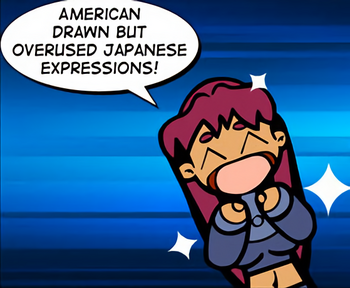
Gansley: It might as well be.
Things that are done in an art style similar to, or use tropes associated with, Japanese anime. Also called anime-influenced animation, Amerime or Americanime (if it's American), Franime (for French things), or faux-anime, animesque works come from a variety of sources. Some are simply non-Japanese creators deciding to mimic the style, while others are genuine co-productions. France and Canada are especially known for cooperating with Japanese producers in this way. In Japan itself, "anime" is a broad term for anything animated (being shorthand for the loanword "animation"), so technically, all of these examples are "anime" whether or not they are classic Japanese-style anime.
Animesque art is a case of a 'full-circle' evolution, because the Japanese anime style was inspired by classical American theatrical animation of the 1930s and 1940s. For example, the big eyes of anime characters were taken straight from such works as Bambi and the old Fleischer shorts — think Betty Boop. The father of manga himself, Osamu Tezuka, was mainly inspired by the style of Carl Barks.
This style was pretty prevalent in the early 2000s due to the international rise of the anime boom in media, with many following the trend. Nowadays, not so much, now that anime is pretty commonplace, though still a design choice for some.
Note that this is about a work's art style, not its storytelling.
Super-Trope to Anime Opening Parody. Compare Disneyesque. See also OEL Manga and Fanime.
Straight Examples
- The Metro Manners series of PSAs are live-action, but the whole concept toes the line between Affectionate Parody and wholehearted embrace of anime tropes. The videos feature a Magical Girl/Henshin Hero protagonist who fights monsters representing rude transit behavior, with lots of Gratuitous Japanese. The visual style is also very anime-inspired, with examples including Super Kind's purple hair, use of anime-style title cards in Japanese, and the use of freeze-frames with Manga Effects, such as a segment where Super Kind freezes, shocked, while white lines radiate out from her face.
- A few advertisements from Canada also do this:
- This
 Recycle Everywhere PSA features not only an animesque art style and animation, but also characters using superpowers that have anything to do with recycling. There's also a white-haired woman that appears to be teaching a teenager on what goes into the blue bin and what doesn't, as well as having the ability to vaporize liquids (Specifically leftover ones) with her eyes.
- A more notable example is Welcome to the Haulerverse, an ad for the Canadian Supermarket chain No Frills. This is what happens if you make an Action Anime that consists of... shopping at a grocery... complete with over-the-top superpowers and special effects to boot.
- This
- Nissin Pasta Express has an ad that aired in the Philippines from 2020-2021 that features an animated mother and her kids working together to prepare the food. Fittingly for Nissin being a Japanese food company, the mother and her kids have a simplistic anime style. Two of the kids also have colored hair, which is associated with anime - the girl has dark pink hair and one of the boys has green hair.
- Taco Bell's "Fry Force" ads of 2021. Not only are they presented as movie trailers, but the entire fictional movie is a spoof of Pacific Rim, which is itself an homage to mecha anime and tokusatsu movies. Taco Bell would later take this up to eleven by publishing a prequel comic drawn and designed to be read from right to left, as many East Asian comics are published.
- Transformers: Generation 1's toy commercials would get shifted from a style more in line with the cartoon (itself falling into this trope regularly depending on episode) early on, to a more anime-looking appearance for 1987's lineup of figures onward (though ironically, not to that of the actual anime released at that time). Of particular note are the ones for the Headmasters, Fortress Maximus and Scorponok.
- Type S: Chiaki's Journey: The series is fashioned as a throwback to 1980s-90s racing anime, such as Initial D, with liberal uses of Japanese writing and phrases. Even if one knew it was an ad, they would probably figure it was another visually elaborate one that comes out of Japan occasionally (Acura is a sub-brand of the Japanese auto company Honda, after all). However, it was produced by London-based studio The Line Animation.
- The North American commercial for Hudson Soft's Xexyz features a version of one of the ridable sea creatures (specifically the fish, though in green instead of the game's red) in animation that looks like it stepped out of a late 1980s mecha OVA title.
- The infamous Beauty and Warrior, while very similar to the Japanese style, was actually made in Indonesia.
- Aachi and Ssipak's animation looks like a twisted Nicktoon with anime influences, like characters nose bleeding and becoming momentarily "chibi-styled".
- The Bat Man Shanghai shorts starring Catwoman have an anime aesthetic mixed with a heavy dose of Wuxia influence. The shorts were commissioned from Chinese studio Wolf Smoke for the DC Nation block on Cartoon Network.
- Barangay 143 is a Filipino basketball cartoon emulating anime-style aesthetics.
- Cupid's Chocolates is, to the untrained eye, virtually indistinguishable from an anime series. The catch: It was produced entirely in China.
- Flowering Heart is technically considered a Korean series, since it's mostly made out of Japan.
- Guardian Fairy Michel is a Korean animation that uses an anime art style.
- Leafie, a Hen into the Wild is infamous for being a sad film with Bishōnen ducks, but is a Korean film.
- Pleasant Goat and Big Big Wolf: With its cute character designs and utilization of facial expression tropes such as Cross-Popping Veins and the Sweat Drop, has a clear influence in anime, though later seasons look slightly more American.
- Happy Heroes: From the same crew who made Pleasant Goat and Big Big Wolf, similarly uses animesque facial expressions on its characters.
- The Chinese series Nana Moon has a brightly-colored, cutesy art style that looks much like a kodomomuke anime, and it uses several well-known anime facial expression tropes.
- Infinity Nado appears to take inspiration from Beyblade with its basic Battle Tops premise, and it has a very anime-looking art style to match.
- The Haunted House: The Secret of the Ghost Ball appears to take inspiration from Yo-kai Watch and Pokémon: The Series about catching the ghost based on Korean mythology.
- Tai Chi Chasers is a Korean animation that was also produced in Japan as well.
- Ur-example: Japonism. Although long before anime, back in the 1860s, Japanese Ukiyo-e prints heavily inspired Western artists of the time. Notably, Van Gogh actually painted two of Hiroshige's works.
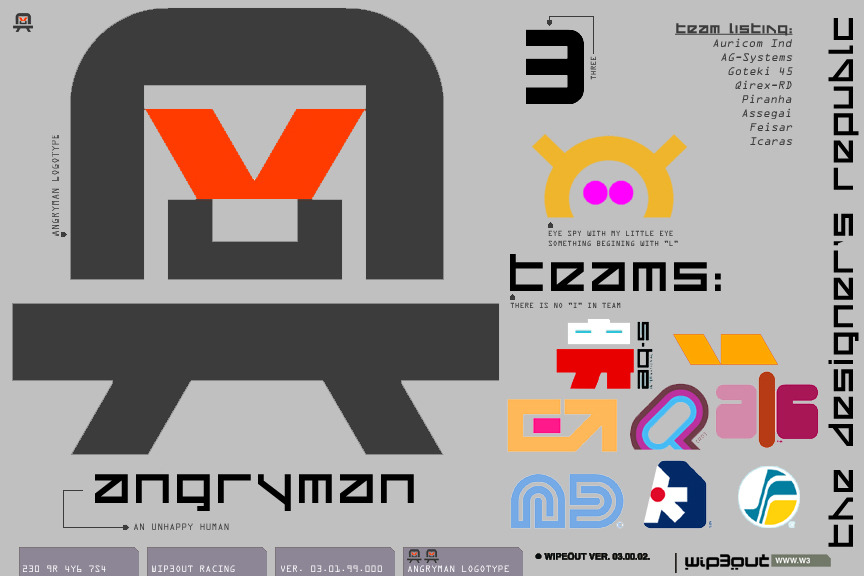
- The works of the British (a northern one, to be exact) design studio The Designers Republic in The '90s codified the◊ usage◊ of◊ this◊ trope◊ in Graphic design (prominently featured on the WipEout series). They turned it into a timeless trend, so timeless that people started copying them. Though they rarely demonstrate this trope anymore, they are still remembered and associated to Japanese-influenced design movements.
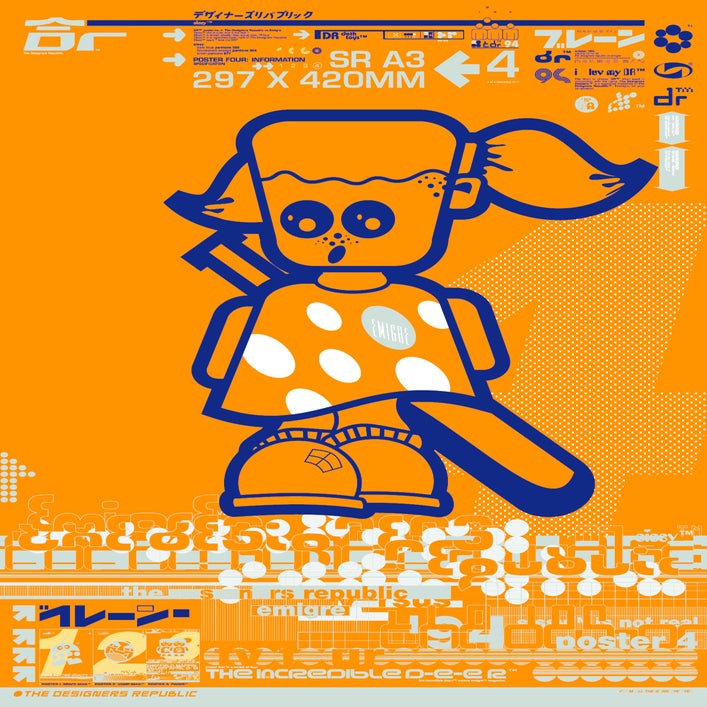
:format(jpeg):mode_rgb():quality(96)/discogs-images/R-139388-1179405286.jpeg.jpg)

:format(jpeg):mode_rgb()/discogs-images/R-8047-1253095693.jpeg.jpg)

- The original card game Magi-Nation was like this, before it got bought out and had change in art style.
- Magic: The Gathering plays this straight often (for example, Chandra, the Firebrand and Jace, Memory Adept. Double points in that there was a special edition version of their original cards drawn by a manga artist released sometime before), but it's averted in the Japan-themed Kamigawa block, which seemed to go more for an art style reminiscent of traditional Japanese art instead of anime. The return to Kamigawa, Neon Dynasty, plays it both ways: actual card art is either the usual Magic style or flat out allusions to traditional Japanese art, including a saga cycle made on classical mediums like carvings; however, the marketing is heavily animesque, culminating in a manga, a Visual Novel and the trailer.
- The style of Sky Doll (especially the side material, e.g. Lacrima Christi or Space Ship) is discreetly, but definitely influenced by the manga style.
- Adam Warren drew OEL Manga years before it became the cool thing to do — or had a name. One of his contemporaries in that sense is Lea Hernandez.
- The title character of Empowered hangs a lampshade on this in a meta-text panel from Vol. 1, lamenting that a manga-styled superhero comic won't have it easy when most manga fans have zero interest in western style superheroes, while most superhero fans hate anything that even looks like manga.
- X-Men was actually drawn by manga creator Kia Asamiya for a brief time in 2002. As well, the art of Joe Madureira, who drew the book from 1994 to 1997, is heavily manga-influenced.
- The Marvel Adventures version of Power Pack by Gurihiru. Like with most other Japanese artists hired to draw American comics, it is just as much an example of them matching our style even in pacing and storytelling.
- Ditto the art of Runaways. But looks less animesque as Art Evolution goes.
- Gurihiru's artwork on Superman Smashes the Klan. In particular, the villain's hair and facial expressions are blatant "Shōnen manga villain" during the climax, which is amusing given his white supremacist motivations.
- Ninja High School was drawn and written by Ben Dunn, an admitted anime and manga addict, and spoofs and/or parodies anything and everything in the genres that it can get away with in its early issues. Later, it settles down into an actual overarching plot, but the parody elements (as well as the art style) remain woven integrally in.
- Gold Digger, another Antarctic Press title by Fred Perry, has an art style heavily influenced by anime/manga, but the artist himself tends to keep the proportions within the art consistent and avoids the common visual gags for the most part. Also, while references creep in from anime that Fred's seen, they're kept company by an equal number of pop culture references from the Western world as well.
- One early example of American graphic novel influenced by manga is Wendy and Richard Pini's ElfQuest.
- The Door Stopper It Takes a Wizard is drawn in manga-style despite not being a "Manga" in definition. (It's even placed in the manga section.)
- Radiant could easily be mistaken for a Japanese series — it even goes on the Manga namespace on This Very Wiki. Valente notes his influence from Akira Toriyama and Yusuke Murata's works, and it definitely shows in his art. He even refers to the series as a Shōnen manga by name. It's also one of the few mangaesque series to fully make the jump to its country of inspiration; Murata endorsed the series when it was translated into Japanese, and Lerche spearheaded an anime adaptation of the series airing in late 2018. Hiro Mashima commented in volume 5 that "while it looks like a Japanese manga at first glance, its slightly bitter tone feels very European."
- James Paterson's novel series Maximum Ride was adapted into an OEL Manga.
- Rockin Raven is very deliberately based on the manga style.
- The art style of Dark Wraith of Shannara, Del Rey's first foray into comic publishing, was meant to emulate manga, but had Western-style panel layout.
- The OEL adaptation of Sherrilyn Kenyon's The Dark Hunters was written by an American, drawn and lettered by Americans, reads and looks like a typical American indie comic, but is formatted in a right-to-left page format like a manga.
- The Dreaming is a comic that is drawn in manga-style by a Chinese-Australian author named Queenie Chan. It's even published by TokyoPop, and is considered one of the first non-Japanese manga series that they published.
- Dork Diaries looks rather animesque, but it's more to give the idea of a girl who is an artist doodling in her diary, and her drawings are actually quite detailed.
- Batman:
- Gotham Knight
- Batman Death Mask
- Batman Child Of Dreams
- Batman: Black and White: "The Third Mask".
- Ape Entertainment's Scarlet Veronica deliberately attempts to blur the line between western comic art and manga art. Typically resembling Thick-Line Animation, characters facefault, sweatdrop, and go chibi as the situation requires.
- Becky Cloonan's work in Demo draws primarily from older indie comics, but steps into anime territory for at least two issues — issue #3 ("Emmy") and issue #10 ("Damaged") both seem heavily manga-influenced. By the second series she seems to have grown fond of the style.
- Chynna Clugston Flores's Blue Monday. The cover of the first volume even has the lead lounging in a giant bowl of ramen!
- Vampirella: There was a sci-fi re-imagining called "Vampi" that was done in a heavy anime style.
- Welcome to Tranquility features an Art Shift to this style in the back-up that gives the skinny on background character Mangacide an extreme Occidental Otaku.
- Ame-Comi Girls is a series based off the popular Anime-inspired toyline. The series stars Manga-styled redesigns of characters such as Wonder Woman and Batgirl.
- UDON Entertainment, best known for Street Fighter and official art for most Capcom projects since 2005. Dozens of artists, most of them Canadian, all of them with clearly manga-inspired styles, the best known of them arguably being Alvin Lee, who handled the series up until Street Fighter II and is responsible for the UDON art found in the Capcom games that use it.
- Monica's Gang:
- There is a spin-off series focus on the teenager audience called Monica Jovem (Monica's Teen Gang). Just compare the normal and cartoony Monica and her friends◊ with her Teen◊ version. The Teen comics are in black and white, while Monica strips were often made with colorful tones. The comics still read left-to-right, though (complete with a last-page notice warning readers of this). Some editions even parodies famous anime like Death Note or games like the Phoenix Wright franchise and MMORPGs in general.
- After the success of Monica's Teen Gang, another printhouse published Luluzinha Teen◊. Yes, it's Little Lulu for teenagers in animesque and yes, that's Tubby Tompkins kissing a Sailor Moon cosplay. For some reason, Animesque comics aimed for teenagers are getting a high popularity in Brazil.
- There is a spin-off series focus on the teenager audience called Monica Jovem (Monica's Teen Gang). Just compare the normal and cartoony Monica and her friends
- Bryan Lee O'Malley's Scott Pilgrim is quite heavily influenced by manga art style. The characters have large heads with big, expressive eyes.
- Seconds (2014). O'Malley specifically stated he wanted to try "70s/80s manga style like Rumiko Takahashi or Izumi Matsumoto" with "bigger hair and 'cuter' figures."
- Godzilla: Rulers of Earth, whenever it's being drawn by Matt Frank, has extremely anime-like designs, especially on the humans. Which is somewhat fitting seeing as the franchise in general is Japanese in origin.
- Ms. Marvel: Jake Wyatt's issues of Ms. Marvel (2014), complete with really adorable Chibi expressions for Kamala.
- Poet Anderson: The Dream Walker
- Sonic the Hedgehog (Archie Comics) went through a period of this from 1996 to about the mid-2000s. Cover artist Patrick "Spaz!" Spaziante was the first to go into this with James Fry and Ron Lim soon after.
- Sonic the Hedgehog (IDW) also invokes this often, especially when drawn by Adam Bryce Thomas, Aaron Hammerstrom, Thomas Rothlisberger, or Ghosts of the Future creator Evan Stanley.
- Archie Comics had a few 'manga style' series in the early 2000s, when anime was gaining popularity in America. Fans hated the artwork however the actual writing in the Sabrina the Teenage Witch comic was praised.
- IDW's Jem and the Holograms (IDW) has a western art style however it does have some manga influences. Jerrica does a Magical Girl type spin when becoming Jem and certain artists use some manga-type expressions.
- Erin Hunter:
- Warrior Cats' graphic novels, despite being American in origin, are called manga, and James Barry in particular has a more animesque style than the other artists. He tends to give cats tufts on their heads, even though cats don't actually have said tufts (and in an extreme example, one had actual hair◊).
- Sister series Seeker Bears also has a few OEL Manga.
- Warrior Cats' graphic novels, despite being American in origin, are called manga, and James Barry in particular has a more animesque style than the other artists. He tends to give cats tufts on their heads, even though cats don't actually have said tufts (and in an extreme example, one had actual hair
- The titles of the short-lived Culture Crash Comics from the Philippines, which includes Cat's Trail, One Day Isang Diwa, Pasig, Solstice Butterfly, and sometimes Kubori Kikiam all featured Animesque designs.
- Also, the Filipino Funny Komiks, which formerly utilized Western comics style, later introduced manga-esque designs by the late 90s or early 2000s. The strip Combatron started the trend, which is the Filipino take on Mega Man.
- The Manga Classics series adapts classic literature into an OEL Manga format.
- Witch & Wizard was adapted into two manga-style graphic novels in 2010-11.
- The Berrybrook Middle School series is drawn in an art style that's recognizably cartoony, but also takes quite a few cues from manga. The series' creator Svetlana Chmakova has drawn OEL Manga in the past (such as Dramacon and Nightschool).
- The Dead Boy Detectives 2005 graphic novel: this Western comic is advertised as a "manga digest" and is drawn in the style of a manga. It's black and white, the characters have oversized heads and eyes, the characters are introduced with hobbies and blood types ("he hasn't got any; he's a ghost!") and hallmark Japanese visual arts tropes like Luminescent Blush and Face Fault are used to indicate the characters' feelings.
- A long running series of Korean Edutainment comic, Why? use art style that influenced from anime. Since each volume drawn by different artists, some the volumes are less-animesque and more leaning to Western Animation influenced style, but still use facial expressions and tropes commonly found in Anime and Manga as well.
- American Chibi of Astro City is an overt, over-the-top example, with an oversized head, large eyes, and tiny body.
.gif)


- The Boondocks has been using an animesque artstyle since its newspaper comics strip days. This is because creator Aaron McGruder says that anime presents the feeling of live-action while still being animation. It also allowed him to get away with Only Six Faces by differentiating only the hairdos and skin tone of a lot of the younger characters.
- InSecurity looks as if it came out of a manga series, from wild-looking Anime Hair, Alertness Blinks, Big Ol' Eyebrows and Visible Silence, to most other Japanese Visual Arts Tropes.
- The newspaper strip My Cage has many of its female characters drawn in an animesque style, though everything else is pretty western. Notable for the fact that its syndicate made a big honking deal about how it will appeal to "manga fans". It appealed to people, just not the massive amounts of manga fans that they were expecting.
- A Christian comic Tract series called The Truth For Youth uses a manga style.
- Beochan: Paisean Agus Aiféala has a little bit of an anime feel in its art style, much like The Powerpuff Girls.
- Holo-Chronicles is, appropriately enough for being based off of hololive, a series with a very clear anime inspiration. Kugeki even lists the specific anime that they reference from in the descriptions of the videos.
- Less Bittersweet gets some anime-ish art style second-hand from imitating the animesque work it's based, on, Doki Doki Literature Club!, particularly the character art. However, there's no attempt to make it into a manga instead of a western comic.
- Pacific: World War II U.S. Navy Shipgirls is drawn in this manner, due to being a KanColle-based work.
- Ark, being co-produced between South Korea and the US, has animation similar to Final Fantasy and wouldn't look out of place when compared to Japanese mecha anime.
- While the Robotech movie Robotech: The Shadow Chronicles is made from original footage, the anime aesthetic of the original series remains. The animation itself is from Korean studio DR Movie, which has worked on anime such as — appropriately — Macross Plus. Being owned by Madhouse also doesn't hurt.
- Little Nemo: Adventures in Slumberland. An adventurous, higher budget co-production with Japan, the style often fell into full anime mode including the sound effects.
- The Last Unicorn definitely has a resemblance to the anime style. The Unicorn's human form could easily be mistaken for a Sailor Senshi.
- Batman: Mask of the Phantasm, being partly animated in Japan, and Batman Beyond: Return of the Joker being entirely so and actively channeling AKIRA. Mask of the Phantasm even includes a short shot-for-shot recreation of a sequence from The Castle of Cagliostro.
- Most of the DC Universe Animated Original Movies have the feel (if not the look) of a typical anime. With entries like Justice League: Doom and Batman: Gotham Knight having been animated in Japan.
- The Transformers: The Movie. Glaringly Animesque visuals by Toei Animation made even more noticeable by the TV series switching from Toei to AKOM immediately afterward.
- Technotise Edit I Ja is clearly anime-influenced in both style and subject matter, the first Serbian film to be so.
- Ever since The Little Mermaid was released into theaters in the late 1980s, at the same time anime was beginning to show up in the United States, many of Disney's later films started to incorporate anime-influenced elements into their character designs, particularly the size and shape of their eyes. Just compare Snow White's eyes with those of Tiana's!
- The Cars Japanese cars and scenes in Japan lean into anime-ish, with the size and shape of the eyes, Gratuitous Japanese phrases being tossed around, and a drift race involving literal Car Fu with ninjas.
- Bolívar, el Héroe: The designs are drawn in manga style to appeal to younger audiences, since anime series like Saint Seiya and Dragon Ball Z were quite popular then.
- The Mexican film The Guardians of the Lost Code
- Poet Anderson: The Dream Walker is influenced by anime with its character designs and fluid action, though there's still western animation design cues in the characters. Interviews with the creators show it's intentional and classics like AKIRA were cited as influences.
- South Park: Bigger, Longer & Uncut naturally spoofs anime with the Dragon Ball Z-esque battle between Cartman and Saddam near the end, complete with motion lines and odd camera angles. It even uses genuine DBZ sound effects.
- Exchange Student Zero revolves about two students from Australia who frequently play with cards from a card-based anime. A series of events brings one of the game's characters, Hiro, to life, with more joining him as the movie progresses; as a result, the animation is a mix of the Western-styled "real life" characters, done in simple Thin-Line Animation with Black Dot Pupils, and the anime-based card characters, who have Big Anime Eyes and are more detailed with robust shading.
- Joy, the protagonist of Inside Out, is designed to look like characters from Japanese cartoons or anime. This is due to the size of her big eyes, hair color and cut, nose style, tall and thin figure, and mainly her face seen in profile, something common in female anime characters.
- In 2, Envy is now added with these same anime features. Even she has the added bonus that her eyes fill with sparkle when she wants what others have.
- The character Peni Parker a Japanese/American Spidergirl from Spider-Man: Into the Spider-Verse is designed and animated this way, the creators citing Sailor Moon as an inspiration for her.
- The Scooby-Doo films Scooby-Doo on Zombie Island, Scooby-Doo! and the Witch's Ghost, Scooby-Doo and the Alien Invaders, and Scooby-Doo and the Cyber Chase have an animesque look to them, as they were co-produced by Mook DLE.
- Turning Red pays a lot of homage to anime, as the director is an anime fan. There are a good amount of cartoony and exaggerated anime expressions on the characters' faces, like sweat drops, sparkly eyes, Playful Cat Smiles and rivers of tears. Also, Mei draws a boy she is crushing on in an anime style in her sketchbook. Fittingly, the movie takes place in the early 2000s, when anime was enjoying a surge of popularity in North America.
- Speed Racer was described as "the first live-action anime", and it certainly fits, with Speed Lines, the mecha-like Car Fu, and Speed clearly being a Hot-Blooded hero. A parody of Fist of the North Star also appears in the show.
- The story of O-Ren Ishii from Kill Bill Volume One had a portion which was an anime-style cartoon paying homage to — of course — anime.
- Brick is created with the same shot composition and editing an anime would have. Brendan's looks are also based off Spike Spiegel.
- The story of Pacific Rim The film takes a great deal of cues from Super Robot Genre anime, as well as Toho Kaiju films. This was probably the idea behind the over-the-top characterization, including a hot-blooded rival.
- Between Stephanie's male fans and pink hair, and the cartoony world, non-fans have mistakenly assumed that LazyTown is Japanese or influenced by anime.
- Super Sentai and Power Rangers:
- Bachsfundo/King Mondo of Chouriki Sentai Ohranger/Power Rangers Zeo has Cross-Popping Veins on his face.
- Hikonin Sentai Akibaranger airs at Otaku O'Clock and has heroes with Anime Hair molded into their helmets, and female characters are constantly subjected to Panty Shot upon Panty Shot.
- Kirsten Dunst covered "Turning Japanese", and the music video is her in a magical girl-styled dress, dancing around Akihabara.
- The official video clip for Madonna's "Give Me All Your Luvin'" features cheerleaders wearing Anime-style masks and clothes similar to Sailor Fuku.
- The Swedish Power Metal group Twilight Force made their music video for "Sunlight Knight" in the style of an old-school JRPG with an anime style to match.
- The music video for the Salvatore Ganacci single Fight Dirty is basically the pilot episode of a shonen anime, played almost completely straight, ultimately revealed as the imaginings of a pathetic version of Salvatore himself.
- Anima: Beyond Fantasy is a Spanish rpg that clearly shows its JRPG video game influences. Along with Ki Manipulation as a source of power, the artwork and classes are more along the lines of Final Fantasy as opposed to TSR-era Dungeons & Dragons.
- Warhammer 40,000:
- The Tau are said to be designed to appeal to anime fans. The reception was and still is mixed. This may have less to do with Japanese influence, which is largely present only in their rather Macross-inspired Battlesuit designs and more to do with their perception as a "good" race by many players in a setting famed for its Grim Darkness. The Tau philosophy is also as much or more Japanese than it is Chinese, specifically WWII-era "Greater East Asian Co-Prosperity Sphere" expansionism. The "mecha" design of their battlesuits, vehicles, and power armour is clearly of Japanese pop-culture origin, with a substantial aquatic-form influence.
- The Eldar are more Japanese-inspired, though the post-Rogue Trader Eldar were explicitly based on organic forms, with an increasingly heavy Art Nouveau influence as the designs evolved.
- Big Eyes, Small Mouth is an open-ended anime RPG, made in Canada. There were a few series-specific books, in case you wanted to roleplay Tenchi Muyo! for some reason, and you could certainly ignore its anime theme and use it for anything you wanted, but the main appeal behind the game is in roleplaying your own anime series.
- Chuubo's Marvelous Wish-Granting Engine has most of its artwork being of the animesque "big eyes small mouth" look for its inhabitants. Rather than a conflict intensive focus of most rpgs (though the game is equipped for that), the first genre that the game explores is pastoral slice of life a la Studio Ghibli movie.
- Fabula Ultima from Need Games has a preface that homages Bravely Default, Ni No Kuni, Final Fantasy and etc. as it's writers are huge fans of JRPG video games and it shows. Artwork has requisite Zeppelins from Another World as well as Ghibli Hills and plenty of characters with gear out of Final Fantasy 14 rather than real-world Medieval Europe.
- Kingdom Death, the monsters are pure Dark Fantasy. Humans though, especially the females, all have childlike faces with large eyes. And when they're not being scantily-clad then they're wearing Monster Hunter-style armor.
- Red Dragon Inn features Witchdoctor Natyli, who is a troll and the niece of another character, Phrenk. Phrenk and the rest of the ever-growing cast of playable characters have more Western-leaning art. Natyli has much larger eyes than the rest of the crew, and is pretty clearly meant to be the game's Cute Monster Girl.
- The supplement Mecha and Manga for the 2nd edition of the Mutants & Masterminds roleplaying game provides rules for playing anime-styled games, with tons of nods throughout to various existing anime and manga, and naturally its artwork is very anime-inspired, contrasting the distinctly Western superhero-inspired aesthetic of its usual artwork.
- In contrast to the Steampunk aesthetic of the other WARMACHINE factions, the Retribution of Scyrah has a distinctly Magitek feel, with lots of flowing shapes, shining white surfaces, and glowing blue-green Tron Lines. Their myrmidons, the equivalent to other races' steamjacks, bear more than a passing resemblance to the mecha in The Vision of Escaflowne, and many of their characters have spiky hair dyed in bright colors.
- Gnomes in Pathfinder artwork often abandon the traditional Western style used on other races for a more animesque style, with overly large eyes, small noses and small mouths. Their lore states that this is actually how they can look in-universe... where people often find it more disconcerting than cute.
- LEGO:
- LEGO Exo-Force was LEGO's take on anime and the Humongous Mecha, replete with very exaggerated Shonen Hair, random kanji slapped everywhere, typical Japanese names, and a heavy dose of anime and mecha-genre tropes.
- In the same vein, Ninjago focuses on Ninjas with a bit of mecha thrown in here and there, most notably the Samurai X mech and various Serpentine vehicles. It's a little more subtle about it in that it limits itself to Shonen Hair and kanji is few and far in between. The names also reflect a much larger variety, with only Kai, Nya and Misako being anywhere close to Japanese. It still uses a lot of anime cliches, such as magical weapons, power-up transformations, color-coded chosen warriors and the aforementioned Shonen Hair. It also mixes several other Asian themes into it as well, most notably Sensei-Wu, who appears more Chinese than Japanese.
- Afterimage is a Chinese-made game, but with an anime art style, best seen in promotional material and in the designs of characters such as Renee.
- ANNO: Mutationem: The character designs have elements with notion to anime, particularly unique expressions and animesque traits that have detailed highlights and settings rendered in stylized detail. The Mystery Console DLC is also presented in a Super-Deformed-style gameplay.
- Phantom Dust was made by Microsoft to sell in Asian countries, then ported back into America later. The theme, character design, and plot all mimic common Anime and Manga attributes. It was unsurprisingly much more popular in America than in Japan.
- Shogo: Mobile Armor Division, an early FPS from Monolith (the first to use their LithTech technology), heavily influenced by mecha anime.
- Gekido: Urban Fighters: While the characters are drawn in western comic book style, the storyline and aesthetic are evocative of late 80s and 90s cyberpunk anime.
- Tsunami 2265, a third person shooter aboard mechas produced in Italy. The female lead looks a lot like Motoko Kusanagi.
- Oni is heavily influenced by Ghost in the Shell.
- FusionFall redesigns the Cartoon Network characters appearing in the game with an animesque look. The series even has a short, official prologue manga.
- Puzzle Quest also uses anime-like style for its characters.
- Genshin Impact was designed and developed by miHoYo (currently doing business as Hoyoverse), a mainland Chinese company, but opts for a full-on anime art style that could easily get it mistaken for an actual Japanese-developed game. This holds true for their other works as well, including Honkai Impact 3rd, Honkai: Star Rail, and Zenless Zone Zero.
- Drawn to Life. Despite all appearances, it had no Japanese involvement in development. 5th Cell seems to be an animesque company.
- Little Red Riding Hood's Zombie BBQ, a game from Spain! One of the main characters is from the Japanese folk tale Momotaro.
- Shantae, a side-scroller for Game Boy Color made by the American developer WayForward Technologies. The first game's Commodore 64-esque soundtrack betrays its Western origins, though. Bonus points for hiring Japanese developer Inti Creates for Pirates' Curse and Half-Genie Hero. Shantae and the Seven Sirens takes it even further by featuring anime-style cutscenes animated by Studio TRIGGER.
- BloodRayne: Betrayal, also made by WayForward, utilizes an anime-like artstyle.
- Vitamin Connection takes it even further by having an actual Japanese singer for its insert songs, and includes a Japanese language option!
- Fantage has a very anime-inspired art style.
- Jitsu Squad have its art style looking like some ninja anime from the 90s.
- Spectrobes: From its main character being a Captain Ersatz of another certain red Badass Longcoat with a sword arm to having cutscenes rendered similar to another Jupiter game, The World Ends with You, it fits.
- Troublemaker, an Indonesian game, has cutscenes rendered in manga-esque graphics.
- During its development, Jet Force Gemini was inspired by several science fiction works, including the anime series Science Ninja Team Gatchaman, hence the character designs for Juno, Vela and to a lesser extent Lupus, specifically their anime-style eyes and the humans' space suits. In particular, Juno's helmet is modeled similarly to that of Ken the Eagle, while Vela's skimpy wear mimics that of Jun the Swan. At one point in the game, their suits are upgraded with Jet Pads to fly in certain places, similar to the Science Ninja Team when gliding with the Bird Style. And each time the player resumes their playthrough, the character selection has the heroes preparing to eject from their mothership into the site of action, similar to when the Gatchaman characters prepare to head into the current episode's place of conflict.
- Katana ZERO: The game itself doesn't look like this, but look at any of the official art and it becomes immediately apparent.
- One Must Fall 2097, a fighting game produced by Epic Games in 1994, well before anime had a large fan base in the US, had its characters drawn in this style.
- Jak and Daxter, although the only noticeably "animesque" thing in it is the character design.
- Black Sigil, whose battle system has a very strong Chrono Trigger vibe to it. It's nostalgia fodder for SNES JRPGs.
- The box art for Fable is rather animesque, to the point where you could be forgiven for assuming it's an Eastern RPG. The in-game graphics however are much more western looking, and later games' box art more closely resemble the in-game graphics.
- The Caverns of Hammerfest contains a few animesque traits, what with the blurred-feet running animation for Igor and the little dance he might do after you idle — the latter being is a homage to Haré+Guu.
- X-Blades has a protagonist named Ayumi, and she is rendered in Animesque style. The game was created by russian game developer Gaijin Studios (Gaijin means 'foreigner' in Japanese) Its sequel, Blades of Time, jumps on current marketing fads and largely dumps the aesthetic, resembling a Tomb Raider game where a vaguely anime Lara Croft runs around with blonde twintails.
- Dragon Age II: Elves got an overhaul to look more like their Japanese counterparts, with long pointy ears, huge eyes, smoothed-out facial features and skinny bodies, including the token Anti-Hero companion.
- Asura's Wrath, with manga style recaps, and is episodic like an actual anime, Eyecatch's included. Critics even referred to it as an "Interactive Anime".
- X-COM: UFO Defense has an animesque intro and the background images for Base functions and the Hidden Movement screen retain the art style of the intro.
- In League of Legends, a few champion designs and some champion splash arts have a noticeable Eastern influence — one big difference between this game and its nearest rival game Dota 2 is that Dota 2 looks more like a Western RPG, whereas League looks more like a JRPG. League as a whole is still distinctly a western game, but it still likes to integrate a few anime references in many of its designs/quotes/storylines, as well as in several non-canon skins, most prominently the Super Galaxy and Star Guardian lines.
- Apidya, with its Japanese-style intro scene, was produced by Kaiko, which was a German company despite its Japanese-sounding name and the large amount of Gratuitous Japanese text in their earlier Puzzle Game Gem'X.
- The WipEout series is Britain-developed, yet incorporates Japanese◊-influenced graphic art◊, courtesy of the Designer's Republic. The third game even has a mascot that is clearly based on cute mascot characters. Some entries even feature the usage of Katakana.
- Yandere Simulator plays with many anime tropes such that it's easy to mistake it for a Japanese game. The game's roots instead stem from a FourChan concept given life when interest was indicated for it.
- Carrie's Order Up! uses big eyes and a bright, colorful style that does an amazing job of recreating the look and feel of '90s Japanese arcade games.
- In TitanFall2 Is more apparent than the first game. The setting, the more outlandish Titan designs and abilities, the use of the Pulse Kunai, shurikens in the grenade slot, subtly more bizarre weapons such as the Alternator, Jack being a rookie who fell into the cockpit, and the over-the-top action certainly give off the vibe of a mecha anime at times.
- Undertale: Invoked; in the True Final Boss fight, the psychedelic background, the music, and the name of his attacks and the calling of them just screams cliched JRPG, but it's because he thinks anime is rad.
- RWBY: Grimm Eclipse, an adaptation of RWBY, looks a lot like a Japanese hack and slash game. So much so, apparently, that Sony put it into their "Straight From Japan" special category of the PlayStation Store.
- Wonder Boy Returns, produced by a South Korean company, has cute Super-Deformed characters.
- Indivisible, much like Shantae and the Seven Sirens, had its intro animated by Studio TRIGGER.
- A Hat in Time has cute character designs with large eyes, anime-style expressions, and speed lines are used frequently.
- No Straight Roads uses a highly-stylized art style with a slight anime influence that's most obviously seen in the 2D animation cutscenes. One particularly strong case is the Virtual Celebrity Sayu, who is deliberately designed to be a cutesy anime Genki Girl with Idiot Hair.
- Haven (2020), by France-based developers The Game Bakers of Furi fame, has an art style and storyline that could be straight out of a Hayao Miyazaki film (the protagonists even have Asian-sounding names), and gameplay highly inspired by Japanese RPG's such as Persona. Bonus points for the Attract Mode and end credits cinematics being produced by an actual Japanese animator.
- Forgotton Anne is a Danish adventure game whose style and themes are clearly inspired by Studio Ghibli films.
- Metal Warriors: The first cutscene's style and some of the Mech Suits are inspired by old mecha anime such as Mobile Suit Gundam. Since the game's conception was inspired by that of Assault Suits Valken (a Japanese game with similar Mecha designs and motifs), this makes sense.
- Need for Speed Unbound is the first installment to features Japanese-style aesthetics combined with Cel Shading effects, making those characters look like they came out fresh of an anime.
- Switchblade, being released in 1989 for the Atari ST by the British creator of Rick Dangerous, is one of the earliest examples of this trope. Its sequel Switchblade II for Amiga is even more clearly inspired by manga and anime, especially notable in the portrait of protagonist Hiro on the cover.
- While initially leaning towards more inspiration from Western Animation, Frebbventure begins to slide hard towards this trope towards the end.
- Heroes Evolved features a variation: There are several heroes who would fit the trope when the country is changed from Japan to China. These heroes have their arts modeled after Chinese manhuas instead of Japanese mangas, and while there are some who speak English, a lot of them also speak exclusively in Mandarin.

- Katawa Shoujo is a Western attempt at making a Japanese-style Visual Novel, complete with anime-style artwork. The art style is because the original art that inspired the game was Japanese. Some people saw a Japanese artist's drawings for a visual novel he'd like to see one day and decided to make it an actual visual novel. It succeeds at emulating Japanese anime/manga and Visual Novels so well that a good amount of fans were actually surprised to hear that it wasn’t made in Japan.
- Zig-zagged with don't take it personally babe, it just ain't your story. While it is a Western-made visual novel, its background CG art and character sprites are used ready-made from a Japanese designer that specifically makes them available for amateur visual novels. The AmieConnect avatar pictures and event CGs, though, are drawn by a western artist in animesque style, but with still a heavy western feel. The transition is actually slightly jarring.
- Anything by the infamous "Winged Cloud", usually their visual novels are prefixed "Sakura".
- Everlasting Summer was developed by Russians, was originally written in the Russian language, and is primarily set in the former Soviet Union. But both the gameplay and character design seem straight out of a Japanese visual novel.
- Milk inside a bag of milk inside a bag of milk is a Russian-made visual novel with a very minimalistic pixelated style. Its sequel, milk outside a bag of milk outside a bag of milk, begins with an animated intro that recaps the whole first game, and is rendered as an anime episode complete with a Japan-esque style (owing to Neon Genesis Evangelion and Serial Experiments Lain), yellow subtitles and odd camera angles.
- Missing Stars is an English language visual novel that has animesque character designs. It is a Spiritual Successor inspired by Katawa Shoujo set in a European school. The finalized art is a bit more western than the early concept art, however it is still animesque.
- NomnomNami's characters are usually drawn in a particular anime style. This style can be seen in her tears were my light.
- Extracurricular Activities is a Western novel where the facial expressions and gags are anime-influenced, as well as the novel borrowing from the Harem Genre where instead of cute girls, the love interests are hulking anthropomorphic men. In early 2018, the novel switched over to a new artist where the art direction became less animesque.
- We Know the Devil is another Western visual novel with character designs largely grounded in reality, but with clear anime influences. Most pronounced in the case of Venus, who has big round eyes.
- Heaven Will Be Mine is made by the same team as We Know The Devil and not only has the same artist but is a Mecha series with heavy influence from Gundam.
- Doki Doki Literature Club! is a School Club Story with typical Japanese high school girl archetypes and a moe art style. It was developed by an American team lead by Dan Salvato, who is also a developer and pro player of Project M. This is part of its Affectionate Parody/Deconstructive Parody nature; even the dialogue is written to sound like it's badly translated from Japanese, and there's a fourth-wall-breaking joke that implies it is so translated, even though it's not. Except it eventually becomes very creepy, but keeps the art style.
- VA-11 HALL-A looks like an anime visual novel that's really deep in the PC-98 aesthetic, but the game was developed in Venezuela.
- A Summer's End — Hong Kong, 1986 is a Visual Novel developed by Studio Oracle and Bone, a team based in Canada, but it takes a lot of aesthetic cues from anime of The '80s, such as City Hunter and Kimagure Orange Road. In one post from the official site, the artist names the art of Haruhiko Mikimoto, Akemi Takada and Akihiro Yamada as some early artistic influences.
- Bee and Puppycat is very obviously inspired by shoujo anime both thematically and stylistically. Bee specifically is reminiscent of Usagi in that she is a Loser Protagonist and becomes a Magical Girl who fights in space after she meets a cat (dog... thing.) Character design falls short of just being anime altogether.
- Many of the early BIONICLE web animations had shades of this. The character models were very faithful to the sets, but they would occasionally include things like Sweat Drops, Blush Stickers, and stylized motion-blur backgrounds for action sequences.
- The Machinimas Brawl Universe and Smash King tend to heavily lean on the side of anime with how their episodes are filmed and edited, as they tend to use EyeCatchers, Japanese Opening/Ending themes as well as Cold Openings, and their action sequences do borrow from anime with the Effects of White/Black spikes surrounding the screen if something dramatic happens, as well as sometimes using transformations in battles.
- Broken Saints: This was more notorious before the Animation Bump, with the first episodes being redone in a more realistic style. However, it still had some visual influence from anime.
- CAPTAIN YAJIMA, a short film made by Ian "Worthikids" Worthington of BIGTOP BURGER fame, is an interesting example. The short was animated in Blender, and evokes a distinctive Will Vinton-meets-Rankin/Bass stop-motion aesthetic, but the character designs and expressions are heavily inspired by anime. To add a layer of authenticity, the voice acting is done entirely in Japanese, and provided by RASH A1M, the same Japanese dubbing team that worked on the Japanese dub for BIGTOP BURGER.
- Dreamscape: Anjren and Ahjeen are animesque in terms of expressions, oddly enough.
- ETU - Animated Stories uses an animesque style in their later videos. They even have animesque expressions.
- gen:LOCK uses the same "3D animations that look like 2010s anime" schtick as fellow Rooster Teeth property RWBY. However, the animation content is quite different; taking cues from Gundam, gen:LOCK is essentially a Western mecha anime.
- Muffin Songs, a YouTube channel for children, uses a style reminiscent of anime for its earlier videos, as well as some Japanese Visual Arts Tropes. For example, on this video, Cinderella's face looks like it's drawn in the Puella Magi Madoka Magica art style, and she wears ribbons that are nearly identical to Haruhi Suzumiya's.
- Nyan~ Neko Sugar Girls is perhaps the most infamous example of this trope on the Internet. Basically, it's Animeland on acid.
- The Red vs. Blue: Animated pilot uses a beautiful and extremely fluid animesque style. Sadly, differences between Rooster Teeth and the group who animated it prevented them from going any further with this. Until Season 14 anyway, where it was made canon and received an extra scene at the end.
- My Story Animated has several videos with varying degrees of animesque and use anime-inspired expressions.
- Rune Adventure by Anima Cartoons is a curious case of animation based on animesque style. Aside from the superficially similar visual art section, it takes fanservice to another extreme by not only giving the female protagonists (they are all moms) large, inflated breasts but also exaggeratedly giant bubble butts that please the malegaze of the male protagonists.
- RWBY by Rooster Teeth is an interesting example of this, with everything about the series looking like a 2010s anime, complete with chibis and various animesque expressions... except that they're 3D animations, making them appear like a series made of cutscenes from a post-Oughts JRPG or a 3DCG show by Sanzigen Animation. It actually does a good job on turning those anime gimmicks 3D, and is able to mix in some Western animation tricks as well. Hilariously, when it was uploaded to Crunchyroll, some people started demanding for the "original" Japanese audio, apparently not realizing that English was the original language (although it received a legit Japanese dub later on). While most of the cast placement and angles appears to be a mix of the Machinima style and soap operas, the fight scenes show Monty Oum's signature mix of anime and Kung Fu/Wuxia choreography norms with western martial arts. It apparently did a good enough job of keeping to Japanese tropes, as the series was popular in Japan and ended up getting official manga adaptations — one by Dogs: Bullets & Carnage artist Shirow Miwa, and another as a 4-volume anthology series — and, eventually, an actual anime adaptation in the form of RWBY: Ice Queendom, a collaboration with Studio SHAFT.
- TIE Fighter is a fanmade Star Wars short animated in the style of '80s anime.
- Wolf Song: The Movie has anime like facial expressions sometimes, as well as sweat drops and pulsating veins during instances of anger. It does however switch between this and a more generic cartoonish style a lot, yet this style is more common whenever there isn’t a fight scene. Oh, and the dialogue can resemble anime dialogue at times (English dubbed anime dialogue that is)
- '32 Kick-Up is a Fighting Series that combines Manga Effects with Inkblot Cartoon Style Funny Animals.
- 9th Elsewhere has some anime influence, probably because one of the authors lived in Japan for a time while working on it.
- Aki-chan's Life is purposefully modeled after Doujinshi, despite being obviously Western, to the point where all the panels are read right-to-left.
- Alien Hand Syndrome has detailed black and white (sometimes color) Manga-style artwork, complete with coarse half-tone screening, but reads from left to right.
- A Miracle of Science lampshaded its influences by citing them in The Rant and stealing their onomatopoeia.
- Angel Moxie is another webcomic heavily influenced by the Magical Girl genre, and using the Yonkoma format.
- As a comic written for an Anime news website, it was unavoidable that Anime News Nina was this.
- Aqua Regia has a very obvious inspiration on the trope, bonus points for being published in INKR, which is more or less Kodansha's second official portal for manga and sharing the spot with it's inspirations on the site to read legally. Despite being in English, it's based on Argentina and translated from Spanish.
- The Beast Legion is very Anime/Manga inspired.
- Bedlam Genesis is done in this style.
- Beloved L is a Chinese webcomic but has been mistaken for a Yuri Genre manga (or manhwa) due to its art style.
- Beyond Bloom is a OEL Manga-type webcomic. Characters are drawn with a heavy manga influence mixed with a more western styled roundness.
- Blue Sky mimics manga tropes in much the same way as Project 0.
- Cat Nine from cat girls to its relatively simplistic style. Plus, it's based somewhere in the Philippines.
- Dave Cheung's Chugworth Academy and Boss Noodle are anime influenced, seeing as they are so risqué...
- City of Trees draws clear inspiration from early-2000's anime and manga.
- Claude & Monet has a heavy manga influence.
- Coga Nito: The comic's overall style is manga-like, particularly in the character designs.
- Collar 6 and its Spiritual Predecessor, Crimson Latex, both fall well within this trope.
- Consolers features many characters drawn in an anime-ish style, and often uses Japanese Visual Arts Tropes.
- Cross Heart is a manga, except it was written by a Spanish author, originally in Spanish and English, and published for free on DeviantArt.
- Crystal Heroes has a somewhat 70s/80s shoujo art style to it as well as using several manga visual tropes.
- Danger Zone One employs a visual style specifically drawn to appear like a manga.
- Demon Candy: Parallel is drawn in a Yonkoma fashion.
- Devil's Candy mixes manga-esque art with typical Western settings. Fitting, since the duo behind the series were veterans in the OEL Manga scene and got a one-shot of theirs published in Shonen Jump.
- Dominic Deegan's style has been described as being on the cheap end of animeshun.
- The Dreamcatchers Masquerade uses an anime-influenced art and animation style.
- Earthsong is a Fantasy Webcomic with manga inspiration.
- El Goonish Shive's visual style has always been anime-inspired, and grown more so over time. The series leans heavily on anime tropes as well, both for humor and as serious plot points. Notably, it is explicitly mentioned several times that blue, purple, pink, green, etc. are common natural Hair Colors in The 'Verse.
- FireSoup uses a couple of related tropes and quirks, such as characters sometimes having pink, blank mouths, Frida having a single sharp tooth when opening her mouth, and Ramy giving a Sweat Drop when Bett told her why she pranked her.
- Furry Fight Chronicles is read like a western comic, but the art style and setting is similar to manga in terms of design thanks to the use of certain gags and frequent Gratuitous Japanese.
- Galebound is influenced by anime and manga, although it is read from left to right. The character's expressions occasionally veer into animesque when properly flabbergasted.
- Ghastly's Ghastly Comic gleefully parodies the Ecchi/Hentai genre, especially the tendency for absurd tentacle groping. The art style itself becomes more and more Animesque, and better-looking, over the course of its Art Evolution.
- Gorgeous Princess Creamy Beamy is a parody of Magical Girl anime, and drawn in an anime-influenced style even though the author is American.
- Tom Siddell, author and artist of Gunnerkrigg Court, cites Battle Angel Alita and Nausicaä of the Valley of the Wind as artistic influences, alongside Western comics like Hellboy and Tank Girl. He incorporates elements from all of them into his own art.
- Grey is... describes itself as a manga and reads from left to right even though it's written in English.
- Gun Kitty has an art style clearly influenced by anime, including Spiky Hair and bouncy boobs just for good measure.
- Hand Command is an Arabic comic drawn manga-style and published in both Arabic and English.
- Harpy Gee uses a rather cute version of this.
- Heartcore. The author has listed Slayers as a major inspiration, and it most definitely shows.
- While most of Homestuck is drawn in its own unique style, quite a few anime and video game tropes show up in the story, the GIF animations, and especially the more elaborate Flash animations, leading to a running joke among the fandom that "Homestuck is their favorite anime". This came to a head when Act 7 was released, which was hand-drawn anime instead of the usual style of Flash animation.
- Starting from Iron Violet: The Shy Titan's second issue onwards, it featured many typical anime-styled art tropes, like face faults and chibis. The huge detailed eyes is also massively anime.
- A major Creator Thumbprint of Jocelyn Samara, whose artstyle is manga-inspired:
- Rain (2010) features plenty of anime tropes and its title character is an Occidental Otaku (who Jocelyn has described as such).
- My Impossible Soulmate is a romantic isekai with an otaku protagonist, and heavily features tropes from both genres.
- Rain (2010) features plenty of anime tropes and its title character is an Occidental Otaku (who Jocelyn has described as such
- Kuro Shouri is inspired, both visually and in story, by anime of the 90s and 00s. It has taken some cues from Western works over time.
- L33tStr33t Boys is about a band based on a group of Otaku, done in anime style.
- Lily Love is Thai and not Japanese. However, it takes several aspects from Yuri Genre manga, such as the artstyle and chibis.
- The Lounge has considerable manga influence, both in artistic style as well as the art gags and tropes common to manga.
- Mexican artist Kanela gave M9 Girls! a definite manga look, complete with chibi panels and manga annotations. Current artist Shadow continues with a more cartoony anime look. The story itself is the Mad Science version of the Magical Girl genre.
- Animesque style isn't reserved to English-language webcomics. Here's a popular French example: Maliki. With one strip directly referencing its many influences, several of them from anime.
- Mechagical Girl Lisa ANT. Even though Ida Kirkegaard is Danish, the drawings are something like distorted manga-style drawings.
- MegaTokyo is the archetypal example of this trope in the world of webcomics, even going so far as to take place in Tokyo and be a fantasy/dating sim storyline. The comic has become one gigantic deconstruction of the most popular genres of anime, complete with a disaffected Magical Girl who can't really use her powers the way she thinks a magical girl should (meaning, like Sailor Moon).
- Misfile has a major manga-esque influence, with scarcely a strip going by without a super deform, chibi, or the omnipresent egregious Sweat Drop making an appearance. Even Rumisiel's T-shirt gets one of those at one point.
- Monsterful: A Slice-of-Life Webcomics of a monster-only world that shows a moderate manga influence, but it's well balanced with western influences and completes the circle with multiple video-game and internet references from both Eastern and Western markets.
- Mutant Ninja Turtles Gaiden, a Teenage Mutant Ninja Turtles fan-comic, which has its human characters drawn in a manga style.
- Nightvee: Characters have large eyes and often make anime expressions.
- No Need for Bushido parodies elements from anime/manga set in feudal era Japan.
- The Noordegraaf Files hits this on the head, linking this trope's page on the comic's homepage, and the creator has said in The Rant that it is drawn and colored in a Japanese paint program made for, you guessed it, making manga.
- Overlord of Ravenfell is stylistically influenced by older CLAMP manga and Yoko Matsushita, so definitely falls in this trope.
- Pandora's Tale uses a very cutesy anime aesthetic, especially noticeable on the Helpers.
- Paranatural:
- Isaac frequently dips into this, highlighted by his allegedly natural spiky hair and brooding, dramatic personality. It's made much funnier by the fact that only this one character is ever drawn with anime eyes or floating sparkles. The other characters (mostly Max) react accordingly. The readers do as well; Isaac doing things such as turning dramatically, or walking with his eyes closed and a smile while light shines on him from no apparent source spawns comments such as, "Isaac is being awfully anime today. He should probably get that looked at."
- The Hitball arc is generally described as the time the comic "went full anime", with impassioned speeches, lots of Talking Is a Free Action, and everyone taking the whole thing way too seriously. Every single bit is of course mercilessly lampshaded.
- Picatrix is another webcomic with a heavy manga influence.
- Powerpuff Girls Doujinshi, Grim Tales from Down Below, and Sugar Bits (created by Bleedman) are heavily influenced by anime, in their art and storytelling.
- Invader Zim: Manifest Doom, another webcomic published by SNAFU Comics, has an animesque touch.
- A lot of what SNAFU Comics puts out falls under this category.
- Invader Zim: Manifest Doom
- Princess Chroma is a Deconstructive Parody of Magical Girl stories.
- Project 0 is usually described as an American Manga. Written by a duo of brothers and takes a lot of the more cinematic and dynamic aspects of manga from a visual perspective, but not in terms of anime clichés and sweat drops.
- Rational Nonsense is a mash-up of manga and newspaper comic art.
- In Ronin Galaxy the cover art resembles anime, and the actual pages are made to look like a manga, despite being read from left to right.
- Roommates and its spin offs, Girls Next Door and Down the Street, (the latter to a lesser extent) have a lot of manga influences. However, the Art Evolution of the first two seem to slowly diverge from this style in different directions: Roommates gets more and more realistic, while GND slowly shifts towards the style of Franco-Belgian comics.
- Rusty and Co. grew into this style with its Art Evolution, especially in the design of female characters.
- Sailor Ranko is an adaptation of Ranma ½/Sailor Moon crossover fan fiction. The art style imitates the source material pretty well.
- Sandra and Woo is a mixture of this and western comic stylizations.
- School of Mages is drawn in a manga style, and it is even read from right to left.
- Shadownova is drawn with a somewhat Animesque style. The author is heavily influenced by anime and manga.
- Shotgun Shuffle has Cross-Popping Veins, nose vanishing, sweat drops and many other anime tropes.
- Sleepless Domain uses a western art-style but it is an anime-inspired webcomic involving Magical Girls.
- Slightly Damned is very anime inspired. Not only are characters drawn in anime style, but the comic also uses a lot of Manga Effects and has several anime and Japanese video game Shout-Outs. The appearance of demons, dragons, other fantasy creatures in Slightly Damned seem to be heavily Pokémon inspired, as the creator draws a lot of Pokémon Fan Art.
- Some anime-like designs are used for the Sluggy Freelance storyline "GOFOTRON Champion of the Cosmos", with Riff even describing one of the alien species they encounter as "blue, anime-looking people."
- Sodium Eyes takes notes of many anime clichés.
- Sparkling Generation Valkyrie Yuuki looks so much like it came from Japan, that it could possibly sell well if it were a published manga there.
- Spinnerette has a heavily manga-influenced style.
- Starfighter is essentially a Western made Yaoi comic. So it has Shōjo-inspired character designs in which the Cast Full of Pretty Boys are all Noodle People with angular yet realistic features and unique, often spiky hairstyles (when they're not Long-Haired Pretty Boys). It also makes heavy use of essential Yaoi tropes. The two main characters are the sensitive, feminine Uke and his aggressive, dominant Seme Fetishized Abuser.
- Star Impact has been described by creator Jack McGee as "a love letter to shounen action and sports anime", and comes complete with odd eye and hair colors being commonplace.
- Star of Destiny's art style is heavily influenced by anime and manga. The comic is even read from right to left like manga, which the writer of it has deemed enough to label it a "webmanga".
- Ten is a German webcomic written in English and is made to read right to left.
- Likewise Terra, which leans more heavily on the Western influences but uses animesque faces, particularly on the women.
- Their Story is often mistaken for being Japanese or Korean, but it's a Chinese webcomic.
- Tove is a full color webcomic that often borrows elements of Japanese animation, particularly when a shocked Tove is drawn Chibi style.
- Unicorn Jelly and Pastel Defender Heliotrope have a unique but clearly SD take on its art.
- Van Von Hunter, Sokora Refugees, and Red String are manga-inspired webcomics that were eventually published by major American manga companies TokyoPop and Dark Horse. However, Sokora Refugees appears to have been taken off the 'net.
- Welcome to the pharmacy!: The webcomic’s artstyle is line art reminiscent of anime & manga.
- Zos Kias is one of those American manga series that reads right to left.
- Keit-Ai features animesque art in the webcomic version. Meanwhile, the fanfic and original fiction also feature a mostly Japanese setting and characters. This is to be expected of a series that originated from 4chan.
- Certain Neopets look suspiciously like Pokémon, the PetPets even more so.
- Despite being a text-based Shared Universe serial, Whateley Universe frequently applies anime tropes, often lampshading or deconstructing them but just as often playing them straight. This is underscored by their being a number of characters who are explicit Captain Ersatz of anime or video game characters either due to their mutation (e.g, Tennyo, Tif Lock, Aerys, and Tiff's brother Squalling), or because they deliberately emulate their favorite characters to an obsessive degree (e.g, Ash and AKIRA).note
- Along with having a manga style cover, the Superhero Web Serial Novel Gamer Girl is bursting with anime tropes, from manga-like facial expressions, to long, Shōnen-esque fights, to wacky gag anime-style comedy.
- Parasite Code is a Web Serial Novel that very consciously plays on the tropes of the Shōnen Fighting Series, complete with a cover inspired by the works of Yusuke Murata.
- Gaia Online features anime-style avatars and illustrations, with plenty of shout-outs to anime, manga, and Japanese games. The plot comics are even referred to as "manga". During the site's early years, the tagline was "an anime role playing community" and once featured a directory of anime-related sites.
- Ichika Whatever has a lot of this. Especially in issue 1. In issue 1, Ichika and Himari are trying to think their perspective of Kurt Cobain is, with what would later become Himari having a light pink background, light pink is associated with good in Anime, and what would later be Ichika had a dark red background in her mind and Kurt Cobain was showing an angry anime facial expression. Complete with the bead eyes and a caption(In English) it first appeared on Facebook and may never see the light of day again, this panel was released in 2019. With the series being continued in 2020.
- The last third of the Scott The Woz episode "Anime Games", appropriately enough, has Scott being pulled over into an anime fight scene (with explosions, hand beams and giant mechas) against one Dr. Anna May, who attempts to eliminate Scott for his distaste in all things anime.
Parodies
- French comic Sentai School is a spoof of many Japanese series (either anime or live-action, and mostly from the '80s) well-known in France.
- Issue 14 of Bart Simpson's Treehouse of Horror features "Murder, He Wrote", a parody of Death Note drawn in a manga style.
- Scott Pilgrim series bears some artistic and formatting similarities to manga style, but its short parody deserves special mention. Volume 4, "Scott Pilgrim Gets It Together", ends with a reading guide as one would find in a right-to-left book. "STOP. This is the BACK of the book. What do you think you're doing?"
- British humour comic The Beano has got in on the act as of the early 2020s: for example, when Batman eats a banana-flavoured sweet instead of a banana to power up, he becomes a chibi version of his usual self, "smaller and sweeter". In late 2022, Minnie the Minx had a storyline parodying One-Punch Man in which she became One Pinch Min, able to defeat enemies with a single pinch. In general, only the character who is the focus of the parody is redrawn in animesque style; other characters and the background don't change.
- It isn't uncommon for fan-artists fond of the Animesque style to use it even when depicting non-Japanese series.
- Here's an example that work surprisingly well despite the extreme Art Shift: The Order of the Stick Manga Style.
- Another good example: Tiffany Aching if The Wee Free Men was directed by Hayao Miyazaki.
- South Park not only parodies Anime often, but the Japanese fanbase (or those who are just fans of Japanese anime) often portray the characters as such in fanart and fanfiction, which doesn't please other parts of the fandom. Some of these artworks were actually shown in the episode "Tweek x Craig".
- The Japanese fanbase of Happy Tree Friends also does this, although it isn't as common that people bash it.
- Here's an example that work surprisingly well despite the extreme Art Shift: The Order of the Stick Manga Style
- Zany To The Max
- Of the seven members of the Kat Krew, five are drawn this way. The other two are Drake the Duck and Narf the Mouse.
- The newest member of the Warner family is Sikko Warner (Pakko, Makko, and Jot's sister), who is drawn this way as well.
- Other characters drawn this way are Sekoila Zarner and Wacka and Wakka MaRakka.
- In fact, Zany to the Max even features a fictional country known as Animenia, where almost all the characters are drawn this way. Since Yakko isn't drawn this way, it is unknown how he became the temporary king of Animenia in one episode.
- Animenia is also featured in this author's Homestar Runner fanstuff (which is known as The Homestar Runner Show). The character of Slipstar Runner was created by Homeschool Winner when he visited Animenia with Homestripe and Coach B. In fact, it is revealed that Homestripe's parents are the king and queen of Animenia.
- A Mr. Men fan series by the same author (called The Mr. Men and Little Miss Show) has Little Miss Slippery, who is drawn this way as well. Later on, Little Miss Wacky and Little Miss Camouflage, who are also drawn this way, were added into the series. In all the fan series by this author, the style is referred to as "Animeniesque", which is pronounced similar to (and is possibly also a reference to) Animaniacs.
- Manga, anime, and bad dubbing are affectionately parodied in Horton Hears a Who! (2008) while Horton, an elephant, imagines he's a heroic ninja capable of performing feats of incredible athleticism and techniques such as an enormous pink beam attack from his hands, while his sidekick Morton the mouse and the clover (which is simply home to the microscopic Whoville and its mayor who communicates with Horton) become a floating Mentor Mascot and a talking flower respectively. The result looks a lot like Teen Titans, and it is about as sudden and abrupt as it sounds.
- Spoofed in Super Troopers with the really cheap-looking "Afghanistanimation" cartoons produced by the Taliban. When they find a monkey sticker on bags of marijuana, Rabbit explains that this is likely a brand used by these particular dealers, borrowed from the Afghani cartoon Johnny Chimpo, vaguely reminiscent of Anime.
Captain: What's the significance of this John Chimpo fella?
Foster: Uh, well, you know those really cheap Japanese cartoons? No? This is basically a cheaper Afghani knockoff. It's this monkey that basically travels around the world... uh, doing nasty things. His butler tries to keep him in line, but, uh— No.
Rabbit: It's really funny, Cap! It's Afghanistanimation!
[later]
German guy: Well, the butler is basically saying to Johannes Chimpo... "Don't let the Great Satan tempt you with the Western culture. You must remain true to the Taliban warlord." - Most Fruitful Yuki, a Show Within a Show in Juno.
- Episode 1 of The Hard Times of RJ Berger has an animated flashback in which Natsumi is drawn in anime form and talks in Japanese (with English subtitles).
- This scene from the ''Community episode "Foosball and Nocturnal Vigilantism" has Jeff and Shirley having a foosball game, Dragon Ball Z-style.
- Bang-On Balls: Chronicles has its Time Trouble on Kaiju Island level, which parodies both anime and Japanese culture. For example, most characters have Big Anime Eyes, you enter a giant mecha suit to fight Bob Boss and Bob Boss' form in this level is a bunch of giant Kaiju.
- Princess Robot Bubblegum, the name of the fictitious anime show in Grand Theft Auto IV: The Ballad of Gay Tony and Grand Theft Auto V, which parodies Japanese Media Tropes (especially Shônen and Shôjo clichés).
- Guitar Hero III depicts Japanese fangirls this way. Also subverted in that the rest of the cutscenes are a mix between this and Western-style.
- Amped 3 has these "interesting" cutscenes: [1], [2], [3], [4], [5], [6], [7]
- Comic Jumper: The Adventures of Captain Smiley has Cutie Cutie Kid Cupids shallow spoofing shoujo manga.
- Doki Doki Literature Club! is Animesque as a parody of the kinds of Japanese works it imitates. However, it parodies the Animesque trope itself when the resident Fourth-Wall Observer notes that some of the locations don't actually look like they're in Japan, thus lampshading that it's a bad imitation of something Japanese.
- Angelicate Avenue, by Alli Kat Nya.
- An The Annoying Orange episode is an Affectionate Parody of Pokémon: The Series.
- Girl-chan in Paradise, by Egoraptor.
- Japanoschlampen ("Japano-Sluts"), a series spoofing anime tropes and other things, by the German YouTuber Coldmirror.
- Homestar Runner's 20X6, featuring anime versions of the main cast, like Strong Bad as Stinkoman and Homestar as Stinkoman's sidekick 1-Up. ...And then it gets even more meta with Xeriouxly Forxe, which is a parody of this very trope, particularly edgy anime-influenced cartoons from The '90s such as SWAT Kats. In 2022 stationary featuring Teen Girl Squad in a chibi art style was sold.
- The Terrible Writing Advice episode on "Isekai" has JP drawn in this style, complete with a hairstyle inspired by Yugi Muto.
- SPARKLE ON RAVEN is an American-Canadian coproduction that's an Affectionate Parody of fanime, taking largely from Magical Girl plot tropes and also featuring anime-inspired designs (notably how Ryan Sasuke and Shinji Yuu respectively resemble Bakugo Katsuki and Shinji Ikari) and Japanese Visual Arts Tropes (such as Sweat Drops and Cross-Popping Veins).
- Ghastly's Ghastly Comic, besides being wholly animesque itself, features a Hentai parody of Scooby-Doo.
"Man! Is there anything the Japanese don't know how to make better?"
- The Handbook of Heroes also has an animesque one-shot panel, "Style". Complete with Bishie Sparkle for Wizard, which Thief would like to stay.
- Kong Tower features Aya, who due to the Superpowerful Genetics of her Toon Physics father and Japanese Shinto-based magic-using Samurai mother, is drawn in an Anime style in comparison to the other characters, who can see the differences. Various notable aspects of the style are lampshaded.
- Another non-English example is Raruto, a Naruto spoof webdoujin that originated in Spanish.
- One panel of Rusty and Co. go this route thanks to a Belt of Genre Changing.
- While Star Impact is already heavily Shōnen-inspired, this Guest Strip exaggerates it in respect to a character in a Fictional Video Game that Aster and Puck play. The Alt Text makes no bones about pointing this out:
The hyper anime eyes on the low poly character kills me. It's too heckin' good.
- Unwinder's Tall Comics features a Show Within a Show, Tokyo Delta Jetlag D, an Affectionate Parody of widgety Shōnen series, and of bad Fansubs.
- Trope-tan, that Moe Anthropomorphism of some page or another.
- Though a podcast with little physical visuals to work with Kakos Industries manages to be influence by anime by having an episode dedicated to being an Affectionate Parody of hentai and the Humongous Mecha genre. Listen to "Kawaii" to follow the exploits of The Giant-Ass-Japanese-Schoolgirl-That's-Kawaii-As-Fuck-Yo.
- Babylon Bee: There's an article that describes the impeachment of Donald Trump as an episode of Dragon Ball Z, with Nancy Pelosi releasing her Impeachment Attack after gathering the energy from every human spirit, only for Trump to absorb the attack and cackling maniacally at those "Foolish mortals!".
- Perfect Hair Forever: An unavoidable consequence, of course, of being a Shōnen anime parody, complete with non sequitur fanservice. Taking it a step further than that, [adult swim] even once aired it done up like an old-style VHS (and low-quality) Fansub for the April Fools' Day weekend.
- Gemusetto Machu Picchu is yet another [adult swim] anime parody show, mainly being a parody of sports anime, with a very surreal sense of humor and animation style. It's also more affectionate than Perfect Hair Forever and focuses on trends with a lot of animation bumps. It even has opening themes in (very poor) Japanese!
- Robot Chicken: A puppet Stop Motion and Sketch Comedy that satirizes many Japanese anime shows such as Sailor Moon, Voltron, Pokémon: The Series, AKIRA, Speed Racer, Dragon Ball Z, Battle of the Planets, Astro Boy, Inuyasha, Ranma ½, Yu-Gi-Oh!, Naruto, Final Fantasy, Shokushu Goukan, and Japanese Hentai, plus American cartoons such as Teen Titans.
- Cow and Chicken: The Japanese in this Got Milk ad.
- Before they were unceremoniously canceled, the last episode of Clerks: The Animated Series ended with a direct parody of out-sourced animation in general, poking fun at Korean animation studios. Any story this episode had was completely tossed out the window.
- South Park gleefully subverts this trope on a handful of occasions.
- Most notably, "Good Times with Weapons", where the boys acquire ninja weapons and subsequently get a massive art upgrade into Street Fighter-esque badassery. (The song "Let's Fighting Love" is more or less about how the song makes no sense, especially the Gratuitous English parts.)
- And "Chinpokomon", in which the boys' craze over a Pokémon-style hobby turns their eyes into arches when they smile and causes them to spout Japanese gibberish with glee. Bonus points: Trey Parker and Matt Stone speak Japanese so it really is gibberish.
- "A Song of Ass and Fire" and "Titties and Dragons" has Kenny turning into a Magical Girl, Princess Kenny.
- Johnny Bravo once had Johnny watching "Clam League 9000", a spoof of Pokémon with a hint of Dragon Ball Z.
- ReBoot presented a game that simultaneously spoofed both Dragon Ball Z and Pokémon — at the same time.
- The Fairly OddParents! made-for-TV movie Channel Chasers has Timmy and Vicky surfing through the dimension of television with magical remotes, creating parodies of numerous classical cartoons, two of which are anime. The first is for Speed Racer's often-joked fast voice acting in the dub. The second is another Dragon Ball Z spoof with a show titled Maho Mushi, portraying a (to Americans) violent fighting tournament and a multitude of beam attacks. The characters' designs change accordingly; Timmy now has bead eyes similar to Krillin while Vicky is dressed like Piccolo. At one point, Cosmo accidentally blasts two holes into sides of the arena. (At least he wasn't Majin...) Though the remote controlled giant mecha were still out of place.
- Johnny Test parodied both the Pokémon anime and games a few times. The parodies were actually surprisingly accurate, including such aspects as evolution by happiness.
- Dexter's Laboratory:
- The series is rather Animesque on its own, but that didn't stop it from doing a complete and full parody of Speed Racer — right down to the style, plot line and Motor Mouth dialogue. Except DeeDee, who didn't get the joke and was animated (largely) normally.
- In the first series finale, "Last But Not Beast", the students at the Japanese school Dexter transfers to own a mecha. Also, the teacher there had pink hair and blue eyes.
- In a revived season episode, the villain Hukouchou looks like an evil bishōnen. Long hair, icy blue eyes, pointy ears, and so on.
- The Phineas and Ferb special, "Summer Belongs to You", had a short musical segment that took place in Japan and caused all the characters to turn into some strange-looking anime style all while doing a parody of Caramelldansen. The singers were in Sailor Fuku too.
- MAD has a segment called "Grey's in Anime".
- In "Batman's Strangest Cases", an episode of Batman: The Brave and the Bold, one segment is an Affectionate Parody of the '60s Batman manga by Jiro Kuwata. The sequence is in sepia tones, has extremely limited animation and out-of-synch "English dubbing", and is a gentle jab at '60s anime like Gigantor.
- The Simpsons:
- From "In Marge, We Trust", Miisutaa Supakaaru (Mr. Sparkle), the Japanese Homer Simpson. He's actually an amalgamation of two Japanese companies whose logos are a fish and a lightbulb, respectively.
- In "Thirty Minutes over Tokyo", there is a Japanese program called "Battling Seizure Robots", which parodies the infamous episode of Pokémon: The Original Series which caused seizures in nearly 700 people.
- In "HOMR", the family goes to an animation convention, and Bart and Lisa watch a parody of Fist of the North Star and Battle of the Planets.
- In "Bart vs. Lisa vs. the Third Grade", Pikachu appears to Bart in a satellite TV-induced hallucination when he tries to take a standardized test.
- The couch gags of "Tis' The Fifteenth Season" and "Fraudcast News" feature the family dressed as several anime and Japanese media characters. Homer is Ultraman, Bart is Astro Boy, Lisa is Sailor Moon, Maggie is Pikachu, and Marge is Jun the Swan from Science Ninja Team Gatchaman.
- In "Postcards from the Wedge", Bart watches an accurate parody of Pokémon: The Series when trying to do his homework, and lampshades both series' long runner status by wondering "how it managed to stay so fresh". Bonus points for the parody depicting Ash in his Diamond and Pearl attire, as the series was in the Diamond and Pearl arc at the time of the episode's first airing.
- [8]" has a segment titled Death Tome, a parody of Death Note'' which is animated in the style of the anime.
- This concept was parodied twice in Garfield and Friends first in "Invasion of the Big Robots" where Garfield winds up in a Voltron-esque show, and in "The Clash of the Titans" where Garfield and Odie team up with the X-Men expies The Power Squad.
- Regular Show: The episode "Brain Eraser" has Mordecai and Rigby rent a videotape of an anime series known as "Planet Starlight Chasers Excellent", which is a parody of many anime series that were popular in The '80s and The '90s. It fits in with the Retro Universe of the show itself, having blinding fight scenes and a Gratuitous Japanese theme song. The video store owner (voiced by Roger Craig Smith, who has done voices for many anime) confesses to watching it "all day, every day."
- The episode "Brilliant Century Duck Crisis Special" is a huge homage to the Humongous Mecha genre, complete with a Shot-for-Shot Remake of the opening to Neon Genesis Evangelion.
- The recursive "American cartoon with Japanese-outsourced animation that disguises itself as American" style that was endemic in the '80s (see the "Animation-USA" tab in the "Straight Examples" section) was parodied in the Amazing World of Gumball episode "The Sweaters", which featured a high school and a couple of characters drawn entirely in this style. They even have a more washed-out color scheme as if they were ripped straight from an old VHS tape.
- Sarah's drawings are drawn in a deliberately sucky but anime-inspired way.
- The flashback sequence in "The Fury" is done in a Dragon Ball style, while fight sequence in the same episode is done in an Animesque style.
- Sarah's drawings are drawn in a deliberately sucky but anime-inspired way.
- Major Lazer uses a style that makes it look as if it were an American cartoon from The '80s co-produced by Toei.
- The final episode of the sixth Futurama season features three stories animated in a different style, including anime.
- The Angry Beavers episode "Pass it On!" has the brothers and their friends telling parts of a campfire story, each an affectionate parody of some genre of fiction. Treeflower's portion is anime in both visual style and narrative.
- The Grim Adventures of Billy & Mandy: At one point in "My Peeps", Billy gets eyestrain, and Grim uses his magic to fix Billy's eyes, accidentally giving the boy precognitive powers. Grim ends up repeatedly altering Billy's sight in an effort to fix things, demonstrated by point-of-view shots through Billy's eyes as the art shifted through several different styles, including an Animesque one where Mandy speaks Japanese.
- In one episode of Drawn Together, Ling-Ling (the resident Pokémon and anime parody) needs to renew his license and, during an eyesight test from his point of view, it's shown that he sees everyone as animesque characters.
- Dr. Krieger's holographic girlfriend Mitsuko Miyazumi from Archer is clearly based on an anime girl with her big sparkling eyes, pink hair, and anime-style expressions.
- In the Mighty Mouse: The New Adventures episode "Don't Touch That Dial", Mighty Mouse encounters The Real Gagbusters, a mix between The Real Ghostbusters (which had several episodes animated in Japan) and Voltron, who are drawn and animated in a very animesque style, they want to rid the world of humor and talk like Lorenzo Music who voiced Peter Venkman in the former show.
- The Animaniacs (2020) revival had two versions: one where the Warners are cute and chibified and a second where they are styled similar to Tengen Toppa Gurren Lagann and Kill la Kill.
- Jellystone!:
- In "Face of the Town", Huckleberry Hound undergoes a Sailor Moon-esque magical girl transformation.
- In "A Town Video: Welcome to Jellystone", Yogi Bear and Huckleberry Hound have a battle in an anime art-style. They even have Japanese voice actors and speak Japanese (with additional English subtitles).
- VH1 ILL-ustrated has the segment, Popeye in Anime with it shows Popeye with Ersatzes from Dragon Ball Z, Yu-Gi-Oh! & Sailor Moon.
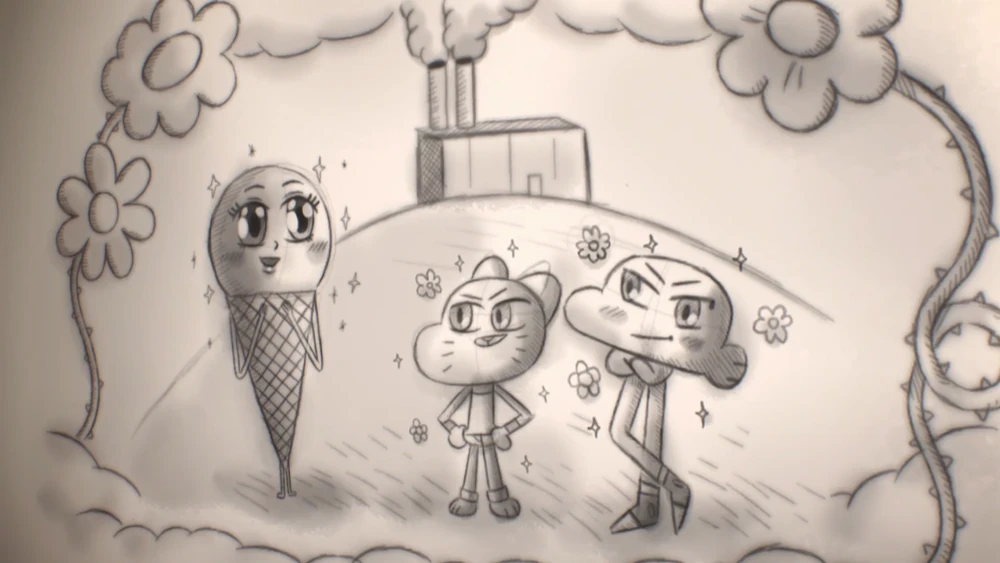
Inversions
Several Japanese series have inverted this trope by going for a western look. Since American cartoons generally require several times the production money for their higher frame rates, there are limiting factors that keep it to surface aesthetics rather than the actual motion. The limits are easier to get around in comics and video games. If they use English, expect it to be about as good as our Japanese. Also Inverted by Japanese video games in their art style and other choices. Outside the country, some like to call them "Japanese Animation" or "Japanese Comics" to differentiate series with no "anime" traits.- The character designs of Japanese artist Susumu Matsushita (best known in the US for his work in Maximo: Ghosts to Glory) tend to be very Western-looking, with round eyes and cartoony proportions.
- Pick almost any illustration produced by Gurihiru from Japan. Chances are, it'll look like something out of a Pixar film. They have been commissioned for design on some of Disney's 3D output, most notably their work on Big Hero 6. They were the character designers of Sonic Unleashed, which is why the human characters of said game had such a western look to them.
- Shigeru Mizuki. Generally, his artstyle is more cartoony/surreal than anything else.
- Fujiko Fujio's art (both together and apart as Fujiko F and Fujiko A) tends to retain the exaggerated features, clean lines, and button-nose cuteness of western children's cartoons. This even extends to works aimed at the adult crowd (such as Laughing Salesman), but they're still seen as one of the landmark examples of manga's influence on Japan.
- The '70s and '80s saw many mangas inspired by contemporary American and European media, some even set in America. Space Adventure Cobra is like Barbarella meets Eagle Land, and Mad Bull 34 is Eagle Land incarnate.
- Given its nature as a multi-vignette show for a young audience, Folktales From Japan features a wide variety of animation designs, most of which cartoony in nature and several in particular rather western. Very rarely does it actually look like anime.
- JoJo's Bizarre Adventure is heavily influenced by American comics.
- While not specifically western (indeed, it more closely resembles Chinese/Korean animation in aesthetics), One Stormy Night is still much closer to your average western animated feature than traditional anime.
- Bambi and Her Pink Gun is so visually influenced by the aesthetics of American comics that only the onomatopoeia give it away as an original Japanese creation.
- The anime for Excel♡Saga had a scene comparing tropes from anime and tropes from western animation, and as Excel demonstrated the cartoon tropes she and the other characters are animated in the style of American comics, rubber hose cartoons, and the Disney animated canon.
- The art style of Studio Ghibli films are heavily influenced by French animated films. One of their films is even a French Coproduction. Conversely, My Neighbor Totoro and Ponyo on the Cliff by the Sea take more influence from American animated films rather than French animated Films. Earwig and the Witch also looked to Aardman Animations and Laika's stop-motion films to translate the signature Ghibli style to 3D CGI.
- The Big O is the result of Japanese animators involved with Batman: The Animated Series (Sunrise, the studio behind the show, was a subcontractor for the latter series) running with the influence of Bruce Timm's iconic art style. Look for the Batmobile in the backgrounds.
- The first ending sequence to Fullmetal Alchemist (2003) is done in Mike Mignola's style.
- Hiroyuki Imaishi's projects tend to have this reputation.
- Zig-Zagging Trope with Panty & Stocking with Garterbelt. It takes most of its art style from animesque Western animation (looking a lot like The Powerpuff Girls). One episode parodying Transformers goes maximum '80s.
- Dead Leaves borrows some exaggerated faces, angular hard-line animation, and violence from Western cartoons.
- Space Patrol Luluco carries much of the same spirit of Panty & Stocking, including humor that wouldn't look out of place on Cartoon Network or Nickelodeon.
- King of Bandit Jing, especially the second manga series.
- The original Lupin III manga by Monkey Punch was heavily influenced by MAD, and the art style definitely shows. The subsequent anime adaptations... not so much. They're not significantly more western-like than most other anime products.
- Nick & Lever is heavily influenced by the art style of Western comics and takes several visual cues of Toon Physics that wouldn't look out of place in Looney Tunes.
- One Piece. The deformations of faces pushed to the limits Looney Tunes-style are probably the most prominent factor. Luffy's Gum-Gum Fruit powers are a close second, looking like something taken out of a Tex Avery cartoon. This comes full circle when Luffy gains his Gear 5 transformation after his powers awaken. In this form, he behaves no different than a slapstick Zany Cartoon character. Eiichiro Oda stated that Tom and Jerry was what inspired him to create Gear 5 in the first place. It's even been speculated that its lack of similarity to the archetypal style of anime is a factor in why it took so long to catch on outside of Japan.
- Fairy Tail has a similar art style to One Piece but then that would be a case of an anime imitating a western-influenced anime. Thanks to Art Evolution, Fairy Tail started being drawn in a style that leans much closer to the "traditional" manga/anime style. It still has some similarities to One Piece's style, but those aren't as hugely noteworthy as they used to be.
- Pingu In The City, a Japanese-made reboot of Pingu is animated entirely in 3D and rendered in a way to emulate the stop-motion look of the original series, but uses some anime tropes such as a slower frame rate in some scenes and the characters do make the odd face faults.
- Space☆Dandy is a Genre Throwback to campy western Raygun Gothic in terms of plot, setting and music. The designs and movements of Dandy and his mostly alien cohorts are far more exaggerated akin to the western cartoony style. The series also embraces episodic Negative Continuity akin to western children's cartoons where characters end up hurt and dead, only to be okay the next episode as if nothing happened prior.
- Soul Eater looks like the unholy child of anime and Tim Burton.
- Super Milk Chan
- Tiger & Bunny is made to resemble Western comic books and superhero shows.
- Trigun's designs and especially manga incarnation are heavily influenced by McFarlane.
- ∀ Gundam's mechanical designs by Syd Mead.
- Usavich
- Obscure series Montana Jones resembles a series from The Disney Afternoon such as Adventures of the Gummi Bears, TaleSpin, or Timon & Pumbaa.
- Cowboy Bebop draws on influences from a variety of genres, many of them quite western (including The Western, appropriately enough), down to featuring one planet themed around Blaxploitation movies.
- Baby Felix was produced by a Japanese studio with input from former Felix the Cat owner Don Oriolo, and is anime trying (and often failing) to look like Western Animation.
- The character designs from Zoobles seem to be at least slightly influenced by stuff like My Little Pony: Friendship Is Magic and Littlest Pet Shop (2012), which themselves are very animesque.
- Many of Nippon Animation's works, like World Masterpiece Theater and Grimm's Fairy Tale Classics are drawn in a way that's more reminescent of Western Animation than Anime. The same applies for Around the World with Willy Fog and Dogtanian and the Three Muskehounds, though both were co-produced with a Spanish animation studio.
- La Quinta Camera, faces in particular.
- My Hero Academia takes a lot of inspiration from American superhero comics. All-Might in his hero-mode especially looks like someone straight out of The Silver Age of Comic Books.
- The Osamu Tezuka short "Legend of the Forest" uses several different Western Animation styles as the decades pass, first a Winsor McCay style, then a 1930's rubber hose cartoon, a Fleischer Bros/Looney Tunes style, a Disney-esque style, a Fleischer Bros Superman style, and finally a UPA style.
- Dawn of the Seeker, which was an actual Japanese animated movie commissioned and written by a Canadian video game studio, producing a very Western-looking anime.
- This Pokétoon short is done in the style of Golden Age cartoons.
- Kodomomuke anime have very simplified art styles to the point where some would get mistaken for western children's cartoons due to lack of "telltale" anime traits. Many of them are adapted from Japanese children's books, which generally tend to be of the same art styles that can be found in the west.
- Anpanman, one of the faces of anime, is about as round and cartoony as any of the kids' shows run in the late 80s early 90s. This partially has to do with it being adapted from a similarly-cartoony book series.
- The long-running series Sazae-san takes many cues from Western newspaper comics, in part due to its beginnings as a newspaper strip in the 1940s— just around the time western cartoons and comics started coming ashore.
- Samurai Pizza Cats resembles a Golden Age Western cartoon in both artstyle and humor.
- Topo Gigio is an anime based on the eponymous 1950s Italian puppet character, and as such it has a style similar to old-school Western kids' cartoons. Interestingly, while the Italian dub has Topo Gigio voiced by the same performer who always voiced the puppet, the Japanese original has him voiced by Ryūsei Nakao, who in fact often voiced heroes and main characters in the Japanese dubs of Western cartoons.
- Lady Red by Akira Toriyama is a homage to, and parody of, Western comics. It is written from left to right, features typical comic book sound effects in big lettering, and has a sense of humour that is quite cynical and almost mean-spirited, a far cry from the man's typical zaniness. The general style, however, is quite clearly Toriyama's.
- Dragon Quest: Your Story controversially discarded Akira Toriyama's Signature Style for a more Disneyesque look.
- Keyman: The Hand of Judgement styles itself after Western superhero comics not only artistically but also thematically.
- Several Nintendo franchises have a very Western feel and design to them:
- ARMS has an art style heavily influenced by American superhero comics.
- Code Name: S.T.E.A.M features several characters and references from western literature and folklore. Just throw in Abraham Lincoln, some Type 1 Eagleland, a Steampunk setting, a Silver Age comic aesthetic, a Framing Device where cutscenes are played out in the panels of a comic book, and as if those elements weren't enough, a campy anthem as its theme song, you'll have a Japanese-developed game that is very Western.
- This was a very intentional move on Nintendo's part when creating the first Donkey Kong arcade game, a game that they created because a prior arcade game of theirs, Radar Scope, had flopped hard in the US despite being a bit hit in Japan. To clear out their enormous stock of unsold Radar Scope machines, Nintendo decided to create a game that would be a surefire hit in America and convert the Radar Scope cabinets to run it. To ensure its success in America they took a lot of influence from classic American cartoons when designing the game.
- While it firmly belongs to the JRPG genre (being a partial parody of it), the EarthBound (1994) series is also heavily influenced by 1950's sci-fi, American newspaper comics like Peanuts and Calvin and Hobbes, and other Western media. The settings of the games range from small middle American towns (Onett, Twoson) to big bustling metropolises inspired by New York City (Fourside)—EarthBound is, after all, the Trope Namer for Eagleland. Two of the main protagonists, Ninten and Ness, are even All American Boys.
- For the Frog the Bell Tolls draws heavy inspiration from European fairy tales.
- F-Zero takes place in a comic book future, with Captain Falcon himself being a homage.
- Kid Icarus (1986) game was very cartoony with weird proportions and wacky characters, and the same applied to its Game Boy follow up Of Myths and Monsters, all while following Greek Mythology to the letter. This then changed in Uprising, while mostly sticking to its Greek Mythology roots, the artstyle, presentation, and character design went full-blown anime.
- Kirby stars a round pink creature with large red feet, and the scenery and characters are clearly reminiscent of cartoons such as The Smurfs. Even the main antagonist is a fat penguin in a Santa Claus-like outfit, and enemies include orange creatures wearing chef hats and wielding frying pans and large beetle-like insects with gloves and sneakers. Played straight with the anime Kirby: Right Back at Ya!, which definitely looks like an anime.
- The Legend of Zelda takes cues from many western fantasy novels and movies; with key influences being Greek mythology, the legend of King Arthur and The Lord of the Rings trilogy. However, Japanese influence became more apparent in games following The Wind Waker. They still hold many western influences and Twilight Princess was specifically based on Wild West stories. Breath of the Wild firmly returns the series to its Western influence via its focus on exploring a land akin to European and Near East fantasy, with notable exceptions such as the Yiga Clan and Sheikah taking Asian influences, with the Sheikah warrior Impa in the prequel, Hyrule Warriors: Age of Calamity, fighting with a Hand Seal usage and Ninja Run that has gotten compared to Naruto. Meanwhile the Link's Awakening remake has more Japanese influences. Much like its sibling series, the Zelda series has its share of Western adaptations.
- Metroid has always aimed for an American comic book look with the atmosphere from Hollywood sci-fi, though several games post-Fusion showed more Japanese influence.
- Panel de Pon has an artstyle and themes that are highly influenced by Western Children's High Fantasy series like Rainbow Brite and My Little Pony.
- Pokémon normally has a Japanese style, but Pokémon Trozei! uses much more simplistic, stylized, and angular designs on the human characters that brings series like Dexter's Laboratory and The Powerpuff Girls (1998) to mind.
- The Punch-Out!! games are extremely cartoony with over-the-top cartoon caricatures of international stereotypes. The games also draw heavy influence from many Western boxing films like the Rocky series and Raging Bull.
- The Splatoon series is what would happen if you asked Nintendo to take everything that made 1990s Nickelodeon what it was, and design it into a game. The series still has a heavy Japanese influence, as the first game features a pair of Idol Singers and takes place in a city based on Shibuya, Tokyo. Splatoon 2 has a more American influence, with Inkopolis Square taking inspiration from Times Square and featuring a DJ/rapper duo modeled after Tupac Shakur and The Notorious B.I.G..
- Star Fox takes cues from Western cartoon animals and space operas. The fuzzy puppets featured in art for the first game and the puppet like mouth face flapping for dialogue in Star Fox 64 was designed to invoke Thunderbirds, though nowadays it just looks like it was animated that way due to console limitations.
- StarTropics and its sequel Zoda's Revenge don't hide their American influence at all, in fact, the games are so blatantly Western that the developers even went out of their way to make many references to American history and pop culture. The protagonist, Mike Jones, was named after the most common American names at the time (1990). Star Tropics' very western design was practically intended by Nintendo, as the Star Tropics games were designed to capitalize on the Western markets, and were not released in Japan.
- The Super Mario Bros. series looks like it is firmly planted in the roots of the The Golden Age of Animation in terms of design. The main characters are plumbers with large noses and moustaches who speak with a heavy Italian accent; the use of anime tropes in the series is rather rare aside from subtle graphical elements (particularly the facial expressions of characters); and the minimal audible spoken dialogue by any of the characters (in any regional version) is in English. Some characters take it further, Princess Daisy's dialogue in particular borrows from many different American English dialects and accents, like Valleyspeak, Southern Dixie and Ebonics, and Wario and Waluigi are inspired by a classic American character archetype. That said, there are plenty of Japanese influences too, mainly in the form of call backs to the culture and mythology (Usually in the form of Power ups like Raccoon/Tanooki Mario and Cat Mario), and the female characters like Princess Peach have a more anime-styled motif than the male characters, and come across as a blend of western and eastern character designs, particularly in 2D art for games like the Mario & Luigi series or Super Princess Peach. Unsurprisingly, the Mario series has had its share of Western adaptations, including Saturday Supercade, the three DiC Entertainment series, and The Super Mario Bros. Movie.
- While the rest of the series belongs strictly on the home front, WarioWare Gold inverts the artstyle from its predecessors, resembling more a Cartoon Network effort than a production from Japan.
- Several of Sega's franchises also take influence from western animation and culture.
- Sonic the Hedgehog, done deliberately so to appeal to the Western market. The design of the Funny Animal characters take cues from Inkblot Cartoon Style, settings, especially urban ones, have a Western feel, an emphasis on techno, rap, and rock for a lot of the music throughout the series, plenty of Gratuitous English in the original localization, and the general "attitude" was to appeal to the "rebellious" nature commonly associated with countries like the United States.
- Streets of Rage is about ex-cops hunting down crime boss Mr. X and freeing the city from his wrath, while beating up hoards of enemies along the way. This all backed up by a soundtrack influenced by rave techno.
- Golden Axe in general is influenced by classic fantasy medieval Europe, however it's also influenced by the Conan the Barbarian films.
- Alien Syndrome was influenced by the Alien films, to the point where a Xenomorph appears as one of the enemies.
- Rent A Hero supposedly takes place in Japan, but the titular superhero is modeled after an American comic book hero and the digitized photograph that's supposed to be representing Taro Yamada, the hero, in the intro, is clearly an American model.
- Clockwork Knight is about a Living Toy soldier named Sir Tongara de Pepperouchau III rescuing the princess Chelsea. It uses a digitized art style comparable to popular Western-made games during the era like Donkey Kong Country and Mortal Kombat, and the soundtrack emphasizes genres like jazz and ragtime.
- The artstyle for Panzer Dragoon was partially influenced by the works of French artist Jean Giraud (aka Moebius).
- House of the Dead is one big Affectionate Parody of So Bad, It's Good B-grade horror movies, complete with intentionally narm-ridden dialogue and voice acting. Especially true in the case of House of the Dead: OVERKILL, with the visuals having a clear grindhouse-movie look and feel.
- NiGHTS into Dreams… was partially influenced by European cultures and theater, with the Cirque du Soleil show Mystère being a specific influence. The sequel NiGHTS: Journey of Dreams takes it a step further by introducing a fictional version of London called Bellbridge and having a cast of British voice actors.
- Samba de Amigo has a strong Mexican/Latin influence, right down to a good number of the songs being licensed Latin genre music.
- Toe Jam And Earl is influenced by hip-hop culture (the titular aliens are rappers, for one), and it definitely shows in parts of the soundtrack. It also has gameplay inspired by Rogue and a lighter version of Starflight's science-fiction theme. Its concept was thought up by Greg Johnson, an American.
- Capcom is another Japanese creator with an extensive library of Western-influenced creations.
- Armored Warriors has English characters and very deep and detailed graphics, taking influence from Mech shows and Western Science Fiction. It's spinoff Cyberbots shares the same general artstyle.
- The Bionic Commando games star a soldier named Rad Spencer armed with a Grappling Hook arm. The NES title even had you battling Those Wacky Nazis, including who is definitely not Adolf Hitler (Named "Master D" In-game).
- Capcom's old mascot Captain Commando is likewise an Affectionate Parody of American superheroes. The company has long walked a middle ground between styles, taking it to a natural conclusion.
- Darkstalkers and its crazy cartoon violence. It looked and moved more like a cartoon than the actual American TV show.
- Devil May Cry stars a dual-wielding wisecracking mercenary named Dante battling demons and monsters in Gothic European and urban settings. It draws heavy influence from Western-themed works like The Divine Comedy.
- The Final Fight games takes place in major metropolitan city reminiscent of New York and Chicago and one of the player characters is a former-wrestler-turned-mayor named Mike Haggar.
- The Ghosts 'n Goblins series stars a medieval knight named Arthur (a clear reference to King Arthur), battling wicked demons and monsters, the majority based on European gothic horror and figures from Biblical mythology like Beezulbub and Satan. The games were also notorious for its very broken English, which has since improved in the sequels.
- Knights of the Round is a Capcom Beat 'em Up loosely based on the Arthurian Legend and stays true to its setting. Based in Medieval England with nice and detailed Real Is Brown graphics, and medieval-styled artwork.
- While originally inspired by Astro Boy, many aspects of the Mega Man (Classic) series have since evolved into being more Western. Taking cues from many futuristic sci-fi, episodic Saturday morning cartoons, and superhero comic books. Two of the main characters, Dr. Light and Dr. Wily in particular are blatant expies of Santa Claus and Albert Einstein respectively. The Darker and Edgier sequel series Mega Man X was made in the The '90s, and definitely wears its time period on its sleeve, highly imitating the "extreme" trend of many Western action cartoons at the time, with the soundtracks of the games relying heavily on rock and guitar. As mentioned further up the page, Mega Man even had a cartoon that ran for three seasons, which ironically was inspired by character redesigns Keiji Inafune made in his spare time.
- The Monster Hunter series is known for this, which is ironic since the games are still more popular in Japan than in the West.
- Red Earth, developed by the same team as Darkstalkers, has very detailed graphics and plays up its Sword and Sorcery theme to its fullest.
- Capcom's Resident Evil series is influenced by Western Zombie films, Horror B-movies, and various Hollywood action films and Conspiracy thriller. All of the main characters are English, and the settings of the games are generally American. The fictional Raccoon City of the first three games is based on a midwestern Everytown, America. The first game even went so far as to have English actors and voice acting for its live action cutscenes, even in the Japanese releases. Unsurprisingly, there have been numerous Western Adaptations of the franchise, including an entire series of American films.
- Resident Evil's sister franchise Dino Crisis is more or less the same thing, but with vicious dinosaurs and strongly influenced by works like Jurassic Park.
- Street Fighter takes inspiration from American cartoons in many ways. The original Street Fighter had an art style reminiscent of 60s action cartoons. Street Fighter II continued this with an art style similar to 80's Saturday morning cartoons, which was taken to a logical conclusion. Street Fighter III continued the Western style further with a artstyle resembling an upper-tier action cartoon with extremely fluid animation and a soundtrack inspired by Late-90's Hip-Hop, Jazz and Techno with loads of English. Street Fighter IV takes the action cartoon artstyle of II and brings it into the third dimension, which in turn made the game even more colorful and cartoony than prior entries.
- Two of the three games featured in Three Wonders, specifically Midnight Wanderers and Chariot, are drawn in a Westernized art style based on Medieval illustrations (the world maps especially), tarots and fantasy/fairy tale books.
- Viewtiful Joe is an Affectionate Parody of both comic book superheroes and Tokusatsu.
- Go Go Hyper Grind is a Japanese-developed skateboarding game with American character designs by John Kricfalusi and Spumco, no less! The gameplay also features many Western cartoon cliches such as Wild Takes, Stuff Blowing Up, and characters losing their heads.
- Konami was known for making games based on American movie genres in its prime.
- Silent Hill is frequently mistaken for an American franchise due to the American setting and realistic graphics, and takes a lot of influence from American media such as Jacob's Ladder and the works of David Lynch. The games are very Western, with the titular Silent Hill being a fictional town set in the American state of Maine. All of the main characters are American, with English voice acting even in the Japanese releases.
- The Metal Gear series takes its influence from American Hollywood action films such as: Escape from New York, Blade Runner, and other various Western media. The original MSX release of Metal Gear 2: Solid Snake even had images of its characters based on famous hollywood actors at the time (Mel Gibson, Tom Berenger and Sean Connery to name a few), just to hammer the themes in further.
- The Castlevania series is obviously influenced and centered around the lore of Dracula and set in Gothic European settings. Most of if not all of the characters are English and Japanese influence is extremely rare outside of visual effects and artstyle, with few exceptions like Rondo of Blood and Portrait of Ruin.
- Contra proudly takes every American action film from the 80's like Rambo, Commando, Predator, Alien, and The Terminator and mixes them all into a blender. The two main characters are named Bill and Lance, and modelled after Arnold and Sly, respectively.
- Persona 5 uses an anime art style, plays like a JRPG and visual novel hybrid, and focuses on issues in modern Japanese society. However, the Phantom Thieves' costumes and Personas, as well as the jazzy soundtrack, take a lot of influence from classic Western comic books and tales of magnificent vigilantes.
- While Onmyōji (2016) plays this straight in every other aspect of the game, some in-game comics (like those about the backstory of Ōtakemaru and Kujira) are drawn in a Western comic book style and read left-to-right rather than like a manga.
- PaRappa the Rapper and its spinoff Um Jammer Lammy. Not only is the art style cartoony, all of the cutscenes and songs are in English, even in the Japanese versions. Makes sense, as the series artist, Rodney Greenblat, is actually American.
- No More Heroes and its sequels sport a mix of cel shading and realism with a So-California setting, western-style character designs and names. All games in the series do make multiple references to anime media, though.
- Killer7 looks, sounds, and feels like if it was made by Mainframe Entertainment than Capcom and Suda 51, and if it was a game in Reboot. All characters have a design that evokes the style of dark-themed comics like Batman and Deadpool, and the music takes cues from superhero cartoon series from The '90s. Even the cutscenes outsourced to Japanese companies (like the opening of the chapter Sunset or those of Alter Ego) retain the Western style to a major extent. There is, however, a boss who parodies the Magical Girl genre in her introduction, though upon being defeated twice she turns out to be the American woman Curtis Blackburn abducted during the opening of the chapter Encounter, roleplaying as a magical girl.
- The main character in Professor Layton, as well as many secondary ones, are designed in a classic French style, though other characters are designed in anime fashion.
- The character design of Sora that Tetsuya Nomura created for the Timeless River world (based off the cartoon short Steamboat Willie and other shorts during the 1930s) in Kingdom Hearts II, which makes him resemble a cartoon character from The Silent Age of Animation (Rubber-Hose Limbs and all). Just look◊ at him◊.
- The arcade baseball game M.V.P., which was made by Sega, used a Franco-Belgian art style for its character design.
- Metal Slug has a style very reminiscent of American cartoons.
- D.N.A.: Dark Native Apostle looks like something out of The Dark Age of Comic Books.
- FromSoftware's best known RPGs, such as Demon's Souls, Dark Souls, Bloodborne and Elden Ring, contain many elements typical of Western games such as Real Is Brown visuals, free-roaming gameplay, character customization, and minimalist story presentation. This, combined with Dark Souls debuting at a time when most Japanese games weren't getting much mainstream attention in the West, leads many people to be surprised when they find out that FromSoft is a Japanese developer. While Sekiro: Shadows Die Twice is set in Sengoku Period Japan, it is still hardly anime in design, retaining the gritty and realistic art style of its spiritual precedessors.
- Metamorphic Force may be the only Japanese-developed Beat 'em Up to look like a Western cartoon or fantasy comic yet not be based on one.
- Kaneko's DJ Boy and its sequel B.Rap Boys are beat-em-ups heavily influenced by American hip hop and street culture of the 80s, and as such have cartoony sprites and graphic elements inspired by graffiti.
- Light Crusader looks much more like a European Amiga game than any of Treasure's other Sega Genesis efforts. The Progressive Rock motifs help confirm this impression.
- The Knack games were developed by a Japanese team, but are full-blown western, resembling an All-CGI Cartoon adventure with western character designs for the human and enemy characters and the eponymous hero himself.
- Splatterhouse rips from every single major American slasher horror franchise/movie from the The '70s and The '80s and mashes them all together into a gore-y stew, like Friday the 13th, Hellraiser, Evil Dead, House, The Texas Chainsaw Massacre and many more. The game stars a paranormal investigator named Rick Taylor who has to rescue his girlfriend Jennifer from a house infested with monsters created by a Mad Scientist.
- Pizza Pop!: Despite being a Japan-only game, the game boasts a distinct American newspaper comic/cartoon style ala Archie. The entire game takes place in an American-like metropolis like New York City and Chicago, and the character designs are extremely cartoon-like. It reflects even more in the design. The signage are all in English, Dollar signs are used, and the game boasts a hopping Jazz soundtrack.
- Starting with 2 especially, Ace Combat is heavily influenced by Top Gun regarding its focus on air battles and a western inspired pilot taking the role of The Ace to fight out enemies in mostly European and American counterpart conflicts. While the sleekness of Japanese and anime aesthetics are felt especially with better technology allowing the characters and futuristic environments to be rendered in that regard, they're still primarily taking from western political thrillers, western military science fiction and Cold War era action flicks from the original Top Gun's era. In fact, Ace Combat 7 would feature a crossover promotion with Top Gun: Maverick, a sequel so long awaited to the original that comparisons between Top Gun and Ace Combat were frequently made over the decades of the latter's releases in that Ace Combat was likened to as close as one could get to more Top Gun. Maverick finally releasing and crossing over with the Japanese franchise so inspired by it brought things full circle.
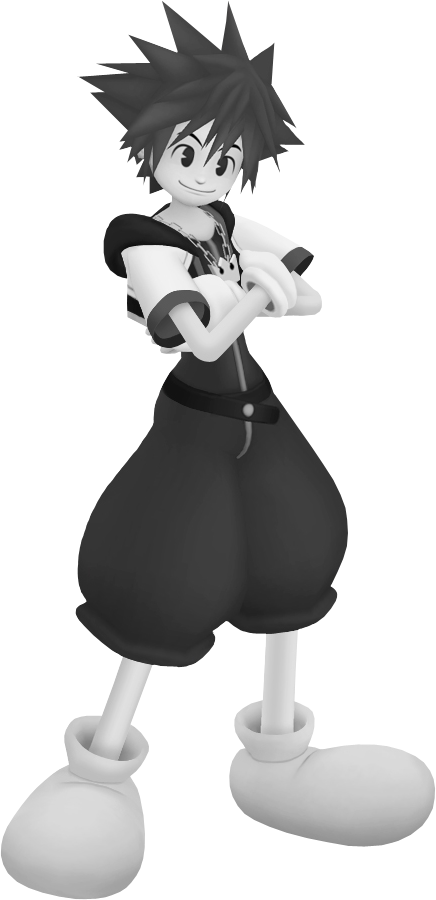

- While most of Marco & the Galaxy Dragon is drawn in typical visual novel style, it Art Shifts to cartoony Thin-Line Animation in cutscenes.
- The art of Inferno Cop seems to be heavily influenced by American comic books.
- Pokétoon is a series of Pokémon animated shorts made for the Internet, and most of them are done in the typical Pokémon art style. The "Scraggy and Mimikyu" shorts, however, are designed to resemble classic American cartoons from the 1930s and 40s.
