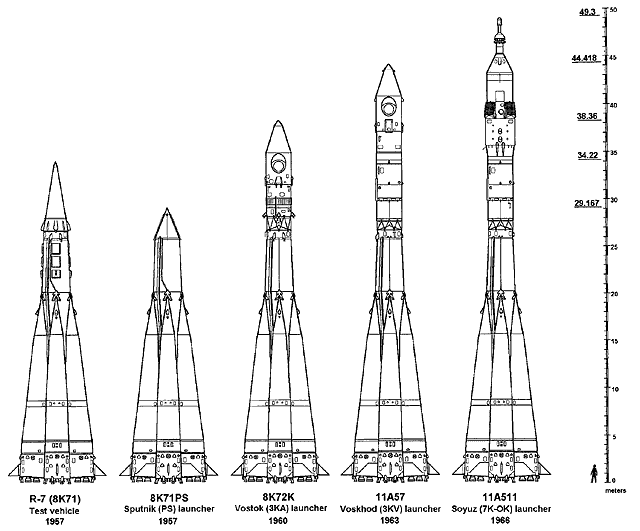
Our bet's on the rocket though.

"Welcome to THE WORLD OFnote TOMORROW!"
Raygun Gothic is a ubiquitous aesthetic of early- and mid-20th century Science Fiction, roughly from Metropolis to Star Trek: The Original Series. Raygun Gothic architecture is modeled after Art Deco, Streamline Moderne, and/or Populuxe (aka Googie). Everything is slick and streamlined, with geometric shapes and clean parallel lines constructed of shiny metal and glass, lit prominently by neon. Sweeping curves, parabolas, and acute angles are used to suggest movement — movement into The Future.
And of course, futuristic fancy-pants technology of the future is ubiquitous. Ray Guns, Jet Packs, flying cars, Video Phones, Space Clothes, atomic-powered everything, cigar-shaped Retro Rockets and other Shiny-Looking Spaceships, and "electronic brains" capable of calculating complex equations in mere minutes, all decorated with little blinking lights that don't really serve any purpose (but they sure look futuristic!).
This is the bright, optimistic vision of The Future that, until sometime in the mid-1960s, the Western world believed was just around the corner. Our failure to make these dreams a reality means that works featuring Raygun Gothic are highly prone to Zeerust. Retro-Futurism is a Genre Throwback to this vision. Stick "Atomic Power" logos on everything, (as well as perhaps slide the scale a bit to the "cynical" side) and you've got Atom Punk.
The Mad Scientist Laboratory and Spaceship are among the most commonly used locations in a Raygun Gothic setting. The most commonly used monsters tend to be nuclear mutants and aliens in general, although friendly aliens are just as likely to appear, either as the heroes or as characters for the cast to meet.
The only thing that could possibly look more futuristic is Crystal Spires and Togas. See also Zeerust, Weird Science, and Retro Rocket. Contrast with Diesel Punk, Used Future, Cassette Futurism and Everything Is an iPod in the Future.
Now of course, while it's true that Technology Marches On, it's also true that the Aesthetics Of Technology will always be basically arbitrary. These days, Everything Is an iPod in the Future because that's the current popular design aesthetic. It will certainly change in time, and who's to say that Art Deco might not come back into fashion one day? Look at the nostalgic design of cars like the Mini-Cooper.
Examples
- Giant Robo: Although the OAV was produced in the early 90s, it retains the look and feel of the multiple 60s mangas it was based on.
- Project Blue Earth SOS is set in an alternate version of the 90s that leans heavily into this aesthetic.
- The Girl Who Leapt Through Space definitely has a Raygun Gothic feel.
- Cyborg 009 has shades of this, mainly in the Cyborgs' uniforms and their rayguns.
- Astro Boy: Is the one of the first anime to use this aesthetic.
- Space☆Dandy is a humorous send-up to this era of sci-fi.
- The designs of the Buff Clan in Space Runaway Ideon are reminiscent of this style.
- Zot!, lives in the far-flung future year of 1965. Note that Zot! began publication in 1984.
- There are several DC Comics characters who live in between the present era and the Crystal Spires and Togas era of the Legion of Super-Heroes, including Tommy Tomorrow and the Planeteers, the Knights of the Galaxy, Ultra the Multi-Alien, Space Ranger, and Space Cabbie. Adam Strange does this in the present time.
- Adam Strange also appeared in some Starman (DC Comics) comics and fits in very well because the title already had a certain Raygun Gothic aesthetic.
- Wonder Woman (1942): The Casual Interplanetary Travel of the Golden Age Wondy stories is rife with colorful retro rockets, marvelous space travel capable submarines with extra little scalloped fins and so very many types of ray gun.
- Robin/Red Robin villain Scarab has wears a polished suit of Powered Armor that definitely fits this aesthetic, her helmet even has the central crest-like fin that's so popular for the genre.
- Warren Ellis's Ignition City.
- Dan Dare was created as the 1950s British archetype of the trope.
- Weird Science by EC Comics had a lot of streamlined rocketships and cool futuristic tech, especially Wally Wood's work.
- Flashbacks to Krypton in the Superman comics from the Golden Age through most of the Bronze Age maintained this look.
- The Silver Age Fantastic Four stories often have Raygun Gothic elements.
- The League of Extraordinary Gentlemen takes place in a parallel universe where all fiction is true, so the aesthetics of the world shift in every time period to match the aesthetics of that time period's pop culture. Appropriately, the first two volumes (which take place in the late Victorian era) have a pronounced Steampunk vibe, whereas the standalone graphic novel The Black Dossier (which shifts the action to the 1950s) changes this to Raygun Gothic.
- Magnus Robot Fighter, both the Silver Age original and (at least in the beginning) the 1990's revival. More recent revivals have averted this.
- Mike Baron and Steve Rude's Nexus is an interesting example, since Steve Rude has always said his two biggest artistic influences are Space Ghost and Dr. Seuss.
- Notably, Nexus and Magnus once had a Crossover.
- Jonni Future from Tom Strong strongly embodies the Raygun Gothic aesthetic.
- Buck Godot: Zap Gun for Hire has a lovely Zeerust feel to it, and was published "late in the 20th century".
- Despite its horror trappings, Solar City and much of the world that Halloween Man takes place in has this style to it.
- EC Comics' scifi output — namely Weird Science and Weird Fantasy — naturally had this aesthetic, although tonally and thematically they were often a bit grimmer and edgier than this trope normally suggests, in keeping with EC's countercultural sensibilities. Notably, "Judgement Day", a story that originally ran in Weird Fantasy, was one of the first scifi instances of Fantastic Racism, and ended with a rather damning — and, at the time, controversial — commentary on contemporary race relations in America. You could even call "Judgement Day" a forerunner to afrofuturism.
- Spoofed and homaged in Plan 7 of 9 from Outer Space with Captain Proton tracking down a Tesla doomsday device in the far-flung future of 2009 with its jetpacks, flying cars, domed cities and vast electronic superbrains, not to mention inconceivable marvels like mobile telephones, interstate highways, automatic sliding doors, artificial satellites, and weapons of mass destruction.
- A Portal 2 mod, Portal Stories: Mel has used this idea in the first part of the story taking place in an unnamed town created by Aperture Science's contraction workers.
- Also the 'Proto-Portal gun' and 'Proto-Long Fall Boots' are versions of their modern counterparts which fall under this trope.
- Rocketship Voyager is Star Trek: Voyager written In the Style of... a 1950's sci-fi magazine story. Voyager is a silver cigar-shaped Nuclear Torch Rocket, equipped with everything from atom-tipped torpedoes to a radium-heated coffeemaker in the captain's cabin.
- The characters in Robots all look retro-futuristic.
- The future in Meet the Robinsons has a very 1950s/'60s "Space Age" type aesthetic, with neat lines, geometric shapes, and pastel colors.
- Gru's style in Despicable Me is very much Cold War atompunk.
- The Incredibles takes place in an alternate-universe version of The '70s, and features a strong mid-sixties take on how wonderful the future nearly was.
- In Toy Story, Buzz Lightyear and Zurg have a Raygun Gothic vibe, more so in Buzz Lightyear of Star Command.
- Planet 51 certainly has this aesthetic.
- The titular character from The Iron Giant.
- Fritz Lang's Metropolis may be the Ur-Example.
- The Fifth Element is a weird fusion of this trope and Cyberpunk.
- Used in the Star Wars prequel trilogy: The Naboo space fleet and the architecture of Coruscant are modeled after this, while the Republic space fleet morphs over time into the blocky, Used Future Imperial fleet.
- The Necromonger fleet from The Chronicles of Riddick (2004) is a much darker interpretation of this aesthetic.
- Star Trek: The Original Series was always very much this way, although the 2009 reboot combines it with the aesthetics of an iPod.
- Men in Black had the same idea as the above example, interestingly just a few years before the iPod was even developed. It could be justified in that the MiB was formed in the mid-1950s in which this aesthetic was in at the time.
- Robot Monster, one of the definitive bad B Movies of The '50s, is swimming with this trope, with both the human technology (especially the Retro Rocket) and the alien technology (THE BILLION BUBBLE MACHINE!) reflecting this aesthetic.
- Anton Furst's designs for Gotham City for Batman (1989) have some elements of this.
- Like the source material, the Flash Gordon (1980) movie is full of this; unlike the original, it is one of the first entirely conscious uses of the trope. Of note is that the Cool Airship Ajax is referred to by the delightfully old-timey title of "war rocket". Also note that Zarkov's rocket, built on Earth, does NOT invoke this trope, at least in comparison to the ships of Mongo.
- Zathura takes place in more or less present day, but the magical board game of the same name is most definitely Raygun Gothic, featuring Retro Rockets, Reptilians, robots and astronauts with jet packs, etc.
- Forbidden Planet, with its rocket ships, spacesuits, and, most memorably, Robby the Robot.
- Sky Captain and the World of Tomorrow is a funny corner case. It's set in an alternate-universe version of the 1930s, so it's often cited as an example of Diesel Punk, but the aesthetics and optimistic worldview are much closer to Raygun Gothic.
- The villains in J-Men Forever are all about this, especially the Lightning Bug baby!
- Bedtime Stories (2008): The final story Skeeter and the kids make up together is set in a futuristic space arena very much adhering to this trope
- The Martians from Mars Attacks! seem to dig this style.
- Six String Samurai is this trope (atompunk, really) mixed with post-apocalyptic.
- The Godzilla films used this aesthetic for all space-related stuff with a totally straight face well into the mid-1970s. Invasion of Astro-Monster and Destroy All Monsters feature humans in rocket ships vs. aliens in flying saucers, while Godzilla vs. Mechagodzilla has gorilla-like aliens running around in silver jumpsuits and carrying laser pistols.
- Fire Maidens of Outer Space has Earth using this kind of technology, in contrast with the Crystal Spires and Togas neo-Classical style of the Fire Maidens (and their dad) themselves.
- Plan 9 from Outer Space has its aliens in flying saucers and wearing shiny sleek Space Clothes and using devices like the Dictorobotary and electrode guns, though the movie is also a Genre Throwback to the Gothic Horror of the 1930s, with a Dracula expy lurking in a Creepy Cemetery.
- From the same director, Bride of the Monster also mixes the '30s and '50s flavours of this trope, with a Mad Scientist in an Old, Dark House, trying to create a Nuclear Mutant in his Mad Scientist Laboratory. The film's working title was Bride of the Atom.
- The aliens in It Came from Outer Space have a bit of this in their technology, with their spherical spaceship covered in hexagonal panels. The aliens themselves have a classic '50s Blob Monster look, and were designed by the great Milicent Patrick. The movie also reflects this trope on a thematic level as well as an aesthetic one, dealing with Cold War themes of suspicion, paranoia, and mutually-assured destruction in the dealings between the humans and the aliens.
- In the ending of Lisztomania a Heavenly rocket ship with wings that look like organ pipes is used.
- The alien rocketship in Earth Girls Are Easy — indeed its depiction of outer space as a whole — has this aesthetic, tweaked with a 1980s Day-Glo color scheme matched by the furry aliens themselves prior to their makeovers. The trope extends to the Animated Credits Opening and Valerie's black-and-white Nightmare Sequence, which even has a Robby the Robot cameo!
- The pin from Tomorrowland displays a vision of the titular city with this aesthetic, though its combined a bit with Solar Punk. The real city is a bit less shiny.

- The Trope Namer, William Gibson's "The Gernsback Continuum", is about a freelance photographer hired to take pictures of buildings inspired by this aesthetic, who either slowly finds himself being sucked into an alternate timeline where it was all real or is hallucinating the whole thing.
- Gibson's story refers to Hugo Gernsback, the "Father of Science Fiction", who founded the first science fiction magazine, created science fiction fandom (by encouraging readers who wrote to him to interact with each other directly), wrote very early examples of the genre, such as Ralph 124C 41+, and coined the term "Scientifiction".
- The cover art of many of the Tom Swift novels.
- A lot of cover art for Philip K. Dick's novels from back when Ace published them clearly fits into this. More downplayed in the books themselves, assuming the trope was applied in the first place.
- Lensman. In fact, the bulk of E.E. "Doc" Smith's better-known work is this. Although his early works had their first origins as early as 1917, Smith continued writing into the mid 1960s (he died in 1965), by which time men had travelled in space, and his writing takes on a somewhat different focus and flavour after the first manned flights.
- Most of the Robert A. Heinlein juveniles.
- Larry Doyle's Go, Mutants! is a parody of this.
- E3 in Ian McDonald's Planesrunner is an Alternate History that combines aspects of this trope and Steampunk. Zeppelins are the main form of air transport but their bags are woven of carbon nanofibers. The main motive power is coal powered (because there's no oil in this world) electric motors, which were invented before the steam engine. Their computers are of the vacuum tube and punch card variety. There's radio but no TV, but they use monofilament wire.
- Operation Future: The cover is addicted to bubbles and circles, also having a preference to metal-looking spacesuits rather than fabric, drawing inspiration from the Mercury 7 styles popular at the time of publication.
- Foundation (1951):
- Starting with "The Encyclopedists", characters have a variety of new devices that are essentially older technology with a smaller energy source, called 'atomics'. As the decades pass, they continue nuclear miniaturization, and in "The Traders" and "The Merchant Princes", start calling such devices 'nucleics'. The (collapsing) Empire uses generators the size of large buildings, while the Foundation creates generators the size of a pocketwatch.
- "The Mayors": Their futuristic weapons are called atomic blasters, and ships use hyperatomic motors.
- "The Traders": This story starts going into detail about the sort of atom-powered devices that the Foundation has been building since Mayor Hardin proved that Terminus ruled the Four Kingdoms, rather than the other way around. They've made knives that generate a force-field blade, mechanical garbage disposers, and even transmutation machines (actually a modified food irradiation chamber, like a microwave oven).
- Pick a Gerry Anderson TV show, any Gerry Anderson TV show. Thunderbirds, Stingray (1964), Captain Scarlet and the Mysterons, Fireball XL5...
- Any Space Cadet show aired in the 50's, from Tom Corbett Space Cadet to Captain Video.
- Star Trek The Original Series, the last unselfconscious example. Subsequent visual media followed the leads of 2001: A Space Odyssey and the Real Life space program.
- Star Trek: Voyager's Show Within a Show The Adventures of Captain Proton is an Affectionate Parody modeled after 1930's sci-fi Film Serial's like Flash Gordon and Commando Cody.
- The alien message decoded in the final episode of Dark Skies had elements of this, presumably as a nostalgic in-joke, since the rest of the series's aesthetics and mythology were much more modern X-Files-inspired sci-fi.
- On The Flash (1990), 1950s villain the Ghost adheres to this motif, and is rather dismayed to find that 1990 isn't like this when he awakens from cryogenic sleep.
- Doctor Who, especially in its earlier seasons (as they were made in the early 1960s). This particularly leads to Zeerust Canon, as the look of the inside of the TARDIS (particularly the big hexagonal console with a glass column that moves up and down) and the Daleks (very Art Deco, but with plungers) can only really be changed so much before they don't look like they're supposed to any more. It should also be noted that during the early Sixties, there was an obsession with hemispheres as being futuristic (similar to the modern-day High-Tech Hexagons aesthetic) which helps to explain the round things on the TARDIS walls and the weird little orbs on the Dalek armour, all of which would cause fan despair if it were removed. This aesthetic carried on showing up as late as the early 70s thanks to the show's No Budget nature - the Sonic Screwdriver as used by the Third Doctor was actually an unused prop from Thunderbirds (which began in 1965) and hence looks 60s as heck. While the new series modernised everything as much as possible - starting off during the Ninth Doctor's tenure with a semi-organic, Steampunk influenced TARDIS interior and weighty-looking, almost industrial Daleks - the sonic screwdrivers are still knowingly designed to follow this aesthetic, perhaps because in the Ninth Doctor's tenure it's revealed that the screwdriver is laughably low-quality, dated technology.
- Other things that deserve mentions - the Dalek warships are the most cheesily stereotypical Flying Saucer things ever, designed as they were for the 1950s-B-Movie-influenced "The Dalek Invasion of Earth". They were redesigned with a 00s-SF Used Future paint job in the new series, but kept the original basic shape, the contrast between the two visual styles coming off as rather silly.
- The Thals in "The Daleks" favour these kinds of Space Clothes even though they live in a low-tech farming society After the End.
- "The Robots of Death" uses this as an intentional homage to the 1920s and 30s science fiction the story is based on, with the sets, robots and human costumes all fitting a distinctive Art Deco aesthetic.
- "The Time of Angels/Flesh and Stone" had the Byzantium. Take a look.◊
- Episodes of The Twilight Zone (1959) that involved aliens or space travel frequently contained a sizable dose of this aesthetic, and even more so if the episode in question was a comical one.
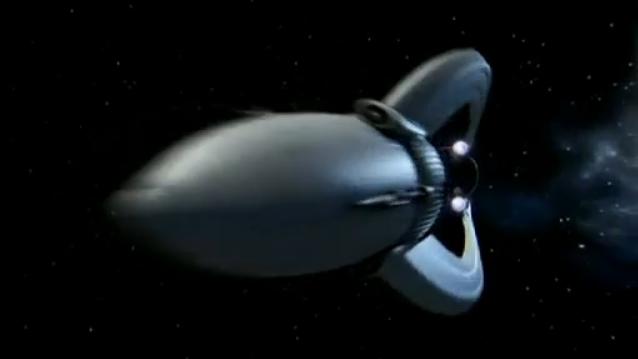
- Analog:
- Many early covers of the magazine featured silver rocketships with sleek designs, space stations with clear domes to see the planet they orbit, and people standing next to round doors with shiny metallic spacesuits.
- The October 1939 issue has a Lensman standing outside of a big circular door. They're wearing a silver suit tight enough to show off their muscles, with knee-high boots, a helmet in their hand, and silver goggles with blue shades. The steps they're standing on have round holes in the sides.
- The cover of the June 1940 issue has chrome vespas and sidecars zipping down a crome street with chrome buildings in the background, with people holding chrome handguns. Everything is on a slant and there are lots of subtle curves to imply high-speed movement.
- Doctor Steel plays with this aesthetic in his music and interactive Fandom community.
- Stereolab played "Space Age Bachelor Pad Music".
- The phrase was applied (probably before Stereolab) to the distinctive lounge musical stylings of Juan García Esquivel. note Have a listen.
- The phrase was applied (probably before Stereolab) to the distinctive lounge musical stylings of Juan García Esquivel. note Have a listen.
- "IGY," the first track on Fagen's 1982 album The Nightfly, is pretty much this trope in a nutshell. He describes a world where there's a train running undersea from New York to Paris in 90 minutes, everyone gets their own Spandex jacket, weather is controlled and solar power is plentiful - and it's all run by "A just machine to make big decisions / Programmed by fellows with compassion and vision". The liner notes describe the album as "certain fantasies that might have been entertained by a young man growing up [...] during the late fifties and early sixties, i.e., one of my general height, weight and build."
- The title is a reference to the International Geophysical Year, a scientific event in 1957-8 that was the USSR's excuse to launch Sputnik into space, thus kicking off the "rocket age" for real.
- The title is a reference to the International Geophysical Year,
- Lights' Drive My Soul video.
- Tom Smith's filk song "Rocket Ride" is a paean to this old-fashioned space-adventure style:
I want a shining tower of glass and steel,
A rubber jumpsuit and a freeze-dried meal,
The will to survive, the need to explore,
The love of adventure, who could ask for more? - The New Albion Guide To Analogue Consciousness, the third album in the New Albion trilogy, is an "atompunk opera" following the Steampunk of the first album and the Diesel Punk of the second. It features AIs created by converting human consciousness into computer programs, a shopping complex vast enough for one of the main characters to hide away comfortably for a long time, and technology used to open a dimensional portal to the afterlife. In-universe, Mascot 3000 (the first of the aforementioned AI to be created) has a love for pulpy Raygun Gothic adventure comics.
- The cover art for Meco's "Star Wars and Other Galactic Funk" album from 1977, even though Star Wars itself was a deliberate aversion of this trope.
- Flash Gordon, of course.
- Which, in turn, was inspired by Buck Rogers.
- In Calvin and Hobbes, Calvin's daydreams of Spaceman Spiff, interplanetary explorer extraordinaire. He wears Space Clothes, carries a Ray Gun, and jets about in a flying saucer with a bubble cockpit and tail fins.
- Some of the elements in Twilight Zone are reminiscent of this, particularly the rocket.
- This is the predominant aesthetic of The Party Zone, which includes Retro Rockets and attractive young women flying around with jet packs and fishbowl space helmets.
- Time Machine (Zaccaria) uses this to represent the Future, with massive silver towers and women wearing skin-tight Space Clothes.
- Part and parcel of Flash Gordon, naturally.
- The aesthetics of Future Spa favors form-fitting jumpsuits, buildings and structures dominated with swooping curves, and lots of gleaming glass and steel everywhere.
- Big Finish Doctor Who's recurring Space Pirates, the Rocket Men, were based around this Zeerusty aesthetic - they show up in pulp-Pastiche stories (a Planetary Romance about an alien ecosystem and a Space Western) and wear leather suits, art-deco-style helmets, and Jetpacks.
- Several GURPS supplements cover the creation of games with a Raygun Gothic flavor:
- GURPS Alternate Earths explores the Alternate History of "Gernsback," which is basically 1930s science fiction come to life.
- GURPS Tales of the Solar Patrol is a more fleshed-out version of the concept, set in a universe consciously modeled after Flash Gordon and 1950s-era Young Adult science fiction stories.
- GURPS Atomic Horror covers similar material as Solar Patrol, but focuses more on the dark side — stuff seen in 1950s B-Movies such as giant insects, blobs, flying saucers, and so forth.
- GURPS Steampunk 1 discusses Raygun Gothic by name, primarily as a visual style that follows on directly from the end of the steampunk period, and which is in fact the basis for some modern "steampunk" costumes and visual designs. The two subsequent volumes in the series build on this, providing examples of Raygun Gothic equipment and character types.
- One of the styles used by Mad Scientists in Genius: The Transgression. It's seen some tarnishing due to its use by two Lemurian Baramins, so it might elicit confusion among Peerage Geniuses, but sometimes all you really want is a bubble-helmet spacesuit and a raygun.
- Many, many Sons of Ether made use of this aesthetic, their greatest triumph being their alternate dimensional laboratory city - and perfect example of this trope - the Gernsback Continuum. Occasionally an eccentric Technocrat, usually a Void Engineer, would do something similar, particularly if they'd been around for a while.
- Magic: The Gathering visits this genre in the 2022 set Unfinity. ("Un-sets" are how Magic does its less serious and more light-hearted set themes, often with an element of Self-Parody - the perfect place to lean into Zeerust.)
- Spaceship Zero featured a retro-Space Opera setting where, for instance, there was no miniaturization, and bigger computers were always better. Partially deconstructed as well, as there were definite indications that underneath all that chrome was a decent amount of grit, causing one reviewer to refer to it as "pulp—with bathrooms."
- Realms of Mars from Exile Game Studio promises to be this for sword and planet, much as Hollow Earth Expedition harkened back to adventure pulps.
- Rocketmen utilizes this as part of its theme, from its space ships, lasers guns, and the whole solar system being colonized.
- The look and feel of Rocket Age. The corebook even states that all technology will look sleek, clothing worn by adventurers should usually be form fitting and every space suit has a fishbowl helmet.
- The Skitarii/Cult Mechanicus models from Warhammer 40,000 have got some of this aesthetic going on.
- The idea of the board game Alien Frontiers is that the players are colonizing an alien planet using this level of technology.
- Hydra Miniatures have Retro Raygun, with characters following this trope, down to the tin-man robots and Middle Eastern-inspired uniforms of the troops of the Empire; and War Rocket, which features various rocket-shaped craft as well as some saucers, with a 50s automotive aspect to their design. They also had in development a ground war game named Atomic Tank which had quite a retro style to the armoured vehicles.
- Slipstream is a deliberate use of this trope, with Retro Rockets, Rayguns, sentient robots working with computers that still use ticker tape for output, and a setting set in a dimension to which all the black holes in our universe lead, with no escape.
- An Alternity setting published in Dragon magazine, "Back to the Future", was all about fifties science fiction, both contemporary-set monster movies and Buck Rogers style Rocket Rangers. As well as stats for atomic heat guns, flying saucers, alien monsters and rocket suits, the article also offered metafictional advice like using exactly the same description every time a spaceship takes off, to represent Stock Footage. (And possibly reading it backwards to represent the ship landing, as badly reversed stock footage!)
- The Astounding Science supplement for Urban Jungle uses this aesthetic, whether you want to add strange visitors from Counter-Earth to the standard thirties setting, or have Earth science advance to this level by the future space year of 1980.
- Tomorrowland at the Disney Theme Parks was originally designed this way, as it originated in 1955. The versions in the various parks have changed over the years in subtle ways, such as adding more contemporary sci-fi aesthetics or even steampunk-style architecture (at Discoveryland, the Disneyland Paris equivalent to Tomorrowland). The original plan was for Tomorrowland to be constantly updating to reflect whatever the future looked like in a given moment (Walt Disney's idea for a "permanent World's Fair"), but when this got to be too much effort and expense for a single theme park land, they decided to embrace the zeerust and, more or less, stick with a Raygun Gothic aesthetic.
- The Fallout series is set in a post-apocalyptic Raygun Gothic world. In Fallout 4, the Institute plays this aesthetic completely straight. The actual ideals, not so much.
- Blasto falls neatly into this trope.
- X-COM: Apocalypse, blended with some distinctly Cyberpunk elements.
- The Covenant in Halo are modeled after a version of this, as everything they design has a very sleek form. As do most things on the titular Halo rings and other installations built by the Forerunners. Understandable, as the Covenant just copied everything they have from the Forerunner.
- Rapture in BioShock has strong elements of this in its design to go along with the Dieselpunk and Biopunk.
- The character designs for Disgaea: Hour of Darkness's EDF soldiers, particularly Captain Gordon, Defender of Earth!.
- The Adventures of Rad Gravity, by virtue of the player character being a Captain Space, Defender of Earth! archetype.
- The Galleon Galaxy of Yooka-Laylee combines a rollicking space adventure and a Gangplank Galleon setting.
- The Zombie missions in Call of Duty: World at War.
- In Star Control II, the Syreen had this aesthetic — their ships were old-fashioned rockets, and what you saw of the Syreen themselves and their ship controls would look right at home illustrating some 1920s sci-fi pulp about Amazon princesses in space or what-have-you. Appropriate, as the Syreen were a species of good old-fashioned Blue Skinned Space Babes in a game otherwise populated by Starfish Aliens and Eldritch Abominations; their pulpy style helped lampshade this fact.
- The Deadly Tower of Monsters takes every cheesy, dated sci-fi trope there is and uses to craft an early 1970's "movie" that you play through, all while the director of said film gives behind-the-scenes trivia.
- The Soldier of Team Fortress 2 has several retro rayguns modeled after Weta's "Dr. Grordbort's" line.
- As have the Engineer and Pyro now, and the Medic and Scout are next in line.
- In the in-universe canonical comic, Australia and the underwater paradise of New Zealand became this in the 1890's due to their access to Australium, the comic's MacGuffin.
- The Outer Worlds has Art Deco designs and garish neon colors everywhere. The game's aesthetic could best be described as this trope getting mixed with Used Future and Cassette Futurism elements.
- Space Channel 5 uses more of a 60's and 70's take on this design.
- Destroy All Humans! takes place during the mid-20th century and you're an alien with cool rayguns and a UFO. What else is there to say?
- Punk Wars is set in a nuclear post-apocalypse future where there are factions of Steampunk, Diesel Punk, Atom Punk and so-called "Steel Punk" duking it out with each other. While each faction is distinctly their genre's technology and aesthetics, the world setting pretty much leans itself towards Atom Punk.
- The Planet X missions from TimeSplitters are certainly influenced from this.
- We Happy Few cross this as British it's gets with some Steampunk elements into it.
- The game set post-WW2 dystopic forest wasteland in alternate Early 60's England/United Kingdom instead of the United States with heavily drew of Mod Subculture and British Survivalism.
- In the Portal series there are hints that during the early years of Aperture Science there was a lot of punk aesthetics.
- The slideshows in the intro of Reunion (1994). The space battle between them is instead inspired by Star Wars.
- Asteroid 5251: The futuristic civilization of Leeir has this look, being mostly constructed out of shiny iron, glass, and glowstone.
- Starship Promise draws a lot of inspiration from '50s Raygun Gothic adventure serials, with some elements of Star Wars and the Used Future of 1980s sci-fi mixed in.
- Cosmoknights is this trope meets Feudal Future IN SPACE!.
- In Gunnerkrigg Court, the plot inside the simulator features a spaceship, a Death Ray, and Latex Spacesuits straight out of 1950's pulp sci-fi.
- See the poster and following pages.
- See the poster
- One of the characters in Andrew Kepple's Goodbye Cruel World! accidentally turns the entire world into this by activating a non-Y2K-compliant VCR and triggering the bug.
- Zap! has a lot of aspects of this, especially in the spaceship design.
- Dresden Codak is in love with this trope, married it, and now has a house in the suburbs with two kids and a robot dog with it.
- Thrilling Tales of the Downright Unusual, a Raygun Gothic interactive web project.
- The hero of Syfy's online Diesel Punk series The Mercury Men, Jack Yaeger, is dressed as a typical Raygun Gothic pilot: Bomber jacket, flight cap and goggles, jodpurs and jackboots and carrying a raygun.
- The Jetsons is pretty much a perfect example of the era's sci-fi aesthetic, with its futuristic city, flying cars, and robots.
- A lot of the look of Futurama as a whole is partly inspired by Raygun Gothic, particularly some of the buildings, the technology and the lot of the Planet Express Ship. The show itself is an inversion of this trope, using a semi-Raygun Gothic style as a backdrop for a Crapsaccharine World where what would normally be helpful technology is instead trying to kill you. More specifically parodied in one episode when a novelty bar is decorated in this style, and the patrons enjoy it in an ironic sort of way. "Everything's so retro!"
- The art style of Kim Possible was designed to be like this, and of course, they have all the Ray guns, jet packs, flying cars and the rest of the fancy-pants technology.
- The classic Looney Tunes short Duck Dodgers in the 24½th Century.
- The 2003-2005 Duck Dodgers also carries this theme.
- Let's not forget about almost every Marvin the Martian appearance.
- The TV show Jonny Quest features hints of this design style in the design of the vehicles and guns.
- Jonny Quest's sardonic successor The Venture Bros. continues the tradition of "super-science" and retro-looking technology.
- Atomic Betty's art style is largely an homage to sci-fi Hanna-Barbera cartoons of the sixties. See here for an example.
- My Life as a Teenage Robot shows this, as the art style being based the old Zeerust cartoons of 40's and 50's.
- Jimmy Neutron: Boy Genius takes place in a Retro Universe where the technology, vehicles, and buildings resemble the fifties and sixties. As such, Jimmy's inventions tend to fit this trope.
- Sealab 2020 and its parody, Sealab 2021.
- Superman: The Animated Series leaned on the raygun gothic look for advanced and alien technology, with Jor-el's Kryptonian home looking like it came right out of a 1950s "House of the Future" article, baby Kal-el being sent to earth in a literal rocket ship, and Lobo's flying motorcycle having more sleek curves than a classic hot rod. This complimented the fact that Metropolis was drawn with a more traditional art deco style, which made the exact time period of the show as a whole sort of unclear.
- Ready Jet Go!, being set in a Retro Universe, mixes modern astronomy facts with the '50s-60s Space Race aesthetic. There are shiny flying saucers that are treated as cars, jet packs, geometric/Art Deco houses, rollerskating waiters, and music evocative of '50s-'70s rock, jazz, and Broadway.
- The Paleo-Future website.
- /r/retrofuturism on Reddit
- These space travel posters by Steven Thomas.
- Atomic Rockets is a website that starts with this trope, but uses it as a launchpad to explore very hard science-fiction ideas about space flight. It refers to "raygun gothic" as "rocketpunk", to follow "steampunk" and "dieselpunk".
- Much artwork associated with the various World's Fairs. For example, this map cover which manages to make a bus look absolutely glorious.
- Revived in the modern age of industrial design: Urwerk Watches. They were specifically made to look like they were going to be worn by Darth Vader over the sleeve of his suit. With one small twist, they were designed in the late 1990s and early 2000s.
- And something that maybe helped to create this trope: Just compare the R-7 Rocket◊ that put the Sputnik in orbit, to the Saturn Rockets◊ of the Apollo Program.
- Subverted by architect Santiago Calatrava, whose High-tech architectural style buildings resemble Raygun Gothic but still manage to look somehow modern.
- A popular theme in the 1950's. Showcased rather dramatically in this promotional film for the 1956 General Motors "Motorama" car show.
- Naturally, futuristic vehicles, particularly in The '50s, would be designed this way, which is why a lot of the most cutting-edge car models of that era now sport rocketlike curves and iconic sweeping tailfins. Concept cars designed to look futuristic even for that time would go further; the Lincoln Futura, designed in 1955, had twin bubble cockpits instead of a hard top (and is now famous as the model for the Batmobile on Batman (1966)); and the 1963 Chrysler Turbine Car—powered, per its name, by a spinning turbine instead of reciprocating pistons—had rotary and jet-propulsion motifs, even if nonfunctional, built into its design.
- As of a few years ago, we finally have reusable rockets that land vertically, just like in the Raygun Gothic days. When the Space Shuttle was new, the whole idea of vertically landing rockets seemed hopelessly passé.
- Space isn't a complete vaccuum. If you're getting up to the kind of relativistic speeds you might want for an interstellar voyage, streamlining might actually matter. You could do a lot worse than a sleek "old-fashioned" Retro Rocket shape.