
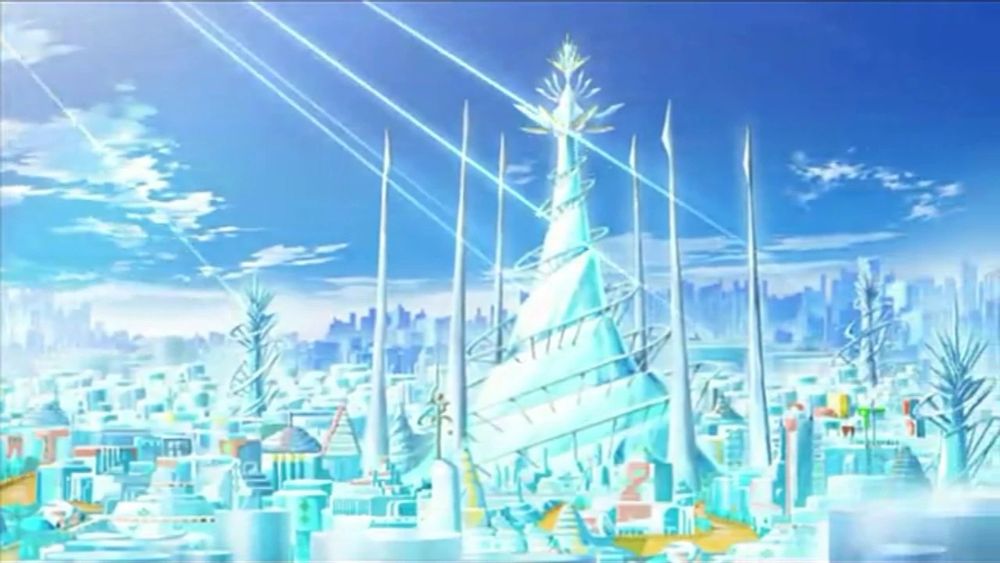
After passing the "big, shiny and sciencey!" period, a highly developed civilization can enter a stage where technology continues to advance, but becomes a lot sleeker and subtler. At the same time, society gets epic. Jumpsuits will start being replaced by togas, robes and such garments, bustling mega-cities by brilliant arcologies. There will be crystals. Lots and lots of crystals. This world of tomorrow may end up looking much like Ancient Greece or Rome (the theme-park Cecil B. de Mille version at least) while still enjoying ultratech comforts.
It's kinda like the civilization-scale equivalent of crossing the Bishōnen Line.
Any society with Crystal Spires and Togas holds a high chance of being ruled by Philosopher Kings, and populated with Perfect Pacifist People (or aliens, as the case may be) or a Proud Scholar Race that require others (namely The Hero and his squad) to take up arms for them. Occasionally they occur in the past, A Long Time Ago, in a Galaxy Far, Far Away..., since decimated by some catastrophe with perhaps a single surviving Advanced Ancient Acropolis. Sufficiently Advanced Aliens are not the same thing, but, as beings who can do anything with no apparent devices, they could be a logical outcome. Thematically it may play opposite number to a society in Medieval Stasis.
A common subversion has this kind of atmosphere only for the rich and powerful, while everyone else lives in a Used Future. Another subversion may be for the society to look beautiful, but for many of its people to be deeply corrupt or malevolent Abusive Precursors in a serious case of Light Is Not Good.
The rare cases where a future society is genuinely not a Bad Future might look like this, but even some Bad Futures still do.
The same sense of style permeates other facets of society, not just clothing and architecture. Instead of a president or an assembly, the Minbari are ruled by the Grey Council, the Nibblonians from the Hall of Forever (which also hosts the Feast of a Thousand Hams), and the Eldar by the Farseers.
While there's a definite trend towards giant and architecturally impressive glass towers in the modern era, the trope hasn't quite made it to the status of Truth in Television yet — aside from a conspicuous lack of togas, robes, or unisuits, these shiny new buildings aren't part of the sort of sweeping social movement this Trope describes but individual corporations jockeying to display their wealth.note Utopian cities they are not; very real slums crowd their feet.
As TIME magazine put it, this is nearly the opposite of Steampunk, as Steampunk seeks to make technology more visible, easier to connect with than the sleek shiny technology of this era. Another opposite would be The Apunkalypse, where the future belongs to violent, shabby-looking vandals. Compare with Defector from Decadence, Space Elves, City of Gold and Space Brasília. See also Power Crystal and Data Crystal, for the Plot Device version. Cyberpunk was created as a reaction against this particular Science Fiction trope.
Examples:
- The world of gods in Ah! My Goddess is this. While at first glance it resembles a stereotypical Olympian heaven, it turns out that it actually relies on massive amounts of Applied Phlebotinum, its inhabitants hold regular jobs and there are even shopping malls (plus plenty of politicking and the occasional Doomsday Device).
- Appleseed: Olympus is a classic example. At least to the outside.
- Bokurano: In the anime, it is implied that one of these is responsible for the robot combats that are destroying universes, somehow benefiting from the process.
- Gargantia on the Verdurous Planet has the Galactic Alliance. Their world-ship looks like the Protoss mothership. Fittingly enough, their enemies are Zerg-like.
- The Guild in Last Exile partly falls under this trope. Despite the rest of the world being steampunkish.
- Sailor Moon had the Silver Millennium in the distant past and Crystal Tokyo in the distant future, though neither are shown with Togas. (Princess Serenity's dress though was inspired by the Palladium Dress by Christian Dior, which was designed to look like an Ancient Greek column) We mostly see the Royalty and Soldiers, which consist of a Pimped-Out Dress and Sailor Suits respectively for the women, and a Suit/Vaguely Medieval Armour and a vaguely military uniform, both apparently based on boy's school uniforms, for the men. Though they don't appear anywhere else, the girls are shown wearing togas during the Silver Millennium in the footage that goes along with Tuxedo Mirage, the first ending theme of the first anime's Super season.
- ElfQuest starts out this way, and much of the main storyline involves getting back to the Time Machine (which has a similar atmosphere). Notably, the spires and togas are an invention by an advanced alien race, but become the future when everyone is sent back 20,000 years in time; the last stages of this are shown in the opening narration.
- In New Gods, New Genesis is depicted as one of these.
- RoboCop Versus The Terminator: When Skynet is erased from history, the new future heavily resembles this trope.
- In the Silver Surfer's past, when he was still just Norrin Radd living on Zenn-La, his planet was very much like this. Their world was so nearly perfect, with beautiful and exotic architecture and clothing, that everyone was bored, and Norrin most of all.
- Superman:
- Many depictions of Krypton fit this trope. Post-crisis, though, Krypton was more dystopian despite all the crystal-toga trappings. When Superman: Birthright retconned Krypton's society back to something closer to the pre-Crisis version (i.e. a more general super-advanced civilization without a specific, dominant theme), the togas changed back to Space Clothes.
- For maximum effect, post Infinite Crisis reverts some of Birthright's changes to include some of the Byrne era Kryptonian aesthetics so that you have the crystal spires and the togas at the same time.
- In the pre-Crisis universe, the citizens of Kandor who survived the destruction of Krypton settled on a planetoid which they called Rokyn. As seen in this scene
 ◊ of Superman Vol. 1 #338: Let My People Grow!, Kandor was definitely a crystal-and-toga place.
- In Superman: Brainiac, Superman's recognizes the Bottle City of Kandor because of the crystalline, tall, strangely-shaped buildings.
- The Supergirl books often go into detail about the culture and society of Krypton, particularly Argo City (Supergirl's hometown). Supergirl (Rebirth)'s first scene depicts Argo City: everybody wore colorful, bright clothes and long, flowing robes and capes; and the buildings were tall, alien-looking structures made of glass and metal.
- In Supergirl (2011) issue #12, Kara Zor-El describes Kandor in these terms:
Supergirl: My father Zor-El took me to see Kandor when I was a little girl. I thought it was the most beautiful place in the world. It wasn't as crowded or noisy as Argo or Kryptonopolis. It was like someone built a garden out of glass and light.
- Subverted in For the Man Who Has Everything, which keeps the crystal and toga trappings while portraying the illusory Krypton as a dystopia.
- The Krypton Chronicles mini tells the history of Pre-Crisis Krypton. Throughout ten thousand years, Kryptonian society goes from rag-wearing barbarians dwelling in stone buildings to a civilization of people clad in bright, colourful robes and skintight suits, and living in shiny cities with tall, crystalline skyscrapers.
- In Who is Superwoman?, Kandorians wear brightly-colored robes and live in shiny, metal skyscrapers.
- In Superman's Return to Krypton, Superman time-travels to pre-destruction Krypton. As wandering around a Kryptonian city, he bumps into men and women wearing colorful skintight jumpsuits and fluffy flounced dresses, respectively. He also observes buildings are tall, polished and strangely-shaped.
- The Immortal Superman: In the one-hundred-and-first millennium and beyond, Earth people live in five-mile-high skyscrapers, wear garish robes and drive flying cars on tube-like floating freeways.
- In Supergirl (1984), Argo City looks like a humongous, glowing-white, drop-shaped diamond floating in space. Their inhabitants wear bright robes and flowing capes.
- In Supergirl Special, Kara describes Argo City as a city made of liquid glass and polished steel where everyone wore Roman-style robes.
Superboy: "Tell me about Argo City. What do you remember?"
Supergirl: "The sound of it. The noise of all the people. It was around you all the time. Buildings like liquid glass and steel." - In Legion of Super-Heroes comics, Weber's World is an artificial planetoid made of steel and silicon. In The Earthwar Saga, its single city -spread all over its surface-, is described as "a thousand towers holding twelve million beings— linked by gleaming vandium steel viaducts".
- "The Unknown Legionnaire": Inverted. The first planet colony built by the Llorn aliens featured metallic, corkscrew-shaped, brightly-colored towers. When their city was destroyed, the Llorn built another city, opting for nondescript cubic buildings which resembled Earth's ordinary apartment blocks.
- The Living Legends of Superman: In "The Exile at the Edge of Eternity", the far future people wear gaudy, richly decorated clothes and builds tall, shining buildings of polished metal.
- Watchmen: Doctor Manhattan invokes this with his floating glass tower during his stay on Mars.
- The story "The Reformers" in Weird Science, 1953, had a perfect utopian place with ultratech elements but several flowing robes and stone arches. Also, it turned out to be Heaven.
- In the first color Zot! story arc, the future utopian version of Sirius seen through the Door at the Edge of the Universe includes togas and hi-tech faux-classical architecture.
- Wonder Woman: During the time where Paradise Island was written as taking in refugees from all worlds and amassing a huge library of knowledge from across the universe it was depicted as having futuristic crystalline buildings jutting out of the lush green landscape on floating islands, yet the Amazons still mostly dressed like they were in ancient Greece.

- A Crown of Stars: The Empire of Avalon. Although there are not many visible togas, technology is sleek and cities are definitely shiny and monumental.
- Last Child of Krypton: Paradise Island, which is where Asuka, Misato, Rei, and others are brought after the battle with Zeruel.
- Superwomen of Eva 2: Lone Heir of Krypton: As its Silver Age version, Krypton is a world with huge, shiny cities, populated with people dressed with flowing robes and colourful suits, surrounded by crystal forests and fire falls.
- Gateworld Virtual Fleet: The Alfar, who are literally crystal spires, fit to a t. Then again, this is intentional because they want visitors to be impressed. It mostly works.
- Kara of Rokyn: The setting of the story is Rokyn, a planet settled by Pre-Crisis Kryptonian survivors who brought with them their civilization's trappings: Kandor is a city of shiny, polished glass buildings where everyone wears space clothes.
- Hellsister Trilogy: Most of cultures in the galaxy have embraced this style in the 31st century, which is because the main characters find people wearing colorful skintight space-suits and dwelling in tall buildings made of glass and steel wherever they go.
- Atlantis in Atlantis: The Lost Empire combines crystals and stone architecture, though technologically these are remnants of a better time in Atlantean history, and the modern Atlanteans have forgotten how to read their own glyphs.
- This aesthetic is featured in the last sequence of Heavy Metal.
- The infamous anti Mormon "documentary" The God Makers features an animated segment that utilizes this trope, which focuses on the Star of Kolob and other idiosyncratic Mormon doctrines. The film is generally considered ill informed at best and defamatory at worst and today most only know it because the animated segment is a YouTube Poop staple.
- A.I.: Artificial Intelligence has, at the very end, extremely advanced robots who are long, skinny, and made up of glowing crystal.
- In the Brazilian film Astral City: A Spiritual Journey (also known as Nosso Lar), the titular city is this. Populated by souls who aren't bound by time or material constraints, the buildings look majestic and crystalline, while the inhabitants wear simple robes as a sign of humility and detachment. One of them was a Roman senator in his past life and still wears his toga.
- The future of Bill & Ted's Excellent Adventure is this, with totally excellent music to boot.
- Some of the upper-crust civilians in Demolition Man dress in long ornate robes, in reference to their attempts to re-engineer society to conform to this trope. As the film is set only 20 Minutes into the Future, conventional clothing is also common, and architecture hasn't yet fallen prey to this aesthetic.
- This style is present in The Fifth Element, though it is shown along with other styles.
- Although the series played the trope a little more straight, it was consciously avoided with the design for the Alliance environments in Serenity. On the commentary, Joss Whedon says he wanted the central planet settlements to look 'genuinely Utopian rather than just tall'. Thus the design of the cities notably omit crystalline spires.
- In Forbidden Planet, the Krell civilization is supposed to have been an example of this, with "cloud-piercing towers of glass and porcelain and adamantine steel". Now only the Underground City remains.
- In 1973's Godzilla vs. Megalon, the inhabitants of Seatopia - host to gigantic cities with architecture that appears to draw on Ancient Rome, Ancient Greece, Feudal Japan and the theoretical lost city of Mu all at once - are an advanced undersea civilization (who are rather P.O.'d at the testing of nukes near them and send out their monster for revenge) where the toga seems the most commonly worn clothing.
- Discussed and parodied in the narration of Idiocracy with some accompanying images of a futuristic world showing bearded guys in togas among the crystal spires of their city. The camera pulls back to reveal that these images are all part of a mural at a carnival, in front of which a bunch of not-too-bright and decidedly non-futuristic-looking people are waiting in line to get into some kind of exhibition or maybe carnival ride.
- Kin-Dza-Dza!, where the toga people specialize in turning dangerous alien invaders into cacti. The nasty part? A bunch of unarmed aliens arriving on their world needing help fits their definition of "alien invaders".
- Subverted in Logan's Run. While the post-apocalyptic society of the film is at first glance a utopia, its prosperity is maintained by a Master Computer that ritually executes all citizens on their 30th birthday in order to conserve resources. Those who manage to escape this fate and flee the city are invariably captured by a deranged robot who freeze-dries them in the belief that they are seafood.
- Man of Steel: Though hardly the crystal-encrusted world shown in the previous films, Krypton is a "neo-medieval" society, with Jor-El, Zod and others wearing armor, capes and robes over their supersuit-esque bodysuits.
- Marvel Cinematic Universe:
- Asgard in the Thor movies fits this trope as well.
- Black Panther (2018) crosses this trope with Afro Futurism. Wakanda is the most technologically advanced country on the planet, while resembling bronze age Central Africa.
- The H. G. Wells-written film Things to Come is the Trope Codifier. The future technocrats literally live in crystal spires and wear togas. The preface to the published script gives the rationale for the costuming which "cries aloud for cloaks, the most dramatic of garments."
- At the tram station in Star Trek: The Motion Picture, most of the civilians in the background are wearing togas.
- Star Wars: while the original trilogy has a Used Future aesthetic, there are flourishes of this trope, most notably in the robes of Jedi. The prequel trilogy use it more, before the Evil Empire took over. Coruscant, Naboo, and Alderaan (until it gets blown up) are particular examples.
- Superman: The Movie and its sequels invoke this trope with Krypton (and Argo City in the spinoff Supergirl (1984)). Krypton's spires are giant crystals. The walls are made of crystal. The canyons are lined with crystal. The clothes are made of some form of wearable, highly-reflective crystal. But, because so little of Kryptonian society is glimpsed, it is left up to the viewer's interpretation whether this is a utopia or a dystopia.
- Tenet: Sator talks of his mysterious sponsor, a man in a crystal tower in the far future. Subverted in that this future is a Crapsack World due to environmental damage.
- Warrior of the Lost World features a Dystopian world in which live a group of toga-wearing "enlightened ones". They have healing powers and live in a pocket dimension from which they battl the oppressive totalitarian government that has taken over the world.
- Probably a shipload of ancient pulp Science Fiction that we can't name. Heck, the good aliens wore togas in the 1930s Lensman series that started Space Opera!
- Note that all of the clothing that the good aliens (the Arisians) wore, in fact the bodies and cities and everything else about the Arisians, was a mental projection which was intended to fit whatever made the visitor to Arisia most comfortable. This point was made explicitly in chapter 3 of "First Lensman", where all of the people saw different things: aliens in togas, male humans in uniform, professors at large universities, 7 foot tall women, disembodied intelligences, etc. There are references to it in the rest of the books when the fellow aliens (Tregonsee, Worsel, Nadreck, etc) briefly discuss their experience on Arisia. They even use the mental projection trick to fool Kim Kinnison into "seeing" one of the forms of the bad aliens, so when he beats one of them (Gharlane of Eddore) he thinks it was a rogue Arisian. The children of the Lens do realize that the Arisians have no physical form at all. The all-too-human Atlanteans, on the other hand...
- Common for a Communist Utopia future in Soviet science fiction. Almost every Soviet book dealing with really distant future or a really developed society will have an Ancient Greece smell.
- True for Ivan Efremov's Andromeda Nebula; our utopian future is to become antithetical and pretentious much like Greek gods.
- Gennady Martynov's Callisto and Callistians features Sufficiently Advanced Alien civilisation with distinctive Ancient Greek traits. And of course, it is Communist.
- Saturn City in Aeon Legion: Labyrinth is a blending of Arabic, Latin, and Greek culture. Its technology grants eternal youth, crime is stopped before it even starts by Seers called Sybil, and Saturnian citizens are pretty nice if a bit hedonistic. Despite being the most advanced and powerful human civilization in history, it is also completely stagnant culturally and technologically.
- In Animorphs, the Pemalites and Iskoort are both examples of this trope, with their playful societies and fanciful architecture. The Andalites, too, have given up the habit of living in cities in favor of a natural lifestyle on the open plains, without losing any of their great technological skill.
- It should be noted that the Pemalites were designed by the Ellimist, a being who can pass for a god to be that way. The Iskoort have architecture that's more like legos and they have spires because the ground is generally too marshy to build on. The Andalites had cities, but because they're basically herd animals, they hated them.
- The Kentrans were essentially like this as well, though the Ellimist only shows up in the toga-wearing appearance much much later. The crystal spires were floating in the air, powered by the flapping of the Ketrans.
- Many of Arthur C. Clarke's short stories imagined this as the ideal civilization. One of his earliest (Rescue Party) supposed that the replacement of the car with the personal helicopter would eliminate the need for cities and "decentralize" civilization.
- The "helicopters decentralize civilization" idea popped up in several Clarke stories during that period. Clarke didn't foresee that flying a helicopter would be harder and more expensive than driving a car, to the point where not everyone can do it.
- Come to that, not everyone can drive a car...The "civilization decentralized" idea also crops up in Alfred Bester's The Stars My Destination (aka Tiger! Tiger!), where "jaunting" (teleporting without a teleporter, pretty much) means you can live anywhere on earth and still be able to get to work perfectly conveniently. It's not exactly an utopian future, though.
- Cars or helicopters, there are still logistics considerations. As Larry Niven wrote about in e.g. Flash Crowd or the Final Days of the Permanent Floating Riot Club, the most straightforward way to achieve societal decentralization is teleportation tech.
- In Against the Fall of Night and its remake The City and the Stars, the city of Diaspar is a classic example of this trope.
- How We Went to Mars (1938) plays this trope for humor.
- The "helicopters decentralize civilization" idea popped up in several Clarke stories during that period. Clarke didn't foresee that flying a helicopter would be harder and more expensive than driving a car, to the point where not everyone can do it.
- Tanith Lee's two-volume Biting the Sun series portrays this as a semi-dystopia.
- Cordwainer Smith had a definite fondness for weird future settings jumbling all sorts of advanced technology — much of it barely understood by the people using it, if that — with baroque and sometimes archaic furniture and clothing.
- Most of Iain Banks' novels, especially those set in the fictional universe known as The Culture. Sometimes subverted in that while the Culture tend to favour a smoothly minimalist and elegant aesthetic for their technology, they're advanced enough to make any tech look like anything they want – and so a Culture home that looks like a basic log cabin or a simple barn-like structure will have just as much technology as a home that looks very advanced, and the simplicity and materials used in its construction are just an aesthetic choice. Similarly, their most advanced ships can appear as enormous landscapes of rolling green fields, or a slab of a gas giant's atmosphere, while their inner workings are still composed of ultra-dense exotic matter and the ship's true structure is essentially a collection of very advanced forcefields.
- Played with/averted in Stephen King's The Dark Tower series, as jokester-qua-gunslinger Eddie Dean abandons the last of his naiveté in realizing that that city of "wise ***ing elves" isn't going to magically appear to help the heroes on their quest.
- Doubly subverted in arguably the most chilling scene of James Blish's very dark The Day After Judgement (a.k.a. the second half of The Devil's Day). The End of the World as We Know It has taken place. God, it turns out, really did die. Satan (who is not so bad) shows a viewpoint character the Crystal Spires and Togas future which would have come about had he not destroyed everything and then reveals that compared to such a soul-less living death, the Apocalypse would seem preferable.
- Not much is known about the Eldren ancient civilization in the Gentleman Bastard series, but they did build (among other things) crystal spires, who are now used as housing for the most powerful noble families.
- William Gibson's short story "The Gernsback Continuum" is about a photographer who, while on commission to shoot some old Thirties-art-deco buildings (all magnificent examples of Zeerust), suddenly begins to see glimpses of an alternate reality that contains all the weird architecture, drapery clothing, and amazing technical advances predicted by the pulp-SF writers of the 1920s-1950s. Gibson actually specifies that the alternate-Earth dress code includes a toga. Gibson states in various places that it is meant as a deconstruction of this trope.
- In The Hunger Games, the Capitol is described as being full of colored glass, and the people are obsessed with fashion. Technology also seems to have advanced to the point that it can be completely hidden from view. Although no one wears a toga, Capitol residents almost all have Roman names, establishing them as a decadent and technologically advanced society.
- From what's left of their vanished civilization in Scott Lynch's The Lies of Locke Lamora the Elderen had a civilization like this. They certainly had the Crystal Spires. Whether they had the togas is unknown.
- Atlantis in Magic 2.0 is a gleaming city made out of a single piece of diamond and ruled over by robed Sorceresses. Everything is shiny and made of some crystalline mineral, mostly to be easier to control, since any non-monolithic substance tends to break apart when manipulated by a time traveler due to the fact that the reality program considers it to be separate objects. The city was created by a female time traveler using a macro she designed that basically works like a nano-scale 3D printer. Sorceresses and other inhabitants typically move around the city using levitating platforms.
- The Martians in Ray Bradbury's The Martian Chronicles. Most of the elements seem like a fantastic version of Egypt, with books written in hieroglyphs that sing when you touch them, houses built of crystal pillars and traveling using flocks of birds, all in the middle of a great desert.
- Deconstructed in Paths Not Taken, in which Lilith's idealized vision of a city resembles this trope, but anyone who's actually lived in a city can see that she's failed to take logistics into account. It's big on the crystal spires, fountains, and other frills, but lacking in such necessary amenities as sewers.
- D. J. MacHale's The Pendragon Adventure has the "closer to nature" future version of Earth, Third Earth. But of course it gets completely and utterly screwed over by the resident Big Bad and becomes a Crapsack World.
- The Elderling civilization in Realm of the Elderlings seems to have been like this before being destroyed by a natural disaster.
- This is the stated goal of Alvin Maker in The Tales of Alvin Maker series by Orson Scott Card
- A Tale of Time City by Diana Wynne Jones. Statues, glass domes, technology which looks like 'a pipe organ' and the caskets (which are actually some kind of advanced time-battery-thing), amongst others. The people wear jumpsuits most of the time, but robes are donned for official functions.
- Subverted in H. G. Wells's The Time Machine in which the Eloi seem to live in this kind of future, but are actually little more than (barely) sapient cattle for their underground dwelling Morlock masters.
- Actually invented by H. G. Wells in Men like Gods.
- The Vampire Hunter D novels mention a rare example of a post-Crystal Spires and Togas Used Future: the capital city, built out of crystal by the Vampires and then fallen into disrepair once they were driven out.
- Indeed, they were Crystal Spires and Togas with a goth twist. All the major vampire buildings resemble gigantic gothic cathedrals and gloomy castles straight out of Victorian horror novels, while the vampires themselves prefer to dress in elaborate evening suits and long flowing capes, which they enjoy twisting into bat's wings.
- Peter F. Hamilton:
- In the Void Trilogy, humans finally hit this stage around 1500 years into the future: most technology is sleek, hidden, implanted or only partially made of matter, and fashion is dominated by "toga-suits" made of smart nanomaterials that reflect and refract light in interesting patterns. Peace, on the other hand, is nowhere in sight...
- The Edenists in The Night's Dawn Trilogy are a civilization of super-advanced genetically engineered telepathic superhumans who dress in antiquated clothes like robes, tunics, and togas and live in giant, sentient floating space stations. Heck, their entire lifestyle is based around clean, sentient or semi-sentient organic biotech, and they believe themselves to be superior to the more traditional "Adamist" civilizations. Sort of a subversion, insofar as their society is clearly not perfect, and a pretty big portion of the books is about this. Hamilton loves subverting this trope.
- Horus Heresy: The interex in Horus Rising.
- In The Wheel of Time, the few glimpses we have of the Age of Legends civilization show it to be very much like that. For example, one of their top universities had an annex designed to look like a huge pure white perfect sphere levitating a few hundred of meters above the campus, that could only be accessed through flying or teleportation.
- A Memory of Light subverts the "perfect utopia" aspect of it, however. When Aviendha expresses admiration to Rand/Lews Therin that knew what it had been like to live in an Age of such wonder, he remarks that, yes, it was beautiful but the world government was ignoring problems that didn't mesh with the idea that their society was perfect. It was getting bad enough that war probably would have erupted within a generation or two if the Bore hadn't created a different problem.
- The Minbari in Babylon 5 have the crystal part down pat in their architecture, but their social development is stuck in a thousand year Medieval Stasis. The Utopian and Enlightened bit of this trope gets subverted in the fourth season, when they fall into Civil War.
- Battlestar Galactica:
- The Beings of Light and their Ship of Lights in Battlestar Galactica (1978) have this feel to them — as did the original colonies. In the pilot, "Saga of a Star World", The Quorum of the Twelve on the Atlantia and its reconstitution afterwards featured togas. And crystalline pyramids are wrecked by the Cylon bombardment of Caprica.
- This is largely averted in Battlestar Galactica (2003), where the Colonies have buildings that are plausible to build today, but simply do not extend to our architectural styles (although looking at Caprica City for too long may sear your retinas, it's that shiny-future...). Same thing for people's appearance, with... well... normal clothes. An exception is the spectral forms of the Final Five Cylons, who appear as glowing robed figures before they're revealed to be the most ridiculously human of the show's Ridiculously Human Robots.
- The Beings of Light
- In the Blackadder special "Back and Forth", Blackadder visits a future world that matches this trope.
- Brave New World: New London has this aesthetic. All the buildings have sleek, futuristic looks and people dress in flowing garments while not at work (where they have more utilitarian garb, but still attractive too). They at least claim it's perfect as well, with everyone living happy lives with clear places in life, everything provided to them and wise, benevolent rulers. However, it's quite empty on the inside.
- Doctor Who:
- The Time Lords represent a civilization of this type. Hobbies include creating Magic from Technology and Abusing the Kardashev Scale for Fun and Profit. The trope was subverted in a couple of ways. Even their first appearance, which shows them highly advanced and almost utopian, establishes their civilization as so boring and pompous that the Doctor couldn't wait to run away from them. Later appearances often, though not always, revealed them as corrupt, petty and hypocritical.
- "Last of the Time Lords" has a flashback of a Time Lord in long robes standing on a hill, with the Citadel of the Time Lords behind him, a great city of spires all encased in a glass sphere.
- Some of the civilizations encountered by the Doctor during his/her travels are similar subversions, for example:
- The city of Morphoton in part 2 of "The Keys of Marinus" (the people are hypnotized by Brains in Jars and actually live in squalor).
- The planet of the Elders in "The Savages" (the Elders live in immortal luxury by draining the life essence from the eponymous Savages).
- Farscape: The otherwise unnamed "Royal Planet" from the "Look At The Princess" trilogy leans on this aesthetic compared to the show's usual mix of Used Future and just plain trippy visuals. Denizens of the Royal Planet prefer all-white outfits, heavy on the Fanservice, and the general look of their cities is minimalist and angular. The main building in all the establishing shots is a futuristic pyramid.
- The inner Alliance worlds of Firefly are Crystal Spires and Costume Straight From The British Regency for the rich, and a very Used Future below.
- Subverted in Flash Gordon (2007), where Mongo's capital, Nascent City, is all crystal spires and togas, while the rest of the planet is a post-environmental-catastrophe Scavenger World.
- Foundation (2021): The Empire seems to be in transition to this, as the Emperors wear robes, technology is becoming more miniaturized and thus less visible, and the high society is focused more on arts and rituals than tech.
- The Australian kids' TV show The Girl from Tomorrow featured a future like this.
- Atlantis in Hercules: The Legendary Journeys.
- The Altrusian Civilization from Land of the Lost (1974).
- The Lord of the Rings: The Rings of Power: Numenor, with its Venetian, Byzantine and Greco-Roman architecture and toga-like attire for the upper classes fits nicely into this trope. Additionally, the elven kingdoms have a touch of it as well, with Gil-Galad sporting a Roman style toga and crown.
- The Land of Light in the Ultra Series is sort of like this, though replace Togas with mantles, in the case of the Space Garrison. Much of the Land of Light appears to be constructed of gigantic emeralds and other gemstones, from the buildings to the very ground itself — spires are pretty much everywhere, too!
- In an episode of Red Dwarf where the lads got split up into a good and an evil part, the good version was portrayed like this.
- The Ancient race in the Stargate television series, especially Stargate Atlantis, are an example of a crystal spires and togas race which has "ascended" to a higher plane, leaving their crystal city (actually a metal-alloy spaceship the size of Manhattan) deserted.
- They are not the only ones. Almost everyone, the Goa'uld (and the Tok'ra), the Tollans, the Asgard, later even the humans, all use crystal-based technology. For most civilizations, the crystals are only the guts. The outward appearance varies wildly. The Asgard and Ancient stuff looks crystal spire-y, except when it looks paleolithic.
- In Stargate: Continuum, we see that following the downfall of the System Lords, the Tok'ra apparently stopped hiding and now have a city made of crystal skyscrapers. They are also fond of wearing toga-like clothing.
- Star Trek: The Original Series actually tended to subvert this. Civilizations that used this aesthetic to make themselves seem civilized and elegant were often only superficially so. Once you got to know them, they could be sneering, snobby, self-important, chauvinistic and, in many ways, backwards.
- "The Cage" features the Talosians, who wear togas and have advanced technology. They also regard all other sentients as potential specimens for study in their menagerie while they go on and on about how superior they are to those lowly primitives. However, they aren't openly malicious, and in "The Menagerie, Part II", a man suffering from disfigurement and paralysis comes to appreciate the amenities they offer.
- The colonists in "A Taste of Armageddon" might have been trying for this, although their "togas" are a bit stylized and topped by truly stupid hats. They tried to "civilize" war by making it a simulation (but with real casualties), which does away with any incentive to actually end wars.
- "The Cloud Minders" gives us the Startoses, who have artists and scholars living in a shiny clean floating city in the clouds, while the Troglytes do all the hard labor in the mines below.
- Star Trek: The Next Generation: The first season features civilians wearing togas and a future Paris with crystal spire-like buildings. This look was very quickly abandoned for the industrial look that the rest of the franchise has embraced.
- Star Trek: Picard: Coppelius, the android homeworld, has a relatively modern aesthetic, but everyone dresses in toga-like outfits.
- Wonder Woman (1975): All the immortal Amazons from Paradise Island wear multicolor vaporous dresses and use bows and arrows even though they live in an Advanced Ancient Acropolis.
- In Dungeons & Dragons 4th edition, Eladrin cities in the Feywild have crystal spires.
- The High First Age magitech-based society of Exalted perfectly fits this trope. There are even literal crystal spires in Chiaroscuro.
- This is a well-established Aesthetic known as 'Crystal Future' in Genius: The Transgression, for Geniuses who work towards this vision of the future. However, a lot of this use it sardonically these days, and it has a somewhat sinister reputation as it was popular with the Secret Masters of Lemuria before their demise.
- In GURPS Alternate Earths, the highly-advanced parallel timeline of Caliph (set in 1683, Christian calendar) substitutes traditional Islamic dress for Roman fashion, but the people still live in diamond skyscrapers and are governed by mostly-benevolent Caliphates.
- As usual, Atlantis in Mage: The Awakening is often shown as a crystal spire city. They even swear its name means "The Dragon Spire".
- Mindjammer: The ancient home worlds of humanity, as depicted in the supplement The Core Worlds, definitely tend to this aesthetic, in a rather baroque form; see the book's artwork.
- High-clearance citizens live like this in Paranoia. The other 90-odd percent live in squalor.
- The True Atlanteans in Rifts employ magic crystals and stone pyramids alongside ancient Greek architecture.
- In Rocket Age the Ancient Martians appeared to have had a society like this. The Silthuri and Kastari castes keep this tradition alive and Martian cities still keep the architectural style.
- The upper classes of the Third Imperium in Traveller. Even more so the Vilani of the First Imperium in the volume Interstellar Wars.
- Crops up in Warhammer 40,000:
- The Tau have far Eastern influences, and their architecture is influenced by their philosophy, giving their ships, architecture, armor, and vehicles no hard angles and smoothed, curved surfaces. This design philosophy tends to be passed over for many heavy Battlesuits (combat platforms which are Power Armor at the lighter end and Humongous Mecha at the heavy end), which are given sloped armor, giving the heavy suits an angular and squared-off aesthetic.
- Zig-Zagged with the Imperium of Man. Bureaucratic necessity and a slow FTL dictates a fairly feudal approach to their empire, meaning many worlds are allowed to grow and develop their societies idiosyncratically. However, mainstream Imperial culture is basically the Holy Roman Empire taken to logical extremes, but with a heavy Gothic influence. Also, much high technology was lost in the collapse of the first human empire, so current Imperial tech is heavy, industrial, and visceral. (To elaborate on that last one a bit, the most common form of drone uses a housing fashioned from a human skull, and most labor "robots" are lobotomized cyborgs.)
- Eldar play this completely straight, right down to crystal spires and toga-like clothing. They used to play it even straighter before the Fall.
- Prospero's capital Tizca, the pre-Heresy homeworld of the Thousand Sons, fits the description practically to a T with its spires of glass and populace dressing in robes. The Sons are universally regarded as Warrior Poets and are shown with a collective penchant for the fine arts, Ahriman himself a surprisingly good vintner. Tizca's libraries are the greatest collective repository of knowledge outside of Terra within the Imperium, and the living standards the population enjoys one of the highest. Unfortunately, one of the earliest battles of the Horus Heresy was Horus orchestrating the battle later named the Burning of Prospero, by playing Space Wolves' bitter rivalry with the Thousand Sons, two of the greatest threats to Horus's rebellion and two fiercely loyalist forces divided by bitter rivalry. The Thousand Sons had to throw in with the Traitors to survive, while the Wolves were diminished, but survived as a very effective fighting force.
- Metru Nui has shades of this in BIONICLE. Minus the togas, of course, as armored cyborgs have no need for clothing. It's even lampshaded at one point, as a character walking through one of the districts notes how disturbingly clean everything is.
- A recurring location in Transformers is Crystal City, home of Cybertron's scientific elite and the planet's most beautiful city. It also tends to get destroyed pretty early in the war.
- AI War: Fleet Command: Amusingly enough, the race that goes full fantasy-style crystalline in all its architecture, ship design and biology is called the Spire. It's implied a lot of their technology is made from modified, engineered versions of themselves, down to facilities and starships, which explains all the crystalline structures handily enough.
- Chrono Trigger has the Kingdom of Zeal, which is located on a Floating Continent to boot. All its awesome crystalness and toganess is due to extracting energy from an otherworldly world-devourer.
- Well, by the time you visit it, anyway. Zeal was originally run on solar power, but they switched to Lavos power because Queen Zeal told them they didn't need the Sun Stone anymore. In an optional sidequest, you can obtain the Sun Stone and use it to create Lucca's best weapon. Awesome power source, indeed!
- In Civilization: Beyond Earth, factions following the Purity affinity from some moment start to take on a Roman-inspired aesthetic, thus trying to preserve their spiritual connection with Old Earth and salvage from oblivion at least a portion of humankind's most glorious heritage.
- In contrast to the Red and Yellow zones, Blue zones in Command & Conquer: Tiberium Wars are this minus the togas. People there have life expectancies over 100, incredibly high standards of living, full employment, virtually no crime, spotless cities, pristine wilderness, quantum computers, and routine spaceflight. All of it made possible by Tiberium.
- Diablo III has the High Heavens where the hooded angels are living. So beautiful and awe inspiring until Diablo came in and made it into a nightmarish ground.
- Atlantis in the Ecco the Dolphin: Defender of the Future fits this trope (especially the crystal part), existing in a civilization around the year 3500 in which humans and dolphins coexist in harmony.
- In The Elder Scrolls, several races of Mer (Elves) are known to have this aesthetic. The Altmer (High Elves) are perhaps the most advanced extant race (with the ultra advanced Dwemer extinct), with Tamriel owing much of its art, science, philosophy, language, and religion to the Altmer, who are also the most magically-gifted of all races. Their buildings are frequently made of glass or crystal (said to refract light into a rainbow "insect wing" like appearance), with tall towers, vine-like buildings, and swirling walls. Gold tends to be the primary color in their weapons and armor. The ancient Falmer (Snow Elves) had a civilization that once rivaled the Altmer, but were driven underground by the invading Nords, where they were enslaved and mutated by the aforementioned Dwemer into blind, bestial, barely-sapient creatures little better than goblins. Their former architecture had significant elements of platinum and massive jewels built into it.
- The Polaris from Escape Velocity: Nova fit this trope well. Their technology, which is head and shoulders above the rest of the galaxy, allows them to create serene, idyllic worlds to match their culture, even on planets specializing in industries like mining and manufacturing.
- Subverted in EVE Online. The Crystal Boulevard in Caille on Gallente Prime is a region near the nexus of the city where every structure, and even the ground itself, is made out of specially nanofabricated crystal. Its actual purpose? A nigh-invulnerable command bunker in case of orbital bombardment. The only way to disable the planetary government and military command would be to pulverise the entire city so thoroughly that it would constitute an unconscionable war crime and throw galactic opinion overwhelmingly against the attackers.
- In Fallout 4, the Institute maintains a clean, sleek and white plastic appearance which deliberately invokes this motif and contrasts with the grimy, lived-in aesthetic seen everywhere else in the Commonwealth. The scientists who wander the halls do so in labcoats which have toga-like patterns on them. Of course, it's all a thin veneer and underneath it's just as dirty and decayed as the rest of the wasteland.
- Fate/Grand Order: The Lostbelt version of Olympus goes like this. Apparently, 14000 years ago, the Olympians were machines built by the Titans, who were extraterrestrials; in the regular history, "Sefar, the White Titan" ravaged the world and attacked the Olympians before it was defeated, and it left their bodies broken and they could only survive as their humanoid avatars, giving them the image that common people know about the Olympian gods. In the Lostbelt, however, Zeus briefly merged with the other gods in order to decisively defeat Sefar, and this allowed them to survive with their technology intact. Over the millennia, they continued advancing their tech, so in the present day Olympus (which is apparently situated below Atlantis) has become a very high-tech city, and yet both the gods and humans there still wear togas.
- Final Fantasy:
- The nation of Esthar in Final Fantasy VIII, which is actually a gigantic (and initially invisible) city, is all crystal and glass tubes and antigravity technology. Even the people (save its president) wear ankle-length robes.
- Final Fantasy X's Spira is this in spades. At least it was before Sin destroyed almost every major settlement (periodically terrorizing the small remaining ones too). The only major city left, Bevelle, is mainly experienced by the player via a few cut-scene at one point in the game, but its appearance fits the trope perfectly.
- The City of Academia from Final Fantasy XIII-2 becomes this in 4XX AF—an Alternate Timeline that Serah and Noel unlock by preventing the events that turned it into Cyberpunk with a Chance of Rain in the original 400 AF timeline.
- The Allagan Empire from Final Fantasy XIV is the Posthumous version. A large technologically advanced empire, complete with a literal Crystal Spire. It's also a deconstruction, for their advancements allowed them to live in comfort and hubris to the point of decay and it was eventuality buried by a large-scale earthquake, leaving only a large satellite/evil-sealing can, a Crystal Tower, and a small floating abandoned research facility.
- Shinra's "Neo Midgar" the second city that would theoretically be built when and if they ever found the theoretical Promised Land in Final Fantasy VII. While it's only mentioned in passing in the original game, in the Remake we see the theorectical design of it in some presentations in the Shinra Building. It's basically a white futuristic looking version of Midgar in this style, vs the very metallic industrial grungy looking original.
- Galactic Civilizations 2, in the past. Only one character is shown, but he has a white robe and a staff.
- The space civilizations in the Galaxy Angel games; the first is actually called EDEN.
- Lemuria in Golden Sun: The Lost Age. Togas, Greek Temples, and the whole thing, all powered by magic... er... Psynergy. This lost civilization even discovered immortality, only to realize that life got really, really boring after a few hundred years.
- Played literally with Hallifax in the MUD Lusternia, a floating crystal city held aloft by Aeromancy. Interesting in that the denizens are also made of crystal.
- It's misleading, though: Hallifax is a Lawful Neutral meritocracy, where scientists are revered and the proles are content to serve their "betters".
- This is the Psilon aesthetic in Master of Orion: Conquer the Stars. Their leader, the Controller, is shown wearing robes in a brightly-lit room curved room with plenty of windows and some strange glowing contraption spinning in the center. The music is decidedly New-Agey. Even the Controller's voice is a soothing baritone (courtesy of Troy Baker). This is clearly designed to portray their Ivory Tower society, where scientific pursuit is all that matters.
- Neo Arcadia in Mega Man Zero, complete with Doric columns. Actually a False Eden, while the inevitable resistance is on a Used Future level.
- Metal Arms: Glitch in the System, a game set on a planet where all the inhabitants are robots, has the equivalent with the underground-dwelling Morbots. The Droids and Mils on the surface seem to have conventional (if advanced) technology and architecture, with industrial and mechanical styling all built out of metal (duh), whereas the Morbot Region is all purple, white, and glowing, very sleek, and with bridges and doors that assemble or shift out of the way in little flying pieces, and Tron Lines everywhere.
- The Metroid universe has the Chozo, an advanced race of terrestrial birds who eventually became so intelligent they developed telepathic abilities. After their technology reached its peak most of them chose to become space hippies, living in harmony with nature where they could seek greater spiritual enlightenment. Most of the ruins they left behind are made of stone and what little advanced technology there is seems to be designed to blend in with the surroundings.
- Or in the case of Elysia, a very pretty retro Steampunk design.
- The City in Mirror's Edge is slowly being transformed into one. And it's rather unsettling. After crushing the initial opposition and resistance, the mayor created an environment that left everyone lethargic and complacent. If people had freedom, they wouldn't know what to do with it.
- While the entire nation of the D'ni in the Myst series was — probably — bereft of togas (though concept art shows plenty of toga-like archaic fashions), their technology and archaeology almost definitely falls into this situation. As a bonus, they do have at least one literal crystal spire: the center and highest point of their city houses a mechanism that uses a giant quartz crystal to generate telemetry that keeps their most advanced devices synched with each other. Plus, they sowed the seeds of their own destruction, and whatnot.
- Outer Wilds: The extinct alien Nomai race used vacuum suits that look like robes with ceremonial masks, carried high-tech staffs, and stored their electronic communications on scrolls and tablets. Most of their structures were made of quartzite, gold, glass, and crystal. It stands in stark contrast to the player's race, which has more of a duct tape and wood aesthetic.
- Overwatch, despite its history has two: Numbani and Oasis. The former is described as the "City of Harmony" where humans and sentient robots called Omnics built and live in the city together in peace after the disastrous Omnic Crisis, and it shows in its organic, sleek, futuristic style married with West African aesthetics, as well as statues of figures in flowing robes reminiscent of togas. The latter, Oasis, is a city of learning lead by scientific rulers called the Ministries. Appearance-wise, it's Arabian Nights of the future with gardens, spires, and high-tech labs, and is one of the safest and most well-educated cities in the world.
- Phantasy Star II has elements of this in its mix of Ghibli Hills and tower architecture on Mota; it's stated in the manual that Palm is a full-blown version at this point (but you never go there). In Phantasy Star IV, Rykros runs on this aesthetic.
- Phoenix Point: The Synderion faction has this as their architecture aesthetic.
- Rocketmen: The Venusians are an advanced society and they certainly wear togas.
- The planet Le Marie Glennecia (AKA, Mariglenn, AKA "Eden") from Rogue Galaxy is almost literally this, featuring copious amounts of actual spires and togas, and to top it all off, possesses what is obviously extremely advanced technology. How advanced? Advanced enough to move their entire planet, intact, to a completely different galaxy, possibly a completely different universe, and surround it with a time stasis field. When they finally return to normal space, they spend 10,000 years waiting for the return of Kisala. And all of this is completely unapparent just from looking at their stone-paved city streets or the pretty, ancient Greece-style masonry buildings. If the spires were crystalline, it would be a flawless literal example of this trope.
- Sid Meier's Alpha Centauri. Space elevators, matter transmitters and the like are built in a standard scifi fashion, but telepathy is eventually done in shrines and ascension to posthumanity apparently by monks.
- This might be a faction-related thing; the telepathy/planetmind techs are usually associated with the Gaians, who tend towards a nature-friendly version of aesthetic.
- The Silver Civilization from Skies of Arcadia. The Purple Civilization might also qualify, although their 'spires' are more like icicles.
- The Sonic the Hedgehog series has had a few of these over the course of the series, such as Quartz Quadrant's Good Future in Sonic the Hedgehog CD, Future City in Sonic Riders (where the Metal City, Night Chase, Megalo Station, and Nightside Rush racetracks take place), Grand Metropolis in Sonic Heroes, and Metropolis (without the "Grand") in Sonic Forces. That being said, all of them have come under attack by Dr. Eggman or a powerful ally of his, requiring Sonic's intervention (with the exception of Quartz Quadrant, where a city grew in its place because Sonic had driven Eggman away).
- Soul Calibur IV, When Siegfried defeats Nightmare, he sacrifices himself. and using his sword, he plunges the world into a utopian society literally covered in crystal. No togas though, as everyone dies.
- Neo Babylon area in Spelunky 2 is an amazing combination of ancient Babylon culture motifs and sophisticated futuristic technologies that harmoniously complement each other, which, however, definitely does not make life easier for the player.
- In Starcraft, the Protoss have a Crystal Spires and Togas society, right down to the togas, especially in the comics and parts of the manual. A large part of their arc is losing their homeworld and struggling to reclaim it.
- The Aeon Illuminate of Supreme Commander was founded by a group of human colonists who landed on a planet already inhabited by an alien race that embraced this trope. The aliens were annihilated by nuclear and biological warfare on the party of humanity, but the remaining colonists adopted the aliens' religion and technology as their own. The Aeon universally wear robes, are lead by a Princess, use all manner of advanced and esoteric weapons (ranging from sonic weapons on low-end units to massive 'oblivion cannons', death rays mounted on flying aircraft carriers, and giant robots with death rays for heads and tractor beams for arms), and have a universal design philosophy of sleek, shiny, and silver with their vehicles and buildings.
- Atlantis in Timelapse takes on this trope as well, to the point that the Atlanteans used crystals for power sources and construction tools, among other things.
- The Lunar Capital in Touhou Project is a Japanese flavored version of this trope.
- The Masari faction in Universe at War. They are also Precursors and Sufficiently Advanced Aliens.
- Warframe:
- At the start of the game, very little is known about the Orokin, up to if they were even human. What was known was that their empire stretched over the whole star system and they followed this trope almost religiously. What architecture and technology remain have a vaguely Greco-Roman look, featuring an ivory coloring and ornate gold detailing, and a pale golden glow where applicable, and much of their tech is usually advanced enough to qualify for Clarke's Third Law. The "present day" of the game takes place long after their disappearance, with three major factions and numerous colonies and societies having established themselves in the remains of Orokin society. The Tenno, one of the Orokin's final creations, are awakening from cryosleep to become the fourth major faction.
- What the players eventually learn is that the Orokin were posthumans and apparently a caste unto themselves, being in the ruling seat of human society. Their own executive council also did indeed wear togas and spoke with British accents and a poetic flourish.
- What the player's also learn right beside the above is that the Orokin were a firm Deconstruction of this trope. While it's not in dispute that the Orokin were highly accomplished and immortal posthumans, their technology and aesthetics reflected a deep seated vanity and decadence. Their history also indicates that the Orokin were very selfish and hideously abusive to the rest of humanity, to the point of causing at least three separate rebellions and ultimately their extinction.
- This is somewhat present in the elven architecture in World of Warcraft.
- Night Elves have a lot of Greek-style columns and spires and their fashion sense generally fits too: lots of toga-ish robes and dresses, especially for the Priestesses of Elune. Warriors tend towards Stripperific leather get-ups, that look more like bondage gear than armor (both for the ladies and the guys).
- Meanwhile, Blood Elves have even taller spires and crystals everywhere (although the crystals tend to have creepy looking evil eyes staring out from them) with magical doodads all over the place. They prefer wearing robes as well.
- The Draenai seem to have embraced this as well, their buildings being crystalline inter-dimensional spaceships or something like that. They have crystals all over just about everything actually. Their native dress also fits the trope to a degree. They like to drape cloth on their armor, or make the armor to resemble cloth. Also they have Greek accents (well, it comes out as halfway between Greek and Russian, depending on the voice actor) and their language kind of resembles Ancient Greek. Many of them have names that are references to classical mythology.
- The highborne night elves were a (evil) textbook example of this at their time, excepting the lack of council. Queen Azshara palace even has a runway and a platform made purely of magic glass. Queen Azshara herself aptly fits the Philosopher King trope, albeit with a healthy dose of Magnificent Bastard.
- Xenogears has Solaris, which fits this to a T in reference to any other land based civilization.
- Shevat fits this trope even better than Solaris. It is a Floating Continent full of immortal people who use elegant and completely invisible nanotechnology for everything. Solaris is not necessarily less technologically advanced, but their tech is much more obvious and awkward.
- Xenosaga bleeds this in all three games.
- And for the Takahashi hat-trick, Xenoblade Chronicles 1 has this with the Floating Island Capital City Alcamoth.
- In Another Gaming Comic, how the inside of Joe's mind is represented.
- This seems to be the case in Las Lindas, due to the efficiency of nanotechnology, in the big cities at least. Most of the comic takes place on a rural farm that looks completely modern day. And most people's fashion sense doesn't quite qualify.
- In A Miracle of Science, the enlightened Martian civilization fits this trope to the T, making it stand out a lot from Earth's 20 Minutes into the Future state, and the Used Future of terraformed Venus.
- Amphibia: Season 2 reveals that Amphibia's lost ancient civilization mixed modern Newtopia's elegant and grand monarchial architecture and medieval clothing together with robots, rockets thrusters, dimension-hopping travel, and a Mechanical Abomination.
- Family Guy pokes fun at this at a history museum, where a shiny, utopian city is presented as an ancient Ireland before whiskey was invented.
- The Nibblonians in Futurama did use jumpsuits and conventional tech, but their leaders had impressive robes and monoliths.
- There is also humanity's more advanced descendants in the year 5 million, as opposed to their stupid, vicious counterparts that live underground.
- During the time slip while Fry is frozen in the first episode, we see New York being rebuilt as a more Classical-looking city after being destroyed. Then it is destroyed again.
- New Olympus in Gargoyles has elements of this. The togas were justified though, since this was the island were all the Greek mythical creatures lived, apparently having borrowed the style of clothes from their neighbors the Romans.
- Ancient Greek clothing can be seen as the forerunner to the Roman styles. (The Romans borrowed a fair amount from Greece.) New Olympus can be seen as sporting the latest fashions that they knew of.
- Hurricanes: The future that Napper dreams about in "The Relegator" is technologically advanced and features people wearing togas.
- In The Legend of Korra, Zaofu technically lacks togas (being Far East inspired), and the spires are metal instead of crystal. However, the metallic spires give the same general effect as crystal ones, and the culture completely fits the style; a peaceful, independent city-state built as a haven for artists and repentant criminals.
- The Crystal Empire in My Little Pony: Friendship Is Magic has this feel (minus the togas), since it has a partially Greco-Roman theming, and the city itself definitely has the crystalline buildings down pat.
- This is actually a brilliant use of this trope, as Equestria as a whole seems to have a late 1800's type decor and level of technology, while the Crystal Empire has been sealed away for over a thousand years and hasn't changed since then.
- She-Ra and the Princesses of Power: Most of the lands under the control of the Princesses have this aesthetic, in sharp contrast to the Horde's dark industrial aesthetic.
- Star Trek: Lower Decks:
- The holodeck recreation of the Adashake Center on Orion depicts a beautiful Shining City with elegant architecture (the arches and the steps evoke Ancient Grome), and its residents are dressed in toga-like clothing.
- The Gelrakians don't wear togas, but there are crystals everywhere on their planet and in their culture, plus their technology is crystal-based.
- The entire planet of Galaluna from Sym-Bionic Titan is a medieval version of this.
- Some Arab countries fit this trope, combining conservative values and dress codes with ludicrous wealth and cutting edge Postmodern-style architecture brought upon by vast oil fields.
- The Church of Jesus Christ of Latter-day Saints puts heavy emphasis on formal wear and traditional garments and lays a claim to being the continuation of the original church in Restorationist fashion, and many of its temples look crystalline and heavenly, often bordering futuristic.
- The actual Ancient Greeks and Romans who partially inspired these aesthetics were technologically superior to the rest of Western Europe. The Romans had under-floor heating, functional plumbing, and swimming pools, while a lot of their European contemporaries were still living in bronze age-style longhouses.
