
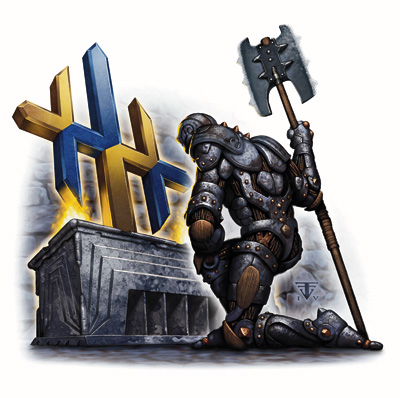
Any fictional religion, such as those found in a Medieval European Fantasy world, which possesses attributes stereotypically associated with Christianity (especially Roman Catholicism) — such as priestly vestments, nuns and their habits, confessionals, the designs of houses of worship, and crosses — but which centers on a deity other than the Christian God, like an animistic spirit or pagan-flavored god. Often there will be a God analog and/or a Satan analog but not a Jesus one, although this is somewhat excusable as Jesus himself is also God according to the precept of the Trinity.
In numerous cases, in order to finalize the separation, the deity worshipped is a goddess. In these cases, she is usually just called "the Goddess." (This may be based on the common use by neo-pagan religions of this term to denote the main female deity.)
In anime, these substitutions are intended for local flavor more than specific evasive metaphors or to avoid the Jesus Taboo. Western productions typically don't engage in this trope since they have to worry about offending someone; however, they may use Crystal Dragon Jesus as a satire on Christianity, in which case the offense is intended. They may also use it simply to use Middle Ages tropes without having to deal with Christianity directly. Also if one wants to use a religion that most people get the gist of, but want the setting to take place in a different world that isn't directly Earth (and thus it wouldn't make sense for the real Christianity, or any other of the Earth religions to exist), this trope is useful. For some, Crystal Dragon Jesus can be interpreted as a certain universe's projection of the omnipresent God Himself, if done right.
The name itself is a Dead Unicorn Trope as few writers are willing to literally use a Crystal Dragon (which would also be a Crystalline Creature), but it does get the idea of random in-universe creatures; perhaps influenced by an idea that Dragons Are Divine. Furthermore, there's the belief that new-age crystals do everything and it's convenient for writers who want to make a Christ figure come across.
There are also a few Crystal Dragon Mohammed religions. They generally share at least a few of these attributes: militant expansionism, coming from the east, and staunch monotheism.
Sub-Trope of Fantasy Counterpart Religion. Compare: Anime Catholicism, Nuns Are Miko, Hijacked by Jesus, Faux Symbolism, Interfaith Smoothie, King of All Cosmos, Fantasy Pantheon. See also You Mean "Xmas", God of Good, and God of Evil. Not to be confused with Fantasy Counterpart Culture Christianity; a key element of Crystal Dragon Jesus is that it keeps the trappings of Christianity but substitutes a markedly different being in the deity's role. Also not to be confused with Church of Saint Genericus, which is about churches whose denomination is unmentioned to avoid audience alienation/distraction. Is usually the center of a Physical Religion.
It's always A Good Name for a Rock Band.
Compare with Not Using the "Z" Word wherein the fictional religion is in fact a real-world religion with the names changed, instead of merely analogous to a real-world religion.
Examples:
- In 07-Ghost, the Church is identical to the Roman Catholic church (pre-schisms), right down to its relationship with the secular government, except that in addition to God, they worship seven 'ghosts' that are more like crosses between saints and angels.
- Attack on Titan:
- The Wallists either believe that God built the mysterious walls that protect them from the Titans or that the Walls themselves are God.
- Beyond the Walls there's the cult of Ymir, the Progenitor/Original Titan and Patron-Saint of the Eldian people; Ymir herself, like Andraste from Dragon Age mentioned below, seems to be a combination of a female Jesus with Joan of Arc with the ability to turn into a Titan to boot. Interestingly, for the Eldians she is revered as a goddess-savior, while for the Marleyans she is portrayed as a devil, in the opinion of Eren Kruger the truth must be somewhere in between.
- Berserk:
- The Holy See religious order is a full-on Catholic Church approximation, complete with the Pope, bishops, and the Inquisition. It is also strongly hinted at that they actually worship the Godhand instead of the Four Elemental Kings, with shots of branded skeletons and Mozgus' story suggesting that the dungeon-cum-inquisition tower was rebuilt as an homage to Void's rise to the Godhand, and The Pope recognizing Griffith as the "Risen Savior".
- Chapter 83, the so-called "Lost Chapter," was never reprinted at the author's request because it supposedly gave too much of the story away too quickly. If you accept it as canon, you'll see that the symbol used by the Holy See wherever you would normally see a cross or crucifix in Catholicism is actually a stylized representation of the Idea of Evil, also known as the God of the Abyss and the "ungodly god born of man", a powerful creation of mankind's collective unconscious whose sole purpose is to cause pain and suffering so that humanity has someone else to blame for their problems.
- The world of Claymore has a dominant religious order that resembles Catholicism, with priests, nuns, and even an entire holy city called Rabona, which forbids the local Amazon Brigade from entering since they are half-demon, though it doesn't stop the actual full-blooded demons from entering the city.
- Fullmetal Alchemist: The sun-worshipping false religion practiced by Father Cornello incorporates many aspects of Roman Catholicism. Later in Fullmetal Alchemist (2003), Rose (who has a young baby) begins wearing a veil and is worshipped as the "Holy Mother", similarly to the Virgin Mary. This is especially noteworthy because, in later episodes of the 2003 anime version, it is revealed that Christianity itself is a dead religion; the show implies the timelines of the fictional universe and "our" universe split about a millennium in the past, around the time alchemy was discovered. This doesn't apply to the manga.
- In Haunted Junction, Haruto Hojo is selected to be one of the three members of the Holy Student Council (the others being a Shinto miko and the son of a Buddhist monk) because his father is a Christian priest. The denomination is extremely vague... the priest's vestments are similar to a Jesuit's robes but in all white, he can marry and have a family, has the icons in his church that bear a strong resemblance to the Virgin Mary, and is skilled in the ways of Hermetic Magic with no qualms about teaching his son enough to make a spirit trapping spell. (Note that some rites in the Catholic Church allow priests to marry; just not the Latin rite, which is the largest.)
- Holy Corpse Rising is set in an Alternate History version of 15th century Rome. The Credic Church worships one god called Alam and his messiah Rosa Creed. Other than that, it is remarkably similar to Christianity and even uses crosses.
- The Saint Church of Ancient Belka in Lyrical Nanoha even has Jesus and Shroud of Turin analogues. Some of the reformed S3 villains end up joining the Church. Nanoha adopts a clone of their Jesus figure (Vivio) as her daughter. For their part, the Saint Church officially considers Vivio a "descendant of the Saint King", rather than a reincarnation or a Second Coming, and do not worship her (though they do refer to her as "Your Majesty"; being a descendant of the Saint King doesn't make her a messiah but it does make her royalty in their eyes).
- One Piece:
- Averted with God Eneru of Skypiea; he can hear (literally) everything on the whole (sky) island, and thanks to his power as lightning incarnate, he can smite the people that insult or disobey him, and all of his subjects fear him like an actual god — but then Gan Fall, Skypiea's former ruler, says that the title "god" is simply that: a title for Skypeia's ruler. Turns out Eneru is just out of his gourd.
- One Piece finally gets into this trope with Bartholomew Kuma's religion. For most of the story, we knew he carried around a book that seemed to be a Bible, but as of chapters 1095-1097 we find out that he worships the Sun God Nika, who will someday return and free all the world's slaves. Kuma himself was a pastor, in fact.
- Revolutionary Girl Utena toys with this trope. The series' deity is Dios, a literal prince on a white horse, who occasionally comes down from the heavens to give Utena his strength. The Big Bad is End of the World aka Akio ("Morning Star", as in, Satan), who clearly defines himself as Dios' evil counterpart. It turns out they were once the same person who was worshiped as a god in medieval society, but were unable to listen to everyone's prayers and fulfill their duties as a deity. His sister Anthy took the blame and was symbolically crucified as a Jesus figure, and they feel the pain of her punishment to this day — or at least claim to; Akio/Dios are also the same person (it's complicated), and it becomes clear that the heroic divine role he played as Dios is constricting and harmful in the same ways as Akio's more blatant abuse. Dios and Anthy are also Crystal Dragon Zeus and Hera — Dios being a variant form of the name Zeus and Hera also being known as Antheia, and they're sleeping together.
- Space Adventure Cobra: The signature character (Cobra himself) goes to church to pray for the life of a badly wounded ally. He delivers a rather half-assed personal talk with God, professes that it's completely out of his character, and ends by telling the holy image that he leaves the rest up to him (God) since He is clearly more qualified in the whole causing miracles department. What makes it qualify for this trope in a somewhat hilarious fashion is that the obviously Christian crucifix is mounted upside-down.
- In Those Who Hunt Elves, the holy symbol of Elvish priests looks an awful lot like a Greek Orthodox cross. There are also at least a few small, rather Christian-esque churches (including stained glass windows!) which may have only a single Roman Catholic-ish-looking priest and/or nun as staff, though the holy symbol seems to be more of a capital X in a circle for these. As of episode 9, there's not a whole lot of theology being discussed, though.
- Trigun:
- There is a character, Wolfwood, who certainly dresses the way we'd expect a Protestant pastor to dress, and he does things like listen to confessions. There is a fair amount of analysis of the conflict between pacifist ideals and the obligation he feels to protect the innocent even if he must kill in order to do so. The major departure is the standard ludicrous weapon given to most characters; in Wolfwood's case, a portable pistol armory in the shape of a 7-foot tall cross (which also has a rocket launcher and machine gun built into it), which he jokes is heavy because it's "full of mercy".
- In the anime version, it's revealed that the various Christian/Protestant trappings are more a disguise/mockery than anything else, as Wolfwood is intended to be the next Chapel of the Church of the Gung-ho Guns, implicitly a cult religion created by Knives for the purpose of paying homage to him. Given this is Knives we're talking about, it wouldn't be that out of character.
- Beast Fables: Asterianism
 is a monotheistic religion widely practiced in a Fantasy Counterpart Culture of Europe. Its God is one being with multiple aspects, and it's named after a figure who some believe was the human incarnation of said God.
- Magic: The Gathering:
- The Church of Tal held an inquisition against magic and were, perhaps, the single most cohesive political entity in the story arc covered by The Dark. Its lore and cards are peppered with quotes from the Book of Tal such as "suffer not a magician to live". The church's role in Terisiare's history is fairly well justified as the natural consequence of the Brothers' War fought between the two master wizards Urza and Mishra (which left the continent divided amongst independent city-states in need of a unifying force and with a healthy distrust of magic and sufficiently advanced technology that got them into this mess).
- Serra is a godlike figure as a planeswalker. Serra is first introduced via Serra Angel. Homelands gives us Serra Inquisitors. But the big point for Serra is Urza's Saga, with cards like Worship, Pariah, and a buttload of angels for Serra. The Urza's Saga editions of plains are all from Serra's Realm, and they feature floating continents. Storyline-wise, Serra's Realm is attacked by Phyrexians (the Expy for hell), leading to Planar Collapse. A year later, the flavor text for Copper-Leaf Angel says "When Serra made angels, people called her a goddess. My angels are superior to hers." (Unless it's late in the game and you've got land to spare, they aren't). This only became more intense in the return to Dominaria set, where serran forces put church stained glass on everything from armor to weapons and celebrate her as a saviour figure.
- Avacyn from the Innistrad block is a curious example. Her church is clearly modeled after medieval Christianity, but the dogma is vastly different (for starters, afterlife is a blessed sleep, and both angels and demons are physical beings rather than otherworldly ones), and Avacyn herself is mankind's savior in a more direct sense since she kills the monsters. In addition, she is essentially a moon goddess, like the Greek Selene. And a goth.
- The polytheistic settings of Theros and Amonkhet are based on historical Greek and Egyptian religions, respectively.
- The Legion of Dusk in Ixalan is based on Catholicism, as to be expected from conquistador analogues. The twist being that they are also vampires; in particular, their tradition of Blood Fasts, holding off blood consumption for a while, is reminiscent of Lent and similar traditions. The Sun Empire from the same setting is based on Aztec sun-worship, but it is fairly unique in being a form of monotheism in which the sun is perceived in three distinct aspects (distinctively separated from Trinity theology by Word of God), which if anything is more similar to Egyptian perceptions on Khepri, Ra and Atum.
- The Orzhov from Ravnica are aesthetically based on the roman catholic church and follow a similar clerical hierarchy. Naturally, they play up the Corrupt Church angle for all its worth, being scammers of the highest order that bind their devotees into servitude. Their theology is deliberately kept vague, though it is heavily implied to be ancestor worship, and at any rate, they don't deny the religious legitimacy of other religious groups like the Selesnya (aside from pointing out that they're hippies).
- Black Moon Chronicles: The Church is built on an alliance with God, represented by two stone tablets that are later destroyed. It's far from the only religion in the empire, though.
- Subverted in First Knife. The religion practiced by the characters initially seems like some kind of fantastical equivalent, but it quickly becomes apparent that it actually is Christianity, just Christianity after several thousand years of lingual and cultural progression, plus an apocalypse or two. Aside from some changes in practice and terminology (such as Jesus being referred to as Hesukristos), the core beliefs are largely unchanged. This gets humorously lampshaded at one point when a cybernetic warrior from the pre-apocalypse world who is believed by another character to be the Second Coming swears by the actual Jesus Christ and gets blank stares because nobody calls Him that anymore.
- Ghostopolis: Joe, a mysterious Tuskegee pilot.
- Green Lantern: Saint Walker's people worship a single male god, and sometimes quote Bible-like verses.
- Planet Hulk:
- The religion of Sakaar seems very familiar. Particularly, their legends of Sakaarson and the Worldbreaker present a clear dichotomy resembling that between Christ and Antichrist. They also refer to "the prophet" as one to whom thanks should be given, indicating a figure similar to Muhammad, as well. Later, Axeman Bone would kill children of Shadow descent until he found the true Son of Hulk, Sakaarson, the savior.
- Korg and the Kronans' faith is basically straight up Catholicism with the words changed, down to a distorted version of the Lord's Prayer; being stone men, instead of asking their lord to forgive their sins, they ask that He forgive their cracks.
- Requiem Vampire Knight: Most vampires revere the Masters of Infinity whose faith resembles Catholicism with mass, cathedrals, nuns, crusaders, and many other things, only twisted into a more demonic take. That is the key difference between them and the Lords of Limbo, who resemble a typical Satanist/pagan cult.
- In Sonic the Hedgehog (Archie Comics) the Echidnas have a holy book known as "The Tomes." Knuckles' mother is seen praying in an Aurorium, a place filled with stained glass windows and dedicated to the worship of Aurora. They also have a prophecy foretelling the arrival of "The Avatar" and a "Lost Tribe" wandering the face of the planet in search of a "Promised Land." Knuckles' Great Grandfather acts as a spiritual leader for the tribe and is known as a "Mitre" or prophet. He is also known to commune with powerful incorporeal beings that only he can see.
- Superman:
- There's also a lot of comparisons between Superman and Jesus Christ, and many authors intentionally try to make Kal-El fit this trope. He has more in common with Moses though.
- In Pre-Crisis days, Krypton's worship of Rao was portrayed very similarly to certain Abrahamic religions. The Krypton Chronicles miniseries even depicts the prophet Jaf-El (an ancestor of Superman's) who helped usher in the age of monotheism on Krypton.
- The Ultimates: Thor's face is based on the face of Jesus, and he was sent to Earth by the All-Father Odin to save the human race. He was taken down when he was in the air in a crucified posture. He even said "Father, father, why have you forsaken me" in his cell, if you need it more explicit. And he's eventually reborn as a God. We even had Hawkeye having his "Doubting Thomas" moment.
- The Animorphs Review Blog "Cinnamon Bunzuh!" has a Running Gag where the overtly mystical whale from book #4 is called "Jesus Whale" (he migrated for your sins!) Any Contrived Coincidence in the series is actually his doing, and the blogs' creators eventually decide that all whales are actually Jesuses, and dolphins are their disciples.
- Bait and Switch (STO) extends the Bajoran religion's Catholic imitation to the point of including at least one major schism, implied to be similar to the Protestant Reformation or the split between Orthodox and Reform Judaism. In From Bajor to the Black, Kanril Eleya refuses to follow her boyfriend to a church-backed college because they "push the Orthodox branch like it's going out of style", whereas a deceased crew member in "Last Rights" is identified as a "secular Foundation Reformist".
- Brave New World:; The Arcean Order is a Saintly Church with a direct line to the Omniversal Celestial Bureaucracy. In addition, Arceus went out the way to invoke this trope by putting "Law Stones" on every inhabited planet.
- Chasing Dragons has the Faith of the Seven, still a very Christian-like religion, undergo a series of schisms similar to the Protestant Reformation. It starts when Septon Jonothor, the chief septon in the newly-established Kingdom of Myr, decides that he can no longer go along with the Faith's choosing dogma over ethics; like Martin Luther, he publishes his beliefs on where the Faith should be going, gets excommunicated, and starts his own following, splitting the Faith into mainstream (Baelorite) and reformist (Jonothorian) factions. This inspires several schisms as well due to the view that the Baelorite leadership isn't doing enough to counter the perceived heresy, as well as the belief that the Faith has been corrupted by pandering to feudal politics — Septon Ryman starts a Calvinist-like faction that believes salvation and damnation are already predestined, while a Puritan-like group that calls itself "the Old Faith" starts organizing to preach a society free of any authority other than local religious leadership.
- In Discworld continuum stories by A.A. Pessimal, such as A Fresh Pair of Eyes, the Order of Octeday Service in the Temple of the Great God Blind Io has a suspicious amount of points in common with the Church of England's Sunday service breviary, The Book of Common Prayer.
- The Forbidden Drink: In the sequel, Luz notes with some amusement how between her resurrection as a god and the fact that her birthday happens to be on December 25, she's basically the witch equivalent of Jesus.
- Goddess Reborn Chronicle has this not in God but in Lucifer and Veritas, the latter of which being a Gnostic figure with strong Buddhist trappings, even called The Jade Bodhisattva.
- Jericho (MLP): The religion of the Teutsche -— a strange warrior nation that is a sort of Culture Chop Suey between Prussia, Imperial Germany, and the more heroic aspects of Eagleland (Flavor 1) -— is something of this. Word of God states that the religion is based on Christianity, but is not it. They share the sign of the cross — which the narrator, Jericho, a Teutscher himself, calls das Kreuzzeichen — wear crosses, and even refer to their deity as "God" (or "Adonai", an old Hebrew name meaning "Lord"). However, the more details the story gives about the religion, the less Christian it seems. Like how they believe Kain to be a dark hero. Or, for one interesting example: "... the sixth tenet of the faith is 'you shall not murder'. It does not say 'you shall not kill'. Yes, you could interchange those two things sometimes, but to murder and to kill are two different concepts. Murder is wrong. Killing is just a fact of life in this world we live in. The faith makes the distinction quite clearly. The faith teaches that there is no shame in taking somebody's life for the right reasons."note And their version of the sign of cross is spoken with a different Latin phrase, which translates as "in the name of the Father, and of the Prophet, and of the Machine Spirit." Or, as it is said in the fic:
In Nomine Patris, et Prophetae, et Spiritus Machinae.
- The Night Unfurls: The Church and the clergy aside, the religion practised in Eostia is based on the worship of a Goddess Reincarnate. The remastered version expands on how this notion came to be — a deity named Laurendau "blessed Eostia with her touch before leaving behind her spirit to reincarnate in those she deigned worthy enough to hear her voice". The high elf Celestine Lucross is the current holder of the title "Goddess Reborn" as a result of receiving her favour in the past, currently having her own kingdom to rule. A Satan analog (Olga) also exists, although it is clear that she is more of a person than a concept.
- In RWBY: Scars, the Brothers Church is the most Christian-like religion. They worship two gods, but they are a church and one of their main religious symbols is a cross (such as the ones Ruby and Qrow wear).
- Blood of the Tribades: The religion of Bathor seems to be a vampire Christianity, with actual quotes from the Bible on gender roles, an X symbol resembling the St. Andrew's cross, plus essentially communion. Bathor is clearly a Christ-like figure whom they prophesy will come again.
- Bright features Jirak, an orc version of Jesus Christ in its historical background. He is said to have united the Free Peoples to save the world from the Dark Lord, and he is worshiped by orcs in modern times who believe he will return to deliver his people, who are victims of racism today. Towards the end of the movie, it's believed that Nick Jakoby is Jirak reincarnated and their Chosen One.
- Hawk the Slayer: Despite it being set in a Dungeons & Dragons style world (with elves, dwarves, giants, etc.) the religion shown is basically Catholicism (although not identified as such): there are nuns in a convent headed by an abbess, the cross is a holy icon, there's an abbot running a monastery, the Devil is mentioned, and people get absolution (though apparently in this world, female clergy can give it). God or a similar figure is not mentioned in the story though, nor Jesus.
- Planet of the Apes: The original film franchise twists the usual take in an uncommon way. There is an ape religion centered on a prophet-like figure, The Lawgiver, whose teachings are contained on the Sacred Scrolls, but the deity above him seems to be indistinguishable from the Abrahamic God (outside of creating all apes equal and "in his own image", of course). Religion is also unified in an organized "church" that is one and the same with the political and judge class, and whose main interest is to keep other apes from learning that humans once dominated the planet. Tim Burton's 2001 version turns this 180 degrees and makes the apes followers of the outright divine Semos, "the giver and origin of all life", with the sacred ruins of Calima identified as the place where Semos started creation.
- Star Wars:
- The prophecy of the Chosen One fits this trope almost perfectly. Of course, what actually happens makes Luke more Christ-like, redeeming his father through his suffering and all.
- While the particulars of the "faith" (such as it can be called one) are fairly different, Revanites do bear a certain resemblance to early Christians in their borderline underground faith and a certain redemptive undertone.
- In Thor: Love and Thunder, they visit Home of the Gods, Omnipotence City. Where Valkyrie points offscreen at a God Of Carpenters.
- In The Adventures of Caterpillar Jones by the J.J. Brothers, most of the meadow's inhabitants credit the Great Owl of Light with the creation of the meadow and worship him as a God-like figure. However, the Owl himself says Mother Nature made the meadow and he's simply one of her helpers, making her the real example.
- The Truffidians in Jeff VanderMeer's Ambergris Cycle.
- In The Arts of Dark and Light, The Church and its hierarchy, rituals, and aesthetics are very obviously based on medieval Roman Catholicism, even if there are actually a number of differences between its theology and that of real-life Catholicism and Christianity. Its churchmen even quote quite a fair bit from holy books that sound very much like those of the real Old Testament.
- The religion in Mercedes Lackey's Bardic Voices and Bardic Choices novels could qualify as this. The church in question has many of the trappings of Medieval Christianity — worship of a "Sacrificed God", monks and nuns, soaring cathedrals, rampant corruption with some good eggs. Specifically believers under duress whip out a "Sign of the Flame," presumably analogous to the Christian "Sign of the Cross."
- Black Dogs: The religion usually just referred to as "the church", which has cathedrals, cardinals, and traditional Christian sexual mores (e.g. they oppose contraception and same-sex relationships).
- The main religion in the Book of the New Sun by Gene Wolfe has many overtones of this. The Pancreator is God, the Conciliator is Jesus, the Increate is the Holy Spirit, and the New Sun is the Second Coming. A relic of the Conciliator has the power to heal the wounded and even revive the dead while angels and saints are often referenced. In this case, the entire affair was deliberately engineered. It was the main character Severian who managed to acquire the relic and the resulting powers, then became the one who inspired the religion in the first place, then brought about the New Sun. All of that was possible thanks to time-travel and other such interventions courtesy of Heirogrammates.
- The Hanged Redeemer in the Cale trilogy from the Forgotten Realms tie-in books. Played with in that Jesus of Nazareth is known, but seems to be confused with Jonah.
- Madragore in the The Chronicles of Magravandias by Storm Constantine The similarity to Catholicism extends to the various local gods of conquered lands being treated as Madragore's subjects like how various pagan gods were adapted into Catholic saints.
- Conan the Barbarian: Mitra is often portrayed this way. While Set isn't directly analogous to Satan, he is the main evil god in that universe, and Mitra's followers think of Set as opposed to Mitra in ways that other gods do not.
- The Crimson Shadow by R.A. Salvatore: The unnamed religion which people in both Avon and Eriador follow appears to be closely based on Christianity, though most details aren't explored. God is explicitly invoked, though with no mention of a Jesus figure, numerous cathedrals exist in major cities of both countries, the good mages considered themselves priests with their powers being a gift from God, the single priest who we see resembles Catholic ones, and the evil mages make pacts with demons to get increased magical abilities (much like what was believed about witches by most Christians once).
- The followers of Gird in the The Deed of Paksenarrion series by Elizabeth Moon. Gird's right-hand man/saint/apostle was Luap (Paul spelled backward).
- "Despoilers of the Golden Empire" by Randall Garrett contains a very interesting example with the Truth and the Universal Assembly. It is an example of a subverted trope; the entire story sets you up to believe that this is some sort of fictional future religion, when in fact it is actually Christianity itself - specifically, Catholicism, with the Universal Assembly being a direct translation of the ancient name for the Catholic Church. The story even mentions Jesus by name at the end.
- In the Discworld series by Terry Pratchett:
- The Discworld contains demons of various descriptions, in the earlier books they might be regarded as the Crystal Dragon Jesus version of Dante’s Inferno (Faust/Eric).
- Omnianism is more of a parody of aspects of Christianity but does worship Om as a bull or an eagle (or, later, a tortoise). Later on, Omnians use an image of the prophet Brutha strapped to a torture device (an iron turtle that was filled with flame) in place of a crucifix. More obliquely, in the novel Feet of Clay, Pratchett writes about a conflicting dead religion from the same region as Omnianism, which, given the fact that its "priests" make Golems, might be the Crystal Dragon Jesus version of Judaism. Omnians in later books have also picked up similar habits to Jehovah's Witnesses and the Salvation Army. Note that "Omnianism" could mean "Everythingism" (Latin, omnia) and the name of the Great God could be a back formation. So what? Well, since "catholic" means "universal", "Catholicism" might be parsed as "everythingism" too.
- Omnianism parodies different aspects of evangelical Christianity, specifically; in Small Gods, which (possibly) takes place some considerable time before the rest of the series, it's very much parallel to the Crusades, being inclined to spread the good word by the sword and dealing rather harshly with heretics (and occasionally taking incredibly liberal definitions of "heresy"). Omnians who are chronologically post-Small Gods are much less violent, and superficially resemble Jehovah's Witnesses; the City Watch books frequently mention that Constable "Washpot" Visit-The-Ungodly-With-Explanatory-Pamphlets spends all his off hours trooping door-to-door through Ankh-Morpork trying to win converts.
- The transition between the two states, changing from a singular evangelical state with autocratic rule to a constantly-schisming hodgepodge of different sects who all disagree on minor points of dogma and decorum, approximately references the breakoff of Protestant Christianity from Catholicism and its aftermath. On the Discworld, however, the expected centuries of persecution and religious civil war were prevented thanks to the reasonable approach of Brutha and the meddling of a time-traveler.
- Interestingly, although the series' Klatchians are clearly Arabs, they are not explicitly linked with Islam other than through a few throwaway references to houris. This is because "Klatch" is both a country (that's half the mythical Araby and half the modern Middle East) and a continent that is basically a stand-in for Asia. The polytheistic religion of Klatch-the-country, complete with temples covered in erotic carvings, is closer to a Crystal Dragon Jesus version of Hinduism. The Klatchians, especially in earlier books, correspond more to old portrayals of Araby, where the religion was something that encompassed paganism, satanism, and (sometimes) the beliefs of pre-Islamic Arabs (these were usually made from the point of view that the Crusaders were absolutely right, of course).
- And the History Monks are Crystal Dragon Buddhism.
- The church of Blind Io (a sort of Odin/Zeus expy) fills the spot of Church of England as the religion most pay lip service to, but no one gets all that excited about, including the priests. Illustrations of Hugonon Ridcully (Chief Priest of Blind Io in Ahnk-Morpork) in The Last Hero depict him in vestments that look very Bishop-y, and include plenty of crosses (which is especially odd as his god's symbol is a hammer).
- Offlerism (despite Offler being a crocodile god who fits thematically with Egyptian gods) has some elements of Christianity, such as showing one temple having a collection for fixing the roof, a common phenomenon in old English churches, but the religion also has elements of Islam. It's particularly common in some parts of Klatch, and there's a throwaway reference to devout Offlerians avoiding alcohol. Riffing on Muslim and Jewish dietary laws, Offler forbids his followers from eating broccoli — which is easy to follow, since no one wants to eat broccoli anyway.
- There is also a rather tongue-in-cheek practice of offering sacrifice to Offler in the form of frying sausages (this is ALSO a very English joke, referring to the traditional Punch and Judy show, in which a crocodile steals a string of sausages). The priests fry the sausages, by which the “essence of sausagidity” ascends to Offler; this achieved, they EAT the sausages, claiming that the “empty husks... turn to ashes in their mouths”.
- The deity Nuggan is basically intended to represent all that can be bad about a religion, and is an egomaniac who constantly imposes new prohibitions on his followers/declares new things to be abominations (in contrast to Offler, he prohibits things people would actually want to do). Nugganism was the state religion of Borogravia, a Ruritania with a Medieval Morons feel, although some readers have interpreted Borogravia under Nuggan is comparable to Afghanistan under the Taliban. Among Nuggan's abominations are chocolate and garlic. A later book in the series seems to suggest Nuggan is now a small god or a wisp of divine essence with little power or consciousness due to lack of worshipers. It's not that there are no Nugganites, but that their faith is now centered on the abominations rather than the god; it's likely he hasn't actually issued any of the recent abominations.
- An older religion still, which still appears to have adherents in modern Ankh-Morpork, is the Cenotine faith. This is the one part of the theocratic set-up that preserves the secret of making Golems and which uses a script not unlike the Hebrew alphabet. Elsewhere it is hinted that Cenotism is a parent faith of Omnianism or at least closely related. And Ankh-Morpork is expressly described as having kosher butchers. So somebody must follow kashrut dietary law, or something like it...
- The Dragonlance tie-in books have the church of Paladine, which resembles medieval Catholicism. The followers of the gods of Light even have a "holy triad" of Paladine, Mishakal, and Kiri-Jolith and a "sign of the triangle" that are very similar to the Holy Trinity and Sign of the Cross.
- Thorarinn Gunnarsson's "Dragonlord of Mystara" includes one of the few literal examples: the protagonist grows up as a human orphan, but is secretly a polymorphed gold dragon, son of the only dragon god and his chief cleric. In Book 2, the crystal dragons of D&D are described as transdragonists who enhanced themselves magically and tried to conquer the word; they had been trying to achieve godhood ; in Book 3, the protagonist — once again, the literal son of a god — apotheoses into a crystal dragon to save all mortal life from a soul-enslaving alien evil. However, in spite of there being a literal crystal dragon Jesus expy involved, it subverts every other defining aspect of the trope.
- Could easily have been named for Irene Radford's Dragon Nimbus series; the plot takes place on a planet with transparent dragons, and the human inhabitants worship stranded space travelers who are themselves Christians.
- Subverted in Margaret Weis and Tracy Hickman's Dragonships series. Aelon, Lord of the New Dawn, is a monotheistic deity whose church is based in a Fantasy Counterpart Culture of Rome and seeks to convert the world in the name of order, civilization, and their god, but it becomes increasingly apparent that there's something a bit... off about the whole deal, particularly in how Aelon seems to encourage a Knight Templar attitude in his followers. That's because Aelon isn't a Crystal Dragon Jesus, he (or she, or it - Aelon has lots of forms) is actually the local Satanic Archetype instead.
- In Dune and sequels by Frank Herbert:
- Located in a distant future of our own universe, the Orange Catholic (generally referred to as the OC) is an echo of what used to be Christianity. The O.C. Bible was a conglomeration of various historical religious texts, created in order to end religious disputes.
- Paul would seem to be the Fremen's Muhammed... which is all the Bene Gesserit's fault for grafting their Kwizatz Haderach bits onto the Zensunni religion. Then he becomes everybody else's Muhammed via jihad.
- Empire of the Vampire: The Redeemer, the central figure of worship of the One Faith, is a very straightforward example. Son of God sent to Earth to spread His word among the people, he was eventually captured and tortured to death by the priests of the "old gods", though instead of a cross, they hung him from a chariot wheel, which serves an identical purpose. His death also acted as the catalyst which eventually spread the One Faith across the Empire which originally executed him. Instead of Virgin Mary, the Redeemer was birthed by the Mothermaid, and instead of the Twelve Apostles, His word was spread by the Seven Martyrs. The names of many angels are also lifted over from Christian canon, though their attributes are switched up - angel Gabriel is now angel of fire. There is even a figure named Jezebel associated with harlots and prostitutes, much like her Biblical counterpart.
- Evillious Chronicles: The Levin faith is a religion with churches, nuns, a belief in Heaven and Hell, a concept of demons, and many other Christian trappings. However, it also worships a two-headed dragon or a talking tree depending on which sect you join, making it a pretty straightforward example.
- In Lindsay Buroker's Fallen Empire series, the dominant faith of the Tribus Solis System is the worship of the Suns Trinity, which includes robed monks and ten commandments.
- The Church in The Familiar of Zero is the Middle Ages Catholic Church complete with a Pope (residing in Romalia) and Christ-figure (Brimnir).
- Joe Abercrombie's The First Law uses this trope as cynically as all the rest. The two disciples of the long-dead wizard Juvens have a running feud that has shaped most of the contemporary world. Bayaz built the secular Union as his proxy, while Khalul used his magic to craft the theocracy of Gerkhul, with him as its everlasting Prophet. Khalul and his religion bear many striking similarities to Islam, particularly in roughly Crusades era that the setting exists in.
- The works of K.J. Parker are usually set in a vaguely Byzantine setting, and while there isn't a clear "verse", they share some common background references. One such reference is a religion that worships the Invincible Sun and has seminaries, Bishoprics, and the like. In The Folding Knife, it is indicated that worshipers will carry a rosary that includes beads and jewelry representing "Lady Moon [perhaps a Virgin Mary analog], seven silver stars and the Invincible Sun".
- The Four Horsemen Universe: In the short story "Unto the Last—Stand Fast", the Arezzo religion is so similar to Roman Catholicism that a syncretic religion develops between them and human settlers on the same planet, called Arritim. Both main branch churches consider it heresy and the Arezzo launch a crusade against the colony, setting off the conflict of the story.
- The General Series: The Church of the Civil Government bears a striking resemblance to Orthodox Christianity — at least so far as rites and church buildings go. It's even got inquisitors, known as "Viral Cleansers", and heretics for them to hunt.
- Dexterity Jones in Karen Miller's Godspeaker Trilogy as well as the historical figure Rollin who was killed for his beliefs.
- Halo: Glasslands has a Sangheilinote who still worships the Forerunners post-Halo 3 compare them to Jesus Christ directly to a human he's negotiating with. (The human decides not to get into a philosophical debate with an alien that is physically on par with armored SPARTAN-IIs.)
Avu Med 'Telcam: So the Halos are machines of destruction. So you say the gods themselves were killed by them. (leans forward) Your god chose to die for you and that is precisely why you revere him, yes?
- The cult on the planet Pardal in David Weber 's book Heirs of Empire is this. What they're actually worshiping turns out to be a voice-activated ship's computer that's been on the planet for ages. "Initiating rite of Fire Test!" indeed.
- In Kage Baker's House of the Stag, the Star, aka the Beloved, seems like a Green Elven Jesus, only it turns out he's more a Green Elven John the Baptist, preparing the way for the real deal: the Saint, aka The Green Witch, who is an actual star descended from the heavens.
- Harry Turtledove:
- In High Places the religion is an alternate universe version of Christianity. In the alternate universe the Black Death lasted longer, and in the aftermath Christians began worshiping Henri, God's Second Son. Just like with Jesus, Henri's followers use the device that killed him as their symbol (a wheel, as Henri was stretched on a large wooden wheel and rolled down a hill, crushing him).
- In his Videssos which features a Fantasy Counterpart Culture version of Byzantine history, Turtledove excels in creating an in-depth fantasy version of Medieval Eastern Orthodox Christianity, along with multiple heresies that are pretty much just people going to war over the small print. Later in the prequels, he creates a Crystal Dragon Zoroaster for his fantasy version of the Persians.
- The theological framework in The Katurran Odyssey by David Michael Wiegeris is pretty straightforwardly pseudo-Christian: the Fossah is basically Aslan as a, well, fossa, and is worshiped by the lemurs as their single "lord of light and dark". Katook is the Chosen One and redeems his people's Corrupt Church. There is an indication that other gods were worshiped in this world, but the story makes no claim to disclaim the apparent monotheism, and all magic that does not come directly from the Fossah is evidently fake.
- Stephen Hunt's Jackelian novels have Circlism, which is a strange take on the trope as it has the form of Anglicanism but its substance is sort of Buddhist/pantheist.
- Guy Gavriel Kay:
- In his loosely associated novels, The Lions of Al-Rassan, The Sarantine Mosaic, and The Last Light of the Sun, "Jaddites" play the role of Christians in a Fantasy Counterpart Culture of medieval Europe, despite the fact that Jad is a sun god. It gets even more confusing, though. Belief in the Jaddite Christ figure, named Heladikos, is actually a heresy of Jaddism, being the rough fantasy counterpart of Arianism. Heladikos's story resembles that of Phaeton, the son of the Greek sun god Helios, who lost control of the chariot of the sun. Jad is more of a conflation of Helios and Jehovah, then, instead of a direct Christian analogue (and maybe some Apollo, too). Off to the side, you also have the Kindath (Jews) who worship the moons, and the Asharites (Muslims) who worship the stars. Everyone thinks everyone else's choice of veneration is insane, for various reasons. And unlike the real world Abrahamic faiths that share some stories, prophets, etc; there doesn't seem to be any common basis between Jaddites, Asharites, and Kindath.
- In The Fionavar Tapestry, the king of the dwarves (and therefore the dwarven culture) is spiritually bound to a lake inhabited by a literal crystal dragon. It's not explicitly a deity, but it does decide whether the would-be king lives, dies, or goes crazy.
- In Nick Perumov's Keeper of the Swords series of fantasy novels, there is an evil Crystal Dragon Jesus called "The Saviour", who resembles actual Jesus very much. Creepy.
- The religions of Kingdom's Disdain, where they worship either a Dragon God or his son. Lampshaded by Cardinal: "...religion seemed to be part of everything they did here, like it was Alabama, only, Jesus was some kind of space dragon?"
- Tehlu in The Kingkiller Chronicle by Patrick Rothfuss seems to be a pretty straightforward example: He created the world, impregnated a virtuous mortal woman with himself, went out preaching and killing demons, and killed himself defeating the devil on an iron wheel... At least according to the Tehlin church, who we can be pretty sure are mostly wrong. We are led to believe that Tehlu does exist, but is probably something completely different. That doesn't stop the church from wearing iron wheels like crosses, arresting people for heresy, having a mysterious secret society of The Knights Templar, and holding a midwinter festival that is sort of like a cross between Christmas and Halloween.
- C. S. Lewis:
- Averted in the The Chronicles of Narnia. Aslan literally is Jesus. Word of God (unavoidable pun) is that just as God the Son became incarnate as Jesus in our world, so he became incarnate as Aslan in Narnia. In one book the characters ask Aslan how they can continue to believe in him if he doesn't exist in their own world, but Aslan replies that he does, under a different name. This also means that the "Emperor Beyond the Sea", mentioned being Aslan's father, would be God the Father. Tash, on the other hand, clearly represents Satan (albeit with elements of The Anti-God), with Shift as the false prophet and Puzzle the (unwitting) Antichrist. Aslan's Country, of course, would be Heaven and is further based on Plato's ideas of it being more real than our world (or Narnia, here where it is explicitly stated that Narnia is an imperfect refection of Aslan's Country), which Lewis liked.
- The Space Trilogy averts this in a similar way. The protagonist initially thinks "Oyarsa" is the name of the Martians' pagan god; as the first book progresses, he comes to understand that it's the title of the spiritual being that governs Mars, under the authority of God, called "Maleldil" in the Martian language. The second book contains a reference to both "Maleldil" and "Maleldil the Young", presumably God the Father and God the Son.)
- Skirted in "The Longest Voyage" by Poul Anderson, in which they worship the Daughter, not Son, of God.
- Lumbanico, the Cubic Planet: Few details are known about Lumbanico's main religion, other than it is a monotheistic creed whose practitioners call their god simply "God", and their prayers are similar to Christian ones. Meanwhile, the inhabitants of the isolated inner mountain valleys believe in the Great Spirit who created plants, animals and humanity.
- Memory, Sorrow, and Thorn: Averted in the Tad Williams' series, in which the religion of Usires Aedon is clearly Christianity with the proper names search-and-replaced (he was the avatar of God, he died nailed to a tree and arose, etc.), in keeping with the books' setting of Fantasy Counterpart Culture version of Medieval Europe.
- Charles Stross' The Merchant Princes Series features an alternate world in which the dominant church in Europe and eastern North America is a church that looks very similar to Roman Catholicism, is headquartered in Rome, but which worships Sky Father and Lightning Child—it is implied that at one point, the pagan Vikings conquered Europe entirely and a syncretistic religion built on the skeleton of the Roman Church came about.
- No Gods Only Daimons by Kai Wai Cheah contains thinly disguised versions of both Christianity and Islam. Their respective cultures are... not getting along at the moment.
- In Avram Davidson's The Phoenix And The Mirror, set in a fantastical version of Roman times, the Cult of Daniel Christ teaches that the Old Testament prophet Daniel was the true Messiah. It's very big on martyrdom, especially if there's a chance of being thrown to the lions. It's not clear if regular Christianity also exists in the setting, since the main characters are citizens of the Roman empire and therefore pagans.
- In Record of Lodoss War, the archetypal High Fantasy anime, priests and paladins can be seen wearing crosses on their vestments/armor — even if they worship separate gods.
- The loosely connected spinoff Rune Soldier Louie heavily features the Church of Mylee, which closely resembles a crusader order, except that it's exclusively female. (Male priests of Mylee play an important part in Lodoss War as well, it's possible that there are separate orders for men and women, though there is no rule of celibacy.)
- In The Redemption Of Althalus, the dominant religion worships Deiwos, a very Abrahmic creator God. It fills the same basic role as Medieval Christianity, with parish priests at the bottom and pontiff-like High Preists at the top, and they are a political force of their own acting either in concert with or against the nobility. Interestingly there are three major sects but there doesn't appear to be any significant theological differences between any of them.
- In the Redwall series by Brian Jacques, the Redwallers have Martin the Warrior, a figure in Redwall's history. In the books, he is depicted as a saint (appearing in visions or dreams which provide guidance, etc.) while the TV series flip-flops between depicting him as either a saint (he appears in visions as with the books) or as close to a god as he could be (the characters ask Martin for help, in and in the Season 3 premiere the Redwallers sing a song thanking him for the season's harvest). Redwall itself is a Catholic-like abbey with monks and nuns, and aside from this however there's no explicit religion, with only a vague "Dark Forest" as the afterlife. The Devil is mentioned in the first book, but religious references are made progressively less frequent. Vulpuz is mentioned in The Taggerung, who seems to be a Satan-like being (it was said he rules Hellgates and created the foxes) though it only comes up once.
- In Rose of the Prophet by Margaret Weis and Tracy Hickman, Promenthas, the god of the pseudo-Europeans, is clearly based on the Christian deity. He has an evil rival Astafas. Their religion is unique in the setting as it rejects the idea of other gods even being real (although they are).
- David Weber's Safehold series features the Church of God Awaiting, a technophobic world church that is so prevalent that the concept of atheism literally doesn't exist in the planetary society. Played with in that the audience knows from the start that the teachings and holy scripture are all lies, deliberately crafted by members of the colonization mission in order to prevent the population from advancing to the point that they might be noticed by the aliens that destroyed the rest of humanity. The protagonist's mission is to break the Church's power and reveal the truth, leading to the beginning of the first-ever schism in the thousand-year history of Safehold in the second novel.
- The church of Mauser in Scrapped Princess has many of the Christian trappings, with a fair amount of local color.
- In R. Scott Bakker's Second Apocalypse, followers of Inrithism believe in a single God (with a side-set of lesser pagan gods, worshiped similarly to Saints) described in a holy text called the Tusk, vaguely analogous to the Torah. The prophet Inrithi shook up the pre-existing religion much like a Jesus figure, and he is worshiped as holy. Inrithi people are at war with a rival, more fiercely monotheistic and desert-dwelling religion obviously analogous to Islam. During the story, the main character pretends to be the messiah of the Inrithi while on a crusade against the religion's rivals. He becomes their Messianic Archetype when the Inrithi lords attempt to execute him by "circumfixion," but he survives, and his image on the "circumfix" (a circle instead of a cross) becomes the symbol of his movement.
- Explicitly invoked from a Christian perspective in James White's Sector General novel The Genocidal Healer: it is stated in the novel that every sentient culture turns out to have a figure in their history clearly analogous to Jesus Christ and a Christianity-like religion.
- In Sergey Lukyanenko's Seekers of the Sky duology, the setting is an Alternate History where Jesus was killed as a baby, forcing God to come up with a new plan. This time, he gets Mary and Joseph to adopt the one baby to survive the massacre. He becomes the Redeemer (no name is ever given) with the power to put any object or living being into another dimension (apparently, Hell). The resulting religion shares much with Christianity but has differences as well. For example, there's no Devil, and to speak of him is heresy of the highest kind. Hell is a frozen wasteland (making the well-known phrase irrelevant). The symbol of the Churches (there are two with one leader) is the Holy Pillar, to which the Redeemer tied himself before disappearing. There are bishops, monks, priests, cardinals, paladins, nuns, large cathedrals, holy wars, etc. Vatican is called Urbis for some reason. Judas was the only loyal disciple of the original twelve. Murder is not a sin unless done more than twelve times (except if involving children and the elderly). Mary is hardly ever mentioned; instead, the adopted Sister of the Redeemer is as revered as him. The Antichrist is scheduled to appear before the Second Coming of the Redeemer, except he is called the Tempter.
- Rachel Hartmen has a pretty strong example in her book Seraphina. The religion of Seraphina's homeland is basically identical to medieval Catholicism, with priests, psalters, saints, and cathedrals. The one big difference? No God. Or gods. Just Crystal Dragon Saints.
- The Seven Realms Series gives us the Church of Mathus, which forbids the use of magic and considers wizards to be heretics, and two briefly mentioned beings known as the Maker and the Breaker. However, the Church doesn't generally play a major role in the series. They're essentially the by-product of ill-will towards wizards brought about by the Demon King, a wizard that nearly destroyed the world a thousand years before the start of the series.
- Inverted in J. R. R. Tolkien's book The Silmarillion. Where the Crystal Dragon Jesus trope refers to a Christianity-like religion with a fictional god, Eru Ilúvatar is literally the Christian God, but worship of him is very different from traditional Christian practice. There are very few ceremonies, only a couple per year. And worship is never carried out in buildings; indeed, temples and churches are associated with evil by worshipers of Eru. In Númenórean worship, only the King or Queen could speak to Eru directly and make (bloodless) offerings, and most prayers or hymns seen in the mythology are addressed to one of the Valar (who roughly correspond to archangels or pagan gods). With them, there is something of a hierarchy of Crystal Dragon Angels and saints, in a rather Catholic way. And only few mortals having the line to god and the majority having to go through them is quite a Catholic understanding of prayer.
- In Slayers, there's a literal dragon-worshiping church with suspiciously cross-like sunburst symbols and temples that tend to look rather Catholic. Their god Ceiphed sacrificed himself to save the world too and left behind four elemental dragon gods. Large factions of the church tend to have extremist policies about what's right in saving the world.
- A Song of Ice and Fire:
- The Faith of the Seven is modeled after Roman Catholicism, with the primary distinct tha of God has seven aspects — the Father, Mother, Warrior, Maid, Smith, Crone, and Stranger — instead of three. The faith has monastic orders, dormant military orders, Cardinals (the Most Devout), and a Pope (the High Septon). It's the dominant religion of the Seven Kingdoms, supplanting the pagan religion of the "old gods", much like Christianity replaces polytheistic traditions throughout Europe, the difference being that worship of the old gods is still permitted (and still prevails in the Kingdom of the North) and several oaths refer to "the old gods and the new". The Faith is also the only religion invested in chivalry and knightly traditions.
- The faith of the Drowned God in the Iron Islands is very much akin to Christianity in different ways than the Faith of the Seven, being based around a god who died and came back to life, with the most important ritual being immersion in water (literal drowning and resuscitation, at least for those entering the priesthood). It's a strictly monotheistic religion that features a Satan-like adversary called the Storm God, with a dash of Cthulhu Mythos added for extra creepiness, and the viking customs of raiding everyone else traditionally.
- The worship of R'hllor is essentially a more militant version of Zoroastrianism. Like it, it's a dualistic faith that reveres a creator god in constant struggle with an evil enemy deity — R'hllor and the Great Other are less so based on Ormahzd and Ahriman as they are different names for them — reveres fire as their god's manifestation in the created world, and has a strongly escathological bent centered on a prophesized final struggle against and destruction of evil. It's also primarily associated with lands in contact with but separate from Westeros, mirroring how Zoroastrianism was found primarily within the classical and early medieval Persian empires and had no presence in Europe.
- Spice and Wolf: The Church is heavily reminiscent of pre-Reformation Catholicism, complete with indulgences.
- Star Wars Legends: There are two examples. (It is a pretty big galaxy.)
- The Sacred Way is an analogue to mainstream Christianity, with Sunday Schools (that Han Solo apparently regularly skipped) and priests who conduct services in a way akin to Catholic Mass.
- Pius Dea is an ancient fundamentalist cult/denomination (with pseudo-Latin name) which plunged the Republic into violent crusades in the distant past.
- Stranger in a Strange Land by Robert A. Heinlein:
- It is an extremely thinly-veiled allegory for the life of Jesus Christ, starring a beautiful blond human boy raised on Mars. He ends up starting his own cult and, in the end, is murdered by an angry mob and ascends to a higher plane of existence.
- It's worth noting that it's explicitly stated at the end of the book that Martian-raised Valentine Michael Smith was the earthly avatar of the Archangel Michael.
- Summers at Castle Auburn by Sharon Shinn: There is a mention of a God and "Lord" is a common interjection, indicating a monotheist society. The worship of that god goes without mention aside from wedding ceremonies
- Tales of the Branion Realm, a historical fantasy series by Fiona Patton set in an alternate Europe in like manner to Guy Gavriel Kay's works, has two fictional faiths which very loosely parallel the conflict between Catholicism and Protestantism and have many deliberate similarities to Christianity:
- The Triarctic faith worships the Living Flame, which is literally present in the body of a human avatar who doubles as the alternate Britain's monarch. It also worships the Holy Triarchy, the minor aspects of Wind, Sea, and Oaks. There is a sign of the Triarchy drawn across the breast by worshipers. One of the prayers is Sabbat Mass.
- Essussiatism is a faith centered on a Pontiff, who lives in Tiberia (the equivalent of Italy). It also has abbots, saints, churches, and crusades. The alternate France and Spain are staunchly Essussiate, although Fenland (the Lowlands) is Reformist. There are numbered Tenets of Essus.
- Torture Princess: Fremd Torturchen: The Church is very Catholic, built upon a mythology of a female Suffering Saint that took on all of mankind's sins; her statue in the capital's central square weeps tears of blood. The Church is more powerful than the secular king and maintains a holy order of paladins, and even has a Pope — with the absurd name of Godot Deus—who was responsible for placing the geas on Elisabeth (the eponymous Torture Princess). The Church is overall a force for good in this series but is riven with corruption that gets worse after Godot Deus is killed in the demon attack on the capital.
- Throne of Glass by Sarah J. Maas: The religion featured has a single Goddess rather than a God, and her son is a Jesus-type figure. A holiday called "Yulemas" even celebrates the birthday of this son.
- Unincorporated World, by Dani and Eytan Kollin: The Astral Bible and the faith built around it, although only glimpsed through a few quotes and in an epilogue at the end of the series seems to be this.
- The Vineart War, by Laura Anne Gilman: Sin Washer and his followers, the Washers. Their power structure is less decentralized than Catholicism and more like Presbyterianism.
- Wax and Wayne by Brandon Sanderson:
- Survivorism has some pretty clear parallels to Christianity. It worships a messianic figure who died and (apparently) rose again, and its symbol is the object that killed their savior, Kelsier (a spear instead of a cross). However, in this case, it is a deconstruction of this trope, as the prequel trilogy shows that Survivorism's savior was simply a Guile Hero who planned his own death, used it to establish a religion in a Thanatos Gambit, where he hoped that by dying and faking his return, he could help to defeat an evil tyrant. What he didn't realize was that his religion might last for centuries.
- Mistborn: Secret History and Bands of Mourning reveal that it's even closer since Kelsier did, in fact, survive and gain divine power with the aid of another benevolent god. To be fair, even Kelsier didn't see that part coming. The Author's interpretation also adds a Mormon twist Kelsier left to another continent to teach the people there.
- Bands of Mourning: We see a Survivorist wedding, and it becomes clear it's no exception. They have pendants instead of rings, girls spreading ash instead of flowers, and the guests are segregated into bride and groom sections. Even their wedding clothes are very similar, though there doesn't appear to be any superstition about seeing the bride before the ceremony.
- The Wheel of Time by Robert Jordan:
- The organization of the Aes Sedai is pretty much a gender flipped version of the Catholic Church, with novices, habits (white dresses and shawls), solemn oaths, a Pope expy complete with Great Schism, and various claims of working in the name of the Creator. There's little hint aside from all this of an organized religion, however, with houses of worship, prayers, or even doctrines absent.
- The Children of the Light, on the other hand, resemble both the Knights Templar and the Inquisition.
- And Rand himself is born to a Maiden (though not a virgin), suffers wounds to his palms, takes a wound in the side from a staff (according to Tarot symbolism, iconographically the same as the Spear of Longinus), and is crowned king with the Crown of Swords aka the Laurel Crown (plants + sharp points = crown of thorns).
- The Wicked Years by Geoffrey Maguire: Unionism is an Ozian equivalent of Christianity. It's the main religion in Oz and has supplanted the traditional pagan worship of the fairy goddess Lurline (Lurlinism). Unionists worship the Unnamed God and their religious text is the Oziad. Elphaba's father Frexspar is a minister and her fundamentalist sister Nessarose later becomes a sort-of faith healer. Unionist chapels have even appropriated Lurlinemas (which traditionally celebrates Lurline's birth). There are a few differences from Christianity, such as Unionists being less conservative about sex (for example, Frex is bisexual and was in a triad with his wife when she was alive).
- Wrapt in Crystal by Sharon Shinn postulates descendants of Earth colonies who have liberally mixed aspects of Catholicism with other stuff. They think of God as female, and one order of nuns are sacred prostitutes.
- Young Wizards by Diane Duane seems to have Crystal Dragon Jesus Mood Whiplash. In the beginning, the main deities of the universe seem to be the "Powers that be", which are essentially Sufficiently Advanced Energy Beings, and not intrinsically above most creatures. Later in the series, the One is revealed — it created all things, has a terrible foe in the Lone Power, has the Powers (several of whom are archangels) working directly for it, and is the source of all life and good in the universe...
- Babylon 5:
- The Minbari religion has Valen, who was a Minbari not born of Minbari that came from nowhere, defeated the darkness, united all the Minbari peoples, brought a thousand years of peace, and is prophesied to return. He does (kind of) in that he was Jeffrey Sinclair, an Englishman born on Mars, until he traveled a thousand years back in time and became half Minbari.
- The Vorlons also qualify, having visited a number of worlds during their travels and appearing as religious leaders. These include the Narn G'Lan, the Minbari Valeria, and the Drazi Droshalla.
- On Caprica, the monotheist religion has distinctly Roman Catholic visual elements, especially in their main temple. They also have a (female) pontiff and what seem to be cardinals. Clarice's V-World meetings with her anonymous Soldiers of the One contact have a noticeable resemblance to the Confessional.
- Carnival Row: The Martyr, portrayed as a hanged man in religious ornaments, basically fulfills the role of Jesus in Christianity to this world. There's even a curse used, "God's noose", matching our world's "God's wounds", or "zounds". The physical prayer motion is a circular hand movement evocative of a looped noose, instead of crossing themselves in the shape of a crucifix. The monks in the orphanage even wear a rope tied into a noose around their necks instead of a crucifix. Curiously, in one episode a Pact soldier is still shown crossing himself before injecting himself with the werewolf serum, implying that they have a more explicit Christian counterpart.
- Game of Thrones:
- The Faith of the Seven, the official religion of Westeros, is reminiscent of the Catholic Church. In addition to supplanting the pagan religion of the "old gods", the Faith worships a single god with seven aspects similar to the Holy Trinity and has a hierarchy of celibate clergy including septons (priests/monks) and septas (nuns), begging brothers (friars), and elite of Most Devout (cardinals), and a single High Septon (pope) at the top. Membership, or at least lip service, is mandatory to become a knight. However, the Faith is much more subservient to the crown than the Church was in most of medieval Europe. With few exceptions, the religion is rare in both the North and the Iron Islands; the former still follows pagan rituals of the Old Gods, and the latter worships "the Drowned God."
- Mirri Maz Duur mentions the religion of the Lhazareen, in which all men are one flock, watched over by the Great Shepherd. This makes them reluctant to fight others, and easy pickings for Dothraki raids, resembling pacifist Christians.
- Legend of the Seeker: The Creator's portrayed as far more similar to God here, even coming in human form (at least, so it seems), somewhat like Jesus. Unlike in the books as well, the Creator's portrayed as female (human avatar too), unlike God is traditionally. She's believed to be far more benevolent as well, with the Keeper her evil counterpart, who created death along with all bad things in jealousy after she lavished affection on humankind (who were originally immortal), though this dualism also departs from Christian belief. The Sisters of the Light, who worship the Creator, also say suicide is an offense to her (which also accords with traditional Christian belief).
- The Outpost: The Prime Order has many similarities to Christianity in what's seen of their religion. First of all, the Three (a trio of people-two male, one female) are believed to be holy and wear robes very similar to the ones Catholic bishops have, along with miters. They have many powers, including an ability to raise the dead. Not only that, but they even appear to have a cross symbol (although it may just be the design of the window slits in one room). Given they are villains, the darker side is also present; they conduct purges of Blackbloods (whom they believe to be inherently evil) plus people who know a language they use, since it might cast doubt upon their teaching. Also, the sect appears to have Inquisition-like members, plus having strict bans on drinking, gambling, or extramarital sex, as some conservative Christians have enforced.
- Stargate SG-1:
- Origin is, like the rest of the villains in it, a dark alien parody of an Earth religion, in this case, the conservative fundamentalist Christianity, with a few touches of Mormonism. Not only do they have their own priests and missionaries, they have their own Jesus figure (Adria) and a distinctly King James-styled holy book. The only difference: the religion's "gods" are Sufficiently Advanced Alien Energy Beings with a fire-and-brimstone motif. Notably, though, the main characters are quick to bring up the similarities. Mitchell, in particular, often compares the Priors and their preaching to his Bible-thumping grandmother. On the other hand, in one episode, they were oddly hesitant to liken Vala's pregnancy to that of Mary's, instead comparing it to the births of King Arthur and Darth Vader. This particular case may be at least partly attributed to the Rule of Funny. Everyone expects the cast to point out Jesus (especially with the aforementioned parallels between Origin and fundamentalist Christianity), so it's funnier when Teal'c answers with Darth Vader (a callback to Teal'c having watched Star Wars nine times since coming to Earth) instead. If you watch the rest of the cast's faces, it's clearly unexpected to them, too. As well, Mitchell suggesting King Arthur is probably partly influenced by the fact that the legend of King Arthur got them into the whole Ori mess in the first place, so it would be on his mind. Carter's reaction to Mitchell clearly show she was about to say Jesus herself. This is compounded by the fact that Mitchell has repeatedly mentioned how often he went to church with his grandma as a kid.
Vala: [about her spontaneous pregnancy] Have you ever heard of anything like that? [the rest of the team looks around hesitantly]
Teal'c: Darth Vader.
Vala: Really? How did that turn out?
Mitchell: Well, actually, I was thinking about King Arthur.
Carter: Really? - Mind you that Daniel also mentions how the Ancients, the good, shiny, all in white heaven-like counterpart to the Ori (and creators of Humanity) changed human outlook from Fire = Good to Fire = Bad. Essentially, the Ancients showed themselves as God/Angels in shiny white armor, and depicted the Ori as the Devil/Demons with fire and brimstone hell.
- The show tended to shy away from making ANY connection to modern religion in the first few seasons. The first "gods" were either ancient Egyptian (Ra, Apophis, Seth, Heru'ur, Hathor), Greek (Chronos), or Norse (Thor). As more system lords were introduced, this rule began to waver, such as with the introduction of a Goa'uld masquerading as Satan — and they even tried to give that one trappings of Egyptian myth (with of course, the completely wrong Goa'uld). Later we even got Yu the Jade Emperor and Amatherasu, but Abrahamic religions remained mostly absent. This is, of course, probably due to the Jesus Taboo.
- Origin is, like the rest of the villains in it, a dark alien parody of an Earth religion, in this case, the conservative fundamentalist Christianity, with a few touches of Mormonism. Not only do they have their own priests and missionaries, they have their own Jesus figure (Adria) and a distinctly King James-styled holy book. The only difference: the religion's "gods" are Sufficiently Advanced Alien Energy Beings with a fire-and-brimstone motif. Notably, though, the main characters are quick to bring up the similarities. Mitchell, in particular, often compares the Priors and their preaching to his Bible-thumping grandmother. On the other hand, in one episode, they were oddly hesitant to liken Vala's pregnancy to that of Mary's, instead comparing it to the births of King Arthur and Darth Vader. This particular case may be at least partly attributed to the Rule of Funny. Everyone expects the cast to point out Jesus (especially with the aforementioned parallels between Origin and fundamentalist Christianity), so it's funnier when Teal'c answers with Darth Vader (a callback to Teal'c having watched Star Wars nine times since coming to Earth) instead. If you watch the rest of the cast's faces, it's clearly unexpected to them, too. As well, Mitchell suggesting King Arthur is probably partly influenced by the fact that the legend of King Arthur got them into the whole Ori mess in the first place, so it would be on his mind. Carter's reaction to Mitchell clearly show she was about to say Jesus herself. This is compounded by the fact that Mitchell has repeatedly mentioned how often he went to church with his grandma as a kid.
- Star Trek: Deep Space Nine:
- The Bajoran religion uses Catholicism as a base but also incorporates elements of other faiths. Ben Sisko is the Jesus figure, although, for most of the series, he's uncomfortable with this. They also have demon-like figures, the Pah-Wraiths, who were cast out of the Celestial Temple. There's also a council of cardinals, the Vedek Assembly, who elect a pope, the Kai, from among their own number. However, like Protestant clergy, Bajoran clergy are plainly not required to take a Vow of Celibacy. The Bajorans also have a month-long fasting rite called the Time of Cleansing, sort of a Space Ramadan, and also used to have a Fantastic Caste System inspired by the Hindu castes, which was abandoned due to the Cardassian occupation.
- The Klingon Jesus was Kahless the Unforgettable, the first Emperor, who was prophesied to return one day (he sort of did).
- The Vulcans, meanwhile, could be said to have Surak, the founder of their philosophy of logic, though they don't attribute any divine attributes to him. He's more of a Crystal Dragon Confucius. They also mention having multiple gods at certain points.
- The Blue Öyster Cult's album Mirrors has "The Great Sun Jester", which sets a Michael Moorcock scifi novel to music. The Fireclown is about a cosmic Messiah who comes to Earth on a mission of love, peace and redemption, preaching, in the words of Douglas Adams, that people should be nicer to each other for a change. Sure enough, the Fireclown ends up being crucified.
- Queen's "Mad the Swine" is narrated by a Jesus-like character: "They call me Mad the Swine, I guess I'm Mad the Swine, I've come to save you, save you." It's basically a New Testament expy, but peculiarly worded.
- Judas Priest's Painkiller cycle appears to be about such a character.
- Anima: Beyond Fantasy: The Church of Abel is this complete with a crucifixion (though this guy didn't come back), and purge (which continues to some extent) against anyone who isn't 100% human. The closer to the setting's present-day one gets, the more tenuous the parallel becomes but it doesn't disappear completely.
- Dungeons & Dragons: The polytheistic religions of the various settings usually have a Lawful Good deity whose religion is a direct parallel of Christianity. A common flaw for deities who fit this trope is a tendency to be self-righteous to the point of arrogant and to be aggressively interested in converting others — see Saint Cuthbert and Ezra.
- Setting-specific religions aside, plenty of early D&D products' artwork depict clerics or paladins using crosses as holy symbols, or as insignia on their shields. Yes, even in comic strips where the same characters call upon "the gods" for aid in battle.
- D&D in general, especially the earlier editions, practically codified this trope. It's explicitly stated the Cleric class was based on militant medieval Catholic orders, and many of the cleric's spells were based on the miracles of Jesus and the prophets and apostles from the Old and New Testaments, but the gods of the setting materials were always a mish-mash of real-world and fictional polytheist pantheons.
- D&D has also produced an occasional Crystal Dragon Muhammad, as with the Loregiver of Zhakara or Al-Kalim of Ylaruam.
- Dragonlance:
- The church of Paladine (an almost literal Crystal Dragon Jesus who takes the form of a platinum dragon) has many direct parallels to Roman Catholicism, including having formerly wielded an incredible amount of political power and having had an inquisition-like purge against wizards, non-humans, and worshipers of non-Good deities (or, more accurately, non-Paladine deities). Of course, said inquisition was rather on the extreme side, and lead directly to the "departure" of the Gods in the Cataclysm, where they dropped a mountain on the city of Istar. The Gods themselves spent quite a bit of time attempting to avoid such things. Also notable is that Paladine is Dragonlance's direct parallel to the ubiquitous dragon deity Bahamut, also a Platinum Dragon Jesus, who also takes Tyr's place in post Spellplague Forgotten Realms.
- Despite each setting having what is described as a pantheon, in many of them the idea of actual polytheism (worshipping more than one god) is treated as eccentric and indecisive at best, or blasphemous at worst. The default assumption seems to be some form of henotheism (believing in all gods of the setting, but worshipping only one) — if a worshipper of the god of fire is about to set off on a dangerous sea voyage, he either prays to the god of fire to calm the sea, or asks a follower of the sea god to pray for him.
- Eberron: The Church of the Silver Flame, which has many paladins in its service and bears similar parallels to Catholicism, including ruling an entire country and leading its own inquisitorial purge against lycanthropes and their shifter cousins back in the day. It's worth noting that Keith Baker, the setting's author, designed Eberron so that clerics of a given god do not have to share that god's alignment, allowing for Knight Templar villains among the ranks of good churches as well as anti heroes among the darker faiths. Although the Sovereign Host is farther from Catholicism in organisation than the Church of Silver Flame, it does have enough stylistic similarities to be the source of the page image.note In fact their symbol, minus the coloring, is an old Christian symbol, being described by Clement of Alexandria and other places. It also gets bonus points for resembling the Coat of arms of the Church of Norway which actually is a cross holding axes.
- Forgotten Realms: The Triad — Tyr, being the oldest, ruling over the other two, despising evil and injustice, and having the most power at his command, is analogous to the Father. Ilmater, a selfless and highly merciful god usually depicted as suffering from disfiguring torture wounds, whose clergy are encouraged to sacrifice themselves to aid those in misfortune, and whose message of hope appeals greatly to the poor and oppressed, is strongly analogous to the Son. Torm, with his inspiring courage, his sense of duty and obedience to Tyr, and his conviction in combating or destroying undead and evil forces, is much like the Holy Spirit. And then there are the paladin orders, most prominently Tyr's.
- Note that Tyr is literally the Tyr of Norse mythology. In the 4th Edition, the Triad is broken. Tyr leaves the Realms after killing the god Helm in a duel over Tymora (then is killed in action fending off a demonic invasion), Ilmater leaves the House of the Triad for Brightwater (the home of Sune, Lliira, Sharess, and Waukeen), and Torm steps up to fill Tyr's place (assuming most of his portfolios) in the Pantheon.
- Still, "the Triad" veneration is limited. It appears when they have to present an united front against a threat, e.g. as patrons of hard-pressed folk. Janessar, La Résistance in corrupt Calimshan, venerate them along with Mielikki. In recently shattered Tethyr their main feature is united Knights Kuldar order based in one combined abbey, lots of people venerate them separately. Otherwise, Tyr is by far more important than the two others. Of course, Ilmater became well-known only after joining Tyr in his first years on Toril and they complement each other well ("Tyr, X suffers greatly!"), so remain close allies. Both Lathander and Helm (though he has a setback over Time of Troubles) being about as prominent and all five of their churches frequently band together in any combinations, but Tempus grabs at least as much of the spotlight as any of them effortlessly. Other chaotic and neutral deities are more active than their churches, but most powerful are, probably, the ladies: Mystra (has so much power that she must lend about half to mortal "co-pilots"), Selune (one planetar per temple, functional or not, is a whole celestial army on Prime), Shar (has the Shadow Weave) and Chauntea (main agricultural deity plus joined Earthmother aspect). And another "Triad" bundle-venerated on Faerûn is more from Wiccan History.
- Greyhawk: St. Cuthbert, whose church is quasi-Catholic, and is named after St. Cuthbert of Lindesfarne, a 7th-century English saint. Maybe this is a case of Crystal Dragon Sainthood, but still... The Cuthbert of Lindesfarne and the Cuthbert of Greyhawk are connected via a printed adventure (in Dragon #100) which takes place in real-world London.
- Ravenloft:
- The Church of Ezra, which, despite centering on a female founder, is a faith in many ways very closely mimicking Christianity, the Catholic Church in particular. Apart from a generally very similar hierarchy, its history includes internal schisms, a branch sect mirroring the Anglican Church in the in-world version of England, and possibly very corrupt ties with an in-world version of the historical Borgias. Fanon takes this further, with devoted fan-made documentation describing the Church of Ezra's impact on the "faith of the loa" (an analogue of real-world Vodun practices) in the Southern-Gothic themed domain of the setting. Faiths in Ravenloft tend to be more inclined toward actual monotheism than is common in many other fantasy settings where, while gods may rival each other or war outright, it is common that the majority still acknowledge that the others exist. Ezra herself is a martyred Distaff Counterpart Jesus, albeit a Jesus-figure without a Yahweh rather than vice versa.
- The Church of Hala has been depicted as having chaste nuns living in convents. Their actual theology, however, is more Crystal Dragon Wicca, though it does also bear some resemblance to the Church of Mystra from the Forgotten Realms.
- The Order of the Guardians, though ostensibly non-denominational, also closely resembles a Christian monastic sect, right down to many followers' observing vows of silence.
- Ravenloft very specifically mentions that the gods can't (or won't) interfere directly in Ravenloft. It is inconsistently hinted that any divine powers clerics receive are, in fact, granted by the Dark Powers instead. For outlanders visiting the Domain of Dread, it is recommended that this loss of a close connection be played up to increase divine classes' sense of insecurity. Natives, who have never experienced anything else, expect the gods to be distant or absent.
- Two deities, the Morninglord and the Lawgiver, are essentially Crystal Dragon Jesus versions of deities from other settings. The Lawgiver is strongly implied to be Bane, the Faerûnian God of Tyranny, whilst the Morninglord could be read as either Pelor (the Oerthian God of the Sun) or Lathander (the Faerûnian God of the Sun), with evidence slightly weighted towards the latter, as "the Morninglord" is one of the titles given to Lathander by his faithful worshippers.
- Fading Suns: The Universal Church of the Celestial Sun is very similar to the Roman Catholic or Orthodox Churches, in fact the Prophet Zebulon was a priest of those faiths, historians aren't sure which. It even has analogues of the Templars, the Inquisition, and Protestants.
- GURPS Alchemical Baroque: The Architecturalists and the Horologicalists, the two dominant religions of the Known Lands, share a common (vague) root and both believe in "a single, transcendent, vaguely imagined God"; they stand in for Protestant and Catholic Christianity respectively.
- Ironclaw: The Church of S'Allumer, which even has heterodoxies and heresies based on actual doctrinal disputes of historical Catholicism.
- Iron Kingdoms: The Church of Morrow is a clear analogue for Christianity, especially Catholicism: It descends from a preexisting religion via a saviour-prophet (Morrow), and still worships that religion's god (or at least claims to), has saints (Ascended), a Vatican-equivalent, an emphasis on charity and generosity, and even Western-style Warrior Monks (the Precursor Knights). It's not the only religion with a real-world equivalent, either.
- Magic: The Gathering has accumulated quite a few of these over the years:
- The Church of Serra worships a long-dead wizard so powerful she was effectively a Physical God. It has all the visible trappings of Christianity, from warrior angels down to stained glass windows.
- The Orzhov Syndicate quite literally worships money and power, and straddles the line between Corrupt Church and Religion of Evil. It also bears a strong resemblance to the medieval Catholic Church, with confessors, tithes, and ostentatious cathedrals financed by indulgences.
- The Church of Avacyn worships a warrior-angel who is seemingly the only force for good in the world of Innistrad. They perform the same role that religion does in the Gothic Horror genre by which Innistrad is inspired.
- Palladium Fantasy has a number of CDJ's in its world, with the notable exception of The Pantheon(s) of Light and Dark, which are actually the Gods of Ancient Egypt.
- Pathfinder has a few downplayed examples, with aesthetics and cultural roles that resemble real-world religions but theology that does not.
- Iomedae, patron goddess of paladins, is more Crystal Dragon Jeanne d'Arc than Jesus, but her church has a distinct flavor of medieval Christian chivalric orders and they refer to their holy wars as crusades.
- Sarenrae herself is closer to a cross between Pelor (Neutral Good deity of healing and the sun) and Eilistraee (beautiful and benevolent goddess with special interests in redemption and graceful swordplay) than she is to any real-world divinity, although she has common areas of concern with Apollo and Mithra. However the aesthetic of her faithful is solidly Crystal Angel Islam, as her worship is most popular and influential in Golarion's equivalent of the Middle East and is marked by a heavy presence of minarets, dervishes, calls to prayer, a Hashshashin-equivalent, and, at least for the clergy, abstention from alcohol.
- Ptolus has the Church of Lothian, which is quite obviously Catholicism with the serial numbers filed off. The official, if now discredited, dogma that all other gods are false ones and actually demons in disguise, the god being a mortal who became a god after death, said ascension coming as a result of death by crucifixion... the holy symbol of Lothian is basically a Celtic cross (a cross with a circle where the four arms in it) with a depiction of Lothian crucified on top, as is the most common depiction of a Christian cross.
- RuneQuest: While there's no particular Crystal Dragon Jesus in Glorantha, they do use the cross as a holy symbol. In-universe, it's the Rune of Death (which "coincidentally" terrifies the undead), modelled after the Sword of Humakt, the god of death.
- 7th Sea: The Vaticine Church, Objectionist, and Ussuran Orthodox Churches stand in for Roman Catholicism, Protestantism, and Russian Orthodoxy in Theah, a swashbuckling, sorcerous version of medieval Europe. The Vaticine Church also subtly incorporates a few elements of Islam as well. Avalon, the local version of England, even has its version of the Anglican church.
- Warhammer 40,000:
- The worship of the Emperor of Mankind is always depicted as having a distinct Roman Catholic flavor. 40K fluff has it that the Emperor was born around 8000 BC, and spent the whole of human civilization guiding humanity from the shadows until he went public round about the year 30,000 AD to lead the crusades to reunite the human space empire. There is a strong implication that he was Jesus. Took him that long to realize that Love and Peace weren't working. Seeing as he decided on an atheistic stance before he got mauled, maybe he just realized that faith just strengthened Chaos anyway. Also, there is at least some fluff that indicates that, though he saw the value of warfare in defense of humanity, the more over-the-top racism and xenophobia of the Imperium crept in after his "death".
- It's also hinted that the Emperor of Mankind was Saint George in the Book "Mechanicum". The Imperium is huge, and as much as they'd like to, the Ecclesiarchy can't maintain any kind of orthodoxy throughout it. Different planets have their own, vastly different, versions of the Imperial cult, which can be variants on this trope. The Cult of the people of Fenris for example is Crystal Wolf Norse Mythology, with the Emperor as Odin and the resident Space Marine base as Valhalla.
- The Sisters of Battle are essentially militant Catholic nuns that worship the Emperor.
- The Cult Mechanicus has an even more literal version of this recognizing the Emperor as the Omnissiah, the physical manifestation of the machine god and part of a trinity with The Machine God, The Omnissiah, and The Motive Force.
- Warhammer Fantasy Battle:
- The (Holy Roman) Empire's main religion, the Cult of Sigmar, can be described as Roman Catholicism if Jesus was a mix of Charlemagne, Thor, and Conan the Barbarian. Unlike many other examples of this trope, the Empire tolerates the open worship of the rest of the Old World pantheon (basically a combo of various pre-Christian European religions), with most people praying to the appropriate god as needed; the Cult of Ulric is also a major political player and their rivalry with the Cult of Sigmar parallels the Protestant-Catholic divide in the historical Holy Roman Empire.
- The religion of Bretonnia centers around the worship of the Lady of the Lake, which is a more traditional take on this trope in that it is a monotheistic religion, albeit with a female deity rather than a male one. It also incorporates chivalric romance into its motifs, as many of its adherents go on quests to both attain the literal favor of their goddess and to ascend the heavily stratified Bretonnian social hierarchy.
- Being a Fantasy Counterpart Culture of the Slavs, Kislev naturally has its own take on Eastern Orthodoxy in the form of the Great Orthodoxy. Like the Empire, it encompasses the worship of multiple deities with its Top God being Ursun, who is a Crystal Bear Jesus. Unlike the other examples listed above, the Great Orthodoxy is the youngest of the three religions, being created by Tzar Boris Ursus only a few years ago in the game's timeline.
- Myrmidia is a sort of cross between Jesus and Athena. Like Athena, she is a goddess of strategic warfare and civilized crafts, and is depicted as an armored warrior bearing a shield and spear. Like Jesus, she is also depicted as having incarnated as a mortal to lead and guide to her people before being killed by a traitor and returning to her divine status, alongside having a Tower of Babel equivalent in one version of Tylos' fall, where she turned away from the city in scorn when its people tried to build a tower that reached the heavens. Her association with the Mediterranean Southern Realms is a sort of conceptual bridge, as it parallels both Athena's worship in classical Rome and Greece and the seat of historic Catholicism in medieval and Renaissance Italy and Spain.
"You just don’t understand. She isn’t like the other Gods. She understands us. She walked as one of us! She experienced pain for us. She died for us. She isn’t like your uncaring Gods. She’s Myrmidia!"—Iulius Innocenti Giovanelli, Tilean merchant
- Winterweir: The faith of Kaalon, the God of Death, bears a lot of similarities to Christianity with its focus on charity and resurrection. The Divine Covenant is another example, being essentially all the darker elements of Catholicism and none of the good.
- Wolsung: Steam Pulp Fantasy has an Elven Charlemagne Jesus in King Justus, who rebelled against the rulers of his native Alfheim, then went to conquer the rest of the Res Empire and ended up poisoned by a traitor known only as The Eternal Wanderer.
- The World of Darkness:
- Mage: The Awakening:
- The Seers of the Throne mostly worship the Exarchs as a pantheon, with certain Ministries acting as cults devoted to a particular Exarch. The exception is Paternoster, who regard the Exarchs as emanations of God (similar to the Holy Trinity) with the Exarch called the Father (who is described in a manner similar to the popular conception of God) as the first amongst them and the one they should approach directly, who was predestined to Ascend and were thus inherently divine from the beginning. Paternoster was founded by a Christian, so their beliefs are essentially a way of reconciling the Exarchs with monotheism. They also keep most of this info secret from the religious figures to stifle innovation — not just for purposes of maintaining the Masquerade, but because they believe mortal worship would cheapen the Exarchs.
- Similarly, some quarters of the Guardians of the Veil (the Pentacle's masquerade maintainers and secret policemen) have their own Crystal Dragon Jesus: the Hieromagus, the one mage who will prove immune to Paradox and lead Awakened society to enlightenment. Until he comes, they'll keep performing all the necessary sins to keep Awakened society functioning, out of the belief that he will absolve them at the reckoning. Needless to say, this belief doesn't get outside the Guardians, because it would make them look even more frightening (and not in a good way) to the rest of the Pentacle Mages.
- Vampire: The Requiem:
- The Lancea Sanctum, which is more Crystal Dragon Abrahamic Faiths. Their core belief is that Longinus, the soldier who stabbed his spear into Christ's side, was made a vampire with the taste of the Savior's blood, and eventually experienced the revelation that vampires were Damned by God's will, meant to harrow humanity into righteousness. The Lancea Sanctum itself is made up of many different creeds, ranging in flavor from Catholic to Protestant to evangelical to Muslim, but their core beliefs are strongly Gnostic.
- The "vampire paganism" of the Circle of the Crone sits somewhere between here and Not Using the "Z" Word. There are clearly references to real-world paganism, but it's given a unique spin.
- Mage: The Awakening:
- In Worlds Without Number, the Bleeding God's faith claims that He is the only God, that he has taken on the punishment for all beings' sins, and that they can find redemption if they turn to Him - and in the case of this church, the transubstantiation of blessed water into the Blood of God is entirely literal. The Sarulite Blood Priest is even this setting's version of the standard D&D cleric. A quirk of this is that his faith is most popular among the underclasses, since in most places it's not really appealing to the elite, and the one place where it's a state religion is Sarul - populated mainly by the Not Always Evil Anakim.
- William Shakespeare's plays that take place in non-Christian eras have pagan gods by name, and Christian rituals and doctrines. Probably all part of the Anachronism Stew.
- In A Midsummer Night's Dream, Hermia might have to become a nun — dedicated to Diana.
- In The Winter's Tale, they consult the oracle in Delphi and talk about the doctrine of Original Sin.
- In The Comedy of Errors, the long-lost mother turns up as the abbess of a convent.
- The titular Starlight Express is essentially God as worshipped by the anthropomorphic representations of a young boy's model railway.
- In Ace Combat 6: Fires of Liberation, the Emmerians worship a historical figure dubbed the "Golden King", and have a huge golden statue of him bearing his armor. It is quite clear that the Emmerians hold some kind of religious awe over him similar to that of Jesus or even God, but it mainly seems to be there just to differentiate the Emmerians from the apparently secular Estovakians.
- When you take the out-of-game fluff (that is, pages upon pages of news articles, historical texts, blueprints, etc. that is always published on the web and nowhere else) into account, the Golden King seems like a thinly veiled King Arthur expy; it's just that the Emmerians are really, really fond of him. Incidentally, a handful of passing references to Christianity and Christian-derived holidays are made throughout the series.
- ActRaiser is somewhat of a unique example, as you are Crystal Dragon Jesus, with some obfuscating Greco-Roman elements tossed in. As the one true god of the gameworld, who was sealed and forgotten as evil overtook the land, you have to revive humanity and lead them to prosperity while destroying the demons that have conquered the earth. The creators of Actraiser have been quoted saying that it was based on Judeo-Christian monotheism. In the Original Japanese, the player's character was God and Tanzra was named Satan.
- Allods Online has Tenses, who was an archmage that sacrificed himself to grant everyone immortality of the soul. The church of Tenses in Kania has trappings very similar to Russian Orthodox Church. There is also Nezeb, who is a Crystal Dragon Lenin.
- In Arc Rise Fantasia, North Noireism contains a patriarch, God (Eesa), and even a Jesus (Child of Eesa).
- In the world of Barkley, Shut Up and Jam: Gaiden, the people worship a deity known as Clispaethnote , who was once the leader of the setting's equivalent of the American Revolution. After he was crucified by the British army, his followers proceeded to wage war for 666 years, ultimately leading to the Cyberpocalypse.
- Back to the Dawn features a world populated by anthropomorphic animals. Many of them worship a deity known as the "Father of the Forest", and a chapel dedicated to him can be visited over the course of the game. The religion is analogous to modern-day Christianity, with priests and bishops, confessionals, a Bible-like text, and a familiar chapel structure.
- The lore of the Bayonetta franchise is heavily steeped in Abrahamic aesthetics, in particular the literal designs of the angels featured in the game. It also features a clear Heaven and Hell-Expy in Paradiso and Inferno, both of which are populated by angels and infernal demons, although both are ultimately run by goddesses named Jubileus, The Creator and Queen Sheba. Bayonetta 2 expands things by also introducing the God of Chaos, Aesir, who sacrificed his presence in the world to grant humanity free will. Also, while not said outright, it is strongly insinuated that classic religions do exist (what with the presence of churches and nuns), but Paradiso is only worshiped as a Fluffy Cloud Heaven due to the angels being basically a Villain with Good Publicity.
- The Church of Cvstodia in Blasphemous is a magnification of all the darker aspects of the old-school Catholic Church. Their messianic figure was nailed to a tree to suffer for the sins of mankind, but twisted around it as well for the added pennance of having his back sprained while being crucified. In emulation of him, all of Cvistodia adopted a severe Martyrdom Culture where self-flagellation, Cold-Blooded Torture, and Impossible Tasks while under a Self-Imposed Challenge are the only meaningful method of pennance, and prayers to succor the sufferung faithful result in their pennance being added to yours. This has reached the point that a terrible curse befell the theocracy, where people feel they literally cannot suffer enough to prove their repentance, neither in life or death, twisting them into horrifying monsters. The games takedown moves bring them all their pain at once so they can die with a clear consience.
- In Bloodborne, the Healing Church is the primary religion of Yharnam, they treat Blood Ministration as a blessing, and ranked by attire: The Black Doctor, hunters who prevent the plague; The White Doctor, who handles medical knowledges; The Blood Saints, who grant their blood to the people; and The Choir, who communicate with the Great Ones. Their aesthetic is very Catholic, but their belief system integrates Japanese Buddhism and Lovecraftian occultism as well. Notably, a religion that seems to actually be Christianity or something heavily resembling it actually does seem to exist outside of Yharnam: the lore description of Father Gascoigne's clothes outright state that the title of 'Father' does not exist in the Healing Church, implying that he was a foreign priest - likely Anglican or similair, as he was married and had kids.
- As noted, Breath of Fire as a series has played with this trope—both with the straight Crystal Dragon Jesus example and a Crystal Dragon Buddha variant.
- The best example is with Breath of Fire II which had the Church of St. Eva. As it turns out, the church itself is just a front for the Big Bad to break out of being imprisoned to bring death to the world.
- Brütal Legend has Ormagöden, Eternal Fire Beast, Creamator of the Sky and Destroyer of the Ancient World. He appears in the intro as a terrifying monster but is actually a Big Good. He is a Physical God of Heavy Metal, and, in the lore, Heavy Metal originated from his body, as well as the elements to allow life to flourish: Metal (ores), Noise (music), Blood (water), and Fire (heat and energy).
- In Civilization: Starting with the Gods and Kings expansion pack in V, you can found religions and choose the beliefs of the religions. It can range from playing this trope straight, with your Shinto religion having a Papacy, making Cathedrals, and believing in a Messiah, or invert by having a Christian state religion where you believe in a Sea God, have Mosques, and think religious idols are holy. The model was carried over into VI.
- In Crusader Kings II, sufficiently strong pagan rulers can, under the right circumstances, reform their respective faiths, creating an organized religion with a formal priestly hierarchy and written holy texts. Note that In this case the religions involved actually did exist (except maybe Zunism) but never achieved the same level of organization as Christianity and Islam in the real world and it's that they can restructure into very similar religious structures and practices. The details, however, vary depending on which expansions you have.
- In the initial version with the The Old Gods DLC, it's implied that these reforms are inspired by contact with and directly patterned after the Christian and Islamic religious bodies. In particular, Germanic Paganism creates a structure similar to the Islamic Caliphates, while the other Pagan faiths all adopt a model more based on the Catholic model of apostolic succession.
- In the newer version introduced by the Holy Fury DLC, reformed Pagans pick a nature, two doctrines, and a leadership structure. With the right combinations, they can closely model Christianity (Catholic, Orthodox, and anti-clerical heresy flavors), Islam, Zoroastrianism, or Indian and Chinese faiths.
- By combining the Proselytizing nature, Monasticism and Ancestor Veneration doctrines, and Hierocratic (Catholic-like), Autocephalous (Orthodox-like), or Autonomous (anti-clerical (eg. Lollard or Waldensian) like), a reformed Pagan faith can structure itself very similarly to Christianity and have very similar mechanics, with Monasticism enforcing priestly celibacy and allowing characters to take religious vows and be removed from succession and Ancestor Veneration being a similar concept to sainthood.
- By combining the Dogmatic nature, any two of Religious Tax, Agnatic/Enatic Clans, or Polygamy doctrines, and Temporal leadership, the faith can at least mechanically mirror Islam. Religious Tax is essentially Jizya, Agnatic and Enatic Clans enforce single-gender inheritance and make the "open" succession used by Muslims in-game the norm for the religion, and Polygamy allows characters of the faith to have up to four wives, much like Muslim men are permittednote . Temporal leadership mechanically mirrors the Islamic Caliphates. Starting with the Bön faith can bring it even closer, as their special Monastic Feudal government (shared with Buddhists) allows characters to hold both castles and temples and enables spending piety to change laws, much like the Islamic Iqta government.
- By combining the Proselytizing nature, Divine Marriage doctrine (the other doctrine being essentially a free slot), and Hierocratic leadership, Pagans can recreate the mechanics of the restored Zoroastrian faith, or by using Autonomous leadership, aim closer to its state at the start of the game, with the Divine Marriage doctrine creating a similar system to Zoroastrian Xwedodah close-kin marriages. The Zunists of Afghanistan (who may or may not have even existed, historical records are unclear) are likely to do this, with Divine Marriage being wrapped into their special doctrine.
- By combining the Peaceful (specifically Jain-like) or Cosmopolitan nature (more similar to Buddhism, Hinduism, and Taoism), any combination of Monasticism, Stability, or Meritocracy, and Autonomous leadership, reformed Pagans can model their faith after Taoism and the Indian faiths with Monastacism serving a similar role to what it does in mimicking Christian mechanics, Meritocracy enabling heir designation much like Jainism, Buddhism, and Taoism, and Stability eliminating short-reign penalties, similar to Jainism, Taoism, and Buddhism, which have reduced or eliminated short-reign penalties. If the AI reforms the Bön faith — which is heavily Buddhist-influenced in real life and plays like a Buddhist/pagan hybrid while unreformed — they are extremely likely to do this, unless the reformer is too bloodthrsty to take Peaceful.
- It is also possible to entirely avert this trope by doubling down on the old ways or coming up with completely different combinations that in no way mirror the structures and gameplay mechanics of existing religions.
- The Light in Darkest Dungeon draws heavily on medieval Christianity for its imagery and terminology.
- Dark Souls III has the Deep Church, a religion worshipping Aldrich. They are basically an extremely evil version of Medieval Christianity, with big, ornate cathedrals, a large priesthood headed by a Pontiff, and Evangelists who spread the word out to other areas. There are also references to witch-burning, as the Evangelists will try to "cleanse the bastard's curse" via immolation. According to the Archdeacon's Robe, the Deep Church used to be the Way of White, until it descended into the Deep thanks to Aldrich. There's also an unnamed religion in Lothric worshipping the "Angels", who are heavily implied to be the Primordial Serpents from the first game or the Darklurker from the second game. The religion was deemed heretical by Lothric's ruling class and lead to a civil war that ruined the kingdom. The Sable Church of Londor also worships the Serpents... in particular Kaathe, the advocate for bringing about the death of Fire and the Age of Dark.
- Deltarune: "The Angel" is worshiped at a church, complete with stained glass, a priest, and Sunday school. This would normally be an innocuous religion were it not for "the Angel's Heaven" being the thing that the heroes are supposed to banish in the prophecy.
- Devil May Cry 4 has the island of Fortuna, where the capital has a congregation called the Order of the Sword that worships Sparda. The architecture has a medieval feel, the innocent bystanders and Redshirt Army wear hooded monk-style robes, while the leader Sanctus looks very much like a Roman-Catholic Pope and is referred to as His Holiness. The Order turns out to be a rather corrupt bunch of Knight Templars that want to wipe the slate clean with a demonic invasion and the creation of a false Savior so that they can usher in a new Utopia.
- Though the tenets of the religion of Zakarum in the Diablo series aren't gone into much (or at all), the architecture and appearance of the various figures make the similarity rather obvious. Interestingly, the religion in general (especially in Diablo II) takes more from Islam than Christianity, with its pope being known as the Que-Hegan that leads a High Council that, during the time of Diablo II, have been completely corrupted by Mephisto.
- The novels expand on the tenets of Zakarum a little more, and it's typical Christian stuff such as forsaking evil in your heart, as well as preaching gentleness and forgiveness. More cynically, the church is also said to be very open to donations.
- Humans in Disciples worship the Yahweh-like Highfather, who uses angels to carry messages and help humans. There are cathedrals, holy warriors, inquisitors, etc. However, the guy who really created the world and humanity is Bethrezen, an obvious version of The Devil, except the fall was not his fault. He grows mad after 10,000 years in the world's molten core and creates demons to kill everything.
- The dwarves were created by and worship Wotan, whose name itself is an alternate spelling of Odin, complete with an explosive temper. They love runes, although that could be more Gaelic than Norse.
- Dishonored has the Abbey of the Everyman. It has no deity and indeed seems to be centered around a humanist opposition to the supernatural. It has a Satan analogue (the Outsider), a list of commandments for its worshipers to follow (the Seven Strictures), its own form of Inquisition, and burns witches and heretics at the stake.
- The Seven Strictures and the text that accompany them seem to be based on biblical passages, especially Proverbs 6:16-19, and/or the Seven Deadly Sins. They are the Wandering Gaze, Lying Tongue, Restless Hands, Roving Feet, Rampant Hunger, Wanton Flesh, and the Errant Mind.
- The Seven Strictures and the text that accompany them seem to be based on biblical passages, especially Proverbs 6:16-19
- Dragalia Lost has the Church of Ilia, the dominant religion of the Kingdom of Alberia. It's fairly analagous to Catholicism except that Abraham was a woman and became a Deity of Human Origin, Yahweh was a dragon, The Knights Templar are an Amazon Brigade who spell paladin with a y, and Jesus was a badass, shapeshifting Dragon Knight who defeated Satan in single combat. Turns out the whole thing was a fabrication created by a fairy as a coping mechanism to handle the loss of her adoptive daughter, the aforementioned Abraham expy, Satan was actually a decent guy from another dimension, but was pissed as fuck at Yahweh for seemingly killing said daughter, to the point that his sheer primal rage created a second, much angrier Satan and Yahweh is a YHVH-esque control freak who used the corpse of one of Alberia's royalty like a puppet in an attempt to create a World of Silence. Oh, and all of them are still around in the present day.
- Dragon Age:
- The Andrastian Chantry is an amalgam of several Abrahamic faiths.
- The Chantry itself is somewhat a mix of the Byzantine Orthodoxy and the Catholic Church. The church is lead by a "Divine" who, much like the Pope in real life, takes on a different name upon being beatified. As a departure, only women are allowed in the upper echelons of the order: there are only Revered Mothers (bishops), no male Grand Clerics (cardinals), and no male Divine, except for the schism of the religion in the Tevinter Imperium (which also allows mages to be clerics, considered extremely heretical by the Chantry of the rest of Thedas). They have also been known to call for Exalted Marches (crusades) against religious enemies.
The Chantry's messiah figure Andraste mixes elements of Jesus, The Prophet Muhammad, Boudica, and Joan of Arc. She was chosen by The Maker rather late in life to be his prophetess (Mohammed) for being exceptionally devout and a true believer (Mary, Mohammed, Joan). She then unified the factions of dissenters against the religious establishment and created an army which she led on a highly successful Exalted March (Mohammed, Joan), leading the setting's Fantasy Counterpart Culture for the Britons against the local Rome equivalent (Boudica). She was later betrayed by some of her closest generals and advisers (Jesus) and burnt at the stake (Jesus, Joan). However, she was never regarded as a child of the Maker, nor was she ever resurrected. Finally, her name comes from a Celtic war goddess that was, according to Roman historians, invoked by Boudica before going into battle. - Amusingly enough, there is an example of a cult worshiping a dragon that they believe is a reincarnation of Andraste.
- The Chantry itself is somewhat a mix of the Byzantine Orthodoxy and the Catholic Church. The church is lead by a "Divine" who, much like the Pope in real life, takes on a different name upon being beatified. As a departure, only women are allowed in the upper echelons of the order: there are only Revered Mothers (bishops), no male Grand Clerics (cardinals), and no male Divine, except for the schism of the religion in the Tevinter Imperium (which also allows mages to be clerics, considered extremely heretical by the Chantry of the rest of Thedas). They have also been known to call for Exalted Marches (crusades) against religious enemies.
- There are also the Qunari, whose teachings are a lot closer to a strand of extremist Confucianism. However, in the game, they clearly stand in for the expansion of Islam into Southern Europe during the middle ages. Coming over the sea, they settled some parts of Thedas and converted the people to the Qun (Spain, Southern Balkans), which caused the Chantry to call for Exalted Marches to push them back (the crusades), and they regard it as their duty to spread knowledge of the divine law to the infidels, which goes hand in hand with expanding their empire. There are also some aspiring converts in Kirkwall in Dragon Age II, which causes (local) terrorists to plan attacks with weapons of mass destruction to fight the spread of the heretic teachings of the Qunari.
- The Andrastian Chantry is an amalgam of several Abrahamic faiths.
- One of the best-known video game examples may be the Dragon Quest series. They may not use the Crystal Dragon Jesus heavily in the plot, but every game requires players to go to "confession" in a church to save the game. The buildings are also heavily influenced by Christian churches — large cathedral structures in the cities, and small huts with some pews and an altar in the farm villages. Dragon Quest VIII used a Goddess, VII used a thinly-veiled analogue of the Abrahamic God (who was also an Optional Boss), and IX had Zenus the Great Architect, but the rest of the games were vague about just what the deity in question was.
- In the DS remakes of Dragon Quest IV and V, the thinly veiled Catholic religion's deity is consistently called "the goddess", and many people venerate the Zenith dragon, a so-called dragon-god, along-side of the goddess as her greatest servant. The Zenith dragon lives in a sky castle with a race of winged humans who are referred to as Angels by at least one NPC in DQIV. His newly created CG appearance makes him look like he is made out of crystal or silver.
- Also, according to Dragon Quest Heroes: Rocket Slime, the well-known Slime enemy from the series worship a slime equivalent of the Goddess.
- The official religion of Hydeland in Dragon's Crown has a lot of Fantastic Catholicism tropes: a head monk based on a Franciscan Friar, a resurrection process that involves a lot of angelic puttoes and imagery reminiscent of the veiled Christ◊, holy paladins fighting demons using divine power, and the heavens providing blessings if you give a donation. However, Hydeland's figure of worship isn't a Jesus analogue but the three goddesses Althena, Jula, and Vernas, who are based on various goddesses from Classical Mythology.
- In Drakengard, the hierarchs are the priests or spiritual leaders of a vaguely defined religion with a multitude of unnamed gods. They carry staves and have ornamental robes and cast spells, so they resemble D&D clerics. The game's sequel gives them more definition, with the Knights of the Seal as the spiritual side of the organization, dedicated to the seals' continuity and defense.
- The religion of Azadi from Dreamfall: The Longest Journey is a Crystal Dragon Islam, except that their deity is female and this religion teaches that women are the superior sex.
- Elden Ring: The primary religion in the Lands Between, the Church of Marika, resembles Christianity with some Norse influences. Queen Marika the Eternal is the central figure of worship, revered as sort of the avatar or messenger of the Greater Will. She is often depicted in statues reminiscient of Mary, or as having been crucified on a rune arc (also used as capital punishment). The other object of worship is the Erdtree, the gigantic, glowing, golden tree that towers over the lands and is considered the symbol of Marika's Golden Order.
- The Elder Scrolls:
- The official religion of the Third Empire of Tamriel (as well as the various Cyrodiilic Empires throughout history) is the Church of the Nine (originally Eight) Divines. Though polytheistic, it draws a number of parallels to a particularly benevolent view of Christianity in terms of church hierarchy, imagery, architecture (notably Gothic), and general attitude. To note:
- The religion is based around the worship of the Aedra, originally eight of the et'Ada ("original spirits") who sacrificed much of their divine power and very beings (including their Complete Immortality) in order to create Mundus, the mortal plane, after being convinced/tricked (depending on the storyteller) by the "dead" creator god, Lorkhan (aka Shor, Shezarr, Lorkhaj, etc.). The Aedra would be worshiped by many different cultures (often under different names) in Tamriel, including the (High Elves) and the ancient Atmorans/proto-Nords. However, the Ayleids ( "Wild Elves") of Cyrodiil instead tended toward Daedra worship, the et'Ada who made no sacrifices during creation and thus maintain their complete divinity. Though they technically operate on their own scales of Blue-and-Orange Morality which put them Above Good and Evil, many of the Daedric Princes (the most powerful of the Daedra) tend to be extremely malevolent toward mortals. This led the Ayleids down some extremely dark paths, including the enslavement and vile torture of Cyrodiil's native Nedic people (Precursors of most of the modern races of Men in Tamriel). St. Alessia, one of those slaves, managed to escape and prayed to the Aedra for aid. They granted it, and (along with the aid of rebel Ayleid lords and the Nordic Empire to the north) Alessia's rebel forces were able to topple the Ayleid Empire, forming the First Cyrodiilic Empire of Men. As part of her Bargain with Heaven, Alessia made the worship of the Aedra the primary religion of her new Empire. However, the church itself was a political compromise, blending aspects of the religions of all the races within the new Empire to prevent destructive infighting.
- The Top God of the Nine Divines pantheon is Akatosh, the "Dragon God of Time". Akatosh is said to have been the first being to "manifest" out of the raw energy of the early universe and is also the "Father of Dragons", who refer to him as "Bormah", draconic for "Father". According to some theories, they are not so much his "children" as they are fragments of his very being. Of the dragons, his "firstborn" is said to be Alduin, the draconic Beast of the Apocalypse whose coming heralds The End of the World as We Know It. According to Nordic mythology, Alduin is simultaneously Akatosh's son and an aspect of his very being, making the Jesus connection even stronger. Akatosh is also known to create the "Dragonborn", rare mortals gifted with the immortal souls of dragons. Throughout history, Dragonborns have acted as Messianic figures (or at the very least, as The Chosen Ones). (The Player Character of Skyrim is one such Dragonborn, said to be the "Last Dragonborn".)
- Talos is the Deity of Human Origin who joined the original Eight Aedra as the "Ninth" Divine. While exactly how he achieved apotheosis is a hotly debated topic in-universe and out, but it is known that Talos is (at least in part) Tiber Septim, the founder of the Third Tamriellic Empire. Talos worshipers place great emphasis on the fact that he was once a man before he ascended as a Divine. While this emphasis in-universe is likely racial in nature, one of the core concepts of Christianity is 'hypostatic union': Jesus Christ is at once both wholly human and wholly divine. (The Civil War secondary main quest to Skyrim has its roots in the Empire's ban on Talos worship, forced onto them as part of the White-Gold Concordat by the Aldmeri Dominion under the leadership of the fascistic Thalmor.)
- The main plot of Morrowind focuses on a trinity religion called the Tribunal, three formerly mortal Physical Gods who have been at the heart of the Dunmeri (Dark Elven) Theocracy for thousands of years. It bears more than a passing resemblance to the Catholic Church - hagiography, apocrypha, an Inquisition, sainthood, and the idea of a "new covenant" supplanting the older Daedric cults of the Dunmer. The Nerevarine is another Messianic figure, being the supposed reincarnation of Nerevar, along with numerous prophecies surrounding them.
- All of that said, the actual function of reality in the ES universe is quite close to Hinduism in many regards. According to several references in the background lore as well as numerous developer written supplementary texts, the universe runs in "kalpas", or cycles of time. When one ends, a new one begins. Additionally, the souls of mortals (which aren't otherwise bound to the mortal world or claimed by a specific deity) are said to enter the "Dreamsleeve", where they are broken down and recycled to be reincarnated.
- The official religion of the Third Empire of Tamriel (as well as the various Cyrodiilic Empires throughout history) is the Church of the Nine (originally Eight) Divines. Though polytheistic, it draws a number of parallels to a particularly benevolent view of Christianity in terms of church hierarchy, imagery, architecture (notably Gothic), and general attitude. To note:
- EVE Online has the Amarrian religion, which is modeled on medieval Catholicism. They didn't even bother to rename God. While this is not known in-game, fluff indicates that it is actually descended from a radical Christian sect.
- Final Fantasy:
- The world of Spira in Final Fantasy X is pretty much run by the local CDJ: Yevon. Except for the Al Bhed who are seen as heathens. To hammer the religious symbolism further, the Giant Space Whale Big Bad is called Sin. Sin is supposedly the punishment for all the bad mankind did by creating advanced technology called Machina, and as such, it regularly goes around destroying cities and towns to prevent them from growing or making any more Machina. The Aeons are even made out to be the spirits of those who were faithful to Yevon, and are said to be the only way to combat Sin. However, Yevon and the religion is revealed to be a Corrupt Church and in the climax, instead of using the Final Summoning like all other Senseless Sacrifices to kill Sin for a period of 10 years, the heroes instead destroy the being responsible for granting the Final Aeon and find a different more permanent means of defeating Sin. The strategy they use is tearing Sin's face open with an airship cannon and then going through the The Very Definitely Final Dungeon that doubles as an Amazing Technicolor Dungeon inside Sin's spirit. At the end of which they reach Sin's core where they find the Final Aeon soulnote , defeat the soul and then fight and destroy the Yu Yevon soul/husk that is controlling everything. Thereby permanently ridding the world of Sin and by extension all the souls that were used to create the Aeons.
- Final Fantasy XI's nations all have different ways of honoring the same Goddess Altana; however, many of these are at least subtly reminiscent of Christianity, and San d'Oria's church very strongly so.
- Final Fantasy XIV has the theocratic city-state of Ishgard, which to go along with its gothic, French-esque aesthetic, very much much resembles medieval Christianity, from being led by an Arch-bishop with an outfit suspiciously similar to that of a Pope to having witch hunts against 'heretics'. However, in an interesting twist, Ishgard's religion is the same as that of the rest of Eorzea in that it's actually polytheistic, they just reserve their worship for Halone, who is actually a goddess of war rather than the Top God of said religion.
- Organized religion in Ivalice has all the trappings of Christianity, specifically Catholic ritual, from the Glabados Church of Final Fantasy Tactics to the Kildean religion in Vagrant Story. The latter finds ample representation in the Church of St. Iocus, a Catholic send-off in all but name that wields great political and military power, and whose sacred icon, called the Rood of Iocus, resembles a cross with four arms instead of two; also, the Cult of Mullenkamp, a heretical offshoot of the Kildean church whose adepts display an upside-down version of the Rood, called the Rood Inverse.
- Final Fantasy Tactics is especially blatant about this, to the point where it feels like all they did to Christianity is replace a few names. Start replacing "St. Ajora" with "Jesus" and see how much sense it makes. In the remake, instead of "God", you get "gods".
- Fire Emblem games commonly do this, generally draping stories of "past hero" around a Bishop-class character. Usually the head deity/hero of the church will have the title of Saint. They aren't an actual God, just a really cool person. The Elibe games, Fire Emblem: The Blazing Blade and Fire Emblem: The Binding Blade, have Saint Elimine. The Sacred Stones has the Theocracy of Rausten. Its founder was the only person strong enough to shake off the Demon King's Mind Control.
- Actually played straight in Path of Radiance and Radiant Dawn with the Begnion Empire. It is a theocracy whose structure is almost identical to the Catholic Church, with the Apostle serving as a female Pope of sorts and the nobles of the country akin to the College of Bishops. These individuals are more than just leaders; they are respected members of their religion, as they are believed to be chosen by the Goddess herself. They honor Ashera, who is the Order component of the goddess Ashunera. Ashunera, the 'Goddess of Dawn', incidentally caused a worldwide flooding that wiped out almost all civilizations of the world after she lost control of her divine powers. The guilt caused Ashunera to split into Ashera (order) and Yune (chaos). Yune is treated as an evil figure and even referred to as a 'dark god'. So we have the 'good' goddess, Ashera, and the 'bad' goddess, Yune. God-Satan, anyone?
- Although in the end it turned out Yune was the good one that loved beorc and laguz while Ashera was the evil one that would rather turn all sentient beings on the planet to stone rather than have them violate her idea of Order. After Ashera's asskicking and 1200 years, Ashunera becomes whole once again.
- Then there is Naga from the rest of the series, who is the powerful leader of the Divine Dragons that many humans falsely believe to be a god despite Naga's thoughts to the contrary.
- The Church of Seiros in Fire Emblem: Three Houses is more-or-less like this. The Goddess, Sothis, begat numerous Saints and empowered several more with her power thousands of years in the past. Saint Seiros serves as Crystal Dragon Pope, the first head of the church and whose successors follow in her mold. The Church is a central political power on the continent, which backs and judges the other three major powers for its own ends. Seiros, later known as Rhea, is, in fact, the founder of the church and has probably been every Archbishop in the interim time period. The Church aims to keep technology at a controllable level after suppressing the near-modern weapons of ancient humans, while Seiros enacts century-long plans with the ultimate goal of returning Sothis, her mother, to life.
- Given Genshin Impact's Mondstadt region takes design inspiration from Europe, it's only fitting that the organization dedicated to worshipping the Anemo Archon resembles Christian churches in aesthetic. Known as the Church of Favonius, the house of worship is a giant cathedral, women dressed like nuns maintain the grounds, and citizens can be overheard making prayers.
- Definitely present in the Golden Sun series. Despite the fact that everyone in the party can summon mythical pagan gods to reduce their enemies to smoldering piles of ashes, they still feel obliged to go to a sanctum staffed by a suspiciously Christian-esque priest and monks to get rid of evil spirits. There's also the "Priest" and "Cleric" classes.
- Grandia II effectively has Catholicism in the game, what with Granas (God), Valmar (Satan), a second coming, the Pope, churches, and priests. The only thing missing is Jesus.
- In Guild Wars: Prophecies, the prophet who makes the titular prophecies is, quite literally, a Crystal Dragon.
- Inverted in Guild Wars 2, where Glint is murdered by her former boss Kralkatorrik. Unfortunately Glint's Plot Armor wasn't sufficient enough to warrant a Resurrection Shrine. Kralkatorrik is just as much a Crystal Dragon as Glint, but whose alignment is the exact opposite of Glints. In effect between the two games you have a Crystal Dragon Jesus and a Crystal Dragon Satan, not to mention a Crystal Dragon Eldritch Abomination, the latter two both being the same entity.
- With the Heart of Thorns expansion, players can explore the golden city of Tarir in Auric Basin. Tarir was founded by the Exalted, followers of Glint who shed their mortal forms to become beings of pure energy, and their attitude toward her is very much that of devoted disciples. The Zephyrites, who literally carry pieces of Glint's body in the form of crystals imbued with the Aspects of Sun, Wind, and Lightning, are also her devotees.
- The crystal dragon pantheon expands in the Path of Fire expansion, where Glint's daughter Aurene begins taking a larger role in the plot. Not only does she have the same worshippers as her mother, along with prophecies that star her — she even returns from the dead.
- Inverted in Guild Wars 2, where Glint is murdered by her former boss Kralkatorrik. Unfortunately Glint's Plot Armor wasn't sufficient enough to warrant a Resurrection Shrine. Kralkatorrik is just as much a Crystal Dragon as Glint, but whose alignment is the exact opposite of Glints. In effect between the two games you have a Crystal Dragon Jesus and a Crystal Dragon Satan, not to mention a Crystal Dragon Eldritch Abomination, the latter two both being the same entity.
- Harvest Moon:
- Most Story of Seasons titles have a "Church", with obligatory priest-collar wearing pastor and "confession" as an occasional option. But the deity they worship is, in fact, the Harvest Goddess. She's a goddess that lives in lakes and is crucial to the rural towns that the characters live in. The Harvest Goddess is a physical being who can even be married in several titles, but the protagonist is one of the few who can see her. The SOS games are generally an intentional mashup of Japanese culture, Western farming culture, and paganism. Noticeably, there are multiple Harvest Goddesses in various different towns around the series. Sunshine Islands shows that there are different denominations of Harvest Goddess worship, as the visitor Cliff's religious beliefs differ from the local's. More than one priest and nun wear a red symbol on their chest, similar to a cross (and, in fact, in GBC3, the local priest wore an actual cross).
- Harvest Moon DS revealed the Harvest King, while Harvest Moon: Tree of Tranquility revealed that there's a Harvest Lord as well (who is a Distaff Counterpart to the Harvest Goddess). Also, Harvest Moon: Island/Sun adds a nun character into the mix of the universe's religion. In fact, the nun is coincidentally named after a demon hunter. She can be married in Sunshine Islands, but it's implied that she's celibate because you can't have children with her.
- The original SNES game makes references to multiple gods besides the Harvest Goddess (or the "Goddess of the Land" as the translation calls her). Being that they're from a farming town, the characters just prefer worshipping the Harvest Goddess. All other games dumb it down to the characters only worshipping one god, with occasionally the Harvest Lord also being worshipped.
- The Natsume-made games, such as Harvest Moon: Light of Hope, have the characters using the Goddess' name in vain. The local Valley Girl is especially fond of saying "oh-my-goddess".
- In Heroes of Might and Magic V, the Holy Griffin Empire worships Elrath, the literal Dragon God of Light, whose cult is nevertheless a thinly-veiled (or, actually, not veiled at all) stand-in for Christianity, with churches, monks, inquisitors, saints, and angels. Androgynous angels with ridiculously huge swords.
- Might and Magic VI and VII had the Path of Light, complete with robed monks, cathedrals, and churches that would not have looked overly out of place in medieval Europe. VIII instead focused on the Path of Light's still-extant predecessor religion, the Church of the Sun, who goes for more colorful and frail-looking architecture.
- The Big Bad of Hollow Knight, The Radiance has some parallels to Abrahamic God, only presented with a Perspective Flip. The calamity that destroyed the kingdom of Hallownest was in fact a plague sent by the Radiance as punishment for the bugs she created and used to rule over, for abandoning her and turning to worship the King of Hallownest instead.
- The Iron Grip series has Trithinism, worshipped primarily by the Fahrong nation (who even made it their official state religion). Though not much is shown of its theological nature, its history seems to mirror the developments of both Christianity and Islam in several ways. There is also some mention of a concept similar to the belief in reincarnation. Trithinite worshippers are usually portrayed (at least in Expanded Universe fluff) as either Rape, Pillage, and Burn Church Militant fanatics or more humble and peaceful missionaries spreading the faith by word, charity, and medical treatment of the needy. Grey-and-Gray Morality indeed...In addition, some levels of the second game feature Trithinite churches with paintings and small idols of the religion's One God, Sa.
- King's Field features Seath, who is literally a Crystal Dragon worshipped as the God of Sorcery, he is the rival of Guyra, the evil Dragon God of Calamity as well as being the maker of legendary sword Moonlight . They both reincarnated into Dark Souls, Seath becomes Seath the Scaleless, the new owner of Moonlight Greatsword and his knowledge leads to the madness of Big Hat Logan, a master sorcerer who sought to harness the power of Seath, and Ocerios, the former king of Lothric, while Guyra becomes Black Dragon Kalameet.
- Lacuna (2021) features the Saviant faith as the most prominent religion the setting, primarily on the colonized planets of New Joran and Drovia (while the colonizer Ghara seems to be chiefly atheistic). The player does not get much exposition or exploration on the exact tenants of the faith, but the titbits that does gets relayed implies it to be somewhat Islam-esque (down to the in-universe bigotry directed at Saviant-adherents and alleged connection to terrorist groups).
- The characters of La Pucelle worship at the Church of the Holy Maiden, a religion with very Catholic-style trappings.
- In Legacy of Kain, the primary human religion is never explored in great detail, but damn if it doesn't look like Catholicism. It is, however, a fairly Corrupt Church and during the time of the original Blood Omen, was a front for a Religion of Evil.
- The Legend of Zelda, being sort of based on Arthurian legend, has a fictional religion that borrows aesthetics from Christianity, (though it is primarily based on Shintoism); the Temple of Time resembles a Christian sanctuary, the young Zelda wears a wimple like a nun or passion bearer.
- In The Legend of Zelda: Ocarina of Time, Rauru, the Sage of Light, is dressed similarly to a Franciscan monk.
- This was stronger earlier in the series. The "Book of Magic" in The Legend of Zelda is a "Bible" in Japan; Link's shield in the first two games bears a cross; in The Legend of Zelda: A Link to the Past (Triforce of the Gods in the original Japanese),the kanji for the priest are "holy father" (where Agahnim's kanji are "master of rituals"), and the artbook depicts Link in the Sanctuary, kneeling before a crucifix.
- Given the revelation that that she is the human incarnation of the Goddess Hylia in Skyward Sword, Zelda may actually be the biggest example of this in the franchise. However Hylia is primarily inspired by Amaterasu, the Japanese Sun Goddess.
- Also, if you stretch it somewhat, the attributes of the Triforce are similar to a biblical principal. The Bible states that "God has not given us a spirit of fear, but a spirit of love, a spirit of power, and a sound mind." It also says "perfect love casts out fear." So, the Triforce's attributes — courage, power, and wisdom — basically equate to the spirit of love, the spirit of power, and a sound mind respectively.
- Luminous Arc is pretty much one big Church of the Crystal Dragon Jesus, complete with the twist of it being evil and the god being an Eldritch Abomination.
- In Lunar: The Silver Star, Althena's temple clearly satirizes Christianity, with priestly vestments and stained glass, but the religion in general seems to be fairly decentralized, with most towns having only a statue of the Goddess as their sole religious establishment. Lunar: Eternal Blue takes this several steps further, having a Christian-inspired sanctuary in many of the game's towns.
- In MARDEK, the most prominently featured religion is the Church of YALORT, who is a dragon.
- The Church of Yahvo, faith of the D'ni from the Myst series, had its own versions of Heaven and Hell (conceived as Ages), divinely-inspired prophets, and its own foretold messiah (the Great King).
- The unnamed religion in Night in the Woods is ambiguously Catholic. They have pastors, a church with traditional Gothic architecture, pews, and stained glass, and both saints and a Pope. They also celebrate Easter and Halloween, but not Christmas. On the other hand, the symbol is an 8-pointed star, God is referred to as a "They", "Longest Night" is a solstice celebration, and the three words appearing in the sanctuary are Faith, Peace, and Joy ("Hope, and Love" are the equivalent fruits of the spirit).
- In Octopath Traveler: The Church of the Flame, the religion which is seemingly followed by almost everyone in the game. It operates almost exactly like a Catholic church complete with nuns, Bishops, an Archbishop, and a "Pontiff," and the cathedrals look just like the interior of a Christian cathedral. The religion's patron deities are Aelfric, the Flamebearer and 12 other deities who follow him, one of which betrayed them and turned evil. The only significant differences are that instead of a cross there is a giant blue flame, and the Priests/Sisters aren't prohibited from romantic relationships (Lianna is the Archbishop's daughter, not to mention Ophilia has some party gossip where the girls interrogate her about her preferences in men).
- Ogre Battle 64 features the Holy Lotus Empire, a theocracy led by a Pope which dominates its surrounding countries.
- Lotus/Lodis is responsible for nearly everything bad that happens in the series that isn't instead the result of demons. They're major antagonists in both Ogre Battle 64 and Tactics Ogre, and a negative political influence in the backstory of the original Ogre Battle. The only game in the series so far where they aren't antagonistic in some way is Tactics Ogre: The Knight of Lodis.
- The Eothasian religion from Pillars of Eternity. Eothas is the god of light, the dawn, mercy, redemption, and goodness in general. Unfortunately, he also went on a crusade that ended with him dead by the Godhammer.
- Played perfectly straight in Ragnarok Online. There is a Knight Templar class (the Crusader), a Priest and Acolyte class, scapulars are acolyte-class armor, Holy Water can be created by the Acolyte class, many of the Priest's protective skills are named after Catholic ceremonies or liturgies, and there's even a Vatican in the city of Rachel. Very strongly Catholic-flavored. However, the Nuns Are Mikos, All Monks Know Kung-Fu, the Pope is a cute little blonde loli, Jesus is completely unmentioned, God is hopelessly conflated with the entire ancient Nordic pantheon of Asr, and finally, underneath the Vatican, God turns out to be an Eldritch Abomination — though the Crusader skill that literally asks God to punch the target in the face STILL WORKS ON IT. To sum up Ragnarok's take on God: God is Jesus is Odin is Thor is Frigga is Azathoth. The whole religious structure is so hilariously disconnected from "real" Christianity once you get past the surface, it's incredible.
- However, there are two different churches. Rune Midgard Kingdom has Church of Odin and Arunafeltz State has Church of Freya, which worship completely different Gods. In general, Church of Odin is treated as the better one of the two.
- Meanwhile, Church of Freya has two different factions. While one is good, the other one is borderline heretic. The heretics do horrible things, including but not limited to: manipulated the Pope for their liking, froze the Pope's twin brother since he was born by threatening Guardian of Ice to do it, worked with Rekenber Corporation to build indestructible cyborg soldiers with Artificial Heart of Ymir planted into them, planned to start a war with the good factions and Rune Midgard Kingdom with those soldiers, killed every single member of Rune Midgard Kingdom royal family, kidnapped King Tristan III and killed him in an abandoned monastery.
- There are ten of these in Romancing SaGa, the most prominent being Elore (for Humans), Saruin (for Gecklings and certain humans), and Nisa (for Taralians/Terranites). Even Death is a god in addition to being the brother of the Big Bad.
- In RuneScape, most humans worship Saradomin, god of order. Saradominist churches and clergy have a Christian appearance to them. Zamorak, god of chaos, is treated as a Satanic figure by Saradominists but enjoys a strong following among certain monsters and some humans.
- Sengoku Basara has "Xavism", a religion preached by the missionary Xavi (a stand-in for missionaries in Japan, specifically Francis Xavier), which mostly composes of acting like really Campy Love Freaks and spouting tons of Gratuitous English while chanting Xavi's name as well as other oddities (apparently "Angry Kitten" is a suitable baptismal name). While it is considered a Path of Inspiration, it's also considered a faction of Harmless Villains, though certain characters do occasionally show up as converts.
- Septerra Core. The whole thing with the son of Creator fighting the incarnation of Evil feels like this. Also, the monks from 3rd Shell have Christian habits.
- Despite largely being based on Norse Myth, Shadowbane falls under this too. While the All-Father is presumed to be absent, incapacitated, or dead, prayers to saints and archons still work (much to the relief of the prelates and bishops). There's also an even more militant offshoot faith that likes burning heretics a little too much...
- The Siege of Avalon Anthology almost averts this by replacing every single mention of religion with "spirits," but somehow still has crosses in the chapel. And the graveyards. And on monks' robes.
- In the Silent Hill series, the local religion looks definitely as a mix between Judaism and Christianity, even though the gods are 100% pagan. It apparently began as a merging between local Native American religion and Christianity.
- The Sims Medieval gives us the Church of The Watcher. It is divided into two denominations: the "Peteran" church and the "Jacoban" church (Essentially the equivalents of medieval Protestants and Catholics, respectively).
- An interesting example in that the game player who sits up above everything and watches the story unfold is the Watcher.
- The Church of the Divine Trinity (the word 'church' is even used on multiple occasions) in Skullgirls. Resident deities are Venus, Aeon and the Mother, Lamia. However, it's not all it looks on the surface — the Trinity seems to be linked if not outright responsible for the continued existence of the Skull Heart and Skullgirls in the Canopy Kingdom, and the main figurehead of the church and avatar of Lamia is Double — a shapeshifting Eldritch Abomination that disguises itself as a nun and seeks out new candidates for wielding the Skull Heart. Which is not a good thing.
- The Anju religion mentioned in Solatorobo is essentially Catholicism WITH BIRDS! To be able to enter their holy forest where all the birds live when they're not guiding souls to the afterlife, you need to obtain a string of rosary beads, and lore says they always have a Bible on hand and worship in churches on Sundays.
- Stardew Valley has the church of Yoba, the Divine Light. Although never shown as a person, there is a chapel to Yoba in the general store, worship takes place on Sundays, and Yoba's holy symbol resembles a W on a cross.
- In Star Ocean: Till the End of Time, a lot of the (first) plot revolves around the conflict between the atheist Airyglyph and the highly-religious Aquaria. Despite having churches and nuns, the Aquarians worship a goddess and all the pastors are female.
- The Order in Strife are a bunch of religious zealots who worship a Giant Space Flea from Nowhere and oppose all human reproduction, choosing to instead extend lifespans with cybernetic enhancements. They also rule the world and you have to help La Résistance defeat them. The only mention of other religions in the game is a single line from Richter, a "Deus" that presumably was worshipped before the development of The Order.
- Churches in the Tales Series.
- Tales of Phantasia has the ubiquitous Church of Martel, though it's really more background fluff than anything (though you do meet Martel herself a couple of times). However, the civilization of Fenrir built a huge cathedral to worship... well, Fenrir, complete with stained glass, a giant organ, and a heavy organ BGM called "Perverse Religion". By the time the game actually rolls around, the entire Fenrir civilization has risen and fallen and the cathedral's been abandoned for years, to the point where the door is heavily iced shut.
- This is given a Shout-Out in the prequel, Tales of Symphonia, with an offhand reference to a legend about Fenrir in the icy regions. Presumably, this later sprouted into a full-fledged religion.
- Tales of Eternia has the Church of Seyfert, with churches dotting the countryside (and willing to let you rest for free) and a massive cathedral, stained glass and all, atop Mt. Farlos. When you get to Celestia, you find out that Seyfert (and Nereid) are real, and that there's more to the story than a simple creation myth.
- Tales of Symphonia, set four millennia before Phantasia, depicted a very different Church of Martel, based almost directly on Roman Catholicism, Pope and all.
- One of Colette's hand gestures when casting spells looks exactly like the sign-of-the-cross. But then, so does Keele's in Tales of Eternia, and he's as close to atheist as you can get when your world is bursting at the seams with nature spirits and you base your entire career on asking them to do things for you.
- Colette has, in the PS2 version, an ability called "Grand Cross" which would cause a large cross to descend upon the enemy. It is included in the sequel.
- In Tales of Symphonia: Dawn of the New World (which takes place 2 years after Tales of Symphonia), the Church of Martel still exists, but to a lesser extent since the whole Chosen of Regeneration thing doesn't exist anymore (most people went to church to pray for their world to be regenerated).
- Several scenes have the characters saying that they doubt that the church of Martel would last for much longer, which makes its existence 4000 years later surprising (or a case of the writers overlooking that small detail).
- The Church of Martel in Symphonia is a very large part of daily life (because of the Chosen system) and the Tethe'alla branch especially has quite a bit of political power. Phantasia's Church of Martel, as mentioned, is there, but it's clearly more of a background "FYI, this world has a religion" than an active player in world affairs. So in a sense, the Church of Martel didn't last. It became less and less significant over the millennia. (And even if you don't take into account that Phantasia was made first, its Church of Martel is still very different from Symphonia's.)
- Tales of the Abyss has the Order of Lorelei. Although it doesn't follow a god, it has a prophecy known as the Score, and the robes the Order members have highly resemble those of Catholic priests. The one from Mohs would be the biggest offender. It gets better- the official ordination of a Catholic priest is "presbyter," meaning "elder." Also, interestingly enough there is an actual Jesus Expy according to the physics and a (literal) word of god via Lorelei in the form of The Hero Luke; as a replica, with Lorelei's fonic signature, he's pure seventh fonons...just like Lorelei making him the Other Lorelei. He also does a Heroic Sacrifice to save the world and (maybe) even comes back to life some time after.
- Tales of Hearts has the Church of Velleia, which worships the "Great Winged Whale", and yes, has a holy city and a cathedral. There's a church in each city and the main character can go into it and confess. It's really not a Path of Inspiration, though. They just have a near-monopoly on the magical weaponry, Soma, and on the curing of The Heartless-induced Despir Sickness. Also, All Myths Are True, and the bishop is the only one who knew what was really going on the entire time and just had some bad ideas on how to go about dealing with it. The Winged Whale in question, however, turns out to be the villains' base.
- The Divine Church in Tears to Tiara 2: God is Watos. Simon is Jesus. The Divine Emperor is pope. They tear down temples to build churches, like early Christianity, have inquisitions, and decide what is and is not a miracle. Interestingly Watos if missing, Simon's an atheist, and Abraxas is actually angry at whoever's upstairs.
- In Terranigma, the main character acts as both Crystal Dragon Jesus and Crystal Dragon Moses. With The Elder and Beruga as the Satanic equivalent. It's that kind of game.
- Thief has the Hammerites, who worship the "Master Builder", but basically look like medieval Roman Catholicism with Steampunk trappings and the Heathen-smiting exaggerated. The Hammerites undergo a schism between the first and second games, and naturally regard their offshoot brethren, the Mechanists, as arch-heretics. This is due to the Mechanists' favor of lots of automation (over only a little bit of automation) and of course, some good ol' fashioned chauvinist outrage (the Mechanists accept female acolytes). Essentially, the Mechanists are more or less a steampunk version of Protestantism; their leader is very similar to Martin Luther or John Calvin, the nobility see them as a way to make themselves richer and throw off the old religious order (much like the German nobles of the Reformation) and the Mechanists themselves are progressive whilst being arch-zealous at the same time, like many Calvinist Sects. They even have their own analogue to Satan: The Trickster, the pagan god of nature, who is naturally opposed to technology and civilization. Garrett can attest to the Trickster's existence- he killed him.
- The Trails Series has the Septian Church, which is very unambiguously based around Catholicism. They worship Aidios and are incredibly widespread across all of Zemuria. Similar to Catholicism, they're lead by a Pope, have a city-state of their own in the form of Arteria, and have similar beliefs to Christianity, including the existence of Gehenna and having books of Testament which are frequently quoted. Ironically enough, the only thing they really lack compared to Christianity is an explicit Messianic Archetype.
- In Ultima IV: You basically create a church like this, with you as the Christ figure (Avatar) and Lord British as the pope. Word of God says the inspiration is behind the Hindu take on Christ.
- Increasingly deconstructed as the series progresses.
- Ultima V: In the absence of the Avatar and Lord British, a new king has set your religion's moral aspirations as an inflexible legal code, paralleling the rise of religious law after the fall of Rome.
- Ultima VI: A deconstruction of the Crusades, with the gargoyles' religion having scary-sounding tenets (they literally revere some of the ideals of the first Ultima trilogy's villains), but in the context of striving to overcome the selfish failings of those villains.
- Increasingly deconstructed as the series progresses.
- The unnamed religion of A Very Long Rope to the Top of the Sky is very similar to Christianity, though interestingly, it actually lacks a Jesus figure. Sunday mass, churches, crosses, and Catholic-looking vestments are all the norm (though the latter are likely a result of using the standard RPG Maker graphics pack rather than an intentional artistic decision). The main difference is that God had two children; one of them, "The Mother", gave birth to the world, while the other, "The Eater", was a lazy hedonist who only devoured his sister's creations. The society of Winged Humanoids claim that wingless humans are the children of the Eater, and use this to persecute them.
- In the Warcraft series, the Church of the Holy Light is pretty much a mix between Catholic Christianity (huge cathedrals, monasteries, and zealous crusaders), Buddhism (meditation and the lack of deities), and Background Magic Field (a holy power binding all living beings together; it even comes with a hatred/insanity-based dark-side).
- However, it was averted in Warcraft I, where the humans of Stormwind worshipped God and had concepts of Heaven and Hell. It was, however, since retconned into the current "nontheistic" religion of the Light. Elune might also qualify to an extent, since she's described as "the only true god(dess) in Azeroth" and had a "half-deity" son, Cenarius. (Whose father was a demigod stag. Squick.)
- The belief in God in Azeroth hasn't been written out entirely though, despite the Church of the Holy Light Retcon. Many followers of the Light believe that it is a (semi-, at least) sentient being rather than an impersonal force and there have been many references to it interceding on a personal basis. The WC 3 manual also makes reference to the fact that some in Azeroth believe that the universe was created by an all-powerful being. There's enough ambiguity that you can believe either based on the material.
- There ARE beings who are essentially angels (although Energy Being angels) and deny being gods, claiming that they serve only "the Light" which may be THE God of Azeroth. These angels (Naaru) can be interacted with and spoken to, but generally do not intervene except in extreme cases, such as Sargeras (Satan Expy) corrupting the entire Eredar race.
- In a strange variant, the Corpus faction of Warframe are a corporate alliance based on ancient merchant guilds, but their manufacturing process is stated to be part typical factory dronemanship, part ancient ritual because their materials are from an ancient time. They even have temples, which they use to brainwash workers. They worship the concept of financial profit at any cost, but also seem to treat the Void dimension as a sentient deity, much like the Orokin before them.
- In ZPC, the player takes the role of a Rambo-like Crystal Dragon Jesus. With Psychic Powers.

- Ansem Retort considers Batman to be a god. Word of God assures us that Zombie Superpowered Batman is indeed terrifying. Ironically enough, one of the persons that asks you to accept Batman as your lord and savior? Jesus.
- Blatantly used in Ava's Demon with a God-Emperor called TITAN, who claims to have created the entire universe. And yes, his name is spelled with all caps every single time. If his followers are faithful enough, they can go to a physical place called Paradise (which is actually the name of the VIP section of Heaven in The Bible), where they can live forever in his presence. They even have holy scriptures, which start off immediately with a Badass Boast about TITAN.
"HE CREATED THE BEGINNING OF EVERYTHING, AND CRAFTED TIME AND SPACE WITH A KNIFE. LIFE BEGAN IN THE PALMS OF HIS HANDS, AND WHEN YOU LOOK DOWN HIS THROAT YOU CAN SEE THE ENTIRE UNIVERSE."
- They also have a Little Mermaid parody that suddenly gets Hijacked by Jesus, so to speak.
"Thank you for saving my life," said the Prince, "without you, I would surely have sunk to the bottom of the sea. But I must admit, this is not the first time my life has been saved. I was saved once before... by our Lord and Savior TITAN and his powerful teachings on being a great follower. Won't you join me in spreading his good word throughout the universe?" - The Church of Thrasu, the dominant religion in Kivallia in The Challenges of Zona.
- Chess Piece has the Leviathan religion, which may be the closest literal example of this trope.
- The One Who is Three is a mysterious but benevolent deity taking center stage in Daughter of the Lilies. There's also mention of a Goddess of unknown provenance.
- In Denma the Quanx, the Church of Madonna, which Edel is a priest of. Including priests, priestesses and a god called Mother Madonna. And the one character's name is Yahwah.
- Digger, being a Fantasy Kitchen Sink, has not only a Crystal Dragon Jesus called the Good Man, it also has an equivalent of Virgin Mary. There's also an evil version of said Virgin Mary figure. She killed her myth's version of the Good Man, and looking at her face drove one of the characters partially insane.
- Gene Catlow has The Creator Of All Things and its associated religion. The related Fan Fic has The Nameless One and it's associated religion. Word of God says that the two deities are one and the same.
- Homestuck: The Sufferer is pretty much a non-divine Troll Jesus (the jury's still out on whether his name is actually Jegus), and the secrecy and persecution of his followers after his execution is very much like what became of Christianity following Jesus' end. The Sufferer's symbol and that of his followers (that is to say, the Cancer sign) even derives from his method of execution!
- However, instead of growing in power and becoming a dominant religion, The Sufferer's religion remained a small cult, eventually fading away and nearly vanishing from history. It helps that a genocidal totalitarian empress probably made a point of killing anyone even remotely associated with it.
- The Dolorosa and the Psiioniic can also be seen as Crystal Dragon versions of the Virgin Mary and Apostle Peter respectively. The Disciple can be easily seen as a blend of Apostle Paul and Mary Magdalene.
- In Looking for Group, the Sisters and Sons have a roughly similar dogma to real-world Christianity, if you replaced God with a bunny rabbit.
- Pastel Defender Heliotrope has a monolithic Corrupt Church which is keen on the oppression and persecution of virtuous sexual minorities, such as the protagonists, and which worships an entity known as Godan. It is then debunked repeatedly.
- Slightly Damned has Gaia and Syndel, who seem to be that 'verse's equivalents of God and Satan. The similarities stop there, however.
- Strange Candy features two parodies in its Fantasy-RPG story arc. The first parodies Falun Gong. The other is Hubbomadaster, religious zealots who derive their name from L. Ron Hubbard, Mohamed, and Zoroaster. They "cleanse" people and launch wars on other nations for being infidels. And their king uses words like "misunderestimated."
- ...and with the rest of 'em glued into one Cannibal Tribe. "omglololol!" It's not Crystal Dragon Jesus, it's simply Hollywood Atheist on board.
- ...and with the rest of 'em
- Tales of the Questor has two: the Rac Cona Daimh Church of the Sojourner, and the Human Universal Church. The former has a conventional cross and cross-in-a-fish imagery associated with it, as well as conventional pastors and churches, although the stained glass portrays a glowing god and human monk and a stag rather than the traditional Christian version. It's apparently fact for the universe. The latter is treated as being speciest, unpleasant to "heathens", and misguided — to the point where an exorcism involves holy water, the use of a modesty ward like a cross, and a Latin chant that translates to "May faulty logic undermine your entire philosophy" — but not intentionally evil or cruel. The Universal Church still has a suspiciously cross-with-a-circle-looking symbol, similar to the Presbyterian cross or High cross but with crystals slapped onto the side, a pastor with priest collars, and a very church-like church.
- Marble Gate Dungeon has the Church of the Highfather that is not only coded Christian but Irish Catholic Christian with its crosses, shamrocks, sheep motifs, and other motifs. It is a Saintly Church with the big differences being equality between the sexes and its clergy being allowed to marry. Oh, and the fact the clerics can go forth into dungeons to kill monsters.
- On the Dream SMP, Church Prime is a major religion on the server based around Twitch Prime, with the Terms of Service being the holy scripture of the religion, and features many Christian elements like the concept of the Holy Trinity. Holy Water even becomes a plot device during the Eggpire arc, where the main weakness of the Crimson appears to be holy water from the waterfall in the church. Overall, it is Played for Laughs, as it started out as a joke among several SMP members.
- Perhaps a little more literally: Godzilla◊ from this list of Worst Nativity Sets.
- Fire Emblem on Forums: Quite a few roleplays in this series carry these. For specific examples:
- Solrise Academy: Sculptor worship is shown to have some similarities to Christianity in our world, though not much of the religion is seen outside of the school containing a chapel to the Sculptor.
- Liberation Of Izzarra: Rhea worship boils down to this, with Rheane being likened to the Vatican and the main Rheanite character Bertholt being a Good Shepherd from a priory.
- The Nostalgia Chick: Nella's My Little Pony drama parodies this when the Lunar Polar Bear (which is of course Jesus) saves the day and hits on the whore teacher with a heart of gold.
- The Truth of Zod in Open Blue is more or less the Roman Catholic Church under a different name, with a couple of differences, namely, the lack of a Jesus, and the fact that the God they worship is a drunken bastard who likes armwrestling with an expy of Cthulhu.
- Discussed and possibly reconstructed in this Puella Magi Madoka Magica column. The writer argues that Puella's Christian subtext made it more meaningful to him.
- What we've seen of the worship of Khersis in Tales of MU is very much like Christianity, except in a world where gods are known to speak to mortals, demons are real, and exorcism works. Considering the one passage from the Khersian holy book that's been referenced parallels the gospels directly and one creation myth says he was born of a great dragon from a crystal egg, he may be a literal "Crystal Dragon Jesus".

- In the series A Test Of Fayth, the main religious figure is Hestala. A prophet who came to Earth and convinced people she was God, and then died. As well as the current Hesists having a clear inspiration from conservative Christians, this seems to show that Hestala is some kind of stand-in for Jesus. It should be noted though that she was a pirate and seemed to rule actual kingdoms, as she was a definitive historical figure, so she definitely is a little different.
- Captain Scarlet and the Mysterons has female pilots known as Angels protecting Cloudbase. Colonel White represents God, Captain Black is the Devil trapped in a Faustian Pact with the evil Mysterons, and the indestructible Captain Scarlet is Jesus willing to sacrifice his own life to save humanity.
- Disenchantment brings us Dreamland's religion, which is still in the early stages. It's still unclear, even to the High Priestess, if there is a God, if there isn't a God, or if there's more than one God.
Big Jo: O lord, our only God, brother of the other God...
- The Dreamstone is an allegory of Milton's Paradise Lost, where the Devil rebels against God and is expelled from heaven. As "Lord Highest", the Dream Maker represents God, and the dark lord Zordrak represents "Satan Himself" (or "Nasta Shelfim" as he was known in the pilot episode). Planet Dreamstone resembles a cathedral, the interior of the Dream Maker's castle resembles a church, and the volcanic land of Viltheed resembles hell or Mordor.
- Robotology from Futurama. Coupled with Robot Judaism, whose followers believe that Robot Jesus existed and was very well programmed, but he wasn't their messiah. There's also the Lizard Space Pope, a throwaway joke about "all-powerful Atheismo", and a literal incarnation of Heaven. Basically, they really like to play with this.
- In Invader Zim, Santa Claus is basically used in this capacity.
- In "Bao Bao's Revenge" from Mao Mao: Heroes of Pure Heart, a mother hides her children from Bao Bao and then makes a heart symbol over her body while saying "Oh, Mother Pure Heart, protect us". It's the equivalent of crossing yourself.
- In Moral Orel, this was the obvious purpose of Orel's short-lived dog Bartholomew, who was killed because he spread too much joy to the townsfolk.
- The Owl House: While the show never really delves into religion on the Boiling Isles, what little we see of the Cult of Personality built up around Emperor Belos bares resemblance to Catholicism. This is almost certainly deliberate, as Belos has a twisted sense of humor and is all but stated to have been raised as a New England Puritan, so it would be perfectly in character for him to trick what he sees as soulless monsters into following a religion he despises as a Stealth Insult.
- The various Transformers continuities have various incarnations of the god Primus, who has been portrayed as alternately an extremely powerful but tangible being, an actual god, or a tangible Transformer creator figure whose vehicle mode just happens to be the planet Cybertron. When in his most god-tastic form, Unicron often plays the Devil to his God. Word of God suggests that The Fallen is playing this role in the live-action movies. And there's the minor detail that Optimus Prime has effectively become some kind of Robot Jesus — sometimes referred to as Optimus Christ. Greatly aided by the fact that his tendency to die and be resurrected shortly thereafter is more or less a running gag at this point.
