
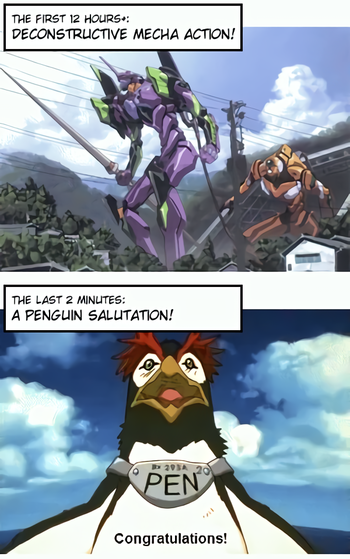
What do you mean, "The End"?!
A Gainax Ending is an ending that doesn't make any sense, or does make sense but is hidden under enough Mind Screw to not have an easy explanation. This is usually a deliberate form of Mind Screw or intended as a Sequel Hook to a sequel that was never made. If it's not done intentionally, it's often the result of the creators rushing to meet a Cosmic Deadline.
For whatever reason, after watching a Gainax Ending, you won't likely have any idea what happened. After rewatching it, rewatching the entire series, discussing it with other fans, looking up the meaning of the symbolism, and subjecting the entire thing to a comprehensive literary analysis, you still might not have any idea what happened. If you're lucky, then there will be some kind of emotional or symbolic resolution even if it doesn't actually explain what happened to the characters, and you'll be left with the sense that the series as a whole was more deeply thought out than it seemed before. If you're unlucky, then you'll be left with more questions than when you started and the sense that the series as a whole has been voided of the meaning you once read in it.
A Gainax Ending frequently involves bizarre and nonsensical Genre Shifts, Fauxlosophic Narration, and/or Faux Symbolism, and may very well cause an Audience-Alienating Ending. For an aborted Sequel Hook, you might encounter a Diabolus ex Nihilo (where a new villain appears from nowhere, does something villainous, and then disappears again) or No Ending in the form of an ambiguous Cliffhanger. Either way, it would have been addressed in the sequel... had there been one.
In many cases, a Gainax Ending is merely an attempt to Take a Third Option, rather than resolve a story with a Happy Ending or a Downer Ending; this ending steps out of the narrative entirely and implicates or invites the viewer to make sense of it. From a creator's standpoint, this makes the work, when done right, something that has far reaching consequences rather than merely something seen and consumed and discarded.
The Trope Namer is Studio Gainax, who became associated with this trope after the infamous ending of Neon Genesis Evangelion.
Compare No Ending and Ambiguous Ending, which also contain an at least partial lack of resolution, Trippy Finale Syndrome, which has similar imagery but actually makes sense (it's explicitly a Dream Sequence, a Battle in the Center of the Mind, takes place in Another Dimension, etc), Esoteric Happy Ending, an ending that is considered happy despite all the evidence to the contrary, Big-Lipped Alligator Moment when a similarly confusing event happens that is not the end of the story, and Mind Screw (and associated tropes), or a Quirky Work, where it's not simply the ending but the work overall that evades explanation. For when the ending ends up changing the entire scenario, see The Ending Changes Everything. Not to be confused with Gainaxing.
And, as a last word for this entry, we'd just like to say that the parrot has been squawking for hours and it is annoying the neighbors, so please feed him his cracker and be done with.
As this is an Ending Trope, unmarked spoilers abound. But don't expect them to make any sense!
Examples:
- At least two episodes of Simple Samosa have endings that come off as surreal, even by the usual standards of the show.
- In "Comic Book", Dhokla, Jalebi, and Vada all laugh at the story about Samosa they worked on when, out of the blue, a warning is given to the town of Chatpata Nagar and the townspeople discover a samosa dinosaur who wants four people for some unexplained reason. The dino turns out to be Samosa himself, and just to reiterate, this isn't in Samosa's friends' story and isn't even real in-universe because it turns out to be the result of Samosa writing the episode. The scene ends with the show's theme song playing as if nothing weird just happened.
- "Kasturi Khushbu" ends with Samosa visiting a United Nations meeting where everyone gives him a ton of consecutive farts. This collection of toots turns out to be the scent Samosa was looking for throughout the episode. Suddenly, Samosa winds up almost completely naked on the grass, and his friends see him sniff his own fart before Jalebi says Samosa didn't need to spend so much effort looking for an aroma he had with him the whole time.
- Invisible Games is a rather straightforward presentation of various fictional games that have supposedly been created over the course of the last century or so. The final entry, however, is an abrupt departure in style. Presented as a follow-up to a non-existent previous entry, the last entry is a surreal first-person tale filled with tantalizing hints about a mysterious sect of women who appear at the homes of the terminally ill. The artifacts they bear are in fact the components of a seemingly supernatural virtual reality machine in which the patients immerse themselves completely in the days prior to their death. The author eagerly anticipates death for the chance to experience the wonders of such a machine and considers dying without access to one to be a tragic fate akin to martyrdom. But the author laments that there is still work to be done and that a storm that has gone on for years is now raging outside. No other updates were ever made.
- Batman: The ending to Whatever Happened to The Caped Crusader?. Granted, the series was intended to close the character of Batman with a metaphysical look at the character, but the ending grabs metaphysics and goes straight into the surreal, passing by Elseworlds, multiple universes, and the Golden, Silver, and Dark Ages of Comic Books along the way. The general point of it was that there is no such thing as a definitive Batman story, and that the happy ending to Batman's story is that he gets to be Batman... because who doesn't want to be Batman?
- Be Prepared: The last scene has Vera's Struggling Single Mother revealing she got the new job she interviewed for—and it's in England, so the family is moving to London. Vera stares off into the distance. End story!
- Creature Commandos: The comic had a respectable run in the anthology comic Weird War Tales. It ended abruptly with a one-page story, in which they (and the writer!) are condemned to execution for being too human, the execution is stayed so they can be stuffed into a rocket headed to Berlin instead, and the rocket malfunctions and zooms into outer space.
- Crimson: The comic is a straightforward story that ends on a bitter-sweet note with The Hero departing on a new quest. But then the final pages reveal that the hero's best friend Joe was telling the story to another friend in a bar. What makes it confusing is that said friend interrupts Joe because he doesn't buy his story is real or vampires, demons and monsters don't exist, despite the many catastrophic events that happened around the world beforehand that confirmed the existence of supernatural creatures, the fact that the Apocalypse nearly happened and that Joe himself is obviously a vampire! Or maybe not, since Joe and his friend walk out of the bar in the daytime with no serious effects. They even pass by a homeless man that looks like one of the main villains who seemingly died during the final battle, which Joe briefly pauses to comment on. These things make it unclear whether or not the series' events were made up or really happened.
- Double Duck: The comic stars Donald Duck himself as a secret agent, with the first story arc full of plot twists. Of course, the story arc ends by revealing the identity of the leader of The Agency that Donald works for: a hologram of Donald. Thankfully, it gets explained throughout the second story arc (the leader, for example, is actually an AI The Agency based on Donald's thought processes, as it turns out he has an uncanny talent for dealing with the unexpected, executing Outside-the-Box Tactics and playing Xanatos Speed Chess, and uses the hologram as an interface).
- The Filth: The ending makes no sense at all. That Other Wiki has an explanation of how it works
 , but it seems to be an interpretation rather than a definitive answer.
- Gold Digger: After thirty years' worth of adventures, the comic ends the story of the Diggers sisters with a Gainax Ending being invoked in-universe in issue 301. With Gina rendered Deader than Dead, and her friends and family having saved the universe from destruction, Brittany heads to her place in the Diggers family tomb and watches The Adventures of Buckaroo Banzai Across the 8th Dimension to reminisce on good times...Until Gina suddenly arrives, probably(?) Back from the Dead, and possibly found a way to make time loop. What follows is the cast getting invited to reenact the ending credits of the aforementioned movie alongside them. The only thing for sure is that Brittany is bemused by Gina thankfully ending the series on such a nerdy note.
- Hellboy: In Hellboy in Hell, Hellboy takes on his One-Winged Angel form, wrecks Hell's capital, ends up on a beach, makes his way to an empty mansion there, comes across three glowing geometric shapes, and presumably Ascend to a Higher Plane of Existence. The End.
- The Invisibles: The comic is a magic spell in the form of a work of fiction. Everything in the first two volumes of The Invisibles is a lie. There's no massive Manichean struggle of good vs. evil. The outer church is simply an outside intelligence trying to prepare humanity for something mindblowing by essentially inoculating humanity against the horror of the end of the world (which is actually human instrumentality). Think of getting a booster shot. It's not going to kill you, but it's going to prepare your immune system for something worse in the future. To quote Grant Morrison: "In Katmandu, much to my shock and surprise, I experienced [...] a full-on, Tibetan, Sci-Fi Vision of All SpaceTimeMind As A Single Complexifying Iteration Which Is The Larval Form Of A 5th Dimensional Adult Entity".
- Mister Miracle (2017): The comic does have a definitive ending to the most tangible conflict — Scott and Barda defeat Darkseid, save their son Jacob from being sacrificed to him, and the war between New Genesis and Apokolips is finally waning. However, this occurs in issue 11. The actual final issue 12 addresses the question of what's wrong with Scott and why the reality around him feels wrong, but with very resounding ambiguity: plot-wise it's effectively a normal day, but throughout it he gets visited by visions of loved ones that died during the series, all suggesting different fates that point to the reality indeed being false: is everything in the world just a Dying Dream from his suicide attempt at the very start of the series? Is he in hell? Is he in heaven? Or just a construct of being struck by the Anti-Life Equation? Whatever the answer, Scott ends up surprisingly content with this "fake" world and chooses to stay, having made peace with his depression, finally having carved out a happy life with his wife and children.
- Ronin (1983): The comic seems like a fairly straight-forward comic until the end when you find out that everything you knew was a lie. It all ends with most of the story wrapped up with a couple of mild questions still lingering... and then the very last page throws everything out the window and raises several more.
- Samurai Jack: Quantum Jack: The comic, an Alternate Continuity Comic-Book Adaptation of Samurai Jack, ends with Jack turning into a tiger and nowhere near returning to the path toward defeating his nemesis Aku.
- Tintin: The adventure "Flight 714" starts with Tintin and friends meeting his nemesis Rastapopoulos, who wants the wealth of a billionaire, and for some reason it ends with aliens who come and brainwash everybody into forgetting the whole thing ever happened (except Snowy, who laments to the audience that no one would believe him even if they could understand what he's saying).
- Watchmen: The last chapter is intended to come across as a Gainax Ending, until you re-read the comic and associated documents to pick up all the foreshadowing.
- After seventeen issues of wrapping up forty years' worth of loose ends and providing a conclusive ending to the story of the X-Men in a big battle royale, X-Men: The End randomly ends with several X-Men gaining godhood without any forewarning. Oh, and Kitty Pryde becoming President of the US and giving a speech to the surviving X-Men, but that one was foreshadowed, with her narration having been present from the start.
- Zero ends with the titular character being comforted by his father while in a fungus-induced haze while also being confronted (and possibly killed) by his son in the future. He is then allowed to "choose" a multiverse to live in by a cosmic being. Also, William S. Burroughs is featured.
- Calvin and Hobbes: In one story arc, Calvin apparently reverses gravity while in his bedroom (not) doing his homework, then he grows so big he outgrows the Milky Way. The story ends when Calvin ends up floating through a white void and finds a door that conveniently leads him back to his bedroom. Then his mom comes in and berates him for not doing his homework after so long. In retrospect, Bill Watterson didn't think highly of the story and considered it "weirdness for weirdness's sake".
- In one series of Peanuts strips, Charlie Brown watches the sun rise, and it looks like a baseball. Then the moon does too, and he starts seeing baseballs everywhere. Then he gets a rash on the back of his head that makes it look like a baseball. His pediatrician suggests going to summer camp to take his mind off baseball; because he's embarrassed by the rash, he puts a paper sack over his head. At camp, someone half-jokingly suggests nominating "the kid in the sack" for camp president, and before he knows it, Charlie Brown is practically running the place, everyone following his advice and looking up to him. Eventually, though, he decides to take off the sack — becoming his old self again — and watch the sun rise to see if he's back to normal... And it looks like Alfred E. Newman's head with the words "What me worry?" under it. "Good grief!" cries Charlie Brown at the ending that made no sense.
- Higher Learning: Inverted. The prologue makes no sense after reading the story. Shinji, Asuka, Rei and Misato are gathered around a dying Kaoru, who reflects about each one of them and wonders if he has been successful and Shinji will not have to do the same thing he did. That scene feels like foreshadowing, but it is not foreshadowing anything. That scene never happens. Those characters never are together in the same scene, Kaoru does not die, and his thoughts make no sense given what happened.
- I don't want to forget: The fate of Shinji and Asuka (apparently trapped forever inside Unit 02) and of humans (still struggling to rebuild the post-Impact world), is unknown. Subverted in the epilogue because, even if it's not shown if Shinji and Asuka managed to get out of the Evangelion's core, it is implied they lived a long and happy life together.
- Darker and Edgier Disney fanfic Her Haunted Mansion: Emily's Journey (a prequel of sorts to a previous fanfic by the same author, Her Haunted Mansion) has four chapters be totally believable backstories for the character we met in Her Haunted Mansion. Our main character is Emily (the name commonly assigned to the Haunted Mansion Attic Bride ghost, although she doesn't become a bride until Chapter 5), who had all the characters in question as love ones before Master Mickey apparently took them away from her (although we know… or are supposed to know… from Her Haunted Mansion that he's actually saving them); she always tries to stop him, and always he enigmatically replies 'You're a little early, Emily' with a wide grin. When Chapter 5 came, everyone expected all these mysteries would be solved and Emily would understand her mistakes about Master Mickey. But no. Ooooh, no. Emily wakes up after having been murdered, and goes inside Mickey's mansion. In the attic, she meets a doppelgänger of herself, ready to be married, whom she brutally murders with an axe. She then climbs down into the ballroom where Minnie and Mickey's wedding is about to be celebrated. Everyone calls Narrator!Emily "Constance" (the name of another, axe-wielding ghost bride character in The Haunted Mansion). The whole chapter is told Through the Eyes of Madness (specifically, those of Constance), and she's getting battier and battier as the chapter progresses; from the mess of the last paragraphs, it appears Emily murdered everyone in the ballroom (even her best friends) because they wouldn't call her Emily. ''All that had been foreshadowed is never explained (Mickey flat-out denies having ever said 'You're a little early, Emily!' in the first place) and why Emily-going-mad/Constance-believing-herself-to-be-Emily/whatever-the-heck-happened happened is never explained.
- A Mind Screw Driver retroactive fanfic was luckily written, available here.
- A Mind Screw Driver retroactive fanfic was luckily written, available here
- The, admittedly already pretty weird, MLP fanfic The Many Secret Origins of Scootaloo at first seems to end on a relatively normal note that more or less raps up the story... then for no reason what so ever, we cut to an alternate universe where the whole story was a dream Nightmare Moon was having, she's married to Discord, Twilight is their infant daughter, and Scootaloo is Twilight's doll. Though it is somewhat foreshadowed by a Running Gag involving a rumor going around that Twilight's the secret child of Nightmare Moon (and later Discord).
- The Half-Life mod Half-Life: Residual Life has two endings as it may be, both of which are more than a bit confusing. No matter what route you choose to get to the ending, the game seems to restart right as player character Sora Kim is on the Black Mesa tram (complete with the first chapter title appearing, Impossibility Dream), implying that the whole game was All Just a Dream... until the tram takes a different route than before, taking Sora to a previously unseen location, and after it stops a guard appears out of nowhere and tells her (using audio of the G-Man's) that she's "not supposed to be here". After the credits, it opens back up to Sora in a some sort of abandoned building in the middle of nowhere devoid of anyone aside from a scant few monsters. Then she finds and boards a mysterious alien ship and leaves. The end.
- Untitled Displaced Fanfiction has a Gainax Ending in both part one and part three. Part one suddenly transitions from the main character Jonah presumably dying because Fluttershy kicked him to a future in which the mane six all have human bodies. Fluttershy then beheads a man implied to be Jonah. The second entry tries to do a Mind Screwdriver but elements such as Rainbow Dash saying "What have you done?" and the place everyone meets in being called "Shibuya" are retconned. The third part of the trilogy also has a Gainax Ending were Jonah goes back in time using Discord's magic, fights Samson (the Biblical character) and then laughs at Delilah for being thin. The story then abruptly ends.
- The Asia Side Story for The Conversion Bureau: The Other Side of the Spectrum ends on a nonsensical and random note, with the characters opening a portal to another dimension where they're flooded with fictional characters pouring into their world before they're visited by Rick Sanchez and Morty Smith, who offer to help them escape their broken universe. It then closes out with the Doctor and the Master having a little conversation, and then the Doctor addressing the readers and reassuring them that the characters will do fine. In the corresponding blog post she made with the chapter's publication, author Kizuna Tallis stated that she wrote it as a way to "blow it all up" as she was sick of writing for the Spectrumverse after its Troubled Production and the increasing hostilities between the co-authors over Creative Differences (of which she herself had several) left her too burnt out to enjoy writing for it anymore but still wanted to give her creations a sense of closure.
- The ending of Bratz Kidz: Sleepover Adventure. When the Bratz pressure new kid Ginger to make her story scarier, she gets overwhelmed and runs out of the room, prompting the Bratz to try and look for her so they can apologize. Sounds simple enough, right? Well, they can't find her or her parents anywhere, it turns out the house is actually abandoned, and Ginger's family was heavily implied to be Dead All Along. The Bratz then run out of the house to discover the characters from their stories have become real. Then when they try to go to their own houses, Ginger and her parents are at the door, repeating the words they said before the sleep-over began. The Bratz are understandably freaked out and flee each time they see this, but when they go to Sasha's house, Ginger's family is suddenly scared to the point of fainting by their presence, and it turns out that the Bratz have inexplicably become the monsters from Jade's story, act like they've always been monsters, and find somewhere to sleep. And that's it.
- The Czech short film Club of the Discarded ends with the all the movie's mannequins gathered around a television screen and watching it. They are watching television static.
- In the South Korean animated film Dino Time, one of the rocks in the kids' town has a mysterious carving on it, dating back to Cretaceous period. Mysterious because no humans were around then. The kids end up going back in time and at one point the main kid decides to make a carving to tell their parents in the future how to get the time machine to work, but he gets distracted when his sister is kidnapped and ends up not making the carving. At the end of the film, his mom explains they got to them in the time machine by looking at the carving, leaving the main kid to wonder how the carving got there in the first place.
- Heavy Metal ends on a rather abstract and metaphysical note.
- In The Sponge Bob Movie Sponge Out Of Water, after the plot has concluded, the talking seagulls begin to reprise their version of the SpongeBob theme, in a stylistic Flash animation. However, Bubbles reappears and expresses his disdain for the song, which inexplicably leads into a rap battle between them.
- The last twenty minutes of The Three Caballeros consist of Donald Duck entering Panchito's final birthday gift, a photograph of Mexico City at night. There he encounters singer Dora Luz's floating head and becomes smitten with her, before being accosted by flashing lights and images of women in bathing suits, while Panchito occasionally pops up to sing the title song with Jose Carioca and another Donald. He then finds himself in a flower patch and meets Carmen Molina, before being transported to a desert where he sees Molina using a baton to bring cacti to life. This scene abruptly ends and the film moves into the final "bullfighting" scene, with Panchito as the matador, Jose as the audience members (all of them), and Donald in a bull costume studded with fireworks. The filmmakers later claimed that the section (referred to as "Donald's Surreal Reverie") was intended to represent the idea that "love is a drug".
- The Twelve Tasks of Asterix delivers a pretty jarring example of this trope, considering the movie is based on a comic book series that's usually at least roughly historically accurate (it is a parodistic/satirical series after all). The movie ends with a group of Gauls from a small village ending up being considered gods, thereby overthrowing Caesarnote and gaining rulership over the entire Roman Empire. After his companion Obelix leans on the fourth wall by pointing out the historical inaccuracy of this turn of events, Asterix proceeds to break it, explaining to Obelix that everything is possible in animation. Upon hearing this, Obelix magically teleports to the island of pleasure, which the pair had visited earlier in the movie. Oh my...
- The final episode of Are You Afraid of the Dark? ends with the leader of The Midnight Society of the previous generation finishing his story, which happened to be about the real supernatural events occurring to the members of the current generation of the Midnight Society.
- Arrested Development parodies the above Being There ending.
- 'It's an ILLUSION!'
- Also:
NARRATOR: Maeby was struggling with a screenplay in her secret life as a film executive.RITA: Is that a story?MAEBY: Not yet. It doesn't have an ending. He's in LA, she's in Japan, how do I get these two characters together?RITA: Maybe they could walk.
- The end of Battlestar Galactica... The angels seen by Baltar and Six reveal that human/Cylon hybrid child Hera is Mitochondrial Eve, and speculate on whether it's all going to happen again. After Head Baltar reminds Head Six that God doesn't like the name "God," she looks at him sternly and he cryptically says, "Silly me." They walk away unseen through the streets of modern New York while "All Along the Watchtower" plays over a montage of robot advances on television.
- Could well have happened in Breaking Bad as this alternate ending shows.
- "Restless", the season four finale of Buffy the Vampire Slayer. After the second-to-last episode wrapped the season up in a more traditional way, the last was a series of bizarre dream sequences. While the episode did end up having a straightforward basic structure, it was also filled with bizarre and abstract ideas. Some were character-building, some hinted at events in season five, and some made no sense whatsoever ("I wear the cheese. It does not wear me").
- Bunk'd: The episode "A Whole Lotta Lobsta" has the Lobster Fest suffer unfortunate events resulting in it Gone Horribly Wrong (with the exception of the giant lobster bot amusing everyone). Emma then suggests they try a different theme for next year, and the next two scenes have them changing the food themes over the next two years, Pizza Fest and later Jalapino Fest, which both end up terrible as well.
- The series finale of Castle, "Crossfire", ended in such as way, partially due to the show's sudden cancellation: The show's writers were operating off the assumption that they had gotten a ninth season, but three days before the Season 8 finale aired, ABC cancelled the show. The resulting ending made viewers' heads spin: Caleb Brown turns out not to be dead and shoots Castle, followed by Beckett returning fire at Brown but not before he shoots her as well. A badly injured Castle & Beckett are then seen laying on the ground seemingly dying next to each other. Then we suddenly cut to a scene that is set 7 years later with the two of them eating dinner with 3 children. It is pretty clear what happened was a case of two endings being spliced together at the last minute. The fanbase had a field day trying to make sense of it, with theories ranging from that Castle & Beckett really did die and the "7 years later" scene was just a Dying Dream, or that the whole series was just the plot of one of Castle's novels, with only the 1st episode being "real" and that Castle & Beckett are just a normal author & cop married in real life without all the crazy adventures of the series. Then there's the theory that simply takes the ending at face value: they made an Unexplained Recovery and managed to Earn Your Happy Ending.
- The 1990 failed Crime Drama Cop Rock ends with Breaking the Fourth Wall and the cast singing one last song (this was also a musical show).
- Joss Whedon's Dollhouse had this in season two, with Epitaph Two. Though this was more a case of Missing Episode and All There in the Manual. Epitaph One, the season one finale which jumped to the future to show that the Dollhouse tech would be weaponized to cause the apocalypse, was not aired on television but was put out on DVD. So for those who did not buy the DVD, the episode made little to no sense.
- Even Stevens: The episode "Close Encounters of the Beans Kind", where Louis and Twitty suspect that the annoying neighbor kid Beans and his family are aliens, due to a series of unlikely coincidences. In the end of the episode, all of the evidence is explained away as being due to mundane events. Then we cut to Beans returning to his parents, who really are giant alien bugs, and speaking to them in an alien language.
- The Eternal Love takes a turn for the bizarre after the birth of Xiao Tan and Lian Cheng's son. Not only does Xiao Tan return to the present, Lian Cheng comes with her — but their baby doesn't. And along the way they end up on another continent, meet Lian Cheng's grandfather Yi Feng, and Lian Cheng develops amnesia.
- The series finale of Farscape ends with John and Aeryn getting engaged on a boat in some random body of water somewhere, having tied up virtually all the major loose ends, and providing a fairly solid conclusion to the show with just the right balance of closure, and riding-into-the-sunset implications of continuing adventures. Then, out of the blue, an alien whose species we have never seen before in a ship we've never seen before, talks to someone over his radio, zooms in, and blasts them with a beam that causes John and Aeryn to shatter into a million little pebbles. To be continued... They knew this was going to be the series finale, and not only do they end it with that random Mind Frell, but they also topped it off with a to be continued. The mini-series actually fixes this, and manages to make this event relevant, even answering significant questions the show never dealt with.
- The showrunners were under the belief that Farscape had been renewed. However, it was suddenly cancelled right around the filming of the final episode. They debated options but ultimately didn't have the time or money to change the ending. So the show reluctantly filmed the ending as it was, and hoped it would somehow work out. The cast and crew were notably upset about it when informing the fans of the series' cancellation.
- The Fresh Prince of Bel-Air: "Will's Misery" involves Will getting pranked by Carlton and Will's date Lisa in a scheme to get Will to respect women better that involves Lisa tormenting Will while tied up and locked up in a cabin. In the end, Lisa comes clean about the prank and tells Will that Carlton was behind it. Will pays back Carlton by finding him in the kitchen back at the Banks' residence and telling him a heavily embellished story about what happened after Will was locked up in the cabin, which supposedly ended with Will getting loose and killing Lisa with a huge rock in self-defense as he tried to escape and left her body there. At this, Carlton screams and runs out of and around the house, back into the house and through the kitchen again, through the cabin, through the studio audience, and through the school cafeteria before he runs right off the set and into Will, screaming incoherently all the way, at which point the episode ends.
- In-Universe example in a sequence of Season 3 Friends with a subplot about a play Joey is appearing in. In rehearsals, it appears to be a True Art Is Angsty play about a married couple's problems. When we see the play all the way through, the last scene is Joey's character going off in an alien spacecraft to find an alternative fuel source.
- The Hills. The Reality Show had dodged accusations throughout its run that it was faked, based off multiple stories and blogs exposing the exaggerated and scripted nature of the series. In response to this, the series finale ends with a conversation between Brody Jenner and Kristin Cavalieri (the de facto main character in the final season), who say their goodbyes to each other. Kristin gets in a limo and is seemingly driven off, while a Softer and Slower Cover version of "Unwritten" playing in the background... and then the camera pulls back to reveal that the entire scene was shot on a soundstage. Pieces of the set are shown being picked up and carted off around Brody, while Kristin's limo is sitting right nearby, indicating it had not driven off like we had been led to believe. The question as to how much of the show was just as fake goes unanswered. The series ending remains one of the few things in an MTV series to become outright Canon Discontinuity — as of the Revival, The Hills: New Beginnings, the aforementioned original series ending was cut out completely and replaced with an alternate ending where Brody visits Lauren at her condo.
- Kamen Rider Ryuki managed to pull off an Everybody Lives ending without ruining its There Can Be Only One premise, and while justifying the alternative continuities of the movie ("Episode Final") and the TV special ("13 Riders"). It's just damn confusing the first time you watch it, mainly because it's something of a Jigsaw Puzzle Plot.
- In the American remake of Life On Mars, Sam Tyler is a New York detective from 2008 who somehow found himself in 1973. Was he mad? Lying in a coma in a 2006 hospital bed, dreaming of 1973? Back in time? None of the above. Sam and his fellow officers from 1973 were really all from 2035. They were astronauts on the first manned Mars mission, and were kept sedated, with artificially-induced dreams, for the voyage. The show was cancelled after its first season so this ending was placed in. Had they had a season or two more they could have foreshadowed it more and not made it such a Gainax (there had been some hints about it, but they only made sense in retrospect). The final shot of the episode — somebody in 1970s shoes stepping onto the Martian surface — also left enough ambiguity that, had there been a super-last-second renewal, they could have explained it away.
- Also worth noting that in the original Life On Mars, we see at the end of the second season that Sam had been in a coma the whole time. The Gainax comes as the point at which he wakes up interrupts the "other" plot just as it reaches the climax (in which Gene leads his team in to foil a train robbery). Of course, after he's woken up and reintegrated himself into "real" life, he throws himself off a roof to "rejoin the action". However, the followup show Ashes to Ashes says explicitly that he committed suicide.
- The series finale of Lois & Clark was an unintentional cliffhanger caused by the show's cancellation. During the episode, Clark Kent discovers Kryptonians are physically incompatible with having children with humans. However, the show ends with Lois and Clark finding a baby in a Superman blanket magically teleported into their house. The baby comes with a note saying, "Lois and Clark, this child belongs to you." No indication is given of who this child is and how it got there. Executive producer, Eugenie Ross-Leming, said that the plot thread was supposed to carry over into Season 5:
We didn’t write it as a series finale, it was just supposed to be a cliffhanger. Looking to create obstacles for them, we ended up saying that carrying a baby to term would kill Lois. But as fate — or intergalactic justice — would have it, a baby of Krypton lineage is left at their doorstep. If the show had gone on, we would have seen them figuring out how to raise this child, who would have aged rapidly. He would have become a teenager in months.
- Lost seems like this trope if you have no knowledge of 2,000 year old religions like Neoplatonism or Gnosticism that it draws from (or can't type "dharma" into Wikipedia). Since the ending does make sense but is hidden under enough Mind Screw to not have an easy explanation, it is the second form of Gainax Ending. If an ending requires a couple of college courses (such as "Religious Studies") or other extensive off-screen research to understand it, it's a Gainax Ending.
- The Lyon's Den was a legal drama that was cancelled halfway through its only season but contractually obligated to deliver 13 completed episodes. Knowing that they could get away with pretty much anything with those last few episodes, the main character was revealed to be a serial killer who murders the secondary lead when confronted before leaping to his death.
- Mad Dogs: The dark-but-comedic crime caper featuring a colourful cast of middle-aged characters suddenly ends with all of the characters getting brutally executed on a beach. Not only does this go straight off the deep end of tone, the final scene is a Big-Lipped Alligator Moment of the whole cast inexplicably plunging straight into Hell. Despite the fact they were simply people caught in the wrong place at the wrong time, and they were killed by a gang of drug dealers that were far more evil than they ever were.
- Most Monty Python's Flying Circus sketches and episodes end in bizarre fashion. When the troupe felt that a sketch had run its course, they'd drop a 16-ton weight; have the "Stop, this is silly!" officer enter; or segue into an animated sequence, news broadcast or documentary. This was a reaction against conventional sketch comedy where every sketch had to have a punchline. The Pythons thought it would be funnier to deliberately subvert convention, and were dismayed to find that their comic mentor Spike Milligan had done it first with his show Q5 (Many of Milligan's sketches ended with everyone stopping what they were doing and shuffling offstage chanting "What are we going to do now?" shuffle, shuffle, shuffle "What are we going to do now?").
- The episode that ended with The Argument Sketch turned the Gainax Ending almost into an art form. All episode long, sketches had been ending with the police entering and making arrests, and the Argument Sketch was going to be no different. Then another police officer comes in to arrest the whole show for Gainax Ending abuse, only to suddenly realize that his doing so made him guilty of the same thing. As was true for the next cop who entered to arrest him, etcetera ad infinitum. Also, said cop was an ape.
- Much of Monty Python's humor made fun of how British comedy shows were written, produced and performed, something the members knew about all too well, as they were veteran British comedy writers themselves. They hated punchlines and how anticlimactic they were compared to the goings-on within the sketches, so they did away with them or lampshaded their arrivals.
- The final scene of the series finale for Newhart reveals that the entire series was the dream of Dr. Robert Hartley. It's considered to be one of the greatest moments in television.
- Norwegian TV theater was straightforward most of the time, but sometimes the Mind Screw factor escalated immensely. In 1982, a young and promising scriptwriter launched a story about a photographer with relationship issues. That is an easy way to describe the plot. The ending contains three actors dancing together with chalked faces, the main character posing as a bride with a ridiculously long veil, a ruin with all actors posed in bizarre ways (one of them inexplicably hanging on the wall), and at the very end, a bicycle hovering in the sea — actually standing on its wheels on top of a wave.
- Police, Camera, Action! was largely an Edutainment/documentary series, but did this twice:
- "The Man Who Shot OJ Part Two": After a largely dark and edgy episode that pulled no punches, including an Urban Hellscape due to the Rodney King beating, this trope was Played for Laughs with footage of Madonna at her wedding Flipping the Bird (It Makes Sense in Context only if you've seen it).
- "On the Buses" in January 1999 had a montage of footage set to EMF's "You're Unbelievable" including a man doing something in a van which was unexplainable as motorcyclists pass by, and the footage requires second viewing to understand. On a sliding scale of gainax endings, it's a 2.
- The Prisoner (1967) finale "Fall Out". After footsying around with metaphor and allegory for the entire series, the Grand Finale goes so allegorical that there's a fairly good case for calling this trope the Fall Out Ending or the Prisoner Ending instead. The debate over what actually happens at the end hasn't died down in nearly fifty years. Two main camps seem to be as follows: 1) The Village was an allegory for 6's own mental conflict over his decision to resign, and thus the entirety of it takes place in his mind; his escape being a metaphor for solving the conflict; and 2) The Village wins by creating an ideal position for 6 as its leader; even though 6 escapes to his home, the door to his flat now closes in the same way doors do in The Village, essentially showing that "they" are still monitoring his every move.
- Quantum Leap. Sam ends up in a bar run by a guy who has the same name as his closest friend. The patrons are all people that either have the same name as his other closest friends, look like people from earlier episodes, or both, and at least one of whom has a different reflection in the mirror. Also, a guy who may or may not be Al's uncle leaps out, and is promptly forgotten by everyone. The guy running the bar is probably responsible for Sam leaping around, and may be God. It ends with Sam leaping back into the season two finale, and telling Al's first wife that he's still alive before she can get their marriage annulled (hence changing every single episode of the series). At this point, a photo of Al leaps out (Because It Looks Cool presumably). A series of captions then informs the audience that Al got a happy ending, and Sam never leaped back home. Throw in the fact that Sam and Al only meet for one brief scene, and some viewers found it... unsatisfactory.
- She-Hulk: Attorney at Law: After a relatively straightforward series with just a few fourth-wall breaks, "Whose Show is This?" goes completely off-the-rails. Jennifer Walters, deeply unsatisfied with how her season finale is shaping up, opens up the Disney+ menu and uses it to break into an episode of Assembled (the MCU's "Making Of" series) and travels to Marvel Studios headquarters to ask for a new ending. After coming across her show's writers, they tell her to speak to "Kevin" since he's the guy behind everything. When she reaches him, she finds that he's actually an uncaring AI that creates "near-perfect" stories, and she convinces him to write a more satisfying ending for her.
- The Sopranos famously ended with a mid-scene cut to black. This may or may not have signified the main character's death. The explanation of the showrunners has it make a lot more sense. Since he is unable to bring himself to leave his life of crime, every day brings the uncertainty of being mundane or the day he is whacked. The audience does not know whether he experiences a routine day or finally meets his fate, and that's how he's going to have to live the rest of his life.
- According to the makers of Stargate SG-1, the Sci Fi Channel never lets showrunners know if they're renewed or canceled until it's too late to base the final episode around it. That's the reason every season finale of SG-1 blows the remaining special effects budget and generally wraps up the current plot — they don't know if it's the series finale or not. Ironically, SG-1 neglected to do this for the season when it was actually cancelled. They threw together a last-minute And the Adventure Continues episode, but some rather important plot threads were Left Hanging (mainly the ongoing war with the Ori and the last of the Goa'uld) until the Ark of Truth and Continuum DVD movies came out — much like what happened to Farscape.
- Star Trek: Enterprise:
- In the third season finale, the Xindi plot was resolved in a totally sane (and awesome) way, and the Enterprise goes back to Earth without their Captain, who they believe is dead. They try to call Starfleet, and no one responds. Figuring it is some sort of communications difficulties, they send a shuttlepod down to San Francisco...where they are met by a flight of American P-51D Mustangs. Meanwhile, on the other side of the country, Captain Archer has been discovered unconscious by Nazi soldiers. One of them asks the others in the group if they recognize his uniform. The camera pans over each of the officers until finally one steps out of the shadows and reveals himself as an unknown alien wearing a Nazi uniform. Roll credits.
- This cliffhanger was the last episode in which Berman and Braga were in charge of the show, with Manny Coto due to take over in the next season. There was much fan speculation that Berman and Braga deliberately came up with the most ridiculous ending they could think of in order to poison the well for their successor. The fact that Coto turned around and produced a fairly well liked season opening from it — one which finished up and disposed of Berman and Braga's generally disliked 'Temporal Cold War' in the process — was seen by many as a major accomplishment. However, a lot of fans who had been enjoying the Xindi arc threw up their hands and stopped watching the series in frustration at that point.
- The Series Finale, "These Are The Voyages", largely takes place as the B-Plot of a seventh-season Star Trek: The Next Generation episode, "The Pegasus", in which Commander Riker needs to get help from other characters to decide on what course of action to take regarding his former commanding officer, Admiral Pressman. As such, the actual events concerning Archer and his crew all take place as a holosimulation in which Riker is acting as the ship's chef and asking them for information completely unrelated to the plot of the episode (in which the crew has to rescue Shran's daughter from pirates). Characters act completely counter to their portrayals, notably Trip having a group of pirates that board the ship knock out Archer so Trip can lead them into a room and blow it up, fatally injuring himself in the process — a scene that was later stated by an officially-licenced Fix Fic to have been deliberately manipulated by Section 31 to hide the "true" whereabouts of the character who sacrified themselves. One of the most critical moments in the show's timeline — the founding of the titular Federation — occurs completely offscreen, as the episode cuts away when Archer is set to deliver a major speech at its founding ceremony, just before cutting to a montage of ships bearing the Enterprise moniker travelling through space, backed by quotes from James Kirk, Jean-Luc Picard and Archer.
- Strangers From Hell: The series ends with Jung-hwa seeing the supposedly-dead Moon-jo and Jong-woo's face turning into Moon-jo's, accompanied by flashbacks to earlier events that contradict what we've already seen. Some of it is justified since Jong-woo's insane, but the rest is pure Mind Screw.
- Up until the last five minutes, St. Elsewhere was a relatively normal hospital drama. Last five minutes? It was all the imagination of an autistic child with a snowglobe. Try not to think about all the shows that had crossovers with St. Elsewhere, and all the shows that those shows had crossovers with, were spun off from, or were honored with Shout Outs by. Somebody actually did that, and deduced that, by way of Six Degrees of St. Elsewhere, this show's Gainax Ending extends to literally hundreds of TV shows.
- The Season 1 finale of Prime Video series Swarm has Loony Fan Dre, after a full season of killing any person who dared criticize singer Ni'Jah (a No Celebrities Were Harmed version of Beyoncé) in any way (including loved ones), finally go to a Ni'Jah concert and try to storm the stage. Dre is then apprehended by security, only for Ni'Jah—having the face of Dre's late sister Marissa—to accept Dre and take her to her limo, finally achieving her life goal of acceptance by her idol. Maybe.
- In Terminator: The Sarah Connor Chronicles, John jumps into the future with Catherine Weaver in pursuit of John Henry (in possession of Cameron's chip), where he encounters the Reese brothers and Allison Young in a timeline where John Connor never rose up to lead the resistance as a result of his time travel. Then it got canceled.
- Tim & Eric's Bedtime Stories has just about every episode end this way, often ending just as something horrific is about to happen or hinted at. It makes a little more sense when promotional material refers to episodes as "nightmares".
- Brazilian sitcom Toma Lá Dá Cá last episode: the cast are about to be killed by an invasion. But since one of the main actors is the main writer of the show, they hand him a laptop and order him to write an ending that saves them... involving the arrival of an alien ship, which had previously "rescued" a character Put on a Bus.
- Twin Peaks:
- In the season 2 finale, Agent Cooper manages to reaches his kidnapped girlfriend Annie in the otherworld Black Lodge, but displays less-than-"perfect courage" when he confronts her kidnapper and the evil spirit entity BOB. He gets overwhelmed by BOB, who is able to once again manifest himself in the real world, this time as a doppelganger of Cooper. Ironically, this is foreshadowed by accident in the pilot episode, which showed an aged (and helpless) Cooper sitting in a chair in the Black Lodge—the world's longest waiting room. Cooper would have been rescued in season three had the show not been cancelled. Through time travel antics (and the movie "Fire Walk With Me", Annie would have contacted Laura Palmer in the past and Laura would have written a message in her diary alerting Cooper's friends of his plight/impersonation, which they would suddenly notice when said new message shows up in the diary when a character reads it.
- In The Return, Coop does escape the Black Lodge as an Empty Shell, 25 years later. His friends also manage to locate the missing pages of Laura's diary with the message from Annie.
- The Finale of The Return: The Doppelganger find Jack Rabbit's Palace and gets warped to the Giant's lodge. The Doppelganger gets sucked into a machine and gets teleported outside the Twin Peak's Sheriff's Office. Agent Cooper manages to warn Sheriff Truman about the Doppelganger and Lucy manages to kill him. The Woodsman appears and tries to revive him. The soul of BOB rises from his torso and attacks Freddie, but he uses the glove the Giant told him to get to destroy him. The woman who came out of Jack Rabbit's Palace meets with Cooper, and becomes the real Diane. Coop uses the key from his room at the Great Northern to unlock a door in the basement. He goes through and meets MIKE. They warp to the Gas Station, and meet up with Phillip Jeffries. They have a talk and MIKE mentions something about Electricity. Coop then warps back to the past. There, he prevents Laura from meeting up with Ronette, Jacques, and Leo the night of her murder. He leads her to the entrance of the Black Lodge. She disappears having never been murdered. Footage from the pilot is shown with Pete never finding her body. Coop warps back to the Black Lodge and wanders around exactly like in Episode 1. He finds Diane before the Tupla of her is created. They warp to the real world and drive to a location in the desert near some power lines. They then drive through a warp and end up in a hotel where Coop and Diane have sex. Coop wakes up the next day and Diane is gone. He has warped to Odessa, TX during the night. He finds a cafe name Judy's, where there is a waitress, Carrie Page, who looks just like Laura Palmer. He drives to her house and convinces her to go to Twin Peaks with him. She agrees. They go to Laura's house, but Cooper finds out the Palmers don't live there anymore, or never have. It turns out Cooper messed with reality when he saved Laura and no one from the main series exists anymore. He and Diane have taken over the lives of two people named Richard and Linda. Cooper asks "What year is it?", and Carrie hear's Sarah Palmer's voice calling out for Laura. She screams. Cut to black and end credits.
- V (1983). The heretofore serious Black-and-Gray Morality Alien Invasion vs. La Résistance science fiction series Gainax Ends big time in the last five minutes of the second miniseries, V: The Final Battle. The alien/human hybrid child Elizabeth develops sparkly magical powers just in time to save the world by disabling the Self-Destruct Mechanism. Never mind the fact that magical or psychic powers have never even been mentioned on the entire show before, and that the heroes already had a perfectly good plan to save the world. Fandom wtfed.
- This was handled much better in the novelization of the miniseries. In the novelized version, Elizabeth saves the world by cracking the supposedly "uncrackable" security code which has Our Heroes locked out of the ship's navigation-and-control system. The reason this works better is that Elizabeth's unusually precocious facility with computers and solving mathematical puzzles was properly foreshadowed in a couple of scenes earlier in the book, so her ability to break the ship's command codes didn't just suddenly come out of left field. Since the novel was adapted from an earlier version of the script, it's highly probable that Executive Meddling was involved.
- Creator Kenneth Johnson quit after writing the original script due to conflicts over budget and the network's plans for the series — he wanted to keep it as yearly mini's, they wanted an ongoing. Years later the head of NBC at the time apologized, saying if they'd stuck with Johnson's plan they'd have been on the sixth chapter by then.
- Norwegian children's series Uhu, about a group of "retired" ghosts who lived in a Haunted House, had a fairly standard happy ending at the last episode... but the final couple of minutes took a turn for the surreal. After the ghosts all get their happy endings, the character of the Oracle (a Flying Face who speaks in a Trondheim accent and Rhymes on a Dime) goes out to grocery store and hides in a can of tomato soup. Which is then bought, cooked and eaten by a random human family (who manage to not notice that the soup is giggling as they eat it). Then, all the family members start talking in the Oracle's voice, complete with Trondheim dialect and bad rhymes. They take the voice change surprisingly well, their reaction being essentially "We all sound like we're from Trondheim, that's hilarious!" And that's how the show ends.
- Wolfgang Amadeus Mozart's A Musical Joke ends rather comically, with each of the instruments concluding in a different key, creating dissonance. By doing so, Mozart was making fun of out-of-tune musicians.
- Hector Berlioz' Symphonie Fantastique ends with the protagonist taking opium, hallucinating about being decapitated, and then imagining his own funeral as a full-fledged Witches' Sabbath.
- The Beatles' "Ob-la-di, Ob-la-da," from The White Album, is about a market vendor named Desmond and a singer named Molly. They fall in love, get married, and have kids. The second-to-last stanza describes Desmond and his children working in the marketplace while Molly still enjoys her singing career. But the final stanza switches their roles, putting Molly in the marketplace and Desmond (who is now apparently a woman) in the band. This was an accidental case. The band members weren't paying proper attention during the recording, and as a result Paul got distracted by John and George yelling "Arm!" and "Foot!" in the break after the first "lets the children lend a hand" and got their roles backwards on the last chorus. They decided to keep it as-is because they thought it was neat (and they were sick of working on the song).
Happy ever after in the market place,Molly lets the children lend a hand.Desmond stays at home and does his pretty face,And in the evening she's a singer with the band!
- "Glass Onion", from the same album, also has quite an unusual ending. After making multiple references to earlier material of theirs, the song ends rather abruptly on a discordant, depressing string section that doesn't so much "end" as it just dies out...
- The "reunion" single "Free as a Bird" is similar. Much like "Hello Goodbye", it seems to end before starting up again after a second … and then randomly changes into a ukulele being played, as well as a backmasked sample of John, before ending.
- The music video explains this a bit - the ukulele part was meant as a reference to George Formby (whom Harrison was a big fan of), and the video ends with a Formby impersonator playing in a music hall (with a dog sitting next to him) in front of an audience. Plus, the backmasked John sample is saying "Turned out nice again", which was one of Formby's catchphrases.
- In a similar vein to the "Glass Onion" and "Free as a Bird" examples above, Oasis' "(It's Good) To Be Free" (the b-side to "Whatever") ends rather unusually on an accordion being played, with some guitar feedback as well.
- The Concerto for Two Pianos and Orchestra by Francis Poulenc.
- Polymorphia, by Krzysztof Penderecki has a rather jarring ending. Why is it so jarring? The entire orchestra suddenly plays C Major, the most "normal" chord there is, after several minutes of intricate experimentation.
- Robert Wyatt's album Rock Bottom ends with minimalist concertina, backwards violas, and a nonsense poem by Ivor Cutler. The effect is astonishing.
- Every single song (save the last) in Hitoshizuku-P and Yama's Bad End Night song series has this:
- In Bad End Night, Miku suddenly goes insane and murders everyone. Then, the screen goes black, a mysterious hooded figure walks in, and crying, picks up the letter she brought in with her. Without explaining what's in said letter.
- In Crazy Night, the same thing happens, but it seems like she's forcing herself to do it. Then, suddenly they all are alive and float off into the distance as Miku says it shouldn't be that way. They all say that they'll wait for another night, and suddenly the hooded figure appears on screen.
- In Twilight Night, Rin and Len pick up the missing page to the book in Crazy Night, which was apparently her letter. But it was blank, and suddenly things get even more Gainax: Everyone's ecstatic, but then Miku appears, saying it was the wrong page. They all turn into illustrations on a page of the book, because the page was blank, and so apparently there was no ending.
- The video for "I'm That Type of Guy" by LL Cool J features the rapper as a Gentleman Thief sneaking through some high-security compound, avoiding or dispatching security guards, crawling under a laser grid, and all that stuff, until he reaches a safe containing - a harem full of scantily-dressed models who are eager to greet him. Intentional, of course, but it's a pretty odd shift.
- Jethro Tull's album-length 1973 Concept Album A Passion Play ends with jarring, stabbing chords and distant crowd screaming of "Steve! Caroline!!", then jazzy saxophone notes as it fades out. One of the most mysterious sections in what is already a barely scrutable album.
- Frank Zappa's Joe's Garage ends with Joe, a rock musician, being jailed. When he is finally freed he discovers music has been banned. Then he becomes a factory worker. Which prompts Zappa, out of nowhere, to start a silly song called "A Little Green Rosetta", which breaks the fourth wall and the entire concept of the album completely and has nothing to do with the rest of the plot. Thus closes the album.
- Cracked has repeatedly mocked Styx's "Come Sail Away" for the random insertion of aliens at the end of the song.
- Mr. Bungle's self-titled debut album features the seventh song-track entitled, "My Ass is on Fire." Midway through, the song gets more aggressive (albeit more goofy—as expected with the band). However, one minute before the song could even end; it just abruptly interrupts itself with a french dinner conversation.
- Lisa Germano's "...A Psychopath", a haunting song about stalking (and implied rape) with a real 911 recording playing throughout, ends with a sample of an upbeat Italian folk song.
- Another well-known example from the classic-rock radio playlist: The Moody Blues' "Nights in White Satin". After the "Red is grey and yellow white ..." spoken poem that seems to bring lyrical closure to the song, there is a short pause, then an orchestral move that seems to be the end. But it isn't—another pause brings in an even more final-sounding symphonic passage. But then ... after another pause, the actual end of the song is a loud gong. Huh?
- Karnivool's 2005 album, 'Themata', could be considered an example. After ten hard rock songs ranging from alt-metal to progressive metal, the album concludes with the competely silent 20 seconds of "Omitted For Clarity", and the final track, "Change (Part 1). The latter consists of two minutes of ambient space music, one minute of quietly emotional but inscrutable lyrics, and a grand crescendo into...silence. The conclusion, "Change (Part 2)" wouldn't show up for FOUR YEARS, until the last track of their next album, "Sound Awake".
- The music video for Ill Niño's "Against the Wall" appears to be all about a problematic relationship, until the last half minute where the couple gets dragged to the bottom of a river by a swamp monster.
- The popular Norwegian children's song Dyrene i Afrika (The animals of Africa) lampshades this when completely out of the blue the crocodile explodes in the last verse:
That the crocodile blew to pieces makes the ending very strangeBut if we don't stop now, the song will never endAah-ja, Aah-ja, Ooh-ha-haAah-ja, Aah-ja, Ooh-ha-haBut if we don't stop now, this song will never end
- The Finnish country rock band Freud Marx Engels & Jung song Iloinen poika ja iloinen tyttö (Merry Boy and Merry Girl) which begins a schmalzy story of two young lovers walking along a road. After two stanzas, comes a line
Mutt' tulee auto, he jäävät sen alle (Comes an automobile, they are run over)
- The song ends abruptly on a loud snare drum bang.
- Several of Igorrr's songs end in very strange ways.
- Pink Floyd's The Wall
- Justified, as the viewpoint character spends the entire movie gradually descending into total madness. He only thinks that ending happened.
- Our House the Madness musical: was always going to have two endings due to the parallel universes plot. However, even after these are resolved via dual Karmic Twist Endings there's still time for a third 'ending' to turn it all into a "Shaggy Dog" Story (done by introducing a third option in the life-changing event at the beginning of the play which would mean none of the things we've just been watching happened at all.) Oh well. Song and dance number!
- P.D.Q. Bach:
- Einstein on the Fritz: The supposedly-lost musical is a parody of Einstein on the Beach, an opera by Philip Glass and Robert Wilson, which is notorious for lasting four and a half hours without plot. Summarized thusly:
Einstein feels a sneeze coming on, and takes his handkerchief from his pocket. In Act II, he realizes that he is not going to sneeze after all, and he puts his handkerchief back in his pocket in Act III.- This is the summary of the epilogue supposedly tacked on by PDQ Bach:
Einstein goes down to Hades to bring back his cousin Sophie, avenge the murder of his brother at the hands of Tsar Ivan the Inside Trader, slays the dragon guarding the entrance to the Golden Cave, seduces the Count's daughter on the eve of her wedding, and unites Italy.
- The Muppet Show loved doing this when appropriate.
- The best example is the Stars of Star Wars note were running amok in the theatre and have their climactic confrontation against Dearth Nadir note . Unfortunately, their weapons are useless and Chewbacca is no match against Angus McGonagle's Gershwin Gargling. How do the Muppets resolve this crisis? With a song and dance number, of course! Suddenly, the droids are dancing and everyone is then singing "When You Wish Upon a Star."
- A similar ending made a little more sense in their Marty Feldman episode, which spoofed Arabian Nights with Feldman as Scheherazade. When they get to "Ali Baba and the Four Thieves" (which has to make do with three thieves because one of the actors was sick), Fozzie is cast as the lead thief - but dresses up as a Prohibition-era gangster named "Big Fozz" rather than in Arabic garb. Then he realizes that everyone is gone, breaks character, and heads backstage to ask Scooter what is happening. Scooter says that everyone is in the alley behind the theater boiling a huge vat of oil - and when Fozzie asks him what this is for, Scooter's response is that the thieves are going to be cooked in it! Trying to hide his terror, Fozzie asks when the thieves' execution will take place, and is told it will occur "right before the closing number." In response, Fozzie rushes back on stage and launches right into the closing number, "There'll Be a Hot Time in the Old Town Tonight." Everyone in the cast except for Feldman joins him, and then Fozzie says "Open sesame!" to the thieves' cave, causing the boulder to roll back and the cast of Sesame Street to emerge. They fall in with the more "grown-up" Muppets and then everyone joins Marty for the song's big finish. There's a fade-out, the show ends as usual after a brief denouement (during which Marty tells a disappointed Kermit that his favorite Muppet is Cookie Monster), and no mention is ever made of the vat of oil again.
- Every episode of The Sifl and Olly Show ends with a song, including episodes with overlying plots. This leads to a lot of bizarre and ambiguous endings:
- In one episode, Sifl made a bunch of clones of himself (and one messed-up clone of Olly) that gradually start to interrupt the show itself. At the end, Olly is telling Sifl to stop making clones, Sifl is staring dejectedly into space, somber piano music is playing, and the background is an image of a broken test tube with Sifl's eye in it. Olly asks if Sifl is even listening to him, and Sifl responds by singing a nonsensical gospel song about missing the 80s, and all the other clones join in (while creating even more clones). By the time the song ends, the room is filled with Sifl clones, Olly has left, and the Olly clone from earlier has taken his place. Roll credits.
- Another episode has them interviewing The Grim Reaper (who turns out to be a pretty nice guy). Afterwards, they perform a cover of "Don't Fear The Reaper" and about halfway through the Grim Reaper comes back to join them...which causes their souls to leave their body and descend into Hell.
- In one episode, Sifl made a bunch of clones of himself (and one messed-up clone of Olly) that gradually start to interrupt the show itself. At the end, Olly is telling Sifl to stop making clones, Sifl is staring dejectedly into space, somber piano music is playing, and the background is an image of a broken test tube with Sifl's eye in it. Olly asks if Sifl is even listening to him, and Sifl responds by singing a nonsensical gospel song about missing the 80s
- Most The Goon Show episodes have no clear ending, unless everyone dies. The grand finale actually dissolves into random gibberish as the entire show comes to a crashing halt, and it doesn't seem atypical. As the announcer often observed, "It's all in the mind, you know." This is mainly seen in later episodes, probably because Spike Milligan himself had no idea how to end them. Earlier surviving episodes tend to have fairly logical plot resolutions, for a certain definition of logic.
- Watchmen ends with the complete destruction of the timeline of the Watchmen universe, causing New York to revert to the real world. This is accomplished via Rorschach, Nite Owl, and Silk Spectre "spinning and tumbling through an other-dimensional funhouse of sound and color" until they land in Times Square, where a kid is reading Watchmen and excitedly shouts that he recognizes them. Then the police arrive. Cut to black.
- In Delta Green: Impossible Landscapes if the players are unable to escape the masquerade the King In Yellow will be unmasked revealing the truth of the universe. The party's attendants will then rush the Agents, strip them naked and dress them in stage clothing and make-up, they will be taken to a stage. As the curtain opens it will reveal every PC and NPC encountered during the campaign and they will clap, the Agents will then realise they are wearing the same clothes they had in 1995 when they first met investigating disappearance of Abigail Wright, the back curtain will open to reveal the set: Abigail's room in the MacCalister building, where the Agents first started the investigation 20 years ago and where the campaign starts. A man will start mouth the lines from the King in Yellow play, the same the agents said long ago. The Agents are now forever part of the play, which they created, doomed to repeat it forever. The Game Master finishes by reciting a poem, and then the curtain closes.
- The grand finale of the musical Celebration involves the old villain (and the audience) being bombarded with portentous symbolism until he collapses, though not before revealing that he and his youthful rival are one and the same.
- The Threepenny Opera ends with Macheath ("Mack the Knife") about to be hanged for his many crimes. As he mounts the gallows, Peachum, who has orchestrated his execution because Macheath has married his daughter against her parents' will, suddenly shouts "Stop!" and addresses the audience. In order that the audience not have to face a sad ending, a happy one has been arranged. The chorus breaks into the song "The Mounted Messenger", as police commissioner Tiger Brown (Macheath's old army buddy and his OTHER father-in-law), in full uniform, comes in riding a stick horse, and reads a proclamation from Queen Victoria, in honor of her coronation, ordering Macheath freed, awarded membership in the Order of the Garter, a castle (at "Mucking on the Creek, Sussex") and an annual income for life... and extending "her royal felicitations" to all "the lovely wedding couples here assembled" (the thieves, beggars and whores)
- The Pirates of Penzance:
- The climactic scene culminates with the pirates convincing the authorities not to punish them by declaring how much they love Queen Victoria. This leads to the entire cast singing the Queen's praises.
- Very similar with Rossini's Il viaggio a Reims. For two hours we watch tons of characcters, and we seem to finally figure out that, right, the French lady is in love with the Frenchman who flirts with the Italian lady who's secretly loved by the Englishman, while the Polish widow is torn between her two admirers… when the plot cuts off for the whole lot to arrange a concert in King Charles X's honor.
- The two Kokoro games both have their fair share of confusing endings.
- The first game, Kokoro No Doki Doki Senpai, has a Bad End where Player, the main character, dies from spontaneous combustion with no explanation as to how he caught fire.
- Every ending in the second and most recent game, Kokoro Baka Monogatari, leads to the revelation that Earth is under attack by psychic, parasitic aliens and that the four main characters were secretly being trained to fight them.
- Bonus Stage had one episode with three possible endings (which, since it's a flash animation, the viewer could pick themselves), two normal ones and one "Sheep in the Big City Ending", which, while perfectly in line with normal Sheep in the Big City sheep-finding shenanigans and puns, had nothing to do with the scene before it involving a character being transformed into a blue blob.
- DarkMatter2525: "The Blame Game" ends with the suspected killer being unmasked, revealing it as a space alien that gets up, flips a switch and blows up the Earth, followed by it being covered on a news-report on a distant planet.
- Foxy Gets Hooked ends with Foxy getting slammed to the ground by Freddy, crushing Foxy into a small form which Chica uses as a fliptop trash can. Cut to the credits, which show the security guard crawling home, with his chair still glued to his backside, while a snail outpaces him. Then it turns out that they were in a race, and the snail won.
- Jimmy Neutron Happy Family Happy Hour, an already surreal web short, ends with a pizza decapitating Hugh and Jimmy concluding that the day is typical for him.
- The ending of the second series of The Most Amazing Story Ever Told is set millions of years after most of the events of the seriesnote , with a pair of conjoined mutated humans recapping the previous episodes on the "retro" web, and then turning their heads into rear ends and defecating from them, at which point the episode finishes with a fanfare.
- One Girl, One Sandwich is a web animation about an attractive young woman who goes to a restaurant to buy a sandwich. She must have been in Soviet Russia because the sandwich eats her!
- The Pimp Lando series is always full of non-sequitur humor, but the ninth episode (the latest in the series so far), after being a mostly coherent Courtroom Episode, ends with an attack on everyone by killer potatoes.
- An episode of Salad Fingers ends with the title character having his head eaten by a clone. Or was that the clone?
- Every YouTube Poop ever! It makes sense, considering the videos themselves in turn aren't even supposed to make sense to begin with. In fact, Walrusguy's supposedly-final YouTube Poop was titled "One More Final: I Need You(Tube Poop)", which is a reference to the original Gainax Ending of Neon Genesis Evangelion.
- The ending of the Tempura Panda arc in Parasite Galaxy had three characters figuring out they were all actually the same person who then became a duck made out of duct tape. While the comic is still ongoing, the ending to that arc can count as a Gainax Ending.
- Bob and George: Par for the course with the rest of the plot. George actually tries to shoot Bob. Though it fails, it causes the Helmeted Author to stop possessing him. It's then revealed that the entire episode was a bet between the two authors, and the comic was being run by Bob and George's mom as a Batman Gambit to toughen George up. Afterwards, Mom takes Bob and George back home while the Shadowy Author ends the comic on an epilogue where all the other characters seemingly die in the Calamity, but in fact faked their own deaths to prevent a time paradox and move to Acapulco, where they lived Happily Ever After.
- The Angry Video Game Nerd:
- The ending to his Star Wars (video games) review, in which a buffalo shits through his window and covers his floor in buffalo dookie. For no apparent reason, other then to reference the a line in his Theme Song.
- The ending of his Seaman review. The Nerd sets the game so far ahead in time that it seems that real-life time follows suit, as the Nerd is reduced to a skeleton far in the future. Then, time starts reversing back to Christmas 1982 as we go through James' whole history as James and eventually as the Nerd. The very ending has the Gillman and the Nerd's positions switched, with the Nerd in the tank while the Gillman roams free.
- His review of Transformers: Convoy no Nazo inexplicably end with The Nerd's Famicom turning into a miniature robot claiming to be Optimus Prime. When The Nerd tries to question this, the little robot simply blasts him away.
- The final video of Alternate Reality Game Pronunciation Book revealed it was connected to infamous Word-Salad Humor twitter account Horse_ebooks. Horse_ebooks itself ended with a link to the Pronunciation Book video, a phone number that was part of a performance piece, and the name of the creators' next project.
- Most, if not all, Brandon Rogers sketches end this way. Honorable mentions include "No Parents!", "A Day at the Park", "The Nuclear Family", and "Swim Instructor From Hell".
- Chrontendo Episode 39 ended with him saying that he could not take anymore games in the Family Trainer series, so he said that he would immediately skip to Episode 183 to play Super Metroid. Considering that the main goal is to play the games in chronological order, you could imagine how shocked viewers were.
- Crypt TV often does this leaving the viewers wondering what just happened, usually Invoked by the creators to make the audience guess on a theory behind it. Often doubles as a Downer Ending.
- Don't Hug Me I'm Scared:
- Episode 4: Ends with the Red Guy discovering a doorway to some kind of recording studio, where he discovers body-suited actors staging a crude recreation of the earlier videos... then his head explodes. Unlike the others, there's no indication that this is some kind of dream or hallucination. He shows up in the next episode, fortunately, although his place or presence in the plot is now unclear.
- The sixth episode and the series as a whole: Red Guy messes around with a terminal that controls the world of the puppets, only to be grabbed on the shoulder by Roy. Red Guy walks away and pulls a giant plug connecting to the terminal, resulting in the world resetting only on June 20th instead of 19th and with the puppets' colors switched. The notepad shows up and begins to sing its song once more, cue credits.
- DougDoug's game tournament Shufflemania ran on the premise of competitors duking it out in games that were rotated across multiple playthroughs by a "Shuffler" bot. Its final match has Ludwig Ahgren and Squeex of Team Orange beating Alpharad and Rubber Ross of Team Blue after a grueling comeback, upon which Doug reveals the secret of the Shuffler: it was never an AI, but rather Jerma985, who then alongside Doug gives Team Orange their prize: an abrupt tennis match (much to Twitch Chat's delight), complete with Parkzer as the referee.
- The ending of James Rolfe's Dorothy Goes To Hell.
- The ending of Episode 12 of Dragon Ball Abridged at first has Krillin waking up from a nightmare where he was being attacked by a monster on Fake Namek, and reflects on it, and is suddenly jumpscared by Mr. Popo. This then cuts to live-action footage of the show's editor KaiserNeko abruptly waking up, and groaning that he should stop editing so late. Cut to a familar black void manifesting onto his computer "agreeing" with him and traumatising him.
Mr. Popo: I'll say.
- While not having a Gainax Ending in the review for Eight Crazy Nights itself, near the end of Duckyworth's review, he calls out the film for this. When Jennifer sees one lone tear from Davey after the police arrest him, and demanding he talks because 'it's the holidays', despite the physical/psychological torture he has induced on others throughout the film, he even uses the first sentence of the first paragraph of this article to describe what a Gainax Ending was, then saying it fell into the former category for not making sense.
- Played straight in the review of The Nuttiest Nutcracker. After Ducky breaks down from both the film and Monokuma's harassment, Monomi/Usami comes out of nowhere to tell him that "You Are Better Than You Think You Are" for handling even the worse films, like the aforementioned Eight Crazy Nights review, and encourages him to keep going. When the Sugar Plum Fairy arrives as a part of the Credits Gag, Monokuma takes a truck to run her over, then aims for Duckyworth and Unami. Unami tries to stop Monokuma, only to get crushed by Monokuma, which she survives. Duckyworth drives off with her, and it ends, Looney Tunes style:
Monokuma: Upupupupupu - that's ALL folks!
- Played straight in the
- The music video for the song 'Fantasy' by Dye. It starts off innocently enough, with four teens (two girls and two boys) breaking into a swimming pool to fool around a bit. One pair of teens starts to get rather frisky in the pool, while the girl in the second pair shies away from her mate and jumps into the deeper end of the pool instead. Then things start to get... weird. The girl who jumped into the pool notices a strange bulge start to move around in her underpants, and quickly gets out, then she and the boy she left by the poolside turn around, and notice the other pair of teens who had been making out have turned into something ''different''. The mutated girl somehow assimilates the other boy into her body, while the final girl tries to escape, but fails. As her former peers close in around her, she jumps into the pool again, and, upon reaching the bottom, somehow finds herself in a different world. She then looks over the horizon, and her eyes explode. The camera then pans over to a massive Eldritch Abomination, and the video ends.
- French Baguette Intelligence: Science vs Ethics Debate infamously ends like this. It ends with Harry going on a rant that was so extreme, disturbing and immoral, that it had to be censored so that YouTube wouldn't remove the video; everyone, even Bowl, a man who is no stranger to controversy, thought that what he said was too extreme. Gringo rhetorically asks if Harry even has a soul, then Harry posts a photograph of his dinner and the video abruptly ends.
Harry: For today's dinner, I made sirloin steak with triple-cooked, Parmesan-coated chips, spinach and Béarnaise sauce.
- JonTron loves this trope:
- The ending of his Nightshade review is borderline nonsensical: after witnessing the constant weirdness of the game (including hilariously bad puns, undecipherable jokes and several Unexpected Gameplay Change moments), he comes across a man beating up an old lady on the street. Deciding he has had enough, he reaches out for the game, throws it against the wall, bashes it successively with a replica of Thor's hammer, a chair, and a kick scooter, all while singing "She's A Lady" (in slow motion, mind you). He finally flies off to the Sun in a spaceship. Watch it in all of its insane glory here.
- At the end of his Dino City review, after giving his final thoughts he suddenly bursts into a cover of Katy Perry's Firework, only changing the line "You're gonna live it blowing up" to "Dino City is a game". And then there's a brief sound distortion and the words "Death Comes to us All" written on the screen.
- The ending of his Conan Games episode has him pray to God to see if he can find a good Conan game. After he finds the said good Conan game, he stops momentarily and says:
Jon Tron: There's a jar of horse radish up there. I don't know why, but it's scary. *dramatic zoom on a jar of horse radish with suspenseful music playing*note
- The review of Yoda Stories during Jon's Starcade event ends with him getting "Perfect Yoda", upon which his face flies off and bounces around the room like the cards in classic versions of Windows Solitaire. Which was only the weirdest of a set of already weird endings; Starcade had a lot of them, including things like being apparently attacked by a Dubstep-playing Jar-Jar Binks and turned into a figurine, a sudden tangent with Jon admitting he "let those dogs out" because he wanted to sleep, and his Evil Laugh getting suddenly interrupted by distortion.
- The ending of his Nightshade review is borderline nonsensical: after witnessing the constant weirdness of the game (including hilariously bad puns, undecipherable jokes and several Unexpected Gameplay Change moments), he comes across a man beating up an old lady on the street. Deciding he has had enough, he reaches out for the game, throws it against the wall, bashes it successively with a replica of Thor's hammer, a chair, and a kick scooter, all while singing "She's A Lady" (in slow motion, mind you). He finally flies off to the Sun in a spaceship. Watch it in all of its insane glory here
- Friday the 13th. ft. Eugene by Matt Santoro ends with Eugene, Matt's clone, doing the weird face that Matt does at the end of every vlog, implying that Eugene and Matt are the same person. What makes this even weirder is that, earlier in the vlog, Matt briefly talks to Eugene.
- The Necro Critic's Dr. Jekyll/Mr. Hyde Double-Feature Halloween Craptacular ends with Necro killing his brother, Devil Critic, only to be killed by the real Necro and Devil Critic, who reveal that the previous Necro and Devil were robot clones of them from the future, only for the living Necro to reveal himself as a robot. Afterwards, a guy watching the video decides to leave a nasty comment on it, only for Necro and Devil to appear behind him and torture him by forcing him to watch The Strange Case of Dr. Jekyll and Mr. Hyde (2006).
- The Nostalgia Critic:
- The review of The Garbage Pail Kids Movie ends with the movie tearing apart the fabric of reality, causing the Critic to split into two people, one of whom is in a coma and the other is an animated piece of poop floating through space. The turd then remarks "I have become what the movie always was", and sings his Signing Off Catchphrase.
- His review of the Scooby-Doo ends with him destroying the movie in the past, present, and future, along with his older and younger selves, and ending up in the place where angels go after they die. After brief but rather ominous chat with his dead guardian angel, he wakes up, and all ends with him playing poker with The Cinema Snob, Rob (who is dinosaur for no explained reason) and Death. This was meant to be the series finale, and is modeled directly on the one from Star Trek: The Next Generation.
- In the end of his Devil review, Devil turns out to be M. Night Shyamalan and threatens him, then Santa Christ reveals himself to be the Devil in disguise, and sends Shyamalan back to Hell, explaining, that it was all a trap to catch him and return him to Hell. After they leave the elevator, Rita Repulsa's corpse comes back to life and turns into Cthulhu, who then says that everything going according to plan.
- "Obedience" is a short film. It starts out as a thriller where the subject is put through a twisted take on Milgram's "Obedience to Authority" experiment... and then it gets weird. With tonal shifts and then a twist ending that seems like it was taken from this site's WMG pages...
- Rat Movie: Mystery of the Mayan Treasure ends with the Cat Police exclaiming how they just saved the world, only for the world to immediately be blown up by a Cat UFO.
- Rat Movie 2 follows up with the Giant Rat casting the Noah's Ark Toothbrush into Mount Doom, except Mount Doom is actually the toilet and it appears that the Giant Rat was just playing with figures all along.
- One episode of Regular Ordinary Swedish Meal Time ends with some crazy twisting head laughing maniacally before a caption says "He died".
- The original Ryan vs. Dorkman ends with Dorkman successfully offing Ryan and walking away to leave — only for Ryan to reappear and ignite a lightsaber through Dorkman's chest. It didn't make any sense until the ending of Ryan Vs. Brandon 2, which reveals that there is a bunch of Ryan clones — this also explains why Ryan has lost every single one of his fights and manages to come back alive.
- Brawl. The reveal of Kirby as the ultimate mastermind and Ness and Lucas jointly acting as "the Butcher" isn't too hard to understand. The really weird stuff happens after the final battle when we see Kirby is still alive, has murdered Masahiro Sakurai, and just before it fades to black Shigeru Miyamoto walks into the room.
- It's not like TVMaxwell's videos are not already completely batshit insane, but the endings usually take it up a notch. For instance, in this brief example, two people go out "clubbing", as in beating random strangers to death with baseball bats. Then the video ends with their car exploding with a pop sound effect, them appearing in space and then flying into the sun, which is all accompanied with opera music.
- Many Internet copypastas end this way. One common ending is the revelation that one of the characters was the Loch Ness Monster asking for $3.50 ("tree fiddy"). Other stories randomly segue into a song, often "Lose Yourself" by Eminem (specifically the "Mom's spaghetti" portion), "Walk the Dinosaur" by Was (Not Was), or the theme song to The Fresh Prince of Bel-Air.
- The Real-Time Fandub Games parody of Sonic Riders does this. Although bizarre to begin with, most of the video is nothing more than an improvised Gag Dub of cutscenes from Sonic Riders and its sequel Sonic Riders: Zero Gravity. Unfortunately, one important sequence at the end of the latter happens entirely in gameplay - which the dubbers have no footage of - rather than in a cutscene. This missing scene is substituted with completely new footage, wherin the characters are transported to Garry's Mod, and their 3D models are flung around haphazardly as they meet Hatsune Miku and fight a Strider. The voice actors are as baffled as anyone else by this turn of events.
note
