
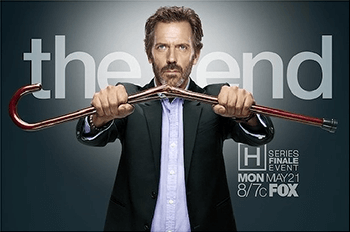
When a show (usually of the Failure Is the Only Option or Stern Chase variety) comes to an end with sufficient lead time, the production team may decide to go out with a bang by ending the endless chase, destroying the undestroyable foe, or in some other way definitively and permanently changing the core axioms the show depends on. It usually resolves all the conflicts that have driven the series over its entire run, and offers some kind of resolution to the dramatic tension that they have powered.
This is the Grand Finale, a way of very clearly saying to the audience "Okay, the show is really over. There's no more. Go watch something else." (That this doesn't always get through to viewers can be a problem in and of itself...) If this happens without warning, it's a case of a Conclusion in Another Medium.
In contrast to American television series, anime series tend to be single, continuous season-long stories that build, like an episodic novel, to a climax in the final episode. In these cases, a Grand Finale is the only fair (and the usual) way to end the show. Of course, since most anime is based on manga, occasionally the anime gets ahead of the manga (or gets canceled before the manga ends) and the anime writers have to make up their own ending, which is usually not as good as the eventual ending of the manga. Alternatively, a la Bastard!! (1988), Angel Sanctuary, and Strawberry 100%, the writers can just leave it hanging.
May often involve Gondor Calls for Aid or "Save the World" Climax. Expect Tear Jerker on a massive scale—the longer (or more beloved) the show, the more tears will flow. Contrast with Cut Short (when a series ends without a proper conclusion to the story), Conclusion in Another Medium (when a cancelled series has its story wrapped up in a different medium), and Series Fauxnale (when a series does an episode that could work as a finale, but gets renewed for more episodes anyway). Compare with Season Finale (for final episodes of a show's seasons rather than the series in general), Finale Movie (for when a work that isn't a film series reaches its conclusion in the form of a movie) and sometimes Wrap It Up (when the production team decides to make a conclusion to the series fast after hearing that the series won't be renewed), though if the "Holy Shit!" Quotient is high enough it can qualify as a Wham Episode. If the production was big enough, popular enough, and is able to bolster its ideas to a larger extent because of that, combined with a budget that allows it, then the Grand Finale can undergo a Finale Production Upgrade.
There will usually be Call Backs, Continuity Porn, Continuity Nod and Book Ends aplenty, along with characters coming Back for the Finale. A Will They or Won't They? running for the length of the series will usually get a Last-Minute Hookup. Expect to see Contractual Immortality and Joker Immunity thrown out the window. Given its nature as being the very final entry of the series, there may even be some End-of-Series Awareness beforehand. Sometimes accompanied by The Last Title. See Network Finale when this happens to a TV or radio station. Also see Series Fauxnale for installments that were intended to be this for a work, only for the work to continue onward anyway.
As this is an Ending Trope, unmarked spoilers abound. Beware.
Example subpages:
Other examples:
- The Jonathan Goldman iteration of The Most Interesting Man in the World got one of these where, to much fanfare and with many fans watching, he boarded a shuttle to take a one way trip to Mars, never to return.
Random General: [as he holds up a bottle of Dos Equis] Adios, amigo!
- Done three times with Hamlet Cigars, each time being related to advertising of tobacco being banned each time in the UK:
- In 1991, tobacco advertising was forbidden on TV, and as such, "Shot in the Dark"
 (highly stylized but likely NSFW) was the company's last TV ad. It showed a sperm being unable to get into an egg. It was truly something else, as instead of showing it taking a smoke, it just wallows away, and the famous "Happiness is a cigar called Hamlet" slogan isn't even said at the end. Talk about a Downer Ending.
- Then, in 1999, Hamlet pulled advertising from theaters as it simply was suitable in a time where cigarette smoking couldn't be done in theaters and advertising for such was pulled, but not before going out with a bang. "Farewell (Happiness Will Always Be A Cigar Named Hamlet)" was the company's last cinema ad, and as such featured people stuck in sticky situations humming the familiar Hamlet jingle, "Air on a G String".
- And finally, in 2003, tobacco advertising was taken off completely, this time being from the radio, resulting in Hamlet's final ad, ever. "Tony & Milo" was their last radio ad, and it featured ad writers Tony Burke and Milo Campbell talking about their job and mentioning that they work almost exclusively in tobacco advertising. However, Tony then tells Milo that by midnight, all cigarette commercials will be pulled. Milo asks what they should do now, and we hear a lighter, followed by the famous Hamlet theme and slogan.
- In 1991, tobacco advertising was forbidden on TV, and as such, "Shot in the Dark"
- Fellow Tobacco company Lambert and Butler preferred to advertise with magazine ads and posters featuring stock photos of two men talking to each other with speech bubbles. As a result of the 2003 ban, they released "The Last Poster". Styled like a collector's item, it showed the two men in black and white pixellation, and Butler says, "Looks like we've been outlawed, sir."
- Silk Cut also did this as well. In the 1980s, they gained fame for a series of surrealistic poster ads that often didn't even feature the name of the product; their first one simply showed a purple silk fabric with a cut inside it. When they learned of the impending ban on tobacco advertising in the UK in 2003, they ended their campaign that year with a poster that depicted an opera singer wearing a silk dress with a cut in it, referencing the term "It isn't over until the fat lady sings."
- 1998's Segata Sanshiro Shinken Yugi was the last first-party game for the Sega Saturn, and as such, it was only natural that its accompanying advert would be the last for the Segata Sanshiro campaign. A man clad in black-and-white clothing (obviously representing a rival company- presumed to be either Sony or Nintendo) launches a rocket at Sega HQ, just as they finish developing the Dreamcast. Segata Sanshiro then drops down from the top of the building, clings his feet to the window while grabbing hold of the rocket, and then launches away into space. The inevitable occurs, cuing up Shinji Nikra narrating "Segata Sanshiro will live on in your hearts", and you breaking down in Manly Tears.
- Ultimately downplayed. Sonic & All-Stars Racing Transformed retcons his final commercial, having him survive and showing that he spent THE ENTIRE 14 YEARS SINCE THEN making sure Nintendo/Sony's rocket never hits Sega headquarters. And somewhere along the line, it seems that he's able to toss the rocket and have it explode somewhere else, and gets back into kicking ass in Project × Zone 2.
- Then in 2020, we were introduced to Sega Shiro, the son of the master himself, for a series of 60th anniversary short films, ending with a face off against 'Sega Hatan Shiro', actually his own dad in disguise. And it was to come back to Earth just to test if his son can carry on the mantle, which he proves to him with flying colours. On his request, Sega Shiro flings him back into space and right into Saturn. Only to find out it was All Just a Dream... Or Was It a Dream?. Fittingly enough, Sega Shiro was played by Maito Fujioka, Hiroshi Fujioka's son.
- Capri-Sun had a series of commercials called Respect the Pouch, in which a kid did something to their Capri-Sun pouch and suffered a transformation to themselves as punishment, turning into what was known as a "Disrepectoid". The advertisement series came to an end with an online web-camera game that saw the Disrepectoids go on an adventure for a "Golden Pouch", with the ending seeing them get turned back to normal.
- We're Alive ends with "The Ink Runs Dry" in which Ink is finally stopped by means of a heroic sacrifice by Saul. At the same time Scratch and the two other remaining Mallers attack Dunbar in hopes of killing Pegs. Pegs manages to shoot Scratch during a showdown on the fire escape, but Scratch lives, only to be Buried Alive by Burt as revenge for her torturing him and cutting off his finger. The story ends 14 years later as Saul and Lizzy's son, Nicolas, joins the defense force for the slowly rebuilding nation centered at The Colony.
- For a long time in Doctor Who, there was one Doctor in particular who seemed to miss the boat on a big finale because he was unfairly booted from the role. Jump ahead 28 years and he finally got one. The "The Last Adventure" anthology provides a final Story Arc for Colin Baker's Sixth Doctor, including the wide gamut of friends, companions, and enemies he encountered throughout his tenure.
- 100 Bullets: The series ends the conflict between the Minutemen and the Trust, and ties up all other remaining plotlines, by slaughtering the lot of them, and leaving the survivors at the mercy of a Bolivian Army Ending (Loop, Victor, and Will not included).
- Amalgam Universe: The Amalgam Comics continuity (a joint venture between DC and Marvel Comics involving a merging of the DC and Marvel Universes where nearly every character is a mash-up of at least one DC character and at least one Marvel character) has its conclusion occur in the Unlimited Access miniseries, with Access once again having to keep the characters of the DC and Marvel Universes apart when they start encountering each other once more, with the added stake of the timestream being threatened. The miniseries ends with Access creating new amalgamated heroes out of the Justice League, Young Justice, the Avengers and the X-Men to take down an alliance between Darkseid and Magneto, subsequently reconciling with his girlfriend Ming after saving the day makes him realize that he's in control of his own destiny and has the ability to prevent his life making a turn for the worst.
- The Avengers: The Kang Dynasty acts was this to The Avengers (Kurt Busiek), with Kang deciding to conquer the present after defeatng Immortus in Avengers Forever (also written by Kurt Busiek).
- Batman:
- Neil Gaiman's Whatever Happened to The Caped Crusader? acts as a send-off to Batman, who had recently "died" at the time, but it's not just a finale for one particular iteration of the character. It's a send off for the franchise as a whole, showing how multiple versions of the Dark Knight met their end, and how multiple versions of his friends and enemies from significant eras and adaptations come together to mourn in a dream-like, metatextual context. It even involves Batman learning that his story has and will continue to go on, and that all the different takes on the Batman mythos result from that, leaving the overall franchise with quite a Gainax Ending.
- Batman: The Dark Knight Returns provides a definitive end to Batman's career, and ends his conflict with The Joker on the side... until The Dark Knight Strikes Again came out. After that, Whatever Happened to The Caped Crusader? (a direct reference to the above) became more fitting an end.
- The Autobiography of Bruce Wayne is this for Golden Age Batman, as well as his Unresolved Sexual Tension with Catwoman. It ends with the two of them getting married and retiring. They also have a daughter who goes on to become the Huntress in this continuity. Though a more fitting example might be "Only Legends Live Forever" where an older Bruce Wayne, now widowed and dying of cancer, dons the cape and cowl one last time to help the JSA stop the magically empowered thief Bill Jenson, at the cost of his own life. It ends with all the heroes, including former sidekick Dick Grayson and daughter Helena Wayne, attending his funeral.
- Some Of These Days is this for Batman (Tom King). The story chronicles the first and last romantic exchanges between Bruce Wayne and Selina Kyle. In between we see the two, having married and grown old together, dealing with Bruce's cancer, which culminates in Bruce dying in bed surrounded by Selina and his Bat-Family, including their daughter Helena
- Blaze of Glory: The miniseries has the subtitle 'The Last Ride of The Western Heroes' for a reason. All the big-name Marvel western heroes are here, and for most of them this serves as their last canonical adventure. Rawhide Kid is the only one who survives, and he gets his own Grand Finale (along with Apache Kid) in the Sequel Series, Apache Skies.
- The Brave and the Bold: The original run ended with a milder version than most: It was a Cross Through between the Golden Age and Silver Age Batmen, having them face the same villain in 1955, when the comic started publication, and in 1983, when it ceased publication, respectively. In other words, it was a Grand Finale for the comic and its concept, itself.
- Green Arrow:
- Although not the final issue of the run, the storyline Where Angels Fear To Tread by Chuck Dixon acts as the final instalment towards Oliver Queen's Post-Crisis era ever since Mike Grell wrote The Longbow Hunters and led the character to becoming more grounded and mature. Although he isn't able to address all the mistakes he made in life, he's able to sacrifice himself for the good of humanity and is able to meet and mentor his own son for once before his demise, leading his son to take on the role.
- "The Last Green Arrow Story" from the anniversary anthology one-shot Green Arrow 80th Anniversary 100-Page Super Spectacular acts as the finale towards Jeff Lemire's and Andrea Sorrentino's run on the New 52 run.
- Green Lantern: Wrath of the First Lantern, specifically its own finale (Green Lantern issue 20), serves as this to Geoff Johns' run on the Green Lantern mythos, seeing the conclusion of story threads laid out ever since he became the main GL writer back in Green Lantern: Rebirth.
- Convergence: The series is essentially the ending to the pre-Flashpoint DC Universe. However, thanks to the ending bringing the multiverse back from the brink of collapse, it has been confirmed the pre-Flashpoint universe still exists, and it's possible we'll see it again. DC Rebirth later confirmed that the New 52 universe is indeed the same as the pre-Flashpoint universe, just tampered with by Dr. Manhattan.
- Crisis on Infinite Earths: Grand Finale to the Silver Age (though it was actually released at the end of the Bronze Age)? Check. Grand Finale to the DC Multiverse? Check. Grand Finale for Barry Allen, Supergirl, Earth-2 Superman, and everyone else in the DC Universe? Check. Became the comic event by which all previous and succeeding comic events would be judged? Double Check. Became
one ofthe only company-wide comic event to permanently rip the Timey-Wimey Ball a new one, and do it so as to be universally praised? Gigantic freakin' Check. - Final Crisis: The series serves as a Grand Finale for the "multiverse" crisis series (which includes Crisis on Infinite Earths, Infinite Crisis, and 52) and the "hero exploration" crisis series (which includes Identity Crisis (2004) and Infinite Crisis). It also gives a Grand Finale to Jack Kirby's DC creations Darkseid, the New Gods, and others like Dan Turpin.
- G.I. Joe: G.I. Joe (2019) had its story wrapped up in the one-shot G.I. Joe: Castle Fall, where the Joes engaged in a final battle with Cobra to end their reign over the country once and for all.
- Hellboy:
- The B.P.R.D. story The Devil You Know serves as this to Mignola's Hellboy universe, though he will continue to write more stories revolving around Hellboy's past adventures.
- The series Hellboy in Hell is used to wrap up Hellboy's character arc before he is revived one year later in the final part of the Messiah arc in BPRD: The Devil You Know.
- Hilda: "Hilda and the Mountain King" served as part 2 of the Stone Forest arc and helped answer questions about why trolls are getting closer to the wall and helped Hilda find a way back home and to her normal self and served as the finale of the graphic novel series. However, Luke Pearson plans to continue the animated adaptation of the series.
- Justice League of America: Darkseid War served as this to Geoff Johns's work with the Justice League, including Justice League (2011), and to the New 52 era as a whole. Appropriately, since it was the first issue that formally kicked off the New 52 era, the arc Book Ends the era with the Justice League yet again dealing with Darkseid as in the first arc.
- Just Imagine... Stan Lee Creating the DC Universe: The line ends in the Crisis one-shot, where the Justice League and several other heroes band together to defeat the issue's titular villain, who was established to have been behind the conflict of the overarching story, in a final battle.
- Kingdom Come: The story centers on a growing conflict and eventual war between the Justice League, a more lawful generation of heroes led by an older Superman, and their violent and chaotic successors, culminating in an outcome so devastating they eventually settle their differences, and all the heroes rejoin normal human society after distancing themselves from it for so long. The future of several DC heroes and a few villains are shown throughout the story, with particular emphasis on The Big Three, making it a fitting finale for Superman, the Justice League, and the DC Universe as a whole (or at least one of them anyway). In a meta sense, it also helped bring an end to The Dark Age of Comic Books.
- Issue 22 of Justice Society of America gives us a further glimpse of the future, showing the Legion Of Superheroes flying off on an adventure, and a bespectacled elderly man with a familiar hair curl watching them with a smile on his face...
- Nemesis the Warlock: In the final issues Torquemada's regime is ended, Purity's new earth Government puts him on trial but he manages to escape to activate his 'Final Solution', then Nemesis sacrifices himself to finally stop his archenemy once and for all.
- Preacher: Alamo ends with a final showdown between Jesse and Cassidy, Tulip executing Herr Starr, and The Saint Of Killers taking his vengeance against God.
- Rick and Morty (Oni): "The Rickoning" five-part storyline serves as this to the main-line series, making up the final five issues (56-60).
- The Sandman (1989): The climax is reached in The Kindly Ones where characters from all other points in the timeline come together in one hell of a story, propelling a long and complex string of events which eventually leads to Dream's death and resurrection inside Daniel. The lengthy aftermath is depicted in The Wake, where it's demonstrated that the previous events had such gravity that they affected everyone in existence, including you.
- Sonic the Hedgehog (Archie Comics): Panic in the Sky is pretty much the technical finale of the comic as it does end with the heroes stopping Eggman and saving the world. The following comics were meant to celebrate the game series 25th anniversary before leading into a new arc, but the comic was cancelled before that could happen.
- Spider-Girl: Spider-Girl: The End brings the long-running clone saga of the Spider-Girl books to a close whilst also sending off the character with both a happy and an open ending, with Mayday finally hooking up with her loyal friend Wes as her family look on. Wes asks the question "where do we go from here?". Time will tell if we'll ever know, as it is presently The End... for now.
- Star Wars: Star Wars: Legacy served as this for the Star Wars Legends timeline, prior to the Disney Continuity Reboot. Taking place over a century after A New Hope, the story revolved around Cade Skywalker's struggle against destiny as well as Darth Krayt's Galactic Empire.
- Superman:
- Whatever Happened to the Man of Tomorrow?, by Alan Moore and Curt Swan, closes the book on the Silver Age Superman, paving the way for the reboot. It's an alternate universe story about how Superman faces his greatest and final challenge; Anyone Can Die, and old villains and other characters return in a veritable parade.
- The Black Ring and Reign of Doomsday (running simultaneously across separate books) served as this for the Post-Crisis Superman, wrapping up most of the plot threads that the series had left hanging before the 2011 reboot. Major events included: Supergirl coming to terms with her Superpowered Evil Side, the capture of the Cyborg-Superman, the last team-up between Superman, Supergirl, Superboy, Steel and the Eradicator (who performs a Heroic Sacrifice), the return, and final defeat of Doomsday, and of course, the last battle between Post-Crisis Superman and Lex Luthor, ending with Luthor being imprisoned in the Phantom Zone. With the majority of Superman's other foes already dead, imprisoned, or in the Zone, the two arcs allowed the series to end on a high note before the reset button was hit.
- In Supergirl: Cosmic Adventures in the 8th Grade, the two-part story "Graduation Day" tied up all ongoing plotlines, featuring a battle for the fate of the universe.
- The End (Marvel Comics): Marvel has released a series of stories known as The End, meant to serve as possible grand finales for some of their major franchises (X-Men: The End, Fantastic Four The End, Hulk: The End, etc.) while existing outside the main continuity.
- Teen Titans
- The Titans West three-parter (issue #50-53) marks the end of the original Silver Age run by uniting every single teenage superhero and past Teen Titans member to create an ensemble cast of Teen Titans (including Golden Eagle from Justice League of America and Bat-Girl from Batman). This was actually meant to be a revival that was Cut Short with the new dynamic being the Fab Five being spread across Titans East and Titans West.
- Meltdown! is the Grand Finale of New Teen Titans, culminating in an end to the Evil Raven storyline from The Darkening, Damage's character arc and Arsenal's era as the leader of the Titans.
- Titans Hunt(1998) marks the end of Dan Jurgen's run on Teen Titans (1996) with the dissolution of both the Teen Titans and Dark Nemesis, the death of Pylon and Isaiah's revival.
- Transformers:
- The Transformers: Unicron closes the book on not just the 2005 IDW Publishing Transformers continuity, but the Hasbro Comic Universe in general, as the miniseries entails Unicron laying waste to Elonia, Cybertron and Cybertron's colony worlds, with the surviving Transformers, the Solstar Knights and the heroes on Earth having to join forces to destroy the Chaos Bringer before Earth becomes his next meal.
- The 2019 continuity reached its conclusion in the 48-page special Transformers: Fate of Cybertron, which ended with Optimus Prime and his Autobots leaving Cybertron in the Ark to search for a new world after one final confrontation with Megatron.
- Done on a meta level with Transformers: Last Bot Standing, IDW's final story for the Transformers license (save for a follow-up to Transformers: Shattered Glass (2021) in Transformers: Shattered Glass II). The story itself chronicles the last known remaining Cybertronian's pilgrimage, as a hypothetical finale.
- Ultimate Marvel:
- In the initial plans, Ultimatum was going to be the grand finale of the Ultimate Marvel universe, followed by a reboot. The three ongoing series at the time, Ultimate Spider-Man, Ultimate X Men and Ultimate Fantastic Four got their Title: Requiem issues. But then it was decided to continue the story from that point. However, it still counts has a grand finale for the phase 1 of the X-Men.
- The Secret Wars (2015) storyline is this for the Ultimate Marvel universe.
- Ultimate Peter Parker's story originally ended with Ultimate Spider-Man #160, where he dies fighting the Green Goblin and the Sinister Six, paving the way for his successor Miles Morales. It later turns out that he's Not Quite Dead, and he has a final showdown with the Green Goblin, for real this time, then officially passes the torch to Miles and elopes with Mary Jane.
- Cataclysm: The Ultimates' Last Stand was the grand finale for The Ultimates. The fight against Galactus was won, but Captain America died and Thor was lost in the Negative zone. Iron Man still lives, but can't go on without his Bash Brothers, so he disbanded the team.
- It also serves as a sort of finale for Ultimate X Men, since Kitty Pryde is recognized as a hero for her contributions in the fight against Galactus by the President himself, who hopes to use this as a way to promote co-existence between humans and mutants with her help. Tellingly, the last issues of Ultimate X-Men are tie-in issues to Cataclysm.
- The All-New Ultimates were formed after the break up of the Ultimates; it was a standalone group with no members from the previous team, and focused on gang wars instead of global threats. It had its grand finale against a mutated giant and a fight against all their enemies up to that point at the same time.
- Wonder Woman: War of the Gods serves as the conclusion to George Pérez' run on Wonder Woman (1987), the conflict revolving around Circe trying to destroy Wonder Woman once and for all by creating worldwide chaos by making the gods of various pantheons fight one another.
- For Better or for Worse: The final installment was published August 31, 2008, and revealed what became of the main characters in future years:
- Main protagonists Elly and John Patterson retire to travel, volunteer in the community, and help raise their four grandchildren.
- The Pattersons' son and oldest child, Michael, an author, has four books published and later realizes a lifelong dream with the signing of a film contract. Deanna opens a sewing school and teaches Robin how to cook. Meredith enters dance and theater.
- Older daughter Elizabeth, who has married longtime boyfriend Anthony Caine, continues to teach. She and Anthony have a child, James Allen, presumably named in honor of his great-grandfather Jim Richards. Anthony manages Mayes Motors and its various related businesses, introduces Elizabeth to ballroom dancing, and hopes to eventually open a bed-and-breakfast.
- The younger daughter, April — presumably graduating from high school in 2009 — enters college (at an unnamed university) and eventually earns a degree in veterinary medicine. Following her established love of horses, she gets a job with the Calgary Stampede. She eventually establishes herself in western Canada, where she meets her boyfriend.
- Family patriarch James Richards ("Grandpa Jim," Elly's father), a widower who had suffered a stroke earlier in the 2000s that left him unable to talk or care for himself, lives to welcome the birth of his fourth great grandson James Allen. In early 2010, at age 89, Jim — who had other health issues late in his life, including several heart attacks — dies peacefully in his sleep, his second wife, Iris (who had been his caretaker) at his side.
- Spider-Man: Following the death of Stan Lee in 2018, The Amazing Spider-Man comic strip was eventually discontinued. The final storyline saw Peter Parker team up with his wife Mary Jane and Luke Cage to battle The Purple Man. Afterwards, the Parkers head off for a vacation in Australia, where they will remain until, or if, the strip is revived.
- The first four Berkeley Breathed strips each provided a sense of closure for their respective star characters:
- The Academia Waltz ended with Steve Dallas getting married.
- Bloom County ended with each of the main characters getting jobs in other comic strips - except Bill, who now had the brain of Donald Trump and bought out the strip in the first place; Opus, who waits to leave until everyone else has; and Ronald-Ann, who moves to Outland. Speaking of which...
- Outland ended with Opus moving back to Antarctica to live with his mother.
- Opus ended with Opus falling asleep within the pages of Goodnight Moon.
- Of course, they were all retconned when the first strip of Bloom County 2015 revealed the two successor strips — and, in all likelihood, the ending of the original Bloom County — were just a 25-year-long dream Opus had.
- The Pony POV Series Chaos Verse ends with Discord: Complete Existence, which details Discord and Fluttercruel — joined by the occupants of their constructed world and Celestia and Luna — engaging in a Final Battle with the Big Bad Nightmare Phobia.
- Back in the original Pony POV Series, the Dark World — which grew to eventually being declared its own series with its own story arcs — has the Alicorn Ascension Arc (yes, even the name is a spoiler). Immediately following the events of the End of Days Arc, this arc deals with Twilight fusing with Nightmare Paradox to become the Concept of Magic and will presumably explain how the Dark World ties back into the main series.
- It's companion Arc (the Shining Armor Arc) has one of its own where Shining has his final showdown with the Blank Wolf, finally admitting his love for Cadence and proposing after the Blank Wolf is defeated, Running Gag proposes to Garnet, and Minuette begins a stable relationship with Captive Audience after feeding her Enemy Within the Master to the Blank Wolf and freeing herself from him.
- A Growing Affection: The second to last chapter wraps up most of the loose ends, and the finale chapter has two time skips to five years later when Naruto and Hinata finally get married; and the eight more years after that, when Naruto becomes the sixth Hokage.
- Higher Learning: The finale arc is six-chapters-long. After the death of the Final Messenger, SEELE's forces invade the Geofront, intending to kill everyone and put Instrumentality in motion. Shinji and Asuka fight for last time in their Evangelions as they struggle to solve their remainder psychological issues. Kaoru finally reveals his identity and his backstory. Despite everything what the heroes did, humankind goes through Instrumentality, and Shinji has to make a choice. The last scene happens several months later, featuring Shinji and Asuka going to school while humankind is gradually returning and rebuilding their world.
- The My Hostage, Not Yours series has the third story, The Inevitable Takeover, which has Zim and Gaz upgrade (downgrade?) from Anti Heroes to full Villain Protagonists, get married, and then begin a plan to conquer the whole planet and ultimately succeed. Oh, and Dib gets a Beta Couple plotline with Tak, finally giving him something to do in the series.
- Examples from the Calvinverse:
- Retro Chill serves as a Grand Finale for the movie series. The rewritten version acts as this for the Calvinverse as a whole, with nearly every regular character coming back in some form, the final defeat of two of the series' biggest villains, and the characters experiencing some End-of-Series Awareness.
- Calvin & Hobbes: The Series, meanwhile, has "Black Rain", an unusually dark episode bringing back two of the series' most competent villains and also putting Slender Man of all people in it. It also ends with said villains dying a very ambiguous death, and the protagonists looking back on the end of the series in a very meta sort of way, eventually leading up to the final words of the series:
- The final three stories of The Lion King Adventures — The Message, The Final Task, and The End — form one continuous story that deals with the various issues that have built up over Series Five, all building up to the arrival of, and confrontation with, The Writer. And after the Final Battle, there's a Distant Finale showing an adult Simba and Nala Happily Married and ruling over the restored Pride Lands with their surviving friends and family.
- Young Justice: Darkness Falls, as fitting a superhero continuation of Young Justice ends with a great battle against super villains. The episode in question, Retaliation deals with the league and the team in their Final Battle against Klarion and the forces of Darkseid. Not only does it end with tons of cool battles and wrapping up almost all the emotional arcs of the fic (and the show in some cases as well), but it also gives the show the kind of closure Greg Weisman gave Gargoyles: an open ended ending that still manages to be satisfying. For even though the light is still at large, the League and Team have finally averted the Bad Future Bart Allen came from.
- My Family and Other Equestrians has one final interlude chapter for each member of the family. After that is one final Story Arc (the story's last proper arc is the Apple Family Reunion arc).
- Star Trek: The Original Series formally ended back in the day on the rather Anti-Climatic and infamously sexist "Turnabout Intruder", ending the show in what can really only be described as a somewhat lacking fashion at best. The Web Video show Star Trek Continues, being a Fan Sequel, tries its hand at offering a properly grand send-off to the original show with the "To Boldly Go" two parter, which is set as a Bookend to "Where No Man Has Gone Before" sees the original Enterprise crew facing off against a threat to all known galactic civilization and finally complete their five year mission, before ending on a couple of more personal and low-key moments of Kirk, Spock, and McCoy discussing the future of their careers (thereby setting the stage for Star Trek: The Motion Picture) and Kirk taking one last stroll on the bridge of the Enterprise.
- For the Ruby and Nora series, we get Cold, in which the heroes fight against Jacques Schnee's dictatorship over Atlas in the first half and Salem and the God of Destruction, Void, in the second half, in which all the Grimm are absorbed into Void's body and Nora pulls a Heroic Sacrifice to unlock the power of Ruby's silver eyes and destroy Void completely. While there is one last story after this in Ruby and Nora, it's simply a short epilogue to the series.
- The Bolt Chronicles: "The Gift" serves as the final wrap-up story for the series, with Bolt, Mittens, and Rhino reunited for eternity in Nirvana after their deaths.
- It's not uncommon for fans of series that were Cut Short or Left Hanging to write fics giving the series a proper conclusion.
- Halloween Unspectacular:
- The fifth edition, The Final Push, was originally supposed to be this, wrapping up the Myth Arc that had developed with a Final Battle against all its allied Big Bads, and ending the series. However, after a couple of years, E350 decided to return to it with a soft Continuity Reboot and a new arc.
- That second arc had its own finale in the eight edition, Blue Alert, concluding with a Big Badass Battle Sequence between the remaining heroes and the forces of PURITY.
- The tenth edition, simply called Halloween Unspectacular X, not only concluded the third Myth Arc started the previous year, but also served as a definite final story in the series, for good this time. It also turned out to be a finale to E350's time on FanFiction.Net, as he moved his attention to other sites.
- Ultimate Sleepwalker: The New Dreams ended in issue #99 with Sleepwalker committing a Heroic Sacrifice to stop Mephisto from driving humanity insane. Issue #100 was a final epilogue where many of the human characters come to terms with everything that's happened.
- So Long, Farewell, Auf Wiedersehen, A-D'oh imagines what the series finale of The Simpsons might look like. As such, it features many plot points that tend to appear in final episodes. Characters retire, die, graduate, are promoted, become engaged, etc.
- The final two books of Animorphs showed the end of the war with the Yeerks, and gave us a glimpse of the heroes' lives a few years afterwards. Cassie is the only one to 'come home' from the war - Rachel dies the final battle, Ax is taken prisoner by a mysterious new enemy, and everyone else goes on a suicide mission to rescue him.
- Mostly Harmless ended with writer Douglas Adams killing all the main characters and completely erasing Earth from existence (in this universe and every parallel universe). He later said he regretted ending The Hitchhiker's Guide to the Galaxy on a such a melancholy note and was considering a sixth book with a happier ending before he suddenly died of a heart attack.
- Harry Potter and the Deathly Hallows finished the series-long conflict between Harry and Voldemort, complete with more major character deaths than the other books combined.
- Prior to the publication of the last book, there was much speculation as to how Rowling, on a purely practical level, would choose to end something so popular and profitable (although the ending had been planned from the humble beginnings over ten years before). Many said that, whatever she'd been planning before the title character would have to die, for example, so that the author wouldn't be hounded for the rest of her life (or that she'd better not kill him off, so that she wouldn't be hounded for the rest of her life). Another "story-ending" possibility raised by some was for him to lose his magic. She seemed to solve the issue by implying that Harry had lived a quiet, peaceful life for at least 19 years following the defeat of Voldemort.
- Alan Dean Foster's Flinx Transcendent is the grand finale of thirty five years worth of novels set in the Humanx Commonwealth universe. Sure enough, each and every dangling plot element is resolved, one by one, like a checklist.
- The Grand Finale of Stephen King's magnum opus The Dark Tower series is infamous for ending with an Anticlimax Boss confrontation with the King Multiverse's Big Bad (who turns out to be a pathetic, powerless loony), followed by the protagonist walking through a door that turns out to be a big Reset Button that boots him back to the first scene of the series, with the implication that this has already happened many times before and that hopefully he'll eventually get it "right".
- Worse, we, the readers, will never learn exactly what "getting it right" will mean, because Stephen King wrote himself into a corner after creating such a divine mystery as to whatever is at the top of the Dark Tower. IF you ever want to see what's up there, forget it.
- Arthur Conan Doyle tried to give Sherlock Holmes a Grand Finale three times without success. The first time, Holmes dies. The second time (after Holmes turns out to be Not Quite Dead), Holmes achieves what he considers to be the pinnacle of his career when he stops a World War from happening (decades before World War I), in a story that was first mentioned as a Noodle Incident eleven years prior. The last was set years after Holmes' retirement during World War I, where Holmes and Watson pull a Xanatos Gambit that gave the Germans so much false information that effectively turned them into sitting ducks against the British forces; the story also gave Holmes an age for the first time in the series. But the combo of Public Demand and Executive Meddling made him continue each time. But when the real last story came, Conan Doyle said, "screw it" and completely averts this by giving us a standard-issue mystery as the last Sherlock Holmes story.
- The Last Hope serves as the grand finale of Warrior Cats, wrapping up all the plot hooks and giving all the characters one last time in the glory. Well, at least it did before HarperCollins decided that the series was selling too well to end it.
- The Lord of the Rings concludes with the end of Middle-earth's Third Age and is chronologically the very last installment of Tolkien's Legendarium.note
- The last story of Awake in the Night Land is one for The Night Land mythos. At the end of times The Powers of the Night are finally defeated and prevented from getting into the next Universe.
- The Fairy Chronicles has Journey's End, which closed the series with Marigold taking on an apprentice.
- Captain Underpants and the Sensational Saga of Sir Stinks-a-Lot is the final book of the Captain Underpants series and has Mr. Krupp permanently stripped of his powers and Captain Underpants identity as well as George and Harold moving on from making Captain Underpants comics.
- Survivor Dogs ends on on the twelfth book (not counting the novella compilation) The Final Battle. Storm finds the traitorous dog and saves her pack.
- Codex Alera has the book First Lord's Fury, where Tavi rallies whatever forces he can (comprised of the last of Alera's legions, Canim refugees, Marat Tribesmen, and even the forces of nature) in a desperate Last Stand to defeat the Vord Queen and her Horde of Alien Locusts.
- The Fall of Shannara is intended to the final chapter in the entire Shannara franchise though Brooks hasn't ruled out doing other works set in the Shannara universe.
- Queen's The Show Must Go On! is clearly this for Freddie Mercury. Brian May had penned the song, but was unsure that Mercury, who was dying of AIDS, could sing it. Fortunately, Mercury was able to nail it, pouring everything he was into it, and recorded the main vocals in one take after taking a shot of vodka.
- The rest of Innuendo is seen by this by a lot of fans, containing some of the best songs of late-era Queen, including the aforementioned "The Show Must Go On", the title track, "I'm Going Slightly Mad", "Headlong" and "These Are the Days of Our Lives".
- The true grand finale for the band, at least before May and Taylor went on tour with other musicians, was the ballad No-One but You (Only the Good Die Young), relased on the compilation Queen Rocks (almost six years after Mercury's death).
- Dream Theater's Epic Rocking song "Six Degrees of Inner Turbulence" (a 42-minute-long song), ends with a section called "Losing Time / Grand Finale".
- Rush's "2112" last section is called "Grand Finale".
- Orbital's Blue Album concludes with the epic "One Perfect Sunrise", which was also supposed to be the swan song for the band, but they later got back together.
- Abbey Road was probably intended to be this for The Beatles, being their final recorded album, closing out with a big medley of short songs, including a song titled "The End". However, circumstances led to Let It Be being the band's final released album.
- The song that ends Sgt. Pepper's Lonely Hearts Club Band. "A Day in the Life" concludes with all four of the Beatles striking the piano in a final E major chord that runs 45 seconds. Music critic Greil Marcus called it "an ending that will never be matched."
- The Smashing Pumpkins played their final show (at least before they reformed) in 2000 at the same venue they played their first gig at. The concert featured songs from all of their albums, and even Billy Corgan's dad showed up on stage.
- "MTV Unplugged in New York" could be seen as this for Nirvana.
- The Last Waltz by The Band.
- "High Hopes" by Pink Floyd, works very well as this, being the last song they ever recorded (until session on 2014's The Endless River began), and managing to feel like something is ending, with a very melancholic tune, and lyrics that focus not on the future or the present, but about how things were better in times past. It's also the last song on the last released Pink Floyd album from before they broke up.
- Merle Haggard: Averted, but in the late 1990s, in an interview he threatened to — but ultimately did not — record a "farewell" album (and retire) in response to his growing distaste for modern country music and radio (which had drifted, as it occasionally does, toward radio-friendly, pop-sounding material) virtually ignoring his new material, despite critical acclaim. The album, he said, was to be titled "On the Brink of Extinction." Haggard continued to record and perform until his death in 2016.
- Bridge Over Troubled Water, Simon & Garfunkel's final studio album, turned out to be a huge success, topping the charts in the US for 10 weeks and the UK for 33 non-consecutive weeks, and even won a Grammy for Album Of The Year. It helped that it contained some fan favorites such as the title track, "El Condor Pasa (If I Could)", "Cecelia" and "The Boxer".
- David Bowie's ★ plays like this, especially the final two tracks, where he spells out that it's the end. He passed away two days after its release. However, it was also revealed that after recording ★, Bowie planned to make one more album, and demoed five tracks for it before his death. Bowie called Visconti a week before his death saying he wanted to make another album, which somehow makes the album's subject even harsher since it makes it plain that, despite ★'s peaceful ending, Bowie still wasn't ready to go.
- J Dilla's Donuts was created as he was dying from an incurable blood disease, and was consciously crafted as a farewell to fans. It was released on his thirty-second birthday, and he died three days later.
- His fourth album The Shining also counts. It was made at the same time, and it was 75% complete when Dilla passed away. As he saw it coming, Dilla tasked beforehand his close friend and collaborator Karriem Riggins to finish the album.
- More precisely, the last song of the album, "Won't do". After so many collaborations and instrumentals, "Won't do" is all about Dilla : Dilla writing, Dilla rapping, Dilla singing, Dilla producing. Solo. No featuring. It's an awesome way to end the album.
- His fourth album The Shining also counts. It was made at the same time, and it was 75% complete when Dilla passed away. As he saw it coming, Dilla tasked beforehand his close friend and collaborator Karriem Riggins to finish the album.
- Warren Zevon's The Wind was also crafted after the singer was diagnosed with inoperable lung cancer, and reflects his impending mortality. He died approximately two weeks after it was released.
- Nujabes : The sixth and final "Luv(sic)", aptly titled "Luv(sic) Grand Finale" (by Nujabes himself), which is the last beat we'll be hearing from that Japanese producer. Its angelic sound is more grandiose than any sound on any of his other albums.
- George Harrison's last album, Brainwashed, was also recorded as the singer was dying of cancer. He was unable to complete it before his illness overwhelmed him and it was completed posthumously by his son and his producer Jeff Lynne.
- Frank Zappa's Civilization Phaze III is generally considered to have been intended as this for the prolific songwriter. He died before completing the album and several of the songs seem to reflect his impending mortality. The final dialogue sequence on the album is usually taken as his closing commentary on the craft of music.
- Big L's second and final album The Big Picture wasn't intented to be his last hurrah (excluding posthumous albums put together using unreleased tracks). If anything, it was supposed to help skyrocket his career. And then, while the album was still incomplete, he passed away in a drive-by shooting in 1999. His manager Rich King finished the album and published it the following year. The intro tells you immediately this is the last time you get to hear L. Better enjoy it.
DJ Premier: Big L rest in peace!
- Less morbid than the previous six examples is Crass's Yes Sir... I Will. The band had already agreed to break up in 1984 and had good reason to suspect it would be their final full-length album (as it was, only followed by a brief EP released after the band broke up), so they went all-out and recorded a scorching manifesto about the state of British politics and society at the time.
- While Jim Morrison's death lead L.A. Woman to be this for the classic line-up of The Doors, some writers have suggested that the album probably would have ended up as this anyway due to Morrison wanting out of the group. In any event, it certainly has the ingredients for it, with its introspective lyrics and three of the band's best known hits ("Love Her Madly", "L.A. Woman" and "Riders on the Storm").
- Outsider Musician Tunnel Rat planned for the Muffin Dawn album to be his last under that name. The album is exactly album-length at thirty minutes and features a description where excessive stress and tensions balanced by the manic and scatterbrain nature of the album lead it to be the last.
- The Grateful Dead's Fare Thee Well tour during the summer of 2015 where it would be last time the remaining members of the band would play together under that name.
- After dealing with strife over Creative Differences and failing to find mainstream success, Spilt Milk wound up being Jellyfish's second and last album. And boy howdy was it a bang to go off on!
- In 1993, Billy Joel released his final pop/rock album, after over twenty years in the industry. The last song on the album, "Famous Last Words", is all about goodbyes and closing up shop for the season.
"These are the last words I have to say/That's why this took so long to write"
- Destiny's Child's Destiny Fulfilled is considered to be this as the group planned to disband after the album due to the title meaning they had fulfilled their destinies.
- R.E.M. concluded their work as a band with the appropriately named single "We All Go Back to Where We Belong".
- Circles for Mac Miller. Ironically subverted with the last track from Faces, "Grand Finale."
- Elton John's final concert tour, Farewell Yellow Brick Road, is intended to be his swan song before he retires to spend more time with his family.
- Unintentionally so with Random Access Memories for Daft Punk, thanks to the duo's breakup in 2021 without a follow-up album, but the closing track "Contact" and its ruminations on life beyond the starts acts as a fitting end to the band's lore and career.
- King Crimson's song "Starless" from their 1974 album Red was originally intended to be this, as the band had broken up before the album released and the song itself closes with a lengthy, slow-building instruemental section. However, the band did eventually reform in the 80s with a new lineup.
- Every album by Gloryhammer ends with a longer song detailing the epic Final Battle that ends the conflict of that album and, half the time, destroys the whole setting.
- "Sunshine In Your Eyes" was the final collaboration of Eurobeat Creator Couple Dave & Domino (Giancarlo Pasquini and Alessandra Gatti), who divorced shortly before its release.
- Ragnarok. The world is consumed, everything burns, every living creature dies, game over, insert coin. Someone does. note
- The Book of Revelation is this for The Bible and could be for reality as we know it according to some. The book ends with all the evil thrown away to the lake of fire and the good people live with God in Paradise.
- After the WWF acquired the promotion, the final episode of WCW Monday Nitro aired on March 26, 2001 from its annual trip to Panama City. Vince McMahon made various appearances from Cleveland (where they were broadcasting Raw that night) in Kayfabe to address the deal, as well as perform some spring cleaning by firing WCW performers he didn't like — such as Jeff Jarrett (although this particular firing was legit due to actual animosity between them). Meanwhile in Panama City, WCW held the "Night of Champions" — which would see four of WCW's major championships defended for the final time, as well as have the wrestlers talking about what WCW meant to them. The final match of the night was Ric Flair vs. Sting, a fitting end as the two had many storied feuds in WCW, even before Nitro went on the air. They both broke kayfabe and performed in a very upbeat and informal manner to bring the Monday Night Wars to an end.
- In a segment at the end of Nitro which was simulcast between both programs, Vince gloated and bragged about the purchase, and requested that Ted Turner personally deliver the contract to him to sign at WrestleMania X-Seven that weekend. However, it was revealed that Shane McMahon (who had been in an ongoing feud with Vince) was in Panama City at Nitro, and that he had already signed the contract to purchase WCW under his own name. This twist led into a street fight between Vince and Shane at WrestleMania, and set the stage for the "Invasion" — an angle which integrated the performers and championships of WCW and fellow acquisition ECW (which was bought in-universe by Stephanie McMahon) by having them form an alliance trying to overthrow Vince.
- The Muppet Show episode guest starring Gene Kelly is a downplayed example. The episode has a storyline involving The End of the World as We Know It, we get to see what the narrator looks like, and the closing number ends with Kelly himself ending the medley with a melancholy reprisal of his Signature Song, Singin' in the Rain. But it was only the last episode taped - it aired as the first episode of Season 5.
- In a rare move for an 80s kids show, Fraggle Rock got a series finale. To be more accurate, it was kind of a three-part finale with 1.) Junior Gorg becoming king, then renouncing his title when he realizes everyone is doing okay ruling themselves (three guesses as to who taught him), 2.) the main characters all learn about the interconnectedness between all the species (Fraggle, Doozer, Gorg, Trash Heap, and the Human World) that Jim Henson had envisioned the show to be and, most importantly, 3.) Doc (the main/only human character) finally sees the Fraggles. The finale does all this while also being as touching and entertaining.
- Pee-wee's Playhouse had a series finale where Miss Yvonne was upset that Pee-Wee is selling the playhouse. It turns out that the word "Lemonade" had fallen off the alleged "For Sale" sign
- While seven other episodes that were intended to air earlier ended up airing in syndication after the fact, Dinosaurs ended with the episode "Changing Nature", where Earl Sinclair accidentally sets off a chain of events that will destroy the world and as a consequence, all the dinosaurs in the show die out, including the Sinclair family. The last thing we actually see before the dinosaurs go extinct is news anchor Howard Handupme telling the viewers "This is Howard Handupme, signing off for the very last time. Goodnight...and goodbye..."
- Sam & Friends has this for the final episode (which aired on December 15, 1961), in which Kermit sings a song, then tells Harry that the series is ending after 7 years. Harry then blows up everything on the set, including all the scenery and equipment, since they probably won't be using it ever again. While no footage of it is known to exist at this time, the script for the episode was located and released.
- Mr. Meaty ends with the TV special Dream of the Dead which ends with them finally starting their career as filmmakers, quitting their jobs at the titular restaurant and never returning until some point in the future where they are rich enough to buy out the entire franchise for the sole purpose of shutting it down. Also half the people in their hometown get their brains eaten by a zombie, but no one seems to notice that.
- The Noddy Shop ended with "Closing Up Shop", in which Noah has to accept a deal to close his shop and sell off its wares for good after failing to make up costs to pay off an eviction notice from his banker. However, the shop is saved once Noah realizes his mistake and he gathers the town to return all the toys back to him. Robbie MacRhino promises to promote the shop on his show to attract more customers. The series ends with Truman switching the closed sign to open and winking at the viewer.
- American Top 40: The finale of the original run, from January 28, 1995, was hosted by Shadoe Stevens. With obvious clues announcing that this was the last episode, Shadoe played a Long Distance Dedication to loyal listeners — James Brown's "Move On." The end theme was replaced by the song "Happy Trails" by Roy Rogers and Dale Evans.
- The last episode (The Raymond Nostril Story) of the second-to-last series of I'm Sorry I'll Read That Again was one of these (the very last series aired three years later, so presumably it was Un-Canceled). It had reappearances of almost all the recurring characters, catchphrases, running gags, and most importantly, announced the end for Radio Prune. Towards the end, the performers ask to sing their beloved signature Angus Prune Tune "happily and cheerfully" as they always have. They're allowed, and perform a slow, sad, sobbing version punctuated by tearful cries and shouts. David reads the credits, tearing up, as the others punctuate it with nostalgic sighs at the names mentioned. Finally, David asks John to utter those magic sign-off words, with the others protesting as they couldn't possibly handle the impact...and then John says, manically cheerful, "It's I'm Sorry I'll Read That Again, again!" and they sing the Angus Prune Tune as joyfully as ever as the episode closes.
- When radio stations change formats or go dead, this trope is often averted and the shift is sudden. Other times, DJs are told in advance, and can arrange proper sendoffs. A few examples can be found on this site.
- When the East German numbers station G03 (aka the "Gongs Station") went dead just as reunification occurred, the operators marked the occasion by playing a recording of the nursery rhyme "Alle meine Entchen", as sung by a chorus of drunk men, instead of a message. Some in the numbers station community interpreted this as re-purposing the nursery rhyme as a way of telling any agents listening to find something else to do now that their espionage jobs were rendered moot, but to continue to keep their identity covert.
- One special scenario in a Gorkamorka expansion was about the Necrons in the ruins waking up and going on an icily murderous rampage. Any mob that was below the usual retirement point was going to have a very hard time with it, and so it was there to end the campaign.
- Warhammer: The End Times was the big final blowout for the Warhammer setting, with all of those apocalyptic wars that had been hovering juuusst at the point of disaster for decades all going off at once. You can guess the results from the title.
- Dungeons & Dragons
- Die, Vecna, Die was intended as the wrap-up point for the second edition, allowing groups to move on to the significantly different mechanics of third edition.
- The Apocalypse Stone is a second-edition adventure written to be used as a Grand Finale for any high-level campaign, though it also discusses ways to go on with the campaign afterwards if you prefer. It's about the end of the world, and one of the side plots involves a fight against an archdevil after he's killed all the player characters' loved ones.
- The Old World of Darkness had a grand finale... once. As part of the Time of Judgment, each of the major gamelines that was still being published got a book detailing various end-of-the-world scenarios for characters to either avert or endure, all to pave the way for the New World of Darkness. Then came the 20th Anniversary editions, written as if the world never ended and Armageddon was not necessarily looming any higher than the default state... and then the 5th editions, which pushed the games forward to today, with all possible end times either getting pushed back or turning out to be damp farts.
- And before the Time of Judgment, Wraith: The Oblivion got an endgame in Ends of Empire, which saw the Shadowlands get scythed clean during the Sixth Great Maelstrom.
- The first edition of TORG had War's End, an adventure module which saw the Gaunt Man betray the other High Lords and absorb their Darkness Devices into his own, resulting in most of their deaths in one genre-appropriate way or another (e.g., pulp villain Dr. Mobius suffers an ambiguous end but may or may not have faked it, while embodiment of Creepy Catholicism Jean Malraux gets a revelation from the true God that causes him realise, and confess on public television, that his Cyberpapacy is a Religion of Evil). The players must then stop him from enacting his final plan to gain ultimate power and become the Torg.
- Several Showbiz Pizza locations with The Rock-afire Explosion ended with "The Rolfe and Earle Show", which was a series of flashbacks hosted by Rolfe and Earl, all while they revealed that Chuck E. Cheese and his friends would be gaining control of that location. All this was going on while staff were removing the animatronics and refitting them to be Chuck and company behind curtains on a nightly basis.
- Beast Wars: Uprising: The last four stories constitute the finale, where the Builders unleash the Vehicon Apocalypse. Every main character from the previous stories (except the ones who died) join together to fight it, and the cause. Good triumphs, but at the cost of a hell of a lot of people, sometimes in horrible and unfair ways, leaving behind a Cybertron more willing to try and make a society that works. And of course, as any Transformers fan will note, it never ends. A brief follow-up story came after, showing maddeningly brief glimpses of what happened after, ending with two Cybertronian ships crash-landing on a strange, unknown planet.
- The 24th chapter of Broken Saints (aptly titled "Truth") features the climactic confrontation between our heroes and the Magnificent Bastard behind the Myth Arc, complete with an Ethereal Choir, Just Between You and Me (justified), several Heroic Sacrifices, and lots and lots of religious symbolism.
- Red vs. Blue: Revelation's final episode definitely felt like a grand finale. In any case, it was the grand finale of the Recollection trilogy, just as much as episode 100 was for The Blood Gulch Chronicles.
- Red Vs Blue: Restoration, which is set to begin in Fall 2023, serves as the final season of the series.
- Walrusguy ended his YouTube Poop career (supposedly) with "One More Final: I Need You(tube Poop)". The title is a reference to the notorious movie ending of Neon Genesis Evangelion.
- The YouTube Poop webseries NextG Poop has "NextG Poop and the (Supposedly) Last Crusade", which is filled with references to earlier NextG Poop episodes and specials and closes with a re-done version of the last scene of the pilot episode of the series. NextG officially retired from pooping altogether with "NextG's Ancient Prophecies", the longest poop he's made since Everybody Now!, crammed with even more references to earlier episodes.
- "The End" is this for Eddsworld. It involves Tord, who was gone for a majority of the show's run, coming back and becoming the final Big Bad. It also involves the house the entire show took place in blowing up. However, there's a chance for the show's return.
- "All Gone" is the final episode of Klay World. How do they finish off the series? By killing everyone, with only Chip surviving. Dr. Bob is also revealed to be the Big Bad of the entire series. Robert Benfer confirmed the show isn't coming back.
- Brawl of the Objects: The thirteenth episode of this object show is the very, very, very last episode.
- Bravest Warriors ended with the season four two-parter "No Matter What the Future Brings", where the Bravest Warriors finally rescued their parents the Courageous Battlers (and Beth's horse) from the See-Through Zone.
- Meta Runner ended with the third and final season's episode "The End". Sheridan is killed and his Evil Plan thwarted; Lucinia wakes from her coma and reunites with Belle (who's revealed as her girlfriend); Masa is cleared of all charges for Lucks's murder in Season 2, and is let off the hook by Marco; and Evelyn gets some proper Laser-Guided Karma by getting carted off to jail for helping Sheridan. The only downside is that Tari and Theo are stuck inside what's left of Sheridan's server, and are believed to be dead by everyone else, although they're hopeful that they'll get out someday, and they still have all the time in the world to play games together.
- Narbonic ended its original run with a final episode that showed several possible futures for the main characters. This was one of only two Sunday episodes that were canon (the very first Sunday was the other).
- Subverted by 8-Bit Theater, to the extent that many fans were unaware that it had ended until Brian Clevenger made a news post a month after the final strip. And then it got a proper finale with a surprisingly happy tone.
- Bob and George concluded with a full-scale battle against Bob. Bob and George themselves get some final Character Development too, culminating with George finally having the will to use his blaster. The Author shows up one last time to wrap up the comic, the final revelation being that everybody faked their deaths in the Cataclysm thanks to Zero telling Dr. Wily about it, so they all lived Happily Ever After.
- Girly ended with a sufficiently grand finale, featuring at least a cameo from everyone. You'd think Josh was trying to get every single character into the last page of his comic.
- It's Walky! had a truly spectacular epic finale, wrapping up everything, with every villain so far crashing into each other on SEMME's doorstep, including the long-foreshadowed martian invasion.
- Problem Sleuth ends with the Big Bad defeated and the characters finally getting the key to escape the building they were trapped in. A mostly textless Where Are They Now epilogue follows, which ends with the three detectives starting a new case. There is one final animation where the Big Bad stomps on his hat while Death pulls out some board games.
- The follow-up, Homestuck, was known for having spectacular endings to Acts, but the final animation, "[S] Act 7", was downright incredible: a nine minute video in which the comic goes full anime, the new Genesis Frog is created, Vriska confronts Lord English with the Ultimate Juju, and Caliborn destroys his God Tier clock to gain immortality (thereby setting the events of the entire comic in motion). It also includes a flash-forward featuring the kids and trolls living together on the new Earth, along with the relocated Carapacians. Possibly subverted, as Hussie has eventually published The Homestuck Epilogues to tie-up the many, many unresolved character arcs and plot threads.
- Brawl in the Family drew to a close on October 3, 2014, the release date of Super Smash Bros for 3DS. The comic closed out with a finale story arc and a heartwarming musical video tribute to the six years of the comic.
- ShiftyLook: Most of the comics on the site had endings despite many of them being Cut Short due to Namco axing the whole production.
- Bravoman: The only comic that managed a conclusive ending. All the heroes unite to battle the Zula in one giant mecha clash. After they win, Alpha gives Bravoman a card which turns out to be from the writers of the comic. In which they thank the characters, as well as the readers, for sticking with them through their run.
- Wonder Momo: Was in the middle of a storyline fighting the Waru Princess, but was hastily concluded with the Wonder Momo bots beaten, the princess beating a retreat, and Momo reflecting on how weird her life is but accepting it and vowing to keep fighting for love and peace.
- Legend of the Valkyrie: Likewise was in the middle of a storyline involving a golden seed and a Shadow version of Valkyrie. But the shadow is quickly beaten, the seed recovers, the prince added his feelings to Valkyrie herself and the king presented the prince to the people. At the very least, the initial storyline was concluded with Valkyrie and her friends managing to beat Zouna.
- Katamari: The Prince gathers all of his cousins for a very important meeting with The King of All Cosmos, where the comic basically ends on an And the Adventure Continues note.
- Dig Dug: Despite being an Anthology Comic with different artists. Its final strip ends with the digger drilling his way out from underground and giving up the digging life.
- Galaga: The aliens are beaten and their invasion thwarted. Game over, enter initials!
- Averted hard for their Klonoa comic, which ends on a "To Be Continued" as the Big Bad attempts to make Klonoa's friends fight him.
- 1/0: In the last twentysomething strips Teddy Weddy (the setting of the series) gets resurrected, long-dead or deanthropomorphized characters are brought back even from other strips, then the cast gets turned into humans and get sent to Portland.
- The Adventures of Dr. McNinja: The final two part arc fittingly titled "The End". After McNinja thwarts King Radical's plan to merge his dimension with Earth (long story), Radical, now the not-so-lawful President of the United States, partners with all of McNinja's enemies (Franz Rayner, Donald McBonald, Dracula, and even his clone Old McNinja) to kill him. McNinja and his family all invade Radical's stronghold to save the real president of the United States from a phantom dimension, which results in a final battle. Ultimately in the end McNinja beats McBonald, teams up with his clone — who then gets killed by Radical — and kills Radical in a final fight. His family kill Dracula and Franz. The real president is freed, but McNinja leaves his family due to them "betraying" him (invoked by the villains by threatening a hostage) and his being no longer able to trust them. In a Bittersweet Ending, the world is safe, the USA is back in rightful hands, Gordito continues to live with the McNinja family, Judy becomes vice-president of the USA and McNinja ends his ninja career and discards his mask to become just a doctor, while his family is finally proud of him.
- The Chaos Timeline has a really Grand Finale: Nothing less than a World War III which is prevented, and the world being taken over by the Logos (hackers) and AIs.
- Cracked TV had Clippy attempt to take over the show while Michael Swaim tried to list "The 39 Most Astounding Celebrity Reinventions". Soon, Swaim aborts the list and went to erase Clippy's memory, at the cost of his own. Thanks to Joanna Angel pressing the "Reboot Swaim" button as she's about to microwave a Lean Pocket, he was then rebooted, complete with a new outfit. He finally pulls a switch and the show ends with a teaser for his next series, Does Not Compute.
- In Dream's Minecraft Manhunt series, the "Minecraft Speedrunner VS 3 Hunters GRAND FINALE" is the finale to the 1v3 Manhunts... but not the finale to all Manhunts.
- The British Railway Stories: Episode 18, "The Last Run", ended the original run of the series on something of a sad note, showing Allen awaiting being scrapped in Hughes Bolckow Scrapyard in 1964, reminiscing on his final happy memories of his time at Copley Hill, and revealing that Stephen has been preserved.
- Crossed Lines: Episode 8, Kindred Spirits, ended the series with Ember safe and Mr. Hardgraves receiving his comeuppance for abducting Mr. Traverse and Mr. Reginald to hold hostage in exchange for Ember.
- The Debbie and Carrie Show actually had SEVERAL, intended by creator Dale Husband as "end points" where a viewer could watch a satisfying conclusion to a long running storyline and then move on rather than expect anything more.
- KateModern ended with a 12 part finale, "The Last Work", which resolved most of the show's plotlines surprisingly neatly.
- lonelygirl15 attempted something similar with "The Ascension". It fell somewhat flat due to being much shorter than the KateModern finale (or, for that matter, the lonelygirl15 season one finale) and failing to resolve any of the main plotlines, being apparently a Poorly Disguised Pilot for LG15: the resistance.
- The Webcam Ward ended on October 30th 2010 with a short riff on Chris-chan.
- To Boldly Flee was not only a massive finale to the Channel Awesome's anniversary crossover story that started with Kickassia, but was also intended as a finale to The Nostalgia Critic as well, who performed a Heroic Sacrifice at the end of the special (which got retconned when Doug brought the character back). While there has been one more anniversary special afterwards, it was more a series of disconnected shorts that have nothing to do with the previous story.
- The hour-long, 50th episode of A Couple Of Cunts In The Countryside. Became a Series Fauxnale with the release of a Christmas special.
- The fake news series News Busted ended with host Jodi Miller saying that it was the show's final episode and thanking viewers for the support over the years.
- Mahu: Both the "Crownless Eagle" and "Second Chance" series end with a grand finale of their own.
- Episode 823 of Stampy's Lovely World, "Thanks For Watching", serves as this, with Stampy evacuating the World with his friends and leaving it to HitTheTarget as a Meaningless Villain Victory.
- MatPat's tenure as host of all four of his theory shows ended with Style Theory's "MatPat's FINAL Glow Up!" (where his and Stephanie's wardrobe is updated with professional help), Food Theory's "MatPat's Last Bite" (in which the next Food Theory host, Santi Massa, bakes a special Food Theory-themed cake to make up for the cake he made with the sports drink Prime), Film Theory's "Don't Trust Your Heroes" (where he analyzes the lack of good role models for boys in children's entertainment), and Game Theory's "MatPat's FINAL Theory" (where he discusses the very concept of game theory).
