
Bilious: Oh, I'm sorry to hear that.
Susan: I said Death.
Bilious: ...You mean, the robes, the—
Susan: —scythe, white horse, bones... yes. Death.
The living (roughly humanoid) embodiment of a fundamental abstraction. They may be god-like in power, but have a much narrower focus. Athena does many things; Death only one. However, the limits of what they can accomplish and the extent of their authority is usually dependent on what they represent. If the being personifies water, then all they can control and have authority over is water. Anything not related to water, a water elemental couldn't help you with. On the other hand, if the personified force is something like destruction or creation, then the entity would have a larger purview to work with. Also, while a god might have more freedom of agency, a personified force can be more powerful. Hades may command the dead and the underworld, but Thanatos IS death and capable of reaping anyone, even the gods. On the other hand, some Anthropomorphic Personifications are much weaker, perhaps due to having a minor sphere of influence (similar to Odd Job Gods). In non-magical series they resemble a Sufficiently Advanced Alien, but unlike them are an intrinsic part of the workings of the universe. Note that a character representing an idea is not enough, they have to literally be the idea's physical form.
- Good — May be one of either the Dungeon Master, often kept off-stage; a Crystal Dragon Jesus who is Sealed Good in a Can; or sometimes a God of Good.
- Evil — Traditionally Satan (or a Satanic Archetype), though a generic God of Evil or other personification will also fit.
- Chaos — Either the ultimate trickster or the Big Bad.
- Order/Law — Enemy of Chaos, sometimes a Big Bad, sometimes Lady Justice

- Fate — Commonly a trinity in fiction (maiden, mother, and crone).
- Death — Traditionally The Grim Reaper, sometimes a villain.
- Luck — Lady Luck
- Life/Nature — Mother Nature
- Time — Father Time
- Fear — The Boogeyman tends to be this, whenever he’s depicted as his own separate entity, distinct from other monsters under the bed and in the closet.
- Tropes — Trope-tan
Good & Evil and Order & Chaos come in pairs. A universe that has one will usually have both. Some have all four.
Other less fundamental concepts can have an Anthropomorphic Personification, such as fear and panic, as can nations and geographical features.
This trope is Older Than Dirt, maybe as old as religion itself (if not older).
Expect mortals in these settings to be Pals with Jesus or Enemies with Death. Killing or imprisoning one of these concepts to discover The Problem with Fighting Death, it's not a good idea to mess with the beings embodying the Magical Underpinnings of Reality. Sometimes if you kill one of these entities you end up replacing them! This may be the nature of the setting's Olympus Mons.
This is very common in anime series, when various items and/or animals come to life (usually by becoming completely human-like creatures) who seek to fulfill a purpose they had whilst being in item form, or taking revenge on the humanity which disposed them.
The character often has Omnipotence over whatever they personify.
Definitely not to be confused with Funny Animal.
A Sub-Trope of Allegorical Character.
A Super-Trope to Anthropomorphic Vice, Anthropomorphized Anatomy, Cast of Personifications, Elemental Embodiment, Holiday Personification, Moe Anthropomorphism, Nations as People, Living Program, and Trope-tan (the TV Tropes mascot). Overlaps with Peeve Goblins.
Compare with Embodiment of Virtue, Embodiment of Vice, Sentient Cosmic Force (a form of Background Magic Field with a will of its own). See also Psychosexual Horror when characters embody themes of sex and sexuality.
Compare and contrast Elemental Plane, for when it's a place rather than a person, or Animate Inanimate Object for physically tangible objects.
Examples:
- Commercials for a feminine product feature Mother Nature surprising women with their "Monthly Gift".
- The Chiffon Margarine commercials from the late sixties and early seventies featured Mother Nature being fooled into thinking Chiffon was butter after tasting it. "It's not nice to fool... Mother Nature! (Dramatic Thunder)".
- In one Halls cough drop ad, the personification of Winter — an old man, gets tackled by the personification of the cough drop — a football player.
- Cleverly used in this French ad as part of a Tomato Surprise at the end.
- Kool-Aid Man has, in the past, acted as the AP of refreshment — arguably, anyway — when in order to give him some justification for all his property damage, the advertising introduced what was unmistakably the AP of thirst: Scorch, a being made out of fire. A Kool-Aid ad campaign in the '90s involved a contest for which kids procuring a map and watching the commercials for clues to where Scorch was hiding.
- A Fiat car commercial features a man meeting a model that gives him a bit of Slap-Slap-Kiss while speaking to him in Italian. As he leans in to kiss her, he finds a car parked where she had been standing, painted in the same colours as the model's dress.
- Another insurance commercial is similar to the Fiat ad: a man has a gigantic infant whom he washes, protects from harm, etc. Then we see that "his baby" is actually a sports car.
- This frankly unnerving Folgers coffee ad has relentlessly cheerful Anthropomorphic Personifications of sunlight annoying all the Not Morning People.
- An ad for the sleep aid Belsomra visualizes sleeping and wakefulness as the words SLEEP AND WAKE with hair, where SLEEP acts like a cat and WAKE acts like a dog. While they aren't terribly antagonistic they aren't supposed to be out at the same time either.
- Allstate Insurance ads feature Mayhem, as portrayed by Dean Winters, personifying all the unexpected events that might cause damage you would want to be insured against.
- One public information film from the British Red Cross has a crisis personified as a teenage girl.
- Attack on Titan: Invoked by Mikasa, who instinctively describes the rogue Titan as mankind's rage against the Titans made flesh. Unsurprisingly, it turns out to be a titanized Eren, who himself hates Titans more than anyone.
- Ballad Of A Shinigami and Death Note both feature central characters who are Shinigami, the Japanese equivalent of Grim Reapers, though the two series portray them quite differently.
- Binchou-tan is about a group of Anthropomorphic Personifications of various natural substances and phenomena, all of whom appear as cute Japanese children.
- Bleach is also about Shinigami. The personifications of the characters' weapons also make appearances.
- The eight demon Kings from Blue Exorcist are revealed to be this. They were originally mere concepts but as humanity civilisation developped They started to take form and finally their ego sprout and They incarnated.
- Bungo Stray Dogs the characters embody Japanese and Western writers and their superpowered abilities are named after the books that they have written. For example, Dazai Osamu is the writer of No Longer Human and that is his ability. His suicidal attempts are mostly based on his real-life suicidal yet failed attempts. Not only writers are being personified, even their characters can be adapted in this universe. Tanizaki Naomi, for example, is based on the antagonist of Tanizaki Junichirou's Chijin no Ai(A Fool's Love)/Naomi.
- In Dragon Ball, Demon King Piccolo is the embodiment of pure evil, created when the Nameless Namekian split his good and evil sides apart. While in this form he's nothing but pure evil, after he's reborn into Piccolo Jr, he undergoes Character Development thanks to Goku sparing his life and, in particular, training Gohan for the arrival of the Saiyans in Dragon Ball Z.
- Dr. STONE portrays sulfuric acid as a beautiful green-haired woman due to its scientific importance and the scenic lake it gathers in. The personification then turns into a grotesque skeletal figure to represent its extreme toxicity and danger. Senku even nicknames "her" Ryuu-san, a pun on the Japanese name of the acid.
- Fullmetal Alchemist:
- The manga had personifications of the Seven Deadly Sins whose names reflected on their appearances, personalities and powers. Lust took the form of a sexy woman, Gluttony could eat anything, Greed wanted to have everything he could, etc. Interestingly, it's later revealed that they are the "sins" of Father given form. Which explains why he refers to them as "my avarice" or "my wrath", etc.
- In Fullmetal Alchemist (2003), although the characters had those names and those qualities, they weren't actual personifications of anything. They were the product of failed attempts at human transmutation. The names and personalities may have been a theme of their creator, but they don't actually represent these sins.
- The entity known only as "the Truth" describes itself roughly as the personification of everything: "I am the world, or the universe. I am all. I am one. And... I am you." Some characters refer to it as God, but it is better understood as the personification of Truth: harsh, unforgiving, and immutable.
- In The Garden of Sinners, Ryougi Shiki's alternate personality is the personification of Akasha, the origin of everything. Simple version? God.
- In Getter Robo, it's explained that everything has a conscience — the elements, time, space and so on, with Getter Robo itself being the living embodiment of evolution.
- Gregory Horror Show: The guests at Gregory House each embody a different kind of primal or universal fear. The most obvious being Hell's Chef (fear of criticism) and Judgement Boy (fear of consequences).
- In Hellsing Seras has a dream in which she meets the Anthropomorphic Personification of her cannon, Hakonnen. Alucard has a familiar dream but his gun, Jackal, apparently couldn't decide which famous actor or assassin he should be personified, so he dropped the idea and manifested himself as two eyes and voice.
- Hetalia: Axis Powers, as mentioned in the trope write-up, follows the Anthropomorphic Personifications of various countries through history, complete with National Stereotypes. For example, Germany is strict and ruthlessly efficient, America is an obnoxious, clueless Love Freak with a hero complex, Japan is a stiff and privately a bit of a Yamato Nadeshiko and Covert Pervert, Russia is huge, completely fucking insane and loves Vodka, England can't cook, and so on. At times, however, the nation's behavior isn't as stereotypical as one might expect. For example, while you might expect England to have a Stiff Upper Lip, he is actually a Tsundere Covert Pervert. He wears many hats however, and is noted as also being a gentleman, keeping to more classic stereotypes. This dissonance from common expectation might be explained by the fact that different countries have different stereotypes for each other. Notice how the Anime section of Stiff Upper Lip is rather thin?
- In Stan Lee and Hiroyuki Takei's Karakuridouji Ultimo the titular 100 Karakuridouji robots were created to see which force was greater — good or evil. As such, there is a team of Evil Doji based on the Seven Deadly Sins, and a team of Good Doji based on Buddhism's Six Perfections. The leaders personify good and evil — Ultimo and Vice.
- In the Magician's Academy world it is possible to personify any item (or it can personify itself) if the item collects some magic power. In fact, Falce's power is to turn items into living spirits.
- "Mecha Musume" is a form of anime fanart in which a vehicle, is drawn as a cute girl essentially wearing parts of the vehicle in question. such as wearing a Humongous Mecha as Powered Armor, or a World War II-era fighter as wings with the tail as boots and the main fuselage over one arm. The series' Strike Witches, Sky Girls and KanColle (the last of which originated as a Video Game) are based on this idea.
- In Now and Then, Here and There, a popular fan theory (partially backed up by Word of God) is that Lala Ru is the personification of water, or even Earth itself.
- In One Piece, the true nature of the Devil Fruits are related to this. A Devil Fruit is the manifestation of a particular hope and dream of humanity, such as "if only I could [summon fire]" or "I wish I can be [a giraffe]". When eaten, the Devil Fruit essentially makes the user the personification of that ideal, which is why they are described as a "[Power] Man/Woman/Person." In particular, Monkey D. Luffy, who was previously believed to have eaten the Gum-Gum Fruit and became a Rubber Man, had actually eaten the Human-Human Fruit, Model: Nika, a Devil Fruit based on the ideal of the Sun God Nika. By eating this fruit, Luffy had gained the powers of a god and himself became the personification of humanity's desire for freedom and victory.
- In Puella Magi Madoka Magica:
- Goddess!Madoka is the anthropomorphic personification of hope.
- The witches are the anthropomorphic personification of despair.
- Puella Magi Madoka Magica The Movie: Rebellion implies that Homura has now become the personification of love; after dying twice, she remakes the universe while waxing lyrical about how love has empowered her and fully eclipsed her moral compass. Both angels and scientists have time to realize just how screwed they are before Homura mindwipes them. And the girl she's in love with.
- Sentou Yousei Yukikaze has a spin-off in which the various fighter aircraft in the story are represented by cute girls.
- Serial Experiments Lain only makes sense if one assumes that the eponymous character is the Anthropomorphic Personification of the Wired, somehow.
- A Simple Survey has a pale girl in white named Alice, revealed to be the physical embodiment of the absurd. Only when a truly absurd thing occurs in the world will cause her to appear, at which point she will die and be replaced by an even more absurd existence.
- Soul Eater:
- The original Clown in the manga claimed to be the personification of insanity (specifically, the product of Asura's massive, maddening soul wavelength). It induces hallucinations in anyone within close proximity to it. The series does have Grim Reaper characters but they're not strictly shown to be personifications of death (perhaps closer to psychopomps due to their soul collecting, by proxy in Shinigami's case).
- The Great Old Ones each personify aspects of human madness, essentially madness born out of ________. There were once eight of these, but only five remain Eibon is knowledge, Asura is fear, and Lord Death (and by extension Kid) is order, Excalibur is rage, and the unnamed one in the Book of Eibon is power. The other three have not been revealed as of yet.
- Yu-Gi-Oh! GX has Darkness... the personification of well, Darkness.
- Allegory of the Four Seasons: Each of the four characters in the piece represents the four seasons. The figures kissing to the left are Spring and Autumn, the woman facing the viewer is Summer and the old man in furs is Winter.
- The Apotheosis of Washington:
- The two ladies on Washington's side represent virtues. The one on his left represents Victory (demonstrated by her war trumpet and Olympic wreaths) and Liberty (demonstrated by her tomb open to all and Roman cap of freedom).
- The thirteen maidens with stars above their heads represent the first United States, which is why they hold up the nation's motto "E pluribus unum."
- The scene of War has a female representation of Freedom in the place of a Greek god. This Freedom is a warrior who fights tyrannies with her mighty eagle and American shield.
- Fortezza by Sandro Botticelli is a personification of the Christian cardinal virtue of Fortitude. That's why she's armored but looks regal. She will soldier through anything and that determination is seen as admirable.
- Liberty Leading the People: Liberty is personified as a strong woman bearing the French tricolor.
- Medici Chapels: The sculptures on the side tombs of the "Sagrestia Nuova" are representations of the four times of the day. Michelangelo Buonarroti himself notes this trope because he called them "Allegories". "Dawn" and "Dusk" are placed in such a way that they receive light respectively when the sun is rising and when it's setting. Although all of them are vague in imagery, there are certain cues to their identities. "Night" is deep in a tense sleep, "Dawn" is languidly resting as if she were waking up because the sun rays bother her, "Day's" muscular frame evokes the energy needed to do one's daily activities, and "Dusk's" rough edges represent tiredness.
- The woman from The Return of Spring is described by the Joslyn Art Museum as a nymph, so it is likely that she is meant to be a lesser goddess of Spring.
- The Scream: The central figure is a humanoid Allegorical Character of the despair, affliction, and anxiety found in human nature. It covers its ears in a feeble attempt of blocking out those emotions and has its mouth open because it has been rendered speechless by them.
- Venus, Cupid, Folly, and Time: Every character in the painting is an embodiment of a specific abstract concept. Although which concepts they each represent tends to depend on the scholar making the analysis.
- Venus and Cupid are both gods of love (mainly passion and sexual desire).
- The putto showering them with flowers is Folly.
- Time is the elderly man holding up the drapery at the very top.
- The figure opposite Time, and also grasping at the drapery, is usually called Oblivion because of the lack of substance to his form—eyeless sockets and mask-like head.
- The old woman rending her hair in the far left has been called Jealousy — though some believe her to represent the ravaging effects of syphilis.
- The creature at the right-hand side behind the innocent-looking putto, with a girl's face and a concealed sphinx-like body, her head twisted at an unnatural angle, extending a honeycomb with her left hand, and hiding behind her back a scorpion's barb at the end of her long serpentine tail, may represent Pleasure and Fraud.
- Sonic the Hedgehog (Archie Comics): According to Eggman, Sonic's repeated exposure to Chaos Energy over the years has made him a living embodiment of Chaos itself; as Chaos is an unknown and unpredictable factor in any plan, Eggman believes that this is why no matter what Evil Plan he or any of the other Freedom Fighters' enemies try, Sonic always seems to beat the bad guys.
- The Marvel Universe has loads of these. Lord Chaos, Master Order, Eternity, Infinity, Oblivion, Anomaly, Despair... They even have Anthropomorpho, of the "dimension of forms", where they pick up physical forms to manifest themselves within the regular universe, making him the living embodiment of living embodiments. Silver Surfer introduces the Never Queen, the embodiment of What Could Have Been.
- The Sandman (1989):
- The Endless embody and are the metaphysical concepts of Destiny, Death, Dream, Destruction, Desire, Despair, and Delirium in seven mostly human-shaped packages.
- Sandman is also a pretty thorough deconstruction: what is it like to personify a timeless concept, especially a mostly negative one, like Death or Despair or Destruction? Are you eternally bound to your cosmic duty, or is your role in the universe escapable?
- The Sandman: Endless Nights features the anthropomorphic personifications of stars, specifically the suns of solar systems. The first one, in addition to our sun Sol (who was at the time an awkward teenager of only a billion years or two), also features Rao of Krypton (a red giant), and the green sun of Oa, the Green Lantern Corps' home planet.
- The Sandman: Overture introduces the Endless' parents, the personifications of Night and Time.
- There's also the Black Flash, the anthropomorphic personification of death for speedsters (or maybe of the Speed Force), who takes the form of a zombie-looking guy in a black Flash costume.
- Lots of the New Gods function as anthropomorphic personifications as well. Mister Miracle is freedom, Metron is knowledge, Highfather is leadership, Darkseid is despotism, Desaad is cruelty, Granny Goodness is child abuse, and so on, and so forth. They even have their own Death personification, the Black Racer. When the New Gods were reborn in bodies of other beings, Black Racer possessed Black Flash, creating a personification of Death to both speedsters and New Gods.
- A DC anthology book called World's Greatest Superheroes contains stories having some of their biggest names essentially representing virtuous things: Superman as peace, Batman as justice, Captain Marvel as hope, Wonder Woman as truth.
- Legion of Super-Heroes has the villain Time Trapper, personification of the theory that there's only one, unchangeable future. In one story they get rid of him by summoning Infinite Man, personification of the theory that there's infinite possible futures, and make them fight.
- Green Lantern's enemy Nekron, Big Bad of Blackest Night, is not the Anthropomorphic Personification of death, as many people believe; but of the cold, dead cosmic void and absence of life (yes, there's a difference). But there is a(nother) personification of death in Nekron's servant Black Hand. And Black Hand is one of several Energy Beings that personify the emotional energies that the Green Lanterns and similar corps draw power from: the others embody rage (the Butcher), avarice (Ophidian), fear (Parallax), willpower (Ion), hope (Adara), compassion (Proselyte), and love (the Predator); and an embodiment of life that includes all emotions.
- In Shazam! Captain Nazi claims to be this for, well, Nazis. Previously he had simply been a neo-Nazi given a Super Serum, so this was either meant as a Retcon or Unreliable Narrator.
- Speaking of Shazam!, he and his "siblings" Nabu the Wise, Amethyst of Gemworld and Lady Terataya (who created Dove of Hawk and Dove) and etc. are Lords of Order. These were incarnations of the concept of Order in the universe and one of the major sources of magic powering the universe. The above mentioned individuals were Lords of Order who empowered superheroes or was a hero themselves. Their counterparts are the Lords of Chaos that represent chaos in the universe.
- Then there's The Spectre, who's the incarnation of God's Justice (though he knows how to hold a grudge and personally prefers Vengeance). Similarly, The Phantom Stranger – who may or may not be some aspect of The Voice/Presence/Source/God. Final Crisis introduces the Spectre's counterpart, the Radiant, embodiment of God's forgiveness, though she vanished immediately afterward. And the New 52 introduced Chris Esperanza, who is the Spirit of Redemption.
- In Fables these come in two varieties:
- The Great Powers, who are beings so ancient and mighty they became embodiments of certain concepts — Bigby's father, Mr. North is one for the north wind and three beings for the south, east and west winds also exist Mr. Dark is the personification of fear. Frau Totenkinder was on her way to becoming the Great Power personifying Witches, but lost too much power in her fight with Mr. Dark. Later we are introduced to the personification of Hope.
- Jack of Fables introduced Literals, who are embodiments of literary concepts. Mr. Revise embodies censorship, Bookburner embodies forgetting and destroying stories, and the Pathetic Fallacy is an embodiment of the pathetic fallacy, with the ability to bring inanimate objects to life, making him a sort of anthropomorphic personification of anthropomorphic personifications. Literal Eliza Wall, who narrates part of the story, considers her ability of Breaking the Fourth Wall proof she is personification of exactly that. Other Literals are Prose, Horror, Science Fiction and his sister Fantasy (third sibling, Super Hero is mentioned, but not shown), Blockbuster and Writer's Block, whose mere presence makes his brother Kevin Thorn, personification of the writer unable to work. And there is Jack Horner himself, Half-Fable, Half-Literal who is the personification of the Designated Hero.
- As a child, Usagi Miyamoto once freed Aki-onna, the anthropomorphic personification of autumn. The monster who imprisoned her was trying to stop winter from coming.
- The Goddess of Britpop turns up in one story arc of Phonogram.
- The WildStorm Universe:
- Has the 'Century Babies', which include Jenny Sparks, the anthropomorphic personification of the 'spirit' of the 20th Century. Her state of mind mirrors that of the 'spirit' of the current age e.g. she suffers depression during the Great Depression, is giddy for most of the Roaring Twenties, becomes much more cynical during the 80s. Jenny Quantum is the 'spirit' of the 21st Century.
- Axel Brass is the 'Mind' of the 20th Century, possibly a personification of science or general use of technology as at the time when he was active, both World Wars had happened, but right after he got damaged and forced to guard a dangerous device in order to not let anybody use it to destroy the world, the Cold War had begun. Elijah Snow is the 'Ghost' of the 20th Century, whatever that's supposed to mean. We don't know what the rest of the Century Babies encountered in Planetary symbolize.
- The Authority also encountered Rose Tattoo, Spirit of Murder, who was transformed by the Doctor into the Spirit of Life, only to later return to her original form.
- In one Ampney Crucis Investigates story, a group of contaminated souls ripped out of the afterlife attempt to create a physical embodiment of war.
- Newspaper cartoonists sometimes represent the new year as a newborn baby (and sometimes the old year as an old man) when producing cartoons to mark the turn of a new year.
- In previous decades, national personifications were often used in political cartoons, with their interactions giving a summary of the artist's opinion or interpretation of then-recent international occurrences — for instance, this cartoon◊ portraying Germany's reaction to the formation of the Franco-British alliance. Most political cartoons these days, however, opt to depict national leaders instead, though political parties still find themselves personified, at least in the US.
- Carrying on from the above, DC Comics has an Anthropomorphic Personification Captain Patriotic, Uncle Sam, the Spirit of America. According to his Post-Crisis backstory, Uncle Sam has previously been known as Minuteman during The American Revolution, then became Brother Jonathan between then and The American Civil War, was split into Billy Yank and Johnny Reb during that war, and became Uncle Sam afterwards. He was also briefly the space-helmeted Patriot. Interestingly, the reason America has an Anthropomorphic Personification but most other countries don't is actually explained- he isn't a natural phenomenon, but, rather, the Founding Fathers specifically created him with a magic ritual to help with the Revolutionary War.
- Also in DC Comics, Kismet aka Ahti aka Sharon Vance aka Strange Visitor is the personification of the entire universe, similar to Marvel's version: Eternity. In fact, in JLA/Avengers, the two fell in love.
- The final arc of Grant Morrison's run on Doom Patrol dealt with the Candlemaker, at first thought to be one of Dorothy Spinner's more sinister imaginary friends. Turns out he's actually the personification of mankind's fears of nuclear holocaust. Yeah. Shit got real.
- Doom Patrol also includes Enemy #1, the living personification of the concept of an enemy in any situation: He is the chair that colapses when you try to make a good impression, the man that bumps on you when you're running late...
- In Swordquest: Earthworld, the denizens are personifications of the Western Zodiac.
Taurus: "I am a living incarnation of zodiacal mysticism!"
- The Guardian Project: The Guardians were this to the NHL teams.
- Viz character The Male Online is the anthropomorphic personification of Britain's very right-wing, moral-panic prone, and hypocritically pervy Daily Mail tabloid newspaper.
- Starting in Wonder Woman (1987) where the classical pantheon became more prominent in the Wonder Woman comics it becomes quite clear that while the bigger gods have a more varied portfolio all of them are reflections of the concepts they're tied to, most clearly shown with Ares and Aphrodite's kids Eros (romance, love/infatuation), Phobos (terror & panic), Deimos (fear & dread), and Harmonia (harmony & balance).
- Asterix, in the short story ''Springtime in Gaul'', the seasons Winter and Spring are personified as tiny, humanoid creatures.
- Astro City:
- The Living Nightmare is a manifestation of human fear, and that fear shapes and sustains it. If need be, it can draw on that fear to bolster its determination. Even if its body is destroyed, it will eventually return as long as fear exists.
- The Dancing Master is a personification of the concept of dance and romance. This is not necessarily a good thing, as his presence brings about a "plague" of romance that almost drives the entire city mad.
- One character the Broken Man introduces to the audience is Mister Cakewalk, a Robin Hood-like Southern Gentleman from the late 19th/early 20th century, who is eventually revealed to be the personification of counterculture music. As the genres changed, so did his identity (and gender in some cases); Jazzbaby, Zoot Suit, the Halcyon Hippie, and so on. Their final appearance reveals that an encounter with a cult that worshiped an ancient god of darkness destroyed them, leaving behind the Broken Man. The Broken Man himself isn't convinced that he can be any of those people, since A) he remembers his old life, which is something a personification of music shouldn't have, and B) if he was the personification of counterculture music, he would've changed with the dominant genre, but he's been the exact same for years.
- My Little Pony: Friendship Is Magic (IDW) has Discord (see Western Animation below), but also introduces Cosmos. Like Discord, she is a Reality Warper who relishes in chaos, although she is far more aggressive than Discord ever was. Discord eventually reveals that whereas he is the spirit of Chaos, she is the spirit of Malice, the desire and intent to do harm.

- In "Catherine and Her Fate", Catherine is asked whether she wants to be miserable in youth and happy in old age or the other way round by a woman who is her Fate. Whereupon her fate gives it to her. Finally, however, her Fate gives her a MacGuffin, which wins her a king in marriage.
- In many variants of tale type ATU 425A, "The Animal (Monster) as Bridegroom" (a subtype that pertains to the tale type ATU 425, "The Search for the Lost Husband", to which Cupid And Psyche belongs), after the heroine loses her enchanted/cursed husband, she travels to the houses of the Sun, the Moon and the Wind (or to the houses of the four cardinal winds, in others) and their respective mothers. The luminaries and the winds are depicted as male, and their mothers, when the heroine reaches their houses, warn her their sons may devour her. However, they warm up to her and point her the way to her husband.
- In "The Twelve Months" (link), several girls meet up with the personified months. Be polite to them. (If they ask what you think of the months, as they do in other variants, find something praiseworthy in each one in its place.)
- "The Frost, the Sun, and the Wind": A traveller bumps into the embodiments of the Sun, the Wind and the Frost.
- Alexander Afanasyev's "Little Master Misery": Misery is the humanoid personification of misery and despondency, clinging to people living in squalor and making them even more miserable.
- A fairytale has the Sun calling a blacksmith because she needs new shoes.
- Avengers: Infinite Wars: During the Spider-Verse arc, the Spider-Gang meet Alpha, a manifestation of the Web of Life created when the Peter Parker of Miles' Earth died in proximity to Fisk's collider, infusing it with some aspect of intelligence.
- The Captain of the Virtual Console: The Thoughtless are this to Moral Guardians and ignorant gamers, and Selene is this to gamers' hopes and dreams. In Chapter 2, Gancena briefly sees a Thoughtless take the form of Giygas.
- Chronicles of Harmony's End: Array is the personification of order, and the lawful counterpart to Discord. Just like his chaotic equivalent, his body reflects his nature — crystalline and structured.
- Child of the Storm, being a Fantasy Kitchen Sink, has many, many examples of this; among them, the Endless (Death, Destiny, Dream, Destruction a.k.a. the Phoenix a.k.a. Life/Creation, Despair, Delirium, and Desire), Eternity (the personification of the universe), and the Queens of Faerie, particularly the Ruling Queens, Mab and Titania — the latter two shift not just the weather, but the climate when they fight, with imbalances in power between the two manifesting as Ice Ages and Global Warming (along with an explosion in the population of everything, viruses and plagues included).
- Codex Equus: This is very common among deities and even demi-deities. Much like the Alicorns and Draconequui of the Pony POV Series, many deities of the Codexverse embody some sort of Concept(s), and thus play a role in the Balance that sustains Equus, for good or ill.
- There are various deities who embody "Good" and benevolent Concepts such as Love, Good, Strength, Justice, Peace, Unity, Empathy, Truth, Humility, Faith, Temperance, Courage, Protection, Growth, Knowledge, and Potential. On the other hand, there are deities with "Evil" Concepts, such as Suffering, War, Darkness, Cruelty, Pride, Poison, Hatred, Conquest, Fury, and Greed... but given how the Codexverse has a very broad and complex morality spectrum, how "Good" and "Evil" a person, mortal or divine, varies wildly.
- Elemental deities, as indicated by their name, will usually embody a certain element depending on their nature, though non-Elemental deities can possess elemental powers if it relates to their Concept(s) on a symbolic level, such as Prince Written Word having air magic to represent the easily-spreadable nature of ideas, and Prince Stoltur Skjöldur having ice magic to represent the empowering and corrupting effects of Pride.
- Meanwhile, there are "Parental Deities", who usually embody the race they created or uplifted into sapience in terms of morality and/or physical and magical abilities — if the latter, then they possess greater versions of their mortal "children"'s powers as divines. Ironically, these traits often make Parental Deities more "human" than many deities in the Codexverse. Examples include Queen Mzazi (Zebras), Satori (Llamas), King Baarish (Elephants), Sultana Sahra' (Camels), High King Irminsul and High Queen Arvan (Cervinae Cervids like Deerkind), High King Kaldr (Capreolinae Cervids like Moose/Elk/Caribou), Upepo (Giraffes), Queen Tiara (Sauropods), Marlu (Kangaroos), Mampfen (Diamond Dogs), King Equus (Equines), Prince Arcaniss (Mana Drakes), and Emperor Golden Scepter (modern Ponykind).
- Communication presents the Mortal Concepts: beings beyond comprehension that are the literal embodiment of a concept that is present throughout the entire multiverse. The ones stated (but not all seen) so far are: Benevolence, Loyalty, Love, Hope, Entropy, Fate, Order, Freedom, Destruction, Structure, Arrogance, Death, Anarchy, and Space.
- Crucible (Mass Effect): Each universe has at least two of these in the form of Life and Death who bring souls from The Song into their world and then bring them back when their times end. Currently, only Death has made appearance and according to him, Life is a pain to work with so he usually just stay out of her way while trying to bend the world to his plan.
- Danse Macabre: The Higher Entities (Death, Fate, Luck, Chaos, Change, Time, Magic and Life) send Gellert Grindelwald back to life and give him a task: raise Hadria Potter.
- Eternal: The Sun takes on the form of a radiantly cruel Celestia. On top of this, Celestia is "the part of the Sun that's a pony", while the Sun is the part of Celestia that is the sun.
- Kara of Rokyn has the embodiments of Dream and Death meddle with the Crisis on Infinite Earths and save the main character's life.
For the Dreamsmith was a figure familiar to Krypton's children. He was the trickster who wove puzzles to perplex young ones in their beds, the terror-maker who sent nightmare-vessels freighted from Hell, the soother of sweaty brows when the weary needed calm nights, the procurer who provided imaginary lovers that left the sheets of dreamers wet and tangled at daybreak. When they neared adolescence, of course, the children of Krypton (whose children had, in turn, settled Rokyn) gave up such beliefs, except as comforting old myths that had made their younger lives more mythic and fine.
Now, Kara sensed that such abandonment might well have been too hasty.
She put out her hand, touched his arm. He was substantial, cool as marble, yet fleshed. There were muscles below his fish-pale skin, and bones beneath that, or so there seemed to be. Whatever substance the Dreamsmith was made of, Kara, in her present state, seemed akin to. - From Here to Eternity: Each of Discord's siblings represents a different aspect of Discord's personality. Animosity is his anger, Quarrel is his pride, Wrangle is his flair for the dramatic, Squall is how he's not ruthless, Schism is his mischievous nature, Strife is his need to be entertained, Dissonance is his tendency to do what he wants when he wants without knowing or even caring who gets hurt, Tiff is his lack of empathy, and Cacophony is his insanity. Their mother too, is one, she is the past, and dreams, hopes, or ambitions that have been tossed aside. As one might expect form that concept, she's evil.
- Frozen Wight: According to Brandr the elf, "cryomancers" aren't changelings or blessed children or even cursed. They are simply the winter, and trying to find a reason for Elsa's powers is like trying to find a reason for light.
Brandr: The way we Fae see things, you're no different from any other snowstorm just cuz one happens to look like a cloud and the other happens to look like a little girl's dress-up doll.
- A Growing Affection: The fic's personification of Death appears as a four-five year old girl in a fine kimono with white hair longer than she is tall. She also wields a scythe heavier than she is. Unlike many Death incarnations, she is neutral and has a pretty good sense of humor. But don't cross her.
- Harry Potter and the Methods of Rationality has the Dementors as Death itself, instead of Fear as other people think.
- A.A. Pessimal's Discworld fic Hear Them Chatter On The Tide deals with the Discworld embodiments of the Eight Virtues and Eight Vices. The Virtues are hampered by the presence on their team of reluctant and forgotten Virtue Tubso, and the lost and forgotten Bissonomy who has been turned into a shoal of electric-blue glowing oysters by a malicious God. A new religion tries to awaken Bissonomy and return her to human form. They awaken all fifteen other Virtues and Vices who face each other down for a showdown... mayhem ensues.
- Hellsister Trilogy features several ones. The Spectre -the manifestation of God's Wrath- helps the main characters twice, and Destruction of the Endless, the embodiment of change and renewal, joins the heroes in the third story arc.
Dev-Em: We know the Stranger. But who, mate, are you?
The Phantom Stranger: He has many names. As one of the Endless, there is no end to what he might be called. But, in your culture, he would be known as... Destruction.
Cosmic Boy: Not exactly reassuring, if you know what I mean.
Destruction: [smiling warmly] I represent a necessity, a phase of change, the crumbling of one that another may arise. But in this case, I may stand with you. - The Logia Brothers: Umino Akuma is the avatar of the Sea Devil that created the Devil Fruits.
- Played with in The Meaning of Harmony. Sunset and Twilight meet Destiny/Entropy/the 'dark force' after activating the Forge of Magic, but Sunset isn't sure whether or not it/they are actually sapient.
- The Night Unfurls: Discussed. Shalala claims that Kyril is the Goddess Incarnate's wrath made manifest, as well as a champion of light. Kyril dismisses such claims, insisting that he's merely a killer who happens to be on the "good" side.
- Pokémon Reset Bloodlines: Chapter 25 features, of all things, Executive Meddling, represented as a guy with no face, wearing a well-manicured suit and a large silver watch. Said incarnation argues with the Author Avatar about the course of the story and attempts (futilely) to sway him to try other things.
- Pony POV Series:
- The Pantheons are this. There are at least twenty Alicorns, 5 Draconequi, and four Elders. There used to be six Draconequi, but their mother Entropy, the personification of Heat Death, Nothingness, and the End of the Universe, erased _______ from existence and Destruction, the personification of Mass Destruction was killed when Discord ate him. Eventually their parents gave birth to Rancor, the personification of Violence, Passions, and Anger (she eventually also takes Destruction's place as the personification of Destruction). The others are Strife, the personification of Conflict, Natural Selection, and Competition, Pandora, personification of Imagination, Creativity, and Hallucinations, Anarchy, the personification of Revolution and Freedom, and of course Discord himself. The Alicorns all represent Concepts as well, but the only ones that have gotten much focus are Celestia, personification of the Sun and the Day, Luna, personification of the Moon and the Night, Cadence, personification of Harmony and Music, Galaxia, personification of Stars, Healing, and Renewal, Venus, the personification of Love, Mortis, personification of Death, Rebirth, and Change and Rota Fortuna, personification of Fate, Cause and Effect, and Free Will. The rest have been revealed by Word of God. The Elders of the Draconequi are the aforementioned Entropy and her husband Havoc, personification of Mass Hysteria, Fears, and Survival Instinct while the Alicorn Elders are the Father of All Alicorns, the personification of Wisdom, Sanity, and Existence, and his wife Fauna Luster, the personification of Existence and Empathy. The Elders are also the personification of their own dimension, Havoc being Hell, the Father Heaven, Entropy Oblivion, and Fauna Luster the Alicorn's domain.
- We eventually see that mortals can become Concepts as well, though it is far from easy and it is supposedly completely impossible to become a Draconequi (possibly because Entropy is the antithesis of life). All members of the Alicorn's Minor Arcana have thus far been created this way. These include Princess Gaia, the personification of Organic Life and Mercy who was Fluttershy, Princess Veritas, the personification of Truth and Honesty who was the alternate Applejack who turned into Nightmare Mirror, Princess Thalia, the personification of Joy and Nostalgia who was an alternate Pinkie Pie, Princess Fidelitas, the personification of Loyalty and Breaking Cycles who was the alternate Rainbow Dash who turned into Nightmare Manacle, and Princess Jiniri, the personification of Wishes and Miracles who was an alternate Razzaroo. Dark World!Fluttercruel ended up becoming a Draconequus named Odyne, in part due to being a demigod and Discord's daughter as opposed to a straight mortal, becoming the Concept of Cruelty, though possibly also Nepotism.
- At the tail end of Dark World, Dark World!Twilight fuses with her potential Nightmare self, Nightmare Paradox, becoming the only member of the Major Arcana to be born a mortal (as opposed to the Minor Arcana, who are all ascended mortals) — Amicitia, personification of Magic, Friendship and Happy Endings. During the ascension process, she meets a previous iteration of Dark World!Trixie, who became Anasi, personification of Drama, Storytelling, and Trickery. And then when Twilight/Amicitia returns to the mortal plane, she helps Dark World!Rarity ascend and become Liberalis, the personification of the Mortal World.
- King Sombra's Origins Episode depicts him as the living embodiment of the crystal ponies' collective fears, brought into existence by one of Discord's cousins as a favor for Discord.
- The Draconequi's cousins, the Outer Gods, mostly seem to embody negative traits. Abandon is the personification of Sadomasochism. Nyarlathotrot is best described as the personification of Horror, Tragedy, and the negative side of the Shadows Who Make (the authors) who like writing Dark Fics. In contrast Fillimon is the personification of the positive side of the Shadows Who Make.
- The Price of the Wish: Both Death and Fate make a non-speaking appearance.
- Queen of All Oni has the glimpses inside Jade's mind, and the Aspects (representations of different parts of her psyche) that inhabit it. The two most prominent are Hero (Jade's inherent good) and The Queen (her Superpowered Evil Side), although at least a dozen more have shown up or been mentioned.
- "Rivers of Ankh-Morpork", a Discworld/Rivers of London crossover, has Peter arrive on the Disc and wonder about the Ankh's counterparts to Mama Thames and her daughters. They turn out to be the Canting Crew, which he has to admit makes perfect sense for that particular river.
- Sharing the Night: Or Equimorphic Personification, as the case may be. Alicorns aren't simply powerful ponies who use magic to control some part of nature; on a fundamental level, they are thing that they preside over. Thus, on becoming an alicorn, Twilight also becomes the stars themselves, so that her physical self and the mass of magic and light in the night sky are extensions of her single being.
- A Skittering Heart has the espers from Final Fantasy. In ASH each esper is the incarnation of a different set of ideas or concepts,
- Ifrit as the embodiment of Fire and Ruin.
- Shiva represents Ice Everlasting and Isolation.
- Mog is the esper of Guidance and Curiosity.
- Ultros represents Infiltration and Tracking.
- Thousand Shinji: After the events of the fic, Shinji, Asuka, Rei and Misato became the New Chaos Gods. Their predecessors were humongous masses of sheer human emotion given sentience, but they are humans ascended to Physical Gods and the personifications of Chaos. Each one of them has a myriad of shapes, but usually they use their mortal forms to interact with others. Shinji is the embodiment of Deceit, Change and Hope; Asuka of War, Wrath and Bravery; Rei of Demise, Decay and Joy; and Misato of Lust, Passion and Perfection.
- Katawa Shoujo picture booru, Shimmie, has Timewarp-tan, a Moe Anthropomorphism of a function that moves game backgrounds. Yeah.
- Time to Plan: Love, an immortal alicorn composed of two ponies who are a happily married couple (Future!Shining Armor and Future!Princess Cadence).
- The Emoji Movie has been described (not as a compliment) as Inside Out with emojis. The film is about the more or less anthropomorphic emojis living inside a smart phone.
- Hexxus, the avatar of pollution, from FernGully: The Last Rainforest resembles an anthropomorphic cloud of oilsmoke with tendrils of tar connecting his upper and lower jaws.
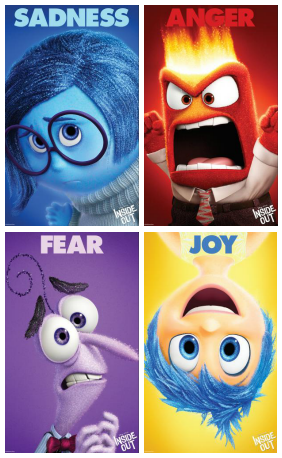
- The main characters of Inside Out are the personified emotions of an 11-year-old girl. Joy, Sadness, Fear, Anger, and Disgust live in Riley's head and operate a control console that influences her response to the situation at hand, generating memories that are color-coded by whichever emotion is in control. Versions of the same emotions in the heads of other characters are occasionally shown. The rest of Riley's mind is depicted as a Mental World of memories and imagination.
- The Nightmare Before Christmas features the Anthropomorphic Personification of Halloween trying to take Christmas from Santa Claus; several other Personifications make cameo appearances. The villain is the personification of a holiday that everyone but him has completely forgotten about (apparently bug-themed) according to the Expanded Universe.
- Ponyo on the Cliff by the Sea has the Grand Mamere, the anthropomorphic personification of the ocean.
- Osmosis Jones note is a film about anthropomorphic body cells and a virus.
- Ralph Breaks the Internet: A lot of the new characters are personifications of internet elements: KnowsMore is a search engine, Yesss is an algorithm, Spamley is a pop-up ad, and so on.
- Each of the main characters in Rise of the Guardians is one: Santa Claus is the personification of wonder, the Tooth Fairy is the personification of memory, the Easter Bunny is the personification of hope, the Sandman is the personification of imagination, the Boogeyman is the personification of fear, and Jack Frost is the personification of fun.
- Collateral Beauty is about a guy who gets visits from the personifications of Death, Time, and Love actually actors (or are they?) hired by his partners to either get him out of his depression or drive him insane so they can sell their company after writing an angry letter to the universe after the death of his daughter.
- In the horror film Come Play, the monster is an entity named Larry that is the personification of the loneliness people feel from having more of a connection to technology than the people around them. Larry is normally invisible except when viewed through a screen, draws on electricity to interact with the real world, and is fixated on finding someone who is as lonely as he is to be his friend... whether they want to be or not.
- Godzilla in the first film Gojira is a living manifestation of the atomic bomb, the very weapon that has haunted the Japanese for the rest of their lives in the form of a radioactive, but sympathetic, monstrosity.
- The title character of Hesher (played by Joseph Gordon-Levitt) is implied to be the personification of a son's emotional turmoil following the death of his mother.
- Death in Meet Joe Black is one of the endless examples in which it takes human form, assuming the appearance of a man who recently died. We never see what Death actually looks like. Same as the original film, Death Takes a Holiday.
- Calypso in Pirates of the Caribbean is the personification of the sea itself, with a personality just as fickle. For Davy Jones and Sao Feng, they could wish for nothing more in a woman.
- The Santa Clause 2 and The Santa Clause 3 featured the Council of Legendary Figures, consisting of Mother Nature, Father Time, Santa Claus, the Easter Bunny, the Tooth Fairy, the Sandman, and Cupid. Jack Frost joins them in the third movie.
- Sam, the Creepy Child in Trick 'r Treat, is the personification of Halloween. And probably also a Physical God.
- In TRON, there are anthropomorphized programs that live in Cyberspace. Their faces usually look like the users that created them.
- In Alien in a Small Town, the alien Jan are stated to have a wide variety of religions, but of the three deities we hear mentioned, two are like this: a fatalistic survival god called, well, "Survival;" and a war god called "Glory" whose followers long for glory on the battlefield.
- Plenty of them in Neil Gaiman's American Gods. For example, we have all the new gods, who represent modern crazes like technology and the media (and slightly older crazes like the railroad). We also have "the buffalo man," who represents America itself (he's a furry Uncle Sam).
- In Black Legion, the characters encounter Solar Priest, who's the personification of Astronomican, navigational beacon of the Warp, in its calmer aspect. There is apparently another, called the Warlord, but we don't get to see it.
- Blood Meridian: the simplest understanding of Judge Holden is that he is literally the immortal incarnation of war itself.
- Bruce Coville's Book of... Nightmares II: The Homework Horror revolves around a boy doing battle with the personification of the number five, which is his least favorite number and has somehow come to life to cause trouble for him because he hates it so much.
- A Christmas Carol features "Want" and "Ignorance", mankind's creepy children. Also, the Ghosts of Christmas Past, Present and Future. Christmas Present claimed to have over 1800 brothers, one for each year since the birth of Christ.
- The Chronicles of Narnia has Father Time. He's asleep underground, but wakes up at The End of the World as We Know It.
- Lord Foul from The Chronicles of Thomas Covenant is the anthropomorphic personification of hatred (or Despite), generally believed to have been born from the Creator's cast-off self-loathing. As the title character has plenty of self-loathing himself, Foul quickly becomes scarily proficient at messing with him in ways that involve varying degrees of horror.
- The Last Chronicles shines a bit more light on how this cosmology works. The Creator is literally the Anthropomorphic Personification of creation, and a third being, the Lover, is love. Covenant posits a fourth personification, Indifference, who opposes the Lover in the same way Lord Foul opposes the Creator, but if shenote exists, she never puts in any kind of appearance.
- The Foundation from Constance Verity Destroys the Universe is the "foundation of all reality, of all possibilities", being the sentient awareness of the nothingness that predated creation and the Void Between the Worlds.
- The Cosmere of Brandon Sanderson has sixteen of these. Eons ago, a being or force called Adonalsium shattered into sixteen Shards, each of which represents a specific idea or concept: Ruin, Devotion, Honor, Odium, etc. Each shard was taken up by an individual and essentially turns that individual into a God. However their original personality is eventually overwritten by the shards Intent, making it impossible for them to act against whatever the Shard represents.
- The world of Roshar also has spren, which exist as a result of the presence of the Shards listed above and represent natural phenomenon, emotions and ideas. Natural phenomenon like fire or wind cause spren to appear, as do strong emotions like fear, joy, glory or anger. There are also more intelligent spren that represent more complex ideas, like Sylphrena who is an honorspren, literally the idea of honor given semi-physical form, or Cryptics who are made out of the idea of lying or secrets. The last variety act as Bond Creatures that give Knights Radiant their powers, and even have cities in the Mental World.
- In The Darksword Trilogy, The Fool Simkin is eventually revealed to be a personification of Magic.
- The Discworld series has plenty of these too, sprinkled in with the regular gods. In particular, Death is a main character of several books, as is his granddaughter, Susan. Other Anthropomorphic Personifications are Time and the remaining three Horsemen of the Apocralypse [sic]. There were originally five Horsemen, but Kaos (who shows up in Thief of Time) left before they became famous. There are also The Auditors of Reality which are portrayed as embodiments of order, bureaucracy, and the mechanics of the universe, and are, instead of Death, portrayed as the opposite of life (which they hate). Unusually, these characters are referred to in the story as Anthropomorphic Personifications, and Pratchett is largely responsible for popularizing the phrase.
- Hogfather centers on what happens when someone manages to bump off an Anthropomorphic Personification. The book also goes into the purpose of such beings; according to Death, minor beliefs and incarnations such as the Hogfather help humans to establish the beliefs in justice, mercy, duty — the things that make them truly human.
- And the Lady.
- In Reaper Man when the Auditors forced Death to retire, a number of other Deaths sprang up to take his place, such as the Deaths of Mayflies, Trees, Fleas, and Rats, as well as a new one for Humans. When the original resumes his role, he sucks up all the rest except for the Deaths of Rats and Fleas. Additionally, Azrael, the Death of Universes, is presented as his own superior.
- Discworld largely plays this trope straight — Death is an Anthropomorphic Personification, born of the theory that 'belief shapes form'; Death isn't a skeleton because of tradition, but because that's what people believe Death looks like.
- However, in Pyramids, a pharaoh is disappointed that Death doesn't appear as a giant scarab, as per Djelibeibian beliefs. Death wearily explains that he long since gave up trying to match everyone's personal expectations, and settled on the one form that was most common.
- Morporkia is the anthropomorphic personification of Ankh-Morpork. Unlike the other examples she's fictional in-universe (as far as is known) and is a parody of real life personifications such as Britannia and Columbia. note
- Although a Goddess of the Seas is seen in The Last Hero with a startling resemblance to the Statue of Liberty. She is even called Libertina.
- The Virtues and Vices are present as Anthropomorphic Personifications on the Discworld. There are eight of each and there is even a street, near the Unseen University, named Eight Deadly Sins in the honour of one team. The unfavoured Virtues of Bissonomy and Tubso are referenced in Going Postal as statues in the Library. They have been ignored for so long that nobody remembers what they were virtues of.
- Bissonomy's Fall from Grace is detailed in A Hat Full of Sky. She got on the wrong side of divine in-fighting in Dunmanifestin and was turned into a shoal of oysters. note
- In Snuff, the Three Disgraces, Nudicia, Pultrichrudina, and Voluptia, may be the daughters of Bissonomy and appear from context to be the anthropomorphic personifications of It's Not Porn, It's Art, existing in Classical Ephebian Mythology purely so that it's acceptable to have statues of them.
- At the top of The Divine Comedy's Purgatory, Christ's chariot is surrounded by seven dancing virgins, each personifying one of the virtues.
- The first woman representing Faith is as white as snow, a sign of Incorruptible Pure Pureness.
- After faith comes the woman representing Lovenote , who is dressed in red so bright that she could be camouflaged in fire. The comparison of love to fire will return often in Paradiso.
- With faith leading to love, love then is followed by the woman representing Hope, who looks like she is entirely made of emerald. Emerald green being associated with the renewal of the Earth, which humanity must hope for in the winter.
- After the women representing the theological virtue pass, the four of them representing the cardinal virtues (from The Republic) are dressed in purple, indicating their duty to rule over human behavior.
- In the Doctor Who New Adventures novels, some of the Eternals (beings considered Sufficiently Advanced even by Time Lord standards) have taken the role of Anthropomorphic Personifications. The main ones seen in the books are Time, Pain and Death; the Doctor is Time's Champion. Former Ineffectual Sympathetic Villain the Monk from the television series had served as Death's Companion in the New Adventures.
- A couple of BBC Books Eighth Doctor Adventures novels called the Eighth Doctor Life's Champion, but whether there's a Life amongst the Eternals or it just means life in general is unclear.
- Other novels have given us Grandfather Paradox, who is the Anthropomorphic Personification of Future Me Scares Me.
- In Dragon Bones, there is Oreg, who is somewhere between Genius Loci and anthropomorphic personification. He wasn't born that way, his father killed/transformed him to use him to power Castle Hurog. He has a physical body that can leave the castle, but depends on physical proximity to his owner (the castle's owner) for his wellbeing. His current owner, Ward, suffers from intense homesickness when away from Hurog, but recovers instantly when Oreg works magic nearby, as his magic and Hurog's magic are one and the same. When Oreg's magic is removed from him, Ward feels pain at the withdrawal. It is not hard to read some Ho Yay into this.
- The Dresden Files: The Fae Queens are, among other things, the Anthropomorphic Personifications of Summer and Winter. The reader is told that a change in the balance of power between them would affect the world's climate, and on two occasions in the series, winter becomes longer and more severe due to their intercession.
- Robin Goodfellow in An Elegy for the Still-living claims to be an anthropomorphic personification of The Trickster archetype, sort of a universal soul of all tricksters. From the same work, Masoch behaves rather like an anthropomorphic personification of death.
- The Firebird Trilogy has the Shadows, who are personifications of evil. They have immense power (including the ability to teleport across planets and keep humans alive in outer space) and are dedicated to thwarting the Mighty Speaker in whatever way possible. When not possessing a human, they are Made of Evil.
- In Terry Pratchett and Neil Gaiman's Good Omens, Pestilence retired after the invention of penicillin and was replaced by Pollution. Apart from War being a woman, the rest of the Horse''persons'' of the Apocalypse follow more or less their models from Revelation... except that they ride motorcycles. The book also featured the four 'lesser' horsemen, who were just normal bikers who, after seeing the real deal, decided that being a group of symbolic figures was much cooler than being a biker.
- Several of Simon R. Green's series, including the Nightside and Haven novels, feature entities referred to as "Transient Beings". These entities seem to be Not-Necessarily-Anthropomorphic Personifications, in that some appear human-like while others are downright bizarre, yet they all embody some greater concept or ideal. They're prominent in the Forest Kingdom series, and include such individuals as the Demon Prince, Bloody Bones, the Lord of the Gulfs, The Engineer (who created the Infernal Devices), the Magus, and the Lady of the Lake.
- Harry Potter has Peeves (and supposedly other poltergeists), who is an embodiment of chaos. Dementors are the personification of depression.
- The Heartstrikers:
- All spirits are sentient magic given shape by whatever large force or feature carved out a vessel in the magical landscape. Spirits of the land are born from physical features like lakes and mountains, while animal spirits are born from large masses of a specific animal. Once they gain sentience, they can speak and appear in at least a vaguely human guise.
- Mortal spirits are conceptually similar, but instead of being created by natural features, they are created by the mass subconscious of humanity, the natural magical ability of all humans carving out much larger vessels in the shape of human hopes and fears. Marci's cat Ghost is actually the Empty Wind, Spirit of the Forgotten Dead. He is the most terrifying of a particularly terrifying class of spirit, but ultimately his purpose is to make sure that the dead are remembered.
- James Stoddard's duology, The High House and The False House, features Old Man Chaos and Lady Law. Both of them are Big Bads who want to take over the universe.
- Each book in Piers Anthony's Incarnations of Immortality series focuses on the life and career of one Anthropomorphic Personification, and his (or her, or their) relationships with the other Personifications that oversee a strange Magitek variation on our own world. His Anthropomorphic Personifications have an unusual twist, though; they're transferrable offices that specific humans hold.
- There is a chance that the The King in Yellow is this for the concept of decadence. That's what the colour yellow means (see the yellow book in The Picture of Dorian Gray).
- Kraken by China Miéville strongly implies that its Psycho for Hire character Goss is actually the Anthropomorphic Personification of the "Psycho For Hire" concept.
- The andat of The Long Price Quartet are spirits representing very specific ideas, such as Stone Made Soft or Water Falling Down. They find being forced into physical entities unbearable and spend most of their time trying to escape and return to their natural state (i.e., nonexistence); to keep one around is implied to require that the practitioner continue to hold the idea in their head forever. Within their domains they are all powerful: it's noted, for instance, that Stone Made Soft could instantly destroy all civilization on a continent by causing its cities to be swallowed by the ground.
- Lords of the Underworld: The titular Lords stole Pandora's Box, and were punished by having its evils sealed inside them. Because of this, the Hunters try to kill them, (incorrectly) believing that it will rid the world of evil.
- The Magic series by Mary Graham Bonner is full of these, starting with geographical concepts like the Western Hemisphere and the Equator and eventually Geography itself in The Magic Map.
- In Malazan Book of the Fallen Draconus is the personification of primordial darkness. He is even called the Suzerain of Night.
- In the Matthew Swift series, a major villain of the second book is the anthropomorphically personified Death of Cities. The title character himself is possessed by the "blue electric angels" of the telephone wires in the first book and made the mystical guardian of London in the second book, arguably making him a twofold Anthropomorphic Personification of sorts.
- The Neverending Story: There are two in the book: the Childlike Empress is the personification of fantastical inspiration, while the Old Man of Wandering Mountain is the personification of written and recorded stories.
- Pact has Incarnations, essentially powerful spirits which represent specific concepts, who are manifested on Earth as a result of practitioners calling the concept into themselves or events that are significant enough to generate a manifestation. A major villain of the story is an Incarnation of Conquest who rules over Toronto-being for all intents and purposes immortal, it hasn't been very long for him since the Europeans were wiping out and subjugating the aboriginal population and taking their land, and in the present day he continues to represent that action, as well as attempting to subjugate anyone weak enough to be easy pickings. He holds dominion not over battle, but over the idea of seizing what remains after war, torture, loss, and despair, and his power is tied to him acting to fulfill those drives.
- Pale has city-spirits, reflections of the inhabitants and history of a town. The main city-spirit, Ken, is the spirit of the Dying Town of Kennet, a Canadian town of some five thousand people. Ken is depressed, unmotivated, struggles with addiction to alcohol and meth, and mildly racist, but nevertheless tries his best to be helpful to the protagonists. Ultimately he is "killed" by a Wallflower Doppelganger, Lis, an Other who has the power to become the average of every person in a given group, who averages all of Kennet to declare herself an equivalent city-spirit to Ken and forces him into non-existence.
- The Palm Wine Drinkard features a number of (physically undescribed) personifications: Death, Drum, Song, Dance, Laughter, Earth, Sky.
- In John Milton's Paradise Lost, Satan meets Sin, who received flesh when she burst out of Satan's head mid-battle. She recounts how the "love" between her and the Devil led to the birth of Death incarnate, who tried to assault his sister-mother.
- A more recent example from Christian literature, the Frank Peretti novels on spiritual warfare name almost all of the demons using this trope. But unlike Pilgrim's Progress, This Present Darkness and Piercing the Darkness are spiritual warfare as thrillers.
- Almost everybody in The Phantom Tollbooth is a personification of some concept or another. It starts in the Doldrums, where Milo almost gets trapped by incarnations of boredom, continues through the rest of his journey as he meets King Azaz of Dictionopolis and his feuding brother the Mathemagician of Digitopolis and everyone in between, and ends in the Mountains of Ignorance where Milo and his entourage make their way past such monsters as the Triple Demons of Compromise and the Senses Taker to rescue the princesses Rhyme and Reason.
- Students of Christian literature remember the allegoric names of the characters from John Bunyan's famous allegory The Pilgrim's Progress. With its protagonist named Christian and his sidekicks Faithful and Hopeful and such highlights as Christian being evangelized by a guy named Evangelist, saved from disaster by a man named Help, given worldly wisdom from Mr. Worldly Wiseman, tempted by a prostitute named Wanton, attacked by enemies named Envy and Superstition...
- In the novel Rivers of London newly trained Police Constable Peter grant has to contend with the Personifications of the Thames and its tributaries. More sinisterly, the Big Bad is Mister Punch, the Personification of Riot and Rebellion.
- Shaman of the Undead: Some demons, such as Bad Luck, bring the idea they personify (such as bad luck) to the person they bond with, whether they want or not. Judging how Bad Luck ended up with Ida, they bring their ideas to themselves as well.
- One Short and Shivery story is about two girls (one kindly, one greedy) who encounter the fairy godfather-like Jack Frost "The Ruby-Nosed". Unfortunately for the greedy girl, Jack is the anthropomorphic personification of winter and the story takes place in Russia. "Come here, and I'll give you diamonds!"
- In the fourth Spellsinger novel, Jon-Tom is captured by a giant eagle. Who is rallying an army of birds who uncomfortably give very familiar salutes. It turns out that the eagle was the Nazi Emblem, which after the Nazis were defeated ended up in the fantasy world as an actual eagle, and is stated to be the personification of Nazism. Luckily Jon-Tom through manipulation turned the birds against each-other, and the entire army was attacking the Eagle as Jon-Tom escapes.
- In The Spirit Thief, everything has its personification, which is anthropomorphic in character, if not shape, as every object, weather pattern and geographical feature has a spirit which can be awakened by a sufficiently skilled wizard.
- Dog mythology in Survivor Dogs attributes many natural occurrences to mythical and mystical dogs:
- Mother Nature is the Earth-Dog. The Sky-Dogs act as gods and their fighting causes thunderstorms.
- Lightning is the fastest of all dogs, so fast he escapes death. The Earth-Dog thought he had lived long enough but all her attempts at killing him failed. When it looked like she had finally gotten Lightning, the Sky-Gods saved him and let Lightning live with them. Whenever lightning strikes it's because Lightning is teasing Earth-Dog by running fast.
- Wind was the Omega of her pack but she dreamed of leaving it one day. When huge dogs attacked the pack, the Forest-Dog protected Wind due to her frequently giving tribute to him. The Forest-Dog helped Wind climb a tree and escape her attackers. Since then, Wind has lived alone. It's said that she can be heard howling in the forests with the Forest-Dog.
- Wildfire is Lightning's granddaughter. She was a curious pup named "Nuzzle" who was saved by wolves when Lightning set fire to a tree she was hiding under. As an adult she grew up into a fierce Warrior-Dog and chose her adult name to be "Wildfire".
- In Those That Wake, the man in the suit is one of hopelessness.
- Chuck Tingle's books often involve the male lead being pounded in the butt by abstract concepts, such as Pounded By The Pound: Turned Gay By The Socioeconomic Implications Of Britain Leaving The European Union, Reamed By My Reaction To The Title Of This Book, and Slammed in the Butthole By My Concept of Linear Time, to name a few.
- The Truth of Rock And Roll has the Leader of the Pack, who is "every night-riding outlaw who ever rode a black horse through a song.". Also, Jenny becomes the Rebel Girl. By doing so, she greatly increases the incidence of such characters in Rock & Roll songs.
- The Unexplored-Class Materials in The Unexplored Summon://Blood-Sign are personifications of the laws of the universe itself, which even gods are forced to follow. All of them are female and are associated with a particular color. However, the White Queen, despite being an Unexplored-Class, is not a personification of anything (except perhaps Mad Love).
- Dante's La Vita Nuova treats Love as if it were a flesh and blood king, one who forced Beatrice to take the poet's hear. There's a significant segment of Dante's commentary dedicated to establishing that he has the Artistic License to speak in such a fantastical way by citing writers like Virgil and Ovid.
- In Piers Anthony's saga on Xanth, several "demons" are Anthropomorphic Personifications of planets or, well, Xanth — a magic land that is occasionally part of Earth. What makes them not strictly Genius Loci is that they can actually move from and to different planets, but while absent their material counterpart will lose its peculiar trait. Xanth's one is magic.
- Played with in Babylon 5: During the Battle of Coriana VI, The Vorlons and the Shadows take Sheridan and Delenn to an illusory world (possibly via telepathy) where each is presented with a personification of the Ancients' goals: An "order" figure for the Vorlons and a "chaos" set of quickly changing figures for the Shadows. The irony is, both those races are assuming the guise of universal aspects for the benefit of the junior races; in actual fact they are very advanced but non-godly aliens whose rather human failings had messed up the last 10,000 years or so of galactic history for everybody. Sheridan and Delenn call them on this, and that is a big part of what finally convinces them to stop trying to "help" the other races.
- In Buffy the Vampire Slayer, The First is the very idea of evil itself. It seemingly has some aspect of being a personification of death, as well, seeing as it can take the appearance of anyone who has ever died (and in fact has no actual appearance of its own). This includes anyone who's died and then been brought back to life, and thus one of The First's common guises is Buffy herself (who's been revived twice, once through simple CPR after her heart stopped and once via magic).
- Coupling: We do not talk about the Melty Man.
- Dead Like Me is about a Quirky Miniboss Squad of Grim Reapers.
- Doctor Who:
- The Fourth Doctor dealt with the White Guardian, Anthropomorphic Personification of order, and the Black Guardian, Anthropomorphic Personification of chaos. Seemingly, the White Guardian functioned as the Dungeon Master, guiding the Doctor and his companions on a quest to assemble the Key to Time, while the Black Guardian tried to trick and corrupt them. In the final Key to Time story, the Doctor realised the Black Guardian was impersonating the White Guardian, but it's open to question whether it was just for that story, or if he'd been impersonating him all along. The Black Guardian sought revenge on the Doctor for thwarting him over the Key, recruiting Turlough to kill the Fifth Doctor, but Turlough was able to break the contract by passing a test from the White Guardian.
- The Thirteenth Doctor encountered the Anthropomorphic Personification of Time, which reflected the form of its current audience.
- Legends of Tomorrow has the Totem Bearers, who wield Totems representing six elements. Kuasa has the Water Totem, Mick has the Fire Totem, Zari has the Air Totem, Nathan uses the Earth Totem (its true bearer hasn't been found yet), Amaya has the Spirit Totem and Sara has the Death Totem.
- Look Up: In the episode about airplane flight, the four forces are presented as four different people.
- Lift is personified as an angel lifting an airplane upward.
- Weight is personified as a fat man sitting on top of a plane, causing it to descend.
- Drag is personified as a man hanging off the side of a plane, holding an umbrella open to slow the plane down.
- Thrust is personified as a strong muscle man throwing a plane forward.
- In Supernatural, the Four Horsemen (in addition to their rather unpleasant traditional duties) happen to wear the keys to Lucifer's prison as jewelry. It's implied that, except for Death (who claims to be possibly older than God himself and says he will eventually reap Him) their power actually resides in the rings, opening up the possibility that their roles might conceivably be passed along to someone else. This is confirmed when Death tells Dean that he wants him to take his job for one day, and the only way to do that was to put on his ring. Ostensibly this was to teach Dean a lesson about the natural order of things and why Death hates the angels and demons who mess around with it on a daily basis (especially Bratty Half-Pint Lucifer).
- An embodiment of Death appeared in the Torchwood episode "Dead Man Walking".
- The Twilight Zone (2002): In "Fair Warning" it turns out that the man speaking with Tina was actually his conscience, warning her against his plan to attack her.
- Young Sheldon: In "A Clogged Pore, a Little Spanish and the Future", Penn & Teller appear as a personification of Sheldon's pimple. Penn is A.V. (short for acne vulgaris) and Teller is Pus.
- The in-song narrator of "I Write the Songs" by Barry Manilow claims "I’ve been alive forever, and I wrote the very first song. I put the words and the melodies together, I am Music, and I write the songs."
- Cecilia Vennersten's Stogens rå is about a romance between a lonely man and the forest calm. According to the song, forest elves adviced her against it, because it would make her less reliable.
- Daniel Amos's Fearful Symmetry has a story in the liner notes where the Author Avatar meets a man who represents the entire physical universe. This man is old and dying—and eagerly looking forward to being created anew.
- The fat giant killed by The Guy in Disturbed's "Land of Confusion" video is either Anthropomorphic Personification of big corporations, industry, economy, rich elites, Greed or just all of it, people still discuss that matter.
- "Thanks, Earthquake" by Driftless Pony Club is partially about, well, praising the anthropomorphic personification of Earthquakes.
- The fact that "The Dirty Glass" by the Dropkick Murphys is a breakup song addressed to a pub is obscured by the fact that the pub not only sings back, but actually has the first word.
- "Dead Hand" by Ferry is sung from the perspective of Dead Hand, a Russian nuclear weapons system from the Cold War. The video depicts Dead Hand as a cheerful little girl in a Soviet-era school uniform.
- "Homecoming" by Kanye West is a love song to Windy, essentially the anthropomorphic personification of Chicago.
- "Homecoming" lyrically references fellow Chicago rapper Common's song "I Used To Love H.E.R.", a song which personifies the genre of hip-hop as a woman.
- "My Boots" by Lights is a song about Canadian winters. Many have mistaken it for being about a relationship.
You might know if you're from around here what goes on from half of the year.
Have you seen the queen of the castle paint this city from ear to fear?
If the air was meant to be glitter, it might not take all yours away.
When she sings she's a heavy hitter.
When she comes you'll ask her to stay. - The song "Yukon" by Lindemann is about a personification of the Yukon River, who has cold blood, rough skin, a dark face and clammy hair, and goes dressed in mud. The singer tries to obtain the river's heart of gold but the Yukon tries to kill him in return.
- Lou Reed's "Perfect Day" personifies the protagonists drug use in a way that makes it sound like a love song. The only sign of the actual meaning are the lines "(...) You make me forget myself. I thought I was someone else, someone good.", which is often missed by people and thus the song gets misinterpreted very often.
- MF DOOM's song "My Favorite Ladies" sees the rapper recall his flings with various women, each of whom is a personification of a different drug.
She said, "You need to stop messin' with that white girl,
She fuckin' with your head and got your heart in a tight curl" - M¥SS KETA: The character of the M¥SS herself represents the entirety of Milan's nightlife scene and its many vices.
- "My Sweet Prince" by Placebo is about heroin use however it sounds like a song about a man uncomfortable with his romantic feelings for another man.
- Poets of the Fall has Monster Clown Hamartia, the sinister jester mascot of Twilight Theater's album art◊ and Villain Protagonist singer of "Daze," personifies the concept of the Tragic Mistake, and finds watching others make them a source of fun.
- "Ebeneezer Goode", the controversial 1992 single by British dance band The Shamen, is an ode to ecstasy use, with the titular Life of the Party character being a personification of the drug. The song infamously reached number one in the UK charts during the BBC's drug awareness week.
Eezer Goode! Eezer Goode!note
He's Ebeneezer Goode! - "Me and My Girlfriend" by Tupac Shakur is about a man and his gun. It's frequently mistaken for a romantic song.
- The Vocaloids are the Anthropomorphic personifications of software. Specifically, each one represents a particular voice synthesis program designed for the use of singing. They take the form of Ridiculously Human Robot Idol Singers.
- "Can't Feel My Face" by The Weeknd is about drug use but is written in a way that personifies it similar to having a girlfriend.
- Within Temptation:
- Within Temptation's Signature Song "Ice Queen" is either about a Winter Royal Lady or winter itself, though it leans towards the latter.
When she embraces your heart turns to stone.
She comes at night when you're all alone.
And when she whispers your blood will turn cold.
You'd better before she finds you.
Whenever she hears raging, she takes a life away.
Haven't you seen, haven't you seen, the ruins of our world? - "Mother Earth" is a song about the weather and Earth itself.
Birds and butterflies, rivers and mountains she creates.
But you'll never know the next move she'll make.
You can try but it is useless to ask why.
'Cannot control her.
She goes her own way.
She rules until the end of time.
She gives and she takes.
She rules until the end of time.
She goes her own way.
- Within Temptation's Signature Song "Ice Queen" is either about a Winter Royal Lady or winter itself, though it leans towards the latter.

- The Four Horsemen of the Apocalypse in the Book of Revelation are often treated this way. If a series has a Death, the rest will probably show up in at least one episode.
- Sins and virtues get this treatment in a lot of early Protestant literature and in the morality plays of pretty much every sect.
- Proverbs personifies wisdom as a woman crying out in the streets, trying to convince others to turn away from their foolishness. Lather Folly is personified as an adulterous woman.
- Japanese Mythology is utterly ripe with these, along with a number of other Asian cultures. What, you mean the physical manifestation of "the fear of using a dark bathroom late at night" isn't something that every culture has?
- Several minor Greek gods, called daimones, are largely abstract personifications of concepts such as fear, strife, mercy, hubris, insolence, battle-cries, tumult, and good reputation. Thanatos (death), Nyx (night), and Hypnos (sleep/dreams) are referred to as being the living representations of what they champion, they're forces older than even the titans, and feared as such, even by the Olympians. The oldest gods are the Protogenoi ("firstborn"). They represent love (Eros), Nature (Physis), Darkness (Erebus & Nyx), Time (Chronos, not to be confused with Kronos), Fate (Ananke), Tartarus, and the earth (Gaea).
- Egyptian Mythology includes names and sometimes images of deities which represented, or at least whose names mean, such things as joy and plenty. Several objects used, perhaps ritually, by the Pharaoh were personified and deified, such as his beard.
- Hindu Mythology has Shakti/Devi represents Power that the various gods possess. Shakti is always shown as feminine. There are several stories that feature one or more Gods channeling their energy to create a more powerful female god. See creation myths around Kali and Durga.
- Also, Hindu Mythology is ripe with several minor deities that represent concepts, Agni for Fire, Pawan for air. Probably, these were the first deities that the Hindus prayed to, and their myths got merged with other Gods as they emerged. Agni is particular holds a special status because of the use of fire in sacrifices. Agni is considered to be responsible for bringing sacrifices from the physical plane to the astral plane, and hence is invoked many times in rituals.
- In the Middle Ages, the Church invented Synagoga and Ecclesia. Synagoga was the anthropomorphic personification of Judaism (from the Church's point of view). She wore a blindfold and a broken crown, and held a broken staff and a pair of tablets. Ecclesia was the anthropomorphic personification of Christianity, and stood proudly with a shiny crown and staff.
- Christian iconography also uses many other anthropomorphic representations — thus medieval churches may include sculptures showing the mortal sins and cardinal virtues in human shape. The latter also can be seen on some tarot cards: Temperance (woman with two cups), Strength (woman with a pillar) and Justice (blindfolded woman with a pair of scales and a sword).
- Charity is often personified as a woman nursing several children.
- Many of these personifications also appeared in medieval mystery and morality plays, where you find Everyman interacting with characters like Lucre, Death and Good Works. These were forerunners of e. g. Bunyan's Pilgrim's Progress (see Literature).
- Most Christians believe God is literally love personified.
- Father Christmas started out as the personification of British Christmas celebrations — particularly the feasting of it. He wore a green or red robe and a holly crown; the Ghost of Christmas Present from Dickens' A Christmas Carol is a good idea of the average image of Father Christmas. It wasn't until the late Nineteenth Century and early Twentieth Century that he was merged with Santa Claus until they became more or less the same figure.
- In Circassian Mythology, Yaminizh is the personification of cholera. After trying to trick Setenay into sharing its secrets, he destroys the Narts' golden tree, as its medicinal powers were depriving him of victims.
- In Norse Mythology, a farmer's son who ends up as a companion of Thor, named Thjalfi, is pitted against the Anthropomorphic Personification of a thought from the mind of the giant Utgard. He loses three times, but only increasingly narrowly each time.
- The same story also feature two others. Loke's contest is to eat faster than a jotun named Loge. Those familiar with Norse languages probably know Loge means Fire. The third was Thor's opponent, an old lady who's the personification of Age. Obviously even a god can't compete with that.
- Pesta (literally "The Plague") was a personification of the Black Death Plague in Norwegian folklore. She was said to walk from town to town, farm to farm, carrying either a rake or a broom. In each house, she would bring out one of her tools. If it was the rake, there would be some survivors. If it was the broom, there would be no mercy.
- Crüe Ball has Mr. Gore, the Spirit of Anti-Metal, the Big Bad of the game.
- Whirlwind features an unnamed Wind Spirit that generates whirlwinds.
- Golden Logres has the Queasting Beast, a personification of the sins of King Arthur.
- Rik Luxury is the personification of wrestling.
- WWE wrestler The Undertaker is made out to be an Anthropomorphic Personification of death, though how much of this is actual supernatural power and how much of this is simply theatrics and mind games tends to vary with the tone WWE is taking at that time. A more bizarre example is Goldust, who, when he first debuted, was portrayed as a strange sort of Anthropomorphic Personification of movies. Then they decided to turn him into just a creepy, possibly-gay dude who liked to quote movies and run around in gold facepaint.
- A Big Finish Doctor Who audio revealed the Master as Death's Champion.
- The Lady of Angels from Behind The Veil, representing the city of Los Angeles and manifesting as a woman with constantly changing features.
- Inferno Quest features Incarnations, which are formed from a balance of Celestial and Infernal energies. The Lord of Greed, Greed, is an incomplete version, and the Personification of the Circle of Greed itself.
- The Guardian Project: Thirty Super Hero personifications of NHL teams.
- Champions: In the Gestalt: The Hero Within campaign setting, every single superhero and supervillain on the planet (including the Player Characters) is an Anthropomorphic Personification of one concept or another (from Acting to Zoology, and anything and everything in between), and possess powers and abilities appropriate to their concept.
- Chuubo's Marvelous Wish-Granting Engine: You can play as one of these — usually represented with some combination of the Arcs Spiritual, Primordial, Allegory or Child of the Ash — although it's a fairly young and inexperienced one, typically high school age. One of the Glass-Maker's Dragon characters — the Child of the Sun — is a) the new sun goddess, and b) the embodiment of Hope, to the extent that she can convert the hopes of other people into new limbs that do cool things.
- d20 Modern features a class of enemy known as "Platonics", creatures of Shadow who are the embodiment of an allegiance or ideal. They typically work behind the scenes, promoting their causes without making their natures known. A platonic of Healing would work as a cancer researcher, for instance. But if you manage to get a Platonic angry... Well, you're going to have some trouble...
- Don't Rest Your Head: Many of the Nightmares are Anthropomorphic Personifications of the worst sort, embodying concepts ranging from unfeeling bureaucracy, to hatred, to sleazy journalism. The fact that they're mostly humans transformed by severe insanity only makes it worse.
- Dungeons & Dragons had (along with gods, who are often in some sense Anthropomorphic Personifications themselves) entire species dedicated to concepts. These are usually the Nine Alignments, who are typically defined as being literally Made of Good or Made of Evil: Archons, Guardinals, Eladrin, Modrons/Formians, Rilmani, Slaadi, Baatezu (Devils), Yugoloth (Daemons), Tanar'ri (Demons)).
- Eberron:
- Celestials and fiends are embodiments of concepts, and nowhere is this more obvious than with the demon Overlords. Tiamat is not merely the biggest, most evil dragon; she is the mortal embodiment of the fear of dragons, with the power to encourage all of a dragon's worst impulses as mortals see them. So she can enhance their greed, their tyranny, their lust for conquest, but she couldn't enhance a particular dragon's suicidal depression, because that's not seen as a defining negative trait of dragons.
- Emphasis is made of using this to cosmetically differentiate immortals from different planes. A pit fiend from Fernia and a pit fiend from Shavarath have the same stats, but Fernia is the Sea of Fire and Shavarath is the Eternal Battleground. A pit fiend from Fernia embodies "evil fire," and a pit fiend from Shavarath embodies "evil war." Therefore the Fernian fiend might be cloaked entirely in flames, while the Shavarathi fiend will be covered in imposing armor.
- Fey are essentially living stories. A dryad is not merely a sapient tree (that would be a treant), she's the mortal idea of a sapient tree. Which is why she's going to lean more into Cute Monster Girl than the treant.
- Exalted: The Primordials exist as personifications of certain defining themes or concepts, which they incorporated into Creation in multiple ways. Likewise, each Primordial possesses souls that act as personifications of qualities or expressions of their Primordials (and each of those souls have other souls that act as the same for them). For some examples, you have Cecylene, who established the laws of Creation; She Who Lives in Her Name, tellingly titled "the Principle of Hierarchy"; and the Ebon Dragon, the incarnation of malevolence and the absence of morality. The Incarnae fit too, being the Anthropomorphic Personifications of the Sun, the Moon and the five planets.
- In Nomine: The Archangels and Demon Princes are, for all intents and purposes, Anthropomorphic Personifications. They all but embody the concepts they and their servants try to promote and see reality through that lens. There are also lesser angels and demons that personify concepts that fit under the sphere of influence of the Archangel or Demon Prince they serve. For example, the Archangel of Lightning (which also encompasses technology in addition to its literal meaning) is served by the Angel of Networks, and the Demon Prince of Fire is served by the Demon of Explosives, who is in turn served by the Demon of Unexpectedly Short Fuses.
- Magic: The Gathering:
- Incarnations are a rare creature type representing the living, physical embodiments of specific concepts and emotions. They are distinct from Elementals, which are living manifestations of natural forces and substances instead of philosophical concepts, and Gods, which are generally much more powerful and hold much broader purviews. They are also all named after the specific thing they embody, such as Purity, Vigor, Anger, Dread, or Subtlety.
- In the story, Worldsouls are the semi-sentient embodiments of all life on a given plane, with their state reflecting the state of life on their plane. Nissa Revane, a druid planeswalker, specializes in communing with these worldsouls. The named worldsouls include Gaea, the worldsoul of Dominaria worshipped as a goddess, Mat'Selesnya, the worldsoul of Ravnica who serves as de jure guildmaster of the Selesnyan guild (represented in absentia by the Trostani dryads), Progenitus, the worldsoul of Alara taking the form of an enormous hydra, and O-Kagachi, the first kami and worldsoul of Kamigawa (later replaced by its offspring, Kyodai). Nissa has also communed with the unnamed worldsouls of Amonkhet, whom she describes as wounded and broken; Innistrad, whom she describes as hostile; Zendikar, who embraces her as its guardian; and Kaladesh, which she describes as structured and orderly and may be represented by the flow of aether through the plane. There are also the Ambiguously Canon Soul of [Plane] cards, which reflect the culture of the plane more so than just its life; Soul of New Phyrexia, Soul of Ravnica, Soul of Shandalar, Soul of Theros, Soul of Zendikar and Soul of Innistrad. Finally, there have been cases of worldsouls that outlive their planes and latch onto planeswalkers, such as the one haunting Davriel Cane.
- Incarnations are a rare creature type representing the living, physical embodiments of specific concepts and emotions. They are distinct from Elementals, which are living manifestations of natural forces and substances instead of philosophical concepts, and Gods, which are generally much more powerful and hold much broader purviews. They are also all named after the specific thing they embody, such as Purity
- Nobilis: The Player Characters are Anthropomorphic Personifications, and powerful ones at that: the core book contains helpful hints on what happens should one of the players decide to re-locate New York City, shoot down the Sun, or unleash a viral version of their personality capable of infecting the entire planet... and those things aren't even very difficult.
- Planebreaker: Sometimes a particular concept or belief swirls together, infused with matter siphoned from the Inner Planes, producing an inkarnate. Each inkarnate is an exemplar of the concept that conceived them, such as uncertainty, belief or being.
- Scion: The Titans are the living embodiments of elemental forces such as light, darkness, water, fire, rot, and so on.
- Unknown Armies: Each member of the Invisible Clergy is one of these, personifying a sometimes simple, sometimes complex idea of what a human being can be. The very concepts of things like The Fool, the Mother and The Trickster (among others) are represented by ascended mortals in the Clergy. This being Unknown Armies, some of the personifications are reflections of the modern world, such as the Flying Woman (a woman who breaks cultural boundaries), the MVP (guess), and the porn star who ascended as the Woman Everyone Can Have But You. Really abstract conceptions of non-human things (Good/Evil, Elements, Animals, Geographical Things, etc.) do not have similar representation. It's a very human-centric cosmos.
- The World of Darkness:
- New World of Darkness:
- In general, spirits are Anthropomorphic Personifications of things... although sometimes for very loose definitions of "anthropomorphic."
- Changeling: The Lost has it that The Fair Folk gained power by managing to make Contracts with concepts such as dreams, beasts, stone, death, and the edge of a blade (how these are different from spirits is never really explained, but it's likely a matter of the crazy-ass fae mindset). The founders of the changeling Great Courts — Mother Susan, Sam Noblood, Clay Ariel, and Snowflake John — managed to use this to their advantage by making various deals with the seasons for protection from the Gentry.
- Geist: The Sin-Eaters: Geists are part ghost and part Anthropomorphic Personification of some aspect of Death. This allows them to overcome some of the limitations ghosts usually have in the New World of Darkness... and also causes them to overlap with spirits — the book goes into this briefly, but ultimately decides it's unimportant since Sin-Eaters don't really deal with spirits.
- Mage: The Awakening: The Astral Realms are seen as the home of the anthropomorphic personifications of individual, human, and universal concepts. Includes beings such as the daimons (the personification of an individual's desire for self improvement), the goetic demons (personifications of dark, repressed feelings and desires), every god ever worshipped, and the most powerful beings in the Realms, the Aeons (the personifications of the fundamental magical facets of reality). Among the most memorable personifications are Anubis, Death (most popularly taking the form of a scythe-wielding skeleton, a faceless cloaked and hooded figure, or an attractive woman dressed in black (possibly inspired by Death of the Endless)), Martians, typhonides (personifications of humanity's self-destructive tendencies) and the personification of teenage rebellion (often appearing as James Dean).
- Old World of Darkness:
- The Umbra is inhabited almost entirely by spirits of things or concepts, from huge, powerful ones like Luna (the Anthropomorphic Personification of the moon and everything that goes with) through weaker but still impressive types like Stag (the Anthropomorphic Personification of deer, obviously, but also mythically connected concepts like male virility, the hunt, etc) down to fairly pathetic ones like the Anthropomorphic Personification of that pebble over there.
- Werewolf: The Apocalypse: The now-extinct Grondr wereboars' most powerful Gift involved marking an area of land. A Bane representing that land's ecological damage would appear (the larger the area, the more powerful the Bane), and, if the Bane was destroyed, the land would recover within a year.
- New World of Darkness:
- Yu-Gi-Oh!: The Flower Princesses and their leader, Queen of the Night, are personifications of the seasons.
- "Tytannial" represents Autumn, given that it is WIND Attribute and Autumn is typically a windy season. In addition, the flower the princess emerges from, the Camellia, typically blooms in late Autumn.
- "Number 87" represents Winter, given that it features snowflakes in its card artwork and is WATER Attribute. Also, its flower, which is a cactus flower, is the only of this family's flowers capable of blooming in Winter due to the climate differences of a desert environment.
- "Talaya" represents spring, since it is also WATER Attribute and Spring is typically a rainy season. In addition, the flower it is based off, the Cherry Blossom, blooms in Spring– around April, when Cherry Blossom Festivals are typically held.
- "Mariña" represents Summer, given that it is FIRE attribute, and Summer is universally the hottest season. In addition, Sunflowers are the only flower featured in the princesses' artwork that blooms in Summer.
- When combined with Terror-Byte, the Crashbug archetype makes a reference to a computer virus. When the virus first appears (Summoning one of them), it infects the system (special summoning the rest of them), then it steals data (taking control of opponent monsters with Terror-Byte), and finally sabotages the system (Super Crashbug switching ATK and DEF of monsters).
- Medieval morality plays such as Everyman, Enough Is As Good As a Feast, and The Castle of Perseverance featured a character called the Vice, who was a personification of a sin, such as Covetousness, Lust, or Gluttony. While originally played for drama, the Vice was eventually played for comedy and tended to be the most popular character in the play.
- Hamilton has an ensemble member called "The Bullet" as the personification of violent death. She's the first character to die on-stage, executed for espionage, carries the actual bullets that miss Hamilton the first time but hit him the second, is the last person to interact with John Laurens before he dies, helping him kill a redcoat, and tells Philip where to find George Eaker (before Eaker kills him in a duel). However, her actress has suggested that she used her abilities as Violent Death to slow down time enough for Hamilton to say what he needs to say before he dies.
- Me and My Dick does this for genitalia and body parts.
- In L'Orfeo, La Speranza is the personification of Hope. She guides Orpheus to the gates of the Underworld, but can't enter, as the Underworld forces one to abandon all hope.
- Orpheus in the Underworld parodies the anthropomorphic motivational figures from other operatic versions of the Orpheus legend by having a character named Public Opinion appear and basically tell Orpheus to get on with the plot to satisfy the audience's expectations.
- Pinocchio: The Musical turns the Blue Fairy into a personification of the moon. While it's not said out loud, her appearances are always preceded by Pinocchio pleading to the moon to help him with his current struggles, making the connection clear.
- Early press material and interviews related to the original version of Journey into Imagination suggested that Dreamfinder is an ageless manifestation of creativity, as he is described as being "older than wisdom, but younger than the morning mist". As he himself puts it in this interview when asked if he and Figment will fit in the Disney family with other well known characters from the company, "The same thing that led to them created me, and I was there when they were created".
- More specifically, Dreamfinder represents the refined creative pallet of an adult while Figment represents the unrefined creative pallet of a child.
- Even Transformers has these, though mostly in the comic continuities. Especially Vector Prime, one of the thirteen original Transformers and the legendary guardian of Space and Time, whose job it is to keep the timestream flowing, resolve temporal paradoxes, and suchlike. He fares rather worse in a fight than most anthropomorphic personifications. Another of the original thirteen, The Fallen, is entropy personified. His true name was taken away from him after he betrayed their creator, Primus, to side with his enemy, Unicron, leaving him known only as "The Fallen". Unlike Vector Prime, the Fallen is portrayed as exceedingly powerful.
- Milky Way and the Galaxy Girls is based on humanized versions of the solar system.
- BIONICLE:
- Makuta wanted to be one so bad. And from a certain perspective, we might say he succeeded, because he was just that evil.
Gali: The spirit of Makuta... is the spirit of destruction.
Makuta: I am nothing. [...] The people of the world are builders. But look into their hearts, and you will find they also have the power to destroy. I am that power. I am destruction. And I will destroy you. - The Element Lords are a more straightforward example, being genetically engineered embodiments of the elements of Fire, Water, Ice, Jungle, Rock, and Sand.
- Makuta wanted to be one so bad. And from a certain perspective, we might say he succeeded, because he was just that evil.
- Condemned 2: Bloodshot has this with the Masked Man being the personification of Ethan's own alcoholism. Throughout the game, Ethan is a drunken mess who can't hold a gun straight unless he has a swig of drink. It's not until the end of the game Ethan beats him to death, outright curing his alcoholism.
- Darkest Dungeon II reveals this may be the case for the Stress symbol. Its actual name is the Iron Crown, and it has appeared time and again throughout history, to the point it may actually predate humanity. It is the embodiment of every mistake, every wrong choice, every poor decision - in short, it is the manifest embodiment of negativity. On the other hand, the Light, humanity's god, is also implied to be this - the personification of human belief in something watching over and protecting them.
- In Dicey Dungeons, Lady Luck claims to be the all-powerful personification of Fate itself.
- Cosmos and Chaos from Dissidia Final Fantasy are Good / Cosmos and Evil / Chaos Personified as Gods, even if Chaos is more akin to being fatalistic and bored. Their appearance also reflects this, Cosmos is a blonde woman white that sorta glows, while Chaos is a big ass demon surrounded by fire. Sadly neither of them tend to do much for most of the game aside give orders to the heroes or villains. Though Chaos serves as the final boss for the heroes, Cosmos does not do the same for the Villains, but it's stated at the end that the forces will continue to exist even if they do not.
- Another example would be Zeromus, from FFIV. He's the incarnation of hate given form after the man behind the curtain dies.
- Also, Necron, the Giant Space Flea from Nowhere from FFIX, is revealed in the Ultimania to be the personification of death.
- The Final Boss of Final Fantasy XIV: Endwalker, the Endsinger, is the embodiment of Despair and Nhilism. Created as a race of empaths, the Meteia were sent on a mission to discover other worlds in the universe and learn from them what gives life meaning. They all discovered dead or dying worlds and were exposed to the despair, sorrow, rage, and hopelessness of countless lives lost who all came to curse life and embrace death as an escape. This warped their Hive Mind and set them on the path to end all life in existence to spare everyone the pain and suffering of living.
- The way he talks in Diablo III, Tyrael would have you believe that the members of the Angiris Council are the physical embodiments of justice, hope, wisdom, valor, and fate respectively. And with Tyrael representing justice, and his temperament in comparison to some of his colleagues, there might be some truth to that statement.
- Many examples in RuneScape.
- The Queen of Snow and Queen of Sunrise are personifications of winter and spring respectively. The former once tried to make the world stay in winter because she cannot comprehend the beauty of spring.
- Death is, well, the personification of death.
- The 2011 Halloween event the simply packed with these. Death apparently joined up with Pestilence, War and Famine to form a clan, and held the event involving Beauty and Fame.
- The gods: Guthix (balance), Saradomin (order), Zamorak (chaos), Armadyl (justice), Bandos (war), Seren (peace).
- The Menaphite Pantheon: Tumeken (sun), Elidinis (water), Amascut (destruction), Het (health), Scabaras (isolation), Apmeken (sociability).
- All of these save the Queen of Snow and Queen of Sunrise were later changed with further explanation of their origins. Death is just a job, and the various gods are all former mortals who merely champion their respective concepts. With the exception of Seren and Zaros, who represent light and darkness, respectively.
- Dark Genie and Dark Element from the Dark Cloud and Dark Chronicle games are personifications of hate.
- Shin Megami Tensei:
- In the main series, YHVH and Lucifer respectively embody the concepts of Law and Chaos.
- In the Persona sub-series, the titular Personas are personifications of one's own psyche, with each person different from another. They are grouped based on the 22 Arcanas of Tarot Cards (From The Fool until The Universe). The Shadows and Demons from various games can also be considered this. In addition, there are beings born from various aspects (usually negative, but not always) of humanity's collective unconsciousness. Considering the game's emphasis on the human mind, this makes sense. In order of appearance:
- Nyarlathotep and Philemon, each personifying the "destructive and creative side" of humanity respectively. The former is the Big Bad of Persona 2.
- Persona 3 FES reveals the existence of Erebus, which represents mankind's fear of, yet unconscious longing for, death. Unlike other personifications from the collective unconscious, the being is essentially mindless, with no mind or desire besides wanting humanity to die, befitting what it personifies.
- Persona 4 gives us Izanami, who represents humanity's willingness to lie and avoid the truth. It is somewhat less powerful than the previous examples, however.
- In Persona 4 Golden, Izanami-No-Mikoto, the true complete form of Izanami, is the shared wish of Humanity's collective unconsciousness.
- Persona 5 has Yaldabaoth, the Demiurge, a representation of humanity's collective desires for social order. However, this leaves him a Knight Templar lunatic who will do whatever it takes to remove chaotic or disruptive elements, as nothing else matters to him.
- In The Elder Scrolls, the various deities of the series generally fit. To note:
- Anu and Padomay are the personifications of the primordial forces Stasis/Order/Light and Change/Chaos/Darkness, respectively. Their interplay in the great "void" of pre-creation led to creation. Creation, sometimes anthropomorphized as the female entity "Nir", favored Anu, which angered Padomay. Padomay killed Nir and the 12 worlds she gave birth to. Anu wounded Padomay, presuming him dead. Anu salvaged the pieces of the 12 world to create one world: Nirn. Padomay returned and wounded Anu, seeking to destroy Nirn. Anu then pulled Padomay and himself outside of time, ending Padomay's threat to creation "forever". From the intermingling of their spilled blood came the "et'Ada", or "original spirits", who would go on to become either the Aedra or the Daedra depending on their actions during creation. (Some myths state that the Aedra come from the mixed blood of Anu and Padomay, while the Daedra come purely from the blood of Padomay).
- These Aedra and Daedra, very loosely (for the sake of brevity) are akin to angelic and demonic entities, respectively, also break down similarly. For example, Akatosh, an Aedra, is the draconic personification (thus, "god") of Time. Sheogorath, a Daedra, is the personification of Madness. Though the Aedra and the Daedra are respectively classified as "Good" or "Evil" by the mortal races, these are beings truly Above Good and Evil who operate on their own Blue-and-Orange Morality scale. For instance, Mehrunes Dagon is the Daedric Prince of Destruction, but he himself is no more truly "evil" than a tidal wave or an earthquake.
- Lorkhan, the "dead" creator god of Mundus, the mortal plane, is said to be the personification of Sithis in some religions. The two are heavily associated, with some suggesting that Sithis "begat" Lorkhan and sent him to disrupt the stasis of Anui-El and the spirits that would become the Aedra.
- There are some hints that Alduin, the draconic Beast of the Apocalypse and "firstborn" of Akatosh, isn't merely a dragon, but is the embodiment of the end of the world itself. As such, he can only manifest his full power when it is time to fulfill his divine duty and actually end the world, at which point he becomes a titanic monster with divine power beyond that of even the Daedric Prince. Anytime outside of that, however, he is "merely" an invincible dragon who needs a very specific realty-warping Shout (Dragonrend) to even render him into a state where he can be hurt.
- Numidium, the Humongous Mecha "brass god" of the now vanished Dwemer species, is theorized to be an attempt to create the personification of the Dwemer's beliefs in Reason and Logic. Since much of the Dwemer's extremely bizarre logic took on the form of skepticism about things like magic, gods, and the nature of the universe, one theory is that Numidium is the personification of the concept of refutation or "is not." According to this theory, the reason why the Dwemer vanished is because when they activated Numidium, it promptly did what it was supposed to and refuted the entire species out of existence.
- Get a mental picture of the Anthropomorphic Personification of slapstick humor in the form of a 2-D sprite. Now, click here. They look the same, don't they?
- The fan made Interquel Mother: Cognitive Dissonance has this in the form of a Walking Spoiler. Niiue is the personification of Giegue's positive feelings towards humanity, as well as Maria's love for him. After his defeat in EarthBound Beginnings, Giegue forcefully ejected Niiue out of himself with his immense PSI powers so that he wouldn't have to deal with the turmoil those feelings are causing him.
- Most Legendary Pokémon have been taking on these sort of roles since Generation III.
- From Gen III, we have land, sea and sky with Groudon, Kyogre and Rayquaza. Jirachi is a possible personification of Wishes.
- From Gen IV we got the Lake Trio, personifications of Emotion, Willpower, and Knowledge. Sinnoh's Dragon trio is essentially time, space, and antimatter. Cresselia and Darkrai are also dreams and nightmares. Arceus is hinted to be god.
- Gen V gave us yang (and truth) with Reshiram and ying (and ideals) with Zekrom and Kyurem as wuji (absence of both yin and yang.) Tornadus, Thunderus, and Landorus are the kami trio and may be based on the different domains of world: Landorus- land, Tornadus- heavens, and Thundurus a transitional state between the two (lightning).
- Gen VI gave us Life with Xerneas, Destruction with Yveltal and Order with Zygarde.
- Pokémon Sun and Moon appropriately has Solgaleo for the Sun and Lunala for the Moon, and Necrozma for black holes/dwarves.
- Moe Moe Niji Taisen features the moetan versions of World War II tanks and planes as cute girls who invoke Defeat by Modesty via Clothing Damage.
- In Fire Emblem: Path of Radiance and its sequel Fire Emblem: Radiant Dawn the society worships a goddess named Ashera and is in fear of an evil goddess sealed in the titular emblem. As it turns out, Ashera is the embodiment of Order, while the sealed goddess, Yune, is not evil, but the embodiment of Chaos. Neither is intrinsically good or evil, they are, after all, Order and Chaos. In the past, heroes fought with Ashera against Yune, because she was trying to spread chaos, but in the present, its reversed, Yune assists the heroes in stopping Ashera, who wants to freeze the world into perfect stillness, order.
- In EarthBound (1994), Giygas isn't even an anthropomorphic personification, he IS evil. Not just an evil being, but evil itself.
- One of Giygas' titles is "The Literal Definition of Fear".
- Due to its extensive Rule of Symbolism, Silent Hill was bound to cover this trope. Perhaps the most potent examples are Pyramid Head, who represents James' subconscious desire for punishment, and Valtiel, who represents a woman's primal fear of an obsessive stalker.
- Scythe from the Fable series, a personification of Will (the raw form of magic) and ai to Theresa for some odd reason.
- In Knights of the Old Republic II, Darth Nihilus is a Humanoid Abomination that personifies Hunger. He feeds on the life force of those he faces, and his entire goal is to devour all life in the universe to satiate his endless hunger.
- Nihilus' counterpart is the Jedi Exile, who is a Humanoid Abomination that personifies The Sacred Darkness. The Exile unknowingly regained their severed connection to the Force by drawing it out of their Force-Sensitive companions and people they've killed. They also unknowingly create Force-Bonds to sway people to their point of view. Despite these abilities, they are still canonically a light-sided Jedi.
- The Sith Emperor Vitiate from the MMO sequel Star Wars: The Old Republic takes it even further. Originally, he consumed the life force of his entire home planet in a ritual so traumatic that the Force itself is absent from the planet. His ultimate plan is to do this on a galactic scale, which would empower him to become a Force entity so powerful that he would essentially become the Force.
- It is revealed in the Darksiders series that War and his horsemen brothers Death, Strife, and Fury, aside from being the harbingers of the apocalypse, once belonged to a race of beings that were APs of their names.
- Not anymore, with Darksiders II they have been retconned into Nephilim, half-demon/half-angel breeds that got into trouble with the Charred Council, and were promptly all slaughtered, well, except four... Either way, the names are just titles.
- Parsee from Touhou Project has essentially become the Anthropomorphic Personification of jealousy.
- Similarly, Junko has essentially become the personification of resentment.
- Chaos the God of Destruction from Sonic Adventure onward.
- In Quest for Glory III a Silly Clown from Quest for Glory II can at times be seen sitting at a table at the inn. A "Silly Clown" is the nickname given by both the series itself and its fans to the random Visual Puns and other sight gags that appear throughout the series, from golfers stuck in the deserts of Shapeir to the Loch Ness Monster inhabiting the lake in Spielberg. This makes him a personification of all the Funny Background Events the player can witness in the games.
- In Mass Effect 3, Javik reveals that the Protheans would declare exceptional individuals in their Empire to be the physical embodiments of certain philosophical concepts. For his actions during the Prothean-Reaper war, Javik was declared the Avatar of Vengeance.
- Shortly before the final battle, Javik declares Shepard to the Avatar of Victory.
- The Halloween Hack:
- Dearkhart represents Dr. Andonuts's guilt over not being a good father.
- The NO trio represents Dr. Andonuts's homosexuality.
- Phaze Destrotur represents Dr. Andonuts's guilt over the "deaths" of the Chosen Four.
- In Sacrifice, Big Bad Marduk claims to be the literal embodiment of all that is ill and sinful in existence and that his purpose is to destroy everything that he judges 'unworthy to exist' by reflecting himself. It seems to be little more than a boast, however, given that Eldred kills or banishes him shortly after.
- Limbo of the Lost has the personifications of two apparently opposing forces: Fate and Destiny.
- Spirits and demons in the Dragon Age mythos lack the "spark of life" that the mortal races possess, and in an attempt to emulate it, fixate on one quality of mortal beings and choose to wholly embody it. Spirits embody positive traits such as faith, hope, and compassion, while demons embody vices like rage, sloth, and pride.
- Forest lord Voden from Gigantic is the personification of forests. He appears as a bow-wielding, anthropomorphic fox-goat who protects the wilderness from those who would despoil it.
- The Fundamentals from Dota 2, ancient beings each representing a fundamental force of nature: Chaos Knight (chaos), Io (the force that binds particles together), Keeper of the Light (light) and Enigma (gravity).
- Mother Russia Bleeds occasionally has the party hallucinate a visceral hellscape with some kind of creature inside that grows bigger and bigger the longer the game goes on. It's eventually revealed that this creature is the personification of the party's Nekro addiction, which eventually transforms into a mohawk-sporting skeleton in leather and serves as the game's Final Boss, the fight representing the party trying to kick their addiction (or succumb to it and overdose to death if they use any Nekro during the fight.)
- The true nature of Izanami from BlazBlue isn't revealed until the final acts of the last game, where she refers to herself as 'the embodiment of the Master Unit's Drive'. In practical terms, this means that she is Death. Not a being that embodies death, but death itself possessing the body of human. A rather dramatic underline for this is shown in Izayoi's Act 2 Arcade, where Izayoi stabs Izanami with the all-killing Immortal Breaker and Izanami doesn't even blink.
- Kirby is vague about its villains' origins, and whether they are actually a personification of something, or what they personify. However, Adventure makes it very clear that Nightmare is definitely Nightmares personified. He was sealed inside the Star Rod, a piece of the Fountain of Dreams, which allows residents of Dreamland to dream.
- Kirby & the Amazing Mirror has Dark Mind, a Giant Space Flea Out Of Nowhere who might symbolize deceit.
- The Binding of Isaac: The True Final Boss in Afterbirth+ is a creature called Delirium. It's an enormous melting skull-like head that warps around at random, takes the form of all the prior bosses Isaac has faced, and may cloak the screen in static and change the setting of the room. True to its name, it's the physical manifestation of Isaac's collapsing sanity, and it, the environment, and everything Isaac has faced up to that point are revealed to have all been a hallucinatory Dying Dream as he lays suffocating in his toy chest.
- The Repentance DLC adds another creature, Dogma, which serves a Climax Boss in The Very Definitely Final Dungeon. It initially takes the form of an angelic fetus emerging from TV static before transforming into an Ophanim. True to its name, Dogma is the personification of the corrupt and fanatical version of Christianity spouted by deranged fundamentalists. The version that Mom subscribed to, which eventually drove her down the path of religious madness.
- Edelweiss: Downplayed. The main characters the protagonist interacts with all represent different ideologies in Kaiserreich: Legacy of the Weltkrieg on which it is based, but they're just normal people who happen to follow them, not their sentient personifications per se.
- Warframe features a mysterious and enigmatic creature known to the Tenno as "the Man in the Wall", who appears before them as either a shadow humanoid figure, or a dark-eyed copy of their Operator form. Its true nature is unknown, but the Red Veil believe it to be an anthropomorphic personification of the Void, the extra-dimensional region where the Tenno draw their unique powers from, while another theory is that it's a Tulpa based on the Tenno's collective residual trauma from the Zariman 10-O incident given form. As of yet we still don't know for sure.
- Puyo Puyo and its ancestor series Madou Monogatari feature Water Element, a personification of water (unsurprisingly) with fittingly blue-colored flowing hair.
- One character in OMORI represents suicidal depression and guilt. It's none other than Omori himself.
- In Loop Hero the Priestess Sigma is the physical avatar of faith in god. Her body is in fact mortal but so long as one person in the universe still has faith she will return by reshaping a host body. While she is benevolent and comforting, she is also zealous in obeying Omega's will and is incapable of seeing his decision to unmake reality as wrong.
- Xenoblade Chronicles 3: Z is the personification of the desire for stability and fear of change, both from the collective anxiety of the worlds of Bionis and Alrest in anticipation of the Intersection, made possible through Origin, the moon-sized supercomputer that contained the information of every living being of both worlds. This collective anxiety resulted in Origin malfunctioning and resulted in the two worlds merging into Aionis, an unstable merged world trapped in stasis from the rest of the universe.
- Aselia the Eternal - The Spirit of Eternity Sword has a somewhat strange example in the last enemies you face in the game, which are Eternity Swords given humanoid form. Eternity swords are not normal swords and appear to be sort of mystical or cosmic in nature.
- Before that the swords, when taken together with the spirits who wield them, are still rather close to being personifications. E.g. Team Mom Esperia's weapon is called "Devotion" and the hero wields "Desire". (The game has H-scenes, including a Bad End where he is consumed by his sword and attacks everyone.)
- The game also subverts this trope with Nelie. She is a Genki Girl, despite wielding the sword "Silence".
- Before that the swords, when taken together with the spirits who wield them, are still rather close to being personifications. E.g. Team Mom Esperia's weapon is called "Devotion" and the hero wields "Desire". (The game has H-scenes, including a Bad End where he is consumed by his sword and attacks everyone.)
- Blick Winkel in Ever17 is the personification of the perspective of the fourth dimension. Which means that mostly he just chills out and watches interesting stuff that happens in our world. If you can get his attention, he's capable of using his host's emotions to give himself the emotional drive to use time travel and pass messages. It's unknown if he's really anthropomorphic but his only appearances are in the form of a young boy. He's also possibly the future self of said boy, and also possibly retains the form when reverting back to a non corporeal form as everyone recognized him when he was no longer in Hokuto.
- Nasuverse:
- The Ultimate Ones are embodiments of their respective planets. They are Nigh Invulnerable, unstoppable monsters that can curb-stomp anything else in the setting. They are called the TYPES, and TYPE-MERCURY is currently the most powerful being shown in the continuum to date. Although the Ultimate Ones don't really fit the 'anthro' part, except for Brunestud of the Crimson Moon. Arcrueid Brunestud from Tsukihime is ARCHETYPE-EARTH, the living embodiment of Gaia.
- Fate/stay night: Angra Mainyu. Some poor shmuck from a village in the middle of nowhere was chosen to bear all of the sins of the rest of humanity. He was tortured and killed so that the rest of the village could feel better about themselves. This technically met the qualifications of becoming a Heroic Spirit, but said villager was, quite fairly, annoyed at humanity after what he had gone through, and he ended up corrupting the Grail with his wish and turned it into an Artifact of Doom. Nice Job Breaking It, Villagers. It should be noted that if the Einzbern family hadn't summoned him, then the Grail wouldn't have become the personification of all the world's evils, since it was stated that the Grail was fine during the first and second wars.
- Alaya, the Spirit of Humanity, is mentioned a few times. It is something separate from Gaia, and controls the Counter Force that works to prevent the human race from going extinct, no matter the cost. In most circumstances it works via Contrived Coincidence (a bit of extra mana or good fortune here and there), but in dire need a Counter Guardian is summoned. These are heroes who have willingly given up their own afterlives in order to be unbound from time so that they may be summoned whenever they are needed throughout history. But because they are only summoned in the absolute worst instances, they inevitably have to kill a lot of people. This is not an enjoyable existence. However, it is noted by multiple people (including one particularly bitter Counter Guardian) that Alaya is quite upfront about the way the deal works, with no trickery.
- Monster Prom: Oz is a monster that is defined as the personification of the concept of fear. The little creatures that appear from his shoulder are personifications of phobias.
- Umineko: When They Cry:
- Black Battler and Eva-Beatrice are those to the theories about their respective characters being the culprits.
- The Seven Stakes of Purgatory represent the Seven Deadly Sins, with appropriate personalities.
- Gaap is a representation of Yaso's clumsiness, which often led them to misplace items. She's a demon who can create gaps in space to move things around.
- Eiserne Jungfrau are the personification of the concept of Fair-Play Whodunnit. They can create barriers that prevent people from doing things that would violate Knox's Decalogue, which can be broken if one can figure out a way to do that thing without breaking any of the rules (such as figuring out how someone left a locked room without using a secret passage).
- The Goats are theories in general. The more of them present, the greater the risk that the truth will be lost among the multitudes of unproven possibilities.
- All characters in Night Terror are anthropomorphic personifications of people's beliefs. The Dreamscapers are based off their emotions, while the Phobias are based off their fears.
- Grej, a fanwork of Jreg as mentioned below, has the protagonists be personifications of ideologies. Rather than being on extreme ends of the political compass, the Anti-Realists are so extreme they can't be put on the compassnote . Their goal is to outright destroy the political compass in the Realicide, with their enemies being embodiments of different realist ideas.
- hololive's newest generation as of writing this, EN generation 2 AKA HoloCouncil, is home to one Baelz Hakos. All of the Council's members represent a certain aspect of reality, physics, or humanity, however, only Baelz can be said to be this trope, as she quite literally is the very concept of chaos given humanoid form. Thankfully (and ironically), unlike most chaos gods, she's actually pretty chill most of the time and acts as The Leader and mediator amongst the Council... as much as she rejects said position of leadership and loves watching and making things go boom when playing games.
- Kevin Temmer's "The Bad Thoughts" personifies instrusive thoughts as dancing cloud-like people who sing about how they hurt you.
- RWBY: Discussed in Volume 5. Blake confesses to Sun that she has a habit of seeing people as the embodiment of a word. Ruby was purity, Weiss was defiance, Yang was strength and Sun is earnestness. She initially saw Adam as justice, then passion, but has since realized that he's in fact the embodiment of spite.
- Looney Tunes Intro Bloopers: Starting with Episode 20, the Speakonia-voiced characters are given human-like designs.
- Part of the whole Zero Punctuation aesthetic is Yahtzee's avatar interacting with anthropomorphic versions of games, game companies and other abstract concepts such as narrative and gameplay, usually by having their flaws translated into personality quirks and watching them interact with and abuse each other in messed up ways. Other common gags include reviewed games being represented as Yahtzee's sexual partners and game companies making poor decisions being Too Dumb to Live.
- Afganisu-tan is about, unsurprising, a humanized version of Afghanistan (or more specifically, various countries if they were little girls). It also features versions of other characters such as her best friend Pakisu-tan and the Eagleland Meriken.
- Medic Pics: The embodiment of exams chases the artist with an angry look in his eyes. While he's defeated a few weeks later, the two acknowledge that this is far from their final battle.
- A Moment of Peace: There are gods personifying in-between places, trust and betrayal, and stories.
- Dominic Deegan: Oracle for Hire: The "Storm of Souls" arc centers around a match between two champions who become the personifications of Chaos and Balance.
- Sluggy Freelance:
- The "Holiday Wars" arc is about Bun-bun murdering his way through a long list of Anthropomorphic Personifications of various holidays — starting with Easter and Groundhog Day, working his way up through Halloween (and its pumpkin-headed king) and Thanksgiving (a turkey general), before facing off against his archnemesis, Christmas (in the form of Santa Claus).
- According to Mohkadunese legend that seems to be true, the two first beings created by "The One" were Protoazo the Creator and Kozoaku the Destroyer, beings above the gods who embodied exactly what their names say. Cyclically, Protoazo would create life, and then Kozoaku would create an extinction event to destroy much of it. This is why Skip the demon states much earlier that K'Z'K is the end: he's really Kozoaku, trapped in the form of a demon by Protoazo's servants. In a similar vein, when the Immortal Breaker Talking Weapon Chaz is asked whether he could kill K'Z'K, he cryptically answers with a question: would tearing off the final chapter of a book would make the story go on forever? Which prompts Torg to start talking about Robert Jordan...
- Sins is a webcomic following the antics of the personifications of the Seven Deadly Sins. Vices and Virtues also feature occasionally.
- Sacred Pie features the personifications of Order and Chaos. Order wears white and Chaos wears black, but don't let the colors fool you; neither of them are what you might call "good".
- Circumstances of the Revenant Braves has evil spirits called "vices" that are essentially personifications of various kinds of negative personality traits, such as apathy or deception.
- Indefensible Positions features Robert E. Lee as the avatar of Chaos and Ulysses S. Grant as Order, the existence of other avatars is speculated on but never confirmed. However Lee suggested that Debbie may be a minor avatar of bliss
- Jack uses anthropomorphic personifications of the Seven Deadly Sins (including the titular character, who is not only The Grim Reaper, but the personification of the sin of Wrath), based on what the characters did while they were alive. Being a furry comic, in this case, not only can they be "confused with Funny Animals", they are Funny Animals.
- In Sonichu, the eventual Big Bad of the series turns out to be Count Graduon...a living breathing high-school graduation. No seriously. The writer was upset that he didn't receive an award for his artwork at his graduation — or any award at all — so he created Graduon. Over five years later.
- Grayling features the personifications of death, life, order, and chaos, among others, as its main characters.
- Scandinavia and the World is a webcomic about the Scandinavian and Nordic lands(Not necessarily the countries, as certain islands are considered cast members despite never being independent nations) As well as their interactions with other countries.
- A Beginner's Guide to the End of the Universe personifies humanity as — who else? — The Everyman.
- Questionable Content has one that Jeph drew for the 8th anniversary
- In Homestuck, every universe is a giant frog that the Dersite agents call Bilius Slick. And the Big Bad Jack Noir is the physical manifestation of the cancer that's plauging the kids' universe.
- The Buildingverse as Mega Crossover has many: Several Deaths from The Sandman (1989) (from here Dream appeared on the Girls Next Door side too) to Discworld, lesser ones like the Green Fairy of Absinthe. And two original in Roommates: Disbelief the Shadow Child, and the Scribble Person/Living Words aka Story (thanks to being in a Meta Fic (s)he is pretty much also fate around here).
- Consolers is all about personified video game companies.
- In the same comic, game news websites are represented as people with news microphones (with their site's logo on) for heads.
- Numbers are personified and given names for many strips of (x, why?)
- Whomp! has the character M-Dude who is the physical manifestation of Ronnie's Motivation
- Nebula is about the personifications of the solar system interacting with each other; for example, Earth gets on Mars' nerves with her questions about him, Jupiter feels that as the largest planet he should be in charge instead of Sun, and Pluto is always left out.
- Depression Comix has the character of Society represented, well, society. A man representing mass media appears a few times as well.
- Schlock Mercenary doesn't actually have any, but Elf sometimes sees herself as one.
Captain Tagon: What about the riot?
Elf: Oh, that. I think that's just people running for their lives as the Goddess of War leads Her Charioteer to the drop point. - Saturday Morning Breakfast Cereal:
- Mother Nature exists as a personification. Thanks to her status as a protector of nature, she's not exactly on humanity's side, though.
- Mother Nature
- Twistwood Tales: Some of the characters such as the Dead Lion and Procrastiknight from "You Can Rely On Me" who are meant to represent the concepts of deadlines and procrastination, respectively.
- Glitter and Guilt's Monsters of the Week are Vents, creatures formed from humans in the throes of extreme emotion. Various different types exist, and can be formed out of such emotions as sorrow, rage, and excitement, and each get a unique array of powers for each emotion.
- TV Tropes has one: Trope-tan.
- Tumblr now has its own personification; the "Knight of Blogging◊", concieved as a reference to Homestuck.
- The Legion of Net.Heroes has as many as are in the comic books it parodies. Two that are especially important are Master Workload and Lord MUDD, the personifications of Work and Play, respectively, and parodies of the Marvel Universe's Master Order and Lord Chaos. Since there's no way writing, reading, or doing anything related to the Legion can be considered Work, Master Workload has been used many times as a cosmic-level Big Bad.
- This picture personifies a number of popular sites on the internet: Facebook, Twitter, Myspace, That Other Wiki, DeviantArt, YouTube, Google, and 4chan. Pretty spot on, all told.
- Speaking of 4chan many, but not allnote , of its individual boards have their own personifications. /trash/ is an odd case; it has an "anthropomorphic" mascot, Trish, who depending on how one views her is either a Big Beautiful Woman, a fat slob, or both. So does this◊ image, but with superheroes!
- Anon, a character used across many canons and web originals, is a green skinned human who represents the average 4chan user, or in a broader sense, the average internet user in general. Many fanfics use him as a Self-Insert for the viewer.
- Gamu Kare!:
- A series of Bishōnen human mascots created by Lotte to represent their various brands of chewing gum. They're supposedly part of an Otome Game-like harem lead by a sentient tooth (a human girl turned into a tooth, but still). It's as absurd as it sounds.
- From the same company, we have Gamu Kare! Shinsengumi, an Alternate Universe version set in the Bakumatsu period with some of the characters from the original series as Shinsengumi members and the protagonist now turned into Kondō Isami's tooth. It just gets weirder from there.
- In the Dominion and Duchy setting, there seem to be twelve Elemental Manifestations, covering things like Light, Darkness, Twilight, Order, Chaos, Neutrality and Balance and several others.
- There are quite a few on twitter, including several grouped together into the "itsaverse": The Four Horsemen of the Apocalypse, Death, War Pestilence and Famine; the Seven Deadly Sins, and others such as Darkness, God, Satan,Truth, Doubt, as well as seven heavenly virtues.
- The Internet, who takes on the form of author Gladstone (the only other person in the room and also a very Unreliable Narrator) in the serialized novel If The Internet Disappeared on Cracked.
- Gods are often depicted this way in The Wanderer's Library, although there's no strict canon. In And I Was Present At the Death of a God the god of Tasmanian Tigers begins to die along with the species. In Gods of Money, the eponymous god confronts the ruler of a Zimbabwe parody over rampant inflation.
- In El Chigüire Bipolar, the story of Creolean slyness causes a three hour traffic stop is told around a man who encarnates that trait.
- In Moonflowers, the Horned Hunter of Celtic Mythology is a fairy referred to as a force of nature — meaning predators. This isn't good for the American family he's plotting to murder, since the Irish gods can barely help them. It's also hinted that the much nicer fairy Maidin doesn't just live in the River Maidin, but that he is the river.
- SCP Foundation has a few on file. Some of them are contained, but most are not (it's rather hard to contain Death). Of note are the Three Brothers, the Foundation multiverse's personification of Death. The younger brother, the Small Death, represents the death of the individual. The middle brother, the Greater Death, represents death caused by war and mass murder, generally mass death that could be prevented. The elder brother, the All-Death represents death caused by unpreventable disasters, such as natural or supernatural disasters. Like all things on the wiki, it's subject to change depending on the author. The brothers were willing to play cards with SCP-1440, and even lost. The winner, unfortunately, got cocky, and the brothers are only good losers to a point.
- SCP-835-JP is an example of this trope being weaponized. The SCP was a recurring event where, every three months, a Foundation staffer would disappear, leaving only a pool of blood behind. A bored Foundation desk worker came up with a backstory for the events, attributing them to Keteru Yamiko, a high-school girl trained as an assassin who could teleport and control darkness. He was reprimanded for wasting company time, but then his higher-ups realized that after he'd given the events an identity, it had taken much longer than usual for them to recur. The Foundation promptly turned Keteru Yamiko into a franchise, encouraging their employees to consume the resulting anime, manga, and light novels, and no one has vanished that way since.
- Dice Funk's altered version of the D&D cosmology has the World of Forms, the embodiments of concepts that sometimes ineract with the world. They're more powerful than gods and their appearance typically causes all sorts of problems. Later seasons introduced the idea of more specific forms such as forms of locations and individual people.
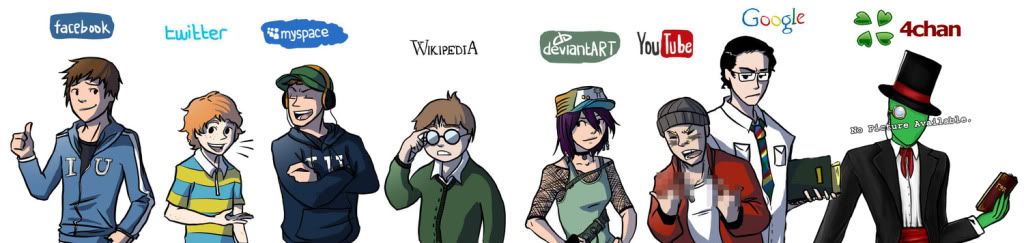

- YouTuber Kevin Brueck has portrayed YouTube itself as The Ditz on the YouTube channels kevinbrueck, kevinbrueck2, wickedawesomefilms, and wickedawesometv.
- Atop the Fourth Wall: Linkara himself faces the Personification of his fandom.
- The Breaking of the Wind/Fart Joke from The Nostalgia Critic is the personification of the Fart Joke.
- Jreg:
- The cast of Centricide are the personifications of various political ideologies interacting with one another. The main conflict is between Anti-Centrists representing the far ends of the different quadrants on the political compassnote , and the Centrists who embody different politically centrist philosophies.
- The Mental Illnesses characters are personifications of mental illnesses, mental disorders, trauma disorders, neurodegenerative disorders, and possibly more. The Neurotypicals are personifications of how non-mentally ill people treat those who are mentally ill.
- Half the cast of Mission 404 are personifications, mostly of websites : there are classics like Facebook, Google, Twitter and all, but also human versions of Youtube's Green & Red Thumbs, one for the random embarrassing spam that offers to give you a bigger penis, and even one for the annoying ad before videos.
- All of the Sanders Sides are manifestations of different aspects of Thomas Sanders' mind. They are, as follows:
- Logan, who represents Thomas' logic and everything he has ever learned.
- Patton, who represents Thomas' emotions, sense of right and wrong, and his inner child.
- Roman, who represents Thomas' creativity and imagination, as well as his ego and femininity.
- Virgil, who represents Thomas' anxiety and fight-or-flight instincts.
- Janus, who represents Thomas' impulses and desire to lie, to others or himself.
- Remus, who represents Thomas' intrusive thoughts.
- VG Myths: As Pikasprey says in "Can You Beat Pokemon Without Getting Hit?":
Pikasprey: apparently I'm the anthropomorphized representation of Pokémon challenge runs.
- ''hololive's second English generation, HoloCouncil, consists of five personifications of nebulous concepts. Space, nature, time, civilization, and chaos.
- One of Rankin/Bass Productions' famous stop-motion Christmas specials, The Year Without a Santa Claus, features "Heat Miser" and "Snow Miser," Anthropomorphic Personifications of hot weather and cold weather respectively, who were shown to be the sons of another Personification, Mother Nature, and were later dusted off for the Big Bad Voodoo Daddy song "Heatmiser". Another special required Rudolph the Red-Nosed Reindeer to save the Anthropomorphic Personification of New Year's Day. And Santa Claus himself can be considered the Anthropomorphic Personification of Christmas.
- South Park:
- The episode "Something Wall-Mart This Way Comes" includes the Anthropomorphic Personification of Wall-Mart itself. Though considering how he also seems to represent other stores from what he said, he could be seen more as a Personification of Mass Consumerism. The personification is in the form of an elderly man who claims to be able to take any form he wants, though this mostly involves putting on different pieces of clothing, and ripping off his mustache to show his "true form."
- Although he's intended as a parody of Christmas Specials, Mr. Hankey is the manifestation of non-denominational holiday celebration.
- The episode "Safe Space" has an anthropomorphic personification of Reality. He was a Dastardly Whiplash-type character who would always tell people the Brutal Honesty about themselves and the world. The town decides to hang him.
- The Daria episode "Depth Takes a Holiday" finds Daria and Jane solicited by the teenage incarnations of Valentine's Day and St. Patrick's Day to try and convince Christmas, Halloween and Guy Fawkes Day to return to "Holiday Island" before their holidays vanish from the real world.
- In "Spring for Strawberry Shortcake," Spring Is Late, so Strawberry and her friends go looking for it. They find it in the form of a young girl, but not before also meeting (naturally) Old Man Winter.
- Danny Phantom has a few ghosts that are part of this trope: Fright Knight is the ghost of Halloween, Clockwork is the ghost of Time, Nocturn is the ghost of Sleep, Vortex is the ghost of Weather, Undergrowth is the ghost of Nature, Walker is the ghost of Law, Technus is the ghost of Technology, Skulker is the ghost of Hunting, and the Box Ghost is the ghost of... Boxes.
- The Avatar in Avatar: The Last Airbender and The Legend of Korra is actually Raava, the spirit of peace and light that fused itself with a human to combat Vaatu, the spirit of chaos and darkness . There are other Anthropomorphic Personifications; most notably, The Ocean Spirit and The Moon Spirit Sokka's ex-girlfriend.
- Much like TRON, ReBoot is set inside the world within your computer. As a result most of the characters are an Anthropomorphic Personification of different programs and functions which the user takes for granted. Especially the viruses, especially Hexadecimal who self titles herself as The Queen of Chaos.
- Star Wars: The Clone Wars: Season three had a three-part arc involving characters known only by their titles, the Father, the Daughter, and the Son, they are the anthropomorphic personification of the balance of the force, the Light side, and the Dark side, respectively.
- My Little Pony: Friendship Is Magic:
- Discord. His body is made up of mismatched bits of a dozen or so different creatures, and he has nigh-omnipotent Reality Warper powers he uses to spread chaos and confusion (something he does in a very forceful, inconsiderate manner in his debut, but which has remained with him in a much less extreme degree since). Beyond just representing his associate concept, "Discordant Harmony" implies that, on a fundamental level, he is actually sustained by chaos. If he were to stop being chaotic altogether, he would fade away and vanish into nothingness.
- King Sombra. He spends far more of his screentime as a sentient World-Wrecking Wave than as a Pony, and Word of God's confirmed that he's meant to be more of a Power of Hate-based Present Absence than an actual character per se.
- Aladdin: The Series has many of these. Most notable are Mirage as "Evil Incarnate" and a one shot character called Chaos. Chaos also mentions another one:
Chaos: I never liked fate. Predestination goes against the grain. Besides, he cheats at cards.
- Young Justice (2010) Chaos and Order personifications, however, Word of God implies there are more than one of each.
- Hedonism-bot from Futurama is, according to Word of God, the mechanical personification of hedonism.
- The only slightly-explained existence of Robot Santa Claus is supplemented by the completely unexplained existence of Kwanzaabot and the Chanukah Zombie. The former is an extremely apathetic (and not especially knowledgable) educator on Kwanzaa. The latter is seemingly just a Jewish man who's undead.
- Adventure Time: While its not outright stated, its heavily implied that The Lich, a rotting undead sorcerer with a sickly green glow, who wants nothing more than the extinction of all life, is the anthropomorphic personification of Nuclear War.
- However, with the release of Evergreen, revealing that he seemed to originate from the asteroid that killed the dinosaurs, he could be considered the anthropomorphic personification of Mass Extinction.
- Star Street: The Adventures of the Star Kids is a Dutch cartoon about anthropomorphic Western Zodiac signs.
- Stoppit and Tidyup applies this idea to common instructions given by parents to children, creating a diverse set of characters whose behaviour and lives are all based on the instructions in their name.
- A slight variant is used in one episode of Kaeloo. The episode had the main four use a machine to extract the bad thoughts in their head, which are then personified as miniature versions of themselves. For example, one of Mr. Cat's thoughts, which represents greed, is portrayed as a miniature version of himself holding stacks of cash and yelling about how nobody can touch any of it.
- Miraculous Ladybug: The Kwamis are explained in supplementary materials to each be the embodiment of an abstract concept, which came into existence at the same time that the idea they represent entered the universe. For example, Ladybug's kwami, Tikki, embodies creation (and is said to be the first of the kwamis, having been "born" alongside the universe itself), while Plagg, Cat Noir's kwami, embodies destruction.
- Regular Show gives us the Guardians of Obsolete Formats, whose members represent and named after old formats like 8-track, Betamax, Laserdisc among others. In the episodes they appear, they've done battle with the Ancient Order of the VHS, DVD and Blu-Ray, and even the Internet–all of whom are personified.
- The Overlord from Ninjago is the anthropomorphic personification of evil. It's stated by the creators that he has existed since the beginning of time in order to balance the realm, and that even if his physical body is destroyed (which it was, three times) he can’t technically die, since evil will always exist.
- Big Tim: The main antagonist of the movie is Kid Friction, who represents the friction caused by roller-less bearings grinding against their axles. He takes the form of a man with a solid green body and clothes.
- She-Ra and the Princesses of Power: The closest approximation as to what a Princess actually is (since it isn't explained in the show). They are human, but they are also natural expressions of Etheria's magic, divided into purviews ranging from the obvious (water, plant life) to the abstract (nets, teleportation). These purviews strongly influence their mindset (Entrapta having difficulty socializing with organic beings, Adora feeling insecure in her "weaker" form), and make them vulnerable to even the slightest implication that they aren't the best at what they embody. For example, Perfuma is driven to despair when someone else is chosen as flower arranger for Glimmer's coronation, and Netossa is irritated when Bow doesn't realize she is the Princess of nets.
- Caissa is the goddess of Chess.
- According to the 1978 Spanish constitution, the King of Spain is also the personification and embodiment of the country.
- The United States has several:
- Uncle Sam is the personification of The United States Government.note
- Outside the United States he is seen as a personification of the United States, not just its government. He is also the successor to a previous masculine personification, Brother Jonathan, who for instance can be seen in Victorian cartoons.
- Columbia is the personification of the United States of America and her people. (Or least she was until she became a movie studio mascot.)
- The US also has Lady Liberty, although this technically is just the embodiment of the appropriate concept. Lady Liberty graces the Capitol building with a headdress made of a resting eagle.
- A certain island off Manhattan with a headdress of rays, a tablet with the date of the Declaration of Independence and a torch to illuminate the world. A smaller version can be founde on the Ile des Cygnes in Paris.
- Uncle Sam is the personification of The United States Government.note
- Many countries of the Western world have Lady Justice (blindfolded statues that appears on and in many courthouses). Lady Justice (or Justitia) is usually shown with a set of scales from her left hand (for measuring the strengths of a case's support and opposition), her being blindfolded (symbolizing the unbiased court), and carrying a double-edged sword in her right hand (symbolizing the power of Reason and Justice, which may be wielded either for or against either part) that goes back to the Ancient Greece.
- Some court buildings, such as the Palais de Justice in Paris, also show other personifications, such as Truth (a naked woman with a torch).
- There is also a Justitia decorating the fountain in front of Frankfurt city hall in Germany (in the old days city councils also served as courts of justice), which is often shown as a background picture on German television for court news. This version is bare-breasted with jets of water shooting from her nipples.
- Related to the above: when a judge enters a courtroom and takes their seat, they metaphorically become the living embodiment of the institution of law (known in general as "the Court") itself. This is why phrases like "If it please the Court" and "The Court accepts this into evidence" appear so often—judges aren't just speaking for the Court. They are the Court.
- Britannia, the anthropomorphic personification of the peoples of Great Britain, and the once and future British Empire.
- Another anthropomorphic personification of England or Great Britain, especially in political cartoons, is John Bull.
- The Nordic countries have their personifications too:
- Holger Danske (Holger Dane) crosses the line between this and a legendary hero.
- Ola and Kari Nordmann (Ola & Kari Norwegian) of Norway and its people, a jovial young man and woman in traditional clothing. Moder Norge (Mother Norway) is also sometimes used, but rarely.
- Fjallkonan (Lady of the Mountains) of Iceland, an imperious woman with a sword.
- Moder Svea (Mother Swea) of Sweden, usually a valkyrie or shieldmaiden.
- Suomi-neito (the Finnish Maiden) of Finland, a barefoot young woman.
- Holger Danske
- Marianne, the feminine personification of the French Republic, is on display in many places, e. g. as a big statue on the Place de la Republique in Paris. There is also a bust of her in every French city hall.
- During the French Revolution, feminine personifications of Liberty, Equality and Fraternity also were often used or a personification of the Republic would be displayed with attributes to represent the three: The Phrygian bonnet for liberty, a builder's level for equality, and breast-feeding a child for fraternity.
- Helvetia, a feminine personification of Switzerland, can be seen on Swiss coins.
- Feminine personifications of countries and cities were especially popular in the 19th century. Here are a few examples from Germany:
- Germania (wearing a suit of armour and a crown, often holding a sword) can be seen e. g. on the Niederwalddenkmal on the Rhine and on pre-1918 German postage stamps. A painting of her decorated the first German elected national assembly in the Paulskirche in Frankfurt in 1848/49.
- Borussia (Prussia).
- Bavaria, e.g. in the shape of a massive bronze statue next to the Theresienwiese in Munich, where the Oktoberfest is held.
- Berolina, the personification of Berlin, was a statue that until World War 2 stood on Alexanderplatz in Berlin.
- Hammonia, the personification of Hamburg, wears a mural crown and can be seen several places of Hamburg city hall.
- In German political cartoons, Germany or the German people has been represented as der deutsche Michel ("German Mike", because St. Michael is the patron saint of Germany) for century. Since the 19th century he is usually shown wearing an old-fashioned nightcap.
- Political cartoons love playing on relationships between national personifications. In early Canada, where political cartoons were the best way to spread propaganda, the personification of Lady Canada had a My Beloved Smother in Britain, and Abhorrent Admirer in America, and a Disappeared Dad in France. The provinces were often seen as her bickering children.
