
GAH, WHERE DID THAT COME FROM!?!
A Giant Space Flea from Nowhere is a boss with no relevance whatsoever to the actual plot, and who comes out of nowhere. They are frequently mindless creatures or beasts as opposed to actual characters, and tend to appear at the end of unimportant plot threads, such as Fetch Quests, but there are a few that do show up in the main quest, sometimes even as the Final Boss or a Post-Final Boss. In any case, do not expect the game to foreshadow or give proper answers about what the hell you are fighting right now.
Note that, contrary to what the name might at first seem to indicate, the Space Flea is not always an Eldritch Abomination, though overlap is possible. If it makes sense in the plot, it is not this regardless of how weird the boss might be. In other words, Lavos, Jenova, and any other alien world-destroying parasites that are essential to the storyline of the game do not qualify, even if they're literal space fleas from the darkest depths of the universe. In more fantastical settings, they tend to be Single Specimen Species.
Sub-Trope of Lone Wolf Boss. Diabolus ex Nihilo is the non-video game equivalent: a bad guy who pops up out of the blue, does some damage, and dies. Contrast Outside-Context Problem, which is a villain (or other problem) whose indeterminate origin is the source of their mystery and danger. Sometimes explained with All There in the Manual, but that might be an Author's Saving Throw. As you can see, many a Superboss is not included because they are technically a bonus boss and may even be outside of canon. Not necessarily related to Giant Enemy Crab, but it could be. Often they are also a Generic Doomsday Villain.
Also, compare the non-video game boss equivalent, the Big-Lipped Alligator Moment, which applies mostly to scripted scenes that came out of nowhere and have little or no mention of it afterward. If the boss and/or the battle is really weird and nonsensical even in the context of the game, there may be some overlap between the two tropes.
Now available in the Trope Co. catalog.
Examples:
- It's explained that Bayonetta and her entire clan of Umbra Witches are often accosted by Angels who their Demon contractors would love as sacrifices, and the whole game takes place during what can be seen as an entire revolution for the angels, so at no point can an angel appearing to fight Bayonetta be strange. The real Space Flea from nowhere is the one enemy of the game that isn't an angel... It's a machine. The Occult Device: The Golem. It's not mentioned at any point in the story, and its backstory explains that it was created by both the Lumen and Umbra clans. Because the weapon was built by Witches and Sages, it makes it even stranger, still, that it appears in Paradiso, the world of the Angels, of all places. It's just... there. Slamming itself into random walls throughout the level and eventually fighting Bayonetta properly at the end, but it gets no mention in the plot, and the controller of this device or of the one that appears in A Tower To Truth is never revealed.
- Castlevania:
- Castlevania: Lords of Shadow has the final boss abruptly turn out to be Satan.
- After all the strife and struggle of reaching the end of Castlevania: Judgment, the player finally faces the mastermind behind the events of the game... The Time Reaper. Granted, he reveals that a villain from Kid Dracula, Galamoth, had sent him from TEN THOUSAND YEARS in the future to the past to alter history and make him replace Dracula as the Dark Lord, but there was no buildup to his identity other than he was messing with the timeline, and after he is defeated, he is never brought up again.
- To be honest, many of the bosses debuted in later games basically fit this trope, since there are no explanations on what they actually are and how do they get to end up serving Dracula, nor do they appear to have any plot relevance.
- Cave Story is solid for most of it (even the fight against a tiny superfast mushroom makes sense). Monster X and Ironhead, on the other hand, are literally out of nowhere. All the latter gives you is "Something's coming", and the former just suddenly tries to run you over once the boss music suddenly starts (and its dying cutscene is even more bizarre). Interestingly, Ironhead is pulled directly out of one of the creator's earlier games. There's also Omega, which unlocks the sun stones in the Sand Zone, and Heavy Press nearly qualifies — however, after beating him, it's revealed that his Load-Bearing Boss nature is the only way to get to the final final FINAL final boss chamber.
- Control has several plot-irrelevant side bosses that are quite a testament to the "out of nowhere" nature of this trope given how already surreal the main plot is.
- One sidequest involves a supernatural mold that must be rid lest it consume The Oldest House and zombify its workers, the end of which involves a giant flower/mold monster in its core called "Mold-1".
- FORMER is a vaguely tardigrade-like thing that abruptly whisks Jesse into a boss fight in another dimension while cleansing an Artifact of Power (twice if you choose a later sidequest). Only after its first defeat do you get any kind of suggestion from The Board as to what it was, and even then, it looks and acts like virtually nothing else in the game.
- A slightly less traditional boss comes in the form of "The Clog", a sentient, festering mass of slime encountered while cleaning out The Oldest House's maintenance sector. Ahti apparently has a history with it, but he never shares details.
- The Krabby Patty UFO boss of the Rocket Rodeo level in SpongeBob SquarePants: Creature from the Krusty Krab. Even disregarding the bizarre nature of the game, this boss comes out of nowhere and aside from an obvious resemblance to the games' Big Bad (a Mutant Krabby Patty), has little to nothing to do with the game. At least it makes a small cameo in the next level, but even that goes unexplained.
- Devil May Cry 2:
- While all the bosses in this game (except for Arius) are nothing but gigantic monstrosities that show up out of the blue to attack Dante and Lucia, special mention goes to Phantom's appearance. Aside from a short text implying Time Travel, there's no significant build up to it, only a cutscene depicting him falling from the sky. Dante doesn't even make any comment about him, despite having killed him some time in the first game.
- Griffon is one of the heads of the Final Boss Argosax the Chaos along with some other bosses, including the above-mentioned Phantom. However, what makes this worse than Phantom's is that unlike all the other bosses, Griffon was never fought in the story and, in fact, did not even make an appearance in the whole game, which means that he literally comes out of nowhere to be a part of the final boss. Quite possibly the most baffling version of this trope ever.
- Not even the slightest prior mention was given to The Despair Embodied's existence in the story. It simply bursts out of a cocoon that ejects from Argosax's withering husk and immediately challenges Dante.
- God of War:
- The Kraken in God of War II. The beast suddenly appears after Kratos defeated the Last Spartan and its existence was not hinted at all prior to this. It is believed that the Kraken was accidentally awakened by Kratos when the Phoenix is set free or as a trap placed there by the Sisters of Fate as the final guardian to prevent anyone from reaching them should someone awaken the Phoenix .
- God of War III has you battling in various boss fights against gods, mythic characters, and even a Titan. After the last boss in the previous sentence, the next boss is... a giant scorpion who happens to live in the area you're exploring. True, it's hinted at by a newly appeared enemy type that hasn't been seen before and some notes on the ground in the area, and said boss is carrying an artifact you need to progress... but after all the epic previous battles, it seems a step down.
- The Legend of Zelda:
- Zelda II: The Adventure of Link: Dark Link's original appearance as the Final Boss. Link already defeated the guardian of the Great Palace (Thunderbird). For some reason, the Triforce Keeper draws out his shadow and they must fight. Many believe it was a final test to deem Link worthy of the Triforce of Courage, and others believe it is the apparition of Ganon's shade, but no official explanation is ever given.
- The Legend of Zelda: Ocarina of Time: Dark Link again from the Water Temple. In the middle of a water-themed dungeon with water-themed enemies, you suddenly get a room that holds a Mind Screw and a fight against Link's darker side. There's a minority of fans that believe this miniboss would have made more sense in the Shadow Temple.
- The Legend of Zelda: Majora's Mask: The aliens that abduct the cows from Romani Ranch. They're awfully out of place in a medieval fantasy series like Zelda, and even though they're somewhat important to a subplot involving the ranch itself, they have no bearing on the overall plot whatsoever.
- The Legend of Zelda: Twilight Princess: The third and final tear collection quest has one. Up to this point all tear collection quests has been straightforward, with you entering an area enveloped by Twilight, finding each Tear of Light on your map, and collecting them by killing insects that die in one hit. Then it turns out the last tear is for some reason stuck in the Twilit Bloat, a literal Giant Flea from Nowhere that you have to fight on a couple floating platforms in Lake Hylia in wolf form. The Bloat is possibly the series' most infamous Goddamned Boss.
- The Legend of Zelda: Phantom Hourglass: The two Giant Eye Plants and the Massive Eye (a flying whale monster), which suddenly appear as ship-combat bosses when Link tries to dock at certain islands throughout the story (their designs imply that they're minions of Bellum, but nobody in-game confirms it). The second Giant Eye Plant only shows up during the last leg of the optional Trading Sequence, making it even more unexpected.
- The Legend of Zelda: Skyward Sword:
- The section of the game leading up to the Sandship dungeon requires visiting three separate mini-dungeons. The final room of the second at first glance looks like a normal room with some sand, but after some dusting Moldarach inexplicably shows up for a rematch. Unlike the first time you fought him, there's no cutscene or door locking behind you as a warning; and Fi's only instructions were to look in the sand for clues to where the next dungeon is. Also, this time around you don't get a Heart Container for defeating him. Thankfully, the fight at least goes faster this time now that the Goddess Sword's attack power has been doubled.
- Tentalus. Every prior dungeon boss had some story justification (Ghirahim was The Dragon, Moldarach was a fully grown version of the scorpion enemies the player had been fighting throughout the Lanayru Mining Facility, Scaldera and Koloktos were objects in the dungeon enchanted by Ghirahim, The Imprisoned is the monster Demise turned into after his seal, hence the name). Also in context are the later bosses Bilocyte (the parasite that caused the disease that started tormenting Levias) and Demise (the Final Boss and the master Ghirahim has wanted to revive); but this giant tentacle-thing just inexplicably appears once you reach the boss room and tries to kill you and sink the Sandship for no reason. What makes this particularly egregious is that the Mini-Boss of said dungeon had a pretty strong plot connection to the place, being the captain of the pirates who stole the ship in the first place, and that the only foreshadowing you get for this thing is from the Boss Key's shape.
- Metroid:
- Metroid: Other M includes a bolt-from-the-blue Superboss of the epilogue chapter, Phantoon. Why he's fought, whether it's the same one defeated in Super Metroid back from the dead or another member of the same species, and what he has to do with anything on the Bottle Ship is never explained. For a game notorious for its long, redundant expository monologues, it's ironic that it clams up during one of the few times an explanation is actually needed.
- The 3DS re-imagining of Metroid II, Samus Returns adds a surprise boss following the original Final Boss, and that is Ridley. Despite being Samus's most hated enemy throughout the rest of the series, Ridley does not get any build-up or foreshadowing to his sudden appearance.
- In Ori and the Will of the Wisps, after Ori reassembles Seir from the titular Wisps in the Windtorn Ruins, a massive Tremors-style Sand Worm pops up out of nowhere solely to provide an Indy Escape Sequence.
- In Prince of Persia: Warrior Within, a giant Griffon appears out of nowhere to fight the Prince midway through the game. While its presumed to be one of the many sand monsters created to guard the Island of Time, its radically different from all other enemies fought at this point and it gets defeated with no ceremony.
- Salt and Sanctuary somehow manages to play a parody for both drama and horror. It's quite scary and dramatic first meeting The Unspeakable Deep who comes off as an Eldritch Abomination trying to kill you as you go through the prologue on a ship on a stormy night.
- Skylanders: Giants: The seventh level, Wilikin Village, is a town full of Living Toys created by Kaos when he was a child, and the Skylanders head there for information about him. The boss is the Chompy Mage, a mad wizard obsessed with Chompies. He has absolutely nothing to do with Kaos, is only mentioned immediately before the battle with him, and never comes up again until his reappearance two full games later.
- Spider-Man:
- In Spider-Man vs. the Kingpin, Spider-Man fights a gorilla as a mini-boss while in Central Park looking for Sandman. Yes, a gorilla.
Linkara: Why is there a gorilla in Central Park?
The Spoony One: And why does it hate Spider-Man so much! - Most of the bosses in the console and PC tie-ins for the film are either from the film or villains from Spidey canon. The one exception is the boss Spidey fights when he infiltrates OsCorp, which is a Humongous Mecha with a Wave-Motion Gun.
- In Spider-Man 2, Rhino qualifies. After you complete an assignment for Robbie at the Daily Bugle, Spider-Man hears an explosion and investigates it, and he sees Rhino as well as a bunch of thugs who tell him to "get the equipment back to base" before driving off. After Spider-Man defeats him, the equipment explodes and Spidey literally leaves him hanging. Nothing of him is heard again, nor is it shown what the "equipment" was.
- Weirdly enough, Ultimate Spider-Man similarly has Rhino as the only boss who has no relevance to symbiotes (or the main plot, for that matter) at all. He's causing havoc in the city at the beginning of the game as the second boss, and after he's defeated and his mecha suit is broken, he never appears again.
- In Spider-Man vs. the Kingpin, Spider-Man fights a gorilla as a mini-boss while in Central Park looking for Sandman. Yes, a gorilla.
- Super Adventure Island II does this twice. The first one appears when you beat the giant bird hyped up as the final boss. Suddenly an evil wizard appears and steals Tina, and you have to play through the level again. When you kill the wizard, a giant scorpion appears, which is the real final boss. And you fight him in outer space for some inexplicable reason. There's some eerie music and mist filling the room when you kill the wizard, indicating the abrupt change in mood, which is nice, but you'd think the player deserves an explanation for this nonsense.
- Super Mario Bros.:
- Super Mario Galaxy:
- Baron Brrr has no lead in from the level to the boss other than being there, and unlike nearly every other boss, never appears again.
- The Undergrunt Gunner, the very common cannon Monty Mole, doesn't even get mentioned in the mission name, and appears in three levels completely out of the blue (and in one of them, he's just guarding the cannon, right at the start of the level, and you don't even need to use said cannon).
- Kingfin is a giant skeletal fish living on his own water planet. It's the only boss located on a single-level galaxy, and the only reason you fight it, aside from the star it keeps, is because you've just entered its territory.
- Super Mario Odyssey: After leaving the Luncheon Kingdom, Bowser sics a previously unseen enemy, the Ruined Dragon, on Mario. Said enemy is a massive photo-realistic dragon who looks like he flew in from The Elder Scrolls V: Skyrim and is fought in a grim, crumbling arena that would fit comfortably in Dark Souls III. No explanation is offered for where he came from or what he is.
- Super Mario Galaxy:
- The Army Men spin-off, Green Rogue, throws a few odd bosses halfway into the game. Granted, your character is a plastic toy soldier, which the game doesn't make any attempt to hide, but for most of the game your enemies are military-themed, including tan-coloured enemy soldiers, jeeps, tanks, helicopters... until halfway through, your hero is assaulted by a giant troll doll who lobs grenades at you. After killing the troll, you fight more tanks and soldiers until the bridge area; destroying three enemy ships, you then fight... a machine-gun wielding cowboy doll resembling Woody who assails you with a hard-to-dodge Spin Attack every so often. And in the last level, an urbanized war zone, you fight your way through the remnants of the rival tan army until facing the Final Boss, the tan army general... who is piloting a Transformers-like giant robot (looking like a Captain Ersatz of Starscream).
- After you defeat the Big Bad in the arcade version of Astyanax, who is a Shout-Out to Emperor Palpatine from Star Wars, complete with "force lightning", you suddenly find yourself in the true final stage, which is a technorganic alien hive complete with eggs and Face Huggers. At the end, of course, is the "Queen Alien", which obviously looks like a Xenomorph from the Alien movies.
- In the second The Blair Witch Project game, The Legend of Coffin Rock, the final boss is something which looks like a cross between a lizard and a bull, and named "Schnell Geist". The only foreshadowing for this is one book in the library near the beginning of the game which describes a local folklore creature called "Snallygaster". Those are different names for the same thing, although the game never gives you that connection. It actually comes from real folklore for the Maryland region.
- BloodRayne 2 had the Unraveler. In a game about a Dhampyr assassin fighting a cult of vampires lead by her evil vampire father, Unraveler is a creature whose origin and nature are not explained into detail and doesn't seem to be related to vampires in anyway, but the heroine just runs into it when storming the villain headquarters. The only things we ever know about it is that it smells really bad and its picking up a fight with the Big Bad's minions.
- Comic Jumper has Benny, a walking, talking Total Recall (1990) reference (complete with giant drill machine) show up in the last Silver Age level, followed by the giant photorealistic head of a Japanese kid in the first manga level.
- E.D.F., a somewhat obscure 1991 SNES side-scrolling flight shooter, played like a typical sci-fi action game, with the player taking on robotic enemies of various descriptions, including a towering computer of a boss at the end. Except when that was defeated, the player has to fight a giant barf-green/yellow hawk-headed thing that spits brains at the player's ship and conjures eyeballs from out of nowhere to attack. Because, you know. Reasons.
- Genji: Days of the Blade is an action game which is based on Japanese history. The stages of the game will also be based on famous battles
 which took — actually took place in ancient Japan. So here's this Giant Enemy Crab..." Meme aside, the crab does have a mythological justification as it's based on the Heikegani crab, which is said to be the reincarnation of Heike warriors who fell at the Battle of Dan-no-ura.
- The Guardian Legend's Final Boss, "It", appears out of nowhere in outer space after the Naju planetoid has been destroyed. Other out-of-place bosses are the "glider", which is actually an enemy from Zanac, and Teramute, a dragon that is only encountered in one corridor of the Forest area.
- In Herc's Adventures for the PlayStation, you run into the Martians from Zombies Ate My Neighbors in an early stage. The game was written by the same people, so it's just an Easter Egg. But then you fight the final boss, Hades and in the end... Hades is a robot controlled by the Martians. Where's the real Hades? Was there a real Hades? Was he replaced? If Hades was always a robot, did Persephone or the other gods know? These questions will never be answered as the game ends there.
- The Nazi Frankenstein in the Prague level in Indiana Jones and the Emperor's Tomb. Granted, he is holding a Plot Coupon, but he comes from out of nowhere with no explanation, no backstory, and nothing to suggest Those Wacky Nazis were engaging in anything other than bog-standard Nazism, not Super Science. Indy doesn't even bat an eyelash as if throwing acid at an 8' tall fireball and furniture-throwing Super-Soldier is part and parcel with being an archaeologist.
- Lone Soldier (1996) is a military-themed shooter which have you battling soldiers, tanks, jeeps and the like, save for the first boss - after fighting your way through a tribal village, you then face a Witch Doctor who suddenly assumes a One-Winged Angel form, a twenty-feet tall troll-like monster who tries bashing you in with a massive club and can breath streams of green flames.
- The Matrix: Path of Neo more or less proceeds with the plot of the three The Matrix movies. Until the very end, when instead all of the Smiths morph into one giant "Mega-Smith" to fight Neo. Atari-esque avatars of the Wachowskis stop the plot at that point to explain how the metaphorical ending of the movies didn't translate well into a video game. This may be true, but it did feel like they were making fun of the player. ("Have fun... and enjoy enlightenment!" [Both laugh])
- Metal Gear Rising: Revengeance has the Metal Gear EXCELSUS, piloted by Senator Armstrong. Even more-so is Armstrong himself, who afterwards bulks up and induces The Worf Effect upon Raiden. Even the Mission Control is shocked, since if you talk to Kevin beforehand, he'll note that there's nothing they dug up on Armstrong that could have suggested that he was in any form a physical threat (aside from the fact that he was in the Navy but didn't see any action).
- Muramasa: The Demon Blade features a giant centipede attacking a building. Granted, it's actually a creature from the Japanese Mythology (the Oomukade if you want to know), but the story at that point indicated you were about to face off against a human antagonist instead.
- The arcade classic NARC has you fighting human criminals (though outlandish ones) and attack dogs through the entire game. Then you fight the final boss, Mr. Big, who is a disembodied big giant head sliding around on some sort of high-tech pedestal. Damaging him first causes his sunglasses to break off, which will allow him to shoot fire from his eyes. More damage will turn him into a skull slithering around at the end of a tentacle-like spine, spraying you with an endless supply of detached tongues.
- Ninja Gaiden II (2009) has one at the end of chapter seven. You've just finished dueling a boss who has a prominent part in the storyline, then the plane you are on crashes in the Arctic (or somewhere icy anyway) and a giant ankylosaurus made of molten rock appears out of the ground to fight you. To add insult to injury, when you defeat the boss, it will explode in what seems to be a cutscene... but is an actual explosion which will kill you if you're caught in it. And the only way to not die from the explosion is to hold the block button. This basically guarantees that players will die at least once from it.
- Ōkamiden has Asteroidean. While all the other bosses in the game have some sort of story relevance, Asteroidean is just a random starfish that is fought underwater, with no mention before it appears, no dialogue before or after the fight, and no mention of it for the rest of the game after. In fact, most people who play the game tend to forget it's even in the game to begin with.
- In Prinny: Can I Really Be the Hero?, once you reach the Flavor Sage and everything suddenly seems to be going smoothly, the aforementioned Flavor Sage commands the random giant padlock behind him to turn into the Chefbot-9000 and attack the prinny in order to make the Ultra Dessert. The lead character even lampshades how incredibly random this is.
Prinny: Nine thousand?! Why does this thing even exist?!?!
- Prinny 2: Dawn of Operation Panties, Dood! has bonus bosses who are all important, well known characters from the Nippon Ichi multiverse...except Tyrant Overlord Eryndum, who is the boss of the Martial Tower if you play through it a second time in one play through. Despite being a Tyrant level demon (who are generally feared and revered across the universe and so rare they can be counted on one hand) he has never been mentioned before or since. There isn't even a cutscene before or after the fight unlike most other bosses in the game and no characters comment on it.
- In Psychonauts, the Stepford Suburbia of the Milkman Conspiracy is suddenly interrupted at two points where demons called Nightmares pop out of the ground and drag you to a stage full of fire and darkness. They were originally going to be part of Milla's mental world, but were moved because it didn't make sense for a boss fight then either.
- From the Ratchet & Clank series:
- The first boss of Ratchet & Clank (2002) qualifies; it is never hinted at or mentioned before or after, and is pretty unexpected. While it seems to be the source of/related to similar, smaller enemies in the level, the character you meet after beating it doesn't mention it at all. The thing just kind of drops down from the ceiling.
- There's the Mothership in Ratchet & Clank: Going Commando. Using Giant Clank to fight Thugs-4-Less' giant robots? Makes sense. Fighting a giant UFO that launches an army of respawning UFO-headed robots, both of which have no foreshadowing and never appear again? Not so much.
- There's the Warship (that's the only name it's given, and even then only if you leave and return) in Ratchet & Clank: Up Your Arsenal. It's a black gunship with a warp drive that shows up to make a platforming section on Planet Daxx difficult, and is then fought as an actual boss. It's not mentioned in the dialogue (it doesn't even get a post-battle cut-scene), there's nothing else with its design or abilities in the game, and its destruction does nothing but open the path to the goal.
- In Holostar Studios in the same game as the above, the player controls Clank through a platforming section to simulate the filming of another episode of Show Within a Show 'Secret Agent Clank'. So far so normal, but then you're suddenly thrown into the only Giant Clank section in the entire game to fight an actually somewhat tricky boss fight... not against the Show Within a Show's normal villain, but a four-armed dragon and his giant robot ninja flunkies. How does this make sense?! The only lead-up is the director making mention of 'The Terror of Talos' in the cutscene before the platforming, but it still comes out of nowhere, even in-universe (or... in the universe inside of the universe), since this is the only time we're shown that Agent Clank the character can turn giant in a spy drama series that a four-armed dragon has no business being in.
- In Ratchet & Clank: Into the Nexus, the titular duo is trying to get to an abandoned orphanage on planet Yerek where Vendra and Neftin are working on something. Eventually, they get there, and a robot named the Voltanoid jumps out of a hole in a wall and attacks the heroes. He has no foreshadowing and comes out of nowhere, although later in the game, you have to Hold the Line against a mob of Thugs-4-Less and another Voltanoid appears during the fight, and a fire-themed variant called the Blazebot appears in the Thugs-4-Less Destructapalooza, suggesting that they built them.
- In the Japanese Famicom version of Star Wars, you run into Darth Vader a lot in the game. He shows up very early on, starting in the Sandcrawler for some reason. When you hit him, he turns into a scorpion. This actually happens throughout the game, and Darth Vader will transform into different creatures depending on the level. The real Darth Vader is actually fought twice.
- Every boss in Super Star Wars is a Giant Space Flea From Nowhere, including the Jawas' lava monster, a giant womp rat, and a mech in the Death Star. Super Empire Strikes Back was somewhat good about bosses making sense (giant probe droids aside), but then Super Return of the Jedi includes a boss fight with EV-9D9 (Jabba's torture droid) in an Ewok Village, and a green fire-breathing tiger thing. What makes this an egregious example, though, is the fact that they tend to use these even when there was a real boss from the movies that would make more sense. For example, in the Cantina Fight, the boss is a living version of the Dejarik piece that R2-D2 uses to beat Chewbacca in the movie. A bit of an odd choice since they could have simply made Greedo the level boss; there's a couple of Greedo-like mooks, but that's it.
- Treasures of the Deep has a level titled "Montezuma's Revenge", where you explore the underwater ruins of a Aztec Temple to find two pieces of Montezuma's lost treasure. After getting the first treasure, entering the room with the second brings you up close and personal with a giant reptilian monster with webbed underarms. The worst you faced up until this point were some angry crocodiles and booby traps.
- True Crime: Streets of LA:
- The first game has a whole chapter called House of Wu made of this. You go to investigate a Triad building. Then for no reason you fall down to the basement and fight zombies. The boss of the chapter is a huge Chinese dragon that breathes fire and swims around a lava pit. Since the game is a GTA-styled Wide-Open Sandbox game with a standard cop-show material with no supernatural or weird stuff in it outside of that chapter, many consider it to be entirely out of place. The developers admitted this level was The Artifact of a prior build and apologized.
- To a lesser extent, the fire-breathing opera boat from the sequel.
- Twisted Metal: Black combines this with a subversion of The Guards Must Be Crazy. The Final Boss is a military helicopter that shows up to end your rampage.
- In Wonder Boy, the bosses of the two Master System-exclusive areas (4 and 8) have a unique design and theme music, attack with lightning instead of fireballs, unlike all the others, and have no apparent relevance in the story.
- Bloodborne:
- Amygdala is one of these from both the standpoint as a boss and in the story. As a boss, the thing comes completely out of nowhere and suddenly forces the player into a boss fight. From a story standpoint, unlike all the other Great Ones, who have at least some role in or effect on the plot, Amygdala has no relevance to the story or any real motive for attacking the Hunter.
- The One Reborn has no explanation behind what it even is, simply being a random monster summoned by the Bell Ringers that the Hunter is suddenly forced to fight. One possible explanation that it might be is that it was created from the fused together remains of the victims of the Yahar'gul Kidnappers.
- The Living Failures from The Old Hunters have no explanation to their existence beyond their name and design indicating that they are result of failed experiments to create Celestial Emissaries. It's also not quite clear as to why they're residing in a field of flowers at the top of the clocktower.
- The Darklurker from Dark Souls II is one of the only bosses in the entire series who's given next to no explanation to what it is. Not only does it lack any story relevance, being a Superboss, but not even the description for the soul obtained from beating it provides any explanation, simply stating "Perhaps it's better that some mysteries remain unilluminated". The only implications to what it might be comes from the game guide, which reveals that the location it's fought in, the Dark Chasm of Old, might be made from the remains of Manus, Father of the Abyss, and Dark Souls III, where it's implied it might be either the angel who contacted Holy Mother Gertrude and inspired her to found the angelic faith of Lothric, or that it's somehow connected to the Angels that fly over the Dreg Heap.
- The Armor Spider from Demon's Souls is one of these, as unlike the other bosses of the game, there is never any real explanation for its existence. Whereas the rest of the bosses are explained to be a corrupted human character, a long-dead being that's been revived, a mystical being manifested into reality, or some sort of artificial monster, the Armor Spider seems to just be a random Giant Spider living in the Stonefang Tunnel.
- The Rogons in E.V.O.: Search for Eden are a race of intelligent fish who are harming the whales, and the player is tasked with taking them down. Absolutely none of this is foreshadowed in any way, nor do the Rogons have any relevance to the rest of the game.
- Typhon in Final Fantasy XVI. The player character is on a mission to destroy the Mothercrystal in Oriflamme, where you have to fight your way through an imperial garrison and some supernatural beings. When you reach the heart of the Mothercrystal, an Eldritch Abomination emerges from it—Typhon. While "Typhon" is a name that has been used for a recurring character or monster, this Typhon bears no resemblance to previous designs, which had been similar to each other (a reddish blob with a second face on its backside). It's a blue humanoid covered in symbols, whose lower body devolves into tentacles. When you defeat Typhon, Ultima appears. Ultima becomes the focus of the plot thereafter, while Typhon is never mentioned again. Even when Ultima provides all kinds of exposition about its own origin and that of the Mothercrystals, nothing about Typhon is ever explained.
- 9 Monkeys of Shaolin, for the most part, has you fighting human-based enemies like marauders, ninja and samurai, until a stage in a temple throws a ghost at you as its first boss. Note that the game had zero supernatural elements before the encounter, and as you're being assaulted by the ghost the game then throws onscreen hints to use your chi to fight it. Later on you can face ghosts as Degraded Boss enemies, but at least they appear in places that makes sense in context. (e.g. a Derelict Graveyard full of destroyed vessels)
- Anarchy Reigns features random boss fights commencing in its multiplayer matches: particularly, a Giant Squid named Kraken, and a Humongous Mecha named Cthulhu (which you can punch out).
- Most bosses in Charlie Murder that are not members of Gore Quaffer qualify. All of them show up without explanation, and most are not commented on your phone either. This includes a giant sasquatch, a living brain, a hamburger/human hybrid and a bloated tumor.
- Castle Crashers also does this in the final level. As far as the bosses of The Very Definitely Final Dungeon go, although the Necromancer and re-animated Cyclops were seen in the game previously, the burly painter with a lunchbox for a head who attacks by painting monsters that were ripped straight from Newgrounds was not.
- Crash: Mind Over Mutant, of all Crash games, features one as the final boss in the Nintendo DS version: The Chimera, a fusion of various Titan enemies with a lion head, bull horns and a cybernetic torso. Its existence isn't foreshadowed, looks out of place, and isn't acknowledged immediately after its defeat.
- Double Dragon:
- Example from Double Dragon II: The Revenge:
- The arcade version took a turn to the occult for some of its enemy characters. The first boss, Burnov, is a masked wrestler who, instead of blinking into non-existence like all the other defeated enemies, will stand up and yell with his arms raised and then vanish into thin air, leaving behind his clothes and mask. In later encounters, he will rematerialize after using his death animation once. Later in the final stage, after defeating Machine Gun Willy, the game seems to be over until the player's own shadow starts gaining a life of its own and attacks the player as the actual final boss.
- The True Final Boss in the NES version is a nameless martial artist with the ability to make himself invisible in battle. Unless you've read the manual, his existence is never hinted anywhere in the game. He is also a Master of Illusion, which explains why your shadow gained sentience...
- For most of Double Dragon 3, the player spent their time fighting human enemies such as bikers, martial artists, swordsmen, and scantily-clad Roman warriors. In the fifth and final stage, the enemies consist of living tree people, stonemen, and the reanimated corpse of Cleopatra (which in the NES version is a possessed Marion).
- Example from Double Dragon II: The Revenge:
- The Playstation adaptation of Fantastic Four has a really baffling example in the second stage, Central Park, where players in control of the four are battling the Mole Man's leftover mooks (mostly Moloids, some giant gorilla-things, and rock monsters for good measure) and halfway through, they're attacked by a Big Red Devil resembling Satan (YES, really). The Devil can't be killed, but will try using his Eye Beams on you from the background, and after you defeat all enemies in the foreground he'll leave you alone.
- Every other boss in God Hand seems to be one of these. Mind you, it's part of the game's appeal: You know that a game is unique when you get to fight two Hard Gay twin thugs in stripperiffic outfits, a Terrible Trio whose hobby is to cut random people's arms off, a masked gorilla who uses pro-wrestling moves, a rock duo from hell who attacks by shooting lazers and beams from their instruments, a group of five midgets dressed in Power Rangers style clothing, an afro-coifed black disco reject in a yellow vinyl suit, replete with arm tassels and flare bell bottom pants. Gene even comments this, after beating the Psychic Midget in the caverns, by saying that the paranoid old hermit seemed to pick the wrong game to appear in.
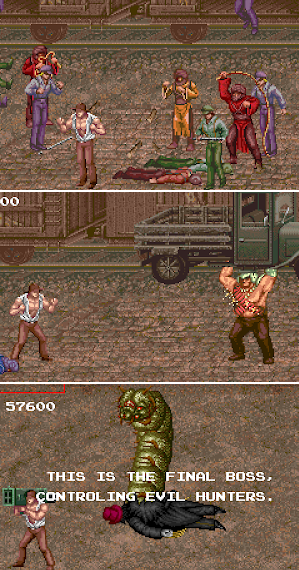
- As depicted above, Growl is all about beating hordes of poachers to death and freeing captive animals. When you take out their leader (a masked freak with enough strength to throw a tank), his corpse begins to slither around the arena, when suddenly a millipede bursts out of his back and states that it is the true leader of the poachers. The Angry Video Game Nerd lampshaded the twist as the game being "Taito as fuck". (Players of the Darius games will recognize it as one of the aliens from those games, but there were barely any hints that Growl shared a universe with them.)
- Iron Commando have your enemies being humans or machines, until you reach the Huago Brothers - a pair of demons with flaming skulls for heads and blast fireballs from their hands. You take them down like any other boss and no such oddity appears for the rest of the game.
- Legend of Heroes have you fighting an invading army throughout, all of them being human enemies, until you defeat the main villain, the Evil Prince. And then it's revealed the prince was actually possessed by the ghost of the enemy army's previous general (a Posthumous Character briefly mentioned in the intro)... despite the entire game having zero hints of the paranormal existing. You then fight said ghost in a kung-fu duel to finish the game.
- Mortal Kombat Mythologies: Sub-Zero: In stage 7, the boss of the level is a knight riding a fire breathing Allosaurus. Nothing about either the knight or the dinosaur are explained, and why Quan Chi or Shinnok would have them as enforcers in the first place is a mystery.
- In Noitu Love 2 we have some pretty strange bosses. Starting with a boat with tank treads that tries to run you over in stage run, to a train that apparently thinks it's some kind of transformer, to the last boss, which becomes a fetus thing, a giant mechanical thing with gears, and... A person.
- Mimmy from No More Heroes 2: Desperate Struggle. Even in a series known for having eccentric, wild bosses, Mimmy's unique for 1) not being a ranked assassin on your kill list, 2) inexplicably taking place in a dream world, 3) having an unexpectedly cutesy anime design among a stylized, but generally realistic world, and 4) not even being fought using Travis, but his brother Henry, marking the only moment in the game you play as him. Considering the intensity of the previous boss fight against Ryuji (as well as how Mimmy is never mentioned again following the fight), it's almost like the game going "Yeah, we're sorry if the last scene upset you, here's a wacky brawl against an anime girl to lighten the mood."
- Raging Blades, a High Fantasy-themed video game, have you fighting goblins, minotaurs, skeletons and various knights in armour, until the game decide to sic a Transforming Mecha as a boss, capable of firing laser blasts on you with it's Arm Cannon.
- When The Simpsons got their own Beat 'em Up arcade game made by Konami, there was only the first season to draw material from. Thus, we got such surreal bosses as an evil Werner von Braun, a Krusty The Clown parade float piloted by Mr. Smithers (who is also evil in this game), two mobsters who copied the two-player combination attacks, a Cerny-esque fire-breathing giant hiding in Moe's Tavern, a bear, an anthropomorphic bowling ball conjured by Homer's imagination, and a Noh Theater actor with a spear. It really says a lot when the boss that makes the most sense is Mr. Burns in a robot suit.
- Silent Dragon, for the most part, is a brawler that have you beating up generic-looking biker thugs and human mooks, until one level throws a red insectoid millipede-human mutant (capable of breathing fireballs and performing a Rolling Attack) at you as it's stage boss. And then there's the following stage, which have you fighting a handful of generic punks again... until you suddenly face a human-bat hybrid monster flanked by a fire-breathing mummy. There's two more minor human-bat enemies later on after you defeated a bunch of human mooks in a later stage. The games Final Boss also technically counts under this, since he appears to be a human until you defeat him... but then he sheds his skin to reveal his robotic form, one that looks a bit like Ultron.
- Streets of Rage 3 has each boss fit closely with The Syndicate. The boss of stage 4 is a ninja that can split himself into three copies, use Super-Speed as a tackle move, become invisible, and teleport everywhere. Better yet, the fight takes place in front of a Japanese styled building and the song that plays during the fight is called "Shinobi". None of the protagonists bring this up after the fight is over, though the Fan Remake does lampshade at how random the encounter was.
- Super Punch Patrol have you fighting the Final Boss, Don Diablo, in his office, and while he starts off as a normal human, after you defeat him Don Diablo suddenly lose his skin and turns into a Big Red Devil that is pretty much Satan without being referred to by name. There are zero supernatural elements prior to this fight, all the earlier mooks and bosses are humans. Granted, his Meaningful Name ("Diablo"?) might clue you off, but still.
- Team Fortress 2 Fan Game Team Fortress Arcade originally has you fight against your opposite-colored equivalents one at a time as bosses, all armed with Secret A.I. Moves. Make it through all nine levels and you're thrown into the bonus level: Aperture Labs, where you end up fight a Humongous Mecha Cave Johnson, who attacks you with explosive lemons and Giant Hands of Doom. He is invincible until you get help from Saxton Hale flying onto the screen to uppercut Cave Johnson's head off body so you can attack it. No, really.
- X-Men (1992):
- The arcade game inexplicably throws Nimrod (an advanced Sentinel from the future) at you. It doesn't make any sense why he would be working for Magneto, since he was designed to hunt and kill mutants. It's possible, and not without precedent in the comics, that Mags could've captured and reprogrammed Nimrod into serving him, but this isn't suggested in the game itself.
- An even bigger space flea is the Wendigo. Not only does he have no in-game ties to Magneto, but you fight him in the Savage Land, a tropical oasis in Antarctica, whereas the Wendigo in the comics is mystically bound to northern Canada on the other side of the planet.
- At the end of the second-to-last level, some pharaoh statues (Living Monolith) attack you in the tomb without any foreshadowing, and earlier on in the level, the players get attacked by six weak clones of Pyro.
- Battle K-Road is supposed to be a semi-realistic fighting game reasonably grounded on reality, with the most outlandish thing about the tournament involving fighting a MMA practicing Cyborg. And then all of sudden the game pits you against a Bear, cappable of delivering a Shoryuken.
- Battle of Giants: Dinosaurs has Mystery Bosses, who are not super dinosaurs, but instead angry inanimate objects. They include monster trucks, rockets, telephone boxes, and a schoolhouse. It's jarring because otherwise you're in some kind of Land Before Time-esque world filled with dinosaurs, and no explanation is given for the phone boxes attacking you. On the other hand, seeing a T-Rex beat up a school is crazy awesome.
- BlazBlue: Chronophantasma and Centralfiction have Azrael. While he's not mindless, he's frequently referred to as the Mad Dog, as his existence seems to revolve solely around finding something to punch really hard. Even the developers have stated that his purpose in the plot is simply being someone that anyone could fight at any given time. His origins are never explained; he just kind of shows up wherever.
- Who's the final boss of Guilty Gear Isuka? Is it Justice? Nope. Dizzy? Nope. That Man?!? Nope again. It's Leopaldon. Some strange, gigantic white beast with a huge puppy inside its mouth that is being controlled by a man in black who looks somewhat like the Black Mage.
- The King of Fighters XIV: You're in a straight up martial arts tournament, but when you defeat the champion, a demonic entity called Verse suddenly appears and attacks the stadium. The endings of several of the teams involve trying to figure out just what the heck Verse is and why it attacked. More things about Verse get explained in the sequel, The King of Fighters XV, while its master and new final boss, Otoma=Raga, takes up the position as this trope (albeit with some more explanations given to the player)
- Lethal League gives us Doombox, an Ax-Crazy robo-boombox thing. He just shows up at the end of challenge mode, revealing himself to be the boombox at the bottom of the screen, before challenging you. No Foreshadowing, nothing. The sequel does give him some backstory (he's an out-of-control experiment who took hold of the first machine he could find, which was coincidentally a boombox), but that's about it.
- Street Fighter:
- Akuma's first appearance as the True Final Boss in Super Street Fighter II Turbo, where he appears out of nowhere and kills M. Bison, who you normally fight. His name wasn't even shown then.
- Akuma similarly comes from nowhere to face you in Puzzle Fighter. Then again, the boss you were "supposed" to fight is Dan Hibiki.
- Capcom vs.:
- The seventh round fight in Marvel Super Heroes vs. Street Fighter is Apocalypse—fair enough, he's a significant Marvel villain... And then, suddenly, Cyber-Akuma!
- This happens again in Capcom Fighting Evolution. The game doesn't have a plot, yet it's still ridiculous seeing Shin Akuma suddenly showing up after defeating Pyron. Admittedly, you can only fight him after fulfilling specific requirements, but still...
- If you said that Yami would be the boss of Tatsunoko vs. Capcom prior to its release, everyone would be mocking you. Improved upon in Ultimate All-Stars, where some characters do in fact acknowledge 1) that Yami pulled their worlds together and 2) they had to beat it to undo said pulling.
- The obscure arcade fighter/beat 'em up hybrid Mutant Fighter, after having you battle a variety of fighters and beast in hand to hand/grappling combat, reveals its final boss to be... "Magician", a wizard who barrages you with spells and doesn't throw a single punch. While not as jarring as some examples, the fact that you get to the end of this elite warrior hand to hand tournament and find a magician is like getting to the end of Street Fighter II and finding a Terminator expy waiting for you instead of M.Bison.
- Kaguya's boss fight in Naruto Shippuden: Ultimate Ninja Storm 4 may qualify as this considering how her insertion into the original anime/manga is widely seen as a poorly handled retcon.
- Samurai Shodown VI is a "festival" game whose plot is basically that Yoshitora Tokugawa is holding a swordfighting tournament and will use his powers as "ruler of everything" to grant the winner one wish. The tournament gets hijacked by one of the four previous final bosses, then you go to HELL and fight Demon Haoh, right out of nowhere. Like the Tatsunoko vs. Capcom example above, neither the "hijacked" boss or Demon Haoh are ever mentioned again.
- The Subspace Emissary in Super Smash Bros. Brawl sees Rayquaza attacking Diddy and Fox for no apparent reason. From a lake. It's supposed to live in the sky.
- Tekken:
- The final boss in Tag Tournament is Unknown: a woman whose actions are controlled like a puppet by a forest spirit — which looks like a werewolf's torso — floating behind her. It probably helps that the game is non-canon, but she/they still come out of nowhere.
- Tag Tournament 2 has Unknown return, but she's less Space Flea-y this time around because the game confirms the Epileptic Trees floating around about her being Jun Kazama. (Well, at least for the continuity of Tag 2 itself. note ) Also, as a Continuity Nod to Unknown's own ending from the first Tag, the wolf thingie is gone, though the arcade ending sees Unknown attacked by multiple wolf spirits after she's defeated.
- The Touhou Project fighting game Touhou Hisoutensoku ~ Choudokyuu Ginyoru no Nazo o Oe features three of them.
- One is Utsuho Reiuji, the final boss of Touhou Chireiden ~ Subterranean Animism. It's a bit of a stretch, though, as Sanae is descending into the geyser control center when you run into her, and if you're at all familiar with the story of Subterranean Animism, you probably expect to see her or at least someone else from that game.
- After you beat Utsuho, you fight Sanae's final boss, Suwako Moriya, who actually does come out of nowhere. Given that Suwako is already in the game as one of Sanae's assists (and you can even use Sanae's Suwako assist during the fight!), it's safe to say that no one was expecting her to be Sanae's final boss.
- Even Suwako pales in comparison to the horror that is Hong Meiling's final boss in her story. It's a giant catfish. This one can be excused due to Meiling's story being All Just a Dream, but even then you'd think the final boss would be another Touhou character...
- The original ClayFighter has N.Boss, a being that seems to be made out of shiny orbs and whose attacks mainly consist on throwing the missiles of other characters. Nothing lampshades his appearance and the announcer doesn't have voice clips of his name, leading many to believe he was a last-minute addition. The Tournament edition of the game expands on the game story, but still there's no mention of N.Boss anywhere and the only mention of him after that is on the sequel where its said that Tiny was the one who beat him.
- The ending to Borderlands. You're all geared up to fight Commandant Steele, whose mercenaries have been making your life difficult for the last quarter of the game, when suddenly a massive Eldritch Abomination pops out of the vault, impales Steele and swallows her whole, and then tries to kill the player.
- Crawmerax the Invincible, which you can fight after finishing the main story of the DLC The Secret Armory of General Knoxx, is an honest-to-goodness Giant Space Crab from Nowhere. The only background for the quest is that there is a legend about a giant invincible crab and that there have been tremors since you completed the final story mission. It has no bearing on the main story at all.
- The ending to Borderlands is lampshaded in the intro of Borderlands 2, where Marcus states that the only things the Vault Hunters found were tentacles and disappointment. Also from 2, the giant loader Saturn shows up with absolutely no warning at all.
- 2 sees the return of Invincible Space Fleas from Nowhere, including the Giant Space Tentacle Monster from Nowhere named Terramorphous the Invincible, the Regular Sized Space Engineer from Nowhere named Hyperius the Invincible, and the Larger than Average Space Kung Fu Master from Nowhere named Master Gee the Invincible, among others.
- Borderlands: The Pre-Sequel!: The Vault on Elpis is guarded by the Sentinel, a giant Eridian robot that vaguely resembles the Guardians. It's not foreshadowed at all beforehand (in fact, an entirely different character is foreshadowed as the final boss, but she turns out to be something entirely different), and no one talks about it afterwards.
- Ironically enough the PreSequel does, in fact, give the backstory to Borderlands 2's Terramorpheous. As it turns out, the Thresher species is very common on Pandora's moon and an optional quest has you sending specimens to Pandora for Sir Hammerlocke.
- CyberMage. You've fought your way through all manner of gun-toting mooks, killer robots and genetically-engineered Super Soldiers in high-tech research labs, a crime-infested Wretched Hive, the headquarters of a Megacorporation, a blasted-out battlefield, and an Absurdly Spacious Sewer (twice) - all bread-and-butter for a First-Person Shooter in the Cyberpunk genre. Then right before The Very Definitely Final Dungeon you find yourself inside a gothic citadel with unmistakably medieval architecture, fighting off robed cultists and LivingShadows that wouldn't look horribly out of place in Origin Systems Inc's other game, Ultima. Even All There in the Manual sheds no light on the in-universe origins or plot significance of this place.
- Doom mod Reelism:
- The World's Most Boringest Ghost, a spectral entity who shoots plasma at you.
- There's Dog Pope. It's a dog wearing a pope hat, who shoots out bees at you when he barks.
- There's MacGuffin, a gigantic green hobo who breathes fire at you.
- And to top it off, there's a wizard who drives around in a monster truck.
Manual Description: You know what? I think this pretty much explains itself. Have fun getting run over!
- The monsters of Evolve are treated as such in-universe. No one knows where they're from, why they're here, or what they want. A few specific conversations gives the player a basic understanding of the answers. They're from another dimension, they were drawn here by the Patterson Effect, and they want to bring the universe into a more stable state. The destruction and slaughter were merely in pursuit of that goal, though their success will mean no one is left to care.
- Hellforces is already a game that runs on Random Events Plot, but one stage throws living dinosaurs at you. Dozens and dozens of them. When all your previous enemies are either zombies or human mooks. They appear exclusively in only one area as well, where your later enemies are mostly humans (save for some areas with robots).
- Postal 2 was a semi-realistic game in that there were no "bosses" or monsters, just a free-roaming journey through a town inhabited by assorted screwed-up gun-toting humans with varying levels of craziness. Postal 2: Apocalypse Weekend ends with the sudden and completely out-of-left-field appearance of a "final boss" in the form of a 20-foot tall demonic half-cow half-man who declares "I am Mike J, Kosher Zombie Mad Cow, God of Hellfire! All bow down, and worship my asscock!" and summons severed floating heads of Gary Coleman to create a bulletproof shield around him. The Postal Dude promptly lampshades the trope by stating "Some designer has lost his tiny mind". The only foreshadowing you get is somebody saying that Mike J, the game's Producer, caught mad cow and had to call in sick, and even then that’s at the start of the DLC, and in a offhand manner making it really easy to dismiss as just a throwaway joke. At first you think this is just from The Dude's head wound as the other hallucinations were... until Mike J returns in Paradise Lost, still mutated and massive. The DLC has weirder parts as well.
- Sharpshooter 3D have you fighting gangsters, drug dealers, corrupt cops, and all sorts of human enemies throughout the crime-infested city of South Slovenko. You then confront the Corrupt Politician responsible for all this mess, only for the mayor's upper body to suddenly burst open and reveal a multi-tentacled, insectoid alien monster. Who's been using the mayor as a Mobile-Suit Human for the entire game. And after you kill the monster, the game ends without an explaination of what just happened.
- Golden-Eye from Turok 2: Seeds of Evil, whom you face at the end of the fourth level, the Lair of the Blind Ones. The blind-ones are a race of sightless cave-dwellers, and once they're dealt with, you find yourself in a large empty chamber for the strangest boss battle in the game: a large orangish eye in the ceiling that glares at you while fighting you with tentacles and a swarm of maggots. What Golden-Eye is supposed to be (besides disgusting) is never explained; one could conjecture that it's the leader of the Blind Ones, and the maggots you fight could be them in larval form, but no concrete information is given.
- For many players the fight against Tenzen near the end of Final Fantasy XI: Chains of Promathia makes no sense. Well, to be fair a lot of CoP's boss fights come out of no where, but Tenzen stands out because he has been an ally through the whole expansion (and continues to be after the fight). You've learned almost all there is to know about the expansion's plot, you've tracked down the Big Bad's location, and you're about to head off to assault the ancient hidden city of "Sea". So why your ally suddenly attacks you is beyond explanation. Some have tried to handwave it as him testing your readiness for the battles ahead, but none of the dialogue before, during, or after the fight backs that up.
- For Final Fantasy XIV's crossover with NieR: Automata, the final boss of the Tower at Paradigm's Breach, as well as for the YoRHa: Dark Apocalypse arc, Her Inflorescence, will come off as this to those who only came into Yoko Taro's works by way of FFXIV and/or Nie R: Automata. For those players who've been around from the beginning since Drakengard and have followed the entire series, it however has dire consequences not just for the world the Warrior of Light is fighting in and for, but the rest of the universe.
- Guild Wars has one of these in Eye of the North, the Disc of Chaos. It has some of the highest health and damage seen on a mob and uses a model that has been flipped horizontally so it floats. The Disc only appears during its fight and is never mentioned before or after. Also, whereas all other Destroyers have names in the format of "Destroyer of" or "of Destruction", the Disc is the only Destroyer to not follow this pattern.
- As silly and nonsensical as Kingdom of Loathing is, the final boss of the main quest takes it to a whole new level. Most other enemies in the game are parody versions of RPG monsters, which you kill with weapons and/or spells with goofy names. The Naughty Sorceress is no exception; she appears to be your basic evil female spellcaster, but her "true form" is some kind of Eldritch Abomination covered in eyes, fanged mouths, and Combat Tentacles. After you beat that, she takes on her "actual true form" and turns into a goddamn sausage. With ludicrously high HP and Reality Warper powers. Which can only be defeated by using anagrams to deflect its attacks.
- Invoked in Phantasy Star Online 2, thanks to the randomly-generated nature of the game's stages, particularly multi-party areas, where bosses can spawn at any time. Even bosses from different fields (but still the same planet) can spawn, such as the Tranmizer, the sub-boss for Lillipa's Mines, appearing on Lillipa's Desert and Quarry. Darker bosses are exempt from the "same planet" rule, and can spawn in any field, regardless of which field they act as the boss of. Limited quests and emergency quests are generally exempt from the "same planet" rule. There are a small handful of exceptions such as Devil Towers and emergency quest superbosses due to their mechanics being dependant on their unique arenas to function properly and their movement patterns often not being compatible with a regular field.
- Runescape:
- The game has Chaos Elemental who, instead of residing in some sort of cave or building, is located in a seemingly uninteresting and generic spot in the Wilderness. So it is very easy for new players wandering the wilderness to run into it by accident and get killed in seconds. There is a sign that warns about the Chaos Elemental but it is very easy to miss and is also located nowhere near the Chaos Elemental, and doesn't even tell you where the Chaos Elemental is.
- A few of the quests have boss battle creatures that come out of nowhere and have nothing to do with the story, just to make the quest a bit harder.
- Lampshaded in the 'could you fetch my ball from the fenced yard' quest: the unnecessary boss morphs into six or seven arbitrary forms with escalating difficulty. Inverted in that earlier in the quest, you read the witch's journal where she mentions her experiment.
- Averted in My Arm's Big Adventure. In this quest, you teach a troll how to farm. Once you have the stuff you need, My Arm (trolls are named for either the first thing they try to eat, or for the noise said thing makes; it was his father's arm) warns you about a "bird". Sure enough, once the goutweed is planted, a Giant Roc attacks you. If you're the type of player who ignores dialogue, you would have been caught by surprise. The mod who wrote the quest was probably counting on that.
- The quest Swan Song had you defending a town against an invasion of sea trolls. The final boss of the quest is a monster called the Sea Troll Queen, but it looks absolutely nothing like a sea troll and more resembles a weird octopus monster. Why this thing is the queen of the sea trolls is never explained.
- In the Star Trek Online mission "Installation 18", if you're playing as either a Federation or Klingon character, this is the first time you meet an Elachi. It's tough to fight, especially flanked by Tal Shiar soldiers, and it holds no bearing to either storylines. This is because it's actually geared towards the Romulan player, who has a whole history of dealing with these things.
- Toontown Online has this as its main plot, in which robots called Cogs show up from out of nowhere and started invading the game's world for just no reason.note
- World of Warcraft:
- In Drak'Tharon Keep, the players fight a skeletal wind serpent named Tharon'ja. The Dungeon Journal introduced a patch and a half later explains that Tharon'ja was one of the trolls who killed and stole the power of a loa, only to be killed in turn and turned into a servant of the Scourge and the Lich King.
- Prince Malchezaar of Karazhan. The other bosses are mostly ghosts or magical constructs left behind in Medivh's castle, but while he's associated with the Eredar, it's never stated why he is there. The same applies to the nether dragon Netherspite. Malchezaar is considered by Blizzard to be the last boss of Karazhan, effectively making him its ruler, as far as the unexplained storyline goes. The question of what does the Burning Legion want to do with a place like that is left for us to wonder. Karazhan is the only place they can do anything with at all. It reaches into the Twisting Nether and thus can be used to try and invade Azeroth. In fact, it's been hinted that Karazhan was relatively quiet up until Malchezaar appeared and started stirring up the spirits. More importantly, Karazhan is three unfinished dungeons (Well, one finished, two unfinished) combined into one.
- A lot of minor dungeon bosses are this. They get one throw-away line to explain who they are and what they're doing. Sometimes. In Cataclysm some effort has been made to explain some of the more bizarre bosses. New quests for classic dungeons offer some explanation of their background, though not every boss gets this.
- The final boss of the Worgen starting zone. Rather than using Crenshaw, the previously-introduced undead general that had bombed Gilneas City, Blizzard decided to put you and your friends up against a weird mutated orc named "The Machinist", who had never even been hinted at.
- Algalon the Observer in Ulduar. He doesn't really have anything to do with the plot, other than wanting to destroy the world because it is "corrupt". For this reason, he is optional. However, story developments in more recent expansions have made him a little bit less random.
- Jaraxxus is one of these. Though in this case, that's because he was summoned by an insane mage. His infinitely memable entrance however, makes him a fan favorite. The mage who summons him in this fight also appears as a Giant Space Flea in a later dungeon.
- There's zero indication why you have to fight any of the bosses in Crash Bash. The Excuse Plot is about the contest between Forces of Good and Evil, so why you need to fight some presumably neutral force (who will fight anyone independently of affiliation) after you collect enough of different junk is anybody's guess. Of these, Bearminator pushes it even further, because while other bosses are at least based on previous game's characters, this one is a giant polar bear (which may or may not be one from Crash Bandicoot 2: Cortex Strikes Back, but that's it) that rides a submarine and shoots bombs and robotic polar bears with missiles at you.
- WarioWare, Inc.: Mega Party Game$!: "Milky Way Delirium" has a giant robot appear without warning at the very end of the game (the instructions mention an "ultimate challenge" but not the robot itself). The leading player must win a microgame (with the other players' asteroids as interference) to destroy it.
- In The Adventures of Tom Sawyer, most of the bosses are in line with the level themes, but this is not the case with the Forest stage, where the boss consists of a gang of monkeys that merge into a King Kong-style giant ape.
- The Angry Video Game Nerd Adventures has an unexpected appearance by The Giant Claw, which the Nerd had never mentioned in his prior videos, although James Rolfe reviewed it on his Cinemassacre's Monster Madness series. When the Nerd reviewed the game himself, he made note of its appearance.
- Amagon's final stage has you fighting Mecha-Mooks on a beach to reach the rescue ship. Once you get there, you encounter The Flatwoods Monster, of all creatures, as the Final Boss.
- Banjo-Tooie has a rare case where the Giant Space Flea is actually less weird than the stage it comes from. Mingy Jongo, a robotic duplicate of friendly shaman Mumbo Jumbo who ambushes the titular heroes in a fake skull house, is found in a place that's literally named Cloud Cuckooland, a series of floating islands with oversized foodstuffs, eyeball flowers that launch eyeballs, and paper-thin goblins that attack with sausages and flowers. Compared to the rest of the wacky inhabitants, he looks downright tame in a series known for its strange and silly cast of characters.
- A Dub-Induced Plot Hole version: After defeating the Big Bad Plutonium Boss in the English version of Blaster Master, a strange cyborg knight with a plasma whip appears out of nowhere to challenge you. The Japanese manual featured a different story where the boss's presence made more sense, which was completely changed for the English localization.
- Muga from Densetsu no Stafy 3. It appears as the boss of the Sea of Sky as sort of a boss variant to the watcher enemies found earlier on, but otherwise its presence isn't really explained.
- Donkey Kong Jungle Beat features our simian hero fighting warthogs, other gorillas, and the occasional robot elephant. Then you get to the final boss fight, and meet: The Cactus King, a weird, green, giant space-gremlin with what looks like a dead tree for a head and rides a fire-breathing pig. Nothing in the game even hinted toward this character's existence, he has no motives, and totally clashes with the aesthetic featured in the rest of the game.
- The Dark Eco Plant of Jak and Daxter. It bears no resemblance to any other enemy and seems to have no alliance with them, while at the same time having no bearing on the plot. What's even stranger is that the entire Forbidden Jungle has holes strewn throughout with tentacles poking out that foreshadow the boss. While it appears that it'll be leading up to another great plot hatched by the Lurkers, it turns out to just be an angry flower.
- A notable subversion in Kirby Super Star: The final bosses of Milky Way Wishes are this unless the player watched its introduction sequence. However, in the original Super Nintendo Entertainment System version, the introduction sequence was both optional and not indicated to even exist, meaning many players probably wondered what was going on at the end of the game. This was corrected in the DS remake, where the introduction was automatically played.
- Klonoa 2: Dream Champ Tournament, as its title suggests, revolves around a tournament. However, the boss stages don't involve actually fighting the other competitors; instead, you have to race them, with your opponents acting like time limits and not otherwise showing up in the gameplay. The actual bosses of the game are just random creatures who appear on the track.
- Mega Man:
- Mega Man 3 has Doc Robot using the powers of the Robot Masters from Mega Man 2 after you beat the initial eight. There's no explanation for what he's even doing there in the first place, nor do we ever really get one.
- Sunstar from Mega Man V is very out-of-nowhere. After spending most of the game with the Stardroids as the Big Bad, then having it be Wily behind it all, it's very bizarre to have the Final Boss be a doomsday weapon never even hinted at throughout the game and with no reason to be there (unless you read some books saying Wily found him alongside the Stardroids).
- In Mega Man Zero 2, the boss of one level is actually three minibosses in a row, one for each element represented in the series (Fire, Ice, Lightning). While you encounter the Thunder and Ice miniboss during a normal run, the Fire one can only be found in an optional area at one level, so if you didn't follow that path, the Fire Golem seems to appear out of nowhere.
- Pizza Tower: Fake Peppino. He very deliberately has no build up or foreshadowing to his existence to make his reveal that much more shocking. And even after, thanks to Pizza Tower's very minimalistic storytelling, there is exactly zero explanation offered as to where he came from, why he's there, how he came to be, whether he's artificial or was just born like that, if he's loyal to Pizzaface or a Punch-Clock Villain, or what the hell he even is. He's just...Fake Peppino, and he exists.
- Ratchet & Clank:
- In Ratchet & Clank: Going Commando, the UFO bonus boss fight with Giant Clank. It just shows up as a place you have Giant Clank fly to in order to fight it. Why you need to fight it is not explained. Why it's even there is not explained. Absolutely nothing about it is explained. The only reason to fight it is to get the Mapper, which is a useful but optional piece of equipment.
- The sequel has teleporting warship in docks of planet Daxx. It just shows up when you explore the docks, shooting missiles along the way at you until you come to the end of the path where you fight it. No explanation for its presence is given.
- Sonic the Hedgehog:
- The boss of the Sandopolis Zone Act 1 from Sonic and Knuckles. All of the other bosses in the game (and in fact most other Sonic games) are either Robotnik or his robotic henchmen. And then at the end of Sandopolis we get this big huge... golem thingy that you have to trick into the nearby quicksand pit. It was referenced in Sonic Adventure 2 with the "Egg Golem" boss. Except that one was bigger, defeated in a different way, and was clearly a robot designed by Dr. Eggman.
- Sonic Adventure 2 has King Boom Boo, who jumps Knuckles after the "Death Chamber" stage. While smaller ghosts appear in some stages as minor enemies, there is no explicit reason for a giant ghost to suddenly pop up in the depths of Eggman's desert base, and aside from Knuckles describing the fight with King Boom Boo as "pretty rough", no mention is made of this boss ever again.
- The first boss of Sonic Rush Adventure, the Ghost Rex. The actual plot of this game is built up very slowly, and so many of the first few levels are just Sonic and Tails trying to accomplish some things on their own, so when a gigantic, mechanical T-Rex drops down and fights Sonic before a villain has even been established, it's... jarring, to say the least.
- The licensed game SpongeBob SquarePants: SuperSponge features The Iron Dogfish as the final boss. Its' sudden appearance is even Lampshaded where before every boss battle you are given tips and information about them from Mermaid Man and Barnacle Boy, however they have no information on this boss and they wonder where it could have even come from.
- Parodied in Stinkoman 20X6. The boss of the Darius-style level — where all of the Mooks are generic sea-life or robots that resemble them — is described in the manual (which initially had no picture of it) as "a small and speedy octopus or squid."note
- Magic Mushroom from Tonic Trouble who randomly shows up to steal your last piggy bank.
- Spinmaster, in a somewhat random encounter, throws a giant blue ghost in the underground stage as it's boss, one which is large enough to take up a whole chunk of the screen but can be damaged by projectile attacks used by Johnny and Tom. Said ghost can also split itself into multiple smaller ghosts periodically to overwhelm the players through numbers, where after killing all but one of those smaller ghosts the last one will revert giant-sized. Repeat until it's defeated.
- Transformers: Convoy no Nazo isn't quite an example (Trypticon is an existing Transformers character, though him being the Final Boss is kind of weird), but the game does still have an example in the form of a giant Decepticon logo that's fought more than once throughout the game.
- The final world of Wild Woody is in a horror comic. The other worlds had bosses related to their theme, so you'd expect to fight a vampire, zombie, or demon to go with the graveyard and hell settings of the previous levels. Instead, you get a green monkey skeleton that flies around while swinging a paddle. Meanwhile, the final totem piece is inside a toilet that's walled off from the rest of the level, and you win by luring the monkey towards a lever that drains the toilet's water.
- Indie platformer William And Sly has this with its final and only boss. Okay, it is mentioned in the beginning that something strange must be going on at the storehouse. But still...the game is an hour or so of relaxing platforming in the vein of Knytt. Impressive vistas, all exploration and scavenger-hunting, only a handful of not-very-threatening enemies. Then you top it off with an awkward and difficult fight against a giant phantom in the shape of a cobra's head.
- Yoshi's New Island: "Suddenly... warping through space and time... King Bowser appears!" No, not Baby Bowser, we're talking about the adult Koopa king himself. When you defeat Baby Bowser, it seems as if you've beaten the game, but then Bowser abruptly appears, and you're forced into a Boss-Only Level, complete with a giant phase (minus the Glowing Eyes of Doom like the giant Baby Bowser had). When you defeat him, he disappears and is never mentioned again. The adult Bowser also abruptly appears at the end of the end credits if the Flutter Wings were used, challenging the player to beat every level without using the Flutter Wings in order to battle him.
- The Home Alone video game adaptation on the Game Boy has the final boss, the Furnace. It is not directly hinted in either the manualnote or the game itself. After the supposed final boss battles between Marv and Harry, the Furnace appears with little fanfare, where Kevin must fight it to complete the game.
- Many, many bosses in Destroy the Godmodder, especially in the first game. At least later games attempt to at least somewhat integrate the presence of their bosses in the plot, but they still contain notable examples. The most infamous Space Flea from 2 was Binary Prime, a living code glitch from Intermission 1 that was only put into the game because the GM still didn't have his computer fixed.
- The final boss of Cool Cool Toon is the Flitz Ghost, a goofy-looking green monster whose existence has not been mentioned at all until then, and whose entire story role amounts to "it's a Sealed Evil in a Can, King has to guard its seal, and Yusa wants to free it, which would be a bad thing." It doesn't help that it doesn't have any appearances in cutscenes.
- The Binding of Isaac:
- Some of the True Final Bosses fall into this category. While the final fight against Mom makes sense, as does Mom's Heart in The Womb to an extent, the latter is eventually replaced by It Lives, which makes less sense. The Halloween update adds Sheol and Satan, which make some degree of sense, but then Wrath of the Lamb adds two more space fleas: Isaac himself and Joke Character ???
- The first new Final Boss of Rebirth is a space flea as well. Apparently the next logical step after fighting Satan is to fight The Lamb, some random demon found in the Dark Room. And after him, at the very VERY end we get Mega Satan. It's just Satan again for no given reason.
- The expansions continued with this theme further. Afterbirth added The Hush, who had nothing to back up his existence before. And then at the very end of content in Afterbirth+ added Delirium, who was out of nowhere, however killing it puts the entire game into perspective.
- After Armageddon Gaiden: The final boss, the Will of the Planet. It appears after you've beaten the game's main villain with little build-up or explanation outside of an ally telepathically telling you that it's a monster made by the villain to suck the life from the planet.
- Baldur's Gate 2 had the Twisted Rune. Originally intended as the hidden cabal behind several sidequests, including the Athkatla slaver ring and the serial-killing tailor, the actual breadcrumb trail that was to lead to them ended up as cut content. They remained in, however, peacefully chilling in their evil clubhouse under the docks district unless the player randomly stumbled across the entrance, resulting in being dropped straight into a battle with an eclectic bunch of obscenely overpowered spellcasters after trying to enter an ordinary-looking house.
- Baten Kaitos: Lost Wings and the Eternal Ocean. At one point, you're in a ghostly area where it's stated that the walls between dimensions is weak. Best way to showcase this? A giant monster bursts out of another dimension, and you fight it back in.
- Baten Kaitos Origins is particularly infamous for the Holoholbird, a boss you have to face immediately after inserting the game's second disk. It's already one of the most ridiculously difficult boss battles in the game thanks to the Bird's infinitely-spawning minions constantly healing it, but on top of that it's completely unexpected and appears at a point where it's nigh-impossible to go back and prepare for it (you're stranded in a forest with no other enemies to grind on, and you just saved). If your party is underleveled and you have no extra save file, you may very well find yourself stuck there.
- BoxxyQuest: The Gathering Storm:
- The game does a pretty good job of linking its bosses to the plot, and the few that aren’t at least make sense given where they’re fought. (A kraken attacking the ship? Expected. A ghost in the basement of an old windmill? Fair enough). However, nothing even tries to explain "The Spirit of CTH'RISTMAS," a surreal Christmas-themed Eldritch Abomination that looks like an unholy fusion of Santa's cap and Cthulhu himself, which shows up to menace the party in one post-game sidequest. Afterward, even the local NPCs are totally baffled.
- There's also the Wendigrief, a mini-boss in Chapter 5's haunted forest. It gets about one screen of buildup before you fight it, and then it’s never mentioned again until the Developer's Room.
- Brave Soul has two. One is a giant flying goldfish, although it gets a pass since it's found in some sunken ruins, and most of the monsters in the game look pretty weird anyway. The other, however, is a giant beetle, found in a Dragon's cave, and can't even be fought during the first visit, because of a scripted event triggered by the associated quest taking over control and moving the player directly to the destination. The only reason it was even included was because one of the developers already made it.
- In Chrono Trigger, every boss you fight up until the battle against Dalton on top of the Epoch is more or less relevant to the plot. After that, you have the choice of battling Lavos one last time or go on several Side Quests. However, one boss fight during the main storyline occurs for no reason. It's the fight against the Mud Imp and his 2 Mudbeasts in the Terra Cave (12,000 B.C.). At the end of said cave, you'll see the 2 beasts standing in your way of entering the Mountain of Woe, then the Mud Imp arrives, yelling "Yer not gettin' through 'ere!" before the battle begins. If you kill the 2 beasts first, he'll eventually run away. Whether the Mud Imp dies or flees, it's never explained why he was in your way in the first place.
- Chrono Cross and the Time Devourer. Sure, Lavos is mentioned a couple times in passing if you go out of your way to read side documents near the end. Schala isn't. But the game already gave two 'final' bosses before this, one at the end of a long dungeon and the prior requiring a long attunement and the entire game having built up to it. But then you fight this giant space-eating glowing thing that merged with Schala somehow and defeat it with The Power of Rock? What the hell? Dropping Magus in would have made about as much sense. Hell, Chrono, Marle, and a zombie Lucca would have made about as much sense.
- In Dark Cloud 2 (Or Dark Chronicle), the final boss of the game, at the end of a bonus dungeon, is the Big Bad (for no reason) from the previous game.
- Duriel, the Bait-and-Switch Boss at the end of the second act of Diablo II, illustrates perfectly how even a boss with deep ties to the game's lore can end up as this trope if the developers neglect to include any explanation for the players. As one of the seven Great Evils, he held comparable significance to fellow bosses Andariel, Baal, Mephisto, and Diablo. However, the lead-up to the boss fight had suggested that players would be facing Baal instead, and nothing about Duriel appears anywhere in either the game's sound files or manual. The only way the player would know his true identity is from reading the Diablo 1 manual or finding in-game lore in Diablo III. Fittingly enough, however, he's there to fake you out while Baal escapes.
Duriel: Looking for Baal?
- Diablo IV:
- Duriel once again get a surprise occurrence, appearing in the middle of Act V. The only mention of him before his appearance is the speculation that Elias plans to summon him or Andariel, and it turns out to be the latter. Instead, Duriel randomly appears in the sewers of Caldeum with only vague warnings that something large was moving underground. Even the Wanderer is baffled after the fight.
- The Butcher has a random chance of spawning in any dungeon, regardless of whether demons are present or not. It will then make a beeline for the Wanderer and fight them until one of them dies.
- Digimon World 3:
- Armageddemon shows up just before you get to fight the Big Bad. Every other Digimon boss is foreshadowed by having an overworld sprite; he doesn't. It's debatable whether he's supposed to be a boss — the random battle theme is used and it's possible to run from him. He's also one of three old bosses featured in the final boss battle. He's used in a similar capacity in Digimon World DS, but this time he gets a line of dialogue and the player's character explaining what he is.
- The main plot of Digimon World 3 also does this. All of the terror in the Digital World was supposedly caused by the MAGAMI company. However, after dispatching all of their head honchos, something called Lord Megadeath shows up and claims responsibility for everything. You are then transported to his orbiting satellite, where you fight him. Absolutely no mention of this character is made until just before that sequence.
- .hack: The original games were actually decent about its Giant Space Fleas. All the 8 Phases of Morgana may have looked bizarre — as BlackRose was oft to point out — but there was a point where that was expected. Even Cubia was given ample foreshadowing, although his initial appearance at the end of the first game certainly may have been a surprise. The Sequel Game Series, G.U. however, had foreshadowing happening with its boss encounters, but most of them were obfuscaded by the entire storyline's 'Great Deception' running motif actively hiding events and causes until the moments of the big reveals. The first game ended with a surprise AIDA infection after a battle with Tri-Edge actually, Azure Kite...which makes sense once later revealtions make one realize the entire encounter was one big orchestrated trap to cause just that event in order to get Atoli to awaken her Phase; the second game ended with Tri-Edge being revealed as the monster hiding in Ovan's arm which was once more foreshadowed by previous events (particularly in .hack//Roots), hitherto thought to be where Corbenik was hiding...which ended up being proven true but that being so actually being key to why everything bad happened in the first place; then, suddenly, in the last game, Cubia appears as setup by the game's 'Terminal Disk' lore primer as what would happen if anyone tried to create another key of twilight like Aura did in the first game or pushed the Reset Button...which is exactly what Ovan just did Right before Cubia becomes a threat again.
- In both game's cases, NONE of the bosses actually end up being Giant Space Fleas by strict definition, as all the sidestory and lore primer stuff for the franchise spells out EXACTLY why they are appearing and why they are treated as such big deals...but that is less the case if a player didn't engage with the provided material. In the IMOQ games, the Phases are all a result of The games' big bad Morganna Mode Gone breaking down due to I Cannot Self-Terminate which is causing all the other bugs in the system, and turning programs part of the game's Black box AI creation files into the boss monsters by weaponizing said programs to harvest data (i.e. Human emotions, responses and consciousness) in the most hostile way possible which is what is trapping people's minds in the game to begin with. In the G.U. games, CCCorp shoving the recovered data of the Phases into player characters in an attempt to use them to create AI slaves for their own benefit(which failed disastrously resulting in them ending up in the PC's of G.U.'s Cast) actually messes up the game's black-boxed AI creation files so badly that the AIDA started spawning, and their desire for knowledge and understanding lead to all the events that follow when the most hostile AIDA started attacking players to take 'human' hosts and assimilate the data they need directly...and the most hostile one of them all ending up hitting the jackpot and parasitically taking over the PC Hosting Corbenik, before it has him attack his sister, and his desire to rescue her from it leading to the following events of the storyline. What's thought of as the Giant Space Flea's for the games...is actually tied directly into why all of their events are even Happening.
- In Chapter 2 of Deltarune, while walking through a side alley to clear an obstacle, Kris is suddenly jumped by Spamton, an surreal parody of spam e-mails who literally crawls out of a dumpster and engages Kris in a comical yet somewhat unsettling battle. If he is defeated by violence, Spamtom flees and is never seen again. Subverted if he is defeated peacefully though, as the player can find him again and start a new sidequest which results in Spamton becoming the chapter's secret Optional Boss
- Dragon Age II has The Ancient Rock Wraith, the final boss of the first act. While there is a lore explanation for it (it's the spirit of a dwarf too evil to return to the Stone), it's only revealed after the battle.
- Dragon Quest:
- Dragon Quest: There is an extremely persistent rumor that, in the Japanese version, the Dragonlord does not actually turn into a dragon, and instead the final boss is his pet dragon who attacks the hero after the Dragonlord is slain. This is false, however. In both the English and Japanese versions, it's a straight up transformation scenario.
- Dragon Quest II had one of the earliest examples of the Giant Space Flea from Nowhere final boss. After defeating the Big Bad of the game, Malroth (Sidoh in Japan and the Game Boy Color version), who he turned out to serve and worship, appears out of nowhere to be the final boss. This was particularly nasty in the US version, as absolutely nothing hinted at his presence aside from a minor quest item named "Eye of Malroth" (and the box art; look closely at the mural behind Hargon), and he is infinitely harder than the game's Big Bad, Hargon, mostly because he randomly casts Healall to set his life back to full whenever he feels like it.
- Dragon Quest III: There is not one single indication that Baramos is not the Big Bad before Zoma shows up to mock the Hero for defeating his pawn.
- Bjorn the Behemoose from Dragon Quest V can appear to be one (emphasis on the Giant, he's the size of a mountain and is fought from the top of a tower) via accidental Sequence Breaking, as the key he drops is needed for the final dungeon but he can be fought just after three-fourths of the way in the game.
- Mortamor of Dragon Quest VI gets namedropped pretty late in the game as well, with his evil being Offstage Villainy, via his minions.
- Dragon Quest VII mostly avoided this with Orgodemir, who is set up from the very beginning and is ultimately responsible for every single bad thing to happen to every place you've been (although you're mostly dealing with the effects of his villainy at first), although many lesser bosses you face turn out to be space fleas.
- Dragon Quest VIII: Geyzer, the merman guardian of the waterfall, comes as a surprise. Also Don Mole and the monsters you fight while escaping from the collapsing Dark Citadel.
- Dragon Quest IX: Tyrantula unexpectedly shows up to serve as the boss of the Marion story arc.
- Dragon Quest Monsters: Joker 2: While Leonyx is mentioned a few times in the game, the True Final Boss in Joker 2 is not once mentioned by any character before his reveal, just a few moments before your tasked with taking him down. And even in the context of the series, his design is pretty gross and out there.
- Drakengard is mostly a hybrid of Dynasty Warriors-style Hack and Slash and Panzer Dragoon/Ace Combat style flight combat. The True Final Boss is a Nintendo Hard Rhythm Game. It should noted that the game's soundtrack is primarily composed of classical music samples arranged to sound harsh and dissonant. All the other possible Final Bosses are fought in the same way you've been fighting for most of the game.
- The Elder Scrolls:
- During the main quest of Morrowind's Bloodmoon expansion, the player will encounter the "Ice Giant" Karstaag. Unlike the other participants in Hircine's hunt, you don't get to meet him until you have to fight him in in the glacier. He has a unique model: a giant, four-eyed yeti monster with horns, which is unlike anything else in the game. Where he came from or what he actually is never gets discussed in-game. (A popular fan theory from the time stated that he may be a Kamal, one of the Akaviri "snow demons" who staged a failed invasion of Morrowind in the distant past.) Skyrim later reveals that Karstaag was a Frost Giant, an offshoot of Giants that are native to a place called The Forgotten Vale. How he got himself to Solstheim? Still a mystery.
- Skyrim:
- A Thieves' Guild quest has Maven Black-Briar hire you to sabotage a competing meadery. The quest involves putting what amounts to rat poison into the Honningbrew Meadery's brew, and killing the skeevers (giant rats) that prompted the owner to hire an outside exterminator. Then you find an insane spell-slinging self-styled "skeever master" in the tunnels under the meadery. And he's not Squishy, and you have no clues that he even exists until the first Firebolt collides with your head. After you kill him, you can loot his journal to find out his backstory, and the quest-giver admits he knew about him, and didn't inform you to avoid getting gouged for the extra "wet work", but going in you have no warning he's going to be in there and his arrival is very surprising.
- The twin dragons Voslaarum and Naaslaarum, who appear in the Forgotten Vale as part of the Dawnguard DLC. There is absolutely no hint that there are even dragons in that region, much less two that are frozen under the lake. Unlike the Frost Giants in the area, unless you found a way around the lake you WILL meet these two during the course of the Dawnguard main quest. Fortunately, they aren't much stronger than your garden variety Revered Dragons and their only real gimmick is coming in a pair and destroying portions of the frozen lake as they dive in and out of it.
- Quite a few of the bosses in Eternal Sonata were these. Potentially justified, in that things don't always make sense in a dream.
- The Final Fantasy series has a bunch of them, some of which act as the Final Boss directly after defeating The Heavy.
- Final Fantasy III contains a prototype for these types of enemies in Cloud Of Darkness, a barely-explained cosmic force who pops quite literally out of nowhere to fight you after you beat Big Bad Xande. Unlike most of the later examples of this trope, however, the Cloud of Darkness actually has a good deal more screentime than Xande, who only appears in person very briefly at the end of the Disc-One Final Dungeon.
- Final Fantasy IV:
- Calcabrina, the living dolls, though the sequel, Final Fantasy IV: The After Years, not only ties them into the plot, they even become playable.
- There's also Lugae. Halfway up a tower which you already know contains a boss you'll have to fight, you run into a guy in a lab coat with Einstein hair, who fights alongside an '80s Frankenstein's monster and then turns himself into a gangly zombie. And apparently survives both battles.
- Ultros from Final Fantasy VI, the most amusing Space Flea ever. He's a giant purple octopus who comes out of nowhere and attacks you (in the Super Nintendo translation, he claimed to want to eat your party, which was at least some sort of motivation, but this wasn't in the original Japanese, nor the Game Boy Advance version, where he just attacks you and that's that). When you give him a beating, he escapes and later comes back to wreck the opera you're attending, along with other situations, for revenge. It's even funnier if you pick Gau and Cyan to go to the opera house. Why? Because this means your party is made up of members Ultros has never met before, and thus he's plotting "revenge" against a pack of total strangers. He makes a cameo as a boss in The After Years, and the collective reaction of the party is something along the lines of "what the hell was that about?"
- Ultros also makes an appearance in Final Fantasy XIV. Apparently, the thaumaturges of Ul'dah summoned him to their world by mistake. At least his role in the plot gets some build up, as he needs to work at the coliseum in order to repay the heavy debt he piled up by drinking at the local bar.note Aside from that, citizens of Ul'dah seems to be unfazed to see a purple pervert octopus with a lot of teeth in their city.
- Atma/Ultima Weapon also fits this. He's the boss of the Disc-One Final Dungeon, and enters battle delivering a Badass Boast about how ancient and powerful he is while a new, more foreboding boss theme begins to play. Aside from an off-hand mention from a single random NPC much earlier in the game, he's never mentioned beforehand and the party doesn't give him any thought afterward.
- Siegfried/Ziegfried. He is a joke boss on the Phantom Train, also appearing in WoR Cave of Figaro and the Coliseum, who has no relevance to the story whatsoever. He is a "legendary" thief who has some relation to Ultros (this is not explained in detail), but despite being "legendary", the only two characters that mention him are himself and Ultros. It is probable that the version on the Phantom Train is actually an impostor, but this just adds to the randomness.
- In Final Fantasy VII, on a less-major level, several minor bosses throughout the story are just random monsters that turn up and fight you for no real reason, to ensure you are levelled properly.
- The Materia Keeper is a random unexplained boss that shows up in Mt. Nibel, without any discussion on it ever for the remainder of the story. What's stranger is how you initiate the battle against it. Normally, most other boss battles are scripted. Once you cross a specific area, a cutscene will play, then the boss battle begins. The Materia Keeper on the other hand? It's visible in the overworld, hanging out at the southeastern part of the second to last area of Mt. Nibel. It's also just standing there, blocking the way out of the mountain for some reason. You'd think walking right up to it would begin the fight, but no. You have to press the Confirm button in front of it, the same way you would to talk to NPCs. There's no animation, monster roar, or dialogue, as the Fight Woosh and boss theme immediately kick in along with the fight. This encounter is so passive that you'd have to wonder if the Materia Keeper was placed in the game late in development as a Padding afterthought.
- There's also the Red Dragon in the Temple of the Ancients. First, Sephiroth reveals his master plan to become one with the Planet. He flies off, then suddenly, the room that this took place in starts shaking and the lights begin to dim. Cloud wonders if this is Sephiroth's doing, but the latter says it's not him. It was actually the Red Dragon that got absolutely no prior build-up, at all. When you defeat it, Cloud immediately asks where Sephiroth went and the Red Dragon is never brought up again.
- Schizo, a strange two-headed dragon who showed up immediately before another (actually plot relevant) boss fight, just to prove it wasn't even there for level structure reasons. It was just kinda there.
- Necron in Final Fantasy IX, predominantly because he is also a final boss who appears suddenly and has no prior lead-up within the context of the storyline. Fans have come up with many Epileptic Trees concerning his relevance and existence, but nothing definitive within the game itself is provided, and his existence is not mentioned during the ending sequence. What's more, he directly followed Kuja, a legitimate Big Bad. Word of God says that Necron was a "thematic" final boss, acting to fight Zidane's desire to live with a being who represented total death (as opposed to Kuja, who was pretty much just deluded). The writers never actually tried to tie him into the plot, though stating he "could have" been several things, which implies that he's meant to be mysterious. This particular case is so infamous that it's common for fans of other series to refer to their trope examples as "the Necron of ____."
- While we can't very well say that all the Notorious Monsters in Final Fantasy XI fit here, as most aren't part of a storyline, and others are actually mentioned before you meet them, there's not much mention of a giant angry snowball the size of a van with teeth. Most of them are at least thematically consistent with the areas they come from, though.
- Several bosses in Dissidia Final Fantasy have no plot reasons for their encounter with the heroes, they just appear and decide to challenge you. The Warrior of Light's battles with Garland, Ultimecia, and the Emperor are the most prevalent; he's searching for his Crystal, the enemy appears and taunts him, he replies Shut Up, Hannibal! and they fight.
- Golden Sun: The Lost Age lampshades this when the Wise One, a plot critical character that last appeared in the beginning of the first game, returns and sicks a random Three-Headed Dragon on you as the final boss. This is cruely subverted however when the dragon is revealed to be three of the protagonists parents transformed, and defeating it fatally wounds them. This is actually a call back to the boss of the first game, which was a Two-Headed Dragon that was similarly two people transformed. Kraden actually realizes this prior to the fight and tries to stop you, but Isaac reveals following it that he knew all along, and knew that it was an attempt by The Wise One to shake his resolve. In the end, lighting the lighthouse heals their parents anyway, revealing that The Wise One never really meant to force the heroes to kill their own parents.
- Golden Sun: Dark Dawn does a (deliberately) bad job of recapping the first two games in the "Sun Saga" books and Psynergy Training Grounds in-verse. Among other things, they made Alex and Felix into the Big Bads of the story, leaving the Fire Clan, the Anti-Villain main antagonists of the games, to look like "freaky dragon people from nowhere".
- Granblue Fantasy: Chapter 75 has the Rock Winger, a very large bird acting as a boss while being extremely durable and hits as hard as the powerful Primal Beasts. However, the game does not even give an explanation as to why it is so strong. Unprepared players can have a hard time fighting it.
- The Granstream Saga produces a boss from nowhere. (But also manages to tie it into the plot while simultaneously nullifying the rest of the point of the game.) You've happily completed the game's quest across four floating continents to save them from falling into the sea. (Then you're sucked into a black hole where someone named Demaar tells you that the whole world was an illusion and that you have to fight him to break a hundreds-of-years-long cycle.) To call it out of nowhere would be something of an understatement.
- In the GBA adaptation of Harry Potter and the Prisoner of Azkaban, the final boss turns out to be none other than Draco Malfoy. There was absolutely no build-up to him being there whatsoever (mind you, this didn't happen in the book) and quite literally just pops up just as you're about to rescue Sirius. The battle itself has literally no impact on the story whatsoever. Its only purpose is possibly to have a more satisfying final boss as compared to the fight against Lupin (which wasn't really a fight, so much as it was "keep Buckbeak alive"). To make it worse, the game tricks you into thinking that Lupin as a werewolf would be the final boss, since aside from the Dementors, he's technically the last enemy Harry and his friends face in the book. Not only that, he received his own unique battle theme so you know that he's not a normal boss and he is fought at the climax of the story.
- Qem in Iron Twilight jumpscares you and then just fights you. Not to mention, he makes a grid that's impossible to escape out of FIRE and traps you inside it for the remainder of the battle. This means you have to press enter on the crystals to send them flying back at Qem to damage him.
- In Jade Empire, the obstruction of the spirit world at Dirge allowed a being of pure darkness from outside the human and spirit worlds to arrive, which the player must defeat. There is little explanation of what it is or where it comes from, it simply is.
- Kingdom Hearts:
- Chernabog appears out of nowhere in the first game's End of the World, and is never mentioned again without even an entry in Jiminy's Journal. In fact, his unique boss theme "Night on Bald Mountain" was only added for the original international release.note
- Kingdom Hearts II subverts this: when Sora and Riku have defeated Xemnas, a giant dragon Nobody shows up from the void and our heroes chase it on a glider until it crashes, only to discover it's a spaceship piloted by... Xemnas.
- In most Kingdom Hearts games, the hardest Superboss (if the game has any) doubles as an Early-Bird Cameo for a character that plays a major role in the next game. Kingdom Hearts 3D [Dream Drop Distance] is the only game so far not to follow this rule, with the toughest (and only) Superboss being Julius from Runaway Brain. Keep in mind this was the first time Disney had acknowledged this character's existence in twenty years.
- Kingdom Hearts III has a deep-cut Optional Boss of its own in the form of Schwarzgeist, a secret Gummi Ship boss that has no relevance to the actual plot.
- A lot of the bosses in Last Scenario. Some (generally the more human ones) at least merit some acknowledgment by the characters, but others (say, the Viviones) are never mentioned again, even if they took you a dozen tries to defeat. There's also the boss unlocked by beating the game after collecting every hex tile, at which point it's just hanging out on the World Map waiting for you to fight it with no explanation or even a single line of dialogue: Planetary Consciousness.
- Exit Fate, from the same developer as Last Scenario above, has a few more examples, but at the same time the way characters talk about them will subvert a few by sheer virtue of no longer being unreferenced. A good example is that a lot of the time military strategy or simple day to day operations will be disrupted by these powerful monsters. While it's never clear where they all come from, The game goes out of its way to at least put reasons for them being there. That random giant monster at the end of a tunnel? Turns out it's why nobody used the tunnels anymore. Random dragon in some old ruins? Turns out the excavation team can't do their job anymore because of it. Random magic monster at the end of the forest? Turns out it's there for some reason other than to have a boss fight.
- The Lunar games tend to develop villains rather well, so instances of this trope stand out. Giant Space Fleas are more common in the Sega CD games, and get Discussed in the elaborate Strategy Guide for their remakes. The developers chose to remove several examples that could distract from the main narrative, while putting more emphasis on some of the baddies that did make sense.
- Mario & Luigi: Superstar Saga has some of these:
- Trunkle, a rock-tree-creature who suddenly appears at the end of the desert section to menace the princess for a distinctly nonspecific reason. If you go to that area before Peach is with you, Trunkle will be sleeping there; you can infer she woke him up and he got angry.
- Before Trunkle, there's a part of the game where you save the queen by having her drink a legendary soda. The main boss of that section... is the soda. The guy who created it made it able to defend itself. No one mentions this again.
- Before the aforementioned soda fight, there's a moment where a Wiggler is sitting in a hole in a hedge that Mini Mario can fit through, so the Bros. jump on it to make it go through the hole. Then, once you make Mario mini and try to enter the hole, Wiggler pops back out with its trademark red angry face and you fight. Wiggler never shows up again.
- Mario & Luigi: Dream Team has a few of these as well:
- Mammoshka. You never know there's a powerful guardian on Mount Pajamaja unless you speak to one of the trapped Pi'illos on the mountain, otherwise you won't until you literally see it in the cutscene just before the fight. It's supposedly legendary... but no one ever mentions it except for said Pi'illo and the Massifs about 30 seconds before the battle.
- Earthwake. One minute you're walking through Dreamy Wakeport trying to free the Bedsmith from some Nightmare Orbs, next minute that Pi'illo Collector guy appears and warns you of a terrible guardian that attacks anyone who hits the nearby ! block (and you see a save block nearby). And even after hearing this, you most likely don't expect the building you're standing on to fly into the air, an alarm klaxon to sound, and a Humongous Mecha made of buildings from the background to form and try to kill the Mario Bros.
- Pi'illodium. You don't know about this ancient Pi'illo security system until it literally appears and someone asks what it is.
- Partway through The Very Definitely Final Dungeon of Megaman Sprite Game, the comic's one-shot character Iris shows up to become a boss battle, with an Unexplained Recovery. Partway through the battle, she mutates into some horrifying monster on top of her sudden appearance. This Makes Just as Much Sense in Context, if you're wondering how any of this correlates to the comic.
- Mega Man X: Command Mission: Depth Dragoon appears out of nowhere to serves a a boss at the Far East HQ. In an interview with the development team, it was stated that him along with Duckbill Mole and Rafflesian were supposed to have been chapter bosses to round out the typical "eight Mavericks" formula of the series. At some point, though, it was mandated the scope of the story to be cut down. So Depth Dragoon was repurposed as a random obstacle and both Duckbill and Raflessian were made optional bosses.
- The fourth Mega Man X: Mavericks game features an appearance in one of the fortress stages by the Crimson Dragon of Mega Man Star Force 3. The most likely explanation is that he was enlisted by the bad guys, assuming Dr. Wily somehow ended up making contact with Meteor G while in space and that's also assuming Meteor G even exists in the Classic series timeline, but the game never tells you a concrete answer as to why he's there.
- Nearly every boss in Mother 3. A notable example is Master Eddy, an animate whirlpool you fight near Tanetane Island. Of course, considering what kind of game this is, you really can't complain about weirdness.
- Because each chapter of Octopath Traveler has to end with a boss fight, there ends up being a few occasions where this trope ends up coming into play:
- Hróðvitnir, the wolf that acts as the boss of Ophilia's 2nd chapter. While it is somewhat foreshadowed through optional dialogue from some NPCs, and the aftermath of the battle does act as the source of Character Development for a few characters, it's still an otherwise-random enemy that doesn't do anything to service Ophilia's story.
- The Lord of the Forest, the stag-shaped tree monster that acts as the boss of H'aanit's 2nd chapter. The boss comes completely out of nowhere, showing up just prior to H'aanit finding Z'aanta turned to stone. The only foreshadowing it has is by a single NPC in the nearby town who says it lives in a cave, only existing to act as the boss for the chapter.
- The Venomtooth Tiger, the tiger fought as the boss of Tressa's 3rd chapter. The beast comes completely out of nowhere right when the player arrives at Baltazar's gem, with the only foreshadowing to its existence being a single NPC in the nearby town. It only exists to give the chapter a boss.
- OMORI: With no warning except for your party crossing a line clearly marked "DO NOT CROSS," they are attacked by a Windows download window. When the fight ends, they are puzzled about what just happened.
- Paper Mario series:
- Smorg from Paper Mario: The Thousand-Year Door. While its individual components do appear in one room in an abandoned train station where you bashed them in the face to get to a switch, it gave no indication that they would be able to amass together to create some giant animal made out of sentient balls of lint. The only apparent reason it exists is to give the chapter a boss fight that isn't Doopliss.
- There are also the three giant Bloopers in the first Paper Mario. They serve no purpose in the game's story, and just appear without warning while you're exploring the sewers under Toad Town screaming "BLOOPER!" in huge text, and are not mentioned by anyone before or after fighting them. Although, by the time you see the Super Blooper (the third one), the shock has all but worn off.
- A giant Blooper is also fought in Paper Mario: The Thousand-Year Door in Rogueport Sewers, with only slightly more justification; the only way for Mario to proceed is to hammer the tentacle conspicuously poking up out of the water (otherwise, the Blooper would have no reason to fight him anyway); defeating the Blooper in question causes platforms that can be jumped across to appear.
- There's also Kent C. Koopa, who you encounter on Pleasant Path after a certain point in the plot. He literally shows up from out of nowhere to block your path for no good reason. You can either fight him or pay him a temporary toll, and while the sewers have a pipe to Koopa Village, Kolorado, who wants to go home, doesn't appear to know about it, and Kent's good Star Points if you're prepared to throw down, so... (Actually, there's a sign in the Mushroom Kingdom that foreshadows his existence. Make sure to read both sides of it each chapter).
- Erebus, the final boss of Persona 3: The Answer. It was mentioned in the first game that Nyx, the Big Bad, was being called into existence by the despair and depression of humanity, but the player was probably not expecting that those emotions would take the form of a giant, two-headed... thing made of shadow.
- Persona 5: The Reaper is a big, incredibly powerful Shadow that will spawn and attack if you sit in Mementos for too long. Even Morgana admits that the only things he knows about it are that it's big, it's aggressive, and it's terrifying- he has no idea where it comes from, what its goals are, or why it's there.
- In the first Phantasy Star game, you spend the whole game trying to reach and defeat the tyrant Lassic. Afterwards the game continues for a brief bit as you literally just have to walk a few steps to encounter the true final boss Dark Force. While the sequels expand on the presence of the Dark Force greatly, in this game it comes out of nowhere.
- Pokémon:
- The roaming legendaries, once unlocked, can be found absolutely anywhere in the world and change location at random. You're just sitting there, training up your Golbat, when — HOLY CRAP! A RAIKOU!
- In the original games, Moltres also qualifies. Its Ice and Lightning counterparts are found at the end of optional Ice and Lightning dungeons. Naturally, you'd expect find Moltres, the fire bird, in some kind of fire-themed area. Then you find it standing around in a dead end of the underground tunnel leading to the last bosses. The anime does give retroactive justification for this, where Moltres' flames are used as the torch representing the Indigo League, so it would stand to reason it'd be located in Victory Road. It was relocated to a less bizarre area in the remakes.
- In X and Y, you can encounter Mewtwo lurking in a cave in the Pokémon Village after defeating the Elite Four. No explanation is given in-game as to why it's there, other than Gen I nostalgia and a halfassed Hand Wave about the village being a refuge for unloved Pokémon.
- Even among legendaries (who tend to be this trope at times), Heatran (who first appeared in Diamond and Pearl is rather random. The guy can be male or female (whereas most legendaries are either genderless or a One-Gender Race), simply chills inside volcanoes and has no real legend to speak of; at best it was supposedly born after Mt. Stark was created, but this has never been elaborated on since.
- Pokémon Sun and Moon:
- After completing the post-game storyline, walking through the tall grass in Ten Carat Hill has a chance of pitting you against a level 75 Necrozma. In an area where the wild Pokémon are around level 12. The only clue you get to its existence is a very cryptic hint that gives no indication of the encounter taking place there, and no real explanation is offered even after encountering the Pokémon in question.
- Also, one of the challengers for the Champion title is Ryuki, a Large Ham rock star from another region who specializes in Dragon-types, and that's all we knew of him until his appearance in Pokémon Ultra Sun and Ultra Moon.
- The Spin-Off Pokémon Colosseum has the bizarre optional encounter with Mirakle B., a Loony Fan of the game's Starter Villain Miror B. who only appears if you go all the way back through Pyrite Cave to where you battled Miror B. after beating Dakim but before completing the main story.
- The Final Boss of Rogue Galaxy is a very odd example of this. For the first two-thirds of the game, Valkog appeared to be the Big Bad; after a certain event (actually reaching Mariglenn/Eden), Valkog and his flunkies are suddenly demoted to Quirky Miniboss Squad and you don't expect to even SEE them again. However, once you face off against the supposed new Big Bad in a two-stage battle, Valkog shows up again...and through a convenient plot contrivance, he and his two flunkies and their spaceship are transformed into the Final Boss.
- In SaGa Frontier, Emelia's final boss is an actual gigantic Mecha Shiva that drops down from the roof of the church where Emelia is pretending to have a wedding ceremony with the party in lieu of her dead boyfriend. Word of God explicitly states that there's no relationship at all between this creature and the Big Bad. It seems to exist solely to provide a final boss to the character arc.
- Shadow Hearts: Covenant has Janus , the boss of the Sapientes Gladio Italian Headquarters. After solving a series of puzzles in the building, the last obstacle is a giant, 2-headed meat wall that drops on Yuri and Co. without any kind of foreshadowing. Most telling, the creature's Japanese name is simply Hideout Boss.
- Skies of Arcadia has quite a few of these.
- An overweight, acid-spewing rabbit, a giant robotic penguin with a death-ray, a floating tortoise that could make itself invincible, and a cockatrice-esque giant bird all appeared suddenly (being as invisible as a random encounter at first), were dispatched by the heroes, and died without comment from anyone. Some fit the area more than others, but many are placed because the game says there must be a boss wherever the level ends.
- The best example is the Bleigock (the aforementioned "acid-spewing rabbit"), a gigantic blob in the game's sewer level. What made him twice as bad was that not only does he come from nowhere, but after beating him, you immediately have to fight a boss that IS related to the story. That sequence sticks is one of the toughest parts of the entire game, partially because it happens so early and your healing options are very limited. It thematically fits, eating the corpses thrown down from the arena, but it appears in an unassuming empty room guarding the ladder to another boss fight.
- South Park: The Fractured but Whole has its share of out-of-nowhere bosses, coming with no warning.
- As the kids are dismantling the cops' plans and invade their jail, Sergeant Yates is forced to unleash the only white person in their whole prison, someone horrible that he only released out of desperation. Said person is the next boss fight, Jared Fogle from Subway, who's now veeeery open about the tendencies that jailed him to begin with.
- In the From Dusk Til Casa Bonita DLC, the vampire kids (and their watcher) that have been the enemy through the whole thing finally turn to summon someone fitting as both their protector and their big birthday surprise, actor Corey Haim. But something goes wrong with it, because no matter how much everyone refuses to acknowledge it the actual soul brought back and ensuing boss battle is Michael Jackson.
- The Bring the Crunch DLC appears to have Nathan and Mimsy as the final bosses, in yet another attempt to shut the summer camp down. It seems to be over after beating them, right until the Zarganor, Mintberry Crunch's previously unheard-of nemesis, comes out of bloody nowhere and unleashes a huge final boss battle on everyone. His relevance to the plot at large is explained only later (with a whole chunk of Mintberry Crunch's backstory being added at the last minute in the process), and he really had nothing to do with the rest of the plot; he just ambushed them when he thought he'd win.
- In an odd play with the trope, the kids get one of these as their Guest-Star Party Member rather than the (more easily expected and fitting) boss fight. As things get hopeless in the fight against the Woodland Critters, the New Kid gets told to pray to Jesus for help, and once he does... Santa Claus comes down instead, pissed off that he just got shot down and even angrier that the Critters are back. Thus, he picks up his baseball bat and joins your team, ready to cave their skulls in.
- Star Ocean:
- Happens in the original game, after a Victory Fakeout no less. Just when you think you've saved the day, all of a sudden, there's this Jie Revorse jackass to deal with, and there's absolutely no lead-up into this. The PSP rerelease at least has a minor rewrite in order to link him to the main plot. This was one of many unfortunate side effects of half the game being Dummied Out for space reasons.
- The third game features Giant Space Fleas, literally from nowhere, which invalidate entirely almost everything that happens previous to their arrival. Not a technical example of this since the entire second half of the game involves dealing with them, but considering the profound implications their arrival has on the entire series, the fact that they happen with absolutely no warning has gone so far as to break the base.
- Lampshaded in Suikoden, where encountering a random boss enemy that is not referenced before or after causes one character to exclaim something along the lines of "What the hell!?" before the fight. It's also played straight with a few other encounters.
- In Suikoden IV, at the climax of the game, you fight a Giant Space Tree From Nowhere. It's actually explained in the game's Backstory — and the sequel clears things up for those who didn't piece things together on their own — but still, it's very much a WTF moment at the time.
- Almost every boss that isn't a human character in Suikoden V falls into this category. Even the final boss of the game, the Sun Rune incarnation, shows up and then dies without a single mention before or after. At no point does the Queen mention that the Sun Rune can do that, none of the villains mention that that's who they're trying to awaken or that that's their ultimate plan... The Big Bad just disappears into a cloud of dust right before the battle and QUICK BOSS TIME GO.
- In Super Lesbian Animal RPG the party is confronted by Javis after fighitng their way through the Neon Labrynth and attempting to secretly listen in on a secret meeting. Javis warps the party into a colorful void with his four "sons" and Paula. Instead of any of them fighting the party, Javis declares that they have better places to be, and teleports away after summoning the Gumball Goliath, a giant gumball machine with arms that spits out gumball minions of it's own. Despite not matching the previous dungeon's theme in any way, the sudden appearence of this boss with little to no buildup is lessened by the sheer randomness of anything to do with Javis and his reality warping magic.
- On the whole, Super Mario RPG: Legend of the Seven Stars is pretty good about making sure all its bosses are either connected to the plot in some way or at the very least foreshadowed. However, nothing whatsoever explains what happens when you break up the Princess's wedding to a minor villain: The chefs who prepared the wedding cake get upset that their work will be unappreciated, so they attack you. Then, the wedding cake inexplicably comes to life and uses its inexplicably vast magical powers to try and kill you for some inexplicable reason, and Mario doesn't even (technically) defeat it; once the cake's HP is worn down low enough, the minor villain interrupts the fight and eats it. Similarly, Punchinello, the boss for the 3rd Star Piece has absolutely no connection with the plot and fights the party simply because they don't know who he is.
- Belome, the boss of the Kero Sewers (and whom you have to fight on two separate occasions) is also pretty random. He's a rotund, four-eyed, four-horned, jaguar looking creature who lives in the sewer and his main characteristic is that he's always hungry. He attacks the party and tries to eat them, and in his second fight he can swallow party members and then create clones of them to fight at his side. What exactly he is, why he lives in the deepest depths of the sewer, and why he's always so ravenous are never explained.
- Mt Nomad in Sunless Sea. It has no connection to the Dawn Machine or any of the political maneuvering. It does have some connections to the powers of the Neath or the Zee, but they don't really play into why it attacks you, and you don't learn any of the lore while it's still alive. What you do learn about Mt Nomad while it's still alive is one, it's a self-propelled mountain; two, it can show up in the North at any time, usually but not always around the Chapel of Lights; and three, it can and will shout your ship to death without any particular difficulty and seems to take a great deal of joy in doing so.
- The Tiamat Sacrament: There is no explanation about how a Monster Whale boss, Moby, got into Mythra Falls or where it came from. It also has the unexplained ability to instantly invoke a water-elemental breath attack, despite that ability being limited to dragons and humans with dragon DNA.
- Ultima III has one in the form of Exodus; not a traditional boss fight to end the game with, but instead, in the midst of a medieval fantasy setting: a computer into which you must insert four punchcards in the proper order. Not exactly what you were expecting, after the first two games, but paved the way for the last-boss-less sequels.
- Uncommon Time, being an RPG, naturally has lots of random monster bosses that exist only to fill the boss slot for minor dungeons. But most egregiously, the Final Boss is one of these: when the party is finally ready to perform the World Tuning for real, Alto tells them they have to destroy the magical distortion caused by their previous failed attempt first. There's no previous foreshadowing that this is a thing that would be necessary, even though it would have been easy to work into earlier exposition.
- Muffet, from Undertale. She was hired by someone to take the player's soul, but unlike every other boss, she has no direct impact on the plot. On top of that, there are ways to avoid fighting her. The reason for this is that she was created as a Kickstarter bonus after the other bosses were finished and the plot solidified, so there wasn't much room to put her in except as this.
- Mad Dummy, too. She appears somewhere near the middle of the game, fights you, then flees and never does anything significant for the rest of your run. Her cousin, Napstablook, isn't very important to the plot either, but at least they play a part in the Mettaton storyline, and they're the one who saves you from Mad Dummy. The odd connection between these three relatively insignificant mini-bosses is that Mad Dummy's battle theme is the remix of Napstablook's theme, while Muffet's theme features remixed parts of Mad Dummy's theme.
- And in the Switch version, we get Mad Mew Mew, who appears in a secret room in Papyrus's kitchen. She's actually Mad Dummy ... and to add to this, her theme is a remix of those three themes too!
- The Valkyrie Profile series has a few, but a particularly odd one is Ull, from Valkyrie Profile 2: Silmeria. He appears in a brief cutscene establishing that he knew Silmeria at some point in the past, does his job as Wake-Up Call Boss, and is then never seen or mentioned again.
- The Final Boss of Xenosaga Episode I. After a boss fight with Albedo, he makes a Villain: Exit, Stage Left and merges a Gnosis with the core of Proto-Merkabah and leaves it to take the role instead.
- The third Darm Tower boss in Ys: Ancient Ys Vanished ~ Omen, Khonsclard, is some weird spinning conglomeration of rocks. Many other bosses in the series also qualify, solely acting as beef gates or guarding plot coupons.
- In OFF, purified zones tend to be bleak and featureless with none of the characters around save for a few special exceptions. The player however will find that they are not alone, and special enemies called the Secretaries will pop up. They are Demonic Spiders with an uncanny and clashing Art Shift to the rest of the game, making them exceptionally creepy especially in the context of the areas they appear in. Nothing about them is said outside of Word of God explaining that they're the reason why those areas are mostly devoid of life.
- Aero Fighters has an alien entity — a giant skinless apeman — break off a jar as the final boss. The second game has you fight a black eyeball that resembles Buckbaird at the end, or a Bedsheet Ghost, which is randomly selected. In the third game, you either fought a mutant ghost submarine in the Bermuda Triangle, or go off to space and fight a either a UFO or a mahjonng tile schoolgirl. And the rest of the game is you fighting various modern-day (sometimes future, however) war machines with a jetfighter (except the third).
- The final boss of Air Gallet. After fighting through waves of enemy fighters, bombers, and jets, your final opponent is... a giant, evil-looking statue armed with a ton of guns whose true form is a flying skull-shaped fighter.
- Alien 3: The Gun has an inverted example. You're a Space Marine who spends entire levels shooting alien xenomorphs, facehuggers, malfunctioning Mecha-Mooks, and after defeating the all-powerful Super Dogburster, you face the Final Boss... a human in a trenchcoat who attacks you with a flamethrower. Which the game rather helpfully names "An Unidentified Man".
- Alien Soldier has "Wolfgunblood Garopa."◊ It's a cyborg cowboy wolf with a machine-gun Arm Cannon that rides on a Mechanical Horse. No explanation is given on why it's there.
- In ALLTYNEX Second, after you beat the ALLTYNEX OS, you are greeted with the REAL final boss, Satariel who literally has no context to it whatsoever, other than it houses the Ophiuchus' core before being hijacked by ALLTYNEX.
- Contra:
- In Shattered Soldier, the True Final Boss, the Relic of Moirai, is one. Supposedly, he's some ancient Eldritch Abomination in a Can, and while it comes out of nowhere at the last second, the whole reason the aliens have been attacking Earth for years was because they are Jovians and we took the relic from them (and the shadowy conspiracy government covered it all up). They were just trying to get it back.
- In Super C, the Final Boss is a weird techno-organic Giant Spider with a woman's face (nameless in the US version, but called Shadow Beast Kimkoh in Japan) that shoots small spiders at you. This enemy appears as a Mini-Boss in later games.
- The True Final Boss of ReBirth also qualifies. What is that thing? It looks like an organic ball that attacks you by throwing garbage and debris at you.
- Contra: Operation Galuga: Just when you thought the game would be over after killing Varanis, a giant alien (heavily implied to be the original game's Big Bad Java) suddenly appears out of nowhere and devours Varanis' ship with you still inside, forcing you to fight your way through the alien's intestines before eventually reaching the heart and finally fighting the alien's head and brain as the Final Boss.
- Cuphead unconventionally inverts this trope with common enemies instead of bosses being out of context. All boss enemies Cuphead and Mugman fight owe their souls to the Devil, who has charged the heroes with taking their contracts back by force. The Run-and-Gun levels on the other hand, feature basic-enemies and mini-bosses who have no real bearing in the plot, they aren't in service to the Devil nor the debtors and don't offer an explanation why they want to kill our heroes so badly other than presumably having set foot in their territory.
- The third phase of the Werner Werman boss fight has him being eaten by the cat that can be seen in the background, forcing you to fight the cat instead. But then it turns out to be a subversion as when you defeat the cat, its face falls off, revealing it was a robot controlled by Werner himself.
- Jitterbug is built up as the Big Bad of Cave shooter Death Smiles. After you beat him, however, Tyrannosatan suddenly jumps out of an open portal to eat him. Tyrannosatan has no relevance to the plot, and is only there to provide a more climactic final boss. Although Jitterbug can come back as Bloody Jitterbug depending on how you've done.
- Gun Bird 2 has you racing to collect elements to make a cure-all medicine to resolve whatever Excuse Plot there is in the game (each of the 5 characters has a reason for the need of the medicine) and fighting off a Goldfish Poop Gang pirate crew who wants the medicine for their own evil deeds. Then you get to the main boss- a giant Expy of Japanese pharmaceutical mascot Sato-chan (an orange-colored anthropomorphic elephant). OK, so maybe It Makes Sense in Context, but it still qualifies since said final boss this was never mentioned in the game until the moment he appears, and up until then, the villain has always been said pirate gang.
- Gundhara have you playing as two commandoes battling a crime syndicate, fighting human enemies all the way until the third boss you fought in a South-East Asian temple turns out to be a Living Statue of a Buddhist God who can fire a Wave-Motion Gun from it's mouth. And if you defeat the statue, it's head then cracks open to reveal it's true form, a fire-breathing Oriental Dragon that tries gobbling you up until it's killed. No such oddities appear for the remainder of the game.
- Every single boss in Gunstar Heroes and its sequel embodies this trope. Case in point: the board game level, which features a giant face named Melon Bread, a bunch of little slime men that swarm you and only have 1 HP each, a giant gumdrop that summons clones that explode for no reason, and a teddy bear that can be defeated by being run over by a car.
- What's the Final Boss of Ikari Warriors? A giant, rotting corpse armed with four turrets. There is literally no explanation as to why a dead body is the final boss of the game. Same for the NES port, where the final boss is a giant robot face on a wall.
- The Final Boss of Journey to Silius is an oversized SkeleBot 9000, a holdover from the game starting development as a Terminator Licensed Game.
- The enemies in the SNES game Macross: Scrambled Valkyrie are, for the most part, based on designs from the actual show, Super Dimension Fortress Macross, or could at least look the part and blend in without being too jarring. As the game goes on you go through familiar setpieces from the show (and the Do You Remember Love? movie retelling) like Macross City and the rings of Jupiter, until you reach the final stage, which is set to be a recreation of the climatic scene in DYRL where Hikaru storms the Zentraedi command vessel. So far so good, and you even get to fight what seems to be like a slight redesign of Boddole-Zer in a similar setup as in the movie (with a giant Minmei holographic screen in the background while Ai Oboete Imasuka plays). Except he's not the final boss in this game. After you defeat him, you immediately proceed to the next room where the REAL boss resides, it's the Star Child. Then halfway through the fight it turns into a humanoid lizard alien. Yeah.
- Lethal Enforcers II: Gun Fighters. Set in the Wild West, you spend the entire game battling outlaws, masked marauders, the occasional hostile Indians, until you made your way to the outlaws' cave hideout and confront the Final Boss - a Red Indian Necromancer who can spit fireballs at your direction and summon walking skeletons to attack. Wait, what?
- In Metal Combat: Falcon's Revenge, after defeating the "real" Anubis (who seems to be either a robot or a particularly extensive cyborg), you fought Typhon and his/her ST, Giga-Desp.
- Metal Shinobi Assassin have you fighting human-based enemies throughout, until you confront the maion villain, Lord Tokugawa, who's then revealed to be a purple-skinned demon who can spam shadow-based attacks on you, besides summoning undead samurai. But what takes the cake is that after you win, the gigantic Buddha in the background suddenly comes to life and is revealed to be the actual Final Boss. And it will summon Jesus Christ as backup. Yes, for real.
- Metal Slug:
- In 2, the entire game is fought against a human army. Then the last level has you fighting a bunch of Mars People with almost no build-up. Largely fixed in X, which has a few of them appear in earlier stages.
- Played straight and inverted in the second stage of 2. After fighting a bunch of Arabian Rebel soldiers in the first stage, you track them down into a temple, where... suddenly, mummies! After spending the entire level fighting off mummies and bats, you climb a tower, only to suddenly get attacked from below by a giant Rebel snake-mech.
- Sol Dae Rokker, the boss of mission four in 3, is supposedly "an artifact of the solar deity that some Japanese believe in". Then again, some of the alternative routes of the game have you fighting acid-spewing snails, zombies, man-eating plants, titanic maggots, jellyfishes bigger than your submarine, and a squadron of the Japanese Army that isn't aware that World War II ended decades ago, so it isn't too outlandish.
- The final boss of Metal Slug 5 is another example of this. After fighting a terrorist cell for the whole game, your last opponent is... a Chernabog-like giant demon. This was probably supposed to be built up first, as early on the game has what presumably counts as exposition in a Metal Slug game (one of the enemies from the first stage picks up a stone mask, gets struck by lightning, then starts showing up as some sort of cult leader in later stages) and several of the cut elements of the game (notably the Stone Tortoise and a cult leader on some sort of pedestal) point to this boss being the last of a few bosses. But in the final game, a demon just pops up out of nowhere. It wasn't until Metal Slug Attack that it was finally cleared up that, yes, this entity, now called the "Avatar of Evil", was supposed to be the God of Evil that the Ptolemaic Army intended to summon to bring about The End of the World as We Know It.
- 6 does this to you as well. After fighting the Rebels in the first stage, having Morden's bodyguards turn out to be Martians is pretty par for the course by now... then out of nowhere an entirely different army of aliens shows up and starts munching on the Martians.
- Pilot Kids is a Living Toys-themed Shoot 'Em Up where you control a toy in an RC plane fighting enemy toys, most of them which are enemy planes, helicopters, and aircrafts. Occasionally you'll be facing hostile dolls and rubber duckies, and in the rare occasion where you fight enemies from the "real" world, it's either bees in the garden or the family dog. So it's certainly odd when the garden stage throws a Man-Eating Plant as the second boss (who is apparently the pet of the ceramic gnome boss who takes over once you defeat the gnome).
- Star Fox has an alternate Final Boss that is completely random. After going through a secret level that made NO sense, you fight a Slot Machine that can only be beaten by getting Triple 7s on it.
- The Strikers series (1945, 1945II, and 1945III/1999) lives on this trope. The attract screen and the PS1 version opening doesn't hint any Humongous Mecha forms of whatever boss fortress you face and an alien entity as the final bosses. Instead, the attract screens and intros show a WWII-themed shmup.
- In Touhou Project, the EX stage of Touhou Gensokyo ~ Lotus Land Story has Reimu and Marisa wandering through a dream world, uncertain how they even got there. Cue getting randomly jumped by the creator of that world in the guise of a Meido... and, once you've trounced her, her big sister shows up. It's also Lampshaded and inverted in Reimu's storyline in that game, where she only calls out and attacks the Stage 1 boss because she knows there's supposed to be a boss fight. Said boss was hiding from Reimu.
- In Time Soldiers, you fight the demon Baphomet as a boss in.... ancient Rome, of all places. He comes right after you defeat a bunch of Roman soldiers as well as Medusa, an earlier boss, and appears right when you'd least expect.
- The Turrican series. The penultimate or final level would always be a Xenomorph hive straight out of Aliens, complete with Face Huggers aplenty. Needless to say, Xenomorphs have nothing to do with the plot of any game of the series.
- Whereas the other bosses in Twilight Wing are powerful enemies (and Trixie) from the show it's based on, the Final Boss is Princess Skyla, ie. a random toy-only baby character with absolutely nothing to do with the show. In her own way, she's much more creepy than the other characters that were actually designed to be intimidating.
- Many bosses in Tyrian qualify for this. Notable examples include the giant brain you fight near the end of the game, and the god Zinglon that suddenly shows up and attacks you for no explained reason after you defeat the final boss.
- Since XOP has no real plot, most bosses are like this, but the final boss of the original is the most blatant. You've been fighting weird translucent aliens for the entire level, then you get the boss warning, and travel down some organic tentacled landscape, shooting blobs. Then you make it to an egg, it hatches...and a phoenix comes out and starts shooting lasers all over the place.
- Zero Gunner is a series of shoot 'em ups where you pilot a helicopter and blow up terrorist vehicles left and right, and the bosses are either massive gunships or mechas, save for the second game's Final Boss - an Oni seated on a floating platform who sics lightning on you.

- Sturm in the first Advance Wars. After fighting the various countries with hints of an enemy that can clone COs, the final boss is revealed to be an alien general that drops meteors on people. No attempt is made to explain where he comes from, or why he has no fellow aliens with him in the first game, or why he is able to recruit human generals in the second game. He just... is. Not that anyone minds, given his badassery.
- Pikmin 2: The Waterwraith appears in only one dungeon, and it's never really explained where it comes from (the ship says it might have come from another dimension). Olimar's notes also remark that neither he nor anyone else have any idea where it comes from, and that he almost suspects the whole encounter was a hallucination of some kind.
- In Dead Space, the bosses are usually given some sort of buildup; you find Doctor Mercer's notes on the creation of the Hunter before you actually fight it (and after you freeze it, Mercer will start to show up again shortly before the Hunter thaws), you spend an entire level trying to make a poison to kill the Leviathan (but it doesn't work so you just have to shoot it a bunch of times), and the Hive Mind is alluded to several chapters prior to fighting it. However, the Slug is given zero foreshadowing. You get "Isaac, there's something blocking our communications" and have to man a giant gun in order to knock it off the antenna. In the Dead Space (Remake), the boss fight with the Slug was reworked into a rematch against the Leviathan after it was ejected into space instead.
- Dead Space 2 has The Tormenter which just turns up after Isaac falls though the ceiling (Isaac had spent the last two and a half levels running from a human gunship).
- Dead Space 2 has The Tormenter
- Somewhat of a staple in the Resident Evil series:
- Most of the creatures in Resident Evil and its remake are this if you think about it. The Yawn gets foreshadowed by Richard, but if he's dead by the time that you reach him, then it comes as a huge surprise. The Web-Spinners just show up in the residence, same with the adders and hornets. The crows can attack you if you check on Forest's corpse without Barry, or if you press the wrong button in a certain puzzle room. The hunters get a short intro scene, but there is no mention of their existence before hand. The Chimera get a dedicated file to them, but it's after you've already run into a half a dozen of them. Really, the only creatures with an undisputed foreshadowing are the zombies, the Cerberus', Plant 42, the Neptunes, and the Tyrant, the last two of which are the only two with a dedicated holding cell.
- Resident Evil 2 gives us a giant mutant crocodile that is fought in the sewers. It has no foreshadowing at all and due to the limitations of the Playstation graphics, the crocodile looks more like a normal croc that just grew huge. Resident Evil: The Darkside Chronicles gives the mutant croc a makeover and it looks more like a zombie crocodile, but it still retains no foreshadowing. He's not much better in Resident Evil 2 (Remake), and this time it was lampshaded by the developers who admitted they struggled immensely with trying to give the thing a proper explanation, and even mulled over dropping it from the game outright, before deciding it was best to just put it in anyways.
- In Resident Evil 3: Nemesis, the primary boss is, well, Nemesis. However, twice in-game, you are attacked by Gravedigger, a Tremors-esque giant worm, which shows up with zero fanfare besides an earth tremor, and a shed skin in an entirely optional area and is never spoken of again. In the Resident Evil 3 (Remake), it was one of the monsters that was noticeably removed.
- The Drain Deimos and Brain Suckers are literally hulking, mutated fleas who have a propensity for spontaneously ambushing their prey from behind while nothing is really known about their origins. While the Drain Deimos was kept for the Remake, the Brain Suckers were removed.
- The Drain Deimos and Brain Suckers are literally hulking, mutated fleas
- Code: Veronica has a similar giant worm called the Gulp Worm, and fighting it is optional as Claire and gives no rewards. With Chris, while you could call the elevator and wait for it to bypass the fight, you won't have access to the submachine-guns later on.
- Centurion, the giant centipede, in Resident Evil 0. At least its scorpion cousin Stinger was documented in a file you can find right before battling it. Similarly, the Giant Infected Bat encountered at the chapel also has no foreshadowing towards it's existence before you fight it.
- The Giga Bites and Mega Bites from Resident Evil: Outbreak are possibly the most literal example of this ever: they're huge monster fleas that show up halfway through the "underbelly" scenario with no foreshadowing or explanation.
- Resident Evil 4:
- The first Garrador (Blind Slasher). While the other three are there as part of ambushes, the first is randomly imprisoned in a basement just to give a short boss fight before you can pull the lever to get through the hallway upstairs. Which also raises a number of questions about what the Ganados expect to do to get through that hallway besides squeezing or climbing over the statues spewing the fire. The Resident Evil 4 (Remake) ends up giving some backstory on this specific Garrador right before the fight by revealing that he was a member of a family of executioners that served the Salazar family who took pleasure in his work. Because of this, Ramon took an interest in him and had him transformed into a Garrador locked in the basement to kill intruders that he would have a servant tend to before she planned to leave.
- The U-3 has no foreshadowing towards its existence before you fight it in files or dialogue except for the call between Leon and Saddler where he told Leon that he would introduce him to "It". In the Remake, U-3 is notably the only boss from Leon's campaign that was cut out along with the underground area where it was fought. This is averted in the Separate Ways DLC of the remake, where it is instead the other Verdugo named Pesanta that Leon didn't kill and didn't fuse with Salazar like in the original since it hounds Ada throughout two thirds of the DLC.
- In Resident Evil: Revelations, nothing is given about the origins or purpose of the Draghignazzo. It just shows up for a boss battle and is never referenced before or afterward.
- In Resident Evil 5, why exactly was Wesker keeping a Giant Enemy Crab in the giant rotating elevator of his underground base? Granted, Chris at least theorized that Wesker sent it to kill him and Sheva, but there's still no indication of its existence up until that point.
- In Resident Evil: Revelations 2, apart from the fact that files explicitly stating their reasons for being are a mystery, the Glasp inexplicably introduce themselves to Barry with no foreshadowing or warning. Almost literally too, considering they closely resemble fleas.
- In Resident Evil Village when you go through the basement of house Beneviento, there are no files or information about The Baby. There's no warning, except for a baby crying, but it can be mistaken for Rose's crying. Due to Donna Beneviento's use of plant spores on her victim's causing them to hallucinate, the only logical explanation would be that The Baby is just a hallucination and that it can only kill Ethan since it's likely just Donna chasing him down instead.
- In Dead to Rights, at the end of the warehouse level, Jack Slate finds the guy he was chasing (Gopher) killed, and the person who killed him is... some random hulking dude with a crossbow called Longshoreman X who you then fight in a boss battle; this guy has zero build-up, and there's no mention afterwards as to who he was or why he killed Gopher.
- In the relatively down-to-earth James Bond game Everything or Nothing, one of the early levels ends with Bond in a helicopter attacking a hidden base that rises out of the Nile that wouldn't look out of place in a Star Wars game. Never gets mentioned again.
- Immediately after defeating the first final boss of Gungrave, an "Alien Head" erupts from the ground, causing you to fall from the previous boss's arena to an entirely separate corridor, in which you fight him for the true final battle. There is no dialogue to give you any clue as to what the hell just happened, and after defeating it, you are inexplicably placed outside the structure you're in. Much like the rest of the final level, the game neglected to mention many key details about this being, including his non-mutated human form. Which is a shame, since he actually plays an important role in the backstory, but you wouldn't know this if you had merely played the game.
- Played straight and then lampshaded in Kid Icarus: Uprising. At the end of Chapter 8, Pit prepares to take on the captain of the Space Pirates in order to retrieve the three Sacred Treasures he used to defeat Medusa in the first game, when suddenly a giant Kraken leaps out of nowhere and eats him.
Palutena: A Space Kraken?! Well that came out of nowhere!
- Run Like Hell had a problem with this, where you will face off against Niles just after Nick sets the reactor to explode, but after this awesome battle, you face off against a weak spider-like member of the race as the last boss which is nowhere near as lethal or as bad as the last boss you faced, and he just sort of appears out of nowhere as if they weren't sure what to do for a final boss. To be fair, the series was ended on game one and it was intended to be a trilogy.
- Zombie Infection, like what the name states, is a zombie-themed game for the most part, save for the docks level where you're suddenly attacked by a Cephalopod-like kaiju called the Sea Mutant.
- Alone in the Dark: The New Nightmare features a battle with a nightmarish Insectoid Winged Demon from Nowhere Mini-Boss in the Library. There's also some sort of sea monster that attacks you in the sewer (if you play as Edward) or out of a rug (if you play as Aline).
- In Armored Core, it seems the most notable difference between Normal and Hard Mode is that Hard will occasionally throw an extra enemy AC/NEXT at you, regardless of your actual mission objectives. While they aren't exactly "Giant Space Fleas" (you face other AC's/NEXT's all the time in regular gameplay), you can't help but notice that their timing is impeccable, especially if you just finished your main objective and you're running on low health and/or ammo.
- Beyond the Beyond has Akkadias as the final boss, who is not mentioned anywhere prior in the entire game. The rest are all plot-relevant.
- Most bosses from Blue Dragon don't really tie into even the countless sub-plots, and no one bats an eyelash after slaying them.
- Game adaptations of Casper give Carrigan this treatment, having her not show up until near the end as the final boss, already a ghost.
- Heinrich from Conker's Bad Fur Day. Up until this point, the Big Bad had been the Panther King. You're all ready to fight him, and a xenomorph implanted by his mad scientist right-hand man pops out of his chest and becomes the Final Boss. Yes, THAT xenomorph.
- In Dance Central 2, the entire career mode seems to hint that the Glitterati are the final boss. However, once you beat them, you're suddenly picked up by a passing airship, which reveals a mad scientist who wants to use his robots to replace all the dance crews in the city. Suddenly you have to do five dances in a row with hardly a break in between to beat them. And you have to get near-perfect scores for each one, or you lose. This boss is never even hinted at throughout the entire game until he suddenly appears to kidnap you.
- In Dawn of War: Winter Assault, there are two campaigns, Order (Imperial Guard and Eldar) and Disorder (Orks and Chaos). If you play the Disorder campaign before you play the order campaign you will be immensely surprised in mission five when Necrons, whom you had no knowledge of even being in this system, let alone coming to this planet, land and attack you. When you play the Order campaign it is explained by the Eldar characters that the Necrons are coming and why they want to attack. But if you play Disorder without playing Order first they seem like a Giant Space Flea From Nowhere.
- Most of the boss fights in the Dead Rising series are unconnected to the main plot, and are simply regular people who Freak Out over the surrounding zombie outbreak. Larry from the first game is probably the best example of this, a random butcher who just so happens to be the one who kills the Big Bad. Some bosses such as the Convicts also have no warning before they show up.
- This is always what forgotten beast attacks in Dwarf Fortress are. They attack with no warning, kill everything they find, and then promptly are killed or the fortress is wiped out. And while they do sometimes have historical events to their name, you can't look at them during Fortress gameplay, so you don't get to find out just how much chaos it may have caused. The game offers no proper lore on them either, other than them being Time Abysses older than history itself.
- In Fable, escaping a prison with your mother ends in a battle with a Kraken. What it's doing there or how it survives in what appears to be a pond of water just large enough to contain it is anyone's guess.
- Golden Freddy in Five Nights at Freddy's is very different from the four animatronics who try to kill you - he's an empty and discolored Freddy costume who only appears when "summoned" and can only disappear when "unsummoning" him (i.e. changing camera views). Nothing foreshadows him, he is never explained, and if he kills you, the game outright crashes.
- The Five Nights at Freddy's fan game Five Nights at Fuckboy's has the sudden inclusion of Vile from Mega Man X. Although he's a whole lot more vulgar, and has a vendetta against his father; Toy Freddy, who he mistakes for normal Freddy.
- The final stage of the story mode of F-Zero GX. Most of the story involves Captain Falcon taking on Black Shadow and Deathborn, both of whom are introduced in the first cutscene. Nothing vastly out of the ordinary until the final stage, where, just as the story is being wrapped up, three ghosts representing the developers appear and announce that Deathborn was wrong about everything. They then challenge Captain Falcon to a race in a kind of digital dimension. He defeats them, they vanish, and the story just ends there.
- In Hatoful Boyfriend, dating Anghel somehow ends in a turn-based JRPG battle against an Eldritch Abomination summoned by the school doctor with dark magics. Fan theories posit that this creature is actually Anghel's Superpowered Evil Side and a representation of the plague the doctor implanted in Anghel, but during a first playthrough it's pretty confusing.
- The House of the Dead: OVERKILL has the Crawler boss, that is almost this trope word for word. It is a giant mutated preying mantis (that may have been once a man) without context that attacks the train G and Washington are riding in.
- Iconoclasts is a fairly standardish story about fighting The Theocracy, which naturally escalates to the point that you end up fighting their god, the Starworm, as the Final Boss. After you beat it up enough, its face opens up to reveal it's not a god at all, but just a weird-looking spaceship driven by an alien bird-man trucker who probably had no idea his ship was being worshipped as a god, has most likely never even seen humans before, is likely confused as to why there are so many of them living on what is basically an intergalactic gas station, and is definitely extremely pissed that they've nearly drained the planet dry of all its fuel. So, not only is he a Giant Space Flea from Nowhere to you, you're probably one to him too.
- Kingdom Rush: There you are, fending off bandits, orcs and other such enemies from attacking your castle, placing your newly acquired paladins and wizards here and there. Cue drone-shooting Humongous Mecha who beats the everloving crap out of your troops. The other two bosses aren't nearly as unexpected.
- In Legendary Wings, after defeating the last version of the Recurring Boss, you fight a teleporting robotic Giant Eye of Doom for the True Final Boss.
- Tutankhamenattack in the NES version of Life-Force, which is, as his name suggests, a giant pharaoh mask. The stage is also a Big-Lipped Alligator Moment. The international releases of the game using the "fight through an evil invading alien fleet" graphics from Salamander while putting the "fight through the body of a giant planet-eating alien" plot from the arcade version of Life Force (an Updated Re-release of the Salamander arcade game with redone graphics to match the plot change) in the manual didn't exactly help matters.
- While every boss starting with Kling Klong in LittleBigPlanet 2 is some creature either created by the Negativitron, the boss of The Factory of a Better Tomorrow is... Copernicus the Guard Turkey. No one ever mentions that the factory even has a Guard Turkey, but when you beat the fourth level of the world, Clive will show up, horrified, and tell you that Copernicus is on the loose. After a quick chase, Copernicus is dead and the plot resumes as usual.
- In Master of Orion a Giant Space Amoeba From Nowhere will occasionally show up and charge across the map, killing everything in its path until it's destroyed. If you take it down, you get a significant boost to your standing with the other races. In the sequel, it's a mild nuisance at best, unless you happen to encounter it at the start of the game, and it eats one of your planets, leaving behind a toxic rock that takes a very convoluted method to turn back into a habitable planet.
- The almost forgotten SNK side shooter Prehistoric Isle in 1930 has the some of the popular dinosaur species as boss encounters, except the fourth one which is appropriately named "Unknown dinosaur": Part plant and part whale.
- The six-armed humanoid (named "God Vishnu" in the US version's Sound Test) in Level 17 of the SNES Adaptation Expansion of Prince of Persia has no relevance thematically to the rest of the game. It is the only boss other than the Final Boss with a unique Battle Theme Music, the only enemy that doesn't appear in the manual, and the only one that doesn't swordfight you.
- Puyo Puyo Fever has an interesting case. It isn't the boss of the game that makes sense (no, it's just a big plot hole), but the secret boss; Carbuncle, who awards you for finding him with the hardest fight in the game series.
- The final boss of Razing Storm is an enormous skull-shaped battleship. One of your comrades lampshades its sudden appearance by asking why no one told him about it, to which someone else responds, "Because we didn't know about it! Now keep firing!"
- Monstrous in Ridge Racer 6 and 7 has no maker stated, making this machine even more mysterious. Racers have to wonder if where did this machine come from. Even Kamata Angelus and Soldat Crinale users don't know about it.
- In Rocket Ranger after clearing the moon base, you're presented by a victory screen, which is then torn and you fight a final space alien that looks somewhat like a flea. That's the True Final Boss.
- In the game Sanitarium, after navigating a hedge maze, you have to face a scarecrow with a pumpkin for a head, wielding a scythe. The game may be based in the PC's subconscious mind, but this was a serious Level Breaker.
- Sigma Star Saga gives us a few of these, including some literal giant space fleas from nowhere.
- A Sachen game called Silent Assault had numerous bosses which even didn't make any sense. This is supposedly a game where aliens and mind-controlled humans are attacking the Earth, but bosses also consist of a floating skull, a computer with a mouth, a clown's head on a boot, a fire-breathing tree, and, as a final boss, a pair of sphinxes. However, it's Sachen so what do you expect.
- Spider-Man is a boss fight in The Revenge of Shinobi. The only foreshadowing of this is a "Copyright of Marvel Comics" at the beginning of the game. Batman, Godzilla, and a Terminator were also bosses in some versions of the game. Seems like Sega liked No Celebrities Were Harmed.
- "Caduceus", the final boss of Strider 2, not only pops out of nowhere with no explanation or relevance to the plot, but is in fact gigantic, fought in outer space, and unmistakably flea-like.
- Tales from the Borderlands: When people discuss the Vault of the Traveler, no one mentions that the Traveler is a giant indestructible teleporting golem-thing, so it comes as a surprise when it shows up at the end of the first act of episode 5. Though if you played any other game in the series, you probably saw it coming. Atlas certainly did; the same upgrade that lets Gortys summon the Vault also turns her into a giant robot big enough to fight the Traveler. Too bad Atlas didn't have time to give her combat programming.
- The final boss of Tokyo Xtreme Racer 3 is a ghost copy of your own car.
- The appropriately-named Unknown Entity in Tomb Raider: Legend.
- The undead missions in Warcraft III: The Frozen Throne have Arthas go through the ancient Nerubian city of Azjol'Nerub. Most enemies he fights there make sense - Nerubians, people with a grudge against him, local wildlife - until he meets the Faceless Ones, strange and unintelligible monsters never seen or hinted at before, though at least they are handwaved as creatures locked up there a long time ago. Which is more than can be said about their boss the "Forgotten One", a gigantic mass of flesh, eyes and teeth that sprouts barbed tentacles everywhere, doesn't move, and isn't even a hero unit like other bosses. It's immediately forgotten after its death and isn't brought up again. World of Warcraft would later show that it probably had something to do with Yogg-Saron, but what it actually was is never properly explained. Even the official canon compendium World of Warcraft Chronicles doesn't make any mention of it during its recap of III's story in Volume 3.
- WinBack: Jin, the McNinja boss, is a blatant example. He is the only boss in the game to not have any introductory dialogue before the battle.
- Yu-Gi-Oh! Reshef of Destruction has the Chevaliers. In their introduction, they simply say that Master Chevalsky turned them into what they are. That's all you get from them, and that makes them even more creepy.
- Panzer Dragoon: Orta, the fourth game, has a boss named Els-Enora who is fought in the fifth episode. Unlike the other bosses, she has absolutely no introduction, not even a cutscene. She just shows up out of nowhere and starts unprovokedly attacking the player like any other creature. The fact that she has kids doesn't even save her from this trope, as she and her kids are mercilessly murdered by Abadd.
- Just Shapes & Beats: The boss set to the song Barracuda. It is the only boss with no appearances in the overworld- you just go into the level and fight it without any context. Word of God confirms that it was going to appear in a cut segment of the game, but the developers liked it enough to throw it into the final.
Works That Lampshade, Discuss, or Parody This (as long as it otherwise happens in video games)
- PlayStation Access is a show about various topics video games. The concept of boss fights against opponents who show up out of nowhere with zero foreshadowing was discussed in a few of the entries in 7 Times The Final Boss Wasn't Really The Final Boss.
