
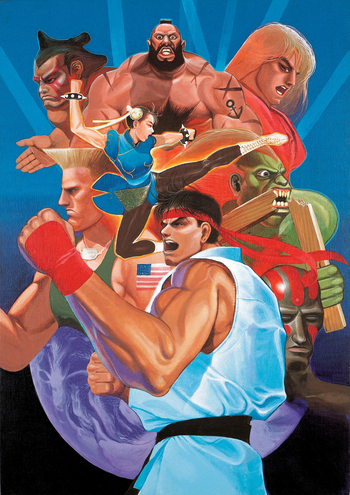
Street Fighter II (subtitled in-game as The World Warrior in its original release) is a 1991 arcade fighting game developed and published by Capcom, and the second main game in the Street Fighter series, which rocketed the franchise into the mainstream eye overnight and became one of the best selling video games of its time. It's credited as a Trope Codifier of fighting games, and while influenced by early games like Karate Champ, Yie Ar Kung-Fu, and its own 1987 predecessor Street Fighter, it is generally considered as the genre's first modern entry.
Compared to the first game, Street Fighter II has a bit more story to it. M. Bison, the leader of the criminal empire Shadaloo, organizes a worldwide fighting tournament, and a number of characters set out to settle a personal grudge with him; the rest are just in it for the prestige. The number of available player characters increased from two to eight. Alongside the returning Ryu and Ken, six now-iconic characters were tossed into the mix, each with their definitive fighting styles:
- Kick Chick extraordinaire Chun-Li;
- All-American soldier Guile;
- Soviet bear-wrestler Zangief;
- Green-skinned mutant Blanka;
- Yoga-magic practitioner Dhalsim;
- Airborne sumo wrestler E. Honda.
Defeat the other seven characters, and you're flown out to battle the Four Devas of Shadaloo:
- I-Can't-Believe-It's-Not-Mike-Tyson a.k.a. Balrog;
- Egomaniac cage fighter Vega;
- The returning (and now-scarred) Sagat from SF1;
- Lastly, M. Bison himself, a tinpot dictator with strange Psychic Powers.
In addition to reinstating features from the first Street Fighter (e.g. six-button control setup and Three Round Deathmatch), Street Fighter II massively refined the combat by expanding the basic moveset and introducing new mechanics like proper Jump Physics, throws, Combos, and Lag Cancel — which have since became staples of the genre. Its biggest influence was creating the character archetypes found in fighting games: a Jack of All Stats Shotoclone with Hadoken and Shoryuken moves (Ryu), a Head Swap/Palette Swap Moveset Clone (Ken), a Charge-Input Special fighter (Guile), The Grappler (Zangief), an Extremity Extremist Close-Range Combatant (Balrog), and so forth were invented with this game.
Its success sparked a renaissance for the arcade video game industry and inspired other producers to develop copycats, from Art of Fighting (developed by Capcom's rival SNK and featuring the Ken lookalike Ryo Sakazaki, who later became the inspiration for Dan Hibiki), to the mostly-forgotten Fighter's History (Capcom tried and failed to sue Data East for infringement) and World Heroes, to bald-faced ripoffs like the creatively-named Super Fighter (not to be confused with the Newgrounds game).
Street Fighter II became the best-selling game since the golden age of arcades in the 70s and 80s. By 1994, it had been played by at least 25 million people in the United States alone. Due to its major success, a series of updated versions were released, containing additional features and characters.
Worldwide, more than 200,000 arcade cabinets and 15 million software units of all versions of Street Fighter II have been sold, grossing an estimated $10 billion in total revenue, making it the third highest-grossing video game of all time, just behind Space Invaders and Pac-Man, and held the record for the best-selling fighting game for 28 years until Super Smash Bros. Ultimate managed to surpass its sales in 2019. The Super NES port of the original World Warrior version sold 6.3 million copies, making it Capcom's best-selling single game until 2013, when it was surpassed by Resident Evil 5. However, it does remain Capcom's best-selling game on a single platform.
Super Street Fighter II Turbo (see below) was followed by series of interquel games, Street Fighter Alpha, that were released semi-annually from 1995-98. A true sequel, Street Fighter III, wasn't released until '97.
See also Street Fighter 2010 and Human Killing Machine, the unofficial sequels to the first Street Fighter.
Revisions:
II was a frequent subject of double-dipping by Capcom; some of those releases (much like Ultimate Mortal Kombat III) made it into arcades before they were ported to home consoles. There were also a large number of home computer versions, more than any later edition.- Street Fighter II’: Champion Edition (1992, a.k.a. Street Fighter II Dash in Japan) — In addition to the requisite Balance Buffs, including differentiating the fighting styles of Ryu and Ken, Champion Edition offered downgraded versions of the four end-bosses as playable characters, and also switched around the scenery and/or the time of day in a few levels. Players can also fight in Mirror Matches with the aid of Palette Swaps. (World Warrior did not have this feature). It was ported to the PC Engine, albeit only in Japan.
- Street Fighter II’: Hyper Fighting (1992, a.k.a. Street Fighter II Dash Turbo in Japan) — This version was released a few months after CE as a countermeasure to bootleg hacks that were incredibly unbalanced, featured faster playing speed, and vastly modified the behavior of many moves to the point of eccentricity. Hyper Fighting introduced brand new special moves for half of the returning characters, further adjusted character balance, increased the play speed for more intense fighting, and included new alternate palettes as the characters' default colors. It got two console ports: the SNES version, titled Street Fighter II Turbo, was released first. Sega, not to be outdone, commissioned their own version for the Genesis/Mega Drive titled Street Fighter II: Special Champion Edition (a.k.a. Street Fighter II Dash Plus in Japan). The difference in title was due to an exclusivity contract between Capcom and Nintendo over the rights to the Turbo branding. While both games featured a mode based on Champion Edition, the Genesis version put more emphasis on Champion Edition as its default mode, while the SNES version leaned more towards the aforementioned Turbo branding and its differences. Notably, it got a standalone rerelease on the Xbox 360 Marketplace in 2006 under the combined title of Street Fighter II Turbo: Hyper Fighting, which was successful enough for Capcom to greenlight production on Street Fighter IV.
- Super Street Fighter II: The New Challengers (1993) - This is the biggest expansion in the series, developed on new hardware with better graphics. It added four entirely new stages and characters: Bruce Lee Clone Fei Long, amnesiac commando Cammy (a glass cannon with one of the best theme tunes
 and an interesting backstory which ties into the prequels), Jamaican Dance Battler and music star Dee Jay, and T. Hawk, known for his palms-out fighting stance, being a Native American (from Mexico), and for being fairly difficult to master. It added more new attacks for the existing characters, such as Ken's flaming Shoryuken which sets his target aflame, and it even tossed in some new animations for existing characters thanks to the newer and better CP System II hardware, which also upgraded the sound quality. Even though the speed increase from Hyper Fighting was well-received in many parts of the world, countries flooded with bootleg hacks assumed Hyper Fighting was another hack (and a lot of players just could not keep up with the increased pace), so the speed increase was dropped for Super. This caused backlash from fans of Hyper Fighting, which is one of the reasons this game failed to acquire the intended playerbase. Ported simultaneously to the SNES and Genesis, and was later brought to the Amiga and DOS.
 - Super Street Fighter II Turbo: The Ultimate Championship (1994, a.k.a. Super Street Fighter II X: Grand Master Challenge in Japan) - The fifth and last of the original arcade releases. This one introduced the now-standard Super Combo Gauge: filled by performing special attacks, landing hits, and taking damage, the bar flashes the word "SUPER" when completely full. At this point, the player can input a command to perform a Super Combo, basically a special move which is more powerful than anything else in your arsenal, and the gauge empties. This game also allows you to play as the four bosses. Of all the versions, Super Street Fighter II Turbo stands as the canonical game: Akuma, a martial artist who is powered by an evil force called the Satsui no Hadou, interrupts the final boss fight by killing M. Bison with the "Raging Demon", thus assuming his place as the True Final Boss. You unlock this fight by reaching M. Bison without continues and getting at least three flawless wins along the way (Akuma is playable via a cheat code, but even in this diminished state, he's still banned from Tournament Play due to being overpowered). This one also brought back the faster game speed of Hyper Fighting, this time with adjustable settings. It is a common sight at tournaments even today, but moreso in Japan than in the U.S., due to the American version shipping with a bug that locked the difficulty to max settings. It received standalone ports for the 3DO and Amiga CD32, in what was the first 32-bit console port in the series.
- Street Fighter Collection (1997) - A Compilation Re-release for the PlayStation and Sega Saturn. It contains Super and Super Turbo in one disc, along with Street Fighter Alpha 2 Gold on the other.
- Street Fighter Collection 2 (1998, a.k.a. Capcom Generation 5) - Another Compilation Re-release for the PlayStation and Sega Saturn, this time focusing on the CPS-1 versions of the game. This one contains World Warrior, Champion Edition, and Hyper Fighting. These ports would serve as the basis for future re-releases of these games up until the port of Hyper Fighting on Xbox 360. It also included a special game mode allowing character versions from the three games to be pitted against one another.
- Super Street Fighter II X for Matching Service (2000) - A Sega Dreamcast port of Super Turbo which features slew of unlockable extra options, including the first instance of playable Shin Akuma as well as being the first version of the game to grant Akuma a Super Combo. It also featured online play. However, it was available only in Japan as a Sega Direct, making it a sought-after collector's item.
- Super Street Fighter II Turbo Revival (2001) - This is a Game Boy Advance adaptation of Super Turbo. It is notable for making Akuma and Shin Akuma unlockable characters, including new endings that better align to the series canon post-Alpha, and having redesigns of various stages.
- Hyper Street Fighter II: The Anniversary Edition (2003) - Created for the series’ 15th anniversary, this is a re-release of Super Turbo that includes the ability to change characters to variations from previous Street Fighter II installments (e.g., Champion Edition Ken vs. Super Turbo Blanka). Originally released as a stand-alone game on the PlayStation 2 in Japan and Europe, it was bundled with Street Fighter III 3rd Strike in North America as a compilation titled Street Fighter Anniversary Collection, which also saw a release on the original Xbox in every region. It also received an arcade release in Japan and Asia, which eventually made it to the West as one of the games in the non-Darkstalkers half of the compilation title Capcom Fighting Collection in 2021.
- Super Street Fighter II Turbo HD Remix (2008) - This is a remaster of Super Turbo released as a downloadable game for the Xbox 360 and the PlayStation 3. It holds the longest title in the series. Developed by Backbone Entertainment, this remaster features rebalanced/tweaked characters, high definition sprites, new character and stage artwork courtesy of UDON Comics, online play, widescreen support, and a brand-new soundtrack created by OverClocked ReMix. It was never officially released in Japan, as it was made and developed specifically for Western countries.
- Ultra Street Fighter II: The Final Challengers (2017) - This is a port of Super Turbo made for the Nintendo Switch to kick off the series' 30th anniversary. It adds Evil Ryu and Violent Ken (the former is originally from Alpha 2 and the latter from SNK vs. Capcom: SVC Chaos) to the playable roster, and it tosses in Shin Akuma as a hidden character (but limits him to certain game modes). Ultra includes the updated graphics from HD Remix (with the ability to use the original visuals as in that game as well), but Capcom opted not to use the OverClocked ReMix soundtrack and the UDON Comics-designed character portraits from that game.note Ultra also includes the voice acting from Street Fighter IV in the HD Remix Mode, and it features several new game modes, including the return of the Dramatic Battle Mode last seen in the Alpha series.
Round 1 - FIGHT!
- AcCENT upon the Wrong SylLABle: Ryu and Ken's "Had-oh-ken" is often heard as "Hadu-ken." The pronunciation is clearer in later games in the series, but the samples from Street Fighter II were so iconic that it's understandable that people can still get it wrong. The "Are you Ken?!" comic, for example, only works with the old sample in mind.
- Ambidextrous Sprite: While everyone has, for the most part, perfectly symmetrical designs, Sagat's newly added scar (along with his eyepatch and hand wraps) can rather obviously be seen swapping orientation whenever he turns around
- Animation Bump: The original roster of II gained new moves and win animations in Super with a similar level of fidelity as the new characters, which can clash quite a bit with the original sprites. For example, E. Honda's command grab makes him look far more muscular than in his doughy idle stance.
- Art Evolution: The graphics were revised with each subsequent installment; this is especially notable with the character portraits, which were modified in Champion Edition and completely replaced in Super Street Fighter II.
- Art Shift: While all of the characters gradually got Art Evolution, compare and contrast the new cast members of Super versus the pre-existing characters and it's night and day between animation quality and detail. More frames of animation, more detail per frame, and a notably different shading and visual consistency make them stand out significantly.
- Ascended Glitch: Playtesters would input special moves too fast and end up with normals, so a leniency system was designed to allow faster execution. During further testing, it was discovered that this allowed special moves to start during the recovery frames of a normal move, and was kept in the game. Various types of cancels are now a core part of combos in fighting games.
- Attack Its Weak Point: While not a well known mechanic, this was featured in the CPS-1 versions of the game. Depending on certain point values, characters could take double damage if hit in certain animations. This especially applied to the bosses in World Warrior, as they could take twice the damage if hit during their signature specials (such as Sagat's Tiger Uppercut recovery or Bison (Dictator)'s Psycho Crusher.) One odd case (and a holdover from a scrapped version of the "Dizzy" mechanic) was Ryu having such a weakpoint hitbox in a single frame of his dizzy animation.
- Battle Against the Sunset: While a few versions take place after nightfall, most iterations of Ryu's pagoda rooftop stage feature a setting sun against a red sky.
- Best Served Cold: Chun-Li's father, an Interpol officer, went missing while investigating Bison's crime syndicate Shadaloo and was presumed dead; his daughter followed in his footsteps by becoming an undercover cop, a detail which was famously carried into the live-action movie. T. Hawk is also out to avenge his father, who died when Bison robbed their ancestral land 30 years ago. Guile's non-canon ending has him preparing to kill Bison in the name of his bash brother Charlie Nash, another Air Force pilot who died while trying to apprehend Bison: Guile's wife and daughter appear out of nowhere and urge him to not sink to Bison's level and instead return home with them, which he does.
- "Blind Idiot" Translation:
- In the original arcade version, one of M. Bison's winning quotes has him telling the loser to "GET LOSE". It was corrected in Champion Edition and onward.
- The original arcade version had one of Balrog's winning quotes saying he has his opponent's blood "of" his fist. Unlike "get lose", this was not corrected to "on" until Super Street Fighter II.
- Ryu's win quote, "You must defeat Sheng Long to stand a chance" is a mistranslation in the arcade releases as the localization team misread the kanji for his dragon punch as something in Chinese. The Super NES version corrects this error to read "You must defeat my dragon punch to stand a chance," and by Ultra it finally read "You must defeat my Shoryuken to stand a chance."
- Blood Knight: Further deconstructed in individual character pages, but common enough that it applies to the series as a whole. While each character has their own reasons for fighting in the tournament, and some are more violent than others, virtually every character in the series actually enjoys brutal hand-to-hand combat, and even the decidedly "good" or peace-loving characters still clearly love a good knock-down, drag-out fight.
- Bonus Stage: II introduced both the familiar barrel-breaking bonus levels, and the less-frequent car-trashing level carried over from its sister series Final Fight. A third bonus stage involving flaming oil drums is confined to this game. The 16-bit ports added a wall of bricks to demolish.
- Border-Occupying Decorations: Playing the Game Boy release on the Super Game Boy makes the game use what the stage the characters are fighting on would have looked like on the SNES to fill in the leftover space, with Ryu's stage also being used for the menu.
- Bowdlerise:
- The SNES port of The World Warrior removed the "Funny Background Events" from Guile and Chun-Li's stages. (See below.)
- The SNES port of Super have blood censored out of the defeated portraits.
- The 3DO version of Super Street Fighter II Turbo censored the cuts and bruises that the characters receive in post-battle scenes.
- In Ultra and the 30th Anniversary Collection, the USAF logo in Guile's stage was replaced by the same one used in Street Fighter V, probably for legal reasons.
- Similarly, the SNES Classic Edition version of Turbo removes the USAF logo entirely from the stage. as does the Special Champion Edition version available on Nintendo Switch Online's Genesis set.
- 30th Anniversary Collection and '"Capcom Arcade Stadium'' also removed the rising sun background in E. Honda's stage, as the Rising Sun Flag is widely associated with World War II Japanese war crimes in countries like China and South Korea.
- Breakout Character:
- While the original roster of 12 are all iconic in their own way, Chun-Li has had a bigger impact than the rest, as she has appeared as a playable fighter in almost every Street Fighter game since. She is also required to appear in every game in the Capcom vs. series.
- Cammy, by virtue of being the second female fighter in the series, has more return appearances than any of the other "New Challengers" from Super.
- Akuma, who went on to become a series mainstay, later appeared in unrelated Capcom games such as X-Men: Children of the Atom and Cyberbots. He's a requisite boss character in most of the Vs. games, including Marvel Super Heroes vs. Street Fighter (as a Cyborg) and SNK vs. Capcom (as the lead villain representing Capcom in opposition to SNK's Rugal who attempts to steal his powers in Mark of the Millennium). He's even a boss in Pocket Fighter. The only fighting games not to grace his presence are New Generation, the EX sequels and the launch edition of V; of course he was eventually added to the latter.
- Briefs Boasting: Zangief. He wears extremely small underwear and loves to brag.
- Calling Your Attacks: About every other special move has this to accompany it:
- Ryu and Ken's Hadoken, Shoryuken, and Tatsumaki Senpukyaku.
- Chun-Li's Spinning Bird Kick and her Kikoken in the Super editions.
- Dhalsim's Yoga Fire, Yoga Flame, and just saying "Yoga" repeatedly in a grab move where he punches his opponent a lot.
- Guile's Sonic Boom.
- Sagat's Tiger Shot and Tiger Uppercut. His Tiger Knee gets this in the Super editions.
- Cammy's Cannon Drill, Thrust Kicknote , Spiral Arrow, and Cannon Spikenote .
- Dee Jay's Air Slasher, called as "Slash!"note or "Max Out!"note
- Canon Immigrant: For a certain value of "canon"; Ultra not only 'brings back' Evil Ryu from the Alpha series, but also Violent Ken from SNK vs. Capcom: SVC Chaos, who was based on the brainwashed Ken seen in Street Fighter II: The Animated Movie. However, it is likely that these dark variants are meant to be What If? characters included for fun.
- Capcom Sequel Stagnation:
- This game is the purest example of this. Capcom milked out a total of five arcade editions of Street Fighter II in a span of just three years, in addition to all the console ports. By the time Super Street Fighter II Turbo was released, gaming magazines were already making memes about Capcom's apparent inability to count past the number two.
- Ultra Street Fighter II for the Switch is an update of a 2008 remaster of a 1994 game which was released nine years after said remaster.
- Color-Coded Multiplayer: From Champion Edition onward, two players can use the same character, with one player having an alternate color scheme assigned for their character.
- In Champion Edition, the player using a character's standard palette has his or her name tag displayed in yellow fonts and the one using the alternate palette is displayed in blue. The same thing applies in Hyper Fighting, except all the characters have a new default palette and the original World Warrior palettes are now used as the alternate palette (except for Bison, who keeps his original as a default, but still gets a new alternate palette).
- In Super Street Fighter II, each character has eight palette choices (the three palettes from the previous games and five new ones). This was due to Tournament Battle variants of the game which allowed up to eight players to compete at the same time by linking four cabinets together.
- Super Turbo gave each of the 16 main fighters a new default palette, along with the alternate "classic" versions of the characters, who each used the original default palette plus an exclusive alternate, bringing the total to 10 palettes per character (except for Akuma, who only has two). Akuma later received a full set of palettes in Ultra, along with a separate set for his Shin form.
- Compilation Re-release: Several
- The first was the 1997 collection of Super Street Fighter II: The New Challengers and Super Street Fighter II Turbo (along with the western debut of the Updated Re-release of Street Fighter Alpha 2, Alpha 2 Gold) for the original PlayStation and Sega Saturn. This was followed on by a second collection (part of the "Capcom Generations" lineage of compilations) that collected the first three CPS-1 based installments (The World Warrior, Champion Edition, and Hyper Fighting) for the same platforms (although the Saturn version is Japan-exclusive). The latter collection also includes some bonus content such as artwork, and also intruced a "Deluxe Versus" mode, where one could pit different versions of characters against one another, preceding Hyper by quite a few years.
- The second compilation was the home release of Hyper Street Fighter II, which was included in Street Fighter Anniversary Collection for PS2 and Xbox alongside Street Fighter III: 3rd Strike. This is less of a straight example due to it only being Hyper and no other Street Fighter II games (although Hyper's purpose is to be a Dream Match Game of the various iterations of Street Fighter II so it still fits broadly).
- The most recent compilation was Street Fighter 30th Anniversary Collection (PS4, Xbox One, PC, Switch), which includes emulated versions of all five major revisions of Street Fighter II alongside other installments of the franchise. Hyper Fighting and Super Turbo can also be played online, and the Switch port of the collection includes a recreation of New Challengers' Tournament Battle version.
- The Computer Is a Cheating Bastard:
- Throughout all of the releases, the computer doesn't need to "charge" their moves like the player does. For example, the computer loves to have Guile walk up to an opponent and deliver a Flash Kick after ducking for only a split-second. They could also not only choose to just be randomly invincible so they can freely counter-attack you at their discretion, but then turn around and hit you with the holds of characters like Zangief or E. Honda, and impossibly mash out enough hits to take over 95% of your health bar in one go, defeating you with a single attack you can't tech or escape. Wind-up frames that are supposed to give your character a chance to block could also just be omitted, resulting in what amounts to unblockable attacks that hit faster than you guard. For extra insult to injury, they even recovered from Stun in 12 frames, or a fifth of a second, and certain later versions made that even shorter to 3 frames.
- The overseas versions of Super Turbo and its later derivatives are notorious for having cheap A.I. that can not only read player inputs but also attack and combo instantly with perfect reaction times. Give anyone a mistake to work from, even as early as the first match, and you can expect them to ceaselessly and aggressively beat you down within seconds. They also liberally use all their tricks above, and attack faster than humans can; it's not uncommon to see Sagat, Guile and Ryu have frame-perfect projectile spam you can't escape all match long.
- Dance Party Ending: Zangief's ending is this. After Zangief beats Bison, Mikhail Gorbachev suddenly descends out of a helicopter, and after praising Zangief, the scene suddenly changes to Gorbachev and Zangief, along with several KGB agents, doing That Russian Squat Dance.
- Difficulty by Region: Infamously with Super Turbo in the overseas release. A Game-Breaking Bug meant that the AI that could be scaled per cabinet via DIP switch was always set to the maximum difficulty, making the game nigh impossible but for the absolute, most hardcore players out there that could game the cheating computer as much as possible. As of 2023, only Capcom Arcade Stadium (or Japanese-region copies of 30th Anniversary Collection) contain the original, pre-bugged Japanese version of the game, as the emergency 1.1 patched version for overseas was never re-released.
- Divergent Character Evolution: Street Fighter II marked the point where Ryu and Ken started to differ from one another ever so slightly. In World Warrior they were more or less exactly the same, so players could fight on even ground. To name a few examples of their evolution, the subsequent Champion Edition altered Ryu and Ken's Tatsumaki Senpukyakus, with Ryu's hitting once but knocking the opponent either while Ken's was multi-hit but didn't. By New Challengers, Ryu had a new set of Hadoken sprites as well as the Shakunetsu variant while Ken had his now iconic flaming Shoryuken, and by Super Turbo, Ryu had two new command normals and the Shinku Hadoken super, while Ken got a new roundhouse animation, a set of new kick specials and the Shoryu Reppa super. If they weren't going in separate directions before, by Super Turbo they certainly were.
- Dub-Induced Plot Hole: Some of the endings in the original arcade versions were translated rather liberally and the characters' backstories were also embellished for the instruction manuals of the SNES and Genesis versions:
- Guile mentions that Charlie was killed by Bison during a mission they were both involved with in Cambodia. However, Cambodia is not mentioned in the Japanese version or in the first two Alpha games, and Guile wasn't even present when Charlie was killed.
- In the Super games, Bison insidiously claims that he and Cammy used to be lovers. This would have rather incestuous implications after Alpha 3 revealed that Cammy was borne from DNA taken from Bison himself. In the Japanese version, Bison merely alleges that Cammy worked for him.
- Dub Name Change
- Capcom changed Bison's, Vega's, and Balrog's names around in the overseas versions. This was done mainly out of fear that they'd be sued by Mike Tyson due to Balrog/Bison being a psychotic Tyson pastiche. (It's mentioned in his backstory that he was kicked out of the pro boxing circuit for his barbarism.) Ironically, when the real Mike Tyson found out about this in July 2019, he was flattered that there was a character who looked like him. Also, "Vega" is a common Spanish surname and Capcom U.S.A. thought that the name "Vega" did not fit the dictator, so the Spanish claw fighter was given that name when rotating the names. To simplify discussions between regions, in fan terms they are simply titled “Boxer”, “Claw”, and “Dictator” based on their physical attributes.
- Although his name never actually appears in II, Akuma is named “Gouki” in Japan.
- Capcom changed Bison's, Vega's, and Balrog's names around in the overseas versions. This was done mainly out of fear that they'd be sued by Mike Tyson due to Balrog/Bison being a psychotic Tyson pastiche. (It's mentioned in his backstory that he was kicked out of the pro boxing circuit for his barbarism.) Ironically, when the real Mike Tyson found out about this in July 2019
- Early-Installment Weirdness: Players who were introduced to II through the later installments may be surprised to find that in the original World Warrior release, the four bosses are unselectable characters and mirror matches are impossible, with both of these being rectified in Champion Edition. Super Moves, as in the especially hard-hitting and meter-costing specials, didn't exist until Super Turbo under the title of "Super Combos", and the proper combos as we know them today were introduced officially in the base Super with the original release just allowing for chaining an attack and special in an unintended sequence. Only the absolute bare minimum of the base gameplay, music themes and initial characters were here for the rest of the franchise to extensively iterate upon.
- Easter Egg:
- According to Akira Nishitani, the orange Hadoken "glitch" was in fact an intentional Easter egg put in by the programmers. Nishitani admitted that he never imagined it would spawn a new special move for Ryu.
- In World Warrior, there is a 512-in-1 chance a single button press will activate a special move on its own. This was done to bring the myriad special moves to everyone's attention.
- Being able to use Shin Akuma in Ultra. To do so, players have to select specific characters, highlight certain colors, cancel and repeat the process before pressing both L and R buttons on the random select icon to play as him. (This won't work if playing online.) The characters are in order: Ryu with color 1, Ken with color 9, Sagat with color 8 and Bison with color 7. Those numbers aren't random, either: 1987 was the year the original Street Fighter was released in arcades.
- Easy-Mode Mockery: In the console versions, clearing the single player mode on one of the three easiest settings will not play the character's ending. Instead, there is a screen encouraging the player to try a harder difficulty.
- Enemy Roll Call: Most versions have credits at the end of Arcade Mode that show the names of two characters at a time.
- Foreshadowing: In the original game, the four bosses' portraits (and flags) don't appear on the world map until you reach Boxer, but their STAGE markers are on the map from the very beginning. Hmm, what's that unlabeled dot doing over there in Spain..?
- Four Is Death: There are four bosses in the Street Fighter II games.
- Funny Background Event:
- Chun-Li's stage has a man in the background literally "choking the chicken".
- There's a guy cheering in Las Vegas who, after a knockout occurs, sobs into his arm. Must be hard always betting on the loser.
- In Guile's stage, a woman appears to be *ahem* servicing one of her male colleagues.
- Breaking the statues in Bison's stage causes the normally meditating monks in the background to get up and start angrily shouting at the fighters.
- Game-Breaking Bug:
- The YYC bootleg hack of Champion Edition had a bug with Dhalsim's Yoga Drill where he would charge towards the edge of the stage indefinitely, even when the time limit reads zero, requiring a reboot.
- Super Turbo Revival on the Game Boy Advance has a pretty terrible one wherein, if the player manages to reach Akuma in Arcade Mode, the game will lock up on a glitchy picture of him and upon resetting, all of their Time Attack and Survival records will be glitched beyond repair. On a lesser scale, Balrog, Vega and Bison's win quotes are mixed up so that Balrog (Boxer) has Bison's quote, Vega (Claw) has Balrog's and Bison (Dictator) has Vega's, likely a result of the nature surrounding their name switch. A ROM patch released in 2014 fixed this, as well as the Wii U Virtual Console release.
- Head Swap: Carrying over from the previous game, Ryu and Ken serve as the quintessential examples of this trope, sharing a body sprite with only different heads and colours to tell them apart. Akuma became the third such example when added in Super Turbo, though unlike Ryu and Ken, Akuma's body sprites do have one subtle addition; a prayer bead necklace.
- Home Stage: There are twelve stages in the original game, based in eight different countries, for each one of the twelve characters, with the four introduced in Super getting their own as well from their respective countries. Though they were more formally named in later installments.
- Air Force Base for Guile (U.S.A.)
- Amazon River Basin for Blanka (Brazil)
- Ayutthaya Ruins for Sagat. (Thailand)
- Battle Harbor for Ken. (U.S.A.)
- Big Factory for Zangief. (Soviet Russia)
- Hospicio Cabañas for T. Hawk. (Mexico)
- Edo no Yu for E. Honda. (Japan)
- Fighting Barroom/ Flamenco Tavern for Vega. (Spain)
- Fraserburgh Castle for Cammy (England)
- Las Vegas / High Roller Casino for Balrog. (U.S.A.)
- The Lemony for Deejay. (Jamaica)
- Maharaja's Palace for Dhalsim. (India)
- Shopping District, Taiping Road for Chun-Li. (China)
- Suzaku Castle for Ryu and Akuma. (Japan)
- Temple Hideout for M. Bison. (Thailand)
- Tiger Balm Garden for Fei Long. (Hong Kong)
- Iconic Outfit: Chun-Li's Qipao is so iconic that when she was given a new, more practical outfit in Alpha, all subsequent games in the series provided the option for the player to use her old outfit.note
- Jiggle Physics: Cammy's boobs are pretty bouncy in the arcade versions.
- Licensed Pinball Table: Right here.
- Long Song, Short Scene:
- Before the CPS2 games, all of the stage themes started over with the new rounds, and while it didn't hurt the game as most themes were less than 99 seconds long, it was very noticeable with Ken's theme, where it was cut off before the last part of the theme was played out.
- Starting from the SNES port of The World Warrior, the second loop of Sagat's theme has a different ending.
- Meet Your Early-Installment Weirdness: Hyper Street Fighter II allows you to select classic versions of certain characters from the earlier renditions of the game like The World Warrior and Champion Edition.
- Mirror Match: A code in the SNES version of The World Warrior enabled this when the original arcade version didn't.note From Champion Edition and onward, all future games allowed players to match characters up with themselves.
- Nerf:
- The game's infamous re-releases were the Ur-Example. Long before patches were possible, they provided an opportunity to re-balance characters. Notable examples include Guile being notoriously overpowered in vanilla Street Fighter II, and Sagat being nerfed in Super Street Fighter II/Turbo. And the latter is still considered top-tier, to the point of being "soft-banned" from competitive play in Japan. (Not technically banned, but players have collectively agreed not to play as him.) Not hard to see why Capcom needed to tweak him.
- An odd example applies to a mechanic from Super Street Fighter IV: 3D Edition which was brought over to Ultra Street Fighter II, which is the Lite mechanic. With charge characters and specials, you either have to properly charge a move before triggering it, or wait for the game to automatically charges it for you. For instance, this prevents Guile from executing a Sonic Boom while walking forward and then following it with an instant Flash Kick.
- Not Worth Killing: Guile chooses to do this to Bison rather than kill him in his ending. This has become a bit of Characterization Marches On as Bison is such a monumental world-ending threat that sparing him like this is hardly practical.
- Obvious Rule Patch: In The World Warrior, battles can last as many as ten rounds with enough double knockouts or draws. The round limit was decreased to four in Champion Edition.
- One-Hit-Point Wonder: According to the Japanese website, Ultra Street Fighter II includes a simplified gameplay mode with one-hit knockouts.
- Pedestrian Crushes Car: Street Fighter II features a minigame copied from Final Fight, where fighters have to destroy a sedan within the time limit.
- Perma-Stubble: Ryu gets one from Champion Edition and onward.
- Personality Blood Types: The character biographies list blood types.
- Promoted to Playable: One of the selling points of Champion Edition is the ability to play as the four endgame opponents.
- Retraux: For Hyper Street Fighter II, when you have the CPS1 music enabled, the music for the four new characters from Super is taken from the Sharp X68000 port of Super Street Fighter II and Akuma has a new CPS1 arrangement of his theme, since those characters only appeared on the CPS2 versions of Street Fighter II.
- Sean Connery Is About to Shoot You: Super Street Fighter II replaced the original opening sequence with a new one where Ryu launches a Hadōken towards the player.
- Secret Character: The "O./Old"note versions of characters in Super Street Fighter II Turbo function as this, with a character-specific code needing to be entered to play as them. Akuma also could be played with a specific code, but his code is very difficult to enter.
- Ship Level: Ken's stage takes place at a crowded port somewhere on the east coast. In the CPS-1 games the crowd watches from a clunky steamboat, while the CPS-2 versions add a lot more flash to the background and swapout the steamboat for a more modern yacht.
- Single Player Gauntlet: The Trope Codifier. While the first game had similar gameplay, II was the first to feature other playable characters out of a selection. Even the non-playable (at first) bosses largely played like the other matches. The subsequent games in the Street Fighter series mostly keep it the same.
- The Smurfette Principle: Chun-Li among the original twelve World Warriors and Cammy among the New Challengers.
- Songs in the Key of Panic: When a player is close to losing the round, the music changes to an up-tempo remix until it fades out at K.O. In the vanilla SFII, this happened every round; in Super and most other versions, this is only done from the second round onward and in Hyper and Ultra it only changes when the fighter low on health is in danger of losing the whole match.
- Super Special Move: Super Turbo introduced the Super Combo mechanic to the game and the series as a whole. Requiring a full Super gauge, each character had one highly damaging version of a regular special move that could turn the tide of the battle. Due to his overwhelming power as an ingame opponent, Akuma lacked a Super Combo at all, and when he finally gained one (his signature Shun Goku Satsu) in the Dreamcast version, it required a lot of hoop-jumping to unlock. Later versions from HD Remix onward gave him said Super Combo as standard.
- Take It to the Bridge: Ryu's and Cammy's stages both take place on a bridge suspended next to a castle. One is in Japan, the other in the UK.
- Tiebreaker Round: The Final Round if neither fighter wins after three rounds (nine in The World Warrior). The player who wins the Final Round doesn't get a point bonus. In solo play, the computer player wins the battle should the Final Round end in a draw or a double knockout. If this happens in two-player mode, both players get a game over.
- Triumphant Reprise: The Credits theme is a victorious, major key variation on Ken's theme.
- Twinkle in the Eye: If you stop the countdown clock after losing a battle, the fighter you lost with gets one.
- Updated Re-release: May as well be the standard-bearer for fighting games. The core Street Fighter II lineage spans five major revisions across two generations of arcade hardware at the very least.
- Versus Character Splash: The fight openers.
- Video Game Sliding: While other characters in the original SFII have sliding attacks — most notably, M. Bison — Dhalsim's crouching Roundhouse is notable for being the only attack that can slide under fireballs and projectile attacks.
- Welcome to Corneria: Guile advising his fallen enemies to "GO HOME AND BE A FAMILY MAN!", regardless of whether his opponent is a woman.
- What Happened to the Mouse?: The two guys from the intro movie are the first thing many kids of the '90s saw of the franchise — and yet, they are nowhere in the game itself, nor were they ever added to it in later updates. It wasn't until the 2010s when Capcom finally revealed their names are Scott and Max.
