
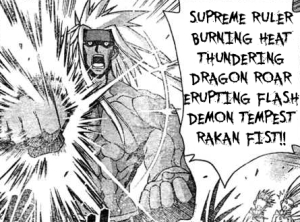
If you can do something more impressive than just throw a punch, your attack(s) must have an equally impressive name. More than that, you have to call it out as you launch the attack. It doesn't matter if it's a martial arts move, a magical spell or your secret superweapon; if you can't say its name, it just isn't nearly as cool or effective. Also, expect plenty of echoing to come with it, and (if a fighter is feeling particularly bombastic) dramatic... *pauses* ...WITHAYELLATTHEEND! A standard feature of practically every Magical Girl story, High Fantasy tale, or martial arts anime.
The origins of this phenomenon are at least Older Than Print, and probably much older. The idea that words can grant power is a cross-cultural phenomenon that shows up frequently in the earliest tales of swords and sorcery. Members of the Sinitic ethnolinguistic family, in particular, tend to ascribe special importance to the power of written characters, and the belief that special words can invoke control over supernatural power permeates their folklore (just ask your local Shinto, Buddhist, or Taoist practitioner if they've donated to a shrine or temple to have a Paper Talisman written lately). The magic power of spoken and written words was also a key concept in Ancient Egyptian religion and Ritual Magic.
In terms of realism, this has some ground as traditional and even some current practitioners of martial arts hold the belief that accompanying statements and/or vocal noises alongside execution build up their chi, thereby increasing the power and efficacy of their moves and techniques. Put less spiritually, saying a phrase at the right time during an attack ensures proper breathing. A call used for this reason is known as a kiai. The naming of attacks also served a more practical purpose as many martial arts schools, Chinese ones, in particular, used to be secret societies. The passing down of techniques was done orally and giving them esoteric names often facilitated this transmission. In addition, kiai has the potential to startle the opponent and give you an opening.
This is also often combined with a spellcaster's Invocation, with the final part of the incantation being the name of the spell, cried out just as the spell is triggered (Spirit of Fire, gather into my hand and incinerate my enemies! FIREBALL!). A character who grows in power will eventually graduate to being able to do the initial incantation mentally, turning the final trigger into this trope completely.
A variant has a Combat Commentator recognizing the attacks being used (usually with a line like "That's the legendary such-and-such-and-something-or-other technique!") and explaining them to any other characters watching (and the audience, of course). When the person launching the attack spends time doing the commentary, however, they may be guilty of Talking Is a Free Action. And, are hopefully in a comic, manga, melodramatic or animated show rather than doing this in Real Life.
Another variant, primarily found in video games, displays the attack name on-screen as it is being executed, without a vocal "call". This typically happens in games where there is no voice acting; the call is implied. In fact, flamboyant attack/technique names are pretty much a trope in and of themselves.
However, used properly and skillfully it can be an effective and compact narrative device. There isn't really a simpler way to let the audience know that Captain Kirk's next phaser blast isn't supposed to kill the alien, or that Judge Dredd's next bullet is supposed to go "boom". Especially in manga, it's particularly difficult to let the reader know what special attacks are used without either motion or color, so having the characters say it is probably the most practical solution.
For a long time, only flashy Finishing Moves or powerful Limit Breaks were considered worthy of calls. Two particularly well-known examples are Kenshiro spelling out the spectacular death-delivering technique he just dealt to his foe - "HOKUTO HYAKURETSU-KEN!!" - and Son Goku's signature "KA... ME... HA... ME... HAAAAAA!!" A few pro wrestlers did this as well. ("Power bomb!") It wasn't until the advent of Fighting Games, particularly Street Fighter II, that shouting out every little spinkick and ki ball became standard practice.
Super trope of Invocation. Sister Trope of Magical Incantation. May overlap with Explaining Your Power to the Enemy, Big Word Shout, Screaming Warrior, Roaring Predator and Pre-emptive Declaration. Overlaps with Super-Scream if yelling out the name of the attack is the attack. In a group, it sometimes overlaps with Attack Pattern Alpha. A similar trope, but with bathroom breaks, is Calling Your Bathroom Breaks.
For a very villainous variation, see To the Pain. For battle cries or shouts, see Kiai and Battle Cry. When violently subverted, it's Talk to the Fist. (Mostly) has nothing to do with Calling Your Orgasms. When your opponent is calling your attacks, it's Combat Clairvoyance or Kung-Fu Clairvoyance.
Example... SUBPAGEEEEES!!
Other... EXAMPLEEEEES!!
- Terry Crews in certain Old Spice commercials. Among his calls is "BUILDING KICK!"
- BoBoiBoy: The heroes aren't the only ones affected, almost everyone will call out what they do, even if it's playing a board game or twisting someone's ears. However, this is somewhat justified for the heroes in the season 2 finale, as Iwan tries to use one of their power watches after they were stolen, but must call out his attack for it to manifest.
- The heroes in Happy Heroes almost always call out the names of their attacks whenever they use them.
- In Kung Fu Wa, Kung-Fu Girl says her attacks out loud when using them and subtitles appear onscreen.
- In Magic: The Gathering, the first step in casting a spell is to announce it, which includes naming all its targets, costs, etc. Not announcing your spells properly is a rules violation since it is considered public information that you need to present to your opponent fully.
"I cast Lightning Bolt on your Grizzly Bears."
- Parodied at the climax of Gene Luen Yang's graphic novel American Born Chinese.
"Mooshu fist! Kung pow attack! Twice cook palm! Happy famiry head bonk! General Tsao rooster punch! House special kick in nards!"
- Alan Grant seems to like this trope. See Batman in the one-shot graphic novel The Scottish Connection.
- Birthright loves this trope, as every mage across the series names their most powerful attack as part of the casting. It's a mark of pride to invent a new spell and then name it after yourself.
- Deadpool:
- In one of the earlyish issues, Deadpool is trying to get Wolverine to fight him, and Kitty Pryde sasses him by saying Wolverine doesn't have time to play Deadpool's "little game". In reply, Deadpool asks, "Speaking of games, you ever play Street Fighter?" And then he Shoryukens her. (And then it is fighty time.)
- Also in the early issues, when he fought against Bullseye, Bullseye started making up names for his attacks when he uses improbable weapons just for fun. There's a reason He and Deadpool get along.
- In Deadpool 25, calling out Rochambeau as he kicks Captain America in the nuts.
- He also calls his shots when he breaks into interpretive dance while fighting Taskmaster.
- Doctor Strange does this a lot, although it could just be part of the spell casting process. If he is unable to use his voice, he is unable to use most if not all of his magic.
- In one Invincible story, it's revealed that to summon a new stone shell for his body, the recurring villain not really turned good guy Titan yells "Rock On!" This inspires our hero to try saying "Invincible PUNCH!" the first time he hits a guy in their team-up battle. Titan calls him on it, he explains, and it never happens again... except once in The Pact when he's decking an old man who was admitting to owing him a debt of gratitude. (No, he's not being a Jerkass, it was the last person he ever wanted to help.) The Pact guys don't exactly like it (the name, not the punch) either.
- Judge Dredd often calls out the names of his trick bullets whenever he fires his Lawgiver. This actually led many readers to erroneously assume that the gun was voice-activated (thus in both movies, it was made so). Canonically, the newer Lawgivers are fitted with a voice activation function, but it gets to silly levels when he also does this with his boot knife.
- Also in the Marvel Mangaverse, the Iron Man mecha crew called out the lasers they had.
- In Nextwave Monica Rambeau would come up with fancy names for various things she could do with her powers and scream them dramatically while showing off.
- In an issue of Marvel Comics' She-Hulk, the Boomerang shouts out the names of his trick boomerangs as he throws them. She-Hulk asks "Are those voice-activated or something? Or is this just some kinda Japanese anime riff?"
- Johnny Alpha from Strontium Dog does much the same thing. "Number Four Cartridge!"
- In her solo miniseries, Vixen shouts out the name of the animal that she is using the powers of.
- Lampshaded in a scene of Marvel's War of Kings event.
Smasher: Accessing hyper-strength upload from my exospecs.
(Drax punches Smasher in the face)
Drax: Accessing fist. - In X-Men either Colossus or Wolverine will call out for the Fastball Special before it's performed. Justified in that neither Colossus nor Wolverine is telepathic; they have to signal to each other when to do the attack or you just have Colossus flinging Wolverine around without his consent or Wolverine jumping into Colossus's arms for no reason.
- In another early 2000 AD title, Flesh, the characters would sometimes narrate their own fight scenes. "I'll use my whip to cut this giant spider in half." "I'll kill this spider with my hook... Yes, got it, right in its rotten heart!" * Cringes*
- In The Incredible Hulk he faces off against a team that includes a woman made out of gas who can change which gas she becomes. In her appearances she'd call out the gas she was becoming and the effect she tried to have (poison, explosive). In their last encounter she turns into hydrogen to become a bomb, but he finds a bottle of oxygen in his lab and sprays her back turning her into a puddle of water. He lampshades her tendency to announce her attacks while handing his friend a mop.
- In Ages of Shadow, this is done by Maximus Domino, partially justified by the fact that his attacks are spells he has to activate. Jade states that he needs to come up with better names for them.
- Ashes of the Past: As the dialogue of the Pokémon in this fic is translated, and quite often are allowed to determine their own fighting styles, they often do this.
- Gary's Nidoqueen even lampshades it in Chapter 34
 :
Ash's Squirtle: Not exactly a one-trick Pokémon, are you? [grinning] Bubblebeam!
:
Ash's Squirtle: Not exactly a one-trick Pokémon, are you? [grinning] Bubblebeam!
Nidoqueen: [bringing up a rock shield to take the impact of the Water attack]] Why do you keep calling out what your attacks are?
Squirtle: It focuses my burning spirit into an almighty flame! - May prefers Calling Your Strategies.
- Max has managed to weaponize this, calling orders that his Pokémon deliberately go against to confuse his opponents or naming strategies after actual moves.
Max: Okay Guy, let's try a low leaf storm!
Norman: Jump over it! ...Wait. Breloom can't learn Leaf Storm...
- Gary's Nidoqueen even lampshades it in Chapter 34
- Parodied in Beyond the Borders; when Rachel is about to throw a Molotov Cocktail, she pauses and decides that she is obligated to call her attacks "because apparently, I live in video games now". Thus she dubs the Molotov "Garlean Firaga".
- Code MENT: "LASER ARM!" "Laser arm?" "Laser Arm."
- The crossover fic Colosseum of the Heart lampshades the fact that both Kingdom Hearts and Pokémon make use of this, with new trainer Sora having to remember to call out Pokemon attacks rather than his own spells: "Rufflet, Aer - I mean, Tailwind!" It comes up again when Serena calls out "Fire!" to order a coordinated attack on a Defender Heartless, only to accidentally cast Fire with the Magus Staff she found, which hits the Defender.
- Co-op Mode: Enforced, discussed, and partly averted by James and Taylor with the Skills given by the Gamer ability. As stated in-story, at low levels (specifically below level 5) all skills have to be activated by vocalizing their names, but afterwards they can be used without having to call out the attack and risk being countered as a result. However, the usual argument of them helping to focus still applies, plus there is a decrease in effectiveness when they are used silently.
James: Okay, let's go. Stealth.
Taylor: This is so weird. How counter-intuitive is that? - Lampshaded in Team Four Star's Dragon Ball Z Abridged with Piccolo pointing out how shouting out their attack strategy for the enemy to hear probably isn't the best idea.
- Also in Abridged, Piccolo tries to say his attack's complicated Japanese name (Makankosappo) before finally giving up and just going with the dub name "Special Beam Cannon!" In the "Abridged Kai" video, this is modified to him just spouting random syllables ("Makan...sappalappaka!").
- In Episode 36 Vegeta calls his "Big Bang Attack", which is mocked by Tien and Piccolo in the next episode. Piccolo and Nail then spend half the episode bouncing ideas for names off one another.
- Lampshaded in Episode 20 when Krillin fights Recoome.
Recoome: Recoome...
Krillin: Does every move you have start with...
Recoome: ...kick!
Krillin: Aaaaaaahhhhh! - Lampshaded again in Episode 40, when after failing to hit Android 18 with a surprise attack and being kicked back to the curb, Vegeta mutters "Why do I yell things?"
- In addition to calling out (and sometimes mocking) the actual attack names from the anime, the trope is further parodied having made-up names called out for completely ordinary punches and kicks. For example, in Episode 51 Trunks yells "Future Kick!" when jump-kicking Semi-Perfect Cell. And in Episode 47, Piccolo tries to call out "Nail Gun" (one of the names Nail suggested in Episode 36) before Imperfect Cell breaks his neck.
- In the Buu Bits (present) Trunks gets rather annoyed when Goten fires off a Kamehameha despite mispronouncing it.
Trunks: Wait, even if you say it wrong it still works?! Then why say it at all?!
"The Great Saiyaman": Because it sounds cool!
Sharpner: Does it though? Tsk, oh c'mon, he knows I love him; you know I love you "THE Great Saiyaman"!
- Justified in Dreaming of Sunshine. Because a major part of chakra is mental energy, calling attacks helps with focus and control. Lampshaded by Shikako.
- Dungeon Keeper Ami: The titular character, coming from Sailor Moon, has to do this for her spells:
- From Reaper Battle!:
"Shabon Spray Freezing!"
It was really convenient how she had to shout out the attack phrase, alerting him to the incoming danger.
- From Reaper Battle!
- In Chapter 27 of Equestria: A History Revealed, the Conspiracy Theorist narrator says she'll have to pull out her secret technique, "HYPER! CONSPIRACY! ANALYSIS! TECHNIQUE! ULTRA! EX!!" What follows next is as ridiculous as it sounds.
- Evangelion 303: Shinji screams commands when he is in his Eva ("THRUST VECTORING ON!", "BRAKES OUT!", "AIR BRAKES OUT!").
- In Fairy Dance Of Death:
- All magic attacks require spoken spells, which gives the target an opportunity to make a counter move.
- Defied and parodied by Asuna, with regard to the flashy weapon techniques in the game.
It made her feel a bit like a manga character who'd been given superpowers. She wondered if it would get any more powerful if she yelled "Linear!" while she was using the skill, and decided against it since she hadn't seen anyone else doing anything so silly.
- Fate/Starry Night: Aside from Servants calling the names of their Noble Phantasms to activate them, Ritsuka shouts "Golden Justice Smash" while using a Diving Kick to knock out Shinji and "Shoryuken!" while uppercutting one of Medea's Dragon Tooth Warriors.
- Fellowship has this most of the time. Justified because it's a Fusion Fic between Chrono Cross and Digimon Tamers, in which the characters from Chrono Cross take the place of the Mons.
- Justified in Harry Potter and the Methods of Rationality as the Chaos Legion's special attacks require others to help make them work.
- Hours 'Verse: In a common fanon divergence from the source material, spell casting is often accompanied by the name of the spell. Fusion spells in particular are always called by name, such as Igor casting Grand Cross using the memories of the Masked Circle, or the Wild Cards casting Ain Soph Aur at the climax of My Kingdom for My Heart. Discussed by the cadets in The Other 25th Hours, where they try to pick a name for their all-out-attack.
Souji: We should call our team attack something. Anna and Tatsuya call their fusion spells new names. We don’t have fusion spells, but we have… whatever that was.
Kotone: A shakedown!
Makoto: Uh, no. No one asked you to name it. - Leidr, the Big Bad of How Trixie (Somehow) Saved Hearth's Warming, does this with his attacks during the Final Battle. Trixie, being Trixie, considers it a sign of him truly being clever for naming his attacks.
- Fate turns an attack name into a Badass Boast in Infinity during her final battle with Susanoo.
Bardiche: Photon Lancer: Deicide Shift
- Discussed in Justice. When Hawkgirl mentions the Straw Hat Pirates do this in battle, the rest of the League finds it odd and slightly amusing, but Queen Hippolyta rationalizes that they're so confident in their strength that they can afford to do such things.
- The King Nobody Wanted: When a Volantene aristocrat tries to re-enslave several guests of the merchants guild, their leaders take turns assaulting him. They call their attacks before doing so, mockingly speaking as if they are giving him gifts (such as one man offering the gift of his boots before using them to kick the slaver).
- In Kitsune no Ken: Fist of the Fox, some of the fights include characters who call the names of certain maneuvers they execute on their opponents. These moves are shown in bold-type print to indicate when it's supposed to be a signature move.
- Kyon: Big Damn Hero has Haruhi screaming "Master Spa~ark" when doing certain attack and Kuyou Suou when using her peculiar but effective defense against assimilation: "Activating 'chibi-mode'!"
- In Manehattan's Lone Guardian, Leviathan gives a name to an attack that Gray used against her. Due to cultural differences—one of them is a humanoid robot from another universe, and the other is a pony—Gray is surprised that she does that, while Levi is surprised that Gray doesn't.
- Happens frequently in My Brave Pony: Starfleet Magic:
- "RAINBOW FORCE...!" "WARD SWORD...!" "STAR SHOWER...!" "PEATL DANCE!". Strangely, they even call their attacks when pulling out their weapons.
- In Naruto: The Abridged Series, they parody this by having all the characters call their attacks with such entertaining names such as "Old Man Monologue Attack" and "Pudding Dragon". Then it's subverted with the "Heart Exploder Death Seal", with actually steals people's souls.
- "DRAMATIC HOKAGE FIGHT JUTSU!!!" "How often could that possibly come up, that you would need to name a technique for it?"
- Nerve Damage: Like in canon, the names of Noble Phantasms have to be called to use them. However, Saber Alter figured out that they work if you whisper them, allowing her to pull off surprise attacks.
- Not the intended use (Zantetsuken Reverse): Daisuke attacks Soma with his mecha while yelling put "MEGA THUNDER CRASH!" He is the only character in the fic who calls out attacks.
- The Pieces Lie Where They Fell: Reel (AKA Kamen Rider Skull II) does this in one of the omake chapters when facing the Nightmare, snapping his fingers and chanting the first three words alongside his Transformation Trinket, followed by the attack name itself.
KEY, MAXIMUM DRIVE! FINAL UNLOCK!
- Pokémon Reset Bloodlines runs into this as is natural in a Pokemon fic with Trainers in it. However, some characters work around it by giving attacks code names or using non-verbal signals.
- In the Pony POV Series Dark World, Traitor Dash tends to do this with her attacks, even after ultimately performing a Heel–Face Turn. Twilight also does it from time to time but does it a good bit more in her pegasus form Halflight Noon because she based the transformation off of Rainbow Dash, though she also points out it's more practical to call them after you perform the attack.
- Naturally, characters in Ranma ½: The Abridged Chronicles tend to call out their attacks as well... usually "Boot to the head."
- Justified in Queen of All Oni, since it's a Jackie Chan Adventures fic based of an AU Season 4, and Hak Foo is a major returning foe for Jackie and the other good guys.
- "Bolt." Taylor Hebert in A Skittering Heart use words to help her cast spells. In ASH magic is influenced greatly by focus and intent so Taylor uses different words to guide her self through channeling the same element to get different effects.
- Bolt — Single lightning bolt fired directly from her sword.
- Shock — Channels lightning through her sword or fingers.
- Thunder — Causes a shockwave of electricity to erupt from around her as she strikes the ground.
- In the fanfic Street Fighter vs. Mortal Kombat (links to two separate MSTs by one group; the original is presumed to be lost), the fight scenes have the characters Calling Their Attacks a lot. Every time this happens (and we do mean every time), the attack name gets its own paragraph and is rendered in all-caps. It reaches the height of unintentional hilarity when one of the 3 Ninjas (it's that kind of fic) attacks with a "SHIN KICK."
- This Bites!: In Chapter 15, Luffy, Usopp, Chopper, and even Zoro insist that Cross and Soundbite come up with names for their techniques. In Chapter 21, they finally begin doing so.
- In the My Hero Academia fanfic Torchbearer this is justfied as a way of mnemonics, calling you attacks in such a way that each action has a word or a part of a word associated with it so calling you attacks will cause you to do them instinctively, with each movement associated wit a with a word or par of said word. All Might uses his smashes as example: TEXAS wind-up. release: SMASH.
- Uninvited Guests: Parodied when Aizen pulls a Hostile Show Takeover to turn himself into the main character. He uses a Sword Beam he calls "Super Aizen Buster". Yamamoto complains that attack name is stupid.
- The Vasto of White: Weaponized by Askin Nakk Le Vaar. He repeatedly calls an attack, but doesn't do anything and laughs at Harribel each time she reflexively dodges a non-existent attack. Eventually, when he calls the attack again, a pissed off Harribel says she's not falling for that again and charges him. This time, he's not bluffing and incapacitates her with his attack.
- Wonderful (Mazinja): Done by many characters:
Taylor: UNITE... HAND! WONDER PUNCH! WONDER BUNKER! WONDER GHOST!
Sophia: UNITE... CROSSBOW!
Emma: UNITE... HAMMER!
Rachel: UNITE... DOG!
Miss Militia: UNITE... GUN!
- In Cloudy with a Chance of Meatballs, Flint becomes overly excited during his first snowball fight and begins pegging anyone in sight with snowballs while screaming "SNOWBALL!" just before letting loose.
- Despicable Me:
- Despicable Me: "FREEZE RAY! FREEZE RAY! FREEZE RAY!"
- Despicable Me 2 points out the problem with this. When Lucy Wilde of the Anti-Villain League shows up on Gru's doorstep, he tries to freeze her. She counters with a flame-thrower and explains:
Lucy: You know, you really should announce your weapons after you fire them, Mr. Gru. For example... (shoots Gru with a tazer) lipstick tazer!
- Justified in Kung Fu Panda 2 as while Po does this because he's Genre Savvy, he also does it to co-ordinate with the rest of the Furious Five for a double team attack. Crane also has a habit of saying things like "Wings of Justice!" In Kung Fu Panda 3. Crane says "Wings of Surveillance!" while scouting causing Mantis to mock him for using this trope all the time, pointing out that you don't hear him say things like "Antenna of Power!" Mantis does exactly that shortly afterwards against the Big Bad, to no effect.
- Puss in Boots: The Last Wish: "Big" Jack Horner tends to call attention to whatever magic weapon he pulls out of his bag. He even lampshades it as a bad habit, after Kitty kicks him into the bag when he announces he's reaching inside it.
Jack: Aww, I shouldn't have telegraphed it!
- In The Super Mario Bros. Movie, the Koopa General calls out "BLUE SHELL!!!" before tucking into his shell and becoming the Spiny Shell from Mario Kart to attack Mario and Donkey Kong.
- Teen Titans Go! vs. Teen Titans: Parodied when 2013 Robin starts calling his martial arts moves, only for 2003 Robin to punch him out while he is talking.
- In the Austin Powers series, Austin always says "Judo chop!" whenever he chops a Mook on the head. Despite the fact that Judo is a martial art based on throwing people to the ground, and doesn't have chops. Other characters do this as well, such as Felicity Shagwell to Fat Bastard right before she kicks him the groin.
- This may be a spoof of the James Bond novel Goldfinger, where the villain describes Karate as "a branch of judo".
- It could be from a The Flintstones James Bond parody episode where Fred and Barney are hauling ass through a villain's secret base and plowing through the biggest Mooks with judo chops while yelling "A Judo Chop Chop!"
- In fact, authentic Judo does teach the "judo chop" (called tegatana ate, 'hand-blade strike') but it is not allowed in competition judo. It is only allowed in 'kata' (drills or exercises). Its use in Austin Powers is a spoof of the fact that the "judo chop" was a now-narmish staple of '60s spy shows.
- One player in The Gamers calls a shot to the groin, but as he calls it to the DM, this is an out-of-universe example.
Tang Lung (Bruce Lee): *Kicks thug in face* Movement number four: dragon seeks path.
- Played straight in Legend of the Drunken Master where Wong Fei Hong constantly calls his attacks.
- Iron Monkey has the named characters perform this. Wong Fei-Hung did it specifically to annoy his enemies, but also caused an enemy to hesitate by calling "Fix Your Body" as one of the attacks.
- Played with in Once Upon a Time in China and America. The hero's assistant gets in a fistfight with a non-Chinese speaking cowboy, and (atypically) doesn't call his moves, but simply howls abuse at him. Later, when the cowboy switches sides and picks up a few moves, he "calls off" the moves by shouting what he heard before. ("Who the hell do you think you are?!")
- There's also one scene where, as a part of his strategy, Wong Fei Hung calls out the name of a move and then does a completely different, which causes his opponent to complain. When the opponent attacks again, Fei Hung calls out the same move and actually does it this time, nailing the opponent. When the opponent complains again, Fei Hung mocks him, basically saying "Yeesh, you complain whatever I do! You sure are hard to please!"
- Pacific Rim: Gipsy's Elbow Rocket and the Typhoon's Thundercloud Formation. The former is justified as Raleigh telling Mako to activate it; the latter is more of an example of the triplets' coordination. But mostly it's just Rule of Cool and a Shout-Out to the film's inspirations. Justified in the expanded material: new pilots who are still learning how to read each other's mind properly will call out the names of the attacks they use to teach their partner to recognize the thought pattern that accompanies it. Older pilots continue to do this out of habit.
- Not done by the attacker, but the second installment of The Shaolin Temple, Kids From Shaolin have the hero (Jet Li, a decade prior to Once Upon A Time in China) executing a lower slash with a sword, while Jet's Old Master calls his attacks as Jet executes the main villain with a slash through the testicles.
- "Hǎi dǐ lāo yuè! (Fetch the Moon From Beneath the Sea)"
- "Hǎi dǐ lāo yuè
- In Smoking Causes Coughing the Tobacco Force (a parody of Sentai in which members are named after chemical compounds) fight monsters. During their fight against a turtle monster, they decide to cause a cancer attack; they surround their opponent and call their chemical compound. Mercure is said to lack sincerity in his calling his attack which causes some drama.
- In Spider-Man, when Peter is trying to figure out how to shoot web, he tries out various hand gestures and phrases, including "Up, up and away, web!" and "Shazam!!"
- In Avengers: Infinity War, Spider-Man does this when attacking Thanos through Doctor Strange's portals, although he's not really calling his own attacks as much as he is the tactics he's using to do them:
Spider-Man: Magic! Magic! Magic with a kick! Magi-
- The western comedy The Villain, features a scene where protagonist "Cactus Jack" Slade is in a Western saloon gratuitously punching people in various ways, and naming the attacks: "Uppercut. Right cross." Finally, he gets a taste of his own medicine and then some: "And that's a two-by-four."
- Inverted the first big fight scene in Bruce Lee's Way of the Dragon, where he calls his moves after the fact as an extension of his earlier "Chinese boxing" lessons to his friends.
- In the climax of Mission: Impossible: "RED LIGHT! GREEN LIGHT!"
- In Night at the Museum: Battle for the Smithsonian, General Custer tends to yell out "Attaaaaaack!" right before attacking. Sacajawea points out the tactical disadvantage of doing this so he starts yelling "Not attacking" instead.
- Subverted in Hot Rod. Rod's idea of an "Ultimate Punch" is a really weak and telegraphed kick.
- In The Belgariad, they use The Will and The Word to perform Magic. This trope is partially subverted by the fact that it doesn't really matter what word is used. Example:
Belgarath: Push?
Garion: You said to say push.
Belgarath: I said to push. I didn't say to say push.
Garion: It [the rock] went over. What difference does it make what word I used?
Belgarath: It's a question of style. Push sounds so?so babyish. After all, Garion, we do have a certain dignity to maintain. If we go around saying "push" or "flop" or things like that, no one's ever going to take us seriously.- In the second series, Belgarion restores a shattered door with "door". Belgarath is not particularly impressed then, either.
- Immortal practitioners in Desolate Era inconsistently call out the names of their attacks, and without an obvious reason for when they do. In an all-out fight where two people are giving everything they have, one may call out attacks while the second does not. But in another, easy, fight, that second person may yell attack names. Sometimes, in a bit of a double subversion, spectators to a fight, instead of the combatants, will shout the names of attacks being used.
- The Dresden Files has wizards use this for focusing purposes. It's indicated that it must use a language the caster is not fluent in, otherwise, the difference in thoughts between when it is used for spellcasting and when it is used for conversation would disrupt the focus. Harry Dresden uses Latin, though other wizards have been seen using more obscure or mythical languages instead.
- Dog Latin, actually. Harry's actual Latin is pretty shabby, but it's still the language the White Council uses at meetings. Can't have some idiot blowing up the Merlin by accident. Elaine uses Dog Egyptian, and other wizards use Dog Sumerian. One imagines that Esperanto might be a good candidate for casting in a real language.
- It's also spoofed in Skin Games when Harry yells "Parkour!" whenever he does acrobatics.
- Epithet Erased: Prison of Plastic: During the final battle, Giovanni tells Molly to name her attacks, and yell their names out loud when performing them. She decides to give it a try. At first, she names her move "Evil Hi-five", which she performs with little enthusiasm to minimal effect, but after more prodding from Giovanni, she changes it to "Bear Paw", which she yells with much more emotion, and this somehow manages to turn it into a much more powerful attack.
Molly looked down at her hands. She had never really bothered naming any of her abilities. Not formally, anyways. It seemed like such a waste of time. She had always looked at her powers from a purely pragmatic angle. Tools in a toolbox. But... maybe there was something pragmatic about giving them a little more flavor. If you named your tool, you formed an attachment to it, didn’t you? And wouldn't that improve your mood, and thus your output? Yeah. That made sense.
- Goblins in the Castle: Igor tends to yell "Bop!" whenever he bops someone on the head with his bear.
- Harry Potter:
- Played straight at first, but justified in that you have to say the name of the spell in order to cast it. However, it gets subverted when a major portion of the sixth-year curriculum turns out to be learning how to cast spells without calling them, specifically so that you don't alert your enemies as to what you are doing.
- Subverted earlier as well, to a degree: many of the spells from the beginning of the series have quite long, cumbersome incantations: "Wingardium Leviosa", "Petrificus Totalus", etc. Spells introduced in later books, especially those intended to be used in combat situations, tend to be shorter: "Stupefy", "Protego", "Reducto", etc.
- A notable early aversion is when Malfoy throws a racist taunt in Hermione's direction, and Ron tries to retaliate with a slug vomiting curse without bothering with the formality of an incantation (in the film version, he screams, "EAT SLUGS!", but that's used as a threat he intends to follow through with, and not an incantation). Key word: tries.
- Parodied in How to Survive a Zombie Apocalypse.
Lucas: Super-angry-because-you-interrupted-my-singing-SMASH!
- In Eragon, spells must be cast by saying their name. These casts are even context-sensitive: saying "Brisingr" while preparing a campfire will ignite it, whereas screaming "Brisingr!" while firing an arrow will make you fire an explosive arrow. This is a result of the local rules of magic.
- The Kirby novel series has some characters do this starting with the "Kirby Clash Team Unite!" novel.
- In The Lord of the Rings, there are the Words of Command, which are extremely draining. While most spells observed in the text require no verbal activation, spoken spells are also alluded to by Gandalf in various places.
- Used for the intimidation factor in The Moon Is a Harsh Mistress. The Lunar rebels didn't really want to kill large numbers of people, so they announced where each large rock was going to hit Earth well before time of impact. Not their fault that at first, everyone assumed they'd never be able to hit Earth with anything and hung out on the impact sites to see what would happen.
- In Raising Steam, Sergeant Detritus screams out "PIECEMAKER" before he fires his crossbow. Justified in that the Piecemaker is a 2000lbs siege crossbow, and he needs to warn his allies so they aren't made into pieces.
- Many, though not all spells in Septimus Heap work like this, like when Marcia Overstrand in Magyk tells DomDaniel to disappear into the Marshes.
- Sorcerer Stabber Orphen: Any time when anyone casts a magical spell. Sword of Light is a popular one. Justified by the fact that the magic human sorcerers wield is powered by their voice.
- Played with in the Star Trek: Deep Space Nine Relaunch novel Demons of Air and Darkness, when the Jem'Hadar soldier Taran'atar battles a Hirogen. At one point, the Hirogen asks Taran'atar why he's not pressing his attack. Taran'atar does not answer, and finally, the Hirogen says that if Taran'atar won't attack, he will — making the Jem'Hadar wonder why the heck he would announce his own attack rather than just doing it.
- Captains of especially large vehicles in the Warhammer 40,000 novels often shout orders a good deal louder than they might really need to. But then, if you had the chance to yell "Nova cannon! ACTIVATE!" would you pass it up?
- The Bible: And God said: "Let there be light." Not actually an attack, but close enough to the spirit of the trope. The Word of God is His power. The way God's power works is that He says something and then it's true.
- The Wandering Inn: Whenever a [skill] is being activated/cast the name of it is being called, though not because it sounds cooler, but rather because it won't work otherwise. Nevertheless, when you reached your limit ([Power Strike]! [Power Strike]! Why isn’t this—[Power Strike]), it won't activate no matter how often you call it.
- Threadbare: In the world of Generica Online, using a special skill requires saying the phrase, although you can try to do it quietly or as part of a conversation, and Grifters (whose skillset involves powers that allow deception) gain an ability early on to hide skill invocation (since saying "Skillful Lie: I didn't know she was married" tends to telegraph your intent).
- Toku shows (Power Rangers, Super Sentai and Kamen Rider) love this kind of thing. Even if most of the time, the attack is pure Stock Footage.
- The Cat Fight between Brenda and Criquette in the parody series Le cœur a ses raisons has them both calling their awfully mundane attacks with epic names, complete with echoing sound effects. This crazy thing can be seen here (in French).
Brenda: CAPILLAR ATTACK!
Criquette: FULGUROSLAP!
Brenda: ASTERO-SHOE! - Doctor Who:
- The Daleks somehow feel the need to shout EX-TER-MIN-ATE every time they fire their weapons.
- Justified in "The Witch's Familiar" — Daleks are programmed to fire their weapons when they hate enough. (Through other mumbo-jumbo, Clara also almost shoots the Doctor.) Basically, EXTERMINATE and the rest of their ranting is actually reloading.
- The new series' Cybus Cybermen shout "DELETE!" when killing people. As a result, "Doomsday", which features them going up against the Daleks, has a lot of this trope:
"EXTERMINATE!" "DELETE!" "EXTERMINATE!" "DELETE!"
- The Daleks somehow feel the need to shout EX-TER-MIN-ATE every time they fire their weapons.
- In the same vein of the above Spider-Man movie example, in Season 2 of Heroes, when Peter is trying to figure out how to shoot lightning from his hands, he says things like "Lightning! Go, Lightning!"
- In Justified Boyd Crowder yells "fire in the hole" whenever he fires an RPG or throws a firebomb. It is a habit he picked up learning explosives handling while working in the coal mines. He does not actually want anyone to get hurt during those attacks and when he actually wants to kill someone he does it quickly and quietly.
- Kamen Rider:
- The most famous example is one of the franchise's trademarks: "RIDER...KIIIIIIICK!!" It's iconic enough that it's become a Stock Shout-Out in Japanese media, usually substituting another word in place of "Rider".
- Somewhat lampshaded by Ryotaro in Kamen Rider Den-O. Kintaros, the team's Gentle Giant, calls out the name of his attack ("Dynamic Chop") after using it, causing Ryotaro to remark on this. Later on in the show, the Imagin tell Ryotaro to come up with a name for Liner Form's Finishing Move...while he's in the middle of performing it. Confused and pressed for time, he shouts out "Densha Giri!" (Train Slash), and instantly his teammates bemoan his lack of sense.
- Although as Ryotaro responds, "Train Slash" is definitely more creative than Momotaros' method of attack naming, "My Final Attack Part ___/___ Version."
- Gets justified in Kamen Rider Double: as explained with the debut of FangJoker, Double needs to synchronize his Memory Breaks because he's a two-in-one detective, and having an attack name for both Shotaro and Philip to call out is the easiest way to do it. When Double and Accel perform a Combination Attack, Shotaro insists that Ryu Terui get in on it too:
Shotaro: Listen, we've got to get the timing right. It's "Rider Twin Maximum"!
Terui (surprised): Me too?
Philip (nodding): You too.- Shotaro does it again in the crossover RPG Lost Heroes, this time with Wing Gundam Zero, dubbing their move the "Twin Finallusion". Amusingly, Heero has less of a problem going along with this than Terui did, only giving a slight chuckle before calling the attack.
- Kamen Rider Blade subverts this by not having the heroes call out their attacks. Instead, their gear does this for them once they initiate their Finishing Move.
- Kamen Rider Kabuto had an interesting take on this, as the Rider would say the Final Attack/Clock Up before activating it, with the Henshin Belt echoing the user, with the exception of Hyper Kabuto when using the Perfect Zector.
- Kamen Rider Fourze has the title character append the word "Rider" to the start of all his attack names a couple of episodes in, after he learns about the Kamen Ridersnote and decides to follow in their footsteps.
- During the Heisei Era, most Henshin Belts in Kamen Rider say something to announce a Rider's attack/Final Attack.
- Kamen Rider Ryuki: "Final Vent!"note
- Kamen Rider 555: "Exceed Charge!"
- Kamen Rider Blade: Says the card names before the aforementioned calling out attack.
- Kamen Rider Kabuto: "1! 2! 3! Rider Kick!"/"Rider (Action)!"/"Clock Up!"/"(Kabuto/The Bee/Drake/Sasword) Power! (Maximum) Hyper (Attack)!"
- Kamen Rider Den-O: "Full Charge!/Charge and Up!"
- Kamen Rider Kiva: "Wake Up!"
- Kamen Rider Decade: "(Type of Card) Ride: (Rider)!" note
- Kamen Rider W: "(Gaia Memory)! Maximum Drive!"
- Kamen Rider OOO: "(Triple) Scanning Charge!"/"Cell Burst!"/"Pytotyranno Hissatsu~!"
- Kamen Rider Fourze: "(Astroswitches): Limit Break!"
- Kamen Rider Wizard: "Chou Ii ne. Kick Strike!/Special! Saikou!!"
- Kamen Rider Gaim: "Soiya/Come On!/Hai~!/*Guitar Riff*!/Soda! (Lockseed) Squash!/Au Lait!/Sparking!"/"Lock on! Ichi!note Juu!note Hyaku!note Sen!note Man!note Okku!note Chou!note Muryotaisu!note (Lockseed) Charge!"note /"Lock On! (Energy Lockseed)!"
- Kamen Rider Drive: "Hissatsu! Full Throttle: (Shift Car/Signal Bike)!"/" Hissatsu! Full Throttle: Full Full (Shift Car/Signal Bike/Viral Core) (Big) Taihou!"/"Execution!"
- Kamen Rider Ghost: "Dai-Kaigan: (Eyecon)! Omega Drive!/Omega (Weapon Attack)"/"Destroy! Dai-Tengan: (Eyecon). Omega-Ulode!"
- Kamen Rider Amazons: "Violent/Amazon Punish/Slash/Strike/Break"!
- Kamen Rider Ex-Aid: "Kimewaza! (Gashat)! Critical Strike/Finish!"
- Ride Players have deliberately weak mass-produced suits the bad guys made so unsuspecting humans who think it's all a game will get themselves killed against much stronger monsters. Nico is so skilled at games that she kicks ass by avoiding attacks and using clever methods to dispatch the enemy. She yells out attacks she invented because Ride Players don't actually have attacks.
- Kamen Rider Build: "Ready! Go! Vortex/Dragonic/Scrap/Crack-Up/Evoltic Finish/Break/Attack"note
- Kamen Rider Zi-O: "Finish Time! Time Break/Burst/Jack!"note /"Beyond the Time! Time Explosion!" note
- Continues on towards the Reiwa era:
- Kamen Rider Zero-One: "(Progrise Key) Impact/Blast (Fever)/Dystopia/Utopia/Destruction/Spark/The End!"/Burning Rain (Rush)!/Crowding Energy (Fall)/Burst (Cannon)!
- Kamen Rider Saber: "Hissatsu Dokuha! (Wonder Ride Book) Issatsu Geki! Fire/Water/Thunder!" or "Hissatsu Dokuha! Rekka/Nagare/Ikazuchi Battou! (Wonder Ride Book) Issatsu Giri! Fire/Water/Thunder!"note
- Kamen Rider Revice: (Vistamp) Stamping/Justice/Darkness Finish!
- Kamen Rider Geats: (Raise Buckle) Strike!/(Two Raise Buckles) Victory!
- Then there was Johnny B in the short-lived Misfits of Science blasted stuff with his electric powers while singing Chuck Berry's "Johnny B. Goode".
- Agents who work for Odd Squad often call out the name of the gadget they're using just before they attack with it.
- In The Office (US), when Michael is calling his mom to tell her about his fake engagement to Holly, Andy Bernard exclaimed "speaker phone" as he hit the aforementioned button so all the office could hear.
- Or Dwight's "Spin move!"
- "Second throat punch... absorb the blow! Groin punch-HIP BLOCK! ELBOW TO THE GUT!! Uh-oh! Up to the nose!"
- Or Dwight's "Spin move!"
- Lampshaded in One Piece when Luffy states that calling out one's finishing move is customary of great fighters. Zoro immediately contradicts him, which is pretty funny considering he does the same thing in the original manga. Becomes a Brick Joke in the season finale when Sanji does the same, and gives the exact same answer when Zoro asks him, making the swordsman quip that he'll fit in just fine.
- Power Rangers / Super Sentai:
- In Power Rangers it's most common for the name of the weapon to be called, rather than the effect. "Delta Max Striker!" "Power Sword!" However, there were a few situations where they'd name the attack too — which made the use of more tricked-out weapons painful to watch. "Lunar Cue!" [Takes out weapon] "Break mode!" [Re-forms it] "Laser Pool!" [Creates phantom pool table, puts Power Crystals on it] "Lunar Break!" [Launches them] Can we say overkill? It's part of the show's Merchandise-Driven nature: gotta make sure everything gets its name announced so the kids know what to beg the 'rents to go buy.
- Has been taken to the extreme in the seasons under Bruce Kalish where even the guns are voice activated. That's right. Whether you call them guns or blasters or anything else, these weapons with quite noticeable triggers (y'know, devices which are operated via the finger) require the user to shout: "LASERS!" in order to make them fire.
- Samurai Sentai Shinkenger/Power Rangers Samurai has an odd variant — the characters write their attacks in Japanese kanji. Justified as that's the way magic works for them.
- Parodied once in Gekisou Sentai Carranger; the Monster of the Week, SS Paman, tried to use his ultimate attack (which included shout outs to past Sentai robo finishers). Unfortunately for him, it was so long that the Carrangers just went ahead and killed him with the RV Robo.
- Kaizoku Sentai Gokaiger has an interesting variant of this, while there are some attacks that the Gokaiger call, whenever they use the one of the thirty-five preceding Super Sentai powers or a Finishing Move their attacks are called out by the Narrator who coincidentally is Tomokazu Seki.
- On Star Trek: Enterprise, Malik the Augment announces his intent to attack Captain Archer just before doing so, just to prove that ordinary humans are no match for him.
- The Wuxia inspired Thunderbolt Fantasy gives the main cast of Kung Fu masters named attacks that they yell at the top of their voice usually followed by objects/people exploding.
- Tomica Hero Rescue Force has another subversion by having the heroes ask permission to their captain to do their Final Rescues, because said attack can be dangerous when not properly used, thus justifying this trope. This trope is also parodied the first time the captain himself equips Powered Armor to fight the bad guys. He even names regular attacks by adding the 'Rescue' prefix to them (IE: Rescue Punch, Rescue Kick) despite them not being special at all.
- Tomica Hero Rescue Fire, the sequel to Rescue force, features calling the attacks through a megaphone.
- Mostly averted in the Showa era of the Ultra Series, although Ultraman Taro introduced it, with Taro's iconic yelling of "STORIUM KOUSEN!" being especially well-known. The trope has shown up a bit more in recent years, though it's still reasonably infrequently used.
- In an episode of Breaking Bad, Jesse brings his stoner friend Badger into the RV to cook meth, Jesse then throws out a few batches he was unsatisfied with, causing Badger to get pissed and to start fighting with Jesse; leading Badger to pick Jesse up, hold him sideways and spin around inside the RV shouting "HELICOPTER, BITCH!"
- In Voltes V: Legacy, it is Justified for the Voltes Team to call out the attacks from various weapons of the five individual Volt Machines and also Voltes V they use in battle against the Boazanian Beast Fighters via voice-activation.
- Yureka: Magic spells within the game Lost Saga are named and casting is usually accompanied with the calling of such, which text has implied is necessary.
- Generally, it can occur in any live gig when the lead singer announces his fellows on the instruments.
- In the Billy Joel song "A Room of Our Own", following the second chorus, Billy calls out "Bridge!" just before the bridge begins.
- Bullet for My Valentine does this in one of their songs (Waking the Demon), in said song, just before the guitar solo starts, the singer calls out SHRED!!!.
- Devin Townsend casually says "Wank" before his guitar solo in the song "Planet Of The Apes"
- Dick Valentine of Electric Six will occasionally declare "Solo!" before the band plays, well, a solo.
- Hibria's "Tiger Punch" has a chorus like this: "Tiii-geeer punch and lightspeed attack!"
- Ringo Shiina of Tokyo Jihen calls out "Gitaa!" before guitar solos in Ringo no Uta and Himitsu, the opening tracks of the band's first two albums.
- So does (but with a German accent, naturally) Tom Liwa of the Flowerpornoes (it's not porn, it's the band's name) on "Titelstory gegen ganzseitige Anzeige".
- Also by Dirk von Lowtzow of Tocotronic on "Keine Meisterwerke mehr".
- And, somewhat unspecific, Peter Thiessen of "Kante" on "Die Summe der einzelnen Teile" - did we forget a "Hamburger Schule" band?
- Die Ärzte use this occasionally, e.g. on "Radio Brennt": "Stoooop!" <music breaks off, you hear heavy panting> "Weiter!"
- Wall of Voodoo Stan Ridgway (after the split) plays with the trope on "Walking Home Alone": "Put another quarter in the jukebox, Pete, but don't play the one with the sad trombone..." Cue sad trombone.
- King Crimson took this trope and ran with it through practically entire lyrics of "Happy With What You Have To Be Happy With": Yeah, then I'm gonna have to write a chorus [...] And this would seem to be as good as any other place to sing it till I'm blue in the face
- Just before the guitar solo in the middle of The Darkness's most well-known song, "I Believe In A Thing Called Love", lead singer Justin Hawkins calls out, "Guitar!" The music video gives an even better fit to this trope as they use their guitars to shoot lightning bolts at a tentacled monster attacking their spaceship.
- Binary Break is a Digimon podcast, so naturally has this for all the Digimon characters.
- In the podcast audio drama The Account, being knighted grants a person a number of special abilities, among them a "weapon" of magical energy that's traditionally named and proclaimed when it's used. The protagonist's is Burst Punch, which more experienced knights find a tad lame.
- In Sequinox. It comes with the territory of them being magical girls.
Summer: Misirlou Beach Blast!
Autumn: Autumn Razor Wind!
Winter: Arctic Desert Freezing!
Spring: Passionate Pollen Breeze!
- The Combat Commentator version is present in most promotions of Professional Wrestling, with the ringside commentators talking about the move, its history, and how utterly devastating it is. As well, most wrestlers, while not explicitly calling their signature moves, do have a particular pose or set-up they perform to signal it. The late Mr. Perfect actually did call his signature move, turning towards the camera and saying, "Now, you're going to see a Perfect-Plex," before executing the maneuver.
- Perfect's call was parodied/subverted by jobber Reno Riggins, who would have a brief surge of offense, then pause to shout "Get ready for… a RenoPlex!". This would inevitably give his opponent more than enough time to recover and beat the tar out of him.
- Wrestlers frequently "signal" the impending move with signature gestures (Ex: Shawn Michaels will "Tune Up The Band" — a long, drawn out, ring stomp — before attempting his "Sweet Chin Music" superkick.)
- Bret Hart, eternally characterised as a master technician, used a variation of this with his Five Moves of Doom — "calling" his Sharpshooter by using the same group of setup moves in sequence. It's now common enough to have become a trope of its own.
- One of The Undertaker's signature moves as the Deadman is walking on the ropes while holding one of his opponent's arms and leaping off the ropes and hitting him. From 2000 to 2003 he would wrestle as a Badass Biker and would allude to his past by shouting "Old School" when he did the same maneuver.
- Sean "X-Pac Heat" Waltman's crotch chops before the Bronco Buster.
- The Rock's People's Elbow... Nuff Said!
- In the indies, it isn't uncommon for wrestlers to literally yell out the name of the move they're about to hit before executing it. (Or attempting to, as the case may be.) Christopher Daniels, for instance, sometimes shouts "Angel's Wings!" before going for that finisher, Chris Hero shouts "Death Blow!", and on one occasion Bryan Danielson screamed "AIR...PLANE...SPIN!" before doing this.
- One of Matt Sydal's finishers is simply known as "Here It Is", or, if you want to get cute, "The 'Here It Is' Driver"
- Normally, a Money-in-the-Bank briefcase holder will cash in on a vulnerable champion, usually after they were in an exhausting match or were attacked brutally by someone they were feuding with. A few wrestlers, however, would announce their intention to cash in the briefcase and give the champion advance notice. Rob Van Dam was the first to do this, presumably to give John Cena a reason to be at the event RVD wanted to win the title at. Daniel Bryan would say he was going to do this and said he would wait until WrestleMania to cash in, but changed his mind after becoming a victim of numerous beatdowns. Cena himself would announce his intention to cash in a week before he did, but this would cost him as he won the match but not the title due to disqualification victory. Damien Sandow would be the most recent to do this, and he would also end up losing his cash in the match.
- The Beautiful People's signature double team move, "Holla!"
- John Cena's sixth move of doom, the Lightning Fist — a move he learned while shooting a movie in China with Jackie Chan — which, given his previous evidence of linguistic prowess, he calls out in Mandarin. Because it's John Cena; the guy who turned his own "five moves" into an Ascended Meme. And of course, he would.
- UltraMantis faced Mister Zero at PXW (Pro Xcitement Wrestling)'s June 23, 2002 event. Before hitting his Praying Mantis Bomb Finishing Move, he yelled "FINISH!" In fairness, this was only his eighth match.
- The Star Wars Radio Dramas were radio adaptations of the Star Wars original trilogy for NPR. Radio, being radio, often requires Narrating the Obvious. In this case, it required Darth Vader to call out the objects he Force-throws at Luke during their climactic The Empire Strikes Back duel. ("...and this stanchion!")
- In many live-action roleplaying games, it is necessary to call the damage done by an attack before it lands.
- Similarly, it is sometimes necessary in LARP events to call out specific attacks. For instance, a backstab might do 5 damage, but the dagger would only do 1; in that case, the player might be required to say "Backstab — 5" instead of only the damage dealt to inform the victim he's not cheating. Calling out attacks is also used in LARPs that have magic; since there is no actual effect, and since the effects can be more elaborate than simple damage (a sleep spell, for instance), spell names and effects need to be called out.
- Lightning bolt! Sleep! LIGHTNING BOLT!
- MAGIC MISSILE!
- Lightning bolt! Sleep! LIGHTNING BOLT!
- Sam G of Avatar Adventures' has a tendency to do this for incredibly menial things; for example:
"Sam Art: Darkness Needles!!!" Sam yelled, prodding a Combine in the eye with the blunt end of a pencil.
- Darwin's Soldiers:
- "Flaming Fist of Doom!" Lampshaded by Aimee.
- And later... "Flamethrower of Death!!!"
Aimee: Hailey, you mind not giving each of your attacks a name? It sounds...stupid...
- "Flaming Fist of Doom!
- Fauna of DC Nation will sometimes call out the animal form (or forms) she's transforming into. It's not essential, but it is a focusing trick, as her abilities come with some unpleasant side-effects.
- In kendo, naginata, and similar arts, one must call out the body part one intends to strike as the blow hits, or one does not receive points for the hit.
- Then there's the story which claims Babe Ruth pointed to the center field bleachers at Wrigley Field in Chicago in the fifth inning of Game Three of the 1932 World Series. On the next pitch, he hit a home run over the center field bleachers. Newsreels of the game do show Ruth pointing right before he hit the home run, but it's not clear where exactly he pointed.
- In "8-ball" pocket billiards, when you are permitted to sink the 8-ball (which is after all balls of your pattern have been sunk), you must invoke this trope and call the pocket you're going to sink the 8-ball into. If you sink the 8 but into the wrong pocket, you lose.
- In "9-ball", you don't have to invoke this trope, but the first ball that the cue ball strikes on any shot must be the lowest-numbered ball on the table. (However, there's no rule that says the lowest-numbered ball has to be the one that's pocketed.)
- As in 9-ball, the newer game of "10-ball" requires that the first ball struck by the cue ball be the lowest-numbered. However, it also requires that the shooter call the ball and pocket for all shots.note The only exception is on the break; if the 10-ball is pocketed on the break, it's placed back on the table, with the shooter's turn continuing as long as no foul was committed.
- This is also required in snooker when rules are being strictly adhered to. When potting a 'colour' (i.e. non-red) ball, you have to 'nominate' the target ball you intend to hit with the cueball. If your cueball strikes a different colour first, or you accidentally pot the wrong colour, then it counts as a foul shot.
- In Straight Pool (the game featured in The Hustler (1961)) players can shoot at any ball on the table, but must declare the ball and pocket in advance. Failure to pot the ball, or potting in the wrong pocket, or potting the wrong ball entirely, ends the player's turn.
- One of NBA legend Larry Bird's most well-known forms of Trash Talk consisted of him telling the players defending him exactly how he planned to score on that possession and then doing it exactly as described. This would later be depicted onscreen in Winning Time.
- Chess:
- In some amateur-level competitions, it is considered mandatory to announce checks. However, this is not a rule in tournament play; in fact, it's considered rude to do so because it implies your opponent is too stupid to see it, and it can actually be seen as a form of annoyance, which is prohibited.
- Blindfold chess is played by announcing one's moves.
- The same applies to correspondence games played remotely via Snail Mail, email, over the phone, or the like. An example of this playing style can be seen in an early scene of Blade Runner.
- The priests of Kor, the god of war and slaughter in The Dark Eye, have the power to harness all the damage their first eight strikes would do and use it all on the final ninth strike. While they are doing this, they will start counting from one to nine so any enemy familiar with this cult will know what's coming. Doubles as a Death or Glory Attack.
- In Dungeons & Dragons it's used several times, unsurprisingly given that there's always a reminder.
- 4th edition actually invites this, with all attacks having names like "White Raven Strike".
- Even more so with the "hellish rebuke" warlock power, an attack that takes the character's angry shouting (with a seemingly expected performance by the player), turns it into fire and hurls it at an opponent.
- Weird spell requires the caster to inform the victims that "their doom is now upon them" in a language they understand. Justified, since it's a phantasm.
- Parodied in the Forgotten Realms novel Silvefall, though in such context it's likely to be a joke about RPGT/cardgames. At least, they call after respective attacks.
"Wild magic stone brings down antimagic shell," the Red Wizard said calmly, for all the world as if he were describing a move in a chess game. [...] "Laeral's Cutting Hand," she announced, her tones a mockery of his own.
- Also, spells require different components (Verbal, somatic, material, experience or focus), and some, but not all require a verbal component.
- Dragon #289 has a big set of tables to generate random names for martial arts attacks.
- In the comics in between chapters in any Exalted book, the characters sometimes shout out the name of the Charm or spell they are using. All Charms and spells also have names like "Flight of the Brilliant Raptor" and "Hungry Tiger Technique," practically begging for this treatment.
- In GURPS: Martial Arts there is an optional rule where calling out a name for your attacks gives a penalty to the opponent's defense. You can also call out the name of a defensive move in order to counter this.
- Another optional rule, in GURPS Thaumatology, makes curses easier to cast and/or harder to resist if the caster announces them beforehand.
- The Mutants & Masterminds supplement Mecha and Manga offers advice about this.
- Saying "check" and "checkmate" in chess. Also, writing your attacks — it has been known for players, even some grandmasters, to write down their moves before making them on the board, although that practice has now been banned.
- Meta-example: There probably isn't a wargame where you can roll the attack before announcing which unit is attacking, its target, and the details of any options they may have when attacking. Aversion of this trope occurs in games where you write down your moves, such as Diplomacy, or games in which moving a game piece to another piece's space provides all the necessary information.
- The same principle applies in role-playing games, where players usually announce the names of specific combat options, special abilities and magic spells used by their characters.
- In the Chinese game Da Lao Er/Cho Dai Di , more commonly known as "Big Two" in the West, players typically announce the combination they play from their hands. This is mostly because cards are played in a common pile, and calling them helps to remember who played last. The highest combination, a straight flush, is the most intimidating to hear, especially when the player who played it was relatively quiet about it until that point in the game.
- Ace Attorney: Phoenix Wright's "OBJECTION!". Anything that can set others to physically mutilating themselves, if not outright EXPLODING, constitutes as an attack.
- Used surprisingly often (as it's a Visual Novel) in Brass Restoration. Most notably, "FOREHEAD CRUSHER!"
- In Danganronpa 2: Goodbye Despair, all of the characters will initiate a Rebuttal Showdown minigame with a cut-in of themselves along with them saying something relevant to them. One of Gundham's, however, stands out:
"INFINITY UNLIMITED FLAME!!"
- Fate Series: Most Noble Phantasms must be called out in order to be used. This, along with high mana consumption, is the main reason why they are used with caution: an opponent may be able to deduce the Servant's identity through their Noble Phantasm, although some are most obvious than others. Exceptions are Noble Phantasms that are continously active, like Diarmuid Ua Duibhne's Gae Dearg and Gae Buidhe, Lancelot's Knight of Owner and For Someone's Glory, and Heracles' God Hand. Gilgamesh's ultimate weapon was Never Given a Name until he decided to name it Ea. However, when he attacks with it, he calls the attack "Enuma Elish", presumably in homage to his best friend Enkidu, whose own ultimate Noble Phantasm is called Enuma Elish.
- Fate/Apocrypha:
- Used as a Drama-Preserving Handicap in Rider of Black/Astolfo's case. Astolfo's last Noble Phantasm is a book that can break any magic spell, and just holding it gives him A-Rank Magic Resistance. However, he can only take advantage of the later effect because he's so much a ditz that he forgot the name. During a new moon which is said to enhance his reason, he finally remembers its true name, "Casseur de Logistille", allowing him to use its full potential.
- Archer of Black/Chiron subverts the trope: since his Noble Phantasm, Anteres Snipe, is an arrow shot from the constellation Sagittarius itself, so he does not need to call its name and can instantly deploy it. This is balanced by the fact he can only use it once per night.
- Fate/Grand Order:
- Mash Kyrielight is a Demi-Servant, a human given the powers of a Servant. When she is still trying to figure out her powers, she does not know her Noble Phantasm's name. Olga Marie Animusphere makes up a name, Lord Chaldeas, which allows her to activate it, but it becomes weaker as a result. When she learns its true name, Lord Camelot, she can use it at full power. Later, when Sir Galahad, the spirit who gave Mash her powers, abandons her, Lord Camelot no longer responds to her, but after augmenting her powers with technology, she is able to use a weaker attack called Mold Camelot.
- Mysterious Heroine XX's Noble Phantasm is called "Etherspace, Howbeit the Order" or "Etherspace, Yet Lawful" depending on the translation. However, when she uses it, she calls out different things like "Twinmyniad Disaster" or "Double X Dynamic", depending on her mood.
- Professor James Moriarty and Erice Utsumi both have the ability to use the magic bullets from Der Freischütz. Erice called the attack Freischütz , but Moriarty eventually corrects her that that attack is called Freikugel.
- Fate/Apocrypha:
- Idol Hakkenden: When Kuwashi attacks Erika with his taser, he calls it "The-Spanish-Currency-is-Called-Peseta" Punch, "The-Aardvark-is-Native-to-Africa" Punch, and "Reagan-is-the-Fiftieth-U.S.-President" Punch.
- Majikoi! Love Me Seriously! has all members of the Kawakami Temple doing this, and Assistant Master Lu even spends time brainstorming names for his new special moves.
- Superhuman has several character call the names of their attacks.
- From Umineko: When They Cry, we get to give a simpler, if very badass example from George in the 4th episode.
- Yo-Jin-Bo likes this trope. Every guy has at least one special attack, and most of their called names are Exactly What It Says on the Tin, perhaps with a dose of Department of Redundancy Department for good measure.
- Saltman, a guest character in Banananana Ninja, fires his "SAAAALT LASER!" which is, strangely, a glob of salt.
- Used with some attacks in DSBT InsaniT.
Shawn: Metal...SPIN!
- For us that understand Spanish here is one parody of this El escroto mortal del dragón (the Dragons lethal scrotum) .
- Egoraptor's series Girl-chan in Paradise parodies this to no end. Shiken-batsu-baku-matsu-hatsu-datsu technique!
- Red vs. Blue: Tucker does this after he gets his sword, saying either "swish" or "stab" for either sort of attack. He only knows those two.
"What's to understand about swish, swish, stab?"
- Parodied in the Siblings cartoon "Half Beard": Rob shouts "HALF BEARD, GO! FORM OF...HALF OF MY BEARD!" (complete with Speed Stripes) in his beardy duel with Rival, only to make his half beard float around the latter.
- The Flash anime XIN subverts this: the only guy who calls his attacks is the weakest one there.
- Homestar Runner:
- Strong Bad's animesque alter-ego Stinkoman has his trademark "Double Deuce!" attack.
- Parodied in the Strong Bad Email "web comics", where the fight scenes in the "fantasy Photoshop gradient comic" consist of the main character and an evil wizard shouting the names of Photoshop effects at each other.
Wizard: LENS FLARE!
Borgorroth: Uh... PLASTIC WRAP! - Inverted in "hremail3184" when Strong Bad hits Homestar with a rake, a shovel, and a garden weasel, it's Homestar who shouts "Rake", "Shovel" and "Weasel" upon being hit.
- When a magisword is used in Mighty Magiswords, an announcer shouts its name.
- Xray And Vav has Vav yell "BALLISTIC BRITISH BARRAGE!" before attacking with... an extremely weak punch.
- The sprite films of Paul Robertson are loaded with this in Affectionate Parody and taken to its ridiculous extreme in "Hyper Parsnip Bitches."
Mortimer: Your bullets have little to no effect on me.
Junesake: How about some of this!?
[cue Epileptic Flashing Lights and Overly Long Fighting Animation]
Junesake: Triple Turbo Hyper Mega Neo Giga Super Berserk Dragon Electric Crystal Galaxy Thunder Overkill Aura Whirl Comet Punch Total Apocalypse Smash Lunatic Flare Shower Ultimate Limit Gaiden Beam Alpha Fury Power Level 100+ !
[Mortimer No-Sells the attack]
Mortimer: [laughs]'' Triple Turbo Hyper Mega Neo Giga Super Berserk Dragon Electric Crystal Galaxy Thunder Overkill Aura Whirl Comet Punch Total Apocalypse Smash Lunatic Flare Shower Ultimate Limit Gaiden Beam Alpha Fury Power Level 100+ has no effect on me. Surely you realize I'm wearing a Triple Turbo Hyper Mega Neo Giga Super Berserk Dragon Electric Crystal Galaxy Thunder Overkill Aura Whirl Comet Punch Total Apocalypse Smash Lunatic Flare Shower Ultimate Limit Gaiden Beam Alpha Fury Power Level 100+ defense cape?
- Lampshaded in 1/0, when Marcus tries to make a spark.
- This The Adventures of Dr. McNinja strip. Though it's a demonstration rather than a proper attack.
- Spellcasting in Aecast is done by reciting several descriptive words in Greek. While the spells aren't given fixed names per se, what a spell is going to do is clearly labelled.
- "Indentured Players" in Alien Dice are apparently required to command themselves to make moves. Lexx calls out every move or power he or his dice use, even when his move-calling could potentially tip the battle in his foe's favor.
- In Antihero for Hire, Baron Diamond takes this to absurd extremes, with "Diamond Knuckle" ("That's just a regular punch!"), "Diamond Pivot", "Diamond Wall Grabbing Move," and so on in that vein.
- Lampshaded: At one point Shadehawk sincerely thanks Baron Diamond for yelling "DIAMOND DRILL" before using said move on him, specifically stating that if Diamond hadn't called the attack, it would have hit Shadehawk and killed him. Yeah, Shadehawk won that fight.
- Lampshaded: At one point Shadehawk sincerely thanks
- Jammy Smasher of Apricot Cookie(s)! does this exactly once, to make fun of how ridiculous Magical Girl attack names tend to be:
Tch, have a word with her, please. She sounds absolutely ridiculous. Baby-dew immolation blaster!
- Used in parody in Bittersweet Candy Bowl whenever a character causes particular annoyance. A quick "AYUUU BEEEEEM" or "SUPAHHH CHOP" generally leaves the offending character as a heap on the floor or a speck vanishing into the sky.
- In The Boy Who Fell, Pafhelo Sorian likes to do this, with the moves having her name in them. The author has stated that they're running out of uncreative Sorian attack names, but whether this is true remains to be seen.
"Sorian bomb!"
"Sorian slam!" - Brawl in the Family takes Captain Falcon's tendency to call out "Falcon Punch!" and "Falcon Kick!" and turns it up a notch.
- In Champions of Far'aus, The barkeep from chapter #3, when he throws what's basically a Molotov cocktail if it was a teacup.
Barkeep: Explodey teacup!
- The magical girl variety gets mocked pretty thoroughly in this Cheer! strip:"Pretty Cosmic Crystal Rainbow Overhead Smash!"
- Played straight during fight sequences in Circumstances of the Revenant Braves, but also parodied by Sol, who calls out various attack names, both as Shout Outs and just at random during other parts of the story.
- Darkbolt: Everyone does the anime-style attacks with booming vocals.
- Justified in Darths & Droids because it's about a group of RPG'ers who are always saying what they are doing.
- In Dragon Mango,
- El Goonish Shive got "anime-style martial arts", so it's given.
- In an early strip, when Elliot attacks the Goo for the first time, he uses a ridiculous name for an equally ridiculous attack.
- After he defeats it later, Tedd points out that he forgot to shout out a "pointless Japanese name" for the last attack he used; mortified, Elliot asks for a do-over.
- Later in the series, Elliot's female duplicate, Ellen, gets it right during the second fight with the Goo.
- In an early strip, when Elliot attacks the Goo for the first time, he uses a ridiculous name for an equally ridiculous attack
- In Evil Plan, Amazingman improvises the Amazing Punch during his first battle. The minions only realized he was a superhero after he invoked this trope.
- Mocked quite entertainingly in these three strips of Exploitation Now. Tentacle Monster to captives: "Anybody up for a game of Monopoly or something while we wait for her to finish shouting the name of her ultimate attack?"
- Mocked in Exterminatus Now — "BEAM SWORD HURL ATTACK!
- Also, this:
Lothar: Shoryuken!
Spectator: Nerd!
- Also, this
- Furry Fight Chronicles has some Combagals shout the name of their techniques when using them ever since the Masato fight in Part 2.
- The God of High School: Many characters announce the names of their attacks before using their signature moves. Sometimes they double as Pre Ass Kicking One Liners, as when you see them coming you know someone is about to go down.
- Justified in Heartcore: like in Slayers, magic spells require a vocal command to use. This can range from simply calling out the spell's name with weaker spells, like a fireball; to long incantations ending in the spell's name, like Ame's "Devil Drive" attack.
- Done under the influence of large amounts of drugs in Girl Genius
Zola: Chophead Tinybits!
- In Goblins characters have often been seen calling their spells. It turns out, however, that in the Thuntiverse, you HAVE to call your spells for them to work — when Kore's throat is injured, he can't use Lay On Hands to heal it without a great struggle.
- Gold Coin Comics does this all the time, when a character is about to use a special skill or spell.
- Hero Oh Hero subverts this when the Aristocrat pretends to call a powerful attack...in order to give himself a chance to run away while his opponent flinches. He plays the trope straight later on while delivering a Megaton Punch.
- Kill Six Billion Demons has a lot of characters shouting their attack name for various reasons. One is that magic in the KSBD universe is actually about lying so convincingly that the universe accepts it as the truth, hence why it's verbal in nature (“My paper soldiers form a wall, five paces thick and twice as tall”). Another is that angels just tend to call out particularly powerful moves of their Supernatural Martial Arts (like “Empty Palm Vanquishes the Wicked”). A third involves attacks that are named by the text instead of a character (TEN CUBIT SPEAR or TOTAL LIFE OBLITERATION: FIVE FINGER, FIVE POINT STRIKE).
- Mechagical Girl Lisa ANT doesn't need any catchphrases to activate her Powered Armor, but she's so into the magical-girl genre that she makes some up. Pink Flash uses them too, to enhance her more traditional magical-girl image.
- Mob Psycho 100: Used for comedy by the shameless charlatan Reigen, who walks up to people and punches them repeatedly while shouting "SELF DEFENSE RUSH!" This is specifically an ass-covering technique, presumably so that if he gets sued, he'll be able to at least try to claim self-defense.
- Both played straight and subverted in Molten Blade. The second time Fred tries this, his target hears him in time to dodge the attack.
- Spoofed in MS Paint Masterpieces with Quintet's Kick-You-In-The-Face-Attack. Played straight with most of the other Robot Masters.
- Muh Phoenix: Wolverine and Captain America did it during their fight. Cap called Wolverine for it, before doing it himself.
- Played VERY straight in Nature of Nature's Art, with text that ranges from Mildly Emphasised to EXTREMELY EMPHASISED! It's not unheard of for one word of the attack's name to take up an entire panel — and that record was recently broken in Secretary. Behold. Keep in mind that this is all ONE WORD.
- When Yori is introduced in No Need for Bushido, he calls each and every one of his attacks — even the most simple slashes.
- Made as a joke in One Piece: Grand Line 3.5:
Luke: Gomu Gomu no ROCKET!!!!
Cory: Luke, What have I told you about calling your attacks? - One-Punch Man: Spoofed, like so many other tropes. Saitama will call his attacks if they're anything other than just him hitting his opponent... but his called attacks are just things like "Consecutive Normal Punches" or "Serious Punch", the latter of which is just him putting some actual effort into a punch. Furthermore, he doesn't shout them so much as calmly state them in the same bored tone of voice he usually uses.
- Other characters in the series play this straight, mostly the ninjas and martial artists, and even a few monsters, like Boros. Oftentimes they never get the chance to actually use any of these techniques before Saitama one-shots them.
- The Order of the Stick does this, as parody, for both spells and special combat maneuvers, having characters ironically shout out "Sneak attack!" and the like (which is fine as the other person failed their spot check), and, after a "Great cleave!" attack is used overly much, snickering about great cleavage.
- Subverted and lampshaded later by Elan's evil twin Nale, when he performs a Sneak Attack without calling it out, then says "Oops, I was supposed to say 'Sneak Attack' there, wasn't I?"
- Also subverted by V calling their attack without actually casting anything.
- Also, due to the spell-casting mechanics, magic users apparently have to call all their attacks.
- Vaarsuvius also tends to write "Explosive Runes" somewhere on everything they cast the spell on. Usually "I prepared Explosive Runes this morning" though not always. And eventually doesn't even bother with the spell name.
- Haley was drawn into combat with a group of thieves who have a tendency to yell out "Sneak Attack!" when they perform a sneak attack. With the introduction of a fighter class mook, said mook yells out "Power Attack!" when he attacks and is immediately informed that he shouldn't yell out his attacks. The fighter then complains that the rogues get to yell out things when they attack.
- One strip reveals that the 10 minute casting time for a certain spell is spent simply chanting the name of the spell over and over.
- SMITE EVIL!
- "TURN UNDEAD!!!" See also "Bolster Undead" and "Stab Undead".
- Power word: Stun is described as a single word, naturally when Vaarsuvius casts it they simply yell STUN.
- The same happens in a later strip: What is the "word" in the spell Holy Word? Holy, of course.
- The same happens in a later strip: What is the "word" in the spell Holy Word? Holy
- The tendency to call attacks is exploited in this strip for a distraction, as a character forbidden from participation in the battle calls a fake attack.
Wrecan: SNEAK ATTACK FROM BEHIND——is a thing I absolutely cannot do, because it would be against the rules. - Penny Arcade:
- Cardboard Tube Samurai does this at least once, at the end of "Cardboard And Steel".
- Parodied in the context of Tales of Arise, in a strip where Law is caught flatfooted by his teammates naming their attacks and expecting him to do so as well. The best he can come up with at a moment's notice is "HITTIN' THIS GUY!", and asks for a do-over. And just to drive it home, the strip's title is "Move Name Exclamation Point".
- Cardboard Tube Samurai does this at least once, at the end of "Cardboard And Steel"
- In Princess Chroma, June's powers in Magical Girl mode work this way. Oddly enough, her predecessor, Princess Chroma the First, seems to not need to do any such thing. Usually.
- Rodney calls every one of his attacks in Raven's Dojo. His attacks are especially over-the-top, like the Skull In Colon or the Face-kick-junk-punch.
- Lampshaded, then justified in Servants of the Imperium, where Lyle, the group's sanctioned psyker, always does this when using a power. That page is even called "Calling your attacks".
Aki: Hey, Lyle, why do you always yell the name of your powers?
Lyle: Well, everyone else gets to make lots of noise with their guns. I feel left out. - Sleepless Domain:
- Lampshaded with Team Outrageous, who do this as Undine and Heartful Punch snark about how showy they are, how they don’t have attack names, and how one of the three doesn't employ Added Alliterative Appeal.
- Undine's team, Team Alchemical, used attack names for team attacks. Sylvia's air and Sally's fire become "Firestorm", Gwen's earth and Undine's water become "Fertile Soil", while earth and fire become "Lava Whatever" because Sally's not creative and Gwen doesn't care.
- In Sluggy Freelance
- Zoë, of all people, uses this trope.
Zoe: You gave me enough time to set a trap. A little trap I like to call ... MISSILE BARRAGE!
- Riff and others who use his Omnitaser Supreme tend to name it when they do so.
- Inverted with characters repeatedly shouting "Run away!" when they do.
- Zoë, of all people, uses this trope.
- Parodied in Sparkling Generation Valkyrie Yuuki when it turns out it is possible to accidentally call an attack in the middle of a perfectly normal sentence, which has unintended side-effects.
- In Supertron, there's DIZZY ATTACK FORMATION-Z!! note Doesn't stop Supertron from kicking their asses though.
- Tower of God
- Ignition Weapons like Black March, Narumada, and Green April will only release their special abilities when their name is combined with the command to attack (i.e., "Black March, IGNITE!"). Since this happens in the heat of battle, there will be shouts.
- The main character, Bam, is notable for largely averting this trope. In a world where most everyone loudly declares their techniques or intentions as they fight, Bam almost never so much as whispers his attacks. He only really says the names of his attacks when he's using techniques he's copied from others.
- When people don't call out their attacks, the comic often includes helpful text naming them anyway.
- In Undead Friend, despite it not being necessary, Brigger prefers to yell out fancy names he makes up when using his lightning magic, even though Wylie thinks it's stupid.
- Unsounded: Generally averted though wrights do have to say their spells to get them to work they do so rapidly and not in a casually spoken language. Elka still goes ahead and says, Pointy stick! when using a lamppost to skewer a monster after Sette yells that wrights are less use than a pointy stick in a fight.
- Plenty in The Way of the Metagamer. There's "SNEAK ATTACK!" and "FALCON PUNCH!", and the author shouts about whatever he's doing, usually as Technobabble.
- Invoked in Wonder Momo: Classic Momo/Momoko's mom needs to explain to the new Wonder Momo and Amazona how to use their special attacks. The lesson is as follows: leap into the air and announce the attack's name. The rest apparently takes care of itself.
- Arcana Magi Universe. Too many to list but here are a couple:
Alysia Perez: PYRO MAELSTROM!
Megumi Miyazaki:' METEOR CRUSH! - The web fiction serial Dimension Heroes makes fun of this trope in one scene where Rob tells his fellow Dimensional Guardians that they must make up attack names to shout out while in battle. When asked why he's unable to give a good reason. He then asks the much more experienced warrior Wyn why he does it. The Guardians wait intently for the warrior's response, and are subsequently disappointed when he mutters simply, "Because it's cool."
- In The Impossible Man Yuki calls her attacks, Jamal has a named attack of his own, and Kaijumon owners have named attacks for their pets.
- Sapphire:
- Psychics do this sometimes, often in their native language. For example, the call for Boris's Blood Rose attack is "Krov' roza", which is, in fact, Russian for its own name.
- And, of course, Michiru and Daisuke call out their Ninjutsu attacks in Japanese, Naruto-style.
- One of Seanbaby's Kick to the Groin comics has the simple-yet-catchy "Kick to the dick" and "Punch to the fucking face!"
- Whateley Universe:
- In two different stories, when the ninja group attack, their leader constantly calls out his signature Ki attacks. Lampshade Hanging ensues because Chaka is learning the moves as fast as the ninja is calling them out.
- Since then Chaka has been using a wide variety of called, anime-style attacks, including Chaka Chaka Bang Bang, a ki-blast, and her Kiai attack, which is a calling attack. For Christmas, she received a pair of power gloves which supercharge one attack per day, and that attack must be called.
- In the second Boston Brawl, both Fey and the Necromancer call their spells out before using them. Discussed later: in the lead up to their third fight, Necromancer admits to Hekate that he normally does that for the intimidation factor, since most non-magical opponents would be frozen with fear just by the name of his spells. He goes on to say that the next time he fought Fey — who was considerably more powerful than he was, but much less experienced (sort of) — he would have to keep that habit in check.
- Magical Girl Policy: The Spirit Guard and the monsters that they face all suffer from this trope.
- Played for Laughs in Dragon Ball Z Abridged's Buu Bits, when Goten uses the Kamehameha but calls out "Kamekameha". Trunks, upon realizing that they don't actually have to call their attacks, questions in frustration why they even bother. Gohan's response? "Because it sounds cool!"
- In Sonic F, Knuckles does this after playing too many fighting games, much to the annoyance of Sonic. Oddly enough, the second time doesn't help Sonic avoid it as he's too distracted to hear Knuckles screaming.
- Played with in one of ProZD's videos, "Video game boss attack patterns," set in The King Dragon Canon.
King Dragon: Maybe instead of going "HERE COMES THE CLUB!" you could try using your right hand, or not yelling that.
Minion: But that's my thing, I love doing that! - In his Let's Play of Silent Hill: Origins, Roahm Mythril calls attacks with the throwable TVs by shouting out the names of TV shows. It's as funny as it sounds.
Roahm: The Dick Van Dyke Show! *Throws TV*
- Finn from Adventure Time seems to enjoy this trope quite a bit:
- "Get ready for an uppercut, you DOG!"
- "All aboard the knuckle-train to fist planet!!"
- Jump-kick! Psych, it was a punch!
- Vampire kick!
- American Dad! often does this incidentally:
- "Nut-Punch!" "Blocked!" "Counter Nut-Punch!"
- "Punch in the face!"
- Atomic Puppet: The title superhero duo do this quite a bit. ATOMIC PUNCH!
- Parodied in Avatar: The Last Airbender.
- When the gang are sparring, Sokka tries to get Aang from behind (who can tell he's there anyway) while yelling "Yaaaaaaaaw, SNEAK ATTACK!" to be instantly blocked by Aang who responds, "Sokka, sneak attacks don't work if you yell it out loud."
- There was also the very poorly performed bit where Katara pretended to be an Earthbender, and when Aang lifted up a rock, she yelled "Earthbending Style!" It even had the background made of streaks.
- And then in "The Ember Island Players", the actor playing Katara destroys Actress Aang's magic bubble with the words "Waterbend: Hiyah!"
- A rare intentional and justified example can also be found when the gang encounter a blood bender. As both Sokka and Aang are trying to avoid hitting Katara, it is not unsurprising that they both do this.
- In Sequel Series The Legend of Korra's "A Leaf in the Wind" Korra sincerely tries to invoke this, with no success:
- Korra: Airbend! [performs form at newspaper]"What is wrong with me? Airbend!
- Ben 10: Beginning with Alien Force, Ben has named attacks for a few of his alien forms, such as Echo Echo's Wall of Sound. Apparently he only feels compelled to call his attacks as certain aliens but not others, though it makes sense in Rath's case.
- Captain Planet and the Planeteers: The Planeteers had to say their element in order to activate their rings. Of course, this happened whether they actually wanted to use them or not, such as when Wheeler off-handedly said "fire" and a small fire broke out.
- On Code Lyoko, Ulrich will often shout "Impact!" when hitting a monster with his sword. Odd fires his "Lazer Arrows!" and Aelita her "Energy Field!" while calling said names — though it isn't obligatory. The exception is Yumi, who maybe said "Telekinesis..." once in Season 1 and never bothered afterward.
- In Defenders of the Earth, the Phantom frequently calls on "The Power of 10 Tigers" before performing a feat of great strength.
- In Dexter's Laboratory, when Deedee and Dexter get turned into monsters, they both call their attacks when fighting each other.
- The Dragamon of Dragamonz always shout what type of attack they will use on their oppenent before they strike.
- In Elena of Avalor, the magical abilities of the Sceptre of Light are voice activated and require Elena to call the ability she wants to use, including for attacking. The same goes for the Scepter of Night and its user, Shuriki.
- In The Fairly OddParents!: Channel Chasers, Timmy and Vicky end up in an Anime style show and do this with every attack. Cosmo and Wanda also do it for several things. Apparently, it's just how that universe works.
- The Gravity Falls episode Fight Fighters has Rumble McSkirmish do this, but sometimes in a AcCENT Upon the Wrong SylLABle -kind funny, like when Mabel had him say stuff in his voice:
Rumble:(from card) Ef-ferVESCENT! Ap-ple FRITTER! Ri-boFLAVIN!
- He did this even when what he did wasn't exactly an attack.
Rumble: FIREBALL! UPPERCUT! DOWNERCUT!! BOOOOWL OF PUNCH!
- He did this even when what he did wasn't exactly an attack.
- Phil Ken Sebben of Harvey Birdman, Attorney at Law did this when he attacks Birdman, thinking he's trying to steal away Birdgirl's affection.
Hit! Uppercut! Uppercut! Jab, jab!
- The characters in Huntik: Secrets & Seekers do this whenever they cast a spell or call out a titan.
- Inspector Gadget's command of "Go, Go Gadget—(insert gadget name)" could count; he's warning people that he's about to activate a gadget, knowing full well that it might not work according to plan...
- This would actually be a subversion since whenever Gadget actually needed a gadget to work, it didn't. So he would call his attack, only to attack in a different way, and fail nonetheless.
- In the Jackie Chan Adventures cartoon series, the villain Hak Foo flamboyantly parodies this trope by inventing names for every action he takes, combat or otherwise; in hindsight, the names really are just flowery similes describing the action in question.
- "Lion Slaughters Two Lambs!" (kicking two heroes aside to grab the talisman they were leaping for)
- "Bunny Flees From Vicious Jackals—!" (running away scared)
- "Snake Cuts Grass!" (leg sweep)
- "Monkey Plucks Two Peaches!" (Eye Poke)
- One of his most recurring lines is "Angry Crow Takes Flight!" any time he so much as jumps.
Uncle: Thank you for sharing, Angry Crow! [counters Hak Foo's attack]
- "Flying Monkey Snatches Magic Box!" — Not an attack; he was just announcing what he was seeing.
- Subverted even during his debut episode, where he called "Elephant Thrusts Its Leg...!" but then delivered a punch when his opponent was anticipating a kick. (Since elephants are quadruped, their front legs correspond to arms, so the smile still works)
Hak Foo: Elephant thrusts its leg! [floors Uncle with a punch] I meant fist.
- During "Shanghai Moon", set in space, when he discovers his momentum hampered by the lack of gravity, he adjusts his attack names accordingly. "Tiger Prowls! ...through ... pudding...?" (slow motion punch)
- When the dark Chi wizard Daolon Wong turned him into a Dark Chi Warrior, he also powered up his attack names accordingly — "Phoenix Flies To Moon!" and "Meteor Brings Mass Extinction!" during a jumping attack, for example.
- And exploited, while executing a large series of attacks against Tohru, Tohru interrupts with "What was that last part?" Hak Foo halts to repeat the attack names and ends up slammed for his efforts.
- Even Jackie gets into it during his first fight with Hak Foo—"These little piggies went to the market!"—and parodies it with a line of his own after getting his butt kicked: "Baboon Leaves Tuckus Exposed".
- HEAT BEAM EYE BLAST!
- RABID HAMSTER CLIMBS WHEEEEEEEL!
- [waking up] SLUMBERING BEAR GREETS THE DAWN!!!!
- [his feet get hurt] CRYING PUPPY FEET! CRYING PUPPY FEET!
- Kaeloo: In the episode "Let's Play Super Powers", the characters pretend to be characters from Mr. Coolskin, Stumpy's favorite superhero comic book series, and call the names of their attacks when they use them.
- In King of the Hill, Dale Gribble was known to do this when he was defending ("pocket sand!"), escaping ("squirrel tactic!") or sort of attacking ("monkey style!").
- In the Legion of Super Heroes animated series ep "Champions", Jo Nah (a.k.a. Ultra Boy, who has all of Superman's powers but only one at a time) calls out his powers as he activates them so viewers can know what the hell he's doing, straddling the line between this trope and By the Power of Grayskull!.
- In Miraculous Ladybug, the powers of the Miraculous are actually voice-activated. The Kwamis have to tell their users what to say to transform, and more than once a special attack has been accidentally activated by the character saying the name. One Villain of the Week had the power to steal people's voices, and this left Ladybug unable to use her Lucky Charm until she managed to trick the villain into saying it.
- In episode "The Gamer", the characters do this during the mecha fight.
- My Little Pony: Friendship Is Magic:
- In the episode "Power Ponies", Twilight calls out her Freeze Ray! She was in a comic book at the time.
- In the episode "To Change a Changeling", Trixie keeps yelling "teleportation spell, go!"
Starlight Glimmer: Why do you keep doing that? You know it doesn't work that way.
Trixie: I know, but this is my process.
- Looney Tunes
- Ali Baba Bunny: HASSAN CHOP!
- Robin Hood Daffy makes a noisy quarterstaffnote fighter: "Ho! Ha ha! Guard! Turn! Parry! Dodge! Spin! Ha! Thrust!" (And then he hits himself.)
- Ali Baba Bunny: HASSAN CHOP!
- Niko from Niko and the Sword of Light does this every time he attacks.
- The Owl House:
- Abominations need verbal instructions in order to function (usually in the form of "Abomination, X"). Higher level Abomination spells don't require this since the user is directly controlling the goo with their magic.
- Eda occasionally does this, though it's more a sign of her not taking things seriously rather than being truly necessary.
- One of the oldest western examples is Hanna-Barbera's Peter Potamus and his "Hippo Hurricane Holler". In this case, the call is the attack, but still...
- The Powerpuff Girls (usually the leader Blossom) call out group attacks like Acrobattack, Cherry Bomb, and Furious Flaming Feline, obviously so the others know what attack they're using.
Blossom: Attack Pattern Alpha Omega Atari! Go!
- In "Nuthin' Special," Buttercup calls all the routines in trying to find her individual power only for Bubbles and Blossom (whose respective special powers are bilinguistics and ice breath) to match her each time.
- Randy Cunningham: 9th Grade Ninja: More of Randy's choice rather than anything else. He also calls out everything. "Ninja Sprint!" "Ninja Stop Ninja Stop Ninja Stop!" "NINJA FLIP!" "Ninja Rotating-Table-Slide!"
- The Ghostbusters' "Full stream!" and (less frequently) "Trap open!" did nothing when called out, but they sure sounded awesome.
- In SheZow, SheZow, Tara, and BrouHaHa do this, naming their attacks as well as using them.
- In the Spider-Man: The Animated Series Crossover with the X-Men, Spidey hopes that Professor X can help him with his mutation. Unfortunately, he ends up in the Danger Room. In the X-Men: The Animated Series series, Storm was quite the Large Ham when using her Elemental Powers, as you can see here. Spidey... well, couldn't resist.
- Star Trek: Lower Decks: In "Temporal Edict", Commander Jack Ransom shouts "Double-fist punch!" and "Interlocked hands!" when battling Vindor.
- In Star vs. the Forces of Evil, casting most magic spells involves calling out the spell's name. That's especially true for Star herself, who often makes up new spells on the spot by calling out a silly name while using her wand. And even when magic isn't accessible, she still can't seem to break the habit of calling her attacks, such as yelling "Stick Blast" before clobbering a rat with a stick in the Season 3 premier or "Punch" while uppercutting a man-eating plant in the series finale.
- On SWAT Kats, Razor would usually shout out the missile being fired, as he fired it, even if it wasn't a new one. Though that could be justified because of the nature of some of their missiles so T-Bone would know what not to do maneuver-wise to keep from disrupting it.
- The girls of Winx Club normally yell out the names of their spells when they use them.
- W.I.T.C.H.: The guardians sometimes yell out the names of their respective elements ("Water!"; "Fire!"; "Earth!"; "Air!") during battle.
- A good half of the dialog that occurs in a typical episode of Xiaolin Showdown consists of various characters calling their elemental attacks and shouting out the names of the various Shen Gong Wu. Justified in the case of the latter since saying the name of the Wu is what activates its powers.
- In later seasons, largely starting when Chase Young enters the picture, Omi in particular begins to call his nonmagical attacks as well, since Chase teaches him how to do it. The most famous one is "Repulse the Monkey" which is Chase's, and later Omi's, signature move (indeed, at one point Omi realises that someone is allied with Chase when he uses Repulse the Monkey), but later on the moves become more ridiculous, with such moves as "Grasshopper Doing Dog-Paddle", "Dogs Playing Poker" and "Spider Doing The Hokey-Pokey".
- Ah, yes. "Sparrow Eating Hot Dog". Good times... good times...
- Which ironically is a parody/subversion: it was random gibberish designed to confuse Chase Young.
- Then there was "Duck Flipping Burgers." In fact, every one of these attacks (barring "Sparrow Eating Hot Dog") are an actual move, which was confirmed via Dojo's book of fighting moves.
- Young Justice
- Amazo has to say the name of whatever Justice League member whose powers it has copied before it can use them. Given that Amazo is a robot, and that this was his first ever appearance within the continuity of the show, this is more understandable than most examples. Although this provides a clue to Amazo's weakness, and the team uses that to defeat it. (Like Jo Nah, this version of Amazo can only use one power at a time.)
- Captain Marvel would sometimes announce or reference which of his powers he was using at a time, whether it was using the Power of Zeus and Speed of Mercury to drill into the ground, or cite the Wisdom of Solomon as the source of his good advice.
- Quick Draw McGraw does this as his alter ego, El Kabong. "KABONG!"
- Comedian Dan Cummins does a sort of variation of this. When telling jokes he sometimes provides the names of them at the end, though this is sometimes simply to extend the joke.
- According to the Other Wiki, Wong Fei Hung "was known to state the names of the techniques he used while fighting."
- Far more common than you'd believe. In a fight, you're always telling an observant opponent what you're about to do through body language. Whether you're going to throw a punch, a kick, or a really complicated technique the movements of your body are broadcasting exactly what you're going to do. The industry term for this is "telegraphing."
- Calls in modern combat play this straight, with a different target in mind: they're to warn your allies as to what you're doing so they can either give you cover or get out of harm's way. For example:
- "Fire in the hole" means that something's about to explode real soon, so you'd best find some cover, block your ears, and open your mouth. Similarly, "frag out" essentially tells others that you are throwing a grenade at the enemy, so they might want to take cover just in case that grenade sends fragments flying back towards you. This is then inverted with "GRENADE!", which is when you spot something round and small flying through the air towards you.
- Also inverted for "reloading" and any variations (with some games, at least, including phrases like "transitioning", "gun down", etc.); you're informing others that you're currently unable to attack because your weapon is out of ammo.
- Announcing your target — either to focus fire or avoid overkill in a gunfight. "Contact" makes people aware that you have spotted a target, to be followed by instructions regarding the target's positioning; "Tango down" (or its phonetic alphabet equivalent in other languages) makes people aware that your target is dead or incapacitated, and that they should find a different target. "Fire at will" essentially tells people to choose their own targets and fire as quickly as they can, though this should only be done when the risk of friendly or civilian casualties is minimal.
- Pilots of Western air forces typically call out warnings when launching weapons. A call of "Fox Two" for example, warns nearby friendly aircraft that the pilot has fired an infrared guided missile (most often an AIM-9 Sidewinder). "Fox One" means a semi-active radar air-to-air missile (usually an AIM-7 Sparrow) has been fired, whereas "Fox Three" means that an active radar missile has been fired (usually an AIM-120 AMRAMM, aka the "slammer"). "Guns guns guns" means the aircraft's guns are being fired. Considering that only friendlies and not hostiles can hear the radio calls, there is considerably less risk of warning the enemy of what's going on. This doesn't translate to the less realistic flight sims, where every aircraft seems to be broadcasting on an open channel.
- If we count the command to fire, then most heavy weapons would apply, although the call is meant to be heard by the weapon crew and accompanying friendly troops. Sometimes, the last thing heard on the radio before everything is drowned out by exploding shells/rockets/missiles is a calm voice on the radio: "commence firing".
- In the US military, armored vehicle crewmen will often use the phrase "on the way" before firing the vehicle's primary cannon or missile armament. This is especially pertinent with tanks since the loader could be severely injured or killed by the recoiling cannon breech if the gunner forgets to make this announcement before firing the main gun.note
- In many police forces, a cop about to fire his Taser is trained to shout "Taser, taser, taser!"note so their partner won't hear the pop of the stun-weapon firing, assume the suspect fired a weapon, and open fire himself, or alternatively not be able to get clear and risk being hit with the barbs by mistake.
- Military orders are essentially this, particularly in older times.
- In wartime, if one side has a strong enough air force, they may openly announce their attacks on particular targets, which serves two purposes: it allows civilians (or deserting enemy troops) in the area to get out of harm's way (no doubt causing traffic congestion problems for the defenders to deal with at the same time), while also essentially declaring that there is nothing the defenders can do to stop you, even with advance warning. Take care not to do this unless you actually can attack the target with impunity, of course.
- Most martial arts accompany an attack with a kiai (a shout) because there is a biomechanical advantage in exhaling sharply (and thus tensing the torso muscles) when striking. Boxers learn a similar technique. In kendo (among others) it's common to shout the part of the body that you're striking at, such as "men" (head), "kote" (hand), or "do!" (torso). Under some organizations' rules, this is part of the scoring process; failing to call a target or calling the wrong target causes the hit to be ignored. This is done to ensure that a fighter with poor technique cannot swing wildly to attempt to get points through pure luck. The fighter must clearly state at the time of the attack what he is attempting to strike.
- In karate, the Ippon kumite sparring exercise consists in the attacker announcing the attack they will perform, which includes the level at which they will strike - head ("jodan"), torso ("shudan"), midsection ("gedan") - followed by the exact name of the technique (the type of punch or kick) they will use. The defender can parry and counterattack as they wish. A variation of this exercise involves only announcing the level of the strike and not the technique that will be used.
- In some states, one has to announce their intent to use deadly force before they can be legally justified to defend themselves against an attacker.
RAINBOW DELUXE!!
