
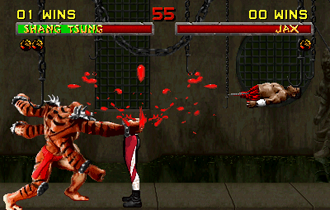
The Finishing Move is a special combat maneuver that is only ever used to cap off a battle, especially one that's already been won. It's often incredibly flashy, frequently requiring a "charge-up" time long enough that it would be impractical to use if your opponent weren't already on the ground in a bloody heap. Even without a "charge-up" time, using a Finishing Move at the beginning of a fight is often unwise (especially if It Only Works Once), because if the enemy can counter it, they most likely will.
When a new Finishing Move is introduced in a story, it's often treated as a case of Forbidden Chekhov's Gun — if the move isn't carried out perfectly, it could backfire and kill our hero(es), or even cause The End of the World as We Know It. Inevitably, the move turns out to be the only thing that can save them this week, and so it works perfectly, and it's treated as being reliable from then on.
Limit Breaks in video games are usually intended as Finishing Moves, but often have different uses. Finishing Moves are also common as a natural part of gameplay in games, as opposed to being intended to be used at the end of the fight and it's just cool. A Finishing Move which makes it easier to kill other enemies in a fight after killing one enemy with it is a Chain Lethality Enabler.
A Coup de Grâce may be used as one, as might Finishing Stomp and Kick Them While They Are Down. See also Coup de Grâce Cutscene. If the effect tends to be delayed then it is You Are Already Dead. If the move is countered, No Selled or otherwise fails to finish off an enemy, especially if it's to show off how badass the newest villain is, then you've got a case of The Worf Barrage.
Examples:
- Kitano from Angel Densetsu, despite being an Actual Pacifist gets one. We only see it used when his few Berserk Buttons are pressed however, and being an 1-hit KO that simply puts the opponent unconscious without real permanent damage it's ''actually'' pacifistic. His father got the same one, albeit being slightly more Technical Pacifist.
- Ayane's High Kick features the eponymous wannabe pro-wrestler's "Golden High Kick." Due to the length of her strong legs, she can land a blow directly to her opponent's temple... which her coach asserts will lead to a certain K.O.
- The Zenon Winzard in Beet the Vandel Buster is the epitome of this, having been blocked a grand total of twice, and survived once when used wrong. And one of those blocks involved having a giant metal rhinoceros take the hit, get split in half, and still only absorb a fraction of the damage.
- Kallen Kozuki of Code Geass fame typically finishes off her enemies with the special weapon of her Guren MKII, the Radiant Wave Surger. Using the Guren's customized claw to grapple enemy Knightmares, she overloads them with powerful microwave energy that fries a Knightmare's systems, warping and distorting the enemy mecha out of shape until they violently explode. The Radiant Wave Surger works as a way to kill Knightmare pilots as well, as it was designed to short out the eject system that all Knightmares have, keeping a pilot from escaping to safety.
- Combattler V: Its finishing move consists of two moves: Combattler paralyzes its enemy with Choudenji Tatsumaki (an electromagnetic discharge) before ramming through it with Choudenji Spin. Choudenji Tatsumaki is always used first in order to ensure the enemy does not move and dodge the second move.
- Daimos: Daimos performs setup moves that chain into their signature moves.
- In Demon Slayer: Kimetsu no Yaiba, The Thunder Clap Flash is the only form Zenitsu has managed to learn in his Thunder Breathing style, but he has mastered it to an extreme degree where his one move is the battle finisher as Zenitsu created several phases within the technique to make the Thunder Clap Flash as powerful as he can possibly make it out to be; Zenitsu later creates a technique all by himself, the 7th Thunder Breathing form: Flaming Thunder God which is a certified battle destroyer move.
- In Dragon Ball Z, almost every character seems to have a few of these. Although nearly every time, the target (often the Big Bad) will just shrugs them off to little or no effect. Some moves are successful however.
- The Kamahameha has been used to finish off foes such as Octopapa, Tambourine, Ginger, Nicky, Cell, Broly and Frieza. In GT Kamahameha was used to kill every single villain with two exceptions of Eis Shenron and Omega Shenron. While everyone's favorite blue beam is powerful it's been No Selled by many villains: Cooler flew straight through it like it was nothing and punched Goku on the other side, and Broly took it point blank without flinching. Several opponents in the Tournament of Power were eliminated by this move, including Kefla whose own finisher, a massive ki stream, was dodged Tony Hawk-style with an assist from Goku's imperfect Ultra Instinct.
- Goku's Genki Dama/Spirit Bomb though it takes extraordinary long time to charge up has enough power to disintegrate foes. Ironically it only worked once in the canon (against Kid Buu) as Vegeta and Freiza got up again after taking the full blast. Movie villains aren't so lucky as Dr Wheelo, Turles, Lord Slug and Android 13 got vaporized.
- Piccolo's Makankōsappō aka Special Beam cannon, is powerful enough to put a hole through two Saiyans and can kill foes from miles away, though it usually takes some time to charge up. In the games it's an Unblockable Attack though in the anime when Imperfect Cell tried to give Piccolo a taste of his own medicine, Piccolo just slapped the beam away.
 ◊
◊
- Vegeta's Big Bang Attack is Exactly What It Says on the Tin he shoots out a blue sphere, a “Big Bang” happens and then there's no more villain. Vegeta sums it up well after he uses Big Bang against Android 19:
Vegeta: If only there was a junk yard nearby so we could give him a proper burial.
- Trunks deserves special mention for his Shining Sword Attack which involves bisecting his foe with his sword and then following it up by dicing them up into fleshy confetti and Ki-blasting whatever remains. Frieza, one of the biggest villains of franchise (someone who came back from a planet explosion) stayed dead after this attack, and even after he was resurrected in Super and Resurrection F, he needed to be put back together again.
- In the original series Goku's ''Penetrate'' attack which he used to finish King Piccolo was a pretty flashy way to beat the villain. But Goku boosted it up notch with the non-canon Dragon Fist which has to be the coolest way to beat the Big Bad in the franchise.
- Dropkick on My Devil: Jashin has a special move called “Jashin-chan Dropkick”. Unfortunately for her, Yurine always finds a way to defy this trope. Played Straight with the Jashin vs. Poporon “battle”, where the former uses her “Jashin-chan Dropkick” on the latter... and it actually works!
- Fist of the North Star contains fighting styles that consist entirely of finishing moves. The flashier ones became "Fatal K.O." moves in the PS2 Fighting Game. The finisher most associated with Kenshiro, however, is the Hokuto Hyakuretsu Ken, which fires off a rapid series of attacks to every one of his opponent's Pressure Points resulting in full body explosion.
- F-Zero: GP Legend: Captain Falcon's Falcon Punch that he uses to finish off Black Shadow. He sacrifices himself in the process though.
- GaoGaiGar:
- The series has the "Hell & Heaven" attack, which ends up inverting the "super-risky new move" subtrope — it starts out as a Once an Episode finisher until the characters realize it's slowly killing the mech's pilot, at which point it gets an upgrade to Dangerous Forbidden Technique. GGG summons a magnetic storm to lock his enemy in place when he performs the move.
- Then there's the Goldion Hammer, the weapon they devised to replace Hell and Heaven, turns out to be just as deadly. Instead of trying again, they decide to build a robot whose job is basically to act as a giant oven mitt so that GaoGaiGar can use it safely.
- The Goldion Crusher (the aforementioned weapon's oversized Spiritual Successor) takes this trope and breaks the frickin' knob.
- God Mars's Final Godmars.
- Takeru: Zuul! I'll show you everyone's anger! This is the final fight! I'll put everything on the line!
(God Mars turns golden while church bells ring in the background.)
Takeru:MARS FLASH!
(God Mars summons the Mars Flash.)
Takeru: FINAL GODMARS!
(God Mars performs a vertical slash and jams the Mars Flash into Zuul's gut.)
- The Guyvers in Bio Booster Armour Guyver (aka Guyver: The Bioboosted Armour) can fire devastatingly powerful "Mega-Smasher" beams from their chests. In something of a subversion, even though the charging time is relatively short for a Finishing Move, it is frequently interrupted (it is one of the only attacks with any charge time at all). In addition, a Guyver cannot use this attack if the protective panels on his chest have any kind of injury, which happens surprisingly often.
- Godannar in Twin Drive Mode.
- Hayate the Combat Butler:
- When the eponymous character goes up against another Battle Butler, the guy shows off one of his Finishing/Ultimate Moves, (specifically, one that creates a huge gout of fire... from a wooden sword) and tells Hayate that he's surprised that he doesn't have one. In his words "every butler should have a finishing move or two". Almost certainly a Lampshade Hanging, especially since these are literal battle butlers.
- At the end of volume 6, Hayate finally develops one, called the "Hayate No Gotoku" (Whimsical Hurricane).
- When a thug with a knife attacked "Sister" Sonia, she crossed herself, saying, "Now pray," before throwing him to the ground. Then, just before the blow that onlookers acknowledged as a finishing move, she added, "Amen." Bonus points for her Scary Shiny Glasses as she said the last word.
- Inuyasha has had a succession of these since he obtained Tessaiga: first was the Wind Scar, then the Backlash Wave; when the Wind Scar became So Last Season he upgraded to the Adamant Barrage, and finally inherited the Meidou Zangetsuha (Dark Path) from Sesshoumaru's Tenseiga.
- Most of the characters in JoJo's Bizarre Adventure have a finishing move, but they usually boil down to just hitting the opponent a lot while shouting their respective Kiai. This is noticeable in the All Stars Battle fighting game, where the barrages make up most of the characters' Great Heat Attacks.
- Kenichi: The Mightiest Disciple: At one point, Kenichi tells the Elder to teach him a Finishing Move, but the Elder explains that's something that cannot be taught, and he has to develop it on his own. As it turns out later, he already had one, made up by combining four very basic moves of the four martial arts (Karate, Muay Thai, Chinese Kenpo and Jujitsu) he'd been learning: Yamazukinote + Kao Loinote + Ugyuu Haitou note + Kuchiki Daoshi note = Strongest Combo.
- Kill la Kill: SEN'I SOUSHITSU! Senketsu even informs Ryuko at one point that an enemy hasn't been defeated because the move didn't work.
- In Kinnikuman every wrestler has at least one finishing move that is supposed to end the fight as soon as it's done. The Kinniku Buster is just one of these skills as he has made many variations to it to fit the situation.
- Starlight Breaker of Lyrical Nanoha's titular character, which generally caps off the big battle of the season. Since it gathers residue magic from the environment, the later it's used in a magic battle, the harder it hits. Interestingly, each time Nanoha uses Starlight Breaker in the anime, it's always a stronger variation of the one she used before.
- Mazinger Z: A bit of a subversion. Breast Fire and Rust Hurricane would be Mazinger-Z Finishing Moves. However, Kouji used whatever weapon he saw fit to end up the battle. In the original manga, Kouji mainly used Mazinger-Z's fists and kicks to beat the enemy and then he finished it off with whatever weapon.
- Great Mazinger: The aptly named Hissatsu Power Thunder Break is possibly the first "proper" example in the Super Robot Genre. Amusingly enough, it is also a subversion: Tetsuya used it constantly, in many different ways, and he came up with a lot of variations.
- Mobile Fighter G Gundam: Domon Kasshu's Shining Finger (and later God Finger), which is uniquely suited to the job of winning Gundam Fights, since destroying the enemy Gundam's head is an instant disqualification. Every major character in the series has at least one finisher, and several characters (Domon included) develop new ones over the course of the plot.
- Deconstructed in My Hero Academia. Many characters have amazing special attacks that can be used to end a fight, but some of them have such devastating side effects that it can harm themselves pulling it off.
- Izuku Midoriya had an unfortunate tendency to wreck his arms by using his Quirk, One for All. After being warned that he was going to permanently cripple himself if this kept up, he realized that using OFA at 100% power all the time was the problem and started developing a safer alternative.
- Denki Kaminari can unleash a devastating wave of electricity, but the power is so great that it temporarily fries his brain, leaving him a babbling idiot.
- Taken further (and reconstructed a bit) when the students are explicitly told to design and finishing moves as a goal. While slightly useful for brand labeling, the real point is that both planning out a special technique whose execution requires taking your Quick use to new levels and then intensively training yourself to be capable of performing it develop you in ways ordinary exercise and practice can't. (And it continues a minor theme the series plays with that a major advantage heroes are expected to have over ordinary villains is willingness to work harder for their goals.)
- In Naruto, several ninjas have these, given the many ways ninjas in Naruto can cheat their way out of being hit, these moves seem to be more trouble than they're worth. The effective ones thus far include:
- Sasuke's adaption of the Chidori; channeling the electricity into his sword, projecting the electricity for a ranged attack, and developing his own technique called Kirin that involves actual lightning and acts as a massive-area attack.
- Kakashi later refined the Chidori to create his slightly superior Lightning Cutter, and so far has killed 1 person (on-screen) with it. Kakashi boasts that his Lightning Cutter "pierces everything".
- Minato Namikaze's Rasengan - the superior product to the Chidori - used traditionally by the main character himself as his signature finishing move in practically all of the films. Naruto later upgrades this to the Rasenshuriken by infusing it with wind to improve its cutting power. Then Serial Escalation kicks in, creating ever-stronger Rasenshuriken variants like Sage Art: Super Tailed Beast Rasenshuriken and Six Paths: Ultra-Big Ball Rasenshuriken.
- This is also parodied, with Kakashi's "Leaf Style Secret Ninja Art: One Thousand Years of Death," which amounts to performing kancho (a Japanese practical joke that involves poking someone in the rectal area) on your opponent. Naruto later converts it into a very serious technique, though. Instead of a finger poke, he jams a kunai in an opponent's rectal area. An exploding kunai.
- Rock Lee subverts this with his "Reverse Lotus," because it never actually ends a fight. Its two seen uses have its effect all but negated and avoided completely.
- Negima! Magister Negi Magi:
- It gives finishing strikes to Negi, Kotaro, and Setsuna on a fairly regular basis. Jack Rakan also lampshades it, stepping into Meta Guy talking about how important having a Finishing Move is. He then proceeds to offer to sell one to Negi for an absurd amount of money. Negi often uses his Finishing Move (Oukahouken) without ending the fight, as its power is based on the number of magic arrows he fires in a given attack.
- Rakan actually develops a hilariously over-the-top Finishing Move for Negi... and later uses it on Negi himself.
- Negi invents a new finishing move in the form of the Titanok'tonon ("Titan Slayer"): a combination of Jaculatio Fulgoris (lightning spears) and Khilipl Astrape ("Thousand Thunderbolts"). It's essentially a gigantic lightning spear with all the power of an anti-army spell condensed into one point. Very rarely does a battle continue after he's used that thing.
- In Nurse Angel Ririka SOS, the title character, like most fighting magical girls, has a Stock Footage finisher. The move is called Angel Aid Bomb Beam, and it requires a move to charge up the Angel Baton beforehand (called Angel Shine Scroll).
- One Piece varies up what moves finish a fight, but Luffy's Gomu-Gomu no Bazooka was notable for commonly either ending a fight or breaking through an opponent's defenses long enough for Luffy to score a true finishing blow.
- Interestingly, Luffy's ''Gomu-Gomu no Gatling'' was given an upgrade and promoted to finisher after it was voted the most popular attack in the series when he used the jet version to finish off Rob Lucci. After learning the hard way how debilitating Gear Third is to his speed and maneuverability, Luffy has taken to using Gear Third mostly for this... until the Time Skip that is.
- Luffy's Gomu-Gomu no Battle Axe, Gomu-Gomu no Rifle and Gomu-Gomu no Bullet are also very flashy finishers that are used to beat foes in the first part of the series. But Gear Fourth kicks it up to the extreme with Gomu Gomu no King Kong Gun which powerful enough to smash Domflamingo straight through the island of Dressrosa and create a crater. Not long afterwards he created a variation, Gomu Gomu no Kong Organ, which is basically launching smaller but multiple King Kong Guns at once.
- Zoro's Onigiri was his go-to finisher for the first part of the series, and it was a Oh, Crap! moment for Zoro when Mihawk blocked it with a little knife. Tiger Hunt, Dragon Twister, Lion Strike, ''108 Pound Cannon'', Demon Aura Nine-Sword Style Asura and Flying Dragon Fire Blaze are Zoro's grandest Finishing Moves.
- In the New World Zoro introduces more finishing moves such as Great Dragon Shock (which bisected Monet), Haki-enhanced Billion-fold World Trichiliocosm (used to wreck Pica) and 103 Mercies Dragon Damnation after unlocking Conqueror's Haki and creating the King of Hell style while fighting King.
- Sanji is no slouch when comes to fishing moves, Mouton Shoot typically blows opponents away whether it be rapid fire kick (manga) or a single powerful kick (anime). Sanji's Concasser is more savage, strong enough to even knock Luffy out, and Anti Manner Kick Course is spectacular even Oars the giant was toppled over when he took this attack to the shin. Also Three-Spot Decoupage which is a triple roundhouse. Special mention to Sanji ''Extra Hachis'' which is kick-version of Luffy's Gomu-Gomu no Gatling and Venaison Shoot in Strong World where Sanji imitates a Mini-gun with his legs.
- Sanji's Hell Memories is his strongest attack post timeskip, scorching the small mountain-sized Wadatsumi. He eventually surpasses even that with Boeuf Burst once he unlocks Ifrit Jambe, a stronger variant of Diable Jambe; it's powerful enough to send a dinosaur flying.
- Chopper however probably plays this trope most straight, his fighting style consists of maneuvering his opponent around until he can transform into Arm Point and use one of his Roseo moves.
- One of the most pronounced villainous examples would be Crocodile who using his sand powers can turn a person into a mummy by sucking the moisture out of their bodies. Crocodile killed multiple bandits this way and almost took out Luffy the same way.
- CP9 and CP0 have “Shigan” or “Finger Pistol” which will kill anyone who isn’t super powered or Badass Normal. Luffy once got a Shigan to the neck from Rob Lucci who stated having a rubber neck was the only reason Luffy was still alive (albeit in great pain).
- Jinbe has thus far showcased two finishers: Vagabond Drill and Demon Brick Fist. The former is mostly used to stop larger foes such as Wadatsumi and Big Mom in their tracks before pushing them away, while the latter is an incredibly powerful and destructive punch.
- Trafalgar Law’s Gamma Knife is a One-Hit Kill as he slices the target internal organs, ignoring all defenses. Unfortunately Law was fighting a dude who could repair his vitals with string powers.
- Eustass Kid breaks out his own finisher during the fight with Big Mom: Damned Punk. To put it simply, it's an oversized, highly-destructive railgun.
- Pokémon
- In Pokémon: The Series, Ash's Charizard always performs a literally over-the-top Seismic Toss to finish off his opponents, first flying high into the sky, and, as soon as he builds momentum (by circling the Earth), tosses the opponent brutally back to the ground. An emergency Flamethrower from Harrison's Blaziken is the only time the move didn't finish its opponent off.
- Pokémon Adventures: Yellow is given the task of delivering the final blow to the fake Kyogre when nine Elemental Beams wasn't enough to dispell it. Two Pikachu and their Pichu kid launching themselves in the air on a Surfboard for a triple Volt Tackle...EPIC.
- All of the various Pretty Cure characters have finishing moves, though they end up usually using a Combination Attack instead as their numbers grow. As well, like the Sailor Moon example above, most of the girls only have Finishing Move attacks, but make up for it by using good old fisticuffs... well, except for the HeartCatch Pretty Cure! and HappinessCharge Pretty Cure! characters, who are armed to the teeth with attacks.
- Puella Magi Madoka Magica has Mami Tomoe's Tiro Finale, which she summons up a gigantic gun for. Pity it isn't enough to finish Charlotte.
- Ranma ½:
- Parodied this with the "Saotome Secret Maneuver" — which is running away from a fight one's losing to regroup and reconsider tactics.
- Ranma and Ryōga both have what could be considered finishing moves in the Hiryū Shōten Ha and the Shi-shi Hōkōdan. While Ryōga's Shi-shi Hōkōdan is not always the end of a fight (Ranma survives several blasts of the "perfected" version), Ranma's Hiryū Shōten Ha is only kept from being a show winner because it tends to stick around. After Ranma uses the technique (which creates a tornado), he oftentimes gets swept up in it, and there is a sizable chunk of time dealing with this. At the end of the manga, with a bit of help from some artifacts, Ranma manages to blow up a mountain.
- Each of the Ronin Warriors and their enemies have a finishing move in Yoroiden Samurai Troopers. Such as Ryo's Flare Up Now (Sou En Zan), Kento/Shu's Iron Rock Crusher (Gan Tei Sai), Sage/Seiji's Thunder Bolt Cut (Rai Kou Zan), Cye/Shin's Super Wave Smasher (Chou Ryuu Ha) and Rowen/Touma's Arrow Shock Wave (Shin Kyuu Ha).
- Rurouni Kenshin:
- Most characters have their own Finishing Move: Kenshin's Amakakeru Ryuu no Hirameki, Aoshi's Kaiten Kenbu Rokuren, Saitou's Gatotsu Zeroshiki, etc. Subverted with Sanosuke, who only knows one special move, the Futae no Kiwami, (the Sanjuu no Kiwami, its finishing variation, was made up on the spot and is never used againnote ), and Sojiro, whose finishing move is merely a combination of simple battoujutsu and his incredible speed. The Big Bad of the Kyoto Arc, Shishio, has a Finishing Move as well, but we never see it executed.
- As for damage to self, the Amakakeru Ryuu no Hirameki requires incredible will as well as impeccable timing to execute, or the reversed blade may well slash Kenshin's left leg off in the process. (The detrimental effects of the entire Hiten Mitsurugi Ryuu on Kenshin are well detailed elsewhere.) Repeated use of the Futae no Kiwami turns Sanosuke's hands into broken wrecks, much to Megumi's displeasure.
- Kenshin's mentor, Hiko Seijuro XIII, knows all the same moves as Kenshin, but seems to prefer Kuzu Ryu Sen as his finisher, despite Amakakeru Ryuu no Hirameki being more powerful. Then again, Hiko is so ridiculously stronger than everyone else in the entire series that Amakakeru Ryuu no Hirameki would be beyond overkill for him.
- Sailor Moon: The eponymous character uses this after the others have weakened the Monster of the Week. A fighting game produced for the Super S season, in fact, combines this with The Worf Barrage by featuring all of the sailor soldiers' finishing moves from previous seasons as special moves of increasing potency with the most recent one being their true finishing move.
- Each of the three Samurai Pizza Cats has their own move for finishing off the Monster of the Week, though Speedy's sees by far the most use (it's in his contract after all). If the move somehow doesn't work, expect things to get bad in a hurry.
- Sengoku Basara X has the "Basara KO," which works a lot like Fist of the North Star's Fatal KOs, and comes complete with Awesome Music.
- Shin Getter Robo: The devastating STONER SUNSHINE works about as often as the spirit bomb. Other units in Getter Robo have moves such as Getter Dragon and Shin Dragon's Shine Spark moves, and Getter One and New Getter's Getter beam.
- The Giga Slave from Slayers was at first treated this way; since it worked the first time, Lina was fully ready to depend on it again. It was subverted in the second season due to the fact that the consequences for failing (of which she apparently wasn't fully aware) turned out to be so high that she became terrified to try it again. Further subverted in that the main villain for that arc actually WANTS Lina to use the Giga Slave on him, so he can test his mettle by seeing if he can survive it.
- Star Driver's Taubaurn has a good half dozen finishing techniques, gained as necessary throughout the series, ranging from a chop to the face, to a giant booster-rocket propelled Rocket Punch, to the main character firing himself as a projectile and tearing through the enemy. Due to the nature of the series, all of them end with the enemy flying up into the air and exploding in a massive fireball, no matter whether they're underwhelming or not.
- At least in the main canon, the main character of Sword Art Online, Kirito, has his 16-hit Dual Blades skill, Starburst Stream. In his first usage of the move (Which is when he first reveals his Dual Blades), he uses it to wipe out the Gleam Eyes. In the second, he uses it to breach Heathcliff's seemingly-impenetrable defenses, forcing him to use his GM privileges to activate the System Over-Assist to avoid the final hit and win their duel, which leads to Kirito figuring out that Heathcliff is Kayaba, and in the third, with help from Eugeo's spirit, he adds a seventeenth hit onto the end to take out Gabriel Miller AKA Subtilizer.
- Tengen Toppa Gurren Lagann's famous Giga Drill Break(er). In the dub, Kamina and Simon do refer it as Finishing Move (Hissatsu, meaning Certain Kill in Japanese) the first time they perform the move. Subverted after the Time Skip and ostensible Genre Shift, when the move not only fails to defeat a foe, but is performed offscreen, in blatant violation of the rules of the genre. Of course, the foe is defeated shortly thereafter, but the point is made. It also doesn't quite work against Lordgenome, although this might be because Simon neglected to howl "FINISHING MOVE!" before the attack.
- Fittingly for a wrestling manga where Pro Wrestling Is Real, Tiger Mask features many, most being actual wrestling moves but four being devised by the title character. The Tiger Choke (that is considered horrible even by the extremely violent Tiger's Cave wrestlers) is abandoned when he rebels against Tiger's Cave and turns in a face wrestling (only showing up again when a Tiger's Cave wrestler breaks his Berserk Button), and the Ultra Tiger Drop is abandoned when Mr. Chi reveals it has a ridiculously easy counter, but the Fujiyama Tiger Breaker and the Tiger V continue show up and crushing their victims, with only Miracle 3 being able to execute the only working counter to the Tiger Breaker.
- Voltes V: Voltes did not get one until its Mid-Season Upgrade, but it presents the first proper example: the V-giri Slash.
- Voltron's Juu Ou Ken (Beast King Sword)/Blazing Sword.
- Zettai Muteki Raijin-Oh: "God Thunder Crash!"

- In Spider-Geddon, Spiderman Japan only uses his mech Leopardon's Sword Vigor to finish off enemies after an extensive battle. Superior Spider-man does get him to instakill a monster before they go into melee, though Takuya complains that it's not very sporting.
- In Thimble Theater, Popeye has the twister sock, a spiraling knockout punch which also appears in the cartoons and the live-action movie (sometimes alternately called the twister punch).
- Damage: John Brickner (played by "Stone Cold" Steve Austin), wins several of his underground fights with a right hook to the sternum. His manager Reno spends the film trying to come up with a name for it, finally settling on the "Damage".
- In the Godzilla movies, the atomic breath usually serves this function. There's also Godzilla's Spiral Ray, an attack introduced in Godzilla vs. Mechagodzilla II which served as this in that film, Godzilla vs SpaceGodzilla, and in Godzilla: Final Wars. Subverted in Godzilla vs. Destoroyah, where, despite Godzilla's breath being locked into it's Spiral Ray state due to Godzilla's Burning form, it fails to kill Godzilla's titular opponent many times, never succeeding once.
- In Iron Man 2, Stark's "one-time-use" personal laser array that takes out the remaining drone suits. Subverted with the "Ex-Wife", the one-shot super-missile in Rhodey's War Machine suit. It sputters and barely dents Whiplash's armor, to the groans of Tony and Rhodey.
- Pacific Rim: While not called as such, the Jaegers seem to have weapons that are normally used to finish off a Kaiju and end the fight, such as Gipsy Danger's Plasma Caster or Striker Eureka's Anti-Kaiju Missiles. A straighter example is Gipsy Danger's Nuclear Vortex Turbine, which sees one use in an actual fight and that's to kill Slattern. Considering the film is a gigantic homage to Tokusatsu and Super Robot Genre anime, this is no surprise.
- In Serenity (2005), the Operative has a particularly sweet one where he effectively paralyzes his victim, then places his sword at such an angle that the victim slowly overbalances and is impaled. He forces people to almost literally fall on their sword. He uses it in the intro, delivering a You Have Failed Me to a scientist. Mal is immune because he had that nerve cluster moved due to an old war injury.
- In Star Wars:
- Revenge of the Sith:
- Anakin defeats Master Swordsman Count Dooku with a pretty cool-looking one after a fast-paced, intense duel: he grabs Dooku's sword hand with his left, slides his lightsaber under Dooku's own with his right, and chops both his hands off. Then beheads him.
- Mace Windu defeats Palpatine with a swift boot to the face, knocking him backwards and causing him to drop his lightsaber which goes flying out the window. However, right before he deals the final blow on him, Anakin chops his right arm, which allows Palpatine to use Force Lightning for a deadly comeback that costs Windu's life.
- After a well-aimed shot at Grievous' biomechanical heart, Obi-Wan tops him off with two more shots, incinerating him from inside. Also, during the movie's climax, he uses a particularly brutal strike on Anakin when he tries to jump over him, chopping off both his legs and his left arm in one swift motion.
- Revenge of the Sith:
- In Troy, Achilles uses a leaping downward stab to kill a rival army's champion in one blow, and continues using it on various Trojan soldiers. One of the signs that Hector is a worthy adversary is that he is able to block the blow.
- In The Wrestler, Randy Ram's finishing move is a top-rope dive called the "Ram Jam." He performs one in the movie's finale, possibly committing suicide as he does so.
- Cradle Series: For most of the series, Yerin's biggest weakness is a lack of a big finisher. Most of her Path revolves around her Endless Sword technique, which is Death of a Thousand Cuts on everyone in sight. She does have the Flowing Sword weapon Enforcer technique, but it takes time and is easy to disrupt. With Lindon's help, she invents the Final Sword, a combination Striker Enforcer Forger technique, held together with soulfire and (unknown to either of them) a dash of the Sword Icon. She perfects it just in time for the single matches of the Uncrowned King tournament. Where she unexpectedly has to fight Lindon. At which point he reveals his own finishing move, The Dragon Descends, a combination Ruler Enforcer Forger technique held together with soulfire. It's basically like strapping a bomb to his hand and hoping it kills his enemy first.
- Parodied by the sketch comedy Almost Live! and its "Billy Quan" skits; Billy's Finishing Move is a double-footed jump-kick which can travel for blocks, go around corners, wait for an elevator, etc.
- The Halliwell Sisters in Charmed can kill almost any enemy by holding hands and simultaneously chanting "The Power of Three will set us free". As the series progressed they used specific spells for various enemies.
- Kamen Rider:
- The signature finishing move is the "Rider Kick!" This is usually a flying side kick, though other kicking techniques are used. Starting from Kamen Rider BLACK RX, finishers involving weapons are also commonly used.
- Many of the kicks have different name for most of the Riders, especially starting from Heisei era (such as Kamen Rider Accel's Accel Glanzer or Kamen Rider Gaim's Burai Kick), but they are still essentially the same thing, and therefore are categorized as a Rider Kick.
- Kamen Rider Den-O in particular, has a unique case where 99% of the time he always use a weapon for the finisher, however he has been shown once to have a Rider Kick finisher. Momotaros also lampshades this trope, by literally proclaiming he is going to do his finishing move.
- Kamen Rider Decade somewhat lampshades this; Decade and his rival Diend use special cards, divided into five categories, to activate their powers. The category for finishing moves is "Final Attack Ride''.
- Every Transformation Trinket with a recorded voice has a different way of announcing the finisher. At least one finisher, though, will almost always boil down to a flying kick, though how it's set up or powered up (propelled by dragon fire? Scene becomes creepy night first? You split in half?) changes.
- In Masked Rider an adaptation of Kamen Rider BLACK RX, the titular character shoots monsters to death...with his sword. This is a result of Bowdlerization, as Black RX finshed his opponents by slashing them with his Laser Blade. Because Moral Guardians could deem this too violent, the creators of this adaptation turned this into a laser beam.
- Super Sentai and its adaptation Power Rangers use this trope a lot. In human size, the finishing move usually amounts to the team firing their combined weapon at the Monster of the Week. However, it is rare that this actually finishes the monster off, as Super Sentai heavily relies on the Make My Monster Grow trope, requiring the use of a Humongous Mecha. The initial mecha of each series usually has a finishing move that involves the robot slashing the monster with a glowing sword, with additional mecha or combinations going for alternate finishers. If a series features a large combination of all of its mecha, the finisher usually falls in either the Macross Missile Massacre or the Beam Spam category. A few notable examples are:
- The original Sentai team Himitsu Sentai Gorenger had the Goranger Storm, where the rangers would pass around a soccer ball-like weapon to charge it with their power and then launch it at the monster, causing it to explode. Near the end of the first half of the show, the ball was upgraded to have the ability to transform into something the victim is weak against before exploding. In the second half of the show the ball was replaced with a football-like missile and the name was changed to the Goranger Hurricane. This move is so iconic that similar moves would appear in many following seasons. It was used several times in Taiyou Sentai Sun Vulcan and Ninja Sentai Kakuranger and in two episodes of Gekisou Sentai Carranger, once being used by a team of monsters pretending to be rangers, and later a giant size version was done by the ranger's mechs using a cannonball the enemy fired at them. You can also count on this move showing up whenever somebody using the powers of the Gorangers shows up. And it is also the team finishing move of The High School Heroes though they only use the non-transforming variant of it. While Ressha Sentai Toqger didn't use a ball, their initial team finishing move could also manifest something the target is weak to.
- J.A.K.Q. Dengekitai: The initial finishing move for the team is for all four members to grab the enemy, toss them into the air, kick them even higher into the air, and then make the monster explode by pointing their fists at it to send a burst of all their powers into their body. After the first few episodes the last part is cut out so the enemy explodes after being kicked. After Big One joins the team they instead finish off enemies by assembling a cannon and using it to blow a hole through the enemy's torso. Later it is upgraded to fire something the target is weak against like in Goranger.
- Kyōryū Sentai Zyuranger and Mighty Morphin' Power Rangers has a fairly wide array of finishing moves. Daizyuzin/Megazord charges its sword with lightning, followed by a diagonal slash. Gouryuzin/Dragonzord Battle Mode drills holes into monsters. Zyutei Daizyuzin/Megadragonzord fires energy blasts, while Ultimate Daizyuzin/Ultrazord goes for a Macross Missile Massacre while riding towards the enemy.
- Gekisou Sentai Carranger and Power Rangers Turbo have its initial mecha spinning around like a whirlwind while holding a sword. Their secondary mech instead would simultaneously shower the enemy with a hail of bullets and blast them with a fireball.
- The initial finisher of the Sixth Ranger's mecha in Mahou Sentai Magiranger and Power Rangers Mystic Force involves sucking the Monster of the Week inside its furnace, burning it alive.
- The final mecha combination of Engine Sentai Goonger and Power Rangers RPM summons projections of its separate robots, who attack the monster before ramming the monster itself while being covered in flames.
- The mecha of both Tomica Hero Rescue Force and Tomica Hero Rescue Fire all possess a "Final Rescue". In Rescue Force the user requires authorization from a commanding officer before being let loose, but this aspect is dropped in Rescue Fire. In addition to a Final Rescue, Rescue Fire's members have a Dragon Attack for getting rid of the monsters after they've been frozen. They also have their own personal attacks Axe Storm, Blizzard Bullet, Blizzard Slash and Tenkuu V Ji No Giri.
- Almost any Ultraman has one of these, executed by crossing the arms into some formation or another. This almost always destroys the monster in one or two shots, and is always used after three or four minutes of wrestling. In fact, the only times it's ever used at the start of a fight is when the monster is capable of withstanding it! The explanation is normally that Ultramen only have so much power to spare on Earth and using their finishing move more rapidly drains their power supply. Thus why they only use it when they've got a pretty good idea that it'll work.
- Revenge from Mars has a mode wherein you take control of a giant Abraham Lincoln robot and battle a giant Martian. After depleting his Life Meter, the player is commanded to FINISH HIM!, and you must then punch the alien, causing him to fly into a nearby saucer and destroy it.
- In Stern Pinball's Star Trek, there is an optional "Victory Lap" shot available after completing some of the game Modes that is worth significantly higher points.
- Common in Professional Wrestling. Some wrestlers even have multiple finishing moves, either done alternately, or in sequence. Since (especially in WWE) it's become increasingly common for wrestlers to kick out of the pin after getting hit by a finishernote , any finisher that actually reliably works and is almost never subjected to The Worf Barrage is known as a "protected" finisher. Wrestlers who have a protected finisher usually have a lesser secondary finisher that ends enough matches to avoid the question of why they use it at all, but can still fail sometimes when the wrestler has to lose, thus preserving the mystique and fear factor of their main finisher.
- Several finishing moves have become synonymous with the wrestlers who used them.
- Of particular note is the Camel Clutch used by The Iron Sheik, which hit all cylinders by being visually effective, having some real basis to its effectiveness, and hitting the Foreign Wrestling Heel trope.
- It's almost a requirement that, if you're a Middle Eastern wrestler (or just brown enough to get the gimmick), you have to use the Camel Clutch in your repertoire. Ironically, the move was actually a Gory Guerrero creation, and not an invention of the Original Sheik. It's also strongly associated with Guerrero's Tag Team partner, El Santo.
- The Claw, used by the Von Erich Family as well as Baron von Raschke.
- Hulk Hogan's Big Leg Drop. As it was in Hogan's heyday, this was easily a contender for the spot of the most powerful finisher in the history of American pro wrestling; he put down the likes of André the Giant, Antonio Inoki, Randy "Macho Man" Savage, and other legendary stars with it, and it wasn't until nearly ten years after Hulkamania swept the WWF that someone managed to survive it. It lost a lot of its power when he became the evil "Hollywood" Hogan, to the point where Goldberg survived an unprecedented three in a row (still surprising, despite Goldberg's gimmick). It regained some of its kick during Hogan's last WWE run as a good guy, but it was kicked out of far more frequently by the then-current main event talent. Even though it's extremely devastating in kayfabe, there are some who aren't impressed: namely modern fans used to flashier finishing moves, and smarks with an axe to grind with Hogan for his backstage antics in WCW. Hogan himself wishes he would have picked a different finisher, as he now has serious spinal problems caused by years and years of intentionally landing ass first on a hard surface,note along with acknowledging that a power wrestler using a legdrop as a finish (a move usually reserved for fat monster heels) didn't make any sense in Kayfabe to begin with.
- AJ Styles' Styles Clash. This was especially stressed in his 2014-2016 runs in Japan, where the move was presented as absolute doom: if AJ hit it, the opponent would not kick out. EVER. It sees limited use because it's a legitimately dangerous move to performnote .
- Bret Hart's Sharpshooter / Sting's Scorpion Deathlock (which he got from Riki Choshu). They have some differences, such as Sting wraps his opponent's legs around his right leg while for Bret, it's on his left instead, but you would be hard pressed to find two wrestling fans who could tell what the difference between them isnote . After adopting his "Crow" gimmick in late 1996, Sting would add the Scorpion Death Drop (an inverted DDT) as a secondary finisher, which would end up becoming just as iconic as the Deathlock, if not moreso.
- Chris Benoit's Crippler Crossface.
- Masahiro Chono's STF (which he got from Lou Thesz) and variants such as the STS.
- Randy "Macho Man" Savage's flying elbow drop.
- Big Show's knockout punch. In WCW, he was known for the choke slam. When he moved to the WWE, he changed it due to back problems (and the fact that it's on a lower part of both The Undertaker's and Kane's Five Moves of Doom).
- The Undertaker's Tombstone Piledriver may be the last piledriver anyone would ever see in the WWE, since Vince had banned the piledriver for anyone else because an improper setup would endanger the victim's neck. Except the one time CM Punk didn't get the memo. The Tombstone was also safer than most piledrivers, since it could make the target look like their head was hitting the mat harder than it actually is. And when using it outside the ring (usually at the top of the entrance ramp), camera angles would be used to hide the fact that the target's head didn't actually hit the floor at all. There were, however, a few botched attempts, such as one that almost killed Bret Hart in 1996, and another that almost killed Goldberg in Super Showdown 2019, which was when even Taker realized that he could no longer do it the way he used to. With his retirement in November 2020, the Tombstone is now considered a dangerous move and retired for good along with him.
- The Rock's People's Elbow or Rock Bottom. Usually in the form of a Rock Bottom followed by a People's Elbow to add insult to injury on the supposedly-unconscious foe. In the same vein, Sting's Stinger Splash.
- "Stone Cold" Steve Austin's Stone Cold Stunner.
- Kurt Angle's Angle Slam (or Olympic Slam). And the Ankle Lock.
- Diamond Dallas Page's Diamond Cutter / Randy Orton's RKO. Similar to the Sharpshooter/Scorpion Deathlock, the RKO involves Randy jumping higher but they are functionally identical otherwise. Orton's move is also well-known for coming outta nowhere.
- Jake "The Snake" Roberts's DDT. It was "invented" when he was setting up a different move, but tripped over his opponent's feet and fell backwards. The DDT has become a regular move for many wrestlers since Jake's time, despite the fact that it looks more devastating than most finishers.
- Ric Flair's Figure Four leglock.
- Triple H's Pedigree.
- Shawn Michaels's Sweet Chin Music, which became his finisher after he dropped the teardrop suplex from that position.
- "Love Machine" Art Barr and Eddie Guerrero's Frog Splash, which is used by his nephew Chavo in tribute (Chavo previously used the Tornado DDT). Sometimes also associated with Hiroshi Tanahashi under the name of High Fly Flow.
- Bruiser Brody, who made his career on being a monster heel, would finish his matches with a powerful knee-drop. Some may find it unimpressive by today's standards, but Brody was a mountain of a man, 6'6" (6'8" in Kayfabe) tall and weighed at various points between 280 and 310 pounds and the sheer height he would get on his leap (around six feet) made it a truly devastating move. He would also use a top turnbuckle diving knee-drop in some matches, bringing the elevation to around twelve feet.
- The splash invented by Jimmy "Superfly" Snuka. Interesting, the Frog Splash is the only other variation of the move as likely to be a finisher as the original version. Big Splash? Corner Splash? Yeah right. And Rob Van Dam called his version the "Five-Star Frog Splash", which involved pointing at himself while he jumped, and then hurting himself as a result of being such a show off.
- John "Earthquake" Tenta, during his run as a monster heel, did a seated senton which was called the Earthquake Splash. He would often do this over and over even after the match ended, often resulting in his unfortunate opponent having to be carried out on a stretcher.
- Kenta Kobashi's Burning Hammer.
- Notably, the Burning Hammer was presented as Kobashi's Dangerous Forbidden Technique (as it's an incredibly dangerous move with a good chance of paralyzing or killing your opponent if done slightly wrong). Throughout a 25 year career with hundreds, if not thousands of matches, Kobashi used the Burning Hammer a grand total of seven times. This meant 1) If he used it, you were an incredibly skilled opponent, and 2) When/If it hit, the match was over, done, no exceptions, you lose.
- And also Tyler Reks's finisher, which is called the Burning Hammer yet is notably different from Kobashi's move.
- The only time the real move has been done in the WWE is by Brian Kendrick during the Cruiserweight Classic.
- Mitsuharu Misawa's Emerald Flowsion. And if that's not enough, then there's its Dangerous Forbidden version, the Emerald Flowsion Kai.
- Martial arts kick (to the head) from Asian wrestlers. Yoshihiro Tajiri and Yoshi Tatsu, for example. Tajiri would kick their legs multiple times until they bent or kneeled over and then kick them in the head.
- Shinsuke Nakamura's Boma Ye/Kinshasa running knee strike.
- Austin Aries' Last Chancery.
- Finishing moves also have included the Rule of Funny.
- Mick Foley, in his non-Cactus Jack personas of Dude Love and Mankind, would parody other wrestlers' signature moves. The most famous would be Dude Love's "Sweet Shin Music," a parody of Shawn Michaels' "Sweet Chin Music" (a superkick to the jaw). Dude Love would do Shawn's trademark stomp, and then kick the opponent in the shins. When the opponent doubled over in pain, he would execute a double-arm DDT. And then there's "Mr. Socko": Basically Mankind's former finisher the mandible claw, only with an old sock with a face drawn on it put on his hand beforehand.
- The Honky Tonk Man, himself an Elvis parody, would do a hip shake before executing a swinging neckbreaker, which he called "Shake, Rattle and Roll."
- Rick Rude used a hangman's neckbreaker called the Rude Awakening, which was preceded by gyrating his hips to give the ladies a glimpse of what a REAL MAN looked like. And before that, he used what is commonly referred to as the "Torture Rack", popularized by Lex Luger.
- Santino Marella's "Cobra".
- The legendary tag teams also have legendary finishing moves, the most famous being The Road Warriors's Doomsday Device.
- The Dudley Boys were notorious for breaking tables as part of their finishers, and they had their own famous finisher in the 3-D (Dudley Death Drop).
- Sabu and Rob Van Dam of ECW utilized chairs in one of their finishers - a combination of RVD's Rolling Thunder and Sabu's Arabian Facebuster.
- Several finishing moves have been copied so often that they are no longer associated with a single wrestler, although sometimes little variations are added just to appear different.
- Variations of the Boston Crab have been used by Bret Hart, Chris Jericho, Sting, and more. Crab holds are in fact considered the go to moves used to beat rookies in Japanese Puroresu.
- The Sharpshooter/Scorpion Deathlock is actually a hybrid of the Boston Crab and the Figure-Four. And thus, it is more painful kayfabe-wise than a plain Crab. It has a better look too, due to the move itself resembling a scorpion upon execution. Hence, the Scorpion Deathlock and Scorpion Hold/Sasori-Gatame names (with the latter being its original name, given by the move's innovator, Riki Choshu).
- Tito Santana's flying forearm (nicknamed lovingly by Bobby "The Brain" Heenan as the Flying Jalapeno) was later used as a finishing move by Lex Luger.
- R-Truth has started using the flying forearm since returning to the WWE. Of course, he puts his own twist on performing the move, making it the Lie Detector.
- The reason the forearm was Luger's finishing move was because of a motorcycle accident he was in; the forearm in question was said to have a metal plate in it that made the forearm more damaging. An entire plotline was formed around the danger of Luger's forearm.
- Since signing with the WWE, AJ Styles started using a flying forearm as an alternative finisher or as a part of his finishing sequence, called the "Phenomenal Forearm".
- The superkick, first made popular by Chris Adams, was later used by Shawn Michaels, Glacier, and others. According to Adams's bio on Wikipedia, the first "superkick" Adams used was in fact the move now known as the enzuigiri. After a stint in Japan, he saw the move we commonly know as the superkick being used, and adapted it.
- The chokeslam is now a signature move of all "giant" wrestlers.
- The moonsault, a notoriously difficult move to execute, is not often used as a finisher, but has a prominent place in the Five Moves of Doom in lightweight and ladies' wrestling. However, some wrestlers still utilize it as a finisher, most notably Sabu, Christopher Daniels, and Io Shirai with the triple jump moonsault and Best Moonsault Ever variations for the former two, while the latter one uses slightly modified versions which also differ depending on her character alignment (the regular moonsault but with lots of hang time as a Face, and a version with a lower-angle rotation that favors landing impact over height as a Heel).
- The Shooting Star Press (or, when Marc Mero used it as a finishing move, the Wild Thing). Shortly after Billy Kidman retired, this move was actually banned in the WWE for a while due to being extremely dangerous, despite Kidman's version being safer than the original done by Jushin Liger. Later, wrestler Evan Bourne was only permitted to use it because he's practically perfected it. "Air Bourne" has since become very closely connected to him.
- The cobra clutch, a form of sleeper hold, was used by both Sgt. Slaughter and Ted DiBiase (who called his the "Million Dollar Dream") while they were both active in the WWF.
- The fisherman's suplex was a finishing move for Harley Race and Curt "Mr. Perfect" Hennig, but is a staple move for light heavyweight and ladies competition.
- The pumphandle slam seems to be the designated finisher for midcard monster heels (Test, A-1, and Snitsky, among others).
- Jack Swagger's finisher is the gutwrench powerbomb. Created by female Japanese wrestler Akira Hokuto, it was popularized by American wrestler (and fellow Oklahoma native) the late "Dr. Death" Steve Williams.
- The Death Valley Driver (fireman's carry to dump on the head) has inspired plenty of variations from other fireman's carry setups, with the current most famous being John Cena's Attitude Adjustment (formerly the F-U, which was a parody of Brock Lesnar's similar finisher, the F-5).
- Similar to how The Rock's finishing sequence followed up the Rock Bottom with the showy but ordinary People's Elbow, Cena soon followed up the F-U/Attitude Adjustment with the Five Knuckle Shuffle. Which simply involved taunting the fallen opponent, bouncing off the ring ropes and then dropping down to punch them in the face. For both wrestlers, the second move was technically the "finisher" since it was the last move before the pinfall, but it was really the second to last move that took them out and the final move was just showing off for the crowd.
- CM Punk's post-Ring of Honor finishers are the Go To Sleep and the Anaconda Vice, which are innovated by Kenta Kobayashi and Hiroyoshi Tenzan, respectively. And there are differences between Punk and Tenzan's execution of the Vice, just like the Sharpshooter and Scorpion Deathlock above (Tenzan locks with his right arm and side, while Punk uses his left instead).
- Variations of the Boston Crab have been used by Bret Hart, Chris Jericho, Sting, and more. Crab holds are in fact considered the go to moves used to beat rookies in Japanese Puroresu.
- Finishing moves are also subject to Villain Decay, as more and more elaborate moves make previous moves seem much weaker by comparison.
- Ivan Putski used a double axe handle blow as his finisher in the '70's, but today it probably isn't even good enough to be one of the Five Moves of Doom.
- Chris Masters used the Polish Hammer to the face of Stevie Richards in his WWE debut match. It broke Richards's nose and hasn't been used since. Sheamus now uses the move on rare occasions, under the name the "Celtic War Sword."
- Eugene used a top rope double axe handle as a finishing move, after giving the opponent an airplane spin first... which is actually a good example of "more elaborate."
- Hulk Hogan's Big Leg Drop was no sold by Yokozuna.
- Also in this category, every single move Ric Flair uses.
- Chair shots, kendo sticks, guitars, etc. even though they are still just as dangerous. Recently, to Gain a Level of Badass, Triple H used a sledgehammer, and getting hit by a car (and even car bombs) became a standard prop. Eddie Gilbert once did that to Jerry Lawler on the TV show in Memphis.
- Unless you were doing it before it became mundane (for instance Jake "The Snake" Roberts, Raven, or Tommy Dreamer), you can't win a match with a normal DDT. You could win if you DDT them on a chair, do an inverted DDT, an lifting DDT, a jumping DDT, a double-arm DDT, a spinning-upside-down-DDT-con-queso, or whatever, but the basic "kick to gut, fall backwards DDT" never wins matches anymore. Though The Undertaker once beat Viscera with one on WWE SmackDown. Averted in the main event at Backlash 2000 when The Rock hit Triple H with a regular DDT. He didn't win by it, but this was because Shane McMahon was the referee and neglected to count the fall to save his brother-in-lawnote from losing. It was made pretty clear that had Shane counted it, the Rock would have won. Also averted at Judgment Day in the Iron Man match between The Rock and Triple H, when Rock hit HHH with a regular DDT and pinned him for a 3 count (after a botched floatover DDT).
- The Big Show's habit of lugging around a "knock out punch". Which is... A punch. In the head. Not a secret punch, or an assisted punch, or a blow to a particular area, or even a particularly hyped up punch, he just hauls off and slugs you, with only the color commentary freakout and a brief faux boxing pose to differentiate it from all the other punches he's probably thrown. Sure, it's a fist the size of your head thrown by a guy the size of your car, but c'mon.
- Randy Orton's punt is sold as causing severe injuries. A running head kick probably could severely damage or kill in real life, but it's a bit underwhelming when somebody who can get back to his feet after chairshots or being slammed through tables is put on the shelf for a month by a kick. Humorously, the move is sometimes referred to as "the Punt of Doom."
- Several finishing moves have more to do with character development than actual utility. The Ur-Example would be The Undertaker's Casket Matches, where as soon as the casket is closed, the opponent is considered defeated.
- Breakaway props are also in this category. All country-music themed wrestlers (Honky Tonk Man, Jeff Jarrett) carry prop guitars that they use during the course of the match to cheat.
- LGBT-themed attacks are generally considered more character building rather than effective.
- Goldust would use LGBT finishing moves, usually involving groin attacks, male-to-male kisses, or inappropriate body contact.
- Rikishi's Stink Face, where he would sit on the opponent's face, also had LGBT overtones. Interestingly, Vince McMahon would use this too as part of his "Kiss My Ass" gimmick.
- Yokozuna's Banzai Drop, affectionately referred to as the "Butt Bomb" by fans, was used to emphasize how heavy he was.
- On several memorable occasions, Jake "The Snake" Roberts would bring one of his pet pythons to the match. In early 1989, André the Giant was given a snake phobia.
- Before women became legitimate talents, limp-wristed slaps by female managers (like Miss Elizabeth) would be the equivalent to a chair shot or Mr. Fuji's cane.
- Several moves have been used as finishers by some wrestlers, and part of the 5 Moves of Doom of other wrestlers, sometimes in the same federation simultaneously.
- In various incarnations, the sleeper hold has been used as a finisher, a move, or a rest hold.
- A lifted double leg takedown was used as a finisher by Arn Anderson (Spinebuster).
- Variations of the suplex are used as a finisher by Koko B. Ware and Goldbergnote , but as a move by Kurt Angle and Chris Benoit.
- To go the other way, the illegal football tackle (Spear) was used as the start of Goldberg's five moves, but as a finisher by Rhyno, Edge and Roman Reigns (in Rhyno's case, it was called the Gore. However, Rhyno's spear was different from those used by Edge, Christian, Reigns and Goldberg. Wheras their spear targeted the lower body and took down both legs, Rhyno's was a striking spear that targeted the midsection and relied on the force of the spear rather than the leg takedown). Christian later used it as a finisher in homage to his long time friend Edge.
- The hurricanrana brought forth by Huracan Ramirez is a regular move performed by Rey Mysterio Jr. several times during one of his matches, a leaping version is used as his finisher, and a standing version is done by Scott Steiner as the Frankensteiner, and is a staple move for light heavyweights and ladies wrestling.
- Another type of finishing move has more flash and substance, and people would often question if the move actually hurt or not, although in the days where suspension of disbelief was strongest, these were often accepted by the audience.
- The most notorious of this type would be variations of spinning an opponent, like the airplane spin popularized by the likes of Al Pérez, in that being dizzy somehow knocked out the opponent.
- The worst modern example would be the People's Elbow (a right elbow drop to the sternum after a long series of theatrics) though it could be argued that the move is more a final insult to injury than it is an actual finisher. Still, the Rock would probably win a lot more matches if he'd just pin the other guy after either the spinebuster or the Rock Bottom (standing side slam) which always precedes it, since it seems to knock them out long enough for him to literally run across the whole of the ring before he drops the elbow. Of course, the audience still accepts because...well he's The Rock.
- The Kiwi Roll, used by Chavo Guerrero, popular in Mexico, is incomprehensible in the US.
- Flash paper was a common type of cheat until the Hulk Hogan / Ultimate Warrior match at Halloween Havoc completely discredited it in mainstream wrestling. One of the worst blown spots in living memory. And then James Mitchell (The Sinister Minister) blew off a finger and a half when he overloaded his flash tube backstage.
- The Gorilla Press, invented by Gorilla Monsoon, and later used as a setup move by The Ultimate Warrior, was simply a body slam raised about a foot higher.
- Although visually stunning and expertly performed, it is clear that the opponent's face and head don't touch the canvas in either Triple H's Pedigree nor The Undertaker's Tombstone Piledriver. Of course, when they do, it can be career-ending; just look what a botched regular piledriver did to "Stone Cold" Steve Austin's neck.
- Jackknifing in the middle of a top rope splash doesn't add any extra impact to Eddie Guerrero's Frog Splash over any other splash. The reason Rob Van Dam got to call his splash the "Five Star" frog splash is because he jumps approximately forty-seven feet in the air when he does it. Unlike just a jackknife this actually does impart more force, and while spectacular to watch, he usually sells the pain it causes as much as his opponents before getting the pin. Sometimes.
- To help sell a particularly weak finishing move (e.g. the Von Erich's Claw), the opponent will blade (cut themselves with a hidden razor) to pretend that the move was more dangerous than it actually was.
- Cheating would comprise an entire category of finishing moves.
- Brass knuckles, rolls of coins, and other "punch improvers" were often used, most interestingly by William Regal in his "Power of the Punch," brass knuckles-aided, finishing move.
- Edge and Christian would commonly both swing steel chairs into an opponent's skull simultaneously, known as the "con-chair-to."
- Mr. Fuji, as mentioned above, would finish a match with a strike from his cane.
- Jimmy Hart's megaphone often ended matches.
- As expected, subversion abounded as the face would counter, reverse, take away, show the ref, or otherwise win the match by using the heel's cheating method.
- As a corollary to the Glass Jaw Referee, incumbent champions would attack the referee to gain a DQ to keep the belt.
- In a rare case of a face having an outside object, "Hacksaw" Jim Duggan would often bring a 2X4 board to the ring, although he rarely used it to cheat to win. He was much more likely to have it grabbed by the heel and used against him. He occasionally won fights with a big fist clothesline aided by a roll of tape wound around his fist prior, though.
- Outside objects were a fixture in ECW, "hardcore," or "shoot" matches, although rarely did they decide the outcome of the match. New Jack and Rob Van Dam had finishing moves involving objects though.
- Jim Cornette's tennis racket back when he was actually managing wrestlers. If you think about it though, it's actually hilarious because hitting them with the webbing of the racket would mean it would just bounce off the wrestler's head. The Midnight Express did load it with a brick at least once, though. Actually, Jim has stated on many occasions that the racket was loaded with a horseshoe (that was thrown at him by a fan, and because it missed, he stated he figured it was lucky) and a dog chain. Furthermore, when things got serious, he would blast someone with the side metal rim, not the webbing in the center. As newspapers and lawsuits would show, Cornette bloodied and knocked cold more than one attacking fan thusly. Cornette has also explained that the "leather" case he had the racket in was actually important to the gimmick, as that's what provided the loud "THWACK!" that could be heard in the back row of the arena when he blasted someone across the back with it. According to him these slip-cover style cases are no longer in production and basically impossible to find these days.
- A favorite of heels, they would put their legs on the ropes to gain additional leverage during a pin, or pull the trunks during a roll-up.
- Goldust had "Shattered Dreams"; he would hook an opponent's legs around adjacent middle ropes in the corner. Then he would back up and deliver a running field goal kick to their exposed groin.
- Odd subversions of finishing moves also occurred when the script couldn't be followed because of injuries during the match.
- In 1997's Summerslam, Owen Hart was scripted to drop the IC title against "Stone Cold" Steve Austin, but accidentally broke Austin's neck with a botched piledriver. To maintain the script's outcome, Steve Austin used a roll-up pin to win the title.
- In the infamous Hell in a Cell match at King of the Ring, Mick Foley sustained severe injuries after being hurled off the top of the cage onto the announcer's table, and then chokeslammed on top of the cage, breaking the wire, and then falling down to the mat. He was knocked out several times in the match, and was unable to recall events. The Undertaker used a stalling tactic to allow Foley to regain consciousness, and they finished the match.
- Gruesomely supported in 1990, when Shawn Michaels's Rockers tag team accidentally broke the neck of jobber Charles Austin. When Austin whispered to Marty Jannetty that he was severely injured, Jannetty had no choice but to roll him into the middle of the ring for Shawn's finishing move, a flying elbow off the top rope. Luckily, Austin would later get his revenge by A) not becoming a paraplegic and B) winning a $26.7 million lawsuit against the WWF.
- And then, there's a whole category of finishing moves that are just weird and/or surreal.
- Of course, Mick Foley would have one with his Mandible Claw. As time went by, and Mankind became more good natured goof and less insane possible serial killer. The move started as a terrifying, invasive hold that put the Undertaker down more then perhaps any other move in history, and then he added a twist through self-parody: creating a sock personality (Socko), pulling the sock from his groin area, wearing the sock on his hand like a hand puppet, and then doing the Mandible Claw. Ring announcers would then comment that the move was effective not because of the hold itself, but because of how disgusting the sock was.
- In Mick Foley's book Have A Nice Day he states that the mandible claw was based on a nerve pinch used by a much older wrestler, and it was indeed supposed to be painful (if done properly, as opposed to merely being a hand in the mouth). It was invented by Dr. Sam Sheppard (who was the loose inspiration for The Fugitive) and when used properly, as a nerve hold, it's extremely debilitating.
- In a case of a finishing move arms race, the Dudleys would increase the number of tables they slammed opponents through, reaching rather ludicrous proportions when slamming through three or more tables.
- In his memorable return as Chainsaw Charlie, the chainsaw using serial killer, Terry Funk did one Groin Attack after pulling out his opponent's athletic cup.
- Haku/Meng (aka Tonga Fifta, one half of the Faces of Fear) had an arsenal of moves as part of his Five Moves of Doom, but his finishing moves were rather odd. One of them, the Tongan Death Grip, was basically a Von Erich Claw applied to the soft area under the chin (try it and see if it hurts). He also had the Tongan Spike, which appeared to be his thumb jammed into the jugular vein. His Five Moves of Doom, on the other hand, consisted of power moves like the atomic drop, super kick, power bomb, and many other moves other wrestlers were using as their finishers.
- The Finger Poke of Doom signaled the death knell for WCW.
- Ron Garvin invented a rather interesting finishing move called "The Garvin Stomp," where he would walk around a prone wrestler and stomp every section of their body. As anybody who's had a charley horse knows, that is a pretty cool way to kayfabe cripple somebody. However, for whatever reason, he was the only one who ever used it. Randy Orton uses it, though not as a finishing move. He's an asshole, though, so it makes sense to Kick Them While They Are Down...
- Another example of the finishing move arms race occurred during the Von Erich/Freebird feud in WCCW. In the first match, Kevin Von Erich used the Claw to win. In the second match, a second member of the Freebirds ran in, and Kevin used the left-handed version of the Claw on the second Freebird. In the third match, he had the Claw on two Freebirds, and when the third Freebird ran in, he used a leg scissors, so he had all three in a hold and wasn't touching the ground. A subversion occurred when the heels of the WCCW figured out that they could block the Claw The Three Stooges Style by putting their hand in front of their forehead, which is when the Von Erichs unleashed the ABDOMINAL CLAW!
- As part of his gimmick, Shane "The Hurricane" Helms parodied the choke slam used by the larger wrestlers. His version, called the Hurrichokeslam, involved him dramatically grabbing a much larger opponent by the throat, and then failing to lift him up. This was especially funny the time he tried it on The Big Show, as his arm was fully extended to reach The Big Show's throat. Rock, it's online.
- W!! O!! R!! M!! Pose. Pose. Falling tomahawk chop to head...
- For a while, Al Snow would use as his finishing move in hardcore matches—get ready for it—a bowling ball to the groin known as the 7-10 Split. Well, you can't fault him for his logic...
- Al Snow's normal finishing move "The Snowplow", a A scoop Brainbuster, was actually quite dangerous looking as well.
- As Simon Miller of WhatCulture Wrestling has pointed out, the most devastating finisher in all of pro wrestling (and especially the WWE) is the surprise roll-up. A roll-up finish is frequently used (widely believed by fans to have become over-used) in an attempt to keep the losers of matches from looking weak, because it might have just been a lucky fluke. The problem is that this also means it doesn't really make the winner look strong and thus the match didn't really matter.
- Dungeons & Dragons:
- The 3.5 edition supplement The Book of Nine Swords features a high-level technique for warriors explicitly titled "Finishing Move". When used against a slightly injured or uninjured opponent, it's somewhat effective. But when used against someone below half their hit points, it's exactly what the name implies.
- Any character is capable of delivering a Coup de Grace to a "helpless" (i.e. immobilized or unconscious) opponent. It counts as an automatic critical hit, and even if the opponent survives that, he still dies unless he makes his saving throw.
- The "Wicked Fantasy Factory" line from Goodman Games had rules for finishing moves in 3.0/3.5 d20, including giving bonus experience points for opponents killed with one. (If you don't get enough damage to kill the opponent, it doesn't do any damage; apparently unlike the "Book of Nine Swords" version.)
- The 4e has entire character classes, The Assassin and its Shadow-counterpart Executioner, built around the concept of Finishing Move. In game terms, they can instantly kill anything that is injured enough — in flavor text, but not so much by the actual rules. There are a few moves that automatically kill an enemy if he has less than 10 hit points left after the move connects, but obviously these are weaker than a move that simply deals 10 more damage and can be used at any time.
- Shadowrun:
- If you use martial arts from 4E's Arsenal book, Finishing Move is the name of a martial arts maneuver that allows you to spend your next action as an interrupt to immediately follow up a successful melee attack.
- Returning in 5E's Run & Gun book, you also have to spend Edge and gain a bonus to the follow-up attack.
- There are plenty of these in Achaea, with the available choices depending on the character class. One of the more graphic ones is called 'Cleave', and uses a broadsword to slice the helpless opponent in two. Vertically.
- AdventureQuest Worlds has the Undead Slayer's Dragon Lance attack, probably the most damaging move in the class's entire arsenal. It is only available to use after you have accumulated 20 or more Spirit Power, which powers the class's healing abilities and anti-undead attacks. Using this move burns ALL of your Spirit Power (returning you to somewhat low damage and healing power) in order to do 4 to 5 digit damage to undead foes, so this attack is best used to finish off an undead boss after accumulating a load of Spirit Power and battering him down to low HP with supercharged attacks.
- Age of Conan features "fatalities" which sometimes trigger upon the use of a combo or spell. In contrast to the normal MMO kill, where the enemy just falls over, these involve decapitation, arterial sprays, electrocution, and such. Even better, upon delivering such a fatality, your character receives a buff for a few seconds, increasing damage and regeneration of mana and stamina. The type of fatality depends on the weapon used (one-handed edged, one-handed blunt, etc.).
- While whittling away at opponents' life is one tactic, it's far more efficient and awesome to use Executions in Assassin's Creed. They come in Counter, by timing the weapon button while guarding, and Combo, timing the weapon button while attacking, flavors, and range from slightly puzzling (How does tripping a guard kill him?) to down right brutal. And that video doesn't even have the knee stomp. Brotherhood lets you pull off a chain of Executions in a matter of seconds. Ezio is now officially as awesome as Altair.
- Astral Chain: Get an enemy down to barely any health and a "finish" prompt will come up. Press A and your Legion will rip out the enemy's core for better loot and a rank bonus.
- In certain games in the Atelier Series (Atelier Meruru, the Updated Re-release of Atelier Rorona, and the Dusk trilogy), using a Limit Break to finish a fight will result in a Theme Music Power-Up and an extended animation.
- Every fight scene in Batman: Arkham Asylum will end with Batman performing a random finishing move on the last mook in the battle, in slow motion.
- Downplayed in Azure Striker Gunvolt as there's no special animation or cutscene for it, but you are encouraged to finish bosses with a super move, as this will result in a big score bonus.
- The entire premise of Battle Chess was finishing moves... in chess! It had dozens of animated fatalities depending on which type of piece took which other piece, and the gimmick alone made it one of the most popular chess titles of its time. A Lego spinoff chess game did something similar. The Pawn takes Queen cutscenes were usually funny, though you'd almost never see them.
- Bayonetta has a few good finishing moves for mooks, and a special one of these for each of the bosses, which get more ridiculous as the game progresses; she punches the final boss INTO THE SUN. The good part is that you get to control her trip the entire way while the boss screams in pain: the bad part is that if you hit any of the planets on the way, the collision blows it up, she recovers and charges back at you with a murderous grin on her face, finishing you off while you're weakened from the effort.
- In Blasphemous, certain attacks can stun enemies, opening them up to a brutal Execution, and each enemy has a special Execution animation too. Killing enemies this way grants you extra Fervor (mana) and Tears of Atonement (currency) compared to killing them normally. You're also invincible during the animation, in case you're also under heavy fire.
- BlazBlue:
- Astral Heats. Unlike instant kills, you can only use an Astral Heat in the final round of a battle, when your opponent has 20% or less health remaining, and you have a full special bar. (one win for each character in a best-of-three fight, or any match in the story mode). Continuum Shift changes the conditions; now you can do it on any game setting round and when your opponent has 35% life remaining, but you need a spare Barrier Burst in order for it to work. They even changed some of their properties so they can now be comboed into.
- BlazBlue: Cross Tag Battle also features Astral Heats, but the mechanics for their use are different: they can only be used after the opponent has lost one character, and the user must have nine Distortion meters, thus necessitating a level-4 Resonance Blaze. Characters from BlazBlue and Persona 4: Arena (see below) retain their finishing attacks, while characters from Under Night In-Birth have their Infinite Worth EXS attacks repurposed to function as Astral Heats. Characters from RWBY have Astral Heats of their own:
- Ruby hooks her opponent on her scythe, then launches into the air, propelled by recoil from her scythe's rifle, before cleaving the enemy in twain.
- Weiss confines her opponent with glyphs before blasting them with a rapid fire barrage of magical beams, then finishes by obliterating the enemy with a giant ice sword.
- Blake launches her opponent into the air, then hits them repeatedly with her scythe as she drives them back down into the ground and makes their body disintegrate.
- Yang delivers a No-Holds-Barred Beatdown that ends with an explosive Ground Punch.
- Buffy the Vampire Slayer (2002) has these. The heroine herself has to stake or burn vampires, behead zombies as such. In order for enemies to actually kill Buffy, they have to feed on her (zombies), bite her (spiders), slash her throat (demons) or crush her (giant vamps).
- In Castlevania: Dawn of Sorrow, Soma must finish off bosses by sealing them within magic glyphs. Failure to do so within the time limit will just resurrect the boss with enough power to put up a fight again.
- Chroma Squad combines this with Combination Attack: when four actors activate their Teamwork skill while standing adjacent to an enemy, attacking said enemy with the fifth actor will activate a flashy attack that deals significant damage. Often, you'll be tasked with defeating the enemy with a Finishing Move: doing so will net you additional fans, while using it too often in a single episode can cause you to lose fans.
- City of Heroes/City of Villains:
- Players who buy the "Super Booster I: Cyborg" expansion pack gain a "Self Destruct" power that can be used as a Pyhrric finishing move — although it kills the character using it, it does so with a massive explosion that inflicts obscene amounts of damage to every enemy in a rather large area.
- Some players like to pick one of their standard powers to use as a finisher, just to add some style and flair to combat. Knockback attacks such as Crane Kick or Knockout Punch are especially popular (especially if positioned to make the enemy fall of a ledge), but everything from Cherry Tapping with the most basic punch to Tier-9 Nukes can work.
- The Corrupter Archetype has this as their special ability, Scourge, which grants them an increasing chance to land a Critical Hit (starting at 0% and then reaching 100%) as the enemies HP drops. The final blow on an enemy is almost guaranteed.
- Alyssa has a devastating Finishing Move in Clock Tower 3 which can kill the first few bosses in a single hit, but which needs to be unlocked by tethering the enemy in place by pulling off several charged shots from different angles before the enemy can break free. Given that Alyssa must spend most of the fight running around in circles looking for an opening to get in a good shot, the fights are hard enough. In the final battle, however, her opponent Lord Burroughs has his own finishing move which works in exactly the same way, and is a guaranteed one-hit kill, and he doesn't need to charge his shots as Alyssa does to bind her in place. A minor laundry issue may ensue.
- Similar to Dawn of War, ParaWorld will have units sometimes finishing off another in a spectacular finishing move when the victim runs out of health. Usually this involves an extra-large dinosaur eating a human unit or ramming it so hard that the victim flies through the air. One finisher involves a sumo wrestler heaving his victim into the ground and crushing them.
- In Dead by Daylight, if the killer brings the Memento Mori offering at the start of the game they will be able to kill their victims rather than hooking them if the requirements for the kind of Mori are met. Each of them have a special animation for the occasion from whacking them a few times, to cleaving their skull, to ravishing their body like a wild animal. Several Killers are able to use alternate Memento Moris under certain conditions as well; for example, Michael Myers has Add-Ons (equipment) that let him instantly kill Survivors while his Super Mode is active, while Sadako can instantly kill any Survivor who has carried one of her tapes for too long.
- Isaac of Dead Space fame usually pulls a gory finisher on human-sized or smaller necromorphs when he's been grabbed and wins the ensuing Quick Time Event. A few advanced Elite Mooks may survive if they were at or near full health when they initiated the grapple, but most critters will end up with their head stomped into the deck or a couple limbs torn off.
- Even Deadly Creatures has this. The Scorpion, in the game, plays as more of brawler than the Tarantula, and consequently it has the default special ability of Finishing Move, where battering an enemy into sufficient weakness and then pressing the C button triggers a Quick Time Event where a specific set of Wii Remote and Nunchuck gestures triggers an enemy specific, and very brutal, killing strike.
- Defense of the Ancients and Dota 2:
- Axe's ultimate ability, Culling Blade, is an axe strike that usually does rather weak damage. However, if used on an opponent with less than a certain amount of health, the victim is instantly crushed, bypassing any armor or damage reduction bonuses and killing them even if they're affected by a death-preventing spell such as Dazzle's Shallow Grave or Oracle's False Promise. This is accompanied by a satisfying "THUNK!" sound and the opponent exploding in a shower of blood. Additionally, if Culling Blade is used in that manner, it does not go on cooldown, gives Axe a permanent Armor boost and you gain a speed boost, potentially allowing you to dunk several enemies in succession.
- Necrophos' ultimate ability, Reaper's Scythe, deals damage based on how much health the target is missing. If they're below a certain health percentage, it's a practically guaranteed one-hit kill and each Scythe kill will give Necrophos a permanent bonus regeneration for greater sustainability.
- Destiny 2:
- The game introduced its take on finishing moves in the Shadowkeep expansion, allowing Guardians to perform flashy takedowns against low-health enemies in the game's PvE modes (though bosses tend to be exempt). Taking a page from the DOOM (2016) playbook, players can use the mod system to have their finishing moves grant them extra ammo, reduced ability cooldowns or a temporary overshield mid-fight.
- Later expansion The Witch Queen introduced Lucent Hive enemies, whose powers from the Traveler grant them the same quasi-immortality as the player. The only way to dispatch them for good is by crushing their Ghost into dust after killing them, turning what was originally a flashy bonus into a critical mechanic.
- Devil May Cry:
- The Wild Stomp from Devil May Cry 3: Dante's Awakening, with Dante filling a prone enemy with lead and then kicking its body away, is clearly meant to be one of these, but on higher difficulties it is never enough.
- Dante's "Dance Macabre" attack in Swordmaster style, on the other hand, will murder almost anything that isn't a boss in Devil May Cry 3 and 4. In 3, the combination even ends with a final big swing and Dante saying "Down and out!".
- In Devil May Cry 4, Nero's Buster moves against bosses won't necessarily finish the boss off, but they tend to do a lot of damage, and they definitely look like finishing moves. Notably, finishing off Sanctus Diabolica with a Buster changes the animation so it dramatically repeats the moment of impact three times, and Nero shouts the Once an Episode "Jackpot!" catchphrase. A Buster is also required to defeat the post-final boss, The False Savior.
- While his familiars are the primary damage dealers, V has to finish off enemies himself in Devil May Cry 5. Against bosses, they tend to be cinematic.
- Vergil in 4 and 5 will often cap off fights with the infamous Judgement Cut End, a powerful attack that requires a full Concentration gauge and requires Vergil to be in Devil Trigger/Sin Devil Trigger.
- Digimon:
- Digimon World features Finishing Moves that can be used only when the word FINISH is spelled out on screen and allows the Digimon to use its signature move, however if they are hit while they are charging it up they lose their chance to use it and you'll have to wait for it to be spelled out again.
- Digimon Rumble Arena features energy bar that when fully charged up, allows a fully evolved Digimon to perform its most powerful move.
- Digimon World 3 also features a move denoted as both a signature move and finisher move with its different name color and being always placed at the very bottom of the move list, as well as having special background when used, but in a twist of the trope, the finisher move can actually be used anytime like a regular move, and can actually finish the opponent even when used early. This includes even Magna Angemon's One-Hit KO "Gate of Destiny" move. An inversion happens with Grizzmon's Maul Slasher attack and Gallantmon's Final Purification attack, which are a counter move, therefore they only happens after the opponent makes its attack, and deals damage based on the damage taken from the opponent's attack. Which makes the damage possible to be ridiculously low and unable to finish the target if the user is already high level and the counter move is used on a really weak opponent, as said opponent most likely won't be able to inflict much damage in the first place. A different kind of inversion happens with Marsmon's Mugenhadou (literally meaning "Infinite Wave"), which despite its name, can actually NOT knock the opponent out in a single hit, as its damage still depends on the Marsmon's offense stats and the opponent's defense stats.
- The Dishwasher, an XBLA Hack and Slash game, has finishing moves ("Clean Kills" and "Messy Kills") as a key part of its gameplay flow. When an enemy's cybernetics start sparking, one or both of the grab or heavy attack buttons will appear over their head. Using the indicated attack will reward you with restored health or a skull magic...Though the player would probably do them anyways, as the finishers are both very violent and very cathartic.
- DOOM
- The legendary Game Mod Brutal Doom amps up the legendary brutality of the Doom series specifically by adding the option to do fatalities on enemies, with each monster having its own set of specific cinematic kill animations. Likewise, some enemies can perform finishing moves on the player if the player gets too close with low enough health to a monster with a melee attack.
- In Doom (2016), the Continuity Reboot for the series, these are known as "Glory Kills". They're a mainstream part of the game, are always satisfying to perform, especially on the tougher, more aggravating enemies, and are in fact recommended. To survive, you need the ammo and health packs (among other loot) that enemies drop on death, and a demon taken down with a Glory Kill drops more loot than one that you just shot to death. In the same vein, using the chainsaw not only provides a gory One-Hit Kill, but also results in a metric crapton of ammo being dropped, making it a very good way to refill ammo if you're running low.
- Doom Eternal continues the Glory Kill tradition, with Glory Kills being used to restore health and the Chainsaw being used to restore ammo. But while the previous installment had you using a Rune to restore armor with Glory Kills as well as health, in this game you have to kill an enemy set on fire with the Flame Belch in order to get armor pickups.
- Dragon Age: Origins had a number of brutal finishers for different types of enemies (though mainly for melee-based characters). To name a few examples: pinning a humanoid enemy in the chest with a dagger, then taking off his head with the sword in the main hand; leaping into the air to slice an Ogre's throat in flight; and jumping onto a dragon's neck and repeatedly stabbing it in the eyes and head until it falls to the ground.
- Dual Blades has these performed in a manner similar to some of the Samurai Shodown games mentioned in an above entry. Many of these take the form of a Diagonal Cut in which the defeated opponent's body would slide in half after the cut. Slashers also has these same finishers, but are Bowdlerized in which the final frame when a finishing move happens will switch to black and white with the word "SLASH" appearing in the middle of the screen (of which the word is also sliding from a diagonal cut).
- In Duke Nukem Forever, a Finishing Move is required to beat almost all major bosses—if you don't complete the necessary button combo in time, the boss will get up, having regenerated all health, and you'll fight him all over again. Finishing moves usually involve Duke climbing onto the boss and ripping off some important body part. Some bosses require more than one finishing move to go down, the Final Boss takes three; yet others offer the "Humiliate" option, which is like a second finishing move but you can Take Your Time on it. Also, early basic enemies will often drop on their knees instead of dying, allowing Duke to "Execute" them. Apart from making you feel good, Executions fully restore Duke's EGO.
- The Elder Scrolls V: Skyrim has various finishing moves in melee combat (beheadings, running your opponent through, breaking their neck with a shield, sneaking up behind and cutting their throat, etc.). A patch added them for ranged weapons and magic.
- Eternal Champions has stage-specific "Overkill" attacks that finish the loser off in a gruesome manner (especially in the Sega CD version), including (in the Genesis version alone):
- Blown up by a missile
- Dragged underwater by murderous seaweed
- Burned at the stake
- Flash-frozen and shattered by robot drones
- Eaten alive by a T-rex
- Pureed by a high-speed fan
- Murdered in a drive-by shooting
- Falling into a chasm as the earth splits open
- Fried on a neon sign
- Eternal Darkness lets you finish off downed opponents with the push of a button. This serves two practical purposes: first, it ensures that an eldritch zombie won't get back up and continue attacking you. Second, finishers refill a bit of your character's Sanity Meter, from the reassurance that yes, this particular monster is good and dead.
- Fallout 4 has various finishing moves for melee attacks. However, as the game has a much heavier emphasis on ranged combat, they're much less commonly seen. Many animals also have special animations where they'll execute a critically injured human to deal the finishing blow in a dramatic way, as do some robots.
- Assaultrons have several, most involving vaporizing their critically-injured target with point-blank laser cannon shots.
- Deathclaws have three — they may lift their victim into the air and gut them with their free claw, skewer them on one claw and throw them over their shoulders, or grab a human by the legs, whip them around in the air and slam them against the ground torso-first to splatter them.
- Radscorpions will impale players in the chest with their stingers and raise the corpse up in the air before shaking them loose.
- Radstags with antlers will charge the player to the ground, grind them up with their antlers and headbutt them a couple feet ahead.
- Yao guai will throw their entire weight on their prey and pin them down while they take a huge bite from the victim's throat.
- Final Fantasy:
- Marauders, Archers and Rogues from Final Fantasy XIV have a finishing move that can only be used once an enemy has 20% or less of their health remaining. Unlike a lot of examples on this page, these moves aren't actually that much more damaging then a lot of the moves these classes can use all the time and are on a fairly hefty cool down. The trick with them is that you can use them while the animation of your other moves is still playing, effectively allowing for some serious bust damage.
- Dissidia Final Fantasy has EX Bursts, only executable when you hit with with an HP attack in EX Mode. They're the most powerful attack of any character, and range from a Gunblade spam-attack to Chainspelled high-level spells to Breaking a Meteor in four and kicking it at the poor sap you just drove your gigantic, flaming sword through.
- In Fire Emblem, units of the Assassin class have a skill called "Silencer" that does Exactly What It Says on the Tin — it instantly kills anything, even if the Assassin could not damage it with its normal attacks. It looks the same as a Critical Hit, but there's a flash that makes it different.
- In The Sacred Stones, Silencer would even override a General's Great Shield, which otherwise prevents the General from taking any damage.
- In Path of Radiance, Silencer is called Lethality, and you have to use a rare item on the game's only assassin (Volke) to make use of it. In Radiant Dawn, it's still called Lethality and Volke already has it when he joins your army.
- In Awakening, Lethality is learned by Assassins at level 5. When it activates, the background fades to red and the characters to black silhouettes before the assassin quickly lunges forward, leaving a trail of black blood behind the hapless victim.
- The Force Unleashed combines this with Action Commands; when a boss's health is low enough, pressing the right buttons and/or moving the Wii Remote at the right intervals allows Starkiller to perform an over-the-top (and often brutal) finisher that varies from one boss to the next.
- Galaxy Angel II:
- The last game of the trilogy invokes this on the final boss, whose shield is so powerful only the Hyper Weapon of Kazuya's chosen Angel can bypass it. Because said Angel is the strongest of the team (and there's the newly-activated wings) this is justified. The exact move that does the job depends on the identity of said Angel.
- Each Angel from both teams (sans Vanilla) has a Hyper Weapon that, depending on who's being hit, serves this purpose.
- In Gears of War, shooting something down in a body part other than the head won't kill them, it will incapacitate them, meaning that they can be finished by a melee attack, a headshot to their downed body, more bullets in them, an explosive or just wait for them to bleed out (aside from the multiplayer mode Execution, in which they can get back up after waiting long enough, removing the bleed out possibility). Explosives and headshots automatically kill when doing enough damage if they are still standing. In the singleplayer mode, however, your enemies don't automatically become 'downed' from taking too much damage from bullets, unless shot in the knees or perhaps legs. There's also the chainsaw bayonet, which instantly kills any enemy it hits (even in multiplayer), with the downsides that you have to be close enough to kiss them for it to work, it takes a few seconds to rev up, and if you are hit during the animation you are stunned and become easy pickings for any player with half a brain. Gears 3 has a unique execution for every weapon except the snub pistol and grenades, which instead allow access to your team's unique execution. These new executions range from burning someone from the inside out with the Scorcher to beating someone to death with their own arm to dropping a mortar launcher onto someone's head.
- If you perform a Suplex on a dazed enemy with less than 15% health in God Hand, you'll blast their head through the ground, as opposed to just giving them a suplex if they have more than that. There are plenty of other more traditional finishing moves as well, such as the Head Slicer which is a guaranteed kill if it works, and the God Poke, which finishes demons as long as they're under strict conditions.
- In the God of War series, when the circle symbol appears above an enemy that you've been giving the beatdown, it's time for Kratos to finish that enemy in exceedingly brutal fashion. Kratos's most brutal and badass kills are reserved for the many bosses he faces.
- Some of the Execution Styles in The Godfather: The Game are used to finish off a weakened opponent and are clearly distinct from those that are gained through standard fighting. You could, for example, carry out a Coup de Grâce or a Neck Snap.
- Guild Wars 2:
- In terms of gameplay mechanics, the game offers up a couple of varieties: "combo finishers", which are typically caused by a move default to your class or by attacking through someone else's active fire/lightning/poison/whatever field to make a combo and then hitting a particular weapon skill to great effect; Warriors also get "Adrenaline Boost" attacks, which charge up with each successful hit, only to deliver a devastating flurry or a single massive strike. From a visual perspective, finishing off an enemy with some sort of elemental damage often leaves them twitching and spasming, screaming and rolling around to put out the flames, choking in poisonous fumes, etc.
- Finishers are an action only available when a player or certain enemies are in the Downed condition. A player or mob in this condition has a small pool of health which can be regenerated, allowing them to resume combat. A successful Finisher instantly depletes this pool of health for a permanent KO. To perform it, the player or enemy gets close to their target and begins a cast that lasts a few seconds. Visuals vary as there are many cosmetic variants available to players.
- One enemy example is the Bandit Executioner, who prioritizes performing Finishers on Downed players over active players. They perform this with a giant two-handed sword that they drive through their victim's chest.
- The Instant Kills from the Guilty Gear franchise, which can be performed at any time to end the entire match. The first game has a unique mechanic where you can counter an Instant Kill with your own Instant Kill, and future games prevent spamming by having it burn out your Tension meter for the rest of the round if you fail.
- Joe Dever's Lone Wolf: Lone Wolf has the option of performing one on the last enemy slain during a battle, or on particularly strong enemies, using the Summerswerd to deal the finishing blow. This refills his Kai (The game's version of Mana) power.
- Ultra and Ultimate combos in Killer Instinct. Ultra Combos function like a fatal No-Holds-Barred Beatdown, while an Ultimate Combo is your standard "Fatality" finisher. Since both kill your opponent, these could change which ending that you get in Killer Instinct 2. If you're doing exceptionally well in a battle, you can also go for the dreaded "Humiliation", where you force your opponent to dance in shame.
- Kingdom Hearts:
- In Kingdom Hearts II, you can only defeat bosses with the finishing move at the end of a combo, a reaction attack, or a magic spell. This can make it difficult if you're faced with a boss that's difficult to finish a combo against. If you are in antiform, you will be unable to defeat bosses until you get out of antiform since none of your attacks in that form count as finishing moves.
- Kingdom Hearts: Birth by Sleep: During the final battle as Ventus, the boss will force a D-link on you. After you fill up the gauge completely, you can perform the Last Word command and kill him.
- Can also work with the Final Boss of the Final story if you get pulled into his mind. You have to get close to him WITHOUT hurting him.
- Kingdom of Loathing: Finishing an opponent with a Disco Combo ending in a Face Stab results in FATALITY! and increased stat points for the fight.
- In Kingdoms of Amalur: Reckoning, Fateshifting can most accurately be described as ripping out your victim's fate, shaping it into a hammer or sword or whatever, and beating them to death with it.
- League of Legends followed suit with Garen's ultimate Demacian Justice, which deals a baseline damage plus up to 40% of the targets missing health as damage. If you use it on someone who has full health it will do pretty weak damage, but if you use it on someone with low health, your victim is instantly crushed. Like Axe's ult, it will bypass all armor and damage reduction bonuses if used on the enemy with the largest killing streak within the last 5 minutes; but unlike Axe's ult, the victim won't die if affected by death-preventing spells or items like Guardian Angel, Kayle's Intervention or Tryndamere's Undying Rage, and when used on enemies not marked by the "Villain" debuff, it will deal magic damage that can be blocked with magic resist. Other similar abilities include Cho'Gath's "Feast", which deals a great deal of true damage and makes him grow in size and increases his maximum health if the enemy is killed by it, and Darius's "Noxian Guillotine", which deals additional damage based on bleed stacks added by his other abilities and can be repeated each time the target gets killed by it.
- In Legacy of Kain: Soul Reaver, you need to use one of these to kill any of the vampires. Usually the vampire has to be bludgeoned into a weakened state first, but a finisher with a spear or the Reaver can be used if Raziel attacks before the vampire notices him.
- The Legend of Zelda:
- Link has a finishing move in The Legend of Zelda: Twilight Princess that can be used whenever an enemy has been knocked over. If you press A before the enemy gets back up, Link does an over-head jump strike, stabbing the monster through the chest or stomach. Later he also gains an attack called "Mortal Draw", which lets you perform an instant-kill on most humanoid enemies as long as you keep your sword sheathed and the enemy is close enough (putting you at risk of getting hit).
- The Legend of Zelda: Skyward Sword also uses the former finishing move, although with a different mechanic (it's used by moving the Wii Remote and Nunchuck downward at the same time). In both games, the move is required to deliver the final blow to the Final Boss.
- Hyrule Warriors: When you evade a strong attack from an Elite Mook or use the corresponding weapon correctly on a giant enemy, a hexagonal gauge appears on top of it, which you need to deplete with repeated attacks: do so, and you'll follow up with a Weak Point Smash that does major damage to said enemy.
- MadWorld has a finisher for each boss, one which makes the Mortal Kombat fatalities look reserved by comparison. One involves shooting someone so many times they get skeletonized, then explode.
- The Manhunt Series also have Opening Finishers as Sneak Attacks. Aproach an enemy with a shard of glass for the right time and kill him the most gruesome way possible.
- Mega Man:
- Colonel in Mega Man Battle Network 6 has a Finishing Move that blinds you with his cape, then cuts you in half (complete with the screen going black, then a sword flash). At first, it was believed that the move was an instant-kill; later, it was discovered that Colonel's AI simply only used the move when your HP was below its damage. KingMan from Battle Network 3 also has an attack triggered under the same circumstances, aptly named "Checkmate". However, both of these can be survived if the Undershirt program is equipped.
- Mega Man X: Command Mission features a "Final Strike" move where all the characters fire everything they have at the enemy — sometimes a pointless gesture, since it can only be done when the enemy has received 75% of their current HP in damage in one action (i.e. one character's attack). However, it can be a lot more useful on bosses.
- This can be done in the Mega Man Zero series when Zero depletes the remainder of a boss' health with a slash from his Z-Saber. This causes the boss (this includes all of the Mutos Reploids, along with Randam Bandam from Mega Man Zero 4) to be bisected. The same applies for the Mega Man ZX games. However, Mega Man ZX Advent adds a second finisher which involves a fully charged buster shot that blasts off a chunk of the Pseudoroids' abdomens (in some cases, one side of their upper bodies are utterly wiped out). For those who don't know, the Zero and ZX bosses are robots, so there's no gore, although you wouldn't believe it by how painful it is for them to talk, then yell when all is said and done.
- "Finish Him!" The Mortal Kombat games are infamous for their "secret" Fatality finishing moves, which evolved in later games into Babality, Animality, Friendship, Brutality, and so on. There are also Fatalities that involve using the stage instead of a character's ability. And from Deception onward, you can Finish Him!! before the round ends via Death Traps on certain stages. You don't get the bonus koins, though. You get 100 koins in Armageddon, but that's nothing compared to the 500 you can get with a kustom Fatality. And for some reason, if you do it on round 1, he gets up again for the next round. Series stablemate War Gods has Fatalities too. Deception in particular has counter-Fatalities called Hara-Kiris, where you can kill yourself before your opponent can.
- These are a vital game mechanic in Ninja Gaiden II: The Dark Sword of Chaos for 360 in order to ensure that enemies are truly dead and not trying to grab Ryu for a suicide bombing; fortunately, it is easy to pull these off. They even have the snappy name of "Obliteration Techniques". Ninja Gaiden had the Fiend Sealer and its variants, which can only be used on downed opponents.
- Nioh: Finishing Blows can only be used against enemies who cannot defend themselves; they're either flat on their face, or so exhausted all they can do is stand in place and hyperventilate. These blows don't always kill the target but they deal massive damage so it's usually a good method to finish off an opponent whose stamina bar you were whittling away at. The spear in particular has an alternate Finishing Blow that impales the target, throws them into the air, impales them again, and then mashes them with the ground.
- No More Heroes:
- Each boss in the sequel has a cinematic ending Finishing Move. Actually, you can even use a Finishing Move against Mooks that usually kill others around the unlucky minion.
- Shinobu, Bad Girl and Henry have special One-Hit Kill attacks with extravagant animations (technically Shinobu's isn't a true One-Hit Kill, but you'd have to be at or very near full health to survive it, which is unlikely by the time she starts using it.)
- Ōkami has you figuring out the finishing move on the enemy and then performing it after you've defeated the enemy as it enters a Bullet Time death to gain Demon Fangs.
- Onimusha (all of them) has a finishing stab that is more or less an instant kill to non-boss enemies when they are prone on the ground.
- In Paladins, Lex's ultimate ability, The Law, instantly kills foes below 65% health. If they have more than that, its damage is rather weak (though it does also destroy shields).
- Plants vs. Zombies 2: It's About Time: Bonk Choy punches out any zombies within reach, and will finish them off with an upper cut.
- Level 3 Supers in Playstation All Stars Battle Royale are designed to be so powerful that no one else on the battlefield can survive them without tremendous luck (or the user's ineptitude). Entire matches have been won using just this technique.
- Primal Rage has some quite memorable ones, such as corrosive pee and turning your opponent into a cow.
- Old-school robot fighting game One Must Fall has the Scrap and Destruction-moves after an opponent was defeated, which basically work the same as Mortal Kombat's Finishing moves.
- Persona 4: Arena also employs these kinds of moves. Their function is a compromise between those in Guilty Gear and Blazblue: they can only be used on a game-setting round, but they can be used at any time during that round, regardless of the opponent's health.
- In Pokémon, there are several moves that are guaranteed to knock out the opponent, namely Sheer Cold, Guillotine, Fissure, and Horn Drill. Granted, it doesn't work on targets that are a higher level than you, and said moves are highly inaccurate, but still.
- The FEAR strategy is also a prime example of this trope. Provided that the opponent only has one Pokémon left, it will nearly always work unless the opponent takes certain specific countermeasures that may not be obvious to many players.
- Brine, which doubles in power (which makes it stronger than a Hydro Pump) when the target has less than half of its HP left. This makes the move's primary purpose to finish off weakened enemies.
- Venoshock, which increases in power if an enemy is poisoned, and Hex, which increases in power if the target has any status condition.
- Prince of Persia:
- Prince of Persia: The Sands of Time had the Prince need to dispatch sand creatures by planting the Dagger of Time in them after knocking them down, lest they get back up again. Prince of Persia: Warrior Within and Prince of Persia: The Two Thrones removed this need.
- In Prince of Persia: Warrior Within Prince would sometimes behead an enemy or chop him in halves in a cinematic slow-mo view. If a thrown weapon was enough to kill an opponent it would also produce an explicit death scene.
- Punch-Out!!: The Wii game uses Little Mac's Star Punch as one during the Title Defense battle against Mr. Sandman. After you survive his Berserker Rage (which he'll only do when he's already on the brink of defeat), he'll be so tired that you can start punching him to receive free stars, and then finish him off with one big powerful uppercut.
- Resident Evil:
- Many creatures from the games have instant kill animations that replace their normal attacks if your health is too low. Some can also One-Hit Kill regardless of your health level. A few bosses, such as El Gigante, require the player to perform a finishing move.
- Story-wise Wesker in Flash Back did a Finishing Move to Spencer- by putting his hand though the latter’s torso.
- Brad Vickers also received a killing strike at hand (literally) of Nemesis.
- Either under special circumstances never revealed or just randomly, Samurai Shodown IV allowed the winning player to perform a fatality-like move on the opponent called a No Contest, or a losing player to perform a fatality on themselves. Later, in Samurai Shodown V Special, finishing moves called Zetsumei Ougis were introduced, which like in Guilty Gear would automatically end the match, and in a very gory fashion. The Zetsumei Ougis were so gory in fact, that they had to be censored for the Neo-Geo release, which introduced several Game-Breaking Bug. The only way you can reactivate them is by hacking intensively into the game.
- Samurai Warriors 4 adds these to the franchise. Under certain circumstances (typically when the enemy is stunned and their health is at a specific level), you'll receive a prompt to press the Triangle button. Doing so will cause your character to perform a unique attack that instantly defeats the opponent.
- Section 8: Prejudice allows you to perform a "fatality" with a combat knife. There's two different versions of it, one of which has your character punch the other guy a couple times with the knife-wielding hand, then jam the knife through the neck joint of your opponent's Powered Armor.
- The Silent Hill games let you finish a downed enemy by disengaging the lock on and pressing action. Earlier games just featured your character stomping the enemy, but later ones have them use their equipped weapon to do it, with gun finishers even using ammo. Not finishing an enemy in Downpour will count as mercy towards your Karma Meter and effect the ending.
- Soulcalibur IV introduces the "critical finish" to the series, though the mechanics of it make it very difficult to pull of in most matches. It's mostly there as a deterrent to those abuse guarding. However, it's always a 1-Hit KO, and you get a special victory pose if you win a match with one.
- In Spec Ops: The Line, executions of downed enemies are used to show Walker's deteriorating mental state as the game goes on. Early in the game, they're quick, simple, and painless, generally a single headshot. Later on, they become more brutal, including smashing the enemy's head against the ground or wrestling a gun into their mouth.
- Stranger of Paradise: Final Fantasy Origin has the "Soul Burst", a finisher that can be used on enemies with a depleted Break Meter. In almost all cases, this entails transforming the defeated enemy into a mass of blood-red crystals and breaking them like glass.
- Street Fighter:
- While not strictly a finishing move, since you can perform them any time your meter is full, they do produce special effects when the player lands a killing blow with one, possibly including the announcer Calling Your Attacks, a special icon denoting your win by super move, or a dramatic background flash.
"Hyper Combo Finish!"
- Akuma's Shun Goku Satsu, which depending on which continuity you're looking at either is an innumerable number of punches, each firing a Hadoken, or Akuma dragging you off to Hell. In Street Fighter III, he gets another secret attack, the Kongo Kokuretsuzan, which Akuma has used to split mountains. And in Super IV he gets the Tensho Kairekijin (Demon Armageddon), where he kicks the opponent into the air, then propels himself via Hurricane Kick into the air, and impales his foot into the enemy's chest as his symbol flashes in the background. Then he cuts through them anime style.
- Characters who utilize the Satsui no Hado (Akuma, Evil Ryu, Oni) get special finish backgrounds when their Raging Demons connect. There is no KO announcement from the announcer (implying the opponent is dead), and instead of the background flashing orange, it flashes monochrome and a different KO sound effect is used. Akuma and Oni even get this effect from their Ultras, which use a modified version of the Raging Demon KO sound effect that adds in creepy children's laughter in the background.
- In a case of What Could Have Been, the cancelled Crossover fighter Capcom Fighting All Stars would have played this trope straight with "Finishers."
- While not strictly a finishing move, since you can perform them any time your meter is full, they do produce special effects when the player lands a killing blow with one, possibly including the announcer Calling Your Attacks, a special icon denoting your win by super move, or a dramatic background flash.
- Super Mario Bros.:
- The end of Mario & Luigi: Bowser's Inside Story has Bowser finishing off Dark Bowser with five charged up punches, the last one being so powerful that Dark Bowser flips into the air and explodes from it.
- At the end of every Giant Battle in Mario & Luigi: Dream Team, you're allowed to use the Finishing Bros. attack. It initiates a sequence where Giant Luigi flies into the stars and throws a huge star with Mario on it at the boss. You then get to control the star as it flies down and smack the boss in a weak point to finish it off. On the last Giant Battle, doing this once isn't enough. On the second time, the Finishing Bros. is upgraded to the Star Driver, which makes the star Mario rides on absolutely gigantic. (Bigger than Giant Luigi.) You have to go through a different (and much harder) sequence to deliver the true finishing blow.
- In some Super Robot Wars games:
- The animation for some attacks (usually that Humongous Mecha's high-end attack) extends whenever the attack destroys an enemy; these are called Dynamic Kills. They often just show the mecha watching the explosion or striking a pose against it, or continuing past the normal attack animation to finish the target off, but the worst example has to be the Super Robot Wars W's resident god-bot Valzacard and its Exa Nova Shoot OVER. Normally, this attack just pierces the enemy with multiple crystal ray things in an already delightfully overblown sequence involving transforming and cutscenes. If it would kill an enemy, it then invokes the triangle of solomon and seals them in a giant red occult circle, where six shining copies of the Valzacard charge it and erase it from existence. (Normally, the attack stops before the crystals turn red.)Watch it in action.
- The Dynamic Kill for its Dimension Breaker is worse: The Dynamic Kill lives up to its name by cracking a hole in reality, and blasting the victim clear outta the galaxy through Hyperspace. See for yourself.
- Solvlius Rex of Super Robot Wars K presents a rarity: a dynamic kill that's considered worse than the normal animation. The mecha calls the stages of its Crystal Heart Sword sequence on the cockpit screen (in Gratuitous German), then finishes it off by displaying "SIEG". But the Dynamic Kill skips the "SIEG" when it goes into the rest of is animation. The irony, of course, is that "sieg" means victory and would be more appropriate to a killing shot.
- The Astray Red Frame's Power Loader's normal melee attack has the Loader clamping down on the target with a massive claw, then punching them away. The Dynamic Kill actually cuts the animation short as the clamp attack crushes them right there.
- Most crossover mecha retain their own finishing moves in the games and many get upgraded versions as actual finishers. Units without any spectacular super moves (particularly Real Robots) will instead re-enact a Coup de Grâce or Moment of Awesome from their home series and can do so more than once.
- Mazinkaiser in Super Robot Wars W need a mention for the sheer number of this. At first, it only has the Chest Blaster Burning Fire as its finisher. Midway through the game, it gets the Final Kaiser Blade and 3 Combination Attacks including the Double Burning Fire(which ends with it and Great Mazinger watching the burned battlefield but has no dynamic kill). After Time Skip it gains combination attack with Shin Getter Robo involving one of its previous finishing move, Kaiser Nova(where it creates an interstellar explosion) and Final Dynamic Special which is a Finishing Move by 3 Super Robot Genre complete with a super robot brofist in dynamic kill.
- Super Robot Wars MX has the Final Dynamic Special reenactment in one scenario. After this scene, Kouji, Ryouma, Tetsuya and Duke can use this attack whenever they please.
- The animation for some attacks (usually that Humongous Mecha's high-end attack) extends whenever the attack destroys an enemy; these are called Dynamic Kills. They often just show the mecha watching the explosion or striking a pose against it, or continuing past the normal attack animation to finish the target off, but the worst example has to be the Super Robot Wars W's resident god-bot Valzacard and its Exa Nova Shoot OVER. Normally, this attack just pierces the enemy with multiple crystal ray things in an already delightfully overblown sequence involving transforming and cutscenes. If it would kill an enemy, it then invokes the triangle of solomon and seals them in a giant red occult circle, where six shining copies of the Valzacard charge it and erase it from existence. (Normally, the attack stops before the crystals turn red.)Watch it in action.
- The Final Smashes in the Super Smash Bros. series don't necessarily auto-KO opponents, since KOs are determined by being thrown too far off-screen rather than a strict damage meter, but they're still very flashy, very powerful, and require the use of a special item to perform (though Ultimate would allow for a Limit Break option for activation as well). A few of them are guaranteed to KO at even low damage percentages provided that they connect however, such as Marth's Critical Hit. Some of these such moves determine the character choices in two custom modes from the Custom Smash series by Tom Fawkes.
- Tales Series:
- Tales of Vesperia has finishing moves, called Fatal Strikes, that can only be performed after you have sufficiently damaged an enemy with a large enough amount of related skills. Against normal enemies, they act as an instant kill, but against boss enemies, they just do a large amount of damage. More conventionally, Burst Artes and Mystic Artes are performed by expending the overlimit meter filled by hitting or being hit by the enemy repeatedly. They are very shiny with special animation and even a special quote from each character as you perform their unique mystic arte. It's subverted by the "minimum damage" skill which make even these two flashy moves do only one point of damage. The fact that you get a lot of Grade points for performing Burst and Mystic artes means that this has become a central pillar of the technique known as "grade farming"
- Most of the Hi-Ougis (also known as Mystic Artes or Aurora Skills, among other monikers) are simple Limit Breaks with a nice illustration. While they trigger off of varies from game to game, with many of the most powerful only triggering when the character in question is at very low levels of health and can't be used on the first playthrough of a game. A few of them lean more towards being finishing moves. Anise' Fever Time in Tales of the Abyss will penalize you something like 20k Gald if the enemies survive, Presea's Hien Messhoujin in the Japanese port of Tales of Symphonia only triggers if all other party members are down for the count, and Tales of Eternia has a number of true finishing move hi-ougis that will only trigger if the enemy is at low enough health to be killed by the attack. For fun, control Meredy or Keele in the fight against Sekundes and cast Indignation when S is under 50% health.
- Seeking to one-up Mortal Kombat, the unreleased Tattoo Assassins boasted that it had over two thousand finishing moves to choose from. Needless to say, this number was inflated a bit; each character had four unique finishing moves plus a library of finishers everyone can access, with the 'two thousand' counting each shared finisher separately for each fighter. The majority of those finishers can be described as 'turn your opponent into something' and 'summon something to crush/kill your opponent' with little variation.
- Amusingly, the Tenchu franchise features opening finishers. If the protagonist manages to hit a guard who doesn't know you're around, you're treated to cinematic, sometimes disturbingly convoluted killing strokes. No matter how many Hit Points the guard had, he's instakilled.
- Touhou Project: Reimu's Fantasy Heaven, which parodies Fist of the North Star and plays a special victory theme that strongly resembles the winning theme from the FoTNS games if you win a tiebreaker with it. Being a "you get hit, you die" kind of thing, the only problem players have with it is setting it up.
- In Ultraman for the Super Famicom, the enemies can only be defeated with a Specium Beam while they have no HP. To complicate things, their health regenerates, Ultraman's power takes a long time to charge and you'll probably have to spend it sometimes while struggling against the tougher opponents.
- Valkyrie Profile:
- Every character in the series has one of these (called "Purify Weird Soul" in-game), and can only use them by filling a combo meter. Timing the order of the party's attacks is important, so if one wants to use these finishing moves, Button Mashing is a no-no. With careful planning, it's possible to have all four of Valkyrie's party members use these in a single turn.
- Valkyrie Profile 2: Silmeria increased the scale of these to the epic level. They are no longer called "Purify Weird Soul", but "Soul Crush" instead. By the end of the game, these moves range from summoning 50 meter tall lances to ripping asteroids out of orbit to invoking supernova-like explosions.
- Magic-users are an exception (most of the time); rather than using a character-specific move, they use either a powered-up version of whatever spell is set as their "default" attack (in Lenneth only) or a special "Grand Magic" attack (also reliant on their default spell) depending on the stave they wield. Some bosses in Silmeria use Great Magic not normally available to casters (Meteor Swarm, Phantom Destruction, Pale Flare). Post-game bosses that utilize these Great Magics generally tend to drop the wand used to cast them upon defeat, which replaces the default Grand Magic while equipped.
- While not initially part of Lara's repertoire in Tomb Raider (2013), certain skills unlock weapon-specific close combat finishers that can be used to instakill dazed enemies. What exactly Lara is willing to do to her enemies nicely reflects how much the merciless fight for survival has numbed her to the violence and brutality around her. It starts with bashing someone's head in with a stone as a desperation move, goes on to replace the stone with her trusty climbing axe, and eventually culminates in her brutally unloading whatever gun she's currently holding into the hapless target. The latter ranges from shooting the guy in the face with a handgun or shotgun at point-blank range, to emptying an entire assault rifle magazine into his chest, also point-blank. Of particular note is that none of the gun finisher skills provide any actual combat benefit while consuming skill points that could've been spent on something useful instead. It also doesn't make much sense breaking cover to finish off someone you could've just shot dead from where you were, but damn if it isn't a blast to do, especially since finishers don't use up any of your precious ammo.
- Total War: Warhammer: Several units have special animations used to dramatically finish off specific types of foes when their next attack would deplete the remnants of a single entity's health or kill of a model from a larger unit.
- Orion, when fighting humanoid foes, may grab a single target, lift his struggling victim into the air and impale them on his spear, before pulling them off and throwing their body aside.
- Many monsters, such as carnosaurs and squigs, will messily devour enemy combatants. Kroxigors have an elaborate version of this where they grab human-sized targets in their jaws, roll around on the ground with them, and stand back up before swallowing the corpse whole. Arachnarok spiders will also spit their victims' weapons aside when they're done eating them.
- Trolls will grab a target and violently smash them back and forth until nothing is left but their legs and lower torso. Giants will do a similar act, in addition to also biting the head off of struggling victims and throwing the rest of the body aside.
- Minotaurs will gore enemies on their horns and throw them behind themselves.
- Great eagles and phoenixes will grab a humanoid target in their talons, fly into the air and dive back down, slamming their victim into the earth.
- Treemen will grab targets with the roots on their feet and crush them to death.
- Tomb scorpions will impale a foe onto their stingers and dive down into the ground, reemerging a moment later without their victim.
- When fighting cavalry, jabberslythes will occasionally snatch fleeing riders with their tongues, rear and throw them up into the air to snatch and devour the steed as it falls, while the rider lands on the jabberslythe's horns. The monster then lands back onto the ground and shoots out its tongue a second time to grab the rider and eat them too.
- A hydra's heads will squabble over and tear apart a victim.
- When killing a dragon, necrosphinxes will stab both of their blades into the beast's belly, lift it into the air and smash it back onto the ground.
- In the hentai metroidvania Vio Toxica, it's the enemies who do this. Every monster has a grab attack where they attempt to eat you, and that's the only way they can kill you; any other attacks will leave you with one hitpoint. However, at one HP the grab is guaranteed death.
- In the Real-Time Strategy game Warhammer 40,000: Dawn of War:
- Nearly every unit capable of fighting in close combat (which is most of them) has a number of special killing animations when they win the fight. Some even have special animations depending on who the poor sap is. Such a case is when a Space Marine Brother-Captain takes down a Khorne Bloodthirster, complete with a Colossus Climb.
- Although you don't get to see it very often, Tau Fire Warriors kill human-sized melee opponents by placing their guns to the enemy's face, then pulling the trigger. Imperial Guard's Vindicare Assassin does the same with a pistol, after a good handful of seconds of Pistol-Whipping.
- Units are invulnerable when performing the Finishing Move. When the unit in question is Dreadnought or Wraithlord (a huge killer robot), trying to shoot it can get downright annoying when it gets into melee.
- Another Warhammer game, Space Marine, uses God of War-style finishing moves extensively. The main way to replenish health is not to Take Cover! and wait, but to grab your favorite melee weapon, wade into the thick of combat, and smash 'em to bits.
- The Warriors has this as special attack during rage mode. If done correctly, you can instantly kill enemies, excluding bosses.
- The little-known fighter Weaponlord had "barbaric victories" that functioned similarly to traditional fatalities; during a brief stun animation at the end of the match, the winning characters' moves took on fatal properties (projectiles lopped off limbs, etc.) These had unique ties into gameplay. If you were killed via barbaric victory you were not allowed to continue and received an automatic game-over. If you did not finish your opponent with a barbaric victory you had to face every opponent you failed to dispatch as such in a gauntlet level before the final boss.
- Warframe has Mercy finishers, which can be performed on certain enemies to kill them instantly once their health is reduced below a certain threshold. Impact procs increase the percentage at which they become available, and Eximus units have a higher threshold than normal to compensate for the Overguard they possess in addition to their normal health. While there are other powerful attacks referred to as finishers, they don't follow the trope as written, as they don't necessarily require the enemy to be weakened beforehand.
- World of Warcraft:
- Rogues and Cat-form Druids have Finishing Moves which are powered by Combo Points given by their other attacks (and which consume them). They come in multiple variations, some of which aren't particularly suited to finishing a battle. For example, the Rogue has a rarely-used Finishing Move that reduces the opponent's armor instead of damage.
- Warriors have a more standard example: the Execute skill converts all of their rage into damage in one attack, but the enemy's health has to be below 20% to use it. This is often a massive overkill if the attack is critical. Except against raid bosses, which still can withstand a lot of punishment at 20% health. There is even one that starts at 20%.
- First Paladins got a slightly less deadly but ranged version and Hunters got the appropriately-named Kill Shot. In Cataclysm, feral druids get a talent that greatly simplifies their rotation when the target is below 25% health, allowing them to use one of their finishers which they previously only used when they had nothing else to do.
- Warlocks can spec for Shadowburn spell, which is an instant cast spell that can be used at any time, but unless the target dies within a few seconds of casting, you lose a Soul Shard so it's mainly used as a finishing move. Warlocks also have Drain Soul, a channeled spell which deals 4 times its normal damage when the target it below 25% health. There is also a high-end demonology talent that reduces the cast time of Soul Fire (normally very impractical spell due to its long cast time) by 60% if the target is below 35% health and is hit by Shadowbolt or Incinerate. And Priests' Shadow Word: Death damages the caster if it doesn't kill the target.
- Several classes also have talents that increase damage dealt to targets that are low on health.
- As of a later expansion Paladin were given a finisher in the same vein as Rogues and Druids, when properly built up the Templar's Verdict ability can hit for almost three times the damage of a normal weapon attack.
- The Bare-Fisted Monk class introduced in Mists of Pandaria had the Touch of Death ability when introduced, causing instant death to the target if it had less health than the user (with a 10-minute cooldown, and not usable on other players). Later it was nerfed to only deal 50% of the user's maximum health in damage after an 8 second delay.
- The WWE Video Games series features finishing moves for its wrestlers. These moves become available once a character inflicts enough damage and using a finisher almost guarantees that the victim won't be able to break a pin attempt. Additionally some games have a separate "signature move" that's almost as powerful as finisher and will cause a finisher to be available for use and other games have an OMG! finisher for an extra-powerful finishing move.
- Xenosaga: Episode III shells out extra experience and gold for killing any enemy with a special attack. This is pretty necessary if you hope to keep up with the level curve.
- In Gold Coin Comics, characters have something called a Final Attack.
- During Kill Six Billion Demons's Discordance of the Demiurges, Jagganoth pulls out one so powerful that it takes up three pages. It completely wipes out all life on the surface of Rabuya, leaving deep scars in the planet's surface, and mortally wounds the other demiurges, including Allison.
- In Megatokyo, on first confronting Junpei, Tohya Miho hugs him, saying he's "Just like a great big teddy bear." He stammers, "Such ... powerful finishing move..."
- Sepulchritude-powered Problem Sleuth and the Weasel King proudly present: FINAL FLIP OUT.
- The Angry Video Game Nerd sometimes uses special effects to finish off cartridges of awful games, e.g. taking the Indiana Jones and the Temple of Doom NES cartridge and ripping its heart out.
- Atop the Fourth Wall:
- "I AM A MAN!!!" *Punch*
- "Neutro! Activate Final Attack!" definitely counts.
- CollegeHumor has a skit showing a cat and a dog facing off in a Fighting Game, and no matter what the viewer chooses, the victor uses a Memeality on the loser.
- A variation in the web series Critical Role. DM Matthew Mercer allows the player who gets the killing blow on the boss (or the last remaining opponent on the field) to describe the final attack, leading to many a Crowning Moment of Awesome. Players and viewers alike practically live for the phrase "How do you want to do this?".
- When the cast of Shuffle Quest visits an oversexed world based on Sonic the Hedgehog, Lord Peepers the Owl kills the Erotic King Sonic with a bitch slap.
- Danny Phantom's Ghostly Wail typically finishes matters. Him not opening with it is justified by the fact it heavily drains his energy, so he only uses it when he has to.
- Although it is never suggested that it could backfire and harm the heroes, or is even unreliable at all, the Wuxi Finger Hold from Kung Fu Panda otherwise falls squarely into this trope. Not only is it actually used to end the climactic encounter between the Chosen One and the Big Bad, we are never shown exactly what it does — everyone is simply afraid of it, even Tai Lung, and its mysterious properties are even lampshaded when Shifu says to Po, "You know what this does?" and the panda replies fearfully and with a fervent nod in the affirmative... but of course, the audience still doesn't know. The only moment we see it used happens off-screen — whether this is an example of the movie makers attempting to not show Family-Unfriendly Violence or leaving it, for once, up to the audience's imagination (perhaps because it could never live up to the hype?) is up for interpretation. The only part we get to see of it is the massive shockwave it sends. The third movie eventually reveals what it actually does: it transports the victim against their will to the Spirit Realm (the series' afterlife.) This means that the Big Bad, being a Spirit Warrior, is immune to it, though Po exploits it anyway by grappling him and then using it on himself to send both of them to the Spirit Realm.
- The lucha libre kids from ¡Mucha Lucha! settle almost all of their fights by flinging opposing finishing moves at each other. This is, of course, because the network won't let them show actual, dangerous wrestling.
- In ReBoot, "Immortl Komflict" a game parodying Mortal Kombat, gives the User a finishing move. He grabs the opponents head and rips it off the neck and/or crushes the head. (It's offscreen, so it's hard to tell which one.)
- Voltron's Blazing Sword is probably the Trope Codifier as far as Western Animation goes. Always formed to finish off the Monster of the Week.
