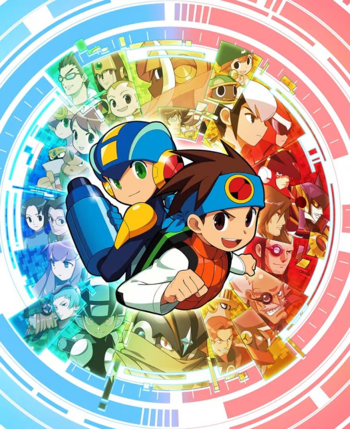
What if Dr. Light went into computer networking instead of robotics?
Mega Man Battle Network (Rockman.EXE) is a Spin-Off/reimagining of the Mega Man series. Set 20 Minutes into the Future relative to the early 2000s, everything is completely run by the Internet and life is more-or-less peaceful. Everything — cars, refrigerators, toilets, schools, the weather — literally Everything Is Online.
The programming required to run society has gotten so complicated that humans cannot comprehend it by themselves. So they've created helper Artificial Intelligences, called Network Navigators ("NetNavis" or "Navis" for short). The stars of the series are the initially 10-year-old Lan Hikari and his NetNavi partner, MegaMan.EXE.
Since power in this universe is through the Internet, public enemies are those who would conquer or destroy it. Viruses are monsters that must be destroyed, and hackers are able to control all of the things mentioned above that the Internet is connected to — even the Mafia is Internet-based. Lan and MegaMan, naturally, have to face these forces off.
The real world and the Internet are separated from each other. Lan can help MegaMan out by giving advice and plugging in "Battle Chips" that grant MegaMan special powers in battle, but he is more or less isolated from the action - unless the part of the Internet that is being affected controls the environment he is currently in, like a runaway train, a cruise ship, the oven of his house, etc.
The series is best known for its unique battle system. It's complicated in theory, yet simple in practice. Combat is conducted on a six-by-three block grid, with MegaMan on the left and his enemies on the right. When your meter fills up, you can select a certain number of battle chips to blast your enemies in real time while dodging their attacks. They can damage, heal, claim more territory for you, damage or remove enemy territory, summon assistants, and a host of other effects. Those are the basics, at least.
The series lasted for six main games with a few side games before ending, and is the second series in the Mega Man franchise to reach a proper conclusion. It spawned a sequel series focusing on radio waves and set 200 years in the future, Mega Man Star Force, utilising a similar grid battlefield system.
Like Mega Man (Classic) and Mega Man X before it, Battle Network would receive a Compilation Re-release, announced in 2022 with a release in 2023. Mega Man Battle Network Legacy Collection contains each version of the main six GBA installments and notably brings them to non-Nintendo systems for the first time. All included games are based on the original Japanese releases with the English script, multiplayer features like Chip Trading and NetBattling adapted to online play (ironically for the first time officially) and various bugfixes. The previously cut Boktai content also makes their official western debut, albeit without the "Crossover Battles".
It also has more than one Spiritual Successor (to its gameplay) in One Step From Eden and EndCycle.
Games in the Series:
- Mega Man Battle Network 1 (2001, Game Boy Advance)
- Rockman.EXE WS (2003, WonderSwan Color)
- Mega Man Network Transmission (2003, Nintendo GameCube)
- Mega Man Battle Network 2 (2002, GBA)
- Mega Man Battle Network 3: White and Blue (2003, GBA)
- Mega Man Battle Chip Challenge (2003, GBA/WonderSwan Color): The WSC port is Japan-exclusive
- Mega Man Battle Network 4: Red Sun and Blue Moon (2004, GBA)
- Rockman.EXE 4.5: Real Operation (2004, GBA): Japan-exclusive
- Rockman.EXE: Phantom of Network (2004, Mobile Phone Game): Japan-exclusive
- Rockman.EXE: Battle Chip Stadium (2005, Arcade): Japan-exclusive
- Mega Man Battle Network 5: Team Colonel and Team ProtoMan (2005, GBA)
- Mega Man Battle Network 5: Double Team DS (2005, Nintendo DS): Both an Updated Re-release and a Compilation Re-release of the GBA versions
- Rockman.EXE: The Medal Operation (2005, Arcade): Japan-exclusive
- Rockman.EXE: Legend of Network (2006, Mobile Phone Game): Japan-exclusive
- Mega Man Battle Network 6: Cybeast Gregar and Cybeast Falzar (2006, GBA)
- Mega Man Battle Network Legacy Collection (2023, PlayStation 4, Nintendo Switch and Steam): a physical Compilation Re-release containing all six of the main Game Boy Advance games and two volumes of digital releases, with the first volume containing the first installment, 2, and each version of 3 while the second volume contains each version of 4, 5 and 6. In addition to an art gallery and music player, the collection also includes an option to have a voiced MegaMan commentate on your gameplay, the ability to partake in online trading and multiplayer for each game, and restores content previously exclusive to the Japanese releases.
Other Media:
- MegaMan NT Warrior (2001): A manga series by Ryo Takamisaki that ran from 2001 to 2006. It loosely follows the games, though the English translation uses terms from the anime due to being printed after it in North America.
- MegaMan NT Warrior (2002): An anime series that ran from 2002 to 2006 with 5 seasons and a movie. Only the first season and Axess were released internationally.
- Battle Story MegaMan NT Warrior: The second manga series by Jun Keijima and Miso Asada, printed between 2002 and 2004; unlike the previous manga,
 it was not released in North America.
 - Mega Man Battle Network - The 20-Year Reunion
 : A special one-shot drawn by Ryo Takamisaki behind the original NT Warrior (2001) manga series to promote the Legacy Collection, featuring the grown-up main cast after the Distant Finale of 6 where MegaMan tries to arrange for them to meet at the titular reunion, but with somber results. Also features the first official depiction of Lan and Mayl's son Patch.
Trope routine, set! Execute!
- 11th-Hour Superpower:
- Hub.bat in the first one. It's actually possible to beat the final boss by just spamming the B-Button.
- In both the second and third games, MegaMan and Lan find a way to synchronize with each other before fighting the final boss, however this has no actual gameplay effects like it had in the first game.
- In the fourth game, MegaMan synchronizes with people from all over the world to become powerful enough turn a meteor away from Earth, as well as show the good in mankind to Duo.
- Subverted in 5; during the cutscene after Mega Man successfully defeats Nebula Grey, it regenerates and then tries to take over Mega Man's body. All hopes seem lost...when suddenly Mega Man turns into his full Hub form and wards off Nebula Grey with little effort. The subversion comes when he turns back to his normal form - and Nebula Grey goes back to strike him yet again. Fortunately there's Colonel (and others) to help him defeat Nebula Grey with a final, supercharged Mega Buster.
- In the final game, Colonel and Iris fuse together to defeat the final Cyber Beast, while MegaMan is knocked out. Sadly, they were set to be destroyed if they were to ever do that.
- 20 Minutes into the Future: The series takes place during the ever popular year of 20XX. The first game was made back in 2001, when the internet was just beginning to be a household thing, hence the Everything Is Online focus. It's actually both amusing and scary how accurate-to-life some parts of this series are now that we've more-or-less hit that twenty minutes in Real Life.
- Abandoned War Child: Long ago, Baryl's father was a soldier who fought in foreign wars, and thus he left Baryl in the care of his friend, Dr. Wily. When he eventually dies, Wily's thirst of revenge returned, and it influenced Baryl as well.
- Achilles' Heel: Shadow viruses No-Sell everything but sword chips. There are no in-game justifications to this, but they are the only effective options for them.
- Adam Smith Hates Your Guts: Notice how the price of HP Memories tends to increase the later in the game you encounter the stores that sell them. It's not just Adam Smith, it's the shopkeepers too! Even within the same store, the price increases the more you buy!
- Adaptational Jerkass: Downplayed with ProtoMan.EXE. The original ProtoMan in Mega Man (Classic), while aloof, is a supportive big brother figure for Mega Man. In the BN timeline, ProtoMan.EXE is considered a rival to MegaMan.EXE because their operators are also rivals, but ProtoMan doesn't take it personally; he's also more willing to scold and even fight MegaMan if it's necessary.
- Adults Are Useless:
- The first game makes this very obvious. Broadcasting evil education programs in school? They get brainwashed. Every car in Den City gets e-hijacked and a WWW agent comes along with a perfect anti-virus? They go scrambling over themselves to drop a million zenny for it (after you bring her to her senses, one of the women realizes she doesn't even have a driver's license). It makes Dex look like a genius in comparison.
- For some incredibly odd reason, nobody else seems to notice that the world's about to end. Yeah, some of the enemy bases are in pretty hidden locations, but in Battle Network 2, the Big Bad is hiding out inside a large condominium building that's getting merged with the internet located in a conspicuously irradiated city. Now how in the hell does somebody not notice that?
- Despite the fact that there are hundreds of people who have been NetBattling professionally for longer than Lan and Chaud have been alive, they're pretty much the only people in the world who are any good at it.
- Adults are even vastly under-prepared for emergencies. In the aforementioned water incident in the first game, it appears that no one has a stockpile of water bottles in case of a water shortage (a very common tactic in real life) and the government is less than useless as they don't provide emergency rations. It takes two 11-year-olds (one is admittedly part of the government) to end the crisis.
- Speaking of the government, SciLabs (which is technically only partly funded by the government). Their network security decisions are laughable. And let's not talk about hiring an established criminal and former WWW goon Mr. Match, who famously tried to burn down Dr. Hikari's house — we understand Higsby reformed, but Higsby isn't working at Scilabs.
- After-Combat Recovery: What sets the first game from the others is that Mega gets fully recovered after every fight. The only exception is in the Power Plant dungeon. Later games removed this feature. However, on the fourth game onward there exists a Navi Customizer Program that you can equip to make MegaMan recover a few HP whenever he finishes a battle. In the fifth game, winning a battle with a "residual battle data" of your partner will recover his HP to full. Also sometimes, if your HP is low enough at the end of battle, the battle reward may change to a big HP recovery instead.
- All in a Row: In Double Team DS, your chosen Navi teammate's combat data will follow you around the net as semi-transparent running sprites. ProtoMan/Colonel call them "ghosts".
- All There in the Manual: Navi Customizer Compression and Extra codes in Battle Network 3 could be found hidden in manuals, the anime adaptation, and even some of the Gaiden Games. For instance, the passcode Lan used to force MegaMan into the ridiculously powerful Aqua Custom Style in the anime? It's the bonus code for 200 extra HP in the game. (Don't bother looking for it in the dub, though...) Let's put it this way: since NT Warrior got shelved, this gets escalated to Guide Dang It! for western fans.
- All the Worlds Are a Stage: Done in the first game, where each part of the final area is a condensed version of earlier areas, complete with more complex takes on previous dungeons' gimmicks (i.e. putting out fires in FireMan's area, using numeric passcodes to unlock doors in NumberMan's area, etc.) Repeated in the sixth game, but justified since the various sectors of the final dungeon specifically refer to the various Cyber City locales.
- Alternate Continuity: The game, manga, and anime all have different conflicts and outcomes to the point where the stories are only tangentially related at times. It may not have as many versions of the story as Arthurian Legend, but it is comparable to the Pokémon manga in this regard. What is especially jarring is the vastly different backstories, events, outcomes, and ultimate fate that are given Dr. Regal in the three mediums. Many characters appear in one form of media but are absent in another or their chief motivation are completely changed. Some characters get different Navis and/or roles in the anime than they had in the game. In some extreme cases, characters are In Name Only to original videogame concept.
- Alternate Self: Almost all of the Navis (and even some of the humans) are based on characters from Mega Man (Classic), with a few special appearances by characters from Mega Man Legends, Mega Man X, and Mega Man Zero. The degree of fidelity to the originals can range from "they're the exact same character just with a bit of Art Evolution" all the way to "they're the same character In Name Only (and sometimes not even then)".
- Alternate Timeline: Played straight during the original trilogy, in which the setting is a world where Dr. Light (Tadashi Hikari) turned to computer networking technology instead of robotics. Red Sun and Blue Moon, however, created a world map inconsistent with the classic series and introduced a modified Duo, altered from his classic Space Police self into a Captain Ersatz of Galactus. Both following games and sequel series Star Force freely engaged in Continuity Drift, though the original premise of the setting was not officially abandoned.
- Alternate Universe:
- The Robot Masters (and a number of other characters) from the original series return, this time as artificial intelligences called Net Navis. Dr. Wily himself is a major force. Dr. Light's counterpart is here named Tadashi Hikari.
- Several Robot Masters have two counterparts. Slash Man has a lookalike counterpart in BeastMan.EXE in Battle Network 3, but in Battle Network 6, they give us the radically different SlashMan.EXE. Another example is Magic Man, who has both MagicMan.EXE and the much more comparable HatMan.EXE.
- Zero.EXE, Colonel, and Iris are NetNavi versions of Mega Man X characters, and Glyde came from Mega Man Legends.
- Some NetNavis are infamously dfferent from their Robot Master counterparts. CutMan.EXE, on the other hand, is identical save that big ol' C across his chest. QuickMan, likewise is just a slightly fancier version of his original.
- Ring is a Gender Flip of Ring Man.
- Save for the Mascot Mook Met, most viruses from the main series are unique. In the Platform Game Network Transmission, many of the viruses take the form of the original Mechaniloids (like Sniper and Hammer Joes). Fitting, as the game itself is largely an exercise in Nostalgia.
- Always Check Behind the Chair:
- Some items and computers are randomly placed in miscellaneous objects in the real world, and unlike Blue Mystery Data in the Net there's no indication that anything is being hidden. So check everything in case there's an HP Memory or Reg Up lying around or a computer to jack in to.
- It's often worth your while to chat with all the NPCs you come across, as more than a few of them will give rewards or drop little bits of information that you can use later, such as Program Advance hints or Number Trader codes. In addition, NPC dialogue also refreshes with story progression, so there will always be something new to look forward to after defeating each scenario boss.
- Always Identical Twins: Most same-sex siblings in the series are identical twins; there's Ms. Mari and Ms. Yuri, Shuko's twin brothers Atsu and Ty as well as topmaker Tensuke and his twin brother.Even the main protagonists Lan and Hub (a.k.a. MegaMan) are identical twins.
- Always in Class One: Lan, Mayl, Dex and Yai are in class 5-A. The sixth game has Lan moving to another school, where he is in class 6-1, alongside Mick and Tab.
- Amazing Technicolor Population: The Professor of Network Transmission inexplicably has greenish skin.
- And Now for Someone Completely Different: In the fifth game, you control your teammate Navis during Liberation Missions. In the sixth game, Link Navis also work like this.
- The Anime of the Game: MegaMan NT Warrior (Rockman.EXE) is based on the games, but is radically different in terms of plot and characterizations. The first two seasons are very loose adaptations of the original trilogy, but the following ones further distance themselves from the source material by embracing Sentai elements, such as the introduction of Cross Fusion between Navis and Operators to emphasize the latter's involvement in action scenes.
- Anti-Debuff: The Tomahawk Soul in the fifth game (T. Cross in the sixth), done by TomahawkMan merging with MegaMan, has a passive ability called Status Guard, making MegaMan immune to most status effects. Only a few abilities can bypass this to inflict statuses normally, such as the DestroyPulse Program Advance.
- Anti-Frustration Features:
- All games from the third onward have the "Collect" program, which always lets a Battlechip drop at the end of battle, provided the enemy drops chips at all. This alleviates the frustration from the previous two games, where you could get a perfect Busting Rank only to get Zenny as a reward, instead of a coveted chip. If you're short on cash, you can intentionally cause a bug with the NaviCust program to force all battles to drop Zenny rewards.
- In 5, whenever it is compulsory to go to the deepest areas of the Oran Isle mines, you will be brought back to the entrance after completing said compulsory task. Really handy since the mines are not known for their simple layout.
- In 6, the area that triggers a boss fight is marked by a tile with a skull on it, so that you know where to save beforehand. This feature is carried over to Star Force.
- The Virtual Console release of 2, like other handheld-based VC games, has no multiplayer functionality; however, Capcom was nice enough to patch the game to give you all the multiplayer-only chips for free. This is also done with the Virtual Console versions of every installment that comes afterward.
- Missing a hard-to-obtain chip for 100% Completion? The Compare Library feature in the link menu allows one to fill in the gaps with another player's help.
- If MegaMan is deleted in a friendly Netbattle (as in, one where Lan actively challenges the other Navi's operator), the game will not hit the player with a Game Over.
- If the player wins a random encounter while at critical health, the game will restore some of MegaMan's HP instead of giving out Zenny or a BattleChip.
- The Operate Shooting Star Updated Re-release of the first game cleans up some Early-Installment Weirdness to bring it in line with the later entries.
- The most notable feature is the addition of maps and inclusion of area names to make exploration and navigation much more convenient.
- You can now retreat from battle any time with the L button in the Custom Menu, and an S-rank on a virus battle will always yield a Battle Chip.
- The infamously frustrating Power Plant level has been made more tolerable — the invisible paths now flicker so you can see where to go, and you can endlessly retry battery placement without needing to backtrack to recharge them. The ability to retreat from battle at any time also reduces the impact of the loss of After-Combat Recovery.
- Mega Man Battle Network Legacy Collection includes a "BusterMAX" mode where normal, non-charged MegaBuster shots have their damage multiplied by 100, allowing a player who is only interested in following the story (or running through the second version of their game in pursuit of 100% Completion) to trivalize most battles.
- Anti-Regeneration: The AntiRecovery battle chip. If an enemy attempts to heal while the user has it active, it springs a trap and damages said enemy for the amount they would have healed from it, in addition to placing a Poison Panel beneath them for good measure.
- Apocalypse How:
- Lord Wily's plan is to seize control of military installations and annihilate modern net society.
- Duo's job is to be Judge, Jury, and Executioner of whole planets, which is what brings him to Earth in the fourth game.
- Arc Words:
- Expect "10 years ago" to come up a lot. A great many things went down ten years ago.
- In the sixth game Lan is repeatedly told to get rid of his kindness when facing enemies. He retorts that being nice is a good thing and that even Dr. Wily couldn't completely leave his own kindness behind.
- Arm Cannon: The Mega Buster has three basic stats: Attack, Rapid, and Charge. Attack is obvious, forming the basis of how powerful Mega's attacks are. Rapid refers to rate-of-fire, which is used by people who prefer to use it as a machinegun-style weapon. Charge influences how quickly it can activate its Charged Attack, which may not seem impressive to Normal Mega (whose normal Charge Shot is merely 10x Mega's Attack rating, normally maxing at a meager 50 damage), but actually is meant to facilitate the Charged Attacks of Mega's various Super Modes, most of which have some tactical use.
- Armor-Piercing Attack: In addition to Break chips that bypass guards to deal full damage, Sword chips are your only method of damaging Shadow enemies, Cursor chips go through Invis and post-hit invincibility, and Wind chips remove barriers and auras.
- Art Evolution:
- Overall, the series changes artstyle in between 3 and 4. The character's eyes are rounded instead of semicircular (most prominent on MegaMan) and the shapes of their bodies feel more slender and less blocky, though the recurring characters are prone to some wacky, far-fetched expressions on their mugshots. The games themselves shrink down sprite dimension and gain thick outlines to create a crisp feel of objects. The colors also become brighter and more saturated, which is probably a measure to combat the GBA's infamously dark screen. Character designs for the generic NPCs went from semi-realistic (especially the non-Electopians) to cartoony-looking.
- Mugshots also change considerably, going from fairly Off-Model to almost spot-on and beautifully shaded by the last game.
- Ironically as the series progresses Battle Chip artwork feature thinner outlines, the colors are slightly less saturated and the shading used is more detailed (though not portrayed well in the GBA due to compressed graphics).
- The Artifact: There are several cases in which a virus is dropped from a game, yet some version of the BattleChip that you earn from defeating them remains in the library. Typically, the portrait for said chip retains the virus but renders the enemy in grayscale. Invisnote and Mine are two such chips.
- Artificial Stupidity: ProtoMan in 4 is very, very dumb if you use Areagrab against him. His tournament fight's AI infamously breaks completely and isn't able to do anything but shuffle around, but his encounter AI is nearly just as bad and is only barely functional compared to other Navi fights.
- As You Know: Each game starts with several tutorials on the basics of the combat system for the sake of potentially new players, typically framed as Lan being taught/reminded how to do one of his favorite activities. It gets increasingly odd as the series progresses, as Lan and MegaMan end up saving the world multiple times and are clearly established to be among the world's best Net Battlers.
- Assist Character: Navi Chips allow you to use data from other Navis (usually ones you've defeated) to perform special attacks unique to them.
- Atlantis: (Ahem) Atlampia, a civilization from 3000 years ago, features prominently in Gaiden Game Legend of Network. No relationship has yet been established with Mu.
- Auto-Pilot Tutorial: Every game begins with an unskippable warm-up battle to teach the player about how multiple attacks can be equipped in a single turn and then how to use a special system (exchanging chips for extra inventory space/interrupting enemy attacks for a power multiplier). Each lecture will force the player to pick specific chips.
- Autosave: Getting a new chip from the chip trader machine will cause the game to auto-save. This is to prevent Save Scumming for the desired chip, as was possible in the first game before the devs realized this. Emulator-users enjoy ignoring this restriction.
- Awesome, but Impractical:
- Some combos and Program Advances can be extremely damaging but gimmicky and otherwise unreliable. An excellent example is the Master Style Program Advance from BN3 which did almost a full thousand damage to the enemy and looked very flashy, but was very gimmicky. You needed four chips, all of them Mega class (only one of each per folder, and they steal the space for any other Mega chips), if MegaMan wanted to use any of the chips individually he had to be in the right style (so only one could be used by itself in a single fight), and each of these chips had a very specific individual gimmick, like the need for field obstacles or holes. The Call-Back Master Cross is vastly superior, utilizing four powerful Standard class chips that all fit easily into the same folder and can be individually used painlessly.
- Many Program Advances also involve selecting 3 or more copies of the same chip with different codes in alphabetical order.note There are a few problems with these kind of Program Advances. Firstly, the Zeta series work by putting you in an invincibility phase while using a certain chip under a time limit. While this is supposedly a neat feature, most bosses have Mercy Invincibility and the attack speed for some chips are painfully slow that you can only attack them with that Program Advance once or twice at most before the timer runs out. Secondly, due to chip selection rules, the player cannot select any other chips to use in the same turn, like attack-boosting chips which would otherwise make the Program Advance much more potent. This also means that it's harder to use these chips alone if you're using a folder with only one chip code.
- MagnetMan's Liberation ability conjures a barrier for the entire party protecting them from attacks outside of battle for a turn at the cost of a rare Order Point...and MagnetMan's turn. Since field damage is pitiful and can't bring HP below 1, it's very rarely worthwhile to use it instead of choosing to liberate a panel.
- Beast Over in the sixth game turns MegaMan invincible and lets him attack automatically (though out of your control). It has the potential to do a lot of damage, but 1) you need to have spent 3 turns in Beast Out to be able to use Beast Over, by which point you may have already defeated all enemies 2) it ends automatically when the Custom Gauge fills up, and 3) it leaves MegaMan exhausted, resetting his Buster stats and causing his HP to drop rapidly. It's designed as a Desperation Attack, and if any enemies remain standing after Beast Over expires, something has truly gone awry.
- Every game from Battle Network 3 onwards features a Giga Chip called Delta Ray Edge, which summons ProtoMan to slash the opponent from up to three different angles, as long as the player presses the A button in time with each sword strike. Unfortunately, due to the way ProtoMan moves, the chip will fail to activate if the enemy is in the upper row, and the additional attacks will only come out if there are empty panels behind and below the opponent for ProtoMan to occupy. Coupled with the awkward timing of the button presses and the fact the chip comes in the lackluster Z code, there is little justification for putting it in the folder over any other available Giga Chip.
- Babies Ever After:
- The Distant Finale of game six shows Lan and Mayl get married and have a son named Patch.
- And an unlockable in Star Force 2 shows that Patch's Navi is named MegaMan Jr, who was made from code taken from MegaMan and Roll's programs.
- Backtracking: A lot of the time, you're required to go back to previous areas. It's completely necessary to rematch bosses too.
- Bag of Spilling:
- At the start of each game, Lan and MegaMan start off with a horrible folder, 100 HP, no sub memories, no Navi Customizer, nor any of the previous transformations (any styles or souls that carry over into the third or the fifth game must be individually regained). The games occasionally explain why certain power-ups are gone (e.g. MegaMan's deletion in Battle Network 3 leads to some files being lost), but most of the the time it goes without comment.
- The sixth game lampshades this in one of the poems of the Poem NCP. MegaMan asks Lan where all his old chips and such go, Lan answers that he really doesn't know!
- At least MegaMan gets to use his charged shot from the beginning in Battle Network 3 and beyond, though the removal of the Powerup system in favor of the NaviCust means that the charged shot can't be as powerful as it could be in the first game.
- Justified in the fourth game, when Yuichirou returns the Navi Customizer to Lan and Mega. Turns out Haruka confiscated it from them to keep them out of trouble.
- In the Gamecube Gaiden Game Network Transmission, the opening cutscene is of Lan and Mega fighting the Life Virus, getting past the Life Aura with a Mega Cannon. This particular chip is nowhere to be found when the gameplay actually starts.
- Not only does Lan lose all his Battle Chips and Mega all his upgrades, any notable status they may have achieved in the previous games counts for absolutely nothing in later installments. In the second game, for example, Lan can become a Rank SSS City Netbattler (Chaud only qualifies for Rank S), but he's still just some kid in the third game. Previous operators he's fought and defeated before, like Tamako/MetalMan.EXE, will sometimes even forget who he is between games.
- Barehanded Blade Block: MegaMan is shown doing this in the picture for the Anti Sword chip. He also does this in the ProtoMan scenario in Blue Moon.
- Battle Tops: TopMan.EXE can spin or toss tops, although MegaMan is only able to copy the spinning.
- Beard of Evil: Regal grows one in-between 4 and 5 to show that he's serious this time. Mr. Match sort of has a Goatee Of Evil going on.
- Beef Gate:
- The lack of important broken bridges in the first game's internet overworld can lead to the player wandering into the Undernet way before they're supposed to visit it. This can lead to some severe Sequence Breaking.
- The third game has security cubes in the Undernet that can only be unlocked by beating the WWW Navis' third forms. Thankfully, each cube gives a hint which Navi needs to be beaten to unlock it.
- Beware the Nice Ones:
- Mamoru all the way. Despite being a sick little kid in a wheelchair, it is revealed in the third game that his father was a SciLabs scientist who created the Undernet, and Mamoru is its current owner. Also, look closely at the Navi icon on the side of Mamoru's chair in his artwork◊. Guess which Navi's icon that is—Serenade! It isn't entirely confirmed, but it is widely speculated and is very likely that Mamoru not only owns the Undernet, but is Serenade's operator and thus the ruler of the Secret Area and the operator of one of the most powerful Navis in the series.
- Also, 6's Prosecutor Ito. It doesn't help that he resembles Mega Man Juno from Legends with a bowl cut and dye job.
- Mamoru all the way. Despite being a sick little kid in a wheelchair, it is revealed in the third game that his father was a SciLabs scientist who created the Undernet, and Mamoru is its current owner. Also, look closely at the Navi icon on the side of Mamoru's chair in his artwork
- Big Bad: Lord Wily, trying various ways to destroy Net Society in the first, third and sixth games. He also has a hand in almost every other game. He's The Man Behind the Man for Gospel, and Dr. Regal (of 4 and 5) is his son.
- Big Damn Heroes:
- Lan and MegaMan in every other scenario in the games.
- And in at least one scenario per game, usually near the game's climax, they're the ones who need the backup.
- Big Fancy House: Yai lives in the largest building in ACDC Town (it's in the corner in the first half of the series, and on the edge in the second half). It has a maximum of at least three visible rooms in the second game (Lan's own home never gets more than two until the sixth game, when they move into one that adds a toilet), which includes Yai's room (other games only allow you to visit this), the large central corridor, and a luxurious bathroom (which is larger than the one in Lan's new house, anyway).
- Bit Character:
- The games feature many different BBS boards with members talking amongst themselves about game mechanics and plot events, and in a few cases even having miniature storylines of their own. One of the regulars from the early games, Koetsu (a Creator Cameo of series programmer Koetsu Matsuda), actually appears as a real-life NPC in both the N-1 Grand Prix and Mega Man Battle Chip Challenge.
- Anna Mori is a waitress who appears in each game of the original trilogy. She features in a Sidequest from the Job Board in Mega Man Battle Network 3 and she's the first major opponent in the DenCity Open Battle of Mega Man Battle Chip Challenge.
- Jennifer and Johnson are Official NetBattlers who attend the conference in Mega Man Battle Network 2 and return, briefly, as The Cameo during the N-1 Grand Prix.
- Bonzu is a contestant from the N-1 Grand Prix who is likely the same man who initiates the rap-off on the plane during the MagnetMan scenario of Battle Network 2. Another man named Bonzu (now localized as Bonds), who may or may not be the same individual, returns in Battle Network 4 as an official judge for the preliminary of the global tournament.
- Nanako is an employee of Higsby's in Battle Network 4 and Battle Network 5 who runs Higsby's chip shop while Higsby is busy doing things like entering citywide tournaments or joining Team Colonel.
- Black Screen of Death: Often used to avert moments of violence (like when ShadeMan kills a mook in the fourth game). Sometimes used to abridge cutscene battles.
- Blatant Lies: A Heel Navi in the mid-late cyberworld in the first game specifies that the WWW server is nowhere nearby. There's a link with a giant red and black W-sign on it five feet away that specifies only WWW personnel are allowed entrance. Subverted in that he's technically right. The WWW Server's standard entrance is at the far end of the first game's Undernet. He's standing at an entrance to that same Undernet, but you have to travel deeper into the WWW-sequestered sections to get to the Server.
- "Blind Idiot" Translation:
- The "Howitzer" Battle Chip is later known throughout the series as the "Cannonball" chip, which suggests somebody on the translation team realized Hougan is the Japanese word for "cannonball" and not a bizarre attempt at "Ho-Gun".
- "Prominence", a battle chip only usable by HeatStyle MegaMan is translated as StandOut, despite the chip clearly refers to the solar prominence and not about standing out in a crowd.
- "Z-Saver" is obviously supposed to be Z-Saber and its flavor text uses the term "Repliroid", the Japanese term for Reploid.
- Red Sun and Blue Moon are the most blatant offenders of this, filled with simple and obnoxious grammatical errors (most commonly - and oddly, considering the series - the game always using "viruses" in the plural). Here's a list of samples at the Mega Rock blog while here is an entire Let's Play dedicated for it.
- Blob Monster:
- The Null, Void, and Null&Void viruses in 2 are slime monsters that constantly regenerate, can push Mega or obstacles, and spawn whirlpool traps around Mega's area that deal huge damage if stepped on.
- The Slimer, Slimey, and Slimest viruses in 3 are cute-looking blobs that hop around into Mega's area, stealing any area that they hop on.
- Alpha from 3 is the prototype of the internet, an all-consuming metal-and-blob-like entity that assimilates all in its path. Its AlphaBug spawn are smaller versions of it that can even corrupt panels they land on.
- Bodyguard Betrayal: Happens in the sixth game, when Chaud reveals his true identity and arrests Mayor Cain right as he orders him to arrest Lan.
- Boisterous Bruiser: GutsMan is loud and fight-happy. So is Mr. Match, from time to time.
- Bond Creatures: Not exactly Mons, but the NetNavis themselves each have an Operator. Rarely, you might meet a NetNavi without one, such as Bass.EXE.
- Bonus Dungeon: Starting with the second game, we have the WWW Area, the Secret Area, Black Earth (a sort of cyber-Hell), Nebula Area, and the Graveyard. Several of these do not allow you to jack-out, so you must haul Mega all the way back to the entrance if you want to leave.
- Bootstrapped Leitmotif: The music used for NumberMan's stage in the first game became this for MegaMan in his Guest Fighter appearance in Onimusha Blade Warriors
- Boring, but Practical:
- Obstacle chips and Terrain-changing chips, especially in the third game where lots of strategies are made and broken by the same kind of chips. Their potency results in subsequent games reducing the availability, strength, chip synergy and range of most terrain-changing abilities.
- No player ever goes anywhere without at least 3 copies of Invis, a chip that frequently comes in * code (except the first game) and bestows protection against most attacks, allowing a player to line up an attack while under heavy fire.
- Higsby's bargain bin in the 5th game offers the player access to several average chips in * code, allowing them to fill out a more streamlined folder...or convert excess Zenny into Chip Trader fodder.
- Atk +30, and its cousins, Double Point and Navi +40. Powering up a single chip by 30 or 40 points hardly seems worthy of a Mega Chip. Except when attached to a multi-hit chip, the boost works for all of the hits that chip deals. This makes the chips obscenely good in the right combinations, and they're even compatible with certain Program Advances.
- The basic Roll chip, the first Navi chip you're likely to get in any of the games, summons Roll to hit a single enemy with her ribbons, then heal MegaMan. It's nothing flashy, but but the heal/damage mix can be a life saver. It gets better in later games, which makes the ribbon attack multiple hit, allowing it to benefit more from the aforementioned Atk up chips.
- FastGauge is a support chip that doubles the speed at which your Custom Gauge fills. This gives you access to chips twice as often, and is crucial to speed deletions, especially when you're aiming to S-Rank a Navi in 10 seconds for maximum SP chip power. FastGauge * is regarded as one of the most useful chips in the game, next to AreaGrab * and FullCust.
- Bound and Gagged:
- In the first game, Lan finds Ms. Mari tied up and gagged in the storage room at ACDC Elementary during Higsby's attempt to hijack the school for WWW. Lan frees her and is rewarded with an ID card he needs to access the teacher's lounge and stop Higsby. Near the end of the game, Ms. Mari's sister, Ms. Yuri, is found in a similar predicament alongside an old man and Higsby himself.
- In the fourth game, Lan's doghouse alarm goes off and he rushes home to find his mother tied up on the floor in the corner of his room with a warning from Nebula that they could easily do worse.
- Bowdlerise:
- In the Japanese version of Battle Network 5, on the Queen Bohemia, a painting of the Da Vinci's The Last Supper was changed into a picture of fireworks. See the painting here. When the remake came about, they reverted all the changes of the localization but this one.
- Zigzagged with the Geddon series of Battle Chips. The original name of the series was "Death Match", but translation teams invoked Never Say "Die" and instead re-titled the chips with a veiled reference to the biblical end of the world.
- In the Japanese version of Battle Network 5, on the Queen Bohemia, a painting of the Da Vinci's The Last Supper was changed into a picture of fireworks. See the painting here
- Boss in Mook Clothing: Battle Network 3 has a handful of higher-level virus encounters dispersed throughout random computers that you can hunt down with search programs. Disjointed virus assortment can result in dangerously powerful viruses hiding in early areas. For instance, Elehornets are the third and strongest version of the Elebee virus series. The first and second versions, Elebee and Elewasp, are found in The Very Definitely Final Dungeon and the Bonus Dungeon, respectively, while the Elehornets themselves are found at your school, the first major area of the game. Such examples tend to be rare encounters — merciful for the player just progressing through the game, but potentially frustrating for those trying to hunt them without prior knowledge.note
- Boss Rush: The final dungeon of most games usually pits the player against improved versions of antagonistic bosses. In addition, the time trials in 3, but they come with asinine requirements.
- Bragging Rights Reward: A few games have an additional reward for 100% Completion and defeat of the True Final Boss.
- Brain Uploading: MegaMan himself is based on the mind of Lan's brother Hub, who contracted a terminal heart condition and died as an infant.
- Bread, Eggs, Breaded Eggs:
- In the second game, there's a virus called Null. It has a stronger Palette Swap named Void, and then an even stronger one called...Null&Void.
- Higsby's shop in the fourth game has a sign that reads "A NumberMan sign. Higsby's Navi and a Higsby's sign Navi".
- Breakout Character:
- SearchMan is one of the more popular Navis introduced in Red Sun, thanks to his design invoking a badass sniper and his Soul Unison being one of the most useful in the game. This resulted in him returning as a playable character in Team ProtoMan, as well as becoming the tritagonist in Stream.
- Bass. Despite only showing up in 1 as a Super Boss, he became a central character in the following two games, and kept showing up in the second trilogy, thanks to his incredible popularity among fans and even the developers themselves.
- Broad Strokes:
- Battle Network 3 was released after MegaMan NT Warrior had gained some popularity, and quite a bit of the anime-adaptation seeps through. Higsby has his famous crush on Ms. Mari, there's an Inevitable Tournament that shares a name with the Tournament Arc from the first season (at which Ribitta is reporting, and which also centers on the rivalry between Lan and Chaud), Yai is suddenly a NetBattler, and there's even a Dummied Out jack-in sequence reminiscent of the anime's.
- The two Gaiden Games released after 3 also draw on the anime a little — Network Transmission has voice-acting work by the original Japanese seiyuu (and an Official Art style clearly informed by the anime)note , and Battle Chip Challenge has an Easter Egg Mythology Gag or two.
- Battle Network 3 was released after MegaMan NT Warrior had gained some popularity, and quite a bit of the anime-adaptation seeps through. Higsby has his famous crush on Ms. Mari, there's an Inevitable Tournament that shares a name with the Tournament Arc from the first season (at which Ribitta is reporting, and which also centers on the rivalry between Lan and Chaud), Yai is suddenly a NetBattler, and there's even a
- Broken Bridge: Faulty electronic equivalent or sometimes a bad net connection are used to prevent MegaMan from going too far into the net. Sometimes Lan will have to meddle with objects or people in the real world to correct this.
- Brought to You by the Letter "S":
- Battle chips are all assigned one or more "chip codes" (derived from the letters of the English alphabet, with the * code as a wildcard). While the characters in the game seem only barely aware of this, it is an essential part of folder building to streamline it by using only one or two codes (some will go as high as three or four
 for fun) to allow you to maximize the number of chips that can be used in one turn.
 - Mega and Giga class chips have (with almost no exceptions) the first letter of their name as their chip code. This holds true for Navis like ProtoMan B and SpoutMan A, whose codes are actually derived from their original Japanese names: ProtoMan = Blues, SpoutMan = AquaMan); Meteors R (Ryuuseigun, Meteor Swarm) and Guardian O (Ojizousama, a Buddhist guardian) are also victims.
- Battle chips are all assigned one or more "chip codes" (derived from the letters of the English alphabet, with the * code as a wildcard). While the characters in the game seem only barely aware of this, it is an essential part of folder building to streamline it by using only one or two codes (some will go as high as three or four
- Call-Back: The first problem that Lan solves is an oven that spits fire in his house. In a later game, someone complains, "My oven's spitting fire!" The response to which is the accusation of that being an old story. Also of note, the fourth game (in which FireMan returns) allows you to Jack In to the oven again, though nothing of particular note happens there except for the tutorial.
- Calling Your Attacks:
- FlashMan.EXE loudly yells the name of his attacks in Battle Network 3: "Hypno Flash!"/"SHINING...BROWSER...CRASHER...!"
- In Battle Network 5 where, during Liberation Missions, MegaMan and their allies will yell out their special abilities' name before executing it. Same goes with the bosses in said missions.
- The Cameo:
- Hideo Kojima himself appears as an NPC in Battle Network 4.
- The Boktai characters have appearances in the 4th to 6th games, going from posters in the background to Battle Chips and even a crossover side mode.
- Rogue of Mega Man Star Force appears as a battle chip and enemy summon in Operate Shooting Star.
- Canon Foreigner: While many special Net Navis are based on characters from other Mega Man series, there are several that were created for this series.
- Many of Mr. Famous's Net Navis are actually Contest Winner Cameo, which were fan-made design that got added into the game. The one exception is Punk.EXE, whose counterpart originated from the GameBoy Mega Man III and Mega Man V.
- Several Net Navis like NumberMan.EXE, ColorMan.EXE, Serenade, LaserMan.EXE, Meddy.EXE, JudgeMan.EXE, etc. have no counterparts within other series.
- By some technicality, BlastMan.EXE was created as a boss Navi in Battle Network 6. Mega Man 11 would later introduce a Robot Master named Blast Man, making it a case of Canon Immigrant.
- Many of Mr. Famous's Net Navis are actually
- Caps Lock:
- All Mr. Progs speak like this from the fourth game onwards.
- Dark Chips' descriptions are also in all caps to denote their ominousness.
- Card-Carrying Villain:
- In Battle Network 3, a handful of Heel Navis attack the Yoka, Beach, and SciLab Areas after the PlantMan Scenario. Every single one of them talks about how they're totes in the WWW, some of them do an Evil Laugh, and one even composes a song about it. It's almost as though they're going out of their way to prove how obviously WWW they are. (Which, in fact, is what they're doing).
- Everyone employed by Nebula, which goals include corrupting the world to evil via dark power.
- Card Cycling: There are ways to manipulate the chips available to you in the Custom Screen.
- The "Add" function in the second and third game lets you discard your current chip selection, fight without chips for a turn, and for the rest of the battle, your custom capacity is increased by the number of chips you discarded.
- In the fourth and fifth game, Search Soul lets you Shuffle the unselected chips in your Custom Screen up to three times, helping you put combos together. There's a "Shuffle" NaviCust program in the sixth game that replicates this function, but only lets you Shuffle once per turn.
- Dust Cross in the sixth game lets you "recycle" your current chip selection, returning them to the folder and drawing replacements immediately once per turn in the Custom Screen.
- Cast from Hit Points: Dark Chips in 4 and 5. One of the most extreme examples of this trope: using a Dark Chip only deducts one hit point from your total, but that hit point is gone permanently.
- Cast from Sanity: Using the Dark Chips also takes away your "sanity" from the invisible sanity gauge. Using them frequently enough will always make MegaMan be in the "dark" state, where he can get access to certain other powerful chips, but disables Soul Unisons and makes him unable to use "holy" chips like Sanctuary or Gun Del Sol. To get out of such a state, you have to do battles without using those chips, and you'll gradually turn better.
- Casting a Shadow:
- Battle Network 2 introduced shadows as a type of defense (with shielding, invisibility, and barriers), which rendered users immune to all damage that didn't have the sword attribute. ProtoMan used chips from this family in Battle Chip Challenge.
- To use the ability, Navis have to win chips from the demonic "shadow" virus family, amorphous shadows that have batwing designs near their head and turn into solid bladed weapons to attack targets with. The shadow virus family would get an Expy in Battle Network 6's "nightmare" virus family, another group of demonic Living Shadows that use Serrated Blade of Pain Sinister Scimitars.
- Battle Network 4 had two unique Bonus Dungeon enemies, the "navi shadow" and "navi black", which were normal navis and heel navis who respectively succumbed to Dark Power and become Living Shadows themselves. This connection between Dark Power and the shadow body-type was never elaborated on.
- Cerebus Rollercoaster: The first game is rather light-hearted but isn't moreso than any saturday morning cartoon or Shounen Anime. The second game and third games up the ante, despite the silly situations. The fourth game then changes it to a borderline Random Events Plot and the later games are much more unrealistic. It's notable that the series was intended to end with three and that 4-6 were a Post-Script Season.
- Chain of Deals: Most, if not all of the games feature one, with a new step becoming available after defeating a boss. The second game features one that starts with an Invis1 *, and ends with an extra chip folder. Full Sequence Later games also have something similar with other chips.
- Chaos Architecture:
- The Internet is constantly undergoing updates so massive, people don't even bother to care that the immediate cyber-neighborhood looks nothing like it did in previous games. You might find a few similar areas here and there (a particular section of the Undernet in Battle Network 4 is reminiscent of an area from Battle Network 2).
- ACDC Town has a remarkably different geography in the second half of the series, having stripped out every building except for four houses (Lan's, May's, Dex's, and Yai's), Higsby's chip shop, and the Metroline station. The fifth game includes a visit to a digital recreation of ACDC Town as it was ten years ago, and it has the same layout as it does in the present.
- Played with in the first three games' version of ACDC Town. The school grounds and Lan's friends' houses don't actually change design between installments, but which parts of those buildings you have access to does. It's only in the first game, for example, that you can even see the entrance to the school grounds, while the third game gives you access to the principal's office.
- Dr. Hikari's office is almost identical in between the first and second games, but for some bizarre reason, it's set in two different hallway structures in two different buildings (the Government Complex in the first game and the Official Center in the second). The third game gives him a new office design entirely, which apparently he's always had. SciLabs in general also revamps its appearance in the third and fifth games.
- Character Model Karma Meter: The fourth and fifth games have MegaMan's appearance change depending on whether or not you use Dark Chips in battle: the more you use them, the darker his color becomes, but going for a long time without touching them causes him to turn a lighter shade of blue.
- Character Name Limits: Appears everywhere, with a limit of 8 characters for all key items, battle chips and Navi names when displayed on the battle screen. Most terms end up being very compressed as a result. The fourth game in particular applies this limitation to almost everything, even to Navi names in conversations.
- Character Select Forcing:
- Shadow and Nightmare Viruses are immune to everything except for cutting attacks like swords, meaning that they're downright unbeatable if you lack those kinds of attacks.
- The Kettle Viruses in HeatMan's scenario lack conventional health and are immune to everything except for Fire attacks, which causes their temperature to rise. If their temperature hits 100 degrees, they explode. Fortunately, you're playing as HeatMan who uses fire. Later variants subvert this by being vulnerable to anything, though they still keep their temperature-based health gimmick.
- Charged Attack: MegaMan can charge his Buster to unleash stronger attacks. While under the effects of a transformation, his charge shot behaves differently and gains different properties, depending on the transformation. From the 4th game onward, certain transformations also have the ability to charge a chip for additional effects — and frequently, double damage.
- Chekhov's Classroom: Every once in a while in the first few games. For instance, in Battle Network 3, we find the class discussing program compression at the beginning of the BubbleMan chapter (which integrates into the game the small cyberworld paths that Mega must compress himself down to use).
- Chekhov's Gun:
- Lan's house has a doghouse behind it. In the first four games, nothing is ever said about it and you would just think it is for security like the other one, but then the fifth game finally makes it a plot point.
- Many fetch quests usually have you running across the item you need in the background somewhere, but you don't notice it until you're told you need it, then you need to go looking for it.
- Chekhov's Gunman:
- A certain gray-haired boy makes a brief appearance near the end of Battle Network 2 during the MagnetMan chapter, the main significance of which is to trigger the Law of Conservation of Detail. In Battle Network 3, Lan repeatedly encounters a redheaded man with a beard who has ties to SciLab. These characters are Sean Obihiro, the secret identity of the 2's Big Bad, and Dr. Cossak, the creator of Bass.
- Another notable Gunman from Battle Network 3 is a little boy you meet named Mamoru whose chief characteristic is that he's suffering from the same heart condition that took Lan's brother's life. Turns out he's the administrator of the Undernet.
- You meet Iris in the opening exploration of Cyber City and she then goes on to be the sixth game's Mysterious Waif.
- Mr. Mach as well, whose introduction in the beginning actually sets up a big reveal later in the story.
- Chest Insignia:
- Just about every Navi has a "Navi Mark" (even Normals), and if it's not on their chest, they'll definitely have it close by. Their operators tend to display that same insignia on some piece of clothing or accessory.
- In case of Bass, he has a massive scar over his insignia that he keeps as a reminder of his betrayal by humanity.
- Chest Monster: Viruses inside trapped mystery data, which is usually found in the less regulated parts of the internet. The Untrap sub-chip will automatically dismantle this trap and give you direct access to the Green Mystery Data's original contents - very useful.
- Chuck Cunningham Syndrome: Many enemy operators (and more than a few allies) fail to make reappearances in later games.
- Sean (who was introduced in the second game) and Mamoru (from the third) each have a powerful influence on their games (each happens to be a Walking Spoiler, unfortunately), but neither appear in the latter half of the series.
- Other villains and antagonists have left and never returned. Rarely, one will receive an explanatory Hand Wave (usually involving jail), some may even be killed (Gospel doesn't like its members failing), but many have just vanished without a trace (the original WWW members).
- In Cybeast Gregar, one of four Link Navi teachers is Count Zap's wife, where she mentions that he was imprisoned.
- Almost all of the allies and villains from the first three games show up in some way or another in Battle Chip Challenge, notably sans Mamoru (especially bizarre in that you can fight his mother, the proprietor of the Ura Inn). Shun's the final battle of one of the last tournaments, and the WWW members have at least one scene to themselves. (Funnily enough, they're discussing curry). And Sean was part of the ensemble finale of Lan's friends in 3. Of course, then he and Mamoru both disappear.
- Cold-Blooded Torture:
- In the first game, ColorMan (a misleadingly-friendly looking Navi) is torturing Roll for fun after defeating her. Fortunately, MegaMan intervenes.
- In the fifth game, Yuichiro is kidnapped by Nebula near the start of the plot, and the chapter interludes show Regal torturing Yuichiro in search for something for his master plan. Also, when MegaMan is nabbed by CloudMan, the Nebula agents infuse him with a Dark Chip to corrupt him, an incredibly agonizing process.
- Cold Sniper: SearchMan's stoic personality and nearly heartless efficiency are made apparent at the beginning of his Red Sun scenario.
- Collapsing Ceiling Boss:
- At least one boss in every game in the series has an attack that causes rubble to rain from the sky.
- The God Stone chip in the second and third game allows MegaMan to attack with falling rubble of his own.
- Comeback Mechanic: Starting in Battle Network 4, taking a huge amount of damage in a short period of time or getting stunlocked will give MegaMan the Anger status. Anger provides temporary Super Armor and doubles the damage of the next chip used.
- Comic Books Are Real: Heavily implied with the depictions of various characters from the other series such as Duo and Vile, who appear on posters and merchandise as "fictional" characters in this Alternate Timeline. Then it turns out a version of Duo does exist in this timeline...
- Comic-Book Time: The main six games take place over the course of two years (5th and 6th grades), but event narrations will remark far too quickly that "several weeks/months" have passed over one or two games' course. See also "Not Allowed to Grow Up" below.
- Company Cross References: The Hadoken input from Street Fighter (Down, Down-Left or Down-Right, then Left or Right) can be used with ShadeMan's chips to have them inflict status ailments.
- Composite Character: This universe's version of ProtoMan seems to be a mix of the original and Zero, being based on the former but with the hair, Laser Blade and social standing of the latter. Also, the Battle Chip "Z-Saver" (mistranslation of Z-Saber, Zero's trademark weapon) is sometimes associated with ProtoMan.
- Content Warnings: Legacy Collection opens with a disclaimer that the series contains "some cases of insensitive cultural depictions" that are left untouched in the name of authenticity; this is almost certainly related to the numerous stereotypes present in the Netopia arc of Battle Network 2, among other things.
- Continuity Drift:
- Battle Network's premise stemming from a Point of Divergence from the Classic timeline was accidentally tripped over in Battle Network 4 with the introduction of a certain character from outer space.
- The second game from Mega Man Star Force introduces the concept of Precursors to the universe with the Murians, raising... interesting questions about the classic series' timeline. Battle Network's own Legend of Network for the cell phone introduced a different set of Precursors (the Atlampeans), raising even more questions.
- Continuity Nod:
- There are a number of little hints spread throughout the games, but the most obvious example consists of the battle chips. Later games will often use battle chips that are heavily simplified forms of previously appearing battle chip series, often featuring darkened artwork of the viruses they originated from (the common Tornado chip, for example, is based on the Typhoon-Hurricane-Cyclone series from the first game).
- A woman in Battle Network 2 complains that her oven has spat fire. The clerk she's talking to says that's an old story (it happened to Lan in Battle Network 1).
- In Battle Network 3, the D-block for the N1 Grand Prix (Lan's group) consists of a handful of custom NPCs and references to Battle Network 2. Jennifer and Johnson were both present at the international anti-Gospel conference, Koetsu and Yosh were both regular BBS commentators, and Bonzu is implied to be the same guy who challenged Lan to the ridiculous rap-off.
- In Battle Network's first scenario, Lan used a Water Gun to douse the fires coming from the oven in the Real World which also douses the fires harassing Mega in the Cyber World. In Battle Network 3, a late-game scenario has the Net itself catch fire and Mega must douse all the flames. In Battle Network 4, during the BurnerMan Scenario, the Net catches fire again, and Mega must douse them again...using the "Water Gun" received from Haruka. (This time, the Water Gun is pitifully ineffective, but Lan gets an upgrade from Higsby) .
- Lan and MegaMan will recognize a good number of their teammates in Battle Network 5, with the notable exceptions of SearchMan and NapalmMan. In SearchMan's case, it could be justified that he's a random possibility among many in Red Sun. In NapalmMan's case, it could be that the bonus areas of the games aren't canon.
- Among the e-reader cards for Battle Network 5 is an item card called "Present from Meiru", which provides you with the chips Roll, Recovery 300, and Barrier 200. While they can't be used as such in this game, these were the ingredients for the Big Heart program advance in Battle Network 3.
- In the Japan-only Mobile Phone Game Legend of Network, which takes place between 5 and 6, Sherrice mentions that she knows that Lan was the one who resolved the incidents of WWW, Gospel, and Nebula. She also mentions the Cache incident from the previous mobile phone game Phantom of Network.
- In Battle Network 6, Mayor Cain compares Gregar's creation to how the Gospel MultiBug Organism came to be.
- Contrived Coincidence: With few exceptions, most of the catastrophes Lan and MegaMan confront merely happen to occur when the boys are in the area.
- Cooldown Manipulation: Here, cooldowns appear in form of the Custom Gauge, the gauge that will fill itself and, when full, lets you access the Custom Screen to load Battle Chips, after which the gauge will be reset to 0 and fill itself again. There exist chips that lets you manipulate this gauge:
- Slow Gauge slows down the filling of the gauge. Commonly used when you just like to take your time for your tactics, or, if you use Custom Sword or Custom Volt, chips that get stronger as the gauge fills but plummet back down to their weakest strength once it fills. In PVP, it's used to offset opponents that are too keen with using Chips and turns the battle into a Buster brawl. It can also be used during the Liberation Missions of Battle Network 5, extending the player's turns in battle.
- Fast Gauge makes the gauge fill faster, allowing you to get chips faster. Full Custom is its stronger counterpart; using it instantly fills the gauge to full.
- The Corruption:
- Dark Chips have immense power and force themselves to the top of the deck when you're hurting, but will permanently remove one hit point per use and slowly twist users into an evil, mindless Living Shadow. Cybeasts in BN6 provide great strength, but will take over and rampage if given half a chance. Just say no, kids. Or, in the case of the Cybeasts, just make sure not to use it for more than three turns in a row.
- Dark Chips can be used if you have the Dark License program or can master the Chaos Unison form.
- A vengeful Navi that has died in the Internet comes back as a corrupted Virus or a series of them.
- Cosmetic Award: Completing your collection of Secret Chips — battle chips either exclusive to your game's other version or as multiplayer rewards — awards you with the Secret Complete badge on the title screen. It doesn't contribute towards 100% Completion which would help with advancing the postgame.
- Cosmic Flaw: Battle Network presents virtual versions:
- The Final Boss of the 2nd game is a living aggregate of computer bugs that come to life and threaten to overload the Internet's servers called "Gospel".
- The Final Boss of the 3rd game is the faulty "alpha" version of the Internet that, when released, threatens to consume the whole current internet like an amoeba, aptly named "Alpha".
- Counter-Attack: Established as a game mechanic from 3 onwards. Successfully landing this will cause a short jingle to play.
- In 3, if the final blow on an enemy is a counter hit, the player gains BugFrags in addition to the other rewards from the battle. In virus battles, the player can gain anywhere from 1 to 8 BugFrags depending on how many viruses were defeated this way; defeating a boss this way will give 10.
- In 4 to 6, the player can only perform this with non-dimming chip attacks. Their reward is the enemy becoming paralyzed, even if they are immune to other status effects, along with the Full Synchro status if MegaMan is not in a transformation. The player's next chip attack will be at double strength (but end the Full Synchro status), and enemies will flash during their attack frames, making it easier to maintain this status should the player not get hit or miss an attack in the process. In fact, the Counter series chips in 4 is exclusively designed for this purpose, only damaging enemies during their counter window.
- Creative Closing Credits: The games in the first half of the series each featured a montage of wordless cutscenes of the characters enjoying peacetime.
- Creator Cameo: Multiple characters in the game are incarnations of people involved with the games in Real Life.
- The most obvious is Meijin Eguchi (Mr. Famous), standing in for scenario writer Masakazu Eguchi.
- Director Ozuma, who appears in the fourth game, is Hideo Kojima, appearing as part of the cross-promotion with Boktai.
- Mami, who hosts the Eagle Tournament in the fourth game, is based on Mami-oneesan, an apparent moderator for tournaments.
- Soul Battler Takeshi was another tournament host, who appeared on message boards in the game and even got his own mod card.
- Crosshair Aware:
- All over the place since the beginning, even more so when 5 rolled out Cursor and other secondary elements for chips and viruses.
- One of the earliest viruses in all games except 4 is a stationary cannon that sends out a moving crosshair whenever Mega is in line with them (Canodumb in 1-3, CanGuard in 5, Gunner in 6). Should he touch the crosshair, the virus will fire after a split-second. The latter two appropriately give Mega Cursor-element chips upon defeat.
- In Red Sun, SearchMan is taking potshots at you with his ScopeGun; you can literally see the crosshairs lock onto Mega, along with the direction you need to dodge in order to not get shot.
- Crossover:
- With Konami's Boktai. The fourth and sixth games have sidequests featuring Django and Otenko, while the last two have a multiplayer mode called Crossover Battle that requires game cartridges from both franchises. Also, GunDelSol, Django, Otenko and the Count appear as Battle Chips that MegaMan can use. Because Boktai bombed outside of Japan, the crossover content was Dummied Out of the non-Japanese versions of 6. Strangely, the crossover content came back with the DS version of 5, though its unlock requisite changed. note
- With Duel Masters. A short where the protagonists from both franchises team up to defeat DesertMan was produced to accompany the Rockman.EXE movie; and Battle Network 5 featured two battle chips based on the Phoenix creatures from the aforementioned trading card game.
- Subverted with Operate Shooting Star; the game was promoted on the alleged crossover between Lan/MegaMan.EXE, and Geo/Omega-Xis. However, this so-called "crossover" only takes the form of an additional scenario, a Navi Chip, and a key item that lets the player "switch" between EXE and Star Force-era Mega Man, and even use the Star Force version's shield ability. Otherwise, it's just a remake of the original GBA game.
- With Konami's Boktai. The fourth and sixth games have sidequests featuring Django and Otenko, while the last two have a multiplayer mode called Crossover Battle that requires game cartridges from both franchises. Also, GunDelSol, Django, Otenko and the Count appear as Battle Chips that MegaMan can use. Because Boktai bombed outside of Japan, the crossover content was
- Cultural Translation: Some Japanese foodstalls are changed by the localization. For example, the takoyaki store in 4 was changed to sell hotdogs instead.
- Cutscene Power to the Max:
- MegaMan slowly shifts from this to Cutscene Incompetence as the series goes on, to the point at which he's almost always at the mercy of something by the sixth game. To get an idea of how bad this is for him, see the Rescue Arc entry below.
- All of the other main characters appear to exclusively follow the first one though. Especially ProtoMan, who is almost always there to save the day in time.
- When under the player's control, Lan and MegaMan can only interact with people face to face. Sending e-mails and making phone-calls to communicate with people at a distance only happens at the plot's convenience and mostly for other people.
- Lan and Mega Man usually must take the long way to reach the distant corners of the world, but NPC NetNavis can teleport to MegaMan's side at the plot's convenience.
- Battle Network 3's BubbleMan freely ignores cyberworld barriers at will. Those security cubes you can't circumvent without the P-code? He can jump over them. Those tiny paths you need the Press program to move across? He can jump over them, too.
- Cyberspace: Specifically The Metaverse, although Net Navis are independent, sentient individuals instead of just user avatars.
- Cyber Punk Is Techno: Although the series have a positive view of massive networks, electronica and techno are the music of choice during the games and their trailers.
- Damage Reduction: Standing on a Holy panel will halve any and all damage taken. While obviously useful for MegaMan, enemies can also take advantage of it if Holy panels spawn on their side of the field.
- Damn You, Muscle Memory!:
- The option to skip cutscenes was changed from the Start button to the Select button during the latter three games. Somewhat justified; having the "Skip Cutscene" button be the same as the "Bring Up Menu" button had some annoying consequences.
- In every main series game from 1-6, the B button was used to run in the overworld. However, Operate Shooting Star (in the vein of Star Force) changed it so that characters automatically run, and the B button makes them walk.
- Dangerous Forbidden Technique: Every single game features one.
- In 1 through 3, Hub Batch. It unlocks MegaMan's true potential, but makes Lan feel every pain inflicted upon Hub. This is symbolized in-game by making MegaMan's HP be cut in half.
- In 3, there is also Bug Style, which either gives you beneficial effects at the start of battle or cripples MegaMan with glitches.
- In 4 and 5, Dark Chips are the most powerful attacks in the game, but permanently reduce MegaMan's HP with every use, cause glitches if they don't end the battle, and prevent Soul Unison or activation of "Light" chips if MegaMan becomes too tainted.
- 5 introduces Chaos Unison, which allows players to use the Dark Chip effects without any drawbacks...if they can time the charge shot properly, otherwise it will spawn an invincible enemy that WILL put a dent on your HP.
- 6 features Beast Out, where MegaMan taps on the power of the beast trapped within his body to become his Superpowered Evil Side. Using it till its time limit expires cancels the transformation and leaves MegaMan tired and unable to Full Synchro, but trying to Beast Out again in that state causes the monster to take over and go on a rampage, leaving MegaMan on the brink of exhaustion afterwards.
- Dangerous Workplace: There are a few examples that apply directly to this trope. In general though, chances are that if you can visit something as Lan in the Real World, you're going to have to defend the place as MegaMan in the Cyberworld.
- Darkest Hour: At the end of every main game, people are practically waiting for the apocalypse - notable in 3 as MARTIAL LAW and TANKS are being applied.
- Dash Attack: The first three games in the series have the Fishy series viruses, which attack by charging forwards even into Mega Man's area and damaging him if they run into him. The Battle Chip that the basic Fishy gives Mega is even called by the trope name and allows him to pull off one by holding onto a Fishy. Fishy3s in 3 can give the Condor Battle Chip, a much more powerful version of DashAtk with a longer startup time.
- Defeat Means Playable: Adding a NetNavi to the Liberation Team in the fifth game means Lan will get to Operate someone new during missions. Invoked with Link Navis, who are alternatives that Lan can use when Mega is incapacitated by the plot.
- Demoted to Extra:
- Bass, in the fourth game and beyond, was reduced to post-game boss status again, after the height of his plot-relevance in the third game. His memory loss from 3's post'gamenote seems permanent, so he never acknowledges his shared history with Mega Man (though the characters certainly recognize him).
- Also, some chips available in the later games are from viruses that don't actually appear in them. In most of those cases, the picture of the virus in the chip is monochrome. One exception is the Cannon series of chips, based on the Canodumb viruses and present as basic weapons in every game.
- Didn't Think This Through: Several disasters over the course of the series show more or less the consequences of hooking up critical computers to the Internet without sufficient security measures, and they naturally get hacked by the villains.
- Did You Just Punch Out Cthulhu?: The Final and Bonus Bosses consist of King Mooks, Eldritch Abominations, and Physical Gods, not to mention a fusion or two. Mega Man beats them all.
- Difficult, but Awesome:
- There are a variety of chips that have secret input commands that allow you to get some special functionality out of them...if you can punch them in fast enough. The most famous of these is the Variable Sword and Neo Variable Sword. The timing to input this code is shortly after using the chip, while holding the A button, and can be interrupted by enemy attacks, so it takes some physical skill to input the more complex commands while under fire.
- Variable Sword on its own would be unremarkable, a single-panel sword chip that simply has an uncommonly high attack rating of 160. But use one of the special input combos, and you can turn it into a Morph Weapon, giving you an instant Life or Fighter Sword, a three-wave Sword Beam, or even a four-stroke stunning Elemental Sword attacknote . It's just a normal chip, meaning you can have up to 4 of those in your folder. If this seems a little broken to you, don't worry, Battle Network 4 went and Nerfed it for you, spawning off the "Neo Variable" Mega Chip for more "advanced" players (though we will admit the NeoVar ignores shields and Mercy Invincibility).
- Battle Network 3 gave secret attacks to the Guts Punch series (which activates when you enter the traditional command for the Hadouken when using the first chip) and the MetalMan Navi Chip's code allows you to place MetalMan's short-ranged Power Fist almost anywhere on the field.
- The secret Punk Navi Chip will allow you to use any of Punk's natural attacks, depending on which code you use.
- Custom Sword has a wide range and can potentially deal up to around 250 damage, but its strength is tied into how much the Custom Gauge is filled, scaling at an exponential rate until it drops back to 0 once the gauge fills. Careful timing is needed to use it effectively.
- The VDoll chip is essentially a rebalanced successor to Prism. When hit, it replicates the damage dealt to it to all enemies. Unlike Prism, it only replicates a single hit's worth of damage and dissipates afterwards, so your maximum mileage comes from amplifying wide-area high-power attacks like LifeSword. If you're up against a vicious superboss, careful timing lets you intercept one of their attacks to deal a Program Advance's worth of damage. See this video for examples of how it's used really well.
- Playing as ProtoMan during 5 is a lot harder to use than Colonel, due to his charge shot being a Widesword and having a non-upgraded buster shot. To compensate for this, he has a shield that reflects damage if you press both back and B at the same time, similar to Mega's from Shield Style or with the NaviCust program. It's much more difficult, but conversely, it's much more powerful once you get used to it.
- There are a variety of chips that have secret input commands that allow you to get some special functionality out of them...if you can punch them in fast enough. The most famous of these is the Variable Sword and Neo Variable Sword. The timing to input this code is shortly after using the chip, while holding the A button, and can be interrupted by enemy attacks, so it takes some physical skill to input the more complex commands while under fire.
- Digital Abomination: Almost every Final Boss in the series counts as this in one shape or form and each one would have destroyed the net and cause unspeakable damage to the real world due to their connection.
- Mega Man Battle Network 1: The LifeVirus/DreamVirus is a super virus created by Dr. Wily, specifically designed to destroy everything.
- Mega Man Battle Network 2: Gospel is an amalgamation of Bug Frags taking the form of a giant wolf. If left unchecked it would have infected and corrupted everything.
- Mega Man Battle Network 3: White and Blue: Alpha (Proto) is the prototype of the very internet itself, having gained sentience it attempted to assimilate everything connected to the net and caused the greatest net based catastrophe in history. It takes the form of a giant metallic blob monster with a singe glowing red eye.
- Mega Man Battle Network 5: Team Colonel and Team ProtoMan: Nebula Gray is the manifestation of the darkness in humanity's soul, as well as the source of the Dark Chips.
- Mega Man Battle Network 6: Cybeast Gregar and Cybeast Falzar: The Cybeast Gregar is similar to Gospel from the second game. Being a massive collection of Bug Frags that take on the shape of a wolf, the main difference is that it is FAR more powerful and dangerous. The Cybeast Falzar was intentionally created as a way to combat Gregar, unfortunately it only made things worse. So much so that the humans had to seal off the entire internet and build an entire new one on top of it.
- RockMan.EXE Legend of Network: The Trojan Horse is similar to the Cybeats Gregar and Falzar, only 3000 years older. It caused the collapse of the Atlampian Civilization, and it's defeat created a rift through space and time*.
- Disc-One Nuke:
- Taken to an insane degree in the Virtual Console versions of 2 and 3; because there's no real way for virtual console players to get at certain exclusive chips, the programmers provided them for free. This gift includes Purposely Overpowered event-exclusive chips, some of which never even made it overshores to America in the original games! The Legacy Collection re-release also allows you to do the same for nearly every game you play, and for the latter trilogy, even use the Japan-exclusive Patch Cards for an early power boost!
- In all games featuring the Number Trader (the Aster Trader in 6), with an online guide to tell you the Lotto Numbers you can get rare and powerful chips and NaviCust programs early in the game.
- In the sixth game, in the very first area, you can obtain from the random encounters 5 Reflector1 As and 5 Machine Gun1 As. These, along with three Train Arrow As you can get in another early area (and SpoutMan if you're playing Falzar), can and will see you through the entire game.
- In general, if you're willing to spend a bit of time grinding, you can assemble dual or monocoded folders very early in the game, which significantly reduces the challenge.
- In Network Transmission, the Mini-Bomb chip is for once actually useful. To be certain, against bosses it's not so hot but it's capable of pretty much destroying or at least crippling every basic enemy in the game that doesn't have an aura since it hits more than once. And the best part? You can get it at the beginning of the game since Higsby sells it for a measly 150 zenny. And since its a beginning chip, you can hold up to 30 and easily set it as your regular chip.
- As another general rule, Mega Chips (the ones you get by rematching bosses, and a few others with similar power level) run the gamut, but many are capable of winning random encounters in one move for much of the game. Many hit the entire screen or a good portion of it and do lots of damage and/or disable enemies. The 3 chips for the first boss of 6, for instance, hit all three rows for 120+ damage and the first area with enemies with more health than the chip takes off is the wood area, where everyone takes double damage from fire. In 3 the first boss's chip does 50+ damage to the whole screen, double on ice or vs water, while guard state and mercy invincibility and inflicting paralysis. To make up for this, though, you can't rely on getting these chips every battle; you'll just have a 5-7 in 40 chance of ending every random encounter in one turn for each chip like that you posess.
- 6 is full of these. The first Cross is acquired relatively early compared to other games upgrade and has arguably the best and most useful effect and can be used just by pressing up on Custom Screen. It's also possible to beat the V3 version of the first boss especially easier in the Falzar version after getting the first Cross in a matter of seconds. You can get the full power version if you grind the correct chip and said correct chip is in the beginning area. At full power, the chip does 250 damage to the whole column.
- A bit of grinding and searching in the earliest portion of the games will net you the ingredients of a Program Advance, generally Zeta/Giga-Cannon1. It's also possible to put together a Flame Hook and Fire Burner P.A. in 6 before BlastMan.
- The Lifesword Program Advance is available pretty early on in all games, and can wipe out pretty much everything it touches for half the game (up to and including the first boss or two).
- In the first game, some solid dueling against GutsMan early in the game can net you five V3 GutsMan chips, which hit the entire screen for much more damage than most enemies can withstand.
- Discard and Draw: MegaMan's transformations undergo this trope between games, discarding Style Changes for Soul Unisons between 3 and 4, and then switching to Crosses between 5 and 6. Some say his destruction and recovery at the end of 3 led to the loss of the chng.bat data, and by extension, his Style Changes.
- Dispel Magic: Wind attacks and effects will dispel protective auras, such as Barrier chips.
- Do Well, But Not Perfect: Some Battle Chips only drop when you get an above-average Busting Rank. Since some postgame content is locked behind having a completed Chip Library, you'll have to repeat some fights while doing decently but not terribly either. If you're hunting certain chip codes, especially to complete a Program Advance, you may have to deliberately get less than an S-Rank to get what you're missing.
- Dub Induced Plothole:
- Most Navi Chips have the chip code tied to the first letter of the Navi's Japanese name, such as such FireMan being F code. While most examples are the same in English, some dub names break this trend, such as ProtoMan being in B code since his Japanes name is Blues. Other examples include Bass (in the games where his chips are F code), GridMan, LarkMan, and EraseMan, to name a few.
- The sixth game used AquaMan.EXE's MegaMan NT Warrior name of SpoutMan, despite him being AquaMan in 4 because DC just decided to randomly enforce their rights to the name in America. The Legacy Collection fixed this.
- Operate Shooting Star plays with this to an extent, changing SkullMan to D code and ShadowMan to T code in order to spread out the variety of Navi codes, given the abundance of S-named Navis in the game.
- An inverted example is the second game's Final Boss. Despite being an alternate incarnation of classic Bass' Attack Animal, it kept its original name of Gospel, rather than Treble. In other words, the localization team declined to make a change the fandom was expecting to see. As it stands, Treble would've been a poor name, lacking the drama and power of Gospel, and the stylized Gs throughout the game would no doubt have to be redrawn.
- The Legacy Collection adds a new one with the addition of The Count. Despite being an entirely unrelated character, the localization team mistook him for Count Zap from Battle Network 1, resulting in Django even referring to him as such. As a result, without context for why the error happened, the English script states that a minor villain from Battle Network 1 inexplicably turned into a vampire, developed a cross-dimensional rivalry, and somehow managed to convert himself into a digital being.
- Dude, Where's My Respect?:
- In a bizarre application of the Bag of Spilling, one of the things that the heroes consistently lose between games is social status. Even excluding the questionably canonical and unquestionably grandiose post-game content, Lan and Mega confront and undo high-profile, international crime organizations and global catastrophes at least half-a-dozen times in two years...and yet are only consistently recognized by small groups of individuals, usually the villains. The rest of the world — even the boys' own hometown — treats them like normal kids.
- The Officials organization consistently treats Lan as Just a Kid, even when, as an international police force that he occasionally allies with, they have direct knowledge of all of his world-saving feats.
- It's worth pointing out Chaud and ProtoMan, the heroes' peers and primary rivals, are the consistent recipients of all the prestige that by rights belongs to Lan and Mega. The games will often go out of their way to pimp the rivals over and above the heroes, no matter how many times you canonically show them up. A good example is in Battle Network 4 when during one particular scenario some Officials talk about "Electopia's Ace" — do they mean repeat world-saver and (currently in-universe) national champion Lan Hikari? No, they mean Chaud.
- Chaud himself tends to zig-zag on this, treating them like minor nuisances even after they do his job better than he does. Thanks to character development, he and ProtoMan grow more willing to recognize Team Lan and Mega's significance as their Worthy Opponent, even going so far as to recruit them for a specialized task force in Team ProtoMan.
- Battle Network 3:
- Lan's friends and the villains make repeated Continuity Nods to the fact that Lan and Mega have heroic feats under their belt, and during the N-1 Grand Prix the boys are noted — on worldwide television, no less — to be world-saving heroes. But most people still treat them like normal kids, and the next game behaves as if nothing ever really happened. (Incidentally, the entire N1 Grand Prix scenario is actually about Chaud. Lan's really just there to watch).
- The FlameMan scenario near the end of the game deliberately gives Lan recognition in the form of an award for a prior in-game feat of heroism...as a set up to force him to make himself complicit of the most contrived examples of Nice Job Breaking It, Hero in the series. Following discussions of him being a "hero" only upset him.
- 4's, SearchMan scenario. Raika, despite being a high ranking military officer, has apparently never heard of Lan, recognized world-class Net Battler, Electopia's current national champion, and (incidentally) repeated world-saving child prodigy. He also runs into trouble with an Official, who warns him the Undernet is no place for children (which can be excused, but, come on, Lan's been up to his eyeballs in the Undernet since the series started).
- Despite certain plot developments in Battle Network 3 pertaining to the Ranking (the Undernet's "government") of which MegaMan is canonically a part of, the Ranking itself is never again mentioned.
- Averted in one instance in Battle Network 5, where Baryl cites Lan's accomplishments in his battles against the previous games' villains when explaining why he entrusts Lan with operating Colonel and the rest of the team during a Liberation Mission.
- Dump Stat: The Buster has three stats — Attack, which determines the damage of shots and (sometimes) charged shots; Rapid, which determines the Buster's firing speed; Charge, which determines how quickly it charges. Rapid is easily the least useful of these stats, especially when the need to dodge around attacks makes it more efficient to use Charge Shots in the few attack windows you get. If you've got a Guts Style in 2 or 3, upgrading Rapid is pointless as those Styles set your Rapid stat to 1.
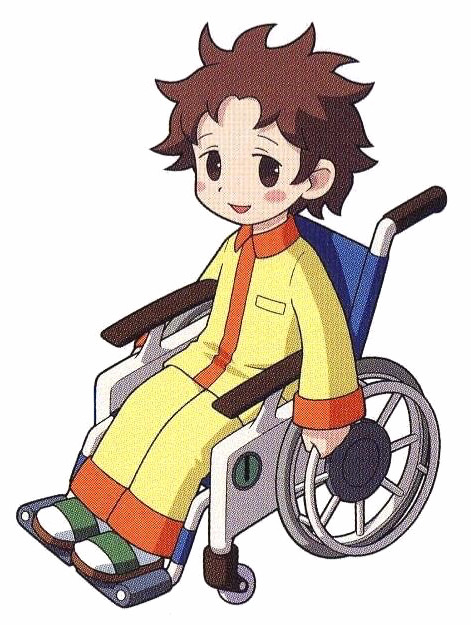
- Eagle Land: Netopia (Ameroupe = America X Europe) is...somewhat mixed in its flavor, but when the games go Flavor 2, they go Flavor 2. One of Lan's first experiences in Netopia is getting kidnapped and having his chips and money stolen in Battle Network 2; in Battle Network 3, Netopian HeelNavis (read: thugs) go rioting over the N1 Grand Prix...twicenote ; and in Battle Network 4, Lan returns to Netopia only to get kidnapped againnote , and then you meet the old man who wants to show you his Wowzer Box, which downloads viruses directly into your PET.
- Early-Installment Weirdness: The first Battle Network was still trying to figure out how to hash out the world itself. Battle Network 2 has also some of its own oddities, sometimes carried over from the previous game and at other times is solely exclusive to it. And while Battle Network 3 features are pretty much finalized for the rest of the franchise, it has its own oddities.
- Features that apply to the first two games:
- Some of the mugshots look noticeably different at first; Mega looks sunburnt while Yai's shirt collar looks different.
- Navi Cust doesn't exist, instead they have Powerups that only upgrade MegaMan's buster. It is impossible to use the charge shot without upgrades in the first two games.
- MegaMan can't charge his Buster until his Charge stat is at least 2.
- HP values for enemies were much lower in the first two games; part of what makes Gater lethal in 2 is the fact that very few enemies exceed 1000 HP. With the Navi Customizer comes massive HP spikes for both players and enemies.
- Many chips that would later be known for only having one version, like Invis, BblWrap, Tornado, and Mine, have to be claimed from viruses and appropriately have three versions.
- Enemies (especially enemy Navis) become faster as the series goes on. In the first couple of games, the flinch that enemy Navis perform when they take a heavy hit is exaggerated and they only remain in Mercy Invincibility state for a few seconds (if even that); by 4, their flinching and Mercy Invincibility lasts about as long as MegaMan's.
- There was also a general willingness to be more sexually explicit in the early games. In the first game, you can walk in on Mayl changing clothes or discover Dex has a Porn Stash. Battle Network 2 did away with most of the directly sexual content, but it also had Ms. Millions, whose dialogue is simultaneously sensual and physically threatening.
- The first game has its own subpage for this trope.
- Features that apply to the second game:
- The game has a lot of profanities (mostly from Lan) alongside some events that would not get past the radar in the future games.
- When it was first introduced, the Undernet looks more like they are made of black giant speakers with some blue and orange splashes occasionally. Later games give the Undernet a hellish (3, 4 and 6) or graveyard (5) theme for the areas.
- LifeSword has three variations in this game, instead of just one.
- Features that apply to the third game:
- The game introduces the countering mechanic, where you are rewarded for attacking an enemy just as they are about to attack. Unlike later games, however, countering only matters if you finish the enemy with the, whereupon you are rewarded additional BugFrags depending on how many viruses you defeat or if you kill-counter a boss. Future games, all the way to Star Force series, instead allow you to counter your enemy any time, resulting in the enemy being briefly stunned without Mercy Invincibility, and you no longer gain material reward by scoring a kill-counter. Battle Network 3 is also the only game where the base MegaBuster can be used to counter, with future games requiring a BattleChip to be used.
- As the entry where the Navi Customizer debuts, there are a couple oddities that don't get carried on to the rest of the series. In this game you have a program color restriction that is partially dictated by your Styles, whereas subsequent games would just let you use up to any four different colors without bugs. The ModTool, Error Code and Extra Code subsystems to further customize MegaMan are unique to the third game, and don't appear in subsequent games. You also have to install certain programs to progress the plot or advance sidequests here, but you don't have to worry about doing so in the later games.
- As the first game to introduce the Extra Folder (a non-customizable folder that you can swap around with certain NPCs) this game uses a lot of scenarios that mandate its use. The subsequent games don't use this feature that often.
- Features that apply to the first two games:
- Earth Drift: The series can't entirely decide if it's set on our Earth or not. In the first game, the WWW lab has a screen◊ of the world map identical to the Real Life one, keeping with the connections to the Classic series. Electopia's name in the Japanese version of each game is also just "Japan." Battle Network 2 shows a world map◊ that looks nothing like Earth, and when other countries start being introduced they're all Fantasy Counterpart Cultures based on real places instead of actually being said places (e.g. Netopia is a combination of North America and Western Europe), though languages like English and Spanish are explicitly mentioned by name even if their associated countries likely don't exist. Battle Network 4 burns that bridge with a vengeance by introducing an all-new globe◊, bringing the series into Fictional Earth. However, Battle Network 6 reintroduces the Real Life Earth map in a room in Sky Town, muddying the waters again.
- Easter Egg: In the Switch version of the Legacy Collection, physically shaking your console in portable mode will have MegaMan stumble over and warn you to take care of your PET (Switch) since he's still inside of it.
- Edge Gravity: Not only can MegaMan not go onto broken or missing panels, wind cannot push him onto cracked or missing panels (given that he isn't using AirShoes which allows him to float in the air).
- Elemental Rock-Paper-Scissors: Fire beats Wood beats Elec beats Aqua beats Fire from day one; 6 implements the tactical variant for the secondary elements (Sword beats Wind beats Cursor beats Breaking beats Sword).
- Eldritch Abomination:
- Cache, from an obscure Gaiden Game as well as the Final Boss during the Beast+ season in the anime.
- In the main games themselves, all final bosses qualify, but most especially Gospel, which is made of multiple bugs (and by the same token, Gregar), and Nebula Grey, which is literally Made of Evil (of the human mind, specifically).
- Emotional Powers: Battle Network 4 introduced the Emotion Window (Kokoro Window in Japan), which caused Mega Man's changing emotional state to produce or indicate certain changes in combat performance. The most famous and constant of these "emotions" was Full Synchro, which doubled the attack power of whatever Battle Chip you currently had loaded and highlighted the counter-window during enemy attacks, but there were other options like Angry, Pinch, or Tired.
- Encounter Bait:
- The Oil Body, Fish, Battery, and Jungle programs increase the encounter rate for enemies of the corresponding elements — handy when hunting for certain Battle Chips. A story quest in Battle Network 3 requires you to use the Fish program in particular to force a specific virus to spawn for that very purpose.
- The Sneak Run program is normally supposed to be Encounter Repellant, but will instead boost the overall encounter rate if it's causing a Navi Customizer glitch.
- Locate Enemy will increase the chance that the last specific Random Encounter formation will spawn again. Nice for hunting some optional bosses (which only appear as part of the random enemy table) to optimize their deletion time for your records.
- Encounter Repellant: The Sneak Run subchip and its corresponding NaviCust program reduce the chance of seeing Random Encounters. They only stop "weak" encounters, however, which is dependent on Mega's max HP.
- The End: Most games feature an "End" card after the credits. The series officially ended with Battle Network 6.
- Endgame+: Exercised in every game except for the 4th, which uses New Game Plus. This unlocks the door to the Bonus Dungeon and several new sidequests.
- Escape Battle Technique: Present in the first two games in the form of an "Escape" Battle Chip. In the first game, this was your only method of retreating from battle. The second game implemented the retreat command (with a chance of failure) through the L button, and the battle chip then disappeared from all subsequent games.
- Establishing Series Moment: In the first game, natch. MegaMan's attempt to pass through the oven's cyber-world is impeded by a field of flames. Lan clears the way for him by spraying the real oven in his house (which is also on fire) with a super-soaker. This works.
- Even Evil Has Standards: Lord Wily was very disapproving of the actions of his son, Dr. Regal.
- Everything Is Online: Exaggerated as it was, Battle Network anticipated the dangers of the Internet of Things as far back as 2001.
- Evil Is Hammy: Dark Chips are described in ALL CAPS. Dr. Regal, too (though in the usual dramatic way); as a fun fact, he's the Dark Chips' creator.
- Evolving Title Screen: Certain milestones on the road to 100% Completion (like collecting an entire division of Battle Chips) would be rewarded by bestowing a star next to the Continue option or special icon on the title screen. The latter was inherited by sequel series Star Force.
- Extreme Graphical Representation:
- The cyberworld is exactly like the human world, complete with water, fire, weather, and plants including full-grown trees. Just slap the prefix "cyber" in front of the usual term. Heck, some Navis are even capable of cooking. You know, because programs get hungry too (apparently).note
- Malware that blocks programs from transmitting data is often represented by chains or obstructions, like the boulders StoneMan.EXE uses to disrupt railway service in the first game. Removing the malware involves shooting at it to destroy it and 'unblock' the system, allowing it to function again.
- Face Framed in Shadow: The 20 Year Reunion one-shot has the entire adult main cast depicted like this where their faces are hidden or outright outside of the panel borders, with the only exceptions being their younger selves, their NetNavis or Patch Hikari.
- Fake Longevity: Plenty of examples...
- In general there would be times when MegaMan has to trek deep into the Cyberworld only to be stumped by a locked door, having no choice but to jack out and find the answer in the real world, and then walk all the way to the locked door all over again.
- The Bonus Dungeon of multiple games will usually halt player progression until they fill out enough of their library — a small subsection of 100% Completion, if you will. Depending on the game, this may mean needing to hunt down rare viruses, repeatedly rematch bosses, or scour Mystery Data for what is missing.
- The Waterworks stage starts off simple, except that the heroes' attempts to fix the system made the situation worse and they have to travel deeper into the dungeon to solve the root of the issue.
- The second game's penultimate scenario involves a lot of running back and forth across the internet to find the plot-relevant NPCs and key items to unlock the ability to progress.
- Any part of the third game that involves the Energy Change program. To clear the related obstacles, not only does the player need to install the aforementioned NaviCust program, but they also need to use up a chip of the relevant element. While the hospital stage during PlantMan scenario generously provides virus encounters that drop relevant chips, FlameMan scenario takes you across different parts of the internet without changing virus encounters. Run out of Aqua chips during the latter scenario? Back to grinding.
- Attempting 100% Completion in the third game — several unique Battle Chips cannot be acquired unless you're using the appropriate Style, and considering that the player can only hold 1 Style at a time unlike the previous game's capacity of 2, it results in more grinding to be able to roll for the one they seek. This can be dodged by using the Bugfrag Trader and getting all other chips to abuse its 25% chance of giving a new chip, but this ends up just changing it from encounter grinding to bugfrag grinding.
- Battle Network 4 uses a tournament mechanic that has no central plot. These tournaments will take place repeatedly throughout the game, and have three scenariosnote that do nothing—nothing whatsoever—to actually advance the plotnote . The plot actually happens between the tournaments, with brief snippets of Nebula harassing the Hikaris in Electopia and the meteor harassing Yuichirou at NAXA. In other words, the central aspect of the game itself is filler spacing out the plot. The game also uses a New Game Plus mechanic with a total of four cycles the player must pass through to fully unlock everything. (You can't even get to the Bass fight until the third cycle, because that's when you get your last Double Soul).
- The fifth game only presents the player with first-level viruses up till the final boss, as the viruses will only upgrade to their next forms when the player opens a door to the Bonus Dungeon. This forces the player to backtrack to nearly every location in the game again for the purpose of hunting down their chips and furthering 100% Completion. And this is done another time for third-tier viruses.
- Family-Unfriendly Violence: For a series aimed at the younger set (at least in the English version), EXE has some pretty horrific stuff going on. Mass poisoning, terrorist bombings, gangsters being murdered by their own employers with briefcase bombs, and it just goes on like this...well, actually that gangster came back for a Chip Tournament later on, but still odd that a kid ordered him murdered. The games are dark.
- Fanservice: Of the non-sexual variety.
- Team Colonel has popular returning characters from the second gamenote as controllable Net Navis, as well as the return of the popular Princess Pride and the reveal of who ShadowMan's operator is.
- Attempted in Team ProtoMan, but it’s fallen flat due to various reasons. ProtoMan is Difficult, but Awesome, though a little too much on the difficult side. MagnetMan and NapalmMan are less than popular due to the frustrating fight without anything backing it up and being too late in the game and after the much more memorable PharoahMan as the second game’s reps, respectively. Lastly, SearchMan is from a game fans would rather forget, despite having a good design, and he’s treated as a newcomer in the narrative, regardless.
- Fantasy Counterpart Culture: While Electopia is just Japan in the original release, the other countries are approximations or combinations or other real life places. Netopia (Amerope in Japan) is an amalgam of the United States and western continental Europe, Creamland is a mishmash of northeastern European countries, etc. Some of the counterparts' names get a little unimaginative, like Sharo, which is basically Russia with the syllables reversed, or Choina and Netfrica (Affric), which you should be able to figure out for yourself. The only one they seem to have put any effort into is Yumland (Ajeena), which would be Thailand (famous in-universe for its food, massive population and the abundance of Buddhist statues). Interestingly, Spanish and English are mentioned as languages in 3 when Mega Man and Lan discuss the etymology of the world pronto, even though Spain and England likely do not exist in this world.
- Far East Asian Terrorists: The WWW and Nebula, cyberterrorist organizations based in Electopia, the series equivalent of Japan.
- Fictional Earth: The series starts off presumably in "our" world, as there is a "blink and you'll miss it◊" image of the world map in the WWW Lab. Future games have completely fictional countries however, and show◊ world maps◊ that are clearly not ours.
- Fight Like a Card Player: The requirements for organizing Battle Chips and creating Folders are basically a set of rules for organizing a deck of playing cards and then throwing them at a chess board.
- Fire and Brimstone Hell: The Undernet is depicted like some sort of Cyber-Hell in 3, 4 and 6.
- Five-Second Foreshadowing: In Battle Network 2, at the end of MagnetMan's scenario, a Navi in the Den Square continually tries to warn anyone who speaks to them of an incoming ice age. When Lan goes to sleep, FreezeMan attacks the next day and freezes over the internet.
- In Battle Network 4: Blue Moon during the AquaMan scenario, Lan gets horoscope spam warning him to beware water. Shortly afterwards, AquaMan floods the internet.
- Forced Tutorial:
- Once per Episode. It will consist of three battles against groups of Mettool viruses. You will have one (1) crappy folder that has no business whatsoever being in the hands of a world-saving duo. The first three games will actually employ the same exact tutorial (virus killing, chip combos, chip adding) with the same exact folder in the same exact sequence, though there are different teachers depending on the game. The second half of the series trades out Chip Adding for an Emotional State (Full Synchro) tutorial, which is more dynamic a system.
- The Gaiden Games Network Transmission and Battle Chip Challenge require tutorials as well, though these are far less aggravating, since they are actually conflated with the opening levels.
- Foreshadowing: The original trilogy is prone to make a number of heavy hints to a big twist.
- In the first game, as soon as you can use the Metro, you're prompted to pay your father a visit at work. He's not in, but while you're at the office you can find a photo of his family revealing that Lan is not an only child, and talk to some Navis in the large workstation who tell you about an experimental Navi with human genetic data. Later, Ms. Yuri tells Lan about the special bond that twins have, and Miyu comments on the bright burning spirit held within Lan's Navi. These are all hints to the game's biggest twist: MegaMan is the digitized version of Lan's deceased twin brother.
- In the second game, Kotobuki Square is full of NPCs who make continued reference to praying for salvation and also introduce a shopkeeper for Bug Frags, a new form of currency introduced in this game. Not only does this later turn out to be the location of one of Gospel's major bases, Gospel is also collecting Bug Frags for usage in its master plan of using Bug Fusion to create an army of Bass copies. The Square itself is also shaped like a skull, hinting at the identity of the true mastermind behind Gospel.
- In the third game, Lan visits the Ura Inn as part of a school trip, meeting a host of characters affiliated with it throughout the story. It later turns out that the Ura Inn is host to the main server of the Undernet. This is more obvious in the Japanese version, where it is called the Ura Net.
- In the sixth game, Mayor Cain talks with Dr. Hikari about details of his research that are meant to be secret. When Yuichiro calls him out on this, Mayor Cain waves it off by mentioning that he has an associate that was employed by SciLab. This turns out to be Dr. Wily, who later weaponizes Yuichiro's research as a means of capturing the Cybeasts.
- Free-Range Children: The main cast of the game are in late elementary/early middle school yet are allowed to travel around the country unaccompanied. Lan is even able to take multiple international flights without his parents or any sort of guardian and is even expected to find and maintain his own lodgings in Netopia.
- Freudian Excuse:
- Most of Gospel in 2. It helps to make them more sympathetic—and their face-profiles even portray them as completely normal looking people. Wily might have been trying to kill Lan, consideringhis defeat in the first game could have lead him to try and eliminate him for his next plot. Most of the attacks seem too specified (i.e. gassing Yai's house and no other) to be general terrorist plots.
- Sean's Freudian Excuse may ring especially true for some people...specifically the parts where he mentions that the internet was the only way he made friends.
- Friendship-Hating Antagonist: Bass is a powerful Navi built by a benevolent scientist named Cossack. He was so powerful that when a disaster occurred on the net because of the "Primordial Net", known as Alpha, he was blamed instead and attacked within an inch of his life. He managed to escape and swore off trusting humans and Navis with operators, relying only on his ability to obtain new powers and abilities via his "Get Ability Program" and his own strength. This naturally brings him into conflict with Lan and Mega Man, who are literally Bash Brothers who strongly believe in The Power of Friendship.
- Future Imperfect: One of MegaMan Star Force's dialogues when the Humor Program is used on in Operate Shooting Star has Geo describing Lan's exploits to Omega-Xis from what he read from a history book. At first, the book's depiction of Lan is accurate (him saving the world several times), then become a little ambigious (him having an IQ of 300note and making impossible soccer shots) and the final page Geo read out mentions that he has an attack called LanPunch which is the equivalent power of a hundred missles.
- Future Spandex: If Navis aren't completely robotic in appearance, they're wearing something in this style. The series' art designers actually held a rule from designing Navis with wearing any sort of cloth, as the fabric-less designs helped reinforce the futuristic Cyberspace aesthetic the series was going for. The only exception to this is Bass with his visibly tattered cape, which the art team admitted was solely because it looked great and they couldn't imagine him without it.
- Game-Breaking Bug:
- Using Hub Style in the second game by having it be transferred from a friend before getting it legitimately prevents you from unlocking it yourself once you meet all the requirements.
- Battle Network 4 has a handful of them. The Virtual Console release fortunately fixed most of these problems:
- The AquaMan and GutsMan Navi chips and the Park Area explored during WoodMan's scenario cause horrible loading slowdowns when played on emulators or an original model DS. The Park Area version of the issue is particularly onerous, since it can occur when leaving a random encounter or even saving the game. Technically the game has not broken; it "simply" temporarily freezes for as long as 20 minutes and will run normally afterward until you're forced to trigger another slowdown. Thankfully, this was fixed for the DS Lite, patches and AR codes have been developed by fans, and the emulators mGBA and NO$GBA have managed to finally solve the issue.
- An even worse example is the Free Space battle board. If you link up with the other version before you have all six of the double souls (this means a New Game Plus Plus at the very minimum) then your game will crash and corrupt the game's code. And by that we mean that it carries a high chance to permanently break it!
- The AquaMan and GutsMan Navi chips and the Park Area explored during WoodMan's scenario cause horrible loading slowdowns when played on emulators or an original model DS. The Park Area version of the issue is particularly onerous, since it can occur when leaving a random encounter or even saving the game. Technically the game has not broken; it "simply" temporarily freezes for as long as 20 minutes and will run normally afterward until you're forced to trigger another slowdown. Thankfully, this was fixed for the DS Lite, patches and AR codes
- VDoll has a showstopping multiplayer glitch in every game that features it. In Battle Network 4 and Battle Network 5, activating Poltergeist or JunkMan and having it interrupted by an attack that hits an active VDoll will softlock the game, while Battle Network 6 crashes if the player uses an elemental attack to hit a VDoll but the opponent has a matching "Anti-" element trap active.
- Gameplay and Story Segregation:
- Glitch MegaMan's code in the NaviCust and drug him with Dark Chips all you want, it doesn't make any difference in the story.
- MegaMan often gets in trouble for using only his lousy buster in cutscenes instead of the arsenal of battlechips he gains through the story. Nobody thinks of just logging out when in trouble, either, though this may be handwaved sometimes.
- Gameplay Grading: You are given a Buster Ranking after every combat encounter based on your performance. Scoring high (i.e. winning fast and without taking much or any damage) will often yield new Battle Chips.
- Gatling Good: The Vulcan chips and Super Vulcan. Due to this trope (they deal damage by hitting for 10 points multiple times), combined with a few chips to boost attack (ColorPt/DblPoint and ATK +10/+30), they get the boost to each individual hit and thus can deal a One-Hit Kill on bosses.
- Gemini Destruction Law: Some Bonus Dungeon contains preset encounters with a couple of enemies who regenerates their HP at lightspeed and revives themselves if they are not all taken out in a single attack, essentially making them Puzzle Boss.
- Generic Doomsday Villain: Both Duo and Dr. Regal in the fourth game exist only to serve as antagonistic forces in the main story without much reason for it other than somebody had to fulfill that role, with the former being a Giant Space Flea from Nowhere brought in at the story's final level and expresses no personality of any sort. Regal's character at least (slightly) improved by the time the fifth game came along.
- Gender Flip: The Robot Master Ring Man was adapted into a female Navi named Ring for Battle Chip Challenge.
- The Generic Guy: The most common model of NetNavi online is officially designated "Normal Navi".
- Geo Effects: There are a multitude of panel types with different effects. Standing on grass makes Wood-type units heal over time but doubles the damage from Fire attacks, ice and water interfer with movement but make you weak to Elec, and so on. Some games get "creative" with magnet panels, conveyor panels, gravity panels, and in 3 and 4, a panel that is a hole into the Internet netherworld.
- "Get Back Here!" Boss:
- Mega Man Geo-Omega is the first type, as he fires at you with the MegaBuster and then runs, only to repeat it when you catch up to him a second time, of course he finally does fight you the third time you catch up to him. The chase sequence can be watched here and here.
- ShadeMan.EXE too, in 4. You must chase him (to rescue Roll) across two whole areas of the Internet, and then through a private server.
- Mega Man Geo-Omega is the first type, as he fires at you with the MegaBuster and then runs, only to repeat it when you catch up to him a second time, of course he finally does fight you the third time you catch up to him. The chase sequence can be watched here
- The Gift: Lan's got it; Chaud, who is declared to spend ten hours a day training, apparently missed out.
- Global Currency Exception: BugFrags, which are pieces of junk data, can be traded in for some of the rarer Battle Chips and NaviCust programs. Those BugFrags tends to be either ridiculously easy or rip-your-hair-out hard to find depending on the game.
- Gold-Colored Superiority:
- Duo Omega in 4 is unique among the powered-up final bosses in that he gets a Palette Swap signifying his status. The primary color is, of course, gold.
- Very rarely in the later games, the player may encounter gold mystery data. These contain incredibly rare chips or large amounts of Zenny.
- Good Is Dumb:
- The Navis you can control in 5 and 6. When you face them as bosses, they have more than 1000 HP (more than you can ever have naturally) and various attacks. However, when you control them they have at max 800 HP, less than the max for MegaMan (1000), but even if you fight them again afterward, they go back to their massive HP.
- The Link Navis could have been upgraded to their full power, but this required the Beast Link Gate, which was a toy that never left Japanese shores.
- The Goomba: The Mettaur is the most basic virus enemy in every game. Low HP, easy to counter-hit and unable to move anywhere but up or down, they even look kind of adorable.
- Gory Discretion Shot: Anytime violence ensues in a cutscene, the screen goes black.
- Guide Dang It!: The series has a lot of stuff to play with. It just refrains from telling you about it.note Battle Network 3 can get particularly cruel in this regard.
- A general principle that you should learn when playing these games is that you should talk to everyone and read all the message boards (i.e. Always Check Behind the Chair applies to NPCs, too). Many of them will drop hints that aggregate into a good idea of how to proceed, or foreshadow something that can be important in the near future.
- Program Advances are a sore spot for many, because there's no real in-game list of PA recipes until you've discovered them (save for one game, and that requires an Old Save Bonus). However, the game will be nice enough to give you hints on the kind of PAs you can build (does a certain chip have its chip codes all in sequence? do multiple chips in the same family have the same code?), but only rarely will you get to see an explicit recipe for one or another (usually the one for Zeta/Giga-Cannon, a bulky P.A. that can be reasonably obtained before the first boss). Past that, however, it's usually guess-and-check or check online.
- Regarding the Navi Customizer, Capcom just gets mean. Compression codes that shrink the programs, and the Error and EX codes for 3's Mod Tools are incredibly obscure (A handful of Error Codes are interspersed throughout the game, but the EX Codes you'll have to look up). Later games at least had the decency of giving random NPCs or details strewn about that mention compression codes, though they don't tell you which program it shrinks.
- Due to limited text space, there's no way to fit in what a battlechip actually does in its description. A handful of Battle Chips even have secret commands that unlock special functions and attack variations. The most famous of these are Variable Sword and Neo Variable, but there are others, like the Guts Punch series and the Navi Chips for BeastMan, MetalMan, and SlashMan. Some chips even poof out when the conditions needed to use it aren't fulfilled, but the game doesn't tell you what exactly it is for each chip.
- And then there's the Lottery Codes for the Number Trader (which doled out free goodies for Lan and Mega in exchange for the right code); there are, again, a handful in the game, but mostly they're online. Funnily enough, even the in-game codes are placed in such obscure places that you have to wonder what Higsby was ever doing there.
- Finding the Beta and Omega versions of bosses in 3 and 5 becomes this for the two games since not only they are rare random encounters, but their locations differ from their Alpha/V2 versions. Some bosses even have specific prerequisites that need to be fulfilled first or during the search for them.
- Hard Work Hardly Works:
- Tora lets on in 3 that Chaud spends ten hours a day training. Guess who's smacking who around on a regular basis. (On the other hand, while Lan consistently outclasses Chaud, Chaud does outclass virtually everyone else.)
- In the first game, Lan suggests that The Power of Friendship enables him to win, as his fighting ability is determined by the strength of the bond with his Navi and twin brother MegaMan, while by contrast, Chaud's ProtoMan uses his own chips and fights alone.
- Heads I Win, Tails You Lose: WWW Operatives in each of the games use their terrorist activities as a cover for program hunting. They will just about always succeed in obtaining the program they want, even if they get deleted.
- Healing Factor: Navis and viruses aligned to the Wood element will heal over time as long as they're standing on Grass panels.
- He Knows About Timed Hits: Actually done well in the main game tutorials. The human operators are themselves using little handheld terminals, so banter about the L and R Buttons fits right in.
- Hero Antagonist: Geo from Star Force in Operate Shooting Star, at least to begin with.
- Heroic BSoD: Lan gets a nasty case of it in 3 after discovering that Mr. Match tricked him into firebombing SciLabs, endangering his own father's life. He locks himself up for several days, skips school, and refuses to talk to his friends about anything.
- High School AU: The second time in the franchise, though unlike the first (Dreamwave) it isn't an alternate version of Rockman that's the lead character going to school but his human born twin.
- Highly Specific Counterplay:
- There are a number of "Anti-" chips or "trap" chips that manifest under the player's HP display as question marks. The most widely used is Anti-Damage which triggers off any hit, and there are stronger but more specific varieties. Some of these chips are only programmed to trigger against enemy chip attacks, making them only usable in multiplayer or against very specific enemies.
- Jealousy destroys the enemy's carried chips and deals damage according to the number of chips destroyed this way. It's clearly designed for PVP and for the occasions where a virus is shown to be carrying a chip, but a little known fact is that it also works on the invisible chips that the viruses carry (e.g. Area Grabs on the Swordy or Zomon viruses) along with damaging even the enemies that don't carry chips. This damage also bypasses several forms of guarding, by the way.
- Beat and Rush are NaviCust programs that can only be triggered in PVP battles. The former steals Mega or Giga chips from the opponent, whereas the latter paralyzes the opponent if they use Invis or Mole chips.
- Highly Visible Password: From your Navi's point of view, passwords are easy to decipher. Justified in that your Navi is directly connected to the network/systems and is most often in the correct dataspaces to see/manage passwords for you.
- Hijacked by Ganon: Of course. The plot of the entire second game is revealed to have been hijacked by Wily all along in the third game, and he hijacks the fourth and fifth games with the reveal that he's Regal's father.
- Hollywood Hacking: Played With. Many of the actions and gimmicks of the series correspond to Real Life hacking, albeit with Extreme Graphical Representation layered on top.
- Sometimes getting into a secure area simply involves obtaining a security certificate.
- Sometimes, you have to destroy or disable components of the security system to proceed.
- Other times you have to figure out the password using hints left in the system, solve puzzles, obtain specific Battle Chips, or fulfill other conditions.
- StoneMan.EXE disrupts a rail service by blocking data transmission from the master network... by dropping malware in the form of virtual boulders into the network space that block the 'rails' that represent the connections between the rail service systems.
- ElecMan.EXE's disruption of electrical power in the first game represents him hacking into the power control firmware/embedded systems at a power plant, limiting the amount of power that was being supplied to everything in the system and causing some programs to behave abnormally due to the low-power conditions.
- AirMan.EXE leaves pink clouds that drain the strength of programs and slows/stops them, denying access to memory sectors.
- QuickMan.EXE and his operator in the second game destroy virtual ground inside the embedded systems of several bombs, severing the virtual linkages and preventing you from pursuing via them.
- The Mother Computer for Electopia and its protective doors actually employ a massive series of passwords that prevent access to the core program, and the systems themselves are littered with Mr. Progs that provide hints. Some of the hints are easy, and some of the hints are difficult (the final hint is actually quite complicated), but the passwords themselves are actually rather easy to bruteforce (especially via Save Scumming), since a Navi has to travel a specific path through a limited selection of characters.
- MagnetMan.EXE uses virtual magnetic fields to 'spoof' magnetic current that forced data to flow through particular pathways in the system, restricting bandwidth and mobility. This also caused massive disruptions in the aircraft computer systems he was intruding, resulting in various failures throughout the plane.
- FreezeMan.EXE in the second game essentially launched a worldwide Denial of Service attack, blocking the network with virtual Ice programs that froze programs and blocked access to network sectors. These Ice programs had special defensive measures to deploy normal viruses when disrupted or 'broken' by normal means. FreezeMan himself was the Command and Control node for the entire DoS attack, so when he was deleted, the Ice programs were stopped since they could not receive more commands from him.
- Serial arsonist Mr. Match's modus operandi is to use strikingly mundane attacks that rely on Social Engineering.
- In the first game, he poses as a repairman performing preventive maintenance—complete with bogus service company operating in the background—in light of the recent attacks (his own) to gain access to the central computers of his victims.
- In the third game, he deceives and manipulates Lan into planting purpose-built malware packages designed to target specific hardware.
- In Battle Network 3, a shady Netopian hanging around Beach Street is selling the ModTools, an unlicensed hacking device that allows users to jailbreak a Navi Customizer. Not only does this let users implement workarounds for common errors that arise when running incompatible NaviCust programs, the ModTools can be used when there isn't an error to add custom code to modify a Navi even further.
- Final Bosses of the series include a powerful virus that replicates itself at an absurdly quick rate, a massive collection of computer bugs, a glitchy early build of the internet itself, a trojan horse, cache data, and a firewall. In particular, the virus was intended to create a botnet that infected military computers, and the glitchy internet build was successfully used for exactly the same purpose.
- Hollywood Magnetism:
- Justified, as this takes place in the cyber world, where the rules of physics are constructed of data and are therefore artificial. There's a chip called MagLine which pulls you to the panel(s). If the panels are in the lower row, the staying in the upper row will prevent it from dragging you to that panel and visa-versa.
- Also, the Battle Chip of MagnetMan.EXE uses his North-South Tackle, and will not work if there is no room to summon South.
- Ice Magic Is Water: Aqua-elemental chips may have either water or ice-themed attacks. This also means that ice-themed Navis are not weak to Fire attacks and actually beat the Fire element in the Elemental Rock-Paper-Scissors, which can be somewhat nonintuitive.
- An Ice Person: IceMan.exe from the first game, FreezeMan.exe from 2, ColdMan.exe from 4, and BlizzardMan.exe from 5 are Aqua-type Navis who employ ice-based tactics in their battles.
- Idiot Ball:
- Gets passed around by various characters in the series, at least in terms of IT security. While repairmen slipping in malware attacks and some particularly nasty cases of social engineering are a standard form of espionage, some of the staggeringly blatant security weaknesses in the Internet as portrayed in the game fall into this territory. No wonder NetCrime is all over the place in the series.
- In the third game, the FlameMan scenario requires stupidity on the part of Lan, MegaMan, and the entire SciLabs staff. Lan falls victim to a play on his ego and a complex gambit (which results in a handful of WWW "agents" getting deleted) that leads him to help install malware in SciLabs computers. Now, it's hard to blame an emotionally manipulated 11-year-old for his part in that, but what's especially vexing is that the Mr. Progs he's helping to modify sit there and let themselves get 1) an unscheduled upgrade from 2) unknown packages by 3) non-personnel. Even after one or two of them starts feeling pain, they do nothing until it's too late. And Mega, who knows the guy isn't operating aboveboard due to how he manipulates Lan into playing along, lets it all happen.
- Immune to Flinching: The Super Armor ability allows a Net Navi to power through strong attacks without being knocked out of their own; typically available as a Navi Customizer program, some NetNavis like MetalMan.EXE or stronger versions of GutsMan.EXE have this ability naturally.
- In Name Only: Several Navis share the names of Classic series bosses, but look, act and fight nothing like them. SlashMan.EXE is a good example, being largely a living piece of cutlery. Classic Slash Man has a much greater resemblance to BeastMan.EXE.
- Inevitable Tournament:
- The third game gives us the N-1 Grand Prix, the preliminaries for which define a significant portion of the early game.
- The fourth game consists almost entirely of three major tournaments (the closest things the games have to story are treated as B and C plots). The game hits you with a New Game Plus that requires you to compete in all three all over again. (If you want to achieve absolutely everything, there are four cycles of the same story for you to pass through).
- Battle Chip Challenge consists entirely of a tournament, in which there are about ten "classes" of increasing length and difficulty. This is made much more bearable on the grounds that the main six main characters each have a Story Arc (a relevant story arc) to pass through.
- Infodump: Each game has a habit of saving a huge chunk of the story for when Lan and Mega confront the boss.
- Insane Troll Logic:
- Green Land in BN6 runs on it, ironically it is said to be a very closed-in and highly regulated society. Two choice laws include the punishment for hitting a Mr. Prog on the head is "something infuriating" (exact words), while the punishment for finding zenny on the ground but not reporting it is tickling. Their entire justice system is overseen by the JudgeTree, a supercomputer built into a giant tree that acts as judge in all criminal cases, which they consider superior to human judges as they might make mistakes. However, this is a world where Everything Is Online, and even the prosecutor mentions the tree is constantly targeted by hackers and their system is ruined if it gets compromised. Sure enough, said prosecutor turns out to be part of the WWW, and has been tampering with the JudgeTree himself to pass verdicts favorable to the organization. He nearly gets away with sentencing Dr. Hikari to the electric chair, and when he's caught, he immediately orders the tree to arrest the entire public and declare Lan a felon.
- Speaking of which, the punishment for tampering with the JudgeTree? "100 hours of zapping." That's right. One hundred straight hours of constant electrocution.
- Inside a Computer System: The entire conceit of the series is the fact that the internet is basically a cyberspace that needs to be traversed. MegaMan lives within the cyberworld, and most major dungeons are networked computer systems.
- In Spite of a Nail: Somehow, most of the Net Navis share the same names, abilities, weapons, appearances, and general motifs from the Classic timeline for no apparent reason, and most of the people involved are on their same respective sides of good and evil. Furthermore, Dr. Wily is a roboticist just like in the Classic series. Instead of trying to take over the world because of his jealousy towards Dr. Light for being recognized by the scientific community over him, Wily retaliates against society for choosing internet technology over the field of robotics.
- Interface Screw: The confusion effect from 3 onward, which changes the orientation of how your NetNavi moves, but most egregiously VideoMan's scenario in 4, which inflicts the status on Mega in the overworld until the scenario is over.
- Inventory Management Puzzle: From the third game onward, the series features the Navi Customizer. You can use a number of programs to give MegaMan benefits with five rules: Textured programs may not touch the Command Line, non-textured programs must touch the Command Line, programs of the same color may not be touch, there must be no more than 4 colors of programsnote , and (starting with the sixth game) all used programs must fit within the allotted spacenote . If you make a mistake, MegaMan will have glitches during battles. You also cannot rotate the programs until you acquire a key item that allows you to do so for programs of a specific color. Until then, your NaviCust will be filled with awkwardly-positioned programs.
- Invincibility Power-Up:
- The franchise features four different types of defense that render cyber-bodies immune to everything except a few specific types of damage. Shieldingnote , Barrier/Auras, Invisibilitynote , and Shadow.
- The true Invincibility Power-Up is a special condition introduced in the third game, marked by the user glowing green for a period of time. Usually this effect is only provided by the Trumpy virus to its allies via Magic Music, but the player can summon his own Trumpy by using a Fanfare chip; it also occasionally appears as one of Bug Style MegaMan's random Buffs. Battle Network 5 notably included a variety of new ways to gain the status, including through the Bonus Panel in Liberation Missions, as Knight Soul (who becomes invincible whenever he uses a non-dimming battle chip in his front column), or using the DarkInvis chip, the last of which also causes the Navi to go berserk, randomly warping around the field and using random techniques selected from his battle history.
- Invincible Minor Minion: Quite a few enemies are invincible without exploiting a weakness or using an Armor Piercing attack.
- Invocation: "Battle Operation, set!" "In!" and "Plug-In! Rockman.EXE, Transmission!" in Japanese; "Battle Routine, set!" "Execute!" and "Jack-In! MegaMan! Execute!" in English.
- Joke Item:
- Panelgrab. In every game of the series, you start with Areagrab, a better version of the chip, and can very easily be obtained pretty early on in * code as well. Outside of very, very specific setups (Meteor Knuckle in 6 only hits enemy panels adjacent to the target(s), for instance, requiring only two chips to set up instead of three) that are more for style than practicality, you will never have a case where grabbing a single panel is better than a row.
- Bugging the charge shot using the Navi Customizer gives various silly charge shot effects of situational power, but the one true joke is the flower bouquet which does no damage and gives the enemy MegaMan the damage-doubling Angry emotion in Player Versus Player.
- "Just Frame" Bonus: Starting in Battle Network 4, hitting an opponent with a Battle Chip right before they execute an attack will stun them without providing Mercy Invincibility. MegaMan will also enter Full Synchro, doubling the damage of his next Chip attack.
- Just Keep Driving: Averted — the cars actually stop when you step out into the street. The first game even has a section with functioning traffic lights.
- Karma Houdini:
- Match, who is the only tertiary character to appear in more than two of the main series games (appearing a total of five times, not counting spin offs) despite supposedly being arrested at least twice for serious crimes. By the end of the series, he has become a schoolteacher. 4 is a rather noticeable one (at least in Red Sun). Match willingly turns himself in by telling Lan and the tournament emcee to call the officials. Lan however, refuses because of their tournament match.
- There is also ShadowMan & Dark, who are canonically mercenary killers, something no one even mentions when he appears as a teammate in 5 despite being the ones who wiped out Yumland's Net population and invaded Electopia's Mother Computer.
- Ditto for a lot of the teammates in 5 and some of the link Navis in 6.
- Sean started a syndicate, whose activities border on terrorism, including hijacking airplanes and blowing up dams. He's out in less than a year due to having a Freudian Excuse, being underage, and what's implied to be an immunity deal where he avoids prosecution in exchange for telling the Officials and SciLab everything he knows about the ones who manipulated him into doing the things he did.
- Wily, having personally started three terrorist organizations and masterminded the creation of a fourth, actually gets punished with jail time when he is finally caught Somehow, despite being a notorious criminal with a knack for computers, is authorized to build two AIs while in prison.
- Almost every single opponent you fight in Battle Network 4 that commits a crime seems to get off the hook one way or another. Take Ivan Chillski, for example, the self-absorbed prat who hacked government satellites in his own country to cause a blizzard in another (Capcom Science is very, very soft) for the sake of his own personal comfort; now, he gets arrested for this, and even gets a personal interrogation room in Netfrica for it, but is somehow freed and returned to his own country in time to make an appearance for the finale. Or take Paulie, from Netfrica, who nearly caused his village to die of thirst out of childish spite, and yet Lan personally asks for him to be forgiven when punishment looms its head.
- In the second game, Lan arrives in Netopia and an NPC offers him a free ride from the airport to the town. Once they reach town however, he holds Lan hostage until he gets every battle chip in Lan's pack. You do get the chips back later by defeating Snake Man, but the guy who stole the chips and sold them to Snake Man's operator, Ms. Millions, gets away.
- Higsby. Heel–Face Turn or not, he still brainwashed most of the kids (and some teachers) in Lan's school for WWW and gets away with only a scolding from Lan.
- Dr. Regal. He refuses Dr. Hikari giving him a second chance because he believes he's done too much to be redeemed. Cue his father Dr. Wily erasing the last ten years of his memories and the last we see of him is living a carefree life working at SciLabs.
- It was never made clear what happened to Madd and Yahoot after the first game. Although ColorMan's appearance and dialogue in Network Transmission implies Madd falls under this as well.
- Karma Meter: An implicit mechanic in the fourth and fifth games (but mostly in the former). MegaMan starts the game in neutral territory, but once the Dark Chips are introduced, if Mega ever performs poorly in combat, his emotional state will become Worried and a pair of Dark Chips will appear in the corner of his chip menu. Choosing these will pull Mega towards Dark Power, while Mega will inevitably be pulled in the "Light" direction by performing well in battle, using Full-Synchro and Double Souls, etc. As he moves in this direction, it becomes much easier for Mega to enter Full-Synchro and harder for him to become Worried. You can see where Mega is on the scale by checking his Navi screen and seeing how he's darkened or brightened.
- That said, it should be noted that the fourth game unambiguously favors the "Light" Side. Mega on the Dark Side can use the Game Breaking Dark Chips, but they will always give him some kind of bug, always deduct one (1) hit point from his totalnote (which will be lost for the rest of the game), and they are useless against the Final Boss. Evil MegaMan also cannot perform Full-Synchro, cannot perform Double Soul, and loses access to SP Navi Chips and Sanctuary, instead gaining access to DS Navi Chips and other exclusive "Evil Chips". Evil Mega will also be forbidden access to the Hub.Batch program at the end of Black Earth 2. Meanwhile, "Light" Mega retains his original functionality, with the perk of getting random Full Synchro in the fourth game, which is seen by most to outweigh Dark Mega's perks.
- Kill Him Already!: Upon confronting the devious operator behind whatever catastrophe was occuring, Lan often jacks into an infected computer system to fix things while the human villain, who is often in the same room, just...stands there...watching...Stopping him would be as easy as running up and yanking out some cables, but nope. No dice. You have to go into the Internet, meet and defeat the perp.
- Lame Pun Reaction: The Humor program consistently spits out awful jokes and plays on words; whenever Mega is using it, Lan is just as consistently unimpressed.
- Land Mine Goes "Click!": The Mine series of Battle Chips places a mine on a random unoccupied, unbroken tile on the enemy's field, dealing a large amount of damage to anyone that steps on it. The Miney Virus that gives this Chip also does the same, but is only found in the first game.
- Large Ham: Lots of characters, but especially Colonel.
- Last Disc Magic: In the 4th and 5th games, you receive your first Giga Chip at the start of the story's final chapter. It may not be the best chip you can get in the game, but it's significantly stronger than your individual Standard chip.
- Late-Arrival Spoiler: Almost every game in the series assumes the audience is aware of the big reveal at the end of the first Battle Network game (save for the second game has an NPC that restates and explains it for players who didn't play the first). MegaMan is actually created from the DNA and memories of Lan's late twin brother, Hub Hikari. The third game specifies that Hub died of a heart disease called HBD, which Mamoru shares, though Mega's discussion of the disease makes little sense until Lan starts talking about his dead brother.
- Law of Conservation of Detail:
- If you see any character with a unique sprite, expect said character to do something major very soon, or at least provide a Boss Battle.
- The first Battle Network has a fully fleshed-out ACDC Elementary, which is used in NumberMan's scenario and a few events beyond. Battle Network 2 removes almost all of it (entering the school gate leads directly to Lan's classroom and vice versa) as school does not play a significant part in the plot. Battle Network 3 brings back some of the hallways in ACDC Elementary and, surprise, the school is used for FlashMan's scenario.
- Subverted in 4, as you end up picking fights with a few Normal- and Heel Navis. Their Operators often use generic sprites, but some have unique designs such as Tetsu and Flave. There's also the tournament announcer Mami and the unnamed female hot dog vendor, both of which have unique sprites and the latter of which appears to have her own emblem.
- Double subversion: From the beginning of the series, there's a doghouse behind Lan's house. Why? Is it a fake for security like the one in the front? No flavor text ever comes from it...until the fifth game, at which point you just know it's going to be relevant later.
- Mick from the sixth game is always talking about he's going to beat you. His Navi is just a uniquely colored Normal Navi, so of course you can't fight him.
- Let's You and Him Fight: Happens constantly throughout the series. You'd think absolutely no one Lan meets throughout his entire series of adventures trusts him one bit with how many times friends and former allies arbitrarily opt to start a fight just to justify fighting that Navi in the game, even if the battle's reused wholesale from a previous title. Though there's also one case In Operate Shooting Star, when Roll is kidnapped, MegaMan finds Star Force MegaMan near a clock and fights him thinking he's the root cause. After the fight, they find that ClockMan is their enemy.
- Lethal Joke Item:
- The Humor program does nothing but replace MegaMan's guidance lines from pressing the L button with bad jokes. In its introductory game, 3, it does nothing if it's bugged, but in the following games, bugging it causes Mega's Emotion Window to rapidly flicker between random states. These include Angry and Full Synchro, which both double damage dealt by Battle Chips.
- There are three levels of bugs for MegaMan's Charged Shot. The first creates Rock Cubes, which you can airshoot/punch/Poltergeist into enemies for 200 damage. The second level is a silly 1 panel-ranged water gun that deals 100 damage, which is anything between 2 to 10 times what MegaMan's basic charge would deal otherwise.
- Limit Break:
- Program Advances, which occurs when an Operator sends a specific array of Battle Chips to their Navi; while in transit, the program morphs (or advances) to a much more powerful attack. Each game will generally give you a few clues as to the possibilities.
- In Battle Network 5 DS, some members of the same team can initiate a powerful Combination Attack by tagging each other in while in Full-Synchro with Lan.
- Living Shadow:
- The Shadow and Nightmare virus series, which can only be harmed with swords; Navi Blacks and Navi Shadows in Battle Network 4 are the same.
- Also, any battle against DarkMega, who does not share that immunity.
- Loophole Abuse:
- Using Dark Chips for Soul Unison doesn't count as using it, sparing players from the permanent HP reduction after every single Dark Chip usage.
- Sure the Copybots in 6 cannot use Battle Chips, but that is not a problem when one of your arm is a sword. Both ProtoMan and Colonel gladly used this to their advantage. It even applies to MegaMan himself when he is kidnapped and forcibly transformed into his Beast Out form, then let loose in the real world. His Beast Out's natural weapons (claws or talons and wings) can do just as much damage.
- Lost in Translation:
- In the third game, Mamoru's last name is "Ura," and the inn in Yoka is the "Ura Inn." "Ura Internet" (with "Ura" roughly translating as "reverse side", or "underworld"), is the Japanese name for the Undernet, so the names of Mamoru and the inn are meant to hint to Mamoru's connection to the Undernet, and the entrance to the Secret Area being located somewhere inside the Inn's grounds.
- In Battle Network 2, the Netmafia Gospel's ultimate goal is to create copies of Bass, whose name in Japan is Forte. To Japanese players, Gospel's name would be a huge tip-off, since that was the name of Forte's support unit in the original games. In America, they translated Forte to Bass as always, but left Gospel's name alone, confusing the hint. Perhaps they thought that "Treble" would be an odd name for an evil shadowy organization, or they didn't want to bother with their logo, which is a "G" shaped like Gospel's head.
- A minor example — the hint to find the DesertMan Beta ghost is that DesertMan "likes sand", which tells you nothing...if you're a Western gamer. In Japan, television static or "TV Snow" is called "sand" instead.
- The LarkMan Program Advance needs two Katana S chips combined with a LarkMan chip to work. An odd combination, unless you know that his Japanese name is SwallowMan. It's a reference to the Swallow Cut, the technique of the pseudo-mythical Sasaki Kojirō that was a two-stroke sword slash based on the motion of a bird's tail in flight, and consisted on a cut down followed by a cut up. The Katana chips are two-strike sword attacks, and thus combining them with LarkMan results, naturally, in a divebomb swooping attack.
- Luckily, My Shield Will Protect Me: There are several enemies that employ shielding techniques and abilities.
- The Mettaur virus family is distinguished by its hardhat, and stronger versions of the virus will use these for protection. Like most of their counterparts the Mettaurs are invincible as long as they had their hats down.
- There's a Shield ability that allows the user to summon a shield and negate incoming damage. A more advanced version of this ability, Reflect, will release a shockwave through the ground upon being struck.
- There have also been Shield and Reflect battle chips (usually courtesy of the Mettaurs) that do the same things; Battle Network 6's "Reflector" chips are notable for being instantaneous and air-borne, in some cases ensuring a counter-attack.
- The Dominerd viruses (Kaazu or maybe "Curze" in Japan) are living shields that turn invisible and protect other viruses from incoming fire. Striking them will prompt them to rush to your immediate area and take a bite out of you. Their Battle Chips, the Curse Shield line, allow you to use them as personal shields.
- While it's not as prominently a part of his design as the original, ProtoMan does wield a shield in battle. He's deceptively quick on the draw, too, forcing you to attack only when he does.
- Made of Iron: Let's take a look at Dr. Wily for a moment...
- 1: Wily was at the center of an explosion that leveled his lab. He was just fine in time for 3.
- 3: He had his soul devoured by an internet Eldritch Abomination and his lifeless body was at the center of an explosion strong enough to sink a small island. He got better in time for 5.
- 5: He walks into a room that is currently exploding (the room is the center of the explosion, naturally) in the crater of a volcano that is simultaneously erupting. This does not faze him at all, and he's back in time for 6. Though admittedly, everyone managed to escape, including Regal himself, so it's safe to say that he's okay.
- 6: He is at the center of an explosion that levels a sizable chunk of town. Not only did they find his body in the exact spot he was standing (again, at the center of an explosion that leveled a sizable chunk of town), but according to Lan, "he wasn't hurt very badly."
- Mascot Mook: Mettaurs. They'll even appear in the later games as an overworld placeholder for virus battles that DON'T involve Mettaurs.
- Maximum HP Reduction:
- Dark Chips permanently deplete the user's maximum HP by one point for each use.
- Anything involving HubBatch bestows MegaMan with a mixture of beneficial effects at the cost of halved maximum HP.
- Meaningful Name: HeelNavis, the netnavi thugs that populate the Undernet.
- Meido: There's at least one maid costume-wearing teenage girl in almost every game, usually in a waitress capacity. The fourth and fifth games featured Nanako, Higsby's new store clerk.
- Mercy Invincibility: Navi characters get some when struck by most attacks, hence the importance of scoring Combos with attacks that don't trigger or ignore invincibility.
- Merchandise-Driven: With the wild success of the franchise at its mid-point, Capcom blatantly tried to capitalize with numerous peripherals (real-life Battle Chips and PETs, various Gates, e-reader cards, etc.) that would "enhance" the gameplay experience with extra bonuses. They continued this with the sequel series Star Force.
- Meteor-Summoning Attack:
- The Meteor chips are available in the second game. They set a cane in front of MegaMan's panel, which in turn causes up to 18 meteors to rain down on the enemies' field at random.
- The Meteors chip freezes time and makes 30 meteors fall in the enemies' area.
- The Asteroid and Dark Meteor chips, which are exclusive to the fifth game, make meteors fall on top of enemies or their surrounding panels, with the added benefit of also cracking any panels that are hit.
- Mirror Boss: MegaMan DS, especially when he's used as the penultimate boss in the fourth game. Not only does he have the HP and all NaviCust programs of the player, he can access attacksnote and strategies that the player has used through the game! Other DS bosses across the fourth and fifth games downplay this; they still hold the ability to use the player's favourite attacks, but generally retain the behavior of the boss they're based off.
- Money Is Experience Points: Zenny can be used to purchase HP and power upgrades as well as chips.
- Mons:
- Experimented with in 3 and 6, in which MegaMan could domesticate and summon viruses through chips (the former) or copy them for tournament battle (the latter). You could even feed them in 3 to increase their power.
- The Navis themselves, capable of battling each other and viruses.
- Mons as Characterization: The Netnavis are customizable computer programs with highly advanced AI, so a navi theme, appearance and personality will generally either match his operator's, or complement it. For example, The Big Guy Dex's Navi is the Dumb Muscle GutsMan.EXE, the dark, no-nonsense ninja ShadowMan.EXE is operated by the serious Consummate Professional Dusk, while Princess Pride is the operator of KnightMan.EXE and Yai's Navi Glyde.EXE act like a distinguished Valet.
- Monster Clown:
- ColorMan almost gets Mayl killed in an explosion and tortures Roll for fun.
- CircusMan has a disturbing appearance, can suck the life out of navis by dancing, can absorb them into his body and, uh...he has an attack in which he turns into a tent and falls on MegaMan to do unspeakable things to him.
- Monster of the Week: In each major scenario, Lan and Mega Man get involved in a incident being caused by criminal's Net Navi, then jacking into the net to battle them.
- Mon Tech: PETs, short for Personal Terminals, are portable electronic devices that house a NetOps NetNavis, and they can be used to Jack In to a device to solve problems caused by viruses or malfunctioning programs. During NetBattles, NetOps can slot in Battle Chips to give their Navis armaments, defense, and support. Introduced in 3, the Navi Customizer gives Navis upgrades and abilities.
- Mood-Swinger: Glitching the Humor program causes MegaMan to rapidly cycle through his emotions during battles. Becomes surprisingly useful if Mega goes into Full Synchro and you have a P.A. ready to use.
- Morality Chain: Subverted. Wily momentarily stops his quest for revenge for the sake of an old friend. That friend goes to war, leaving his son (Baryl) in Wily's care. When Wily learns that his friend died in battle, his thirst for revenge returned.
- Multiplayer Difficulty Spike: Player Versus Player is an entirely-different, often more complicated ordeal than single-player battles. While most bosses do have the exclusive ability to Teleport Spam to random non-adjacent panels, everything else about the fights boils down to pattern recognition. Player battles, on the other hand, are comparatively unpredictable: many offensive chips are nigh-impossible to avoid on reaction, and players can and will pull out all of the defensive options like Invis, Barriers, and Auras. Additionally, the fact that PVP battles take up to 15 turns demands completely different deck building and chip selection tactics than single-player, where S-Ranking boss Navis is heavily based on speed.
- Multiplayer-Only Item:
- The NaviCust programs Beat, Rush, and Tango only work in multiplayer, with Beat (who steals the first Mega/Giga-class chip the opponent tries to use) and Rush (paralyzes the opponent the first time that they try to use Invis or PopUp) in particular only making sense in a Player Versus Player environment.
- There are also a number of chips that are available in single-player but are clearly intended for PvP, being near-worthless for single-player outside of fringe situations:
- Interrupt from BN1 breaks all of the opponent's chips. This is devastating for multiplayer, but basically does nothing for single-player because most viruses don't carry chips.
- Each of the latter three mainline games have one or more chips that are capable of disabling NaviCust programs. These effects are obviously only meaningful in multiplayer since no single-player enemy has access to NaviCust.
- BugFix and BN6's HubBatch chips are incredibly impractical for single player, being limited to one per Folder and having MB ratings that prevent them from being bookmarked. They make much more sense to build around in multiplayer, where finishing quickly is not a priority.
- Musical Nod:
- One that stands out is from the credits sequence of the fifth installment; you may be pleasantly surprised by the sudden appearance of the opening riff from the first three games.
- You can also hear it in the background of the "Hometown" theme from the same game.
- Musical Theme Naming:
- MegaMan's Japanese name is RockMan, and the most prominent female Navi is called Roll. Their pairing is an obvious pun on rock 'n' roll.
- ProtoMan is called Blues in Japan. In the manga, an omake introduces his girlfriend, Rhythm. As in rhythm and blues.
- Every game features a Superboss called Bass (Forte in Japan). In the second game, he is cloned, but the copy is unstable and degenerates into a multibug organism called Gospel.
- In the third game, the master of the Ura Internet is a Superboss called Serenade. Also, the Blue version has an Optional Boss called Punk.
- Two Navi Customizer programs that only function during multiplayer battles are called Beat and Tango. The former summons the eponymous bird to steal the opponent's first Navi chip, while the latter is a helper that restores MegaMan's health when it gets low, but only works once per battle.
- Mutually Exclusive Power Ups: Battle Network 4 introduces the Emotion Window, which displays MegaMan's emotional state and provides some sort of buff or even debuff depending on how he's feeling. He cannot benefit from more than one emotion at a time, and the Double Soul and Cross System transformations completely override them.
- My Rules Are Not Your Rules:
- NPC Navis can use battle-chips, but aren't limited to folders of thirty like Player Characters are. Additionally, they have a limitless supply of Special Attacks and abilities that Mega Man can't duplicate even with the Navi Customizer. The NetNavis of Battle Network 2 are notorious for their gimmicks, like SnakeMan and his jar.
- Mega can only move from one adjacent panel to another, while enemy Navis very often move by Teleport Spam between unconnected panels. There are some non-warping Navis, like WoodMan, who jump from panel to panel instead.
- Several NetNavis have attacks that let them lock-on to MegaMan's location and warp to it, which is not an ability available to MegaMan until very late in the series.
- Mythology Gag:
- The first three games are loaded with references to the Mega Man Legends series, Battle Network's immediate predecessor. Lan has a poster for Legends 2 in his room in the first game, Yai has a Data doll, and Mayl and Dex have various figurines of Servbots and Tron herself. Lan also apparently watches a show called "The Bonne Bunch". The Global Currency is Zenny.
- Lan can accidentally walk in on Mayl changing clothes in the first game, much like Volnutt and Roll Casket (also in Legends).
- Higsby has a poster of Vile in his chip shop in the first game.
- Bass.EXE gives one in the second game, for all those people who know his Japanese name.Bass.EXE: "Battle is my forte!"
- Lan's grandfather and stand-in for the Classic series' Dr. Light is named Tadashi Hikari, which translates to "right (i.e. correct) light". Obviously a play on the whole Dr. Right/Light problem. This is given another nod at the end of the series: Lan's son (Patch) in Japan is named "Raito Hikari" (光来斗).
- Network Transmission is one giant Valentine to the classic series, reinterpreting Battle Network as a platformer; many of the "viruses" are direct transplants of the Mechaniloids, such as the Sniper and Heavy Joes. See Nostalgia Level below, too.
- The recurring Ratton chip deploys a travelling bomb that heads forward but immediately does a 90-degree turn towards a target once they're near it, which is exactly the same behaviour as the Magnet Missile.
- Necessary Drawback: Games from Battle Network 4 onward have power-ups called Patch Cards that buff MegaMan separate from the restrictions of the NaviCust, with a few providing otherwise exclusive abilities. Since a number of the Patch Cards are incredibly powerful and they're usable in PVP, the majority of them come with some sort of negative attribute, such as inflicting nasty bugs or lowering MegaMan's stats.
- Nerf: The series is constantly trying to adjust for balance from installment to installment.
- In Battle Network 1, players could put up to ten copies of an individual battle-chip into their folder, save for Navi chips, but in Battle Network 2 the Cap was reduced from ten to five. In Battle Network 6, the amount of any individual chip that can be included is determined by the chip's MB rating.
- Battle Network 3 introduces the Standard-Mega-Giga classification system, which expands the limits put on Navi chips in the early games to any Purposefully Overpowered battle-chips.
- The Navi Customizer manages to do this in a couple of cases, such as making Mega's formerly permanent Power Ups into optional enhancements. Later games are constantly shifting the size of programs, making some of them massive and hard to use (Hub.Batch is a prime offender).
- The strength of certain recurring Program Advances has been diminished over time.
- Guts Shoot, for example, dropped from five hundred damage to four hundred and then ultimately to three hundred over the course of the original trilogy.
- Big Heart in Battle Network 2 would heal MegaMan to full health and grant a few moments of invisibility, but in Battle Network 3 it only heals 300 HP.
- Never Say "Die": Zig-zagged. They don't sidestep around the fact that people may die (or have died in the past), but usually they say "Deleted" in place of die. Count Zap, however, immediately kicks things off by welcoming everyone to the "WWW Party of Death!".
- New Year, Same Class: The transition between fifth and sixth grades doesn't ruffle Lan's crew any. He, Mayl, Dex, and Yai are all together again, and they even have Ms. Mari for a teacher. Subverted during the sixth game, when Lan moves away, and again in the epilogue, when the first three end up going to a local middle school while Yai transfers to a preparatory school for girls.
- Nice Guy:
- In the sixth game, one scenario's villain claims Lan's Fatal Flaw is that he is too nice. Lan's response?Lan: "Being nice is a good thing!"
- Aside from that, though in the first three games occasionally gets a little cocky, throughout the entire series Lan is ridiculously nice and forgiving, to the point that at the end of the sixth game he forgives Wily. Reminder that this is the same kid that got a Freak Out and a Roaring Rampage of Revenge in 3.
- In the sixth game, one scenario's villain claims Lan's Fatal Flaw is that he is too nice. Lan's response?
- Ninja Log: A technique ShadowMan can use. He leaves a decoy and jumps, shooting shuriken. MegaMan can also use the technique through the Anti Damage chip and Customizer program. It's quite practical, as it blocks any enemy attack and accurately deals up to 300 damage. A Program Advance version of the technique exists that does much, much more damage.
- No Fair Cheating: Using Patch Cards or Legacy Collection's BusterMAX mode will prevent Battle Network 3 through 6 from recording your Time Trial or Omega/SP Navi clear times.
- No-Gear Level: Early on in BN3, MegaMan's transmission program (the program that keeps the connection between him and Lan's PET) breaks, having been damaged by FlashMan's Shining Browser Crasher. This removes MegaMan's ability to jack out, making it necessary for him to run back to the jack-in point to get back into the PET. It also removes the possibility for Lan to send Battle Chip data to MegaMan, leaving him with his Mega Buster to defend himself. Thankfully, this happens in ACDC Area, with comparatively weak random encounters. That is, unless MegaMan to run into FlashMan V3.
- No OSHA Compliance: Sky Town in the 6th game is a floating weather control station 30,000 feet in the air suspended by rockets while its narrow walkways don't even have guardrails. It's also open to the public.
- Non-Indicative Name:
- Some of the viruses. Larks are good example, being flat, wide-finned fish with little propellers and great big eyeballs and looking nothing at all like actual larks. Meanwhile, Fishies from the first three games are the inversion of Larks, resembling a cross between a bird and a paper plane.
- ProtoMan.EXE isn't actually a prototype of anything, as far as is shown.
- Non-Elemental: Some chips lack any sort of element, which is noted by their blank icon. While they cannot take advantage of elemental weaknesses nor be used to fuel Double Souls, some transformations and mechanics interact with non-elemental chips specifically. For example, NumberSoul provides them a blanket +10 boost to damage.
- Noob Cave: Typically ACDC Area. In the one game where it's not, it's revealed the reason why ACDC area usually has such weak viruses is because MegaMan clears out the area so often that the only viruses that could form were small ones.
- Not Allowed to Grow Up: The first three games happen during fifth grade, and the final three during sixth grade. The final game ends (before the Distant Finale) on the last day of sixth grade, and the elementary.
- Not Completely Useless:
- The Minibomb chips in each of the games are usually one of the first chips a player removes from their initial folder, due to the fact that actually hitting anything with them is like pulling teeth, and it doesn't pack the punch even if it does land. However, in the sidescrolling spinoff, Transmission, it's actually really easy to hit with, and the explosion hits several times for full damage within the space of about a second, meaning one single bomb can destroy almost every random enemy in the game not protected by some sort of aura. It's also easy to get, has a low MP cost, and you can carry a ton with you. For that single game, it is turned from a useless weapon into a complete Game-Breaker, but most players will still just skip over it after their experience with it in the main games.
- Throwing chips in general tend to be unattractive because they're not well-suited for Navis that use Teleport Spam or are otherwise nimble, which is many of them, but they are suited for Navis that hang out in the farthest column.
- The Slow Gauge chip slows down the rate in which the Custom Gauge is filled. Outside of NetBattles with other players (who are also affected by the slower gauge), this chip is completely useless... except in the fifth game's Liberation Missions, in which each battle must be cleared in three automated turns. However, the cost for setting this as a default chip is greatly increased in that game to prevent exploiting it from the beginning. It also provides a larger window of action to maximize the attack power Custom Gauge-based chips, like CustSword, which tend to zero out when it maxes.
- Bubble Wrap grants a barrier that regenerates over time, but it's often excluded from most folders due to the unusual codes it is available in, and it isn't as helpful against rapid-fire attacks; Invis often overshadows it due to its * code availability and good utility. However, against Protectos in 2 it makes you invulnerable since it always regenerates in time to block their explosions, giving you the time to assemble the combo you need; the infrequency of Nebula Grey's stronger attacks also makes Bubble Wrap a great defensive option against it.
- The Minibomb chips in each of the games are usually one of the first chips a player removes from their initial folder, due to the fact that actually hitting anything with them is like pulling teeth, and it doesn't pack the punch even if it does land. However, in the sidescrolling spinoff, Transmission, it's actually really easy to hit with, and the explosion hits several times for full damage within the space of about a second, meaning one single bomb can destroy almost every random enemy in the game not protected by some sort of aura. It's also easy to get, has a low MP cost, and you can carry a ton with you. For that single game, it is turned from a useless weapon into a complete
- Not Disabled in VR: Of a sort; the wheelchair-bound Mamoru really likes NetBattles because he gets put on a more even playing field with his opponent.
- Not the Intended Use:
- Navi Customizer bugs are intended to be punishment for using the NaviCust incorrectly, but not all of them are that punishing. Deliberately glitching the elemental hunt programs (Jungle for Wood viruses, for example) will lower the encounter rate for viruses of that element. Bugging the Humour program in the latter half of the series causes MegaMan's "mood" to change at random, allowing the player to semi-reliably deal double damage because it was on Full Synchro or Anger for a few seconds. Bugging Sneak Run might sound like a punishment since it increases the rate for random encounters instead of decreasing it, but if you're hunting viruses for chips or Zenny it just cuts back on downtime. You can also bug Mega's buster, which causes him to fire silly things like squirts of water or bouquets of flowers. One form of the glitch causes the charged shot to create Rock Cubes, which can be airshot or punched into enemies for 200 damage.
- A strange attribute of Punk is that the Yo-Yo attack is destroyed on contact with him, so it only hits once instead of up to three times as intended. Put together a Z-Yoyo Program Advance, however, and you can unleash the attack as fast as you can mash the A button. Punk also flinches from the attack but doesn't receive Mercy Invincibility so this can eat through a lot of his HP.
- NPC Amnesia: The quiz givers will always repeat the exact same lines, and give the exact same questions. Always. Apparently, they have forgotten that you have just done their quiz and failed, odd, as you would think that they would consider a rare item as a prize a reason to remember those who have taken the quiz.
- Numerical Hard:
- The second game has a hard mode which only increases the amount of HP each enemy has and the amount of damage they do, without changing the rewards they yield.
- So does the fourth, in its New Game Plus, though the enemies also move faster, have more aggressive attack patterns, and drop higher quality chips.



- Obfuscating Insanity: There's an old man NPC in the first game who spends most of the game telling you he's not senile. He's the one who knows how to access the Undernet.
- Obvious Rule Patch:
- The GrabBack and GrabRvng chips damage the opponent for any panel you've lost and reclaims those lost panels, but they suddenly lost their up-front damage numbers from the 4th game despite not losing any functionality. This is to prevent synergy with the newly-introduced ColorPt and DblPoint chips, which sacrifice your front row for an attack boost to your next damaging chip.
- In Battle Network 4 and Battle Network 5, Bugstop can cancel the negative side effects of Patch Cards. In Battle Network 6, this no longer works.
- Mega Man Battle Network Legacy Collection makes some changes to the gameplay for online battles, most of which are not applied to single-player:
- A timer is added to the Custom Screen, to preemptively combat Griefers who might be willing to sit at the chip menu to force ragequits.
- The infamous Treebom + Prism combo from the Japanese version of Battle Network 2 (where Treebom triggers Prism's effect repeatedly) is directly altered in online matches to have its non-game-breaking Battle Network 3 incarnation.
- The "All Guard" Patch Cards from Battle Network 4 are banned in online battles, because having them both active makes the player invulnerable to everything except Breaking chips and HP drain.
- Dark MegaMan's AI has been nerfed so that he will attack using Standard Chips if his available chips lean toward Dark Chips. This is in response to DarkInvis from Battle Network 5 (which induces this state) being banned in Japanese tournaments.
- Obviously Evil: Dr. Regal, so much so that he wasn't really trusted even in his not-entirely-negative publicity days. Pretty much every evil Navi follows this trope as well.
- Oddly Small Organization: The number of unique characters in World Three shrinks as the series goes on. As a consequence, their influence goes from being feared throughout the world in the first three games to being hardly noticed until (and arguably after) they release the Sealed Evil in a Can in the sixth game.
- Offscreen Villain Dark Matter: Typical of Dr. Wily, but the medal has to go to Dr. Regal who has a literal country’s worth of dark matter (Nation Z) backing him.
- Ojou: Yai is the daughter of a wealthy video game company president named Gabcom.
- Ominous Visual Glitch:
- Computer bugs in the series (usually just "Bugs" or "Bug Fragments") are little globs of pixelated mass with vaguely arcane power. In Battle Network 2, the Big Bad collects so many of them that he accidentally turns his apartment building hideout into an interdimensional sinkhole and causes reality around him to glitch.
- Battle Network 3 introduced the Navi Customizer and Customizer Bugs to the series; mistakes in customizing your Navi cause unexpected gameplay changes or debilitating performance issues and are usually indicated by the Navi's body pixelating.
- One Game for the Price of Two: Beginning with the third game, there have been two versions of every installment of the main franchise.
- Battle Network Rockman.EXE 3 Black is actually an Updated Re-release that fixes some issues that the original version had and added some new stuff, like Mr. Famous and Punk.EXE. To capitalize on Pokémon's success, though, Capcom decided to release both versions internationally as Blue and White, with White being the original while Blue is the updated Black version.
- Red Sun and Blue Moon are the first true multi-version release for the series; in the original Japanese versions, by linking games, you could cause version-exclusive Navis to appear in the opposite's tournaments (that's why there's an extra Heel and Normal Navi pair on every tournament board — they're place holders).
- Team of Blues was followed some months later by Team of Colonel, which notably expounded on several plot points introduced in Team of Blues. There was an Updated Re-release for the DS including both versions with both crossover content and Old Save Bonus functionality.
- Gregar and Falzer were released simultaneously like Red Sun and Blue Moon.
- Pain & Gain: ShadowMan.EXE possesses the Muramasa Blade, a katana whose power is equal to the amount of HP he's lost. This makes him increasingly dangerous as his boss fight draws on, as he can potentially inflict massive damage on Mega Man with a single hit once Shadow Man is brought to low HP. This sword is also available to Mega Man in the form of the Muramasa battle chip. The weapon makes a reappearance in the sequel series, Mega Man Star Force, as an obtainable battle card.
- Palette Swap:
- Most Normal Navis come in the same design but different colors, especially green (mostly correlating to boys) and pinks (mostly correlating to girls). Battle Chip Challenge displays no less than six palettes of Normal Navi.
- Stronger versions (or variants with different elemental alignments) of viruses have the same model but different color palette.
- In 4 and 5, boss Navis have a slightly different palette at the highest versions, which applies to the SP/Omega forms for 4, and DS forms for both games.
- Some human NPCs are identical in design but have different colors from others, most notably if they are same-sex siblings.
- The Password Is Always "Swordfish": The passwords are very often all too easy to figure out, as helpful programs give a lot of hints.
- Pause Scumming:
- Battling the Pop-Up enemy plays like a game of whack-a-mole, so pausing lets you spot him without the need for lightning fast reflexes. The fight with Drillman.exe is similar.
- This completely breaks 5's Chaos Unisons by letting you always perform the charge attack perfectly, effectively giving you infinite uses of the Dark Chip in question.
- Perfect Play A.I.: Invoked with ProtoMan in the first game. Official NetNavis can carry their own Battle Chips and battle without Operator input; according to ProtoMan, solo-fighting was his standard operating procedure, which fact combines with his "untouchable" reputation to form this trope.
- Permanently Missable Content: Several chips in certain codes can only be obtained once, ignoring any duplication glitches. This can have painful consequences if the chip is vital to continuing a Chain of Deals but the player recently disposed of it in the Chip Traders.
- Pet the Dog: Just to show how much different the Wily of this universe is from the original, he paid for the medical treatment of Joe Mach's daughter, and adopted Baryl while also temporarily abandoning his plans of revenge.
- Pink Girl, Blue Boy: Roll and MegaMan, respectively, have bodysuits designed with reference to this trope (Roll throws more than a little red and black in, for flair). these pictures should explain it.
- Poltergeist: The Poltergeist chip replicates a poltergeist's common traits by picking every item on the battlefield and flinging them at enemies. It's very deadly if you have enough items on field at once.
- Pop Quiz: Most games in the series have multiple NPCs that will quiz you on random information about the universe, such as the power of certain Battle Chips or virus names. Correctly answering all of their questions will reward an item, a NaviCust program, or a rare Battle Chip.
- Post-End Game Content: Very extensive in the main games. For instance, at least about a quarter to a third of the chip library is inaccessible until you open up the Bonus Dungeon, so expect a long time playing towards 100% Completion.
- Power at a Price:
- Several powerful programs you equip in the Navi Customizer are guaranteed to afflict MegaMan with bugs even if you don't break any Navicust rules in the process, such as the Giga Folder 1 program slowly turning all of the player's panels into Poison Panels with each step taken in battle. In any case, equipping the BugStop part immediately removes the effects of all Bugs, making them risk-free.
- Dark Chips in the 4th and 5th game are built around this concept. They are incredibly powerful but carry several side effects that persist throughout the battle and deduct from your max HP after finishing a battle where you used them. Continued use of Dark Chips also reduces your "karma", and eventually MegaMan turns evil, gaining access to "Evil" Chips and DS Navi Chips, but loses the ability to use Double Souls, Full Synchro, and certain other Battle Chips.
- Some of the more powerful e-Reader Mod Cards (Patch Cards in Legacy Collection) in 4 and 5 will also apply Bugs to MegaMan just like Navicust programs. The BugStop program prevents these in addition to bugs from normal Custom Parts. In 6, almost all Mod Cards/Patch Cards apply a penalty of some sort, and the ones that apply Bugs cannot have their Bugs disabled by BugStop.
- Power Copying: It wouldn't be a Mega Man game without it. Played straight in several ways, actually, with Souls/Crosses mimicking other Navis' attacks and Battle Chips mimicking virus attacks.
- Power Levels:
- The first two games used a "level" system that indicated how many HP Memories and Power-Ups Lan and Mega had collected; it was worthless as a power indicator however, since it had no relation to the strength of their assorted battle chips. It was dropped with the introduction of the Navi Customizer in the third game (though it resurfaced in Mega Man Star Force).
- Viruses, NetNavis, and even Battle Chips all operate under a Tier System, usually with three phases, usually indicating how powerful they are with a version number (or α and β or EX and SP). Some games sneak in secret fourth-tier (Omega - Ω) enemies or other variants that can't be fought normally. Note that these tiers have almost no bearing on a given character's Super Weight. A boss introduced early in the game can generally be trusted to remain low on the Sorting Algorithm of Evil and to have the same general effectiveness no matter how high his version gets. An early boss, ignominiously enough, may remain weaker than a boss introduced near the end of the story even after a version upgrade.
- The Power of Friendship:
- A core concept of the series; the fourth and fifth games treat this as a battle mechanic (MegaMan develops powerful bonds with other NetNavis and earns the ability to use their power in a Double Soul).note
- In the first game, ProtoMan (who, as an Official NetNavi, can fight without Operator input) is stunned when he loses to Mega. Mega informs him that, as a Civilian NetNavi, he requires an Operator, and the reason he and Lan have come so far is because they have each other. ProtoMan is stunned by this explanation, and further by Mega's description of his Operator as a friend.Chaud: "ProtoMan! Don't listen to their nonsense! Jack out, now!"
ProtoMan: "Wait, please, Lord Chaud!!" - Another Battle Mechanic instance is the Style Change from the second and third game. The Team Stylenote allows MegaMan to carry more Navi chips into battle (Mega Chips in the third game, being the second tier of the Chip-related Power Levels, to which Navi Chips are relegated), and in the third game, Team Style is essential to obtaining the secret version-four Navi chips by S-Ranking beta-version Navis.
- There's also Full Synchro from the fourth game onwards, which is when a Navi and Operator fight as one. In gameplay it activates whenever you get a counter-hit on an enemy, and doubles the damage of the next attack chip used.
- Powers as Programs: Literally in this case, many abilities and attacks come from Battle Chips that the Net Operator can load into their Net Navi for them to use against threats. The Navi Customizer Programs are also programs equippable to a Net Navi to enhance their capabilities.
- Pragmatic Adaptation: Legacy Collection gives out "Crossover Points" for winning ranked matches in Battle Network 5 and Battle Network 6, in order to compensate for the fact that there is no way to connect to Boktai games to earn them via "Crossover Battles" as in the originals.
- Press X to Not Die: In PvP play, you can counter the other player's time-stopping weapons, even things like the V5 Navi Chips in 3, just by pushing A at the right moment to call your own ally. You have to set up a Battle Chip for this in advance, however.
- Punny Name: Starting from Lan (a de-capitalized acronym for local area network) and going damn near everywhere: (e)Mayl, (in)Dex, 5's Fyrefox, Hub...and that's just the ones derived from computer and networking terms.
- Purposefully Overpowered: The Legacy Collection has a feature called Buster MAX Mode that multiplies the damage of uncharged MegaBuster shots by 100. This was introduced to allow players to more easily breeze through the story if they so choose.
- Puzzle Boss:
- Protectos in Battle Network 2 and Numbers in Battle Network 3 must all be destroyed in a single hit; time-stopping multi-hit attacks will not work. Numbers will punish a failed deletion with a deadly counterattack, while Protectos will regularly count down to a massive field-wide explosion.
- ShadeMan Omega in Battle Network 4 is also a "Get Back Here!" Boss.
- Random Events Plot:
- Many of the chapters (and Lan and Mega will most often just so happen to be around), for better or worse, though many of them share a unified "theme". In the first game, each chapter is a different terrorist attack staged by a WWW operative (serial arson, corrupting the water supply, several nigh fatal hostage incidents), each of which disguises a theft of a superprogram to be utilized in the creation of the Life Virus; the third game is more of the same, with even more terrorist plots, also serving the purpose of stealing program data.
- In the second game, Gospel's actual goal is to create as much chaos as possible, so the scenarios are literally random terrorist acts. They don't start having a coherent plan of action until the end, where MagnetMan's theft of the High-Power Program contributes directly to the endgame scenario.
- The 4th game has a literally randomized plot, having each scenario determined randomly by the tournament system. The game's events are *so* random, there's no required chronological arrangement (though some official guides behave as though the proper order is the Normal/Heel Navi fight, the Double Soul fight, and then the enemy Boss Battle).
- Lampshaded in the sixth game:Lan: "It's OK. I'm used to random things happening by now."
- Random Loot Exchanger: Every game has a machine called a Chip Trader that allows you to exchange a set number of Battle Chips or BugFrags to obtain a random chip in return. Each Trader has its own turn-in requirements and chip pool it draws from, with the ones asking for more chips or BugFrags having better potential drops.
- Randomized Damage Attack: NumberMan.EXE's Dice Bomb deals damage based on what number the die rolls.
- Recurring Character:
- The only games that don't feature Mr. Match as a boss are Blue Moon (and he still cameos in BurnerMan's scenario), both versions of 5, and Cybeast Falzar.
- Mr. Famous appears in every game after his debut in Battle Network 2 with the exception of Battle Network 3 White, and is a boss in most of them.
- Recurring Riff:
- The franchise features three major leitmotif themes. One is featured for the first three games (and a few of the spin-offs); each version has its own refrain (different moments in the franchise use either the common theme or the game-specific refrain). Most games feature the main leitmotif to signify intentional moments of awesome.
- The first three games share a number of themes in general. Battle Network 4 would throw out most of them; the exceptions, whose melodies are used in all six mainline games, are the ACDC Town theme and the BGM that plays when a Player Versus Player match is lost.
- Three of the four Navi Customizer themes start with a similar melody before transitioning into the games' respective leitmotifs. Battle Network 4 is the odd game out here, with a completely different BGM being used.
- Rescue Arc:
- Twice in the fifth game, three times in the sixth game. Almost all of them involve rescuing MegaMan.
- ProtoMan gets one in Blue Moon, and either he or Colonel, depending on the version, do in 5 as well.
- Retcon: In Battle Network 2, Mega achieves the Style Change by installing a special program obtained from Yumland. In Battle Network 3, a one-off NPC suggests Style Change is potentially usable by almost any Navi.
- Ridiculously Cute Critter: All Mr. Progs, AquaMan.EXE and several viruses (including the Mascot Mook Mettaur).
- Right Hand Versus Left Hand: After you beat ProtoMan in Operate Shooting Star, Roll gets kidnapped and all Mayl says is that there was a weird blue NetNavi with a red visor covering his eyes. Lan and MegaMan confront him and after a long chase sequence the two of them fight. The thing about this is that the chase and fight sequences could have been avoided if SF MegaMan had just told MegaMan.EXE what he was doing in his time period instead of running off.
- Rouge Angles of Satin: Some words are mistranslated into other words with similar spellings but have completely different meanings, such as the "Heal" Navis of 4 and ProtoMan in the first game addressing his operator as "Load Chaud".
- Rule of Drama: In order to add some depth to the series, every once in a while the jobs that Lan and MegaMan take on will have somber or even tragic elements. Sometimes this can go entirely too far, such as one job in which the heroes fail to report a kidnapping.
- Science Fantasy: The final half of the series largely abandons strict adherence to sci-fi and begins introducing the more fantastic elements of Dark Power and the bizarre properties of Bug Frags.
- Science Is Good: This series has the general idea that the internet and networking technology can be used to achieve and create great things that help advance human life. All of the threats in the games come from the baddies trying to destroy or corrupt the whole internet technology for their own reasons, and our heroes, Lan and MegaMan, have to stop them to prevent such things from happening.
- Scientific and Technological Theme Naming: To match the series' computer theme, the two main characters' original names are the Japanese words for Net (Netto) and Site (Saito). The dub changes their names to Lan and Hub, respectively. Additionally, Lan's love interest is called Mayl, and their son in the sixth game's epilogue is called Patch.
- Score Screen: After every battle, the player is rated on his performance and awarded either a chip or some quantity of Zenny, depending on his ranking.
- Sealed Evil in a Can: Alpha in the third game and both Gregar and Falzar in the sixth game. The sixth game's example is especially notable in that immediately afterwards, one is captured by CircusMan for the evil organization, and MegaMan has no choice but to seal the other within his body. Cue MegaMan's series of internal struggles while having to deal with the evil organization at the same time.
- Second Hour Superpower: From the second game onwards, you will get to access MegaMan's transformations (Style Change, Double Soul, Cross) somewhere before or after you confront the third major antagonist of the game.
- Serial Escalation:
- Mega Man's power-ups become more tactical and convenient as the series progresses, from Armor to Style Change to Double Soul to the Cross System.
- When the latter half of the series introduces Full Synchro and numerous means of doubling the strength of your attacks, the HP of bosses begin to scale upwards to match your potential might. It's now very difficult to find a 3rd-tier boss rematch that doesn't have over 1000 HP.
- The final bosses get progressively more menacing with each game in the series. It went from basically just a big insect-like virus in 1 to a huge Hell Hound made of bugs in 2 and then the Internet itself in 3. The second trilogy had MegaMan fight against what was effectively an extraterrestrial deity in 4 and the embodiment of evil in 5. The final game apparently took the series back to its roots, introducing just two complex viruses as the final bosses, only to subvert it with the revelation that they can cross over into the real world by using the CopyBots, making them the only digital villains in the entire series that endanger the Earth by attacking it directly.
- Sequel Series: Mega Man Star Force continues the story 200 years into the future.
- Shoot the Medic First:
- Trumpy viruses deal no damage but provide support to the enemy either by granting temporary invincibility or a Non-Damaging Status Infliction Attack. The more advanced versions of this virus either has a longer invincibility-granting song or plays a song that fully heals all other viruses. They are hence often priority targets.
- Inverted with Appley viruses in the fifth game. When they are deleted, they restore the HP of a random enemy, undoing your hard work of trying to whittle down other enemies with it. Given the difficulty in damaging them without Fire attacks and the simplicity of their attack patterns, it is often recommended to defeat them last as opposed to trying to pick them off while dodging the other more deadly viruses.
- Shout-Out:
- A corrupted program in the first game says, "All your base are belong to us!" A different corrupted program from the same place says "I will strike down upon thee with great vengeance and fuuurious anger!" Yet another corrupted program from the same place says "You lookin' at me? You lookin' at ME?"
- Also, One of Cossak's inventions, a chair that can transport a living person's mind into cyberspace, although with risk of leaving a person brain-dead or worse if his/her mind was killed in cyberspace bears a lot of similarities to the Jack-in chairs from The Matrix trilogy.
- Incidentally, the phrase "Jack-In" was used in the original Matrix prior to its use in the original Battle Network (the English versions; the Japanese versions uses "plug in").
- In 3, a red cap and overalls are hanging on the wall of Yai's house.
- In the first game, there's a rather familiar looking yellow pelt on the floor of Yai's mansion, and a matching head mounted on the wall.
- It's well-hidden, but if you like exploring areas between chapters, you might find an Aquarium worker hanging out with the jellyfish in BN6 - he even introduces you to two of them: the one on the right is named Leeroy, and the one on the left is named Jenkins.
- In the second game, there's a Game Cube logo in the scenery for the Scilabs' Mother Comp. where you fight ShadowMan.◊
- In 6, prior to the second time you fight JudgeMan.EXE he says "Thou shall not pass!"
- In the Mobile Phone Game Legend of Network, the fourth chapter is titled "From Sharo With Love", referencing James Bond.
- One of the N-1 Grand Prix competitors in Battle Network 3 is a complete mystery. The only known thing about him is that his name is Q.
- Visiting the N-1 studio after the DesertMan scenario lets you walk in on a comedy duo on-stage. Their sketch:"...How can you say that gangsters are good?"
"Come on, you know! They're...Goodfellas." - A fan translation of the untranslated Operate Shooting Star has a humor scene where Lan asks Geo about TV in the future. Geo recalls a popular Soap Opera, "Ways of Their Lives". Both of them are shocked to learn that it's still airing after 200 years.
- Simple, yet Awesome: The LifeSword advance from the second game onward. It requires three chips to use (Sword, WideSword, LongSword in that order), the first two tend to be in all the starting folders and the lattermost can usually be acquired early on. Put them together in the right order, and you get a very powerful single attack that covers a wide area and does a lot of damage. It's a useful attack many players will likely find themselves using again and again.
- Single-Use Shield: The First Barrier NaviCust program provides a barrier at the start of each battle that goes away after taking 10 damage. While this doesn't seem like much when damage values can reach the hundreds, excess damage doesn't bypass the barrier, so it can eat at least one potentially powerful hit.
- Situational Damage Attack:
- The Number Ball chip deals damage based on the last two digits of your HP, multiplied by 5.
- The Custom Sword chip deals damage based on how much the Custom Gauge is filled (the gauge refers to the cooldown time between every access to the chip selection screen). If it's filled to full, however, it deals minimal damage, so precision plays a big part here.
- The Muramasa chip deals damage based on how much HP you've lost. While useless when healthy, it has an incredibly high damage cap on par with some Giga Chips (999 or 500 depending on game), making for a potentially potent Desperation Attack.
- Situational Sword: A major reason why several chips fall into Awesome, but Impractical. That said, several renowned folders are built around producing the situation to trigger the sword before maximizing its damage potential.
- NO-Beam hits everything down the row incredibly hard (its weakest form does 200 damage) and pierces enemies, but to use it you need an obstacle positioned behind you, when most obstacle-creating chips spawn the obstacle directly in front of you. It can also be used if certain enemy projectiles are behind you, but that again is situational as best.
- Machine Sword deals a lot of damage, but only hits paralyzed foes. Element Sword only hits enemies that are currently standing on elemental panels. Assassin Sword hits both paralyzed enemies and those on an elemental panel.
- Slasher deals high damage to enemies without the need to aim, but only when they enter your side of the field.
- A number of high-power chips require the use of holes in the battlefield, forcing you to dedicate some of your folder to terrain destruction to set them up.
- The Smurfette Principle:
- Roll is essentially the only female Navi in the series. Ring, Meddy and Iris were only in one game each and the other female Navis are generic NPC's.
- Excluding Nebula in 4 and 5 each of the villain organizations have one female member. Madd in 1, Pride in 2, Anetta in 3, and Yuika in 6.
- Socialization Bonus: You can trade Battle Chips and battle with other players who own a copy of the same entry, and some Battle Chips can only be obtained this way. While the Wii U Virtual Console releases don't include the multiplayer, Capcom was nice enough to give these chips to the player for free.
- Socketed Equipment: The Navi Customizer, letting you socket MegaMan with programs that enhance his abilities. There are rules for customizing, and breaking the rules may result in MegaMan getting bugged, so care must be taken.
- Spell Levels: In a variant, many Battle Chips exist in levels of strength, usually 3 levels. Such as Cannon, Hi-Cannon and Mega Cannon.
- Spell My Name With An S: In Mega Man (Classic), most main character and Robot Master names that had two terms had one word for each term. In Battle Network, however, in keeping with the computer programming motif, most character names are now written as one word in CamelCase (e.g. from Mega Man to MegaMan).
- Spin to Deflect Stuff: Used by Serenade, who, as a graceful jerk, sends back the large majority of your attacks right back at you without even taking a scratch. Aside from the "attack when Serenade is attacking you" tactic, there is a less obvious way to completely bypass this defense: just use Area Grab to panel-lock Serenade.
- Stationary Enemy: One of the earliest viruses in all games except 4 is a cannon that sends out a moving crosshair whenever Mega is in line with them (Canodumb in 1-3, CanGuard in 5, Gunner in 6). Should he touch the crosshair, the virus will fire after a split-second. The latter two appropriately give Mega Cursor-element chips upon defeat.
- Stay in the Kitchen:
- As each game progresses, Lan gets more and more concerned with his friends intervening in dangerous situations, and he tries to keep them out of danger, as the games insist on not buying any extra Plot Armor for his friends. A good example is the first dungeon in the third game, in which Lan insists on confronting a criminal alone, only for his friends to overrule him... and immediately fall prey to the villain's hypnosis powers.
- Mayl in particular suffers from this; in the second game Lan forbids her from entering Yai's house when a criminal compromises it and fills it with gas (for context, she, Lan, and Dex had all just earned Z-licenses and thus she was at least Dex's equal, so according to the mechanics of the story itself, she was at least an entry-level city Netbattler).
- The third game doesn't even bother trying to hide it in the endgame, when the young male protagonists (Lan, Chaud, Dex, and Tora) head off to the WWW base and leave the girls behind. Yai even points out that she was a quarterfinalist in the recent tournament (making her at least as good as Dex), but is immediately shut down by Chaud.
- Story-Breaker Power: MegaMan's true form, Hub Hikari, who only appears during the finale of a game, if at all. In-story it usually serves as Cutscene Power to the Max, but it does have some at-will gameplay ramifications. In the first game, that power cranks his Buster strength past the maximum, but from Battle Network 2 on, it became an Infinity +1 Sword for Mega, first as a Style and then as a Navi Customizer program (it becomes a Giga Chip in 6). All but the last cut his max HP in half but grant almost every non-HP-increase passive ability at max power. It is implied throughout the series that should MegaMan ever completely tap into his latent powers from his human side as Hub Hikari, he would gain powers that would make it seem as if he was the strongest being on the Internet, if not an actual god of it. However, we finally see MegaMan unleash his full power in a cutscene at the end of 5, where he completely transforms into his human form and seals the (thought to be defeated but had quickly recovered) final boss Nebula Gray (which is the personification of evil and darkness) with a simple wave of his hand. Of course, everyone quickly forgets about this by the time the sixth game rolls around.
- Super Boss: Present in the Bonus Dungeon in each game. Bass.EXE is a Recurring Boss and often the biggest challenge.
- Swiss-Army Appendage: Net Navis often replace either or both of their arms with the weapons pictured in assorted Battle Chips, sometimes with projectile weaponry or entire blades. ProtoMan and Colonel are notable for using a sword whilst occupying Copybots.
- Synchronization: The trope gets used as a plot device towards the climax of each game's plot for cinematic reasons. It later gets turned into a game mechanic from the 4th game onwards.
- The Syndicate: The dark-chip syndicate, Nebula, is an evil organization behind a great deal of crime in Battle Network 4 and Battle Network 5. Unlike the World Three terrorist organization and the net-mafia Gospel, Nebula uses a surplus of generic HeelNavi and thug NPCs to achieve their ends and only have a few custom navis in their ranks, most of whom are AutoNavis.
- Takes One to Kill One:
- Some enemies with Breaking attacks (KnightMan and DrillMan) are protected by shields that can only be bypassed by other attacks that pierces through armor, like other Breaking attacks.
- The Shadow enemies in 2 and 3, as well as the Nightmare enemies from 6 can only be harmed by Sword attacks. The Shadow cards that the former drop allow Mega to perform a Step Sword attack in place of his charged shot when it's active, while the Summon Black chip that the latter drop makes a Nightmare appear from a hole on the field to deal a Wide Sword attack on the nearest enemy.
- Take Your Time: No matter what an evil NetNavi is doing, you always arrive just in time to save the day. Exaggerated during the post-game; while you spend all your time exploring the Bonus Dungeon, the game still assumes the world is on the brink of Armageddon.
- Talking Is a Free Action: The first game implies that MegaMan's actions in the cyberworld are actually happening in fractions of a second...but the whole series also insists that Navis can have full conversations with their Operators in real time while all this is going on.
- Tele-Frag: There are enemies whose movements can cause them to overlap the position of Rock Cubes, resulting in heavy damage to them. For example, let a Fishy chase you and then place the cube at the panel where the virus will land.
- Teleport Spam: In combat, almost all enemy Navis and even several viruses warp around their own field at their own leisure. MegaMan, by comparison, has to walk from one panel to another.
- Temporary Online Content: Most games have special event-only Battle Chips that are unobtainable in the current day. For the Virtual Console ports and Legacy Collection, it's averted — on the Virtual Console, the defunct "Network" option in the menu lets you receive any of the event chips, while in Legacy Collection you can collect them from the "Download" option in the MegaMan menu. You can only receive those chips once per save and they are lost forever if removed afterwards ingame.
- Theme Music Power-Up: "Running Through The Cyber World"/"Proof of Courage", "Under Justice"/"You're Not Alone" and "Hero" play during Lan & friends' heroic deeds and moments.
- Theme Naming:
- As usual, the Navis with names go with the Something Person formula of the classic counterpart, barring a few such as Bass or Serenade. The remainder (like Bass and Serenade) typically have music-related names. In Japanese, most of the important Navi names are music related: Rockman (MegaMan) & Roll, Blues (ProtoMan), Forte (Bass)...and the evil organization they're up against is Gospel.
- Applies to some of the human characters as well, with a recurring theme of computer-networking-related terminology (Lan from LAN, or Local Area Network; Hub as in "network hub", a connection point where multiple devices can connect to a single network; Mayl as a corruption of "mail", as in e-mail; etc.).
- They Look Just Like Everyone Else!: Used for disturbing effect in the third game; one storyline reveals that several friendly generic NPCs Lan has recently talked to are actually undercover World 3 agents planted in strategic locations to gather information and deflect investigation/suspicion.
- This Is the Final Battle: Inovked whenever Lan and Megaman throw down with the Final Boss.Lan: MegaMan! Final Routine, set!MegaMan: Execute!
- Throw Down the Bomblet:
- MiniBomb, a starter chip in every single game, lobs a bomb that travels forward three panels and hits a single enemy for minor damage. Battle Network 4 would create multi-hitting variants in EnergyBomb and MegaEnergyBomb.
- The Beetank (Bugtank in Battle Network 5) is a recurring bomb-type virus. In the first two games, it gives LilBomb (hits the target panel and one space above and below), CrossBomb (hits in a plus shape) and BigBomb (hits in a 3x3 square). Battle Network 3 changes its chips to SingleBomb, DoubleBomb and TripleBomb which fires a LilBomb once, twice, or thrice respectively. After missing Battle Network 4, the virus returns in Battle Network 5 and gives the panel-cracking CrackBomb, paralyzing ParaBomb, and NaviCust-nullifying ResetBomb, all of which have the range of LilBomb. BigBomb comes back as a solo chip in Battle Network 6.
- The Ratton chip series fires a tiny mouse bomb that runs forward, changing direction once if it finds an enemy in the panel above or below.
- BlackBomb lobs a massive bomb forward that doesn't explode...until it comes into contact with a Fire-element attack, at which point it detonates and damages the opponent's entire field.
- The TimeBomb chip series spawns a bomb in the opponent's area that explodes across their entire field if the bomb survives a three-second countdown.
- The BoyBomb series spawns a square bomb that can be pushed further into the opponent's area and creates a 3x3 explosion after a short while.
- Tiered by Name:
- Most enemies come in three basic versions, sometimes with version numbers or new Underground Monkey-like names. Navi names usually have a basic form and then a mark indicating one of their two upgraded forms (V2 and V3, Alpha and Beta, or EX and SP). Some games utilize secret fourth levels (sometimes called Omega); any enemy that has a form above its third should be treated most warily.
- Bass rarely has a consistent naming mechanic, not helped by the fact that his ultimate forms all have different designations: DX, GS, XX, BX.
- The enhanced Life Virus in Network Transmission gains an "R" in its name and has different color and design when it was revived.
- Too Dumb to Live: When Adults Are Useless isn't just enough, the games make them outright incompetent to get Lan to do all the hard work in resolving an incident. Some incidents are also made possible due to in-universe network design decisions looking very questionable under scrutiny.
- In the first game, during the water-works scenario, someone who's incredibly thirsty walks right up to the school pond and takes a drink... never mind that one, he is drinking from a fountain that likely has a completely different filter than water taps, but it's also purple.
- Whose bright idea was it to automate trafficnote ? Also, why do none of the cars have emergency brakes or other mechanical fail-safes to a hacked brake or accelerator "program"? Really, in many cases, the governments in this world are just asking for trouble.
- Tourism-Derailing Event: In each game, Lan and his friends take a trip to a popular spot that comes under danger when a Villain of the Week uses their Net Navi to cause mayhem by setting bombs around a camp, or having animals go rampant at the zoo.
- Tournament Arc:
- The N1 Grand Prix in Battle Network 3; Lan and company spend the early game competing in the prelims, while the tournament itself comprises an entire chapter.
- Battle Network 4 consists of a string of tournament arcs. Throughout the game Lan competes in three different tournaments, or, rather, blunders his way through a Random Events Plot over and over again; the tournament is actually the Excuse Plot tying the mismatched and unrelated chapters together.
- Trailers Always Spoil: Not that Red Sun and Blue Moon tried to keep the Big Bad much of a secret, but this trailer still doesn't help things.
- Transforming Mecha: GyroMan.EXE has two forms, humanoid and helicopter. TurboMan, from ''Battle Chip Challenge':, is specified to be able to transform into a formula racer in concept art, but this was never integrated into gameplay.
- True Final Boss: It's tradition to have the Final Boss of each game become stronger and more durable once certain requirements are met, usually as your final challenge for 100% Completion.
- Two-Teacher School: Across all games, the 3rd and 6th mention additional teachers, but only one of Lan's teachers is ever shown.
- Umbrella of Togetherness: Downplayed in Battle Chip Challenge. At the beginning of Mayl's story, Lan offers her his own umbrella so she can get home in the rain, but runs off on his own, splashing in the puddles. He gets a huge cold that prevents him from participating in the tournament, so Mayl decides to enter and try to win it for his sake... until she decides to start fighting for her own.
- Undesirable Prize: Oftentimes players will get a perfect busting rank in a battle and still ends up with mere Zennys instead. The only exception is all first fights with bosses since those will never yield Battle Chips.
- Uniqueness Rule: Giga Chips are extremely powerful chips with devastating effects such as dealing heavy damage across a wide area or buffing Mega Man's stats immensely. But their power comes with the caveat that only one Giga Chip may be put in a folder at a given time, preventing players from simply filling their folders with them. There are ways to increase this limit, but they frequently come with downsides.
- Unintentionally Unwinnable: Virus gauntlets in the second and third games feature Shadow viruses, which can only be deleted with sword-attribute attacks. If you don't have any of them in your folder, the only thing you can really do is reset. The sixth game avoids this situation with the similar Nightmare viruses, as each version has a Cross form with a sword-attribute charge shotnote ... unless, for some reason, you decided not to pick up that Cross.
- Unstoppable Rage: Combined with a Comeback Mechanic in the fourth game onward — taking a large amount of damage at once (300 or more) will cause Mega's Emotion Window to display anger. Here, he gains Super Armor and his next chip attack is at double strength, and unlike Full Synchro, getting hit will not dispel this rage. This state is instead quelled either by executing your next chip attack, or over time.
- Updated Re-release:
- The third game (White and Blue) is an example of this in Japan. Blue Version was originally released as Black, three months after the glitchy mess that was the original version of Battle Network Rockman.EXE 3.
- Team Colonel is actually one for Team ProtoMan. More than just correcting glitches, Team Colonel refines the story in a few places and expands on a few trailing plot threads introduced in Team ProtoMan (e.g. the mysterious Colonel.EXE, the MagnoMetal in Oran Mine, what exactly happens in the epilogue. etc.).
- Double Team DS is one to 5 overall. You can play either version of the game, but the music has been updated to a DS soundfont, a couple of dungeon areas removed in the localization are re-included and there's all sorts of extra functionality (like the TP chips, Party Battle system, and the use of the W-Gate).
- Operate Shooting Star is an updated re-release of the very first game, with a special guest appearance of Mega Man Geo-Omega. It also removes a lot of the Early-Installment Weirdness from the base game, and adds a few Anti-Frustration Features to boot. Since there's very little beyond that guest appearance, however, most fans found it kind of disappointing.
- Upgraded Boss: Each boss has multiple forms, with each successive one sporting higher HP, stronger attacks, and more aggressive AI. Some may even gain attacks that their previous versions lack. The method of encountering these later forms can vary by numerous factors between games since most are optional, though some are mandatory story rematches against antagonist Navis.
- Useless Useful Spell:
- The Aqua Aura chip is laughably weak, being capable of repelling all attacks doing under 10 damage but breaking to anything equivalent or stronger. Its only use is to deflect uncharged Buster shots. Even a bog-standard Mettaur can break it!
- Recover 10 heals for a pitiful amount of health, and is often among the first chips to be replaced, especially when the player starts finding stronger recovery chips.
- Verbal Tic: Almost everywhere. The localizations have had...varying success accommodating them.
- Most prominently, Higsby with his trademark "huh", a few of the Navis also do this, such as DiveMan with "Awooga" and AquaMan and * woosh* or "drip" for the fourth and sixth games, respectively.
- Even more prevalent in the Japanese version. Higure (Higsby) has "demasu", BubbleMan has "puku", GutsMan has "gatsu", and so on.
- BubbleMan has a lot of bubble-based tics.
- The Very Definitely Final Dungeon:
- Let's see, A base isolated in the mountains, an irradiated condominium, an evil-looking castle on an island, a foreign internet network inside an asteroid, and yet another evil-looking building in the heart of a volcano...
- The only EXE game that actually tried to hide this is 6, and even then, you will figure it out after listening to it's suspicious music and when the Big Bad appears and reveals his Evil Plan. It was an innocent-looking area that can be accessed about five seconds after leaving from Lan's house.
- Kotobuki's cyberworld also tried some subtlety. It has bright colors and everyone there is nice; also, it's one of the first Internet areas outside the ACDC town net that you can access, with appropriate virus difficulty. The only oddity, compared to the previous game, is that the player seemingly have no way to access the real-world area of Kotobuki, when it's usually the other way around... But if an observant player looks carefully, Koto Square is shaped like a skull and has a mysterious blocked darker path. Just before the reveal, you discover that the Koto area is connected to the Undernet. Also, people pray in there. "Gospel", get it?
- Most of the Bonus Dungeon instances in the games have a very ominous feel to them. Notable exceptions include 1 (due to all areas of the Internet having the same background) and 3 (which is far more deliberate; the bonus area has a bright overall look and relaxing music, but the enemies you fight are very difficult).
- Viewers Are Geniuses: The games do give you a few hints about Program Advances, but rather than give you hints for each individual recipe, the games expect you to recognize the patterns in the examples you've been given and then to collect as many Battle Chips as possible so you can go analyze your collection looking for more Program Advance patterns. Most people write it off as a matter of Guide Dang It!.
- Vigilante Man: According to the Mega Man Battle Network Official Complete Works artbook, all NetBattlers are this technically speaking due to the net police being shorthanded for every single net crime, though a license is required first, making them government-sanctioned vigilantes.
- Vile Villain, Saccharine Show:
- Many members of WWW commit terrorist acts where what they do in Cyberworld effects the real world, and show no compunction with harming children, sometimes even directly attempting to do so. Gospel in 2 takes that to the next level, committing genuine bombings, gassing houses with children inside, attempting to destroy a dam and kill everyone nearby with the flooding, wiping out all of the Navis of Yumland, and are straight up referred to as a "Net Mafia" that will attempt to kill anyone that gets in their way, even turning on their own for failure. While other games nearly kill characters in some way or another, this one has folks burned, blown up, directly wounded and everything with all the violent intentions implied, even if no one actually dies. The fact that their leader is an abused, orphaned child who turned to the internet after becoming misanthropic, and it's heavily implied Wily reached out to him anonymously and inspired the foundation of Gospel adds even more Realism Induced Horror regarding children being radicalized online. Later games toned this down significantly to fit their intended ratings better.
- While Dr. Regal tends to attract a lot of snark from the fandom for being the Big Bad of Battle Network 4 (which is almost universally reviled by the fandom) and 5 (which is also divisive mainly for being part of the same "era" of the series as 4) and being a very straightforward Card-Carrying Villain, his ultimate plan in 5 is to use Mental Fusion and The Corruption to Mind Rape the entire planet into embracing evil and lawless anarchy, and he thinks nothing of harming kids or torturing his captive to get the information he wants.
- Villain on Leave: Dr. Wily is the main Big Bad of the series, but is absent from it in 4 and 5 except for an appearance at the end of the latter. Instead, Dr. Regal is the villain in those two installments.
- Virtual Sidekick: NetNavis are sentient virtual assistants who have become ubiquitous and essential to everyday life. In addition to being walking antivirus programs, they are often responsible for helping Mr. Progs run everything from TVs to cars to life support equipment. Almost everyone carries a PET to house their personal NetNavi and jack them into appliances for when they need to access the internet. NetNavis and their Operators also pit themselves against each other for sport in NetBattles.
- Wake-Up Call Boss: ProtoMan is almost always this in his appearances; he moves faster than other enemies, gets in your face more than other enemies, and makes use of hidden shielding and Counter-Attack more than other enemies, requiring you to mostly wait for him to drop his guard...and then Counter Attack him in turn. (Mostly averted in 3, where he's saved for the post-game.)
- Warm-Up Boss: GutsMan is almost always this in his appearances. He moves slower than other enemies, only gets in your face if you get too close to his area, has the most obvious tells where you can counter him, and he is constantly vulnerable. On top of that, his primary attack is a shockwave, making him little more than a bulky Mettaur virus. You can fight him within the first ten minutes of the first game, right after the tutorial, where he has a whopping 200 HP.
- Weak Turret Gun: In all games except 4, one of the first viruses encountered is a rather-easily dispatched turret. Later versions of said enemy tend to avert this, with more health and in the case of 5's CanGuards, can actually block attacks.
- Weather-Control Machine:
- Made important in 2 when the computer suppressing the planet's weather is hacked, threatening to unleash years' worth of earthquakes and storms on the planet.
- Rehashed on more localized scales in 4 and 6, natch. In these cases, however, the real-world weather disruption is part of that chapter's boss Navi's schtick (in 2 it's just a byproduct of Net-centric weirdness).
- Welcome to Corneria: Averted. NPC dialogue almost constantly changes, not only from chapter to chapter, but often with every triggered event flag during these chapters themselves.
- "Well Done, Son" Guy: The third game introduces us to Chaud's father, who is cold and aloof to everyone, even his son. His introduction alone re-colors Chaud's own haughty attitude in the first two games.
- What Happened to the Mouse?: Throughout the series, characters simply disappear and are never mentioned again. While part of this is due to Nominal Importance, it is sometimes quite odd. Sometimes it's handwaved by mentioning the character being in jail or something along those lines.
- There's a mysterious NetNavi in 3 that forges some connection between SciLab, Bass, and Alpha. While the connection between those three entities is expounded, the Navi only appears for all of two scenes and we're never given any sort of closure regarding him.
- In the second game, Arashi Kazefuki fails Gospel and the Organizations leader tries to take him down with a suitcase bomb. The game explicitly mentions that the authorities didn't find any casualties associated with the bomb. However, the character doesn't appear again until the somewhat obscure Battle Chip Challenge game which came out almost 2 years after the second game.
- Also from the second game, we have "The Doc" whose real name is never mentioned. He's a genius and mysterious programmer who resides in the Undernet, he can cure FreezeMan's ice, his origin is never explained, the method to summon him is to invoke his code word on the Undernet chat board (the word(s) being, rather suspiciously, "WWW"), and arrives at Koto square after MegaMan beats FreezeMan to give exposition. He even says that he will send a bill directly to the government officials for services rendered (and has no doubt that they will pay). With the connections and skills all that implies, you think he would pop up now and again as an ally or a villain, but he never does.
- Similarly, you would think that Dr. Cossak would become more involved in the games after it's revealed that he created Bass and that he would appear to help stop him in future games. Nope. He just vanishes from the series.
- Besides for Higsby, two other WWW members defected. They were Ms. Yuri, Ms. Mari's twin sister, and an old man who used to be Wily's assistant. This wouldn't be much of an issue if Lan hadn't needed Higsby to provide information on the WWW in both the second game and Transmission whereas the old man, who was with Wily since the beginning, would be much more familiar with the WWW's secrets. It could be explained as Lan not having either of their emails, but the makers of the game don't even bother with even the laziest handwave. Heck, Ms. Mari could probably have provided Lan with Yuri's contact information. You would think that the government officials would, at least, track them down for information after Lan found them tied up at Wily's base during the first game. Nope.
- Zero from Network Transmission (set chronologically between the first two games) plays a major role in that game and turns good if you save him. With his strong sense of justice and disdain for the WWW, you would think that he would reappear later in the series right? No such luck. Given it's entirely possible to let Zero be deleted, he might've been dead.
- Other Navis that don't reappear or are mentioned are many of the bonus bosses from the games. These bosses often imply a hidden plot or scheme yet these plot threads never seem to travel between games (and even if the Navi does reappear, neither MegaMan nor Lan recognize them, making the canon continuity of the secret areas very shaky). Oddly, by the start of the third game, MegaMan could have fought the real Bass as many as 3 times after which Bass obviously escapes each time. However, in the third game, neither Lan nor MegaMan recognize Bass from anywhere besides the fake version in the second game.
- What If?: The series stems from the question "What if Dr. Light worked in networking instead of robotics?" Meanwhile, Dr. Wily still worked in robotics, and became fiercely jealous when Light's projects took away his funding and public interest.
- Weird Currency: The series has a secondary currency known as BugFrags, described as fragments of literal junk data. They are difficult to obtain and/or rare to find, but can also be turned in at select merchants or trading machines for rare Battle Chips.
- Woobie, Destroyer of Worlds: Bass.EXE nurses a powerful grudge against humanity for giving him his Dark and Troubled Past.
- Wretched Hive: The Undernet is filled with criminal Navis, garden-variety thugs, and even Yakuza. The closest thing it has to a ruling class is "the Ranking", which is a selection of (up to) ten NetNavis carrying ranks; prospective Ranking entrants are encouraged to fight (kill, really, but MegaMan doesn't play that way) to the last man standing before they are sent after the Rank 10 NetNavi.
- Why Don't Ya Just Shoot Him?:
- Villains usually hack systems from out of sight, there are still many instances where Lan and his (generally larger and tougher) opponent both send their Navis to do battle from within the same room. In the time it takes to traverse a puzzle dungeon, fight through waves of Random Encounters, and win a Boss Battle, the enemy operator never thinks to punch Lan out or otherwise. The one time we have villains resorting to physical force happens around the end of the 6th game.
- Approaching this problem from the other end is the question of why the terrorist Operators never bail when the heroes happen upon them. It requires almost no effort to Jack a Navi Out from any location, but for some reason, most Navis linger for a Boss Battle that they could avoid. Sometimes this is justified by the villain needing to complete an ongoing task, like BlastMan, or not having anywhere to Jack-Out to or any means to do so, like Solo Navi BubbleMan, but some, like ElecMan, appear to gratuitously waste time by sticking around after their job is done.
- You All Look Familiar:
- Lampshaded at one point. Justified in the Internet world, as the regularly reused navis are supposedly "standard" models. They're occasionally used by major characters; similarly, unimportant characters like LarkMan sometimes have unique sprites.
- There's a mention in 6 from the characters which notes that MegaMan "looks heavily modified", which possibly factors to the unique models.
- After an NPC stole Lan's battle chips during his first trip to Netopia in 2, another similar looking NPC notes how Lan stares at him angrily and said Lan shouldn't be blaming others just because they look alike.
- Zeerust: Zig-zagged - there's clearly "futuristic" technology that still doesn't look too out of place ten plus years later (Flat-screen television monitors, for example), but a clever eye can spot some outdated tech such as CRT monitors, which were much more common in the early 00s when the games were first created but are uncommon in the new tens. The games also show technology marching on in-universe as well - early on, a Navi user must physically insert the device into the jack-in port, the second game uses a wireless adapter as a plot point, and in the future games they can do so wirelessly - somewhat reflecting how technology with game boy connectivity (and other devices as well) marched on.
- Actually justified on two levels - you can conveniently jack into some of these devices implying that they were of recent creation (They were likely designed to look retro) and the game was set 20 Minutes into the Future at best.
- The designs for the PET's have not aged well, and by the end of the 2010's, appear horribly out of date. The Original PET resembles a netbook, complete with keyboard, a concept killed off by tablets. The Advanced PET resembles a flip phone, a cell phone designed abandoned long ago and now associated with the elderly. The Progress PET and Link PET_EX resemble classic iPods and mini iPods, respectively, both designs, and MP3 players as a concept, killed off by smart phones. The Plug-in PET from the third game, and also the second PET introduced, has actually aged better than the rest. In terms of appearance, it more or less resembles a modern tablet. However, it still uses a wired connection to jack-in and requires the use of physical buttons to operate rather than a touch screen.
- VideoMan's design references VHS tapes and RCA connectors. VHS has since been replaced by DVD as the standard video recording medium, and RCA has been replaced by HDMI as the standard A/V connection. Justified as Viddy's stated goal for the tournament prize money (to change him from analog to digital) implies that VideoMan is an outdated model.