
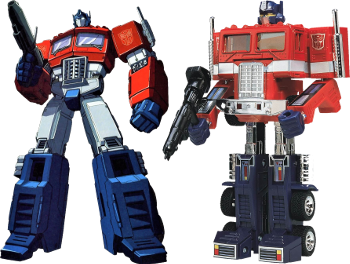
The Merchandise-Driven show, otherwise known as the "half-hour toy commercial", is not merely a television show (or other work) with a line of toys licensed on the side, but a television show created from a line of toys. The program exists largely to sell these products to the audience. Although merchandise-driven cartoons and anime are usually targeted at younger viewers, examples aimed at the older demographic do exist, though they're fairly rare.
Note that there are very few instances of the Merchandise Driven cartoons of today that predate the deregulation of children's television in the Reagan years. The FCC classified 1969's Hot Wheels cartoon as "a thirty-minute toy commercial", which pretty well killed the show (along with reruns of Linus the Lionhearted, a show starring the cartoon Mascots of the Post Cereal line).
(Conversely, it was rare that a popular show would spawn action figures and toys when it was actually on the air in the US. Throughout The '60s and The '70s, the only reliable source for the various Cool Cars and Cool Ships from various science fiction and superhero shows were the Corgi line, imported from the UK. Mego's Star Trek: The Original Series figures didn't appear until well after the show was in reruns.)
Today, there is a full symbiotic relationship between the show's production and the toy company (or other manufacturer licensed, show-themed products), which is usually the primary (or even only) sponsor of the show. But the key difference between this and normal licensed merchandising is that here, it is the toy manufacturer who dictates the show's Canon. They may be able to demand addition or removal of characters from the series based on the actual toys in their production line, or that new characters must be something that they can design a toy version for on demand (military or paramilitary-themed shows and Humongous Mecha anime are particularly prone to this). Another sign of a toy manufacturer exerting influence is the blatant structuring of episode plots solely around the newest merchandisable toy accessories, often where the characters Gotta Catch Them All or be declared a failure as a human being ... yeah, something like that. Meanwhile, in Tokusatsu works, it has become common for the production staff to use weapons and Transformation Trinkets from the show's toyline in the actual show itself.
Merchandise Driven shows are not limited to a young audience either. Many works are adapted from manga, video games, toys, etc. only if there's an existing lucrative market, and older fans are often targeted for their potential loyalty and deeper wallets. That so many comic books and late-night anime can maintain a decent budget is due to this small but vocal group of fans.
Can be halfheartedly avoided with the use of a Segregated Commercial. Still, this sometimes produces a Franchise Zombie. However, Tropes Are Not Bad — some fandoms like the merchandise more so than the show itself.
Many musicals ensured that potential hit tunes were reprised a few times. This was as much for the sake of the song publishers as for dramatic opportunities like the Dark Reprise. The revues, which were formed around Sketch Comedy and had little to no plot, could get quite shameless: some of them explicitly introduced song reprises as a ploy to sell sheet music.
Note that a show can have a line of licensed merchandise without being Merchandise Driven, and once the requirements are met the writers are basically given free rein to script what they want. See The Merch for that. Peanuts creator Charles Schulz was famously quoted as saying there is nothing wrong with using characters in marketing, so long as the quality of one's work stays refined. That said, Bill Watterson has, equally famously, taken no chances and limited Calvin and Hobbes to the print medium to prevent any decay in quality. (Unfortunately, this caused people to just make offensive unauthorized merchandise...)
Also note while advertising can often be the main reason for a show's existence, it is never the only reason, that's what actual commercials are for. Shows of this nature always do their best to tell a story and to keep the viewers hooked with said story. Keep that in mind whenever viewing a show that falls under this trope.
It's also notable that, when the series is particularly well-done, it may outlive the product that inspired it. This seems to be particularly true of comic books, such as Rom: Spaceknight and Micronauts. It's also common for merchandise driven shows to develop a cult following that long outlasts the original merchandise; such a fanbase may result in its eventually being Un-Canceled (usually with accompanying new merchandise), as the current incarnations of Transformers, G.I. Joe, and others can attest.
Compare Misaimed Merchandising, where this sort of thinking is applied where it shouldn't be. See also Defictionalization, where the licensed merchandise is also merchandise inside the show; and Breakaway Advertisement. In some instances, this can also be intertwined with Off-the-Shelf FX. Contrast with The Merch, where the merchandise sales came after the work, in order to support it. For derivative works that are (usually) not metatextual focus of the original work, see Tie-In Novel, Licensed Game, and Advertisement Game.
See also Product-Promotion Parade, a common occurrence in Merchandise Driven works, and Cash-Cow Franchise, and Toyline-Exclusive Character, where the merchandise includes characters that don't actually appear in the work made to promote the merchandise. See the Analysis page for a list of tropes enforced in these works as ways to sell more merchandise.
Example subpages:
Other examples:
- The main reason why the Argentinan children's channel The Big Channel was made is to advertise various toys from Argentinan toy company Cartan. They also aired a good amount of merchandise-driven cartoons.
- Hello Kitty and all her Sanrio friends. They have various adaptations including TV shows and comic books, but they are at heart saleable products first.
- Aikatsu! was made to promote an arcade card/rhythm game of the same name. The events of the anime and the clothes worn by the characters during performances are made to match the content of the expansion pack released on the arcade game. Some episodes are even related to some of the side merchandises. During its first years, it perhaps was one of the most successful of these kinds of shows in Japan-it makes more money than Pretty Cure does! Unfortunately, that success didn’t last too long, as the series became less and less profitable over the years, especially recently, but it didn’t lose its dedicated fanbase that it gained during these years.
- In the same gamut, Bakugan. At least it has a better justification (parallel universe and all).
- Battle B-Daman had a similar premise, based on increasingly ludicrous games involving marble-shooting chibi robots.
- All of the various anime seasons in the Battle Spirits franchise are made to promote a trading card game. While some of the seasons allow more focus on the characters and story, and may even gloss over the card battles sometimes, later seasons make the merchandise-driven nature more obvious, with the plot being driven by real-life set releases.
- Battle Skipper: The mechas the girls use are based on a toy line by Takara Tomy. The series is a three-parter, fan-service-riddled, easily side-tracked commercial.
- Beast Saga, due to being the Spiritual Successor to Battle Beasts/Beastformers.
- Any Beyblade series, which focus on a wildly popular world dominating sport where competitors play with little spinning top toys and try to tip each others' toys over.
- The Black★Rock Shooter franchise exists to promote new BRS figurines. It would have been less egregious if other Other-world characters have their figurines released, but they just keep releasing BRS variations (regular, 2035, BRSB, IBRS...), and the variations aren't even all that different. Anime distributing company Funimation have even gone on to say that the reason why they were unable to get the rights to the TV series was because of the expensive toy dealings that were practically tacked on to the rights. It is very telling when GoodSmile were already announcing figures for the spinoff anime Black★Rock Shooter DAWN FALL before it even aired.
- The entire Brave Series was heavily Merchandise Driven; the franchise was essentially a remake of Transformers when Takara was having difficulty with its other contractors about that franchise and so turned to Sunrise, then already famous for Mobile Suit Gundam, and asked them to animate several toy-driven kid's shows. The brand never did as well as Takara had hoped it would and they eventually stopped caring, which led to everything that ever happened in GaoGaiGar.
- Cardfight!! Vanguard definitely smells of this, with a hefty number of early episodes being dedicated to instructions on how to play the gamenote , throwing in real-life booster pack names now and then note , and in one instance, promote a CD Single of their theme song.
- Parodied in the dub of Crayon Shin-chan with Tokusatsu hero Action Bastard, spoofing toy-driven tokusatsu with open plugs for action figures, role play gear, and mail-away offers during episodes.
- Crush Gear Turbo was advertising for a rather strange game where battery-powered toy cars rolled around and collided in a small tray until one of them had the wheels fall off, or something. The merchandise is almost as hard to find as the show itself.
- Digimon, in all of its anime forms, though not as blatantly as other examples in this page; the exact degree varies considerably. Even more so in manga form, as Cmon Digimon was finished before the v-pets. Notable as Bandai didn't care about anything except the merchandise and gave the anime writers a free hand, with... diverse results. Digimon Tamers even features merchandising from the franchise in the show.
- Adventure 02 is a good example — in the series, T.K. and Kari's Digimon had to evolve into Armor forms because the plot placed a restriction on normal evolution methods. Later in the series, the limitation was lifted, allowing Patamon and Gatomon to reach their (more powerful) angelic forms; nevertheless, they still went with the Armors most of the time, since they were what was selling then.
- Digimon Fusion tightly embraces the marketing side - practically every main character was clearly designed with Combining Mecha toys in mind, and as such the story primarily wove itself around said combining gimmick, but it is unclear how much of the story is influenced by it. It paid off, as its toy sales were reportedly the best of any Digimon line in years and were enough to get the show an extra season. Said extra season, Digimon Xros Wars: The Young Hunters Who Leapt Through Time, was significantly less toyetic, to the point where no actual toys for anything introduced in it are known to have been produced
- On the other hand, Digimon Frontier provided a rather blatant example, as Takuya, Koji and Koichi's combined forms, as well as their Ancient Digimon, were quite clearly designed as simple amalgamations of their earlier Hybrid forms and thus easily able to be made into toys. Susanoomon, the final hero, is also a visible amalgamation of EmperorGreymon and MagnaGarurumon. Coincidentally, the seasons after those toys were released are infamous for turning Takuya and Koji into a Spotlight-Stealing Squad, as they were the only ones to get the top-dollar armor-up action figures. (Koichi had one planned, but it was cancelled, leading to him making a few major appearances and then quickly dropping off in importance.)
- Kotobukiya was quite blunt about making the anime adaptation of Frame Arms Girls very much about enticing people to buy kits of the small robot girls. It lends the show a certain cheesy charm in its unabashedness in marketing them.
- The "success" of a Gundam anime series is often considered to be measured by the number of Gunpla models it sells. The fact that many of these series are either good, great, or mind-blowing, seems completely unimportant to Sunrise, their animation studio.
- Ironically, Tomino made the original Gundam series in an attempt to make the Giant Robot genre something other than a toy commercial. It hasn't always worked. For example, the color scheme of the titular mech was drastically altered to be more visually appealing (even though it was much, much less realistic). And all of the other modifications to the original story.
- Even more ironically, the Gundam series' continued survival and success is largely down to the fact that Bandai chose to sponsor the series and sell plastic models. The original series' cancellation was in part due to poor merchandising.
- Gundam Sousei discusses this. The show's ratings were absolutely terrible, so Tomino started creating blatantly toyetic mobile suits and vehicles (such as the G-Armor) in hopes that toy sales would keep the show afloat. It didn't work, but the strong toy and model kit sales did help convince the studio to do a trilogy of Compilation Movies, which eventually led to Mobile Suit Zeta Gundam, which was far more successful.
- In the later parts of the UC timeline, mobile suit technology is refined to the point where the suits can be built 20-30% smaller and lighter without sacrificing power or armor. And so Bandai gets to market smaller and cheaper models in the same scales, grades, and price points as before.
- Despite the expense of new kits, this has been phased out as newer kits are often priced depending on their weight and complexity. Kits like the 00 Qant and the Unicorn Gundam are hot sellers but they are priced according to how much plastic is in those kits. On the other hand, large kits like the Sinanju err to the more expensive side.
- By the time of Mobile Suit Gundam: Iron-Blooded Orphans, the price of the HG kits are barely the half of the other kits thanks to the inner frame features, all mobile suits in these lines can interchange parts with each other as well as attaching Builder parts onto the peg holes on the frame.
- Often times, Bandai will find ways to release old kits as a new model with various ways to make them seem like legitimate standalone kits. One such method is to market recolors (0 Gundam and the Celestial Being colors) or spin-off variations of a kit (Astraea, Astraea type F) without having to create entirely new runners. This can be both subtle and completely in your face, like the GN condenser 00 where the frame is the exact same except for an extra clip that gives you the condenser pieces.
- Gundam Build Fighters is what happens when Gundam abandons any pretense at not being merchandise driven. It's a typical toy-driven To Be a Master series... except the toys are Gundam models. Build Fighters is marginally more decent about this than its predecessor, Model Suit Gunpla Builders Beginning G, though. The previous show had An Aesop that modifying your kits or scratch-building parts is bad (though we know the real reason why Bandai would rather you buy stock parts), whereas scratch-building is very much celebrated in Build Fighters.
- Funnily, this is also the creation behind Sunrise shows that fans call "it's Gundam, only not". Since the Gundam name has such a specific stigma behind it and requires model sales to be successful, Sunrise will make shows that in many ways are Gundam series, but called something else in order to avoid said stigma. Examples being Code Geass, Valvrave, and Dragonar, which was called by fans "the best Gundam show of the 80s".
- Ironically, Tomino made the original Gundam series in an attempt to make the Giant Robot genre something other than a toy commercial. It hasn't always worked. For example, the color scheme of the titular mech was drastically altered to be more visually appealing (even though it was much, much less realistic). And all of the other modifications to the original story.
- Kemono Friends was made to promote a mobile game, but outlasted it as the original game shut down a little before the series aired. When the show's suprise popularity revived interest, new games were made — but they now promote the show, not the other way around.
- LBX: Little Battlers eXperience, a series that could be seen as a Spiritual Successor to Medabots, existed to promote a series of video games and a corresponding line of customizable, 1/1 scale model kits.
- Sunrise's other multimedia darling, the Love Live! franchise is not much different. The multiple animation productions tie-in with continuous merchandise releases, such as CDs with the songs that the idols perform in anime, waffers with collectible cards, nesoberi plushies, keychains and more bizarre paraphernalia like nippers and fidget spinners. The bulk of the sales, however, comes from the CD and Bluray releases that accompany each anime episode, which contain lottery codes for live concerts; it's not uncommon to see fans purchase 10 or more CDs while attempting to win a ticket. And this is without getting into the mobile games, that hold multiple events to promote the anime, and viceversa. The franchise has stayed in the top 10 of the best selling franchises in the Oricon chart since 2015 thanks to this.
- Medabots was a vehicle to sell a series of video games and customizable action figures; justified in-universe by having battlers being able to take one part from their opponent on victory and add it to their robot. Fits this trope to a T; and was also pretty memorable in its own right.
- MegaMan NT Warrior existed to promote Capcom's already-popular Mega Man Battle Network video games; as well as the accompanying merchandise for the series itself.
- Mini 4WD related manga and anime Dash! Yonkuro and Bakusou Kyoudai! Let's & Go!! are created solely to sell toy models from Tamiya. They even add tips on how to race the toy cars. The premise is similar to Crush Gear Turbo, except these are even older.
- Monsuno, a series centered around a card game and a line of toys where monsters burst forth from spun tubes.
- Neon Genesis Evangelion is probably the most famous example of the "it wasn't meant to be a toy commercial, but it ended up becoming one anyway" subtrope. It was conceived to deliver a basic message, not to shill for toys; however, with the series becoming a smash hit, everybody and their mom started craving model kits of the Evangelions and figures of the girls. Especially the figures of the girls. Everything released since the original series is made to cater to all the plentiful diehard fans around the world - the merch was in fact so successful it managed to singlehandedly save Studio Gainax from bankruptcy, and then some!
- Ojamajo Doremi showcased magical accessories that were not only gaudy and colorful, but even in the anime looked like cheap plastic, and featured sounds, lights, and actions that were easy to replicate via the magic of mass production. This Dreamspinner◊, for example, is precisely as depicted in the show, right up to the point where it fails to spit out a magic wand and costume — they're sold separately.
- The movie Oshare Majo Love and Berry: Shiawase No Mahou was made to promote the arcade game.
- PaRappa the Rapper was made purely for this.
- Pokémon: The Series is an arm for advertising the video game series, with storylines being tied to the games, certain Pokémon games being promoted near the time of release, and character and plot being de-emphasized over showcasing the newest monsters. And it worked; it became one of the most popular children's cartoons and anime series at the time of release, and helped turn Pokémon into the Cash-Cow Franchise it is now.
- Pokémon Origins is a completely separate OVA created to promote Pokémon X and Y, aimed at older fans who grew up with the original games. As such, it still serves as a promotional arm for the games, especially with Mega Charizard X's appearance, but otherwise focuses more on bringing the original games to life rather than shoving all the newest Pokémon and features in viewers' faces.
- Almost all Pokémon manga is this, though they can handle the Merchandise-Driven aspect in different ways. Pokémon Adventures, for example, isn't as relentless in this regard as the regular anime (as evidenced by its Schedule Slip tendencies), and puts a stronger focus on characters and storytelling.
- Pretty Cure: Becoming a long running Cash-Cow Franchise for Toei Animation. The franchise grew so popular over the years that toys, dolls, accessories, and coloring books are released long before the new season even airs or even proves ratings worthy.
- The Pretty Series, as well as its spin-offs PriPara and King of Prism, are based off arcade games.
- In Queen's Blade the Visual Battle Books are what really ignites any other related product for the franchise, from figurines to Anime/Manga and Video Games; Hobby Japan itself are endorsed by other companies to make merchandise of their products, so making some for their in-house creation comes off as expected.
- In Sailor Moon, the Outer Senshi had unique Transformation Sequences due to the transformation wands Bandai sold at the time. Since the Outer wands came with tubes of lipstick, the Outer Senshi were given close-ups of their lipstick magically gliding over their mouths during their transformations.
- In the live-action Pretty Guardian Sailor Moon, the weapons and accessories used by the characters in the show were the actual toys on sale concurrently in the shops.
- Also, Naoko Takeuchi originally designed the Sailor Starlights with short hair (which fit the androgynous theme behind the characters), but was convinced to give them ponytails after Bandai representatives informed her that it was difficult to produce short-haired dolls.
- Saint Seiya: Part of the reason why the protagonists' Cloths evolve constantly. In fact, when the manga was to be adapted to anime for the first time, Bandai requested that the Cloths were altered to cover more body parts, so as to make the action figures more appealing.
- Subverted with Samurai Pizza Cats. The show was originally commissioned by Bandai as one of these, but the toyline ended up cancelled with the series already mid-way through production, so Tatsunoko decided to go ahead with it anyway.
- selector infected WIXOSS is an unusual instance of this played straight. On the surface it looks to be a TCG anime akin to Yu-Gi-Oh! with a dash of Magical Girl for flavor. A closer examination shows that the presentation is a Deconstruction of the Serious Business mentality such shows treat their card games with. Wixoss seems just to be a cute game for girls, but those who can see and speak with special cards known as LRIG's are Selectors, unique in that they can battle in hopes of granting a girl's greatest wish. The game is revealed to have a dark consequence for those who fail three battles, quickly reversing the effects of their wish into a curse, and their cute LRIG companion will disappear. The anime delves into what a harsh system will do to girls as they struggle to win battles at any cost, sacrificing friendships in the name of achieving their wishes, and a worse twist that befalls those unlucky enough to win. Ostensibly it exists to promote the Wixoss card game, but unlike most anime of this nature the rules are barely explained and focus more on the characterization of those playing, the psychological complexity of those desperate enough to play, and exploring many Darker and Edgier themes that make you wonder why little girls would buy such a depressing product.
- Seven Mortal Sins was a figurine line first before it became an anime, and its purpose is to flesh out the characters' backstory.
- Sgt. Frog: Inverted here - it's Keroro's love of Gundams that earned them Bandai as its merchandising arm. The KeroPla line of plastic models features Keronian characters and mecha all compatible with existing Gundam models.
- It also resulted in the series making it to Super Robot Wars, Keroro's living the mecha fanboy dream.
- And on Keron, the platoon is a super duper popular cash cow... but they didn't actually know this until they got letters from Keronian kids on New Year's. Somebody's really rich, but it sure as Hell isn't them.
- It's parodied in episode 10 of the anime (at least in the dub), where an armored vehicle is introduced just to add it to the toy line.
Keroro: It's so roomy!Giroro (in monotone): Yes for action figures, and toys. - Spellbound! Magical Princess Lil'Pri is an adaptation of a Sega arcade game called Lilpri - Yubi Puru Hime Chen, which allows players to scan cards to customize their own Magic Idol Singer. The cards are even used in the show by the three main characters and are advertised at the end of each episode.
- Super Dragon Ball Heroes is a worse offender because it turns up this trope to over 9000!. Characters like Future Trunks or Cooler who are fan favourites do nothing other then watching or getting beaten up. Hearts, one of the main villains, unlocks a form without warning. Cabba fades out of the story after two episodes. Kale and Caulifla, and later on Vegeta, ends up getting possessed by the tuffle for no good reason. Goku uses Ultra instinct for merchandise reasons. It gets to the point that it screams BUY THE CARD!!! at the end of the episode.
- In fact, many of the Super Saiyan transformations in the regular Dragon Ball series (Super, GT, Z) were primarily made to sell more action figures.
- Variations of Super Sonico (and her friend Super Pochaco) exist to promote her figurines. While most of her variations are different (swimsuit version, bathing version, waitress version and so on), there are some egregious examples like the Tanned version and color variants (which are, well, recolors), see it for yourself, along with her other merchandises (the link doesn't contain her prize figures). That's also not counting her various manga spinoffs and CDs starring her anime band, as well as her games. It was to be expected, though, as she owes her existence to being a concert poster girl.
- Suzy's Zoo: Daisuki! Witzy was technically created to increase awareness of the Suzy's Zoo franchise in Japan.
- Out of popular otome franchises, special mention goes to the Tsukipro franchise and its mascots. There's a different animal for each series of two idol units - Tsukiuta's Tsukiusa (rabbit), SQ's Lizz-kun (squirrel), Alive's Arainu (dog), and Vazzrock's Vazzcat - and the mascots come in each character's image color. Not only do they sell a ton of different permutations of plushies of them, they also make clothes and accessories for the original size ones. And they encourage fans to be creative with them - many fans make tiny versions of the characters' costumes from the illustrations and stage plays, for the plushies, and there are plenty of instagram accounts of fans taking photos of the plushies in interesting arrangements. They even had an official photo contest.
- Yo-kai Watch, being based on a video game, is this, to the point where it's currently rivaling Pokemon in popularity.
- Contrary to what some may believe, the original Yu-Gi-Oh! manga/anime did not fit this trope: not only was Duel Monsters not originally part of the series, it took a while before it could be developed into a real collectible card game, which explains why the series seemed to be making up rules as it went along before the Battle City arc, which was lampshaded heavily in the Abridged Series. Future series, however, were very much this, causing some fans of the original to complain.
- Zoids is unusual in this respect, as the original model line from the 80s had no supporting media, aside from two short promotional videos, a few video games and a comic series produced by Marvel Comics. The second model line, however, had numerous anime and manga adaptations, though only the first three (Zoids: Chaotic Century, Zoids: New Century and Zoids: Fuzors) saw distribution outside of Japan.

- Rainbow Ruby has a stuffed bear and a magical suitcase that were made into toys in the show's home country of Korea. In addition, there have been many dolls made of Ruby's various costume changes in the series.
- Marvel's Micronauts comic book series was created specifically to sell the action figure toy line, but writer Bill Mantlo successfully turned it into a well-written and sometimes deeply philosophical science fiction epic, while doing all they could to avoid some amazing similarities between the toy line and the recently-released Star Wars: A New Hope. The comics outlasted the toy line, but since Marvel doesn't own the trademark, the Micronauts have rarely reappeared in the Marvel Universe, and their more familiar aspects, and name, have been suspiciously absent when they did appear. Bug still appears without the rest of the team, since he bears so little resemblance to the "Galactic Warrior" figure on which he was very loosely based, that Marvel can claim him as their own original creation.
- Marvel Comics had several toy-based series in the late 70s/early 80s: in addition to Micronauts, there was also Shogun Warriors, Rom: Spaceknight, Transformers, G.I. Joe and others. Somewhat unexpectedly, nearly all of them, especially G.I. Joe, are usually regarded as quite good. All of these (except Transformers and Joe) were considered part of the main Marvel Universe, meaning they could interact with Marvel characters. In fact, even after losing the rights to the main characters, Marvel still owns the ones they created (such as the Dire Wraiths from Rom) and they still show up in the comics occasionally. Marvel also created a few series that were intended to be adapted as toy lines, such as The Saga of Crystar, Crystal Warrior with Remco.
- At least for the first few issues, The Transformers (Marvel) was considered part of the mainline Marvel Comics universe, in that there was some overlap, but not as much as there would be between Marvel's main titles. Spider-Man appeared in issue 3 of Transformers, and the Transformers comic villain Circuit Breaker made an appearance in Secret Wars II (so that Marvel wouldn't lose the copyright on the character to Hasbro). Issue 8 had the last specific reference to the Marvel Universe in the American series with an appearance of the Savage Land (which was only used as a Lost World backdrop to explain the origin of the Dinobots). Material written for the UK version of the comic kept occasionally referencing the Marvel Universe for another year, with the last reference there being the appearance of Roxxon in issue 46.
- After merging with a toy company, Marvel produced a comic based on its own "MegaMorphs'' Transforming Mecha toys. Fans seem to regard the resultant comic as So Bad, It's Good.
- The G.I. Joe comic was partly created as an end run around using animation in toy commercials. The amount of animation was limited to a few seconds. However, they could do full 30 second animated commercials for a comic book. That's why it's one of the very few comics to ever be advertised on television. It was really about selling toys.
- The Team America comic book series was conceived by Ideal Toys as a way to continue selling their motorcycle products after Evel Knievel (the previous subject of their line) was arrested for battery.
- One of Marvel's least successful toy tie-ins was a series called US-1, which was meant to promote Tyco's slot-car truck toys. The toyline lasted for six years; the comic only lasted 12 issues. The comic would later become fodder for Atop the Fourth Wall, to the point where the series is referenced in the theme song. Nevertheless, U.S. Archer remains a part of the Marvel Universe (really, the only thing Marvel can't use from that series is the US-1 name and logo).
- Marvel Comics' Secret Wars miniseries was created to promote sales of Mattel's Marvel toys. As such, certain story elements were implemented for the sole purpose of benefiting the toy line, such as Doctor Doom's armor being damaged and rebuilt so that he more closely resembled his action figure. Strangely enough, certain characters who played big parts in the series did not get their own figures, while characters who didn't even appear at all (such as The Falcon, Daredevil, Baron Zemo and the Hobgoblin) did.
- DC produced three mini-series for Kenner's Super Powers Collection toy line. The minis are fondly remembered today due to featuring artwork from legendary comic artists like Carmine Infantino and Jack Kirby. The series worked in some of the new designs from the toys, such as the ones for Mantis, Steppenwolf and the Parademons, with even Darkseid himself donning a cape so he'd look more like his action figure. Some of the vehicles, like the heroes' Delta Probe One and Kalibak's Boulder Bomber craft, also appeared.
- Speaking of the Super Powers Collection, George Pérez designed Lex Luthor's suit of green Powered Armor so it could be adapted as a figure in the line. Though initially discarded after Crisis on Infinite Earths, the look proved popular enough that Lex has worn variations of it in the decades since.
- A similar mini-series was produced for Kenner's Total Justice action figure line. The contrived plot saw the members of the Justice League donning high-tech suits of battle armor after temporarily losing their abilities. The writer, Christopher Priest, has admitted in later years that the series was pretty awful.
- Ame-Comi Girls, which is based off the Animesque line of statues.
- Likewise, DC Comics Bombshells began life as a series of statues depicting DC's various heroines and villainesses as World War 2-era pinup girls.
- The original Atari Force started off as promotional giveaways included with Atari 2600 game cartridges. The second series kept the backstory and the characters, but was otherwise an original sci-fi romp.
- This is the entire reason Spider-Man's short-lived Spider-Mobile even existed. In the 70's, Stan Lee was seeking new revenue streams for Marvel to exploit, and thought that giving Spider-Man a Cool Car would make the character more appealing to toy companies.
- Likewise, DC introduced the Supermobile for Superman because Corgi's Batmobile toys had proven to be a massive success, and they wanted to see if lightning would strike twice.
- Also, the entire reason Superman's enemy Brainiac became a living computer is because the makers of the Brainiac toy computer threatened legal action over trademark infringement. As part of a settlement, DC turned the character into a living computer and then included a footnote advertising the toy.
- During the 90s, Scott Lobdell had wanted to redesign Iceman in order to give him a spikier, more Animesque look. At the time, he was shot down by his editor and told that ToyBiz would be pissed if the character no longer resembled the Iceman action figure that was currently in stores. Ironically, after learning of the proposed new design, Marvel's marketing department later wound up okaying the idea, as they realized Iceman's new look was more toyetic, and thus would be more appealing to merchandisers.
- This is becoming more and more common in "regular" comic books, from Events to other stories. Many, many stories now heavily feature rapid-fire costume switches and variants on old costume designs, as heroes gain temporary power-ups. DC's Blackest Night and Marvel's Fear Itself show this most strongly. In the former, a dozen heroes get possessed by Power Rings that alter their costumes more than once. In the latter, heroes and villains get new costumes and weapons. All have the side-effect of allowing whole new sets of toys to be created in their likeness. Although curiously, Fear Itself didn't receive a line of toys, and there haven't been any variants produced of the characters in the toy-lines. Blackest Night, on the other hand? Almost every Black Lantern has received a figure, at the very least.
- Larry Hama's legendary run of G.I. Joe was full of this, in spite of his writing. Many, many issues featured a new cast of characters on their "first mission" or a "training run" or some such thing, as they were based off of new toys that were coming out. Hama seemed to take it in good cheer, and enjoyed coming up with creative new concepts and character names. Aside from a near-constant recurring main cast, the comic featured an endless supply of new background characters.
- The title was so popular that a second book, Special Missions, was started up with the stipulation that Hama didn't have to write all of the new toys into it.
- In one case, when the "Eco-Warriors" subline (which included main cast member Flint) was worked into the book, Hama added a line about how the team's special new uniforms were made out of recycled action figures.
- Spy Gal, who received a one-shot comic book as part of a promotion between Marvel Comics and Benefit Cosmetics.
- As Cracked pointed out, there's an entire genre of promotional comics published by DC and Marvel designed to plug various products. These include (among other examples):
- A Justice League of America comic featuring Sears appliances.
- An Avengers comic featuring Harley-Davidson motorcycles. This partnership also spilled into installments featuring Captain America and Thor.
- An Avengers comic featuring Audi vehicles, with the cast consisting of characters featured in Captain America: Civil War (Captain America, Black Panther, Black Widow, etc.)
- An Avengers comic featuring Pirate's Booty snacks.
- An All-New, All-Different Avengers comic featuring Western Union.
- A Captain America comic featuring Kiehl's cosmetics.
- An Iron Man comic featuring a DJI drone.
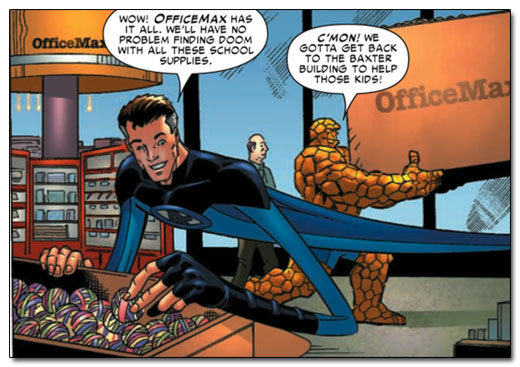
- A Fantastic Four comic featuring tech from Hitatchi Data Systems. There was also the time they went to Office Max.
- An The Incredible Hulk comic featuring mattresses from Sleepy's.
- A comic starring a Canon Foreigner hero who drove a Pontiac Solstice, featuring a guest appearance from Black Canary.
- A series of Justice League of America comics featuring Subway sandwiches and cameos from famous athletes.
- An Agents of S.H.I.E.L.D. comic featuring Lexus vehicles.
- A Superman and Wonder Woman comic featuring Tandy TRS-80 home computers.
- The unforgettable The Adventures of Kool-Aid Man.
- A Black Panther comic featuring Lexus vehicles.
- An Ant-Man and The Wasp comic featuring Dell computers.
- The Freshmen, a team of young heroes created as a collaboration between Marvel and the grooming company Axe.
- And Marvel's Combo Man, who somehow gained the powers of various Marvel characters by eating Combos.
- Monica's Gang had a comic series about the theme park based on the franchise, the main stories was about the characters having adventures on the park or just enjoying it, one can wonder how the characters can go to a theme park based on themselves but can be explained by the Animated Actors trope, and the comic was quite good and it wasn't much of shameless advertising, the rest of the stories in each issue were not related to the park, when the park was closed, the comic series was cancelled.
- In-Universe example in My Little Pony: Friendship Is Magic (IDW) #28, when Twilight notices Well-To-Do has made merchandise of her. Justified, since Twilight's a princess and all.
Twilight: You're still using my face on merchandise?! I didn't agree to that!
Well-To-Do: [holding slightly similar toy of Twilight]: This? This is the park's new mascot "Princess Twilight Sporkle"! See? Totally different from you! Our legal department said it's totally fine! - It's common for Marvel and DC video games to get Recursive Adaptation comics to promote them, such as Injustice: Gods Among Us, Marvel Future Fight or the third Contest of Champions (2015) series.
- Lampshaded in an issue of the "Heroes Reborn" Fantastic Four series, where Sue notices that Johnny has begun wearing a new costume for no apparent reason.
Human Torch: Two different costumes means two different toy figures.
- Way back in The Golden Age of Comic Books, the Chicago Mail Order Company partnered with Centaur Publishing to create C-M-O Comics, which was like very comic anthology of the day, except that it featured Product Placement for items in the Chicago Mail Order catalogue, along with ads for them. The Invisible Terror was part of the series, among others.
- Marvel produced a mini-series based on the popular Tsum Tsum toys made by Disney. Despite the premise, it was generally considered to be pretty fun and well-written.
- Wonder Woman and the Star Riders: Was meant to sell a line of dolls and accessories by Mattel, but the show and toys ended up cancelled after a few previews leaving the short tie-in promotional comic as the only complete and published bit of the project.
- In-universe in Youngblood (Image Comics). Shaft would have to meet with the toy company to go over his action figures planned for the year. Four variants for 1993, and Badrock's gonna collect em all!
- Avengers: Mech Strike, a comic book mini-series where Iron Man, Captain America, Spider-Man, Black Panther, The Incredible Hulk, Captain Marvel and Black Widow pilot Humongous Mechas to battle Kaiju, was launched to promote a line of toys from Hasbro and Lego.
- Likewise, Tech-On Avengers is a mini-series where Captain America, Black Panther, Captain Marvel, Spider-Man and Wolverine don suits of Powered Armor after losing their superhuman abilities, making it similar to Total Justice. The comic was conceived to promote a line of Animesque Avengers toys from Bandai's S.H. Figuarts brand.
- Annihilators: Earthfall has an in-universe example with Mojo's show about Rocket Raccoon and Groot. He's made at least four different Environment-Specific Action Figure toys of Rocket, and each is packaged with one piece of a buildable Groot toy. He expects the toy sales to make up a big chunk of the profits.
- Titans: In the 90s one-shot Titans Sellout Special and in issue #93 of The New Titans, the team begins to license their likeness to products, and even a toyline based on them and their enemy Deathstroke is advertised on a catalogue.
- Garfield, as its creator Jim Davis would eventually reveal, was created specifically with this kind of marketability in mind. Maybe not as a toy per se (the character was dramatically less toyetic in appearance in the beginning), but definitely as a line of merchandise. Garfield and Friends frequently lampshaded this. In one episode, another cat named Gabriel performs a Hostile Show Takeover, eventually leading Garfield to complain that "He's got my merchandising!"
- Bill the Cat of Bloom County was created as a vicious parody of Garfield's heavily merchandised nature, with the joke being that he was a hideous, uncouth character completely unfit for merchandising. Ironically, Bill became a Breakout Character and accrued quite a bit of merchandising himself.
- Robotman, created by United Feature Syndicate in the '80s to be a marketing icon — a rare instance of a character actually being created by a syndicate and handed over to a cartoonist instead of the other way around, and an excellent example of how Merchandise Driven the comic strip industry in general had become by this point. After looking over a comic submitted for syndication by a young Bill Watterson and recommending that he spin off two of its minor characters into their own strip, they asked him to incorporate Robotman into the resulting product. Watterson, unsurprisingly, refused, and wound up not getting the gig. He moved on to rival Universal Press Syndicate, and the rest is history. And what became of Robotman, you ask? He eventually did get his own comic strip, but it never became the marketing boom the syndicate hoped, and was eventually renamed Monty after the eponymous character was written out at the syndicate's own recommendation when they discovered it was hard to market a strip called Robotman.
- Calvin and Hobbes:
- A repeating gag is that Calvin, for all his artistic pretension, definitely wants in on the market share.
Calvin: Look at the dopey clay tiger Hobbes made.
Calvin's Mom: Gee Calvin, I think this is good.
Calvin: You LIKE it?? Where's the marketabiity?
Calvin's Mom: Ask Hobbes if we can put it on the coffee table.
Calvin: But look what I made! A hundred shrunken heads of popular cartoon characters!
Calvin's Mom: Eww, you stitched their mouths shut?!
[beat]
Calvin: Gloat now, 'cause some day I'll be a lot richer than you.
Hobbes: I call it "Symphony in Orange, No. 1". - Calvin's dad especially rails against the consumerism of mass media, a viewpoint that mirror's Watterson's own.
Calvin's Dad: Our lives are filled with machines designed to reduce work and increase leisure. We have more leisure than any man has ever had. And what do we do with this leisure? Educate ourselves? Take up new interests? Explore? Invent? Create?
Calvin: Dad, I can't hear this commercial.
[Calvin is thrown outside]
Calvin: If it were up to my dad, leisure would be as bad as work.
Calvin's Dad: How can you stand these cartoons? They're just half-hour commercials for toys. And when they're not boring, they're preachy. And these characters don't even MOVE. They just stand around blinking! What kind of cartoon is THAT?
Calvin: Meet my dad, the Gene Siskel of Saturday Morning TV.
Calvin's Dad: Watching a Christmas special?
Calvin: Yep.
Calvin's Dad: Another show extolling love and peace interrupted every seven minutes by commercials extolling greed and waste. I hate to think what you're learning from this.
Calvin: I'm learning I need my own TV so I can watch someplace else.
- A repeating gag is that Calvin, for all his artistic pretension, definitely wants in on the market share.
- Regularly mocked in Foxtrot, where Jason makes no secret whatsoever that he wants money, not artistic recognition.
- One of his proposed Slug-man comics was nothing but Slug-man and Paige-o-tron using their various weapons against each other (Each Sold Separately, *batteries not included, and all ending in a Trade Snark) ending with Jason wondering if it was customary to approach network executives or toy manufacturers first.
- Another had him submit a comic strip to his school newspaper.
Jason: Honestly, what do you think of my strip?
Peter: Well, it's not particularly funny...
Peter: And it's not particularly well-drawn...
Peter: In fact, it's probably the lamest thing I've ever seen.
Jason: But will it sell T-shirts?
Peter: My, but you do have pure motives... - And this immortal line:
Jason: Do you think the world is ready for cartoon-shaped Ty-D-Bol tablets?
- Surprisingly, Toy Story was not made for this, although it happens to be perfect for selling toys anyway. But the Shows Within The Movie, Woody's Roundup and Buzz Lightyear of Star Command (the latter was Defictionalized) both are, and the two main characters are part of the merchandise. Woody's Roundup is even said to have been Cut Short because the toys weren't selling anymore, the fate of too many real-life series to name.
- Cars quickly became Disney/Pixar's Cash-Cow Franchise in terms of selling merchandise. Kids don't really want Woody, Buzz, or any of the other characters Pixar created; they want cars. It's a symbiotic relationship: despite consistent lukewarm critical and box office reception, John Lasseter kept producing Cars films at Pixar, and spin-offs set in the same universe made by DisneyToon Studios, because that world was his personal pet project, and Disney had no problem letting him do it because he happened to pack each film full of more marketable new vehicle characters than an entire Transformers series. To put this into a wider perspective, the first Cars film was green-lit by Michael Eisner specifically because he knew how much money other companies were making by selling car toys. The project Eisner turned down in order to make Cars? An early version of Toy Story 3. THAT is how valuable he felt the Cars franchise could become.
- The Disney Fairies movies were made to sell the franchise’s toy line. When the toys stopped selling well, the franchise was discontinued.
- The scene in My Little Pony: The Movie (2017) where the ponies go underwater could have easily been completed without them turning into sea ponies. The main reason why that happened was so people would want to buy toys of the Mane Six as sea ponies.
- The Honest Trailers' video for Frozen (2013), in its introduction of the cast, called Olaf "Merchandising"
- Gnomeo & Juliet is an interesting variation on this trope. It was put into production by Disney in the late '90s as a passion project for Elton John (who had previously done the music for Disney's The Lion King (1994)), who at that point hadn't made a compilation album. Disney's logic was that if they crammed as many of Elton John's biggest hits into the film as they could, they'd then make a fortune by positioning the movie's soundtrack as an unofficial "Greatest Hits" album. Seriously. It turns out this wasn't actually such a good idea, and after nearly a decade of trying to make the film work Disney gave up on it and handed it off to someone else.
- JLA Adventures: Trapped In Time was commissioned by Target to promote its line of Justice League action figures. In an example of Tropes Are Not Bad, the film was pretty well received by fans and critics.
- The reason Thrax has the power to change the appearance of cars in Osmosis Jones is because the creators thought it'd help sell toys. However, the film's toy line was never released, making the gesture somewhat meaningless.
- The television movie Furby Island was made to promote the emoto-tronic Furby toys.
- Twinkle Toes was made to sell Skechers' new Twinkle Toes brand of light-up shoes. Yup, not even a toyline. Just shoes. Those kids' sneakers with the electric lights that flash every time you take a step, which were popular for a solid generation before Twinkle Toes. It's a charming kids' film in its own right, though, and if anything, the scene that introduces the shoes encourages kids to use their creativity to decorate their own shoes rather than buy Skechers.
- Jonah: A VeggieTales Movie: Khalil was changed from being a worm to a half-caterpillar, half-worm due to this trope. After seeing his inital design, Phil Vischer said "No child in America is gonna want to hug that", referring to the fact that his design wasn't cute enough for merchandising.
- Willy Wonka & the Chocolate Factory was underwritten by the Quaker Oats Company to help launch a new line of Willy Wonka candy. Ironically, the Wonka Bar was quickly recalled, leading to a curious, decades-long lack of chocolate in the chocolate-themed IP's products.
- The Wizard is a 90 minute infomercial for the Nintendo Entertainment System. They not only include showing characters playing popular video games at the time, they also show the Nintendo hint line, and most (in)famously the Mattel Power Glove (which doesn't work as well as advertised, making one character's Totally Radical statement "it's so bad" more true in the literal sense). The climax of the movie has them going to a video game championship where it's revealed that they will be playing a secret game. The not-released-at-the-time SUPER! MARIO! BROTHERS! 3! The climax of the movie is the new Super Mario Bros. game!
- Singin' in the Rain is a rare example of a merchandise driven product that turned out beautifully. The studio had the rights to a catalog of songs, and asked some filmmakers to make a movie with those songs in it for promotional value. A more crass motive you could not imagine, and yet Singin' in the Rain is considered one of the best movie musicals of all time.
- The Batman franchise:
- The Tim Burton films are pretty good examples of this. Batman has a wide range of gadgets, vehicles and outfits depending on the situation, making him a gold mine of different merchandise to produce and sell. Part of the reason that Burton left the franchise after the second film was that it was felt that his increasingly Darker and Edgier vision was causing problems with creating child-friendly merchandise.
- Warner Bros. forced Joel Schumacher to make Batman & Robin "more toyetic," a word the director had never heard before then. The film's garish visual design choices were partly a result of the art design being rushed so that they could start producing the toys.
- The Dark Knight Trilogy gives a lot of details to him developing and repurposing all of his gear. Utility Belt playsets were very common, and each movie introduces a new vehicle for him to use. All that said, it's downplayed compared to the Burton/Schumacher films due to having more consistency of his costume and vehicles and having less colorful villains.
- The DC Extended Universe Batman gives him multiple outfits and vehicles for Batman v Superman: Dawn of Justice, and more variations throughout the story of Justice League (2017).
- This approach bled into the rest of the shared universe. Superman's suit had some slight alterations in-between Man of Steel and Batman v Superman, with Zack Snyder's Justice League giving him a black and silver variant. Wonder Woman's signature outfit comes in varying shades of red, blue and gold for every appearance, with her solo films giving her an Amazonian training outfit and golden armor. Aquaman has a new suit with every major appearance, going from green in Justice League to gold in his solo film and dark blue in the solo's sequel. The Flash got a total of three new suits in his solo movie; one being an upgrade of his early costume, another being appropriated from a spare Batsuit for his doppelganger and the third being a horrific melding of rubber, shrapnel and possibly flesh for his Evil Knockoff. Outside of the Justice League are Harley Quinn and the Shazamily - who all get new costumes with every appearance - and Black Adam, whose own movie also introduced four members of the Justice Society.
- Joker is a major inversion in recent memory. Simply put, no merch was made around it, at the request of director Todd Phillips (if you ever see a Funko Pop! of it, it's custom-made). Phillips was infamously told by some Warner Bros. executives who doubted of the film's potential that "they can't sell pajamas with this version of the Joker on them".
- Street Fighter: A lot of the stuff involving tanks and other vehicles was put there at the behest of Hasbro, who wanted the film to promote their tie-in toy line.
- At least part of the reason why the Superman movie franchise was in Development Hell for so long is due to executives wanting to depower the Man of Steel so they could give him Batman-like toys that they could sell to kids. Several of the script drafts for Tim Burton's Superman Lives movie (including the one by Kevin Smith) featured Superman donning a suit of Powered Armor and using gadgets like high-tech goggles and S-shaped throwing stars.
- Star Wars as a whole is rooted heavily in vehicles, gadgets and exotic characters, making it very lucrative. Fox gave George Lucas the merchandising rights in lieu of salary as director, assuming A New Hope would flop. Not only have the films been massive box office hits, the merchandise sells so well that it's a key reason why a major film often needs merchandising potential just to get greenlit these days. The Disney era of the franchise has carried on the trend.
- The Pirates of the Caribbean movies were created to promote the already popular Pirates of the Caribbean ride, then the subsequent merchandise. Which led to the original Pirates of the Caribbean ride being refurbished to feature umpteen Jack Sparrow, to hype the movies' DVD sales and box-office receipts. Predictably, this disgusted fans of the attraction's classic layout but was a blessing for fans of the movies who wanted to see Jack and the crew as part of the original ride.
- Mattel execs hoped Masters of the Universe would save the then-dying franchise of the same name by reigniting interest in the brand. Unfortunately, the toys and TV show being on a downward trend affected the film production itself, which flopped and couldn't do anything to save the toyline.
- Hasbro started the Transformers Film Series as a means of keeping the franchise going when the Unicron Trilogy was wrapping up. The toys for the first Transformers film surpassed Power Rangers in sales for the top boys' toy series. The second film proved to be a big example of Critical Dissonance (it made several worst of 2009 lists, but made over $836 million worldwide), and had steady toy sales. However, while the third film saw a further uptick in worldwide gross, toy sales actually hit a decline, forcing cutbacks that hit a lot of the franchise, and the line ended up scaling back heavily for Age of Extinction.
- G.I. Joe: The Rise of Cobra was created as a revival of the G.I. Joe toyline. While the film wasn't the biggest hit, the toys were major sellers; so much that the sequel, G.I. Joe: Retaliation, was funded with the money made from the toys.
- Magic Mike's Last Dance is a rare example of this trope being applied to a franchise that isn't primarily geared towards children and/or "geek" types, primarily existing to promote the Magic Mike Live stage show and featuring many of the dancers who perform in it.
- Marvel Cinematic Universe:
- In Iron Man 2, the helmet and repulsor toys worn by the kid who Tony rescues from nearly getting killed, later retconned to be a young Peter Parker, are actually from the toyline. This is quite possibly the only superhero movie where using the actual toys used to promote the film is completely appropriate in-story.
- In general, it's speculated that one of the reasons Iron Man changes suits in every MCU movie (sometimes sporting multiple armors in a single film) is because it gives the toy companies more products to sell. Iron Man 3 in particular had an entire fleet of new armors that got very little screen time but nonetheless featured heavily in the merchandise for the film.
- Other recurring characters like Captain America, Thor and Spider-Man have gone through multiple costume changes which are reflected in the merchandise.
- In universe, Jingle All the Way has a show to promote the Turbo Man toyline.
- While not itself a victim of the trope, Spaceballs lampshaded and parodied it throughout for the laughs. Countless background objects have the movie's name on them culminating with a few lines from Yogurt. Apparently one caveat is that Mel Brooks received help from George Lucas on the condition that the film didn't have a toyline (which would have competed directly with Star Wars).
Merchandising. Merchandising. Merchandising. We put the picture's name on everything. Spaceballs the coloring book. Spaceballs the lunch box. Spaceballs the breakfast cereal. Spaceballs the '''flamethrower''', the kids love that one.[...]God willing we'll all meet again in Spaceballs 2: The Search For More Money.
- Our Friend Power 5: Toys for the film, including character figures and a board game, were made around the same time as the film, and produced by the same company. The film was most likely made as a vehicle to promote the toys.
- My Pet Monster: A film based on a stuffed animal made to promote it. There was also a cartoon from the same people aired the year after on ABC.
- In Wonder Woman 1984, it's widely believed that the only reason Diana sports the Gold Armor was to have another action figure to sell. The armor bears little relevance to the plot and when Diana finally wears it, it's destroyed by Cheetah almost immediately.
- Part of why X-Men: The Last Stand has such a bloated cast (many of whom appear in only a few scenes and\or die anticlimactically) was hoping to make as many toys possible. Ironically the fast-tracked Troubled Production wound up making development too rushed for ToyBiz to be able to put together action figures for it - only a year after the movie came out Hasbro made some Last Stand toys in the Marvel Legends line.
- Several of Margaret Snyder Picture Books come with a toy.
- The American Girls Collection. Every book in the series (until the BeForever remvamp) made sure to tie the images in the books to the historical character's collections. They featured at minimal a new outfit for the central character and corresponding doll—a school-themed outfit, a Christmas or holiday-themed outfit, a birthday party outfit, and so on—along with accessories. For example, the cover of Happy Birthday Samantha has her in her birthday dress, holding her gifted teddy bear, and with her table and chairs decked out with her birthday treats—all things that could be purchased as part of her collection. It can sometimes feel like a stretch to include these items—Addy, recently emancipated from enslavement and starting life over in the city, manages to get nice new dresses regularly (that show the fashions of the era) because her mother is a seamstress. Others make little sense or were clearly shoehorned in to fit the patterns of the characters—e.g. Felicity gets a lamb for her birthday because every character had to have a pet in her birthday book and while it's written that Posie is to help teach Felicity and her siblings about caring for young creatures, Posie is never seen after that book. The merchandise ends up working for the series, though, because the items are (even if improbable to the story) impressively well-researched and usually end up contributing to the sense of representing the era history or have meaning in the story.
- Cubnet:
- The creative staff orientation video at the titular network (which hadn't been updated since The '80s based on the fact that it mentions cable TV being a new thing) outright tells the incoming creative staff to ensure their shows are marketable to toy companies for the sake of having merchandise for children to buy (the video also, among other things, mentions that because toy and junk food companies have historically controlled most of the ad time on Saturday Morning Cartoons, the shows must be stuff the average child would enjoy).
- A Product-Promotion Parade is mentioned at the end of an episode of "Rory and the Rodents" (an '80s Band Toon).
- This line at the beginning of the episode of "Funny Bunnies" that Brenda writes:
Silly Bunny: NOOOOO! You can't go! How else are we going to sell toys... I mean, fight evil?
- Deltora Quest, which started as a standard fantasy series; but gained an anime adaptation with a card game and series of collectible figurines.
- The Warhammer and Warhammer 40,000 novels published by Black Library sometimes seem like this. Occasionally, it seems like every named character in the Horus Heresy series who doesn't die is condemned for his heresy to spend eternity as an expensive piece of plastic.
- Horus Heresy isn't really the best example as GW proper does not produce any Heresy-era miniatures (their sister company Forgeworld announced a series of Horus Heresy campaign books and models, but the book series had been going for years before). Many BL books heavily feature special characters from the games and sometimes you can catch hints of new models in books released shortly before a new codex/armybook that feature the army in question.
- A series of Barbie novels was published in the 1960s that portrayed the character as a high school student. In 1999, a new series was published for Generation Girl line.
- Deconstructed in Sailor Nothing, when Himei notes that "I'm very tired." wouldn't sell any action figures. Nor would her second catch phrase, "I want to live."
- The Spy Gear Adventures novels feature four kids having adventures with Wild Planet's "Spy Gear" line of toys, though In-Universe they're implied to be surplus from an actual spy agency disguised as a toy warehouse.
- An in-universe example in Bruce Sterling's Zeitgeist; the girl-band G-7 was created by Leggy Starlitz primarily to sell The Merch. The music is only of secondary interest to him.
- The degree to which Captain Power and the Soldiers of the Future was merchandise-driven actually drove producer J. Michael Straczynski off the show.
- iCarly: Parodied when the webshow started advertising for sneakers on her show. The foot warmers and wi-fi pedometer linkup exploded and wiped hard drives, respectively, so they obviously didn't advertise them for long.
- The Toei Tokusatsu franchises Super Sentai and Kamen Rider have devoted whole episodes to new merchandise, and Power Rangers adds their own merch on top of that.
- In the original Mighty Morphin' Power Rangers, the Rangers' Power Morphers were designed to be worn on their belts while in civilian gear, but this gimmick was dropped after the first episode, with the teens usually just keeping them in their pockets instead. This is likely because in Kyōryū Sentai Zyuranger, the Morphers ("Dino Bucklers") were supposed to be stylized belt buckles with golden "Z" symbols on the back (with the Z visible when the heroes put their Bucklers on backwards), but the American Morpher toys neglected to include the Z stickers or the holsters needed to attach the toys to a belt. Since the toys completely missed out on the whole belt buckle disguise aspect, the show didn't use it either.
- This may also be why in the movie, the Rangers' costumes were redesigned to incorporate emblems of their respective dinosaurs on their chests. This had long been a feature of most of the Power Rangers action figures, merchandise, and promotional material, but couldn't be incorporated into the show itself because of the reliance on Japanese stock footage. When it came time to make a movie out of 100 percent original footage, the Rangers now conveniently looked more like their action figures.
- Beginning with Power Rangers in Space, they began to add American-exclusive "Battlizer" modes (typically only for the Red Ranger) with over-the-top designs and abilities for the purposes of shilling the equally-crazy action figures. (The toylines will also give the other male Rangers similar gimmicks, but these never get seen in the show....and the female Rangers often get no powerups outside of team-wide gear.) And that's not even getting into the extra vehicles; PR loves to add motorcycles and other crazy vehicles on top of whatever the source footage had (in some cases, they have to justify it whenever the Rangers can either teleport or have some other mode of transportation already available); the toylines often include a variant of the new vehicles for the Sixth Ranger (or, if the extra team member has their own personal vehicle, they give variants to the other Rangers).
- Power Rangers Lightspeed Rescue is a good example of the whole "adding vehicles" thing. They start with a Humvee (the "Rescue Rover") which was never available as a toy; they soon get the Lightspeed Cycles (with an additional sidecar, the "Rescue Speeder", which could be used as a weapon), with the Red Mobile Armored Vehicle added around mid-season (though it barely saw use outside of a "Groundhog Day" Loop episode, and then in the finale as a method of bringing down a hijacked Megazord). The final vehicle added, the Trans-Armor Cycle, also doubled as Carter's Battlizer (with both Joel and Chad getting their own "Mega Battle" powerups). They even went so far as adding a Sixth Ranger, in the form of the Titanium Ranger (the source material didn't have a full-time sixth member), the first time PR ever added a new US-exclusive Ranger. (He got no vehicle in the show, probably because of Ryan being Put on a Bus to account for him not being in the Japanese footage and shooting new US footage to include him was getting expensive; the toyline gave him his own "Titanium Land Crawler".)
- A particularly bad example is when, in Power Rangers Mystic Force, the debut of the Red Ranger's motorcycle overshadowed the debut of one of the show's staples — the team's Humongous Mecha. Worse, there was a monster that turned into a car not too many episodes later, which would have been perfect for debuting the bike and working with the plot rather than against it.
- The Milestone Celebration episode Forever Red in Power Rangers Wild Force was a hideous example of this. The original finale to the episode was supposed to have had the classic Megazords fighting Serpentera, but was shot down because they didn't want to promote old toys. Even more, because Bandai was helping finance the episode (as it was made during the transition between Saban and Disney), they were forced to use the brand new motorcycle Cole got the episode before, leading to the ridiculous Curb-Stomp Battle between it and Serpentera.
- Power Rangers Samurai has a nasty case of it. Due to Disney stopping production on the series, Samurai was initially designed as a toy-only installment and the toymakers used the freedom to take liberties with the original designs from Samurai Sentai Shinkenger. But then Saban picked up the rights and rushed a new TV season into production, forcing both sides to suddenly try and pivot to line up with one another. So the Rangers' Transformation Sequence involves transforming first into the suits minus helmets but with face-concealing masks (as that is how the toy makers did the usual head-flipping figures without actors to base heads on) and then the helmets form. During mecha fights, the toy versions of the Rangers' gear is used while in the cockpits, and only there. This means there are enough all-new suits and weapons that you could make a whole new series out of them if you wanted... and all this stuff only exists while piloting the Megazord and serves no purpose whatsoever within the show. (You'd think morphing from the show version to the toy version would make a good Mid-Season Upgrade, but that'd mean making expensive new fight scenes instead of being able to use Shinkenger's Stock Footage.)
- Later seasons would follow Samurai's example and have the Rangers continue to don new armor and weapons in the Megazord cockpits. On the plus side, these were better justified in-show as assisting in powering and operating the Megazord (Samurai had no such explanation) and were strictly secondary merch where the Samurai toyline focused on the zord armor at the expense of the regular suits.
- Power Rangers Megaforce didn't have the cockpit armor of Samurai, but it was just as bad of a case, if not worse, due to the first half adapting Tensou Sentai Goseiger, a series with a rather large amount of mechs as well as collectible cards. Due to Nickelodeon forcing Saban to limit each season to 20 episodes, the zords debuted back-to-back - for an idea of just how forced this was, by the end of episode 5 in Megaforce, the team had the same number of Zords that the Goseigers had gotten by episode 9 of that seriesnote - in fact, of the 20 episodesnote of Megaforce, the team gains mechs or some other powerup in 12 of them. The second half, Super Megaforce, was a bit better in the mecha department, since the majority of the zords the team gained were from older seasons,note but it was just as bad if not worse overall, since Kaizoku Sentai Gokaiger, the sentai Super Megaforce was adapted from, had ranger keys, which allowed the team to transform into past ranger modes - one key for each ranger; while they didn't release all the keys used in the seriesnote they did release several toyline exclusive keys.note
- Power Rangers Ninja Steel has another major example of toys dictating the show. In the source series Shuriken Sentai Ninninger, the Rangers' Cool Swords are their Transformation Trinkets; when Saban was adapting the show, Bandai asked them to make it so that the Rangers' secondary Swiss-Army Weapon (which is shaped like a giant ninja star) was the transformation device instead, since they wanted to move as many toys as possible and knew the sword would already sell well by virtue of being the Rangers' primary weapon.
- Merchandising concerns ended up working to the detriment of Kaitou Sentai Lupinranger VS Keisatsu Sentai Patranger. The toys didn't sell well, but the Lupinranger merch sold better than merch for the Patrangers. In order to push sales, the Lupinrangers became a Spotlight-Stealing Squad and items intended for the Patrangers were reassigned to them (with the plot justification that the Lupinrangers were already established as thieves who would swipe stuff for themselves).
- Lupinranger VS Patranger was followed by Kishiryu Sentai Ryusoulger, yet another dinosaur Sentai coming a few years earlier than the franchise usually likes to recycle that theme. The reason they went back to dinosaurs so soon is that toy sales had been slumping for the last few years, but Kids Love Dinosaurs and they sell. (Though it didn't work this time, as it in fact had even lower toy sales than its predecessors.)
- Discussed in the fourth-wall-breaking Supplementary Plan tie-in for Kamen Rider Zi-O. Sougo wonders aloud why Kuroto Dan, a character from Kamen Rider Ex-Aid, was such a major character in episodes that were a tribute to Kamen Rider OOO (pointing to the various OOO-themed merchandise released at the same time) instead of the ones actually devoted to Ex-Aid. When he learns that there was a promotional item based on Kuroto released during those episodes, he concludes that the show runs at the whim of the toy company. But Kuroto himself denies that he was brought on just to hawk some toys, and Woz explains that the toy release was adjusted to match the show instead of the other way around. (In real life, it was a matter of when Kuroto's actor had room in his schedule.)
- The production staff of both series have even said that TV ratings are an afterthought compared to merchandise sales. The reason behind the increasing amount of mecha and Rangers in newer Super Sentai seasons are to recoup the losses of an underperforming Power Rangers under Disney's tenure with the show. Power Rangers is also typically the best-selling boys' toyline in America; so it's often a big deal when it's outperformed, as other examples of this trope can prove.
- Notable examples of awkwardly introduced pieces of merchandise: the Faiz Axel in Kamen Rider 555 and the Zect Mizer in Kamen Rider Kabuto.
- Since around 2010, both Sentai and Rider have added to this by making the Transformation Trinket depend upon a number of smaller collectible items that provide new weapons, equipment, form changes and Super Modes, etc. This adds a pseudo-Gotta Catch Them All aspect, since Bandai spreads the devices among multiple bits of merchandise,note meaning the only way to get all the trinkets is by buying all the role-play toys. Bandai shows mercy with a few series like Kamen Rider Double by having cheaper versions of the trinkets available as Gashapon prizes, but if you want the high-end ones, well, better crack open that wallet...
- Kamen Rider has whistles for Kiva, cards for Decade, USB memory sticks for Double, medals for OOO, switches for Fourze, rings for Wizard, padlocks for Gaim, cars for Drive, eyeball-like gadgets for Ghost, video game cartridges for Ex-Aid, bottles for Build, pocketwatches for Zi-O, keycards for Zero-One, books for Saber, stamps for Revice, belt buckle attachments for Geats, and cards again for Gotchard. Not only do these objects work with the toys such as the Transformation Trinket and the weapons, but they also provide powerups in the arcade games.
- Super Sentai originally pushed as hard as Kamen Rider did, with power cells in Go-Onger, discs in Shinkenger, and both cards and "headers" (mecha heads) in Goseiger. Since then, though, they've settled into a pattern where only every other year features the collectible aspect: keys in Gokaiger, batteries in Kyoryuger, shuriken in Ninninger, globes in Kyuranger, knight figures in Ryusoulger, and gears in Zenkaiger and its successor Donbrothers. In many cases, the collectible isn't just tied to the roleplay gear but is built into the mecha as well; and even in off-years the mecha toys may be compatible with the roleplay items as if they were the collectibles (see ToQger and Lupinranger VS Patranger). Power Rangers includes these collectibles when they adapt such a season, but generally doesn't appear to market them as hard — but conversely, when they adapted a season without collectibles (Tokumei Sentai Go Busters), they took the opportunity to add their own (a set of keys in Power Rangers Beast Morphers).
- In fact, you can see the different priorities in toy sales between Sentai and Rangers by what gets featured in the show: Japan favors the roleplay gear, hence the collectibles; while America pushes action figures more and so promotes Super Modes and Environment-Specific armors.
- Hikonin Sentai Akibaranger, despite being a spinoff series aimed at an older target audience, is just as merchandise-driven as the mainline Sentai seasons. Specifically, the show is sponsored by Bandai's Tamashii Nations division, who are in charge of producing the S.H.Figuarts line of collectible action figures. As a result, guest Sentai warriors in Akibaranger tend to be characters who are being released as part of the Figuarts series.
- This is also why in all these franchises, an overpowered Super Mode or giant overkill mecha combination will be used for almost every episode after it's introduced, even against monsters that are clearly no stronger than the ones who came before. Some series justify it by showing that the heroes really are going up the Sorting Algorithm of Evil; for example in Kamen Rider Fourze, the Monsters of the Week give way to high-level commanders. Meanwhile, Kamen Rider Kiva had real-life reasons: the original costume was so heavy that it almost killed suit actor Seiji Takaiwa during the filming of one episode, so Kiva gained his Emperor Form (whose costume was made to be much lighter) relatively early in the show and started using it far more often.
- Another toku franchise, the Ultra Series, is quite merchandise driven with its numerous Transformation Trinkets, weapons, planes, spaceships, kaijus and Ultras all waiting to be turned into plastic toys. In the most recent era (starting in 2013), they've also adopted the collectible aspect from Sentai and Rider; and the first of these series (Ultraman Ginga and Ultraman X) were the most blatant as the action figures themselves were used as the in-show collectible (though in defense, Ginga started out with No Budget and Off-the-Shelf FX was a necessity). Since then they've moved to cards (X again, Ultraman Orb, and later Ultraman Decker), capsules (Ultraman Geed), crystals (Ultraman R/B), bracelets and rings (Ultraman Taiga), various kinds of discs (Ultraman Z and Ultraman Blazar), and USB-like "keys" (Ultraman Trigger).
- Every single episode of Madan Senki Ryukendo is devoted to the introduction of some new toy. The main character has four different forms (with four different action figures) each with its own robot sidekick — that's eight episodes to introduce everything. Then towards the end of the series he gets a Super Mode that upgrades everything he has, meaning another eight episodes to introduce all of his new powers. And then at the end of that, he gets an Ultimate Form. With equally Ultimate robot sidekicks. This isn't counting the episodes where he gains a new piece of barely-useful equipment (Madan Dagger, anyone?) or one of the two other main heroes gets a new upgrade/robot sidekick/finisher. God forbid he use the powers he already has in a new and interesting way.
- The show's Spiritual Successors, Tomica Hero Rescue Force and Rescue Fire, actually have the toy company's brand name (The Tomica series of die-cast cars) in the title, although at least they're better about making the toys fit in with the storyline.
- The Metal Heroes franchise of the early '80s to mid-'90s featured the same kind of toys most sentai do, however a lot more emphasis was placed on firearms such as Blue Swat's famous Dictator, which fired frighteningly similar to a real gun. Also, they had crazy arsenals even when it was just one hero, as much gear as the average Super Sentai series (right down to the giant robot in some cases). Bikes, tanks, drill-tanks, fighter jets, and at least one giant mecha-dragon all launched from a huge flying base (the base itself will often transform into something, including the aforementioned mecha-dragon). There are whole Sentai teams who don't have as deep a bag of tricks as a Space Sheriff may on his lonesome.
- For a time in The '60s, it was de rigeur for eccentric characters in high-concept Sitcoms to drive George Barris-customized show cars. They would invariably be available as AMT model kits. Examples include Batman's Batmobile, The Monkees' Monkeemobile, and The Munsters' Munster Koach and Drag-U-La.
- Monty Python's Flying Circus parodied this with "Trim-Jeans Theatre," which presented plays and movies with the cast members all wearing Trim-Jeans.
First Knight: Absolve all those you have excommunicated.
Second Knight: Resign those powers you have arrogated.
Third Knight: Renew the obedience you have violated.
Fourth Knight: Lose inches off your hips, thighs, buttocks and abdomen. - The later seasons of Glee had gone from a TV show about life in a glee club to a commercial to sell cover albums. Unsurprisingly, the ratings went down.
- Bandai produces toys for the Indonesian tokusatsu BIMA Satria Garuda, just like for the Japanese franchises it was inspired by.
- In-universe example in the NBC Wonder Woman pilot. The heroine's garish costume was explained as something she wore specifically to sell Wonder Woman action figures, as this version of the character was a corporate businesswoman who used merchandise sales to fund her vigilante activities.
- Parodied in RoboCop: The Series with the Show Within a Show cartoon superhero Commander Cash. Created by OCP to sell toys (some of which are explosive), cereal and promote the positive side of shady business practices; because OCP cares about the future.
- Romper Room effectively became this when Claster Television, the company that created the show, was bought by Hasbro in 1969.
- Garth Marenghis Darkplace parodies this twice:
- When the plot of an episode slams to a halt so Garth can moralize about how you should always buy name-brand batteries. It's not clear whether this is an attempt at product placement or just one of Marenghi's many personal hang-ups.
- Garth also frequently uses the Show Within a Show to advertise his numerous books, usually by having characters read his books in-universe and then praise them.
- This sort of work is homaged by the energetic Hip hop/Dancehall act Major Lazer with the video for their song "Hold the Line." The film is a mostly animated adventure featuring a Lazer-armed superhero fighting vampires, cut with footage of kids playing with Major Lazer action figures. Even down to the video quality it looks exactly like an '80s toy ad for He-Man or similar. Sadly the toys are unavailable, made for the promo only - especially irritating because they look beautiful.
- Gottlieb's Canada Dry (a rethemed version of their earlier El Dorado) was produced for a promotional contest in France.
- Corvette was released in time to celebrate the 40th anniversary of the car line.
- ...and Stern Pinball's Mustang was released for the 50th anniversary.
- Played straight with the various Harley Davidson pins.
- This used to be a staple of the Southern USA, where it was often part of a baby face's duty to shill merchandise during intermissions. Thrill Seekers Tag Team, arriving in the country via SMW, were baffled by the concept and felt there was a passive aggressive attempt to push them out of the company given they weren't good enough at shilling wares to justify how much they were getting paid. As it became increasingly clear that the territories were not coming back though, this practice became more common in other regions.
- Frontier Martial-Arts Wrestling were accused of hiring Megumi Kudo for the purpose of selling catalogs after she had been cut from the Zenjo roster and faded into obscurity. However, their most infamous case was perhaps during the "World Entertainment Wrestling" era when Mr. Gannosuke appeared in a porno wearing Hayabusa's mask. Supposedly this was an attempt by Team No Respect to destroy the Hayabusa Brand.
- While FMW faced accusations and ran a few over the top angles, Xtreme Pro Wrestling was actually founded by a pornography company and used its wrestling ring to film porn. In the event a wrestler wouldn't do porn (most who worked for it never did), XPW would merely film the wrestler doing something mundane, possibly to appeal to some kind of kink or maybe not, nothing explicitly sexual, then edit in clips of pornography in between clips of the wrestler so it could sell porn videos with the wrestler's name on them. Disappointed workers and customers all around.
- D-Generation X's post-2000 runs. Which they promptly lampshaded at every opportunity, shoving in every cheap plug they could find. At least they made it funny.
- Parodied in Gateway Championship Wrestling by Matt Sydal, the shameless wrestling shirt salesman.
- All Japan Pro Wrestling's infamous "Puroresu Love" era was all about getting as much merchandising and sponsorship as possible after the bulk of its roster deserted the company in favor of Pro Wrestling NOAH, going from serious presented sport to...silliness. AJPW was noticeably behind the other majors critically and financially during this era but made enough money to stay open and eventually get back on track.
- After Toru Yano snapped in 2004, he became the drunken DVD advertisement of New Japan.
- In TNA, the Suicide gimmick was devised to sell copies of their Midway developed video game. To this end, at least five men were put under the mask to keep it going.
- Subverted by Sami Callihan in EVOLVE, where he mentioned a video game that featured every member of the roster but couldn't remember its name, just that more people were playing as him online than as Johnny Gargano.
- Kevin Steen used this for one of his three reasons for joining Adam Cole and The Young Bucks in Pro Wrestling Guerilla (the other two being an inability to beat Cole and disrespect he and the bucks got from the fans), saying he wasn't selling enough shirts.
- An episode of Feral TV (spinoff of the Australian programme The Ferals) had an episode where the boss of the station had, for reasons best known only to him, purchased a container or two full of colourful plastic lampshades and demanded the characters make up a programme to sell them. The result: The ''Mighty Dorky Power Whingers!'' Cancelled after one episode due to all the lampshades selling out, including those on set. The boss then announces that he now has a load of bananas and pyjamas, which require a programme to be created to sell them.
Rattus: Bananas AND pyjamas? Forget it, Kezza! (to camera) There isn't a TV show in the world that could sell that!
- Although it is not as merchandise driven as most of the other examples from network TV, Word of God says that Zoe, a Monster added to Sesame Street in 1993, was designed specifically to be marketable — her orange fur was chosen to complement the red Elmo, etc. — while most of the other characters before were designed more organically. This has made her controversial among Sesame Street Muppeteers. Abby Cadabby, a female Muppet introduced in 2006, was created in the more traditional manner. However, the show has been notorious for this since Elmo was made its central character. One big example of the show's love of this trope is the infamous Tickle-Me-Elmo.
- Homaged with the Cartoon Action Hour role-playing game. The first version even suggested players think of gimmicks for a corresponding action figure when creating characters.
- Warhammer 40,000:
- What once started as a joke among the fanbase became less of a joke when Games Workshop started releasing rulesets that seemed tailored to force people to buy new models. One of the most memorable cases came with the 5th edition Codex Tyranids. The iconic Carnifex, which had been a staple of any Tyranid list worth its salt for two editions running, was nerfed into near oblivion. But fear not, Tyranid players, for Games Workshop's new Tyranid model range was full of winning units, such as the Trygon/Mawloc kit, and the now-ubiquitous Hive Guard. Have fun buying new models, kiddies!
- 8th edition led to a massive surge in people calling bullshit on GW, since it featured a new line of Primaris Space Marines that became the face of the SM faction. Space Marine players therefore found themselves obligated to buy dozens of expensive new models to stay competitive in the game. This has only escalated in the last several years, as more and more Primaris kits and army sets have been released, often with rules that make them outright broken to play against.
- Some players think that Games Workshop is steering away from this due to the increasing number of units with complete rules developed long before the models come out. Former examples include the Space Marine Drop Pod, Ork Battlewagon, Tyranid Gargoyles and Tervigon, Chaos Daemons' Seekers of Slaanesh and Dark Eldar Razorwing, while current examples (as of October 2012) include various special characters like Old Zogwort, Justicar Thawn, and Baron Sathonyx and a vast number of Tyranid units including the Harpy, Shrike Brood, Doom of Malan'tai, and Parasite of Mortrex. Forge World, the division of GW that specializes in big expensive resin kits, will sometimes sell kits for these units, but crack is not only cheaper, but has an infinitely simpler assembly.
- Oddly enough, for a very long time the company had almost no merch beyond the models and books themselves. Given the rabid fanbase, including many who love the setting but don't play the main tabletop game, this seemed to be an odd choice in an age where even every webcomic sells T-shirts. For quite some time, the only 40K merch available outside video games like Dawn of War and a few board and card games was directly related to the game itself: gaming accessories like branded dice and rulers, figure transport cases, and paintbrushes, the latter in the hope that the punters won't ever discover that Officeworks also sell paintbrushes. Some of their tools seem to have a reason to exist; not many manufacturers make a mould line removal implement, after all, but there are some you'd just get at Spotlight or another craft store, plus their special branded glues and basing materials. These are people who insist on trying to sell you a pot to fill with water to rinse your paintbrush in. They once had a souvenir mug, but apparently it went wrong and was not cleared for food use, so was sold as a different brush-washing pot. After the release of 8th edition, however, GW started moving into the non-game merch space with a vengeance, and now you can buy official 40K t-shirts, keychains, mugs, backpacks, sweaters, plushies, and comics, among other things.
- Games Workshop undoubtedly swung back in this direction for a while, after their legal team's trademark debacle with the author of Spots the Space Marine a few years back. Almost all units and characters that had rules, but never got official models, eventually disappeared from the tabletop as the books containing their rules were superseded, with only a few exceptions (usually units with official models that went out of production and were never replaced). Likewise, practically all model-less units and characters in Warhammer failed to make the transition to its successor, Warhammer: Age of Sigmar, although Games Workshop acknowledged that some players and collectors made their own models for them by recommending units that they could be used to proxy.
- Another sign of a more merchandise-driven approach was a move towards artwork that replicated the miniatures, detail-for-detail, rather than focusing on exploring the setting beyond the tabletop like in the past (although this may also have been due to an increased reliance on freelance artists). However, recent information about the art direction of Warhammer 40,000's 8th edition suggests that they may be swinging back in the opposite direction again.
- Warhammer: Age of Sigmar got this particularly bad when it first came out. They had general ideas for the setting, but a lot of the new model lines were still in development and nowhere near ready to go. This resulted in the setting being vague to the point of incomprehensibly at first and all the early storylines focusing on the new Stormcast Eternals, which were available at release. Even years later you can tell which realms still have major factions planned to be based in them when the model lines are done by the way the topic gets avoided in the fiction.
- American Girl has this as part of the brand drive and has since the start (though the popular fandom idea is beliving the brand is educational first and toy-driven second). Every character through Kit's release (and in part with Kaya, Julie, and Rebecca) had book covers that made sure to show off the new outfit, furniture, and accessories that "went" with each book's plot and the items would be shown in the books as well. After all, won't seeing Samantha's fancy birthday dress and wicker table on the cover with her fancy petits-fours cakes coax the reader to want all of it? One big example is the holiday books, which all have the main character recieve a doll as a Christmas gift—wouldn't you, book-reading girl, also want a doll for Christmas? This also occurs with Courtney, who gets a Molly doll for Christmas 1986—very soon after the brand would have launched. (Don't think too hard about the implications.)Girls of the Year also have the items in their collections shown in the books and movies.
- LEGO:
- BIONICLE was something of an experiment in this trope for LEGO, in response to increasing financial trouble and realizing that reliance on their Star Wars license wasn't a good permanent solution — the company theorized that promoting a line with a story would bolster sales compared to lines without a story. It's hard to tell whether the story was much of a factor, but they were proved right for a while — no other LEGO line sold better until around 2007, this being when the story really started to become bloated. Though the toyline was terminated in early 2010, the line's head writer continued to write story serials (until LEGO shut down the story website in 2011, ultimately resulting in Four Lines, All Waiting all being Left Hanging), making BIONICLE an example of a merchandise-driven property that outlived the merchandise.
- Its Spiritual Successor, Hero Factory, is still merchandise-driven but doesn't push its story as much in comparison. BIONICLE received a short-lived reboot in 2015 with the revamped building system from Hero Factory, which sports more versatility than a lot of classic BIONICLE building systems and massively sturdier molds.
- LEGO also tried this with an Animesque Humongous Mecha set clearly inspired by stuff like Voltron. LEGO Exo-Force lasted three years; while short compared to City or BIONICLE, it was very popular during its run, second only to BIONICLE and LEGO Star Wars sales. It died in its third year due to the loss of the studio producing the related comics and because the bigger sets of the second year stayed behind in stores like solid rocks.
- The practice of crafting a story behind the toys has clearly caught on, as two of Lego's current flagships are Ninjago and Legends of Chima.
- And again with The LEGO Movie, but this time the movie itself has more control than the toys. In fact, the movie itself is a love letter to the LEGO brand, and the toys are on the side.
- One notable failure for LEGO in this area was Galidor, mainly because the figures were not constructed — they instead had mostly-incompatible stuff; not only that, the show was pretty boring, the video game sucked, and the show got screwed over in the switch from Fox Kids to ABC Family; it served as a lesson for LEGO not to deviate from their main area of expertise (which they forgot when they created a Ben 10 line that had the exact same setup, and also flopped).
- There is a whole genre of video games that only exist to promote a product. They are called Advergames.
- Both McKids and Cool Spot, which are remembered for their great gameplay. The problem is that neither of them have a lot of relationship with what they are trying to sell.
- Zool (Chupa Chups).
- ChexQuest was probably the coolest thing you EVER got out of a cereal box if you grew up in the 90s.
- This one actually became so pervasive that it spawned a fandom of its own and is a popular subject for Doom modders (since it is a Doom-engine game). There are both unofficial and moderately official (as in "with the input of the original developers", although Chex themselves not so much) follow-ups to the original series as well. So Merchandise-Driven as it may have been, it no longer is bound to that and the "Chex" name and setting remain simply because that's what started it.
- Chex Quest mania is so big that in 2020 Limited Run Games released a physical copy run, alongside a limited edition bundle. No really.
- Pepsiman, based on a series of TV commercials that also had an associated toyline. One big difference from other advergames is that while the rest have little in common with what they are advertising, Pepsiman succeeds in making you remember which product you are supposed to buy. How? It brainwashes you with a song that repeats the product's name, "PEPSI-MAN!"
- Darkened Skye is probably the weirdest case. When you look at it, it could have probably be an RPG on its very own (even the title doesn't look any Advergame-ish), but it's a game to promote the Skittles candies, riding the coat-tails of a similar venture by Mars Candy to promote M&M's. Since the makers had freedom (no Executive Meddling, since the executive producer flat-out refused—she is quoted as saying, "you can fire me now, or you can, like, not make me do this"—and only consented once she was good and schnockered), they decided to do it in a parodied way.
- In the early 2000s, Wonka.com had a plethora of "Wonkanized" (and quite good) remakes of arcade games—Pac-Man, for example, became "Gobstopper Gobbler;" there were also several original games such as "Oompas Wild Rush."
- Brütal Legend does this in-universe, by using Merchandise to power the Command & Conquer Economy.
- Urban Rivals manages to do this without a tangible product. The Web Comics promote characters on the cards, often with gang team-ups, sometimes with what appears to be a Crack Pairing that actually hints as to how the cards could work together in a hand. The showcased character cards enjoy a boost in popularity and price, and purchasable booster packs tout the inclusion of the characters.
- The genre of games known as "toys-to-life", with Loads and Loads of Figures to buy. Notably, this gained popularity in the early 2010's with Skylanders, and soon faded out halfway through the decade:
- Skylanders is Activision's foray into this area: An Action Game with collectible physical figurines and a device through which they can unlock virtual versions of themselves for player use. To date, consumer response has been positive due to the surprisingly high quality of the game component. You get three figures for free with the purchase of a game, and they're great characters, but in order to fully explore the game, you need a character from the other five elements. Nothing's stopping the completionist from collecting all the characters, though (and their variants, if so inclined).
- Disney has Disney Infinity, an Action-Adventure series with a main focus on its LittleBigPlanet-like Toy Box mode which uses the company's massive stable of well-known characters, along with those from Pixar, Marvel, and Star Wars. Unfortunately, the franchise was cancelled in 2016 with only three games after producing more figures than what was demanded.
- LEGO has LEGO Dimensions, which is a Massive Multiplayer Crossover LEGO Adaptation Game using their own franchises and multiple well-known franchises from various companies, although Warner Bros. (and various properties acquired by them over the years, like Hanna-Barbera toons and Metro-Goldwyn-Mayer films) is a little more prominent here; they published the game.
- Nintendo has entered this genre twice, first by using Pokémon for Pokémon Rumble U, which didn't work out well, then later gaining far greater success with the amiibo line of cross-game compatible figures.
- Webkinz is an earlier game which functioned similar to the toys-to-life concept. It was made so that the player would buy a plush and then adopt its virtual counterpart in-game. It used to be that a premium account would expire a year after being activated by a plush, forcing players to keep buying plushies to play, but this was stopped due to complaints.
- In the early 90s, a bunch of Amiga games were released that advertised certain products (mostly from Germany). Examples are
- "BiFi - The Snack Zone" (promoting a popular sausage-like beef snack food called, well, BiFi, which is known in the UK as Peperami, where it is made out of pork)
- "Das Schmutzige Erbe" (The Dirty Heritage) 1 and 2, promoting the German Ministry of Environment and "living green"
- "Das Telekommando" promoting phone company Tele Kom
- "Helikopter Mission" promoting the German Armed Forces and specifically service as a Helicopter pilot. Gameplay and graphics were similar to Desert Strike, but no enemies, weapons or violence was involved and missions consisted of dropping paratroopers and supplies.
- Die Anstalt is a flash game made to promote a series of plush toys of various cute animals with severe mental issues (the goal of the game is to help the toys overcome their issues).
- Earthworm Jim was born of a collaboration between Shiny Entertainment and Playmates Toys, which was riding high on the success of the Teenage Mutant Ninja Turtles franchise. The original game was intended to kickstart a multimedia empire on the same scale as TMNT (albeit even sillier), complete with tie-in toyline, with all of this being unsubtly shilled in the game manual's "Hints and Tips" section. In the end, though, this attempt ended up as a dud, and while the first two games and the animated series are fondly-remembered Cult Classics, the action figures wallowed in obscurity and are largely forgotten.
- There's no actual real-life merchandise, but side-scrolling Shoot 'Em Up Geppy-X is framed as an old 70's Humongous Mecha anime. As such, levels are often broken up with live-action commercial breaks advertising fictional Geppy X merch.
- Homestar Runner:
- Parodied with the Show Within a Show Cheat Commandos, which is an obvious spoof of merchandise-driven cartoons from the 80s (particularly G.I. Joe). The show is not only blatantly market-driven, it doesn't even attempt to hide this fact. Buildings are routinely referred to as "playsets," and one of the toys is called the "action figure storage truck" within the show. The "Cheap as Free" (the name of the fictional toy manufacturer) logo appears every time a new object is shown, and the show's theme song includes "Buy all our playsets and toys!" In one episode, they even go through the battery compartment of the Headquarters Playset, where the batteries have been left in too long and have leaked.
Silent Rip: No wonder the electronic lights and sounds stopped working. These batteries haven't been changed since Donnie's twelfth birthday!
- This is particularly ironic since Homestarrunner.com is, itself, entirely supported by merchandise. In fact, they sell an actual set of Cheat Commandos figures in the shop, and papercraft playsets are downloadable for free.
- Parodied with the Show Within a Show Cheat Commandos, which is an obvious spoof of merchandise-driven cartoons from the 80s (particularly G.I. Joe). The show is not only blatantly market-driven, it doesn't even attempt to hide this fact. Buildings are routinely referred to as "playsets," and one of the toys is called the "action figure storage truck" within the show. The "Cheap as Free" (the name of the fictional toy manufacturer) logo appears every time a new object is shown, and the show's theme song includes "Buy all our playsets and toys!" In one episode, they even go through the battery compartment of the Headquarters Playset, where the batteries have been left in too long and have leaked.
- Mattel created Monster High just for this reason, also planning a book series and a movie from the get-go.
- BIONICLE had many different online animations in its original lifespan (Bohrok Online Animations, Vahki Online Animations, Piraka Online Animations, Stars Battle Videos, etc.) and its 2015 reboot featured a series of 90-second online animations as a means of storytelling (alongside books).
- Blank: A Vinylmation Love Story exists to promote Disney's Vinylmation figures.
- The DC Super Hero Girls web shorts exist to promote Mattel's line of DC dolls and toys.
- For a concise description of the ultimate Merchandise-Driven show, see this strip of Penny Arcade.
- Homestuck: In-Universe, The Squiddles is this.
- The Oatmeal may be such a comic, according to this article.
- Parodied by the Joueur du Grenier in his special about Merchandise-Driven shows: He reveals that his show was originally created to sell JdG dolls, but for some reason they never took off. That a pull-ring doll that tells racist jokes might not be marketable to children apparently never occurred to them.
- Parodied in Yu-Gi-Oh! The Abridged Series' first movie, where the climactic scene (the Big Bad getting his attack laughed off then getting pulverized by a giant dragon with Ode to Joy blaring in the background) is only slightly marred by the fact that half the action is obscured by a gigantic "BUY YU-GI-OH CARDS TODAY". Characters in-universe refer to Duel Monsters almost exclusively as "a children's card game", and much humor is derived from how everyone treats an innocuous playground activity as Serious Business.
