
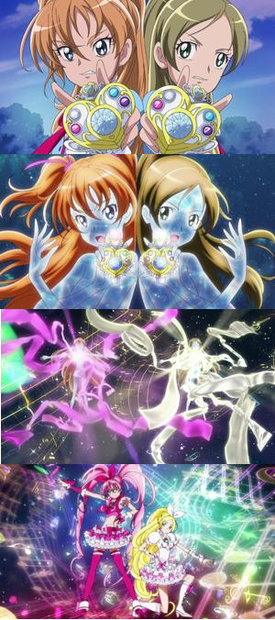
Before the Ordinary High-School Student (or a hidden Bad Guy) can access their secret powers, there must be a power-up. This usually involves a change of form or at least costume, although the precise mechanisms usually vary by type. In Japanese television, this is called (a) henshin. By genre, this usually goes as follows:
- Magical Girl: Our heroine usually utters a key phrase, accompanied by certain gestures and/or using some sort of magical device, and then hovers into the air over a magical background, then has her clothes disappear as her hero costume glows into existence over her until all her ribbons, jewels, feathers and assorted frippery have formed. Despite being strongly associated with Magical Girls there are several "magical boys" who have comparable sequences, though their outfits are usually more like uniforms or armour and the strip-down is generally averted.
- Henshin Hero: Similar to the Magical Girl but usually less elaborate and more awesome than Fanservice, our hero uses his special device (often a weapon) and/or shouts his transformation phrase to turn into his superhero form in a faster but equally flashy sequence, that for some reason often involves lightning, glowing or shining, and the hero announcing himself. This includes many American characters and series, like Captain Marvel (widely considered the first Henshin Hero) or He-Man and the Masters of the Universe (1983).
- Super Mode: An already-powerful hero or villain becomes even more powerful to face the latest threat. While generally not as elaborate as the previous two transformation sequences, it often signifies a more intense upgrade. The raised power level is usually indicated by a colour change, glowing eyes (or hair) or appearance altered in other ways than a wholly new costume and accessories.
- Monstrous Transformation: A darker and more physical sequence, usually when a humanoid character becomes more monstrous before our eyes — often involving bulging muscles, ripping clothes, (to various extents) and often implications of pain, especially in a horror-themed series. Werewolves, Jekyll & Hyde, and other magical or chemical induced transformations usually fall under this. It's often a way for the villain to get serious during the Grand Finale... and become something viewers won't mind seeing the heroes kill.
- Eldritch Transformation: A humanoid or mundane character becomes not only monstrous, but Eldritchy in nature.
- Mechanical Sequence: A Humongous Mecha or Power Armour wearing hero gets into battle mode, whether through transforming, combining, adding the gear, and/or just plain launching into battle. Usually contains as much Technology Porn as time and budget will allow, and is very often tool-assisted in some way as the base's machines use mechanical arms and such to remove and add components.
- Size Increase: An already formidable monster or hero doesn't make many physical changes but simply increases their size massively, often to Kaiju levels.
- Other Sequences: Ones that aren't covered by or overlap with the above include Mon "evolution" sequences (which are sometimes permanent), characters combining into one, or more mundanely, a superhero donning their outfit via conventional (if accelerated) means.
Transformation Sequences are good for a show's budget because they provide a large amount of Stock Footage that can be (and often must be) reused each episode. They also provide nice filler for the writers if a script happens to be running short. If a particular transformation sequence occurs multiple times in one episode, a shortened version will often be used after the first time (hopefully).
Rarely is there a special-effects sequence for changing back.
It seems to be an unwritten rule that evil characters almost never get a Stock Footage transformation sequence, instead opting for a special-effects-assisted "insta-transformation", a single sequence in the case of one-shot villains, or just transforming offscreen. This is a good way to spot the Sixth Ranger Traitor or a Noble Demon looking to make a Heel–Face Turn somewhere down the line.
Note that many transformation sequences are actually just for the viewer's benefit (and to eat up air time), and the actual change as experienced by the character in-universe is instantaneous — or at least very brief. This might explain why bad guys (almost) never attack a hero during their transformation sequence, although the No-Nonsense Nemesis usually will not let the opportunity slip by. This may result in an unstable Partial Transformation.
Compare Hulking Out, Gorgeous Garment Generation, Creation Sequence, Fighter-Launching Sequence, Lock-and-Load Montage, and Activation Sequence. Generally overlaps with Suit Up of Destiny the first time the character transforms.
Example Subpages:
Other Examples:
- In the Metro Manners series of PS As, which make loving use of Magical Girl and Henshin Hero tropes, every episode features one of these. When Super Kind notices bad behavior on the Metro, she yells her name and transforms into her superhero outfit. The transformation takes place on a blue background with red hearts, and Super Kind rotates slowly as clothing items appear. At the end, she strikes a dramatic pose.
- The characters in GG Bond tend to have extravagant transformation sequences whenever they morph into their stronger animalistic forms.
- The heroes' vehicles in Happy Heroes get a transformation sequence whenever they transform into the Car Knights. The sequences are only a few seconds long, and it's very common for multiple Car Knights' transformation sequences to be played at once to save time.
- In Jet and the Pet Rangers, the Pet Rangers have a flashy transformation sequence whenever they need to transform into their Pet Ranger personas, showing Jet being given his suit relatively slowly while the animals transform much faster.
- In Kung Fu Wa, Tee Yang transforms when she puts Kung-Fu Sock on her foot starting episode 2, in episode 3 they start to call the activation, making a flashy transformation sequence, but it doesn't happen in all the episodes. It's also shown to be instant in real time whenever the transformation is obscured by anything in front of the ones transforming or the situation calls for the instant transformation to be necessary.
- Each of the Mask Masters can transform for battle into their master forms and later into their Synostone forms.
- The Miniforce use this to go from cute animal to Power Ranger-esque heroes when there is trouble to be fought.
- In Pleasant Goat and Big Big Wolf: Mighty Little Defenders episode 1, Wolffy gets a transformation sequence parodying Sailor Moon when he uses General Wolf's chip. The sequence ends with him completely transformed into a dog.
- The Ur-Example has got to be Billy Batson shouting "Shazam!" and transforming into Captain Marvel with a magic bolt of lightning. Notably, in The Golden Age of Comic Books, it was part of the magic of the transformation that nobody standing nearby noticed this happening unless he wanted them to (with the witnesses left believing that the "kid" had left and this new person arrived in their place while they were momentarily blinded). Well, Depending on the Writer, anyway. The other members of the Marvel family would transform the same way. During a story in the '90s, Billy was in Keystone City and attempted to transform, shouting "Shazam!" The Flash, racing by, saw lightning about to strike a small boy, and so heroically pulled him out of the way.
- Marvel Comics' Captain Marvel gained a version of this when he would swap locations with Rick Jones in a flash of light after banging his two wristbands together; ditto for his son Genis, who also ended up swapping places with Rick.
- The Clown from Spawn becoming the terrifying devil Violator. The detailed transformation in the movie is particularly disturbing.
- Iron Man occasionally has one, depending on the title and era (for instance, it's very rare to see him activate the suit in an Avengers comic). The most typical one involves assembling the armor from a briefcase. This was abused a bit during the late 90s and early 2000s when every new writer on the Iron Man title introduced their new, super-advanced armor technology, like the SKIN armor, Tin Man and Ablative armor.
- In the first issue of Blue Beetle (New 52), Jaime's first transformation into Blue Beetle is shown in nine detailed panels. His later transformations usually take one panel.
- Robin: In Bludhaven during a brawl one grey skinned woman is surrounded by what looks like glowing floating blood droplets before transforming into some kind of red-furred animal mash-up that includes a beaver tail and large fangs. She then joins the fight herself.
- Wonder Woman can sometimes change clothes by spinning, and in Wonder Woman 600 the spinning has an added swirl of sparkly pink.
- In A New Problem Thaz transforms into a slightly younger woman with superpowers, meant to be a soft parody of Sailor Moon and other animes.
- In WanderingWordsmith's Thawing Permafrost, Pandora the Shikigami explodes into a weird white goo, then reforms into the commanded form if it can manage it; otherwise, it just flips back to its normal form and collapses, exhausted.
- Kuso Miso Technique's Michishita Masaki has one in this
 fanvideo into his powerful, naked form.
- In Mega Man Reawakened, Robert and Roll get one when they activate their battle modes.
- The Geometry Dash animation Prelude gives both of its main characters a transformation sequence where they gain legs to run faster. While the green square grows human legs, Norcda Childa gets legs that resemble a stick figure's.
- Averted in Pretty Cure Perfume Preppy; the space normally used for describing the transformation are filled with random comments by the Lemony Narrator, usually about "sparkly stuff". In episode 12, there is a little quote by the narrator during that part which reasons that.)
First, it's repetitive and boring if you read the series everyday; second, it's a matter of letting you guys imagine how they would be like; and third, I don't have the time to do it.
- In Hop to It, Jack's transformation to Rabbit in the first chapter is described in about as much detail as one would expect for a Miraculous Ladybug transformation:
Jack: Mimmi! Hop to it!
Her Kwami stretched and got sucked into her old-fashion wristwatch, turning the leather strap white and changing the clock face so it measured five minutes instead of twelve hours, the single hand stuck in an upright position. The transformation continued from there, crawling down one arm, across her chest, and to the other. A large flat throwing ring, a chakaram, appeared in her hand, which she moved across her face in a circular motion, her white domino mask appearing. Tossing her weapon into the air, she yanked two rabbit ears into existence out of the back of her head and magically smoothed her caramel-colored hair into a perfect side fishbone braid. Jack then caught her chakaram and swung it down as she kneeled, the transformation reaching her toes. Now she was entirely dressed in a white skintight suit weaved out of hexagons. She had opera gloves with the tiniest of claws, more for aesthetic purposes than to actually scratch anyone, and heavy knee-high combat boots that packed a wallop whenever she kicked someone. As if to demonstrate, she stood back up and preformed a few low air kicks and a side kick. She ended by swinging one leg in a perfect circle, her shin level with her eyes at one point, before slamming it down just as her little fluffy tail appeared. To be honest, Jack could do without the tail, but it came with the bulletproof costume. - This Animorphs fancomic went the extra mile and added animated morphing scenes.
- In the Pokémon fanfic FlamingRed and SplashingBlue, Pokémon are able to evolve by neatly shifting their own bodies into those of their evolved form. If a Pokémon has appendages, they push, pull, rub, etc. their body parts in order to form them as though they are on a potter's wheel. If they don't have appendages or are too short, they divert all the light to a certain part of their body, concentrate hard, and then push, pull, stretch, or bend their body parts.
- The “pottery wheel” transformation continues in the fanfic Pokémon Carnegie. One of the evolutions involves a Staravia’s wing being shifted into a Staraptor’s in four steps: lift, push out from the tip, pull down into a smooth curve, and finally, puff the wing out. The entire sequence is in fact directly derived from this sequence from the Pokémon anime, which uses the same wing formation steps in a single, smooth motion, albeit not via the “pottery wheel” method.
- The best part? The “pottery wheel” method is completely painless and is done in a hypnotic trance.
- The “pottery wheel” transformation continues in the fanfic Pokémon Carnegie. One of the evolutions involves a Staravia’s wing being shifted into a Staraptor’s in four steps: lift, push out from the tip, pull down into a smooth curve, and finally, puff the wing out. The entire sequence is in fact directly derived from this sequence from the Pokémon anime
- No Chance for Fate: It's revealed to the Senshi that even though their transformation takes mere five seconds, they are not only vulnerable but due to technical reasons butt-naked as well until their uniform forms on them. The transformations described, while less visually impressive as the long sequences from canon, are still interesting on their own.
- Dungeon Keeper Ami: From A Deal with the Devil:
"Mercury Power, Make Up!" A flash of blue light concealed Ami for a split second when she triggered her transformation to restore her ruined outfit. It also re-applied her make-up, removing all traces of crying, and cleaned her body, as it was intended to. To the senshi, everything felt normal. Her sailor crystal, embedded within the dungeon heart, felt rather confused though. Not with providing its magical power, everything was working as normal there. No, it wasn't quite certain what to apply the cosmetic operations to. There were just so many connections, going every which way. Which one to choose? The non-sentient crystal had no way to take a decision, so it just chose all of them. A cylinder of light, centred on the heart, started expanding through the dungeon, leaving only gleaming cleanness in blue and white tones and the occasional Mercury symbol in its wake
- Tales of the Canterlot Deportation Agency: Jack: Shuffle: When the transition from Jack to the chemicals is described:
From the outside, it can look just about instantaneous. They'd both seen that, for Victor had recorded the process on video — once.
...
From the outside, chemicals contact skin and pink loses all hue, goes to white. The effect rushes along that outer layer of fully ineffective biological armor, even as the colors of the fabric start to shift. Entire limbs bleach, just about all at once. Hair goes through a different kind of color change, which includes one to the texture. Posture warps: the chemicals have a different way of standing, something which makes it a little taller than Jack and leaves his back sore for a few hours after the loan is repaid. (It's sorry about that, but the situation is something it can't help.) And then the side effects kick in, including the one which is the existence of that other.
From the outside, it's a few heartbeats. But on the inside, everything is still shifting. Balances aren't quite any more, and the new levels haven't found themselves. Neurons are trying to fire two sets of messages at once.
In transition (and only then), there are two. Transition creates a period of time where Jack and the chemicals communicate directly, each taking their part of the stage within the theater of the mind. In transition, there are arguments and agreements, plans made and dashed, information passed along. There have been times when they've risked leaving videos for each other on a phone, but such messages only go one way, and no permanent record can ever be kept. Transition allows them to talk.
Transition lasts eighty-four seconds. - In Chapter 2 of I Got You, Little Buddy, Tongus does a transformation scene to become Nurse Tongus.
- Reenacting a legend: In this Fate Series/High School D×D crossover, this is parodied when Shirou Emiya reveals he can instantly change his outfit into his combat uniform. Serafall Leviathan asks him to teach her how to do that, which he can't since it comes with being a Servant. She says on her Magical Girl show, her transformation is achieved via special effects done in post-production. She's been looking for a spell to transform her outfit for years, but every wizard she met thought that was a waste of time.
- The Echo Ranger: Chapter 3 describes Izuku's Morphin' sequence from All Might's point of view.
- Disney's Atlantis: The Lost Empire has a scene where Kidagakash (Kida for short), merges with the Crystal, effectively becoming a physical incarnation of the Atlantean deity.
- Beauty and the Beast has its famous transformation scene (the piece of score that plays under it is even simply titled "Transformation"); the inverse of a monstrous transformation.
- In The Book of Life, Manolo gets one when he returns back to life.
- Brother Bear has the scene near the beginning of the film where Kenai is actually magically turned into a bear as punishment for disregarding his late older brother's wishes.
- The Barbie film franchise manages to shoehorn one of these into almost every movie, usually featuring lots of sparkles. Notable examples include:
- Barbie in the Nutcracker gives a brief one to both Clara and the Nutcracker when the former is revealed to be the Sugarplum Princess and her magic restores the latter to his true form.
- Barbie as Rapunzel combines an extended transformation sequence with a Costume-Test Montage. As part of her preparations to leave Gothel and her tower behind for good, Rapunzel uses her magical paintbrush to create a series of different dresses, finally settling on the one she wears for the rest of the film.
- In Barbie of Swan Lake, Odette gets one each time she changes into a swan or vice versa, as well as one when the Fairy Queen gives her a dress to wear to Daniel's ball.
- The Princess and the Pauper is notable for averting this. The closest it comes is Erika walking into Anneliese's closet, closing the doors behind her, and immediately emerging in another outfit. The Princess and the Popstar, a more modern re-adaptation of the same source material, would later play it straight by having the girls use magic to swap appearances.
- Fairytopia and its sequels all feature at least one of these, usually changing the design of the main character's wings to symbolize their character growth.
- In Barbie and the Three Musketeers, there's no magic involved, though the effect is the same. It consists of the four girls hastily removing the long overskirts of their ballgowns and pulling out their weapons amid a shower of glitter from Viveca's perfume.
- Barbie: Princess Charm School has its transformation sequence double as a Really Royalty Reveal, as the crown that triggers it only does so when placed on the head of the true heir to the throne.
- In Barbie and the Pink Shoes, Krystin's appearance changes to match that of the heroine in each ballet she stumbles into, culminating in her returning to her true appearance during her final confrontation with the Snow Queen. She also gets a brief one when she's transformed into a swan while traveling through Swan Lake.
- While many versions of Cinderella either imply this trope or directly invoke it whenever she gets her gown for the ball, Disney's version is especially notable for this, although it only takes a few seconds.
- Hal Jordan also got one of these in Green Lantern: First Flight.
- Played for Laughs in Justice League vs. Teen Titans. When they're attacked at the fair, Starfire gets a full Magical Girl transformation where her costume appears, Blue Beetle powers up his armor, Beast Boy drops onto his knees to turn into a tiger... and Damian just runs to the car, breaks in the window and grabs his costume from the backseat.
- The Little Mermaid:
- Ariel's transformation when turning from mermaid to human. She's mostly naked afterward.
- There's another transformation sequence in the same movie, though without the nudity. All the in-between stages of Ursula's transformation into Vanessa are extremely creepy, and her Evil Laugh doesn't help.
- Ariel's transformation when turning from mermaid to human.
- In Luca, the Fish People turn human when dry and return to their normal forms when wet. Most of the time this happens instantly, but the second time that Luca turns human (and the first time that he does it willingly), the camera pans over him and lets us see the process in more detail, albeit still only lasting a few seconds.
- My Little Pony: Equestria Girls:
- My Little Pony: Equestria Girls:
- Sunset Shimmer has one of the monstrous kind when she goes One-Winged Angel after stealing the crown.
- In the climax of the movie, we get a classic sort of transformation for the Equestria Girls, adding Little Bit Beastly pony traits to the girls.
- My Little Pony: Equestria Girls – Rainbow Rocks:
- In the sequel, the transformations are activated by the band members' instruments. They are different than those of the first movie, adding "Rainbow Power" hair to the mix.
- Notably, when a reformed Sunset Shimmer gets her own transformation, it's instead in the same style than in the previous movie.
- The villain trio of the Dazzlings gets their own, more sinister-looking transformations, when they reach the apex of their powers. The ribbons of red lights that envelop them might be a Sailor Moon shout-out.
- My Little Pony: Equestria Girls – Friendship Games:
- In the third film, the transformations are activated accidentally by the girls performing their Elements. They are drained of it almost immediately after they transform by Human Twilight's amulet however.
- Human Twilight of all people gets the monstrous kind going One-Winged Angel when transforming into Midnight Sparkle as a callback to Sunset's transformation in the first film.
- Sunset gets a Golden Super Mode when she activates the Elements of Harmony to match Midnight Sparkle.
- My Little Pony: Equestria Girls – Legend of Everfree:
- First, one for Gloriosa Daisy turning into Gaea Everfree, with vines creeping up her legs before a flash of light and Kirby Dots flowing over her body.
- Then, a continuous sequence for all seven of the heroines gaining brand-new Magical Girl costumes when they bond with a crystal geode.
- My Little Pony: Equestria Girls:
- Pinocchio has the infamous Pleasure Island sequence where Lampwick the wayward bad boy slowly turns into a donkey as did all of the other bad boys lured onto the island to be sold into labor. Only Pinocchio is fortunate enough to escape, but not without sprouting ears and a tail first. In other adaptations, Pinocchio also transforms (since he did in the original book).
- The sequence at the end of the first Shrek is a double subversion as 1) she is already a monster and 2) she doesn't actually transform. It's also a Shout-Out to the scene in Beauty and the Beast.
- Snow White and the Seven Dwarfs brings us the awesome transformation of the Wicked Queen into a hag. Subverted in that the transformation was not to increase her power (in fact, it seemed to make her weaker), but as a disguise.
- Space Jam has the tiny Nerdlucks morph into the gigantic Monstars thanks to the powers they stole from five NBA players.
- The Transformers: The Movie has Megatron turned into Galvatron, Thundercracker into Scourge, Shrapnel, and Kickback into the Sweeps, and Bombshell into Cyclonus, complete with one of these for them.
- Wreck-It Ralph: Vanellope Von Schweetz transforms into a princess after crossing the finish line of her game Sugar Rush at the film's climax. It confused her until she found out she was Sugar Rush's true ruler before King Candy/Turbo sabotaged the game and made her an outcast.
- One of the earliest was, again, Captain Marvel in the serial The Adventures of Captain Marvel. They didn't have the budget to have a lightning bolt strike Billy or Captain Marvel, but they managed a decent effect using smoke bombs and dramatic sound effects instead.
- An American Werewolf in London and The Howling (1981) both have werewolf transformation sequences of the most painful and terrifying kind you can imagine. The former in particular is often held up as the gold standard among Werewolf Works.
- Bloodthirsty: Grey turns into a wolf finally near the end in an extended sequence that shows her body warping painfully. Vaughn later partially changes too before Grey shoots him.
- Fright Night (1985) had something like this with Evil Ed turning back into a human from being a wolf, and the vampires have 3 stages of transformation.
- Ghostbusters (1984) has the scene where Dana and Louis turn into Terror dogs; it's quite a disturbing process, though.
- Steven Chow's God of Cookery takes this to absurdity with Magical Chef Transformation Scenes. A character (not the lead) takes a power pose, his clothes fly off in all directions and underneath he is already dressed as a chef, all that is required is that he put the trademark hat on.
- Gremlins has a very important rule: "Don't feed them after midnight." If you do, the Mogwai goes into a slimy cocoon and mutates into a hideous monster. Unfortunately in the movie somebody makes that mistake as well as getting them wet (causing them to multiply, which looks incredibly painful).
- There are several gruesome gremlin-related transformations in Gremlins 2: The New Batch, including those involving a bat, spider, fruit, electricity, and even a woman!
- The Jekyll and Hyde transformations from The League of Extraordinary Gentlemen.
- The Marvel Cinematic Universe plays around this:
- Tony Stark puts on his suit different ways:
- The Mark II and III armors were placed on him by JARVIS-controlled droid arms, stored either in a safe platform inside his garage or in his helipad. The Mark IV and VI armor are also put on this way.
- The Mark V travel armor, with a button pushed for its handles to appear. Tony then places it across his chest/arc reactor and it assembles neatly around him.
- The Mark VII is probably the most egregious: Tony would wear tracers on his wrists, with the armor (in a large capsule shape) summoned via voice-activation to latch onto the tracers and form around his body. It is practically useful on-the-go... or falling downwards after pissing off a megalomaniac Big Bad.
- The Mark 42 is relatively low-key. Tony tries to design it for an effective sequence, but it often goes wrong due to being a prototype. On the other hand, the armor can assemble on anyone he points to, such as Pepper or the Big Bad.
- Since The Avengers (2012), Tony modified the Mark VII and built his armors from then on so that they can open up for him to simply step in after which they close up around him, making the transformation even more low-key. They can also form around him in midair like the original Mark VII but at a much faster rate. Even Rhodey's Iron Patriot armor has this feature.
- The Mark 50 or Bleeding Edge armor introduced in Avengers: Infinity War consists entirely of nano-bots, and is stored in a new arc reactor installed on Tony's chest. All Tony has to do is tap a button and the armor forms around him.
- Bruce Banner, being who he is, can (a) be triggered into becoming the Hulk under stressful conditions or (b) lets it out freely. Whatever is happening could be determined whether he is struggling or he seamlessly transforms.
- Thor, while spending almost an eternity wearing his Asgardian dress armor, loses it after being sent to Earth. After sacrificing himself to the Destroyer, Mjolnir flies to him and strikes him with lightning, forming his traditional armor. His helmet, apparently, is a separate piece and not always worn. Later movies show that Mjolnir also allows Thor to change between different forms of his armor, whether it be by summoning a storm or just magically changing his clothes.
- Used again in Thor: Ragnarok, Thor and Loki both use a transformation sequence when facing against Hela for the first time. Thor's involves a massive lightning strike, while Loki's is a much more subdued affair. Hela has her own involves rubbing her hands upwards and backwards on her head to summon her iconic headpiece.
- Avengers: Infinity War has a subtle one when Bruce Banner smashes into the New York Sanctum — one second, Doctor Strange is wearing street clothes, the next, he's in his typical sorcerer outfit, complete with cape of levitation. Spidey's quick transformation into the Iron Spider also qualifies.
- Tony Stark puts on his suit different ways:
- The A Nightmare on Elm Street series has quite a few of these. For instance, in A Nightmare on Elm Street 4: The Dream Master, fitness girl Debbie is turned into a cockroach and then trapped in a roach motel by Freddy. The same movie has Final Girl Alice invoke this by giving herself an Adrenaline Makeover to rock music in a way that resembles Magical Girl anime.
- The Nutty Professor:
- The '90s remake had some surprisingly gruesome ones with plenty of Body Horror.
- And the original has Jerry Lewis going through some grotesque transformations quite out of the tone with the rest of the movie.
- Several of the Star Wars movies will have starfighter pilots immediately precede a space battle with an order to "Lock S-Foils into Attack Position.", a process that usually involves the wings unfolding or splitting apart. Given George Lucas' love of old war movies and airplanes, it was likely a nod to the Dive Brakes that dive bombers would extend before going into a dive, as seen in this footage.
- Pretty much every adaptation of The Strange Case of Dr. Jekyll and Mr. Hyde, though the transformations are often fairly restrained in the less campy versions.
- The 1931 film is not very campy, and its transformation sequence was at the time a major breakthrough in special effects.
- In the musical Jekyll & Hyde, Jekyll changes into Hyde by turning his head to the left, hunching a bit, sometimes changing clothes, and having the lighting change. If the actor is good enough, it works, especially at the end when he's doing a duet with himself and changing back constantly.
- In Mary Reilly, John Malkovich undergoes one of the most gruesome and spectacular Jekyll/Hyde transformations ever committed to screen, with Hyde appearing inside Jekyll's body and growing outwards. Then, afterward, he looks exactly the same.
- Underworld (2003) and Underworld: Evolution, with static vampires (except for the main vamp boss with the somewhat typical beastly demon-form) but human-werewolf transformations, and their werewolves have digitigrade legs. Not much outright transformation was shown in the first movie, the most notable sequence being one shot where two lycans change back, as well as one sequence where a character had an aborted change. The second film had some decent shots of man-to-wolf changes, but they went quick because they were mooks.
- There are a number of these in Van Helsing, most notably the werewolves who transform by ripping their skin off.
- Videodrome is just plain weird in general but the transformation parts are even weirder.
- Eustace' transformation from dragon to boy in The Voyage of the Dawn Treader film.
- The Witches of Eastwick has the final scene in which the three witches mix up the body parts of a voodoo doll that resembles the main antagonist Daryl (Jack Nicholson) who at first turns into a giant, but then turns into a worm-like thing.
- Animorphs: The books made it quite clear that morphing almost never happened the same way twice, and was usually highly disgusting unless the morpher had an unusual talent for it (as did Cassie). It's also very Depending on the Writer how long and descriptive the transformations are — Book #20 went into so much detail that it took almost a whole chapter for Marco to morph a cobra.
- A transformation sequence is shown on each cover of the main series, though technically they are inaccurate — in the books morphing doesn't happen evenly like that (one body part can change at a time, for example), and normal clothes don't morph with you.
- A transformation sequence is shown on each cover
- The Chronicles of Narnia: The Silver Chair has the villain turn into a snake to fight the heroes. Quite a bit of detail goes into the description, though the narrator notes that it happened faster than it would take to read it.
- When the Reaper reveals himself in the Cradle Series, his hair grows out and changes color, he summons his armor and shadowy cloak from seemingly nowhere, and the entire world goes still and silent.
- In the Discworld series, both vampires and werewolves can transform, vampires into either a swarm of bats or one really big bat. Not much detail is given to werewolf transformations, but there is at one point a fight between two of them where they're both in a constant state of flux between forms. Angua, the werewolf on the watch and Captain Carrot's girlfriend, is stated to be perfectly comfortable with him seeing her naked in either form, but doesn't want him to see her mid-change. According to Gaspode in Men at Arms: "Angua in both shapes was OK to look at, but the second or two in between, as the morphic signal hunted between stations, was not a sight you wished to see on a full stomach".
- Universal Monsters: In book 6, after Ardeth Bey's neck is broken, he transforms back into his original form as a mummified Imhotep. He remains just as dangerous in this form as before though.
- In Winni Allfours, the protagonist is a girl who wants a pony. When that's denied to her, she chooses to turn herself into a pony. Two whole pages of the small book are dedicated to showing her change from little girl to tubby little pony.
Very slowly things began to happen...
- Somewhat spoofed in Dorothy of Oz. When Mara activates the boots, her clothes are actually ripped apart and reformed into her witch's outfit, meaning that everyone sees her naked. And yes, the reason why nobody interrupts the sequence is that they're ogling her.
- Michael Jackson:
- The first segment of Michael Jackson's "Thriller" has Michael transforming into a werepanther.
- There's also Michael turning into an Optimus Prime-esque Transformer at the end of Moonwalker.
- "Weird Al" Yankovic undergoes a transformation sequence at the start of his video "Fat" that fortunately does not strip him nude in the process.
- Similarly enough, the music video for "Right Here, Right Now" has a transformation sequence based on the theory of evolution.
- Alestorm shoehorned one into their video for Shit Boat (No Fans). This being Alestorm, it's as random and hilarious as you'd expect.
- Pathfinder: The Magical Child archetype (class modification) for the Vigilante class naturally has this by the exact name (and other Vigilantes can pick it up as a social talent); the supernatural Transformation Sequence ability cuts down the time to switch between the social (public) and vigilante (disguised) identities at the cost of making it a magical spectacle of sound and lights. It is not a free action, although a high-level Vigilante can reduce it to almost if not quite that quick.
- Third-party Pathfinder add-ons include the Henshin Hero class and the Magical Girl / Magical Boy class (possibly named for the pages on this very wiki), which are basically the same thing as each other. The former is physical-based, while the latter is magic-based, but they both have similar Transformation and Finishing Moves abilities. The Henshin Hero's transformation isn't detailed, but the Magical Girl's is described as "an explosion of light and quite possibly ribbons".
- Third-party Pathfinder add-ons include the Henshin Hero class and the Magical Girl / Magical Boy class (possibly named for the pages on this very wiki), which are basically the same thing as each other. The former
- Bee and Puppycat has a downplayed version. Bee's transformation is less exaggerated than most, and Bee groans in complaint the entire time.
- DSBT InsaniT: Starting with episode 6, this happens when a character changes form.
- Flipnote Warrior: Subverted. Mome tries to transform, but it just changes her shirt because, as Ugo explains, it's bothersome to animate. She's still good in a fight.
- In Agents of the Realm, we get to see Norah's first transformation, which is rather short and conscise. From then on, however, both she and other girls change off-screen.
- Alex in the webcomic Angel Moxie has a sequence, though it only occurs a couple of times the second time it crops up has a lampshade hanging.
Riley: You know, by the time you transform, the world could have already been destroyed.
Alex: It's my moment. Let me have it. - Alienby Comics: Parodied in "Transformation" where the trigger for the sequence is Riri's hair dye kicking in with the blow dry.
- In Apricot Cookie(s)!, every Magical Girl has a sequence where they get into their magical girl costume, including a Transformation Name Announcement. Apricot, who isn't a real magical girl, is able to initate the sequence and rises into the air spinning, but she gets stuck half way, so the sequence just removes her clothes without giving her a costume or powers.
- Avania: Agent Valenvarius performs a magical transformation to disguise himself as the species of his foe. However, he does have to manually undress first.
- Much to her horror, Tohsaka gets one in Fate/hollow ataraxia thanks to the Kaleidostick.
- Beeserker: Trigona and Queenie use bee-based and smoke-based transformations, respectively, to get dressed in the morning, as well as swap outfits on the go if needed.
- Inspired by Trigona, Yellow comes up with one of his own. He only uses it once, however, as it involves his being horrifyingly killed.
Beeserker: "IF IT'S ANY CONSOLATION, BEING DEREZZED IN A SWARM OF BEES IS ONE OF THE LEAST PAINFUL WAYS TO GO."
- Beeserker undergoes one to become Queen Beeserker VII.
- Inspired by Trigona, Yellow comes up with one of his own.
- Fillbert: Maple's hair is transformed in a 4-panel sequence.
- Parodied in The Fourth Wall here when the Creator decides to trick Greg out before he begins the search for Ric.
- Parodied in Head Trip.
- In Holiday Wars, April Fools' Day is a shapeshifter and in between forms he turns into a giant glob resembling an ink blot, as seen in this strip.
- League of Super Redundant Heroes: Lampooned in this strip where the more experienced villain clearly find this sort of thing odd, but doesn't question it anymore.
- Leif & Thorn: For the magical girls (and boys, women, men, etc). Teenage girl Ivy gets a lavish one; so does an adult male character earlier in the same storyline.
- Averted in M9 Girls!. The M9 Girls must change themselves into their super-heroine clothes, not without some shinny effects added by the artist.
- Magical 12th Graders: Usually naked, always lampshaded. This includes the boys, with the author noting that the lower half is obscured because he doesn't want to draw it. It's not obscured for Yeorum.
- Mahou Shounen Fight! features one here for protagonist Mike Smith; note that he isn't stripped completely naked as he keeps his Mantis Man underwear on.
- Parodied and lampshaded in Princess Chroma. June gets impatient by the third time she transforms. And she slaps the attacking monster when it tries to interrupt her in mid-transformation.
- Parodied in Queen of Wands, with Kestrel "explaining" how Batman and Robin changed costumes while sliding down the Batpole.
- Parodied in the Questionable Content strip "Sailor Sagittarius A*", in which we see Bubbles de-armouring Sailor Sentai style, and then this turns out to be an Imagine Spot by Faye as she levers it off with a crowbar.
- Parodied (along with the idea with the idea that all lesbian characters must be stereotypically 'butch' and own loads of cats) in this Red String guest comic by Megan Gedris.
- Sleepless Domain: Every Magical Girl gets one. However, notably they each get only one; the author didn't want to bog down the story by repeating transformations. Outside of the single (and awesome) one, the girls transform offscreen. Seen here for Team Alchemical.
- Parodied in Supernormal Step where a male character is doing a Magical Girl transformation sequence.
- Sweet Dreams: Shown here for The Starry Trio.
- In Union of Heroes there is an animated transformation sequence of Munin changing from his human to his raven form and flying away.
- In The Witch's Throne, a girl must go through one to become a Witch.
- xkcd: When he hears a cry for help, Sagan-Man whirls around and dons a cape.
- In Arcana Magi Zero, when Alysia Perez calls for Saga and Megumi Miyazaki calls for Fable, their magic circles would go through their bodies forming their magical outfits and armor.
- Buster Girls usually fully describes the transformation sequence of any meaningful form the main characters take the first time they do it.
- Yuki Shimizu in The Impossible Man has a Transformation Sequence off scene. The plausible reason was to hide her identity from everyone, even her co-workers. Unfortunately her co-workers already figured out her secret identity and she know its too, but she still goes off scene in their presence when there are no villains around to transform.
- Link and Mage, fitting for its magical girl-inspiration, has those for both the Link Strikers and the Mages.
- In Magical Girl Policy, each of the spirit guard experience this, though it is so far only shown when Rob transforms for the first time.
- The Metaverse has two examples.
- Tom Fury attempts to replicate Ultraman's transformation into his signature gear...but he hasn't quite gotten the hang of it yet.
- Kid Sideburns becomes the superhero Captain Mental to defeat Coyle Commander byputting on a mask and having his clothes magically change,
- Analyst Bronies React: AnY does the Wonder Woman spin to... change his clothes.
- Linkara's has a few Power Rangers-styled ones in Atop the Fourth Wall.
- Prior to the climax of Return of the Cartoon Man, Roy undergoes a transformation back into a Cartoon Man so that he can stop Simon's diabolical scheme.
- And then there's Spoony turning into Dr. Insano in Kickassia.
- Manatee Girl: The Movie features one that is roughly a minute long (of a 4 minute 30 second film) and has manatees in space floating in the background. The length is Lampshaded when the mid transformation sequence the main villain checks his watch.
