
Main Tropes Index

Troperville

Editing

Tools

Toys

Narrative

Genre

Media

Topical Tropes

Other Categories

Custom Search

alt title(s): Cosmic Horror; Ultra Horrific Monster
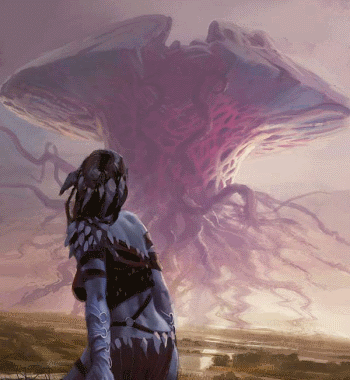
See those tiny figures in the circle? Those are people.

How to describe these unclean mockeries of natural law? There are no words that can encompass such foulness, not in English or any other human tongue. They are other, alien beyond comprehension, their very existence an affront to all rationality. I could speak of ichor-dripping tentacles and yonic voids, painfully dissonant cries and colours of no earthly hue, but those are mere superficialities. Monstrous though these stigmata are, they do not define the abominations; they are merely among the more common symptoms of their underlying wrongness.

What all Eldritch Abominations have in common is their defiance of natural law, as humans understand it. They are the things that should not be, the ultimate aliens. It is this that makes them abominable, and it this that reduces to gibbering insanity all but the strongest of those who encounter them.

However, people can get used to anything in time, if they don't die first. If Eldritch Abominations were on every street corner, people's conceptions of natural law would stretch to accommodate them. A lone mile-high soul-devouring monstrosity would be cause for worldwide pandemonium. If there were ten thousand such, descending from the cold stars on umbral wings every new moon to ravage the Earth, then that would just be a fact of life. People might not like the oversized locusts, but they would not be driven to madness at the sight of them.

For this reason, only creatures which people rarely meet, and survive to tell the tale, can qualify as Eldritch Abominations. The creatures may actually outnumber humanity — trillions may dwell in the Stygian abysses far below the ocean waves, trillions of trillions may drift between the stars — but they prefer wild and lonely places, where people seldom tread. What qualifies can also depend on who is looking. Some things are so strange that even lesser Eldritch Abominations find them abominable.

Physically, Eldritch Abominations range from almost human, through big ugly monsters, to the unimaginably bizarre. Generally, the weirder they look the more powerful they are, but this isn't a universal rule. Y'golonac (you fool! you doomed us all!) looks approximately human, but just reading its name condemns you to Mind Rape. If you see it in the flesh, it's too late to run. And while we're at it, never, ever, EVER say Hastur three times.

The most eldritch of the abominations come from Outside. Whether they are from beyond the stars, or from before the dawn of time, they are alien to this universe, and its laws. Other than that, they have nothing in common. The mildest Eldritch Abominations are typically the descendants of greater abominations, or the work of mad wizards (not mad scientists, who have trouble mastering the eldritch). These include some of the rarer varieties of undead, so long as they are rare, and the product of ill-advised breeding programmes.

The best known abominations are the big ugly monsters that fit in between these two extremes. Here, the "ugly" in "big, ugly monster" doesn't just mean that it's horrible to look at — it means that there's something about it, about the way it looks, or the spaces it moves through, that violates every law of reality as you know it. "Big" doesn't just mean that it could use the Empire State Building as a toothpick — it means that the... thing doing just that is only the barest fraction of the monster's true form, the tiny piece of it that actually exists in a set of dimensions that our limited senses can perceive.

This trope has some overlap with Starfish Aliens. However, Starfish Aliens aren't necessarily horrific or unnatural; they're alien only because they evolved in a different environment than humanity, and can be helpful or neutral, whereas Eldritch Abominations have a deep wrongness to them, no matter where you find them. For example, while Starfish Aliens usually care enough to take on a A Form You Are Comfortable With to avoid breaking your mind, an Eldritch Abomination won't even acknowledge/realize you have one to break. They can still be helpful or neutral, though most of them are way beyond the whole alignment system and are merely uncaring, treating Earth as at best a colourful plaything, and at worst...

Eldritch Abominations are native to the genre Cosmic Horror Story, but they are not confined to it. Mild examples can be found throughout the horror and fantasy genres. Greater abominations can occur in almost any type of fiction, so long as enough Cosmic Horror Story tropes are used. Usually they derive, at least in inspiration, from Lovecraft's work; folkloric origins are rare.

Occasionally they lust after our women (and men), resulting in Naughty Tentacles.

For instances where the abomination's reputation is a bit more solid than the actual monster itself, see Did You Just Punch Out Cthulhu.


Examples

Literature
  • The Great Old Ones (most famously Cthulhu) in the writings of HP Lovecraft (and the Mythos they spawned).
    • Lovecraft's Eldritch Abominations are usually divided into three groups (the distinction is mostly created by later writers, but it is present in Lovecraft's own work to some degree):
      • The Great Old Ones, which are immensely powerful beings made not wholly of flesh and blood but of something that can only be called matter in the most basic sense. They traveled from world to world when stars were right, but now sleep, waiting until the stars are right once more so they may rule again (incidentally, when they wake up, they plunge the world into madness and terror).
      • The Outer Gods (Lovecraft referred to them as the Other Gods), which exist outside our universe, and seem to be embodiments of various cosmic principles. They are far more powerful than even the Great Old Ones, and seem to be responsible for the creation of our universe (as well as other ones), albeit unwittingly. The most famous ones are the mindless Azatoth, who resides in the center of all infinity, and Yog-Sothoth, who exists simultaneously in every point in space and time. Their soul and messenger is the Crawling Chaos Nyarlathotep.
      • The Elder Gods. Lovecraft only used one of these deities (the rest are created by other authors, namely August Derleth, as is the term "Elder Gods"), namely Nodens, Lord of the Abyss. Nodens appeared in a humanoid form (whether this is his true form or one he took in order to not drive mortals insane is unknown) and was an enemy of Nyarlathotep (and thus somewhat beneficial to humans, who Nyarlathotep wants to wipe out). Derleth made Nodens the head of a pantheon called the Elder Gods, who were mortal enemies of the Great Old Ones (although some stories seem to place them at the same power level as the Outer Gods). In Derleth's works the Elder Gods were good and the Great Old Ones evil, which doesn't really fit with Lovecraft's cosmology. Most other writers who have used them make them somewhat benevolent to humans, but only because they want to keep the Great Old Ones asleep, which is also what most humans want to do (what with them destroying the world when they wake up and all).
      • Lovecraft did use Hypnos, but its nature (or existence) is unclear thank to Unreliable Narrator.
      • Not to mention it's highly unlikely that this story was set in his usual mythos, as it completely lacked any references that are so prominent in the Mythos-stories.
    • Towards the end, Herbert West had a vat of reanimated reptilian flesh, which he used to animate body parts, producing minor Eldritch Abominations.
    • Lovecraft pretty much codified the language used to describe these things: show me a horror described as "eldritch", "gibbering", or "squamous" and I'll show you an author who's been influenced by Lovecraft.
  • Proto-example: Robert W. Chambers' book The King in Yellow, which was an influence on Lovecraft himself, and he made references to it that are now better known than the original source. Filled with Mind Screw and Take Our Word For It.
    • Another proto-example: William Hope Hodgson's "The Night Land", as well as "The House On The Borderland", have quite a few of these, and his descriptions of the places and times where such things would exist helped shape the Cosmic Horror Story.
    • Arthur Machen, who along with Chambers and Hodgson, was a major influence on Lovecraft, is best-known today for The Great God Pan, where a group of intellectuals manage to create a Half Human Hybrid by impregnating a woman with the seed of the eponymous greek god. Unfortunately for them, the cosmos is quite different from what they believe, and "Pan" is also the greek word for "all"... Making this an obvious influence over Lovecraft's The Dunwich Horror.
  • Arthur C Clarke gives us the Mad Mind, an artificially created disembodied intelligence with near-godlike powers, whose creation goes very wrong. So terrifying is it that humans create another one (and do a better job this time) in order to (hopefully) stop it. Humanity is trapped between Scylla and Charybdis on a grand scale: the conflict between the two might destroy the entirety of creation, but implicit in the decision to create the second being is that what the Mad Mind will do if it makes its way back to inhabited space, or remains unchecked for a sufficient length of time, is worse.
  • Alan Dean Foster's Humanx Commonwealth series has its own Ultimate Evil: a galaxy-sized region of total nothingness, where all light and matter are absorbed. Moreover, this nothingness possesses sentience, and is capable of movement. Naturally, our galaxy is in its path and only The Chosen One has any chance of stopping it.
    • The same series also gives us the Vom, which while more on the world-devouring scale than the galaxy, fits several of the requisite criteria: inscrutability (it's a huge black... mass), exponential power growth, alien thought process (it lives only to devour all life on the worlds it comes across), strange origin (possibly extragalactic), immunity to conventional weapons, and Mind Control / Mind Rape abilities.
  • Peter F. Hamilton's Nights Dawn Trilogy incorporates a positive slew of eldritch abominations: an incident involving a satanic ritual and a passing energy being creates a cross-dimensional link that allows the souls of the dead to come back and possess the living, before secreting entire planets away to their own pocket dimensions. Even worse, the trans-dimensional powers of the possessed, as well as the fact that they have absolutely no idea what they're doing, open the door to a range of other, semi-scientific eldritch horrors, by far the worst being a dimension of almost infinite entropy, which, if linked to our dimension, would suck it dry like a vampire. Things get so hopeless that it pretty much takes a literal Deus Ex Machina to sort the whole mess out.
  • In Stephen King's IT, the eponymous monster is perceived as a Giant Spider by the protagonists, because this was the closest analogue that their rational minds could find for Its appearance. Attempting to fight It can result in one's mind being flung beyond the edge of the universe, then being driven mad by the Deadlights (which It is merely an appendage of). After the protagonists succeed in killing It, they magically forget about the entire incident; apparently, this was the only way they could have lived a normal life afterwards.
    • Stephen King is, as we all know, particularly fond of creepy-ass creatures. He and Peter Straub got together to write The Talisman, a horror fantasy novel which is chock full of horrific creatures and mutants, the most disturbing amongst them is probably a mewling tentacle creature that bleeds ichor filled with biting white worms.
    • The Mist describes what happens when ordinary folk are confronted with what may be an encroaching alternate reality that enshrouds their small town in an unnatural fog filled with predatory Eldritch Abominations. (Although the story's narrator explicitly notes the creatures aren't really perfect examples of this trope: they are not terribly bright, and when shot, they bleed.)
    • The short story "I Am The Doorway" is about a former astronaut who becomes the conduit for an Eldritch Abomination, manifesting in the form of golden eyes on his hands. In an unusual spin on the trope, though, said Abomination isn't malevolent — it's terrified and disgusted by our world, which is as alien to it as it is alien to us, lashing out violently at the horrors it's forced to witness.
    • In From a Buick 8, the titular car... isn't a car.
    • And of course "He Who Walks Behind The Rows" from Children of the Corn.
    • Room 1408 at the Dolphin Hotel is an arguable example, as it's specifically stated in-story that there are NO GHOSTS involved.
    • As well as another short story, N, told through the journals of a psychiatrist analysing a patient who believes that by keeping objects "in order" obsessive-compulsive style, he is keeping cosmic horrors at bay. The psychiatrist eventually, following the patient's suicide, takes over his "duty" of keeping things in order, and ends up killing himself as well, due to the stress involved in keeping the cosmic horror CTHUN and the rest of its reality out of ours. It's implied that even if more people continue the duty, the barrier keeping CTHUN at bay will stop working anyway.
    • In The Dark Tower Book Three, Illustrated Edition, a print shown during their trip aboard Blaine shows the part of Roland's world that has yet to even begin to recover from the wars that made it what it is. The bird-things may not reach cosmic-level, but what they indicate about the greater cosmos could snap those old neurons pretty damn fast.
  • Nasu Kinoko's early work, Notes, has "The Ultimate Ones", aliens who come to destroy the future humanity and reclaim the planet after Gaia dies.
    • Also, Fate/Zero has a Caster hero who's basically a guy with the Necronomicon summoning different Eldritch Abominations.
    • ORT, the Ultimate Being of planet Mercury, is mentioned in Tsukihime. Its raw power is considered far greater than that of any Dead Apostle.
    • ORT's a funny thing. Infamous in the fandom for being the Strongest Being by Word Of God, ORT is only here because it responded to the dying message of Gaia before Gaia died and decided to wait it out here. ORT changes the laws of the universe around it, which isn't all that impressive on its own since mages can learn spells with the same effect, except when mages do it the effect only lasts for a few seconds because reality fights back. In ORT's case, reality is losing. It also technically holds a position as a Dead Apostle vampire, but only because it instantly obliterated the previous holder who wanted to study it (and supposedly has "vampire-like qualities"). Yeah... that's probably a lifetime membership right there.
  • Oddly enough, the "angels" from CS Lewis' The Space Trilogy show some of these traits. They exist on a profoundly different level than us, have strange geometries and dealing with them can be terribly unsettling. One of the characters even notes that the fact that they're benevolent makes it worse; no matter how terrible the evil you're facing, there's always the hope that good will swoop in to save you... but what do you do when facing good turns your brain-inside out?
    • The Oyeresu themselves, on occasion. In explaining what they mean by "manifesting to humans", they use the analogy of the ways a stone can manifest in human perception. The glorious statue is one possible perception, but so is the sensation you have after it's fallen on your head.
    • It's also worth noting that the Oyeresu, who are just as good as the Unman is evil, have to try a few times before they figure out acceptable, vaguely humanoid, manifestations; their first try is a bad acid trip — eyes, talons, hurtling shapes in a void full of vertigo. This is, presumably, near the hit-in-the-head end of the manifestation spectrum.
    • The Un-man in ''Perelandra'' is a zombie-like human whose evil is so pure and different from that of any other human that it made the protagonist pass out when he first saw the expression on its face. It is controlled by a being who is invisible to us and whose true form is literally indescribable to humans, not fitting into any of our mental categories. It is strong enough to destroy worlds and yet subtle enough to pass through matter and manipulate human minds.
  • In Terry Pratchett's Discworld novels (especially the early ones), a constant danger of the use of magic is that of accidentally opening a rift into the "Dungeon Dimensions", regions with "very little reality", inhabited by nightmarish Lovecraftian monstrosities that crave the reality that those in more solid universes take for granted. They tend to try and invade the Discworld's universe in the vain hope of becoming more real themselves, "with the same effect as the ocean trying to warm itself around a candle".
    • It should be added that the creatures from the Dungeon Dimensions don't actually have form; the reason that they look like an incomprehensible mass of tentacled horrors is because when they do acquire some substance by coming close to the real world, they're terrible at it. This does not make them any less terrifying.
  • The Atrocity Archives by Charles Stross and its sequels take place in a world where divisions that MI6 and the CIA don't even know they have, battle Eldritch Abominations (and their own bureaucracy) attracted to reality after Alan Turing discovered a theory that allowed the user to warp reality with computers and the Nazis attempted to summon the Great Old Ones using the souls of those slaughtered in the Holocaust to win World War II.
  • Surprisingly, JRR Tolkien had read some of Lovecraft's stories, and took a few stabs at this.
    • Lord Of The Rings
      Gandalf: Far, far below the deepest delving of the Dwarves, the world is gnawed by nameless things. Even Sauron knows them not. They are older than he. Now I have walked there, but I will bring no report to darken the light of day.
    • Ungoliant from The Silmarillion.
      Then the Unlight of Ungoliant rose up even to the roots of the Trees, and Melkor sprang upon the mound... and their sap poured forth as it were their blood, and was spilled upon the ground. But Ungoliant sucked it up, and going then from Tree to Tree she set her black beak to their wounds, till they were drained; and the poison of Death that was in her went into their tissues and withered them, root, branch, and leaf; and they died. And still she thirsted, and going to the Wells of Varda she drank them dry; but Ungoliant belched forth black vapours as she drank, and swelled to a shape so vast and hideous that Melkor was afraid.
    • She later attempts to eat Melkor.
      • She would have succeeded, too, if the Balrogs hadn't pulled a Big Damn Heroes... Yes, really.
      • Please note, we are talking about Melkor, Boss of Sauron, Strongest of the Valar (Powers of the world/god-like beings), and only subservient to Eru (the creator/High-god) himself. Ungoliant was one big bad mama.
      • This would have been a real problem if Melkor hadn't already spent a considerable amount of the strength native to him in making and animating evil things. When he was finally defeated, he was so weak (relatively) that he was thrown on his face by one of the Maiar. A similar thing could be said to have happened here, especially after Ungoliant had consumed so much of the power present in the light of the Two Trees and in the jewels made by Feanor that she and Melkor had just stolen.
      • This troper isn't entirely sure these references are Lovecraftian... Tolkien based most of the Lord of the Rings from Norse Mythology, and a good chunk of that is devoted to describing the demonic creatures that gnaw at the roots of Yggdrassil, the World Tree. On the other hand, this troper hasn't read Norse mythology in years and hasn't read Lovecraft at all... or Lord of the Rings, for that matter.
      • ...Not all Eldritch Abominations HAVE to be Lovecraftian, you know. And Nidhogg and Jormungandr (of Norse myth) are rather close to the trope all on their own.
  • The Minotaur in House Of Leaves, if it exists.
    • The house itself. While looking at it isn't immediately maddening, all attempts to understand it or classify it fail, and it moves, reshapes, and exists in manners that should not be possible.
  • The Blight, from Vernor Vinge's A Fire Upon The Deep.
  • The Dresden Files has the Outsiders, beings that exist beyond 'The Outer Gates', or basically the limits of known reality. They can only be summoned by mortal magic, and are considered so dangerous that not only is summoning them forbidden under the Laws of Magic, but a member of the Senior Council (The Gatekeeper) has the full time duty of monitoring any possible incursions.
    • Also, Outsiders eat magic and destroy reality just by being present. It takes wizards hundreds of years to learn even how to hold their own against them in battle.
    • And there's the skinwalker from Turn Coat, which reduces Harry to a gibbering mess when he sees it with his Sight. It's pretty much a demigod, and is a walking source of very, very nasty dark power.
  • Inverted in the Blind God of The Acts Of Caine. It is as impersonal, awful, powerful, and horrifying as anything from the Lovecraft mythos. The inversion is that it's not alien, but an intensely human entity born of our drive to survive and consume. Played straight with the Outer Powers worshipped by the Black Knives in Caine Black Knife.
  • Skulduggery Pleasant has the Faceless Ones, so named because they cannot be looked upon in their true forms without driving the observer mad, and can only manifest by possessing humans, melting all features from their faces in the process. They are the former rulers of this reality, before their slaves, the Ancients (the first mages) managed to find a weapon capable of driving them into another reality. They are described as having been so evil and sadistic that even their own shadows were afraid of them. A creature cobbled together from several monster parts including the torso of a Faceless One's host took a small army of mages to kill. When they finally appear, Valkyrie gets only a passing glance at one, and is temporarily driven into a catatonic state by its impossible geometry and biology. Skulduggery explains that if they successfully return, they will wipe out half of humanity, and then work the other half to death, before destroying the Earth.
  • Part of the Doctor Who Expanded Whoniverse declared Lovecraft's creatures canonical, and had their names originally bestowed by Rassilon. As if Cthulhu, Hastur, and the Fendahl weren't enough, a number of characters (most notably the creators of the Land of Fiction, and Compassion, an EU companion who became a TARDIS) have been upgraded to this kind of thing.
  • There's an arguable case in the Star Wars Expanded Universe, Waru. "Hethrir's scientists breached the walls between dimensions and brought into existence a massive slab of meat covered with shining golden scales. Though this entity, Waru, lacked discernible sensory organs, it was highly intelligent and could communicate in a deep resonating voice." The scales were variable in size and a syrupy ichor oozed from between them. The ichor could be breathed by humans, and it was larger on the inside. It was promised a way home by the man who summoned it, and it worked with him and healed the sick, was worshipped, and ate people to replenish its healing energy. It was always lonely and ended up eating the guy who summoned it before collapsing in on itself.
    • The book it was in, The Crystal Star is commonly known as one of the worst Star Wars novels in existence. "A golden trans-dimensional being with anti-Force capabilities" could have been so much more crucial to that meandering plot. Fans and even published authors say Waru was "an excellent concept that was badly realized."
  • In Barbara Hambly's The Ladies of Mandrigyn... Altiokis's power source, full stop. It gets him in the end.
  • The passageway between the worlds in Coraline. At first seeming to be a relatively normal, if strangely unsettling hallway, by the end it's a furry... thing that's very much alive, and incomprehensibly vast and ancient. It makes The Other Mother look trivial, and she's a particularly nasty example of The Fair Folk.
  • The never-seen—and only very obliquely described—Todal in James Thurber's The 13 Clocks.
  • In The Bible the appearnences given of angels would likly count as such. The cherubs for instance are described as 4 faced 4 winged eye covered flaming sword wielding beings that can move without turning their bodies.

Anime and Manga
  • In the Fullmetal Alchemist manga, both Pride and Envy are this, when they show their ugly sides, anyways.
    • Much more Pride: the other homunculi call him a monster
      • Since the Homunculi all come from Father, this would make him one as well.
      • Father originally looked like Pride...well, except for the 'human boy' part. He was just a black blob with eyes in a flask labeled "Homunculus." Then he got a copy of Hohenheim's body. He fits the rest of the bill for being an abomination.
      • The Gate of Truth, which is basically a giant floating necromicon with a giant eye inside, that spews black tentacles that gives eldritch lore in return for sacrificing your limbs or other's souls.
  • Digimon Tamers, where the final enemy was the D-Reaper, a data-disposal program that got plugged into cosmic power. To fulfill its objective, a null-state for everything, it mutated into more and more alien forms, all inspired by the Cthulhu Mythos (mixed correspondingly with designs of the Angels from Evangelion). Unique in that it got worse when it became aware of humans as entities; it tapped into the agony and pain of one little girl, amplifying and becoming The Heartless and quite, quite insane by anyone's standard. Also noteworthy in that it is both man-made and technological in origin, which as noted before is extremely rare.
  • Both the Orechalcos stones in the Doma arc of Yu-Gi-Oh and the Light of Ruin that the Society of Light in Yu-Gi-Oh GX's second season is built around are Eldritch Abominations that were born from spatial phenomena, and having no purpose but to doom the universe under their whims. Even Judai's Neospacians reminded him that the Light of Ruin was a literal danger to all the cosmos.
  • And then there are the Earthbound Gods (or Jibakushin) from Yu-Gi-Oh 5Ds, the evil entities sealed into the Nazca Lines, and a serious threat to the protagonists (frequently yielding Oh Crap reactions from those about to get creamed).
    • Although a couple look a bit silly (eg googly-eyed lizard Ccarayhua - though those eyes would probably give small children nightmares - that and the fact it can eat you if you push its owner too far).
    • Raphaello from Bt X is a homebrew version of this: Amorphous, constantly growing, Nigh Invulnerable and assimilating everything in its path.
  • The various Vampire Princess Miyu continuities use Eldritch Abominations as the Monster Of The Week... and the leading Dark Magical Girl.
  • The Kishin from Soul Eater. Perhaps one of the only examples where a human can become an Eldritch Abomination with a little effort.
  • In Berserk, the Godhand, many, many Apostles and some Qlipoth creatures count as Eldritch Abominations, being thoroughly unnatural creatures who are all extremely powerful. However, the more powerful Apostles (Zodd, Grunbeld, Locus, and later Irvine) are not Eldritch Abominations, interestingly. Also the thing that Ganishka has transformed into in recent chapters.
  • The Angels from Neon Genesis Evangelion are each and every one (well, except for the last) hideous, unnatural monsters of enormous size. Some bear just enough resemblance to natural life to be incredibly creepy, while others are utterly abstract and can barely even be described.
    • It appears to be fairly common for certain fan-fic writers to just make them Lovecraftian entities.
    • Don't forget the 18th Angel(s): Humanity itself and Lillith's children. Ironically, they're still villains; guess who attacks as the Monster Of The Movie?
  • Urotsukidoji, in the Naughty Tentacles sense.
    • Also the titular demon beast from Demon Beast Invasion by the same creator, though its nature and origin is constantly being RetConned (as well as a lot of other important plot points).
  • A common Epileptic Tree is that Guu is one of these. She's rather cute and seemingly benign (if mischievous), but the shadowy, formless thing which may or may not be her true form bears a rather Lovecraftian air.
  • The Big Bads of the first three seasons of Sailor Moon- Queen Metallia, Death Phantom and Pharoah 90.
    • The Big Bad from the last arc in the manga would count, wouldn't it? It's Chaos itself. It's also implied that the previous entities are extensions of it.
  • Bleach's Aaroniero Arruruerie's relased form anyone?
  • The Nightwalker in Princess Mononoke may be enormous and scary to humans, but it isn't an Eldritch Abomination. Until its head is removed, that is.
  • The titular character in Suzumiya Haruhi could be considered one of these, at least at the very beginning of the series. Just sit back and contemplate the idea of a bored, self-centered Jerkass of a teenager who both considers humanity dull and has the power to literally destroy and recreate the Universe at will and in any shape she desires- but who has no idea that she even has such power. And then imagine what would happen if she became aware of her power...
    • That concept may even rival H.P. Lovecraft.
    • The Data Entity would also fit, being incomprehensible to humans, not possessing language and having no relation to space or time. Luckily, it is True Neutral and mostly does not bother with this plane of existance.
  • The Hiruken Emperor from Xamd Lost Memories certainly qualifies. Not only does it have an unsettling and unnatural appearance, blots out the sun when it awakens, and causes a rain that turns every living thing it touches to stone, we later find out that it's the product of artificially bringing a stillborn baby back from the dead using the Hiruko.
  • Tetsuo from Akira ends up becoming something similar to this at the end of the film/manga. Hell, Akira himself could probably count.
  • The berserk form of the Book of Darkness's defense system in Magical Girl Lyrical Nanoha.
  • Rave Master's Endless is a clock roach created by the world's memories, whose purpose is to destroy the world which had been altered by Time Travel.

Comic Books
  • The Justice League Of America sometimes faces these.
    • Starro, the very first foe they dealt with, has slowly moved in this direction over the years, being a literal Starfish Alien that latches onto you and takes away your free will.
    • The Silver Age homage ''Justice League: New Frontier' had "The Centre", an ancient and unstoppable monstrosity. It also happens to be a giant island.
  • Grant Morrison especially enjoys these.
    • Mageddon, the Big Bad of his JLA run, is a cosmic doomsday weapon that survived the death of the universe of the god-like beings who built it. Its purpose is to initiate universal suicide by psychically prompting all living beings to war with each other to the death. Even when disabled (by the combined forces of the angelic hosts of Heaven, every single human being on Earth endowed with super powers, and a secret weapon that was basically its Kryptonite), it was still in danger of detonating and vaporizing half the galaxy.
    • Hexus, the Living Corporation, from Marvel Boy, a sort of Cosmically Corrupt Executive.
    • The Archons of The Outer Church in The Invisibles are typical Eldritch Abominations — slimy, chitinous and decidedly non-human. In an interesting inversion of Lovecraft's themes, the Archons aren't entities of entropic chaos, but absolute order. When the universe reorients itself in their presence, it's not because it's breaking down, but because it's coming more in line with the Archons' specifications.
    • Zenith in 2000AD features a number of five-dimensional beings, who owe more than just their names to HP Lovecraft.
  • Hellboy is pretty much built on this. Especially the Ogdru Jahad, neither male nor female, sleeping until they bring the downfall of man. They have an army of frog men that have long, clinging tongues capable of sapping the prodigious strength of Hellboy, let alone a human, can take on the appearance of a normal human being, possess Genetic Memory, and have the knowledge of great spells of power not heard on the Earth for millions of years. Also, every single frog man is a human infected by the Ogdru Jahad.
  • In the Marvel Universe, there are various 'Elder Gods' that count as Eldritch Abominations. The most notable of these is Chthon.
    • Don't forget Shuma-Gorath, who is oddly adowable.
    • The serpent-god Set is another Elder God that plays a major role in the Marvel Universe, thanks in large part to its past continuity links with the Hyborian Age.
    • Arguably Galactus qualifies as well: Older than the universe itself. Eats planets for a purpose unfathomable by men. (When he is put on trial he summons the sentient will of the universe who basically tells them to Take Our Word For It) and is incomprehensible by mortals. (It is canon that his hat-wearing humanoid form is simply an image our puny minds superimposes over a reality we cannot truly comprehend, for instance, Beta-Ray Bill sees him as a big starfish)
    • Although he's a mechanical example, I'd say Ultimate Gah Lak Tus definitely qualifies. Aside from driving everyone who sees it insane and spreading a flesh eating virus across the planets it consumes, much of the devastation it causes stems from its own gravitational pull... So Yeah.
  • The DCU 52 miniseries introduced the Four Horsemen of Apokolips: ancient, primal entities that hail from Apokolips and predate the New Gods. They are limited only by their inability to physically manifest in the universe without assistance. In their debut, using flawed bodies that could only channel a fraction of their true power, they devastated Khandaq, murdered Black Adam's new family, and nearly killed Black Adam himself. Thankfully, they are now Sealed Evil In A Can... inside Veronica Cale.
    • Furthermore, 52 featured the evolution of the villain Mr. Mind, who became a cosmically huge insect abomination. He's responsible for the differences between the 52 realities of the DC multiverse, having literally eaten key moments in time from all but one of them.
    • The 5th Dimensional Imps, of which Superman villain Mr. Mxyzptlk is the most famous, have become an example of this. They can more or less wear the laws of physics like a funny paper hat, and while they tend to appear as cartoonish characters, those aren't their true forms. Luckily, most of them aren't interested enough in meddling with our universe, and those that do are permitted only to cause mischief. Of course, sometimes hiccups occur, like the time Mxyzptlk made the well-intentioned mistake of giving his reality-reshaping powers to the Joker.
      • One of Alan Moore's early works is Whatever Happened to the Man of Tomorrow?. It's set in an alternate possible future where Superman is getting ready to retire - up until something moving at super-speed kills everyone he loves! It turns out: it's Myxy himself, who, as a superdimensional imp older than time, is now bored with being mischevious and wants to "try being evil for a while; maybe after 2000 years or so of that, I'll get to be guilty". When he drops the Goth version of his usual little-guy-in-hat image, he appears as a jagged-edged humanoid tear in space with malevolent eyes and maw, and Lois points out for the benefit of us readers that it hurts her eyes just to try and look at it, like all the angles are wrong. Now THAT begins to approach the idea of a being from the Fifth Dimension.
    • In one issue, Superman teleports to the Edge of the Universe. Way out there, space becomes white, and after that, there is a MASSIVE, INFINITE WALL of Eldrich Abomination/Body Horror marking the final boundary between our universe and the next one over.
    • JLA: Another Nail has the Limbo Cell, a primordial creature that eats existence.
  • One Donald Duck issue revealed that a giant octopus called Ar-Finn sleeps beneath the depths in a sunken city. Our reality (or at least Donald's) exists only because Ar-Finn dreams about it. But if he wakes up, the world will start to adapt to his image, with the architecture becoming more and more alien and the people more octopoid in appearance. Also interesting to note is that Ar-Finn's subconscious mind manifests as humans in our world; a good guy who wants the dream to continue and a evil guy who wants the dream to end. It was awfully cynical for a Disney story, especially the ending, where Donald is horrified to find out that our whole existence is just a dream. Probably as close to Lovecraftian standards as Disney will come for the foreseeable future.
  • Watchmen: Ozymandias has one custom made. Dr. Manhattan also has some elements of this: Although he still looks somewhat human and does not drive people insane immediately from having gazed upon him, he is as alien to the people around him as they are to him, in addition to his godlike power.
  • Hack/Slash has the Neflords, giant masses of tentacles (that double as wing wongs that can make things explode) which possibly lived in the void that existed before God created the universe. Being unable to create life themselves the Neflords need virgins taken from Earth to impregnate to create minions. Also, their main servant was Elvis.
  • The excellent DC New Frontier mini-series (and the Justice League New Frontier movie based on it) had "The Centre", basically a living island of tentacles, eldritch-looking dinosaurs (as it previously had been masquerading as Dinosaur Island), and a world-wide psychic influence that causes cults to rise and a a Pseudo-Doctor Seuss to kill himself. Also, when the USAF attacks the insides of the thing, each pilot sees something different.

Films
  • Cast A Deadly Spell climaxes with a cultist trying to awaken a Lovecraftian beastie. Luckily the needed Virgin Power turns out to have already been, um, depowered. Yes, yes, Incredibly Lame Pun and all that...
  • Speculation about J. J. Abrams' movie Cloverfield included the possibility that it involved an Eldritch Abomination wreaking havoc on New York City. What it actually was was never really answered. An alien? A mutant? A misplaced prehistoric animal? Cthulhu after all? Your theory holds as much weight as this troper's.
  • "Mr. Shadow" from the The Fifth Element. Never really explained other than being pure death-bringing evil from deep space.
  • The Monster from the Id in Forbidden Planet, a manifestation of Dr. Morphius' subconscious. While analyzing a footprint cast, the science officer comments that whatever made the print goes counter to all known evolutionary theory, and would be a nightmare in any world.
  • Gozer (and Zuul) from Ghostbusters.
    • Also, in a way, Mr. Stay Puft; although he looks like the friendly advertising mascot on the outside, from the horrible squeals and growls he makes there's clearly something very, very unspeakably nasty inside him just waiting to get out...
  • Hellboy had one of the Ogdru Jahad Hem cameo, as a tentacled monstrosity that burst out of Rasputin's body and grew from man-sized to warehouse sized in minutes.
  • The true form of the Tall Man from the Phantasm movies is implicated as being some kind of Cosmic Horror that is anchored in another dimension.
  • Although none directly appear in the Japanese version of The Ring, it's hinted that Sadako's mother had contact with such beings due to her psychic powers... and that one may have been Sadako's father, rather than the man who was believed to be.

Gamebooks
  • One of the creepier recurring enemies in the Lone Wolf series is the Crypt Spawn. These are essentially swarms of human brains with batwings that, ironically enough, mindlessly attack anything in their path. To make matters worse, they always appear in the presence of even greater evils, such as a timeless and bodiless...thing in the Graveyard of the Ancients, two of the Darklords themselves, and the King of the Darkness Naar himself.

Live Action TV
  • In Buffy The Vampire Slayer, the tentacled monstrosity underneath the Hellmouth. The Old Ones that used to inhabit the Buffyverse aren't seen, with the exception of Olivikan and a picture of Illyria.
  • In Doctor Who, everyone who saw the Fendahl died of fright, and that was only a crippled ghost of its true self, 12 million years dead. In the Expanded Universe, the Time Lords deliberately created the Fendahl-eater, a malign void which could reach across time and space to feed on the stuff of thought and hungered to devour all eternity, from the Big Bang to the end of time.
    • The Beast from "The Impossible Planet"/"The Satan Pit" certainly qualifies as well.
    • The Silurians are arguably something of a subversion; they have the effect of driving people who see them mad, but that's more due to a long-dormant race-memory of when humans were just beginning to evolve and the Silurians ruled the planet than any inherent 'wrongness' that the Silurians possess, and they're otherwise just another sentient race.
  • Several in Power Rangers, such as Onimi from Power Rangers SPD and The Master from Power Rangers Mystic Force. They tend to be more defeatable than most, of course.
  • Admittedly, this may be special pleading, but upon reflection, I believe the original Star Trek had one, in the form of the Doomsday Machine, of the episode of the same name. Think about it: a bizarre ship appears from outside the known Galaxy that is irregularly shaped, looking something like a giant cone irregularly carved out of granite, with an abominable eye at its center looking suspiciously like a gateway to hell. It's virtually indestructible is capable of destroying and consuming whole worlds. Consider also Commodore Decker's response to it: after it destroys his ship and kills his crew, this man, previously an atheist, describes it as the devil and coming straight out of hell, and suffers a complete Heroic BSOD. Later, recovering only slightly, his only response is to mindlessly try to attack and destroy it no matter the cost. Failing utterly at this, he surrenders himself to its power, and steals a shuttle specially to fly into it and kill himself. brr, man.
    • A stronger case can be made for Redjack from "Wolf In The Fold", a formless creature that feeds off pain and suffering. When it possesses the ships computer, the viewscreens show a bizaare multicolered, constantly shifting chaos that Kirk speculates is where it comes from.
  • Babylon 5 featured a race of ancient aliens that were a kind of Eldritch Abomination in the TV-movie 'Thirdspace', inhabiting a different type of space (neither normal, nor hyperspace) and waiting for a very, very long time until someone finds the Artifact Of Doom and activates it, allowing them to be released. Oh, and they have tentacles and extremely strong telepathy, and they cause insanity.

Music
  • "The Width of a Circle" features David Bowie "encountering" an Eldritch Abomination. Consensually, no less. (The Seventies were a weird time.)
  • "The Thing That Should Not Be" by Metallica is about such a creature, and, quite obviously, is directly inspired by Lovecraft.
    • Also "The Call Of Ktulu".
    • In Guitar Hero: Metallica's "Metallifacts" video for "The Thing That Should Not Be," it also lists "All Nightmare Long" and "Ride The Lightning" as being inspired by H.P. Lovecraft's stories, specifically, "Shadow Over Innsmouth."

Tabletop Games
  • Dungeons And Dragons has whole races of Eldritch Abominations; from 3rd edition onwards, they have been increasingly linked with the Far Realm, an impossibly vast, incomprehensible place far beyond the cosmology of most D&D settings. A 3.5 sourcebook, Lords of Madness, gave greater detail to the "aberration" creature type, which is mainly used for such creatures.
    • The subterranean illithids (also known as mind flayers) are inhumanly dispassionate, squid-headed alien creatures with vast psychic powers who raise human cattle to feed on their brains. They prefer "wild" game, though, as unlike muscles, brains apparently taste better when they've been getting proper exercise. They, at least, are more humanly understandable than most Eldritch Abominations, though their physical form is definitely inspired by Cthulhu.
    • Several kinds of demons in the game invite comparisons to Lovecraftian beasties as well, especially the various Obyrith subspecies: they've existed since before the dawn of time, often have incomprehensible biologies, and just glancing at one is enough to induce new phobias or temporary insanity. One of the oldest horrifies reality itself and can kill if you get a glance at its true form.
    • The Epic Level handbook for 3rd edition brought us the Abominations; malformed offspring of deities which desired to destroy all reality. Among the most horrific of them are the Atropal, which are the undead remains of stillborn godlings, as well as the Dream Larvae, who transform into something so scary that it can kill you with fear instantly the first time you look at it.
      • Also in the Epic Level handbook are the pseudonatural creatures. Horrifying, tentacled, soul draining creatures from the far realms the lesser of which can take on greater demons such as balors. Did I mention they're immune to spells? If you come across a paragon (paragon creatures are the perfect forms of such creatures) pseudonatural creature suicide is your best bet.
    • Perhaps closest to the Lovecraftian mold are the aboleths, giant psychic fishlike aberrations that dwell in the deepest, darkest parts of the world in unspeakable aquatic cities and have racial memories stretching back to before the births of many gods. They can enslave people by sliming them; the slime turns skin transparent. Ironically, these monsters are terrified of the illithids, who they, despite their long memories, have no recollection of.
      • That's because illithids are from the future, refugees from the destruction of their vast empire.
    • Another subterranean race culled from Lovecraft are the kuo-toa, amphibian humanoids consciously modeled on the Deep Ones.
    • Don't forget the Daelkyr. Extradimensional invaders who mess with the fabric of reality for shits and giggles. They also like to mess with mortal biology like a kid plays with Play-Doh.
    • Recently, Wizards has released a book called "Elder Evils", which features a guide of how to create your own Cosmic Horror, as well as several examples of Big Bad Eldritch Abominations, including Ragnorra, the Mook Maker Space Whale with an Evilutionary Biologist streak; Pandorym, the living Forgotten Superweapon with a personality you don't want anywhere near a Forgotten Superweapon; Atropus the undead planetoid; Kyuss, The Worm That Walks (that's his actual title); and of course, the Hulks of Zoretha.
      • Since most of said world-threatening Elder Evils described in the book are acually beatable (in some cases killable) by non-epic (i.e. non-godlike) characters, quite a few cases of Did You Just Punch Out Cthulhu can result. On the flipside, many of these cases are either fighting the monster before they've fully awoken/recovered from crash impacts, facing down a cult that was about to flood reality with beings like the one that just almost killed the party, or taking down an alien weapon designed to soften us up for invasion.
    • 3.5 Edition also included the Alienist class. The class features made all your Summoning spells summon creatures from the aforementioned Far Realm, which took the forms of creatures you could normally summon, but took on a template that gave them more hit points, resistances, tentacles or other deformities, and the ability to shift into their "true(r) form" which scared everything like crazy. Further, your familiar became one of these creatures. Basically, you're calling tiny C'thuloid monsters. In addition to that, the caster who takes the class eventually starts becoming like one of these creatures, goes more then a little insane, and (with the timeless body feat) and is taken to the Far Realms by the unspeakable Eldritch Horrors when they would normally die of old age, specifically never seen again by people on the prime material plane. If you manage to reach the maximum level, you can cheat dying of age altogether, gain the "Outsider" trait and become an Eldritch Abomination. Your character grows a tentacle or two at this point.
    • 4th Edition introduces an Origin classification for Eldritch Abominations called "aberrants". Naturally, any aberrant creature is almost guaranteed to have numerous tentacles or mind and reality-warping abilities — usually both.
      • 4E also has the Primordials — a primeval race of elementals who created the universe, and are powerful enough to destroy gods. They would like nothing more then to destroy said creation, since as their nature as elementals dictate, they wish to continue an endless cycle of death and rebirth. Most mortals are perfectly fine with the world as it is now, especically since said death and rebirth would include them.
      • Also 4E gives Warlocks the Star Pact power source, which basically involves beseeching strange otherworldly creatures that lurk behind specific stars for power. A lot of fluff text suggests that they become a little unhinged. Furthermore, a Dragon Magazine supplement includes an Epic Destiny where you become one of these strange otherworldly entities. It also describes the aforementioned stars, and notes their "unnatural" qualities, particularly one that you're better off not looking at for long.
    • While it mostly deals with Gothic horror, the Ravenloft campaign setting features an eldritch abomination in the form of Gwydion the Shadow-Fiend, Darklord of the Shadow Rift. He became trapped between realities when a planar gate collapsed on him, and really, really wants out. His full appearance is unknown, but what has been seen causes even The Fair Folk to go mad.
      • The Dark Powers, the force(s) that created Ravenloft itself, could also apply, since both their methods and motives are entirely unfathomable. As well, the Nightmare Court could qualify.
      • Regular old fiends (demons, etc.) were described pretty much in cosmic horror or eldritch abomination terms in Van Richten's Guide to Fiends for this setting. It didn't seem inappropriate. Horrifying creatures of great power and alien minds from other realities...
    • This troper considered adding Beholders to this pages. The fact that there was any consideration involved pretty much speaks for the rest of this page.
    • Aboleths are too arrogant to worship anything, but they respect beings they call the Five Elder Evils. These are thematically based on HP Lovecraft horrors, and include flames surrounding a body that will drive you mad if you see it, a ball of sentient goo the size of a planet, and a drilling subterranean squid that appears to be eating its way very, very slowly through the crust of the planet.
    • Cthulhu himself has an entry in the 1st edition Deities & Demigods supplement - and the way 1st edition rules worked, a high enough leveled player character could, in fact, punch him to death.
    • Also the Gibbering Mouther (and its 4E relatives, the Gibbering Abomination and the Gibbering Orb). The name alone is obviously inspired by Lovecraft.
  • Naturally, Chaosium's The Call Of Cthulhu game.
  • In the world of Earth Dawn, the cyclical ebb and flow of magic periodically allows Horrors to slip from their own dimension into the world and devour anything that moves. If you're lucky, they will devour your body before they start on the good stuff.
  • In White Wolf's original World Of Darkness, Cosmic Horror is not the central part of the game, but the authors love to incorporate Eldritch Abominations from beyond time and space into the setting, whose presence corrupts souls, drives people insane or warps reality. Included in this list are the Wyrm and its servants from Werewolf: the Apocalypse, the Nephandi and their patrons from Mage: the Ascension, the Fomorians from Changeling: the Dreaming, the Onceborn and Neverborn from Wraith: the Oblivion (and Grandmother from Orpheus), and the Earthbound from Demon: the Fallen. Vampire: The Masquerade had a lot less of this... except when the Tzimisce and Gangrel antediluvians were mentioned. One was pure Lovecraftian fleshy horror; the other had merged with the planet, sinking to the core to be rocked back and forth in slumber as though it were a child in its cradle.
    • Abyssal entities from Mage: the Awakening come from what could best be described as an "anti-universe," a world that lives by rules wholly antithetical to those of Earth. An Abyssal entity that's been known to sell a lot of prospective players on the setting is the Prince of 100,000 Leaves, a demon made of living anti-history whose first summoning rewrote history and spawned a cannibal cult that literally eats its victims out of history in an attempt to bring the world in line with the Prince's native timeline.
    • There's also the Nemesis Continuum. It's the scientific Cosmic Horror to the Prince's perversion of the humanities. It's an altered set of the laws of physics. Bits of the material world it contaminates are twisted; what if anything green was suddenly boiling hot, and the speed of light was slower than the speed of sound? It gets worse. The Nemesis Continuum is summoned by intelligent scientists "accidentally" (the book says that most proofs are found through indirect interference by acamoth) finding a proof for it, which then becomes true. And they become obsessed with finding more proofs.
    • The Sourcebook Summoners includes some other examples, such as the chtonians of the Underworld (known as the "neverborn" since they exist in the realm of the dead, but cannot be reliably said to have ever been alive) and certain Supernal beings.
    • In White Wolf's Exalted, there are several vast armies of insane, unreal things positively itching to roll up reality like a carpet and devour the souls of the living. Since this is Exalted, it's the player characters' job to punch every last one of them in the face with the power of their undiluted, shiny awesomeness.
    • In addition to the Wyrm, the Weaver and Wyld deserve mention. All three are incomprehensibly vast primal forces, arguably the prime movers of creation, and their conflicts with each other are all that stop any of them from bringing about The End Of The World As We Know It. If each were given its way, the Wyrm would destroy everything, the Weaver would freeze everything in eternal stasis, and the Wyld would dissolve everything into perpetual chaos.
  • In the Tabletop Games Monsters and Other Childish Things, one of the types of monsters used in its dark and twisted take on Mons are Eldritch Abominations. The non-statted sample monster Dewdrop is an Eldritch Abomination take on a unicorn, while one of the statted sample monsters is a Lovecraftian monstrosity merged with a teddy bear named Yog-So`Soft. Both these and the more "normal" monsters tend to cause bouts of panic and madness in people who see them as well, further adding to it.
  • In The Whispering Vault, the player characters are all minor Eldritch Abominations who act as a "police force" that apprehends and retrieves other abominations who have illicitly made their way to Earth.
  • Warhammer 40000.
    • A small list: The four Chaos Gods (obviously) representing Rage, Lust, Change and Decay, and their assorted nightmarish hordes of daemons, the C'tan and their nightmarish hordes of awakening Necrons and the nightmarish hordes of Tyranids implied to have devoured entire galaxies. Oh, and the Emperor himself possibly qualifies.
    • Depending on which side of the fluff you stand by, the Emperor is either a corpse on a throne or the most powerful being in existence waiting to be reborn.
  • Magic The Gathering has the "Horror" and "Nightmare" creature types. Not all of them fall under this trope, but a fair number do. For example, the Nemesis of Reason. As well, there's Marit Lage, an ancient, betentacled Sealed Evil In A Can. The card Dark Depths allows you to unseal her.
  • The Lords of Cthul from Monsterpocalypse are the Cthulhu-esque, Godzilla-sized avatars of powerful extradimensional monsters.

Toys
  • Tren Krom from Bionicle exists as a Shout Out to Lovecraft. However, he actually isn't an alien or other; he was created by the Great Beings just like everything else in the Matoran world. Despite this, he's got the looks — tentacles and all — and causes insanity in those who look upon him. He was also one of the first things to exist in the Matoran world, managing it before Mata-Nui, who contains the entire Matoran world in his body, was activated.
    Tren Krom: You think me an alien... an "other"... But I am of the substance of this universe, and I walked here long before you or even Mata Nui himself.
    — Federation of Fear

Video Games
  • No self-respecting fantasy RPG seems to do without one or more (except some of the Evil Witchking villain variety, and even then, not always).
  • Lavos from Chrono Trigger and especially its sequel, Chrono Cross — a horror from space that descended to Earth when it was young, and slept and ate until it was awakened to destroy it in 1999. It was supposedly destroyed via Time Travel, but in the sequel, it was revealed that it had gained the power to jump across dimensions into Alternate Universes. So anytime it was killed in one dimension, it would simply come back from an Alternate Universe where it hadn't been destroyed; or even from the Darkness at the end of Time where cancelled timelines go. Suck it, causality!
    • We see the Time Devourer in its full hideous glory in the bonus dungeon of the DS remake. After you "win," The Battle Didnt Count since it just absorbs a self from another reality where it doesn't die. Schala uses the last of her power to rescue you and the new ending implies the beginning of the massive Xanatos Roulette that is Chrono Cross.
  • The Primagen in Turok 2, who threatens to break out of his prison and unravel the fabric of the universe. There's also Oblivion, another Abomination who is the Big Bad of the third game.
  • The Androsynth disappeared before the beginning of Star Control II, and their region of space is now occupied by the Orz. Trying to put together an accurate assessment of what happened on their homeworld results in the scientist who read about the Androsynth's IDF research going insane and being attacked by invisible creatures. It's not exactly clear what went down, but the Arilou put it best: "You do not wish to be seen. The Androsynth were seen. There are no more Androsynth anymore. Only Orz." This is an especially subtle example, because, early on, the Orz seem comical, with their round, bird-beaked bodies, their nearly-untranslatable speech, and their silly voices.
    • But if you ask the Orz about the Androsynth, they attack and take no prisoners.
    • Note that "going insane and being attacked by invisible creatures" is a good description of what happened to Abdul Al-Hazred, writer of the Necronomicon in HP Lovecraft's works.
  • In the first Mother game, Giygas was just an alien. A very angry Grey alien who tried being human for a while, but was upset when humanity took advantage of his knowledge. In the second Mother game, though, called Earthbound, Giygas has become something far more horrible. Mindless, he exists in the future and the past, and has no physical form. In case you haven't realized, he's practically Azathoth, with less tentacles.
  • Shadow of the Comet, Prisoner of Ice and the better-known Alone In The Dark, by Infogrames, are all in the same Cthulhu Mythos-haunted world, with several direct Lovecraftian references, including the Necronomicon and De Vermis Mysteriis. The name of the mansion from the first Alone In The Dark, Derceto, is revealed in-game to be an alias of Shub-Niggurath, the Mythos' equivalent of a fertility deity...
  • Persona 3 has Nyx, an Anthropomorphic Personification of Death, as its Big Bad. It even subverts the traditional Did You Just Punch Out Cthulhu ending for video games featuring them; when the SEES team finally beats it, it shrugs it off as though nothing happens and continues to bring about The End Of The World As We Know It. Ultimately, this fate is only averted when the Main Character receives an Eleventh Hour Superpower courtesy of The Power Of Friendship, and even then he only manages to seal it away.
    • For an extra dash of Nightmare Fuel... Nyx's true body is the moon, and that surface is just a shell.
    • Of course, in the new chapter in Persona 3: FES, the team discovers Erebus, Nyx's husband and brother in Greek myth. Aigis and company learn that their grief over the hero's death not only manifested the Abyss of Time, but also helped fuel Erebus, the Anthropomorphic Personification of nihilism and sorrow in human hearts. This "nihilism avatar" was the real problem, not Nyx — Nyx existed long before humanity ever awoke, and by itself wasn't a force of good nor evil — it was only when the self-destructive thoughts in Humanity hit a critical threshold that they coalesced into the decidedly unfriendly Erebus, who seeks to absorb Nyx's power and bring about The End Of The World As We Know It. The hero wasn't sealing Nyx away, but instead keeping Erebus away from Nyx. The party fights Erebus in a final battle, and learns that the protagonist can never return to them, because so long as there is the desire for destruction in human hearts, Erebus will live on. However, a stated goal of the presumably immortal Robot Girl Aigis is to work to improve humanity to the point that Erebus can be defeated — someday.
      • In Persona 4, Elizabeth is going for a "quicker" solution to help the hero; Margaret does comment that "time is loose for Residents such as herself and Elizabeth" and that it could take eons.
    • It should be noted that Nyarlathotep was the villain in Persona2. Unfortunately, the form he took to interact with our world meant half the game was never released outside Japan.
  • Dark Matter from Kirby has a definite Eldritch Abomination vibe to it, not to mention it's still fully awake. It's an immensely powerful, formless being of evil that corrupts all it touches and is completely invincible, except to special weapons. Further, judging by how often it's reappeared, it appears to be impossible to permanently destroy, and can only be temporarily defeated. It basically seems to be the closest thing you can get to an Eldritch Abomination in a Sugar Bowl setting. Thankfully, it's also far more defeatable than most major abominations.
    • 02 (Zero Two) from the N64 game is the "heart" of Dark Matter, and essentially a giant bloody eyeball with creepy wings and a halo. It's bizarre for an otherwise cutesy series.
      • Indeed, most Kirby final bosses are at least somewhat Eldritch. Nightmare is the manifestation of everyone's bad dreams, Dark Mind from The Amazing Mirror is an evil mirror demon, and Dark Nebula from Squeak Squad is a sleeping Eldritch Abomination.
    • Kirby's proposed origin in the anime series is actually more or less that he himself is actually an Eldritch Abomination that went good. This explains a lot. Gooey, his sidekick from Dreamland 3, is a piece of good Dark Matter, too.
  • Chzo from the titular Chzo Mythos is definitely an Eldritch Abomination. A Magnificent Bastard Eldritch Abomination. A pain elemental who absorbed all its rivals, to the point where Chzo become a literal mountain of flesh that took over a sizable portion of the Ethereal Realm. A whole lot of events (that it could plan out ahead of time, thanks to it being in every possible time) and manipulations later, Chzo had a Religion Of Evil on his side, a practically invincible right-hand-man, and had all but succeeded in creating the bridge between our realm and the Ethereal Realm... Of course, we'd be all boned, had everyone not been fooled to the point where they hadn't realized that Chzo would actually die if he crossed over to Earth. He wasn't intending to cross over, anyway — he was actually trying to get a New Prince. And he succeeded. After all the deaths, trauma and general misery, nobody was expecting Chzo to actually win in the end.
  • The universe of Shadow Hearts is filled with these things. The Final Boss of the first game, Meta-God, is a Sufficiently Advanced Alien with a moderate resemblance to Cthulhu crossbred with a horse, and is beyond human reasoning. Covenant sets up Amon, one of Yuri's strongest Fusions from the first game (second to Seraphic Radiance), as part of a triumvirate of eldritch horrors, opposed and matched by Asmodeus and Astaroth.
  • The Survival Horror game Eternal Darkness (cheerfully subtitled "Sanity's Requiem") for the Gamecube. This one takes one of the most interesting twists, as the most powerful Ancient, Mantorok the Corpse God, is actually mildly fond of humanity, even serving as a fertility god in a small village in Cambodia. He's ultimately responsible for the main character's destruction of the "evil" Ancients, and he's probably the only abomination even close to being good. Ever.
    • Except that Mantorok was using the Roivas family to kill three of the other Ancients in three separate timelines, and then merged those timelines together. To what end will probably be unknown until Eternal Darkness 2 comes out.
    • Also, there may be a fifth one, judging from some enemies that are yellow. It could also just be enemies with no alignment however.
  • In Drakengard, The World Is Always Doomed because the gods are not just evil, but also composed entirely of Eldritch Abomination}. There are not slithering masses of tentacles that cause insanity by their very sight, but something very morbid.
  • Warcraft 3 introduced a faction of vaguely Lovecraftian entities, the Faceless, presided over by a stock Eldritch Abomination called the Forgotten One. They were pretty easy to kill, though.
    • The Warcraft universe also features the Old Gods, which are basically Shout Outs to Lovecraftian entities. The number of Old Gods is stated to be five in the third game manual, although their exact location is a bit of a debate. At least three are said to be locked in the earth, and a large corpse in the game is implied to be the body of one.
      • The Old Gods are behind some of the truly nastier fellows who originated in Azeroth, such as corrupting Neltharion into Deathwing along with his entire dragonflight; corrupting Queen Azshara, the most powerful Night Elf sorceress; and creating the Naga, the silithid, the qiraji, and the nerubians. They're also the (partial) creators of Humans, Vrykul, some Giants, Dwarves, Gnomes and Troggs by use of their parasitic weapon, the Curse of Flesh, designed to make its targets more like them and less like the metallic Titans.
      • One Old God, C'thun, has, however, been killed by mortals (he was a raid boss). However, he had gotten his ass kicked by the godlike Titans so badly that they thought he was dead, so the players face him with only a fraction of his full power. Apparently, the remaining Old Gods pulled the fun trick of tying their existence to Azeroth, meaning that if they die, they take Azeroth down with them.
    • The Faceless return in World Of Warcraft: Wrath of the Lich King in the form of three Forgotten Ones and Herald Volazj, who are very Lovecraftian in appearance. The Herald periodically causes the player characters to go insane and fight one another. The power behind the Faceless, not to mention all sorts of other weirdness in Northrend, seems to be an Old God named Yogg Saron (not to be confused with Yog'Sothoth, of course).
      • Yogg-Saron was featured in a recent content patch. True to trope, he is able to drive characters insane and make the entire raid hallucinate about past events. Despite this, within twenty four hours he'd met the fate of all raid bosses.
  • The Elder God of Legacy of Kain fame claims to be an omnipotent demigod, existing beyond any casual interpretations of time and space as "The Engine Of Life" that turns "The Wheel Of Fate", and physically manifests himself as an enormous mass of eyeballs and tentacles. It is eventually speculated by the protagonists that he is little more than a parasite who feeds on the souls of the dead, masquerading as an omnipotent god to strike fear into the hearts of his servants. Oh, and he's voiced by the late Tony Jay.
  • The Roguelike Incursion has among its pantheon Kysul, the Watcher Beneath the Waves, an unspeakably ancient and foreign being from a long-dead world, keeper of eldritch mind-shattering secrets, whose mere form is so alien that it can cause insanity in the unprepared. It is also, in a spectacular subversion of the expected attitudes of such a creature, strongly Lawful Good.
  • Jenova from Final Fantasy VII, who is basically an Expy of Lavos from the Chrono Trigger example above. By extension, Sephiroth is half-human, half-Eldritch Abomination.
    • Have you forgotten WEAPON? Its first appearanced made this troper nearly crap his pants. Its first appearance is a creepy bigass eye that almost inconspicuously opens and closes behind a crystal rock face. Then it erupts out of the solid ground as a giant monster, and "WHAT THE HELL IS THAT?!" Though its mechanical Godzilla-like appearance lends it some momentary Narm, it manages to be scary yet again one of them crawls out of the sea and attacks Junon like it was Cthulhu rising from R'lyeh.
  • In Final Fantasy IX, Necron fits this to a T, with the effect being accentuated by High Octane Nightmare Fuel scenery and music. So Yeah.
  • In Final Fantasy X, Sin is a giant monster that is reborn from the very person who gave their life to kill it last. He also comes with a variety of nifty little Sinspawn.
  • The Esper Famfrit in Final Fantasy XII, who was apparently a cloudlike being before the gods shoved him into a suit of armor with spikes inside.
  • The Elder Scrolls has several, the most noticeable being House Dagoth in Morrowind, but for the true position, Sithis takes the cake. Recent games have attempted to pass him off as a more traditional god of death, but the game's backstory reveals that he is actually a great void, the undying soul of a dead primordial force.
  • Wild Mass Guessing goes that the glitch Pokemon Missing No. is actually a Reality Warper Eldritch Abomination, explaining its effects upon the games. The Unown are also a possibility; see the third movie.
  • In the Visual Novel Saya no Uta, the protagonist is saved from dying by experimental brain surgery that, while successful, rewires his perceptions such that he's now living in a world of Alien Geometries made of rotting flesh and blood gelatin. So he's overjoyed to meet Saya, who looks to him like a lovely girl in a white sundress. (What she looks like to normal people is never shown, but slime and tentacles are mentioned.) Her favorite food is human flesh, and her hobbies include modifying human brains, bodies, and genomes.
  • The nameless evil in Jade Empire. The Water Dragon refers to it as the ultimate evil that doesn't even have a name given by the Celestial Bureaucracy, as it's outside their jurisdiction.
  • The spirit eater curse in Neverwinter Nights 2: Mask of the Betrayer probably counts. You become one in one ending.
  • Although they are never explicitly described, it is heavily implied that the W'rkncacnter from Bungie's Marathon trilogy belong to this breed. Whatever they are, they're powerful enough to survive inside suns and black holes, and dangerous enough to warrant the Jjaro building elaborate machines to keep them there. The plot of Marathon Infinity is jump-started when the resident evil aliens blow up Lh'owons sun, releasing the W'rkncacnter trapped inside. As there's absolutely nothing that can be done to stop it once it's been released, the protagonist is forced to abandon the universe and find an alternate timeline where the W'rkncacnter's release can be prevented. See the Qoutes page for Durandal's description of them.
    • Note also that the way you "abandon the universe" it that the W'rkncacnter creates such pure chaos around it that merely being in its vicinity hurls you through dimensions.
  • Bungie's early game Pathways Into Darkness involves a Reality-Warping Eldritch Abomination that sleeps beneath a ruin on Earth and is beginning to wake. Under instructions from the Jjaro, the humans are supposed to put it back to sleep long enough for the Jjaro to deal with it permenantly. With a nuclear bomb detonated in its lair. It's sometimes believed that Pathways Into Darkness actually takes place in the same universe as Marathon, due to some parallels and particularly interesting and subtle Shout Outs, in which case, the Eldritch Abomination is an unusually weak W'rkncacnter.
    • To be clear, the ruins in question (and their inhabitants) are the result of said abomination's dreams. If it wakes up, “you hardly even remember dying.”
  • The aftermath of the Kingdom Of Loathing 2008 Crimbo event resulted in the Crimbomination. Just look at that thing. It's also about as unbeatable as a typical Eldritch Abomination, no punching out Cthulhu here. To hammer in the Lovecraftian overtones, it's made clear that the guard that was assigned to the factory has been driven completely insane just from looking at it.
    • This is also a rare case where the Eldritch Abomination was created by human hands penguin flippers. The Crimbo factory was taken over forcefully by the Penguin Mafia, and the Crimbo Elves were forced to work in a factory powered by grimicite, which is highly radioactive and caused the elves to mutate. After curing a lot of elves of their mutation, the remaining mutated elves fused together to create the Crimbomination. The Kingdom's adventurers were able to weaken it to the point where the penguins could seal it in a gigantic crate.
  • In one fan-made campaign for Free Space 2, Transcend, the Big Bad is a being known only as "the Transcendant", who distorts the laws of reality itself just by being there, and unconsciously evokes human souls to play out particular roles. It turns out that the Transcendant was originally human, and was somehow expelled from the physical universe, growing into an Eldritch Abomination, then attempting to return home only to very nearly break the universe in the process. He did none of this on purpose either, being pretty well insane by the time he attempts to re-enter reality. All you hear from him directly is his static-broken voice over your radio begging for help... and thanking you when you finally kill him.
  • City Of Heroes has Rularuu, a Planet Eater who was only defeated by banishment to the Shadow Shard, a weird, twisty dimension. His minions are things like giant eyeballs with teeth and giants made of crystal, he commands reflections of the inhabitants of the worlds he's devoured, and you never face him directly — just fragments of his personality, which in and of themselves are ridiculously powerful archvillains (except for the heroic fragment who helps you).
    • In the Cathedral of Pain trial, taken offline a few days after being released due to massive exploits, Rularuu himself (or possibly just an Aspect that wasn't a personality fragment) was the final boss. This allowed the participation of three teams instead of one, however.
    • Hamildon, a giant single cell monster that is the largest Giant Monster in the game, and leader of the Devouring Earth faction may count. Though it is implied that he was once a person that became what he is through a combination of science and magic, there are some people that will swear (rightly so), that he is a god.
  • Recent (but equally horrifying) example: the Necromorphs.
  • The Reapers in Mass Effect are massive mechanical beings from beyond the edges of the galaxy. Whenever galactic civilization becomes advanced enough, they wake and wipe it out. Just one of them is able to wipe out nearly the entire Citadel fleet. It's only defeated because Shepard is able to distract it.
  • In Eversion, the princess you're rescuing is one. in the bad ending, she eats you. In the good ending, so are you.
  • The Waterwraith boss from Pikmin 2. Its even mentioned as being anchored in another dimension and being capable of causing fear to the point of insanity.
  • Played for laughs in Japanese Super Mario World hack VIP MIX 2. The final boss is supposedly the creator of the game himself, who appears as a cluster of 2ch memes.
  • In this flash game, you get to play as one.
  • Custom Robo on the Gamecube has Rahu, the Big Bad. Originally an intangible force of destruction that annihilated anything it came across, and very nearly caused The End Of The World As We Know It, it for some reason merged itself with a children's toy (the titular Robo). That turned out to be a very stupid move: while Rahu is still pretty powerful, it is also defeatable in that form.
  • Halo: The Flood and Gravemind. They are said to have come from another galaxy that they completely infected. And there are supposedly multiple Graveminds as well, possibly themselves manifestations of a collective consciousness.
  • The Dark One from ''Quest For Glory 4' is one of these, and an obvious Cthulhu reference.
  • The titular town of Silent Hill may be considered one.
  • Several entities in Super Robot Wars fit this category. Such as Einst, the inter-dimensional race that claim to watch humanity from start. Now they wish to "reset" humanity by chosen new Adam and Eve. They also appear in Endless Frontier claim to be one who creat the titular world, by creating Crossgate dimension portal and turn the world into several mini-dimensions separate by dimensional wall. It turn out that Einst's goal is to return to the origin world "the world of silence".
  • Darth Nihilus in Knights Of The Old Republic II: The Sith Lords is a "human (dark side aberration)" according to the Star Wars Saga Edition KOTOR supplement. When translated into plain English, this is "horrific, incomprehensible monster spawned from pure evil that wipes out entire planetary populations because he's hungry Hunger." An Eldritch Abomination by any other name...
  • In Xenogears, Deus strongly exemplifies this, even looking irreconcilably bizarre to boot.
    • Incidentally, Deus is located aboard an interstellar spaceship named Eldridge.
  • Ragu O Ragula, a monster of practically unimaginable power of destruction, appears in pretty much every Wild Arms game. Almost always a Super Boss sealed safely out of human reach (and out of its reach of humanity). Unseal it at your own terror. Well, might be scarier if it weren't a constantly recurring theme in the series.
  • In Wild Arms 2, the Planet Eater "Encroaching Parallel Universe" Kuiper Belt does this trope in a decisively terrifying way, complete with music that perfectly captures "too terrible to exist in my universe".
  • The Heartless of the Kingdom Hearts series qualify while still being cute as a button. Their ultimate goal is to devour the hearts of people and enitre worlds and turn them into beings like themselves, and they can never be truly defeated because they come from the darkness in people's hearts. In a minor subversion, it's quite possible that the Heartless were only a minor threat until Ansem's research turned them into a veritable army of darkness.
  • From the .hack// series: Cubia. Okay, sure, he's a computer program, but within the realm of The World, he very much qualifies. For one thing, he's a mass of purple tree-root-looking things with a very creepy skull for a head that can materialize anywhere he chooses, and he's even referred to as "The Anti-Existance" once or twice. All of the other AI's running about seem to have some purpose that they're trying to accomplish, but Cubia pops up out of nowhere, and even with a somewhat vague explanation of what he is, no one in the series seems to be able to explain what his goal or purpose is, nor how he was created. Oh, and he's unkillable, save for one very specific method, one the heroes are understandably reluctant to use.

Web Comics
  • Gunnerkrigg Court: Judging by Kat's reaction upon seeing him, the insect-Guide Ketrak apparently looks like something from Lovecraft's nightmares. But he's quite friendly once you get to know him.
  • The Mind Wedgier from Sluggy Freelance. "To a Mind Wedgier, our flesh is a crunchy candy shell to the nougat center of our spirit."
  • In Dominic Deegan, it's revealed that the Infernomancer has become one...
  • The Order of the Stick: The Snarl is an incomprehensible being born from deific rage and strife, kept in check from destroying the world and the gods only by five measly gates.
  • The Cultists in 8-bit Theater worship and summon eldritch abominations on a regular basis: First there's a nameless creature referred to as an "eye-stalk" which mind rapes anyone that makes eye contact with it (in addition to transporting the victim to its own pocket dimension). Then there's major enemy Ur/Jnn'efur, who fits the "fragment of the true being" bill. ( As does the Big Bad Chaos.)
    • Early in the series, it's revealed that the reason Black Mage must wear a hat that conceals his face is that he is a human nexus of dark energy and seeing his visage for only a moment would… well, do this. The few times he drops the Idiot Ball are downright scary, and it's implied he could potentially destroy the universe.
  • And then, there's The Unspeakable Vault (Of Doom). Yum Yum!
  • Shadowgirls is set in Innsmouth, straight from Lovecraft's tales. In fact, the description that comes with the page title is "HP Lovecraft meets Gilmore Girls." .....OK, maybe that doesn't sound all that cool, but the story and the art is awesome.......with a bit of fanservice here and there. But the examples for Eldritch Abomination would have to be Mother Hydra and her sleeping "husband."
  • The first radio play in Girl Genius mentions extradimensional abominations coming out of a well, leading directly to low rents.
  • Though they don't really appear in the comic proper, this tidbit concerning cubi dream surfing reveals that these creatures do exist in the world of Dan And Mabs Furry Adventures.
    Fa'lina: Cubi aren't the only creatures who can lurk into dreams...
  • Grim Tales From Down Below, being a fan-comic based mostly on The Grim Adventures Of Billy And Mandy, have some as well including certain main characters...

Real Life
  • Common problem in advanced mathematics. Ever heard of the death of an expert in non-euclidean geometry? Never. They disappear.
  • The Bloop still manages to conjure lovecraftian Nightmare Fuel in those with active imaginations. Considering its extremely remote location (some of the remotest Pacific Ocean at a deep depth) and its great size (larger than any living thing ever known to have existed), it's made even more scary if you listen to the audio clip at its original speed or even twice its speed ("smaller"). It scared this troper shitless.
    • It does not help that the Bloop's coordinates are frighteningly similar to those of R'lyeh in the original "Call of Cthulhu" short story.
    • There's also the "Slow Down" from an area north-ish of the Bloop.

Web Original
  • In Tales Of MU, the goblinoid girls, after seeing a human goddess on television, mention that their gods are "lumpier" and have "lots more eyes, or sometimes none" and that they "don't pray to them so much as pray they don't wake up." Goblin Oru later names two of them as "The Bleak Black Voice Beneath The Stones" and "The Burrower Under The Bog".
  • In the Whateley Universe, Lovecraft is CANON. As in, he was right. Sara Waite, a main character, has the misfortune to be one of these. She's pretty nice though. She just EATS SOULS. (Of hamsters.)
    • And dogs. And one of her cultists tried to sacrifice a kitten for her once. She got it back only to have the owner think she was going to eat the poor kitten's soul.
  • Zalgo. Possibly.
  • Ruby Quest. Let's see: Hearing voices in dreams led Red to find a room buried under the sea floor. Said room contains: a red biological growth that cures anything (even death) at the cost of insanity and horrible mutation, a Cthulhu-like idol, and a dummy. With glowing red eyes. And that's just the start...
  • The Shape of the Nightmare to Come. This fan created postulate of what might happen ten-thousand years after regular Warhammer 40k features all the usual suspects (the Four Chaos Gods, the C'tan, etc) and adds a few. Most notable; the Ophilim Kiasoz, the New Devourer, the Star Father and his Angyls, Valchocht the Maker, and possibly the Nex.
  • Humorously addressed in an advertisement for Elder Sign.

Western Animation
  • Recent Retcons to the Transformers backstory have turned the planet-eating Unicron into an Eldritch Abomination, not only giving it the power to move between dimensions, but also insinuating that a piece of its dark soul inhabits all of the Transformers since the beginning, meaning that any one of them could turn into a servant to its apocalyptic hunger.
    • The Swarm in Transformers: Generation 2 could also be considered an Eldritch Abomination, being born from a long-lost ritual of Transformer reproduction that their god Primus never intended them to retain, and obsessed with destroying all mechanical life in the known universe.
  • In a two part Justice League episode "The Terror Beyond", Superman and Co. go fight Cthulhu Ichthultu. A giant alien monstrosity not bound by time or space going up against a group of superheroes in a work that sits firmly on the Idealistic side of the Sliding Scale Of Idealism Versus Cynicism? The beatdown was the source of much Awesomeness.
    • Note that, while Cthulhu is in the public domain, the creators of this episode stated that they were under the false impression he was under copyright when they made the episode.
  • One of these bought the galaxy in an eBay auction during a Futurama episode.
    • Another one attempts to date and have sex with the entire universe in the second movie.
      • "So, Elzar, what are you preparing for Morbo to devour with his mighty jaws?" " Morbo, I'm whipping up a nice unnameable horror from beyond. With mango chutney!" It's not made clear how good it will actually taste, but it appears to emit truly terrifying amounts of some sort of radiation. Probably very hygienic.
      • The dish sounds mind breakingly horrible...mango chutney? No Just No.
  • Teenage Mutant Ninja Turtles (2003) featured one of these in the episode "The Darkness Within", who arrived centuries ago in the form of a meteor and sucks the life energy of its victims as they visualize their worst nightmares. However, its most henious feat may have been its subconscious influence on the greedy, which caused them to gravitate to Manhattan, and was therefore indirectly responsible for the existence of Wall Street.
  • The Grim Adventures Of Billy And Mandy had a cameo by Yog-Sothoth in one episode, Cthulhu in another, and a brain-eating one-eyed abomination from space who has a very catchy theme song.
    • That last one is actually a parody of Audrey II of the Little Shop of Horrors.
    • The Nergals also have obvious traits of this.
  • The prime antagonist of Shadow Raiders (also known as War Planets) is the Beast Planet- a Planet Eater the size of a star that never stops, tires or negotiates, produces an unlimited supply of scary-looking Mooks and is completely Nigh Invulnerable. They only defeat it by teleporting it away, and it then just starts eating other planets, and may well have absorbed the teleporter technology...

Mythology
  • Khaos, the Ancient Greek God of the Air (and one of the Progenoi, who aren't just older than the Olympians, they are older than even the Titans!) is described by Ovid as "rather a crude and indigested mass, a lifeless lump, unfashioned and unframed, of jarring seeds and justly Chaos named." A lumpy, crude, unframed mass? Throw some tentacles on it and call it Azatoth!