
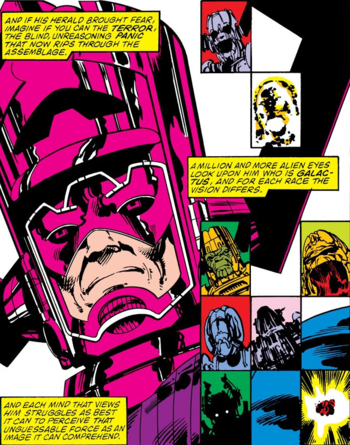
 flavour text, Magic: The Gathering
Imagine if some non-human entity, such as let's say, TV Tropes, became a three-dimensional living entity with self-awareness and consciousness, that wanted to sit down and have a lovely little chat. What would it look like? Like a surprisingly feminine, charming little sprite named Trope-tan? Walls and walls of PHP code that resolve themselves into a house-like shape? Or perhaps a whole universe, a world, complete in and of itself?
At some point in the conversation, the personification of TV Tropes drops a little Mind Screw in your tea: you are not looking at or conversing with, all that TV Tropes is. You are not even seeing an illusion that TV Tropes is projecting into your mind. Rather, the sheer awesomeness of TV Tropes, the might and immense hideousness of it, or its life-ruining influence bypass your eyes and occipital lobe entirely, and your mind meekly registers it as the closest, safest, yet still a comparable thing on hand.note You Cannot Grasp The True Form, or else you will Go Mad from the Revelation. May overlap with Brown Note Being.
A practical application of Nothing Is Scarier. Related to These Are Things Man Was Not Meant to Know, and sometimes Alien Geometries. Often a property possessed by the Eldritch Abomination. If everyone who fails to grasp the True Form sees something different, it's an example of Appearance Is in the Eye of the Beholder.
When a computer undergoes this, it's oftentimes a particularly extreme Logic Bomb.
When someone is in a truly outlandish environment, their brain will just make up stuff for them to see. Usually, an excuse for the artist not to have to draw weird other-dimensional stuff.
More possible in real life than you may think, just be prepared before heading on over to the Real Life subpage — you may leave with a headache.
See also A Form You Are Comfortable With, Unseen Evil, Hyperspace Is a Scary Place, and Weirdness Censor. Not to be confused with You Can't Get Ye Flask.
Examples:
- Implied regarding goddesses and demons Ah! My Goddess; because they exist in a twelve-dimensional state naturally, four-dimensional beings such as humans cannot truly perceive them. This was most openly stated in chapter 268 where a demon purposefully forced Keiichi to witness a bit of her true form and nearly shattered his mind.
Mokkurkalfi: You don't perceive our true appearance. Your existence and ours are different. My form, and what you think you are seeing, are not necessarily the same.
- Baccano!'s Ronnie Schiatto reveals his true form in the light novels once. No physical description is given, however, on the basis that the sight was so terrifying and incomprehensible that it was blocked immediately and entirely from the spectator's memory.
- Several characters in A Certain Magical Index have "unexplainable" abilities. Ollerus (a ridiculously powerful sorcerer) and Gunha Sogiita (Level 5 esper) are a couple... Gunha doesn't even know how his own abilities work (he thought he figured it out at one point, but was told that he was wrong). This is actually a great boon to these characters, as if your opponent doesn't understand what they're being attacked with, they cannot form an effective defense against it.
- The enigmatic being Aiwass looks kind of like an angel, yet is very clearly not an angel. When Accelerator gets his ass kicked by it, Accelerator has a difficult time comprehending what his foe was. In particular, he thought Aiwass's wings looked strange and wrong, but not in any way he could actually articulate.
- A Majin wields power that very few can understand. When Othinus (a true Majin) and Ollerus (a "failed" Majin) have a brief battle, bystanders can tell that something happened between them, but they cannot explain what.
- Downplayed in Bleach: If a being has an extraordinarily high level of spiritual power, it cannot be sensed by people whose spiritual power is too low, meaning only those whose Power Level is sufficiently close to that of the opponent can sense it. You'll still be able to see them with your eyes, though.
- Chainsaw Man: Devils are manifestations of human fears and phobias, growing more powerful the more common and the more intense that fear is. The Darkness Devil, representing the Primal Fear of the dark, is therefore an entity of almost literally incomprehensible power. While its physical form is easy enough to perceive, if bizarre, its attacks are preceded by surreal imagery, such as croaking frogs or praying astronauts, that have no causal relationship to the result of those attacks.
- In The Circumstances Leading to Waltraute's Marriage, Freyja in her full glory cannot be properly seen by mortals and is perceived as an intensely bright light. She has to power down to communicate with Jack.
- Death Note's 13th volume, How To Read, mentions that the true form of the Shinigami King is unknown and may be incomprehensible to humans.
- In Dragon Ball Z: Battle of Gods, Beerus and Whis' ki is so alien that it cannot be perceived by non-divine beings. After Goku and Vegeta unlock the Super Saiyan God transformation, it's suggested that they are slowly learning how to sense it, even when not in god-form themselves.
- Additionally whenever Goku and Vegeta transform into Super Saiyan Blue during Dragon Ball Super their ki becomes undetectable to all other Z-Fighters. Their ki suddenly disappearing is repeatedly used as an indication that they're fighting somewhere as Blue and something must be up.
- The Elder Sister-like One: Yuu frequently has to remind himself that no matter what she looks like to him, the true form of Chiyo (AKA Shub-Niggurath) is beyond human comprehension. More unusually for the trope however, the series suggests that logically the inverse must also be true — just as a human cannot ever truly understand a Lovecraftian outer god, such a god cannot ever truly understand what it is to be human.
- In Neon Genesis Evangelion, humanity and the Eldritch Abomination Angels were two sides of the same coin created by Neglectful Precursors with a fascination for creating life. Humans were made to have the precursors' capacity to create while the Angels were given their godlike power instead with the two intended to never meet, and when they actually do both parties end up suffering from this trope. All humans see are gigantic Starfish Aliens trying to kill them (with their rare attempts to communicate leaving them almost wishing they had), and the Angels' inability to perform abstract thought means they cannot independently conceive of the very concept of emotions. When Leliel and Armisael attempt to take A Form You Are Comfortable With and communicate with Shinji and Rei, they have to draw extensively on their knowledge and understanding of it before they are able to talk about it, and even then it is obvious that they are struggling to comprehend it.
- Nyaruko: Crawling with Love!:
- Played with in that, while Nyarko does indeed have many forms that would break Mahiro's mind, she insists that as the being of a thousand masks, she doesn't have any one "true" form, so her human shape should count as an aversion too.
- The series also features the interesting situation of not being able to grasp one's own true form. To human senses, Mahiro is just an average looking human boy, but in the Alien Geometry that beings like Nyarko can perceive, he's apparently the most beautiful being in all of existence! (Much to his consternation.)
- In Junji Ito's My Dear Ancestors, the protagonist is so traumatised by the sight of the antagonist's father (and later, the antagonist) connected to the scalps of each of his ancestors like a centipede that she loses her memory. Twice.
- In Princess Tutu, anybody who isn't directly connected to the story sees the eponymous Magical Girl as a giant white swan wearing a crown.
- Conan the Barbarian: Conan the Slayer had the main protagonist and his companions encountering a trio of monstrous brothers whose physical appearance varied from each person's point of view. To Conan, they looked like normal humans of unusual size while one companion saw them as troll-like creatures, another one as tentacled humanoid beings resembling Davy Jones and a third one viewed them as demonic skeletons on fire.
- Judge Dredd: The Face of Fear is obscured by a helmet that the monster in question only opens to kill people with his Nightmare Face, but he doesn't actually have a real face. It's always reflecting the most deep-seated terror of the person who lays eyes upon it. However, if they're not actually afraid of him, it doesn't work at all, which once got him a fist through his skull from Dredd.
- In an early Justice League of America comic, the JLA encounter a monster calling itself the Unimaginable, a creature so far beyond human comprehension that it's effectively invisible.
- Toyed with in the tale of Orpheus in the Sandman Special, reprinted in Fables And Reflections. Orpheus visits Death and becomes confused and disoriented when he sees her in her house clothes (i.e., her usual '80s-'90s look). She quickly cleans up for her visitor (though it's more of a 18th-19th century dress than the black Greek toga she was seen in earlier in the story).
- Marvel Universe:
- The One Above All, the supreme cosmic deity, much like the Abrahamic God, is utterly incomprehensible to humans because he is literally everything. The One Below All is much the same, only much less nice. When dealing with mortals, the One Above tends to come in the form of an elderly human male. The One Below steals bodies and wears them "like a mask". That's if it's feeling nice.
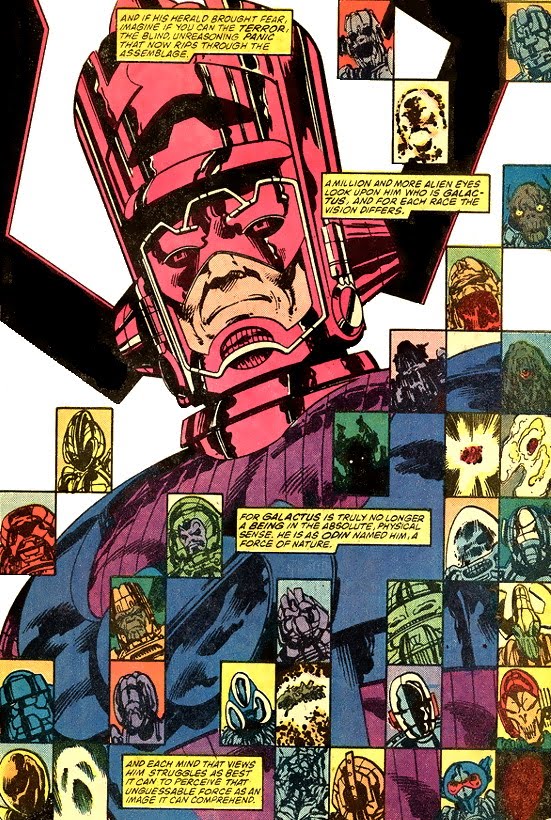
- It's often said that Galactus doesn't actually look like a gigantic human — it's just the human brain that makes him seem that way, and each alien race has a different perception of him. It turns out that he was a Human Alien in the previous universe before he became Galactus, but now his true form resembles a star.
- To Beta Ray Bill's people, he looks like a giant amoeba. Interestingly enough, Bill himself sees him like Earthlings do.
- In one instance◊ when Galactus appears before a large number of species, the page is filled with numerous smaller pictures showing how each species perceives him. Some of them do look pretty horrifying.
- Played for Laughs when the The Unbeatable Squirrel Girl encounters Galactus. She's heard of the different species theory, so she asks her squirrel sidekick what she sees. Tippy-Toe reports no, Galactus just looks like a regular guy — but the art reveals "a regular guy" is how Tippy-Toe describes a 400-foot-long purple squirrel.
- In Guardians of the Galaxy, it's explained that forces and entities, like the Abstracts, sometimes simplify themselves for mortals in order to get their assistance. In the same issue, it's revealed that the setting, what looks like a giant checkerboard-like world, is actually the cloak of a gigantic Abstract.
- Doctor Strange: The Vishanti, a trio of higher entities who sponsor the office of Sorcerer Supreme, explicitly state that they cannot show their true forms to mortals because it would wreck their minds.
- JLA/Avengers: After flying into space, Superman and Iron Man see the forcible merger of their worlds as two gigantic hands pushing the two Earths together. Tony comments that this can't be real, and Clark says that this is simply how their minds chose to represent the event. Also in this crossover, we see Eternity (the Anthropomorphic Personification of the Marvel Universe) merging with his female counterpart, Kismet of the DC Universe in what looks like a very intimate embrace. Left behind in the space where the "merger" took place is an egg that will explicitly become the center of a new universe someday. Make of this what you will. (At any rate, it certainly gives Big Bang a whole new meaning.)
- Due to miscommunication at DC, the death of the New Gods in The Death of The New Gods were completely contradicted by the death of the New Gods in Countdown to Final Crisis. Grant Morrison says that they both happened and are merely different mortal viewpoints of an event completely beyond our grasp.
- In PS238 #35, a Journey to the Center of the Mind, the Lords of Order and Chaos appear at the start to explain that much of what we're seeing is a metaphor that we can make sense of, starting with themselves.
Order: What that means is that I'm not really a pleasingly-shaped metallic object that can talk.noteChaos: And my true form isn't a jumble of random threads of what appears to be string.note
- In Sub-Mariner: The Depths, for the most part, Namor looks like a creepier version of himself, as seen by the crew. But once Dr. Stein goes mad, he sees a creature that looks much more inhuman and implies Namor's human form is just the closest thing a human mind can come to comprehending what he looks like and kept their minds intact.
- In the Superman story Whatever Happened to the Man of Tomorrow?, Lois Lane tries to tell what Mr. Mxyzptlk's true fifth-dimensional form was: "I can't describe what Mxyzptlk then became. He had height, width, depth, and a couple of other things, too."
- Thousand Shinji:
- The Chaos Gods have horrible forms that are beyond human understanding.
- Their successors Shinji, Asuka, Rei and Misato wear a thousand forms each, and only a few of them are understandable to human beings. Usually, they wear human shapes when they interact with people (their public relations faces, so to speak).
- In the Pony POV Series:
- The Elders of the Alicorns and Draconnequi are Eldritch Abominations (though the Alicorns are benevolent), and as such cannot be properly viewed by mortals. This is best exemplified when Liarjack meets the Father of Alicorns — the only thing she's able to view him as is a piece of the Night Sky in the shape of a pony (probably due to him being the Anthropomorphic Personification of existence). Everything else about him is so seemingly contradictory (such as appearing as a foal, a colt, and a stallion all at once), she's incapable of understanding it, and finally just gives up trying to in frustration.
- The Outer Concepts all seem to have this to varying degrees. Some of them do carry the 'induce insanity' part, but most of the time it's simply impossible for a mortal to get more of an abstract idea of what they really look like, even when using an Avatar. Their Elder, Azerhorse, is implied to be constantly changing physical form.
- It's implied this applies to some degree to all of the Concepts, as when Cadenza and Strife appear in their true forms to Moochick and Heathspike, they're both seen as a member of their respective races that represent their Concepts, and Luna implies this is the case whenever the Concepts manifest in their true forms to mortals. The only exception appears to be when a mortal truly and completely understands their Concept, at which point they can grasp the true form. This was the case with Venus's mortal lover (and one of the reasons she married him) and the Tales Era Sparkle Pony Napper (who was friends with Luna and could grasp her's).
- In Sonic X: Dark Chaos, trying to comprehend the true form of Dark Tails is a very, very bad idea. Maledict — who happens to be the biblical Satan and an immortal Physical God — is literally left stunned with terror after he sees it.
- The Bound Destinies Trilogy: Both times Din, Nayru, and Farore make actual appearances, they use human forms, explaining that their true forms are beyond mortal comprehension.
- This comic has Poindexter, upon learning Discord's normal form is A Form You Are Comfortable With, asks to see his true form despite Discord's warnings. He really should have listened.
- Fate/Black Reflection: Variation when Shirou and Archer find themselves unable to grasp the structure and history of zanpakutous the way they can with regular weapons and Noble Phantasms. Shirou compares it to a computer continuously trying to process a file and getting an error message every time he pictures Tensa Zangetsu. This is because zanpakutou are not magical weapons but rather extensions of a shinigami's soul in the shape of a sword, a fact neither of them are aware of. They can grasp the basic nature of a zanpakutou after close inspection, as Archer is able to figure out that Rukia's Sode no Shirayuki is ice-based before she releases her shikai during their encounter at Homurahara high school.
- The Supermen: Wesker's plane falls into a wormhole that takes him to the DC Comics universe. It is described as "changing shape in impossible ways" when he tries to look at it, being an indescribable colour, and having Alien Geometries. Wesker can only look at it out of the corner of his eye and struggles to describe it, even thinking that "Lovecraft would have been proud."
- In Blood Bond, Blood Omen Series, the Unshaper looks like an amorphous mass the size of a moon. From a distance. Once someone gets an actual look at it, physical or psychic, their mind tends to shatter because the Unshaper is "a thing of absolute negation, pure unCreation", and no creature of Creation — that is to say, any creature of our universe, let alone humans — can comprehend it.
- The final boss of the Wrath of the Gods fan-addon for Terraria Calamity is a nameless deity of light ( although its Sigil Spam, as well as replacing the Boss Rush activated with the Terminus and giving you the Rock, gives off its true identity as Xeroc) whose entire appearance is this, an ArtShift amalgam of realistic shifting body parts and flowers, with its face being censored outright. The censor bar isn't even a part of its sprite, giving the impression that it's your own eyes trying to blot out the Nameless Deity's face. Its lore item and Bestiary entry also aren't easy to read either, the entry changing its description each time you read it and the lore item being entirely randomized strings of dialogue that change every 22 real life days.
- It is said in the Devil that the devil can take on any form and gender.
- In Dogma, God manifests twice in A Form You Are Comfortable With (most famously as Alanis Morissette), but His/Her voice is a perfect example. Humans' heads and chests explode upon hearing it because we do not have the aural capacity to handle its awesome power, which is why God usually sends an Angel to communicate with humans.
The Metatron: We went through five Adams before we figured that one out.
- Merlin in Excalibur describes the Dragon, the source of his magic, as "a beast of such power that if you were to see it whole and all complete in a single glance, it would burn you to cinders."
- Glorious: Ghatanothoa's quasi-ethereal state - Ghat states that looking upon him would turn Wes into an Empty Shell Humanoid Abomination that all men would question why such a thing be allowed to exist. When he gets a look at Ghat closer to a corporeal form, it causes him the worst pain he's ever felt. At the end, Wes does witness Ghat's fully corporeal form after gifting the god his liver.
- The Mothman Prophecies
John: I think we can assume that these entities are more advanced than us. Why don't they just come right out and tell us what's on their minds?Leek: You're more advanced than a cockroach. Have you ever tried explaining yourself to one of them?
- Phantasm: The Tall Man. He refers to his body as a "skinsack", and it's later revealed he's actually some...thing that killed a sweet old man who entered his dimension and used his body and an army of copies he made of it to act as avatars to allow him to interact with our world. His true form is unknown.
- Infamously at the end of Raiders of the Lost Ark. The moment the spirits reveal their true form to the Nazis who dared to look inside the Ark, they are all sent into fits of screaming before dying in grotesque and gruesome ways.
- Sauna in the movie Sauna appears to humans as sauna, while it really is something more. This is most likely because it chooses to appear in a form that people can comprehend.
- A Scanner Darkly, the rotoscope animated film based on the Philip K. Dick story, has an interesting take on this.
- No one knows what the true (or original, if you prefer) form of The Thing (1982) is. Not in John Carpenter's version, anyway. This is one of those subjects that "one could go crazy thinking about" as Carpenter put it in the DVD commentary. It remains debated by the fans.
By Author:
- Stephen King:
- The monster It from the book of the same name. The closest approximation for its physical form that the protagonists could comprehend was a Giant Spider; anyone who sees Its true form of the deadlights will be driven insane at the very least.
- This also happened with the eponymous character of Stephen King's novel Rose Madder, whose true form was something like a spider... thing. Rosie was warned several times not to look at it.
- Happens AGAIN in the Lovecraft-inspired Crouch End, where the woman telling the story to the police recounts how her husband saw something in a pit in Crouch End, she was only able to glance it but he saw the whole thing, and his mind immediately blanked it out and caused him to regress mentally.
- This is the whole plot of From a Buick 8, with the Buick not really being a car, or even anything remotely resembling one; it simply looks like one to our senses. It might be described as a gate to another dimension, but it probably isn't that either, not fully or exactly. One of the main characters actually compares it to the breathing apparatus on a scuba tank.
- Mostly averted in H. P. Lovecraft's works as his Eldritch Abominations tend to appear in their true form, which tends to lead to madness in those who see them. Sometimes it's played straight, though:
- Yog-Sothoth is perceived by mortals as congeries of iridescent spheres because his true body transcends the space-time continuum and we only see the small parts of it that happen to intersect with that particular location in time and space.
- Nyarlathotep tends to appear in a form of a man because it makes manipulating humans easier. He has several less human forms too (1000 to be exact) but all of these are just avatars, or "masks". What his true form looks like is never even hinted, but as he is the soul of the Outer Gods, he might not even have a physical body outside the avatars.
- Although it's never explicitly mentioned, considering the insignificance of mankind in Lovecraft's cosmology it's very unlikely that the Elder Gods naturally look humanoid. More likely the human-like forms they appear in are used by them in order to not drive humans insane. The Elder Gods oppose the Great Old Ones, and since mankind would be destroyed if the Old Ones awaken, they are the closest thing the Derleth-subscribed mythos has for benevolent deities. Not that that's saying much.
- In "Through the Gates of the Silver Key", Yog-Sothoth explicates a major implicit premise behind the whole Cthulhu Mythos: practically everything we experience goes under this trope, including three-dimensional space, change and time, and the individuality of what we ordinarily think of as different creatures. Ramsey Campbell's "The Render Of Veils" exploits this variation of the trope to very disturbing effect.
- The titular "Colour" from The Colour Out of Space. It is described is unlike any color in the normal spectrum, which under conventional logic would suggest it simply being invisible. It is, however, suggested that isn't even a colour, as it's only said a colour is the closest thing it can be compared to.
By Work:
- The Ellimist always appears in a humanoid form before the Animorphs (and as a bird to Tobias once), while his true form is some techno-organic behemoth made out of countless pods, organs, feathers and the like, built around his original avian body, about half of which is still trapped inside a black hole.
- Assassin Fantastic: In Myhr's Adventure in Hell, Terrin translates everything Myhr "sees" in Hell to something he can grasp without going insane. Mainly, a Sugar Bowl. With naked lesbian demons.
- After the Confessions spends the first chapter questioning God, humanity's ability to manage to say anything about Him is called into question and only answered with an assurance that we need to at least try to say something, lest we end up pagans.
- In Ambrose Bierce's "The Damned Thing", there is a creature that is not of alien form but of alien color rendering it impossible to see properly.
- This is a regular feature on Discworld, particularly as it relates to death (and indeed Death) It's also how the Time Travel antics of the Men in Saffron appear to civilians.
"Time has stopped for everyone but you," said Sweeper patiently. "Actually that sentence is wrong in every particular, but it's quite a useful lie."
- Death gets this whenever he interacts with humans, who seem confused because someone is talking to them, and it appears to be a skeleton in a cloak, but that's ridiculous, so the mind just rejects it. Children, however, aren't nearly as mentally fixed, so their minds more easily wrap around it and they sometimes see him as he really is. There are rare occasions when Death can be seen, such as in Wyrd Sisters, when Death decides to take the place of an actor who is supposed to play him in a Macbeth expy. Everyone in the audience is expecting to see Death and, therefore, does. Death, not being used to such a large audience, gets stage fright. It is hilarious.
- Non-magic users, not having octagons in their eyes in addition to rods and cones, cannot see octarine, the eighth colour; instead, they only see a "gap" where something isn't.
- Inverted when Death speaks to the holy-man who is said to know everything, and who claims that it is impossible to "see the infinite." Death corrects him by saying he's "seen the infinite" and it's "nothing special." Death then proceeds to describe the infinite, saying that it "looks blue from the outside."
- The Divine Comedy: Insofar as God is depicted at all, it's in an extremely abstract fashion due to how far he is beyond human understanding. Dante has to literally go through Hell, climb up the opposite side of the world, fly outside the universe, bathe his eyes in a river of heavenly light, and pray for the intercession of the Mother of God and even then, he admits his memory contains an infinitely inadequate account of what God actually is.
- Doctor Who Expanded Universe:
- The seven-dimensional Legion, which appeared in both the Doctor Who New Adventures and the Doctor Who Missing Adventures, aren't even contiguous in three dimensions.
- The NA Sky Pirates! features a small pocket universe that is one of these, which is hiding a totally separate species that is also one, and it also heavily implies the Doctor himself falls into this category. Its loose sequel Death and Diplomacy extends this to the TARDIS, too.
- The Dresden Files:
- There is a semi-divine being known as a Skinwalker, or Naagloshii. Just to look at it resembles a powerful bestial creature (with the ability to shape-shift). Certainly frightening, but by no means incomprehensible. However, when Harry uses his Wizard's Sight on it, even briefly, the effect is almost mind-shattering. The Naagloshii's true form is so inherently wrong that it literally takes hours for Harry to dissemble enough to function normally again (and he has to be careful not to think about it otherwise it reduces him to near unconsciousness). This is made even worse by the nature of the Sight, in that things that are Seen are remembered with perfect fidelity forever.
- It is implied that the powerful movers and shakers of the supernatural world have similar (if not so utterly abominable) forms. The Queens of the Sidhe, particularly Mothers Summer and Winter, are beings of such intrinsic power that their true forms are likely to be completely incomprehensible.
- Odin himself is explicitly described by Gard as someone whose "guises are created to diminish him into something a mortal mind can readily accept" and as an "elemental" being.
- He Who Walks Behind is so alien that even his name cannot be comprehended, merely experienced as a rush of ugly emotions and a deep-seated hatred for all mortal life.
- The various deities in The Elenium and its sequel series The Tamuli are hinted to be this, seeing as Aphrael can appear as a child, a grown woman, and even two people at the same time.
- Flatland: Discussed. The protagonists are two-dimensional polygons for whom the very notion of three-dimensional creatures inspires Cosmic Horror Stories. When a Flatlander is befriended by a 3-dimensional sphere, he literally Cannot Grasp The True Form without touching it. A cube looks like an Eldritch Abomination, constantly changing shape at various angles.
- The Hitchhiker's Guide to the Galaxy: A variant of this happens in Life, the Universe and Everything, when the giant supercomputer Hactar appears on a psychiatrist's couch. The couch appears the normal size for a couch, the computer appears the normal size for a giant spaceborne supercomputer, the illusion that one is sitting on top of the other is... disturbing.
- In Isekaid Shoggoth, the protagonist Alyssa Gillespie is a shoggoth disguised as a human, because if anyone were to see her true form, or even hear her true voice, they'd become permanently insane and try to mutilate themselves in their efforts to reject her otherworldiness. Her four wives all got a quick peek and became highly "defiled."
- Journey to Chaos:
- This is the case with higher levels of magical powers. It's impossible for mortals to perceive what chaotic energy or orderly influence truly look like and so instead they see golden-brown light and silver-grey light, respectively.
- Noitearc, the Third Founding Deity, is thought to be a giant tree because that is the best mortals can conceived it. The truth is much more complicated.
- When Reapers and Sowers exist as the abstract concepts "death" and life" respectively. Only their priesthoods are capable of seeing their true nature.
- In Larry Niven's Known Space series, Hyperspace has this quality: the human brain is completely incapable of perceiving hyperspace, and carefully edits it out of your sight, and in about 60% of humans drives them insane. If you look at a window, you see the frame basically collapsed all around the window, which is slightly less disturbing. If you look at a 360 degree panorama of hyperspace, you lose sight completely: you don't just go temporarily blind, your completely forget that you ever possessed sight, or what sight even is.
- In E. E. "Doc" Smith's Lensman series, it is impossible for anyone to properly see a Palainian or any other being that lives in distant planets that are perpetually cold. This is because these beings survive by being four-dimensional (this is described as a "hyper" dimension); since everyone else lives and perceives in three dimensions, this extra-dimensional aspect is lost on them.
- In the Otherland series by Tad Williams, Felix Jongleur communicates with The Other through simulations so he can avoid interacting with it more directly. Unusual in that he's the one who determines what fake form he's perceiving, though The Other tends to warp the simulation into something a bit more disturbing.
- Percy Jackson and the Olympians: Looking at a god's true form is fatal to humans.
- The gods from Ravelling Wrath. The characters travel through vast magical worlds – and those worlds are merely parts of the gods. The story repeatedly reminds you that the gods don't produce human words or human thoughts on their own. The characters have to interpret the gods' thoughts, literally reducing them to human comprehension.
- The Silmarillion: Ungoliant's Unlight baffles and disorients even the god-like Valar.
- The Sister Verse and the Talons of Ruin has the Lord in White, whose true face explosively disintegrates anything around it, as demonstrated when it single-handedly obliterates Highgate.
- C. S. Lewis' Space Trilogy: Most of the time angels just look like a vague shimmer of light; other attempts have produced wheels rolling on distant hills, a painful impact of colors (described as being like the "true sensation" of being hit in the eye by a rock), and (most successfully) a pair of otherworldly humanoids.
- In The Stormlight Archive book Oathbringer, the God of Evil Odium appears to Dalinar in human form for a chat. Dalinar makes the mistake of telling Odium that he now knows the face of his enemy, so Odium gives him a glimpse of the infinite seething expanse of fire, divine power, and raw transcendent hatred that he really is, leaving Dalinar acutely aware that any more exposure would drive him insane.
- Warhammer 40,000: Subverted in Dan Abnett's Know No Fear. While fleeing from Chaos Daemons two Guardsmen perceive them as horrific monsters with horns, spikes and forked tongues. However one member of their party, the seemingly immortal Oll Persson thinks to himself that what they are seeing is not the true form of a Daemon, it is what their minds are perceiving it as by pulling together bits of what they believe monsters look like. He however sees their true forms as shapeless clouds of warp energy and is able to kill them.
- In the Worlds of Power novelization of Blaster Master, the Big Bad takes the form of whatever each person fears.
- American Gods (2017) implies this with Mr. World when he goes off on a tangent in his first meeting with Shadow Moon. His form pixelates, distorts, clones itself, and corrupts to an incomprehensible level before being brought back down.
- In Babylon 5, most people see the Vorlons as whatever equivalent their culture has to "angel," but Londo apparently sees nothing. Whether this was because the Vorlon ignored the Centauri race and focused their ancient genetic manipulation on the now-extinct Xon race that also evolved on Centauri Prime, or because Londo is just a Jerkass, is never explained. Series creator J. Michael Straczynski claimed somewhere, in response to a fan's question, that Garibaldi (an agnostic) would have seen himself in Kosh. This statement seems to support the idea that it was Londo's having been touched by Shadows that led him to see nothing, rather than any faith-related matters/crises on his part.
- Buffy the Vampire Slayer: In the musical episode "Once More With Feeling", Buffy tries to draw what the afterlife looks like. She draws a white circle within a blackness, similar to the cliche "Go into the Light". She cannot translate the true form using her human senses.
- Doctor Who:
- The Weeping Angels, maybe. They can't be seen by any living being, and any time they can be observed, they instantly freeze into their trademark stone statue forms. It's implied, however, that they aren't necessarily limited to the form of angels when frozen in stone. We don't know why they freeze into rock beyond it being a defense mechanism, but for this very reason, what they are/look like unfrozen is anyone's guess.
- This trope was invoked by Russell T Davies to explain why the Time War would not be depicted onscreen — the true form could not be grasped by any sort of special effects and so anything that was attempted would be disappointing.
- In Grimm, it's explained that it's generally a bad idea for normal humans to see the true forms of Wesen, as it could make them Go Mad from the Revelation. Someone like Hank whose sanity was able to withstand the initial shock then thinks he was going crazy. For weeks, he was unable to sleep and was becoming increasingly paranoid. Nick had to stop him from shooting his own goddaughter in a blind panic when she accidentally reveals her Game Face.
- In The Invaders (1967), the titular beings are alien invaders who are always disguised as humans — which might be a good thing, considering what happens in the episode "Genesis". The story starts with a motorcycle cop seeing the true form of an invader, which drives him insane ("What is it? What is it?") and causes him to be hospitalized.
- In Joan of Arcadia, God appears in various forms to the main character, including a goth guy, a pair of twins, old women and a substitute teacher. At one point, Joan accuses God of being "snippy" at her, and God replies that if she hears snippy, it's because snippy is the closest thing she's capable of understanding to what God's saying, and that it doesn't really look like any of its forms, it just appears as them because it has to manifest as something she's able to experience in order to speak to her.
- Parodied somewhat in The Middleman, when MM and Wendy visit the underworld. It appears to Wendy (and the camera) like an office building, but when she mentions this to MM, he claims to see an overgrown field full of feral creatures. He's kidding, he sees an office. "Someone's funny in the underworld."
- Observer in Mystery Science Theater 3000 insists that he exists only as a brain, and that if "lesser minds" perceive a body carrying around said brain, it is merely this trope in action. The show often plays this for laughs, with Observer getting physically injured but insisting that it doesn't matter because he "doesn't have a body", despite obviously being in pain.
- Star Trek:
- Many portrayals of the Q Continuum indicate that whenever a human enters the Continuum it looks like normal 4D space-time so that the human mind can comprehend it. This is seen twice on Star Trek: Voyager. In "Death Wish", the Continuum is portrayed as a Stock Desert Interstate, and in "The Q and the Grey" a civil war among the Q is depicted as The American Civil War that Voyager's crew can interact with even down to using Continuum weapons (shown as Civil War muskets).
- The novel I, Q goes so far as to say that the human mind does this automatically to stay sane and that Data normally shuts down because his android mind tries to "see" everything and crashes. Q must filter the sensor input so Data can function.
- In fact, the Q Continuum has never been truly perceived by visitors; they're always shown a representation which they could understand.
- In one novel, Picard perceives the Continuum as a weird-looking highway with a sign at the on-ramp saying something like "Organians, keep out!" The book also mentions that the Q don't like the Organians for their smugness and the holier-than-thou attitude.
- The pilot episode of Star Trek: Deep Space Nine plays this both ways. After Commander Sisko goes into the Bajoran wormhole, he meets the Bajoran Prophets: other dimensional beings who are the gods of Bajoran mythology. They assume the forms of Sisko's son and deceased wife, but not so Sisko can comprehend them: they have no concept of beings who exist in linear time, so most of their interaction is them trying to figure out him!
- Supernatural:
- Angels cannot be comprehended except by their true vessel. Anyone else who glimpses their true form has their eyes melted out of their head, and anyone else (or anything around anyone else) that is around their true voice experiences what basically amounts to tornado conditions. To even be comprehended, they must first take a vessel. Any improper vessel, even the next closest thing, will eventually explode under the power.
- Archangels are even worse. The very presence of their true form is capable of doing all of the above, but with massive earthquakes, and instant death for anyone who's around. This can even remain true when they're in a vessel. Raphael simply manifesting himself created a thunderstorm that knocked out all power to the Eastern Seaboard. In a later episode, he similarly created another thunderstorm when he manifested again. When he showed up to protect a prophet, the growing light was tearing the room apart.
- According to Zachariah, in response to Dean mocking him for still looking like a bald, middle-aged man when they run into him in Heaven, his true form has 6 wings and 4 faces, one of which is a lion. This is actually in line with how The Bible describes angels.
Zachariah: You see this because you're... limited.
- The nameless Cosmic Entity in the Empty is incomprehensible even to angels. When Castiel meets it in "The Big Empty", it appears as a mirror image of the angel. It explains that it can't appear in its true form, otherwise Castiel would go insane trying to understand it.
- The Bible:
- In the Old Testament, God warns Moses that "you cannot see My face, for man may not see Me and live". Even Moses could only see His back. God is omnipresent and exists at every point in the space-time continuum simultaneously yet transcends all of it. Which then rubbed off on Moses a bit, since when he came back to everybody else his face blinded them into making him wear a veil. That said, several Old Testament figures (including Abraham, and for that matter Moses) are said to interact with God directly. The usual explanation is that they were speaking with an angel who was speaking directly for God (acting as a kind of cosmic telephone), or else that God was appearing in a form they could comprehend. Christians often interpret these events as pre-incarnate appearances of Christ, the "image of the invisible God".
- In Book of Exodus chapter 24 God appeared in full glory for seventy-four leaders of Israel total. The fun part? It mentions that they all ate and drank together, it says that God stood on a sapphire pavement, and absolutely nothing else.
- This is subverted in the Catholic faith, as the saints will get to see God in all his glory in Heaven, often referred to as Beatific Vision. This is also an interpretation of the Beatitudes promising that the "clean of heart will see God."
- Also applies to the Seraphs, God's personal throne guards. They keep themselves hidden with their wings (they have six or more, by the way), as any mortal who looks at them directly bursts into flames or get annihilated instantly.
- Regarding Heaven, some believers reject a Fluffy Cloud Heaven and Fire and Brimstone Hell interpretation of the afterlife, instead preferring a metaphor-based no-true-form spin on where we cannot really comprehend the true form of those dimensions, and the literal interpretations above are just approximate interpretations of what is really happening in there. For example, Heaven is a state that is expressed in metaphor as a place of peace and bliss, while Hell is filled with so much of all kinds of sin, chaos, insanity and perversions against nature that the human (and supernatural) mind is unable to cope with it, and tries to resolve it into a Hell it can comprehend and express in art, namely a dark inferno filled with pain and disgusting Eldritch Abominations.
- Averted with Jesus, although revealing Himself to Paul later on (after the Ascension), is likened to a lightning strike and knocks Paul off his horse, temporarily blinding him. Some forms of Gnosticism instead teach that Jesus never was physically incarnated, and had no tangible form.
- Book of Revelation: The four horsemen and great seven-headed beast are all probably metaphorical... and maybe angels in their native environment really are humanoids, some with six wings and using four of them to cover their faces and feet, or have four wings and four faces... but then John talks about things like how "the sky rolled up like a scroll," and you start to get an inkling of how everything this poor man's mind was experiencing utterly defied all human comprehension.
- Plus, John had to describe things as he understood them, using similes of things he knew. At one point, he describes "locusts with breastplate of armour" whose "wings beat with the sound of a thousand chariots going into battle," which some scholars have theorized could have been a first century man's impression of a modern combat helicopter.
- Acts of the Apostles: The Holy Spirit descended upon the Apostles "like tongues of fire". Since the only way to make light in the first century would have been A) the Sun (obviously not it) B) lightning (again, not in a flash) or C) fire, this would have been the only way someone then could have described it.
- In the Bhagavad Gita, Krishna actually shows Arjuna his (God's) true form, which is basically a more extreme combination of Eldritch Abomination and Purity Personified. Krishna even mentions that Arjuna's mortal mind cannot comprehend all that he is, so Krishna briefly gives Arjuna divine sight so that Arjuna can comprehend. Arjuna still can't handle it, and begs Krishna to retake human form.
- Played straight in Judaic and Talmudic literature, which says that God is incomprehensible. Oddly enough, some Kabbalistic poems describe Him as though He were a human king, though the rabbis dismiss this as an elaborate metaphor.
- Classical Mythology:
- Mortals that look upon a God/Goddess's true form instantly burst into flames and die, because the gods are that awesome.
- This is exactly what happened to Dionysus' mother Semele, one of Zeus' lovers; Hera tricked her into doubting that he was truly who he claimed to be, and she insisted that he reveal his true form. Due to an oath he made to fulfill a promise to her, he had to comply. He managed to save her unborn child however, placing him under the skin of his thigh until he could be born.
- Medusa. Though her description is well-known — a hideous, snake-haired woman at her most basic — you literally cannot look at her or you'll turn to stone and (implicitly) die.
- The Qur'an:
- Moses asks to see God, who replies that the sight of Him to a living mortal would be too much... but He will reveal Himself to that mountain over there — which immediately crumbles to dust.
- Prophet Muhammed was so frightened when he saw the true form of Angel J'ibreel, that he ran home to his wife Khadija and begged her to cover him with a cloak. This caused the Surah of "Al Muddathtir" (The Cloaked Person) to be revealed.
- In the theological theory of Pandeism, it is proposed that those who are somehow able to contact the mind of our Creator as it unconsciously underlies our Universe find that experience so incomprehensible that their tiny human minds automatically defend themselves by interpreting such encounters as conscious communications from culturally familiar conceptions of gods, thereby explaining all revelation and scripture.
- In Taoism, from Laozi in the Daodejing: "The Tao we can describe is not the Tao that is."
- This is also familiar territory to devotees of Bahá'í where God is just too vast to be comprehended, so reaches us through various manifestations instead; teacher-prophets like Moses, Jesus, Muhammad, Buddha or the Báb along with minor prophets who reflect and explain the teachings of the greater ones.
- Egyptian Mythology: Followers of the ancient Egyptian religion (and modern kemeticism) did and do not believe that the gods look like dudes with animals heads; that is just a symbolic/metaphorical representation of their basic traits meant to help convey what the gods what were like and their teachings. The actual gods were understood to be abstract forces far beyond such simplistic descriptions, and if they appear to mortals at all, it's through forms that humans can better understand.
- In The Magnus Archives a mother sees something happen to her son that afterward she cannot bear to think about, let alone find the words to describe. The least inadequate description she can manage is "the sky ate him".
- This happens somewhat frequently in Welcome To Nightvale. The Shadowy figures and the dog park itself are the most common examples, and the most notable one being "This" from "This just in" which is some sort of bizarre alien life form that Cecil completely fails to describe.
- Dungeons & Dragons:
- The Obyriths, the primordial race of demons spawned by the Abyss eons before life arose on the Material Plane. Their bizarre, horrifyingly-alien appearances grant the Obyriths an ability called "Form of Madness." Their presence is established to be an affront to all five senses, which causes anyone who so much as senses them to be afflicted by an oftentimes permanent type of insanity (phobias, feelings of being consumed by insects, etc).
- Pale Night, the so-called Mother of Demons, is ancient even among the surviving Obyriths, but lacks the "Form of Madness" rule. She appears as a feminine figure wrapped in a white shroud blowing on a spectral breeze, which occasionally shifts to almost reveal what's underneath. This is neither her true form, nor a conventional illusion — instead the veil (which she can suppress with some effort) is a sort of cosmic censor, because her actual appearance is so horrifying that reality itself refuses to accept it. Pale Night's "Truth Behind the Veil" rule means that anyone who gets a good look at her true form must make an immediate (very high) saving throw; success means that the character's mind refuses to comprehend what they're looking at. Those who fail the roll die outright, and if revived afterward, mercifully have no memory of what they saw.
- Even some incredibly powerful forces of Good cannot be viewed safely by mortals. The Book of Exalted Deeds sourcebook mentions Zaphikiel, the greatest of the Hebdomad and the ruler of Mount Celestia. Only the gods themselves and the other Hebdomad can look upon him safely; anyone else who does so is said to be consumed by his overwhelming radiant energy and destroyed utterly. (Or maybe ascended to a higher form; it depends on who you ask.)
- Mage: The Awakening presents magic in general and the Supernal particularly as this. The actual underlying processes of magic are beyond human beings' ability to understand, so there need to use metaphor and symbolism to compose their spells. For those few mages who become capable of entering the Supernal itself, it's necessary to expend great effort to force it into a comprehensable symbolic form, or else unfiltered contact with it will utterly obliterate the mage. One of the goals of Ascension is to achieve a state in which true perception of the Supernal is possible.
- Magic: The Gathering:
- The Alara block gives us the Nemesis of Rea- THE END.
Words describing it fail. Pages relating it shrivel. Tales recounting it end.- When Jace comes into mental contact with Emrakul, he perceives her as Emeria, an angelic deity inspired by greatly distorted legends of the Eldrazi Titan. She speaks politely, they play chess (Jace even considers whether to offer her tea), then she turns the pieces into abominations and disappears.
"Emeria": Communication between us is difficult. I cannot talk to you. I do not even really know you exist. But you, your brain, it is very...adaptable. - The Alara block gives us the Nemesis of Rea-
- Pathfinder works this into the stat block for Cthulhu himself. Since Cthulhu is non-Euclidian and not wholly in the Material plane, or the third dimension at all for that matter, Cthulhu's attacks naturally cleave in a ten-foot cube around what he appears to actually strike. Additionally, his apparent and actual position don't line up quite right, granting him a flat 50% miss chance against all attacks. This can be defeated by using the True Seeing spell, but this is a generally inadvisable option, forcing a Will save versus instant and permanent insanity as you are suddenly forced to grasp Cthulhu's true form.
- Predators, a book for Werewolf: The Forsaken, introduces a being known only as the Unseen, which is Exactly What It Says on the Tin. It's said that its form is so blasphemous that reality itself refuses to show it (just like Pale Night). The Unseen is uncannily good at hunting werewolf packs, to the point that some suggest it's a weapon created by a werewolf-hating Eldritch Abomination. About the only way you learn of its presence is when your guts spill out of a seemingly spontaneous slice in your flesh.
- Also Hell, as presented in World of Darkness: Inferno: a place comprised of so much depravity, so much sin, that the human (and supernatural) mind is unable to cope with it, and tries to resolve it into a Hell it can comprehend. Hell's corruption is so pervasive, even looking at it triggers a check on the Karma Meter, as it worms its way into your soul.
- A fairly common trope in Warhammer 40,000.
- In some depictions the Emperor of Mankind (a living deity) is so powerful that most mortals cannot gaze upon his true form (he occasionally disguises himself, both to hide his identity and to protect onlookers). Those who attempt to either die, are blinded by the power inherent in his visage, or else their minds simply are unable to process what they are seeing. Even those who can safely look at him (generally those who are extremely powerful or have strong wills) see him as somewhat indistinct, with his features constantly changing and shifting. Some of his sons, the Primarchs, inherited this ability.
- In some depictions his form and even his words vary with the observer. To his Blank (psychically-immune) bodyguards however he is just a man.
- Magnus the Red, Primarch of the Thousand Sons, got the lion’s share of his father’s incomprehensible nature, and that was before he became a Daemon Prince. Any two people who look upon his physical form will see two very different things, and a single observer who looks at Magnus multiple times will perceive him in a completely different way each time. His solitary eye is the only detail that remains consistent across all his forms, and even then it will have different structures and colours depending on who is looking at it.
- The Warp is a dimension that is quite literally made of this trope. It is a realm of madness where emotion is given form and where the laws of physics do not apply. Ships travelling through the Warp have protective shutters drop down over their viewports, because those who gaze into the Warp have a high risk of going mad.
- Fittingly, given that the Warp is their home (and that they're made of the stuff), daemons are similarly subject to this trope. Daemons appear differently to different people, meaning that two soldiers can fight the same daemon at the same time and give completely different accounts of what it looked like (both of which would be wrong — the human mind is simply unable to process what a warp-denizen actually looks like, so it just substitutes something suitably terrifying in its place).
- Psykers, particularly human astropaths and navigators, are psychically-gifted individuals whose job it is to try and comprehend the true form of the Warp in order to steer ships through it (navigators) or pass messages through it (astropaths). It is an imperfect science at best — navigators fly as much on instinct and gut feelings as any actual dictates of their training and astropaths have a notoriously difficult job because incoming messages are less "transmission of the actual message" and more "indistinct thoughts and feelings that must be correctly interpreted to mean something vaguely close to what the sender was trying to say". Making the job harder is the fact that the Warp doesn't have linear time, either, so a message from across the galaxy can be 5 minutes old or 5 thousand years, or even come from the future.
- In some depictions the Emperor of Mankind (a living deity) is so powerful that most mortals cannot gaze upon his true form (he occasionally disguises himself, both to hide his identity and to protect onlookers). Those who attempt to either die, are blinded by the power inherent in his visage, or else their minds simply are unable to process what they are seeing. Even those who can safely look at him (generally those who are extremely powerful or have strong wills) see him as somewhat indistinct, with his features constantly changing and shifting. Some of his sons, the Primarchs, inherited this ability.
- An unusual and particularly dark case for the True Final Boss of The Binding of Isaac: Afterbirth+. Isaac cannot grasp the true form of Delirium, but not for the reasons usual for an Eldritch Abomination. No, it's because Delirium is a symbolic representation of Isaac's mind shutting down on the threshold of death; Isaac cannot grasp the true form because there's almost nothing left of Isaac to do the grasping.
- In Bloodborne, some of the most powerful Great Ones (like Oedon and Kos, or some say Kosm) transcended physical form and merely exist as concepts. In Oedon's case, it's "Blood and Voice".
- It's averted in the case of Kos. You find her corpse washed up on a beach in the Old Hunters DLC, and she resembles a nudibranch with human arms and a human face.
- Devil May Cry 4 has Pandora's box, a Morph Weapon with 666 forms (not all usable). Despite turning into a throwing glaive, a rocket launcher, or a missile platform, its most damaging attack is simply letting the box drop open, revealing the contents inside to everything in front of Dante.
- The Trope Namer is EarthBound (1994). "You cannot grasp the true form of Giygas' attack!" It's a tradition of the Mother series' final bosses. In EarthBound Beginnings, Giygas (aka Giegue) attacks telekinetically without lifting a finger; his mental power is so far beyond the protagonists' that they can't process what his PSI is doing. In EarthBound he's "reduced" to an Eldritch Abomination so large and all-encompassing, you simply can't tell where his attacks are coming from; in gameplay terms you're fighting against the background. In Mother 3, Porky doesn't get an explanation, but it may be related to him having access to such ridiculously advanced technology that it's a form of Clarke's Third Law. Additionally, the Masked Man doesn't have announcements for most of his attacks like other enemies in the game do; they simply happen without warning.
- The Elder Scrolls:
- This is said to be the case for the series' Alien Sky. The sun and stars aren't typical flaming orbs of gas, but are holes punched in reality by escaping spirits during the creation of Mundus, the mortal plane. They connect to Aetherius, the realm of magic, through which magic flows into Mundus, visible in the night sky as nebulae. The two moons are said to be the sundered and rotting "flesh divinity" of Lorkhan (aka many other names), the "dead" creator god of Mundus. The eight planets are said to be the flesh divinity of the original eight Aedra, spirits who stayed and sacrificed much of their divine power/very beings to create Mundus. This all appears as it does because it is the best a mortal mind can do to comprehend it.
- The Daedric Princes are the spirits who did not participate in the creation of Mundus, and thus remain at full power with Complete Immortality. They are really a form of Eldritch Abomination who subscribe to their own Blue-and-Orange Morality depending on the sphere they represent. When dealing with mortals, however, they often take a form that mortals are more comfortable and familiar with. One exception is Hermaeus Mora, the Daedric Prince of Knowledge (with a specialty in Eldritch knowledge). When he takes form, it tends to be as an infinite and mind-melting mass of tentacles and eyes. Within his realm of Apocrypha, his tentacles blot out the sky.
- The eponymous Elder Scrolls, also called "Fragments of Creation", in addition to being Tomes of Eldritch Lore and Tomes of Prophecy and Fate, can be this depending on the reader. If the reader is completely untrained in reading the scrolls, the scrolls appear to be a sort of star chart with indecipherable glowing glyphs printed over (and under) the map. If the reader has some knowledge of the scrolls, they may be able to decipher some knowledge, but it will likely be incomplete, and the reader will be struck instantly blind. A fully trained and mentally prepared reader, such a member of the Cult of the Ancestor Moth (who tend to be the primary keepers and readers of the scrolls), can glean significant knowledge and recover their eyesight, but will eventually go blind after repeated readings. In all cases, including for people who merely study the nature of the scrolls and never even use them, complete madness is a frequent side effect. In Skyrim, the Dragonborn can attempt to read an Elder Scroll. The result is a split second view of strange runes and writing before temporary blindness sets in. It is implied that that the only thing preventing you from going blind or insane is that you possess the soul of an immortal being (a dragon, in this case) and thus exist slightly outside of time, just like the scroll itself.
- There's a half-joking fan theory that the blackout is the universe effectively crashing from the paradox and rebooting.
- The Scrolls themselves have a case of this. If someone attempts to attune one of them to the time of the so-called "Middle Dawn", a Dragon Break that lasted about a millenia, the Scroll cannot make any sense of the impossible, implausble, and contradictory events that happened during that time and goes completely blank as a result.
- Morrowind includes a comedic example with Boethiah's Pillow Book, a book so pornographic that "No words can describe what you see. Or what you think you see." It features into a Thieves' Guild quest where it will be used as blackmail against a local politician.
- Eternal Darkness has a moment where Anthony, suspicious of the person telling him to deliver a scroll to Charlemagne the Frank, opens the scroll and catches a glimpse of a strange symbol before being Blown Across the Room by the power of the spell drawn on it. He then spends the rest of the chapter slowly rotting alive.
- Final Fantasy VII has the ???? skill. That's right, even the name of the ability can't be determined. The effects of the spell is pretty nutty too as it only shows a weight with a question mark on it before dealing damage to the target. It deals damage equal to the amount of HP the character has lost in comparison to their max HP. "Revenge" was one name for the attack, but in Final Fantasy IX it was Played for Laughs, having the name "Pumpkin Head." The Pandora's Box skill invokes this as well, only showing a giant question mark floating through space before dealing massive non-elemental damage.
- The final battle with Sin in Final Fantasy X plays out with Sin's attacks not being labelled except for its Limit Break, Giga Graviton.
- Played for laughs in Final Fantasy XIV with the Great Serpent of Ronka, which looks like an Ugly Cute worm, but then you read the flavor text.
"This creature, Quinfort insists, is the all-seeing, all-powerful Great Serpent of Ronka. Though its wobbly girth may deceive the eye, that is, presumably, a mere mark of the serpent's mercy, for its true form would be too terrible for mortal minds to comprehend."
- In God of War (PS4) Sindri explains how he and his brother can seemingly turn invisible and teleport.
Sindri: It's a little trick my people can pull. A special way of not being seen.
Atreus: You can be invisible?
Sindri: More like I can step into the Realm between Realms, and your mind doesn't understand what it's seeing, so it sees nothing at all. - The attacks of the Orochi in The King of Fighters involve a lot of whole-screen flashes and invisible hits — but more mysteriously, the special moves are unnamed. (... as long as Orochi's clone Mizuchi doesn't count).
- While a living being can easily look upon the "Dark Matter" entity from the Kirby series, analyzing it is something else. Star Dream, the ultra-advanced supercomputer developed by the Haltmann Works Company in Planet Robobot, recreates the Blade version of Dark Matter last seen in Kirby's Dream Land 2... not because it would be the ideal opponent, but because it is literally all that the supercomputer, something on par with Galactic Nova, is capable of replicating. Apparently, even the mightiest digital minds in existence have a very hard time comprehending a being made of pure evil.
- The Patriots, when they finally speak, claim this status in Metal Gear Solid 2: Sons of Liberty. In fact, they say they're the embodiment of the collective will of the United States itself. They're a pretty Unreliable Narrator, though, and this was debunked in Metal Gear Solid 4: Guns of the Patriots.
- The original Nexus War contained Nifleheim, the home plane of Hashaa, the Elder Power of death and entropy. Nifleheim was a combination of Old West dustlands and dark, twisted Old World castles and forests. However, according to Word of God, what players saw was just a reflection of what was really there, and Nifleheim takes a different dark and spooky form with each cycle of the universe to reflect the changing cultural memes of different worlds.
- One of OFF's endings implies there's something like this going on in regards to The Batter. Sure, when you control him, you see just a man with baseball attire and a bat, but when, in the Judge's ending, you're using the Judge against him, what you see then is a monstrosity that could only be called humanoid in the vaguest sense of the word, wearing his same (perfectly fitting, which could argue against a transformation) baseball player attire. In the end, you never know if you, the Judge, or neither, ever saw the Batter properly.
- Word of God says that you cannot grasp the true form happens to everyone in the setting; with the whole world gone insane, everyone's brains are approximating what they think their senses are glimpsing. The Batter sees himself as a normal human but his enemies think he's a monstrous psycho mutant.
- Yami, the Big Bad of Ōkami is stated to be so alien an entity that it cannot be represented as either a human or animal. In actuality however, it takes the form of a mechanical sphere with a fish/fetus-like core.
- Pokémon:
- In Pokemon Mystery Dungeon: Gates to Infinity the Bittercold's attacks are implied to be this. On top of the Bittercold being an Outside-Context Problem, it also uses attacks never seen in the Pokemon franchise before, hits the entire room, can confuse or vastly lower your party's stats, and the names of said attacks don't appear in the message log at all.
- Speaking of Pokémon, the Pokémon Mimikyu, as stated by Pokedex entries, have been seen without their crude Pikachu costumes on by some, including a child, who did not live to see another day after seeing what they really look like. It's no wonder why Mimikyu is so lonely!
- Pokémon Legends: Arceus suggests this is true of Arceus itself. The game heavily implies that the weird four-legged deer-thing we see is just a tiny piece of Arceus; the only part of the being that humans can even recognize.
- In Prey (2017), January explicitly warns Morgan to not scan the Final Boss, the Apex Typhon, with the psychoscope. Doing so reduces your PSI to 0, and your HP to 1.
- The dragons of Rift aren't dragons at all...
- Parodied in Sam & Max: The Devil's Playhouse. Yog-Soggoth certainly thinks that mortals will be driven insane upon seeing him, but nobody is particularly disturbed.
Max: You look like something my non-existent cat coughed up.
- The original Shadow Hearts has an attack, most commonly used by Fox Face, that is just called "!!!". It reduces the victim's HP to 1 no matter what they were before.
- In Shin Megami Tensei: Strange Journey:
- All demons are Invisible to Normals. When a third (and not entirely benevolent) third party grants the Investigation Team the Demon Summoning Program, they can "see" the demons... as blobs of unidentifiable static who speak only gibberish. You must fight and defeat these foes in order to identify them and be able to translate their speech.
- Even then, the master, creator, and lord of the Schwarzwelt, as well as the mother of all life on the planet, radiates such immense power that it's utterly impossible to recognize its form. Only by receiving the "brilliance" of a traveler of the Schwarzwelt can you get a glimpse at its true form.
- The bonus boss Yggdrasil has the ability to do something "almost imperceptible" (i.e. freeze time and attack). Basically, you've been struck so fast that the attack literally took no time at all. Naturally, you can't defeat it until this ability has been nullified.
- Sonic Frontiers: Word of God is that The End appears as a visual representation of how one percieves death for each person. This suggests the planet form it takes for the final fight is a transitional form as it worked on regaining its full strength.
- Team Fortress 2's Mildly Disturbing Halloween Mask "appears as a moldering, eldritch veil of such manifold depravity, the human eye will not process the sheer enormity of its malevolence, and out of self-preservation will merely show you a brown paper bag with a team colored face painted on it."
- The power of Houjuu Nue from Touhou Project is this minus the Go Mad from the Revelation part. She can also imbue other things with the same characteristic by placing a "Seed of Unknown Form" on them, although knowing what the actual object is prevents it from working. This is actually the reason behind the UFOs in Touhou Seirensen ~ Undefined Fantastic Object. Nue has placed these seeds on the fragments of the Flying Vault, which caused the heroines (who have just had a conversation about UFOs) to see them as flying saucers. Byakuren's group, who knew what the fragments are since the beginning, only see floating but otherwise ordinary pieces of wood and are confused by the claims of them being UFOs. The heroines investigating this discrepancy is what sets off the story of the Extra Stage.
- Inverted in Warframe; with Cephalon Cy and the Railjack's Reliquary Drive. Cy is completely incapable of registering the Drive's existence in any way, to the point that he locates it by looking for a spot on his sensors that returns no data whatsoever. Any attempt on his part to closely examine or even think too hard about the Drive results in him having to reboot due to his systems being incapable of handling the lack of data input. The Tenno, on the other hand, can comprehend it just fine, and see that the Reliquary drive is a case that contains a humanoid finger... that's eight feet long. And was cut from the hand of an Eldritch Abomination.
- The World Ends with You:
- In the main game, it's impossible to make out the Composer's exact features, even though you can clearly tell who it is. He appears in a shroud of white light, and the artwork is sketchy and hard to focus on.
- Parodied in the Bizarro Episode Another Day, where Shiki Misaki looks exactly like she does in the main game despite a major plot point having been that as her entry fee, she was changed to look like her friend Eri. In an optional side conversation, Joshua says that the reason "a certain young lady still looks like somebody else" is because you refuse to perceive her as she really is. The obvious implication is that "you" here refers to the player, but he says this to Neku, who has no reason to question anyone's appearance and is very confused. note
- Almost certainly at work with any of the Old Gods you face in combat in World of Warcraft:
- Yogg-Saron, the final boss of Ulduar in Wrath of the Lich King, appears as a giant face covered in fanged mouths, half-submerged in the floor with tentacles and manifestations emerging from the walls. However, given that throughout the course of the fight the players are literally teleported inside his brain into spaces that are larger than the room outside, this is almost certainly not his 'true' form. An in-game manifestation of Go Mad from the Revelation is also at work in this fight; players have a Sanity bar which starts at 100, and slowly decreases throughout the fight if you do stupid things like looking directly at Yogg-Saron.
- In the Shadowlands, the Warcraft afterlife, Bolvar warns players not to trust their perceptions as these realms were not meant for mortals.
- The Wave Existence from Xenogears is a fourth-dimensional being that humans are unable to comprehend, and he appears as a vaguely star-like... thing from which waves emanate similarly to the ripples on a pond's surface.
- U-DO from Xenosaga too falls under this category as it too is a Wave Existence
- In Fate/stay night, when Shirou tries using his Analysis magic on Gilgamesh's "sword" Ea, he cannot get a read on it. Despite being able to examine and copy any other bladed weapon in the blink of an eye, trying it on Ea gives him nothing. This is because Ea is a weapon that existed before humanity, and therefore existed before the concept of a sword even existed. It is a weapon beyond human understanding.
- In Saya no Uta you never actually see the full form of the eponymous character. You only ever get to see individual limbs or extreme close-ups of certain body parts, with most of it being covered in darkness. Characters who have fallen prey to madness perceive it as a little girl, while regular people see it as an abomination made of cold, rotting flesh that causes them to become paralyzed with fear before it kills them.
- Tohno Shiki of Tsukihime can see the 'death' of anything that has a flaw, but since human brains can't truly comprehend death as it applies to nonliving things, Shiki has to struggle to kill inanimate objects. He can even kill conceptual things like time or disease, although this places so much stress on his brain it nearly kills him. There are also beings who simply have no 'death', and thus cannot be killed, such as Arcueid during the night (which Shiki finds out to his chagrin during Ciel's route.)
- Featherine Augustus Aurora from Umineko: When They Cry is an interesting take on this. While not really an Eldritch Abomination herself (we think), the form she assumes can vary. Being a witch of untold age, she had to create a horseshoe-shaped device that hovers around her head. This thing not only contains all of her memories, but even her physical appearance. According to Lambdadelta, it once got dinged in the past, abruptly changing Featherine's personality and form.
- She can also use the power of "you cannot grasp the true form" to initiate an attack in a similar vein to Giygas. As the Witch of Theatregoing, she can literally stop time, rip out the script of a world and rewrite it. In the eighth and final book when she "fights" Lambdadelta, she starts from the end of the incoming fight scene and works her way back, only to the part where she deals a rather brutal finishing blow to Lambda. She doesn't even write what killed Lambda, deciding to think it up later. When time resumes, the poor Witch of Certainty suffers just as Featherine wrote and has no idea what just happened before perishing, the narrative almost quoting this trope word for word.
- It gets better: Featherine isn't even the genuine article, but rather an Author Avatar of Ikuko Hachijō.
- Bernkastel and Lambdadelta themselves might also qualify for this trope. The former is actually Ikuko's pet cat who takes the form of an older Rika Furude in the meta-world, and the latter is literally made out of candy.
- Girl Genius: Agatha believes that the way everyone perceived the Boilergast before was derived from their minds' attempts to cope with viewing a higher-dimensional creature, and that it's entirely possible everyone saw something completely different while looking at him. But by making him fully compatible with their own world, everyone should see him the same way from now on.
- El Goonish Shive has an inversion; Magic can't understand humans. Its only senses relate to how and when spells are cast, and so it explicitly notes that it can't understand corporeal beings any more than we can understand cosmic forces like it.
- In Homestuck, the Horrorterrors are psychically perceived by humans as adorable squid creatures (about whom a cartoon is made) due to this effect.
- Invoked in Housepets! When Pete and the Dragon Spirit convocated King into their realm, King sees his own universe as an RPG which both beings literally play with.
- Sarda uses such an attack in 8-Bit Theater, which the reader can sort of comprehend but the characters really can't. It leaves two characters having a minor Freak Out, reeling with confusion. Sarda explains that it would be worse if they knew what it was.
- The Pa'anuri of Schlock Mercenary: made of Dark Matter, for most of the story only able to interact with the viewpoint Universe through gravity, and with a completely different basis for their 'chemistry'. Arguably, the only character that gets a chance to see them for what they really are is only able to do so because his mind was effectively uploaded into a Pa'anuri body of his own to use; and since Schlock quickly figured out the chemistry issue, quickly put his nickname of "Mundivore" to quick use and became an Eldritch Abomination of the dark matter plane.
- The True Shape of Kill Six Billion Demons is noted to be impossible to fathom. The Goddess Aesma saw it twice; the first time she was too preoccupied to understand it and escaped unharmed, but when she tried to repeat the process with intent, the knowledge boiled her eyes from their sockets. The Demiurge Jadis tried, and it drove her irrevocably insane (though she did get omniscience out of the deal). It's usually depicted as a wheel, though those who achieved Royalty can turn the wheel on its side to see in it the true name of God; I.
- Inverted in Animator vs. Animation with the Animator. He appears as a mouse cursor on the computer, but every program on it can see him through the monitor.
- In a Creepypasta called "The Cave", there is the Eldritch Abomination known as the Jackal. The closest to a description the narrator manages to provide when it is seen is that whereas its depiction had been scratched out from pictures on the walls before, looking at the real thing is a lot like looking at those pictures, because all you can see is still something blurry and formless.
- Dimensional Prophecy of Zohar Redux The attacking Caine aliens have a form which is incomprehensible and in most parts even invisible. The only things people can see are hands which look skeletal and have lots of tumours growing on them, attacking people, or giant eyes floating in the air. Most people who saw the Caine went insane and/or started to hallucinate. Because of this, during Caine attacks, it is unknown if there is just one Caine attacking, or if there are several attackers at the same time.
- Lioden: When visiting Hell during the October event, souls in the forms of ghostly lions are visibly being tortured by demons. The narration notes that they probably only look like lions to you because that's the best way you can understand them.
- Orion's Arm takes a slightly different approach. An intelligence of a lower toposophic cannot understand a higher intelligence. Humans are considered S0 intelligences (the lowest level of sapient intelligence), and cannot comprehend the nature or thoughts of an S1 intelligence (Basic Transapient). However, an S1 is likewise unable to comprehend the thoughts of an S2 entity, and so forth. The highest intelligences (or at least the highest known) are the Greater Archailects (S6), which exist physically as multiple planet-sized objects networked together, sometimes at least partially in alternate universes of their own creation. It's said that an archailect's individual thoughts are themselves sentient entities, whatever that means. Given that an S6 is effectively a vast and all-powerful interstellar civilisation in itself, an S7 (if such beings exist) would be... perhaps literally incomprehensible to humans.
- The portals in The Salvation War are very hard for anyone to really comprehend what they are seeing, describing it in completely contradictory terms (for example, one character notes it looks both parallel and perpendicular to the ground). It is mentioned it's at least a seven dimensional object, and what is seen is at best the "shadow" of the real thing.
- A good many SCPs are likely to qualify, although most are written as mundane things with strange properties, rather than strange things appearing as mundane things.
- The most prominent of these would probably be SCP-055, which is a... thing. Anybody who sees it will completely forget about it within a few minutes. Anybody who hears or sees secondhand details, including picture and video, about it will also forget about those within a few minutes. The object is classified as Keter (most dangerous) simply because the Foundation doesn't know if it's dangerous, specifically mentioning that it could have killed hundreds of personnel in the process of getting it and they wouldn't remember any of it. People can remember what it isn't, however, and so far the Foundation has determined that SCP-055 is not spherical. This story dials the horror of such a... thing that isn't spherical up to eleven.
- Go ahead. Try visualizing what number SCP-033 is supposed to be. The closest the article comes to explaining it is by using the example of humanity not ever coming up with 5, instead skipping straight from 4 to 6 simply because the quantity of 5 was never conceived of. To make matters worse, the range of numbers this integer is supposedly located in has been expunged from the record, and the number itself is so chaotic it literally cannot fit into any known mathematical system; absolutely all calculations, no matter how large or strange, are done without it or knowledge of it, and trying to make use of it causes logic itself to break down, manifested as objects on which the number has been written degenerating into mush.
- Then there's SCP-3930, whose threat is driven by the fact the human mind keeps trying to grasp it. It's literally nothing, a perfect nothing where nothing exists, nothing leaves, nothing is visible, etc. But the human mind, with its tendency to see patterns where there's none, goes into overdrive and overwrites that nothing with something; the equivalent of seeing shapes in clouds, something where there's nothing, except this time it sees Russian wilderness and a building where there's nothing at all. Anyone that enters that nothing ceases to exist, too, but the brain continues to act as if it does, and anyone watching or listening continues on like the individual actually went there and saw things. But that all breaks down, loses consistency as the brain keeps lying to itself because it can't put up with actual nothingness, right until concentration is broken and the invented individual with their invented expedition stops registering. They were always gone, but that shadow the mind invented is gone too once the thread is broken. In those utter voids, even these little shadows have an influence, the edge of this void starts piling up with these invented things that aren't real, but seem real enough to manifest, and they merge together. The more people know of this void and subconsciously overwrite it with their own patterns, the more they are. If there's too much of this thought together, too many of these inventions of the mind piling up at the edge of nothingness, they start to merge into one thing, it becomes complex, gains sentience, and realizes what it actually is. It exists now, and it would very much like to go back to not existing. That little thing is what's known as a Pattern Screamer, because it's born from seeing nonexistent patterns, and it screams in hatred of the thought that brought it to be. The only way to erase it is to erase the inventions that made it happen; the only way to make that happen is to send the ones who thought them into this nothingness, so they'll stop existing. The threshold is around ten people; any more than that knowing of this void, and the screaming starts.
- The most prominent of these would probably be SCP-055
- The Narrator in Shell tries to describe the Eldritch Abomination, but cannot grasp its true form when drawing it.
- It is implied in The Slender Man Mythos that this is one of Slendy's characteristics, given that he has been know to grow Combat Tentacles, his use of both On and Offscreen Teleportation, and taking into account the lack of distinguishing (read: any) facial features.
- RPPR Actual Play: "Though the lure is alien, offensive to his eyes, the fish sees food, and bites, and dies a death beyond his imagining. [...] And we fall prey to our mind's own metaphors."
- The Whateley Universe is simply packed to the brim with creatures whose true form cannot or should not be perceived by mortals. The character of Nacht gives an apt analogy:
Imagine that you're in a boat and you see some fish in the water. You reach your hand into the water to grab one of the fish. From the fish's point of view, this weird thing with a flat body and five tentacles and a weird thick tail that reaches out into nowhere, but no eyes, mouth or fins, just appeared in a shower of bubbles. It moves around in ways that have nothing to do with swishing its tail or moving fins in any way. Then this thing which shouldn't be any stronger than the fish is, and has no eyes with which to see, wraps itself around one of the other fish, and suddenly that fish disappears from the first fish's plane of reference. The hand is utterly alien to the fish, and it operates in ways that would seem magical to it, if fish had the brains to encompass the notion of magic. I think that your Headhunter is like that: it has much, but not all of the power of the demon at its disposal, and it has a perspective that most mortals can't have, and it operates on very different principles and motives.
- In one episode of I Am Weasel, Weasel and Baboon use a bike so fast it exceeds the speed of light in which they find Another Dimension where the living beings look like ham. I. R. Baboon tries to eat one even after the beings explain they aren't really ham, they simply appear as such to their minds.
- One episode of Invader Zim parodies this with the Meekrob, who fly into Dib's room in the form of strange, glowing aliens, and then inexplicably transform into giant floating sneakers.
Dib: Who... what are you, and — why did you transform into giant shoes?
Meekrob: We are beings of pure energy. This is merely a form that your human brain can understand.
Dib: But- you just looked like aliens before you turned into shoes.
Meekrob: Hmm... yes. But you couldn't comprehend that.
Dib: Yes I could. - Robin from Teen Titans sees the entrance to the afterlife as a regular wooden door with LIFE AND DEATH written on it.
- Which is taken directly out of one of the comics when Beast Boy and Raven venture there. They even make a remark about it;
Beast Boy: I can't believe the afterlife has a sense of humor.
Raven: Yes, it disturbs me as well.
- Which is taken directly out of one of the comics when Beast Boy and Raven venture there. They even make a remark about it;
- Transformers: The alien Vok in Beast Wars capture Optimus Primal and communicate with him. But to do so, they first scan his memory banks for what he would consider a figure of authority — they choose to manifest as the disembodied head of Unicron. They're actually creepy glowing energy skull things that do very little.
- In The Venture Bros., a mysterious alien arrives to save Earth from another extraterrestrial invader. This alien has taken A Form You Are Comfortable With to avoid upsetting anyone. Unfortunately, the appearance it chose was that of Jonas Venture Senior. Dr. Venture is furious at it for impersonating his dead father and refreshing so much emotional pain. The alien is so irritated by Dr. Venture's tantrum that it spitefully agrees to drop its disguise just to prove a point. The audience doesn't see what it looks like, but the other characters do. Sure enough, they are utterly horrified.
Alien: All right, fine! You wanna see? Here! (Pulls away disguise.)
(Off-screen light and sound.)
Alien: There! That would have been better? If I showed up like that out of nowhere?! Look at you! You practically crapped your pants! Except for him, he crapped his pants! - In the Grand Finale of Amphibia, Anne meets the Cosmic Guardian, the creator of the Calamity Stones who watches over the multiverse. It first takes the form of an outdated computer and then of her cat, Domino. When she asks why they do this, the Guardian explains that seeing its true form would cause her human brain to explode. When Anne is skeptical, it briefly shows its true form, which is something like a giant eyeball, surrounding by pulsating, rainbow-colored energy. Just the momentary glance freaks Anne out, seemingly proving its point.
