
Hobhouse: Does he sigh a lot, and mope after girls?
Davies: Does he have a limp, by any chance?
A fictionalized version of an author who appears as a character in the events of the story. While many characters may be inspired by some aspect of their creator (it's hard to write a hero you have nothing in common with) an Author Avatar is a direct analog, as if the author were dropped directly into the world they've created.
Good signs you are looking at an Author Avatar include: looking identical to the creator (or being played by the director), sharing strong political viewpoints with the creator, being named after the author or having a very similar name, sharing life circumstances or family situations, and being declared an Author Avatar by Word of God.
In some cases, the avatar takes on the role of providing commentary for the story and delivering the author's verdict.
Related tropes include:
- Self-Insert Fic: Author Avatar as an original character added to an existing canon.
- Reader-Insert Fic: The main character is the reader instead of the author, but many reader-inserts end up being author inserts in practice anyway.
- Creator Cameo: A brief appearance by creator as a background character or bit part.
- Life Embellished: Creative nonfiction, starring the author.
- Write Who You Know: Characters and character traits inspired by the author's real life experiences.
- Author Guest Spot: Work's creator appears as an animated/cartoonized version, usually as a bit part.
- Author Powers: Author affects the reality in-universe.
Examples:
- Happy Heroes: Leo Huang gets a cameo in the first movie as a chef and the second movie as a scriptwriter superhero. He also sometimes appears in the main series, as a sketch artist for example.
- Osamu Tezuka frequently inserted self-portraits into his printed material; he invariably represented himself as a tall, skinny, big-nosed, bespectacled man wearing a beret and smoking a cigarette. In the Astro Boy collections, he drew new introductory pages for almost every story, in which he would provide opening narration and insights into the process of making manga. In his Buddha comic, he actually appears as a minor character, in his Real Life capacity as a white coat wearing medical doctor. In Vampires he's one of the characters, and when a villain's trying to kill him, he points out that since he's the one drawing the series, he can't die. Probably.
- Japanese children's book author Takashi Yanase is a recurring character in the Anpanman franchise and its spin-off material as a character named "Yanase Rabbit". Yanase even provided the voice of Yanase Rabbit in the 2011 and 2012 movies. After his passing in 2014, Ken Shiroyama took over to voice the character in future installments.
- Kentaro Miura has tried to deny it, but it's clear Guts, the protagonist of Berserk is a surrogate for Miura himself. It's especially evident when Miura admitted that leaving his college friends to walk his own path was a key moment in his life... which of course parallels Guts leaving his True Companions in the manga.
- Black Dog, an H-manga mangaka, frequently appears in his work as a tiny black figure that apologizes to the audience for various things.
- A Bride's Story: As with her previous stories, Kaoru Mori portrays herself in the afterwords as a messy haired caricature with bad manners (often yelling the whole time). She’s also usually eating something.
- In Buso Renkin, the author, Nobuhiro Watsuki, appears as a cartoony pig, and appears for a very brief cameo in the anime, voicing himself in both the Japanese and English(!) versions. A less direct example also exists in Myojin Yahiko from Rurouni Kenshin; Watsuki has admitted in interviews that Yahiko's character was based partially on what he was like when he was a kid.
- Johji Manabe caricatured himself and a couple of his assistants as background characters in several of his stories, most notably in Caravan Kidd.
"Pipe down, it's just a patrol. We don't run unless the editor shows up."
- Similarly, in the manga and anime D.Gray-Man, a pink rabbit called Yoshi with his tongue poking out often appears in various places—sitting on Lavi's shoulder, being thrown through the air by Kanda, etc. Yoshi is the avatar for Katsura Hoshino. In one of the gag comics, she reveals she's given birth to a baby...kitten.
- In Doctor Slump and early issues of Dragon Ball, a small robotic man wearing a hat, with a face like a gas mask, would sometimes appear walking around in towns and villages. This was in fact the Author Avatar of mangaka Akira Toriyama.
- Wonderfully used when Turbo, Senbei's son, goes missing.
Senbei: Turbo! Turbo! Where are you?
Dog: [barks]
Robot Toriyama: You've got business with my dog Turbo?
[Cut to Senbei angrily chasing Robot Toriyama around the field.] - Another great use of this was in the trailer for the third Dragon Ball Z movie It opens with a majestic, swooping shot of... Robot Toriyama at his drawing desk.
- Akira shows up in this version as a video game character as well, in one secret ending of Chrono Trigger, mask, hat, and glasses all present. Toriyama Robot also appears as a secret character in the video game Tobal No. 1, when the player clears all the floors of the expert level dungeon in Quest Mode. Akira Toriyama was the character designer for the game.
- In early manga
 and anime Doctor Slump, he is depicted as a bespectacled mechanical birdnote holding a big pencil.
- Wonderfully used when Turbo, Senbei's son, goes missing.
- Excel♡Saga has both Koshi Rikudo (the manga author) and Nabeshin (a contraction of Shinichi Watanabe, who made the anime based on it). Anime director Nabeshin has appeared in more than just Excel Saga. He's also appeared either as a Canon character or just a brief cameo in Nerima Daikon Brothers, Tenchi Muyo! GXP, Puni Puni☆Poemi, Hayate the Combat Butler, Nurse Witch Komugi, Eyeshield 21, The Wallflower, and possibly others.
- One of the Fate/Grand Order New Years' specials had a segment where the male Ritsuka Fujimaru and Mash started talking enthusiastically about having enough quartz to roll the gacha. The sketch was pretty much a slightly exaggerated conversation between their voice actors Nobunaga Shimazaki and Rie Takahashi, both of whom are extremely vocal online about their experience with the game.
- If you see a small cartoonish bipedal cow with glasses in Fullmetal Alchemist, you've just met Hiromu Arakawa's avatar (a reference to having grown up on a dairy farm). She appears at least once in the anime (when Scieszka goes on a tangent about aliens◊), and several times as alchemized weapons or items in the games. She also appears at random times in the manga, whether on a logo of some sort or just a random appearance in the background. Naturally, her avatar also makes a short cameo in Silver Spoon's anime.
- Tachibana Higuchi of Gakuen Alice in her volumes appears as a humanoid pig that makes a cameo from time to time.
- In one episode, Elizabeth, an enigmatic creature/alien in the anime Gintama, is revealed to be the director wearing a weird costume, though it was just a one-time joke. The author himself is portrayed as a lazy, humanized gorilla who's typically seen laying on the floor, wishing he were a stack of waffles or some other kind of pastry. He never actually appears in-universe, instead just being the subject of omake, but that didn't protect him during the Popularity Poll arc...
- The principal of the Yazawa Arts High School featured in both Neighborhood Story and its Spin-Off Paradise Kiss is the author herself. She does appear in Neighborhood Story (and takes the opportunity to lampshade the huge amount of Author Appeal going on in the manga), but in the latter she only turns up in a particularly crazy omake.
- Gundam has a minor example for Yoshiyuki Tomino: Professor Y.T. Minovski, discoverer of Minovsky Physics, which served as the basis for all the Humongous Mecha technology in the Universal Century timeline. What makes the example unusual is that much like Tomino his work is utterly indispensable for the existence of the franchise, yet his only appearance so far across the entire franchise is a single relatively minor one, in the manga Mobile Suit Gundam: The Origin. The unofficial manga Mobile Suit vs. Giant God: Gigantis' Counterattack has Amuro Ray refer to Tomino as a character in the Universal Century, apparently a historian who theorized about the existence of a universe before the current one—namely, the universe of Tomino's other anime Space Runaway Ideon, the eponymous "Gigantis".
- "The Little Giant" from Haikyuu!! is initially introduced as the brilliant player main protagonist Hinata idolizes. However, when he actually debuts as a character - Tenma Udai - following the Time Skip, it's revealed that he stopped playing volleyball after high school and became a mangaka. Specifically, he's writing a horror manga for Weekly Shonen Vie that's on the verge of cancellation. After that story gets the plug pulled on it, his next project is a sports manga about volleyball. This career path - volleyball in highschool to cancelled horror mangaka to volleyball mangaka - exactly mirrors that of Haruichi Furudate, the mangaka of Haikyuu!!
- Sayuri Tatsuyama the author of the Happy Happy Clover manga is portrayed as a monkey.◊ She usually delivers notes to the reader in some stories. She mostly appeares between stories, with a Mini Bio about her life and manga career at the end of each volume.
- Mattsu and Asu Tsubaki, the authors of He Is My Master, show up in heaven (as an alligator and a hamster, respectively) every time Izumi mentions God, usually to ignore her plea for help.
- Rimukoro, the author of The Helpful Fox Senko-san made a cute fox spirit avatar for the author's notes of the manga. She gets a cameo in the anime on episode 3, as one of the fighters in a videogame.
- Hidekaz Himaruya, author of Hetalia: Axis Powers, has said that nerdy Estonia is the closest character to him in terms of looks and personality, and at one point referred to him as the "coolest" character in the series. Of course, this may be why Estonia is the Weirdness Magnet of the series.
- The author of Hidamari Sketch manifests as a Metapod-lookalike named Ume-sensei.
- Sankaku Head, author of Himouto! Umaru-chan, appears in the series as a person with a white, cylindrical head (ironic, since his pen name means "Triangle Head") and a hamster-like face. He pops up a lot in the anime, including in scene transitions, but special attention is drawn to him in the last episode when Taihei is test-driving an SUV and freaks out over "nearly" hitting him while he was crossing a crosswalk, causing Taihei to shout "A MANGAKA!"
- JoJo's Bizarre Adventure:
- All the way back in Phantom Blood, Araki compared Jonathan Joestar to himself, saying both he and Jonathan were trying to find what their place in the world was.
- Rohan Kishibe from Diamond is Unbreakable is sometimes seen as a representation of Araki. Rohan is also a mangaka, and his Stand, Heaven's Door, lets him open people up like books so he can read their personal information and write commands, very symbolic for someone who represents the series' creator. However, Araki has said that he's a little put off by the comparison, since Rohan is an Insufferable Genius and a bit of a prick, while Araki wants to be seen as mellow and approachable. For that matter, Rohan utterly despises Josuke, who Araki has said is his favorite character he created.
- Eri Takenashi, author of Kannagi: Crazy Shrine Maidens, appears as a blue humanoid thing twice in the anime version. Once on an information card, and the second time in a crowd of people Daitetsu scares out of the bathroom.
- Karakuridouji Ultimo: The character Dunstan looks eerily familiar to a certain comic book artist/legend, who just so happens to be the series's author. He later made an appearance in the first episode of Heroman asking "Joey Jones" for his coffee.
- The author of Kekkaishi, Yellow Tanabe, takes the form of a penguin with a Y-shaped pattern in white on her chest. She shows up near the end of every manga volume to talk about how Kekkaishi came to be and the struggles she faced while making the universe. She appears in cameo in the anime from time to time, being seen on such things as a pouch or a packet of tissues.
- Miho Obana makes several appearances in Kodocha (with a single self-voiced catchphrase, "I'm Obana") and, naturally, she's well-known to the characters for no adequately explained reason.
- The television series mascot Babbit is sometimes confused for an Author Avatar since he gives so much running commentary, but that's more a result of Executive Meddling producing a surprisingly funny character.
- Meh, Obana's overt appearances are silly or humorous. Her real avatar is Sana's mother, especially in the manga.
- Makoto Raiku frequently appears in bonus material in the Konjiki no Gash Bell!! manga, but he makes one memorable appearance in the anime...as God. Victoream eats a magical melon which lets God grant him one wish, and he wishes for another melon—which Raiku cannot grant, because he ate it already. So Victoream instead wishes for a movie to be made about him, and Raiku complies.
- Ken Akamatsu, Love Hina's mangaka, made appearances in the two Love Hina specials, which the girls in the cast commented on several times; at one point in the TV series, Keitaro Urashima works a very short time as a manga "inker" for Akamatsu. He also made an appearance in another animated adaptation of his work, Negima! Magister Negi Magi. His avatar is never used to voice opinions, though; he's only used as a plot device when the characters need something (like money or transportation).
- Apparently, Keitaro and Mutsumi are based on Akamatsu and his wife, even though the main heroine is Naru.
- Supported by the fact that Ken really does look like◊ Keitaro◊.
- When drawn in the manga Ken Akamatsu looks possibly like a future version of Keitaro.
- Supported by the fact that Ken really does look like
- In one episode of the anime, Naru was temporarily a singer idol; possibly a reference to the fact that Akamatsu's wife was a former singer idol.
- Apparently, Keitaro and Mutsumi are based on Akamatsu and his wife, even though the main heroine is Naru.
- Kagami Yoshimizu, creator of Lucky Star, depicts himself as a spherical cat with a tail. It's never shown up in the main manga, but is commonly seen in the omakes and the anime eyecatch.
- Shouji Kawamori, one of the creators and current mastermind behind the Macross franchise, appeared in several episodes of Macross Frontier as a taciturn movie director, filming the in-universe version of Macross Zero. He was drawn in his perfect likeness except for a thick, bushy beard.
- Mokona from Magic Knight Rayearth represents (unsurprisingly) Mokona Apapa, the lead CLAMP mangaka. Though she's only the lead artist. Ageha Okawa is a lead scriptwriter, and her (new) name, meaning "Butterfly", obviously explains CLAMP's penchant for butterflies in several of their works. She actually takes turns with Nekoi as lead artist. Mokona is the one behind the fluffy bangs and the thick eyelashes, and Nekoi is responsible for the Noodle People style.
- The nurikabe that appears in Mahoraba is apparently an avatar of author Kojima Akira.
- Mangaka Shirow Masamune often draws himself as an octopus with a minigun for a nose.
- Okayado (Takemaru Inui), the creator of Monster Musume and 12 Beast, makes appearances in his manga and the Monster Musume anime as a small hermit crab with a torticone shell. It's a reference to when he used to own one as a pet, and in turn it led to his "Crabman" nickname among Western fans. He also voices an unseen person named Okayada in one episode of said anime, though he can be barely heard over the voices of his own creations.
- In the Nasuverse, Kinoko Nasu is depicted as a mushroom. "Kinoko" means "mushroom" in Japanese.
- Neon Genesis Evangelion is about the main character going through psychological struggles which mirror the ones Hideaki Anno faced when making it. He says, in fact, that all the main characters represent aspects of his personality. See Creator Breakdown.
- One Piece:
- Eiichiro Oda made an appearance as Odacchi in the anime's soccer short, in which he gloriously kicks a penalty right in the keeper's hands.
- In the SBS corners, however, his usual avatar is that of a fish-headed man, apparently a pun on his name.
- In-Universe, Oda stated Shanks is closest to him personality-wise: being laid back, but very passionate when the moment calls for it; if that weren't enough Oda actually dressed up as Shanks in Jump Festa. Though Oda also claims Luffy and Buggy have a lot of elements of his personality.
- Signature-wise, Oda draws Sanji's distinctive eyebrow as a wink when he writes his name.
- It's pretty clear Oda puts a lot of his wife Chiaki Inaba into Nami, which is probably helped by the fact Inaba cosplayed as Nami, so this strongly explains why Nami is the 1# Ms. Fanservice and favoured above all other female characters.
- Saitama from One-Punch Man is undoubtedly based of Webcomic creator ONE himself. The titular hero’s name derives from "Saitama Prefecture" located in Japan, where ONE currently lives and first started drawing the series. Also, Saitama is also mocked and underestimated by almost everyone in his universe, just like how ONE suffered similar criticisms when he first started drawing One Punch Man; but like the titular protagonist pulled through.
- Jun Mochizuki, the author of PandoraHearts, usually manifests herself in the form of a black cat with a pink mustache. While she never cameos in the anime, she appears in the manga volumes where she muses about a variety of things while running into some misfortune, courtesy of her own characters. She also does this with her co-workers in guidebooks.
- Patalliro! In both the anime and manga, a chibified Mineyo Maya pops up occasionally. His amusing little avatar even got a few mangas of its own, which were actually quite funny.
- In the author notes of Pokémon Adventures, the author is an Electrode, the first artist is a pencil-wielding, glasses-wearing Oddish, and the second artist is a Swalot. In the beginning of the Emerald arc during the Battle Frontier opening ceremony, an Electrode and a Swalot are the rental Pokémon that Lucy and Spencer fight against. (Does it say anything about the creators seeing how those two Pokémon got the shit beaten out of them?)
- Sailor Moon: According to Word of God, Usagi was based on her mangaka, Naoko Takeuchi—to the point that Usagi's family members share the names of Takeuchi's family.
- Maeda-kun (aka MAEDAX), assistant to the creator of Sayonara, Zetsubou-Sensei, makes constant appearances in said anime in the form of a censorship bubble, clock face, or oddball cutaway. Koji Kumeta himself often appears as a stereotypical (probably correctly so) overworked manga artist.
- Harima in School Rumble.
- In Sgt. Frog, one of manga editor Aki Hinata's employees is called Yoshizaki-sensei, referring to Mine Yoshizaki (who not only created Keroro but used to work with Futari Ecchi creator Katsu Aki). This character goes on to appear onscreen several times, including one scene in the third movie where he's enthusiastically sketching Dark Keroro's flying fortress.
- To a lesser extent, there's a one-shot character called Yoshi Minezaki, a pallid woman in office garb.
- In the manga, Yoshizaki is represented by a "Grey" alien wearing a baseball cap.
- Cool-Kyou Shinsha has two of them. An overweight rabbit with glasses for his regular works, and a one-horned walrus for his Hentai.
- In Slam Dunk, a chibi named "Mr.T" would from time to time appear to explain basic basketball rules to the viewers. Logically, this is the Author Avatar of Takehiko Inoue.
- Barasui, the creator of Strawberry Marshmallow, appears at the end of the first manga volume, mainly to apologize for the Art Shift and to be criticized by the main characters.
- The author of the TOKYO TRIBE2 manga, Santa Inoue, appears in the anime adaption talking with two other gentlemen who are likely part of the anime staff, discussing manga scripts and whether the anime staff should take a hip-hop class or not. Apparently, he's so well-recognized in the TT2 universe that two of SARU's members, Kai and Gondo, refer to him as "Sensei".
- Vampire Knight: Some of Yuuki's personality traits are apparently based off Hino Matsuri herself, though she stated she gave all three characters bits of herself; Yuuki is her "just" side, Kaname her "evil" side and Zero her "hesitant" side.
- Played with in Wakako Zake. Wakako's character design is somewhat based on the author's likeness (a decision based on the editor's suggestion), the first volume's afterword shows that the author is likewise fond of food and drink, and the author has visited at least some of the establishments mentioned in the manga, but there's no clear evidence that Wakako and the author share opinions or beliefs, or are supposed to be one and the same.
- An in-universe version happens in Wandering Son. The transgender protagonist writes a gender-bender play about everyone in the world switching sexes one day. The main characters of the play are avatars for herself and her best friend.
- Tatsuhiko Takimoto does this throughout Welcome to the NHK. In one afterword, he notes that upon reading his novel, it reminds him so much of his earlier lifestyle that he sometimes gets the urge to scream, throw his laptop out the window and commit suicide.
- Akira Toriyama's long-time friend Masakazu Katsura parodied this in his early series Wingman, where his characters would allude to a certain Mayarito-san. This is an allusion to Toriyama, only with the syllables reversed.
- Gosho's name (or Gosho himself) tends to pop up frequently here and there in Yaiba. He also appears along with the other characters (who refuse to acknowledge him and mercilessly mock him) in the Omake. He takes part in the race with the others but get zapped by God for cheating.
- Yoshihiro Togashi of YuYu Hakusho often turns up in the background of his work as a goofy-looking dog, generally a stuffed toy or logo. In Hunter × Hunter, he includes his wife, Naoko Takeuchi (also a manga-ka, of Sailor Moon fame), in her preferred shape as a bunny rabbit.


- Abaporu: Tarsilinha, Tarsila do Amaral's great grandniece, suggested that the Abaporu is actually a self-portrait done from an aberrant angle's perspective. There was a mirror in Tarsila and her husband's house that, when seen from Tarsila's studio or room, depicts the viewer with oversized feet and an undersized head. According to Tarsilinha, this served as the painting's inspiration. Additional evidence is that Tarsila's second foot toe was longer than her big toe, just like the Abaporu. This is filed in the family reports Tarsilinha collected.
- It has been argued that the positioning of Jonah on the Sistine Chapel's ceiling, with his back bent and face staring upwards, reflects the position Michelangelo Buonarroti himself would have been in while painting the ceiling. The three-page paper Michelangelo's Art through Michelangelo's Eyes makes a point of this.
- The Scream was inspired by a personal experience Edvard Munch had when he was walking with his friends and had a feeling of despair after hearing what he called an infinite scream penetrating all of nature. Thus, the character covering his ears in terror is intepreted to represent the painter himself trembling with fear and anxiety, with his friends being the two figures walking on in the background.
- Naudline Pierre identifies the main character in her paintings as an alternate version of herself, her paintings mere dictations of what this other version of herself is experiencing.
- Young Sick Bacchus: Many of Caravaggio's self-portraits depict him as Bacchus, especially fitting since he was known for his heavy drinking and partying. Hence, the ill aspect of Bacchus in this painting.
- Alice in Sunderland: Bryan Talbot has multiple facets of himself.
- Blake and Mortimer: An unusual and ironic example: Colonel Olrik, the Arch-Enemy in the comics, is a portrait of Edgar P. Jacobs, the author. That's it: the series's author cast himself as the guy who regularly gets the heroes into trouble.
- Druuna: Italian artist Paolo Serpieri has inserted himself into his comics in the form of a character called The Doctor. Since Druuna is basically his idealized woman, it's more or less an extensive Galatea fantasy on his part.
- ElfQuest: Cutter is an avatar of artist/co-writer Wendy Pini (at least her male side) and Skywise is her husband and the other co-writer, Richard. Also, the humans Nonna and Adar, although being mortal they're not around as long.
- Ex Machina: The comic includes a subplot where the protagonist commissions a comic book to be written about his life. He calls in Brian K. Vaughan and Tony Harris (the co-creators of Ex Machina) to interview for the gig. They don't get it.
- Fanhunter's author, Cels Piñol, appears in the comics as Cels Denbrough, a fan-pire (sort of a living dead who eats comics, movies and so, given that he hasn't read/watched them previously). Kicks as much butt and is as butt-kicked as every other character, and though he's one of the protagonists, he doesn't steal the spotlight.
- Fantastic Four: The Fantastic Four rented their original home base from a landlord who clearly wasn't Jack Kirby at all... And the Thing? Just because he's Jewish and was from the same part of New York as Jack Kirby does not mean he is based on Jack Kirby. This came to a head when Marvel published the What If? story "What if the original Marvel Bullpen became the fantastic four?" Smilin' Stan Lee became Mr. Fantastic, Stupendous Sol Brodsky flames on as the Human Torch, Fabulous Flo Steinberg becomes the Invisible Girl, and, as one might guess based on the above, Battlin' Jack Kirby becomes the ever-lovin' blue eyed thing!
- Fish Police: According to Steve Moncuse, Inspector Gill is heavily based on himself.
- Grant Morrison
- Morrison was directly inserted as a godlike character in their run on Animal Man. This character, now referred to as 'The Writer', was killed in an issue of Suicide Squad by John Ostrander (possibly as a Take That!).
- Morrison was also the model for King Mob of The Invisibles, and certainly seems to believe that they enjoyed some sort of mystical link to the character, pointing to the fact that they suffered a collapsed lung when King Mob was recovering from a gunshot wound.
- In The Multiversity Guidebook #1, Earth-44's Doc Tornado looks suspiciously similar to Grant Morrison.
- Judd Winick may have done this with Max Lord in the beginning of Justice League: Generation Lost #15. Lord's plan includes killing Wonder Woman and turning the Amazons against the world, starting a human-vs-metahuman war. However, this is impossible due to the complete rewrite of Wonder Woman's character and backstory at the hands of J. Michael Straczynski. It's easy to see Lord's ranting in this issue and picture Winick's frustration as to how he's supposed to make this story work now.
- Justice League of America: In the Elseworlds miniseries, (where all powered heroes lose their abilities in what is essentially a 3-part love letter to Batman), it becomes quite blatant that the Martian Manhunter is an avatar for author Doug Moench. He rants about how the heroes "deserved" to lose their powers, even himself (despite technically not having powers at all since his abilities are natural functions of his race), then raves about the coolness of Batman.
- Power Pack: Jim and Maggie Power, the parents of the Power Pack, are very, very thinly disguised versions of the husband-wife writer/artist team Walter and Louise Simonson; Louise previously co-created the original series.
- Shade, the Changing Man: Shade's cultural confusion in America echoed Peter Milligan's own sense of cultural alienation in America.
- Starman: Jack Knight was blatantly and unabashedly a dual creator avatar. The first volume's introduction has a third-party writer note that Jack is writer James Robinson and that he bears a strong resemblance to artist and designer Tony Harris.
- Stan Lee once admitted that of all his characters, he identified most with his most popular character of course Spider-Man, and that he had modeled Spidey's way of talking on his own.
- He also admitted on Talk of the Nation that J. Jonah Jameson was designed as a grouchier caricature of himself and has also said that he would have jumped on the opportunity to portray him in a movie. (But he did say that J. K. Simmons did an excellent job.) The early image of J. Jonah◊ bent over his desk at the typewriter is likely Ditko referencing Stan tirelessly writing out scripts for his comic.
- Stan also mentioned in an interview that his own traits were the basis of Reed Richards's tendency to over-explain everything (and subsequently get yelled at). Now look back on all Ben and Reed's interactions in the Lee-Kirby issues of the Fantastic Four...
- He also has an in-canon avatar called The One Above All. The One Above All happens to take on the appearance of influential creators of Marvel Comics. He's usually Stan Lee but has appeared as Jack Kirby and other writers as well. He usually takes a True Neutral stance and doesn't get involved with anything that happens to the Marvel multiverse, but he does have the power of Deus ex Machina to change literally anything if needed.
- And the far humbler Willie Lumpkin, mailman extraordinaire, who he even ended up portraying in Fantastic Four (2005).
- He also admitted on Talk of the Nation that J. Jonah Jameson was designed as a grouchier caricature of himself and has also said that he would have jumped on the opportunity to portray him in a movie. (But he did say that J. K. Simmons did an excellent job.) The early image of J. Jonah
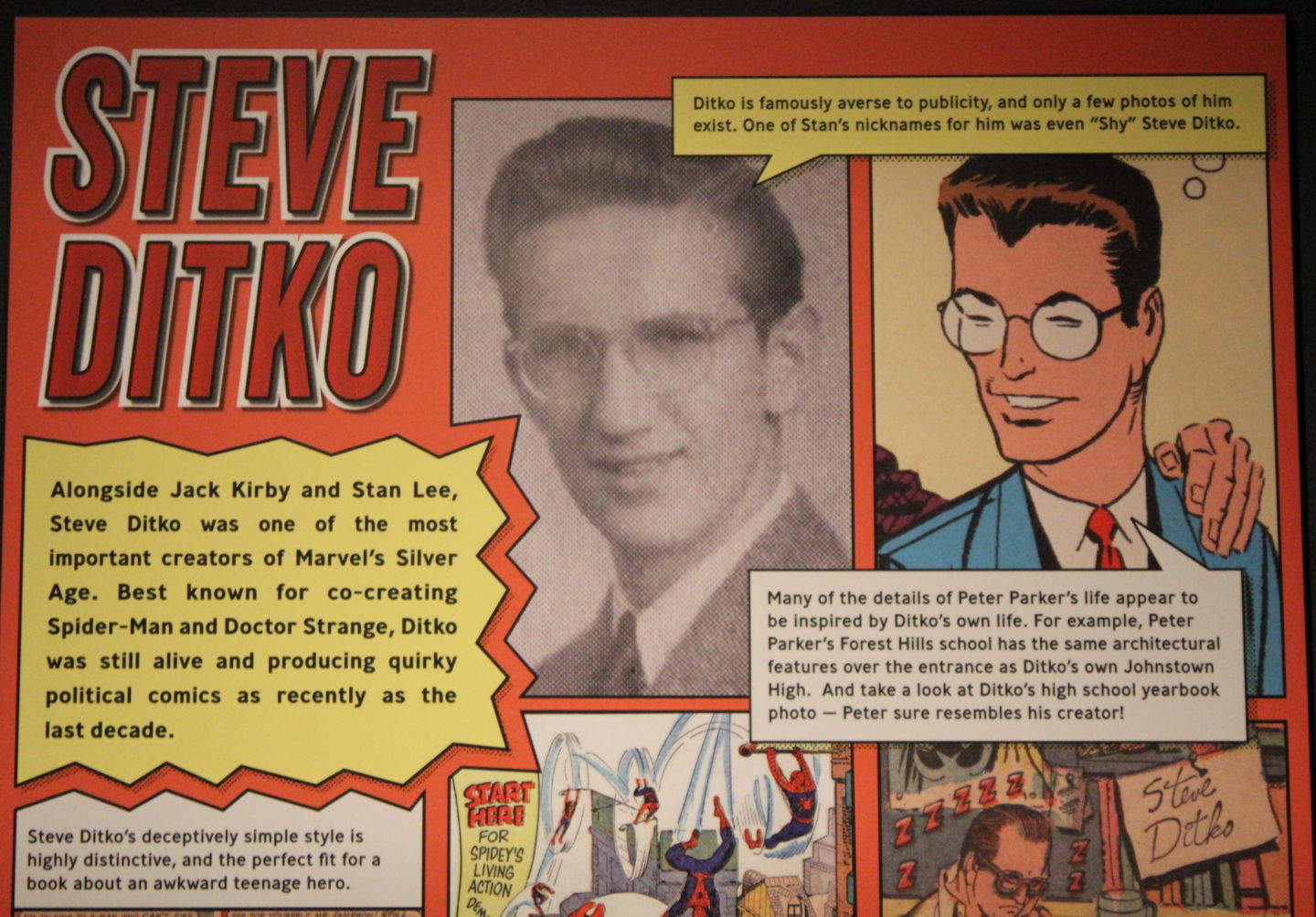
- While Stan Lee may have shaped the personality of Spider-Man, it's important to note Peter Parker was the true Author Avatar for Steve Ditko, going so far as to model himself◊ on Spidey's alter ego like Jack Kirby did with The Thing. Ditko was also introverted to the point of Stan Lee dubbing him "Shy" Steve Ditko which echoes Peter Parker's own wallflower nature (bonus points that they both grew up in Forest Hills, Queens). Really, Spidey can be seen as some level of Wish-Fulfillment for Steve. Similarly, Doctor Strange’s anti-social, solitary, and stubborn nature is akin to his creator.
- Steve Gerber used perpetual loser Richard Rory in several works, including Man-Thing and Omega the Unknown. Also bearing a strong resemblance to Gerber is Paul Same, the introverted artist neighbor from Howard the Duck, and Jack Norriss from The Defenders. According to Marvel writer/editor Jo Duffy, these characters were known as "Gerberoids."
- Superlópez: Author Juan López sometimes draws himself, usually as a background character. Not to mention that the titular character is called, well, Juan López. That doubles as a Fridge Brilliance because Juan López is a pretty common name. If he were called José Pérez, it'd have been in theory the same.
- Superman: Jerry Siegel and Joe Shuster conceptualized Superman in response to the turmoil of their own lives being ostracized for growing up as Jewish kids as well as immigrants (much like Supes himself). Paradoxically the initial idea was for Supes to be the villainous "Übermensch" lambasting Nietzsche's idea which Siegel and Shuster abhorred. However, Joe Shuster flipped this around and made Superman the hero, the ideal man who would fight the perceived injustices and wrongs as a kind of Wish-Fulfillment for the pair.
- Tintin: Tintin is naturally based off Hergé with even some physical similarities to boot, however since Tintin was idealistic Herge reflected more of his flaws into Captain Haddock. Interestingly Snowy Tintin's loyal dog was based off Herge's childhood sweetheart whose nickname was "Milou" Snowy's French name.
- Ultimate Spider-Man: Kenny "Kong" McFarlane was a very clear one for writer Brian Bendis; not only did he look just like a teen version of Bendis (which was made even more obvious when Bendis made an outright Creator Cameo and was drawn identical to Kenny), but he would echo many of Bendis' opinions, and even functioned the way a Self-Insert Fic character would. He got Character Shilling from others, was made one of Peter's closest friends to the point of supplanting the role of other canon characters (notably, Flash Thompson), and even became a Beta Couple with Kitty Pryde, a character that not only has Bendis admitted to having a crush on, but her Creator's Favorite status is so infamous he's received a (playful) Take That! over it in the past.
- In the German comic Werner:
- Some believed that Werner and Brösel are the same person. In fact, however, Brösel's Author Avatar has been a Werner look-alike with glasses in the first few books. Around the time when Beinhart! was produced with Brösel starring as himself in the live-action parts, he drew a more faithful comic version of himself that also appears in later books.
- Brösel drew both himself and guest artist Jörg Reymann into Volle Latte! He went by the name Ørg to make it less obvious.
- Wonder Woman:
- It's interesting case with Wonder Woman and her creator William Moulton Marston as it's more accurate to say Diana is based off Marston's wife Elizabeth and their lover Olive Burn with Marston himself being more in line with Steve Trevor. It's true Wonder Woman being Bound and Gagged in many issues was a reflection of Marston’s fetish for bondage, but Diana breaking the chains herself◊ was also symbolic of the Women Suffrage movement which Marston his wife and Olive Burn supported.
- Wonder Woman (1942): Robert Kanigher wrote himself into the story to "retire" a bunch of characters he didn't want to write anymore. This meant that the characters were told by their writer they were being erased from continuity before he stopped using them and acted like they'd never existed.
- Wonder Woman: Black and Gold: Liam Sharp, the writer and artist of "The Prophet", is the main character of said story.
- It's interesting case with Wonder Woman and her creator William Moulton Marston as it's more accurate to say Diana is based off Marston's wife Elizabeth and their lover Olive Burn with Marston himself being more in line with Steve Trevor. It's true Wonder Woman being Bound and Gagged in many issues was a reflection of Marston’s fetish for bondage, but Diana breaking the chains herself


- The title character in Cathy is a stand-in for creator Cathy Guisewite.
- In Dilbert, creator Scott Adams spends a couple strips "trapped" in his own creation.
- Elly Patterson, in For Better or for Worse. In fact, the entire Patterson family was modeled after the Johnston family, with each character's first name being the middle name of their real-life counterpart—except Elly, who was named after a childhood friend of Lynn Johnston who died at a young age.
- FoxTrot: Jason Fox = Bill Amend. There's also a Running Gag of characters reading newspapers that have headlines extolling a godlike "Author", who does things like winning the Nobel Prize, jamming with Bruce Springsteen, and dating beautiful supermodels.
- In Garfield, Jon Arbuckle is more or less an avatar of Jim Davis. Like Davis, Jon is a cartoonist who grew up on a farm and had some out-there dating experiences.
- In Overboard, the author (who apparently lives on the ship with the rest of the pirates) appears as a nondescript man seated at a comicker's desk. The cast occasionally come over to complain about a plot element or attempt to convince him to write something in for them.
- Pearls Before Swine: Stephan Pastis appears from time to time in his cartoons, often to get yelled at by his characters. A recurring gag in the strip involves one of the characters (often Goat or Pig) making a particularly bad pun, immediately followed by a panel depicting Rat insulting Pastis for making that pun.
- During a brief arc where Darby Conley and Pastis collaborated on a gag, Conley appears in one or two Get Fuzzy strips where Pastis tries to peaceably get Conley to cease and desist his blatant ripping off of the day's Pearls Before Swine strips. He looks a bit like Rob, but distinct enough that you can tell you're looking at someone else; he portrays himself as an arrogant jerk who forgets Pastis's name as soon as he's done lying through his teeth at him.
- Sabrina at See-CAD: Creator Eric Schwartz's stand-in Eric Squirrel shows up at the end of the series graduating from college in the penultimate strip.
- To an extent, Misty and Lumi, from Adventures of the Writer, are examples.
- Back to the Frollo: Danisha in this The Hunchback of Notre Dame fic.
- Blixemi: Blixemi's avatar is a cat with various shades of brown all over her fur, fluffy ears, freckles, and purple eyes.
- Blooming Dreemurr has Vee's character, Vee, though she doesn't actually interact with any of the characters lately, and just uses the character for OOC updates it seems.
- "But... I Made You!" or "The Day I Met My OC": Kind of a weird example—each of the six authors featured in this collaboration meet their own My Little Pony: Friendship Is Magic Original Characters. Chapter 3 also involves Blade Star the character meeting Blade Star the author, which also helps for those who accused the original fic of being a Self-Insert Fic.
- The Captain of the Virtual Console has Gancena, an avatar for the troper Gancena.
- Child of the Storm has Doctor Strange, who the author has admitted is pretty much an author avatar - or at least, since it was apparently entirely accidental, "as close to one as I'm ever likely to write". This is unsurprising, considering that Strange is a mysterious schemer and master Magnificent Bastard who specializes at lying with Exact Words, is behind most of everything that happens in the book, ties it all up pretty neatly... and is a colossal Troll who will do things simply because he thinks that they're funny and both cast and reader frequently want to punch in the mouth.
- The Child of Love: The main characters and their friends often go to an arcade game center whose owners are avatars of the writer and their friends. Unlike some examples, their presence is not intrusive at all, and they remain secondary characters who seldom show up.
- Lady Delphine in the Contractually Obligated Chaos series is admitted by the author to be "slightly" one of these. She shares the author's Law of Inverse Fertility backstory and resultant tendency to take in "strays."
- In Crack Ronpa, the author pops up and speaks every now and then. He often talks to the characters, and he can interact and change the world at his will.
- Wolf of Craziness Candy Jedi Knights And What is clearly the author, Do a Barrel Roll.
- The main characters of The Cubearth Saga are avatars of rafer and J735 as Geometry Dash cubes, with each one being the focus of their creator's levels and animations.
- Fanfic writer CVGW James has made characters of himself themed after the franchises he writes for.
- James the Hedgehog is himself as a Sonic-esque hedgehog character.
- Jim Mic'Cormack is his Inksona.
- Jimeho is an omnipresent version of himself that observes The Multiverse and occasionally acts as a Character Narrator in his stories. He's also called "the Multiversal Observer", or just "the Observer".
- James the Hedgehog
- CyberdineDreams has Tamagi Stardust, whom the author has admitted is this to a degree.
- The author of Dante's Night at Freddy's 2: Animatronic Boogaloo doesn't appear but does give Dante a phone call in reference to Scott Cawthon being the creator and Exposition Fairy in Five Nights at Freddy's. For extra Mind Screw, he has seemingly disappeared without a trace by the time the fic's sequel takes place.
- Death Note II: The Hidden Note has William Cattlefarmer. He's an actual character and is somewhat important to the overall plot.
- Flo serves as one in Diaries of a Madman, often providing the author's opinion on the actions of characters.
- The cast of Geometry Dash Episodes is almost entirely author avatars of its contributors outside of its main characters. Typically, someone creating an episode will include at least their own avatar in it.
- E350 occasionally makes appearances as a character in his Halloween Unspectacular series, which usually end in either Self-Deprecation, him whipping out his Anti-Magic Tommy Gun, or both. And, as it turns out, he's essentially the Big Good of the entire setting (at least, in its original arc), being the caretaker of the "Unspectacular Branch" of the multiverse.
- The trope is also deconstructed in the ninth edition; the Stranger's main beef against E350 is the fact that, despite all the power he has as the author, he never does anything to help the people he writes about, preferring to record events as they unfold (no matter how bad they get) and then present them as his own stories. The fact that E350 is an in-universe character also means that the Stranger is able to subject him to a far more serious form of Rage Against the Author than he normally would be able to.
- In Heirlooms, one character symbolizes each of the individual companies that contributed to the Super Smash Bros. universe over the four (or is it five) games. So far, we have Freya, Caitlyn, Harold, and Sage, who fill the parts of Game Freak, Creatures Inc., HAL Laboratory, and a surprise Early-Bird Cameo from Sega.
- The Incredibles: Rise of the Galeforces gives us one of the few Author Avatars who actually influences the plot. See that teenage boy over there in the corner? The one who is eventually revealed to be Stratogale's half-brother by way of Aperture Science and Technology? That's the author with the ability to transform into a genetically engineered Terror-dactyl.
- Edrobot in Jake English's Mysterious Theater of Scientific Romance from the Year 3000. Much like the Homestuck example below, this is played for laughs.
- In The Kedabory Verse, Stefanie Madrigal (appearing in Encanto fanfics) and Theresa (appearing in A Big Blue House in Tall Pine Grove) are the most closely based on Kedabory herself.
- In The Lion King Adventures, the Unseen Evil of the series is called the Writer. No points for guessing who he's based on...
- From Magica Madoka Veneficus Puella comes EnBey. He is a major factor in the universe's backstory, as he was the one who initiated the Incubators' civil war in the first place.
- 111SAMUSRIDLEY4EVA2006 included herself as a character in her story Metroid High School. Without changing the name in any way.
One day Samus and Ridley and her frends Ted, Mandy, Robbie, 111SAMUSRIDLEY4EVA2006, Helen, and Tio Juan were at a sleepover.
- Miraculous! Rewrite has fun with this in its adaptation of "Animaestro", which features Astruc's own self-insert. The co-creators appear as a pair of critics who are thoroughly unimpressed with his lackluster offering, criticizing his depiction of Ladybug as a Faux Action Girl and focusing on a Romantic Plot Tumor. Marinette and most of the main cast agree, triggering his akumatization in his fury at having his 'artistic vision' challenged.
- The author of Moirailegiance is Science outright describes herself as "a cheap knockoff of Andrew Hussie", and pretty much serves the same role in the fanfic as his Author Avatar does in the Homestuck canon proper. And she didn't just write the fanfic; she kidnapped Hussie and hijacked the plot.
- In Must Love Ned Flanders, Naomi Sanders is meant to be the author because both have crushes on Ned Flanders.
- Ebony Dark'ness Dementia Raven Way of My Immortal. Made even more obvious because the author sometimes uses her own name in place of Ebony's.
- My Brave Pony: Starfleet Magic by Dakari-King Mykan has three.
- Lightning Dawn.
- The Grand Ruler, whose design is directly lifted from the author's OC cosplay and Word of God even states that he's voiced by him. When he came up with the concept for the first time, Celesto was even going to be named Mykan.
- Titan is theorized to represent the deep-seated hatred the author has for ''FiM''.
- Dr. Kudos in Starfleet Magic IV represents Mykan's hatred of friendship, love, and especially, redemption.
- Human in United Equestria features a character named Mykan Stevens. His pony self appears in season 6 and acts pretty much like his real-life counterpart.
- In The Official Fanfiction University Of Middle-earth, Miss Cam is a stand-in for Camilla Sandman.
- The Advisor in Perfection Is Overrated, who gives the Himes most of their exposition on the SUEs. He is also known as the Avatar, and he created the SUEs and set them against the Himes to determine whether such characters could survive or achieve her goals without the author's support; he chose not to support them or the Himes because if he wholeheartedly helped one side, that side would win. The Himes are not pleased when they find out, and Natsuki even tries to kill the Avatar to prevent anything of the sort from happening again.
- The Pieces Lie Where They Fell: Beta-reader and co-writer Anon e Mouse Jr. includes an author avatar of himself with the powers (and then some) of Kamen Rider Skull in the non-canon omake chapters, where he tends to pop in and give some information to the characters before disappearing again. His words are chosen to be truthful, but careful not to spoil the plot.
- In Pony Pals: Dirk Strider Edition, a full version of the modified version of Detective Pony which Dirk made in Homestuck, Dirk himself is a character who appears around halfway through the book.
- Taken to its logical extreme with The Pretty Cure McLaughlin Club, as its author explicitly puts himself in the role of the unnamed moderator.
- Brownie is this in the fic Rainbow in the Dark
- A rare in universe example: Bonbon of the Reading Rainbowverse runs both Crystalstuck and the DM Bonbon blog, leading to an NPC based off her relationship with Lyra.
- Julia Nakahamou is Sephirothslave's (extremely obvious) avatar in her story Shinra High SOLDIER.
- The author of The Lion King fancomic Simba's Legacy places her fursona in as Vitani's daughter.
- Yogui's Avatar shows up when you achieve 100% Completion in the Something Series. He gives the player his Word of God and congratulates you for completing the game.
- Eric the Hedgehog from Sonic X: Dark Chaos is pretty deliberately one of these. Except not really - his name isn't actually "Eric" and he's a Deconstructive Parody of this trope.
- Hypnos Technicion and agent of the Triad, Daneel Randt from the Tamers Forever Series, although he's a rare example of a Self-Insert that doesn't hog the spotlight and rather, serves as more of a Mr. Exposition character.
- Alex Vaughn, the central protagonist of the supercrossover military fanfiction series, The Terminators: Army of Legend, is stated by Word of God to be an "idealized" version of the author, Sir Areis Lionheart.
- In To the Troll and the ToD Writers, Pit voices the concerns of the author, Pit FTW. He is even a fanfiction writer with two fanfics with titles extremely similar to Pit FTW's.
- Curtis (pen name: Curtis Wildcat) in the old crossover What Insertion? ends up as part of a Mind Hive at the back of Hellmaster Phibrizzo's consciousness. It's hinted on several occasions that he's aware that he's very much out of his element in this situation, so he's content to let Phibrizzo and Inuyasha do all the heavy hitting while he lazes about.
- The author has observed that Emrys of The Wizard in the Shadows actually started as a Self-Insert Fic, albeit an unintentional one, before he developed a personality of his own. This was only noticed in embarrassing retrospect. It has also been suggested that Harry took on a few of the author's personality traits (along with those of Harry Dresden), though how much of this Write What You Know and how much is Signature Style is ambiguous.
- Child at Heart Forever occasionally inserts herself in her original stories, usually the ones that cross over the Super Mario Bros. and Sonic the Hedgehog franchises. Surprisingly, her Paper Mario X magnum opus has her kept neatly outside the story, preferring to talk on the author's notes—that characters have occasionally invaded, causing Child to have conversations with those characters. Child's sister Natalie also makes a part of these notes later on, usually on the final chapter of each story.
- Wolfie, and Hussie: Engage in highly indulgent self-insertion into story.
- Rory, one of the students at Skyhold Academy in Skyhold Academy Yearbook, is admitted to be this for one of the co-authors.
- The April Fools' Day chapter of Pokémon Reset Bloodlines features main author Crossoverpairinglover writing the fic (with a chainsaw of all things) and then arguing with an Anthropomorphic Personification of Executive Meddling, who tries (futilely) to sway the author to take the story in different directions, in what is the most hilarious Take That!.
- In Citadel of the Heart, Ultimorian Deity Grandis is noted to be a weird example of this. While it is true the author flat out confirms Grandis to be this, even gladly admitting he'd voice the character and to the point he has the same real-life name aside from his title, Grandis overall tends to take a backseat towards the other Ultimorian Deities a lot, or at most lets his son do much of the work for him. It gets to the point where he has a very distinct King in the Mountain status to the point many in-universe and out wonder why he's supposed to be the King of the Ultimorian Deities in the first place. Which that in and of itself is because of a string of incidents which lead to him being Kicked Upstairs for the simplest explanation in an otherwise more complicated discussion one could have regarding the nature of his existence. Also, the fact Grandis isn't even the strongest Ultimorian Deity, nor is he the strongest of the original works originating characters in the entire Series Fic.
- From the Professional Wrestling series The JWL: In the service of a Take That!, Paul E. Dangerously, on "Will You Still Need Me, Will You Still Feed Me, When I'm Episode 64?". 911 had just Squashed Mr. World Cupnote . After the match, the fans chanted "One more time! One more time!"
PAUL E. DANGEROUSLY: "Mr. World Cup, I am going to dedicate this next chokeslam to every American boy and girl who has ever had to play your stupid, boring, uneventful, idiotic, and, in every sense of the word, POINTLESS so-called sport."
- Miraculous! Rewrite: As "Animaestro" already featured a self-insert version of the show's creator as the director of the In-Universe Ladybug movie, the creators of the blog insert themselves into the episode's rewrite as a pair of internet critics who end up panning said movie, much to his ire (a Take That! towards several flaws the original show had, as well as how Astruc tends to handle criticism on Twitter).
- This trope is used as the final gag in this Miraculous Ladybug fic; the author insert ends up being the cherry on top to the ridiculous guests (ranging from celebrities to outright gods) Marinette ended up inviting to her party. Said author insert cheerily declares she's there for the free shit and the boys.
- The Winglet's videos often feature a Blu Demoman with a party hat, based on his in-game loadout from Team Fortress 2.
- Directing duo Ron Clements and John Musker are often caricatured as background characters in the Disney films they direct, starting with a pair of villagers◊ who briefly appear near the beginning of Aladdin. They also appear in various forms in Hercules, Treasure Planet (as robots), The Princess and the Frog, and even in Moana (as figures on a tapestry).
- Toy Story 2: The toy repairman can be seen as this, since he tells Al that he can't rush art... much like the Pixar films themselvesnote .

- Adaptation. invokes this in one of the many ways in recurses in on itself.
- Keith Toshko from Barbarian is a lanky, awkward (but ultimately charming, funny, and well-intentioned) man, who also happens to be a founding member of a famous troupe of artists- pretty obviously a stand-in for the director/writer Zach Cregger of The Whitest Kids U' Know (Keith explicitly specifies that he's not "the guy", which seems to be a reference to the recently-deceased "face" of the group Trevor Moore).
- In Basquiat, a biopic of the successful but short-lived artist Jean-Michel Basquiat, director Julian Schnabel—a New York-based artist himself during the time the film is set—includes another rising artist based on himself named Albert Milo.
- In Blue Is the Warmest Color, according to Word of God, aspiring actor Samir is a stand-in for Kechiche as he asks Adèle if the intimacy with women is different from men.
- Lieutenant Werner in Das Boot is a stand-in for Lothar-Günther Buchheim, the author of the novel the film is based on. Buchheim had been a war correspondent aboard a U-boat during World War II and the novel is a partially fictionalised account of his own experiences.
- There's a simultaneously in-universe as well as meta-fictional example in In the Mouth of Madness. The Sutter Cane that Trent encounters is strongly hinted to be only a representation of the real Sutter Cane, who is writing the story outside of the fictional universe that Trent and by extension the movie exist in. Either that or Cane's rewriting of reality has gotten so strong that he can visit his own stories at will.
- Tommy Wiseau of course of course embodies Johnny the trouble protagonist of The Room (2003) the movie he directed and produced. Johnny is overtly adored by almost everyone in the film and gives wisdom about life, Greg Sestero also muses that Johnny's anger towards a cheating fiancé and caring for Danny like a younger brother are possibly elements taken from Johnny’s own life.
- David Cronenberg's adaptation of Naked Lunch and Steven Soderbergh's Kafka feature thoroughly fictionalized versions of William S. Burroughs and Franz Kafka respectively as their protagonists, while combining elements from both their lives and their works.
- Kevin Smith largely avoids this in his own movies, appearing as Silent Bob... until the very end, when he either has a huge hand in resolving the plot or delivers a critical bit of wisdom in one of his few speaking lines.
- Dogma is his character's least invasive role, where he utters maybe five words the entire movie, though he does still help out with Jay a fair bit.
- Smith apparently wrote the role of Randal in the first Clerks movie for himself, but when he had difficulty memorizing all the lines, he decided to cast Jeff Anderson as Randal and became Silent Bob.
- Oddly, he acted more like his Real Life self in the movie Vulgar, which he neither wrote nor directed.
- Kevin Smith's "Silent Bob" moment in which he possibly comes the VERY closest to ever being the real Kevin Smith was during the climax of Jay and Silent Bob Strike Back, in which he launches into a shockingly knowledgeable diatribe about the legal transference rights of intellectual properties.
- M. Night Shyamalan has cast himself in very small speaking roles in all of his films for simple Creator Cameos but then in Lady in the Water, Shyamalan cast himself as a writer who gets a suspiciously large amount of Character Shilling.
- One gets the sense that Tim Burton is the main character in many of his own movies. Maybe the most obvious was Edward Scissorhands, whose main character was a messy-haired Eerie Pale-Skinned Brunette with a macabre look about him who had trouble fitting in. This goes double if played by Johnny Depp—one Hollywood producer explained that "Basically, Johnny Depp is playing Tim Burton in all his movies." Depp actually agreed.
- Quite common in Woody Allen's films. Even among the films Allen doesn't act in. Deconstructing Harry is built on the interaction between the writer protagonist (played by Allen) and several characters from his fictional pieces, including one ("Ken") who states he's a "thinly disguised version of you". In Bullets over Broadway, John Cusack spends the whole movie doing a very accurate impression of Woody Allen.
- When conceiving of Operation Y and Shurik's Other Adventures, the Soviet film director Leonid Gaidai based the main character Vadik on himself. In fact, when casting the character, he went through over a hundred actors before settling on Aleksandr Demyanenko, mostly due to the actor's resemblance to Gaidai. He then turned the actor into The Danza by renaming Vadik to Shurik, a short form of "Aleksandr". Gaidai then made two more films with Demyanenko as Shurik (Kidnapping, Caucasian Style and Ivan Vasilievich Changes Profession), although it's not clear if it's the stories are supposed to be connected.
- Charlie Mortdecai from Mortdecai, as his opening voiceover has him stating that he is an art dealer, accomplished fencera, and fair shot with most weapons just like Kyril Bonfiglioli's book jacket author biography states.
- In The Kid & I, Bill Williams is a transparently obvious avatar for screenwriter and star Tom Arnold.
- The career of Ellison Oswalt, the protagonist of Sinister, bears a lot of similarities to the film's director Scott Derrickson. Both of them had a successful streak only to fall into obscurity (for Derrickson this happened after the utter flop of the remake of The Day the Earth Stood Still). Ellison's fear of constant failure is what drives him to keep investigating the Stephenson massacre, despite the damaging effect it has on him and his home life. Derrickson has admitted he based the character's development on his own anxieties as a film-maker.
- Marwood from Withnail and I is a stand-in for the film's writer and director Bruce Robinson.
- The Sensei for Scoundrels who the main character of School for Scoundrels (1960) consults is Mr. S. Potter (played by Alastair Sim). The author of the spoof advice books Dr Potter's academy is based on was Stephen Potter.
- White Hunter, Black Heart is told primarily through the eyes of a young writer named Pete Verill. Verill is a thinly veiled version of author Peter Viertel, who writes a novel on which the film is based and also contributed to the screenplay. The story is based of Viertel's experiences working on The African Queen.
- She Dies Tomorrow: The lead character is named Amy and looks quite a bit like a younger Amy Seimetz, the writer/director.
- In The Devil's Playground, the main character Tom Allen serves as a fictional stand-in for director Fred Schepisi, who grew up in a Catholic juniorate similar to the one in the film and based its story on his own experiences there.
- In Maradonia and the Shadow Empire, main character Maya (who was also a direct author avatar in the basis Maradonia Saga book series) is an author avatar for Gloria Tesch, but Gloria takes it to the next level in the film by actually playing the role of Maya herself instead of hiring a professional actress to do it. The film makes this trope more obvious than the book series does, not only because Gloria plays Maya, but also because Gloria was 22 years old trying to play her young teenage author avatar from when she originally wrote the books as a minor.
- In-Universe in Please Turn Over; The heroine of Naked Revolt is Blanche Gaunt, who was based on the writer, Jo Halliday, and everyone in the book is based on people Jo knows in real life.
- The NIN9S: Gavin, a gay screenwriter who's close friends with Melissa McCarthy, is a fairly obvious stand-in for writer-director John August, also a gay screenwriter who's close friends with Melissa McCarthy. The main difference is that Gavin is a television writer while August mostly writes film scripts.
- Roberto Bolaño's fictions, besides poems, are very autobiographical, as it often share same elements from his own life.
- Arguably the father of the modern Author Avatar was E. E. "Doc" Smith, particularly with The Skylark of Space, generally agreed to be the first work of what is now called Space Opera.
- The character Grigoriy Aleksandrovich Pechorin in Mikhail Lermontov's A Hero of Our Time fits this trope perfectly. So much so that, much like Pechorin, Lermontov had an obsession with dueling—which ultimately led to his death.
- James Branch Cabell:
- In several volumes of Biography of the Life of Manuel, a character named Horvendile has the reputation of being insane because he insists it is a world he created, and they are all characters he made up. This is borne out when they keep obeying his eccentric directions without knowing why, or even admitting it. In other volumes, there are references to him as "Orven Deal" or "Frank Vanringham".
- In the trilogy The Nightmare Has Triplets, the dreaming author appears in successive volumes as Smirt, Smith, and Smire.
- The initially unnamed narrator of Justine is a paper-thin placeholder for author Lawrence Durrell. In later books, the narrator's name is revealed to be L. G. Darley—their initials are identical.
- In An Elegy for the Still-living Jeremy Reinertson appears briefly to retrieve an umbrella, tell Francis a story, and generally wreak havoc with the fourth wall.
- Any work by Leo Tolstoy will have one.
- In the novel Anna Karenina, the character of Konstantin Dmitrievitch Levin is an Author Avatar: Tolstoy and his wife courted using the "letters game" that Levin and Kitty used in the novel. Also, Levin's musings on philosophy reflects Tolstoy's own internal debates at the time, and his idea of economic reforms that could be enacted to improve the Russian Empire's agricultural efficiencies were those suggested by Levin.
- He has two in War and Peace.
- By his author's own admission, Nick from Atharon is Author Avatar, acting and behaving the same way author would have done in the world. Only Nick has six-pack instead of beer belly. And magical powers.
- In Sergey Lukyanenko's Autumn Visits, the science fiction writer Yaroslav Zarov is a clear avatar of Lukyanenko. Several of Zarov's novels appear to be novels that Lukyanenko wrote himself. Additionally, Lukyanenko would later use Yaroslav Zarov as his pen name for some published works.
- Esther Greenwood, the protagonist of The Bell Jar, is Sylvia Plath. Essentially every aspect of Esther from her appearance, talent for writing, bad luck with hypocrite boyfriends to her mental breakdown, suicide attempts, and subsequent hospitalization can be traced back to Plath herself in some way. Which takes a deliciously meta twist when Esther starts a draft of an account of her experiences, which is obviously The Bell Jar in a nascent form.
- Fame, Blame, and the Raft of Shame, a Brave Books installment written by Dan Crenshaw, features a war-veteran mountain lion version of himself, complete with a Purple Heart medal and his distinctive eyepatch. The story's plot draws much influence from his Saturday Night Live experiences.
- Older Than Print: Geoffrey Chaucer shows up as one of the pilgrims in The Canterbury Tales, and is the only one to get two stories out. The first is horrible, the second is applauded.
- The eponymous protagonist of The Chronicles of Steve Stollberg is a stand-in for the author, voicing the author's beliefs that conspiracy theories are stupid.
- The Grandmother: The Prošeks' girl, Barunka, is shown to have a special relationship with the Grandmother (who herself was based on the author's maternal grandmother Marie Magdalena Novotná). Her name is short for Barbora, the author's birth name and the novel is inspired by elements from the author's childhood.
- Conciencia y Voluntad features a dead avatar of the author, as Esteban Ruquet is one of the characters actually, at the time of the novel, the real avatar is long dead, and his imposer, Rocafirme, is another author avatar.
- Arthur Brown in the Deptford Mice trilogy represents Robin Jarvis.
- Dante Alighieri put himself explicitly into The Divine Comedy as the main character.
- Grace Richards MP in The Division Bell Mystery shares a number of characteristics with the author, "Red Ellen" Wilkinson MP.
- The Dogs of War has the Corrupt Corporate Executive consult a journalist known for his knowledge of African mercenaries while planning the coup. He's never named, but it's clearly Frederick Forsyth, freshly back from the Nigerian Civil War.
- Don Quixote: Cervantes dedicates some chapters of the first part of the novel to "The story of the Captive Captain", Ruy Pérez de Viedma, a Spanish captain who was prisoner of the Moors. Curiously, this man, like the Priest, claims to know some guy called "de Saavedra".
- L. M. Montgomery admitted that the protagonist of the Emily of New Moon series was based on her, saying, "People were never right in saying I was Anne. But in some respects, they will be right if they write me down as Emily." Unfortunately, this means that Emily's glossy locks, purple eyes, literary genius, string of hopeless suitors, and psychic powers move her toward Canon Sue territory.
- Many scholars believe that Lewis Carroll intended the Dodo in Alice's Adventures in Wonderland and the White Knight in the sequel to be caricatures of himself. (Carroll himself never confirmed or denied this.)
- In Eric, the Creator of the Discworld is described as a little rat-faced man with a put-upon voice made for complaining. It is strongly implied that the Creator's physical appearance is a reference to Terry Pratchett himself, and he is a self-parody of Pratchett's own act of creation in writing the novels.
- Spenser wanted an excuse to brag about how lucky he was to marry a beautiful Irish gal, so he inserted himself in into The Faerie Queene as "Colin Clout" and had the guy encounter a poor maid more beautiful than Venus' children.
- The protagonist of Fear and Loathing in Las Vegas is actually named Raoul Duke, not Hunter S. Thompson...
- In The Saga of Darren Shan by Darren Shan, guess which chosen Vampire Prince was based on the author? The answer: apparently, there are two — obviously, he based the eponymous hero on himself, but the Big Bad (Darren's childhood friend Steve) is, as he says, another side of the same coin.
- In A Series of Unfortunate Events it is heavily implied that the narrator/author,Lemony Snicket, is a character who is important to the plot. Later, this is confirmed.
- V. C. Andrews's character of Cathy Dollanganger from Flowers in the Attic is this. Cathy is amazingly beautiful, she can attract every man who even looks at her, and she is the only one who craves vengeance for being wronged, while the others who survived the same ordeal just want to leave well enough alone.
- Douglas Hofstadter inserted himself into his final dialogue in Gödel, Escher, Bach: An Eternal Golden Braid. Given the odd events his characters go through in every dialogue, meeting their own author barely provokes a reaction. The non-fiction inside is even more of a Mind Screw than the dialogues.
- The Golden Ass is a novel by Lucius Apuleius, about a man named... oh wait... Lucius Apuleius.
- If Nagaru Tanigawa wants to show off complex concepts in Haruhi Suzumiya, he uses Koizumi, and adds a "just kidding" at the back. If he wants to show off his general knowledge, he uses Kyon and his references.
- Skeeter in The Help is a blatant stand-in for the author, Kathryn Stockett. Kathryn Stockett wrote this book to discuss the plight of black maids in 1960s Mississippi. The book is about a white woman in the 1960s who writes a book (called The Help as well) about the plight of black maids in a Mississippi.
- The way Nora Grey from the Hush, Hush series is described bears similarities to how Becca Fitzpatrick looks in terms of hair and body build.
- Joris-Karl Huysmans, the author of A Rebours, wrote four novels: Là-bas (1891), En route (1895), La cathédrale (1898), and L'Oblat (1903) centering on Durtal, who serves as a stand-in for Huysmans. Like Huysmans himself, Durtal would convert to the Catholic faith and become a Benedictine oblate.
- In I Am the Messenger, the author Markus Zusak shows up at the end of the story to tell the main character, Ed, that he's the one responsible for everything that's happened to him through the course of the book. In fact, everything that's happened to Ed in his life up to that point, like his father's death, can be blamed on Zusak for making it happen.
- I, Lucifer by Glenn Duncan has failing writer Declan Gunn, whose body is given to Lucifer to live as a mortal for a trial run.
- Inheritance Cycle: by the author's own admission, series protagonist Eragon was initially written as a reflection of himself doing the things he would like to do, but Eragon has become more of his own character as the series has progressed.
- There's a meta-example in Jim Springman and the Realm Of Glory. When the protagonists' entire town gets absorbed into a fantasy book, one of their ideas is to contact the author by finding her Author Avatar. Turns out her avatar's the villain, not the hero like they'd suspected.
- Douglas Coupland plays a part in his novel jPod, in which all the main characters are fans of his earlier works. As it turns out, he's a "sociopathic shit" who steals the main character's friends and colleagues (even his mom), and tricks him into handing over his laptop on which the entire novel is based, spam mail, porn collection, and other stuff included.
- Sir Max in Labyrinths of Echo is named after the author's pen name (or rather the books are presented as his fictional autobiography). He is also far more powerful than the other characters, he becomes popular rather than staying the friendless nerd he used to be, and the books themselves contain quite a lot of things the author likes, such as coffee and cats.
- David Rain is Chris d'Lacey's Author Avatar from The Last Dragon Chronicles.
- The authors of the Left Behind series are terrible about this, as they combine very obvious author avatars in the heroes (Rayford Steele for Tim LaHaye and Buck Williams for Jerry Jenkins) with raging Canon Sue complexes. This gets really, really hilarious when the authors get things blatantly wrong due to their limited understanding of reality (Williams, supposedly "really physically fit", is about ready to pass out after a two mile walk through the streets of New York—something that the overweight Jenkins probably would find uncomfortable). Although it's more severe with Buck, since Buck is Jenkins' avatar, and Jenkins is the one who does the actual writing.
- Word of God has it that Faramir is J. R. R. Tolkien's avatar in The Lord of the Rings. Beren from The Silmarillion is also his author avatar. That name is even inscribed on his tombstone! And "Lúthien" is inscribed on the tombstone of his wife, Edith. According to him, the story of Beren and Lúthien was their story. (Clearly, he embellished it somewhat). Bilbo from The Hobbit and The Lord of the Rings also draws heavy similarities to his creator, being a stand-in for Tolkien in his later life as a middle-class, tobacco smoking writer and linguist. Even Tolkien’s illustrations of Bilbo◊ more than passingly resemble himself.
- The protagonist and narrator of Bret Easton Ellis's Lunar Park is a fictionalized suburbanite version of himself, cleverly named... uh, Bret Easton Ellis. He fears characters from his books are coming to life and murdering people. Naturally, it's completely fucked up. Could also qualify as As Himself.
- Multatuli's novel Max Havelaar actually has multiple, which the author admits in a fourth-wall breaking monologue near the end.
- The Millennium Series features the intrepid 40-something Stockholm journalist Mikael Blomkvist, who writes for Millennium magazine, which is dedicated to anti-fascism and exposing political corruption. The books were written by 40-something Stockholm journalist and author Stieg Larsson, who edited the anti-fascist campaigning magazine Expo.
- It's probably not a coincidence that the heroine of The Mortal Instruments is named "Clary" while the author's name is "Cassandra Clare", which would result in some interesting implications if Cassandra Clare has a brother. (It is worth noting, however, that Cassandra Clare is just a pen name; the author's real name is Judith Rumelt.) Clare has stated, when asked by a fan "What kind of a name is 'Clary'?", that she was named after a friend, whose full name is Clarissa, much like the Clary in the books. The only real similarities seem to be red hair (though Clare also states that she imagined Clary's a much darker shade) and the first four letters of their names.
- A particularly dismal example shows up in Moscow - Petushki. Despite all the comedy, it's depressing when you realize that the real-life Venedikt Erofeev was, like the fictional one, living a miserable life that was unlikely to get better anytime soon.
- My Name Is Red has author Orhan Pamuk and his older brother Shevket appearing as minor characters. So too does his mother, Shekure, who's one of the most important characters. A character, supposedly the author Orhan Pamuk, plays a larger role in Snow (2004), where the last few chapters are about him investigating the fate of his friend who starred in the earlier part.
- Possibly (according to several fan theories) Pseudonymous Bosch in The Name Of This Book Is Secret and If You're Reading This, It's Too Late.
- Proven in the fourth book, when Max-Ernest sees himself in the mirror as the author... kind of. He also likes chocolate as much as him, so...yeah.
- This is eventually confirmed in the fifth book.
- Michael Moorcock appears as his own great-grandfather in the first two books of the 'Nomad of the Time Streams' sequence of novels (The Warlord of the Air and The Land Leviathan), and as himself in the third (The Steel Tsar).
- J Eifie Nichols shares dress style, as well as character traits and a few skills, with Julius Adams in The Radiant Dawn.
- Drosselmeyer in The Nutcracker has been claimed to be a self-portrait by the author E. T. A. Hoffmann.
- Dirk Pitt Adventures: Author Clive Cussler makes appearances in most of the novels. The character usually has something named Periwinkle with him (a boat, a car, or in one case a donkey) and tends to act as a very small Deus ex Machina to get Dirk out of whatever jam he's currently in (typically by simply providing him with transportation from point A to point B.) He'll often dole out small bits of wisdom, advice or insight as well. No matter how many times Dirk meets him Clive always seems familiar but Dirk fails to place him. Interestingly, this wasn't done as a self-insert but rather to see what his publisher would allow him to get away with. Dirk Pitt himself has a few things in common with the author, such as collecting classic cars and working for NUMA (although the NUMA in the books is quite a bit different than the real-life NUMA).
- On Earth We're Briefly Gorgeous: Protagonist Little Dog's story greatly echoes the author Ocean Vuong's, as a Vietnamese immigrant to the US who struggles with his sexuality.
- Sal Paradise from Jack Kerouac's On the Road. In the "scroll" draft of the book, all the characters corresponded to Kerouac's real life colleagues. For example, Neal Cassady became Dean Moriarty; Allen Ginsberg became Carlo Marx.
- Jeanette Winterson's novel Oranges Are Not the Only Fruit, in which the narrator is named Jeanette, has a lot of autobiographical elements.
- The narrator of Oroonoko is a female British colonist in Surinam, which is similar to the author Aphra Behn's experience.
- The metafictional children's book A Pack of Lies by Geraldine McCaughrean has an in-universe example. The central character of the book is a young man with an implausible name, who is handsome, charming, athletic, and an accomplished raconteur with a mysterious past, who even the other characters start to think is a bit too good to be real. A Nested Story Reveal at the end shows that the entire book up to that point has been a story being written by a lonely young man who inserted himself into it as a Canon Sue.
- Oscar Wilde, not wanting to be simple about it, is all three of the leads in The Picture of Dorian Gray, or so he claimed. His exact words: "Basil Hallward is what I think I am: Lord Henry what the world thinks me: Dorian what I would like to be — in other ages, perhaps."
- The Railway Series: The minor character referred to in the books only as "The Thin Clergyman" is in fact the Rev. Wilbert Awdry, author of the series. His companion, The Fat Clergyman, is Wilbert's friend the Rev. Teddy Boston.
- W. Somerset Maugham includes himself as a minor character in his novel The Razor's Edge.
- Brian Jacques has stated that he based the Redwall character Gonff the mousethief on himself.
- P. Frank Winslow in F. Paul Wilson's "Repairman Jack" novel Bloodline. Amusingly, Winslow has a character called Jake Fixx to reflect Wilson's Repairman Jack... okay, the recursion is starting to hurt.
- Philip José Farmer uses these a lot:
- His Riverworld series has as a recurring character Peter Jairus Frigate (note the initials), who is a writer of science fiction.
- Farmer's World of Tiers series has a recurring character named Paul Janus Finnegan.
- Tim Howller in After King Kong Fell is not only from the same town (Peoria, Illinois), but is the same age (thirteen) in 1931 as Farmer would've been at that time.
- Author W.P. Kinsella wrote a fictionalized version of himself (named "Ray") as the protagonist of his novel Shoeless Joe (better known in its film adaptation, Field of Dreams).
- Chris Elliot's (yes, David Letterman's Butt-Monkey and Cabin Boy star Chris Elliott) historical crime novel Shroud of the Thwacker, the author skips past any pretense, and presents a buffoonish modern version of himself as the main character. Solving crimes in 1850. Also Yoko Ono turns out to be the evil genius behind it all.
- She Woke to Darkness: Brett Halliday, author of the Michael Shayne series of mystery novels, writes himself into this one as a character. After Brett finds himself under suspicion of murder he calls his good friend Michael Shayne the Hardboiled Detective to find out who really did it. This also establishes the whole Shayne series as A True Story in My Universe.
- Sisterhood Series by Fern Michaels: Myra Rutledge and, later, Countess Anne "Annie" Ryland de Silva are almost certainly avatars of the author herself, due to them being at least middle-aged, owning dogs on Myra's part, both of them having a lot of money (Annie has more money than Bill Gates, which is ridiculous, considering that Microsoft makes $90 billion a year), and both of them seeing ghosts. One book in the series features a one-shot character named Marble Rose, who explains that her name comes from an imaginary friend she had, which is based off of the author herself and how she got her name!
- Johannes Kepler wrote a story called "Somnium" about a student of Tycho Brahe travelling to the moon by means of magic provided by his mother, a witch. Kepler himself was a student of Tycho Brahe, and his mother was accused of witchcraft.
- Werther, the main character of the epistolary novel The Sorrows of Young Werther, serves as Johann Wolfgang von Goethe's author avatar. Except for the suicide, which was in fact based on the life of one of Goethe's friends. Later in life, Goethe actually tried to distance himself from the book—he had grown to dislike his earlier romanticism, and was embarrassed about the way he'd publicized his young love for Charlotte. To his ire, it remained one of his best-known works.
- Spectral Shadows has this with Perri Prinz, who's the same species and name as the author's Second Life character.
- In the "Captain's Table" Star Trek books, the main conceit is that each of the series' captains ends up finding the strange, eponymous bar that only admits people who captain a ship (be it starship or sailing vessel) and must pay for their drinks with a story. The author of any particular book is visible somewhere in the crowd of customers on the cover, and can usually be identified as one of the unnamed characters listening in during the framing scenes.
- In Stuck, Tre is, for all intents and purposes, Lyle Terry. He realizes this in the third act and quickly starts to get irritated with it.
- At the end of The Terrible Privacy of Maxwell Sim, Jonathan Coe appears as himself, to inform a very disappointed Maxwell that he is a fictional creation, before extinguishing him with a click of his authorial fingers.
- Tim O'Brien's The Things They Carried stars a fictionalized version of himself leading him to put a disclaimer in the book that it's a work of fiction as many other characters are also named and based off his own squad mates in Vietnam.
- Cpl. Fife in The Thin Red Line is a stand-in for James Jones.
- Edward Ormondroyd appears as a character and narrator in Time at the Top.
- Bella Swan◊ for Stephenie Meyer in The Twilight Saga. Also Melanie Stryder in her second novel, The Host (2008). She just spoonerized the name. Stephenie stated that Melanie was named after her cousin and a high school classmate named Stryder.
- Jason Nazry appears in Unda Vosari—the first name of the character being the middle name of the author, and the last name being an archaic pronunciation of his last name.
- Open a Philip K. Dick novel. Any Philip K. Dick novel. No matter how much of an ordinary schlub the hero is or where he comes from in life, nine times out of ten he'll be a strongly moral Only Sane Man with a bitter sarcastic streak towards the insanity around him who just so happens to enjoy (and constantly reference) True Art like opera and classical lute music and is well-versed in the history of metaphysics, philosophy, and Jungian psychology. In short, the kind of guy who would write a Philip K. Dick novel.
- In VALIS, his friends get in on the action, too. In addition to Dick's avatar Horselover Fat, there are thinly-fictionalized versions of Tim Powers, K. W. Jeter, Brian Eno, David Bowie, and Philip K. Dick.
- Gets downright bizarre when the early version of VALIS, Radio Free Albemuth, is taken into account. Although the full manuscript wasn't published until after Dick's death, it was summarily included in VALIS as a movie within a movie, where it depicts its own Phil Dick avatar, Nick Brady, receiving visions just like Horselover Fat, and just like Dick himself believed happened to him in 1974. So, to recap: the author is dealing with his real-life visions by writing about an author avatar dealing with his visions by watching a movie of another author avatar deal with his visions. Are you dizzy yet?
- Louis the yard teacher in the Wayside School series is this for author Louis Sachar. It's actually stated in the last chapter of the first book. The books are very loosely based on Louis Sachar's time as an elementary school T.A. and recreation supervisor in college.
- Children's picture book We're Off to Look for Aliens contains an obvious Author Stand-In who writes a Book Within A Book that you can actually read, as it's physically a Book Within A Book featuring an obvious Author Stand-In. In a Twist Ending, the Book Within A Book is a true story.
- Agatha Christie:
- Mystery writer Ariadne Oliver is an Author Avatar in several Hercule Poirot novels. Oliver's comments about her detective creation, a vegetarian Finn, give some interesting insight into how Christie felt about the Belgian Poirot.
- Several of Christie's female characters echo her personality and journey in life. For example Jacqueline de Belfort from Death on the Nile is a intelligent but distraught woman who lost her man to another woman, which clearly reflects Christie having her husband Archie run off with a younger woman and her feelings about it at the time.
- A.P. (Alan Patrick) Herbert's "Albert Haddock", defendant in numerous preposterous law cases in Misleading Cases In The Common Law. According to Herbert, Haddock's middle name was probably Percival.
- Ayn Rand admitted that Dominique Francon in The Fountainhead was her Author Avatar.
- Word of God has admitted she is The Fishwife in Galt's Gulch in Atlas Shrugged.
- Did Ayn Rand ever write a character who wasn't either an Author Stand-In Character Filibuster Escapist Canon Sue or a Straw Political Butt-Monkey?
- Kira Argounova from We the Living. Argounova wasn't the only one with two men from opposing sides vying for her attention.
- C. S. Lewis
- The main character in The Great Divorce is a stand-in for C. S. Lewis (or perhaps what Lewis would have been, in his own estimation, if he had remained an apostate), and shares some autobiographical details.
- Lewis appears as himself, more or less, in the opening chapter of Perelandra, the middle book of his Space Trilogy, and in the disputed "Dark Tower" fragment. (One faction believes "The Dark Tower," published posthumously, wasn't actually written by Lewis.)
- He also appears, more briefly, in the other two books of the Space Trilogy. In Out of the Silent Planet, he describes how he learned of Ransom's adventures when he contacted Ransom to ask a philological question. In "That Hideous Strength," he describes his visit to the scene of the story, before the plot began.
- The Chronicles of Narnia. Digory Kirke in The Magician's Nephew, who grows up to become Professor Kirke in The Lion, the Witch, and the Wardrobe. He nearly loses his mother to cancer as a pre-teen (Lewis's own mother died of cancer when he was ten years old), he gets to be present at the creation of Narnia, and in later life he owns the wardrobe that lets children into Narnia (the wardrobe in the books was inspired by the wardrobe in Lewis's study during the time when he was writing the novels). Kirke was also based partly (in both name and personality) on Lewis's own tutor Kirkpatrick, and serves as a vehicle for Lewis to shoehorn in a version of his own Trilemma. If you know anything about Lewis's life, then you are sure to recognise that the grumpy professor character is, in fact, Lewis himself. The grumpiness actually has a lot to do with much of the setup to The Lion, the Witch, and the Wardrobe being based on real events; Lewis actually did play host to evacuees during the Blitz, and the Narnia novels came about specifically because the (initially very distant and grumpy) Lewis developed a newfound respect for the intelligence and capability of his sudden miniature lodgers.
- The protagonists in Ernest Hemingway's war novels: Robert Jordan in For Whom the Bell Tolls; Frederic Henry in A Farewell to Arms. Hemingway is an inversion of this: He did his very best to equal or better the achievements of every single one of his male leads. He outfished the Old Man, for starters.
- Most novels by Edgar Rice Burroughs have a Framing Device where a character who is obviously Burroughs is visited by a character (such as John Carter) who tells them the main story of the novel. Oddly, while the framing character does seem to be Edgar Rice Burroughs (he lives in Tarzana and sometime characters allude to previous books he has published) some of his biographical details are slightly different, he grew up in the antebellum South rather than Chicago and he has been on giant hunting safaris and other huge adventures the real Burroughs rarely had.
- Franz Kafka to the extent that it's easy to identify characters from his own life in his work, and picture every Butt-Monkey protagonist as him.
- The nameless narrator of the original The War of the Worlds (1898) is H. G. Wells with the serial numbers filed off. Likewise, the narrator of The Time Machine is clearly meant to be Wells. He also manages a separate Creator Cameo in The War of the Worlds as "a certain speculative writer of quasi-scientific repute".
- Randolph Carter is most certainly a stand-in for H. P. Lovecraft. However, "The Statement of Randolph Carter" being a near-verbatim retelling of one of Lovecraft's nightmares originally had, in his dream, Warren's name replaced by Lovecraft, thus Warren would also be a suitable contender. Likewise, Charles Dexter Ward from "The Case of Charles Dexter Ward" (who has a "long face", enjoys "rambling walks" and walks with a "slight stoop") and the ghoul in "The Outsider (1926)" are probably the author in various guises.
- It's never stated in the stories, but Isaac Asimov has said that the narrator in his George and Azazel short stories is meant to be himself, though all he does in the stories is get insulted by and act as Straight Man to the man whose stories he's reporting.
- In "Murder at the ABA", the first person narrator (Darius Just) breaks the fourth wall to meet Isaac Asimov. Apparently, he considers himself something of an arrogant know-it-all.
- In Asimov's short story "Gold", an author convinces a director to make a film of his book, which is clearly Asimov's The Gods Themselves.
- Asimov appeared in various other stories, with aliases ranging from paper-thin ("Abram Ivanov") to slightly thicker.
- Stephen Dedalus, the protagonist of James Joyce's A Portrait of the Artist as a Young Man and a major character in Ulysses, is a rather obvious Author Avatar—just look at book's title.
- J. D. Salinger had Buddy Glass, the second of the Glass children, short story author, girls' school English teacher, stated narrator/author of the Glass children novella "Zooey" from Franny and Zooey and the protagonist, narrator and author of both novellas in Raise High the Roof Beam, Carpenters and Seymour: An Introduction. In "Seymour," Buddy claims authorship of Salinger's short stories "A Perfect Day for Bananafish," "Teddy" and "Franny," and he strongly implies he is the author of The Catcher in the Rye. Seymour has also been proposed as an Author Avatar of Salinger's, as has Holden Caulfield, protagonist of Catcher, but in "Seymour," Buddy emphatically denies the protagonist Holden is based on Seymour, and he claims the depiction of Seymour in "Bananafish" seems more like Buddy than Seymour. In addition, Salinger has a habit of including minor characters who narrate but refer to themselves in the third person, including Robert Waner in "The Inverted Forest" and Sgt. X in "For Esme with Love and Squalor."
- Many of Jorge Luis Borges's short stories—"The Zahir," "The Aleph," and "Ulrikke," for instance—feature a "Borges" as the narrator and the protagonist. In "Tlon, Uqbar, Orbius Tertius" (where the narrator is not named) Borges's friend Adolfo Bioy Casares appears as a supporting character. Two different stories—"Borges and I" and "The Other"—are about meetings between older and younger versions of Borges. In the first, the younger Borges is the narrator; in the second (written much later), it's the older one. The narrator in "Borges and I" is never identified. He can also be interpreted as Borges's inner personality, as opposed to the persona he uses to interact with others, or simply a different aspect of his mind.
- Kurt Vonnegut invented a sci-fi author character, Kilgore Trout, who was originally based on another real person, but later developed into his own avatar for purposes of self-deprecation...or self-abuse.
- Vonnegut also appears directly in Breakfast of Champions, where he tries to free his characters from his writing while still writing their lives in real time. He personally apologizes to Kilgore Trout on this occasion.
- Slaughterhouse-Five has Vonnegut as a (very minor) character. Justified in that the novel is loosely based on his own experiences in WWII.
- Mark Twain's fantasy story "The Facts Concerning the Recent Carnival of Crime in Connecticut" is narrated by a character who is clearly Mark Twain himself. "The Man Who Split in Twain" is a 1986 science-fiction story by F. Gwynplaine Macintyre, narrated by a science-fiction writer named F. Gwynplaine Macintyre who meets Mark Twain. In a meta-twist within this story, Macintyre reads Twain's story "The Facts Concerning the Recent Carnival of Crime..." and he denounces Twain's vanity for making himself his story's protagonist, with Macintyre ironically failing to notice that he has done the same thing in his own story.
- "The Esquimaux Maiden's Romance" was written as if it were being told to him in person.
- Diana Tregarde, the occult detective heroine of three Mercedes Lackey novels: Burning Water, Children of the Night and Jinx High. Played straight in that Diana is, like Lackey, a novelist (though of romance novels rather than fantasy), a practicing neopagan, has delivered more than one Author Tract on behalf of Lackey's philosophy, and shares (according to reports) many of Lackey's own personality traits; subverted, ironically, by real life, in that Lackey found herself so often having to insist to fans with a less-than-firm grasp of reality that she herself was not a magically powerful occult guardian who fought hidden supernatural menaces that it contributed to her eventually abandoning the series. (The primary reason she moved on was simply that the books weren't making very much money, but the fan weirdness certainly influenced the decision.)
- The Heralds of Valdemar series has the other notable example in Herald-Chronicler Myste from the Heralds of Valdemar (a little more obvious when you know that Mercedes Lackey's nickname is "Misty"). Her job is to write down everything happening in Valdemar—and she gets the most badass guy in the whole series. (Myste is also, however, useless in a fight, with her best asset being a working knowledge of when to get the hell out of the way, which keeps her well out of Sue territory.) Almost unusually among Lackey's Herald characters, the relationship between said badass and the self insert is not a 'life bond' but instead a friendship that gradually turns into something more. Also the character herself is described as somewhat dumpy and middle-aged as well as practically blind without her glasses. She is also very much a secondary character in the story.
- Michael Crichton does this on occasion. Ian Malcolm seemed to serve as his mouthpiece for the middle and end of Jurassic Park.
- In several of Philip Roth's novels, Nathan Zuckerman is a stand-in for the author. In The Plot Against America, the narrator is actually an American Jew named Philip Roth, growing up when and where Roth did, albeit in an alternate universe. Operation Shylock takes it even further; it is narrated in first person by the famous Jewish-American author, Philip Roth and while most of the events in the book are fictional, it contains segments of a real interview Roth made with Israeli novelist Aharon Appelfeld.
- Ray Bradbury does this in three of his books—the unnamed narrator of Death is a Lonely Business, A Graveyard for Lunatics, and Let's All Kill Constance is almost certainly him. He's not the driving force behind the action, and is really just there to get it all down on paper.
- Robert A. Heinlein has at least one of these in every book he ever wrote. Notables include Professor Bernardo de la Paz in The Moon Is a Harsh Mistress; Johnnie's history and moral philosophy professor, Jean Dubois, in Starship Troopers, Jubal Harshaw in Stranger in a Strange Land and Lazarus Long by whichever name he's currently using, particularly in Time Enough for Love.
- Robert Asprin's novels Dragons Wild and Dragons Luck are mostly set in the French Quarter of New Orleans (where Asprin lived in real life), and feature brief but ongoing cameos by a Cool and Mysterious Badass nicknamed (sigh) "Maestro" who is blatantly modeled on Asprin himself. Then, in Asprin's (more-or-less) last published novel NO Quarter, Maestro becomes one of the main characters.
- Robert Rankin has inserted himself in at least one of the Pooley/O'Malley books, writing in a bar, with the characters complaining about him; in other books there are characters that darkly refer to "Rankin" in poking fun at his shameless Running Gags. Then again, considering the fact that his books have thoroughly demolished the fourth wall, it's actually an indication of his restraint in not doing it more often.
- Roger, a guard in Castle Amber, and amateur author is likely to be Roger Zelazny writing himself into his novel. Corwin describes Roger as lean, cadaverous, pipe-smoking, and grinning, a description that would fit the author. Roger says that he is writing a "philosophical romance shot through with elements of horror and morbidity," and that he composes the "horror" portions while on duty in the dungeon.
Corwin: Does it have a happy ending?
Roger: I'll be happy. - Many Salman Rushdie characters share aspects of his personality and upbringing. The most blatant is probably Saleem Sinai, the main character of Midnight's Children. Saleem and Salman are both Indians of Kashmiri Muslim descent with younger sisters formerly called "the Brass Monkey", latest wives named Padma, and prominent noses.
- Spider Robinson's narrator Jake Stonebender from the Callahan's stories is admittedly himself; the cover art for the Callahan collections frequently features Jake among the other characters, always drawn as a portrait of Spider.
- Harriet Vane, love interest to the main character in the Lord Peter Wimsey mystery novels, is herself an Oxford-educated writer of detective stories and that's only the tip of the iceberg. The author Dorothy L. Sayers always decidedly, though not altogether convincingly, denied this.
- Stephen King
- The Dark Tower:
- Song of Susannah: Stephen King appears, in a warts-and-all snapshot of his life, incorporating his Real Life alcoholism and car crash. The main characters rescue him after the accident and convince him to quit drinking. King gets to realize his role as their literal Author, as Roland and Eddie have to talk him into continuing the Dark Tower books, since the stability of the universe depends on it about as much as on the Beams and the Rose.
- The Dark Tower (2004): Like in Song of Susannah, King himself appears again.
- Misery: The main character has written a long series of popular genre-novels (historical romance, rather than horror), but wants to write more "serious" fiction, and is kidnapped by an obsessed fan who needs to know how the series ends.
- It: The protagonist is a successful horror writer, whose novel is being made into a movie, with some flashbacks to explain how thoroughly his success proves wrong his snobby, pretentious writing professor, who sneered at all that genre stuff.
- Interestingly enough, the protagonist of 1408 writes nonfiction "scary" books, all about supposedly haunted locations, and the hotel manager comments on how cynical his work seems.
- The Shining: In his nonfiction, On Writing, King admitted that Jack Torrance was a self-insertion (although he didn't realize this till after he'd written it). Danny, Jack's son, is also a stand in for King’s own attitude towards his Disappeared Dad growing up.
- The Tommyknockers: Both the male and female leads are authors with similarities to their creator (he's an alcoholic, she's a successful writer of genre fiction).
- The Dark Half: King has written (and still does, occasionally) under the pseudonym of Richard Bachman, and he treats Bachman like a separate person, even giving him a separate biography in Bachman novels. He wrote The Dark Half, and Thad Beaumont, partly to explore that idea in a literal sense. This makes the fate of the character who 'outs' Thad in The Dark Half a particularly obvious bit of score-settling on King's part.
- The Dark Tower:
- Lightweight political thriller author Steve Martini, a former attorney, writes a series starring Paul Madriani, an attorney.
- Victor Hugo: Gringoire in The Hunchback of Notre Dame and Marius Pontmercy in Les Misérables.
- George R. R. Martin: Martin has said in various interviews that the A Song of Ice and Fire character Samwell Tarly is most like himself. He has also said that he and Tyrion Lannister are alike in wit, but that he takes weeks to come up with retorts Tyrion gives in an instant.
- In the back of the Tough Magic books, there are a bunch of outtakes that usually have the Author directing.
- Fancy Apartments has a bunch of outtakes in the back that the author appears in.
- Taken to a surprising level by martial-arts champion and actress Tara Cardinal with her character Sword and Sorcery character Aella. She played her in the movie, wrote books about her, and even models as her for covers in the Legend of the Red Reaper franchise.
- In The Belgariad, David Eddings has made no secret of the fact that Belgarath is his avatar, while Polgara is his wife and co-author, Leigh Eddings.
- It has been said that in The Hitchhiker's Guide to the Galaxy Marvin the Paranoid Android was based off Douglas Adams' own depression and the captain of the Golgafrinchan Ark Fleet Ship B who spent over three years in a bath tub was based off Adams' use of bathing as a way of procrastination. (Adams himself claimed Marvin was based on fellow comedy writer Andrew Marshall, but admitted he had no actual memory of that beyond it being something he'd always claimed, and that all comedy writers were like that anyway.)
- In Timothy Goes to School, Miss Jenkins and Miss Cribbage both resemble Rosemary Wells herself.
- Author Colleen McCullough based Justine of The Thorn Birds off of herself—their similar personalities, the difficult relationship with her mother, and a beloved younger brother who drowned. Nell of The Touch is even more similar—many critics noted the similarities between her and Justine, to the point where they dismissed her as a mere copy — what with her desire to be a doctor, as McCullough wanted to be before realizing that she was allergic to the chemicals used in the OR.
- In Dance Dance Dance by Haruki Murakami, there's a character named Hiraku Makimura, which is an anagram to the author's name. As Hiraku is a successful writer and his negative traits are highlighted during the entire novel rather than the positive ones, it can be seen as a case of Self-Deprecation and Creator Career Self-Deprecation.
- News from Nowhere has a prologue explaining that it recounts an event that befell a comrade, of whom the author says, "I understand the feeling and desires of the comrade of whom I am telling better than any one else in the world does". It's pretty clear that the protagonist is a stand-in for the author himself.
- Cody Lennox in Karl Edward Wagner's short story "At First Just Ghostly". He's an American writer invited to a London s-f/fantasy convention. He is also burnt out, drinks much too much and cannot come to grips with the loss of his wife - just like Wagner in real life.
- The Stormlight Archive: Kaladin Stormblessed is a downplayed example. He shares at least one important bit of background with his author—both of them had parents who wanted them to go into medicine, but they ended up doing something else.
- Used rather blatantly in the Mark Brandis books - a series of Zeerust-y Pulp Science Fiction novels from the 80's. Featuring the grand adventures of the dashing space-captain Mark Brandis, this series was penned by one... Mark Brandis. They never attained any great success, but they remain a very rare example of an actual, real-life use of Her Codename Was Mary Sue in published literature...
- In P. G. Wodehouse's Ukridge stories, the life of the narrator (Corky) incorporates a few details of Wodehouse's own early career (like living in a boarding-house run by a retired butler).
- The recurring character of Marlow in the works of Joseph Conrad is a stand-in for Conrad himself. For example, in "Youth", Marlow goes on a journey that mirrors Conrad's own experience on an ill-fated voyage on a decrepit ship carrying coal to Bangkok, and, like Conrad on that voyage, is full of youthful idealism and ambition in spite of the constant setbacks.
- In Dad, Are You the Tooth Fairy?, Gabi is based on the author's own son Gabriel and the story the dad tells him is based on what the author told his son. Despite this, the book dad looks nothing like the author.
- The main character of the Betsy-Tacy series, Betsy Ray, is one for the author, Maud Hart Lovelace, who said that Betsy is a "slightly glamorized" version of herself when she was younger. This makes sense through, as Betsy's friends and relatives are all based off of people Lovelace knew in real life.
- John Buchan has Edward Leithen, a Scottish barrister and MP who is the protagonist of The Power-House, John Macnab, The Dancing Floor, The Gap in the Curtain and Sick Heart River. He's a friend of Buchan's best-known hero, Richard Hannay.
- The Cat Who... Series: Qwilleran could represent Lilian Jackson Braun herself to a large degree. Like Qwilleran, she had no children, and enjoyed living a simple life without much public attention, despite her wealth and accomplishments. That, and the fact that both live(d) with Siamese cats.
- Diary of a Wimpy Kid: Dog Days: In-universe, Greg's "Hey, People!" comic features a main character that resembles him.
- Laura, the protagonist of 365 Days, is a self-admitted one for author Blanka Lipińska. Laura's physical description and the way she's depicted on the cover of the second book closely matches pictures of Lipińska (especially them both having short, blonde hair after Laura gets a makeover) and Lipińska has stated she based parts of the trilogy upon her own life (in particular Laura's frustration over her relationship with boring Martin and thus her attraction to domineering bad boy Massimo).
- The Hands of the Emperor: In story, Aurora the eponymous character of the imperially-forbidden ballad Aurora. A rebellious princess, imprisoned in a tower, who escapes due to her friends and has hidden ideas to reform the government? – clearly, she represents the author Fitzroy Angursell, better known as the later emperor Artorin Damara. As the second heir to the throne (the Marwn) who was forced to live in a tower in absolute solitude until the legendary Red Company freed him.
- A Kind of Spark has two in one book: author Elle McNicoll has said that lead protagonist Addie is herself as a child and her older sister Keedie is herself as an adult. Like Addie, McNicoll had a childhood fascination with sharks and witches, and both characters are autistic like McNicoll herself.


- In Awkwafina is Nora from Queens, Nora Lin is loosely based off co-creator/lead actress Awkwafina (born Nora Lum) growing up.
- J. Michael Straczynski appeared in the final episode of Babylon 5, as the janitor cleaning the station and turning the lights off for the last time. Also, both of The Captains, Jeffrey Sinclair and John Sheridan, share Straczynski's initials. Word of God has said that it is not a coincidence.
- Ron Moore appeared in the final episode of the re-imagined Battlestar Galactica reading a National Geographic magazine.
- When Blue Heelers was revamped with the station bombing the writers were able to get Geoff Morrel to play Sergeant Mark Jacobs, who they wanted to hire for a while, and part of his role was to comment on the writer's views of the police and issues such as politics (how the treasury will be disappointed there are not speeding motorists or his reaction to a shot John Howard picture for example.)
- Joss Whedon: On average, there is one "Joss" character per Whedon show. For Buffy the Vampire Slayer, it was originally created Xander Harris but then became Buffy. Wash and Topher fill these roles as well.
- Paige on Pretty Little Liars seems to hold a special place in creator I. Marlene King's heart and they have a lot of similarities.
- The eponymous novelist in Castle has in his latest work a character called Jameson Rook, who is a high-profile freelance journalist who lives a rock-star life and is doing a ride-along with the NYPD, getting into Unresolved Sexual Tension with the attractive detective who is the main character of the novel. Castle himself is a high-profile mystery novelist who lives a rock-star and is doing a ride-along with the NYPD, getting into UST with the attractive detective who is his latest muse. Coincidence? Surely. Got even weirder when the Nikki Heat novels were defictionalized—written by one or more ghostwriters under the pen name "Richard Castle". So we now have a real-world novel series featuring an Author Avatar of a fictional novelist.
- Charmed: Constance M. Burge stated that the Halliwell sisters were based off her and her own real life sisters. Prue is based off of her eldest sister Laura, Piper is based off of her middle sister Edie and Phoebe was based off of Burge herself.
- Chucky: Protagonist Jake is explicitly based on franchise creator Don Mancini and his experience as a gay teenager. The character even shares the same dark curly hair Mancini had in his youth.
- The Community
- Jeff Winger is an idealized version of series creator Dan Harmon, though Harmon would admit to being more like Abed.
- "Conspiracy Theories and Interior Design" has an in-universe example, with Dean Pelton writing a novel. The protagonist is known as Dean Dangerous.
- Private Pike from Dad's Army was based on co-creator Jimmy Perry. In fact, the part he originally wanted to play was Private Walker.
- Patrick in Dead Set is a mouthpiece for the show's writer Charlie Brooker, hugely exaggerated to the point of total disdain for absolutely everything. Joplin also acts like this to some extent; both he and Patrick use lines from Brooker's earlier work in his Screen Burn columns.
- In Friends, the other five characters constantly praise Rachel, making a big deal about her making it on her own, how she gave up her life as a spoiled rich kid, what a great girlfriend she is, how she's an "ideal career woman", and that she's so relatable. One guess which character is series co-creator and head writer Marta Kaufman's Author Avatar.
- Cantus the Minstrel of Fraggle Rock fame was a rather blatant one for Jim Henson. Overlaps with Ink-Suit Actor (Puppet Suit Actor?), because Henson was Cantus's puppeteer, and he was even designed to look a bit like Henson.
- Kurt in Glee is an avatar for Ryan Murphy's teenage self. However, Kurt is nothing compared to the character Bryan in Murphy's newest show, The New Normal, a flamboyant gay man who is the showrunner of a show called 'Sing!'
- The writers of Gossip Girl have admitted that Dan is their author avatar. Which probably explains why he becomes more of a Creator's Pet each season. Right up to his being Gossip Girl. And never getting what he deserved. Dan's book 'Inside' is about his real life and that of his friends and as such the main character is his author avatar.
- Dan Ashcroft from Nathan Barley is another example from Charlie Brooker's work.
- Rodney Trotter in Only Fools and Horses was a stand-in for creator John Sullivan, who had an elder brother and was an idealist and dreamer in his youth.
- On PJ Katie's Farm, PJ Katie made a plasticine avatar of herself to interact with the animals. It was even called PJ Katie.
- Patrick McGoohan is Number Six of The Prisoner (1967). No ifs, ands, or buts about it. Listen to the man give an interview and you'll be amazed at just how much the lines blur.
- Reboot (2022): In-Universe; Hannah adds the character of Whitney to the reboot as a stand-in for her, the daughter who got left behind when her dad left to be someone else's good stepfather.
- Bill Lawrence is the janitor who tears down J.D.'s goodbye sign and gets the last word in the Scrubs finale. He also appears a few episodes earlier as the person who marries The Janitor to Lady, complete with a "We are gathered here in the presence of The Creator" line.
- George Costanza from Seinfeld is a thinly disguised version of co-creator Larry David. In Curb Your Enthusiasm, where Larry David plays a fictionalized version of himself, he's annoyed, when Jason Alexander (who played George) refers to his character as an "idiot" and a "schmuck". Larry also tries to play George in the episode "Seinfeld", when he organizes a Seinfeld reunion show, but Alexander quits.
- Candace Bushnell is Carrie Bradshaw on Sex and the City.
- Eugene Wesley Roddenberry openly admitted that Star Trek: The Next Generations Wesley Crusher was a younger, idealized version of himself. Oddly enough, though, the character was originally envisioned as a teenage GIRL named Leslie...
- Even in real life. When Wesley aced his second entrance exam for the Academy, Roddenberry commemorated it by presenting Wil with the second lieutenant bars Gene earned in the Air Corps. Present at the ceremony was General Colin Powell(!).
- According to some interpretations, Zephram Cochrane in First Contact was intended to represent Gene Roddenberry himself.
- Supernatural:
- Chuck is at least something of an Author Avatar for creator Eric Kripke: a slight, mild-mannered, reserved fellow with a fairly high speaking voice who openly states, "Writing's hard." Kripke himself added Chuck's drinking habit into the script (it's probably a fictionalized flaw, but the creator did not choose to idealize the character). This trope is played with somewhat by the fact that Sam and Dean found Chuck when they realized a series of books entitled "Supernatural" described the Winchesters' adventures in alarmingly-accurate detail. When they tracked him down and confronted him, an angel informed them that he's actually a Prophet of the Lord and his books are destined to become a new gospel. Meta humor ensues. It's stated that Chuck has no marketable skills beyond passing the protagonists' adventures off as fiction (and, apparently, even his writing isn't all that great). However, the fifth season finale has narration by Chuck, and Chuck smiles knowingly and disappears into thin air at the end of the episode. One popular interpretation, which was confirmed in later seasons, is that Chuck is actually the Judeo-Christian God, who has been conspicuously absent throughout the series.
- Metatron, the Scribe of God, who is a nerdy, obsessed storyteller who idolizes God (see above) but also foolishly thinks he can replace him and do as good a job is thought to be an avatar of Jeremy Carver, who was the second post-Kripke showrunner and often felt he was in Kripke's shadow. Mirroring real life, fans were decidedly mixed on Metatron while Chuck remained a fan favorite even when he became the show's over-arching villain.
- Charlie Bradbury, a geeky but beautiful lesbian hacker who has many of the traits of the show's female fans is thought to be an avatar of writer Robbie Thompson. Some fans loved Charlie, happy to have a female companion for the Winchesters who was not going to interfere with their slash fantasies and one who became a "sister" to Dean much like many Self-Insert fanfiction characters. Other fans found the character annoying and inorganic, finding her to "geeky" traits to be surface-level pandering to the base. However, everyone agreed her gratuitous Bury Your Gays death was awful and unnecessary.
- Liz Lemon of 30 Rock is really Tina Fey, more or less. And Kate Holbrook from Baby Mama is Liz Lemon with a different name. The Girlie Show (The Show Within a Show the characters of 30 Rock produce) is really Saturday Night Live, and most of the show's plots come from her experiences as a writer on that show. With some exaggeration at times.
- Justin from Ugly Betty is an author avatar of Silvio Horta when he was younger/growing up/a teen.
- The Waltons: John-Boy Walton = series creator Earl Hamner, Jr. Hamner also does the John-Boy narration.
- While David Simon's journalism background influenced The Wire's final season (he also cameos as a reporter), a more straightforward Author Avatar is Jimmy McNulty to Simon's co-creator Ed Burns, who was a similarly hot-headed but intelligent detective in his police days, who was a driving force behind major drug arrests of the gangsters that influenced the Barksdales. However, Prez also fills this role, his switch from policing to school teaching in season 4 following Burns's own career path, with much of his real life experience influencing Prez's storyline. It must be said though that Burns left the police of his own accord, rather than retiring after shooting another cop.
- A rather tragic in-universe example appears in The X-Files episode "Musings of a Cigarette-Smoking Man"; the CSM is shown several times in the episode writing his personal series revolving around the character Jack Colquitt, who is clearly an avatar/representation of CSM. At the same time this author avatar allows glimpses into his personality and personal desires. Near the end of the episode CSM writes about how Jack believes in sacrifice but often longs for a second chance in life to do things right...
- Dawson of Dawson's Creek started out as one, then went really meta with an in-universe version in the finale, when Dawson directs a television show called The Creek, where his Author Avatar does get the girl.
- On Schitt's Creek, the characters of David Rose and Stevie Budd represent aspects of Dan Levy's personality. David, whom Levy plays, is flamboyant, fussy, creative and pours himself into his career while Stevie is introverted, cynical and insecure but blossoms when given the opportunity.
- Subverted in Coheed and Cambria's The Amory Wars: Though there is a character named Claudio in the story-within-the-story and a character called The Writer who writes the story, neither character is based on the band's frontman and lyricist Claudio Sanchez.
- Roger Waters is Pink in Pink Floyd's The Wall, with elements of Syd Barrett.
- "The Million Dollar Man" Ted DiBiase was something of an author avatar for Vince McMahon, being a wealthy heel who threw money around to get his way and did whatever he pleased.
- Anyone in Professional Wrestling who has booked (written) storylines and appeared in them onscreen can be considered an Author Avatar. Vince Russo, Aja Kong, Jeff Jarrett and several members of the McMahon family are examples.
- Can also apply when wrestlers are allowed to essentially be themselves cranked up to maximum because the creative team fails to come up with a good character for them. "Stone Cold" Steve Austin and The Rock may be the biggest successes of this.
- The WWE creative team actually prefers to do this with all the wrestlers; they use real life situations in the wrestlers' lives in storylines so they have an easier time performing them. This can work in negative ways as well, such as Molly Holly being written as a self-righteous prude when she was a virgin in real life, or Edge and Lita's behind-the-scenes affair becoming a storyline feud with Matt Hardy.
- Destroy the Godmodder has had a few instances of this. The GM of the second thread, TwinBuilder, got summoned as an entity in Act 2. He became one of the most important characters in the story.
- Another example is the players summoning themselves. This happens on a fairly regular basis.
- In general, many of the in-game player characters are at least partially Author Avatars of their real life selves, and are often referred to by their forum usernames.
- Greatest Hit, a play-by-post forum game, features the host in-game, who gets to judge a cook-off and marry Jenna Fischer.
- Void of the Stars has Fairlan Miklan and Duck deSteelhorn, both of whom tend to get a nice little Deus ex Machina when in trouble. Unless their respective creators actually want something bad to happen to them.
- Wanya Kingdom VS Awoofy Unity has the creators manifesting as these. Unlike most things regarding the Fourth Wall, the character they appear to doesn't have to be a Fourth-Wall Observer.
- Ed Greenwood wrote himself into his "The Wizards Three" series of Dragon Magazine articles, interacting with Elminster directly, and spying on Mordenkainen and Dalamar. Elminster himself supposedly started out as something of an Author Avatar within Ed's original Forgotten Realms campaign, as well as a God-Mode Sue Ex Machina, although Greenwood himself denies this.
- Maid RPG author Ryo Kamiya features in the game's "examples of play" skits.
- White Wolf does this in the Old World of Darkness—Pentex subsidiary Black Dog Games is a thinly-veiled parody of White Wolf, and Black Dog's employees are (slightly) twisted versions of White Wolf's. In Subsidiaries: A Guide To Pentex, they extend the parody to the RPG industry as a whole.
- Even beyond that, White Wolf used to use the Black Dog imprint as a way to mark their extreme products (Clanbook: Giovanni for instance). They were the ones that pulled out the stops and could not be presented maturely to anyone under the age of twenty five. They didn't often have call for it, but it does mean that actual books with the Black Dog label exist, aiding the basic verisimilitude of the old World of Darkness setting. (The imprint had fallen into disuse by the time the New World of Darkness came on the scene, so there are no nWOD Black Dog books.)
- The stated logic of using Black Dog for real-life books of the extra-noir, extra-bloody variety is that the World of Darkness is (as the name implies) a Crapsack World. So, obviously, the Black Dog books are the ones that seem like a Crapsack World setting to players already in a Crapsack World. The flavor writing in the Black Dog books has a lot of recursion jokes.
- Gary Gygax was infamous for this in almost all of his work.
- George Bernard Shaw:
- In "Candida", the character of Reverend Morell is an avatar for the playwright.
- In response to rumors that "King Magnus" in "The Apple Cart" is supposed to be George V, Shaw replied that the character is a self-portrait. A scene where the King is tackled by his mistress was copied from a real encounter between Shaw and Stella Patrick Campbell.
- John Proctor in The Crucible is the avatar of the author, Arthur Miller. So is Quentin in "After the Fall".
- Tom Wingfield in The Glass Menagerie is the avatar of Tennessee Williams; similarly, Tom's physically disabled sister Laura is Williams's mentally disabled sister Rose, and Amanda is his mother.
- The opera The Mother Of Us All, by Virgil Thomson and Gertrude Stein, has a pair of characters named "Virgil T." and "Gertrude S."
- The leading character of Henry in The Real Thing is an avatar for playwright Tom Stoppard.
- In the musical RENT, the character of Mark, the filmmaker who narrates the story, is an avatar for the show's composer/lyricist, Jonathan Larson.
- The various fools in William Shakespeare's plays are commonly seen as this, as is Prospero from The Tempest.
- Czech playwright (and later president) Václav Havel wrote the so-called "Vanek plays", which feature his avatar Ferdinand Vanek, a playwright who lives under the radar of Communist authorities.
- This trope is Older Than Feudalism: After Aristophanes described fellow comic dramatist Cratinus "as a drivelling old man, wandering about with his crown withered, and so utterly neglected by his former admirers that he could not even procure to quench the thirst of which he was perishing" in The Knights, Cratinus responded with his (now lost) play The Wine-Flask, wherein an he himself is taken to court by his wife Comedy, who accuses him of cavorting with young wines. He defends his wine drinking in-universe by describing it as vital for his ability to write decent-quality comedy.
- At Universal Studios:
- Steven Spielberg appears as himself in E.T. Adventure to explain the situation to the guests, introduce them to E.T., and explain what they need to do.
- Bill Hannah and Joseph Barbera appeared as themselves in the pre-show for The Funtastic World of Hanna-Barbera, where they set up the story of the attraction.
- In both .hack video game series, the character of Piros/Piros the Third is the author avatar of Matsuyama Hiroshi, the president of the actual company CyberConnect2 and the director of much of the series. Making this one of the few examples where an Author Avatar is there to take the piss out of the author in question.
- Action Doom 2: Urban Brawl, authored by Stephen "Scuba Steve" Browning, includes a moment where a scuba diver comes out of the fountain to attack you, announcing "I'm Scuba Steve, bitch!" And he is, indeed, named Scuba Steve (all the other Mooks are named after prominent members of Doom community). He's a regular mook though, if a Unique Enemy.
- Alan Wake is loosely based on creator Sam Lake. Luckily Lake is awesome. Max's face in the first Max Payne IS Sam Lake's.
- Animal Crossing has K.K. Slider/Totakeke, who is based on Nintendo composer Kazumi Totaka. One of Slider's songs, K.K. Song, is even based on the famous "Totaka's Song".
- Artix Entertainment does this, not just for one or two characters, but the majority of the NPC cast. Nearly the entire dev team has some form of NPC representation. Particularly amusing is the fact that King Alteon the Balanced was named after a brand of Server load balancer. No, really.
- The protagonist of Battle Princess Madelyn is based on the creator's real-life daughter, Madelyn. For that matter, Madelyn's in-game family is also based on her real-life family members.
- Batman: Arkham Knight has several examples: The game director Sefton Hill can briefly be seen during the beginning and end of the game. (Modders have even made him a playable skin!). In addition, after completing the story, This exchange can be heard said by thugs: "First Asylum, then City, and now Knight. I wonder what's next? -I'd say we leave Gotham for a while. -I dunno, Gotham has been good to us. -Yeah, it has." Referencing how the developers are not planning another Arkham Game.
- The Binding of Isaac: game creator Edmund McMillen and the game's lead programmer Florian Himsl both appear as a miniboss... named Ultra Pride. After all, how prideful do you have to be to put yourself in your own game?
- Played very, very strangely in Blue Dragon: Awakened Shadow. Akira Toriyama's Author Avatar died many years before the series began, and recurring character Toripo is a robot whose construction was stipulated in his will, designed to be his manga-drawing successor.
- Shrimp from BoxxyQuest: The Gathering Storm is an odd semi-example. He shares a name with the game’s lead developer, and speaks for him in one explicitly non-canon cutscene, but other than that he’s treated like a fully distinct character, and the real Shrimp notes that their personalities are pretty different.
- Cave Story: The Hermit Gunsmith a.k.a. Tetsuzou Kamadani could very well be this for Daisuke "Pixel" Amaya. The gunsmith initially has a firm belief that only a weapon's creator can use it to its full potential (an In-Universe example of Only the Creator Does It Right), and is none too happy with Quote stealing his Polar Star while he was sleeping. After examining how Quote has put his weapon to good use, his opinion shifts and he decides to upgrade it to the Spur. His closing words are a perfect representation of how Pixel dedicated five years of his life to creating Cave Story all by himself as a passion project, simply because he wanted to.
Hermit Gunsmith: In this world, there exists a balance between those who are creators and those who are users.
Hermit Gunsmith: I knew that, of course, but it took your help for me to experience this firsthand. From now on, I vow to dedicate myself to the side of creation. The labor involved becomes joy when I know there are those who will enjoy my work to the utmost. - After the ending of Chocobo's Dungeon 2, the player can go to the second floor of the Bomb House in the village to find some monsters that are avatars of some of the programmers.
- In the text adventure adaptation of The Colour of Magic, it's possible to get brief cameos from the game's developers by typing IMAGINE TERRY, IMAGINE FERGUS, IMAGINE COLIN and IMAGINE JUDITH.
- A twofold example in Cry of Fear. Simon's appearance is based on the team's lead developer, Andreas. In-Universe, the Simon the player controls for the majority of the game is an author avatar of the book he's writing.
- In Dark Seed, the protagonist both is and is acted by producer Mike Dawson. In the sequel, while you still play as Mike Dawson, the real life Mike Dawson was not involved in the development, and thus the character is being played by a completely different person - and, oddly enough, with much different and more pathetic characterization, making you wonder what the developers thought of the guy...
- In The Darkside Detective: A Fumble in the Dark, the protagonist is attempting to contact his sidekick, who trapped in another dimension, and gets a series of wrong numbers; one of them is the game's lead programmer, who refuses to give him any hints about what to do next.
- Deus Ex: Human Revolution's Adam Jensen is the hair and facial features of the games art director Johnathan Jacques-Belletete.◊
- As part of the Devil May Cry reboot, Dante received a new look nearly identical to the new art director, Ninja Theory's Tameem Antoniades. As of the E3 2011 trailer, however, Dante received a slight makeover, with different hair and a different face, to match his voice actor (who's also doing the motion capture). You could still argue that Dante's rebooted design is Tameem's envisioning of himself as Dante.
- Every Elder Scrolls game since Morrowind has had M'aiq the Lair, a recurring Easter Egg Legacy Character, in this role. M'aiq is a known a Fourth-Wall Observer (and Leaner and Breaker) who voices the opinions of the series' creators and developers, largely in the form of Take Thats, to both the audience (given the ES Unpleasable Fanbase) and isn't above above taking some at Bethesda itself. His comments often mention features that the fanbase wanted in the series, elements from past games that were removed from later games, and comments on features Bethesda finally delivered after years of fan demand.
- El Paso, Elsewhere: James Savage is voiced by the game's narrative designer, Xalavier Nelson Jr., who also happens to be from El Paso. This is a deliberate Shout-Out to the Same Lake in Max Payne example listed above.
- Many people from Ambrosia Software appear as minor NPCs in Escape Velocity.
- Everhood: The Dev Gnomes are simplistic representations of developers Chris Nordgren and Jordi Roca, who show up briefly for the battle against the Gnomes and show up as a Superboss with a much harder battle that represents how they created the game. Killing them sends you to the credits, with a color-coded "R.I.P." above each developer.
- EXTRAPOWER: Star Resistance: Needle・Sandman himself is a secret bonus item found in Stage 2. Unlike other secrets, he cannot be interacted with as he dances around the stage... except by performing a Final Crush on him. Destroying Needle・Sandman grants a gem worth 1 whole point.
- Fahrenheit opens with David Cage himself instructing you on how to play the game.
- Arcade Gannon from Fallout: New Vegas is based upon a character JE Sawyer played in Chris Avellone's Fallout tabletop campaign. Although the version of Arcade in the game is less cynical than Sawyer, his didactic discussions of politics and ideology reflect Sawyer's own views and speech patterns. He was originally much more of an Author Avatar, but dialogue where he outright explains to the player why Caesar's plan is idiotic was cut.
- Sawyer has two other Avatars as well. Arcade represents the idealistic version of Sawyer (Naive but striving for great things), Caesar represents his revolutionary side (The current system is corrupt and I will replace it), and Joshua Graham is his Pragmatist side (If we don't fight what we believe for, we'll lose more than our homes). Each representing the Id, Ego and Superego of Sawyer.
- According to Chris Avellone himself, Ulysses, from the Lonesome Road add-on, resembles Avellone's own thoughts on the Mojave conflict.
- Ron Perlman, the narrator, also has a hidden avatar as a Legionary with an eyepatch.
- Andrew Tallini, the creator of Farnham Fables, is known to exist within the universe of the games. However, he lives in the "real world", which is pretty much Another Dimension in relation to the games' world, so he rarely gets to interact with his creations. So far, his only appearance is in the ending of Episode 4, which is a Dream Episode, when Dream Weaver Ethrea brings him to Theresa's dream world.
- Final Fantasy XIV has director Naoki Yoshida appear in the game as the Wandering Minstrel that serves to give the player access to the much harder content of the game. During The Rising yearly event, Yoshida, while still using the avatar, will appear as himself and address the player directly.
- Sol Badguy from Guilty Gear is stated to be creator Daisuke Ishiwatari's alter ego, with Ishiwatari usually providing Sol's voicework in-game. Ishiwatari is a fan of Queen and based Sol's design around that.
- The developers of the Half-Quake series of Half-Life Game Mods cast themselves as the sadistic owners of the titular Death Course facility.
- The plot of Hotline Miami is ultimately revealed to have been orchestrated by a pair of janitors who look suspiciously like the game's developers and rant about how the entire story was a "game" that they created "independently," alluding to the fact that Hotline Miami itself is an indie game. They reappear in the sequel to speak to Richter, again alluding to the game itself, saying that they’re cutting loose ends.
- Impressive Title: In the original, KovuLKD appears in the game's Video Game Tutorial as a brown, green-eyed lion who teaches the player how to play the game through scripted Speech Bubbles. In fan-made servers, his 3D model is a hidden Easter Egg in some maps.
- Nagase in The King of Fighters Maximum Impact 2 is a direct author avatar of producer Falcoon. Considering he's homosexual, there are no unfortunate implications here. From the same series, protagonist Alba Meira was designed as a "cooler" Falcoon. It would explain why he has access to moves such as a triple projectile and an anti-air reversal...
- Rich Franke, who developed the premise for Kitty Powers' Matchmaker, chose to incorporate his drag personality of Kitty Powers into the game. He decided to do this for several reasons, stating that he had "been messing about with drag for a while and I wanted a good reason to evolve it and take it to a new place. Secondly I felt drag and video games hadn't really collided properly yet and this might be a good way to do it. Thirdly I wanted to make my debut game unique, and a real reflection of me and my voice. Kitty seemed like a good way to tick all of the boxes." She appears as the final client you have to successfully match when you reach level 20.
- Hideo Kojima himself can be recruited by Big Boss in Metal Gear Solid: Peace Walker and Metal Gear Solid V: Ground Zeroes. And if the player uses the save data download feature in Metal Gear Solid V: The Phantom Pain, Hideo can be brought to Mother Base there as well.
- Scorpion may very well be this for Mortal Kombat co-creator and executive producer Ed Boon. The yellow-clad hellspawn ninja isn't just a fan-fave; Boon has stated numerous times that Scorpion is his favorite character. Boon even provides the voicework for Scorpion' iconic "GET OVER HERE!"/"COME HERE!" (in fact, he's been doing so since the series's inception in '92), and Scorpion became the icon for Netherrealm Studios' logo, albeit with a slightly different design and weapon (a sickle instead of a chain-tipped kunai). On the flip side, it's unknown if Sonya and Tanya qualify for this status, although Boon does admit that they're named after his sisters, Sonya and Tania. Additionally, Noob Saibot's name comes from the last names of the creators of the Mortal Kombat franchise, Ed Boon and John Tobias, spelled in reverse.
- Musaic Box: The musicians who appear while a song is being played are modeled after the developers. Alexander Porechnov's the violinist and general director, Alexander Yuzhovich's the drummer and music box + interface artist, Vadim Chaliy's the pianist and sound director, Alexander Oleynik's the room artist and mandolinist, and an unidentified trumpeteer.
- The Nameless Mod takes place in a TRON-like representation of the Deus Ex community. Many of the major characters are people who worked on the mod.
- The Neptunia series does this in a more roundabout way. Along with the four goddesses being Anthropomorphic Personifications of the four big console manufacturers, there are also Makers, who are personifications of various Japanese development studios. The two most recurring Makers, Compa and IF, represent the two co-developers of the franchise, Compile Heart and Idea Factory.
- Although he doesn't appear in the games proper, No More Heroes director Suda51 appears in the trailers for both games wearing a lucha mask.
- The owners of Flipline Studios have appeared as customers in all but the first of the Papa Louie time-management games.
- Wolf, one of the playable robbers in PAYDAY: The Heist was modeled after one of the game developers and is also voiced by him.
- Persona features Tadashi, the heir of the Satomi Tadashi drugstore chain, who is essentially the self-insert of the game's writer, Tadashi Satomi. Persona 2 takes this a step further, by adding the main illustrator Kazuma Kaneko as the Demon Painter, the composer Kozy Okada as the saleswoman to a CD shop, and the graphics designer Soejima as Garçon Soejima.
- In every main series Pokémon game, Game Freak employees are inserted at some point, appearing at their headquarters or on vacation, depending on the game.
- The Japanese versions of Pokémon Red and Blue featured "Satoshi" as a name choice for the Player Character, and "Shigeru" as a choice for The Rival, both of which would carry over to the main anime. It is no coincidence that these happen to be the names of the creator of Pokemon, Satoshi Tajiri, and his mentor, Shigeru Miyamoto.
- From Pokémon Black and White onwards, the player can battle Shigeki Morimoto, one of the game designers/programmers who's worked on the series since the beginning and is credited as the creator of Mew. Every "second set" of games each generation adds an additional fight against another veteran of the franchise. For example, Pokémon Black 2 and White 2 has designer Kōji Nishino.
- One of your rivals in Pokémon Flora Sky is Sky, who owns a Hippopotas that goes on to evolve into Hippowdon. The creator of the rom hack is known as SkyHippowdon.
- Confusedly done in Quest Fantasy. Okay, first off, there's the Author Insert character in Final Dragon, but since Final Dragon was originally a fangame that became canonized, that's just the Author Insert of that particular entry of the series. There is, though, an author avatar character for 7874doom, the fictional creator of the series, as well as one for the actual creator of the series, Arale, who ends up being an impersonation by Shachihata anyway.
- Scott Pilgrim vs. The World: The Game has the film's director Edgar Wright as a sprite in Level 2.
- In the Scribblenauts games, you can spawn some of the 5th Cell developers who helped with the game. "Edison Yan" spawns a dinosaur with a red sweatband on its head. "Jeremiah Slackzcka" spawns the game's main developer who breakdances.
- Amanda in Smoldeps Magickal Adventure 2 Even Gayer, in the game’s classic Stylistic Suck fashion, is just straight up represented by a real life stock photo-like image of the author. Not only is she an author avatar, she also uses her Author Powers to end the game permanently as Author's Retaliation for Smoldep not answering her texts and complaining about the length of the game.
- In the Space Quest series, the Two Guys From Andromeda (Mark Crowe and Scott Murphy) serve as these.
- Murtaugh in the Submachine series is based in large part on creator Mateusz Skutnik, right down to having a black cat. The fact that Murtaugh is the Big Bad is likely an original spin on real life.
- In the FMV games of the Tex Murphy series, the creator Chris Jones actually plays Tex Murphy. It can be assumed that much of Tex's mannerisms mirror those of Jones or, at least, Jones's idea of an old-style gumshoe.
- Scott Cawthon uses the stick figure man from one of his older games, There Is No Pause Button, as his Steam and YouTube icon. This avatar also shows up in 3D form to represent him in the final boss battle of Hard Mode of Five Nights at Freddy's World. The avatar then became a party member in the game’s final update under the name "Animdude", which Scott uses on social media sites like Reddit.
- According to the Twisted Metal documentary that came with the PS2 version of Twisted Metal: Head On, co-creator David Jaffe said that Sweet Tooth and Kratos represent his darkest personas.
"Sweet Tooth is me, Kratos is me."—David Jaffe
- The Author Avatar of Richard Garriott, creator of the Ultima series, is Lord British, the (not quite) invincible ruler of all Britannia. He was promoted to General British for his sci-fi MMORPG Tabula Rasa. More obscurely, Shamino the ranger, one of the Avatar's recurring companions, is also based on Richard Garriott, specifically his Society for Creative Anachronism persona.
- Both Worlds of Ultima games contain an avatar of Origin developer Warren Spector, named Dr. Johann Spector. He first appears in Savage Empire, having lost his mind and referring to himself as 'Zipactriotl'. In Martian Dreams, he helps the Avatar complete their quest on Mars and return to the present.
- Umineko: When They Cry uses it In-Universe at a few points:
- Turn of the Golden Witch provides highly questionable semi-example when Beatrice, who more or less "wrote" the various murder scenarios solved in the series, writes herself into the story.
- End of the Golden Witch is a clearer example, the story's events boiling down to a villain's self-insert fanfic.
- Featherine in Episode 6 explicitly says that she is an author avatar, who is getting Ange, replacing Battler as Audience Surrogate to read and interpret the story for her—representing the relationship between Ryukishi and the theory-crazy, speculating community. Because including a meta-narrative wasn't enough, we needed the meta-meta-narrative thrown into the story itself. In Episode 8, she also shows off her Author Powers by deciding to kill someone and promising to write how she did it later on.
- In Undertale, Toby Fox makes an appearance as a small white dog that sleeps all the time and loves to annoy people. When Undertale won the audience award at 2016 IGF, Toby Fox, in lieu of a personal appearance, submitted a video in which the dog claims the award. The Temmies are this for sprite artist Temmie Chang. The Annoying Dog and Temmie reappear in Deltarune, with the latter including the real-life Temmie Chang's hat and hairstyle. The Annoying Dog takes until Chapter 2 to start appearing in person, but can be found off-camera during the Chapter 1 epilogue working on the rest of the game.
- WarioWare: Smooth Moves has Satoru Iwata appearing as the toy shop clerk in 9-Volt's stage. His face isn't shown until you beat the stage in the story. The gag credits also lists Iwata as the shop clerk.

- In Algicosathlon Camp, due to the odd style of writing seen in the series, where the actors give the contestants their personalities, technically all the characters are this.
- The titular Character of Bloxxel represents the creator of the channel.
- Canadian-born, Catholic-raised computer geek Raimi Matthews from Broken Saints has elements of this.
- Jeffrey, an angel who criticizes God's action (or inaction) in many ways, is pretty obviously one of DarkMatter2525 himself.
- Dreamscape: Dylan's pretty much one, right down to the name.
- DSBT InsaniT: Koden is, in a rather contrived way. The Special Info Episode explains the circumstances of this.
- Sona Drawz Stuff YT, the animator of Flicker, is the person on the intercom speaking to the characters.
- Homestar Runner:
- In the Strong Bad Email "crazy cartoon", one of the characters in Strong Bad's hypothetical crazy cartoon "Sweet Cuppin' Cakes" is a version of himself that inexplicably has a Casio keyboard for a head. It plays the demo music ("Unterlanders Heimweih") when he gets mad.
- In the Cheat Commandos short "The Next Epi-snowed", the ego of lead actor Crack Stuntman is getting way, way out of hand, so the show's writer A. Chimendez inserts himself into the show as "Agent Chimendez" so he can give Stuntman's character Gunhaver the boot.
- HTF +: A brown critter appears in HTF+FI/RF 2 right before Flippy murders her.
- FreedomToons: Seamus will occasionally appear as himself in several cartoons.
- Slamacow Creations has his Minecraft avatar as part of his main trio. Unlike most examples however, he is quite a Butt-Monkey. The Game of SPLEEF is one notable video of his which in he is The Load for his team.
- SMG4 used a Palette Swap of Mario with white overalls and a blue shirt and cap and was later redesigned to resemble Luke Lerdwichagul, the person he is based on. It should also be noted that before the redesign, his profile picture as well as certain merchandise depicted him as a caricature of his real-life self wearing his Mario recolor outfit to avoid copyright issues with Nintendo.
- Makko Warner from Zany To The Max. Also, Homestripe Runner and Mr. Dudeman, both created by the same author.
- The toy comic Adventures In Aaron's Room uses a knockoff Ryuranger figure, sometimes wielding a gunblade.
- Akuma from Akuma's Comics started as an author character being a somewhat more exaggerated version of the author, but soon became an independent character. Later on The Pixelated Penguin serves as a more in-character representation of the author.
- Assigned Male: Steph is more often than not used by Labelle to talk about her own beliefs and discuss social issues.
- Orion Gates writes Beyond Reality, the main character of which is named... Orion Gates. Orion the character has a girlfriend named Natty, who is based off of Orion the author's girlfriend NJ.
- Many webcomics do this. Bob and George most famously, seeing as its author is a cast of supporting characters, including an evil doppelganger version of himself, a shadowy version of himself, and all of his "Parties" consist out of Webcomic/Subcomic/Forum posters as Author characters, and his friend's Rick O'Shay's Author character being a tag along with random beer runs inside of the comic, and Disgruntled Ferret showing up in his MS Paint Masterpieces subcomic etc. etc. etc.
- Books Don't Work Here has the author as the director and narrator but eventually makes an official Author Avatar who gets Put on a Bus.
- Andy, of Casey and Andy is the author Andy Weir, while Casey is a long-time friend of the author who (oddly enough) really is named Casey. Andy Weir claims the weird inventions and insane activities of the characters really reflect some of the crazy things he and Casey really did. Presumably, dating Satan is not in that list of real activities.
- Gary from Collar 6 is the Avatar of the Author, Stephen Wallace.
- Com'c: Krixwell is a character in his own comic, interacting mostly with the Fourth-Wall Observer Block.note
- In Creative Release, the author appears as a character but keeps her Author Powers. As a consequence, she's a character whose magic level is nigh-omnipotent.
- Curtailed is about the (mostly) true adventures of the authors, so naturally, the author avatars are also the main characters of the strip.
- Amber Williams of Dan and Mab's Furry Adventures often appears one panel sight gags and Fourth-Wall Mail Slot strips, always accompanied by the comic's "real" mascot, Fluffy.
- In the works of Canadian furry and fantasy artist Style Wager (including Dela the Hooda), the male lead tend to be a tall, lanky guy in his late twenties with a blond mullet.
- Jennie, the main character in The Devil's Panties. The real Jennie Breeden has says that the character has developed differently in some ways, but they're enough for a Life Embellished strip.
- This◊ strip of the comic Dumnestor's Heroes. Irony-chan is also the author of Get Medieval.
- El Goonish Shive non-canon filler strips will often include Dan Shive himself as a squirrel-person, and as the acknowledged creator of the EGS universe he is shown morphing the world around him for laughs. Canon strips include Dan the squirrel-boy as a character in Sarah's amateur comics. Also, Dan's full name is Daniel Elliot Shive. Main character Elliot's full name is Elliot Daniel Dunkel (On the other hand, This filler presents an alternate theory.) Dan has appeared in several story comics as he really looks, while his squirrel avatar is showing up less often.
- Everyday Heroes has the Generic neighbors, who are avatars for the author and his wife. Oddly, she's appeared more often than he has.
- Ichabod from Far Out There is often accused of being this, though the author denies it (He claims he just wanted Ichabod to LOOK like him to for cosplaying purposes)
- Both of the main characters in Faulty Logic are Author Avatars for the same person.
- In Fillbert, Vivi is the creator of Fillbert and has the same name as the author.
- Fontes of Fontes' Rants.
- Phil Foglio shows up from time to time in Girl Genius as a nameless storyteller (his Author Stand-In from his earlier strip, What's New? with Phil and Dixie) who appears to be picking up Agatha's story. It's claimed on the site that he and his wife and co-author Kaja (who also appears in the "Radio Theatre" interlude comics) made a powerful enemy in protagonist Agatha Heterodyne with their telling of her story, and had to flee to a parallel universe, where they turned the story into a comic.
- At one point he has a fight with a nameless Jagermonster who wants a bigger part. On another occasion, Oggie meets him, and joyously recognizes him as his several-times-great grandson.
- Colorist Cheyenne Wright also makes occasional appearances, claiming to be the ruler of a subterranean civilization that will rise up and seize the surface world! Until he gets deposed by his more level-headed daughter in the Paris arc.
- Kaja Foglio has now made an official appearance in the story as well, meeting Agatha's party in Paris and promptly appointing herself Agatha's biographer at the beginning of Volume 17.
- Master Payne, showmaster of the sparky circus, is a real person (though not the author). Yes, he really is that big, and he really has that hair.
- Played with in Girls with Slingshots, by the author, Danielle Corsetto's own admission, Hazel has a lot in common with her, to the point that Hazel's birthday is the day before Corsetto's.
- Almost every character in Goodwill Heroes is based on either one of the four authors or their friends.
- Heartcore features not only Amethyst Lashiec as an avatar for author TL Welker, but cameos of characters made by friends of Welker that are avatars for their respective authors. To witt:
- Ryodalin Knight for Holland W.S.
- Sukina for "A Novelty Spoon"
- Emerald Jaeger for Cory Holmes
- Syranon Glaed for Stephen Stewart (the author's husband)
- Ryodalin Knight for Holland W.S.
- A recurring gag in Homestuck:
AH: Engage in highly indulgent self-insertion into story.
"What?"
"Oh hell no. This is always such a terrible idea. Leave me alone."- Apparently he has warmed up to this. In later chapters he also does cosplay of his own webcomic.
- Like many Breaking the Fourth Wall elements in Homestuck, this was first used for a brief gag in Problem Sleuth:
AH: Become homoerotically interested in your fan.
"Andrew Hussie becomes aroused by fans of MS Paint Adventures. Way to break the 4th wall, numbskull!" - Later, Hussie breaks through the fifth wall and ends up back in the main story in order to kill off a particularly annoying character: Doc Scratch.
- At one point, John and Jade end up traveling through Hussie's house.
- And then Lord English kills Hussie.
- Homestuck also now has reader avatars, in the form of uranianUmbra and undyingUmbrage. The former, according to Hussie, is based on overenthusiastic fans who get way too invested in the story and pester everyone around them to read the comic; the latter is the opposite, a Fan Hater who can't stand the actual issues readers have pointed out (long waits between updates, long, difficult-to-read chatlogs).
- There have been literal reader avatars around for much longer than that, mostly shown reacting badly to the crap Hussie pulls.
- Barry T. Smith's InkTank site used to have a strip called Angst Technology, in which the four main characters (Hugh, Dante, Yaz and Marc) were based on different aspects of Smith's personality. It has been replaced with Ink Tank, a strip in which a fictionalised Smith himself works at Angst Technology.
- Since Insecticomics is a toy comic, the author avatar is just the author—either in hand-drawn art (as seen here) or in photographs of herself (as seen here).
- In Irregular Webcomic!, David Morgan-Mar has himself as a main character. He appears in several strips (Fantasy and Space in particular, since they started out as just role-playing games, with him as the DM) He also did a strip just for his Author Avatar, titled "Me". "Me" was killed by himself from the future. However, when the me that was killed got into the position to become the killer, he chose not to. However, this, combined with several other events in different strips, caused a paradox that wiped out the universe. With the birth of the new universe, he went on the run from the Deaths. He finds out that the paradox caused the Nazis to win World War II, joins the time-traveling scientists to fix history, and ends up killed by another version of himself to serve as Hitler's new body. He finds out from Head Death afterward that the universe literally revolves around him, and in order to repair the fractured timeline, Head Death has to send his consciousness back to 2002. The last comic (before IW was rebooted) showed him back at the very first comic. He hasn't been featured at all in the reboot.
- Klunscomic: Two deities exist in this universe: One unnamed, and one named "god" (all lowercase). They are supposed to represent the comic artist himself.
- Pepe Val Pew, the Fursona of Dave Hopkins, appears in Jack both as Pepe Val Pew and as Satan. Interestingly, only when appearing as Satan does he appear to be able to discuss plot points and openly break the forth wall. Other appearances are little more than cameos. Word of God also states that Drip is also his Author Avatar.
- The Law of Purple contains two avatars of the author-Jay, an employee at Dachsund's Market, and the boss lady dragon.
- Learning with Manga! FGO has Gudako, who, much like Riyo, is a fan of all the pretty girls that show up in the series, especially if they're together. She's a seasoned mobile RPG gamer and has choice words for DelightWorks' handling of the mechanics. Then again, she's also a insane, bullheaded sociopath with a sexual harassment problem, so it's probably best not to read into her too much.
- Living with Insanity has never been shy about its main characters being author avatars, even naming them after the writer and artist. Herbert has said the strip is partially autobiographical. In-comic David and Paul also do a comic strip, except for a newspaper, and find success when the real webcomic does.
- Mayonaka Densha has Hatsune's best friend back in her own time be a huge otaku who larps on occasion named Kyoko who is stated outright to be an author insert. This character is only seen once at the beginning and a couple of times in flashbacks.
- Medic Pics: The main character represents the artist either talking about or depicting scenarios at university.
- Millennials since the very first panel in 2016 Millennials author appears regularly in the series. Her trademarks are red hair and manga-style glasses. She also often features her boyfriend, called 'bf' in the series.
- Monster of the Week has the author appearing sometimes (usually on the coach in the living room) to show or tell the readers how does she feel about the episode she's currently abridging. This created the "Black Oil!!!" Running Gag (she's absolutely terrified of it). She appears in-universe proper only once, when lecturing about implausibility of killer fungi, and gets promptly thrown into a volcano.
- MSF High: The Author Avatar, while appearing in the Backstory, and writing all of the RPG sourcebooks, has disappeared by the time the comic takes place.
- Emily McGovern, the titular "background Slytherin" of My Life as a Background Slytherin, is one for the comic's author, also named Emily McGovern.
- In Nerf NOW!! the purple tentacle monster is supposed to be this.
- Nightvee: MKR, the author is the owner of Nightvee and a prominent character.
- Brogalio and Kingwerewolf of Nintendo Acres.
- Overcompensating is supposed to be semi-autobiographical, hence the main character looks like and shares the same name as the creator.
- Penny Arcade is an odd example. The two main characters did not start out as avatars, but so many fans assumed they were that they were that they were retroactively made so, to the point where the creators are now better known by their character's names than by their own.
- Philler Space: Alex, the creator of the Philler Space comics, shows up multiple times and manipulates the story. He's represented with photographs instead of drawings.
- The Pokémon Red and Blue-based Super Effective is a unique variant. The comic is an Affectionate Parody of the game, many of the jokes in which are based off of the author's actual experiences playing the game. For instance, being forced to watch the old man catch a Pokémon despite already having two, running around in the grass in order to strengthen his Charmander, naming his rival Douche, and not having a Pokeball when he finally encounters a Pikachu.
- Polk Out does this with its entire cast, except for obviously embellished strips like Faulty Economy or Twee, which no longer run anyway.
- Precocious: In his FAQ, Chris states that Bud was originally "a cartoony avatar of myself." However, a more straight example would be Kaitlyn Hu, especially in the Copper Road strips.
- Punintended's two main characters are quite obviously supposed to represent it's two authors. Their friends also tend to occur in the comic.
- Word of God for Rank Amateur is that the author will appear in Series 2 as an identity-confused GELF who is unsure of whether he is dreaming, insane, is in a Virtual Reality machine in Real Life, or whether '"real life" really was just a VR designed to give him basic life skills (though these skills are often irrelevant to the situation outside the VR—especially given the technology differences between the modern-day set VR and the "real life" of the webcomic's storyline). However, Armathas Station's AI was feeding him parts of outside the VR to prepare him, including making him believe he was writing a webcomic about events that had been happening in 'real life'. Needless to say, it's complicated.
- AsheRhyder the creator of the Roommates got magic sneezed into it once. She/he fled immediately fearing the characters wrath.
- Sam & Fuzzy: Sam Logan appeared in a short discussion with Fuzzy following the "Race to the Bottom" arc, addressing the fact that his decade-long Myth Arc was now completed and he would take the comic in a different direction next. Fuzzy suggested making Spinoff Babies next, which Logan rejected.
- Scandinavia and the World: As the author is Danish, some comics use Denmark to reenact some of her interactions with people from other countries (represented by their own Nation As People).
- Scenes from a Multiverse: Either Jon himself or some thinly-veiled version of him will pop up fairly frequently, either to put himself into a Star Trek parody or make a pseudo-philosophical statement.
- Schlock Mercenary: Howard Taylor has made several appearances in the comic, either as a dream or as a near-death hallucination.
- Sequential Art's author uses a hamster avatar. Why? So his Sexy Secretary assistant can give him rides in her cleavage.
- Shortpacked! author/artist David Willis cast himself as Unlucky Everydude Ethan's nemesis in a Transformers Wiki edit war. Word of God says his avatar exists in its Ultimate Universe counterpart Dumbing of Age as the creator of Dexter and Monkey Master and Ultra Car, but won't make an appearance.
- Park Dong-sun, author of A Simple Thinking About Blood Type is a Type O, and has admitted that the character is based on himself.
- The Cartoonist in Sinfest. Originally an anonymous background character simply assumed to be the author, he later put himself in the spotlight.
- Andy of Skewed Reality.
- Sluggy Freelance
- Pete, the creator of the comic, makes godlike appearances in filler strips. Shirt-Guy Tom (in charge of merchandising?) and Joe Sunday (colorist) and a few others also insert themselves when Pete is absent. Complicating the matter (is it still an author avatar if that same author isn't making the particular strip?), Pete's and Tom's avatars also get used by other people making filler strips or guest stories.
- When Ian McDonald was doing the "Meanwhile in the Dimension of Pain" Guest Strips, the story eventually lampshaded its own changing style as compared to Pete's Dimension of Pain, likely in response to fan complaints, with a character saying that it was as if there was some mysterious interloper messing with the dimension. This became the seed of the new major storyline in the MitDoP strips: an interloper was indeed messing with the dimension, turning it first more human and then even further towards something like an animated kids' show. This angel, as he turned out to be, was thus a kind of representation of the guest artist.
- So... You're a Cartoonist? has the creator Andrew Dobson appear as a cartoon version of himself named Tom Preston in early strips and then as a blue bear later on.
- In Sonichu, Chris-chan starts out as an Author Avatar character before steadily becoming more and more involved in his own series, moving on to Life Embellished as the author depicts himself fighting against people who antagonize him in Real Life, until he becomes a full-on God-Mode Sue and, in fact, the central focus of the entire series, with its title character Demoted to Extra.
- Tom, the author of TwoKinds, has been known to appear in his comic, usually as a delivery boy of some sort.
- In Union of Heroes there are interludes between the end and the beginning of a new episode. The main character of most of these interludes is the photographed creator of the photocomic talking to the audience and providing them with making-off information.
- Virtual Shackles: The two main characters are based on the authors.
- The Author of The Way of the Metagamer appears first in Filler Strips, but eventually ends up in the comic proper.
- Notably averted in [1/0 1/0], despite its No Fourth Wall status – Tailsteak speaks to the characters through narration boxes, but never appears on-panel. In-comic, he states that this is because he wants to get away from No Fourth Wall stories being about the author.
- Dragon Ball Multiverse: Akira Toriyama, the creator of Dragon Ball appears in the strip as a fighter only to quit when he realizes that the fighter he is up against is not his creation. While leaving, he meets the Author Avatars of the creators of Dragon Ball Multiverse who ask him for his autograph, which he gives them, in Japanese.
- It's revealed in the penultimate comic of Brawl in the Family that Master Hand is this. He gives a speech about how, yes, he's been guiding the characters on the paths they're currently on, but it's out of love for said characters. He also reveals that it's someone else's turn now, but he'll always remember them, and their stories will continue.
- L's Empire has both standard cases and a variation. Dark Star BECOMES an author (complete with a user account on Smack Jeeves), so he becomes an Author Avatar by default.
- Author Ronnie Filyaw appears in Otaku Dad as Filyaw-San.
- The Author of Nobody Scores! puts in an occasional appearance, this one is the most substantial, others are usually one-panel cameos.
- The author of Secret of Mana Theater occasionally appears in the special episodes of the series.
- Mary Cagle appears in Sleepless Domain as Tessa's new teacher, Ms. Cable.
Alt Text: Woops I tripped and fell into my own comic, such a klutz.
- In Yokoka's Quest, Chris appeared in the third Q&A strip (but not in any actual comic pages) to answer reader questions.
- Maximumble: Chris Hallbeck appeared in at least one strip to advertise his Patreon and merch store.

- Muranyl Kizrai of Chaos Fighters. This is lampshaded when he noticed that the plot of Beyond The Earth is exactly the same with what he wrote a year before.
- Pixel Girl of The Defrosters tends to be this for creator Stevie the Ice Queen. This explains why her rants stick with the Ice Queen's pet topics (Harry Potter, Vertical Horizon, World of Warcraft, Degrassi: The Next Generation, etc).
- The DeviantArt group Earth-G is made of these.
- Klay World: Dr. Bob is named after the series creator Robert Benfer. The finale makes this even more obvious as he reveals he was the one who made the other klaymen, made them to be incredibly stupid so they kill each other, sometimes killing them himself, and rebuilding them because he thought it was funny. Until eventually he gets bored of the violence and intends to end Klay World for good.
- Most of the early Legion of Net.Heroes members were "Writer Characters", loosely based on their creators' net personae. The LNH's leader Ultimate Ninja was originally his author writing himself into the LNH world.
- The toys the writers at OAFEnet use to represent themselves are author avatars in the most literal sense, but also fit the definition of this trope when they show up in the comics with personalities based on the real people.
- The AlternateHistory.com series Reds!: A Revolutionary Timeline has a sort of meta-example. The website is a forum, and in the timeline, one of the author's favorite story telling techniques is an alternate AH.com board. One of the recurring commentators from the alternate, flibbertygibbet, is according to Word of God, very close to the author Jello_Biafra's point-of-view.
- The Codeless Code has a few cases featuring Qi, the temple's scribe and also the out-of-universe author. Some of them just use Qi as a framing device, but others are more self-referential, with characters questioning Qi on his writing style, or calling out errors in his account of events.
- Jogchem Niemandsverdriet, author of Nobody Here, makes frequent appearances in the site's stories, though as a silhouetted version of himself.
- The Whateley Universe has the Lit Chix, who are a group composed entirely of Author Avatars. Unusually perhaps, most if not all of them are fairly well-rounded, fun-to-read characters. They come a lot further down on the scale of Sue-ish-ness than the main characters, for the most part.
- Dream Machine:
- Leah Lucchesi for writer Phoebe Roberts. Roberts has said that Leah is designed to be as unflattering a parody of herself as possible, for reasons of humor, but also to skewer her observations and experience about storytelling while still avoid self-indulgence.
- Derek Kaplan is one for writer Bernie Gabin, to include the perspective of someone who comes to production from the technical side. He's also intended to skewer Gabin's qualities.
- Dream SMP: To at least some extent, every single character in the main series started out as their content creator counterpart's self-insert character, or are otherwise based on their respective online personas. Some of them have drifted further away (i.e. become averted) from this as the Fourth Wall solidified, especially as more content creators started to explicitly lean into the roleplay aspect of the series, but there are also a few who don't take the roleplay seriously, so their characters still remain under the boundaries of this trope (to put it politely).
- Googlebrains has himself as a main character.
- All of Matt Santoro's clones represent a certain aspect of Matt's real life personality: Eugene represents Matt's nerdy side, Hugo represents Matt's goofy side, etc.
- Party Crashers:
- On TCNick3's channel, the fellas are represented by animations of their Mario Party Superstars mains imitating Ace Attorney character sprites:
- Nick: Daisy as Phoenix Wright
- Brent: Luigi as Luke Atmey
- Vernias: Birdo as Larry Butz
- Sophist: Wario as Damon Gant
- In "Mario Party but the bonus stars are EVIL", the crew is represented by Exsio Picore's designs of the group from the Party Project mod.
- On TCNick3's channel, the fellas are represented by animations of their Mario Party Superstars mains imitating Ace Attorney character sprites:
- Subverted with Shrooms, as while the personalities of Blue and Red are based on creators Theditor and Shadow Raptor respectively, Shadow Raptor voices Blue and Theditor voices Red.
- Schaffrillas Productions typically represents himself using Tamatoa, a character from Moana he especially likes. He is known to represent himself with the aardvark version of Matt Damon too, though.
- One of the biggest Wham Moments in To Boldly Flee is when The Nostalgia Critic is face-to-face with his own creator, Doug Walker. To a lesser extent, he's talked about all his characters (including Ask That Guy) having some traits of his, just exaggerated and twisted. To sum it up with the most obvious characteristic they exhibit of his, Critic is the movie obsessive, Donnie is the flirt, Chester's the optimist and Ask That Guy's the Nightmare Fetishist.
- SMPLive: By nature of being a Minecraft server with low-level roleplay elements, the in-game characters do still represent the streamers a notable amount.
- American Dad!
- In the episode where Stan meets God face to face, God looks like the typical old man with a beard, but speaks with Seth MacFarlane's natural voice.
- The two other creators of the show, Mike Barker and Matt Weitzman voice themselves as scientists working at the CIA. After Barker leaves the show, Dr. Weitzman becomes an Ascended Extra.
- Uniqua from The Backyardigans was based on the series' creator, Janice Burgess. In an interview, Burgess said, "Uniqua is me. Or at least who I was as a kid. She’'s a ringleader. Out of the five, Uniqua is the main character, and we use her in every story."
- The Drawn Together creators' in-show representation comes in the form of the Jew Producer, though uniquely, he is the show's villain (at least in the series; in The Movie, he's more of an Anti-Hero).
- A common complaint of Seth Macfarlane's other show Family Guy is that Brian Griffin, who Macfarlane also voices with his normal speaking voice, is also regularly used to espouse Macfarlane's own views on the show and otherwise engage in an Author Filibuster.
- Dipper Pines from Gravity Falls was explicitly based on series creator Alex Hirsch, drawing on his childhood experiences, while Dipper's twin sister Mabel was based on Hirsch's real-life sister.
- On the Madeline animation there was an artist named Ludwig who was friends with the girls and is even seen working on the original picture book in one episode. Ludwig Bemelmans was the author and illustrator of the original picture books that the series was based on.
- Miraculous Ladybug: In "Animaestro", the Villain of the Week is an animation director who shares the same appearance, voice (in the French version, anyways), and even name of the show's director, Thomas Astruc.
- The Owl House: Tinella Nosa is based on the show's creator Dana Terrace's self-caricature design and is even voiced by her.
- Rocko's Modern Life: Creator Joe Murray described Ralph Bighead as a "less stable" version of himself, to the point where he voices the character. In Rocko's Modern Life: Static Cling, Rachel gains her own author avatar when she adds a baby into The Fatheads.
- Xavier Riddle and the Secret Museum: The character Brad is based off of co-creator Brad Meltzer, who describes him as the most "handsome" character.
- The title character of Jorel's Brother is inspired by the series' creator, Juliano Enrico, when he was a kid, wearing one of his childhood outfits (a black tank top, red shorts and yellow boots) and having big curly hair, as well as having a more popular and handsome older brother named Jor-El, who is a Long-Haired Pretty Boy and, as such, he was mostly known only as "Jor-El's brother" during his childhood, much like the main character.
