
Some series can go their entire lives without breaking the Fourth Wall once. Some series will occasionally break the Fourth Wall for a few moments of comedy, but outside of that the Fourth Wall is in full effect.
A series with No Fourth Wall doesn't just break the fourth wall, it vaporizes it. There might as well not be one. Characters will make references to "the last episode" or "next issue". They'll criticize the production, writing, management or even the audience. In extreme cases, they'll refuse to go on acting. Expect there to be large amounts of Medium Awareness, such as characters in a comic pointing out the use of panels. No Fourth Wall often leads to characters being extremely Genre Savvy, or frequent lampshading of Genre Blindness.
A good way to test for whether it's merely Breaking the Fourth Wall or if there is No Fourth Wall at all is to check how important the breaking of the fourth wall is to the premise: If the moments of Breaking the Fourth Wall could be removed without readily changing the premise of the series, it's likely Breaking the Fourth Wall; if breaking it is such an important part of the series that removing it would noticeably change the series, it's No Fourth Wall.
See also:
- Animated Actors: An animation-specific subtrope, where animated characters are treated like they're actors in a production.
- Aside Glance: A milder form of this, when someone might glance at the fourth wall but otherwise keep it intact.
- Assuming the Audience's Age: When a Fourth-Wall Observer or characters in a work with no fourth wall assume the audience's age.
- Born in the Theatre: These Fourth Wall breaking jokes only work in the cinema and often lead to confusion if the film is watched on TV.
- Fourth-Wall Observer: When only one character can see through the fourth wall.
- The Fourth Wall Will Not Protect You: Something (often a rampaging monster) comes out of the screen at the audience, usually for a comedic scare.
- From Beyond the Fourth Wall: The creator of a work, the audience, or you, personally, interact with characters (in a way that isn't Audience Participation). Such as by lending the characters a boat, or money. Can happen in reverse too.
- He Knows About Timed Hits: This trope applied to video game tutorials, where characters in the work explain game mechanics or which buttons to press.
- Meta Fic: A Fan Fic-specific variation that examines the concept of fanfiction or its own premise.
- Mockumentary: An in-universe Framing Device that simulates this trope by having the characters react to the cameramen like they might to the audience.
- Narrator: This trope is their job.
- Postmodernism: As a genre that frequently plays with audience expectation, it loves this trope.
- Rage Against the Author: A subtrope with added conflict against the work's creator.
- Real-World Episode: Characters entering the world in which their own universe is a work of fiction.
- Who Writes This Crap?!: The sillier version of the above.
- Who Would Want to Watch Us?: Characters lampooning the premise of the work. May or may not break the fourth wall, but frequently does.
Still requires a Willing Suspension of Disbelief (unless you ACTUALLY believe the characters can see and hear you). See also Sliding Scale of Fourth Wall Hardness. Lampshade Hanging is a less extreme form of this trope.
Examples:
- Osamu Tezuka does this all the time. Usually it involves his author avatar or playing with the panel borders.
- The 100 Girlfriends Who Really, Really, Really, Really, Really Love You: This manga is quite parodic in tone and nature; for starters, the characters are quite aware that they are in a manga:
God of Love: (to Rentarou) Stop repeating what I just said! You've been doing that for a while now! YOU'RE JUST WASTING PANELS!!! It's already bad enough that we've got tons of things that need to be drawn for the first chapter!!
- Bobobo-bo Bo-bobo broke the fourth wall all the time in the manga, but the anime did it even more.
- The Disastrous Life of Saiki K. originally had Saiki being the only one being capable of breaking the fourth wall due to his psychic powers, until later on in the series where everybody was aware of being fictional, even background characters lamenting their irrelevant status. Of course, this goes hand in hand with the fact that everybody is Wrong Genre Savvy with Saiki's friends thinking they're the protagonists of anything but a gag anime with Saiki as the real main character.
- Doctor Slump does this all the time too, with jokes often hinging on the fact that the characters are aware that they are in a manga. Sometimes the creator, Akira Toriyama, even enters the strip himself and meets the characters!
- In the Doraemon episode Transformed when Nobi turns into a frog off-screen, Sue looked directly at the camera as if the viewer interested her. Also, there are quite a few times when Doraemon directly addressed the viewers.
- Dragon Ball was like this early on in its Gag Series phase, if to a lesser degree than Akira Toriyama's previous work, Dr. Slump. Characters would frequently mention that they were in a shonen manga and show a good deal of Medium Awareness, including one instance where Goku bounced Yamcha off the comic panel. This was gradually phased out once Cerebus Syndrome kicked in, though the Buu saga brought some of it back, including one instance where Krillin called out Toriyama by name for re-using panels.
- Dragon Half. At one point in the second episode, a new character appears to proclaim the main heroine his implacable rival. He gives an impressive rant about what she's supposedly done to him... and she has no idea what he's talking about. He pulls out a TV set and a tape of the first episode to show her, only to find that all his scenes were cut by the editor. This prompts another rant.
- Eroica will occasionally complain about how he's supposed to be the main character when he hasn't been getting much screentime.
- Excel♡Saga and its Spiritual Successor Puni Puni☆Poemi don't so much demolish the fourth wall as they never bother to build one in the first place.
- In particular, Poemi in Puni Puni☆Poemi hasn't even gotten as far as the first wall yet — she's convinced that she's actually her voice actress and refers to herself by that name, and also believes her father Nabeshin is actually the director. Which he is, but she shouldn't know that.
- FLCL has the occasional scene in which the characters acknowledge the audience or criticize how a scene was created, but it's taken to an extreme in the final episode in which Kamon goes on a rant about how hard and expensive it is to stay in an Art Shift form.
- The English dub of Ghost Stories is less a translation of the original series, and more of an officially licensed parody. There are numerous instances where the characters reference pop culture, point out overused cliches, talk about how hard it is to sync their lines with the characters' lip movements, and in one instance confuse the fourth wall for the third wall.
- The characters of Gintama are perfectly aware that they're in a manga/anime and have no qualms about discussing its ratings, writing, and author, along with various real world topics. They also devote entire chapters or even story arcs to subjects that break the fourth wall.
- The Popularity Poll arc uses this in full force, with the characters getting into a war over their popularity rankings in the latest Shounen Jump character poll and their current ranking inexplicably being displayed as a tangible number next to them at all times. Otae even jumps out of the panel/screen and goes after the author for scoring higher than her, which messes up the art style until he's revived as a cyborg.
- The Kintoki arc revolves around a robot lookalike of Gintoki trying replace him as the main character and when that fails, he aims to become the villain whose defeat will end the manga for good.
- In one chapter, Gintoki's lack of confidence in the new Gintama Sugoroku game for the PSP leads to him breaking into the Bandai Namco Entertainment studio and editing said game into a RPG called Tales of Gintama Sugoroku, thinking it'll sell better that way. He later edits it into Tales of Madaohazard, then Tales of Super Madao Brothers for completely random reasons.
- Hayate the Combat Butler invokes this trope pretty much every single episode, with the characters constantly aware that they are in an anime and that there is a narrator and audience. The manga re-erects the fourth wall eventually, then it stays mostly intact.
- HEYBOT!: Some of the cast show awareness that they are in a children series, with them poking at Merchandise-Driven and To Be a Master tropes, and Moekath Trio trying to hijack the plot to be more of a classical battle shonen. The final episode is treated like The End of the World as We Know It because nobody knows what's going to happen to them.
- In Kodocha, both Babbitt and Sana make frequent references to the fact that they are in an anime; Babbitt in particular scolds Sana on several occasions for doing things that she shouldn't in a kids' program.
- One of the ways the original Lupin III manga differed from any subsequent adaptations was its shameless lack of a fourth wall. From Lupin's quip in chapter 6 that "This manga is very thrilling!" to some stories involving the author as a character (one was just a chapter of Lupin criticizing and abusing the author, the other has Lupin giving the manga-ka a tour of his hideout), to a chapter starring the reader himself.
- Martian Successor Nadesico had entire episodes explaining various aspects of the show.
- Several characters in Medaka Box are aware of their status in a manga. In particular, the Big Bad is in the midst of forcibly shifting the manga from action to love comedy to give the main character a better chance at success. And in chapter 127, she claimed she intended to speed the manga up, and make it end before the anime comes out. One can only wonder how she's going to take that in the anime.
- Nerima Daikon Brothers: Fourth wall? What's that? Everyone mentions the audience and animators, and often comment on the "Stupid dub writer!"
"But what are we supposed to do with lyrics like 'legal rabid beagle?' You want my advice? Fire the goldang English dub writer!"
- Ninja Nonsense is full of characters who constantly address the camera. The last episode is dedicated to the characters trying to figure out a satisfactory way to end the show.
- Ouran High School Host Club deserves a special mention for the constant references to it being a romance anime — at one point this leads to Tamaki declaring himself and Haruhi the romantic leads and relegating the rest of the club to the homosexual supporting cast.
- The cast tends to more often lean on the fourth wall than break it, but the bananas might be said to be a consistent Fourth Wall breach that would even change the plot outcomes.
- Rosario + Vampire. In a second-season episode, the narrator-bat is shown to be able to transform into anything, including a gigantic spiked warhammer for Kokoa. When she goes on a rampage against the main cast, they lament how the writers were probably drunk when they wrote the episode, as well as kept the bat's secret hidden throughout the first season.
- Sayonara, Zetsubou-Sensei - In Meru's introduction episode she criticizes her classmates' character types (i.e. "Your bandaged character is worn out"), and at that point the series breaks the fourth wall practically every second episode (Kafuka stating it's time for a commercial break, and later that it's the end of the episode, Chiri saying profound things should not be said in a cheap anime, and so on.)
- Sgt. Frog: Especially in the English dub, but there's hardly much of one in the original, either.
- Slayers often had characters addressing the viewers in an aside.
- Similarly, at one point Lina notes that Martina's still alive after NEXT's climactic battle because she's the comedy relief. Sylphiel quickly warns her she's giving too much away.
- Revolution has Lina pursuing new character Pokota because he usurped her traditional big scene in the first episode where she blows up an unsuspecting town with the Dragon Slave.
- One could venture that the entirety of Slayers novel-verse has no fourth wall, as they are told in first person from Lina's point of view. She frequently pauses to address the audience, often reacting as if she's been called on her sometimes (often) less-than-ethical actions where assaulting local banditry is concerned. This usually results in her denial before readers are given the details of what actually happened to cause ten armed men to chase her.
- What can be said about Space☆Dandy? Hmm... Maybe that the very first minute of the very first episode has Dandy and QT arguing over letting the narrator give the Exposition Dump? Or maybe in "There's Always Tomorrow, Baby" when the narrator has to personally tell the characters that they're in a time-loop because they're too stupid to figure it out themselves? Or when the narrator, as well as everyone else in the universe, became a zombie? Or when...
- In the first episode of Strawberry Marshmallow, Nobue describes the other characters directly to the audience; while describing herself, she turns to look directly at the camera (incidentally, doing a Shout-Out as well).
- She does the same thing in the Cold Turkeys Are Everywhere chapter of the manga, acknowledging the reader while saying: "A 16-year-old girl shouldn't be smoking!"
- Violinist of Hameln (manga version) never built a fourth wall in the first place:
- The characters say things like "this is a really stupid manga".
- When the heroes first meet Ocarina, Hamel is happy to "finally have a girl in sexy clothes in this manga".
- When Hamel's violin is broken his friends plan to take over the manga and steal the main character status.
- At one point, Hamel tells Olin that he's not important because he wasn't in the Anime adaptation.
- Characters in YuruYuri, especially in the manga, constantly break the fourth wall, referring to readership, publication history and things like colour pages and Fanservice content. Memorably, a bonus Yonkoma strip was almost entirely filled with characters talking about the format change.
Kyouko: She isn't trying very hard to become a memorable character.
Yui: Oh, but... The author says that putting her in that role has actually made her more interesting and easier to incorporate. On the other hand, he thinks this has made Chinatsu-chan start to fade into the background instead...
- Deadpool, of the Marvel Universe, has "Blasting down the fourth wall, brick by brick!" as his catchphrase. Among his powers is the ability to see the yellow text boxes. He has also made sarcastic comments like "that dreamy Tobey Maguire" being the reason Spider-Man is so popular. Other characters tend to dismiss the "merc with a mouth" as completely insane, which he is, so it sorta works out. Deadpool is so aware of being in a comic book, he even has knowledge of events that, in-book, shouldn't be known by anybody. For example, he's aware of One More Day, and Spider-Man's deal with Mephisto. He even wishes he knew about what he was informed about during the recap pages, which aren't part of the continuity. He even speculates on whether pulling off something specifically awesome will get him a solo series or movie. Now that he's succeeded in that goal, Deadpool will gloat frequently about being responsible for "the world's highest-grossing R-rated movie," always in that exact phrasing. His out-of-continuity success has also translated into in-universe popularity and wealth... somehow, and Deadpool bankrolls the Avengers Unity Squad.
- Pretty much the entire point of Ambush Bug, whose works usually serve as a satire of the comic book industry, and who can even see speech bubbles, and interact with his own writer and editor.
- Animal Man of The DCU became aware of the true nature of reality during Grant Morrison's revival of the character. This even extended to a peyote trip where Buddy looked out of the page and declared "OH MY GOD! I CAN SEE YOU!" to the reader. Unlike most who share this knowledge, Buddy has a hard time dealing with it and is prone to mental breakdowns as a result.It got worse: the Psycho-Pirate, the character who became aware of the fourth wall first, at one point goes "We are the creations of sick minds. Yes. I've seen... and there's something worse... the creators... they're not real either..."
- The First American and U.S. Angel from Alan Moore's Tomorrow Stories.
- Included in the latter half of DC Comics' Tales of the Unexpected mini-series as comic relief (which it desperately needed) were the adventures of the DCU's resident Doubting Thomas, Doctor Thirteen, as he and a team comprised of other canceled, abandoned characters battle DC Comics' head writers for the right to continue existing in the about-to-be-rebooted universe. However, the writers are referred to in-character only as "the Architects", leading to a finale similar to Rick Jones' (see above), when the good Doctor finally puts the pieces together and begs the reader not to turn the page, "Our very existence depends on it!" This, of course, turns out to be the last page. Turn it, and the comic's over.
- One memorable crossover between Batman and Sgt. Rock also crossed into the real world, with the villains holding the writer at gunpoint and trying to make him write the deaths of the heroes. Batman and Rock couldn't hear the narration he wrote, but he could indirectly help them if the villains were distracted.
- Superboy-Prime follows this trope as the Clark Kent from Real Life is brought into the comic world. As a comics nerd back home he already knows everyone's stories and weaknesses, and has no problems killing probably around a trillion characters (though only a dozen or so are relatively important) by exploding an Earth or two. His conclusion for Legion of Three Worlds takes this trope to the most extreme of meta, reading the same page of the same comic as you do. His story concludes in his parents' basement, plotting revenge on the comics universe by complaining about comic books on the internet. He's probably here now.
- This comes back to bite him in the ass as it turns out, his parents read about all his misdeeds and are now completely fucking terrified of him. They would've disowned him if they weren't so sure he'd kill them horribly.
- Continued in Adventure Comics' Blackest Night Tie-In, when Adventure Comics #4 begins with Superboy-Prime just having finished reading Adventure Comics #4 and shitting his pants. He spends the entire rest of the issue trying to find advanced copies or internet spoilers for Adventure Comics #5 and then gets attacked by a Black Lantern version of his former partner, Alexander Luthor of Earth-3, who wastes no time telling him that the readers all think he's a joke, Superboy-Prime dies in Adventure Comics #5, and discovering that the internet is a box that acts as a conduit for the rage of all the people in our universe.
- The Fantastic Four once met The One-Above-All ("God" in the Marvel Universe) and it's... Jack Kirby.
- The Pathetic Fallacy of Jack of Fables knows that he is part of a comic book, to the point where he chastises Jack and Wicked John for interrupting his story "that shouldn't have taken more than two pages is now going to have to be continued into the next issue" and worries about losing readers because of their bickering.
- In the crossover event "The Great Fables Crossover", many of the characters from the main Fables book guest star in Jack of Fables. Jack, frustrated that his book isn't focusing on him, storms out of the restaurant they're in on the last page, exclaiming, "I'm going back to the main book, and I'm taking my favorite artist with me!" You can probably guess what happened in the next issue of Fables.
- Sonic the Hedgehog (Archie Comics) was like this pre-Cerebus Syndrome. Now it's limited to Off Panel, a strip in the back pages about the characters reacting to the story.
- In DC's Infinite Crisis, Alexander Luthor — the superintelligent son of a Lex Luthor from another universe where evil was good and vice versa who helped defeat the Anti-Monitor in the original Crisis on Infinite Earths (pant pant) — was trying to create the "perfect world" by artificially creating thousands of universes and physically mixing them into new versions. It doesn't work very well — but at one point, he looks up and out at the reader, says "You" and starts to reach out of the page (not really, thankfully, but the art suggested it). Significantly, the universe where his ally Superboy came from — namely Earth-Prime — at one point supposedly was the "real world". The one outside your window.
- Scott McCloud's Understanding Comics is a textbook on the medium of comic books — in the form of a comic book whose main character (McCloud himself) addresses the reader throughout, discussing the techniques the book also demonstrates.
- Issue #46 of The Powerpuff Girls was titled "See You Later, Narrator," and dealt with Mojo Jojo kidnapping the narrator and making him read a prepared script showing Mojo as ruler and the girls as unavailable. Season 5 episode "Simian Says" was its animated Expy.
- Most of the less serious comic strips in any of DC Thomson's Anthology Comics. For example in The Beano the characters often interact with the reader, the editor and the Beano artists. Which can often lead to insane things for example in one Beano annual Billy Whizz messed up the Beano Office resulting in all the comic strips being mixed up together resulting in composite strips with aspects of one strip combined with another. Also in The Beano and The Dandy the characters often read the comic in which their strips appear.
- Croatian children's comic Borovnica (translated, Blueberry) practically revels in this. Every character is aware they're in a comic book, and after the 100th episode, the main heroine (the titular Borovnica) actually steps out of the comic. In the next episode we see her hiding behind the panels, listening to the others wondering where she is. Additionally, there is an episode where she meets the author and berates him for not meeting his deadline, and several episodes where she answers fan mail.
- The STAR Comics title Madballs based on the semi-popular toy line, and well known for its Care Bears cross-over, was thick with it. The series characters had no qualms about being comic characters. Everything from interacting with the readers, pointing out things about the comics themselves, direct references to previous issues, etc., was present. Many characters actually used the comics elements as a power, be it fighting with their own word balloons and puns (and acknowledging that they were doing so), or setting the Madballs to actually compete with the book's puzzle pages and ask the reader to help them directly in continuity.
- She-Hulk had no fourth wall when being written by John Byrne. She-Hulk knew that she was in a comic book and took advantage of the fact. In one issue, she escapes from a trap by ripping a hole in the page, walking across two pages of ads, and ripping her way back into the story at a later point.
- She-Hulk's ability to know she's a fictional character (which in some Marvel reference works is actually listed as one of her powers) still resurfaces from time to time.
- In Ultra Comics #1 the memesmiths, the Gentry and the title character all directly address the reader. Theoretically, at least, the last of these is the reader.
- Astro City has the Broken Man, a (possibly) insane being who directly addresses readers to enlist them in his quest against the Oubor.
"Look, I can't explain everything all at once — we'd be here for like a dozen issues and your eyes would glaze over!"
- Like its predecessor, Fight Club 2 fully acknowledges the story's existence as fiction, featuring frames with movie theaters playing "Fight Club, starring Brad Pitt and Edward Norton" in the background, characters with tattoos of non-dialogue quotes from the book, and a confrontation between Marla and the author, who refers to her as "his little girl". There's also a number of pages with 3D pictures of actual objects spilled over the page and obscuring faces and panels.
- Several of the issues have Tyler Durden addressing fans at the end, handing out "homework assignments" to the audience on behalf of Project Mayhem, and praising anyone who sent in photographs of the completed homework from the previous issue.
- Fourth wall breaks have been a staple for humor in the Monica's Gang franchise ever since its beginnings on newspaper comics (with Jimmy Five's debut even having the punchline "somebody should've told me that this stwip was going to be in color"), and has carried over all other media it has expanded upon ever since to this very day.
- As you'd imagine from her code-name, Gwenpool is keenly aware of the fourth wall and regularly addresses the reader through it. Not only does she narrate her own book, but she makes usually-but-not-always accurate assumptions about how her story will play out based on her own comic book knowledge. She has limitations, though, as she's a comic book fan from our world transplanted into the Marvel Universe. She's been regularly blindsided by twists in her own story, and her knowledge is limited by which comics she has and hasn't read. When she faced off against Deadpool she was at a serious disadvantage because she always found his comics a little too "LOL memes" for her taste.
- The "Beyond the Fourth Wall" arc. At this point not only does she begin to see all the comicbook conventions around her but they become Metafictional Devices that she can interact with like real world objects..
- In the 2017 Clue comic book by IDW, the butler Upton regularly and frequently addresses the editor and the readers about the events in the comic. In the final issue, he steps out of the comic to go after the editor, letterer, artist, writer, and the reader...
- In Hsu and Chan, the titular brothers have spent whole issues addressing the reader and at one point prepared for a possible disaster because "that text box guy is being smug again."
- Jerry Dumas and Mort Walker's Sam's Strip of the early '60s was more or less built around this. The title character would address the readers directly, frequently complained to the cartoonist, kept spare idea bulbs and swear symbols in a closet, and would occasionally rent out the strip's panels. Characters from other strips, many of them old and obscure, would frequently pop up.
- Garfield has had gags that directly addressed the audience literally since day one. The first panel of the first comic, tells the very first thing that the strip did was break the Fourth Wall.
Jon: Our only thought is to entertain you.
Garfield: Feed me. - Pearls Before Swine milks this for all its worth. Sometimes there are storylines about production mistakes (like when they ran out of A's for text balloons), sometimes the cast interacts with fellow comic characters, and sometimes the characters gripe about and/or reprimand the author for lame puns.
- Or in one case, brain him with a baseball bat before he started one.
- Berkeley Breathed's various strips had not only jokes but entire story arcs built around the fact that the characters knew they were in a comic strip — although the characters treated it more like a TV series. Opus, after delivering a particularly stupid line, occasionally pulls out his script to make sure he didn't botch it; characters argue frequently with the narrator, demand that boring scenes be re-written, and complain to the show's "producer" (who essentially personified comics-page Executive Meddling).
- In one case, several weeks of strips forewent business as usual to have the characters go on strike for a larger panel size.
- As the original strip wound down the characters were looking for new jobs.
- It certainly didn't stop after the original Bloom County: strips for both Outland and Opus both carried on the fine tradition. In particular, both the former and the latter had a series of strips in which a stupid pun or social blunder caused Opus to be put on trial and thrown in jail, only to blunder again and have a worse punishment; they also both noted the lack of female characters in cartoons and the complications of trying to create one that can still be funny and engage in slapstick without being misogynistic.
- Beetle Bailey has been known to comment on Sarge's Symbol Swearing, saying things along the lines of "Hang on, that's not how you use *storm cloud* in a sentence." He's also pointed at things in the previous panel.
- Doonesbury has always broken the fourth wall for things like answering reader mail, but the latest strips have (the fictional) Mike Doonesbury handing over the strip to his daughter Alex to run. She announces to us that she plans to change the name of the strip to "What Up, Alex?" and will remove older characters. She is also shown on her computer "designing" the very strip we are seeing
 .
.
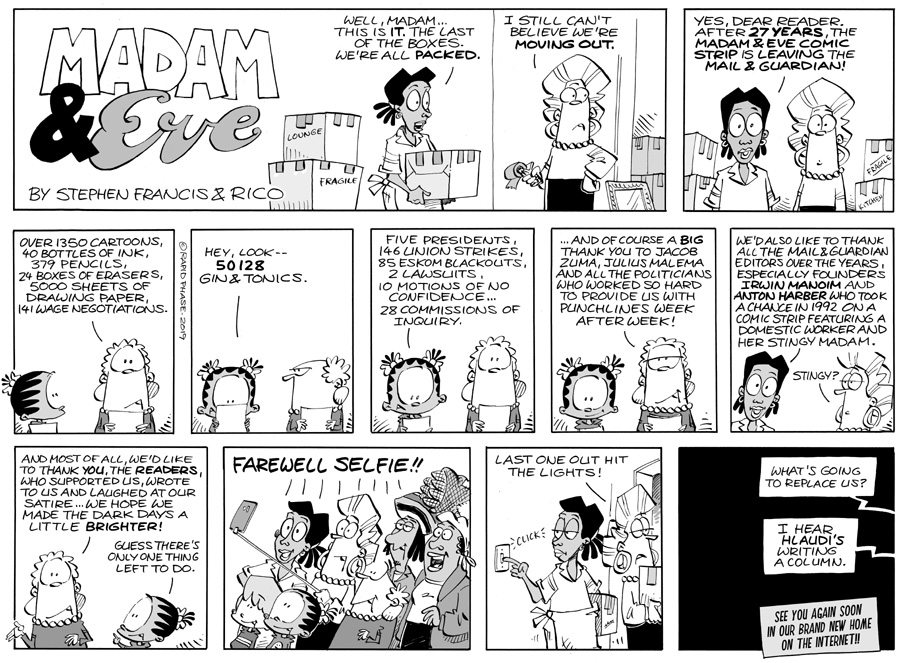
- Madam & Eve does this fairly often — the characters will address the audience, criticize punchlines, experience technical difficulties, and file for unemployment.
- This series of strips has the comic downsized from four panels to three due to an ink shortage.
- Done in this July 25, 2019 farewell comic,◊ marking the series' departure from the Mail & Guardian newspaper.
- This series of strips
- Many, many Abridged Series.
- Special mention to Yu-Gi-Oh! The Abridged Series, where season 2 ended with the fourth wall literally collapsing and the show being cancelled. The episode following was titled "Beyond the Fourth Wall."
- And the fact that the third season is chock full of references to the show being cancelled. Seriously, the characters (mostly the villains) talk about it all the time.
- Dragon Ball Z Abridged started off like this, but by the time they landed on Namek, the fourth-wall breaking mostly disappeared, and was completely gone by the time Season 3 rolled around. That said, the movie adaptations still occasionally break the fourth wall for the sake of a quick gag, such as the "minor character" discussion in Plan to Eradicate Christmas or this exchange in Broly Abridged:
Gohan: Man, this just isn't my day.
Goku: Eh, don't worry. I think it's your movie, next.- Also the fourth episode of Friendship is Witchcraft, where Pinkie Pie bends space-time by baking the fourth wall.
- This is half the humor in Ultra Fast Pony. In the very first episode, Twilight comes up with a plan to solve everything, only to be interrupted by the "To be Continued" ending (which becomes a Running Gag in two-part episodes). She opens the next episode by explaining parts of the plot that were left out of the previous episode specifically so there won't be any plot holes. Scootaloo speaks in scat, and other characters can understand her by reading her subtitles (except Rainbow Dash, who can't read). Everyone frequently makes jabs about sloppy editing or stupid plot devices. In one episode, Twilight forgets all about the theme song until the halfway point.
- Scootertrix the Abridged has a strange relationship with the Fourth Wall. Awareness of it is treated as something akin to a special power, (At a few points, even referring to it as The Fourth) and different characters have different levels of success in wielding that power.
- Pinkie Pie has access to the script, notices text captions, and occasionally argues with the show's editor, at one point even assaulting him (offscreen, during the closing credits). In fact, the fourth wall is so transparent to her that she sometimes breaks it by accident, which causes Twilight no end of confusion. But what is especially unusual about her case, is her knowledge is sometimes Played for Drama, as she sees holding such knowledge as a burden, due to knowing that her entire existence can be erased with a Cease and Desist order, and knowing overusing her Fourth Wall Powers can potentially cause a Plot Hole, which has serious consequences in their world. As seen when her using her abilities is slowly weakening Discord's seal.
- Nightmare Moon is completely aware that she's the main villain of the story; she's just appalled at how shoddily her appearance was foreshadowed.
- Trixie treats her knowledge of the Fourth Wall like dark magic, using it to supplement her magical abilities. She doesn't seem to have quite the same level of access as Pinkie, however.
- At one point, Celestia, Luna, and a royal guard casually discuss other MLP Abridged Series.
- The dragon from "Dragonshy" decides to depart his scene early, knowing that he tends to meet grisly fates in other Abridged Series.
- Prior to episode 15, Twilight Sparkle appeared to be most in the dark about the Fourth Wall, probably because it's funnier that way. The rest of the Mane Six don't appear to care one way or the other.
- Special mention to Yu-Gi-Oh! The Abridged Series, where season 2 ended with the fourth wall literally collapsing and the show being cancelled. The episode following was titled "Beyond the Fourth Wall."
- Chapter 8 of Takamachi Nanoha of 2814 by Shadow Crystal Mage maliciously and with forethought takes an axe to the fourth wall, using this very wiki as the tool to do its evil work.
- Opening Author's Notes for Chapter 9, after breaking the newest replacement fourth wall: "To the No Fourth Wall TV Tropes page! As you can clearly see, I used a hammer, not an axe!"
- The entirety of Adventures of the Writer by Der Blaue Wolf. The basis of the story is that the writer has been kidnapped and his characters have to go and save him. It also includes laptops that can change the world around them, simply by writing something into the story. It later even mention the place 'where the fourth wall used to be.'
- Pokemon fanfiction The Adventure of Adventureness by Missingno. Master is one of the best examples of this trope. It is literally the story of how the protagonist and the narrator seek revenge on the author for writing them into a terrible story.
- The Calvinverse has a whole page of Medium Awareness moments. Calvin & Hobbes: The Series has another one.
- The CSI fic What If Our CSIs Were On Facebook? by Simply Laura is pretty much made of this. The characters are constantly breaking the wall and referencing being characters on the show in their FB posts.
- After Hours at the Watchfire by Raven Kat is this; it's basically the characters gathering at the series' main bar location after the show to complain about the fanfic writers tormenting them.
- In the Ed, Edd n Eddy/My Little Pony: Friendship Is Magic Crossover Fan Fic Ed, Edd, 'n Pony, the Eds are well aware of the fact they are in a story, and so does Pinkie Pie. The fourth wall is pretty much demolished in the story. Case in point: in chapter 3 alone, Ed does a scene transition (at the request of the author), Eddy claims under his breath the author gave the Eds "a generous gift of sudden flight knowledge", Eddy pulls the scene behind him, Edd directly talks to the author pulling out a new screen afterwards, the Cutie Mark Crusaders do a scene transition (to their confusement) and Eddy asks the author if he does not have to use a lame pun again.
- Ed, Edd n' Eddy Z also has No Fourth Wall. The characters themselves acknowledge the fact that the series is a Fandom Rival to Super Mario Bros. Z, a few characters directly reference past episodes of the series, and many times aspects of the series' creation, including the viewers and the author himself, are brought up. A few examples:
Edd: You know, for the sake of the viewers, and to satiate my curiosity, I believe one of you should explain where you get all these Senzu beans...
Rolf: Let Rolf rub the pit of victory—
Corey: Rolf, I think SSJ5G is too lazy to make those sprites...
Edd: Corey, let's limit the fourth-wall breaks to one per saga, thank you...
Corey: Wait... ah shit, how many people will call this show a "Super Mario Bros. Z ripoff" for that?
Rolf: Shall Rolf rub the pit of victory?
Corey: Still don't have the right sprites made for it, and I doubt we ever will... - In Diaries of a Madman, both Navarone and Discord occasionally address the reader directly. The former since his stories are being told through his eponymous diaries, and he's usually telling the reader to stop reading his private records. The latter since Discord is the God of Chaos and can literally break the fourth wall if he feels like it.
- In The Story to End All Stories, the characters are fully aware that they're fictional and frequently comment on how absurd and illogical the events unfolding before them are.
- The main draw of Communication is that YOU, the players of the Quest themselves, are talking and guiding your chosen Host directly, with no filter to limit you on what your saying to them.
- Following its parent game, Hades' Misguidance destroys its fourth wall from the very start. Apparently by the time of the Meta Knight episode they're running out of replacements.
- Armada - The REAL Story: The narrative appears to lack a fourth wall, as Optimus Prime opens the comic by telling Hot Shot to "do stuff for eight pages" and Jolt says he hopes to at least save the plot and gives Hot Shot a "handy plot device".
- Annie Hall: Mixed in with Medium Blending and Imagine Spots.
- being Hands: Lilith, in and out of character, frequently addresses the camera directly and conversationally. Despite in-universe events, this continues through the film.
- Oliver Hardy regularly broke the fourth wall with his mastery of the Aside Glance. While uproariously funny in itself, it was often used to pad out a gag to give the audience time to finish laughing so they wouldn't miss the next bit of dialog.
- Mel Brooks loves this trope:
- In Robin Hood: Men in Tights, the introductory scene for Maid Marian begins with a camera zooming in on the door to her chambers as she sings to herself. The scene cuts to the inside of the room where Marian continues to sing until the zooming camera from the first shot suddenly breaks through the window above the door. Later on, when the Sheriff splits Robin's perfect bull's-eye arrow in twain, they have to resort to the script to find out that Robin gets another shot. In the opening scene, a credit run with flaming arrows that ends with a peasant village burning to the ground, is followed by the entire population of that village shouting as one, "Leave us alone, Mel Brooks!" Also, when Robin is training his merry men and they're proving an incredible incapability to fire arrows, he simply turns, looks intently straight at the camera, and then goes back to watching the men without ever saying a word. Nicely played.
- And then, of course, while walking down the aisle during the wedding scene, the Abbott's staff bumps into the camera, in a possible case of Throw It In!.
- During the climactic swordfight, one of Robin's lunges through a window spears a bagel out of a crew member's hand.
- Spaceballs does this many a time (with Dark Helmet responsible for the vast majority of these, especially when he flips up his helmet in annoyance):
- The camera zooms in on Dark Helmet in the middle of a dramatic speech and conks him on the head.
- Helmet accidentally kills one of the cameramen during the climactic final duel.
- And how does he find out where the heroes escaped to? By watching Spaceballs, of course! This includes fast-forwarding past the embarrassing scenes that happened to the bad guys, and accidentally finding the scene where they are watching Spaceballs, causing a very confusing conversation about defining the concept of "now".
- Early in the movie when Col. Sandurs finishes explaining the Spaceballs' evil plot, Helmet pointedly turns to the camera and asks, "Everybody got that?"
- President Skroob must run throughout the ship because its ridiculous length warrants it. If he walked it would take too long and "the movie would be over."
- Also, when Helmet captures the heroes, he actually captures their stunt doubles.
- Yogurt, the movie's most prominent Jewish stereotype and played by Brooks himself, not only recognizes he's in a movie but admits the real money is made by merchandising and proceeds to market Spaceballs merchandise within the movie itself. Apparently the kids just love the flamethrower.
- Dark Helmet is aware of the Spaceballs action figures and in fact owns the whole set, which he likes to role-play with in private. The scene was entirely improvised by Moranis.
- Blazing Saddles repeatedly breaks the fourth wall throughout the film by making anachronistic jokes, having characters address the audience, and generally acknowledging the medium of filmmaking throughout. This culminates in the climax, when the film literally breaks out of its own set and into other sets throughout a Hollywood backlot, ultimately culminating in a confrontation outside a theater screening the film. This is all part of the theme of deconstructing the Western film genre.
- In Robin Hood: Men in Tights, the introductory scene for Maid Marian begins with a camera zooming in on the door to her chambers as she sings to herself. The scene cuts to the inside of the room where Marian continues to sing until the zooming camera from the first shot suddenly breaks through the window above the door. Later on, when the Sheriff splits Robin's perfect bull's-eye arrow in twain, they have to resort to the script to find out that Robin gets another shot. In the opening scene, a credit run with flaming arrows that ends with a peasant village burning to the ground, is followed by the entire population of that village shouting as one, "Leave us alone, Mel Brooks!" Also, when Robin is training his merry men and they're proving an incredible incapability to fire arrows, he simply turns, looks intently straight at the camera, and then goes back to watching the men without ever saying a word. Nicely played.
- Wayne's World has Wayne and Garth frequently addressing the camera and viewers.
Wayne: (To Glenn, the Donut Shop Manager) Hello! What do you think you're doing? Only me and Garth get to talk to the camera.
- In Wayne's World 2, Wayne stops for directions at a gas station, and the old attendant, upon hearing the place Wayne's trying to get to, launches into a story of a girl he once knew there, but is doing so in a stiff, self-conscious manner. Wayne addresses the camera and asks "Do we really have to put up with this? I mean, I know it's a small part, but couldn't we get a better actor?" The old actor is led away and Charlton Heston is brought in to replace him. By the time he's done giving directions, Wayne is in tears, and thanks him, more for the performance than for the directions.
- The Truman Show features this about the show-within-a-movie for everyone but the titular character. In fact, because the show doesn't have commercials, the people interacting with Truman will often mug at the camera while holding some random item placed there by sponsors. Eventually, this tips Truman off about the nature of his world — when his "wife" launches into a poorly-timed pitch out of nervousness, Truman exasperatedly asks who she's talking to.
- Monty Python and the Holy Grail. Examples include a random knight killing the "famous historian" relating the knights' strategies to the viewers. The narrator is attacked (off-screen) and replaced by a hairy creature (that continues to leaf through the Book of the Film). The "aptly named Sir Not-Appearing-In-This-Film", the characters talking about "scene 24", a castle guard calling Arthur on using coconuts to make riding sounds, a monster dying because "the animator suffered a fatal heart attack" and, of course, the ending where the police arrives to arrest the protagonists for the murder of the famous historian and one of the policemen turns off the camera, remarking "All right, sonny, that's enough, just take off." — and that's not nearly all of them, mind you.
- 24-Hour Party People is an interesting one considering that it's a biopic. Aside from the main character narrating on screen (including one time where he remarks that one scene will be "cut and appear on the DVD extras"), there is also a scene in which a (fictional) incident is recounted in which Tony Wilson's wife cheated on him with Howard Devoto of the Buzzcocks and Magazine. The real Devoto, playing a janitor in the scene, turns to the camera and remarks "I definitely don't remember this happening!". And there's also one point in middle of the film where every cameo by an actual musician is pointed out, which happens right after Steve Coogan — playing Tony Wilson — points out that the guy in the last scene was the actual Tony Wilson.
Tony Wilson: I'm being postmodern. Before it was fashionable.
- The postmodern Peter Sellers biopic The Life and Death of Peter Sellers.
- In the Mouth of Madness married this trope and had little half-movie, half-trope babies. Trent is looking for a very popular author who has vanished while writing a novel. He finds out that the town featured in the previous book is a real place, and goes there to find every minute detail exactly as it was in the book. He also finds the author, only to slowly discover that he himself is the protagonist of the author's current novel, "In the Mouth Of Madness". The author has written himself into the book, which is about how that same book ended the world, and how Trent has to try and stop it from going to publication. Otherwise it will drive people nuts, turn them into monsters, and allow the really bad monsters back into the world. Trent fails of course, but sees a movie theatre playing the movie adaption. On the screen is the beginning of the film the audience has just been watching. Epic Mind Screw.
- George of the Jungle is a serious contender for king of this trope. For one, the beginning of the second movie, where George explained, at the behest of the narrator, "Me new George. Studio too cheap to hire Brendan Fraser."
- George in the first film makes constant asides to the audience and often chats with the narrator. The villains outright berate the narrator for giving them such a hard time.
- Funny Games is a horror movie with No Fourth Wall. One of the villains is well aware that he's a slasher movie villain, and frequently talks to the audience. Why is he torturing this innocent family? Because his only motivation to kill is to please the audience, and breaking the wall takes the audience away from an observer's point of view and makes them part of the movie itself. This is the director's way of guilting the horror movie watcher; by making them the sole reason for the protagonists' demise. Isn't that why people watch these movies?
- Whatever Works, the Woody Allen comedy starring Larry David, opens and closes with the main character Boris openly and deliberately speaking to the audience, fully aware they are in a movie theater. This is toyed with for laughs, as it seems only he is capable of seeing and speaking to the audience. In the opening scene, it even shows that from the point of view of everyone else, he's speaking to no one. A black woman shuffles her child away, fearing he is insane. He explains this in the end by pointing out that he's the only person who can see "the whole picture".
- The indie film Killer Flick is built around this trope. The characters are all filmmakers who reside in the film they are creating. They try to make it as violent, sexy, and exploitative as possible so they can sell it and earn lots of cash.
- In Return of the Killer Tomatoes!, talking to the camera is the least of it. The film stops halfway through because it runs out of money, then continues full of Product Placement. When someone needs paper to write a message, he uses a copy of the script. The phone-in presenter from the framing device calls during the finale scene. When someone calls attention to the setup/payoff nature of the film, a pizza tossed into the air in the first scene lands on his head. And so on.
- Peter Greenaway's The Baby of Macon heavily blurs the line between what is fictional and what is "real" within the film. The plot of the film is sometimes a morality play performed before an audience, but sometimes it seems real. Sometimes members of the audience are just spectators, and sometimes they walk onstage and influence the plot. We're frequently shown the actors backstage, and sometimes the actors conspire to make what happens on stage real. When the performers all make a curtain call, the lead actors, whose characters have died, remain dead. The living actors bow to the theatrical audience, and then the audience stands up and they all bow to the camera.
- The Road to ... series fully embraced this trope by Road to Morocco.
- Another Bob Hope vehicle, The Princess and the Pirate does this at the end when his Road To co-star Bing Crosby turns up as the guy who the heroine actually loves, prompting a rant from Hope saying he'll never make another picture with Goldwyn.
- Monsters Crash the Pajama Party. As this was part of a Spook Show, a theatrical presentation that combined films with Audience Participation, specifically the actors from the film running into the theaters and "attacking" people in the audience, this is inevitable. However, this happens before the audience participation begins.
- Big G the Gorilla sometimes holds signs reading "FANTASTIC" "INCREDIBLE" and "SPECTACULAR" right up to the camera.
- Miss Petrie calls up Professor Williams to tell him that she's sure that something is wrong, adding, "I read ahead in the script!"
- Mad Doctor tells Big G and his other unnamed Mooks to aim the laser at the theater.
- "The Movie Hero" a movie where Jeremy Sisto's character belives he is The Hero in a movie. He talks to the audience constantly, all the while discussing common tropes in movies. He even titles other characters in the movie; The Love Interest, The Side-Kick, ect. And he tells them what roles they play in hs movie. When addressing the audience, other characters will ask him who he is talking to, and he replies, "My audience". The rest of the characters think he's insane, to the point where he has to go to therapy for it.
- In the 1997 informative video The Kids Guide to the Internet, despite explaining things to their friends, Peter and Dasha face the camera to speak. The viewer is directly addressed by the Jameson family at the beginning and end, but visitors Lisa and Andrew never address or acknowledge the camera.
- Fight Club has its protagonist ("The Narrator") turning to the camera to tell us about Tyler Durden, complete with Tyler himself pointing out "cigarette burns" in the physical film the movie was supposedly recorded on. Tyler also points out one of the flashback gags, vandalizes the FBI warning at the beginning of the DVD, and splices subliminal images of himself and frames of porn into the movie itself.
- Deadpool, naturally.
- In the start of test footage, Deadpool greets the audience while sitting on an overpass and listening to Gwen Stefani's "Hollaback Girl".
- At the end of the test footage, Deadpool says hi to Tom Rothman, a Fox CEO at the time the test footage was made (who was rumored to have hated Deadpool).
- After teaming up with X-Men Colossus and Negasonic Teenage Warhead, Deadpool turns to the camera and says "cue the music." "X Gon' Give It to Ya" by DMX kicks in.
- In the Christmas Red Band trailer, Deadpool starts the trailer by pausing it and giving a short explanation on how this isn't your typical superhero movie.
- In the Australia Day promo, Deadpool has a personal grudge against the country of Australia for producing Hugh Jackman/Wolverine, whose film Deadpool considers a "career low".
- In the movie itself, the fourth wall (or at least the camera lens) is splattered with a piece of gum (that Deadpool found on the ceiling of a taxi) less than five minutes after the opening credits.
- One of the best examples in the movie proper is a fourth wall break inside a fourth wall break. Which is lampshaded:
Wade: It's like sixteen walls!
- When Deadpool arrives at Xavier's mansion and sees Colossus and Negasonic Teenage Warhead, he says: "With such a big mansion it's funny how I only ever see two of you. It's almost like the studio couldn't afford another X-Man!"
- When Deadpool catches the Recruiter, he turns the camera away himself so that we don't have to see what he does.
- Carried on in Deadpool 2. At one point, Deadpool calls Cable "Thanos", referring to how Josh Brolin starred as both Cable in this film and Thanos in the Marvel Cinematic Universe, since this film opened against Avengers: Infinity War.
- She's Gotta Have It: Nola and other characters to a lesser degree address the audience directly multiple times.
- Women Is Losers: Celina regularly speaks to the audience about things going on, as does a bit character once.
- Breakfast of Champions involves Kurt Vonnegut treating the reader as someone who does not understand earth customs and regularly pauses to explain concepts and includes cute doodles of things like motor cars (used for transport) and anuses (used for bowel evacuation and injecting drugs). In addition, he as the author writes himself into the book to speak with the main character, explains that it is a novel, that he is the author and that the character is fictional and then grants the main character freewill.
- Italo Calvino's If on a winter’s night a traveler is written in the second person, with the Reader as the protagonist, and begins: "You are about to begin reading Italo Calvino's new novel, If on a winter's night a traveler."
- Robert Rankin's novels are full of No Fourth Wall devices, including characters complaining the plot is the same as an earlier book, and minor characters demanding names and descriptions before they'll continue. Notably, Armageddon: the Musical concludes with Elvis Presley listing every Fridge Logic moment in the book. He doesn't get a satisfactory explanation. At one point, two characters reappear some time after apparently being blown up. One says "Oh, it's us! I thought we were dead!"
- In The Witches Of Chiswick, the plot really starts to get muddy and away from Rankin about 3/4ths in. One character comments more or less: "This is starting to get so confusing, I wish the author of this book would plan things out ahead of time instead of making up the story as he goes along".
- In Robert Anton Wilson's and Bob Shea's Illuminatus! trilogy, the main characters eventually learn that they are characters in the book itself, being narrated by an all-powerful, overseeing AI. Of course, the book is so perspective-jumping and Mind Screw-filled that what the "truth" is intentionally left up to the reader.
- The novel How to Mutate and Take Over the World is all about... the writing, publication, and aftermath of How to Mutate and Take Over the World. A review of the book actually appears in the book about a third of the way through, and it spoils the ending.
- The Stinky Cheese Man and Other Fairly Stupid Tales manages to break the fourth wall before the first page, when the Little Red Hen appears on the front endpaper, loudly demanding that Jack the Narrator tell her story (or at least help bake her bread). Things only get worse as the book progresses: Little Red Running Shorts and the Big Bad Wolf refuse to perform their story after Jack the Narrator spoils the ending. The Giant takes issue with the usual plot of "Jack and the Beanstalk", so he tells his own (nonsensical) story, then threatens to eat Jack the Narrator if he can't tell a better one. After Jack bores the giant to sleep with a recursive story, he tries to sneak away by moving the endpaper a few pages before the actual end of the book.
- In The Neverending Story, this becomes the entire basis for the first arc. It turns out that the whole purpose of Atreyu's adventure inside the book is to draw the main character (who is outside the book, reading the book... inside the book we're reading... you know what I mean) into the story and give him important information. To further complicate matters, there is another "neverending story", or possibly the same one, being written inside the story by a god, which is the story of the world. The main character also rewrites the reality he inhabits by coming up with new stories.
- The movie version went a step farther, in that the Childlike Empress makes direct reference to how the audience has been observing Bastian all morning.
- The classic childrens book The Monster at the End of This Book features the Sesame Street muppet Grover — having read the title on the frontispiece — taking increasingly (and comically) desperate measures to prevent the reader turning any more pages, as he's terrified of meeting the Monster at the end. Fortunately, it turns out the titular monster is Grover himself.
- Mister B. Gone by Clive Barker is about a demon trapped inside a book, the book he is trapped in is in fact the one you are reading. The plot of the novel is: the demon attempting to convince you, the reader, to burn the book, this book. Over the course of the book he asks politely, begs, bargains, and out-right threatens you in his quest to get you to stop reading the book and burn it right now.
- Sophie's World by Jostein Gaarder evolves over the course of the plot into a multi-layered version of this that doubles as a textbook on the history of philosophy as revealed by a Genre Savvy, quasi-Author Avatar philosophy teacher, much to the shock of the title character. By the end of the book, the dominant POV has switched to Hilde, the daughter of the "author" of a book called "Sophie's World," who has received the book as a birthday present from her father, who is not Jostein Gaarder. Confusing, but brilliant.
- The way House of Leaves is written plays up everything in it to have actually happened, with Johnny Truant directly addressing the reader several times. The problem comes up when other, supposedly fictional agents begin to address the reader directly as well. There is a scene where Navy reads and burns a copy of House of Leaves.
- The main character in Chris Wooding's Poison learns that she is a character in a story being written by the heirophant of the Fairy world. When she goes into a suicidal malaise after hearing this, she is snapped out of it when bluntly reminded that she isn't just a character in a story — she is the main character in her story. She ends the book, beginning to write the Story which we have just been reading.
- Examples abound in the parody novel Bored of the Rings, mostly involving characters looking to see how much of the book remains to be read before they can get out of the mess they're in.
- In the novel The Great Good Thing and its sequel Into the Labyrinth, the protagonist, Sylvie, and everyone surrounding her, are all characters in a book-within-the-book. They all have to run around in the book to perform their lines for Readers, and Sylvie even starts up a friendship with the Writer. In the second one, the book is moved online, and they have to run down the screen. They get their dresses caught on the words, etc. There's no fourth wall at all in the book-within-the-book.
- In the Martha Soukup short story The Story So Far, the narrative character is a secondary character in someone else's story, and is only conscious while she's "on screen", and is forced to act like a puppet. But she learns tricks that let her remain aware and in control of herself while the main character and the readers can't see her.
- In the Robert A. Heinlein novel The Number of the Beast, the four characters eventually discover they can travel between worlds that only exist in fiction, as well as other "real" dimensions. This leads them to speculate on traveling to universes created by Heinlein. They mock Stranger in a Strange Land, saying, "Some people will write anything for money."
- Captain Underpants is fraught with examples, including green gloop running through the classrooms of their school, through hallways, and even covering up the text on the page.
- The Samurai Cat series is this trope. It folds, spindles, mutilates, and slices sashimi out of the Fourth Wall, so much so that the feline characters constantly deride the author for being such a spineless, unimaginative hack. Occasionally, this incurs direct in-story retaliation in the form of bad luck and/or nasty enemies' sudden and inexplicable appearance.
- In Michael Gerber's parody of The Chronicles of Narnia: The Lion, the Witch and the Wardrobe, The Chronicles of Blarnia: The Lying Bitch in the Wardrobe, one of the characters asks another if he thinks they are in a children's book. The protagonist merely replies if the asker hasn't seen the page numbers below them.
- In The Book Thief Death often addresses the reader directly.
- In John Dickson Carr's mystery novel The Nine Wrong Answers, the narrator regularly halts the action to inform the reader that if you think such-and-such is the case, "you're wrong."
- Becoming quite common in children's books. Mick Inkpen is another example. Hide Me, Kipper! starts with "Kipper was sitting on the first page of this book, wondering what sort of a book it was going to be". Then a mouse (who first turns up before the title page, saying the legal bits are boring) hides in the foldy bit in the middle of the book. This Is My Book is about a dragon who steals letters from words in the book.
- In The Pale King, David Foster Wallace addresses the reader directly whenever he narrates.
- In The Basic Eight, you are reading the protagonist's diary that she has edited and sold now that she's been arrested and imprisoned for a now world-famous murder.
- The Language of Literature (Grade 6): As a reading textbook, the audience is often addressed and given questions to create a deeper understanding of the text.
- Isaac Asimov's Extraterrestrial Civilizations: Dr Asimov writes this Non-Fiction with very little reference to himself as narrator or you as audience, but occasionally addresses the reader directly. This results in many tropes being Discussed based on their real-life inspiration.
- ML Lanzillotta loves this trope. Most of her narrators address the audience directly at some point.
- 'Allo 'Allo!: Rene would regularly explain his ongoing predicament at the start, and make asides at the Audience regarding other people's leading statements.
- On Andy Richter Controls the Universe, Andy's voice-over narration would frequently address the audience directly.
- Ants in Your Pants: Lickety Split would always ramble to the audience about whatever topic the episode he was in was about.
- The Narrator in Arrested Development addresses the audience, responds to things the characters say, criticizes the narration of other TV shows, and observes after a remark about "arrested development," "Hey! That's the name of this show!"
- Barney Miller: Averted, literally, when the show actually built a fourth wall. Several episodes in the final season featured reversed shots from the usual setup, with the camera staged somewhere around the holding cell, usually the rear of the set, pointed back out across the squad room, with an actual fourth wall placed where the cameras would usually be placed.
- The characters on The Basil Brush Show probably never went an episode with the fourth wall intact. They would frequently pick up a copy of the script and read ahead, get to places quickly by cutting across the set, and on one memorable occasion total disaster was averted by the appearance of a director rushing in to explain to the marauding pirates that they'd wandered onto the wrong set. Another incident involved the camera man quitting after the cast gets cream on the lens, only for the guest star of the week to offer to operate the equipment.
- In The Bernie Mac Show, Bernie frequently goes to his garage to sit facing the camera and address "America."
- Ted, of Better Off Ted, talks to the camera a lot.
- Boston Legal: If there were a Fourth Wall for this show, Denny Crane couldn't exist. During the Alan/Denny Balcony Scene:
Denny: There should be a show about us.
Alan: We could promote it.
Denny: No, there's probably a law against promoting us. - Buffy the Vampire Slayer: Invoked by Anya in "Once More, With Feeling" to describe how exposed she felt when she and Xander burst into song: "It's like we were being watched, like there was a wall missing from our apartment. Like there were only three walls, and not a fourth wall."
- One of the earliest TV series that regularly broke the Fourth Wall was The George Burns And Gracie Allen Show, a Sitcom in the '50s. Not only would George (playing himself putting on a TV show) turn to the audience and comment on what the other characters were doing, but in later episodes he would often direct the audience's attention to a TV set in his private study. On the screen you would see the events that he was talking about, occurring in real time as if it were a security camera monitor. He would use this information to intentionally complicate things in order to ensure maximum Hilarity Ensues.
- In one episode, George and Harry — his announcer — are in the living room when Harry says, "I understand you're about to rerun a few episodes, George." George says, "Yes, why tonight we're doing the one in which Gracie tries to get me to invest in the Ballet. In fact, it's coming on right now, let's go watch." They get up, and we fade into the first scene of said episode.
- In the original live broadcast, this is how the commercials were done. (George walks over to the "neighbor"'s "driveway" where he's waxing his car; "Say, Bob, that sure is a beautiful new Oldsmobile you got")
- There are some public domain episodes with Carnation Milk as a sponsor. These truly get inventive in working the product into the storyline.
- Inverted in a VERY funny twist. George tells Gracie that if she can prove that his car really WAS crushed by an elephant sitting on it — and not by her driving — he'd buy her a mink coat. They gather all the witnesses who say that, yes, there was a circus parade and the elephant got loose... When George asks the final witness: "Who are you?" the man says "I'm from Beverly Hills Furs. I was watching the show and I knew you would lose." He holds up the mink, and the gleeful Gracie takes it.
- Clarissa Explains It All was pretty much the queen of this trope. The title character would open every episode with a monologue directly to the camera, and she would also address the audience after a major plot point in the episode, which usually happens around 5 times an episode. She also makes the occasional facial reaction directly to the camera during a scene.
- The Colgate Comedy Hour. Though sometimes the performers would build one and then knock it down again, just for fun.
- In Eerie, Indiana, there was a entire episode about Marshall's life suddenly becoming a television show, and finding out that he isn't even Marshall Teller at all, but somebody they keep calling 'Omri Katz' (which is, of course, the real name of the actor playing Marshall). Dash X is still a villain in the tv-show world rather than his actor, but acknowledges that the only reason he is one is because he's a fictional character.
- Ellery Queen (NBC, 1975) always had one No Fourth Wall moment every episode. Immediately following Ellery's mandatory "Eureka!" Moment, he would turn to the audience, briefly review the key evidence for the viewers, and ask them if they'd figured out who the culprit was — right before going to a commercial. (See The Summation.) This was a trademark of the radio show as well.
- The British sketch show, The Fast Show, has three recurring characters that directly address the viewer: The Fourth Duke of Wimbledon (who remarks to the viewer on his compromising situation) an unnamed character played by Mark Williams (who is shown engaging in suspicious activity before noticing the camera and saying, "You ain't seen me, right?") and Unlucky Alf (who sadly reflects to camera about his bad luck, before falling victim to it).
- Fleabag frequently speaks directly to the audience via Aside Glance, creating a relationship between herself and the viewers and giving them a deeper insight to her dysfunction. Significantly, her love interest the priest is the only one to notice this.
- The Fresh Prince of Bel-Air broke the fourth wall quite often, but the moment that evaporated it came during the premier of the fifth season. The previous season had ended with Will deciding to remain with his mother in Philadelphia, leaving viewers expecting some sort of emotional catharsis. Instead, the next episode opened with an NBC executive approaching and informing him in no uncertain terms that the show was called "The Fresh Prince of Bel-Air," and that was where he was going to be. Then shoving him into an open van(marked "Star Retrieval Unit").
- And then there's the episode that has Carlton running screaming through several sets for the episode and then into the audience.
- Will asking "If we're so rich, why we can't afford no ceiling?" ... as the camera pans up to show the studio lights.
- Jazz asking Will "Who's playing the Mom this year?"
- Season 2 of the musical comedy Galavant in general.
- The opening number of the first episode of Season 2 is the single most self-referential moment of the entire show. It includes them saying that since it's a new season they need to retire the old theme song and come up with a new one, (in part because the old one failed to win an Emmy Award) the passage of time in the real world, imploring viewers to watch episodes live and ignore other events that would drive their ratings down, how unlikely it was that they got a second season after mediocre ratings and ending the first season on an unsatisfying cliffhanger, etc. And that is still only part of the fourth wall breaking they do in the course of a single song.
- The finale makes multiple references to the fact that it will be highly unlikely that the show gets to be renewed for a third season, as well as The Jester referencing the first season's cliffhanger ending and wondering if they will do the same for season 2. (They don't.)
- Australian mockumentary The Games played with the trope on several levels. The characters break the fourth wall, but it's the fourth wall of the In-Universe documentary that is the Framing Device for the show, not the real television show in our reality. However, one of the characters, Tim, does seem to be aware and remarks about how they are in a scripted tv show.
- High Fidelity: Rob directly addresses the audience often talking about her life. Simon does the same in his Perspective Flip episode.
- In Episode 10 of Hikonin Sentai Akibaranger, Akibared, Nobuo, becomes aware of the fourth wall. He convinces the rest of the characters of this and this trope is in full effect for the rest of season 1 as the final episodes revolve around the Akibarangers trying to thwart attempts from the producers to end the show. Season 1 ends with The heroes fighting the end credits
- The BBC series Hustle includes at least one fourth wall-breaking moment in every episode, in which one or more of the main characters will address the audience about the con currently underway, sometimes as time freezes around them. Some episodes are more subtle, having a character perhaps wink at the camera.
- The iCarly online content (as opposed to the in-universe webshow) often breaks the fourth wall, by way of a 40 year old man filling in for Sam, and a clip of Freddie informing the 'Baby Spencer' character (who is played by Jerry Trainor), that Jerry Trainor was nominated for an award.
- The ultimate example may well be the late-80s Showtime series It's Garry Shandling's Show. From its self-referential theme song to its numerous guest stars, it extensively parodied the conventions of the Sitcom while actively demolishing the fourth wall, starting right from its opening credits:
''This is the theme to Garry's show, the opening theme to Garry's show.Garry called me up and asked if I would write his theme song...''
- A common gimmick was to have Gary riding his bicycle between the various studio sets where the program took place.
- Kamen Rider Zi-O normally has its fourth wall firmly in place, but the series also has web-exclusive Supplementary Plan half-episodes where the charactersnote are fully aware that they're fictional characters in Kamen Rider Zi-O and discuss certain aspects of production, such as openly admitting that the Kamen Rider Fourze arc had to be rewritten because the actors were tied up filming Bleach and couldn't Cameo. In one memorable episode, protagonist Sougo is warned about a world-devastating war and decides that the best way to prevent it is to blow up Toei Company, the people who make Kamen Rider.
- Malcolm in the Middle: Would regularly make snide comments to the audience.
- The Mighty Boosh spits on your fourth wall! They not only look at the camera and talk to the audience, they make in-episode references to the show's premise, the actors playing multiple characters, that episode's costumes and special effects, even the show's channel and time slot.
- Mister Rogers' Neighborhood spends each episode with Fred Rogers talking directly to you, his "television neighbor," in the kindliest tone you can imagine. He occasionally mixed in some Medium Awareness as well, showing us how his house was actually a set on a TV sound stage and taking us behind the scenes to meet the crew.
- The Monkees is a primary example for this trope, as the group's television personas somehow "knew" and expressed the fact that they were on a TV show, while they remained within their wacky sitcom universe. Whereas, gags of this type are aplenty in nearly every episode: making direct remarks and asides to the audience, funny (often times, ad-libbed) comments about scripts, acting, production, censorship, even adding outtakes into actual scenes.
- Monty Python's Flying Circus was famous for breaking the fourth wall; but one unfortunate example was actually forced on them by Executive Meddling . A sketch that the team wanted to do, about undertakers asking a man if he wanted to eat his mother's corpse instead of burying it or burning it, was only allowed by the BBC if they showed the studio audience reacting with distaste and invading the set during the sketch.
- And of course, everyone's favorite Running Gag character, Colonel Mustache. "Quite right, quite right, stop this sketch, it's getting entirely too silly."
- And here's the clincher: offenses against the "Getting out of sketches without using a proper punchline" Act, four, namely, simply ending every bleedin' sketch by just having a policeman come in and... wait a minute...
- Mr. Robot makes the audience one of the characters of the show: specifically, the protagonist's imaginary friend. Not only does this provide a way for him to offer narrative exposition but it also means that what we are shown has been filtered through his psychosis and paranoia. He'll accuse the/his audience of holding out on him if he remembers something he should have known all along, for example.
- In Mystery Science Theater 3000, the crew of the Satellite of Love were apparently broadcasting their skits to the Mads and us. In every skit, Joel, Mike, or one of the 'bots would talk to the camera, addressing either the Mads or the audience. (The Mads also talked to the camera, but almost always to address the SOL crew.) The camera itself was a character (a robot named Cambot), albeit one who never spoke, rarely interacted with the others (beyond filming them), and was only seen during the opening theme. And the Magic Voice's main job on the Satellite of Love was to announce the start of the first commercial break.
- This is explained very early on as that Dr. Forrester is selling the tapes of Joel and the bots to Comedy Central. Several of Forrester's bits revolve around trying to increase their ratings. (Introducing Timmy Bobby Rusty, giving them a drug to turn them into the cast of Renegade, etc.)
- The Movie reversed this, with Dr. Forrester addressing the audience while Mike and the 'bots ignore the fourth wall.
- Ned's Declassified School Survival Guide was famous for this. In the "Guide to Girls", Ned had nothing to offer and asked Moze to give some tips. After a false start, he stops her and produces a CD player from under the table to play the "tips" BGM.
- Croatian series Nemoj Nikome Reći (translated, Don't Tell Anyone) had the honor of being Croatia's most fourth-wall-breaking Teen Drama. Helena, the main character, constantly spoke to the audience, even going so far as saying "This is my show and I can do whatever I want!".
- In Nowhere Man, in episode The Spider Webb, a writer/producer makes "The Lenny Little Show", a program basically Nowhere Man with really bad reenactments of scenes from the show, and gets really trippy when they are filming scenes he is doing at the same time, until he becomes really genre savvy and reverses what is written/filmed to outsmart the writer/producer.
- My World… and Welcome to It: John serves as in-universe narrator in all episodes, frequently looking at the camera and addressing the viewer to explain what’s going on, usually in Deadpan Snarker mode.
- Brazilian sitcom Os Normais had the two protagonists frequently monologuing to the audience. Once a couple the protagonists were visiting noticed the cut to a Flash Back, and did one themselves (complete with the husband asking "who filmed this?" as the flashback ended).
- PJ Katie often spoke right to the viewer on PJ Katie's Farm.
- Rab C. Nesbitt: Espousing theories at the audience. These may have been deep and important, but were almost incomprehensible.
- The story arc of Red Dwarf: Back to Earth consists of the intrepid four discovering that they're just characters in a TV series, and trying to track down the writers to find out how long they have left. Subverted, as it was actually a group hallucination brought on by the ink of a psychedelic squid.
- The Red Green Show: The majority of the Lodge's escapades are exposed almost exclusively through the characters directly talking to the audience. One recurring skit, "North of 40", has Red talking right to the audience about problems that middle-aged men face.
- Readalong: There are plenty of segments in the show wherein characters would talk directly to the audience.
- Occurs frequently on The Red Skelton Show.
- Red often makes jokes about flubbed lines and similar mistakes, and informs the audience about things that have gone wrong.
- Very common in a literal form during episodes focused on Freddie the Freeloader: Freddie would be unable to open his front door for one reason or another, and would simply walk around the front wall into his house.
- The first season of Roger Moore's TV series The Saint began each episode with Simon Templar addressing the audience and setting the scene for each week's adventure. After the show moved to color production, this was replaced by narration.
- Saved by the Bell: Zack Morris is notorious for saying, "Time out," then stepping aside to speak to the audience. This may be an homage to Ferris Bueller's Day Off or the musical Stop the World, I Want to Get Off, both used a similar gimmick.
- Taken to the extreme in one episode, where he uses it to dodge an incoming punch and escapes. Nobody seemed too bothered that he just vanished into thin air...
- In an episode of Jimmy Fallon, Mark-Paul Gosselaar showed up as a guest, as Zack Morris, in character and all, and used the "time out" trick at one point to explain something without Fallon interrupting him. When he timed back in, Fallon stopped for a second, then asked, "Did you just time me out?"
- Seans Show was a UK sitcom with a similar premise to It's Garry Shandling's Show; the main actor/character (Irish comedian Sean Hughes) knew he was starring in a sitcom and what sort of plots he could expect as a result.
- Secret Diary of a Call Girl. Belle talks to the audience at least as much as she talks to anyone on-screen.
- She's Gotta Have It: Nola speaks directly to the audience quite often, as do minor characters at times, like in the original film.
- In the last episode of Sliders, they slide to a world with a television program based on the sliders' adventures, complete with lampshading all the major show tropes and fan reactions.
- Subversion: Stargate SG-1 ended up plotwise, with Wormhole X-Treme, a show made by an alien character suffering from multiple amnesia layers. In a bonus clip for the 200th episode, one of the real-life actors playing an actor in the show becomes confused and disoriented at where exactly the fourth wall is. Doubly subverted in that the actor was just, well, acting and knew what was reality all along.
- Towards the end of the episode "Wormhole X-Treme, one character manages to utterly annihilate the fourth wall. It's set up as one of the actors from Wormhole X-Treme being interviewed, only for the man to give his real life name. It actually breaks the wall more from there.
Christian Bocher: I'm Christian Bocher. I'm portraying the character of Raymond Gunn, who portrays the character of Dr. Levant, which is based on the character Daniel Jackson, portrayed by the actor Michael Shanks. Originally portrayed by the actor James Spader, in the feature film. (looks at camera operator with a concerned look) Are you okay?- Hilariously, in the same episode, the Wormhole X-Treme creator says that they need something unexpected to reel in audiences, prompting Jack O'Neill (who hadn't been seen for a couple of seasons) to wander into the room and say, "Something like this?" Which then caused Sam Carter to remark "Are you kidding? They'll show that in the commercials." In fact, the commercials for the episode did showcase the "return" of Jack O'Neill to the show.
- In the same episode, during the third act, the alien film producer (Martin ) starts complaining about how he was just notified that there's going to be a huge budget cut to the movie:
Martin: Well this is just great, this completely ruins the end of act 3!
Carter: Why, what happens at the end of act 3?
Martin: Well at this point, not much! Act 3 just ends!
[ce instant fade-to-black and go to a commercial break]
- In the same episode, during the third act, the alien film producer (Martin ) starts complaining about how he was just notified that there's going to be a huge budget cut to the movie:
- Combined with Bilingual Bonus: Russian dialog frequently comments on the show itself (provided you can work through the generally horrible pronunciation). One exchange between two ill-fated Russian sailors in "Small Victories" goes something like this:
[clunk]
Sailor #1: What was that?
Sailor #2: I dunno; maybe it's the bugs from the last episode.
- Tales from the Crypt has the Crypt Keeper, who casually talks to the audience in each episode. Some of the few (live) characters he has during his intro and outro segments are also shown to be aware of the fourth wall.
- The 1952 Tales of Tomorrow episode "The Window" has a live drama show being interrupted by spontaneous images from an apartment somewhere in the city, where a woman is conspiring with her boyfriend to murder her husband. Made more surreal in that the drama in question is a previous episode of Tales of Tomorrow, re-shot word for word so audiences would initially think it's a repeat.
- Almost every Episode of That Mitchell and Webb Look features a sketch where members of the cast sit around on set between takes, usually wearing costumes from other sketches, having humourous conversations. In one such sketch, Robert Webb was astonished to find that these sketches were scripted as well, being shown a script describing the conversation he thought he was having spontaneously. Other sketches have involved debating guest stars, (they hired The Queen, but actually wanted Helen Mirren) and lampshading the conventions of sketch comedy, such as the inconvenience of having to write and film 50% deliberately unfunny material, in order to qualify as 'hit and miss'. They also produced this gem.
- Titus (a sitcom starring comedian Christopher Titus):
- The main character addresses the audience from a small room with one light bulb, viewed through a black-and white filter. On one occasion, when he is drunk, there are three light bulbs.
- His father Ken and girlfriend Erin both addressed the audience from that same small room on occasions where Chris was unable to make it or when their narration was thematically important.
- WandaVision: Episode 6, which primarily takes influence from Malcolm in the Middle, has Tommy and Billy frequently make aside comments to the audience.
- The sitcom The War at Home has its characters speaking directly to the audience by providing cut scenes with commentary throughout the show. Usually, Michael Rapaport's character is the primary one to do this, but all the other characters get their chance occasionally.
- From the UK, The Young Ones regularly made reference to their being characters on a sitcom. In one episode, Neil's mother visits to complain about his working on a program with such shoddy production values, smashing a chair as an example; Mike points out that the chair is a breakaway prop Rik was going to be struck on the head with. Sure enough, Rik gets clobbered with a chair a few minutes later ... and is knocked unconscious, because his attacker unwittingly uses a normal chair instead of the ruined prop!
- Spiritual Successors to The Young Ones are Filthy Rich & Catflap and Bottom, in which the main characters constantly address the camera/audience.
- The Offspring's album "Smash" features a narrator addressing to the listener in the first track. The same voice appears in the end of track 5, "Genocide", saying "Hmm, I specially enjoyed that. Let's see what's next." Then, after track 14 "Smash", the narrator waves goodbye to the listener and the very riff from Genocide is played several times in a loop, much like an Ending Theme. Then, after several minutes of silence, an Arabian version of track 7 Come Out And Play's riff ensues. Curiously, the very same Genocide riff re-appears in the next album "Ixnay on the Hombre" track 14, "Change the World", only decreased by a tone.
- The folk song "Railroad Bill and the Kitten" is about a character who gets into an argument with the singer. It doesn't end well for him.
- "Weird Al" Yankovic's "This Song's Just Six Words Long" consists of the songwriter proclaiming he can't think of anything to write about, so he'll just keep repeating the same phrase.
- Simon & Garfunkel's "Leaves That Are Green" (and Billy Bragg's "A New England") kicks off with the line
I was 21 years when I wrote this song
I'm 22 now but I won't be for long - Neil Young's decidedly odd Rock Opera Greendale features the following line as one of the characters is dying and suddenly notices Young singing about him:
That guy just keeps singing
Can't somebody shut him up? - The Beatles had "Only a Northern Song", a song written (by George Harrison) largely out of contractual obligation, in which the lyrics talk about how badly-written the song is, and then says that it "doesn't really matter." It's basically a Take That! against the publishing companynote .
If you're listening to this song
You may think the chords are going wrong
But they're not
He just wrote it like that - Pretty much all of Dokaka's "Human Interface" album. He interrupts various tracks with a request to skip them, uses multiple tracks to announce how much time has passed or what point of the album the listener is currently at, and at one point suggests the bitrate at which the album should be encoded should the listener wish to save it to mp3 player.
- The band Gorillaz sometimes acknowledge that they're cartoon characters; 2D once claimed that paternity suits from live-action women "don't stick because I don't have any DNA", and Murdoc shrugged off murder charges after the El Manana incident with "I'm a cartoon, mate. You'd have a hard time sticking anything on me. I don't even have fingerprints."
- The old novelty number "Crazy Mixed-Up Song," by Homer and Jethro (among others): "You may think that this is the end/Well it isn't 'cause there is another chorus." Then: "You may think that this is the end/Well it is" and the song cuts off.
- "Something Changed" by Pulp starts:
I wrote this song two hours before we met
I didn't know your name or what you looked like yet - The Bonzo Dog Band song, "Canyons of Your Mind" starts off by addressing the listener with spoken word:
This is the 'B' side of our platter, sports fans
And I'm singing just for you, covered in sequins.
- Pro wrestling's version of this is called breaking Kayfabe: the performers acknowledge for once that what they're doing isn't real, as if we didn't already know that. Most notably, whenever a wrestler dies or makes a memorable exit from a company, the other wrestlers will temporarily put aside the fact that they "hate" each others' guts and come out to the ring together.
- Professional Wrestling, in its various forms, has no fourth wall (or first through third, for that matter) by design; the wrestlers, announcers and such frequently directly address the audience (either the audience in attendance at the arena, the viewers at home, or both), and the production crew often find themselves employed as part of various angles. As well, those speaking often directly address the camera in order to talk to others not appearing in the on the show, saying, "I know you're somewhere watching this right now..."
- D-Generation X would often use this to comedic effect by lampshading it into oblivion, including a time Triple H covered up a flub with "Gimme a break, it's live TV.", and once acknowledging he hadn't anything funny to add to the DX mantra that week because coming up with new ones every week was hard.
- WWF/E has an usually strong fourth wall by professional wrestling standards, and even then it only tends to conceptually materialize whenever the action leaves the arena proper, with the backstage area and all other parts of the world beyond the ring supposedly being "behind the scenes" where the audience can't see what's happening. This is because Vincent K McMahon thinks "characters" acknowledging the existence of cameras the fans cannot see is "unrealistic" because he sees WWE as an "action adventure" series or macho soap opera rather than a live sports show or magician's act, more Magnum, P.I. than Harlem Globe Trotters. A common way to exploit this is to have a heel wrestler "secretly" insult someone or admit to an ally to having committed a heinous deed, completely disregarding the TV camera being held right next to them. Sometimes the commentators will reveal that the whole world heard everything, but more often everyone will "remain ignorant" of the incident until the face confronts the heel in the ring and reveal they obtained a videotape, which will then be shown on the Titantron. You can tell when an organization's booker is taking cues from WWE from this particular use of the fourth wall trope alone. However, Vince Junior was not the first promoter to treat wrestling this way, as Jack Pferer invented "theater wrestling" in an attempt to destroy kayfabe out of spite.
- In the territorial era, where kayfabe was sacroscant, the issue "backstage", in the "lockeroom" or otherwise outside of the arena was usually solved by an excited reporter supposedly "finding" some happening and yelling to the camera man to hurry up, usually resulting in the heel getting caught doing something he didn't want the baby faces catching, such as Crippler Rip Oliver breaking Mike Von Erich's hand in Texas or Eddie Gilbert trying to kill Jerry Lawler in Memphis. In the post territorial era, BJ Whitmer became "the smartest man in wrestling" by actually watching the show and acknowledging locker room happenings recorded on shows he wasn't even on. Following his lead, Ring of Honor, SHIMMER, and the entire WWN "Family" such as FIP, EVOLVE, SHINE, even Dragon Gate USA and American Combat Wrestling tend to treat anything caught on camera as visible to anyone. However, ROH offshoot All Elite Wrestling tends to waver between this and WWE style fourthwall.
- One of CM Punk's signature spots is to steal an article of clothing and hide from his opponent in the audience. How well it works depends on if Punk is a heel or face at the time, or if the audience is generally more interested in seeing what his opponent will do than what Punk is attempting, such as when he tried it in a match against Delirious in IWA Mid-South.
- A wrestler no longer employed by a company continuing to show up "as a fan" is not uncommon, especially when the company's contract leaves room for them appearing on camera for another show, such as Austin Aries showing up at ROH shows "as a fan" while working for TNA. What was unusual was Austin Aries signing an ROH contract then and there after TNA fired him when it decided to pull its contracted wrestlers out of their ROH bookings to fill up a show and Aries, though not booked, obviously wasn't going to make it. It's considered bad form when contracts does not allow appearances but the rival promoter decides to film the wrestler anyway, such as when TNA decide to have the camera linger on Robbie McAllister of the Highlanders, which lead to the breakup of the Tag Team.
- NXT, by reason of it being a try out show, needs a lot of this. Bryan Danielson calls David Otunga a worse wrestler even though Bryan always lost to him, because everybody knows Bryan is better, which is basically breaking the fourth wall and basically saying Otunga only won because it was already agreed he would when rhetorically asked if Otunga really deserved his ranking. It's topped itself in season three, where Josh Matthews literally tells Michael Cole that a wedding they're watching is fake.
- The feud between Lei'D Tapa and Epiphany in Ohio Valley Wrestling was kicked off during a match between Tapa and a Blossom Twin that focussed inappropriately on Tapa's body to the detriment of the action. Turns out Epiphany's boyfriend Eddie Diamond had stolen a camera in order to get a better view.
- Promotional material for ROH Golden Dream largely consisted of Jay Briscoe's image(often him pile driving Kevin Steen) tapped over Adam Cole's with the words "Real World Champ" crudely written in marker or crayon.
- Ring Warriors was revived in 2011 as a member of the National Wrestling Alliance and began signing up wrestlers from the Caribbean in preparation for running shows there as former NWA member Championship Wrestling From Florida had. Apart from Haitian wrestler Tyree Pride, who was already working as a manager in the NWA and used as a wrestler again by Ring Warriors for these Caribbean shows, none of this talent was actually booked by 2012. This caused La Rosa Negra to interrupt the first Bahamas show in Nassau to complain about being an Advertised Extra and demand a shot at the winner of the first match in Ring Warriors' women's title tournament. Yes, the entire angle surrounding their first women's champion was an open criticism of their own promotional and booking practices!
- The angle where Kevin Steen was kicked out of ROH by El Generico not only involved Kevin Steen hacking the ROH website to show his videos, but him going so far as to criticise ROH on the Pro Wrestling Guerilla message boards. This in turn lead to an angle where Bryan Danielson tried to kick Steen out of PWG too, tough he relented after winning a match but finding Steen grovelling to keep his job. Former booker Gabe Sapolsky actually complained when Steen did make it back to ROH and used his name when talking about people unjustly fired from the company.
- On the last WSU of 2018 Maria Manic issued an open singles challenge only to be informed by The Shook Crew that as one half of the Tag Team champions she had to defend the belts on the last show before the coming Retool and would forfeit without a partner. So she pulled a fan out of the audience to act as a substitute for Penelope Ford.
- All of this being said, it's generally ill-advised to break kayfabe. Wrestling works the way it does because of Willing Suspension of Disbelief — while the best angles or storylines have Reality Subtext to them that makes things all the more engaging (as shown by the Summer of Punk II and Daniel Bryan's feud with The Authority), outright breaking kayfabe (outside of an off-hand joke for a quick laugh like what DX likes to do) generally never works. As best illustrated by Vince Russo's booking of WCW, where he practically murdered kayfabe and pissed on its remains, including having scripts being rewritten live, onscreen.
- The Muppets, largely.
- This is somewhat expected in The Muppet Show and Muppet*Vision 3D, which were basically variety shows, but even the actual films like The Muppet Movie and The Great Muppet Caper come up one wall short. Only The Muppets Take Manhattan kept the fourth wall unbroken.
- The Muppet Show could be a tad surreal when it came to the fourth wall. While talking to the audience is expected in a variety show, the characters would sometimes address the audience while they were backstage, or otherwise acknowledge that they were just actors portraying a variety show.
- The unaired pilot Tales of the Tinkerdee was about the same way: Taminella and Kermit both explicitly address the audience directly, and even the king and prime minister seem to get in on that act when they crowd the camera and say the phrase that Princess Gwendolinda catches all the time. Heck, in-universe, it's kind of implied that the king knows he's being watched by Taminella when she uses a clairvoyant spell: he says "over and out" just as the spell is ending!
- Gerbert has the protagonist address the audience when talking about the Bible or asking questions to them.
- Codified by The Goon Show, written by Spike Milligan, where no rules were safe, and the writer often chided the listener for being smug about wrongly predicting the punchline of a gag.
- And then there's Captain Kremmen by Kenny Everett, which not only demolished the fourth wall but the fifth, sixth and seventh! It knew it was a radio serial and of course often started with the Kremmen's bright "Hi Kids! In our last episode ..." Many episodes, more digitals than could be calculated on a digital calculator, included some sort lampshading or wall shattering, including:
- Why Captain Kremmen knew he would thwart the cosmic baddie's plans: "I have faith in my scriptwriters!"
- Captain Kremmen to Captain Kremmen, in the Bionic Double arc: "Won't this confuse the listeners?" "Anyone who listens to this is mad anyway!"
- "What are we going to do, Captain?" "I'm gonna to do what I always do when something desperate and untoward happens. Leave it to next week!"
- Lengthy foley effects of feet walking down a corridor.
President: You're very quiet, Kremmen.
Kremmen: Just padding out the serial, sir.
- Icelandic radio theatrical comedy Harry & Heimir would do this a few times per episode. From noting they only had x minutes to solve the mystery of the week before the end of the episode to reading the other character's lines in the script; and in the finale of the second season they drove a horse carriage out of the studio, onto the streets of Reykjavík and finally crashing. The show ending where they were recovering in the hospital. It is also often joked that EVERYBODY hates the show, even the narrator. To the point that in the final episode of the first season, it turned out HE was the big bad!
- The Firesign Theatre was basically Radio Without Walls.
- Hello Cheeky was some sort of strange play on this, depending on how you choose to interpret it... the characters (also actors) share the actors' names but have distinct personalities, and a lot of the jokes come from casual conversation between the characters while not playing characters, or moments that weren't scripted in-canon. Apart from this, No Fourth Wall also applied in a more traditional sense — the characters were fully aware they were in a show called Hello Cheeky, and would occasionally read letters from fans, explain jokes or technical hitches, or otherwise address their listener ("hello, Eric").
- Characters on the children's show Jungle Jam and Friends are fully aware that they're putting on a production, beginning every episode by asking the Narrator about the stories for today.
- Abbott and Costello would occasionally break character to refer to their script, especially if one of them blew their lines. Lou Costello would stop and ask, "What page are YOU on?"
- The Jack Benny Program started out as a standard comedy-variety show but as time went on, it became a sitcom about a variety show.
- In Avatar Adventures, there is literally none at all. Characters frequently address the posters, to the extent that "Out Of Character" tags may as well not exist. One character in particular, Sam G, is said to exist on a plane between the two worlds; he is, unsurprisingly, an Author Avatar.
- We Are All Pokémon Trainers has so many examples of humans and Pokémon breaking the fourth wall that it's considered a distinct power, and the authors have joked that the RP's fourth wall is more akin to a fourth wall curtain.
- Atmosfear practically relies on this with each game's host directly interacting with the players.
- Bride of Portable Hole Full of Beer, a farcical Dungeons & Dragons supplement, includes a prestige class that slowly figures out that it is a RPG character as it progresses. At the final level, the character enters the real world and moves in with the player.
- The brilliant Over the Edge includes a metaplot in which the PCs encounter odd things, and start to notice clues, and finally discover that they are actually characters in a role-playing game! The adventure in question eventually has the characters meet the players playing them. (The rule book specifically advises that the players not play that adventure under the influence of psychedelic drugs.)
- Before the Realism movement, the fourth wall didn't exist. Asides and soliloquies were common and expected; actors weren't subtle about speaking to the audience. Elizabethan actors had to deal with overzealous audience members trying to join in with the action.
- Hecklers were common and expected. Retorts could fly from the stage back into the crowds, characters would direct their lines at certain members of the audience or mug for the crowd, particularly well-done or well-thought-of scenes could be encored (although not as often as in opera). Every good actor could improvise and react to the goings-on. They weren't helped by lines being added right up to showtime.
- General example: chldren's theatre, particularly live shows based on popular franchises like Sesame Street, Blue's Clues, My Little Pony, or Disney Junior properties, etc. Participation from the kids in the audience is expected as a given and if the show previously utilized Fake Interactivity, this will be used as a chance for some real interactivity. And even if no such element was present within the original show, it will be in the stage show.
- We Bombed in New Haven is a two-act play that not only has no fourth wall, but its entire plot and theme is absolutely dependent on zig-zagging across that barrier so fast and so many times that eventually no one — characters, actors, or audience — is quite sure what sort of play this is. Which should not be unexpected, as it was written by Joseph Heller and has more catches in it than his novel. It too revolves around World War II bombing missions — We are bombing Constantinople (not Istanbul) — and takes a sudden turn into the dark when one of the Characters is killed on a mission ... and afterwards ... no one can find his Actor!
- At the close of the first Act, the airmen/actors are playing the old game "Time Bomb", which was a windup toy bomb that set off an alarm when it was supposed to "explode". The first round one of the airmen/actors panics, tossed it to the wings resulting in a HUGE explosion. Then the officer/actor brings out another one ... winds it up ... and tosses it into the Audience!
- In The Revenger's Tragedy, one character takes an aside to the audience, only for one of the other characters to ask who he's talking to. The whole play is a Refuge in Audacity.
- Noises Off is a play within a play that shows three performances of the same first act. It demolishes the fourth wall, with actors popping up from seats in the audience and throwing props off the front of the stage. At one point, when everyone is screwing up magnificently, Gary Lejeune gives up and addresses the audience directly, trying to explain what just happened, "In case any of you are out there thinking, 'My God!'"
- In Spamalot, the Holy Grail is found under an audience member's seat. Then there is the scene of the Lady of the Lake's actor coming on in the middle of the show and having a great musical number asking what happened to her part! Just to be clear, it's not the Lady of the Lake doing an aside, it's the actress playing her, in her bathrobe, singing about how the producers deceived her about the size of her part and she's sick of her career, and how she's going to call her agent.
- The Our Town by Thornton Wilder has No Fourth Wall — and depending on your definitions also lacks the other three as well. It has a character named "The Stage Manager" who directly addresses the audience, narrates the action, plays the role of the minister in one of the scenes involving the other main characters, comments on the lack of scenery, and interacts with actors planted in the audience.
- The musical Into the Woods features a Narrator who addresses the audience and, at one point, is pulled into the story proper by other characters who don't like the way he's been telling the story.
- In Hair, one of the characters complains to his parents that they're embarrassing him in front of the audience. In some productions, police officers arrest audience members for watching an "obscene" play at intermission.
- The script for Picasso at the Lapin Agile has an actual fourth wall, usually represented on stage by a row of colored lights. At points in the production, various characters step into the colored light with an audible cracking sound as the rest of the scene freezes so that the character who's broken through the fourth wall can address the audience directly without missing anything.
- Some productions of Hamlet have the soliloquy performed by the title character presented as talking to the audience instead of simply to himself.
- Shakespeare loved this trope — it's a rare protagonist who doesn't freeze everyone else in place so they can talk to the audience. The talks range from quick asides to full on soliloquies. Special mention should be given to the prologue to Henry V. Not only does it provide the normal amount of Exposition that you'd expect from a normal soliloquy, but it also lampshades the fact that the theatre can't possibly represent a real battlefield or army, and attempts to inspire the audience to make up for these deficiencies with their imagination.
- Six Characters in Search of an Author is about the titular six characters approaching a theater group and trying to get their story told, which leads to several different levels of "reality" throughout the show. By the same author is Absolutely! (Perhaps), in which the main character looks at the audience as he's meant to be looking in a mirror. At the end, after the central mystery of the plot is very pointedly not resolved, he turns to the audience and says "Are you satisfied?", then laughs wildly.
- Hellzapoppin constantly broke the fourth wall.
- Pippin. When the title character's very first words are a request to have some more lighting, it's clear that the Fourth Wall is going to be transparent at best. Throughout the show, characters talk to the audience and the conductor and get into conversations with the Lemony Narrator. And this is without going into what happens in the final scene, where the show suffers such a catastrophic breakdown that by the final curtain there might not even be a third wall.
- Urinetown is based off this premise. The characters of Officer Lockstock and Little Sally frequently break away from their in-show groups (Lockstock from police officers and Sally from the urchins) to discuss with the audience the musical they're in, with Lockstock giving Sally advice on how not to put too much exposition into their conversations with the audience, or at the end when Sally complains that the show should have a happy ending because the music is so happy.
- Drood plays with this, written as actors putting on the show in a London music hall, and narrated by the Chairman of the company, who at one point has to step in to fill in for another actor and is frequently confused about which role he is currently playing. The audience and actors vote on the ending, the actors at one point making a decision because they dislike the music hall actress playing one character.
- One of the major themes in Rosencrantz and Guildenstern Are Dead is that Rosencrantz and Guildenstern are minor characters in Hamlet, and that they die because the playwright had written that they were dead. At one point Rosencrantz even shouts "Fire!" in order to demonstrate the abuse of free speech. This is a play off of the "Shouting 'Fire!' in a crowded theatre" exception to the First Amendment of the United States Constitution (since they are characters in a play, it is obvious that they are in a crowded theatre).
- All The Great Books Abridged embodies this trope. The entire play is three teachers jotting through a list of classics to the audience, who are all students in a remedial English class.
- In Cats, at the end of the opening number "Jellicle Songs for Jellicle Cats" the cats become aware of the audience, and de-facto narrator Munkustrap acknowledges the confusion of certain audience members as to what exactly a "Jellicle" cat is. Later, the cats take refuge among the audience when hiding from Macavity.
- In Rock of Ages, Lonny acts as the narrator of the story and at one point, actually informs the main character, Drew, that he is in a Broadway Play and shows him the playbill to prove it.
- In Avenue Q, the characters frequently address the audience in a manner similar to Sesame Street, which the show is parodying. At one point, when the characters are trying to collect money, they literally run into the audience with hats and collect money from audience members (the money is donated to Broadway Cares).
- The Skin of Our Teeth is about human life from the invention of the wheel, to the great flood, to the end of great war. It also is constantly connecting the "historical" events to real life, because there is no fourth wall at all in the play. The actors are constantly "forgetting lines" and at one scene where Sabina tries seducing George, Sabina says she can't go on with the scene explaining a friend of hers recently broke up with her boyfriend for the same reason. A member of the audience leaves the auditorium in tears.
- As a hybrid of circus and traditional plot-driven theater, Cirque du Soleil does this a lot — while many of the shows are telling a self-contained story, it's almost always with full awareness of the audience, so Audience Participation and acknowledgement are common. Notable examples include:
- The principal clown of Mystère, Brian Le Petit, is The Prankster who somehow got into the theater and first masquerades as an usher. By the time the show is over, the animal characters of the Red Bird and Green Lizards have almost thoroughly explored the first few rows of the theater, an audience member has been adopted by a giant baby as its parent, and Brian has locked a man in the audience in a crate so he can woo his date.
- In KOOZA, the 'King' character sets off the stages security system every time he moves onto it. The alarm blares out "Please move away from the stage" until the king pulls out //something//, and turns off the alarm with the accompanying car alarm beep. Note that this only happens to the king. Later in the show, an audience seat is revealed to be on a hydraulic lift, raising the audience member five to six feet above the nearby seats.
- The Umbilical Brothers
- The Mighty Boosh have a live show that has no fourth wall to speak of, the players cracking asides to the audience and commenting on the effects (they apparently have a very bad sound technician). It gets meta damn quick.
- A Very Potter Musical does this trope quite well. At one point, Ron complains that he hasn't a snack, and the piano player gets up and hands him a pack of Twizzlers.
- Also, after a song that Harry, Ron, Hermione, and Ginny sing, Draco enters and says that he was backstage listening to their four-part harmony. Later in that scene, Hermione mentions that they haven't seen anyone from the Order of the Phoenix the whole play. Ron then proceeds to call her toward him, saying, "Hey, Hermione, come here. Come downstage."
- Book-it Repertory Theatre's plays are narrated by the characters as they act.
- A play based on Ramona Quimby began with Beezus talking to the audience, until Ramona interrupts her by talking to the audience herself. During dinner, Ramona complains to their parents that Beezus won't let her talk to the audience, to which her parents reply that Beezus gets to talk to the audience because she's older.
- The Drowsy Chaperone Lights dim. Theater goes dark. Waiting. Disembodied voice "I hate the theater" 2mins Soliloquy later... lights come up and the narrator directly addresses the audience for the remainder of the show.
- In UMO Ensemble's Red Tiger Tales, audience participation is integral to the show. For example, in the opening, one of the characters is lost and asks various spectators to show her "the way".
- Marxiano Productions' Seattle Vice, loosely based on the nonfiction book by Rick Anderson, inducted the audience "back in time" to an authentic 1960's burlesque club. One scene had one of several local guest burlesque dancers "audition" for the club. During the first act break(not the later intermission), audience members were invited to come onstage and dance with the cast.
- Much of the humour in The 39 Steps is based on this premise. For example, after a particularly extravagant and long-winded series of costume changes, "Hannay the actor can't take any more" and exclaims "Oh just get on with it!!"
- Westeros: An American Musical keeps several Breaking the Fourth Wall moments from the Hamilton songs. On top of this, it has such things as characters casually pointing out differences between A Song of Ice and Fire and Game of Thrones or acting out romantic scenes between specific pairs to please the audience. The Interactive Narrator also tries to kick the Sand Snakes out for showing up too early and gets killed over it.
- The characters in Adiboo: Magical Playland always talk to the player.
- Anything involving Artix Entertainment invokes this heavily. Games like AdventureQuest, DragonFable, and MechQuest constantly feature characters acknowledging they're in a video game, frequent deconstructions of in-game plot points and tropes, and even characters having conversations with the game's programmers.
- While the characters of Ar nosurge do not act like video-game characters, a system called Interdimend connects the player to protagonist Delta as well as the robot Earthes. The characters acknowledge the player and occasionally refer to the fact that the player is viewing the action through the screen and is pressing buttons.
- In The Bard's Tale the player character and the narrator interact regularly. This usually involves them insulting one another, with the narrator taking almost sadistic glee in the acerbic protagonist's misfortunes.
- Calendula's entire gimmick is that the main menu itself is the primary game, as you must navigate it to fix glitches and find passwords so that you can play the actual, In-Universe game.
- Dance Central VR drops the paper-thin fourth wall that the series previously used. The interface is on an in-game phone and the dancers address the player directly either through face-to-face conversation or text messages through the player's phone, which the player can respond to.
- The Discworld games do stuff like this a lot, particularly the second game. Constant references to "obvious plot devices" and "the game's budget can't afford a better action sequence". The games protagonist, Rincewind, also identifies many typical fantasy clichés and character stereotypes and meets the man who built all the crazed-logic problems of the game. He has a cathartic time shouting at him.
- Duke Nukem 3D has Duke address the player if he leaves him standing still too long ("What are ya waitin' for, Christmas?"), berate the player for making him spend too long searching for hidden doors and switches, and, in the Atomic Edition, ride a theme park ride on which all riders must be at least 48 pixels tall.
- The Elder Scrolls:
- The series incorporates this trope in subtle but relatively major in-game ways. In fact, the games' developers are known for incorporating programming errors and other game quirks into canon by explaining them in later games. (Such as mentioning Redguard's "jagged water" graphical glitch in a Morrowind book.)
- The series has the in-universe concept of "CHIM", essentially an ascended state of existence where one becomes aware of the true nature of the ES universe, but exists as one with it and maintains a sense of individuality. Essentially, achieving CHIM means realizing that you are in a video game and using that knowledge to edit the situation around you. The Dunmeri Tribunal deity Vivec (cryptically and metaphorically) states in his dialogue and his 36 Lessons what this means. He makes vague references to things like the Player Character ("The ruling king who only he can address as an equal"), pausing the game, console commands, and the Construction Set Level Editor. His explanation on what happens if he should "die" also sounds a lot like reloading a saved game:
Vivec: When I die in the world of time, then I'm completely asleep. I'm very much aware that all I have to do is choose to wake. And I'm alive again. Many times I have very deliberately tried to wait patiently, a very long, long time before choosing to wake up. And no matter how long it feels like I wait, it always appears, when I wake up, that no time has passed at all.
- Leisure Suit Larry 3: Passionate Patti in Pursuit of the Pulsating Pectorals has a meta ending, where Larry and Patti are transported at one point to Sierra studios, where they have to navigate through obvious stage sets from other game series by Sierra, such as Space Quest, Police Quest, and King's Quest. At the end, they meet Roberta Williams, co-owner of Sierra, who agrees that their story would make a good set of adventure games. It ends with Larry starting to write the first game in his own series.
- The fifth game in the series, Leisure Suit Larry 5: Passionate Patti Does a Little Undercover Work, begins with Larry and Patty separated and with no recollection of what happened in the last game, because Big Bad Julius Bigg stole the master floppies and the game was never released.
- The Disgaea series.
- The first game cracks it here and there with Laharl's complaints about The Rival's tragic past and Vyers' nickname "Mid-Boss". Then after Etna's previews just makes the wall disintegrate from here.
- The second game decides to nuke the remains from orbit. How do you know the Big Bad isn't dead yet? Because nobody's title changed to "God of All Overlords". Taro theorizes that Adell wasn't affected by Zenon's curse like everyone else for one simple reason: he's the Main Character.
- Don't forget the Senate hearings over who gets to be the main character.
- Hell, the reason why Etna joined the party late in the game is because they summoned her and as a result (To her exclusively), dropped her level down to 1 and is 'stalking' them until she gets them back (But not really for gameplay sake.).
- In the third game they've just thrown up their hands and run with it. Characters note that expository dialogue explaining a past relationship is very helpful for the player who is on his first time through the game. There's also Mao who's trying to become a "hero" because heroes never lose.
- Another comments on how cheat-codes would help.
- In Disgaea 4, it's like the wall never existed! There's one of the main characters, Desco, who wants to become the "Final Boss", so she decides to attack the main characters to become one.
- This game also comes with a next episode preview like the first Disgaea
- When the main cast meets Des X, she looks just like Desco, just recolored. One of the main cast makes a comment: "Was this a cost-cutting tactic by the creator!?"
- There's also the post-game, when they meet Asagi it is revealed that she is still using an older-style Disgaea sprite unlike the others who are in HD.
Valvatorez: Didn't she get the memo? Bummer.
- There is a game called The Experiment which started with you operating switches behind a security camera (aka, your monitor) to help the heroine to escape, and she directly interacted with you, talked with you from the beginning, which is the premise of the game.
- In Just More Doors, the writing on the walls mentions from the very start that we're in a video game.
- Nippon Ichi's grand continuity features Asagi, a character whose entire purpose is attempting to take over games from their main protagonists to make up for her own Makai Wars becoming Vaporware.
- Similarly, Laharl's frequent cameos in other Nippon Ichi games tend to be based on his neverending desire to usurp the main character and take over the game. Or, lacking the ability to do that, just plain destroy the whole thing.
- The fourth wall for Soul Nomad & the World Eaters was very solid despite the tutorials on the first playthrough. The instant Asagi's name is mentioned in-game, the fourth wall just crumbles — and her first move when Revya and Gig don't comprehend, much less comply to, her demands is to obliterate Feinne with one shot!
- Conker's Bad Fur Day includes buying and reading the in-game manual, subtly pleading with the game designers not to change the game significantly in the remake, and Conker winning the game only because the game locks up near the end.
- Vampire: The Masquerade - Bloodlines: Some Sabbat vampires have captured and are considering mutilating the player character; the leader turns, gives the player the finger, and comments, "Those of you sitting in the first few rows will get wet." If the player asks Rosa if they will be victorious in the end, she says "Whether you win or lose is irrelevant. What's important is that you bought it."
- The Nintendo DS game Contact does this almost all the time, with the Professor speaking directly to the player asking you to "guide" Terry, the main character. In the ending, following the final boss fight, Terry wakes up back on the first island and start to talk to you. Up until this point he had been a Silent Protagonist, as you (the player) controlled him, and you could not actually speak. He then tells you that he realized that he just was being controlled, and was angry at you. He then attacks you, forcing you to fight him yourself. After that, the rest of the ending rolls, and if you're lucky, you can see the epilogue, in which the professor explains that the entire plot of the game was started when he realized he was a video game character. He learned what he was, and afterward, began to live even when the game was turned off. He then says that he's leaving the game to travel the (real) world, and creates a copy of himself in case you want to play through the game again, leading you to wonder if the one that left that message was even the original to begin with...
- Destroy All Humans! (and Destroy All Humans! 2) does this a lot.
Orthopox: Oh don't mind me, I'm only a fictional character in a simulated universe, after all. I have nothing better to do, really. I'm just made up of a bunch of electrons floating around your console, and a few hundred kilobytes of data stored on your DHS disk... DON'T PAY ANY ATTENTION TO MEEEEEE!
- After talking to The Freak in disguise and trying to recap his mission goals, The Freak had already forgotten what he said 30 seconds ago. Crypto turns to the camera and says "This is why you shouldn't do drugs."
- While constructing an interstellar communicator from parts found around the city, Crypto starts singing a rendition of Dry Bones:
Cryptosporidium: The sensor cell connects to the focal plane; the focal plane connects to the plasma beam... I know you're waitin' for me to sing that damn song. Well, I ain't doin' it. I've got standards; they may not be high but I've got 'em. Also we couldn't get the rights.''
- Reading the mind of a Majestic agent will sometimes reveal ahead of time that Silhouette is a woman, this is quickly followed by the agent thinking "Crap, the player's not supposed to know that yet!"
- Also, when being told that he has to blow up some blimps spreading strange gas across the city (Quote is not 100% accurate).
Krypto: I thought the name was "Destroy All Humans", not teach the nice kids at home about the nasty little drugs.
- The Nintendo GameCube RPG Baten Kaitos played this alarmingly straight by having the player serve as a "Guardian Spirit" assisting the party, whom the characters would occasionally address by turning to the camera and asking a direct question. Choosing an answer contrary to the plot wouldn't change the storyline, but would reduce the likelihood of getting certain special attacks in battle. Having said that, separating the player from the party wasn't entirely a gimmick: it allowed the main character, Kalas, to hide his motivations for betraying the party until the Face–Heel Turn actually happened.
- It happened again in the game's sequel/prequel, Baten Kaitos Origins. And as it turned out later, the Guardian Spirit had an even more significant role in this game.
- Metal Gear:
- Some sample quotes from the series:
Big Boss: This is Big Boss! Snake, switch off your MSX/Playstation 2/Playstation 3/Xbox 360 console at once. That's an order!
Baker: I forget, it's on the back of the CD case.
Mantis: [reading your memory card] You like Castlevania, don't you?
Ocelot: There are no continues, my friend. And don't even think of using auto-fire, or I'll know!
Colonel: Turn the game console off right now. ... Don't worry, it's a game.
Rose: You'll ruin your eyes playing so close to the TV.
Colonel: You wouldn't be trying to give yourself a bogus score using some ingenious trick, would you? That's just about as low as anyone could possibly stoop.
Mei Ling: You should be happy you have time to be playing video games, Snake.
Mantis: No memory card! Where are your saves? ... No vibration either. [alternatively, "Vibration is back!"] - And how about Otacon in ''MGS4'', after the Crying Wolf boss fight? It goes like so:
Otacon: Hold it, Snake! Time to change the disc. I know, I know, it's a pain. But you need to swap Disc 1 for Disc 2. You see the Disc labelled "2"?
Snake: Uh, no?
Otacon: Huh? Oh! We're on Playstation 3! It's a Blu-Ray disc! Dual-layered, too. No need to swap!
Snake: Dammit, Otacon, get a grip!
Otacon: Yeah, what an age we live in, huh, Snake? What'll they think of next? - In The Twin Snakes, when Psycho Mantis tells you to put the controller on the floor, the camera cuts to Snake who, while keeping his pistol pointed at Mantis, will shift his eyes towards the camera and nod at you, telling you it's ok.
- Some sample quotes from the series:
- Izuna 2: The Unemployed Ninja Returns. Most notably on menu screens and such, but also any time the plot from the previous game becomes important the fourth wall comes down long to inform you that if you want to know what they're talking about you should go play the original game, which they refer to by name.
- The Banjo-Kazooie series has remarkably little fourth wall, especially in the second game—Kazooie observes when the music changes, signifying new events, Banjo continuously asks if the quests are over so they can get jiggies, and Jamjars works the names of the controller buttons into his Sound Offnote . It helps that both protagonists have become alarmingly Genre Savvy since the last game.
- Of course, Jamjar's songs are butchered in the XBLA version.
- "...Press LT or RT..."
- Any fourth wall that may have remained is completely obliterated in Nuts & Bolts, which opens with the Lord of Games (L.O.G.), the apparent god and creator of all video games, showing up, addressing Banjo, Kazooie, and Grunty as "second-rate game characters", and giving them goals. L.O.G. continues to make references to and crack jokes about games, genres, and the state of the game industry throughout the rest of the game whenever he shows up, and all the challenge worlds are artificial places explicitly crafted by L.O.G. himself.
- Of course, Jamjar's songs are butchered in the XBLA version.
- Kid Icarus: Uprising takes the fourth wall and shatters it with a light arrow:
- Much of the banter in the stages and boss battles talk about things that let the player know they're well aware they're in a video game. Strategy guides are mentioned, bosses recognize themselves as such, and Palutena even remarks how the Three Sacred Treasures are no longer pixellated like they once were.
- On top of that, the characters frequently make references to other Nintendo games, including Super Smash Bros. So they're not only aware of their own game, but pretty much the entire Nintendo universe.
- Rhapsody: A Musical Adventure:
- Missing the timing while fighting the Puzzle Boss leads to Etoile blaming Cornet for the mistake. Cornet immediately shifts the blame to the person holding the controller (or stylus in the DS remake).
- After the first Boss Battle, Myao orders another boss to attack. Cornet immediately accepts and says she will fight with all she got, to which Kururu asks something similar to:
Kururu: Are you sure you want to fight? I mean... if you lose, it will be game over... and you'll have to watch this whole scene again!"
- No More Heroes: Right off the bat in the intro. "Just push the 'A' Button!" Then slowly chipped them away one by one until the last mission and then completely destroyed at the end ("I would expect you and your players would expect a twist or some kind!").
- No More Heroes 2: Desperate Struggle doesn't even bother repairing the damage. "Players don't want to know about your fall from grace, it's BORING!"
- No More Heroes III: There's a boss (the Rank 3 assassin) who gracefully tells Travis that he'll replace the rules of the game with those of a turn-based Role-Playing Game, so their boss fight proceeds in that style. Travis isn't amused, and during the battle he can attack the RPG menu and interface instead of the boss himself until depleting their HP, allowing him to disable those rules and switch back to the Hack and Slash genre he's familiar with.
- Ollo in The Sunny Valley Fair: Downplayed. Ollo sees the player as a friend, but he's the only character who acknowledges the player's existence.
- In Rayman 3: Hoodlum Havoc:
- Murfy spends much of his time in the game bickering with his copy of the game's instruction manual (which replies via on-screen captions.) To heighten the effect, the real instruction manual is very uncomplimentary of Murfy in the character profiles section. Additionally, Murfy farewells the player with the words "See you in Rayman 4!" and Globox can be bullied into saying, "You were nicer in Rayman 2: The Great Escape!"
- Far after Murfy's farewell, there is an incident which tricks Globox into some overthinking. In effect, our friend starts claiming he's a masterpiece of 3d animation, commenting on other games as well as his very own polygon count.
- The Simpsons Game:
- After the first level (which is a direct reference to the "Land of Chocolate" daydream from the German episode) Bart finds a videogame user's manual for the very game we're playing right now, and through that manual, discovers that each member of his immediate family has some kind of videogame superpower.
- In the final cut scene Ralph Wiggum walks up to the TV screen, knocks on it, and says, "Daddy, people are looking at me!", just before the TV (not the real one) turns off.
- Also, at certain points as you play, the game is interrupted by the Comic book Guy pointing out the fact that you just came across some typical videogame cliche, such as invisible walls or an enemy that is physically identical to another one but they changed the colours.
- Plus, there are entire levels that scream nothing but "You're in a videogame, this is a videogame, and we're going to remind you that you are playing a videogame. Also, here's some references to some other videogames."
- The whole Pokémon franchise frequently breaks the fourth wall, but the games take it a step further by having the developers exist as characters in-game. They even personally congratulate any player who catches every Pokémon.
- In Mega Man Battle Network installing the Humor program into the Navi Cust lets Megaman tell (bad) jokes, one of which Lan responds to with "We'd better stop this or our players will get crabby!"
- In Baldur's Gate II: Throne of Bhaal which is based on the 2nd edition AD&D ruleset, Mazzy the Halfling Fighter has a discussion with another NPC who suggests she should become a Paladin. Mazzy responds by saying Halflings can't become Paladins (as is the case in 2nd edition). Paraphrasing: "It's not as though there's a third edition out is there?"
- Eat Lead: The Return of Matt Hazard eats, drinks and breathes this trope. The developers even went as far as adding fake fansites detailing the non-existent Matt Hazard games.
- In the Artix Entertainment games, the one who really broke the Fourth Wall was (and still is) the Guardian Dragon in AdventureQuest when you summon(ed) it for a super special attack. Most of his jokes and gibes were (are) at the player, the game creators, and a few other things. In DragonFable, however, when your character is asked why he fights for good, he answers, "I'm the Hero of the story. It's my job."
- There is of course the one where he goes "Don't blame me, the idiots in the forums wrote my lines!"
- The hidden ending for The Nameless Mod has Trestkon wandering around the boundries of the final level, watching all the mooks respawn and go about their business. He talks to the player, and decides he enjoys having God-like powers over the world. He accepts his position of existing solely to entertain, and bids the player good-bye, inviting him or her to come back if "you ever want to play again sometime."
- This shows up in Batman: Arkham Asylum. As you solve the Riddler's puzzles, he occasionally throws out different comments. When you've got most of them he demands to know if you're cheating by looking up their locations on the internet.
- There is a bizarre encounter midway through the game with the Scarecrow. While the first two encounters were in-universe hallucinations, the third one begins by making the console appear to lock up and restart the game, this time with Joker taking Batman into Arkham as an inmate. The Joker pulls out a gun and shoots Batman in the face, triggering a fake "Game Over" screen with a "Try This Next Time" tip that's impossible (the console versions say to use the middle joystick to dodge the bullet (lucky there's no N64 version); the PC version says to tilt the mouse). Choosing continue or quit will both bring you to the actual fight stage.
- Happens in-universe in the final scene of Assassin's Creed II, where Minerva turns and looks directly at Desmond and speaks to him, ignoring Ezio, who is understandably confused by the whole thing.
- In Marvel vs. Capcom 3, Deadpool goes the whole hog and beats the opponent with his healthbar and power meter in his level 3 hyper combo. Deadpool's taunt acknowledges the player pressed the taunt button. His victory cinematic has him approach the camera going so far as insulting the player for various reasons such as not recording the gameplay footage or sitting around while he does all the work. Finally, the ending has him throwing a huge party and jokes about inviting the player to join...only for the party to be destroyed, with him and the player wanted by the police.
- Donkey Kong Country's Cranky Kong breaks the fourth wall near-constantly in the older games, but the entire (All There in the Manual) storyline of Donkey Kong Land depends on the lack of a wall: Cranky has K. Rool steal DK's bananas again as part of a bet that DK and Diddy can't have a successful adventure on the 4-color Game Boy.
- Some of Kisala's idle chatter in Rogue Galaxy invoke this. If you haven't saved in a while, she'll say stuff like "Shouldn't you save soon?", and the like.
- In X-Men Legends II, Deadpool is a mid-level boss whom you have to fight in order to proceed with the game. Upon game completion, Deadpool is unlocked as a playable character and can be used in replays at any time. Having him in the party at the Deadpool boss fight unlocks an Easter Egg dialog where both Deadpools discuss which cheap comic book plot they can use to explain the situation and then conclude that game programmers are stupid for not realizing the paradox they created.
- Like wise in both Marvel Ultimate Alliance and its sequel. Nick Fury hates when he does that.
- The Deadpool game developed by Highmoon studios certainly invokes this trope. Between other things, you can use your yellow dialogue boxes as platforms at one point.
- The Sims has this come up, when a sim will look directly at the camera and speak as if to the player. Sometimes it's to point out an unmet need, other times it's to seemingly object to an instruction the player has given them to follow. In one example from The Sims 4, a sim with the "No Touching" celebrity quirk will even do it to object to the player instructing them to woohoo with someone with whom they are not in a committed relationship.
- Super Paper Mario is another one with no fourth wall, at least as far as NPCs are concerned. The dialogue suggests that Mario himself is unaware of the player's existence, though it's hard to tell, but if he is, he's the only one.
- Paper Mario: The Thousand-Year Door has this too, with an odd meta gimmick that there are TWO non-existent fourth walls. One between the player and the game (which the characters address or in one case, steal keyboard letters from), and one between the characters and the in game audience watching their battles. Because in-game, there's Audience Participation going on, in ways ranging from Mario doing stylish moves to gain power from their cheering to audience members going on stage or throwing rocks at the combatants to certain bosses using the audience as ammunition, food, or stealing their souls to restore health.
- Virtual-ON. This arcade game's story involves a government agency using the arcade video game to recruit and train pilots for Operation Moon Gate where a lunar base must be destroyed before the world is destroyed by the Solar Gun. Supposedly the first five stages are the training stages- the final four levels have you piloting an actual mech on the moon, having completed the training program.
"The following is not a simulatory system. All user data will be transferred to the deployed Virtuaroid System Memory Bank"
- The game has a penalty stage where you can fight a phantom enemy called Jaguarandi if you cleared the first five stages without dying. The game explains this as a bug in the training program.
- GLITCHED: The fourth wall may as well not even exist. While only FROG Inc. is aware of you initially, the glitch causes Gus to become aware of you as well. The glitch itself also makes the game crash when it first appears, and corrupts your save file if you refuse to save him when he's getting corrupted.
- Hotel Mario: "We gotta find The Princess! And YOU gotta help us! If you need instructions on how to get through the hotels, check out the Enclosed Instruction Book!"
- Doctor Who: Destiny of the Doctors's intro makes you think there's a fourth wall, shatters that perception 30 seconds in and never rebuilds it. The entire game has The Master and the first seven Doctors (as well as Brigadier Lethbridge-Stewart) talking to you.
- In the video game Mafia II, Vito Scaletta is hiding in an office waiting for the guards to move away so he can steal gas rationing coupons. If you make him wait long enough, the guards engage in a conversation aout a television one of them has purchased (remembering that this is a WW2-era game at this point) and one guard describes how it might be in the future that you could control the characters on the television, using some device to make them drive cars, shoot guns and essentially behave just like the characters in the first-person shooter you are playing and that they are. The other guard is dismissive of the idea. There are occasional NPC comments that indicate an awareness of the game.
- In Monkey Island 2: LeChuck's Revenge the correct response to one question is "I'm Guybrush. You tried to sell me the minutes of a PTA meeting in the last game, claiming that it was a map"
- Early-90s point and click adventure game Simon the Sorceror also has one - a group of wizards claim to be farmers, and the way to prove them wrong is by selecting the answer "but when I move the cursor over you it says 'wizards'
- In Omikron: The Nomad Soul the first thing you see upon starting a new game is the protagonist addressing you, the player directly, telling he has bridged the gap between his reality and ours through your computer and asks you to transfer your soul into his body so you can control it. The only way the fourth wall was more nonexistent would be if he openly admitted this was just a game, rather than state that you are entering another world that is just as real as ours.
- Undertale completely throws the fourth wall away. While sometimes played for humor, it is mostly used for story elements, primarily the SAVE feature. Some examples include killing Toriel, restarting your game, and sparing her will result in Flowey lampshading this, after the True Ending where Flowey asks you not to reset the file so Frisk and the others can be happy, and when you fight Flowey, he deletes your save file and saves over your own death.
- In Super Smash Bros., the series has no fourth wall. The opening cinematic (for the original) indicates that the entire game is a child's daydream about the Ultimate Showdown of Ultimate Destiny. And if characters get knocked off the top of the stage, they'll either do the Team Rocket flash-in-the-sky, or bounce off the inside of the TV screen. Brawl takes this one step further, with all characters explicitly recognizing that they are trophies.
- Villager's victory animations in Super Smash Brothers 4 has him showing the bug he caught or the fossil he digged for to the camera.
- In Distorted Travesty, there is a fourth wall... but Jeremy is sitting on top of it, so it might as well not exist. The characters are fully aware they are in a video game and are constantly discussing game tropes as the story progresses. Later it turns out that This Is Reality... sort of. The real world and the fictional world of games have been joined together in a big Reality Warping mess.
- In most Jump Start games, the characters talk directly to the user quite frequently, and they never shy away from telling you to use the arrow keys to do such-and-such.
- The main characters in Playrix's hidden object games do a great deal of speaking directly to the player, from making comments about you watching them to nagging you if you go too long without clicking the play button to asking whether you couldn't find anything you liked if you exit the remodeling screen without making any purchases.
- Idea Factory and Compile Heart apparently love this trope, as some of their games show.
- First, Cross Edge. It spends most of the game with a solid Fourth Wall for the main scenario, however, after you beat the last boss and hit the post game, they waste no time in tearing the fourth wall into bite sized chunks and dancing merrily on its remains. They act very Out of Character, quote completely insane lines, refer to in game events as such, count the number of lines they have in a scene, blatantly lampshade numerous RPG and Character Tropes, and basically throw away all pretentions they are anything but a game. (Of course, considering Etna of Disgaea (mentioned above) is in this game, the player is lucky there's a fourth wall at all. Needless to say, her hidden episode previews waste no time shattering it when found.)
- Next, Trinity Universe. Unlike the previous game, this one doesn't wait until the end of the game to use this trope. It'll attack the fourth wall every so often throughout the whole game. Of course, that should be expected since Etna, Prinny, and Flonne are in this game.
Prinny: You can't show violence to animals in video games, dood! I'll sue you, dood!
- And then there's Neptunia. It will smash the fourth wall to pieces that by the time you think they rebuilt it, they'll just smash it again. Best exemplified by Neptune who in just about every scene, she will make a lot of references to players, the game developers and translators, and know how events play out but will withhold information to other characters (but not to the players).
- The sequel continues the merry tradition. The third game has the alternate dimension Gamindustri and for a while hangs a lampshade on the lack of a fourth wall; while there still isn't one, the local CPUs take their roles a little more seriously than Neptune, getting fed up with Nep and telling her to stop being so blatant about it already.
- The anime adaptation doesn't stray too far from the beaten path. While it doesn't go out of its way to break the fourth wall like the games do, it still has no qualms with doing it whenever it helps push along the plot. For example, they needed a computer security expert to be able to solve a problem in one episode, so they just made a character up specifically for that scene that fit the bill. They even have Neptune lampshade it by explaining that she was made for the anime and complaining that her obnoxiously prevalent Verbal Tic doesn't make a character popular with the fanboys.
- Even Record of Agarest War Zero joined in the fun in the post-game content where everyone acts out of character. Unfortunately, this doesn't apply to the first game and the third game.
- SpaceQuest plays with this trope left and right.
- In Space Quest 6, Roger Wilco will occasionally argue with the narrator, Gary Owens. The director and Scott Murphy even give him less funny lines after a scuffle.
- And let's not forget some of the messages using the "Taste" and "Smell" icons!
- Played straight in Space Quest 4, when Roger goes to a future Space Quest game and has to buy a hint book for Space Quest 4 to solve a particular puzzle.
- Sunset Overdrive has lots of this. EVERYONE is perfectly aware that they're in a video game, and will act as such. Some examples:
- Your character doesn't know their own name. The reason? It floats above their head in multiplayer, making it impossible to see.
- You're being held up by a guy with a gun. You get him to lay off by pulling up the weapon wheel.
- Hell, the TRAILER has this. When a guy is pinned down behind a crate, your character says "Cover mechanic, right?" And then there's the rest. The PC is aware of where the camera is, and speaks to the PLAYER themselves during the entire thing. The last words of the trailer? "Of course you can. It's a F**king video game.
- You are pretty much considered a character in Tomodachi Life, the Miis even going as far as to refer to you as "[first islander]'s lookalike" (the first islander supposedly being a Mii of yourself). A live-action hand is also superimposed into the game whenever you, for example, remove a flower petal off a Mii's head.
- In the Flash room escape Game in Game in Game the protagonist is a room escape fan who, upon realising they're actually locked in their bedroom, immediately opens their computer to see if there's a walkthrough. And there is.
- Quest Fantasy gets more and more like this as the story progresses. Although one character acknowledges and threatens the player in the original, the end of the final game escalates this so much that stopping an antagonist from triggering the credits sequence, characters having only one portrait, and places being unvisitable because they were never programmed into the game are legitimate plot points. All taken completely seriously.
- During the course of Grand Theft Auto V Michael helps make a movie called Meltdown, which you can actually watch in the game. It's about ten minutes long and spends most of those ten minutes savagely attacking the fourth wall and lampshading various tropes.
- While driving, if you run your vehicle into something or have a near-miss, the player character will sometimes yell at someone else in the game. Sometimes, however, they yell at you for either your poor driving skills or luck.
- In one of her M.U.G.E.N winquotes, RicePigeon's Yukari Yakumo recognizes M.U.G.E.N as a computer program, and how amazing it is to merge diverse worlds together, then concludes that humans must really have been inspired by her.
- Fallout 2 has fun with the Fourth Wall, too. The Player Character thinking about to save his game in another slot is just the tip of the iceberg. There's also John Cassidy being frustrated about not having enough Action Points or wishing he had a Limit Break, you get mistaken for an NPC in one conversation (either as someone for the main character to fight if you're male or have sex with if you're female) and end up telling them that no, you're the main character, and after finishing the main quest the Fourth Wall gets basically annihilated. You can even find the "Fallout 2 Hintbook" in-game.
Item description: "Well, THIS would have been good to have at the beginning of the goddamn game."
- While there are many parts of Saints Row IV that break the Fourth Wall, the Enter the Dominatrix DLC bludgeons the Fourth Wall into submission with a giant floppy purple dildo bat. It's presented as the Saints (and Zinyak) reminiscing about a failed project called Enter the Dominatrix that was later rolled into what became Saints Row IV proper, seemingly mirroring the game's own development process. Along the way, references to characters Put on a Bus, blending of canonical and non-canonical endings (don't ask Shaundi about it), escort missions, gameplay filler, budgetary restrictions, and many other tropes of the Saints Row series and video games in general abound. At one point, Pierce fast-forwards through Kinzie's overly-long Techno Babble, and near the end, Zimos explicitly states that the Dominatrix has "rebooted the DLC" to evade death.
- OFF demolishes the fourth wall with a vengeance. The characters will often address the player personally by the name you give yourself at the start, and it's acknowledged in-universe that The Batter is being controlled by the player. At the end, the Judge calls you out for helping The Batter "purify" the world. He urges you to side with him and defeat The Batter, to which The Batter tells you that he needs you to help him finish purifying the world, and you're given a choice as to which ending you want through siding with one or the other.
- Flower, Sun and Rain has numerous characters refer to events going on in video game terms, such as blatant lampshading of the game's event flag-based ultralinearity. Pretty much every criticism the player might have of the game is mentioned at some point or another, especially with the character Shoutaro Kai, a young child who ruthlessly tears into the game, offending the protagonist who is too polite to break the fourth wall so blatantly.
- Pony Island:
- If you decide to mess around with the game's save data, Lucifer will bluntly tell you to knock it off the next time you load up a game. He also remembers the player if they start a New Game Plus and changes his opening speech accordingly.
- If all the tickets are collected during a New Game Plus, the Lost Soul determines that you must be looking for the Golden Ending and challenges you to a "cathartic" final battle. Once the fight is done, he tells you to close the game because there's nothing else to see.
- The Lost Soul outright encourages the player to delete the core files as it's "the only way to advance the plot".
- The fight with the third demon, Asomodeus.EXE, is NOTHING but this as he tries to trick you into looking away from the game window. This includes faking a Steam friend message, playing social media notification sounds at random, and intentionally causing a program stall that you have to "wait for the program to respond" on.
- A very early example of fourth-wall elimination is the late-1970s Apple II game, The Prisoner, which was based upon the TV show of the same title. As the game begins the player is assigned a three-digit number and told never to reveal it to anyone in the game. The game then proceeds to trick the player. Notoriously, a simulated game crash would randomly occur, generating the error message "Syntax Error in XXX", with the 3 digit code being the XXX. Users familiar with the BASIC source code would usually type "List XXX" to see what the error was, not knowing the game was still running. This was actually a clue, as one way to win the game was in fact to go into the source code to look for information on beating the game. Any wonder that the CIA reportedly used the game as a training tool?
- A Knight's Quest for Milk : The fourth wall doesn't seem to exist and many characters are aware that they are in a flash game.
- The story of One Shot is about how you, the player, are a god to the inhabitants of the game world. (And on a deeper level, how you have received a world-simulating software—the game itself—which you run on your computer.) You're tasked with helping the protagonist, Niko, escape from the game world to return home. Both the game and Niko address you directly, and Niko even provides narration for your benefit once they learn of your existence.
- In Welcome to Bummertown, all the NPC's are 100% aware that they're NPC's in a video game. They're all mad at the developers for not finishing the game, and one of the NPC's even makes you go into the logic terminal to fix the broken parts of the game.
- The Annventure series, a part of the Yoobiiverse, initially has an intact fourth wall in the first game, but then Tyrannia begins Addressing the Player and demanding your soul. Annventure of a Lifetime has it intact until about halfway through, then shatters it with the appearance of characters from The Brains And The Brawn and Annabelle (RPG Maker), who openly discuss how The Multiverse is a game and is falling apart because of Tyrannia's glitches. From then on, Ominous Visual Glitches and Glitch Entity enemies appear a lot, the game worlds break apart, and Tyrannia accomplishes this by hacking the game's code, and is ultimately defeated by destroying her code and resetting the game. Annventure To Remember then ups that with text boxes serving as bridges and even more glitches. Finally, An Annventure To End Them All has Glitch Glacier as The Very Definitely Final Dungeon, and the Big Bad is none other than an Author Avatar of the series creator.
- The Talos Principle's Serious DLC replaces the voice of the omniscient Elohim with Serious Sam, who immediately dispels any formalities and spends the entire game talking directly to the player. While the main game is about philosophical quandries relating to the in-game characters, Sam instead discusses games as a medium.
Serious Sam: "How many games are in your library that you've left unfinished? Do you give up when things get too hard? Do you put things away when they no longer amuse you? I guess that's the point of games, amusement. But, is there any real accomplishment if you're always shoving things to the side?"
- The Lands of Dream series, which includes The Strange and Somewhat Sinister Tale of the House at Desert Bridge and The Sea Will Claim Everything look like video games, but they're actually magical windows that let you interact with a different world.
- Present in Ever17 and Remember11 of the Infinity series, but not in the usual way. In both games, the player is an entity within the game universe, acknowledged by certain characters, and holds a major plot importance: is essentially the "Deus" in Deus ex Machina ending of Ever 17, and virtually the antagonist - or at least the one responsible for some bad things (albeit unknowingly) - in Remember 11.
- Fate/stay night Tiger Dojo, the hint section between deaths and routes, Taiga, Illya and sometimes Rin address the player.
- The heroine of Hatoful Boyfriend clearly does not have a fourth wall. She introduces herself and all the love interests to the audience, needs a reminder to check the date in the upper-left corner of the screen, and interrupts the fake credits roll after Azami and Blaster hook up to point out that her story isn't over yet, so the game can't be either. In the manga, she points out that she never appears directly because the story is told from her point of view, "like an FPS!" In the sequel Holiday Star, she and Ryouta discuss visual novel mechanics when Sakuya unwittingly triggers an event, and at the beginning of the fourth episode she recaps the previous events to the audience, despite Nageki's insistence that the players aren't that stupid. She even comments that she's been friends with the Grim Reaper since the demo version of the original game, apparently from all the possible bad ends she's had.
- Monster Prom: The game is a Dating Sim filled with fourth wall breaking jokes and scenarios to the point that even the creator describes the game as "Obnoxiously Meta". Among the things that can happen in the game: You can date The Narrator, who turns out to be another student that was talking what he was watching, characters have a breakdown when they realize they're in a game and characters from other mediums are aware that they're in a TV show inside a video game and use episodes and seasons as a measure of time.
- Played straaight in Algicosathlon Camp, where most contestants will openly talk about how they're in a camp, or about their actors.
- Played double straight in Unforgotten Realms. Not only does the game of unforgotten realms exist with no fourth wall to the players, but the animation itself constantly references the fact that it's an animation.
- DSBT InsaniT ADORES this! There are even jokes about how much the characters break it.
- Tomorrow's Nobodies:
- Used extensively in the old series. The characters regularly mention that they are the ones animating the show and several gags, such as the Baja Fresh gaining a drive through so they don’t have to be animated getting out of the car, or the Soda-Popper creating hotdogs because all Chris can draw are hotdogs and fire, reference this fact.
- While largely averted by the new series the end of episode 5 has the creators arguing over the inclusion of a Jew joke followed by most of the cast quitting and David taking over animating the ending.
- A staple of Object Shows (of the competition variety, that is) is that every character is aware that they are in a cartoon. Characters will often refer to an episode or two and also address the viewers. Animated Inanimate Battle, in particular, uses it rather extensively with the use of Ninja Prop in the first episode and a Running Gag where Oodle appears during cutscenes.
- Drowtales in the fact the audience exists in-universe. The readers and fans of Drowtales are in fact small demons that fill the world and can only be seen by Kiel'ndia. Theynote take the form of swarms of black blobs covered in tiny white glowing faces, that typically swarm and cover Kiel'ndia, who is able to hear bits and pieces of what they say, which is in fact the things being said in the site's forum.
- 1/0 takes the concept fairly seriously; the cartoonist is a disembodied voice who talks with the characters often. Incidents such as the characters going on strike (refusing to talk, move or think, to drive down readership and force the cartoonist to give in) or developing "personal fourth walls" were common, and the end of the series was largely concerned with the question of how to let the characters survive past the strip's end.
- DeviantArt based comic The Grind takes place in the game RuneScape, and the characters are players in the game. As such, all of the characters know they are in a game...except for the main character, who is the only one who doesn't know what he is actually doing, sort of an anti-Fourth-Wall Observer.
- Mr Square The titular Mr. Square wants to commit suicide because his world is drawn so poorly. The artist and his creations are openly mocked, including his poor spelling.
- Roomies also has the narrator directly interact with the cast. The plot device to explain this is he is a disembodied spirit of some kind. (Not to be confused with the other webcomic named Roomies!, which evolved into It's Walky!).
- Though that Roomies!, too, experimented with the idea for about a week when Willis realized he needed filler.
- Though that Roomies!, too, experimented with the idea
- Framed! is based on the premise that the characters really are the real people they are based on, whom the cartoonist, DaMonk, has trapped in a Pocket Dimension; unfortunately for DaMonk, being real people, he has no control over them, and at one point they turn the tables on him, trapping him in the comic.
- The Insecticons are the most frequent offenders in the Insecticomics, but to some degree or another the characters are aware of their status. Some of the hand-drawn comics feature the author herself talking to the characters — and one rather odd one in the usual Photo Comic format with the Insecticons (who are only about two inches high, as toys) talking to the author's giant head.
- In Stickman and Cube, the two titular characters are fully aware of their status as comic characters and are constantly making meta-jokes and talking to the readers.
- Triangle and Robert takes the no-fourth-wall concept way past its logical conclusion. Not only does the Cartoonist interact with the characters, his presence has altered their universe — everything has been badly drawn and monochrome since he showed up. Unsurprisingly, there are anti-Cartoonist protests in the characters' world.
- Real Life Comics does this constantly, since the premise is the author Mae Dean doing a comic about her own life and many of the characters being her friends and family. Ocasionally "The Cartoonist" is talking to the character Mae inside the strip. This interaction works both ways, with the strip's characters sometimes talking to the author, the characters or the author talking to the readers, and even, at one point, an instance where the comic's main character vandalised the comic's website. In the days before the birth of her daughter, the character Mae accused the cartoonist of the child already being born in the real world, but not yet inside the comic because she couldn't figure out how to draw a baby.
- Checkerboard Nightmare — the story of Checkerboard Nightmare's attempt to create a wildly popular webcomic, starring himself — smashed the fourth wall to bits and danced across the rubble from day one.
- In the particularly insane "Repairing the Fourth Wall" arc, Vaporware decides webcomics have become too dependent on No Fourth Wall gags, so he decides to rebuild the Fourth Wall. He succeeds in spite of much opposition from the rest of the cast, who come to grudgingly accept that removing the crutch of self-aware humor is probably for the best. Then Chex smiles at the audience and says, "That's it for this storyline, folks! Be back here next strip for more Checkerboard Nightmare! And please click on a few ads."
- In the particularly insane "Repairing the Fourth Wall" arc
- The characters of Sluggy Freelance frequently complain when they are forced to participate in lame filler strips, especially when illness, laziness or holidays mean they're drawn as stick figures. The cartoonist, Pete, occasionally speaks to the cast (appearing as a godlike figure whose features are not visible due to golden light), and Shirt Guy Tom (represented by a stick figure) frequently tries to take the comic over, which everybody hates because he is a terrible artist. There's an entire mini-arc drawn by a guest author, featuring the guest author coming up with a guest comic and then being chased by angry fans because she messed with canon.
- However, the plot proper firmly requires a fourth wall. Even when it's broken within the normal comics (as opposed to filler), it's always in throwaway lines, and the characters go back to being unaware of being in a comic for most of the time and at all important points.
- Also most characters in Least I Could Do use No Fourth Wall on occasion, especially during the comic's annual Valentine's Day contest, wherein the characters themselves often read through fan-mail and pick a winner to go out on a date with a chosen character in the strip.
- Another instance of LICD No Fourth Wall is when the author and artist send a letter to the characters stating that they will no longer be "forever 24", and that they will begin to age like normal people do. See also Webcomic Time.
- In a perfect example, the main character Rayne threatened both the writer and artist should they censor a reconcilliation between a lesbian couple. (Or Rayne's attempt to seduce them both). Linky
- Don't forget when John mentioned the title of the strip, quickly followed by a smack from "God's Hand", and a firm verbal downtalking. Leave the question: who did the slapping? Ryan or Lar?
- It's Lar. Watch the artist Ustream.
- Irregular Webcomic! is also a frequent offender, especially in the "Me" theme—as the name implies, it features the author of the comic, often with a Crossover into one of the other themes. The very first comic was him staring at a computer and dissing the concept of webcomics, and the next few framed the "Fantasy" theme as a tabletop RPG he started playing. An example possibly topping all of those in this page is the current storyline in that theme where after saying a regular cast member would die permanently before the end of 2007, the author himself is killed by what is later revealed to be his future self who has since become Death Of Going Back In Time And Killing Yourself.
- And when he is sent back to kill himself, he refuses and are now on the run from death it(?)self.
- Jayden and Crusader used to use this trope heavily, and was indeed a pivotal plot point in one storyline, but since March 2008 has been desperately been trying to put up a flimsy fourth wall.
- It then totally blew the fourth wall into tiny smithereens in this page [1]
- It then totally blew the fourth wall into tiny smithereens in this page [1]
- Jerkcity contains what is probably the first, and perhaps the only, occurrence of a fictional character reporting a real bug in OpenBSD, in the process pointing out that he can't do anything because he is fictional.
- Paul Robinson's Tales Of Zenith: In the first issue, the strip's creator comes on a local afternoon TV show in the City of Zenith to tell the host that they're currently in a web comic. She doesn't believe him, of course.
- The Way of the Metagamer. Extremely so. The author appears as a major character, the other characters repeatedly talk about the audience and possess Medium Awareness, and literal plot holes allow the characters to travel to other works.
- Instead of a fourth wall, Voices has a window, through which the forumgoers can see, hear and speak to the main protagonists.
- The Order of the Stick:
- The webcomic has the distinction of having two fourth walls to break: the fourth wall of being a comic (which in one instance is hilariously broken by Haley Starshine climbing onto the character introduction page to steal a diamond to be used for a Resurrection spell), and the fourth wall of being in a game (characters often directly reference feats, having skill points, and gaining levels, which technically aren't supposed to be in-character knowledge).
- This strip shows a third fourth-wall to (literally) break through: The comic panels themselves!
- One scene from the prequel "On the Origin of PCs" lampshades it brilliantly:
Elan: Good evening, innkeeper! I require a room [...]
Innkeeper: Of course, sir. What kind of room did you have in mind?
Elan: Well, I was thinking of something with a ceiling, a floor, and four walls.
Innkeeper: Are you certain, sir? Because rooms without fourth walls are very popular in this comic strip.
[both smile and wink at the reader] - In fact, it breaks the fourth wall for comedic purposes or even to advance the story, with characters regularly lampshading what should happen for dramatic purposes, which then usually happens; there should be a subtrope only for this. Belkar for example uses it to pretend to have character development instead of actually doing it.
- Pessimistic Sense Of Inadequacy:
- In the early comics, interactions between the comic characters and the "web comic" nature of the comic so much that for comic #100, the author is in the strip, the characters are talking to the audience, and then ... http://psiwebcomic.com/00100a.htm (animated gif). "If you break the 4th wall so much, you are bound to break something else...."
- Not to be outdone, during the Crossover Wars, the author is forced into an interaction with one of the evil army's main bad guys. No 4th wall? The author is talking about the comic to another character from another comic, and Fesworks has said that this was never his plan for his comic.
- In the early comics, interactions between the comic characters and the "web comic" nature of the comic so much that for comic #100, the author is in the strip, the characters are talking to the audience, and then ... http://psiwebcomic.com/00100a.htm
- The Metroid Sprite Comic Planet Zebeth is an interesting case. Although nobody (except Author Avatar Kabutroid) knows that they exist in a comic strip, the characters are aware that they are fictional, and that the entirety of the planet actually exists on Kabutroid's server (which still uploads with a 33.6k modem and has a lot of glitches). This even drives the plot at some points, like when they were stuck mid-transfer in an FTP client when Kabutroid had computer problems, and directly afterward when he had to install Linux, leaving Samus and Kraid stuck wondering what was going on.
- Done often enough to qualify for this in Dan and Mab's Furry Adventures especially in the early comics. Including but not limited to Dan addresses the narrator, Mab decides to be plot convenient for the day. The characters are shocked and appalled by amber's poorly drawn scenery, dark pegasus having to explain his evil plot to the cursed readers. wildy comments on a convenient plot twist. I should probably stop now. Here’s one of the worst ones
- Magic and Physics plays with this trope, as the creators desperately want to maintain the fourth wall, while the characters make sure it doesn't exist.
- Bob and George uses this for nearly the entire running time, with the author ultimately becoming a main character.
- Educomix
Juice: Did you mistake our house for an airport?
Dave: No, that was six chapters ago. - Shifty Look's comic based on Bravoman does this a lot. Characters frequently point out when the comic changes, and make fun of the writers and merchandising. One instance has Bravoman develop a laser weapon that kills instantly, but it only works on nameless mooks, so Dr. Bomb creates minions with names that are immune. In the alternate universe, Dr. Bomb or so it seemed invented a device to shut the fourth wall down, preventing the meta-humor and powers that it grants, allowing him to take over the world.
- Creative Release makes the readers part of the story (they're collectively called Player 1 and they can alter the flow of the story to an extent through their comments). Also, sometimes the author will just throw information to the readers without any regard for the other characters.
- APT Comic has some character who can't see through the Fourth Wall, and some who actively destroy it due to their Medium Awareness and snark.
- Erin from Dragon City has obliterated the fourth wall of Dragon City. Her family members try to remain blissfully unaware that they're in a comic, but Erin keeps bringing it up and often gets in trouble for it. It's gotten so bad for Erin, in fact, that at one point she has a hard time remembering one of her cousins because they've had very few onscreen interactions.
- Sketch Comedy: to the point where not only the cartoonist, but even the readers become characters in the comic.
- Roommates is the most meta part of a whole Meta Fic 'verse. Characters knowing the page numbers, giving advice about gaining audience sympathy, invoking/exploiting/discussing/conversing/lampshading/etc. tropes or fixing their own speechbubble is normal. At least one even steals the author's beer. Also Theory of Narrative Causality and Fanservice are pretty much Sentient Cosmic Forces.
- RH Junior has stated his dislike of fourth-wall breaks (finding them jarring), but did a strip called Undefined, which was this. He claimed to find it a fun experiment.
- Fortuna has the readers directly interacting with the 1st generation A.I.s, holding conversations with them and giving the characters information learned from reading other parts of the comic.
- In El Goonish Shive, the Q&A storylines are non-canon Fourth-Wall Mail Slot strips and have never had a fourth wall.
- Fillbert comics include investigating whether the webcomic is a furry comic, looking at the comic's schedule, and asking readers to donate.
- TV Tropes itself. See for example, its Real Life sections and articles.
- Gaia Online:
- The characters periodically comment on news from "the real world", interact with users in the forums, and the like. Chance Items have gone to even stranger places; one of the Lex-Box scenarios was Lex using a tablet to illustrate himself on that stage using the tablet to illustrate (recursion), while the Gee Boi Turbo was all about Don Kuro, his sister, and his pet owl going to a Gaia Online fan convention. And the Don finding yaoi about himself.
- Gaia Online events usually involve user participation. Reached an extreme during the Alien Invasion event, where several members of a fan-thread for the aliens became characters in the comics dealing with the event; however, this caused other users to feel alienated and subsequently hasn't been repeated.
- The SCP Foundation, having no official canon, varies in how much of a fourth wall any given entry includes, but one particular item posits that the entire universe of the Foundation lacks one.
But we found out that there is a God, and it is SCP-001. And it’s a bunch of horror writers.
- Tales From Dev Null puts jokes in GDPR cookie notifications and share buttons.
- In Farce of the Three Kingdoms, all characters know that they are in a book, and frequently refer to past events by chapter, and lampshade the various tropes and cliches. The narrator also steps in as a character on several occasions.
- Welcome Home (Clown Illustrations): In-universe scripts indicate that the viewer of the show was treated as another neighbor, with Wally directly addressing them on a regular basis a la Mister Rogers.
- Part of the premise of lonelygirl15 and LG15: the resistance, as stated by Word of God, is that there is no fourth wall. The characters are always aware that there is an audience, and often address them directly. However, the characters do not know that they are fictional, so perhaps it would be more accurate to say that the fourth wall exists — it's just transparent.
- KateModern follows the same premise, but additionally, characters sometimes play with the Fourth Wall in a more traditional sense.
- A major part of the plot of The Church of Blow is Cornelius discovering he is a fictional character. And it is so sad.
- All of the characters on Channel Awesome. Most of them are reviewers, and talking directly to the audience by their premise, but it goes beyond that. Characters from the shows/movies/comics/games that they review come out, they can invoke tropes to control the narrative, use a Big-Lipped Alligator Moment or whimsical montage as a weapon, and they can read the subtitles.
- Filthy Frank similar to the lonelygirl15 example, is presented in a way as if Frank and co are actual members of the human race. This trope is taken further in the videos where Pink Guy roams around in Real life locations, such as Times Square.
- Almost every video by Matt Santoro involves him talking to the viewer.
- YouTube: Art or Reality? from Philosophy Tube features Abigail being arrested by two cops (both played by Abigail) who know they are in a video made by Abigail. They frequently make references to techniques like the annotations and the dialogue sensor. The video ends with Abigail talking to an assistant off screen and then going to bed.
- Dad: The characters all know they're on YouTube despite the otherwise Dom Com-esque format; Dad openly announces his intention to be the best YouTuber, Mom takes away his rights to "the sever" as a punishment, and he even interacts with the audience through live-streaming and comment-responses.
- The fourth wall was actually shattered during the second season finale of Yu-Gi-Oh! The Abridged Series. This allowed the next season's villains, representatives of 4Kids Entertainment to sweep in and cancel the series In-Universe. That said, the fourth wall was so paper-thin anyway that Melvin could just as well have not done anything and 4Kids STILL would have intervened.
- The Deadpool character across various canon portrayals usually lacks or often breaks the fourth wall, and that holds true for the "Deadpool: The Musical" fan films. Unlike those canon works, these musicals give other characters medium awareness, too.
- "Deadpool: The Musical":
- Deadpool hears the soundtrack start, looks around the Bad Guy Bar for where it's coming from, and says, "Ooo, was that a musical cue?"
- After the bartender starts insulting him through song, Deadpool addresses the audience and says, "I've always wanted to be in a musical!"
- Deadpool's white inner voice box from the Deadpool comics speaks up to compliment him after he admires how Spider-Man's tights fit him, and he thanks it.
- "Deadpool: The Musical 2":
- Deadpool's white and yellow inner voice boxes from the comics join him as backup singers during a Moana song parody.
- After Jubilee tells Deadpool he's not a superhero, he's an actual murderer, Deadpool turns to the camera for a heel realization as music starts to play. Jubilee is annoyed that he took her words as a cue to start singing, but he shoves her aside to begin a The Little Mermaid (1989) song parody.
- Speaking of Jubilee, Deadpool initially fails to recognize her because she's played by a different actress in every movie appearance. And just to prove his point, her actress changes between shots.
- Exaggerated while parodying The Little Mermaid (1989) Deadpool sings "breaking fourth walls only goes so far" as he walks to his bedroom set's fourth wall, which has a "closed set" warning sign on it that's been scribbled out in favor of "fourth wall" and an arrow pointing to the set door. He opens the door to walk backstage and startles the actual film crew and producers who were watching the live filming feed. They all hastily scatter as fires his gun at the ceiling, except one unflappable camera operator whose eyes stay fixed on the equipment.
- After exchanging insults with Puck, Deadpool turns to the audience with a comment on Puck's attitude.
- The ensemble for the Mulan parody "Be a Team" holds up one of the dead Hand ninjas and requests that the audience "please turn this dead guy into a meme."
- At the time this fan film was made, the mix of Marvel characters seen in "Be a Team" had their official film and television rights scattered across multiple companies note . Partway through the song, the ensemble sings, "What happens now that we're owned by Disney?" There's a musicalis interruptus for a beat and an awkward cough before they resume as if nothing happened.
- "Deadpool: The Musical":
- Unwanted Houseguest the Houseguest speaks to the viewers regularly, and none of the other characters see it as strange.
- The Amazing World of Gumball is a strange example, as it falls under this trope even though the characters, by and large, don't know that they're in a TV show. Just a few examples:
- "The Countdown" has a countdown clock show up on the screen. Gumball and Darwin can visibly see it, notice that it runs off the show's time instead of how long it logically could, and eventually they accidentally cause it stop, making time freeze. Then, they interact with it, causing them to Time Travel.
- "The Money", where the Wattersons being broke causes the show's animation to downgrade, including the show turning into bad CG, them running through the episode's storyboard, and eventually become sticky notes. The characters are fully aware that this happening.
- "The Signal", where satellite interruptions start affecting Elmore, because it's inside a TV show. Just as Gumball and Darwin are about to figure this out, it abruptly cuts to them at the dinner table to take them off the subject. Both of them are visibly scared about this.
- "The Disaster / The Rerun", where Rob gets the TV remote that controls the show itself, rewinds through the episode, including actual ads for the show, uses it to control the volume, aspect ratio, and other aspects of the show. Eventually, they start ranting to Gumball about how the world they're in isn't real.
- Batman: The Brave and the Bold has Bat Mite, who actually goes so far as to discuss the legitimacy of that show's interpretation of Batman relative to the darker incarnations in the show itself (his exact position changes over time). In the Grand Finale he intentionally tries to make the show jump the shark to get it canceled so a Darker and Edgier cartoon can take its place, complete with replacing one character's voice actor.
- Bounty Hamster: The characters will regularly comment on the jokes or directly address the audience, and the first episode ends with Marion being spotted in front of the Iris Out by the angry mob he was just saying he'd escaped.
- Chowder is fond of destroying the fourth wall whenever possible. Characters constantly acknowledge that they're within an 11-minute episode (or, alternatively, a double-length special) or a season, and refer to the viewers regularly. One time, Chowder even pointed to the Cartoon Network logo bug at the bottom of the screen.
- One memorable instance of this was in "Shopping Spree", when Mung Daal, Schnitzel and Chowder spend all the money in Truffle's petty-cash box, meaning there isn't even enough for the show's animation. Cut to the voice actors wondering what to do to get the money back and subsequently organizing a car-wash fundraiser.
- Occurs frequently in Danger Mouse, both the original and the reboot.
- In one episode, the narrator is tired of his voiceovers and just says, "London, city of millions...blah blah blah blah." Colonel K pauses in mid briefing to say, "Did you hear someone going 'blah, blah, blah' just then?"
- Another episode had the narrator just not bothering to start the regular spiel and he walks off without a by-your-leave. DM and Penfold wind up doing the opening.
- In "Very Important Penfold" from the reboot, the main duo turn the lights out in order to take a shortcut through the narrator's recording booth, where they eat his biscuits, play sound effects from his board and comment on how he's much hairier than they imagined. This reemerges at the end of the episode, where the narrator tries to turn on the closing music for the credits... only for nothing to happen. He scrolls through several random sound effects before declaring that someone else can find the correct music, and leaves angrily.
- Dave the Barbarian often uses this, to the point where the final episode revolves around the narrator being brainwashed by the Big Bad to narrate a story where he is victorious. Sometimes the low budget of the show is referenced too ("And so, our heroes defeated the muffin monster in an epic battle which is too expensive to be animated in such a cheap show like this").
- In Dog City, animated detective Ace Hart would frequently engage in conversation with his creator Eliot Shag, even stopping the show while it was being animated to do so.
- Duckman engages in this regularly.
- Ed, Edd n Eddy dabbles in this occasionally, invoking scene transitions ("an Iris-In would be appropriate, don't you think?"), talking about previous episodes (one episode actually has them traveling between episodes to get back to the present), etc. The Grand Finale Made-for-TV Movie even has Edd noting that it took "130 episodes, 4 specials, and a movie" for them to finally be respected by the other kids. The best example is probably the episode "One + One = Ed" where the Eds play around with cartoon physics and the nature of their universe (including having Jimmy turn into a puddle of talking color when they remove his outline).
- The Emperor's New School uses this, to the point where it was used as a plotline.
- The characters of Family Guy criticize "the network" (Fox) on a regular basis.
- Characters also frequently address the audience directly, most frequently Peter, who even tells off the audience for being offended at his antics on account of it being a cartoon.
- In an episode when Meg became a born-again Christian, Peter turned to the camera and said dryly: "That's right folks. It's gonna be a Meg episode. Stick around for the fun. Here's the clicker. No one'd blame ya."
- Another episode explained that the reason Peter can afford to do all the expensive stunts he pulls off in the show is because Fox pays for it ahead of time.
- Garfield and Friends did this from the beginning, there are several shorts entirely based around the cartoon status of the show. Characters acknowledge the audience on a regular basis, and remark that they want bigger parts in the show. In one short, Garfield sits down and watches his own show on TV to find out what he should do next; in another, opening in medias res, has him pull out a script to find out what has happened up to that point.
- The Garfield Show does this too, though only Garfield seems to have full awareness of the world beyond the screen.
- Occurs frequently in The Grim Adventures of Billy & Mandy, particularly with Mandy asking who writes the show, or stepping entirely out of the screen to watch the episode.
- Grojband is extremely self-aware, and the characters often lampshade plot points or express awareness at the fact they are in a cartoon. In fact, every episode ends with Corey saying to the audience, "Thanks for coming out, everyone!", before pulling down the garage door that signifies the end of the episode. The show's wiki even has an article on it.
- The characters on Kaeloo are fully aware of the fact that they are in a cartoon. In fact, at the end of Episode 105, Stumpy takes over the animation studio, and the characters have frequently referred to being in a cartoon.
Mr. Cat: I don't like this episode!
- Looney Tunes:
- Perhaps the most brilliant example ever was the classic Chuck Jones short Duck Amuck, which entirely consists of Daffy Duck and an unseen (until the final shot) animator arguing with each other across the Fourth Wall.
- The animator turns out to be nobody else but Bugs Bunny (but then, who didn't see that coming?).
- "Ain't I a stinker?"
- Rabbit Rampage was created as a sequel to the aforementioned short, in which Bugs Bunny is tormented by Elmer Fudd. Chuck Jones believed this short was effective only in highlighting the character-driven brilliance of the original in contrast, as he felt Bugs had far too much grace under pressure to freak out as beautifully as Daffy.
- A 1940 Looney Tunes short titled "You Ought to Be in Pictures" involves Porky Pig and Daffy Duck literally jumping out of their animation cels and interacting with the real (live-action) world.
- In the early short "The Case of the Stuttering Pig", the bad guy plotting to off Porky and his kin taunts the audience that there's nothing they can do about it, especially not "you in the third row, you big creampuff!" At the end of the cartoon, the pigs are saved by "the guy in the third row" throwing his chair at the bad guy and knocking him into a set of stocks.
- There's also "The Big Snooze", where Elmer Fudd and Bugs Bunny are going through the motions of a typical cartoon, when Elmer suddenly decides he has enough, and rips his contract with Warner Bros. apart.
- 1939's "Thugs With Dirty Mugs" has an audience member trying to leave the theater ("Well, Mr. Killer, this is where I came in!") and being forced back into his seat at gunpoint. In the next scene the patron alerts police officer Flatfoot Flookie of the Killer's planned break-in of the Lotta Jewels mansion.
- Bugs Bunny in general.
- Tweety often breaks the fourth wall, as well. It's usually when he tawt he taw a putty tat and when he makes comments about Sylvester's antics.
- Perhaps the most brilliant example ever was the classic Chuck Jones short Duck Amuck, which entirely consists of Daffy Duck and an unseen (until the final shot) animator arguing with each other across the Fourth Wall.
- In My Little Pony: Friendship Is Magic, the character Pinkie Pie is an embodiment of fourth wall breaker.
- Nature Cat: All of the main characters are fully aware of their existence as cartoon characters, constantly Breaking the Fourth Wall by referencing past episodes and seasons, or sometimes even showing flashbacks to older episodes. This seems to have been ramped up from Season 4 onward, where the fourth wall seems to have vanished completely; there seems to be a fourth wall joke in nearly every episode, and the characters sometimes even pull out the scripts for some episodes.
- Duh, Phineas and Ferb. At first they seemed to have it, but Rule of Funny seems to have eroded it. At this point they've had a musical episode where everyone just agreed to sing and dance to the music without a source, parodied several times the fact that Status Quo Is God and used it as a power, had clip-shows, and character commentaries of episodes. ("You live in a cartoon and have never seen a thought bubble before?")
- Monogram seems to dislike breaking the fourth wall according to "Make Play":
Major Monogram: "Oh, wow, what are the odds."Carl: "Well, it is a cartoon, sir."Major Monogram: "What did I tell you about breaking the fourth wall, Carl?"Carl: "Sorry sir."
- The entire episode of "What'd I Miss?" featured this, with characters discussing the narration and noting that they can't see the flashbacks.
- Also in the Grand Finale with the song "Thank You For Comin' Along" that has the characters singing to the audience and thanking them for watching. At the end of the song, Phineas waves goodbye to the audience before closing the door.
- Monogram seems to dislike breaking the fourth wall according to "Make Play":
- Pocoyo: The Narrator asks the viewer to do various things from pepping up Pocoyo when he's feeling sad to waking up Sleepy Bird.
- The Popeye short The Hungry Goat was pretty much a WB cartoon featuring the sailor. At the end of the cartoon, the ship's admiral goes to the movies to see... how his ship is being eaten by the goat.
- A few cartoons also had the characters step out of the movie screen or use the Iris Out to escape something like "Too Weak to Work" and "Me Musical Nephews". There were also a few that utilized the Paramount Pictures logo as an ending gag, which were edited out of Associated Arts Productions prints.
- In the Climax of "Goonland" the fighting gets so intense that the actual film strip rips in half, causing the goons to fall off the cartoon. A live action hand then mends the strip.
- Regular Show would drop the fourth wall in its final season; Pops' training to fight Anti-Pops is done via montage (which everyone is 100% aware of), the Park employees preserve their lives with a Blu-Ray box set, characters turn into storyboards and sketches when Anti-Pops erases them, and Pops later ends up in the student film that he originated from.
- Rocky and Bullwinkle is also noted for its missing fourth wall; the characters know that they are on a TV show, know that there are censors watching, realize that it's a children's show, and recognize that the writing/plot/script/concept is "bad writing" at times.
- They also talk to the narrator from time to time. At one point, Boris fails to discover a piece of paper, and has to answer to the narrator who insist it is "right under his nose". He was sitting on it.
- And, moments later, he rewinds the tape to miss a plot-critical statement made by the narrator.
- One episode has Boris and Natasha attempt to purchase a fruit cart as part of their evil scheme. The vendor demands an exorbitant amount of money and says they have no choice but to pay - he watches The Rocky and Bullwinkle Show and so knows Boris's scheme and that his fruit cart is part of it. Boris begrudgingly agrees and then just knocks the vendor out as soon as he isn't looking.
Natasha: "Boris! He trusted you!"
- They also talk to the narrator from time to time. At one point, Boris fails to discover a piece of paper, and has to answer to the narrator who insist it is "right under his nose". He was sitting on it.
- Rocko's Modern Life would do this from time to time, the most notable case happening in "I Have No Son!". When Rocko, Filburt and the Bighead Studio tour guide stumble upon a "story conference", we see a storyboard depicting Rocko, Filburt and the tour guide stepping in that very room. The guide soon realizes they're in the wrong room.
- Sam & Max: Freelance Police never had a 4th wall, pointing out jokes that were used in the comics, referencing the constraints a kids' show puts on them, and even going so far to point out the show's lack of viewers.
Max: Sam, I think we're being watched.
Sam: Judging by the lack of fan mail, I beg to differ, little pal. - Scooby-Doo:
- A Pup Named Scooby-Doo had a gimmick similar to Ellery Queen, just before they revealed who the monster was.
- Then there was the late '70s prime-time special Scooby-Doo Goes Hollywood, which had Scooby and Shaggy getting tired of being stuck in a formula-driven Saturday morning show, and attempting to sell a network executive on giving them a prime time show of their own.
- Scooby-Doo in Arabian Nights featured this in one part, when Magilla Gorilla commented on it was amazing how things would happen right on cue in a cartoon.
- Sheep in the Big City, in a similar manner to Rocky and Bullwinkle, frequently switches to the narrator inside the recording studio for commentary. The Season 1 finale tops it all off where it turns out that the sheep is the real Big Bad, and that he has a narrator-powered ray gun. Don't worry, it's All Just a Dream.
- The The Simpsons episode "The Cartidge Family" has an In-Universe example: when Homer shoots the TV to turn it on, the bullet hits a character inside the TV, killing him.
- The Spongebob Squarepants episode 'Krusty Krab Training Video' has the characters hearing the narrator speak; going as far as to even make comments about what they are hearing.
Patrick: Squidward! Your ceiling is talking to me!
- Steven Spielberg's WB Animation shows of the 1990s, Tiny Toon Adventures and Animaniacs in particular, are essentially built on this trope, using it for most of their jokes.
Bugs: If this assignment doesn't turn out funny, Warner Bros. will disavow any knowledge of the episode and blame it on the writers.
- In the same vein, Freakazoid!. In addition to complaining about the writing, the characters will actually call production assistants into the episode to help them resolve the plot, or be interrupted by executives who urge them to show off more merchandise.
- A weird variation of this occurs in Teen Titans Go!, where the fourth wall is typically stable unless episodes revolve around discussing criticism or the process behind making the show, in which case the fourth wall ceases to exist.
- Teenage Mutant Ninja Turtles (first cartoon) frequently used this trope.
- In one episode an ancient Japanese sorcerer gets summoned and starts threatening the Turtles in English. One turtle says, "If he's from ancient Japan, why is he speaking English?" Another replies, "Because we can't afford subtitles."
- In another episode one turtle constantly suggests that the strange things happening are a work of Krang and Shredder (the usual villains). The other disagrees each time until saying "In fact they don't appear in this episode at all."
- Even better, one episode has Shredder in As You Know Mode explaining the effects of Krang's mind control device, to which Krang responds "Why are you explaining this to me? I invented it!" Shredder's reply: "I wasn't explaining it to you." (points to camera) "I was explaining it to them!"
- "Will you leave off it already? He's not even in this episode!"
- Donatello trying to bring April up to speed on the episode so far:
Donatello: Do we have time for a flashback?
April: It's your show. - A recurring moment whenever a dangerous stunt is or being performed, mostly Raphael will tell kids not to try this at home.
- The turtles sometimes mention episode numbers as references. Takes a turn for the funny when a wrong episode number is mentioned.
- Tex Avery MGM Cartoons:
- In The Early Bird Dood It, the worm and the bird find a billboard for the movie Mrs. Minimum (a parody of MGM's Mrs. Miniver) featuring the very cartoon they're in as a side attraction.
- In Northwest Hounded Police, Wolfie hides from Droopy in a movie theater, only to find him on the screen.
- The later episodes of Wacky Races (2017), in the vein of the aforementioned 90s WB Animation cartoons, contain frequent fourth wall breaks and meta jokes, including entire episodes built around them - ranging from the racers having to put up with format changes against their will to meeting the creators of the old show in a courtroom session.
Dastardly: Look at me! I'm breaking the fourth wall!
- Disney's Winnie the Pooh has indulged in this trope quite a bit.
- In "Winnie the Pooh and Tigger Too," Tigger is stuck up a tree and asks the narrator to narrate him down, which he does by tilting the page so Tigger can climb down the text of the story(!).
- At one point in "A Day For Eeyore", when the titular donkey gets rescued from the river, he argues with Tigger about whether or not he was bounced into the river. The narrator promptly interrupts, much to the confusion of everyone (except Tigger, of course), then he turns the pages back in order for everyone to see the scene and find out. Earlier in the same short, the narrator has to tell Pooh why he used sticks instead of fir cones for Poohsticks (you know, that game where you drop sticks from a bridge).
- In fact, in most Pooh adaptations that acknowledge the storybook aspect of the franchise, it's a STANDARD, from the narrator frequently interacting with the cast, to in-book elements affecting the actual text of the book (such as the winds of the blustery day blowing off some of the text which blow into Pooh, for starters, and vice versa (turning the page prevents Pooh from flying out of the book).
- This is perhaps a reference back to the very first story of the very first Pooh book, which uses a Framing Device of Christopher Robin and Edward Bear (yes, that's Pooh) wanting to be read a bedtime story, with Pooh liking stories about himself, and so the narrator—never stated by name but obviously author A.A. Milne, as Christopher Robin was based on his own son and the other characters on the real Christopher Robin's stuffed animals—tells them the story about Pooh's attempt to get honey by tricking the bees into thinking he was a rain cloud. While later stories more or less dropped this aspect, First Installment Wins is likely guiding the adaptations.
- Woody Woodpecker frequently does this, taking it to the point of Roger Rabbit Effect in the live action segments of his old 60's TV series.
- Children's cartoon WordGirl regularly has the narrator talking to the heroine (and sometimes the villains). At least once, he outright tells Word Girl where the villain is.
- The Jim Henson Company's Word Party also uses this trope, the characters and narrator addresses the audience directly.
- What little Fourth Wall there is gets torn, poked, pierced, sewn shut, nailed back together, then utterly obliterated in the mixed 2D / 3D short Get a Horse! by Disney. At one point, the movie screen itself gets flipped back and forth as a sort of pause, fast forward, and rewind.
