
After the success of Monty Python's Flying Circus in the UK and US, the six Ambassadors of Anarchy got the right to make films. This 1975 effort was their second go-round (after 1971's And Now for Something Completely Different, which featured redone versions of several sketches from the first two seasons of Circus) and quite possibly both their most famous and most often quoted.
A complete skewering of the Arthurian Legend, it tells the story of King Arthur and his attempt to build a court at Camelot. note Once he assembles his crew (off-screen, mostly), he has a vision of God (or a reasonable drawing of same by Terry Gilliam based on a famous cricket player ), informing him that to cement his name in immortality, he must seek the Holy Grail— the cup used at the Last Supper of Christ, and which caught his blood after the crucifixion. After a long and roundabout search which leads them to the far corners of the Kingdom and past idiosyncratic knights, the world's oldest harem, and a very nasty rabbit, they discover the Grail is supposedly located in a very old castle, which has fallen into the hands of those heathen enemies— the French.
Those nasty taunting bastards.
Full of random quips, hilarious stand-alone scenes, and the type of comedic anarchy and anticlimax that practically defines British comedy even to this day, the movie was a low-budget success story and has become a cult classic over time. It also revealed Michael Palin's versatility, as he played something like 10 roles over the course of the film. He's not alone, of course; the majority of people and about 80% of the lines are from the Pythonites, leading to some interesting blocking and directing decisions. (Watch Lancelot's helmet.)
Or, if you want to be "artsy" about it, see Eric Idle's Broadway adaptation, Spamalot!.
The film was adapted into a point-and-click adventure game for CD-ROM in 1996 as Monty Python & the Quest for the Holy Grail by 7th Level, as what would be the second of the company's three Monty Python-related projects.
Just a side note — because Terry Jones was, in fact, an Arthurian scholar, this happens to be not just the funniest but the most accurate film adaptation of Malory's Le Morte d'Arthur ever made, though it is not to be confused with the original myths or other tellings of King Arthur and the Holy Grail. Some of the humour, in fact, is derived from typical Pythonian spins on events and characterizations from the original tales. It also meant that Jones knew how to caricature a story already muddied by Pop Culture Osmosis.
Bring out your tropes!
- Abnormal Ammo:
- The cow and large wooden rabbit the French fling at the English knights. Catapulting real animals— which the French also do — was a legitimate strategy in sieges, but they were usually dead animals meant to spread disease, not living livestock. Oh, and it was an attack strategy — the animals flung into a besieged castle — as defenders had more trouble getting rid of the corpses without letting the attackers in.Frenchman: Fetchez la vache!
- The Holy Hand Grenade of Antioch, ultimately used to defeat the Killer Rabbit.
- The cow and large wooden rabbit the French fling at the English knights. Catapulting real animals— which the French also do — was a legitimate strategy in sieges, but they were usually dead animals meant to spread disease, not living livestock. Oh, and it was an attack strategy — the animals flung into a besieged castle — as defenders had more trouble getting rid of the corpses without letting the attackers in.
- Absurdly Sharp Blade: King Arthur can cut through the Black Knight's armour and limbs with ease; for the arms, in particular, his sword doesn't even seem to go through, and a strike on the shoulder is enough to make the limb fall off. Justified, as he's using Excalibur.
- Accent Upon The Wrong Syllable: The Knights of the Round Table, whose shows are formidABLE, but many times are given rhymes that are quite unsingABLE.
- Actually Quite Catchy: During the "Knights of the Round Table" bit, a prisoner who's strung up in the dungeon claps along with the rhythm.
- Adaptation Decay: The Trojan Horse is adapted into the Trojan Rabbit. When that fails, it is suggested that they re-adapt it into the Trojan Badger.
- Affectionate Parody: Terry Jones was an Arthurian scholar and knew a lot of the source material. As a result, the movie has a lot of fun parodying Arthurian Legend while still being one of its more accurate portrayals.
- Alcohol Hic: One of the guards has a hiccup all through the king's speech about how they are supposed to guard the prince. note
- All for Nothing: In the end, Arthur never gets the Grail as he and Bedevere are arrested just as their army is about to storm the Castle AAAAAUUUUUURRRRGGGHHHHH.
- All There in the Manual: Revealed in the bloopers on the movie, the old lady collecting dirt with Dennis is named "Beatrice".
- All Women Are Lustful: Castle Anthrax, where the many vile temptresses threaten to take Galahad's purity, despite the fact that he doesn't mind.
- Almost Dead Guy: Subverted constantly.
- The "plague victim" who protests that he is not dead. However, both his "caretaker" and the cart bearer eventually have had enough of his whining and kill him anyway.
- The Running Gag of people getting shot, stabbed, or otherwise injured, and people mourning over them as if they are giving a Final Speech, only for them to protest that they are "getting better".
- Ambiguous Gender: Despite being a prince, Herbert has very pale makeup, long blonde hair, and wears a long tunic. At one point, his father mistakenly calls him "Alice", and even Lancelot mistakes him for a lady.
- Amusing Injuries: The Black Knight's limbs being lopped off with absolutely no pain or reaction in his duel with King Arthur.Black Knight: You yellow bastards! Come back here and take what's coming to you! I'll bite your legs off!
- Anadiplosis: After the Knights of Ni call for a narrative interlude, one arises that contains:Narrator: Winter changed into spring, spring changed into summer, summer changed back into winter, and winter gave spring and summer a miss and went straight on into autumn.
- Anachronism Stew: Although the film is surprisingly faithful to its setting and source material, a good amount of this does still feature for comedy's sake; this is, after all, a Monty Python work. (And also because there's a lot of it in the source material itself.)
- The Arthur of real-world legend is believed to have lived in the 5th or 6th Century AD. It was Athelstan, founder of the unified Kingdom of England, who was on the throne in 932.
- The leader of the French soldiers hears chainsaw and buzzsaw noises coming from the forest when Arthur and his knights are building the Trojan rabbit.
- The modern-day police officers coming to arrest Arthur and his mob at the end of the movie.
- Arthur notes that "That rabbit's dynamite." Dynamite wouldn't be invented for another millennium.
- The Holy Hand Grenade.
- Although this film is technically set in 932 AD, the knights in the movie predominantly wear great helms, which were not developed until the late 12th Century (and wouldn't mature until the 13th Century). Additionally, most of them sport surcoats, also primarily a 12th Century innovation. This video goes into detail about how armour developed in Western Europe during the High and Late Middle Ages. Judging by the facts highlighted in the overview, this film's time period would be much more accurate if it were set roughly 300 years later (circa 1232 AD).
- Castles are plentiful in the movie, but were not common in Britain until the 1000s, a whole century after the film's supposed setting.
- The peasants practise anarcho-syndicalism, an ideology that arose in the late nineteenth century.
- This video points out some other anachronisms: as the Black Plague (which actually occurred four centuries later), the self-flagellating monks (also four centuries later), and the witch trials (five centuries later).
- Anarchy Is Chaos: Intentionally averted when King Arthur comes across an anarcho-syndicalist commune of literal mud farmers. They are decidedly non-violent, particularly when compared to Arthur himself.
- And There Was Much Rejoicing: The Trope Namer, after they were forced to eat Sir Robin's minstrels. Yaaay.
- Anti-Climax:
- The Death of the Legendary Black Beast of Aaaaarrrrrrggghhh. There is no fight, just a chase scene. The monster disappears when the animator has a heart attack.
- The surprise ending to the British attack on the French castle. The reason why they didn't go through with the whole fight is that they ran out of money and time and couldn't film the whole thing. So they just said "Everyone went to jail". Some people consider it a cop-out. note Including Eric Idle's daughter. From the documentary Monty Python: Almost the Truth:Eric Idle: I ended the Holy Grail because we didn't have an end for that either. I said, "Why don't we have the police arrest them, put their hand over the camera." My daughter hates me for that! She says, "It's the shittiest ending of a movie ever! I hate you, Dad!"
- Anyone Can Die: For a comedy, this film has an awfully high mortality rate. Indeed, all that remains of Arthur's band by the end is Arthur himself, Bedevere, and Lancelot. Not that it does them any good, as they all get carted off to jail.
- Apathetic Citizens: The wedding guests at Prince Herbert's wedding continue reveling as Sir Lancelot rampages his way through the castle, not even noticing the commotion until they are personally attacked. Averted when Lancelot is coming back down and he gets mobbed by the angry survivors, who have to be talked down by the king of Swamp Castle.
- Apocalyptic Log: The message carved by Joseph of Aramathea giving the Grail's location.
- Apologises a Lot: Discussed. Every time God tries to talk to other humans, it's "Sorry" this, "Forgive me" that and "I'm not worthy"...
- Arbitrary Mission Restriction: The film parodies this trope when the Knights Who Say "Ni" demand that Arthur cut down the mightiest tree in the forest— with a herring. Of course, it overlaps with With A Herring, since the tool is not only arbitrarily specific but also totally inadequate to the task.
- Armour Is Useless: The Black Knight wears full mail armour, which does little to prevent Arthur from cutting through it to chop his limbs off (though Arthur is using Excalibur). Earlier, the Black Knight throws his sword at the Green Knight with enough accuracy to go through the eye slit of the Green Knight's helmet and enough force to punch a hole through the other side.
- Arranged Marriage: Prince Herbert's father wants him to marry a princess because her father owns the biggest tracts of open land in Britain, never mind Herbert's objections. Sir Lancelot comes to rescue Herbert because he thinks he's a Damsel in Distress.
- Arrowgram: Concorde receives a note for Lancelot by getting an arrow to the chest. Concorde doesn't appear very upset about the whole thing, but Lancelot, being the Large Ham that he is, starts giving Concorde a farewell speech.
- Artistic Licence – History: A man announcing himself as the "King of the Britons" and "Defeater of the Saxons" would never have concluded with "Sovereign of all England". The reason a Briton would have been fighting the Saxons in the first place would be to prevent the establishment of "England", which means "Land of the Anglo-Saxons". Besides, if the story really was taking place in 932AD as is claimed, then Britain would already be predominantly Anglo-Saxon, with the primary foreign threat coming from the Danes.
- Ascended Extra: Sir Bedevere is a fairly minor character of Arthurian legendnote , but in this movie he's one of Arthur's three continuous companions.
- As Himself: As part of one of the many fourth-wall-breaking jokes, Terry Gilliam is briefly seen as "the animator of the movie"—himself—suffering a fatal heart attack.
- As Long as It Sounds Foreign:
- The "Swedish subtitles" during the opening credits are just English spelled with a Funetik Aksent and a liberal use of the Punctuation Shaker. The foreign letter ø they use isn't even Swedish (but from the Dano-Norwegian alphabet).
- Likewise with the "French" taunters. Ex: "Fetchez la vache" = "Fetch the cow".
- As the Good Book Says...: A Bible is used in the blessing of the Holy Hand Grenade. The text being read is from Armaments 2:9-21.
- Astonishingly Appropriate Interruption: King Arthur and the knights call Brother Maynard up to translate an Aramaic inscription on the wall of the cave. He says it's the last words of Joseph of Arimathea, who hid the grail in "Castle Aarrgh." While the other knights are saying it out loud to guess what it means, the serial Malaproper Sir Belvedere lets out an "Oooaaagh!" They correct him on his pronunciation, before realizing he's screaming at the terrible beast approaching him.Brother Maynard: It's the legendary Black Beast of AAAAARRRGGGHHH! [falls of cliff, gets devoured by Beast]
- Attack! Attack... Retreat! Retreat!:
- Arthur's Battle Cry quickly breaks down into a rather disorderly call for retreat: "Run Awaaay!", when the French counterattack by launching a farm animal at the attackers.
- The tactic used against the killer rabbit is initially to Zerg Rush it. When it effortlessly kills several of them, Arthur calls a retreat.
- Badass Adorable: The Killer Rabbit of Caerbannog is an ordinary fluffy white rabbit that rips your throat out with ease.
- Bait-and-Switch Credits: The credits start with Swedish subtitles, turn into a pitch for Swedish tourism, then an anecdote about a woman being bit by a møøse. The credits people are fired, before one more møøse subtitle comes in, after which the new directors are fired. The credits continue with møøse positions added in, which results in the directors being fired again. Finally, the last few credits are shown with bright flashing lights, crediting llamas several times, all set to Mexican mariachi music. See them all here.
- The Bard: Sir Robin's minstrels, one of whom sings "Brave Sir Robin Ran Away".
- Bedsheet Ladder: Prince Herbert's escape attempt involves one, but it doesn't turn out well when his dad cuts the sheet and he falls from the tower.
- Bewitched Amphibians: One of the peasants in the witch-burning scene claims that the accused turned him into a newt. Note that he isn't a newt.
- Bilingual Bonus: Subverted when the French knights start to speak French, but have to repeat themselves in English because one of them doesn't understand French.Frenchman #1: C'est un lapin!
Frenchman #2: Hmm?
Frenchman #1: It's a rabbit!
Frenchman #2: Ah, un lapin!
Frenchman #1: Allons-y!
Frenchman #2: Hmm?
Frenchman #1: Let's go!
Frenchman #2: Ah, allons-y! - Black Knight: King Arthur encounters one guarding a tiny bridge over a tiny river. He turns out to be far less fearsome than he makes himself out to be, against Arthur himself anyway.
- Bloody Hilarious: King Arthur's duel with the Black Knight is absurdly gruesome, but, this being Monty Python, it's Played for Laughs as the man refuses to admit that Arthur is completely trashing him.
- Blowing a Raspberry: The French Knight, each time he confronts King Arthur and his knights, tends to end his insults with a loud, wet raspberry.
- Boogie Knights: The famous "Knights of the Round Table" song and dance number in Camelot, where Knights in full mail are dancing on the tables as peasants scurry by with large pancakes. A similar scene in Spamalot even provides the page image.
- Boomstick: Wielded by Tim the Enchanter in his first scene right before the confrontation with the Rabbit of Caerbannog. He uses it to cue thunderstrikes and Blow Stuff Up purely for dramatic effect.
- Boring Religious Service: Just before the holy hand grenade scene, there is a long reading by Brother Maynard. John Cleese says in the DVD commentary that this was reminiscent of school assemblies.
- Bravado Song: Sir Robin the Not-Quite-So-Brave-As-Sir-Lancelot employs a quartet of minstrels to improvise songs about how brave he is. He is, of course, nothing of the sort. In the first scene, they sing a song listing all the horrible potential tortures and deaths Sir Robin's definitely not afraid of, but Robin gets so unnerved that he asks them to stop singing. Shortly after, he runs away from a three-headed giant rather than fight it — and the minstrels sing about how very brave this was.Minstrel: [singing] Brave Sir Robin ran away...
Sir Robin: No!
Minstrel: [singing] ...bravely ran away away...
Sir Robin: I didn't!
Minstrel: [singing] When danger reared its ugly head, he bravely turned his tail and fled.
Sir Robin: I never did!
Minstrel: [singing] Yes, brave Sir Robin turned about, and valiantly, he chickened out.
Sir Robin: Oh, you liars!
Minstrel: [singing] Bravely taking to his feet, he beat a very brave retreat. A brave retreat by brave Sir Robin. - Breaking the Fourth Wall
- In one scene, (cut from the original theatrical version, but reinstated for TV and video) Dingo turns and talks to the audience, before being admonished by various cast members who aren't involved in the scene, even characters who had yet to appear in the film like the Soothsayer, Tim, and the army.
- "GET ON WITH IT!!"
- "Look! There's the old man from Scene 24!"
- Patsy: [referring to Camelot] "It's only a model"note .
- "The animator of the movie suffered a fatal heart attack . . ."
- Policeman: [to the camera] "Alright, Sonny Jim, that's enough." [pushes camera aside] *crash* [film cuts off]
- Brick Joke:
- The swallow joke ("African or European?") comes up at least twice after the initial scene. The narrator goes on about how many swallows'-flights away Arthur and Bedevere are from Galahad and Lancelot, and the counter-question that allows Arthur to pass the Bridge of Death is a clarification on which species of swallow. Bedevere is also introduced with a coconut tied to a bird, though it's a dove instead of a swallow.
- The above joke went even further in the script, but the final Brick Joke had to be cut because of the movie's low budget. The Pythons originally wanted the movie to end with an epic payoff for the "swallows with coconuts" joke, where Arthur's army would have stormed the Castle Aaaaargh and been aided at the last minute by a flock of swallows dropping coconuts on the French knights. Naturally, they didn't have enough cash to pull that off, and ended the movie with the cops arresting everyone instead.
- After Lancelot "saves" him from Castle Anthrax, Galahad accuses Lancelot of being gay, which he denies. Subsequently, we see Lancelot rush to a castle to rescue a "damsel" who turns out to be the very effeminate Prince Herbert — who already had an escape plan. So not-gay, ostentatiously-hyper-masculine Lancelot ends up answering the personal ad of a young feminine guy who isn't at all interested in marrying a girl with huge... tracts of land.
- The Book of Armaments, as read by Brother Maynard, expressly forbids counting 5. Unfortunately, Arthur keeps getting 3 and 5 mixed up, and technically does count 5.
- The murder of the historian, and the ending.
- Early in the film some peasants comment that Arthur must be a king as he passes them by, citing that he's the only one not covered in shit. At the end of the film, the French drop shit on Arthur.
- The Dreaded Black Beast of Aaaaarrrrrrggghhh is glimpsed momentarily by the viewers, but not by any of the Knights, just before the And There Was Much Rejoicing scene. Later on, the Knights encounter the Beast in the Cave of Caerbannog.
- The credits is a subtle example: all of the credits guys were sacked (i.e., fired) at the beginning of the film, so there are no end credits.
- Brown Note: The Knights Who Say "Ni", a word that apparently drains the life out of whoever it is said to, or something. Later King Arthur uses the word himself. Then it's revealed that the word "it" has a similar effect on the Knights themselves.
- Burn the Witch!: The villagers seek permission to burn an accused witch from Sir Bedevere, but he's not convinced she is a witch until they establish that she weighs the same as a duck, and therefore must float, which means she's made of wood, which burns--just like witches.
- The Cameo:
- Actress Connie Booth, John Cleese's wife, appears as the woman accused of witchcraft.
- Python animator Terry Gilliam appearing as himself having a heart attack, instead of in make-up and costume as a character, also counts.
- Canon Foreigner: Of all the named knights of the Round Table, only Sir Robin is created for the film. You'll also be hard-pressed to find any mention of Patsy, Castle Anthrax, killer rabbits, Tim the Enchanter, or Knights who say Ni in the original literature (though as for Sir-Not-Appearing-In-This-Film, who knows?)
- Cassandra Truth: King Arthur and the knights stopped believing Tim when they caught their first glimpse of the Killer Rabbit. Then it bit one of the knights' head off.Tim: I warned you! I warned you, but did you listen to me? Oh no, you knew it all, didn't you? Oh, it's just a harmless little bunny, isn't it? Well, it's always the same. I always told them, but do they listen to me? Oooh, no...
King Arthur: OH SHUT UP! - Casting Gag: Robin's travelling minstrel is the film's music supervisor, Neil Innes.
- Catchphrase: King Arthur's "Oh, shut up!", "Jesus Christ!", and "Run away!"
- Celibate Hero: Sir Galahad, though he's just about to give up on it when Sir Lancelot shows up to "save" him.Lancelot: We were in the nick of time! You were in great peril.
Galahad: I don't think I was.
Lancelot: Yes you were, you were in terrible peril!
Galahad: Look, let me go back in there and face the peril.
Lancelot: No, it's too perilous.
Galahad: It's my duty as a knight to sample as much peril as I can!
Lancelot: No, we've got to find the Holy Grail. Come on!
Galahad: Oh, let me have just a little bit of peril?
Lancelot: No. It's unhealthy.
Galahad: ...Bet you're gay.
Lancelot: Am not! - Chandelier Swing: Parodied when Sir Lancelot attempts one, but gets stuck and has to ask for someone to give him a push.
- Character Name and the Noun Phrase: Well, creator name, but the principle is the same.
- Cheese-Eating Surrender Monkeys: Inverted. The French are constantly getting the drop on the English knights.
- Chekhov's Gag: Several; the debate about swallows is foremost. It comes back for a blink-and-you'll-miss-it shot at the beginning of the witch-burning scene, when Sir Bedevere is apparently attempting to see if a bird can fly with a coconut tied to its legs, and again near the finale, when Arthur's experience with the subject gives him an edge over the Bridgekeeper.
- Chekhov's Gun:
- Halfway through the film, a historian appears to summarize the next part of the plot and is murdered. Later, Arthur, Sir Bedevere, and Sir Lancelot are stopped on their quest and arrested for his murder.
- Arthur's overheard information about swallows and coconuts. Used to launch someone off a bridge.
- The Chosen One:
- Subverted and discussed. When King Arthur gives his Lady of the Lake speech, an anarcho-syndicalist peasant doesn't see what's so special about being chosen.Dennis the Mud Farmer: Strange women layin' in ponds distributin' swords is no basis for a system of government!
- Rule of Funny applies here, since in the legends the Lady of the Lake gave Excalibur to Arthur when he was already king. He became king by drawing a sword from a stone (sometimes Excalibur, sometimes a different one), which the film doesn't mention.
- Subverted and discussed. When King Arthur gives his Lady of the Lake speech, an anarcho-syndicalist peasant doesn't see what's so special about being chosen.
- Cloudcuckoolander: Almost every character in the film counts as this, with the exception of the Historian, his Wife, and the Police, whose presence only reinforces the theory that the main characters are merely away with the fairies.
- The Coconut Effect: Parodied with a literal use of Coconut Superpowers; all of the knights mime riding horses, while their serfs follow behind them with two empty halves of coconuts, clapping them together. Subverted by the knight who kills off the Historian - the only knight in the movie to actually mount a horse.
- Coconut Superpowers: A literal use, caused by the movie having
 No Budget.
- The horses are just the serfs following their knight, clapping two halves of a coconut together.
- When the knights are hurled from the Bridge of Death, the actor is just crouched down, and then standing up real fast before the camera cuts to a shot of the "knight" flying through the air.
- Combat Pragmatist: Despite how absurd the film is, the fight between the Green and Black Knights is actually very close to how a fight would have gone in the Middle Ages. The fighters use not only the blades of their swords, but also the pommel and cross guard. Kicks and punches are thrown and the knights attack the other while they are down.
- Comically Missing the Point:Herbert's father: One day lad, all this [points out the window] will be yours!
Herbert: What, the curtains? - Commune: Dennis informs Arthur that he refuses to acknowledge him as king, since Dennis didn't vote for him, and getting made king by having received a sword from "some watery tart" (i.e., the Lady of the Lake) is no basis for a system of government. He then goes into a far more detailed explanation of how their governance works, to Arthur's annoyance (eventually culminating in him grabbing Dennis). On the DVD commentary John Cleese states this was a parody of radical leftists living in the UK at the time.
- Contrived Coincidence: Finding a shrubbery in 6th century England seems an even more difficult task than locating the Holy Grail for Arthur and Sir Bedevere until this chance encounter:Roger: Oh, what sad times are these when passing ruffians can say "ni" at will to old ladies. There is a pestilence upon this land. Nothing is sacred. Even those who arrange and design shrubberies are under considerable economic stress at this period in history.
Arthur: Did you say "shrubberies"?
Roger: Yes. Shrubberies are my trade. I am a shrubber. My name is "Roger the Shrubber". I arrange, design, and sell shrubberies.
Bedevere: Ni!
Arthur: No! No, no, no! No! - Conveniently Interrupted Document: The mystic runes, saying the Holy Grail may be found in the castle aaaaaargh.Brother Maynard: He must have died while carving it.
- Cool and Unusual Punishment:
- The Knights of Ni and King Arthur using the Brown Note "Ni!" to hurt people.
- Apparently the punishment for lighting the "Grail-shaped" beacon at the Castle Anthrax is for the offender to be tied to a bed and spanked. And after the spanking, the oral sex!
- Credits Gag:
- The opening credits are underscored by bogus "Swedish" subtitles, with liberal reference to møøse for Caption Humour.
- Literally everything in the final segment of the opening credits is some sort of reference to llamas.
- Mass firings, which carries on into the end credits, or lack thereof.
- The disclaimer that no characters are based on real people is signed by Richard M. Nixon.
- Crashing Through the Harem: Sir Galahad fights his way through a forest in a storm until he finds Castle Anthrax, which has a Grail-shaped beacon overhead. He bangs on the door, and when it opens he falls inside. He meets several young women, one of whom tells him that the castle contains eight score young blondes and brunettes, all between the ages of 16 and 19½. As Sir Galahad escapes from two naughty female doctors, he enters a room filled with the aforementioned eight score young women. Just as he decides to stay, Sir Lancelot arrives to "rescue" him and get him to continue the Grail quest. Sir Galahad then proceeds to call him gay.
- Creepy Cave: The cave guarded on the outside by the killer rabbit, and inhabited by the legendary black beast.
- Crosscast Role: In a rarity for Monty Python, there's only one example of crossdressing in the whole film: the very minor character of Dennis' mother, who is played by Terry Jones. Even the Pythons comment on this on the DVD commentary, and surmise that, since they could afford an actual cast for the first time, they just naturally hired real women to play the women in the film. Indeed Connie Booth (Cleese's then wife) is cast as the supposed witch, while Carol Cleveland is the main woman in Castle Anthrax.
- Cryptic Conversation: Scene 24, wherein the old man who later turns out to be the Bridgekeeper explains (but only with prophetic vagueness) how they are to find the Grail.
- Damsel in Distress: The Prince in the swamp castle is (obviously) actually a Distressed Dude, but it's worth mentioning as it is deliberately played as a Parody of a Damsel in Distress. Lancelot, in fact, thinks it is the latter, and is distinctly nonplussed when he realizes the truth.
- Dark Age Europe: It takes place in the Dark Ages in England... with Frenchmen present, for some reason. Common tropes for the setting are everywhere, such as World Shapes:
- Death by Looking Up: The only person killed when the "Trojan Rabbit" is launched is one of the servants, who stands still, looking up at it.
- Death of a Thousand Cuts: Lancelot tries, without success, to take out the French castle using this technique. The marks in the castle's masonry from John Cleese's blade remain to this very day.
- Defied Trope: The King of Swamp Castle is not having any musical numbers if he can help it. Unfortunately for him, he can't stop a Crowd Song.
- Department of Redundancy Department:
- A very wordy set of instructions is given to use the Holy Hand Grenade of Antioch:Brother Maynard: Three is the number thou shalt count, and the number of the counting shall be three. Four thou shalt not count, neither count thou two, excepting that thou then proceed to three. Five is right out.
- This sounds exactly like an oral tradition (where repetition helped cement things in memory) that got transcribed exactly when it got written down. See above about Terry Jones being a history geek.
- Parts of the Book of Armaments bear an uncanny resemblance to the Athanasian Creed, which affirms the Christian doctrine of the Trinity in agonizing detail note . To quote just a tiny section:"...and yet they are not three eternals; but one eternal. As also there are not three uncreated; nor three infinites, but one uncreated; and one infinite. So likewise the Father is Almighty; the Son Almighty; and the Holy Ghost Almighty. And yet they are not three Almighties; but one Almighty. So the Father is God; the Son is God; and the Holy Ghost is God. And yet they are not three Gods; but one God..."
- A very wordy set of instructions is given to use the Holy Hand Grenade of Antioch:
- Derailed for Details: In the opening scene, King Arthur's attempt to summon the Lord of the local castle derails into a discussion of how exactly King Arthur acquired a coconut shell in Medieval England, and ends with an argument over the migratory patterns of swallows. This even turns up later in a Brick Joke.
- Deranged Animation: The various intercut scenes, like with the Black Beast of AAAAAAARRRRGGGHH!, are animated in Terry Gilliam's signature deranged style. The Blu-ray extras contain even more examples, newly restored, that didn't make it into the final film.
- Determinator: Deconstructed, figuratively and literally, by the Black Knight scene. Cleese even said he based it on a school lesson in never surrendering that Cleese found rather ridiculous (as it was about a Greco-Roman wrestler who died in the ring rather than lose the match). If all your limbs are cut off then, no matter how determined you are, you can't continue fighting.
- Deus ex Machina: Played for Laughs when the Black Beast of Aaaaarrrrrrggghhh is stopped by the animator having a heart attack.
- Diabolus ex Machina: The ending where Arthur's army is arrested by modern-day police.
- Diabolus ex Nihilo: The Dreaded Black Beast of Aaaaarrrrrrggghhh is never mentioned before (only glimpsed by the audience, not the Knights, just before the And There Was Much Rejoicing moments) or after its appearance and has nothing to do with anything (despite sharing its name with a few other set pieces). Although it's probably not from space, it wouldn't be the only Monty Python alien in a historical parody.
- Didn't See That Coming: This is how Arthur gets rid of the Bridgekeeper. The Bridgekeeper asks "What is the airspeed velocity of an unladen swallow?", expecting Arthur to not know the answer and get tossed off the bridge. Then Arthur turns the question around by asking if he meant an African or European swallow. The Bridgekeeper, not having considered that, says he doesn't know and is tossed off the bridge.
- Didn't Think This Through: The complete failure of the Trojan Rabbit plan: It's an obvious rehash of the classic Trojan Horse, except that Bedevere forgot to include the part where anybody is inside the rabbit. He doesn't even realize the mistake until the rabbit is already inside the castle and Arthur asks him what the next step is.Bedevere: Now, we wait until nightfall, and then, Lancelot, Galahad, and I leap out of the rabbit—
Arthur: Who leaps out of the rabbit?
Bedevere: Er, [pointing to each in turn] Lancelot... Galahad... and, oh... - Died During Production: In-universe (sort of) and Played for Laughs, as the characters are only saved from the Legendary Black Beast of AAAAAAARRRRGGGHH! when the animator suffers a fatal heart attack and the cartoon peril is no more.
- Dispense with the Pleasantries: God to King Arthur.God: Arthur! Arthur, King of the Britons! Oh, don't grovel! If there's one thing I can't stand, it's people grovelling.
Arthur: Sorry—
God: And don't apologize. Every time I try to talk to someone it's "sorry this" and "forgive me that" and "I'm not worthy". What are you doing now!?
Arthur: I'm averting my eyes, oh Lord.
God: Well, don't. It's like those miserable Psalms — they're so depressing. Now knock it off! - Distressed Dude: The Swamp Prince is in need of rescuing. Lancelot thinks he's a Damsel in Distress, and the situation is deliberately played as a Parody of that trope.
- Don't Explain the Joke:Maynard: [translating the Aramaic carvings on the cave wall] ...he who is valiant, and pure of spirit, may find the Holy Grail in the Castle of aaargh...
[confused silence]
Arthur: ...what?
Maynard: The Castle of aaargh...
Bedevere: What is that?
Maynard: He must have died while carving it.
Lancelot: Oh, come on!
Maynard: Well that's what it says!
Arthur: Look, if he was dying he wouldn't bother to carve "aaargh"! He'd just say it! - Dope Slap:
- After Sir Bedevere fails with the Giant Wooden Rabbit idea, he comes up with a Giant Wooden Badger idea and king Arthur slaps him on the side of his helmet.
- Prince Herbert and his father are standing next to an open window talking.Father: One day, lad, all this will be yours. [gestures toward the window]
Herbert: What, the curtains?
Father: [hits him on the back of the head] No, not the curtain, lad! - Prince Herbert is also slapped hard by his father at the end of this scene.Father: [seizing the Prince roughly] You're marrying Princess Lucky, so you'd better get used to the idea! [slap]
- Double Entendre: The Swamp King has a famous euphemism for large breasts.Swamp King: She's rich, she's beautiful, she's got huuuuge... [suggestive gesture] tracts of land.
- Double Take: The French soldier performs an exaggerated one when he sees the Trojan Rabbit in the distance.
- The Dulcinea Effect: Subverted by Lancelot's attempt to rescue the Prince.Lancelot: O Fair One, behold your humble servant Sir Lancelot of Camelot. I have come in answer to your mess-[notices that he's talking to a man] oh, I'm terribly sorry!
- The Dung Ages: Played for Laughs, of course:
- The corpse collector is able to identify Arthur as a king because "he hasn't got shit all over him", never mind the crown on his head.
- Dennis and his mother are mud farmers.
- Dwindling Party: Thanks to the Killer Rabbit of Caerbannog and the Bridge of Death, Arthur's expedition rapidly shrinks to just himself, Bedevere, and Lancelot. Only the first two actually make it to the final confrontation at Castle Aaaaargh, as Lancelot gets arrested after crossing the bridge.
- Dying Clue: With his dying breath, Joseph of Aramathea carves a message on a cave wall. The whole gag is subverted when the Castle is revealed to be named "Aaaaarrrrrrggghhh!"King Arthur: If he was dying, he wouldn't bother to carve "Aaaaarrrrrrggghhh!", he'd just say it!
Sir Galahad: Perhaps he was dictating.
King Arthur: Oh, shut up. - Dynamic Entry: Sir Lancelot does this in "The Tale of Sir Lancelot". After running at the entrance of the castle (in various repeated clips) he storms the front door, kills pretty much everyone and then attempts a Dynamic Exit. Except he fails and needs a push.
- Early-Bird Cameo:
- Sir Bors appears much earlier than his famous death scene; he's one of the helmeted knights who help Lancelot "rescue" Galahad from Castle Anthrax. He's not named in that scene, but you can tell it's him since he has the same heraldry.
- The Old Man from Scene 24, Tim the Enchanter, and the army summoned to fight the French appear during the fourth-wall breaking scene in Castle Anthrax. Clearly, they hate the stalling of their scenes.Everyone: Yes, get on with it!
- Eat Dirt, Cheap: Parodied. The Constitutional Peasants are seen gathering dirt and filth in the same way one would harvest crops.
- Embarrassing First Name: Subverted with the ladies of Castle Anthrax, who have clankingly unsexy names such as Zoot, Dingo, Piglet, Winston, Midget and Crapper, but who seem to be absolutely unfazed by this.
- Epic Fail:
- Prince Herbert's father describes three attempts to build a castle in the swamp before he finally got it right. All of them sank; the third somehow caught fire and fell over as well.
- Galahad's Trojan rabbit idea would have worked in theory, except none of the knights bothered to hide inside of it. And the castle guards catapulted the whole thing one minute later anyway.
- Sir Galahad is cast into the ravine when he second-guesses his favourite colour.
- Episode Discussion Scene: There's a scene that has a historian begin to deliver a short lecture explaining the historical context of the plot, until the trope was subverted when one of the story's knights killed the historian in the middle of a sentence.
- Everyone Calls Him "Barkeep": The historian's name is given as "A Famous Historian" but when his wife calls out to him she says Frank.
- Everyone Join the Party: At the end, hundreds of soldiers show up literally out of nowhere.
- Everything Is an Instrument: The song, "Knights of the Round Table", has a brief section of one knight playing a tune on the helmets of several other knights.
- Expecting Someone Taller: Parodied when Tim the Enchanter leads King Arthur and his knights to the Cave of Caerbannog after warning them of the beast that guards it. When they show up, Tim alerts them to the beast's arrival...and a little white rabbit appears.
- Explain, Explain... Oh, Crap!: Sir Bedevere discovers that while his plan was tactically sound, he has missed an important step in its preparation:King Arthur: [after watching the French roll the Trojan Rabbit into their fortress] What happens next?
Bedevere: Well, now, uh, Lancelot, Galahad, and I wait until nightfall, and then leap out of the rabbit, taking the French by surprise — not only by surprise, but totally unarmed!
King Arthur: [glancing over at Lancelot and Galahad, still standing nearby]... Who leaps out?
Bedevere: [hesitantly] Uh, Lancelot, Galahad, and I, uh, leap out of the rabbit, uh, and, uh... [looks at the other knights, who are facepalming] I—look, if we built this large wooden badger... - Extremely Easy Exam: Zig-Zagged. When the remaining knights have to answer three questions to cross the Bridge of Death:
- Lancelot is only asked for his name, his quest, and his favourite colour, getting an easy pass.
- Promptly subverted when Robin goes next, and he is asked for his name, his quest.... and the capital of Assyria. He cannot answer and is thrown to his death.
- Double subverted when Galahad goes up and he gets the favourite colour question again. Subverted again when he still manages to get this wrong, and is thrown to his death.
- Inverted when King Arthur is asked for the airspeed velocity of an unladen swallow, and Arthur turns the question back on the Bridgekeeper: "African or European swallow?" The Bridgekeeper doesn't know, and is thrown to his death.
- Eye Scream: The Green Knight gets the Black Knight's sword through the eye-slot of his helmet. Cue High-Pressure Blood.
- Face-Design Shield: Sir Robin, the Not-Quite-So-Brave-As-Sir-Lancelot, has a shield adorned with... a chicken, quite appropriately.
- Facepalm: Upon recognizing a glaring flaw in the Trojan Rabbit plan, most of the other knights do this in the background.
- Fake-Out Opening: On the special edition DVD, the movie begins with the completely unrelated film Dentist on the Job. Shortly into the movie, a projectionist is heard changing reels before finally beginning the real movie.
- Fake Shemp: Used in many, many scenes, including an actual one-legged man (named Richard Burton, no less — despite not being that other guy) playing the Black Knight in part of his scene, the French taunter being played in long shots by (as per behind-the-scenes footage) a man whose thick Scottish accent was dubbed by Cleese, a stand-in with a black-and-white helmet playing Sir Lancelot while Cleese plays Tim the Enchanter, and Brother Maynard reading an inscription about the Castle of Aaaaaaaargh to Arthur's Knights, including a Sir Robin we don't recognise trying to hide behind his shield.
- Fantasy-Forbidding Father: In this case, Break-Into-Musical-Numbers-Forbidding Father.
- Fear Is the Appropriate Response: Arthur and his remaining knights run away when the evil bunny kills some of them off.
- Feels No Pain:
- The Black Knight is apparently completely immune, and even oblivious, to the pain and blood loss from his severed limbs.
- The chanting monks whack themselves hard in the face with the boards they carry and don't miss a step (though if you look closely, you notice one of them stumbles a little after every thwack).
- Fetch Quest: The Knights who say "Ni" send the protagonists on a quest for a shrubbery for no apparent reason.King Arthur: O, Knights of Ni. We have brought you your shrubbery. May we go now?
- Film the Hand: The last shot in the movie is a policeman blocking the camera.
- Finders Rulers: Arthur's claim to royalty lies in him possessing Excalibur.
- Flashy Teleportation: Tim the Enchanter teleports from a mountaintop and then next to Arthur's party by exploding.
- Flat Joy: Whenever the narrator says "And There Was Much Rejoicing", it's followed by the characters giving out an unenthusiastic "Yaaaaaay" and some waving of flags.
- Flynning:
- Averted, surprisingly, in one of the few Hollywood "knights in armour" tropes that's not parodied. The fight between the Green and Black Knights is very aggressive and ruthless (with the combatants not only using the blades but hitting each other with the crossguards and pommels, kicking, punching, and hitting the other guy while he's down) which is actually a much more accurate portrayal of what a real-life sword fight would have been like.
- Played more humorously in the fight between Arthur and the Black Knight, where the latter misses his sword swings hilariously widely and Arthur actually has to move to block the Black Knight from menacing the ground.
- Format-Specific Joke: The film opens with the opening credits to something along the lines of The Andromeda Strain, which runs for a couple minutes before the projectionist (voiced by Terry Gilliam, incidentally) realizes his mistake and switches out the reels. Obviously, this falls a bit flat on home releases. And yet, some more modern cinematic showings have skipped the "screw up" sequence, despite the opportunity to play with it.
- French Jerk: The French castle is full of them, particularly the one played by John Cleese, who does nothing but spew insults at King Arthur.
- Funny Background Event: Pay close attention to now-empty scales during the end of Bedevere's introduction scene after the 'witch' has been carried off. The side that had the duck is hanging significantly lower than the side that had the 'witch'.
- Funny Foreigner: The French castle guard.Frenchman: I'm French! Why do you zink I have zis outrrrrageous accent, you silly king-a?!
Frenchman: I fart in your general direction! Your mother was a hamster and your father smelt of elderberries! - Fun with Subtitles: The opening credits start with an As Long as It Sounds Foreign "Swedish" subtitle that merely uses the Punctuation Shaker on all the letters, but then quickly turns into a bizarre story about møøses and toothbrushes.
- Gag Dub: A bonus feature on the DVD redubs the French Castle scene and the first Knights of Ni scene in subtitled Japanese that is just accurate enough to be hilarious.
- Gag Sub: The opening credits have bogus "Swedish" subtitles, and the DVD release includes a complete set of bogus subtitles for the entire film. The latter is entirely composed of lines from William Shakespeare's Henry IV Part 2. It's labelled on the DVD as being "For People Who Did Not Like The Film".
- Gainax Ending: Also could qualify as a Played for Laughs Downer Ending, as Arthur gets arrested by (modern-day) police officers in connection with a trans-temporal murder committed by an entirely different person earlier in the film. The climactic battle with the French never happens.
- Genericist Government: Rather deliberately subverted, where King Arthur claims to be a king, and the peasant blithely demands to know what kind of government he offers, and how it is an improvement over the anarcho-syndicalist model already practiced by the local peasantry (which he insists on describing in detail). The conversation ends with the peasant complaining about "being repressed" when King Arthur attempts to shut him up in annoyance.
- Girl in the Tower: Parodied. For one thing, it's a man, and it only gets worse from there.
- God: Shows up, crudely animated and cranky, to give the Knights a sacred quest. Turns out not to be a fan of grovelling or of depressing religious psalms.
- Groin Attack: The Black Knight does it to the Green Knight while fighting him, as Arthur and company look on.
- The Guards Must Be Crazy:
- The Swamp Castle guards watch their prisoner blatantly write a request for help, grab a bow, and then shoot it out a window. They do nothing because their orders did not include stopping him from doing so. Prior to this, there was a long string of miscommunications regarding what their task was, so it also makes perfect sense.
- Sir Lancelot invades the castle right through the front gate. Two door guards simply watch him running toward them, unfazed by a man in mail charging at them with sword in hand. Lancelot then slaughters one guard before running inside; the other stands and watches, only calling "Hey!" after Lancelot charges past him.
- Hair-Raising Hare: The Killer Rabbit of Caerbannog, who kills three of the Knights of the Round Table.
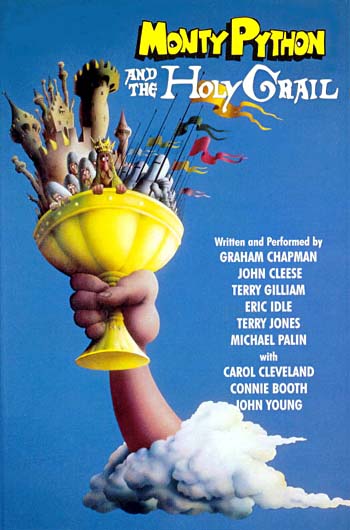
- The Hand Is God: The poster, seen above, depicts the right hand of God reaching out from a cloud and holding the titular grail.
- Hammer Hilt: At one point during his duel with the Black Knight, King Arthur hits the Knight on the top of the head with the pommel of his sword.
- Hand Signals:
- Arthur uses some to direct his knights after arriving at the castle with the insulting French guards.
- The chief of the Knights Who Say Ni holds up a hand to stop his fellow Knights from saying Ni to King Arthur and his party.
- The enchanter Tim holds up a hand to stop King Arthur's party as they approach the Cave of Caerbannog.
- Brother Maynard points to his assistants to signal them to retrieve the Holy Hand Grenade of Antioch.
- Having a Blast: Tim the Enchanter randomly shoots off fireballs and uses elaborate hand gestures that cause massive explosions in his opening scene. We never see him do it again, but at least he made a good first impression.
- Heaven Above: The movie crudely depicts God as a giant Sky Face who rips open a cloud to start a conversation with King Arthur, taking the association of the heavens with Heaven to a comical extreme.
- High-Pressure Blood:
- King Arthur's duel with the Black Knight; every time the knight loses a limb, he spurts absurd amounts of blood for a second or two.
- The scene with the Killer Rabbit, wherein the rabbit bites off a few heads, does the same thing.
- Historical In-Joke:
- Alfred, King of the English, actually built a stronghold in a swamp, for his guerrilla war against the Danish invaders.
- Several of the examples listed on the YMMV page under
 Aluminum Christmas Trees would also qualify - a lot of the absurdity in the movie is inspired by things that actually existed, either in real life or in other stories of King Arthur and his knights.
- Hoist by His Own Petard:
- The bridge-keeper attempts to invoke three questions before letting them cross (which are either very easy — if you aren't indecisive — or awfully hard trick questions or trivia). If they fail (either by not knowing one of the answers or simply being indecisive), they are hurled down a fiery crevice. When Arthur gets his turn, specifically when he gets to the third question (about the airspeed velocity of an unladen swallow), Arthur asks for clarification as to whether he meant an unladen African swallow or an unladen European swallow. The bridgekeeper then admits he doesn't know, with predictable results.
- The Knights of the Round Table, when the French taunters catapult their own Trojan Rabbit back at them.
- Hollywood Apocrypha: Brother Maynard reads from the Book of Armaments.
- Hollywood Tactics: Played for comedy. Arthur and his knights charge heedlessly at the walls of a castle on foot, without siege implements or any other apparent plan on getting into the castle. Only Lancelot manages to actually reach the wall, and he simply chops at it with his sword before retreating.
- Hollywood Torches: Big, flaming torches are used as easy props in a few interior scenes.
- Holy Hand Grenade: The Trope Namer. "Bless this oh Lord thy Holy Hand Grenade of Antioch." It's a holy weapon meant to smite evil.
- Hope Spot: Arthur leads an army in an all-out assault against the Castle Aaaaargh only for the police to intervene and arrest Arthur.
- Hurricane of Euphemisms: The anarcho-syndicalist peasant uses different synonyms each time he argues against Arthur's Lady of the Lake speech.
- Hypocritical Humour: The Knights Who Say "Ni!" have a deathly aversion to the word "it," yet moments before after King Arthur brings them a shrubbery, the head Knight says "It is a good shrubbery." Then after the Knights repulse after Arthur uses the word "it" in a response, the head Knight says "Aagh! He said it again!" Prior, when Arthur asks what word not to say, the head Knight says "I cannot tell; suffice to say is one of the words the Knights of Ni cannot hear!"
- The Idol's Blessing: King Arthur and his Knights of the Round Table are literally blessed by God himself to find the Holy Grail and cement their names in legends.
- I'm a Humanitarian: Robin's minstrels, in a pun on Galaxy Minstrels.Narrator: And they were forced to eat Robin's minstrels... And There Was Much Rejoicing.
Knights: Yaaaaay. - Impaled with Extreme Prejudice: The three knights impaled to a tree with a lance by the three-headed knight.
- Implausible Deniability:
- When the Black Knight is getting his arse handed to him by King Arthur, he insists that "it's just a flesh wound," all the while bleeding profusely from being heavily dismembered.
- When Bedevere reacts with (understandable) disbelief to the peasant's claim that a witch turned him into a newt, despite him standing right there in full human form, the peasant meekly adds, "...I got better."
- Impossible Task: "You must chop down the mightiest tree in the forest... wiiiiiiiiith... a herring!"
- Improbable Aiming Skills:
- The Black Knight throwing his sword right through the eye-slot of the Green Knight's helmet.
- Prince Herbert fires an arrow with a message tied to it out of the window, and it travels a considerable distance before striking Lancelot's servant square in the chest.
- Incessant Music Madness: Sir Robin eventually loses his temper with his minstrels, though it has more to do with their derogatory lyrics than the quality of their singing.
- Informed Ability: The minstrels initially gush about Sir Robin's bravery, but after he flees from combat with the three-headed giant, it turns into servile snarking.
- Inherent in the System: Trope Namer, when Arthur tries to rough up Dennis to get him to stop talking:Dennis: Come see the violence inherent in the system! Help, help, I'm being repressed!
- Inherently Funny Words:
- Ni!
- Shrubbery.
- "A newt?" (As opposed to, say, a cat.)
- Møøse. Majestic perhaps, but very funny.
- Insane Troll Logic: Bedevere's faultless chain of reasoning leading to the conviction of the witch: If a woman weighs the same amount as a duck then she's made of wood because both ducks and wood floatnote , and because both wood and witches burn, she must be a witch! In true Monty Python fashion, it works!note Also, one of the tracks on the soundtrack album is an alleged philosophy professor analysing the very thing. He concludes that sex is better than logic.
- In the same scene, one of the peasants suggests building a bridge out of the woman to test if she's made of wood. Bedevere shoots down that idea... by pointing out that bridges can also be made from stone.
- An Insert: The scene of Sir Lancelot running towards Swamp Castle was re-shot on Hampstead Heath near London, because the original was out of focus. John Cleese recalls how while filming this, although he was a very tall man in Medieval armour, bystanders took absolutely no notice of him.
- Insistent Terminology: Overlapping with Sarcasm Mode, the repeated use of the word "brave" to describe Sir Robin during the minstrels' song veers into this territory.
- Intermission: Parodied. The "intermission" is ninety percent of the way through the movie and very brief.
- Invisible Backup Band: Every time Herbert makes an (almost always abortive) attempt to start singing, a band begins to play, before it's all shut down by his father.
- "I Want" Song: Defied. The lord of Swamp Castle keeps stopping his son, Prince Herbert, from breaking out into one at several points. It is first, in a later scene, where Herbert turns it into a Crowd Song that he is able to drown out his father's attempts to stop it.Swamp King: And that is what you're going to get, lad! The strongest castle in all of these isles!
Hebert: But I don't want any of that! I'd rather...
Swamp King: Rather what?!
Hebert: I'd rather... just... sing! [music starts swelling up]
Swamp King: Stop that! Stop that! [music grinds to a halt] You're not going into a song while I'm here! - Jerkass Has a Point: Dennis is annoying as hell, but he's correct that 1) in real-world terms Arthur's claim to be ruler is Insane Troll Logic, 2) Arthur has not been given legitimacy by the people he seeks to rule, and 3) Arthur immediately begins attacking and insulting him the instant he points out 1 and 2, thereby proving that "violence is inherent in the system".
- Just a Stupid Accent: John Cleese's taunting Frenchman hangs a lampshade. It's further played with when one of the French knights does speak French (or uses commonly known French words), and the other Frenchmen don't understand a word.Frenchman #1: C'est un cadeau!
Frenchman #2: Huh?
Frenchman #1: It's a present!
Frenchman #2: Oh! Oui, un cadeau!
Frenchman #1: Oui! Oui! Allons-y!
Frenchman #2: What?
Frenchman #1: Let's go.
Frenchman #2: Oh! - Kick Them While They Are Down: After Arthur cuts his arms off, the Black Knight kicks Arthur as he prays. When he won't let up, Arthur cuts off both of his legs, too.
- Killed Mid-Sentence: "It's the legendary Black Beast of— [gets eaten] AAAAARRRRRRGGGHHH!"
- Killer Rabbit: The Trope Namer, who the Knights run into in their quest for the Holy Grail, and rapidly lives up to its name.
- King of All Cosmos: God the creator of all appears as a cranky eccentric in one of Terry Gilliam's cartoons.
- Kinky Spanking: The women in Castle Anthrax try to get Sir Galahad to spank them for luring him in. Unfortunately for Galahad, Sir Lancelot thinks it's "too perilous".
- Lady Land: Castle Anthrax is populated entirely by "young blondes and brunettes, all between the ages of 16 and 19-and-a-half." They are doctors, you know, so you must obey them when they undress you.
- Leeroy Jenkins: Sir Lancelot. He storms a castle to save what he thinks is a princess, killing a lot of innocent people as he does it, only to find he's gotten everything completely wrong. When the innocent people in the castle rightly want his head for it, Lancelot kills a few more of them before he's stopped.
- Left the Background Music On: Prince Herbert tries to start a musical number several times. His father interrupts him every time, except for the last one, when an assembled crowd starts it.
- Let No Crisis Go to Waste: The Swamp King spins Lancelot's slaughter of the wedding guests and father of the bride into a land grab by adopting the orphaned bride — even if he needs to nudge the orphan aspect over the finish line.
- Letting the Air out of the Band:
- Each time the credits stop to inform the viewer that someone has been sacked, the background music deflates before starting up again.
- Every time Herbert's father shuts down his attempts to start singing, the Invisible Backup Band deflates.
- A Light in the Distance: Castle Anthrax's Grail-shaped beacon is what leads Galahad through the storm.
- Literal Disarming: King Arthur cuts off both of the Black Knight's arms and both of his legs, and the Black Knight still refuses to surrender.Black Knight: Alright, we'll call it a draw.
King Arthur: Come, Patsy!
Black Knight: Oh, oh, I see... Running away, ey?! You yellow bastard! Come back here and take what's coming to you! I'll bite your legs off! - Literal-Minded: Prince Herbert's guards are so literal in their interpretation of their orders that they allow Herbert to engineer his rescue because in the process he never does anything they were told to keep him from doing.
- Logical Fallacies: The ignorance of the people of the era is Played for Laughs in the witch scene, where they fall for a classic Association Fallacy.
- Lord Error-Prone: Lancelot when he's Storming the Castle. He thinks he's rescuing a Damsel in Distress by slaying her captors, when he's really killing innocent wedding guests and saving a whiny young man from an arranged marriage.
- Lovable Coward: Sir Robin, the Not-Quite-So-Brave-As-Sir-Lancelot, who had nearly fought the Dragon of Angnor, and who had nearly stood up against the Chicken of Bristol, and who had personally wet himself at the battle of Badon Hill:Minstrels: Brave Sir Robin ran away
Sir Robin: No!
Minstrels: Bravely ran away, away
Sir Robin: I didn't!
Minstrels: When danger reared its ugly head, he bravely turned his tail and fled
Sir Robin: No!
Minstrels: Yes Brave Sir Robin turned about
Sir Robin: I didn't!
Minstrels: And gallantly he chickened out. Bravely taking to his feet
Sir Robin: I never did!
Minstrels: He beat a very brave retreat
Sir Robin: All lies!
Minstrels: Bravest of the brave, Sir Robin!
Sir Robin: I never! - The Low Middle Ages: Note that in the DVD commentary, the Pythons admit that Anachronism Stew is at work: It is said to be set in Dark Ages Britain, but the costumes are based on fashions from the 1300s, not to mention the castles.
- Ludicrous Gift Request: If you do not have a shrubbery to give to The Knights Who Say Ni you will never pass through their wood... aliiive.
- Lyrical Dissonance: The song "Brave Sir Robin Ran Away" is a jaunty tune about all of the Body Horror that Sir Robin is allegedly not afraid of. Sir Robin finally stops it when the minstrels get too graphic.Minstrels: He was not in the least bit scared
To be mashed into a pulp
Or to have his eyes gouged out
And his elbows broken
To have his kneecaps split
And his body burned away
And his limbs all hacked and mangled
Brave Sir Robin.
His head smashed in
And his heart cut out
And his liver removed
And his bowels unplugged
And his nostrils raped
And his bottom burnt off
And his pen—
Sir Robin: That's—that's enough music for now, lads...
- MacGuffin Location: "Camelot! Camelot! Camelot! It's only a model. Shh!" ... "Well, on second thought, let's not go to Camelot. It is a silly place."
- Made of Plasticine: How easily King Arthur hacks off the Black Knight's limbs. With the arms in particular, it looks as though a mere tap on the shoulder is enough to detach a limb.
- Major Injury Underreaction:
- The Black Knight each time Arthur removes a limb — all four of them.
- Lancelot's faithful squire Concorde upon getting shot in the chest.Concorde: Message for you, sir!
- Medieval Morons:
- Doubly subverted when Sir Bedevere is approached by a mob of superstitious villagers who think they have caught a witch and accordingly want permission to burn her. When Bedevere asks them the obvious question of how they know the woman is a witch, they only come up with nonsensical non-evidence ("she looks like one", "she has a wart", and a perfectly human-shaped man claiming she turned him into a newt). The impression that Bedevere is a voice of reason trying to talk the villagers out of their superstitious fury is soon scattered when Bedevere instead uses a string of equally nonsensical "logical" conclusions to "prove" that witches are made of wood (because they burn), and therefore weigh the same as a duck (because ducks float, like wood). By use of a pair of giant scales, Bedevere and the villagers proceed to determine that the suspect weighs the same as a duck, and accordingly the woman is hauled off as a witch.
- Subverted in the "peasants digging filth" scene:Dennis (peasant): We're an anarcho-syndicalist commune. We take it in turns to act as a sort of executive officer for the week, but all the decisions of that officer have to be ratified at a special bi-weekly meeting by a simple majority in the case of purely internal affairs, but by a two-thirds majority in the case of more major...
- Medium Awareness: Prince Herbert's father when the prince is about to start singing. He's aware of the invisible back up band.
- Medium Blending: As with virtually all of their work, the movie frequently switches from live-action to Terry Gilliam's Deranged Animation, particularly for transitions between scenes, though it crops up elsewhere as well, such as with the Black Beast of Aaaaaaaarrrrrgh.
- Miles Gloriosus: "Brave" Sir Robin, who has a troupe of troubadours to follow him about and sing his praises. Unfortunately, he runs away at the first sign of danger, and they incorporate his cowardice into their song.
- Minsky Pickup: The Camelot song begins this way, naturally.
- Miscarriage of Justice: Fridge Logic shows that the police were in the wrong to cart off Arthur and his men as the murderers of A Famous Historian. The knight who killed him rode a real horse.
- Misplaced Wildlife: Infamously, coconuts in medieval England. Extensively discussed, but never actually justified: Arthur claims that he and his men found them, but he doesn't especially care how they got to England, only exasperatedly suggesting that perhaps Swallows Did It.
- Mission from God: The knights seek the Holy Grail because God told them to do so.
- Mistaken for Gay:
- Galahad accuses Lancelot of this since the latter rescues the former from "almost certain temptation" from a castle full of virgin women.Galahad: Bet you're gay!
Lancelot: ...No, I'm not. - In Spamalot!, Lancelot really is gay.
- In the screenplay on the DVD, the other knights look knowingly at Lancelot.
- Galahad accuses Lancelot of this since the latter rescues the former from "almost certain temptation" from a castle full of virgin women.
- Mistaken for Murderer: Lancelot, Arthur and Bedevere are all arrested by the cops for the murder of the Famous Historian, the latter two identified by his wife. However, none of them are the killer — the killer had a horse.
- Moment Killer: An epically funny one when Sir Lancelot shows up at Castle Anthrax to save Sir Galahad from almost certain temptation.
- Monster Munch: Sirs Bors, Gawain, and Ector, three Red Shirts who show up after the Time Skip following the Knights of Ni scene, exist entirely to be killed by the Killer Rabbit.
- Mood Whiplash: Parodied (like everything else) when King Arthur and Sir Bedevere finally reach the castle where the Holy Grail is kept. The scene even has majestic music playing, until...King Arthur: Our quest is at an end! God be praised! [he and Sir Bedevere kneel] Almighty God, we thank Thee that Thou hast vouchsafed to us the most holy— [a sheep is flung at them] JESUS CHRIST!! [sheep lands on them]
French Guard: Hello, stuffy English Kniggit and Monsieur Arthur King who has the brain of a duck, you know! So we French persons outwit you a second time! - Moving the Goalposts: The Knights Who Say "Ni" do this to King Arthur and Sir Bedevere. After they get the Knights a shrubbery, the Knights demand another shrubbery, and to cut down the mightiest tree in the forest with a herring. Arthur and Bedevere are only saved thanks to Arthur accidentally exploiting the Knights' Weaksauce Weakness to the word "it".
- Multiple Head Case: The three-headed giant whose heads bicker amongst themselves, which ultimately allows Robin to escape while they are distracted.
- Mythology Gag:
- Sir Bedevere is the first knight to follow Arthur. The character of Bedevere (Welsh: Bedwyr) appeared in Arthurian legend before Lancelot, Galahad and the rest (except Sir Robin who is new).
- Sir Bedevere is also the last of Arthur's knights to remain. In Malory's Le Morte D Arthur he is the last knight alive after the final battle where Arthur is mortally wounded.
- Sir Robin was mentioned to have wet himself at the Battle of Badon Hill. This battle was apparently a real event which Arthur became associated with. It frequently comes up in discussions about the historical basis for the Arthur legends.
- Sir Lancelot's squire Concorde shares a name with the steed of the Flying Circus character Dennis Moore (also played by Lancelot's actor John Cleese) from the episode "Dennis Moore".
- Names to Run Away from Really Fast: Not Castle AAAAaaaaaargh (although it clearly was intended to evoke this trope), but Castle Anthrax. Maybe there really was more peril there for Lancelot to rescue Galahad from than just losing his chastity...
- Negated Moment of Awesome: Arthur's charge against the Castle Aaaaargh where he mobilises an entire army to attack becomes this thanks to the police showing up to stop it.
- Never Say That Again: Ni! Turned around on the knights, later. They are drained of their will by the word "it". Oddly enough, the knight says it at the top of the scene with no harm done. He hits himself with it for damage during the fadeout.
- No Ending: Due to a combination of writer's block, No Budget and everyone getting fed up with the film's Troubled Production. Arthur and his knights prepare to storm the French castle, and are then promptly arrested by the police for the murder of a historian killed by a random knight halfway through the film.
- Noodle Implements: Bedevere claims to have some theories on how sheep's bladders can be used to prevent earthquakes. Then again, he is quite the Cloud Cuckoolander.
- No Ontological Inertia: A fourth-wall-breaking example, where the knights are saved from the cartoon cave monster by the animator keeling over dead, causing it to disappear from existence.
- No Party Like a Donner Party: The minstrels are used as food to get through winter.Narrator: In the frozen land of Nador, they were forced to eat Robin's minstrels. And there was much rejoicing.
- The Noun Who Verbed: The Knights Who Say "Ni" use the word as their greatest weapon. They later change their name to something along the lines of "The Knights Who Say 'Ekke Ekke Ekke Ekke Ptangya Zoooooooom Boing Ni'", however, King Arthur, who can't pronounce this, proceeds to call them "The Knights Who 'Til Recently Said 'Ni'".
- Off with His Head!: The knight Bors has his head bitten off by the Rabbit of Caerbannog.
- Oh, Crap!: It seems as though all will be well when the King of Swamp Castle is walking with Lancelot to have a drink, when one of the guests recognizes Lancelot.Guest: There he is!
King: Oh, bloody hell. - Ominous Fog: The fellowship encounters heavy fog in the woods which creeps them out.
- Ominous Latin Chanting: The flagellant monks recite what are Catholic prayers, while hitting themselves on the head with wooden planks.
- The Oner: The Overly Long Gag "make sure the prince doesn't leave the room until I come and get him" scene in Swamp Castle was filmed in one take.
- Only a Flesh Wound: The Trope Namer — but subverted. King Arthur chops the Black Knight's sword arm off to end the fight quickly and thus avoid having to kill him. When the knight insists on fighting one-armed, he chops off the other one, then one leg, then the other. At this point, the knight is clearly bleeding out and will probably die, but he trash-talks Arthur as if nothing had happened at all.
- Only Sane Man: Arthur. He's not necessarily brilliant, but he's a capable and smart leader, a good sword fighter, confident, assertive, and the only one without a severe emotional problem of some sort. (And he hasn't got shit all over him.)
- Only Six Faces: The vast majority of roles are played by the Pythonites with appropriate costume changes. The fellow playing the "Famous Historian" also plays the old man added to the cartload of dead.
- Only Smart People May Pass: Parodied in the Bridge of Death scene. The old man guarding it asks three questions; the first two are harmless, but the third one can be either another harmless one or a tricky piece of trivia nobody is assumed to know off-hand. Get any of them wrong or show hesitation and you're launched into the abyss below. This goes for the bridge keeper as well.
- Ooh, Me Accent's Slipping:
- John Cleese's faux-French accent slips into his British one momentarily during the French Taunting scene.
- Cleese inverts this during his scenes as Tim the Enchanter, whose accent suddenly becomes much thicker between his first meeting with the knights and the scenes at the Cave of Caerbannog.
- John Cleese's faux-French accent slips into his British one momentarily during the French Taunting scene
- Overdrawn at the Blood Bank: The Black Knight sequence; every limb lopped off results in a spray of High-Pressure Blood.
- Overly Literal Transcription: Discussed while seeing the carved message from Joseph of Aramathea: "He who is valiant and pure of spirit may find the holy grail in the Castle of Aaauuuggghhh..."Bedevere: What is that?
Brother Maynard: He must have died while carving it.
Lancelot: Oh, come on!
Brother Maynard: Well, that's what it says.
King Arthur: Look, if he was dying, he wouldn't have bothered to carve "Aaaauuuggghhhh". He would just say it.
Brother Maynard: Well, that's what's carved in the rock.
Sir Galahad: Perhaps he was dictating.
King Arthur: Oh, shut up. - Overly Long Gag:
- The calligrapher who's trying to finish The Tale of Sir Lancelot title page, going around and down long corridors to go outside to tell the "bloody weather" (clouds and the sun) to stop jumping around and making a racket.
- It takes an inordinately long time and many patient repetitions for the King of Swamp Castle to get his guards to understand that he wants them to stay in the room and not let Prince Herbert leave. And just when the King thinks they've got it, the guards start to follow him out of the room (i.e., the exact opposite of what the King told them to do), and he has to explain his orders yet again.
- The sequence of Lancelot charging toward the gate of Swamp Castle, played five times before we finally see the continuation of it.
- The reading of the Holy "Gospel of Armaments" and how to use the Holy Hand Grenade.
- The entire "Get on with it!" scene, to the point even God joins.Three-headed Knight: At least ours was better visually.
Dennis the Peasant: At least ours was committed and wasn't just a string of pussy jokes.
Old Man from Scene 24: Get on with it.
Tim the Enchanter: Yes, get on with it!
Army of Knights: YES, GET ON WITH IT!
Dingo: Oh, I am enjoying this scene.
God: GET ON WITH IT!
- Painful Rhyme: The "Camelot" song is built around these, and it's even lampshaded:We're Knights of the Round Table, our shows are for-mid-able
But many times, we're given rhymes that are quite un-sing-able... - Painting the Medium: Done literally with the title card in Sir Lancelot's segment as an animated cartoonist is painting the title card itself.
- Period Piece, Modern Language: The characters will frequently switch from speaking in poetic, Shakespeare-esque dialogue to a more modern way of speaking to accentuate the absurdity of the setting and story.Arthur: You are indeed brave, sir knight, but the fight is mine.
Black Knight: Oh... had enough, eh?
Arthur: (beat) Look you stupid bastard, you've got no arms left! - Pervert Alliance: A wholly female group at a convent that was none too holy would light a "grail shaped beacon" to draw in wandering knights seeking same. Sir Galahad , after stating he seeks the Grail, is informed that it's not the first time that they've had that problem, and that he must punish the offending girl by tying her on a bed and spanking her soundly, with the other girls quickly insisting they be spanked as well. "And after the spankings, the oral sex!" declares the lead girl. Sir Galahad decides he can stay a bit longer. Fortunately, Sir Lancelot shows up to rescue Galahad from the "peril".
- The Pig-Pen: The villagers compared to Arthur, since "...he hasn't got shit all over him."
- Poirot Speak: The whispering among the Frenchmen is full of this. When they are about to Drop the Cow, the order is whispered in Franglais: "Fetchez la vache!" Later when they bring in the Trojan Rabbit, they cannot understand each other in French and have to switch to English: "C'est un lapin, lapin de bois. Quoi? Un cadeau. What? A present. Oh, un cadeau."
- Pose of Silence: Played for Laughs. When the French knight is bawling over the castle wall to Arthur and his knights that they already have their own Holy Grail, then turns to the other knights with him on the wall and whispers behind his hand, "I told them we've already got one!" and they all cover their mouths and guffaw, clearly learning this for the first time.
- Prayer of Malice: Parodied; the heroes pray for God not only to defeat their enemies but to "blow them to tiny bits, in Thy Mercy".
- Precision F-Strike:
- The script originally called for Sir Galahad to tell Tim the Enchanter to "fuck off" during the Killer Rabbit scene. He instead says "Get stuffed." due to a censorship request. Still, "shit" has been said a few brief times.
- On the soundtrack album, the logician dissecting the witch burning scene goes off on a tangent about his wife's infidelity taking precedent over his supper, then of her turning her passion towards him. "Fuck supper," he winds up saying as he and his wife get it on.
- Also, the soundtrack album starts with an introduction on the quality of the record and contains this:There is little or no offensive material apart from four "cunts", one "clitoris" and a "foreskin". And, as they only occur in this opening introduction, you're past them now.
- The script originally called for Sir Galahad to tell Tim the Enchanter to "fuck off" during the Killer Rabbit scene. He instead says "Get stuffed."
- The Presents Were Never from Santa: Dennis pours scorn on the Lady of the Lake myth:Dennis the Mud Farmer: Listen, strange women lying in ponds, distributing swords is no basis for a system of government. Supreme executive power derives from a mandate from the masses, not from some farcical aquatic ceremony!
- Prophet Eyes: The old man from scene 24 has whited out eyes as he gives out his prophecy.
- Public Domain Artifact: The Holy Grail is the object of the heroes' quest, given to them by God.
- Rapid-Fire Descriptors: Dingo, a maiden from Castle Anthrax, gets "angry" with her identical twin Zoot for lighting up their grail-shaped beacon and luring Sir Galahad into their castle. She calls her "Bad, bad Zoot! Oh, wicked, bad, naughty Zoot! Oh, wicked, bad, naughty, evil Zoot!" She says Zoot's a bad person who must pay the penalty! Which is spanking. All the maidens want a spanking. And after the spanking, the oral sex.
- Red Shirt: Bors, Gawain and Ector. They appear suddenly and without barely any introduction before The Rabbit of Caerbannog and they are promptly dispatched.
- Relax-o-Vision: As Arthur and Bedevere cross the Bridge of Death accompanied by dramatic action music, a title card that reads "Intermission" appears for about ten seconds along with peppy organ music.
- Remember the New Guy?: Sirs Gawain, Ector and Bors show up with no explanation whatsoever, and nobody seems to notice. Though they do appear after a year-long Time Skip. Brother Maynard shows up in the background at the same time, but it's easy not to notice him until the Holy Hand Grenade scene.
- Repeat to Confirm: Parodied when the King of Swamp Castle gives commands to a guard, and the guard repeats them back wrong. The two of them spend the next two minutes going back-and-forth with the king trying to get the guard to get the orders right.
- Rewriting Reality: The knights escape a cartoon monster when the animator dies of a heart attack.
- Riddle Me This:
- Parodied by The Bridge Keeper:Bridge Keeper: What is your name?
Lancelot: My name is Sir Lancelot of Camelot.
Bridge Keeper: What is your quest?
Lancelot: To seek the Holy Grail.
Bridge Keeper: What is your favourite colour?
Lancelot: Blue.
Bridge Keeper: Right, off you go. - Sir Robin wasn't so lucky. Same questions until the third.Bridge Keeper: What is the capital of Assyria?note
Robin: Wh— I don't know that! [tossed into the chasm below] - Sir Galahad got the favourite colour question, but still managed to get it wrong. What's funny is that it doesn't sound all that implausible — he was answering the same questions as his predecessor with the same answers, and accidentally said Lancelot’s favourite colour too instead of his own.
- King Arthur gets another atypical question, and yet he survives because...Bridge Keeper: What is the airspeed velocity of an unladen swallow?
Arthur: What do you mean, an African or European swallow?
Bridge Keeper: Huh, uh, I don't know that... [tossed into the chasm below]
- Parodied by The Bridge Keeper:
- Rope Bridge: Subverted, in that it doesn't break. Graham Chapman got so drunk, he was absolutely terrified this would happen, so a stunt double strutted across the bridge in his place. You might notice how strangely determined the guy looks when doing this.
- Rule of Funny: The plot is just a loose framework around which the Python crew string a series of humorous situations.
- Rule of Three: Rule of Five (Three, sir!)
- The counting of the Holy Hand Grenade. "Five is right out."
- Subverted with the story about constructing the swamp castles. The third castle in the swamp fared even worse than the first two, but the fourth one stayed up.
- Arthur constantly confuses "five" for "three".Arthur: How many did we lose?
Lancelot: Gawain.
Galahad: Ector.
Arthur: and Bors, that's five...
Galahad: Three, sir.
Arthur: Three, three. - At the Bridge of Death, adventurers must answer five questions (three questions!) ...three questions in order to cross the bridge.
- Running Gag:
- Swallows and coconuts come up way too often in this movie, as do people not quite dying, and the number three.
- Every time Arthur prays, he gets hit with something. Since God made it clear he's done with all of this blind worship, that probably isn't a coincidence.
- Arthur keeps getting 3 and 5 mixed up.
- Whenever Prince Herbert tries to start singing, his father puts a stop to it.
- The modern-day police officers and detective following Arthur's shenanigans, and eventually arresting the whole cast.
- Characters turning out to be Not Quite Dead.
- Sacred Hospitality: The girls of Castle Anthrax are, ahem, very "hospitable" towards Galahad. More so, in fact, than he's comfortable with (at first).
- Scales of Justice: In a scene a suspected witch is put on the scales to see if she weighs the same as a duck (and therefore floats, is made of wood, is flammable, and hence a witch), but the scales are obviously unbalanced. (Then again, she does say "It's a fair cop..." implying that she is a witch after all.)
- Scare Chord: Like everything else by Monty Python, the Knights Who Say Ni scene plays this for laughs:Knight Who Says Ni: We want... [Beat] a shrubbery!
[cue a very loud, screeching chord] - Scenery Porn: In its own Pythonesque way. There are many background shots of the British countryside, with the director's commentary saying it is amazing how the background could look so naturally beautiful on a shoestring budget. Notable moments are the setting of the Black Knight scene (Epping Forest near London), bluebells in the wood during the "Brave Sir Robin" scene, An Insert of Cheddar Gorge just before this, and the mountainous terrain in the Tim the Enchanter scene. Terry Gilliam's animation is also beautiful, especially the sunset which follows the absurd scene of the sun and clouds jumping up and down.
- Scooby Stack: The French knights stack up against the wall by the entrance to their castle before stepping out to investigate the Trojan Rabbit.
- Screw This, I'm Outta Here: When brave Sir Robin encounters a three-headed giant, he chickens out. His minstrel keeps singing about it, much to his annoyance. Listen to the Tale of how Brave Sir Robin ran away.Sir Robin's minstrel: Brave Sir Robin ran away.
Bravely ran away away.
When danger reared its ugly head, He bravely turned his tail and fled.
Yes, brave Sir Robin turned about and gallantly he chickened out.
Bravely taking to his feet, he beat a very brave retreat.
Bravest of the brave Sir Robin. - Seinfeldian Conversation: Lots of it, especially the argument about coconuts that defeats Arthur's attempt to enlist the master of the castle at the beginning of the film.
- Sexy Figure Gesture: The Swamp King does the "big breasts" gesture when describing to Prince Herbert how the princess he's going to marry has huuuuge... tracts of land - even though he had earlier established that her royal family does literally possess a large amount of land.
- "Shaggy Dog" Story: The whole movie is this it turns out, since it ends with everyone being arrested, so that the quest for the Grail is never fulfilled and the whole journey was for nothing.
- Shout-Out:
- The Trojan Rabbit (Trojan Horse) and Lancelot's squire Concorde (the jet) (or possibly a reference to John Cleese's Dennis Moore character from the TV show), among others.
- Also, Lancelot thanks the Bridgekeeper as he passes the Bridge of Death by saying "Thank you. Thankyouverymuch," in the same vein as Elvis Presley.
- The flagellation, the witch burning scene, and the mock-Swedish subtitles are all shout-outs to The Seventh Seal.
- One of the other words kept by The Knights Who Say Ni, Nehwon, is the name of the world where Fritz Leiber's Fafhrd and the Gray Mouser stories take place.
- Shown Their Work:
- Terry Jones was an Arthurian scholar and added details not commonly seen in different King Arthur adaptations, such as Lancelot being a total berserker in combat.
- Despite the absurdity of the subsequent "duel", the fight between the Black Knight and Green Knight is actually much closer to how real-life sword fights went than Hollywood usually portrays them, it's less an honourable duel and more a violent brawl that happens to feature swords and ends the moment someone is hit in a vulnerable area.
- Siege Engines:
- The French knights presumably used some kind of catapult to fling the cow and giant rabbit.
- Several are seen amongst Arthur's army at the end of the movie, probably to be used against the Castle Argh.
- Sky Face: God's face appears in the sky to send King Arthur and his knights on a quest.
- Smoke Out: There's a Smoke In when Tim the Enchanter teleports from a distant mountaintop.
- Sneaky Departure: "Brave Sir Robin" sneaks away while the heads of the three-headed knight are bickering about whether to have biscuits with their tea after they have killed Sir Robin.
- Someday This Will Come in Handy: The conversation about swallows Arthur overhears at the beginning of the film comes in handy much, much later.Bedevere: How do you know so much about swallows?
Arthur: Well, you have to know these things when you're a king, you know? - Somewhere, a Mammalogist Is Crying: Tim the Enchanter refers to the Killer Rabbit as a "bad-tempered rodent". Rabbits are not rodents!
- Sophisticated as Hell:
- The Holy Hand Grenade instructions, as read by Brother Maynard:Brother Maynard: ...who, being naughty in My sight, shall snuff it.
- Dennis the anarcho-syndicalist peasant defies Arthur's authority:Dennis the Mud Farmer: You can't expect to wield supreme executive power just because some watery tart threw a sword at you!
- The Holy Hand Grenade instructions, as read by Brother Maynard:
- Soundtrack Dissonance: The opening credits feature dramatic music... and goofy subtitles about moose.
- Stealth Pun:
- Due to the film having No Budget and the crew getting frustrated by its Troubled Production, there was no way they could have an epic Final Battle to close the movie. So instead, the characters are anti-climactically arrested by police officers for a random murder committed earlier in the movie, and the film ends without a real conclusion. It's a cop-out.
- Describing a woman as having "huge tracts of land" accompanied by hand gestures indicating she has a large chest. The potential bride is described as having property, which, given the era, she would not have owned outright, but would have made up her dowry, to go to her husband upon marriage. Thus she was literally "well-endowed." In today's language a woman is "well-endowed" if she has a large chest.
- On the Special Edition DVD, the film opens with a clip from the 1961 British film Dentist on the Job; the off-screen projectionist realizes his mistake and switches over to the film proper. On the surface, this is just standard Python humour, but the joke comes from the film's American title: Get On with It.
- As explained by Terry Gilliam in the 40th anniversary Blu-Ray, the image of W.G. Grace as God was meant to be a reference to "The Grace of God".
- Due to the film having
- The Stinger: An aversion — a black screen and two minutes and forty seconds of repetitive organ music. On the old CBS FOX Video VHS releases in the late '80s/early '90s, the organ music was shortened and played out against the standard warning screens which bookended VHS tapes.
- Stone Wall: Parodied with the Black Knight. He has all his limbs chopped off, yet still boasts that he's invincible, and that it's Only a Flesh Wound.
- Stop Worshipping Me: God is visibly annoyed with Arthur's and the Knights' slavish reverence, and bluntly snaps at them to knock it off more than once.
- Storming the Castle:
- The French castle is attacked three times: Arthur's knights attempt to storm it early on, Lancelot later attacks the castle by himself, and finally, Arthur's army charges it again at the climax.
- Lancelot storms Castle Anthrax to save Galahad from "almost certain temptation", and Swamp Castle to save the distressed... prince.
- Stuff Blowing Up: Tim the Enchanter interrupts the knights mid-sentence for no purpose but pyrotechnics.
- Suspiciously Specific Denial: When Galahad arrives at Castle Anthrax and demands the Grail, Zoot acts as if she has no idea what he's talking about, but when he mentions seeing a vision of it in the sky, she suddenly exclaims, "Oh, I just remembered, our castle's beacon is grail-shaped." Considering A: there's a punishment set in place specifically for turning on the beacon (because they keep having trouble like this over it) and B: the maidens in the castle clearly want to lure young men into their bedrooms, it's pretty obvious Zoot knew all along what Galahad was talking about, that the beacon was turned on to trick travellers, and Zoot's exclamation was both this trope and a bit of Blatant Lies.
- Take That!: According to the DVD commentary of the cast, the scene where a monk reads the instructions of the Holy Hand Grenade was revenge against being forced to go to church as children. They described their experience during service as having to listen to someone reading a nonsensical repetitive bible verse in an annoying high pitched voice, which is exactly what happens in the scene.
- Taken During the Ending: Played for Laughs. King Arthur and Sir Bedivere are arrested and taken away by modern-day police on suspicion of murder right in the middle of an epic battle to decide the fate of the Holy Grail, ending the film as an Anti-Climax. (An example of Real Life Writes the Plot, since the reason why Monty Python didn't go through with the whole fight is that they ran out of money and time before they could film the whole battle.)
- Team Rocket Wins: By virtue of Arthur and everyone joining him in the attack of the castle getting arrested, the French knights are victorious.
- That Makes Me Feel Angry: When the Black Knight refuses to join Arthur, he mildly states, "You make me sad," but doesn't appear to be particularly upset until the Black Knight also refuses to let him pass.
- That Poor Cat: Exaggerated, in that the cat is occasionally deliberately abused (in one scene, it's being swung by its tail at a post). The cat is on-screen every time someone makes it complain. (No, it's not a real cat.)
- That Reminds Me of a Song: Prince Herbert prepares to break into song to tell about how he escaped the castle and was saved by Concord, much to the chagrin of his music-hating father.
- That Was the Last Entry: Parodied when the group encounters a stone wall on which a victim of a monster attack has been carving entries onto. It ends, "He who is valiant, and might of spirit, may find the Holy Grail in the Castle of Arrrgh". The knights argue whether the castle is actually named Arrrgh or if the author died while writing it and wrote down his death rattle while doing so. Someone suggests he was dictating it. It's the first one.
- These Questions Three...: Named for the Troll Bridge scene, which didn't just parody this, it zig zagged it. The first two questions are constant: "What is your name?" and "What is your quest?" After that, he'll often ask "What is your favourite colour?" but he's just as likely to throw curveballs like "What is the air-speed velocity of an unladen swallow?"note , or "What is the capital of Assyria?note "
- This Is a Work of Fiction: The regular "accidental and unintentional" message appears in the opening credits... followed by "Signed Richard M. Nixon".
- Throwing Your Sword Always Works: The Black Knight kills the Green Knight by throwing his sword through his helm's eye slot.
- Time-Passes Montage: The seasons-passing segment. Subverted in that the seasons are deliberately mixed up by the end.
- Trial by Ordeal: A famous scene has an accused witch subjected to this: she's weighed to see if she weighs as much as a duck, the Insane Troll Logic is as follows: If she weighs as much as a duck, she must be able to float in water, which means she's made of wood, which means she can burn, which in turn proves that she's a witch.
- Trrrilling Rrrs: Brother Maynard's novice reading the Book of Armaments:Novice: Thrrrrree is the number thou shall count, and the number of the counting shall be thrrrrree.
- Trojan Horse: It's a straight homage to the original, except that it's a Trojan Rabbit... But they forget to put anyone inside of it.
- Troll Bridge: The Bridge of Death, which nobody can cross without answering three questions asked by the Bridgekeeper. Get a question wrong or fail to answer confidently and immediately, and the unfortunate adventurer is cast into the chasm.
- The Trope Formerly Known as X: When the Knights Who Say "Ni" become the Knights Who Say "Ekke Ekke Ekke Ekke P'tang Zoom-Boing Rlrlrlrl" (Ni!), Arthur finds himself unable to remember this and resorts to calling them the Knights Who Til Recently Said "Ni".
- Trust Me, I'm a Doctor: Both Doctor Piglet and Doctor Winston try to assure Sir Galahad that they are doctors during his stay at Castle Anthrax. They've had "basic medical training".
- Unexplained Recovery:
- The peasant's claim that he "got better" after being turned into a newt by the alleged witch comes across as pretty unconvincing, although it's just as likely that the peasant was lying about getting cursed in the first place.
- Despite an unpleasant "splat" sound effect after falling out of the tower, Prince Herbert shows up at his wedding none the worse for wear. He does intend to explain this recovery (in song, of course), but, sadly, we don't get to hear the best part.
- Unstoppable Rage: Lancelot when he's Storming the Castle. He later admits to the king of Swamp Castle that it's a bit of problem of his, as he never really knows when to stop, or when not to start.
- Unusual Euphemism: The Swamp King wants Herbert to marry a woman so he can inherit her father's property, but the son is unwilling. He tries to convince him with a couple of reasons, ending off with the fact that she has "huge... tracts of land," with a gesture that is less suggestive of real estate and more suggestive of womanly curves (of course, thanks to this film, the expression has entered the vernacular to such a degree that it barely qualifies as "unusual" anymore).
- Unusually Uninteresting Sight: The guards at Swamp Castle just watch as Lancelot charges toward them. When he finally arrives and stabs one to death before running on, the other guard's reaction is just to say, "Hey!"
- Unwanted Rescue: Sir Lancelot "rescues" Galahad from Castle Anthrax, where he is in "awful peril" from "eight score young blondes and brunettes, all between the ages of 16 and 19½." Naturally, Galahad protests.
- Vague Age: The girls of Castle Anthrax are "all between the ages of 16 and 19½".
- Verbal Tic:
- The Knights Who Say "Ni" have a habit of spouting the word off like punctuation, even when they're not using its Brown Note capabilities.
- King Arthur has a tendency to say "five" when he actually means "three".
- Verbal Weakness: The Knights Who Say Ni "cannot hear" some words, but the only one shown in the movie is the word "it".
- Visible Boom Mic: During the scene with Tim introducing the Knights to the Rabbit.
- Voice of the Legion: The three-headed giant has very echoing voices, even when only one head at a time is talking.
- Vow of Celibacy: Sir Galahad is known as "Sir Galahad the Pure", but the many women at Castle Anthrax eventually convince him to forget it. He's rescued (very unhappily) by Lancelot before actually violating it though.Galahad: I am sworn to chastity!
Woman: Back to your bed at once! - Wandering Minstrel: Brave, brave Sir Robin's got a bunch of them following him around (until they get eaten).
- Wedding/Death Juxtaposition: During "The Tale of Sir Lancelot", Lancelot rushes to the rescue of a prince who is being married against his will in Swamp Castle, and ends up killing a bunch of guests on his way to rescue him. The King was not happy that he killed 8 wedding guests, killed the best man and kicked the bride in the face on his way to rescue his son. When he's being shown round, he ends up killing more as the guests all complain about his actions, and the king could only explain it's meant to be a happy occasion, and no one should bicker and argue about who killed who.
- Weaksauce Weakness: The Knights Who Say "Ni" are weakened by hearing the word "it", much the same as what "ni" does to ordinary humans.
- Weapons-Grade Vocabulary:
- The word "Ni", soon revealed to be usable by ordinary humans and not just The Knights Who Say "Ni".
- Turned around on the Knights, later. They are weakened by hearing the word "it". Oddly enough, the lead Knight says it near the beginning of the scene with no harm done, but then hits himself with it for damage during the fadeout.
- We Have Reserves: "Did you kill all those guards? They cost 50 pounds each!"
- What Measure Is a Non-Cute?: The Killer Rabbit of Caerbannog is initially dismissed as non-threatening until it shows its fangs and easily dispatches several knights.Arthur: That rabbit's dynamite!
- When Props Attack: In the frames where it attacks people, the Killer Rabbit is quite obviously a cuddly toy.
- White Bunny: The Killer Rabbit of Caerbannog, which is definitely of the deceptively gentle-looking variety.
- Why Don't You Just Shoot Him?: The Killer Rabbit of Caerbannog is defeated with a hand grenade once it is established that the rabbit can kill the knights easily in close-quarters combat.
- Winter of Starvation: Played for Laughs.Narrator: In the frozen land of Nador, they were forced to eat Robin's minstrels. And there was much rejoicing.
Knights: [weakly] Yaaaaaayyyy... - World Shapes: Bedevere delivers an Orphaned Punch Line that suggests there is proof that the world is banana-shaped.
- Your Mom: This famous oft-quoted insult:French Knight: I don't want to talk to you no more, you empty-headed animal-food trough wiper. I fart in your general direction. Your mother was a hamster and your father smelt of elderberries.
- You Look Familiar: In-Universe. Carol Cleveland plays Zoot when Galahad enters the Castle Anthrax. Later he bumps in to her again, thinking she is Zoot, but she explains she is actually Dingo, Zoot's twin sister.
- You Shall Not Pass!: The sole purpose of the Black Knight, who says nothing aside from "None shall pass!" and, when Arthur insists upon passing, "Then you shall die."
