
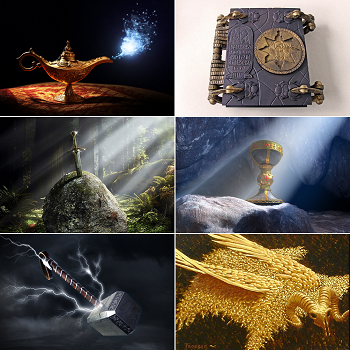
A famous, often completely mythical, conveniently uncopyrighted-yet-instantly-recognizable item, pulled from the realms of history, literature, or legend (if not all three).
Examples of this trope pop up frequently, and have occurred in any number of genres — comedy, drama, science fiction, historical fiction, fantasy, you name it. They can be spotted in cultures from the East to the West — and some date back surprisingly far. Some cultures have favorite items to use, such as the Holy Grail for the West or the Ame-no-Murakumo for Japan, but with modern globalization trends, we're seeing more and more stories pulling from others' usual lists — such as Japanese media like Neon Genesis Evangelion using the Lance of Longinus (a fabled item involved in the Crucifixion of Jesus).
It can be a weapon, a MacGuffin, or hell, maybe both if it's a mystical doomsday device. Sometimes the trope shows up as Imported Alien Phlebotinum (seen often, for example, in Stargate SG-1), sometimes it's a mystical object, and occasionally it's both. Sometimes startling revelations are to be had about the object, sometimes it's straight out of the legends, heck, maybe it's even reconstructed from the original's spare parts. Regardless of its distinguishing features in the story, though, what makes it a Public Domain Artifact is its origin as an item from the collective myths of man, with all their familiar symbols.
There's honestly no telling how long this trope has been around; while nowadays it's often used partly to avoid copyright infringement, it's been around much longer than the concept of copyright. Many authors (ancient and modern alike) have used these for the mythos attached to them, or simply because it's easier than inventing something out of whole cloth; if an author puts a supposedly mythical sword in their work, it needs to be supported, but when you hear "Excalibur," it doesn't take any explanation to understand how important it is. See the example of Durandal below, Sword of Hector... then Roland... then reforged for Ogier the Dane. Later authors namedropped former heroes to make their mystical artifacts even more mystical, making this Older Than Feudalism.
In a series set in another world, these may appear, but under different names. They often function as a Plot Coupon; sometimes even entire sets of such artifacts will be used like this, leading to Gotta Collect Them All. In modern series, many of these items are made of low-grade unobtainium, especially if magic is downplayed or completely absent.
There's about a one-in-three chance that Hitler either had it or was searching for it. As the book Angels of Light and Darkness put it: "If Hitler had half of what they say he had, he would have won the war."
May be related to Alternate Landmark History. Frequently involved with an Historical In-Joke or instance of Been There, Shaped History. If weapons, they are almost certainly Named Weapons and examples of Stock Weapon Names.
Sister trope to Public Domain Character. Landmark of Lore is also related, cover what are essentially Public Domain Locations.
See also: Stock Unsolved Mysteries, particularly for items with alleged connections to historical figures or events (especially with religious figures such as Jesus or the Buddha).
Artifacts with their own pages:
- Akashic Records
- Crystal Skulls
- Excalibur
- Hand of Glory
- Holy Lance
- Magic Lamp
- Muramasa and Masamune (or rather the swords they created)
- Philosopher's Stone
- Thunder Hammer (it's more often than not just straight up Mjölnir)
Other examples
Arabian
The Magic Lamp/Bottle — sure to contain a djinni that will grant wishes to the holder, usually with a weird or sadistic twist, inspired by of course, Aladdin's lamp. Ironically, the original point of this trope was that the magician who trapped the djinni (who are really good at magic) would have had to have been extremely powerful to do so, and the djinni would be so happy to be freed they would use their magic to reward the holder.
Anime & Manga
- Magic Knight Rayearth: The country of Chizeta is inspired by the Arabian Nights motif, so of course it includes these. Turns out that the djinn's starship has the shape of an oil lamp, and of course two djinn could be commanded to appear from the spout when needed.
- Magi: Labyrinth of Magic: Anyone who captures a dungeon gets a djinn to serve them. The djinn need not be put into a bottle, however, it can be bound to any metal item in its master's possession.
- De Rode Ridder: The focal point of the album De Lamp van Aladdin.note Here the genie is female and takes a liking to Johan, vowing to keep him safe from all harm from now on. Johan is none too pleased to be locked in a gilded cage though.
- Gaz Dreams of Genie: Dib recovers and brings home a genie bottle, which Gaz breaks just to spite him. This counts as opening it, thus giving Gaz Three Wishes from the genie within. It also curses her to take said genie's place after the third wish.
- Enchanted Forest Chronicles: Done comedically in Dealing with Dragons, in which Cimorene discovers (through the bumbling of her Disposable Fiancé, Prince Therandil) that Kazul has a bottle with a djinn in it in one of her treasure rooms. Due to the djinn having sworn an oath to kill anyone who let him out after a certain amount of time, he tries to claim he has to kill them... except it turns out they let him out too early, during the time when he'd instead give three wishes to anyone who let him out. He ends up giving them one wish each in thanks for Cimorene's advice to go back into the jar until his time's up (by which point both she and Therendil will be dead of old age anyway) before going back in.
- I Dream of Jeannie has the somewhat less common bottle version of the mystical lamp.
- Once Upon a Time: A genie's lamp is briefly shown in Rumplestiltskin's shop, and in Once Upon a Time in Wonderland genie bottles play a major role as Alice's love interest Cyrus is a genie and Jafar is looking for him (as well as all the other genie lamps/bottles.)
- Mahou Sentai Magiranger/Power Rangers Mystic Force: The Sixth Ranger has a genie companion whose lamp also serves as his gun. It's powered by rubbing it, and can fire tracking shots or the genie himself.
- Dungeons & Dragons this time is closest to the source: in Al-Qadim very powerful sha'ir can make and use genie traps, but even for them this act is rarely conducive to long happy life.
- Magic: The Gathering:
- "Aladdin's Lamp,"
 rather than doing anything with genies, lets the player look through their cards.
- "Bottle of Suleiman," when sacrificed, will on a random coin flip either create a genie under its owner's control or damage its player.
- "Aladdin's Ring" deals a burst of four damage to a single target.
- "Djinn of Wishes" and "Ring of Three Wishes" gives you... well, you know.
- "Aladdin's Lamp,"
- AdventureQuest: Magic lamps house djinns, which can be summoned to deal damage.
- The Lucky Lamp is a melee item. (As in, the player bludgeons the opponent with it.)
- The Infernal Djinn Lamp is a misc. item that summons an Infernal Djinn as a guest, which seeks between Fire and Darkness damage, whichever the opponent is weaker to.
- Animal Crossing: Aside from having Genie lamps as decorative items, some games allow you to rub the lamp and summon a ghost wearing a turban, who will rid your town of weeds.
- Nethack has lamps. You can apply the lamp to turn it on or off. Regular oil lamps will run out after a while, but magic ones won't, and may summon a djinni, who may be friendly, neutral, or hostile.
- Pokémon Ruby and Sapphire: Introduced in Pokémon Omega Ruby and Alpha Sapphire is an item known as the Prison Bottle. It allows the mythical Pokémon Hoopa to transform into its unbound form and become stronger and much larger.
- Sonic and the Secret Rings uses both the lamp and the ring from the Arabian Nights story. However, the genie is the bad guy and Sonic's forced to reseal him away.
- Last Res0rt uses this with Sedja, an Efreet who willingly lives in a bottle worn around Adharia's neck.
British, French and Irish
Anime & Manga
- A Certain Magical Index: The Durandal is a sword used by the Maiden of Versailles.
- High School D×D: Xenovia wields Durandal, a Holy Sword allegedly capable of cutting through anything.
- One Piece: Cavendish has a sword called Durandal.
- Space Battleship Tiramisu: Durandal is the name of the lead character's Humongous Mecha.
- Symphogear: Durandal is the name of a Golden BFS that gives its user endless power, so much power that it can possess its wielder or power a moon-destroying laser.
- De Rode Ridder: Durandal is the focal point of the album De Zeekoning,note but he loses it in the end and it isn't seen again in the series.
- The League of Extraordinary Gentlemen: Durandal is Excalibur, having been stolen by Orlando/Roland and renamed to not arouse suspicion (because even he knows it was kind of a dick thing to do).
- The Dresden Files: The holy sword Esperacchius, the Sword of Hope, is Durandal, albeit reforged to look like a cavalry saber. Like the previous example above, it also has one of the Nails of the True Cross worked into it.
- The Elric Saga: Durandal becomes a manifestation of the Black Sword and Roland an incarnation of the Eternal Champion.
- The Secrets of the Immortal Nicholas Flamel: Durendal is the elemental sword of Earth.
- Kyōryū Sentai Zyuranger: A duplicate of Durandal is forged for Dora Knight. The process requires some of the hammering to be done by a child whose birthday it is (Bandora had him kidnapped, of course), which becomes important later because the sword can't harm its maker. The sword is incredibly powerful, able to damage the Zyurangers' Legendary Weapons and even the sword of their god Humongous Mecha.
Tabletop Games
- Future Card Buddyfight has a card named Immortal Sword, Durandal. It has two notable properties: it cannot be damaged by normal means, and it a Sentient Weapon. In fact, because it's alive, it's the only weapon that may be used as your Buddy.
- Yu-Gi-Oh! has a monster called "Artifact Durandal".
- Marathon: Durandal is one of three AIs on the titular ship. Marathon's Spiritual Successor Halo features an AI named Cortana.
- Fire Emblem: In the Elibe canon, Durandal is the absolutely enormous sword used by the legendary hero Roland in the Scouring. In Binding Blade it serves as the Infinity +1 Sword and can be used by any sufficiently skilled swordsman, while in Blazing Blade it's a Sword of Plot Advancement usable by Eliwood in the final battle. Rather amusingly, his best friend and fellow member of the protagonist Power Trio happens to be named Hector (who gets an axe called Armads as his legendary weapon, named after Almace, the sword of Archbishop and Church Militant Tilpin/Tulpin/Durban, one of Charlemagne's Twelve Peers alongside Roland. Fittingly, in-universe, the legendary hero who previously wielded it was named Durban).
- Fate/stay night: Durandal gets a brief mention, and is one of the weapons in Gilgamesh's Gate of Babylon. According to its profile, it was given to Roland by an Archangel, which makes you wonder how Gilgamesh has a protoversion of it... Additionally, Fate/Grand Order features Hector of Troy with Durindana, the sword/spear which eventually became Durandal, and later Roland himself shows up wielding Durandal.
- Final Fantasy XII has this as the strongest one-handed sword available for equipment. Ub Final Fantasy XIII, the Durandal is a gunblade with above-average stats, but prevents the character using it from staggering enemies.
- Baten Kaitos: Eternal Wings and the Lost Ocean: Durandal is the strongest Light-element sword magnus in the game, even ahead of the Sword of the Heavens.
- Freedom Wars: The Caliburn's fire variant is called Durendal, which is crafted from Dionaea-Class Abductor parts.
- Front Mission 4: The research company the heroes work for is called Durandal.
- Final Fantasy Legend III: One of the Mystic Swords that can harm the Masters is Durend.
- Bladestorm: The Hundred Years War: You get this sword by supporting the French forces.
- Xenosaga: The Durandal is also a spaceship.
- Ogre Battle 64 and Tactics Ogre: The Knight of Lodis: Durandel shows up, in these iterations it is one of the four "Arcane Instrument of Bane".
- Folklore: Durandal is a boss Mon. It's a dragon with neon-blue gecko feet. It's also found in Hell, causes absurd damage once fully upgraded, and its backstory refers to it as an indestructible sword worthy of a hero, but that would spark wars if it really existed.
- F/A-18 Hornet features the Durandal anti-runway bomb mentioned below.
- Durandal is a character in the backstory of Tales of Innocence, the legendary blade of the god Asura. One of the main characters, Spada, is the reincarnation of said sword.
- Durandal is available as a card in Shadowverse called Durandal the Incorruptible. It is summoned whenever Roland enter the playing-field.
- While never actually found in the game, it is the end goal of the King to find it in Life Goes On.
- In Honkai Impact 3rd, Durandal is the code name of the S-rank Valkyrie Bianca Ataegina, one of the most powerful Valkyries in the Schicksal organization. While her default weapon is a lance, its design allows her to wield it like a sword, and she wears a battlesuit called Bright Knight: Excelsis that allows her to summon two large robot assistants, one wielding a huge sword and one wielding an equally large shield.
Real Life
- The Matra Durandal, a French anti-runway penetration bomb, designed to destroy airport and airfield runways.
Anime and Manga
- Fate/Zero: Servant Berserker is revealed to hold the sword Arondight. It was formerly a holy sword, similar to Excalibur, but after his betrayal, Arondight became a demonic sword.
- Mobile Suit Gundam SEED Destiny: Arondight is the name of the Destiny Gundam's Anti-Ship Sword. Like how Excalibur belonged to Shiin Asuka when he was the hero, when he was shunted into antagonist mode by Kira Yamato's return, he was given this to hammer in that fact.
- Fate/Grand Order has Lancelot wielding Arondight when summoned as a Saber. His Noble Phantasm involves overcharging Arondight akin to a Broken Phantasm, but since Arondight can't be broken, Lancelot never has to suffer the downside of the technique.
- Fire Emblem: In the Tellius canon, Path of Radiance and Radiant Dawn, a magic sword of the same name acts as an Infinity +1 Sword, wielded by the Black Knight. That said, it was given an unusual alternative spelling: Alondite. Originally, "Alondite" was actually the name of Ike's initial weapon in the Japanese version of the second game in the duology, which got switched with "Ettard" (which wasn't the name of a sword in Arthurian legend, but the woman who fell in love with Sir Gawain, which happens to be the real name of Ike's father Greil), the original name of The Black Knight's sword, due to a translation mishap
- Sonic and the Black Knight: Sir Lancelot, represented by Shadow the Hedgehog, uses Arondight as his starting sword. Fitting Shadow's '90s Anti-Hero style, this Arondight is a black falchion held in a Reverse Grip. Amusingly, the game notes that it never loses its edge. Lancelot also wields Arodnight in Sonic Dash and Sonic Forces: Speed Battle.
- The Witcher: Aerondight is one of the best silver swords of the first game. Geralt can gain the sword after Completing a series of quests in act 4 to The Lady of The Lake's liking. It returns in the Blood and Wine DLC of The Witcher 3: Wild Hunt, where Geralt gets it back provided that he's made decisions that have upheld the five chivalric virtues of a knight.
Literature
- A Certain Magical Index:
- The Curtana was originally a normal ceremonial sword, but was enchanted by Henry VIII through a ritual which symbolically linked the four territories of the United Kingdom to archangels, imbuing its wielder and their knights with the power of the heavenly host (but only while the sword remains on British soil). By the present day Queen Elizard wields only a replica with 20% of the power of the original, with the plot of the "British Hallowe'en" arc revolving around one of her heirs getting their hands on the long-lost regalia and using its power to attempt a coup. Besides its ability to empower armies, the Curtana can also make strange projectile attacks by severing chunks of matter from a higher dimension.
- The Knight Leader uses Hrunting, which he reanalyzed and recreated in order to create new spells based on its creation.
- The Shadowhunter Chronicles: Cortana is the Ancestral Weapon of the Carstairs family.
Tabletop Games
- Dungeons & Dragons: The Dragon article "Relics of Myth" has Julius Cesaer's sword Crocea Mors as an epic-level artifact, an intelligent +6 vorpal keen wounding short sword of lawful power, which also inflicts disease and radiates a blinding light, amonst other powers. It's also possibly Excalibur.
Myths and Legends
- Any one of Beowulf's swords can be used for this, particularly Nægling and Hrunting.
- Castlevania: Symphony of the Night and all the portable 2D Castlevanias that follow it. You can find a huge amount of named armor, swords and artifacts — from Joyeuse to the Masamune to Death's Scythe. The most powerful sword in Castlevania: Aria of Sorrow and Castlevania: Dawn of Sorrow, the Claimh Solais, apparently comes from Irish mythology... odd for a Japanese game about vampires.
- Final Fantasy loves to include the Joyeuse every now and then in its games, making it a Royal Rapier in every incarnation:
- Final Fantasy XI:
- The Joyeuse is dropped by Charybdis, which respawns every 8 to 12 hours. The sword was a very powerful weapon in its time, being a level 70 weapon that would occasionally attack twice, allowing fast TP building. It was also a favorite weapon for Red Mage players, and one of the best weapon to solo with.
- Final Fantasy XI also includes Caladbolg and Ochain, respectively a sword and a shield wielded by two major figures of the Ulster Cycle; Tizona and Colada, swords wielded by El Cid; Murgleis, wielded by the stepfather of Roland in The Song of Roland; Burtgang, a sword from the Dietrich Cycle; and Rhongomiant, the little-known personal spear of King Arthur.
- Final Fantasy XII: The sword wielded by Larsa Ferrinas Solidor is the Joyeuse.
- Final Fantasy Tactics and Final Fantasy Tactics A2: The Joyeuse is a mid to high-tiers rapier.
- Final Fantasy XI:
- The Good Life: One of the investigative routes involves the legendary sword Curtana. This version of Curtana fits in more with the Excalibur legend, since it is connected to the descendants of King Arthur and the spirit of the sword wishes to be returned to a lake.
- Fate/stay night does this to ridiculous extremes, what with all myths being true, so not only were there Excalibur, Caliburn, Durandal, and Gram (and plausibly, everything else), there's also that minor event known as the Holy Grail War — it's not the actual Holy Grail though.
- Taking it even further than that is the character Gilgamesh, whose ability is basically that he owns the originals of every Public Domain Artifact ever. Though theoretically he only has the originals if they were of Earthly origin, as fits his legend of traveling the Earth and gathering all of its treasures. This is why he doesn't have a prototype Excalibur in his arsenal, as Fate canon has it being forged in Avalon by the Fae.
- Of course, Gilgamesh himself is a Public Domain Character.
- Fate/hollow ataraxia: Archer uses replicas of Hrunting, modified into arrows, as long-range Broken Phantasms (similar to his use of Caladbog in Fate/stay night). Besides their raw power, they move at incredible speed and continue to seek out the target as long as Archer keeps aiming at them.

They are sometimes matched up with the four western elements. The Cauldron is often identified with the Holy Grail but it also gets mixed up with the Cauldron of Cerridwen from Welsh mythology and the Black Cauldron. The Spear gets identified with the Spear of Destiny, and sometimes gets confused with the Gae Bolg. The Stone is sometimes said to be the Stone of Scone, once part of the Coronation Chair in Westminster Abbey but now housed in Edinburgh Castle but a few less-reliable sources say it's the Blarney stone in Ireland. There's also a standing stone in County Meath called the Lia Fáil. There's a legend that the Blarney Stone and Stone of Scone are both half the original Stone, although the Irish stone is bluestone, and the Scottish one is red sandstone.
Anime and Manga
- Last Exile: The flagship of the Anatoray armada is the Claíohm Solais.
- Little Witch Academia (2017): Claíomh Solais is the original name of Chariot's "Shiny Rod."
- Shattered Angels: Claíomh Solais is the robotic form of the amnesic Kuu.
- Indiana Jones and the Spear of Destiny reveals that the Spear of Destiny and the Spear of Lugh are one and the same.
- Discworld: The coronation of the dwarves in Uberwald takes place with the new Underking sitting on the Scone of Stone.
- Everworld: They belong to the dragon Nidhoggr, who acquired them after Dagda was eaten by Ka Anor. They're stolen by the fairies and serve as a MacGuffin that the heroes have to get back. Nidhoggr's favorite seems to be the Cauldron, which ironically was the one the fairies were most willing to part with. (Apparently all it makes is corn beef and cabbage.)
- The Wheel of Time: These four artifacts, when conflated with the Arthurian legend of the Fisher King, also appear in new incarnations: the Cauldron is the Bowl of the Winds, the Spear is Mat's ashandarei, the Sword is Callandor, and the Crown (in place of the Stone) is the Crown of Swords.
- Young Wizards: The Four Great Treasures show up in the fourth novel, A Wizard Abroad. Claíomh Solais is replaced by yet another legendary sword, Fragarach.
- Dungeons & Dragons: The Stone of Destiny is included in the Dragon article "Relics of Myth" as an epic-level artifact. Or rather, two epic-level artifacts. A character who stands on the Stone of Scone for a round while a command word is uttered gets a permenant +1 bonus to Sense Motive checks. If the character has the Leadership feat, this is +10, and Epic Leadership or Epic Commander gives +20 and +30 respectively. (The assumption seems to be that a monarch would have at least the first of these.) The Blarney Stone gives the bonus when kissed for a full round, and it's to Bluff checks, balancing out the effect of the Stone of Scone if the monarchs of Scotland and Ireland are different people.
- AdventureQuest: The Celtic Mastercraft set uses these items. The Claimh Solais, Spear of Lugh, and Lia Fa'il are the highest-level weapons for Melee, Ranged, and Magic damage, respectively, while Coire Dagdae is the set's misc. item.
- Castlevania: Aria of Sorrow: The strongest sword is the Claimh Solais. It's nerfed in the sequel, 'Castlevania: Dawn of Sorrow''.
- Ogre Battle 64 features Clamioth Solias as "Clau Solias", a weapon wielded by Prince Yumil. Dagda also gets a reference, though it the form of a hammer. Finally, the Lia Fail appears, as a doll.
- Rhiannon Curse Of The Four Branches: Their approximate Welsh equivalents (or at least symbols thereof) are among the objects of an extended Fetch Quest.
- Shin Megami Tensei:
- Shin Megami Tensei IV: The Fair Folk, or Tuatha de Danann, desperately seek to retake Dagda's Cauldron from the angels (who believe it to be the Holy Grail) to revoke their status as a Dying Race. Even though they manage to get it, they still need Lady Danu to reactivate it.
- Shin Megami Tensei IV: Apocalypse: Near the end of the game, Dagda himself gives the protagonist Nanashi the Stone of Destiny, an item that allows him to relearn his ultimate skill at any time.
- Tales of Vesperia: Near the end, there's a scene in the Lower Quarter where Yuri gets Claíomh Solais.
- Trails Series:
- In Trails of Cold Steel I and II Claíomh Solarion is an Orbal Art, though it doesn't take the form of a sword. Instead, it appears as a giant metal arm that reaches through a portal above the battlefield before blasting its target with a massive laser beam.
- Trails of Cold Steel II also introduces Altina, whose combat shell (a weaponised Robot Buddy) is outright named Claíomh Solais, and it indeed can turn into a giant rocket-powered sword, among other things. Since following games feature Altina in major roles, the aforementioned spell wasn't carried over into them.
 seem to have been popular with everybody's ancestors. This isn't just a British/Irish trope.
Anime & Manga
- Negima! Magister Negi Magi: Similar structures to Stonehenge act as gateways to the magical world.
- Yu-Gi-Oh! 5Ds: Stonehenge appears as a card and also gets referenced by several cards in Yu-Gi-Oh! ZEXAL
- The Pumaman uses Stonehenge as where the alien Aztec gods drop their mind-control mask in the beginning and where they pick it back up at the end.
- Transformers: The Last Knight: Stonehenge was assembled by the Knights of Cybertron, to mark the place where Unicron's spark can be drained to restore Cybertron.
- Angus The First Warrior has Gaoth Cerridwen, the Sword in the Stone, being forged by Druids on the Stonehenge using a nail of Jesus' cross melted with the metals.
- History of the Kings of Britain claims that Stonehenge was built by giants from "mystical stones" brought "from the farthest coast of Africa". The stones were magical so that water poured over them acquired healing power, and the giants used to cure all kinds of sicknesses by bathing in such water. It was situated on a mountain top in Ireland, until it was brought to Britain by Uther Pendragon and Merlin and reerected in the exact same shape, so it would keep its mystical powers. This narrative seems to suggest the stones still have the power to heal, only nobody can remember which stone cures which sickness.
- Outlander: The Stonehenge and all the other stone circles are markers for locations where certain people may (painfully) be transported through time.
- Doctor Who: In the first part of the season 5 finale, "The Pandorica Opens", Stonehenge is the location of the Pandorica. It also mentioned much earlier in "The Time Meddler", where a Time Lord, the Monk, claims to have used anti-grav machines to help the construction of it.
- Tracker (2001) has a mention of Stonehenge among the things that Cole's species helped humans build.
- Xena: Warrior Princess: Stonehenge is formed out of the ruins of a Temple of Dahak, the building having crumbled after Gabrielle is impregnated with his demonic child.
Pinball
- Golden Logres: Appears on the "Camelot" table; it is where Sir Bedivere first gets his quest to reunite the Knights of the Round.
Tabletop Games
- Dungeons & Dragons: Appears in the Dragon article "Relics of Myth" as an epic-level artifact, with powers based on the standing stones in the Masters of the Wild sourcebook, only More So, with each stone allowing a druid to apply Enlarge Spell, Extend Spell and Intensify Spell to a specific spell ("normal" standing stones only Empower Spell, rather than Intensify). The article also features other notable stone circles as having similar effects on other spells.
- Ace Combat 04: Shattered Skies plays this well in the form of a superweapon named Stonehenge. It consists of several massive railguns, arranged in a circle, that are armed with anti-air burst missiles that destroy everything 2000 ft. above the ground.
- Civilization: Stonehenge is a wonder of the world in IV and V.
- Dark Chronicle had Kazarov Stonehenge where a Chrono Union - a merging of 2 times at a specific location could take place. Which was necessary to bring Paznos to the present given it was in the future.
- EarthBound (1994): Stonehenge appears as a subarea of Winters. Alien invaders decide to set up a base underneath it.
- Space Invaders Get Even: There's at least one Stonehenge in every level. Landing in one fully refills your time/health bar and invader supply, but resets your score multiplier back to 1.
- Ultima: The standing stone circles are gates that permit rapid travel between the cities of virtue. The Avatar originally came to Britannia via a matching stone circle on Earth that may or may not have been the original Stonehenge.
- Beast Wars: A structure resembling Stonehenge appears in one episode as an alien beacon. (Note that while it resembles Stonehenge, there's some very obvious differences).
- Filmation's Ghostbusters again. This time, it was the hiding place for one of the "stones from the future"; Sir Trance-a-Lot used his magic to bring the stones to life (complete with faces and arms, no less!) to distract the Ghostbusters.
- Jackie Chan Adventures: One episode is about trying to keep someone from using Stonehenge as a weapon. It turns out to be an alien signaling device, but the aliens don't show up until everyone leaves.
- Legend of the Three Caballeros: In "Stonehenge Your Bets", it's a gateway to Goblin Town.
Comic Books
- Wild C.A.T.s (WildStorm): Savant has a pair of Seven League Boots at one point.
- Loki: Agent of Asgard: Loki has a pair of these too, they are "walk on any surface" equipment.
- Alexandra has a pair, which she uses during her journey to New Mexico to find John Manuelito.
- The Highborne noble, Mildreas, uses the Seven League Greaves, which he uses to Flash Step all over the place in Transcendence.
- Used in The Girl Who Drank the Moon by the circle of wizards as an emergency escape plan in the event of volcano eruption.
- Known on the Disc to cause severe groin sprain without proper precautions.
- Worn by the Mercenary in The Bartimaeus Trilogy. If used by the untrained, can lead to unfortunate side effects... namely, the person wearing the boots is torn in half due to one leg suddenly moving forward seven leagues....
- Isaac Asimov in Magic calculated that you could probably run around some of the other planets in our solar system and back again, just by holding your breath in outer space and wearing a pair of a certain kind of Seven League Boots (which aren't really Exactly What It Says on the Tin). Also, you'd leave Earth's atmosphere in three steps if you walked in a tangent line, making them a severe case of Blessed with Suck.
- In this case, it's the acceleration rather than the speed that's constant, making distance traveled proportional to time squared. Zelazny used a similar concept in one of his own novels, except there it was a magical horse instead of boots; he explicitly stated that with a long enough run-up the horse could circumnavigate the universe in a single stride.
- Elizabeth Bear had Christopher Marlowe enchant some regular boots into seven league boots in Whiskey and Water.
- Utilized by Sophie in Diana Wynne Jones's Howl's Moving Castle. In this version you go seven leagues for each pair of steps. If you only want to go three and a half leagues, you put on just one boot.
- In The Midnight Folk, the witches have one-league boots, seven-league boots and forty-nine league boots (the last have to be screwed to the floor when not in use).
- In Out Of Oz, Mr Boss asks Little Daffy if she can make him a pair to get them into the quadling jungle more quickly. Brrr the Lion says he'd need two pairs but would settle for a seven league settee.
- In The Magician's Land, Professor Mayakorvsky shows Quentin Seven Thousand League Boots among several other magical inventions.
- In Peter Schlemihl The Shadowless Man, Schlemihl, in exile once his condition is revealed and he has lost his position and fortune, finds casually a pair of boots which happen to have these properties. In spite of how prodigious the finding is, he manages to be unhappy about it, because given the disposition of certain countries and islands, he would never be able to visit them due to the length of his stride. He finds that he can wear wooden shoes over the boots if he wants to avoid jumping around without taking the boots off.
- The Elder Scrolls III: Morrowind
- The "Ten Pace Boots", a set of legendary boots inspired by the Seven League Boots. They are enchanted to increase your movement speed as well as with a Slowfall spell, allowing you to survive high drops.
- The same game has "Boots of Blinding Speed", which allow the wearer to move so fast they can't see where they're going.
- Path of Exile: The unique boots Seven League Step grants a massive amount of bonus movement speed, and nothing else. It's popular for leveling alts because of its extremely low level requirement.
- In The Adventures of Puss in Boots, They are one of the treasures of San Lorenzo, powered by a treasure hungry Devil Wind, which is let free when they are used, making them an Artifact of Doom. Also they shrink to fit.
Anime & Manga
- In Legend of the Galactic Heroes it appears as the name of a battleship under the command of Edwin Fischer.
- Symphogear: Serena's (later Maria's) Symphogear armor was created from the Airgetlam, having a white colour scheme and being bulkier on the left arm. While not the most powerful it's extremely versatile, capable of creating knives, Whip Swords, Deflector Shields and a Wave-Motion Gun, and is also capable of stabilising Relic energies (which has been used on itself to reduce the stress on its wearer, on the living Relic Nephilim to pacify it, and on Gungnir to assist in controlling its larger-scale Combined Energy Attacks). Unlike most artefacts which appear in the series, "Airgetlam" is officially just a codename for a Relic which has never been identified, as the arm was discovered in Iraq with no records and nothing connecting it to Ireland beyond its appearance. It later turns out to be the severed arm of the Sumerian god Enki, which was petrified along with a portion of his battle armour.
- Inheritance Cycle: Dragon Riders are often referred to by the title "argetlam", in reference to the silvery mark which appears on someone's hand when they bond with a dragon.
- Re:Monster: After losing his left arm in battle, Rou is gifted the magical Airgetlam to replace it.
- Dragon Project: Airgetlam is not actually an artifact but rather a Light-Elemented Ghostly Knight in Shining Armor Behemoth whose tablet drops the Light Burst Sword and Shield set, which dresses The Hunter in a Knightly Sword and Shield set.
- Fate/Grand Order: An Alternate Universe Sir Bedivere wears a powerful prosthetic named "Switch On - Airgetlam", actually a version of Excalibur which was transmuted into its present form by Merlin and stabilised by naming it after Nuada's arm. Even after Bedivere gives up Excalibur, he is still able to use a version of this Airgetlam due to Clap Your Hands If You Believe.
- The Legend of Heroes: Trails of Cold Steel: Airgetlam is the name of Millium's weaponised Robot Buddy.
- Symphogear has The Dagda's harp Dur da Blá (also known as Uaithne and "The Four-Angled Music"), described in myth as having the power to control things like the cycle of the seasons and of life and death, to refuse to sound in the hands of an enemy, and to fly to the Dagda on command while destroying everything in its path. It features as the Relic backing Omnicidal Maniac Carol Malus Dienheim's Faust Robe under the title of "The Slaughterharp", allowing her to fight with Razor Floss while also massively boosting the power of her elemental magic.
Literature
- In Clubland Heroes, the Splendid Six are said to have King Arthur's original round table in their meeting room, having recovered it on one of their earlier adventures.
Egyptian

The Egyptian Book of the Dead, a written set of spells designed to help a deceased person's spirit survive the trials of the afterlife, has seen occasional use.
Anime & Manga
- Overlord (2012): Momonga used a copy to turn his Yggdrasil character from a Skeleton Mage into an Elder Lich.
- The Mummy (1999): The Book of the Dead appears along with the Book of Life. One gives life to the dead, one gives death to the living. When Evie and company use the latter book on Imhotep, his immortality is taken away, rendering him mortal.
Literature
- The Kane Chronicles: The Book of the Dead is used as a map to navigate the Duat and reach The Land of The Dead.
- The Magic Treehouse: In an early adventure, Jack and Annie help an Egyptian queen's ghost find the copy she was buried with in order to help her pass on.
- The Elder Scrolls III: Morrowind has two in-game books which parody the style of the Book of the Dead — The Book of Life and Service and The Book of Rest and Endings. Primarily found in Dunmeri ancestral tombs, they contain incantations to, respectively, bind the spirits of the dead to the service of the speaker and put spirits to rest.
- Fable II: Parodied with the Norminomicon, the Book of the Extremely Dead.
- La-Mulana: The Book of the Dead is an item that protects against the Anubis enemies that guard it.
- NetHack: The Book of the Dead is a vital MacGuffin. Which is funny, considering how widely available it is in Real Life.
- Pharaoh Rebirth is set in Egypt and features the Book of the Dead as a collectible item, that however is modeled after its depiction in The Mummy (1999).
- In Spelunky, you can find the Book of the Dead inside the City of Gold, guarded by Anubis II, and it's got an Evil Dead-esque face on it. It's required to locate and open the door to Hell, which is somewhere at the bottom of Olmec's Lair.

Anime & Manga
- Lupin III: Lupin steals the mask in one episode of the second series and decides to wear it as a joke. He promptly becomes hypnotized by it into believing he is Tutankhamun, leading both his own gang and his rival Zenigata on a wild chase to catch and remove the mask from him before he goes nuts for good.
- Batman: Circe, former partner of Black Mask (i.e. not the Wonder Woman villainess), offers to use a replica of this, allegedly belonging to the pharaoh Ankh-Es-Anon, to "heal" Two-Face's broken psyche. It appears to work at first, and even seems to repair his face, but then he rips off the skin to reveal a totally scarred face, declaring he's seen through Circe's trick — there is no such pharaoh, after all. However, half of said scars turn out to be makeup, but it appears the events of the story have sent Harvey's psyche off the deep end (more so than usual). And the whole thing was Batman's plan. Nice Job Breaking It, Hero.
- Stargate SG-1: Early seasons feature a panning shot of a similar mask as the title sequence.
- Animal Crossing: The mask can be bought from the Able Sisters shop; in Animal Crossing: New Horizons, it can also be hand-crafted using five gold nuggets. Wearing it, however, brings bad luck to your character.
- The Cave: The Adventurer's object of desire is the burial mask.
- It is the boss of one of the levels in ActRaiser.
- Futurama: Bender has stolen it, twice.
European Middle Ages and Renaissance
- The Voynich Manuscript, an untranslated medieval manuscript of a seemingly occult nature, sometimes appears in fiction as a Tome of Eldritch Lore. A list of some works featuring it can be found here.
- The Pied Piper's flute usually appears in that character's possession in stories or plays, but turns up on its own (as the Pipes of the Sewers) in the Dungeons & Dragons RPG.
- The Just Judges is a painting that once formed part of the legendary Ghent Altarpiece. In 1934 the panel was stolen and never recovered. Albert Camus' The Fall (1956) finds The Just Judges in the possession of the nefarious Jean-Baptiste Clamence who draws inspiration from it for his questionable occupation of "judge-penitent." It makes a cameo in season 3 of Arrow in the possession of Ra's Al-Ghul.
- The Cellini Salt Cellar features prominently in Lois McMaster Bujold's Historical Fantasy novel The Spirit Ring. (Or at least its physical form does; in the novel the saltcellar is the work of Prospero Beneforte, an Expy of Benvenuto Cellini who is not only a goldsmith and sculptor, but an openly acknowledged mage, and the saltcellar itself has magical powers.) An Expy of Cellini's Perseus with the Head of Medusa plays an even more important role in the novel's finale, when it temporarily becomes a Living Statue (while glowing red-hot) and fights the villains.
Finnish
Comic Books
- Don Rosa, touched by the appreciation of his Finnish fans, wrote an adventure featuring Scrooge McDuck hunting down the pieces of the Sampo, here a device capable of creating wheat, salt and gold, and rebuilding it. Of course, his greed gets the better of him, and ultimately he is nearly taken by the artifact's divine builder to the heavens. He is offered the choice to go with it, but realizes he's not ready to leave his life behind and agrees to let the Sampo go. At the end, his reward is the Sampo's crank.
- Under the Northern Lights: The Sampo occurs as a myth somewhat similar to the original one. While it is often called a mill, noone knows exactly what it was today, but it had the power to break a famine. Princess Luna reveals it as a wishing machine used by the "gods" to create the world, by transporting things or even abstract concepts to the user. It was cursed by Discord as a prank so that it always steals the things you get with a wish.
- Emil Petaja wrote a series of stories based on the Kalevala. I believe The Star Mill relates to the Sampo.
- The Sampo was a major plot point in the featured film from the Mystery Science Theater 3000 episode The Day the Earth Froze. Again, the artifact is continuously mentioned, and even used, without it ever being explained just what the hell it's supposed to be, leading the Satellite of Love crew to have endless fun with the concept, culminating in a fan contest asking people to send in their own ideas of what a "sampo" is. The winner: a photo of a small TV set with the brand name "Sampo" showing a frame of MST3K.
- In Noita, this item is closely guarded by final boss and is required to complete the Work and trigger an ending. Its name changes depending on how many Orbs of True Knowledge you're holding. There's 15 names and only one of them is actually called "Sampo". The game files confirm it's what it's supposed to be.
- A version of the Sampo can be seen in SCP-294, a vending machine with a keyboard for entering requests. It can only dispense items in liquid form, but it can produce anything that exists in the universe, even abstract concepts such as 'music' or 'my life story'. Its only limitation is that it, like in the fanfic section above, must steal the materials from somewhere else (i.e. from a nearby container of bleach if 'bleach' is requested, organic material from someone the requester knows as Joe if 'a cup of joe' is requested...).
- Ukonvasara, legendary lightning-creating hammer of Finnish thunder god Ukko—known also as Ukonkirves, or Ukko's Axe—is the Empyrean Great Axe for Warriors in Final Fantasy XI.
Graeco-Roman
Comics
- It's only natural for Man-Thing to stumble across it in his home in the Florida swamps (and some conquistadors along with it).
- The Fountain used to be somewhere around Florida in the DC Universe, and granted genius-level intellect and omnilingualism to Detective Chimp. However, when the Spectre went mad without Jim Corrigan, he decided all magic was evil; one of the first things he did after the revelation was to boil away the fountain's waters.
- In a story from the comic book tie-in with the late 1980s Superboy TV series, the Fountain of Youth turns out to be a lie, and Ponce de León was actually cursed with youthful immortality until he was killed by a powerful rich person seeking the legendary fountain.
- In one Carl Barks story from the Disney Ducks Comic Universe, Scrooge McDuck stumbled upon the Fountain of Youth (and a pair of young men who were actually stranded conquistadores) while scouting for property in Florida. Unfortunately, the fountain was destroyed by a construction crew before Scrooge could call them off.
- Wonder Woman (1942): In the Golden Age part of becoming an Amazon was to drink from the Fountain of Youth on Paradise Island, which in turn made the drinker stop aging and be immortal while on the island.
- The Fountain. In a subversion, there is no literal fountain that is being sought by either of the three versions of Tom, but a magical tree.
- Showed itself in the third Librarian movie.
- Pirates of the Caribbean:
- At World's End ends with Barbossa going off to find it... only Barbossa discovers Jack has stolen the map to guide them there.
- And the fourth movie On Stranger Tides features Jack and Barbossa teaming up to find it... and fight Blackbeard.
- Terry Pratchett spoofed Ponce de Leon in Discworld with Ponce de Quirm, who spent his whole life exploring foreign countries because people made fun of his name. The Fountain granted him youth, but also granted it to the strong, healthy dysentery bacteria that killed him.
- Who says the fountain of Youth can't be elsewhere? There are hand-wavium FoYs in Demon, the third book in John Varley's Gaea Trilogy, which is set in a (huge) creature (essentially a sentient, living space station) orbiting Saturn.
- The Fountain appears memorably in Tim Powers' On Stranger Tides.
- Xanth also has the fountain of Youth. Since Xanth is basically Florida in a fantasy environment, the author claims that the two fountains are in the same place (in Xanth, Earth, and Mundania).
- In Charmed (1998), the Fountain of Youth was like a normal fountain in a city only underground and could be accessed using a magical grail. It was located in San Francisco in a cave.
- In Power Rangers Zeo, after Billy begins suffering from rapid aging, he has to go to Aquitar in order to drink from that planet's Fountain of Youth. He has to drink it fresh from the source, because otherwise it isn't strong enough. He decides to stay on Aquitar after being restored because he falls in love with an Aquitian scientist named Cestria.
- In season seven of Stargate SG-1, Daniel goes searching for the Fountain of Youth, or, more specifically, a powerful Ancient healing device capable of, besides healing, reviving the dead and extending life. Its effects came to anyone who was near it when it was on. It was hidden in a temple near a waterfall, thus originating the "Fountain of Youth" myth.
- An artifact card in the Magic: The Gathering, The Dark expansion, which also popped up in the book based on it. It's randomly located in some village. The main character hides in it from some goblins and so unwittingly gains immortality. Humorously, the card's flavor text explains why no one else ever discovered its true nature. No one wants to drink from a fountain where (now immortal) pigeons bathe.
- Leonization, a rejuvenation procedure in Shadowrun, is named after Ponce de Leon.
- The campaign of Age of Empires III is about three generations of people keeping it out of the wrong hands. Hell, you even get to blow it up at one point.
- The videogame Colonization lets you discover it and get a bonus. Amusingly, it doesn't limit how many times you can discover it, so a player who explores thoroughly can find dozens of Fountains of Youth scattered all over the Americas.
- The entire thing can be stolen and relocated to your secret lair in Evil Genius 2.
- Rogue Legacy: The "cure for all ills" the prince was searching for in his journal pages turns out to be this. Which is given foreshadowing, as each of the bosses have a name related to the fountain of youth.
- Civilization V features the Fountain as a Natural Wonder. If it's claimed by a city, it gives +10 Happiness to the owner of the city, and any military units that move next to the Fountain permanently gain the ability to heal twice their usual speed.
- Some Might and Magic games have it. Usually it is indistinguishable from regular fountains, however it removes all magically-induced aging. In VI it is incredibly handy considering one of best spells of Light Magic ages caster by 10 years, some nasty creatures can also age party members, age in this game does affect stats and only other way to cure aging comes in form of potion that permanently drops your stats. However, it is located in zone with high-level monsters, so it is inaccessible for quite some time.
- Oglaf parodies this, with an explorer discovering the Fountain of Doubt, the Water So Delicious That Even Dead People Want It, and the Fountain of Girl.
- Appears in an episode of Ben 10. The guy who guarded it probably should've known better than to keep a supply of its water in a carnival dunking booth, even if it was out of order.
- This was the objective in a Codename: Kids Next Door episode, in which the Fountain was hidden in a cave beneath an elementary school. A girl who'd used it to remain young for generations had connected its runoff to a drinking fountain inside the school, with a permanent "out of order" sign.
- The DuckTales (1987)-episode "Sweet Duck Of Youth" sees Scrooge, Launchpad and his nephews searching for the Fountain after Scrooge gets reminded how old he is on his birthday. They find the Fountain with the help of an eldery man who searched the Fountain for 30 years. It turns out the water doesn't make one younger, but only the reflection of said person. Scrooge learns his lesson to accept his age and spends a world trip to the man who wasted half his life to find the Fountain.
- The Fountain was the focus of the DuckTales (2017) episode "The Forbidden Fountain of the Foreverglades!" Scrooge and Webby race Goldie to the fountain, though Scrooge and Goldie are turned into teenagers, apparently due to the waters leaking into nearby rivers. It turns out the true cause was drinking water from a nearby hotel. Ponce de León had drained the fountain into said hotel, as the waters actually transfer youth instead of just granting it, so he set about stealing youth from teens on spring break via his pool.
- An episode of I Am Weasel featured the eponymous character and I. R. Baboon as Spanish conquistadores tasked by the King of Spain with finding the whereabouts of The Red Guy as Pantless de León who went to find the Fountain of Youth in America decades ago and was never heard from again. After arriving to a 20th century America, they find de león guarding a drinking fountain in a park, which he claims to be the real deal because it has a "Youth" sign next to it. As I. R. drinks from the fountain. Weasel points out it's because there's nearby fountain with a "Adult" sign next to it. Realizing the mistake, Pantless de León agrees to return to Spain. While returning, Fridge Logic kicks in as I. M. Weasel wonders why Pantless hasn't aged a bit despite being in America for several years. Cue to Pantless and Baboon having been turned into babies.
Anime & Manga
- In Macross: Do You Remember Love?, it is vaguely hinted that the Protoculture's hidden sunken city is or inspired the legends of Atlantis.
- Atlantis is also, of course, the respective home of DC's Aquaman and Marvel's Sub-Mariner.
Literature
- In Dinotopia, Poseidos is thought to be Atlantis. It was an island with an advanced society that sank into the sea. Atlantis in the myths was said to belong to Poseidon, and things got garbled.
- In Neverwhere, Islington the angel shares some wine from Atlantis with visitors, and mentions having known and watched over the city before it sank. Which is true, because Islington is the one who sank it.
- Doctor Who had several depictions of Atlantis over the years: one was in the Second Doctor serial The Underwater Menace, and the other was the Third Doctor serial The Time Monster.
- The Lost City of Atlantis itself, as seen in Stargate Atlantis, where it had been moved to another galaxy, submerged, resurfaced in the first episode, then moved to another planet.
- Atlantis obviously, though at this point it hasn't been submerged.
Pinball
- This is the last continent to be visited in Ripley's Believe It or Not!
Tabletop Games
- The Yu-Gi-Oh! card game features Altantis in the form of a card called "A Legendary Ocean". "Atlantean" monsters also exist as an archetype of city-dwelling sea serpents.
- In Rifts, Atlantis was thrown into a pocket dimension after experiments by the ancient Atlanteans Went Horribly Wrong. The Coming of the Rifts caused Atlantis to return, which raised the sea level around the globe. Obviously, the original inhabitants are long since gone, and Atlantis is now the domain of an Eldritch Abomination and his thousands of slaves.
Theatre
- Golden Bat, one of the very first Superheroes of Japan, was originally from Atlantis, though by way of Time Travel rather than being aquatic.
- Age of Mythology set its campaign in Atlantis.
- Trident from Eternal Champions fought for Atlantis against the Romans for a share of land. Following his death, his people were forced to live underwater.
- The Atlanteans built a time travel machine in Ecco the Dolphin and used it to escape to the past after several wars with the Vortex. Ecco uses the machine during the first two games.
- In God of War: Ghost of Sparta, Kratos inadvertently sinks Atlantis searching for his brother. Despite being a pretty large moment in the game, it is only referenced one other time. While battling Poseidon in God of War III, he will sometimes say, "Atlantis will be avenged!"
- Indiana Jones and the Fate of Atlantis is about the titular character searching for Atlantis before the Nazis can find it and use its secrets. Indy makes use of various Atlantean artifacts powered by beads of orichalcum. Naturally, orichalcum originally comes from Atlantis.
- In It's Walky!, Atlantis was an ancient Martian outpost, from which various people such as the Head Alien and SEMME steals technology.
- Atlantis: The Lost Empire accidentally subverted this trope. The heroes are able to find Atlantis because they got their hands on both the Shepherd's Journal (a road map to the place) and a linguist who was able to actually read it. In the DVD voiceovers, the creators mentioned several responses from viewers congratulating them for actually using the Shepherd's Journal for extra authenticity. Ironically, the legend of the Shepherd's Journal begins and ends with Disney's Atlantis — there was no such artifact, legendary or otherwise.
- Name-checked in DuckTales the Movie: Treasure of the Lost Lamp in the form of Genie's account of its destruction: it was the resort getaway of its time until Merlock couldn't get a reservation. The rest is history.
In the original story, the container was identified as a jar — specifically a pithos, a large storage urn about as tall as a person — but was later changed to a box, as a result of the 16th century translator Erasmus of Rotterdam mixing up pithos with pyxis, meaning "box".
Anime & Manga
- Saint Seiya: Pandora's box contained Hypnos and Thanatos, Hades' servants, where they had been initially sealed by Athena after the end of the war in the Age of Myth. Pandora, of course, released them in modern times.
- Haunted Junction has the protagonist open it by accident. It wakes him up a bit.
- Fate/kaleid liner PRISMA☆ILLYA: The box shows up. It turns out to the Cube used by the Ainsworth family, and is correctly called a Pithos. In a departure from the original myth, in an alternate reality, Pandora didn't open the box and has let it stay closed for its entire existence — but for reasons unknown, not unleashing its contents unto the world has caused that world to slowly die, thus the Pithos' contents are the story's biggest mystery. Darius Ainsworth's entire plan relies on using his '"daughter" Erika (actually Pandora herself) to open it and save Humanity; she is unable to die until it is open, and works with Darius in order to finally die.
- New 52: Pandora's Box was a skull-shaped item that could only be opened by the person with the most evil heart. It turned out to be a gate to Earth 3.
- Project Superpowers: The box (as an urn) is the major lynchpin of the comic book series. They've done the research; Pandora was originally given an urn, not a box. It wasn't until Erasmus of Rotterdam miscopied πίθος ("urn") as πύχις ("box") in the 16th century CE — scholars speculate that either he was confusing Pandora and Psyche, who was associated with a box — that Pandora became associated with a box rather than an urn.
- Pony POV Series: Pandora is the Goddess of Imagination, and multiple boxes exist. Some are used to imprison her creations that got too far out of hand, and others contain essence given to her by other Gods for use in creating stories. The two that have ended up on Equus, however, definitely ended badly: the first one contained dark magic, and released it into the world when Morning Star, resulting in the creation of Hydia's clan, numerous monsters, and Lord Tirek himself. The other was the prison of the entity that would become General-Admiral Makarov.
- Lara Croft: Tomb Raider – The Cradle of Life: The MacGuffin. Pandora's Box contains a virus so deadly that it's described as (and may well be) an elemental anti-life force. Furthermore, while the original Pandora's box was said to contain hope as well as pain, there's no such silver lining described in this one: it's simply an extremely efficient Weapon of Mass Destruction and is specifically sought for this purpose.
- The Librarian: Quest for the Spear has Flynn discovering it as one of the artifacts at the beginning ... and promptly opens it. Thankfully, Judson quickly closes it before anything happens.
- Mythic Misadventures focuses on a teenage version of Pandora having to hunt down all the evils she released and put them back inside the box.
- Percy Jackson and the Olympians: In The Last Olympian, Prometheus gives Percy the urn of Pandora and tells him that if he opens it, he will free Hope and so surrender. It turns out to be a Clingy MacGuffin — it keeps showing up after being locked in a safe. Percy finally hands it to Hestia, who can keep it safe.
- Xanth: In Night Mare, Magician Humphrey, in preparing some of the defensive spells he expects will be needed during the invasion that forms the background of the story, turns out to have a box he took "from a very foolish young girl", without saying what it contains — except that it's dangerous. When Mare Imbri, near the end of the book, feels like she has nothing left to lose and, in preparing for a desperation attack, opens the box... releases the Hope trapped inside, and gains the determination and courage to perform the attack that ends the war.
- Atlantis: Jason is sent to the Underworld to fetch it in return for his friend's safety, only to realize that it's too dangerous to give to anyone else. He has a copy made, but unfortunately Medusa finds the real thing, opens it, and ends up with her legendary snake hair.
- Between the Lions: One of the installments is titled "Pandora's Box" and covers this story.
- Charmed (1998): Pandora's Box shows up in a last season episode, with a superpowered Guardian (named "Hope") who was to protect it so that demons (or anyone really) would not be able to open it and release the ills within. Naturally said Guardian knew nothing about all this and had to go through a (relatively short) How Do I Shot Web? bit before she could save the world. Interestingly, since the Box had already been opened long ago to originally release its contents, doing so now merely intensified the bad traits of humanity — which, aside from the obvious negative consequences, helped to tilt the balance of power toward evil.
- Doctor Who: The Pandorica plays with the general concept of the trope; the device itself is based upon the legend of Pandora's Box (Amy's favorite story). It was made to hold the worst nightmare the Universe has ever seen (the Doctor), but, in its own strange way, it ended up containing Hope as well.
- GoGo Sentai Boukenger: Pandora's Box is one of many MacGuffins; once emptied of its contents, Arch Priest Gajah transforms the artifact into the final Monster of the Week: Desperado.
- Kamen Rider Build: Pandora's Box is a cube found during a Mars expedition. Just the act of touching the Box while it was closed caused a World-Wrecking Wave that balkanized Japan into three regions divided by massive walls spitting out clouds of Nebula Gas, and drove the leaders of those regions mad with an instinctive urge to possess and open the Box. Actually opening the Box is how the Once-Green Mars became the barren rock it is today. It also contains the spirit of an alien from beyond our solar system, who used the power of the Box to destroy Martian civilization and plans to do the same to Earth. In this case it's simply named after the mythical Pandora's Box and nobody ever suggests that it's the same one.
- Once Upon a Time: Shows up in season 3 as an item that can entrap even the most powerful magical beings. Mr. Gold uses it to trap Peter Pan actually Henry in Pan's body. Before that, he was briefly trapped in it himself.
- Warehouse 13: Pandora's Box turns up "empty, of course." In Season 4, the box is retconned to traditionally contain Hope, which is destroyed in the explosion of the Warehouse, and fixed when the Reset Button is pushed.
Radio
- The Story Lady: In one episode, a parody of children's programming, Pandora's box turns out to contain ". . . a whole lot of funny-looking cigarettes with no brand name on them."
- City of Heroes: Opening Pandora's Box is what triggered the ongoing Age of Heroes.
- Devil May Cry 4: After defeating Dagon, Dante finds a weapon called Pandora, but it's not quite a box - it's a suitcase. It can take numerous forms and Dante eagerly tries out one after another. One its move is of note — form 666: Omen, where Pandora doesn't transform at all, but is actually opened in its default suitcase form and searing light emanates from within, stunning and damaging any who are exposed to it. It's then promptly closed by Dante after just two seconds.
- Evil Genius 2: Can be stolen and put on display in the lair. Interestingly, the Villain Protagonist actually steals it specifically to make sure it's never opened.
- Legendary: The Box has its master thief protagonist being hired to steal Pandora's Box and accidentally opening it, thereby freeing a horde of vicious monsters upon the world.
- King's Quest IV: Retrieving Pandora's Box is one of the tasks Rosella must complete to win the game.
- Final Fantasy VI: Banon tells Terra the story of Pandora's Box. He tells her that once when people were pure and innocent, there was a box they were told never to open. One man did, releasing all of the world's evils: envy, greed, pride, violence and control. The only thing left in the box was a single ray of light: hope. He then tells her that she is that ray of light, the Resistance's only hope.
- Zombies Ate My Neighbors includes it as a special item that releases fireballs which chase down and wipe out all enemies in the screen.
- The second entry in the web serial novel The Chimera Bazaar deals with Pandora's box. Later the contents of the box mutate into the Eldritch Abomination Zaa, who apparently speaks Pandorian, the language of Pandora's Box.
- American Dragon: Jake Long: In one episode, it's revealed that evil wizard Eli Pandarus is a direct descendant of Pandora, and the code to unlock the box had been passed down through his family for generations. The code is so complex that only one person was able to solve it; Spud.
- Class of the Titans: In "Little Box of Horrors", opening the box releases two characters, the Seeper (the Monster of the Week) and Hope.
- Dungeons & Dragons (1983): "The Box" centers around the similar Zandora's Box, which acts as a portal to other dimensions depending on where it's opened. The kids actually make it home, but Venger follows them; his magic still works there, but theirs doesn't, so they have to leave again so he'll chase their items and leave Earth alone. He's tricked into going through another portal, but they can't use theirs again, as it was tied to a bridge that collapsed.
- The Grim Adventures of Billy & Mandy: One episode centers around the pandemonium of Pandora's lunchbox being opened.
- The Powerpuff Girls (2016): Blossom accidentally opens it while cleaning (it was in the Professor's possession for some reason). Hope is likewise inside it too but became too distracted by toys to be of any use (directly anyway).
Comic Books
- In "The Golden Fleecing" by Carl Barks, Uncle Scrooge and company had to face harpies and a dragon to recover the Golden Fleece.
- Wonder Woman (1987): Diana retrieves a cut of the fleece during an astral projection which is then used to help heel burn victims in a hospital.
- The Golden Fleece is a Plot Coupon in the Italian film Hercules (1958).
- The Golden Fleece was lost after the fall of the Roman Empire in Level Up Hero. Sam have to find the fleece in order to cure Thunder of the Blight.
- The Golden Fleece is actively used in the Percy Jackson and the Olympians series. It has healing properties and certain power over Nature. In the second book, Sea of Monsters, Percy and his friends go on an Argonauts-inspired quest to look for the Fleece in order to heal Thalia's tree (a tree that guards the borders of Camp Half-Blood against monsters), which has been poisoned by the Big Bad. On healing the tree, the Fleece also brings Thalia herself, Zeus's daughter, back to life.
- Gene London on Cartoon Corners/The Gene London Show possessed the Golden Fleece and could make wishes on it.
- In the Assassin's Creed series, the Golden Fleece is an artifact left behind by Those Who Came Before and is also known as the Shroud of Turin. It is advanced technology with incredible healing abilities and the power to temporarily animate the dead.
- In Fate/stay night Caster has this and can even summon the awesome dragon associated with it with a spell. Unfortunately, she doesn't know the spell that lets her control the dragon, so she refrains from doing so since it would effectively be a destructive attack dog just as likely to try and kill her.
- When Jason himself appears in Fate/Grand Order, the Fleece manifests as one of his skills, allowing him to heal himself or an ally.
- You can pick this up from Jason in God of War II, allowing you to counterattack enemies.
- Runescape: You require Golden Fleece to make a magic harp.
- It is the object of Jason's quest in Rise of the Argonauts. As with Assassins Creed it's a source of vital energy capable of resurrecting the dead, as well as being as the strongest set of armor in the game.
- Titan Quest: The actual golden fleece cannot be found, but the player can find relics imbued with its essence, which, when used to enchant armor, lowers the Mana it takes to cast skills and increases armor effectiveness.
- The Smurfs: In episode "The Smurfs Odyssey", the Smurfs help Zeus's son Hermes complete his journey to get the Golden Fleece on Gorgon Island in order to prove himself worthy of godhood.
- An episode of Hercules: The Animated Series had Herc join Jason and his Argonauts on a lifelong quest for the fleece, rumored to have a grab bag of miraculous powers. When they do find it, they're disappointed to find it only grants flight to whatever it touches, which Hercules and a number of his friends are already capable of through their own means. This overlooks both that flight is still uncommon to the general public, and that the fleece can be used to make Jason's whole ship fly.
Literature
- Arabian Nights and Days, a sequel and companion piece to One Thousand and One Nights includes an invisibility ring as a sub-plot.
- The Invisible Man is a more modern retelling of the tale of the ring.
- The most evident ability conferred by the One Ring from The Lord of the Rings is invisibility. Considering how well-read Tolkien was, it's probably where he got the idea in the first place.
- Reveries of a Solitary Walker by Jean-Jacques Rousseau mentions the ring and cites how he would use it himself.
Video Games
- Enchanted rings which confer Invisibility (and the closely related Chameleon effect) are quite popular throughout The Elder Scrolls series. Most famous is the legendary Ring of the Khajiit, allegedly stolen from the arm of a Daedric Prince. While its exact abilities vary between games, it typically grants its wearer invisibility and increased movement speed.
- In Supergirl's Three Super Girl-Friends, Kara unearths Achilles' helmet.
- In Final Fantasy XI, the Aegis shield (Zeus's shield, occasionally on loan to Athena, in the mythology) is the Relic shield for Paladins.
- Additionally, Aeneas, Marsyas, and Terpsichore—respectively, the Aeonic dagger for Thieves, Bards, and Dancers; the Aeonic flute for Bards; and the Mythic Dagger for Dancers—are named for figures in Greek and Roman mythology.
- In Indiana Jones and the Dial of Destiny, the titular Dial, Archimedes' Antikythera Mechanism, is rumored to give its bearer the power of Time Travel, and Jürgen Voller, a neo-Nazi doctor, determines to use it to kill Hitler and take his place to win World War II. Even when he pulls it off, he finds out to his horror that it's pre-programmed to only point at a time-rift to 214 BC, which Archimedes used to call for help during the Siege of Syracuse.
Japanese
 rather than the whole necklace. The Kusanagi was found in the tail of the Orochi after its death. Sometimes Hihi'irokane is described as being used in the regalia's construction. If one of the artifacts appears in the story, it is very likely that the other two are not far behind, with Rule of Three in effect.
Anime & Manga
- The blue seeds from Blue Seed are the souls of the Aragami are single magatamas, one of the main characters is named Kusanagi Mamoru, and there is a villain named Murakumo who is actually Yamata no Orochi.
- Ghost in the Shell's protagonist, Motoko Kusanagi, is named after the sword. (It sounds roughly as natural to a Japanese speaker as "Jane Excalibur" would sound to an English speaker... which is probably why Masamune Shirow lampshaded it with a comment in his narration about it being "obviously a pseudonym".) In-Universe, it actually is a pseudonym. In every version of the series where her backstory is described, her birth name was either never given to her in the first place, or all records of her family were lost to her.
- The necklace used to give the titular Inuyasha the "sit!" command resembles the full Yasakani no Magatama.
- Additionally, in Inuyasha The Movie Swords Of An Honorable Ruler, some comedy is generated by Kagome's grandfather's misreading of the kanji on the sheath of the evil Empathic Weapon Sou'unga, which causes him to believe that it is the real Kusanagi no Tsurugi.
- Inuyasha's own weapon happens to come from the body of a monster and is able to control the wind, one too many similarities to the Kusanagi.
- Destiny of the Shrine Maiden postulates that Ama No Murakumo is actually two swords. And a Humongous Mecha, for an even count.
- Its spin-off series Shattered Angels has Kaon, the reincarnation of Destiny's Chikane, actually become Ama no Murakumo, though a very scaled down version of that one.
- Orochimaru of Naruto somehow has the Kusanagi (which the dub calls "The Grass Long Sword" and it literally means "Grass-cutting Sword") and stores it in his throat of all places, presumably because he is indirectly named after the legendary serpent Orochi, in whose body the Kusanagi supposedly originated. Though it's a katana in the manga, it is shown accurately as a straight blade in the anime, but also possesses the ability to extend and glows for some reason. The Mirror is held by a spirit that Itachi creates with a Dangerous Forbidden Technique that deflects all attacks... and ends up killing him. The Sage of the Six Paths wears a necklace that looks the Magatama, though it doesn't appear to be of any significance.
- Later revealed that all three users of the Dangerous Forbidden Technique mentioned above (Sasuke, Itachi, and Madara) all have a related attack that takes on the appearance of the Magatama. Sasuke merely generates fiery beads, while Itachi and Madara actually wield them in a massive necklace.
- In Sailor Moon, all three treasures became the primary weapons of Sailor Uranus ("Space Sword", based on the Kusanagi), Sailor Neptune (the Mirror), and Sailor Pluto (the necklace, or the jewel from it at any rate, which became the Garnet Orb on her staff). The items are so powerful in combination that — bizarrely enough — they can call into existence another Public Domain Artifact on this page: the Holy Grail. Which is, of course, really just another excuse to add another transformation sequence/fancy outfit/power-up for Sailor Moon, who is (appropriately enough) the Messianic Archetype of the series.
- In Sleepy Princess in the Demon Castle Kusanagi is Demon King Twilight's strongest weapon that constantly shines like the Sun which he decided to keep in the Forest of Sacred Treasure. Princess, having her biological clock be messed up due to lack of natural sunlight in the Demon Castle, goes to the forest to retrieve Kusanagi so that she use it as a light source to wake up properly each day. Oddly enough, the anime adaptation redesigns the sword to be more of a traditional fantasy sword and renames it to be the "Sword of Valor".
- In the Mobile Suit Gundam SEED series, two of Orb's great weapons are named after the mystical weapons: the space battleship Kusanagi and the anti-beam reflecting armor Yata no Kagami. Appropriate enough given that despite being a South Pacific island with a largely Caucasian population, Orb is treated as an obvious Expy of Japan.
- The Galactic Imperial Family of Space Pirate Mito has the full set: a sword (in the form of a spaceship that can be swung like a giant blade), magatama, and mirror. The latter two are rather more mystical and are used to do things with spirits.
- In YuYu Hakusho, Kurama and Hiei first appear as thieves who stole the three treasures from King Enma's palace along with Goki. The Sword has the power to turn living organisms it has cut into demons, the Mirror can grant the user one wish on a full moon in exchange for their life, and the Jewel has the ability to suck human souls out of their bodies and store them. Hiei uses the Sword to create demon minions, Goki uses the Jewel (which is not a necklace or in the shape a tama) to store and eat human souls, and Kurama uses the Mirror to heal his human mother Shiori (but with Yusuke's help, he doesn't die for it).
- The comic Usagi Yojimbo devotes two whole story arcs to the rediscovery and delivery for safekeeping of Kusanagi no Tsurugi. The focus is more on how the sword could be used to rally people to overthrow the shogunate and restore the emperor, but despite this the Grasscutter has some supernatural power - the evil Jei can't corrupt the blade as he does all others he wields and it's the only thing to actually kill him. Okay, so it didn't stick, at least it did better then most.
- Notably, the sword is also correctly depicted as double-edged, straight blade. Stan Sakai is famous for showing his work, with a few paragraphs on his research always included in the letters section too.
- Also in the fourth color special Usagi is forced to recreate the incident that gave the sword the Grasscutter name - a group attacking Usagi sets the grass around him on fire and he slashes the grass around him to create a safe area from the fire.
- In Elric: The Balance Lost, Kusanagi is equivalent to the Stormbringer in Eric Beck's universe. It is depicted as a black blade with a red jewel in the hilt.
- Groo the Wanderer: The "Sword's of Groo" story tells how Groo gained his swords and the backstory of the blades seems to be partially based on the Kusanagi no Tsurugi. The swords were forged by the Japanese-themed gods and served as part of the regalia of the emperor of a Japanese-themed culture. Considering Stan Sakai served as letterer on the Groo comics and is a friend of Sergio Aragonés, Sergio would be more then likely to know about the Kusanagi no Tsurugi.
- Shadows Awakening: The regalia were stolen and corrupted long ago by the Dark Champion of the Shadowkhan (the ones on public display are explained as being duplicates made to hide the fact), and were scattered and hidden when he was defeated. Together, they can open a portal to the Forge of Shadows, the place where the Shadowkhan were originally created, but they seem to have individual powers as well. At the very least, the Kusanagi possesses the person wielding it, turning them into a mindless berserker.
- The Yata no Kagami, now the Mirror of Despair, puts Tohru into a coma when he looks into it, trapping him in a vision of a Bad Future until Uncle is able to wake him up.
- The Jewel can be used to bring a person's darkest thoughts and self-doubts to life as shadow doppelgangers of themselves. They can't cause physical harm, but the emotional damage can be just as bad.
- Kamen Rider Showa has the hero gaining thinly-veiled analogues of these treasures (a magical sword, gem, and mirror), each of which bestow him new powers because of the supernatural being within them.
- Accel World: Discussed in book 19. While in an area based on the Imperial Palace which contains three powerful items, the cast note that a Regalia theme would be obvious, but that the two known items are a sword (The Infinity)... and a suit of armour (The Destiny), which don't seem to fit. Graphite Edge explains that this is because they only saw The Destiny's appearance after it was corrupted into The Disaster; in its original state it had an appropriate mirror-like sheen. He also adds that currently the Sword and Mirror in the real Imperial Palace are replicas, with the Magatama being the only item that hasn't been moved to a shrine elsewhere in the country, which might be why its Brain Burst counterpart is so much harder to reach than the others.
- In L. Jagi Lamplighter's Prospero's Daughter, the sword is one of many that the Prosperos has.
- The Dresden Files: the holy sword Fidelacchius, the Sword of Faith, is implied and later confirmed to be the Kusanagi. It being a katana (or more precisely, a sword cane with a katana blade) is Justified by it having been reforged in the past. It's remade into a lightsaber in Skin Game.
- Campione! has Ena possessing the Ama no Murakamo, at least until she draws too heavily on its power and needs to be rescued from it as it awakens as a Rogue God. In the anime it is absorbed by Metis but in the novels it is defeated by the appropriately named Kusanagi Godou and becomes the source of his second divine Authority (to absorb and redirect magical energy).
- The YA urban fantasy trilogy "Sword, Mirror, Jewel" is based on the Imperial Regalia, and the books reveal that each item is a weapon constructed by an incredibly ancient and advanced alien race. A ragtag bunch of teenagers have to prevent them being stolen and used in a war between Yokai.
- Kusunagi is the titular blade in the Emberverse novel The Desert and the Blade. The story reveals that Kusunagi was purchased illegally by an American GI in the aftermath of World War II and ended up in North America. Kusunagi has powers similar to those of the Sword of the Lady which figured prominently in earlier books in the series. However, it can only be wielded by a legitimate heir to the Chrysanthemum Throne. Unlike many depictions, Kusunagi is depicted in a form appropriate to its era in Japanese history.
- The early 80s interactive book Blade of the Young Samurai used a series of magical treasures based on these as its Plot Coupons. There's the crystal sword Kusanagi (as a katana), the Gem of Seeing and the Mirror of Omikami.
- Yu-Gi-Oh!: Several of the Bujinji monsters appear to be based on the ten treasures known as the Tokusa no Kandakara ("10 varieties of the god's treasure") which are enshrined at Isonokami Shrine. The supporting trap cards also reference the Magatama and Sword.
- One of the Mastercraft sets in AdventureQuest is the Japan-themed Fujin set, found at the end of the Bridge to the Sky. The Imperial Regalia appear as endgame bonus items after the final boss is beaten.
- The Kusanagi Sword, uniquely, has an Always Accurate Attack, with the tradeoff of doing lower damage.
- The Yata Mirror reflects some damage back to the opponent if it blocks an attack.
- The Yasakani Jewel increases Dexterity, Charisma, wind resistance, and healing.
- The Full Set Bonus for the regalia increases combat defense and provides a small amount of Gradual Regeneration.
- In the doujin game Akatsuki Blitzkampf, the Big Bad Murakumo is named after the Ame-no-Murakumo. Subverted in that he doesn't have the sword as his weapon of choice.
- Baten Kaitos: Eternal Wings and the Lost Ocean has functional expies of the Regalia in the form of three Sacred Artifacts - Ocean Mirror, Earth Sphere, and Sword of the Heavens. Curiously, Kusanagi Blade itself also shows up in both Eternal Wings and Origins. It's the strongest Fire-elemental attack Magnus in the former, and powerful, but not nearly the best Fire equipment in the latter.
- The Treasures' symbolism plays a key role in BlazBlue's plot. Amaterasu itself is, for lack of a better word, God, and Kusanagi is a living weapon whose sole purpose is to destroy Amaterasu. Also, here the Murakumo refers to thirteen Robot Girls that were specifically created by the NOL to traverse and guard the Boundary. The Kusanagi also has a Distortion Drive called "Yata no Kagami" which fires a Frickin' Laser Beam Spam in all directions, while the Susanoo Unit has a continually regenerating Magatama gauge instead of a Heat gauge like everyone else. In Central Fiction it's revealed that The Imperator's crown is actually the Yasakani no Magatama. Given that The Imperator is actually Izanami, the Goddess of Death, it's probably a bad thing that she's the one who wields it. Central Fiction also incorporates the Hihi'irokane as a mystical weapon - specifically, a Soul-Cutting Blade.
- In Dark Chronicle, you can equip Monica with the Ame-no-Murakumo. The game hints at the idea it might be a fake.
- Fate Series
- The mirror carried by the playable Caster/Tamamo-no-Mae in Fate/EXTRA is revealed to be Yata-no-Kagami, or at least the mirror what was later known as such.
- Fate/Grand Order: In addition to Tamamo-no-Mae showing up with the mirror, the "Naraka Mandala, Heian-kyo" chapter introduces Ibuki-Douji, the Superpowered Evil Side of Shuten-Douji and the daughter of the Yamata-no-Orochi who wields both the Kusanagi (which is depicted as a blue-green straight longsword) and the Magamata (depicted as a full necklace of blue-green comma-beads).
- In Final Fantasy XI, the "Amanomurakumo" is the Relic 'Great Katana' (two-handed katanas distinct from the one-handed ones Ninja use that more resemble wakizashi) that Samurai can equip. Interestingly, its model isn't similar to that of most Great Katana (which is the usual long, curved, single-edged blade usually associated with katanas), but a likely more accurate model of a straight, double-edged blade.
- The three treasures show up in Final Fantasy XIV, where they're pieces of the Kojin's chosen Primal, Susano. Bringing all three together results in the Lord of the Revel challenging the Warrior of Light to a fight, mostly for fun.
- Freedom Wars: The Kusanagi makes an appearance in this game not as a sword but as a flamethrower instead. The Kusanagi is an electro variant of the normally fire-elemented Aldering, upgraded with Ramosa-Class Abductor parts.
- In Genpei Tōma Den, you need to find all three of the Regalia hidden in the levels, or Yoritomo cannot be killed. This was carried over when the characters from this game appeared in Namco × Capcom.
- The original Golden Sun has an unused light blade called "Kusanagi", but in The Lost Age its graphics have been reused for a sword called Masamune.
- Each of the protagonists in Kamiko is bestowed one of the Imperial Regalia at the beginning of the game to use as their weapon. Yamato fights with the Blade of Kusanagi, Uzume uses the Magatama of Yasakani as an arrowhead for her arrows, and Hinome uses the Mirror of Yata as a Precision-Guided Boomerang.
- Though the artifacts themselves don't appear, certain characters from The King of Fighters are named for them: Kyo Kusanagi, and Iori Yagami (former clan name: Yasakani). Chizuru Kagura is not named for her artifact (though her clansmen used to refer themselves as the Yata clan), but has been shown to be a vessel for the Yata Mirror.
- They do, however, appear in the live-action movie.
- In The King of Fighters: KYO, the Yata Mirror does appear. Chizuru can use it as a normal Magic Mirror, watching over Iori and Kyo's Battle in the Rain when she's not there.
- In the OP of KOF XIII, a short sequence around 0:20 shows Chizuru, Iori and Kyo floating nude in a void alongside the game's rendition of the Amaterasu Treasures. (Heavy spoilers, obviously.) As a Genius Bonus, Kyo's Kusanagi no Tsurugi is not represented as a katana, but as the double-edged longsword it should be.
- Similar to the Yu-Gi-Oh! TCG example above, a group known as the Ten Sacred Treasures are included in the GBA-exclusive EX series, consisting of Moe Habana (Yatsuka no Tsurugi), Reiji Oogami (Hetsu Kagami), Jun Kagami (treasure unknown), Miu Kurosaki (treasure unknown), and Sinobu Amou (Makaru Kaeshi no Tama). In a peculiar move, Kyo, Iori, and Chizuru are counted as part of the Ten note , even though the Three Sacred Treasures are not the same artifacts (and, in fact, are likely the source that the legend of the Ten Sacred Treasures is derived from), meaning that three of the actual ten treasures don't exist in the KOF verse.
- The three Plot Coupons of The Legend of Dragoon which were created to destroy three corresponding Wingly seals which keep the God of Destruction's flesh in the sky as the Moon That Never Sets are based on the Imperial Regalia.
- Moe! Ninja Girls has the protagonist's sword, the Kamuy, resonate with a Magatama-shaped gem called the Izumo. Later, the Yata no Kagami appears as itself, and the three items together are referred to as the "three sacred treasures" in-universe.
- Kusanagi no Tsurugi (labeled here as Kusanagi Tsurugi), and the Yasakini Magatama appear in Nioh as an equippable Sword, and Accessory respectively. Despite the presence of these two, Yata no Kagami seems strangely absent.
- The Yata Mirror was added as another Accessory in a later update, as well as the "Holy Trintity" achievement for equipping all three items at the same time.
- As you would expect for a game starring Amaterasu, Ōkami and its sequel Ōkamiden features the three relics as your three weapon options— a mirror, a sword, and a "rosary" of beads worn around the neck.
- More interesting still, the first and final swords you receive are won by defeating Orochi. And the two most powerful Rosaries look like the Yasakani no Magatama.
- Also note, this is one of the rare examples where all the blades are double-edged straight swords (albeit a lot larger and wider than average) that match the "ancient (read: pre-katana) Japan" aesthetic.
- The Kusanagi is mentioned as apparently having been stolen in Onmyoji, but that's all we get to know about it.
- Though not actually the weapons themselves, Uxie, Mesprit and Azelf of Pokémon Diamond and Pearl are themed after the Regalia (Uxie is the mirror, Mesprit is the Magatama, and Azelf is the sword).
- The sword, mirror, and "proof of royalty" in Ruin Explorers.
- In the game SaGa Frontier, these three items (a sword, shield, and necklace respectively) can be found in Sei's Tomb in Shrike. Players can choose to keep these items, which are medium-powerful in their own right, or put them on particular pedestals to open the way to the undead King Sei (who promptly attacks the grave robbers). On defeating him, you can either have him give you the Kusanagi (which is significantly stronger than the Murakumo you used to get into his tomb) or recruit him (in which case he has the Kusanagi as a special attack).
- Another notable example occurs in the first two Sakura Wars games, in which they are called the "Majinki" (meaning "Demon God Weapons"). They can grant whoever uses them the power of a god... or a demon. They are stolen and used by the Big Bad in the first game, and are destroyed in the second game to prevent the second game's Big Bad from doing likewise.
- They also allow someone from the Shinguji bloodline to banish the Kouma Demons at the cost of their life... which also plays into Oogami's decision to destroy them, as Sakura does consider their use — like her father Kazuma did in the first war.
- Shadow Hearts: Covenant's final boss is Susano-o, the Japanese god of storms, who is aided by the three treasures who can act on their own and join him in combo attacks.
- The Shall We Date? games Destiny Ninja and Destiny Ninja 2 involve descendants of Princess Kushinada who protect the regalia. Notably, in Destiny Ninja 2 the main character uses the Sword of the Gathering Clouds of Heaven to purify the four seasons.
- All three Regalia must be reclaimed from powerful foreign demons attempting to establish strongholds in Tokyo shrines to release Amaterasu in Shin Megami Tensei IV.
- In Shin Megami Tensei Liberation: Dx2, the three regalia serve as powerup items for your demons: The Kusanagi Sword helps to level up your demons, the Yasakani Magatama helps the demons learn or upgrade skills, and the Yata Mirror increases their level cap.
- The Blue Moon Crystal in Skies of Arcadia, which is also a sacred artifact for the nation of Yafutoma, just happens to be magatama-shaped.
- Amaterasu as she appears in Smite utilizes all the Imperial Regalia. The Yasakani no Magatama is used to initiate an aura that boosts offense or speed of surrounding allies while she gets a small period of self-healing. The Yata no Kagami is used to generate a shield that decreases damage to her while building up a charge that can be shot back to the enemy for more damage the more she has been hit beforehand. And she's basically using her Kusanagi-no-Tsurugi to either hack and slash her enemies, or placing a damage-increasing debuff on them, silencing them or her ultimate wide strikes.
- Kusanagi appears in the old Sega Master System title Spellcaster, and remarkably is actually depicted as having a straight blade. Perhaps because it's only used at certain points to advance the plot.
- In Super Robot Wars Alpha 2, Kukuru pilots the Magalga, who is The Rival to one of the four protagonists in the game. The names of the Magalga's attacks are based on the Imperial Regalia.
- Tales of Symphonia: You get Yata Mirror, Yasakani Jewel and Kusanagi Blade as drops from the Sword Dancer, in this order, one item per battle. The former prevents all status ailments, the middle gives HP and TP regeneration, and the latter in the most powerful dual blade (yes, it's two swords here) weapon in the game.
- Touhou Project: Keine Kamishirasawa has a set of spell cards called "Three Sacred Treasures." Depending on difficulty, what follows will be the Sword (Kusanagi, on easy), the Orb (Magatama, on normal), or the Mirror (Yata-no-Kagami, on hard). On Lunatic, it will instead say "Three Sacred Treasures - Country."
- Also Rinnosuke owns the Kusanagi-no-Tsurugi, according to the Curiosities of Lotus Asia stories. (He got it from Marisa, who'd unknowingly found it as a kid and kept it in a pile of scrap metal.)
- The fangame Riverbed Soul Savers also features the three treasures, each owned by the bosses of the 4th, 5th and 6th stages respectively. Suitenguu no Himemiko was busy looking for the Kusanagi, using a fake in the 4th stage that looks more like a western sword in design, until she eventually finds the real one by the time she reappears at the midboss of stage 6. Takenouchi no Tarumi essentially is the magatama, being a tsukugami born from the jewel. And Yamatoyo no Momohime, the last boss, is in possession of the mirror. Each of the treasures are used heavily in their Spell cards. And the Extra boss is Yamato no Yato, a piece of Orochi who's trying to reclaim the Kusangi, and has a final spell card that uses mockeries of the three treasures.
- In World of Warcraft the Grasscutter is yours for only 60 Badges of Heroism! (Note: It's an off-hand weapon.)
Anime & Manga
- In the Zanpakutou Unknown Tales filler arc of the Bleach anime, we are introduced to a character named Muramasa, who has the power of making the Shinigami's swords materialize in their true form, and who's controlling them into rebelling against their respective Shinigami. Turns out, Muramasa is a Shinigami's sword, as well.
- Hayate the Combat Butler has the sword correctly named as a creation of Masamune, though it is a wooden sword. It isn't given a specific name on its own, just called Wooden Masamune.
- In Samurai Pizza Cats, Speedy Cerviche's Magical Ginzu Sword is called the Masamasa, a reference to Masamune, in the original Japanese version. Similarly, in the episode "Gone With the Ginzu", Bad Bird's cloned Ginzu Sword is called the Muramura, a reference to Muramasa.
- In Soul Eater, Tsubaki's older brother is named Masamune, and has incredible powers beyond turning into a sword. However, he's probably not the real Masamune, or else he'd be over 600 years old.
- The one-shot manga Tsukumono by Watano Yuka is set in an antique shop where the merchandise has come to life as tsukumogami. The shop's most valuable item, a Muramasa sword, is never placed on display because its rowdy spirit promises to murder anyone who touches it... but in truth it only acts this way because all its wielders have either died or turned into bloodthirsty monsters, and it doesn't want to see that happen again.
- The Outsiders: Katana wields a sword made by Muramasa- who was described as being mad; the sword itself steals the souls of those it kills.
- Wolverine: Muramasa is a mad immortal who can create powerful weapons by imbuing them with a portion of someone's soul. These are known to include:
- The sword most commonly known as "Muramasa" - a (sometimes) blood-red katana which is Sharpened to a Single Atom and has the power to negate healing factors. Muramasa created this weapon for Wolverine using the depths of his rage and hatred at a particularly dark point in his life.
- A shield secretly created as a countermeasure for the above sword, using "parts of Logan he barely acknowledged at the time". Muramasa claims that while the sword was created to help Wolverine get revenge on his enemies, the shield was designed to help him protect himself and those he loves.
- The "Black Blade" - a weapon created from a part of Muramasa himself, which grants the wielder superhuman strength and endurance at the cost of driving them to madness and evil unless their will is strong enough to master it.
- In Cyberpunk: Another Daybreak, Honjo Masamune is a katana forged by the legendary blacksmith Masamune and an artifact worthy of being called a national treasure. After stumbling upon it on an assignment, V uses it to cut this way through more then fifty chromed-up men in a shootout without chipping despite the blade being nearly eight centuries old at that point. It's so cool that V is worried that the fiercely patriotic Saburo Arasaka would have V's head for using it as a meat cleaver.
- All of the blades of Muramasa and Masamune are present in Harry and the Shipgirls, all having become Tsukumogami due to how long they've existed.
- Special mention goes to Juuchi Yosamu, Muramasa's Magnum Opus, who is the Potter Honor Blade specifically because they're the only ones capable of being immune to the Unstoppable Rage that anyone else who wields her succumbs to.
- The Honjo Masamune shows up in Son of the Western Sea in Percy's possession, having found it after slaying the Yamata no Orochi to save Ryuujin's daughter. The last person to have possession of the weapon after World War 2 was eaten by Orochi, explaining why it turned up in the giant serpent's stomach. The sword itself is made from the Shinto pantheon's Jewel Steel, and Tsukuyomi enchants the sheath so only Percy can draw it until he dies.
- The first Highlander film. Ramirez's katana — and subsequently, Connor's katana — was made by Masamune, making them one of the only works to get the whole swordsmith/sword name thing right. However, Ramirez claims that he was given the sword after marrying Masamune's daughter in 543 A.D., which puts Masamune's existence about 800 years earlier than in reality. Connor's love interest Brenda lampshades this by referring to the sword as being "like finding a 747 before the Wright Brothers".
Ramirez: Macleod, I was born 3,947 years ago. In that time, I've had three wives. The last was Shakiko, a Japanese princess, in 543 A.D. Her father, Masamune, a genius, made this for me. It is the only one of its kind. Like she was. When Shakiko died, I was shattered. I would spare you that pain.
Literature
- Emberverse has the Japanese empress's blade, forged by either Masamune or one of his students according to legend.
- Forever (2014): At the end of the "Pilot" episode, Jo says they have a case involving the Honjo Masamune that famously went missing at the end of WWII and was apparently found "sticking out of some guy's chest on 32nd and Park". The investigation is not depicted on-screen.
- In an early episode of Highlander, Duncan comes across a katana that is said to be a Masamune. He gives it to a woman who is a new Immortal. Later it turns out she's not a new Immortal at all, and she and Duncan end up fighting, his dragon-head katana against the Masamune.
- Warehouse 13: The version of the Honjo Masamune featured in "Implosion" (the original sword, not Artie's copy) is so finely balanced and aligned that light bends around it, rendering its wielder invisible.
- Shadowrun: Dunkelzahn possessed an ancestral katana forged by Masamune, which he left to Toshiro Mitsuhama, President and CEO of the Mitsuhama MegaCorp.
- Baten Kaitos: Eternal Wings and the Lost Ocean has the Muramasa as the strongest Darkness-element sword. It also carries a 5% chance of inflicting instant death on anything not immune to it.
- The Castlevania series includes swords with each name.
- Chrono Trigger features two characters named "Masa" and "Mune", who combine to create a big windblowy boss called "Masamune"; they're actually the spirits of the sword Masamune. Oddly enough, in the original Japanese they had nothing to do with the Masamune; they were "Grand" and "Leon", and the sword's name was (wait for it) GrandLeon (which makes a bit more sense, as the "Masamune" in the game is a European-style cruciform sword and not a katana).
- The Masamune returns in Chrono Cross, having been corrupted at some point between the games since it was created with a piece of Lavos. After going on a quest, Masa and Mune's sister Doreen merges with them to transform the Masamune into the Mastermune (aka Grandream), Serge's ultimate weapon.
- In Fate/Grand Order, Muramasa appears as a summonable Saber-class Servant inhabiting the body of the similarly wrought-iron Shirou Emiya. In contrast to his devilish reputation, Muramasa is a crotchety, but ultimately well-meaning old man whose attempts to create swords on the level of the divine have all resulted in demonic weaponry one step below them. During the events of Shimousa, one of his Demonic Swords, Myoujingiri Muramasa, is taken up by Musashi to do battle against the Seven Heroic Spirit Swordmasters, who are otherwise unkillable. Later, Muramasa is summoned again by the Foreign God and ends up joining in the creation of a new Excalibur using his own body as the core.
- Several Final Fantasy games, starting with the first one, have swords by these names (Auron's ultimate weapon comes to mind, as well as one of Edge's); however, the most (in)famous example is certainly Sephiroth's, an extra-long no-dachi that he uses as his weapon of choice.
- One of Zidane's thief swords is called Masamune.
- The Masamune is the Empyrean Great Katana in Final Fantasy XI
- The Muramasa is the name of the sword occasionally found in barrels and such in Final Fight. Sodom wields swords called "Muramasa" and "Masamune".
- In Golden Sun, the Muramasa is an Evil Weapon, which curses you when you wield it, but has extremely high attack power. The Masamune is one of the few weapons with more attack power than that which isn't cursed.
- Mabinogi has several types of Japanese-style swords available; the most powerful of which are the Muramasa and Masamune swords (1-handed and 2-handed, respectively). They are not unique, so are most likely named after their creators (the game is not entirely clear on that; however). They are not available in shops or as drops; but can only be acquired from the cash shop or as special event drops.
- The Muramasa is featured in Mega Man Battle Network as a sword attack that does damage equal to the HP the user has lost. After two untainted appearances, it was labelled as a "Dark Chip", imposing limitations and/or penalties with its use.
- Jetstream Sam from Metal Gear Rising: Revengeance has a high-frequency sword called the "Murasama", likely a a Shout-Out to the Wizardry example below. And since the quality of a high-frequency blade depends on the quality of the sword it was made from, and the sword is very high quality, it is a very sharp, very strong red blade and turns out to be the only one that can damage Senator Armstrong at all.
- Muramasa: The Demon Blade has the swordsman Muramasa forge several swords. As such, the Muramasa is a type of sword instead of one specific sword.
- NetHack features the Tsurugi of Muramasa as the Samurai's quest artifact. Advantages include a chance to One-Hit Kill anything up to about human-sized via bisection (if that chance comes up against anything larger, like a dragon, it'll do double damage instead). Its main disadvantage is that it's two-handed, which can be bad news if it gets cursed.
- Persona 2: Eternal Punishment features a skill called "Muramasa Sword", which deals some damage and seals away use of Personas for several turns. That skill is a renamed version of "Longinus Spear" which appeared in the previous game.
- Two "two-handed-sword" class weapons named Muramasa and Masamune are found in Ragnarok Online. The former raises its user's critical rate, but has a chance to curse its user, and the latter is more powerful and raises dodge rate, but reduces its user's defence to 1/3.
- Soul Calibur III at least has an unlockable weapon for Japanese Ronin Mitsurugi: the Masamune.
- Tales of Symphonia has them and at least has flavor text saying they are named after the swordsmiths.
- Terraria has a Muramasa that is extremely fast, swings constantly when you hold down the attack button, and can only be found in a dungeon. It is also used the craft the strongest pre-hardmode sword.
- Wizardry VI: Bane of the Cosmic Forge to Wizardry 8 feature "Muramasa Blade" as one of the most powerful weapons in the game, usable only by the samurai class. In the Japanese translation, a typo resulted in its name becoming "Murasama", leading to a persistent mistaken belief among Japanese players that the weapon was intended as a composite of the Muramasa and Murasame (the latter of which was largely unknown outside Japan at the time).
Note that characters named Murasame may instead be a reference to one otvf the protagonists of the noh play Matsukaze.
Anime & Manga
- In Akame ga Kill!, "One-Cut Killer: Murasame", Akame's primary weapon, is a weapon imbued with a deadly poison which can stop its target's heart. It also comes with a Dangerous Forbidden Technique called Little War Horn, which channels the weapon's poison into its wielder to act as a performance-enhancing drug.
- In Bastard!! (1988), Murasame appears as the main weapon of Ninja Master Gara, which can shoot blades of Razor Wind fueled by the wielder's Life Energy. By sacrificing all of their energy to the sword, it is capable of unleashing an incredibly powerful Suicide Attack.
- Gundam SEED Destiny: The Murasame is ORB's newest mass-production mobile suit, which can transform into a jet-like form. The Expanded Universe features a space combat variant named the Ootsukigata, derived from the sword of Satomi Yoshinari (uncle of the Eight Dog Warriors).
- In Hakkenden: Eight Dogs of the East, a loose adaptation of Nansou Satomi Hakkenden, Murasame is a sword described as "the blade of life" and said to have the power to "tear through all magic, make all spirits cower and subdue everything formless on earth". It can also summon rain and turn into a talking crow.
- Nansō Satomi Hakkenden: In the sword's original appearance it is the personal weapon of 15th-century samurai Inuzuka Shino, one of the story's protagonists. Originally lent by the Ashikaga family to Shino's grandfather, Shino seeks to return it to its rightful owners in honour of his father's dying wish (dying because he just used it to commit suicide in front of him); accepting the weapon is also the event which causes Shino to awaken as the Dog Warrior of Filial Piety. This is complicated when he learns that the sword's blade has been swapped for a counterfeit, and later again when the restored weapon is stolen. The Murasame is always damp to the touch, spraying droplets with each swing and washing away any blood that would stain it; on occasion it displays greater control over water, such as generating great clouds of mist to extinguish enemy torches. The sword's water powers also serve as a counterpart to the fire-based abilities of Shino's rival-turned-comrade Inuyama Dousetsu, the Dog Warrior of Loyalty.
- Avataro Sentai Donbrothers: Don Murasame is a living version of the sword, usually wielded by a humanoid avatar of itself which acts as an Evil Counterpart to Don Momotarou. In a Pun which at least fits its water powers, said avatar is a purple ranger with a shark motif (mura[saki] same can be read "purple shark"). As an extra nod to its wielder in Hakkenden, Don Murasame has a youthful voice and is initially driven by obsessive loyalty to his "mother".
- Fate/Grand Order: Kyokutei Bakin (the author of Hakkenden) is a Rider-class Servant normally consisting of Bakin sharing the body of his scribe/daughter-in-law Omichi, who fights with mundane weapons like daggers and a pistol. However, in their Third Ascension they transform into the Dog Warriors' mother Fusehime, wielding the Murasame as her main weapon. Fusehime can use the sword's water powers to produce enhanced slashes, a massive spiralling Sword Beam, barrages of water bullets, or clouds of mist to conceal her movements.
- A recurring weapon in the Final Fantasy series. Typically it's one of the stronger katana-type weapons in the game, falling below the Masamune and/or Muramasa in sheer damage output, but sometimes with extra powers such as dealing water-elemental damage or allowing the user to cast Protect. Some incarnations treat it as a demonic sword, interpreting "shower" to mean it drives its wielder to leave showers of blood in their wake.
- In Freedom Wars, the Murasame Mk.9 is a technologically-advanced kukri crafted by Master-X-Peace, which serves as one of The Sinner's Starter Equipment alongside with the EZ Katze.
- Appears in the Soul Series as a weapon equippable by Mitsurugi, which slowly drains his health in exchange for boosting the power of his attacks and allowing them to absorb health from his opponent.
- hololive: Shirakami Fubuki has been shown to wield the sword in tie-in media that require her to be good at fighting:
- In Dawn of the Breakers (a videogame which includes a number of Virtual Youtubers as Guest Fighters), it's explained that Fubuki bought it in a junk sale, where its ability to generate water was regarded as largely a party trick; in her hands however it acts as a constant supply of moisture, allowing her to use ice-based attacks more easily by channelling them through the blade.
- In the manga Holoearth Chronicles Side:E ~Yamato Phantasia~ it allows Fubuki to perform a number of Special Attacks including Snowfox Barragenote , Frostblade Burstnote and Ice Dome,note though it has a limited supply of water which can run out in intense battles. It can also act as a focus for Fubuki's ability to form pipefox spirits into objects, transforming it into various harder-hitting weapons such as hammers and spears.
- The titular character of Hell Teacher Nube carries one such rosary as one of the most vital parts of his exorcism arsenal, either to erect barriers against the supernatural or to channel his own spiritual powers.
- In Saint Seiya, there are 108 Specters of Hades. Gold Saint Virgo Shaka has a rosary with 108 beads as well, and when the Specters invade Sanctuary, he terrifies them by pointing out how each bead that goes dark represents a defeated Specter... and most of the rosary has gone dark by then, thanks to the efforts of Athena's Saints.
- In Shaman King, Anna has 1080 beads, which are ten times as powerful.
- Nansō Satomi Hakkenden: In the prologue, Fusehime is gifted a necklace as a Protective Charm to steer her family curse in a more positive direction; it consists of 100 small beads, and eight large beads inscribed with the Confucian Virtues (their odd placement on a Buddhist implement reflecting her struggle To Be Lawful or Good). With Fuse's Mystical Pregnancy and subsequent death, the necklace becomes a Dismantled MacGuffin - each of her bodiless spirit-sons is born to a different family with one of the Virtue beads inside their body, while Fuse's fiancé-turned-monk Chuudai restrings the 100 small beads into a tool which lets him detect the large beads' presence. When he finally succeeds in reuniting Fuse's children, the beads' markings and supernatural powers fade away; eventually the Satomi family considers them simply mundane trinkets and repurposes them as decoration for statues.
- There are 100 individual stray beads to collect in Ōkami. If you get them all, you receive a powerup in New Game Plus that makes you invincible. The other 8 beads are the Satomi Power Orbs (a reference to Nansō Satomi Hakkenden above).
- Vampire Survivors: 108 Bocce is a weapon from "Legacy of the Moonspell" DLC, and the starting weapon of McCoy-Oni. Emits a damaging aura, and actually it's just 8.
which was born from swallows. Though some of the more clever suitors attempt to pass off normal items as the fantastic ones in question, all of the suitors are rebuffed.
- Inuyasha wears a robe made from the pelt of the fire-rat. Not only is it fireproof but humans (Kagome) have actually survived the lack of oxygen and extreme temperatures while donning it and immersed in flames. In Inuyasha The Movie The Castle Beyond The Looking Glass, the villains are regathering the five treasures and Inuyasha gets involved when they try to steal his robe.
- In the chapter of Sgt. Frog where they celebrate Natsumi's birthday, a severely wounded Giroro shows up late to the party with "cosmic" versions of the five treasures from the legend of Kaguya-hime, which he claims he just happened to have lying around.
- Kaguya-sama: Love Is War uses this as Theme Naming. All of the members of the student council are named after the princes in the story -barring Kaguya herself-, and several supporting character (who have at least some connection to them) are named after the items the were tasked with finding.
- The Practical Princess references this when the titular princess is likewise trying to dissuade an unwanted suitor - she requests the fireproof robe, then the jewelled branch and rejects him for bringing fakes. (He kidnaps her instead before she can carry on to more of the requests, and the story ends as a Gender Flipped Rapunzel.)
- In Touhou Project the whole story of Kaguya-Hime turns out to be completely true: not only is there the moon princess herself living in Gensokyo but she also possesses all five of the artifacts from her impossible tasks. (It's how she beat her suitors: ask for things you already have but no one else knows you have.) She is most commonly depicted holding the branch of Hourai, which, in-universe, is a plant that exists on the pure lunar surface and only blooms/bejewels when exposed to the impurity of the Earth.
- In a later game, she devises four new impossible requests, to theme a few new attacks around. These include ilmenite harvested from the moon, a new elemental metal called "Mysterium", a seamless (harvested from one impossibly huge piece of wood) wooden plank that can be used as the ceiling of the buddhist temple Kinkaku-ji, and the Red Stone of Aja.
- Hourai is mentioned quite a few times in Touhou:
- The elixir of immortality, formally the Hourai Elixir, is an accursed MacGuffin from the back story of the Lunarian residents. Its creation and consumption was the catalyst of Kaguya's exile.
- Fujiwara no Mokou, a human turned immortal thanks to the Hourai Elixir, has a spellcard named "Hourai Doll" and "Hourai 'Fujiyama Volcano'." The latter is probably a reference to a Chinese alchemist who was quested by the emperor to find Hourai ("Penglai" in Chinese) and found Japan instead, but also has character back story implications, and the former has nothing to do with Alice. Oh, and she's also the daughter of one of the suitors, and is not happy that Kaguya humiliated her dad.
- Hourai is the second of Alice's two most popular dolls and is the subject of her spellcard "Curse 'Hanged Hourai Dolls'". In this case, the name is meant to indicate the location as all of Alice's dolls are named after cities or countries.
- Appears many times in the form of an optional companion searching for them in the sea quests in Etrian Odyssey III: The Drowned City.
- Fate/Grand Order:
- During the "Sparrow's Inn Daily Report - Records of the Enma-tei's Prosperity" event, the titular inn is suffering from a severe debt due to the incident 500 years prior when a bamboo cutter was staying at the inn only to have five priceless heirlooms stolen from his room. Since the thief nor the treasures were never found, the bamboo cutter now takes out a yearly payment from Beni-Enma and this year it's reached the point where she can't hope to even pay the interest. Chaldea decides to find replacements for these heirlooms by inviting the many Heroic Spirits they've befriended or become acquainted with to the inn.
- The Jeweled Branch from Hourai is owned by the Elemental Yu Mei-ren, who arrived to receive a long-needed deep-tissue massage in preparation for reluctantly joining forces with Chaldea as a summoned Servant. She makes a deal with Fionn mac Cumhaill that if he can provide someone who can fix her aches, she'll give him anything he wants.
- The fire rat robe (or rather something very close to it) is owned by Elisabeth Bathory, who arrived to do a rock concert inappropriate Japanese clothing. They manage to get a piece of it off of her after they fight (because she nearly destroyed the entertainment hall with the force of her voice despite the sparrows all enjoying the chaos) and convince her to do it outside by the hot springs.
- The dragon's colored jewel is obtained from creating and defeating a Shadow Servant of Kiyohime. The real Kiyohime is unamused with Archer of Inferno for doing this, considering the fake ran around abducting other guests via Swallowed Whole and she nearly got into hot water with Beni-Enma in a case of Mistaken Identity.
- The stone begging bowl of the Buddha is obtained from Xuanzang Sanzang, who fights the party to test if they're strong enough to hold on to it (literally, because it's much heavier than it looks).
- The swallow cowry is held by Sasaki Kojiro, resident swallow-killer, who gives it up without a struggle. He points out that these treasures are the very same ones from the story and notes it's odd that this bamboo cutter, who claims to have had all of these items, possessed them when the suitors of the story failed to obtain one.
- As it turns out, Fionn confirms the Bamboo Cutter was lying through his teeth; he never had the treasures and instead only an empty pouch that he never allowed Beni-Enma to see into before the apparent theft. His true goal was to take the inn and collaberated with three other long-term guests: a monkey, a snake, and a tiger, to do so. When conned into revealing he lied, it turns out the "bamboo cutter" and the three other guests were in reality all part of the Youkai Nue, who wanted to ruin Beni-Enma for his own amusement.
- During the "Sparrow's Inn Daily Report - Records of the Enma-tei's Prosperity" event, the titular inn is suffering from a severe debt due to the incident 500 years prior when a bamboo cutter was staying at the inn only to have five priceless heirlooms stolen from his room. Since the thief nor the treasures were never found, the bamboo cutter now takes out a yearly payment from Beni-Enma and this year it's reached the point where she can't hope to even pay the interest. Chaldea decides to find replacements for these heirlooms by inviting the many Heroic Spirits they've befriended or become acquainted with to the inn.
 .
.
Literature
- Issun-boushi ("One-Inch Boy") found the mallet after defeating an Oni, using it to gain great riches (and in later versions of the story, to grow to human size).
- Momotarō features the mallet as among the treasures Momotaro retrieves from Oni Island.
- The Tale of the Heike features an anecdote of a priest with a torch being mistaken for an Oni wielding the mallet.
- Appears twice in Super Sentai:
- Appears in GoGo Sentai Boukenger as one of the legendary "Precious", which is found by Ryuumon and used to enlarge his Mooks to beyond the size of the Boukenger's Humongous Mecha. Notably, in its Foreign Remake Power Rangers Operation Overdrive, the mallet is instead referred to as Mjolnir.
- In Shuriken Sentai Ninninger, Kyuemon uses a ceremonial mallet fitting this appearance as a Magic Wand, most often to revive and enlarge defeated monsters. It can also transform into a sword. His Power Rangers Ninja Steel counterpart, Madame Odius, cannot use her mallet to enlarge monsters, but can instead shrink them.
- Ultra Series: Ultraman King wields a small "King Hammer" which can be shaken to change the size of his enemies (an extension of the common Ultraman power to switch between human and giant forms) or wielded as a melee weapon.
- Yu-Gi-Oh! features a winged version of the mallet as a Spell Card (localised as "Magical Mallet"); its effect lets a player shuffle any number of cards from their hand into their deck, then draw the same number of cards.
- Ōkami features the "Lucky Mallet" as an apparently sentient item that leads the player around, and can appear and disappear as needed. Despite Issun-boushi himself being Ammy's Fairy Companion, it's never used to make him larger but rather to shrink Ammy to his size.
- Touhou Project:
- In Touhou Kishinjou ~ Double Dealing Character, the "Miracle Mallet" is an oni tool which can grant the wishes of an inchling wielder, but the oni who made it enchanted the thing so it would only grant wishes that either benefit the oni or ruin the wielder; besides, it has a finite amount of energy, which can be exhausted fairly quickly. While Issun-boushi saw the dangers of the mallet and used it only to increase his own size, his descendants became greedy and abused its power, eventually leading them to become trapped in "a land of oni". The Big Bad, Shinmyoumaru, is largely ignorant of all this, being tricked into "standing up for the little guy" by using her people's forbidden mallet to make weak youkai more aggressive and to bring objects to life. Interestingly, the mallet was edited out of Shinmyoumaru's silhouette on the cover for being too recognizable.
- In the Gaiden Game Danmaku Amanojaku ~ Impossible Spell Card, one of Seija's items is a Miracle Mallet replica which can be equipped as a main item for a powerful melee attack, or as a sub-item to power up her main item's effects. A non-canon special edition of the game, Gold Rush, gives Seija the actual Miracle Mallet, which transforms enemy bullets into gold coins.

Anime & Manga
- Ga-Rei: The resurrected Yomi (Izumi) is able to materialize one out of thin air, having lost the Shishiou.
- Kamen Rider Blade: The Deer Undead wields two organic-looking Seven-Branched Swords which evoke a pair of antlers.
- Appears as the Seven Bladed Sword in Castlevania: Curse of Darkness, through the combination of—you guessed it—seven separate and distinct swords. It appears as a slightly purples hued blade with three pronged blades on either side of the main one, and is one of the few weapons that deals dark damage.
- The Seven Branch Sword shows up as a "terminal" weapon in Dark Chronicle.
- The Dark Dragon Blade in Ninja Gaiden is styled after this weapon.
- In Ōkami the Seven-Branched Sword appears repeatedly through the game, as both a decoration and a weapon. Every time it appears, Amaterasu is able to use it as a lightning rod via Thunderstorm, with this use being necessary for solving various puzzles and even defeating Ninetails. Additionally, Amaterasu is able to buy the Seven Strike, an equippable weapon designed after the legendary blade, from a weapons dealer in Sei'an City.
- The Shichishito features in the second case of Phoenix Wright: Ace Attorney – Trials and Tribulations. It comes back as the murder weapon in the final case (Or rather the assumed murder weapon. The actual weapon was the victim's Sword Cane).
- In Final Fantasy Legend II, the Seven-Pronged Sword can deliver up to seven hits in a single swing, but can only be used seven times.
- In SaGa Frontier, it's used by Hell's Lord.
- In Samurai Warriors, Kenshin Uesugi uses a seven-branched sword as his weapon.
- Throughout the Shin Megami Tensei franchise (with the exception of Persona 4), the storm god Susano'o carries this sword, and is usually depicted as sitting on the ground while leaning on it.
- Two versions of it exist in Soul Series: Ivy has a Whip Sword variant called Kaleidoscope, while Siegfried in the first game can wield the normal variety: it has low damage and durability but rapidly recovers the weapon gauge, allowing him to spam his Critical Edge liberally.
- In the Tenchu series, the Shichishito is Mei-Oh's primary weapon.
- In Fire Emblem: Awakening, Yen'fey carries a seven-branched sword called Amatsu.
- As does Kusanagi above a likeness appears in the old game Spellcaster. As with Kusanagi, however, it's only used to advance the plot at certain locations.
- The hero of the NES game Demon Sword reassembles a legendary weapon that looks just like this over the course of the game.
- A gigantic, spectral version is wielded by the Divine Dragon in its climactic boss fight in Sekiro: Shadows Die Twice. In keeping with the sword's Korean origins, the Divine Dragon is said to have come from a foreign land to the west.
- In Nioh 2, the Seven-Branched Sword is a Sword of Plot Advancement called the Sohayamaru. It was shattered in the past, and reforging it is necessary to defeat the Big Bad.
Anime & Manga
- In Shaman King, the Futsu-no-Mitama (referred to as "The Antiquity" in the anime dub) is given to Yoh partway through the story, after which he can achieve a stronger Oversoul by holding his first medium (the katana Harusame) in his right hand and the Futsu-no-Mitama in his left. It is depicted as a short, leaf-shaped blade carved from red stone (possibly Hihi'irokane).
- Nioh: Futsunomitama appears as an equippable sword.
- Futsu-no-Mitama has been a recurring weapon in the Final Fantasy series starting with Final Fantasy XI, where some translations render its name as "Odinblade".
- Shin Megami Tensei features the Futsu no Mitama as both a weapon and a Persona.
- In Symphogear, Ame no Habakiri is the relic used to create Tsubasa's Symphogear. In her hands it can manifest blades in various shapes and sizes (including Flaming Swords, Armed Legs, and a Storm of Blades), though her weapon of choice is a simple katana.
- Final Fantasy: Dojikiri Yasutsuna (sometimes shortened to just "Yasutsuna") and Yoichinoyumi—weapons used by legendary Samurai—appear in multiple Final Fantasy games, including XI.
Jewish

Film
- Indiana Jones:
- Raiders of the Lost Ark uses it as the MacGuffin. It proves too dangerous to actually use, though, turning the whole film into a "Shaggy Dog" Story. You didn't think God was going to just let the Nazis use His ark to take over the world, did you?
- Shows up in an engraving under Venice in Indiana Jones and the Last Crusade.
- The actual ark shows up again in Indiana Jones and the Kingdom of the Crystal Skull, revealed as the contents of one of the other crates in the warehouse the titular skull is taken from.
- In The Librarian: Quest for the Spear, it is one of the first artifacts that Flynn sees in the Library. He's more than a little amazed when he's told it's not a replica.
Literature
- The plot of Alpha and Omega is kicked off by the discovery of the Ark beneath the Temple Mount.
- In The Fourth Realm, the Ark of the Covenant is kept in a church in Ethiopia (as has been speculated in real life) and contains a gateway that non-Travelers can use to journey to the other Realms.
- The Treasure of Alpheus Winterborn: The titular treasure is actually a small golden statue, one of the two golden cherubim on the cover of the Ark of the Covenant, which Alpheus Winterborn brought home with him after finding the Ark itself - the rest of the Ark was buried in a cave-in soon after its discovery (a previous cave-in had opened a path that led to its resting place).
- While never actually referred to as such, the Ark appears in the Xena: Warrior Princess episode, "The Royal Couple of Thieves". After a weapons dealer steals it, Xena and company go undercover as warlords to infiltrate the auction for the Ark and retrieve it for the Israelites.
- In season 6 of Supernatural, Sam convinces Castiel to come down to Earth by claiming they found a gold box that Nazis were after and it melted someone's face off, then calls him an idiot for falling for the plot of Raiders of the Lost Ark. However, in season 11 a piece of the Ark actually appears as a 'Hand of God' - an object touched by God himself which possesses a portion of His power.
- One episode of Mythbusters had the team investigate the "Baghdad Batteries", supposed ancient batteries used by the Babylonians. One of the tests used a recreation of the Ark as a means of testing spiritual resolve. It was assumed plausible, though they believed that the batteries had too weak of a charge to actually do anything and if they did feel it, they would think it to be a divine action because of the lack of understanding of electricity.
- In the original Tomb Raider I, the tutorial level takes place in Croft Manor. Lara asks the player to pardon all the crates she has strewn about the place. Sitting in front of the crates is the Ark. Given the crates present, one might suspect how she came to possess it.
- The Ark is what kicks off the plot for Giga Wing 2.
- Shows up in the Monks and Mystics DLC of Crusader Kings II, in the possession of the Jewish Duke of Axum.note
- The Ark is one of the Noble Phantasms of David (as in the David) in Fate/Grand Order. It has the power to One-Hit Kill anyone who touches it without permission, and is potent enough to bypass Heracles' God Hand, instantly taking all twelve of his lives. Getting that to work requires David to get someone to actually touch the Ark though, so it's generally pretty useless as a weapon and can't be used against enemies in gameplay. The Ark does however become David's Bond Level 10 Craft Essence, and equipping it gives him a 10% chance to instantly kill a target on hit.
- Shows up as stealable loot and can be used to decorate your avatar's lair in Evil Genius. Seemingly as a nod to the famous movie scene, the radio announcement of its theft warns whoever finds it not to open it. Since you play the villain, that's probably good advice.
- This is the ultimate prize in the early point-and-click game The Riddle Of The Sphinx, and reappears as one of a whole series of mystical macguffins required to save the world at the end of the sequel, The Omega Stone.
- In Serious Sam 4, the Holy Grail is said to be contained within the Ark of the Covenant, which itself turns out to be hidden inside a small church in Carcassonne, France. Revealing the ark requires Father Mikhail to solve a few riddles, like inverting a cross and blinding an angel statue. Unfortunately, Father Mikhail's hunch that the ark was really sealing away something evil turns out to be correct.
Tabletop Games
- In the Yu-Gi-Oh! card game, the "Gold Sarcophagus" is a spell that delays, then forces the draw of a card, possibly opening up a box of worms or setting up anything given enough foresight. This card could alternatively be considered a Pandora's Box analogue.

Comic Books
- B.P.R.D.: The Universal Machine: Kate is held captive by an immortal marquis who controls a group of demons because he wears Solomon’s ring. She defeats the marquis by cutting off his fingers and breaking the ring, allowing the freed demons to take vengeance for their enslavement.
- The Ars Goetia section of the anonymously written The Lesser Key of Solomon (compiled from sources centuries older) expands upon the legend, talking about the demons bound by Solomon to work in God's name. As such, it is a common Stock Shout-Out for a Tome of Eldritch Lore.
- In The Bartimaeus Trilogy prequel we see Solomon use it to summon and control thousands of demons, though at a price.
- In Poul Anderson's Operation Chaos, the genie came from such a bottle.
- In L. Jagi Lamplighter's Prospero's Daughter, this is used on various spirits.
- In Final Fantasy VIII, the Ring of Solomon is one of the items needed to obtain the Doomtrain Guardian Force. The other ingredients are 6 Steel Pipes, 6 Remedy+ and 6 Malboro Tentacles.
- Fate/Grand Order puts a spin on this - there are ten rings of Solomon, rather than just one, and holding all ten allows Solomon to negate and control all magecraft. Rather than take the form of a seal ring, these ten rings are all simple golden bands, each of them worn on one of Solomon's fingers. Given how Solomon is the Big Bad of the story, this is naturally a Story-Breaker Power and a massive hurdle for the heroes to overcome. However, Mash notes that one of Solomon's ten rings is silver, while Dr. Roman has a gold ring just like them under his gloves...
- The Golem of Jewish folklore straddles the line between this trope and Public Domain Character, depending on how self-motivated it seems in any given story.
Christian
Folklore
- In The Song of Roland, the Durandal is said to contain numerous artefacts in this vein embedded in its hilt.
Film
- In The Nun, Valak, as a high-ranking demon, is immune to most holy objects, except for the blood of Christ himself.
Literature
- The Treasure of Alpheus Winterborn: In the first sequel The Dark Secret of Weatherend, the book's villain comes into contact with a glass vial that had been kept in his "father"'s tomb. The vial reacts violently when the villain touches it, and both are utterly vaporized; Emerson Eells later explains that the vial was actually the Blood of Hailes, a relic from Hailes Abbey said to contain some of the blood of Jesus Himself.
- In Legends of Tomorrow, the Legends decide that one way to permanently keep the Spear of Destiny out of the hands of the Legion of Doom is to find the blood of Christ. (the Spear was empowered when it pierced Christ, impregnating it with his blood, so the Legends reasoned that the blood can also rob the Spear of its power, allowing them to destroy it.)
- A number of these show up in Crusader Kings II, if you have the "Monks and Mystics" DLC. The fingers of St.John and of generic saints are somewhat common, while the Pope starts out with the bones of Saint Peter. And the foreskin of Christ does indeed show up.
Anime & Manga
- Sailor Moon: It is Holy Grail that transforms Sailor Moon into Super Sailor Moon. That being said it may not be the Holy Grail as in the manga, and the videogame Sailor Moon: Another Story, there's two of them — Sailor Chibi Moon has one as well.
- High School D×D: The Holy Grail is one of the three Holy Relics and allows the user to regenerate and resurrect the dead.
- Camelot 3000: The Grail transforms a mutated Knight back into human form, and then, when stolen by Mordred and merged into a suit of armor, creates an armor that instantly heals any and all damage, no matter how fatal. Not that it really did Mordred that much good...
- The Invisibles features the Black Grail, which caught the blood and excreta of Judas when he hanged himself. It bestows ignorance, rather than the enlightenment of the normal grail.
- A Letter from Home: Played for laughs. Scrooge McDuck finds a vault containing the treasure of the Knights Templar, and Donald ends up beaning the bad guy with what turns out to be the Holy Grail.
- De Rode Ridder: Appears in the albums Montsalvat and De Graalkoning note , including a retelling of Lancelot's quest for it (by Lancelot himself, who is Johan's best friend in the series).
- A Force of Four: The Holy Grail is used by the villains to banish all magically-powered heroes from the planet.
- Indiana Jones and the Last Crusade: The Grail — the cup from which Jesus drank and that caught His blood — grants eternal life to those that drink from it, and is hidden in a secret cave in Palestine. It is hidden amongst many other cups, and, if you choose the wrong one, instead of gaining eternal life you'll die very quickly instead. On top of that, you can't leave the area where the grail is, or you lose the eternal life part and become mortal again. This explains why the knight in the cave, while very old, is still alive, while his contemporary brethren who left the area have long passed on. A central point in the trial is that the grail isn't a golden cup with jewels encrusted on the sides as one may imagine, but an ordinary, plain wooden cup — the kind that a common carpenter would have drunk from note . Elsa Schneider attempts to leave with the grail, but she steps on the "Great Seal", which sets off an earthquake trap meant to keep anyone from taking it. During the chaos, the grail falls on a small ledge and Elsa, dangling from Indy's arms, desperately reaches for it, but her hand comes up inches short. Her attempt to recover the grail fails and she falls to her death. Indiana tries reaching as well, and nearly follows her fate, but his dad convinces him to "let it go". In the end, the Grail is lost forever.
- Monty Python and the Holy Grail is (obviously) a parody of Arthurian legend relating to the quest to recover the Holy Grail. They never actually manage to claim it or even see it other than in a vision from God, and the castle where it supposedly can be found is already occupied by French knights.
- Perceval, the Story of the Grail the work by Chrétien de Troyes which invented the artifact, describes it as a dish to serve fish (it's the original medieval meaning of the word). The protagonist, Perceval, finds himself in the court of a maimed king, where he witnesses an enigmatic procession featuring a grail (note the absence of capital letter) and a spear whose tip is bleeding. It is latter strongly implied in-universe that the scene was very important, but its supposed original meaning is lost to the ages because the book is unfinished. The actual myth of the Holy Grail was born from continuators of the original story (and the bleeding spear was interpreted as the Spear of Destiny).
- Parzival, by Wolfram von Eschenbach, is the Trope Codifier. Parzival, destined to be its keeper, is initially found unworthy to guard it, before embarking on a spiritual struggle to find it. In Wolfram's telling, the Grail is a (precious) stone or "thing", but its true importance lies in how it sustains the community around it. It has a number of useful properties, it can provide you with food and transmit messages; a chaste virgin may lift it on her own, but a sinner cannot, no matter how physically strong he is.
- The Confessions of Peter Crossman: In Stealing God,, the Holy Grail is Hidden in Plain Sight, with the Knights Templar keeping an eye on it. Part of the reason it's so hard to find is that all the stories about it being a cup or a dish are wrong (and the Templars have encouraged them to keep people off the scent); Wolfram von Eschenbach's description is said to have been closest to what it actually looks like.
- The Dark is Rising: While the actual Grail does not appear, a replica of it "the last trust of Logres, the grail made in the fashion of the Holy Grail, that told upon its sides all the true story of Arthur soon to be misted in men's minds" plays a key role in the first and third books. It is inscribed with a major prophecy that plays into the plots of the last two books.
- The Dresden Files: The Grail is the main object of Skin Game, where it's been secured in a vault belonging to Hades since antiquity. The book describes the Grail realistically, as a small, unremarkable clay cup that nevertheless gives Harry massive supernatural vibes when he touches it. Found along with the Grail are the placard from the True Cross, the Crown of Thorns, the Lance of Longinus, and Christ's actual burial cloth (not the Shroud of Turin, which is fake in-Verse).
- Empire of the Vampire: The Holy Grail shows up, initially described a near carbon copy of the real-world artifact. Apparently, it was held by San Michon to "catch the blood of the Redeemer as he lay dying on the wheel". Later it was carried forth by crusaders spreading the One Faith across the Empire. As it turns out, the "catching blood" part of the saying was a bit more metaphorical than people assumed, since the Holy Grail is actually the Redeemer's descendant, Dior Lachance, invested with His powers.
- Ethical Vampires, by P.N. Elrod and Nigel Bennett, combines Arthurian legend and vampires. The Grail also has significance in the pagan/Druid stuff Sabra is part of. Both Richard Dunn, the vampire who served as Lancelot, and an evil vampire are searching for it because their kind isn't immortal and the eventually becomes locked in a beast form. Only drinking from the Grail can stop it and Richard is desperate to save Sabra, who's getting close to getting locked in beast mode herself.
- The Faerie Queene: The Holy Grail is mentioned in Canto X of the second book. Said book is an account of Britain's ancient history and it references the legend that the grail was brought to Britain by St. Joseph (a tale of central importance to Arthurian Legend).
- The Forever King by Molly Cochran and Warren Murphy: The Grail is a cup fashioned out of a stone that fell from the heavens, many years before the birth of Christ. Its association with Jesus is only coincidental, and He is not the source of its powers (nor, although the villain initially smugly assumes so, is it the source of His).
- Grailblazers by Tom Holt: Spoofed. The Grail is a bowl that was used at the Last Supper, which was miraculously transformed into Tupperware.
- Nightside by Simon R. Green: Inverted in the second book with the MacGuffin being the Unholy Grail — the cup that Judas drank from.
- Knight Life Series: The Grail is still in the keeping of Percival, the knight tasked with finding it. Turns out it's magical from catching the blood of the Unicorn King, back when Merlin was a young man. It became linked up with Jesus when he drank from it.
- The Hammer and the Cross, by Harry Harrison: The word "Grail" turns out to be a corruption of "graduale", Latin for "ladder", and refers to the ladder which Joseph of Arimathea used to take Jesus down from the Cross and as a stretcher to bear him away. King and Emperor, the third book, has the titular King and Emperor both seeking the Grail where it is hidden by the Gnostics.
- Blood of the Templars subverts it by revealing the Grail as Jesus's bloodline a la The Da Vinci Code. That said, there is a physical Grail in this film, only that it is basically a mass of blood.
- Kaamelott: King Arthur's dedication to find the Grail is met with perplexity by his knights (who still can't decide if it is supposed to be a cup, a candescent stone or a Mason jar).
- Once Upon a Time: Season 5 reveals that the Grail is the source of most of the magic in the setting, good and evil. Merlin found it thousands of years ago, and drinking from it granted him immortality and gave him his vast magical powers, and he later melted it down and reforged it into Excalibur in an attempt to render himself mortal again. Unfortunately, before he could do that, Nimue selfishly drank from it to gain magic and immortality as well, so that she could take revenge on the warlord Vortigen for destroying her village. Her killing of him subsequently corrupted the Grail's magic within her, turning her into the first Dark One.
- Stargate SG-1: A major part of the plot of the tenth season is the Sangraal, also known as the Holy Grail. As Daniel points out, the original Arthurian legend doesn't have anything do do with Christ (as that part was added in later), and the Holy Grail is depicted in multiple ways, including "a stone that fell from the heavens". This is what they need to find, as it's actually a weapon created by Merlin, who is actually a Sufficiently Advanced Alien, and this weapon is the only thing capable of destroying their enemy.
- Warehouse 13: The cup is mentioned by name in "Age Before Beauty" and implied to be real. It's alluded to again in "The Ones You Love" when Mrs. Frederick tells a Vatican priest that their cup is in the Warehouse and safe, if slightly dented.
- Crystal Caliburn: The ultimate goal is to assemble the Knights of the Round and retrieve the Holy Grail.
- Golden Logres: Returning the Grail to Camelot resurrects King Arthur and grants eternal prosperity to Logres.
- GURPS Magical Items 3 features "God's Cup" which is the Holy Grail interpreted for the GURPS Goblins setting. It has the same origin, and is a golden chalice which can heal any ill ... if the user is suitably Godly. An unworthy user instead receives a Bolt of Divine Retribution. Naturally, this includes most goblins.
- Yu-Gi-Oh!: The "Forbidden Chalice" is a spell that temporarily strengthens the user, but removes any ability the monster may have for the remainder of the turn. This can be used to get around pesky negative effects temporarily.
- Spamalot is the stage adaptation of Monty Python and the Holy Grail, so the Grail is naturally here. Unlike the movie, it is found under one of the seats of the venue the show is being performed at.
- Baten Kaitos: Eternal Wings and the Lost Ocean: Holy Grail is an incredibly weak healing item, but one with a two in three chance of working even on a downed ally. Furthermore, using it in combination with most wine-based magnus allows you to create the Sacred Wine item, which is a fairly decent healing item and one of the most easily acquired ones with a 100% chance of working on a downed ally.
- Fate/Grand Order revolves around multiple Holy Grails scattered throughout time, which much like Fate/stay night are once again not the original but rather creations of the villain. Several other characters in the story, particularly the wealthy ones, even have Holy Grails of their own, gained not from the villain's machinations but rather from their own historical exploits.
- Hidden Expedition: A King's Line is centered around the search for King Arthur's tomb, and the Holy Grail factors into this, with the game positing that Arthur was in fact successful in his quest to find it. The player unearths it in a magnficent chamber beneath Mount Snowdon in Wales.
- Heroes of Might and Magic uses the Grail as side objective (and sometimes the win condition of certain maps). It varies between games, but typically it works by consulting special structures that reveal puzzle pieces, eventually showing where the Grail is buried. Finding it allows the player to build an insanely powerful structure in the town they take it to.
- Persona 5: The Holy Grail is the Treasure of Mementos, and represents the apathetic masses' desire for a great leader like Arthur to "save" them from The Evils of Free Will. It's actually the first form of Yaldabaoth, God of Control, Big Bad and Final Boss of the game.
- Pharaoh Rebirth humorously combines the legend of the Holy Grail with the Seven Dragon Balls, since the goal of the game is to recover all seven Grails and use them to make a wish.
- Romancing SaGa 3 had the Holy Grail which once held the Holy King's blood. Ironically, it is in the hands of a vampire.
- Serious Sam:
- Serious Sam: The Second Encounter: In the last two levels, Sam needs to find the Holy Grail to access a Sirian spaceship so he can leave Earth and confront the Evil Overlord Mental back on Planet Sirius. But before he can get to it, one of Mental's servants reaches it first and takes it to the Church of Sacred Blood somewhere in Eastern Europe. While the forces of evil can't actually do anything with it, they can keep it away from Sam.
- Serious Sam 4: The plot revolves around the Earth Defense Force trying to find the location of the Holy Grail, which they believe to actually be an alien artifact, to use it against Mental's armies and turn the tides of war in their favor. Most of the game is spent following the Alien Artifact Acquisition team on their journey to obtain the Holy Grail with the guidance of Badass Preacher Father Mikhail. Unfortunately, it turns out what they were seeking was not the Holy Grail at all, but rather an Artifact of Doom that the A.A.A.'s superior officer General Brand takes for himself, intending to hand it over to Mental and gain a position in the winning team.
- Soul Sacrifice has the Sacred Chalice, which was renamed from the Holy Grail to avoid tension in Europe where Arthurian legend is still pretty important. The Chalice appears before individuals who have crossed the Despair Event Horizon and offers to make their wish come true. Should they accept, the chalice will take a sacrifice from them and transform them into a horrifically-mutated mockery of their wish: an Archfiend. Yeaaaaah, turns out the Chalice is the creation of the resident God of Evil meant to sow chaos, greed and destruction.
- Treasure of the Rudra: The Holy Grail is a sealing receptacle which holds a netherworld spirit in it. It's considered "Holy" since it repels monsters.
- Fate/stay night revolves around Emiya Shirou, an Inept Mage with self-destructive levels of Chronic Hero Syndrome, stumbling into the fifth iteration of his city's secret "Holy Grail War" - a ritual which calls out to the spirits of legendary heroes with unresolved wishes, binding them to local mages as Familiars with the promise that once only one Heroic Spirit remains, the Holy Grail will manifest to grant any wish. The Grail War was originally conceived as a simple sham, where pre-arranged Masters would lure in Heroic Spirits and then immediately command them to kill themselves to power the Grail. However, every War has gone Off the Rails due to in-fighting before the Grail could be claimed, with Shirou eventually learning that his own father ended the last War by destroying the Grail's manifestation before it could be used. It turns out that someone in the Third War, attempting to summon a God of Evil in order to steamroll the competition, accidentally inserted a wish to "Embody All the Evils of the World" into the Grail, turning it into a Jackass Genie overflowing with corruptive "mud". All three arcs of the novel end with the heroes discovering this and deciding to destroy the Grail.
- It's explicitly stated that this Holy Grail is not the genuine article that received the blood of Christ, nor the chalice that Galahad claimed, but rather a replica of both formed from alchemy (beginning life as a human-like homunculus whose heart absorbs the defeated Servants to transform into the cup). However, the Church routinely investigates any artifact which claims to be the Holy Grail, and even if this one isn't the real thing, its power is close enough to the original that they appoint a priest to Fuyuki City to monitor and supervise the Grail War.
- Arthur, King of Time and Space: In the Baseline Arc, the Grail serves the same role as in the myths. In the Space Arc, it's basically the Genesis Device.
- Minion Comics: Dingus is convinced that the evil organization he works for is seeking out the Holy Grail, because their leader is German and "Germans love searching for ancient artifacts."
Anime and Manga
- High School D×D has the three Holy Relics, one of which is the Incinerate Anthem, the "Holy Cross" on which Christ was crucified, which allows the user to control purple holy flames.
- Hellboy: The titular character's massive handgun, "The Samaritan", is said to have a grip made of fragments of the cross.
- Doctor Doom was revealed to have splinters of the True Cross in his armour in the Captain Britain and MI13 series, just in case he'd run into Dracula one day.
- In the continuity of Vampirella, giving a vampire a scratch with a fragment of the True Cross, even if it is a wound a normal human would ignore, causes the monster to explode.
- In John Bellairs' Johnny Dixon series of novels, the heroes' greatest weapon against the forces of darkness is a small cross, worn on a necklace by a priest, containing two splinters of the True Cross. Unfortunately, it's lost in The Secret of the Underground Room when Masterman breaks the chain that Johnny wears it on, and he realizes later that he'd forgotten to grab it from the floor and so left it in the underground room.
- In The Dresden Files novel Skin Game, Harry finds the placard from the Cross in a vault belonging to Hades, along with the Holy Grail, Crown of Thorns, Lance of Longinus, and Shroud of Turin. Two books later in Battle Ground, with Chicago facing impending invasion by an army of monsters, he uses the placard to turn Mac's Pub into a mystically protected safe haven; as Harry puts it, with it in place an attacker would have to kill Mac before they could harm anyone else.
- The book El último Catón has its initial mystery being around the strange robbery of all the fragments of the Cross spread around the world. It turns out to be a hidden sect of Christianity that once protected the Cross and is bent on restoring it.
- The webcomic The Adventures of Dr. McNinja features a selection of anti ghost wizard weapons, including a staff carved from the True Cross.
- The webcomic Clan of the Cats has a stake made from the True Cross as the only way to permanently kill Dracula. Which is, admittedly, a pretty good way.
- Like the source material above, Anderson produces Helena's Nail in And Shine Heaven Now. However, in this story he stabs the I-Jin of Jeeves with it instead and gets sliced too badly to regenerate in return.
"It's a relic salvaged from the cross, and, aye, I do mean that cross. I could have used it on myself. Could have submitted myself to a power that passes understanding. But I'm a priest. You? You're unholy. And the Lord separates the sheep from the goats. Congratulations. You've just been Deus ex Machina'd.
- Spoofed in the "Homie The Clown" episode of The Simpsons, where after a bullet meant for Homer strikes Ned Flanders in the Bible, a second round knocks him over, and he gets up again, relieved that he was wearing "an extra large piece of the True Cross today."
- Guitarist Skwisgaar Skwigelf from the band Dethklok from Metalocalypse explains that one of the guitars he designed and created is made of the one True Cross, and bassist William Murderface notes that they'll probably get letters from offended religious fanatics, which causes Skwisgaar to quip "Who could be offended by the most religious instrument ever?"
Other
- The Flying Dutchman is about a man traveling with a piece of the cross to be able to return it to his father who has been haunting the oceans since he died at sea.
- A supposed True Cross fragment is incorporated into the decor of the Fairy Castle dollhouse at the Museum of Science and Industry in Chicago.
A few surviving artifacts reputed to contain nails of the True Cross still exist. The Iron Crown of the Lombards (which was seized by Charlemagne when he defeated that Northern Italian state) is reputed to incorporate such a nail; however, modern testing shows that the crown contains no iron and the silvery band reputed to be the nail was, erm, silver. That said, a review of medieval sources suggest that the crown was made to support a single arch—since lost—which was in fact made of iron, and that might have been the source of the legend. Similarly, the Spear of Destiny in Vienna (cited elsewhere on this page) also incorporates an alleged nail of the Crucifixion. The Vienna spear
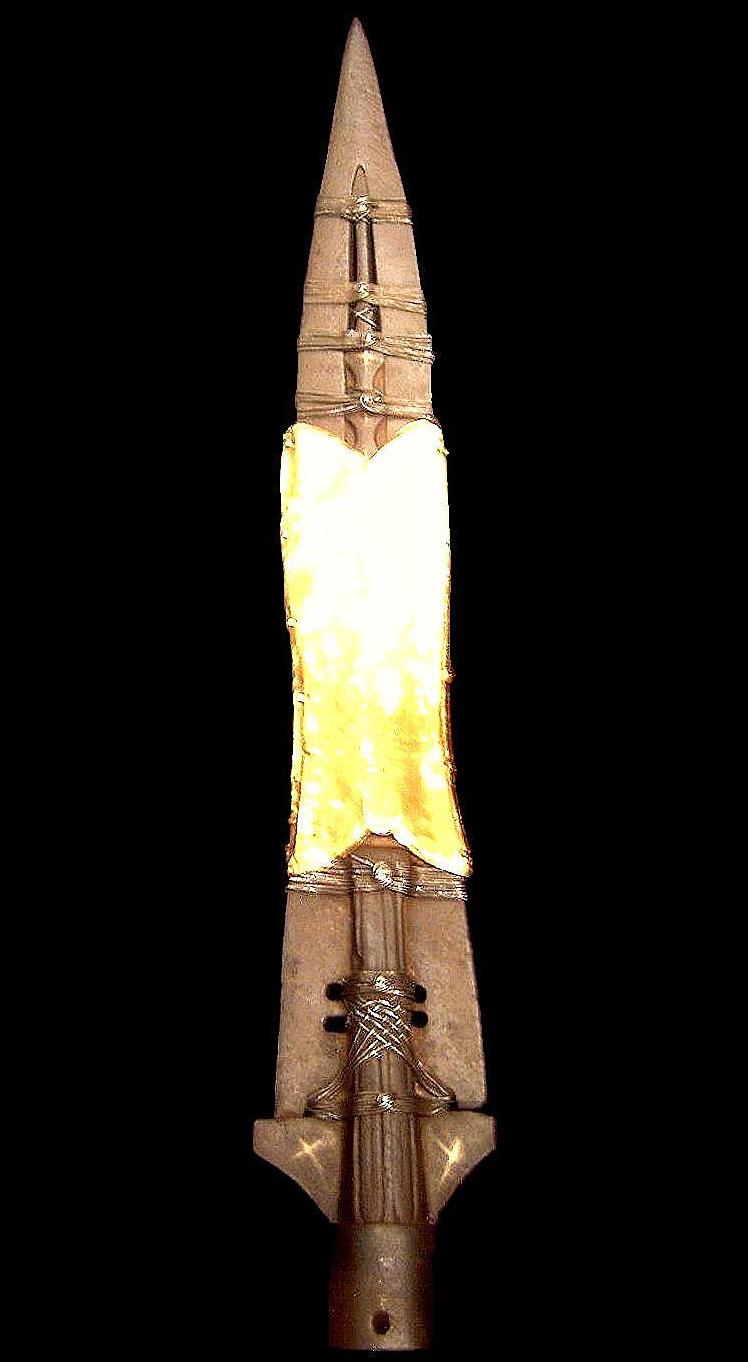 ◊ consists of a simple spear wrapped in a ridiculous amount of bling (including the supposed True Cross nail). The spear that was supposed to have pierced Christ's side is the core; the nail and everything else would have been added later.
Anime and Manga
- In the Hellsing manga Alexander Anderson uses in his final fight with Alucard one of the Vatican's most important relics, "Helena's Nail", to turn himself into a inhuman monster. According to Catholic tradition, Helena of Constantinople, mother of Emperor Constantine I, was the discoverer of the remains of the True Cross. She is said to have affixed at least one nail to the bridle of her son's horse to give him protection in battle.
- In the De Rode Ridder album De Ijzeren Kroon note , there turn out to be three copies of the Iron Crown of the Lombards, each made with one of the three nails (two for his hands, one for both feet). In the end Merlin magically combines the three into one, which then gives Johan enough holy power to take on the demon Baalfemort (which he could barely scratch before) on equal terms.
- In Fright Night (2011), Peter Vincent's collection of arcane relics contains a Crucifixion nail. Stabbing a vampire in the heart with one is described as an "old school" way of killing their kind. Nobody ever gets to a chance to use it.
- In Luther (2003), Joseph Fiennes' portrayal of Martin Luther makes reference to these by joking to some theological students that Rome has enough of these nails from the holy cross to shoe every horse in Saxony.
- Variation on the nails legend: in Piers Anthony's Incarnations of Immortality series, reference is made to how the nails were fashioned. When the time came for Jesus to be crucified, the Roman soldiers needed to have nails made, but no one would make them once they found out who was to be crucified with them. After several fruitless attempts, the Roman soldiers finally wised up and didn't tell the next forger who the nails were for—until he had made three nails and was working on the fourth. Once he found out, he then refused to finish the last nail. The soldiers took the completed three, thus supposedly explaining why Jesus had his feet nailed together instead of separately—while the blacksmith and his family were forced to flee from terrible, nightmare visions of the unfinished nail following them everywhere they went. The forger was Roma... thus explaining why their people wander to this day. Considering the author got everything right about the origin of "Gypsy" and their being native to India, and that their depiction was both sympathetic and working hard to overturn a lot of stereotypes, these little lapses can be forgiven. Besides, it was a pretty good (albeit entirely fictional?) legend.
- It does bring up the question of why the Roman judicial court wouldn't have entire bushels full of nails already, given how common crucifixion was. (Although most crucifixions were done with rope, nails weren't that uncommon.) Or why they didn't simply buy or commandeer some from a construction project, given how Herod had been upgrading Jerusalem's infrastructure for years.
- The nails are used as the ultimate weakness to defeat Satan in Magnus.
- In The Dresden Files, as mentioned above, the swords of the three Knights of the Cross have the Nails worked into the hilt. In Peace Talks, Harry, Butters, and Sanya work out that, as a counterpart to the Fallen Angels in Judas's thirty pieces of silver, each nail contains a faithful angel of God. When the Knights on occasion seem to act as mouthpieces of a higher power, it's these angels that are speaking through them.
- In John Bellairs' Lewis Barnevelt series of novels, The Vengeance of the Witch-finder sees Lewis discover the Amulet of Constantine, a glass tube on a chain which contains one of the Nails of the True Cross. After Lewis's uncle Jonathan uses it once to banish an evil spirit, he gladly entrusts it to his neighbor Mrs. Zimmerman, who specializes in such talismans and is more skilled with magic than him.
Live-Action Television
- These make a heavily implied appearance in Whitechapel (TV Series) in which an elderly woman (also heavily implied to be Lucifer given her name is Louise Iver) uses large nails to puncture holes in the police station's plumbing, leading to water/electricity damage and a successful attempt at messing with the team's heads. When Miles finds them, he asks others if they look familiar...
Video Games
- The Binding of Isaac features The Nail, an active item that transforms Isaac into a demon on use. Considering the tone and content of the game, it's strongly implied to be this.
- Afterbirth added a passive item called 8 Inch Nails, which may also relate.
- In Crusader Kings II, the Emperor of Byzantium starts out with a nail, so long as you have the "Monks and Mystics" DLC. And if you're not the Emperor, you can always try and loot Constantinople for it. Oddly, in the games files, it is labelled as a fragment of the True Cross, rather than as a nail.
) that often runs smack into the critics themselves having their own biases, with the interpretation of some of the science (not the actual science) being read either way in the debate.
Anime & Manga
- Appeared in Magical Girl Lyrical Nanoha StrikerS in the form of the Holy Shroud of the Saint King, the figure of worship of the Belkan Saint Church. While it had no powers of its own, it was used to retrieve blood samples of the Saint King and create a clone of her.
- A Certain Magical Index's titular character, Index, claims her outfit, the Walking Church, is an accurate replica of the Shroud, and is of Pope-class hardness, able to deflect physical, magical, and psychic attacks. Well, it was, until Touma's Imagine Breaker touched it and it fell apart.
- It's the central object in Doug TenNapel's graphic novel Creature Tech, in which the Shroud actually has the power to instantly heal anything, even bringing things back from the dead, such as GIANT SPACE EELS.
- Appears in the Wild Cards novel Death Draws Five, in which the Shoud is stolen and given to an ace with the power to speak with the dead, in order that she might summon up Jesus and have him give instructions as to what to do to bring about the Apocalypse.
- The shroud is the central focus of the De Rode Ridder album De Sluier van Wuustwezel note .
- In Batman: The Adventures Continue, a continuation of the DC Animated Universe, Batman and Azrael team up to find the Shawl of Magdalene, a artifact revered by the Church of St. Dumas and said to hold healing powers. Catwoman stole it for the Penguin to deliver to a mysterious benefactor. Said benefactor ends up being Mr. Freeze, who wanted to use it to save Nora Fries, who ended up dying a few years after the events of Batman And Mr Freeze Sub Zero Freeze is unable to use it to revive Nora, but Batman saves Azrael with it.
- Supposedly used in the comic miniseries Punk Rock Jesus to create a Clone Jesus, similar to the Christ Clone Trilogy example below. It turns out that "Chris" really is a clone, but not of Jesus.
- In The Dresden Files (somewhat unsurprisingly) the entirety of Death Masks is centered on the theft of the Shroud of Turin, in which it's heavily implied (and occasionally all but outright explicitly stated) that said Shroud has some crazy mystical strength owing to many years of being an object of faith. Interestingly, the usual assumption that it could heal (as is a common assumption with pretty much anything that ever touched so much as Jesus' toenail clippings) is addressed, but the book in question leaves it open as to whether or not it actually can heal to the level hoped for. It does, however, hold up improbably well despite taking a beating (and a soaking followed by a pulling), and it may or may not have contributed to a fight, if you don't believe in coincidence. Oh, and it was about to be used as part of a mystical doomsday plot at one point, too... need I go on?
- For all of this, the jury actually stays out on whether the thing really ever came within a thousand miles or years of touching Jesus. In fact, Harry (as both protagonist and narrator) comes down on the side of "probably not." It turns out, though, that when millions of people in the Dresdenverse venerate something as an artifact of power, they literally can't be wrong.
- Harry finds the real Shroud in Skin Game in a vault belonging to Hades, along with the Holy Grail, the placard from the True Cross, Crown of Thorns, and Lance of Longinus. He notes that it seems a lot frailer than the one he encountered before and surmises that that one was a replica made by the Church. It's speculated that the one he saw earlier still had power because people thought it was the real one; as such it gained some measure of the power it was believed to have had.
- In the first book of the Christ Clone Trilogy, Professor Harry Goodman discovered that living cells that came from Jesus' own body were preserved on the Shroud of Turin, and so used the cells to create a Clone Jesus, his supposed "grandnephew" Christopher.
- There was an episode of The Outer Limits (1995) where a Christian fundamentalist was using DNA samples from the Shroud of Turin to clone himself a new baby Jesus.
Tabletop Games
- The Yu-Gi-Oh! card game features this as "Forbidden Dress" ("dress" here simply meaning "clothing").
- In Assassin's Creed, the Shroud is actually an artifact left behind by the First Civilization, and is an advanced piece of technology that has miraculous healing abilities.
- It's the main artifact both sides are looking for in Assassin's Creed Syndicate after the first Shroud, which contained the Isu Consus inside it, was destroyed during an Assassin raid. It can't outright bring the dead back, but only from outright fatal wounds. The only way Dr. Alvaro Gramatica and Violet Da Costa could speak to Consus was to shoot the one wearing the Shroud in the head. The finale reveals that there's a second Shroud buried under Westminster Palace in London where it's fought for in two different eras: The first time between twins Jacob and Evie Frye and the Templar Grandmaster Crawford Starrick. The second time in modern day with Galina, Shawn and Rebecca against Sigma Team. The Templars win and grab the Shroud.
- Shows up in the "Monks and Mystics" DLC of Crusader Kings II
Comic Books
- DC Comics also has the Crown Of Horns (obviously a play of words) that allows its user to rule Hell.
- Spoofed in Sturmtruppen: when the trooper "Messiah" Heinz started driving the officers mad with a mystic crisis that made him believe he was Jesus (and somehow had the powers to back it up, but, obviously, not the brains to use them well), Musolesi offered to take care of him for thirty Reichsmarks (struck in silver, of course), and as part of the preparations to nail him to a cross he has Heinz try out crowns of barbed wire to see which one fits. The crown reappears with a cross, a hammer and nails in Musolesi's hands when he's finally ready to nail Heinz... Right after the mystic crisis has worn off.
- In The Dresden Files book Skin Game, Harry finds it in a vault belonging to Hades, along with the Holy Grail, placard from the True Cross, Lance of Longinus, and Shroud of Turin.
- In Chrononauts, you yourself may travel back in time to 33 AD, and steal it from You-Know-Who, to aid in your Mission as a Time Traveler, or perhaps to simply sell off as a Biblical Relic to gain a bonus card when given the opportunity to Sell an Artifact.
- While the explicit Crown of Thorns doesn't appear in Pathfinder, the Thorncrown of Iomedae is clearly inspired by and based off of it.
- Crypt Of The Necrodancer has the Crown of Thorns as an equippable item. Picking it up damages you, but also heals half a heart for each ten (or fewer, if you also have a Blood weapon equipped) enemies killed.
- The Binding of Isaac has a passive item called Blood of the Martyr, which visually looks like the Crown of Thorns.
- The Elder Scrolls V: Skyrim has a similar one, called the Jagged Crown. It even has a quest related to finding it!
- Shows up in the "Monks and Mystics" DLC of Crusader Kings II, and is one of the artifacts that not only spawns at the start of the game, but spawns in a different area depending on what year the game starts in (Pre-1066, it's in the possession of the Count of Jerusalem, post-1066 but pre-1238, it's in the possession of the Byzantine Emperor, and post-1238 it's in the possession of the King of France).
- The Final Fantasy games often contain this rare item that can be equipped as a helmet, often changed in translation to "Thornlet" to avoid controversy. It gives a character maximum protection against attacks, but inflicts a status ailment that constantly drains their HP (as if they were wounded and bleeding).
- Unwinder's Tall Comics uses this in the Show Within a Show Tokyo Delta Jetlag D. In an episode utterly drenched with Faux Symbolism, the protagonist uses the Crown of Thorns to kill a kaiju called the Messiah Demon.
Comic Books
- The DCU:
- The Judas Coin by Walt Simonson: One of these shekels is the central MacGuffin, which ends up in the hands of various DC characters throughout the ages, including Two-Face, for example.
- New 52: The Council of Wizards and the Voice punished Judas Iscariot for his betrayal by making him the Phantom Stranger. He had the coins hung around his neck, where they would be impossible to remove until he completed his penance for the Voice.
- Ghost Rider: One story is about a conspiracy to use the silver pieces, which were cursed with immense evil by their circumstances, to forge unholy silver bullets powerful enough to disrupt the balance of power between Heaven and Hell.
- Sturmtruppen: Spoofed. When trooper "Messiah" Heinz has a mystic crisis that makes him believe he's Jesus (and somehow gives him the powers to back it up, but not the brains to use them well), Musolesi initially installs him as his Pope and manipulates him to make money, but the moment the officers say that they'd be willing to pay to get rid of him before he drives them mad Musolesi offers to do the job for thirty Reichmarks (struck in silver, of course).
Fan Works
- In Marcus S Lazarus's crossover fanfic The Coven of Reformed Supernaturals, the thirty pieces are revealed to have been forged into a set of silver knuckledusters that fell into the hands of John Constantine sometime after he defeated the archangel Gabriel; they're highly effective against anything naturally good. He uses them to kill the Elder Gideon, who is trying to kill Leo and Piper's infant son Wyatt, the Elder believing that the child's power will lead him to ultimately turn evil.
- The Brass Teapot: It's implied that the titular artifact contains silver from the coins. The Teapot’s powers are associated with greed and pain.
- Dracula 2000. The traditional revulsion of vampires for crosses and silver is revealed to be because the first vampire was Judas Iscariot, with the associated guilt over causing the crucifixion of Christ for thirty pieces of silver.
- The Librarian: Curse of the Judas Chalice: The pieces had been forged into a silver equivalent to the Holy Grail for vampires.
- Brotherhood Of Blood: The thirty pieces of silver were impregnated with Lilith's spirit and passed from man to man, the most famous being Judas, and eventually melted into a cup, the Blood Grail, which turns anyone who drinks from it into a vampire. This goes badly for the guys who find it thinking it's the other Grail.
- The Dresden Files: Each of the thirty pieces contains a fallen angel, the lot of whom are collectively referred to as the Knights of the Blackened Denarius (or as Harry calls them, the Nickelheads). While the Knights of the Cross and their allies do their best to recover the coins and keep them away from evil, several that were known to be in the hands of the Church are later shown to be back in the hands of the Denarians, something the Denarian leader attributes to the fact that the Fallen cannot be contained by mere mortals; however, two have since been left in the vault of the Greek god Hades.
- Lamb: The Gospel According to Biff: Biff took the silver pieces from Judas after hanging him from a tree for his betrayal and buried them nearby before killing himself out of grief over Jesus' death. When the angel Raziel resurrects Biff at the start of the book they dig up the pieces and sell them to pay for their plane tickets to America.
- The Last Coin, by James Blaylock: The villain is collecting the thirty coins to fulfill his vile schemes. He's up to 29 at the beginning of the book and close to the last one.
- Sleepy Hollow: The thirty pieces of silver are revealed to be cursed to cause whoever touches them to betray the thing most dear to them. It is explicitly stated that this is what caused Benedict Arnold to defect to the British during the American Revolution.
- Anima: Beyond Fantasy: Featured (as thirty pieces of black metal; the background history — being given in exchange for Abel, the game's equivalent of Jesus to Iscariote (yes, it's named so) — being the same) as one of the most important artifacts of the game's setting, being actually superadvanced minicomputers that, basically, help someone to develop advanced technology.
- Champions: They figure into the origin of the Coin Collector, one of the top leaders of the evil group DEMON,. He took part in a satanic ritual where he was transported to Hell and met Judas himself, who handed over the silver pieces, which cemented the Coin Collector as a servant of ultimate evil.
- In Nomine: The thirty pieces are of considerable symbolic value to demons as a reminder of the depths to which humans will sink for the sake of material wealth, and are assumed in-universe to have become powerful relics. They are of particular importance to Mammon, the Prince of Greed, who has gathered twenty-four of their number to himself and will pay dearly for the whereabouts — or simply delivery — of the missing six.
- Dante's Inferno: The Thirty Pieces of Silver show up as items to search for. Each five collected gets the hero a power-up.
- Thunderstruck: Judas Iscariot is the progenitor of all vampires, his condition being the result of a curse put on him due to his traitorous intentions as he drank of the blood of Christ at the Last Supper. The thirty pieces of silver became a talisman holding absolute power over his soul; whoever possesses the silver pieces has total control over Judas (but only if they have all 30).
- The Dresden Files: The noose with which Judas Iscariot hanged himself also shows up. (It's worn as a Noose Necktie by the bearer of one of the thirty coins mentioned above.) The noose protects its bearer from everything except the noose itself.
- The Magicians: The Dragon of the Grand Canal in The Magician King boasts of a vast collection of magical artifacts, including both the Lance of Longinus and the noose that hanged Judas.
Norse
Mjollnir is actually spelled/pronounced "Mjöllnir". The sound ö is usually unpronounceable to native English speakers. It's somewhat similar to the "heu" in French (like heure). "Myol'neer" (with short o) is pretty close, though. Speak the word heard or girl (the 3: sound) and you will be pretty close.
Occasionally you will see Gram — the sword of Siegfried, used to kill the dragon Fafnir. This sword has also been referred to as Balmung and Nothung.
Ragnarok is also a common name for swords in RPGs, and there's also Lævateinn, the Flaming Sword of Surtr.
Anime & Manga
- Bayloupe of New Light from A Certain Magical Index condenses Thor's weapons into a pair of gloves, allowing her to use all of Thor's weapons.
- Marian wielded Dáinsleif, or at least a replica of it, at one point. It is said to trigger Ragnarok if it is ever fully unsheathed, and most people drop dead out of pure terror if even a small amount of the blade is revealed.
- Brunhilde Eiktobel created a replica of Gungnir, though this was later destroyed. Othinus, a Magic God, wants to create the real Gungnir, not a replica like most of the magical items in the series.
- Look at any work by Kosuke Fujishima, Ah! My Goddess being most prevalent.
- Used in Bastard!! (1988) by the Seraphim: Uriel has Gungnir (which is also said to never miss its target) and Michael has the Flaming Sword Laevatainn.
- Digimon Tamers: Most of Dukemon's arsenal consists of weapons named after legendary weapons of Norse mythology. In his base form he wields a lance called Gram, and as Crimson Mode he wields dual energy weapons named Blutgang and Gungnir. In expanded universe material, his Evil Counterpart Palette Swap ChaosDukemon instead calls his lance Balmung.
- Full Metal Panic! features the ARX-8 Laevatein, designed to replace the destroyed Arbalest as Sousuke's Lambda-enabled AS.
- Laevatein is the name of Signum's Intelligent Device from the Lyrical Nanoha series, though it's also been called Levantine.
- Once again with Mobile Suit Gundam SEED, this time it was an EMP weapon developed by ZAFT and used to disable the Earth Alliance's first run Strike Daggers and take out Porta Panama's Mass Driver.
- Marie Mjolnir from Soul Eater is a Death Scythe whose weapon form is either a hammer or a tonfa.
- Symphogear:
- Fragments of Gungnir were used to create the Symphogears worn by Kanade, Hibiki and Maria. Its weapon is, what else, but a spear. Except when used by Hibiki, who cannot manifest a weapon and instead uses Bajiquan moves to "strike like a spear".
- Chris's Symphogear is supposedly based on Ichaival, the bow of the Norse god Ullr. Except that this was a research failure on the part of the writers, as Ichaival actually originated as the bow of a character named Ullr in Fire Emblem: Genealogy of the Holy War (where it's usually transliterated as "Yewfelle").
- The cursed sword Dáinsleif appears in season 3, where its fragments are used to create the Ignite Module - a Symphogear upgrade which allows the armour's wearer to enter a spiky black Super Mode by forcibly activating its berserker state and then taking control of its power.
- Mjöllnir shows up in the videogame spinoff Symphogear XDU, where it fuses with Hibiki's Gungnir to grant her a more powerful form with control over lightning. Its Finishing Move, Unlimited Beat, follows the Once a Season tradition of being an ultimate attack named after the opening theme.
- Fragments of Gungnir were used to create the Symphogears worn by Kanade, Hibiki and Maria. Its weapon is, what else, but a spear. Except when used by Hibiki, who cannot manifest a weapon and instead uses Bajiquan
- Yu-Gi-Oh! 5Ds features several of these as support cards for the Nordic and Aesir cards used by Team Rangorok. The manga version references Gram in the form of a Blackwing monster.
- Nasuverse
- Gungnir is mentioned in passing in Fate/stay night as similar to how Servant Lancer's Gae Bolg works as a throwing spear.
- Saber of Black from Fate/Apocrypha wields Balmung, as his true identity is Siegfried. Like Excalibur listed above, he can use it as a Wave Motion Sword.
- Gram is stated to be the strongest demonic sword, being the antithesis and equal to Excalibur, although this is never actually shown. Like in mythology, it's the sword of Sigurd, who is a completely different person from Siegfried in this universe. Naturally, Gilgamesh also has a copy of it in his Gate of Babylon.
- Mjolnir is wielded by Beatrice Flowerchild in Fate/kaleid liner PRISMA☆ILLYA since she possesses the Berserker class card connected to Thor. The hammer is roughly three times her size and requires her to enlarge her entire arm just to hold it. Mjolnir turns out to be a massive Red Herring for this Berserker's True Name - rather than being derived from Thor, the card is instead derived from Magni, one of Thor's sons who inherited the hammer after his father's death during Ragnarok.
- In The Epic of Zektbach, Nox Catorce's sword is called Tyrfing, after a cursed sword of Norse mythology.
- Record of Ragnarok depicts Mjolnir as a Living Weapon that's larger than Thor himself.
- It appears in Marvel Comics' The Mighty Thor. This version can only be used by "one who is worthy" of the power of Thor. It's a dual-purpose enchantment by Odin to both make sure that power doesn't fall into the wrong hands, but also to make sure that there is a Thor who will act like Thor once Ragnarok comes around. Thus, Captain America could lift it, but not Superman (except with Thor's permission, in JLA/Avengers), because Superman isn't worthy to lift Mjölnir because he's actually a little too heroic. A proper Thor needs to think like a warrior when the situation calls for it, which means being just a little bit more willing to use lethal force when necessary. That's no slight on Superman, it just means that Superman would make a poor viking, which is as it should be. Other Marvel/DC crossovers have shown that Wonder Woman does meet Odin's definition of worthiness.
- Also Marvel: in Loki: Agent of Asgard Loki has Gram, which even in this universe belonged to Sigurd and was used to kill a dragon, but has truth revealing powers and truly ridiculously complex origin story. Less surprisingly Loki also owns Laevateinn, which they apparently always had but never used before. According to Sigurd because it sucks beginning with its name ('damage twig'), maybe it's true, but maybe Loki just didn't want people to insult their Ancestral Weapon.
- The hammer is of course the focal point in the De Rode Ridder album De Hamer van Thor note . Both Mjollnir and Gungnir also make an appearance in the album De Walkure note , where they are wielded by their original owners. The album Doodsbrenger note briefly shows how Mjollnir was originally forged (from mithril, according to the story!), but instead focusses on the sword Deathbringer, which was forged at the same time but ended up hidden on Midgard, where it was eventually found by the album's main villain.
- My Little Avengers: Naturally, Big Mac uses Mjolnir to transform into Thor. Gungir also shows up later in the story in Trixie's possession.
- Child of the Storm has Mjolnir and Gungnir, is in the Marvel Cinematic Universe, as well as Laevateinn - which, here, is a wand, which contained embers of the Phoenix force. Or at least, it used to be. Currently, drained, it's pretending to be a phoenix feather, and has since served as a container for Harry's mind, and a container for a Dark Phoenix's worth of power. What it actually is and where it came from is up for speculation, but it's hinted that it might actually be the Twilight Sword, or a fragment of it.
- One of the ships in The Matrix was technically called Mjolnir, but everybody called it "The Hammer". Probably because, as the special features on the Revolutions DVD demonstrate, nobody involved in the production could figure out how to pronounce it.
- Additionally, there's Theme Naming in the Mjollnir's crew members: all of them were named after guns, except the medic (who was named after a magazine) and the captain (who was named after Stephen King's gunslinger). Which fits this theme more, an unpronounceable Norse weapon or the thing that strikes off a cartridge?
- Mjolnir and Gungnir feature repeatedly in the Marvel Cinematic Universe in Thor. One of the regular human characters refers to it as "Myew-myew".
- In L. Jagi Lamplighter's Prospero's Daughter, one of the swords the Prosperos own comes from Norse mythology.
- In Harry Harrison's The Hammer and the Cross, Shef acquires a spear named Gungnir at one point. Seeing him carrying it, with his single eye, upset Valgrim priest of Odin to no end.
- At one point in Amos Daragon (a French-Canadian Fantasy youth novel series), the half-man/half-bear Béorf Bromanson receives a favor from the god Odin and is told about the location of Gungnir, which at that point is rusty and hidden in a dusty forgotten vault in the woods. He restores it to its proper glory, and he also needs a special enchanted gauntlet that also belonged to Odin to be able to wield the spear in the first place.
- Magnus Chase and the Gods of Asgard: As usual, Mjölnir is Thor's weapon. Although it spends almost two books missing.
- Odin and his spear appear in the Dresden Files books Changes, Peace Talks, and Battle Ground. In Odin's guise of Donar Vadderung, Gungnir is disguised as a short cane that nonetheless projects a shadow the full length of the spear. In its true form, it appears as a simple spear with a shaft of ash wood, but in the right hands can encase itself in lightning and project more of the same. The Titan Ethniu defeats Odin in battle, knocks him out, and takes Gungnir from him, using it to devastating effect against the forces allied against her. But when Odin wakes up, he simply speaks the spear's name, causing it to twist like a snake and stab Ethniu in the eye. Dresden notes that the name translates to "Swayer."
- Mjolnir showed up on First Wave as an alien portal-making thingy.
- Power Rangers:
- An oddly Japanese-looking Mjolnir shows up in Power Rangers Operation Overdrive, as a Cultural Translation of a Boukenger storyline involving the Conjuring Mallet above; in addition to its Sizeshifter powers from the stock footage, Thor is shown using it to create blasts of lightning. There's also the Spear of Neptune, although Neptune himself is not encountered.
- All the more interesting since one of the villains seven seasons earlier (Power Rangers Lightspeed Rescue) was a demon named Loki (pronounced "lokai," though), and King/Lord Neptune himself appeared in that same season. How Overdrive's long-abandoned city of Atlantis squares with Power Rangers Time Force's ancillary materials placing Atlantis in the South China Sea is unknown..
- This is really common in the various Stargate SG-1 series. Thor's Hammer included. These are usually Imported Alien Phlebotinum of some sort.
- Supernatural: Mjölnir is auctioned off in the episode "What's Up Tiger Mommy?" by Plutus, the Greek God of Greed. When Sam manages to get his hands on it, he is able to strike down gods.
Tabletop Games
- Dungeons & Dragons: The Hammer of Thunderbolts is an enchanted warhammer that, depending on edition is either an outright artifact or the next best thing to it and is always a blatant name-changed version of Mjolnir. Mjolnir itself shows up as, what else, Thor's weapon of choice in Dieties and Demigods.
- In Nomine: Once Thor is roused out of his amnesia in The Final Trumpet, the players are tasked with helping him track down and reunite with his armaments — Mjolnir, the protective guantlet Megingjord, and the strength-multiplying belt Jarngreipr.
- Yu-Gi-Oh!: Some of the support cards for Aesir and Nordic decks include Norse mythological weapons, including Gungir. As was the Gram Blackwing monster. Balmung is also referenced in a monster name.
- In Breath of Fire IV, one of the combination magics is named after this.
- Gram is a sword found in Castlevania: Aria of Sorrow, described as being a dragon-slaying weapon.
- Dragalia Lost has the whole set of Norse artifacts be an Infinity +1 Sword to Fire characters, tokens for earned by fighting against the Wind Agito, Volk.
- Unsurprisingly, Mjolnir shows up in EVE Online. Mjolnir Torpedos deal EM damage to a target. Though it is primarily a Caldari weapon and most Norse named ships are Minmatar... However, perfectly acceptable for an Icelandic company.
- Gungnir has it as its plot weapon. Unsurprisingly.
- Yet another Halo example: the MJOLNIR Powered Armor worn by the Master Chief and other Spartan Super Soldiers.
- Also, the Spartan Laser, which has the designation of M6 G/GNR, and was developed as part of Project GUNGNIR, providing a suit of MJOLNIR Powered Armor of the same name.
- Gungnir, Mjolnir, and Laevateinn show up often in the Final Fantasy series.
- In Final Fantasy XI the Mjollnir is the relic weapon for White Mages, of all jobs. Gungnir is the relic weapon for Dragoons, which lets you use the weapons skill "Geirskögul," which was a Valkyrie in Norse Mythology. Ragnarok was the Great Sword relic weapon, usable by Warriors, Paladins, and Dark Knights. The Bard's relic musical instrument was the Heimdall's Gjallarhorn. A Black Mage's mythic weapon was Laevateinn, a more obscure Norse artifact. FFXI kind of loves this trope.
- In Final Fantasy XIV, the Gae Bolg is a relic weapon Level 50 Dragoons obtain.
- Fire Emblem:
- In Fire Emblem's Jugdral canon (Genealogy of the Holy War and Thracia 776), quite a few of the weapons of the Twelve Crusaders are named for weapons from Norse mythology - the Tyrhung (Tyrfing), Balmunc (Balmung), Gungnir, Mystletainn (Mistleteinn) and Thor Hammer (Mjöllnir).
- Several of these aforementioned weapons reappear in Fire Emblem: Awakening, set in the Jugdral canon's Distant Future, generally in the hands of Aversa's Dreadlords.
- Many of the characters introduced in Book 2 of Fire Emblem Heroes take their names from Norse mythology. Relevant to this specific trope is Laevatein, who wields a weapon named after herself.
- Blutgang makes an appearance in Fire Emblem: Three Houses as a Sacred Relic associated with Maurice's Crest.
- In Freedom Wars, Gungnir is the name of the fire version of the Holy Lance, which is upgraded with Dionaea-Class Abductor parts.
- Magicka: Weapons like Mjölner, Gungnir and Gram can be picked up and used in game. As a bonus, Gram kills the boss Fafnir in one hit.
- Mjollnir, Gram, Balmung, Nothung, Gungir and Laevateinn all appear in Ogre Battle 64 as randomly-dropped weapons. None are plot relevant. The other games of the series feature some or all of them as well.
- In Persona 3, fusing the Personas Odin, Thor, or Surtr with any Nihil Weapon would yield their respective spear, hammer, and sword. Likewise, in Persona 5, Odin and Thor can be turned into their respective weapons through Electric Chair execution.
- Since Thor appears in Smite, he naturally carries his Mjolnir around and has been using it more than his title, God of Thunder, imply.
- Tales of Phantasia has a weapon named Gungnir.
- The Gungnir in Terraria is a giant golden spear with a red gem in the spear head. Before an update changed its crafting recipes, it was made with three other spears and can kill pre-hardmode bosses in seconds.
- Mjolnir is the focus of Tomb Raider: Underworld, which is the sequel to Legend. Just like Legend, the mystical "weapon" turns out to be a key to enter Helheim. Wherein the Big Bad is attempting to wield Jormungandr, a gigantic ancient machine that will bring about Ragnarok
- Touhou Project features the vampiric Scarlet siblings, each with a potent magical weapon out of Norse mythology. Remilia has Gungnir, which in-game can be used to fire an energy spear of danmaku, while her younger sister Flandre has Lævateinn, the "Wounding Wand of Loki," which functions as a Flaming Sword. It's unclear if these are the Gungnir and Lævateinn or if "the young descendent of Tepes"note is exaggerating her supernatural clout again.
- Golden Sun:
- Ragnarok is a Venus-aligned spell that appears in all games and conjures a giant sword to impale one enemy.
- Lævateinn (or Levatine, as it's spelled in the game) is a greatsword that can be forged from mythril silver. It has a massive red blade and it can unleash Radiant Fire, an armor piercing explosion.
- Can be found in the "Monks and Mystics" DLC of Crusader Kings II, but can only be used by followers of the Norse religion.
- In God of War (PS4), the smiths who forged Mjolnir, Brok and Sindri, are supporting characters who aid Kratos and Atreus by providing crafting services. They are deeply ashamed of forging Mjolnir since Thor used it to slay countless Giants. Thor's sons Magni and Modi are in fierce competition with each other over the right to inherit the hammer. The hammer itself finally made an appearance in The Stinger when Thor appears in front of Kratos house in Atreus's dream.
- As AdventureQuest has an equipment set themed after Norse Mythology, Mjollnir naturally shows up as one of the weapons in the set. It is an Energy-element hammer that can either be swung or thrown. The Full Set Bonus of the set grants Mjollnir a x20% damage to any opponent that uses Strength.
- Titan Quest has an entire expansion pack dedicated to Celtic and Norse mythology. The player character fights against the Norse Gods themselves when under Loki's ruse. Not only will they use items like Gungnir and Brisingamen against the player, but the player can also find such items as rare drops.
- Mjölnir naturally is a hammer that does loads of Lightning and Electrical Burn damage, and even has a special Chain Lightning attack.
- Gungnir is a spear that specializes in Elemental (magical) damage, while most spears are only physical.
- Gram is a powerful sword that rarely does lots of Piercing and Bleeding damage, and it gives bonus damage against certain bosses in the game.
- Lævateinn is the the Flaming Sword. It deals Fire and Burn damage in addition to physical damage, and increases Fire and Burn damage, increases Fire and Freeze resistance, and increases the power of skills in the Earth mastery.
- Tyrfing shows up as a powerful physical sword. It gives a whopping +40% attack speed and 20% chance of +100% total damage (not just one damage type, unlike other weapons), among other bonuses. Attacking with it sends out projectiles that curse the enemy with Fumble and Impaired Aim.
- Enchanting a weapon with the Essence of Donar's Hammer with it gives it a chance to stun, as well as deal extra damage and receive less damage against Giants.
- Heroine's Quest is based on Nordic mythology, and fittingly contains the swords Balmung (a Flaming Sword and drawn from a tree), Gram (given to you when asked to defeat Fafnir), and Tyrfing (owned by the former guild leader). It even has a cat's footfall, one of the traditional components of the leash that binds the world-destroying ur-wolf, Fenrir.
- Quake's Expansion Pack Scourge of Armagon features the Mjolnir as a melee weapon. It's a hammer that uses Thunderbolt/Plasma Gun's cells in order to deal a Chain Lightning Area of Effect attack.
(Manual): This is THOR’s War Hammer. Electrical by nature, when hammered to the floor it sends out a scattered electrical force along the ground. An ear-piercing clap of thunder will sound when the opponent is struck. The electrical current can spread from one opponent to the next.
- In Honkai Impact 3rd, Mjolnir is the name of a pair of pistols that can be wielded by Kiana and Kallen Kaslana. They have a special ability that allows a large energy-based version to be slammed down on enemies like a Pistol Whip, alluding to the hammer theme.
- While it's not outright Mjolnir, Raiden owning a giant war hammer that he makes use of in Mortal Kombat 4 and keeps it ontop of his Sky Temple as a lightning rod in Mortal Kombat: Deception. Is definitely a reference to Mjolnir considering both are giant hammers used by gods of thunder.
- In The Specialists, Balmung
- Ginger's Bread: Ryan and Kelly once gave Ginger a taser-shaped like Mjölnir as a birthday present. At first she was annoyed that they were persisting with the joke that her (very Swedish) dad is Thor, but then she decided it was a pretty cool weapon.
- The Order of the Stick: Durkon starts using a Hammer of Thunderbolts near the end of the story arc "Utterly Dwarved". It's coruscated in white lightning whenever he swings or throws it.
- In Atlantis: Milo's Return, Gungnir is the artifact the third leg focuses on. It is in fact of Atlantean origin. A crazed shipwright named Eric Helstrom, under the delusion he was Odin, stole it from Mr. Whitmore's collection and attempts to use it to cause Ragnarok. He is prevented from doing so and the spear is instead used to raise Atlantis back above the surface of the ocean.
- In the last episode aired of James Bond Jr., a pirate villain seeks and finds Thor's hammer.
- An early episode of Mighty Max had his bodyguard wielding Thor's hammer. Again, because he'd originally wielded it thousands of years ago when his exploits inspired the legends about Thor.
- Tom Holt's Expecting Someone Taller has hapless clerk Malcolm Fisher receiving the Ring and the Tarnhelm from a badger he runs over one night, who turns out to be Ingolf, brother of Fafnir.
- Yu-Gi-Oh! features the ring as one of Sigfried's cards.
- The aforementioned Heroine's Quest also has the ring, which causes almost everybody to dislike you, and is a Clingy Macguffin to the point that after restarting the game you'll still have it.
Other
Anime and Manga
- The Necronomicon was mentioned in passing as one of the 103, 000 grimoires inside Index's brain in A Certain Magical Index.
- Kosuzu Motoori is in possession of a Japanese copy of the book in Touhou Suzunaan ~ Forbidden Scrollery.
- The Darkhold is Marvel Comics analog of the Necronomicon. The Darkhold started out as a set of scrolls written in Antedeluvian times, referenced in their Conan the Barbarian adaptations.
- Felix Faust is sometimes seen reading from the Necronomicon. When reading the literature of Tartarus in Justice League Unlimited he refers to dark tomes that make the Necronomicon look like a children's book.
- The book appears in two albums of De Rode Ridder, Necronomicon and De Boeienkoning note . It is displayed as a source of phenomenal magical power and in both cases Johan needed serious help to deal with its current owner. The first time he was aided by the Babylonian goddess Ishtar, and the second time he was aided by The Grim Reaper. The book is still at large in Johan's world, searching for a new owner...
- The Necronomicon Ex Mortis from the Evil Dead series, a classic Tome of Eldritch Lore.
- Jason Goes to Hell: The Final Friday: The Evil Dead version of the tome appears in Jason's cabin, possibly as a way to set up a future crossover (which only happened in the comics), considering the film also ends with a Sequel Hook cameo by Freddy Krueger.
- P.C.Hodgell's Chronicles of the Kencyrath has a Necronomicon-analogue in "The Book Bound In Pale Leather", one of several mythic treasures ( or curses) of the Kencyr. The Book can be bruised if mishandled, and contains rune spells of such power that numerous priests went mad simply writing them down to make The Book.
- Terry Pratchett's Discworld version is the infamous and feared Necrotelicomnicon, the Book of Communicating with the Dead Long Distance.
- It also appears in Neil Gaiman's The Sandman (1989) under its alternate title, Liber Paginarum Fulvarum, dog Latin for "Book of the Yellow Pages".
- Christopher Pike made the Necronomicon into the Satanic Bible. There actually is a book called The Satanic Bible, by Anton La Vey, but it's not the Necronomicon either.
- One of the Defictionalization instances was published as a mass market paperback authored by someone only known as "Simon". Inexpensive copies litter many finer used book shops at a bargain price.
- In Lifeblood, Jack meets a bookseller who owns and closely guards one of these forgeries, and doesn't have the heart to tell the guy he's been suckered into buying a worthless knockoff.
- Mentioned in the The Dresden Files. The White Counsel were the ones who had it published, in order to dilute the rituals' power. Rituals in The Dresden Files are like the water in your house: the more people who are trying to use it at once, the less each person gets.
- In Stephen King's short story "I Know What You Need" (contained in Night Shift), Ed Hamner Jr. is the proud owner of a copy (though we're not told if it's the actual book).
- In the Dan Shamble, Zombie P.I. series, the spilling of virgin's blood on a 1st edition Necronomicon during a rare celestial conjunction is what kicked off the Big Uneasy and unleashed all manner of monsters into the modern world. A homely middle-aged librarian/witch's blood, shed via a paper cut, but it counts.
- John Hodgman's Complete World Knowledge trilogy has the Americanomicon, held by the Secret World Government at Yale University, which predicts the entire history of the United States all the way up until the year 2012, when Ragnarok happens.
- Unsurprisingly, Necronomicon is centered on the tome.
- In Wizard101, we have the Krokonomicon, a magic book from the world of Krokotopia.
- This appears in Golden Sun, but changed in the English translation to "Tomegathericon".
- The Necrotelicomnicon also shows up in Kingdom of Loathing.
- Guess what happens if you mess around with the Necrophilicon in Quest for Glory IV.
- In King's Quest VI, the Big Bad's name is Abdul Alhazred, and The Kings Quest Companion runs with the idea that he really is that universe's version of the Lovecraftian author and thus wrote a version of the Necronomicon within the KQ universe.
- Parodied in Team Fortress 2 with the "Bombinomicon", a Necronomicon offshoot originally sold for $6,66, whose teeth clench a Cartoon Bomb and who is a Motor Mouth to boot. Can also be worn as a badge, causing the wearer to spectacularly explode when killed.
- Dota 2: Necronomicon was an evolving item that temporarily spawned a duo of small demons, a melee warrior and an archer, to fight for the user. The item could be upgraded twice to spawn more powerful summons, both in raw numbers and additional abilites. It was removed in patch 7.29 - probably because of problems with balancing heroes who synergized too well with controllable allies.
- In Demonbane, the Necronomicon is one of the main characters, and appears in the form of a young girl who usually goes by "Al Azif", shortened from Kitab al-Azif, the book's Arabic title. The reason it appears as a girl is said to be because the most powerful magic books are so potent that they generate a human body and soul for themselves. A number of other magical tomes from the Mythos also make appearances, though Al Azif is said to be the most powerful of all.
- In The Binding of Isaac, The Necronomicon is an active item that deals massive damage to all enemies in your current room. It also has two missing pages, one being a passive item and the other being a trinket, both with similar (but more conditional) room-clearing powers.
- Shows up in Crusader Kings II as part of one event path of the Learning focus. With "Monks and Mystics" installed, it becomes a proper artifact.
- AdventureQuest has two parodies of this item:
- The Necromoron is an abridged version of the Necronomicon, and it increases Darkness resistance and gives bonus damage against undead.
- The Nekonomicon is a Lolcat version of the Necronomicon, which foretells a "cuddly apocalypse" where "The Old One" is a cat. It increases magic defense, and opening the book unleashes a magic spell that overloads its target with cuteness.
- In Persona 5, Futaba Sakura's Persona is called Necronomicon, represented as a green UFO.
- Dark Seed II features the Necronomicon in the secret room in Paul Cooper's house. Apparently it was involved in some way in his group's communions with the Dark World.
- In Over Cooked 2, King Onion uses the Om Nom Nomicon to summon the Un Bread. Really it's more of an Excuse Plot than anything else.
- RWBY Chibi has a brief gag where Ruby reads from the Necronomicon during a "Reading is Fun!" PSA. The book is designed to look like its Evil Dead counterpart.
- The Necrowombicon in MegaTokyo, which was a reference to an early Penny Arcade strip.
- Sam & Fuzzy: "No! Not the Necro-Deatho-Bookicon!"
- The South Park Cthulhu trilogy featured the Necronomicon, of course.
- The Springfield Republicans in The Simpsons read from the Necronomicon during their meetings.
- The Owl House: Shows up as a background gag in "Lost in Language" when Luz visits the library of the Boiling Isle. The fact it's located in the kid's corner indicates that, in the Demon Realm, the Necronomicon is nothing more than a children's picture book.
Other
- Artist H. R. Giger named two famous collections of artwork and autobiography after the Necronomicon.
Anime & Manga
- The Blasphemous Grenade in Nyaruko: Crawling with Love! probably counts.
- In chapter 10 of the Touhou Project manga Inaba of the Moon & Inaba of the Earth, Hieda no Akyuu asks resident Moon Rabbit Reisen if it is true that youkai rabbits are weak to holy hand grenades, such as the "HHG of Aunty Ock".
Film
- Ready Player One (2018): After finding the First Key, Parzival buys the Holy Hand Grenade. Comes in useful to deal with a large bunch of Sixers standing between him and the end goal.
- The Black Templars from Warhammer 40,000 have a unique piece of wargear called the Holy Orbs of Antioch, which always wounds on a 2+.
- Could be obtained in Fallout 2 in a special encounter involving five knights in Power Armor fighting a rat. In Fallout: New Vegas, you can get a slight variation with the Wild Wasteland trait, the Holy Frag Grenade.
- The Holy Bomb spell in Noita. There's an Emerald Tablet which quotes the scene in verbatim. There's also the secret Giga Holy Bomb.
- Appears as one of the higher tier weapons in Worms. It even lets out an angelic chorus before it explodes.
- One is a findable magic item in the ASCII graphics-based Omega RPG.
- Can be found in the Medieval levels of Duke Nukem: Time to Kill. These will home in on enemies and deal massive amounts of damage.
- Nowadays we have U.F.O.s, Area 51 and The Greys, which seem to qualify as the latest Public Domain Artifacts.
- Or, as the quote from Angels of Light and Darkness states, half of what they say was owned by Hitler.
- Fables seems to be extremely fond of this trope — which considering it also uses public domain ''characters'' as the primary basis for its main cast (even relatively obscure ones like Rose Red), should probably not surprise anyone in the least. Public Domain Artifacts in the series include the fountain of youth (which the fables drink from yearly to remain ageless), the magic beans (from which come magic beanstalks, of course), the Vorpal Sword (as described in Lewis Carroll's "Jabberwocky" poem... no, really genuinely as described in the poem, including an accompanying "snicker-snack!" sound effect...), the Witching Cloak, the magic barleycorns that Tom Thumb's bride was supposed to have grown from, Boy Blue's horn, a magic lamp, several magic carpets a la Aladdin, and... really countless such objects, actually. Even Santa's "Naughty and Nice" lists make a brief appearance.
- There are some artifacts which are associated with Santa, but occasionally show up without him. Usually his bag (ascribed mystical properties of producing whatever is desired) and his sleigh (or some other fantastic method of transportation).
- The supposedly "real" haunted arcade game Polybius, which doesn't have a specific author and is instead part of the contemporary folklore (keep in mind, though, that his logo is trademarked).
- The Go Board that Honinbo Shusaku spilled blood on when he died, which housed Sai's spirit in Hikaru no Go.
- Native American Mythology of the Great Plains has the sacred buffalo calf pipe (Lakota), seven arrows (Cheyenne), medicine wheels (across the plains), and ghost shirts (across the plains). Also, anything reputed to have been touched by a famous Native American. New Age groups tend to love to claim false artifacts. Arrowheads are popular pieces as well.
- Lemuria and Mu. Mu is a mistranslation of a Mayan codex. Lemuria was a land bridge by Ernst Häckel to explain similarities in the ecosystems of Madagascar, India, and Australia before plate tectonics.
- Some public domain literary characters' associated items have attained this status, such as Dr. Jekyll's Hyde-transformation elixir or Dorian Gray's youth-sustaining portrait.
- In L. Jagi Lamplighter's Prospero's Daughter, there are more public domain artifacts per square inch in the Prosperos' mansion than anywhere else. Several are mentioned above. But they were collecting them.
- The eponymous Xiovias from the work of the same title.
- Any phenomenon that science has no definite explanation for - examples include the stone spheres in Costa Rica. This overlaps with Beethoven Was an Alien Spy.
- To summarise several prior comments, for a series as heavily saturated in world mythologies as Shin Megami Tensei, it should be unsurprising that this would show up. Just in the Persona sub-series, there exist Mjölnir, Gungnir, Balmung, Laevateinn (Norse), Gae Bolg, Caladbolg (Irish/Celtic), the totsuka-no-tsurugi, and several famous katanas (Japan). Several weapons are also named after gods or mythological figures; Chie from Persona 4 has access to the Moses Sandals and a pair of boots named Sleipnir, after Odin's eight-legged horse.
- The Amber Room, and by extension, the rest of the so far unrecovered Nazi loot from all over Europe. The location of the Amber Room specifically is one of the most popular Stock Unsolved Mysteries throughout Central and Eastern Europe.
- Hergé didn't have to travel very far to find the model for the "Arumbaya Fetish" that serves as the MacGuffin of The Broken Ear. It is a pre-Columbian wooden statue in the collection of the Royal Museums of Art and History, Brussels, though it has two intact ears, which in Hergé's story happens to be how Tintin distiguishes the replica substituted for it.
