
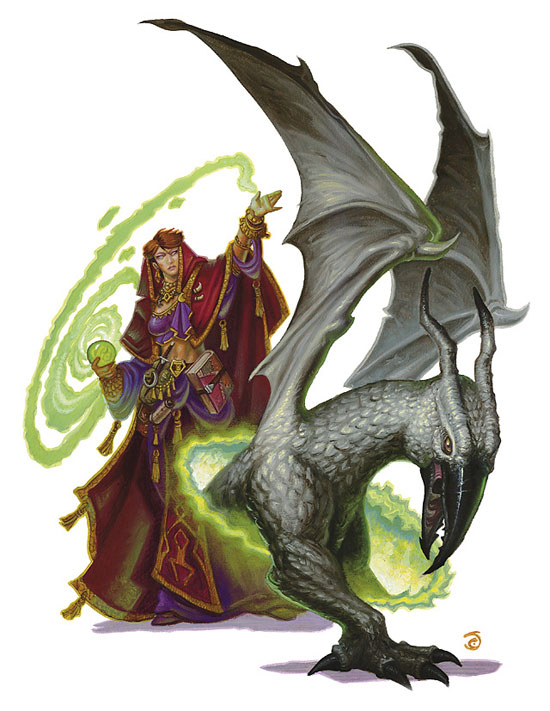
Summon Magic is the ability to conjure forth a magical, often mythological entity without the hassle of actually having it follow you around. This is a common spell found in RPGs.
In some Role-Playing Games, one of the most powerful attacks in the game is to call upon the aid of a powerful mythological beast to lay the holy (or unholy) smackdown on your foes. Typically summoning sequences will have lots of eye candy thrown in, one or more poweful creatures will make a flashy entrance, perform a powerful attack (causing as much destruction as possible), and then leave. Like the Limit Break, a summon will usually have some sort of restriction in order to compensate for its power.
In other games, especially ones modeled on Tabletop RPGs, summon spells are of the "instant ally" variety. These tend to summon weaker allies as NPCs (at least for a few minutes) instead of delivering a one-shot proxy attack and vanishing. Necromancers and demon-summoners, both of whom usually use a form of Hermetic Magic, fit this subset of the trope. The Japanese form of such spirits are shikigami. A few games use a variation on this where summons act as a Guardian Entity, bonding with or hovering around their summoner and providing bonuses, protections, and special or automatic attacks without acting as a separate character in their own right. In most franchises, especially non-linear ones, the summonable creatures will usually remain the same across all installments, even when the protagonists are different, such as in the Final Fantasy and Tales Series.
Summons are typically assumed to have their own lives and goals outside of being called on to fight puny mortals' battles, which has various effects on how well they take to being called or what they do when they arrive. Some will require you to fight them before they will let you use their power; others may ask for some service or payment or require the formatting of a magical contract before they will serve their summoner. In other scenarios, a summoner might use Summon Binding to compel or coerce summons into their service. These beings may have varying attitudes regarding their summonings; some duly accept the limits of their service, others submit to the process because they get something in return, and others still deeply resent their service and will take any chance they can to turn on their would-be masters.
These have a very high probability of being called "shô'kanjû" / "召喚獣" ("Summoned Beasts") in Japan; in translations released for the west, more individual names (such as Espers for example) may be substituted.
"Killing" a summon may result in it actually dying, both it and the summoner dying or just being sent back to its home until the summoner can summon it again.
From the game rules standpoint, summoned creatures are usually regarded as "expendable" ones, since they arrive on demand, and usually having them killed does not prevent the mage from summoning more. In strategies, this comes in handy since they (usually) don't have to be paid for, arrive instantly to where they are needed, and are temporary anyway (so there's no point in saving them since they will leave regardless once the combat ends). Basically, the only surefire way to defeat the summoned army is to kill off their summoner. Certain game classes can be built around this kind of magic, doing little to no actual fighting by themselves, and mostly just summoning more creatures as the current ones die.
It is not necessarily always magical, in some cases it can be an inborn superpower, a psychic ability (teleporting allies to you for example), or even from an item you hold in order to call upon the summoned being. In sci-fi settings, things like orbital robot drops, airstrikes from a distant base, or drones, can fulfill the exact same role.
The logical extension of this, wherein the creatures summon us to their realm, is rarely explored.
Compare Mon. See also Inconvenient Summons for when the summoned is not happy to be interrupted. See also Summoning Ritual, for the more dangerous form of this kind of magic. Compare/contrast Drone Deployer and Mon. When an enemy does this, it is an Enemy Summoner. Assist Character is a related trope commonly found in fighting games. Balking Summoned Spirit is when the entity summoned is unhappy with being called and/or the task assigned.
Examples:
- State Farm has several commericals based around this concept. If a customer recites the company's jingle, their insurance agent will immediately appear next to them.
Customer: Like a good neighbor, State Farm is there!
Agent: You're covered.
- 3×3 Eyes: A recurring element:
- Pai/Parvati IV herself can summon demonic creatures to work as her mount or defender: her first summon is the bird-like Takuhi, while from the second series onward she usually summons the clam-like flying monster Fei E (Flying Jaws).
- Benares was the one who invented the magic to control and summon the beasts known as "Juuma" (Demon Beasts or Demon Larvae/Fighting Larvae). The user must hatch the Juuma egg with his blood and then force the newborn beast to submit and accept to become a summon. Human sorcerers can tame Juuma, but since each summoning is Cast from Hit Points, it would kill them in the long run, so that only a Wu can master this magic.
- The climax of the third arc has Huang Xunli/Xun Gui trying to summon the soul-eating Quan beast for her plans, under the guise of presenting it a test for Parvati: the ritual requires blood sacrifices and the use of 108 paper talismans to bound the Quan to the human world, but the beast is also very difficult to control.
- Subverted in the Legend of the Maidens storyarc: the girl posse is seemingly summoning a real demon to do their bidding (something which muggles could do, according to Hasrath Hahn, but not without serious danger), but in the end it turns out that the "demon" is simply generated by Yoriko's powers allowing her to project hers or others' thoughts and make them material.
- Agni's Philosophy: One of the known functions of the crystals is summoning a dragon. This is almost certainly a Mythology Gag for the main Final Fantasy series, seeing as the clip is a tech demo for that franchise.
- Basilisk: Hotarubi can distract her enemies by summoning a swarm of butterflies so large it completely blocks their eyesight.
- Blue Exorcist: There are five different classes of exorcists. One of these classes, the tamer, summons demons.
- Bungou Stray Dogs: Kyouka and Kouyou have abilities that work like this, summoning a "demon" in the form of a kimono-clad, sword-wielding woman to do their bidding.
- Cardfight!! Vanguard:
- Cardfight!! Vanguard G: The Singularities/Peacemakers are capable of using Depend Cards (special Gear Chronicle units) to summon them to planet Earth. However, this ability comes with a particularly steep Cast from Hit Points cost that actually kills one of its users.
- Cardfight!! Vanguard (V Series):
- The Singularities return during the Shinemon arc, and this time without the cost or restrictions. However, it was only possible to summon in a location that had powerful dimensional anomalies to begin with.
- A more conventional example happens in the -If- arc, where Emi can use her powers as a Magical Girl to "Realise" various cards in existence.
- Expecting to Fall into Ruin, I Aim to Become a Blacksmith: Kururi attempts to summon Treants but ends up summoning Nature Spirit beings to possess radish-like roots with Dirty Old Man faces, much to Kururi's violent displeasure from the ensuing hijinks they repeatedly cause. Eventually, Kururi does manage to summon one of the spirits into a tree. It turns out they have a Hive Mind, and to pay for his past abuse, Kururi makes a deal with the spirits to set up a Penal Colony for Kururi's lands, in their home Beneath the Earth.
- Fairy Tail:
- Celestial wizards specialize in using magic Gatekeys to summon celestial spirits, magical beings based on the Zodiac and constellations. Main character Lucy Heartfilia is one such wizard, while others include Duke Everlue, Karen, Angel, Zoldeo, and Yukino. It's inverted with Caprico (the human-spirit hybrid of Zoldeo and the spirit Capricorn), who uses magic to summon humans.
- While not as common, there are other summon magics that allow the caster to bring forth aid. Angel post-Timeskip uses Angel Magic, which summons angels at the cost of shaving off years of her life. She gets "refunded" after she goes too far and her "angels" turn into Blob Monsters trying to consume her, and she seems to have mastered it to the point she no longer pays any cost. Minerva can summon a War God deity for one of her attacks, and Arlock of Avatar can summon an even more powerful one by sacrificing one of his body parts (in his case letting his face be burned).
- Final Fantasy: Unlimited , an anime loosely based on the Final Fantasy series, has a character who uses a magic gun to summon monsters.
- Hetalia: Axis Powers: In one short, England tries to summon a demon and gets Russia instead.
- JoJo's Bizarre Adventure: Stands are similar to this. They're varying manifestations of the user's psychic power that can be called upon and dismissed at will.
- Cursed techniques in Jujutsu Kaisen that involve summoning shikigami to fight on a jujutsu sorcerer's behalf are this:
- Megumi's primary use of his Ten Shadows Technique. By making shadow puppets with his hands, he can summon up to ten different creatures which obey his every command.
- Mahito awakens Junpei's latent affinity for cursed energy, allowing him to call upon a jellyfish-like shikigami summon known as "Moon Dregs".
- In Kaze no Stigma, certain magicians (especially amongst Fire Magic users) combine the powers of smaller spirits of the element into a spirit beast, who channel the elemental power through themselves. Unfortunately, when a beast suffers a wound, it can feedback into the summoner.
- Magical Circle Guru-Guru: Guru Guru magic summons monsters through magic circles. Properly performed Guru Guru spells summon anything from blasts of fire to lightning throwing demons to bad luck fairies to houses. Improperly performed Guru Guru magics summon something utterly random.
- Magical Girl Lyrical Nanoha StrikerS introduced Summon Magic to the franchise along with two summoners: Caro Ru Lushe, who can summon dragons, and Lutecia Alpine, who can summon insect-like creatures.
- Before that, the supplementary manga of Magical Girl Lyrical Nanoha A's had another dragon summoner.
- Magical Girl Lyrical Nanoha ViVid has two other summoners: Corona Timil is able to summon Improvised Golems, while Fabia Crozelg is able to summon devils.
- Magic Knight Rayearth's Ascot, who thinks of his summoned beasts as his only friends —mostly because everyone else ran in fright of him when he summoned something— but doesn't hesitate to sic them on his enemies, at which point they tend to get killed. Clef can also summon great beasts, although he uses them more as vehicles than enforcers.
- MÄR: Guardian ARM are accessories or weapons that turn into giant creatures and kick ass.
- My-HiME: CHILDs, once they're summoned, stay on the battlefield until they're destroyed or their summoner willfully dematerializes them. Some can even be given vocal commands (Natsuki does this frequently when readying her ultimate attacks).
- Naruto: Summoning jutsu require the user to make a pact with the creatures he summons (which is written on a special scroll and signed in blood), and are actually explained as a type of teleportation that is also used on inanimate objects to create a Hyperspace Arsenal (and the same branch of ninjutsu used to flat-out manipulate time and space). One particularly inventive ninja created a technique to "summon" himself to other places (special seal which he put on kunai to be specific) as a way of traveling quickly.
- In Chapter 409, Naruto gets "reverse-summoned" (which itself sees some more use later on) to Myobokuzan by one of his own summons, who is lounging there with other frog summons. Fukusaku says that Myobokuzan is "a month's journey from Konoha on foot". So the summons live in distant areas of the Ninja Continent, not in their own pocket realities.
- Pain's Animal path body is capable of summoning her own teammates to her current location. This was once used to hide their numbers while on an infiltration mission.
- Humans can also be summoned, as proven early on during the Forest of Death section of the Chunin exams. The scrolls the teams had to gather summoned higher ranking Ninja telling them they passed if they did it right (having at least one of each scroll) and rendered them unconscious if they opened them otherwise.
- Negima! Magister Negi Magi: All demons seem to require a summoning to be anywhere. They stay around till their task is complete, to which they then leave in a poof of smoke. Demon slayers are required to end their summoning by defeating them before they can complete their task (usually killing). Most higher level demons don't bother for pride's sake, but demons do act on free will to meddle in human affairs, which appears to be the only time slayers and exorcists will outright kill them. However, they only ever organize when utilized by humans. Is per Rule Magic, the amount and quality of demons summoned is directly linked to a summoner's skill or raw power.
- Onegai My Melody: This is My Melody's power in seasons 2 and 3.
- The second season is titled Kuru Kuru (Spinning) Shuffle because it's My Melody's method of summoning people. Because it involves random, spinning cards, she doesn't know who she'll summon. Later her Melody Takt gets a Mid-Season Upgrade allowing her to summon two at once but often doesn't because she messes up the tongue twister incantation.
- In the third season, she instead gets a single blank card to summon anyone she wants, provided she can draw their face. On her own, she can't, so she also gets some magical crayons that help her draw.
- Persona -trinity soul-, to no one's great surprise — considering that it is set in the same Verse as Persona 3, though Trinity Soul has since been declared non-canon. The personas seem to be of a more permanent nature here, even surrounding their owner like a translucent suit of armour and enabling flight, and the evokers have been removed.
- Record of Lodoss War: Shamans can summon elemental spirits to fight for them. Deedlit the Elf, one of the main characters, often summons a water-spirit named Undine and an air-spirit named Djinn. Her Evil Counterpart, Astar the Dark Elf, summons Behemoth, an earth-spirit, to fight her.
- Rental Magica has Adilicia, a heir apparent of a magic school in Solomon's tradition who prefers this part. If she uses magic, it's going to be "summon demon" — or occasionally "summon angel".
- Rosario + Vampire: Fang-Fang Huang has the power to summon various monsters to aid him in battle. Unfortunately, he hasn't mastered it, so he only gets a random monster. Fortunately, he is good in another thing.
- His father, on the other hand, seems to have mastered this power.
- The head of Fairy Tale's fourth sub-division, Xia-Long Miao, has mastered it and is able to summon plant monsters.
- Yukari has learned Summon Magic in a very short period of time.
- Samon the Summoner: Samon is quite skilled at summoning demons to a variety of effects, though he usually uses them for convenience or to mess with people.
- There, Beyond the Beyond: Magicians are sometimes seen making use of summoning magic as the article describes, but the main plot stresses the use of magic to summon flowers from the Beyond, which are permanent beings that can grant wishes, perform miracles, and enhance magical powers.
- Trapped in a Dating Sim: The World of Otome Games is Tough for Mobs:
- The main antagonists of the game protagonist Leon transmigrated into, The Principality of Fanoss, summon entire armadas of flying cephalopod-like monsters using a Magitek Ancient Artifact from an extinct civilization, including a Giant Flyer whale with a fortress built on top of it. These beings can be repelled by strong enough White Magic. The flute works by using pre-programmed designs and the monsters are constructed using the flute player’s soul as fuel.
- Leon uses the excuse of his Robot Buddy Luxion's Surveillance Drone that follows around being a summoned familiar to keep his true nature hidden.
- Yo-kai Watch: Much like in the games, Keita/Nate uses his Yo-Kai Watch to summon Yo-Kai he's befriended. Here, it's more Played for Laughs: sometimes things that were in the Yo-Kai's vicinity get summoned with them (such as Manjimutt bringing his entire prison cell with him), and because there's no de-summoning mechanic, the summoned Yo-Kai have to walk back to wherever they were before they were summoned.
- Magic: The Gathering: The game's central conceit is that you play as a Planeswalker, a powerful wizard capable of traveling across the planes of the multiverse, and that the creature cards you play represent entities you have encountered; either pulling them from their homes to fight for you or using the concept of them to create a facsimile of them Depending on the Writer.
- Some cards work in the "big instant attack" fashion, as one-shot super-monsters. Ball Lightning
 is the canonical example of a very large, very damaging, very brief red summon.
- Lorwyn's Evoke mechanic is an explicit attempt to invoke the "big instant attack" style. A creature can be summoned, bringing with it an additional effect, or, for much cheaper, summoned very briefly for the effect alone before it vanishes into the Graveyard.
- Flavorwise this has caused a massive conundrum since most players don't want (or are assumed to not want) to use slaves. Early flavor explicitly states that yes, these are creatures you're plucking from other worlds and forcing to fight; but Agents of Artifice explicitly states they are actually aether constructs. Most modern stories don't feature creature summoning at all or when they do its in a plausible denialbility kind of way (i.e, Jace, an illusion mage, casts Hard Light illusions, Liliana Vess summons corpses laying around with necromancy and Kiora stole the bident of the sea god Thassa to enhance her control over sea creatures).
- Some cards work in the "big instant attack" fashion, as one-shot super-monsters. Ball Lightning
- Star Wars Customizable Card Game: Summoning is called "deploying". All cards (except Interrupts and some Epic Events, which are one-shots) are "deployed".
- Yu-Gi-Oh!: Playing a monster is referred to as "summoning" it. The Invoked monsters in particular are called the aforementioned Summoned Beasts in the Japanese version.
- Locke & Key: The Shadow Crown allows the wearer to summon an army of shadow-creatures to do their bidding. Fortunately, they disappear in direct light, as Kinsey is quick to exploit.
- Broken Bow: As one of the perks of being Artemis's only child, Armani can summon animals to help him fight, and utilizes this power in the second book to call in some of his mother's wolves to even the odds against the Athena kids who have him cornered.
- Concept Road receives a deck of twenty-one cards, which he most likely must fill by making contracts with people willing to join him. "What am I, a Magister Magi?"
- The Dragon That Will Pierce the Heavens: As a Celestial Wizard or a "key-holder", Hikari can summon Celestial Spirits using their keys.
- Game Theory (Lyrical Nanoha) has an interesting variation. There's a type of magic called summoning, but the mechanics are rather different from the norm. Instead of conjuring entities to fight for them, the summoner creates magical constructs from designs imprinted in their linker core by their genetics.
- Nan The Keyblade Master:
- Touhou Galaxy: Lucy's specialty, though Virgo pops out instead of Loke during the battle with Petey Piranha in Partners in Time (apparently, Big Bro was making out with Aries before they got married) and Virgo summons herself multiple times in Dream Team such as to give Mario and Luigi Ultra Hammers (that she purchased with Lucy's money!) and also stores the pieces of the Ultibed in the Celestial Realm.
- Sora's Adventure in Rogueport Remake: In Chapter 19, Sora summons Ralph to fight Cloud Strife's Ifrit. Ralph wins via massive uppercut, but gets very burned in the process. During Chapter 20, Sora summons Simba during Sora's battle with Bea but Bea simply avoids Simba's furious claw swipes before punch the lion in the jaw with enough force to send him sliding off stage and causes him to disappear. Sora tries to summon another helper but Bea steps on his hand and tells the Keyblade wielder he has to rely on his own strength because his friends may not be there to help him. Finally, in Chapter 24, the Sweet Feast move inexplicably summons cheese wheels and Remy and several rats with one accidentally triggering the self-destruct switch on Magnus Von Grapple 2.0 and Lord Crump pushing a button that hastens the countdown.
- Seventh Endmost Vision has the canon summons from Final Fantasy VII, but unusually, the mechanics of them and the summon's nature are examined much more closely. Summons are treated as Godzilla Threshold abilities; it can kill someone to summon something they don't have the strength for. Summons stick around and basically act as another warrior, rather than just hurling one big spell into the fray. Summons seem to be some combination of the Planet itself choosing to remember someone and the the beliefs of humans, though there's a lot of debate in-universe about just how summons work. Apparently most gods have an attached summon, or most summons are gods, depending on how you see it; Titan explicitly is mentioned as having a religion while also still being a summon. Summoners have some influence on how their summon works, but older summons are more "set" in their forms and personality than younger ones. Two summons are also examined more closely and have the most plot importance:
- Shiva, who was Aerith's personal summon, is the most focused on. It's made explicit that Shiva is basically a person, and explicitly seems to be a reincarnation and/or memory of the Planet of the Ancient queen who beat Jenova the first time and sealed her in the ice. She's noted to be extremely strong-willed and the only summon who will attack her own caller deliberately if they cross the line.
- Ifrit is apparently the oldest summon — there are apparently cave paintings of Ifrit figures — and unlike other older summons, is surprisingly malleable. When Cloud summons him, for example, he not only has a Noble Savage look, but also explicitly resembles Zack. He even has an obsidian Buster Sword! Notably, Ifrit is the other summon who can attack his summoner, but in his case, it seems to be because Ifrit is particularly affected by a summoner suffering depression or rage, driving him into a frenzy that leads to him attacking everything around him.
- My Little Pony: Equestria Girls – Rainbow Rocks: The final move of the Rainbooms during the Battle of the Bands is very similar to the ultimate attack summons of console RPGs: a gigantic magical beast is summoned to deliver a powerful and decisive strike, in this case in the form of a rainbow-beam-firing alicorn.
- Big Trouble in Little China: The Big Bad and Mentor wizards duel by conjuring up huge glowing spirit-warriors that exchange sword blows.
- The Box (2018): The Magical Incantation on the paper in the box summons a Doppelgänger of whoever reads it out loud to soundlessly appear out of nowhere, and replace the summoner after making them mysteriously disappear.
- The Smurfs: Gargamel sends a moth to summon eagles so that he could escape Rikers Island in New York City. Instead, he gets a swarm of flies that help him escape.
- Lone Wolf:
- The Darklords and evil sorcerer types love to summon nasty things in a pinch. Among their favorites are the Crypt Spawns — flying flesh-eating tentacled brain monsters that can really ruin your day.
- For the good guys, extra help can come from Shianti Elementalism magic. Which elemental shows up is a bit random, and sometimes they hurt more than they help. Earth Elementals are notoriously stupid and slow.
- Sorcery!: Two spells allow you to summon allies when needed, as long as you have teeth of the adequate creatures in your possession. "GOB" summons goblins, who are rather weak fighters. "YOB" summons a giant, who can give a better fight, as long as it has enough room to appear in the first place.
- The Bartimaeus Trilogy: The ability to summon, control, and torment demons is almost the only thing magicians can do. However, because this essentially gives them command of all the magic that the demons can do, they don't feel the loss that badly. However, it's also somewhat cumbersome, as the demons wish to kill their masters and will twist their commands if they can get away with it, and summoning them can be time consuming and must be done perfectly. The magicians try to conceal this weakness by commanding invisible demons to perform feats of magic, and can also have demons "seal" spells into objects that they can activate without the demon's aid later, so if someone doesn't know the trick it appears that magicians have far greater magical powers in addition to commanding mighty demons. There are indications that there is another magic, seen with the golem in the second book. The magic of earth and shadow that powers it is antithetical to demons and was created by a man who did not appear to be a magician, and who was putting a lot of himself into it. However, summoning and controlling demons is presumably an easier and actually less damaging to your health than golem-making, and no other spells are mentioned that use it.
- The Belgariad: Wizards among the uncivilized tribes maintain their power by summoning demons. It's an incredibly complex process in which a lot can go wrong, and if the slightest mistake is made it invariably results in the demon escaping, killing the summoner, and then going on about whatever business suits it. The demons are forced to fit a shape imagined by the summoner, who must hold their contration while simultaneously controlling the demon like a puppet and making sure their protective circle remains intact.
- Bitter Seeds: The warlocks have no power of their own but can summon Eidolons to do their bidding. Eidolons however cannot be commanded, only bargained with.
- The Chathrand Voyages: This is Macadra's specialty; in the last book, she conjures various demons to pursue the protagonists. Her rival and brother Arunis can do this but isn't very good at it; his skills seem to lie more along the route of necromancy.
- Digital Devil Story features summoning via the Demon Summoning Program.
- The Dresden Files: Several evil sorcerers summon demons to help them fight. When a demon is summoned, that's only its vessel. If destroyed, then whoever summoned it can make a new one easily. It's very difficult to permanently kill one, but one way to make it easier is to use a magical holy sword. Other wizards are known to summon fae or elemental spirits for various reasons; the titular wizard detective tends to use them as informants. Or a laundry service.
- Heralds of Valdemar: There are several planes besides the material in which demons, elementals, and "empyreals" live, and which can be summoned for combat or information. Kethry in the Vows and Honor trilogy is a sorceress of a school which insists that those they summon are allies and never to be coerced, which means she has to put in extra effort to befriend and trade with the beings she calls to her aid — however, this also means she's in no danger of them turning on her.
- The Heroes of Olympus:
- Frank's godly parent gives him a spear tipped with a dragon's tooth that can be used thrice. Breaking it off in the ground creates a zombie warrior roughly akin to the Terminator.
- Nico uses the Scepter of Diocletian to call up a Roman ghost-legion in The House of Hades.
- Hurog: Ward finds out that he can summon Oreg (a Genius Loci who is somewhat human, it's complicated) using the ring to which Oreg is bound, even if he's far away from the castle which Oreg inhabitates.
- Michael Moorcock seems to be somewhat fond of this concept:
- The Elric Saga: Elric himself has access to some of this courtesy of being the rightful ruler of Melnibonë, thus heir to a fair number of contracts his ancestors made with various supernatural beings, and having the royal magical ring to prove it to boot. It's not always quite instantaneous, and it's unclear whether any given "quick" summons would work more than once since he never seems to repeat them, but despite the occasional bit of self-doubt on his part the summoned help tends to live up to its part of the bargain readily enough.
- Corum: In the first trilogy, the Hand of Kwll and Eye of Rhynn that replace his own missing body parts enable Prince Corum to summon the last set of enemies slain either by himself or their predecessors into battle.
- The History of the Runestaff has the Sword of the Dawn and the legion it summons on command and seemingly at will, as long as the rightful wielder's own strength holds out.
- Magika Swordsman and Summoner is set in a world where humans discovered magic 20 Minutes into the Future. Most mythological beasts actually exist in a parallel world and are now called "Divas." Divas can be summoned by those who bear a special marking that appears on their 14th birthday.
- The Pillars of Reality: Mages can summon various kinds of magical creature; trolls and dragons, for example. When Alain sees a steam train, he mistakenly assumes that it's a creature somehow "summoned" by the Mechanics via a parallel technique.
- Princesses of the Pizza Parlor: Selvi's ancestral totem activates when she's in an Unstoppable Rage, and it summons some red-colored spirits that wield swords, and since she also wields swords, they attack with her to multiple the number of attacks she deals.
- Second Apocalypse: Some people in the Scarlet Spires school of sorcery are practiced in demon summoning. This is the only part of sorcery that the Scarlet Spires has over the Mandate's superior Gnostic sorcery. Iyokus is specialized in demon summoning. He admits that he's been curious for quite a while about how his summoning magic would stack up against a Mandate sorcerer.
- Super Powereds and Corpies: This is a superpower. The latter actually has two key summoner characters: Hexcellent and an old veteran named Birdsman. The latter has four elemental birds in his arsenal (Fire Eagle, Lightning Falcon, Plasma Hawk, and Rocsteady). Hexcellent can summon demons named Impers (a small flyer used for scouting and message delivery), Huggles (five-foot-tall vulture-like demon with scythes for arms), and Big Henry (a huge monstrosity for lifting rubble and supporting collapsing buildings). Her first summoned creature was Hopcules, a fluffy bunny. During the novel's Decisive Battle, she's threatened by a Humongous Mecha. Hopcules reappears... as a twenty-story fire-breathing rabbit in medieval armor.
- Thousand Sons: The sorcerer Ctesias specializes in summoning daemons, and he has spent thousands of years learning their true names and binding hundreds of them into his service. At the climax of The Tale of Ctesias, he is forced to summon nearly all of them at once in order to fight off an endless tide of Slaaneshi daemons, an act which nearly kills him.
- The Traveler's Gate: The primary magic system of the world. "Travelers" can open Gates to strange worlds called "Territories", filled with powerful elemental monsters and forces. The rules are slightly different for every Territory, but every Traveler can summon a small army at nearly any time. Valinhall is the main exception, as they summon powers into themselves rather than through a Gate.
- The Unexplored Summon://Blood-Sign: The main form of magic that humans can use.
- The First Summoning Ceremony is summoning a being to take over one's mind, like dressing in animal furs and then summoning an animal's mind to replace the summoner's own, or dressing like some mythical person and summoning a being to take over the summmoner's body and use the skills of that mythical person.
- The Second Summoning Ceremony is changing the summoner's mind into a state that allows the use of supernatural knowledge, such as rain-calling or demon-summoning via grimoires.
- The main form used in the series is the Third Summoning Ceremony, also known as the Blood Sign-based summoning ceremony, which can essentially be described as Scrabble performed using a 3D game of pool. A ceremony begins when an Incense Grenade is detonated, creating an Artificial Sacred Ground in which supernatural phenomena can occur. A Rose is created at the centre, consisting of 216 floating red spheres known as Petals (analogous to the object balls in pool). Each summoner is accompanied by White Thorns (white spheres, analogous to the cue ball) and uses their Blood Sign to hit the White Thorns to knock the Petals into Spots (36 spherical holes in space, analogous to the holes). Each Petal is associated with a particular letter, and by knocking a particular combination of Petals into Spots, a summoner spells out the name of a Material to summon them.
- Summoning invariably requires two people, a summoner and a vessel. The summoner uses the method detailed above to call in a Material from the other world, who then possesses the vessel. The vessel's body transforms into that of the Material, gaining its invincibility and other powers.
- The summoner can change the Material they use by knocking more Petals into Spots. Doing so is necessary because different Materials have different strengths and weaknesses. Additionally, the Material's strength is proportional to the total number of Petals in Spots.
- The first Material summoned is always of the weakest Regulation-Class. After summoning 100 Regulation-Class Materials, the summoner can then summon the Divine-Class Materials. If they then summon 50 Divine-Class Materials, they gain the privilege of summoning the Unexplored-Class Materials. However, a given summoning ceremony only lasts for ten minutes (barring certain exceptions), so they rarely progress to this level.
- Understandably, many efforts are made in-universe to simplify the summoning ceremony. Alternatives to the Blood Sign method include the Sewn Realm Summoning (analogous to throwing a fish back with a hook in its mouth, so it can be more easily caught in future), the Holy Key Women, and Pandemonium.
- Pandemonium can do Projection Summon Bombing, which is basically a long-range attack on an area.
- There's also Attach Saint Project, which is summoning godly weaponry for human use.
- The Holy Key Women are living weapons. Vessels who contain a Divine-Class Material and then let loose to rampage on one's enemies.
- The Vampire Chronicles: A lot of witch-magic (her and in the same author's Lives of the Mayfair Witches, set in the same universe) involves summoning and commanding spirits.
- Villains by Necessity: Valerie uses a spell to summon a couple minor beings for aid during a fight. The nearest ones are a couple apprentice mages, whom her opponent kills before either can react.
- Warlocks of the Sigil: One of the possible powers a warlock can have is summoning magic. And the one Quinn exhibits.
- The Wheel of Time: The Horn of Valere is used to summon heroes of legend from every age of history to kick ass on behalf of whoever blows the horn.
- The Witch of Knightcharm: It's implied that a rookie witch named Starlyght Mornyngmyst is able to do this. She runs a deadly race with three other students, two of them die, and the other survivor (besides Starlyght herself) babbles about how Starlyght somehow called upon monsters to help her kill the other two.
- Buffy the Vampire Slayer: Andrew summons powerful demons to battle Buffy. note
- Merlin (2008): As a Dragonlord, Merlin can summon and command the dragon by calling to it, and it was bound to obey him and come when he called, providing many a Big Damn Heroes moment.
- The Outpost: This turns out to be the power Talon has (and Blackbloods generally). She's able to invoke and banish the Lu'quiri (most people call them demons), although it's difficult to master (the latter especially) and they must obey her when she speaks in her language.
- Supernatural: In "All Hell Breaks Loose, Part One" (S02, Ep21), Ava learns to control an Acheri demon, which she uses to help her kill the others at Cold Oak.
- The Kalevala: Kullervo does this after the Northland Maiden tricks him into destroying his precious knife (the only family heirloom he had left). He summons a bunch of bears and wolves and sends them into her house were hey tear her into pieces.
- Sorcerer: The Evil Sorcerer summons flaming skeletal dragons.
- Chronopia: Despite a fairly large number of factions in a Dark Fantasy /High Fantasy setting, summoning magic is largely the domain of the Devout and the Elven Noble Houses, the Swamp Goblins have a potent summons to sneak in as the 3rd and final faction with summoning. The Devout's Warped Lords and Necromancers can summon Demon Knights and Undead Knights respectively. Meanwhile all the elven houses save Yellow Lotus have summonings: Crystal Lotus can summon Frost Golems, Obsidian Serpent has the Adamantite Golem and Crushers, finally Helios are able to summon Daughters of the Phoenix and Fire Elementals. Finally Swamp Goblins can summon Gourd Spirits.
- Deadlands: Summon Magic is rare, and where it's present it runs toward the dark, soul-devouring end of things. Shamans might be able to summon and bind nature spirits (the spirits don't like this), but the best summoners are those that have sold their souls for such abilities.
- Dungeons & Dragons errs on the side of game balance in regards to summoning magic (a subset of the "conjuration" school of magic).
- All casters have some form of summoning magic, at most to all levels of casting, but the creatures summoned aren't all-powerful. They do, however, fight right alongside everyone else in combat, meaning nobody has to step out for the summon to take their place.
- There are also the planar ally and planar binding spells, which calls forth an exceptionally powerful creature to serve you by either bargaining with it or forcing it to. At the highest end of things, there are a handful of spells that take quite a lot of time to cast, but conclude with the caster summoning his own private squad of both powerful and loyal creatures.
- One of the most powerful conjuration spells is gate, which simply makes the monster (such as a powerful demon, archangel, titan, or god) be here... and says nothing about its attitude toward the caster.
- Then there's the planar exchange spell, which switches the caster with an extraplanar being, zips him up in a pocket space, and allows him to remotely control the summon and use its senses — effectively being replaced by that creature for the duration.
- Not all magic give control over the summoned creatures. The spells summon swarm or insect plague, for example, will call upon swarms of nasty critters that will attack anybody in range, including the caster if he doesn't keep as safe distance.
- Throughout the editions, there are also some magic subclasses specifically built with summoning in mind. The biggest examples of this in Fifth Edition are Conjuration/Necromancy Wizards and Shepherd Druids, all of whom have subclass features that enhance certain summoning spells and/or the creatures they can summon.
- Exalted: One of the major cornerstones of Sorcery is the Summon [X]th Circle Demon spell. It allows you to call up a demon from Malfeas and challenge it to a test of wills; if you win, it's bound to serve you until its chosen task is completed or for a year and a day, whichever comes first. If you lose, however, the results can be... messy. There are somewhat safer spells, such as Summon Elemental, and Necromancy has its own equivalents (such as Summon Ghost).
- It's also possible to summon 1st Circle demons (the weakest) using mortal thaumaturgy, but not to compel them. The summoner needs to negotiate with them.
- Many spells draw power from other beings, Final Fantasy style. Total Annihilation comes to mind, invoking the Green Sun of Hell to accomplish not quite Exactly What It Says on the Tin. Other examples include the Titan's Icy Breath (unnamed Behemoth), the Crumbling Walls (Saturn, Maiden of Endings), the Battle's End (Saturn and her sister Venus, Maiden of Serenity), Cleansing Solar Flame (Ignis Divine himself) and Light of Solar Cleansing (ditto).
- Fabula Ultima: The Grand Summoning heroic skill lets an Arcanist summon their bound Arcanum as an independent entity instead of channeling its power. An Arcanum which has been "Grand Summoned" this way will fight alongside its Arcanist for the remainder of the current scene, and can use its associated Dismiss effect—which normally ends an Arcanist's channeling of an Arcanum—at will, provided that the Arcanist can pay the 20 MP needed to keep the summoned Arcanum from vanishing into thin air after doing so.
- GURPS severely limits the effectiveness of this. It takes a lot of energy, it requires thirty seconds to perform the needed ritual, the summoned creatures won't always cooperate, and it sometimes takes several minutes to appear once the summoning ritual is finished. Nonetheless, a sufficiently powerful necromancer could try to summon the assistance of Satan for a full hour. That's using the basic GURPS Magic rules. An alternative method is to build the summoned creatures as an Ally with the "Summoning" enhancement.
- Invisible Sun has the Goetic Order, magic-users who can summon entities such as angels, demons, spirits, or other creatures from across many realms and universes. Thanks to the nature of Actuality, these are likely not going to be beautiful people with wings or imps with horns, or even conventional beasts like dragons or elementals, but extremely abstract creatures reflecting the dream-like and bizarre nature of the realm.
- Ironclaw: Elementalists and Cognosites can learn to bind Elementals and Shades, respectively, to talismans and call them forth later. While druids who have dealings with goblins can attempt to summon them, whether they'll help is up to them, more innocuously druids can also learn the "Summon Ally" spell that simply sends allies a telepathic call for help and increases their movement speed on higher rolls.
- Pathfinder, which was built off of Dungeons & Dragons 3rd Edition, has almost the same exact spells for summoning creatures.
- One of the game's original classes, the Summoner, focuses exclusively on this trope. In addition to having lots of summoning spells at their disposal, with the entire Summon Monster spell series even being part of their class features, the Summoner also has an Eidolon, which is essentially a Mon that they can call upon or dismiss at will.
- In ancient Thassilon, summoning was associated with the sin of Sloth, since at heart it revolves around calling other beings to fight your battles and handle difficult tasks for you.
- Some creatures, such as voidworms, ourdivar proteans, and quasit demons, do not physically exist prior to being summoned and are instead created by the spell itself reacting with the chaotic magic of their home planes.
- Res Arcana: The alchemical mages can spend essences to summon helpful creatures, dragons and demons.
- Rifts: This is the Shifters' main ability, and the reason most people don't like having them around. There's no limit to how long a summoned creature stays in this dimension, and it's all too easy for Shifters to lose control of the creatures they called forth.
- Shadowrun: Both Mages and Shamans can summon spirits. Shamans summon nature spirits on the spot while Mages summon element spirits ahead of time and bind them to be called on later. The 4th Edition of the rules blurs the line between the two types with both being capable of binding or immediate summoning. 4th Edition also has sprites, which are compiled by technomancers, although they exist only in the Matrix.
- Warhammer: The summoning of daemons from the Realm of Chaos is common practice for Chaos cults hoping to get some quick muscle or sorcerous power, and the calling of a major daemon can be a serious problem for their enemies. How well this works in the long term depends on how well the cult's and daemon's goals align and how well the daemon takes to being called on by mortals; one Lord of Change in 40,000 hates being summoned so much that, if his name is so much as uttered, he will immedetaly manifest and murder everyone on the planet just make sure that he doesn't get repeat incidents.
- Warhammer 40,000: Any psyker with access to the Daemonology (Malefic) Psychic Discipline are able to summon and control units of Chaos Daemons during a battle, not just Chaos Sorcerers.
- Warhammer: Age of Sigmar: Any model with the Chaos and Wizard Keywords are able to summon Daemonic units and characters; all the player needs is the appropriate Warscroll and models.
- The World of Darkness:
- In Mage: The Awakening and Werewolf: The Forsaken, it's possible to summon spirits from the Shadow, although they are by no means obligated to serve the summoner (without additional magics or rituals, at least) and can often be quite hostile. The Mage Sourcebook Summoners has details for summoning other beings, including cryptids (weird terrestrial mutants, such as Bigfoot and the Loch Ness monster), chtonians (beings which inhabit the Underworld which cannot be reliably said to have ever been alive), Abyssal beings and even the denizens of the Supernal Realms. The last two are noted to be very hard to summon, quite difficult to control, and extremely dangerous.
- Changeling: The Lost has a minor bend into summoning with the higher levels of the Contracts of Communion, which allow you to summon a guardian made of the Contract's chosen element and bind it to serve your purpose.
- Aion:
- Spiritmasters are exactly what you'd think they are - casters who specialize in taming Elemental Spirits of Water, Fire, Air, Fire and race-specific combination - Magma (Earth + Fire) or Tempest (Air + Water). Each one has a role varying from tanking, melee combat and aggro building, or simply DPS, melee or ranged. Spiritmasters use also special skills called Commands to make Spirit deal more damage, Crash or Stun the enemy, attract his attention or even suicide in a big explosion.
- Clerics can summon Divine Servant, which is an immobile ball of energy, aiding the caster in combat by attacking from distance, losing health with each attack.
- During Fortress Sieges, players attacking the Gate can summon Siege Weapons to help break the first line of defense.
- Akai Katana: The enemy bosses summon things like battleships, aircraft carriers, swarms of fighter planes, and other things.
- Arcanum: Of Steamworks & Magick Obscura: Enchanted weapons can be stolen here and there throughout the game; aside from the usual increase-speed or deal-poison-damage modifiers, some particularly cool weapons have a chance to summon woodland beasties or even the undead. Or a naked halfling.
- Archon: The "Summon Elemental" spell brings a random elemental onto the board to fight an enemy piece of the current player's choice that's not standing on a power point. Both the Wizard (light side) and the Sorceress (dark side) can cast this spell once per game each, and regardless of the outcome of the fight the elemental disappears again immediately afterwards. Its sequel, Archon II, takes this to the next level — all pieces are summoned to the board by the four starting Adepts.
- Arc the Lad has a share of characters with summon magics such as the titular character, Arc.
- Arknights has several Operator types who specialize in this, as well as enemies who can summon minions to the battlefield.
- From your Operators, the Summoner, Dollmaster, Artificer, and Tactician sub-branches are able to deploy some form of summonable assist onto the map. Many of these are actually a mechanical or animal minion rather than anything magical. However, some Operators do call up magical minions, such as Muelsyse, who can create water clones of your other Operators, and Kal'stit, whose Monst3r summon is a huge crystalline creature that emerges directly from her body.
- Summoning magical minions seems to be a trait of the Sui siblings. Nian, Dusk, and Ling all have some summoning capacity, with Dusk conjuring monsters from her painting, and Ling creating dragon minions directly. Nian doesn't use her summoning directly in-game, but she is asked to create an army of terracotta warriors by the government of Yan. In the Invitation to Wine story, the unnamed Second Brother is able to transform random household items into "waregeists" to serve as summoned minions.
- In the Twilight of Wolumonde storyline, Mudrock was able to create massive earth and stone golems to act as her minions in battle. In her playable form she exchanges this summoning power for unbreakable shields.
- Avencast: Rise of the Mage: The Summon tree is engineered the same as the other two skill trees, but summons require substantial investment and are anemic by comparison.
- Bayonetta: The Umbra Witches all have the ability to summon the Infernal Demons to them in varying capacities. In game, the titular witch uses them to finish off larger enemies, along with summoning the limbs of Madama Butterfly, her pact demon, to allow for giant fists and stiletto heels to appear and attack her enemies. Their light counterparts, the Lumen Sages also have the ability to summon giant angels for roughly the same purposes, although this has only been demonstrated by one character in both games. In the third game, Bayonetta has the ability to summon Infernal Demons in gameplay, though she won't be able to attack while they're out since she has to dance to maintain the ritual and the demons can be defeated, temporarily making them unsummonable. Meanwhile, new character Viola can use her sword to summon her demon Cheshire and can fight alongside it via boxing moves.
- Bloodborne: The entire magic system consists of summon magic. In order to cast a spell, one must possess Arcane knowledge to interact with the medium, be it a phantasm from a Great One or an old hunter's bone, then cast it with Quicksilver Bullets drenched with one's blood.
- Blue Dragon: The characters can summon the creature that dwells in each of their shadows (a bat, a phoenix, a minotaur, a tiger, and, yes, a blue dragon) to help them fight. This is pretty much the key mechanic of the game.
- Castlevania: Circle of the Moon does it with traditional mythological beasts, but Castlevania: Symphony of the Night has fun with it with the "Power of Sire" item, which summons an image of Vlad Tepes Dracula (the real Dracula) to attack.
- Champions Online has an astounding number of controllable pet options, including attack robots, healing drones, wolves, bears, dinosaurs, eldrich golems, wind spirits, darkness elementals, and even killer toys. There are also uncontrollable pet-like attacks like tornados, ball lightning, fire snakes, and so on, that are generally treated as ranged attacks, but will chase down enemies and even switch targets if the first one dies. And with Champions' freeform power system, you can take all of them if you want (and if your computer doesn't overheat and explode). There are even specializations to make your pets hit harder, survive longer, and require less energy to summon.
- Chaos Legion: Sieg has the power to summon Legions, powerful demons that are big as life and twice as nasty. When summoned the Legion usually forms a protective ring around Sieg, attacking of their own accord (Active Mode) or waiting for the player's input (Passive Mode). Sieg cannot run when the Legion's out, but they're a big help when surrounded by lots of enemies (which is most of the time). They can gain experience points and determine what kind of stat boosts and skills Sieg can acquire from them.
- Chaos Rings: The four Purple Gifts that can be found over the course of the fourth game can be used to create items that allow the characters to summon the Zodiac Arms: powerful robots located inside satellites orbiting Marble Blue. However, they can only be used once a day in real time, limiting their usefulness. Furthermore, said Gifts can instead be fused together to create a powerful light-elemental Gene.
- Chrono Cross: The Summon Elements are useful not only for sheer damage, but because killing enemies with them makes them drop Shiny materials, needed for Item Crafting the game's strongest weapons. Sadly, they're loaded with drawbacks: you need to have the entire field in their color (which means if you're interrupted after casting All(X Color), you have to start over) and you can only cast so many at a time.
- Churbles defines summon magic fairly loosely. The three types of "summonur" are travelurs (who summon portals through time and space and can speed up or slow down time at their leisure), beckonurs (who use portals to catch and control creatures and spawn elemental minions), and heralds (who are basically shamans who heal and buff allies with Elemental Powers "summoned" from the elemental lords)
- City of Heroes has many, many ways to scratch that summoning itch:
- First and foremost, Masterminds are entirely built around the concept of having a small army of henchmen pets do all the fighting (with the Mastermind himself as a support character). Some Mastermind variants had even more than the normal six pets. The Thug powerset has Gang War, which let you summon a huge but weak army of gang members who leave after a short time. Necromancy has Soul Extraction, which lets you transform one of your undead minions into a ghost (and then you can re-summon the original undead minion in addition).
- All Controllers and Dominators, with the exception of Mind Controllers/Dominators, can summon a creature to fight beside them. Electric Control summons a pair of pets with its summon power, Gremlins, and Fire Control summons a trio of Fire Imps. Several sets (Plant Control, Darkness Control, and Illusion Control) have temporary pet powers in addition to the permanent pet.
- Several support sets (used by Defenders, Controllers, Corruptors, and Masterminds) have pets, including Dark Miasma (Dark Servant), Traps (Seeker Drones, Force Field Generators, Acid Mortars, and Triage Beacons), and Storm Summoning (Tornado and Lightning Storm).
- Some other powersets have one-off pets, like Voltaic Sentinel in Electrical Blast (for Blasters and Corruptors) and Gun Drone in Devices (for Blasters). Peacebringers can summon Photon Seekers, similar to Seeker Drones. Warshades could extract the essences of defeated foes to fight for them for a short time. Arachnos Soldiers (Bane or Crab) can "Call Reinforcements" to summon Arachnobot Disruptors, and the Crab Spider sub-class can also summon Spiderlings.
- Any villainous character could learn Patron Powersets, all of which have at least one summon (with the exception of the variants for Masterminds). Some have an additional pet or pseudopet as well (for example, Leviathan Mastery had Water Spout, which was effectively the same as Tornado in Storm Summoning).
- When Incarnate powers were added to the game, the Lore Incarnate powers let any character of any class summon ghostly versions of various minor NPCs to fight for them for a short time.
- Subscribing for at least 9 months would allow the player to give vanity pets to all of their characters; subscribing for at least 14 months would allow the player to give combat pets to all of their characters. There was a choice of styles so you could match the pet to your character concept (fairies, robotic drones, etc), and the combat pets could either give offensive or defensive buffs (chosen when you pick the pet). Now the pets pets are available in an in-game shop for in-game currency.
- Other vanity pets were available from the cash shop (now the same in-game shop as the buff pets), plus a leprechaun pet that would increase money drops while it was active.
- Finally, there are various temporary powers that allow summoning of helpful pets for a short time, from armored police drones for heroes, to armored Arachnos soldiers for villains, to zombies and werewolves for everybody (just to name a few examples).
- Conviction (SRPG): Some classes can learn magic that summons additional troops, though these spells tend to be expensive in terms of MP. Huffy Hoof's Chest hair allows the wearer to summon Huffy, regardless of class, again for a large MP cost.
- Dark Souls: This is the lore behind the game mechanic of summoning allied phantoms to aid you. In the DLC The Ringed City for the third game, we finally get to see what a summoner who isn't a mere Undead Hollow can do. The Adjudicator Giants are able to summon entire armies at once.
- Deception allows the player character to call up monsters to either attack or daze enemies by using crystals known as Block Orbs. But first, the monsters themselves must be constructed from the remains of invaders (for instance, a Zombie is created from a Soldier, a Cleric, and a Pirate). Monsters also level up as they're used.
- Diablo II: The Necromancer and Druid characters have a whole list of spells devoted to summoning multiple allies, who are always loyal and fight until killed. The Amazon and Assassin can summon a single powerful ally.
- Divinity: Original Sin II: The Summoning skill line primarily creates and buffs short-lived Elemental Embodiments, mostly "Incarnates" that the player directly controls and Sentry Gun-like "Totems". Other creatures are available through combining other skill lines, like the Necromancer's Bone Widows, and through Non-Standard Skill Learning, like a condor you can persuade to obey your summons.
- Dofus:
- Though it's not a tactic favored by many players, all eighteen classes have at least one summon spell available, though how many and what level they're obtained at differ from class to class (ranging from Osamodas, which get their first summoning spell at level 1; to Huppermages, which get their first and only summoning spell at level 160 out of 200). Furthermore, all characters regardless of class can learn to summon spiders and skeletons via quests or scrolls.
- In the sequel, Wakfu, there's less emphasis on summons (and no way to learn "extra" summons), but eleven out of seventeen classes still get at least one by default. (Not the same 11 classes, and mostly not the same summons) Summoning here was formerly split into two types, "Leadership" (for summoning living or magically-animated creatures), and "Mechanics" (for summoning or building devices), but Mechanics was folded into Leadership to simplify the system.
- Dungeons & Dragons, and all its computer game adaptations, have plenty of summoning spells... although not all of the beings summoned are going to be instantly cooperative.
- Planescape: Torment is notable for lacking much in the way of lasting ally summons its similarly-based contemporaries feature, but does feature several instant-massive-damage summons, especially at very high level, where they're accompanied by spectacular CGI-video animations.
- In games like Baldur's Gate, summoning creatures is usually an excellent way to rip medium-low level adversaries apart; however, higher level wizards tend to have spells which allow to quickly "banish" the summoned creatures, making them useless.
- Unless you keep summoning them, in which case they very quickly run out of banishing spells. Alternatively the top level summons such as Planetar or Gate are immune to banishing spells... but totally useless, because they count as "unaligned", so you don't get Experience Points for their kills.
- Summons are obscenely useful in the first game, since the spells summon massive numbers of creatures, which includes archers. This was noticed, and a limit of five total creature's is imposed in the sequel, as well as most spells calling only one or two at a time.
- One major quest line in BGII focuses on a bunch of Drow seeking to summon a really powerful Demon, then bargain for its aid once it's arrived since it's too powerful for loyalty clauses in the summoning to work. Fortunately the PC steals the MacGuffin they were planning to use for leverage, with the usual consequences for team Drow.
- Neverwinter Nights has a number of spells and items that let you summon a convenient ally to your side who'll then follow you around as basically another party member and fight for you until the spell's (generally long) duration runs out, the creature gets killed or banished, or you take your next rest, whichever comes first. Limited by the fact that you can only have one such summoned ally around at a time, although that's in addition to your usual henchman (and familiar or animal companion if your class comes with those).
- Drakengard: Your party members' pact-partners when summoned last for a while, whereas your dragon does one thing and then disappears.
- Dungeon Keeper 2:
- The Keeper's most powerful spell conjures up the Series Mascot: the Horned Reaper, an invulnerable demonic Lightning Bruiser who goes on an uncontrollable rampage before disappearing. It's usable once per level at most until the late game, where it's restricted only by its staggering Mana cost.
- The Dark Angels are powerful endgame units who, when fully leveled up, gain the unique ability to summon a squad of short-lived skeleton minions.
- Elden Ring: As with FromSoftware’s previous games, you can summon other players to help you traverse areas and defeat bosses. However, Elden Ring ups the ante with the Spirit-Caller Bell and spirit ashes, which allow you to summon various enemy NPCs or even groups of them as allies. There are restrictions, though: you can’t use them if you’ve already summoned another player, you can only do it in certain areas, such as boss arenas and places with lots of enemies, you can only use one spirit ash per encounter (and if they die you can’t summon them again unless you start the fight over), and all ashes start out weaker than their hostile counterparts unless you have the items to upgrade them.
- The Elder Scrolls:
- The series contains evocation magic (under the label of "Conjuration" as of Morrowind). These spells take a creature/item from somewhere else and bring it in front of the caster under their command. In practice, there are two main types of this:
- "Creature summoning" takes a creature from somewhere else and brings it in front of the caster, under their control, for a fixed duration of time. (Skyrim shows in the Master Conjuring quest that mages can summon unbound Dremora from various Planes of Oblivion. When the mage summon them, they have to be beaten into submission before they yield, even if the mage wants something that goes against their Daedric Prince's wishes, in this case a Sigil Stone. The Dragonborn expansion lets the Dragonborn summon a Dremora Butler and/or Merchant to carry things or sell them.)
- "Item summoning" combines Summon Magic and spontaneous Item Crafting magic. In Daggerfall, there is a spell that creates a type of weapon or armor at a random quality level, from nothing; in Morrowind, Oblivion, and Skyrim, there are spells that summon specific quality armor or weapons enchanted with the souls of a summoned creature (Daedric Armor). In Skyrim, it's even more blatant that the summoned weapons are only temporary as it shows them as sort of a purple weapon made of magic, showing it's only a shade of the actual weapon. The Dragonborn DLC has the "Bardic Knowledge" spell to summon a spectral drum to boost stamina regen in a radius for 300 seconds.
- "Creature summoning" takes a creature from somewhere else and brings it in front of the caster, under their control, for a fixed duration of time. (Skyrim shows in the Master Conjuring quest that mages can summon unbound Dremora from various Planes of Oblivion. When the mage summon them, they have to be beaten into submission before they yield, even if the mage wants something that goes against their Daedric Prince's wishes, in this case a Sigil Stone
- The Elder Scrolls V: Skyrim also has the Thu'um (or "shout" in Dovah), which creates magic with only three words can can call upon a violent storm, summon the undead from the Soul Cairn or even send dragons to your aid.
- Each game also features permanently summoned creatures, usually by sorcerers or necromancers. It's implied to require rituals that the player is unable to do (without exploits).
- The series contains evocation magic (under the label of "Conjuration" as of Morrowind). These spells take a creature/item from somewhere else and bring it in front of the caster under their command. In practice, there are two main types of this:
- Elemental — War of Magic: It's possible to summon a wide variety of creatures.
- Epic Battle Fantasy: Summon magic is a reocurring feature in the series:
- Epic Battle Fantasy 1 gives Natalie four separate summons she can use, those being Pichu and Registeel from the Pokémon franchise, Canti from FLCL and Catastrophe from the Golden Sun series. All of themnote were replaced by Expies in the EBF Collection version of the game.
- Epic Battle Fantasy 2 has Natalie start with four summons, those being Scanbot, a Slime Bunny, the Beholder from the previous game and NCHProductions' mascot, Meow Meow. She unlocks a fifth summon, named Ion, after defeating the Guardian.
- Epic Battle Fantasy 3 lacks a summoning mechanic, with all of the summons from EBF2 (barring the Beholder) being turned into skills or Limit Breaks. There are five new summons introduced as equipment effects, but that's about it.
- Epic Battle Fantasy 4 reintroduces summoning as a mechanic, with summons now available to the entire party (and an additional resource, called Summon Points/SP, being introduced). 21 summons are available in the base game, with an additional 3 exclusive to Battle Mountain.
- Epic Battle Fantasy 5 expands upon the summon system with a Pokemon-styled capture system, letting the character use nearly every single foe in the game as a summon, including the Final Boss.
- Eternal Darkness: The Tome of Eternal Darkness allows its bearer to summon Trappers, Zombies, and Horrors with the Tier, Aretak and Pargon runes, as well as one of the Ancients' runes. Just don't waste your time trying to use Mantorok to fuel the spell.
- Exile/Avernum: There are a number of spells for summoning temporary allies. Before summoning demons, it's necessary to cast another spell to keep them from immediately turning on you.
- EXTRAPOWER: Blackberry's primary mode of attack in Attack of Darkforce and Giant Fist is to summon various demons to attack for her. In Star Resistance, Rem uses similar summons during her boss fight.
- Fate: There is a group of spells classified as charm magic that allow you to summon up to six monsters to temporarily fight for you.
- Fell Seal: Arbiter's Mark: The secret Vessel class specializes in summoning powerful magical beings for attack and defense. Other classes have the various “Locus” spells, which conjure an elemental creature to attack a single target.
- Final Fantasy:
- Final Fantasy IV: Rydia is one of the first examples in the franchise; while summoners were actually introduced in the previous game, Rydia brought attention to the job. Since then, Summon Magic in some shape or form has been a staple of the Final Fantasy series. In some cases the summoned beings even play a role in the plot (hello, Bahamut).
- Final Fantasy V: Summoners are one of the jobs the player characters can train in, and it works more or less the same as in III and IV (as a powerful one-time attack). The Ranger can also use the !Animals command to summon a random woodland critter, which does a mild amount of damage, inflicts a status effect, or heals the party, for no MP cost.
- Final Fantasy VI: The summoned beasts, or Espers, drove the entire plot of the game. They weren't even summoned creatures in the usual sense until about an eighth of the way into the game, where they started dying and turning into Magicite. Even before that, pretty much every plot point was based on them: They hold the lost art of Magic, the Evil Empire is draining their powers to become all-powerful, the Mysterious Waif is half-Esper, and their world contains the resting place of the Gods of Magic. For all their plot-importance though, the actual summoning aspect is arguably the weakest it's ever been in a Final Fantasy game. You can only equip one summon per party member, and you can only summon them once per battle, unless someone mimics the summoner. True, the summoning effects are still quite powerful, and holding the Magicite alone teaches magic, but they're no longer the bane of all enemies, like they were in IV. Though that's Justified because Magicite is actually the remains of a dead Esper. All you're doing is summoning some shadow of their former self.
- Final Fantasy VII is probably the most inconsequential example of regular summoning magic in Final Fantasy, as none of the summoned deities play a role in the main plot of the story, and none of the characters have any "special" links to them, as the Summon Materia can be equipped on any one of the main characters, like with all other materia in the game. However, the Black Materia, while unable to be equipped, is a major part of the story due to Sephiroth using it to summon Meteor to destroy the planet.
- Final Fantasy VIII takes it a step further, with the entire combat system being built around your summoned creatures, called Guardian Forces. The main characters defeat Guardian Forces and thus earn their friendship and support, and "junction" these Guardian Forces. The GFs then grant them various powers, such as the ability to use magic, summon them, use special abilities, or junction magic to their physical stats to make them tougher, stronger, more powerful with magic, etc. This also has some important plot relevance, as a side effect of junctioning Guardian Forces is memory loss.
- Final Fantasy IX has summon magic as an Inherent Gift of a tribe of people. In this game, abilities are taught by items, and Eidolons are taught by certain gems. Storywise, they are used as weapons of mass destruction by the villains. The effects of one Eidolon even looks like a nuclear explosion.
- Final Fantasy X and Final Fantasy XII switched to more lasting summons, having them replace everyone on the team but the summoner and fight like a party member.
- It's worth noting that Espers in XII tend to be best used solely for their limit breaks, as a full party of three is much more versatile and can potentially do more damage than the Espers' own attacks, given the damage cap. This leads to something similar to the first kind, as the Espers unsummon themselves right after said limit breaks.
- Also of particular note is Yuna's emergence as a playable character in Dissidia 012 Final Fantasy, summon abilities and all. Why is this noteworthy, you might ask? Well, the Dissidia games are Mascot Fighters, and all of Yuna's attacks are carried out by one (or two at once, if in her Super Mode) of the five Aeons that she obtained in her pilgrimage (sidequests not included) in FFX. It's also notable because the other character whose powers are largely defined by her summon abilities, Lightning, uses Odin's powers by herself, having Odin sit the fight out.
- Final Fantasy XI summons stick around, making the summon a variety of 'pet' that costs Mana to summon, to keep summoned, and to use its powers. In a doubly dissonant subversion, conflicting both with their storyline role and their traditional usage in the Final Fantasy series, summons' attacks are actually fairly weak unless you use your desperation ability or reach level 70. However, until you reach level 70, the Summoner class is used in parties as nothing more than a different kind of White Mage, exactly because the summons are so weak: if you see Summoners under 70 keeping their pet out all the time while in a party, they're not doing their job properly. When they reach level 70, however, they're used more for their intended purpose, and the mechanics of play are closer to the "instant attack" version: summon, run into the fray, use mega-attack, unsummon, fall back, recharge (one way or another), rinse, repeat.
- Final Fantasy XIII has these, but they can transform into vehicles. Each character has their own summon (Odin, Shiva, Bahamut, Alexander, Hecatoncheir and Brynhildr to Lightning, Snow, Fang, Hope, Vanille and Sazh respectively) because of their status as l'Cie. In-Universe, the Mon party members in Final Fantasy XIII-2 are described as a minor form of summoning.
- Final Fantasy XIV:
- As a result of teachings from the Ascians in their efforts to destabilize and destroy the world, the Beast Tribes of Eorzea start practicing summons to bring their patron deities, known as "primals", into the world for the purpose of protecting them and/or destroying their enemies. This is a big problem for the world, as these deiform entities require large amounts of aether to summon in the first place, and yet more aether continuously to maintain their physical forms: even setting aside the risk of bodily harm, becoming brainwashed, and the destruction of cities, leaving primals to their own devices carries the risk of them simply draining the planet dry of its very life force. While the beast tribes are the ones who summon primals predominantly, the humanoid races of Hydaelyn can also summon primals of their own with enough aether and fervent belief, as first demonstrated when dimension-hopping goofball Gilgamesh accidentally summons a primal of his avian companion, Enkidu. Other such primals include King Thordan and the Knights of the Round (summoned by Archbishop Thordan VII and the Heavens' Ward), Tsukuyomi (summoned by Yotsuyu), and Anima (summoned by unwitting Garleans).
- Arcanists, Summoners, and Scholars all use a pet-type summon. Arcanists summon different varieties of Carbuncle, which is described as an Aether construct. Scholars, a healing class, summon a fairy to assist them in that task. Summoners summon Egi, a small shard of a Primal's essence that stuck on them after they defeated that Primal in battle (although before they can summon it at will they have to perform a Summoning Ritual the first time, followed by battling it to establish dominance). Summoners later gain the ability to summon Demi-Bahamut and Demi-Phoenix (both of which are simulacrum of those primals) for 20 second periods. Summoners got a fairly major overhaul in the Endwalker expansion: Now they can only summon a Carbuncle (a small, glowing bunny like creature) which can't attack as their permanent pet; Summoning the old Egis results in something much closer to how summons worked in older games, which is to say they arrive, use a powerful attack and then leave again.
- A variation of this comes into play in the leadup to Shadowbringers: Over the course of the post-game MSQ for Stormblood, members of the Scions of the Seventh Dawn begin to fall into comas. You soon meet the one responsible, the Crystal Exarch from the First. It turns out your allies' comas were not his intent: he was trying to summon you to the First in order to save it from destruction, but trying to summon someone from a parallel universe across the vast expanse of the interdimensional rift is not easy, and his spell latched onto your allies when he was trying to summon you. Since the spell was meant for you, when it affected your allies, it pulled their souls into the First, leaving their physical bodies comatose in their home dimension. Once it works on you, it pulls you, body and soul, into the First, as intended all along.
- The Warrior of Light themselves has this power starting with the patch storylines in Shadowbringers. As the reincarnation of the Ancient known as Azem, this was their bread and butter, summoning anyone anywhere in a matter of moments. Starting with patch 5.3, when the Warrior is able to retrieve Azem's Crystal, they can tap into this innate power to summon a group of Warriors to aid them in battle. In a case of Gameplay and Story Integration, this is used to explain how they can have allies for boss fights and the like when they're in areas far removed from readily available sources.
- Final Fantasy XV trades in series-standard summons for instead calling on the power of the Astrals - essentially the Gods of Eos. However, this can only occur when they deem his life is in jeopardy, making them quite literal Random Number Gods. The environment becomes covered in will-o'-the-wisps and Noctis' eyes glow red, and he is allowed to invoke the Astral's aid with the push of a button. Said Astrals range from no bigger than a human, to hundreds of stories tall! This mechanic is given its proper balance however (if you can even call it balance) as the Astrals deal massive damage to every opponent in the vicinity, wiping out most non-bosses and severely injuring most bosses.
- Final Fantasy XVI has summons take on a more central role than any other game in the series to date. Now called Eikons, they are large Kaiju-like beasts which operate as if they were giant, organic mechas, controlled by a human wielder known as a Dominant. Like with earlier titles in the series, gaining control of these Eikons also allowed their Dominant to learn elemental spells, as well as use a singular powerful attack while in combat. Gaining control of all the Eikons is a major plot point, as protagonist Clive Rosfield can only become Ultima's vessel once he gains the power of each Eikon from their Dominant.
- Final Fantasy Tactics Advance has not only the traditional Summoner job, but also an additional ability called the Totema, which were meant to represent each of the races within Ivalice. The Totema targeted all the enemy units, and two of them only targeted MP, while the other three targeted HP. But you could only use them when a unit has ten Judge Points, no less.
- Final Fantasy Tactics A2 brings back the Summoner job and it's almost exactly the same as it was in Advance. Instead of just the Totema, the game also brings back the all of Espers from XII, here called Scions. They can be accessed by any job with special accessories that can only be obtained from specific missions, mostly tournaments, and can be summoned once per caster per battle to hit all enemies with damage and sometimes another effect.
- Final Fantasy Type-0: Deconstructed; the player can summon Eidolons, powerful controllable monsters, once per mission to turn the tide of battle. Unlike other Final Fantasy games, however, doing so requires the player to sacrifice one of their party members, with the exception of key story missions.
- Fire Emblem: Some spells allow this:
- Summon appears in Sacred Stones as a skill for Summoners and Necromancers, and in Radiant Dawn as an exclusive one for Izuka.
- Fire Emblem Gaiden and its remake, Echoes: Shadows of Valentia has the Invoke (for Clerics and Saints), Lemegeton (for the Guru overclass), and Conjure (for the enemies)
- Fire Emblem Heroes takes this a step further. The Summoner uses an artifact called the Breidablik to summon characters from other Fire Emblem games.
- Fire Emblem: Three Houses has Hapi, who can summon monsters by sighing. Unfortunately, she can't actually control the monsters she summons...
- In Fire Emblem Engage, this is the Engage Attack of Veronica, called Summon Hero. She summons a random unit of a specific type denoted by the color of orb you pick (Just like in Heroes, Red=Swords, Blue=Lances, Green=Axes, and Colorless=Everything else.), and the rarity of the unit is denoted by its star rating, from 3 to 5 stars. 3-Star units are Fabrications in base classes (i.e. Sword Fighter or Cavalier), 4-Star units are Fabrications in Advanced classes (i.e. Swordmaster or Paladin), and 5-Star units are Emblems (Any character Except Alear who inhabits an Emblem Ring or Bracelet, and yes, this can include a copy of Veronica herself (and that copy can then use Summon Hero).
- Summon
- Gacha World: Prominently shown in three characters. Other examples are too common and unremarkable or has some other more remarkable trait than for them to be listed here.
- Ellie is credited for summoning you into the game as The Protagonist that saves nine worlds and more throughout the game's story mode and beyond.
- The Protagonist is the gacha summoner which summons five pre-slotted beings which agree beforehand to being summoned (meaning you have to already have gacha'd them first to use them) if they are holding onto the gacha sword or randomly summons any units that are already seen in story mode with the help of Creator Luni's newly coded function after the sword is confiscated by Ellie in the True Final Boss battle.
- Creator Luni requests for your help on an experiment later on in a challenge quest named Gacha League where she creates units from scratch (resembles some of the units that can be obtained from gacha but has the wrong elemental type sometimes) to attack you.
- Golden Sun enables you to summon monsters by temporarily using up "Djinn" which are ready on standby. They can be summoned individually for minor attacks, or you can use up a lot of them at once to summon more powerful spirits; either way, they're ready to help again after a few turns of rest. The problem is that while resting or in standby, you lose the stat bonuses the Djinn give. The cycle goes like this: 1) Djinn equipped, grants stat bonuses. 2) Unleash a Djinni, cause a special effect depending on the Djinni, and put it in standby mode. 3) Summon a combination of unleashed Djinn to get spiffy effects and deal major damage. The Djinn rests for a few turns each before being reset and grant bonuses again. If the character has no Djinn set, he or she is usually at almost 50% of normal capability.
- The formula for Djinn recovery is basically 1 Djinn on the next turn at random. The way it is set up. You can also hasten the process by unleashing a certain djinn to speed up the recovery. However, given the abilities of the set classes, it is actually a lot smarter to use the customized classes rather than summons (except on Dullahan) because although summons are powerful, you are almost guaranteed to survive a good fight with a custom class. If you run out of summons and the enemy is still alive, your characters will get killed.
- However, if you decide to unleash your Djinn to use their special powers (something that might come in handy), you might as well summon with them to do some damage and raise your elemental powers, and allow them to reset themselves on their own, rather than waste turns manually setting the Djinn.
- Granblue Fantasy: This is another source of your fighting powers beside your weapons are monsters and spirits that Lyria helps you summon into battle.
- Hearthstone: Many of the cards summon other cards, some do nothing else. Murlocs are particularly infamous for this.
- Henry Stickmin Series: In the Toppat King route of Completing The Mission, Henry can use a spell to summon Shoop Da Woop to attack the military. Just as it's about to fire, the camera shifts to the base... completely deserted, as the Fail Screen says it took a week for Henry's summon to arrive.
- Heroes of the Storm
- Many of the hero abilities from Warcraft III are present in some form. For example: Anub'arak has the beetles, Arthas summons ghouls, Kael'thas has the phoenix, and Jaina has the water elemental. Malfurion can choose to summon a treant in his Entangling Roots. Arthas'other ultimate is a reference to the Wrath of the Lich King cinematic: he summons a dragon that breaths ice on the ground. Tyrande summons an owl which flies in a straight line revealing everything, and with the right talent kill anyone who doesn't pay attention to the minimap. Lunara summons a wisp for vision. Gul'dan has the Eye of Kilrogg for a similar purpose.
- Nazeebo, Thrall and Sylvanas have summons that quickly disappear. Nazeebo's abilities are all different kinds of summoned poisonous animals. Thrall summons wolves which damage and debuff the enemy, while Sylvanas summons banshees which she can jump to.
- Probius is a hero entirely built around summoning. Rather than creatures though, his summons are machines. He usually summons his pylons in bushes to trap unwary characters.
- Xul is particularly sneaky, as he can summon creatures under enemy fortifications. He summons skeletons which can do a lot of damage to structures if they go unnoticed.
- Murky's ultimate is infamous for both being silly, and extremely effective. It is called March of the Murlocs, and it summons a bunch of tiny murlocs who walk in a straight line. They damage and knock back anyone in their path. Its effectiveness comes from how long the ability lasts: far longer than it takes to channel an objective. It has also been known to win games by killing an unsuspecting enemy's core.
- One of Azmodan's basic abilities opens portals to hell, out of which pop devils. They are interesting in that they have health bars unlike standard minions, so some abilities work on them that wouldn't on minions such as Sylvanas' mind control.
- Jim Raynor's ultimate summons his ship, the Hyperion. It moves forward slowly, shooting everything beneath it.
- Tychus summons a banshee ship which serves as a scout.
- Junkrat can summon an exploding tire to decimate a clumped-up team. He can also summon a rocket to do a kamikaze attack.
- Hyrule Warriors: One of Lana's weapons is a floating portal that can summon weaker versions of the game's miniboss monsters (or in the 3DS version, colored spheres that mimic the minibosses' movements) to attack enemies.
- Inazuma Eleven has notable skills that summon hands, gaint gigas, and gods out of nowhere to show how powerful the moves are: Majin the Hand, Bakunetsu Storm, God Catch. The other silly yet cool feature involves a student of world-destroying academy summons penguins of all things to attack. In the sequel, summoning is so common it gets its own term: Keshin.
- Kingdom Hearts:
- The summons are Disney characters from other worlds, mostly worlds that don't appear in the game. Some of them change the gameplay temporarily when summoned, like Dumbo, and Mushu who both make KH's melee combat into a temporary Third-Person Shooter... or squirter in Dumbo's case.
- Some types of Heartless can do this, too. The Crescendo Heartless can summon new Heartless to the battlefield. The Cresceno card in Chain of Memories even boosts the power of summon cards at the cost of disabling regular magic. The Darkside Heartless summons Shadows. The Dark Follower does the same except that the Shadow Heartless it summons have a purple tint rather than the standard blue. Bouncywild Heartless can summon Powerwilds. One of the fights against Ansem, Seeker of Darkness has him summon Bit Snipers if you stay far enough away.
- Kingdom Hearts: Chain of Memories has the summons from the first game return as Summon Cards. These work similarly to the Friend Cards that appear randomly during battles and represent party members, but are actually in your deck instead of just dropping in for a single use. In both cases, they appear, perform an attack and leave. A few of these require player input and for the ones that don't, you can move Sora to direct the attack to a varying degree. They can also be stacked into Sleights for different effects, only some of which involve summoning the respective characters.
- Kingdom of Loathing: The Pastamancer class is able to summon various pasta-themed monsters, including zombie lasangna, undead macaroni, and the dreaded Spice Ghost.
- League of Legends: You take the role of a Summoner. An anonymous character who calls into battle (or summons) a champion, whom which you control to battle other summoners to win EXP and IP or influence points, to unlock champions. More directly gameplay-related are Champions who themselves summon creatures to help them. From plants, to spiderlings, to turrets, to zombies, to a clone of you or your allies, to a giant animated teddy bear from Hell (literally), there's quite a few options.
- The Legend of Dragoon: The final spell all the character receives is a Dragon summon. However, given that all the magic in this game has extremely over the top destructive effects, this is overkill.
- The Legend of Zelda: Breath of the Wild: By way of technology — equipping a horse with the DLC Ancient Saddle allows Link to teleport it to his side whenever he whistles, even if the horse is currently at the other end of Hyrule.
- Lie of Caelum: Mai's Flow ability, Mock Tamer, summons artificial monsters to fight alongside her, but if she's incapacitated, the monsters will despawn. According to the developers, she does this by putting Flow energy into her BURST cards so she can manifest the holograms as minions.
- Light Fairytale: Some bosses, such as Executioner and Ice Elemental, drop orbs that can summon an entity to deal party-wide damage. These orbs can also be equipped to weapons and armor, granting these pieces of gear bonus elemental damage or resistance to a stronger degree than normal elemental orbs.
- Like a Dragon
- Yakuza: Like a Dragon features a non-magic version of this in the form of the "Poundmates" smartphone app, which Kasuga can use to call upon certain characters he's helped (or fought) over the course of the game to lend him a hand in battle (for a nominal fee). Being an RPG fan with an over-active imagination, Kasuga treats the whole process as if he's using traditional summon magic.
Time to call...A FRIEND!- Like a Dragon: Infinite Wealth, in addition to bringing back Poundmates, has a class called "Sujimancer", who specializes in summoning Sujimon — Phonýmon that the player has managed to recruit — to attack their enemies.
- Lufia: The Legend Returns: Deckard is a benevolent pirate whose most powerful attacks are "White Whale" and "Sea God". Betcha can't guess what they do.
- Lufia II: Rise of the Sinistrals: The most powerful elemental spells (Firebird, Ice Valkyrie, Thunder Beast, and Dragon) are summons, though they aren't explicitly called that.
- Mario & Luigi: Bowser's Inside Story: Bowser's special attacks consist on him summoning a bunch of a specific mook and doing a quick minigame, with more damage to the enemies the better it's executed. Collecting all the Blitties for Broque Monsieur allows Bowser to summon his dog Broggy, who, if perfectly executed, will attack alongside said blitties.
- Marvel Heroes features a lot of characters with a summoner build, including some you may not expect, like Luke Cage (who summons other members of Heroes for Hire), the Thing (who can call in the other members of the F4 as well as Yancy Street Thugs), Rocket Raccoon (who can lay down turrets and call on Groot), or Iceman (who creates a trio of powerful ice golems), and some you probably would, like Loki (who can create an illusory army), Dr. Doom (and his various Doombots and drones), and... Squirrel Girl (guess). On top of that, "Team Ups" allow everyone to have a constant summoned companion or sidekick. There's also gear that summons various types of allies (ranging from minor enemies to Iron Man), some on command, some when the character attacks, some when the character gets attacked.
- Master of Magic has creatures that can be summoned in battle AND a large number of creatures that can be summoned outside battle under your permanent control. You can see most of them during a montage in this video.
- Mega Man:
- Mega Man (Classic): Rush, Beat, Eddie, and the only-seen-once Tango count. in Mega Man 8, the Unexpected Shmup Level has the possibility of calling them to assist all at once (except Tango).
- Mega Man X: Command Mission: Axl's Action Trigger functions as this, allowing him to transform into previous bosses and perform one of their attacks.
- Mega Man Battle Network: Beating most Navis will get you their NaviChips, which let you summon them to perform an attack. NaviChips come in multiple levels (as many as five in some games), and they always freeze time, making them especially valuable. To keep players from Navi-spamming, there's a limit of five NaviChips per folder (a deck-like structure of thirty chips), but you can increase it in various ways.
- Metal Gear Ac!d: Some Character cards appear to allow Snake and Teliko to summon main series characters to attack their enemies. Some which do this are Cyborg Ninja (Fixed Damage Attack on any target on the stage), Psycho Mantis (mind control on any living target on the stage), Genola (knocks out all characters on the stage), Gurlugon (slows down all characters on the stage) and the Metal Gear cards (trampling enemies, shooting them, cutting them up...).
- Mortal Kombat X: A handful of characters gain this in their variations. Namely Quan-Chi (a bat-like demon), Kenshi (ancestral undead samurai), and Scorpion (a skeletal demon). Customization options in Mortal Kombat 11 can allow Kung Lao to summon the spirit of his ancestor, the Great Kung Lao.
- Necesse has summons as one of the main damage types. They're the easiest to use, since the summons automatically follow you everywhere and automatically attack enemies that come nearby.
- NetHack: It can sometimes be a pain to get your pet(s) to follow you around the dungeon. The 'Magic Whistle' will instantaniously bring them to you, even if you're in a room with all the doors closed.
- Nexus Clash has Petmaster classes that summon large numbers of minions, limited by their ability to maintain their connection to the physical plane. What form this takes depends on moral class and alignment — Angels who go this route act as a fragile Robot Master, Demons summon via Lovecraftian Superpowers, and the Unaligned go for Necromancy.
- Nippon Ichi games don't use summon magic as a separate type, but the highest-level elemental magic is shown calling forth some massive entity to bring the pain. The later games in the Disgaea series actually have you calling in characters from Makai Kingdom.
- Disgaea Dimension 2: In addition to the high level spells, the game adds the new Book weapon-type, which uses Summon Magic for all of its skills.
- La Pucelle: Tactics: You can summon various elemental beings by doing a Mass Miracle by purifying a circle of Geo Effects. Taken to a silly extreme in the Disgaea series where Priere, having as(/de)cended to become a Demon Overlord, can perform an attack where she causes a Mass Miracle and invokes herself.
- Disgaea 4: A Promise Unforgotten: You can anime characters. If you ever wanted to sic Holo or Anime Tenchou on your foes, now's your chance.
- Disgaea 5: Alliance of Vengeance: Usalia always summons her Prinny mount before getting into combat. Except in her first appearance, where she's gone berserk.
- According to the World of Disgaea Artbook, Omega-level magic spells and higher are not Summon Magic regardless of how the animation plays out; instead, the Spell Keeper of that respective element appears to help regulate the magical power of the spell and ensure the caster doesn't overload themselves on it.
- Odin Sphere:
- Mercedes has the ability to summon a butterfly that attacks with her when she's firing her bow in the remake. Different butterflies has a different direction of attack.
- Fire Spirits and Ice Spirits Alchemy Potions summon Fire Spirits and Ice Spirits. In the original game, the spirits will block 3 hits no matter how strong the attack. In the remake, they assist you by dealing damage to those who get close to you and inflict their element's status effect (burning or freezing) on the enemy.
- Onmyoji is based on the arts of onmyōdō, so the use of shikigami in battle is commonplace.
- Phantasy Star Online also uses a summon-type attack, called a Photon Blast, as a Limit Break.
- Phantasy Star Universe has a variant where the android CASTs get massive artillery pieces teleported from satellites and BEASTs turn all big, furry, and dangerous. Humans and Newmans only get summons in the Portable series, activated the same way as the SUV weapons and the Nanoblasts.
- Phantasy Star Online 2 has an evolved version of its predecessors' limit-break-style summons: instead of pausing the action for a flashy cutscene-attack, your summoned... being either roams the battlefield attacking on its own or follows you and attacks your targets, depending on the summon. They only last a few seconds, and they aren't particularly strong compared to your regular attacks, but you are invincible while summoning them, and you can even chain the summons with nearby players to make them substantially more powerful.
- Pokémon:
- Pokémon X and Y: The Mythical Pokémon Hoopa can summon and control other Olympus Mons using its Hyperspace Fury signature move.
- Pokémon Ranger: Guardian Signs: You can draw Ranger Signs to summon Legendary Pokémon.
- Richman: Ninja uses this skill to summon a giant toad to swallow his rival, Miyamoto, whole in one of their duals in his ending from 4's expansion pack. In 8's Story Mode, when he tries to use it, a cat scares him and make him accidentally summon a monster that wrecks havoc around town, causing him to join the Richman Tournament to help repair the mess he has done. In his ending, he uses some of his money to build a ninja school which forbids this skill.
- Romancing SaGa does this also; but summoning elementals, to really summon the very powerful monsters you need special items to do so.
- In Sands of Salzaar, besides the Spiritmancer being able to summon Shades, at character creation you can give your new hero various legacies including the power to summon a Fire Elemental and/or an Arctic Wolf. Summoning powers are a great way to get around a party's Arbitrary Headcount Limit and for characters that can't learn Arcana, legacy summons will bypass that limit. There are also learnable scrolls and magic items like the Book of Phoenix Summoning for more summons.
- Septerra Core uses summons for big instant attacks. The Summon card, combined with elemental cards, are basically powered-up versions of normal spells. Combined with other cards, the summon often changes the card's normal effect to straight damage-dealing (with two exceptions: one, a powered-up healing spell, the other causing numerous status effects). All summons conjure beings from the in-game mythology.
- Shin Megami Tensei and its various spin-offs run on this trope.
- Shin Megami Tensei I, II and IV are about summoning demons with a program in your arm computer. Nocturne's Player Character can summon demons without any fancy tech, due to being part-demon himself.
- All special and magic attacks in the Persona games are of this variety, as the main characters' special powers (and their combat statistics) are derived from magic demons that are representations of their psyches, created by their minds through Tarot Motifs and summoned on the battlefield.
- Notoriously, Persona 3's cast summon their Personas by shooting themselves in the head.
- Persona Q: Shadow of the Labyrinth (a crossover between Persona 4 and Persona 3) has two skills called "Summon Ghost" and "Summon Demon", Almighty skills that you need Circles to activate. So you can use Summon Magic to use Summon Magic.
- Persona 5 reinforces it, with your Guardian Entity appearing any time you look through your skill menu in battle, rather than just when you use a skill.
- Devil Survivor and Devil Survivor 2 use modern apps from cell phones as a way of summoning demons, but the core programming actually runs on magic.
- Devil Summoner: The Devil Summoners in the first Devil Summoner and Soul Hackers use computers integrated into guns, guitars, etc. to summon their demons, while those in the Raidou Kuzunoha prequels instead use small tubes to carry their demons (since they didn't have digital computers in The Roaring '20s).
- Summoner employs both lasting and temporary summons. Monsters clearly based off of Western mythology, such as minotaurs and golems, hang around for a while to knock some heads, while the great dragons you get from the rings hidden in the ancient China-like part of the world do one thing and disappear. In Summoner 2, the main character actually becomes what she "summons" for a short period of time.
- Summon Night: This is the entire magic system. The stones that allow you to summon act more like spellbooks in that they need to be equipped and each has a set of available abilities that a particular summon can do. Most are the "instant attack" variant, coming out to deal/heal damage or possess units (as buffs/debuffs). A few can also be summoned into units, giving the summoner an instant ally. However, doing so denies the use of said summon for any its other skills until it is recalled. If it falls in battle, all the abilities of said summon are unavailable for the rest of the battle. Summon Night 4 did allow the player to use a summon's skills while it is out on the battlefield as a unit. It hangs a lampshade on this by having said summon teleport from its current location to pull out the attack, and then teleporting back.
- Super Robot Wars: Some games in the series have attacks where A unit summons mechs or weapons that aren't available for normal use (such as supporting characters). For example, Quatre in some games often has his strongest attack summon the Maguanac Corps to fight by his side for one ridiculously unfair beatdown. Super Robot Wars W has a variant with the "Support Request" ability, that allows you to call in a non-deployed character to perform an supporting attack.
- Super Smash Bros. for Nintendo 3DS and Wii U: Zelda, having lost her ability to transform into Sheik, gains a move where she summons a Phantom from The Legend of Zelda: Phantom Hourglass and The Legend of Zelda: Spirit Tracks. It's quite versatile, as it can deliver a strong attack and even take hits for Zelda.
- Tales Series: Summons have been present since the first game, Tales of Phantasia.
- In said game, Claus F. Lester is a human studying summoning, as only those of elven blood can use magic. Summoning is a plot point established for the initial arc of the Past segment of the game, with Cress and Mint attempting to help Claus make summoning pacts so that, in a way, a human CAN use something akin to magic. However, after Claus makes a pact with Sylph and the team adds Arche, this side-plot is dropped.
- Tales of Eternia, the second game to use Summons, ratcheted up the pace of the battle in every way, including making all spells take place in real time...except summoning the Greater Craymels. But then, it also switched the summons from being just another kind of spells (as Klarth used) to being a sort of magical Limit Break charged up by repeatedly using the proper element of spells. (Anyone who's played the game enough knows how often you get to summon Undine, whose domain contains both water and healing spells.)
- Tales of Vesperia (360) has the basic four Spirits from the series, but doesn't let you summon them in-game. Tales of Vesperia (PS3) totally makes up for it by giving Estelle a Mystic Arte that summons all four of them at once.
- Tales of Graces: Pascal can summon the spirits Grim Sylphie (wind), Cyan Deem (water) and Blood Flamme (fire).
- Tales of Symphonia: Sheena is a Ninja who can form pacts with each of the 8 elemental spirits, (Fire, Water, Ice, Earth, Light, Darkness, Wind, Lightning), and 2 other extremely powerful non-elemental ones after defeating them in battle. While these summons are incredibly powerful, they are somewhat impractical since Sheena can only summon while in Overlimit mode.
- Tales of Destiny 2: Summon Magic serves as Reala and Harold's limit breaks. They share Efreet and Undine between them, while Reala also summons Gnome and Sylph while Harold has Rem and Shadow. There is also a Good Bad Bug in the original PS2 version that allows Nanaly to summon Efreet.
- Tengai Makyou: Suigetsu can summon paper shikigami to assist in combat; they stick around as extra party members, attacking automatically until they're 'killed'.
- Terraria has a class dedicated to summoners. They have many different summoning tools, have their own damage type, have armor sets that increase the number of summons you can have at once, and whips that damage enemies and improve the summons. As summoning tools use a bit of mana, it can be classified as a magic.
- The summoned creatures have Intangibility, making them unable to be attacked by enemies, while they can damage them. However, enemies will never target these creatures and will always go for the player.
- A few summons are instead sentries, always staying stationary and firing projectiles at enemies. They do not take a minion slot but have their own separate sentry cap, and will last for two minutes even if the player dies. This makes them only ideal for chip damage or for groups of incoming enemies, as bosses will often be too mobile for sentries to dish out any reasonable damage.
- Torchlight: Every class has a skill tree dedicated to building your personal mook army.
- Total War: Warhammer: A number of spells and unit and army abilities allow players to summon temporary units in battle; these are affected by summon degeneration, which causes their health to rapidly decay to zero after a certain amount of time, and are not kept after the end of the battle in campaign mode, but can be useful under the right circumstances — especially if you need something expandable. In addition to the numerous variants of the Animate Dead spell, which are otherwise functionally identical to regular summons, the game counts:
- The Transformation of Kadon, a basic spell within the Lore of Beasts and thus available to several different factions, allows the summoning of a manticore. The Vampires' versions creates a giant flightless bat monster instead, while the Wood and High Elves summon giant eagles.
- The Arachnarok Queen, a Giant Spider in the Greenskins army, can create a unit of smaller but still oversized spider hatchlings.
- Wild Dominion, a spell unique to the Beastmen, summons a Cygor, a gigantic cyclopean minotaur who throws boulders like a mobile artillery platform. Morghur, when equipped with his Stave of Ruinous Corruption, can summon a unit of Chaos Spawn.
- The Lizardmen, after performing certain actions in campaign, can call upon a unit of feral Cold Ones from the deep jungle and summon an ethereal Skink Priest through the Geomantic Web.
- The Skaven possess numerous spells to this effect, all themed around summoning hordes of reinforcements from underground. Vermintide summons a unit of Clanrats, Pestilent Birth a unit of Plague Monks, and the Dreaded Thirteenth Spell a unit of Stormvermin.
- Touhou Project: Yukari has the superpower of "altering boundaries", allowing her to teleport anything from anywhere to anywhere. During the games, she mostly sticks to summoning her shikigami, though.
- Ultima: Most of the games have one or more "Summon Creature" spells, ranging from rats to insect swarms to demons. All of these created them as friendly NPCs that fought until killed or the summoning wore off.
- Under Night In-Birth: Orie's only EXS ability is summoning a sword-wielding spirit called Thanatos to perform attacks for her (the rest is just swordplay and strict training). Chaos has a slightly more belated version of this: his ability allows him to summon and read a magical tome, known as the Chaos Code. However, the Chaos Code shows him how to summon and control a medium-strength Void who does a lot of his fighting for him, and unlike Orie's he can keep it manifest for as long as he likes.
- Vantage Master is based around this, since it's a tactical RPG where you start with a summoner that has to call forth allies as the battle continues.
- Warcraft III: Reign of Chaos: Several Hero units are capable of summoning beasts, elementals, or demons to aid them in battle.
- Alliance:
- The Archmage summons a Water Elemental, a tough short-ranged unit (and can have up to three active at any time).
- The Blood Mage summons a Phoenix as his ultimate, a flying bird immune to spells and can do damage without stopping to attack. Unlike most summons in the game, it has no life timer, instead it constantly loses health. When it reaches zero health (either by itself or from enemy attack), it turns into an egg. If the egg is left alive, it shortly turns into a new Phoenix shortly after.
- Horde:
- The Far Seer can summon a pair of wolf spirits, who are eventually permanently invisible while moving.
- The Shadow Hunter can create immobile Serpent Wards that spit at nearby enemies. Troll Witch Doctors can place Sentry and Healing Wars, which monitor an area or heal units around them respectively.
- Undead:
- The Death Knight's Animate Dead ultimate can bring back half a dozen corpses to fight under his command, which then explode after use. The expansion made them invulnerable as well.
- The Dreadlord's ultimate summons an Infernal, which stuns enemy units on summoning and then burns everything around it.
- The Crypt Lord can summon beetles from corpses. These have no life timer, but he can only have five at a time.
- Necromancers summon a pair of skeletons from a single corpse. They can also be upgraded to summon one ranged and one melee skeleton instead of two melee.
- Night Elves:
- The Keeper of the Grove can transform an area of trees into a number of Treants. The Treants don't get stronger with the spell, it just summons more of them from a wider area. As the Night Elves don't consume trees for lumber, this can allow the Night Elves to deny enemies lumber or make shortcuts.
- The Warden can summon an Avatar of Vengeance as her ultimate. The Avatar itself then summons invulnerable Spirits of Vengeance from corpses.
- Others:
- The Beastmaster summons beasts, shockingly enough. He's remarkable in that all his spells are summons (a bear, a hawk, and a quilbeast, something like a cross between a porcupine and a warthog), while his ultimate sends waves of thunder lizards from nowhere to run into enemies and explode.
- The Firelord can summon a Lava Spawn. If the Lava Spawn kills enough enemies, it creates a new one.
- The Pit Lord's ultimate can be cast on a friendly or enemy unit, causing it to take massive damage every second and can't be dispelled. When (not if) the unit dies, a Doom Guard spawns from it.
- The Dark Ranger's Black Arrow spawns skeletons from units killed under its effect.
- The Naga have the Parasite spell, which causes damage over time. If the unit dies while the spell is still active, it creates a tiny Mur'gul from their corpse. Eredar Warlocks have a similar spell that summons a tiny demon instead.
- The Burning Legion has the Purposely Overpowered spells Dark Portal (Archimonde's spell, which summons a random number of high-end demonic units) and Rain of Chaos (Balnazzar's spell, which summons four Infernals at random in a huge area, although it can't be aimed).
- The Razormane Medicine Man is a Pig Man that can summon smaller pigs. As it can also create Healing Wards, it's a good choice for a mercenary unit.
- Several items can be used to summon allies:
- The Spiked Collar, Inferno Stone and Demonic Figurine create Felhounds, Infernals and Doom Guards respectively.
- The Talisman/Amulet of the Wild item summons Furbolgs (bear-men), either up to three ordinary ones or a single high-level one.
- The Book of the Dead creates half a dozen skeletons.
- Alliance:
- Warlock: Master of the Arcane allows players to summon variety of magical creatures to serve in their armies.
- World of Warcraft:
- The Mage class also has an optional elemental summon. So do Druids, Priests and Shamans with the right talents, although their summons are rather short-lived and can't be controlled as directly.
- Death Knights can call short lived ghouls, while a talent allows them to keep a ghoul as a permanent pet much like a hunter or warlock.
- Hunters can tame creatures out in the wild, which are an integral part of playing their class. They summon these creatures with a calling spell. In the Beastmaster spec, many of a hunter's spells summon animals which do a special attack and then leave.
- The Warlock is explicitly using demons Summoned from the Twisting Nether, making them the best example of this. Some of their demons can be named, and are [1]. In the Demonology spec, they can call other nameless demons on a temporary basis. Warlocks can also summon the Eye of Kilrogg which can be used to see far away things though it is less versatile than Far Sight.
- Wrestle Quest: Once you prove your worth to the Icons of Wrestling, they will join and aid you in your quest by helping out in battle.
- Yo-kai Watch: The main character can summon Yo-Kai they've befriended by inserting their medal into their Yo-Kai Watch.
- Fate Series: The Servants in Fate/stay night, the prequel, and the pseudo-sequel are copies of Heroic Spirits, heroes or other major figures from history and myth stored in the Throne of Heroes, an interdimensional realm where these figures go after death. A Magus prepares a magic circle, usually made of blood. Optionally, he/she can add a relic of that hero or specify them as a Berserker (provided that someone else hasn't summoned their Servant as a Berserker yet) in order to get a specific hero. If no relic is used, the Servant summoned will be a random one who has a compatible personality to the Master. Between the two is using a "generalist" relic that can potentially summon a pool of Heroic Spirits tied to it but will end up with the one most compatible with the Master. Then they show up, the Master makes a contract for a week or two throughout the Grail War. The Servant stays until either they are defeated or the Grail War ends, at which point the Grail stops helping the Master supply them with Prana and their copies disappear and merge with their original versions in the Throne of Heroes. Except for Gilgamesh, who did not return to the Throne of Heroes after the end of the Fourth Holy Grail War. In addition, due to making a deal with the Earth, Saber/Arturia has chosen not to join the Throne of Heroes until she wins a Holy Grail War and gets her wish, so instead, she returns to her original moment of death every time she dies in a Holy Grail War (which is what happens offscreen at the end of Fate/Zero, and the cycle ends in the main ending of the Fate route of Fate/stay night, where she accepts being Killed Off for Real). Saber and Rider/Medusa also stay in the present with their Masters in two of the endings of Unlimited Blade Works and Heaven's Feel respectively. Oh, and the magus who summons them generally has an absolutely 0% chance of ever being able to beat their Servant in combat, though there are a few exceptions. Among the Servants themselves, a few have the ability to cast their own Summon Magic. Fate/Zero's Caster, for instance, instead of fighting the others directly, only ever uses his Tome of Eldritch Lore to bring in monsters that fight on his behalf.
- NinNin Days: Sumire is able to perform ninja summoning magic, which she shows off by summoning a mouse. The people of her village are able to summon dogs too. Sumire, however, is too scared of dogs to try.
- Rewrite: One of two supernatural powers present. Most summoners are in an organization called Gaia and they fight against an organization of superhumans.
- Umineko: When They Cry: Just about all "furniture" (Think where summons and servants collide) uses this trope. At least, in the mansion. Given that the meta-world appears to be where all the magical stuff lives (at least at this point in time), anyone magical can pop up at any time.
- Dreamscape:
- Anjren can summon Snowball, a polar bear.
- The one instance of Black Magic Melissa used so far is just summoning horned creatures... oh, and dragons.
- Eleenin can summon a trio of fairies to fight.
- Jenna can summon her Skull Snake, which is Exactly What It Says on the Tin.
- In Holo-Chronicles, this and yeeting away attacks with the Purity Trait is basically Sora's entire fighting style. To be specific, she has the power to summon up to 13 powerful spirits taking the form of armored knights (the exact number depends on the opponent's power), each of which can destroy a small country. Uniquely for this trope, they act less like on-command backup and more like a group of Guardian Entities, as Sora summons them automatically upon being attacked and has a grand total degree of zero control over their actions. In the words of A-chan, they exist solely to protect her and only her.
- RWBY:
- The versatile Schnee family's glyph-based Semblance includes the ability to summon ice avatars to fight on their behalf. The avatars are based on any foe the Schnee has defeated in a manner that forced them to grow beyond the person they were before the fight began; each Schnee has their own go-to favourites. After initially struggling to use this power, Weiss masters it at the end of Volume 4. She favours the White Trailer's Arma Gigas for regular battle and a Queen Lancer for flight. Winter favours attacking with a flock of miniature Nevermores and uses a Manticore for flight; in Volume 8, Willow saves Whitley's life by summoning a giant Boarbatusk because Whitley is the only Schnee who appears unable to use the family Semblance.
- Salem can create glyphs from which she summons multiple Grimm arms that can be used to bind people to the ground or walls. She uses it on Hazel after he tries to take responsibility for the failure at Haven, restraining him while she forces the team to reveal the truth of Cinder's failure. Her summoning glyphs have been previously seen associated with the summoning of the parasite Grimm from Cinder's arm to steal Amber's Maiden power and by a Petra Gigas that summoned its natural arm after Team RNJR destroyed its rock arm. She uses them repeatedly when fighting Hazel in Volume 8 to toss him about, restrain him, and and try to strangle him.
- Adventurers!: Ardam can use summon magic, although it usually backfires amusingly on him. The story provides some lore for where summons come from: some powerful beings allow themselves to be trapped in the summon realm in exchange for immortality. Ardam's achievement hinges on an inversion: pulling an enemy into the realm of summoned creatures so they can all beat the hell out of it.
- Crimson Flag: Elemental spirits can be channeled through staffs to act as allies. The religion of the Red Reyn bans this type of magic as "spirits are rivals to The Lady."
- Daughter of the Lilies: Drath-summoning overlaps with Necromancy, since it calls damned souls into a host through a ritual circle. The drath themselves tolerate the summoning only because it's their only way back to the living world, and will take any chance they can to slip their bonds, subvert their would-be controller, and wreak havoc.
- Dragon Mango has summoning as a class of magic. Candy is the most prominent summoner, and she's very skilled at summoning rabbits, but not much else.
- Drowtales:
- Demon summoning is a fairly widespread form of magic in the setting, consisting of the summoner carving a "gate" into a wall (or someone's flesh) and using it to summon demons, which in this setting are incorporeal, magic-eating spirits that can possess magic-using creatures and turn them into monsters. The issue is that these summons are of the uncontrolled sort and as happy to eat their summoner as they are to eat her enemies, and so are usually summoned one by one through temporary gates and bound into corporeal bodies, which can then be controlled. Summoning gates can also be left open as a form of sabotage, leaving a tide of demons for the enemy to deal with.
- Despite the name, regular summoning isn’t an example, as it focuses on taking the aura (the soul) of a magical animal or fae and storing it into an object, turning it into an elemental being that can be called on at will. Incidentally, demon summoning made regular summoning largely obsolete — summons are essentially made of magic, and since demons eat magic...
- El Goonish Shive: Summoned creatures are of the instant ally variety. They are dismissed if "killed" (the same critter can be re-summoned and give a report) or the summoner is knocked out.
- Last Res0rt has a non-magical (sorta) variant of this with the Efreet, specifically Adharia's ally, Sedja (who stays in a bottle around Adharia's neck most of the time, and has so far been "summoned" by shooting her out of a gun that the bottle happens to fit). We haven't seen much of her so far, but her first appearance is a textbook example of this trope. Sedja would've stayed out longer to fight... except White Noise threatened to stuff Addy in the bottle if she didn't put Sedja back first.
- MS Paint Adventures: Problem Sleuth affectionately parodies the one-shot-attack summon with a strange array of options: Wilford Brimley, Henry Clay, and a trio of blind jazz musicians are a few examples.
- RPG World: Cherry can summon with magical stones.
- Rusty and Co.:
- Near the end of level 6, the villains summon an Eldritch Abomination using the artifact they have stolen.
- In level 8, meddling with another artifact once again summons the same monster.
- Near the end of level 8, Derek the Cleric summons an angel to assist the team.
- Sluggy Freelance: Done a few times, all involving spells found in the Book of E-Ville. Most summoned creatures are demons, who are used to grant wishes, seek vengeance, or buy beer. However, at one point Bun-Bun summons the Groundhog's shadow (yes, the one which tries to scare a groundhog every February 2nd so there can be six more weeks of winter); the spell goes wrong, and the Living Shadow ends up stuck to Bun-Bun for several years.
- Unsounded: Magic items can be designed to produce this effect, like a glass ampoule that creates a tentacle monster when shattered and a silk mantle that produces razor-edged spectral insects on command. However, the underlying magic is essentially a solid 3D render, not summoning the creatures from anywhere.
- What's Shakin': Pai is a spirit mage; a type of mage that can gain the powers from the creatures they bind to and are able to summon their spirits in the form of "haints" aka ghosts. However, Pai is not able to use these powers yet.
- The Witch and The Bull: Aro's magic works like this as she can summon spirits based on consetllations by firing airing into the air after chanting an incantation.
- Yokoka's Quest: The king centipede that Mao fought was summoned from the Darkness Clan with a summoning circle. Grace forms a pact with spirits born from her lucky deck, and has summoned them to teleport her and Yokoka away from a battle, to heal Yokoka, and to play poker with.
- Trinton Chronicles: Summoning summons lasting things, where the summons stay around as a new character and beat the crap out of whoever, but they aren't magic spells instead being actual supernatural powers to do the summoning although the rules of marking / making a pact with are about the same.
- Void Domain: Arachne and other demons get to the mortal plane by summoning circles.
- Whateley Universe:
- This is what makes the supervillain Devilmaster so feared. He summons, stores away, and controls all kinds of devils. Then sics them on people.
- Gateway's main power is to create and use portals, including summoning portals. The first one she created let Ambassador Rythax of The Five-Fold Court, a courtly Mega Neko from times long past, to return to Earth (though not for very long, at first).
- Nightmare Time: Lex Foster's powers allow her to reach for objects far away, even in other dimensions.
- Noob: The fictional in-universe MMORPG has a summoner class, which is played by Gaea.
- The Amazing World of Gumball: In "The Console" Gumball has to use a cellphone to summon his friends and family against the final boss of Inverted Paradox, a jrpg he was playing, to save himself and his siblings. The way he summons them is an obvious send up of Final Fantasy VIII.
- Harley Quinn: The power of the Queen of Fables, an old school villain who once soloed the Justice League by summoning various fairytale characters to fight for her. Given the nature of the show, this can have various uses such as having the Big Bad Wolf slaughter a family, the Three Little Pigs dispose of a body for her, or Humpty Dumpty provide the main ingredient for a really big omelette.
- Jackie Chan Adventures:
- In seasons 1 and 2, Shendu can summon the Ninja Shadowkhan from shadows on his command. The season 1 finale reveals that he can also summon and control hordes of dragons.
- Jade briefly gets the same power to summon Ninja Shadowkhan through a mysterious symbol from the Demon Archive, which she gets tattooed on her ankle, until it gets magically removed.
- Daolon Wong can summon his three Dark Chi Warriors to battle the Chans and other enemies, and in Sheep In, Sheep Out devises a spell to summon the Shadowkhan instead. When he tries to use it a second time in season 4's opener to break himself and the Enforcers out of jail, it results in Tarakudo emerging and taking his place as the new Big Bad.
- Season 4 explains that Shendu's ability to summon Shadowkhan came from a wooden mask — one of nine, each with an Oni sealed within them — concealed within his palace. Wearing the masks grants the wearer the same power, and after the masks magically shatter and release the Oni generals within, said Oni are able to directly summon their individual tribes of Shadowkhan.
- The Little Prince (2010): This is what the powers of the Little Prince amounts to. Besides multi-purpose sheeps, he can summon many fantastic creatures or items for the task at hand simply by drawing them. Strangely, despite this he's always puzzled when people call him a wizard.
- Miraculous Ladybug: This is Mayura's power. She can conjure powerful creatures to act as guardians for her subject (and possibly for other uses).
- The Owl House:
- The Abomination coven revolves around the use of specialized purple goo (most commonly as semi-sentient Muck Monsters, though more skilled witches can directly manipulate the stuff as a Morph Weapon) which is usually prepared offsite and then called directly to the user when needed. Darius, the leader of the coven, even demonstrates the ability to do this in reverse, "summoning" it to a distant location while people are trapped inside to instantly lock them in a jail cell.
- Eberwolf, the head of the Beast-Keeping Coven shows a more traditional example by summoning beasts to ride on, though it's unclear if the monsters are native to the Boiling Isles, some sort of construct, or being pulled from a pocket dimension.
- The Trap Door: In "Ghoulies", while rummaging around an old room, Berk finds a book of spells and incautiously decides to read one at random, summoning the titular monsters.
- Winx Club: In season 6, Selina (one of the main villains) has the Legendarium, a magical book. His keeper can summon any number of wild creatures from the book just by reading it out loud. The book itself is a dimension where fictional characters are real, which means, it is a magical link between the imaginary world and the real world. When the Legendarium World is accessed, the legends become real.
