

Final Fantasy XII is the twelfth main game in the butt-blisteringly popular Final Fantasy RPG series, released on the PlayStation 2 in 2006. In a first for mainline games, XII isn’t set in its own new universe, but rather takes place in an existing setting, namely the land of Ivalice. It's a standalone prequel to Final Fantasy Tactics and takes place many, many years before in an Ivalice with technology and nations more grand than anything seen there.
The story begins with the defeat, and subsequent occupation, of the Kingdom of Dalmasca at the hands of the powerful Archadian Empire. Two years later, an energetic young street thief called Vaan finds himself sucked into the languishing resistance movement led by none other than Ashelia B'nargin Dalmasca, princess heir to the Dalmascan throne, thought dead. Ashe is determined to regain her kingdom and take revenge against the Archadians, and the key to this might just be the legendary nethicite once used by her ancestor to unite Ivalice under his rule.
The story is also about Basch fon Ronsenberg, a proud knight of Dalmasca thought to have betrayed his king on the eve of Dalmasca's defeat, now imprisoned in a cell far from human contact. It's about a dashing Sky Pirate called Balthier and his frosty Viera co-pilot Fran, who have their eye on the riches they can acquire while tagging along with Ashe. It's about Penelo, Vaan's childhood friend who finds herself yanked into the chain of events thanks to her relationship with Vaan. It's about Archadian nobleman Vayne Solidor and his ruthless campaign of intrigue and reformation, and about his young brother Larsa, who wishes to unravel the web of deceit his brother has woven.
Final Fantasy XII is a complicated and detailed game noticeably different in storyline from other Final Fantasy games; whilst other games tend to focus on quests to save the world by defeating a Big Bad, XII is more a story of nations and politics. Power plays are not made just with shows of force, they are made through implicit threat of force, from the rumors of commoners that echo to the higher eschelons of power, and from the weight carried by important names and ideas. It examines what true power really is, the morality of war and revenge, and the meaning of honor and patriotism. That is not to say the game is not a character piece, though — most of the major characters have their own answers to those questions that have shaped their worldviews, and those views are often challenged during the game. Grey-and-Gray Morality is in full effect with villains that demonstrate virtue and pragmatism, heroes that are flawed and misguided, and those who are caught between either and trying to decide which side they belong to.
The game is a hybrid of turn-based and action gameplay. Party members move around the field engaging enemies in real time with every action they take having a charge time, shown in place of the traditional ATB gauge in the HUD. To ease micromanagement of the party in such a system, XII utilizes a system called "Gambits" that allow players to program their party's AI in great detail, setting up specific commands to execute under specific conditions and giving them order of priority. Basic Gambits to attack enemies and heal wounded allies will get a player through normal battles fine, but bosses are more challenging and will need player input; or, if the player is very clever about setting up their Gambits, the party may be able to take care of themselves even in trying battles. The game's Limit Break system are "Quickenings", quicktime events where players must quickly shuffle commands and input the next attack to string chains of Quickenings together for higher damage and to trigger Concurrences.
A major claim to fame for Final Fantasy XII is its very deep world, arguably one of the deepest of the franchise. There are hundreds of hours of side content, including optional dungeons, bonus bosses, rare treasure to farm from rare enemies so you can sell it to unlock items for purchase in shops, and more. It has an encyclopedia's worth of lore on monsters, locations, local cultures and species, and their traditions and history. All of it is optional fluff however, there for players to engage in as deeply or not as they want, though doing so often provides clues on how to access the game's more obscure secrets, like bestiary entries that indirectly tell players which enemies can be farmed for specific items. The game homages other Final Fantasy games with its Espers, which are either taken directly from Tactics or are a reference to a past Final Fantasy villain, most of them sharing the same name as their inspiration and having lore that is a nudge and wink to their original appearance.
Has a direct sequel for DS, Final Fantasy XII: Revenant Wings, an unfinished Comic-Book Adaptation, and a cameo by Vaan and Penelo in Final Fantasy Tactics A2.
An HD Updated Re-release for PlayStation 4, Final Fantasy XII: The Zodiac Age, was released in July 2017 in all major regions (July 11 in Western regions, July 13 in Japan), implementing the International Zodiac Job System release and all of its changes and features, including a high-definition retexturing and orchestrated music tracks. A Steam port was released on February 2, 2018 worldwide, and Nintendo Switch and Xbox One ports were released in April 2019 (April 25 in Japan, April 30 in the West).
This game provides examples of:
- Abandoned Mine: Several instances. The Lhusu and Henne Mines are a variant, in that they're still in use, but they just happen to be abandoned at the time the party visits them due to outside circumstances. The Barheim Passage, however, plays it straight.
- Absurdly High Level Cap: The series standard of 99 is the cap, but the game can comfortably be beaten in the high 40s.
- Absurdly Spacious Sewer: The Garamsythe Waterway. The in-game codex makes it clear that it actually isn't a sewer, but an underground channel used to bring water to the city, since Rabanastre is in the middle of a desert; hence the sluice control valve to prevent flooding. Its uncleanliness and infestation has gotten to sewer levels because Cúchulainn is there.
- Achievement System: The "Sky Pirate's Den" gradually collects sprites as the player meets certain tasks like progressing through the story or hunting down rare Elite Marks. Each sprite in the Den clearly details the accomplishment it was awarded for. In The Zodiac Age, the Sky Pirate's Den was eliminated in favor of standard PlayStation 4 Trophies, most of which match what was originally in the Sky Pirate's Den, though with a few new ones added in. It was added back in the 1.04 update.
- Action Commands: Quickenings are carried out with these. Each character is assigned a button depending on their place in the party order and pressing that button will either set one of their Quickenings to go next or do a Mist Charge that lets them use another. If no options are useable, you can shuffle in hopes of something available coming up, but that takes some of your already limited time.
- Actor Allusion:
- Cid, a Mad Scientist obsessed with a strange, godlike being, is very similar to another character portrayed by John Rafter Lee.
- Hiroaki Hirata (Balthier's Japanese VA) has also played a pirate before.
- Added Alliterative Appeal: This gem of a line from Balthier:Balthier: Ah, the prison repository of wrested relics and raiments.Vaan: So our things are in here?Balthier: That's what I said.
- Advancing Wall of Doom: The aptly named Demon Wall enemies. The stronger one is optional and can be escaped from, though doing so throws you into the mandatory battle with the weaker one. The weaker one can also be slowed down using the torches on either side of the bridge it's fought on.
- Aerith and Bob:
- The main party are Vaan, Penelo, Princess Ashelia, Basch, Balthier/Ffamran … and Fran. Fran has two sisters called Jote and Mjrn.
- The Judges seem not to be this at first glance: Ghis, Bergan, Gabranth, Zecht, Drace, and Zargabaath. Then you learn that Gabranth's real name is Noah. By extension, this would make the twin Ronsenburg brothers Basch and Noah.
- Less prominently, the weapons shop in Balfonheim is run by Beruny and Emma.
- Affably Evil: Vayne may be a megalomaniac who wants to conquer Ivalice, but damn if he won't be unflinchingly courteous to you even if you're on opposite sides of a conflict.
- Affectionate Gesture to the Head: Al-Cid greets Larsa with one at their meeting on Mt. Bur-Omisace; Larsa is not amused.
- All There in the Manual:
- There's a much more complicated story here than most fans give it credit for, but considering the development team behind it, you'll be doing a lot of reading and deciphering a lot of subtext if you want the full picture.
- A lot of cool ideas, such as the backstories for the Espers, that were probably left on the cutting room floor have at least some existence as text background in the Bestiary.
- Always Chaotic Evil: The Urutan-Yensa and the Baknamy are universally reviled and nobody has anything nice to say about them.
- Ancient Tomb:
- The Tomb of Raithwall, a town-sized mausoleum to store the body of Ivalice's equivalent of Cyrus the Great.
- The Necrohol of Nabudis is also an example, but unlike the Tomb of Raithwall, it's a mausoleum by accident.
- Anti-Debuff: Remedies are a bit different in this game as the statuses they remove depend on the licenses active for the characters using them. In addition to the standard status-removing spells and items, the game also has Cleanse, which removes Disease from a single target. These spells all have the same animations as their item counterparts.
- Anti-Magic: Nethicite has the power to nullify the effects of magic, and store the energy within itself in order to become a Fantastic Nuke. In gameplay, however, this translates to the characters merely resisting all elements and being unable to use magic themselves while they have a piece of Nethicite equipped. Also, magicks are completely disabled during the fight against Zeromus.
- Antidote Effect: Subverted. Poison is a pretty hazardous status ailment, and you don't want it to compound (Poison + Sap will make your HP go down the drain quickly). The game mechanics (items are used nearly instantly) help it a lot.
- Anti-Frustration Features: The Zodiac Age re-release adds several.
- Upon entering most screens, an auto-save is created to let you reload at the start of the screen.
- When selling Loot, holding Triangle will let you instantly select all of a Loot item to sell in bulk, making selling large numbers of items quicker.
- The L1 button activates a speed-up feature to hasten gameplay by 2x or 4x times (changed in the menu or by holding L1 and Up/Down on the D-pad), making overall gameplay quicker and making it easier to explore the game's large areas.
- The L3 button brings up the full map as an overlay on the screen during normal gameplay, so you can keep track of where you're going without having to constantly go into the main map.
- A lot more Gambits are sold much earlier, making it easier to set up your party properly earlier in the game.
- The air cab in Archades only needs three chops to ride instead of nine, substantially cutting down that sidequest for players not interested in it beyond progressing in the story. You can also gather the full 28 needed to get a sandalwood chop much faster by turning on the aforementioned speed-up feature.
- As a carry over from the International release, treasures are considerably simplified. A lot of treasures holding rare items, particularly spells and Technicks, will always spawn and always contain that rare item. The Diamond Armlet's mechanics are considerably simplified; aside from chests in only a couple end-game areas, it makes chests always contain a Knot of Rust or a Meteorite, and has no effect on the mentioned rare items so you don't have to worry about missing something good.
- An update added the ability to reset and change the characters' License Boards by talking to Montblanc. This allows much more freedom to experience different setups, and much less stress as you're not stuck with whatever choices you made at the beginning of the game anymore.
- Anyone Can Die: None of the six main characters, mind you, but the death toll for this story is reasonably high. Reks, King Raminas, and Rasler all perish during the prologue, all but one of the Judge Magisters die, all but one of the Guest Star Party Members die, everyone in Nabudis prior to the main events, and anyone else the Occuria might've exterminated through the use of 'Dynast Kings' much like Raithwall.
- Applied Phlebotinum: Mist. Appears as a fog in high concentration, Mist increases the power of magic, causes mutations in monsters, and can have negative effects on the environment. It can also cause races that are sensitive to it, such as Viera, physical discomfort.
- Arbitrary Headcount Limit: Only three active characters at a time out of your six-man party, but they can switch out anytime as long as they are not being targeted.
- Arc Words: "The reins of History back in the hands of Man."
- Artificial Brilliance: What you get if you use your Gambits well. Gambits to cast healing spells or use healing items only execute once when appropriate. For example, if you have all three party members with Gambits to use Eye Drops on an ally inflicted with Blind, the first party member to get their next turn will use Eye Drops on the Blinded ally and the other two will keep fighting, unless more than one person has been inflicted with Blind. Allies can also detect an enemy's elemental weaknesses even if you don't know them, so Gambits that trigger when fighting an enemy weak to a certain element will go off appropriately.
- Artificial Stupidity: What you get if you use your Gambits poorly, and/or also because of poor programming. Gambits for Steal will continue to execute as long as the conditions are met again, even if the enemy in question has already be Stolen from (and thus cannot be Stolen from again). There's also no Gambits that can tell if an enemy is immune to certain Technicks, so Gambits for those abilities will keep going off regardless of if they'll have no effect. For Gambits that target allies with Cura or Curaja, or enemies with group-hitting spells, the caster cannot pick targets intelligently, leading to a healing spell going off but by the time it affects an ally they've been killed, or a damaging spell targeting an enemy that dies before it is cast and thus the time spent charging the spell is wasted.
- Ascended to a Higher Plane of Existence: The Occuria. Not that it stops them from meddling in the affairs of Ivalice and ensuring history follows the 'correct' path they've decided to chart for it.
- Attack Reflector: You have Reflect and Reflectga spells, with the Reflect status being classified as a positive status effect, although it can be a nuisance when you are trying to heal a party member with spells. The Opal Ring accessory enables you to bypass Reflect status on ally and enemy alike and the status can be bypassed by Motes, as they are technically items, not spells. The Mirrorknight enemies will cast Reflect on themselves if not already spawned with Reflect status. Infamously, the superboss Yiazmat will cast Reflect on a party member when its HP is less than 10% (though it will only do this once per stage). If you don't pay attention, you might end up reflecting Renew back to Yiazmat and have to start the fight all over again.
- Awesome, but Impractical:
- Espers' designs are awesome, but in the OG game are simply weaker and more limited than not summoning them at all. Many players go through the OG game without summoning a single one, while the Zodiac versions allow them to be controllable/their ultimate attacks to be used at will.
- Some feel the same about Quickenings. They look awesome, but the damage they deal is somewhat random, and figuring out how to chain them together for the real damage finishers can be a bit of headache, and in the OG game use up all your MP afterward. In the early-to-mid game, they're a great way to finish off tough foes (or at least greatly weaken them), yet by the late game you'll generally deal just as much damage using your party's normal attacks, as they unfortunately don't scale with you.
- Background Magic Field: The Mist which pervades all Ivalice, with some locations having more concentrations than others. It even affects the gameplay; the higher the concentration, the more MP you can recover by movement.
- Bad "Bad Acting": Listen carefully to Basch during the assassination scene during the prologue. That's not bad acting; that's Gabranth not quite managing to imitate his brother.
- Bait-and-Switch: The Final Battle in-game. Once it's done, everyone gazes thoughtfully at the sky to contemplate the villain's death and the implications of victory (and, in Fran and Balthier's case, to do a fist pound). Then a destroyed fighter crashes in front of them because the two airship fleets have naturally been focused on the enemy ships, not tiny people running around on a stationary object, and don't magically know that they can stop shooting. Cue the heroes' frantic scramble to announce a ceasefire before any more lives are lost.
- Bait-and-Switch Boss: In the Necrohol of Nabudis, where a Catoblepas is slaughtered by Fury, an adorable little bunny.
- Bare-Fisted Monk: With proper set ups, your party can become this, and one license on the grid board powers up your strength when fighting barehanded.
- Bat Out of Hell: Several varieties, including some that drink blood. A rare variation of one drinks sap instead.
- Beast Man: Bangaa and Seeq are common sights throughout Ivalice. Less common are the Rev, who only appear in-game as Marquis Ondore's butlers. Vieras and Garif are more of a case of Little Bit Beastly.
- Become Your Weapon: The final battle is broken into three separate battles, the last of which sees Vayne and Venat fusing.
- Beef Gate: Contrary to most other Final Fantasy games, which tend to be rather linear, XII's world is as wide-open as the old-school NES games, with the same empowered enemies waiting for you if you go somewhere you're not supposed to. However, level grinding allows players to go to areas they're not meant to access yet and get equipment and spells ahead of time.
- The Necrohol of Nabudis is an oft-cited example. The enemies are most probably beyond your handle at the earliest time you can access the area. However, many people still visit the area prematurely due to the game-breaking Zodiac Spear being obtainable there. This method is removed in the Zodiac versions, however.
- Ditto with the Feywood. If for whatever reason you want to avoid fighting the Elder Wyrm after the Mjrn quest, you can take a detour to the south of Golmore Jungle and head east to Paramina Rift. Problem is, you are advised to head east immediately; the enemies of the Feywood, from tomatoes to rabbits to wolves, are a magnitude above the level of the Elder Wyrm (who is about Lv.20). If you are stupid enough to wander to the second area and head west, you will find yourself in a cut-off part of Henne Mines populated by Lv.60-65 bats. Death is guaranteed.
- Benevolent Boss: Venat is never anything less than completely friendly toward Dr. Cid and Vayne. Despite being far more powerful than both of them, she is far less their boss and more their partner and guide in their shared quest to put the reins of history back into the hands of Man. She actively aids Dr. Cid's research (which comes to benefit all of Ivalice by the end of the game) and when the time is right, she reveals herself to Vayne and helps guide him further along Vayne's own path to becoming Dynast-King. When Dr. Cid dies at the Pharos, she moves in to protect Cid from the party only for Cid to request that Venat let them by so he can say a last goodbye to his son, and even expresses sorrow for Dr. Cid's death. And finally at the end, when Vayne's defeat is assured, she does not abandon Vayne to his fate, but rather joins with him in taking that step into the beyond.
- Berserk Button: "Venat is a HERETIC!"
- The Big Bad Shuffle: At first Vayne is presented as the main villain, but as the game progresses attention turns to Dr. Cid as the main researcher for Archadia's weapons technology including nethicite. Then you find out Cid is just a puppet for Venat who is using him to manipulate the world political stage. Then near the end of the game you find out it's more friendship than manipulation between the two, and Vayne is also in on their plan. Vayne is widely considered the central Big Bad since he's The Emperor and the Final Boss, but Cid and Venat are also strong candidates to the title.
- Big Fancy Castle: The royal palace of Rabanastre, which has a spacious garden and secret passages (including one leading directly to the sewer) enough to support the Resistance room for guerrilla warfare. Nabudis used to have one as well; the Necrohol of Nabudis level largely consists of the ex-residence of Rasler and his father.
- Bizarro Elements: Out of the Esper elements, Exodus' Aether and Shemhazai's Soul are the only ones that have never appeared on any other game. The former refers to the Comet and Meteo spells, while the latter refers to the same type of attack as the Knot of Rust and Dark Matter items (calculated by the caster's max HP and the amount of Knots of Rusts used respectively). Both are classified as Non-Elemental.
- Book Ends: The tutorial/intro culminates in Gabranth impersonating Basch to kill King Raminas and ensure Dalmasca's fall. During the ending cutscene, Basch impersonates Gabranth to stop the battling fleets before Dalmasca is destroyed in the crossfire.
- Boring, but Practical:
- The Steal Technick. You start the game with it, half your party starts with the License for it, and the ones that don't can acquire it quickly. Stealing from enemies will quickly give you a big boost in your loot income, and it's fairly simple to set up your gambits so you attempt to Steal from enemies at least once before you kill them.
- The Knight class in The Zodiac Age. It gets almost no other combat abilities, primarily getting Licenses for weapons and armor. That said, it gets several powerful weapons and armor, good boosts to stats, and overall is probably the most useful physical class in the game since it pairs well with any physically oriented class by providing armor and a larger variety of weapons.
- Boss in Mook Clothing: Many. If an enemy is docile (read: won't attack you unless provoked), it's probably because it's this trope and the developers are giving you fair warning to step lightly around it.
- Rare Game enemies tend to be this. By their nature Rare Game are stronger enemies that only appear under certain circumstances, but they tend to be much stronger than the normal enemies in the area, often to the point of this trope. Yet they tend to look just like normal enemies save for maybe being bigger and a different color.
- In the Estersand, the first area of the game you explore when leaving Rabanastre, you'll run across a Wild Saurian, a giant T-Rex enemy with several thousand HP. By the time they appear deeper in the desert as normal enemies you're strong enough that they're merely Elite Mooks.
- Entites and Elementals, who appear alongside normal enemies but have level three magicks and tens of thousands of HP.
- You may accidentally stumble on Henne Mines while navigating through the fogged areas of the Feywood towards Giruvegan (or, if you are suicidal, when you are taking a detour on the way to Mt. Bur-Omisace). And you will find that no matter how hard you attack, cast spells, or do Quickenings, the bats there will not freaking die. In fact, it's 99% you who will die instead. This is because they are all above Lv.60, which, by the way, is higher than the Final Boss (the average level of the party should be about 45-50 by this point).
- The International release turns Archaeoaevis into one. Previously a Unique Enemy Elite Mook found in the Zertinan Caverns, it had some 15,000 HP and wasn't too tough if you were strong enough to survive the caverns. The International release buffs it up to a Level 70-ish monstrosity with several hundred thousand HP, putting it on-par with end-game bosses. Ironically it's now stronger than the actual boss of the area, Adremmelech.
- Boss Room: Most bosses are fought in large open rooms, though there are exceptions such as Adremmelech, who is fought in a long snaking corridor that serves as a central hub for the rest of the Zertinan Caverns.
- Bragging Rights Reward: A lot of the best stuff in the game is so hard to acquire that it can fall into this; do you really need it so bad if you can spend hours fighting powerful enemies to acquire it?
- The Wyrmhero Blade. The highest attack in the game, automatically grants Bravery and Faith status, and has an 80% combo rate. But to get it you need to beat Yiazmat (which is only unlocked after completing the other 44 hunts) and Omega Mk. XII. Thus, by the time you can get the blade, you've beaten the game's strongest enemies. All that's left is hunting rare enemies and elementals for rare loot and killing the optional Espers, which you're obviously strong enough to do without it.
- The Tournesol isn't much better. Getting it requires several hours hunting down rare and powerful enemies to farm rare loot from them, and its a Guide Dang It! from start to finish to know that you need those loot items. Your reward is one of the best weapons in the game, but as good as the Tournesol is, you can finish the game just fine without it.
- Other ultimate items (Danjuro, Yagyu Darkblade, Staff of the Magi, Grand Armor, Grand Helm) have a single digit percentage of dropping from Rare enemies that only spawn under specific circumstances.
- Subverted with International/The Zodiac Age, where you can bring these items into Trial Mode, where you'll have to beat these bosses all over again.
- Brick Joke: The petitioner for the Wraith mark mentions the ghost has begun haunting the Garamsythe Waterway and suspects it came into being to seek vengeance for the slain rats and other vermin living in the sewers. Guess what Vaan spent his time doing to train prior to the game? If you talk to the petitioner several times, she actually subtly implies she knows Vaan is the culprit:"I'm not pointing any fingers here..."
- Broken Bridge: It wouldn't be Final Fantasy without them.
- While there are plenty of opportunities to wander into areas with monsters stronger than you are meant to face yet, all the paths to places important to the plot are locked via gates, bridges, weather, Imperial guards, etc.
- You can get into the Mosphoran Highwaste long before you're meant to by spooking a guard with a chocobo, but even that option is a Broken Bridge at the beginning of the game.
- Many areas around Dalmasca lie in jagd; areas where skystones, the magicite that powers airships, do not function. This prevents you from simply flying everywhere in the Strahl and forces you to walk, until the late game when you get a skystone that can function in jagd.
- Brutal Bonus Level: Trial Mode in the Zodiac releases. A 100 stage gauntlet of enemies that eventually becomes a Boss Rush that includes the strongest Hunts and Rare Game in the game, the Espers, Omega, Hell Wyrm, Yiazmat, and culminating with a battle against all five Judge Magisters.
 Word of God is that this mode was specifically designed to push players to their limits, even if they had a Level 99 party with the best equipment in the game.
 - Cactus Person: Cactides and Cactoids are creatures resembling short cacti with stumpy legs and long, thin, ribbon-like arms. They're distinguished by the two stacked cactus lobes growing from a Cactoid's head, which Cactides lack. They're docile and won't attack unless struck first, and drop bundles of needles and cactus fruits on death. There's a stronger variant, the Flowering Cactoid, which despite its name is a Cactide with a flower on its head. This one is hostile, and unlike the regular ones can shoot volleys of needles as an attack.
- Cassandra Truth: When Vaan, Balthier, and Fran meet Basch in the Nalbina Dungeons, he attempts to explain what really happened the night the king of Dalmasca died (where he apparently betrayed his people and killed Vaan's brother Reks); he had an Evil Twin brother. While it turns out that he is being completely honest and correct, from the heroes perspective, they point out how absurd it seems to pin the blame on an "evil twin brother" when nobody can verify that - while Vaan is dismissive due to his hatred of Basch, Balthier admits that the story holds water since they just saw how Judge Gabranth and Basch look alike. The only reason they even free him is for pragmatic reasons, and they only believe him when they see he genuinely is a good person.
- Central Theme:
- Grey-and-Gray Morality — your heroes are not all that virtuous or noble at times, and their enemies are not cardboard cut-out evil. Associated with this is War Is Hell and what it can do to people.
- The examination of what is truly important when it comes to being loyal to a kingdom — loyalty to its ideals, its people, its rulers, or the physical kingdom itself, and if any of these should be sacrificed for the sake of the others.
- What true power really is — is it military might, physical strength, emotional strength, or the value of your lineage? And what are the moral ways to use those types of power?
- Family: Both losing it literally or being estranged from it. And what leads one to that; as well as how it affects you.
- Vaan is an orphan following the death of his brother; and his desire to avenge him as well as his status as an orphan street urchin defines and drives his motivations.
- Ashe lost both her husband and her father in the war and yet her duty as Princess require her to push on.
- Basch and his brother are on opposite sides of the war following the loss of their mother and their conflict forms much of the story.
- Balthier and Fran both split from their family over ideological reasons and cut off all ties with them.
- Vayne wants to secure his family's control and legacy against those who would threaten it (The Senate; rival houses of the Empire; the Occuria). This drives him to actions that cost him his family members; both literally as he kills his father and through driving Larsa to oppose him.
- Chainmail Bikini: Weirdly, while the Archadian soldiers all wear full armor, a lot of the Dalmascan soldiers seen in the opening cutscenes fight with plate armor with no mail undershirt or other armor and noticeable gaps between the plates. Rasler himself is shot through the very wide opening around the throat of his armor during the Battle of Nalbina Fortress, something he might have survived if the hole had never been there in the first place.
- Character Filibuster: Gerun sweet-talks Ashe for close to five minutes straight, barely letting her get a word in edgewise, and when she finally asks a legitimate question, it goes ballistic.
- Chekhov's Gun: An early cutscene introduces Balthier's voice changer device. It's completely forgotten until the very end of the game, when Vaan uses it to impersonate Larsa, and Basch uses it impersonate Gabranth..
- Chest Monster: Mimics in Ivalice are a kind of metallic bug that imitate chests and will attack the party when interacted with, though they can be spotted by their different color schemes. And in case you thought killer save points were limited to I Wanna Be the Guy, they're here too.
- A Child Shall Lead Them: By the end of the game, the 12-year-old Larsa becomes Emperor of Archadia.
- Class and Level System: In the International Zodiac Job System version, you have to pick your job before you can start getting licenses for that character, but thankfully earned LP up to that point is still retained. The Zodiac Age re-release grants you two jobs and allows you to change them at any time. Some characters are naturally better at some jobs than others due to their base stat growth. The jobs available are:
- Archer: Fights with a bow and wears light armor, standard bowman archetype. Also learns mild Black Magic.
- Black Mage: Casts offensive Black Magic and a few green magic spells, wears cloth armor. Generally the best class for Penelo.
- Breaker/Foebreaker: Uses axes and hammers with shields and heavy armor. Pure offensive power. Best used for Balthier and especially Fran.
- Knight: Uses swords and broadswords with heavy armor, and learns defensive magic. Good for Balthier or Basch.
- Machinist: Uses guns with light armor. Good for characters with high speed stat.
- Monk: Fights barefisted or with poles, wears light armor. Good for high strength characters like Basch.
- Bushi: Samurai class, fights with katana and cloth armor. Generally regarded as Ashe's best class.
- Red Battlemage: Fights using all forms of magic (along with staves and cloth armor), but misses out on the last 2 tiers of each. Good for high magic characters like Ashe.
- Shikari: Combination of hunter and ninja classes, fights with daggers and ninja swords and wears light armor. Ties with Bushi as Vaan's best class.
- Time Battlemage: Fights with buffing and debuffing spells, uses crossbows and heavy armor. One of the better choices for Fran.
- Uhlan: Technically the Dragoon class, but the lack of the class's trademark Jump command makes it a little closer to the Dark Knight instead. Fights with spears and heavy armor, with some mild Black Magic. One of Basch's best classes.
- White Mage: Specializes in White Magic, fights with rods and wears cloth armor. Penelo and Ashe both perform excellently at it.
- The Zodiac Age remaster allows each character to pick a second job after a certain point in the story allowing for much more customization. Classes can also be changed by speaking to Montblanc in Dalmasca, but this resets all licenses and refunds all of the characters LP requiring some tedious effort to buy all the licenses again. Thus, this makes it impractical to do often.
- Classically-Trained Extra: While many veteran voice actors have prominent roles, many others had little or no voice acting experience before Final Fantasy XII, instead being known for their careers in television and theater.
- Competitive Balance:
- Vaan is the Master of All being able to comfortably slide into any role, Balthier is a Lightning Bruiser while not as strong and durable as Vaan and Basch has higher speed but low magickal talent, Fran is the Master of None with no strengths in particular but no glaring flaws other then general mediocrity (she was buffed in the Zodiac Age), Basch is a Mighty Glacier being the strongest but suffering from low speed and poor magic, Ashe is a Glass Cannon Magic Knight with fair strength and powerful magick but low speed and health, and Penelo is a textbook Squishy Wizard with high magical stats but low physical stats.
- In terms of equipment, every weapon type has different speed at which it attacks, different combo rates to chain consecutive attacks, and use different stats to calculate damage, as well as variably being one-handed, two-handled, or long-range. Additionally, the three armor types raise different stats; heavy armor boosts Strength and has the best physical defense boosts, mage armor boosts Magic and has the best magical defense boosts, and light armor boosts HP and is balanced between physical and magical defense.
- The Computer Is a Cheating Bastard: Though the main storyline can be played through without much difficulty, the optional bosses cheat like hell:
- They disable parts of the battle menu.
- They get a massive boost in attack, defense, attack speed, and even a damage cap at critical health.
- They have status spells, up to and including instant-kill attacks, that land at much higher rates than your own.
- They put up a paling to make themselves immune to physical damage, a barrier to become immune to Magick attacks, or both at once.
- Some use a certain ability to double their level, making them one-hit kill your party members with regular attacks.
- Late game bosses and many marks have a "CT=0" ability that triggers once their HP falls to a certain amount. This ability lets the enemy attack at any time without having to wait for the charge time, meaning they can attack as fast as their attack animations can allow it. If you have your battle speed set to low, this will work heavily against you as the enemy wails on you while you wait for your turn to come up. Lord help you if this enemy is Hasted.
- Some bosses also have "null evasion" as a passive ability, which means their attacks never miss. A lot of bosses and some regular enemies have "null vitality", which lets their status abilities hit every single time unless you are immune to the effect in question. Also, most enemy abilities are programmed in as Technicks, meaning that they have no MP cost and bypass Silence.
- The battle with the five Judges of Trial Mode Level 100. First off, there are five of them, whereas you are only allowed three active members in your own party. All of them are extremely fast and they can heal other with Elixirs. The saving grace is that Contractual Boss Immunity is not in effect for all but one of them, meaning that status ailments and debuffs are the way to win the battle.
- Copy Protection: The PC version of The Zodiac Age shipped with the prolific Denuvo Anti-Tamper DRM, though it (and steamworks) was removed in an April 2020 patch, making the game fully DRM free.
- Cool Mask: The Judge Magisters' and the Garif's helmets. The latter is lampshaded by the cockatrice Shurry when she escapes Giza into Jahara.
- Creating Life Is Bad: The extra bestiary entries for the Urutan-Yensa are project notes of the man who created the mimics as living weapons.
- Crystal Landscape: Ondore's mansion in Bhujerba has huge magicites jutting out around the area. The deeper sections of Lhusu and Henne Mines, which haven't been squandered much by miners, are also this. Then there is the Great Crystal, a section of Giruvegan set inside a humongous golden crystal.
- Crystalline Creature: Crystalbug is a Chest Monster disguised as a crystal that serves as a save point.
- Cute Monster Girl: The Viera, who are bunny-girls. You just never see the males in-game.
- Dark and Troubled Past: Everyone in the main party with the exception of Fran (who left her village voluntarily) have their own brand.
- Both Vaan and Penelo are war orphans. While Vaan lost his parents to a plague unrelated to the invasion, his brother was killed while enlisting against the invasion.
- Balthier, an ex-Archadian Judge, turned rogue after seeing his father, Dr. Cid, apparently lose his mind due to the nethicites.
- Basch is forced to watch his homeland fell to the Archadian invasion, leaving his sick mother and twin brother, Gabranth.
- Ashe is a princess of a subjugated kingdom who lost her family and husband and has to adapt herself from being an inactive princess to leader of the Resistance.
- Dark Is Evil: The Great Crystal's core is located at the very bottom, so the more you go downwards, the more well-lit the place is, and vice versa. The bottom also happens to host the way to the Occuria, so the mandatory part of the location spans only from the middle section downward, where it's very well-lit. Conversely, the optional Brutal Bonus Level is located upwards, where it gets increasingly dark, culminating with the almost-pitch black Crystal Peak (where you fight Ultima).
- Dark World: The late-game boss battles against Pandaemonium, Slyt, and Fenrir take place in perpetually-eclipsed versions of the Nam-Yensa Sandsea, Cerobi Steppe, and Paramina Rift respectively. The boss arenas are locations that are above or below traversable areas in their real counterparts.
- Day-Old Legend: The game averts this. It's implied that the materials you sell eventually end up in the hands of craftsmen that make the stuff you buy there, but the best weapons are usually replicas of legendary weapons that are themselves nowhere to be found.
- Dead All Along: After completing at least a couple of the Hunts, you find that the petitioner or someone else involved with the Hunt actually nipped it a while back and is petitioning from beyond the grave.
- The Diabolos quest involves a demon monster in the Lhusu Mines of Bhujerba that parents threaten misbehaving children with, not knowing that it's actually real. "Better be good or Diabolos will get you." When you complete the hunt, it turns out that your petitioner, a young boy, is a ghost, having been killed by Diabolos a long time ago.
- Death and the Maiden: Zalera the Death Seraph is depicted as a horned Lich-like monster carrying a semi-naked woman in his right arm. According to the lore surrounding him, he was tasked with judging the souls of the damned but rebelled against the gods, and the woman is a shamaness who he abducted in a bid to increase his powers.
- Death Faked for You: Basch and Ashe are both pronounced dead by Ondore at the end of prologue, and it is revealed early in the game to not be true.
- Death Is a Slap on the Wrist: Originally, getting a game over meant starting over from the last save crystal you used. The HD remaster autosaves every time you enter a different area and you can also load from your autosave slot, thus dying is a minor inconvenience.
- Death of a Child: The deaths of infants and young children are mentioned frequently throughout the story and several Hunts (Antlion, Diabolos, etc.) revolve around missing or already dead kids. The petitioner of the Diabolos Hunt, Miclio, reveals that he's actually the ghost of a boy whose life was taken by the Child Snatcher.
- Deconstructor Fleet: The Kid Hero is a Decoy Protagonist, the Determinator is so focused on her goal that she almost causes a world war, the Evil Genius Mad Scientist is neither evil or mad, and the Evil Twin is just like his brother but reacted differently to the same events.
- Decoy Protagonist: This game has no less than three of these.
- A new player going into the game with no prior knowledge could reasonably assume Prince Rasler to be the main character, given that he's a handsome, young, sword-wielding, white-haired pretty boy in a Japanese role-playing game. That same player will then likely be surprised when Rasler bites the dust before the opening cutscene is even over.
- Gameplay begins when the player is introduced to Reks, another handsome, young, sword-wielding, white-haired pretty boy. He too bites the dust at the end of the tutorial area.
- Following the prologue, Reks's brother Vaan serves as the main character for the first act of the story. While Vaan doesn't die, he gets shoved into the background almost immediately after Ashe, the "real" main character, joins the party, and the most relevance he serves from this point forward is as a Morality Pet for Ashe. This is despite him having been the focus up to this point, and his actions having been solely responsible for bringing all of the heroes together in the first place.
- Dem Bones: Quite a few varieties.
- Developer's Foresight:
- You get your first hunt assigned to you during the progression of the story, but if you forget to go back to Tomaj for your reward until after a number of other plot events — such as after you've gotten back from Nalbina — he'll complain about how long you took and say that he already heard about your success from someone else. He'll still give you your reward, of course.
- Two guards block the entrance to the Mosphorean Highwaste from Nalbina Fortress. If you Sequence Break and get into the Highwaste another way then come back through the Fortress, they wonder how you got in and survived the trip through, and then offer to let you through this one time, or you can turn back.
- The Henne Mines can only be reached via chocobo paths, or using the gate crystal in the dungeon. On the unfortunate chance you warp to the mines and don't have a teleport stone to warp away, there's a docile chocobo loitering around outside the mines so you won't be trapped there.
- The International version removes the Necrohol Zodiac Spear chest mechanic from the game, mainly due to balance purposes (your jobs tend to make you a lot stronger for most of the game now that you're focused). If you talk to an NPC next to the first jar to avoid, he says along the lines of "you can go ahead and grab this treasure here, that thing can no longer be obtained that way."
- Dinosaurs Are Dragons: Or rather, dinosaurs are part of the dragon genus, along with wyrms and wyverns.
- Disc-One Final Boss: Averted or outright subverted. Major boss battles happen to include very important plot points used, like how the Manufacted Nethicite is revealed during an boss battle with Tiamat due to Mjrn's twisted inflence from the Nethicite itself. This is because the Occuria have an indirect control through the Nethicite.
- Disc-One Final Dungeon: The Pharos. It's the longest dungeon in the game, has numerous reveals sprinkled throughout, contains epic boss battles, and is visited near the end of the game. But it's not the end.
- Disc-One Nuke: The game is in many ways designed to allow players to find powerful weapons and armor well before they become available in stores. You just have to know where to go and be willing to face powerful enemies to get them.
- The Zodiac Spear, one of the best weapons in the game with power at least double the other entries listed here, can be acquired as soon as you set out to the Jahara. All that's stopping you is a Beef Gate, nothing a bit of level grinding can't fix. No longer possible in the Zodiac versions, however.
- The Mage's Habit, a piece of mage armour from mid-late game, can be found as a rare drop from battery mimics, which are found in one of the first major dungeons in the story. With chaining kills you can get its drop chance to 5%, and it can turn one character into a complete tank for the first few hours of the game.
- After killing eight of the optional bosses or marks, you can get the the Nihopalaoa. It causes all items in your inventory to have the opposite effect. Combine this with a Remedy and you can inflict every status effect in the game on a single enemy almost instantly, while also allowing turning the Phoenix Down into an item that inflicts Instant Death. From there the game's difficulty comes toppling down like a row of dominoes (it should be noted that the Zodiac Age version of this game, it is no longer a Disc-One Nuke as what you have to go through to get it
 is significantly higher).
 - The Burning Bow is dropped by the Dive Talon, an enemy found in the Westersand, which can be accessed as soon as Vaan beats the Rogue Tomato. This bow normally doesn't become available for purchase until you head to Archadia, more than a third of the way through the game.
- The Gladius, a mid-powered dagger normally sold at the Jahara, can be stolen from another enemy in the Westerstand.
- The Kotetsu, the first katana-type weapon (also normally not available until Jahara) can be dropped by an enemy on the Giza Plains, again accessible right after Vaan beats the Rogue Tomato.
- The Deathbringer, a powerful sword normally sold in the final town in the game, can be stolen from a rare enemy in the Barheim Passage, which you can re-enter as soon as you finish Raithwall's Tomb. Also in the Barheim Passage, one can farm Mimeos for the Zeus Mace, one of the most powerful maces in the game, and the Francisca, one of the most powerful axes/hammers.
- The Arcturus, the second most-powerful gun, can be unlocked at the Bazaar when you get to Raithwall's Tomb, provided you know the three loot items to unlock it. Meanwhile the Fomalhaut, the most powerful gun, can be found in the Lhusu Mines once you reach Mt. Bur-Omisace.
- In the Zodiac Age re-release, trials can be done to get weaponry far in advance of what is available to the player at the time, in pots or stolen from mobs in the trials. While you can't officially save until completing 10 trials, the auto-save function kicks in after every trial, and the resulting auto-saves can be loaded into the regular game. Of note is the Karkata, the Knight's ultimate 1H sword, which can be stolen from the Flowering Cactus as early as Stage 3. While the grinding for LP can get tiresome, if you're at the point where you can equip a Golden Armlet, it takes no time at all to have a 92-Strength sword that deals Confuse on hit. Instant disk one nukes.
- The Seitengrat Bow, the Game Breaking Infinity +1 Sword that completely shatters any semblance of difficulty in the gamenote , can be obtained as soon as Raithwall's Tomb is completed. Normally, the Seitengrat appears in an invisible chest on the Air Deck of a leisure craft airship to another city that has a 1% chance of appearing and a 1% chance of containing the bow, but people found a way of manipulating the RNG to make the bow easy to farm.
- Speaking of nukes, it is possible (though extremely difficult, because you have to basically run through crowds of level 60 monsters) to get the Scathe spell as soon as you get the Phon Coast key to the Lhusu Mines. This exact same method also grants the player the second best armour for all three types, and the second, or in one case, strongest versions of several weapons.
- The Trial Mode in the Zodiac version of this game allows characters to be much stronger in terms of LP than would normally be the case.
- Disconnected Side Area: Ubiquitous, especially in optional areas.
- Paramina Rift has an area separated by a pond in the middle. You can see the cut-off bit from one side, but need to walk around to reach there.
- Some areas of Garamsythe Waterway are separated by floodwaters you can control using the sluice gates.
- Zertinan Caverns is made of Disconnected Side Areas. All seemingly bits and pieces areas strewn about are actually connected; you just need to run around and push rocks to chain them together. An elite mark located in Nam-Yensa Sandsea (actually your rematch with Ba'Gamnan) can only be reached through a convoluted pathway in Zertinan Caverns, which itself is entered from Ogir-Yensa Sandsea.
- Disposable Woman: Judge Drace, who gets maybe ten minutes of screen-time before getting killed by Gabranth so he could continue to protect Larsa. Granted, all ten of those minutes are raw awesome, but it's kind of egregious considering she's the only major female character outside of the main party.
- Double-Edged Buff: The Reverse status inverts healing and damaging effects. On one hand, it gives the player a cheap way of healing without using magic or items, but on the other hand, the player will only be able to damage enemies with healing spells.
- Double Take: As Doctor Cid enters the Rabanastre Palace administrative office to speak with Vayne, he's enjoying a very pleasant one-sided conversation with thin air, passing by Gabranth as he leaves. The camera is framed to give us an angle of Gabranth pausing and giving Doctor Cid a confused sideways glance, before he continues on his way.
- Downer Beginning: The opening up to the introduction of Vaan can be summed up as a Trauma Conga Line for Dalmasca as things seem to fall progressively From Bad to Worse. It first starts with the destruction of its ally, Nabradia, then the loss of Nalbina Fortress where we witness Prince Rasler's death, then the capitulation of King Raminas to Archadia where he was assassinated, and finally the supposed suicide of Princess Ashe, all of them culminating in Dalmasca becoming a colony of Archadia for two years and counting.
- Dracolich: You can run into several types of these including a couple of rare monsters and a boss.
- Dressing as the Enemy: To escape the Leviathan the party commandeers a small Archadian ship, and casually fly though the rest of the fleet. Penelo asks if they can fly any faster, but Fran points out that flying at normal speed lets them blend in with the other ships.
- Drought Level of Doom: The game can be like this when trekking between key locations. The long road can wear you down with nary a save crystal or a shop in sight as you waste MP and items on monsters that keep swarming you.
- Henne Mines has exactly one restore/save point: the Gate Crystal before the Tiamat boss battle. If you run out of MP and half of your party on the way to Zodiark, well, luck's simply not on your side.
- And then there's the Great Crystal. There are around 75 areas, but only two Save Crystals: one at the very bottom, just before the Shemhazai boss battle, and one near the top, just before the Ultima boss battle. Yes, they're not indicated on the map, either.
- The Necrohol of Nabudis has no Save or Gate Crystal whatsoever. The nearest ones are the Gate Crystals of the Salikawood and Nabreus Deadlands, both equally distant and filled with tough enemies.
- Dub-Induced Plot Hole: In Final Fantasy Tactics Advance, the initial party has fixed names in the Japanese version but random names in the English one. These hurts the Mythology Gag of the Clan Centurio members being the same people.
- Dub Name Change:
- Balflear -> Balthier
- Pannero -> Penelo
- Ashe (pronounced ah-sheh in Japan) -> Ashe (pronounced ash in English)
- Dungeon Crawling: Definitely more of a feeling of this here than in previous games in the series.
- Eldritch Abomination: Pretty much the majority of the optional bosses. Zodiark, for one.
- Eldritch Location: Giruvegan, full stop. The first thing signifying that there's something wrong with the place is that you can't see the Feywood from any direction in the entrance area; instead, you're in a set of platforms in the middle of an endless, calm open sea. And it gets worse from there.
- Elemental Powers: The 13 Espers each correspond to an element:
- Elemental Tiers: The elemental weapons vary wildly in power. Often they are only effective in the chapter they are first available.
- You only get the first water-elemental spell, skip the second wind-elemental spell and have a fourth Fire spell called Ardor. In addition (and this seems to be a Final Fantasy tradition), you get no abilities that deal earth damage.
- Another example. Each Esper is associated with an element, but they are divided into three tiers.
- Tier 1 includes Belias, the Fire Esper; Mateus, the Ice Esper; Adrammelech, the Lightning Esper; and Zalera, the Esper of Death.
- Tier 2 includes Shemhazai, the Soul Esper; Cúchulainn, the Poison Esper; Exodus, the Non-Elemental Esper; Hashmal, the Earth Esper; and Zeromus, the Gravity Esper.
- Tier 3 includes Famfrit, the Water Esper; Chaos, the Wind Esper; Ultima, the Holy Esper; and Zodiark, the Dark Esper. Also, despite his affinity with Wind, Chaos can use all elements except Earth (which is his opposite element).
- Yet another example. In this game, after performing a chain of Quickenings, you may perform an extra attack called a Concurrence. There are eight Concurrences, and while they all do Non-Elemental damage, their animations are very clearly based on the elements. Their order from weakest to strongest are : Inferno (fire), Cataclysm (earth), Torrent (water), Windburst (wind), Whiteout (ice), Ark Blast (lightning), Luminescence (light), and Black Hole (darkness).
- Elite Mooks: Most areas have at least one or two unique enemies that only spawn under the right circumstances, are in a hard-to-reach area, or are just overleveled for their region. The exception is late-game places like the Necrohol of Nabudis, or the Nabreus Deadlands.
- Embarrassing First Name: Balthier's true name is Ffamran mied Bunansa. It's not clear whether he considers it embarrassing because he hates his father or because the name itself simply sounds stupid.
- Enchanted Forest:
- Golmore Jungle is a dark forest home to the isolationist and xenophobic Viera, who weave barriers and illusions to drive intruders away. The Viera believe the forest to be a Genius Loci in its own right and worship it as such. Golmore is also guarded by a dragon restored to life by the local flora, lending some credence to this belief.
- The Feywood is an ancient, high-altitude woodland heavily saturated with Mist. This trait has allowed many species of magical plant and monster that are extinct elsewhere to thrive while also keeping the area cold year-round. The densest areas of Mist conceal the way to Giruvegan, whose denizens allow only those they allow to meet them to pass through. It's also home to the Behemoth King, which is said to be a guardian of life in the Feywood.
- Epilogue Letter: The epilogue is a Voiceover Letter of Penelo to Larsa, telling him what everyone is doing a year after the Battle at Bahamut.
- Escape Battle Technique:
- A subversion to the trope. Since all battles take place in real time, there isn't any escape techniques. Holding the flee button forces the party to put away their weapons and their running speed is slightly increased to help them get away from enemies.
- Enemies can run away like this, too. Usually on a path that attracts more enemies.
- Establishing Series Moment: Hits when you finish Raithwall's Tomb. Vossler betrays the party in negotiations with Ghis to allow Ashe to reclaim her throne and the Emperor will allow Dalmasca to return to independence, at least marginally. However, Ashe refuses the terms, seeing it as disgraceful and wanting to go to war with the Empire to avenge her kingdom's fall. This is where the player realizes the up-until-now simple and formulaic plot they've been going along with is actually a Grey-and-Gray Morality Deconstructor Fleet.
- Even Evil Has Standards: Vayne may be an evil, scheming son-of-a-bitch, but his hostility appears to be reserved only for those who oppose him. He's polite and well-mannered during his first appearance in Rabanastre, even going so far as to insist that he be addressed as "Vayne" rather than "Lord Consul", a title he says he finds cumbersome. He declares himself "a citizen of Rabanastre" rather than acting like a ruler and orders his soldiers to be respectful to the other citizens.
- Event Flag: The game is structured around them. Essentially, a bunch of things are unlocked after different stages of the game. They are as follows: the Consul Parade, escaping from Barheim Passage, visiting Marquis Ondore's estate at Bhujerba, the events of Raithwall's Tomb and the immediate aftermath, defeating Judge Bergan at Mt. Bur-Omisace, escaping Draklor Laboratories, leaving Giruvegan, and the events at the Pharos at Ridorana.
- Everything Sounds Sexier in French: Fran's accent in the English localization is cute, but very hard to place. It's apparently meant to be Icelandic.
- The Evil Prince: Vayne. Well, sort of.
- Evil Twin: Basch and Gabranth.
- Exclusive Enemy Equipment: Unusually for the series, mostly averted. Numerous enemies use the same weapons as the playable party — the player is probably too busy killing enemies to pay attention to what their weapon looks like, but they do match weapons the player can acquire. Played straight with the Behemoth and Reaver-type enemies, the Espers, and the Judges. However, the latter is excusable by means of Ace Custom for the Imperial elite, and the Behemoth and Reaver weapons are One Handed Zweihanders too big for the party to reasonably use even if they had the chance.
- Exponential Plot Delay: The game moves very fast between Rabanastre and Bhujerba, moves at a steady pace through the Sandsea and the Tomb of Raithwall, then slows to a crawl between that and Draklor as you are sent on fetch quests by supporting characters that often take you through at least one new area to traverse, often more. Then you get to Giruvegan and suddenly the plot begins to rush to a close.
- Expy:
- Balthier and Fran are said to be expies of Han and Chewbacca.
- The Judges — especially Gabranth — are Darth Vader, Ashe has elements of Princess Leia and Daenerys Targaryen...
- In keeping with the game's many commonalities with Star Wars, the Urutan-Yensa are Tusken Raiders.
- The Viera are expies of Tolkien Wood Elves.
- The pig-like Seeq resemble the Gamorreans, as well as classic porcine orcs, like those who appeared in Vagrant Story, another game by Yasumi Matsuno. Curiously, the games take place in the same universe, so orcs of Vagrant Story and see may be connected.
- The Baknamy are expies of the otherwise recurring goblin enemies in the series, even having the Goblins' Signature Move Goblin Punch.
- Venat rebels against the gods, aids Man, and gifts Man knowledge, making him a combination of Satanic Archetype and an invocation of the myth of Prometheus.
- Ultima, the High Seraph was created as a perfect being. However, her perfection made her arrogant enough to lead a rebellion of her fellow Espers against the gods, similar to Lucifer, the angel of light in ancient tradition, or Satan in modern Christianity.
- Vayne after fusing with Venat, becomes The Undying, which takes a lot from Bahamut, as he appeared in previous games. The Undying, has a draconic, metallic form (Bahamut is the king of metallic dragons in Dungeons & Dragons), created from bits of Sky Fortress Bahamut fused with Vayne Novus. The Undying, also has Bahamut's characteristic attacks, Megaflare, Gigaflare, and Teraflare.
- Yiazmat appears to be based on the recurring superboss Shinryu. Like Shinryu, it's a super boss, god-like holy dragon, its bestiary entry claims it's a guardian of a sacred blade (most probably the Recurring Infinity +1 Sword Ragnarok, which Shinryu often guards), and is probably the dragon which Omega Mark XII was designed to fight, as accepting the hunt for Shinryu unlocks the ability to fight Omega. And as it's known, Shinryu and Omega are classically connected to each other since their first apperance in Final Fantasy V. Additionally, Yiazmat is a pale white dragon, like the crystalline Shinryu.
- Fairytale Wedding Dress: Ashe wears one in the game's opening scene.
- Fake Longevity: The middle act between Raithwall's Tomb and Archadia tends to drag, story-wise, since it involves traversing multiple new areas to get a destination, then backtracking through them to another. but the developers dragged it out longer than it needed to be by making you traverse multiple new areas to get to a destination, and then backtrack through them to get to another destination. The late-game portion of the game can also feel like this, if more because the dungeons are quite long, with many strong enemies to face and the story bits spread across them.
- Fake Ultimate Mook:
- There are early-game enemies called Slavens, which are described as being "beasts of burden gone feral" that are twice as tall as your characters, but that are barely any more dangerous than the wolves or bats from the areas they show up in.
- The Wild Saurian you run into in the very first wild area of the game, however, is very much not this trope, which is why the thing doesn't attack first. Once you reach a certain point in the game, there's a one-fifth chance of a variant popping up, which attacks on sight and is even stronger than the Saurian regularly. There's also the pair of Werewolves in another early game area are hostile, and will one-hit kill you at that point in the game. Some in-game dialogue says that local villagers play chicken with them.
- Fallen Angel: Invoked and played straight by Ultima, who led the Espers in rebellion against the Occuria.
- Fallen Princess:
- Ashe, obviously.
- Fran is implied to be this. Her older sister is the leader of their community, while her younger sister is well-known enough that many viera take notice of her absence from the Wood, when usually, they couldn't care less of renegades. It's entirely likely that Fran would have been an important figure within Eruyt Village had she not chosen to leave it.
- Balthier, real name Ffamran mied Bunansa, used to serve as a Judge of Archadia before he called enough of his father's endless ramblings, left Archadia, and became a free-spirited sky pirate.
- Fantastic Nuke: Nethicite is the reason Nabudis became the Necrohol of Nabudis. The interesting part is that it parallels Real Life nuclear technology - there is no way to undo its development. Not only are nethicite city-smashers being stockpiled, but originally there were huge swaths of land that airships couldn't fly over, all but isolating Ivalice from the rest of the world. Nethicite not only negates that effect, but makes airships faster. By endgame, just about every nation uses nethicite-enhanced airships. All that said, it can be put to peaceful uses, too. For example, Cid had developed a skystone that lets airships fly in Jagd. Reddas gives one to Balthier.Reddas: Would you like to know the best use of nethicite? Will or nil, I'll tell you. You pick it up, and throw it away.
- Fantastic Racism: All over the place. Humes (especially in the Empire) toward Bangaa and Seeq, Viera toward Humes, everyone toward the Baknamy, the Urutan-Yensa toward everyone else...
- Fantasy Counterpart Appliance: The mundanity of global airships in the series is highlighted here with the Aerodromes, which are exactly like airports.
- Fantasy Counterpart Culture:
- Dalmasca is inspired by cultures from the Fertile Crescent, being a strategic desert country inheriting relics from the ancient past and constantly in danger of being invaded by outsiders. Lowtown's architecture and music have an "Arabian Nights" Days theme. The Nebra's expanse and importance can be compared to the Tigris and Euphrates. Heck, the name Dalmasca sounds like and rhymes with Damascus.
- Archadia is obviously based on The British Empire. Accent notwithstanding, they're famous for their airship superiority (airships in this game = ships in Early Modern real life). Their research for nethicites (mined from a flying continent populated by people speaking Indian-accented English) allow them to advance their technology much faster than their neighbors; in real-life, Britain pioneered the Industrial Revolution, including textile manufacturing worked from raw materials imported from its colonies (chiefly The Raj).
- Appearance-wise however, Archadia's soldiers take cues from Samurai armor, so there's likely a good mix of Pre-Meiji Japanese influence as well.
- Fetch Quest: Kytes hangs a lampshade on Fetch Quests shortly before you enter the Garamsythe Waterway for the second time.
- Becomes a plot point in Archades, when Jules deliberately has Vaan run around the city streets gathering chops in order to give the Judges time to shore up Draklor's defenses.
- Fire Stolen from the Gods: Nethicite is a Mineral MacGuffin with the ability to absorb Mist, the Background Magic Field of the setting, and thus nullify any surrounding magic. The mineral was once property of the Occuria who rule the continent of Ivalice, who occassionally entrusted it to select individuals as a means of manipulating the history of mankind... until one Occuria named Venat committed heresy by teaching an Archadian scientist how to manufacture artificial nethicite, in an attempt to undermine the influence of their kin. The Archadian Empire soon used its newfound power to conquer the neighboring kingdoms of Nabradia and Dalmasca, kicking off the main plot of the game.
- Fisticuffs Boss: The seeqs in Nalbina Dungeon, unless you managed to get Vaan the license for Fire (which you get for free when Balthier and Fran join up).
- Five-Second Foreshadowing: In true Final Fantasy fashion, most of the area bosses that avert the Giant Space Flea from Nowhere trope.
- You are told that Raithwall left treasures that are guarded by powerful magicks and traps. You then fight Demon Wall in his tomb, possibly twice. You also fight Vinuskar in the Stilshrine of Miriam.
- Something powerful drove everyone out of the Henne Mines, which you only find out right before you go inside. Then you encounter Tiamat.
- As you leave Eruyt Village, Fran is warned that the Wood is jealous of her companions and will try to get her back. About five minutes later, you run into the Wood's guardian, the Elder Wyrm, who is not happy that you stumbled into its resting place. You can skip this fight, but only by running south into the Feywood and fighting your way past enemies twice the level of the average Golmore Jungle enemies.
- Almost every time the Mist turns up, expect to find an Esper soon after.
- Fixed Damage Attack: 1000 Needles, which is only used by the Flowering Cactoid. You can learn it as a Technick. You also get Numerology, which deals damage based on the powers of 2.
- Floating Continent: Bhujerba, which is a part of a collection of floating lands called Purvama. The floating rocks around the summit of Mt. Bur-Omisace are the remains of one that came crashing down in the distant past.
- Fluffy the Terrible: Carrot, an Archadian noble's pet Malboro.
- Flunky Boss: Several bosses and marks either call more enemies (the Thextera and Rafflesia, for instance) or have them there at the start of the battle (like the Wild Malboro or Doctor Cid). Subverted with others, which just appear in areas where said enemies would spawn anyway (case in point: Adrammelech, Roblon).
- Flying Seafood Special: Several enemies, including a boss, are fish that float in the air.
- Forced Level-Grinding:
- Especially in the earlier levels where you can't yet touch the Hunts you've been given. If you go through the game and just kill every monster on your way from point A to point B, you will not level up enough to tackle the next area, usually. Sometimes even having all the Hunts that you can done will not save you from having to grind.
- Besides that, Level Grinding in general is highly recommended in this game, and it could be argued that the enemies are designed in such a way to encourage this, because many have equipment pieces to be stolen or won that are much stronger than what you have at the point you first get to them. For example, an enemy met in the Giza Plains - the second area of the game - rarely drops a Katana with 52 attack, while an enemy in the Westersand (accessible at the same time) drops a Dagger with 45 Attack. You just need to know where to go, what to kill, and have the willingness to invest the time in getting it.
- Foreshadowing:
- Balthier's Mysterious Past is hinted at quite a bit in the earlier parts of the game. Notice how he flinches or otherwise perks up whenever nethicite or Draklor Laboratory are mentioned. To say nothing of his accent, and this particular line of dialogue to Larsa:
Balthier: "You can never know another, even your father."- Another notable one is his repeated habit of calling the Dalmascan resistance "insurgents". Something that most of the Archadians also do.
- On arriving at the Phon Coast's Hunter Camp, Balthier reveals a particularly-juicy chunk of his past: he was made a Judge by his father. After this is revealed, Judge Zecht (who is stated to have disappeared around the time the Midlight Shard was used to utterly annihilate Nabradia) starts to be mentioned more and more by Imperial characters, and Balthier shows a certain distaste for any nethicite he comes across. This lasts only until the real Judge Zecht reveals himself to be Reddas.
- The Four Gods: Four of the bosses in the Pharos, Pandaemonium, Slyt, Fenrir, and Phoenix are based on them and have the color schemes to match. Their in-game lore states that each is revered as divine figure in parts of Ivalice corresponding to its compass direction.
- Framing Device: The entire story is described in Marquis Ondore's diaries and documents. Often, especially after important events, he will narrate from them personally.
- Free Rotating Camera: In a first for the series, XII allows you free use of the camera to get whatever angle you need to see what you need/want to see.
- The Friends Who Never Hang: In general, the story focuses on the plot rather than any personal character interactions between the main party.
- Ashe only has significant development to her friendship with Balthier. She has some interaction with Vaan, though it mostly delves on recounting their shared tragic past.
- Vaan is childhood friends with Penelo, and has a semi-mentor relationship with Balthier.
- Balthier most often talks to Ashe, acts as a sort-of mentor to Vaan, and is Fran's partner.
- Fran is Balthier's partner, and acts as Penelo's mentor in a similar vein as Balthier to Vaan.
- Basch is there to protect Ashe, and sometimes banters with Vaan.
- Penelo is Vaan's childhood friend, seems to look up to Fran, and gets well acquinted with Larsa.
- Frontline General: Rasler leads his army directly in combat during the defense of Nalbina Fortress during the game's intro, but the downfall of his kingdom and the presumed death of his father leads him to ignore Basch's (a more experienced captain's) suggestions for retreat, the fortress being well overrun and no longer shielded from aerial bombardment due to the fall of its defensive Paling. He ends up being killed by an Imperial soldier that manages to shoot him with an arrow, albeit via a shot with quite the aim.
- Full Health Bonus: "Serenity" and "Focus" are (passive) augment licenses added in the International Zodiac Job System version of the game, which provide a bonus to the Magick and Strength stats respectively if the characters HP is full.
- Gambit Pileup: When the creators of Final Fantasy Tactics and Vagrant Story are involved, and it's the same world as in those games, this is only expected. You'd best pay attention during cutscenes because the game does not spoonfeed you the plot as you may expect from some other games: said plot concerns the political struggles of two feuding nations and their elite generals as well as the various insurgents, some within their ownranks, who are trying to keep their side from going to war with each other.
- Gameplay Protagonist, Story Protagonist: Vaan is considered the game's protagonist for marketing purposes, is the first full-time party member you get control of, and is the one you control while in cities. However, the story takes a more ensemble approach, with Princess Ashe generally controlling the party's overall actions once she joins. This ends up making Vaan the Spanner in the Works to the Occurias' plan. By letting go of his desire for revenge earlier, he inspired Ashe to do so at a critical moment. This is lampshaded by Vaan when the party is once asked why each of them is on thier journey. By Vaan's own admittance:Vaan: I'm just along for the ride.
- Gentleman Thief: Balthier, all the way.
- "Get Back Here!" Boss:
- Vorpal Bunny, and almost all of the Dreamhare monsters are like this.
- The Trickster will also often run away.
- King Bomb has the annoying tendency of running to one side of the arena and then using Renew to heal itself to full health.
- The Mandragoras in Sochen Palace Cave run all over the place, turning into a
 Goddamned Boss.
- Ghost City:
- Nabudis, though the Baknamy call it their home of sorts, and One even sets up an improvised store there. It's unclear whether they were already present since before the nethicite's explosion, though.
- Giruvegan is also an example, regardless of how impractical the whole place is for habitation. Then again, considering that it's been abandoned for millennia, who knows what beings made their home there.
- Ghostly Goals: Some of the deathscythes, such as the Ixtab mark, are vengeful spirits. Some of the ghost enemies remain in the mortal world because of regrets or hatred.
- Giant Space Flea from Nowhere: Several examples. The bestiary gives them some backstory, but beyond being worldbuilding, they generally don't have anything to do with the party, the plot, or the player.
- Firemane is a boss battle at the end of Garamsythe Waterway, which pops and goes away just like that. Cut to the Archadians arresting you.
- Mimic Queen. Probably the only hint to its appearance is a foreshadowing rooted in your knowledge of animal organization: Barheim Passage is populated by the insect-like Mimics, and insects typically have a queen somewhere.
- King Bomb serves as a Beef Gate to keep you from gaining early access to the Necrohol of Nabudis and Nabradia Deadlands, but just sort of appears in the Salikawood.
- Ahriman in the Sochen Cave Palace.
- Rafflesia. It does not protect anyone or anything, and seems to be made a final exam for your encounters with the mutated flora of Golmore Jungle and the Feywood.
- Girlish Pigtails: Penelo, which is in keeping with her status as the youngest female in the party.
- Gladiator Games: Yiazmat is fought in a Roman-style ampitheatre aptly called "The Colosseum". Traps litter all over the place, so keep that Libra on. Other than finding the map and a bunch of treasure chests, you don't have any reason to visit it since the place is devoid of monsters most of the time, until the battle with the holy dragon, where you'll probably spend hours before you can leave.
- Global Currency Exception: Archades values chops, a sign of social power, more than gil. If you don't get chops, you'll be barred from parts of the city. Pinewood chops are the more mundane variant, and sandalwood ones indicate high standing and unrestricted access.
- Glowing Eyelights of Undeath: Skeletons and Deathscythes are undead enemies with glowing eyeholes. The eyes of most zombies also glow, but less noticeably.
- Glowing Eyes of Doom: A lot of monsters have these in any number of different colors. Adrammelech briefly sports this as his boss fight starts. In addition, the second form of the final boss has them at certain points.
- God of Evil: Debatable. Venat, the heretic that seems more "evil" in action, but could also be considered a Well-Intentioned Extremist. Also subverted in that the Occuria don't refer to themselves as "gods", whereas everybody else does, but they do have Blue-and-Orange Morality, along with some questionable actions like wanting Venat dead simply because they suggested humans could rule themselves. It's entirely possible that there's something(s) much bigger out there in the XII world than them, or perhaps not.
- Golem: The ones in this game appear to be rogue Magitek robots.
- Good Republic, Evil Empire:
- ... Except the good guys are monarchist, and the bad guys, while still called an 'Empire', actually have democratically elected leaders... Well, it's a little more complex than that: Dalmasca had a House of Commons that still exists (albeit with little power) under Archadian rule, and if you listen to NPCs in Archadia, you will learn that the senate is controlled by the wealthiest families of the Empire. The greatest irony about the Empire is that the ruling House Solidor rose to power by taking control of the army and making sure that it remained a meritocratic institution. The brilliance is that while there is a clear social divide in Archadia, the game drops subtle hints that show that the Archadian army allows people from different social background to work together and that people from unprivileged origins can rise to the top of the hierarchy (a feat nearly impossible in the civilian society), thus explaining why Vayne is popular and why Larsa is pretty certain for most of the game that his family holds the moral high ground.
- Additionally, the Archadian Empire isn't evil — despite their leaders' actions in the war, many Imperials are usually decent guys who uphold the safety of the Empire's citizens, even in conquered territories, and the Archadian people are as sympathetic and human as anyone from Rabanastre. Even so, Vayne is a bit on the megalomaniacal side as he wants to rule the world (or rather, free it from the "gods"), and the Empire conquered other realms for power. It's more of a case of both sides having issues.
- Gratuitous Foreign Language: The use of Sanskrit.
- The Bhujerbans use it often. Bhadra is essentially the Sanskrit version of Sir/Madam. Parijanah means "guide". Madhu means "honey".
- For non-Bhujerba example, the Espers each symbolize a zodiacal sign from the Jyotish astrology.
- Although the names might sound Sanskrit-ish, the locales of the Great Crystal are not this trope. As the wiki explains to you, they are actually well-faked bastardizations of English and scientific terms (e.g. Dha = Down, Kabonii = Carboniferous, Jilaam = Xylem).
- Gratuitous Iambic Pentameter: Literally, in the case of Venat and occasionally the Judges Magister. The rest of the Occuria speak in iambic tetrameter.
- Gratuitous Spanish: The Great Crystal's name in Japanese is "Cristal Grande", which translates to 'Big Crystal' in Spanish. Almost Gratuituous Portugese, too, but the right expression in Portuguese would be "Grande Cristal".
- Great Offscreen War: Archadia and Rozarria have had many wars in the past. You're actually in the middle of one during the opening movie and the prologue with Reks. At the present they're currently on a ceasefire (established after Archadia conquered Dalmasca) but all options to continue the war are on the table.
- Green Hill Zone: Ozmone Plain, Tchita Uplands, and Cerobi Steppe. Unusual in that none of them are visited early; Cerobi Steppe is actually one of the end-game zones, and an optional one on top of that.
- Grey-and-Gray Morality:
- Word of God says they actively went for this, giving the party members character flaws and the antagonists virtues. In their own way everyone is just doing what they think is right, for themselves, for others or for their country, and it's not hard to at least understand why they feel the way they do, even if you don't agree.
- It even continues into the credits, what with the still image of a quite happy (and sane) looking Dr. Cid holding baby Balthier, who is turns out from said image is the spitting image of his father in his younger days.
- The Grim Reaper: Zalera's bestiary description states that he judged men upon their deaths; he also bears some common characteristics of a traditional Grim Reaper. (His skeletal appearance, ability to cause instant death). Ultima also fills a role of the Grim Reaper, her bestiary entry describes her as guiding souls to heaven before she rebelled against the Occuria.
- Guardian Entity:
- Guest-Star Party Member: Assorted Guild members help out on hunts or in dangerous areas and some random people out on the field. Plotwise, Vossler (before he becomes a boss), Larsa (using a fake name the first time), Reddas (until he takes out the Sun-Cryst), and Gabranth. One could count Reks as well since he doesn't last that long. Ashe (also under a false name) joins the party as this at first, with Balthier using her lack of true cooperation at the time to explain how a Guest isn't going to follow orders, explictily calling her one.
- Guide Dang It!: The game has a slew of optional content that you will never know even exists, much less how to access it. The Clan Primer and NPC conversations can give vague hints to some of them, but not enough for you to actually figure out what you have to do.
- The Zodiac Spear, the most powerful weapon in the game, is found in a treasure pot in the Necrohol of Nabudis, but only if you avoid opening four otherwise completely innocuous chests throughout the rest of the game; there are no hints nor an explanation for why opening these chests causes the Spear not to spawn. The only other way to get it is in a specific pot in another area, that has one in a hundred chance of holding the Spear, on top of a 10% chance of the chest appearing in the first place. The Zodiac releases remove the spear from here, and in turn places it in a treasure chest that has a 1% chance of appearing, but guarantees the spear, along with the possibility of getting it from Hunt Club along with Zodiac Escutcheon.
- The Bazaar will eventually sell the best equipment in the game, but only if you sell the right combination of loot items in the proper quantities. At no time does anyone tell you what loot items need to be sold in what quantities to unlock which items. Additionally, the game doesn't tell you that when you unlock an item for purchase, the loot you sold to unlock it no longer registers. For instance, if one item needs two Quality Pelts to unlock, and another needs five, and you unlock the first item without unlocking the second, those first two Quality Pelts you got don't count towards the five you need for the second item to be unlocked.
- Speaking of Loot, a lot of items can only be stolen/poached/dropped from a handful of enemies. If you kill a boss and forget or don't know to steal from it, you lost the chance to get that item forever. Further complicating things is that many enemies have four tiers of drop items, three tiers of stealing items, two tiers of poached items, and each enemy also has a fifth drop item that they only drop if you have the Monograph corresponding to their species, so it can be very difficult to keep track of which enemies have which items to obtain. Unlocking Monographs at the Bazaar is also a Guide Dang It. note
- Getting those Loot items only comes after spawning the enemy that has them, because a lot of enemies, particularly Rare Game, only spawn under specific conditions in one single area. These include certain weather conditions, having a party member at critical HP, killing all enemies in the area then leaving and returning, being in the area for a period of time, killing a certain number of enemies in the area, not killing any enemies in the area before you get to their spawn point, and having the game's minute timer between two particular values when you enter the area.
- Particular mention to the Tournesol, another of the most powerful weapons in the game, because it encompasses all of the above. It can only be obtained by purchasing it at the Bazaar by selling three each of three particular pieces of loot. You get one of each of them from Montblanc for doing various tasks, but to get the other two you have to track down more very rare loot items, three for each loot piece, most only obtainable from one or two enemies, often times Rare Game. Hoard those nine very rare loot items, sell them to the Bazaar in the right quantities to unlock the Tournesol's trade components, buy those trade components, and then sell them back to unlock the sword at last. Again, nowhere is the player told what, where, when, or in what order to do any of this - or even what their reward will be if they happen to do it correctly.
- It's fairly obvious that a lot of the dungeons you enter have additional areas, as you can see them on the map and will often find locked gates and other obstacles blocking your path. Good luck figuring out how to access these areas though.
- Some chests with valuable items have a random chance of spawning. Sometimes a room will have a chest in it, and sometimes the room will be empty. If you are aware of this, it's as simple as exiting the room and coming back in until the chest spawns. If you are unaware of this (e.g. someone new playing the game casually), you could easily miss powerful items because you assumed a room or area was empty and didn't think something so silly as exiting the room and coming back in would make a chest magically appear.
- A lot of NPC sidequests, like the Viera warrior in Rabanstre, the Phon Coast Hunt Club, the Windvane, and the Bhujerban Madhu, require talking to otherwise completely inconspicuous characters to even be aware that their sidequest exists.
- The Great Crystal is one of the most complex Magical Mystery Doors puzzles in the history of video games. It's a labyrinth of identical crystal corridors connected by pathways and waystones that teleport you between areas. Many paths are blocked off by gates, and the gates are deactivated with corresponding waystones but only stay open for a set amount of time before they close back up. Additionally, the waystones can control two gates each, and opening one gate closes the other. The names of each room are extremely long and in a foreign language, meaning you're unlikely to be able to remember where you are or where you came from. And to top it all off, unlike every other dungeon in the game, the player has no map — you're just given a vague indicator of where you are in the maze. If you want to do it all yourself in lieu of googling a guide made by previous players, getting through the area requires hours, if not days, of diligent home map-making and note-taking. The one "good" thing is that the area is completely optional. Nevertheless, some of the most powerful spells and equipment are hidden in the maze, as well as two secret bosses.
- A number of the treasure chests that can only be opened once can be wasted by using (or sometimes not using) the Diamond Armlet, an accessory that improves the quality of items you find from chests, but sometimes screws you over by turning a really good item into vendor trash. This was fixed in the Zodiac versions, in which all one time chests will always give you a specific treasure (though some of them still have a limited chance to spawn in the first place).
- In International/The Zodiac Age, the two most powerful weapons in the game are the Great Trango (1H sword) and the Seitengrat (bow) (which have the added bonus of being invisible when used) are ridiculously difficult to get without a guide.
- Great Trango is found in two places. Either by stealing from Zodiark (at 3% chance of getting it), or by opening a chest in the Subterra level of Pharos (10% chance of chest appearing, 10% chance of chest containing an item, 2% chance of containing Great Trango, totaling a 1/5000 chance of getting it).
- Seitengrat is found on the top deck of the transit airships. The chest that contains it is invisible, has no set spawn point, has a 1% chance of even spawning, and has a 1% chance of containing the Seitengrat (equaling 1/10000). You can only find the chest by running into it.
- Harder Than Hard: The Zodiac Age has a "New Game -" mode, which keeps the party's level cap to, at most, 3, meant to be a new challenge for players by forcing them to become Weak, but Skilled, and think especially tactically to make up for their lack of power.
- Ham-to-Ham Combat: Just get Dr. Cid and Balthier in the same room and stand back!
- Healing Checkpoint: Save Points heal you and remove negative status ailments.
- Hearing Voices: Dr. Cid. The first time we see him, he's chatting very animatedly with the air to his right. General consensus among Imperials is that even in madness, he's brilliant. He's actually perfectly sane. He's just talking to Venat and is incredibly theatrical.
- Heavy Equipment Class: The International Zodiac Job System/Zodiac Age version gives four of its twelve classes access to all versions of Heavy Armor, these classes being the Knight, Uhlan, Foebreaker and Time Battlemage. But while the former three classes are well suited to front-line combat, the Time Battlemage's specialty with crossbows and time magic makes the latter better suited from fighting at a distance.
- Heel–Face Turn: Several, some prior to the game's beginning. The aforementioned Gabranth is the most notable example.
- Hello, [Insert Name Here]: This is the first Final Fantasy game to avert this trope, to the rejoicing of localization teams worldwide.
- Heroic Sacrifice:
- Lampshaded by Balthier: "I am the leading man. Might need to do something heroic." He does, of course, go on to make a heroic sacrifice... and survive it. Smooth operator. It's lampshaded again, too: During the Heroic Sacrifice, Balthier tells the party members not to worry about him, as the leading man, he claims he can't die.
- On the other hand, it's played surprisingly straight by several of the Judge Magisters, including Gabranth, Drace, and former Judge Zecht. Even Zargabaath is about to make one at the end, when some last-minute assistance makes it unnecessary.
- Hidden Elf Village: Eruyt Village, Fran's hometown, is one of many Viera communities in Golmore Jungle. Viera are so isolationist and xenophobic that their villages are hidden even from each other. Subverted with the Garif, who just aren't well-known by the outside world and make no effort to draw attention to themselves despite being somewhat welcoming to outsiders.
- High-Heel–Face Turn: Judge Drace attempts one when Vayne stages his coup against the Senate. She's immediately killed for trying.
- Highly-Visible Ninja: Up to one third of the game, and all of the Healing Checkpoint Crystals are either blue or reddish-brown. In the Stilshrine of Miriam, you run into a suspicious green one with the "Life Crystal" designation. Say hello to the most obvious Crystalbug in the game.
- Hong Kong Dub: The English dub tries to fit the characters' mouth movements while simultaneously preserving the pastiche-Shakespeare tone of the story, but there are moments where the mouth movements are ignored completely, or followed so exactly regardless of how it ends up sounding.
- HP to One: Sight Unseeing will reduce the target's health to single digits with a chance of the number selected being 0 (insta-kill) if the user is blinded. Unfortunately, it's pretty inaccurate and a lot of enemies are immune to it.
- Humans Are the Real Monsters: Humes are portrayed as very power-hungry and driven to make their mark on the world due to their short lives, including via war and conquest. Ashe gets singled out several times by non-Hume characters (especially the Viera) for embodying this trait, including the Occuria.Mjrn: The stench of humes. The stench of power.Ashe: What's wrong with her?[Mjrn stops and points at her]
- Humans Are White: Averted.
- Identical Twin ID Tag: Basch has a scar on his forehead above one eye while Gabranth has a rougher and more heavily accented voice.
- I Don't Like the Sound of That Place: Quite a few.
- Necrohol (city of the dead) of Nabudis, Nabreus Deadlands, Mosphoran Highwaste...
- And individual sections within these regions have their own ominous names of doom. A sampling: Subterra: Abyssal (Pharos at Ridorana), The Lost Way (Tchita Uplands), and, best of all for creepiness, a hidden and unmapped area called The Fog Mutters (Nabreus Deadlands).
- Impersonating the Evil Twin: In order to keep up appearances (and to maintain the pretext of the fragile Archadia-Dalmasca peace treaty) Basch takes over the role (and identity) of Judge Gabranth at the end of the game from his twin brother Noah.
- Improbable Aiming Skills: The Imperial Trooper who kills Rasler does so by shooting him with an arrow, through the one unarmored spot on his body, while Rasler is mounted. While also in the middle of a pitched battle, across the span of a bridge, at night. If it wasn't for the fact Basch kills him, the man would probably be deserving of a promotion.
- Inconsistent Dub: In that subtitles and spoken dialogue often come out very different, due to the voice actors ad-libbing their lines sometimes. Though it's rare, sometimes the two just don't match up.Cid (dialogue): Alas, the hour of your return is late.Cid (subtitle): Alas, your return is too late.
- Inconsistent Spelling: The mark in the Rabanastre sewers is translated (correctly) as "Orthros", in reference to Greek myth. However, that obfuscates it's a Mythology Gag to Ultros, the recurring inept boss from Final Fantasy VI.
- I Need a Freaking Drink: Multiple NPCs, but special mention goes to a mother in Bhujerba. She was on the wagon prior to you being able to sell her a particularly potent Bhujerban spirit. Boy does she ever need one after you complete her quest.
- Inexplicably Identical Individuals:
- In every city, the chocobo stables are run by a pink moogle named Gurdy. Rabanastre even has three.
- Played with in a subquest involving the delivery of a letter to various stewardesses working on the many airship routes across Ivalice. They really are sisters, all of them.
- Infinity -1 Sword: Every ultimate weapon, and sometimes even the next-best thing, is very rare to acquire. Either you have to gather specific quantities of very rare loot, the item is found in a single specific treasure chest, or dropped from a rare and/or powerful enemy. Thus you'll be spending most of the game making due with the second and third-best items.
- The Danjuro, the ultimate dagger, is only dropped by the Larva Eater, a rare enemy spawned in the Great Crystal, which is That One Side Quest. Or you can just buy the slightly weaker Zwill Crossblade in Balfonheim.
- The Yagyu Darkblade, the ultimate ninja sword, is a 3% drop from the Bombshell, an enemy that only has a 20% chance to spawn in one specific area in the Lhusu Mines. Or, you can just gather the moderately rare loot to unlock the Orochi at the Bazaar.
- The best gun, the Fomalhaut, is found in a handful of chests across the game, and those chests may not even spawn or contain it. On the other hand the Arcturus can be found in the bazaar and is a famous Disc-One Nuke because it can be acquired as soon as you get to Raithwall's Tomb.
- The Zodiac versions of the game introduce many new weapons that are superior to the ones from the vanilla version of the game, while at the same time making almost every one of the previous Infinity +1 Swords easier to get, effectively downgrading them to Infinity -1 Swords.
- Infinity +1 Sword: Every weapon class has an ultimate weapon, but getting them is often ridiculously difficult due to needing lots of hard-to-find loot or only being dropped by a specific rare enemy.
- The best example of an Infinity +1 Sword in this game has to be the Wyrmhero Blade, which can only be acquired by beating two incredibly hard Superbosses (Yiazmat and Omega Mk. XII) and trading in the rewards you get for them (along with another reward you get by punching a statue of a dragon after completing a certain hunt. It grants the wielder permanent Bravery and Faith status and has no license requirement, meaning you can equip it as soon as you get it. Unfortunately, it's so slow that it ends up being more of a Bragging Rights Reward. The Zodiac Age version allows you to get it in Trial Mode rather early (with a bit of patience) and since this game features job system, the non-requirement of license is extremely important, as it means you can give it to your mage for permanent Faith buff and not be bothered by its charge time.
- A more practical example of Infinity +1 is the Tournesol. It requires an obscure chain of rare loot sales in the correct order and amount and overall costs an arm and a leg, but it has the second highest attack of the game's weapons, a very beefy 25 evasion, and a combo chance you'd expect out of a katana. Better still, you can actually obtain it in time to use it for a good portion of the endgame.
- The Zodiac Spear combines this with Disc-One Nuke. In terms of raw power it has the highest attack strength in the game, even higher than the Tournesol and Wyrmhero Blade. In the original game, it can be acquired as soon as the party can get to the Mosphoran Highwaste, but requires trekking through a Beef Gate several miles long to get, on top of not opening an arbitrary amount of treasure chests found throughout the game. If you fail to get it that way, the only other way is to loot a treasure chest in the optional part of Henne Mines that only spawns 10% of the time...and contains an item 10% of that time...that contains the spear 10% of that time. The Zodiac versions remove the arbitrary chest method, but introduce a much easier method by selling 16 Rare Game trophies to one of the bangaa outfitters at Phon Coast, as well as increasing the chance for the Henne Mines chest tenfold.
- Zodiac versions introduce two obscenely powerful weapons that take really ridiculous means to get. The Great Trango must be stolen from Zodiark (for 3%/6% with Thief's Cuffs - and then you have to survive Zodiark) or found in Pharos Subterra for a minuscule chance. The Seitengrat bow, even stronger than Great Trango, is to be found in a chest on a sky ferry that is there 1% of time and it contains Seitengrat 1% of time.
- An honorable mention goes to the Kumbha, a Katana which was introduced in the Zodiac versions. It has higher power and a higher combo rate than the Masamune. While it's weaker than the above examples in pure stats, if combined with Genji Gloves, Haste and Berserk it quickly becomes a game-breaker. On top of that the game treats it like a 1-handed weapon so the user can equip a shield. However, to get it, you either have to steal it from Gilgamesh in Trial Mode Stage 94 (for 10% of the time, or 20% with Thief's Cuffs), or craft in the bazaar with the same rare ingredient used for the aforementioned Tournesol, then buy it for 350,000 gil.
- Informed Ability:
- Fran, as a Viera, is implied to possess powerful magical abilities ("The Magicks binding the door to the Oubliette are quite strong. Too strong even for my talents."). Until Lv.50, she has the second lowest Magic stat in the game. At Lv.99, she ends up with the third lowest Magic stat. Around the middle of the game, however, it's revealed that her magic has grown weaker since she left her Hidden Elf Village, so it's Justified.
- Fran and Balthier have slightly modified attack animations when using their default weapons (bows and guns, respectively.) Thing is, these animations take longer than the normal ones, making their rate of fire slower - meaning that they are each the worst at their preferred weapon type out of the party.
- Injured Vulnerability: The Poach skill only works on weakened enemies, but you can gain rare items with it.
- Instant Runes: Concurrences take the form of runic symbols appearing over enemies and blasting them with some elemental force (though all Concurrences are non-elemental). Nine of the Espers appropriate one of the Concurrence graphics to reuse for their cinematic attack when fought as bosses.
- Insurmountable Waist-Height Fence: In all its ridiculous glory.
- Interface Screw: Some optional bosses such as the Espers are this way, particularly those that disable certain parts of your battle menu (you can't do standard attacks against one, you can't use items against another). The middle section of the Pharos requires you to either inflict one of a subset of these on yourself or disable your minimap and one puzzle its the final section requires you to remember which one you chose.
- Intergenerational Friendship: Basch to everyone else in the party, especially Vaan and Penelo, with whom there is a 19-20 year age gap. Fran is more of a case of Mayfly–December Friendship, not to the mention the fact that she doesn't particularly ally herself to anyone other than Balthier.
- Invisibility Cloak: Balthier's ship has one. You briefly see it activate before going into the Sandsea region.
- In Your Nature to Destroy Yourselves: Gerun basically says that this is why the Occuria have been manipulating mortal affairs for millennia, and have so much issue with Venat who believes otherwise.
- It Began with a Twist of Fate: Vaan just happens to decide to break into the palace on the same night La Résistance tries to take it back, and the dashing Sky Pirate Balthier and his partner Fran also attempt to steal something from its hidden treasure troves.
- Item Amplifier:
- The Item Lore Augments increase the effectiveness of items for each one purchased.
- The Pheasant Netsuke accessory stacks one more of each Item Lore.
- Item Crafting: Selling Loot unlocks items to be bought at the Bazaar. Some are merely a set of items sold at a discount price, others are rarer pieces of equipment, while others are completely unique. What Loot must be sold to unlock certain items is usually just vaguely hinted in additional Bestiary entries.
- It's All Upstairs From Here: The Pharos. It goes downstairs as well for another Brutal Bonus Level.
- Jerkass Gods: The Occuria. On the other hand, they may merely be Well-Intentioned Extremist Gods. The problem with the Occuria is that they have a Blue-and-Orange Morality, so opinions vary.
- Joke Weapon: The Excalipur makes its return in Zodiac versions after completing a certain hunt. No points for guessing which one.
- Judge, Jury, and Executioner: The Imperial Judge Magisters. Think of medieval Judge Dredds, but much more reasonable and with wicked swords.
- Kamehame Hadoken: The ultimate black magick, Scathe. Basch's first Quickening also counts.
- Killer Rabbit: The late-game happy bunny species are this. You may be surprised at how the bunnies you encounter at Feywood are not docile and would blast you with Confuse every time they spot you (though their black-and-white coloration may give hint that something is not right). Fury is one, quite literally, as is the Vorpal Bunny whose name is practically a Shout-Out for the trope.
- Knight in Shining Armor: Basch. More than one character is taken aback by his unimpeachable honor and unwavering sense of duty.
- Knight in Sour Armor: Judge Drace and Judge Zargabaath.
- Kung-Fu Wizard: Also see Bare-Fisted Monk above. Since magic is not tied to weapons, you can make your character fight barehanded and cast magic. Final Boss Vayne starts the first phase of his fight by attacking you with powerful magic and his own fists and feet!
- Lady Drunk: The Antlion sidequest woman is still feeling under the clouds even after her children came back home. You can give her some booze for 1000 gil, and she'll stand atop a box and do some weird movements.
- Lady of War: Ashe. Also the older and more experienced Judge Drace.
- Large Ham:
- Dr. Cid - "A trial for Ashelia B'Nargin Dalmasca!"; also, to some extent, Balthier (runs in the family), Judge Ghis and Reddas.
- Also, the volume of Vayne's voice goes up a signifcant number of decibels during the final boss fights....
- Gilgamesh says your silverware are forfeit to him.
- Last Lousy Point:
- The Rare Games, but especially those whose spawning requirements are chance-based (e.g. "appear 30% of time") rather than condition-based (e.g. "kill 15 of [x]"). Even a few condition-based Rare Games can be really cumbersome to spawn, such as the Larva Eater.
- Some Bestiary entries can be this, particularly those of enemies that only spawn one at a time in a single place, such as the Wildsnake or the Garif Adventurer. The Darkmare is a really tedious example, because it cannot be respawned simply by zoning out two areas and returning. To respawn it, you either have to zone out of Stilshrine of Miriam entirely or save and reset the game.
- The Gnoma Entite only spawns during a sandstorm, while the Ice Elemental and Leshach Entite only spawn during a blizzard. It is advisable that you fill out their entries before defeating Earth Tyrant and Fafnir, because defeating them will cause the frequency of sandstorms in Dalmasca Westersand and blizzards in Paramina Rift, respectively, to plummet.
- The Law of Conservation of Detail: The map provided by the game only covers the landmass of the important kingdoms and empires. Plus, you don't actually visit every inch of them, because the game's events are centered on Dalmasca and its surroundings. Compare this map◊ (indicating which area you can explore) with this◊ (used in Ondore's narration). Archadia and Rozarria have a lot more land stretching to the north and west, as well as colonies in Kerwon, but your northern limit is Archades (which is conveniently located close to Nabradia), and Rozarria is outright not explored (Jagd Yensa is entirely within Dalmascan territory).
- Layered Metropolis:
- Rabanastre is divided into two halves following its occupation by Archadian forces. "Lowtown", as its name suggests, lies beneath the streets and is comprised of storerooms, now converted into residences.
- Archades, meanwhile, has an Old City and a New City. The New City is off limits to those of low social standing; those who can't afford entry permits are forced to stay in the Old City. Even the New City has parts that are off limits to those of not-quite-high social standing.
- Lazy Backup: Averted. If all three party members are KO'd, you have to switch in your reserve characters. In fact, the ONLY way to get a Game Over is to have all six party members wiped out. The active characters can even cast spells and use items on the reserves.
- Leaked Experience: Reserve party members earn just as much License Points as active ones, but not experience.
- Leaning on the Fourth Wall: Balthier, good lord.
- Right from the get-go, he refers to himself as "the leading man", and furthermore makes mention to "the story". He seems a bit too aware of his role as one of the leads in a video game. The irony is that he fancies himself the leading man, but that status more rightly belongs with Ashe or Basch. He's more Wrong Genre Savvy.
- Balthier is also one of a few characters to break the fourth wall to give tutorials on how the game works, particularly the gambit system. The gambit system itself leans on the fourth wall considering conversations with NPCs in gambit shops and with one woman in Archades whose husband accidentally developed a shopping gambit that she was the unwitting guinea pig for.
- Left-Justified Fantasy Map: Averted. The sea is actually located to the east of the continents.
- Leitmotif: The very distinctive "Theme of FINAL FANTASY XII" (which itself uses the overworld theme to Final Fantasy) and "Imperial Theme" are reprised throughout a variety of themes, such as the boss-battle "Strike of a Blade," "State of Urgency," and "Desperate Fight." Even the iconic "Prelude" is augmented with a few chords from it. The Final Battle theme, "The Battle for Freedom," includes a very somber, ominous arrangement of "Imperial Theme," but as the sequence plays out it is overcome and drowned out by a heroic version of the main theme.
- Lens Flare: This is a fairly common effect in the game to the degree that this article showing preview screens from the game's high-definition The Zodiac Age remaster made a point of it.
- Lethal Chef: In the first game, a minor character who gives you a chop when you find a philosopher of food willing to try her... unusual cooking ("it's painful, yet delicious!"). Penelo starts out as this in Revenant Wings, but slowly improves over the course of the game to the point where Larsa gladly pays to have her airship cafe remodeled after sampling her cuisine.
- Lethal Joke Item: The Manufacted Nethicite that Larsa gives you usually doesn't see much use, as while it gives you half-damage from elements, it casts permanent Silence on its user. But you can get a lot of mileage on it by designating someone a tank (Basch works well for this, as he doesn't come with any magic), and giving it to him. That way, you've got someone who can wade through elemental attacks with ease, and always has full MP to start a Quickening chain.
- The Zodiac versions add the Bonebreaker mace. It has very low stats but is also very hard to get. (1% drop from Omega Mk XII in the regular game, 3% steal from Omega Mk XII in Trial Mode and a treasure chest in Cerobi Steppe which has a low chance of spawning and an even lower chance of containing it.) It however has a 100% chance of inflicting Sap (HP constantly drains) and Disease (Lowers max HP when damage is inflicted by the amount of damage inflicted) on anything not fully immune to those status effects. It also ignores enemy's stats for it's damage calculation. This may also count as a Running Gag because Omega Mk XII on the original version could also drop an extremely weak but hard to get weapon (the sword you start the game with, no shops sell it so the only way to get a second one is here.) at an obscenely low drop rate.
- Level Limiter: The Firefly accessory prevents the user from gaining experience. The New Game Minus mode in the International Zodiac Job System/Zodiac Age prevents the player from gaining levels.
- Lighthouse Point: The Pharos at Ridorana, which is named after the Greek word for lighthouse. However, it's never actually used for navigable purposes, since regular ships and airships can't even get close to it without losing power on the way or getting pulled into a cataract nearby. Also, the heroes visit it not to relight its source of luminosity, but to destroy it.
- Light Is Not Good:
- The ultimate mark, an ancient dragon with 50 million hit points, that killed Montblanc's mentor, is light elemental.
- If the Bestiary info is anything to go by, Ultima also applies, being the fallen leader of the rebellion against the Espers' creators.
- Arguably the Occuria considering their mysterious, celestial appearance.
- Like Brother and Sister: Subverted with Vaan and Penelo. It's pointed out in the game and in the guide, but very nearly a case of protesting too much. They get much closer in later games.
- Limit Break: Each party member, guests aside, have three that can be chained together in a lengthy sequence. Do it right and you can get a Concurrence to really up the damage output. Espers and Bosses seem to have them as well.
- Lip Lock: International versions of the game don't edit the Japanese-matching lip flaps. This can be distracting, but it's somewhat tempered by the fact that many minor cutscenes use simple open-and-shut lip flaps that don't match the Japanese dub either.
- Little Bit Beastly: Viera have rabbit ears and smoother facial features than humes while Garif have thick fur, long necks, and pointed ears. Hashmal is a large humanoid with leonine facial features, in keeping with him representing Leo in the Western Zodiac.
- Loads and Loads of Races: At least 11 races exist in this iteration of Ivalice: hume, bangaa, seeq, moogle, viera, garif, nu mous, baknamy, urutan yensa, rev, and helga.
- Loads and Loads of Sidequests: The game has tons of these, ranging from hunting marks and getting rewards to pretty much just running around and killing stuff. It could be said that the amount of extra content is larger than the main plot.
- The Lost Woods: Golmore Jungle and Feywood, especially the latter. Salikawood can be counted as well, though it's significantly less creepy and actually has amenities to back it up due to being located on an international trade route.
- Loveable Rogue: Both Vaan and Balthier.
- Low-Level Run: A popular Self-Imposed Challenge in the original release and a well-hidden reward in International Zodiac Job System and The Zodiac Age allows for the party to be unable to gain experience, sticking Vaan at Level 1, Balthier and Fran at Level 2, and Basch, Ashe, and Penelo at Level 3, thus earning it the nickname of the "122333" challenge. Enemy stats are unchanged, and Level factors heavily into most damage calculations, so "challenge" is an apt descriptor.
- Mad Scientist: Subverted. Though Dr. Cid is the first Final Fantasy Cid to play the role of a villain all the way through, the invisible being he was seen talking to when he was introduced was real after all and Cid himself is just extremely theatrical.
- Mage-Hunting Monster: The bestiary explains that the Bomb enemies were created as anti-mage weapons. In gameplay, most variants start passive and only become aggressive if they detect spellcasting nearby.
- Magick: Magic and techniques are rebranded as Magicks and Technicks. Statisticks, too, according to one NPC.
- Magitek: One of the most prolific uses in the series, even more than the Trope Namer. Airships run on mist-infused magicite but use spinning rings to somehow generate lift instead of traditional propellers and engines, guns and crossbows can somehow fire status and elementally-attuned bullets and bolts, the Moogling system teleports people across Rabanastre, and high exposure to mist can mutate animals and humes into superbeings with magical powers. And that's all within the first few hours of the game.
- Male Gaze: The camera tends to hug the backsides of the party, and the females of the group have outfits that are very tight and form-fitting in that area.
- Manual Leader, A.I. Party: It was the first game in the series to use this. The player controls one party member at once and has the option of customizing the AI of the party. You can override your party's AI at any time with the exception of espers and guest characters, though.
- Marathon Boss: Omega Mk.XII (an hour), Hell Wyrm (hour and a half), and Yiazmat (twelve hours, which nabs the page's picture) are all offenders here. Zodiark can turn into this if you're not careful.
- Trial 100 on the Zodiac version can turn into this if you don't figure out how to stop (or lack the means to stop) the bosses from using Elixirs (full heal) on each other.
- Marathon Level: The 100-floor Pharos Lighthouse.
- Mass Monster-Slaughter Sidequest:
- You can only complete the Clan Primer by killing a certain number of every single enemy in the game.
- Getting some rare enemies requires chaining a specific number of a single enemy type. One of the biggest offenders is the Urutan Exile, which requires kill 100 Urutan Yensa in a row. However, it still pales in comparison to Larva Eater, whose guaranteed spawn requirement has you kill 256 same enemies in a row without using a single waystone. There is a much easier way, but it's, well, not guaranteed.
- Maximum HP Reduction: A status ailment called "Disease" prevents healing, by reducing the victim's maximum HP any time they take damage.
- Mayfly–December Friendship: Unlike the rest of the party, Fran is a viera, and her lifespan is three times that of a hume's. Her age is never given (and she refuses to give it when Vaan asks her). She had left Golmore Jungle fifty years before the events of the game - and before any of the other player characters were born. She is friends with Balthier, a hume who is only 22 years old. Though her age is not given, she could very well outlive the rest of the party.
- May the Farce Be with You: In many respects, the game is very much a fantasy-themed take on Star Wars. Basically, think of how the original trilogy might go if Luke was just a Farm Boy instead of The Chosen One, with Leia being the Chosen One instead, and Final Fantasy XII is how things might play out.
- Vaan, Balthier, Fran, Basch, and Ashe, are direct parallels to Luke, Han Solo, Chewbacca, Obi-Wan, and Leia, respectively.
- The Archadians are The Empire with Vayne as Palpatine, the Judge Magisters, particularly Gabranth, collectively standing in for Darth Vader, and Ba'Gamnan as Boba Fett, a bounty hunter tracking the heroic outlaw. Gabranth even has familial ties to the main cast, being Basch's brother, as opposed to Vader being Luke's father and Obi-Wan's former apprentice.
- The theme of the Archadian Empire mainly features stirring violins and trumpets, much like the iconic 'Imperial March' from Star Wars (though in keeping with the game's Grey-and-Grey Morality, the Archadian theme leans more towards "imposing grandeur" versus the "threatening menace" of the Star War's 'Imperial March').
- The story parallels include Ashe being a leader of the resistance who is captured and rescued aboard an airship, Basch being a once-famed knight now presumed dead, Balthier and Fran as outlaws who aid the group on promise of money, and an ally of theirs (Lando / Vossler) pretending to help them only to betray them to the Empire.
- Even the locations provide parallels: the Sandsea with the Urutan-Yensa are Tatooine and the Tusken Raiders, Bhujerba is Cloud City as a flying city that is politically neutral, the Sky Fortress Bahamut is the Death Star, etc.
- Meteor-Summoning Attack: There are a few:
- The Comet and Meteor spells return as a standard attack and Limit Break respectively for Exodus, one of the Non-Elemental Espers.
- Balthier's strongest Quickening, Element of Treachery, has him combine three illusions of himself into a meteor that falls on the target to cause a huge explosion.
- Some types of Chocobo use Choco-Comet, which drops a small meteor on the player's party when at low health.
- Missing Child: The Antlion hunt revolves around this. The person who posted the hunt is a mother whose children went to explore the mines while said monster was on the rampage.
- Money for Nothing: A standard trek through a dungeon or new area will get you plenty of loot to sell once you get to your next shop, and in the late game stronger enemies can drop loot items worth over a thousand gil each; a trip through a dungeon or area casually farming enemies will net you tens of thousands of gil in goods, while new equipment and the like will cost maybe a couple thousand each. In the end game all the best equipment isn't found in shops anyway, so the only thing you'll need to buy is restock of healing provisions, which are cheap in comparison to the money you're making dungeon trekking. The Zodiac version and its subsequent PS4 remaster counter this with higher prices on most everything, but that only delays this trope kicking in. See also the next trope.
- Money Sink:
- The Monographs, costing over 20,000 gil each, and the Canopic Jar, costing 250,000. They're far and away some of the most expensive things in the game, but you have to do it because it's the only way to get enemies to start dropping their fifth drop item, which are usually needed for the best bazaar goods.
- The last obstacle to get the Tournesol is the fact that it costs 600,000 gil, making it the most expensive item in the original game.
- The Zodiac versions, on top of increasing the price for everything, also add Zodiac Spear and Zodiac Escutcheon as buyable items in the Hunt Club. The kicker? Each cost 999,999 gil.note
- Money Spider: In a departure for the series, averted. Only a small handful of enemies have gil to drop or steal, and it's usually humanoid enemies so it makes sense they'd be carrying money. Normal monsters and the like, you instead get loot items you can sell at the bazaar.
- Mood Whiplash: Finding the Sword of Kings. After a lengthy dungeon and a battle with what is likely your second Esper, you enter a chamber full of Clock Punk Magitek. The magical machinery grinds to a halt, its glow fades, the sword floats forward for Ashe to take hold off...then clangs to the ground as she finds it too heavy to hold with one hand.
- Motive Rant: Bergan gives one about Vayne's intentions after murdering the Gran-Kiltias.
- Mouth Flaps: Subverted. The characters' mouths will sometimes move much faster than their lines would suggest, most notably the scene where Vaan delivers the sword to Vossler.
- Mr. Fanservice: Let us start with the main cast. There is Vaan, his lack of a shirt, and the numerous cutscenes in which he clasps his hands behind his head and treats the viewer to a gratuitous ab shot. Balthier is considered quite attractive too—though he's fully clothed, those clothes are very tight. Then there is Basch, who despite being rougher and quite a bit older than the previous two is undeniably still meant to be pleasing in the eyes. You don't like his hairstyle or sideburns? See his twin, Gabranth. Plus, in the ending, Basch ends up impersonating Gabranth. Among other things, he has to adopt his hairstyle and shave those burns.
- Ms. Fanservice:
- Fran and her armored bikini, along with Leg Focus.
- Ashe and her strategically-revealing outfit.
- Multi-Melee Master: The entire cast has twelve different melee weapon types to choose from: Swords, Axes, Hammers, Maces, Daggers, Great Swords, Katanas, Ninja Swords, Spears, Poles, Rods, and Staves. Each character can wield them with near equal efficiency largely only dictated by the characters stats.
- Multi-Ranged Master: There are five ranged weapons to choose from: bows, Crossbows, Guns, Hand-bombs and Measures. Again, all party members can use them with near equal efficiency.
- My Friends... and Zoidberg: Vaan and Penelo usually get pegged as this in comparison to the more important party members like Ashe, Basch, Balthier, and Larsa. Lampshaded by Balthier, no less:"At least we thought to bring entertainment."
- My Country, Right or Wrong: During the talk with Anastasis, Ashe believes that initiating a world war to revive her country and reestablish her part as the Princess of Dalmasca is the best option. It's possible that she was influenced by the Nethicite, but the other characters like Vaan convinced her to Take a Third Option.
- Mysterious Mist: The Mist, while normally used for everyday things such as cooking and piloting, can be collected inside nethicites for more powerful and (oftentimes) nefarious purposes. Some locations have such high concentrations of Mist that it manifests as a golden fog radiating throughout the area and reflecting its environments.
- Mythology Gag: too many to count. Some notable gags:
- The name of one of the Superbosses is Omega Mk. XII. Simple, but gets the point.
- It doesn't end there. The name of the Ice Esper? Mateus. Esper of Gravity? Zeromus. Non-Elemental Esper? Exodus (mistranslated from Exdeath). Wind Esper? Chaos, and when you fight him, he's backed up by elementals corresponding to the Four Fiends to drive home the reference. The Water Esper, Famfrit, is referred to as the Darkening Cloud.
- Most of the Airships are named after some of the iconic summons and characters in the series.
- The Final Boss, the Undying, fusion of Big Bads Venat and Vayne, is a literal mechanical dragon. In addition, some of its special attacks have Flare in their names (e.g. "Mega Flare"). Most of the parts that make up this monstrosity came from the Airship/fortress "Bahamut".
- See Gilgamesh and his, erm, "borrowed" swords.
- The whole last chapter of the game seems to be an extended mythology gag. Let's see... The party climbs an incredibly tall, well-guarded tower to obtain the ultimate power, and upon leaving, they find the Emperor hovering outside of their hometown in a large flying fortress guarded by a cyclone. Hmmm, now where have I heard that one before?
- There's actually an homage to Final Fantasy's rival series, Dragon Quest, in the form of the Wyrmhero Blade (Called 'Tolo's Sword' in Japan.), modeled after the sword of the legendary hero Loto (also known as Erdrick).
- A stranger form of Mythology Gag is found in Yiazmat's name. Yasumi Matsuno, the man behind Ivalice, was known to his peers as 'YAZMAT.'
- At the end of the game Balthier is said to be off looking for the "Cache of Glabados"—a reference to St. Ajora Glabados of Final Fantasy Tactics. According to background information, Ajora is supposedly alive around the time in Ivalice when Final Fantasy XII occurs. Balthier is still looking for it when he appears as a cameo in the PSP version of Tactics. How he did the Time Travel is not explained, but, unlike Cloud, nobody sees him as strange because he's talking about something that probably has some (even if probably different) meaning in their timeline.
- In Final Fantasy X, when fighting the Behemoth enemy, Wakka will sometimes quip "How many steaks do you think we can get out of these?" In Final Fantasy XII, the Behemoth enemies sometimes drop the Loot item "Behemoth Steak".
- The Zeus Mace in this game is able to strengthen dark magic spells. In Final Fantasy IX, The Zeus Mace was able to teach Vivi the only dark elemental spell for him in that game.
- The differences might be due to translation, but Ashe loosely quotes another Final Fantasy Princess, Garnet Til Alexandros, at least twice:Garnet: I have a favour to ask of you - I wish to be kidnapped right away!Ashe: You're sky pirates, aren't you? Then steal me! Is that too much to ask?Garnet: Someday I will be queen, but I will always be myself.Ashe: I am simply myself, no more and no less. And I want only to be free.
- There's a horrifying nod to a Never Say "Die" translation from Final Fantasy: after Judge Bergan sacks Mt. Bur-Omisace, a boy is crouching near his fatally-wounded mother, and saying, "The man in armor knocked her down!"
- Names to Run Away from Really Fast: Dreadnought Leviathan. Some of the locales have names like this, too.
- Nerf: Green Magick got this hard in the International version. In the original release, Green Magick was about buffs and debuffs; it includes Sleep, Silence, Blind, Protect, and Shell, their "-ga" upgrades, as well as Bravery and Faith. For the International version those all got reclassified under White and Black Magicks. Green Magick now consists of exactly six spells; Oil, Reverse, Decoy, Drain, Syphon, and Bubble. While those spells are nowhere near useless, the loss of all the other spells it once had means Green Magick is far less useful.
- New Game Plus: In the International version. Beat the game, and it unlocks this, where nothing carries over, but everyone starts at level 90 (not as great as you think; you'll find out fast just how gear-dependent this game isnote ). Beat the 100-man trial, and you unlock New Game Minus, where nobody gains any EXP, period.
- New World Tease: As stated above, you can reach the optional part of Henne Mines through Feywood as soon as the completion of the Mjrn subplot. However, the junction road is blocked by a rock that won't disappear until you beat Zodiark, whose earliest access is granted after you beat Giruvegan. And you probably won't risk going there unprepared, considering the Abysteels can do a quick work of your party before you even have a chance to flee.
- Non-Human Undead: Many of the monster types have an undead version. Examples include undead wolves, undead war horses, undead vampire bats, undead slimes, and undead bombs. There's also the requisite undead boss who is a Conjoined Twins demon with visible skull.
- Noob Cave: The Giza Plains and the Estersand have fairly weak enemies you can easily grind for EXP and LP, but they also contain much stronger foes at least 20 levels above yours that serve as the Beef Gate if you are not careful. There are also Giza bunnies and Bangaa watchmen that will heal and buff your party since you don't have any healing and buffing magic yet.
- No OSHA Compliance: The city of Bhujerba is on a floating continent in the sky, and some portions of the city have no railings. However, it's said in-game that no one who falls from Bhujerba dies, and a fallen Bhujerban is found in Phon Coast, amnesiac but alive.
- Nuclear Mutant: The high concentrations of Mist released by deifacted nethicite have a tendency to mutate monsters the same way nuclear radiation does in older works of fiction.
- Older Than They Look: The Viera live much longer than Humes. Fran for example, left her village 50 years before the start of the game, yet still looks like a fit twentysomething.
- Ominous Fog: Nabreus Deadlands and Feywood have this. In the case of Feywood, the last two areas of the level (one of which is the ironically named "Ice Field of Clearsight") are nigh-impossible to travel through due to being basically a giant empty football field covered with fog that reduces visibility to less than several feet. You may be left wandering through the area until suddenly stumbling on a white ghastly T-Rex that instantly charges at you.
- One-Hit-Point Wonder: Disease lasts after a character has been KO'd, meaning that you first have to revive them, then remove the status, THEN heal them.
- One-Time Dungeon: Several examples. Some of them are removed from the world map after the player finishes them, but others are not.
- Nalbina fortress, which is destroyed during the attack in the prologue.
- Rabanastre Palace during the heist.
- Nalbina Dungeon is only accessible during your escape.
- Several airship dungeons, including the Leviathan and Shiva, though the latter is less of a dungeon than an area for a Climax Boss fight.
- Draklor Laboratory in Archades.
- One-Winged Angel: The final form of the final boss has wings formed out of parts of Sky Fortress Bahamut.
- Only One Name: In a game where most characters have not just first and last names, but middle names too, Vaan, Fran, Penelo, and Reks only have first names. With Fran it's a cultural thing, while Vaan and Penelo are commoners and orphans. Reks, in addition to being a commoner and orphan, doesn't live long enough to need a last name.
- Opening the Sandbox: More areas become available as you progress through the game.
- Optional Boss: 60 of them, some of which are superbosses.
- All but the first hunt are optional to complete.
- There are 8 Espers to fight that are off the beaten path. Chaos, Zalera, and Cuchulainnn require you to finish several hunts beforehand.
- There are 8 non-Esper, non-hunt bosses mingled with the above. King Bomb guards the way to the Necrohol of Nabudis. Hell Wyrm isn't a hunt but mandatory to defeat to unlock the Yiazmat fight.
- Notably the 100th trial pits you all five judges at once, two of whom you never fight in the main game.
- Or Are You Just Happy to See Me?: A background NPC uses the line, although he doesn't quite finish it.
- Organ Drops: Since the only enemies that carry money are, logically enough, humanoids, harvesting organs is the main way to earn cash. This produces a bit of Fridge Logic when chaining kills of the same type, which improves both drop rates and drop quantity - just how many pelts does a single wolf have? This can be combined with Video Game Stealing to result in removing the pelt (aka, the skin) of a wolf before killing it to get another 4 or 5 pelts.
- Our Dragons Are Different: There are flying wyvern-type dragons and huge land-based dragons with seemingly vestigial wings.
- Our Ghosts Are Different: One type is literally made of fear and all of them can teleport.
- Our Liches Are Different: Zombie mages are described in the bestiary as mages who wanted to live forever, but settled for undeath.
- Our Werewolves Are Different: Bipedal monsters called "Werewolves" live in the Giza Plains south of Dalmasca. They're similar in function to the Behemoths encountered much later, but lore from the game's Monster Compendium claims that they used to be human, and became transformed into monsters after eating some kind of contaminated meat.
- Our Zombies Are Different: Many of them are associated with sorcery. The king of them all, the Shadowseer, is capable of conjuring four creatures based on The Four Gods.
- Overly Long Fighting Animation: Quickenings. Some of the bosses' special attacks also fit.
- Palmtree Panic: The Phon Coast, a region of sandy white beaches, turquoise water and palm trees... that's also populated with vicious monsters.
- Paper-Thin Disguise:
- It usually isn't too difficult to tell what treasure pots are really Mimics, especially later in the game when some Mimics are bright red or vibrant silver and blue, while the treasure pots they're supposed to be hiding as are usually gray and black. The rare enemy Killbug is the same color as a treasure pot, except that when it disguises itself it's as tall as the party members.
- Omega Mk XII will, like other Mimics, be disguised as a treasure chest if the player goes to his boss room before starting the Yiazmat hunt. A gigantic treasure chest.
- The famous sequence in which Vaan runs around Bhujerba declaring himself "Basch fon Ronsenberg of Dalmasca!" is a subversion: it was designed to stir up trouble rather than convince anyone that he really was Basch. It worked.
- It usually isn't too difficult to tell what treasure pots are really Mimics, especially later in the game when some Mimics are bright red or vibrant silver and blue, while the treasure pots they're supposed to be hiding as are usually gray and black. The rare enemy Killbug is the same color as a treasure pot, except that when it disguises itself it's as tall as the party members.
- Party in My Pocket: In towns your party is represented by Vaan (even if he's not in the active party). Out in the field and in dungeons your three active characters (and whatever guests are with you) are always present and can be swapped out for your reserves at any moment.
- Patchwork Map: The Kerwon continent is screwed up.
- Frozen tundra and mountains border lush tropical jungles. Most oddly, Mt. Bur-Omisace, at the top of a long climb through the frozen Paramina Rift, is relatively nice & sunny (or rainy). It's warmer on top of the mountain than at the base! Similarly, the continent temperature varies strongly east-to-west instead of north-to-south. Of course, this is in a game with sand seas & floating continents.
- It is heavily implied the Mist has a profound effect on the environment and the ecology, so Mist concentrations are likely the cause of Kerwon's badly put-together jigsaw puzzle status.
- There's also the fact that with certain environmental conditions (mainly volcanic heat), things like Mt. Bur-Omisace is very much in the realm of possibility.
- Pause Scumming: The player can enter the party menu any time, during combat or otherwise. This enables such things as removing equipment from characters who are under Confusion ailment and about to murder a party member, or switching accessories and armour to nullify the effect of a status ailment or elemental spell the enemy is readying.
- Peninsula of Power Leveling: Several areas in the game are prime levelling spots.
- The most famous early-game instance is the two Werewolves in the southern area of the Giza Plains. A pair of Level 20 enemies with approximately 2,500 HP, they'll crush your Level 5 Vaan easily. However, abusing Quickenings to kill them nets you 1,200 Exp a kill, and then you can run away to the Save Crystal, restore your MP, zone away to respawn the Werewolves, and go back to do it again. You not only get lots of exp, but they drop good quality loot including the Kotetsu, a Disc-One Nuke weapon.
- Almost as famous is the rare game Dustia, which requires you to lower your HP to below 10% to make it appear in a specific area of the Dalmasca Westersand. Killing it is as easy as using a Phoenix Down on it, it gives you ~1,100 XP, and it could drop the Book of Orgain, which you can sell for a tidy profit and use to buy more Phoenix Downs from Nalbina to continue the process.
- Setting up the proper gambits in the Stillshrine of Miriam allows you to level infinitely off of Negalmuur, a rare game that spawns undead to fight you. There's always the risk of Negalmuur using Doom on your party, but the right accessories can make that threat negligible.
- The Henne Mines have an area where several Jellies spawn. If the player kills them using Break, they will respawn endlessly. A proper Gambit set-up here results in the party killing an endless supply of Jellies at little risk to themselves, and you can let the game run for hours as they do so.
- Gaining early access to later areas allows you to grind off of more powerful enemies who provide more XP, though it almost requires you use the many Disc-One Nuke weapons available to survive. Coupled with the Embroidered Tippet, your party will often skyrocket in levels after only a few minutes of work.
- Percent Damage Attack: Gravity and its variants. Enemies also have abilities like Tri-Attack, which deals damage equal to a third of the target's health. The game determines damage using the target's maximum health.
- Permanently Missable Content:
- In the original game, many treasure chests in the game only spawn once but contain different items depending on chance and whether you equip the Diamond Armlet, which, contrary to the game's claim, can actually screw you out of obtaining rare items since it may cause you to get things like the nearly-useless Knots of Rust instead. The Circlet, for example, can be missed entirely if you equip the accessory; the only two treasure chests containing the armor will only surely give you the Circlet if you don't equip the Diamond Armlet.
- Selling things that aren't sold in shops, dropped by or stolen from respawning enemies, or don't appear in respawnable treasure chests, like the aforementioned Circlet, the Genji equipment, or Vaan's starting weapon, Mythril Sword. The Zodiac versions fix this issue by making many of those items available to farm in Trial Mode.
- In the original game, be very careful to pick the Omega Badge once you defeat the Omega Mark XII. The loot can only be obtained once and will disappear if you leave Dhebon Jilaam Avaa (Omega's boss arena), thus locking you out of the Wyrmhero Blade.
- The July the Streetear sidequest will be unavailable once you defeat Judge Bergan.
- Point Build System: The License Grid, which was the same for all six characters and thus led to a certain amount of homogeniety within characters. The Japan-only international version gives you the option of switching to a Class and Level System for your License Grids. The Zodiac Age not only gives you the class system from the International Zodiac Job System/Zodiac Age version, but also allows you to pick a second class for each character.
- Point of No Return: Of the merciful kind, as the game clearly warns you that once you go for the final area, you cannot go back. Furthermore, at several points the game advises you to save in a new slot because you won't be able to go back for a while.
- Poisonous Person: Cúchulainn is one due to having fed on The Corruption for too long.
- Polite Villains, Rude Heroes: Vaan and Ashe do most of the talking throughout the game, and are usually pretty chilly with any Imperial they interact with, or anyone who isn't actively helping them. Conversely, outside of some light disdain, most of the high-ranking imperials the party interacts with are unflinchingly courteous to the party (Smug Snakes Ghis and Bergan aside) despite this.
- Portal Network: You can expend a teleport stone to use save crystals you've visited before to get to all the important locations in the world. In fact, despite Balthier owning an airship, this will be your dominant means of long-distance transport in the game, and it can take you to far more locations than the airship can. Given that it's cheaper than commercial travel in the game (which you'll never use outside of one sidequest), one has to wonder if only clan people are allowed to use them—otherwise aerodromes would go out of business. Most likely, it's less 'allowed' and more that no one outside of clans and other adventurers can even get the stones needed to teleport-they only appear in the Clan marketplace and as loot drops from certain enemies. The average traveler would be stuck flying.
- Port Town: The aptly named Port at Balfonheim (usually just called Balfonheim for short) is a colorful seaside town controlled by pirates.
- The Power of the Sun: The bonus note in the bestiary for Garuda-Egi suggests that the sun is aligned with holy power, not fire, dispelling the "myth" that the sun is just a large, fiery sphere.
- Power Nullifier: All nethicite disables the player's MP, with the in-game explanation of them absorbing magick nearby. Jagd is the location equivalent of this, as regular airships would be rendered immobile if they try to enter them. Equipping the airships with special skystones (a different type of magicite from nethicite) allow the vehicles to enter jagd territory.
- Pragmatic Villainy:
- Ba'Gamnan simply lets Penelo go once her purpose as bait for Balthier was finished.
- Vayne's evenhanded treatment of Dalmasca's citizens may also be an example.
- Prequel in the Lost Age: It's a prequel to Final Fantasy Tactics. Probably.
- Prison Level: After the fete in Dalmasca, the current party is jailed in Nalbina Fortress and must find a way to retrieve their weapons and then escape.
- Programming Game: The Gambit System, which has you set up conditions that the AI-controlled characters use to fight — unless, of course, you want to control all of them yourself, which is an entirely valid option.
- Protagonist Power-Up Privileges: Ashe is the one to receive the two Swords of Plot Advancement, and in the manga Belias, the first Esper, chooses her as its master.
- Psycho Serum: Nethicite is this when implanted into the body as evidenced by Judge Bergan and later Vayne.
- Pun:
- "Wingwraiths" in Revenant Wings.
- "Ring Wyrm," in the original game.
- Punch Clock Villains:
- When you're not busy carving your way through their ranks, most of the Archadians are a fairly decent lot. The Archadian civilians are worried about normal day-to-day issues like finding employment and buying their spouses gifts, and some of the Archadian soldiers stationed in Rabanastre show a genuine concern for its citizens and truly want to keep the peace. For example, the Wyvern Lord Hunt is petitioned by an Archadian soldier in the city who saw it while on patrol and is worried it could pose a threat to the city, but his superior brushed him off. Thus, he decided to pay money out of his own pocket to hire you to kill it before it causes trouble.
- The Judges, in particular (except for Vayne's Ax-Crazy Psycho Supporter Judge Bergan), are far more morally ambiguous than one would expect from a Quirky Miniboss Squad made up of Darth Vader clones.
- Punny Name: The Foobar enemy.
- The Purge: Vayne frames the Imperial Senate for the poisoning of his father the Emperor and has them rounded up and presumably executed in response. According to the bestiary's entry on Archadia, the Solidor dynasty brought itself into power by repeatedly purging opposition.
- Purple Prose: Most characters, except for commoners like Vaan and Penelo, speak in a formal and somewhat antiquated manner. The Occuria in particular act like they're auditioning for Shakespeare. Even Magic Pots have abandoned their crude demand of "Gimme Elixir!" Instead they "clamor" for them.
- Purposely Overpowered: The famous Wild Saurian in the Dalmasca Estersand, which is fast and nasty enough to wipe Vaan out in one hit if he throws the first punch. Emphasis on the "purposely," though, since it's meant to illustrate how overworld battles can let players avoid nasty surprises entirely. Also, it teaches humility.
- Pyrrhic Victory: Come the end of the game Venat accomplishes every one of her implied or stated goals, despite her plan ending with herself, Vayne, and Cid dead, Archadia in ruins militarily and its government in the hands of a literal child, and with the rest of the Occuria still very much alive, but now ostensibly powerless. Seeing as how most of this actually benefits the heroes, they are all reasonably okay with it.
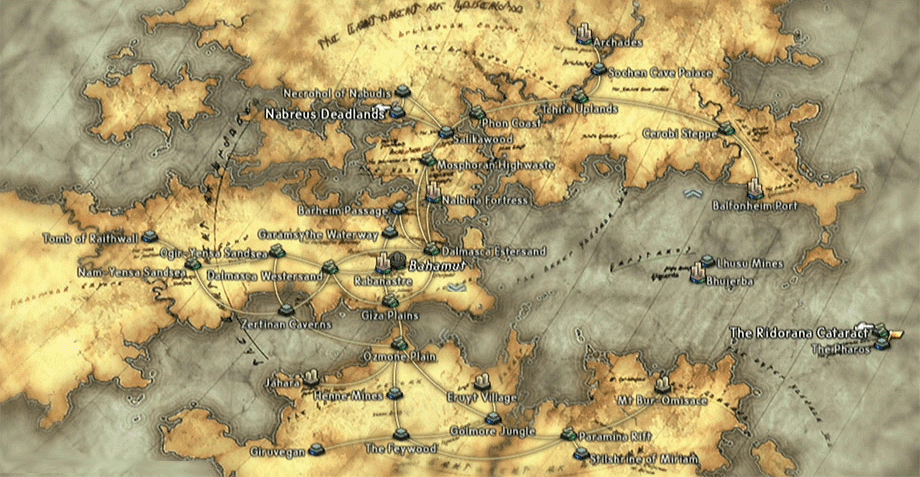

- Randomly Drops: Oh yes. Lots of rare equipment and loot can only be acquired as very low drops from one specific enemy. Hunting them down to get the best stuff in the game is a big part of gameplay.
- Read the Freaking Manual: The reply of every person frustrated with newbies who equipped the Goddess Magicite or the Dawn/Dusk Shard (They cause forever zero MP or Silence as long as it's worn) without bothering to read the item information displayed on screen, and then asked why they couldn't use magick.
- Really 700 Years Old: Fran and her entire Viera sisterhood all appear to be in their mid to late twenties, and their leader might just pass for thirty. However, since they never actually age, they're all actually very old. Their lifespan is about least three times that of humans. For example, Fran is at the bare minimum fifty.
- Realpolitik: Pretty much the core theme of the game.
- The Archadean Empire is not on a war of conquest for glory or power, at least not only for those things, but because it is surrounded by nations who are the puppets of the Occuria. The twisted scheme to force a total surrender on Rabanastre — they couldn't comb the city for nethicite otherwise. Their quest for nethicite, again, is not for selfish reasons — nethicite is the tool used by the Occuria to manipulate humanity, and the only means Archades can fight back. Vayne is actually completely honest about accepting Rabanastre's hatred of him - he knows he's temporarily reduced them to slaves in his quest to free the world from the Occuria, and accepts that he'll be remembered as a monster for it. Anything as long as the Occuria are defeated, because that's the only way his nation will be safe. The numberless people who suffer and die due to this are regrettable, but expendable. Likewise, Archades suffers no punishment or judgment for its takeover of Rabanastre and for all of the suffering it caused, simply because, even though its leader was removed from power, the country itself is still quite powerful.
- Marquis Ondore is disliked for cozying up to the Empire, but openly opposing them would mean that Bhujerba would be at best turned into an Archadean colony and at worst wiped out. Likewise, he can't back up Ashe's claim to the throne since, after announcing both her suicide and Basch's execution, doing so would tank his relationship with both the Empire and the resistance movements and the Empire knows he's financially backs up the resistance, but have no proof; he has to wait until the Empire is distracted to move forward to unify the Resistance.
- Recurring Boss: Gilgamesh in more than one sense. You can fight him twice during the game. Furthermore, this could be the same Gilgamesh from previous Final Fantasy games as evidenced by him possessing various (replicas of) familiar swords such as the Gunblade and the Buster Sword. It was implied in an earlier game that Gilgamesh's "death" in FFV really just sent him careening through time and space, sticking his nose into every game along with the way and borrowing trophies.
- Redemption Equals Death: Gabranth, and Reddas for destroying Nabudis.
- Regenerating Mana: Walking around restores MP, in an inverse proportion to the current MP level: the less you have, the more you receive. Mist-laden locations restore MP faster.
- Repeatable Quest: The game has only one repeatable quest, and it's very modest, and available very early. By visiting the Giza village and running around in the Giza Plains area, you can create multiple Sunstones, which sell for what is a moderate bonus for the player at that part of the game — but the player could get the amount from just killing wolves and selling the loot, and on the side get both EXP and LP.
- La Résistance: The
InsurgenceResistance. - Revenge Before Reason: Ashe's desire for revenge means she's willing to do whatever it takes to get at the Archadian Empire. This causes major issues because she puts revenge over her countries future or well-being, leading to instances of the loss of allies or even the deaths of people because she believes her revenge is justified and thus rushes off to find power or fight back against the Empire. Vossler outright betrays her when he realizes this, believing that she would doom Dalmasca over revenge, something that Ashe doesn't truly awaken to until late into the game.
- Reverse Escort Mission: The tutorial has Reks being escorted by a small army of generic soldiers. They carry an infinite amount of potions and will use them on you the moment your HP runs low, making dying next to impossible. They also have a captain who can hit well with a sword.
- Revive Kills Zombie: The mechanism is there in the game, for example Dustia in the Westersand can be killed with a Phoenix Down. Other undead are immune to it though, for example the Wraith mark from one of the hunts.
- Rewatch Bonus: Several parts of the game make more sense on the second playthrough now that the player knows some of the secrets of the various characters.
- Listen carefully to Basch in the introductory sequence when he stabs Reks. He sounds a bit different, doesn't he? That's because by this point it's Gabranth impersonating Basch.
- Watch Balthier's reactions to nethicite in the first parts of the game, like suddenly losing interest in the Dawn Shard and growing angry with Larsa in the Lhusu Mines. His behavior makes more sense once you find out he left Archades because of Cid's growing (perceived) insanity over studying nethicite.
- Dr. Cid's Establishing Character Moment is him walking down the hall talking excitedly with himself. It's only around the last third of the game that you realize he was talking to Venat.
- It seems rather unusual that the Empire would so readily allow Ashe to reclaim her throne and let her restore (some of) Dalmasca's independence, after they went to war to invade and conquer them over two years. It's because the real reason they invaded Dalmasca is to search for the deifacted nethicite, and they've not only found the shard in the palace of Rabanastre, but then Ashe and her allies found the shard in Raithwall's Tomb, so there's no reason for the Empire to stick around anymore. Further, Ondore is looking to re-organize the Resistance under his leadership, and given that he was the one who publicly announced Ashe's death, for the Empire to reveal she was alive would discredit Ondore and make his task harder. The Empire isn't being generous when they offer Ashe the chance to reclaim her throne, they're just better at the political game than she is and see value in having her as a Puppet Queen instead of an enemy.
- Riches to Rags: A major theme throughout the first half of the game is that Ashe is the Princess of Dalmasca... and that means next to squat, since her family is dead, she has no real political or military power, and no way to prove her royal heritage. The only respect she gets is from people who recognize her and feel loyalty towards her, but if she needs their help she is pretty much relying on them feeling charitable. Ghis also points out that Ashe hasn't been seen in two years and is presumed dead, so if Archadia ever wanted to use "Ashe's" influence, any young girl bearing a passing resemblance to her could be presented as the real thing and more easily molded into the Empire's pawn, so why should they even leave Ashe alive?
- Ridiculously Cute Critter:
- The moogles, who in Ivalice games are turned into rabbits with wings and pompoms. However, the seeq owner at Old Archades would beg to differ, when his plan to sell the moogles is leaked.Seeq Owner:I'll never look at a pom-pom the same way again.
- There is also the entire happy bunny genus, even such dangerous ones as mus (who are naturally hostile) and their king, Fury.
- The moogles, who in Ivalice games are turned into rabbits with wings and pompoms. However, the seeq owner at Old Archades would beg to differ, when his plan to sell the moogles is leaked.
- Robe and Wizard Hat: They appear as two pieces of mystic armor.
- Rotating Protagonist: Everyone gets A Day in the Limelight.
- Royal Blood: Played with. Ashe's lineage carries a lot of weight and gives her influence with others, but not enough. A handful of single individuals are willing to fight the Empire on her behalf out of honor, but the people that have real power to make war in Ivalice refuse her. The reason is that she has only her royal lineage and nothing else; no armies, no weapons, no money, just a name that some people may feel loyalty towards, and even then, it's just a name. This is why Ashe wants the Dawn Shard, to prove her royal lineage and gain a better position with which to curry allies and confront the Empire. Ghis comments on this, saying that the Dawn Shard is more powerful than Ashe and if the Empire ever needed the influence she could wield, they could come up with a look-a-like and use the Dawn Shard to pass her off as the real thing.
- Running Gag:
- Ashe would like you to know that she leads a resistance, not an insurgence.
- Early on in the game, you'll start hearing random citizens in Bhujerba going on about "Bhujerban Madhu," a local brew that's in short supply. Then you start seeing NPCs who are suicidally depressed, half-drunk, or raging over a bad day, all of whom are jonesing for Bhujerban Madhu. Then you start finding caskets of Bhujerban Madhu. Then you start selling them...
- Sacrificial Lion:
- Reddas. It was his choice.
- Vossler is a straighter example, dying at approximately the quarter-way mark of the story. He's a former Guest-Star Party Member. At this point, it became clear that even the protagonists weren't completely safe.
- Sacrificial Revival Spell: The game has the Revive Technick, but you don't get it until long after you got the basic Revive spell, and it is also on the market next to the more useful Arise spell. It becomes more useful in the International Zodiac Job System/Zodiac Age, when every class can learn most technicks including Revive, but not all classes can learn Raise or Arise.
- Saharan Shipwreck: The airship wrecks in the middle of Ozmone Plain. The bestiary says that they are evidence of a war once fought above the area.
- Saintly Church: The Church of Saint Kiltia, which worships Faram. Despite being adopted as state religion by kingdoms like Dalmasca, they mostly retreat to themselves and confine their acolytes at Mt. Bur-Omisace, where they offer refuge for those who lost their homes. Which just makes their sacking at the hands of Archadia that more anger-inducing.
- Sand Is Water: The Ogir-Yensa and Nam-Yensa sandseas.
- Satanic Archetype: Venat is a divine being who rebelled against the rest of his kind and is thus considered a "heretic" by them. The means and nature of this rebellion are the same; giving humes knowledge that inspired them to go to war. To this purpose he made a deal with Cid and Vayne.
- The Savage South: The Kerwon continent to the south, compared to Valendia and Ordalia, is wilder, harsher, and sparsely-populated. There is no identifiable kingdom or country and instead scattered settlements of mostly non-human beings, such as garifs and vieras, take up the populated areas.
- Savage Wolves: A lot of regions have at least one variety of either these or hyenas.
- Scenery Porn: The game's scenery is absolutely gorgeous.
- Schizophrenic Difficulty: Due to the open world and the player's freedom of movement, the game difficulty can be all over the place. During a basic, normal playthrough while fighting a reasonable number of encounters, the difficulty will generally follow a smooth curve from easy to hard over the course of the game. However, if the player actively avoids encounters and just goes from one boss battle to the next, they can easily find themselves under-leveled and under-geared. Alternatively, if the player gets side-tracked by even some of the extra content included in the game, bosses from the main storyline can easily become a joke, as much of the extra content is not only more challenging than anything found in the main storyline (there are random bats in caves that are higher level than the story's final boss), but can reach absurd levels. The game's ultimate optional boss, Yiazmat, was infamous for taking players 12 hours to defeat in the original PS2 version. Throw in stuff like New Game Plus, New Game Minus, and self-imposed challenges like assigning all 12 zodiac jobs to your party, and the challenge (or lack of it) you're likely to find in Final Fantasy XII can vary wildly.
- Science Is Bad:
- Most tech you see hails from the evil Archadian Empire which isn't evil at all, and the divine Occuria condemn it for manufacturing nethicite ("the power of the gods") because they don't want mortals to have control of their own fates.
- Completely averted with the moogles, whose engineering skills are second to none, kupo! Moogles are the source of a lot of other technology, including Bhujerban airships as well.
- Sealed Evil in a Can: The Esper, Famfrit. The "can" in this case being a suit of armor.
- Sea Sinkhole: The Ridorana Cataract is a huge abyss at the eastern edge of the sea, ringed by immense waterfalls, that prevents access to the land beyond — ordinary ships get pulled into the cataract, while regular airships lose power if passing over it since the whole area is a jagd.
- Secret Shop: Very, very much. It's in the optional dungeon, which opens after you beat an optional boss that becomes available to fight midway through the game and is filled with powerful enemies, and it's invisible. Its best wares are only available near the end, though.
- Sequel Escalation:
- Played straight in regards to gameplay. A boss with fifty million HP exists in the game. While the original version of the game restored the 9999 damage cap, the IZJS version removed it as X had, and you will need those tens of thousands of damage against several enemies. The lategame is also massively expanded, with several sidequests, enemies far more powerful than the final boss for you to test your might against, and in general, the game has plenty to keep you playing even after you've felled Vayne Solidor.
- Notably inverted in regards to the story. Where the previous eleven games in the series all focused in some way on saving the world, XII instead is about preventing a war from ravaging a section of Ivalice. There are some of the usual elements, such as gods being involved and grand powers being used, but ultimately, the plot of the game is limited in scope compared to previous entries.
- Sequel Hook: In the epilogue, Balthier mentions that he and Fran are currently hovering around the Cache of Glabados.
- Sequence Breaking: With a few exceptions you're free to move between areas freely as you like, accessing rare drops and new shops ahead of time (though usually what they can sell is dictated by event flags that prevent you from getting too powerful too early). However, you still have to do the storyline events in a specific order and a few areas are sealed off before you do. Plus, if you skip ahead to a later area out of order, the monsters you meet will often be at a much higher level, and thus sequence breaking is very dangerous unless you flee from fights.
- Shifting Sand Land: The Estersand, Westersand, and the Yensa Sandseas. In fact, Dalmasca is mostly a desert kingdom, with Rabanastre being built around its largest oasis.
- Shop Fodder: It's your main source of income. Unlike previous entries, non-humanoid enemies (who make up 99% of enemies in the game) don't randomly drop gil when killed, they drop Loot instead, which you have to sell to make money. Once enough loot has been sold, it also unlocks special bundles in the Bazaar that typically consist of items, gear, or sidequest items that can help players get extra equipment.
- Shout-Out:
- Several Puns, as seen above.
- A rank for Clan Centurio is "Hedge Knight."note
- A background conversation between Vaan, Penelo and Larsa while Ashe and Basch discuss weightier matters is a shout out to the notorious translation of Final Fantasy Tactics. "I had a good feeling." "This is the way!"
- The Leamonde Entite's name comes from Leá Monde from Vagrant Story, not lemonade.
- Also from Vagrant Story, the Light of Kiltia religion.
- There's also its rare game called Vagrant Soul, yet another reference to Vagrant Story. Its name in the Japanese version is Soul of Chaos, which refers to Final Fantasy.
- The Espers that aren't Continuity Nods towards Final Fantasy Tactics and Final Fantasy Tactics Advance, specifically Chaos, Zeromus, and Exodus, reference the Final Bosses of Final Fantasy, Final Fantasy IV, and Final Fantasy V, respectively. In addition, (Emperor) Mateus and Famfrit (humes' and moogles' respective Totema who first appeared in Final Fantasy Tactics Advance, and promoted to Esper status for this game) had their backgrounds expanded to reference Final Fantasy II and Final Fantasy III.
- None of the traditional summons from the main games are featured in the game (a first!) but their names survive as the names of the airships used by the Archadian and Resistance fleets. Notably, two flagships which serve as mini-dungeons are Shiva and Leviathan, and the final dungeon is Bahamut.
- Furthermore, the ship destroyed at the beginning is called "Tonberry."
- Marquis Ondore's flagship is the only named one in the game not named for a summon or a monster, instead being called Garland, after the reoccurring Big Bad of the Francise.
- It's been speculated that the Optional Boss Fury might be a Shout-Out to the Killer Rabbit of Caerbannog from Monty Python and the Holy Grail.
- The whole back story of Venat being disowned by her own race for giving the humes the secret of magicks via magicite/nethicite, is similar to the tale of Prometheus.
- When talking to Dantro when accepting the Flowering Cactoid hunt, he says of the cactaurs in general, "They mostly keep to themselves. Mostly."
- At the start of the side-quest "Anne and her Sisters", the gentleman that Anne is talking to is named Rande.
- A Pirate Gossip in the bar in Balfonheim tells you about a strange fellow he met who talked about defeating a wyrm on Cerobi Steppe... "But I heard all he does is yell at windmills. Pity the man that rides with him."
- Bhujerba has a large castle, which sports a pair of massive angelic wings, a visual reference to Final Fantasy IX. There is also a scene set within this castle wherein a Rebellious Princess asks to be kidnapped by pirates in their airship.
- Northswain's Glow's Japanese name is literally "North Star Bone Crushing Slash" which uses the same naming convention in Fist of the North Star.
- Judges are knights wearing face obscuring helmets, who are the supreme enforcers of the law. Sounds familiar.
- A Cartographer's Guild moogle at Mt. Bur-Omisace greets the party with "Howdy, pilgrim, kupo!"
- The Wyrmhero Blade has the crest and sound effects from Dragon Quest.
- Skill Point Reset: In the Zodiac Age version, you can reset your Licence Boards and recover all your LP by talking to Montblanc.
- Skyscraper City: The Imperial City of Archades. The higher your residence is, the posher you are.
- Slippy-Slidey Ice World: Paramina Rift, alongside the associated Soundtrack Dissonance. The Feywood is also one.
- The Smurfette Principle:
- Drace is the only female Judge.
- Averted with your immediate party, however, which has a 50/50 male/female split.
- Soundtrack Dissonance:
- Fighting on the field in Ozmone Plain, Cerobi Steppe, Paramina Rift, and the Great Crystal. Also, hunting Marks in these areas (music does not change when fighting Marks (except for when luring out Ba'Gamnan and encountering Gilgamesh, both of whom are considered bosses), such as Trickster in Paramina Rift, where you fight a particularly tough Optional Boss with a calm, movie score-like track playing.
- The music does not change for Quickenings either, so you get to hear the calm music of Ozmone Plain or Paramina Rift while your characters tear asunder space and time.
- Space Cold War: Rozarria = NATO, Archades = Warsaw Pact, Nethicite = Nuclear Weapons, Dalmasca = any country that got a proxy war in it such as Korea and Vietnam. This game could be viewed as what would happen if during the Cuban Missile Crisis, one of those countries caught in a proxy war was looking for secret stockpiles of nuclear weapons that would allow them to get the attention of the larger powers fighting around them. This trope is why so much of the plot of the game is about politics and faction leaders while your party tries to get an edge in on the coming conflict — Rozarria and Archadia both don't trust the other to back down and don't want to do so themselves for fear of appearing weak. But with Archadia's nethicite research allowing them to grow more and more powerful, everyone assumes it's just a matter of time before they try to invade Rozarria, and while Rozarria doesn't want war, it seems one is inevitable and they are strongly considering if they want to make the first strike. This is why the game's climax centers around stopping the battle between Archadia and the Resistance; such a conflict would be the impetus for Rozarra to get involved, and the fantasy equivalent of a nuclear war would engulf all of Ivalice.
- Space-Filling Empire: The Ivalice of the game has three major continents: Valendia, Ordalia, and Kerwon. Archadia dominates the Valendian continent and a small part of Kerwon, while Rozarria rules Ordalia and another part of Kerwon. The rest are either filled with smaller kingdoms that have since been colonized by the superpowers (Dalmasca, Nabradia), uninhabited, or sparsely populated.
- Spanner in the Works:
- The heist at the beginning of the story features four factions disrupting each others' plans. The Resistance is launching an assault on the fete, which the Imperials have planned for, but Balthier and Fran are using the celebration as a distraction to pilfer treasure from Rabanastre and Vaan is using the fete to also try and make off with some ill-gotten gain from the palace storeroom. The unfortunate coming-together of all four at once results in Balthier, Fran, and Vaan all being captured and imprisoned and the Resistance escaping, frustrating all four parties' attempts to profit from the situation.
- Despite his status as the Decoy Protagonist, Vaan of all people manages to undermine the Occuria's plans. His ability to see Reks, as Ashe saw Rasler, implies that the Occuria would use him were Ashe to turn aside from their plan for her. Instead, he overcomes the illusions, refuses to take revenge on behalf of his brother, and ultimately may have been the role model Ashe needed to reject the Occuria.
- Stat Grinding: Though less so than in other games.
- Stat Overflow: The Bubble status effect doubles the HP of the affected character, allowing it to surpass the Cap of 9999 (even if the HUD doesn't say so). It also provides immunity to the Disease status effect.
- Stay in the Kitchen: Notes about the Viera state that they practice a Gender-Inverted Trope version of this - Viera males live separate from the women and generally do not leave their villages except for meeting with the Viera females that are generally seen.
- Sticks to the Back: All greatswords stick directly to your back, with a slight clang, suggesting they're stuck there using magnets.
- Stripperiffic:
- Ashe and her micro-skirt and Fran and her armored teddy for the guys, and Vaan's vest and pants for the girls. Penelo's skintight jumpsuit is modest by those standards, but still pretty revealing.
- Dalmascans in general tend to show a lot of skin; even in their combat armor, the midriff is typically exposed.
- The arguable winner in this category is a minor NPC in Reddas' crew◊. She wears a coat that might as well not exist for all the coverage it provides and sports a pink g-string over hot pants. It's as though she's had clothing described to her, but doesn't actually understand the concept.
- Summon Magic: Of the Western variety.
- Stumbled Into the Plot: Main character Vaan was just a Street Urchin and petty thief who happened to be trying to steal a valuable piece of Magicite from the castle on the same day that both the deposed princess and a famous Sky Pirate also tried to steal it, resulting in the urchin getting entangled in a political struggle that reshapes the continent, and even forever changes the relationship between mortals and the Occuria, who are awfully close to gods.
- Supernatural Sensitivity: The Viera are very sensitive to Mist and will go on an uncontrollable rage if shoved into a place infested with it. However, if the Mist is very strong, they will instead collapse.
- Supporting Protagonist: While Vaan is the POV character, the story is all about Ashe and, to a lesser extent, Basch.
- Sword of Plot Advancement: Uniquely, all the magic doodads you find during the course of the game - such as Nethicite and the swords you're sent to find, etc. - are equippable but have ridiculously bad stats. Nethicite, true to its plot purpose of sucking up magic, reduces your MP to zero, but also reduces magic attacks against you big time. Helpful against the boss fight with Mateus. Justified in the case of the swords, seeing as they were made with the sole purpose of destroying nethicite and the Sun-Cryst and not for combat.

- Tagline:
- "Discover the secret that will unravel an empire."
- "Return to the world of Ivalice." (The Zodiac Age)
- Team Power Walk: The five Judges, slowly walking together in a V-formation in the opening cinematic.
- Technophobia: The Viera choose to remain in their forests sheltered from the outside world, thereby shunning technological advances that could harm nature. The Garif of the Ozmone Plain avoid any technology more advanced than simple stonework and use even that sparingly.
- Tech Points: Defeated enemies yield "License Points" used to purchase new abilities, in addition to the traditional Experience Points.
- Teleporters and Transporters: Way stones teleport the party to different parts of some dungeons.
- Tell Me How You Fight: Although with the proper license, any character can use any type of weapon, each of them has a particular style that's visible regardless of weapon equipped. Balthier tends to use everything one-handed, even two-handed weapons, which reflects on his laid-back persona. Fran holds anything that isn't a ranged weapon elegantly to one side. Vaan uses low, wide stances that, in real life, generally allows a person to cover ground quickly. Penelo, starting with a knife, has an acrobatic, dance-like fighting style most easily seen with her unarmed style with Brawler unlocked. Ashe's style is pretty defensive, with even her unarmed stance has her putting a hand up in front of her like she's using a shield. Basch is pretty much the Combat Pragmatist given that all his moves are basic strikes executed from a natural standing stance and border on Boring, but Practical.
- Temple of Doom: The Stilshrine of Miriam is an abandoned temple loaded with deadly enemies, puzzles, and traps.
- Thematic Sequel Logo Change: This logo shows major villain Judge Magister Gabranth in blue and purple. Gabranth does the pose shown in the title once in-game, and two times in Dissidia Final Fantasy.
- Tiered by Name: The game has another Omega named Omega Mark XII, one of the last marks you fight and also an optional superboss. In the Japan-exclusive version (named Final Fantasy XII International Zodiac Job System) and in The Zodiac Age, Omega Mark XII is also fought on the 99th floor of trial mode.
- To Be Lawful or Good: Judge Zargabaath struggles with this most of the game, usually deciding on Lawful.
- Token Evil Teammate: Among the villains, only one is outright evil, keeping in line with the game's Grey-and-Gray Morality theme. Namely, the five Judge Magisters. Gabranth sought a place to belong after the fall of Nabudis and is loyal to his overseers, Zargabaath is the most reasonable and restrained of the Judges, Ghis may be a Smug Snake but he was willing to make certain concessions for a trade of mutual benefit (to a degree) when he had no reason to with Ashe and the Dawn Shard, and Drace saw right through Vayne's coup and attempted rise to power and refused to go along with it (though it cost her her life). This leaves Ax-Crazy Blood Knight Judge Bergan, who wholeheartedly supported Vayne's rise and was not above massacring innocents at Mt. Bur-Omisace for no real reason other than to coerce Larsa to return to the Empire.
- Token Good Teammate: Precisely one example each of the Urutan-Yensa and Baknamy defy their species Always Chaotic Evil nature, with the former seeking outside help to slay his species' natural predator and being executed for it by the Urutan Queen and the latter being a secret merchant inside the Necrohol of Nabudis, ground zero of a Fantastic Nuke.
- Too Dumb to Live: The second page of the Chimera Brain's entry in the Bestiary is Report #A0075 O.P.O.D:Eat the head of the wise, and his wisdom you shall gain! Like eating food whence to gain nourishment. To determine the truth of this, I have just now eaten a whole chimera head. No effects as yet. On the morrow, we shall see.No further reports, poacher no longer at large. Investigation closed, by Imperial Decree." Sgt. Xerse of the 8th
- Another instance of this is the Overlord, a fearsome headless giant from the gates of hell. It was originally a two headed monstrosity that served the lord of the underworld, whereupon one of the two heads decided to get mouthy and cost the giant both of its heads.
- Treacherous Checkpoint: There are monsters that impersonate save crystals and attack the party if approached. Fortunately they turn into regular save crystals if defeated.
- Treasure Room:
- Balthier expects the Tomb of Raithwall to have this and is disappointed upon learning that Ashe's promise of "prize beyond measure" amounts to an Esper, Belias.
- Cerobi Steppe is a variant. It's an optional dungeon that is littered with treasure chests, most of which contain rare items that can't be bought elsewhere.
- Turns Red: Via augments, everyone can do this; Last Stand, Spellbinder, and Adrenaline boost defense, magic power, and attack power, respectively, but only activate when at critical health. Many enemies also have these augments.
- Twin Switch: Deconstructed and justified with Basch and Gabranth. The reason that Gabranth was able to frame Basch for King Raminas's assassination was precisely because people would find this trope implausible. The only people who would believe Basch would be those who know that the two are brothers. Even the party only gives Basch's claim credit because they'd seen Gabranth's face, and otherwise wouldn't have bothered. After Noah's death, it works just as easily in the other direction, allowing Basch to protect Larsa in his place.
- Underground Monkey: Subverted. The in-game encyclopedia gives long explanations on monster genus origins and the subtle differences between subspecies in different areas. The monsters are never just pallete swaps, but actually reflect their habitat in their designs.
- Unique Enemy: The Wildsnake, Darkmare and Emperor Aevis and most rare game only appear in one location each. For the Darkmare to respawn, you have to leave the region where it can be found entirely. This trope applies even more to the trophy rare game, which actually ARE one-of-a-kind and never respawn after they are defeated.
- Unnecessarily Large Interior:
- Giruvegan has an infinitely huge interior that somehow manages to house a crystal so big it's designated as another subsection larger than the city itself. Then again, you're not supposed to go there unless you explicitly have the Occuria's blessing...
- The Pharos is a lesser scale. Except for the topmost level housing the Sun-Cryst, the whole thing has no sky lobby. From the Heaven's Challenge sublevel 4 all the way to Floor 99, it's open space.
- The Unpronounceable:
- An NPC called Ktjn is involved in an optional sidequest. According to supplementary materials, it's pronounced "kitten", though in Japanese it's "Katrine". Most of the other Viera fall under this too - Fran seems to be the only exception as one of the few Viera fortunate enough to afford a vowel in her name, which seems to fit considering she's not like other Viera.
- Krjn (Caroline in other languages) is her sister.
- Unusable Enemy Equipment: A very strong aversion, many enemies that fight with weapons wield weapons that are recognizable as equipment the player can purchase and equip, and for the same reason enemies tend to wield a variety of different weapons. The only enemies that have unique weapons are the Behemoth-types, which have one-handed BFSes the party wouldn't be able to use anyway on account of them being so huge. Otherwise all enemy-exclusive equipment falls under the domain of bosses, who are usually ranking Imperial officers so it makes sense they'd have customized weaponry.
- Updated Re-release:
- The "International Version: Zodiac Job System" re-release. It's subtitled "International" because the game is based on the international, i.e. US and EU versions, with English voice acting, adjusted spec ratio, and other bunch of technical things. However, the game then adds new content and gameplay that easily make it a whole new game outright. Due to this, it has been the target of some flak from those not understanding the logic of the name for supposedly being "international" while simultaneously a Japan-exclusive. Thankfully, the Zodiac Age version is released worldwide.
- The Zodiac Age features a number of upgrades to bring the game into the modern age. Widescreen spec ratio is retained and the game features full high-definition graphic, as well as the latest in sound. The entire soundtrack has also been reorchestrated by the original composer. An upgraded high-speed feature has been implemented, as well as an auto-save, both of which are true blessings for the game's expansive field and dungeon areas. The Sky Pirate's Den has been replaced with the Trophy system, with a few new Trophies to boot. The overall game balance has been tweaked to make it somewhat easier compared with the International Zodiac Job System version, though the release is based upon that version. Perhaps the biggest change from IZJS is that you can select for each playable character two job License Boards, instead of just one, opening up new possibilities and strategies and marking another decrease in difficulty.
- The "International Version: Zodiac Job System" re-release. It's subtitled "International" because the game is based on the international, i.e. US and EU versions, with English voice acting, adjusted spec ratio, and other bunch of technical things. However, the game then adds new content and gameplay that easily make it a whole new game outright. Due to this, it has been the target of some flak from those not understanding the logic of the name for supposedly being "international" while simultaneously a
- Urban Segregation:
- The citizens of Rabanastre who are poor or lose their wealth after the Archadian invasion are forced to reside in Lowtown, where they live in wretched but still otherwise normal existence. Keep in mind that Lowtown is a former warehouse.
- Archades as well. Your social standing determines which part of the city that you can not only visit, but simply to enter; if you're very low-leveled, you can't even enter the city itself and must be kept waiting in the Old City to the north.
- Useless Useful Spell:
- Averted, subverted, played sorta straight, and played completely straight in equal measure. Some of your status effect spells are the difference between success & failure in most boss battles and against many normal enemies (which really don't pull their punches in this game). Others are useless.
- The most blatant example is the Water spell. In the original version of the game, you could only learn the basic Water spell and not the next tiers of the spell tree while enemies could use the stronger version of Water. The only way to do a ton of damage against enemies weak to water was to use a gun with bullets that have the water element.
- Victory Pose: Each character has a multitude of victory poses available after boss fights, mainly depending on what sort of weapon they're carrying. An extensive list can be found here on the official Wiki.
- Video Game Cruelty Potential: Some actions, when it comes to Gambits anyway, can only be set to be cast on enemies or on allies. However, there are not as many restrictions as you may think. You are within full rights to set up Gambits for your characters to attack themselves or each other over and over until they die, or cast status ailment magic on each other, heal it, and then cast it again. There's little practical reason for doing so, but if you're feeling sadistic, you can do it.
- Video Game Delegation Penalty: Present in the Gambit system, which allows you to set orders for your party members who are not actively under your control. This allows you to setup your party members to work together efficiently without needing constant direction. However, even with very specific Gambits set, the AI-controlled characters may still not do what you want or need in a given situation. If you need them to do something very specific, your best bet is to switch to controlling that character manually and executing the action yourself.
- Voice of the Legion: Mjrn has this briefly while possessed by Venat. The Occuria also have it.
- Voodoo Zombie: Most of the zombie enemies. Some of the skeletons also count.
- Wake-Up Call Boss: Ah, so you haven't learned how to handle magick yet? Don't worry, the Elder Wyrm will be your teacher - and this is very much an AP course.
- The Walls Are Closing In: The game has two Demon Wall enemies. The first one you fight presents a twist — it is powered up and offers you little time to defeat it, but it is fortunately a Skippable Boss and you are meant to flee the battle by using the door that it would crush you against, and instead fight the second wall in the next room. The second one (the one you must defeat) is much weaker and offers much more time to win. If so desired, you can come back later in the game to rematch against the first wall. Unless of course, you've done a lot of Level Grinding, in which case you can just off the first one right away and pick up a weapon that you're not intended to have at that point in the game yet (still not quite the Infinity +1 Sword though, but it is one of the games many, many Disc One Nukes).
- The Wandering You: All of the maps that are not dungeons, and even some of the dungeons themselves, are rather large open areas filled with monsters.
- War Is Hell: Basch is very much of this opinion. Vossler believes this to an even greater degree, betraying Ashe in an attempt to peacefully restore Dalmasca. Larsa, too, aims for peace to protect the ordinary citizenry from the trials of war.
- Wave-Motion Gun: The battery of Mist Cannons mounted on the top levels of Sky Fortress Bahamut, used to sink (read: utterly disintegrate) Resistance cruisers in one shot.
- We Are as Mayflies:"The Humes ever skew hist'ry's weave. With haste they move through too-short lives. Driven to err by base desires, t'ward waste and wasting on they run. Undying, we Occuria light the path for wayward sons of man.
- "Where Are They Now?" Epilogue: Ashe is ruling Dalmasca as queen, Basch takes Gabranth's role as Judge of the now Emperor Larsa, and Vaan and Penelo are training to become sky pirates. The latter two also receive a letter from Balthier, revealing his and Fran's survival and something about an adventure at Glabados.
- Where It All Began: The post-tutorial game begins and ends in (well, above) Rabanastre.
- Will Talk for a Price: Jules of Archades, a "street-ear" who Balthier states would "bite a Gil given him by his own mother, and shave it by half to pay for her funeral." He's always willing to provide your party with information... for the right price.Jules: I’ve a message from Master Balthier. He’s waiting in Central. He says to come quickly.Vaan: On this? But we need a... a Chop. What is a Chop, anyway?Jules: When a boy wants information…that’s right… A boy pays. 2500 Gil sound about right.
- Ye Olde Butcherede Englishe: Awesomely averted. The semi-Shakespearean dialogue is performed so smoothly and naturally that you stop noticing pretty quickly. When you do notice it, it's only because it's awesome and memorable. This treatment was also present in Matsuno's previous Ivalice work, Vagrant Story.
- You All Look Familiar: Lampshaded.
- You All Share My Story: Played relatively straight. The main characters of the story are;
- Ashe, the Princess who lost her country to invaders.
- Balthier, AKA Ffamran mied Bunansa, the son of one of the architects of the invasion.
- Basch, the guy who took the fall for the invasion.
- Vaan is the Player Character because he has the best perspective of the whole train wreck - a civilian who not only has to live in a conquered country, but lost family to the conquest. Penelo tags along with him to keep him from snapping due to the three blowhards who play their power games, ignoring how normal people suffered in the turmoil.
- Fran is there to remind them that the world is bigger than humes and their squabbles.
- You Bastard!:
- Some of the Mark hunts are memorably harsh, particularly the "Legendary" ones such as the White Chocobo and Black Chocobo, who keel over with a pathetic "Kweh." It's enough to make an FF fan die inside.
- The Behemoth King is tough to even find: the player must slay every monster in the south Feywood within a set time limit. Once the King perishes, its dossier reveals that it's a guardian spirit which protects the creatures of the Feywood. Oops.
- You Have Researched Breathing: The license system can look like this if one takes a step back; for instance, requiring the player to get the proper permit to wear certain types of hats, even in the late game when you'd think something as simple as wearing clothes would come naturally, nor require a legal document.
- Zodiac Motifs: Rather than the traditional Final Fantasy set of summons, the Espers here are the Lucavi based on the Western Zodiac, some of which previously appeared in Final Fantasy Tactics.
