

Advanced, ubiquitous magic always seems to end up working just like technology. The car engine might be powered by a fire elemental, and the telephone may work through the principle of contagion, but this doesn't affect the man on the street. They just get in the car and drive away, or pick up the phone and talk — no special talent required, just as if the devices were technological.
Magitek (or "magitech") often appears to combine magic with modern technology or at least something distinctively mechanical: traditional heat engine or an electrical generator powered by or powering a magic spell, or a giant mecha that can inexplicably shoot ice from an empty hand. Sufficiently Analyzed Magic frequently causes this but isn't necessary, since a Black Box is almost as good if it's reliable and cheap enough.
When Magitek is combined with gritty realism, we get Dungeon Punk, but magitek is also common in comedic fantasy. In some works, technology is based on sufficiently advanced magic, which is itself disguised sufficiently advanced technology. Fantastic Science leads to this because it treats magic as science; something to be studied and learned and experimented with.
There is "technomancy", the school of magic that specializes in controlling or improving existing technology with magic. In these circumstances the machine would work without the magic, but magic improves it. That, or it possesses it...
With all that said, a sci-fi setting with no supernatural/fantasy elements could readily substitute actual magic with alien phlebotinum in the equation.
The Ur-Example can be found in various ancient mythologies, each of which usually has a craftsman god who empowers their inventions with magic. For example, Classical Mythology has Hephaestus, who created supernatural automatons by combining metallurgy with magic. The more modern Trope Codifier is Robert A. Heinlein's 1940 novella "Magic, Inc.". It takes place in a (then) present-day in which, for example, your taxi is a flying carpet, but otherwise the same (cabbie, meter, and so on). The Trope Namer is Final Fantasy VI, where the Gestahlian Empire had suits of Power Armor, dozens of Humongous Mecha, and fleets of flying Mini Mecha, armed with various lasers and missiles powered by the life essence of enslaved magical creatures. Courtesy of Ted Woolsey's translations, this fantastic science and the inventions using it became known under the blanket term "Magitek."
Often involves the Science Wizard (not to be confused with the purely technical Techno Wizard). Magitek is one of the hallmarks of Science Fantasy works. May result from Sufficiently Analyzed Magic. Also, Utility Magic, which can sometimes manifest as this. Contrast with Clarke's Third Law, Magic from Technology, and Post-Modern Magik. See also Harmony Versus Discipline, Ritual Magic, and Alchemy Is Magic.
See also Magic Harms Technology and Science Destroys Magic, where magic and science/technology are incompatible and/or interfere with each other.
Example subpages
Other examples:
- In Ah! My Goddess, the magical system underlying existence is likened to computer code, and manipulated accordingly.
- In The Ancient Magus' Bride, this is the product of Magus Craft, which uses magical power as a power-source rather than electricity.
- Often shows up in works by Yoshiyuki Tomino:
- Most obviously Aura Battler Dunbine, which has a pair of American engineers Trapped in Another World who accomplish a Two Man Industrial Revolution and are producing Humongous Mecha with both magic and electronics for other otherworlders, like the actual protagonist of the series, to pilot.
- Even the original Mobile Suit Gundam, paragon of Real Robot-ness, has it in the form of Psycommu weapons, though this may not technically qualify, as at the time it was made, many serious scientists were conducting research into Psychic Powers. But the fact that subsequent Gundam stories have continued to use the concept even after all the major psychic research was proved to be flawed or outright fraudulent places them firmly in Magitek territory.
- Broken Blade features a world where any form of technology more complex than a hand tool involves the use of magic to manipulate quartz. The lead character is unique in that he can't use that magic, thus rendering even personal vehicles unusable to him.
- Opposing FMA, Buso Renkin uses Alchemy as basically a synonym for Magitek. It is established early on that the rules for Buso Renkin is take an ordinary weapon, the lower-tech the better, and give it a magic power, i.e. rocket-propelled lance, Precision Guided Chakrams, ect.
- A Certain Magical Index: This is rather rare due to the fact the science and magic sides are in a cold war at best and hate each other at worst, many on the Science side either don't know or don't believe in magic, many of the Magic side don't see the point in immersing themselves into science beyond necessity, and that in most cases magic and esper powers are incompatible for the same person to use. However, in New Testament, Kihara Yuiitsu in the midst of her Roaring Rampage of Revenge manages to create the Elements, which resemble giant translucent robots modeled after different kinds of animals and are powered by magical cores, by combining her scientific expertise of a Kihara with the knowledge of magic she obtains from analyzing the St. Germain virus.
- The plot of Cyborg 009 vs. Devilman involves a Mad Scientist working for Black Ghost building a cyborg body for a demon to possess, in hopes of making the perfect killing machine.
- The technology in the setting of The Dark Queen and I Strike Back (up to and including advanced aircraft and a colossal railgun) is all powered by Techniques.
- Demon King Daimao has this in spades, from a quasi-robotic crow that sees your future (eliminating the need for a guidance counselor), to airships running off mana reactors, to a god that's really an intensely complex computer system.
- Dog Days: The world of Flognarde has this trope merged with Schizo Tech. Despite being a feudal society, they have telephones (limited to old-style wall-mounted models), firearms, broadcasting equipment (including cube-shaped "Jumbotrons") and the technology to host a full-on Idol Singer show complete with lasers, fog machines, and glowsticks. They do go into the specifics a little bit in a third season episode that explains that the tech is "Crystal Magic", based around naturally-occuring magical crystals which have many uses, including functioning like circuit boards. Technology does seemingly advance a bit over the course of the show, as in the third season Nanami and Leonmichelli use tablet-like devices to communicate with each other.
- The Dungeon of Black Company features a fantasy world that has underwent an industrial revolution with a large chunk of its technology powered by demonite crystals.
- Fairy Tail: Most of the technology is powered by magic, from cars and motorcycles to orbital laser satellites. Lacrima Crystals are crystals enchanted to cast specific magic, communication lacrima being crystal balls used for video calling. One character eventually develops a miniature version that perfectly resembles a smart phone, carrying much of the same limitations.
- Fate Series: Magi in Fate/stay night and Fate/Zero are generally averse to using technology in place of magic, which is the reason why Kiritsugu Emiya is considered a "Magic User" and not a "Magus" — for example, his familiars are equipped with cameras so that they are not fooled by illusion magic, and his Mystic Code is a Thompson Contender which uses bullets made from his powdered bones in order to destroy other magi's Magic Circuits and render them useless.
- Fullmetal Alchemist brings this trope and its corollary round full-circle. In FMA the magic is the tech, and the tech is the magic. Specifically, look at the first chapter/first episode:
Al: "It's not magic, it's science!"
- Meanwhile, the technology behind automail is handwaved. How do they have cybernetic prosthetic arms and legs when they're only at early 20th century tech?
- This follows a sub-troping principal that, as Magic becomes more and more understood and studied, it becomes more and more akin to science, gaining specific rules and methods, rather than just "duuuuur, MAGIC!"
- High School D×D has the various supernatural races make use of a lot of technology that's powered by magic. Devils have cars, trains, aircraft and televisions (to name a few examples).
- I Couldn't Become a Hero, So I Reluctantly Decided to Get a Job: Daily life is a lot like modern Japan, with TVs, telephone, AC, etc. Except that the cars are monster drawn carriages, and everything runs off magic instead of electricity. Plus the demons, spells, and all the other fantasy touches.
- Lapis Re:LiGHTs: The world runs on this, with their cities being powered by mana instead of electricity. It's most obvious in "Orchestras" where the transforming, floating stages, the special effects, and the sound systems are spells cast by the witches performing and are fueled by mana from their audiences. This is also the specialization of Maryberry from Sugar Pockets, who is a magical Gadgeteer Genius and a member of the MIT (Magical ITems) Research Club.
- Little Witch Academia:
- Constanze Braunschbank Albrechtsburger is a witch student who mixes magic with technology like a Spark. She made a Robot Buddy out of a Playstation-like console, flies a broom with a propeller-driven engine, made a manabolt firing shotgun, and magic powered microwave ovens, among other tricks.
- TV series: Professor Croix is introduced in Season 2 as a witch who uses advanced technology in conjunction with magic such as a smartphone as a wand and wifi routers that picks up magic from Ley Lines.
- Lyrical Nanoha: All over the place, though most notable in the third season where this is lampshaded by Fate giving an As You Know speech about how the TSAB's civilization has discarded conventional technology because magic was safer and better.
- Similarly, the StrikerS antagonist's primary cannon fodder consists of Mecha-Mooks that are unique in Mid-Childa due to their lacking any magical capabilities at all and actively projecting fields that dampen magic around them.
- Force, has villains who are completely immune to magic, thus rendering all the protagonists' weapons and abilities useless in fighting them. They must invent new weaponry that leans more toward tech than magic to get around this.
- Magic Knight Rayearth: The country/planet Autozahm is an entirely "mechanized" industrial power that runs on "Mental Energy" instead of electricity, which has screwed up their environment in addition to sending them into comas. So they've sent an invasion force made up of a spaceship and Humongous Mecha to take over the more classical magic system of Cephiro, which itself has "rune gods" in the form of giant robots.
- The world of Ordine in Magic Artisan Dahlia Wilts No More is a fantasy-counterpart to Earth filled with monsters and magic. Magic Artisans like Dahlia make their living crafting magically-powered appliances (like hair dryers and portable cooktops powered by fire-magic stones) and materials imbued with supernatural properties (like fabrics made waterproof with concentrated slime essence or lip gloss that gets its shine from kraken scales).
- Magical Project S: Both Washu and a later character create and employ this.
- Magilumiere Co. Ltd.: The force that magical girls wield to defeat Kaii is called "magic" and certainly looks like what we would call "magic," but it's actually treated like a science In-Universe, developed by engineers the way any ordinary technology would be. Akasaka explains in Chapter 38 how that technology involves harnessing a nutrient called "magitosin," which in layman's terms is magical power. Most magical girls deploy magic via "spells" that are pre-programmed into their wands, but Magilumiere takes a unique approach by having their magical girls work with engineers in real-time in order to produce spells that are best suited to deal with whatever situation they're currently facing.
- MÄR has ÄRMs, magical jewelry with a variety of cool forms and abilities. Each ÄRM is a blueprint for a specific magical ability, such as summoning a giant guardian or shooting out huge beams of energy (in some cases, both), among others. Justified since this gimmick is incredibly convenient, meaning that ÄRMs can be used by muggles for mundane activities.
- In Modern Magic Made Simple, the modern magic the series prides itself on draws heavily from this. Spells involve Matrix Raining Code, but people like Yumiko still use a magic staff.
- Naruto: The level of chakra research gets taken to this level by the time of Boruto: Naruto the Movie. For instance, the full-size summoning scrolls in Naruto have been shrunk down to tiny proportions in Boruto and can be launched via a portable device that will automatically summon whatever was stored in it immediately after launch. In other words, at least one type of magic present in Naruto has developed beyond Powers as Programs and straight to Powers as Apps. The setting at large has also developed from a blurry Medieval Stasis straight to the present, with chakra counterparts to air travel, television, video games, laptop computers (including the Internet), construction equipment able to make high-rise skyscrapers, and smartphones. The inside of a typical house in the Hidden Leaf Village in Boruto's time is nearly indistinguishable from what you might expect in a middle-class house in the 21st-century Japan.
- In Negima! Magister Negi Magi technology seems to have been more or less fully integrated with magic. Magic guns are considered antiques. The local Robot Girl runs partially on magic, and there's an entire Magic Internet that can be accessed by magic books or computers complete with program, hacking, and virus spells. Not to mention Magical Flying Warships such as the Paru-samaSpecification.
- In the end, humanity goes through a major magitek revolution, making it available to the general public and leading to colonization of the rest of the solar system getting very far underway by 2017.
- The Sequel Series UQ Holder! follows up on this; the first chapter involves phone apps that let you quick-cast spells as a plot point.
- In One Piece, powers granted by the Devil Fruits are often used in very creative ways. Ace's sailboard is propelled thanks to his ability to generate flames, Captain Smoker's Blower Bike is powered by wind-catching wheels being blown by the smoke he generates, Mr 3's ship is also powered thanks to its owner's candle wax-generating superpowers, and Trafalgar Law can perform surgeries that doctors in the real world can only dream of. Eneru supplies himself electricity used to fly his Ark Maxim. The dials (seashells that can store kinetic energy, sound, light, fire and anything else depending on the version) and transponder snails might be seen as this, but is most likely Organic Technology. One Piece is a versatile manga indeed. Scientists like Vegapunk are also working to completely artificialize Devil Fruit powers, from giving their power to inanimate objects to being able to synthetically produce them.
- Orion has a Buddhist/Hindu design style and a computing basis, such as talismans and seals for wake-up alarms, and reality-altering "dharmaquations", a mixture of computer program and mandala.
- Outlaw Star: The Caster Gun was created by wizards to allow people in an age of low mana to use spells. This is the most powerful weapon in both Gene Starwind and Ron MacDougall's arsenal.
- Queen's Blade: Alchemy seems to serve as the Magitek de jure of the setting, powering such things as the Hyper Vibration Armor or the automaton, Vingt.
- Sailor Moon: Ami "Sailor Mercury" Mizuno owns a literal Magical Computer — disguised as a compact, it vanishes when she doesn't need it and can detect all manner of magical and mundane phenomena. In the manga it's actually just an interface for the actual supercomputer on the moon.
- Sonic X: The seven Chaos Emeralds and the Master Emerald are described as magical, and their effect on Sonic and Shadow can be said to be magic, yet they're often used to power technological equipment such as Eggman's robots and the Sonic Driver.
- Tweeny Witches: Present in varying degrees between the witches and warlocks. The female witches tend to a more primitive steampunk-style of magitech while the technologically advanced male "warlocks" now use very little magic at all (there's only one "real" warlock left, and he's very old).
- Ultra Maniac featured witches using computers to create magic spells for them. This was apparently not the only way to do so, however — the main character, Nina, pretty much relies on this method because her magic skills are so poor.
- In The Vision of Escaflowne, fossilized dragon hearts are dug up and used as a power source for the planet's Humongous Mecha. Lord Dornkirk's technological empire seems almost entirely comprised of Magitek machinery. An early episode even featured a quarry for said dragon hearts that had its own Humongous Mecha onsite... a fossilized dragon heart-powered bulldozer. This is how Dilandau used to be a little girl named Selena Schezar... and reverts to a female body at the end. Selena was kidnapped and used for "fate-alteration" experiments.
- The Witch and the Beast combines witches, magic and fantasy/gothic monsters in an Art Deco-inspired world filled with guns, zeppelins and sorcery industrialised within 1920s level of technology.
- Yu-Gi-Oh! 5Ds heavily blurs the lines of magic and technology in the second half of the show. The main antagonists are cyborgs and are never stated to have any magical connections, but they can shapeshift, teleport and levitate, among other magical-type abilities. Many of the powerful magic users in earlier seasons such as Yugi, Pegasus, and Marik are able to channel supernatural powers through a collectible card game and the machinery and computers that run their holographic arenas as well.
- The Technomancers in Big Finish Doctor Who are based on this. A Time Lord illustrates this by pointing out their communicators look like communicators, even with the same buttons, but when you crack them open, there's nothing recognisable there, because they're powered by "message spells".
- Astro City: Infidel uses magic to replicate technological functions, including audio/video recordings of events and artificial servants.
- "Battlegods: Warriors of the Chaak", a miniseries by Dark Horse Comics, has a futuristic Mayan take on this, such as cloned priests with their minds linked together to form a magical computer.
- The DCU:
- DC One Million: The ancient Amazonian sorceress Magda says the difference between magic and science no longer exist in the 853rd century. "Let's just say, I can still cook."
- Green Lantern: Unlike most of the rings in the mythos, which are Magic from Technology, those of the Red Lantern Corps mix this with Blood Magic, and as such have very different methods of use and limitations.
- Supergirl: In Bizarrogirl, Dr. Light examines villain Superwoman and concludes a combination of science and magic was used to alter Lucy Lane’s DNA and give her Kryptonian powers.
Dr. Kimiyo Hoshi: Superwoman was infused with several strains of alien D.N.A. using a combination of science and magic, giving her extraterrestrial abilities.
- Wonder Woman: In some continuities, the Amazons have spent their years as a closed off society developing truly impressive combinations of magic and science like the invisible jet and the purple ray medical lenses.
- Lady Death: In the Coffin Comics continuity, Hell has undergone a more modernized make over. In addition to hellish variations of human technology like trains and motorcycles, we also have machines for harvesting souls. New character Jake is also a technomancer, a sorcerer who can manipulate technology and his body is implanted with demonic Nanomachines.
- Marvel Universe:
- Death's Head: Death's Head was created with a mixture of technology and magic, originally intended as a replacement body for his creator.
- In Fantastic Four, Mr. Fantastic considers magic a science that simply works with a different set of rules (albeit rules he can't quite comprehend, so he might be totally wrong). Doctor Doom has occasionally integrated the talent for sorcery he inherited from his mother into his inventions and schemes. At one point, Reed had to actually learn how to wield magic from Doctor Strange in order to fight Doom. He wasn't very good at it at first, until he realized that the key was to admit to himself that he had no idea what he was doing.
- Galactus: It's a little unclear how much of Galactus' power comes from the Power Cosmic and how much comes from his very advanced technology. It's even less clear after he merges with a swarm of Killer Robots that is his Ultimate Marvel counterpart.
- Some of the Iron Man armours such as his Uru armor and Mysterium armor are as much supernatural in nature as they are cutting-edge Mad Scientist technology.
- In Shang-Chi (2020) the villainous Sister Hammer creates a Chinese Vampire army. Normally, only dead with an unresolved grudge can be reanimated in this way - so she uses implanted microchips to network them and connect their minds to someone else's grudge, circumventing this rule.
- Silver Surfer: Dan Slott's series shows that Zenn-Lavians have a form of technology that combines science and sorcery called "Magitech". One of their applications for it was the Illumimatrix, a device that can leech or imprint culture itself on a planetary scale. Apparently, Zenn-Lavians stopped space exploration to curb their nasty habit of forcing other civilizations into their own image.
- Mystic, a CrossGen series, takes place in a world much like Earth, ca. The Roaring '20s, but with magic instead of technology. So you get Art Deco architecture paired with magical flying Model T-style taxicabs, for example. That's mostly the Nouveau Guild and their nation. Nouveau magic, as the name implies, runs on change, so coming up with new and interesting ways to use magic, and the corresponding changes in society, are what makes the magic work. Other nations on Cyress follow more stable systems of magic (barring the Astral Guild) and don't have the Magitek.
- Planetary: The Drummer is a machine telepath who can sense magic; his explanation is that magic is "cheat codes" that manipulate the mechanics of existence.
- Rat Queens features a necromancy-based communication device powered by souls that is effectively a cell phone (that only talks to dead people).
- Sonic the Hedgehog (Archie Comics):
- The Iron Queen, a Technomage who can control the electrical impulses found in all active electronics and send him out at will. As you can imagine, she's quite dangerous to opponents who are partly or completely robotic.
- Dr. Eggman, as a man of science, complains about Chaos Emeralds being their own explanation, and having no logic to their power. Snively reminds him that he powers his own technology with Chaos Emeralds on a regular basis; Eggman concedes, but points out that he doesn't have to like it.
- In Sonic the Hedgehog/Mega Man: Worlds Collide, both Dr. Eggman and Dr. Wily come up with the Chaos Devil, stated to be a "fusion of magic and machine" (Chaos being a water god, Yellow Devil being a blob robot).
- Vampirella: This pops up from time to time. One story had a doctor who could control the dead using a machine that combined quantum technology with Mayan death magic. He referred to this technique as voodootronics.
- Wizards of Mickey has mages and dragons right alongside evil robotic armies and Goofy building a damn Humongous Mecha.
- Phoebe and Her Unicorn: Marigold (the unicorn) can send and receive text messages with her mind. Her horn also amplifies satellite radio signals and is a WiFi hot spot.
- Antipodes: All of the advanced Lost Technology is based on arcane principles and powered by magical crystals.
- Child of the Storm: As in the MCU, Asgardian technology is much like this — although the tech is sci-fi level to begin with. It all runs on magic, which is depicted as the fifth fundamental force of the universe (and the more of it you can gather together, the more you can affect the other four).
- Discworld by A.A. Pessimal:
- Wizard Ponder Stibbons settles down as husband of an Assassin who has done much to revolutionise her profession, and they have three daughters. The youngest takes after her father in manner, outlook and inclination. Ruth Smith-Rhodes-Stibbons is also a catch-net for inspiration particles. Combined with a practical and creative streak, among other things she works out how the Guitar that caused havoc in the canonical work Soul Music can be reproduced using Magitek. Her first experiment is with an amplified bass guitar. At the current point on her timeline, having proven it works on a four-stringed bass, she is applying the concept to a six-stringed guitar and has plans for adapting it to keyboards. Her father, who saw the original Guitar, is yet to cotton on. A collection of Imp helpers with names like Lemmy, Jack, Ritchie and Hammond are closely associated.
- Elsewhere, the Ankh-Morpork City Air Watch is an Air Force that runs almost completely on Magitek. Its commanding officers, Witches who have helped push the concept of broomstick flight, have heard of mad ideas, like having an airframe powered by some sort of engine that turns a propellor which then screws its way through the air. They are duly sceptical about the chances of flight powered by other means than magic. Read more in
 The Price of Flight.
- Disillusion, by Hermione Granger: Harry Potter, turned into a weapon by the Ministry after the Prophecy was made, decides to take revenge on the magical world when it turns on him and his best friend, Neville Longbottom. He studies the scientific principles behind magic and ends up creating incredibly advanced technology (artificial gravity, teleportation, matter manipulation). This eventually leads to the destruction of the Magical World as it is forced out of its self-imposed exile.
- Dungeon Keeper Ami: Mercury's highly scientific approach to magic results in this. To date: giant scythe-wielding battle robots, airships, gem synthesizers, and chlorine trifluoride.
- The Dusk Guard Saga has magical crystals that are used in everything from magilights to toys to armor to golems. However, enchanting all but the smallest and simplest of crystals is extremely dangerous and time-consuming, and as such, Magitek is heavily supplemented with steam power.
- Empath: The Luckiest Smurf: In "Smurfette's Inner Beauty", Hogatha the witch uses a magic mirror social network called Magebook in order to find a date. The Smurfs themselves use magic mirrors for computers and Video Phones.
- Emperor: The Northern Kingdom's scientists collaborate with many wizards and witches to develop new ideas that mix magic and technology, such as working Artificial Intelligence, special cannons that can disintegrate their target in one shot, and genetic grafting in adults.
- Endless Pantheon, a Dresden Files/Stargate SG-1 fusion fic, has all Goa'uld, Asgard, Ancient, and Nox technology is in fact magitek. In one example, Harry notes that the healing sarcophagus is actually a ritual device that uses necromancy to repair the body and is powered by a nuclear reactor. This also justifies the extravagant weapon and armor designs of the Goa'uld. After the Great Offscreen War, the Goa'uld have lived in fear of the Nevernever for millennia. The full body iron armor and melee weapons of jaffa are designed to counter faeries while the fancy ship decorations are in fact wards to prevent intrusions from the Nevernever.
- Equestria: Across the Multiverse: The development of this is a major plot point. While Equestria has some magitek, including the Portal Casters used for dimensional travel that kickstarts the plot, it takes off big time when they encounter the world My Little Pony Tales is set in. While having very little overt magic, they do have far more advanced technology than Equestria Prime does. After First Contact is made and Ponyland enters the Alliance, development on combining Equestria Prime's advanced magic with their advanced technology creates a gigantic technology boom. This also includes superweapons for dealing with Kaiju level threats, such as Seiryu (a Magitek Mechagodzilla) and the Great Harmony (a gigantic flying super battleship). Things only increase from there as more and more worlds join the Alliance and pool their knowledge and resources.
- Equestria Girls: Friendship Souls: All of the factions use technology that makes use of spiritual energy to some degree.
- The Quincy use technology to aid them the most, in the form of VTOL craft and tanks that can fire Quincy arrows for use in Hueco Mundo, etc.
- Twilight's research focuses on combining spiritual energy and technology with magic. She's already made some progress, like Sugarcoat's visor and Indigo Zapp's legs.
- Grogar's self-experimentation and augmentation makes him look like a Cyborg in Resurrección form.
- Fallout: Equestria: Almost all instances of advanced technology seen in Fallout are given this treatment, right down to nuclear weapons being replaced with magical bombs that are just as deadly if not more so. Even computers seem to run on magic in these stories.
- Fantasy of Utter Ridiculousness:
- In the alternate ending, Coop combines Patchouli's "Philosopher's Stone" card with Megas's systems, creating his first and only bonafide Spell Card.
- The Extra Stage answers the question of what would happen if Megas was as overpowered as Reimu, who uses herself as a Living Battery to bestow the mech with her powerset.
- Harry Potter And The Invincible Technomage: Harry experiments with building a magic-powered computer.
- A Growing Affection has ninjas using cellular phone with jutsu built in so that rivals/enemies cannot trace them; Kakashi does not trust that is 100% effective. Also a minor character is a computer programmer asked to create a system to monitor chakra interactions.
- An ISOT in Grimdark: After arriving into the Warhammer Fantasy world, the German engineers quickly get to work on adapting their technology for the setting. They start off with a "magic indicator" for detecting hidden magic users or potentially dangerous magical artifacts. It isn't long though before they start building suits of Powered Armor, and even using Magitek to power their manned space program.
- Light, Darkness and Paradox: Ruby eventually learns how to make magical ammunition; a necessity after she runs out of Dust ammunition and can't get any Dust to make more.
- Lyrish, by TheInvertedShadow: Robo-Lyra, who is fully robotic but has the same range of magical abilities that her flesh-and-blood counterpart does. Similarly, the Puppet has the ability to spawn animatronics out of thin air.
- Marionettes: Twilight mentions Mana Engines charged by unicorn magic. It turns out the robotic ponies (the titular Marionettes) are powered by mana engines, but produce their own mana. Trixie also is shown to have a magic wand in place of her horn.
- Maybe the Last Archie Story: Mad Doctor Doom circumvents the laws of physics, which say that time travel is impossible, by creating a magically-powered time machine. It looks like a strange but ordinary cubic device, if you don't notice the helpless witch hooked up to it -which the device drains power from-, and the odd symbols on plastic overlays, arranged around it.
- Mr and Mrs Gold: The Time Clock Dragon is a magical cuckoo-clock within Rumpelstiltskin’s collection that comes to life when the clock strikes midnight, briefly coming to life and doing a dancing puppet-show that predicts future events. While Rumpel finds it an annoyance, Belle enjoys the stories it tells.
Wooden Puppet: Ladyfleas and gentlefarts, may I present to you tonight's tale... Charming Snow!
- My Choices: Twisted Tales Through Time: The future version of Equestria, as seen starting in Chapter 8, makes common use of "magitechnology", gem-based technology intended to be useable by anyone. Examples include what are essentially magical versions of computers, iPads, holographic picture cameras, and audio recorders.
- A Nerubian's Journey: Among the first magic exercises learned by aspiring Viziers is to convert arcane magic into fire and ice. By imbuing these into silk, Krivax has refrigeration and cooking elements in his kitchen.
- Outside the Reaching Sky: The ponies of Equestria launch an advanced space program after encountering a human from a parallel universe who provides them with a computer core containing the entire conventional and magitechnological base of a highly advanced culture, plus the means to access it.
- Royal Heights has Utopia which provides jets able to fly fast enough to rip through dimensions and into new ones, a metal chip that sends your consciousness into a new body, and what appears to be a universal mail system. But unlike other examples, Utopia tries to pretend all of their work is purely scientific. The witch of the story reveals that all of this couldn't be possible without magical assistance.
- Starlight Over Detrot: Almost everything runs on arcanoelectrics — a combination magic, runes and alchemy — from the automobiles to the toasters (that regularly turn toast blue).
- Star Mares abandons all pretense that the technology of the Star Wars verse is based on scientific principles — it's all powered by "magic reactors".
- Star Trek: Phoenix: During Season 2, Sunset and Twilight begin to incorporate Equestrian magical engineering into the Phoenix's sensory arrays by creating a mechanism to transform energy from the ship's warp core into magic in order to power sensors meant to detect magic signatures.
- In With Strings Attached, the Fans operate via magitek, largely through computers.
- In Exitium Eternal, the Exitium runs on a mixture of magic and science. Interestingly, the Citadel races believe that this is actually some kind of advanced technology that either the Exitium does not fully understand, or their translators are unable to impart the concept.
- Harry Is A Dragon, And That's Okay: Ever since Ron got an interest in Muggle space travel, his goal throughout the story is to invent working magical rockets and travel to the moon. For his OWL Runes project, he manages to invent self-refilling fuel tanks, and for his NEWT project, he invents a full rocket ship prototype with features like an Unbreakable superstructure, charms used on broomsticks for maneuvering, and a Protean charmed alchemic silver globe for navigation.
- In Howl's Moving Castle, (and to a lesser extent Diana Wynne Jones's book of the same name on which it was loosely based) the structure is maintained by the wizard's magic. Moreover, the kingdoms of the world which the film takes place actively make use of witches and wizards to fight in wars, in addition to more standard weapons and tactics.
- A lot of the magic in Disney's Atlantis: The Lost Empire works by application of their Power Crystals. Lamps are lit by touching the crystal to it something like a match and the stone fish-shaped vehicles have a mystical activation process of sticking the crystal in a hole, turning it halfway around, and then a quarter turn back, which is basically the motion of turning a key in a car's ignition. However, you've got to keep your hand on the inscription pad while doing it. This is written on the vehicle, but when your people were stuck in flood-survival bunkers long enough to forget how to read their own writings...
- Dungeons & Dragons: Honor Among Thieves: Sending Stones are like magical walkie-talkies, even having feedback if used too close to each other. However, they only work for an hour.
- Equinox is one of the oldest examples and may be the oldest put to film. The symbol magic in the film is explicitly treated like a science.
...Manipulation of these symbols is treated exactly like the science of chemistry. This element changes that one, one symbol is a catalyst, another is an agent or a counteractant.
- Marvel Cinematic Universe:
- Thor is an interesting example, because while Clarke's Third Law is in full effect (as Jane Foster puts it, "Magic's just science we don't understand yet"), it hasn't yet reached the levels of this trope. Specific items like weapons and clothing are imbued with incredible properties, and the Asgardians have the ability to make pinpoint wormholes and use anti-gravity to lift entire skyscrapers high in the air... but they still use (presumably genetically engineered) horses. There's a lot of cultural tradition at work here.
- Taken further in Thor: The Dark World, where we are introduced to the Dark Elves, a civilization preceding even the Asgardians, who have advanced spacecraft, energy rifles and black hole grenades, but also make use of magic-like energy-manipulation.
- Loki and Freya establish that yes, in addition to Asgard's fantastical technology, they also use honest-to-goodness magic.
- The weapons used by HYDRA, the Nazis' Deep Science Division led by Johann Schmidt/The Red Skull in Captain America: The First Avenger, are using the Cosmic Cube/Tesseract that the Asgardians used beforehand as a power source.
- Nightworld: Lost Souls has the Frequency Harmonizer, a mechanical device invented by Thomas Edison that allows living people to communicate with ghosts.
- Star Wars: The Jedi are within spitting distance of this, although they're more a matter of magic coexisting with a technological world than of magic displacing technology. In the Expanded Universe, attempts to design technology that uses the Force are mostly the province of the Dark Side for some reason.
- Lightsabers and holocrons can only be built by using the Force — the khyber crystals that power them only respond to Force-users, and in some cases are directly created through specialized Force techniques.
- One example involves a Sith destroyer designed by a technologically-minded Sith Lord during Star Wars: The Old Republic days to use a Brain/Computer Interface with a powerful Force user in order to boost the ship's systems, turning the destroyer into a superweapon capable of wiping out fleets on its own. The ships hyperdrive channels energy directly from Darth Karrid to allow it to travel at unheard of before speeds. She uses the Force to fine-tune the ship's targetting sensors to be able to pick off any ship, even a Space Fighter, with a precision shot.
- Rogue One low-key turns the Death Star into this trope. In the current canon, the station's lasers are powered by Kyber crystals, the same crystals that are a central component to building lightsabers, and have a natural connection to the Force.
Series:
- The characters in Ace Lightning claim that the Amulet of Zoar (amongst other things) is fueled by magic... But they are all actually video game characters brought to life by a bolt of lightning so technically...
- In Angel, Fred and Wesley create a technomystical device to aid Angel.
- The Technomages in Babylon 5 and the Spin-Off Crusade are an inversion. They are described as "people who use technology to imitate the effects of magic".
- Buffy the Vampire Slayer
- During the first two seasons we had Jenny Calendar, a self-described techno-pagan, who occasionally combined divination and other arcane abilities with computers and the Internet.
"You think the realm of the mystical is limited to ancient texts and relics? That bad old science made the magic go away? The divine exists in cyberspace same as out here."
- In the comics, provided by the Twilight group to try and give Amy an advantage against Willow.
- During the first two seasons we had Jenny Calendar, a self-described techno-pagan, who occasionally combined divination and other arcane abilities with computers and the Internet.
- Doctor Who
- In "The Masque of Mandragora", an Eldritch Abomination is manipulating the Cult of Demnos in Rennaisance Italy to carry out an Alien Invasion. The Doctor examines a cult mask and identifies it as "Predeluvian sandstone with a complex circuit of base metal fused into it."
- In "Battlefield", the Arthurian characters come from a magitek universe. In fact, when discussing how one of their spaceships worked, the Doctor goes so far as to point out to Ace that not only is sufficiently advanced technology indistinguishable from magic, but that the reverse is true as well.
- Game of Thrones: Many of the feats of engineering seem aided by magic. The Wall is far larger than normal architecture should allow and Valyrian steel is supernaturally sharp.
- Ghosted has the Cronos machine from “The Machine”. Built in the early 1800's, it was designed as an experimental medical treatment intended to enhance people’s life spans. However, it’s powered by a cursed South American tree containing evil spirits which induce invincibility. This combination makes it an Immortality Inducer that steals the blood and life force of people placed upon it and allows them to be absorbed by the machine’s owner, making them immortal.
- Kamen Rider uses this trope frequently in the Heisei era; most commonly the Transformation Belt will be a piece of modern technology made to harness the power of ancient, mystical artifacts so that normal people can safely use them.
- The Rider suits in Kamen Rider Blade draw their power from ancient magical cards holding divine creatures called Undead.
- In Kamen Rider W, both the heroes and the villains use Gaia Memories, which are USB drive-like devices which hold knowledge from the mind of the planet itself.
- Kamen Rider Wizard plays this trope as straight as it can be, as the Riders explicitly use magic, but require rather technological looking belts to do so. The main weapon of The Hero is also a sword, which turns into a gun, that shoots magical homing bullets. Justified. As the Big Bad of the series combined science and sorcery to become a wizard himself, as well as creating the other wizards through this process.
- The Lock Seeds, which are used as Transformation Trinkets by the Riders in Kamen Rider Gaim are pieces of magical fruit from another dimension converted by technology created by normal humans.
- In Kamen Rider Ghost, the protagonists have Transformation Trinkets that contain the souls of historical figures like Miyamoto Musashi and Thomas Edison.
- In Knightmare this was the villain, Lord Fear's hat.
- Motherland: Fort Salem: The first season finale reveals that Camarilla, an ancient witch-hunting sect, has figured out how to combine the vocal chords harvested from witches with tech to replicate witches' vocal abilities.
- Power Rangers:
- The series is filled with magic/technology hybrid gear. We start with an ancient alien wizard in a high-tech command center that runs the Rangers' gear by channeling the power of the vaguely-defined Morphin' Grid versus an alien witch released from the can by astronauts. Humongous Mecha powered by the spirits of dinosaurs. Magi Babble and Techno Babble combined by Robot Buddy Alpha. The entire "Zordon era" of the franchise was characterized by this, and while the later stand alone series tend to be magical or technological, a few later series have gone back to it (and the Grid is the source of all Ranger powers.) Spiritual energy-powered BFG, anyone?
- Particularly prevalent in Power Rangers Mystic Force, where the newly-minted teen sorcerers have their wands turned into cell phone morphers to better blend in. They cast spells by plugging in "spell codes" (aka dialing a number).
- Super Sentai also very often uses the same as its sister series and adaptation above, throguhout it though, there's some more prominent examples.
- The first series in the franchise to apply this trope is Kousoku Sentai Turboranger. While the motiff of the series is vehicles and as always they use a large mecha, the team's powers derive from the magic of their ally Seelon, the last fairy alive, who Dr. Dazai specifically built all the team's equipment to be powered by.
- Mahou Sentai Magiranger is the magic-themed season of the series, as the titular team become and learn to be mages to stop an invasion. Their spells are done by dialing numbers in their flip-phone changers.
- Tensou Sentai Goseiger features a team of angels that drag the powers of their mecha and gear from ancient angelic-powers.
Made-for-TV Movies:
- The Made-for-TV Movie Paradox is made of this trope — at least until they visit the science-based world. Every desk has a magical computer with a Holographic Terminal displaying Instant Runes, and every character carries a scrying crystal cellphone. There are also cars and freezers. Notably, however, nobody really understands how any of these things work, which is why science looks more attractive to the main characters.
- The Stone Tape involves English scientists trying to develop a new recording technology to compete with Japan. When they realise they're in a Haunted House and believing that the ghost is a Living Memory, they try to study the phenomena in the hope of developing a new technology. It doesn't end well.
- Kids Praise: Psalty's Songmobile invention from the fourth album is a vehicle made of musical instruments, and since it only works properly if its user is praising God from his or her heart and makes ugly noises if it the user isn't, it's implied that the vehicle is a theurgistic variant of this.
- The Deus Machina of Demonbane are Humongous Mecha-esque magical constructs summoned from ancient tomes, except for one: the titular Demonbane, a still grimoire-powered but otherwise man-made giant robot. In theory, that means it should not be as strong as a "true" Deus Machina. In practice, however, it and its pilots go on to work miracles.
- In Magical Diary this turns out to be utterly forbidden. Ellen tries to experiment and it almost gets her expelled.
- Magic machines are ubiquitous in An Octave Higher. Every single piece of technology in the kingdom of Overture, from drinking fountains to film projectors to flying cars to factory assembly lines and furnaces, requires magic to function; if you don't have enough Mana to cast spells, you can't even take a shower because the water is being summoned via magic.
- Engine Machines in Shikkoku no Sharnoth appear to work like this, though the story tries to deny it. But with the precedent set by its predecessor Sekien no Inganock it becomes hard to deny.
- RWBY:
- All advanced technology is powered by Dust, a magical substance, whose properties vary depending on the type of Dust. While the technology of that world is quite advanced by our standards, space flight is still an impossibility for them, as Dust stops working in orbit. This also means no satellites. Because of this, the Kingdom's of Remnant lose contact with each other once the Cross-Continental Transit System tower in Beacon is taken out by a Wyvern at the end of Volume 3. However, General James Ironwood later converts Amity Colosseum into Amity Communications Tower in order to restore communications with the other Kingdom's and warm them about Big Bad Salem.
- As of Volume 7, Penny's been revealed to be this, being an android with a core powered by a piece of her creator's aura. By the end of the volume, she gets access to real magic, too, becoming the Winter Maiden.
- Atlas is a floating city whose levitation is powered by the Relic of Creation, one of the four surviving Relics of the gods' power.
- In 8-Bit Theater, the visible Sky Castle is described as being an "ancient flying techno-magic castle". There's also
Warmech, that completely human chap with the laser, and the Datasphere, a powerful data-storing device that will drive you insane if you read it. - The Adventurous Scarlet Carolus and the Machine of Eternal Summer features the eponymous weather machine, plasma guns powered by energy crystals, and other gadgets of various size.
- Alice and the Nightmare: everything in Wonderland, from mini-fridges to carriages (without horses) is powered by dream energy of Earth humans.
- Apricot Cookie(s)!: In Chapter 2's intro, the Director of Darkness shows off his brand-new 84" Crystal Ball with 6 HDMI ports and 4K resolution, as though it were a plasma screen TV.
- Baskets of Guts: Homunculi-based magic batteries are used in every piece of technology from quite complicated to completely trivial.
- Beaches and Basilisks has giant robots powered by a combination of magic and technology. Also, several character carry spellphones, which are magically-enabled cellphones.
- Broken Space features technology powered by a combination of gears, steam, and mystical glyphs.
- Chirault has two-way radios and what appears to be a city-wide public announcement system, presumably powered by magic because it's a pseudo-Medieval fantasy setting.
- Crimson Flag has airships with cannons that fire energy blasts, both magic. And crystal balls used as videophones.
- It's kept in the background but also present in Dan and Mab's Furry Adventures with things like ghirphon based public transit.
- The world of Dominic Deegan abounds with this sort of thing. Some examples include:
- Using crystals (which may or may not be of the "ball" archetype) to communicate like telephones.
- Small crystals enchanted with a "Voice of the Titans" spell to make microphones.
- Creating lamps/light bulbs out of something carrying an illumination spell.
- Taking musical instruments, e.g. guitars, and adding a healthy dose of electrical magic to create electric guitars.
- The epilogue involves the entire planet choosing this, as humans unlock their technological potential through an industrial revolution while the orcs handle their awakened shaman magic. The end result will likely involve multiple breakthroughs in magitek.
- In Dragon Mango, magitek is technology that is powered by magic-generating reactors. It was outlawed in most countries after a Magitek reactor blew up the technologically advanced city of Square Onenote .
- As a by-product, Magic produces chaos energy, which causes the laws of physics to shut down. The minuscule amount generated by typical spells is harmless, but Magitek reactors generate massive amounts of magic, and by extension, massive amounts of chaos, which could theoretically result in continent-wide destruction.
- And then there's the chaos filters; by using human sacrifices in technology-based magic siphoning, Magitek can achieve greater power generation than a thousand Magitek reactors.
- In a subscription-only section of the Drowtales website, there's an on-going story arc about the Drow society 100 000 years in the future (from the main story's point), Space Age, where mana powers and controls EVERYTHING (including but not limited to spaceship flight, weapons, wormhole travel, faster-than-light communications, their internet...), to the point where their first encounter with "Earth humans" goes undetected because their traditional sensors are incapable of detecting objects that are not infused with mana at long range, although one of the characters eventually creates bio-signature detectors to good effect.
- In Dubious Company, Walter is a magitek engineer and comes from a nation that excels in it. His and Sal's knowledge of magical theory also allows them to dissect and formulate spells, even though they themselves cannot cast them.
- El Goonish Shive: While the transformation gun is a piece of alien technology — with different forms programmed on Tedd's computer and replaceable parts — it definitely uses magic to operate. However, there's not very much magitek in the setting. (Unless you consider the Uryuom-human hybrids as biomagitek.) Tedd thought he'd turned a Nintendo Powerglove into a device that could enchant objects, but it turned out he had a natural gift for that he knew nothing about, and the glove wasn't doing anything.
- GAMMA of EQG Crossover is powered by Equestrian magic (how, her creators don't know, considering they were drunk when they made her). It unfortunately causes her to suffer Power Incontinence.
- Implied to be widespread in The Far Side Of Utopia considering the programs named at Levinworth Academy are "Magic Theory and Technology" and "Magical Use and Engineering". Additionally autocasters seems to be a cross between wands, guns, and computers.
- Heroes Inc. is a sprite comic whose plot ties in heavily to that of the Trope Namer Final Fantasy VI, and as would be expected, the comic makes significant use of magitek borrowed from the game.
- In Gaia there are cameras, cable cars, sophisticated security systems, etc, all which run on magic.
- From Girl Genius side story:
Agatha as Cinderella: Any sufficiently analyzed magic is indistinguishable from science!"
- Gunnerkrigg Court:
- Kat was rather bewildered to find out that a "prototype" robot has no recognizable power source or drive system whatsoever, but as soon as you insert a Personality Chip he starts moving around on his own. Old "robots" turned out to be very fancyful, mechanically sound golems. What one might call their "integrated circuits" are actually runic symbols carved on their interior parts; these can be damaged as easily as a normal circuit, but are somewhat easier to repair.
- Mrs. Donlan has a computer that includes "just enough etheric technology" to allow it to perform its task. Which is to ward off a dangerous spirit.
- However, despite its preponderance, the Court at large apparently frowns on Magitek as cheating.
- Homestuck has very advanced technology and magic existing side by side intially. They start to blend later; for example one character uses a combination of alchemy and Boolean logic to combine a Crystal Ball with a super computer to see all locations at once.
- From this Keychain of Creation: "Misho, how is this cart bigger on the inside than the outside?" "I know magic science."
- In Kaspall mirrors are used like phones, with operators.
- Society in Leif & Thorn runs on spelltech, e.g. with magical multi-purpose crystals standing in for smartphones.
- Daria of A Magical Roommate is a pioneer of Magitek, as it is a school of magic that remains unnamed.
- MSF High is littered with it but the most noticeable is the Bio Warp drive, FTL through magic.
- In My Impossible Soulmate, "Stamps" are used to infuse wood or metal with one or several of the 7 magical elements (Fire, Water, Earth, Wind, Frost, Light, and Spirit) to create stoves, lamps, refrigerators, water filteration systems, etc. Light stamps are also used as a form of electricity.
- The Order of the Stick:
- Discussed/lampshaded in this strip when Vaarsuvius comments on how Cliffport looks anachronistic for a "presumed medieval time period". Also quotes Niven's corollary when trying to rationalize Durkon's response of "It be magic."
- Seen in various magical luxuries like Xykon's widescreen Crystal Ball and "Teevo" magical video recorder.
- A coffee maker is also seen which, despite being seen plugged into a power outlet, can be surmised to work off of magic.
- Discussed/lampshaded in this strip
- In The Red Star, warfare makes heavy use of technology and magic in combination.
- Saturday Morning Breakfast Cereal: Google search is revealed to be run by ghosts of the damned, not AI. It's okay, they're damned anyway, this is just a different form of torture.
- The Story of Anima has Catalysts, minerals that allow Anima power to be harnessed into technology.
- In Tales of the Questor, most Racconnan technology is powered by lux, which technically isn't magic but is commonly mistaken for it. And they seem to still use it in the interstellar age, even more, with few wizard types.
- Twice Blessed apparently has giant magic robots (golems, warforged, constructs).
- Use Sword on Monster
- Agent Haung specialises in this. She has a tablet computer that can hack spells and duplicate their effects, with an Instant Runes app selection that Oz describes as "Like Apple had started making tarot cards".
- This also seems to be the standard operating procedure of the dwarven company Arcforge. Their most notable creations in the story so far are "thaumites", which are magical nanotech, leading inevitably to magical Borg and magical Grey Goo.
- In The Wotch, the T.C.D. (Transparent Cylinder of Death, which doesn't actually kill people) is a machine that can permanently changes males into females and strengthens their feminine pride.
- Wychwood: The world's "magic" runs on rules similar to computer coding, accessed through wearable interfaces called "casters" which project control panels that humans can use to create new spells or trigger existing ones; these spells are capable of creating and manipulating both energy and solid matter.
- The Online RPG AdventureQuest features a lizard/human race called the Drakel. They use incredible knowledge of both Magic and Science to create armor and weaponry that is implausible even on our scale. The blend of magic and science is called "Magiscience." It is possible for the player to obtain several Drakel-made items (including Powered Armor, an energy shield, and a rocket launcher [temporarily]), and one quest involves hunting and killing 10 assassin DrakBots for their power crystals in order to create a sword.
- In Arcana Magi, Mana is a source of energy akin to electricity, with kinetic and potential types. Avalon Tech Enterprises invents machines and magical items that uses Mana as its energy source to operate.
- In Deucalion Chronicles, worlds that are part of the Crossworld Union possess an astounding level of magic-based technology.
- Equestria Chronicles has transgender pins, Tabitha the tinkercorn, and Tinkertop's autocart. All magic powered.
- Guan Lu has a prophecy-generating computer in Farce of the Three Kingdoms. Even Cao Cao is impressed.
- In Magic, Metahumans, Martians and Mushroom Clouds: An Alternate Cold War, the Roswell spaceship captured by the Fortean Studies Bureau is found to have demonic rituals powering at least some of its system. NASA later has the idea of doing something similar (though probably without using the Roswell incident as inspiration, given its classified nature), as they use all kinds of magic wards and other mystical doodads to create a working Martian lander to one-up the Soviet moon landing.
- Jeffrey Channing Wells's short story "Half an Hour 'Til Lunch at the Black Priory" is set at the magical equivalent of a computer help desk, and also includes a kind of smartphone created by holding a small scrying pool between two plates of glass.
- Metamor City is a world where technology developed alongside magic, it can be hard to tell whether a given device is magical or technological.
- In Phaeton the Phaetonians were masters of magic and science and of couse the combination of the two, few races have ever cracked the so called "Metatech Code".
- In an episode of Plumbing the Death Star, Zammit argues the Masquerade in Harry Potter is bad because wizards and muggles could be working together to make, in his words, "A MEGA-NUKE" by combining magic and science.
Jackson: No, a nuke with a dragon in it!Zammit: With three dragons!
- SCP Foundation: The GOC makes use of magitech frequently, including magical sensors and casting spells on tablets and with computers.
- The Foundation themselves have also used some of their anomalies to construct various impossible pieces of technology. Examples include SCP-2669, SCP-2798, the Olympia Project and djkaktus's Proposal I.
- The Foundation themselves have also used some of their anomalies to construct various impossible pieces of technology. Examples include SCP-2669
- In Six Chances, individuals called Conductors can channel vitae through the use of devices called conductors. Cue magic, a light show, and cool accessory-flaunting.
- Tales of MU goes out of its way to make a modern world built purely on a D&D-styled-setting.
- United Liberators Coalition roleplay is full of magitech of various degrees, however requiring the rather expensive Red Matter as a catalyst. Said tech ranges from magically sharpened swords, to AK-47s that can use anything as ammo, to overpowered magitech F-35s flown by wizards and even magic-powered airborne battleships.
- Amphibia: Season 2 reveals Amphibia is host to the long-disused underground ruins of automated robot-building factories with advanced technology. At the season's end, it's revealed that these factories actually used the dimension-breaching power of the Calamity Box as their main power source to function — them and every other piece of advanced weaponry that Amphibia's lost civilization left behind, such as Newtopia's royal palace which is actually a cannon-equipped Ominous Floating Castle.
- Arcane: Or Hextech, as Jayce calls it, which involves drawing specific magic from crystals through technology instead of through innate skill. It's first used to build a Hexgate that can propel airships half away across the continent but its ability to power smaller objects like Atlas Gauntlets or lasers becomes more and more important.
- The Avatar franchise features multiple types of martial arts-based elemental magic referred to as "bending", which is often used to help operate various technologies. In fact, it's implied that there are more peaceful uses for bending than there are combat uses. This makes sense given that bending, while uncommon, is not so much seen as a superpower as a special talent in the Avatar-verse (like double jointed or photographic memory), so people would use it for a variety of purposes.
- In Avatar: The Last Airbender, the four main societies rely heavily on this, to the point where their technology parallels our own despite the mid-19th-century-esque setting. In fact, non-magical complex devices are occasionally referred to as "fake bending" (example: explosives = fake firebending).
- The Earth Kingdom runs complicated metro transit and postal systems by using Earthbenders to "bend" the cargo across stone tracks, with the trains themselves made of stone as well. It also has advanced construction (with the largest and most elaborate cities in the world) and possibly agriculture (which could explain how Ba Sing Se is able to maintain vast tracts of farmland from within its city wall), eventually developing earthbending-powered tanks as well.
- The Air Nomads traveled with the help of gliders supported by airbending.
- The Water Tribes, among other things, have largely overwritten the need for traditional medicine. The canal lock system used for the capital city of the Northern Water Tribe also runs on waterbending (which was also likely used to construct the city itself, given that its largest and most elaborate buildings seem to be made completely of ice). They also eventually create waterbending-propelled submarines.
- The Fire Nation's innate ability to control, well, fire has allowed it to undergo an all-out industrial revolution, with plenty of steam powered machines, such as tanks and drills. Unlike the other nations, however, much of its more advanced technology can be fully operated by non-benders as well.
- This is played with in Sequel Series The Legend of Korra. Seventy years later, and the Avatar world has much more advanced technology, most of which can run without bending, such as automobiles, radios, and biplanes; even the Earth Kingdom's transit system from the original show has replaced its Earthbenders with conventional engines. It's even a plot point in Season 1, where the most technologically advanced faction are the anti-bending Equalists. Nevertheless, there's still plenty of room for bending-based technology; power plants in Republic City are staffed by Firebenders using lightning to help power the electrical grid, and battleship cannons are primarily used to increase the power of bending attacks.
- The ultimate example of this for the entire franchise happens in Season 4 of Korra, when Kuvira's Earth Empire unveils a Humongous Mecha powered by spirit vines, wielding a giant energy cannon that's also powered by spirit vines. Varrick already concluded that spirits and science do NOT mix. To top it all off, it can roughly approximate a Motion-Capture Mecha by having Kuvira metalbend trackballs to pilot it.
- In Avatar: The Last Airbender, the four main societies rely heavily on this, to the point where their technology parallels our own despite the mid-19th-century-esque setting. In fact, non-magical complex devices are occasionally referred to as "fake bending" (example: explosives = fake firebending).
- A lot of ghost-related gear in Danny Phantom comes off as magitek, both in terms of technology used by ghosts (such as Skulker's suit) and technology used by ghost-hunters, such as all the Fenton technology.
- Dave the Barbarian, especially the Crystal Ball that functions like the internet.
- Much of Egyxos technology in Egyxos appears to be combined with magic.
- Gargoyles
- Coldstone, an undead cyborg gargoyle created using Xanatos' technology and brought to life by Demona's magic.
- Demona's stone-by-night curse in "City of Stone" and plague in "Hunter's Moon" also used a combination of science and sorcery: The curse was broadcast throughout Manhattan using Xanatos' technology, while Xanatos' chemical disinfectant and Sevarius' carrier virus were integral scientific components to the plague. (The Fulfillment Spell and the Praying Gargoyle were the magical components.)
- He-Man and the Masters of the Universe (2002) was full of this. Flying discs, steampunky mecha-dragons, energy shields — Practically every bit of technology was combined with magic. There were also technological devices using or enhancing magical artefacts, like a belt powered by rare magical water which punished the wearer with an electrical shock as soon as he tried to do evil.
- Jade Armor:
- Black Tiger knows how to combine her gadgets with Shards increasing their power and giving them the magic of the Shards.
- Will has created a drone that can integreate with the Crimson Lord and nearly perfectly replicate all the magical powers of his missing Beasticons.
- In the Justice League Unlimited episode "Alive!", Lex realizes that he can use his clingy girlfriend Tala as a power supply for his device to bring Brainiac back to life. She screws him over in revenge by bringing back Darkseid instead.
- The Magic Key: One episode features Zandoodle, an “inventor wizard” who makes this for a living.
- The Magic School Bus has various abilities that are powered by devices such as the "shrinkerscope" and "mesmerglobber", which occasionally go on the fritz and require a trip to a mechanic at one point.
- In My Little Pony: Friendship Is Magic:
- Lauren Faust's Hand Wave for any appearance of technology more advanced than that of medieval Europe (namely, ones that run on electricity) is that it's powered by unicorn magic.
- At the end of "May the Best Pet Win", an example of this is shown when Rainbow Dash's new pet tortoise Tank flies by wearing a visibly-enchanted propeller on his shell.
- In "The Super Speedy Cider Squeezy 6000", the eponymous cider-making machine is powered by the Flim Flam brothers' unicorn magic.
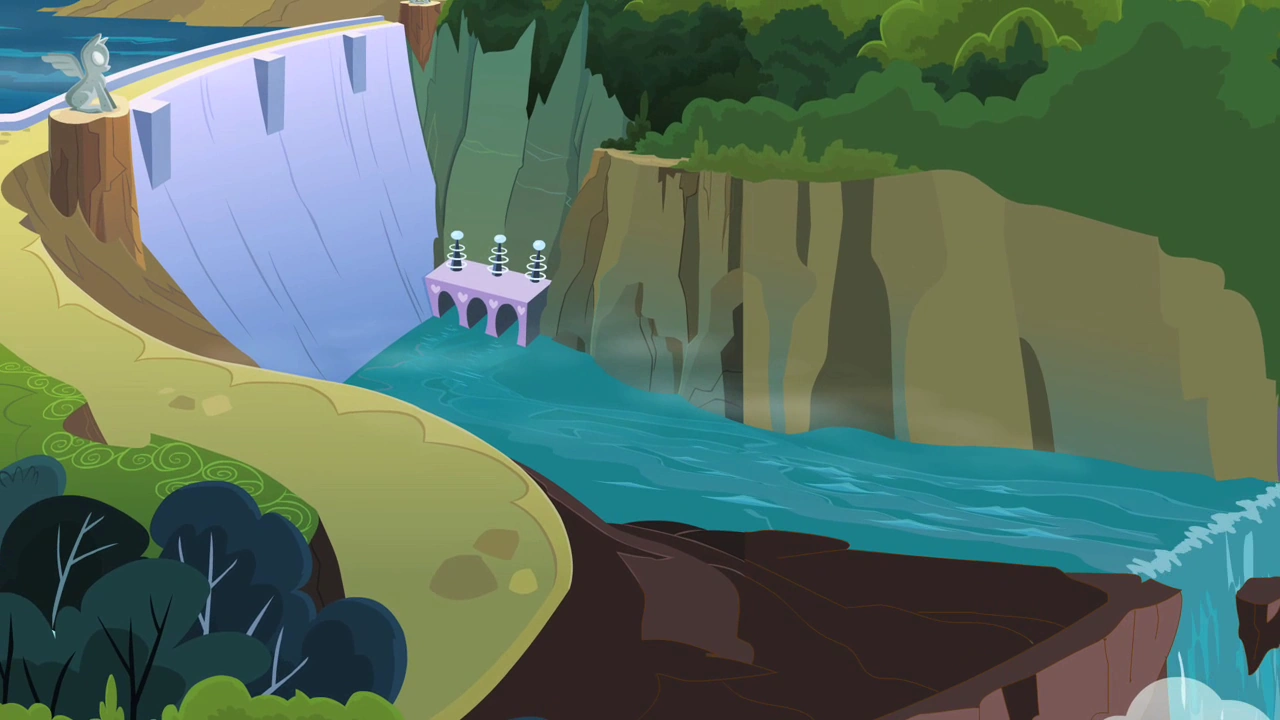
- "The Mysterious Mare-Do-Well" features what looks remarkably like a hydro-electric dam◊, suggesting it may be possible for the ponies to "generate" magic power in that way as well.
- Subverted by the industrial-sized pet hair dryer in "Just for Sidekicks", which does not have any visible energy source, plus Sweetie Belle's magic probably isn't stable enough to control such a device.
- PJ Masks: The heroes have access to a high-tech HQ that contains among other things a Holographic Terminal and can turn into a rocketship, as well as high-tech individual vehicles, all of which would not be out of place in a sciencefiction series. Yet, it's all powered by a Power Crystal, and tied to the PJ's own powers (in the season 4 premiere, the vehicles vanished when the PJ's lost their powers, and reappeared with upgrades when they regained their powers.
- While Rick and Morty is primarily science fiction, supernatural beings and forces also exist and Rick has no problems either applying his super science to deal with magical threats or combining magic with his tech, at one point even cobbling up a magical gun when in a dimension where his tech won't work.
- Rise of the Teenage Mutant Ninja Turtles's version of the Mutagenic Goo was created in a lab by a Mad Scientist, and it's clear that chemistry was involved in its creation. Its origins, however, are magical in nature, which explains its...odd properties.
- Samurai Jack:
- Aku's Ultra-Robots were created with advanced technology, but powered by Aku's evil magic essence which he infused into them.
- Scaramouch was also a robot who had magical abilities (at least he claimed it was magic, it was never really explained).
- The Simpsons.
- Parodied in a Future episode. "We can do anything now that scientists have invented magic."
- Prof. Frink mastered the one and only science: Astrology.
- Sonic the Hedgehog (SatAM): The plot of "Super Sonic" involves an ancient computerized spellbook that actually traps concentrated evil inside it.
- To add another to the Star Wars examples above in Film and Video Games, Star Wars Rebels introduces the Lasat, a species that uses Force-empowered technology along with ritual. Their National Weapon, the bo-rifle, can be reconfigured into a Magic Staff under the right circumstances and their shamans use more traditional staffs that can intersect with holomaps to show The Promised Land. In the climax, the team's spaceship is enchanted and then Force-empowered to fly through an imploded star cluster, briefly becoming an example itself.
- Essentially the gist of Gem technology in Steven Universe, which is undoubtedly highly-advanced, but also mystical. Clarke's Third Law is not fully in effect due to a variety of factors.
- The evil wizards in Thundarr the Barbarian are just as likely to employ giant robots and war machines as magic spells.
- In Transformers: Prime, the Iacon relics are the crowning achievements of the ancient Transformers. Ratchet describes them as fusions of magic and technology.
- Trollhunters: Rise of the Titans has his protagonist Jim Lake Jr donning "The Magiktech Armor" in the final battle, created from the combination of alien technology from Akiridion-5 and Merlin's magic, all while wielding Excalibur.
- In Winx Club it's strongly implied that much of the tech shown in the series is magitek, from the hover bikes to the space ships. Zenith, Tecna's homeworld, is the epitome of this.
- In Young Justice (2010), the Light seems to be fond of mixing magic, biology, and technologies to carry out their Evil Plan. Their ultimate goal for season one is using "techno-sorcery" to create Starrotech, which uses magic to fuse bits of Starro's body with nanobots to create the ultimate mind-control weapon.
- A Pakistani scientist had proposed using the power of the djinn to solve the 1998 energy crisis.
- NORAD's Santa Claus tracking. It is a real thing. You read that right. And they even got a website!!
- MIT's AI Lab once possessed a mainframe computer that seems to have been a primitive form of Magitek.
- Quantum entanglement is the property of particles that are "entangled" to react predictably and instantly when one of them is measured or acted upon. Because of Heisenberg Uncertainty Principle, the actual state of both particles are undetermined (not merely unknown) before measurement of their states; the particles are said to be entangled because measuring one state allows you to predict state of the other particle (usually through a conservation law, such as conservation of angular momentum)—-and this effect appears to travel instantaneously, instantly determining the state of unmeasured particle (magically, and apparently in contradiction to what Special Relativity says). Possibly subverted, as there is no exchange of energy or information and therefore no actual interaction between the entangled particles (which is why entanglement cannot be used to create a Subspace Ansible).
- Quantum Mechanics as a whole can be thought of as being almost magical, due to its bizarre, common-sense-defying rules. Particles can be in two places or states at the same time, tunnel through barriers it shouldn't, have particle and wave natures simultaneously (even contradictory ones), and act instantly on each other over effectively infinite distances. Yet, as surreal as it sounds, it has proven to be true and contributed to the accelerated progress of modern physics in the 20th and 21st centuries, as it explained phenomena that the preceding science was unable to.
- Some anthropologists have defined magic to be a form of pseudo technology, which depends on our perception of the laws of physics rather than on physics-breaking supernatural phenomena. Magic comes from the magician's understanding of magic and is equivalent to an engineer's magic/understanding of science, which allows the engineer to create fantastic results.
- Some forms of technology can sound like magic.
- Steel is carbonized iron, e.g. a molten iron sword smothered in blood. "This sword was bathed in the blood of a virgin sacrificed to the War God." Damascus Steel, in particular, has turned out to follow Clarke's Law surprisingly closely. We have now reproduced a superior version of Damascus Steel with the mystical 'carbon nanotube'.
- Speaking of blood, the ancient Romans infused their cement mix with the blood of animal sacrifices to curry the gods' favor, unknowingly aerating it and thus producing stronger concrete than would be available for centuries after the fall of Rome. How much stronger? It's the only reason their ruins are still standing after all this time.
- The Mongol shamans' practice of boiling drinking water to drive away "evil spirits."
- Many engineering schools teach their students to treat their job as witchcraft. It's the job of a scientist to figure out how things work, but it’s the job of an engineer to make things work. Trying to figure out how the different components you are working with work is time consuming and doesn't help solve the task at hand, so engineers are taught to treat them as magic relics where only the inputs and outputs are relevant. And at the end of the day, an engineer's work should be mysterious to the lay person, otherwise there is no need to hire them over any other schmuck.
- Both sides of the Iron Curtain tried to produce weapons powered by, and/or producing, supernatural energy. Whether or not the scientists found anything interesting is something still researched today.
- Alchemy was aiming at this. Much of the lab technology eventually used by real chemists (beakers, retorts, crucibles etc) was actually developed by alchemists first.
