
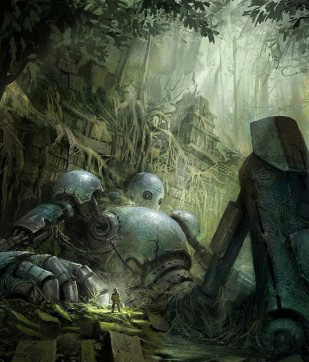
 ◊ by Artur Sadlos
Beyond Schizo Tech, beyond Scavenger World, there's Lost Technology.
The Ancients had some pretty neat gear. Robots, weapons, even the answer to The Ultimate Question of Life, The Universe, and Everything. Easy to use, little or no maintenance required, and after thousands of years of neglect often still in perfect working order!
...oh yeah, and this technology completely and utterly destroyed the Ancients and most of the world with it. But that doesn't stop the villains (or the heroes) from wanting to get some for themselves by pillaging an Advanced Ancient Acropolis. Usually, said Lost Technology then tries to destroy the world again. Some, but not all, heroes are smart enough to try to keep people away from the stuff.
Occasionally the good guys need Lost Technology to combat ancient evils that have arisen again (or villains who have acquired Lost Technology of their own). They usually use it as best they can, despite Black Boxes. Still, they suffer from Low Culture, High Tech.
It is similar to Imported Alien Phlebotinum, with the catch that the current population comprises the survivors or replacements of an age that fell due to its arrogance, war, or some other catastrophe.
In real life, this trope is a main reason to document your research and development work and leave clear schematics/source code/some descriptions somewhere your successors (or you) can retrieve them when need arises. It may seem boring and redundant now, but it saves lots of time and money on reverse engineering the things your facility is supposed to know several years/decades later.
May also show up in the guise of Lost Magic in fantasy settings. Often a consequence of No Plans, No Prototype, No Backup. Also see Advanced Ancient Humans, Sufficiently Advanced and Pointless Doomsday Device. Compare Bamboo Technology. A subtrope of Older Is Better. Frequently overlaps with Sufficiently Advanced Bamboo Technology. May lead to an Archaeological Arms Race.
Examples
- Due to citywide amnesia, the megadeuses from The Big O are Lost Technology despite being little more than 40-years-old.
- The City in Blame! is so immeasurably vast that "lost" technology is positively ubiquitous, which isn't surprising, considering that the mega structure was built over the span of thousands of years and encompasses most of the solar system. For a more obvious example, Killy's weapon is revealed to be an ancient and legendary piece of technology that nobody has been able to replicate. He is mildly shocked to learn this.
- In Broken Blade, the hero Rygart's mecha or err Golem is not made of quartz like everyone else's, oh no, his is an unholy fusion of cheap metal, oil and he is apparently the only one who can use it — vice-versa goes for the quartz golems. Besides being this trope it is also faster and stronger than anything made from quartz.
- The technology of Laputa in Castle in the Sky. Unusually, it did not destroy them; they voluntarily threw it away because it was alienating them from the earth.
- Diebuster:
- Warp technology was purposefully suppressed after humanity gave up trying to explore the galaxy thousands of years ago, to the point that nobody even knows the first principles behind it. And then, of course, there's Nono.
- The giant space habitat where Jupiter is supposed to be. In the episode where it appears, the characters mention that it used to be a space battleship — and indeed, closer examination by a viewer who had seen Gunbuster will reveal that it's actually the Eltreum, the 70 km white flagship that led humanity's final assault on the galactic core at the end of Gunbuster. Since then, it had its degeneracy reactor destroyed and the hull hollowed out to create a space habitat instead of being scuttled and dismantled for the simple reason that the outer armor is made of a material not even antimatter pair-annihilation could damage.
- The Demon God Androids, the Eye of God "Death Star", the Trigger of Destruction battleship, etc. etc. from El-Hazard: The Magnificent World.
- In Excel♡Saga, Il Palazzo and Kabapu have access to technology from the lost civilization of Solaria. Kabapu is allegedly trying to destroy the last of it to prevent a disaster.
- In Fairy Tail, "Lost Magic" is, according to Master Hades the former master of Fairy Tail of Grimoire Heart, the magic closest to the source of all magic in their world which he believes is connected to Black Mage Zeref. The strongest members of his guild, the Seven Kin of Purgatory, are armed with Lost Magic and are extremely powerful.
- Keeping people from (while recklessly getting into) the stuff is a major premise of Galaxy Angel, which is called Lost Technology in the series. The serious Galaxy Angel gameverse has it in droves, but replace backtalking missiles with, say, dangerous ones.
- GUN×SWORD is a Spiritual Successor to Trigun and also uses this. Two examples are the feuding sisters who turn out to be clones whose father actually saw them as experiments not children, and neither they nor the other characters know what the word clone means and that cross puzzle Van tries to open which turns out to be an electromagnetic shield for his mecha.
- In Heat Guy J, humanity has gone several steps back technology wise, after a calamitous war. The most advance technology is being controlled and maintained by an apparently benevolent group known as the Celestials. In fact a number of laws were enacted after the war to prevent humans from regaining some of the more destructive technologies, notability research into androids has been outlawed (with some exceptions) and the only android allowed within city limits or populated areas is J.
- In Kotetsu Jeeg, Dr. Shiba finds several ancient mysterious magical artifacts and hieroglyphs during an archaeological expedition. His findings provide evidence of the ancient lost kingdom of Yamatai that thrived in south of Japan has survived, and its Queen Himika is preparing to invade Japan. Of course, his reaction was using that lost technology to get a countermeasure ready (i.e., turning his eldest son into a cyborg capable transforming into a Humongous Mecha).
- Invoked with the Zentraedi of Macross and Super Dimension Fortress Macross's English adaptation Robotech, who know absolutely nothing about building or repairing their various technologies. It turns out that this is a deliberate ploy on the part of their creators (the Protoculture in Macross and the Robotech Masters in Robotech) to ensure that the Zentraedi must always depend on them to repair and replace used ammunition and broken parts and thus prevent a rebellion. While it works for the Robotech Masters (as Dolza, commander of the Zentradi, did want to rebel according to the Expanded Universe but knew he had no chance due to that factor), the Protoculture ended up exterminated when they were forced to deactivate the other safeguard and couldn't reactivate it fast enough once the danger was over.
- Magical Girl Lyrical Nanoha has a ton of this stuff, and it's always a major part of whatever crisis the main characters are facing. Magic was specifically nurtured and developed in order to handle the multiple times someone finds a "Lost Logia" and accidentally (or intentionally) pushes the "destroy planet" button. In StrikerS, it's shown that there are Lost Logia that are safe enough to legally be sold in auctions.
- In Mazinger Z, the plot is set in motion when Big Bad Dr. Hell finds an army of giant robots in the underground mazes of the Greek island his archaeological expedition was researching, belonging to the lost Mykene civilization. Instantly he decides to seize that technology to further his goals of world domination. Too bad to him — and the world — the legitimate owners of that technology were still around. In one of the UFO Robo Grendizer mangas, Lost Technology had an important — and dire — role.
- After being dead for 2,000 years, Anos Voldigoad of The Misfit of Demon King Academy is incredibly disappointed to find that many of the most powerful skills he has and had taught his descendants were forgotten to time, alongside the understanding of magic being incredibly flawed and imperfect. Fortunately, he remembers and is actively trying to elevate magic (and society as a whole) back to its glory days.
- Mobile Suit Gundam AGE has a similar mechanic with the "cursed treasure", the EXA-DB. Centuries before the series, a united human race vowed to give up war and destroyed all their advanced weapons. All information regarding how to create them was placed in a massive database... and lost. Vagan's mobile suits are so powerful because they discovered a small fraction of the EXA-DB and based their military tech on it. Both sides are hunting for it, knowing that the lost military tech stored within would easily decide the victor in their generation-spanning war. It briefly appeared in a side manga called Memories of Sid, found by the Bisidian Space Pirates, who got trounced by its automatic defense system Sid, and they have since lost it again.
- In Murder Princess, the Lost Technology is actually called Lost Technology, proper noun. All of the world's "magic" and monsters, as well as the heroine's two companions, were born from Lost Technology, and when its "central processing unit" is destroyed so is everything it created.
- In The Mysterious Cities of Gold, the little bits of surviving technology from the Mu Empire are this, including a solar powered warship that shoots lasers, a solid gold airplane, and a nuclear reactor. Fighting against Spanish galleons and Mayincatecs with spears.
- An ancient war machine forms a important part of the plot of Nausicaä of the Valley of the Wind.
- This is the whole basis of the manga O-Parts Hunter with the most ultimate of lost technology able to restart the universe itself.
- Panzer World Galient: Ancient war machines and weapons were buried everywere in planet Arst. Marder dug up tons of ancient technology to arm his army, and La Résistance tried to find and unearth best weapons to fight him with. The titular Humongous Mecha was one of those weapons found by a rebel settlement.
- Sengoku Komachi Kurou Tan has a particularly mundane example in family registries. For reference, they were first implemented in Japan during the Taika Reforms but fell out of use somewhere in the Heian Era and only came back during the Meiji Restoration Era. Shizuko reintroduces it in the Sengoku Era as part of her plan to modernize her territory and Nobunaga gives it his full support because he figured out how to use it to his own advantage.
- The eponymous airships in Simoun are so far lost that their origin isn't clearly remembered. Knowledge of how to use them is only regained through time travel.
- Showed up often in Sorcerer Hunters.
- In Sound of the Sky only 10 Takemikazuchis are left, and it takes a Teen Genius to make one operational.
- Lost Technology is both the central MacGuffin and the enabling device in Spriggan, which revolves around an archeological arms race between cold war powers, a few secretive fringe groups, and the ARCAM foundation, which seeks to secure (or if that's not possible, disable beyond repair or useful R&D) all "Out-of-Place Artifacts", or "OOPArts", until such time as they feel that the rest of humanity is ready to use them responsibly.
- The doll Emily in Str.A.In.: Strategic Armored Infantry turns out to be Lost Technology with dubious origins.
- Texhnolyze. The technology is only lost to the population of Lukuss — the Class and the Theonormals never lost it.
- In Trigun they literally call the Plants "Lost Technology". The Plants are like power plants, they produce energy that allows humans to survive on the planet Gunsmoke. The Plants were invented on another, now mostly mythical planet (Earth), and with one exception the knowledge of how and why the Plants work is completely forgotten.
- Trinity Blood. Not only is it actually called Lost Technology but they even heavily analogize Lost Technology to magic by giving it mystical references.
- The main theme of ∀ Gundam. To fight back against the alien humans of the Moon Race, Earth (which appears to have somehow gone back to the Victorian era) starts digging up old mobile suits and battleships it finds. Turns out we're seeing the end of all the then known Gundam timelines. The Turn A was so powerful it sent humanity effectively back to the stone age, with only the Moon Race retaining video documentation of what happened.
- Also used as the plot for the more kid aimed spin off Musha Generation, alabeit with the mecha now super deformed, more fantasy elements to the cast and the overall theme being the way of the samurai.
- Green Lantern: One of the brilliant ideas of the Guardians of the Universe was to set up a civilization, the Psions, set up like this by design. They hoped that by seeding their planet with technology and sealing them off, they would slowly grow and understand the immeasurably powerful tech scattered across their world. While they did grow for a bit, this started a Vicious Cycle in which they rise to a great level of technical skill, then realize their entire world was custom-made as an experiment, realize the truth of their farce of a culture, nuke themselves into the Stone Age in a fit of despair, and the cycle starts again. Worse yet, this culture has sent them into a spiral of abuse against other species, creating a race of Mad Scientists.
- Antipodes: Old-world tech, advanced beyond anything the scattered survivor holdouts are capable of now, are occasionally uncovered. However, a lot of it has become inaccessible due to being located in barren wastelands where life cannot exist.
- Triptych Continuum: The Discordian era destroyed virtually all records and artifacts from before its time. Every once in a while, someone manages to turn up a bit of lost technology, which are all incredibly valuable because they are too complicated to be reproduced and too rare to be disassembled and examined to even try. In A Mark of Appeal, it is revealed that the Sun and the Moon are both products of the lost ancient civilization.
- Pony POV Series: Technology from the Golden Age (the My Little Pony Tales era) has been found, but ponies aren't certain how it works or what it is. Twilight and Luna eventually decide to help with recovering it now that Ponykind is ready to utilize it properly.
- Let the Galaxy Burn: The millennia-old gravity field machinesnote on Moat Cailin might be this. The Starks may or may not still be building them at Winterfell.
- RWBY Alternate: Remnant is around the technological and societal level of the early 20th century in most respects. They also have robots, cyborgs, holograms, and air ships (but no cars). This is due to the series taking place millenia After the End where the older version of society, called the "Imperial Era", changed after a dramatic event called "the Fall" led to the downfall of humanity. Remnants of technology from that era remain but are largely only used by militaries.
- Cloud Atlas: By the time of Zachry's era, technology has mostly devolved back to the iron age, but a small group has access to some stuff on our current level and a even a few objects more advanced than anything we currently have.
- Contact: While the plans for the transportation machine may have come directly from the Vegans (it's never stated outright), the Vegan Ellie speaks to tells her they did not build the transit system she traveled on. They apparently found it In Working Order and decided to use it to make contact with other species.
- The setting of Aestival Tide by Elizabeth Hand is a city run entirely on forgotten technology, which is slowly failing and actively crumbling under its own weight since no one remembers how to control it.
- All three factions in the Amtrak Wars have lost technology. The Mutes are the mutant descendants of people stuck above ground during the nuclear war. So much has been lost by them that being given crudely-made crossbows is a big step up in technology for them. The other two factions the Iron Masters and the Amtrak Federation are far more advanced but both DELIBERATELY lost a particular technology. For the Iron Masters, they feel it was electricity that led to the nuclear war so they rid themselves of it while the Amtrak Federation forbid gunpowder technology for fear of their Mutes enemies capturing and reverse-engineering them. So the Amtrak Federation restricted themselves to air-powered firearms which are more difficult to reproduce and less powerful to use in case some guns are captured.
- In Ayn Rand's Anthem Lost tech includes a subway system and an abandoned house.
- Area 51: The Airlia, an alien species, left their technology in different locations hidden across the Earth long ago. Humans gradually discover some of it over the years.
- Isaac Asimov's
- "The Feeling of Power": Aside from mathematics, a throwaway line reveals that hydroponics is the primary means of growing crops, to the point growing them in soil is considered theoretical.
- The Foundation Trilogy's "The Mayors": One of the signs that the Empire is in decay is that it loses the fundamental understanding of its own advanced technology, leaving power plants in disrepair and warships abandoned. When an old Imperial battle cruiser from the height of the Empire is discovered, Terminus is excited. The Foundation has the theoretical know-how to make such a ship, but it was built on an absurdly large scale which they cannot replicate (because Terminus has almost no metal). This one Imperial battle cruiser, once restored to full capacity, could outfight any of the Four Kingdoms.
- In Awake in the Night Land millions of years pass during the course of the book, along with them some of the technology of previous eras is lost, mainly how to create some of the Applied Phlebotinum. However sometimes the knowledge is regained through prophetic dreams.
- The Big Bad in The Chronicles of Prydain, Arawn used to travel the continent, stealing and hoarding magical devices and other more advanced technologies. Somehow he ended up also stealing the knowledge of the making of such devices, such that he sits on a treasure trove of Lost Technology, while the rest of the population wallows in ignorance.
- The Citizen Series: It's indicated that a lot of old Earth ("Third Civilization") knowledge has been lost, leading to a certain degree of Schizo Tech between the Home Worlds, the colonies, and especially the Riders who have devolved back to Stone Age nomadic hunter-gatherers. Destry comes up with several innovations (for example, World War II fighter plane doctrines applied to frame fighting) by going over surviving historical records.
- The city of Diaspar in Arthur C. Clarke's The City and the Stars (a novel-length re-working of his earlier novella Against the Fall of Night) is composed of technology that no one living understands any longer; but which is all fully automated and self-repairing. Somewhat subverted in that the computer that maintains the city, including the inhabitants — who are cloned reincarnations of the original population with memories of all their incarnations stored in the computer — could conceivably produce new inhabitants with the requisite memories. The technology necessary for space travel, on the other hand, had been deliberately purged both from the city computer's memory, and the records of the telepathic inhabitants of the pastoral city of Lys; and the populations of both cities had developed a phobia of space travel, with a powerful and completely wrong mythology justifying their fear.
- City of Bones by Martha Wells: Charisat's markets do a booming trade in relics — remnants of technology from the pre-apocalyptic Ancients, valued because no one has the know-how to create them anymore. A very few, such as the pain rods, actually have practical uses. Some scholars devote their whole lives trying to figure out the workings of relics.
- A Colder War by Charles Stross has the Cold War exacerbated by a Lensman Arms Race involving relics of the Elder Ones. It's suggested that the Fermi Paradox is caused by something killing off intelligent life before it has a chance to go making First Contact, like meddling with such relics. Right after this suggestion is raised, humanity shows they are indeed Too Dumb to Live.
- A Connecticut Yankee in King Arthur's Court is an unusual example of this Trope being invoked: as a side-effect of the Church decrying King Arthur's Court and deciding to decimate everything and everybody involved with it for their blasphemy; they destroy all of the technology and knowledge that "The Boss" (the titular Yankee, who has Brought Radio To The Romans and caused an industrial revolution several hundred years early) has made.
- In the Darkover series, matrix technology is essentially Magic from Technology fueled by Psychic Powers. During what would later be called "The Ages of Chaos" things got a little out of hand and warfare routinely included summoning creatures from other dimensions and unleashing devastating energies. This eventually led to the Compact, which banned all distance weapons. Over the centuries, the Darkovans developed a superstitious fear of returning to those troubled times, and consequently lost the knowledge of how build or safely use most matrix technology from that era. What was still around was studiously avoided by most people, causing society overall to regress to a largely Medieval level.
- In Stephen King's The Dark Tower series, Roland's world is littered with remnants of the super-advanced technology of the "Great Old Ones", including artificial intelligence, robots, and advanced weaponry. Elements of this technology frequently become central drivers of the plot.
- The Deryni series has the Lost Magic variant as a running subplot:
- Deryni went from having thriving Healer schools and a regular cadre of Healers as part of society to no Healers in the whole of Gwynedd, with a very slight comeback (a handful of untrained Healers flying by the seat of their pants) two centuries later. Arcane knowledge generally is hidden away and /or lost, with traces gradually coming to light.
- During the "Camber of Culdi" and "Heirs of Saint Camber" trilogies, Camber, his children, and his allies spend a lot of time working to rediscover the arcane knowledge that had been lost over the previous two centuries, since the great Deryni adepts Orin and Jodotha died.
- In the time of Kelson Haldane, two hundred years after Camber's time, the Deryni of Gwynedd are scrabbling desperately to recover the knowledge that was lost during the purges that occurred during and just after Camber's time, especially information about Deryni Healing powers. Orin is remembered as a great poet and scholar; his status as the greatest of all Deryni adepts seems to be long forgotten.
- In the Destroyermen series, the Americans lose access to a lot of their technology and are forced to start from scratch, with only each human's understanding of science to help them acquire similar results. Much of their manufactured ammunition and more modern technology that DID survive has been altered so much that numerous aspects of the original designs have been lost for the sake of ease of manufacture.
- Digitesque: The world is littered with the remnants of humanity's technology, still maintained by their ancient robots. Most of it is extremely intuitive, to the point that people can even drive hover cars without much trouble, but the best stuff is locked behind indestructible doors that no one can open.
- Implied in The Dinosaur Lords when Florian and Jaume find ruins of an ancient temple, with strange burn marks on the walls. They note that with technology they have, they couldn't produce temperature this high and make burns this small, and lightning doesn't tend to go in straight lines like the marks do. The readers can, however, guess it's been left by lasers, or something laser-like.
- Terry Pratchett's Discworld novel Thud! introduced Lost Technology in the form of "Devices", mysterious magical/technological devices found and utilized by the dwarfs. Two examples are a inch-wide cube that functions as an indestructible audio recording device activated by voice commands and in some cases allegedly containing millions of years worth of sound. And something which is described as simply two blocks with some sort of bearing between that causes them to rotate in opposite directions. Forever and no matter how strong a force is used to try and hold them. Basically an infinite mechanical engine that can power anything on nothing. They are found so deep underground that it seems likely they were there when the world was constructed.
- Lost technology and the ruins of long lost high-tech civilizations turn up in the Dying Earth novels (and the fantasy RPG) by Jack Vance, as well as in several of his other short stories (both fantasy and science fiction).
- Emberverse: Exaggerated. The lost technology won't even function in the post-Change world, although some specialized items manufactured using pre-Change techniques can be repurposed (e.g., truck suspension springs to power ballistae and heavy catapults, precision-machined gears from automobiles being used in wind- and water-driven machinery, etc.) Spare parts and raw materials salvage is a major preoccupation (and source of wealth) for many communities.
- The Empire of the East and the Book of Swords are set in the distant future of earth, after the collapse of technological civilization and the rise of magic. In Empire, however, Technology Comes Back, or starts to, at any rate. The discovery of some old technological devices, including an atomic-powered battle tank, plays a major role in the story.
- In Rod Duncan's The Fall of the Gaslit Empire, Napoleonic War-era breech-loading guns are the Lost Technology!! In 2009, people are using front-loading flintlocks and for long-range stealth killing, secret agents make use of crossbows.
- An ancient galaxy-spanning Internet exists in Vernor Vinge's A Fire Upon the Deep, and archaeologist programmers seek miraculous technologies left behind in archives by species who have gone extinct or Transcended. Unfortunately just like the contemporary Internet there are the associated problems of viruses, malware, translation errors, and propaganda that can have disastrous consequences when the technology sought is often more sentient than the races seeking to use it. The novel is about what happens when a malevolent power, the Straumli Perversion, is released from one of these archives.
- Another Niven example (this time with Jerry Pournelle as co-author): Footfall has the fithp: aliens capable of interstellar travel because a predecessor species on their homeworld left instructions behind. They've managed to decode the instructions so they have a (slightly) higher tech level than humans do, but they follow the instructions by rote as opposed to really understanding it.
- Robert A. Heinlein's Future History has space travel becoming one, though rediscovered later.
- The General Series has a Lost Technology computer providing information for a planet at a development stage akin to the American Civil War on Earth, to eventually rebuild interstellar travel over a millennium after it was lost due to a galactic civil war.
- Elderglass from the Gentleman Bastard series.
- T. E. Bass' Half Past Human depicts an Earth about 3000 years in our future, where humans have devolved into a four-toed variety (called the Nebish) and technology appears to have declined as well (although it's still higher than ours). There are two instances of Lost Technology in this novel, both owned by (and planted to assist) the few remaining five-toed outcasts; one gets dismantled by Nebish technicians, who fail to recognize it as a Class 6 cybernetic device, since it's small and portable and their understanding of Class 6 cybers is that the brain case alone would weigh over two tons.
- The Deathly Hallows in Harry Potter. Each of them is a one-of-a-kind artifact with power that laughs in the face of all conventional magic: the Elder Wand when wielded by its rightful owner is powerful enough to repair other wands (which Ollivander believed was impossible) with a simple Repairing Charm, the Resurrection Stone can summon a bonafide shade from the afterlife (even this much shouldn't be possible), and the Invisibilty Cloak's power doesn't vanish with time (all other Cloaks eventually run out of juice). Attempts to recreate the Hallows have all ended in failure. Even the Elder Wand — wandmakers know that it's made out of elder wood and has a thestral hair core, but can't create another wand with its power even with those components available. The Hallows are so powerful and mysterious that one legend claims that Death itself created them.
- The titular quest in Hiero's Journey is about a search for lost computer technology in an After the End world.
- Plenty of Precursor technology is found throughout The History of the Galaxy books. The most jarring examples are a Dyson Sphere built by the Insects and a giant supercomputer in space built by the Logrians, composed of tiny crystals, each of which is in itself a computer more powerful than anything humans have. What do the humans use with the giant supercomputer? Turn it into the replacement hub for their InterStar network. Yes, they take an advanced alien computer and use it as an Internet server with the tasks mainly limited to routing signals. There are also Logrian gravity generators that can bend light in such a way as to keep a whole star cluster hidden for millions of years. Humans adapt them as Deflector Shields for Space Fighters.
- Note that most Insects and Logrians have been slave races to the Harammins for so long that they have forgotten how this technology works.
- A number of novels also focus on Lost Colonies where the colonists have degraded to the point where they don't know how to make anything new. One such world involves an unending war between the humans and the Insects, who have also degraded. Both sides are able to run primitive industry, such as making bullets, but it's mentioned that the helicopter that a character ends up crashing is one of the last working ones in their fleet and is from the original ship's stock.
- The Liaden Universe has "OldTech", Clarkian technology from the waning days of the previous universe (as seen in Crystal Soldier and Crystal Dragon) and the early days of the present universe. Much of it was designed by or derived from tech designed by the Sheriekas, the evolved transhumans responsible for rendering that universe inhospitable to ordinary human life, and it can often carry their malign influence. One of the primary missions of the Scouts is to sequester or destroy any remnants of that technology that still exist, whether harmful or not, as well as research it to try to derive safe versions. This can sometimes bring them into conflict with others — such as Uncle or Clan Korval — who take a more enlightened stance toward using that technology. Likewise, the Department of the Interior recognizes the inherent advantage in having as much OldTech as they can.
- In A Lord from Planet Earth, most of the Seeder artifacts scattered across the galaxy are this. Few are able to figure out how they work, although many of these can be replicated without truly understanding the principles behind their functionality. It turns out the reason is because that tech hasn't been invented yet. It will be invented by the 22nd century. By humans, no less. They will need a large army to fight an invasion from another galaxy, so they'll send automated ships into the distant past to seed the galaxy with life and scatter Black Box artifacts in order to guide that life's development.
- The Lost Regiment features the Tunnels of Light that occasionally bring humans from Earth to Valennia. They are, in fact, teleporters placed on numerous planets of the ancient starfaring race that nuked itself back into the Stone Age. Their descendants are the Tugars, the Merki, the Bantag, the Kazar, and other hordes. In the second novel, the Merki go against their traditions and raid some of their ancestral burial grounds for Lost Technology, which they use to power their new airships. Due to the symptoms of the sickness that painfully kills anyone near the engines, they can be assumed to be nuclear in nature.
- Murder In The Place Of Anubis: Some unguent-stains on the victim's kilt are identified by King Tut's royal perfumer as a very rare type for which the recipe was lost decades ago. This is a telling clue, because the victim and his murderer had conspired to rob a century-old tomb in which some of that unguent had been placed as grave goods.
- Orphans of the Sky: The Ship's society is fallen to such a state that, while the Ship's original systems are still maintained out of rote ritual, none of it is understood as anything other than the universe's natural processes as created by God and actual manufactured technology tops out at knives and slingshots. As a result, one of the primary reasons why The Coup goes the way it does at the end is because the main characters' faction has, by means of reading old novels, worked out how to recreate ancient and powerful weapons — that is, swords and metal armor.
- The stagnant remnants of a world-spanning autocracy that has frozen its culture for tens of thousands of years meets its comeuppance in the form of a one-way time traveller and his knowledge in another Vinge story, "The Peddler's Apprentice". His list of tricks consists of a self defense gadget, and the uplink codes to the array of spy and killsats left behind by Sharn, the "crystal city" the Kingdom of Fyffe devolved from.
- In The Pillars of Reality, this has gradually happened. The technology possessed by the Mechanics is better when it's older (provided it has been maintained), because newer attempts to duplicate it tend to be inferior. Each succeeding generation has less and less understanding of it.
- The Reynard Cycle: The crew of the Quicksilver encounter robots and electric lamps while in Carcosa. They interpret both to be the product of dark sorcery.
- Alastair Reynolds:
- In the Revelation Space Series, a civilization-wide cataclysm known as the Melding Plague — a alien nanotechnologic virus which assimilates any other nanotechnology it contacts — caused the collapse of virtually all manufacturing facilities, most of which were located in the Glitter Belt (Now known as the Rust Belt) around Yellowstone. Humanity still knows how to make the technology, but it is impossible for it to built due to the lack of a manufacturing base, and the risk of the remaining strains of Plague corrupting it. Only the Conjoiners were unaffected by the Plague, due to their extreme isolation. Lighthuggers, the only form of interstellar travel, became this when the Conjoiners stopped building the ships; only the Conjoiners knew how to build the Conjoiner Drive (and only they had the resources), and any attempt to reverse-engineer a Conjoiner Drive would result in a apocalyptic explosion as the drive's propulsion unit would collapse itself. In the modern age, Lighthuggers are priceless and are fiercely defended by their crews, the cybernetically enhanced Ultranauts.
- In Terminal World, the technology behind Spearpoint — the last human city that rises kilometers into the sky — has been lost even to the highest levels, where reality's Enforced Technology Levels is at its weakest and technology borders on magic. Nobody knows how it was made, and what its original purpose was.
- Merlin's Gun, humanity's tech base has steadily regressed under the relentless assault of the Absolute Xenophobe Huskers. When Merlin rescues a human in a stasis pod after living in the black for hundreds of years, he notes how primitive the technology has become. On the other hand, the computer tech has progressed far beyond Merlin's; the rescuee's Virtual Ghost effortlessly slips into Merlin's computer system.
- Ringworld: The inhabitants of the Ringworld have lost the technology to build or repair it (mostly; the builders left a couple of caches behind, and ensured that anyone who finds them will be smart enough to figure out how to use them). And then there's the City Builder culture, which was a bit below the tech level required to construct the place (or understand it, demonstrated by the fact that they dismantled the stabilization system), which collapsed when the Puppeteers destroyed their superconductors, but which left bits and pieces of equipment based on different technology lying around, some of which still work.
- Rogues of the Republic: The Magitek the ancients left behind. For the most part, the modern countries have a good understanding of how it all works and can replicate much of it, but the greater wonders like levitation crystals and automated golems remain out of reach.
- Safehold: Both sides of the conflict have access to it, although only one knows about it. Main character, Merlin, is piece of Lost Tech himself — PICA, the implacable android with human memory. In his stock he has ultimate spying bugs, invisible recon machines, laser guns and assault crafts. His enemies, the church, have almost-living building, the Temple, and Kill Sat Rakurai.
- Scavenger Alliance: Earth at the beginning of Exodus Century was at the height of its technological progress. Then the interstellar portal was invented which led to Exodus Century, with the population leaving in droves to colonise other planets. There weren't enough experts left to maintain the technology which slowly broke down and couldn't be replaced. This is about to be a particular problem for the Alliance as New York's power structure is about to fail, resulting in a massive firestorm.
- Second Apocalypse: The Tekne, the highly advanced technology of the alien Inchoroi race (including beam weapons and highly capable, sophisticated genetic engineering). The remnants of the Inchoroi are largely ignorant of how their technology works, and use it in a black box, "trial-and-error" fashion.
- Semiosis: Justified with the human colony on the planet Pax, as the original colonists brought advanced Earth technology with them but their descendants lack the resources to reproduce or repair it. They take care to preserve the underlying knowledge so that they won't have to rediscover everything from scratch when their society reaches that level of manufacturing ability again.
- In Jasper Fforde's Shades of Grey technology hasn't been lost so much as deliberately purged by a series of "Leapbacks". Some is still reserved for the government resulting in Schizo Tech.
- Terry Brooks's Shannara:
- There are hints of a previous, lost technological civilization. In Sword of Shannara, the characters are told the civilization destroyed itself with powerful weapons, and encounter a mutant-cyborg monstrosity in a ruined city. This aspect is not played up so much in the later novels, although the Big Bad in one is an AI from the old world.
- Brooks is currently linking this to his Urban Fantasy series The Word and the Void: The Genesis of Shannara series is set After the End of Word/Void.
- The "Genesis of Shannara" series openly reveals that the "lost technological civilization" is basically our world about a century in the future. The ruined landscape in which is takes place is the continental USA, the Elves live in an Oregon river valley and forest, and the final destructive event that triggers the cataclysm that re-shapes the world is when an insane US military officer trapped within a nuclear missile command bunker in North Dakota years after the Great Wars took place decides to launch the remaining US nuclear ICBMs (inter-continental ballistic missiles) on a whim.
- In The Sister Verse and the Talons of Ruin, the Sisters of Ruin scavenge technology from fallen cities and military bases in order to wage war against the border guard.
- Valyrian steel in A Song of Ice and Fire, and though not really technology, in some weird manner, dragons. Valyrian steel does still exist (many houses have an Ancestral Weapon of it) but the art of making more of it has been lost. A sufficiently skilled smith if given enough Valyrian steel could make a new sword from it, proven when Tywin Lannister melts the Stark Ancestral Weapon Ice down to make two new swords.
- Valyrian steel is a fantasy counterpart to a real-world "lost" technology: Damascus steel.
- Also, the techniques used to raise the Wall, a seven-hundred foot tall wall of ice spanning a continent, built eight thousand years before the series takes place. Lord Commander Mormont said that unlike the hundred of previous commanders, he is the first one under whose rule it shrunk. The others always left it at least a couple meters higher. I.e. the wall was not built as it was at a single point in the past, it got bigger over thousands of years of labour. And the techniques are also presented — rocks and wooden beams and earth then covered in water that freezes into ice, pretty primitive though effective. Kind of an analogue to real-life pyramids, which many people also think to have been impossible to build at the time. And the "barrier" that stop the white walkers is more an instance of The Magic Goes Away, not technology, altough knowledge lost nevertheless.
- A number of other structures credited to the same half-mythical architect are impossibly huge and resilient stone fortresses that have stood since prehistory (it's been noted even in-universe that the timeline makes little sense; the margin of error runs into millenia). It's not really clear if magic was again responsible or not; some of them do have powerful magical defenses as well. Oddly enough his own castle of Winterfell was an exception, the actual keep being almost an afterthought to the vast multi-layered crypt he built for his descendants.
- In a Star Trek: Deep Space Nine novel, the crew of the Defiant runs across a world that was essentially SET UP this way as an experiment. A highly-advanced culture dropped off a whole bunch of their babies on a planet with tons of small, hi-tech devices scattered all over the place and sat back to see what would happen. The result is a people who are so dependent on technology they don't understand that they're royally screwed when the batteries go dead.
- Subverted in The Stormlight Archive:
- Modern scholars are obsessed with rediscovering ancient Magitek fabrials, marvelous machines that could do all sorts of things like heal and change what material an object was made from (meaning it can do things like turn waste into food) — not to mention the magnificent Shardblades and Shardplate, weapons and armor which can turn the tides of entire wars. But as Dalinar's visions show, the ancients didn't actually have any advanced technology. They had the Blades and the Plate, but other than that they were actually of significantly lower tech level than the modern era, which confuses the people he confides in. This is because world-breaking Desolations would regularly knock civilization back massively in terms of technological advancement, often all the way back to the Stone Age; it was so bad that the divine Heralds weren't even sure that civilization would have rediscovered bronze by the time they came back to help fight again. Although some things have been lost to time, when Taln returns from Damnation, their reaction seems to indicate that modern Roshar is by far the most advanced civilization has ever been. The "technology" they lost is lost because it largely wasn't technology at all. Shardblades were actually the bonded spren of the Surgebinders call the Knights Radiant, and Shardplate is the coalesced forms of spren which gathered around a Radiant who achieved their Fourth Ideal. Soulcasters are eventually revealed to also be a form of spren who have formed into metallic, solid shapes, much like Blades and Plate.
- In Oathbringer (the third book), the heroes are in Urithiru, the long-lost ancient city of the Knights Radiant. They are shocked that there is barely any technology at all; there are fabrial elevators and plumbing, but those are just clever applications of technology that the modern world has already rendered obsolete. In Rhythm of War it is revealed that much like Blades, Plate, and Soulcasters, Urithiru is one massive spren known as the Sibling, and that bonding with the Sibling is what allows the tower to fully reactivate all of its immensely powerful systems.
- Tolkien's Legendarium:
- The Silmarillion states that the people of the First Age built an elven ship made of "mithril and elven-glass" that could travel both through the sky and through the Outer Void (outer space). This was the ship that Earendil used during the War of Wrath — it was not referred to in technological terms, but as a conventional ship that through divine power could also fly in the heavens.
- The Fall of Gondolin: In the earliest version, when Morgoth destroyed Gondolin, the great Elven city hidden in the mountains, his army crossed the peaks with metal troop carriers that had fire in their bellies (i.e. engines).
- The Fall of Númenor: In the Second Age, the Númenoreans are said to have had ships that moved against the wind, with weapons that could "fire darts across an ocean." One version of the legends says that the Númenoreans in exile even managed to build aircraft in a futile attempt to escape the newly round world.
- Older Elven technology is always superior to newer technology, since, as the elder race in Middle Earth, Elves got a head start on building things and had the benefit of doing so in a time and place that was close to paradise as is possible in the setting. Due to a mixture of population decline, nigh-endless war with the forces of evil, and a lack of semi-divine material, they simply weren't able to continue building their marvels, and their crafts and techniques became forgotten and lost. Humans and Dwarves don't fade, and thus can continue to create more and more amazing things.
- One chapter of Unfinished Tales of Númenor and Middle-earth is a treatise on the palantíri "seeing-stones". Their properties are given detailed description (for example, they had "poles" and proper orientation; to look west, one had to sit on the "east" side) and in the heyday of Gondor and Arnor, were used frequently by individuals who were skilled in their proper use and management. By the end of the Third Age, there was no training or technique preserved to tell users like Denethor how to avoid the intense mental strain of improper palantír use. Another aspect was that a palantír was extremely difficult to use by anyone who didn't have a "right" to it, which was only an heir to Elendil or their legally-appointed representative; for this reason, Denethor (the hereditary Steward of Gondor) found his palantír much easier to use than Saruman, who was essentially an unauthorized user. This also played into Aragorn's ability to wrest control of the palantír from Sauron in spite of being a mortal man and Sauron a fallen angel.
- The Tripods: the humans on Earth have lost all knowledge of scientific advancements since, essentially, Faraday's work on electromagnetic induction; steam power is used almost exclusively as the primary non-human/animal motive energy source. One of the characters has no idea that he's passing by an electrical substation because he has no idea what a volt is.
- In Virtual Mode (and further in the Mode series), by Piers Anthony, Darius' dimension has a technology know as "chips" that permit Dimensional Travel: one setting allows a one-time link between the host dimension (the one with the activated chip) and a random destination, or a more permanent "virtual dimension" that requires five anchors that lasts until one of the anchors is released. This tech was deliberately lost (by being left in Darius' dimension), because as it turns out one of those dimensions had an empire that would use it to take over the multiverse....
- In the Warhammer 40,000 novel Dark Adeptus, Magos Antigonus is able to be Not Quite Dead thanks to some hitherto-unknown tech he finds shortly before he gets killed. The Father of Titans is also shown to be comprised of tech that its copiers cannot replicate fully.
- Robert Jordan's The Wheel of Time series heavily plays the Lost Magic angle up, stocking the world full of unknown thousand-year-old devices mostly in working order, sometimes harnessed and sometimes just accidentally triggered. The Hero is given glimpses into the per-cataclysm world, as well. The "Age of Legends" was a personification of a Crystal Spires and Togas world, complete with advanced flying machines and car-equivalents, genetic engineering, universal peace, high-quality medicine — you get the idea. Think an almost ideal peaceful, futuristic society aided and abetted by widespread magic and Magitek.
- Andromeda:
- The eponymous ship is a High Guard capital ship that survived the fall of the Systems Commonwealth and three centuries of the following intergalactic dark age orbiting a black hole at a distance where Time Dilation brought shipboard time to a standstill. Unusually for this trope, the protagonists have access to it and the highly advanced antique tech onboard from the pilot on, being the salvage team that pulled it out and the sole surviving member of the original crew (plus the ship herself).
- On the other hand, other High Guard ships are later found. One troop transport has been converted into a casino. One powerful warship had an AI that has gone insane and started a Luddite movement. The Nietzscheans have an entire prison system for High Guard ships captured during the rebellion. They'd like to get their hands on all that juicy tech, but the A.I.s keep killing anyone who gets aboard (usually by dialing up the Artificial Gravity), and it's nearly impossible to get rid of an AI without blowing up the ship. Although the Nietzcheans have finally developed a device that can erase an AI once plugged in.
- Babylon 5:
- A great war resulted in Earth reverting back to roughly Middle Ages technology, centuries after the end of the eponymous space station. The occasional discoveries of that old time's technology is mostly due to Rangers planting them to be "discovered" by the locals, in order to help them rebuild civilization on their own. One of the monks, who happens to be Ranger, gives a report to his superiors and asks them to provide the next Lost Technology in an old container unlike the last time.
- There's also companies like IPX (InterPlanetary Expeditions), who travel to planets that were once home to long-dead civilizations, looking for Lost Technology among the rubble. While they have a tendency to find more than they bargained for (such as the Ikarran protector that started tearing through B5), they have also found useful things (EarthForce Interceptors, point defence guns so accurate they can reliably swat out of the sky enemy weapon fire and casually annihilate fighter attacks coupled with an energy barrier to soften what enemy fire gets through, were reverse-engineered from an ancient alien starship found by IPX).
- That's the entire plot of the Crusade spin-off, where the crew of the Excalibur is on a mission to look through old ruins on various worlds in an attempt to find a cure for the Drakh plague that will kill the population of Earth in 5 years. Had the show not been cancelled, they would have found a cure by the end of the second year and the plot would have radically shifted away from this.
- In Battlestar Galactica (2003) this is very much the case with Cylon technology, and indeed most technology in general. The people of Kobol apparently invented things like organic Cylons and Resurrection in the distant past. Knowledge of this was lost in the conflicts that led to the settlement of the Twelve Colonies. The rediscovery of these technologies sparked a renewal of hostilities between the mechanical Cylons created in the Colonies and their human makers.
- In Chou Sei Shin Gransazer, millions of years ago, the ancient earth was populated by a hyper advanced Precursor civilization. These precursors created technologies such as Humongous Mecha and Powered Armor; the titular Chou Sei Shin and Gransazers respectively. However, they were wiped out by an alliance of alien races for growing too powerful. In the modern day, these technologies still work perfectly well and outperform all modern earth weaponry.
- Dinotopia: The Advanced Ancient Acropolis of Poseidos has robot dinosaurs powered by Power Crystals.
- Downplayed in the Doctor Who serial "Paradise Towers", which is set in a massive tower block which has been isolated from the rest of the universe and degenerated into anarchy and savagery. The Doctor is at one point kidnapped by a gang of near-feral teenage girls, and one of the ways he gets them on his side is by showing them how to use a drink vending machine that's been in their lair all the time without them realising what it is or what it can do.
- Fringe has introduced this with an ancient race who developed the technology to destroy an alternate universe. You might not think that would be a useful thing, unless you just happened to be in the middle of a war with an alternate universe. Subverted later on when it turns out the tech was actually developed by the main characters in an alternate future, and spread across the past for their present-day selves to find and use to avert their Bad Future.
- Game of Thrones: Valyrian steel can be reworked by experts, but no one knows how to make it anymore.
- The entire premise behind the Stargate-verse is that the galaxy is positively littered with incredibly powerful technology from thousands of years ago. Early on it is assumed that the Goa'uld created most of it but it is eventually revealed that the Ancients created almost all of it before vanishing, the Goa'uld just found it and used it to conquer most of the galaxy. The absurd degree of power and danger in the artifacts the Ancients left behind (including a box that when activated drives people insane then raises them as zombies) makes them iconic Neglectful Precursors.
- Land of the Lost (1974) was full of this. In fact, the Land itself was a pocket universe created by Altrusian technology.
- A small-scale case in SeaQuest DSV; after the ten year Timeskip between Seasons 2 and 3, Captain Bridger actually asks Captain Hudson why they didn't build a new seaQuest to replace the missing one. Hudson explains that because the world has politically fractured apart during the crew's missing time, the technology that went into the ship is now controlled by the UEO's enemies, who have no interest in such a thing. The technology is thus still around but is lost to the UEO.
- Of the many worlds encountered in Spellbinder (both the original series and the Land of the Dragon Lord sequel) were based on lost and irreplaceable technology. In fact, Regent Correon's biggest goal in the series (besides helping Paul get home) is finding a way to repair power suits and flying ships — or construct new ones. The Land of the Dragon Lord has The Empire protected not by a standing army but by a highly-advanced photonic computer. Naturally, no one alive has any idea how to fix it once Ashka rips out a key component. Another world had a primitive After the End society telling stories of evil machines that destroyed their world. The protagonists end up unwittingly finding and fixing an AI-controlled APC. Oops.
- In the Star Trek: Voyager episodes "Message In A Bottle" and "Hunters" the ship comes across a vast abandoned network of relay stations (over 100,000 years old; each powered by its own black hole!) enabling them to make contact with Starfleet on the other side of the galaxy.
- Super Sentai:
- The source of the Rangers' powers in Chouriki Sentai Ohranger is technology created long ago on Pangaea that U.A.O.H. excavated.
- The premise of GoGo Sentai Boukenger is that both the rangers and the villains hunt for powerful treasures known as Precious. Several of these Precious are this trope. Examples include the Heart of Gordom, an ancient battery powerful enough to power a Humongous Mecha and the God's Head, an ancient supercomputer that outperforms most modern supercomputers.
- In Rush's "2112", the Tragic Hero finds an electric guitar, just to be told by The Omniscient Council of Vagueness that it's worthless and it caused the destruction of the elder race of man, then smash it and yell at him to get back to work. The hero can't take it anymore and commits suicide.
- Star Wars is full of this, particularly in the Legends continuity.
- The prequel era Sith are missing a lot of ancient Sith knowledge, thanks to Darth Gravid going mad in the process of trying to incorporate Jedi philosophy into Sith ideology and destroying most of it so that the Sith could begin anew. Given that the narrator of this is Darth Plagueis, a Sith Lord who was rather narked at Gravid's actions because he felt the Sith would have conquered the galaxy centuries earlier if not for Gravid's actions, it's possible that Gravid 'simply' returned to the Light, was entirely sane, and was trying to simply destroy it. Even at the start of the Rule of Two era, this was a characteristic of the Sith, with Darth Bane not even knowing how to make a holocron and having to find one that actually explained it, because all the others simply took it as read that any Sith would know how.
- Before that, the Sith lost entire library worlds from the Golden Age of the Sith during the Great Hyperspace War, and millennia later, they're still holding a grudge. Even in the Old Republic era, the likes of Kreia make clear that modern Sith, even the indestructible Sion and the planet-eating Nihilus, are but children by comparison to the ancient Sith. Given that even a relative incompetent like Naga Sadow had the Suncrusher, a ship capable of blowing up stars, she may have had a point.
- The Eternal Empire of the Old Republic Era is based on weapons technology from the mysterious world of Iokath, which, among other things, included a Dyson Sphere, 'machine gods' powerful enough to earn the name and facilitate the transfer of an entire planet's life-force, and a droid battle fleet that under the command of a single person can annihilate both the Sith and the Republic. The technology becomes lost for the second time when the core of the Eternal Fleet is destroyed.
- The Kwa Infinity Gates, providing instant galactic scale teleportation and potentially infinite power. Only the Rakata really figured out how to make them work, which is why the Kwa destroyed almost all of them and set in motion the creation of the proto-Jedi Order, the Je'daii, to protect the last ones. One is discovered on Dathomir, implied to be the Kwa homeworld, and even after a minimum of 37,000 years, it's still working just fine - as are all the defences. Furthermore, while the Kwa have supposedly degenerated into the semi-sentient Kwi (whose DNA a rogue Dathomiri witch is using to access the gate), one of them psychically connects with Quinlan Vos and both instructs him on how to deal with the gate and imprints on him what is essentially admin access to do so.
- Celestial technology is capable of moving around planets and stars, and blackholes, creating the Maw just to imprison Abeloth. This is largely through Centrepoint Station, in the heart of the suspiciously neatly organised Corellian system. While the heroes do eventually work out how to use it during the Yuuzhan Vong War, misuse means they accidentally take out not just the enemy but most of their own fleet in the process.
- Most of the knowledge of the old Jedi Order was lost on Ossus, 4000 years before the Battle of Yavin, including a lot of holocrons.
- Speaking of the Rakata, who were a step down from the Kwa, who in turn were mere servants of the Celestials, even a lot of their Force-based technology is unable to be replicated, such as the infamous Star Forge. While it's mostly used to build battlefleets and amplify Malak's Force potential, draining it from Jedi, Revan's journal made it pretty clear that he thought this was gravely underperforming and that properly used, it could make literally anything and eventually build planets, stars, even galaxies. Given that a small piece of it, given to his Ongree servants, grew into something that made literally anything it was large enough to make (the only downside was that as living technology, it took about three centuries to grow from 'fingernail' to 'person sized').
- A fair chunk of all of this is explained by a number of galactic dark ages, with the Jedi, the Sith, and the Republic almost being wiped out repeatedly by each other.
- In BIONICLE, just about every bit of technology was considered lost on the desert planet of Bara Magna. Non-functioning battle machines were littered among the dunes, and the characters fought with depleted energy-weapons, using them as plain spears or swords. However, most of the characters did know what their function was and how they worked, having used the technology themselves during the Core War that devastated their planet — they simply didn't have the resources or the knowhow to repair most.
Later it's revealed that their very settlements have actually been bits and pieces of an ancient exploded Humongous Mecha, and that uncharted regions of their planet still contained a lot of unknown technology, none of which they had been aware of for a hundred millenia.
- In Loony Labyrinth, the "Loony Machine" is a Time Machine built by ancient Precursors.
- BattleTech has 'LosTech' which is Exactly What It Says on the Tin. Well, it's technically old Star League tech that was never proliferated or was destroyed during the Succession Wars, but don't go telling the Successor States that. The Kearny-Fuchida Drives, extra-light fusion reactors, many types of weapons and armor, Power Armor, active camouflage, and the black-box Sub Space Ansible are just some of the many devices lost during the Succession Wars.
- The Clans' ancestors managed to save quite of a lot of tech when they fled the Inner Sphere at the start of the Succession Wars. Three hundred years later, they return to (attempt to) crush the Successor States who are only starting to rebuild their infrastructure.
- As the game timeline goes on, many technologies are rediscovered. By the 3150s a lot of 'LosTech' has been recreated, especially military tech.
- Dungeons & Dragons
- Third Edition formally defined "lesser artifacts" as magical Lost Technology: items of great power that could no longer be manufactured by mortals. This distinguished such powerful, yet non-unique items (e.g. staff of power) from singular items like the Wand of Orcus. Many published D&D settings have complex historical backstories involving long-forgotten civilizations, the better to account for why so much Lost Technology can be found lying around in monster-infested holes in the ground.
- Spelljammer setting. The Illithids are creatures from the far future and once had a dimension-spanning empire. After its collapse, the Illithids no longer know how to make their Nautiloids, a mollusc space-ship capable of travelling between the Prime Material Plane and the Astral Plane. This makes each remaining Nautiloid extremely valuable to the surviving species.
- Empire of the Petal Throne. Some examples of the previous human civilization's technology exist, but they're considered magical by the current medieval level society.
- First Age artifacts, especially warstriders, from Exalted. Subverted in that the technology isn't quite lost, just rare and only buildable in certain places or by certain people.
- Lost technology and the remnants of a star-spanning Galactic Republic are a central part of the setting of Fading Suns, where mankind has descended into a new feudal age and most technology is considered sinful or even blasphemous by the Church.
- The Fringepaths created by the Tehrmelern race in Fringeworthy.
- Gamma World is a haven for Lost Technology.
- Hoyle's Rules of Dragon Poker claims special Dragon Poker decks existed once, but none have ever been found. Of course, there's a penalty for not playing with a Dragon Poker deck.
- Judges Guild's campaign world (City State of the Invincible Overlord, City State of the World Emperor, etc.) is a standard fantasy setting with spells, magic items and medieval level technology. However, some supplements have examples of high tech relics from the past.
- Revised Guide to the City State (of the Invincible Overlord). The Hell-Bridge Temple treasury holds two walkie-talkies, each charged for 10 uses.
- The Fantastic Wilderlands Beyonde
- Sea of Five Winds hex 0307. An audio system that can perform recording and PA (Public Address) functions.
- Sea of Five Winds hex 1828. A usable periscope lies under a table in a partially burnt cottage.
- Elephant Lands Ruins & Relics hex 2223. Three orcs are playing with a periscope.
- Elephant Lands Ruins & Relics. Hex 4207 has a partially operational tape recorder.
- Lenap Idyllic Isles hex 2107. A corroded battery can be found in a leather pouch.
- Lenap Idyllic Isles hex 2410. A "dangerously operational" steam locomotive is in a crumbled temple.
- Lenap Idyllic Isles hex 3432. An airplane propeller is used as a ship's anchor.
- Lenap Idyllic Isles hex 4912. Beneath a tower are six deep-sea diving suits and twelve oxygen tanks.
- Lenap Idyllic Isles hex 5016. A ruined aerial balloon holds a telescope.
- Wilderlands of High Fantasy issues N and O
- Issue N has a set of tables which include a plethora of relic high tech items with little description. They include a parachute, hang glider, airplanes (prop-driven and jet), a helicopter, a re-entry capsule, a "spacecraft", an anti-grav vehicle, a fully operational "flyer harness" (Jet Pack?), an "underwater suit" (diving suit?), mechanical Powered Armor, vehicles that can bore through earth and rock, and a nuclear submarine.
- Issue O has a wrecked, yet fully operational hang glider, a partially sunken telescope, a partially operational hot-air balloon and an aqueduct made of steel-reinforced concrete.
- Wilderlands of the Magic Realm
- Isle of the Blest hex 0513. A mechanical man walks in a circle on the ocean bottom. Its internal mechanisms can't be repaired.
- Isle of the Blest hex 4131. In the broken hulk of a ship can be found a functioning optical rangefinder.
- Isle of the Blest hex 4226. A defective crawler/tractor digging machine, deep within an ancient silver mine.
- Isle of the Blest hex 4429. Ten rolls of stainless steel barbed wire.
- Before Island has a hidden laboratory complex that contains android parts and other mechanical devices.
- The Isle of the Giant Sundial has a time machine in the form of a giant sundial.
- Ebony Coast — Ruins and Relics. In hex 4523, a hill giant uses the stainless steel rudder of an ancient ship as a gardening tool.
- Idyllic Isles of the Ebony Coast hex 4506. A high tech artifact powered by geothermal energy projects a laser hologram of an elven princess.
- Ghinor Islands hex 3102. On the island of Skymetal Rock is a building framework made of steel girders.
- Ghinor - Ruins and Relics. In hex 3406 is an underwater laboratory, the lair of a Mad Scientist looking for experimental subjects.
- Ament Tundra — Ruins and Relics. A fully operational hang glider is tied down to a small hill in hex 4423.
- Wilderlands of the Fantastic Reaches
- Idyllic Isles - Ruins and Relics. In hex 2049, a halfling has a x4 power telescope.
- Silver Skein Isles — Ruins and Relics. In hex 3530 is an ancient machine that travels in a two-mile diameter circle in the ocean. It is a 40 foot long, cigar-shaped object made of seamless metal (possibly a submarine).
- Glory Hole Dwarven Mine. The Dragon King named Kukalkin lived during a period of advanced technology in the planet's history. A number of high tech artifacts were buried with him, including flashlights and batteries, cameras and film, video and computer games, disposable lighters, electric typewriters, hand calculators, wrist radios, telephones, automatic pistols, motorcycles, Geiger counters, television sets, record players and toaster ovens. In one room of the Mine can be found items made of a super durable, super hard plastic.
- Shield Maidens of Sea Rune. The ancient (7,000 years ago) Markab civilization had 1990s equivalent technology, including rifled gunpowder firearms. Their aircraft were capable of powered flight and had VTOL (vertical take-off and landing) capability. Their civilization was destroyed during the Uttermost War (a nuclear war).
- The Brothers' War that underpins nearly all of the early storyline of Magic: The Gathering was begun when the two brothers found the Lost Technology of the Thran.
- Averted in Mutant Chronicles. While the general tech level of the far future is equivalent to that of the 1950s (with some exceptions) this is not because technology is lost, but because electronic devices, especially those with integrated circuits, are an open door for the Eldritch Abominations of the setting. Blueprints and drawings of pre-regression devices are carefully preserved and copied, and the theory behind them is well understood. As soon as humanity finds a way to keep the Big Bad out, restoring everything from home computers to Kill Sats will take take no more than a few months.
- Played straight in Mutant: Year Zero, all artifacts are considered some form of lost technology but only a few of them can be understood by The Ark at a certain requirement.
- Numenera: The titular devices are the remnants of various examples of the "And Man Grew Proud" version of The End of the World as We Know It (eight times over (that the setting's denizens know of), the game setting being the "Ninth" World) that have some amount of Ragnarök Proofing... and even then, the majority of them only have one use left in them before they short out forever.
- Since the Broken Lands of Remnants are still recovering from the last apocalypse, all technology is lost and functional stuff is more precious than anything else. The most likely to be functional, due to advanced self-repair? Mecha.
- Anything more advanced than a lighter in Rifts is either lost technology or reverse-enigeered from lost tech. The Glitter Boy is a shining example of both — not only do most of the suits in existence come from before the Cataclysm, but the only new ones come from Free Quebec, who managed to work out their mechanics. The exception being Magitek, the vast majority of which is imported from other worlds and/or dimensions; most notably the Splugorths via Atlantis. Or home-built by Techno-Mages, who are VERY prominent in the setting.
- More technology exists in Rocket Age's past than its present. Mars was once a technological paradise, the Erisians had some very developed medical and military technology and Io is also implied to have been very advanced before the Europans decided their neighbours' cities would look better as craters. In fact, most new Earthling technology is inferior reverse engineered Ancient Martian technology, with the possible exception of the rocket ship and some of Tesla's inventions.
- The golden age of Humanity in Warhammer 40,000 was brought to an end around the 25th millennium by the one-two punch of the "soulless" rebelling robots known as Men of Iron and the increased activity of the warp storms note which shut down interstellar travel for several thousand years. As a result, the advanced Standard Template Constructs that contained its technological knowledge were damaged and/or destroyed, leaving humanity with but a fraction of their scientific and industrial knowledge. The current Imperium of Man rebuilt human technology by recovering knowledge from these artifacts of the ironically-nicknamed "Dark Age of Technology" (the Dark Age of Technology is also, confusingly, known as the Golden Age of Technology: whilst human technology verged on Crystal Spires and Togas at times, it is considered a spiritual dark age by the Imperium, where arrogance and overconfidence caused catastrophe).
- There is also lots of other 'archeotech' out there from several of the other races, mostly the C'tan, the Necrontyr and the Old Ones/Eldar. It's heavily implied that three of the main races from the setting are forgotten and lost biological weapons in the War in Heaven between the Old Ones and the C'tan (Eldar and Orks for the Old Ones, having been created wholesale, and Necrons for the C'tan, having been the Necrontyr who made a Deal Withthe Devil and lost their souls and organic bodies).
- The Necrons are ancient skeleton machines scattered through the universe. They are what the Necrontyr were reduced to by the C'tan as soulless husks of their former selves.
- The most spectacular pieces of Lost Technology are the Talismans of Vaul, aka Blackstone Fortresses. Giant, space-station-sized, quasi-sentient weapons capable of channeling pure Warp energy, and the only weapons capable of hurting the C'tan. Created by the pre-Fall Eldar (at the guidance of the Old Ones during the War in Heaven), they were found abandoned by the Imperium in the Gothic Sector in early M33. The Imperium employed them, even though they were only able to use basic point defense and life support systems. Abaddon launched 2 separate Black Crusades to find remote control devices for the Talismans and another one (12th) to capture them. The 12th Black Crusade, the Gothic War, culminated with Abbaddon using three of them, to annihilate a habitable star system, by turning its star into a supernova. As Imperium/Eldar reinforcements poured into the Gothic Sector, Abaddon used one fortress to lure the vanguard forces. During the boarding action, Abaddon set 4 Talismans to self-destruct to deny them to the Imperium, while retreating two remaining ones to the Eye of Terror. During the 13th Black Crusade, one Talisman was used to destroy a Hive World in the Cadian System, to lure in and kill Eldrad and in a failed assault on Cadian orbital defenses, while another one was allegedly destroyed by a Necron battlefleet (most of it was retconned with relaunch of the 13th Black Crusade).
- In general, as warfare escalates, Eldar pull more advanced and rare equipment from their vaults, up to superheavy walkers and grav tanks and Exterminatus grade Weapons Of Mass Destruction. They try to avoid using them because of their rarity and because large-scale warfare tends to feed Chaos Gods, especially Khorne.
- One of the Imperium's driving goals is to avert this trope by rediscovering the lost Standard Template Constructs, machines that have schematics for everything from digging irrigation to building hive cities in a way that an average person could understand. In one expanded universe novel, the elation the protagonists feel when they discover one gives way to horror when they realize that it produces Men of Iron. Even worse, it's tainted by Chaos, which might explain why the original Iron Men rebelled in the first place. One of the characters in this instance relates the story of a group of scouts from the Imperial Guard who found an STC which held the schematics for nothing more than a new kind of combat knife. Each of the scouts was given an entire planet for this discovery.
- The worst part about the history of the Imperium is that the technology they did lose could beat nearly every other threat in the galaxy due to dual capability of technology like the Necrons and psychic powers like the Eldar. The Ark Mechanicus Speranza from Graham McNeill's Priests of Mars contains some of the most advanced technology the Dark Age Tech Priests had made, technology that could be so accurate and so powerful that they worked at 100% efficiency in a Warp Storm. Technology so powerful that even when an Eldar Farseer, one of the strongest Psykers the Eldar have, dodged the Speranza's shot moving at the speed of light in a cruiser the Speranza warped it back a nano-second to fatally hit it. The ship's Machine Spirit forced the Eldar back in time as to not have to waste another shot.
- The Adeptus Mechanicus has actually created their own lost technology in the form the Ironstrider Engine, which is a perpetual motion machine used to make the Sydonian Dragoon light cavalry walker. However, the tech-priest who designed the perfected form the Ironstrider was not very politically-savvy and died under unusual circumstances, and the secrets to how he created this form of the Ironstrider were lost. As a result, not only can the Adeptus Mechanicus no longer make any of these engines, they can't even restart them after they turn them off, meaning the Ironstriders have to be left running constantly. This makes transporting them to the battlefield, as well as recovering units whose pilots were killed, into an interesting challenge.
- The basic premise behind We Will Rock You, where music itself is the Lost Technology.
- According to legend, vitrum flexile, or flexible glass, was supposedly invented in the 1st Century AD by a Greek whose name has been lost to time. He demonstrated to Emperor Tiberius Caesar that it wouldn't break, only be dented, and could easily be restored with a small hammer. Tiberius asked if the inventor had told the secret of the flexible glass to anyone else. When the inventor confirmed that he was the only one who knew, Tiberius had him executed. He didn't want the flexible glass to devalue gold and silver. This is widely thought to be a myth for an obvious reason: If Tiberius was the only one who knew, and didn't want anyone else to know, how did historians find out about it?
- In the world of Arcanum, magical and technological civilisations cycle, so, naturally, this occurs a lot. While the current society is basically a fantasy world undergoing industrial revolution, achievements of the previous hi-tech civilization include steam robots, a mild Super Serum, a device that can resurrect dead (craftable, no less), a pistol that packs more punch than the game's resident BFG and another one that shoots plasma, and a device that can permanently kill a mage of tremendous power, which indirectly led to said civilisation's demise at hands of one such mage as a preemptive strike.
- Ar tonelico is absolutely swarming with semi-lost technology. There are a number of survivors from when the towers were originally built, but nearly everyone else can at most operate the doors and Reyvetail Cosmosphere connections. Controlling Tower Guardians is right out.
- Assassin's Creed:
- Assassin's Creed II has the Pieces of Eden being Lost Technology from a race that preceded humanity as the dominant species, appropriately called the Ones Who Came Before. Their true purpose is as of yet unknown but it may be part of a defense system to protect Earth from a solar flare. It should also be noted that according to Subject 16, they have many varied and versatile uses, since Tesla was planning on making free energy and a free global with the Fourth Apple, while Hitler used it to start WWII.
- Assassin's Creed III reveals that the Pieces of Eden turned out (unexpectedly even to their creators) to have Clap Your Hands If You Believe properties. If enough people desperately wanted something while being the focus of a Piece, it would happen.
- In Brain Lord, you fight through many gimmicky Lost Technology dungeons.
- One form of treasure in the post-apocalyptic roguelike Caves of Qud. The civilization that came before the current world was very advanced, to the point the True Kin, people living in highly isolated futuristic arcologies and stuffed to the gills with cybernetics, are still somewhere behind them; their precursors could break reality over their knee with their devices, some of which are still around.
- Chrono Trigger has different technology available in different eras. As the game is based on Time Travel, however, if something is Lost Technology in the modern era, you can go to the era where it was developed and where it's not "lost." note
- The Enlightened Ones of Zeal in 12,000 BCE use Magitek that no era, not even the future, can match. However, when Man Grew Proud and Zeal fell from the skies, the knowledge of Zeal was lost. Though relics from the Dark Ages survive, such as the Masamune, the Sun Stone and the Pendant of the Guardia royal family, the power of magic was lost to humans, Magitek was never rediscovered, and technology in the future went down a purely nonmagical path.
- In one specific case, the red mineral called Dreamstone was commonly used to make powerful technological and magical devices during the Dark Ages, but all sources of it have dried up by the modern era. This becomes a problem because, while Melchior has the technological and magical knowledge to reforge the Masamune, he doesn't have any Dreamstone to use in the alloy, necessitating a Fetch Quest in 65,000,000 BC.
- Prior to The End of the World as We Know It in 1999, human technology had advanced to levels roughly equal to the Enlightened Ones, but all of that ended on the Day of Lavos. In 2300, humans are no longer developing new technology, and humanity only clings to existence by maintaining 300-year-old relic machinery. There is a facility that's building new machinery, but the robotic Mother Brain who rules Geno Dome is completely hostile to humans.
- 65,000,000 BCE is an odd situation. The Neanderthals are Stone Age hunter-gatherers, but their craftsmanship is good enough to develop weapons superior to anything available in the modern world, including guns and robotic arms. Though this is partly Gameplay and Story Segregation (especially the Stone Arm), at least part of it is implied to be through the use of Dreamstone, which the Ioka Tribe knows about but, as humanity has not yet evolved magical abilities, cannot utilize to its full potential. No weapons from 65,000,000 BCE are known to have survived in any other era, but you can take them to the future yourself if you choose. Also, Elixir is freely available to the Ioka (and called Sweet Water), but after the coming of Lavos, the Sweet Water stops flowing and Elixir becomes a fairly rare item afterwards.
- In the backstory of Dark Souls the Witch of Izalith and her Daughters of Chaos were originally wielders of flame sorcery. The Witch's disastrous attempt to recreate the First Flame with her Lord Soul mutated her and most of her Daughters (only Quelana escaped unscathed). The original flame sorcery was lost and replaced by Pyromancy. The only traces of the original sorcery are the Demon Catalyst wielded by the Demon Firesage (the last practitioner of the flame sorcery whom you eventually kill) and the Izalith Catalyst that belonged to one of the Daughters of Chaos prior to the birth of Pyromancy.
- Distant Worlds: There is quite a lot of it scattered around, going from tech advancements and ships/facilities that you can't build yet but eventually learn how to make, to creations you simply cannot build at any time barring specific scenarios. And it's absolutely everywhere, since the last galactic war that wiped out every interstellar empire had an ultra-deadly virus as its finishing touch, leaving everything practically frozen in time in the middle of a massive war barring everyone being gone.
- The RPG Dokapon Kingdom actually has an item CALLED "Lost Technology." It unlocks a new character class, the Robo-Knight — male characters who use it become sentai-style mechs, while female characters become Robot Girls.
- Retrieving their Lost Technology is one of the major reasons the Dwarves continue to launch expeditions into the Darkspawn infested Deep Roads in Dragon Age: Origins. Some of the lost thaigs still hold valuable secrets that could help turn the tide against the Darkspawn. Others have secrets that are better off buried and forgotten.
- Very possible in Dwarf Fortress and in partcular community "succession games" in which various members of a community pass around a save file and pick up where the previous player left off. As players build various devices over the course of days or even weeks, putting down connections and levers without labelling them, that thing is going to be inherited by a player down the line who will have absolutely no clue how to activate the device and no idea what lever does what. Since Dwarf Fortress players have a tendency to be pointlessly sadistic jerks with a habit of building Pointless Doomsday Devices, and tantruming dwarves have a habit of throwing random levers without being told to, many fortresses meet an untimely end that involves a lot of magma getting into places where magma shouldn't be. Of course, even playing purely single-player, it's entirely possible to build mechanisms and then forget what they were supposed to do.
- The Elder Scrolls
- The now-extinct Dwemer (Deep Elves or "Dwarves"), were the most technologically advanced race known to have ever walked Tamriel. Blending Steampunk machinery with masterful enchantments along with bending the "Earthbones" (essentially the laws of physics and nature) allowed them to create technology far more advanced that any other race on Tamriel has come close to and has allowed their creations to last in working order for the thousands of years since their disappearance. They are essentially a fantasy version of Sufficiently Advanced Aliens, leaving behind working lost technology such as Weather Control Machines, Humongous Mecha, and even a machine capable of safely reading Elder Scrolls. Despite having ready access to Dwemer technology, no one else on Tamriel has been able to replicate their creations because, similar to the Thu'um of the dragons, the Dwemer's technology runs on Reality Warper principles that no one else seems to be able to grasp.
- Likewise, the Ayleids (Wild Elves) created many useful magical items during the golden years of their Empire, none of which have been replicated by the time of the games, forcing players to search Ayleid ruins in order to get their hands on them. Their magic items included Welkynd Stones and Wells which restore lost magicka, as well as Varla stones which can restore enchantments to weapons. The catch? The stones disappear after being used, and the wells need time to recharge. (According to some theories, the Ayleids themselves didn't "create" these items, but preserved them from the "Dawn Era magicks of the Ehlnofey", meaning they were a form of lost technology even to the Ayleids.)
- There is also older, advanced Magitek that became lost for much more mundane reasons. In the Second Era the Reman Empire operated an organization who built magically-powered "spacecraft" that could explore the Void beyond the atmosphere of Nirn, where the planets and stars and moons resided, as well as an observatory to study the stars, planets, and Oblivion. The basis behind this incredibly advanced machinery and magic is still understood, but it has largely been abandoned simply because it cost far too much in terms of money and resources for very little practical benefit for the Empire at the time, and the subsequent successor states following the Reman Empire over the next thousand years or so had no real interest in spending the money to restart the program.
- A twist on this is Fallout, which takes place in a post-apocalyptic USA, beginning 84 years after a massive nuclear exchange that took place in the year 2077. The local Big Bad has recovered terrifying Lost Technology — in the form of a powerful nuclear weapon from the beforetime!
- Played with The Institute: They've advanced their technology past the Pre-War age, but they LACK in so many areas (social, most of all) that they're starving themselves in certain areas and don't realize it. This leads to barbarism and organized crime with robot slaves. Your best option is to MAKE their technology Lost so that they'll be forced to take jobs with real organizations of the Fallout era.
- The Brotherhood of Steel are all about enforcing a ban on this trope, collecting and warehousing (though some might call this 'hoarding' instead) dangerous pre-war tech, and use the more low-key versions of it (such as energy weapons and Powered Armor) to enforce this ban. Or, at least, they used to, but between several ideological schisms, branch groups going AWOL and a massive war on the West coast, they have alternatively forgotten their creed or went completely overboard with it. In New Vegas especially, they begin discovering that, like it or not, the world is going to rediscover and use this lost technology and leave their dwindling order behind.
- Fate/EXTRA: The Moon Cell, a supercomputer on the Moon. Not a supercomputer built into the Moon, mind you, but the entire Moon itself is one enormous supercomputer. Carbon dating indicates that the Moon Cell pre-dates even the formation of the Earth, and its data manipulation abilities are so tremendous it qualifies as Reality Warping. Who built the Moon Cell is a total mystery, and there's only a scant amount of information on why they built it, as it seems to be passively observing everything that has ever happened on Earth. The games' plotlines often focus on people trying to control portions of the Moon Cell's power for their own benefit.
- Nearly every early Final Fantasy game has some elements (6 and 7 as Lost Magic), usually just to give you a chance to dungeon crawl through a high-tech tower of some sort. No one ever thinks to pick up a dropped laser gun or study the tech for the betterment of the world, though.
- The semi sequel/prequel Dissidia Final Fantasy goes into detail about the backstory of some of the lost technologies from Final Fantasy, which were only briefly touched upon in the original game.
- In Final Fantasy X, the use of lost tech, or Machina, is forbidden (with some specific exceptions) by the Church of Yevon due to it being the cause of human sin that is embodied in the giant whale monster Sin. There is a tribe of near humans, the Al Bhed, that ignore these teachings and are thus widely shunned.
- In Final Fantasy XIV, the technology left behind by the Allagan Empire is the subject of multiple, multiple incidents throughout the life of the game as the Eorzean Alliance seek to understand it and use it for the betterment of all while the Garlean Empire seek to use it to further their ambitions of conquest. The fact that the Allagans had serious A God Am I problems also means that most of their technology is either unethical, or only useful for warfare. And in some cases, both.
- In Foxhole, the weapons and equipment resemble that of the World Wars period, but it actually takes place in an Alternate History future, after something like a century of constant warfare between the Colonials and the Wardens. This on-going war has cost them some of their technological advancements which is why the war resembles the familiar past. Their tanks in particular are both outdated and a rare sight on the battlefield.
- Golden Sun is set in a pretty standard fantasy world filled with small towns and villages. The elemental lighthouses are the only advanced structures in the world and, aside from very few people that barely understand how they work, practically no one knows how the lighthouses work or what their purpose was. For the people who know a bit about the lighthouses, they only know that they are acting as a seal on Alchemy's power and throwing the elemental stars down the well will activate the beacon and break the seal on that element. The antagonists want to break the seals to unleash Alchemy in hopes of (presumably) obtaining its power while the heroes try to stop them before said power destroys the world. The sequel reveals that Alchemy was used to help man flourish, but when they grew greedy and violent for its power, the sages sealed Alchemy away to prevent its powers from being further misused. By sealing Alchemy, no one had the power to keep advancing in civilization and technology. Ergo, people slowly regressed from a utopia to primitive societies where not a single soul knows what Alchemy really was nor do they know that the seal on it was causing the world to slowly wither away.
- Central to the Halo series:
- The entirety of the first game is set on the titular Forerunner ringworld, which also happens to be one of seven identical superweapons designed to kill all life in the Milky Way. The 100,000+ year-old installation also comes with a whole set of self-replicating robotic guardians. We later find out there are six more of these.
- In Halo 3, we get the Ark, a massive structure (about 100,000 km across) sitting outside the Milky Way that serves as a control room for the Halos.
- Halo: Ghosts of Onyx gives us a Forerunner Shield World, which is basically a Dyson Sphere designed to protect against the effects of the Halos; the one in Onyx is bigger inside than it is outside. And in Halo Wars, we end up inside a another Shield World, this time with a whole fleet of Cool Starships hidden inside.
- Off-screen, Forerunner technology was what fueled the creation and technological advantage of the Covenant; it was founded by a group of Prophets who took to the stars in a Forerunner Dreadnought and decided to keep looking for more "sacred" Forerunner relics, which they reverse-engineer to produce the majority of Covenant technology. In fact, the entire war against the Hunters started simply because some of them were eating the stuff.
- Halo 4 takes place in a Shield World called Requiem, which consists of multiple, artificial layers ensconced on-top of each other, with the outer-most layer designed to make it impenetrable to any form of offensive or breaching action - including the effects of the Halo Array. Requiem also contains more extant Forerunner technology, including a class of combat mecha (the Promethean Knights), a large selection of Forerunner-manufactured weaponry, and a living, breathing Forerunner complete with a top-level combat skin. 4 also introduces an Artifact of Doom from the Expanded Universe, the Composer, designed to digitize any sentient organic within its effective range.
- The Forerunner Saga — a trilogy of prequel novels detailing the last days of the Forerunner civilization — mentions the Organon, the most sought-after Precursor artifact in all of Forerunner archeology. The final novel, Halo: Silentium, reveals that it's actually the Domain, a vast, sentient, galaxy-spanning information network older than the current universe itself that the Forerunners were using to store the entirety of their history, precepts, and achievements. Unfortunately, it was lost forever when the IsoDidact activated the Halo Array. Apart from the Precursor relics scattered throughout the Milky Way, the trilogy also reveals that some extant Forerunner relics were so old and advanced that the Forerunners themselves had forgotten how to build them.
- Halo 5: Guardians introduces, well, the Guardians, enormous bird-like constructs who enforced the Forerunners' rule over subject species; a single one is capable of policing an entire solar system.
- Heaven's Vault: The knowledge to maintain the Flashy Teleportation technology of hoppers has been lost.
- Homeworld: Deserts of Kharak involves a search for the Primary Anomaly in the middle of a great desert, a site where a satellite has detected metal similar in composition to the debris orbiting Kharak and a power source, whose level rivals Kharak's sun. By that point, the Kharakian people have known for a while that they're not native to this world, but they have forgotten that they have originally come to this world as exiles, forbidden to ever leave again.
- Horizon Zero Dawn:
- The opening sequence of the game presents robotic animals as just another facet of nature, and everyone, including the tech-phobic Nora, uses parts scavenged from these machines for making clothing, tools, armor, and weapons. Furthermore, the Nora worship something namely, a giant mechanical door, which they call the All-Mother.
- A major plot point in the game is the Focus, a rare piece of lost technology that Aloy (the protagonist) finds early in the game and uses to interact with other pieces of lost tech. This combined with the fact that she's the genetic clone of a scientist who had top-priority access to practically everything in the pre-apocolypse, in a world where genetic scanners had replaced locks and keys, and her extraordinary intelligence and tech-savvy gives her the means to access tech that few others can even dream of.
- Discussed in a tavern conversation in Infinite Space. A character notes that Adis' advanced technology is very close to the technology their precursors from Terra used to have, which leads another character to say the idea of their precursors had more advanced technology than the current generation is ridiculous. There are real examples, however, such as the Epitaphs, Void Gates and Cosmic Trade Authority.
- The Jak and Daxter games feature the shiny orange artifacts, structures, and machinery of the Precursors.
- Kenshi takes place after an apocalypse and, later, a severe societal collapse, with the result being some rather schizophrenic societal and technological backsliding. Remains of the First and Second Empires can be found all over the place, including Humongous Mecha remains, a crashed Kill Sat (And one malfunctioning one that's scorching Venge), and AI cores. There's even an entire race of robots that's on a terminal decline as nobody can manufacture new ones.
- Carefully defied at the end of Kingdom of Loathing's "Zombie Slayer" challenge path. Your character remembers from the Grey Plague world-event that the zombie cure is synthesized from an infectee's pineal gland, and tells this to the Cola War medics in the past to Set Right What Once Went Wrong.
"Incredible!" The doctor rolls up his sleeves and reaches for a scalpel. "I'll begin straight away!"
You put a hand on his shoulder. "One more thing, and this is the most important part. Once you've worked out the formulation of the cure, you must write it down. Don't forget!" - BioWare also invoked this Trope with Knights of the Old Republic. The Rakata technology and Star Maps were an unholy cross of well-built, heavily-guarded technology infused with the Dark Side of the Force. A virulent plague, slave revolts, warring amongst themselves, and a mutation rendering the species Force-deaf sent the planet back to the stone age. By the era of Darth Bane, the species is extinct, meaning any hope of recovering the tech is lost forever. And as detailed in other Expanded Universe works, the Force-powered hyperdrive used by the Rakatans was reverse-engineered by Correllians. Every hyperdrive built since then is based on the resulting designs, and even thousands of years later nobody completely understands the underlying principles of hyperspace.
- The Legend of Zelda:
- The Legend of Zelda: Skyward Sword: A few centuries prior to the story, there was a thriving civilization made up mostly of sapient robots (and, probably, a related civilization that made the robots), with antigravity technology, mastery of electricity, and other technology to put modern Earth to shame. The civilization vanished around the time of a war and ancient ridiculously high-tech relics show up in dungeons and as monsters for the rest of the series, a span covering literally thousands of years.
- The Legend of Zelda: Breath of the Wild: Thousands of years before the events of the game, the Sheikah created countless Magitek tools and machines to serve the people of Hyrule. 10,000 years before the start of the game, this technology was even used to help the princess and hero of that era defeat the Calamity Ganon. However, one of Hyrule's kings feared the technological power of the Sheikah, and banished them from the realm; in response, the still-loyal Sheikah abandoned their technology. Nowadays, though even the Sheikah themselves have mostly forgotten the workings of their ancient creations, remnants of their technology can still be found around Hyrule. The very first item Link receives (after awakening from a high-tech-looking resurrection chamber, no less) is the Sheikah Slate, a tablet computer with maps, world-manipulating apps (runes, as the game calls them), NFC, and a camera that not only has a zoom function, but also an enemy scanner. Roaming around the world are powerful Starfish Robots known as Guardians, which attack with a laser seemingly unavoidable without cover or speed. Scattered around the world are over a hundred Sheikah shrines, some containing places to download (distill, as the game calls it) apps, and others containing miniature Guardians that are no less fearsome than their overworld counterparts. Also, there are towers throughout the world where Link can download new maps to his tablet, and the tablet's aforementioned NFC capability is used to unlock shrines, towers, and some treasure chests. Additionally, the four main dungeons are actually ancient Sheikah Animal Mecha known as "Divine Beasts". And, a more amusing example, there's an armor set that grants resistance to electricity due to being made of an exotic material whose creation method has been lost to time: rubber.
- LEGO Legends of Chima Online: Chima's Portal Network includes several ancient portals believed to be a thousand years old, dating them to the era when the tribes had just become sapient. Who built them and why remains unknown; however, the player is encouraged to activate as many of them as possible to speed up traveling around the map and swarms of enemies will show up in an effort to stop them.
- Ubiquitous, naturally, in Lost Technology. However, the technology in question tends to be more mundane, such as musical instruments or guns.
- Mass Effect:
- A large part of the story of the original trilogy revolves around the galaxy's dependence on Applied Phlebotinum that were created by the Protheans, a mysterious race that died out 50,000 years ago. However, it is later revealed that the Phlebotinum were in fact Lost Technology to the Protheans as well; they were created nearly 1 billion years ago by either the Reapers, a race of Mechanical Eldritch Abominations or their own Precursors, the Leviathans, a race of Aquatic Horrors, and that these artifacts were specifically intended to be found by later civilizations in order to guide their technological development along a specific path.
- Mass Effect: Andromeda has everyone in the Heleus Cluster of the Andromeda galaxy fighting over super-technology known as the Remnant, which also fights back itself since its automated caretaker robots don't view people coming to reverse engineer things very kindly. Played with a bit in that the Remnant scans as only being around 300 to 400 years old, a lot newer than most Lost Technology. The Remnant is ultimately revealed to be a vast terraforming network left behind by a civilization known as the Jaardan, who abandoned it and went elsewhere when the Scourge was unleashed on Heleus. What the Jaardan intended to do with Heleus once the terraforming was finished remains unknown, as does the reason why some unknown enemy used the Scourge on them.
- Mega Man Legends is all over this trope. From the setting to the plot to the Big Reveal at the end of the sequel to the world's money, it all has to do with Lost Technology.
- Metroid: The Chozo had marvelous technology, widespread over many a planet the player visits in a game, all of which Samus inevitably collects, blows up or uses during the plot to refill her Bag of Spilling. Same with their oneshot intergalactic Pen-Pals, the Luminoth. One only has to take a look at one of the few remaining Chozo weapons that is still seeing active service, namely Samus' iconic Powered Armor, to realize that the Chozo were incredibly powerful.
- Might and Magic: In the first five games, it isn't entirely clear the technology was strictly speaking lost (there is a very strong possibility it was simply kept from the participants of the Ancients' Great Experiment for the sake of its rather obscure purpose), but it plays out very close to this trope in any case, complete with malfunctioning robots as enemies including the Big Bad. In the Enroth Trilogy (6 to 8), most of the technology definitely was lost — the dating system is based on when contact was lost with the mother civilization and the technological society that had been began to break down cut off from necessary supplies and maintenance (and even ordinary Enrothians know that's what the Silence was).
- Netherite in Minecraft is effectively this. There are no primary sources for it, and the only way to get some is to unearth rare "ancient debris" made of the stuff deep inside the Nether, smelting it and alloying it with gold.
- My Time at Portia: Quite a bit of things can no longer be manufactured, forcing you to mine for them in the ruins of the precursor civiliation. These include electric motors as well as springs and pipe valves.
- Neverwinter Nights gives us the incredible magic of the Old Ones (Lizard Folk precursors), who used it to create a stasis shelter to protect them from global cooling, and, in Shadows of Undrentide, the powers used by the people of Netheril to levitate their cities. In the case of the Netherese, it ultimately came from the mother setting, with an interesting explanation for why the ability to shear the tops of mountains and levitate them were lost: the old method to do so became impossible to use when the rules of magic were re-written.
- Neverwinter Nights 2 gives us the Guardian of Illefarn — related to the Netherese example from the previous game, he was created using ancient magic, and only survived the aforementioned re-writing by tapping into an alternate source of magic known as the Shadow Weave. Illefarn's numerous Song Portals, meanwhile, can only be duplicated by modern magic at far greater expense.
- The Xbox remake of Ninja Gaiden features a statue with floating stones. This power, it is said, "clearly shows that it was not made with modern technology" and "must be the product of an ancient age". It becomes important later.
- In Phantasy Star IV, society has reverted to simpler, medievalish technology after the protagonists of Phantasy Star II destroy Mother Brain, a supercomputer that controls all technology. Unfortunately, without her guidance, the technology controlling the planetary systems like climate, tectonics, and defenses, goes haywire and makes life tough for the survivors. At least until the heroes beat the Big Bad and let benevolent androids resume control of the systems.
- Ragnarok Online is set in a more medieval-like period, but also features Juperos, the ruins of an ancient city, that has hundreds of robots, including giant ones, still working inside. Even the security mechanism in the lift still works! And then in a newer update, one area of Juperos has been excavated and revealed a path towards Verus, another robot-filled ancient city ruins that's probably even more advanced, shown by the fact that it even has an underground bunker that doubles as an advanced laboratorium (and it still can be used as such even today), and a large part of the city is pretty much still standing, compared to Juperos, indicating better material used to build the city. There are also a few robot NPCs there that looks and acts more humanoid than the ones in Juperos. The main quest for Verus update heavily implies the reason Verus fell taking the nearby Juperos with it, was something akin to a nuclear fallout.
- Another update introduces Varmundt's Mansion, which revealed that Varmundt also created his own humanoid robots, which, based on his living records, heavily implies the robots are made hundreds of years ago.
- Rimworld: Your colonists and other factions are bound to find technologies they need a long time to research or are so far advanced they simply cannot be manufactured without mods. All thanks to the world you arrive in being the victim of an unspecified apocalypse long ago. Or maybe not that long ago; procedural generation throws off any guesses. It does bear mentioning the technologies in question are not lost to humanity as a whole, but since FTL travel does not exist tech levels are terribly uneven between different sectors and planets; any given inhabited world can go from tribal to far-future Archeotech and anything in-between, and worlds are prone to taking massive steps back if left alone too long.
- Secret of Mana centers around the attempts of the Big Bad to acquire the ancient world-destroying Mana Fortress and Mana Beast.
- A common element of The Secret World: basically, the world has had three previous "Ages", and almost nothing is known of them other than the impossibly advanced devices they've left behind, most of which tend to seamlessly fuse magic and machinery. The most common examples of this belong to the Third Age, which usually incorporate clockwork mechanisms and Anima as a power source: the Custodians come from this time, as does Excalibur, the Time Tombs, and even the tokens used to transport travelers back to Agartha. Nothing remains of the Second Age outside of the Hell Dimensions, and the only remnants of the First Age are Agartha, Gaia, the Buzzing and the Gaia Engines. Needless to say, the sheer power of these surviving devices makes Third Age tech jealously sought-after by secret societies. For good measure, it's proved almost impossible to reverse-engineer this technology, even when experts native to these times show up to provide advice. It's later revealed that this is actually because the Ages aren't merely a measurement of time, but a measurement of universes. Essentially, the universe has been reset three times following apocalyptic disasters, and the only things that remain from the previous iteration are immensely powerful beings and immensely powerful devices — hence why Ragnarök Proofing is in play; also, physics often shift in nature thanks to these restarts, hence why nobody's been able to perfectly replicate the technology of previous Ages — because the surviving devices are examples of a system of physics that no longer exists in reality.
- The earlier Shining Force games features a cast of traditional fantasy warriors, magicians, and creatures battling traditional fantasy evils. Except for the occasional sentient robot that survived through time to help the heroes.
- In Sid Meier's Alpha Centauri and its expansion Alien Crossfire, Planet itself is one massive piece of Lost Technology. Known to the alien Progenitors as Manifold 6, it was part of a grant experiment to create sentient planets. The other 5 ended up going badly and wiped out the ancient Progenitor race, with their descendants working to rediscover lost tech. The two alien factions in the expansion, the Manifold Usurpers (who want to finish the experiment and ascend) and the Manifold Caretakers (who want to prevent another catastrophe) also bring with themselves Ogre-class Spider Tanks that are bits of left-over tech from their ancestors. They can't build new ones or even fix the ones they have. When their advanced scouts crash-land on Planet, they spent the following years on equal footing with humans, working to rediscover even their normal tech in order to build a Subspace Ansible and summon the fleet.
- StarCraft:
- The artifacts of the Xel'Naga. Even Protoss technology pales in comparison.
- StarCraft II: Legacy of the Void introduces the Spear of Adun, a gigantic spaceship capable of carrying an entire civilization. Built during the Golden Age of the Protoss Empire, its technology is far beyond the ones they possess in the present day.
- Stellaris: Several Origins are themed around your species living on a cache of technologies they do not understand, but can unlock over time:
- The "Remnants" origin has your species' homeworld start as a ruined City Planet, with signs of colonization attempts on neighbouring worlds, hinting that they used to be a space-faring civilization but were knocked back by some calamity or defeat in a war. Clearing away the rubble and ruins uncovers random technological secrets that will help in their galactic expansions. And much later, you'll get the opportunity to restore the City Planet to its former glory.
- The "Void-Dwellers" origin has your species living on orbital space stations hovering above their ruined homeworld, having lived like this since time immemorial. A special Arcane Replicator provides their initial industrial needs, but it is too advanced for them to build another one.
- The "Shattered Ring" origin has your species start on what used to be a Ring World, built by the Precursors. Segments of the ring have been blasted apart by some disaster long ago, and your species has nowhere near the technological or industrial capability to repair the segment, nevermind construct a whole new one. Though that might change with time, and even at its nadir the ringworld is still a boon to your species.
- Various artifacts from the Sindar civilization in Suikoden series.
- The Holy Ryuvian Empire from the Sunrider series possessed all kinds of advanced technology in its heyday, from AI-controlled capital ships to Humongous Mecha to matter replicators to time machines. The empire has long since crumbled and much of its technology has been lost (it is explicitly called “Lost Technology” in-universe), but samples of it can be found on worlds throughout the galaxy. Several sidequests pit the player against automated Ryuvian mechs and ships that have come online after millennia of dormancy, and they prove to be some of the toughest enemies in the game.
- Sola vi Ryuvia’s personal mech, the Seraphim, is a scout model that has gone two thousand years without maintenance. Despite this neglect, its sniper rifle is powerful enough to punch holes through modern capital ships.
- The final boss of Sunrider Liberation Day is the Nightmare Ascendant, a fully intact and restored Ryuvian mech piloted by the series’ Big Bad. This machine is so powerful that it can No-Sell a direct hit from the Sunrider’s Vanguard Cannon and decimate an entire fleet singlehandedly. It ends up taking the combined firepower of a joint Alliance-PACT fleet, plus another shot of the Vanguard Cannon, to finally destroy it.
- Sword of the Stars is rife with Precursor-tech, unfortunately most of it is shooting at you in the form of random encounters. The Morrigi in particular were once much more advanced than they are now and most of their "research" is simply re-discovering what they're lost.
- Tales Series:
- Played with in Tales of Symphonia and Tales of Phantasia, where magitechnology was lost, but is just being rediscovered. In both cases, as well as during the 4000 years inbetween, one of the first pieces of technology to be reconstructed and rebuilt by archaeologist/scientists is the Mana Cannon, the superweapon the use of which destroyed the ancient civilizations that invented (and reinvented, and re-reinvented) magitechnology in the first place.
- Played with further in Tales of Vesperia, which revolves around "Blastia": Lost Technology that is well-researched, widely-used and vital to modern life in the world. Even though the knowledge on how to create blastia has been lost, research has advanced to the point where basic preliminary models can be created. In another subversion of the usual formula, the solution to the heroes' problems is not using them.
- And toyed with again in Tales of Berseria. There appear to be several overlapping sets of completely different Lost Technology. People have figured out how to use a lot of it, but reverse-engineering it for reproduction is difficult as each branch is completely incompatible with another, massively complicating the process. Turns out there's a story behind this: the Reset Button is forcibly pushed for all civilization on a regular basis.
- In Tears to Tiara 2, the floating city of Tartetos has a bunch from the Precursors and earlier human times, including floating farms, buildings, and the floating city walls. The Holy Church is also actively suppressing knowledge, and many characters mention human technology that has recently been lost.
- The fifth game in the Thunder Force series is about the discovery of a wrecked ship that humanity calls "Vasteel" ("Vastian's Steel" for short) and builds a line of technology based off it, including a supercomputer... which goes berserk.
- Present but downplayed in Tribes, set after the Starsiege series. Starsiege's signature Humongous Mecha, the HERCULANs, were briefly used in the Outlands in Tribes, but replacement parts and the know-how on how to repair the very complicated machines meant that they were soon mothballed. The Tribes now use derivative HERC technology in their Powered Armor, which are simpler, cheaper, easier to repair and far, far more mobile. The Tribes do not seem to have lost any other knowledge, as they still produce advanced starships and energy weapons.
- Av Kamiw in Utawarerumono. Basically, giant Evangelionesque mechas in a world where very few people like herbalists know of gunpowder, and fear it too much to use it. Game-Breaker much? (They still go down to swords and arrows then it's the protagonists attacking, of course.) The last stage of the game is also set in an abandoned research laboratory that has a few crumbling remnants of working technology, but it's generally useless stuff like holograms that tell us about the backstory.
- In Warhammer 40,000: Gladius, after the titular planet was swallowed by a Warp Storm, even things like hand grenades and sponson-mounted guns became lost, nescessitating they be researched from scratch to justify the game's Tech Tree. For some reason, only weapons and certain vehicle technologies were lost (well, more lost than usual, this being a 40K tie-in and all).
- A major element in Wild AR Ms 1 and Wild AR Ms 3. In fact, in the first game, the protagonist Rudy is made of lost technology, and one that nearly destroyed the world to boot.
- World of Warcraft:
- The main premise of the Uldaman and Ulduar dungeons, and the Uldum complex, though the technology itself does not come up much.
- Gnomeregan is a relative case, in that the advanced technology was only recently lost. The gnomes of WoW are the most technologicaly advanced people on Azeroth (all the way up to frigging nuclear bombs) but they lost their city to a trogg invasion during the third war (some seven years ago at the moment) and with it the best of their tech. It is a lowbie dungeon now, was and one of the most run for all the engineering drops. They rely on slightly less advanced Steampunk style tech now (but they still have shrink rays and rocket launchers), but spend their time trying to (fruitlessly) retake their home.
- Xenoblade Chronicles 2
- The myriad devices salvaged up from beneath the Cloud Sea. Nobody has any idea where they come from or how any one item works, but what each one does is well-understood that they're used to build current technology and salvaging is a primary industry. It turns out this is 20 Minutes into the Future modern Earth tech, just given bizarre names. The Cloud Sea itself is actually a benevolent Grey Goo — it turns anything that fall in into more salvage.
- Several ancient now-destroyed civilizations left behind highly-advanced technology for their time and even compared to the modern-day. The nation of Torna, destroyed at the end of the Aegis War 500 years ago, had highly advanced warships with one in particular capable of turning into a giant mecha that no other nation in the present possesses. The nation of Tantal, which was founded by survivors from Torna, brought much of that technology with them and it's why despite their extreme isolationist stance they're still around now. The extinct nation of Judicium developed the first Flesh Eater Blades and massive Titan superweapons, the latter of which are of notable interest to Warhawk senators of Mor Ardain, who have been excavating such titans in secret despite orders from their own Emperor to stop since he doesn't want to risk riling up their rivals from Uraya.
- The World Tree is in reality a massive Space Elevator and Space Station which contains many technological marvels from Earth right before Klaus' grand universe-shattering experiment. The Aegis's Artifices in particular were mass-produced Weapons of Mass Destruction used for war. In fact, the Aegises themselves are Lost Technology, highly-advanced AI cores Klaus/The Architect used to help in said experiment, and later to manage the Core Crystal-Blade-Titan system he set up to revive life on the planet afterwards.
- Xenogears:
- The game tends to flip-flop on whether Gears are or aren't lost technology. At the very least, Gears are dug up from ancient ruins, but it's painfully obvious that they can be tweaked and created via available tech in the more advanced areas. At the very least, the Omnigears are lost tech.
- The remains of the Elridge, however, and the Zeboim civilization, very much fit the trope. The Merkaba, the "Treasure of Kislev," the Yggdrasils, and Emeralda herself are primary examples.
- Carried through to its spiritual prequel Xenosaga, archeologists digging up the Zohar and building the Zohar Emulators, a technological bridge to higher planes of existence that is responsible for the historical divine miracles and a theoretically infinite source of energy. In true lost tech style these higher planes also contain the Wave Form Existence/U-DO, the closest thing in the series to God.
- Pacificators: A big part of the story is that the world has been plunged into a second Dark Age and as a result, much of modern technology has been lost. The descendants of the survivors are trying to re-discover those old technology via archaeology. Too bad there's some people who wants those technology destroyed.
- Schlock Mercenary: The company discovers a cache of technology from a lost era of galactic history, along with the inheritors of that cache, who are happy to hire the company as thanks for reviving them. They quickly find that they have difficulty selling any of this technology, because all their potential customers know that "technology from a lost era" is a blatant con. It later turns out the original creators are still there in digital form, and would really like their stuff back.
- Serenity Rose: The town of Crestfallen is stated to be absolutely full of conjurations and sorcery that modern witches are totally incapable of replicating. Due to the mechanics of magic in this setting, this applies not only to the complexity of the things there, but to the fact that they are still around in the first place.
- Wapsi Square has the golem girls as well as the calender machine. The former were responsible for destroying the civilization that created them, while the latter trapped the world in a "Groundhog Day" Loop 1450 years long through 56 iterations until it was destroyed.
- Fine Structure: One of the protagonists sends human civilization back to the stone age every time they get close to re-developing nuclear weapons. Nukes are Lost Technology and she intends to keep it that way.
- The Gamer's Alliance: The Alentian and Lefeinish devices are millennia old, dating back to the First Age, and are more advanced than anything developed in the Third Age.
- Land Games: Farseer discovers his people once had weapons like those of the human players.
- Mahu: In "Second Chance", the Galactic Commonwealth's explorers sometimes find spacecraft and technology decades if not whole centuries more advanced than anything they could ever hope to build.
- Orion's Arm has its own name for such devices. "Clarketech" (derived from Clarke's Third Law) is any piece of technology created or left behind by a highly advanced intelligence or alien civilization, which a member of a lesser-advanced civilization may be able to use but not understand or replicate. Devices like these are highly valued, and are eagerly sought after by treasure hunters known as "Clarkers."
- Taerel Setting In the age of Awaking and more so in the Age of Shattering, the tech of the Old Zu'aan Empire is lost but some parts remain (such as a hydroponic garden and a speaker system
- Critical Role: A lot of technology was lost in the Calamity, most notably Aeormatons (Exandria's equivalent to Eberron's Warforged). When the Mighty Nein explore the ruins of the ancient city of Aeor, they find and reactive an Aeormaton. Five years later, during the third campaign, Aeormatons from Aeor have spread somewhat thanks to that original Aeormaton reactivating others, although knowledge how to construct them remains lost.
- Adventures of the Gummi Bears had this by the truckload, most of it left behind by the enigmatic Great Gummis. The modern Gummis had some of it — like the Quick Tunnels — from the start and could use others as the series progressed, but they kept finding more and more powerful stuff, like the Gumarine and Gummi-Scope. Not even they were able to figure out how all of it worked, and a lot of it ended up destroyed. (Which was often for the best, ironically.)
- In Amphibia, at first the titular amphibian world appears to be relatively primitve, but in season two, the heroes discover an abandoned factory capable of making robots that are technologically advanced by human standards, hinting that it wasn't always backwater. It's eventually revealed that 1,000 years ago, Amphibia was an Advanced Ancient Acropolis and the Calamity Box, the music box that brought Anne and her friends to Amphibia, was its power source, only for it to be stolen, causing all the technology to be rendered inert. When the box is returned to King Andrias, he is able to reactivate it...while at the same time revealing he was Evil All Along and that his civilization was planet-looting Multiversal Conquerors.
- In Beast Wars, "die-cast" construction like that used in the creation of The Autobot Ark is a lost art. Rattrap remarks that the ship wasn't built but rather poured when he notices how none of the Maximals' weapons can even scratch it. Keep in mind that this is a ship that is millions of years old by this point. (This is a bit of a Leaning on the Fourth Wall moment, as many toys the first two years of Generation 1 utilized die-cast metal, which was phased out of most later retail lines.)
- Droners: Aqua technology is apparently incredibly advanced, but not very well understood. People scavenging it (called Shorescrubbers) seem to contribute for a pretty big part to both the economy and the technology level.
- In the Futurama episode Mother's Day, Fry reinvents the wheel (which he shapes like an oval) after the robots rebel. This is however only a gag, as wheels are commonly seen in the show (particularly on robots).
- In a later episode, the crew go to a museum to find and use a thousand year old weapon... The heat-seeking missile.
- It's also been suggested that, at some point during the time that Fry was cryogenically frozen (possibly during the 24th Century), the world had experienced another Dark Ages. Yet, somehow, Fry remains cryogenically frozen during that time.
- Sectaurs: The Hyve, ruins built by an ancient and mysterious people of planet Symbion. The power it contains is sought by both the good and evil Sectaurs.
- Part of the backstory of Etheria in She-Ra and the Princesses of Power is that the planet is littered inside and out with First Ones Tech. A major goal of the evil Horde, as well as Entraptra, is to find and understand all the caches around the planet, particularly the Runestones.
- The Older Is Better trope also manages to get averted with it: as powerful as the technology is, it is also outdated and "crude" to the series's true Big Bad, meaning that he has no trouble reverse engineering some of it.
- Many of the Arkadian devices in Spartakus and the Sun Beneath the Sea could count as Lost Technology; their creators died long ago and nobody today knows how to fix them — which is Very Bad because their artificial sun is dying.
- Ancient technology is a pretty important aspect of the plot in Tangled: The Series. No one is quite sure how it happened, but thousands of years prior to the series' beginning people had fully-functioning automatons, weather machines, and elaborate life-sized mazes with advanced booby traps and mechanical guards. Our "present-day" cast of characters are consistently amazed beyond belief upon discovering bits and pieces of said tech, especially Varian, who is able to successfully reverse-engineer some of it.
- In ThunderCats (2011) the Cats of the magical kingdom of Thundera, stuck in Medieval Stasis, consider technology to be the stuff of fairy tales they tell their cubs, and any physical evidence thereof as Worthless Yellow Rocks forged to take in the gullible. Young Prince Lion-O believes otherwise, and scours the Black Market for salvaged tech. Unfortunately, technology is very real, as their longtime rivals the Lizards prove when they ally with a benefactor to unleash a Super Weapon Surprise, using shockingly futuristic war-tech like Humongous Mecha and laser rifles to conquer the Kingdom of Thundera in one night.
- Xyber 9, the Garden of the Ancients, battle medallions/battle armor, and probably most of the tech in the Underworld of Xyber 9: New Dawn.
- It can intentionally happen with no ill effect on technological progress.
- The Saturn V is "lost technology" because multiple components were one-offs or are without available means of manufacture. However, modern engineering makes resurrecting a replica of the Saturn V an incredibly backward attempt: it's safer, cheaper, and easier to design a new rocket that could fill the same purpose (the Space Launch System for example). Why bother recreating something with vintage 1960's hardware? It makes as much sense as trying to reassemble a 1960 computer to play World of Warcraft. Hence NASA's objection against politicians with nostalgia fever to specifically bring back the Saturn V, instead of a newer model that doesn't put astronauts and space programs at needless risk. As this video shows many of the Saturn V's components were hand made for each launch since they were disposable and used techniques that were lost because the personnel retired, died or never saved the notes for each flight.
- The schematics for the Apollo vehicles were not lost, but NASA engineers are forced to go to junkyards looking for the original parts from the missions. Why? Each vehicle was designed for its launch and had numerous adjustments made for that launch only. They then have to, effectively, reverse-engineer the designs based on the plans they don't quite understand (to be clear, they may understand that the part in the plan is a valve, but they have no idea why it's there, which is more important).
- The Saturn V is "lost technology" because multiple components were one-offs or are without available means of manufacture. However, modern engineering makes resurrecting a replica of the Saturn V an incredibly backward attempt: it's safer, cheaper, and easier to design a new rocket that could fill the same purpose (the Space Launch System for example). Why bother recreating something with vintage 1960's hardware? It makes as much sense as trying to reassemble a 1960 computer to play World of Warcraft. Hence NASA's objection against politicians with nostalgia fever to specifically bring back the Saturn V, instead of a newer model that doesn't put astronauts and space programs at needless risk. As this video shows many of the Saturn V's components were hand made for each launch since they were disposable
- A great many of the Romans' construction techniques, such as how to make aqueducts, were lost for centuries once the Roman Empire collapsed, and the remains are still around today.
- The Romans had used concrete to create buildings with domes. Once the Western Roman Empire fell, no large-domed buildings were able to be built until Brunelleschi's Cathedral of Florence was completed in the Renaissance. There were domes in the Middle East before the Renaissance, however, as they were inspired by the Hagia Sophia and other Byzantine churches. One of the reasons the secret of concrete was lost was because the Romans used a specific type of Italian volcanic ash as a binding agent. Attempts to duplicate the concrete recipe without access to that ash would fail, until a substitute was developed in the 1600s. Even modern concrete isn't quite as durable as the Roman type; some Roman buildings are still standing after 13 centuries or more. Modern chemistry can replicate Roman concrete, but no one these days wants to pay the premium for a building that will endure like the Romans' did. Reinforced concrete is stronger than Roman, even when it's cheap Ordinary Portland Cement instead of Roman opus caementicum, but it rots in 30-40 years unless it's reinforced with nonferrous materials — which are much more expensive than steel rebar. The US Interstates, and doubtless other developed-world highways, are built on a foundation of concrete reinforced with fiberglass, which will last forever; but everything else contemporary will crumble pretty quickly.
- As part of their construction process, the Romans sacrificed animals and mixed their blood with the concrete, asking their gods to hold up the structure. No Christian would sacrifice an ox to ask Apollo and Dionysus to hold up a building, because it was asking for help from either false and man-made beings or evil spirits; no scientist would ask for favors from Apollo and Dionysus either, because it wouldn't work. But it turns out it did work: the blood aerated the concrete, and aerated concrete wears slower and lasts longer. (Dramatically slower and dramatically longer: many Roman concrete buildings are still perfectly serviceable today, while all concrete buildings built between the end of animal sacrifices for buildings, and the beginning of modern aeration, have already crumbled away.) Aeration was discovered as a formal principle in the 1940s-1950s, and it wasn't long afterwards that people realized that this is what the Roman animal sacrifices did.
- Also, depth in paintings; if you look at some of the murals from Pompeii, they might well have been painted in the 1600s for how realistic they look.
- A conspicuous aversion to this: the Medieval Industrial Revolution of the 1200s. This period gave us water mills, windmills, bellows, clockworks, pulleys, and camshafts: the machinery that the Industrial Revolution proper would automate. Fernand Braudel estimates that these machines gave Europe 2 or 3 million horsepower of automatic work; that isn't very much (men and horses gave Europe about 100 million horsepower), but it gave the continent its decisive edge — and a stock of machinery that could be switched to steam power very easily once high-pressure engines came onto the scene 600 years later.
- Another conspicuous aversion: during the so-called 'Dark Ages', the first universities were founded and punctuation and spacing between words was invented (while this might seem like a minor invention, it made books far easier to read).
- So-called "Damascus" steel had been lost for centuries since the original iron deposits in India ran out (there was a key impurity in those particular iron deposits). It was figured out in the late 1990's in Finland and there are now companies making bladestock from it. Modern bladesmiths have slowly been using it more and more. To prevent confusion with "pattern-welded" steel, which was and is commonly referred to as "Damascus" steel, it is known by the original name for the ore: "wootz". Likewise, the pattern-welding itself was almost lost after the Middle Ages. It was kept alive by rifle barrel makers until metallurgy became a science instead of arts.
- There is also the steel made by the Haya people, a tribe that existed in what is modern day Tanzania. They made their steel in a kiln from the clay of termite mounds and shaped it like an upside-down cone. Their process required a mixture of charcoal, swamp reeds and iron ore, roasted at gradually rising temperatures as air was pumped into the kiln. The result was a high grade carbon steel which had been used by the Haya for 2,000 years or more before European steel had become mass produced, and the art of making the Haya steel was all but lost.
- There is also Greek Fire, the secret weapon of the Byzantine Empire, which could not be put out using water, of which the formula has been lost for ages. Today the problem of finding out what it was is more related to the fact that there are several options. There is more than one known way to make fire that can't be put out with water, as well as conflicting accounts of how Greek Fire actually behaved; some say it ignited on contact with water, others say it only needed to be exposed to air. Quite possibly it's a catch-all term for a number of different incendiary chemicals, some or all of which may have since been rediscovered.
- The Antikythera mechanism was a mechanical device for computing the position of the Sun, Moon, and the planets from a date and time. Its parts are on par with 18th century clocks in terms of complexity. It was made in the 2nd century BC.
- A tool similar in exquisite manufacture, reputation, mystique and expense to a classical-age violin is the classic double rifle from the golden age of African hunting. Contrary to what people may think, their number during The Edwardian Era was never large (the vast majority of hunters and workers in the African colonies could not afford something more expensive than a demilitarized rough and tumble bolt-action rifle) and insane expenses are needed to achieve in modern times the same performance it did 100 years ago. One may find out the hard way the $120,000 classic rifle once fired by Denys Finch Hatton needs a caliber which no factory has built since the 1950s, is regulated to a precise combination of powder (which is no longer manufactured) and bullet weight and aerodynamics that no archive search can find, and finally the modern target shooter lacks the Great White Hunter's talent, or is so different in body shape the rifle doesn't fit him or her the slightest bit.
- Swordmaking. The European style sword was never a constant style of design, but reflected the contemporary era; of fighting styles, armour and enemies it was designed to dispatch. Once new designs were introduced, old ones were lost. The Medieval style swords were successfully duplicated only in the late 20th century by the X-ray crystallography, metallurgical analysis and also analysis of sword physics.
- Cuir-bouilli. This is Medieval art of hardening vegetable-tanned leather into rigid and solid three-dimensional objects. These objects do exist, but the actual process has been lost. Modern experiments have produced similar, but not quite the same, objects. Likewise, the actual chemical process behind this art is still unresolved.
- The so-called Baghdad Batteries (which are technically galvanic cells, not batteries). While significantly less powerful than that 99 cent Duracell you buy at 7-11, and requiring an entire vase (not a cheap item in those days), they were fully functional 1800 years ago. Naturally, this raised the question of why people made them in the first place. While no one actually knows for sure what their intended purpose was; archaeological evidence indicates that they were most likely used for electroplating gold (which would not require a large current); alternately, they could've been used to shock those who touched a religious object. Science Marches On: Archeologists now believe (key word: believe) that they are not in fact batteries but were storage vessels for sacred scrolls.
- The A-10 Thunderbolt. Only 715 of which were made, and they are a partial example of No Plans, No Prototype, No Backup (see here; the plans existed, but many of them were thrown away after the subcontractors went out of business), so there was a time when spare parts had to be scavenged from non-functioning planes. It's no secret that Generals of the US Air Force have long desired to keep replication of the A-10 lost, with their greater intentions to terminate the warplane's program entirety (for a laundry list of reasons and counterarguments too long to mention). To their dissatisfaction, pushback from politicians and ground soldiers saved by the A-10 has led to Congressional funding for reverse engineering of the A-10 blue prints to construct new parts. Boeing for example, currently constructs new wings. Motor and electronic components are also being manufactured by other defense contractors, though the list gets hazier due to military secrets.
- Played with in Real Life by the US miltiary's "boneyard" in Arizona. The 309th Aerospace Maintenance and Regeneration Group is tasked with storing old aircraft because parts are this trope: companies went out of business, plans were lost or parts are uniquie to a make and model of aircraft no longer in production. Aircraft that are no longer airworthy are taken apart and the useful bits are sent to units that need them.
- Played with in Real Life by the US miltiary's "boneyard" in Arizona. The 309th Aerospace Maintenance and Regeneration Group
- Nowadays there is an entire branch of archaeology dedicated to fabricating and using replicas of ancient tools just to determine what the heck were they used for. It has helped greatly to understand prehistoric lithic industries, though there are still items of unclear function, such as the palaeolithic "sceptres" found in many places.
- Techniques for forging relics? Maybe. Most medieval forgeries, like the Donation of Constantine, contain obvious mistakes. The Shroud of Turin might be a more convincing fraud; carbon dating turned up a late date, but the shroud had been damaged in a fire and repaired in the Middle Ages, messing with carbon-dating results. If the shroud really is a forgery, it's quite remarkable that medieval forgers knew to add first-century Levantine pollen to it, and even more remarkable that they had a supply of first-century Levantine pollen in the first place (although there's nothing stopping a 14th century forger from starting with a first century cloth).
- Heron Alexandrinus (10-70 AD) made (supposedly first): steam turbine — ages before the piston steam engine that first got on trains and boats; several self-regulating feedback control systems — precursors of things like the regulator which made possible the steam engine (and again) as today know it; and a vending-machine — drop a coin, get a drink.
- Heron also described earlier (attributed to Archimedes) inventions, including an odometer, both in taximeter and naval log variants.
- According to Aristocles (2nd centrury BC), there was an alarm clock in Plato Academy.
- Around 424 BCE Boetians burned down wooden walls of Delium. With a bellows-powered flamethrower.
- Aside of an organ (hydraulis), which was the first keyboard musical instrument ever — and, by the way, quickly found its place as a church organnote — Ctesibius invented: a pump (ironically, it was lost in the fires that ravaged Alexandria); a water clock (a direct precursor to the flushing toilet); solar-powered mechanisms and a pneumatic cannon. In the third century B.C.
- Archimedes, according to Leonardo da Vinci, also built a steam-powered cannon.
- The Chinese magazine-fed crossbows (Chu-Ko-Nus) are rather famous, but there were more advanced forms. The first known chain-driven weapon was not "Chaingun", it was the chute-fed Repeating Catapult by Dionysius of Alexandria.
- Mobile artillery has been repeatedly lost and reinvented. Consider the Roman ballista quadrirotis, two-horse cart with a ballista on top.
- Also, tanks. The first Panzerkampfwagene were used by the Hussites; they were literal armored fighting wagons, drawn by horses and carrying an artillery piece and ten or so soldiers (armed with flails and muskets) apiece. On the defense, they "circled the wagons", connected them with chains, and easily repelled knightly charges; on the attack... we're not sure, but with a defense like that, they hardly needed to attack.
- Götz von Berlichingen, the knight most renowned for his wit due to Goethe's homonymous play, had a mechanical prosthetic iron hand to replace his right hand and forearm lost in combat. It was so advanced anatomically that it could handle the reins of a horse, the shaft of a lance, a playing card and even a feather quill to write a letter. But there was one thing the 16th century lacked — the energy source (springs would be either too weak or too big) — the hand needed first to be tightened by the other hand around the object to be handled.
- The field transistor predates the bipolar transistor by 22 years (Lilienfeld filled the first patent application in 1925), since the idea was much closer to the electron tube. It's unlikely that he really built it: considering the proposed scale and the quality of early semiconductors, it would not give a measurable amplification. But the principle was right, even though the theoretical basis was not yet developed.
- Another Chinese example would be the south-pointing chariot, a mechanical compass working on principle of Cardan gear.
- The pyramids of Ancient Egypt. Even today, there are scholars who argue as to how the pre-Bronze-age Egyptians moved all those multi-tonne stone blocks into place. (Since the advent of pourable concrete, the manipulation of enormous solid pieces of stone has basically become a lost art.) It's an odd example since the Egyptians actually left illustrations of some parts of the construction process, but generally not the parts there's any reason for confusion about.
- Complicated by the fact its entirely possible they may have switched methods more than once. Some seem to make heavy use of compacted gravel and clay as fill, others have certainly been entirely cut stone. The Romans even disassembled one made entirely out of granite, which is an equally mysterious engineering feat.
- Stonehenge. Not only is the technique of arranging the stones unknown, but there's also the matter of how they actually got the stones to the site in the first place, as scientific study has determined that the type of stone used is from Wales, several hundred miles away. While modern technology would make this fairly easy to do, Stonehenge was built 5,000 years ago. There is also the question as to what the site is actually for, with several theories ranging from credible (some kind of calendar/clock system, religious significance) to... less so (aliens). The choice of location at least has been solved; during the period it was built there was an entire city there, not just a random field in the middle of nowhere like there has been for millennia. And now researchers are suggesting that it didn't even spend its entire existence there, but may have started life closer to its Welsh quarry of origin — meaning that it was quarried, moved assembled, and then, at some point, taken apart, moved, and assembled again.
- Future Lost Technology in the works: The Clock of the Long Now is being designed and built to run for 10,000 years.
- The medicinal and culinary herb silphium, extensively used by Mediterranean cultures in classical times, was widely believed to have gone extinct around the time of Nero. As it's unclear precisely what silphium actually was, researchers don't know if its suspected living relatives (asafoetida and giant Tangiers fennel) are the same plant under another name, or if it really did die out from over-harvesting and overgrazing of the Libyan coast.
- Another biological mystery of the ancient world is the North African elephant, described as a buffalo-sized version of the African bush elephant, which is reputed to be untameable. Was it a subspecies of the latter, or a different species altogether? What exactly did the ancient Numidians and Carthaginians do to train them? In the early 1900s the Belgians managed to train African forest elephants (now recognized as a different species) in the Congo, however, using the same techniques employed in South-east Asia to train Asian elephants. It is possible then that the North African elephant, like the forest elephant, was just small enough to be manageable, unlike its gigantic savanna brother.
- There are cases of prehistoric peoples that colonized islands by boat, probably first discovering them in fishing trips to the ocean, and then stopped making boats and fishing altogether, even from the shore. For a while, the ancient Tasmanians were believed to have even forgot how to make fire — and while that has been fairly well debunked, it has been proved that they reverted from shaped bone tools to sharpened stone ones.
- When the British first met the Lumbee people of North Carolina in the 18th century, they were told that their ancestors could "talk in a book" and "make paper speak", but they no longer did. One theory is that the Lumbee tribe absorbed the survivors of the English colony of Roanoke, which disappeared with barely a trace around 1589.
- Writing was completely lost during the Greek Dark Ages (ca. 1100–800 BC). The later Greek alphabet is an adaptation of the Phoenician alphabet, adopted at the end of that era.
- Throughout much of Russia there are upwards of a hundred known abandoned scientific facilities that don't have an exact known purpose and quite isolated. It is more than possible that one of these stumbled on a major scientific breakthrough that was lost in the fall of the Soviet Union, even when one does not consider that there are more than likely even more interesting labs that modern society does not know about.
- Like with the Russian abandoned laboratories mentioned above, several of Nazi Germany's scientific facilities weren't discovered until decades after the end of the war and their contents had long decayed.
- The Russian answer to the American Space Shuttle, the Buran program was canceled with the collapse of the USSR. The first shuttle had made its first and only space flight in 1988, before being put along with the other unfinished ships into undetermined storage, scavenged for parts and ultimately forgotten. What was left of the one flown Buran was destroyed in 2002, when its hangar collapsed upon itself because of lack of maintenance. What makes this tale even sadder? The Buran was more advanced than the Space Shuttle, and could fly unmanned (which doesn't change the fact that the shuttles were clearly an evolutionary dead end).
- Avro Canada had actually made working versions of many stereotypical "Sci Fi" concepts like flying cars, but when their flagship project the Avro Arrow was sunk, the company broke apart and the blueprints and prototypes were scrapped for national security reasons. There are even parts of various Avro projects being found and rumors of others.
- The flush toilet has been invented at least two dozens times, and lost at least half of that. One of its earliest users, the Indus Valley Civilization (26th century BC) also had a sewage system whose complexity wouldn't be matched until Roman times.
- The use of Vitamin C as a cure for scurvy was discovered and lost several times before the 20th century.
- While not exactly technology, the Destrier Warhorse is an extinct breed, as their key traits, such as their aggressive, energetic temperament and their strength made them unsuited for roles of a peacetime steed or workhorse.
- The same fate has befallen a number of other domestic animal breeds whose original functions are no longer needed. For example, the "turnspit" was a British breed of dog once used to generate Hamster-Wheel Power to rotate skewers of roasting meat; this function was largely replaced by various mechanical roasting jacks, particularly smoke jacks that ran on turbines driven by the hot air rising through the chimney from the roasting fire. Mechanized and convection ovens put the final nail in the turnspit's coffin.
- In 1986, the BBC Domesday Project implemented a fully interactive and searchable database of the Domesday census books. The project's hardware used an Acorn BBC Master System which was state-of-the-art in its day, but was not widely purchased by the British public. As years passed, machines that could read the project were becoming rare, and fears of digital obsolescence spurred on efforts to preserve it and make it accessible from the Internet.
- Terra preta is particularly fertile black earth in the otherwise pretty infertile Amazon Rainforest. We know humans made it. We have a hunch how they might have made it. We cannot replicate it today.
- This can happen on the small scale with any company that's been around long enough. The employees who originally created something (the software, a machine, a process or even an entire factory) leave the company, taking their knowledge with them, and so long as the thing is working correctly, no one takes the time to understand it (since there's new work to be done). After a while, if the thing in question breaks, you might find out that no one still at the company knows how it actually works or even where the documentation about it is stored. In extreme cases, a company may end up having to reverse engineer their own technology.
- The Incan Quipu is generally believed to be analogous to an abaccus and used to record numbers and help countability. However, due to some cryptic comments in chronicles from the time of the conquest, some people believe that it could also record other information or at least help remember it, which would make it a form of writing. Needless to say, we can't "read" the handful that survive if that is the case. Others believe that the Tocapus were not merely decorative clothing patterns but an alphabet or proto-alphabet.
- While not lost per se, the means of producing high-quality thick naval armor have been phased out. While it's theoretically possible to revive such processes, it's currently not ecconomical to do so. This is why the United States held onto the Iowa-class battleships for so long and why it continues (amoung other reasons) to hold onto the Blue Ridge-class command ships. That said, between precision guided munitions and railguns in testing, it is basically obsolete to use armor like that.
- A historical zig-zag: foie gras. The practice of overfeeding certain waterfowl — particularly ducks and geese — to produce large, fatty, buttery-tasting livers is seen in Ancient Egyptian paintings. The Romans learned the technique directly or indirectly from the Egyptians, and fattened liver was very popular among Roman gourmets; there are many records of Romans force-feeding geese figs for the purposes of making iecur ficatum — literally "figged liver" — i.e. foie gras. However, the technique was lost during the collapse of the Roman Empire.note
Centuries later, the Ashkenazi Jews of Central and Eastern Europe rediscovered the technique when they started overfeeding their ducks and geese with grainnote to increase the production of the subcutaneous fat they used to render into schmaltz (rendered poultry fat, used to fry meats in Ashkenazi cooking because they couldn't get their hands on vegetable oils and all of the other available fats weren't kosher with meatnote ). The fattened waterfowl produced large, fattened livers that the Jews mostly sold to their Gentile neighbors, who went mad for the stuff. The rest is (mostly French) culinary history. - A minor case of this happened to the prop makers on the set of Star Trek: Deep Space Nine. They were looking for small pumps for the Ketracel-white tubes. They got 12 pumps from a copy machine from a surplus store which worked perfectly as they were powerful enough but were quiet enough they wouldn't be picked up by the mics. When they went to get more pumps to make more props, they found out that they had gotten the last 12 working pumps of that make and model that could be found anywhere.
- Happened AGAIN with "Trouble with Tribbles." A specific type of pink insulation used in Star Trek: The Original Series was made by a company that went out of business, with no way to replicate the exact look, and no way to find the company.
- One of the ideas behind the Guedelon Castle project is to rediscover some of the lost techniques of medieval castle construction, architecture, and other elements of daily life, all by using exclusively medieval techniques. By being forced to use only period techniques, the archeologists and specialists discovered things that weren't properly recorded or were lost, such as the method of firing tiles, lubricating millstones to process grain, and the process of precisely quarrying, shaping, and transporting certain types and shapes of stones. Rediscovering these processes has slowed down the castle's construction as the team experimented; in medieval times the plan for the castle would take about ten years, but the current project has stretched on for over twenty as they figure out how to build each part of the structure.
- Before Chroma Key had been perfected to filmmakers' satisfaction, there was another analog method of separating actors and props from an empty background, known as the sodium vapor process. A light that emitted only a single wavelength of yellow light (most yellow light is a mix of many wavelengths between red and green — or in the case of TVs and monitors, just pure red and green) was shined at a white backdrop, and a decommissioned Technicolor camera — originally designed to separate the picture into red, green, and blue channels — was fitted with a special prism that separates out just that wavelength. It worked so well that it was even able to film Mary Poppins wearing a veil during the lengthy "Jolly Holiday" sequence without interference. The trouble is, although the technique was simple enough, the prism was one-of-a-kind and its own inventor didn't understand it well enough to replicate it.
- The COBOL programming language: it's practically ancient for a computer codebase, having been developed in 1959, and while it has been replaced by many programming languages since then, a surprising number of very important systems, such as banking systems, rely on it. However, the number of programmers that are versed in COBOL is on a horrible downward trend, meaning that eventually there won't be anyone that understands it. Efforts have been made recently to get more skilled programmers trained, as well as shifting COBOL systems to newer code languages (an extensive, expensive, and tedious process that is also prone to error, requiring far more testing than is typical for software).
