
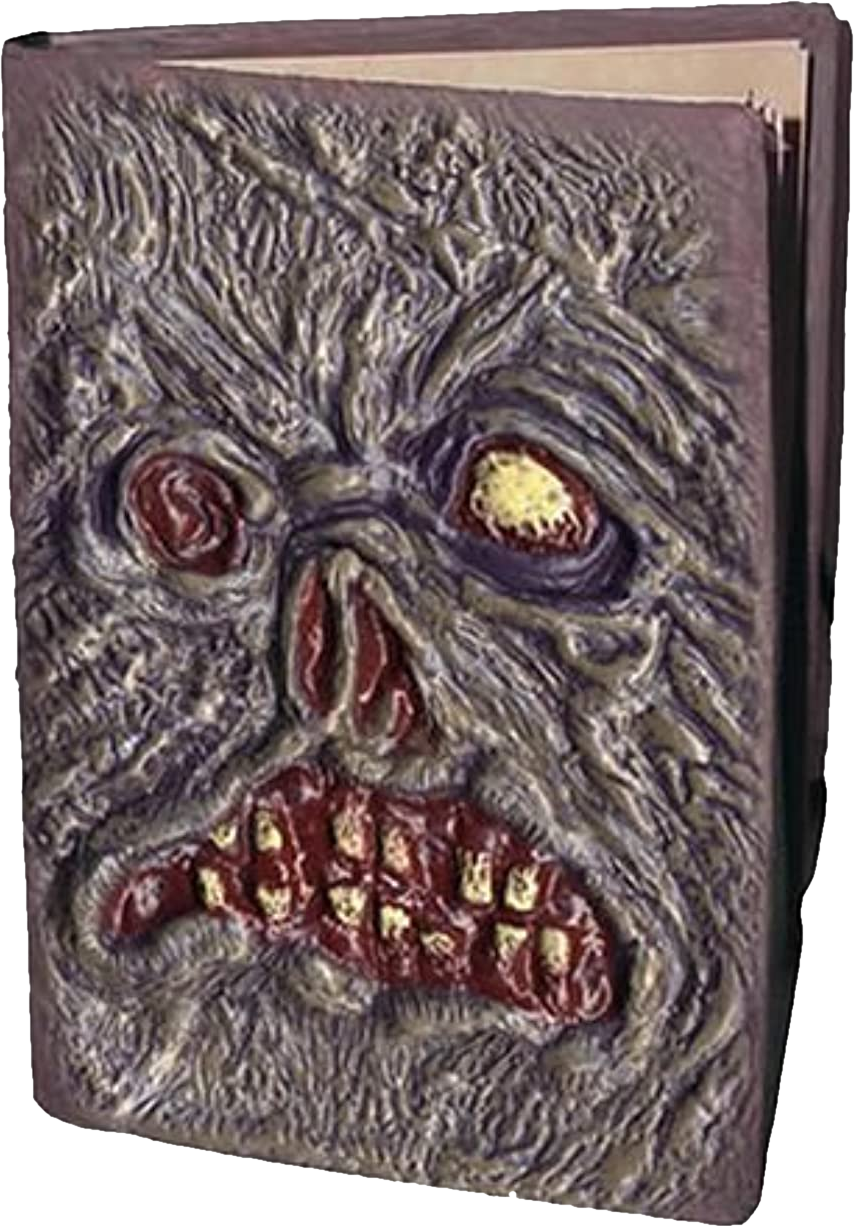
The Evil Counterpart of the Great Big Book of Everything. An old leatherbound book with engravings depicting unpleasant creatures, prophecies of certain doom, and spells that do everything from turning toenails green to stopping (or causing) The End of the World as We Know It. Needless to say, You Do Not Want To Know where that leather and ink came from.
Villains collect these books for their step-by-step guides to bringing about their evil plans. When read by the hapless, they tend to summon The Legions of Hell into the mortal realm. When the books are read by the comic relief, Hilarity Ensues.
In Cosmic Horror Stories, they typically drive their readers into gibbering insanity; the title alone can make them hear voices. Reading from one carelessly can result in an Accidental Incantation.
Normally these books are centuries old, but one common subversion is for them to be modern paperbacks with almost-familiar names — e.g., The Idiot's Guide to Demonology, A Child's Garden of Gibbering Horrors, The Home Handyman's Guide to Building Gates to Hell, Chicken Soup for the Soulless.
See also Artifact of Doom, These Are Things Man Was Not Meant to Know, and Brown Note. Not to be confused with the Great Big Book of Everything or Spell Book, which are more of a neutral nature, or the Deadly Book, which is more actively harmful. May overlap with Tomes of Prophecy and Fate if they have evil prophecies. May serve in-setting as a Monster Compendium, especially in stories in the style of H. P. Lovecraft, in which the heroes sometimes have to familiarise themselves with horrible books, despite the danger to their sanity, in order to understand what they are fighting. Can involve The Fourth Wall Will Not Protect You. In some cases, a character coming across such a book will kickstart the plot.
Examples:
- Grimoires in A Certain Magical Index seem to be this, considering that they allow the user to gain tremendous power, but the results range from (so far) Blood from the Mouth at best and Body Horror at worst. Only the eponymous Index of Prohibited Books has been able to read the grimoires and store them in her head, since she has no mana to power the grimoires. One of the grimoires within Index is the Necronomicon, which was originally just a fictional book until some magicians decided they wanted to bring the Cthulhu Mythos to life and defictionalized it.
- The Black Bible from the Hentai anime Bible Black, replete with demonic rituals. You really don't want to be in the building when this thing gets used. Every major spell requires a Human Sacrifice, and even the minor ones tend to cause cases of Demonic Possession.
- Asta's five-leaf clover grimoire in Black Clover hosts a devil from the underworld which is the source of his anti-magic. His grimoire was formed when Licht was overcome by despair after the elf genocide, turning his four-leaf grimoire into a five-leaf.
- The Death Note probably counts, or at least the portion containing instructions on how to use it, as it’s a notebook used by Shinigami intended to kill humans.
- Digimon: The Red Book of Appin belonging to Baalmon's X-Antibody form. The regular one is just a Great Big Book of Everything, but thanks to the X-Antibody the book has come alive. It will offer people the knowledge contained within it, provided they can best a trail first. If they fail, the Book will attack before Baalmon does and eat them, making them a part of itself.
- The Books of Zeref in Fairy Tail. Black Mage Zeref wrote a bunch of books infused with magic that allows people to accomplish truly awesome and terrifying feats, such as demon summoning and time travel. Each Book contains the rituals and magic necessary to summon a different demon.
- Caster's Noble Phantasm in Fate/Zero is Prelati's Spellbook, a tome with a covering made of human skin. It's a self-powering prana generator and allows the user to summon Eldritch Abominations. It's also called the R'lyeh text, as a Shout-Out to the Cthulhu Mythos. It can also allow Caster to merge with the book in order to summon a gigantic Eldritch Abomination. Is it any wonder that Caster is so absolutely insane?
- Jewelpet Twinkle☆ has a book in which Jewelina encased all the Dark Magic in the world. Anyone who tries to read it for their own purposes risks getting possessed by the book, in which case it's going to try to destroy everything while it has a body. Also, it can turn into a Cool Sword.
- Madlax: The Firstari, the Secondari and the Thirstari are capable of driving cities of men into their darkest emotions, creating doppelgangers, and bringing down airplanes.
- The Book of Darkness in Magical Girl Lyrical Nanoha A's. It managed to open itself despite being chained shut. To power it up, you have to collect the magic power of other people and creatures; if you decline to, it will drain your power instead, slowly killing you. And when all its pages (naturally, there are six hundred and sixty-six of them) are filled, do you think you can wield its power? You're as good as dead, and so is the planet you are on. (The tragedy is that it wasn't originally that way — it has been corrupted by people who wanted to use it as a weapon.)
- Common item in the Read or Die TV series done different ways. One example had a god-like man named "The Gentleman" who had his essence written into a number of such books. In the OVA series, there's a subversion: handwritten notes in the margins of an otherwise-harmless book held the secret to driving the entire human race to suicide. The manga used it straight; The Dark Abyss, a book bound in human flesh, that the publisher required 5 different people to print, a page at a time. Reading it or listening to someone read it instantly resulted in insanity.
- School Mermaid: Revolves around a journal containing a spell when chanted at a certain time at night, will cause human looking mermaids to appear before the user. If the mermaid with the first letter of the boy you love is caught and killed, all you have to do is eat the flesh of it while thinking of your true love and, presto, instant boyfriend.
- The Claire Bible in Slayers. Its author is benign enough (one of the good dragon-gods of the Slayers world), but its subject is the Mazoku race and the dragons' war with them, with extra details on the Mazoku-powered black magic and the secret magic of the supreme creator deity. The genuine Claire Bible is also not a book, but a sphere holding infinite knowledge, however many fragments of it are indeed scribed as books and scrolls.
- In NEXT, the heroes suspect every strange magical effect they hear of to be caused by a Claire Bible manuscript, indicating that even the mundane fragmentary copies can have weird properties.
- Soul Eater has the Book of Eibon, written by a sorcerer centuries ago. It contains the information Arachne used to create the original Demon Weapons, and to turn herself into a pseudo-Kishin. It is currently being used by Noah, who impersonated Eibon, to collect anything he sees as interesting. Such as Death the Kid.
- Which is a shout-out to the fictional tome (aka the Liber Ivonis) from the Cthulhu Mythos (see below).
- The book itself is so evil that it's indexed by sins, and it currently contains at least one of the worst creatures imaginable, Excalibur. Oh, and there's a Great Old One who bears a striking resemblance to Cthulhu.
- And later we learn that Noah is actually a construct of the book itself, embodying one of it's chapters, not it's owner. After the first one (Greed) is defeated, the book produces a new one — embodiment of chapter of Wrath.
- YuYu Hakusho has a videotape, Chapter Black, which serves essentially the same purpose. It's a recording of the worst evils ever done by humans, which human-hating Big Bad Sensui makes a point of showing to his followers to drive them insane with disgust at people.
- Notably, it's part of a two-tape set. The other tape, Chapter White, records the best good deeds ever done by humans, and you're not supposed to watch one without the other. Guess what Sensui did.
- In an episode of The Badger dealing with Lovecraftian beasties, Mavis whipped out her "Pocket Necronomicon".
- The Marvel Universe:
- The tome called The Darkhold was written by the elder (and evil) god Chthon as one of the — if not the — first books of magic ever. Writing the Darkhold allowed Chthon to influence the very nature of magic itself. It contains a variety of spells, but using one equals sealing your soul to Chthon, and most of them work in really sick and twisted ways. The Darkhold is also known as the Book of Sins because of its corrupting influence.
- The Book of the Vishanti is said to contain every counter-spell and all defensive magic ever (to be) known, including a spell to free one from the Darkhold's control. (Oddly enough, it doesn't seem to contain the spell to cure vampirism, which is in the Darkhold.) It also contains a lot of useful lore penned by previous holders of the tome and it seems to explicitly add new pages for current owners to add their own information into its pages.
- Doctor Strange has an entire library of these.
- Kurt Busiek's The Wizard's Tale revolves around an eldritch tome which the inept and not particularly evil wizard must locate and cast spells from. Fortunately, he learns that the good guys hid it rather than destroyed it because it contains a spell to banish evil. He casts it instead.
- Green Lantern:
- In Sinestro Corps War, the Sinestro Corps have the Book of Parallax, which contains everything every Sinestro Corpsman has ever done or will do in the name of causing fear.
- Later on we see the Book of the Black, penned in the tainted black tears of the undead Guardian Scar.
- In the Star Wars Expanded Universe: Dark Empire comics, the resurrected Emperor Palpatine has written two and is working on a third. They were a kind of combination of Necronomicon and Mein Kampf. The Dark Empire series itself is referred to on occasion as "The Dune Sea Scrolls."
- The two completed volumes of the originally intended several-hundred-volume set, to in turn be titled the Dark Side Compendium, were The Book of Anger and The Weakness of Inferiors. The third almost-completed tome was to be titled The Creation of Monsters. In the audio drama Luke comes across tapes of The Book of Anger and finds them horrifically compelling. Just listening to them makes him feel cold and perceive the world as getting darker. It takes an effort of the Force to wrench himself away, and even then he wants to study them.
- The Star Wars Expanded Universe also brings us the Sith holocrons: essentially audio/video/Force recordings of a Sith Lord's teachings and accumulated dark wisdom. They're almost always hidden someplace unpleasant, and if you can find one and disarm all the booby traps, you might get lucky enough to learn something. Sith holocrons also contain an imprint of the personality of whichever Sith Lord created them. If the Holocron finds you worthy, it will try to corrupt you into a successor to the dead Lord, while if not it might well try to manipulate you into getting yourself killed. Have fun!
- The My Little Pony G1 Comics contains The Book of Horrors, an ancient tome kept locked away in Majesty's Secret Room in Dream Castle. In the comic story Ponyland in Danger it is consulted by Majesty and Gypsy after they both see ominous indications of an ancient evil approaching in the form of a red cloud.
- In Lori Lovecraft, Lori acquires all of her occult expertise and power from a copy of the Necronomicon given to her by the ancient priest Ama Ton for protection in My Favorite Redhead.
- Supergirl (1984): Selena can be seen perusing a large, heavy, leatherbound copy of the Necronomicon and reading up on summoning elemental demons right before Supergirl crashes into her lair. One black, horned skull-and-crossbones symbol is drawn on the red front cover.
- Vampirella: Giacomini's Apocrypha. Originally called the "De Fascino De Libre Tres", the book was written by a Catholic bishop named Vairo who was an expert occultist that understood the "fascination of evil". The book was stolen by one of Vairo's priests, Domenico Giacomini, who was jealous of the attention Vairo's work received in Rome. Forming a cult known as the Council of Worms, Giacomini took the ideas contained in the book further than anything Vairo had come up with and basically transformed it into an instruction manual on how to traffick with demons. The Council of Worms were eventually killed by the Cestus Dei, a covert operations force formed by Pope Clement X. It was believed the Apocrypha was destroyed by the Cestus Dei, however, some of the information within it survived and was scattered across the globe. Von Kreist intends to use it to restore his original body.
- Wonder Woman (1987): Back during WWII the protective magical barrier around Europe was dropped temporarily in order for Paula von Gunther to read from an unsettling magical tome in a cathedral under Hitler's watch and turn herself into a powerful monster.
- Knights of the Dinner Table lampshades this while the knights are playing Scream of Kachoolu (the webcomic strips, bound in Tales from the Vault 5): Brian warns everyone to burn all books they find. This is further compounded by the fact that the last campaign ended messily with Bob's character reading a traveler's guide to Boise.
- In the Jackie Chan Adventures fic Queen of All Oni, Jade is searching for the Teachings of Eternal Shadow (a series of three tablets with the Black Magic of the Shadowkhan/Oni on them) so she can increase her own power and keep Jackie and the other heroes from capturing her.
- In the Harry Potter fic Inter Vivos, Draco's mother gave him a book that contained "a great deal of Dark Arts knowledge—spells, but also rituals, potions, and many other things, willed into the book by its possessors". When asked a question, it would shift into a book about whatever the subject might be — provided you asked it the right questions.
- The "Black Book" in Fallout: Equestria. It contains dark, necromantic zebra magic designed to conjure flesh-eating megaspells, the creation of Soul Jars, Blood Magic and other nasty things. Notably, it has a malicious aura that both tempts the owner to read the book, along with other maddening effects; one courier chewed his hooves off.
- Luna becomes Nightmare Moon by reading an unnamed book about dark magic in Whispers.
- Parodied in the Reading Rainbowverse by the shadowbolts book. While it can add and remove itself from the library catalog, the most terrifying thing it does is draw a dick on Lightning Dust's head.
- In Altered Histories
 Circe was a necromancer who created her own version of the Necronomicon, made of skin flayed from the backs of a thousand men and capable of containing a thousand souls.
- In My Little Balladeer, human Thorne has the ''Letters Of Cold Fire'', a particularly nasty example of this trope because it has been enchanted to force any mage reading it to release Discord from his stone prison.
- Inquisitor Carrow writes one as a present for Hermione Granger.
- In Split Second (My Little Pony), Sparkle possessed several of the books in a series of these tomes. Interestingly, the book itself is alive.
- In the lore of Sonic X: Dark Chaos, the Bible and the Koran are depicted as this, driving people to madness and being able to summon Lovecraftian horrors with the right versions.
- In The Bridge, all of the villains trained by Grogar — Equestria's Nexus of Dark Magic — were gifted with one of these. Scattered among the four of them are the components of the spell needed to free Grogar from his imprisonment.
- The Book of Characters in The Keys Stand Alone: The Soft World might count, though ultimately it's just a throwaway MacGuffin rather than any major influence on the world. Its main significance to the four is that after George destroys it to save lives, they're fined 150,000 Swords and threatened with jail/endless pursuit if they don't pay the fine. They spend several days struggling to get the money.
- A major plot point in Child of the Storm is the Death Eater/HYDRA alliance led by Lucius Malfoy steals the Darkhold and gifts it to Gravemoss. Like in it comic canon counterpart, it's the ultimate book of Black Magic, created by Chthon as a Soul Jar to maintain his foothold in reality. The book itself is indestructible, and it just being outside of its containment causes reality to slowly start breaking down.
- The Word of Kemmler appears in the sequel, Ghosts of the Past. Unlike most examples, it's not inherently magical, and neither were the other books Kemmler wrote. However, its predecessors contained a lot of serious necromantic knowledge, which back in the early to mid-20th century meant that a lot of otherwise fairly minor dark practitioners got hold of the How To guide on real necromancy. The Word of Kemmler is the worst of the lot, as among other things, it contains the instructions for a necromantic ascension into a Physical God.
- The trope is also parodied in said sequel, with Doctor Strange supplying Harry with a number of relevant books, often with snarky titles. Examples include: Blood Magic for Morons (which Strange wrote himself — Harry strongly suspects that he titled it such because being a Seer, he knew that Harry was going to do something stupid), Everything You Wanted To Know About Vampires But Were Too Afraid To Ask, The Necrotelecomnicon ('The Phonebook of the Dead'), and Liber Paginarum Fulvarum ('The Book of Yellow Pages').
- The Freeport Venture: The Black Codex is an infamous grimoire written by a cabal of warlocks and lunar cultists during the Lunar Rebellion and containing information on every form of Black Magic in existence, including things like necromancy, Mind Control and demonology. Most people don't believe it's anything more than a myth, a belief the Equestrian government encourages to cut down on the number of would-be warlocks trying to get their hooves on it. In Freeport Venture: Auction Night, a copy surfaces... at an auction house in the local Wretched Hive. Sunset spends the rest of the story trying to get before a known warlock facilitator does. Uniquely, the Codex is not magically enchanted, cursed, or even difficult to use, which is exactly what makes it so dangerous; Most dark magic books like this either requires a fair bit of knowledge of the subject to understand, or is full of magical traps and curses. The Black Codex is an introductory primer to the most horrific Black Magic imagineable.
- Deconstructed in Cant. As the tome is so old, it's at risk of falling apart entirely, and as the writer was insane (or, in this case, drunk) when she wrote it, its instructions for summoning eldritch beings are wildly off-base and would never work. Reconstructed when none of this stops it from being dangerous, as the mere act of copying the writing is implied to do something to Twilight, slowly driving her to an unhealthy obsession with replicating the book exactly as written.
- A Diplomatic Visit: The seventh chapter of the fourth story, The Diplomat's Life, mentions the "Inspiration Manifestation" spellbook from canon, and that Rarity encountered it while Twilight was on her world tour. Thankfully, Princess Celestia noticed what was happening in time and stepped in to deal with it.
- a string of words: Chapter nine, "summon", involves Trent buying an old book supposedly used for "communing with the forces of Hell", though he doesn't believe it. After a few drinks, he and the rest of the band accidentally end up summoning a demon for real.
- The Barabbas Manuscript from The Awakening of a Magus. An ancient tome with five original copies, with Draco's grandfather giving him the presumably only surviving copy. Among other things, it has hidden text visible only to descendants of the demon Klaatu, and absent in all secondary copies.
- The New Adventures of Invader Zim:
- Season 2 Episode 9 features the Ikiwikinomicon, a blatant parody of the Necronomicon which when active is capable of transforming people into mindless monsters.
- The sixth entry of the non-canon spinoff New Adventures: Mature Edition features the Tome of the Abyss, the book that Gaz uses to summon Kastrofi after the writing changes itself from some ancient alphabet into English for her to more easily read.
- Sausage Party features a cookbook being treated as this. It's found in the "Dark Aisle" (i.e. the place where cook and kitchenware are located), and its illustrations of foods being cooked and eaten are presented with all the same horror as the grisly artwork inside the Necronomicon. Frank tears pages out of the book to show to the rest of the store in order to get them to believe him.
- Asylum (1972 Horror): In "The Weird Tailor", Smith says that he spent his entire fortune to buy a very expensive, one-of-a-kind mystical tome. Its full contents are not revealed, but at the very least, it details how to make a suit that will bring a corpse back to life.
- The eponymous book in The Babadook. A pop-up book, believe it or not, one which seems to be a bedtime story for kids, the book is not just magic and cursed, but alive, sort of. The monster seems to become more and more sapient the more the book is read, and stronger the more disbelieving adults deny that it's real, tormenting children and parents alike. Tearing the book up only makes it come back with a scarier story, and while burning it prevents that, it doesn't get rid of the monster; the protagonist has to resort to other methods to finally crush it.
- Gray's Sports Almanac from the Back to the Future movies. Technically an ordinary sports almanac purchased in a conventional book store in the then-future year of 2015, this book truly matches the trope when brought 50 years into the past, as it contains information on the outcome of sports events from 1960 to 2000. Biff Tannen is able to use the knowledge to amass a fortune from gambling, eventually creating a Bad Future where he rules. Much like the typical cursed tome, burning it at the end of the second movie is required to Set Right What Once Went Wrong.
- Beetlejuice has the Handbook for the Recently Deceased, which explains important things to know right after you die, making it a rare instance of a Tome of Eldritch Lore that's actually helpful. Unfortunately, it isn't very reader-friendly, as it reads like stereo instructions.
- Big Tits Zombie also features a version of the Necronomicon, which summons and controls zombies.
- In The Butchers, The Book of the Dead is used to cast a resurrection spell that brings the serial killers back from the dead.
- The Cabin in the Woods kicks off its serious horror elements with the reliable Latin incantation from a spooky old book. Marty, the Erudite Stoner, immediately sees where this is going.
Marty: "Okay, I'm drawing a line in the fucking sand here. Do not read the Latin."
- Italian director Lucio Fulci used two. City of the Living Dead had the Book of Enoch (an actual text used in the Ethiopian Orthodox Church, though it probably doesn't really open the gates of Hell), and The Beyond has the Book of Eibon, which has first written about by Clark Ashton Smith, and used in Lovecraft's "The Haunter of the Dark", "The Dreams in the Witch House", and "The Shadow Out of Time".
- The Lifetime (of all things) movie Devils Diary references a book found in a graveyard, planted there by a lightning strike. Anything negative you write in the book will come true.
- Dead Birds: Todd and William find one while searching the house. It contains a ritual for raising the dead, which apparently involves the torture and murder of many. Hollister performed this ritual to resurrect his wife, who had fallen ill and died. Instead of getting her back, he let something else in that turned his children into monsters.
- Evil Dead featured a book called Necronomicon Ex-Mortis, which, when read, resurrected a bunch of evil Kandarian spirits. In the first movie and the beginning of the second, it was called the Naturom Demonto. By the time of Army of Darkness, it was just called the Necronomicon.
- Saviour of the Souls in The Hazing; an age old book of blood rituals rescued from the ruins of an corrupt ancient monastery by Professor Kapps' ancestors that allows the possessor to travel between the dimensions of life and death to return from the grave through a rite of possession.
- In the Mouth of Madness features the popular horror novelist Sutter Cane, whose last book is So Bad Its Horrible, if inexplicably well received by the public. Still managed to have a movie made, which was almost as well received as the book and made quite an impact on audiences around the world.
- It doesn't have a name, but Winifred's book in Hocus Pocus qualifies. Given to her by Satan himself, it is bound in human flesh and cannot be destroyed by any known method (when the protagonist tries to burn it, it doesn't burn). It's also alive, proven by an eyeball set in the cover, which moves around on its own accord. Among the evil spells that Winnie casts from this book is the curse she places on Thackery which turns him into a cat and makes him unable to die, and a spell which raises her ex-lover Billy from the dead as a zombie; it also contains the recipe for the potion used to keep her and her sisters forever young — at the cost of the lives of children.
- In Merlin's Shop of Mystical Wonders, Merlin, of all people, gives one of these to a snobby critic, of all people, to try to persuade him that magic is real. As a result, the critic summons a demon, sets fire to a cat, almost crushes himself and eventually manages to provide his wife with the baby she desires by, in a bizarre kind of "reverse incest", turning himself from her husband into her son. Naturally, Merlin thinks this is a jolly delightful jape.
- The Mummy (1999) had the Book of the Dead, which unleashed the title monster upon the world, as well as its good cousin, which stripped him of his undead immortality and made him mortal.
- Night of the Demon: Cult leader Karswell has one of the only copies of an ancient tome on witchcraft and demonology, written in ancient runes he claims are unreadable — though it turns out he has the translation, and uses it.
- The plot of the movie The Ninth Gate (based on The Club Dumas, above) revolves around a book called De Umbrarum Regni Novem Portis ("The Nine Gates of the Kingdom of Shadows"). All known copies of the text were burned along with their author Aristide Torchia because it was an adaptation of an earlier work called the Delomelanicon (the Invocation of Darkness), supposedly co-written by the Devil himself and contained clues on how to summon him in person.
- One Night in October: Kate finds an old book full of pages containing magic images while she's hiding in the barn from the killer.
- In Warcraft (2016), the ornate book Khadgar finds in Medivh's vast library is a tome on the Portal and fel magic, both of which are pretty much evil.
- In Warlock (1989), the Grand Grimoire is a Satanic book that was broken up long ago. When brought together it reveals the hidden name of God, which if said backwards will undo all that he created and destroy the world.
- Arthur Machen's story The White People predates the Trope Namer: during a discussion on the nature of sin, an ascetic gives his friend a "green pocket-book" with a "morocco binding", used by a young girl as a "book of secrets" (she says she has many others) to record her engagements with The Fair Folk, who in this story are definitely more on the "eldritch" side of elvish. Hilariously, said book appears to have a sequel, T. Kingfisher's "The Twisted Ones," that leaves a lot to be desired.
- Clive Barker's Books of Blood has the creation of the "books" as the story vehicle behind the telling of these short stories. A researcher meets a famous medium who's supposed to be able to communicate with the dead but is actually a fraud. At the site of an actual haunting, the spirits of the dead are enraged at the conman's buffonery so they give him what he claims. The ghosts render him helpless as they take broken glass and carve all their stories of woe into his flesh. The researcher is unharmed and actually rather pleased by this event as she reads the stories written on his skin.
- The Necronomicon of H. P. Lovecraft's Cthulhu Mythos is the Trope Codifier and quasi-Trope Namer (the term "Eldritch", meaning "otherworldly", being pretty much only used by Lovecraft or writers trying to sound like him). It's the definitive book of black magic, created by Lovecraft as a sendup of the real-life "black books" — but since Lovecraft found them kind of underwhelming, he upped the scariness factor by creating his own. Unlike many later versions, in Lovecraft's stories the book is just a mundane, rather rare medieval text — it's what it reveals about our place in the universe that drives the reader mad, not some inherent magical quality of the book itself.
- Lovecraft claimed the name Necronomicon meant "Image of the Law of the Dead" in Greek, but due to his rather lacking education, that's not quite what it means. Modern translations use "Book of the Dead", which isn't quite accurate either. Other authors translated it to "Book of the Laws of the Dead" or "Book of the Names of the Dead"; S.T. Joshi has it as "Book Considering the Dead" or "Book Classifying the Dead". Lovecraft also wrote a short piece, "The History of the Necronomicon", which traces the text from its origin — the Arab mystic "Abdul Alhazred"note — and its original title Kitab al-Azif, through Greek and later German translations, and in his stories the characters usually only have access to the medieval German version.
- The Necronomicon has now become so ingrained in Western culture as the definitive Tome of Eldritch Lore that it's been Defictionalized, to an extent. Obviously, no one can print a Necronomicon that actually drives you mad, but enterprising pranksters have inserted fake library card entries for the book (using its ostensible author "A. Alhazred", from the books' "Abdul Alhazred the Mad Arab"). The book has also been used as a sort of shorthand for the Cthulhu mythos as a whole (for example, My First Necronomicon, a primer to the mythos for children, bound in soft felt no less). Some people aren't convinced it's fictional, and during the "Satanic Panic" of The '80s and The '90s, several instructional guides on how to tell if your kid was involved in Satanism asked if they had ever read the Necronomicon. Among the books calling themselves the Necronomicon are:
- A collection of short stories about the fictional Necronomicon by H. P. Lovecraft and other writers.
- A collection of artworks by H. R. Giger.
- At least two books purporting to be the "real" Necronomicon, which contains a hodgepodge of Sumerian mythology, Hermetic lore, Kabbalah, and other mystical writings. In no way do these stories relate to Lovecraft's works.
- One written by Donald Tyson that details the "wanderings of Alhazred", probably the closest to Lovecraft's original idea.
- Countless omnibus collections of Lovecraft's stories.
- It's had all manner of Shout Outs in all manner of mediums, from Evil Dead to Magnus to Unknown Armies. Many of them are listed elsewhere on this page, and even if they don't refer to the Necronomicon by name, they're clearly heavily inspired by it.
- The original Weird Tales circle featured many books of dark lore other than the Necronomicon, including:
- Clark Ashton Smith's tome of choice, the Liber Ivonis or the Book of Eibon;
- Robert E. Howard's Nameless Cults or Die Unaussprechliche Kulten — Lovecraft thought the latter was German for "unspeakable cults", but it's actually closer to "unpronounceable", which given the names of the Great Old Ones is probably more appropriate; and
- Robert Bloch's Cultes des Goules and De Vermis Mysteriis, the latter of which is featured in Stephen King's short story and Lovecraft homage "Jerusalem's Lot", in The Eyes of The Dragon, and in Revival, in which it is claimed to be the "real" book that inspired Lovecraft's Necronomicon.
- The Call of Cthulhu RPG gave us the Massa di Requiem par Shuggay, an "opera" that is impossible to perform, namely because an uninterrupted performance will lead to Azathoth being summoned midway through the second act, leading to everyone going mad and The End of the World as We Know It.
- Terry Pratchett's Discworld:
- A recurring parody of the Necronomicon is the Necrotelicomnicon, translated as "On Communing with the Deceased" or the "Phonebook of the Dead". It was written by "Achmed the Mad", who prefers to be known as "Achmed the Sometimes I Just Get These Headaches" — his About the Author page spontaneously combusted, leaving only the "Other Books by the Same Author" page (which has only one entry, Achmed the I Just Get These Headaches's Book of Humorous Cat Stories). Reading it will drive a man insane, and Equal Rites recounts the unfortunate case of a mage who tried to read it and was not only never seen again, but whose compatriots noticed that the book became several pages thicker. It's kept at the Unseen University library by the Librarian, who deals with the book containing things man was not meant to know by being an orangutan and thus not technically a "man" — but he does get a headache and a nasty rash. The Necrotelicomnicon also appears in Pratchett's collaboration with Neil Gaiman, Good Omens, and from there to Gaiman's The Sandman (1989) (under its alternate title Liber Paginarum Fulvarum, which is Dog Latin for "The Book of the Yellow Pages").
- The Octavo is a book containing the eight most powerful spells, left behind on the Disc by its creator. Rincewind "accidentally" read the book and got one of the spells stuck in his head, which left him unable to learn any other spells (even after getting rid of it) and drove much of the plot of the first two books.
- One of Pratchett's many footnotes describes how the Unseen University library has some books chained to the shelves. It's a sendup of Oxford's Bodleian Library, which does this to stop the students damaging the books. At UU, though, it's the other way around — and sometimes it's to protect the books from each other.
- Another of Pratchett's footnotes describes Unseen University's several volumes of sex magic, one of which must be kept in a room full of ice. Humans can't read them without being driven a very specific type of mad. The Librarian, on the other hand, gets unusual feelings about fruit for a while.
- Almost Night has the book by the previous Dark Lord McEvildude. The cover is bound in human flesh, the ink is made from orc blood, and each page is made from dryads.
- In I Shall Wear Midnight, the Bonfire of the Witches, written on behalf of the Cunning Man, is so full of his hatred of witches that a copy of it allows a curse ineptly attempted against a witch to work simply by being in its proximity, and later almost allows said creature to manifest into the world through its pages before it's pressed shut very decisively.
- Robert W. Chambers' The King in Yellow stories feature the eponymous play which simultaneously enlightens and drives mad anyone who reads it all. Reportedly, the first act is normal enough, but glimpsing even the first few words of the second compels people to finish the whole thing and expose themselves to all manner of hideous revelations. (Presumably a production would be impossible to stage.) Only a few brief excerpts, not enough to clearly indicate the plot or subject matter, are ever given. Likewise, the Yellow Sign is never actually described. Chambers' stories predated Lovecraft's Cthulhu Mythos stories and Lovecraft cited them as an inspiration.
- The Dictionary of the Khazars, as described in the lexicon novel of the same name, was printed in a poisonous ink. Remarkably, this ink causes convulsions, pain, and eventual death not from licking or eating the pages, but from reading them, and death would always strike at a particular point on the ninth page.
- In Betsy the Vampire Queen, the "Book of the Dead" can only be read for a page or two at a time before it starts to mess with your head. As it contains instructions and prophecies for Queen Betsy's entire reign (whether or not it has more unpleasant spells is not mentioned), it also serves as a Great Big Book of Everything.
- The vampire novel The Historian has one which has the effect of attracting Vlad Dracula and his minions to those who find a copy. This is made creepier by the fact that the novel actually looks like the Tome of Eldritch Lore described within.
- The Club Dumas by Arturo Pérez-Reverté reproduces the nine illustrations that provide the clues to invoke the Devil in the tome of eldritch lore (De Umbrarum Regni Novem Portis — everything occult sounds better in Latin), repeated each time the protagonist finds one of the three surviving copies of the Novem Portis, as each one has a subtly different set of illustrations. There is a Twist Ending that hinges on these differences. It is little surprising that these illustrations are supposedly reprinted from the fabled Delomelanicon, or Invocation of Darkness, which legend has it was co-written by Lucifer himself.
- Jackie and Craig features Talon's Diary, which she keeps chained to her wrist. A combination of a teenage girl's Secret Diary and a record of unholy black magic and mad science experiments, it's pink and has a heart drawn around the Necronomicon Sigil on the front. Craig gets a glimpse of the inside and sees crude diagrams of people vivisected in human sacrifice.
- From the Warhammer 40,000: Eisenhorn series of novels:
- The Necroteuch from the first book emits an aura of incredible evil, so it's a bit of a no-brainer what to do with it; although it's the entire focus of the book, no one knows, needs to know, or cares to know what exactly it does. Until you trick a Chaos Space Marine into picking it up and take advantage of its effects to kill him.
- The Malus Codicium contains many scriptures on things like daemon-summoning and binding and slowly corrupts the reader. The protagonist, an Inquisitor, perfectly used to dealing with such artifacts, finds this book particularly creepy — because it doesn't give off a sinister aura like the others.
- Played for comedy in Bruce Sterling's Schismatrix with "the literature of the [untranslatable]".
- In the Whateley Universe:
- One of the main characters, Sara Waite, is a young Eldritch Abomination. She owns shelves full of these books and considers them ideal casual reading material. As long as she can remind them not to eat her friends.
- The Whateley library has a restricted section of these books. And a really restricted section of the worse ones. However, there are some books even they don't dare touch — those are in Sara's library.
- Horror novelist Michael Waite's best-seller Incongruity is really the First Book of Kellith. The relationship between Michael Waite and Sara Waite is... complicated.
- F. Paul Wilson's Repairman Jack series has the Compendium of Srem, which translates itself into your native language for your cans-of-evil-unsealing convenience.
- In Stephen King's The Eyes of The Dragon, the wizard Flagg has such a book that he has been reading for over one thousand years and is less than a quarter of a way through, lest he go mad from reading it too quickly.
- The Old Kingdom trilogy:
- The Book of the Dead is a green leather-bound book that's different each time it's read and shows a certain disconcerting independence of movement — i.e. it knows where it needs to go and will follow along with someone headed in that direction, with or without their cooperation. It can only be opened by a necromancer and closed by an uncorrupted Charter mage — that is, the Abhorsen and their successor. Normal people find it exudes an aura of deathly chill and utter terror. It's not actively malevolent, though, since it's kind enough to ensure that the reader doesn't remember the more horrifying sections until they really really need to.
- In the second book of the trilogy, Lirael takes on a job working in the Great Library of the Clayr, which is a bit more like a museum. The books (and "exhibits") range from the prosaic to works of great magic, which are kept under lock and key. This has the unfortunate side-effect that if one of said exhibits gets loose somehow, the person responsible has to find a sneaky way of getting at highly protected books if she wants to have any chance at all of stuffing it back into its can.
- In the young adult horror anthology Still More Scary Stories for Sleepovers, the short story "Night of the Ki-Khwan" has an example. The protagonist's scholar mother brings home a collection of texts that describe Native American rituals. One of these rituals provides instructions on summoning the titular Ki-Khwan, who are essentially Native American werewolves. The protagonist and his friends, being young and foolish boys, decide to give some of the rituals a shot late at night in the woods for a thrill. To their horror, they succeed in summoning the man-beasts. Just when it seems like they can keep their campfire going long enough to keep the creatures at bay, a rain dance they performed earlier kicks in, putting the fire out.
- In the guide book How to Be a Villain, its guide to weapons contains books of evil, which more or less fit this trope perfectly.
- John Barnes's One for the Morning Glory features Highly Unpleasant Things It Is Sometimes Necessary to Know and worse, Things That Are Not Good to Know at All.
- Tad Williams' Memory, Sorrow, and Thorn trilogy:
- Du Svardenvyrd (The Weird of the Swords) is a perfectly straight example of this trope. Written by a mad prophet, it causes mortals who read it to Go Mad from the Revelation, and it is eventually revealed that the book is basically an instruction manual for summoning the undead Storm King back into the world. The book doesn't have any inherent mystical power, but the secrets it reveals are too much for a sane mind to accept.
- The sequel The Last King of Osten Ard has Bishop Fortis' Treatise on the Aetheric Whispers, a book which has been banned by the church since the mysterious disappearance of its author, over two hundred years ago. The censors' copy is kept apart from other books.
- The Book Bound in Pale Leather in P.C. Hodgell's Chronicles of the Kencyrath books works a lot like this, even though it was given to the Kencyr people by their God. Said god is not exactly nice, and neither is the book; reading too much of it can drive you mad or kill you, and the Master Runes inside are highly dangerous to use. Oh, and that leather? Human skin, and the Book appears to be alive; dropping it gives it bruises.
- The Shannara Series by Terry Brooks has the Ildatch, an Artifact of Doom dating back to the war between the good Fae and the Demons. Filled with dark magics, it corrupted the rebel Druid Brona into becoming the Warlock Lord, transformed his followers into the Skull Bearers, and later transforms a new group of people into the Mord Wraiths. Destroying it serves as the main plot in The Wishsong of Shannara. Unbeknownst to all, the book is alive, reasoning, and the Big Bad of the entire trilogy. It nearly turns Brin, the main character, into a monster, before her brother brings her to her senses, enabling its destruction.
- In Ben Counter's Warhammer 40,000 Horus Heresy novel Galaxy In Flames, Loken runs across a book that changes languages (and alphabets) under his gaze, gives him horrific visions, and convinces him that the Outgrown Such Silly Superstitions view of the Empire is wrong.
- In The Cassini Division, a Fall Revolution book by Ken MacLeod, two characters peruse a market stall selling old books. One tome, Home Workshop Nanotech by a "Dr. Frank N. Stein", published some 250 years before the events of the book, explains in straightforward terms how to make replicating nanotech using a simple computer, some household chemicals, and a tunnelling electron microscope. Sci-fi to be sure, but a mysterious ancient book containing world-shattering knowledge of things man was not meant to meddle with makes it pretty eldritch.
- In The Golden Dream of Carlo Chuchio, the hero buys a mysterious book in a market and finds that it contains not only tales of old but a treasure map. The description implies that the book is a Shout-Out to the Arabian Nights.
- The Dresden Files typically subverts the trope, as the White Council encourages the spread of books of dark rituals — they only have a limited amount of power to draw from, so mass publication tends to dilute them into uselessness. But in some cases, there are works which contain knowledge that's too dangerous to know regardless of the power of the book itself.
- In Dead Beat, "The Word of Kemmler" is a book written by the necromancer Kemmler, a major Big Bad who was responsible for a whole mess of atrocities and other badness throughout history, up to and including World War I. Yes, all of it.
- Dead Beat also features Der Lied der Erlking, a collection of poetry, art, and prose dedicated to the Erlking, head of The Wild Hunt. Among all that poetry is a summoning rite meant to bring the Erlking and the Hunt into the world.
- The short story El Libro de Arena ("The Book of Sand") by Jorge Luis Borges contains a variant. The bibliophile protagonist trades a priceless 14th-century Bible for a mysterious book in an unknown language that has no beginning, no end, pages that are out of order, and never allows the reader to see the same page twice — and it is implied that the number of pages is infinite. Over time, he loses what few friends he has and spends every waking minute fanatically obsessing over a book he cannot read, copying pages and illustrations before they vanish forever. But unlike most such stories, this one appears to end relatively well — the protagonist recognizes the evil of the book and disposes of it. He doesn't want to burn it, thinking that could be dangerous given the book's physical properties, but he does put it in a random, dusty shelf among the National Library's 900,000 books, ensuring that neither he nor anyone else will ever find it. The story implies that he was better off with his good old-fashioned Bibles.
- The Grimmerie from the novel Wicked is implied to be one of these, but no Ozian can actually read the thing. Elphaba can make out bits and pieces, but that's because she turns out to be only half-Ozian. It's also revealed that the Wizard's entire despotic reign is a mere Evil Plan to get his hands on it.
- These are apparently pretty commonplace in Harry Potter:
- Harry Potter and the Prisoner of Azkaban: Hagrid's Care of Magical Creatures class includes The Monster Book of Monsters as required reading. The book is a sentient beast that will bite you if you try to open it. The only way to safely read it is to stroke its spine, which will soothe it and convince it to open for you. Hagrid apparently thinks this is common knowledge and is genuinely befuddled on the first day of class to see that none of the students have figured this out and have tied their textbooks shut in various ways. They are a pain in the ass for the owner of Flourish & Botts to stock too, with him having to keep them in a cage so they can't hurt customers.
"I'm never stocking them again, never! It's been bedlam! I thought we'd seen the worst when we bought two hundred copies of The Invisible Book of Invisibility — cost a fortune, and we never found them."
- Harry Potter and the Half-Blood Prince: The graffitied copy of Advanced Potion-Making contains margin notes by someone called the "Half-Blood Prince" (who turns out to be Severus Snape), which provide a lot of useful advice to Harry on how to make potions — better than the textbook itself (which frustrates Hermione to no end). It also contains a lot of other spells, and when Harry tries one labeled "For Enemies" on Draco Malfoy, he nearly kills him from the ensuing blood loss.
- The Restricted Section in Hogwarts' library contains books that more traditionally fit the "Eldritch" role, having to be chained to the shelves or screaming when they're opened. Early on, Ron warns Harry of books that burn people's eyes out, that are impossible to stop reading, or that make you speak in limericks for the rest of your life. The protagonists find that it's pretty easy to get a professor to write a permission slip for you to go in there; they do this as early as Harry Potter and the Chamber of Secrets to learn how to make a Polyjuice Potion (and get Lockhart to sign off the form under the guise of getting an autograph). Oddly enough, when Harry learns about Horcruxes in Half-Blood Prince, Hermione scours almost the entire restricted section to learn what they are and finds one reference, in a book titled Magick Moste Evile (which apparently makes a "ghostly wail" when closed), and mentions them only to say that they are so evil they will not be discussed. It is later revealed that the school does have a book which explains about Horcruxes in detail, called Secrets of the Darkest Art. However, Dumbledore confiscated it from the Restricted Section years ago, and is implied to have done this because Tom Riddle used the book as a reference to create not only one, but seven Horcruxes.
- Chamber of Secrets: Tom Riddle had a diary, which talks back to you when you write in it. It possesses Ginny to sic a Basilisk to petrify muggleborn students, and convinces her to open the eponymous chamber, and it nearly kills her and replaces her with the teenaged Tom. Said Tom Riddle turns out to be the future Lord Voldemort, and Harry finds out much later that the diary was a Horcrux.
- Harry Potter and the Prisoner of Azkaban: Hagrid's Care of Magical Creatures class includes The Monster Book of Monsters as required reading. The book is a sentient beast that will bite you if you try to open it. The only way to safely read it is to stroke its spine, which will soothe it and convince it to open for you. Hagrid apparently thinks this is common knowledge and is genuinely befuddled on the first day of class to see that none of the students have figured this out and have tied their textbooks shut in various ways. They are a pain in the ass for the owner of Flourish & Botts to stock too, with him having to keep them in a cage so they can't hurt customers.
- G. K. Chesterton's Father Brown story "The Blast From The Book" subverts it — the whole thing is an elaborate practical joke.
- Thoroughly deconstructed and parodied in R.A. Wilson's The Masks of Illuminati, where a number of people are apparently mailed copies of a book that after only the slightest glance inspires them to thoroughly destroy the volume and then enter a suicidal mania. As it turns out, the whole thing was elaborately fabricated for the narrator's benefit. The real kicker is that the book was Mother Goose's Rhymes — and it had even been subtly foreshadowed earlier in the story!
- Conan the Barbarian:
- In "A Witch Shall Be Born", the title witch did not mind when the magician who raised her drove her off:
I could never endure to seclude myself in a golden tower, and spend the long hours staring into a crystal globe, mumbling over incantations written on serpent's skin in the blood of virgins, poring over musty volumes in forgotten languages.
- Several Conan stories mention "The Book of Skelos", an ancient tome of black magic that contains spells for summoning demons.
- In "A Witch Shall Be Born", the title witch did not mind when the magician who raised her drove her off:
- In Valentin Ivashchenko's Dancing Flame:
- The unnamed tome on necromancy, written by the last grand necromancer Yaromor, contains pure Black Magic knowledge and a large fraction of Yaromor's power, granting both to the current user. The power also actively searches for new users every few centuries, although Heroic Resolve allows one to contain the power without being corrupted. Killing the user grants the world said few centuries of peace, thus forcing a later generation to deal with the next grand necromancer.
- Earl Valle is the most powerful and most studious necromancer to ever live, and his spellbook contains a few things generally thought impossible for necromancers by the setting's Mutually Exclusive Magic. Valle himself was disgusted by the book's contents, so he just destroyed it.
- In Vitalij Zykov's Return series, this trope takes the form of stone tablets rarely found at relic sites of ancient civilizations. The tablets are covered with text in a language older than any humanoid race, including two elven races. It's only known that the tablets contain magic-related information. The protagonist happens to learn said language by Exposition Beam, learns one of the spells, and casts it in a magical duel. The resulting damage is considered overkill in comparison to magical carpet bombing by dragon squadrons.
- In Strong Spirits, the protagonist's rival in mediumship, Cockcroft, has acquired a famous necromancer's Tome of Eldritch Lore and wants to summon the author's ghost to help him figure out its cryptic contents. Subverted when the ghost is finally contacted and admits he was a charlatan who wrote a fraudulent "spellbook" to impress the rubes.
- The grimoire of King Gorice of Witchland in E. R. Eddison's The Worm Ouroboros is used to harness the powers of Hell.
- Nick Perumov's Keeper of the Swords series has the book Of the Essence of Otherbeing by Evengar of Sallador, which is a typical example.
- The Book of Salzared in The Beyonders only contains a few pages of material explaining the Word that can destroy the Emperor and the first syllable of the Word, but it's enough to be considered one of these. And since the author, and source of the leather used to bind it, was a Displacer, it's still alive.
- In Pact, the protagonists Blake and Rose Thorburn discover that their departed grandmother was not only a powerful diabolist, but that she wrote several dozen such books on the subject of the forces that she trafficked with, and had left them to her heirs upon her death. The given comparison is suddenly inheriting control of a historically troublesome rogue state with access to nuclear weaponry.
- In the webnovel DO NOT TAKE THE SHELLS, Jonathan Vaun's bookcase contained several of these. One of them is named "The Ancient Art of Daemonism", and another "A Window into Providence".
- The three books in Dance of the Butterfly could be, but their actual use is never fully explained. They are highly sought after and guarded closely by those in possession of them.
- The Sister Verse and the Talons of Ruin has the eponymous Sister Verse, a book that eats any reality it is written in and assimilates it into its stories.
- Joseph Payne Brennan's short story "The Willow Platform" features an ancient book written entirely in Latin owned by hermit Hannibal Trobish. After Trobish's death, it falls into the hands of a man named Henry Crotell, the local Cloud Cuckoo Lander. Crotell's efforts to have it translated into English lead to him going insane and attempting to summon an ancient evil entity by building the eponymous willow platform. Because Evil Is Not a Toy, Crotell ends up Eaten Alive by the monster he summons.
- The Shadowhunter Chronicles has three books which fit this trope.
- The Gray Books are copies of the Book of the Covenant, a collection of Shadowhunter runes dictated by the angel Raziel a millennia ago. Every Shadowhunter use them as reference, but they can only learn a rune every few years, because trying to memorize them all at once will cause lasting headaches. Only few copies exist (all Institutes have one), because only the Silent Brothers can create them. Magnus also collected one during his centuries of working with the Clave.
- The Book of the White contains some of the strongest spells in the world, including one which can put someone to a state of Deep Sleep, one capable of binding demons to automatons, and another which can break wards preventing demons from entering Earth. Because it contains demonic magic, warlocks see it as their rightful inheritance and the only known copy is stored in the Spiral Labyrinth.
- The Black Volume of the Dead is by far the most dangerous and mysterious magic book of the three, containing, among other things, a resurrection spell and a charm which can make a person become irresistible to everyone. It used to be stored in the Cornwall Institute, but has changed hands many times because many evildoers want to use them for their own ends. Its current whereabouts is unknown.
- The Tough Guide to Fantasyland: Grimoires. In Fantasyland, these are not spell books generally, but specifically books of evil spells. Many seem to be alive, invariably made of black leather or human skin. They may smoke somewhat when touched. Some may try to entice the curious into reading them, but others stubbornly keep their pages blank. Those really wishing to consult them will need a lot of spells for protection. All Tourists are advised to leave this for a Wizard and or Tour Mentor.
- The eponymous grimoire of the novel Liber Lilith is a blasphemous Gnostic text, apparently written in the early Common Era, that is attributed to Lameth, the son of Cain in the Bible. It describes Lilith as the creation of the Demiurge Samael; she, in turn was the true creator of Adam, as well as being the Serpent who tempted Eve (who was created by Samael, causing Lilith to become jealous). The rest of the grimoire describes the grotesque rituals needed to worship Lilith in exchange for great power and enlightenment, which often involve ingredients such as baby fat and mensural blood. The rituals themselves range from mere possession by her to (spoilered for Nausea Fuel) what the disclaimer at the beginning describes as "sexual necromancy" . Much of the book is a reproduction of the diary of a German occultist named Karl Steiger who attempts to worship Lilith as the grimoire describes, only to be driven to insanity, being tormented by horrific nightmares and becoming increasingly paranoid and distrustful of the outside world, before losing contact with reality altogether and committing suicide.
- The Grimoire in Blood Ties (2007) is used several times to summon demons. Henry has his own copy, "confiscated" from a bunch of Medieval cultists, and uses it to sabotage summoning rituals.
- On Buffy the Vampire Slayer, Giles had whole bookcases filled with these. "Xander, don't speak Latin in front of the books."
- He used to keep them in the library of the high school. This was lampshaded once, with the principal doing a search of the library and questioning whether it was appropriate to have in a high school library filled with tomes instructing on the uses of dark magic — despite being asked during a period of demonic-inspired moral panic against magic, this was actually quite a reasonable question, considering.
- Giles explained in an early episode that he did it because the students never come into the library. It's the perfect place for a Watcher to put a collection of books so no one will ever read them.
- Remember that in a previous episode Giles physically threatened Snyder so he would reinstate Buffy. Besides, the books were probably kept by the anti-supernatural mob and would probably return it to him since it was his "personal collection".
- And then at the end of season 6, Willow absorbs all the knowledge from these books and actually does set off to destroy the world.
- In season 3 several episodes focus on a set of tomes called "The Books Of Ascension" which apparently detail the process for a human ascending to demonic form. The Mayor, who's attempting to do just that, gets his hands on them pretty quickly but Willow manages to steal a few key pages while being held prisoner.
- In Charmed, there is the Grimoire, which is the demon equivalent of the Book of Shadows.
- Doctor Who: "Extremis" features The Veritas, a short book kept in the Vatican's secret library of blasphemy, the contents of which cause everyone who reads it to kill themselves. Why? Because it reveals the "world" is a computer simulation created by hostile aliens as preparation for their planned invasion of Earth, and thus no one in it is real.
- The Master himself is said to have a copy of none other than the infamous Necronomicon itself among many other horrible and sanity destroying pieces of literature.
- The Book of Changes from Ghost Whisperer.
- Power Rangers Lost Galaxy had the Galaxy Book. Tellingly, our heroes found it answering a Distress Call from a ship whose crew had been wiped out be an unnamed monster. It might not be inherently evil, but it has the power to open a portal to the titular Lost Galaxy, a pocket dimension full of deadly space pirates. It also contains the history and location of other creatures and weapons that are nearly as dangerous.
- Marvel Cinematic Universe features The Darkhold, one of the classic Marvel tomes.
- Agents of S.H.I.E.L.D.: It appears in Season 4. Like its comic book counterpart, the book is centuries old and completely indestructible. It is also able to alter its contents according to the skills of the reader, such as changing its text to their first language, and allowing modern-day engineers to create devices far beyond the technology from the book's original time period. It also drives readers insane. When necessity required someone to read the book to save Coulson and Fitz from being trapped between dimensions, the android AIDA volunteered since her processing power would withstand the information overload and she could be rebooted if anything went wrong. The book even changes its text to binary code for her. She saves the day, but it appears to have given her real emotions, overwhelming her and sending her off the rails. Except not, as her seemingly erratic actions were at the order of her creator Dr. Radcliffe, who was corrupted by merely glimpsing the book's contents. In the season finale, it's explained that the Darkhold is able to defy all laws of physics and reality because it's from a different dimension of The Multiverse.
- The book comes back in Runaways (2017), used by Morgan Le Fay.
- And again in WandaVision, used by Agatha Harkness. And then by Wanda herself (whose already fragile sanity is completely shattered by its effects) and the titular doctor in Doctor Strange in the Multiverse of Madness. This one is implied to be a copy, hence it's different look from the previous appearances. This one can be destroyed. However, the original writings are revealed to cover the inside of the temple of Cthon, the first demon, and the Darkhold itself merely a transcription of these.
- The Book of Forbidden Knowledge in Shoebox Zoo. Its dark magic and science corrupts those around it.
- Sleepy Hollow: Season 1, Episode 4, revolves around the heroes stopping a group of Hessians from retrieving the Lesser Key of Solomon an ancient text capable of opening a portal to Hell and unleashing the 72 demons sealed there by King Solomon.
- Several episodes near the end of Season 2 involve the Grand Grimoire, a collection of extremely powerful dark magic gathered by John Dee (notably, not to be used, but so he could better understand and combat it). Among other things, it can open portals into the past, or awaken latent magical powers in otherwise normal people.
- The finale of Star Trek: Deep Space Nine, of all series, featured one of these. The fact that its pages remained blank until splattered with the blood of a murdered man really should have been a hint that the ritual it was going to be used for was not a good idea.
- The Book of Pure Evil from Todd and the Book of Pure Evil.
- Truth Seekers: The Praecepta Mortuorum, a book made of human skin and written in human blood, contains forbidden spells that deal with human souls and human sacrifices.
- The Twilight Zone (1985): In "Gramma", Georgie finds the Necronomicon from which his grandmother, a powerful witch, gets her power. It contains several references to Cthulhu and Yog-Sothoth.
- The crossover series Kamen Rider Zi-O has Twilight Chronicle *, which records the ascension of time and space tyrant, Oma Zi-O and the events leading up to it. So all the spoilers for Zi-O and the Heisei era Kamen Rider seasons before, making it also a Great Big Book of Everything. Usually it's carried around by Woz, Oma Zi-O's Affably Evil prophet and reffered to simply as the book or Woz's book.
- As one would expect, Necronomicon is centered on the famous tome from the Cthulhu Mythos.
- The Magnus Archives has a story arc about the library of Jurgen Leitner, which consisted of particularly nasty examples of this trope. The mention of his name in a statement is enough to make the usually-sceptical archivist immediately believe every word of the subject's story.
- Malevolent features a couple, most notably the tome that housed the mysterious Entity (who later started going by John Doe), which directly causes the Inciting Incident of the story.
- On the Threshold has A Revelacao Preta, which not only was derived from the notes of a Brazillian plantation owner who subjected his slaves to horrifying rituals and experiments to try to appease dark powers, but has since allegedly been found in the hands of cults and serial killers for centuries (though the podcaster dismisses these as likely trumped up or coincidental. Still, one professor considers its English translation a valuable work of comparative anthropology, before she starts reading it and then begins feeling stalked by unseen observers, experiences memory loss, and not long after dies under questionable circumstances.
- Arkham Horror, being Cthulhu Mythos The Board Game, features the usual library of eldritch tomes such as Unaussprechlichen Kulten or The King in Yellow. You generally burn movement points to read the tome, make a Lore check, and gain spells, skills, or some other benefit at the cost of sanity.
- The Call of Cthulhu RPG has the typical Lovecraft library from the original stories, and a few additions of its own. And by a few additions we mean an entire sourcebook filled with half to two page descriptions of books both taken from other Mythos sources and invented outright. The major works generally include an Apocalyptic Log hinting at what has happened to characters who came into contact with the book, a history of the book and the explicit effects both skimming and reading it have. Guess what the sourcebook is called...
- The legendary Old Man Henderson, a.k.a. "the only character to ever win Call of Cthulhu", had a backstory that was an eldritch book of madness on par with anything from the universe of the game he was a character in (which was actually Trail of Cthulhu, but close enough). It was a massive Doorstopper clocking in at 320 pages, justifying all of Henderson's many skills in minute detail. It switched perspective and tone wildly, at one point switching to a script format with stage directions, and at another point switching to German. Henderson's player did not speak German, yet it was both written in his handwriting and grammatically flawless. The player claimed that he felt like did not create it, but that it already existed and was merely waiting for him to give it life. After the campaign was over, the player burned the only copy, claiming it was truly evil.
- CthulhuTech
- The game has a Tome of Eldritch Lore that was used to develop the setting's Magitek, but all the scientists that worked on the project were driven stark raving mad. There is one subversion though, The Ta’ge Fragments, which actually brought those who read it back to sense, realizing that bringing Eldritch Abominations back to Earth wasn't such a good idea. And they made a Heel–Face Turn.
- The world government actually produces and distributes copies of these in the black market. Why? Because the ones they do are mostly neutered and have the really bad stuff in them taken out. By selling the neutered copies anyone stupid/insane enough to muck around with said tomes would first find those versions and stop looking. When someone finds a non-neutered copy or an original copy with things that even the later edition didn't dare put in.
- As befits its tone, Deadlands has a few of these tucked away in its pages and pages of Splatbooks. The most "Eldritch Lore-y", though, would be the Whateley Family Bible, which — in addition to having the Family Tr... Shrub (don't ask) in the front pages — contains margin notes on how to perform all manner of dark arts. The irony of profaning a Holy Bible is not lost on the misanthropic family. Player Character Whateleys, while assumed to be a moral cut above their NPC brethren (and cousins and uncles, some of which are the same people), can get a "pocket-sized" version, which contains less forbidden lore and can cause panic in anyone attempting to translate it... whether they succeed or not!
- Dungeons & Dragons has had countless numbers of these over the years and editions, some of which serve as mere MacGuffins for adventure modules, others as potent magical items characters can make use of. If one is of a magical turn of thought, caution should be taken when putting pen to paper.
- The Book of Vile Darkness is a catalogue of dark knowledge and despicable deeds, expanded upon by a series of evil scholars over the millennia, leaving the book so tainted that nature abhors its presence and the tome gradually corrodes whatever it rests against. Evil characters can gain powerful abilities from studying it — and non-Evil characters run the risk of having their alignment flip to Neutral Evil by attuning to the thing — but the book demands constant acts of evil from its current bearer, and will disappear to find a new one if it isn't satisfied. Even if the tome is destroyed, it will eventually re-form somewhere in the multiverse As Long as There Is Evil.
- The Book of Vile Darkness was in earlier editions of the game dedicated specifically to evil priests, with the Libram of Ineffable Damnation being a wizard-oriented companion artifact. Good Counterparts of both books are the Book of Exalted Deeds and the Libram of Gainful Conjuration, while the Libram of Silver Magic was intended for Neutral readers. Both the Book of Vile Darkness and Book of Exalted Deeds were eventually Defictionalized as sourcebooks for utterly evil and exceptionally good characters, respectively.
- The Codex of the Infinite Planes is one of the oldest artifacts in D&D, and one of the most powerful. Its lead sheets are bound in an obsidian cover, and the book is so large it takes two strong men to barely lift it. Those who study the tome can use its magic to summon mighty fiendish servants, raise the dead, or open a portal to any place on any plane, and prolonged use will eventually allow one to transcend mortality (sometimes in the worst way). Unfortunately, disasters both natural and supernatural seem to follow the Codex, and some who open it for the first time are instantly annihilated on the spot. The book is also sentient and subtly takes control of its "users," compelling them to expand its knowledge until they are drained husks pushed aside by the next to claim the Codex.
- The Black Scrolls of Ahm are a collection of artifacts concerned with demonic lore, the only records to survive the infamous Tulket nor Ahm's efforts to study the Abyss. They include the Abyssal Mundus, a baroque bundle of maps of the Abyss, the rubric of Tulket nor Ahm, containing pages of demonhide, and the transcriptions of Ergon, fragments of notes assembled by Ahm's apprentice. Possessing some of the Black Scrolls grants passive bonuses to skills or saving throws, and access to powers like teleporting to a specific layer of the Abyss for a set duration or mimicking a demon's spell-like abilities, but each use of them has a small but cumulative chance of causing a demon to appear nearby and attempt to capture the artifact for destruction in the Abyss. To counteract that, the Black Scrolls are enchanted to have a chance to teleport away if a demon gets too close. There's an entire organization, the Black Cult of Ahm, dedicated to studying and protecting the Black Scrolls, which brings them into conflict with both forces of the Abyss and those who view demon lore as inherently corrupting.
- The Demonomicon of Iggwilv is a similar work, a tome by the archmage Iggwilv that chronicles Abyssal history, some of her new spells, even the histories and true names of demon lords.
- The Black Scrolls and Demonomicon's devilish equivalent is the Codex of Betrayal, a collection of four books, each with several dozen chapters, totaling multiple thousands of pages, written by the last follower of the God that was murdered and over thrown by Asmodeus. It chronicles the history of the god, the war in heaven, and the creation of devils.
- The Book of Keeping is not truly a magical tome, but still a dangerous one. This book contains information on summoning powerful yugoloths, even giving the true names of a few of them. No one knows who wrote it — given that the author would likely be the yugoloths' most hated enemy, they are likely no longer be alive. At least four copies of the Book exist, although some say as many as seven, and their owners tend to change frequently.
- The various gods of magic have divine artifacts with this sort of reputation. Vecna's Tome of the Stilled Tongue contains instructions for creating a lich's phylactery, assorted other spells, and mental exercises to improve spellcasting ability at the price of physical endurance, but the dessicated severed tongue nailed to its cover stresses the importance of keeping the Maimed God's secrets. Wee Jas has the Scrolls of Uncertain Provenance, which contain magic for avoiding or even reversing death, but are written in every language imaginable — sometimes switching from one to another mid-sentence — and studying them runs the risk of driving the reader mad or even cursing them to exist as a ghost for a year and a day. The Tome of Ancient Lore, supposedly "borrowed" from Boccob's library, has a deliberately confusing system of cross-referencing that seems to rearrange itself at will, but a reader has an excellent chance of finding any arcane spell they look for somewhere in the text.
- In the Forgotten Realms setting, one of the most powerful (if not the most powerful) artifacts are The Nether Scrolls, two sets of 50 scrolls made of gold or platinum sheets written by the mysterious creator races. While they are completely harmless by themselves, they contain a near-limitless amount of magical knowledge; no matter how many times the scrolls have been perused, there is always new information to be gained. In fact, the Netherese grew to be the most dominant magical empire ever known simply by the power of this artifact, with mages that were powerful enough to build flying enclaves and at one point drain the power of the goddess of magic herself, although that didn't end well for them.
- The Cyrinishad is a book written by the god Cyric, full of craps explaining how Cyric is the most awesome god ever and why you should worship him. Once you start, you can't stop voluntarily and you will become a devout worshiper of Cyric. That and alone isn't that dangerous by itself... except for the fact that it's potent enough to brainwash deities as easily as mortals. One of the reasons Cyric was a Mad God for a long time was because he read the book himself immediately after he finished writing it.
- The Book of Vile Darkness is a catalogue of dark knowledge and despicable deeds, expanded upon by a series of evil scholars over the millennia, leaving the book so tainted that nature abhors its presence and the tome gradually corrodes whatever it rests against. Evil characters can gain powerful abilities from studying it — and non-Evil characters run the risk of having their alignment flip to Neutral Evil by attuning to the thing — but the book demands constant acts of evil from its current bearer, and will disappear to find a new one if it isn't satisfied. Even if the tome is destroyed, it will eventually re-form somewhere in the multiverse As Long as There Is Evil.
- Earthdawn
- Any book about the Horrors can potentially have bad effects on the person who reads it (including the Horrors source book), but probably the straightest example of a Tome of Eldritch Lore is the Book of Scales. According to legend, a group of powerful Horrors captured a dragon and forced it to write a history of the Horrors, using the dragon's own scales as pages and its own blood as ink. The dragon then scattered the scales as far apart as possible to minimize the damage. The Book of Scales allegedly contains valuable information that can be used to battle the Horror, but is so tainted that carrying around a single scale (not even reading it, mind you, just carrying it) will eventually drive a person mad.
- The Back Story mentions the six Books of Harrow, which tell of the existence and powers of the Horrors. The first man to study them was found dying after ripping out his own eyes and holding them in the fire. Thus far, only one was fully translated; perhaps coincidentally, the Scouring happened a few hundred years later.
- Exalted has numerous examples, but the most infamous might be The Broken-Winged Crane. How bad is it? It isn't even written yet; all the copies that exist are reverse engineered from the perfect version that comes into existence the day the world ends.note And seeing as the only canon character to have read the book is implied to have been abducted and mind raped by archdemons, there's a very good chance the book causes it.
- Fabula Ultima has the Tome of the Gate, a sinister book filled with incomprehensible eldritch scribbles and illustrations of disturbing entities. It can be used to ritualistically open a portal to a realm of cosmic horror during the night of a full moon.
- GURPS' Pyramid magazine had an article detailing Clay Bricks of Eldritch Lore which fit pretty much every aspect of this trope (unreadable, evil, drive you crazy) except that they're not actually books (being from before bound books were invented, or from cultures that never did).
- Magic: The Gathering
- While most of them don't literally involve books (and conversely not all book-related cards in the game suffer from this, either), the game features its share of cards that play on the 'forbidden knowledge' theme by providing access to additional cards for a modest sacrifice in life points or cards already in hand or in play.
- Geth's Grimoire deserves a mention for both being a book of evil knowledge (in this card's setting Geth is a powerful Black-aligned character,) and for housing a conscious spirit that is in constant torturous agony due to said evil knowledge. The flavor text states that save for when the book is opened and presumably being read, the book is always shrieking, and mechanically the card activates off of an opponent discarding, which Black can force on others.
- With the release of the Innistrad set, based on gothic horror, it has an archetypal example: Grimoire of the Dead, whose playtest name was, in fact, "Necronomicon".
- Appropriately, the Necronomicon features as a usable (by Professors only) item in the Munchkin expansion "Munchkin Cthulhu." As do Necronomicon parodies like the Necrocomicon, the Necronookiecon and the Necrotelecom.
- A flavor text in the Nobilis Third Edition rulebook says that A Philosophy of Treason, a book detailing the case for serving the Excrucians, has many fake copies that will remove the eyes of any who read and fill their eye sockets with worms. Oh, and the genuine article is almost as bad.
- Pathfinder, being an off-shoot of D&D, has its own version of the Book of Vile Darkness known as the Book of the Damned, a repository of all evil knowledge in the planes. Its angelic author, Tabris, wanted to have as accurate an account as possible, so what did he do? He corrupted a part of himself and put it into the tome so it would always update with the most recent information. This lead to the birth of The Voice of the Damned, who guards the Book of the Damned zealously. This act got Tabris barred from Heaven as a result.
- Fortunately, Tabris also wrote a good tome as well which chronicled the histories of the good-aligned forces called Chronicles of the Righteous. He also wrote a supposedly neutral tome called Concordance of Rivals.
- Runelord Zutha, an extremely powerful lich from the ancient Thassilonian Empire, made his phylactery into one of these, known as the Gluttonous Tome. He split it into three parts when he foresaw Earthfall, hoping his disciples could reassemble it and ressurect him afterwards. When Earthfall proved more devastating than anticipated, the parts of the book were lost for 10,000 years, until they resurfaced in the present day of the setting. One of the novels details some very intelligent people trying to reunite the book fragments and restore Zutha; an adventure set after those events allows the players the opportunity to use one of the fragments to permanently get rid of him.
- Warhammer
- The Nine Books of Nagash the Necromancer, in which the first necromancer wrote out the secrets and nature of his dark art. The originals were destroyed, but there are some copies still lying around.
- The Liber Chaotica (the Book of Chaos), a guide to all things Chaotic, with occasional referances to Warhammer 40,000. As a different take on this trope, the writer was not trying to support Chaos, but was ordered by the Cult of Sigmar to compile it to help fight Chaos. Naturally the study of such subjects has a less than stellar effect on his mental health.
- Storm of Magic describes the Black Book of Ibn Naggazar, which is such a powerful repository of dark magic that its bearer will become the most talented Death and Shadow mage on the field, capable of turning two power dice into an apocalyptic display... but, at the same time, it eats a lot of the people around him, since it automatically claims a blood sacrifice for every spell cast, and will eat its wielder too if he doesn't keep it fed. It's very popular with Necromancers, Skaven mages and goblins.
- These are one of the types of artifacts that can be found throughout the galaxy in Warhammer 40,000. They often draw the attention of treasure hunters, Inquisitors (puritanical and radical), and military forces trying to seize control of these artifacts for good or ill, and it's conceivable, even probable that battles or even wars broke out for control of these. However, it's more often that covert operatives are used to avoid drawing too much attention when someone makes a grab for one.
- One of the most notable books is the Book of Lorgar, penned by the Primarch Lorgar when he turned to Chaos and started laying the groundwork for the Horus Heresy, the Imperium's first and largest civil war. It's essentially a Bible of Evil, though it's implied to hold quite a bit of practical information, particularly on daemonology.
- Another of the most notable books is the Book of Magnus, penned by Lorgar's brother, the Primarch Magnus. Where Lorgar was a preacher, Magnus was a scholar and a wizard, so the Book of Magnus is a compendium of knowledge of Chaos, psychic mechanics, and sorcery.
- Then in true 40k fashion, it goes overboard with the Black Library: an entire extradimensional stronghold full of forbidden lore, guarded by space elf ninja clowns who worship a god that managed to trick other gods into eating each other. Named the Laughing God of course.
- World of Darkness:
- Mage: The Awakening has numerous books called grimoires, where a mage inscribes all their knowledge of a spell (literally; it leaves their mind forever) so that others can learn it more easily; notably, the mage who wrote the grimoire can relearn it from that same book, and anyone who already knows the spell can use the book as a reference, making the spell easier to cast. Needless to say, some grimoires are less than wholesome, including: the book of the life of an Atlantean prophet that turns those who study it enough into a psychic clone of said prophet; a bestiary on Abyssal beings that leads the mage who reads it enough to believe that he's uncovered an important secret and that all his friends have turned on him; and the book that contains both normal spells and spells that draw upon the Abyss but doesn't tell you which are which. Grimoire of Grimoires is an entire sourcebook dedicated to these.
- The worst of these are The Final Spell Of Eli Ben-Menachem, The Invisible Codex, The Tome of Power, and The Prince of 100,000 Leaves. The first is a seemingly-sentient spell that teaches you how to summon reversed forms of Goetia symbolizing reversed Virtues into your enemies' minds, which are actually Abyssal entities who will escape. The second is an Abyssal creature in the form of a Tome of Eldritch Lore, which actually takes that form to lure power-hungry mages so it can eat their souls. The third is also a gulmoth, but the tempting devil to the Codex's Honey Trap, teaching its readers inherently Abyss-tainted versions of incredibly destructive magic designed specifically for them to have talent with, and when the mage is fully corrupted summons a different gulmoth to continue their education. The last is the heart of an Annunaki, one of the living alternate universes that compose the Abyss, that takes the form of 100,000 pages detailing a twisted alternate history for the world, which will then proceed to become real — the catch is that it's not fully written or put together.
- Interesting subversion: The Ialdabaoth Codex, besides being incredibly hard to spell, seems like it at first, being an Abyssal bestiary that gradually drives its readers to paranoia and the summoning of its contents... except that's the precise opposite of the book's intended function. It's actually a prison for the various Eldritch Abominations it describes (it scours the mind of its new prisoners and writes an entry based on its findings), and the madness is the result of them trying to get out. The writers of the book were actually pretty nice people, and a story hook presented involves reconstructing their Legacy.
- Not quite as bad as the others, but still quite thoroughly horrid, is the Hildebrandt Recording, a recording of a seance that contacted an entity of the Abyss. The disc is sometimes described as feeling tacky and unclean, the spells it can teach are profoundly disturbing at best, it brings misfortune to its holders, is actively sought out by profoundly vile individuals (whom it seems to actively influence), and on top of everything else, it should not exist. Hildebrandt should not have been able to even contact the entity, his equipment should not have been able to record its sounds, and for the recording to become a grimoire is just not possible, explicitly stated as such. It violates every principle of reality just by existing.
- Werewolf: The Apocalypse
- The game has the Chronicle of the Black Labyrinth which was written by an insane Black Spiral Dancer Kinfolk describing the lore of the Wyrm. Reading it slowly corrupts the reader to the power of the Wyrm.
- An expansion book, Warriors of the Apocalypse, includes a Bane character named Tsannik. His human host summoned him using an ill-gotten book of sorcery.
- Mage: The Awakening has numerous books called grimoires, where a mage inscribes all their knowledge of a spell (literally; it leaves their mind forever) so that others can learn it more easily; notably, the mage who wrote the grimoire can relearn it from that same book, and anyone who already knows the spell can use the book as a reference, making the spell easier to cast. Needless to say, some grimoires are less than wholesome, including: the book of the life of an Atlantean prophet that turns those who study it enough into a psychic clone of said prophet; a bestiary on Abyssal beings that leads the mage who reads it enough to believe that he's uncovered an important secret and that all his friends have turned on him; and the book that contains both normal spells and spells that draw upon the Abyss but doesn't tell you which are which. Grimoire of Grimoires is an entire sourcebook dedicated to these.
- ANNO: Mutationem: The Consortium is in possession of an ancient scroll called The Codex, which contains 12 chapters written in an ancient codified language. Its contents are a source of information and different hypotheses such as the existence and details regarding Hinterland. Major corroborate findings from The Consortium informed them of a mythical weapon called The Artifact, hidden away in Hinterland that might be the key to destroy LIMEN.
- Baldur's Gate III has the Necromancy of Thay, a Necronomicon expy (face and all) detailing the practices of The Magocracy known as Thay. The book is hidden underneath the Blighted Village, and the player has the choice of either deciding No Man Should Have This Power and destroying it with radiant damage or reading it. If you choose to read it, you have to make progressively difficult Wisdom saves and you're rewarded with the Speak With Dead spell as well as a permanent bonus to Wisdom checks. In Act III, using the Tharchiate Vigor book will allow them to read further and unlock the Danse Macabre spell to summon ghouls in combat.
- Dr. Ludwig and the Devil has the Grand Grimoire, which contains everything humanly known about demons, hell and other related matters. Its only defect in Dr. Ludwig's eyes is that the cover happens to be sheepskin rather than the traditional human skin.
- The Elder Scrolls:
- The eponymous Elder Scrolls themselves:
- The Scrolls combine this with being Tomes of Prophecy and Fate. Referred to as "Fragments of Creation," the Scrolls are of unknown origin and number which simultaneously record past, present, and future events irrefutably; what did happen, what could have happened, what might yet happen. Even the falsehoods in them are true. (Especially the falsehoods, as is pointed out several times in the series.) To the untrained eye, the Scrolls will yield an odd chart that looks like it has constellations on it with odd glyphs printed over or under it. A knowledgeable reader will be able to interpret the Scrolls to a degree, but incompletely, and will be irrevocably struck blind. A well-trained reader, such as a member of the Cult of the Ancestor Moth, will glean much more from the Scroll and will even recover their eyesight... for a finite number of times before their sight is permanently lost. In all of these cases, reading the Scrolls tends to lead to madness for the user. Even those who merely study the Scrolls, never actually using or even handling them, are driven to complete madness with alarming regularity.
- The power of the Elder Scrolls is so great, their truths so irrefutable, that not even the machinations of a Daedric Prince can overcome them; that's how the curse on the Gray Cowl of Nocturnal is broken in the Oblivion Thieves' Guild questline. In Skyrim, you get to read one yourself to gain knowledge of a Thu'um shout lost to time; it turns out you don't read the scroll, you see events happen as if the scroll was a window to another (possibly alternate) time. Trying to read the scroll outside of the Time-Wound temporarily robs you of vision — and the reason you only suffer that much is because you have the soul of a being that exists partially outside of time, not unlike the Elder Scroll itself. Even the dragons like Paarthurnax and Alduin himself fear the Elder Scrolls' power. Turns out that they don't just reveal events, they can alter reality as well; with no recourse left, the ancient Nordic heroes who faced Alduin invoked the power of an Elder Scroll to "cast Alduin out of time", postponing his reckoning until the age where Skyrim (the game, not the province) takes place. The residue from that event created the Time-Wound, mentioned above.
- As seen in Skyrim, the glyphs on the Elder Scrolls match closely to those seen on the Eye of Magnus, an artifact of great and mysterious power connected to Magnus, the god of magic and "architect" of Mundus. This has led to the theory that the scrolls are related to that event (and their alternative name, "Fragments of Creation", further lends credence).
- In Skyrim's Dawnguard DLC you undergo the same ritual Moth Priests go through to be able to read an Elder Scroll after the Moth Priest you rescued goes blind after reading one without the necessary precautions. After reading the Scroll you are none the worse for wear, likely because as the Dragonborn, your Aedric soul protected you from the normal side-effects.
- The Mysterium Xarxes, an artifact of Mehrunes Dagon, the Daedric Prince of Destruction. The Oblivion script notes actually call for Martin, the most knowledgeable major character on the subject, to react as if given "a handful of glowing plutonium" when he receives the Xarxes. It's just that sort of book.
- The Oghma Infinium, which translates to "infinite wisdom" in Old Aldmeris, is bound in humanoid skin and is an artifact of Hermaeus Mora, the Daedric Prince of Knowledge (with a particular specialty in Eldritch knowledge).
- Skyrim's Dragonborn DLC introduces the Black Books, which are more or less the Oghma Infinium's little brothers. Reading them teleports you to Apocrypha, the Daedric Plane of Hermaeus Mora, via black tentacles that come out of the book in search of a new power. Like many of the other examples here, it drives most mortals insane. The Dragonborn, however, gains power in the form of spell buffs, shout buffs, and skill increases.
- Online introduces a subdued example in the Necrom chapter with the tomes used by Arcanists. Like the Infinium and Black Books, they're books (or, at least, Creatia that takes the form of books) from Apocrypha. However, they bind themselves to a given Arcanist and will only lend their powers and insights to their chosen Arcanist.
- The eponymous Elder Scrolls themselves:
- Eternal Darkness revolves around the stories of The Chosen Many of Mantorok, as written in the eponymous Tome of Eternal Darkness; to unlock new chapters, Alexandra has to find missing pages. The book itself is larger than a dictionary, bound in human hide and detailed with shrunken bones, and remains hidden in an extradimensional room full of statues and with a floor of screaming faces, held inside a huge skeletal hand. Anyone who gains access to the Tome can read it regardless of language and literacy level and possession of it allows for use of rune-based magicks. The Tome also works as a Lore Codex, and in a nice bit of Gameplay and Story Integration, it serves as the menu system.
- Fable
- A couple of optional quests in Fable II have the Normanomicon, the book of the extremely dead. Said quest is a touch underwhelming, as it mostly involves getting the book back from a bunch of undead mooks that two bumbling brothers (Max and Sam) have accidentally summoned.
- The book returns in Fable III with a more interesting quest line, which involves getting the book for the ghosts of the two brothers from the last game, and one of them going mad with power.
- Fallout 3 has the Krivbeknih and some other unnamed tome, part of a Shout-Out side quest in both the Point Lookout expansion and the original game, respectively.
- Final Fantasy
- The Gran Grimoire in the Ivalice Alliance miniseries. In Final Fantasy Tactics Advance, it's a magickal tome that transforms the sleepy town of St. Ivalice into the actual Ivalice. In Vagrant Story, it's not a book per se — every stone in the city of Leá Monde is inscribed with ancient Kildean runes, turning the city into the ultimate codex of magick.
- In Final Fantasy XII, you can get two Grimoires, titled Togail and Aidhed, from certain creatures you kill. Their descriptions say that they contain spells respectively capable of destroying Ivalice and snuffing out all life; to you, they only serve as Shop Fodder.
- Golden Sun has the "Tomegathericon" an item which allows the party member who equips it to take the "Dark Mage" classes, and grants powers such as attacking with hellfire, summoning demons and raising zombies. Curiously, the tome is given to the party by a benevolent animistic deity, who asks that they safeguard it until the witch doctor of the tribe that worships the deity has matured enough to be worthy of receiving it (witch doctor also being a benevolent role, when not occupied by an irresponsible teenage apprentice). Note that it was actually called Necronomicon in Japanese.
- Its English name is also a Shout-Out, and pretty ominous in its own right; "Omega Therion" is the Greek name of The Beast in the Book of Revelations.
- The various magical tomes from GrimGrimoire. With every new "Groundhog Day" Loop cycle Lillet goes through, they become even more powerful, until she's capable of summoning dragons, golems, and arch-demons.
- Shadow Hearts series has the Three Ancient Tomes. They contain extremely powerful and forbidden magic, and can drive their readers mad. If someone is both smart and stable enough to read and comprehend it without going insane, they will still become detached from the world, realising that humanity is insignificant of the cosmic scale.
- The most notable one is Émigré Manuscript, a book so evil, it's shaped as a skull. Its magic can bring someone Back from the Dead, something attempted in all four games of the series. Unfortunately, most attempts end up as grotesque Eldritch Abominations. It also can control time and grant eternal life.
- Pulse Tract is used to summon a god from the soul of the Earth. It's known as Seraphic Radiance, and when it appears it destroys all of Shanghai, and then subjects our hero to The Mother of All Mind Rapes.
- R'lyeh Text (mistranslated as "Codex of Lurie" in the first game) can be used to reactivate an extraterrestrial beacon to summon a godlike alien from 4800000 lightyears away. These aliens are so powerful, they are described as being as far above humanity as humanity is above insects. One of them serves as the first game's final boss, and is referred to as "Meta-God".
- Super Paper Mario has the Dark Prognosticus. The game's intro states that "The book held frightful secrets not meant for people's eyes." Later in the game, it's revealed that Lord Blumiere was reborn as Straw Nihilist Count Bleck upon first opening the book.
- There's a reason nobody was supposed to look at it: opening the book sets in motion The End Of All Worlds As We Know It, and makes you continue flipping pages until all worlds end.
- The Dark Prognosticus is said to know everything that has happened or will happen, with the end of the world fittingly being recorded at the end of the book. According to lore, wars have even been fought over the book, only to realize the book had said wars documented already.
- And, perhaps even worse, the Dark Prognosticus is not destroyed or locked up at the game's end. It's simply stated to have "faded back into history".
- Another book, the Light Prognosticus, was written later. Unlike its darker cousin, this one predicts Mario & Co. stopping the end of everything.
- To a minor degree, the Ghost's Diary in Paper Mario: The Thousand-Year Door. The book itself will not kill you for opening it, but his owner asks you to not read it. And if you do read it, he will know immediately. And he will not be happy about it.
- There's a reason nobody was supposed to look at it: opening the book sets in motion The End Of All Worlds As We Know It, and makes you continue flipping pages until all worlds end.
- Forbidden Scrollery of the Touhou series is entirely about these books; it's even in the title. Kosuzu Motoori is a human bookseller and lender who collects them and has the magical ability to read them. Most of the relevant ones have youkai sealed inside. Or give birth to youkai by making you think about them. Or are youkai themselves, in book form.
- Also, the Grimoire of Alice, which is always sealed up. The one time Alice used the book, she jumped from a 3rd stage boss into a Superboss. However, she hasn't used it since then.
- Books of dark magic and eldritch lore appear in Warcraft games. Notable ones include the Book of Medivh, which was used to summon the demon lord Archimonde, the Compendium of Shadows, and Lexicanum Demonica, which is said to contain the name of every demon in existance.
- The Book of Condemnation in Suikoden V and Alhazred, the recruitable character who is looking for it.
- In Shadow of the Comet, the player gets to read a few pages of the Necronomicon, although he's been warned that it would drive him crazy. (he can't move forwards in the plot without doing so) Apparently, it's safe to read it as long as you don't take it away from the room it was stored in.
- "Fragments of the Book of Abdul" and "De Vermis Mysteriis" in the original Alone in the Dark. The first one hurts Carnby, the latter is instant death, unless you stand in the pentagram to read it.
- Kingdom of Loathing has the Cookbook of the Damned, for Pastamancers to conjure infernal pastas directly from Hey Deze. The Necrotelicomnicon is also there (also known in Latin as the Liber Paginum Fulvarum.)
"Legend has it that the mad Arab Al Aksandir Garambel wrote it after he was driven insane by his very first summoning, a terrifying entity known only as Wa'tz'ynn."
- In the Call of Cthulhu RPG, all the books are present, from The Book of Eibon to The Necronomicon. Books will give you knowledge of the occult, but also cause permanent Sanity loss.
- In the Lovecraftian-style Interactive Fiction game Anchorhead, there are (appropriately) several evil artifacts, including a Tome of Eldritch Lore. Tip for players: don't read it.
- In Tales of Phantasia, the summoner Claus main weapons are books, including the Necronomicon, Liber Ivonis, Requiem (for Shaggai), The King in Yellow, Celaeno fragments, and pretty much any other fictional grimoire from the Cthulhu Mythos. The GBA version has alternative spellings (or poor translations) of said books. Also, these books apparently weigh a ton, since Claus can use them to smack around monsters.
- In Final Fantasy Legend III, the wizard Shar can use the Tablet to free the people of Pureland from the Master's power. Since the whole game is a Shout-Out to the Cthulu Mythos, it's most likely the Necronomicon. In the original Japanese it's a "Goblin corpse".
- In a nod to the D&D examples listed above, Planescape: Torment has a book called the Grimoire of Pestilential Thought. Not only will it offer to teach spells in exchange for the main character doing increasingly awful deeds, it can also offer 'advice' which has a very good chance of making the main character more evil just from hearing it.
- The Fire Emblem series has a few of these — in fact there's an entire school of magic that is dedicated to using the magic in these kind of tomes, the aptly named "Dark" magic (Although, because Dark Is Not Evil, but many think it is, some good dark-wielders call it "Elder magic".) Effects from delving deep into the dark arts often includes insanity and corruption — whereas the spells themselves are known for having interesting effects such as; Stealing one's life force (Nosferatu), Summoning a horde of voracious insects (Swarm), Exposing someone's soul to the torment of hell (Hell), making someone explode in a shower of blood (Balberith)... but the most true to the form of this trope would be the tome of Loptyr in Genealogy of the Holy War — a book containing the power of a Child-Eating Dark God. Upon reading it, Prince Julius went completely insane, murdered his mother (he tried to kill his adorable sister too, but she was warped away before he could)... its effect: Halving the stats of anyone who challenges the wielder, unless said opponent is wielding the tome's opposite number, Naga)
- Jets'n'Guns Gold Edition features the Necrofilicon, a book with such horrible grammar, reading any part of it out loud will awaken the dead in the immediate area.
- Although Castlevania 64 and it's remake, Legacy of Darkness, have the Necronomicon as their Main Menus, the book itself does not appear in either game.
- The "CTHULHU discs" in Twilight Heroes serve this function in the digital age.
- Loosely based on Cthulhu Mythos, several tomes are appear in Demonbane. In unusual fashion, the original copy of each grimoire appear as a young girl instead of a book (and Necronomicon is the heroine nonetheless).
- In Persona 2, the In-Laqetti. Somewhat deconstructed in which the entire thing's a sham-but the rumors sparked by its release aren't, which jibe with Sumaru City's powers to bring all of them into reality.
- In Shin Megami Tensei III: Nocturne, the Scripture of Miroku. It details how to end the world and bring a new one into reality.
- Shin Megami Tensei IV puts a twist on this trope: The Black Samurai hands out "Literature" that enriches people with knowledge beyond what exists in the Eastern Kingdom of Mikado, but also drives them insane, turning them into demons. It's modern Japanese literature, and the transformation is the result of them going mad from realizing there is a better life outside of their kingdom.
- The Gozerian Codex in Ghostbusters: The Video Game is one of these. The boss of the area uses four copies of it.
- The events of Castlevania: Harmony of Despair take place in the Grimoire, a book chronicaling the collective history of the namesake dwelling of Dracula.
- In the Mage Towers level of Thief: The Dark Project, some documents mention a rogue necromancer's attempt to locate the dreaded "Book of Ash". As it turns out, this book can in fact be found in the sequel. From what the player can see it contains rituals in Lovecraft-speak, and has a rather nasty fate in store for anyone who reads it.
- Dungeon Crawl has three: the Grand Grimoire, the Necronomicon, and the Book of Annihilations, all of which can do nasty stuff to inexperienced casters if they try to read them.
- The eponymous Book of Shadows in the second Corpse Party game. May or may not be sentient.
- Clive Barker's Undying: What started the curse.
- In A Witch's Tale, Liddell wanted to find a powerful spellbook to become a great witch. She found the spell, but also unsealed the Eld Witch.
- In World of Horror, Toshiaki Wakamatsu has a unique item: the Necronomicon, an ancient book that the cultists in his school's club were using to summon the Old Gods, which he stole in the hopes of preventing the end of the world. It starts off with one spell, with up to five more acquired as he levels up: "Aura of Azal-Hoth" (reduces DOOM by 10% when completing a mystery), Krootky's Kill (defeats enemies instantly while increasing DOOM by 15%), F'Thoth Flash (reduces DOOM by 3% in exchange for 15 EXP), Shebbe's Surge (increases all stats by 1 until the end of the mystery while increasing DOOM by 5%), Rage of Ragh-Zull (increases damage inflict on enemies by 1 until the end of the mystery while increasing DOOM by 6%), and Cure of Cthur-Izto (restores 3 Stamina and Reason while increasing DOOM by 7%).
- The Secret World: Blood-based magic attacks use a book as a focus, so it's apparent that these tomes are not normal. Especially the ones from hell that looks like Cthulhu fucked a book.
- The Binding of Isaac has multiple that appear in library rooms:
- The damage boosting Book of Belial which increases the chance of a Deal with the Devil,
- The Book of Revelations, which gives you a soul heart and forces a Horseman of the Apocalypse to fight you instead of a normal floor boss,
- The Necronomicon, which kills all the enemies in the room.
- The Telepathy for Dummies, which gives you homing shots for a room.
- The Book of Shadows, which grants 5 seconds of invincibility.
- And in Rebirth, How to Jump makes an appearance.
- In the Final Mix version of Kingdom Hearts II, Sora and Co. discover a book in the Underworld titled "Absent Silhouettes". Said book is also floating in midair, decorated with the Nobodies' symbol and surrounded by an aura of dark energy. Subverted once you examine it, though; it's actually not a book, but Zexion's Absent Silhouette, taking the form of his weapon.
- Several of Zexion's lexicons in 358/2 Days at the very least have names that invoke this trope such as "Cursed Manual", "Eldritch Esoterica" and "Indescribable Lore".
- The Codex Umbra utilized by Maxwell in Don't Starve. It can summon shadows of various sorts. In-game, it creates a doppelganger of Maxwell to work alongside him, at the cost of sanity and some Nightmare Fuel. In the backstory, however, its consequences are far more dire...
- Dark Souls III: A few of these pop up among the spellbooks you can find for your teachers to interpret. The Deep Divine Tome and the Londor Divine Tome both terrify Irina of Carim; she'll reluctantly interpret them for you if you ask, but if you do, she'll eventually be corrupted to the point that she can't even interact with you anymore, constantly talking about "little creatures that never stop biting in the darkness". Cornyx of the Great Swamp will outright refuse to touch the Grave Warden Pyromancy Tome, recognizing its inherent darkness. Karla will interpret any of the dark tomes for you with no negative consequences (she's already heavily associated with darkness), though she really doesn't like looking at Divine Tomes, dark or not.
- For bonus points, Karla is a Child Of Dark whose day has come and gone; she can provide a non-sanity-destroying translation because horrific truths about the cosmos are her bread and butter.
- The Book of Claws from They Bleed Pixels constantly drips blood and causes the main character to have nightmares where the game takes place. At the end of the game we see that the school library is full of them.
- Dwarf Fortress has a couple of examples that develop during world generation. Slabs containing the true name of a demon, or slabs containing the secrets of life and death can be created by deities, and the art of necromancy can spread further by being copied into books.
- A fair chunk of the gameplay of Cultist Simulator consists of buying these from Morland's shop, stealing them from Strathcoyne's library, and studying them to turn them into snippets of lore.
- The various books you read can, besides eldritch lore, occasionally give you Fascination or Dread, which may lead you down a Sanity Slippage or a Despair Event Horizon respectively
- The Necronomicon makes an appearance in Graveyard Keeper. Unlike many other examples, you have to retrieve it from the hands of an illiterate Lighthouse Keeper, who enjoyed the pictures inside.
- In Kingdom Come: Deliverance the Necronomicon is a quest item found in the Cabinet of Forbidden Books in the Benedictine monastery at Sasau.
- Oleander from Them's Fightin' Herds has the “Unicornomicon”, a cursed and forbidden book which contains a variety of dark magic spells as well as a demonic entity known as FHTNG.
- Octopath Traveler has the appropriately named From the Far Reaches of Hell in Cyrus's story. Ostensibly a book about necromancy, it is in truth about the fallen god Galdera's power over life and death, and contains dreadful secrets such how to obtain great power and immortality at the cost of other people's lives using Blood Magic. The book's mere existence poses a great threat because of the knowledge it contains, and Cyrus has decide whether or not to destroy the book and its knowledge forever to keep it away from those who would abuse it.
- Borderlands 3's DLC, "Love, Guns and Tentacles" has a sidequest that parodies it with the Nibblenomicon: the cookbook of the damned.
- Team Fortress 2: Within Merasmus the Magician's castle lies the Bombinomicon, an eldritch tome of... bombs. A young Demoman attempts to read it, only for the Bombinomicon to possess the Demoman's left eye and turn it into MONOCULUS!. When it makes its in-game appearance in the 2012 Scream Fortress event, it turns out he talks like an Italian used car salesman and is actually pretty affable, even helping the mercs fight Merasmus by giving them bomb-heads to stun him.
- Blaseball had the first season conclude with an election decree that opened of the "Forbidden Book". This was immediately followed by a solar eclipse, the umpires' eyes turning white, a player being spontaneously incinerated, and Hellmouth swallowing Moab, heralding the start of the DISCIPLINE ERA. (Most of the Book is redacted, but just enough is readable to be seriously worrying.)
- Monster Prom has the Totem of Z'Gord, the sacred book of an eldritch deity also known as the Ruler of the Dark Realms. It is used in a secret ending to unleash the Dark God on the world and destroy all of monsterkind as a "prank."
- The end of the first act of Max Payne has Max, while closing in on Jack Lupino, coming across his collection of occult books, such as "Necronomicon", "Witchcraft", "Paradise Lost", the "Malleus Maleficarum" and "De Umbrarum Regni Novem Portis", as well as stacks of horror videos and Ouija boards. Subverted in that the books don't contain any kind of dark magic at all, but are a sign that Lupino has become obsessed with the occult and has lost his mind due to being hopped up on Valkyr.
Max Payne: The only thing I could take seriously was the thought of Lupino taking it seriously. He'd been spending a lot of time getting intimate with the guy downstairs.
- The Necronomicon was parodied in the Webcomics Penny Arcade and MegaTokyo with the Necrowombicon, with Penny's wombat logo on its cover.
- User Friendly mentions a Necronomicon in one strip, but it turns out it's just
Cthulhu's resumea speaking engagement contract for Cthulhu. - The Webcomic A Miracle of Science has Crank Theories Of Robotics, one of a number of books which can infect susceptible persons with Science-Related Memetic Disorder, essentially an idea-disease that turns you into a Mad Scientist.
- Played straight in the Lovecraftian Diesel Punk webcomic Even Death May Die! Here the actual Necronomicon is the MacGuffin for the Nazi villains and Pulp Magazine-styled heroes.
- The Book of E-Ville in Sluggy Freelance, which is hinted to have power and backstory far more significant than its cutesy title suggests. Also downplayed and parodied with the Book of Ro'thar-Niece, the counterpart of the Book of E-Ville in an alternative dimension where everything is so good and peaceful that the worst descriptor they can apply to things is "rather nice". The Destroyer Deity, K'Z'K, is a Sealed Evil in a Can locked within The Book of E-Ville. While the world is intended to be destroyed every so often as part of a cycle, K'Z'K has no respect for the appointed time, so The Book was intended to keep him locked away in the meantime. The Book was originally intended to disguise it's true nature by being filled with nothing but useless spells to make it look like a Joke Item, but K'Z'K played to the ego of one of the book's keepers and got her to fill it with lots of dangerous spells that could end the world even without K'Z'K's help.
- The Datasphere of 8-Bit Theater. What else it can do is a little vague (BM looked into it once as RM mentioned "knockers" and apparently the experience was "very soft"), but when Red Mage took a long look at it without interruption, he gained the knowledge of how to destroy anything that could ever exist. Sarda powered on the four orbs apparently couldn't exist, so what appeared to be a masterful plan turned into a Batman Gambit that nearly ended the world. Only a nine-year-old brick joke saved the world from Chaos.
- Rose from Homestuck has the "Grimoire for summoning the zoologically dubious".
- She refused to use it as her weapon because it sounded like a bad idea. However, that didn't prevent her from using it in alchemy to make the Thorns of Oglogoth, which she does use as weapons even though no sane person should.
- She refused to use it as her weapon because it sounded like a bad idea. However,
- The Necronomicon in Cthulhu Slippers knows the email addresses of every Eldritch Abomination working at Cthulhu Corp.
- There was an attempt at mass-producing an abridged version, "My First Necronomicon", but it was less "devour the innocent" evil and more "show your wife your browser history" evil. After it switched Hastur's coffee for decaf, it was recalled and all volumes incinerated.
- There was an attempt at mass-producing an abridged version, "My First Necronomicon
- Exterminatus Now had the Necrotelenomicon in one arc, a book made from its author that was apparently like a phone book of the Immaterium. A cult was attempting to use it to resurrect their god, but they couldn't translate it and even attempting to read it made their eyes bleed. Virus and Rogue retrieved it from them by allowing them to scan some pages and run them through an online translator, reasoning that whatever it spat out would be completely useless.
- Meta-example: Book of Lies is a collection of short horror stories. The comic itself is meant to be the Tome.
- Awful Hospital: Ms. Green ends up buying one of these at a store in a village of bacteria. It's chained up.
- Yu Zi Uwuud in Crimson Knights is an old grimoire filled with dark magic spells and rituals. Only a few remaining copies of the book are known to exist, all centuries old.
- A comedic variation in Nodwick, where the scroll of Things Man Was Not Meant to Know causes heads to explode... if they're men. Women who read it are not only fine, they gain insight into the male mind (such that one had a fit of laughter and couldn't stop cracking up on seeing a man, knowing what he was sensitive about).
- Heroes of Homeroom C: Damien owns a Necronomicon, which has glowing green eyes, and a glowing green mouth. It's also a sentient, living being capable of speech.
- Blood is Mine: Geoangular Control is a book about magic and rituals that call upon the power of various eldritch monstrosities.
- The Necronomicon and The King in Yellow exist in the Whateley Universe, as does The First Book of the Kellith. Unfortunately for the future of said universe, that particular book was actually published as a horror novel, and it was a best seller.
- SCP Foundation: SCP-140 is a modern hardcover book entitled A Chronicle of the Daevas, detailing the history of the Daevites, an ancient, extinct, and preternaturally evil human civilization. Readers find the contents simultaneously repulsive and fascinating, but the worrying part is that it absorbs any ink (or, preferably, human blood) it comes in contact with to expand and rewrite its contents, and the really worrying part is that those expansions alter history to match, with new artifacts and ruins appearing in old dig sites. When first discovered, the book stated that the Daevites had been wiped out around 200 BCE by Qin Shi Huang; now the book says they were only temporarily defeated, and that the Daevites continued to thrive until Genghis Khan crushed them, some 1,400 years later. Worst of all, there are multiple copies of the Chronicle out there, and any one of them that expands itself updates all the rest. The Foundation is very interested in finding out where these other copies are before the Daevites can retroactively insert themselves into the modern era.
- Turned on its head with SCP-6140: The entire story of the country of necromancers and flesh sorcerers was the invention of a racist English author, who felt the actual history of Daevastan was woefully boring compared to their bloody myths, and basically wrote the book by stretching some legendarily horrible incidents and extrapolating them into a civilization where they were the norm, instead of the catalyst to have the perpetrators immediately removed from power. The author then used unknown magic to wipe out the real country and allow his fantasy version to leak into reality. However, when the disciples of said civilization finally completed the ritual to bring "the True Empire" forth, they only succeded in releasing the real Daevastan, a perfectly normal Central Asian republic with a colorful mythology.
- Turned on its head with SCP-6140
- Atop the Fourth Wall has the Absent Grimoire, which told of several outer gods such as the Entity and the King of Worms.
- Dreamscape: Vampire Lord discovers one called 'Worlds of Darkness', written by Melinda, in his bookshelf. This is what clues him in that his "humble" home is actually Melinda's castle, which had somehow been transported to the Underworld.
- Part of Adventure Is Nigh's Dabarella's backstory is that she read a necromancer's spellbook after mistaking it for a cookbook. She was looking for cookie recipies.
- The first Care Bears movie has a book that might have been considered a plain old spellbook, were it not for the fact that it also contains the head of a malevolent spirit that coaxes its owner to cast more and more evil spells.
- An episode of Dave the Barbarian had Dave take up cooking and finding what turns out to be an eldritch cookbook that produces angry sentient food. Then he decides to take up knitting and finds an eldritch knitting guide, and the episode ends with the family being chased by a giant, angry ball of yarn.
- Subverted in an Earthworm Jim episode "The Book of Doom", in which the "most evil book in the universe" is revealed to be Fuzzy Wuzzy's Funny Animal Pop-Up Book. Doubly subverted in that a few copies turned out to have accidentally been printed with a page explaining how to destroy the universe, just after the pudgy-wudgy hippo.
- Kyle, a 12-year-old boy wizard from Fanboy and Chum Chum, wields the Necronomicon.
- The plot of Gravity Falls started when Dipper found Journal #3, and it's later revealed Gideon Gleeful has Journal 2 and Grunkle Stan has Journal 1. The journals contain relatively innocuous information, cataloging the various supernatural phenomena around the town. However, they also contain things like a spell to summon a horde of zombies, schematics for an interdimensional portal, and most dangerous of all, the instructions to summon Bill Cipher; The identity of the writer is another one of the mysteries the main cast tries to discover, but turns out the writer is benevolent and it's revealed to be Ford Pines, brother of Grunkle Stan.
- He-Man and the Masters of the Universe (1983) and She-Ra: Princess of Power had a few of these, including a spellbook that would summon Daimar the Demon, in the He-Man episode "Daimar the Demon", and the Ancients' Book of Spells in "A Bird in the Hand". In the She-Ra series, Shadow Weaver got ahold of the Eldritch Book of Spells in "The Eldritch Mist". Then Madam Razz had to locate the Nameless Glowing Book to find a spell to get She-Ra out of the Sixth Dimension in "Three Courageous Hearts".
- My Little Pony: Friendship Is Magic:
- In the episode "Inspiration Manifestation", the book that Spike finds with the spell to help Rarity is hidden in the old Everfree Castle, hidden by a secret wall, behind a locked gate, and on a rock stairway that immediately crumbles when the book is removed from the pedestal. It's made of stone and even has spikes sticking out of the cover. The only spell actually used from it, the titular Inspiration Manifestation, gives Rarity the power to create or "improve" anything she imagines — at the cost of slowly turning her into a megalomaniac determined to transform the world into an artistic masterpiece.
- In the episode "The Summer Sun Setback", to utilize Grogar's Bewitching Bell, Tirek, Chrysalis, and Cozy Glow break into the restriced section of the Canterlot archives, where they found a chained-up book containing all the information they needed to master it. It even had detailed pictures showing the spells that enabled the Bell to steal a creature's magic and give it to another.
- Randy Cunningham: 9th Grade Ninja: The Ninjanomicon, while usually acting as a Great Big Book of Everything for Randy, also contains great powers and horrible things that can be unleashed in the wrong hands, like the Necronomicon it's named after.
- In The Real Ghostbusters the Necronomicon and The Nameless Book both fit the bill.
Peter: I don't see what all the fuss is about. It's just a book!Ray: And an atomic bomb is just a couple of rocks slammed together.
- In the episode Russian About, Ray mentions that writers like H. P. Lovecraft and Clark Ashton Smith read The Nameless Book for story ideas, but since it's too dangerous for him to read everything he knows about it comes second-hand.
- The Simpsons:
- The show parodied it in the first Treehouse of Horror episode, where one segment features an adaptation of Edgar Allen Poe's "The Raven". When the line about reading the quaint and curious volume of forgotten lore comes around, we find Homer reading a book titled "Forgotten Lore, Volume III".
- In another episode, Lisa is cleaning out the garage and finds a thick leather bound book. She begins to read the Latin and behind her, a demon begins to form. However the horror is foiled when she tosses the book aside in favor of Mad Libs.
- And again in Halloween special III where Bart and Lisa find a book in the library's "Occult section". Bart attempts to bring back their dead cat Snowball but end up raising the dead in the human cemetery, which was right next to the pet cemetery.
- Also the members of Springfield's Republican Party read from the Necronomicon.
- Titanium Chef from Sushi Pack uses recipes from "The Book of Chum Chop: Ancient Recipes for Chaos and Mayhem" to perpetrate his villainy. This includes creating perfect (but emotionless) doppelgangers, opening a warp to a parallel universe, and cooking up a batch of shoeshine that makes anyone who uses it feel cold even though they're not (It Was Evil In Context).
- The Venture Brothers:
- During the trial episode of season 1, Dr. Orpheus asks the bailiff to swear him in with his own book. A book that bears a suspicious resemblance to the Necronomicon. As the book snarls at the bailiff, Dr. Orpheus warns: "Careful, he's a nibbler!"
- There's also the Orpheus' tome that Dean reads from in the ambiguously canon Christmas special episode. While perusing it for Christmas stories, Dean accidentally summons The Krampus. Orpheus was also known to read from it while baking gingerbread cookies.
