
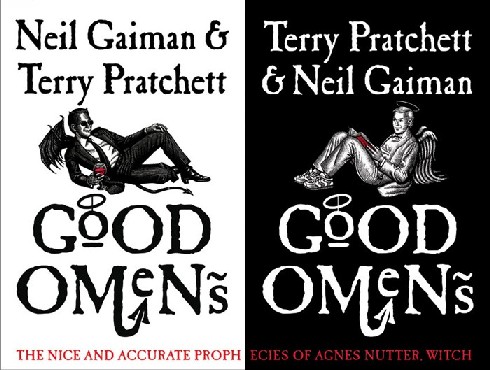
Good Omens is a 1990 novel about the apocalypse co-written by Terry Pratchett and Neil Gaiman, in which The Antichrist is accidentally Switched at Birth and given to a normal family, where he grows up free from any influence of Heaven and Hell and becomes a completely normal and average child. Well, normal aside from the fact that he's subconsciously using his powers to make sure his small, quaint hometown stays small and quaint...
The mix-up causes plans for Armageddon to spin wildly out of control, as agents of both Heaven and Hell try to find out just why things aren't going as planned. Two of those agents, an angel (Aziraphale) and a demon (Crowley), who've come to realize that they have more in common with each other than with their superiors, are trying to find the Antichrist and put a stop to The End of the World as We Know It because they decided they like humanity. Also in the mix are the last witch-finder in England (and his new assistant), and a modern-day witch who is the heir to a book of oddly specific but still conveniently obscure prophecies.
A four part mini-series adapting it was apparently in the works , by Terry Pratchett's own production company, with Terry Jones (of Monty Python fame) and Gavin Scott writing the scripts, though nothing seems to have come of it. BBC Radio 4 aired a six-part mini series adaptation of the book in December 2014, created by the same production team who did the celebrated adaption of Neil Gaiman's Neverwhere.
Amazon and the BBC greenlit a miniseries, which was written by Gaiman (with Pratchett's blessing). David Tennant plays Crowley, while the role of Aziraphale is filled by Michael Sheen. The full production began in September 2017, and the series was released on May 31, 2019, on Amazon Prime. Playing other roles are Anna Maxwell-Martin (Beelzebub), Michael McKean (Sgt. Shadwell), Miranda Richardson (Madame Tracy), and Jon Hamm (Archangel Gabriel).
Pratchett and Gaiman considered working on a sequel, and discussed the likely plot, but aside from a potential title (668: The Neighbour of the Beast) nothing was ever publicly confirmed. After Pratchett's death, it seemed that the sequel would never be created, but Gaiman has confirmed that its plot is the basis of the planned third season of the BBC/Amazon miniseries. Gaiman has also said that it may still be released as a book if the show is not renewed for that season.
Some useful annotations for the inquiring (or nonplussed) reader can be found here.
This book provides examples of:
- Absence of Evidence: When Crowley and Aziraphale realise that the Antichrist has been "misplaced", Crowley observes that they can at least know that the child is still alive because if the Antichrist had turned up in Hell Crowley wouldn't still be on Earth.
- Abstract Apotheosis: The Bikers undergo this when Adam is near. Only Death doesn't change. (Some things don't).
- Achievements in Ignorance: Adam pulls this off by combining godlike powers with a child's view of the world. For example, he doesn't like nuclear power, so he makes the local nuclear reactor go away. But since he never considered the implications of the core of a power plant suddenly disappearing, they don't happen, and as a result the plant is still generating power even though there is no reactor.
- Acquired Error at the Printer:
- Aziraphale collects misprinted Bibles, including the most famous one, the "Wicked Bible" or "Adulterer's Bible" from the 17th century that accidentally contained the commandment "Thou shalt commit adultery." While the Charing Cross Bible and Bugger-Alle-Thys Bible are invented, every other misprint mentioned in the novel, like the Standing Fishes Bible, is a real misprint.
- Meta: In some editions, when Famine signs his name, it is seven letters. Both Neil and PTerry insist it was six in the draughts and the proofs.
- Action Girl: Pepper (the scourge of neighbourhood boys) and War (obviously).
- Affably Evil: Crowley, "An Angel who did not so much Fall as Saunter Vaguely Downwards", if he can even be called evil.
- Affectionate Parody: Of The Book of Revelation and The Omen
- Also of Richmal Crompton's Just William stories - Gaiman's first draft was called "William the Antichrist"
- All Bikers are Hells Angels:
- The co-Bikers of the Apocalypse.
- The actual Bikers are literally Hell's Angels.
- The Alleged Car:
- Newt's Wasabi. It... drives (except when it doesn't, and spare parts are only sold by one company. In Japan). He names it "Dick Turpin" because wherever he goes, it holds up traffic.
- Taken up to eleven with Crowley's Bentley after going over the M25. It's on fire, has no wheels, and takes all of Crowley's concentration just to keep it from falling apart.
- The Alleged Computer: Newton Pulsifer has a singular knack for machinery, which is the knack of failing absolutely to make them do what he wants them to do. And he always buys the worst. His computers somehow always manage to be the early model with the hopelessly flawed chipset or the bug-ridden OS and the like. And don't ask about his car. Notably, this becomes his Chekhov's Skill… well, lack of skill.
- Ambiguous Time Period: The year in which the modern plotline is set is never given, only that it is eleven years after the screwup with the babies at the hospital. However, based on a few clues in technology, it is likely the mid 1980s. Home computers exist, Crowley's Bentley has an audiocassette player, and Marvin O. Bagman's music album is advertised as available on LP, audiocassette, or Compact Disc (which was first sold in the US in 1983).
- Ambivalent Anglican: The Youngs don't go to church, but are quite insistent that the church they don't go to is the Church of England.[Mr Young] quite liked nuns. Not that he was a, you know, left-footer or anything like that. No, when it came to avoiding going to church, the church he stolidly avoided going to was St. Cecil and All Angels, no-nonsense C. of E., and he wouldn't have dreamed of avoiding going to any other.
- Anachronism Stew: The novel's archaic passages occasionally derive humour from combining modern idioms with generally accurate Early Modern English dialect.
- The usage of "forget my own head next" in a passage that otherwise could have come straight out of the King James Bible:25 And the Lord spake unto the Angel that guarded the eastern gate, saying Where is the flaming sword which was given unto thee?
26 And the Angel said, I had it here only a moment ago, I must have put it down some where, forget my own head next.
27 And the Lord did not ask him again. - Shakespeare's three "lost plays": The Comedie of Robin Hoode, or The Forest of Sherwoode, The Trapping of the Mouse, and Golde Diggers of 1589. (Two of these are actually references to specific theatrical or cinematic productions; the second is a reference to Agatha Christie's The Mousetrapnote , while Golde Diggers is a reference to a series of similarly named movie musicals from 1933, 1935, and 1937. However, it is unlikely any attested usages of the idiom exist from as early as Shakespeare's day.)
- Any of Agnes' prophecies concerning modern technology: "Do Notte Buye Betamacks."
- The usage of "forget my own head next" in a passage that otherwise could have come straight out of the King James Bible:
- Angels in Overcoats: There is a deliberate spoof of the spy thriller trope of agents from various secret services having clandestine meetings in anonymous garb while, for example, feeding the ducks in a London park. In the midst of a duck-feeding session attended by overcoated members of MI5, the CIA, the KGB, Mossad and others, we see Aziraphale (angel) and Crowley (demon) trying to look as inconspicuous as the rest...
- Anthropomorphic Personification: The four Horsepersons are these for the various foibles of humankind. In the climax, they give up their humanoid appearances and become more direct metaphors: War is a construct of bullets and weapons, Pollution is a slime monster, etc. Only Death maintains the same skeletal appearance throughout the story, because unlike the others he's a true angel and not a figment of humanity's collective imagination.
- Anti-Anti-Christ: Adam is a mischievous kid who doesn't quite understand adult morality yet, but doesn't do anything really nasty... then he gets angry at the way the human race is screwing up the world and decides to do something about it. For a bit, he becomes a crazed monster, willing to genocide the human race and build new, better people for him to play with. Then his human side regains control and he again becomes his essentially affable self, but still containing a dark well of evil threatening to burst through every so often.
- Anticlimax:
- After following them intermittently throughout the book, the role of the Four Bikers of the Apocalypse turns out to be little more than sneaking into a military base and hacking some computers to kick-start World War III. Several of them comment on how this feels like a letdown after thousands of years of waiting.
- Just when it looks like the Apocalypse has been averted, a mighty rumble from underground signals that Crowley's boss isn't going to let this go easily. Crowley and Aziraphale arm themselves for the final battle, exchange speeches, change into their true forms, and the human characters decide to join them in the upcoming fight... then Adam waves his hand and suddenly there's no battle to be fought. Everything's back to normal now and the characters can get on with their lives!
- There's a certain Double Entendre in this sequence, where the characters believe they're about to fight Adam's biological father (Satan), but Adam changes it so that his adoptive father (Mr. Young) arrives instead.
- Anti-Villain: Crowley, at worst. Also, Death, while not as friendly as his Discworld counterpart, never does anything in the novel that can actually be described as evil, unlike the other three Horsepersons of the Apocalypse.
- Apocalypse How: Class 4, at least. No humans will survive it, and Crowley and Aziraphale discuss the unpleasant consequences for other species such as dolphins and gorillas. Between the impending nuclear war and the events described in The Book of Revelation, it could go as high as Class 6. It's also implied that if Heaven wins, they will destroy Hell, and vice versa.When the fire falls and the seas of blood rise you lot are all going to be civilian casualties either way.
- Are You Pondering What I'm Pondering?: "Listen, do you know what eternity is?"
- Archangel Azrael: Death, one of the Four Horsemen (or motorbikers) of the Apocalypse, doesn't get as much page time as the others because he's always busy, but towards the climax he reveals that, in spite of his position with the Four Horsemen, he is not like the others. Whereas his three companions are more or less manifestations of facets of humanity, Death is actually the angel Azrael, with wings of darkest blackness and dotted with lights that aren't stars. When the others are defeated, he congratulates the characters and leaves.I am Azrael, created to be creation's shadow. You cannot destroy me. That would destroy the world.
- Armor-Piercing Question: On the brink of succumbing to his nature as the Antichrist, Adam goes on a megolomaniacal rant about remaking the world, dividing up the countries among his friends for each of them to rule. But then Pepper brings up a point; "What bit're you going to have?" Adam comes to a realisation; the only thing he wants is his own beloved hometown of Tadfield, and unlike Australia and America - so far away as to seem like fantasy worlds to him - Tadfield is too real to change. With this, he finally comes back to his senses.
- Arson, Murder, and Jaywalking:
- "Human beings mostly aren't [particularly evil]. They just get carried away by new ideas, like dressing up in jackboots and shooting people, or dressing up in white sheets and lynching people, or dressing up in tie-dye denims and playing guitars at people".
- "Many phenomena — wars, plagues, sudden audits — have been advanced as evidence for the hidden hand of Satan in the affairs of Man..."
- Atrocious Alias: The secondary group of Bikers of the Apocalypse. Their names are: Grievous Bodily Harm, Cruelty to Animals, Really Cool People, and Treading In Dogshit (formerly All Foreigners Especially The French, formerly Things Not Working Properly Even After You've Given Them A Good Thumping, never actually No Alcohol Lager, briefly Embarrassing Personal Problems, and finally People Covered In Fish)
- Aura Vision: An offshoot of Anathema Device's psychic powers. It causes slight troubles when she can't see a certain person's aura."It might, or might not, have helped Anathema get a clear view of things if she'd been allowed to spot the very obvious reason why she couldn't see Adam's aura. It was for the same reason that people in Trafalgar Square can't see England."
- Baby Talk: Sister Mary Loquacious gets very distracted by the baby Antichrist and his little hoofie-woofies. Which he hasn't got.
- Back-to-Back Badasses: Aziraphale and Crowley when preparing for the final battle armed with a flaming sword and a tire iron, respectively.
- Badass Decay: In-universe example. A huge dog that would make angry rottweilers and pitbulls cower gets turned into a small terrier-like mongrel with a funny ear, because Adam's his master and he said so. Much to Dog's dismay, he can't scare away cats like he used to and tries (mostly unsuccessfully) to fight his new small-dog instincts. By the end he gives up and starts to enjoy it, realizing much as Crowley has that Earth is so much more interesting than Hell.
- Badass Normal: Pepper, Brian, and Wensleydale who defeat the Horsemen, and Shadwell, who's ready to take on Satan. With his forehead.
- Bad Boss: Crowley is a demon, so his superiors include Hastur and Ligur, Dagon, Beelzebub, and Satan — all of whom are nasty pieces of work and threaten to make him regret some of his choices. On Aziraphale's side, there's the Metatron — the Knight Templar Jerkass Voice of God.
- Bait-and-Switch: In the last scene with Shadwell and Madame Tracy, we're told that Shadwell "popped the question", a stock phrase which almost invariably refers to the question "Will you marry me?" — however, Madame Tracy's response makes it clear that in this case the question was actually "How many nipples do you have?", in the final appearance of the running gag about Shadwell's favourite way of detecting a witch.
- Balance Between Good and Evil: The forces of Good and Evil are trying to destroy each other, but Aziraphale and Crowley (an angel and a demon, both very low-ranking) have been working opposite each other for so long that they've become friends. They work to maintain the balance because it allows both of them to report successes to their superiors without anything really changing over time, which coincidentally allows them to keep working together on Earth. It's suggested that this may be the underlying idea behind the conflict in the first place, so that neither side ever wins permanently, but God's plan is so ineffable note that none of the lesser angels or demons know this for certain. It's implied that halfway between good and evil lie humans, who in turn are capable of the better acts than angels and worse acts than demons. For either side to win would destroy humanity, free will, and the whole world. The free will part of this is what makes Adam realize that doing whatever he wants with the world isn't the right way to go about it, because what's the point of having friends if you can make them do whatever you want?
- Batman Can Breathe in Space: Technically, angels and demons don't need to breathe.
- Batman Gambit: The entire plot is implied to have been either this, or a Gambit Roulette, by God.
- Beast Man: Downplayed, in that Crowley's only animal traits remaining are his snake-like eyes and a slight tendency to hiss under stress.
- Because Destiny Says So:
- This is essentially the logic with which Anathema lives her life.
- Both Beelzebub and Metatron insist that "It is written" when Adam refuses to take his part in Armageddon, and instead puts a stop to the whole thing.
- Beelzebub: Manifests on behalf of Hell to try and convince Adam to restart the Apocalypse, mentioned to look almost indistinguishable from his Good Counterpart Metatron excepting a Palette Swap.
- Been There, Shaped History:
- Parodied. Crowley received a commendation from Hell for starting the Spanish Inquisition, which was the first he'd heard of it. He just happened to be in the area when it started, so Below attributed it to him. When he finally got around to seeing what that was about, he was horrified and ended up spending a good deal of time drinking to forget what he saw.
- Likewise, Crowley and Aziraphale both claimed Milton Keynes as a success, and believed meter maids were a plot by the other side, but both were entirely human creations. However, Glasgow and Edinburgh are their work.
- Beware the Nice Ones: Aziraphale may be an angel, but it's still not a very good idea to piss him off.
- Black-and-White Insanity: Before he and Crowley got to know each other, Aziraphale didn't believe that it was physically possible for a demon to do the right thing.
- Blood Lust: Scarlett/Carmine Zuigiber/War.She licked a spatter of blood—someone else's—from the back of her hand with a scarlet, cat-like tongue. Then she smiled.
- Blow You Away: Crowley toys with the idea of conjuring up a hurricane to eliminate rival job applicants.
- Blue-and-Orange Morality: Azrael/Death probably goes here. And possibly God, what with all the ineffability.
- Blue Means Cold: The Metatron is sort of God's second-in-command and is seen wrapped in blue flames that are said to be cold.
- Body Surf: Aziraphale does this briefly after stepping into a pentagram. Shadwell mistakes him for a demon. Twice in the same day.
- Bond Villain Stupidity: Averted and lampshaded: Newt explains that he can't save the day the way James Bond would, because the bad guys didn't show him all the Megadeath Doomsday Machines and explain how they work before they left. If he were Bond, they would have; but this is real life.
- Book Ends: The last line of the book, "there never was an apple, Adam thought, that wasn't worth the trouble you got in for eating it", is a callback to the opening chapter, which is about Crowley arguing to Aziraphale that he didn't do anything wrong by making Adam and Eve eat the apple because the benefits of giving humans knowledge of good and evil outweigh the consequences of bringing God's wrath upon them.
- Also, the "Saturday" segment which makes up almost half of the book opens with the International Express man making a delivery and dying; it closes with him collecting all the things he'd delivered earlier in the book after an Unexplained Recovery.
- Boring, but Practical:
- Crowley uses magic to maintain his car in perfect condition far longer than would normally be expected; Mr. Young achieves the same effect by just following the suggested maintenance schedule. It's noted that he's pretty much the only person to ever do so who wasn't involved in writing them.
- Because she's a witch, and therefore sensible, Anathema doesn't rely on things like charms and spells to protect her when she goes out alone at night. Instead she carries a foot-long bread knife in her belt.
- Brick Joke:
- After the baby swap at the beginning, the narrator notes that it would be nice to think that the spare baby, instead of being ruthlessly disposed of, was adopted out and led an ordinary life somewhere with an ordinary sort of hobby like "restoring vintage bicycles, perhaps, or breeding tropical fish". Much, much later it's mentioned in passing and lampshaded in the footnotes that Greasy Johnson, the leader of Tadfield's other kid gang, is secretly devoted to his prize-winning collection of tropical fish.
- Near the beginning, Crowley invites Aziraphale to lunch at the Ritz. Near the end, he does it again — and while the angelsnote are dining at the Ritz, a nightingale sings in Berkeley Square.
- In a footnote, it is mentioned that one of four things published in a trashy tabloid is actually true, including the fact that Elvis works at a burger joint. A little while later, Famine visits a restaurant and there's a man flipping burgers... with a cowlick... singing Hound Dog. You do the math. Further reinforced by Death later saying he never touched the guy.
- Buffy Speak: Shadwell, of all people, when instructing Newt to look out for "Phenomena. Phenomenatrices. Things, ye ken well what I mean" as the main part of his witch finder media-watch duties. Also, Aziraphale when drunk.
- Burn the Witch!: This is how Agnes Nutter died, but not entirely as planned.
- Business of Generic Importance: United Holdings (Holdings) PLC, which employs the executives at the paintball retreat and also Newt in his boring day job (as a wages clerk, which avoids giving any clues about what United Holdings (Holdings) PLC actually does).
- Call-Back: There's a footnote about the "Buggre Alle This" Bible indicating that this particular edition of the Bible also had three extra verses in Genesis 3, and suggesting that they were inserted by Aziraphale. This is a callback to the very first prologue.
- Cannot Tell a Lie: Aziraphale. It extends to his taxes, which he files so scrupulously he's been audited several times by government accountants made deeply suspicious by such accurate, honest accounting.
- Capital Letters Are Magic: Several times, sometimes bordering on parody levels. Oftentimes Gaiman and Pratchett will have nouns capitalized to emphasize their cosmic importance. For example, "the Start" (Genesis), "Above" (Heaven), "Below" (Hell), "the Last Battle" (Armageddon), "the Great Plan", "Life", "Time", and "Universe".
- Card-Carrying Villain:
- Crowley is an anti-heroic example... ish. He's a self-proclaimed bastard who tries to avoid doing the right thing as much as possible, but he doesn't seem to think of himself as truly evil. The narrator states that he'd be the first to tell you that most demons aren't deep down evil, and Crowley doesn't argue when Aziraphale states that he always knew there was good in Crowley.
- There's no ambiguity with Beelzebub, Hastur, or Ligur, though. They're evil to the core and they know it. This is presumably also true of Satan.
- Care-Bear Stare: One of Aziraphale's duties is spreading divine ecstasy. Crowley occasionally covers for him.
- Cassandra Truth: Agnes' prophecy book was the only one that didn't sell a single copy in an era where prophecy books were all best sellers, it was also the only one with real prophecies.
- Somewhat Zig-Zagged in that Agnes fully foresaw this and only even published it for the single gratis copy to which an author is entitled. Additionally, her book is full of extremely specific and esoteric prophecies that are relevant entirely to her descendants and not to the broader world (for instance, her prediction for November 22, 1963 was about a house falling down in King's Lynn and said nothing about Dallas). Regardless, she is noted as having been the world's worst prophet entirely because all of her predictions came true.
- The Chain of Harm: Crowley takes full advantage of it to maximize his efforts in making human lives miserable: he calls it "thinking wide", such as tying up all the phone lines in Central London for less than an hour, which caused the people inconvenienced to trigger expanding waves of bad temper and abuse. Other, more traditional demons can't see the point in this, which is why they consider Crowley a free-loading slacker.
- Chekhov's Gag:
- In the prologue, Aziraphale is one of the angels with flaming swords stationed at the gates of the Garden of Eden to prevent Adam and Eve getting back in, and he gives his flaming sword to Adam and Eve to keep warm because he feels sorry for them. During the final confrontation, it comes out that the red sword which is War's Iconic Item is that same sword, and Aziraphale reclaims it after War is defeated.
- That Crowley arranged the M25 to be a demonic sigil. It seems like a throwaway gag at first, but it comes back in a big way.
- Chekhov's Skill: Well, lack of skill is more like it, but Newton's utter ineptitude with technology is put to good use at a crucial moment when Anathema realizes that he can destroy the computer in the base by trying to fix it.
- Children Are Tender-Hearted: Adam, despite being a bossy kid with a mischievous streak a mile wide, is noted to be "a soft touch for tears," and first meets Anathema when he hears her crying and goes to see what's the matter. He tries to cheer her up and offers to help with whatever's making her sad, which is the first major signal that he's a Jerk with a Heart of Gold.
- The Chosen One: Complicated; first when the Antichrist is Switched at Birth one too many times, resulting in the wrong person being prepared for 11 years, and secondly when he then decides he doesn't want to cause Armageddon and convinces both Heaven and Hell not to go through with it.
- Chronic Hero Syndrome: "Aziraphale couldn't resist an opportunity to do good".
- Cloud Cuckoolander: Pollution, who is thought to be a hippie until people notice he's leaking things everywhere and is groovy about littering.
- Colour-Coded Characters: Three of the Four Horsemen have motifs based on the colour of horse they're described as riding in Revelation (War red, Famine black, Pestilence white). This covers not only their physical appearances, but also the pseudonyms they use, which are all synonyms for these colours.
- Colourful Theme Naming: Three of the Bikers of the Apocalypse have names that reference the colors of the horses that, according to biblical texts, they ride out on.
- War takes such names as Scarlett or Carmine, and even the last name Zuigiber (latin for ginger, well nearly; technically that would be Zingiber).
- Pollution goes by "White, or Blanc, or Albus, or Chalky, or Weiss, or Snowy", among others.
- Famine calls himself Dr. Raven Sable.
- Conflict Ball: War is the anthropomorphic embodiment of one. Wherever she goes, people randomly start fighting (sometimes over her).
- Cool Car: Crowley's Bentley is one. Although, towards the end it's a totally hot car instead.
- Cool Old Guy: Shadwell is one, for a given value of "cool."
- Cool Old Lady: Madame Tracey is barely phased by being temporarily possessed by Aziraphale, and is all too willing to help out in whatever way she can in the face of Armageddon.
- Cool Shades: Crowley wears them as part of his cool bad guy image. All the time.
- Cosmic Plaything: Everybody is a cosmic plaything. With the possible exception of Adam.
- Crack Fic: It basically is one for The Bible.
- Crazy-Prepared:
- Crowley keeping holy water on hand.
- Agnes Nutter, who had plenty of time to prepare for her imminent burning, including getting her affairs in order, cancelling the milk, and filling her underwear with gunpowder and roofing nails.
- Agnes's descendants, thanks to the book she left behind, have at least a vague idea of what's coming.
- Whoever wrote the book of Maritime Radio Signals included one for reporting the return of Atlantis (and its High Priest winning a quoits contest).
- Critical Staffing Shortage: The Witchfinder Army was once a thriving paramilitary organization but by the time of the book is reduced to two. However, both Heaven and Hell believe the WA is at least regiment-sized...
- Curb-Stomp Battle:
- Crowley takes on a jeep full of soldiers at the Lower Tadfield airbase. By the next paragraph, it's Crowley's jeep.
- War, after getting her sword in a bar full of armed soldiers, decides it's time to get to know them better. To their initial and short-lived surprise, they regret this.
- Dark Action Girl: War, the Horseperson who licks somebody else's blood off her palm.
- Deadly Prank: The bucket over the door trick Crowley performs on a felow demon. Using holy water.
- Deadpan Snarker: Newton gradually morphs into one in the face of the absurdities he's subjected to.
- Death Glare: When it's deployed by Crowley reality tends to realign accordingly.
- To Dog's chagrin (and initial confusion), his standard issue, weapons-grade hellhound stare of doom and death... stops being anywhere as effective after, you know, he's been shrunk and mongellified. He gets over it.
- Deconstruction: Agnes is a deconstruction of oracular characters in general. On the one hand, we see that she's always right, but sometimes her predictions are oddly specific (don't buye Betamacks), too ahead of their time (jogging helps people to live longer), centered on her relatives in the future (she predicted for 1963-11-22 that a house in a small English city would fall down, but doesn't mention the assassination of John F. Kennedy on the same day — one of her relatives might have been near that house on that day, but apparently, none of them wanted to go to Dallas), and she didn't bother to order her predictions or explain them in detail. On the other hand, she uses her power to successfully Write Back to the Future (and also to prevent people who deliver said message from snooping), and since she can predict everything, this includes knowing when Anathema will read a specific prophecy — so it always fits.
- Decoy Protagonist: Aziraphale and Crowley. For all of their efforts, and despite them prominently appearing in the plot, Armageddon ultimately is stopped by Anathema, Newt and Them.
- Demonic Possession: Well, Angelic Possession, when Aziraphale temporarily possesses several people after his body gets destroyed, settling on Madame Tracy. But it helps demonstrate how angels and demons are not that different.
- Designated Girl Fight: An unusual version of one, with violent little tomboy Pepper being paired up with War when the Them confront the Horsemen.
- Determined Defeatist: At one point, when things are at their bleakest, Crowley thinks he might as well drink himself senseless while he waits for the world to end. Instead, he drives at top speed to Tadfield to prevent the Apocalypse. In a burning car. That he's holding together through sheer Heroic Resolve.
- Devil in Disguise: Crowley. He's Hell's field-agent, posing as a bon viveur named Anthony J. Crowley.
- Did the Earth Move for You, Too?: Anathema and Newt have sex during upheaval preceding the end of the world.Newt: That was wonderful.
Anathema: Good. The earth moved for everybody. - Digging to China (or from Tibet): Adam's belief that such a thing is possible combined with his immense reality-altering abilities causes Tibetans to start popping up out of holes in the ground all over the place.
- Divinely Appearing Demons: Crowley notes that there's "not that much difference" in appearance between angels and demons, except the demons are better groomed. One of the running themes of the book is that angels and demons are not so different.
- "...stretching off to infinity, were the hosts of Heaven and Hell, wingtip to wingtip. If you looked really closely, and had been specially trained, you could tell the difference." Incidentally, this is also a shout-out to a very famous series of pictures by MC Escher depicting... you guessed it: geometrically-spaced angels dovetailing perfectly with geometrically-spaced devils.
- Does This Remind You of Anything?:
- The Young family's telephone number: Tadfield six double-six.
- Two very powerful sides, each of whom have agents trying to get other nations to act according to their principles, have an increasingly fragile detente, which will kill millions of people and cause utter destruction if broken. Which Cold War is this, again? (Heck, it's even noted that an MI5 and a KGB agent have their meetings in some of the exact same places Aziraphale and Crowley do, and are also bickering Friendly Enemies.)
- A Dog Named "Dog": Dog, a hellhound who goes from a massive terrifying beast to a miniature mutt with a funny ear as Adam describes him.
- Don't Explain the Joke: Played with. Footnotes were added to the American version to explain some of the jokes that depend on knowing British geography and such. Except they tend to boil down to "If you were British, you'd be laughing." Some of them contain their own little joke to compensate. For example, after the lengthy explanation of the old British system of currency, it quips how the Brits spent a long time avoiding the decimal system "because they thought it was too complicated".
- Doom It Yourself: Newt takes this to the level of a superpower. He once got a joke circuit board that isn't supposed to do anything, and ended up building a wireless radio that picked up Radio Moscow. Winds up as a Brick Joke when he "fixes" the launch computers, causing them to fail in spectacular fashion.
- Dramatic Wind: The wind suddenly blows around Adam when his powers begin to manifest.
- Dreaming of Times Gone By: Shadwell has a dream in which he witnesses the death of Agnes Nutter. She knew he would; her direct address to him was mistaken by her contemporary onlookers for speaking blasphemy in the direction of Heaven.
- Drives Like Crazy: Crowley is something of a speed demon. The only person he actually hits in Anathema, but his philosophy on the road is "they know the risks they're taking".
- Eagle Land: Mostly the negative variety; the Americans encountered are Trigger-Happy, absent parents, image-obsessed, fundamentalists, racist, and homophobic. Not that the English get off any better.
- Earth Is Young: The Earth has only been around for 6,000 years and all the 'old' stuff in the ground is God's decoration. Or personal amusement; consider the dinosaur skeletons.
- Eerie Pale-Skinned Brunette: Anathema. She is a witch, a psychic and has an unsettling effect on people.
- Elvis Lives: A Running Gag. (For the record, he unwittingly works for Famine at a burger joint.)Death: I don't care what it says, I never laid a finger on him.
- Embarrassing First Name/Embarrassing Middle Name: Pepper's real name is Pippin Galadriel Moonchild. It's also her Berserk Button."There are only two ways a child can go with a name like Pippin Galadriel Moonchild, and Pepper had chosen the other one."
- The Empath: Aziraphale when they're trying to find the Antichrist is puzzled when he doesn't detect any evil in the area, but rather love.
- The End of the World as We Know It: The underlying premise of the book is that everyone is getting ready to throw down for Armageddon, which Adam is supposed to kick off.
- Energy Beings: Beings of angelic stock can travel through the phone lines.
- Erotic Eating: War in the bar when "on holiday."Red unconcernedly withdrew the maraschino cherry from her drink, put it to her scarlet lips, and sucked it slowly off its stick in a way that made several men in the room break into a cold sweat.
- Even Evil Has Standards:
- Crowley, having already crossed the demonic line by using holy water on Ligur, considers putting the tape in which Hastur is trapped into his car until it turns into a Queen album, then decides it would be too cruel.
- It's a recurring theme in the book that humans on their own are capable of far greater evil (and good) than demons (or angels) could ever imagine. Or, in Crowley's case, stomach.
- Evil Counterpart:
- Inverted. The Them are the good counterparts to the Four Horsepersons.
- Crowley and Aziraphale. Given a rather unambitious definition of "evil."
- Beelzebub and the Metatron even look virtually identical, only differing by the color of their flames.
- Evil Is Petty: Crowley's Modus Operandi is generating vast amounts of low-level evil (telemarketers, phone system failures, the M25, and such) as the knock-on effects are potentially vast, and furthermore, the people themselves keep it going, as opposed to more old-school demons who work on corrupting people on an individual basis.
- Evil Is Sterile: It's spelled out that demons aren't very imaginative, which is why humans are actually better at being evil. Of course, because they come from the same stock, angels aren't any better.
- Evil Redhead: A woman first introduced as Scarlett and later Carmine "Red" Zuigiber is a Fiery Redhead who deals in weapons and seems to cause violence through her mere presence. She's eventually revealed to be the Anthropomorphic Personification of War.
- Exactly What It Says on the Tin: In-universe subversion in the form of CHOW™, SNACKS™ and MEALS™ which thanks to cutting edge food-science technology contain nothing of any nutritional value whatsoever. The latter is a true work of art in that if you eat it in any significant amount, it will cause you to both become morbidly obese and die of malnutrition, which their inventor (Raven Sable, also known as Famine) finds deeply amusing.
- Exact Words: Anathema intimidates an American soldier into submission by shoving a stick into his back to imitate a gun and telling him to do what she says, or she'll regret what she has to do next (the natural implication being "shoot him"). The narration goes on to say that this is quite true, as she would really regret the soldier discovering Anathema's ruse and trying to shoot her.
- Eye-Dentity Giveaway: Crowley is a demon who caused a little trouble in the Garden of Eden with an apple. Given human form and a roving commission to make trouble in the human world, he found the invention of sunglasses to be a relief, as his eyes are a disconcerting serpentine yellow with vertical pupils.
- Face of an Angel, Mind of a Demon: Subverted with Adam, who is handsome and blond and doesn't turn out nearly as evil as everybody's expecting. It's pointed out that his Father was born an angel and that falling into the Pit isn't actually an inheritable genetic trait.
- Fallen Angel: All the demons of hell are fallen angels. So is Crowley, though he "did not so much Fall as Saunter Vaguely Downwards".
- Felony Misdemeanor:
- Crowley's reaction to his immediate superiors being rather underwhelmed by his demonic influences (i.e. traffic jams, telemarketers, the M25) on the mortal world.
- Hastur and Ligur look down on Crowley's tying up London's phone system for an hour at lunchtime (tarnishing thousands of souls in a domino effect of people being in bad moods across the city) in favor of their more artful craft of spending a lifetime trying to corrupt a single pious individual.
- Fictional Colour: There was a mention of infra-black, that was the color that flashes before your eyes when you've just run into a wall head-first, right before you die.
- Fiery Redhead:
- War, who can make men fight over her. To be more exact, fight through her, they were going to execute her for disrupting a four-way battle. Well, you get the idea.
- Pepper, who can and will beat up anybody who annoys her; she got her nickname on the first day of school after simultaneously beating up three boys who laughed at her real name. The narration notes that with a name like "Pippin Galadriel Moonchild", it was really her only choice other than giving in and becoming hopelessly soppy.
- Fish out of Temporal Water: Aziraphale hasn't updated his wardrobe since the '50s. Every demon except for Crowley is also stated as being severely behind the times.
- Flaming Sword: The angels have these. Except for Aziraphale, who "misplaced" his by giving it to Adam and Eve so they'd have a way to keep warm in the rain.
- Flock of Wolves:"The park was deserted except for a member of MI9 trying to recruit someone who, to their later mutual embarrassment, would turn out to be also a member of MI9."
- Foil: Crowley and Aziraphale, Shadwell and Tracey, Newton and Anathema, etc.
- As a duo, Shadwell and Madame Tracy are a foil for Aziraphale and Crowley: two people who initially appear very different, but who after a many years working in close proximity realize they're not so different after all and grow fond of each other.
- Each of the Them corresponds to one of the the Horsepersons of the Apocalypse. Adam is Death, Pepper is War, Brian is Pollution, and Wensleydale is Famine.
- Footnote Fever: For backstory, digressions, gags, set-ups for Brick Jokes...
- Forgotten Trope: Newt's wretched Wasabi automobile is a borderline example of the forgotten "Japanese Technology is Shoddy" trope, which had already pretty much died out when the book was written. The evolution of the trope is lampshaded: the narration points out that if the Japanese used to be "fiendish automatons who copied everything from the West", and had now become "skilled and cunning engineers who would leave the West standing", there must have been a period of transition during which they were creating "innovative disasters the avoidance of which had made firms like Honda and Toyota what they are today" — and it was during that period of transition that the Wasabi was designed.
- French Cuisine Is Haughty: Sable's attempt to create a fast-non-food market in France is foiled by his agents being shot less than half an hour after they'd landed.
- Freudian Excuse: Newton suggests that this is why his ancestor had been a Witchfinder, because having to be called "Adultery Pulsifer" all the time would have made him want to hurt a lot of other people. Anathema shrugs this off and says he was probably just an ordinary misogynist.
- Friendly Enemy: Aziraphale and Crowley are enemies in name only.
- Friend to All Living Things:
- Parodied by Crowley, who talks to his plants to encourage their growth. Topics include disappointment in growth rates and what happened to the last plant that didn't bloom. His plants are very tall, very green, and very frightened.
"Although talking is perhaps the wrong word for what Crowley did. What he did was put the fear of God into them. More precisely, the fear of Crowley...the plants were the most luxurious, verdant, and beautiful in London. Also the most terrified."- Aziraphale exhibits this trope in several instances where Crowley is about to get someone killed. Having tried and failed to replace clowns as the entertainment at a child's birthday party by way of his old training as a stage magician, ends up suffocating a dove by leaving it tucked in his sleeve for too long. He seems much less bothered by that than by the fact that the hellhound he and Crowley are watching for hasn't shown up, and Crowley's the one who carefully resurrects the bird and sends it on its way.
- At one point, St. Francis disguises himself as a gardener and plays the Friend To All Living Things trope literally and explicitly for the benefit of an impressionable child. It doesn't exactly work.
- From the Mouths of Babes: Metatron and Beelzebub are both dissuaded from carrying out Armageddon (with the argument that it'd just start the cycle over and ruin a fun experience for everyone) by 11-year-old Adam Young, AKA the Antichrist.
- Functional Magic: For angels and demons. And maybe for certain humans, like Agnes Nutter.
- The Fundamentalist:
- Sergeant Shadwell, almost-but-not-quite played for laughs.
- Marvin O. Bagman, the smarmy televangelist, really thinks he's doing what the Lord wants him to do. One of the taglines on his show is "Putting the Fun in fundamentalist".
- Funetik Aksent: Parodied with Shadwell, whose accent is described as a random, shifting mixture of accents from all over Britain. Likely meant to be a Take That! to American portrayals of British accents that unwittingly mix regional dialects, or maybe in fact a direct tribute to a single famous British television character — Alf Garnett, played by actor Warren Mitchell in the sitcoms Till Death Do Us Part and In Sickness and In Health. Anyone familiar with the character's physical description, "roaming accent", and personality (he is a comical bigot) will recognize him instantly if they were born and raised in England in the 1970s or 1980s. (However, Alf's accent was fairly firmly in Sarf London, the one area Shadwell never goes near. Make of that what you will.)
- Funny Foreigner: Sister Mary mistakes Mr. Young for the American diplomat. Hilarity Ensues.
- Gaia's Vengeance: Under Adam's influence, the sickly potted trees in a South American shopping mall have a sudden rush of energy and tear the place to bits, while the Leviathan awakens and attacks a Japanese whaling vessel.
- Gambit Roulette: At the end of the book, Aziraphale notes that the near-miss Armageddon may have been exactly what God intended. The two sides actually go home to consult higher management when he brings it up to them. Everything may be to plan, but it is the ineffable plan after all..."It can't be chess — it must just be very complicated solitaire."
- Garden of Eden: Adam and Eve are kicked out of it in the prologue. Backstory-wise, Crowley was the serpent who tempted Eve, and Aziraphale was one of the angels guarding the gates.
- Geodesic Cast:
- There are four separate groups: Aziraphale and Crowley; Shadwell and Newt (and Tracy); the Horsepersons; Adam and the Them. And Anathema on her own. They start interacting later in the story.
- The Ghost: Neither God nor Satan ever actually appears. The most we get is Metatron and Beelzebub, who claim to speak for God and Satan, respectively, but it's heavily implied that Metatron is misinformed, and it's also possible that Beelzebub is lying. Crowley and Aziraphale speculate at the end of the novel that the events may have actually gone exactly according to God's plan, but there's never any definitive proof.
- Giftedly Bad: Newton with electronics. To such an extent that, when he's struggling to prevent Armageddon, the solution is "try to make this computer work better".
- Girls Love Stuffed Animals: Madame Tracy's old-fashioned sensibilities about what men consider attractive leads her to keep a collection of threadbare stuffed animals in her bedroom.
- Glamour Failure:
- After War, Famine and Pollution return to Tadfield Army Base after being "wrapped around the world", their human bodies don't exactly... fit right.
- Also, the automated security system raises the alarm when they enter an off-limits section. Granted, that doesn't achieve anything but annoy the soldiers because of humanity's inherent Weirdness Censor (none of the humans can see the four), but it's still interesting.
- Crowley has a tendency to hiss when he forgets himself.
- Global Ignorance: Voodoo is not a Desi thing.Shadwell: Mister socalled Rajit. It's them terrible forn arts. The ruby squinty eye of the little yellow god. Women wi' too many arms. Witches, the lot o' them. [...] And voodoo. I bet he does voodoo. Sacrificing chickens to that Baron Saturday. Ye know, tall darkie bugger in the top hat. Brings people back from the dead, aye, and makes them work on the Sabbath day. Voodoo.
Newt: But Mister Rajit's from Bangladesh, or India, or somewhere. I thought voodoo came from the West Indies.
Shadwell: Ah. Ah.
Newt: Well, doesn't it?
Shadwell: Hidden wisdom, lad. Inner mili'try secrets of the Witchfinder army. When you're all initiated proper ye'll know the secret truth. Some voodoo may come from the West Indies. I'll grant ye that. Oh yes, I'll grant ye that. But the worst kind. The darkest kind, that comes from, um . . .
Newt: Bangladesh?
Shadwell: Errrukh! Yes lad, that's it. Words right out of me mouth. Bangladesh. Exactly. - Glowing Eyes of Doom: Death/Azrael. Crowley, as well, when he's straining himself.
- God: Does not actually appear at any point, but is mentioned frequently and is implied to have a hand in manipulating the events towards the end result that occurred rather than what either side actually wanted.
- God Is Neutral: The Ineffable, who works behind the scenes of both Heaven and Hell and doesn't seem to intefere, remaining The Ghost.
- God and Satan Are Both Jerks: Or if not God, at least the angelic establishment, who are stuffy, prudish, and generally un-fun. God Himself? He's reclusive and no one has any idea what He's doing.
- Going Native: Aziraphale and Crowley, who have more in common with humanity and each other than they do with Heaven or Hell. Specifically discussed in Crowley's case by Hastur and Ligur.
- Go-Karting with Bowser: The relationship between Aziraphale and Crowley started out like this and only got closer. By the time the story gets underway they've been actively defying both Heaven and Hell for years, and only participating in the angel/demon feud to keep up appearances. The reason given for their "Arrangement" is that they realised "they have more in common with their immediate opponents than their remote allies" and a certain acceptance of the inevitable, rather than ideological slippage. Aziraphale honestly believes in his cause and Crowley enjoys his work, but neither sees what they do as particularly important in determining the contest between Good and Evil.
- Good Is Boring: It's explained that Heaven doesn't have any good, notable musicians or actors. The two musical exceptions that Crowley says Heaven possesses are Elgar and Liszt. It's implied to be very terrible. Crowley emphasises some of the horror underlying Heaven's tedium when he tells Aziraphale that if Heaven wins Armageddon, in the time it takes for a bird to fly from one end of the universe to the other and wear down a mountain by sharpening its beak against it, Aziraphale still won't have finished watching The Sound of Music. And Aziraphale will enjoy it. Every single time. Note that this is a parody of the traditional hellfire sermon, where the bird flying across the universe is used to suggest how long the torments of the damned will go on.
- Good Is Not Dumb: Aziraphale. Members of The Mafia that threaten his bookstore tend to leave and never come back. As the narration says, "Just because you're an angel doesn't mean you have to be a fool."
- Good Wings, Evil Wings:
- Downplayed; there is little difference between the wings of angels and demons (though the wings of demons tend to be better groomed).
- Azrael's wings are called "angel's wings" while also being described as black holes into space with visible stars - there's no way they could have feathers. Perhaps because he's the Angel of Death, and his wings are thereby "angelic" no matter what their style, or maybe the voids in reality are feathery-wing-shaped.
- Granola Girl: Anathema Device is something like this, though she's also portrayed as being a lot more practical and pragmatic than is the norm for the character type.
- Gratuitous Japanese: The story refers to the Japanese city of Nigirizushi ("hand-formed sushi"), a Japanese whaling ship named the Kappamaki ("cucumber roll"), and an alleged car model named Wasabi.
- Greedy Televangelist: The angel Aziraphale possesses various people at random while attempting to get to Tadfield and avert the apocalypse. One of the people is an evangelist on live TV telling his audience only the faithful will be saved and everyone else will burn and spends approximately forty-five minutes of each hour cajoling, begging, and threatening people to send money. Unfortunately for him, Aziraphale decides to set the record straight, explaining that Heaven honestly doesn't care what happens to anyone and scolds the man for thinking the idea of sneering down at all the people who supposedly won't be saved is justifiable.
- The Grim Reaper: Similar to but a lot less interested in humanity than the Discworld version. (Almost nothing like the Sandman version, for the record, except for the wings.)
- Grounded Forever: Adam discusses his grounding with the Them:"When do you think they'll let you out, then?" asked Pepper.
"Not for years and years. Years and years and years. I'll be an old man by the time they let me out," said Adam.
"How about tomorrow?" asked Wensleydale.
Adam brightened. "Oh, tomorrow will be all right," he pronounced. "They'll have forgotten about it by then." - Guardian Entity: The hellhound is sent to be one to the Antichrist, who complicates its mission by unwittingly turning it into a normal little dog.
- Hair of Gold, Heart of Gold: Adam, the anti-Antichrist. Aziraphale counts in most fanart depictions, although he struggles with To Be Lawful or Good and often gets stroppy.
- Happily Adopted: All three of the babies involved in the birth switching.
- Haute Cuisine Is Weird: Nouvelle cuisine is artistically impeccable and totally lacking in nutritional value. It was invented by Famine, who loves the idea of very rich people spending a lot of money to go hungry. A deleted scene in the TV series would have given this a Setting Update with molecular gastronomy.
- Have a Gay Old Time:
- Non-sexual example in The Nice and Accurate Prophecies of Agnes Nutter (the word 'nice' didn't settle on its modern implication until the 19th century). Probably influenced by the story of Alice Nutter and the Device family of Pendle, Lancs., being recorded in a 1612 book called The Wonderful Discovery of Witches in Lancashire — wonderful at the time meaning simply 'amazing'.
- Also happens when Anathema and Newt are trying to get inside the airforce base. The American guard is very impressed with Newt's fancy Witchfinder credentials, but is skeptical of the part "...about us got to give you faggots?" Although he is excited when he finds out that they wanted the faggots to burn them.
- Hellish Horse: Crowley notes that Hell specified this kind of horse as the only kind a demon should be seen riding. He usually fell off, and these days prefers cars.
- Hellish Pupils: Crowley has a quite literal case of these.
- Hell of a Heaven: Crowley hints that Heaven's a boring place with few composers, theaters, and films."Listen, the point is that when the bird has worn the mountain down to nothing, right then...then you still wouldn't have finished watching The Sound of Music. And you'll enjoy it.""The boredom you got in Heaven was nearly as bad as the excitement you got in Hell."
- Heroic Fire Rescue: Crowley runs into a burning bookshop to rescue (or at least find) Aziraphale, but ends up rescuing the only copy available to Crowley and Aziraphale of The Nice And Accurate Prophecies of Agnes Nutter, Witch.
- Heroic Spirit: Crowley holds his burning car together through sheer force of will.
- Hero's Classic Car: Crowley owns a vintage 1926 Bentley which is his pride and joy.
- Hidden Depths: Sister Mary Loquacious initially comes across as a deeply silly woman. When she reappears, it turns out that she'd never really thought about anything before because she'd never been expected to, and once she started reading magazines about things other than knitting, she became remarkably savvy about both business and computers.
- Hippie Name: Pepper's real given names are "Pippin Galadriel Moonchild", because her mother was going through a hippie phase when she was born.
- Historical Rap Sheet: Crowley actually was responsible for the original Temptation in the Garden of Eden, but a Running Gag has him receiving the congratulations of Hell whenever they notice something like the Spanish Inquisition has popped up in the human world. They inevitably leap to the conclusion that Crowley was responsible for getting it started. He frequently protests to Aziraphale that he had nothing to do with it whatsoever: the human race thought of new ideas to be beastly to each other all on their own.
- Hoist by His Own Petard: Crowley designed the M25, and ends up getting stuck in it decades later right when he needs to get to Tadfield in a hurry.
- Hold Your Hippogriffs: "Crowley blessed under his breath" because, being a demon, cursing under his breath wouldn't be appropriately transgressive. Though Hastur or Ligur still says "What the hell" at one point.
- Holy Hand Grenade: Aziraphale cites the Biblical instances of cities being destroyed by fire from Heaven as a reminder that Good Is Not Nice. "Ever been to Gomorrah? ...I meant afterwards."
- Holy Water: Holy water, the real-life blessed-by-a-Christian-priest kind, is extremely dangerous to demons. Crowley handles a bucket of holy water like it's nuclear waste, and later uses it to kill his supervisor Ligur in a Bucket Booby-Trap.
- Horsemen of the Apocalypse: The four former Horsemen — er, Horsepeople of the Apocalypse have kept up with the times, and are thus now literal Hell's Angels on motorcycles.
- Humanity Is Infectious:
- Crowley and Aziraphale are both changed somewhat by their time on Earth. Crowley's fellow demon Hastur notes this and claims that Crowley is Going Native. Though even Hastur isn't all that different — when he really wants to let Crowley know just how pissed off he is, he uses human curses since he thinks demonic ones aren't volatile enough.
- Dog discovers, to his initial horror, that Small-Dog-anity is infectious too.
- Humanoid Abomination: The Horsemen approach this as Armageddon draws near. Their human forms are described as "ill-fitting" and their human-like personalities start to fade as their basic programming as bringers of destruction becomes dominant. Something similar nearly happens to Adam. Only Death is unaffected — Death never really changes, after all.
- Humans Are Special: In contrast to angels and demons, who are described as being predisposed to being Always Lawful Good and Always Chaotic Evil respectively, humans possess the ability to be either at any given moment. In fact, humans are capable of greater virtue than angels and deeper malice than even the most sadistic of demons, to the point where Crowley wonders why they even bother. It's that free will thing. It's a bugger. When Crowley read the end-user agreement that came with his computer, he was so impressed with the way it was worded that he sent a copy of it to the department of Hell that deals with soul-selling contracts, with a yellow sticky-note on it reading, "Learn, guys." It is this very quality that makes Adam reject his destiny and cancel the apocalypse before it officially starts."It may help to understand human affairs to be clear that most of the great triumphs and tragedies of history are caused, not by people being fundamentally good or fundamentally bad, but by people being fundamentally people."
- This trope is demonstrated when the Them are able to defeat the Horsepersons of the Apocalypse through the power of belief. The Horsepersons are mere Anthropomorphic Personifications of ideas, so the Them, having ideas of their own, easily vanquish them.
- Hypocritical Humor: Crowley hates talking to his superiors, since they threaten him the same way he threatens his houseplants.
- I Gave My Word: Crowley is a demon of his word.
- I Have Many Names:
- Horsemen/Horsepersons/Bikers of the Apocalypse.
- The Antichrist is also known as the Adversary, Destroyer of Kings, Angel of the Bottomless Pit, Great Beast that is called Dragon, Prince of This World, Father of Lies, Spawn of Satan, and Lord of Darkness. See Try to Fit That on a Business Card.
- I Just Want to Be Normal:
- Adam just wants to be a normal person.
- Newton Pulsifier may also qualify. Convincing Anathema not to use the followup book also keeps him from using it.
- Improvised Weapon:
- A tire iron is used as one.
- This happens when the Them face off against the Four Horsemen.It wasn't much of a sword, but it was about the best you could do with two bits of wood and a piece of string.
- Incendiary Exponent: Early in Crowley's journey to the site of Armageddon, his Bentley is set on fire when he is forced to drive it through a barrier created by malicious magic. By the time he arrives at his destination, he's holding the flaming wreckage of the car together by sheer force of will.
- I Need a Freaking Drink: Understandably, Crowley takes a look at what people are doing in the Inquisition and promptly has this reaction.
- Instant Sobriety: Aziraphale and Crowley can simply decide to be sober.
- Insult Backfire:R. P. Tyler: Young man, how would you feel if I came over to your house and dropped litter everywhere?
Pollution: Very, very pleased. Oh, that would be wonderful. - Intimate Telecommunications: Newt answers the phone for his neighbor Madame Tracy and answers the question "what are you wearing?" entirely truthfully. He stops answering the phone for Madame Tracy after that.
- Invented Individual: "Sergeant" Shadwell is the only real member of the Witchfinder Army (until he ropes Newt into it), but officially it includes many more members, such as Witchfinder Majors Milk, Tin, Cupboard, and Saucepan, whose salaries are paid by Crowley and Aziraphale.
- Inventor of the Mundane: Anathema wrote her Ph.D. thesis on people who invented things that, once they were invented, became so ubiquitous no one remembered they ever needed inventing. Highlights include Humphrey Gadget, Cyrus T. Doodad ("America's foremost black inventor") and her own ancestor, Sir Joshua Device.
- Invincible Classic Car: Crowley fondly credits his vintage Bentley for driving through hellfire on the M25, saying "You wouldn't get that sort of performance out of one of these modern cars."
- Insistent Terminology: Inverted, Anathema explains several times (and it's implied she's annoyed by how often she has to) that the "nice" in the prophecy book's title means "precise".
- Ironic Name: Pippin Galadriel Moonchild goes by Pepper, as she is a short, scruffy tomboy with a temper.
- It Was a Dark and Stormy Night:
- Noted as untrue when Crowley goes to meet Hastur and Ligur. Like so:It wasn't a dark and stormy night. It should have been, but there's the weather for you. For every mad scientist who's had a convenient thunderstorm just on the night his Great Work is complete and lying on the slab, there have been dozens who've sat around aimlessly under the peaceful stars while Igor clocks up the overtime.
- Played with in the prologue. After Adam and Eve are kicked out of Eden — which up to then had had only nice, sunny days — mean-looking clouds and lightning are described as coming over the horizon, ending, "It was going to be a dark and stormy night."
- Noted as untrue when Crowley goes to meet Hastur and Ligur. Like so:
- Japanese Ranguage:
- The fish boat captain speaks this way.
- Newt's Wasabi has a recorded voice that plays to remind riders to fasten unfastened seatbelts (which never goes off, because hey, it's Newt's Wasabi). The Wasabi's voice is described as being programmed by someone who not only didn't understand English, but didn't understand Japanese, either. At one point the voice is described as saying "Prease to frasten sleat-bert". Inverted at the end, when Adam restores the Wasabi so it runs better than ever. The helpful voice now speaks in clear English, but in haikus.
- Jesus Taboo: The book plays with every single Evangelical Christian trope and belief about the End of Days, with the notable exception that Jesus never makes an appearance (despite The Book of Revelation being all about his Second Coming!) Even Lucifer and Beelzebub appear in person, but no sign of Christ. Perhaps Gaiman and Pratchett didn't want to push their luck poking fun of Christianity that far. Or perhaps "the Metatron" is He in another guise. Or maybe since the Apocalypse was averted, He didn't need to show up after all.note . He does warrant some mention, though — when the Hell's Angels realize who the other bikers in the bar really are, one exclaims, "Jesus Christ!" and another speculates that He's probably looking for someplace to park His bike.
- Just Following Orders:
- Aziraphale and Crowley discuss their bad feelings about the coming end of the world:"It's not that I disagree with you," said the angel, as they plodded across the grass. "It's just that I'm not allowed to disobey. You know that."
"Me too," said Crowley.
Aziraphale gave him a sidelong glance. "Oh, come now," he said, "you're a demon, after all."
"Yeah. But my people are only in favour of disobedience in general terms. It's specific disobedience they come down on heavily."
"Such as disobedience to themselves?"
"You've got it. You'd be amazed. Or perhaps you wouldn't be." - Three hours of drowning their sorrows later, Aziraphale puts it slightly more bluntly, if less coherently:"All right. All right. I don't like it any more than you, but I told you. I can't disod—disoy— not do what I'm told. 'M'a'nangel."
- After some character development, near the end of the book it's Aziraphale who points out, while trying to convince Crowley not to leave the mortals to confront Satan alone, "Lots of people in history have only done their jobs, and look at the trouble they caused."
- Aziraphale and Crowley discuss their bad feelings about the coming end of the world:
- The Kid with the Leash: Adam, the young Antichrist, has a pet hellhound. It started off fitting that description until it got its name: Dog. Its name changes its nature and it was expecting a name like Terror or Stalks-By-Night - but since it's bound utterly to its master's will it got stuck with being a dog. Complete with cat-chasing, tail-wagging, stick-chewing, face-licking, a funny crooked ear, a lack of size and general small-dogosity. But the hellhound part is still there deep down if you happen to upset its master.
- Knight Templar:
- Played with for the Witch Finder Army, generally for laughs.
- Played horrifyingly straight for the forces of Heaven and Hell.
- Lamarck Was Right: Inverted in one conversation between Aziraphale and Crowley.Crowley: Saying [the Antichrist will] grow up to be a demon just because his dad became one is like saying a mouse with its tail cut off will give birth to tailless mice.
- Laser-Guided Amnesia: Adam does this to the mortals present at the almost apocalypse. Azrael (or God) does this to Aziraphale and Crowley when they begin to guess at the true nature of the Universe. "What were we talking about?"
- Laser-Guided Karma: During Crowley's efforts to avert the apocalypse, the biggest obstacle he faces and the one that gives him most trouble is the supercharged demonic M25 — which he created himself as one of his efforts to turn mankind toward Hell.
- Last-Name Basis: Shadwell and Wensleydale are always referred to as such, which are their last names. The same goes for Anthony J. Crowley. (Technically, that's not his real name, anyway.)
- Lean and Mean: Dr. Raven Sable, AKA, Famine. He's rail-thin, and a Horseman of the Apocalypse who gets a sick sense of satisfaction of watching anorexic people starve themselves to death.
- Leg Focus: War's legs get mentioned significantly more times than anyone else's, and with complimentary adjectives attached.
- The Legions of Hell: When they arrive for Armageddon, it's noted that the commanders of The Armies of Heaven and the Legions of Hell look remarkably similar, all part of the book's theme that neither side is all that different from the other.
- Let's Get Dangerous!: Aziraphale spends most of the book as slightly ineffectual comic relief, but near the end of the book he takes up his old Flaming Sword to protect humanity against the forces attempting to end the world."Once you learn, you never really forget how."
- Line-of-Sight Alias: Due to Witchfinder Sergeant Shadwell's shady book-keeping and limited imagination, the suspiciously small organization that is the Witchfinder's Army is made up of the likes of Witchfinder Majors Milk, Tin, Cupboard, and Saucepan.
- Lord Error-Prone: Witchfinder Sergeant Shadwell is fanatically devoted to the quest against Evil but has never actually encountered a real witch or demon and isn't very effective when he finally does.
- Lost in Translation: Some American paperbacks had misprints due to someone at the publisher's not realizing there is an English city named Hull and therefore renaming it "Hell". Also, the British AA (Automobile Association) became the AAA, an American insurance company. As reprinted, these sort of made sense in context, but only to an American audience.
- The changing of the AA to the AAA actually averted a bit of this: while the AAA still pretty much says 'car people' to American readers, 'AA' in America is more readily associated with Alcoholics Anonymous, which has a radically different meaning. It's unlikely most American readers would ever have associated it with the Automobile Association without it being spelled out directly.
- Louis Cypher: Ubiquitous, especially among the Horsepersons whose aliases always refer to their colours (War is red, Pollution/Pestilence - white; Famine - black).
- Lovable Traitor: Crowley rebels against Hell and commits what other demons see as an unspeakable crime: using Holy water on another demon. However, he's a sympathetic and endearing character to the audience, and wants to prevent the Apocalypse.
- Lovecraftian Superpower: Crowley scares off the paintballing commando by turning into something dreadful..."I think the maggots were a bit over the top, myself."
- MacGuffin Super-Person: Warlock, the child Antichrist, falls into this, being contended for by both Aziraphale and Crowley. Except not, as due to a mix-up at birth the actual potential Antichrist is growing up elsewhere with another family.
- Mad Mathematician: When Aziraphale starts busting out the heavy-duty equations to decode Agnes Nutter's prophecies its mentioned that the type of equations he uses have symbols which:only eight other people in the world would have been able to comprehend; two of them had won Nobel prizes, and one of the other six dribbled a lot and wasn’t allowed anything sharp because of what he might do with it.
- Magicians Are Wizards: Defied. Aziraphale refuses to use his actual powers during his magic act, because that would be cheating.
- Malevolent Architecture: Played for Laughs. The M25 motorway forms a demonic sigil that translates to "Hail the Great Beast, Devourer of Worlds." Crowley considers it one of his finest demonic works as it generates all sorts of unpleasantness from its drivers.
- Man of Wealth and Taste:
- Dr. Raven Sable, one of the Four Horsepersons of the Apocalypse, has found a way to get people to pay him to afflict them. He's a wealthy jetsetter who wears tailored suits and offers literary quotations at appropriate moments.
- Crowley tries to be, but doesn't always get it quite right (which suits the fact that he tries to be evil but doesn't always get it quite right). For instance, he drives a vintage Bentley — with fake bullethole stickers on the windscreen that he got from a James Bond promotional giveaway.
- Meaningful Name:
- Crowley, a reference to occultist Aleister Crowley. It also references his original role as the serpent ("Crawly") that tempted Adam and Eve.
- Attempted with the Antichrist. The Satanist nuns keep trying to get his mother to name him something evil-sounding and eventually end up with Warlock. But subverted, as Warlock is the wrong baby—he turns out a spoiled brat but otherwise normal. The real Antichrist is named Adam, after the first human, and eventually chooses humanity over Hell.
- Famine receives his scales in Des Moines. This may be a pun on "moins", which means, "Less".
- Metatron: Shows up when Aziraphale reports on the location of the Antichrist, deciding not to do anything about it. Also shows up in the finale when Adam decides not to end the world, mentioned to look almost indistinguishable from his Evil Counterpart Beelzebub excepting a Palette Swap.
- Micro Dieting: Raven Sable, AKA Famine, keeps his influence in the world by encouraging humans towards disordered eating, including publishing a diet book called Starve Yourself Thin and inventing nouvelle cuisine.
- Mind over Matter: Aziraphale levitates a scooter and Adam levitates in the air at one point.
- Mirroring Factions: This is explicitly the relationship between Hell and Heaven, down to ostracizing Crowley and Aziraphale in the same ways for the same reason, wanting Armageddon to occur simply because it's "supposed" to, and even to their human followers down on Earth. Fundamentalists are implied to have gotten so monomaniacal that they've lost all sense of an ethical code.
- Mistaken for Gay:
- Several minor characters throw gay slurs at Aziraphale. Also, Aziraphale and Crowley were mistaken for a couple by Anathema Device. Shadwell privately refers to Aziraphale as "the southern pansy". It doesn't help that Aziraphale calls Crowley "dear", "my dear", and "dear boy" on a regular basis, whereas Crowley sometimes refers to him as "angel" — literally true, but suggestive of a close relationship. One of the three first impressions of Aziraphale is "gayer than a tree full of monkeys on nitrous oxide." It's wrong, because angels don't have sex, sexes or sexual orientations, but the implication remains.
- When Mr Tyler sees Sister Mary Loquacious and another nun winking at each other, his immediate thought is that Ken Russell knew what he was talking about.
- Mistaken for Superpowered: Shadwell confuses Aziraphale for a witch when he sees the enochian circle he drew to contact God. When Aziraphale accidentally steps into the circle and gets discorporated, Shadwell thinks that his exorcism vaporized a demonic entity and for the rest of the novel, he thinks that his finger is a Weapon of Mass Destruction, routinely threatening people with it when they get in his way.
- Modernized God: Pestilence (as in the third Horseman of the Apocalypse) gets replaced by Pollution after the invention of penicillin means that plagues get nipped in the bud more often. It's noted that Death is the only one who never had to change (Famine is now making fast-food that contains no nutrients whatsoever, and War, when the story picks up, is taking a break from arms dealership to dally as a wartime journalist).
- More than Mind Control: Crowley uses this as part of his way of getting more souls to Hell. He doesn't lead people into evil, he leads them into temptation by looking into their soul and giving them what they really, truly want. Is it really his fault people want such horrible things so often?
- Motor Mouth: The Chattering Order of Saint Beryl is an entire satanic convent of motormouth nuns.
- Mundane Utility: The angelic Reality Warper powers are nice for miracling up vintage wines into existence and keeping your car dent-free.
- Murder Is the Best Solution: Aziraphale does consider straight-up killing the Antichrist, but nothing comes of it.
- Mustache Vandalism: It's mentioned that one of the late Witchfinders used to draw mustaches and spectacles on all the witches and demons in the Witchfinder Army's collection of demonological texts.
- My Horse Is a Motorbike: The Horsepersons of the Apocalypse replaced their horses with motorcycles.
- A Mythology Is True: In this case, the entire Bible - completely and literally, apart from the prophetic books, which are only vaguely accurate.
- Namesake Gag: Anathema Device is descended from the man who invented the device. When Newt doubts this, she says sarcastically that next he'll claim he's never heard of Humphrey Gadget, Pieter Gizmo, Cyrus T. Doodad, or Ella Reader Widget. (Device really is a Lancashire name (see below) but seems to be properly pronounced 'DEH-viss', so probably just a regional version of Davis. However, pronunciations of English names can change as families move around the country...)
- Names to Run Away from Really Fast:
- Parodied and invoked. Sister Mary tries and fails to convince the adoptive father to name the misplaced Antichrist Wormwood, Damien, Errol, Cary, Saul, Cain, and a large number of demons and Hollywood villains, before settling on... Adam. A more persuasive nun convinces the ambassador to name the wrong Antichrist "Warlock".
- Prior to getting his actual name, Adam is referred to as Adversary, Destroyer of Kings, Angel of the Bottomless Pit, Great Beast that is called Dragon, Prince of This World, Father of Lies, Spawn of Satan, and Lord of Darkness. Every time.
- There's also Dagon and Beelzebub (Lord of the Flies), whom Crowley contacts when he needs to talk to his supervisors.
- Subverted with the Hell's Angels. After joining the Horsepersons, they attempt to give themselves proper apocalyptic names. This quickly degenerates into a laundry list of petty annoyances.
- Both 'Nutter' and 'Device' are names of real families who were persecuted under the early 17th century witch hunts (though their situation seems rather different to the one described in the book). The case of the Device family is particularly tragic and disturbing (though Anathema's existence suggests that little Jennet must have had children of her own in this 'verse...) Alice Nutter, a yeoman's daughter caught up in the same place, was probably guilty simply of being Catholic; their story is told in a book called "The Wonderful Discovery of Witches in Lancashire".
- National Stereotypes: Pretty much everyone of every country is depicted with hilariously overblown stereotypes, even (or possibly especially) the British.
- New Powers as the Plot Demands: Aziraphale and Crowley, preparing for the final battle, sprout wings. It's kind of implicit that they had the capability, since they're an angel and a demon, but they've spent the entire story up to this point (apart from the prologue) in ordinary human-shaped bodies. It's only at the end when they face off against Lucifer and think they're going to die that they decide they might as well go out the way they came in.
- Nice Job Breaking It, Hero: Hey Anathema, don't give the Antichrist conspiracy theory magazines!
- Nice Job Fixing It, Villain:
- Just imagine how the events would have resolved had Crowley and the satanic nuns done their baby-swapping task properly...
- A minor example. Hastur escapes from Crowley's answering machine when a telemarketer calls the number, and proceeds to murder all of the people in the telemarketer's office. This causes a ripple effect of goodwill and contentment in the world because the telemarketers couldn't ruin anyone else's day.
- Aziraphale points out that Crowley may have done this (while he may have invoked Nice Job Breaking It, Hero) when Crowley tricked humanity into learning the difference between good and evil, while Aziraphale gave them fire. Crowley is not amused.
- Ninja Pirate Zombie Robot: The book Adam wrote and illustrated:"It was a triffic book. It was nearly eight pages long. It was about this pirate who was a famous detective. [...] If you like I'll let you read it. I bet it was a lot more excitin' than any book you've lost. 'Specially the bit in the spaceship where the dinosaur comes out and fights with the cowboys."
- Noble Bigot: Shadwell has a (mildly) derogatory slur for everyone, belittles foreign cultures and religions, and suspects everyone of being a witch or a warlock, yet everyone is charmed by him and he fearlessly prepares to fight Satan when the Apocalypse comes.
- Noble Demon:
- Crowley, although he's fairly conscious of his benevolence. (To the point of being embarrassed. It's a major failing in a demon, after all.)
- Inverted, appropriately, with Aziraphale, who is an angel of horrible character.
- The Nondescript: Pollution is described as being rather plain and unnoticeable in his human form, which suits him just fine as it allows him to get into position to make some really big messes.
- Non-Human Non-Binary: Angels and demons, including main characters Aziraphale and Crowley, are described as "sexless unless they really want to make an effort". Co-writer Neil Gaiman considers them all to be nonbinary. That's Bible-accurate - angels just don't have biological sexes.
- Non-Verbal Miscommunication: During the baby swap sequence, two conspirators exchange nonverbal signals and each, knowing something the other doesn't, receives a different message from what the other intended to send.
- Noodle Incident: For Adam, anyway."Well, " said Adam, "We always win, right?"
"Nearly always," said Wensleydale.
"Nearly always," said Adam, "An' — "
"More than half, anyway," said Pepper. "'Cos, you remember, when there was all that fuss over the ole folks' party in the village hall when we—"
"That doesn't count," said Adam. "They got told off just as much as us." - Number of the Beast:
- The Young family's telephone number turns out to be "Tadfield six double-six," causing a flustered Aziraphale to respond, "Sorry, right number."
- Famine is first encountered in a restaurant called "Top of the Sixes" at 666 Fifth Avenue, Manhattan.
- The title for a proposed sequel, unfortunately never written, was 668: The Neighbor of the Beast.
- Nuns Are Spooky: Parodied by the Chattering Order of Saint Beryl.
- Obfuscating Stupidity: Aziraphale, to GOD, as noted in the three extra verses he inserted into the proofs of the Buggre All This Bible.25 And the Lord spake unto the Angel that guarded the eastern gate, saying Where is the flaming sword that was given unto thee?
26 And the Angel said, I had it here only a moment ago, I must have put it down somewhere, forget my own head next.
27 And the Lord did not ask him again. - Occult Detective: The modern Witchfinders are in the business of investigating and locating witches. And killing them. They're not very good at it, fortunately.
- Odd Couple:
- Aziraphale and Crowley, who are nominally on opposite sides but actually Mirror Characters who spend a lot of time hanging out together.
- Newt and Anathema. But that one makes a certain amount of sense. He was a witchfinder and, well, he found himself a witch.
- Oddly Small Organization: The Witchfinders are just Shadwell, joined by Newt. Everyone else is long dead, and a good chunk of those "Witchfinders" were mostly interested in claiming the property of those accused.
- Omniscient Morality License: According to the narrative, God has this:God does not play dice with the universe; He plays an ineffable game of His own devising, which might be compared, from the perspective of any of the other players,note to being involved in an obscure and complex version of poker in a pitch-dark room, with blank cards, for infinite stakes, with a Dealer who won't tell you the rules, and who smiles all the time.
- Once More, with Clarity: The first time we see Agnes being burned she randomly drops a non sequitur that the crowd takes as blasphemy. When Shadwell sees it later in a dream it turns out that she's addressing him, but he experiences it as a non sequitur as well since he can't hear the preceding monologue.
- One of the Boys: Adam's gang consists of three boys and Pepper, who earned her place on the first day of school when she beat all three of them up after they laughed at her real name. They're young enough that romantic considerations aren't an issue yet, although the narration notes that the boys are beginning to be vaguely aware of the possibility.
- Operation Game of Doom: Crowley getting out his holy water and placing it in a bucket. One splash on him, even a tiny drop, means it's over. Which is how Hastur figures out the mister Crowley's holding isn't filled with holy water.
- Opposed Mentors: Sent by Crowley and Aziraphale to young Warlock's home, deliberately done to cancel one another out. Then they realise he's the wrong kid.
- The Order: The Witchfinder Army is a centuries-old organisation devoted to fighting Evil, though in the present it's dwindled to Witchfinder Sergeant Shadwell and his apprentice Newt.
- Otherworldly and Sexually Ambiguous: It is stated that angels and demons are normally sexless, unless they really want not to be. Both otherworldly protagonists take the form of male humans, though.
- Our Angels Are Different: Aziraphale, at least, who takes on the outward appearance of a stuffy English used books dealer.
- Our Demons Are Different: These demons can shape-shift and usually can be made up of horrible things, like maggots.
- Out of the Inferno: Crowley rushes into the inferno that was once Aziraphale's bookshop to see if its occupant is okay, and walks out unscathed just after the firemen outside have started saying things like 'Poor guy. Horrible way to die.'
- Overly Long Gag: The Adversary, Destroyer of Kings, Angel of the Bottomless Pit, Great Beast that is called Dragon, Prince of This World, Father of Lies, Spawn of Satan, and Lord of Darkness. During the baby shell game, the three participants are designated Baby A, Baby B, and... well, the above, in full. Every single time.
- Overly Long Name:
- The Adversary, Destroyer of Kings, Angel of the Bottomless Pit, Great Beast that is called Dragon, Prince of This World, Father of Lies, Spawn of Satan, and Lord of Darkness.
- To a lesser extent, Thou-Shalt-Not-Commit-Adultery Pulsifer, a witchfinder ancestor of Newt's. (Newt's reaction is "I suppose if I went around being called Adultery Pulsifer I'd want to hurt as many people as possible.")
- The Witchfinders seem to have an excess of these, a favorite being Witchfinder-Colonel Ye-Shall-Not-Eat-Any-Living-Thing-With-The-Blood-Neither-Shall-Ye-Use-Enchantment-Nor-Observe-Times Dalrymple.
- This is likely to be a parody of the names that 17th-century Puritans inflicted on their offspring. For instance, the unfortunate Nicholas If-Jesus-Christ-Had-Not-Died-For-Thee-Thou-Hadst-Been-Damned Barbon, who got the nickname "Damned Barbon" for his studies of economics that held that immoral behavior was good for the economy.
- Overly-Long Tongue: Crowley has one, apparently.
- Overt Rendezvous: Crowley and Aziraphale meet at the duck pond in St. James's Park, which is said to be the meeting place for spies. Also, the café at the British Museum, a home-away-from-home for the battle-weary soldiers of the Cold War. Complete with arguments over who gets the receipts.
- Palette Swap: The main difference between Metatron and Beelzebub is that one is made of golden fire, and the other blood-red flames.
- Parody Names: The Burger Lord franchise has a mascot named McLordy the Clown.note
- Perplexing Plurals: Shadwell's instructions to Newt are to search for:1. Witches.
2. Unexplainable Phenomenons. Phenomenatrices. Phenomenice. Things, ye ken well what I mean. - Person of Mass Destruction: The Antichrist has the potential to be one.
- Phrase Catcher: Whenever Adam is mentioned to Mr. Young or Mr. Tyler, their reflexive reply is "What's he done now?"
- The Pig-Pen:
- Brian. His parents do make him wash, but it doesn't really do any good; "there was something basically ground in about Brian". Which is part of why he's Pollution's counterpart when the Them go up against the Four Horsepersons.
- Pollution in his real form.
- Playing with Fire: Aziraphale makes a traffic ticket spontaneously combust.
- Pocket Protector: A yuppie is saved when a bullet hits his wallet and is stopped by his enormous collection of credit cards.
- Poke the Poodle: Crowley, who's considered an incompetent idiot by his fellow demons for choosing to annoy an entire population rather than drive one person to ruin and temptation, such as tying up the phone lines of Britain for an hour at lunchtime or creating the M25, which is a) horribly prone to traffic jams and generally ill-designed and b) the sigil odegra, which churns out a "fog of low-grade evil" when driven on. Subverted by the narration, which backs up Crowley's claim that this a more effective investement of effort for the given corruption. Annoyed people have a tendency towards taking it out on others, and where other demons take years to corrupt a single person, Crowley in an afternoon slightly tarnishes thousands of souls. He does have respect for the other demons' commitment and skill, but he believes the old ways can't keep up with population increase.
- Police Code for Everything: A naval variation. After trying to find the way to communicate that he's found a sunken city of pyramids, he looks through "international codes" and sends "XXXV QVVX" which means "Have found the lost city of Atlantis. High Priest has just won the Quoits contest."
- Post-Apocalyptic Traffic Jam: One of these starts to form on the M25 London orbital motorway thanks to Crowley reshaping it into an infernal glyph meaning "all hail the great beast, devourer of worlds." This causes an inconvenience for him as he's trying to leave London and stop the Apocalypse, especially as it comes to be ringed with fire.
- Posthumous Character: Agnes Nutter, 17th Centurie Wytche. We do see her in in a Dreaming Of Things Gone By flashback.
- The Power of Friendship: What tilts Adam away from the brink of bringing the apocalypse? The realisation that his friends are scared of him.
- Precision F-Strike: Aziraphale's "Oh, fuck." After six thousand years of practiced not-swearing.
- Pretender Diss: There's a bemused, cynical version from demons towards Satanists (compared to what a Vietnam veteran would feel about a guy who wears body armor and camo fatigues to a Neighborhood Watch meeting), and from the Horsepersons of the Apocalypse towards the bikers in the bar, who in their turn feel the same about weekend bikers.
- Profane Last Words: The angel Aziraphale faces bodily disincorporation with a muttered and furious "Oh, fuck."
- Properly Paranoid: At one point, it's mentioned that Hastur is paranoid, which is in fact a very reasonable thing since he's spent most of his life in Hell, where everyone really is out to get you.
- Prophecy Twist: Agnes Nutter's prophecies are always accurate, but it's difficult for her descendants to figure out what they're referring to until the prophecies have already been fulfilled. She might have been wrong on some too, though it's difficult to tell with all the implied maneuvering going on. Hilariously played with for one prophecy, where the descendants wondered what it was about for centuries only for it to be a direct and clear instruction once relevant — "Do notte buy Betamacks".
- Proud Papa Passes Out the Cigars: Mr. Young attempts to treat Crowley to one, but Crowley's in a hurry.
- Psychic Powers: Anathema, being a witch and a descendant of Agnes, has a degree of psychic ability, which she regards more as an annoyance than anything.
- Psychoactive Powers: The Antichrist's powers. When he's imagining things idly, those things tend to come to life. When he gets upset, Armaggedon comes.
- Pun: Newt named his lemon of a Wasabi "Dick Turpin" after the famous highwayman... on account of the fact that it holds up traffic wherever it goes.
- Punch-Clock Villain:
- Crowley, as a demon, sort of. He does seem to take joy in causing misery to people, but not beyond causing small amounts of annoyance. All the truly evil things he's done were part of the job. It's implied that this is typical of demons, though Hastur and Ligur are notable exceptions.
- Interestingly, his counterpart Aziraphale is a Punch Clock Angel — not exactly a hero, but has the job of inspiring small amounts of goodness in the same way that Crowley causes small amounts of evil. They even take turns doing each other's jobs once in a while and mostly try to thwart each other on a one-to-one basis so neither side really gets the upper hand. However, though he takes a lot longer than Crowley to realize it, Aziraphale is actually a Punch Clock Villain as well; both his and Crowley's jobs require planning to bring about The End of the World as We Know It. Or at least that's what they think for most of the novel. In the epilogue, he and Crowley both speculate that it's possible that they'd been meant to help avert the Apocalypse the whole time. It's never proved one way or the other, though - as they conclude (with the assistance of Death, who overhears their conversation whilst discreetly feeding the ducks), the thing about ineffable plans is that they're, well, ineffable. The narrative quote under Screw Destiny below - from very early in the novel, mind you - suggests that their conclusions, at least about ineffability, are correct.
- Queer People Are Funny: A running gag is that the divine/infernal duo are Mistaken for Gay.
- Rapid-Fire Comedy: Nearly every sentence has something to laugh about.
- Read the Fine Print: Crowley is so impressed by humanity's progress that he sends an example of a computer's licence agreement to Hell to show them how it's done.
- Reality Is Unrealistic: Nutter and Device are not only authentic Lancashire family names, they are names of two of the Pendle Witches. Nutter is an Old English word for "cowherd" and Device (pronounced DEH-viss) is an alternate spelling of Davis.
- Reality Warper: Adam, and every single supernatural being, to a greater or lesser extent.
- Really 700 Years Old: Angels, demons, personifications, and other immortals are older than humanly possible but don't appear to be.
- Red Eyes, Take Warning:
- War, fitting with her overall color scheme, as red eyes. She's also the physical manifestation of war, and causes violence wherever she goes.
- Red Right Hand: Crowley has snake eyes, a forked tongue, and snake skin boots that may or may not be actual boots.
- Religious Horror: Parodied. The early section of the story is a riff on The Omen, and it's noted that Shadwell learned most of what he knows about demons from movies like The Exorcist and The Devil Rides Out.
- Reptiles Are Abhorrent: Averted with Crawly/Crowley, who is portrayed as not being all that bad.
- Reset Button: In-universe. After Adam decides not to proceed with the Apocalypse, he restores everything that was damaged in the lead-up, including Aziraphale's shop and Crowley's car.
- Rip Van Winkle: Crowley slept through most of the 19th century.
- Rip Van Tinkle: ...he only woke up to use the bathroom.
- Rock Star Parking: There's no parking right outside the bookshop, which is realistic in central London. Of course, when Crowley arrives in the Bentley, the double yellow lines just get out of his way.
- Running Gag: There are several. The way every cassette left in a car for too long turns into The Best of Queen is particularly prominent.
- Samaritan Syndrome: Aziraphale has this. "Lord, heal this bike." When he and Crowley are at Tadfield Manor looking for the Antichrist's birth records, he points out that he can't refuse to help the police with their inquiries if he should encounter them.
- Satan: His existence is implied. Ultimately unseen. He doesn't have the overarching background presence of God, either.
- Schmuck Bait: Crowley points out that it's hardly fair to wave Forbidden Fruit in someone's face and expect them not to eat it.
- Science Is Wrong: Good Omens fits this pretty nicely (albeit in parody), since within the book the universe really is about 6000 years old (having been created in 4004 BC), The Bible is literally correct, etc. Scientists aren't exactly portrayed as bad, just kind of pointless. ("The whole business with the fossilized dinosaur skeletons was a joke the palaeontologists haven't seen yet.")
- Screw Destiny: The entire book is about breaking away from destiny and people's expectations of you, and finding your own path. At the end, Newton Pulsifer even convinces Anathema Device not to live her life trying to interpret prophecies left to her by a distant ancestor. Also, the Antichrist averts Armageddon. However, Agnes may have seen it all coming. Hilarious that the plot to Screw Destiny is actually orchestrated by God, and everything might have gone just as His ineffable plan intended; even the angels and devils really have no idea.God does not play dice with the universe; He plays an ineffable game of His own devising, which might be compared, from the perspective of the other players note , to being involved in an obscure and complex version of poker in a pitch-dark room, with blank cards, for infinite stakes, with a Dealer who won't tell you rules and smiles all the time.
- Adam more or less states this explicitly near the end: "I don't see why it matters what is written. Not when it's about people. It can always be crossed out."
- Secret Message Wink: Played with when Sister Mary Loquacious and another nun try to switch out one baby with the baby Anti-Christ. Their winks to each other are intended to communicate long, complex statements such as "What are you doing wasting time here for? Kindly indicate which baby is the Anti-Christ and I'll go make the switch," and both misinterpret the other's winks.
- Self-Deprecation: Despite all the jabs against Americans, the British get one when it's pointed out their McLordy restaurants manage to take every positive aspect of the American version and remove it: taking the "fast" out of "fast food", serve it at room temperature, and the only way to differentiate between the bun and the patty is that there's lettuce between them.
- Sergeant Rock: One of Shadwell's predecessors in the WA was one Company Sergeant Major Narker, considered a god by some African tribes."Sergeant Narker, whose striding, bellowing, six-foot-six, eighteen-stone figure, clutching an armor-plated Book, eight-pound Bell, and specially-reinforced Candle, could clear the veldt of adversaries faster than a Gatling gun."
- "Shaggy Dog" Story: Almost all of the protagonists have next to no influence on the conclusion of the plot, spending most of the book trying to catch up to events and never learning the full details even after it's resolved. Adam and his associates are more or less single-handedly responsible for preventing the apocalypse, with help from Newt shorting out the computers at the military base.
- Shame If Something Happened: It's mentioned when describing Aziraphale's book shop that once or twice people have come in and made pointed remarks about how flammable the place is and what a shame it would be if something happened to it. However, Aziraphale isn't an ordinary shopkeeper and after making their threats they just... go away.
- Shiny New Australia: When he briefly goes full Antichrist, Adam decides he'll remake the world to be better, and divide it up between his three friends to rule. When asked what he wants to rule, however, he finds that, upon reflection, he really only wants his hometown.
- Short Title: Long, Elaborate Subtitle: The book's full title is Good Omens: The Nice and Accurate Prophecies of Agnes Nutter, Witch.
- Shout-Out: There are many, many shout-outs, ranging from Edgar Allan Poe to Dirty Harry.
- Pepper mistakes Metatron for Megatron when he introduces himself.
- When the Them are playing Adam does the best Darth Vader impression. Reference is made to the arguments over who gets to wear the coal scuttle and blow up planets.
- Little girl at Warlock's birthday party: "I gotter transformer anna mylittleponyer anna decepticonattacker anna thundertank anna..."
- The dedication: "To G. K. Chesterton: A Man Who Knew What Was Going On".
- The example from Flock of Wolves ("The park was deserted except for a member of MI9 trying to recruit someone who, to their later mutual embarrassment, would turn out to be also a member of MI9") may be a reference to Chesterton's The Man Who Was Thursday, which has this happen on a massive scale.
- Upon seeing the Them ride past on their bikes the airbase guard asks if anyone saw if they were carrying an alien in a basket.
- There's also the alien that looked like a pepper pot, described as beeping, so... it's a bit of a twofer.
- Adam's style of speaking is an homage to William Brown in the Just William stories, as are the speaking styles of the Them, the little-girl hanger-on, and the Them's mortal foes, the Johnsonites.
- A few shout-outs are made to The Hitchhiker's Guide to the Galaxy. When discussing the coming apocalypse while drunk, Crowley starts rambling about dolphins.
- Pepper's real name, Pippin Galadriel Moonchild, is a twofer reference to The Lord of the Rings and The Neverending Story. Moonchild may additionally be a reference to a story by Aleister Crowley - i.e., the namesake of Crowley.
- The names Hastur and Dagon are references to H. P. Lovecraft. (Neither name was invented by him, but he made them famous).
- Hastur and Ligur were demon-names used by Welsh horror writer Arthur Machen in his dark stories in the early 1900s.
- When Hastur and Ligur are first introduced, the text notes that they are so very good at lurking that "if Bruce Springsteen ever recorded Born To Lurk they'd be on the cover".
- Crowley says at one point: "You think wars get started because some old duke gets shot, or someone cuts off someone's ear, or someone's sited their missiles in the wrong place." They are references to, respectively, World War I, The War of Jenkins' Ear, and the Cuban Missile Crisis.
- Crowley's big inspiring concept of spreading a relatively small amount of mischief as wide as he can, so everyone gets a splash, is a shout-out to C. S. Lewis' creation, the teaching demon Screwtape, who advocates exactly this as the human race gets ever-larger whereas there were only the same number of demons to deal with them. A lot of Crowley's modus operandi looks like he's read and learnt from The Screwtape Letters. The name Wormwood, suggested for the Antichrist by Sister Mary Loquacious, is also the name of Screwtape's student.
- The Chattering Order of Saint Beryl first appeared as a comedic device in 1960s comedy sketch show Not Only... But Also. Peter Cook and Dudley Moore expanded the sketch into their 1967 movie, Bedazzled. Only, their Beryllites extoled and praised God while performing acrobatic feats on trampolines, so as to be Nearer, our God, to Thee.
- Indeed, Peter Cook's louche, cool, and trendy indoor-sunglasses-wearing Satan in Bedazzled comes over suspiciously like an Ur-Example of Anthony Crowley and shares many characteristics...
- Anathema's warm woollen cloak and reliable bicycle may be a shout-out to Margaret Rutherford's portrayal of the medium Madame Arcati in the 1945 movie version of Blithe Spirit. Or else to the everyday working jobbing Witches of the Discworld - warm unglamorous cloaks and reliable, although not very fast, broomsticks.
- Shakespeare's "lost plays" include a reference to Agatha Christie's The Mousetrap and another to a series of movie musicals (Gold Diggers of 1933, 1935, and 1937).
- At a point when the narration reveals Dog's perspective, Adam's commands are described as "His Master's Voice," a reference to the British record label.
- At the last paragraph after Adam manages to avert the apocalypse: "If you want a picture of the future, imagine a boot... No, imagine a sneaker, laces trailing, kicking a pebble; imagine a stick, to poke at interesting things, and throw for a dog that may or may not decide to retrieve it; imagine a tuneless whistle, pounding some luckless popular song into insensibility; imagine a figure, half angel, half devil, all human... slouching hopefully towards Tadfield... forever..."Slouching hopefully towards Tadfield... for ever.
- Shown Their Work:
- One would think that Nutter and Device were just comedic last names made up for laughs. Anathema's lecture on the topic certainly plays this aspect up. However, those familiar with the Pendle Witches know that they were the last names of some "actual" witches.
- Similarly, the reader might think that the Wicked Bible – named for a tiny, tiny proof-reading failure meaning that one of the ten commandments was "thou shalt commit adultery" – was, like the Buggre Alle This Bible, just another joke by the authors. The reader would be wrong. With the exception of the "Charing Cross Bible", the other erratic Bibles listed are all also real.
- It's mentioned that Warlock, the supposed Antichrist, was taken to Megiddo, the Biblical battlefield for the last fight between Heaven and Hell. In fact, "Armageddon" is derived from this place.
- One would think that Nutter and Device were just comedic last names made up for laughs. Anathema's lecture on the topic certainly plays this aspect up. However, those familiar with the Pendle Witches
- Sidetracked by the Analogy: It seems no one can make an analogy without being derailed by his or her listeners.
- Signs of the End Times: The typical signs appear, as is to be expected given it's the biblical apocalypse.
- Silly Reason for War: People tend to come up with these wherever Scarlett goes, even if the most violent thing to happen in that area in the past decade was a drunken bar fight. Of course, since she's the anthropomorphic personification of War, the real reason the wars break out is because she's there.
- The Simple Life is Simple: Subverted, naturally— Pratchett's other books show he knows the rural life very well. This trope gets one paragraph, regarding Pepper's mother's backstory, where she birthed her daughter and named her grandly (Pippin Galadriel Moonchild) in a miserable commune full of ideals and marijuana. Later, Pepper's mother "begins to glimpse why almost the entire drive of human history has been an attempt to get as far away from Nature as possible," she leaves the valley with her baby and returns to her "very surprised" parents.
- Sliding Scale of Idealism vs. Cynicism: As expected from a Terry Pratchett and Neil Gaiman book, there is a fair amount of both idealistism and cynicism in the story, however the general outlook is very optimistic.
- Slouch of Villainy: Played with in regards to Adam.
- Small Name, Big Ego: R.P. Tyler believes himself to be the arbiter of right and wrong, and considers it his duty to share his knowledge with the world.
- Smite Me, O Mighty Smiter: Agnes Nutter appears to heckle God on the pyre. Actually, she's addressing Shadwell, whom she predicted would be dreaming about her death in the present-day!
- Solitary Sorceress: Agnes Nutter apparently lived alone on the outskirts of her village. Her last scion, Anathema Device, also lives alone (at least to start with), in a cottage she rented outside Tadfield.
- Sophisticated as Hell: The Buggre Alle This Bible. (While this might also seem like an anachronism, the Oxford English Dictionary indicates that the vulgarity "bugger" has been used in British English to refer to the act of sodomy since at least the sixteenth century.)2. And bye the border of Dan, fromme the east side to the west side, a portion for Aſher.
3. And bye the border of Aſher, fromme the east side even untoe the west side, a portion for Naphtali.
4. And bye the border of Naphtali, from the east side untoe the west side, a portion for Manaſſeh.
5. Buggre Alle this for a Larke. I amme sick to mye Hart of typeſettinge. Master Biltonn iſ no Gentelmann, and Master Scagges noe more than a tighte fisted Southwarke Knobbeſticke. I telle you, onne a daye laike thiſ Ennywone with half an oz. of Sense should bee oute in the Sunneshain, ane nott Stucke here alle the liuelong daie inn thiſ mowldey olde By-Our-Lady Workeſhoppe. @ *"Æ@;!*
6. And bye the border of Ephraim, from the east ſide even untoe the west ſide, a portion for Reuben. - Spanner in the Works: Sister Mary Loquacious, an incompetent cultist and a satanic nun of the Chattering Order of Saint Beryl.
- More broadly, Aziraphale and Crowley may qualify as examples for their respective sides, and Adam may qualify more broadly for the planned Apocalypse as a whole. However, as Aziraphale and Crowley reflect later (with cameo assistance from Death) it's also possible that this was the ineffable plan all along.
- Speech Impediment: Crowley tends to hiss when agitated.
- Spirit Advisor: Aziraphale is stuck like this for a time.
- Stark Naked Sorcery: discusses and subverts this when introducing us to Anathema's witchcraft. Anathema is a "practical occultist" who most certainly is not nude when she does her spellwork. But, as the narrator puts it:Most books on witchcraft will tell you that witches work naked. This is because most books on witchcraft are written by men.
- Staying Alive: For angels and demons, though discorporation is rather a pain because it involves going through the red tape of requesting a new body from the management.
- Strangely Specific Horoscope: The local newspaper serving Tadfield has a surprisingly specific horoscope for Libra, on the day the Antichrist is born. This is just after a discussion of 17th century Bishop Usher's great contribution to Creationism, in which he conclusively worked out from Biblical revelation that God created Earth in October 4004 B.C.E. Which makes the Earth a Libra...
- Strongly Worded Letter: Mr. R.P. Tyler of Tadfield, neighbor of Adam Young and the town's resident busybody, responds to everything that annoys him by writing an angry letter to the local newspaper about it. This is also his response to, for instance, the Four Horsepersons of the Apocalypse riding through, although even he has trouble drafting an appropriate letter in response to a man driving a car that's on fire.Not for R. P. Tyler the soapbox, the polemic verse, the broadsheet. R. P. Tyler's chosen forum was the letter column of the Tadfield Advertiser. If a neighbour's tree was inconsiderate enough to shed leaves into R. P. Tyler's garden, R. P. Tyler would first carefully sweep them all up, place them in boxes, and leave the boxes outside his neighbour's front door, with a stern note. Then he would write a letter to the Tadfield Advertiser. If he sighted teenagers sitting on the village green, their portable cassette players playing, and they were enjoying themselves, he would take it upon himself to point out to them the error of their ways. And after he had fled their jeering, he would write to the Tadfield Advertiser on the Decline of Morality and the Youth of Today.
- Sue Donym: Mr. (Ezra?) Fell, Mr. A. Ziraphale.
- Super-Senses: Crowley can see in the dark, but turns on his headlights at night anyway so as not to upset the other drivers.
- Suspiciously Clean Criminal Record: Aziraphale is an angel, and so scrupulously good that he's been audited five times on the basis that anyone who turns in perfectly accurate tax forms on time, every time, must have something to hide.
- Sustained Misunderstanding: Sister Loquacious is persuaded that she's talking to the American Cultural Attaché, whereas Mr. Young is far too frazzled to notice.
- Sweet Tooth: Aziraphale has a great liking for sweets.
- Switched at Birth: The main reason why Armageddon fails to go off as planned is that a satanic nun gave the Antichrist to the wrong family by accident.
- Take That!:
- Aziraphale's dismissiveness of televangelism and the Rapture while possessing a televangelist who's on the air. "Gosh, am I on television?" It's made clear that this televangelist believes what he says and really does funnel most of his enormous income back into the ministry, doing "what he really thought was the Lord's work". One can only speculate whose cause that helps.
- A subtle one is possibly made at pop culture. When The Four Horsepersons of the Apocalypse gather at the Diner, they are not all immediately present. A tall fellow with an obscured helmet is playing a video trivia game with a bunch of bikers. Said game has four categories: Pop Music, Sports, Current Events, and General Knowledge. War arrives, and "Sport" is replaced with "War". Famine then shows up, prompting the trivia category General Knowledge to be changed to "Famine." When Pollution arrives, Current Events becomes "Pollution," whereas Pop Culture is renamed with the similar-sounding "Pop Trivia 1962-1979". The Tall Fellow with the Obscured Helmet then refuses to answer the question of what year Elvis Presley died, insisting that he never touched Elvis. The fact that Death was there all along makes one wonder about pop culture.
- Done repeatedly against telemarketers as a Running Gag. In fact, when Hastur escapes from Crowley's answering machine due to a telemarketer calling it, he immediately kills and consumes all the telemarketers in the building. This is noted to cause a wave of goodness to wash over the surrounding area.
- The Running Gag about every cassette tape of music in a car turning into a Queen compilation is a subtle dig at the quality of music tapes sold at service stations at the time. The only reason one would have for buying most of them was if one couldn't get one's hands on a blank tape. The Queen tape would be the only tape in the service station that didn't utterly suck, so every car of the period tended to have a Queen tape or two in the centre console.
- That Glasgow and Edinburgh are noted to be Crowley and Aziraphale's work might count, given their depiction (exactly which one is a Take That depending entirely on the reader).
- Crowley is very proud of Manchester.
- Taken from a Dream: After being introduced to Conspiracy Theorist magazines and environmentalism by Anathema Device, Adam Young has dreams on both subjects... but as he's the Antichrist, his Reality Warper powers result in the contents of his dreams becoming real, leading to sea monsters attacking whaling ships, aliens landing on Earth, Atlantis rising from the ocean, and the nuclear material in a reactor vanishing and being replaced by a lemon drop. Also, given that he's Obliviously Superpowered, Adam isn't initially aware of any of this.
- Taking You with Me: Agnes Nutter. (Again.) When the witch hunters come to burn her at the stake, Agnes takes the time to fill her clothing with gunpowder and roofing nails, effectively turning herself into a living pipe-bomb.
- Talking to Themself: When Aziraphale possesses Madame Tracy, the two of them have conversations out loud. This confuses the American gate guard, who eventually decides Tracy is a ventriloquist and Shadwell is her dummy.
- Telepathy: "He wanted a real gun." Mind reading also seems part of the angelic/demonic power set.
- Telephone Teleport: Played with when the demon in question has already entered Crowley's apartment the conventional way, ready to unleash the wrath of Hell on him. Crowley (also a demon) tricks him by darting into the phone line himself, prompting Hastur, his assailant, to follow him in a high-speed chase through a phone line. Crowley then turns around at the phone on the other end, races back through the line to his own apartment, and reemerges just in time to hang up the phone, leaving Hastur trapped on his own other line's ansaphone tape.
- Tempting Fate: "It's over, don't you think?"
- Terms of Endangerment: War, at the bar, calls her would-be attackers "chaps". In fact, she calls everybody that. Also, Crowley's habit of calling Aziraphale "angel" seems to have a positive correlation to how much danger they are in.
- Thanatos Gambit: Agnes Nutter's plan included her own death.
- That Poor Plant: Plants, plural, and all of them are Crowley's.
- Time Abyss: Every supernatural being (except Pollution) has been around since The Start, which was 6,000 years ago.
- To Be Lawful or Good: Aziraphale struggles with the idea that Heaven actually do want the Earth to end, killing all the humans on it. Crowley, on the other hand, understands perfectly that his superiors are bastards.
- Token Good Teammate: While not as affable as his Discworld counterpart, Death never does anything that could actually be described as evil, in stark contrast to the other Horsepersons of the Apocalypse. Although Famine at one point considers that Death is something Above Good and Evil in a way that even the other Horsemen are spooked by. He doesn't need to do anything, good or bad, he just needs to be.
- Tomes of Prophecy and Fate: Anathema's copy of The Nice and Accurate Prophecies of Agnes Nutter, which are detailed and always correct and extensively annotated by the various people who have owned the tome.
- Too Dumb to Live: If Shadwell doesn't have some higher regional superior doling out the pay for the greater general Witchfinder's Army, he definitely fits under this trope, because the pay scales haven't been revised since the organization was founded (back when having a whole pound to burn was posh money), so he fudges the numbers on his budget with made-up superiors and underlings so that he can make enough to survive on.
- Torment by Annoyance: When Beryl of Krakow was to be forcibly married to Duke Casimir, God answered her prayer by blessing her with a Motor Mouth. She would eventually become so annoying that the Duke strangled her to death on their wedding night, allowing her to die with her virginity in-tact. Alternate tellings of the story claim that they lived long lives as a married couple after the Duke got earplugs. She would eventually be recognized as a martyr and saint and an order of nuns that would emulate her - the Chattering Order of St. Beryl - was founded. Unfortunately, the order would eventually be thoroughly infiltrated by Satanists and used to help induct The Antichrist into the world. Or, at least, that was the idea...
- Trademark Favorite Food: Shadwell's cans of condensed milk. He doesn't appear to subsist on anything else.
- Tradesnark™: Famine's products are CHOW™, SNACKS™ and MEALS™.
- Trial by Ordeal: Adam and his friends attempt to play Spanish Inquisition, but due to their rather hazy sources they end up putting Pepper's sister on trial as a witch, and their attempt at dunking her results in her enjoying it.
- The Trickster: Crowley.
- Triple Nipple: Shadwell is obsessed with them, since they're one of the signs of a witch. One of Newton's daily duties is to check the Page Three Stunna for it.
- True Companions: Once Crowley rushes into a burning building to save Aziraphale and briefly freaks out when he doesn't find him, it's pretty clear that they're not just amiable enemies.
- True Name:
- Crowley is made to sign his true name, in receipt of one Antichrist.
- The Horsepersons are also made to sign their true names in receipt of their weapons. Pollution's pen leaks while signing his, blotting it to the point that it might read "Pollution" or possibly "Pestilence." This is a reference to an earlier statement that, with the rise of sewers, medicine, and antibiotics, Pestilence hasn't had much work lately. Pollution, on the other hand...
- Possibly also God.
- Trust-Building Blunder: Paintball as a trust-building exercise between office staff might seem like a good idea in theory. It might even be a good idea in reality, assuming one really can find a way to prevent the participants from "accidentally" injuring each other. Just don't get Crowley involved, because he'll switch the paintball guns with actual guns for a laugh. He does make sure no one actually dies, because while he may be a demon, the book's description of him as "an Angel who did not so much Fall as Saunter Vaguely Downwards" is in fact nice and accurate.
- Tunnel Network: One of the New-Age beliefs that starts coming true thanks to Adam's influence is the belief that the Secret Masters of the World live in Tibet and have a system of tunnels beneath the surface of the Earth. This leads to confused Tibetans suddenly finding themselves popping up in backyards across Tadfield.
- Unlucky Everydude: Newt. Literally. He has terrible luck at everything he does, minus finding a job. He gets out of it at the end.
- Unresolved Sexual Tension: Shadwell and Madame Tracy have unresolved sexual tension. The ending strongly implies that it will soon be resolved, however.
- Unseen Evil: Satan never actually appears. He almost does at the end, but Adam prevents it.
- Unstoppable Mailman: The same mailman is able to reach all four horsepersons of the apocalypse - including killing himself to meet Death - and deliver a package to each. Happily, Adam's reworking of reality restores him to life, sans memory and any inclination to talk about what he does remember.
- Unusual Euphemism/Gosh Dang It to Heck!: "For Go-, Sa-, for somebody's sake!" Also, "making an effort."
- Unusually Uninteresting Sight: The Tadfield Gardening Club approaches the rain of fish and rain of blood, both signs of the impending Apocalypse with a surprising amount of casualness.
- Urban Fantasy: With the exception of a three-page prologue, the novel takes place entirely in modern, mostly urban settings, and, as demonstrated by the angels, demons, and various other supernatural elements, it's definitely a work of fantasy. (A comedic one, but it still qualifies.)
- Villainous Lineage: Aziraphale argues this in regarding the Antichrist, but Crowley argues that he has just as much chance of being on the side of good, because Lamarck wasn't right but Crowley is.
- Voicemail Confusion: Aziraphale's one-sided conversation with Crowley's answering machine.
- Voluntary Shapeshifting:Crowley does this to scare off the paintballing commando by turning into something ''dreadful''..."I think the maggots were a bit over the top, myself."
- Waking Up Elsewhere: Newt lost consciousness after he crashed his car on the side of the road, and when he wakes up, he realizes that he can't be in his own room because there are no model planes hanging from the ceiling.
- Walking Techbane: Modern-day technology doesn't work the way it should when Newton Pulsifer uses it, to an extraordinary extent. This turns into a Chekhov's Skill in the end with the nuclear launch systems. "So? Fix it."
- Watch the Paint Job: Crowley's beloved Bentley gets completely trashed in the race to avert the apocalypse. Adam restores it as a gesture of thanks when he's tidying up at the end.
- Weaksauce Weakness: Holy water, and the horseshoe over Anathema's door that wards off demons.
- Weather Dissonance: Lower Tadfield has perfectly normal weather, a little too perfectly normal. It's always hot and sunny in the summer and snows on Christmas, every Christmas. Adam is playing a living Weather-Control Machine and unconsciously making the localized weather in his happy little town exactly what he thinks it's supposed to be for that time of year. In fact, this is how Newt finds him. After all, when was the last time anywhere else in Britain had perfect weather?
- Weirdness Censor: Adam casts a Weirdness Censor field around him, making it extremely difficult for Anathema, Newt, and even Crowley and Aziraphale to discern his identity and location. They can see all the obvious evidence that something is off about Adam, such as the hyperlocalized ideal weather in his hometown, but their minds simply don't make the link.
- Whole-Plot Reference: The whole story is basically The Omen (get it?) if it was a comedy.
- Why Did It Have to Be Snakes?: A minor example with the police responding to the overturned lorry of fish. One of them has a minor panic attack on discovering that the load also includes lobsters.
- Wicked Cultured: Crowley tries, bless him, but he's not full bottle on high culture (unless early nineties yuppie culture counts), and he's not red-hot on being wicked either.
- World-Healing Wave: Adam does one of these at the end after averting Armageddon, putting everything back (mostly) the way it was and making it so that no mortal could remember what happened.
- Xanatos Speed Chess: Crowley does this when the Dukes of Hell are after him.
- Ye Olde Butcherede Englishe:
- Agnes Nutter, Nife and Accurate.
- Lampshaded to the point of parody when applied to every medieval character's casual dialogue.
- The passage quoted from the Buggre Alle This Bible.
- Anathema's spelling is mentioned as being 300 years too late, because she learned to read and write from The Book.
- On the whole, the "Butcherede" part is somewhat downplayed, as an awful lot of the usage in Good Omens matches actual Early Modern English usage, but it's still not completely accurate. The replacement of s at the beginning or in the middle of words with f rather than ſ may have been done for technical reasons (it's possible the font or computer system used didn't possess ſ), but it's not always done consistently with the novel's purported Early Modern English text, and ſ was rarely used twice in a row (so it would have been Manaſseh or even Manaßeh, not Manaſſeh), nor was it typically used at the ends of words (e.g., this would usually not have been written as thiſ - though then again, this is part of a "lengthy compositor's error, if such it may be called" by a character who makes a few other spelling and grammar errors, so this deviation from typical usage may have been intentional on the authors' part). However, the novel's usage is still more accurate than is typical. The archaic spelling is definitely a case of Truth in Television, as English spelling was not standardised for quite some time, and many words were commonly spelt with silent e's that have since been dropped. The efforts of Samuel Johnson, from about 1755, and Noah Webster (he of the eponymous dictionary), from about 1805, are usually credited with codifying Modern English spelling, so the novel's description of Anathema's spelling as "300 years too late" is also quite accurate. The authors also use archaisms like "thee", "spake", and "shewn" correctly.
- You Can't Fight Fate: Subverted and played straight at the same time, as spoilered in Gambit Roulette. It reaches the point where one can open up Agnes' book completely at random and find exactly the prophecy needed for the moment.Aziraphale: Just because it's written doesn't mean it can't be written different somewhere else.
Crowley: In bigger letters, too.
Aziraphale: And underlined.
Crowley: Twice. - You Have Failed Me:
- Crowley pulls this on his houseplants. Whenever one of them gets yellow leaves, he takes it away... and leaves the empty pot in full view of the others.
- This appears to be a standard way of thinking in Hell, as well.
- Your Terrorists Are Our Freedom Fighters: The concept is brought up in those exact words during one of Aziraphale and Crowley's binge drinking philosophical debates. It turns out to be literal, as well: they compare lists of organizations they consider to be on their respective sides, and a slight majority are on both lists.
- You Shall Not Pass!: Aziraphale, Crowley, and Shadwell are ready to pull one against Satan himself. It turns out they don't have to.
- You Were Trying Too Hard: Anathema tries and fails to invoke this trope while searching for the book she has misplaced. She fails partly because she left the book in Crowley's car and Aziraphale has already found it.
The 2014 radio adaptation provides adaptations of:
- As Himself: Several radio personalities contribute their voices for scenes where characters are listening to the radio, and are credited this way.
- Creator Cameo: Terry Pratchett and Neil Gaiman cameo as a pair of traffic cops in the first episode.
- Death by Adaptation: Crowley splashes holy water on the tape he traps Hastur in. In the novel, Crowley leaves the tape be and Hastur eventually escapes.
- Defcon 5: Played with in the final episode, when the four Horsepersons power up the nuclear exchange that will end the world, and all relevant indicators go to Defcon 5 — because the Horsepersons have decided that having the indicators stuck on "normal peacetime conditions" while conditions become increasingly abnormal will increase the confusion.
- Evil Brit: Inverted. The story is set in England, and two of the Horsepersons have American accents.
- Foreshadowing: The first time Mr Tyler complains to Mr Young about Adam's behaviour, Mr Young's reply is, "I know Adam is no angel, and I wouldn't want him to be."
- I Need to Go Iron My Dog: In episode 5, when Adam starts to lose it as he hears the voices of the Horsepersons in his head, Wensleydale announces, "Is that the time? I have to go, Doctor Who is on!"
- Mythology Gag: Crowley listens to Queen's "Bohemian Rhapsody" on his car radio in one scene, in homage to the Best of Queen Running Gag that didn't make it into the adaptation.
- Pragmatic Adaptation:
- In the book, Hell sends messages to Crowley using the voice of whomever he happens to be listening to on the radio or watching on TV, including Freddie Mercury, Kylie Minogue, and Woody from Cheers. In the adaptation, various real-life BBC personalities contribute their voices.
- In the book, Red's introduction scene is an elaborate example, with a large cast, of the fact that wherever she goes war breaks out sooner or later. In the adaptation, this is replaced by a scene where she attends a war correspondents' dinner and turns it into a Bar Brawl with a few well-chosen words.
- Setting Update: There are some subtle tweaks to bring the setting forward a few decades, mostly involving celebrities, brand names, and technologies (particularly in the area of Crowley and his cutting-edge-for-the-1990s telephones). Oh, and Wensleydale watches Doctor Who.
