

An Evil Overlord, Diabolical Mastermind, Corrupt Corporate Executive, or other villain or Jerkass character establishes just how bad they are by callously mistreating their own henchmen, sometimes outright maiming or killing them — not just for failures that weren't their fault, but simply because somebody blew their nose too noisily; or to remind them who's the biggest, baddest son-of-a-bitch there; or because they were in a bad mood; or in many cases, absolutely no reason whatsoever beyond exercising dominance and/or entertaining themselves. And sometimes, a boss might just be so powerful compared to its minions that it mows them down, entirely unaware.
Why anyone goes on working for them is unknown. Their behavior sometimes breeds usurpers and/or annoys/scares off their mooks into joining the winning (or at least less dangerous) side, but sometimes it has no effect... and sometimes you're left wondering why anyone would work for them in the first place. They may have simply Signed Up for the Dental, though often it's just that they are even more terrified of what the boss would do to them if they dared to quit. Of course, this may be one reason why villains don't win nearly as often as heroes do; after all, a company/boss that mistreats their employees doesn't tend to be as successful as one that respects them.
Never ever ever try With Due Respect on a Bad Boss — many of them do not take criticism well, if at all.
The Weasel Co-Worker has an unusually high chance of getting away with his lies under him, which may be why he works for him.
In some cases it's not the Big Bad, but a more vague force of evil that slaughters its own. For those cases see Artifact of Death.
See also:
- Disposable Intern
- Drill Sergeant Nasty
- General Failure
- General Ripper
- George Jetson Job Security
- I Will Punish Your Friend for Your Failure
- Make an Example of Them
- Mean Boss
- Mistreatment-Induced Betrayal
- Mook Depletion
- Pointy-Haired Boss
- Prima Donna Director
- Shoot the Messenger
- Villainous Demotivator
- Weakness Is Just a State of Mind
- We Have Reserves
- You Have Failed Me
- You Have Outlived Your Usefulness
Not related to That One Boss, or to any other Boss Battle trope. Contrast with Benevolent Boss who is often the Hero and Foil and Mean Boss, who is just an asshole to their employees rather than pure evil. If they're also in charge of the government they will also be The Caligula and treat their citizens like how they treat their mooks.
Example Subpages:
Work Subpages:
Other Examples:
- Dilbert
- Catbert and the Pointy-Haired Boss, at one point, discuss taking out a life insurance policy
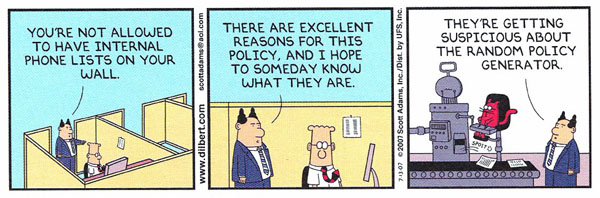
 on their employees and then creating an emotionally toxic environment as to make people die from stress-related illness, specifically from creating insane rules that raise blood pressure to dangerously high levels, and also inventing a Random Policy Generator◊ to make employees question their own sanity,◊ or claiming that asbestos is safe while wearing a hazmat suit.◊
- One Sunday strip went through a list of different kinds of awful bosses, the Pointy-Haired Boss being just one of many. The "perfect" boss is one that dies on a Thursday afternoon since this gives employees a three day weekend.
- One story arc involved a temporary boss, who was a very angry man-hating woman. And would fire random male workers for no other reason than the fact that they're men. Though with Asok (The Indian employee) it completely backfires.
- Catbert and the Pointy-Haired Boss, at one point, discuss taking out a life insurance policy
- Roger's boss JP Pembrook in FoxTrot. At one point, his company was in the red and had to go through a round of layoffs. What does Pembrook do? He gives himself a $300,000 pay raise and makes Roger convince the boardmembers to approve it. On a more petty note, he also insists his employees look bad on company photo days (Roger is exempt since Pembrook believes he can't get any worse) so Pembrook will look better by comparison. He also assigns so much work to Roger that Roger has to bring it home to finish it. Roger doesn't have anyone but himself to blame for this one though: Pembrook does this because he realizes that Roger gets better results when he brings his work home (thanks to Jason catching Roger's mistakes).
- Life in Hell gives us an entire list of them.◊ With one exception. The Bad Boss trophy goes to The Psychotic Boss Monster From Hell.
- Retail:
- Much of Grumbel's corporate is this, as they'll cheerfully cut payroll and blame employees for bad sales rather than think it could be their bad decisions at fault.
- Stuart, who worships corporate, is like this too: he'll gladly take the credit for good sales (even when he was on vacation but any actual work and all the blame got passed onto Marla. Fittingly enough, he was eventually promoted to district manager.
- And yet, they pale in comparison to Delman's manager Mina, who will backstab anyone she can in order to become manager, and once she did so, set out to foster a hostile work environment where everyone is either cowed by her presence or just as backstabby as her.
- One strip showed a man in a high-rise office, opening the window and preparing to jump out. His boss, who was sitting behind the desk, would have none of it. "Get the hell back in here, Jenkins. I'm not through with you yet."


- In Catskin, the cook is cruel to Catskin.
- In The Fire-Bird, the Horse of Power, and the Princess Vasilissa, the archer is working for the tsar when he brings him the firebird's feather. The tsar immediately begins to demand more from him on pain of losing his head.
- In The Grateful Beasts, Ferko is working for the king when the king listens to his brothers' Malicious Slander and starts to devise Impossible Tasks for him.
- In Prunella, Prunella succeeds when sent to the witch's sister because she gives her servants things, and when the witch calls on them to stop her, they retort that Prunella gave them things that the witch didn't.
- In The Three Aunts, the queen demands that the girl working for her produce an impossible amount of work because other servants claimed she said she could do it.
- The 3 Little Pigs: The Movie: Big Boss has next to no respect for his sole employee, Aromé the skunk. Not only does he overwork her, but he also kicks her around almost whenever she’s near his feet.
- BoBoiBoy: The Movie: Bora Ra is perfectly willing to abuse his own gang members if they don't deliver satisfactory results. He leaves the airlock open until Yoyo Oo gives him Klamkabot's exact location, and not even Gaga Naz is exempted from being yelled at for "losing to kids".
- In his first scene in A Bug's Life, Hopper takes out his frustration at his brother by punching out another member of his gang (since he promised his mother on her deathbed he wouldn't kill his brother). Later, he buries his underlings alive just to prove a point.
- Valerie Da Vinci is introduced early on in Despicable Me 3 as Silas Ramsbottom's replacement to lead the Anti-Villain League... And not 10 seconds after she's introduced, she rudely kicks Silas out in the middle of his retirement speech, calls everyone present a loser, then fires Gru on the spot for failing to arrest Balthazar Bratt, even though Gru kept him from stealing the diamond he was after. When Lucy takes issue with this and defends Gru, Da Vinci fires her too (even though she's one of the AVL's best agents), then orders them both thrown off the AVL's blimp HQ. While it's still in the air. The worst part? She's only in that one scene (not counting Gru's Imagine Spot later), and doesn't suffer any kind of repercussions for what she did.
- Many Disney Animated Canon villains qualify. Among them:
- Maleficent from Sleeping Beauty was also shown to be a very bad boss to her minions (granted, it isn't surprising due to her being the Mistress of All Evil). A very notable instance of this is when she electrocutes her minions with lightning after she learns that they spent sixteen years searching for a baby, not even being aware that Aurora would age. That being said she said averts this with her raven Diablo, perhaps because he’s more competent.
- The Horned King, once he gets his rotten hands on The Black Cauldron shows, though, that there is a position for his soldiers in his new world order as nameless corpses in his Cauldron Born army.
- Ratigan of The Great Mouse Detective, as demonstrated when a drunk henchman sets off his Berserk Button by calling him a "rat." The irony of this is, no matter how much he denies it, he is a rat (literally, not just figuratively) and he's hardly fooling anyone by denying it.
Ratigan: Oh, my dear Bartholomew... I'm afraid that you've gone and upset me. You know what happens when someone upsets me. (rings bell to summon his Right-Hand Cat)
- When Fidget suggested for them to cast off excessive weight of their dirigible in order to go faster (he was thinking of tossing their hostage overboard, so he isn't exactly nice guy either), Ratigan complied... by throwing him overboard. Fidget is a bat with a crippled wing.
- Then there's Captain Hook, who once shot one of his pirates (off-screen) for singing and playing the accordion too loudly. And then threw another (Starkey) overboard for remarking on "no splash" when he sent Wendy overboard.
- Hades in Hercules regularly throttles or flame-broils Pain and Panic. They might not be the sharpest minions out there, but after over ten years you have to wonder if he's just too lazy to find anyone else. Small wonder they're happy to see him get punched into the River Styx.
"Memo to me, memo to me: maim you after my meeting."
- Frollo in The Hunchback of Notre Dame. His idea of a warm welcome for Phoebus, the new Captain of the Guard? Having someone flogged within their earshot — someone all but outright stated to be Phoebus' predecessor, who "disappointed" Frollo in some way.
- The Lion King (1994): Scar lets his hyena lackeys run rampant over the Pridelands until even they run out of food, but casually manipulates all of them into helping his selfish scheme, and ultimately tries to pass the blame onto them when he tries to weasel his way out of justice. He also physically abuses them throughout his Villain Song. It's no wonder why the hyenas are happy to devour him when they overheard his plot to betray them. The Lion Guard shows that Scar used the Roar of the Elders to destroy his own Lion Guard when they refused to support his plot to murder his older brother Mufasa.
- Commander Tiberious Rouke in Atlantis: The Lost Empire mortally wounds his crony Helga Sinclair by throwing her down from the zeppelin he's using to escape. She retalaliates by using the last of her remaining life to fire her flare gun at the zeppelin.
- Soto, the leader of the saber-tooth tiger pack in the first Ice Age movie. For someone who supposedly wanted revenge for the murders of his pack, he certainly didn't seem to value his crew's lives very much, threatening them with death for failure and more generally not caring for them and letting each fend off for himself.
- Captain Gutt from Ice Age: Continental Drift is arguably worse. He is verbally and physically abusive to his crew, cruelly rebukes his (former) first mate Shira before demoting her as punishment to kill the sub-zero heroes and outright threatens to kill her when she turns on him. When we next see her, she's in a pretty bad state, implying that Gutt might have done worse to her. Diego even points out that when she went missing, Gutt never bothered to send a search party for her, opting to fix up a new ship instead to continue pursuing Manny's group.
- Syndrome from The Incredibles is a horrible boss. He didn’t even care that Mirage could have been killed when she was held hostage by Mr. Incredible, not caring that she's his Dragon. The end result is Mirage's Heel–Face Turn.
- In the TV movie Jonny Quest vs. the Cyber Insects, Dr. Zin provides several good examples of how not to treat your henchmen. Specifically, he continually kills them for very minor failures, including two occasions where the executed minion wasn't responsible. Even in Jonny's Golden Quest, Zin briefly considers taking Dr. Devlon back into his employ, but then changes his mind and has his robot kill him. He then admits that he has never been known for "making good management decisions."
- Lord Shen from Kung Fu Panda 2. He clearly doesn't give a damn about any of the wolf soldiers under his command and is perfectly willing to fire on them to get at the heroes. And when The Dragon objects, he knifes him in the throat.
- Madame LaCroque from Madeline: Lost In Paris. Rather than taking care of them properly, LaCroque mistreats her victims and punishes them for "complaining", which is more often than not about things that could be life-threatening. One particularly despicable example was when Fifi lost control of her coughing and ruined the lace that she was working on. Does LaCroque help her? Nope! She sentences Fifi to working on black lace, which would blind the latter as another slave reveals is possible. A pissed Madeline defends Fifi and gives LaCroque a "The Reason You Suck" Speech for being cruel, but this only makes LaCroque angrier instead of making her go through a Heel Realisation.
- Monsters, Inc.: Randall is very rude and abrasive toward his assistant Fungus, their relationship being totally opposite to Sulley and Mike's. It is telling that when Fungus is seen at the end without Randall, he is much happier.
- Puss in Boots: The Last Wish: Big Jack Horner is a bullying thug who runs his family's pie-making business with an iron fist, hoards magical artifacts (including baby unicorn horns) because of his long-standing envy of magical creatures, and carelessly sacrifices the lives of his employees in his quest to get the Wishing Star. He's also a Card-Carrying Villain; when the Ethical Bug calls him an "irredeemable monster", his response is to mockingly ask him what took him so long to notice.
- Ratatouille: Skinner goes from Mean Boss to this, first when he finds out that Linguini is Gusteau's son and tries his best to keep Linguini in the dark about it so he can fire him and continue his frozen foods line unopposed, and then when he steals Lalo's scooter at one point to chase after Rémy.
- The Return of the King: The Lord of the Lash, who whips his orc troops, forcing them to march into battle.
- Rumpelstiltskin's idea of a council with his hench-witches in Shrek Forever After consists of him filling a glass with water and waving it threateningly at the witches while wrongfully blaming them and threatening them with liquidation unless they find a solution. And it becomes crystal-clear that the only thing that matters in this council is not speaking when the king is fed up even when its very helpful to do so, because the witch who did it didn't live to see that her idea was good enough to be immediately followed through.
- Hunter from Storks as the head stork made his office entirely out of glass, knowing full well that birds can't see glass — Cue storks smacking into the glass walls. He also uses tiny Robins as various office items, and the balls in Office Golf.
- Bowser in The Super Mario Bros. Movie. Rather shocking considering his game counterpart is quite the opposite, but in the movie he's much nastier and crueler to his troops. Some of his minions are terrified of him, he doesn't know the species name of the Spinies, or worse doesn’t bother to remember their species name, and instead refers to them as "whatever those things are" (which visibly disappoints them), and a few members of his army are shown locked up in his dungeon and are even used as sacrifices for his wedding (with one Koopa Troopa already shown being dead in one of the cages, in addition to a few Goombas who didn't want to help him conquer the Mushroom Kingdom). He also roasts one of his Koopa Troopa minions and reduces him to a Dry Bones for speaking out of line and even slammed the piano cover on Kamek's fingers in a fit of irritation that he doesn't know anything about this human plumber that stumbled into the Mushroom Kingdom.
- Toy Story 3: Lots-O-Huggin Bear is such a horrible boss that his minions serve him out of fear rather than loyalty. When Buzz refuses to join Lotso's gang in the Caterpillar Room and abandon his friends, Lotso brainwashes him by resetting him to demo mode. He even betrayed Ken, his lieutenant, by leaving him to fall in the dumpster with the heroes and poked Big Baby with his mallet while yelling at him for still loving Daisy, an act that even his minions were horrified of.
- When we first meet Synonamess Botch, the Big Bad of Twice Upon a Time, we see him cussing out his vulture minions and telling them not to slack off, which is apparently his idea of a Rousing Speech. Even in the tamer director's cut, he bluntly admits that some of his vulture minions might not make it out alive from their latest mission, but that's a sacrifice he's willing to live with.
- Stalin is giving a speech in a packed auditorium, when someone in the crowd sneezes. "Who did that?" Absolute silence. "Who sneezed!?" Still not a peep. "Soldiers! Execute the front row. [...] Right! Who sneezed?!" Still nothing. "Soldiers! Execute the second row! [...] Now who sneezed?!" Still not a sound. "Soldiers! Execute the third-" "Comrade Premier, it was me, I sneezed!" Stalin turns towards the man who just spoke and says, "Gesundheit, comrade!"
- Grahame Coates of Anansi Boys. His key failings as a boss: he always fires employees before they've been employed long enough to qualify for the severance package, saving him considerable money in having to pay it; the one employee who didn't get this treatment ended up being the patsy for his corporate corruption; and he actively revels in speaking in clichés.
- Animorphs:
- Visser Three, who decapitates a subordinate for closing a door too slowly and has another one shot for reminding him that bugs exist. note He acquired a Yeerkbane/Vanarx, the Yeerks' natural predator, giving him the means to kill subordinates in a Primal Fear way. He is so awful, that members of his army will often pass up promotions because it means working (physically) closer to him. Everyone who works close to him lives in constant fear of his wrath and is extremely careful not to aggravate him or question his orders. It's to the extent that, when posing as a Controller in a situation where Visser One was expecting a group of three, Marco was able to deflect suspicion by claiming, "I think Visser Three killed them for doing something wrong." He immediately chastises himself for such a stupid lie, but is believed without question.
- Ironically, his Bad Boss tendencies actually work to the Animorphs' advantage on multiple occasions. For example, several Yeerks have been suspicious that the Animorphs are humans and not "Andalite bandits", but because Visser Three is firmly convinced that the Andalites would never hand over their morphing technology to other races for any reason, they're too scared to contradict him and thus decide to leave it up to someone else to tell him. Jake even mentions at one point that Visser Three's leadership makes the Yeerks less effective.
- Greater-Scope Villain Visser One is also an example, though she's more the type to pragmatically kill off hosts or subordinates only once they're no longer of use rather than at the drop of a hat as Visser Three does.
- Visser Three, who decapitates a subordinate for closing a door too slowly and has another one shot for reminding him that bugs exist. note He acquired a Yeerkbane/Vanarx, the Yeerks' natural predator, giving him the means to kill subordinates in a Primal Fear way. He is so awful, that members of his army will often pass up promotions because it means working (physically) closer to him. Everyone who works close to him lives in constant fear of his wrath and is extremely careful not to aggravate him or question his orders. It's to the extent that, when posing as a Controller in a situation where Visser One was expecting a group of three, Marco was able to deflect suspicion by claiming, "I think Visser Three killed them for doing something wrong." He immediately chastises himself for such a stupid lie, but is believed without question.
- Buffy the Vampire Slayer: In The Gatekeeper Trilogy, Il Maestro gets his enforcers to do horrible things for him in the name of power, but is also planning to kill all of them once his plan reaches fruition. Even without that, he is constantly sending scores of minions on suicide missions or using his magic to kill anyone who voices doubts about his plans (regardless of whether he is there with them, as his powers let him spy on conversations from far away) or deviates from his instructions in the slightest.
- In Castle Hangnail, this is discussed; the minions have standards about what kind of behavior is acceptable from a Master. Handing out strict punishments for minor infractions is perfectly ordinary and even expected. Killing is relatively okay, especially if he always remembers to revive the victim once he's calmed down. But there are some things that are just not on.
- Older Than Radio: Ebenezer Scrooge in A Christmas Carol, before his reformation, that is.
- The Chronicles of Narnia, The Lion, the Witch, and the Wardrobe: It doesn't matter if you're a rebel or a minion of the White Witch, she'll turn anyone into stone if they piss her off.
- A Confederacy of Dunces:
- Lana Lee pays Burma Jones peanuts and harasses and berates him repeatedly and makes Darlene work on a commission, at one point beating her up for answering the phone. She also blames her employees for problems caused by her cheapness and poor business management, and runs an illegal porn ring on the side.
- Downplayed by Mr. Clyde, who for the most part is a somewhat gruff but ultimately good guy and a reasonable boss, but he also repeatedly threatens to stab Ignatius with a rusty fork, and it’s pretty clear that he will follow through in his threats should Ignatius push his luck.
- Ajaw Cassowary's Establishing Character Moment in Constance Verity Destroys the Universe opens with him breaking one of his scientists' neck with his bare hands for "stifling [his] greatness" by suggesting that using The Key without testing it first is a bad idea.
- The Death of WCW:
- The book frames a particularly unsavoury stipulation in World Championship Wrestling's contracts as this. Namely, if a wrestler couldn't return to duty within 90 days of an injury, their pay could be cut in half and they ran the risk of being fired, as Davey Boy Smith was while hospitalised for six months due to a spinal injury. As the authors note, this kind of clause is almost unheard of in professional sports due to the pressure it puts on the injured to return to work before they were fully healed and helps explain WCW's reputation for rampant pain pill addiction.
- The authors also note examples of unpleasant behaviour by management, ranging from greenlighting a skit portraying Arn Anderson as a layabout drunkard despite knowing about his bad personal history with alcoholism, to offering the otherwise near-shelved Bret Hart a chance to appear on TV... as long as he was willing to perform dangerous stunts like driving vehicles out on iced-up ground or taking bumps onto concrete, and this after Owen Hart's tragic death.
- The Destroyermen series has Captain Kurokawa. The Imperial Japanese Navy was known for its harsh corporal punishment, but even they find it extreme to let savage alien lizards cook and eat some of your guys from time to time. Kurokawa has no such inhibition.
- Being a God of Evil, Gorgoz in Divine Misfortune likes to make his followers commit terrible deeds or self-harm whenever they fail him or for his own amusement. That is if he doesn't just kill and eat them first. Being one of his cultists also means that after death, your soul turns into one of his animal familiars to serve him for all eternity, so the cons outweigh the pros by a wide margin.
- The Elemental Trilogy: The Bane kills hundreds of his own soldiers on the chance they might expose his use of sacrificial magic to Atlantis.
- Harry Potter: Lord Voldemort regularly tortures, abuses and kills his subordinates, even before his initial fall from power. It's his style of leadership. Several characters point out that many of the Death Eaters only returned to him out of fear of what he'd do to them if they didn't; even if they like to taunt people they don't like that they will get theirs when Voldemort returns, and sometimes go on "Muggle hunts" in their Death Eater uniforms, in reality most have pretty mixed feelings about him actually coming back, save for a few fanatics like Bellatrix.
- You don't want to work for Ivo Taillebois in The Hereward Trilogy. Most of the time he'll limit himself to shouting and throwing things at you, but no amount of loyal service will stop him sending you to certain death if he has anything to gain by it.
- In Death series: Crime boss Max Ricker from Judgment in Death is very much this. He will kill employees for failing to do their jobs. He smashed an uninvolved robot maid to pieces over a failure of his employees. He wanted to kill a loyal employee, but his lawyer managed to convince him not to — and that he could find another time and place to have that one killed. He is addicted to drugs and has Mood Whiplash that is as disturbing as it comes. It's a wonder that anyone would want to work for this guy!
- Ned's boss Tate from In the Company of Ogres is a gryphon who has a habit of eating employees who displease him in any way. Since Ned never stays dead for long, he tries everything in his power not to piss him off, not wanting to see how he'll wake up post (or mid) digestion.
- SMERSH in the James Bond novels. In Casino Royale, the villain Le Chiffre is explicitly motivated by such behavior.
- In From Russia with Love, Kronsteen, their strategist and actual chessmaster, is left sweating and coming up with excuses to justify not departing the minute he is summoned during a live chess championship.
- Joachim from The Key of Yliaster shows why psychopathic serial killers should not be made into a leader. If you work for him, there are several ways you could get killed off: failing him, annoying him, boring him, ceasing to be useful, or simply for no particular reason at all. He just finds it funny when people die, subordinates or not.
- Carl of the Kitty Norville series. In the first book, he sexually abuses his female packmates — including Kitty — and manipulates them in a power game against his wife Meg. When he returns in the fourth book, he's even worse, dragging his pack into a vampiric civil war and killing underlings out of paranoia. It all backfires on him rather spectacularly: two pack members defect to Kitty's side, four more rat out the entire operation when the police catch them, and the remainder decide enough is enough and tear him to pieces at the end of book four.
- The Last Days of Krypton: Zod randomly selects a completely innocent servant to send to the Phantom Zone as a test.
- Legacy of the Dragokin: Rufus shouts abuse at his goblin employees because they're stupid and get on his nerves.
- The Supervisor at Iotech makes a show of caring for The Man with the Terrible Eyes, but he sees him as something he can experiment with, spy on, and eventually kill if he needs to.
- In Masques, Geoffrey ae'Magi is a generally unpleasant person, who also kills his guards for having been tricked by the heroes. In front of the Sex Slave he had been raping beforehand. And he then asks the poor girl to take away the remains of the unlucky guardsman ... it's only ashes, but that makes witnessing the execution only more horrible.
- In The Mouse Watch, Cyborg Mad Scientist rat Dr. Thornpaw uses a Trap Door to dispose of henchmen who question him.
- Scrooge was tame compared to Fagin, another Charles Dickens character (from Oliver Twist). Fagin didn't care at all about members of his gang that were hanged for stealing (the fact that most of them were children only made it worse), but he would do anything in his power to silence one who he thought would rat on him to the authorities.
- One Fat Summer: Dr. Kahn comes off as this at first, at least in Bobby's eyes. The flyer he put up indicated all he needed was someone to mow his relatively small lawn. In reality the job takes the form of full time grounds maintenance, while still offering the same pay rate. He even stiffs Bobby after his disastrous first day, docking his pay to replace the rusty old mower blade Kahn had forced the boy to use when it gets broken by a rock. If summer camp weren't the worse prospect, it's unlikely Bobby would have stayed.
- Cartel boss Bill Netley of Paraiso Street is a Manipulative Bastard who rewards cruelty, encourages infighting, and rules through fear. He's also comfortable with killing even his own successful employees to prevent minor inconveniences. This comes back to bite him, however, when he hinges his otherwise effective if convoluted conspiracy on framing a subordinate for a years-old slight, which puts him firmly in the crosshairs of other villains after the same person.
- Averted (mostly) with the Stained-Glass King, the Eldritch Abomination in control of all passage between the lands of the living and the dead, who gives his people as much leeway as needed to perform their jobs. Just don't accept bribes, deal with criminals, or violate the Laws of the Dead.
- The B-plot of Pegasus in Flight revolves around a major construction project whose overseer, Ludmilla Barchenka, is extremely demanding and has a pronounced tendency to cut corners — particularly when it comes to safety equipment for the workers — in her determination to get the job done "on time" (although it's widely suspected that by this she means "quickly enough for me to earn a fat early-completion bonus"). The construction workers turn to Bothering by the Book to get their own back, and in the end the project is completed exactly on time.
- The Pilgrim's Regress: Mr. Sensible yells at and threatens his servant "Drudge" while he's getting Mr. Sensible's work done. When Drudge understandably decides to leave with the heroes, Mr. Sensible sees it as gross mistreatment. He says that he'll have to talk to some of his friends, who may have mechanical contrivances or members of a servant race to supplement the loss.
- Interestingly, despite the popular representation of Machiavellianism, The Prince strongly discourages this behavior — abusing and bullying your subordinates for no actual reason will make them hate you, and hatred must always be avoided. You Have Failed Me may be a reasonable practice, but in very limited amounts. Otherwise, Machiavelli encourages a Bread and Circuses way of treating citizens.
- In the Rainbow Magic series, Jack Frost can't stand his goblins, especially when they mess up.
- Every Redwall villain ever put in print. The most extreme example may be Slagar the Cruel, who not only kills off any minion who fails him or talks back, but whose entire plan also revolves around killing off his crew so that he can have the entirety of their profits.
- Grocery store owner Mr. Fyowhe in Riesel Tales: Two Hunters. He works his employees hard, pays very little, and is an all-around sarcastic jerk. Good employees are typically rewarded with boxes of cereal.
- Screwtape from The Screwtape Letters is the boss from Hell (literally!). It's too bad we never get to see the booklet "on the new House of Correction for Incompetent Tempters" that he sends Wormwood at one point, as a motivational tool.
- Daylen in Shadow of the Conqueror got into the habit of disposing of any underling who failed or annoyed him when he was Emperor, and he still has traits of this. After killing Blackheart and pressing Sain into service, Daylen punishes any infraction with backhands, punches, and broken bones (taking advantage of Ahrek being nearby for the latter), while threatening to kill him if he leads them into an ambush. He seems to be moving away from this, though, as he repays Sain with interest after the mission by giving him Blackheart's ship and considerable fortune.
- The Shahnameh: Afrasiab decapitates his soldiers who won't fight against Key Khosrow with a dagger when it's become evident that the Persians Roaring Rampage of Revenge is unstoppable. The Turanians Mostly know that Key Khosrow is a just king and he's only after Afrasiab and those directly responsible for Siavash's death.
- The Sisterhood Series by Fern Michaels: Rosemary Hershey in Sweet Revenge is very much this. She is in charge of a company that makes architectural plans and blueprints. Her employees probably didn't like her, but they tolerated her. However, she suffers a Villainous Breakdown that spans the book. During her breakdown, she is practically screaming at her employees to come up with some great architectural blueprints now! When she gets some blueprints from them, she starts yelling at them that a 12-year-old could have drawn up these plans. This is interesting, because Rosemary doesn't really have much expertise in drawing up plans. In fact, she had to rely on plagiarizing the plans belonging to her former boss Isabelle Flanders to get to the position she is at now. She becomes so enraged at what she perceives as incompetence on the part of her employees that she fires them. All of them. Yes, that is how bad her breakdown is.
- In A Song of Ice and Fire, the infamous Gregor Cleagne is said to have killed one of his own soldiers for snoring too loudly.
- The highly mercurial Cersei Lannister is not easy to please (and, yes, she does expect you to be both psychic and fluent in sardonic wordplay or "Lannister code"), and will gladly throw even family members she convinces herself messed up under the proverbial bus (isn't that right, Lancel?), let alone other people. Once Qyburn gets involved as her trusted personal assistant... *shivers*
- Ramsay Bolton neé Snow: he and Gregor share some broadly similar management styles. He does rather like flaying as a motivational tool...
- Subverted with Roose Bolton and Tywin Lannister: they're careful to be OK, if challenging, to work for. Until the minute you screw up with no plausible excuse. At that point, you're several shades of screwed.
- Split Heirs: King Gudge “solves” any issue he has with a person by beheading them (naturally this includes his underlings).
- Star Wars Legends:
- Darth Vader learned from the best. In Dark Lord—The Rise of Darth Vader, Vader suspects that Darth Sidious had his life support and armour constructed with outdated, ill-fitting technology to punish him for needing it in the first place. Sidious considers either sending Vader to Naboo and Mustafar or just killing him as further punishment for failing to kill Obi-Wan. Instead he gives him a scathing verbal beatdown.
- In Maul: Lockdown, Warden Sadiki Blirr summons a group of new guards who she suspects of infiltrating the prison on behalf of Jabba the Hutt and threatens to unleash the ruthless prison gangs on them if no one confesses. Once she gets a confession, she sics the gang members on them anyway. She doesn't even spare the innocent ones due to feeling they know too much. For his part, Jabba (who Sadiki is calling throughout the scene) also refuses to acknowledge any of them as his men when that may have saved their lives.
- X-Wing Series: Isard. When one of her ship captain minions betrays her, her response is to order not just his death, but the death of his girlfriend and her entire family; a calmly delivered, easily missable line reveals that she started killing the families of all the ship's crew hours ago. Additionally, Isard states that she had killed families of Imperial personnel before. Even Isard's co-conspirators hold her in such contempt for her excesses that one of them (who's the POV character for the scene above, and has pretty well already decided to betray her) decides that he'll make sure as many of the people in question remain safe despite not giving a damn whether they live or die, just because it'll annoy her. Her backstory in the comics and a mini-novel by Stackpole and Timothy Zahn makes it abundantly clear she's willing to throw anyone to the rancors to advance her own agenda. Including her own father, whom she has arrested for treason (it's rumored that she shot him herself) before taking over his post as Director of Imperial Intelligence.
- In The Stormlight Archive, the truly reprehensible villains are defined by this behavior.
- Highprince Sadeas effectively runs his army like this, being willing to throw away the lives of his soldiers and slaves regularly in order to win Gem Hearts from the chasmfiends and kill the Parshendi. The bridgemen, in particular, are organized to be Cannon Fodder just so his trained soldiers won't be shot at by Parshendi archers.
- Odium and the Fused also run on this. Outwardly they behave like benevolent leaders to the Parshendi armies, but this is due to pure pragmatism to keep the army functional and efficient. They don't hesitate to throw away the lives of their soldiers, they enslave their own people when they make a significant mistake, and each Fused requires the death of a Parshman to let them inhabit their bodies — a fact that the Parshman isn't told of beforehand.
- Tortall Universe: In the Trickster's Duet, the ruling family of the Copper Isles are invariably this. King Oron is The Caligula, and after him come his daughter and son-in-law Imajane and Rubinyan. They routinely execute underlings who dissatisfy them, slaughter hundreds of raka villages, arrest a popular and powerful noble for saying they should ease up on the oppression a bit, kill Oron's child successor, and easily fall for fake evidence of an affair by Rubinyan that results in Imajane beating the innocent woman.
- Underground has Richard Swanson, who is reviled by every fighter that works under him, as he regularly sends his other lackeys to beat up or even kill anyone who steps out of line.
- The Unwilling Warlord: Vond kills a servant for accidentally spilling some wine onto his robe in a fit of rage. This act is what finally leads Sterren to get off the fence about working to bring him down.
- Vathek, being a Gothic Horror novel, has this with all three of its authority figures:
- Vathek shows absolutely no concern for the lives or well-being of his officials, servants or soldiers. Frequently, he degrades and tortures them For the Evulz.
- Carathis is more callous and business-like about it then her son, but deliberately sacrifices persons helping her at least once in the tale (when she walks her huntsmen guides to their deaths, and then instead of giving them decent burials, feeds them to ghouls). She also randomly poisons her daughters-in-law and other noblewomen, then heals them with antidotes, as a form of practice. And, of course, in the end she murders her faithful "mute negresses," apparently under the theory that they should not outlive their mistress.
- Eblis sends forth his giaours to tempt proud men to his service in return for promises of treasure and power — but only gives them their rewards under conditions that ensure they will not enjoy their gifts, because they will be tortured forever immediately thereafter, and they know it.
- Victoria has several, but the Cascadian Straw Feminist goddess is the worst seen onscreen. Her initial reaction to believing an order has been disobeyed is literally to look for a victim to have sacrificed.
- The Grand High Witch from Roald Dahl's The Witches is quite nasty. She'll incinerate you alive if you so much as express any kind of reservation about her plan to wipe out all the children, as one poor Witch learned the hard way. And if you got turned into a mouse yourself, well, tough luck — you're getting squashed under her heel, regardless of whether you were a child (her usual target) or not. She also mistreats her assistant, Miss Irvine, in the movie, culminating in forcing her to stay upstairs and pack for their departure instead of attending the RSPCC dinner. Ironically, this ends up saving Irvine's life — if she's attended the dinner with the other witches, she would've been turned into a mouse and chopped up.
- Virgil of Within Ruin definitely qualifies. After violently murdering two Magi with little explanation ("I must uproot the rot among my subordinates") he tells the third to keep in line or face the same. Later he chastises her for having an armed escort greet him at the fortress gates. She had brought the contingent in order to protect him, Virgil didn't see it that way.
- You Are Dead (Sign Here Please):
- Director Fulcher is prone to shifting blame onto his employees and dangling promotions and name changes over their heads and never delivering.
- Overdirector Powell has a large collection of canes topped with skulls that belonged to Director Fulcher's predecessors who failed her.
- All Creatures Great And Small: Angus Grier is a drunken bully who humiliates his employees for kicks.
- Almost Live!: This Seattle-based sketch comedy once did a bit set in an office where the bad-tempered bully of a boss gets promoted, and his replacement is a box of snakes. Eventually the box gets promoted as well and replaced with the greatest horror of all: a guy who sells Amway.
- Babylon 5:
- The insane Emperor Cartagia, among other things, kept the severed heads of advisors who gave "unappreciated" advice, in a room all their own, and killed his court jester for making the wrong joke. His plan of ascension to godhood involved the destruction of the entire Centauri Homeworld. He was completely out of his mind. It's worth noting that one of the advisers was killed because he had a "most annoying cough".
- Only slightly better: Ulkesh, the second Vorlon ambassador, whose treatment of his human aide Lyta included forcing her to throw away all her possessions to "avoid distractions", making no attempt to avoid Mind Raping her when he Body Surfed her, Agony Beaming her whenever anything vaguely annoyed him, and Punching Her Across the Room when she attempted to telepathically scan him. The emotional subtext approached Domestic Abuser.
- Battlestar Galactica (2003):
- Admiral Helena Cain: a sick, twisted bitch, even by Battlestar standards. For instance, her original XO refused to give a near-suicidal order — her response was to shoot him in the head in front of the entire CIC.
- In the forgettable episode "Black Market", the head of the black market Phelan shoots one of his henchmen in the head simply so that Lee can close his case without uncovering more dirt and disrupting his operation. He does this in plain view of his other henchmen as well.
- Breaking Bad: Thrives on this. Tuco Salamanca beats one of his henchmen to death for reminding Jesse Pinkman and Walter White who they work for; in his first appearance he beats Jesse senseless for trying to sell his meth at too high a price. Gus Fring kills Victor in full view of Jesse and Walt to send them a message and keep the police from tying him to Gale Boetticher. When Walt continues to help Hank Schrader, Gus puts out a hit on Hank and threatens to kill Walt's entire family if he interferes. Don Eladio Vuente, head of the Mexican cartel, murders Gus' meth distributing partner before allowing him to work for the cartel, and may have been blackmailing Gus ever since. In Season 5, we have Walt himself.
- Buffyverse:
- Angelus in the second season, who constantly needles a wheelchair-bound Spike and outright flaunts his relationship with Spike's lover Drusilla. Spike eventually turns on him out of both revenge and self-preservation.
- The Master was also terrible, probably made worse over being trapped underground and powerless and unable to take his frustration out on anyone but his own servants. He overused You Have Failed Me and snapped at his servants constantly. He mellowed out a bit after everyone except The Anointed One died.
- In Season 2, Spike sacrifices a vampire mook on two separate occasions just to get an idea of how the Slayer fights. The following season these henchvamps are working for the Affably Evil Mayor of Sunnydale, and make a point of telling Spike how their lot has improved since he left town.
- Glory, the Big Bad of Season 5, tends to spend most of her screen time with her minions openly insulting or beating her minions, who all have Undying Loyalty to her regardless. Of course, since she's also a Mood-Swinger, she switches from treating them like scum to coddling them in the blink of an eye.
- As Warren gets darker, he dominates Andrew and Jonathan, reserves all of the gadgets and artifacts they steal and/or make for his use alone, and ultimately leaves them to take the fall.
- The Swell kill all of their human and demon minions.
- Wolfram & Hart, and their unforgiving treatment of their employees. There have been such reports as sacking employees using actual sacks, forcing them to eat their own livers, and performing random telepathic scans to root out any disloyal workers and execute them on the spot. Furthermore, in the fifth season premiere of Angel, Knox tells Fred that on one occasion, when an employee was fired, he was literally set on fire.
- Jacob Crane, the evil restaurant owner in the Angel Season 5 episode "Unleashed" who has Nina Ash captured with the intent to serve her for dinner, flat-out tells Angel that he's perfectly willing to let his mooks die.
- Angel himself became an example after he and his crew took over Wolfram & Hart during Angel Season 5, though in his defense, most of the employees are bad guys in servitude to the Senior Partners, his sworn enemies; by the time of the sixth episode of the season, it's noted that Angel has killed several of the employees, as well as their clients, and that all of the other employees are terrified that Angel's going to off them next. In the episode "Harm's Way," he called a demon employee into his office and promptly chopped his head off with an axe because said employee violated the zero-tolerance policy on killing humans that Angel had instated.
- Charmed: Demons are quick to kill their underlings for even the slightest infractions. They'll even kill their underlings for not saying exactly what they want to hear at the time. About the only way a demon can hope to last long is by having a skill that's really hard to replace.
- Corporate:
- Christian Deville, the CEO of Hampton Deville, has no morals and rules his boardroom through fear on top of being a Louis Cypher.
- John and Kate, the direct supervisors of the main characters, are fickle, cruel, and completely self-centered.
- Dinosaurs: B.P. Richfield is often mean and intimidating to his employees. In one episode, he informs Earl that WESAYSO wanted to provide an incentive for the most trees pushed down, and Richfield's suggestion (shot down by the higher-ups, of course) was to harm them. In another episode, Richfield makes his employees work overtime at the last minute (and without extra pay). In another episode, at a company picnic Earl talks about the importance of family over work, and as a result Richfield wants to eat Earl (but is stopped upon learning he could still be useful to the company).
- In one episode, he fires Earl for getting injured on the job, after being sued for 80,000,000 dollars and after Earl comes by to show off (and jokingly warns him to be careful or else he'll sue him again) uses the opportunity as an excuse to fire the other employees and raise prices, putting the blame on Earl. Later on, Robbie talks Earl into giving him back the money in exchange for hiring back all the laid off employees and lowering prices, which he refuses, and after Earl accidentally crashes a golf cart into his trailer, Richfield fakes an injury so he can sue him for the money back. While he wins, the judge also orders him to rehire everybody and lower prices as well.
- Doctor Who:
- The Master has a persistent tendency to kill anyone who even remotely qualifies as a henchman. Notable examples include the character's first appearance in "Terror of the Autons", where he kills a mildly disobedient henchman with a plastic chair; and "The Sound of Drums", where the Simm Master's first act as Prime Minister is to gas his entire cabinet. The only discernible reason the Master does this is because they're just that twisted. Capped off with a dying cabinet member proclaiming "You're insane!" and the Master responding with two enthusiastic thumbs up.
- "Dalek": Henry van Statten, an American billionaire with more money than sense. He keeps control via an army of mooks and by memory-wiping subordinates on a whim, keeping the rest in a state of sycophantic terror. Unfortunately, by insisting the Dalek he had in his "possession" be captured when it got loose, regardless of casualties (he even gives an order for the soldiers to stop shooting at it because he doesn't want its body scratched), he alienates the security force, and by breaking down in fear in front of his latest second-in-command he loses her respect. After the crisis is over, they quickly join forces to depose van Statten, giving him the same treatment he'd given to subordinates he'd felt "failed" him.
- "Daleks in Manhattan": Mr. Diagoras orders the workmen at the Empire State Building to work harder and faster on completing the building, not caring about the conditions at all. He also threatens to fire them on the spot if they don't work in the dangerous conditions.
Diagoras: I don't care how cold it is, or how tired you are, just get out there AND FINISH THE JOB!
- "The End of Time": The Big Bad, Rassilon, Lord President of the Time Lords, disintegrates a woman who voices a dissenting opinion on his council (she speaks out against the Time War, and even dares to suggest that maybe the Time Lords should die). In his second proper scene, no less.
- Played with in "The Bells of Saint John", where a boss recommends killing an employee... but quickly adds to wait until he returns from his upcoming holiday, because she doesn't want to be unreasonable.
- "Arachnids in the UK": Jack Robertson, an American businessman who is a clear Take That! at a certain real-life individual. Over the course of the episode, he: fires Yaz's mum Najia for accidentally walking in on a sensitive conversation between himself and two of his most trusted staff, shuts his bodyguard Kevin in with a Giant Spider and leaves him to die, and blames everyone but himself for what's happening.
- "Nikola Tesla's Night of Terror": The Skithra Queen destroys one of her underlings for answering the Doctor's question in her place... before giving the exact same answer as him.
- Don't Trust the B---- in Apartment 23: Subverted in "Sexy People ..." Chloe walks into the offices of People magazine and takes over the production of the annual "Sexiest Man Alive ..." issue to get James on the cover in order to prove to June that she's a sheep who follows trends. She does her best Miranda Priestly, firing the first two people who ask her questions, constantly bullying another employee, drawing penises on the whiteboard and trying to throw things through the window to make her points. However, at the end it turns out that one senior editor picks the cover boy every year, completely ignoring the staff's suggestions.
- Elementary:
- Moriarty has a habit of eliminating henchmen, not only when they fail but when it suits an agenda. In "M," Moriarty betrays Moran to Holmes in the hopes that Holmes will kill him; and in "The Woman" has Isaac Procter kill a man who served as a Body Double, sends assassins after Procter, and then kills him personally.
- Charles Augustus Milverton in "Dead Man's Switch" killed his blackmailing partner, Abraham Zelner/Stuart Bloom, for demanding a raise.
- Firefly:
- Adelai Niska, a psychotic crimelord introduced in "The Train Job", makes a point of showing his new hires the beaten, bleeding body of... his nephew. Indeed, after the crew of Serenity renege on their deal with him after learning that the job in question was denying the citizens of Paradiso some much needed medicine and put his Dragon Crow through the ship's engines, Niska takes revenge by capturing Mal and Wash and putting them to the torture in "War Stories," prompting a furious Castle Storm by the rest of the crew to get them back. Many crimelords in all genres and (gasp) Real Life make a point of being cruel to perceived enemies.
- He goes on to explain that reputation if nothing is you don't back it up with reality. He feels that being known as a torturer is not enough to motivate underlings. Being seen as one shows you he's serious.
- Game of Thrones:
- Joffrey Baratheon's rude, abrasive and thinks nothing of ordering people killed for minor slights.
- Ramsay Bolton, during a twisted variant of Good Cop/Bad Cop, kills five of his "bad cop" henchmen merely to mess with the mind of his captive, who believes Ramsay is rescuing him. He essentially killed his own men for fun. Later, he has no problem ordering his archers to fire upon their men when they are engaged with the enemy during the Battle of the Bastards and creating a mountain out of their corpses to trap Jon's forces.
- Littlefinger occasionally shows his true colours to his sex workers.
- Justified in most cases with Tywin Lannister, as he's Surrounded by Idiots. He's actually rather friendly with Arya, as he recognizes her as intelligent and competent. That is until he hands her over to the service of Ser Gregor Clegane.
- Not in Real Life, but Alton Brown sometimes portrays himself this way on Good Eats. To the point where in a couple of episodes, his crew went on strike, and once they marooned him on a deserted island which turned out to be O'ahu.
- The Good Guys: The pilot has a drug lord who insults his bodyguards, pays a flunky who handles million dollar drug deals for him "less than he pays his pool boy" and constantly reminds Pedro that the guy is only the "second best assassin in the world" and has him do gun tricks as entertainment. It is hardly surprising when his men are not very loyal to him.
- Heroes:
- Arthur Petrelli in Volume 3. When Maury Parkman protested against his plan to kill Matt, Arthur responded by telekinetically snapping his neck on the spot.
- Emile Danko of Volume 4. Especially in the online comics and mini-series, where he's shown pushing his men to the brink and also sending them into potentially hazardous situations blind with poor intel. Plus it's implied that he's fed two of his men to Sylar so Sylar could assume their identities, as well as setting things up so that one of the personnel would end up killed by Tracey Strauss in an escape orchestrated by him to prevent an implied shutdown of the division by the government.
- It should be noted that when push came to shove, Danko's men were completely prepared to believe that he'd cracked and shot his own men, rather than believing Danko's story of shapeshifting killers, despite knowing that such things are entirely possible. Apparently that's the sort of reputation you get amongst your co-workers when you enlist them to fake attacks on your own citizens by the enemy.
- Hogan's Heroes:
- General Burkhalter is definitely this to Colonel Klink, constantly humiliating and insulting him both in private and in front of others, and threatening to court-martial him, shoot him, transfer him to the Russian Front, or even all three!
- To a lesser extent, Klink is also this to Sergeant Schultz, although he really is more of a Pointy-Haired Boss.
- General Burkhalter is definitely this to Colonel Klink, constantly humiliating and insulting him both in private and in front of others, and threatening to court-martial him, shoot him, transfer him to the Russian Front, or even all three!
- House:
- Has Edward Vogler from the first season. His first act as board chairman is forcing House to fire one of his team, ostensibly for budget reasons, as a sick test of obedience.
- House himself, however, is horrible to work for. Several characters have noted that prolonged employment by — or contact with — Dr. House has a corrupting influence on the soul. In early Season 4, Foreman can't get work anywhere else because of the behaviors he's picked up from House.
- Kamen Rider:
- Kamen Rider Gaim: Ryosho, the Overloard Inves king, is a rare, justified version of this trope. All of his remaining subjects are selfish sociopaths, so keeping them on a short leash is the only way to keep them in line.
- Kamen Rider Ghost: Alain/Kamen Rider Necrom is completely careless about using mooks as meat shields and his suit is powered by them. This is slightly mitigated by the fact that they are non sentient drones, but his attitude towards everyone else is not any better.
- Kamen Rider Ex-Aid: Parado, the de facto leader of Bugsters, has absolutely no qualms about mistreating them or punishing them with death. While this is largely motivated by the fact that Bugsters can always respawn, it's not only nasty, but also hypocritical.
- Kröd Mändoon and the Flaming Sword of Fire: Dongalor kills people or has them killed frequently just for delivering bad news, telling him things he doesn't want to hear or the like.
- The Law & Order: Special Victims Unit episode "Bully" features a Bitch in Sheep's Clothing whose abusive treatment of her employees is secretly recorded by one of them, who then has them leaked to the media. The boss ends up Convicted by Public Opinion and after her company starts to go under, she calls a press conference to give her employees, the media, and the police an undeserved "The Reason You Suck" Speech before shooting herself and leaving everything to her dog out of spite.
- Lexx has His Divine Shadow. Interrupting his meditation with news of a security breach is punishable by death. In that specific case, he not only ordered the poor general's death, he immediately orders the major who executed him to kill herself right afterwards. One admiral was willing to risk colliding with a Negative Space Wedgie rather than disobey a direct order from His Divine Shadow, since there was at least a chance of surviving the Negative Space Wedgie. Justified since His Divine Shadow's true agenda is the complete extermination of humanity. He doesn't really need an excuse to kill humans. At the end of the first season, he even went so far as to kill the Divine Predecessors, the brains of his former hosts, since he didn't need them anymore after reuniting with his original Insect body.
- The Mandalorian:
- Moff Gideon's Establishing Character Moment involves killing a dozen of his own men to make a point. In the next episode, two scout troopers with an important package hear about this and decide to make absolutely sure they have confirmation before riding in.
Scout Trooper: [into comlink] Any update yet?
Dispatcher: That's a negative. Still waiting for confirmation. He just killed an officer for interrupting him, so this might take a while. - Valin Hess, and boy is he ever! His most disgusting act is to sacrifice millions of his own troops to ensure Operation Cinder was carried through.
- Moff Gideon's Establishing Character Moment involves killing a dozen of his own men to make a point. In the next episode, two scout troopers with an important package hear about this and decide to make absolutely sure they have confirmation before riding in.
- Dr. Forrester on Mystery Science Theater 3000 routinely subjects his assistant Frank to painful, unsafe experiments such as replacing his blood with antifreeze and exposing him to biohazard material. He also kills Frank on a regular basis.
- Næturvaktin: Georg from this Icelandic comedy is an arrogant, dictatorial bully to his employees, particularly Ólafur. He steals their pay, ignores their complaints, and takes every opportunity to belittle or torment them, often accompanying the abuse with an explanation that it's all somehow for their own good.
- Odd Squad: President Obbs, the President of the Scientists, is revealed to be this for every single Scientist working at Odd Squad in "Oscar Strikes Back". When he poses the concern of Investigation agents taking the credit for solving oddness while Scientists get none, the Scientists counter it by explaining that they enjoy helping the agents because Investigation agents and Scientists are on the same team. In response, Obbs proceeds to mind-control the Scientists into doing his bidding, making them destroy Odd Squad and making them target Oprah and Oscar specifically (Oscar being the only Scientist apart from Obbs who isn't mind-controlled). It's implied that Obbs has been planning to destroy Odd Squad for years and has mistreated his Scientists plenty in the meantime.
- Once Upon a Time has Regina, AKA The Evil Queen. She has a tendency to kill anyone working for her, if they fail to carry out a mission. Unless they're Faceless Goons, in which case she doesn't even need a reason to snap their necks with magic, as demonstrated countless times, most recently in Season 6's Musical Episode, "The Song in Your Heart", where she kills two mooks just because it's supposed to make her look evil.
- Revolution:
- Captain Jeremy Baker in Episode 3. He sends his men into the field for the sole purpose of forcing the enemy to waste bullets cutting them down, and fails to anticipate an ambush...not once, but twice.
- General Monroe himself. By the Season 1 finale, most of his best men have either been killed at his own hands due to his rampant paranoia about being betrayed (Episode 14, episode 17) or have deserted him because of witnessing this (episode 13, Episode 19).
- Saturday Night Live had a sketch about one, appropriately titled "Evil Boss".
- In Squid Game, Ali was a Pakistani immigrant to Korea whose reason for joining the Deadly Game was that he was taken advantage of by his boss at the factory he worked, who pocketed his employees' wages for six months while giving excuse after excuse as to why he couldn't pay them in spite of the job costing Ali some of his fingers. When Ali catches him trying to run away with an envelope full of money, the two get into a fistfight on the factory floor that results in his boss' hand being crushed by the machinery.
- The Front Man counts as well. As soon as a square guard unmasked himself while being held at gunpoint by player no.119, he executes the guard on the spot.
Front Man: Remember, once they find out who you are, you die.- Downplayed, but he also executed a triangle guard and player no.111, not because they were operating an underground organ-trafficking business, but because they disrupted the fairness of the games by allowing the guards share gameplay info with the latter. Though he did hang player no.111 and all the guards involved in the organ-trafficking business on display to the rest of players.
- Star Trek: The Original Series: Captain (LORD!!!) Garth of Izar from the episode "Whom Gods Destroy". He tells Kirk that he's developed a bomb that could possibly destroy an entire planet. What does Garth do to demonstrate its power? He sends his minion Marta, who he just made his consort, outside the asylum, which has a poisonous atmosphere, and blows her up with a portion of the explosive that he implanted in her necklace. The explosion is so violent, it shakes The Enterprise, which is in orbit. (The guy was clearly in an insane asylum for a reason...)
- Supernatural:
- Lucifer fiercely despises the demons, his own creations, even more than he does humans. He sacrifices around a hundred of them to raise the Horseman Death, dismissing them as cannon fodder afterwards when he sees Sam's shocked face. He maintains a facade of being their savior leading them to victory over Heaven, but it increasingly becomes clear that he plans to exterminate them all after he has destroyed the Earth with their help.
- The Horseman Famine readily kills his demon minions. He kills one for not getting him his lunch (a human soul) on time and sends two more to collect Sam so he can capture them instead and drink their blood. He offers the rest to Sam as well and eats them when Sam refuses to indulge him.
- The Big Bad Leviathan leader Dick Roman really deserves the "Dick" part when it comes to his treatment of his own staff and kind. Off course one wouldn't expect anything else from a species of eternally hungry Eldritch Abomination, but his enjoyment in punishing anyone who displeases him in any way appears to exceed his desire for his kind to conquer the earth and devour humanity. At one point he forces one of his scientists to "bib" and devour himself when his attempts at turning humans docile and apathetic (and thus easier to farm and eat) had a 0.03% chance of other humans becoming rage-filled cannibals, while in another episode he eats an unlucky leviathan who failed to retrieve a package replaced with a borax bomb (the only thing that hurts Leviathans, at least temporarily).
- Joyce Bicklebee from the episode "Out With The Old", is a smaller example, a Leviathan posing as a real-estate agent whose irritability led her to eating four of her assistant who displeased her and ordering around her latest one like a dog on a leash. It's really no surprise when the current assistant switches sides by helping the brothers dispose his superior when the opportunity presented itself and giving them information on the Leviathan's intents.
- This is the style of leadership employed by most Evil Overlords in Super Sentai.
- Queen Hedrian in Denshi Sentai Denziman is a notable aversion. She treats her subordinates quite well and genuinely cares about them.
- Dengeki Sentai Changeman: Star King Bazeu takes the cake for most horrible boss in the Sentai series. Every other episode has him threatening his subordinates (who he forced to serve him under threat of their planets being destroyed) with execution if they fail him again.
- Choushinsei Flashman: Great Emperor Lah/Rah Deus didn't start that bad, at least compared to other villains on this franchise, but as his minion continued to fail, he began to zapping and torturing them as punishment.
- Hikari Sentai Maskman: Earth Emperor Zeba views his subordinates as disposable pawns, frequently electrocutes them as punishment for failure, and in the final episodes sacrifices them one by one as part of his plan.
- Choujuu Sentai Liveman: Great Professor Bias mixes this with Evil Teacher, although he's a zig-zagged example since, while he'll dish out stern punishments, he'll also genuinely compliment his students if they do well. He's eventually revealed to be this played fully straight, with his compliments just being a way of manipulating his students. Failing him gets you kicked out and usually executed, succeeding leads to you losing your body and having your brain added to his Fountain of Youth.
- GoGo Sentai Boukenger: Creator King Ryuuwon has a Social Darwinist worldview and in line with that treats his subordinates as expendable, frequently sacrificing them or making them fight to the death in ritualistic duels to create Wicked Dragons.
- Engine Sentai Go-onger: Prime Minister Yogoshimacritein. Not only does he uses the Quirky Miniboss Squad as human shields twice and fires them at our heroes as missiles — or even because he indiscriminately fires in their direction, he also he fires RIGHT THROUGH THEM to hit our heroes. Most Super Sentai Big Bads count as this trope, but this is a particularly harsh whiplash since Yogostein, his son, was genuinely nice to his followers. The same son Yogoshimacritein denounces as a useless failure when he appears, mind.
- Tales of the Tinkerdee: King Goshdosh can be harsh on his minstrel when he botches a rhyme or makes a bad joke, but that's about as bad as it gets for him. The Wicked Witch Taminella Grindenfall, by contrast, is outright physically abusive to her ogre minion Charlie.
- Played for Laughs with Louie De Palma from Taxi. He frequently berates and bullies his employees, he's sold cab parts on the black market and let his assistant, Jeff, take the heat (he had no idea Jeff would actually get arrested, but still...), and he frequently hits on, and sexually harasses Elaine Nardo, who clearly finds him repulsive at best.
- In The Tribe, as Season 4 progresses it becomes increasingly clear that everyone in the Technos lives in fear of Ram. He constantly executes various mooks for the smallest failure and Siva admits that she's terrified he'll use her brain as processing power for his virtual reality games as well.
- Truth Seekers: Toynbee sees his followers as resources to be exploited, and talks several of them into sacrificing themselves for his plan. He reveals at the end that he never really intended to bring anyone to Eternis with him.
- 24:
- Although she's never outright killed anyone, Erin Driscoll (the boss of CTU in season ) is by all accounts a horrible, horrible boss. This is a literal example of a "bad boss." She starts out by firing Jack from his job at CTU (even though his actions saved the lives of hundreds of thousands of people) because she thought he was a drug user. She then (in the space of 12 hours) fires one of the two halfway competent programmers in the building, makes bad decisions, gets security to taser an innocent employee (then forces her back to work, then fires her for complaining about being illegally detained and tortured), orders Jack to stop his rescue attempt of the Secretary of Defense (which he ignores anyway), tells a grieving man (who just found out his mother is dying) to suck it up and go back to work, and finally ignores her schizophrenic daughter's pleas for help, as Driscoll is keeping her confined in the CTU medical wing. The fact that the Secretary of Defense pulls rank and asks her to leave is a sigh of deep relief.
- Surprisingly an Averted Trope by the terrorists. Most terrorist masterminds tend to take the suggestions of their subordinates into consideration, and step back to reevaluate when their subordinates ask them to look at the bigger picture.
- Warehouse 13: Walter Sykes, the Big Bad of the third season, is this in spades. If you fail him, he'll roll another Evil Plan and arrange to dispose of you. If you succeed, he no longer has any use for you and has you offed anyway. As it happens, it's just another facet of the corruption of the Collodi Bracelet turning him into a monster.
- The Wire: A given in a show that's about the drug trade and corruption. It's par for course for powerful individuals on both sides of the law to kill or ruin the lives of their subordinates over personal grudges, selfishness, and mere rumors of betrayal.
- Marlo Stanfield treats everyone working for him as disposable, and the flimsiest suspicion of disloyalty is enough for him to have them killed. Michael Lee, who has been nothing but loyal, nearly falls victim to this.
- Stringer Bell capriciously kills during his tenure as the Barksdale Organization's acting boss. When he orders D'Angelo's murder, he doesn't even think that D'Angelo is snitching; he merely thinks that D'Angelo knows too much and is useless from prison anyway, and thus has him killed preemptively.
- Bill Rawls, a self-serving careerist, stomps on well-meaning officers in his quest to become Police Commissioner. While no real-life police department would've allowed Bunny Colvin's Hamsterdam experiment of legalizing drugs in one district to continue, Rawls is needlessly savage to Colvin when he ends the project, up to getting Colvin's pension slashed.
- In the Vocaloid song "Evil Food Eater Conchita" by mothy, the titular character eats her fifteenth chef just for asking her for a vacation, and it's likely that some of her previous chefs met the same fate. And then she eats her maid and butler for no real reason beyond still being hungry.
- The Last Real Man Silas Young forced The Beer City Bruiser to be a bad boss to Dalton Castle's boys, after Bruiser acquired them from Young who "won" them from Caslte, on account of the boys being unmanly.
- Eric Bischoff is WCW's equivalent of Mr. McMahon, allying himself with the nWo to ensure his faction would always have the upper hand both in and out of the ring. While he turned Heel a year before Vince did, Vince got a lot more out of the character since he really is the boss, while Bischoff was a TV announcer who got the Executive Vice President job because he was a Professional Butt-Kisser to the know-nothing corporate suits at Turner, as opposed to his predecessor, the reactionary, bullying dinosaur Cowboy Bill Watts.
- Implied with Bobby "The Brain" Heenan. When he and Gorilla Monsoon would be on commentary and Brain would be praising some Heel and talking about possibly managing him, Gorilla would ask how much of the guy's earnings Heenan would take for himself.
- Jimmy Jacobs has a history of it. From abusing Delirious after manipulating him into The Age Of The Fall, to abusing Adam Page after strong-arming him into Decade, to ordering Eddie Kingston to destroy his own mooks in The Flood, the amalgamation of Heel groups out to destroy CHIKARA.
- Prince Nana was supposedly a Benevolent Boss to Ring of Honor's Embassy, spending excessive amounts of money on them, except for Jade Chung. He mainly kept her around to act as Jimmy Rave's footstool.
- Vince McMahon is pro wrestling's patron saint of Bad Bosses. His "Mr. McMahon" persona is a vile, greasy individual who does everything he can to harass, antagonize, and screw around with his employees just so he can feel like he's in control. Often gets his comeuppance from individuals who aren't afraid of his power.note
- Among his worst moments have been indefinitely suspending Ashley Massaro for spilling coffee on his suit (and then mocking her when she burst into tears); siccing his son and Triple H (his son-in-law) on Randy Orton, stalker-style, to the point that Triple H broke into Orton's house and smashed up his front window (and that was when McMahon was a face!); pulling down his pants and making various Superstars literally "kiss his ass" in order to prove their loyalty to him; and firing Jim Ross for refusing to apologize for "Stone Cold" Steve Austin "Stunning" all four members of his family, right after his wife Linda kicked Ross in the crotch, as if that weren't punishment enough. On that same night, Vince's anger at what had happened to him and his family was so boundless that he made a point of temporarily "hiring" every man, woman and child in North America, just so he could loudly "fire" them all on-camera.
- Acquisitions Incorporated: Omin is a CEO. Early in Season 7, Viari gets some honest talk with Jim and Binwin, who hesitantly reveal how Omin essentially browbeats them with legal terminology into working for him essentially for free. It helps him immensely that Binwin is Super Gullible and Jim is a Horrible Judge of Character, so Viari is essentially the first person savvy enough to question his leadership style.
- Welcome to Night Vale:
- Cecil is a nice guy that often fails to understand that Night Vale is incredibly dangerous, and sending his Red Shirt interns out to investigate stuff that happens in it makes him a god awful boss. He also makes them copy edit his slash fics. Intern Maureen does eventually call him out on this, although he still doesn't quite seem to get it.
- Cecil's own boss(es), Station Management, is an unseen entity that lives in a room inside the radio station that doesn't seem like it could physically fit in the building. They are definitely inhuman, based on the otherworldly howling they make and the oddly-shaped shadows visible behind the door. Looking at them or reading certain symbols they write seems to cause mental harm.
- Episode 40 introduces us to Cecil's new Program Director Lauren Mallard, who is cheerful and friendly on the surface, but takes a special interest in learning the names of all of Cecil's loved ones.
- ElvenQuest: Lord Darkness, as one might expect from a Card-Carrying Villain, tends to treat his troops appallingly, from physical to verbal abuse. Especially his head minion, Kreach. In the second season, he realizes his tendencies come from unresolved childhood issues relating to being sent to fat camp, where he was mercilessly bullied by the owner. After getting revenge, he continues abusing Kreach, but now justifies it that he's not doing it to make up for trauma, but just because he likes it.
- In The Men from the Ministry, the head of the General Assistance Department Sir Gregory Pitkin is very fond of hitting One and Two or throwing something at them after they've messed up greatly on their assigments.
- Our Miss Brooks: Mr. Conklin is a pompous, overbearing, Screw the Rules, I Make Them! Dean Bitterman. Amongst the staff and students at Madison High School, he scores a 0% Approval Rating — with the exception of his daughter Harriet. Still, Conklin actually does have the best interest of the high school in mind, and he's often shown to have a Hidden Heart of Gold. That said, his relationship to Miss Brooks is best described as that of a Friendly Enemy.
- The Book of Mormon: Morianton is about to rebel and secede from the Nephites over a land dispute (where apparently he was in the wrong), but he beats up one of his servants in a fit of temper, and she runs away and exposes his plans.
- Whilst not being indiscriminately abusive to his henchman, Danya, Big Bad of Survival of the Fittest, has his moments. He enjoys tormenting Dorian, one of his subordinates, to the point of deliberately giving him tasks (such as taking over the daily announcements) that he can't do/hates, and assigned his scorpion collection to a student as a weapon. A more severe example was when three of the terrorists screwed up in V1 (they accidentally broadcasted their reading of a Slashfic across the PA system on the island, and then began loudly insulting him and the entire SOTF act. While he was having dinner with his family.). Danya put them on the island to get killed too. Oh, and had their vocal chords cut out.
- BattleTech: The Clan Trueborns are very smug to other warriors. They consider Freeborns as inferior, and older warriors (anyone above 30) passed their prime as cannon fodder. The warrior caste as a whole consider the other castes as dispensable and wouldn't mind leaving them for dead, or spacing them when they don't have enough room for their spoils. In fact, the Clans have entire units, called solahma, that are places to put old or deficient warriors, where they are specifically expected to give their lives in hopeless battles to buy time for the "real" warriors.
- Dungeons & Dragons: Not uncommon in adventures, fanfics, etc.; demon generals and other epic-level Always Chaotic Evil types often slaughter their own minions for thrills, sport, or out of frustration. Most of the lower-level Always Chaotic Evil types are Explosive Breeders relative to comparable good aligned races, in order to counter their high mortality rate. In fact, in Planescape the bottom level planar mooks spontaneously reincarnate.
- In fact, in the 4th Edition, pit fiends (the devils that make up the bulk of the ruling class of Hell) have an ability called Irresistible Command, which basically lets them use any devil that is weaker than they are like a bomb against its foes (killing the devil used as such in the process, of course). This ability is usable once at will (meaning once per combat round) and is limited only by the number of minions they are willing to sacrifice. (The section where its combat tactics are explained even suggests two clever ways it uses this ability, suggesting that they tend to be quite liberal with it.)
- Lawful Evil entities have a high tendency to fall under this trope, but are generally less obvious. Rather than blatantly following through with it, they tend to just place their minions in situations where failure is guaranteed.
- In Nomine:
- Zigzagged with Khalid. On the one hand, he's one of the most unforgiving of the Archangels, and regularly inflicts dissonance for faliures or slip-ups that most Archangels would dismiss. On the other hand, he's also one of the most generous, lavishly rewarding his servitors when they succeed. Get in his good books, and he's one of the best archangels to work for... as long as you stay there.
- Mammon views himself as owning his servants just as much as he owns his riches, and wants to make sure that they know this. When he drops in for a visit, his minions are expected to drop everything and make with the bootlicking, and will be made to perform a variety of menial, disgusting, and humiliating tasks for a few coins or a grubby handful of banknotes — and this can range from serving him his meals to crawling around on their bellies, licking his shoes clean, or performing "more intimate services". Mammon will only mellow out once his is fully satsified that his servants know who owns them.
- Legend of the Five Rings:
- Emperor Hantei XVI may be one of the most prolific examples, if not the greatest. Aside from more standard atrocities like killing all of his siblings to eliminate potential rivals to the throne, or humiliating a political rival and taking his daughter as his concubine, Hantei XVI also regularly rooted out conspiracies against him (many of which didn't exist until his actions created them) and slaughtered large swaths of people for even minor slights. In the end, it was his own honor guard that took him down, right after he had Hida Tsuneo kill his own mother in an extremely gruesome fashion.
- Some certainly see Empress Iweko I as this, as well. After helping to thwart the forces of Kali-ma, the Spider Clan was awarded official Great Clan status by the Empress, against the protests of pretty much every other Clan. When she also made them her Right Hand in place of the Lion Clan, they committed seppuku en masse in protest.
- A number of daimyos and other samurai lords can fall into this trope, usually because they're some combination of incompetent, corrupt, or brutal in their methods.
- Leviathan: The Tempest: Encouraged for the titular Leviathans. A Leviathan can propitiate its divine nature and regain Ichor by abusing one of its Beloved in an appropriate fashion (a Judge might hand down excessively harsh punishments, for example). Given that a Leviathan's Beloved have been MindRaped into fanatical allegiance, this abuse rarely has a deleterious effect on their loyalty.
- Magic: The Gathering:
- The philosophy of the color Black is summed up as Power at a Price. It's willing to do anything to win... and sacrificing monsters/minions is a common cost to play spells and abilities. Other colors have the sacrifice-a-creature cost too, but it's less often and their "flavor" changes by color. For Red it's carelessness, for White self sacrifice, and for Green it's natural selection.
- Nicol Bolas opens up the first chapter of Alara Unbroken by using his magic to melt one of his minions' minds, turning the poor guy into a babbling lunatic. Tezzeret and Sarkhan Vol don't fare much better. Tezzeret hates working for Nicol Bolas and longs to be free of him. Sarkhan Vol lost his sanity because Nicol Bolas ordered him to guard the Eye of Ugin. As his sanity fell apart, Sarkhan wondered why he ever thought worshipping that "flameless dragon" was a good idea.
- In the Aether Revolt story Breakthrough, Tezzeret becomes a Bad Boss in his own right to the winners of the Inventors' Fair as their patron. He forbids them from speaking to each other during work hours, verbally abuses them during progress checks, and by the end, he's threatening to have Rashmi's former assistant killed if she doesn't cooperate with him.
- Paranoia: The Computer is not just a bad boss to the entire Alpha Complex, it's an insane paranoid one, and the human-staffed bureaucracy under it reflects this at every turn.
- This is a traitorous lie spread by mutant commie traitors. The Computer Is Your Friend, citizen. Report immediately to your nearest Termination Booth. Have a nice daycycle!
- Friend Computer means well, but between malfunctions, misinformation, and High Programmers altering Its programming...
- Shadowrun:
- Used in-universe. The top-rated independent TV show is called I Hate My Boss. Given how thoroughly the MegaCorp mindset has taken over society, it's considered an extremely subversive program and airs only on pirate stations. This is also a common trope associated with Mr. Johnsons, many a runner has done a job for bad boss taking out his competition or silencing a complainer.
- Lofwyr is a zig-zagged example. He rewards competence, discretion and loyalty very well, but also insists on micromanaging every single thing about his corporation, hates being kept out of the loop, never shares his plans with anyone and eats people who fail him. You will never know if what you were working on was sanctioned or if you are about to get axed because your immediate manager got overexcited, or if you were set up to fail from the start.
- Warhammer 40,000:
- Commonly invoked for Imperial Guard leaders. At this point, it is difficult to determine if they are the exceptions or the rules. Most protagonists tend to avoid the trope, but almost always have to deal with other Imperial Guard leaders that do fit the trope. The Commissars are infamous for being this. Most of the time they would kill a guardsman for cowardice to get others back in line, but there are times that they would shoot an individual for something like uniform violation. However, as the titular character of Ciaphas Cain (HERO OF THE IMPERIUM!!) notes, most Commissars who shoot Guardsmen on a whim end up dying in glorious combat several miles away from the frontlines. Furthermore, the Catachans (think Vietnam Jungle Fighters turned Up To Eleven) have/had a special "Oops, sorry Sir!" rule, which meant that any Commissar attached to a Catachan unit has/had a 1-in-6 chance of dying before the battle even starts.
- And if you think the IG chain of command is bad, you should take a look at Chaos leaders. In general, unless you are willing to ruthlessly sacrifice anyone and anything that you control in order to achieve your goals, you cannot make it as a Chaos Lord. Some of them also kill underlings for other reasons, such as to enforce discipline, or to punish treachery, or because they're bored, or simply because they can.
- Your average Ork Warboss would normally throw insults, or beat up any Ork smaller than him, though Ork society is always about being the biggest and the strongest while many Ork Klanz usually get a cybernetic prosthetic (free of charge) whenever their arms are broken. Any Warboss that fails to consistently assert their strength and authority would inevitably lose their position from their Boys squabbling instead of following orders, or worse yet, another similarly-sized Ork taking the opportunity to challenge them and take over.
- Abbadon the Despoiler, Warmaster of Chaos. This guy was a nasty piece of work before he decided that worshipping eldritch horrors from his universe's equivalent of Hell was a good idea. He is a huge advocate of the Darth Vader method for dealing with subordinates who have failed to carry out his bidding. Heck, the guy blows up entire warships just because the captain displeases him. Maybe that's why all thirteen of his "black crusades" against the Imperium have failed and that not only is he fanonically considered a massive General Failure, he is also considered by several Chaos warlords to be an incompetent coward unworthy of commanding the forces of the ruinous powers. He remains Warmaster because no one else is strong enough to take the position from him. His failings as a leader aside, he's still one of the most powerful warriors in the setting. His tabletop stats reinforce this: he's a great close-combat unit but he's a lousy commander who barely buffs his army.
- All completely overshadowed by Commander Kubrik Chenkov of Valhalla. He routinely clears minefields for tanks by ordering his men to run into them, he orders them into melee combat with enemy forces to bog them down so he can blow them all up with artillery, distracted a fortress from demolition teams breaching it by having platoons of soldiers attack it head-on, ended a year-long siege of a citadel by having stormed without siege or artillery (costing ten million troops their lives), and the man once had one million of his own men executed to create a dam with their bodies. His regiment, the Tundra Wolves, has been reformed more than a dozen times while this guy has been in command due to ridiculous casualties. Oh, and because this is the Imperium of Man we're talking about, he is routinely awarded spadefuls of medals and commendations for winning quickly with these brutal tactics.
- Darnath Lysander of the Imperial Fists in recent stories is shown to be a very bad boss. He took command of his chapter's 3rd company after their captain was killed in action. He led them to victory while they were completely surrounded and were nearly annihilated. It wasn't until after that the 3rd company discovered reinforcements from friendly forces had been available, and that Lysander had refused, letting his men fight and die out of stubborn pride. This wasn't unnoticed and he was demoted by the chapter master for the incident. In truth he wanted to punish him more harshly but feared it would cause a split in the chapter since a good deal of them thought it was heroic.
- Perturabo's first act when put in charge of the Iron Warriors was to order literal decimation — one in ten was killed for failing to live up to his standards — and got steadily worse as he fell to Chaos.
- The World of Darkness: As a general rule, as a character gets older, he is likely to become more powerful, to gain status, and to increasingly lose his grip on his Morality and sanity. As a result, your boss is likely to be among the most powerful, most respected, and most insane people alive (or "alive", as the case may be). Note that this is also true for the player characters.
- Demon: The Fallen: The Earthbound genuinely believe that things like logic and causality are pesky details that can be pushed out of their way if they just apply enough brute force, and they are even to some extent right.
Blaysiel: Imagine working for a boss who's got no idea what year it is or how you do your job, but he wants you to take your job seriously. He wants that so much he's willing to kill you if you fail, just to make a point.
- Vampire: The Masquerade: Any high-ranking vampire is almost guaranteed to be this. Not only is the Camarilla a hive of corruption full of cronyism, nepotism and petty backstabbing, but many vampires simply consider it a Rite of Passage to abuse the neonates. The only upside is that, at least, you're not working for the Sabbat. The vampires
- Vampire: The Requiem: Also true, though to a somewhat lesser extent. This is because the Covenants of the New World of Darkness tend to work to mitigate the peculiarities of elder vampires, rather than simply giving them the run of the show.
- Demon: The Fallen: The Earthbound genuinely believe that things like logic and causality are pesky details that can be pushed out of their way if they just apply enough brute force, and they are even to some extent right.
- Craig's Wife: Harriet is such a housecleaning Nazi that she makes life miserable for her domestics, and the household staff has a high turnover rate. When Mrs. Harold tells Harriet that she is leaving with Miss Austin, she also tells Harriet that the employment agency won't be sending over any new help, as Harriet keeps firing them all. Harriet fires Maizie for leaving out a business card in the wrong place.
- Case 03: True Cannibal Boy: Nya orders Jade to manipulate Marty into killing Lily for the sake of entertainment. They reward Jade by abruptly reincarnating her into the Peacemaker Series without so much as a warning.
- Dennis from Double Homework is possibly this. The “sea captain” employed by Dennis to keep the protagonist and the girls away from land surrenders and tells all when the protagonist and Morgan threaten him physically, saying he’s not being payed enough for combat.
- Minotaur Hotel:
- Clement was not only abusive towards Asterion, but he barely bothered paying his employees and was very disorganized overall.
- You can be one as well in the Ruthless route.
- The coach for team Crash in SC2VN lets Accel do all of the actual coaching and then blames Accel whenever anything goes wrong. It doesn't help that the coach has probably never played a game of Starcraft in his life.
- Subverted in The Great Ace Attorney when Barok's mysterious masked apprentice is introduced. Since Barok looks like such a Card-Carrying Villain, Ryunosuke immediately and repeatedly assumes that he must be torturing his apprentice in some way, only to be immediately proven wrong in every instance—he's sits on the floor because he prefers working that way; the mask and the vow of silence are by Stronghart's orders, not Barok's; all the backbreaking, menial labor involved in taking care of Barok's wine collection and glassware? Barok does it all himself. Even while attempting to get revenge on Barok for his father, Kazuma has nothing negative to say about working under him, asserting it was quite comfortable, and even talks Barok out of retiring at the end of the game so he can continue his apprenticeship.
- A Fox in Space: Doctor Andross superficially acts like a Benevolent Boss, speaking politely to his more loyal followers and giving them lavish rewards for good performance, but scratch the surface and it becomes clear that he doesn't care about any of their lives, will punish failure brutally, and holds many of them in barely-concealed contempt beneath his Reasonable Authority Figure act. As an example, he has two loyal agents murdered just to lure James McCloud into a trap, and when the trap succeeds, he proceeds to insult another loyal agent — Pigma — to his face with backhanded comments about how much he detests mercenaries (right after the aforementioned mercenary handed him his victory on a plate).
- AoHaru Manga Library: When the stories are about office life, the male antagonist will usually be a corrupt chief or boss who makes Keiichi overwork, takes all the credit for himself, and eventually proves to be incompetent at the same time too.
- Counterspell: While Dragon Prince Daegara presents himself as Affably Evil to Black Mage and Bruiser, he has a habit of killing his own men in a fit of rage whenever he fails to play Dredge's song.
- Dreamscape: When Melinda finds out Pita went through a Heel–Face Turn, she vaporizes him (although he regenerates). She also shows no remorse when Possessor Ghost gives up his "life" to merge with her. She also admits she would've killed Melissa for betraying her if she wasn't sealed away at the time.
Pita: She was willing to destroy me because I was of no use to her! She has no bond or connection with her underlings, that should NOT be shocking to you!
- The Auditor in Madness Combat is shown to kill his subordinates to inspire fear and later absorbs them to increase his power.
- Manga Angel Neko Oka:
- Akira is an employee of a coffee shop and is also passionate about coffee, however, his manager dislikes him for not being able to go to high school and also forces him to do extra works while taking all the credits for what he did. Akira is eventually fired by his manager because of "staff reduction," in reality he was trying to find a way to get rid of him while also admitting female students into working in his coffee shop, this causes Akira to open his own coffee shop. The manager's coffee shop eventually starts falling because nobody else but Akira could brew the coffee there, he also forced the part-timers to do his works the same way he did to Akira, causing him to be fired when the higher-ups find out about his antics.
- Akira's superior at his workplace is extremely self-centered, he often takes credit from other people's success and also blames them when he does some mistakes. He also transferred Akira to a failing branch out of spite because he was complaining about an unreasonable order.
- Akira
- Manga Character Sprinklers: Hayakawa harasses and often dumps his work on Yuto just because he is popular among female employees and the hostesses provided extra service to Yuto than him. He later transfers Yuto into a smaller branch in the countryside. He later gets scolded hard by the CEO for manipulating Yuto's evaluation to get him transferred and embezzling the company's entertainment expense to go to his favorite hostess bar. In the end, he ends up getting himself demoted and transferred overseas.
- In the Mappy web series, Goro is this as a whole towards Mappy, being especially dickish to him.
- Mastermind: Meet The Mastermind, possibly the single worst example of a Bad Boss you can experience in five minutes. The guy holds meetings with his flunkies just to have an opportunity to execute the first person who speaks up. It's heavily implied, though, that the Mastermind is deliberately acting like a childish, ignorant jackass because it allows him to manipulate his minions (and the occasional hero) into letting him have his way rather than waste brain cells trying to reason with him.
French Lackey: I should have called in sick. I don't know why I come to these stupid meetings!
MM: I don't know why I call them. Do you?
FL: Oui, oui, to get someone to answer your stupid question about why you call... the... meetings... oh...
MM: Ah, that sounded like an answer to me! See, this is why I'm the Mastermind, and why you have failed me for the last time! - Meta Runner: The Big Bad Derek Lucks is incredibly abusive to his employees, and based off of implications in Season 2, he even has them killed via fatal gunshots.
- MoniRobo:
- Ibari was a mean field supervisor to the subcontractor company that Taro works at. This escalates when the master of the subcontractor collapsed and was taken to the hospital. This came to a head when the workers couldn't work at the temple due to a typhoon. Ibari fired them out of frustration but the priest of the temple threatened to switch to a different company unless Ibari hires Taro and his crew back. They declined the offer and Ibari's mistake was exposed to the boss of his company and he was fired.
- Nano's boss was very demanding and when Nano asked permission to take a leave from the department for her father's funeral, he tried to push her workload on her and demand her to come to the office but she couldn't do it. After a bad meeting, he told Nano that she was fired and forced her to bring a letter of resignation.
- Ibari
- The Most Epic Story Ever Told in All of Human History: Ridiculously Epic never treats his assistants nicely by any means, but “The Most Epic Supervillain Origin Story” puts him here for sure. He spends the entire episode completely ignoring one assistant (Epic Robot Guy) while insulting and being a Jerkass to his other one (Ridiculously Epic Fail).
- From Professor Brothers, the title characters' boss is one of these. Aside from being over-bearing, intimidating, and unforgiving, he even pranks them in various mortifying ways.
- Refreshing Stories:
- "My boss cancelled a restaurant reservation for the company president thinking it was for me": Busujima harassed her subordinates and forced them to work overtime, particularly Rin. One day, she canceled Rin's reservation at a restaurant using her computer. It turned out that the dinner was for a negotiation with another company.
- "Manager thought I stole the company's money but...": Bonkura mistreated Hiroshi at work. When the company money was missing (due to Bonkura not realizing the different drop-off time from the bank despite Hiroshi trying to tell him), he decided to frame Hiroshi for the theft and tried to get the CEO Minako to fire him. She refused and instead demoted him to a regular employee and cut his salary.
- "My manager took the credit for all of my work, and I was the one that ended up being fired…": Matsunaga used his power to harass, criticize and bring down his employees, especially Hiroshi. His targeted mistreatment towards the latter increased when Yurie Tanaka, the worker he had a crush on, was in love with Hiroshi and not him. This led to Matsunaga taking credit for whatever work Hiroshi did and getting him fired for a typo on copies of the manga Hametsu no Yaiba.
- "Wife was having an affair with my boss I caught them banging in the meeting room so...": Futamata always went out of his way to harass Hiroshi for being a "loser," but he changed his attitude towards the latter's wife Kako. Moreover, the bastard had him demoted for "messing up" the chemicals so he could take over his project. Moreover, Hiroshi found out Kako cheated on him with Futamata by seeing the side dish on his bento box, while she only put rice in Hiroshi's lunchbox.
- "The day I was promoted, everyone was fired and our office had been cleared out… I found out that…": Geba was a hopeless company president who went out of his way to maximize his company's sales as he grew up during the Economic Bubble, refusing to pay attention to the current times. Moreover, he is also a lecher who sexually harassed female employees, especially Mitsuhashi.
- "My boss made a reservation of 100 people at my dad's restaurant and cancelled last minute...": Kataoka was known in the company for resorting to dirty tricks to increase profit, such as creating fake positive reviews and going as far as telling his female employees, in this case, Ms. Chie, to sleep with his clients to secure himself a profit.
- "Wife has an affair with her boss, but she doesn't know my grandad owns that company": Gunji was the head of Agenty's sales department and was renowned for creating a system where the most hard-working employee gets a mini-bonus. However, he abused his position and the system to exploit the workers and avoid doing any work himself. Moreover, this and the fact he charmed Hiroshi's wife, Fuuka, into sleeping with him, were the reason Agenty was losing workers.
- "My boss thought my wedding was held abroad and invited herself but...": Setsuko was an abusive boss who dumped her workload on her subordinates while she fixed her nails and did no work herself. Moreover, she had the habit of demanding female subordinates invite her to their weddings with the intent of gorging herself on good food with the bride's money, under threat of spreading rumors about them.
- "My boss cancelled a restaurant reservation for the company president thinking it was for me"
- Revenge Films:
- Karen bullied her co-workers to the point where some of them quit. The protagonist decided to record her actions and sent them in on the day of her wedding with her fiance. As a result, she was fired, dumped, and disowned by her family.
- The new CEO harassed his employees, particularly protagonist Jessica Connelly. He denied her request to take off work for her mother's funeral and when she went anyway, the CEO kept sending messages mocking her and her mother. Soon, Jessica had enough of the CEO's mistreatment and quit her job. Eventually, the other employees left, leading to the company collapsing.
- Karen
- RWBY:
- Salem is a subtle example, as she carefully treats her subordinates in ways that are both cruel and effective, but look kind at first glance. When Cinder is injured, she cares for her and helps her through it; she knows that Cinder hates being weak and coddled, so this drives her to recover far faster than she otherwise would. When Tyrian fails a mission, she simply tells him "you disappoint me" and does nothing else; she knows that since he worships her slavishly, this will drive him insane with grief. Leo is an otherwise good man but also a coward; him she keeps in line with threats and physical violence, usually delivered as casually as if she were commenting on the weather.
Salem: It's important not to lose sight of what drives us: love, justice, reverence... but the moment you put your desires before my own... they will be lost to you. This isn't a threat, this is simply the truth. The path to your desires is only found... through me.
- Adam Taurus of the White Fang quickly proves to be a rather terrible leader (both morally and practically) once we get a better look at his practices. He repeatedly tries to use his organization for spiteful revenge on a single person, which the Albain brothers are forced to spin into something about how it's for the greater good. This all comes to a head in "Downfall," when he tries to blow up everyone at Haven, including himself and his own followers, just to deny Blake victory. When one of said followers demands to know what he's thinking, Adam grabs him by the throat, screaming that he's making humanity pay for what they've done. In "Haven's Fate", when his men are defeated, Adam bails on them to avoid being arrested; as Ilia points out, this has effectively cost Adam any respect and support the White Fang had for him. Later, his remaining followers call him out for his cowardice and mock him for fleeing from Blake, and Adam slaughters them all in a spiteful fit of rage.
- Salem is a subtle example, as she carefully treats her subordinates in ways that are both cruel and effective, but look kind at first glance. When Cinder is injured, she cares for her and helps her through it; she knows that Cinder hates being weak and coddled, so this drives her to recover far faster than she otherwise would. When Tyrian fails a mission, she simply tells him "you disappoint me" and does nothing else; she knows that since he worships her slavishly, this will drive him insane with grief. Leo is an otherwise good man but also a coward; him she keeps in line with threats and physical violence, usually delivered as casually as if she were commenting on the weather.
- SolarBalls: Houston makes Astrodude go on missions with no return date and doesn’t seem to care about his well being.
- Doktor Vandike of Steve And Carlos is most definitely this, as he gets more kills on his henchmen than the characters who are actually against him.
- Tanabata Manga: MC's company is full of bad bosses, including the CEO, they force the MC to do work overtime without pay and also bully him to the point he had to be hospitalized.
- Trouble Busters: President Asahina treated her employees like slaves and threatened to fire anybody that disobeyed her orders. When Hikari took a homeless man to her hotel and tried to call the homeless shelter, President Asahina decided to suspend her.
- ‘’Wolf Song: The Movie’’: The Death Alpha does slip into this at times, one time giving his subordinate Cobalt a death threat based on a report of his cowardice and towards the end of the film ordering the death of Blaze for refusing an order to inflict harm just before the final battle.
- Speaking of Cobalt, the guy does yell at his goons quite a lot whenever they hit one of his Beserk Buttons, and there is circumstantial evidence that he and his superior have done much worse things to and involving their packmates.
- Darths & Droids:
- General Grievous, maniac par none, drops an anvil on his soldiers for interrupting his monologue.
- Darth Vader, even more so than the films. Vader has a habit of killing underlings who prove incompetent, or just talks back (here, Admiral Motti isn't insulting the Force when Vader strangles him, simply pointing out Vader's slowed down construction of the "Peace Moon" because of the sheer number of people killed over the years). Though some of them really are Too Dumb to Live.
- Demonseed Redux: The hooded Big Bad tells Rhoda that it'd be best for her if she succeeds in bringing Chico in. She finds it suspicious she even thinks of him as a person and doesn't see what's special in him. When he confirms in person that Chico is indeed an unusual case, he wonders between punishing her anyway or sending her to do the job.
- 8-Bit Theater:
- Kary frequently kills her own minions for her own amusement. When her accountant informed her that she had killed all her minions, she corrects him by pointing out that he's still with her... then sets him on fire.
- Bikke isn't a whole lot better. He fed his loyal crew nothing but Cheetos for months on end because they were cheaper than oranges, leading to some astonishingly severe cases of scurvy.
- King Steve. Aside from being dumber than a box of rocks, his exploits include things ordering his bodyguard to kill a messanger and forgetting to mention that it's just a joke, destroying the kingdom by trying to drill for Mana even though you can't get Mana by drilling, starting multiple wars for no reason other than he felt like it, and losing his kingship to a piece of string in a poker game. His longsuffering advisor's advice generally goes unheeded.
- Sarda differs a bit from Kary, Bikke, and King Steve in that he's actually competent... but he's also a jackass with a chip on his shoulder, and thus uses his competence to make the Light Warrior's lives as miserable as possible. This includes punishing mild annoyance with things like shredding them on a molecular level while preventing them from dying, or dropping a whole continent on Black Mage. In fact, the whole reason he became their boss in the first place was to enact this trope on them.
- Dracula Everlasting: Surprisingly subverted, Dracula gives the Reinfields more then enough chances on their servitude before ultimately offing them (save Mason) when they prove unreliable and is shown showing concern for his brides.
- For some Drowtales readers, Zala'ess Vel'Sharen crosses the Moral Event Horizon when she deliberately sends a team of minions (including her own adopted daughter, a new recruit who had saved her daughter's life, and several starving slaves) on a suicide mission just to make another clan look bad.
- Exterminatus Now: Inquisitor Lord Antonius Schaefer takes a different tack with Bad Boss; he tries to be the consumer model, but he's too incompetent to really pull it off. Nothing gets done without his adjutant Riktor Simmons there to do all the thinky-type stuff for him.
- Girl Genius plays with the trope.
- Baron Klaus Wulfenbach is built up as being incredibly ruthless, and it's early on implied that if his son Gilgamesh doesn't perform to expectation, he'll be broken down for spare parts (which isn't necessarily metaphorical, given that Frankenstein's monster-like "constructs" aren't exactly uncommon). But while it's true that he's quite ruthless, he kind of has to be, since he's in control of all of Europa, and not all of Europa is happy about this. Further, his punishments are harsh but not unfair, he rewards success quite handsomely, and greatly values loyalty; so much so that he actually punishes a man for conspiring against the man who just tried to kill the Baron.
- Straighter examples would include — well, many of the people the Baron's conquered, and some he's allowed to operate provided he doesn't have to come over there. Why anyone would work for Prince Aaronev, for example, or his "daughter" Anevka, or any of the Mongfish family, or the Heterodynes before Bill and Barry rather defies explanation beyond "they couldn't run fast enough to get away."
- The Heterodyne tried to avert being bad bosses; they were a terror to everyone else but did their best to be good rulers to their own people. They being terrors to their own people, is not usually intentional. The people are often loyal anyway since many are minions and as such drawn to Sparks, especially powerful ones like the Heterodyne.
- Lucrezia in particular as The Other gets away with being a Bad Boss thanks to Mind Control technology sidestepping the whole loyalty thing. Anyone she has indoctrinated will follow her orders to the letter, something she abuses. At one point she ordered a servant to die, and the servant choked on her own tongue.
- Damien of El Goonish Shive used to beat up Grace and her "brothers" to inspire fear in them when they were under him.
- I Don't Want This Kind of Hero:
- Baek Morae is terrifying enough as a boss that Orca doesn't feel comfortable with disobeying his orders and it's implied he'd kill Kana if she became useless to him. Even to a lesser extreme, he's rather uncaring about their emotional well-being in the long run and makes them do work he's too lazy to do himself.
- Yeong Jeong doesn't exactly care about Dune's emotional well-being, and she kills Songha — her most loyal subordinate — for disobeying orders.
- I'm the Grim Reaper: Satan. Although he does have his moments of explaining things well and even briefly training Scarlet, Satan is still... well, Satan, and has a lot of fun at Scarlet's expense, purposefully not telling her important information like there being more than one grim reaper or there being a demon residing in her that could easily lose control.
- Extends to Brook as well, although he finds him to be more annoying than anything else.
- He somehow gets even worse by the end of season two, where he orders Scarlet to either kill Chase by midnight that night or be sent back to the 9th level forever, all because he loves making her miserable and wants more attention.
- The Order of the Stick:
- The villain Xykon takes this trope to a ridiculous extreme, commenting at one point, "Sacrificing minions... is there any problem it can't solve?" Then again, he's undead, and he can turn dead people into undead zombies who bend to his will. So, for the most part, he can get away with it.
- To a lesser degree, Xykon's Dragon Redcloak. He acted very much like Xykon in regards to hobgoblins (who he didn't regard as "real" goblinoids) and was perfectly willing to see them killed for whatever effort, even when there was no need for it. This led a Villainous BSoD when one of those hobgoblins performed a Heroic Sacrifice to save his life in spite of how he had been treating them; specifically, he became absolutely horrified when he realized how much he was acting like Xykon, who might be his ally (even a borderline Villainous Friendship) but who he (accurately) regards as the most depraved and disgusting individual he has ever met.
- Angelo, from Our Little Adventure. This is a contrast from his husband, Brian. He does subvert it a bit, having a minion he offed resurrected.
- Hannelore's mother in Questionable Content. Imagine a wealthy New England businesswoman who runs her international conglomerate like she's Ernst Stavro Blofeld. Complete with firing a minion. Into a volcano.
- In Skin Horse, the Anasigma command staff. Acceptable footwear policy (or all policies, actually) are on pain of "extirpation", which is taken by all as meaning "death". Whether it actually does remains to be seen.
- According to Subnormality, Bad Bosses tend to cause their underlings to quit, so they're ultimately less harmful than the Benevolent Boss, who can keep you working even if the job itself is soul-crushing.
- Super Stupor demonstrates the downsides of this approach to leadership: when a supervillain asks for a threat assessment, his Beleaguered Assistant decides to... hold back certain crucial information, leading the supervillain to certain doom.
- Unsounded:
- After his henchman Ephsephin was grievously injured, Starfish decided to beat him to death with a bottle, with a smile on his face as Ephsephin begged for help and choked on his own blood. Moments later he tries to kill Quigley to avoid paying him after meeting up with the wrights on his employer's pay.
- Ruck casually rips his lawyer's heart out when the man annoys him a bit. He seems to think doing so might curry enough favor with Bastion, or at least keep Bastion from fleeing long enough that Ruck can get his hands on Bastion and pry his interesting secrets from him.
- Wolf Keum from Weak Hero. After his lackeys lose a fight and come crawling to him for help, he merely beats them up further and chastises them for not winning. Anyone who serves Wolf does so out of fear, not because they enjoy the position.
- From The Agony Booth: Albert/Dr. Winston O'Boogie is this to Ursa in Stuff You Like's 50th episode
- Angel of Death's Pretty Pink Ponytails is implied to eat some of her underlings. note
- The Rock Lord from Ash & Cinders gets its Establishing Character Moment by pounding an underling/Stonewight into a brutish sword for speaking out against him, just to prove how really evil he is.
- Cream Heroes: TT is cast this way in Kittisaurus Villains. She tasks DD with selling catnip to the other cats, threatening to take his fangs should he fail. When the catnip bag is stolen, she makes good on that promise.
- The Heaven Cycle:
- Ashton Sharpe, given his sociopathic tendencies, shows no care towards his minions. He belittles them at every turn, and was perfectly fine with helping Chayne open a portal to Heaven, knowing that the energies would've slaughtered other Red Clover associates.
- Chayne Summers, while not as bad as Ashton, was also indifferent over her associates dying — or worse — due to the effects of her experiments with Tango.
- Heaven and Hell has Uriel, who talks to his fellow archangels condescendingly or callously kills them if they annoy him in any way.
- The Kindness of Devils: A lot of the major villains are sociopaths who couldn't care less about civilians or their own minions.
- Nyarlathotep, on a good day, will kill his minions quickly after they've served his purpose. On a normal day, he'll probably have them tortured in incredibly complex and disturbing ways for many years just for his own amusement.
- Girls on Film has Rich Jacobs, who abuses and sometimes kills his own lackeys if they irritate him for even the slightest of reasons.
- Under The Cold Moon has Siegfried Gunmarsohn, who tortures and even kills his own children if they so much as talk back to him or don't do what he demands. Even after his fully-competent daughter dies, he's indifferent about her death.
- In the Castle of the Night has Count Nicolai Gabriel von Krolock, who kills or tortures his henchmen and followers the moment they're useless to him. He even had Kryder cut out his own tongue after his brothers begged the Count to be "merciful" to him for screwing up one of his tasks.
- Puppet Reviews Stuff:
- Puppet tends to mistreat Farkel and is unappreciative of the work Farkel puts into assisting him on videos even if for the most minimal of effort.
- Vonstrucker is worse. He forces Farkel to work for him under the threat of having his father executed and later fires his weapons at another henchman for his own amusement.
- Smirvlak's Stone deconstructs this with Lorko Maeliss. He abuses and/or kills his own minions for incredibly petty reasons, and is repeatedly called out for it. At no point does Lorko ever apologize or take responsibility for his actions, and he keeps blaming his minions for failures that he caused. Two-thirds of the way into the story, nearly all of his minions who haven't died abandon him.
- Tails Series:
- Tails of Fame has Seamus Osgranov, who slaughters his entire organization so he won't have to share his profits with them.
- Tails of the Bounty Hunter has Gobor Grizzer and the Baron. The former is a Dirty Cop who willingly allows his own officers die (or even kills them) even if they do everything he demands from them. The latter is a sociopath who burns down his entire empire and kills dozens of his own competent employees just so the IGPA won't do it first.
- To Welcome Oblivion has Dr. Lilith Madison, who kills her entire research team just so she'll be able to use their carcasses to further her malicious plans.
- Deathlist, the unstoppable supervillain in the Whateley Universe. While he loves his boss Chessmaster, and he treats his Sabretooth minions as if they were his own children (they may be, in some sense), he is perfectly willing to gut anyone else. When the general of the Syndicate warriors irritates him, he tells his second-in-command to make said general a target of opportunity.
- Reach from What You Are in the Dark? had a certain slender man as his boss for the better part of forty years. As you can guess, the process of becoming one of slendy's servants was a nightmare. No surprise he quit.
- The Chief from Agents of Cracked.
- "If I don't find out who the most under-rated Care Bears are by three o'clock, the Chief is gonna throw me in a volcano."
- In Atop the Fourth Wall: The Movie, Mechakara treats the astronauts he roboticized as little more than tools. When Malachite's Hand runs out of energy to power the Caelestis, he resorts to draining the life-force of one of the crew members and only stops because draining the entire crew would not supply enough power for the rest of the ship.
- Played for Laughs with Rowan from the Viva La Dirt League series Bored, his crimes include constant pay cuts, hurling abuse at his employees and refusing to accept Adam's resignation because it "Wasn't a good time for Playtech".
- Anni Hilator, the minion of Coyle Commander, has to PAY to work for him in Coyle Command. And then the Commander regularly beats him up.
- Diamanda Hagan is an Evil Overlord who regularly orders her minions to execute themselves.
- Echo Chamber:
- Tom is this to Zack.
- Jason Jefferies from Halloweenie makes no secret about how much he hates Halloweenie. Sure, he may have a point about how much of a jerk Halloweenie is, but he also admits to deliberately trolling him.
- From MyMusic: Indie. He regularly abuses Intern 2 and is rather indifferent to the suffering of his employees in general. In Season 2, he briefly turns Hip-Hop into his next target after he "comes out" as a nerd, then mocks Intern 2 even further when he gets a new job at the acid factory.
- Stuff You Like's Sursum Ursa is one of these, judging from the start of the Halloween Episode:
- Bowser from SuperMarioLogan gives his personal chef, Chef Pee Pee all the responsibilities in his house, from cooking, to cleaning, to babysitting his son, Junior, all with little to no pay. He also creates additional chores just to keep Chef Pee Pee from going on break, and while Chef Pee Pee slaves away, all Bowser does is sit on his tail and watch his favorite Show Within a Show, Charleyyy and Friends.
- In DaThings' "Wow! It's Made" series, there's one narrator who treats certain workers cruelly, using them to make various items. In one short, he even declares he's the king.
