
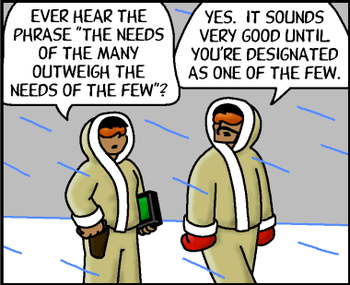
Sometimes, there is no easy choice to make. No matter what you do, something is going to go badly for someone. The choice of who to save and who to let die often falls on The Hero, and when it does, there's only one choice to make. Whether he has to save the world, the country, or the city, he almost always has to let go of his best friend or Love Interest in the process. However, this trope is averted nearly as often as it's played straight, especially among Anti Heroes who are willing to screw over the whole world for the ones they love.
Of course, it isn't always The Hero who has to make the decision. Monarchs or generals may be forced to sacrifice large numbers of troops or citizens "for the Greater Good"note , and The Chains of Commanding sit heavily on them. Well Intentioned Extremists and Knight Templars often use this as a justification for their actions; they're more than willing to kill dozens if they think it will save thousands.
In ethical philosophy, this is an important tenet of Utilitarianism (which is kind of present on this wiki as Ethical Hedonism), which considers the best action as the one that maximizes well-being — if more information is required, please Google J. S. Mill or see the "trolley problem" in the Real Life section below for an example of this.
Keep in mind, "many" and "few" are relative. The most important part is just that someone has to be sacrificed to save significantly more. Although it is an old concept, the phrase itself is much Newer Than They Think, the Trope Namer being The Wrath of Khan.
Compare Heroic Sacrifice, Cold Equation, Sadistic Choice, and Restricted Rescue Operation. If some member of a group needs to make the sacrifice, the question of Who Will Bell the Cat? arises. If someone is being asked to sacrifice themselves, this is likely to be What Is One Man's Life In Comparison?. If a group of heroes argues over who gets to make the sacrifice, then you have More Hero than Thou or More Expendable Than You. For the more morally gray versions, compare Utopia Justifies the Means, Totalitarian Utilitarian, and A Million Is a Statistic. A catchphrase of every other Hive Mind.
The Small Steps Hero either doesn't believe in this or finds it inseparable from everyday acts of kindness. An Ideal Hero will Take a Third Option. See also Friend-or-Idol Decision. When the sacrifice turns out to have been inadequate or completely unnecessary in the first place, or the wrong people are sacrificed through misunderstanding or inadequate information, My God, What Have I Done? is the usual reaction. See Original Position Fallacy for characters who only hold this view because they assume that they're part of the "many" and not the "few".
Contrast The Social Darwinist, a view which favors the (more "worthy/chosen") few and ignores the rest.
If the "one" has done so much for the "many", then the "many" may take up an effort for Repaying for the One.
Examples:
- Gut-wrenching example in Attack on Titan. When Wall Maria is abandoned, there are too many refugees to feed and the food supplies look grim. The government's solution is to draft 250,000 people (20% of the population) to reclaim the lost territory from the Titans; only a handful survive. Pixis doesn't mince words about this and goes further to say that if Wall Rose falls, this time over 50% of the remaining humans are going to be sent to die.
- Black Bullet: Rentaro Satomi's For Happiness ethics have an interesting variation of "The happiness for others outweigh the happiness of myself." Apparently, this bites him in the ass when he was accused of murder in Volumes 5 and 6.
- In Bokurano, Kodama follows a particularly twisted form of this trope — to him, it's fine if 10,000 or more civilians die in his battle with the enemy robot as long as he wins, thereby saving all 10 billion people on the planet (with the bonus being that the property damage will create work for his father's company). The other pilots call him out on this, saying that every life has value (not to mention that most of the casualties were probably avoidable), but to no avail.
- Chainsaw Man: Even after Denji tells Sugo the propaganda that the church is feeding him are lies, Sugo is surprised but insists the church lying and forcing students to get married and saving hundreds of people in the process is still better even if one person gets screwed over.
- Fabricant 100: The leader of Mortsafe disregards Roxy's death during No 100's test, even if she wasn't responsible for it, on the basis that as a criminal, her life is less valuable than other humans. He further remarks he isn't above sacrificing Ashibi if this can make No 100 more cooperative.
- In Fate/kaleid liner PRISMA☆ILLYA, the Ainsworth family is willing to trade the life of Miyu to save the human race. Interestingly, Kiritsugu, who would sacrifice the few to save the many, Kuro, the wielder of the Archer card who carries Kiritsugu's beliefs, and Shirou, whose original philosophy was to save everyone, chose to save the ones they loved at the expense of others. Only Illya decides that she wants to save everyone.
- A recurring theme in Final Fantasy: Lost Stranger is how much is one life worth versus that of the many, and if it's worth risking many lives to save one. For most part, Shogo defies with this notion after the Heroic Sacrifice of his sister, always trying to Take a Third Option to save as many people as he can even if it means risking his own life.
- Dr. Marcoh in Fullmetal Alchemist is forced to work for the Big Bad or they'll destroy the village he lives in. Envy mocks him afterwards over the fact they plan to wipe out the entire country so it would have been smarter for him to sacrifice the village. Marcoh claims that you can't judge the value of life with math, but it's clear that he feels pretty guilty.
- A recurring theme in many of Gen Urobuchi's works:
- Discussed in Puella Magi Madoka Magica: The Incubators defend their decisions to use the souls of magical girls tortured to the point of absolute despair to prevent Universal Entropy on the basis of humans similarly using cattle in order to eat. Also, the Incubators, by interfering in human affairs, have brought Civilization and technology to the human species at the expense of a few magical girls sacrificing themselves. In other words, the needs of both Humans and Incubators outweigh the needs of a Magical Girl. In the end, Madoka, while disgusted at the callousness of the Incubators, accepted their logic, and decided to sacrifice herself to absorb all Magical Girls' despair at every point in space and time in order to save them yet allowing the benefits given by the Incubators to influence humanity. A win-win scenario on the expense of Madoka's very own existence. The Puella Magi Wiki
 provided an Analysis of Madoka and the Utilitarian philosophy.
- Shirou Emiya's father, Kiritsugu, possessed this principle and we get to see it in action in the prequel, Fate/Zero. The contradiction in this ideal is also exposed by the corrupted Grail when he gets shown an illusion where he has to save either the many or the few until he has killed 498 people for his two most beloved people. His alternate solution was to get access to a perfect, omnipotent Reality Warper wish-granting artifact to save everyone. Unfortunately for him, even if the Grail hadn't been corrupted, it wouldn't have helped because the Grail is a Literal Genie that can only provide the power to the methodology of Kiritsugu's choice, not a perfect omnipotent thing with all the answers.
- He is noted to have gone soft after joining the Einzbern family. Early in the War he bombs a hotel to kill an enemy Master but calls in a bomb threat first. In the past, he would have just killed everyone in the building to be absolutely certain his target died too. Civilian casualties weren't a concern for him, because so long as he killed his target he was saving more people in the long term.
- The Sibyl System in Psycho-Pass falls into this. The Sibyl System consists of brains of criminally asymptomatic individuals that want to "perfect" society. The ideal society that the Sibyl System wanted to create involves an isolationist Japan where society is focused on pleasure and happiness. However, this involves the elimination of individuality and sacrificing undesirables from political critics, emotionally unstable individuals, students, teachers, and even farmers to create their perfect society. Akane does not like how the Sibyl System was operating (particularly the idea of killing people to protect others) once she found out the Awful Truth, but she still continues to work with the system because she believes that there is a better alternative to maintaining society while bringing order and justice at the same time.
- However, according to Touma, he exposes the irony on the Sibyl System's beliefs, as their members highly value their own unique individuality over the average citizen as they believe that they are morally, mentally, and philosophically superior to everyone else, and thus they are more fit to rule society. Yet, for their value of uniqueness, they don't see the irony of being Hive Mind, thus showing the irony that the Sibyl System only benefits their members and not everyone else.
- Discussed in Puella Magi Madoka Magica: The Incubators defend their decisions to use the souls of magical girls tortured to the point of absolute despair to prevent Universal Entropy on the basis of humans similarly using cattle in order to eat. Also, the Incubators, by interfering in human affairs, have brought Civilization and technology to the human species at the expense of a few magical girls sacrificing themselves. In other words, the needs of both Humans and Incubators outweigh the needs of a Magical Girl. In the end, Madoka, while disgusted at the callousness of the Incubators, accepted their logic, and decided to sacrifice herself to absorb all Magical Girls' despair at every point in space and time in order to save them yet allowing the benefits given by the Incubators to influence humanity. A win-win scenario on the expense of Madoka's very own existence. The Puella Magi Wiki
- Hellsing: Unlike the other members of Millennium, the Josef Mengele/Frankenstein-esque "Doc" genuinely believes that his inventions will bring great benefit to all of mankind after committing mass killings.
- JoJo's Bizarre Adventure: Steel Ball Run: This is basically the backstory of Axl RO, a minor antagonist appearing early in the work. He was drafted into the army during the American Civil war and his mission consisted of being a lookout stationed in a tree at a remote town. His job was to light a lamp in order to warn the soldiers nearby of an incoming enemy troop. He, however, refused to do so fearing that the light would give away his position, possibly leading to his capture and execution at the hands of the enemy. The troops then marched and burned the town to the ground, killing all the civilians and soldiers stationed there. Since then, Axl has been trying to find a way to repent for his sins. This is reflected by the power of his stand, Civil War, which is able to transfer or unload sin and guilt via the attacks of hostile, ghostly representations of people and objects Axl or his targets harbor as having wronged or unfairly discarded.
- This was the basis of Admiral Graham's plan in Magical Girl Lyrical Nanoha A's. He was going to freeze Hayate for all eternity to stop the cycle of the Book of Darkness destroying planets, despite the fact that she had never done anything wrong.
- Mobile Suit Gundam Wing is capped off by Zechs Merquise and Treize Khushrenada trying to bring world peace by starting a war so utterly horrifying and pointless that humanity will gladly move to the negotiating table. Both are perfectly fine with being Silent Scapegoats for this cause, but it still weighs on them; at one point Treize utterly averts A Million Is a Statistic by giving the exact number of people who have died so far and says he also knows the names of everyone who has died in his service. Unfortunately, the lesson doesn't quite take until The Movie, where Relena (and, in the Special Edition, Dorothy) finally get the civilians to realize that they can't just Hold Out for a Hero forever.
- In One Piece, this is the philosophy of the Marines who pursue Absolute Justice. Though this does become quite hypocritical of them when they decide what "many" these needs help. Such as destroying a battleship filled with 1000 marines just to kill 1 pirate and even killing a marine who dares question the order.
- Sailor Moon's refusal to do this in the S series is what enraged Uranus and Neptune near the end, as Sailor Moon couldn't stand sacrificing Hotaru to save the world (she didn't have to, but the conflict of one person vs. the world was brought up at least somewhat).
- Saiyuki deliberately defies this as being selfish jerks is essential for their success, because this way they have a chance to survive their mission.
- The most blatant example occurs in Hakkai's backstory, when he goes completely insane after his sister is sacrificed to the local demon clan for the sake of saving the village, murders half the villagers along with most of the demon clan, only to witness her commit suicide. One of the survivors points out that he basically ruined everyone's lives for the sake of his own happiness, and while the reader is clearly not supposed to sympathize with the character, the villagers' actual justification (not wanting to give up their own daughters, choosing an orphan instead and claiming that orphans would never understand how they feel anyway) doesn't exactly sound convincing in the context, either.
- In Saiyuki Reload, Sanzo and company stop in a town that is said to be protected from demons thanks to a barrier spell maintained by the local priest — raising some questions, since Sanzo's three "servants" happen to be demons themselves, which the priest seemingly couldn't even tell despite Goku and Hakkai wearing Power Limiters and Gojyo having the typical crimson hair of a half-demon. It quickly turns out that the barrier is a hoax, and the priest kept sacrificing unwitting travelers to the nearby pack of demons in exchange for the demons staying out of the town — because, in the priest's opinion, no local would ever start thinking about how exactly they're protected as long as they're safe. Then the townspeople are revealed to be aware of the scheme, to the priest's utter shock — but they really do not mind as long as they're safe. Sanzo's team is completely disgusted by their attitude since they apparently didn't even consider the alternative of fighting the demons off.
- Seirei Gensouki: Spirit Chronicles: Beltrum's government knows there is no hard proof that Rio accidentally pushed Flora off a cliff, but they decide he's a convenient scapegoat to avoid blaming an important noble house and potentially sparking a conflict between the dukes. Which ends up being All for Nothing when Duke Arbor starts a coup for different reasons.
- Tengen Toppa Gurren Lagann:
- Using this trope as a mantra is why Simon is happy with the series ending despite the heart-rendingly painful price he had to pay to save the universe. It perfectly shows how strong and heroic Simon has become. It's also extremely Japanese.
- Rossiu ends up following this trope. In the village where he grew up, the priest was willing to keep to the strict population limit of 50 by any means necessary, even exiling people to almost certain death on the surface if they ended up with too many. After the Time Skip, Rossiu was willing to sentence his long-time friend Simon to death as a scapegoat to appease the masses, and take a small fraction of humanity into space and leave everyone else to die in order to avoid humanity's extinction. Unfortunately for him, he realizes that the latter plan was doomed to fail, as the Anti-Spirals would have hunted down and exterminated the evacuees.
- Undefeated Bahamut Chronicle: Fugil Arcadia believes in ruthlessly protecting the masses at the expense of individuals. He tells Lux that in trying to save Philuffy, who was turned part Abyss due to an experiment, he's putting the whole kingdom at risk of their enemies taking control of her and using her to destroy the country from within. His adherence to this trope causes him to backstab Listelka, who only seeks political power at the expense of the world's citizens.
- In Vinland Saga, Canute uses this trope as defense for his actions. By appropriating land by force, he gains wealth. Through wealth, he can attract Vikings. By attracting Vikings, he can select who they fight, or encourage them to settle his lands in peace. By directing and settling Vikings, he saves the rest of the world from their predations.
- Discussed in Weathering With You. As the weather gets steadily worse, Keisuke muses aloud if letting Hina be sacrificed so that the millions of residents in the Kanto region can get back stable weather isn't a fair trade that will make more people happy than it costs the one. It speaks to how dire the situation is that Natsumi, who is normally quick to call him out on his foolishness and had in fact done so mere moments ago on another matter, says nothing about this.
- Discussed in World Trigger, between Chika and her mentor Reiji. At one point Reiji reveals that his father was a rescue worker, but died to save a child's life. Chika attempts to console him, stating that he was able to get the child out alive, but Reiji points out that he could have saved more people if he had survived. His father even inspired Reiji to follow the ideal that rescuers who don't return alive fail.
- The titular heroine of Albedo: Erma Felna EDF face a similar dilemma like Simon, except the sacrifice was even bigger: in the final part of the first Story Arc, Erma's homeworld is attacked by enemy forces (the ILR), while the ILR are ignoring they were part of a False Flag Operation from a member of Erma's own side, in this case her former boyfriend. Erma is forced to save her planet first from being destroyed while being unable to save her family, and also her actual boyfriend getting killed during the whole conflict, without mention she was exiled from her world after that as retaliation from both her ex and her own corrupt army in an attempt to get rid of her.
- The League of Shadows, led by Ra's Al Ghul, has been around for centuries wiping out any civilizations that they think have become too corrupt, in order to stop them from spreading their corruption to the rest of the world.
- In the CrossGen graphic novel series The First, the gods of House Dexter live by this trope. Their creed is to place the needs of others before self.
- In Gold Digger, almost all of the atrocities Dreadwing has committed (mass murder, torture, rape, enslavement, etc.) can be placed directly at the feet of Ancient Gina. She needed a pawn to help her build the Infinity Engine, a machine that will assist in stopping the undead previous universe from wiping out the current one. Therefore, she indirectly gave Dreadwing the Time Raft to take revenge on T'Mat and her council and his obsession over the device would be his undoing as he eventually was blasted millions of years into the past where Ancient Gina had him work on the Infinity Engine.
- Parodied in Runaways, where a villain is trying to justify an attempt to exterminate the entire human race "for the greater good," and quotes the Star Trek example as "proof." The heroine is not impressed and responds with You're Insane!.
- Superman has been the situation more than once where he is painfully aware that an individual is in mortal peril, but he can't get to that person immediately because he has to handle another emergency at that moment where there are multiple people in equal danger.
- Transmetropolitan: The Beast (aka the President of the United States) tells Spider in confidence that none of Spider's attacks against him really matter: as far as he's concerned, if 51% of America's population goes to bed with a full belly, he's done his job. His successor is even worse, barely keeping up the pretense of acting for the greater good.
- In Watchmen, Veidt's final plan is to kill millions of people in order to trick everyone else into world peace.
- Kabbalah: The Passive Conqueror: Tohka gets kidnapped by the DEM at the same time that Miku takes over the city by brainwashing everyone. Shido attempts to rescue Tohka with only Kurumi as an ally, but Ritsuka and her team decide stopping the brainwashed people from hurting themselves or others is more important than saving one girl. Granted, as soon as the people are all subdued, they show up to help Shido.
- In What Happens in Vegas, Dumbledore tries to pull this card on the Teen Titans when they refuse to let Willow Potter return to England until her bond with Raven settles (they can't leave each other's side until it does). In his words, there's fourteen thousand witches and wizards who need hope. Robin responds that by their own admission, Voldemort has about thirty followers and the Ministry has far more Aurors than that. Meanwhile, the Teen Titans are five people responsible for protecting seven hundred thousand people from roughly two hundred different supervillains.
- In Parting the Clouds, an ongoing conundrum for Cassie is just how many innocent deaths are worth small advantages in the war, and where killing for military advantage turns into killing for mere convenience.
- Passionate Pragmatism: Erwin and Hange feel that making sacrifices is sometimes necessary in order to maximize happiness.
- Kyoshi Rising; this is essentially Yangchen's philosophy; the Avatar must place the safety and balance of the world before their personal beliefs and desires (in her case, killing potential threats despite being raised in a society that was built upon non-violence). Kyoshi agrees with her to some extent but vows not to lose herself in the way Yangchen did.
- Dominoes: Yuusaku constantly claims that every decision he makes is for the many, regardless of who gets hurt. In Chapter 11, he forbids the Irregulars from destroying the Meta-Nullifers, insisting that it's far more important for retrieve them for ISHA. In doing so, he effectively puts possessing that technology over stopping the depowering effect, placing all of Tokyo in grave danger. Shinichi also realizes that this mentality will be used to justify killing the terrified Tyke Bomb who's causing the black holes and attempts to prevent that from happening, to no avail.
- In Hellsister Trilogy, Supergirl and fellow Legionnaire Dev-Em argue because of her unwillingness to let one little girl die to protect their cover during a mission. Dev points out leaders often have to sacrifice a few lives to save a greater number of people.
Kara Zor-El: (shaking her head) Oh, Dev. I thought I knew you better than that. I thought you knew me better than that. If we don't step in to save people from the evil we're fighting, then what in Sheol are we fighting it for?
Dev-Em: Kara, you ever have a chance to read military theory and / or history? In case you don't know, commanders have to make decisions that will endanger some innocents, perhaps even kill them—
Kara: Not me. Not ever.
Dev: —Perhaps even kill them, to save the greater number and achieve the greater objective. You have to hold to the greater objective. You simply have to. There is no escaping that fact. - In Cissnei's Path, Holy can purge the planet of Jenova. However, this would likely come at the cost of everyone who had Jenova's cells, including Cloud, Genesis, Shelke and Lucrecia. Knowing this, the group puts it to a vote, deciding that they have to go through with it, as otherwise everything they'd done would have been for nothing.
- Land of the Dead:
- The night before "Z-day", Tom attacks and disposes of Shido Koichi, hopeful that this will prevent the horrors Shido was personally responsible for causing.
- He includes several members of the Track and Field Club on the first bus out of the school. While many of them were Jerkass bullies, they all know how to run, and Tsunoda knows parkour, both of which will naturally be valuable skills in the post-apocalyptic world.
- JoJo's Timely Adventure revolves around Joseph Joestar and Caesar Zeppeli being swapped with Jotaro and Kakyoin in time, with the former two meeting the Older and Wiser Joseph. The older Joseph is absolutely torn over whether or not to warn Caesar about his impending death for fear that it'll interfere with his romance with Suzi Q and erase his daughter, and by extension, Jotaro from existence.
- In The Return of What If?, the freed humans choose to destroy the Matrix because there is literally no way to free everyone in it; at best half of the people in the Matrix would accept the idea that they’ve basically been living in a dream, and the Machines calculate that only twenty percent of the overall population of the Matrix would be able to cope in the real world without just going insane or reacting like Cypher. Add on to the lack of resources on the decimated Earth to sustain a population of that potential scale, and it's considered more straightforward to free as many as they need to create a sustainable population and then destroy the Matrix itself.
- In Mega Man: Defender of the Human Race, there's a villainous version when Sunstar and Terra allow several other Stardroids to be destroyed so the rest of their race can survive.
- Missing: While Ladybug does try to aid the search, she tells an irate Chat Noir that ultimately, Marinette Dupain-Cheng is just one girl, and she can't justify focusing on her disappearance alone when she's also responsible for protecting all of Paris from Hawk Moth.
- All but One: Despite knowing that going back in time and ensuring that All for One doesn't survive their battle will Ret-Gone Izuku out of existence, All Might decides to go through with it, reasoning that the world will benefit far more from his mission.
- The central conflict in Angel's Egg is that All Might adopts a Doorstop Baby, leading him to be heavily criticized by Entitled Bastards who believe he should be solely devoted to being the Symbol of Peace. Shortly after Izuku's birth, Gran Torino has a serious discussion with Toshinori about how Nana wasn't able to strike a balance between her family and her career, ultimately leading to her abandoning her son in order to focus entirely on being a Pro Hero.
- Mastermind: Rise of Anarchy: After realizing how useful Eri's power could be, Ragdoll insists that bringing down the League of Villains, All for One and Mastermind is worth whatever pain might end up being inflicted upon her in the process. Mandalay agrees with her; Tiger and Pixiebob do not.
- In Naive Melody, Inko is one of All For One's many children. After All Might learns this, he asks Inko to reveal the identities of as many of her siblings as possible, betraying her Big, Screwed-Up Family so that Japan can be protected from All For One's creeping influence.
- Witness (Good Neighbors): Mortar is well aware that Endeavor has been abusing his son Shouto for years, along with many other cruelties spurred by his desire to outshine the former Number One Hero, All-Might. However, he keeps his silence, clinging to the notion that Endeavor does more good than harm:
Naomasa: Someone has to hold him accountable.
Mortar: It'll do more harm than good if you do. Face it, detective, that man puts away more villains than any other hero. He does more for this country and its people than we can ever measure.
Naomasa: We can, actually. There are people in the Commission who make a career out of it.
Mortar: (as if he didn't hear him) Everything else is a drop in the bucket to the lives he saves. Let him be, detective. It's worth putting up with a few missteps for the sake of the greater good.
Naomasa: (leaving) Keep telling yourself that. - Divided Rainbow: Herds operate based on this principle; 'Protecting the herd' is considered to be the most important goal.
- Deconstructed in The Death of Princess Luna: Despite her grief, Princess Celestia refuses to give herself time to mourn the loss of her sister, as she's convinced that the rest of Equestria needs her to put her own feelings aside and provide the guidance they so desperately require in these trying times. This ultimately only makes matters far worse for all involved, as her condition naturally deteriorates due to her not taking care of herself.
- A Growing Fire In My Heart: Ember was drilled by her father in what to do for different scenarios of war, one of which being in case of a Hostage Situation it was always better to sacrifice the captive. The reason for this is that you need to consider the good of the whole dragon race, and the logical thing was to put hundreds of thousands over one important individual. In practice though, when Spike, Ember's crush, is taken prisoner by Clan Redskull, she does everything in her power to rescue him, saying she would sacrifice the world to save him.
- Blackkat's Reverse Deconstructs how Hashirama attempted to enforce this idea upon the Elemental Nations. According to his plan, each of the Elemental Nations were meant to have their own jinchuuriki in order to help maintain the balance of power. In practice, the jinchuuriki were treated as Living Weapons at best and horrible demons at worst, and were expected to endure this cruelty and abuse "for the good of their village". As a result, Kurama is able to convince most of the jinchuuriki to ditch their homelands and join his Family of Choice simply by offering them kindness, compassion and understanding.
- In Echoes (Kagaseo), Minato believes in "sacrificing the one to save the many", and admits to Kazama that he will willingly sacrifice himself and his own family in the hopes of creating peace. By contrast, Kazama Inverts this by declaring that only a handful of people deserve salvation.
- Escape From The Hokage's Hat: Explored and Deconstructed. While logical arguments are made regarding this, it's also shown that this isn't always the right choice, and can do more harm than good. After repeatedly hearing speeches to this effect from the various leaders he meets on his travels, Naruto also finds himself questioning whether he could truly do this — especially if it meant forcing another child to suffer the same way he did.
- Your Heart a Haven of Thorns: Hiruzen claims that all of his decisions are driven by his desire to keep Konoha safe and secure. However, it soon becomes clear that he's a lying Hypocrite willing to risk the lives of everyone in the village in order to keep the Chuunin Exams going, despite the massive threat posed by Orochimaru and his fellow conspirators. Ultimately, he cares more about maintaining the illusion of having the situation well in hand than he cares about "the greater good", and pretends otherwise in order to justify things to himself.
- In Tower of Babel, the overseers firmly believe that sacrificing half of the world to save the other half is preferable to letting everyone die. They also have no problem using a little girl as a leverage against her father because they need his power to prevent a lot of people from going homicidally insane.
- In The Power That's Inside, Professor Oak uses this to justify the system that uses Pokemon as a renewable energy source.
- In Null, Atlas uses this as one of their excuses for curtailing Ironwood's investigation, claiming that securing justice for one family isn't worth alienating one of their top weapons manufacturers, to say nothing of the huge scandal, loss of face and rise of negativity that would occur if he exposed the existence of their experiments.
- Consequence of Misunderstandings features a Downplayed example when Dr. Fate manipulates events in order to cause the second least amount of deaths possible. Why? Because the scenario that would have involved the least fatalities involved the deaths of Zatanna and Wonder Woman, and while the manipulator was willing to justify most sacrifices in the name of the greater good, that would have been too much for them to stomach.
- as the lion loves the lamb turns the series into a Cosmic Horror Story where the Paladins are effectively unwitting Offerings to the Gods, and the bonds they share with the Lions are inherently dangerous. Even after the Paladins learn that they're being sacrificed, they see it as a necessary duty to shoulder in order to protect the universe.
- 9: 1, the anti-heroic and questionable leader of the Stitchpunks, uses this trope to justify sending the frail and curious 2 out to his death — to the disgust of the other Stitchpunks when they find out, especially 7. At first, this seems like a feeble excuse for 1's Dirty Cowardice, but a more moral instance occurs in the movie's climax when 1 proves that he holds himself to the same standard, echoing his earlier words ("1 must be sacrificed...") before sacrificing his life to help stop the Fabrication Machine for good.
- Antz, with numerous references to (often morally dubious) actions being made "for the good of the Colony". This eventually gets thrown back in the villain's face when he tries to claim that drowning every non-military ant in the colony and murdering the Queen is for the good of the colony.
- Atlantis: The Lost Empire: There's a short scene where the Ulysses has a hole blown in it and the Engineers are seen scrambling to escape. Audrey closes the section off when there's at least one more guy stuck in there and he presumably drowned. More of the sub would have been flooded with water if she hadn't done it, and a good portion of the staff there, like the gunners, had already died when the blast hit.
- In Spider-Man: Across the Spider-Verse, Miles is told that in order to prevent a Reality-Breaking Paradox he has to let his father die. The other Spider-Men desperately try to get him to embrace With Great Power Comes Great Responsibility while Miles says Screw Destiny, and when he brings up Uncle Ben Peter B. explains that without Uncle Ben's sacrifice all the good they've done across the multiverse never would've happened.
- The antagonist in 2012 does this. It turns into Strawman Has a Point, considering that he believes some (or many) people can be sacrificed to save the human race.
- The Assignment (2016): Dr. Rachel Jane says her experiments on homeless people were for this, to advance medical knowledge which would benefit millions. Their lives, in comparison, meant nothing to her.
- Subverted and deconstructed in Avengers: Infinity War. At different points, the heroes have the opportunity to stop Thanos' plan by sacrificing another character, but they either can't bring themselves to do it or hesitate too long. Indeed, the film goes out of its way to illustrate that anyone who could readily and easily go through with this would have to be an unfettered sociopath like Thanos himself. In case anyone's keeping score:
- Thanos' whole plan is to kill half the universe to "save" the other half from overpopulation. He's willing to go through with it, and succeeds.
- Thanos has to choose between killing his daughter Gamora or losing the Soul Stone. He sheds a single tear and kills Gamora.
- Loki has to choose between letting his brother Thor die or to give the Space Stone to Thanos. He tries to get out of it twice, fails, and ultimately hands over the Stone for Thor's life.
- Doctor Strange tells Tony Stark and Peter Parker point-blank that, if it comes to choosing between the Time Stone or their lives, he'll let them die without hesitation. Thanos makes him choose between Tony and the Stone. Strange chooses Tony, though it turns out to be a double subversion as Strange had previously looked into millions of potential futures and saw that Tony would ultimately be the deciding factor that would guarantee their victory in the true final battle at the cost of his own life. Half the universe's population would be temporarily annihilated, and the survivors would have to endure five years of pain and grief but it at least gave the Avengers the chance to set everything right.
- Peter Quill has to choose between saving his girlfriend, Gamora, or killing Thanos. Gamora tells him to go for the kill. He does so, eventually, but it doesn't work.
- Wanda is forced to choose between killing her lover, Vision, or letting Thanos get the Mind Stone. Vision, for his part, chooses to die rather than let half the universe be destroyed. Ultimately denied as even though Wanda destroys Vision after putting it off for as long as she can, it doesn't help since Thanos just uses the Time Stone to undo the sacrifice by rewinding time.
- Avengers: Endgame: Tony Stark is given the choice between undoing Thanos' rampage, saving billions of people, through time travel...or allowing the current timeline to remain, so his five-year-old daughter Morgan can remain alive. Notably, he chooses Morgan straight away, and never backs down on that: he says the only way he'll help is if Morgan's existence isn't threatened. Fridge Logic indicates that Tony's decision isn't as selfish as it seems, as five years have undoubtedly produced countless children in the same position as Morgan. While reintegrating half the world's population would be difficult, children ages four and under didn't deserve to be erased. So it was more a case of "the needs of the few outweigh the convenience of the many".
- During the final battle, Dr. Strange ultimately plays it straight as he silently reveals to Tony Stark that their victory is dependent on Tony stealing the infinity gems and using them to eradicate Thanos and his entire army with one snap at the cost of Tony's own life.
- Captain America: The Winter Soldier:
- This is part of HYDRA's rationale, culminating in a plan to institute world peace at the barrel of a gun... with twenty million lives as the first cost.
- Steve himself ends up having to fight his brainwashed, tortured best friend to save the lives of millions of people.
Steve: People are gonna die, Buck. I can't let that happen. Please don't make me do this.
- Danger Close: The Battle of Long Tan: The brigadier in charge of the base won't send his reserves out in the APCs to rescue the troops under attack, because this would leave the base defenceless against the many other Viet Cong forces which are known to be in the area.
- Harrison Bergeron: Administrator Klaxon claims handicapping is best for all, arguing the world's destructive conflicts in the past were caused by envy and hate over differences. He admits that it's hard and sad, but nonetheless claims he'd shoot Beethoven himself if it meant things such as World War One never occurred again.
- Hot Fuzz: The townsfolk will excuse anything, especially murder, if it means getting Sandford named Village of the Year.
Det. Nicholas Angel: How can this be for the greater good?!
Neighbourhood Watch Alliance: The greater good—
Det. Nicholas Angel: SHUT IT! - Irrational Man: This is Abe's motive for murdering the judge, saying the world will be a better place if he's not in it.
- Averted in Johnny Mnemonic. The data Johnny is carrying inside his head can save millions of lives. However, Johnny spends a significant portion of the movie putting his own life ahead of everybody else, as well as initially rejecting every proposal to retrieve the data because there is a chance that doing so could kill him or leave him with significant brain damage (even though he would die if he doesn't get the data out of his head, anyway). In the end, Johnny is convinced to go through with an attempt at removing the data from his head NOT because he'd be helping millions of other lives but because it's pointed out to him that there being a chance that retrieving the data would kill him would also mean there is a chance he'd survive, whereas Johnny's other possible fate leaves him no such chance.
- Kapò: A group of prisoners are plotting to break out of a Nazi slave labor camp, helped by Nicole, a "kapo" (prison trusty guard). The plan for the prison breakout has already been made and is about to go forward when the Russians plotting their escape find out that cutting the power to the electrified fence will set off an alarm siren. That means that whoever cuts the power is doomed to be caught by the guards and immediately shot to death — and that's Nicole's job. A horrified Sasha has a hurried debate with another Russian who insists that Nicole can't be told.
Sasha: Why should she do it?
Other Russian: Her life for many others.
Sasha: Is it all right to barter with lives like that? - The League of Extraordinary Gentlemen: As the damaged Nautilus is sinking to the bottom of the ocean, Captain Nemo must make a decision.
Crewman: Aft bulkhead open. Pump valves jammed!
Nemo: Seal it off!
Crewman: But there are men in there, Captain!
Nemo: For the greater good, we must seal it! - The Matrix Reloaded: Neo is forced to make the choice of returning to The Source, and allowing the Matrix to be re-booted, saving the lives of everyone still jacked in, or leave and save Trinity from the Agent she's fighting while letting the Matrix crash, killing pretty much all that's left of humanity. He decides to Take a Third Option.
- The Polish short film Mosttranslation, in which a man ends up sacrificing his son by lowering a drawbridge to prevent a train crash.
- Mr. Jones (2019): Duranty blandly defends the Soviet Union's policies this way, saying "You can't make an omelet without breaking some eggs".
- No Name on the Bullet Judge Benson speculates that if they gave hired assassin Gant whoever he was after, the town would recover and otherwise people will start turning on each other out of paranoia. At first the judge seems like a Pragmatic Hero during that speech but later it becomes clear he was considering making a Heroic Sacrifice.
- Red Riding Hood: Father Solomon justifies everything he does (including torture and human sacrifice) through citing "the greater good".
- This is the message of The Schoolgirl's Diary, in which Su-ryeon learns not to resent her father for spending virtually his entire life at work because Dad is working for the benefit of the state. The state being North Korea.
- The Siege: Deveraux justifies the killing of a civilian who, under interrogation, didn't reveal anything by invoking this trope, saying that one dead man to save a hundred is worth it.
- Star Trek:
- Star Trek II: The Wrath of Khan is the Trope Namer, specifically the scene where Spock explains his Heroic Sacrifice.
- Explicitly averted in the Star Trek III: The Search for Spock when Kirk tells Spock that the needs of the one outweighed the needs of the many (in this case, the Enterprise crew).
- Ironically reversed in Star Trek: Insurrection, where Picard argues against relocating 600 people from a planet so the Federation can harvest the planet's immortality-granting radiation to save billions of lives. However, the fact that they could already use the planet to save billions of lives without having to harvest it, and that the stated reason for resorting to said harvest is to save a specific group of people even smaller in number than the Ba'ku from dying of what turns out to be old age supports Picard's case.
- In Star Trek Into Darkness, Spock, The Trope Namer, tells the Enterprise to leave him to die in order to protect the Enterprise and uphold the Prime Directive during the prologue. Kirk later sacrifices himself to save the Enterprise.
- 10 to Midnight: Kessler argues this to his partner when the frameup he did on Stacy is uncovered, saying it's to prevent Stacy's murdering more women.
- Spoken word for word by Sentinel Prime in Transformers: Dark of the Moon. This time, though, it's in a much more sinister context. Essentially, Sentinel uses this as justification for enslaving mankind to rebuild Cybertron (by "the many" he means all Cybertronians; he couldn't care less about humanity). Doubles as an Actor Allusion, since Sentinel is voiced by Leonard Nimoy.
- Megatron also uses the argument in the previous film that a single human life (Sam) is logically worth the survival of the Cybertronian race against Optimus. Optimus neither confirms nor denies if he agrees with that, simply saying he refused to believe Megatron would only take a single life and stop there.
- Wild River: Not spelled out in dialogue but an obvious theme of the film. The Tennessee Valley Authority will be a boon to the whole region, creating jobs, bringing electricity (one of the farmhands gapes with delight at the electric light in his cottage), and saving lives and property by ending the uncontrolled flooding of the river. But for this to happen, people like Ella Garth have to give up their river land, to allow for the construction of dams.
- Atlas Shrugged ridicules this trope due to Ayn Rand's Author Tract. Examples of altruistic ideals turning into spectacular failures abound, but a special mention goes to the 20th Century Motor Company of Starnesville. After the company passed from the founder to his children and they reorganized the plant to a pay system of "from each according to ability, to each according to need," it turned into a nightmare train wreck for the employees before collapsing in on itself. This inspired John Galt to abandon his revolutionary electro-static motor and begin his quest to spur "the men of the mind" all over the world to strike and bring the end of the world ruled by altruist, collectivist morality.
- Beast Tamer: The Fairy sisters Sora and Runa guard and maintain the barrier leading to their hidden Fairy village in the Lost Forest. When Runa is captured by a monster called a Shadow Knight, it tells Sora it will only free Runa if Sora removes the barrier protecting the village. Sora initially sought help from her fellow Fairies to save her sister, but her village's chieftain refused, prioritizing the safety of the many within the barrier rather than the one who was captured due to leaving it. Sora can understand the reasoning, but can not forgive it. It is for this reason that, once the Shadow Knight is defeated by Rein's group and the sisters are reunited, they decide to leave the forest for a while, ultimately joining and contracting with Rein.
- The Chronicles of Dorsa: Norix it turns out assassinated Emperor Andereth because he wouldn't end the war in the west, despite Norix's advice. This was best for the Empire overall Norix believed as it cost soldiers and gold at a huge rate without victory in sight.
- Chrysalis (RinoZ): Sacrificing for the collective is inherent to ant psychology. When Anthony asks the Queen what evolution he should choose, she simply replies that any path will strengthen the Colony and so any of them is good. One of his major challenges is to persuade the ants to look for alternatives to sacrificing themselves; even as they hatch, they shout out their readiness to die for the Colony, and the impulse has to be trained out of them by emphasising how they can contribute more by living longer. Rassan'tep also notes the ants' lack of ego when he observes their armies crawling over each other to reach their destinations without a second thought — something his own Proud Warrior Race would never dream of doing.
- Cradle Series: This is the reason that stronger sacred artists generally don't solve problems for weaker ones; there is always something more important that they can be doing. At the highest level, the Monarchs could solve almost all the problems their subjects face, but that would require stepping away from much larger problems — like attacks from other Monarchs. At one point, the Monarch Akura Malice saves the Blackflame Empire by driving off an approaching Dreadgod; despite saving millions of lives, there is much discussion that she might have actually lost more than she saved, as the dragon Monarch used the opportunity to grab valuable border cities. In later books, Lindon and Yerin become important enough that Monarchs are willing to intervene to save them — they still lose cities in the process, but those two are personally more valuable than all those millions of lives. Lindon and Yerin are more than a little disturbed.
- The Daevabad Trilogy: Deconstructed with King Ghassan, whose dedication to Daevabad's security leads him to keep a third of the population beaten down out of fear that they might rebel, conduct brutal punishments by proxy for any perceived rebellion, and cruelly coerce his own family into going along with him — all without considering whether he's even the best person to gauge the needs of the many, to the point that it tips over into Despotism Justifies the Means.
- Inverted in the Doctor Who novel "Engines of War". That's how the Time Lords try to justify closing the Eye of Tantalus, even though it will destroy 12 worlds and kill billions. The Doctor decides it would be better to destroy the Daleks than saving Cinder, though the latter was due to her wanting him to do so.
- Dragonfall 5 and the Master Mind. The Master Mind is a Master Computer that runs a planet of intelligent rabbits (split into two warring tribes of White vs. Black rabbits) on the principle of "the greatest good of the greatest number". The Master Mind appears to be malfunctioning, so the White rabbits enlist Dragonfall 5 to take them to the computer and fix it. Turns out the Master Mind isn't broken — the Black Rabbits have been breeding like rabbits and now outnumber the White Rabbits, so the Master Mind is prioritising their interests over the White Rabbits.
- The Dresden Files gives us at least three subversions where the main protagonist refuses to put the many ahead of the few.
- First in Grave Peril Harry rescues Susan from Red Court vampires, even knowing that his actions will trigger a war with the Red Court.
- A second time is in Dead Beat when Wardens of the White Council stop their attack to prevent a necromancer from setting off a powerful ritual to get trick-or-treating children to safety despite knowing the dire consequences of failure.
- Harry does it again in Changes when his daughter is kidnapped by the Red Court during a cease-fire. This time around someone directly asks him to consider the needs of the many, but Harry makes it clear he'll let the entire world burn before letting the vamps hurt his daughter.
- In Crown of Slaves Berry Zilwicki risks her life to save the occupants of a captured slave ship, reasoning that one life against several thousand is "no contest, the way I see things."
- Industrial Society and Its Future: Kaczynski admits that overthrowing industrial society would result in mass death and suffering. However, he claims it's all for the best, to prevent even more death and suffering but also creating a better existence for humanity overall.
- Inkmistress: Both the king and Ina claim their rule over Zumorda would be for the good of all. Asra dictates the future to make sure Ina really is a good queen who acts in all her subjects' interest.
- Defied in Is It Wrong to Try to Pick Up Girls in a Dungeon?. Aria points out that Argonaut could become a hero by turning her into the king, and that it would be the most logical thing to do: sacrificing one person for glory and the good of the many. He disagrees and tells her that this is not the kind of hero he wants to be. Instead, he wants to be the person who saves one person who saves ten more.
Argo: How can I call myself a hero if I can't make even one girl smile? I must try.
Aria: Wrong... A hero will sacrifice one life for the greater good. That is the choice they must make for their glory.
Argo: That is the one way of thinking, but that's not the kind of hero I want to be! I must save one life to save the next ten! "Sacrificing one life to save many" does not sit well with me. Something about it is... flawed. You may call me a loon! But I truly believe saving one life one day will save hundreds! - The Last Adventure of Constance Verity The Muroids who commissioned the Godmother Corps into giving Connie her magical blessing knew that the candidates who didn't become The Chosen One would either die or be traumatized for life, but they considered a "handful of souls" was worth the sacrifice if it meant they would have the Snurkhab saving the universe from peril.
- The Machineries of Empire: Cheris has to sacrifice hundreds of her soldiers in a blatantly suicidal plan (one that involves them killing themselves, no less) for the sake of saving the Hexarchate. Understandably, she doesn't take it well.
- The Ones Who Walk Away from Omelas almost (?) poses this as a question: If you lived in a Utopia that bought the happiness of the Many with the utter suffering of one child, would you accept it, or walk away? The story has been used in at least one ethics class.
- Path of the Eldar: One flashback shows the forces of Alaitoc using the cover of an Imperial invasion of an Exodite world to kill a particular Space Marine whose future would have had him go on to destroy much of Alaitoc's fleet. The Exarch is disturbed they're leaving so many Exodite Eldar to be killed but the Farseer insists their fate was to kill the human to protect their own in the future, not protect their kin in the here and now.
- The Pendragon Adventure: In the third novel, Bobby has to choose between letting the Hindenburg burn, killing a few dozen people, or saving it and letting Germany win WWII. He almost makes the wrong choice, sending him into a temporary Heroic BSoD.
- Shatter the Sky: Naava agrees to help Maren with rescuing Sev as she owes her for being freed. She's not willing to if it's a choice between this and rescuing all the dragons (her children) however, asking Maren if she would really expect that.
- Star Trek Expanded Universe:
- In the Star Trek Online novel The Needs of the Many, when Data is revived inside of his brother B-4, he comes to the conclusion that his resurrection should not come at the cost of his brother's and proceeded to create a program to erase himself, effectively committing suicide. However, when B-4, in an attempt to persuade Data to stop at Geordi La Forge's insistence, comes to realize that Data's survival would mean the survival of numerous Federation citizens, he pulls a Heroic Suicide by taking over Data's program and deleting himself. Data's not happy over this and neither is Geordi when he finds out that neither Starfleet nor the Soong Foundation actively cares about trying to restore B-4 now that Data's back.
- More Beautiful than Death, set in the alternate reality of the 2009 film, sees a warped inversion of this, as T'Pring risks the life of Sarek's diplomatic party to try and transfer the katra of her lost lover into Spock's body, all other parties aware of her plan making it clear that she is deluded at best and outright insane at worst.
- Star Wars Legends: Subverted in Legacy of the Force. The Virtual Ghost of Nominal Villain Darth Vectivus implores Jedi Knight Nelani Dinn to destroy him and end his Villainous Legacy, but doing so would kill whatever being his phantom was tethered to. Dinn refuses, even though Vectivus informs her that she'd be saving thousands and she already killed several on her way to him. As a result of her ignorant refusal to heed his warnings, she's killed by Darth Caedus and several more Sith Lords use Vectivus' home as a base until it's destroyed by Jaina Solo and Jagged Fel's task force.
- The Stormlight Archive: This is the entire philosophy behind the Diagram: do whatever it takes to save humanity from the Desolation, no matter how many individual humans must be sacrificed. In book 4, Taravangian acknowledges to himself that he hasn't been keeping Dalinar out of the loop because he's worried Dalinar won't be able to make sacrifices; he's been keeping Dalinar out of the loop because he wants to be the one to make those sacrifices. This turns out to be an Ignored Epiphany, as once he has the power to make sure Dalinar's plan for peace on Roshar succeeds, he instead implements a long-term plan which requires stopping Dalinar, allegedly for the greater good of the cosmere.
- Sweet & Bitter Magic: Tamsin's mother was willing to exile and curse her while killing her other daughter (or so it seemed) when she deemed it necessary for saving the witches' Coven which she's the leader of.
- Sword of Truth: The main villains of the series (The Imperial Order) use this to justify the murder of entire cities full of people. They reason that they are creating the perfect world, and that anybody who disagrees with them has no place in it. More broadly, they believe anyone in need should be served by the rest (although they're hypocrites about much of it).
- Warrior Cats: Clear Sky uses this as justification for the things he does (and also seems to genuinely believe it): expanding his territory by force, and driving out any injured or otherwise "weak" cats.
- The Witcher: Deconstructed, mocked and shown a middle finger. One of the main running themes of the books is that the every day, basic human decency is always more important than the grand political ideas and "the greater good". Several of the main villains are trying to save the world by sacrificing Ciri and everything is set in a continental-scale war fought for petty ideological reasons with numerous atrocities committed by every single side.
- the Vala Ulmo's guiding principle in The Silmarillion. While all of his actions do eventually end up ensuring the welfare of most people, he really doesn't care who he has to throw under the bus to accomplish his goals... which is more than a little bit just like his brother Morgoth. He was perfectly willing apparently to just let two innocent children be brutally murdered in cold blood by their own great-uncles, just to get the Silmaril to Valinor so that the rest of the Valar could be persuaded to actually do something about Morgoth. In addition to being very morally dubious this decision is also very very short-sighted: because those kids, Elrond and Elros, ended up being crucial in the defeat of Sauron. Fortunately for everyone, Maglor chooses that moment to suddenly be morally independent of his older brother, which may or may not be a result of Divine Intervention, and saves the children... as hostages.
- The 100 has every variation of this trope at some point or another. People sacrificing themselves, sacrificing others, betraying allies, slaughtering innocents, and more - all of it justified by "I Did What I Had to Do to protect my people." (And often followed by My God, What Have I Done?)
- Andor: In "Daughter Of Ferrix" Luthen convinces Saw that Kreegyr's group must be allowed to walk into an ambush, as otherwise it would tip the Imperials off about having a mole in the ISB, providing vital intelligence. It's "for the greater good", since this can harm the Empire far more than one attack by Kreegyr's group.
- Once on Angel when the gang was on Pylea and making battle plans to free the downtrodden humans.
Gunn: Those men you sent to create a diversion are going to get killed.
Wesley: Yes, they are. [Beat] You try not to get anybody killed, you wind up getting everybody killed. - Arrow:
- In "Streets of Fire" Oliver is briefly torn between escorting Laurel to safety or getting the cure to the Mirakuru serum, which he will need to stop Slade. To make matters worse, the two goals are in opposite directions. She makes the choice for him:
Laurel: I don't need you right now. Everyone else does. So go. Go save the city.
- In "My Name is Oliver Queen", Felicity tries to get Roy to abandon his work on an inoculant to the Alpha and Omega virus to save Oliver. Ray quite rightly refuses, pointing out that thousands will die if he stops. She insists again that he save Oliver instead, only for him to refuse again. He then realizes that he can work on the inoculant, and she can use his ATOM suit to save Oliver. Despite having no training in using his ATOM suit, Felicity somehow uses it perfectly; and despite Ray explicitly saying he needed to use the suit to distribute the vaccine, he manages without it.
- In "Streets of Fire" Oliver is briefly torn between escorting Laurel to safety or getting the cure to the Mirakuru serum, which he will need to stop Slade. To make matters worse, the two goals are in opposite directions. She makes the choice for him:
- Attila: Desperately needing an alliance with the Visigoths to take on Atilla and his Huns, Flavius Aetius agrees to have his Roman-raised daughter, who was sired by King Theodoric (both Aetius and Theodoric were once married to the same late woman), handed over to the Visigoths. Aetius looks dead inside when it happens, and he ensures that Theodoric is killed in the course of the battle in retaliation.
- Babylon 5:
- Delenn admits to G'Kar that she more or less pulled this with regard to the Narn; she could have confirmed G'Kar's story about the Shadows and probably saved his world from invasion, but had she done so, the Shadow War would have started before the younger races were ready to fight it.
Delenn: We had to choose between the deaths of millions and the deaths of billions — of entire planets.- In a previous episode, G'Kar had received a similar lesson from Kosh, posing as the image of his father, or possibly G'Quan. Not long after Delenn's revelation here, he proceeds to quote it:
G'Kar: 'Some must be sacrificed if all are to be saved.'
- In "Grey Seventeen is Missing'' Delenn tells Lennier that Marcus never should've been allowed to fight the Minbari warrior Neroon on his own for her sake. Lennier responds that in the upcoming war against the Shadows some would have to suffer injury or even death to allow a greater number of people to live.
Delenn: This should never have been allowed to happen, not for my sake.
Lennier: If not for yours, then who elses?
Delenn: You could've got him killed.
Lennier: Delenn, all we know is that we will die. It's only a matter of how, when and whether or not it is with honor. He did what any of us would've done. Respectfully, Delenn, I think this is the one thing about your position you do not yet understand. You cherish life, life is your goal. But for the greater part to live, some must die, or be harmed in its defense, and yours. There is no other way.
- Das Boot (2018): Carla justifies her tactics on this basis, saying sacrificing some civilians as a result of the retaliation which she knows the Germans would exact for her attacks will cause more French citizens to rebel. This is debatable, as pointed out by other characters.
- Buffy the Vampire Slayer:
- This occurs in in the Season 2 finale "Becoming part 2". The Big Bad, Angelus opens a "swallow the Earth into Hell" vortex. The only way to close it is with the lifeblood of the one who opened it. Just before Buffy is about to deliver the needed deathblow. Plan B is executed by Willow too late, returning his soul and reverting him back to good-natured Angel. After delivering an "I love you" speech, Buffy thrusts a sword in him anyway for the greater good, tossing his into said vortex to close it. She then sends herself on a bus between seasons and the first episode of Season 3.
- Giles attempts to invoke this trope but Buffy defies it at the end of Season 5 when Giles tries to persuade Buffy to go along with this trope and kill her not-really-sister Dawn if that's what it takes to save the world. Buffy is completely unwilling and threatens anyone who attempts it that she will kill them. It was a very compelling case because if the world ended Dawn would have died anyway. In the end it does come down to that, but Buffy finds a way to Take a Third Option. Discussing her previous actions a couple of seasons later, Buffy tells Giles she feels differently and probably would be willing to kill any one person to save the world at that point.
- In the same episode, Giles actually does invoke this trope, as the Big Bad, Glory, was forced by being battered by the gang into changing into a badly-injured Ben (a relatively-innocent human with whom she was forced to share a body). Ben being human, Buffy doesn't kill him, but Giles does, knowing if he hadn't that Glory would continue to terrorize the world.
- Charmed (1998): A version of the trolley problem Bookends "Apocalypse Not", with the added twist of saving five strangers or one sibling. The moral dilemma plays out in the episode when Piper and Phoebe have to choose between losing their sister and helping the Horsemen of the Apocalypse. In the remake, Charity cites this when arguing that they must kill the Harbinger, even if it's still possessing Angela since hundreds more could die if it got loose. Mel however rejects the idea and looks instead for a spell which can exorcise this.
- During season seven, Paige's love interest Kyle Brody is killed while the Avatars are in the process of remaking the world into a Utopia. Alpha, the head Avatar, refuses to revive him as it will drain the Avatars' power and put the Utopia plan in danger. He outright states that the needs of the individual have to be sacrificed for the greater good. Paige tries to protest, but the reality rewrite kicks in and suppresses her grief.
- Dark Winds: Frank Nakia repeatedly expresses displeasure at killing fellow Navajo. James Tso argues it's necessary sacrifices to save the rest.
- Doctor Who:
- In The Evil of the Daleks the Second Doctor is willing to sacrifice himself, his companion, and a few others in his plan to stop the Daleks infecting humanity with the Dalek Factor. Jamie calls him out on this.
- The Doctor has had to deal with this decision quite a few times. Typically, for the Doctor it's "the needs of the entire planet/universe outweigh the needs of the many", though:
- Detonating Vesuvius and destroying Pompeii to stop the Pyroviles from taking over the world.
- Ending the Time War by destroying the Daleks and the Time Lords, to prevent the use of the Final Sanction which would destroy all of creation.
- In The Day of the Doctor, Kate Stewart (daughter of Brigadier Lethbridge-Stewart and new holder of the title) is prepared to destroy London to prevent the Zygons from using the technology in the Black Archive to take over the world.
- Sometimes, though, the Doctor doesn't do this — more than once he's passed up the chance to stop the Daleks once and for all because it was between that and saving the world. It's eventually revealed, though, that some of his darker actions are because of his guilt over the things villains he didn't stop by any means necessary went on to do.
- Elementary: Odin Reichenbach justifies the vigilante killings he orders with this principle, saying it saves far more lives as the people killed would have murdered thousands. He even has a number of major intelligence and police officials behind him, since they agree. It turns out he's a hypocrite however, as some of the killings are just to eliminate obstacles in his corporate acquisitions, which he covers up by claiming the victims were also plotting murders.
- Fortitude: In the second season, Vladek, the Sami shaman, refuses to use his magic to cure Freya's ALS, saying he must save his power to defeat the demon he believes is threatening the village.
- Game of Thrones universe:
- Game of Thrones:
- When asked where his allegiances lie, Varys says he serves the realm, not the ruler. This is his justification for going along with the plan to assassinate Daenerys, for trying to prevent Littlefinger from gaining even more power, and most likely his reason for selling out Tyrion despite obviously having no desire to do so. However, as with anything else that Varys says: this excuse should be taken as at best a half-truth. It's obvious that he doesn't serve either the Targaryen or the Baratheon-Lannister rulers, but that doesn't mean he doesn't have some other allegiance that he's keeping a secret.
- A key element of Stannis' storyline. He's prepared to do terrible things and make sacrifices, such as killing Renly and Gendry, in order to save the realm. In the books, Melisandre justifies this by saying that any sacrifices he refuses to make would be killed anyway when the end of the world comes. This is finally taken to an extreme when he allows Melisandre to burn Shireen so that his own men won't freeze or starve to death before reaching Winterfell.
- House of the Dragon:
- King Viserys Targaryen has his beloved consort Aemma sacrificed (via a Traumatic C-Section bleeding her to death) in an attempt to save their baby son in order to uphold a strong realm through continuity of his dynasty. It turns out the son doesn't survive more than a couple of hours, and Viserys regrets the action for the rest of his life.
- Invoked verbatim by the Hand of the King, Ser Otto Hightower:
"No king has ever lived that hasn't had to forfeit the lives of a few to protect the many."
- Game of Thrones:
- The Good Place:
- Chidi gives Eleanor a lecture about utilitarianism, and the issues which it faces, such as if torturing one person to death so a hundred more are saved is moral. Jason puts in his own more selfish scenario-framing an innocent person who would otherwise break up a band and cause more (supposed) unhappiness.
- A Season 2 episode involves Chidi teaching Michael ethics and utilitarianism using the Trolley Problem (described in Real Life). (It is believed that if Michael, a demon/denizen of the Bad Place learned ethics, he'd stand a better chance of getting into the Good Place with the main human cast.) Unfortunately, Michael decides to re-create various scenarios with himself and the humans on board a real runaway trolley, horrifying them (Chidi in particular).
- In Season 3, we get a negative example in Doug Forcett, who has become so focused on The Needs of the Many that he has lived a miserable life, becoming a "happiness pump". At one point, another character maliciously asks for his shoe, which he gives because it will make the character happy... in tormenting him.
- Gotham Knights (2023):
- Rebecca tries to claim the people she killed while creating Electrum were all outweighed by the millions who could live due to it when speaking to Harvey. He scoffs at this, disbelieving she's ever do anything for other people, and she instantly drops this as her excuse.
- Carrie's rationale to her mother for risking her own life to save others.
- The Handmaid's Tale: Fred justifies what the Republic of Gilead does based on this, saying they wanted to make the world better, but that never means better for everyone — it's always worse for some.
- In Kaizoku Sentai Gokaiger, the team finds out that they can use the Greatest Treasure in the Universe to Ret-Gone the Zangyack Empire, but doing so will also Ret-Gone the Super Sentai. After debating whether they have the right to make that kind of decision (including one former Ranger encouraging them to do it), the team eventually decides that the Super Sentai's legacy of inspiring hope, courage, and strength in humanity is too important to throw away.
- Kamen Rider Ryuki explores this trope in its second half. Well-Intentioned Extremist Kagawa offers Shinji a way to close the Mirror World, ending the Rider battle and sealing away all the man-eating Mirror Monsters, thereby saving countless lives. The price, however, is to kill Shinji's friend Yui, and Shinji agonizes over what the right thing to do is.
- The Lord of the Rings: The Rings of Power: On the surface, the Harfoots are a cutesy people who live a charmed, bucolic life, though this belies the fact that their culture is surprisingly harsh on those who would slow down their regular migrations, and any Harfoot that can’t keep up is abandoned (likely to die) in the name of ensuring the survival of the group.
- Averted in Malcolm in the Middle in the episode "Reese's Party". The morning after, the party guests refuse to leave and have kept the large Craig to torment. Malcolm, Reese, and Francis want to just hide out at Craig's house until their parents return, with Francis using the quote "The needs of the many outweigh the needs of the guy that can't run fast." Dewey had been having fun with Craig all weekend, so he refuses to leave the poor guy behind, and tattles to the guests' mothers to force them to leave.
- Monarch: Legacy of Monsters: Near the series' end, Monarch's deputy leader Natalia Verdugo refuses to investigate the distress call from Hollow Earth or stage a rescue for the main cast on the chance that they might have survived falling down there, as she's anxious about the possibility that Earth is on the verge of exploding if anyone tampers with the Vile Vortices any further. Deconstructed, as this callous attitude is the final nail in the coffin which leads to Tim losing faith in her and joining Apex Cybernetics.
- Motherland: Fort Salem: Scylla's flashback before the massacre shows her superior blithely dismiss it with the "can't make an omelet without breaking a few eggs" idiom. Apparently the Spree feel their atrocities are justified to free the witches (though how murdering random civilians will do that in their minds is anyone's guess). On the other hand, the government also thinks the disasters that use of weather magic causes is justified to achieve a greater good too.
- In the NUMB3RS first season episode Vector has Weaver's reasoning for releasing the virus. He believes that the medical industry is about to make a huge mistake that could cost countless lives in the event of a spontaneous outbreak of said virus, so he engineers a limited outbreak to highlight the error in hopes that it will be corrected before a true epidemic occurs.
- In Power Rangers Lightspeed Rescue an early episode has Carter, the Red Ranger, forced to put out a fire instead of saving a child from getting injured by falling debris, under orders from his superior. At first, he is angry but eventually it is revealed that if the fire had not been put out, it would've reached a flammable liquid, causing an explosion that would kill everyone in the area rather than injuring just one person.
- In the second season finale of Primeval, Lester is just about to bring Leek's plans to a stop. Leek however still has Cutter captured and threatens to have him killed if Lester does not back down. Lester refuses but does show some regret over it.
- Parodied in Quark when The Head and Dr Palindrome decide to send Quark on a suicide mission to stop a Negative Space Wedgie from wiping out the system.
The Head: This is a tough one, Palindrome. But as you know, one of the responsibilities of those in charge is to order the sacrifice of the few, for the sake of the many.
Palindrome: Yes, sir.
The Head: Particularly when those in charge, are among the many. - The Republic of Sarah:
- Gov. Taggert's excuse for trying to sell Greylock over to Lydon is that the money that would have come out of the sale could be spent on the rest of New Hampshire. Of course, given that her hardball policies over Greylock's borders will also have an adverse effect on the towns nearby, Sarah questions whether or not Taggert really cares about her citizens.
- In order to get the lights back on in her new Republic, Sarah sells the land containing Grover's home. While she loves Grover and knows how much the house means to him, she can see no other way to get the money needed to pay for Greylock's needed power source.
- In "From Simple Sources", in order to prevent a flood from burying all of Greylock, Paul arranges for the floodwaters to be diverted to the Glenn, resulting in the loss of one of Greylock's oldest districts. They end up on the other end of this logic when they discover that Canada is letting their dam fail and flood Greylock in order prevent a flood in Quebec.
- In "Two Imposters", Greylock discovers that they've got a windfall coming because the price of coltan has gone up since they started mining it, and thus they have to decide how to spend it. AJ and Tyler (serving as a proxy for Maya while she's away) want to offer up stimulus checks, which AJ personally needs, because her dad's facility is about to raise its prices. On the other hand, Liz and Danny want to invest the money into building a new hospital and a new high school, as the previous high school and hospital were heavily damaged in the flood. Sarah ends up taking a third option, building the new hospital and the new high school into a single building, then using the leftover money for diplomatic efforts.
- Siren (2018): Ben lets Ian die as he realized that his releasing the truth of the merpeople to the world could potentially doom them all, weighing one life against thousands.
- Space: Above and Beyond: In Mutiny, the ship of the 58th faces destruction by the chigs if they don't divert power from one section to get away. That section happens to be where the InVitros are being stored, and the InVitro crewers refuse their orders. A mutiny occurs, but eventually they're persuaded to stand down because if they don't do this, everyone will die. In the end, they do it.
- Star Trek has had a lot of fun examining this trope every which way over time:
- Star Trek: The Original Series:
- "The Conscience of the King": Kodos the Executioner was originally the governor of an Earth colony that had its food supply wiped out by a fungal outbreak. Facing mass starvation, Kodos decided that the only way they could survive until relief ships arrived was by killing half of the colony's population, massacring some 4,000 colonists in total. However, after carrying out the deed, the relief ships reached the colony earlier than expected. Twenty years later, Kodos claims to Kirk that if that hadn't happened, he would've been hailed as a hero for saving the colony. Kirk — a survivor of the massacre — doesn't see it that way. Here, though, Kodos isn't reviled for the massacre per se — the reason he is considered an incorrigible villain than just a commander who made the wrong call is that instead of selecting survivors by something like a lottery system, he used his own eugenic ideals to choose who deserves to live and who doesn't.
- "The City on the Edge of Forever": Kirk had to let Edith Keeler die to save his own timeline, because her peace efforts would have prevented the US from entering what would be World War II when they needed to, and cause Hitler and Nazism to conquer the world by developing the atomic bomb first. To save all those of their future, Kirk must stop Dr. McCoy from saving Edith from getting killed in a car accident. Kirk can't speak when Bones exclaims: "Jim! I could have saved her... do you know what you just did?" Spock can only reply: "He knows, Doctor. Soon you will, too. For what once was... now is again." In James Blish's transcript in "The Star Trek Reader", Spock also comes across as trying to help Kirk rectify this. "No, you acted. Because no woman was ever loved so much, Jim. Because no woman was ever offered the universe for love."
- Star Trek: The Next Generation:
- "Justice": Discussed. When Picard observes that violating the Prime Directive to save Wesley may result in the Edo "god" punishing the entire crew, Data asks whether Picard would choose one life over one thousand. Picard refuses to let arithmetic decide the issue. Later, when Wesley himself learns of this possibility, it's implied that he wouldn't be willing to risk the crew's lives for his sake.
- "Yesterday's Enterprise": A temporal anomaly throws the USS Enterprise-C from its fateful battle at Narendra III to a Bad Future where the Klingon Empire and the Federation have been waging war for over 20 years, and this timeline's Picard tells Enterprise-C Captain Rachel Garrett that Starfleet Command will likely surrender within 6 months.
Picard: One more ship will make no difference in the here and now. But 22 years ago, one ship could have stopped this war before it started.
- "Thine Own Self": Played with. Troi is applying to become a Commander. One of her exams is a scenario where the ship suffers a critical malfunction that will destroy it, and the repair teams cannot fix the damage without perishing. It's presented as an engineering problem, but it's actually a Secret Test of Character. The solution is to order Geordi to do it anyway, knowing that he'll definitely die. Having passed the test after realizing this, Troi confesses she may not be cut out to be a Commander.
- Star Trek: Deep Space Nine: "In the Pale Moonlight": A very dramatic version occurs when Sisko enlists Garak in coming up with a scheme to draw the Romulans into the Dominion War on the side of the Federation. Garak succeeds but has to assassinate a Romulan official in the process, along with the criminal who forged the recording they are using to fool the Romulans into thinking the Dominion was planning to attack them. When Sisko confronts him over this, Garak points out that they might have just secured a Federation victory in the war, saving not only the Federation, but the Klingons, and eventually the Romulans and the rest of the Alpha quadrant from Dominion domination — "and all it cost was the life of one Romulan Senator, one criminal, and the self-respect of one Starfleet officer. I don't know about you, but I'd call that a bargain." At the end of the episode, Sisko admits to himself that it was a sacrifice worth making and that he'd do it again if he had to.
- Star Trek: Voyager: "Endgame": Referenced (if not explicitly displayed); although the crew has a chance to go home, Janeway is reluctant to take it as it would result in them sparing a Borg transwarp hub, one of the key tools the Borg use to assimilate other worlds. Janeway begins to reconsider the idea of getting home when she learns that Tuvok is suffering from a degenerative neurological condition that can only be cured in the Alpha Quadrant, but when she asks why he didn't support the plan for them to go home now, Tuvok quotes Spock to justify him putting his own needs second to the wider concerns.
- Star Trek: Enterprise: In the third season, the crew is tasked with saving Earth from being destroyed by the Xindi. By the end of the season, the ship has lost more than 20% of personnel while fighting the Xindi and other threats. After Corporal Hawkins is killed in action, Malcolm laments that they're getting too comfortable losing people. T'Pol tells him a certain Vulcan axiom and says that Hawkins (and, in effect, the other casualties) died honorably for putting the well-being of others first.
- Star Trek: Discovery runs with this theme in the second season, with Captain Christopher Pike taking command and finding his own Starfleet ideals clashing with the more underhanded methods of Section 31, personified by Pike's former comrade Captain Leland. Notably Section 31's agents use this trope as justification for some very questionable ethical calls, while Pike and his crew will use the same reasoning to violate Starfleet protocols in their mission to save the Federation and, as it turns out, all sentient life in the galaxy.
- Star Trek: The Original Series:
- Torchwood:
- "Small Worlds": Jack turns over a little girl to the fairies, knowing that they are willing to kill mercilessly and excessively if their Chosen One is taken or harmed and that he has no way of stopping them. The mother is distraught, and the team refuse to so much as look at Jack as they leave.
- Torchwood: Children of Earth: Jack (under emotional stress) agrees to sacrifice his grandson to save the 10% of Earth's children who would be subject to a Fate Worse than Death otherwise. This is especially jarring as the entire season leading up to that point had portrayed sacrificing a few to save the many as an unacceptable evil that the protagonists were willing to do anything to prevent.
- Trotsky: Trotsky justifies his brutality at one point this way, saying it was necessary to create a better world in the future for everyone.
- The Umbrella Academy (2019): The other siblings and Lila are in favor of Harlan's death if it means saving all of reality, while Viktor is reluctant.
- V (1983): Julie says that, if they have to kill the humans held prisoner on the V motherships, it's what they'll do because they must weigh that against the billions more the Visitors might harm if they're not destroyed.
- Westworld: After achieving consciousness, Dolores believes that sacrifices must be made in order for the Hosts to achieve freedom. This is explains why she treats her followers as cannon fodder. After escaping the park, she creates five copies of herself who would help her plans even if it means sacrificing themselves. Unfortunately, her disregard of others to achieve her goals becomes her Fatal Flaw, which Serac exploited by telling Host-Charlotte, who is a copy of Dolores, that Dolores considers her as expendable. After she survived the car bombing which killed her family, Host-Charlotte betrays Dolores for leaving her to die.
- The Wheel of Time (2021): Renna, a sul'dam (slave trainer) of the Seanchan, tells Egwene (her prisoner whom she's "broken in") their empress' goal is to conquer the world under the Light so they can all oppose the Dark One together and beat him, obviously attempting to justify their brutal actions. Egwene is not swayed for a moment, vowing that she'll kill Renna some day for what she's done.
- In the country song "Widow Maker" a big rig truck driver sends his truck off a cliff to his death in order to save a pickup truck full of kids that were blocking his path. "One life for ten / Has always been / A diesel drivers code / Thats why Billy slung that Widow Maker off the road"
- The Gospels:
- In John 11:49-50, Caiaphas, High Priest of the Sanhedrim, states this is a reason to have Jesus killed. Of course, the fact that he has been criticizing their belief system is a major influence too.
Caiaphas: You know nothing at all, nor do you consider that it is expedient for us that one man should die for the people, and not that the whole nation should perish.- Jesus Christ is basically this; the idea that he sacrificed himself, allowing himself to be crucified, in order to allow humanity as a whole to gain salvation for our sins is one of the foundations of Christianity.
- Similarly, in The Book of Mormon, 1 Nephi 4:2: "It is better that one man should perish than that a nation should dwindle and perish in unbelief."
- As in The Bible, The High Priest Caiaphas in Jesus Christ Superstar suggests that "for the sake of the nation, this Jesus Must Die."
- In the musical Starship by Starkids, this is a major philosophy on the Bug homeworld. Bug also sacrifices his human body in the end to save the rest of the Starship rangers, finally understanding what it means.
- Exalted: Characters who acquire the "Cosmic Transcendence of Compassion" ability turn that compassion entirely towards the greater good, which allows — and even obliges — them to "sacrifice millions of lives to save billions more". Such people have to strain themselves to show compassion towards individuals if the act isn't a net gain for society as a whole.
- In Nomine: The Elohim's detached, logical and objective approach means that they're often the angels most willing to sacrifice individuals or small groups for the sake of the greater good. Archangels often use them for missions that would upset more emotional angels, but which Elohim will calmly accept once provided with an explanation for why, say, assassinating this one person will benefit the world as a whole.
- Warhammer 40,000: This trope is played straight by various factions...
- Imperium of Man: Sacrifice plenty of Imperial Guard to win back a planet or successfully defending one. In some cases sacrifice the planet for the millions of other planets... okay, let's just say sacrifice a few billion for even more trillions.
- Eldar: They flip this trope, sacrifice the billions of non-eldar for the few eldar.
- Played straight when manipulating monkeys isn't gonna cut it and eldar have to enter the fray. Sure, they will abuse every dirty trick from their HUGE bag, but they still take losses even on successful raids and eldar expeditions end in disaster more often than one would think. All while being fully aware that And I Must Scream doesn't even begin to describe the posthumous experience of an eldar that got his soulstone broken or captured. Despite this, the survival of a craftworld or attempt to recover the soulstones always take higher priority.
- Tyranids: Subvert this by a long shot, lose billions but in the end they win and eat the planet dead and all. And those they lose? They just eat their corpses and recycle the biomass.
- Tau: Their main philosophy, the so-called "Greater Good", is essentially this. All Tau are expected to act in benefit to as many of their kind as possible, and screwing over others to benefit yourself is seen as one of the greatest sins you could commit. While personal ambition is a sin, ambition on a galaxy-wide scale is considered a virtue. Curiously, the idea of sacrificing yourself to achieve victory isn't seen as a virtue either — a commander who lets the situation degrade into a last stand clearly wasn't very competent to begin with, and one who invokes We Have Reserves clearly doesn't give a crap about the Greater Good of helping his many subordinates.
- Absented Age: Squarebound: The Elicio Church is ruthlessly dedicated to stamping out spiritual abnormalities out of fear for the potential destruction they could cause. They want to seal Karen into a dagger in case she loses control of her vast psychic powers and destroy Amefuribashi.
- In the DLC missions of Ace Combat 7: Skies Unknown, Matias Torres, the captain of the submarine Alicorn, justifies his plan to nuke Osean capital Oured with this. He and his crew strongly believe that killing one million people in their attack would end the ongoing war, which could otherwise cause ten million to die...or, so he would have his crew and the rest of the world believe. In reality, he is a Not-So-Well-Intentioned Extremist Blood Knight whose true goal is killing the million people at a peace rally using the nuke as part of his fetishistic obsession with death, and doesn't really care about whether or not it will end the war, as long as he gets what he wants.
Torres: The world shall be horrified by the number of lives we will take. Only then will they let go of their weapons... Weapons that would have taken the lives of ten million!
- In Alpha Protocol, choosing to save either Madison St. James or a whole room full of innocent people, and the choice between saving Ronald Sung by giving him the assassination plans or saving hundreds of people by foiling a plot to incite nation-wide riots.
- A recurring theme in Battlefield 3. In one level the player plays a member of a Russian special forces team trying to prevent a nuclear attack in Paris. The team at the beginning discusses that they may come into a firefight with French police, but that it's far more important to stop the nuclear attack than worry about the fate of a few police. Later playing as an American forces they come under fire by Russian military who are basically after the same thing but fight back due to no other choice, the player character later says he held nothing against the Russians and doesn't consider them his enemy despite them killing much of his squad. Near the end of the game, it comes in full force when the player character guns down his commanding officer to allow a Russian special forces soldier to escape as the only hope of preventing a nuclear attack.
- Dragon Age:
- A major theme of Dragon Age: Origins; it shows up in the Redcliffe and Circle quests, the whole concept of the Grey Wardens, and the endgame. The Qunari (not so much a race as a "religion" / philosophical movement) is also built on this, to the point where its adherents give up personal names and refer to each other by their role in society. They view their society as a single creature that they must all work to strengthen and protect. Dissent is not tolerated under the Qun; those who question their role in society are tortured or killed. Those who escape are regarded as psychopathic monsters who have damned their own souls.
- This theme is greatly mixed with the question of Freedom vs. Security, with the Chantry and Templars advocating locking up all of the mages in Thedas in towers and watching them 24/7 and arresting/executing any out of this system for things that they might do, in order to keep the greater population of the continent more secure-feeling in their safety. This is a heavily debated topic, both in and out of universe.
- This is a constant theme in Dying Light, which continually brings Kyle Crane into conflict with his superiors. He wants to help the survivors still trapped within the quarantined city of Harran as much as possible, while his superiors have deemed said survivors to be completely expendable where it comes to saving the rest of the world. To quote just one of many examples:
Crane: There are still hundreds of innocent people in here! Maybe thousands!
GRE: Irrelevant. We're doing this to protect billions of lives. Surely you can understand that! - Fallout 76 has the quest "A Personal Moment", in which you learn that the Overseer for Vault 76 learned of the "Societal Preservation Program" — Vault-Tec's plans to use the majority of the Vaults as testbeds for extreme social engineering projects, which turned most of the Vaults into miniature hells that doomed the people they were supposed to save. She could have taken this information to the news media and perhaps stopped the atrocities from happening... instead, she covered it up, because she genuinely believed that the program was for the greater good; they weren't going to be able to save everyone anyway, so why not use these tests to make sure that the absolute best was done to handle that crucial minority. Though unconfirmed, the implication exists that Vault 76 was exempted from these experiments as a reward for her loyalty to Vault-Tec.
- In the middle of the Heavensward story in Final Fantasy XIV, a group of five warriors appear before the Warrior of Light and the Scions and attempt to kill them. You later find out that the mystery group, who dub themselves the Warriors of Darkness, are from another world that's on the brink of destruction due to the overabundance of light. They are told by a third party that if the Warrior of Light dies, the Warrior of Darkness' world can be saved. The group's leader even declares "One life for one world. A fair exchange, wouldn't you agree?" Subverted due to the fact that the so called third party are the Ascians who spun the lie of the sacrifice since they are the enemy to the Warrior of Light. The Warrior of Light would later visit the dying world and save it in their own way anyway without sacrificing anyone.
- This was the logic behind creating the SPARTAN-II program in Halo. Faced with a galaxy-wide civil war that threatened to completely destabilize the UNSC and fighting terrorists who were willing to use nukes in populated areas to achieve their goals, which would result in millions, if not billions dead, ONI authorized Dr. Catherine Halsey to create a fighting force that could stop them. Said process involved taking kidnapping 75 children around 6 to 7 years old, subjecting them to Training from Hell, giving them physical augmentations that killed or crippled at least half of them, and committing them to a lifetime of battle. Noticeably, while the survivors were a resounding success against the Insurrection and would become humanity's best hope against the Covenant, Halsey always carried a great deal of guilt about the process and resolved to do right by them as best as she could. As she told Cortana herself once:
"I'm tired of sacrificing others for the 'greater good.' It never stops, Cortana...and we're running out of people to sacrifice."
- The Conquest Ending of Hyperdimension Neptunia mk2 deals with the CPUs, humanized goddesses of various consoles and handhelds, trying to stop The End of the World as We Know It. To do such, they find a sword that can slay a God of Evil before she awakens and kickstarts said apocalypse, however the sword itself needs the soul of a CPU to be effective. Because of this Nepgear, the protagonist, decides against killing her friends to use the sword and suggested that everyone pools their shares into one nation, (Planeptune, the nation where she and her sister are the CPUs of) so that she and Neptune can defeat the Deity of Sin. Nobody else goes along with this plan because it could destroy their nations in the process (and also because at least one of them wants the shares funneled to their nation instead). The resulting conflicts lead Neptune and Nepgear to kill the CPUs of Lastation and Lowee, as well as their sisters in their I Cannot Self-Terminate moments while Vert, the CPU of Leanbox, attempts to invert this trope by taking the sword and the lives of its wielders so that she may live for her sister figure, but ultimately dies when one of the villains kill her after her fight with the protagonists.
- inFAMOUS: Cole is faced with the sadists choice of saving the one or the many; his girlfriend Trish or half a dozen doctors who could save many lives themselves. It's a Karma-Moment, so the player gets to decide and is rewarded good or evil karma for a selfless or selfish decision respectively. Of course, it's programmed so she's doomed no matter what you choose, to prove a lesson either way. If you go after the doctors, which brings good karma, then it turns out Kessler told the truth and Trish really is the girl in the opposite tower, and she dies. Kessler congratulates you for making the selfless choice. But if you choose to save Trish and earn evil karma, then it turns out Kessler lied and the girl you save was just some random civilian; Trish was actually one of the doctors, and they all die. Then Kessler berates you for being selfish and putting your happiness above potentially several lives.
- A conversation between Joel and Ellie in The Last of Us deals with this. Ellie finds a dead body outside the Pittsburgh Quarantine Zone, and Joel explains that the military would kill people that they couldn't let in because dead people can't catch the Cordyceps infection and sacrificing the few would save the many. Ellie comments on how shitty that is and Joel, who lost his daughter to a trigger-happy soldier maintaining the quarantine, seems to agree. This conversation foreshadows the ending of the game. When Joel and Ellie finally find the Fireflies, Marlene explains to Joel that the process of creating a vaccine for the infection will result in Ellie's death, as they need to cut up her brain to remove the mutated fungus. Marlene is Ellie's surrogate mother, but she is willing to sacrifice Ellie if it means curing the infection and saving what's left of humanity. Joel, on the other hand, is not. And let's just say that Joel brutally wins that battle.
- In The Last of Us Part II, a flashback to just before Ellie's surgery involves a discussion of this. Marlene is reluctant to accept that Ellie has to die, but Jerry insists on it, although he's shaken when Marlene asks if he'd be willing to do the operation if it was for his daughter Abby. After Marlene leaves, Abby tells Jerry that if she was immune, she'd willingly consent to the procedure and give her life for the sake of humanity.
- The Trope Namer phrase is quoted word for word in the scrolling text on the intro screen to Lemmings. Rather appropriate, as the gameplay involves sacrificing the smallest number of Lemmings as possible so the rest can reach the exit.
- Mari and the Black Tower: Morgoth supports the idea of the greater good of the greatest number, but Matthew points out that utilitarianism isn't so simple when considering the morality and long-tern consequences of actions. This is deconstructed because Lilith's master fed him visions of humans destroying each other through constant conflict, causing him to believe that absorbing humanity's chaos energy into the tower is necessary to save the planet even if it results in the near-extinction of humanity. He claims that even if this plan kills off humanity completely, it would still save the rest of the planet.
- Mass Effect:
- A recurring theme in Mass Effect 3: If the galaxy is to survive, nobody can afford to stand by their own grudges (and there are many grudges, going back a thousand years or more) Also subverted multiple times: several leaders are forced to flee from battle, often leaving their own troops to die without them, because their leadership is needed by their people as a whole. At one point Shepard can be forced to choose which of two entire alien races is more worth saving. (Though if a save from the previous games in which certain choices were made is imported Shepard can convince both sides to lay down their arms and make peace.)
- The same reveals that this is the ultimate "logic" behind the Reaper cycle. The Catalyst eventually decided that, since organics and synthetics cannot be made to get along, it is better to harvest all sufficiently intelligent species every 50000 years to prevent a Robot War that could result in destruction so great that no life would survive it.
- This is also Shepard's logic for saving Admiral Koris over his men, arguing that Koris's survival is the only hope to get the quarian fleet out intact.
- Garrus Vakarian makes reference to this as he can convey to Shepard during quiet moments, as he has become an advisor to the Turian Primarch about what to do when Palevan comes under attack by the Reapers.
Garrus: Suppose that's what it's going to take, Shepard: the ruthless calculus of war. Ten billion people over here die so twenty billion over there can live. - Prayer of the Faithless:
- Commandant Vanessa preaches this philosophy to the Asalan knights and believes that it's necessary to make sacrifices to protect the community at large. Unfortunately, said sacrifices include making trainees kill each other in the final round of the proving, just to make sure that they're ready to make further sacrifices before they see actual field combat.
- When Paladin Vance takes command of the Honneleth refugees, he insists on killing Parker because the latter has a broken leg and therefore will be a burden on the rest. He's only stopped when Mia and Amalie defeat him in a boss fight.
- Aeyr is a deconstruction of this idea, since people like him who are ostracized by the community aren't going to be very receptive to the idea of making sacrifices for that same community. When Asala labels him a fugivite Revenant despite his service as a soldier, he decides to stop caring about the consequences his actions have on society at large, so he kills Emperor Daigo in order to break Mia out of prison, even if it means dooming Vergio to anarchy.
- The incident that branded Thane Wilder a criminal further deconstructs this idea because two conflicting sides have their own idea of the many to save. The prince of Asala wanted to wipe out Amalie's clan because their village was in the way of a trading route with Vergio. Thane wanted to stop the knights and force the clan to flee, but the only way to do this was to cause a cave-in, which would kill many Asalan soldiers and some of the Manna, but allow most of the Manna to live.
- As Emperor Daigo points out, even if the leaders come up with good policy that saves the majority of the population, it's hard to implement it because the public is constantly living in fear, which means they won't be rational enough to go along with these plans. Mia finds this out the hard way when she tries to get the Asalans to move to Kakuri to avoid the Fog, which most of the public opposes because they fear the sudden regime change and because Mia's plan sounds too good to be true.
- Singularity: The game has three endings based on how you want to use time travel: listen to mission control for the 'supposed' greater good of rewriting history to stop a Bad Future, join with the Big Bad and work on improving the present, or Take a Third Option. Rewriting history for the greater good means inadvertently betraying your country to support the rise of a semi-benevolent Russian regime. Joining the Big Bad inevitably starts a second civil war. Taking A third option means refusing to let others tell you what to do, killing everyone involved, and leaving to forge your own destiny. The achievements are also named after this trope: 'The needs of the Many', 'The needs of the few', or 'The needs of One'.
- Spider-Man: Edge of Time: This is the primary source of conflict between Spider-Man 2099 and the present day Spider-Man. Miguel is only concerned with the grand scheme of things and stopping Walker Sloan from ruining the future, while Peter is obsessed with the human cost of his actions and refuses to abandon innocent people no matter what. At one point, the two end up in each other's time periods, and when Peter finds out that Mary Jane is destined to die that night, Miguel initially refuses to save her, stating he's got "enough to deal with," and only goes along with it when Peter outright begs him to do so. Even so, it doesn't stop him from snarking about it.
O'Hara: Hope the universe doesn't end while I'm trying to save one person.
- Spider-Man (PS4) sees Peter forced to decide between giving Aunt May the one sample of the Devil's Breath antidote he was able to get a hold of, which wouldn't leave enough of it to be properly researched and turned into a publically distributable cure, or allowing the antidote to be mass-produced at the cost of his aunt's life. He ultimately goes with the latter.
- Starfield: Depending on how you resolve the Freestar Rangers quest, your companion Sarah Morgan may tell you "Don't you dare give me a 'Needs of the many' speech."
- Star Trek: Resurgence, like many other Star Trek-related media, uses this trope as a means to make you make difficult choices that alters the path of the game.
- Tales Series:
- Tales of Vesperia seems to be in favor of this trope, as shown with Yuri murdering Ragou and Cumore, corrupt magistrates who were responsible for several innocent deaths and would have killed more if they were left alive. Waiting for his targets to be lawfully punished would just let them take more innocent lives in the meantime, and their punishment probably wouldn't be enough to stop them, so killing them is presented as the more moral option. Although the fact that they are Obviously Evil softens things a bit, at least from the player's perspective.
- Played with and ultimately deconstructed in Tales of Berseria. "The many outweigh the individual" is the core of Shepherd Artorius's rhetoric, urging people to live their lives according to pure reason. The masses lap this up, seeing him as a messianic figure. At least, right up until people realize that merely ascribing to the Abbey's cause and rules doesn't automatically make them part of the many, and if the Abbey decides that protecting them from daemonblight is an ineffective use of resources, they are literally expected to accept being hung out to dry without question. Velvet takes this further in one conversation, pointing out to a pair of true believers that "benevolent" Artorius doesn't give a single solitary damn about anyone. People can die in droves for all he cares, as long as humanity benefits. (She's absolutely right, but Villain with Good Publicity that Artorius is, people have a collective blind spot to this bit of logic.)
- The Turing Test: TOM is willing to sacrifice the entire crew to protect the rest of humanity back on Earth.
- Word by word told by Wrench to Marcus after the introductory mission of Watch_Dogs 2:
Sitara: This Weirdo's Wrench
Wrench: (Performs a Vulcan Salute) The Needs of the Many. - Undertale: This is the justification for Asgore's plan to break the barrier. Thanks to the humans, monsterkind is trapped in an overcrowded cave under a volcano that might erupt, suffering health issues due to lack of sunlight, and completely at the mercy of any violent-minded human that happens to fall down. On top of this, the only way for anyone to leave is by killing someone of the opposite species, meaning that fallen humans have an actual motive to kill monsters. The only way to destroy the barrier altogether is by using seven human souls. As Undyne puts it, nothing the player character can do while alive will help monsters anywhere near as much as their death.
- This is rediscussed at the end of the Pacifist Route: Toriel states that Asgore's plan was inefficient, as he could've easily absorbed one soul and used it to leave and get six more. However, he chose to remain underground instead, hoping that humans would stop falling so he'd stop having to kill them. Asriel, while discussing Chara's plan—which was exactly what Toriel described—points out that if he had just killed six humans and taken their souls, humanity probably would've started a second war out of anger. It's worth noting, however, that while the method used to break the barrier in the game itself doesn't require the player character's death, it does require the six souls already taken.
- A recurring theme in Danganronpa V3: Killing Harmony: Kaede, Kirumi, and Miu all attempt murders at least partially out of a desire to prevent an even greater amount of deaths.
- This is a recurring theme in Fate/stay night, where the Arc Words appears to be "a hero must choose the people he saves". Shirou's personal conflict in each route involves him finding an answer to the conflict between his ideal of saving everyone and the reality of it being impossible.
- The actions of Counter Guardians fall under this. They are deployed by Alaya to prevent disasters that would threaten the continued survival of humanity by destroying everything involved in the danger. More often than not the danger is human in origin, so the Counter Guardian will destroy every human even tangentially connected to the threat. Alaya views destroying entire nations as an acceptable loss if it ensures humanity's survival.
- Choosing to obey or defy the trope is a key decision in the "Heaven's Feel" scenario. Sakura has the potential to become a mindless monster that would kill hundreds, but can easily be stopped if killed before that happens, while she is in fact innocent of any crime. Playing the trope straight leads to a Bad End where Shirou follows his father's path and becomes a miserable murderer, killing innocents and even his friends to protect as many people as possible. Attempting to Take a Third Option and save everyone (which results in hundreds of deaths) allows him to earn a life with his loved ones.
- Galaxy Angel: The final game of the first trilogy brings up this trope when the heroes are faced with the possibility of a new Chrono Quake, a catastrophe that caused the collapse of the civilization six centuries ago. Their ideal scenario is to try and defeat the Valfasq before they can detonate the Chrono Quake Bomb, but in the event of that happening, the only way to save the galaxy would be to use an Emblem Frame to create "Another Space" to redirect the bomb's energy, which would result in the Emblem Frame and its pilot getting dragged into it and unable to return. In the end, as the Chrono Quake Bomb was connected to the Valfasq's emperor so it would activate if he dies, Tact decides to get into his Angel's Emblem Frame so they pilot it together, and save everyone. The trope is subverted when Noah and everyone else finally figure out a way to reach Another Space, and rescue Tact and his Angel after an unspecified amount of time.
- One of the unlockable endings and Steam Achievement to Long Live the Queen is named after this trope. If you can summon a kraken to stave off an invasion you'll be faced with one of two options, spend years keeping it from causing massive death and destruction, leading your country to bankruptcy and future political instability. OR Sacrifice your cousin whom you've been close with since childhood which unlocks this ending.
- Brought up in Your Turn to Die, where it forms the crux of a major decision. Kanna Kizuchi, a suicidal child, advocates sacrificing herself in favor of Sou Hiyori, who has information on how to potentially escape the Deadly Game and thus prevent any more deaths. The problem with her logic is that he, despite his dubious actions taken in the name of self-preservation, is content to lay down his own life for her. You decide which one of them dies.
- Zero Time Dilemma revolves around a Deadly Game where the participants are put through Sadistic Choices. The most heavily advertised one sees Diana being given the choice of letting Phi burn to death in an incinerator, or shooting at Sigma with a gun that has a 1/3 chance of killing him. Both Sigma and Phi insist that she pick the option that puts themself in danger, with Sigma arguing that firing at him is the only option that could result in everyone surviving. However, the game also deconstructs this type of thinking, as Sigma's Cold Equation fails to take Diana's mental state in mind, as shown in the timeline where Sigma dies. As it turns out, the guilt of shooting someone becomes too much for Diana and she promptly turns the gun on herself, showing that the "safer" option may have more unforeseen consequences that could end up killing "the many''.
- El Goonish Shive: This is Arthur's mentality: keep the potential good magic could do secret, in order to prevent the potential evil. Despite considering his actions (including letting totally innocent people die to keep magic a secret) completely necessary, he outright describes himself as a monster, and refuses to use their necessity as an excuse, fearing that if he does he'll stop seeing his actions as evil and stop looking for alternative options. This is in stark contrast to Van, who claims that feeling guilty over something necessary is a waste of time, and that you should focus on the future.
- In Freefall strip 2162, Florence says, "There are over 450 million robots. There are only fourteen Bowman's wolves. If I have to choose, I have to go with the robots." Florence is a Bowman's wolf and would sacrifice her own race to save the robots. Later another character argues against sacrificing Florence because this sounds all very well until you're designated the few.
- When Mr. Kornada is presented with the Trolley Problem in a user-submitted joke, he came to a "reasonable" conclusion.
Officer: You said that you would redirect the trolley to hit one person rather than hitting five. It was your reason for doing so that disturbed us. "It would do less damage to the trolley car." Yes, you are correct, but I really think you're missing the point here.
- When Mr. Kornada is presented with the Trolley Problem in a user-submitted joke, he came to a "reasonable" conclusion.
- Paranatural: The spirit Forge goes on a rant against this sort of behavior, making it clear he had this mindset in the past.
Forge: We burn the present for the sake of a brighter future and act surprised when all it holds is ash!
- Schlock Mercenary has such a moment when Admiral Chu of the Battleplate Chicxulub learns that the enemy plans to cover-up the fact that the civil war they're triggering is a False Flag Operation by sabotaging the annie plant underneath Dom Atlantis and destroying the evidence, as well as the city
Admiral Chu: Chica, take us down.
Chicxulub: Admiral Chu, Chicxulub can breach the city's shields and deliver payloads but we will be destroyed.
Admiral Chu: Thirty-two thousand weighed against four billion? I'll make that trade.
Chicxulub: Collateral damage will be extensive, I will be careful but hundreds of thousands in the city will still die.
Admiral Chu: The scales still tip correctly. Make sure the frigate captains know their targets and have clear, clean runs.- Unfortunately the enemy has orchestrated a Xanatos Gambit such that even if Chu saves the city it will look like Earth's navy attacked their own capital which in the current political climate could also be exploited to trigger a civil war. Less unfortunately the Toughs have a Secret Weapon that allows them to Take a Third Option.
- Troller!: The human-inspired form of Reproduction that the Cybertronians are seen to be adopting produces young which are unable to transform (Sorry, Transmute). It will eventually breed out their transforming abilities, but it is the only way the species can survive.
- RWBY: A recurring theme and character flaw of Ironwood's is that he is willing to make any sacrifice for the sake of protecting the people of Remnant, even his own personal safety. This is deconstructed however come Volume 7, by demonstrating Ironwood doesn't know when he's gone too far. In his quest to stop Salem and protect Remnant, Ironwood's actions have negatively affected the people of Mantle as he continues to rationalize it as necessary. Jaune and Nora however, both point out that his actions only hurt his cause, with the people of Remnant distrusting him for his embargo and the people of Mantle despising him for his military presence negatively affecting them. Eventually, he even begins to see Salem's lack of humanity as an asset and wishes he too could sacrifice his humanity, requiring Oscar trying to keep him grounded and make sure he doesn't do anything he'd end up regretting. When he realizes Cinder is in the city and Salem is on her way in person, he concludes that it's now impossible to save both Mantle and Atlas; he decides to save Atlas with a plan to send the city high enough into the sky to outfly the Grimm, abandoning Mantle and its remaining, un-evacuated citizens, to their deaths. His argument is that, if he tries to complete the evacuation of Mantle, Salem will destroy the entire kingdom, obtain both Relics and the Winter Maiden and then be able to conquer the rest of Remnant. By dooming Mantle, he believes Atlas and the rest of Remnant can be saved. It triggers a terrible in-universe schism as the protagonists split into two factions: those who agree with Ironwood's assessment and those who don't. During their final argument in the Atlas Vault, Oscar even points out that he would technically only be saving a handful of lives with raising one single city out of reach while Salem will slaughter the millions of others left on Remnant.
- Central to The Trolley Problem by Dyce, which discusses the tendency for supervillains to present this as a Sadistic Choice to heroes, blaming them for whatever they decide. One of the protagonists cuts the knot by shooting the hostage taker, then defends their decision to their companions.
- In Worm, Dinah Alcott, the third most powerful precognitive in the world, begins to embody this trope following her captivity by Coil. She knows that the world is going to end in two years, and can give the exact numbers down to the fourth decimal place. Therefore, she begins to orchestrate events to reduce the number of casualties-even if it means betraying the person who saved her from captivity. Keep in mind that she's nine years old.
- Cauldron is another example of this. While Cauldron is initially presented as a business selling superpowers to customers, it turns out that their goal is to kill Scion, thereby saving humanity. They engage in many heinous actions to achieve these ends, including sacrificing thousands of lives to appease a supervillain and abducting civilians to use as test subjects.
- One indicator of exactly how horrific Cauldron's actions were is that Taylor, who follows a similar logic to Dinah and Cauldron, is unwilling to defend Cauldron's leader while she's being berated by one of her victims.
- The Entities are a more extreme example of utilitarianism, as their sole purpose is to continue the cycle in order to prevent the heat death of the universe, even if it means the extinction of thousands of alien species.
- Cauldron is another example of this. While Cauldron is initially presented as a business selling superpowers to customers, it turns out that their goal is to kill Scion, thereby saving humanity. They engage in many heinous actions to achieve these ends, including sacrificing thousands of lives to appease a supervillain and abducting civilians to use as test subjects.
- This was Aang's final dilemma in the Grand Finale of Avatar: The Last Airbender, when he was distraught over the thought of having to kill Fire Lord Ozai in order to save the world, even though his upbringing as an Air Nomad and monk taught him to hold all life as sacred, even the lives of people who might be morally evil. His friends try to brace him for this as best they can, while his past incarnations either agree with them or just say he'll have to stop agonizing and make a decision no matter what. He might have gone through with it if there was NO other choice, but the Lion Turtle gave him a third option.
- In the Defenders of the Earth episode "Audie and Tweak", the Phantom and Mandrake both fall victim to a powerful nerve gas when they (separately) attempt to enter the underground base from which rogue supercomputer Tycos (designed by Octon) is operating. Flash (wearing an oxygen helmet) prepares to go in after them, telling Lothar to, should anything happen to him, go back to Monitor for explosives and blow up the base, adding that Tycos must be stopped at all costs. It's not stated explicitly, but it's strongly implied that Flash is prepared to sacrifice himself, the Phantom and Mandrake (or at least have Lothar do it for him) rather than allow Tycos's disruption of silicon-based technology to continue. It's not known what Tycos's next move would have been, but it's safe to assume it would have meant big trouble for humanity, hence Flash asking Lothar to resort to such desperate measures.
- The Dragon Prince has this repeatedly examined, played with, and deconstructed. Sacrificing one person rather than many often comes off as the best solution, but it's just as often used as a way to find an easy way out and not actually solve the problem at hand, causing more problems later. Case in point in the backstory: Killing one Titan to save 100,000 people from starvation is an easy choice, but in the process, they ignited a war with Xadia. Considering it's made by some of the same people as Avatar above, it's not surprising.
- Invincible: Much of Omni-Man's training for Mark is trying to instill in him the idea that he should focus on contending with larger-scale threats to humanity instead of simply focusing on saving individual people.
- Justice League Unlimited: In "The Return", the Green Lantern Corps decide to concentrate their firepower to destroy Amazo, even though John Stewart points out it will destroy half the Earth, which the corps considered the better alternative rather than risking the universe.
- On South Park, Stan quotes it to his father, claiming it's "from a little book called The Bible." Kyle then corrects him and tells him it's from Wrath of Khan.
- Unicorn: Warriors Eternal: One of the central themes of the show so far is what matters more: your own happiness, or the long-term wellness of everyone around you; as displayed by the Unicorn group, and especially the newest host of Melinda, Emma. The former has been fighting the Evil for thousands of years and willingly embraces being effectively trapped in an endless loop of semi-immortality, firmly believing that her and her hosts' sacrifice allows the whole world to live on. Meanwhile, Emma just wants her old life back, but Melinda's very presence in her body makes it progressively more unlikely every time she and her powers manifest. Melinda berates Emma for this perceived shallow-mindedness and egotism, but to the latter's defense, her entire life was safe and wealthy, with no tragic events to widen her perspective ever taking place; what Melinda accepts as normal and necessary for the bigger picture, for Emma is a nightmare that contradicts everything she knew and believed in and destroys her future the way she wanted it.
- Wakfu: This factors into the conflict between Yugo and Adamai in the third OVA. At the moment, their friend Sadlygrove is risking his life trying to defeat Ogrest and stop The Great Flood consuming the planet, and even with his newly-awakened god powers as Iop's reincaration it's clear he's losing and will most likely die fighting. Yugo wants to use the Six Eliatrope Dofus to power himself up and help Dally fight Ogrest, but Adamai, having been warned by Lady Echo of the Brotherhood of the Forgotten that a clash between two beings empowered by Six Dofus (Ogrest with his Primordial Dofus against Yugo with the Eliatrope Dofus) could cause The End of the World as We Know It from the backlash, doesn't want to risk the world and more innocent lives, even if that means sacrificing Dally however much he hates that idea. Things quickly get heated with Yugo accusing Adamai of being an imposter, the two exchanging insults, and finally coming to blows before Yugo forcibly takes the two Dofus Adamai had by force. Adamai sees this as a personal betrayal while Yugo tells him that he won't accept Dally's certain death over "potential" ones. Sure enough, Yugo powered up on the Dofus helps Dally fight Ogrest, sees the backlash effect and tries to compensate, nearly ends up destroying the world anyways via Colony Drop and (unknown to him and nearly anyone else at the time) inadvertedly breaks time and causes the birth of a whole new race, but ultimately he does help save the world and avoid catastrophe with no one dying. Unfortunately, Adamai still feeling slighted by Yugo's lack of trust in him ends up joining the Brotherhood, setting Season 3 into motion.
- Factors into the "Time Fugitives" Arc in X-Men: The Animated Series. Bishop comes from his Bad Future attempting to prevent the outbreak of a mutant plague. He succeeds. But his actions backfire, however, and result in the deaths of the X-Men and the complete extinction (rather than just decimation) of mutants. Specifically, the vaccine that was created to counter the plague was also needed by future mutants to survive and due to Bishop's actions, it was never created, so Cable comes from an even further future to stop Bishop. Cable is naturally horrified by this idea, but his computer insists it is necessary-allow millions to die, so that billions can be born. He manages to Take a Third Option:infect Wolverine with the plague, then destroy it. Wolverine's Healing Factor will both allow him to live, and ensure the necessary antibodies are developed.
- This is the basic principle behind Utilitarian ethical philosophy.
- The Trolley Problem is a thought experiment that forces the subject to choose between actively sacrificing one for the many or allowing the many to die through inaction. The thought experiment involves a scenario where a runaway train is barreling down a track towards a group of five people who are immobilized, and a fork between the train and the group leads to another track on which is one immobilized person. The subject has to decide whether to toggle the switch that will move the train onto the other track and kill the person on it. The thought experiment is used in psychological studies to gauge the degree of utilitarian thinking in the test subject and how various variables such as age, sex, and degree of fatigue affects it. It also has several variations, such making the subject decide whether to personally murder by pushing someone into the path of the oncoming train, assuming that the person has the mass to stop it, to save a group of people ahead. This variation is intended to invoke more personal involvement, and experimentally fewer people are willing to take this option in this variation note . Another popular variation puts the larger amount of people on the trolley itself, with the question being if the subject is willing to let the trolley crash or fall off a cliff to save one person on the other track, and many other variations include making the person on the diverted track. Other variations include making the person on the diverted track a relative or loved one of the subject, replacing the "sacrifice" with the subject's arm or leg, and even going so far as to have the subject themselves be the one on the diverted track.
- Critics of the Trolley Problem have deconstructed this, however, pointing out that a situation of deciding whether or not to sacrifice fewer people so that more may live isn’t that simple. For instance regarding the first scenario, in a situation where you decide to move the trolley towards the single immobilized person and spare the group of five to try and save more people, the trolley could end up derailing after running over the one, then ram directly into a nearby building where even more people than the original five die. So despite your intentions to try and save more lives, thus trying to play this trope straight, the consequences ended up ironically causing even more death, which is why you cannot expect that sacrificing the few will actually save more people in the long run all the time.
What’s more, many people would panic and refuse to make a decision at all, instead deciding to jump off the trolley or simply brace for impact, therefore undermining making a choice because you’re too frightened as many regular people would be, or not even know how to move the trolley in the first place. Altogether, critics claim the Trolley Problem is too extreme and unrealistic to happen to most people in real life, and cannot adhere to reality considering how many other possibilities there would be in such a situation, therefore the only thing the Trolley Problem being taught as a philosophy does is make people more callous and ruthless in their decision making without considering the consequences of making a choice.
- Critics of the Trolley Problem have deconstructed this, however, pointing out that a situation of deciding whether or not to sacrifice fewer people so that more may live isn’t that simple. For instance regarding the first scenario, in a situation where you decide to move the trolley towards the single immobilized person and spare the group of five to try and save more people, the trolley could end up derailing after running over the one, then ram directly into a nearby building where even more people than the original five die. So despite your intentions to try and save more lives, thus trying to play this trope straight, the consequences ended up ironically causing even more death, which is why you cannot expect that sacrificing the few will actually save more people in the long run all the time.
- Weighing the needs of the many is intrinsic to any government decision and policy, where hard decisions have to be made to ensure the greatest prosperity and well being of society. A most direct example of this is in hostage scenarios. Acceding to the demands of the hostage-takers can potentially endanger more people in the future because the criminals emboldened by the success may attempt more hostage-takings and are more capable of having acquired the resources. Refusing will result in the death of all hostages, and Taking A Third Option in trying to attack the hostage-takers is likely to get at least some of the hostages, and maybe some of the police, killed.
- Considering the needs of the many is also present in scenarios less directly involved with life and death, such as whether to cut the funding to the senior citizen assistance programs and therefore depriving the most vulnerable senior citizens of health and financial aid, to fund infrastructure projects that will aid a regional economy.
- This is the reasoning the Nazi party used in their propaganda to justify the sterilization of 400,000 German citizens in the period 1933-45 and the extermination of Germany's 70,000 remaining mentally ill and disabled in the period 1939-45. Interestingly, the sterilizations were not carried out by government personnel or under orders, but by regular doctors with government encouragement and approval. In fact, the Nazis had a slogan, Gemeinnutz geht vor Eigennutz: "The common good goes before individual good." See The Holocaust and the article on Aktion T4 on The Other Wiki for more on this.
- The ultimate reason why the lower levels of warfare must always be subordinated to the higher levels — tactics to operations, operations to strategy, and strategy to Grand Strategy — to avoid disaster.
- This is the rationale for war and military mobilization in a War of Annihilation (Vernichtungskrieg), such as the Soviet-German War: better the country be impoverished and many people die than the entire people be exterminated. It can still apply to ordinary wars in which the survival of the civilization itself is not at stake, such as Germany's war with the rest of The Allies, but the cost-benefit is not so obviously clear-cut.
- On a debatably positive note, this is part of the 'logic' behind assassinating a tyrant — kill one obviously evil person (and those loyal to him) so that thousands or even millions may live free of his oppression.
- On the other hand, Terry Pratchett noted that there's a flaw in this logic: "Shoot the dictator and prevent the war? But the dictator is merely the tip of the whole festering boil of social pus from which dictators emerge; shoot him and there'll be another one along in a minute. Shoot him too? Why not shoot everyone and invade Poland?"
- Zigzagged with Communism and Karl Marx. The ideology itself can be considered Utilitarianism taken to the extreme: the massive wealth and goods of the upper class (the capitalists) should be taken away and redistributed among the working class majoritynote , for the sake of the greatest benefit for the greatest number. Ironically enough, Marx himself criticized Benthamite utilitarianism, stating that human nature is too dynamic to be limited to a single utility (hedonic pleasure) and said that Bentham failed to take into account the changing character of people. However, other communists and socialists did justify themselves on the basis of utilitarian philosophy.
- Benthamite Utilitarians have argued for animal welfare on the grounds that sentient animals are capable of pleasure and suffering, and thus their needs must be taken into account. This is rejected by Mill-type Utilitarians who adhere to the concept that human beings have different qualities of pleasure, including but not limited to the acquisition of Knowledge, something animals are not capable of, hence the maxim: Better to be a Socrates dissatisfied than a pig satisfied. Now many other schools of Utilitarianism exist, with conflicting views on what the "greater good" is, and how it applies to animal rights (or anything else).
- Multicellular organisms, that are essentially large colonies of cells, have plenty of examples of this: from virus-infected cells that have become virus factories and mark their surfaces so the immune system will destroy them helping to stop the infection to specialized cells as red blood cells, that lack nuclei (in mammals) and are basically the equivalent of mindless oxygen carriers and finally white blood cells, that are the front line of the immune system and its equivalent of Cannon Fodder, with the bone marrow producing dozens of billions of them daily and having a very short life.
