

Sometimes, The End of the World as We Know It just isn't enough. If you really want to end the world, why not destroy the whole planet — tear the very ground from under everyone's feet?
Science Fiction writers have devised many methods of demolishing a planet: you can blast it with a laser, you can hit it with a really big object, you can feed it to self-replicating all-consuming Nanomachines, or use other, even more imaginative ways.
This is understandably worse than just conquering a world or wiping out the present civilization. Mankind can always rebuild after that. There's usually no "After" for this End. Destroying a planet is usually reserved for the most shocking moments in a Sci-Fi or even Fantasy series. Blowing up an entire, inhabited planet is one of the fastest ways to really ratchet up the body count and cross the Moral Event Horizon.
Some series prefer to have this as the final goal of the Big Bad, with the heroes racing to stop him. In other series, there's no way to stop the Earth-Shattering Kaboom, and the subsequent storylines focus on the actions of the few survivors as they try to carry on, seek revenge or simply live with the fact that their home has been completely obliterated.
A slightly less devastating (and, due to the vastly reduced energy requirement, significantly more realistic) variation of this is to simply blast the surface of the planet until the air hums with radioactivity and nothing can live on it, for example, the "glassing" of planets in the Halo verse. This is Colony Drop and Kill Sat taken to the extreme. Compare the Planet Eater.
Wikipedia refers to ships and weapons capable of doing this as Planet Killers . Actually shattering a world is in fact considerably harder than TV makes it look. Even if your huge laser manages to blast into the planet, you still have to overcome the gravity of all that rock with some sort of explosion capable of sending all thousands of quintillions of tons far enough away that it won't just clump together again (you'd obviously still succeed in slaughtering all the inhabitants if this happened, but then if that was all you cared about you'd have just used the "saturate the surface with nukes" method above). 'Cause if you've just got a big laser, all you're going to do is drill a buttonhole in it.
Think of it as a Tokyo Fireball on a planetary scale. The full-on Earth-Shattering Kaboom is a Class X on the Apocalypse How scale, often represented with an Earth-Shattering Poster. Sacrificial Planet is when this happens near the beginning of the story to set up the threat level of the villains. Of course, some villains one-up this by going Star Killing, destroying stars (and thus entire star systems) instead of just planets.
The villain archetype who wants to cause this (or some other event that would kill pretty much everyone) is called the Omnicidal Maniac. Alternatively, if he does it by accident (or just doesn't know why he'd do it), he's the Mike Nelson, Destroyer of Worlds.
Oh, and if somehow if some part of the planet still remains, and someone settles on that, then it becomes Shattered World. See also Why You Should Destroy the Planet Earth.
Contrast Genesis Effect, where planets are created instead of destroyed. See also Orbital Bombardment, which may overlap. For a less extreme version of this, where it's only continents getting blasted or rearranged, see World Sundering.
Examples:
- The threat of this trope happening is part of the premise for Assassination Classroom. Koro-sensei already destroyed 70% of the moon, and if Class E cannot kill him within a year, he will do the same to Earth. It later turns out it was not him, but a dying anti-matter mouse that devastated the moon, and his anti-matter organs have a low chance of actually destroying Earth.
- Tsutomu Nihei, the author of Blame!, stated that Killy's Graviton Beam Emitter would cause a substantial environmental change when fired on Earth. It doesn't take a genius to figure out what would happen if it's fired at Earth.
- Subverted in the Clow Card arc of Cardcaptor Sakura. With the Clow Cards free, Kero warns of a catastrophe that will befall the world if they're not captured, only to later reveal that the catastrophe isn't this trope. In fact, it's actually worse... kinda'.
- In Digimon Adventure, Vademon summons a planet (complete with rings) to keep AtlurKabuterimon (MegaKabuterimon) away. The insect Digimon promptly blows it up.
- In Digimon Frontier, Lucemon beats the shit out of the heroes by piledriving them straight into conveniently-placed moons. Said moons promptly explode.
- Doraemon movies usually have the gang trying to avert this trope:
- Doraemon: The Record of Nobita : Spaceblazer have the Gartite Corporation revealing their superweapon, a nuke embedded in Planet Koya Koya's core, which will detonate within two days, and it's up to Doraemon and friends trying to stop it from going off.
- The climax of Doraemon: Nobita and The Space Heroes have the gang trying to prevent the Space Partners from activating a superweapon capable of draining energy form the core of Planet Pokkoru, which will make it unstable and explode into debris should they fail to deactivate it.
- Dragon Ball:
- The saga is full of characters who can destroy the world. All the major villains starting with Frieza from Dragon Ball Z are capable of it (Vegeta destroys other planets, although it should be remembered that the times he is seen destroying planets are in Fillers); the usual reason they don't just do it is that they want to fight Goku first. Earth is successfully destroyed twice in Canon, once by Kid Buu, which is fixed with New Namek's Dragon Balls, and again by Frieza in Dragon Ball Z: Resurrection 'F', though Whis undoes it by rewinding time.
- They added a nice touch when it was indirectly destroyed by the most pathetic villain of the series, Pilaf, in Dragon Ball GT.
- Frieza is the first character who built his reputation on being able to do this, and we've confirmed that he destroys Planets Vegeta and Namek, Gohan blows up the Makyo Planet, Cell blows up King Kai's planet while trying to destroy the Earth (although it is worth noting that King Kai's "planet" is small enough for you to walk around in less than three minutes), and Earth isn't the last planet destroyed by Kid Buu.
- The non-canon Non-Serial Movie villain Broly Dragon Ball Z: Broly – The Legendary Super Saiyan had his movie opening with the aftermath of him destroying an entire galaxy when he flew into a rage.
- In the arcade game Dragon Ball Z2: Super Battle, Cell's ending has him fire a Kamehameha at the earth that splits it in two down the middle.
- In Dragon Ball Z: Battle of Gods and Dragon Ball Super, Beerus the Destroyer Deity is the strongest planet buster in the series—especially apropos since planet busting is his job as it relates to preserving room for growth in the universe. He's strong enough to completely destroy the entire universe at full power if he's not careful.
- Even he is dwarfed by Zeno, who can easily destroy entire universes.
- Science Ninja Team Gatchaman ends with the team preventing Leader X from destroying the Earth. Berg Katse doesn't take it well.
- Gilgamesh from Fate/stay night has Ea, which at low power can match and surpass Excalibur. It is classified as an ANTI-WORLD noble phantasm, the most powerful in existence. He shows what it's capable of in Fate/Zero when he destroys Rider's Ionioi Hetairoi, a Reality Marble which should be in theory many times larger than the Earth itself, with a single strike.
- In Getter Robo Armageddon, the Shin Getter attempts to do this to the Jovian moon Europa, but is blasted back by an Invader reflecting its Stoner Sunshine. The Shin Dragon is able to complete this job with its own, much more powerful Getter Beam. A little bit later, the two Getters combine their energies for the Final Getter Tomahawk, destroying Jupiter and its remaining moons to destroy Cohen and Stinger.
- Gunbuster goes past mere planetary destruction with the Black Hole Bomb, a weapon capable of destroying the core of the galaxy. One of the weapon's components? The planet Jupiter. The entire planet Jupiter. In addition, in images of the final battle, planets and moons are shown being destroyed as collateral damage. The Black Hole Bomb's detonation ultimately annihilates 60% of the Milky Way Galaxy, though since the Sol System is fairly far out from the galactic core, it is unaffected.
- In Infinite Ryvius, the Blue Impulse uses gravity manipulation to destroy Saturn's (inhabited) moon Hyperion.
- Lyrical Nanoha: Lost Logia can, and have, destroyed several worlds across multiple dimensions in the past. Needless to say, the heroes don't want them falling into criminal hands and/or going out of control.
- Pop Team Epic: The main characters cause one of these during the theme song. With this series being what it is, they reappear back on Earth with nothing wrong immediately after.
- Rave Master: the so called "Overdrive" caused by the Mother Dark Bring in the past was a colossal explosion which wiped out a tenth of the known world note and completely wiped out the kingdoms of Symphonia and Rareglove, leaving behind a featureless landscape and an eternal storm in the borders. King created a Dark Bring aptly named End of Earth which can replicate that Overdrive and sealed it in his rival's Gale's head, forcing him to abandon his friends and family and travel the most desolate lands alone. During the confrontation with Shakuma near the end of the manga, he reveals that the Overdrive was supposed to be powerful enough to completely destroy the Alternate Universe that is Rave's world, and claims to be disappointed that Shiba's interference reduced the explosion to a "mere firecracker who only killed two millions puppets". Later, after merging with the Endless, Lucia prepares to destroy the world with one final Overdrive.
- Sailor Moon:
- Sailor Moon went ahead and destroyed a planet in the second story arc.
- Sailor Saturn is infamous for her ability to end the world, with the price being her own life.
- Sailor Chibi Moon is a planet buster as well. The anime may have made her the most incompetent fighter ever, but she was pretty strong in the manga.
- Sailor Galaxia is shown blowing up "junk planets" during her search for the strongest star in Stars.
- Sgt. Frog:
- Angol Mois is from a whole tribe of Humanoid Aliens with the power to destroy planets.
- In one chapter Keroro flips out when the chapter's ruckus ruins his Gunpla models. He lights something that looks like a candle claiming it can blow up the Earth. Disaster is averted when Fuyuki reminds Keroro that he can just buy more models, and Keroro casually douses the candle in a pail of water.
- Shelter: The final shot of a young Rin in the spaceship shows the Earth and the other object colliding via a reflection in the spaceship's window.
- Space Battleship Yamato:
- Although the original Wave-Motion Gun is not in fact a planet-killer, several of the alien races have (and use) this capability.
- In the 2199 remake the WMG is capable of blowing up a floating continent the size of Australia in one shot and implied to be capable of doing the same to Pluto, so it fits.
- Space Runaway Ideon goes even further than that, as the titular Humongous Mecha has three main weapons that start at planet-killing, and go up from there.
- Tenchi Muyo!:
- The final storyline of the original manga had an otherworldly prince tether his dying world to Earth and kidnap and brainwash Princess Ayeka so that they could die together. Then, he makes the mistake of kidnapping Sasami as well, dragging everyone in to save the princesses and the world from destruction.
- In the 3rd OVA series, the Chobimaru superweapon is set off, attacking Earth. Tenchi attempts to block it with the Light Hawk Wings and misses, causing a massive chunk to be obliterated. He gets it right when time is reset, but is annoyed that he's "killed" again.
- Tengen Toppa Gurren Lagann has planets being thrown at the Super Galaxy Gurren Lagann. And that's nothing compared to the Final Battle: GALAXIES THEMSELVES BECOME WEAPONS!
- Toward the Terra:
- Nazca, Mu's new home, gets completely destroyed by Megido and the combined efforts of Blue, Jomy and the Nazca children aren't enough to prevent this.
- The Earth almost gets shattered into a million pieces, when the Grandmother decides it's time to get rid of the Mu for good.
- In Blake's 7 audio drama "Warship", the dwarf planet Megiddo is a bomb. All of it. When the Federation builds a defence system, they don't go about it by halves. (On another note, the kaboom is so big that its shockwave wipes out a good part of the alien and Federation fleets, making for a much shorter war.)
- In Flying Buffalo's Nuclear War, there is a rule that allows an improbable series of events to result in a nuclear chain reaction that not only destroys the Earth but the entire solar system.
- Superman:
- The fate of Krypton is perhaps the most famous example in comics, if not all modern media. On an interesting note, the reason for Krypton's demise has changed over the years. Back in the Golden Age, Krypton was destroyed when a giant earthquake ripped the planet apart, based on the (at the time) relatively new theory of Plate Tectonics. In the Silver Age, Krypton's core had too much uranium and other nuclear fuels in it's core, meaning the planet was a ticking time bomb. In the late 80's, the reason leaned more on the quasi-mystical science that comics seem to run on these days, combined with the inhabitants themselves destroying their own planet.
- Supergirl's origin stories like The Supergirl From Krypton (1959), The Supergirl from Krypton (2004) and Last Daughter of Krypton usually show Krypton's explosion in via flashbacks.
- In The Supergirl from Krypton (2004), when Superman and his companions travel to Apokolips to rescue Kara, Batman rigs five hundred Hellspores to blow up unless he inputs the deactivation code. One of them is able to blow a hole down to a planet's core leaving a firepit. Five hundred of them would turn the planet to ashes.
- In Supergirl (1982) #21, the alien race known as the world-seeders nearly blow Earth up while trying to kill Kryptonite Man.
- In Bizarrogirl, the godship turns half Bizarro World into space debris.
Supergirl: That monster— whatever it is— is chipping away at your planet, and pretty soon the core will destabilize.
Bizarrogirl: What will destabilizing the core of Bizarro World do?
Supergirl: You saw what happened to the bottom half of Bizarro World?
Bizarro #1: No. Er, yes?
Supergirl: That was nothing compared to what will happen if we don't get it away from Bizarro World. - In War World a large number of planetoids explode when Superman and Supergirl fight alien warlord Mongul's star-sized weapon satellite. Warworld itself explodes when Superman reprograms its computers.
- Superman: Brainiac:
- In issue #867, after raiding another world, Brainiac shoots a missile at the star which it orbits. The sun blows up and the shockwave obliterates the planet.
- And later Brainiac tries to blow Earth up, too.
Superman: Brainiac's fired some kind of weapon at the Sun. Kara. Whatever is heading towards the Sun, you need to stop it. If it gets there, it's going to trigger a supernova. And that fire will engulf the Earth.
- In Who Took the Super out of Superman?, villain Xviar intends to destroy Earth by turning Superman into a living bomb and then making him explode via Super-Power Meltdown.
- Two for the Death of One: After gaining untold magic power, Syrene blows up a planet located beyond the orbit of Pluto to use its remains as a weapon against Satanis.
- In Superman vs. Shazam!, Karmang gets his agents to plant two devices in Earth-One and Earth-S to make both planets collide with each other and blow up.
Karmang: I want you to place a device on each Earth which will cause those worlds to become magnetically attracted to each other— resulting in planetary collision— and the utter destruction of both planets!
- In Time and Time Again, Dev-Em the Daxamite activates explosives planted in the Earth's moon that are rigged to explode and destroy the moon. Saturn Girl stops the countdown with only a few seconds to spare, but the Linear Man, who realizes that the moon's destruction is the only thing that can send Superman back to his own time, shows up to resume the countdown, and it explodes, taking the Linear Man and all the people living on the moon with it.
- Invoked in The Untold Story of Argo City when it is mentioned that an unnamed alien world was nearly obliterated by its own exploding sun.
- In Reign of Doomsday, Doomslayer intends to crash his starship into Earth at terminal velocity to blow the planet up.
Lieutenant: We have an incoming signal, approaching from Sunward, blueshifted so hard—!
General: Blueshifted?
Lieutenant: It's approaching lightspeed, sir! And it's headed straight for Earth! Please understand, anything of that mass hits Earth at that speed—!
General: The short version, Lieutenant.
Lieutenant: Sir, we are ten minutes away from a planetary extinction event! - In The Last Days of Superman, Supergirl prevents a planet from eventually colliding with Earth by pushing it towards another empty world. As a result of it, both worlds crash into each other and die in a fiery holocaust.
- The Phantom Zone: Wegthor, one of the moons of Krypton, blew up when it was hit by a missile launched by Jax-Ur. Jax-Ur intended to intercept a meteor, but the guidance system failed, and his missile hit the wrong target.
- In The Planet Eater Trilogy, the titular planet-sized super-weapon destroys an unnamed world by activating huge whip-like beams which slice through the surface until it shatters.
- "Luthor Unleashed": Planet Lexor gets blown up during a battle between Luthor and Superman, when the former's blast bounces off the latter's chest and hits a giant spire built to infuse the planet's core with stabilizing energy. Luthor's energy blast mixes with the neutron waves flowing into the core, resulting in a planet-sized exploding fireball.
- Superboy-Prime destroys several planets during a rampage in Countdown to Final Crisis.
- Legion of Super-Heroes stories like The Death of Lightning Lad have a species of giant space critters called Sun Eaters, who do just that.
- The Condemned Legionnaires: Mentioned. Superboy and Mon-El are not around to help stop the Big Bad because they are busy preventing two inhabited planets from colliding with each other.
- In Supergirl's Greatest Challenge, an eldritch abomination is destroying inhabited worlds across the cosmos out of envy towards all living creatures. Before Supergirl is able to find a way to stop it, it blows up an inhabited planet -merely by passing through it- before her eyes.
- In the post-Five Years Later era, both the Earth and the Moon were destroyed. The Moon was destroyed by the Linear Man in order to send Superman back to the present while the Earth was destroyed sometime after. The Legion hold a lot of guilt for its destruction.
- Superman vs. Muhammad Ali: Rat'Lar coerces the titular characters to fight a boxing match against each other and a second one against his own champion, under threat of commanding his fleet to fire all their missiles at Earth if they don't comply.
Rat'Lar: "You will meet in combat in twenty-four of your hours at a place of our choosing!! Should— you— refuse, your planet and all its inhabitants will be reduced to a smoldering pile of radioactive dust... AND THAT IS FINAL!!"
- An old Doctor Who comic had an insane hermit living in some ruins in an asteroid belt, desperately seeking to capture the TARDIS. When the Doctor caught up with him, the gun he was holding turned out to be sentient, and the Doctor asked it to explain why an asteroid belt had formed when there should be a planet. It turned out the lunatic was once a famed inventor interested in creating the ultimate weapon. He finished building it and tested it on a spittoon. The blast took out the entire freaking planet and he only survived because of the energy shield the gun created.
- Galactus of the Marvel Universe, a gargantuan being who eats planets. While there is some debate over what actually happens if Galactus succeeds in eating, the zombies who ate his dimensional double definitely created massive rubble. Sometimes the planet dies, going from Earth-like to Mars-like, that's it. Some authors say he "consumes the life force" of life-sustaining planets, turning Earth-like worlds into sterile rocks, others say he "eats" the planets leaving an asteroid belt-like ring of planet crumbs or something. They're pretty explicit about what Ultimate Galactus would do to a planet. Intelligent life would be wiped out by psychic attack and death cultists. A flesh-eating supervirus would reduce all (multicellular?) life to sludge. Then robotlike nodes would descend to the planet, crack open the crust and charge themselves up by siphoning off geothermal heat. Maybe there was more to it, but the end result is that Galactus would be recharged ("fed") for a voyage to the next planet in its path and the world would be stripped of all its current life and unable to support anything like that for a long time, if ever.
- The Incredible Hulk: This is a major threat for the planet Sakaar in the Planet Hulk saga. The Chekhov's Gun finally goes off in Skaar Son Of Hulk, as Galactus devours Sakaar.
- This happens to Earth in Legion of Super-Heroes v4 #38, shortly after the Moon had been exploded a few issues earlier. Approximately 20 cities are saved and become a Shattered World, but even with the advanced technology of the 30th Century, everyone is not able to get off-planet. (The issue also includes one of the few times Neil Gaiman's Death appeared in a mainstream DC Comics issue (as opposed to Vertigo).)
- Possibly the oldest comic book example is in The Monster Society of Evil, where it nearly happens a couple of times. Mister Mind tries firing giant shells at America and Russia from a ten-mile Big Bertha, then in another chapter, he tries to blow the Earth in half using explosives set up by tiny Americans living underground in case the war went badly for America.
- In The Avengers (Jonathan Hickman), Black Panther meets a woman who destroys a second Earth hanging over their heads. The comic is broadly hinting that the New Avengers will have to destroy Earths too, possibly even their own Earth, to save the rest of reality.
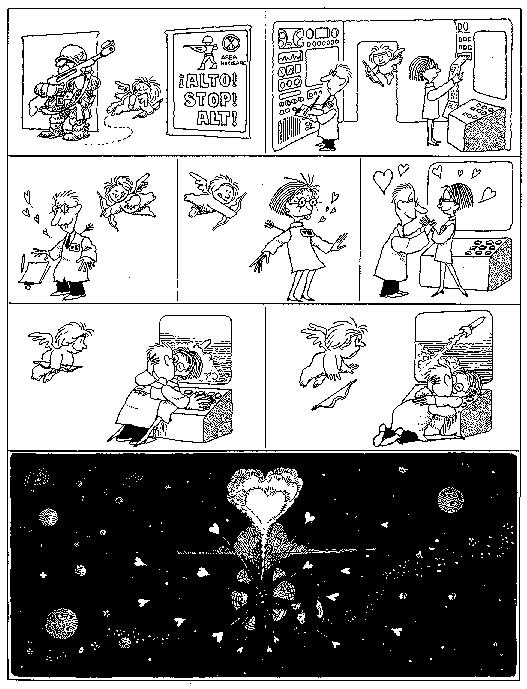
- This strip◊ by Quino. Cupid is doing his job, two researchers get a little occupied... and the Big Red Button gets leaned against.
- In The Secret Origin of Iron Man arc, the Godkiller is revealed - an ancient, five-mile-tall hyperweapon designed to kill Celestials. That's Celestials, plural. That it destroys planets is incidental - it simply flies through them without slowing down. At the speed with which its travels - at least in the area of light speed - that leaves a rapidly expanding cloud of planetary debris.
- Shakara: Earth is blown up on the very first page, which then follows battles between various aliens. Plenty of other planets get blown up throughout the comic as well.
- Sonic the Hedgehog:
- Averted in Sonic the Comic; the Metallix are trying to convert the Miracle Planet to metal to use as their base, using something called the Alpha Device created by Grimer. After dealing with the Metallix, Sonic proposes 'just yanking the thing out', but Porker Lewis states doing so would blow the planet up.
- Played VERY straight on the other side of the Atlantic in Sonic the Hedgehog (Archie Comics). In issue #256, t's revealed that Dr. Eggman's actions in Sonic the Hedgehog/Mega Man: Worlds Collide not only caused the Multiverse to collapse on itself and reboot but also had all of those energies trapped within Sonic's World. Sonic and Tails think they can still save the day and Orbot and Cubot think Eggman has a plan to fix it. NICOLE and Eggman's response? IT'S TOO LATE!
- In Starslayer, Torin mac Quillon comes into possession of a weapon that can implode a sun into a black hole. He ends up using it.
- Star Trek: Early Voyages:
- In "The Fires of Pharos", the Enterprise destroys the dilithium-rich Pharos siteworld, resulting in the creation of a giant fireball that would burn for decades.
- In "Cloak and Dagger, Part Two", Darien 224 is destroyed by the Vorl-tak, otherwise known as the world weapon. It employs a planet's gravitational field as a psionic amplifier and has the potential to tear its host world apart. The Vorl-tak can also destroy any ship or object in orbit. Matriarch T'Kell, the leader of the main group of Vulcans on Darien 224, intended to use it to kill her rival Commander Tagok and his followers while she and her group escaped aboard the Enterprise. However, they failed to capture the Enterprise and all of the Vulcans from both sides died with the planetoid.
- In Trinity (2008), Krona crushes Earth with his bare hands during the Final Battle. It got better.
- Green Lantern: It happened to living planet Mogo. He got better, though.
- The Protectors ended just like that. The heroes failed, and Earth was destroyed.
- Judge Dredd: During the Apocalypse War, Mega-City One launched a retaliatory nuclear strike against East Meg One by firing 25 TAD missiles, each one of which is capable of leveling a Mega City by itself. East Meg One used a hidden superweapon to teleport the inbound missiles to an alternate Earth where peace had reigned for over a millennium. The planet exploded.
- This strip from This Modern World.
- In Ashes of the Past, Cyrus ends the world so he can recreate it in his own image. Arceus dislikes this, and creates a new Dialga in order to send Ash, who had been (maybe) saved from the end of the world, back in time to the start of his journey, with knowledge of the future, the ability to use aura, and the ability to restore memories of the original timeline to those he knew, in order to prevent the end of the world.
- Examples from the Calvinverse:
- Evil Calvin from Retro Chill creates a button that does this to the Earth, and repeatedly threatens to use it unless the citizens of Earth bow down to him and his masters.
- According to Calvin & Hobbes: The Series, if Thunderstorm doesn't stop exploiting another dimension using a portal, this will happen to both our world and the other dimension.
- In Chapter 10 of Chronicles of the Crusade: The Long Road, Captain Gideon and the crew of the Excalibur detonate the Mark IX inside of Enceladus so that Kathenn can be destroyed. They later remark that Sheridan would be pissed that he wasn't the one who pushed the button to detonate it.
- The Warhammer 40,000 fan film Damnatus ends with Inquisitor Lessus ordering an Exterminatus on the planet of Sancta Heroica in a Downer Ending after the heroes fuck up their mission and die trying to escape. Given this is the Crapsack Verse of 40K, this is par for the course.
- In Guilty Sparks, Zek almost quotes the trope namer when the countdown to The Pillar Of Autumn's reactor meltdown hits zero. He's interrupted mid-sentence when his escape ship is rocked and lit up by the resultant explosion, which does, in fact, destroy Halo.
- In Keepers of the Elements, Radcliffe does this to Zenith by taking out its central power core.
- In one chapter of The Lone Traveler the eponymous Traveler drops an asteroid on an earth that he finds to be utterly irredeemable. For added hilarity, he makes sure it impacts right on top of the head of Lord Voldemort.
- What happens to Equestria and Unicornicopia in My Brave Pony: Starfleet Magic. It got better.
- In Reaper's Origin, this happens during the Battle of Antarctica and when the SGC destroys Erebus.
- This happens several times throughout Reunions Are a Bitch.
- During the course of Thirty Hs, Harry kills the fuck out of at least two planets, and Dumblecop kicks another planet in half.
- In the backstory of Thousand Shinji, Abbadon finally gave up on trying to seize Cadia and blew the planet up.
- Earth's Alien History:
- When Palaven is invaded by the Reapers, the Turians trigger massive explosions along underground fault lines, breaking the planet apart in order to deny the Reapers access to those civilians who couldn't evacuate in time.
- The Klingons destroy at least one of their own overrun colonies to deny the Reapers a victory.
- During the Reapers' Final Offensive, one of them suicide rams Tuchanka with a Naquadah asteroid, partially destroying the planet itself and rendering its surface uninhabitable.
- Praxis explodes as per Star Trek canon, due to a chain reaction of exploding generators in the mines.
- In an Offscreen Moment of Awesome, the Pact of the Raptor apparently destroy the Leviathans by blowing up their planet.
- Several examples in Katie's Bad Future, as the Galactic Empire used Sun Crushers to destroy Kryptonian and Tamaranean worlds, and later used the Death Star on Earth itself.
- Doing It Right This Time: In order to carry out the desperate Peggy Sue plot, Kaworu needs a huge amount of energy. More than even an S2 Organ can generate in normal operation. The hastily jury-rigged overclock does work, but...
"Approximately five seconds later, Lillith's severely damaged and overtaxed S2 engine finally overloaded. Unhindered by the various very important failsafe mechanisms that Kaworu had overridden first to get it working again at all and then to ramp up its already unfathomably large power output far beyond safe operating levels, the ensuing explosion took most of the planet with it."
- Of course, since this was in the immediate aftermath of Shinji's Suicidal Cosmic Temper Tantrum at the climax of The End of Evangelion it didn't really matter that much.
- Hybrid Hive: Eat Shard?: One of Taylor's experiments, combining telekinesis with Flechette's dimensional power, inadvertently starts a runaway conversion of matter to antimatter. Fortunately, Taylor does all her testing on uninhabited alternate Earths.
"Lord," Hive sent a moment later. "It would appear that there are now several pieces of planet where one of the planets you were testing on used to be."
- Infinity Crisis: In Tomorrow's Guardians, the Kaylons attempt to destroy Xelayan by dropping a massive nuke into a volcano range, triggering a chain reaction of tectonic events that will tear the planet apart. Thanks to the Legends and Guardians they fail, but the Orville is less successful at stopping them from doing the same thing to Moclus.
- In this parody comic of Steven Universe, Yellow Diamond somehow manages to destroy all of Homeworld itself with just her dynamic singing.
- The climax of Ark has the entirety of Planet Alcyeon imploding, an explosion that the film spends most of its runtime building up.
- A Chicken Little teaser parodies The Hitchhiker's Guide to the Galaxy (2005) trailer, with the Earth exploding.
- The Little Mermaid (1989): King Triton first blows up a globe in Ariel's grotto with his trident during his Unstoppable Rage, then does the same with the rest of Ariel's human treasures.
- Two from the The Mind's Eye series. In The Gate to the Mind's Eye, the sequence "River of Souls" shows some type of weapon destroying a world implied to be Earth. From Odyssey into the Mind's Eye, the sequence "Volatile Planet" shows a much slower version of this as a small spacecraft is trying to escape.
- Titan A.E.:
- The film begins with the destruction of the Earth, and continues with the survivors from there. This explosion deserves special mention, as one evacuation shuttle is disintegrated by the force of the explosion, several more are destroyed by debris from the planet, and huge chunks of the Earth then pulverize the Moon breaking parts of it off. It's very impressive.
- Near-perfectly inverted at the end with an Earth Creating Kaboom. The Big Bad shows up to try to destroy the Titan, but instead destroys herself and creates
a new earthBob. - Something just short of this trope evidently happened to the Broken Moon of Sessharim, to judge by the huge jagged crack that mars half its surface.
- In Arthur C. Clarke's 2010: The Year We Make Contact (both film and book) the Sufficiently Advanced Aliens who made The Monolith invoke its abilities to cause Jupiter to collapse and ignite as a star. It's notable that this is not for nefarious purposes; instead, they want to provide an energy source to the evolving life forms on Europa, who would otherwise have died out as the geothermal vents keeping them warm went cold. The novel shows that the destruction of Jupiter's current climate is an apocalyptic event for the strange gasbag creatures that live there, but the Monolith's creators decide that fostering a potential civilization on Europa is worth the sacrifice of an environment in which intelligent life is unlikely to ever develop.
- In Battle Beyond the Stars, the Big Bad has a weapon called a Stellar Converter that, well, converts planets into stars.
- In Battlefield Earth, a nuke sent to Psychlo causes a reaction with its atmosphere and blows up the planet...except this time Psychlo is reduced to a cloud of noxious gas.
- In Beneath the Planet of the Apes (the first sequel), a group of mutants (who captured Taylor, his girl and the guy who came to rescue him) worships a powerful nuke, that when detonated would destroy Earth. Then the apes attack, and while Taylor is falling dead, he triggers the bomb... one Downer Ending, especially due to the Insignificant Little Blue Planet speech that follows. Parodied in Mystery Science Theater 3000 in Season 8. The Satellite of Love was orbiting a Planet of the Apes-like Earth...when Mike Nelson gives advice that starts the bomb that a cult worships. Predictable results...and Mike was only beginning.
- In Daleks' Invasion Earth: 2150 A.D., the Daleks planned to detonate a bomb which would remove the Earth's core.
- The John Carpenter's ultra low budget film Dark Star featured a starship crew whose job was to traverse the Galaxy, using "Exponential Thermostellar Bombs" to destroy planets that might someday threaten human colonies. We see them blowing up a planet in the Action Prologue.
- In Godzilla vs. Destoroyah, it's revealed that Godzilla's heart is a nuclear reactor. When Birth Island erupts and exposes Godzilla to a bed of radioactive materials, he absorbs too much and begins to undergo meltdown. Unfortunately, his self-destruction will cause the next Big Bang and take the entire universe with him, sending scientists and the military scrambling for a way to prevent it. Things get more complicated when Destoroyah arrives on the scene, making Godzilla's meltdown occur faster and become more powerful due to his rage at Destoroyah's actions (mainly killing his son). Thankfully, though, the military, utilizing tanks with freeze rays, manage to avert the explosion, but his radiation still makes living in Tokyo a death wish. Then his son is revived by a life-force transfer and he makes Tokyo habitable again.
- Keeping in mind the Death Star and Alderaan, the similar destruction of the peaceful planet Basketball in the Star Wars parody film, Hardware Wars.
- Forbidden Planet. Dr. Morbius resorts to blowing up the ancient Krell power plant as it's the only way to stop the Id Monster menace permanently.
- The Hitchhiker's Guide to the Galaxy (2005). Ironically, rather than a "terrible, ghastly noise" (as the book, listed below, describes), the destruction of the Earth in the film version is silent (more like an earth imploding "zip"). Played straight in the teaser trailer.
- The destruction of Krypton as its core blows up in Man of Steel.
- Marvel Cinematic Universe:
- Thor: Ragnarok.
Korg: The damage is not too bad. As long as the foundations are still strong, we can rebuild this place. It will become a haven for all peoples and aliens of the universe. [planet rips apart] Now those foundations are gone. Sorry.
- In Eternals, a Celestial's Emergence from a planet it's incubating in results in the planet's destruction. Arishem shows Sersi what Tiamut's birth would look like: Tiamut rises through the crust for a couple of seconds, and then Earth breaks into a dozen fiery pieces.
- Thor: Ragnarok.
- At the very end of the Argentinian animated film Mercano, el marciano (Mercano the Martian) the Earth explodes because the characters cut the wrong wire of the remote controlling all of the world's computers, that were turned into bombs.
- Lars von Trier's Melancholia revolves around the destruction of Earth by collision with an immense rogue planet (though there's not a lot of suspense about it, as the world's fate is revealed upfront in the opening sequence).
- The beginning of Men in Black II shows Sarleena destroying planets she passed by. Even more amazing when the viewers find out that the ship is only a foot tall.
- In Plan 9 from Outer Space, an alien comes to Earth to explain that, since Humans Are Bastards, they will not stop at atom bombs and hydrogen bombs, and will soon produce the solaronite bomb, which, by exploding sunlight and everything it touches, will create a chain reaction destroying the universe.
- Soldier gives us the DX-57 bomb, colloquially known as a "Planet Killer". Looking much like a soccer ball, it's more than enough to destroy the Landfill Beyond the Stars planet the protagonists escape from. It's possible the aliens' attack on Earth gives humanity a reason to produce such a weapon.
- It is slightly hinted that Spaceballs parodies Beneath the Planet of the Apes as well. When President Skroob, Dark Helmet and Colonel Sandurz crash-land on the Planet of the Apes, an ape says "Oh shit, there goes the planet." The scene changes after that, and never switches back to the planet, making it seem more of a What Happened to the Mouse?, but if you've seen Beneath the Planet of the Apes, you can assume what happens next.
- A Q-Bomb is used to crack Planet OM-1 in Starship Troopers 3: Marauder, though the sight wasn't enough to distract General Dix Hauzer from snogging Captain Lola Beck.
- Star Trek:
- The Genesis Device from Star Trek II: The Wrath of Khan and Star Trek III: The Search for Spock. Its intent is that it can terraform lifeless planets to make them habitable. However, it has its flaws:
- The newly minted planet from Star Trek III fell apart in just a few weeks. This is eventually chalked up to the fact that Kirk's son couldn't actually get the technology to work, so he put proto-matter in it. Being an unstable substance, the new planet slowly but surely implodes on itself.
- Later novels retcon what the movies established, asserting that the device was supposed to be used on a planet, rather than a nebula, and hence much of the energy of the Genesis Effect was wasted on drawing in sufficient matter to create a planet, rather than stabilising existing matter after it had been transformed.
- Disturbingly enough, the trope repeats itself by accident at the beginning of Star Trek VI: The Undiscovered Country, when the Klingon moon of Praxis explodes due to overmining and No OSHA Compliance. About 1/6 of the planetoid remains, and a massive (subspace, meaning it travels at FTL speeds) shockwave spreads throughout the sector.
- Not to be outdone, Star Trek: Generations introduced the "Trilithium Warhead," a small device which could implode a star, causing a shock wave that could destroy a solar system, and which could be produced and deployed by one person.
- Star Trek (2009): It ups the ante even more, with the Romulan Big Bad's plan being to destroy every single planet in the Federation, just to get back at Spock for not being able to stop Romulus from being destroyed by a star going supernova in time. The villain actually gets as far as destroying Vulcan and is in the process of trying to destroy Earth before he is stopped by Kirk and Spock. Technically, it's an implosion, rather than an explosion as the red matter is injected into the planet's core and ignites, setting off a black hole.note
- The Genesis Device from Star Trek II: The Wrath of Khan and Star Trek III: The Search for Spock. Its intent is that it can terraform lifeless planets to make them habitable. However, it has its flaws:
- Star Wars:
- One of the most famous Planet Killers is the Death Star from A New Hope, with poor planet Alderaan to supply the Kaboom. Later on in the movie, the Death Star gets its own version (okay, space station the size of a small moon, close enough).
- The second (and larger) Death Star gets its own as well in Return of the Jedi.
- In The Force Awakens, the First Order continues the grand Imperial tradition of planet-killing with its new and even better version: Starkiller Base. Built on the surface of the planet rather than in a mobile space station, it massively outdoes the Death Stars. Using the entire mass of a star, it generates a beam which can cross the galaxy in minutes, split into several beams, and wipe out every planet in the target system. Naturally, it shares the same fate as its ancestors at the end of the film.
- The Rise of Skywalker has a massive fleet of Star Destroyers with built-in planet killers. One of them ends up destroying Kijimi. Most fanedits remove this planet-killing ability from the film, and the biggest one that didn't (TROS: Resurgence by Krausfadr) had Kylo Ren destroy Corellia early in the film.
- At the end of Transformers: Dark of the Moon, Cybertron collapses in on itself when the Autobots destroy Sentinel's Space Bridge.
- Aeon 14: Destiny Lost: The government of Bollam's World has been using a multi-Jupiter-mass gas giant as a helium-3 factory, using Artificial Gravity to keep it from collapsing into a brown dwarf. When these generators are destroyed by a rival government in an attempt to destroy the protagonists' colony ship Intrepid, the gas giant is converted to a gigantic thermonuclear bomb. That's not the crazy part. The crazy part is that the upper layers suddenly exploding all at once acts kind of like a multi-stage nuclear device in its own right, compressing the lower layers beyond the density limit to create a black hole. As for Intrepid, they're thrown clear by the shockwave and survive because of some Applied Phlebotinum.
- Battlefield Earth: A Saga of the Year 3000, in both the book and movie, Johnny "Goodboy" Tyler detonates the Psychlo homeworld by teleporting a nuclear device to the planet. The nuke is a plain old one, but it's the way nuclear radiation interacts with the Psychlos' breath-gas that causes the big boom.
- Black Widowers: In "The Ultimate Crime", Henry speculates that Professor Moriarty's treatise Dynamics of an Asteroid describes an explosion of a planet between Mars and Jupiter and created the asteroid belt. And that Moriarty might have had dreams of doing the same thing to Earth.
- In the backstory of Bounders, the Youli homeworld was shattered into pieces during a galactic war caused by the Youli's unethical treatment of other planets. Youli scientists used a rift in spacetime to travel back and warn the Youli of what would happen if they didn't change their ways, and as a result the planet was saved, although its surface was destroyed and won't be habitable for another thousand years. In Fractured Futures, Jasper learns that after the events of The Forgotten Shrine, the Youli shattered Earth the same way. Mira talked the Youli into letting her travel back in time to prevent the war.
- C. J. Cherryh wrote about one method in her Chanur Novels. The main character speculates how the bad guys might hijack loose interplanetary debris and accelerate same, followed by aiming said debris at the main character's homeworld.
- Creatures of Light and Darkness by Roger Zelazny includes shattering "worlds", supposed to contain multiple planets, in the course of the battles of the gods.
- The Crew of the Copper-Colored Cupids:
- Zaroff-024 in Under the ea intends to launch the planet Earth at the planet Mars.
- It seems Mars can't catch a break in the Cupids 'verse, as the very next story revealed that (in an alternate universe) the Director had destroyed Mars to avert a human/Martian war.
- Zaroff-024 in Under the ea
- In "Dark Seiyuu", this happens as a result of Earth's gravity suddenly disappearing.
- The Dirty Pair count as planet-killing weapons all by themselves - they have blown up at least seven planets entirely by accident.
- The Draka: The third book details Project Fenris, a secret Draka project to plant the Moon with explosives that, when detonated, will dislodge the celestial body from orbit and slam it into Earth at velocity. As the Draka believe they are a Superior Species to the rest of humanity, they believe that it's a crime that the world continues to exist without their civilization.
- In the fifth Dune novel, Heretics of Dune, an Honored Matres fleet blasts the surface of Arrakis (called Rakis in that era) into molten slag, effectively sterilizing it.
- Empire from the Ashes:
- All of the various Planet Spaceships used by the Fourth Imperium, Fourth Empire, and Fifth Imperium have enough weaponry to destroy terrestrial planets. In the second book, the heroes find evidence that this was done in at least one star system during the civil wars that caused the Fourth Imperium's collapse.
- The Absolute Xenophobe Achuultani have this as one of their favourite tactics (via Colony Drop), especially against more technologically advanced worlds. The former fifth planet of the Solar System was destroyed this way during the First Incursion, roughly 70 million years ago. An interlude in the second book shows a nameless planet subjected to this, and during the Siege of Earth, they eventually yank Iapetus out of its orbit and try to hurl it at Earth. They get very close to succeeding before the Big Damn Heroes arrive.
- In the third book, the Big Bad has a planet-busting bomb built as part of a plan to kill everyone in the Imperial government higher-ranking than him so that he can become Emperor and blame the destruction of Birhat on terrorists that he secretly controls. Fortunately, the good guys manage to destroy the bomb's power using low-tech conventional explosives before that can happen.
- Orson Scott Card's Ender's Game involves the "Little Doctor" device, which is indeed capable of blowing up a planet, and is used for that purpose near the end of the book. In the sequel Children of the Mind, a second such disaster is narrowly averted.
- The device is nicknamed the "Little Doctor" because it's actual name is the Molecular Disruption device, abbreviated MD, which is also the abbreviation for "Medical Doctor". It works by creating an energy field that prevents atoms from clinging together. The field's strength and area of effect is related to how much mass the target has. The effect spreads from atom to atom in a chain reaction. This means that the weapon requires the same amount of energy to be used against a single ship as it does a planet.
- The weapon's range isn't actually that great, which means that any ship using it against a planet is on a suicide mission, as the field from the planet's destruction will get anything in orbit. The ships using it in the first book had 70-year-old equipment, so it's possible that later developments upped that range.
- Specifically, in Ender's Game, the weapon is explicitly stated to be NOT a missile. Circa 3000 years later, by Children of the Mind, it's shown to be the payload of a missile or missile-like device.
- The prequels Earth Unaware and Earth Afire feature a precursor to the Little Doctor called a "gravity laser" or "glaser", developed as an asteroid mining tool. One of the test shots almost destroys the firing vessel as the field expands kilometers beyond what they had expected, and when used as a weapon against the Formics they mount it on expendable drones.
- The device is nicknamed the "Little Doctor" because it's actual name is the Molecular Disruption device, abbreviated MD, which is also the abbreviation for "Medical Doctor". It works by creating an energy field that prevents atoms from clinging together. The field's strength and area of effect is related to how much mass the target has. The effect spreads from atom to atom in a chain reaction. This means that the weapon requires the same amount of energy to be used against a single ship as it does a planet.
- In Lindsay Buroker's Fallen Empire series, the planet of Kir, home of the psychic Starseers, is destroyed in battle due to a combination of nuclear and kinetic bombardment and psychic superweapons.
- Possibly Charlie McGee from Stephen King's novel Firestarter. "Suppose there is a little girl out there someplace this morning, who has within her...the power to crack the very planet in two like a china plate in a shooting gallery?"
- Vernor Vinge's A Fire Upon the Deep contains at least two types of planetcracker weapons: antimatter warheads (with sufficient yield to, at the very least, sterilize a planet's surface) and kinetic missiles accelerated to relativistic speeds. As typical warships carry thousands of the former as their standard armament, space conflicts can (and do) become fast and bloody.
- In Greg Bear's The Forge Of God, Earth was blown up after (a) being shot with one giant neutronium bullet and one giant anti-neutronium bullet that met and exploded and (b) having vast quantities of hydrogen extracted from the oceans and turned into hydrogen bombs.
- Julian May's Magnificat the final book of the Galactic Milieu series ends with the destruction of a major colony planet, alluded to in the rest of the series as the biggest mass murder of all time.
- Robert A. Heinlein originally used the term "nova bomb" in the 1953 version of his short story "Gulf". It was a theoretical bomb that could destroy the entire Earth.
- In The History of the Galaxy, the LIGHT annihilation device is an Antimatter-based weapon that can blow up a Moon-sized planetoid. That's actually the largest target it ever had and was its first use in battle. How? By luring the enemy armada to it and turning all the planetoid's mass into energy with an anti-matter stream. That was the plan, anyway. What actually happened was both fleets got wiped out, except The Empire still had plenty of ships left, while La Résistance (who used the weapon) only had 8. Oh, and the weapon was destroyed as well. Can you say Pyrrhic Victory? The only thing that saved the colonists was that the enemy had no idea they were defenseless. The device is later mounted on flagship cruisers but almost never used.
- The Hitchhiker's Guide to the Galaxy Trilogy:
- The first book starts with the Earth being demolished to make way for a hyperspace expressway.
- And then ratchets it up at the end of Mostly Harmless by destroying every Earth in every alternate dimension ever.
- The Larry Niven short story "The Hole Man" involves a team of explorers uncovering an ancient alien device on Mars that is powered by a miniature black hole in a containment field. When the black hole is accidentally released, it falls through one of the explorers standing underneath (killing him) and through the surface of the planet, leaving a tiny pinhole. The explorers predict that the black hole will settle in the planet's core and slowly add the planet's material to its mass, with the whole of Mars eventually collapsing into it—but this supposed outcome doesn't occur within the timeframe of the story itself.
- In Weber's Honor Harrington stories, everyone can do it, but no one does because of the "Eridani Edict." Anyone indiscriminately bombarding planetary targets will themselves meet the same fate when everyone else in the galaxy turns around and does the same to them.
- Alan Dean Foster's Humanx Commonwealth series features a couple of these, starting with the basic mechanism used for Faster-Than-Light Travel — immensely strong artificial gravity fields that can theoretically demolish large chunks of a planetary body if brought too close. Needless to say, doing this is considered a horrific crime, and would almost certainly be suicidal to boot. The novel The End of the Matter features a search for a Lost Superweapon that creates anticollapsars, or white holes, made out of antimatter. The long gone race that created the weapon did so in order to counter rogue black holes, but also threatened to use it on the planets of their contemporary rivals. (The resulting arms race destroyed both species.)
- In Dan Simmons's Hyperion Cantos saga, a team of scientists accidentally created a black hole in the earth's core, which slowly destroyed the planet and forced the Hejira, an exodus to multiple inhabitable planets. Later it was revealed that the accident was engineered by the A.I. Technocore, in order to spread the farcaster network, where they resided.
- The old earth is destroyed in this fashion at the end of the Left Behind book Kingdom Come.
- In the Gray Lensman book of E. E. "Doc" Smith's Lensman series, two planets have their inertia dampened (i.e. forward momentum placed in stasis), after which they are moved into place on opposite sides of a planet of villains. When their inertia or forward momentum is returned, they rush together to crush the planet between them. This is merely a coda to the use of an antimatter bomb of planetary size. Later in the series, this is deemed insufficient and more powerful weapons are used, including planets from other universes with intrinsic velocities significantly above lightspeed.
- In The Log by Craig Charles and Russell Bell, a prototype weapon called the Proton Cannon of Nakasami is tested at the edge of the solar system, and according to the authorities, it was entirely a coincidence that Pluto vanished on the same day. It's probably just as well that the cannon proved to be of no practical use, as its recoil was enough to blast it across the solar system, where it embedded itself in Titan.
- In Oleg Avramenko's Stars in the palms humans do posses gloon bombs. It's activation near planet just force all unstable elements to destabilize, creating asteroid field instea of planets. Humanity prefer not to use them against inhabited enemy planets (they just glass them if it's necessary or use biogical weapons, they also ask for surrendety first). Their enemies don't have this technology but one of enemy races demonstrated they do have 'strangelet fuse' which could cause star to go supernova. Humanity's reaction? Secret ultimatum to prove said aliens din't invent strangelet fuses themselves, together with some "minor" details why it's very bad idea to use them in combat because.
- In Sergey Lukyanenko's A Lord from Planet Earth trilogy, quark bombs are relatively small spheres. One is fully capable of starting a process of total subatomic fission that is impossible to stop and consumes a planet in a matter of minutes. Even small chunks of the planet can re-start the process on another world if they happen to make it that far. Luckily, the bomb has to be delivered by ship, as teleportation renders it inert. After only two uses, it was banned by the entire galaxy. The only safe way to dispose of the bomb is to take it to a very remote area of space and blow it up.
- The eponymous device of Alastair Reynolds' short story "Merlin's Gun".
- In The Night's Dawn Trilogy, the scientists studying the ruins near the habitat Tranquility crap themselves when they realize that the planet of this ancient alien civilization was actually destroyed, as in reduced to large chunks of rock floating around space. This reaction is largely provoked by the fact that the best that their technological advances so far, which include light-speed warping, anti-matter bombs, living thinking Bitek space vessels and habitats (Tranquility is actually one of these), and techno-telepathy, have only made it as far as being able to completely screw with the surface of a planet and destroy its climate and ecology. It gets worse, because for reasons unknown, this ancient alien race apparently did it to themselves.
- In the Paradox Trilogy, the Eldritch Abominations called phantoms disrupt gravity, causing planets to tear themselves apart. A large phantom can destroy a planet in a matter of hours with its mere presence.
- The oldest and still canonical example of this in the Perry Rhodan universe is the Arkon bomb, a reasonably portable device capable of causing a runaway nuclear chain reaction that will destroy the planet it is planted on over the course of only a few days. The arguably most destructive weapon ever built by Terrans, the Hyperinmestron, was used only three times in the series and only once for actual military purposes — it's capable of blowing up a star, and that first use resulted in side effects that caused supernovae and other general chaos and devastation throughout the center of the Andromeda galaxy.
- Jack McDevitt's Deepsix (part of his Priscilla Hutchins series) is about a last-minute xeno-archeological expedition to a doomed planet that is about to be hit by a large rogue moon. The team only has three weeks before the planet-shattering kaboom, so it's important that nothing goes wrong. Of course...
- Ra: The Abstract War starts with about 60 thousand hollow Earth replicas being destroyed.
- The Revelation Space universe features many Earth Shattering Kabooms: First, the main antagonists destroy at least three planets during the main trilogy and an unknown but very large number more during the previous one billion years; second, defeating those antagonists releases a rogue terraforming agent, which, it is implied, destroys the whole universe in several billion years. From the very first novel, a group of humans have a cache of 40 weapons, each capable of destroying a planet. And then finally, there are the Nestbuilder Weapons, of which little is seen but much is said.
- In Michael Reaves' The Shattered World and The Burning Realm, this had happened to a fantasy world a thousand years ago. The damage-control efforts of every wizard in the world allowed fragments of the broken planet to be saved, orbiting one another in a bubble of atmosphere. The Shattering was blamed on the power-mad Necromancer's final, spiteful spell, cast when the nations of the world refused to bow down to him. He was actually a scapegoat for a collision between planets, and had really used his powers to keep the world's fragments from disintegrating into dust.
- David Weber and Steve White's The Shiva Option features this (in the form of anti-matter warhead barrages from fighter swarms) being used against a genocidal alien race as a regular tactic, once the good guys discovered the aliens communicated by telepathy. Kill anything over several hundred million on-planet, and the psychic hammer blow of the mass deaths cripples anything else in-system. Given that the alien species was a lot of ancient horror cliches come to life (including Human Resources to the point of making conquered races into planetary-scale livestock ranches), the inclination is to rule it necessary. Especially since an earlier book in the series ended with a Terran Federation ex-President sacrificing his own health to prevent the destruction of a different species' planet where only the world government was at fault.
- In the third book of the Spaceforce (2012) series, the theme-world Fantasia is destroyed by concentrated fire from four Taysan warships, in order to obliterate the source of a drug the Empire fears could corrupt its civilisation.
- In the novel Starship Troopers, the Terran Federation develops the Nova Bomb. It is used on planets that are heavily occupied by bugs and of no strategic importance to the Federation.
- Quite a few examples from the Star Trek Novel 'Verse:
- Thallon in Star Trek: New Frontier, by virtue of the Great Bird of the Galaxy, which has been gestating inside its core for millennia. Now ready to "hatch", it destroys the planet from within.
- Several planets in the Taurus Reach during the 2260s, due to the use of Shedai technology by Federation and Klingon researchers. Some planets were destroyed accidentally as a result of inept use of Shedai artifacts, others were destroyed deliberately by the Shedai Wanderer in her attempts to prevent her people's technology coming into the hands of other, younger races. Palgrenax was one such planet. See: Star Trek: Vanguard.
- In Star Trek: Titan, the Shalra homeworld was destroyed by a space-going creature, which fed on the remains. Also, Oghen - and possibly other worlds in the Neyel Hegemony - were destroyed by the effects of the Red King protouniverse.
- Erigol in Star Trek: Destiny, deliberately destroyed in order to maintain a stable time loop.
- Dokaal in Star Trek: A Time to..., in a natural disaster.
- Star Wars Expanded Universe:
- In Empire's End, Gallius Rax attempts to destroy Jakku with a bomb, thereby destroying most of the New Republic and Imperial forces as well, but is stopped by Norra Wexley and Rae Sloane.
- Star Wars Legends:
- In the old Expanded Universe, further planet-killers seemed a dime a dozen, some built by Imperial forces, others not. These include the Darksaber (the Death Star's laser, rebuilt without an actual Death Star. And it doesn't work), the skeletal prototype Death Star, the Eye of Palpatine, Centerpoint Station, and the Sun Crusher (which is even worse than the Death Star; it's a tiny indestructible ship that, if you replace "crush" with "supernova", does what it sounds like).
- The "planet killer arms race" featured in the Star Wars EU, in which every planet-killer has to be somehow bigger and badder than the last, is one of the most-cited reasons why some fans consider several fair-sized chunks of the EU non-canonical and ridiculous. This was only really happening in the nineties when Bantam had the license. Nearly all of the Bantam superweapons were Kevin J. Anderson's doing. He put at least one in each novel except in the Young Jedi Knights series. Del Ray, for all their perceived faults, mostly uses this gimmick with the Vong, who possessed and often were Planet Killers themselves.
- And then there were the World Devastators. They were Star Forges in miniature, except taking materials from planets instead of stars and having to chew said planets up to get them. These "merely" rendered the planet an uninhabitable ball of rock significantly smaller than it used to be, rather than an actual kaboom. Notably, in the first Rogue Squadron game players could fly against the World Devastators as Wedge Antilles.
- The Eclipse-class Super Star Destroyer had a superlaser that extended the length of the battleship. It had only 1/3 the power of the Death Stars' superlasers, but it was still powerful enough to rip a gap in the crust of a planet. It wasn't nicknamed the "Continent Cracker" for nothing.
- Then there's the Galaxy Gun. Its distinguishing trait was that it could stay in orbit of the Emperor's new throne world (protected by a fleet), and simply fire a missile into hyperspace. The missile would then exit hyperspace at its target and destroy it, while the gun was never in any danger.
- In one battle during the Clone Wars, in which the Republic was laying siege to the Separatist shipyard-world of Pammant, a Republic battlecruiser suffered a hyperdrive malfunction and collided with Pammant at hundreds, maybe thousands of times the speed of light. Pammant was reduced to some radioactive chunks.
- In the Sten series, the Empire has Anti-Matter Two weapons called planetbusters. The Eternal Emperor tries not to use them much, for the pragmatic reason that blowing up entire worlds tends to attract unwanted attention from other governments and is generally bad for business. However, in Empire's End, one is deployed against the Manabi homeworld.
- In Stranger in a Strange Land, Mike mentions that he is able to destroy the Earth with his psychic powers, although he reassures Jubal Harshaw that he is morally unable to do so. The book also mentions that the asteroid field between Mars and Jupiter was created when the Martians used the same powers to destroy a planet between them many eons ago.
- In the epilogue of the expanded edition of that novel, it is noted that the Martians eventually do decide to destroy the earth; by then, however, humanity has colonized space, a lot.
- Temple (Matthew Reilly) has the Supernova, a nuke capable of vaporising one-third of the Earth's mass and knocking the rest out of its orbit around the Sun. There's three of them.
- Downplayed in Transpecial. The ky'iin blow up Phobos to destroy its scientific outpost.
- Urn Burial has this happen to the home planet of the Eldritch Abominations in the backstory; blown up with superweapons by the alien whose grave the human hero finds while herding sheep.
- Warhammer 40,000 Expanded Universe:
- In the Blood Angels stories, the planet Orilan is Exterminatus'd to sterilize it of corruptive daemonic taint. Shenlong follows when the Blood Angels find its people fallen too far from the God-Emperor's light.
- In the Ciaphas Cain novel Caves of Ice, a bomb that was placed in a mine that was flooded with millions of gallons of highly volatile promethium resulted in a gigaton range explosion that obliterated a mountain range and caused a shockwave that could be felt from orbit. Despite that, they're still not certain whether or not the explosion destroyed the Necron tomb hidden below the mine.
- In the 1932 novel When Worlds Collide by Edwin Balmer and Philip Wylie, a Jupiter-sized rogue planet drifts into the Solar System on a direct course for Earth with a result one character compares to tossing a walnut in front of a cannon at the instant the cannon is fired.
- In ALF, the titular character ends up on earth after his homeworld of Melmac was destroyed. In one episode, he tries to get through to the President on his concern about a nuclear disaster, saying that he's already been through one and it's no picnic.
Willie: Nuclear? You mean that's how your planet exploded?
Alf: No. We all plugged our hair dryers in at the same time. - Probably named for Heinlein, the series Andromeda had Nova Bombs. How powerful were they? Well, the Andromeda carrying 40 of them was enough to send resident badass and proud warrior race guy Tyr into a fit because it was enough firepower to conquer an empire. The bombs cause stars to go super-nova, and can be volley-fired into black holes to turn them into white holes.
- Incidentally, there is a literal Earth-shattering kaboom in the series' final episode. Nova Bombs are not to blame but rather something called Radical Isotopes: stuff with negative mass from another dimension.
- Harper also designs an even more destructive variant of the Nova bomb, and it's used to destroy an artificial sun.
- Babylon 5 destroyed or rendered completely uninhabitable at least two dozen planets in its fourth season, when the Space Cold War between the Vorlons and the Shadows escalated and both brought out their versions of planet-killer ships to destroy worlds of younger races "touched" by the influence of the other.
- In the sequel movie A Call to Arms (which was also the movie-pilot for the spinoff Crusade), the Drakh acquire a planet-killer left behind by the Shadows, test it on an inhabited planet, then threaten Earth with it.
- And in an episode that depicts the human race a million years in the future, humans are leaving the Solar system as the Sun is about to go nova, implicitly not by natural causes.
- The Dilgar sun "went nova" supposedly by similar mysterious but deliberate means not elaborated, shortly after the Dilgar War (which preceded the Babylon 5 timeframe), according to Word of God.
- Happens at the end of the Battlestar Galactica (1978) pilot Saga of a Star World when the tylium set on fire by Apollo and Starbuck reaches the surface of the planet Carillon.
- Doctor Who:
- It's the plan in "The Dominators".
- This is played straight in Doctor Who too many times to count. Not always with Earth, but with a planet inhabited by humanoids. Gallifrey, for instance, goes boom in the new series or rather, appears to, and in "The Invasion of Time", the Sontarans threaten to blow it up.
- And in "The Pirate Planet", the eponymous planet destroys other worlds by materialising around them, stripping them of their resources and shrinking them down to the size of a basketball, after which they are displayed in the captain's trophy room.
- Subversion: Earth is destroyed on-screen in "The End of the World", but nobody in that era makes a big deal out of it... because it's five billion years from now, Earth's destruction was long overdue anyway, and humanity has abandoned it long before.
- "Boom Town": Margaret Blaine's plan to escape Earth involves setting up a situation where the Cardiff Rift will be torn open, destroying the planet and powering her escape vehicle.
- "Journey's End": The Osterhagen Key is a series of nuclear warheads embedded beneath the Earth's crust which, when triggered, will destroy the entire planet. Martha Jones explains that it was created as as last resort to spare humanity from an even worse fate such as the Daleks using the planet to destroy all of reality. The Daleks teleport her away before she can activate it.
- "Asylum of the Daleks": The titular planet is blown up by the Daleks at the end of the episode.
- "Nightmare in Silver": The soldiers stationed on Hedgewick's World have a planet-buster bomb, which the orders are to use in case of Cybermen. Clara confiscates the detonator for the bomb, and then, after the Cyber-army has turned up, the Cyber-Planner calling itself "Mr. Clever" destroys the detonator. Also, Captain Ferrin, who could voice-activate the bomb, was killed by a Cyberman earlier. Fortunately, there's still a way for the bomb to be activated — dwarf Porridge is actually the Emperor, and he can activate the bomb. Everyone still alive on the planet is transmitted to the Emperor's ship before the planet blows, which it does spectacularly.
- "Demons of the Punjab": The Thijarians show the Doctor a recording of the destruction of their homeworld in this fashion.
- Crichton's wormhole weapon on Farscape could easily destroy planets, and sizeable chunks of the galaxy were it ever deployed in warfare. The Peacekeeper Wars shows that it's more than capable of destroying the entire universe. And Crichton isn't gun-shy.
- In Heroes, the third season features a prophetic painting that the Earth is going to explode sometime in the future, which is implied to be the event that Hiro sees destroy Tokyo in the future. Unfortunately, the entire subplot is never fully resolved or adequately explained, due to the protagonists seeming to forget about it.
- However, after the introduction of Samuel in the fourth season, who can manipulate earth and gets stronger in proximity to other evolved humans, it's likely he was the party responsible for causing the catastrophe. As the Bad Future prevented in the third season involved turning everyone into evolved humans, this would have increased his power exponentially.
- Kamen Rider Kuuga is said to be able to do this in his Ultimate Form with his Rider Kick...probably why we never see it.
- Strangely, that doesn't seem to stop him from performing a Rider Kick when he returns in the last 2 episodes of Kamen Rider Wizard, given that he has access to Rising Ultimate Form, a more powerful version of his Ultimate Form.
- Lexx featured the destruction of many planets over the course of the series (some deliberately, some accidentally), culminating in the last episode, when the Lexx is tricked into blowing up the Earth!
- "Lexx, use every last bit of juice you've got to blow up that ugly blue planet!". 790 had to have loved saying that.
- In the Night Gallery episode "Little Girl Lost", a military scientist has delusions that his dead daughter is alive. A wounded pilot becomes his bodyguard and must act as if he is interacting with the daughter. At the end of the episode, it is revealed that the scientist has subconsciously realised that his daughter is dead and has found a way to be reunited with her and get revenge on who killed her. And it turns out he has been working on nuclear fission. Oops.
- The Showtime series Odyssey 5 started with the world blowing up, and had five astronauts, who had survived because they were on the titular space shuttle Odyssey at the time, getting sent five years into the past to prevent it.
- The Outer Limits (1995): In "Phobos Rising", the Free Alliance accuses the Coalition of Middle Eastern and Pacific States of developing a triradium-based anti-matter weapon, a Doomsday Device with the capability of incinerating Earth. In response, the Coalition accuses the Alliance of developing such a weapon. As this latest escalation of tensions is being communicated to the Alliance base on Mars, a giant explosion encompasses Earth. The base's commanding officer Colonel Samantha Elliot comes to the conclusion that the Coalition has been smuggling triradium from Mars, its sole source, and were therefore responsible for destroying Earth. Further evidence of the scale of the destruction comes when Mars is struck by a colossal shockwave. When a drone is launched from the Coalition base, Colonel Elliot orders that all of the Alliance base's missiles be launched in response. However, it turns out that not only was the Coalition not smuggling triradium but the drone was being used to send a distress signal from the Coalition base, which had been devastated by the shockwave. The Coalition base's missiles are automatically launched in response to the incoming Alliance missiles and, in spite of the efforts of Colonel Elliot and her counterpart Colonel Paz, both bases are destroyed. Only Major James Bowen and Major Dara Talif survive the destruction of the Alliance base, which they do by shielding themselves in spacesuits. In the midst of the devastation, they see a message from the commander-in-chief of the Alliance's military explaining that the giant explosion was caused by the incineration of The Moon as a result of an Alliance experiment with a weapon far less advanced than a triradium bomb. The surface of Earth is devastated and the death toll is high but the planet remains intact. The commander-in-chief announces that the Alliance and the Coalition have signed a permanent peace settlement so that they can put aside their differences and focus on rebuilding Earth.
- While not actually ever used for its intended purpose, missiles with the power to blow up a planet are known to exist in Power Rangers. In Power Rangers in Space it took one of them to take out the Dimension Lord Big Bad Man Behind The Man. He was stabbed in the back with it by The Starscream. Being hit with said missile didn't kill him. It took Darkonda hitting him with a second Planet Killer to destroy him for good, and he still survived long enough to take Darkonda with him.
- Also from Power Rangers is Serpentera, a colossus of a Zord (which is saying something) built by Lord Zedd and his subordinates which on its maiden voyage blew up an abandoned planet in an attempt to stop the Mighty Morphin Rangers from retrieving the Sword of Light. Unfortunately for Zedd, and fortunately for the universe at large, Serpentera was never able to build up anywhere near that kind of power again.
- And the one time it did, the Rookie Red Ranger rammed his motorcycle into it and blew it up.
- Also from Power Rangers is Serpentera, a colossus of a Zord (which is saying something) built by Lord Zedd and his subordinates which on its maiden voyage blew up an abandoned planet in an attempt to stop the Mighty Morphin Rangers from retrieving the Sword of Light. Unfortunately for Zedd, and fortunately for the universe at large, Serpentera was never able to build up anywhere near that kind of power again.
- Sliders: In "The Exodus, Part 2", Maggie Beckett's Earth is destroyed by a group of pulsars.
- Stargate SG-1:
- Several different Goa'uld take a crack at Earth, although Anubis nearly succeeds a couple of times. But none of them top Major Samantha Carter using a Stargate to blow up a sun and wipe out a solar system, complete with (almost all of) Apophis' fleet.
"You know, you blow up one sun and suddenly everyone expects you to walk on water!"
- Anubis at one point fires a superweapon at Abydos. He detonates the stargate itself causing a massive explosion killing everyone on the planet. It's unclear if the planet was destroyed, but it was certainly left uninhabitable.
- In "Chain Reaction", under orders from a General Ripper who replaces Hammond for the episode, the SGC blows up an uninhabited planet using a naquadah-enhanced nuke to start a chain reaction in its naquadah veins. In theory, it would have been a strategic superweapon for use against Goa'uld planets, but it causes the stargate to lock open temporarily due to the energy release on the far end causing massive radiation to come back to Earth.
- Probably the saddest example in the series occurs in the final episode "Unending", in which the Asgard, having exhausted their last hope to fix their genetic degradation, commit mass suicide by blowing up their home planet.
- Several different Goa'uld take a crack at Earth, although Anubis nearly succeeds a couple of times. But none of them top Major Samantha Carter using a Stargate to blow up a sun and wipe out a solar system, complete with (almost all of) Apophis' fleet.
- McKay destroys one in Stargate Atlantis. Accidentally. He would like to remind you that it was "only five-sixths of a solar system," and an uninhabited one. And then later there was the Replicator homeworld...
- Stargate Universe blows up a planet in the first episode through a combination of an unstable radioactive core, plugging a Stargate into said core and dialing it to a ship billions of light-years away, and having the Lucian Alliance bombard the base. And then, in the season finale, the situation gets reversed — it's a Lucian Alliance base planet getting attacked/destroyed by Earth forces.
- Star Trek:
- Star Trek: The Original Series:
- The USS Enterprise can be assumed to have planet-killing abilities (of the lesser kind), unless Captain Kirk was bluffing when he mentioned General Order 24 (and he probably wasn't, since other Starfleet officers also mention GO 24 in non-bluff situations)...
- The Mirror Universe's ISS Enterprise from "Mirror, Mirror" clearly does have the capacity to destroy a planet, or at least sterilize its surface.
- Star Trek: Deep Space Nine:
- In "The Die Is Cast", it is stated that a fleet of 20 Romulan and Cardassian ships can destroy a planet down to its core within 6 hours (1+5). The opening volley alone destroyed 30% of the surface, after which the fleet was interrupted by 150 Dominion ships and destroyed.
- The Defiant could supposedly reduce the surface of the new Founder Homeworld to a smoking cinder in short order. (While it was Garak who said this, he said it to Worf, who would be the most familiar with the Defiant's systems).
- In the Star Trek: Voyager story "Scorpion", Species 8472 can combine the energy from 9 of their ships to create a beam powerful enough to make a planet explode.
- The Xindi superweapon in season three of Star Trek: Enterprise was designed to do this. In fact, it happens in the alt-future episode "Twilight".
- Season 4 of Star Trek: Discovery deals with a Negative Space Wedgie that unleashes a powerful gravity distortion that can tear apart a planet, which is what happens to Kwejian, Book's homeworld.
- Star Trek: The Original Series:
- The 2017 Ultra Series Ultraman Geed started with Ultraman Belial (the father of the series' titular hero) detonating Earth with a Super-dimensional Eradication Bomb. As a result, Earth is not only destroyed but also becomes the epicenter of a giant wormhole that consumed the universe until Ultraman King reversed the damaged by merging with the entire universe.
- The doomsday planet from Vintergatan. With a name like that, it was pretty certain to be...well, doomed.
- The premise of You, Me and the Apocalypse, in which an 8-mile wide comet is due to collide with Earth 34 days after the series begins.
- On the cover of the Self-Titled Album Boston, by Boston.
- Gloryhammer: The Earth is destroyed at the end of Apocalypse 1992, after the Hootsman detonates his neutron star heart to stop the summoning of Kor-Viliath and close the Galactic Terrorvortex.
- "Weird Al" Yankovic's "One of Those Days":
Then late at night just before I go to bed
The world blows up and now everybody's dead
You can't deny it, it's just like I said - A delayed one at the end of Junior Senior's "Move Your Feet" video.
- Occurs at the end of "Third Stone from the Sun" by The Jimi Hendrix Experience.
- "We're Going To Destroy The Earth" by M.O.T.O.
- On the cover of the album Fragile by Yes.
- The video for Frankie Goes to Hollywood's "Two Tribes".
- The end of Avatar's Hail the Apocalypse.
- The fourth Supergame mode in Judge Dredd requires destroying Deadworld, home of the Dark Judges.
- In Red & Ted's Road Show, Super Payday starts with the protagonists accidentally destroying the Earth while fighting off a crisis (either an alien invasion, monster attack, or earthquake).
- The ending of Dino Attack RPG's alternate ending, December 21, 2010.
- In Void of the Stars, the Equestrians decided to go and save an innocent planet from Triarian oppression. They ended up destroying it instead.
- Big Eyes, Small Mouth has rules detailing exactly how much damage, over what area, needs to be inflicted to blow up a planet.
- Exalted: She Who Lives In Her Name invoked a Creation-shattering KABOOM that destroyed 90% of the world she helped create. Apparently one of the creators of the universe decided that if she can't rule it, she would rather have it destroyed. The fact that her very name is deeply intertwined with the sub-structure of the universe make it very easy for her to do so.
- Fans and Authors argue about the Three Sphere Cataclysm. Some feel that making it too cosmic runs the risk of causing the pre-cataclysm era to be fundamentally unrelatable as a storytelling medium. Others feel that letting her destroy 90% of just raw landmass isn't grand enough for a newly-minted horror. The deepest fan-theories hold that she annihilated Creation's Dynamic Link Library (its card catalog), thus making it impossible for anyone in the world to feel like the world as a whole makes sense... which, granted, is the one thing she would've coveted over the purely physical parts of reality.
- Creation isn't actually a planet, but it's close enough in that it's a bubble of stability in an infinite ocean of chaos. To The Fair Folk who lives outside Creation, even the glorious First Age was but a tiny spark of what Creation used to be in the age of the Primordials.
- Then there's the giant dragon, The Kukla. He's given as one example of a mid-power Greater Elemental Dragon. This isn't even touching the Five Elemental Dragons, who are the apexes of the Elements. Anyway, he's a 1,200-foot-long gently slumbering beast guarded by twelve high-level war gods, whose job it is to kill anyone who tries to summon or otherwise disturb Kukla's sleep. Why? Because when he wakes up, he'll blow up Creation through liberal application of insane quantities of the five elements, and then go on to blow up the Wyld. Then, seven scales will fall down from his body and form the continents of a new world... Yeah.
- Maid RPG includes among its numerous strange items (which venture often into territory) the "Earth-destroying bomb," which when used turns the world setting to post-apocalyptic.
- The Alphatians of Mystara came to that planet after destroying their own in an academic dispute between rival factions of wizards.
- In Strike Legion, the only warship weaponry that matters are weapons that deal this scale of damage. Most light ship-based weaponry is more suitable for providing heavy orbital supporting fire or rearranging continents, while the weapons used in actual ship-to-ship combat are capable of casually destroying planets. There are also "singularity grenades" which are capable of destroying small planets, and can be launched from standard-issue grenade launchers (though obviously, the burst radius is quite a bit larger than the range on said grenade launcher....).
- Warhammer 40,000 gives a number of ways to kill a planet, from the appropriately named Cool Starship Planet Killer, to fleets of Space Monsters that can eat a planet down to the rock. And then there's the Blackstone Fortresses... Like Star Wars, the evil empire also has a planet-killing order, called "Exterminatus." Exterminatus is usually used on planets where there is no possible way of ever using the planet again, say because soldiers deployed to it invariably defect to Chaos. Most of these methods usually leave a dead ball of rock, however, but Two-Stage Cyclonic torpedoes indeed cause a Planet-Shattering Kaboom.
- During the 13th Black Crusader, Abaddon the Despoiler launches a Blackstone Fortress towards the fortress world of Cadia, destroying the planet.
- In Rocket Age Eris, the solar system's original fifth planet, was destroyed this way.
- Tech Infantry has a dinosaur-killer-sized asteroid dropped on earth in the backstory. After the Earth partially recovers and is just starting to be recolonized by rebels against the main human government, said government sends in a fleet that blows up the moon, first by firing several small black holes through it to weaken its structure, then ramming it with a miles-long starship moving at 90 percent of the speed of light. The shattered fragments of the moon rain down on the surface of the earth, melting the top few miles of crust into a continuous layer of molten lava, boiling off the oceans, and blasting the atmosphere away. A few decades later, some nasty aliens invade, and the invasion is only stopped by using Dooms Day Devices to send the suns of the main alien homeworlds into supernova.
- Traveller mentions Siege class starships in its 5th Edition and novel. They can destroy worlds by bombarding them with big slugs made in orbit. Much more effective than general orbital bombardment.
- BIONICLE:
- "The Shattering", which is the name given for the planet of Spherus Magna splitting into Bara Magna, Aqua Magna and Bota Magna due to the forces of the Energized Protodermis within its core. Although in some media, it's depicted not as a true "Kaboom", but more like a large planet spitting out two smaller ones.
- At the end of the Final Battle, Makuta Teridax decides he'll destroy all of Bara Magna with a concentrated gravity blast right at the core of the planet, not because he needs to but because it'll make for one hell of a grand finale for his triumph. It's only through distraction and quick thinking that Mata Nui is able force him to fire the gravity burst into the sky and draw the two moons back towards the planet instead (plus crushing Teridax's head on falling debris from one of said moons).
- Atrea, the world in which Aion takes place, is a hollow sphere whose inhabitants live on the inside rather than the outside. The Tower of Eternity is a large tower running through the inside of the planet which provided light to its inhabitants in lieu of a star, although the planet does still orbit a star. However, when the Tower of Eternity broke in two, the resulting explosion blew the planet into two pieces connected only by a magical field created through Heroic Sacrifice.
- Happens in Anachronox. What else do you think could happen to a planet called "Sunder"?
- The good ending of Assault Retribution has the good guys doing this. Namely, by destroying the mutant planet's Hivemind which is the Final Boss, this results in the planet becoming unstable, and as the player flees on a space shuttle the entire mutant planet then erupts behind them.
- In Asura's Wrath:
- Asura does this to Wyzen, after Wyzen becomes as big as the earth, with his bare fists. It's also hinted that Gohma Vlitra even before going One-Winged Angel could do this, and Augus stabs through the planet with a sword at the end of your fight with him. By extension, this would also put Yasha, Deus, and the Brahmastra in this category
- Chakravartin in his giant form has a laser attack that casually blows up planets in it's way without loosing momentum. He eventually starts THROWING Planets and entire Stars at you, including a Red Super Giant.
- Should you fail to destroy Jubileus' body at the end of Bayonetta, such fate will befall the Earth. Another possible kaboom occurs right before it, if Jubileus' soul hits one of the planets on it's path to the Sun. Should the planet in question be Earth, well...
- BioForge: The reactor explosion in a moonbase somehow manages to blow up the entire moon.
- In Bravely Default, this happens multiple times during the final battle, destroying some of the thousands of parallel worlds linked by the Big Bad's servant Airy. This almost drives the party beyond the Despair Event Horizon, but they recover when the worlds of the player's linked allies summon the Heroic Resolve to resist the destruction and fortify the party with their prayers.
- Commander Keen episode two, appropriately called "The Earth Explodes" has the bad guys from the first episode position a planet-destroyer ship over the Earth. At Game Over, or if the hero is foolish enough to push the Big Red Button, it activates rather spectacularly. The fifth episode repeats this, with a galaxy destroyer.
- Contra: Legacy of War ends with a planetoid heating up and exploding, leaving our heroes stranded in space.
- In Darius Gaiden's Zone Z ending, Darius explodes.
- Defender, once all the humanoids have been abducted and converted into mutants. If the player can survive until the next wave that's a multiple of five, the planet is restored.
- Most demons of Overlord level or higher in the Disgaea series and Makai Kingdom (about level 1000+ in-game) are capable of this and many of the higher level skills have a very bad habit of destroying whatever unlucky planet(s) happens to be nearby.
- Laharl actually does it if you beat him in the battle that you're suppose to lose.
- His father, the overlord, split a planet in two when his wife died.
- A large number of specials in Disgaea 5 (from generics to Red Magnus to Usalia to Goldion to Void) are devoted to wrecking a planet, but the Big Bang skill thinks that is overdone and swallows the whole star system into a black hole. Which explodes.
- In the 8-bit games Driller and its sequel Dark Side, this is what will happen to the planet Evath if you fail in your mission. The first game takes place on a moon where gas has begun to build up under the surface; eventually, the moon would explode, the debris destroying the planet as well. The second one takes place on the other moon of the same planet, where terrorists have built a superweapon which continuously collects energy from the Sun (with obvious results should it be fired on Evath).
- In Doom Eternal, the Doom Slayer learns that the portal to the final Hell Priest he must kill is located in a city within the core of Mars. His answer to the problem is to commandeer the BFG 10K and blast his way in, much to the frustration of Dr. Hayden.
Samuel Hayden: You can't just shoot a hole into the surface of Mars!
Mission Objective: Shoot a Hole in Mars. - Dr. Muto: Dr. Muto accidentally blows up his home planet in the opening cut-scene. The game is based around his attempts to rebuild the planet.
- In EV Nova, the Federation Navy is quite capable of the lesser kind. They do it by bombarding the planet from orbit with nukes and biological weapons. Any survivors will die of disease and starvation.
- Had Earth & Beyond been allowed to run its course it was the intention for the V'rix to blow up the Earth using the 2Y24FG4Dnote that was under construction near Cheron's Gate. This event was supposed to occur about 2-3 patches after where EA pulled all funding, and was going to have a full cinematic made.
- In The Elder Scrolls series' primary Creation Myth, the interplay between Anu and Padomay (the God of Gods personification of "stasis/order/light" and The Anti-God personification of "change/chaos/darkness", respectively) led to "creation", sometimes personified as the female entity Nir. Nir favored Anu, which angered Padomay. Padomay killed Nir and "shattered" the 12 worlds she birthed. Anu then wounded Padomay and presumed him dead. Anu salvaged the pieces of the 12 worlds, putting them together to create one world: Nirn. Padomay returned and attempted to destroy Nirn, wounding Anu in the process. Anu then pulled Padomay outside of time, ending his threat to Nirn forever.
- In EVE Online the storyline that heralded the Apocrypha expansion and the formation of wormholes, sympathetic reactions from the explosion of a Lost Technology device caused several distant stars in the galaxy to flare and space-time to rupture; the kaboom from one of the star flares burnt the inhabited mining world of Seylin I to a cinder.
- In Evolva, the Parasite tries this in the final level.
- EXTRAPOWER: Attack of Darkforce: This is what Dark Force's plans for the Earth evolves into once the resistance against him becomes too strong. At first it's sufficient to spread the Dark Strike Cannon strike to several targets across the Earth as a show of force, and then harvest the Earth's magical items. Once his plans become foiled and he nearly gets trapped in Yami space, he decides to reduce the planet into cosmic dust by concentrating the full force of the Dark Strike Cannon at once. Luckily, a full, concentrated blast takes time to charge up, giving the heroes time to stress the situation and form a desperate plan to stop it.
- Many villains from the Final Fantasy series are examples (although most only attempted to do so). These include Kefka, Neo Exdeath, Sephiroth, Kuja, etc.
- Kefka very nearly succeeded with the lesser version, notably.
- Kuja fully succeeded in doings so, fortunately, it was merely a long-dead planet hidden inside the regular world...somehow. Frankly, it didn't make much sense while they were explaining it in-game either.
- Zodiark's Final Eclipse escalates it to "Existence Shattering Kaboom". It still deals a measly 50.000 damage to every target, when the hardest Superboss in the game has FIFTY MILLION HP, in addition to the attack being Awesome, but Impractical.
- Some of these (e.g. Sephiroph's Supernova) are regular magic attacks that get used possibly dozens of times in the relevant boss battles. How that works is anyone's guess. Sephiroth actually seems to destroy the entire solar system, and the attack takes about two minutes to complete; some players might be fooled into thinking it's a cutscene, but he can actually do this several times during the battle. (And one could argue it's not even his most powerful attack.)
- Judging from the description and the fact that it shares the starting animation of a summon spell, a likely explanation is that it teleports his opponents to another dimension, one where the sun goes supernova. Thus, the prime dimension remains safe, but his opponents suffer the force of an exploding star.
- In Final Fantasy X-2, the Lost Superweapon Vegnagun was designed to completely destroy an entire country. If you take too long to defeat the final boss, Vegnagun completes its firing sequence, and you get to see it blow Spira to fragments.
- In Firefall, the titular event was caused when a malfunctioning warp-jumping ship crash-landed into Fortaleza, Brazil, spewing Applied Phlebotinum into the atmosphere and making the area *outside* Fortaleza toxic to human life (and messing up all other forms of life as well).
- Two space shooter games take this to the next level, with star-destroying weapons. The Shivans in FreeSpace 2 can do this with some eighty dreadnoughts combined, and X-COM Interceptor had a nova bomb you could research, which was needed to destroy the moon-sized alien superweapon to win the game. What was cool about the nova bomb was that it wasn't just needed for the final mission - you could use it any time you liked to wipe stars off the map, along with any bases or fleets in the system.
- In Descent: Freespace, the Shivans also have technology to destroy the surface of planets, in the form of their superdestroyer the Lucifer.
- Fury³ deals out, take a guess: Three of these in the course of one game. Humanity's greatest pilot (The Player) is charged with the destruction of the Bion race that is conquering planet after planet who's resources will allow them to utterly annihilate the human race. The first of these is the enemy's primary base for building weapons of mass destruction, a world plentiful in a hyper-explosive element with which they can annihilate entire worlds. The second, a massive asteroid serves as the Bions' main training grounds and the third, the titular planet Fury, is the Bions' main headquarters and is essentially a planet-sized fortress. Once the player has destroyed enough Bion targets and defeated each world's respective "Guardian", each planet inexplicably explodes with the player escaping each time to fight another day. Astonishingly, even three of these was not enough to stop the Bions from returning in full force in the following sequel Hellbender.
- The Twilight of the Arnor expansion for Galactic Civilizations 2 adds the Terror Star. While wildly impractical in some respects due to its horrendously slow travel rate, the Terror Star can vaporize any star, completely obliterating any planets in that solar system. One famous After-Action Report depicts a player attempting to beat the game through peaceful means and cultural influence, then saying "to hell with it" when one too many races get belligerent with him and going on a massive solar killing spree.
- The Guardian Legend - You have to save the world from this fate by blowing up NAJU, the massive alien base on a collision course with Earth.
- Halo:
- The Covenant "glass" planets - they blast them from orbit until the surface has melted into a glasslike substance. However, this is subverted a little; they can do it, but it takes a huge number of ships and several years, with the idea of glassing every square millimeter of an entire planet being pure UNSC propaganda. In practice, the Covies primarily focus on glassing population centers, and burn just enough criss-crossing orbits across the rest of the planet to let the convection kill off anyone who managed to avoid being directly fired upon. Still, while the planet might not be completely glassed, it will still require lengthy and costly re-terraforming before it is anything close to habitable again.
- The UNSC NOVA bomb. It is a cluster of nine nukes, each surrounded by a shell that, when the bomb goes off, briefly compresses each of the nine explosions to neutron-star density, giving each blast a 100x boost. Vice-Admiral Whitcomb explicitly calls them "planet-killers" and mentions they were designed with the intent of turning around the space battles against the Covenant through sheer destructive power. One is accidentally set off on an Elite loyalist vessel in orbit around a loyalist world: the planet is wiped clean of life, its moon is shattered, and nearly the entire fleet massed nearby is annihilated. Another was used by Gray Team on the Sangheili colony world of Glyke, completely destroying it...after the war was over, which they weren't aware of due to fired radio equipment.
- Forerunner ships were quite capable of doing this; one of their weapons was actually designed to lift and flip a large chunk of a planet's crust.
- In Half-Minute Hero, the game's main gimmick is the hero has to thwart a spell that destroys the world in 30 seconds. You'd think this would be the rare, ultimate magic right? Nope, the spell is so commonplace that even half-baked mages or people with no magical talent whatsoever can cast it, and tend to do so for extremely petty reasons or completely by accident. Thankfully all it takes to stop is beating the caster senseless.
- Heroes Of Might And Magic IV Clouds Of Xeen starts with Enroth being destroyed when Armageddon's Blade and the Sword of Frost clash. The awesome powers of these blades colliding triggers the Reckoning, a massive explosion that causes a chain reaction of destruction across the entire planet. A lucky fraction of the populace escape through mysterious magical portals that appear out of nowhere leading to the new world of Axeoth.
- Homeworld: You find out that the planet you're living on isn't really your home planet. Then just as you're about to set off into the stars to search out your true homeworld, a hostile fleet comes out of nowhere and razes your planet... with most of your civilization still on it.
- Worse: they did it for the sole reason that you broke a treaty that was so old, nobody from your civilization even remembered it. It's also implied that the hostile fleet was merely a patrol.
- Made even more tragic by the music playing.
- The goal of the Mad Scientist villain in Impossible Mission is to crack the world's missile codes, triggering nuclear Armageddon.
- Possible in some versions of Kerbal Space Program due to game bugs. Deliberate planet-killers typically involved building a long ram out of girders and smashing into the planet at high speed. Not much of a kaboom, the planet would simply disappear. Jool, the gas giant, was immune.
- Kingdom Hearts deals with the destruction of several worlds by The Heartless, which are reformed, just as they were before they were destroyed, at the end of the game.
- In Kirby Super Star, one of the minigames is called Megaton Punch. Do well enough on the three timing sections, and the little pink puffball will destroy a pile of bricks, the stage, and split the entire planet of Pop Star in half.
- Knights of the Old Republic II: The Sith Lords reveals that the Mandalorian War was won because Meetra Surik activated a device known as the Mass Shadow Generator over the planet of Malachor V as Revan faced the ruling Mandalore in single combat. At the end of the day, Malachor was torn apart, both fleets were nearly destroyed, Mandalore had been defeated and his mask hidden to prevent another from simply rising in his place. This was also the event that triggered Revans Face–Heel Turn and the Exile to cut herself off from the force. The canon light side ending of the game involves the Exile and Bao-Dur's remote activating the device again, completely destroying Malachor V once and for all.
- The Legend of Alon D'ar: The setting's world is little more than a continent. The reason for this? The game's Big Bad and the hero fought each other so violently, they blew it apart.
- The Legend of Spyro: Dawn of the Dragon: At the end of the final boss fight, Spyro and Cynder turn out to be just a moment too late to prevent the Destroyer from completing its circuit around the world. As such, the cataclysm they had been trying to prevent gets started in fully and the planet begins to tear itself apart, with chunks of crust and mantle the size of continents ripping free and floating away. Spyro's Heroic Sacrifice manages to stop this just before everything is fully destroyed, although the planet remains a Shattered World afterwards.
- Major Stryker: After destroying the mothership at the end of an episode, the planet suffers catastrophic damage for no given reason. A significant fraction of the Lava Planet's surface erupts in a volcano, the Ice Planet cracks and shatters, while the Desert Planet simply explodes.
- Marathon: At the beginning of Infinity, a Wrkncacnter escapes and causes a universe shattering kaboom, forcing our hero to jump between Alternate Historys to try to prevent its release.
- Marvel vs. Capcom 3. The final boss is Galactus. As you fight, he's already siphoning off energy from the Earth, turning it more and more of a hideous red shade the longer you battle. If you lose, he then proceeds to crush what remains of the planet between his hands, sending shattered chunks hurtling toward your screen as it fades to white. You can see the aftermath of his attack if you refuse to give it another go.
- In Mass Effect, the codex mentions that it is illegal to use weapons of mass destruction (such as asteroid drops) on habitable worlds even if no one's living on them, the reason being that habitable worlds are rare and take eons to form, and are therefore highly valuable real estate. In the actual game, there's a DLC side mission where you have to stop a batarian terrorist from dropping an asteroid on a human colony. Later in Mass Effect 2, there's a DLC mission where you have to slam an asteroid into a mass relay to prevent the Reapers from using it; you destroy the relay but the energy released by the explosion wipes out all life on a nearby planet (but since the Reapers were coming they were as good as dead anyway).
- Mass Effect: Andromeda: This happened to Habitat-2, the intended colony world for the turian Ark, thanks to the Scourge. Apparently it messed with the gravity of local matter, causing it to pummel the planet until it shattered. It's also heavily implied that this is the reason for the suspiciously high abundance of Asteroid Thickets found throughout the Heleus Cluster.
- Master of Orion II has the Stellar Converter, a weapon that can vaporize most battleships and blow an undefended planet to bits when used in the post-battle bombardment (use during the battle phase doesn't destroy the world, but it still hurts for whatever's targeted) reducing it to an asteroid belt (which a sufficiently advanced race can actually reconstitute later). It makes for a great defense when built planetside, but in space it needs one of the largest ship hulls initially, though with further research it can be squeezed into a very barebones cruiser hull. At the stage of the game where the Stellar Converter becomes available, the usefulness of the weapon is minimal from a purely logical viewpoint. Does this stop players from zapping worlds? Not at all.
- For those who absolutely insist on every planet being useful, one can use the Stellar Converter to destroy a crappy world (abnormal gravity, poor resources, toxic environment, small size) and rebuild it into something eventually useful. Just don't think about how the rubble of a "tiny" world with ultra-poor resources can be made into a "large" planet of abundant resources. Sadly, you can only use it on inhabited worlds.
- For those who don't care about having planets but don't want their opponent(s) to have any use of them, it's the ultimate "screw you, you Rubber-Forehead Alien bastard!". (AI players can research building planets, but are unable to use the fruit of that research.)
- Invoked in a level of McPixel to stop an explosive from destroying the moon.
- Planet FM in Mega Man Star Force killed Planet AM using Andromeda. Two items are required to wake it up for its malicious deed; the controller, held by king Cepheus, and the key, which Omega-Xis stole before bailing to Earth.
- In the anime, Omega-Xis uses the Andromeda Key to blow up a planetoid as a diversion to get away from his pursuers; Cygnus managed to trail him despite such efforts.
- In Meteos, planets must constantly ignite the meteor blocks raining on them to get them off. If the stack goes too high, the planet explodes.
You Lose!
ANNIHILATION! - Several Metroid games love to blow up planets and have Samus narrowly escape (more info at Samus' entry in Never Live It Down). Some examples are Zebes, Dark Aether, Phaaze, and SR388 (Dark Aether was of the lesser variety, as it was a pocket dimension). Quiet Robe mentions that the Chozo once considered blowing up SR388 to put an end to the metroids, but this never transpired, at least until Samus did just that in Metroid Fusion, to stop the X Parasites. By the end of Dread, Planet ZDR is blown up, too.
- In Might and Magic VI if you don't release a previous villain, Archibald so he can give you a seriously powerful scroll that encloses an area in its own pocket dimension. Without it when you blow up the reactor in the Kreegan Hive ship, or if you die afterwards thus preventing you from using it not only does the world explode but the moon inexplicably blows up afterwards.
- In Mortal Kombat 3, Cyborg Smoke has a Fatality in which bombs come spilling out of his chest panel. We then see a shot of Earth exploding from space. Cyrax later borrows this Fatality in Mortal Kombat Gold, and again in Mortal Kombat 1.
- Can be invoked by the player in the Nintendo 3DS AR Games. When playing with the globe, all you can do is spin it around by shooting it at different angles. However, shooting it repeatedly causes it to start turning red. Should you keep shooting it beyond that state, it explodes into a million fiery pieces, leaving behind a message that says "Take care of our planet" and is accompanied by creepy doomsday-like music that shifts into a sad melody. The globe is erased from your games list and you have to buy it again to play with it again.
- Planetary Annihilation features the Metal Planet, a planet-sized ancient superweapon that can be resurrected by rebuilding its catalysts. A single shot from it has enough power to rub a planet off the face of the system it is placed in. The Titans expand-alone adds the Ragnarok, one of the titular Titans. It's a building that, when its construction is finished, immediately begins digging into the planet's crust and mantle with a laser drill, then fires a missile directly into the core, making it explode.
- The very first thing that happens in Planet Busters is that Earth gets blown up by aliens. During the course of the game, you blow up Mars, and countless extra-solar planets, moons and asteroids.
- Pokémon Diamond and Pearl had Team Galactic set off a bomb at one of the three main lakes, and the resulting kaboom was enough for a city on the other side of the region to feel it.
- This is ignoring the semi-kaboom (but probably counting as 'earth-shattering') that was born from the top of Mt. Coronet...
- According to VG Cats, an ESK is the answer to giving powerful Pokémon to kids and then asking, "What's the worst that could happen?" Team Galactic thought too small.
- In Persona 2: Innocent Sin this is what happens at the end of the game, where the protagonists can see the planet explode from space, completely unable to stop it. Fortunately, Philemon manages to hit the Reset Button
- In the first Ratchet & Clank game, the villainous Drek needs to remove a planet in order to give his man-made world the perfect orbit. Drek's tool for achieving this goal is the appropriately named Planet Buster. However, Ratchet steps in and foils this plot before it can be launched, and so Drek attempts the same scheme again with an orbital laser called the Deplanetizer, with Ratchet's homeworld in its crosshairs. The weapon does produce an Earth Shattering Kaboom, but not on the planet you'd expect.
- If you fail to hit the Deplanetizer switch in time during last battle, however, it does produce this on its intended target.
- The objective of RayForce and its ending, due to the Con-Human taking over the Earth.
- In RayStorm, this is what the Secelians plan to do as the finishing stroke to permanently replacing Earth as known space's new emperors. The giant battleship Hannibal is how they plan to do it. In the end, it's Secelia that winds up suffering a version of this—Yggdrasil's destruction warped its orbit to make it plunge into a gas giant. In Thirteen-Ship Mode, Earth suffers this too. Presumably because you sent EVERY R-Gray you had off-Earth—leaving no way to fend off replacements for Hannibal.
- Rimworld: The "planetkiller" scenario, which has to be configured in the start menu, turns the save file into a Timed Mission to get off the rimworld. If you fail to evacuate the planet in time, the screen fades to white as the narration says an interstellar weapon collided with the force of a trillion nukes, ripping the world asunder and forming a new asteroid belt. Unsurprisingly, [[Permadeath this is a permanent game over]].
- The Destroyer from Romancing SaGa 3 blows up more than just the earth, it wipes out the entire universe!
- In R-Type Final, the Giant Warship's Giant Wave-Motion Gun is said to have the capability to do this. It just takes a long time to prime if that's the intent.
- In T260-G's quest in SaGa Frontier, he eventually learns his original purpose was to destroy RB3, a.k.a. "Region Buster 3", a weapon that could obliterate entire Regions with one shot. (It's not clear what exactly a "Region" is, but their being planets is entirely possible.)
- Zinyak threatens to do this if The Boss continues to resist his rule in Saints Row IV. He's not kidding.
- The Planet Buster missiles in Sid Meier's Alpha Centauri may not actually be powerful enough to destroy Planet, but they can sink entire continental masses below sea level! Of course, Planet does not appreciate you doing this.
- Sin and Punishment's final stage pits you and the Earth against a copy of the Earth, which you try to destroy by shooting the copy's projectiles to reflect them back. If you succeed, the copy suffers this fate. Fail by allowing too many attacks to hit the Earth, and Earth itself blows up.
- The Novalith Cannon from Sins of a Solar Empire launches a massive nuclear warhead at an enemy planet that eliminates all life and wipes it clean with radiation if it is not fully upgraded, especially horrifying when you consider that the last thing people see is a blinding flash of light.
- Siege ships and capital ships are capable of conducting orbital bombardment in order to kick an enemy faction off a planet and repopulate it with your own people. Certain capital ships specialize in bombardment and can do it more quickly than other ships.
- In the standalone expansion Rebellion, one of the Vasari factions has the ability to completely destroy planets.
- Soma Union: Unlike the previous game, where Soma and its people were simply split into Joy and Sorrow halves, this game has Soma being blown to pieces. Strangely, each piece is still capable of sustaining life. This is because Bright took control of Zero's body to interrupt Zeta and Absolution's attempt to destroy Soma. If he didn't try to stop them, Zeta and Absolution would have completely destroyed all life on Soma in addition to destroying the planet itself.
- Sonic the Hedgehog:
- The ARK's Eclipse Cannon was capable of destroying a planet with the power of the Chaos Emeralds. It was used twice: first to blow apart half of the moon in Sonic Adventure 2, and to annihilate the Black Arms Comet in Shadow the Hedgehog. The Eclipse Cannon, at it's full power (with the 7 Chaos Emeralds powering it), is said to have the power to pierce stars.
- Averted in Sonic Unleashed, where Eggman uses a cannon that one would think would cause this, but which instead ends up cracking the planet into eight floating continents with few ill effects on the populace other than minor earthquakes, according to the characters in the game.
- In Sonic Frontiers, this is the ultimate fate of THE END. In the base game’s ending, Sage pulls a Heroic Sacrifice to prevent the moon-like entity from attacking, destroying itself and the moon. In the Golden Ending, Eggman shoots Cyber Super Sonic at SUPREME/THE END, shoving the possessed mecha through the entity, destroying it.
- The video game Solar Smash has multiple ways of destroying the planet, but one of your weapons is a Death Ray that's capable of this. The game's use of it is actually pretty sound to how it would realistically play out with a weapon that powerful: anything on the surface is killed pretty much immediately from the heat and pressure wave emitted from the blast, while the planet itself is only turned to dust several minutes later after sustained fire.
- Space Empires allows any empire to destroy nebulae, stars, planets, black holes, wormholes, or create any of these, given the proper research.
- The MacGuffin from Space Quest I: The Sarien Encounter is the Star Generator, a device which turns a planet into a sun. It was meant for the best, honestly, but obviously it gets stolen and used for extortion. The device is blown up at the end of the first game, for which the evil villain takes revenge in Space Quest II: Vohaul's Revenge
- It is also possible to escape the alien ship without destroying the Star Generator, leaving them free to use it.
- In Spore, the most powerful weapon in the Space stage is the Planet Buster. It does Exactly What It Says on the Tin and gets nearby empires mad with you, even if they were not the target.
- Destroying Earth is actually required for 100% Completion.
- StarCraft had
at least onetwothree planetary surfaces sterilized by the Protoss to stop the spread of the Zerg; Chau Sara, Mar Sara and Antiga Prime. By the time of StarCraft II has become habitable again, just in time to fall to the Zerg.- Also the planet Korhal was glassed with nukes by the Confederacy in the backstory. In Brood War it's a desert world, but people can live there. By StarCraft II however, it's been rebuilt into a City Planet.
- In Legacy of the Void, Vorazun and Artanis take it even further and lure over a billion zerg to Shakuras before they hit the Xel'naga Temple's Exterminatus button, completely shattering Shakuras.
- In what may be one of the earliest examples of player-controlled planet-cracking power, StarFlight gives the player 3 Black Eggs, artifacts that can destroy a planet. Of the 3, you only need to use at most 2 in the course of the game, and can beat the game with only one of them...so which planet would you like to see destroyed today?
- In Star Fox: Assault, this is how the villains, the aparoids, are defeated. The heroes use a selfdestruct program on their queen, and when she explodes, so does the aparoid homeworld.
- Star Ocean:
- The villains of The Second Story unleash the Symbol Of Annihilation, a magical incantation that when cast would cause the entire universe to stop expanding and collapse in on itself. The destruction of the cosmos is prevented only by the heroes' use of the Symbol of Divinity, which limits the Symbol of Annihilation to merely destroying the planet that they were on.
- In the third installment, the Earth itself is destroyed from an attack by the Executioners. In this case, the Executioners doom many other worlds off-screen as well.
- Star Ruler allows players to bombard planets until they break up - usually by shooting giant railgun slugs the size of Cyprus at a sizable fraction of the speed of light. And then there's the DSM, or Directed Spatial Manipulator, a super-weapon so powerful it can only be fired manually, which can blow up planets and suns.
- Star Trek Online has Starfleet players fighting a Planet Killer discovered by the Big Bad of the Klingon storyline; it destroys a small planet with its' primary weapon in a cutscene just before the player fights it to give them an idea just what kind of power they're up against.
- Stellaris:
- The iconic armament of Colossus ships in the Apocalypse expansion is a weapon capable of turning an entire planet into a debris field. Using such a weapon on an occupied planet will infuriate basically every other empire in the galaxy (unless the target is a Crisis Faction) and the weapon is generally considered Awesome, but Impractical compared to the Neutron Sweep, but Stellaris is such a troperiffic game that it was pretty much necessary for a war-focused DLC to provide the option. Try using it on a Holy World for extra fun!
- The Doomsday origin is a starting condition where your homeworld will explode a few decades after the game starts, killing anyone left on the surface and leaving behind a debris cloud rich with resources.
- The Voidspawn and Ether Dragon Hatchling both incubate inside worlds that fracture when the creature is born.
- In Super Paper Mario, Mario and his friends are on a quest to assemble the Pure Hearts in order to stop the destruction of all worlds. They don't achieve this goal in time for some.
- ALL worlds. Each of the game's levels are actually separate universes, meaning that Count Bleck is destroying everything. Everything as in EVERYTHING everything - including Heaven (the Overthere), Purgatory (the Underwhere), and Hell. In fact, the only universe left would be the one created by Dementio, which was created specifically for that.
- In Sword of the Stars the System Killer Unknown Menace is Exactly What It Says on the Tin. The Von Neumann Construct, labelled in data files as "final solution", is a copy of the System Killer and can be on the field at the same time as the original.
- Not quite a kaboom in Tales of the Abyss, but careful manipulation by The Big Bad and quick scrambling by the heroes did result in half the world missing at one point.
- In Teraburst, the Bad Ending concludes with one, as the alien leader, in it's death throes, activates the mothership's bio-particle cannon and evaporates the Earth in one last act of spite after it's defeat. You can only avoid this ending by clearing off all it's health before the timer reaches zero in the final battle.
- Terminal Velocity (1995) features two planet killers: one the Moon Dagger, that must be taken out before it cores the Earth (actual in-game text), and the other the asteroid (now minor planet) Ceres that has been sent on a collision course with Earth.
- Touhou Chireiden ~ Subterranean Animism: Utsuho Reiuji is a hell raven girl that suddenly gains the power of nuclear fusion. Overwhelmed by so much power, she goes on a power rampage with the mission of glassing the entire Earth. Will our heroines Reimu and Marisa be able to stop her?
- In Turok 2: Seeds Of Evil, it is said that if the Primagen escapes, he will cause a rupture in the fabric of space, leading to a universe-shattering kaboom. However, as told by Retcon in the manual for Turok 3: Shadow Of Oblivion, it happened anyway after you destroyed him. Although a few characters survived, including the similar Oblivion.
- The Warcraft series:
- At the end of Warcraft II: Beyond The Dark Portal, the orcish warlock Ner'zhul opens up too many portals at once and ends up ripping the orcish homeworld to pieces - the remnants are still reasonably habitable, though, and are featured in Warcraft III and the Burning Crusade expansion to World of Warcraft.
- This actually happens several times to the main world, Azeroth. First, from Azshara's/Sargeras' Sundering. Second, from Deathwing breaking free from his hellhole cage and basically turning the world into a Crapsack World along with breaking it.
- Warhammer 40,000: Rogue Trader: The Dogmatic choice at the end of Chapter 1 is a de facto Exterminatus, that the Player Character executes on their own authority as the Rogue Trader. A planet has had its star removed, and is falling to the forces of a Chaos cult. Your resident member of the Inquisition insists you fire upon the ancient archaeotech fusion reactor on the planet's surface; destroying it will cause an explosion that wipes out the planet's life, killing everyone on it but preventing it from falling to Chaos and turning into a Daemon World.
- The Wing Commander series of games had two of these in Wing Commander III - a Cool Ship (the Behemoth) a slimmed down Death Star (read as: one honkin' big cannon with a ship wrapped around it) is used to destroy a world, and is later destroyed itself since the ship conveniently wasn't finished before being rushed off to destroy the Big Bad's homeworld. The job is later finished by a "Temblor Bomb", an apocalyptically powerful earthquake bomb, dropped into a faultline by a solo space fighter (the player), resulting in the Big Bad's home being utterly blown apart through the resulting earthquakes, magically stopping the war.
- In Wing Commander Prophecy, the complete destruction of Kilrah is retconned into the planet being rendered uninhabitable and a great deal of its mass blown into space. Probably because the idea of the Confederation packing enough explosive power to literally destroy a planet into a package the size and shape of the Fat Man bomb was a jump too far.
- In the first game of the series, fighter missiles are armed with an explosive mineral referred to in the (necessary for the copy protect scheme) manual as Illudium Q36. Missile explosive power was measured by their "ESK" rating. Three guesses what "ESK" stood for.
- This is believed to have happened to the Kha'ak homeworld in the X-Universe, which is the source of the nividium asteroids floating around. The plot of X: Beyond the Frontier revolves around the Second Xenon Conflict, the effort to prevent the Xenon from using their M0 planet-killer against an inhabited world. The Kha'ak do this to the sector President's End in X2: The Threat using their own M0; the plot revolves around preventing an encore performance.
- Xenoblade Chronicles X starts with Earth being destroyed in a war between two alien races. Some of humanity manages to escape on a gigantic Colony Ship which drifts in space before landing on the mysterious planet Mira, the game's setting.
- In Yars' Revenge, the reason the Yars want revenge in the first place is because one of their three home planets, Razak IV, was blown up by the Qotiles. The colorful Neutral Zone in the center of the game screen where neither friend nor foe's shots work is a debris ring made of Razak IV's irradiated remains.
- In Marco & the Galaxy Dragon, Astaroth owns a gargantuan starship called the Planet Crusher. Its name is quite literal: the ship latches onto a planet like a giant hand and squeezes until the planet breaks apart.
- DEATH BATTLE!:
- In Goku VS Superman (2013), Goku and Superman destroy the Earth when Goku's Dragon Punch takes on Superman's Infinite Mass Punch. Superman wins.
- In Beerus VS Sailor Galaxia, Galaxia causally points her finger at Earth and it blows up at the start of the fight.
- In Hulk VS Broly, both Hulk and Broly caused multiple planets to explode in their battle.
- in Frieza VS Megatron, Frieza, after having his lower half destroyed by Megatron's Anti-Matter attack, fires a Death Disc at Megatron, which slices through not just Megatron's head, but also the planet Cybertron, which then explodes as a result.
- In Goku VS Superman (2023), Goku's Kamekameha while in Ultra Instinct and charged with Kaio-Ken causes the Earth to get destroyed as it cannot handle the backlash from such an attack. Later on, the punch parry between a supercharged Superman and Goku's giant Ultra Instinct avatar causes shockwaves that destroys the universe, which results in Goku getting a halo over his body and Superman saying he almost lost at that point.
- In Galactus VS Unicron, at the start of the fight, Unicron takes Earth that Galactus was planning to consume and smashes it on his head to deny Galactus his meal.
- This happens in The Demented Cartoon Movie. A lot. It's fun to count how many times, even.
- The words "Zeeky Boogy Doog" can cause a nuclear explosion. On its own, that's a highly-localized event. Broadcast somebody saying that phrase all over the world, however...
- Worse: "Gleeg Snag Zip" skips the nuclear explosions and jumps right to the planet-shattering.
- Twice when it explodes it says "Happy End!"
- Tsukumo Sana of hololive often does this by accident whenever the limiter keeping her human-sized falls off her head. Thankfully she can just ask Kronii to reverse time and fix things.
- Murder Drones shows that the Earth as we know it was blown to pieces by the Absolute Solver, before the main events of the series unfold. In the moments leading up to this cataclysm, we see the lovely sight of Murder Drones systematically eradicating the last human survivors in a ravaged city and effortlessly overwhelming human military forces as if they were swatting flies.
- 8-Bit Theater: Described in the "formula for the end of the world", written by a lovecraftian apocalypse cult.
- In Bob the Angry Flower it is easy to do◊.
[two weeks later...]
Freddie: ...and then you blew up the Earth!
Bob: Yeah, yeah, yeah... are you ever gonna let that go? - Fractal bombs in Buck Godot.
- Darths & Droids has one, naturally. But it's Naboo, not Alderaan, that is destroyed.
- The end of the War In Hell arc in Dominic Deegan ends with one in hell, which is powerful enough to breach dimensional barriers.
- The Spark of Thought in Drive (Dave Kellett).
- In Folly and Innovation this trope is used with hilarious effect.
- In The Inexplicable Adventures of Bob!, space villain Fructose Riboflavin likes to extort cooperation from people by threatening to do this. "Remember, Galatea... threatening to blow up a planet always works." Bob is the only person who has ever called him on it, realizing the fact that Riboflavin needed Earth for his plan and so couldn't blow it up, so the threat was an obvious bluff.
- Irregular Webcomic! ended 2008 with one on a multiversal scale
- God shows how it's done in The KA Mics
- The Earth exploding randomly is a constant Running Gag in the Sprite Comic Neglected Mario Characters.
- The Snarl did this to the first world the gods made in The Order of the Stick. And the one after that, and the one after that, and the one after that...
Thor: Well, it's like my Dad says: We gods may have a lot of bad qualities—
[view zooms out to show millions, if not billions, of gravestones]
Thor: —but we sure ain't quitters. - In Quentyn Quinn, Space Ranger, the Racconan Empire of the Seven Systems owns a small fleet of Stellar Lances. One of which was used to destroy a Kvrk-Chk solar system. Word of God is that the Lance operates by firing a planet-sized beam of "antigravitons" through the heart of the system's star, causing it to hemorrhage from either side, spraying the surrounding planets with white-hot stellar matter (picture a water balloon with a pinhole on either side spinning on a string).... the lawn sprinkler from Hell. If conditions are just right, it goes downhill from there, into a stellar collapse and supernova...
- Schlock Mercenary had Io-shattering kaboom.
- Played for laughs in Sluggy Freelance when this happens to the planet of Gritania during the GOFOTRON arc.
- The GOFOTRON arc ends with a universe-shattering kaboom, in fact. But it's only a tiny universe.
- Used here in Subnormality.
- Wulffmorgenthaler shows what happens a second before.
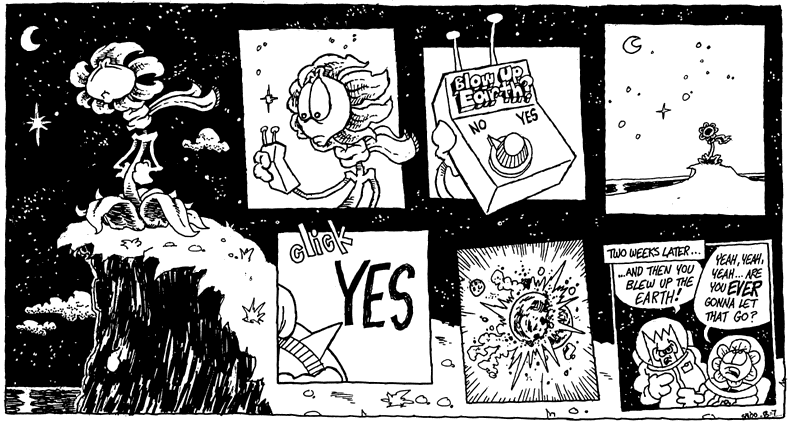
- In Fine Structure, this is the ultimate fate of Earth during the Final Battle. Luckily humanity from the next universe over jumps in to pick up survivors.
- Protectors of the Plot Continuum: Agents have two options when they find an uncanonical planet in a fanfiction: let it integrate into the canon if it doesn't happen to be dangerous, otherwise kaboom. One particular example had the agents play around with the settings of a spaceship's Wave-Motion Gun in the hope it would be enough to pierce the crust and make the planet break apart. They ended up narrowly escaping the planet's explosion.
Agent Sergio Turbo: I think we just outdid the MythBusters here.
- On DeviantArt, there are "Power emoticons" that take regular emoticons to the EXTREME. Many include a view of the Earth (or a part of it) being destroyed.
- The Fiery Joker ends off his videos with this.
- In the song I Like Trains, by Tom Ska, there is an EarthShattering Kaboom when all the turtles explode at once.
- Mike Diva's "Japanese Donald Trump Commercial" ends with Donald Trump flying into space in a Humongous Mecha and firing an enormous energy beam to the surface of the Earth until it explodes in a blast of purple.
- MrBeast: In the "$1 vs. $100,000,000 House" video, a satellite blows up the entire planet with its laser, only for the video to continue on a chunk of the Earth to showcase the $100,000,000 house.
- Ponies The Anthology III references the Trope Namer in one of its shorts.
- The Whiskey Vault: In the video which is played for people who have contributed enough bottles to the show to become a "Titan of Whiskey", a fiery whiskey bottle flies through space and destroys the earth, then flies into the sun with show hosts Rex and Daniel riding it.
- Yu-Gi-Oh! The Abridged Series:
- Parodied in Yu-Gi-Oh: The Abridged Movie: when Anubis announced his intention to destroy the world, Yami asks him what he could possibly gain from that. As revealed on his LiveJournal, the creator included this because he considered Anubis to be a terrible movie villain with, in his own words, 'generic motives'.
- A running series called "Zorc and Pals" features Big Bad Zorc Necrophades and Yami Bakura discussing Zorc's plans to destroy the world. The clip from "Zorc and Pals: The Movie" in the Abridged Movie details what Zorc is going to do after he destroys the world... He's going to Disney World. And then he's going to destroy it. However, he found it much too fun, so he destroyed Euro Disney instead.
- Arthur featured this in the arcade game "Planet Smasher" that the gang (sans Arthur) was playing.
- Batman: The Brave and the Bold: The teaser for "Joker: The Vile and the Villainous!" ends with Joker pressing the button on the Omega warhead. Which blows up the Earth.
- Ben 10: The Storyboarding the Apocalypse shows that the titular Planet Destroyer in "The Big Tick" eventually does this to every planet it feeds off.
- The Dexter's Laboratory episode "Let's Save the World, You Jerk!" ended with meteors blowing up the Earth, after Dexter and Mandark keep bickering while in their robot suits and fail to stop the meteors and save the Earth.
- Exo Squad: A Mars-Shattering Kaboom happens at the end of "Heart of Mars", which gets reversed in the final episode thanks to Dr. Algernon. During the final arc of the series, Phaeton attempts to do the same to Earth using an antimatter bomb and fails.
- The Fairly OddParents!: In one of the Oh Yeah! Cartoons shorts, Cosmo has to be bad for one day, and ends up almost blowing up the Earth by turning it into a bomb. Fortunately, just before it explodes, midnight hits and Cosmo turns it back to normal.
- In the Family Guy episode "It's A Trap!", the earth-shattering Ka-Boom from the first Star Wars movie is shown and a piece of Alderaan floats through space to come down on top of Princess Leia on the Moon of Endor, knocking her off her (ten-speed) speeder bike. Luckily for her, it was just a small piece, about the size of a baseball.
- Futurama has never shied away from destroying planets, but the best example of destruction comes from the episode "I Dated A Robot":
Sal: So your fantasy has always been to destroys a planets, huh?
Fry: Sure! What have they ever done for me?
[Fry presses a button — a planet explodes]
Leela: Wow! The most mundane events look almost exciting through your eyes. - The ending of the I Am Weasel episode "The Hole" had this, due to I.R. Baboon plugging up a huge hole that turned out to be a ground-level volcano (complete with buildings, cars and a plate of pork butts and taters flying from the explosion). The only survivors left are Weasel, his local assistant and Baboon, on a very small fragment of land left from the blast, but then Baboon gets in his car and drives off the edge to his death.
- Justice League:
- In the episode "In Blackest Night", an errant Green Lantern beam accidentally hits a weak spot in a planet's crust and destroys it. This is later revealed to be an illusion.
- In the episode "War World", Mongul orders that Draaga's homeworld be destroyed with a death ray. Hawkgirl destroys the gun before it could fire.
- In the Justice League Unlimited episode "For the Man Who Has Everything", Superman relives the destruction of Krypton.
- In Episode 72 of Kaeloo, Stumpy is granted intelligence by a spirit. He then decides to build a bomb and Take Over the World with the threat of blowing up the planet if anyone tries to rebel.
- In the Kim Possible episode "Car Alarm", Shego seems to graduate to Omnicidal Maniac by hoping to use a rocket car she and Motor Ed stole in order to use its full-powered rocket boost to destroy the planet. Ed on the other hand just wanted to use it to drive around with Shego as arm candy.
- Looney Tunes:
- The Trope Namer here is the Chuck Jones character Marvin the Martian, who says the line after Bugs Bunny steals his Illudium Q-36 Explosive Space Mod-U-Lator in the short "Hare-Way to the Stars". His motive is that Earth is obstructing his view of Venus.
- In the earlier short "Duck Dodgers in the 24½th Century", Dodgers (Daffy) and Marvin manage to reduce Planet X to a rock the size of a basketball. They somehow manage to stand on it, very closely.
Daffy: As I was saying, buster, this planet ain't big enough for the two of us, so... [pushes Marvin off the rock] ...off you go!
- Il Était Une Fois...:
- Once Upon a Time... Man ("Il était une fois... l'Homme") is an European educational cartoon about History (as a serious Histeria!). The credits were The Abridged History, with a pessimistic take on the future of humanity: a war that ends in a big kaboom.
- In the cartoon Once Upon a Time... Space of the same series, there is a type of warship used by the androids of planet Yama, that combine to form one larger star-shaped vessel with enough firepower to destroy a planet. It's tested on a (seemingly) barren, Moon-like planet of their system and in the penultimate episode of the series it's used to force the surrender of Cassiopeia threatening to destroy that planet.
- Once Upon a Time... Man ("Il était une fois... l'Homme") is an European educational cartoon about History (as a serious Histeria!). The credits were The Abridged History, with a pessimistic take on the future of humanity: a war that ends in a big kaboom
- Played for Laughs in Men in Black: The Series: the Fmeks tried to do this to their enemies the Arqulians but thanks to Men In Black intervention, the plan backfires.
- Played for Laughs surprisingly often on Phineas and Ferb. The first time the gag appears, it's the final scene of the boys' movie. A similar gag plays out multiple times over the course of "Save Summer", this time with Buford directing. In "Out to Launch", Candace's nerves get the better of her as she tries to ask her crush out to a dance, and somehow she concludes that the destruction of the earth is a logical progression from Jeremy laughing in her face. The one time a planet actually does explode is Alderaan in Phineas and Ferb: Star Wars, and even that is basically a Funny Background Event as Doofenshmirtz's Elseworld equivalent wonders why the value of his timeshare on the planet has suddenly dropped to zero.
- An episode of Pinky and the Brain had the destruction of the Earth at the end of the episode, but it's all right...everyone had already moved to Brain's papier-mache replica.
- ReBoot had an episode where this happened inside a game. While not world ending, it still pissed off Bob since he was inside the planet when binomes triggered it. Bob chews them out after barely escaping, then lectures everyone else.
- The Ren & Stimpy Show featured this at the end of the episode "Ren's Brain". Originally in the John Kricfalusi-written version, the mayhem would end after only North America explodes. But Nickelodeon Animation Studios produced the episode long after John K. was fired, and took it to the extreme: after several viewers' brains explode, followed by several houses and then North America blowing up, we then cut to the Earth from space and see it dramatically blow up (complete with Pre-Explosion Glow), to which a narrator says "And thus endeth the Republican party as we know it!"
- Robotomy: Because the robots inhabiting it revel in endless carnage and mass destruction, this happens to Insanus so often the inhabitants just treat it as a mild annoyance. One episode ends with the cast colonizing another planet after Insanus blew up again (thanks to a nuclear grandma), with Thrasher groaning that this is the sixth time just this month.
- In Star Trek: Lower Decks, Season 2 ends in a Sudden Downer Ending as Captain Freeman is accused of destroying Pakled Planet and is arrested for it. The Season 3 opener ends with the revelation that the Pakleds themselves destroyed their own planet and framed Freeman in order to try to get a new, resource-rich planet.
- Star Wars: The Clone Wars: In "Unfinished Business", Separatist Admiral Trench tries to destroy the planet Anaxes with a bomb. His plan is foiled and the bomb disarmed, but in the first season of Rebels, about fifteen years later In-Universe, the Ghost crew visits the shattered remains of the planet (in "Out of Darkness" and "Gathering Forces"). The Databank says it was the result of a "cataclysmic event", but you wonder...
- Star Wars Resistance: "No Escape, Part I", being synchronous with The Force Awakens, also shows the destruction of the Hosnian system. However, due to Hosnian Prime being protagonist Kaz's Doomed Hometown, the destruction carries much more personal weight.
- Steven Universe:
- This was the intended end result of Homeworld's Cluster experiment, which is a bunch of Gem shards forcefully fused together and incubated within the planet that will create a thing so large that, when it manifests its Hard Light form, it'd shatter the entire planet.
- When we finally see the outside of Homeworld, the planet appears to have been violently split apart, with only the outer rings remaining intact.
- In the Superman: The Animated Series two-parter "The Main Man", Lobo claims he's the last Czarnian because his high school science project blew up the planet. In addition, the first episode depicts the destruction of Krypton.
- In the Totally Spies! episode "Evil Professor", the titular professor tries to use the stolen "inflator" weapon to blow up the planet.
- In The Transformers, the Quintessons blow up their own planet to destroy the Autobot Matrix (they fail). Later, Rodimus Prime has the planet Paradron detonated to prevent its energon falling into Decepticon hands. The Big Damn Movie has the Autobots blowing up a moon to try and kill Unicron (which fails) and Rodimus using the Matrix of Leadership to actually destroy Unicron, who's basically a planet-sized Transformer. Then in Transformers: ★Headmasters, Scorponok succeeds in blowing up both Cybertron and Mars before the show is halfway through. Later, the Transformers Zone OAV begins with the planet Feminia being destroyed.
- Transformers: Prime: Megatron's visions show that this is how the Earth will end if Unicron in the planet's core remains awakened.
- Whereas most of Wander over Yonder's professional baddies are out to dominate the galaxy, season 2 introduced Lord Dominator, who goes around in a drill-shaped ship destroying planets by puncturing their crusts and draining their volcanic cores, leaving them in pieces. She does this for the kicks and her endgame is to keep going until she's destroyed every planet in the galaxy. Lesser villains, such as Lord Hater and Emperor Awesome, are not above destroying a few planets for fun or to make a point, but they want to keep the galaxy intact so they'll have something to conquer.
- This is what Black Beetle plans to do to the Earth in the Young Justice (2010) episode "Endgame". It is up to Earth's heroes to find all of his bombs and deactivate them before this can happen.
- The current prevailing theory of the formation of Earth's moon is that the proto-Earth was hit by another proto-planet that blasted both the proto-Earth and the impacting planet into a loose conglomeration of material, most of which reformed into the Earth and some of which coalesced into Luna, the moon Earth has today. Literally Earth-Shattering. Although there was (probably) no Kaboom.
- Astronomers call the orbiting debris cloud from such collisions "synestias" and have found evidence of them in protoplanetary discs.
- Astronomers call the orbiting debris cloud from such collisions "synestias" and have found evidence of them in protoplanetary discs
- Saturn's major rings are understood to have formed by a large moon having disrupted due to Saturn's gravity rather than an impact, but the smaller moons and dust particles within the rings are broken to pieces by meteorite impacts. Within a few hundred million years, the rings will no long exist as they are now.
- It's been hypothesized that Miranda, a moon of Uranus, had been shattered by an impact and its fragments reassembled; thus explaining the patchwork of geological features on the moon. more modern theories consider this unlikely, however.
- It was believed that once it's absorbed by the red giant Sun 7.5 billion years from now, Earth's kaboom would rather be a sizzle, as the ablation and vaporization caused by its fall towards the Sun's center would destroy it after some centuries at best. More recent research suggests after having been engulfed and spiralled into the Sun's central regions, Earthnote would be destroyed by drag forces caused by very dense matter present there after just some minutes, breaking down into smaller bits that would vaporize and merge with the Sun's matter. There's also the possibility, was it to happen during the Sun's latest evolutive stages instead which as of now seems unlikely, of our homeworld surviving but stripped down to its core.
- As noted in the Real Life folder of the Shattered World, a now discredited theory for the origin of the asteroid belt is that it's what remains of a planet between Mars and Jupiter often known as Phaeton. More outlandish variants of such theory include that the planet would have blown apart in a nuclear exchange between its inhabitants, someone else would have detonated it, or that Phaeton itself would have gone nuclear exploding as a result.
