
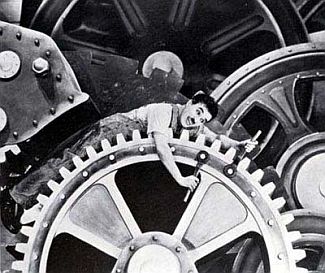
Industrial complexes in which climactic battles are fought always seem to have been built with a callous disregard for the safety of workers. Inside, you're likely to find narrow catwalks with simple rope/cable handrails (or none at all) that are hung by what might as well be knitting yarn over open bubbling vats of green acid, massive exposed machinery flailing everywhere without protective covers, safety switches in awkward places far from the machinery they control (assuming that there are any safety switches or that they're even functional), blast furnaces glowing fiery red and shooting plumes of flame, and other hazardous conditions so terrifying that any sane person would probably insist on a six-figure danger bonus to even go near the place.
In short, if the Occupational Safety and Health Administration (or the local counterpart in non-American settings) ever saw the place, it would be condemned in seconds. Sometimes, the story will Hand Wave this by referring to the factory as "abandoned." However, it will never be explained why it hasn't been decommissioned or demolished yet, why it still receives electricity, or why all the machinery is present, plugged in and operable as if it's itching to be the setting of a climactic showdown.
And oddly enough, for all the lack of safety compliance, the factory's door will be unlocked or easily entered with the breaking of a single rusty chain, and there will be not a single night watchman in the obviously dangerous, multi-million dollar facility.note Usually all the crushing, spiking, and burning machinery will be left to run unattended; but if this is not the case, they will all be activated by a single exposed switch placed on a bare stretch of wall.
Of course, this means the hero and the villain will immediately rush into the heart of such a complex to have their final battle, instead of just settling things in the parking lot. On the other hand, this does allow for the frequent accident of the villain falling to his doom which allows for the villain to die while the hero looks heroic for trying to save them. Any collateral damage in the battle will invariably hit a Big Red Button, cause Failsafe Failure, and No One Could Survive That! resulting explosion.
These environments still exist because they are visually interesting and allow the cowardly villain more opportunities to sneak around behind the hero, or the overmatched hero to find some way to even the scales against the seemingly omnipotent villain. Granted, it's always possible to put together a dramatic fight sequence in a perfectly balanced tournament-style environment (see the last segment of The Karate Kid (1984), or virtually any movie where martial arts is the foundation of the plot), but the ultimate authority on such matters in entertainment is, of course, the Rule of Cool.
These facilities are also often referred to as "Smoke and Fire Factories", in reference to the fact that the function of the building is rarely explained, with smoke and fire as its only discernible outputs. Incidentally, OSHA Compliance is not just about construction and design, but also about people in the facility following proper procedures, so the act of having a battle in a workplace is already non-compliance with OSHA, even without the smoke and flame.
Note that if a villain plants a few explosives in such a place, it transforms from a mundanely unsafe facility into an instant Death Course. See also Eternal Engine and Malevolent Architecture (the video game equivalents), Construction Zone Calamity (when this trope is Played for Laughs) and Homicide Machines (when a horror film does this with everyday household appliances). No Seatbelts and Railing Kill are subtropes. Amusingly enough, real-life OSHA does not concern itself with whether the facility is safe for consumers or not; a facility whose sole purpose is to murder its visitors would pass inspection just fine if it was safe for the employees to work at. Others agencies might have objections, however. Overlaps with Lethal Negligence if the lack of safety is caused by negligence.
Rule 87 of the Evil Overlord List gives advice on how to avoid this — and if you're plotting to rule the world, you should heed its advice.
This trope is always present in a Nightmarish Factory, or a Blood Sport.
This has nothing to do with the lack of approval without accompanying a certain Wildling to go beyond The Wall. Then again, their world is not a safe place either. It also has nothing to do with Oshawott's Pokémon Speak. This is also not related to things labeled Not Safe for Work, unless you're really into that sort of dangerous living.
Example subpages:
Other examples:
- A minor example in The Aquatope on White Sand. Gama Gama is constructed partially into a hillside, so there aren't enough emergency exits in the event of a fire. Fortunately, this is but a background detail.
- Lampshaded in the first episode of Code Geass. After Lelouch falls into a hijacked truck, he wonders "Why didn't they stick a ladder on the inside, too?"
- The Para-mails in Cross Ange are a very much invoked example. The Norma who are tasked with piloting them are discriminated against and therefore considered expendable by the society subjecting them to their lot.
- The titular museum from Doraemon: Nobita's Secret Gadget Museum hits every box on fulfilling this trope, from allowing robot exhibits capable of hurting visitors (intentionally or not) roam around freely to having no locks or safety features on display items, where any random gadgets can just be picked up and used (Case in point? A Gulliver Tunnel which shrinks literally everything is unattended, without even a barricade, resulting in Gian and Suneo accidentally shrinking themselves and spending a good chunk of the film pocket-sized). What's even worse is the unguarded restricted area which contains a Killer Robot Prototype, deactivated and simply stored in an unlocked room that literally anyone can enter and trigger by accident, which predictably happens in the climax.
- In the anime of Heavy Object, Grunthor gets chewed out for actually wearing a safety harness when he's assigned to do work on the upper side of an Object, while it's under motion. Specifically, he's told that "you only need a safety harness if you're actually in danger," which makes about as much sense as saying that the only time you need to be wearing a seat belt is when your car is actually crashing.
- Spoofed in Himouto! Umaru-chan: Alex and Umaru play a Dating Sim set in a former mining town where stuff randomly blows up because apparently there are old sticks of dynamite just lying around everywhere. And nobody questions this.
- The roofs for the school buildings in Kaguya-sama: Love Is War lack proper fencing. This is especially conspicuous after the light novel spin-off revealed that the principal personally knew somebody back when he was a student who died after falling off of one of those very roofs.
- In Mobile Fighter G Gundam, mention is made of an incident in the preliminary Gundam Fights where a competitor was disqualified for repeatedly positioning himself so that his opponents could not fire at him without risking hitting the spectator stands (this was technically not against the rules, but the judges decided that they would rather have their country represented by someone going out of his way to protect civilians rather than one who went out of his way to endanger them). After which he went on a temper tantrum and blew up several stands deliberately. After having mecha tournaments every four years for the past sixty, it had never occurred to anyone to not allow spectators for mecha fights to be seated within effective range of the mecha's weapons, or to at least take some sort of safety precautions to reduce the risk to the audience in the event of shots being fired in their general direction. Then again, the only safety-related rule in the tournament is that nobody is to target other people's cockpits on purpose.
- In Nausicaä of the Valley of the Wind, Kurotowa is sent to investigate the God Warrior being excavated in Pejiti only for his guide to fall a couple hundred feet to his death, and he says "This is why they keep having accidents." Justified in that this is After the End, the OSHA died along with the industrialized world in the seven days of fire.
- Negima! Magister Negi Magi:
- Evangeline's "resort":
Asuna: Hey, wait a sec, why doesn't such a high bridge have any handrails? I wish this fantasy stuff would give me a break already!
- Worse than that. While it's technically a private residence for people who have no need to fear falling... it's a private residence in a pocket dimension, in the form of an often sunlight-flooded tower surrounded by open water, deliberately designed to house a vampire in comfort. This isn't "somebody forgot about safety standards", it's out-and-out Malevolent Architecture.
- Mahora itself, which has stuff like vampires, dragons, and demons all over campus, none of which the students are aware of. And presumably some of the teachers are unaware as well; nobody felt like informing Negi of all the weirdness. Such as an evil vampire with a grudge against his father...
- Technically, one of the students is aware of all of this. That's because she is the vampire.
- Library Island, the school's library and Japan's largest repository of dangerous magical books and a few monstrous creatures. You need grappling hooks, rappelling clips and spikes, a minimum of three people, and hopefully some sort of hovering device and an eleven-foot pole... And that's before you get to even the most basic of magical books!
- Evangeline's "resort":
- While Pokémon: The Series simply skips the Gym puzzles feature in the games, it still has some clear examples — Koga (all kinds of ninja traps), Blaine (a dormant volcano, and later a lava pit), and Clemont (whose stand-in robot literally threw unworthy or losing challengers out of the very high Prism Tower) standing out. The last one was acknowledged and ultimately fixed. Ironically, Erika's Celadon City Gym contains a giant forest filled with Grass-type Pokémon and does not contain a sprinkler system while the Pewter City Gym does, the latter being filled with mostly rocks and Brock's own Rock-type Pokémon who are weak to water. Both of these Gyms related to the sprinkler system (or lack thereof) have caused an incident where the Celadon City Gym was set on fire and burned down while Brock's Onix was severely hurt by the sprinklers when they activated.
- Science Ninja Team Gatchaman
- There are no seatbelts in the God-Phoenix control room, even though the individual vehicles have them. This in a flying battleship that regularly gets knocked all over the place.
- The Jigokiller episode had Dr. Nambu standing over a BIG tank holding the plant of the title, on a narrow catwalk with waist-high rails. The rails are so damaged that he cuts his hand on one. Granted, the plant didn't eat men, but it could move independently and had already been shown to throw G-4 about quite nicely. The rail crosses over with artistic license, since the blood from the cut is what kills the monster.
- Galactor bases and mechs are no better: They usually fit the waist-high rails and deep pits to a T, and blow up if looked at wrong. (A bit of exaggeration, but not much.) It's ridiculously easy to rig the bases to blow up with their own primary power source.
- Trigun has multiple examples, but the biggest one is the sand steamer, a massive land ship. If the vehicle is pushed to unsafe speeds, the brake controls fail and the boiler overloads. There's no way to shut down or vent the boiler from the control room. The room with the emergency reset switch is behind a door that's shut with heavy bolts that are so stiff it takes multiple people pushing on the wrench to unscrew them, and there's at least eight. The room itself has no ventilation and becomes so hot that protective suits must be worn. It's filled with a maze of steam pipes so dense that an adult human can't fit through them. The pipes are so hot that they instantly cause second or third degree burns through heavy-duty protective garments if touched. Brilliant Dynamite Neons' plan to crack the steamer open to get at the contents of the safe seems frankly redundant, the whole ship is in danger of doing that all on its own.
- Yu-Gi-Oh!:
- Duelist Kingdom. The island (which is somewhere in the South Pacific, in the middle of nowhere) is barely adequate for a dueling tournament. No facilities to provide for food or hygienic needs (as mentioned in one episode) and the stations have flame thrower devices that the special Eliminators can access. It's a wildfire waiting to happen. The castle is a little better, although the roof and balconies (where Yugi faces Kaiba) have no guardrails or anything else that could prevent an accidental death from a fall. (Or someone trying to do it on purpose). And speaking of whom...
- Dueling atop a flying zeppelin may be dramatic, but again, no safety precautions whatsoever. Jonouchi nearly falls to his doom right before the duel with Rashid. Not to mention Kaiba is way too mule headed and concerned with gaining the God Cards to order it to land, even if three contestants are unconscious and possibly dying. Alcatraz is just as bad; it's a tower built on a demolition site, designed to resemble a shining tower rising out of a ruin to symbolize Kaiba's triumph. Dramatic again, but not exactly safe.
- The Old Momentum Reactor in Yu-Gi-Oh! 5Ds, obviously. It caused Zero Reverse, and was still dangerous afterwards. How dangerous? There was a portal to Hell inside it. That's pretty dangerous.
- The Duel Academia in Yu-Gi-Oh! GX; it's on an island miles away from the rest of civilization, and is sitting on top of the ruins which hold the spirits of 3 evil monster cards. That's not all; there's an abandoned dorm in which all of the students in it have mysteriously disappeared, and the school has made minimal attempts to cover it up. The whole island is a magnet for evil spirits to manifest themselves in card games in which people's souls are on the line.
- The origin of The Joker in Batman involved falling into a vat of some unspecified acid at Ace Chemicals, staining his skin and hair, giving him his distinctive appearance and driving him insane. Batman: The Man who Laughs suggests that the chemical plant in question was in trouble with OSHA. Some versions of Two-Face's origin also involve this trope.
- Goosebumps: Download and Die! ends with the protagonists throwing Slappy into their school's telescopic gym bleachers, which start to crush him. When Slappy points out that "these rickety pieces of junk always have safety measures", a character counters with, "Not if they were made in the 90s."
- Just like its source material, the Dystopian domed city of Alpha Complex in Paranoia is fairly lax on safety features. Even so, R&D takes it to an entirely new level:
King: "What's that?"
R&D Tech: "Radiation alarm. Nothing to worry about."
King: "Shouldn't me and my guys be wearing suits like the one you have on?"
R&D Tech: "Nah. A couple of million roentgens never hurt anyone." - Superman:
- In the Superman/Supergirl story Krypton No More, Superman looks into the case of a plastic fabric which makes vinyl chloride -a known carcinogen- when a worker tells him of the non-existent safety standards:
Milton: Like I tell ya, Mr. Kent — the company knows that this vinyl chloride we work with may cause cancer — It knows that some of the guys are dying 'cause they work with the stuff — yet they don't do nuthin' —! No safety standards — No special benefits — Nuthin!
- In Kryptonite Nevermore, Professor Bolden was going to test a potentially dangerous Kryptonite engine... and his only apparent security measure was Superman -the same guy who is killed by kryptonite radiation- paying attention to his experiment and saving them.
- One of the earliest Superman comics had him dealing with a mine owner who couldn't be bothered to properly maintain the safety equipment in his mines until Superman tricked him into spending some time in said mine and then orchestrated a cave-in so the owner could experience just what life was like in a decidedly unsafe mine (This issue predated the existence of OSHA by nearly 40 years, but the point still stands.
- In Supergirl (1982) issue #1, Kara bursts through a factory's wall to save two workers. A bucket's guide-chain snapped and poured a shower of molten steel on them. Fortunately, she shielded them.
- The Supergirl-Batgirl Plot: Batman and Robin corner a crook right next to an atomic reactor. For some reason, said reactor has an opening on the top of the chamber, with no shielding whatsoever. There is not even a railing around the open pit.
- In the Superman/Supergirl story Krypton No More, Superman looks into the case of a plastic fabric which makes vinyl chloride -a known carcinogen- when a worker tells him of the non-existent safety standards:
- Watchmen: The intrinsic-field subtractor experiment, which vaporizes anything put in the chamber, comes equipped with a massive steel door to the chamber that closes on a timer without any interference, confirmation, or even presence of a human scientist. There are no checks done to see if any personnel is in the chamber at the time, no warning sounds or signs displayed when a timed closing is imminent, despite frequent work being done inside (why else would Dr. Manhattan have left his coat inside the chamber?). There's no way to open the door from the outside or inside, and no way to stop the disintegrator-beam from firing after the door has closed. And to top it all off, these are all explained in the comic as safety features. To be fair, the scientist responsible for this monumental stupidity realized just how much of an idiot he had been even as he was explaining it to the soon-to-be-deceased John Osterman.
- Explicitly mocked in chapter 45 of the Firefly fanfic The Treasure of Lei Fong Wu.
 Zoe and her party find such a gap. One of the team points out that it is both necessary for the operation of the ship, and presents "formidable opposition" to boarding parties. Such that it would be more or less impassable if the other side was defended, even with the flimsy, railing-less bridge up.
- Lampshaded at least three times in Fallout: Equestria as Littlepip repeatedly encounters buildings, including a factory, a mad science lab, and a powerplant, with one major feature in common:
"How did catwalks over heavy machinery become the dominant aesthetic?"
- As this Fan Fic Rant reminds,
Labcoats, gloves, goggles; these things aren't just there to look good / sexy / nerdy (depending on your point of view), they are all protective gear. It won't help if you're running around showing off lingerie/skimpy outfits/your birthday suit while you go about sciencing.
Goggles go over your eyes, not on your head. - Psyche Ward: Taylor lampshades this about Whispering Rock a couple times, and wonders if OSHA even exists on her new Earth, given the time period it's apparently in. Milla apparently hasn't heard of it though.
- The trope becomes a major plot point in the Spooky Month/Friday Night Funkin' crossover fic It All Started with an OSHA Violation, down to mentioning the organization itself. Skid and Pump find themselves in a laboratory with zero security, and the staff that is present doesn't seem to be qualified to be around children, let alone work in such an environment. They don't even notice when the children go down the wrong elevator, either.
- Lampshaded in Starcrossed, where Scotty tells Geordi that in his time, warp core breaches were only created in the lab for experimentation, and the TNG basic design has been rejected as a useless and dangerous piece of Tim Taylor Technology.
- One of the main reasons the Imperials wanted to get back to their own galaxy was so they wouldn't face having to downgrade to the Star Trek warp drives. This was mostly a concern of speed, as Hyperdrives are far faster, but one Imperial Captain stated, "I will not have my ship be a flying bomb."
- The Total Drama story, Legacy plays with this trope and ultimately defies it. It takes a contestant's death and the enactment of a "memorial" law to clearly establish that reality show contestants are to be considered employees for the purpose of applying workplace safety regulations.
- Averted in Sophistication and Betrayal, where the protagonist's safety headgear actually saves his life in a construction accident.
- Mocked and lampshaded at two points in Star Wars Paranormalities.
- Subverted with the Valkoran Empire's Obliterator-class Star Destroyers. They have some corridors that lead right into the plasma cannon's firing tunnel, but have force-field airlocks that activate during firing cycles. Valkoran Trooper Private Will Helms somehow gets trapped in one of these tunnels, and nearly sucked out into space before being incinerated by the plasma sphere. They get points for having force-fields, but Zolph Vaelor questions why the architects would place corridors leading right into the tunnel itself. Admiral Marx Gravlek just passes it off as an obstacle for keeping infiltrators like him out.
- The mockery is taken further with Darth Vader's castle on Vjun. Private Helms (same one) is talking with another Valkoran trooper about the creepy atmosphere of Bast Castle and his previous death while standing on a walkway with no guardrails. Once the trooper laughs at him, she hits him on the shoulder and accidentally causes him to fall off the walkway and die again.
Zolph: "By the Force! I'm really beginning to feel bad for the poor souls who worked here." - In Pokémon Reset Bloodlines, Blaine had his Gym inside the Cinnabar Island volcano, as shown above in the anime entry. However, many trainers complained about almost losing a Pokémon in the hot lava, so the Pokémon League forced him to relocate to a safe traditional building.
- In Under the Bridge, some of the moving machinery parts inside the attack submarine Albacore are left completely open. The character originally known as The Gray Mouse who has designed and built Albacore reconsiders this when a young sailor gets his ankle caught in a drive chain and injured. Then again, this incident really kicks off her Character Development and eventual Heel–Face Turn from Big Bad into a Byronic Hero.
- In A Young Woman's Political Record, Germanian submarines are insanely faster than their Albion equivalents and can stay submerged for far longer thanks to swapping out their original engines for reactors based on hydrogen peroxide. Those reactors also make the subs tremendously prone to exploding, to the point the fact that the one shown at a presentation for Albish observers didn't explode was treated as a small miracle. They anticipated this might happen, which is why they only built one submarine using this engine design before deciding to shelve the technology for use in naval vessels and only use it to power rockets and torpedoes. Also, Dr. Schugel and his entire line of research can produce absurdly advanced technology... which has to go through a lengthy period of refitting and additional testing so the safety features Schugel himself never contemplated can be properly implemented.
- Old Harry's Game: One episode has Hell take in a new arrival of a safety inspector who starts writing up Hell for its many health and safety violations, much to Satan's bafflement (since, y'know, it's Hell. Safety isn't really the point.) Eventually, he tries to punish the guy by putting him in a private Hell of nothing but disasters-waiting-to-happen until he realises that for an officious inspector this would be Heaven, and so changes it to the most tediously safe place imaginable.
- In BattleTech, the Clans have this reputation. Since they're a caste-based society, the warriors (the top caste) have utter disdain for the safety of technicians and laborers. When one technician defected to the Inner Sphere, he was utterly shocked by both the amount of safety equipment that techs were given to do their jobs and by the fact that when there was an accident, medics were immediately rushed out to save the victim's life. Heck, the Clans were like this from their very earliest days, according to Historical: Operation Klondike. One interlude in that book is a message from a plant manager venting about the human consequences of the warriors' demand for more and more military material in the buildup to the retaking of the Pentagon Worlds:
Every team on every shift has been working overtime FOR TWO YEARS. OF COURSE there's going to be accidents and quality control problems. WE JUST LOST THIRTEEN MEN because of an accident that COULD HAVE BEEN AVOIDED! I TOLD THEM six months ago that we needed to shut down the lines one shift every week for maintenance. And what did they do? They threatened me and my family if I didn't keep the lines running at full speed. I'm surprised this didn't happen sooner. And now that it did happen? They don't give a good goddamn that thirteen men are dead and twenty-three more are going to be in the hospital for months. They don't even realize that half a shift is GONE, or that it'll take MONTHS to get the plant operational again. We still have to make quota. They only care about their precious goddamn equipment. The HELL with the rest of us.
- In Exalted, this is the unintentional design ethos of Autochthon, the Primordial "god" of technology and progress. Machines practically worship him and are incapable of hurting him, so it never occurs to him to bother with even the most basic safety features. He just doesn't realize that rapidly spinning razor sharp gears, giant slamming pistons, huge arcs of lightning, deadly steam vents, and whipping monofilaments are dangerous to other people. His creations are all of impeccable quality and quite unlikely to break, but he makes no attempts at safety for human users. Autochthon's inhabited interior isn't any safer. Incidentally, Autochthonians consider Creation to fall under this. By their standards, open gears and steam vents are just part of the scenery, but they're always scrupulously labeled, so their people will be safe so long as they mind the signs. But the fact that rain-slick steps don't have a caution sign is an unforgivable failure of safety procedures!
- Paranoia tabletop role-playing game: Life in the dystopian Alpha Complex is a daily struggle against insane regulations, faulty or untested equipment, and impossible odds for most clones (against their fellow clones). Especially if they happen to fall into the food vats. Remember, citizen, happiness is mandatory. The Computer is your friend. Not only justified but actively encouraged in Paranoia. Since The Computer is responsible for everything, questioning safety measures means you are questioning The Computer. Which is treason. Not bringing potentially dangerous working conditions to the attention of Friend Computer is also treason, but that's a different trope.
- Robo Rally revolves around robots who race for their lives in a factory full of lasers, crushers, Conveyor Belt o' Doom, and so on...
- Spelljammer setting has "Accelerator", Magitek cannon that pulls into the barrel and shoots anything placed on its reception cup. Which specifically included a torn off hand of any poor sod who failed to drop ammo accurately, or just stumbled and accidentally grabbed the cup.
- Warhammer:
- As a byproduct of general Skaven recklessness and disregard for casualties, Skryre inventors take absolutely no steps whatsoever to make their laboratories and factories safe to work in — the slaves and underlings working in Skryre facilities routinely die by the dozens from falling off of unstable platforms, getting facefuls of steam or noxious gases or being caught within exposed gears or moving parts, and larger workplace accidents can kill of hundreds or thousands of workers at once. This goes on all the time, and Skryre higher-ups don't care — you can always get more slaves, after all.
- The Chaos Dwarfs Zig-Zag this trope. On one hand, they pride themselves on making reliable warmachines and accidentally killing a fellow Chaos Dwarf is one of the quickest ways to the Infernal Guard. On the other hand, they do not care whatsoever about the safety or well-being or their slaves, and the extremely brutal work conditions imposed on them will kill them either through body-ruining labour or through breathing in the toxic smoke of their factories.
- Warhammer 40,000:
- The Adeptus Mechanicus has a somewhat complicated relationship with this trope. On the one hand, artwork and stories routinely depict their worlkplaces as filled with pounding pistons, whirling cogs, sparking electricity and coils of cables lying around everywhere and just waiting for someone to trip over them. In the lore, however, the tech-priests are protective of their machinery to a literally religious degree, and will go to great lengths to ensure that it's kept safe and guarded. Depending on your average tech priest, however, "machine safety" may mean making things safe for their operators or making things safe for the machines. Securing the obligatory giant industrial fan may mean putting a grating on top of it... or making it strong enough that it can shear through a human falling into it without ceasing to work.
- Ork technology, on the other hand, runs this completely straight. Their technology is slipshod and crudely cobbled together, their extremely tough physiques' ability to quickly recover from crushed fingers, severe burns or electrocution gives them little incentive to prevent such things from occurring, and their Meks routinely decorate their creations with spinning metal parts, arcing electricity, hissing steam vents and the like solely because they think they look better that way.
- Magic: The Gathering: The "Unfinity" joke set takes place in a space themed Amusement Park of Doom. Dangers in the park range from the mundane lack of maintenance, to more exotic dangers such as use of chainsaws during magic performance, to having multiple rides go next to the event Horizon of a Black Hole.
- Action Park was infamous for having poorly-designed and tested rides... which, obviously, led to many injuries and some deaths. It's a wonder it managed to stay open for almost two full decades.
- In Despicable Me: Minion Mayhem at Universal Studios, Gru's inner-factory is filled with giant blades, rotating screws, toxic goo, and fire everywhere.
- North Korea allegedly has a few amusement parks. They grab local villagers off the street to safety test the rides.
- The priceless Fairy Castle dollhouse assembled by Hollywood actress Colleen Moore is an invoked example: the professional architect who designed it wanted its layout to be whimsical, not functional. This includes this freestanding staircase in the Great Hall◊ that only winged fairies could ever be expected to risk traversing, given its lack of railings.

- DSBT InsaniT: Several of the exhibits in 'Untamed and Uncut' do not have the proper fencing to keep the guests and the animals separated. For example, the Windear exhibit is only blocked off by bars.
- The carnival in 'Carneelval' also qualifies, such as the bumper cars being way too fast and the roller coaster lacking in any sort of seats. Although in that case, its because the roller coaster is actually Eel.
Amber: This roller coaster seems a little...off, right?
Lisa: Why? Because its missing seats and bars? Most rides tend to lack safety precautions like those anyway, carnivals are quirky like that.
Cody: Lisa isn't wrong. Carnivals aren't really known for being safe havens.
- The carnival in 'Carneelval' also qualifies, such as the bumper cars being way too fast and the roller coaster lacking in any sort of seats. Although in that case, its because the roller coaster is actually Eel.
- In HFIL and its prequel series Dragon Ball Z Abridged, Snake Way is this thousands of miles long, winding path over Hell with no guardrails. Raditz complains about it as him falling off Snake Way led to him being recaptured, and Goz tells him they're are on back order.
- RWBY:
- Conversed in Volume 6. Yang and Blake are searching a dilapidated farmstead for some means of transport that may make their journey through the wilderness to Argus a bit easier. Upon spotting a rusting old tractor that has clearly seen better days, Blake jokes about how unlikely that vehicle is to be street-legal and then moves on.
- Deconstructed in Volumes 7-8. The heroes quickly discover that Mantle's defences are sub-par and unable to stop the Grimm from entering the city to attack. There is a hole in the wall that cannot be repaired because General Ironwood is redirecting the construction materials to a secret military project hidden in the tundra. Ironwood has massively upgraded all of Atlas' security, but neglected any of Mantle's. The villains are able to exploit the security deficiencies in an effort to try and turn the two cities against each other. Mantle's deficiencies include the security systems, which were designed by Watts and have been so neglected by Atlas that he can easily hack it as it's still using his original code. The Big Bad's plan was counting on Ironwood making the same mistake all Atlesians make — neglecting Mantle's infrastructure and software even when he's paranoid — for it to work, and it does. Characters point out the flaws in neglecting Mantle's infrastructure with increasing urgency until it finally leaves Ironwood abandoned by his allies and at the mercy of his enemies.
- Played for Laughs in Volume 8. Central Command is run by rows of computer operators. A massive poster warns staff to never bring food and drink into the room. When May trips up a worker to create a distraction, the worker's coffee flies across two computers to land in the lap of another worker. The two computers spark out, and the one of the affected workers begins ranting about the fact that "Bill" is always violating the sign, has a terrible work ethic and even violates the unwritten social code of not heating fish in a communal microwave. Later in the volume, Bill can be seen sat at his desk. Not only is he still employed, but he has yet another mug of coffee in his hand, which he drops again when an emergency broadcast suddenly activates.
- Brought up in Cracked's 6 Sci-Fi Movie Conventions (That Need to Die) article. Sure, electronics spewing sparks when the ship's hit is dramatic, but why does the ship have such dangerous electronics in the first place?
- A Let's Play of The Legend of Zelda Parallel Worlds had some fairly funny discussion of this trope. Including a short parody of Stairway to Heaven.
- The Rifftrax for The Avengers mentions this trope by name by pointing out how lousy Loki's makeshift headquarters is.
"Darn supervillains and their disregard for OSHA!"
- Defied in Ruby Quest. That giant room with the deadly spinning fans? They have guardrails. Pretty tall guardrails, coming up to an average human's chest. They're explicitly stated to be at least regulation height, if not higher. Thus, that patient "Stitches" still ended up getting killed by the fans was very suspicious to the staff (also because Stitches was "very familiar with the area" even when he was "still blind", mind you), which in turn tips them off to the fact that Ruby was a murderous psycho.
- Played straight with most of the automatic doors, especially the "Z-hatch", which close with enough force to decapitate
- The SCP Foundation plays with this. At the top of every article is an explanation on how to keep the various dangerous objects locked away, and how to handle the things safely, with all safety precautions that MUST be taken when testing the objects... for the scientists. The class-D's get no such comforts, doing jobs that have extremely high fatality rates, being just the test subjects to see what SCPs do (and all of them are terminated after a month if they somehow survive). Also, it is very clear that the Foundation is above many regulations of any country, OSHA, EPA, or otherwise, just to keep the horrors they deal with contained.
- Many of the organizations that create SCPs don't make these things safe for anyone that goes near the objects. Dr. Wondertainment's toy robot's (Robo-Dude) only safety feature is the long winded warning it gives to anyone who tries to use it. The toy's features include "Fire Drill", "Ultra Plasma Rifle", and "Atomic Grenade." The Factory is even worse, proudly producing products that seem designed to kill anyone who even touches their products, such as a bouncy ball that increases in power each time it bounces (only stopping when it lands in water or leaves Earth orbit), destroying any building it is in.
- Having said that, we get this little gem from Agent Lombardi:
Agent Lombardi: Who here is willin' to die rather than give up on the mission? One, two, three, four… Okay, you five fail. Counter to what some dingbats will tell you, the latter is actually the preferred option. - Many of the organizations that create SCPs don't make these things safe for anyone that goes near the objects. Dr. Wondertainment's toy robot's (Robo-Dude
- Radham Academy in Twig has a very simple policy in case of escaped experiments in the Bowels: Seal off the area with giant stone blocks, send in Gorger, wait a few days, then cleanse it with fire and chemical weapons before letting Gorger out. Some scientists not getting out in time is considered regrettable but a necessary sacrifice. This reportedly happens every few weeks or so.
- This typically tends to bug the Yogscast when they play Minecraft together:
- Ridgedog's efforts to build a working nuclear reactor with a third of the needed materials note work... but it isn't wise to stand right next to.
- "It works ok, except for the fire...and the radiation."
- In MoonQuest, featuring Lewis Brindley, Simon Lane and Duncan Jones, the trio managed to (deep breath) use a pool of lava as a light source on the moon and nearly burn to death (the episode in which this happened was even named "Health and Safety Nightmare"), fall into the smelter a few times which resulted in at least one death, put electric fences right next to the front door and get themselves killed again (also supercharging creepers, which did damage to the base) and finally put down a working rocket with fuel loaded in their factory which subsequently destroys it and the surrounding area.
- Played with in Sjin's Farm, in which Sjin and Lewis Brindley have a giant chasm next to their plot of land, which is covered in barley and thus obscured from view. During the time when it is left as is, Sjin falls in at least twice, losing their horse at one point when he forgets to rescue it. They eventually cover it up with dirt, solving the problemnote .
- In Cornerstone, numerous problems arise from the island being in the middle of the air. Town members keep falling off the edge, though gliders mean that these falls are mostly a minor inconvenience. The exit to the "Mile High Club" room (that Hat Films built) is a drop straight down onto land, meaning that the oblivious Sips falls to his death. Furthermore, expanding the island proves troublesome when Hat Films forget to lay torches down, causing mobs to spawn and rush the players.
- Ridgedog's efforts to build a working nuclear reactor
- Likewise, many of the disasters covered by podcast-with-slides Well There's Your Problem would have been avoided or mitigated by proper safety standards; the hosts also note when safety rules do save lives.
Justin: Everyone was safely evacuated from the mine by nine o'clock. Safety procedures sometimes work.
- Fascinating Horror: A good number of the disasters covered took place before OSHA was founded, and could have been mitigated or completely prevented had any safety standards been followed.
- In Film Theory, MatPat not only concludes that Willy Wonka's factory from Willy Wonka & the Chocolate Factory was an unsafe, unsanitary death trap that would face serious OSHA penalties, but theorizes Willy Wonka knew this, and given that the movie takes place about the same time OSHA was first implemented, the whole Golden Ticket contest was likely a scheme he could use to pawn off his factory onto some unsuspecting rube, where the poor sucker would be on the hook for potentially millions of dollars a day until all the issues are fixed when the laws would come into effect.
- Hadriex: From time to time he gets a good jab in when he encounters these sorts of areas, but this scene takes the cake.
- Averted and Played for Laughs in Half-Life but the AI is Self-Aware according to one of the characters, all of the bottomless pits and vats of toxic waste are perfectly safe and allowed within OSHA guidelines.
- The Honest Trailers for Willy Wonka & the Chocolate Factory includes a song to the tune “Pure Imagination” sung by Michael Bolton titled, “The 'This Factory is a Lawsuit Waiting to Happen' Song.” (It is quoted fully on the Quotes page.)
- It's explicitly mentioned in In Golden Waters that a lot of the seasteads were built with little in the way of safety measures and oversight. Inevitably, this gets a lot of people killed both during construction (mention of dead construction workers is frequent) and after it (when things inevitably start breaking down).
- In Stampy's Lovely World, the water stream in Stampy's Cool House connecting the top of the Music Tower, the brewing room, the storage rooms and the nether portal isn't exactly safe, as demonstrated by the fact that Chicken the dog drowned there while it was under construction in Episode 49, "Troubles Brewing". Finnball lampshades this in the honeymoon episode of Finnball's Kingdom, where he takes a visit to the Lovely World with his wife.
Finnball: I'm surprised Health and Safety hasn't looked at this elevator.
- Discussed in depth in the Unraveled video "Smash Bros. owes millions of dollars in OSHA violations," which tallies up all the OSHA violations in Super Smash Bros. Ultimate stages, based off the standards for construction sites (the closest equivalent, since Brian notes there's no OSHA regulations for blood sport). The stages manage to rank up to 17 million dollars in fines, largely due to repeated offenses. The only safe stage is the Boxing Ring, since it was designed to be a fighting arena.
