
Cat: Hey, I do not need fashion tips from you!
Lister: Safety belt!
There are No Seat Belts on the Cool Starship (when there are even seats), particularly not on The Bridge. Whenever the ship is hit by Energy Weapons, even if the Deflector Shields hold, everyone on board will be flung about by the Screen Shake. Either the designers assumed that Space Is an Ocean, or everyone has a standing battle station.
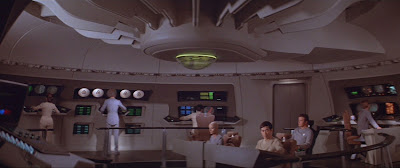
Star Trek: The Motion Picture did a Lampshade Hanging on this, giving The Captain a chair whose arms folded down to function as a seat belt. Kirk wound up being tossed around anyway despite this. Star Trek III: The Search for Spock also had an impressive sequence of the bridge crew aboard the Excelsior buckling up in similar fashion before activating the transwarp drive — which instantly broke down.
The lack of seat belts is part of No OSHA Compliance (as well as no common sense).
Exceptions:
- Cross Ange: The Para-mails lack seat belts, which, in flight mode, which is tantamount to a flying bike, is nothing if not lethal. Enforced in this case as the Normas who pilot them are treated as Cannon Fodder by the World of Mana. This is left unchanged for no apparent reason when the Norma escape Arzenal and restart Libertus.
- Inconsistently done in the Gundam franchise, which can't seem to make up its mind if Mobile Suits have seat belts or not. Most notably averted in Victory Gundam, where all mobile suits have a fairly sizable, inflatable lap restraint that expands to cover the torso in an emergency.
- Mazinger Z: Depending on the version, this trope was played straight or averted. In the original series Mazinger-Z's seat did not seem having seatbelts, but in Mazinkaiser and other reimaginations you could clearly see Kouji Kabuto strapping his seatbelt before launching.
- Evangelion 303: The original series used this trope so the author of the doujin, who was aiming for a more realistic universe, made a conscious effort to avert it and include seatbelts in the war planes.
- Averted in Rocketship Voyager because humanity has no knowledge of Artificial Gravity or Inertial Dampening until they encounter aliens from outside the Solar System. Voyager only has "pseudo-gravity" when under acceleration, and so has recessed handholds in the bulkheads and deckplates, strung "null-gee cables" for traveling along passageways, and safety webbing on the chairs and beds. In the opening chapter, Captain Janeway gets injured when she releases her safety webbing (because it's pulling her tight against the acceleration couch, and she can't turn to speak to her Bridge crew) at the wrong moment.
Janeway strapped herself in behind her desk, grimacing as the webbing tightened on her damaged ribs. The only thing she found annoying about space travel was the need for all these safety belts. She hadn't worn them groundside since her fifteenth birthday, when Father taught her how to fly the family car.
- The LEGO Batman Movie; Batman takes Robin on his first mission in the Batmobile, and when Robin asks where the seatbelts are Batman tells him "Life does not give you seatbelts!" Sure enough, Robin almost gets flung out of the car when Batman has to break for a little old lady, with Batman saying he's going to get the seatbelt thing fixed when they get back before driving at much lower speeds while holding his arm across Robin's chest.
- In PAW Patrol: The Movie, the dogs never wear seatbelts, whether in their casual van or high-speed rescue vehicles. Even though they are traffic officers. (All humans are shown with seatbelts, though.) Their van actually seems designed to let them walk around during trips.
- Averted in Atomic Blonde. Lorraine tells Spyglass to buckle up before getting into a car chase, and in an earlier scene where she's fighting someone in a car, she unbuckles the driver's seatbelt and grabs hold of her own (though she doesn't have time to buckle it) before deliberately crashing the car.
- Averted in Star Trek: The Motion Picture. The fact that seat belts were a subject of public discussion in the late 1970s and that the bridge crew kept thrashing around falling out of their seats in TOS probably helped. This bridge has chairs with armrests that fold down over the legs. They do look kind of awkward, though. Played straight for the handful of poor bridge officers who don't even get chairs
 ◊, let alone restraints. In the novelization, Kirk is embarrassed to realise that he doesn't know how to deactivate the safety bar so he can get into his chair, until someone discreetly does it for him.
- Averted in Star Trek III: The Search for Spock, where the arms of the chairs on the Excelsior folded down to become essentially a safety bar.
- There was a scene at the end of Star Trek: Nemesis, cut from the final version, where Picard enters the bridge to find some techies installing a new captain's chair. It includes an automatic seat belt of sorts; a pleased Picard notes that "it's about time!"
- In Star Trek Into Darkness, Spock puts on a restraint system when the Enterprise is crashing. The bridge crew also activates their restraints when they refuse to obey his order to leave.
- The tendency of Star Trek films and episodes to follow this trope is lampooned in a brief scene in Sev Trek: Pus In Boots, where the Picard-analogue fastens a safety belt shortly after ordering "brace for impact!" Shortly after impact, the ops and helm stations display the use of airbags...and a Red Shirt flies through the frame and crashes into something—likely the viewscreen.
- Averted in Serenity, where, as the title ship is Coming in Hot, everyone does strap down.
- There are seat belts on the Space Ball One in Spaceballs. However, do not expect Lord Helmet to use one.
Col. Sandurz: Sir, shouldn't you buckle up?
Dark Helmet: Oh, buckle this! - The Fast and the Furious: Oddly enough, the lack of seat belt use seems to have little effect on anyone's ability to survive catastrophic crashes.
- Likewise in Shoot 'Em Up. Smith's car is rammed head-on by a Van in Black full of mooks. Having shot out both windshields, Smith flies through the air, lands in the back of the van and shoots all the mooks. His Bond One-Liner is "So much for wearing your seatbelt." It's that kind of movie.
- Where Eagles Dare: While being escorted by Weissner and a carload of Nazis, Smith and Schaffer attack their guards, causing the vehicle to crash. Weissner is flung headfirst through the windshield and flies several feet in front of the car.
- In The Last Seduction, Bridget has been found out on her criminal activities but (while driving) convinces the man to accept sex in lieu of capturing her. When he undoes his seat belt to expose himself, she deliberately drives into a tree, killing him.
- Averted in the sci-fi B-Movie Cat Women of the Moon. When the crew have to put their Retro Rocket in a spin to dislodge a meteor that's become lodged in their tail section, they buckle up the seatbelts on their swivel chairs... Swivel chairs?
- Likewise in Commando Cody: Sky Marshal of the Universe (1953 Film Serial). Commando Cody and his crew always buckle up before blasting off, but they're seated in swivel chairs that are never shown being locked in position first. There's an even worse example in the sequel Zombies Of The Stratosphere where the Martians are seated in plastic chairs that aren't even attached to the floor, causing them to go tumbling all over the cabin when their rocketship is shot down.
- Averted in Queen of Outer Space where the crew and passengers are strapped into seats that also fold back to form acceleration couches for the crushing G-forces of takeoff.
- The single-stage atomic rocket in Destination Moon also has acceleration couches with restraints that might make things rather uncomfortable on the return journey. You see according to exposition given during the movie, the rocket is supposed to hit the Earth's atmosphere nose-first, which means the acceleration couches would be facing the wrong direction, with only a single chest and knee strap to hold the astronauts in!
- Alien 40th Anniversary Shorts. Subverted in "Harvest" where the seatbelts in the Escape Pod only mean they're strapped down when the Face Hugger attacks.
- Averted in Cobra. The moment the obligatory car chase starts, Cobretti and Ingrid are shown buckling up in race car harness, one of the custom modifications to Cobretti's 1950 Mercury. It's just as well as the chase ends with Cobretti crashing the car. However during a short chase in the climatic battle, Cobretti is standing in the back of a pickup shooting at the bad guys, and goes flying off the back when the pickup crashes (though he's unharmed thanks to a Necessary Combat Roll).
- Averted, then subverted in the Star Trek: Deep Space Nine novel ''War of the Prophets''. The future starship Phoenix has effective seat restraints, even though the Federation is falling apart and the universe is about to end. They're so effective, Captain Nog uses them to restrain the bridge crew so he can sell them and the ship out to the Romulans. (He has a very good reason.)
- Averted in the Star Trek: Titan series, then double subverted when only Riker (the belts work perfectly for Vale and Troi) gets thrown to the floor anyway as he wasn't sitting down when they were hit, leading him to note "Obviously the lesson here is to stay in my chair".
- Subverted in Larry Niven's later Known Space stories: No one uses or even needs seatbelts since every vehicle in the universe is comprehensively equipped with outrageously effective automatic safety, restraint and crash protection systems. Who needs a seatbelt when your driver's seat has a built-in force field?
- Actually makes sense given the high speeds of the vehicles in question. Even as an emergency backup, a seat belt is not going to save you if your supersonic flying car crashes and all the other mechanisms fail.
- Very definitely averted in Honor Harrington, where warships' duty station seats have full-up shock frames to hold the crew in place — which come in handy when you take a graser hit near the bridge. Not so much when you take one to the inertial compensator; everyone on the ship is instantly turned to "strawberry jam".
- Generally averted in The Ship Who..., though brainships do sometimes have to make emergency maneuvers without giving their humans time to settle into acceleration couches and strap themselves in. Tia accidentally breaks Alex's nose while evading danger.
- Averted for Rule of Drama in Star Trek because the Screen Shake trope is used to signify the ship being struck by weapons fire or the effect of a Negative Space Wedgie.
- Doctor Who "The Satan Pit" features seat belts in the rocket (they're even plot relevant...). Mind you, they're not the kind of seatbelts you'd usually find in a spaceship (this was a production oversight).
- The TARDIS did have "seatbelts" in one Colin Baker episode, but it's best not to mention them. (Trying to plausibly fit seatbelts in a control room with no seats was never going to work, really.)
- Despite the Ninth and Tenth Doctor's control room actually having a seat near the console (and foam crashpads wrapping the handrails), the Doctor rarely seems to ever use it and tends to cling onto the console for support whilst the TARDIS is in flight.
- In "The Waters of Mars" there were seatbelts on the realistic rocket which they plan to escape on.
- Also averted in the famous Episode 3 cliffhanger of "The Caves of Androzani". Because the Doctor is the only one wearing a seatbelt, he's able to flee the ship he just crashlanded faster than the bad guys who've been tossed about by the impact.
- Lampshaded in Stargate SG-1 when the team gets severely knocked around while on board a Goa'uld shuttle:
Daniel Jackson: You'd think a race smart enough to fly across the galaxy would be smart enough to have seatbelts.
- Referenced by name in Andromeda episode 'Belly of the Beast', made by Beka after she is tossed around the bridge in yet another explosion.
- In the 1960s Batman (1966) series, the Batmobile was initially played this trope straight. However, when the series was criticized for the Dynamic Duo not buckling up, the producers thought it could be a good joke to have the goody two-shoes doing so before driving. As it is, the joke backfired in a positive sense with the series being rapturously praised for setting such a good safety example.
- One of the subtle element in Emergency! is the fact that none of the ground fire crews wear seat belts in their vehicles. In truth, seat belt usage in emergency vehicles would not be mandatory until the The '80s, which could be considered strange since Public Service Announcement campaigns about the need to buckle up really began to ramp up in ubiquity in The '70s.
- Used for Deliberate Values Dissonance in Mad Men when Bobby and Sally are climbing all over the back seat when Betty crashes the car into a neighbor's yard.
- Apparently Zig-Zagged on The Orville - it's as yet unknown whether the titular Cool Starship has seat belts, but the shuttles do. This ends up coming in handy in the pilot episode, when a Krill soldier with a BFG stows away on a shuttle; Mercer defeats him by hitting the brakes, and inertia sends the Krill flying into the windshield.
- Paranoia: Vehicles built in Alpha Complex may or may not come equipped with seatbelts. The seatbelts may or may not work. The Red-level Troubleshooters piloting.. poking blindly at the controls of.. the vehicles may or may not have ever heard of the concept of "seatbelts."
- Halo: Combat Evolved: At the end of the first mission, Master Chief and Cortana get into an escape pod with a group of Marines and crewmembers. Cortana suggests that Master Chief strap in, but he merely braces himself and says "We'll be fine." Everyone else straps in, but MC and Cortana are the only survivors when the escape pod lands, because of his Powered Armor. One joke fan theory says that he bounced around and killed everyone else.
- None of the player ship bridges in Star Trek Online have seatbelts, and some of them (the Destiny bridges, for one) don't even have chairs. Fortunately they're just a cosmetic option.
- Mass Effect manages to avert this.... kinda. In the third game Traynor actually mentions being strapped into a safety harness during the action the Normandy sees over the quarian homeworld. This makes a particular amount of sense since it's mentioned in the backstory that it's standard practice for ships in combat to turn their a-grav off to reduce energy expenditure and heat build up. We never actually see such a safety harness anywhere on the ship, however. Traynor's line falls into the series' general pattern of holding true to space physics in the backstory, but not in the things we actually see.
- In 8-Bit Theater, Black Mage made a similar comment and carried out the same actions as Bender did in the Futurama episode "Roswell That Ends Well". However, this was his plan (that he would be thrown clear of the burning wreckage). Of course, the fact that the universe hates Black Mage meant that he was immediately crushed by a giant, and the others escaped thanks to quick thinking on the part of Red Mage (for further irony, this was at the cost of the very items that could have saved Black Mage from his predicament).
- Averted Trope in Galaxion, where The Bridge has seatbelts (yay!). It used to be a private yacht of a very, very eccentric (and impossibly rich, obviously) man, so he might have been a Troper?
- Averted in Kim Possible: The show makes sure that they put on helmets or parachutes or buckle up in their flying car.
- Spoofed in Sev Trek: Pus in Boots, an Australian 3D animated send-up of Star Trek: The Next Generation. After sitting down in his Captain's Chair, Captain Jetlag Pinchhard pulls across a seatbelt. Later when the Enterforaprize rams another ship airbags inflate from the consoles, but one of those ensigns who are always standing around at the back of the bridge goes flying through the air.
- Spoofed in Futurama: When the professor takes control of the Planet Express ship, Fry and Leela fasten themselves to their seats with about 30 seat belts, and Bender rivets himself to the wall. And, of course, the professor ends up "driving" at about two miles an hour.
- In "Roswell That Ends Well", everyone sits down and buckles their seatbelts in preparation for a crash landing except Bender, who smugly insists, "Those things kill more lives than they save." In accordance with the laws of Tempting Fate, Bender is the only one sent flying when the ship touches ground.
- Averted in 3-2-1 Penguins! The Rockhopper crew always buckles up for landing.
- Passenger trains and public buses generally don't have seatbelts, but counter-intuitively this is actually safer. Unless you can ensure that every single passenger is wearing them at all times when the vehicle is in motion — and neither trains nor buses can stop at will to let you stretch your legs or take a leak — then they create more problems than they solve; effective seat restraints require much heavier and more solid seats, which exacerbate injuries to unrestrained passengers. Further reading.
- Planes and manned spacecraft place great emphasis on seatbelts. Occupants are unlikely to survive crashes at most speeds, but seatbelts allow them to survive the huge accelerations and turbulence involved in day-to-day use. Artificial Gravity and compensating for inertia remain fictional, and any sudden deceleration involving a hard surface can damage the body.
- There is also the Boring, but Practical fact that being strapped down to your seat means you will not be tossed around the cockpit when performing energetic maneuvering, thus meaning you won't be tossed away from the controls.
- It's always been a point of confusion and grumbling — in the US, at least — that school buses don't contain seat belts (specifically, the big yellow ones, other types of buses do). People find it especially strange since buses are very large, rather top heavy, and almost always filled with small children, so you'd think that'd be one place where seatbelts would be. (Of course trying to ensure that a bus full of rambunctious children are securely buckled into their seats would be a significant challenge for the driver.)
