Sufficiently Advanced Aliens are very common in sci-fi, and they will often claim to be actual deities. In some cases, they'll be actual, historically worshipped deities like Apollo or Thor.
Unless under some sort of mind control or from a "primitive" culture, the heroes will never treat a Sufficiently Advanced Alien as a deity, or even consider the possibility that they might just be right. Some Earthlings might fall for the "alien", but they will be shown to be weak-minded to be taken in by these "gods".
For something like the Puppeteer Parasite whose "miracles" are born from technological prowess, this is reasonable enough, but for beings like the Q or the Ori or various Eldritch Abominations in fiction, who have immense, unexplainable powers that genuinely seem god-like in nature, it stretches (dis)belief. The only reason they should be considered "just" powerful aliens seems to be "they came from Outer Space", which doesn't really make all that much sense if you think about it - if there is a deity who created everything, and you could physically meet them, why should a divine encounter only happen on Earth? Other views on why such entities are considered aliens instead is also due to the prevalence of Clarke's Third Law and its corollaries in science fiction and real life science, and because the words "god" and "magic" brings up connotations of worship and superstition.
An interesting irony in this is that Heaven is generally regarded as being in, or above, the sky, and that most cultures tend to look upward when thinking about their deity or deities.
There is a strong degree of Arbitrary Skepticism in many examples of the trope, particularly in cases where characters automatically disbelieve the self-proclaimed deity because it runs against their view of what God is or should be. Take, for example, Star Trek V, where "God" tells our protagonists that He "needs a ship," and is met with skepticism on the grounds that God wouldn't need a starship. Sure, the Abrahamic God would have no need for a starship, but Helios had a chariot and Ra had a barge (and The Bible does describe God as possessing a chariot made of angels)... In short, the entity is disbelieved because it pretends to be specifically the Abrahamic (or at least Christian) God. Had he instead claimed to be, say, Quetzalcoatl, one suspects our heroes' reaction would have been very different.
See also Sufficiently Advanced Alien, Arbitrary Skepticism, and Ancient Astronauts. Not to be confused with If Jesus, Then Aliens which in some ways is almost the reverse. No Such Thing as Wizard Jesus is how Jesus will continue to be worshiped and not suspected of being anything other than the son of God even if an alien superhero named Josys from the planet Beaven is running around doing everything he can do and more. You Mean "Xmas" is when there is "No Such Thing as Space Christmas".
Has nothing to do with Space Jews.
Ironically, there technically is a "Space Jesus," however he is a musician and not exactly the Jesus you were probably thinking of.
Examples:
- Fantastic Four
- In one issue, a No Celebrities Were Harmed version of Walt Disney goes mad and believes himself a Messiah. To solve the problem of overpopulation he plans to use the Human Torch to reignite the Earth's core thus expanding the landmass. He dies just as he's about to push the big button. Afterwards his assistants claim the idea would never work. Queried why they were doing it, they admit they were programmed to obey him. The point being, they know the messiah stuff is rubbish but they can only do what they're told.
- Subverted the second time Galactus attacks Earth. He is preceded by his new herald Air Walker, a very impressive-looking being who just happens to be named Gabriel Lan note and who, as a herald of Galactus, has come to announce the end of the world. Naturally, the human onlookers assume he is the Biblical Gabriel announcing Armageddon and are terrified. Air Walker is then confronted by the Silver Surfer, who makes it plain that he himself does believe in God, and that Air Walker cannot possibly be His agent, because Air Walker is acting like a bullying jerk.
Silver Surfer: "The ultimate power need never be flaunted! You cannot possibly be who you claim!"
- Averted with the gods of Olympus and Asgard in the Marvel Universe Elseworld Earth X. They effectively are Sufficiently Advanced Aliens — albeit ones from another dimension rather than from outer space — but they're referred to as gods anyway. They aren't technically deceiving anyone — they have assumed the mantle of gods so long they believe themselves to be — but they aren't, technically, gods.
- They're still powered, or at least extremely affected, by belief, unlike their main Marvel Universe counterparts. The mainstream versions, though, are indeed aversions- magical beings from various magical dimensions, the most powerful of whom are Reality Warpers and several explicitly sorcerers. They even have (i.e. rule) their own afterlifes, which their worshippers can be admitted to. They are not empowered by belief, having mystical power by nature.
- And The Eternals were godlike superpowered immortals who were also once worshipped as gods — in fact in their original series they were said to have inspired the myths and legends that led to belief in gods, but once they became Canon Immigrants in the mainstream Marvel Universe this was retconned into having been mistaken for already-existing gods. Their Arch-Enemy, Apocalypse, likewise has been mistaken for (or posed as) various mythical gods, and has access (on loan) to the tech of Sufficiently Advanced Aliens.
- The Marvel Universe generally averts this. The higher up the cosmic scale you go, the more blurred the distinction becomes, and the most powerful cosmic entities - such as Eternity and Death - are apt to show up in both magic and space-based stories, notably Doctor Strange and the Silver Surfer. They effectively are both supremely powerful magical beings and Sufficiently Advanced cosmic entities.
- Further aversions came in the Secret Invasion (2008) and Chaos War stories, which proved that the gods of certain alien cultures were every bit as real as the Asgardians and Olympians, although most of them were dead in the aftermath of the former and before the start of the latter.
- Averted by the graphic novel Creature Tech. Dr. Michael Ong, courtesy of his alien symbiote, teleports to a planet where he witnesses the death of an alien-symbiote Jesus. This is what finally causes him to convert.
- Played with in the one-off strip "Bud Tuttle and Commander Jesus" by Jay Kinney and Ned Sonntag (in Occult Laff Parade, 1973). Bud Tuttle is a very ordinary guy on Earth, except that he gets mental transmissions from Commander Jesus, who is wearing a spiffy space fleet uniform and piloting an orbiting spaceship.
- The DCU also generally averts this, in much the same way (i.e. the gods of extant Earth pantheons like the Olympians are both supernatural and extradimensional, the New Gods are both Sufficiently Advanced Aliens and actual, bona fide gods, etc.).
- Deconstructed in Transformers: More than Meets the Eye. The mythical Necrobot (a Cybertronian deity of death whose legends arose during the war) is discovered by the crew to actually just be a normal, friendly guy who records deaths he comes across as a way of honoring an old friend, using tech that's not even that advanced by the setting's standards and being mistaken for magical when people saw him searching battlefields. This revelation causes Nightbeat to suffer a crisis of faith because he thinks that if something like the Necrobot is just a wartime myth, then stuff like the afterlife may not exist either and that terrifies him. The Necrobot expresses the belief that it doesn't really matter if something like the afterlife exists as long as you have the hope such an idea gives.
- Later reconstructed; in the last few chapters of the series, it turns out that the Necrobot was a god. He was Mortilus, the robot God of Death, member of the Guiding Handnote . The reason no one recognized him was because the entire planet of Cybertron had been mind-wiped, and he didn't even remember himself. The other members of the Guiding Hand were still around in some way until the final chapters, too.
- The IDW Transformers comics seem to love playing with this trope. In the sister series The Transformers: Robots in Disguise, it is revealed that the second most godly beings in Transformers lore, the original thirteen Primes, are nothing but a fabrication created by a time-traveling Shockwave in order to establish a stable time-loop. They were just a bunch of powerful and ambitious jerks brought together so that Shockwave could one day destroy Unicron and conquer the universe. Speaking of...
- The Transformers: Unicron does this for IDW's version of the titular chaos-bringer. While many recent works had elevated him to being a Satan-like force of primordial evil, the comics brought him back to his roots. Unicron in this version is nothing but an experimental alien super-weapon created to destroy Cybertron, its colonies, and everything living on those planets. The Cybertronians did have a myth about an ancient evil who was the opposite of their creator-god... but given the time-travel shenanigans, that myth having any basis in fact is highly improbable.
- The Ten-Seconders: The Ten-Seconders are shocked to find out that the Gods, despite their super-natural powers and even their title, are simply aliens from another world. The same thing applies to their Fathers, the Sufficiently Advanced Aliens who created the Gods.
- Subverted in Sonic the Comic. Amy and Tekno find out that the universe was created by aliens. When Amy mentions that she thought someone else made the universe, the aliens imply they're working for a higher power.
- Averted in Plan 9 from Outer Space, in what could have been a very interesting moment had Ed Wood not glossed right over it.
Eros: It is because of men like you that all must die! No use of the mind God gave you!
Jeff: You talk of God!?
Eros: Is it so hard to believe that we might also think of God? - Inverted in the anti-Mormon propaganda film The God Makers, which has an odd animation describing how Mormons believe God and His followers come from a planet called Kolob. This, like much of the information in the film, can be chalked up to sloppy research or shameless lying; in the Mormon Book of Abraham Kolob is supposedly the star or planet nearest where God currently resides, not the planet he came from. However, there IS such a thing as Mormon Jesus.
- In The Avengers, as Captain America prepares to dive into a battle involving Thor and Loki:
Black Widow: These guys are from legend. They're basically gods.
Captain America: There's only one God, ma'am. And I'm pretty sure He doesn't dress like that. - Played straight in Man of Steel when young Clark asks his father if God is responsible for giving him power, Jonathan says no and shows him the space pod that brought him to Earth. This also counts as a subversion of If Jesus, Then Aliens.
- Inverted in Prince of Darkness. The book of prophecies pretty much says that Jesus was an alien who fought the Antichrist.
- Paul: The titular alien uses his own existence to disprove creationism to a fundamentalist.
- Enforced in The Day the Earth Stood Still (1951): The studio objected to the Messianic, Sufficiently Advanced Alien Klaatu being brought Back from the Dead by technology, so he explains that his return is only temporary and true resurrection is the domain of the "Almighty Spirit".
- "Answer" by Fredric Brown: Computer scientists build the world's most powerful computer, far more powerful than any previous computer. They ask it, "Is there a God?". The computer replies at once "Yes, now there is a God."
- Inferno (Larry Niven and Jerry Pournelle): Discussed, and ultimately subverted. Allen Carpent(i)er is — much like the writers — an author of 70s-era science fiction, mostly focusing on future Earth and space-age settings, and with a strictly materialist understanding of the universe. Thus, when he wakes up after very clearly dying, he assumes that the frightful afterlife he finds himself in is a monstrous amusement park or some other megaproject created by extremely advanced aliens. As he descends farther and father into the pit, he needs to make increasingly large concessions to the technological prowess of these "Builders", including the ability to effectively alter physics and time. He eventually realizes that he's given this hypothetical civilization so much power that there is no difference left between them and God now beyond pure semantics, which is when he admits to himself that, indeed, he is dead and he is in Hell.
- Rendezvous with Rama: By the end, it's heavily implied that the eponymous ship, and the other ships like it, were constructed by God — the God — for the purpose of conducting an intergalactic survey of His creations. Much of the conflict in the later novels arises from the way the characters behave in the light of this revelation.
- Just to clarify, God made very little of the Rama survey ships or the system behind them. Rather, according to the robots behind the "survey", moments after the very, very first big bang (the Rama series assumes the theory of big bang > snapback > big bang > snapback, etc.), a tiny nanite factory of sorts was created, with instructions to create the necessary infrastructure to, and to go about, watching and taking note of any civilization making steps toward Utopian society. Every recurring "'big bang", the process begins anew, the eventual goal being to find the key pattern to creating a true, eternal Utopia — without violating free will by just making Utopia and rendering the whole affair pointless. The only source of this information is, importantly, according to the robots, who themselves make certain to point out they were just programmed with this knowledge, and can't exactly give any real proof besides the scale of their operation and its goals.
- Interestingly, in the original novel actually written by Arthur C. Clarke, one of the characters is a member of a church that believes Jesus really was an alien or at least from outer space. Although his belief is never confirmed or denied by the Rama spacecraft. In the end he's just a competent crewman with a strange personal belief.
- Ray Bradbury:
- In the short story "The Man," there is such a thing as Space Jesus! You just missed him, though; he left planet yesterday. Good luck finding him. His body may have left, but his spirit's still in the Temple. It always is, right?
- And in "The Fire Balloons" (from The Martian Chronicles) two ministers try to make a Space Jesus representation to some aliens, but it turns out that they've had their Jesus Analogue and are well aware of The Faith.
- Also from Arthur C. Clarke, in The Space Odyssey Series, the builders of the Monoliths appear to have ascended to Godhood by the start of the series and went on to convert Dave Bowman into this semblance of Godhood.
- Averted in the Cthulhu Mythos. While the Great Old Ones and the Outer Gods are "merely" immensely powerful extradimensional entities, they are often referred as gods and worshiped by various cults. After all, what else do you call something like Yog-Sothoth, who is eternal, omniscient and pretty much all-powerful, not to mention completely unbound by our 4-dimensional universe? Especially when you consider that Cthulhu is effectively the space pope (with his fellow Deep Ones being the clergy), preparing our (world?/universe?/Dimension?/Time?/Reality?) for the Great Old ones (who ARE gods, or at least godlike).
- The Hitchhiker's Guide to the Galaxy:
- Followers of Great Prophet Zarquon (a Jesus-like being who promised to return) are mocked by a stand-up comedian at Milliways, The Restaurant at the End of the Universe. Zarquon then proceeds to show up, apologize for being late... and then disappear when the Universe ends.
- Also Thor's cameo in Milliway's, and then the characters all go to freaking Asgard in And Another Thing....
- The babel fish are such obvious proof of God that he can't possibly exist, and God's last message to all creation, written in huge flaming letters: We Apologize For the Inconvenience.
- Toyed with in Book of the New Sun where God is real, but it seems quite clear that he is a sufficiently advanced alien from an alternate dimension manipulating humanity from afar. This does not stop any Urth religions from worshiping this alien as God.
- C. S. Lewis generally averts this, most notably in The Space Trilogy, which is pretty much about Space Jesus. Because of this trope, the astronauts in the first book are too caught up in materialism to consider that the spiritual ruler of Mars is not an idol or a fraud, but a real spirit empowered by an even realer God. Their inconsideration costs them humanity's only method of interplanetary travel.
- The possibility of Sufficiently Advanced Aliens is briefly discussed by Richard Dawkins in The God Delusion. The conclusion he reaches is that even if such beings were to exist, they would necessarily postdate the Universe as a whole and would ultimately have a natural origin-as such they do not meet the definition of gods used by the book.note
- This is notably one of the criticisms of Richard Dawkins in so much that his critiques are mostly critiques of Christianity and monotheism, rather than religion in general as a concept.
- Averted and subverted in Michael Resnick's The Cassandra Project. Not only was Jesus an ambassador from an alien race but they broke off contact after we killed him
- The Church of Particularly Cynical Atheists in You Are Dead (Sign Here Please) have figured out that the universe is in fact run by a Celestial Bureaucracy and want to prove that fact since they reason that if the universe is run by bureaucrats, then it is not run by God, therefore God does not exist. They are not at all happy when Nathan points out the numerous logical holes in that argument.
- Babylon 5:
- The First Ones - notably the Vorlons who have engaged in some very specifically religious meddling in the affairs of several species, and Lorien - who had been a patron to their millennia old culture.
- Both invoked and averted: This is the central theme of the first story in the Babylon 5: The Lost Tales TV movie, which revolves around a man on Babylon 5 who is apparently possessed by a demon. The priest brought in to deal with the situation gives a long speech about how churches are emptying because people haven't found God in the heavens (apparently people in the future think extremely literally and expect to find some old bearded guy in white robe floating around the crab nebula, while ignoring any kind of significant religious experience down on boring old terra firma). While the possibility that the "demon" is an alien is raised early on, the ending leaves it open and even seems to lean towards the supernatural. Either way this is the creature behind the legend.
- Earlier episodes included a new religion that believes "God" is too big a concept for any one tradition to grasp, and also a group of Catholic monks seeking to learn every name and view of God across the various species.
- The Minbari religion gets a mention for apparently having no supernatural beliefs whatsoever beyond the existence and continual reincarnation of the soul; this may be related to their special relationship with the Vorlons. Note that there is such a thing as a soul in Babylon 5, which can be extracted with a machine and imprisoned in small orbs. The Minbari (and others) don't just believe in reincarnation, they can actually measure it.
- One of the themes in the series is that it really doesn't matter if God exists or not, faith and religion will continue to be important to people, no matter what.
- Doctor Who:
- In the original series, the Fourth and Fifth Doctor's encountered the Black and White Guardians of Time, who seemed to be Anthropomorphic Personifications of Chaos and Order, or else more than Sufficiently Advanced Aliens who had taken it upon themselves to fulfill those roles. Whether or not this implies the existence of a still-higher power is left unclear. They do need The Key to Time to maintain the balance of the universe. Partially subverted in that since the Time Lords are themselves SAA's, the Guardians are not wholly beyond their comprehension. The Doctor and Romana refer to the Key as "Guardian technology" and the Doctor is seemingly able to keep the Black Guardian at bay by fully-activating the defense systems of the TARDIS.
- In "Pyramids of Mars", the Monster of the Week is Sutekh, whose personality and history heavily resembles the same god from Egyptian mythology and possesses very god-like powers (said by the Doctor to be "near-limitless"). Again, it is not clarified whether this is another alien encounter or something completely different. Sutekh is specifically said to be an Osirian, and that he was imprisoned on Mars by the leadership of his planet.
- Played straight in many episodes, however, where the local religious fanatics would be worshiping something that would later turn out to be either advanced alien technology or some kind of native animal; see "The Curse of Peladon", "The Face of Evil", etc.
- Played with in in "The Satan Pit", where the Doctor finds Satan chained up on the edge of a black hole. The episode never clarifies if it's just a Sufficiently Advanced Alien, actually Satan, or a Sufficiently Advanced Alien that inspired legends of Satan, but all theories are put forward by different characters. It claims to predate time itself, which the Doctor declares impossible.
- Beings from the Pre-Universe or Post-Universe tend to have immeasurable and inexplicable powers due to operating by their Laws of Physics rather than those of the current Universe. However, by the same token they also tend to have at least one inane shortcoming that allows them to be defeated.
- Almost the whole point of Stargate SG-1. The series ran so long and addressed the reality of so many myths and religions that anything even related to Jesus was conspicuously absent,note prompting the viewer to think that Jesus wasn't real, or in any case wasn't as powerful an historical figure as Merlin, Ba'al, Buddha, or even Thor, the last of whom looked like a Roswell Grey (with holograms to appear like whatever their followers worship).
- It gets a bit blurry with the Ori: they are ascended mortals, which would be more than enough to qualify them as gods in several Fantasy settings and more than one real-world religion; however, one of the major running themes in the show is that even though being extremely powerfulnote does not make someone a god. They also point out that, while the Ori are the closest to gods in the universe as far as mortals know, worshiping them still isn't a good idea because it only makes you a blind follower, and someone less susceptible to Ascend to a Higher Plane of Existence (while giving more powers to the lucky bastards who already ascended).
- Various villains call out to this trope on how their enemies keep insisting that they are not gods, but otherwise fail to mention anything on "what makes someone a god?", thereby leaving a hole that the only reason they aren't gods being that someone says so.
- Only directly brought up once. On finding a medieval-European style town on a planet, complete with church, cross, and witch-burning minister, Teal'c says that he knows of no Goa'uld that is capable of the love and compassion displayed by Jesus in The Bible. Turns out that episode's Goa'uld was impersonating Satan instead. Similarly, Moses and Mohammed are never even mentioned and the Abrahamic God (YHWH/Jehovah/Allah) naturally doesn't make any appearances.
- One of the most common plotlines in Star Trek. Apollo and Quetzalcoatl have all been "explained" away as Sufficiently Advanced Aliens as have a number of fictional alien gods.
- The Q are an interesting case because, by most measures, they are gods. In fact there are plenty of deities that have been (or are currently) worshiped by real world religions who seem to be several orders of magnitude less powerful than the Q. Even if they started off mortal, they hit A God Am I status a long time ago.
- Certainly some of the large-scale demonstrations of Q power, such as Q putting Bre'el IV's moon back into a safe orbit or Amanda Rogers completely restoring the entire planetary ecosystem of Tagra IV would provoke a massive upsurge in religious fervor if they were to happen in real life 21st Century Earth. Presumably, the more advanced a civilization becomes the harder it is to impress them. Plus, only a select few like Picard have seen (or at least remember) some of the even bigger things Q has done, such as rewriting history (or the future) on-demand.
- In the episode "Tapestry", Captain Picard "dies" and encounters Q:
Picard: Q, what is going on?Q: I told you. You're dead, this is the afterlife, and I'm God.Picard: [laughs scornfully] You are not God!Q: Blasphemy! You're lucky I don't cast you out, or smite you, or something. The bottom line is, your life ended about five minutes ago under the inept ministrations of Dr. Beverly Crusher.Picard: No, I am not dead. Because I refuse to believe that the afterlife is run by you. The universe is not so badly designed.
- It's worth noting, however, that in the very conversation above, "God" displays a very non-omniscient degree of surprise at Picard's "blasphemy," uncertainty as to how to punish him, and a sudden decision to change the subject. Which ironically is actually pretty consistent with the depiction of God in the Bible, especially the Old Testament.
- In TOS episode "Bread and Circuses," the planet 892-IV with its 20th-century Roman civilization is implied to have had an actual Jesus along with its other historical figures from that era.
- Averted by Star Trek: Deep Space Nine: Ben Sisko begins with the usual Federation attitude towards the Prophets, but gradually changes towards a more mystical, even devout view of them; note how he ceases to call them "Wormhole Aliens" in favor of "Prophets", the Bajoran religious term. Of course, being The Chosen One of this religion (and discovering that they orchestrated his birth) probably goes a long way towards that, even if it took him several seasons to get used to the idea. The Prophets are not actually supernatural, however-they're non-linear beings, and thus can "see into the future" because for them it exists simultaneously. As early as the first season finale Sisko is arguing that the Federation and Bajoran views are a Distinction Without a Difference; the Federation acknowledges all the main points because they've seen them, they just use more general names.
- His status as The Chosen One and the circumstances surrounding his birth mean that technically, Sisko himself IS Space Jesus.
- The non-changelings of the Dominion seem to have little problem believing in Space Jesus, as they know the Founders are an alien race, yet still consider them gods. One Vorta dismisses the Prophets as mere Sufficiently Advanced Aliens, and then immediately states that the changelings are real gods. It's noted though that the Founders actually genetically-engineered these species to worship them- and in the Expanded Universe, its revealed that the Founders have their own God....and accidentally get him killed. Woops.
- When it's pointed out that the Founders genetically engineered the Vorta and the Jem'Hadar to worship them as gods, one Vorta responds that he knows, and that it's what you expect of gods. Which is what many real-life religions teach as well.
- Although to be fair, whatever gods genetically engineered us to worship them clearly didn't go as far as the Founders, seeing as how people argue over this in the first place.
- A slight variation in Star Trek: Voyager, where Chakotay meets the "sky spirits" of his (non-specific) Native American beliefs. While it is confirmed that they had direct interaction and cultural exchange with his native ancestors leading to their mythology, they do not particularly claim to be Gods.
- Before his departure, the Klingon prophet Kahless pointed to a star and said that would be where he would someday return. After they developed interstellar travel, Klingons went to that star and built temples on a habitable planet in that system to wait for his return. Worf was there fasting and praying when he showed up. Then he turned out to be a clone, but then a priest asks, "How do you know this is not how the prophecy was to be fulfilled?" Well, how DO you?
- Christianity does this to all the small g-gods.
- 1 Corinthians 10:19-20 King James Version (KJV): "What say I then? that the idol is any thing, or that which is offered in sacrifice to idols is any thing? But I say, that the things which the Gentiles sacrifice, they sacrifice to devils, and not to God: and I would not that ye should have fellowship with devils."
- How does this connect to space, you ask? Well, according to some sects, small g-gods and devils in the Bible are angels or sons of God. And angels are called stars in the Bible in many places like Revelation. Have you ever noticed planets and constellations are named after pagan deities? A literal interpretation of this is that the stars are the angels themselves or inhabited somehow by an angel. Literal star gods that are not gods like in fiction.
- Warhammer 40,000: The T'au have no Warp presence, and thus are nearly immune to the risk of insanity and daemonic possession that is endemic to humanity (even their space travel doesn't use the Warp, and thus is safer but much slower). Having no frame of reference for it, they therefore believe that the human reports of daemons are just madmen's tales (to be fair, Chaos forces are usually insane, and humans in this setting consider prayer and incense to be vital parts of machine maintanence), and that the daemons they have encountered are a highly unpleasant species of alien with bizarre abilities. It's hinted that the Ethereals are aware of Chaos and the Warp and deliberately hide this information from the population.
- Pokémon: Being the franchise that indirectly provided the page image for Olympus Mons, Pokemon is naturally no stranger to this trope.
- Pokémon Ruby and Sapphire: Groudon is said to have created the very land itself when the Earth was in its infancy. Kyogre did the same for the seas, and Rayquaza the sky. However, these three are simply regarded as super ancient and powerful Pokemon.
- Pokémon Diamond and Pearl: Gen IV defies this trope pretty hard for the most part, with many of its Legendary Pokemon being straight-up deities. However, one notable exception is Regigigas, which is literally responsible for continental drift in the setting, but isn't regarded as some kind of deity the way many other Gen IV legendaries are.
- Pokémon X and Y: Xerneas is the embodiment of life itself, capable of bestowing immortality. Yveltal is the embodiment of death. When it "dies" it takes every other living thing on the planet with it and retreats into a caccoon to recover. Then you have Zygarde, who is responsible for keeping the other two from upsetting the balance of nature. However, like Groudon, Kyogre, and Rayquaza, they're regarded as merely being exceptionally powerful Pokemon and not gods.
- Pokémon Ultra Sun and Ultra Moon: These games contain probably the most blatant example in the series. Solageo and Lunala were worshipped by ancient humans as the deities of the Sun and Moon respectively. However, it's heavily implied that they're just ordinary Pokemon from another universe who got mistaken for Gods by ancient humans due to their overwhelming power.
- Averted in Space Station 13, where the default religious figure for a Chaplain is Space Jesus. The administrators of the server can portray themselves in-character as said deity when the Chaplain prays to them.
- In StarCraft, the Xel'naga are an ancient alien race that created both the Protoss and the Zerg and they are shown to be older than entire universes and nigh-omnipotent through their understanding of the fundamental laws behind all existence. The Protoss worship them as gods. However, it turns out these 'gods' are technically mortal within the context of their universe-spanning journey, as they all die when the next generation of ascendants reincarnates as their descendants, and the latest generation has been exterminated by a Xel'naga usurper. Then he and his followers get their asses kicked by a Koprulu coalition, driving the species extinct.
- There are several varied examples in World of Warcraft:
- The Titans are a pantheon of extremely powerful cosmic beings that were formed at the dawn of the universe. While they're not responsible for all life in the universe, they've created or guided their fair share, including ultimately being responsible for most of the playable races. However, they're generally depicted as metallic giants and they create mechanical servants and futuristic tech. They're referred to with god-like titles, such as creators or makers, on top of the term titan, but rarely the actual word god.
- On the other end of the spectrum, you have the Old Gods. Regularly referred to with the word god, they are Eldritch Abominations that are bound to a single planet. Eventually, it was revealed that they're essentially giant-sized parasites working for an even greater evil beyond the physical realm. While actual worship of them is generally consigned to the insane or extremely evil, they're one of the few beings to actually be referred to as gods.
- Elune, the moon goddess of the night elves, has been referred to as the only true goddess in the Warcraft universe. The tauren worship her as one of the eyes of their deity, the Earthmother, but don't consider Elune a distinct entity. However, despite elaborations on the cosmology of the Warcraft universe, Elune's true nature has not been revealed. She was responsible for creating the night elves from dark trolls, has performed the occasional miracle, and has an artifact related to the titans, but she has never been seen in person and her relation to the other cosmic beings is unknown.
- This is very awkwardly averted by the Naaru. They don't particularly say they are deities (or say anything since they speak through wind chimes in your brain), just extremely holy. There isn't a single NPC that speaks ill of them, even though part of their life cycle is a black hole that devours souls. Epileptic Trees surround them to the effect of this trope, but the issue is brushed under the rug as they were barely featured in the following expansion. One Naaru, however, did go mad and turn into a Raid Boss. If you know the way the Light works, however, this makes a bit more sense. The Light (that the Naaru serve and most of the Alliance worship) is not a deity, so much as the collective good will of the universe—karma that you can get divine spells from. The Naaru are the physical form of that; much closer to angels than gods.
- Toyed with in Shadow Hearts where an Eldritch Abomination is shown to be designated the role of God. Roger Bacon states that God, is not God as we think of Him but a Sufficiently Advanced Alien yet Roger is still a pious monk; Either the real God is immaterial and thus Roger prays to the real thing and God was given credit for the alien's action creating the planet or Roger has knowingly been praying to the giant space monster, neither is too hard to believe considering who Roger is. The heroes on the other-hand don't seem to care and just aim to beat the snot out of the primordial space titan that has come down to bring about the Apocalypses.
- The Jenkinsverse plays with the idea that the intellectual underpinnings of religion - imagination, inventiveness, a tendency to see conscious agency behind apparently random events, a profound sense of spiritual connection to the universe and the desire to makes sense of it - have been essential to the survival and success of the human race, given that Earth is a Death World. Most aliens, hailing as they do from softer and easier planets, never needed nor invented religion. When the interstellar community is first introduced to the concept of theism via the unfiltered perspective of a depressed, misanthropic antitheist, they not unreasonably conclude that Humanity Is Insane.
- Later on, it's discovered that religion actually used to be quite common among the various alien races, but was socially-engineered away by the Hierarchy to manipulate them into focusing on technology that would benefit them in the long run. Daar for one is furious at how much Gaoian culture had been erased, and makes it his mission to recover as much of it as he can.
- Futurama:
- Bender almost at once calls the sentient nebula he encounters God. He comes close to this trope when he says that God wouldn't use binary code, but he realizes that a space probe which "collided with God" would. It is not exactly confirmed, but it is heavily implied that the nebula is indeed Him. This is probably a mixture of Star Trek V (as above) and The Changeling, an Original Series episode in which a robot probe collides with something and becomes sentient (although in The Changeling, the probe decides Kirk is God). And to Star Trek: The Motion Picture, in which an alien-altered probe becomes a god by the end of the film. And Kirk claims to be its "God".
- It should be said that while there is no mention of Space Jesus, there is a Space Pope.◊
- There is mention of robot Jesus though. The robot Jews believe that He was built, and that He was a well-programmed robot, but they don't believe He was the robot Messiah.
- And a zombie Jesus, possibly connected to His second coming "in 2148". It may or may not have erased most of the VHS tapes.
- Star Trek: The Animated Series rehashes this trope in episode 22, "How Sharper Than A Serpent's Tooth", in which a winged alien, Kukulkan, which had served as a patron to humans millennia earlier (causing the Mayans to worship it), returns to trade anvilicious rhetoric with Kirk. At the episode's end, Spock mentions that the alien had visited Vulcan, too, and "left much wiser".
- Averted in the Transformers franchise. Despite the technology, there's much of the divine and mystical in Cybertronian culture, and most of it proves to be genuine. Unicron is a good example, as he's rarely treated as anything other than an evil supernatural force, and is generally dealt with by use of a sacred relic (the Autobot Matrix of Leadership.)
- A good part of the second season of Transformers: Prime, in particular, revolves around several mystical artifacts, the most important being the Omega Keys (though the Forge of Solus Prime played a big part, too).

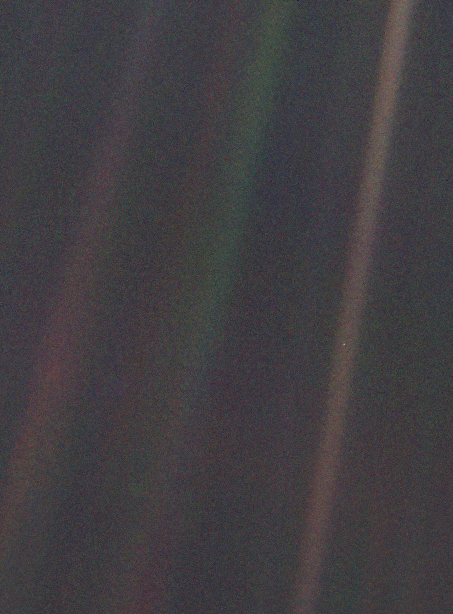
- Both the Voyager 1 photo of Earth commonly known as the Pale Blue Dot◊ and the vastness of the universe in general are popular arguments against theists who claim the universe was fine-tuned to produce humans, but the fact that the universe is vast and we are so small doesn't really bother theists who believe that God's children reside on other worlds as well. The two examples that come to mind are Islam and Mormonism, and Catholicism has entertained the question more than once.
- Baha'i doctrine is explicit that there is life on other planets.
- Similarly, Vatican spokesmen have stated that to dismiss the existence of anything without reason is to doubt the creative power of God, meaning it's technically sinful, even blasphemous (using the technical definition of that term) not to believe in the possibility of aliens.
- Mormonism believes that there is sentient life on other worlds, and they are all (more or less) Human Aliens, and that Jesus Christ is their Messiah too. And while Jesus lived on Earth, the throne of God is nearest to Kolob.
- Islam already believes in non-human sentient life in the form of spirits and ifrits and other dimensions. Life on other planets isn't too far a stretch. In fact, most religions seem to be pretty okay with the concept, even traditional ones like Orthodox and Catholic Christianity and Hinduism. It's kinda hard to lose your faith because you see photographic proof of how small and helpless you are in the face of the immensity of the universe when you spend most of your life believing in your smallness and helplessness in the face of God.
- Many Hindu scriptures in fact explicitly state that there is life on other planets and other universes (in fact, some of the earliest instances of the multiverse concept are found in the Vedas).
- Some Christian philosophers, including C. S. Lewis, have also replied to this argument by pointing out that, following the doctrine of redemption,note it's possible that humanity merits God's special attention precisely because we are the least significant and most sinful moral beings in the universe.
- In The Discarded Image, Lewis claimed that religious thought prior to the scientific age (even in ancient times) tended to emphasize the lowliness of man compared to the divine, and that it was only once the concept of evolution was accepted that man started thinking of himself as being at the top of a ladder of life, and dreaming of subjugating nature to his will. This isn't entirely accurate; the so-called great chain of being put man in charge of the physical world (and more specifically, put rulers and nobles above other people), and indeed, in Genesis, God explicitly states that man holds dominion over all the creatures of the world. And women. The idea of man being on top of the world, with only the divine above them, is an ancient one, and shows up in a great deal of mythology. Interestingly, the misconception that evolution puts man at the top of the great chain of being is an unscientific holdover from the previous worldview. One of the reasons that people disliked (and continue to dislike) evolution is that it means that humans aren't special or different from animals.
- Then again, it's worth noting that when the Bible states that we are special in God's eyes, that there's no real reason to assume it means that Earth is special compared to the rest of the universe, instead of that sapient minds, being capable of returning God's love, are special compared to the rest of creation, that is, the rocks and stars and lower animals, which aren't. There's no reason to assume that the aliens will all be fallen like us, nor is there a reason to assume that they'll all be unfallen. But whatever the fallen:unfallen species ratio is in the universe, it's safe to assume three things. A) There are other inhabited planets out there, since God wouldn't go out of their (the trinity) way to plow out a garden this big only to plant a single flower in it, B) That God makes themself known to all of the universe's inhabitants, and C) That God will redeem a given fallen world in some way, shape, or form. Perhaps by doing what they did here, or perhaps by doing something quite different. Whatever is appropriate.
- The Old Testament certainly treats Earth a lot more special—at least if you read it literally. This means that mainstream Christian denominations find it easier than those based on fundamentalism to accept the possibility of aliens. (And likewise within Judaism; Islam is a different story.)
- Except the fact that fundamentalists believe that UFO encounter aliens are literal fallen angels/devils from the sky. It is simply that fundamentalists believe in spiritual/interdimensional types of aliens in the form of devils that live in space or the second heaven, not biological/physical ones that live on planets.
- The context of this verse is that God proves there is only one God because there is only one chosen people, Israel, and thus only one Earth: Isaiah 45:18 King James Version (KJV): "18 For thus saith the Lord that created the heavens; God himself that formed the earth and made it; he hath established it, he created it not in vain, he formed it to be inhabited: I am the Lord; and there is none else."
- In The Discarded Image, Lewis claimed that religious thought prior to the scientific age (even in ancient times) tended to emphasize the lowliness of man compared to the divine, and that it was only once the concept of evolution was accepted that man started thinking of himself as being at the top of a ladder of life, and dreaming of subjugating nature to his will. This isn't entirely accurate; the so-called great chain of being
- Another uncomfortable topic to bring up in a religious discussion is that modern humanity is already sufficiently advanced to do things that would have seemed miraculous in the past, or at least, we have rudimentary technologies that demonstrate the possibility of that with a certain amount of development. In the 1800s finding naturalistic explanations of miracles was actually regarded as an *affirmation* of the Christian faith specifically, though the practice rapidly fell into disfavor again once churches realized that it seemingly negated the need for a creator deity altogether.
- There are two problems with this argument, however. The first is that it fails to explain why an alien with this technology would transform themselves into a perfectly human form, use their technology to deceive ancient humans into worshipping them, only to leave the planet soon after (and then there's the fact that they had a recorded human childhood, and only decided to use their technology once they became adults). The second is the naïve assumption that people believe in gods specifically and solely to explain the universe, even though the concept of Space Jesus relies on the idea that people believe in gods because that god came down and demonstrated their existence and divinity.
- A related issue is that the popularity of science-fiction has raised the bar on what would have, in the past, been considered unequivocal proof of a deity because even if the technology doesn't exist right now to replicate the effect, one can imagine technology that could. If someone were walking unscathed through a blazing inferno a thousand years ago, most people would assume magic or divine intervention. Were the same thing to occur today, the first thought in the minds of many people would be "force field". However, at the time this page was made, force fields didn't exist in real life, and that argument doesn't rule out the explanations for miracles that occurred prior to the existence of advanced technology.
- However, there are some miracles recorded in religious texts that it is difficult to imagine any sort of technology accomplishing, such as how Jesus rose Lazarus from the dead, simply by telling him to get up and walk out of the cave, from outside the cave, and considering the fact that Laz had been dead for several days and had already started to stink.