

The adaptation is a wonderful place, where new ideas can frolic without having to worry about fitting into the Canon. However, sometimes an idea is so interesting that the people who create the canon decide it deserves to be included.
Thus, we have the canon immigrant, who is a character created and nurtured in another medium and, eventually, imported back into the original. Note that, often, surface details are brought in to play off a new movie or TV series; this isn't that. Rather, it's usually a completely new character, who over time becomes more and more popular with the fandom, often filling some niche that was never quite complete before. As a recurring trend, these tend to be female characters (likely to be "spunky") who serve to break up an otherwise male Rogues Gallery or ally contingent.
If they're successful enough, they'll be included in new entries in the expanded universe, cross-pollinating concepts. Canon immigrants are often part of an adaptation distillation, and the new, canonical version usually has extra details to tie them into the more complex backstory of the original.
One should always be aware of the Canon Rule of Cherrypicking and Broad Strokes: the fact that one or two elements from an Alternate Continuity or expanded universe have made their way into canonicity does not make the rest of the alternate continuity or expanded universe canonical, as a whole.
A character is more likely to become a canon immigrant, and be embraced as such, if they are a God-Created Canon Foreigner.
This applies exclusively to characters or concepts who make the move from adaptation to original material. When dealing with alterations to existing canonicity that ends up changing the original material, see Ret-Canon.
Works with their own pages
Examples:
- Agent Ali: Neonimus first debuted in the mobile game Ejen Ali: Emergency, as the villain who hacks MATA's defense systems, before appearing in "Mission: Play". Ali and Alicia comment that Neonimus has messed with them before, making the game's events canon to the series.
- BoBoiBoy: In the sequel series BoBoiBoy Galaxy, the alien mechanic Nut appears in the 2017 magazine comic special "Raya Bersama TAPOPS" before making his animated debut in episode 23 of Season 1 (2018).
- Flower Angel: The animated series is quite famous for having quite a lot of Canon Foreigners, though a few of them eventually end up making appearances in some of the special events.
- SEER: Taomee will also occasionally release some of the mons that were originally introduced in the movies and TV series during special events along with using the SPD team (the main trio from the donghua) for promotions.
- The Big Finish Doctor Who audio plays have characters brought in from the comic strips, mostly from Doctor Who Magazine: short episodes feature cuddly alien conqueror Beep the Meep and Time Lord construct Shayde, and there is a short and a full-length episode in which the Doctor's companion is shapeshifting penguin Frobisher.
- The Company of Friends is an Eighth Doctor play that features a 45-minute story for two people that were never in the Big Finish audios before — Fitz (books) and Izzy (comics).
- For the longest time, Big Finish's works were of debatable canonicity, never officially being acknowledged by the show itself, but never being denied either. In a prequel to the 50th anniversary special called "The Night of the Doctor", the Eighth Doctor acknowledges and name-drops all of his audio-only companions, officially rendering Big Finish's stories and characters canonical.
- Garfield:
- Similar to Clark and Lois' marriage, Jon and Liz are now the strip's Official Couple after nearly 30 years of non-interest and pity dates on her part. This is mainly because the live-action movies had paired the two off in the first and married them in the second.
- Also, Binky the Clown who debuted in Garfield's Halloween Adventure (or Garfield in Disguise) before appearing in the strip a year later.
- Floyd the mouse is an odd case. He debuted as a minor character on Garfield and Friends, and appeared in the strip several years after that show ended, but he only ever appeared in one strip (January 27, 1998
 ). The presence of an infrequently appearing mouse character named Squeak probably played a role here.
- Hubert and Reba, Jon's old neighbors. They first appeared in the special Here Comes Garfield, aired October 25, 1982, then started to appear in the strip 13 days after that.
- The animated Peanuts special, Snoopy's Reunion, aired in 1991, featured three of Snoopy's siblings who hadn't appeared in the strip, Andy, Molly, and Rover. While Molly and Rover never appeared in the strip, Andy first appeared in the strip in 1994.
- Big Nate:
- The character Dee Dee Holloway, a member of the drama club at P.S.38, first appeared as a main character in the spin-off narrative books that accompanied the main comic strip. She became popular, however, and was added as a recurring character in the main comic strip.
- Dick Tracy:
- Cueball, the villain from the 1946 film Dick Tracy vs. Cueball, would much later (2011) appear in the comic strip. The main villain from Dick Tracy Meets Gruesome (1947) would follow suit in 2014. Gruesome's resemblance to Boris Karloff (who played Gruesome in the movie) was played up by having him appear in a production of Arsenic and Old Lace and encountering the real Boris Karloff's daughter, Sara, at a horror convention.
- After a 2014 crossover storyline that served as a Fully Absorbed Finale, the cast of Little Orphan Annie are now recurring characters in the strip.
- The comic book version of Nancy from 1959-63 had a character named Oona Goosepimple, a Cute Ghost Girl who lived in a haunted house. She didn't appear in the newspaper strip until 2013, 50 years after her last appearance.
- Tank Mc Namara: Tank's neighbors, Nick and Kate, were the stars of their own strip, Second Chances, from 1996 to 2000. When the strip ended, they were folded into the Tank cast.
- Phoebe and Her Unicorn: Voltina, an electricity dragon introduced in the graphic novel The Magic Storm, appeared in the comic strip a year later.
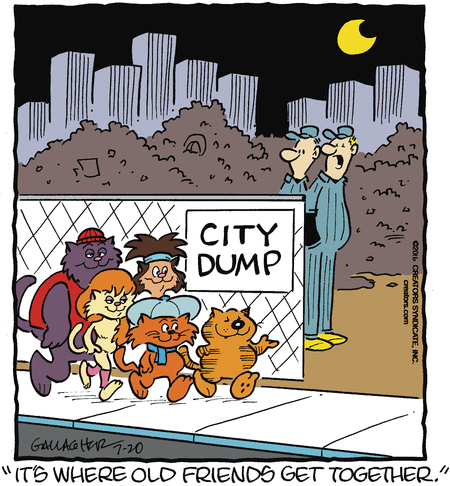
- Heathcliff: The Catillac Cats from Heathcliff & the Catillac Cats have made two◊ appearances in the original comic strip.
- Advice and Trust: Chihiro Tanaka, a character originally created in Once More with Feeling is Shinji, Asuka and Rei's classmate and makes several appearances where she tries to woo Shinji and pry him away from Asuka and Rei... with no success whatsoever.
- Armada - The REAL Story has a passing mention of Elita-One, a character who exists in other Transformers media but doesn't have a counterpart of herself in the Unicron Trilogy (which the comic is based on).
- Asuka & Shinji's Infinite Playlist is an Evangelion fanfiction which continues the manga adaptation's story. Mana Kirishima, a character of the Girlfriend of Steel game who never showed up in the manga, is one of Shinji's classmates.
- Chihiro shows up in Doing It Right This Time, in a superficially similar but ultimately very different role. The fic also imports Mari Makinami from Rebuild of Evangelion, and attempts to give her a bit more of a developed character than the canon does.
- Once More with Feeling: Someone asked the author if Mana Kirishima would show up. He answered: "Who is Mana Kirishima?". After looking for information about her, he stated she would show up, but nobody better count on it being more than one scene or her role being big.
- Mechanic Wrench of the fic, Rainbow in the Dark, actually has her origins in an earlier piece by the author.
- The Awakening of a Magus, had a Recursive Fic called Who Wants to Live Forever describing the death of a background character from over 3000 years ago (removed due to being a songfic). Details of that description later made it into the Awakening.
- The original Pokéumans series was sufficiently successful and had enough scope to prompt a community of fan series of its own. Ideas from these such as the evil mooks being called 'Extinctionists' and The Board of Dream Messengers were then accepted across the whole group and in the original series.
- Reimagined Enterprise takes a number of plot details from the non-canonical Star Trek Expanded Universe and uses them.
- "Rihannsu" is the real name of the Romulans and "Romulans" is a human code name for them.
- A version of the Optimum Movement from Star Trek: Federation appears as antagonists during the Post-Atomic Horror in the flashback in "Remembrance".
- In Mega Man: Defender of the Human Race, a story based around the Mega Man cartoon and Classic game series, the leader of the Mega Crew is revealed to be Tiesel Bonne, from the Mega Man Legends games. Later, his siblings appear, and the Bonnes become supporting characters.
- Mega Man Reawakened
- Fandom VIP Lizsama's Original Character, Elizabeth Marmalade, appears in Arc 3 with her permission.
- The Neo Emerald Spears, who are based off the Emerald Spears from Mega Man (Archie Comics), appear in Arc 4.
- Prism Man, who's exclusive to the MegaMan NT Warrior anime, appears in Arc 4.
- DC: United We Stand: In DC: United We Stand, in addition to the pre-existing examples of Canon Immigrants from DC Comics, there are also quite a few characters available who either had not appeared as of the time the roleplay is set, are adaptation-exclusive characters, or are from the New 52 reboot.
- The Turnabout Storm novelization does this in regards to the Sirens from My Little Pony: Equestria Girls – Rainbow Rocks. Since the Sonata from Rainbow Rocks and the Sonata from Turnabout Storm share the same name, the Sirens get to be related in the following way: the mother of the Sonata in this story is Adagio, and her sister is Aria (who reminds Sonata of Maya).
- With This Ring: Mainstream DC Comics characters that didn't appear or mention in the original Young Justice (2010) show are: Yao Fei from the Great Ten; John Constantine and the recurring cast of Hellblazer; the casts of Knight and Squire including the eponymous duo, Captain Cornwall and Cornwall Boy, and Dark Druid; Arnold Munro from Young All-Stars; Swamp Thing and Abigail Arcane; Henry King, Jr. of Infinity, Inc.; Holly Robinson; and the Super Young Team. There are also a few cameos from the comic "The Sandman (1989)," including Delirium of the Endless and Lord Kilderkin, and OL's Evil Counterpart Nylor Truggs is originally from Dial H for Hero.
- The "Zorro Farfetch'd" from the oneshot fanfic The Edit War for Ash's Freedom to not be Betrayed hopped on over to the author's ongoing Pokémon fanfic Pokémon Reset Bloodlines in Chapter 28.
- Lastie's P*R*I*M*A*R*C*H*S has Farseer Kyli, a character who was originally created to MST the story. Lastie featured her in the story's 3rd arc.
- The Weaver Option:
- Malekith, Dark Elf king in Warhammer Fantasy, is revealed to have been the last Aeldari Emperor while his mother, Morathi, is the Arch-Priestess of Slaaensh.
- The Skaven which only existed in the Warhammer Fantasy universe are revealed to exist in the 40k but were almost entirely exterminated by the Emperor during the Great Crusade. The survivors were sealed in a stasis container which is eventually unleashed on the daemonworld Sicarus.
- The release of the Skaven in turn re-canonizes Malal/Malice, a Chaos God which had essentially been written out of the 40k lore after the early editions.
- After Cegorach kills Slaanesh, he collects two of its now purified essences and grafts them onto two Drukhari. Given time, these essences will give birth to Addaioth and Atharti, Elven gods from Warhammer Fantasy.
- In Smallville fanfiction New Beginnings (Smallville), Arrow character John Diggle is Oliver's bodyguard when Clark first meets him, having been appointed by the people who managed the Queen fortune while Oliver was missing after the deaths of his parents.
- In the X-Men: Evolution story The SuperStarr Chronicles, it's revealed that after the events of the episode "Middleverse", Forge ended up joining Phil Coulson's crew from Agents of S.H.I.E.L.D.
- Happens in Ben 10: Reincario. While it is based on the original series (Ben 10 to Ben 10: Omniverse), there are villains from the reboot series that make their appearance, namely Lord Decibel and Dr. Animo's Alphas.
- While the sequel series to Ben 10: Unlimited, Unlimited Justice, primarily crosses over Ben 10, Justice League, and Young Justice (2010), the team later includes Cyborg, Starfire, and Raven.
- Roller Brawl: The Mega Cyborg crosses over Skylanders and the Mega Man (Archie Comics) series, which focuses primarily on the Mega Man (Classic) series. However, Lord Obsidian and Suna make appearances as the true main antagonists of the "Spiritus Ex Machina" arc.
- Happy Heroes: The Movie features Transformation M., a shapeshifting monster who is later given a role as a minor antagonist in Season 9 of the television series it's based on.
- King Louie of Disney's The Jungle Book (1967) has appeared in a few other works based on the stories that the Disney film is based on, most notably Fables, which, as an afterthought, the creator Bill Willingham described as, "a very good example on why it's best to go back to the source material before one embarks on a major story, rather than rely on often faulty memory of which characters were original canon [sic] and which weren't."
- With regards to the Disney Animated Canon, in the United Kingdom and Sweden, The Wild is listed as the 46th entry (despite the fact that Disney merely distributed it), with Dinosaur being excluded. Dinosaur is a Canon Immigrant itself, as it was made as a separate project and wasn't considered Disney's 39th animated feature until several years after its release.
- Disney doesn't treat direct-to-video sequels as canonical. The Lion King II: Simba's Pride is about Simba's daughter Kiara. Kiara has been accepted by most of the fandom; however, it wasn't until The Lion Guard that she reappeared in media.
- Shrek:
- Before he appeared in Puss in Boots, Humpty Dumpty debuted as a playable character in two Shrek video games, albeit with a completely different design and personality.
- Puss in Boots: The Last Wish introduces Goldilocks to the mainline universe. Just like Humpty, she first appeared in a video game with a different appearance.
- The Moorish character in Robin Hood, who in the last decade or so has cropped up in Film and TV, at least. The earliest incarnation seems to have been Nazir in Robin of Sherwood.
- Godzilla:
- The 1998 American Godzilla officially became part of the Japanese franchise with the release of Godzilla: Final Wars and was even given the official name of "Zilla". Poking fun at the American rendition, unlike all the other monsters, which are depicted as men in latex costumes, Zilla is rendered in intentionally mediocre CGI. He was referenced in an earlier film in which a character asks "Didn't Godzilla show up in New York recently?" and is told "That's what the Americans think."
- And it doesn't stop there. Mothra, Rodan, Varan, Baragon, Kamoebas (a giant turtle from the obscure film Space Amoeba), Moguera (from another obscure film called The Mysterians), Meganulon, Manda (from yet another obscure film called Atragon) and King Kong were all stars in their own respective films before becoming part of the Godzilla franchise.
- Frankenstein Conquers the World: It's known as Frankenstein vs. Baragon in Japan. It takes Frankenstein's Monster (who, not surprisingly, is mistakenly called "Frankenstein") growing to giant size and fighting Baragon.
- Mosasaurus appears in Jurassic World, after playing a prominent role in Jurassic Park: The Game. The Masrani website also talks about the Bri-bri natives of Isla Nublar relocated to the mainland in The '80s, who were first represented in Jurassic Park: The Game in the character of Nima Cruz.
- Killer Tomatoes Eat France, the fourth and final Killer Tomatoes movie, features Zoltan and Ketchuck, two of Gangreen's tomato lackeys in the Attack of the Killer Tomatoes animated series. In addition, the film features a third tomato grunt named Viper, who is loosely based on the cartoon-exclusive tomato Fang.
- Black and White in Color: This film was originally titled La Victoire en chantant ("Victory sings") in France, from a line in a French martial song. Since that reference would be lost to international viewers the international release was titled Black and White in Color. Then, when the film was re-released in 1977 in France after winning the Oscar, it was titled Noirs et Blancs en couleur.
- Heimir from The Northman is meant to be an analogue of Yorick from Hamlet, a figure who was thought up by Shakespeare and did not appear in Saxo's original story of Amleth.
- King Toadstool and Wooster, Super Mario Bros.-related characters introduced in Nintendo Comics System, made a few appearances in the Nintendo Adventure Books.
- The Lone Wolf gamebook series had a short-running companion novel series called Legends of Lone Wolf, which covered and expanded upon the gamebook stories, including introducing several new characters. Demigoddess Alyss was introduced early into that series, and broke through the canon ceiling in Book 16 of the gamebook series.
- Older Than Radio: None of the three most famous stories associated with the Arabian Nights — "Aladdin", "Ali Baba and the Forty Thieves", and "Sinbad the Sailor" — were part of the collection as it was assembled in the Arab world over several centuries. All three were independent folk stories added to the Nights by Antoine Galland when he compiled his 18th century French translation, which introduced the Nights to European culture.
- William Gillette's Sherlock Holmes play introduced the character of Billy the page-boy. When Arthur Conan Doyle later wrote a couple of Holmes plays himself (The Crown Diamond and an adaptation of The Speckled Band) he included this character, possibly for the sake of consistency with Gillette. Conan Doyle later adapted The Crown Diamond into a short story (The Mazarin Stone), and thus Billy entered into the Sherlock Holmes canon. He also received a very brief mention in a couple of the later canonical tales.
- Happened with Raymond E. Feist's The Riftwar Cycle. The characters of Gorath, Owyn, Jazhara and Jimmy's twin brother Lysle Rigger all make their first appearances in the computer games Betrayal at Krondor and Return to Krondor, set in Feist's world. They were then incorporated into canonicity when Feist wrote a novelization for both games and made references to them in later books.
- Margo Lane appeared first on The Shadow radio show before Walter Gibson incorporated her into the prose series. Earlier novels of the Shadow often only barely featured women, but the radio show wanted vocal contrast. Gibson vehemently opposed the inclusion at first, both because it was a character being foisted upon him and from the fact that The Shadow already had a female agent, Myra Reldon. In her first appearances, Gibson wrote her as The Scrappy and The Load, but later began to warm to Margo (and indeed, the canonical spelling came from Gibson, the radio character is properly "Margot, from singer and Broadway actress Margot Stephenson, whom she was based upon and who voiced her in an early season of the radio show) and wrote her much more competently from then on.
- Inspector Morse had a Canon Immigrant car. The original novels by Colin Dexter had Morse driving a nondescript modern vehicle, but the TV show gave him a Cool Car, a red 1960s Jaguar Mark II. The car became so iconic of the character that the novels written after the TV show started included it with no explanation of the change, even to the point of putting it on covers (art images, not photos from the show).
- Ellery Queen's secretary Nicky Porter was originally created for the radio show, but later appeared in two of the novels and a dozen short stories.
- Hastur, a Great Old One in the Cthulhu Mythos, is actually a canon immigrant from The King in Yellow (well, sort of) with a name taken from an Ambrose Bierce story by way of August Derleth. Lovecraft, Derleth and Robert E. Howard were all friends and frequently borrowed and swapped ideas for deities and monsters.
- Discworld:
- A minor example: The Wizla Tobacco and Rolling Paper Company was first mentioned on the label of Albert's tobacco tin in the TV adaptation of Hogfather, before getting referenced several times in Unseen Academicals.
- As revealed in the official Mort playscript, rather than try and duplicate the established appearance of Rincewind for the sake of a brief cameo, the Studio Theatre Club replaced him with their own nervous junior wizard character. They called him Stibbons.
- In The Compleat Ankh-Morpork City Guide the list of cafés includes Café Ankh, and the pubs and taverns includes the Octarine Parrot, both from Discworld Noir.
- Doris and Benny the Cab, created for Who Framed Roger Rabbit, appeared in the sequel to the original book. Another character created for the film, Teddy Valiant, is mentioned in the book, though he doesn't appear in either version because he was killed years ago. Who P-P-P-Plugged Roger Rabbit? is really more of a sequel to the film than the book in most respects, including Toons being animated characters rather than comic strip characters, Roger being a good guy and being set in The '40s rather than The '80s.
- Two famous British literary heroes had their backgrounds tweaked to reflect those of their actors in live action adaptations:
- At first, Ian Fleming didn't like the casting of Sean Connery as James Bond. However, after seeing Dr. No, he made Bond's father, like Connery, a Scot.
- Bernard Cornwell established his hero, Richard Sharpe, as born and raised in London. After Sean Bean portrayed the character for television, Cornwell added a previously unrevealed aspect of Sharpe's childhood. At age 15, Sharpe moved to Yorkshire, where he presumably gained an Oop North accent similar to the obviously-not-from-London Bean's.
- Also the character of Rifleman Harris was created for the TV series and subsequently appeared in the novels because Cornwell liked him.
- Honor Harrington: Havenite superspy Victor Cachat was first introduced by Eric Flint in a spin-off anthology Changer of Worlds, in a short story which also made Anton Zilwicky an Ascended Extra. He has since become an iconic character and as much a series mascot as the eponymous protagonist herself. Though Flint in essence becoming Weber's equal partner in writing the series might have something to do with that.
- The Wonderful Wizard of Oz: Due to Adaptation Displacement, the 1939 movie adaptation had a profound impact on future Oz movies, most of which pay at least some homage to attributes of the film that weren't in the original novel, such as Dorothy wearing ruby slippers instead of silver shoes, Glinda being the witch of the North rather than the South, the journey to Oz being All Just a Dream, and a great deal of the visual look of the story and characters. But there were also previous adaptations that introduced elements that would become part of the canon: it was a 1911 play that first made Dorothy's surname Gale, it was a 1925 movie adaptation that introduced the idea of the Scarecrow, the Tin Man, and the Lion being the farmhands from Dorothy's Kansas home, and it was a 1933 animated short that first came up with the idea of the Kansas sections being in black and white, the Oz sections in color.
- Noddy:
- Martha Monkey was originally created for the 1990s stop-motion series Noddy's Toyland Adventures and reappeared in Make Way For Noddy. In recent years, she was featured in some of the original books on redrawn pages that featured Master Gilbert Golly (such as the book "Noddy Goes To School"◊).
- Another character that originated from Toyland Adventures is Dinah Doll, who is also seen in a few redrawn pages in some of the original Noddy books.
- Martha Monkey was originally created for the 1990s stop-motion series Noddy's Toyland Adventures and reappeared in Make Way For Noddy. In recent years, she was featured in some of the original books on redrawn pages that featured Master Gilbert Golly (such as the book "Noddy Goes To School"
- Pirotess the Dark Elf was created for the original OVA adaptation of Record of Lodoss War. She does not appear in the novels that the OVA covers, but the author Ryo Mizuno liked her character and decided to add her to the later novels, starting with the sixth one.
- Rudolph The Red-Nosed Reindeer, created for a department store giveaway children's book which was later into an animated short by Max Fleishcer adapted into a song and a TV special. The character became so popular that he's been added to the eight reindeer from "A Visit From St. Nicholas"/"'Twas The Night Before Christmas" and has become the face of the band in the public consciousness.
- The 1999 Christmas Special of Vivan Walsh's Olive, the Other Reindeer introduced Martini the Penguin, a con-artist penguin who helps Olive achieve her goal of saving Christmas. While he wasn't present in the original book, he managed to make a couple non-speaking appearances in the 2004 Valentine's Day book "Olive, My Love" which involves Olive trying to return a giant heart to her friend Dexter, a winged dog. At one point, a picture frame showing Oliver and Martini together is seen inside Oliver's doghouse.

- Buffyverse:
- In a comic about the character Spike from Angel, Spike is sent to an asylum for demons and meets an incredibly strange character... a human-sized, floating, telepathic Betta fish named Betta George. Apparently, when Joss Whedon approached the writer of these comics to collaborate on the canonical continuation comic After The Fall, he noted "I like George. Let's find a place for him." The fans are reportedly somewhat squeamish about the inclusion of such a blatantly strange character in canonicity, despite the show's other eccentricities.
- Illyria also appeared in another comic's canon and appears in Buffy season 9.
- Beck, who also appeared in the Asylum mini-series and other Spike comics, appears in After The Fall.
- The CSI villain Sqweegel. Anthony Zuiker's digital novel "Level 26 Dark Origins" has first White Sqweegel and at the end comes Black Sqweegel, the one who crossed to CSI. Word of God has confirmed the immigration on Level 26 website.
- Doctor Who has occasionally dipped into its Expanded Universe, largely because of the former fanboys currently in charge.
- The idea of top-ranking Daleks being gold-painted began in the Peter Cushing films, but made its way into the first couple of colour TV Dalek stories. Speaking of the Cushing films, the new Dalek props introduced in "Victory of the Daleks" take their technicolour design from those of the movies and a couple of design elements (most notably the balljoints for the eyestalks) from the same comics the Dalek Emperor first appeared in. The smallest Dalek time unit, the "rel", also began in films and comics but has been incorporated into TV canonicity in post-2005 Dalek stories.
- The look of the Daleks' flying saucers, which first appeared on the DVD release of "The Dalek Invasion of Earth" as replacement special effects, and later appeared in the series itself, was originally from the comic strips.
- As far as actual characters go, the Dalek Emperor first appeared in Dalek comics and annuals, though he looked considerably different in his first TV appearance in "The Evil of the Daleks". When he reappeared in "Remembrance of the Daleks" he looked more similar to the comics version, as a Shout-Out.
- A glass Dalek was first mentioned in David Whitaker's novelisation of the original Dalek story: Doctor Who in an Exciting Adventure with the Daleks. A glass Dalek eventually made it into TV canonicity in "Revelation of the Daleks".
- "The Eleventh Hour": The Atraxi originated in the Eighth Doctor Adventures novel Vampire Science.
- While not appearing in the episode, the Chelonians, an alien species first introduced in the Doctor Who New Adventures novels during the show's nineties hiatus, are name-checked as part of the Legion of Doom of "The Pandorica Opens".
- "The Power of Three" brought Kate (Lethbridge-)Stewart, the daughter of the Brig, into the series — albeit this time played by Jemma Redgrave, not Beverley Cressman.
- "The Night of the Doctor" makes canonical several Eighth Doctor companions from the Big Finish productions: Charley, C'rizz, Lucie, Tamsin, and Molly.
- In "The Day of the Doctor", the Eleventh Doctor meets a character called the Curator, strongly implied to be a far-future regeneration of the Doctor, played by an elderly Tom Baker (who played the Fourth Doctor in the 1970s). The character originates from the odd pseudo-Framing Device used in the official reconstructions of Development Hell serial "Shada", which were narrated by an old Tom Baker, dressed in a suit and describing the missing scenes while showing the viewer around an art gallery. He also referred to the Doctor in the third person, but prominently used the Fourth Doctor's mannerisms and Character Tics, and performed the unfilmed "Lesson of the Day" Speech scene where the Doctor announced that maybe someday he'd retire and everyone would think that he was just a nice old man with the Fourth Doctor's signature Cheshire Cat Grin.
- A number of concepts from the spoof Doctor Who: The Curse of Fatal Death eventually found their way onto Moffat-helmed canonicity, such as Time Lords being able to change genders upon regeneration, the Master romancing the Doctor, and why are there chairs on Skaro.
- Abslom Daak, a '90s Anti-Hero character from the Doctor Who Magazine comics, was briefly alluded to in "Time Heist".
- The teaser trailer for the 2023 Specials shows the unexpected appearance of Beep the Meep, or at least a Meep from the DWM strip.
- The "Clue Crew" in Jeopardy! originated on the short-lived kids' version Jep!, there called the "Jep! Squad".
- Howard, Marina, and Pearl from Last of the Summer Wine. They started out in a stage play version of the show, and got a good enough reaction to become part of the TV cast.
- LazyTown: Roboticus originated in a LazyTown stage show from 2011, with the episode of the same name being based on the play.
- Power Rangers:
- This is subverted with Zordon's home planet of Eltar. While Eltar Is first mentioned in the non-serial first movie, and not mentioned in the main canon until Power Rangers Turbo, the name has been in the Universe Bible since the beginning.
- Likewise the Tengu (renamed Tengas) and the Rangers' ninja costumes and powers originated in the movie and were used in Mighty Morphin' Power Rangers Season 3, since the events of the movie were modified and retold in the series. The Zords don't quite count as they were based on the mecha from Ninja Sentai Kakuranger and most likely would have appeared in the series anyways even if the movie was not made.
- The Battlizer from Power Rangers S.P.D. crossed over to its source material, Tokusou Sentai Dekaranger, the same yearnote when they returned for its team-up movie with Magiranger.
- While the term wasn't used for Gokai Silver's Gold mode from Kaizoku Sentai Gokaiger and Kyoryu Red's Carnival mode from Zyuden Sentai Kyoryuger, both modes do share traits from Power Rangers Battlizers, most notably, enhanced power armor, and a finisher.
- The New Powers from Power Rangers Super Megaforce certainly count. These are Dairanger, Changeman, Flashman, Fiveman, and Maskman, five previously unadapted Super Sentai teams, thus were previously part of Sentai canonicity, but not Power Rangers canonicity. The original holders of the Fiveman powers were later expanded on in an issue of the Boom! Studios comics.
- Star Trek:
- The first name of Uhura, of Star Trek: The Original Series. The name "Nyota" (Swahili for "star") was invented by William Rotsler for his 1982 book Star Trek II Biographies. It was approved by the original actress, Nichelle Nichols, and by series creator Gene Roddenberry. After wide use in the Star Trek Expanded Universe and All There in the Manual works it finally became canonical in Star Trek (2009) and was later used in Star Trek: Strange New Worlds. As did the names of Captain Kirk's parents, George and Winona, coined by novelist Vonda N. McIntyre in Enterprise: The First Adventure. McIntyre also gave Mr. Sulu the first name Hikaru in her novel The Entropy Effect, and the name was canonized in Star Trek VI: The Undiscovered Country.
- The Holodeck of the Star Trek: The Next Generation series, which started its life in Star Trek: The Animated Series. Kirk's middle name was first declared as "Tiberius" in the animated series as well (though it was conceived earlier, and Gene Roddenberry had previously used "Tiberius" as the middle name of the title character, William T. Rice, in his first TV series The Lieutenant). Although that does conflict with the tombstone that Gary Mitchell conjures up in the second pilot, which reads James R. Kirk...
- Add to that Lady Amanda's surname of Grayson, taken from "Yesteryear," the best known episode of ST:TAS.
- Minor example: the most prominent new species of the animated series, the Caitians (M'ress) and Edoans/Edosians (Arex), are also canon immigrants: Caitian admirals appear in The Voyage Home and Edosians have been mentioned several times (for instance, Garak dealt with Edosian orchids while a gardener).
- If plot points from originally non-canonical works count, then the big, big one would be the entire episode "Yesteryear". Though the animated series was largely considered non-canonical, this one episode gave us a lot about Vulcan culture and Spock's past that has been adhered to - its events were referenced in TNG's "Unification," Vulcan's Forge was featured in the Vulcan trilogy on Star Trek: Enterprise, and the 2009 movie's sequence with young Spock is taken nearly word-for-word from the episode.
- Synthehol, an alcohol substitute that gets one drunk, but the effects of intoxication can be dismissed at will, started life as a concept in the TNG novels and was soon written into the TV series.
- "The Warrior's Anthem", a Klingon war hymn sung in DS9: "Soldiers of the Empire", originally appeared in the video game Star Trek: Klingon.
- Though Star Trek: Picard's storyline conflicts heavily with Star Trek Online's version of the chronology after Star Trek (2009), the season two premiere "The Star Gazer" adopted four starship classes from the game into canonicity: the Gagarin-class,note Reliant-class,note Sutherland-class,note and Ross-class.note Season three episode "Vox" would introduce the Pioneer-class and fully canonize the NX-class refit.
- Star Trek: Strange New Worlds: In "Strange New Worlds", Una Chin-Riley made First Contact with the Kileans in a Hermes-class starship, the USS Archer. The class originated in Franz Joseph's original Star Fleet Technical Manual, and though it was previously depicted as a screen icon in Star Trek II: The Wrath of Khan and Star Trek III: The Search for Spock, this is the first time one has been depicted as a live starship.
- A variant: Supergirl (2015) and The Flash (2014) have a musical Crossover featuring a version of The Music Meister, who originally premiered in Batman: The Brave and the Bold. He may or may not ever make it into the comics, however, since his gimmick doesn't exactly work in a silent medium. The Meister made a few appearances in Supergirl (2015) prior to this as well.
- Milestone Celebration series Kamen Rider Decade, which was all about traveling to Alternate Universe versions of past shows, created a few Original Generation characters to help flesh out the existing worlds; in particular the "World of Ryuki" arc introduced Kamen Rider Abyss, who also had Sailor Earth elements (his Bond Creatures were normal, uncontracted Monsters of the Week in Ryuki). Ten years later, Kamen Rider Zi-O gave Ryuki a web-exclusive sequel miniseries which added Abyss to the original roster of Ridersnote .
- Mother Goose Treasury: Discussed, Exploited, and ultimately granted to Bertram twice. Bertram is shocked to find there are no good rhymes about geese. So he becomes the hero to the stories of both Little Bo Peep (finds the sheep's tails) and the Old Woman in the Shoe (teaches her kids to behave), resulting in Mother Goose including lines about him.
- Red Dwarf: The concept of an uplifted Rat Race, first introduced as the inhabitants of an alternative universe in Skipper, first originated as one of the potential characters that could be played in the 2003 Tabletop Game
- The Beatles had a problem with the soundtrack to their television film Magical Mystery Tour, as the film had only six songs. In Britain the soundtrack "album" was released as two singles with three songs apiece. In America, Capitol Records added the Beatles' 1967 singles (including "Penny Lane", "Strawberry Fields Forever", and "All You Need Is Love") to the soundtrack to make a full length album. The revised American version has now become the standard version all around the world; the original British edition of Magical Mystery Tour wasn't released again until the 2012 DVD and Blu-ray special edition rerelease of the movie. Purists don't like the US album because it apparently messes with the band's concept - but the band actually preferred the US album and reissued it as such from the 70s onwards.
- Bryan Ferry's "Let's Stick Together" compilation was created for the US market, as the label demanded an album off the back of his "Let's Stick Together" single and declined to release his "The Price Of Love" EP. He combined the two releases with the previous year's "You Go To My Head" single, some UK B-Side recordings of Roxy Music tracks and a then unreleased version of "Casanova", in order to create an 11 track album. Whilst initially intended as a US only release, "Let's Stick Together" became hugely popular on import to the point where Island released it in the UK, and it has featured in all the reissue series since. Part of the reason is that it was the first Ferry release after Roxy Music announced their split.
- Megadeth's soundtrack contribution compilation Hidden Treasures was originally designed as a limited edition bonus disc for Youthanasia, but became very popular, largely thanks to the hit single "Angry Again" being included. It was released as a separate release in its own right, and a remastered version was reissued in the UK many years later (the US label kept most of the tracks for the box set Warchest, although some appear in different versions).
- Oasis had the B-Side compilation The Masterplan which was designed for US and Japanese fans to avoid them paying a lot of money for singles. Because the band's B-sides were often considered to be just as good, if not better, than their actual singles, it became a very popular import in their native UK. It ended up being released in the UK thanks to demand, and has since become one of their most popular releases.
- The Human League pretty much adopted Phil Oakey & Giorgio Moroder's "Together In Electric Dreams" as their own, including it on Greatest Hits compilations and performing it live for many years. The track was originally Moroder's and he hired Oakey to sing on it for the Electric Dreams soundtrack. To Oakey's surprise, it was a bigger hit than the Hysteria album his group was promoting at the time, thus necessitating its inclusion in their canon.
- Queen: "Under Pressure" was initially released as a non-album single in October 1981; it was ultimately incorporated as the closing track on Hot Space a year later, hence its radically different sound from the rest of the album and the six-month gap between its single release and that of "Body Language ↑⬱".
- Although many sources now list among the Norse pantheon a goddess of love named "Astrild", she is in fact the creation of a Romantic-era English poet; the original Norse goddess of love was Freyja.
- The hippogriff made its first documented appearance in the 16th century poem Orlando Furioso, and it's unlikely that even people who'd sincerely believed in griffins ever gave credence to these horse/griffin hybrids (griffin were supposed to eat horses, not screw them). That hasn't stopped modern fantasy writers from including them in the roster of commonly-appearing mythical beasts.
- Sequinox has Ethan Wright. He was a character in the previous Cool Kids Table game Creepy Town, and was brought into Sequinox on account of him being Shannon's favourite.
- Mil Mascaras was originally a character used when El Santo was unavailable for any particular film, but The Gimmick was later taken up by an actual luchador, who is perhaps the third most recognizable luchador after Santo himself and Santo's rival Blue Demon.
- The main character of the '70s manga and anime Tiger Mask, a masked pro wrestler by the same name, was brought into New Japan Pro-Wrestling in the '80s. He's since become something of a Legacy Character — at least four different wrestlers have donned the mask — as has his Evil Counterpart, Black Tiger.
- Suicide, a character who first appeared in TNA Impact!: The Video Game, and later showed up in the ring to exact unspecified revenge on the Motor City Machine Guns. Due to wrestling's self-aware nature, this led the Guns to complain to anybody who'd listen about having been beaten up by a video game character.
- Tommy "Tiny" Lister, a.k.a. "Zeus", became a pro WWF wrestler after doing No Holds Barred with Hulk Hogan. That venture fared mediocrely, but that didn't stop WCW from bringing him back briefly to fight Hogan as "Z-Gangsta".
- WCW tried it too, when they made David Arquette the WCW Champion after Ready to Rumble. This isn't quite an example, as Arquette's WCW run was explicitly As Himself and not his character from the movie, but it's close enough to merit a mention. The bizarre triple-cage match that serves as the movie's climax also made a WCW appearance as part of this storyline and would be used in one additional match prior to WCW’s closure.
- The 2017 WWE-produced webseries Southpaw Regional Wrestling largely lived completely apart from the main roster programming, but a comedy bit on an August episode of Monday Night Raw (conveniently airing from Memphis, Tennessee) saw "The Impressive" Pelvis Wesley (Heath Slater's Elvis Impersonator character) confront and get laid out by Elias.
- Yelizaveta "Bounce" from Survival of the Fittest version four started off as a character in the 'In-Universe Chat' (a chatroom where SOTF members could RP being members of the show's audience). After some time, she was brought into the version four pregame as a fully-fledged character.
- BattleTech:
- Adam Steiner was created for the spin-off cartoon; however, he has since been "adopted" into the canon of the main line, becoming one of the heroes of the Lyran Alliance due to his military exploits and eventually becoming known as one of the greatest Archons in the history of the Lyran state. Other characters from the Cartoon have appeared, but none as prominently.
- Ian Dresari, the protagonist of MechWarrior 4, is canonized in the history of the tabletop game. Word of God is that reports of Ian Dresari's tyranny in the sequel are actually unfounded propaganda by House Steiner to demonize him and turn public opinion from him. Dresari was defeated but ultimately survived the events of Black Knight come the time of the Civil War.
- The Bombast Laser in Mechwarrior 4: Vengeance was made a canonical weapon eight years later in the "Tactical Operations" advanced rulebook. The Deimos battlemech originally appeared as an unofficial mech in the MekPak Game Mod for the Mercenaries Expansion Pack. It was later made canonical and appeared in the official BattleTech technical readouts
- The various spinoffs often redesign mechs for the sake of aesthetics, some of which make it back into the artwork of the boardgame and the other spinoffs, especially for mechs that haven't had a redesign since 1984 and the days of boxy black-and-white mechs with funny proportions. For example, the trading card game redesigned the awkward looking 'Black Lanner', which later reappeared 9 years later in Mechwarrior Living Legends
- The Aurigan Coalition and House Arano were first introduced in the 2019 video game before being added into the tabletop in early 2019. Unlike most examples, this was pretty much expected to happen - the game was made with the assistance of Jordan Weisman, one of the men who made the tabletop game.
- Gomorra, California, home of the tie-in Collectible Card Game, would eventually become an Immigrant Setting for Deadlands. Part and parcel to this were many, many Canon Immigrants, including most of the entire Whateley Family, Sioux Union, and piratical Maze Rats.
- Dungeons & Dragons has a long history of taking races and monsters from specialized settings and featuring them in core Monster Manuals, or repurposing them for splatbooks.
- The Dark Sun setting's thri-kreen mantis folk and half-giant race have been appearing in Monster Manuals since the AD&D days, and both were presented as core races for 3rd Edition's psionics sourcebook.
- The neogi, slaving spider-eels who debuted in the Spelljammer setting, have become recurring threats in generic Monster Manuals. Which is easy to justify when they have a history of flying from world to world on their spider-shaped starships.
- The domains and darklords from the 2nd edition Ravenloft setting became a standard feature of the 4th Edition Shadowfell.
- The Planescape setting, which greatly filled out D&Ds "Great Wheel" planar cosmology, basically became the default cosmological model for 3rd and 5th Edition, with many of its creatures and races appearing in various sourcebooks.
- Eberron's warforged, changeling and shifter races proved popular enough that even in the same edition the setting debuted, those races were reprinted for the generic Monster Manual III, and reappeared in 4E Monster Manuals as well. The 5th Edition Mordenkainen's Monsters of the Multiverse sourcebook even features rules for changelings and shifters with rewritten backstories to make them independent of the Eberron setting.
- The writers of the Forgotten Realms supplements have made canonical a wide variety of plot points from the video games.
- The whole Bhaalspawn plot from the Baldur's Gate series is referenced in the 3.5E splat Lost Empires of Faerûn, while Minsc and Boo were mentioned in the 5th Edition module Baldur's Gate: Descent into Avernus, as were the two comic books by IDW that were published about them. Many of the locations in the titular city are also given write-ups in the same module.
- Zehir, the yuan-ti god of poison, was homebrewed for Neverwinter Nights 2: Storm of Zehir, then became one of the primary pantheon of 4th edition and its Nentir Vale setting, and then was relisted as a subservient deity of Bane in the 4E Forgotten Realms Campaign Guide.
- Psurlons were a new monster created for the Dark Sun: Shattered Lands computer game. They turned out to be popular and interesting enough to be introduced to the tabletop setting as well.
- Games Workshop games:
- Warhammer 40,000:
- The Blood Ravens Chapter of Space Marines were initially invented for the Dawn of War series of video games, but eventually got accepted into 40K canonicity due to the popularity of the series, and have since appeared in several Black Library novels, including the novelisation of the games themselves. The Chapter have even been included in every Space Marine Codex since the 4th Edition of the game where they were used as one of the examples of how to use Chapter Traits (albeit with traits that were not representative of the Blood Ravens as seen in the video game).
- The Blood Angels' special character Mephiston, Lord of Death. According to his backstory he used to be Brother Calistarius, the Librarian from the spinoff board game Space Hulk.
- The mutated monster known as the Mutalith Vortex Beast became part of the Thousand Sons army list in their 2018 codex, five years after its introduction as a Warriors of Chaos unit in the original Warhammer.
- Shield-Captain Valerian and Sister of Silence Aleya, two of the protagonists of the Watchers of the Throne books, got their own models in the tabletop game, complete with a rule that preserves their team dynamic.
- The Blood Ravens have become a one-spin-off-to-another example with the release of the Honour The Chapter sourcebook for the licenced RPG Deathwatch. Prior to this there was just one piece of art in Rites of Battle and a quote from Captain Davian Thule in the core book.
- Warhammer 40,000:
- Elegant Nova of Progression first showed up in Keychain of Creation as an Alchemical Mad Scientist dedicated to making mortals into Alchemical Exalted piece-by-piece. Now, crack open Manual of Exalted Power: Alchemicals and flip through to "Notable Individuals"...
- In Magic: The Gathering:
- The Viashino were originally introduced in the Tie-In Novel The Prodigal Sorcerer by Mark Sumner. The designers of the game liked them so much that they worked them into the game, and they still turn up from time to time.
- Kiora the merwoman was originally designed for one of the video game spinoffs. Her appealing character design lead to her becoming a common recurring planeswalker in the franchise.
- After a PC game was made out of Jeff Wayne's Musical Version of The War of the Worlds, he utilized several features from it for the live stage version (most notably a large part of the Martian intro movie, and the game's model for the Martian flying machine which can be seen briefly during The Red Weed)
- Audio-animatronic figures of Jack Sparrow and Captain Barbossa have been added to the Disney Theme Parks ride that inspired their movie franchise. An odd case, since the original version of the ride didn't have any story, as such.
- The Starlight Girls (the foster girls Jerrica takes care of) were created specifically for the Jem TV series. However, at least three of them: Ashley, Ba Nee, and Krissie, were later made into dolls.
- Littlest Pet Shop introduced a human companion to the pets in the form of Blythe in 2010. Blythe herself was actually a completely separate range of dolls released back in 1972 by Kenner and discontinued just as fast; however, she became unexpectedly popular in Japan, leading to first Takara and then Hasbro (who'd inherited the rights with their purchase of Kenner in the 90s) selling collector-targeted dolls in the 2000s, before the decision was made to reintroduce the character to new audiences via LPS.
- Many of the more notable minor characters in My Little Pony: Friendship Is Magic began gaining more and more recognition and nods from the writers, to the point where several of them were finally firmly cemented into canonicity in the form of toys. By now, the overwhelming majority of background ponies have toys; previous generations have had toylines that were much bigger than the shows' casts, but Hasbro realized how much fans have latched onto the background characters and have figured that if they make the "extra" toys look like the crowd filler ponies instead of just slapping random color schemes on them, you'll have a character who means something to someone.
- The Baroness actually debuted in Marvel Comics' G.I. Joe: A Real American Hero in issue #1, created by Larry Hama when he realized there were very few women in G.I. Joe at the time. She was the first character in the canon to cross media, being imported into the TV show and given her own figure thereafter.
- Monster High's C.A. Cupid is this for Ever After High, where she currently resides.
- Both Knight Unicorn Gundam and Crown Knight Gundam III are part of the SD Gundam Gaiden Series, yet their first appearance was in SD Gundam Ultimate Battle. They would later be properly incorporated in New Testament SD Gundam Gaiden: Saddrac Knight Saga.
- BIONICLE examples:
- The character that became Takua was originally the generic, cutomizable protagonist of the Game Boy Advance game Quest for the Toa, then was given an official design and name in the Mata Nui Online Game and the related online animated shorts, which were initially not fully accepted into the series's canon. Due to his popularity and sudden story importance, Takua was made into an actual toy two years later, and even starred in his own Direct to Video movie, Mask of Light.
- Artakha and his evil brother Karzahni were haphazardly made up for an obscure online game promoting Mask of Light, as mythical figures of Bionicle lore. About two years later, a plant monster named Karzahni appeared in a novel, placing the legend of Karzahni into the actual story. Another year later, the true Karzahni himself was introduced as a distinct character, and yet another year afterward a toy bearing his name came out. Artakha too became canonical around the same time, but wasn't sold as a toy. He first received an officially approved look in a 2020 fan contest, 17 years after his name was first referenced in a random web game tangentially related to the franchise.
- Tamagotchi: The Gotchi King first appeared in the Tamagotchi Research Report book in 1997, but wouldn't appear on any virtual pets until he was featured as an NPC on the Keitai Tamagotchi Plus in 2004.
- SuperThings:
- Characters such as Mr. King, Professor K., Ron Ron, Clowny, and Mayor Duplus, were first created for the webseries. They would later be added to the toyline. Mr. King (with Ron Ron) and Professor K. were made Ultra Rare characters, Mayor Duplus was made a Super Rare figure, and Clowny was made a common figure with two color variants.
- Oculus Max provides for an interesting variation. Planned to be a figure from the start, it took him until Series 6 to get a figure. He was revealed as a character in the show starting in Series 2, only being referred to as "Max", where he was hidden in shadows, with his eyes and gloves visible, only getting a true reveal when his series released.
- While without physical toy backing, a few characters have been canonized as existing in the toyline canon from the webseries via bios, due to relationships with other characters. Walpurgis (only revealed as a character existing in a nightmare in an episode) is Witchy Way's cousin, and Young Joe is the grandson of non-superhero character Old Joe.
- Blue End, a drama CD set in the Spirit Hunter: Death Mark universe, introduced the character of Rosé Mulan. She then showed up as one of the main characters in Death Mark's sequel Spirit Hunter: NG, marking her move to the series proper and establishing her connection to the previous protagonist via the supernatural circles they both run in.
- Something*Positive's creator sometimes posts comics supposedly based on his real life, formerly under the name Rhymes With Witch. One of them included a bizarre creature that looks like a blue stuffed animal, which switched from being super-happy to psychotic in seconds. The Alt Text quipped that he would be added to the comic unless the fans sent in money. Apparently they didn't—he's been Kharisma's ambiguously Imaginary Friend for years now (and has received the name "Fluffmodeous").
- Going the other way, Rippy the Razor was a one-off gag in Something*Positive (as a mascot that Davan apparently drew), but now is Randy's (living) tormentor in some RWW material.
- The Dini-verse characters Kathy Duquesne, Roxanne Ballentine, and Sonia Alcana from Batman: Mystery of the Batwoman are regular characters on DC Nation, having been recruited by Hawkman to police his town between incarnations.
- Somewhere askance of canonical Problem Sleuth, the Midnight Crew, a four-man mercenary group, was created as a donation request that spent most of their time fighting the protagonists. In Homestuck they are exiles in the Trolls' session, and were given about a month of screentime and character development. Later, in the Kids' session, they are given new names, and the leader ascends to Big Bad status.
- In another Homestuck example, when Andrew Hussie put the Homestuck adventure game up on Kickstarter, he promised humorous rewards for extremely high donations, including "Your fantroll will become canon [sic]" for a donation of $10,000. He was incredibly surprised when not one but two people actually donated that amount. True to his word, those trolls (Mierfa Durgas and Nektan Whelan) did show up in the comic's canon... but the $100,000 prize was "Your fantroll will survive past their first panel", so they didn't last long.
- Season 4 of Survivor: Fan Characters pitted ten canonical characters, such as Sephiroth, Riku, Shiki, and Minerva Mink against ten fan-made characters. In other seasons, characters from the fan-characters universe visit on the family and friend reward challenge, and the host of all 8 seasons so far has been Jeff Probst.
- Dragon Ball Multiverse: Even though the authors are not fans of Dragon Ball GT, U18 Bra is clearly the non-fighting, typical teenager GT incarnation. She even wears the same outfit. Word on this is that one of the authors liked her character even though she's from in their minds a bad series.
- As seen above, Friendship Is Magic 07-P4 has Sunset Shimmer make a brief cameo to help the group see the jewel on the monster they were fighting. The fact that she enters a portal afterwards heavily hints at the fact that this indeed is the Sunset Shimmer of the EqG-verse.
- Barry Kramer, originally the editor for JonTron, has officially transferred over full-time to Game Grumps, which no longer includes Jon.
- An odd example with Critical Role: Sprigg was based on a character Darin De Paul played in a D&D game thirty-seven years ago with Matthew Mercer's mother - so, naturally, Darin plays him thirty-seven years later.
- Supermarioglitchy4's Super Mario 64 Bloopers: The two leads of the Guards N' Retards spin-off, Chris and Swag, make their first appearance in the main series during "Mario and the retarded spaghetti factory", where Mario decides to sneak into the factory where they work to steal some spaghetti. They have continued to regularly appear after this as well, even after the cancellation of the spin-off.
- While Dragon Ball Z Abridged doesn't consider the movies to take place within the same continuity as the show (outside of Bardock: Father of Goku, The History of Trunks and technically Dead Zone), most of the movie villains do get namedropped within the series proper and are thus shown to exist in some capacity, with Bojack even being a recurring voice-only character while sealed in King Kai's planet. This finally changes in episode 9 of HFIL with both Cooler and Bojack making their first proper on-screen apearances within the main canon (and Bojack's dialogue in the following episode indicates that the events of his movie are considered canon despite never being depicted on screen).
- Adventure Time:
- Flame Prince first appeared in the Fionna and Cake comics before showing up in "The Prince Who Wanted Everything".
- "Orb" features Nightmare Princess, a character from the Adventure Time: The Secret of the Nameless Kingdom game (albeit in a form based off her Final Boss fight sprite rather than her normal appearance).
- Anne of Green Gables: The Animated Series features the characters of Felicity, Felix, and Hetty King as well as suspected witch Peg Bowen, all of whom originally appeared in the live-action series Road to Avonlea (known just as "Avonlea" when it aired in the US on Disney Channel). Though Sullivan Productions created both shows, so they're only reusing characters they created.
- Paloma from Atomic Betty made her first appearance in the Game Boy Advance before appearing in the series proper.
- Ben 10:
- The antagonists from both live-action Ben 10 films have appeared in Ben 10: Ultimate Alien. In that sense, Nanomech is one too.
- The former law enforcer-turned-criminal Gorvan was an original character created for a videogame adaptation of Ben 10: Alien Force. Said character finally made its first canonical appearance in Ben 10: Omniverse and it was implied that his backstory still involved betraying the Plumbers.
- Blinky Bill has an interesting example; along with retaining the characters from the original 1930s books, the 1990s animated series based on the books introduced many new characters made for the cartoon. When the animated series was rebooted in 2015, Marcia the mouse was the only character made for the 90s series who returned for the new show, disregarding other fan-favourite characters such as Flap the platypus and the Dingo family. Naturally, this angered fans of the original series, who were already divided on the reboot to begin with.
- Classic Disney Shorts:
- Arguably Disney's best example; while Donald and Daisy Duck premiered in Disney animated shorts, one of Duckburg's most illustrious citizens, Scrooge McDuck, started as a supporting character in the Carl Barks' Donald Duck comics in 1947, where he grew in popularity until he wound up getting his own title in the fifties. His first animated appearance was in an educational short called "Scrooge McDuck and Money" in 1967, and then he starred in the 1983 theatrical featurette Mickey's Christmas Carol, as Ebenezer Scrooge. He then co-starred with Goofy in "Sport Goofy in Soccermania" before starring in DuckTales (1987), cementing his place as one of the most famous cartoon ducks of all time.
- Meanwhile, Donald's nephews, Huey, Dewey, and Louie, first showed up in the Silly Symphonies comic strip (in which Donald starred at the time). Their first appearance was later adapted into an animated short, and the rest is history.
- Donald himself originally debuted in an unrelated, standalone Silly Symphony short, before being transplanted into the classic cast.
- Mickey Mouse Works and House of Mouse would include Chief O'Hara and the Phantom Blot from the Mickey Mouse Comics for the first time in the classical cartoon format.note
- Matilda and Sergeant Slipper were created for the animated adaptation of Dennis the Menace (UK). They both made appearances later in The Beano.
- DuckTales (2017) incorperated several elements from the original series' video game like Scrooge's ability to use his cane as a pogo stick, Oxy Chew, or (most promeniently) the famous Moon Theme being used as a lullaby that Della wrote for her sons.
- On The Fairly OddParents!, two of the Crimson Chin's villains, the Iron Lung and the Brass Knuckles, appeared in the non-canonical webtoons before appearing in the series proper.
- Gargoyles:
- Though The Goliath Chronicles has been excised from canonicity, with the exception of season premiere "The Journey", another part of the series has managed to find its way into fanon and eventually canonicity: The scene where Hudson's blind Human friend Robbins reveals that he already figured out Hudson was a Gargoyle, particularly the part where he mentions a scent "like old leather and concrete".
- While the comic licensed by Marvel was deemed non-canonical, Petros Xanatos appeared in #7 prior to his onscreen appearance in "Vows".
- Disney's Max Goof was imported into the Disney canon from Goof Troop. This is unique in that Max has no "iconic" depiction to revert to and, unlike other characters, has aged appreciably over time. However, Max's appearance and role is arguably based on Goofy Jr., a character used in Goofy's original cartoon shorts; this is somewhat confirmed by one episode in which he introduces himself as "Goofy Jr., ma'am."
- Looney Tunes:
- Lola Bunny. Created for Space Jam, she made a surprise cameo in Tweety's High Flying Adventure, became a regular in Baby Looney Tunes, the comic series, merchandise and later The Looney Tunes Show and New Looney Tunes.
- Before Lola, there was Honey Bunny, Bugs's girlfriend in the comics, who made a cameo appearance in the TV special "Bugs Bunny's Thanksgiving Diet".
- King Vorak first apparead in the My Little Pony: Friendship Is Magic miniseries My Little Pony: FIENDship Is Magic as the father of season 4 villain Tirek. In the grand finale, Discord (who was shown in Vorak's court in said comic) mentions him by name while taunting Tirek for having daddy issues.
- The character of Brutus from Popeye is an odd twist on the trope. The original Thimble Theater Newspaper Comics used the character Bluto first. After a two-week fight with Popeye in the comics, Fleischer Studios thought he would be a good character to include in their theatrical cartoon shorts. Thinking (mistakenly) that Bluto was a creation of Fleischer Studios, Segar's successors created a Captain Ersatz of Segar's own character, named Brutus. Later in the Hanna-Barbara cartoons, Bluto was replaced with Brutus, the canon immigrant from the comics, who looked identical but had a different name, thus confusing children everywhere.
- As pointed out on its main page, The Hex Girls from Scooby-Doo! and the Witch's Ghost could technically count, since they debuted in that movie, and have since gone on to appear in another movie, an episode of What's New, Scooby-Doo?, 2 episodes of Scooby-Doo! Mystery Incorporated, and Scooby-Doo and Guess Who?.
- According to Matt Groening, Milhouse Van Houten from The Simpsons made his first appearance in a Butterfinger commercial.
- She-Ra: Princess of Power: Despite appearing in the original cartoon, Hordak's little buddy Imp didn't receive a proper toy for the franchise until the Classics line as he was not a part of the original toy line.
- SpongeBob SquarePants:
- The female mayor of Bikini Bottom that appeared in The SpongeBob Musical (known only as "Ms. Mayor") has now appeared in the actual show as of "Plankton's Old Chum" in Season 12.
- Princess Mindy and David Hasselhoff, who first appeared in The SpongeBob SquarePants Movie, made cameos in the "SpongeBob's Big Birthday Blowout" special in Season 12.
- Likewise, Goofy Goober only had rare mentions and references after his debut in the movie. His first physical appearence in the show was in the episode "Patnocchio" in Season 11 along with Walter the Waiter and the Goofy Goober's Ice Cream Party Boat. The explanation for Goofy Goober's absence is that after the first movie's production, a firewall of sorts prevented stuff originating in the movie from appearing in the series; as such, neither Goofy Goober or the party boat could physically appear in the series until 2015 when Sponge Out of Water released. This was also why Perch Perkins flip-flopped between being orange and purple.
- Kamp Koral introduced SpongeBob's two narwhal friends, Nobby and Narlene. They later made it onto the main show in season 13, having focus episodes "Something Narwhal This Way Comes" and "Upturn Girls".
- The Season 13 episode "Captain Pipsqueak" introduces the mini-boss Prawn from the video game SpongeBob SquarePants: Battle for Bikini Bottom into the main series for the first time, as a member of the League of E.V.I.L. He is even seen reciting one of his lines from the game verbatim.
- Star Trek: Lower Decks introduces a few ships into "Alpha Canon":
- "Cupid's Errant Arrow" introduces the Olympic-class ship into the Prime Timeline, which had initially only existed in the anti-timeline in Star Trek: The Next Generation's finale, "All Good Things..."
- "No Small Parts" introduces the Luna-class ship and with it, the U.S.S. Titan from the Star Trek: Titan series. It also uses the design used for the books as well as Star Trek Online.
- The Super Hero Squad Show: Reptil was created for the show, but was introduced in the main Marvel canon in a spinoff issue of Avengers: The Initiative, which was published months before the show even premiered.
- In the animated series Tabaluga, most characters were created exclusively for the animated series including but not limited to the titular character's best friends Happy and Digby, his father's friend Shouhu as well as the living sandstorm and ruler of the desert Humsin and his forces, the Big Bad of season 2.
- Teenage Mutant Ninja Turtles (2003): A few elements of the show have made their way into the original comic book universe, including the Battle Nexus, and its proctor, the Gyoji; and later, Hun and (off-panel only, due to the series' cancellation) Agent Bishop.
- The Smurfs (1981): Gargamel's mother (aka "Mummy") and Mother Nature were originally exclusive to the Hanna-Barbera series. Both characters would later appear in the Belgian comic series that were made after Peyo's death. In the 2021 animated series, Mummy becomes a major antagonist with The Smurfs while Mother Nature is confirmed to retires her role as the guardian of the forest.
- Thomas & Friends: Diesel 10 and Lady, who were introduced in Thomas and the Magic Railroad were eventually added to the main series.
- Tom and Jerry: The grey mouse who can speak comes from the licensed comics. There, he's called Tuffy and is Jerry's friend; when he was adapted, he became Nibbles, and Jerry's nephew.
- Transformers:
- The character Oil Slick was originally a toy-only character in the Transformers: Animated series. However, the writers found the idea of a chemical warfare expert who turned into a motorbike with a ram's head on the front (and a Ninja, to boot) rather appealing, and he was later written into both the supplementary comic series and the show itself as part of Team Chaar.
- The Lockdown figure from the Transformers: Revenge of The Fallen toyline was later repurposed as G1 Lockdown. Although they're completely separate characters, their toys are identical and with only small differences in canonical appearances.
- And now, Lockdown appears in Age of Extinction! He looks quite different from the RotF toy, though. (And yes, TF toys usually come before the movie/cartoon/comic they're designed for, but Lockdown's toy came out when AoE couldn't possibly have been planned, years ago; it was more like "Everybody loved that Lockdown guy, let's movie-ify him and see if they'll buy his toy twice!"
- Besides Lockdown, many non-G1 characters, most of them Decepticons, have been retroactively added to G1 via G1-related media, such as the IDW comic, due to their popularity. These include Barricade, Lugnut, and Knock Out.
- Transformers: Cyberverse wanted to import several characters from the comics and other continuities, including Minimus Ambus, Nickel, Transmutate (with some cues from the Beast Wars: Uprising version) and Lightbright; sadly, it was not to be. They did manage to get one, though, and it was a doozy...the final villain of the show is Tarn, although significantly revised considering that Cyberverse is aimed at quite young audiences and IDW's depraved, fanatical sadist might have been a bit much.
- VeggieTales: Khalil the caterpillar/worm hybrid (his mother was a caterpillar and his father a worm), who first appeared in Jonah: A VeggieTales Movie has made a few appearances in the main series following his debut.
- Woody Woodpecker has two: His niece and nephew Knothead and Splinter originally appeared in the comics, but were eventually brought over into his theatrical toons.
