
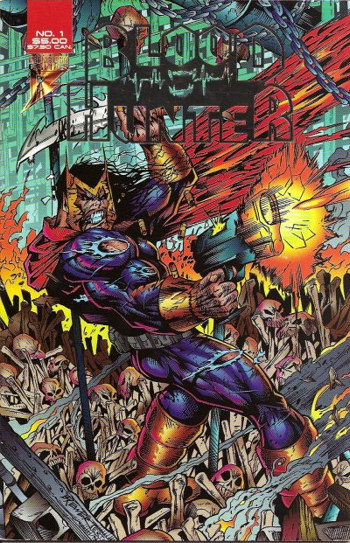
'90s Anti-Heroes are the polar opposites of your typical Silver Age superheroes. Not only are they flawed, they may lack any heroic attributes, apart from the fact that they never lose. They appeal to the audience strictly due to being totally committed to... whatever the hell they're doing at the moment. They have no compunction about killing criminals and, indeed, this may extend to anyone who gets in their way; when confronted by classic archetypes, such as The Cape, they dismiss them as dupes and fools. To aid in this murderous work, '90s Anti-Heroes with superpowers tend to have superpowers of the directly lethal variety, usually these abilities are demonic or technological in origin, and never received through the idealistic good graces of anyone. The '90s Anti-Heroes who lack supernatural abilities usually make up for it by carrying guns. Lots of guns.
Male N.A.H.s are easy to identify: ridiculously muscled, and often wear lots of pouches or bandoliers. There's a good chance he's either middle aged with lots of long, grey hair and beard stubble, or scars, but either way, he's likely to be masculinity incarnate. He also probably has at least one eye that looks fake, injured, or diseased and he carries a ludicrously oversized gun or sword which no mortal could possibly carry.
Female Nineties Anti-Heroes, like most female superheroes, have large breasts and small waists, but unlike most female superheroes, this is often taken to disfiguring extremes. They don't tend to wear very much clothing (or if they do, it'll be typical superheroic barely-there "spandex" which showcases their exaggerated/inaccurate anatomy). But they still usually wear tights in some form. The ultimate extreme of the female version was the "Bad Girl Comic" subgenre, featuring ludicrously buxom, near-naked Dark Action Girls, generally with some kind of supernatural nature or origin, hacking and pouting their way through plots designed solely to offer as much Gorn and Fanservice as possible.
Usually, they'll have gritty names at most two words long that wouldn't be out of place on villains, often creatively misspelled* to appear more dramatic, because poor literacy is kewl, to make the character look radical, or to make them easier to trademark.
In terms of characterization, they have one thing in common above all else. '90s Anti-Heroes are willing, if not outright eager, to use extremely violent methods and intimidation to solve their problems. As such, emotions are limited to further this goal: brooding, sarcastic, cynical, or just plain psycho are all common traits of the '90s Anti-Hero.
The one thing that keeps them out of villain status is typically because they're the story's Designated Heroes, and the stories they are in typically falls far on the cynical side of the Sliding Scale. In a world with Black-and-Gray Morality, the heroes may earn their "hero" status simply by fighting villains who are even worse.
Note that, in spite of the cynical-sounding write-up, this is not a bad trope. It's just that, as with most Darker and Edgier fiction, it's very difficult to describe without making the whole premise sound inherently ridiculous.note Something of a Discredited Trope these days, as most of the original comic anti-heroes have been Retooled or Put on a Bus; more often you see parodies of this kind of character, Deadpool being among the most famous, but they still come up occasionally in Video Games. As for why the '90s produced so many of this type of Antihero, Check out the Analysis Page.
If one of these is replacing an older more optimistic hero, you have an example of an Anti-Hero Substitute. It's also one of the stages of the superhero Reconstruction.
Commonly paired with Superhero Packing Heat.
See also: Sociopathic Hero, Action Genre Hero Guy, Designated Hero and Byronic Hero. Should not be confused with the Heroic Comedic Sociopath, who blatantly does bad deeds Played for Laughs. Generally, '90s Anti-Heroes tend to range from Unscrupulous Heroes to Nominal Heroes, though some can border on Villain Protagonists. Many Magical Girl Genre Deconstruction works are to Magical Girls in the 2010s what these were to superheroes in the 1990s.
Example subpages:
Other examples:
- Calvin and Hobbes: Being a six-year-old Nightmare Fetishist, Calvin thinks these are the coolest comics ever, though one Sunday comic shows that he does have his limits.
Calvin: Oh no, Captain Napalm's getting his kidneys punched out with an I-beam!
- Reconstructed in The Night Unfurls. The Hunter fulfils the basic requirements, being a dreaded, brooding, frosty, weary, and cynical Lightning Bruiser who mainly deals with irredeemable folk via three methods: a serrated cleaver to the face, a bullet to the head, and loads and loads of Gorn. Whereas deconstructions criticise this Character Archetype as laughable, destructive and unlikeable, The Night Unfurls asserts that the Hunter isn't purely defined by being an unrelenting onslaught that leaves behind mangled corpses in his wake. He can take a breather, he can feel contentment, and most astoundingly, he is capable of being a constructive influence in the setting.
- Lampshaded in A Prize for Three Empires by Captain America, who — after "Operation: Galactic Storm", an Avengers storyline published in 1992 — ponders about the rise of a new breed of heroes who appear completely unconcerned with killing.
"I'm thinking of stepping out, Carol. This new age seems to be an age for killers—The Punisher, Wolverine, U.S. Agent. I've only killed one person in recent times. Flag-Smasher manipulated me into it. I didn't like it. I'm not a killer anymore."
- Many of the Guardians from Super Smash Bros.: Guardians Arise! fit this trope to a T. You have: a bunch of trigger-happy weapon-toting loose cannons (Pikana, Aly), mechanical limbs (Heather, who also packs a bloodthirsty Superpowered Evil Side), eagerness to use violence as a means to survive (Cameron, Golfer), sometimes disfigured individuals (Chester, KOR), rather grim and brooding mindsets (Traca, Golfer, Wrath) and some with edgy names (Heather Elektra Wolfon, KOR).
- Sever (Lucy Liu) from Ballistic: Ecks vs. Sever, a gun toting Dragon Lady dressed in black leather with a perpetual Kubrick Stare on her face and on a quest for revenge against her corrupt former employees. She isn't above kidnapping a child in order to achieve her goal, and usually gives short and cold responses to someone like "I'll Kill You!" and "Pain don't hurt."
- Batman v Superman: Dawn of Justice features a particulalry hardcore Batman who has long since given up on his principles after twenty years of constant crime-fighting. Fridge Brilliance as the film is set in The New '10s and he mentions being active for twenty years — in other words, since the '90s.
- Parodied with Huntress in Birds of Prey (2020), a former Mafia Princess turned violent assassin who rides a motorcycle and vows revenge on the gangsters who killed her family... and is also comically serious, has No Social Skills, and has the mindset of a rebellious teenage girl who desperately wants to be taken seriously by those around her. She just comes off as grossly immature despite her genuinely lethal skills and athleticism, especially with her insistence that people call her "Huntress" and not "the Crossbow Killer", and her cool, badass facade frequently cracks throughout the film. The only person who thinks she's legitimately cool is the Ax-Crazy Cloudcuckoolander Harley Quinn.
Black Canary: What the hell is up with this bow and arrow shit?
Huntress: It's not a fucking bow and arrow, it's a crossbow! I'm not twelve!
Black Canary: I love this chick. She's got rage issues.
Huntress: I DON'T HAVE RAGE ISSUES! - Blade, the main protagonist of the Blade Trilogy. He's a half-human, half-vampire who hunts and kills other vampires with ruthless efficiency, wear black leather and sunglasses and has a short yet intimidating name. Interestingly, the character actually predates the trend by close to two decades, having debuted in 1973.
- The Chronicles of Riddick: Riddick B. Riddick, who first appeared in the 2000 movie Pitch Black, is a morally ambiguous mass murderer who will kill anyone who gets in his path and is only good in comparison to the enemies he faces.
- Explored and parodied in Deadpool 2. Much like a number of his comic runs, Deadpool's central conflict is whether a morally-compromised Professional Killer who started life as a minor villain created by "a guy too lazy to draw feet" in a '90s comic where even the "heroes" were murderous psychopaths is actually capable of doing anything decent. This is specifically why his antagonist is Cable, a muscle-bound, gun-toting Cyborg soldier from the future with a many-pocketed fanny pack coming out of the same source material, who has become so much Darker and Edgier due to a Freudian Excuse he even Would Hurt a Child. By the end, despite his failings, Deadpool manages to redeem both Cable's still innocent target, and to a lesser extent Cable himself, proving at least to some degree his heart can be in the right place.
- The Demolitionist, a B-Movie from 1995, is about a ruthless, revived cyborg woman (played by Baywatch sex symbol Nicole Eggert in a Spy Catsuit with added boob armor) with Guns Akimbo fragging anyone who gets in the way of her quest for vengeance against those who killed her. Essentially a rebellious Distaff Counterpart of RoboCop.
- Hakaider from the anime/tokusatsu series Kikaider becomes this in the movie Mechanical Violator Hakaider.
- Mr. Furious in the movie Mystery Men is a parody and subversion of these kinds of characters. He would very much like to be one, and tries his hardest to come up with a back story fitting this mold (with most of his proposed names being some combination of 'Phoenix', 'Dark', 'Dirk' and 'Steel'), but is in fact ultimately a rather shy, gentle, and meek man called Roy. In fact, the realization that he's not one of these types is enough to prompt a moment of Heroic BSoD for him.
- Deconstructed and satirized in Small Soldiers in the form of the Commando Elite, a group of toys given sentience via a military-grade microchip who invoke this trope in-universe. They are willing to use whatever methods to find and destroy the Gorgonites (whose only crime was not being human like them), including attacking bystanders who had no involvement with either side of the conflict, kidnapping and attempting to kill hostages, and turning a girl's Gwendy dolls into killing machines with one of their fallen comrade's microchips. Chip Hazard, the Commando Elite's leader, repeatedly justifies their actions because the Gorgonites are "the bad guys" and they are "the good guys".
- The Suffocator of Sins
 , directed by and starring "Diggity" Dave Aragon of Pimp My Ride fame, was to feature a Darker and Edgier Batman-like vigilante who, based on trailers that were released for it, is strongly implied to be this trope, using firearms and mercilessly killing criminals while hunting down a Neo-Nazi villain. The film now seems to be in limbo following the 2012 Aurora Theatre massacre, whose perpetrator, James Holmes, seemed to have been inspired by it.
- The Terminator. More specifically, the one from 1991's Terminator 2: Judgment Day, who is a musclebound, leather-clad cyborg with no hesitation against destroying anyone who got in the way of his directive, until he is ordered by John Connor not to kill anyone, whereupon he starts gaining a conscience.
- Doctor Who New Adventures:
- Ace becomes one of these. On TV, she had been a rather messed-up but still quite bubbly and exuberant schoolgirl with a taste for explosives and chemistry. In the books, she became a hardened and gritty Blood Knight space marine. It was relatively mild compared to some examples of the time, but it was this trope nonetheless.
- Several of the Doctor's other companions in these stories were also quite close to the '90s Anti-Hero archetype, also being rather hardened and angsty space marine types.
- Parodied in The Man In The Ceiling by Jules Feiffer. Jimmy's friend Charley Beemer (who doesn't like capes) commissions him to draw his idea of a comic, which would feature a superhero named Bullethead, a weapon of death who drills through his enemies with his head, with lots of severed bodily parts to be drawn in detail (which the author refuses to show, since it's written for children).
- IN THE SUPERHERO SATIRE,Tales of the Astonishing Black Spark, DEATHRAGE. HIS SUPERPOWER IS GUNS, HIS PARENTS ARE DEAD AND THE CAPSLOCK KEY SEEMS TO BREAK WHENEVER HE SPEAKS. ALSO, HIS PARENTS ARE DEAD.
- The Supervillainy Saga is a book starring a somewhat offbeat fellow, Gary Karkofsky, who finds a magic cloak and decides to become a supervillain. The book Deconstructs the '90s Anti-Hero and The Dark Age of Comic Books by having Gary disgusted by heroes who kill and overly psychopathic villains. It also serves as a Decon-Recon Switch because Gary, himself, is a well-written '90s Anti-Hero. The book, notably, treats Lighter and Softer superheroes significantly more sympathetically than most examples of the Capepunk genre.
- Worm has Shadow Stalker, the loner vigilante who joined the Wards as an alternative to prison for nailing a man to a wall with a crossbow. She serves as a deconstruction of the Character Archetype, and is roundly despised as a thug, a bully and a petty sadist even by her own teammates.
- She only has one real friend who later abandons her when she is sent to prison, believing that Shadow Stalker has failed her own Social Darwinist philosophy, which is revealed to be nothing more than a Jerk Justifications for her own love of violence. The two supervillains Shadow Stalker hates and targets, Grue and Skitter, both show far more compassion and empathy than she does.
- Rachel from Animorphs may not look the part (being a pretty teenage girl), but fits it in terms of personality, being tempermental, bloodthirsty, and even a bit Ax-Crazy at times, to the point the other characters almost regard her as a Token Evil Teammate.
- An episode of Are You Afraid of the Dark? featured a comic book nerd becoming obsessed with the Ghastly Grinner, a violent '90s Anti-Hero type comic character who he thinks is the coolest thing ever. That is until this character comes to life, and he comes to realize just how uncool violence really is.
- The obscure '90s comedy series Bob, starring Bob Newhart, focused on a comic book creator of a Silver Age hero named "Mad-Dog", who was forced by his new employers in the '90s to reinvent his character into a hero of this fashion.
- Buffy the Vampire Slayer:
- In contrast to the more celibate and restrained Buffy, Faith loved drinking, fighting and having sex. She was also a more ruthless Slayer than Buffy, and temporarily became a villain after an Accidental Murder.
- Spike came as close to a televised version of Lobo as you could get. He rode a bike, lived for battle, hated all forms of authority, smoked ciggies and listened to rock n' roll. His Popularity Power ensured the heroes would never kill him off, and Buffy eventually fell in love with him.
- Wishverse Buffy is what Buffy might be like had Todd McFarlane or Mark Millar gotten their hands on her. Unlike Faith, she's grim and pessimistic. And she's killed by the Big Bad as the episode's plot is about to be concluded.
- An episode of Criminal Minds has a comic book artist create a character named "True Night" who seems to be one of these. It has plot significance because the ways Night kills the other characters in the comic reflect murders the artist is committing in real life. In fact, if one looks at the episode a certain way, it can be viewed as a deconstruction of this trope and Dark Age comics in general.
- An episode of Dexter features a comic book character (The Dark Defender) based on Dexter's Serial-Killer Killer self that is a perfect '90s Anti-Hero; "Stalker of the night, his blade of vengeance turns wrong into right..." The "real" Dark Defender, upon seeing a pin-up of the character, has the most satisfied smile on his face for all of three seconds before he shakes it off as absurd not for any moral reasons (Dex is a Poetic Serial Killer and proud of it), but because, "Miami's too hot for all that leather". He does later have an Indulgent Fantasy Segue where he crashes the key moment of his "Super Hero Origin", kills the bad guys and saves his mother from being hacked to gibbets with a chainsaw. In leather.
- Doctor Who:
- The Ninth Doctor. Though he came much later he still follows the formula perfectly, dark past, broods a lot, comes dangerously close to killing his enemies (being stopped just short by a companion), makes sarcastic one liners frequently and he dresses in a black leather coat.
- The War Doctor, with Nine's leather jacket, a Badass Bandolier and a more violent methodology. However he seems a deconstruction of this trope, he doesn't like how ruthless the other Time Lords are becoming and while prepared to destroy Gallifrey this is only a last resort, with the later Doctors disowning him for this. It is later revealed he hadn't actually destroyed Gallifrey but due to Timey-Wimey Ball it is three regenerations later that the Doctor remembers this.
- Hikonin Sentai Akibaranger has an episode that parodies Power Rangers by altering things so that it started in America in the '90s and was then adapted into the Japanese Super Sentai and not vice-versa. We're shown an image of a "Powerful Rangers" comic book cover, and the Red Ranger an overmuscled character in keeping with the style of the time. The Powerful Rangers seen in person are complete jerks, too.
- In a serial of Kamen Rider Double, the Cockroach Dopant runs a website where people list those that have wronged them for him to assassinate. While basically a glorified contract killer, he considers himself this trope, calls himself "Roachstar" and "the Dark Exterminator", and even has and draws his own manga in-universe.
- Galadriel in The Lord of the Rings: The Rings of Power is written like a 90' antihero because of the Adaptational Angst Upgrade and Adaptational Jerkass and barely has any of the heroic attributes of her book and movie counterparts. She is a Byronic Heroine completely driven by her grief and revenge. She wears armor, is brooding and snarky, proud, the most badass warrior and... is a tyke bomb ready to explode any moment because none of those traits are good for her mental stability. She wears armor and wields a sword because she cannot stop fighting, something she confesses to Halbrand. She has a toxic and self destructive behavior resulted from her trauma of losing her brother and husband to the Orcs and witnessing a devastating war that lasted for eons. She channeled all the resulted anger and hate at Sauron for centuries, until she ended up consummated by her obsession. In present, Galadriel is not even above threatening with genocide, and doesn't see nothing wrong with that.
- In-Universe example from The Office (US). Recyclops, a character created and portrayed by Dwight for a corporate-mandated recycling initiative evolves over the course of five Earth Days from a bland mascot to a violent destroyer decked out in black armour and weapons.
- Smallville lampshades this by having a comic-geek-turned-supervillain threatening to push Chloe off a tall building and that it is "big in the '90s".
- Xena: Warrior Princess. It's all there; stripperiffic costume, a dark, violent past, a name that is spelt with an "X", a distinct lack of compunction about killing her enemies, frequent brooding, sarcasm, and extreme badassery.
- Older Than Feudalism example: In The Bible, we have the story of Samson in the Book of Judges. While most Bible heroes had their flaws, Samson was characterized almost entirely by vengeance, and would often commit mass slaughter when something pissed him off — but those slaughters were of Philistines, whom God wanted dead too, so it's all right. His other major point of characterization was a weakness for women, to the point of committing a Too Dumb to Live blunder with Delilah. He even fired off a stereotypically-badass Bond One-Liner at one point — a possible English translation would be "With an ass's jawbone, I have made asses of my enemies."
- Frontier Martial-Arts Wrestling founder Atsushi Onita, along with his rival\sidekick and Shin FMW founder Tarzan Goto, who naturally got it started in 1989. Onita was more cheery and off base than most examples, with the trademark 'brooding' and willingness to destroy his own allies or even uninvolved bystanders to "make men out them" being Goto's trait but both were fond of extreme violence and believed everything up to landmines should be allowed in Puroresu. Onita also sometimes parodied top stars of "mainstream" Japanese promotions such as The Great Muta and also challenged kick boxers and mixed martial artists from K-1 and PRIDE Fighting Championships to face him in no rope exploding barbed wire death matches.
- The later top faces of FMW, Megumi Kudo, "First Son" Masato Tanaka and Hayabusa were less insanely violent, more subdued and socially adjusted faces who just happened to be in a very violent promotion. Though that changed for the latter when Kodo Fuyuki took control of FMW and declared he didn't want "superheroes" in his promotion, forcing Hayabusa to unmask and then putting the mask on a porn star to ruin his reputation. This caused the former Hayabusa to take on the name of H and become a delinquent who used the same tactics as the Fuyuki backed "Team No Respect". It was the less ironic face, Tanaka, who ended up being the one to personally defeat Fuyuki though.
- W*ING Kanemura from the rival promotion to FMW of the same name was initially a villain coming into FMW to invade but became a '90s anti-hero when another invasion from IWA Japan in the form of Victor Quinones's "Puerto Rican army" forced him to team up with the FMW Sekigun. Despite his Heel–Face Turn he still threatened his enemies with death, even when they weren't really enemies such as when wrestlers from ECW like Balls Mahoney came to celebrate FMW's success.
- Dramatic Dream Team had MIKAMI, a high-risk aerial wrestler with a Badass Longcoat, paramilitary attire and a somber personality, who carried around the wrestling equivalent of a big weapon (in this case, a metal ladder, used to enhance his aerial moves) and was nicknamed "Suicide Boy". If this was not edgy enough, he was also the usual tag team partner of Tanomusako Toba, a kickboxer-wrestler who was into the porn business.
- While the Gangstas New Jack, Mustafa Saed and D'Lo Brown were initially part of a race bating angle (and Brown would continue to be in them with The Nation of Domination and Thuggin And Buggin Enterprises), the former two would become '90s antiheroes when they jumped from SMW to ECW and their criminally violent tendencies were admired rather than feared, at least by the fans. Their opponents on the other hand...
- From 94 onward, Cibernético tended to be one whenever he made a Heel–Face Turn in AAA, as this was a "tecnico" who nonetheless killed off anyone who betrayed him (ever so briefly). Similar things can be said for his rivals Vampiro, La Parka, La Parka Jr and Mesías during their tecnico runs.
- When El Hijo Del Santo returned to CMLL from AAA, his long time nemesis Negro Casas had become an unironic tecnico and the two teamed together until September of 96 when Santo turned on him. As shocking as his Face–Heel Turn was though, it only worked in CMLL as Santo continued to be cheered everywhere else no matter what he did, making this a Heel–Face Revolving Door example. Even then, the CMLL fans gradually started cheering for him again too during and after a hair vs mask match with still tecnico Casas in 97, leading to Hijo Del Santo becoming this trope in CMLL too before eventually softening in September of 98.
- Late 90s WWF saw most of the babyfaces in this era act as such, with the charge being led by acts such as "Stone Cold" Steve Austin (originally given a stoic gimmick but then grabbed the microphone at King of the Ring and became an anti-authority rebel), The Rock (given a 1980s baby face gimmick ten years too late before he lashed out at the fans for disliking the gimmick and then targeted Austin), and D-Generation X (an Expy of the nWo with a more playful, less megalomaniac slant).
- The WWF trend was the direct result of having to compete with WCW, who hit on this concept with the New World Order. While the nWo were essentially just popular villains, the Wolfpac formed as definite 90s antiheroes up until the Finger Poke of Doom. The most successful aspects of the WWF's Attitude Era were directly inspired by the nWo, the Austin vs. McMahon feud, almost universally considered the key to the WWF's resurgence, is the nWo vs. WCW with the roles reversed. WWF also borrowed heavily from the growing underground success story known as ECW (Austin shared many traits with The Sandman, for instance) and allowed a number of wrestlers to develop their own grittier gimmicks but the need to change was a result of WCW's runaway success with the nWo angle.
- The No Limit Soldiers were a group of street-wise anti heroes formed in June 1999 by rapper Master P, partly to draw more hip hop listeners to watch WCW and partly to give his cousin Randy "Swoll" Thornton a break into the business (since he'd had no success since a stint with New Japan back in 1991). They ended up only lasting one month because their "street-wise anti heroes" ended up just acting like heels - particularly, Curt Hennig formed the West Texas Rednecks to feud with them because they attacked him for no particular reason when he gave Master P's brother a birthday gift - which left audiences confused at best and liking the supposedly-heel Rednecks more at worst.
- The head trainers of the Long Island Wrestling Federation's doghouse, Laithon, Lowlife Louie and Homicide, as well as many of the graduates, the most notable being Low Ki, who went on to form a tag team known as "The Strong Style Thugs" with Homicide, who were openly cheered when they stole the JAPW tag team titles from The Hit Squad.
- Carly was a late bloomer, as though he certainly looked like a '90s antihero when he debuted in the '90s, wrestled similarly to both The Rock and Stone Cold, and had a signature foreign object in the form of a shovel, he was a nice enough guy who simply had to resort to such tactics to save the family business (the Puerto Rican version of the World Wrestling Council) from La Familia Del Milenio. It wasn't until the mid 2000s that he became a complete jerkass too, such that he at one point hated getting baby face pushes because he felt someone who insults, spits on, and poisons people shouldn't be cheered.
- The ongoing success of MMA (UFC in particular) in 2010 has seen a partial revival of this trope in WWE with the resurgence of the newly-turned Randy Orton (especially when compared to his Hoganesque counterpart John Cena).
- Referenced by Rory Mondo in CZW, where he complained that the baby face Danny Havoc went too far when he tried to light him on fire when the match stipulation was barbed wire casket. Havoc responded that if Mondo didn't want to burn alive he shouldn't have kicked out. CZW did start in the 90s after all.
- Given the cyberpunk setting, the player characters in Shadowrun can be this since the game's rules include giving the character cybernetic body parts, edgy clothing and a variety of exotic weapons and deadly powers. Most Shadowrunners in-universe are also relatively amoral mercenaries, and many pay little heed to the lives of civilians (though spree killing is generally seen as Stupid Evil).
- Many superhero games, such as Marvel Super Heroes, forbid this through use of Experience Penalties for killing. A character who is willing to kill will not be a functional PC.
- Vampire: The Masquerade signature character Lucita y Aragon qualifies in concept, being a rebellious, vengeance-driven, attractive, shadow-wielding assassin-vampire with a penchant for skimpy black leather, but in the associated novels, it depends on the writer when she's an angry, spiteful ball of hate and when she's more subtle, reasonable and controlled.
- Chainsaw Warrior from Games Workshop was a '90s antihero from the '80s as the game came out in 1987. He's a grim and quiet bionic Super-Soldier who did black-ops for the US government until his retirement and now living in a rundown apartment in New York. When called back to action against the zombies, cultists, mutants and the Darkness, he straps on a Laser Lance and whatever military hardware that Uncle Sam can provide him - including a trusty combat chainsaw.
- Champions had the supplement Dark Champions, published at the height of the craze in 1993, that allowed roleplaying any of these characters you wanted to create.
- It was subsequently dialed back in 2005 with Dark Champions: The Animated Series, meant to emulate the lighter feel of the DC Animated Universe and the like.
- Sentinels of the Multiverse:
- KNYFE has a stronger moral compass than the standard, but she's still a hard-drinking, hard-fighting, foul-mouthed commando who has lots of sex, is willing to kill her enemies, and spells her name with a Y (it's a backronym for bonus points). Early concept art even had her in black leather, per Word of God, although she tends to favour more sci-fi outfits in her primary design. In the Letters Page episode about her, Christopher even comments, "In case it's not obvious, she is a '90s character."
- The Xtreme Prime Wardens are an Affectionate Parody of the whole thing, with a punk rock Argent Adept, Fanatic with a crucifix branded over one eye, Tempest in black leather and so on. Their entire world is covered in Mad Max vehicles and chains with pointless spikes on them.
- Mutants & Masterminds 2nd Edition's Iron Age sourcebook is entirely dedicated to the trope, with rules for lethal damage (damage in M&M is otherwise non-lethal), Darker and Edgier character archetypes, and new additions to the Freedom City setting like the anti-hero team FORCE Ops and a Watchmen-inspired Super Registration Act storyline.
- Warhammer 40,000 did this in 1998 with their 3rd edition which was the bleakest iteration of the 40K franchise with the rot in the Imperium, the Eldar and their heroes at its highest level (plus the Squats became Tyrannid food and the few survivors Imperial slaves). The reason for this Darker and Edgier turn was the negative fan reaction to supplement book Realms of Chaos: The Lost and the Damned which had darker artwork than the earlier Slaves to Darkness sourcebook but far lighter and more hopeful in fluff - with the Emperor being in his most heroic depiction as the New Man, the promise of a benevolent new god "The Starchild" and etc.
- Parodied in Homestar Runner with the Xeriouxly Forxe April Fool's Joke, where everyone gets a more spiky, angular design, more weapons, gritted teeth, Xtreme Kool Letterz in their names, and angry faces. Except Homsar.
- Pico, the Series Mascot of Newgrounds: His debut flash, Inspired by… Columbine of all things, features a squad of goth kids tearing up the school, prompting Pico to grab the nearest assault rifle and pump them all with lead, whether they surrender or not. The majority of his Flashes embody the gratuitous edginess and Vulgar Humour commonplace in late 90s / early 00s Internet media; his appearance in the Assassin series is about him gunning down an M-rated mockery of Bear in the Big Blue House. While his default appearance doesn't exactly look the part, instead operating on Troubling Unchildlike Behavior, certain Flashes will age him up into a closer example or pit him against an NC-17 counterpart named Piconjo.
- The overall look is parodied in Commander Kitty, where after Nin Wah whispers to Zenith some ideas for CK's new threads, the android ends up designing for him a bulky outfit with enough spikes and pouches to make Rob Liefield blush.
- An issue arc of Spinnerette involves universe crosses between the "modern age" Spinnerette, her saccharine silver-age counterpart... and her '90s-era counterpart which plays every Liefeldian transgression to parodic levels.
- League of Super Redundant Heroes has a one-shot comic where one of these gets frozen Captain America-style and wakes up in the present day as a Fish out of Temporal Water.
- The titular Weapon Brown is a rare modern example played straight, if it isn't a dark comedy parody: mechanical arm, likes big guns, doesn't care about innocents, brutally kills his enemies, he's a Deadpan Snarker and his sidekick is a man-eating dog. Pretty much the whole webcomic is what happens if the characters from the various classic comic strip series are re-invented by Rob Liefeld and Mark Millar with a dash of Pat Mills and Garth Ennis.
- Atop the Fourth Wall: '90s Kid's ideal comic book hero is Bloodgun, a faceless dude with a gun that shoots other guns. Linkara himself mentions such heroes as "Gungun".
- Ashen the Vioblader (created by Matt McMuscles of Wha Happun?, Two Best Friends Play and Krooked Glasses) is the host of Edgelords, a show that examines '90s anti-heroes (and a few edgy villains), and fits this trope to a T. Edgy-sounding name? Check. Glowing red eyes? Check. Has a ludicrously edgy-looking outfit on? Check. Dual Wielding a pair of axes that he uses to chop his enemies up? Big fat CHECK. Unlike other anti-heroes, he's also a parody of this trope and thus displays some humourously dorky moments, like squeeing over an anti-hero's edginess, or having his show interrupted by a phone call from his mom.
- The Nostalgia Critic: Devil Boner!, introduced in his review of Small Soldiers (mentioned above under the Film section). He is a spiked-and-black leather-jacketed guy armed with a Machine Gun of Peace as well as the ability to pyrokinetically blow things apart with his mind, which is totally child-friendly.
- Being a Deconstructor Fleet for every superhero trope in existence, Worm naturally has a number of candidates, but Sophia "Shadow Stalker" Hess is probably the most deliberate example: "Edgy" codename and costume design, check. Relaxed attitude to using excessive force, check. Not actually all that heroic on close inspection, very check.
- Beast Wars has Dinobot, a Gruff Social Darwinist Unscrupulous Hero with a Velociraptor alt-mode and a large sword and a spinning weapon. He's characterised primarily as a Noble Demon Proud Warrior Race Guy, however.
- Parodied in an episode of The Fairly OddParents! in which Timmy calls upon the help of several different versions of the Crimson Chin to defeat an escaped supervillain, including a bandolier-wearing, gun-toting "edgy" version of the Chin from the '80s. He's apparently the only version who ever got away with profanity, but was canceled because of it anyway. Interestingly, the actual '90s Chin is depicted as more of a grunge rocker.
- The Pack was an (in-universe) live-action example in Gargoyles. The actors eventually turned into supervillains through a series of literal Xanatos Gambits, complete with actual powers and an even more Dark-Age-ish look.
- G.I. Joe Extreme has a very Rob Liefeld-esque feel in terms of character and weapon design, with some G.I.Joe Extreme members having a rather grotesque physique and lots of pouches. However, it's a bit of Subverted Trope, as their characterization doesn't get more edgy than Totally Radical dialogue and Leeroy Jenkins tactics.
- The Life and Times of Juniper Lee spoofed it with Boomfist, who battles an idiot Mad Scientist in a futuristic Crapsack World. Though to be fair, he does respect Juniper's abilities and makes a Heroic Sacrifice.
- The eponymous Major Lazer certainly has elements of this — bonus points for his BFG being a literal Arm Cannon.
- The Powerpuff Girls (1998): In "Super Zeroes", when the girls briefly decide to split up as separate superheroines, with Blossom taking on a Wonder Woman-ish persona and Bubbles dressing up as a cute Sanrio-inspired bunny girl, the sullen and quick-tempered Buttercup reinvents herself as "Mange", a brooding, shadowy character with glowing green eyes who only emerges at night — thus, when trouble arrives in the middle of the day, necessitating several hours of awkwardly brooding on the couch until nightfall.
- While not exactly a superhero, Enzo/Matrix in ReBoot is pretty much this trope to a T, as a foil to Bob's idealistic Silver Age-ish personality. He also serves as a partial Deconstruction of this type of hero. The events that made him this way such as losing an eye, being trapped in games, hopping from system to system as a result, and then suffering at the hands of Megabyte, and all this after Bob had been trapped in the Web had left him as an emotional wreck who has difficulty adjusting to peace.
- Skysurfer Strike Force featured typical "Iron Age" character designs, but was otherwise not very edgy.
- The Tick: Spoofed with Big Shot, a Punisher-esque character who shoots up inanimate objects while tears run down his face. After running out of bullets, he says "Why didn't you love me, Mom?" and collapses, sobbing, on Arthur. He's someone so obviously messed-up that the Tick tells him to 'seek professional help'. When next seen in "The Tick vs. The Tick," after Big Shot has done so, he's relatively well-adjusted and tries to convince the Tick and Barry to discuss their problems rationally. With emphasis on "relatively". He starts foaming at the mouth when he mentions how he used to solve all his problems with... violence, and gives a rather, um, passionate outcry for Barry to "put it in the happy box!". In his final appearance in the show on "The Tick vs. Neil and Dot's Wedding", Big Shot goes on a shooting spree... with a camera, having channelled his enthusiasm for firearms into flash photography.
- The Venture Bros.: While developed after the 1990s, Brock Samson is a semi-Affectionate Parody of this trope.
- Captain Sturdy, a pilot for a proposed series that aired as part of the What A Cartoon! Show, presents a subversion and parody of this archetype. The eponymous character, an aging Silver Age era superhero, watches as a '90s anti-hero type character demonstrates how a hero should approach criminals, and tells a hypothetical criminal to put his arms in the air. When the character is told "what if he has no arms?", the hero then does a 180 and begins to mope about the hypothetical criminal's misfortunates. Captain Sturdy already didn't have a high opinion of the '90s anti-hero character, but after this he especially became disillusioned with how the Union of Super Heroes are more concerned about avoiding offending people than doing what is necessary and pragmatic for the common good.
