
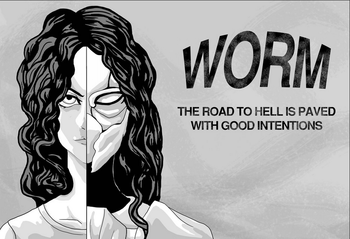
 to an official cover.
Worm by John McCrae, a.k.a. Wildbow, is a Web Serial Novel centered around Taylor Hebert, a teenager with a superpower enabling her to control bugs. It is the first novel in the Parahumans series.
Worm takes place in an alternate universe known as "Earth Bet". The history of Earth Bet very closely resembles that of our own Earth, but things rather drastically changed when a naked man with golden skin, going by the name "Scion", was suddenly found hovering in the middle of the Atlantic Ocean in 1982. Following Scion's appearance, a fraction of the human population found themselves suddenly gaining superpowers, usually a result of being faced with an extraordinary traumatic and stressful event in their lives; these incidents became known as "trigger events" and the superpowered people that resulted from them became formally known as "parahumans", informally as "capes". In the beginning, the sudden influx of these parahumans gave birth to the brief era that became known as the "Golden Age of Heroism", as many of them started using their powers in name of public good and helping people. But in the late 1980s and early 1990s, this Golden Age gradually faded out, as a growing number of the parahumans instead started using their powers to commit crimes, something which presented an increasingly serious challenge to the parahumans who stayed on the path of heroism. In addition, the growth of the superpowered criminal element and the brutality of their crimes, resulted in widespread concern and discontent amongst the regular human population, resulting in several of the world's governments founding agencies to counter parahuman criminals.
Things would, however, seriously change again in 1992, with the sudden arrival of the "Endbringers"; giant monsters with cataclysmic powers. The activities of the Endbringers lead to serious destruction, causing the loss of millions of lives, as well as catastrophic and irreversible economic and geographic damage. As the powers of parahumans are desperately needed in the attempt to beat back the Endbringers and limit the damage they can do, the agencies meant to police the supervillains are forced to grant them varying degrees of leniency in return for their assistance in combating the threat.
The story follows Taylor as she quickly gets swept up in the chaos and complexities of the "cape" community of Brockton Bay by joining with a group of villains known as the Undersiders. Cape politics, factions, rivalries, information warfare, and the individual problems of the people beneath the costumes put even the heroes in something of a gray area. Taylor's actions in the midst of this leave her in a situation where she's forced to make some hard choices, facing the reality of having to do the wrong things for the right reasons.
Bullying has also been featured as a major element in the plot and character development of the main character. Over the first few plot arcs, though, the story shifts away from the hellish landscape that is contemporary high school towards the more uplifting setting of a bombed out city at the mercy of a roving band of psychopaths.
Worm launched in June 2011 and updated regularly on Tuesdays and Saturdays (and some Thursdays) until the final chapter was posted in November 2013. The story has earned much praise, with reviewers citing the creativity of individual powers, flow of writing, detail and action scenes as selling points of the work. In the blog post discussing the completion of the story, the author has expressed intent to re-edit the story and try to get it published.
Something of a bonus feature, if you're into story analysis, is the staggering amount of stuff in the comments to each episode. They span from meta-analysis, wild mass guessing from spot on to crackpot, Dark Comedy, to short stories in their own right. Since it's all jumbled up and not indexed, Archive Panic does not even begin to describe it.
Worm has several character sheets for the tropes applying to specific characters. A memes page can be found here.
Soon after Worm's conclusion in November 2013, Wildbow began a second serial, Pact. He eventually returned to the Wormverse with a interquel known as Glow-Worm, beginning on October 21, 2017, before starting the proper sequel Ward, on November 11, 2017.
Not to Be Confused with Team17's Turn-Based Strategy game about warfare earthworms.
Spoiler Warning: Worm is heavy on Wham Episodes, and has a fast moving Godzilla Threshold. Both this and the cast page are heavily masked by spoiler tape; WMG, Quotes, and the Moment pages (Funny, Heartwarming, Awesome, Nightmare Fuel and Tearjerker) are not. Open them at your own risk.
Worm provides examples of:
- Aborted Arc: Leviathan's arrival and the Anyone Can Die dice rolls to decide the survivors end up rendering the build-up to Kaiser as the next big local villain once the Endbringer threat is over completely moot.
- Abusive Parents: Rachel's mother abandoned her, Aisha/Brian's mom is negligent and uncaring, Alec's dad turned him into a sociopath, Panacea's adopted parents never wanted her, and Lisa ran away from a rich background to live on the streets just to get away from her father due to him exploiting her for her powers ever since her brother committed suicide. Taylor is the only Undersider who had caring parents, and it shows in how she acts.
- Adaptive Ability: Crawler's power. He obsessively seeks destructive powers strong enough to hurt him despite his own now-ridiculous durability, so that he can become stronger.
- Adults Are Useless: Played straight with Mr. Gladly and Taylor's head teacher. It's played with in regards to the other adult characters. It's tragically telling that when Taylor finally meets a genuine Reasonable Authority Figure, she suspects she's under some mental compulsion.
- Very painfully, Taylor's own father wants to help her, but due to a variety of reasons including It's Not You, It's My Enemies, failing to beat the school bureaucracy, and his own heavy handed attempts to reach Taylor, he's never able to help her when she needs it.
- Aerith and Bob: Rachel's dogs are named Brutus, Judas, and Angelica. Justified, as they were named by different people.
- Aerosol Flamethrower: Skitter creates one of these by hitting someone trying to light a Molotov Cocktail with pepper spray.
- Agony Beam:
- Bakuda turns the tables on Taylor and her team using a pain grenade that has this effect.
- It's also one of Butcher's attacks, relying on line of sight.
- The Alcatraz: The Birdcage, a prison fitted into a mountain where a hole in a wall creates a deadly vacuum. It is designed to only have people go in and not come out. Despite the powerful people it holds, no one has ever escaped. Until Khepri got around to breaking people out using Doormaker's powers.
- Alien Space Bats: Worm is set in a world that was originally our own, but diverged with the real world thirty years or so before the time the story was written due to people developing superpowers. "Our world" exists as an alternate universe that can be traveled to. However the existence of the city of Brockton Bay where most of the city is set, which does not exist in the real world, has led to a lot of Wild Mass Guessing about why it is there.
- All There in the Manual:
- The cast page describes the powers of several characters who haven't been seen much in the story.
- Things such as the salary of Protectorate and Wards members, as well as what the number classifications actually mean can be found on this document for PRT Quest.
- All Up to You: Taylor is forced to take the initiative and lead the fight against Behemoth as everyone else who could lead is either dead or incapacitated as the fight grows increasingly desperate.
- Alternate Timeline: Scion and other powered individuals started to show up during the early 80s, and the Endbringers' presence in particular has caused some major changes.
- Japan isn't a world power due to a past attack, several parts of the world are simply gone, and the US has a lot of Asian immigrants from devastated parts of the world.
- On a more positive note, it's also hinted that thanks to Scion the events of 9/11 and Hurricane Katrina were averted.
- Perhaps on a more mixed level, comics in the Wormverse never quite got to the bronze age, likely due to the presence of parahumans.
- Betamax is implied to have won out over VHS.
- Alternate Universe: A multitude of parallel versions of the main setting, Earth Bet, have been confirmed to exist. Earth Aleph was contacted via an accidental hole torn in reality by a Tinker in 1988. There's communication and an exchange of news and media between them, and yes, they botched the Star Wars prequels too. Doormaker's power enables movement between Earths, while living off of multiple versions of planets is how the Worms survive. Additionally, Scrub and Labyrinth made Tattletale's gate to a world without people.
- There's a twist on the Alternate Universe. Unlike in a lot of fiction, where the alternate universe is filled with the same people, only slightly different, the alternate realities have the same people up to a very clear point of divergence. Immediately after that point of divergence, any person conceived is distinctly different from that in another timeline, simply because of the butterfly effect.
- Always a Bigger Fish: Before the events of the story, one of Glaistig Uaine's victims was Gray Boy.
- During the events of Gold Morning, the remaining Endbringers assist in the battle against Scion. It doesn't work.
- Ambiguous Ending: Either Contessa disabled Khepri's powers and Taylor is alive with her father in another world, or Contessa actually just put her in a coma and Taylor's epilogue is All Just a Dream. Wildbow discusses it here.
- Ambiguous Innocence: Bonesaw in a nutshell. She's one of the worst serial killers in the Wormverse, but she doesn't necessarily do what she does because of malice. Rather, she feels the idea of a concrete moral system is absurd and doesn't apply to her, and she does what she does because she finds it fun and interesting.Bonesaw laughed, and it was a sound without reservations, not shaped by social constraint or culture or self-censorship. It was the laugh of a child, free and without a care.
- Also played with in that it's revealed in her POV chapter that Jack purposefully manipulated and mentally broke her to give her the moral compass she has now by continuously mortally wounding her parents for her to save over and over again, until she was so tired that she had no choice but to give up. How much of this excuses her behaviour is left up to discussion.
- And I Must Scream:
- What Shadow Stalker must have been feeling when Regent had control over her.
- Grue, Cherish, and Blasto after being variously caught by Bonesaw.
- When we see Gray Boy's power, we see that it is obviously suited to the purpose. Aside from the fact that his victims can still technically scream.
- Most of the surviving cast experience this once Taylor's power is jailbroken, as they're all controlled by her against their will, at least for a while.
- And the Adventure Continues: The last epilogue shows the Undersiders gearing up to kick Teacher in the balls, metaphorically and probably literally as well.
- Animal-Themed Superbeing: Averted in the present day but Taylor mentions that in the past many heroes went the easy route and stuck -hawk or some other bird of prey on the end of their names (e.g. Laserhawk, Flame Falcon, Steel Eagle, Cockatoo, etc.) before it became unfashionable.
- There are still a couple examples, the most prominent being Canary.
- Another Dimension: The story takes place on Earth Bet, which has a certain amount of communication with Earth Aleph since 1988 thanks to a cape named Haywire — limited to data, but enough to transfer (among other, more important things) the alternate-universe versions of the Star Wars prequel trilogy, Episodes 1 and 2 of which the Undersiders watch.
- Annoying Arrows: Not so annoying, in fact:
- Shadow Stalker, a former vigilante hero in Brockton Bay, became a probationary member of the Wards after nearly killing someone by pinning him to the wall with one of her crossbow bolts, and as such restricted to using nonlethal bolts. (That said, as such, she didn't always obey said restriction, and she had as a vigilante and was willing to as a Ward kill with her bolts.)
- Flechette's superpower allows the bolts from her arbalest (and the throwing-knives which inspired her hero name, and anything else) to pass through or embed themselves in anything, up to and including Endbringers and Scion.
- Antagonist Title: The titular worms always intended to destroy the world in the end, after using it as a testing ground for powers. When that's no longer possible one becomes an Omnicidal Maniac.
- Anti-Hero: Something of a rule, given the setting — examples can be found somewhere among the cast of every subtrope.
- Anti-Villain: The Undersiders and the Travelers. In some ways, Cauldron.
- Anyone Can Die:
- The Wormverse is a dangerous place. Supervillains play for keeps, and the Endbringers are guaranteed to have a huge bodycount every time they show up.
- During the Extermination arc, Wildbow literally rolled dice to determine who would live and who would die amongst those fighting Leviathan, with not even Taylor herself being safe had her dice roll come up wrong.
- Apocalypse How: The world is in the process of a protracted Class 2 at the hands of the Endbringers. Each attack kills massive amounts of people, sometimes millions, causing significant distruption on a global level. Toward the end, Scion also inflicts varying levels of devastation on the alternate Earths he attacks, ranging from Class 2 to Class 4, except the destruction is caused over the course of a few days rather than 20-odd years. Additionally, at the end of their cycle, The Entities inflict Class X apocalypses on the worlds they go to.
- Appeal to Force: Somewhat played with. Skitter likes to resort to threats because she does not really like to hurt people, and hopes that scaring them off would avoid lethal consequences. For example, when she finds three ex-ABB gang members threatening her deputies:Skitter: It won't be pretty. Brown recluse venom makes your muscles necrotize. That means it decays while you're still alive. It takes days, but the only real cure is taking a knife to the area around the bite. That might be okay if you have one bite, carve out a half-pound of flesh, let the wound drain, stitch it up. But what if you have three or four bites? Or ten? It's excruciatingly painful. Nothing you experienced during your initiation into the ABB even compares, I can guarantee it. You're rotting alive, your flesh turning black as it liquefies. So maybe you shoot me. Maybe you even kill me, though I doubt it. Either way, whether I walk away from here alive or not, you get bitten. They're already on you. All three of you.
- Arbitrary Skepticism: In a world where huge numbers of people have powers that flat-out defy the laws of physics, everyone still thinks the capes who interpret their powers as magical are completely bonkers. While they're technically correct to dismiss magic, this still bites them in the ass — aside from a very thin coating of supernatural interpretation, Glaistig Uaine was one of the few people who knew exactly what was going on, and everybody ignored her solely because she used the word "fairy" instead of "alien". This is discussed by Tattletale when claiming to be psychic during the bank robbery when Glory Girl calls out her claim to be a mind reader on the basis that true Psychic Powers are literally impossible, as intercepting, deciphering and meaningfully interpreting someone's neural activity in real time would require far more computing power than can be obtained from a human brain. Tattletale replies that, in a world where people can and do manifest powers that allow them to warp space and time, ignore the conservation of mass and energy or shoot lasers that can turn corners, claiming that something is flatly impossible because it goes against the known laws of physics is a little less than logical. However, this it's subverted since Tattletale isn't actually psychic, just inhumanly good at reading people.
- Tattletale: Why is it so hard to believe? Legend can shoot lasers from his hands, lasers that turn corners. Clockblocker and Vista can mess with the fundamental forces of space and time. Kaiser can create metal from thin air. Conservation of mass, conservation of energy, basic laws of our universe get broken by capes all the time. All of that is possible, but I can't peek into your brain?
- Armed Blag: When the Undersiders are contemplating a Bank Robbery, Alec asks why they don't hit an armored car instead. Tattletale points out that it's no easier than just knocking over the actual bank since it would be protected by capes.
- Armor-Piercing Question: Emma uses one of these on Taylor as part of her bullying campaign.
- An Armor-Piercing Statement is later used to defeat Eidolon, courtesy of Scion
- Also one of the the primary weapons in Tattletale's arsenal.
- Arrogant God vs. Raging Monster: Armsmaster helps in the fight against the Endbringer Leviathan and seems to be beating him singlehandedly despite his great power, bragging all the while about how the Endbringer is too dumb to be able to fight back against Armsmaster's strategy. However Leviathan turns out to be smarter than he seems and turns the fight around.
- Arrow Catch:
- Flechette manages one when her arrival catches Shadow Stalker off-guard.
- Scion returns the favor much later.
- Artistic License – Law:
- Criminal defendants in the US, even those with public defenders, are allowed to request a different attorney if they feel the one they have is not working in their best interest. Ignoring electronic communication from a client is not only a breach of contract, but evidence of incompetence or willful negligence; and if this incompetence resulted in a nonviolent first offender appearing in court restrained in a way that would bias the jury against her, the defendant could petition the judge to declare a mistrial. The client would then be retried with a competent attorney and a new jury.
- Defendants in the US are also entitled to a trial by a jury of one's peers, which is commonly interpreted as a mandate that a jury include members reflective of the community's demographics, and multiple members of the defendant's demographic group. Meaning that a jury for the trial of a civilian parahuman would have to include a parahuman at the very least, preferably another civilian.
- Many American schools don't have "rules and regulations about the maximum travel times a student was allowed to have between home and a given school." So long as a student and their parents/guardians fill out the proper forms at both schools, they're usually able to transfer with very little hassle.
- If a student were bullied so severely she had to be admitted to the psychiatric ward and drugged to calm down, her bullies would likely face criminal charges. It's unlikely they would be tried as adults, but they might face time in the local juvenile detention center. Sending a victim to the hospital is serious business in the US.
- The general implication to Emma being able to get away with bullying is "she's rich", and Sophia being Shadow Stalker.
- Ascended Meme: Not so surprising, given the abundance of comments each episode. The author even takes time to address minor points that get asked a lot (e.g.: how does the invincible Alexandria cut her invincible hair?) when it does not break the flow of the story.
- One of the recurring jokes in the comments section is random posters pretending they do not remember who Imp is. Cue an interlude, with an In-Universe forum, where a poster (himself a cameo of an actual poster for added recursion) forgets Imp's name.
- Another recurring meme: the worst possible way to tempt fate In-Universe is saying "meh, I could take her" when confronted with Taylor. No matter how overpowered you are it's a guaranteed curb stomp. And then a Big Bad — Jack Slash — says "Eh, I can take you" to her face.
- Asshole Victim:
- The first large group of people attacked onscreen by the Slaughterhouse Nine are the Merchants, who are drug dealers and general scum of the earth. Your heart bleeds.
- Bakuda is an unrepentant Mad Bomber. In her backstory she held her university hostage for giving her a less than perfect grade. She goes on to implant bombs in innocents and carry out an indiscriminate Brockton Bay-wide bombing spree. When she meets her end, no one weeps.
- Shadow Stalker's extended Break the Haughty can also evoke this feeling, given its being welcome comeuppance for all the torment she's unrepentantly inflicted on certain characters.
- Assurance Backfire: Weaver's attempt to reassure Cuff that wearing metal won't make her vulnerable to Behemoth's lightning attacks doesn't come out so well.Weaver: I don't think you're any safer or worse off than anyone else. His lightning doesn't follow regular channels. We're all lightning rods to him.
(Beat)
Wanton: Not reassuring. - Astonishingly Appropriate Appearance: Averted, almost everyone with powers starts as a physically normal person, while the others have monstrous appearances typically unrelated to their powers. While some change appearance later or due to their power(s) most don't even go that far, instead faking stuff like fancy hair as part of their disguise.
- Attack! Attack... Retreat! Retreat!: The Merchants weren't afraid of Skitter's bugs. They laughed and joked as they invaded the Boardwalk. Then they start screaming.
- Audio Adaptation: The work has spawned two fan audiobook adaptations thus far; the now-complete Rein audiobook found here and the full-cast audiobook found here. The latter is very new but of high production quality, while the former is complete with only a single narrator handling each entire chapter. Both had wildbow give his blessing.
- Back-to-Back Badasses: Skitter, Weld, and Atlas vs. Echidna clones of several Wards.
- Badass Army: The Dragon's Teeth. The best PRT soldiers armed with the best of Dragon and Defiant's gear.
- Badass Bystander: When Skitter is fighting Mannequin, a then-unnamed man runs over and helps drag away and smash his head. That took major guts to do. The guy later gets a major rank in Skitter's organisation just because of it.
- Badass Normal:
- Coil's mercenaries and the PRT, all of whom fight alongside and against capes with only training and (relatively mundane) technology. Special mention goes to one of Coil's snipers who is pushed off a three story building and breaks his leg, but still manages to follow Skitter's directions and snipe the teleporting bastard that did it to him.
- Theo Anders prevents Jack Slash from murdering his half-sister and mother several months before he gets powers.
- Jessica Yamada, being a parahuman therapist, gets put in rooms alone with individuals who are dangerous by their very nature. On purpose. She psychoanalyzes patients while they're trying to crush her to death, and becomes the third person to save the world, after Contessa and Khepri, by talking Glaistig Uaine out of killing everyone.
- Jack Slash's power subtlety predicts and manipulates parahumans, so he is finally defeated by an unnamed, unpowered Dragon's Tooth soldier.
- Bad Guys Do the Dirty Work: A recurring theme, starting when the villains of the town (excepting the Merchants) ally to take down the Azn Bad Boys after the ABB starts its bombing spree. The fact that the Undersiders and the Travelers do so much to defend the city from the Merchants and the Slaughterhouse Nine in the wake of Leviathan's attack ends up becoming a major plot point when a large fraction of the highschoolers of the town ally with Skitter over the Protectorate when the latter try to capture the former at Arcadia High.
- The Bad Guys Win:
- The Undersiders do succeed in taking over Brockton Bay, although they are the Villain Protagonists.
- Jack Slash convinces Scion to basically destroy the world. Successfully. Scion is ultimately beaten but not before he does a lot of damage.
- Bait the Dog: Taylor is initially so persuaded by Coil's cool Pragmatic Villainy and his commitment to running the city better than it has been run before, even if he admits he's just doing it because of his pride, that she makes the final decision to work for him as one of the Undersiders rather than betraying them. Then she, and the audience, find out that Coil has kidnapped a child and is drugging her in order to use her future prediction powers.
- Bank Robbery: Taylor's first crime and superhero fight happens during one.
- Batman Gambit:
- Director Piggot pulls one on Crawler — fooling him into remaining in the path of the Bakuda-bomb bombardment that would kill him by the simple expedient of telling him it was coming.
- Skitter's I Surrender, Suckers gambit depended on Echidna charging her personally.
- Skitter pulls one when she escapes from an ambush by recruiting her fellow high school students to act as Human Shields against Dragon, Defiant, and Clockblocker.
- Batman Grabs a Gun: Skitter deliberately violates her no-kill rule when she executes Coil (with an actual gun) in order to prevent his return.
- Amy violates her rule of not using her power on people's brains, at first due to being forced by Bonesaw, and later using it on Glory Girl.
- Battle in the Rain: Leviathan attacks in the middle of a raging storm, that he might have actually caused.
- Becoming the Mask: Invoked by Victor when Tattletale suggests that his feelings for his partner Othala are a lie.
- Taylor presents herself as a ruthless criminal and warlord to cow people into surrendering/not attacking to avoid hurting them too badly. As the story progresses she becomes more and more ruthless, even if her intentions are still pure.
- Being Good Sucks: The heroes are outnumbered and are restricted in how they use their powers. Taylor laments that things would be so much easier if she didn't have a moral compass.
- Beard of Evil: Discussed by Regent.Regent: Hey, Monster girl.
Noelle: What?
Regent: When you make my clone, do you think you could give him a goatee? - Beware the Superman: The presence of parahumans has been a bit of a mixed bag at best for the world at large, but Scion definitely takes the cake for going omnicidal and trying to destroy every Earth.
- Big Applesauce: Taylor operates within New York City under her new identity as Weaver.
- Big Bad: Scion, the world's first superhero, is truthfully an alien Eldritch Abomination that introduced superpowers to Earth as part of his species' life cycle, making him indirectly responsible for every major conflict in the story. Furthermore, Scion's life cycle is intended to finish with the destruction of Earth, but the death of his partner leaves him unable to complete the process and stranded without a purpose. Cauldron committed all of their atrocities in the hopes of stopping Scion when he inevitably grows bored of the heroic role he adopted to pass the time and decides to wipe out all life anyway, which occurs when Jack Slash convinces him to return to his vicious, primal roots.
- Big Damn Heroes:
- Taylor first meets the Undersiders when they attack Lung before he recovers from being pepper-sprayed enough to be able to see her.
- A group of ex-ABB thugs are about to attack some of Skitter's other minions when Skitter arrives and drives them off.
- Bilingual Bonus:
- Bakuda's tinker specialty is bombs. Baku is Japanese for explosion.
- Lung is Cantonese for dragon. Guess what the guy named Lung turns into.
- A Birthday, Not a Break: Leviathan's attack on Brockton Bay happens to take place on Vista's 13th birthday.
- Bittersweet Ending: Scion's attack was devastating, but humanity is shown to be well on its way to rebuilding. And Taylor wins — and even seemingly survives — but she has to give up almost everything to do so, including her powers and all her friends.
- Black-and-Grey Morality: The protagonists are (morally grey) supervillains while the main heroes are working for a mysterious and unethical organisation (also grey, as it does create superheroes) and plenty of other superheroes are seriously messed up. However, although these heroes and villains fight, they all are willing to team up against the really evil threats like the monstrous Endbringers and mass murderers like the Slaughterhouse Nine.
- Blade Brake: To avoid being sucked into Bakuda's black hole explosion, she stabs the extremely high quality combat knife she was given into the side of a derelict shipping container.
- Blessed with Suck: While being a parahuman grants you extraordinary abilities, you have to have something truly awful happen to you to get them, many have nasty side effects, they can turn you into a target or resource to exploit for others, there is massive societal pressure for you to fight the Endbringers, and it's been revealed that the entities that grant abilities are intelligent and might be exerting some negative mental influence on your actions. The majority of parahumans shown seem to have quite a few issues.
- Blown Across the Room: Leet is blown so hard into a wall by one of his own light bombs that Taylor briefly thinks he died.
- Blood Knight: Many parahumans seem to become these after triggering; there is In-Universe speculation that this is because the power grants the entities influence.
- Bluff the Impostor: The fact of Regent's People Puppets power leads to Weld subjecting Shadow Stalker to this test when she shows up with several members of the Undersiders in custody.
- Bodyguard Babes: The twins Menja and Fenja fulfill this role for Kaiser. Until Leviathan shows up and Kaiser and one of them die.
- Body Horror: There are quite a few sources of this in the Wormverse. Biokinesis and biotech tinker powers tend to result in this fairly often if in the hands of the less than scrupulous, but other powers can easily react to living tissue in... less than pleasant ways as well.
- When Bitch transforms her dogs into their monstrous forms, their bodies grow faster than their skin can keep up with. They essentially burst from their hides like sausages splitting open, their engorged musculature calcifying and hardening as it goes and growths of bone bursting forth from beneath it. Once at full size, their surfaces become patchworks of torn skin, exposed flesh, bony spikes and plates, and patches of hardened, partially ossified muscle.
- Bakuda's two-twenty-seven bomb is a spatial warper that only affects organic substances, stretching, compressing, bending and twisting any living tissue within three feet of itself. Because this is purely a change in proportions — the affected tissue still connects and functions as before — it's never directly lethal, forcing its victims to live with their horribly distorted bodies. Bakuda likes to plant it inside people's bodies before setting it off, in order to maximize the disfigurement.
- Book Ends: The last thing we see Jack Slash doing is also one of the first things we saw him doing on screen: talking about how he doesn't like blank slates.
- Bond One-Liner: Imp's killing of Nice Guy is accompanied by one.
- Bond Villain Stupidity: Lamp-shaded and justified when Taylor is teleported into a burning building, shot and left for dead while gunmen surround the building to make sure she doesn't get out. Afterwards, Taylor wonders why the villain responsible went to all that trouble when he could have just teleported her to a bomb and detonated it.
- Justified in that when she asks Coil why he didn't do this, he admits that he tried to use a bomb repeatedly, and even teleporting her into a vat of acid, but the teleporter was built by Leet and went wrong whenever a bomb or acid was involved due to Leet's power actively sabotaging him, forcing Coil to keep changing the parameters of the scenario until he found a combination that wouldn't set off the inbuilt malfunction of the teleporter, and then Coil ran out of time due to the narrow window of opportunity and had to go with the burning building plan.
- Boring, but Practical: Skitter's extendable baton is surprisingly effective against various capes and villains. In general the story has a healthy respect for ordinary weapons like guns or knives, with various named characters being seriously wounded or even killed by them.
- Boxing Lessons for Superman: Members of the Wards are required to take lessons (e.g. in the theory of parahumans) as well as do patrols. Many villains train or research to improve their powers as well.
- Brian teaches Taylor physical combat so she can be more useful at a close range without relying on her powers. It turns out to be helpful when she fights foes like Mannequin who can No-Sell a lot of what her insects can do.
- Break the Cutie: So many get broken in this setting. Parian is probably one of the more prominent examples.
- Break the Haughty: Shadow Stalker's time under Regent's power. Emma has one when she learns Taylor's identity.
- Break Them by Talking:
- The speech that Eidolon's clone gives to the entire army of Protectorate and Wards heroes does this by driving a wedge between the Case 53s and the rest, as well as undermining their confidence in the entire organization they work for.
- This is Tattletale's usual battle strategy when she has to deal with opponents personally.
- It is later revealed that Contessa is capable of this as part of her powers. So is Scion, who takes out an opponent with just four words.
- Breather Episode: Between the action the Undersiders just hang out and shoot the breeze with each other.
- Bring My Brown Pants: Taylor mentions that Glory Girl's fear inducing aura caused her to nearly wet herself. She then follows up by saying she probably would've still had that reaction regardless.
- Burn the Witch!: It is mentioned that there are more trigger events in third world countries — witch burnings in Africa are mentioned by a professor giving a lecture on them.
- The Bus Came Back: Faultline's crew decided to leave and look for answers on Cauldron after the Endbringer attack. Although they're featured in several interludes, they're absent from the main story for several arcs before they return and assist in banishing Echidna.
- Bus Crash: Grue, who hadn't made it off the oil rig. We only find out way, way after the fact.
- The Call Knows Where You Live: The Travellers leave the story for a very long time, mostly putting their cape lives behind them, but are dragged back into events when Khepri!Taylor has need of their powers.
- Calling Your Attacks: Skitter briefly toys with the idea of categorising her abilities with phrases such as: 'Firebug attack, go!' or 'Silkwrap Strike!', but ultimately decides against it.
- Canon Discontinuity: What would have been when a Noelle-clone of Tattletale managed to manipulate Shatterbird, Vista, Weld, Shamrock, and Gully to escape the ruins of Coil's base and gain a management position in Weld's Case-53 mercenary group as a fake Case-53) was pulled a couple hours after it was posted when, after seeing
 the decidedly equivocal reaction of the fanbase, the author found himself dissatisfied with it.
 - Canis Major: Bitch's power makes these out of normal-sized dogs.
- Can't Get Away with Nuthin': Weaver talks to a group of middle schoolers about how the use of this trope in Drugs Are Bad PSAs is stupid, because (contrary to the trope) drug abuse is initially enjoyable — it destroys your life over time, not right away. She segues from this into her explanation of why being a supervillain isn't worth it.
- Cape Busters:
- The Parahuman Response Teams — PRT — are organizations of unpowered humans trained and equipped to fight supervillains.
- Coil's mercenaries are trained for roughly the same purpose against superheroes.
- Cardboard Prison: "The amusing but relatively harmless villains get a regular jail cell, they inevitably break out before the trial concludes, and the cat and mouse game starts again." The reason for this is that the safe villains are popular, entertaining, and occasionally helpful against the Endbringers and other threats. However, the actually evil villains get sent to The Alcatraz.
- Carnival of Killers: The Slaughterhouse 9 used to act as this for gangs such as the Teeth. By the current story they seem to have abandoned these side jobs in favor of straight mayhem.
- Cassandra Truth: Skitter and the Undersiders are greatly distrusted by the heroes when trying to inform them about greater threats. Perhaps justified as the heroes see them as somehow corrupting various people or using disasters to further their own powerbase.
- The Cavalry: Just when it looks like Mannequin is about to crush the immobilized Wards, Skitter rides to the rescue on a flying beetle bearing grenades.
- Cavalry Betrayal: Trickster when he sides with Noelle and gets several members of the Undersiders absorbed by her.
- Cell Phones Are Useless: Shatterbird's scream destroys all the electronics in the city, including cell phones. This makes Brockton Bay even more dangerous since no one can call for help in the city, and it's much harder to get news about where villains/gangs are.
- Cerebus Retcon: Uber and Leet are initially presented as comic relief due to their Awesome, but Impractical Crippling Over Specialization, with Uber's power to automatically master any one skill while he focuses on it undermined by his natural incompetence with anything that skill doesn't cover, and Leet being able to build any device he sets his mind to but the results blowing up in his face if it's too similar to something he's done before. It's later retconned that this isn't a limitation of Leet's power. His shard thinks he's not being violent and innovative enough, so it is subtly mind-controlling him into introducing these backfires in an attempt to either push him to behave more to its liking or to kill him and move on to a more suitable host, which it eventually succeeds in doing.
- Changed My Mind, Kid: When Leviathan has just left the shelter and knocked Skitter — at that instant the only cape in position to track Leviathan's movements — face-down into the water with a broken back, Bitch turns up with a pack of empowered dogs, rescues Skitter, and keeps Leviathan tied up fighting on the street long enough for Scion to arrive.
- Character Development:
- Many characters change over the course of the story. Among the main cast:
- The insecure, nervous, near-suicidal girl aspiring to be a hero that Taylor was at the beginning is very different from the supervillain who calmly executed Coil and felt bad for not feeling any guilt over it ... who is in turn different from the antiheroic loose cannon of a superhero that Weaver becomes, who is little like the omni-controlling borderline insane entity that Khepri ends up as.
- Bitch has noticeably improved in social situations, by her standards, thanks to Taylor's friendship.
- Theo Anders changes from a pudgy kid abandoned by his Neo-Nazi family to the superhero Golem capable of fighting toe to toe with the Slaughterhouse Nine.
- Many characters change over the course of the story. Among the main cast:
- Charles Atlas Superpower:
- Defied Trope. During Brian's combat training with Taylor, he notes that training can help with fighting ability, but an enemy's greater strength or reach could still be insurmountable obstacle without resorting to weapons or superpowers.
- Also played with as part of Worm's deconstruction/reconstruction of superhero archetypes. Rather than just personal training, powers/tech that grant Awesomeness by Analysis, such as the software in Armsmaster's helmet or the powers of Number Man, Contessa, Jack Slash, and the Harbinger clones, can allow them to perform seemingly supernatural feats of strength, agility, and stamina.
- Cheap Costume:
- Since anything bought can be tracked, those parahumans who do not join the government superhero organizations have put their own costumes together, with varying results. Taylor is one of the exceptions — she uses spiders to weave one out of spider silk.
- She plays this trope to an extent when she needs to have a completely different costume due to joining the Wards. The new costume is essentially made out of spare costume parts they had on hand; Taylor eventually makes a new spider-silk costume, however.
- Chekhov's Gag: In 3.4, it's mentioned that Professor Haywire created a portal to an alternate Earth through which they exchange DVDs, but the alternate version of the Star Wars prequels are still disappointing. Initially it seems like a throwaway joke but in arc 17 it actually becomes important to the plot.
- Chekhov's Gun:
- Doctor Mother mentions that one of Cauldron's capes can De-power parahumans. It gets used on Taylor at the end of story.
- In Flechette's Interlude, she mentions that a supernatural sense of timing is one of her secondary powers. She uses it later on to fool the vaunted Gray Boy into lowering his guard.
- Chekhov's Gunman:
- The leader of a contingent of kid heroes brought in to fight Leviathan is "a shirtless, muscled boy with metal skin, eyes and hair" whose name is never given. The tags on the bottom of the entry, however, confirm that this is Weld, who is brought in to lead the Wards. Fletchette is also present during the Endbringer fight.
- Thomas Calvert is introduced in the first bonus chapter of arc 16 (told from Piggot's Point of View) as the second survivor of the failed Nilbog mission. Cue another, later chapter of same arc which reveals that Coil's civilian name is Thomas Calvert.
- Inverted/Brickjoked With Noelle and her (apparent) Alternate Universe counterpart, who is only mentioned in passing by Eidolon.
- Oliver, the Non-Action Guy of the Travelers, turns out to be the key to defeating Scion.
- Coil's accountant is a supervillain banker by the name of The Number Man. He is later revealed to be Harbinger.
- Chekhov's News: The day after the Undersiders rob the bank, that event is pushed off the front page of the local paper, the Bulletin, by a report of a kidnapped child — specifically, Dinah Alcott, targeted by Coil for her precognitive abilities.
- Chest Insignia: A few superheroes and supervillains. Every member of New Wave has their own stylized one.
- Clark Kenting: The government keeps the identities of heroes secret to protect them and their families from retribution from villains. Averted by New Wave, who have gone public with their identities, though they seem to be the only ones for the foreseeable future due to the unbelievably terrible luck they have experienced since going public.
- Cliffhanger: More than a few chapters end with one.
- Colony Drop: One of the Thanda uses this as his primary means of attack.
- Competitive Balance:
- Lampshaded by the PRT, who break down powers into a number of categories as a shorthand for their combat advantages. Capes tend to fall under at least 1-2 (or more) classes, with the associated numerical ratings defining the threat level they pose to a PRT team. The PRT classifications are the following:
- Mover - Capes whose powers let them move great distances at a time. Includes flyers, Teleporters and speedsters.
- Shaker - Capes that can affect their surroundings in some way. Includes capes capable of bending or compressing space or creating forcefields.
- Brute - Capes who are extremely durable and/or have above average strength, either through Super-Toughness or an incredibly effective Healing Factor.
- Breaker - Capes that "break" the laws of nature for themselves, sometimes used when dealing with an Elemental Shapeshifter (how one can breathe if they're made of fire) or the Required Secondary Powers for a Super-Speed type cape (like altering how friction applies to them).
- Master - Capes whose powers allow them to control others or create minions.
- Tinker - Capes capable of highly specialized technological/biological creations years ahead of their time: from building laser beams or a Hover Board, to growing Mix-and-Match Critters. They're separated into two types, with specialty tinkers having a specific type of thing they build, while method tinkers are unique in how they tinker. Wide-scope method tinkers theoretically can create anything but with a catch such as Leet's inability to create the same thing perfectly twice, while narrow-scopes like Armsmaster are more limited but can create extra effects with what they do have.
- Blaster - Capes with a ranged attack, such as emitting laser beams, Hard Light, or Elemental Powers.
- Thinker - Capes whose powers deal with the mind, allowing for Awesomeness by Analysis, Sherlock Scan, or Precognition abilities.
- Striker - Possible subgroup of Breakers. Capes with the ability to apply an effect at point-blank range, whether it be an Elemental Punch or Healing Hands.
- Changer/Shifternote - Capes who can change or shift forms. Effects range from utilizing a Shapeshifter Weapon to Swiss-Army Hero abilities.
- Trump - Capes with powers that copy or interfere with other powers, or which give them access to many different powers in some other way. Includes those whose power gives them an Adaptive Ability, Power Copying, variable power loadouts, and Power Nullification.
- Stranger - Capes whose powers can be used for stealth purposes, be it an Invisibility Cloak, Perception Filter, or inflicting Laser-Guided Amnesia.
- Invoked Trope by the shards, which moderate the strength of the powers they grant their hosts to foster innovative conflict. Cauldron capes don't have such limits built in, which is why the likes of Contessa, the Triumvirate, the Travelers, and Case 53s make up the bulk of the setting's most powerful capes.
- Lampshaded by the PRT, who break down powers into a number of categories as a shorthand for their combat advantages. Capes tend to fall under at least 1-2 (or more) classes, with the associated numerical ratings defining the threat level they pose to a PRT team. The PRT classifications are the following:
- Conservation of Ninjutsu: The Slaughterhouse Nine are an S-class threat. Several of them individually sustain entire chapters as terrifying threats. The several hundred cloned Slaughterhouse Nine die in groups in a single sentence.
- Justified and even Discussed in-universe in that the reason the S9 were such a threat was that they were essentially terrorists, picking their fights to be in favorable conditions, and often evading straight up battle. The clone army, however, is sent to slow down the heroes chasing Jack, and can never fully exploit what made them such a nightmare while they were in the S9. Also factor in that nearly all of the clones were fought with the full knowledge of their weaknesses and how the original was taken down, and that their memories were cobbled together by Bonesaw instead of having years of real experience developing skills and building a connection with their powers. Of particular note is the Nigh-Invulnerable members that featured earlier: the Crawler clones are killed relatively easily due to not having a chance to build up their Adaptive Ability, and Jack sends all but one of the Siberian clones to a single location in such a tactically poor move the heroes muse it's specifically to have them killed off because they're boring to him.
- Container Maze: The Undersiders' fight with Über and Leet in Shell 4.5 is at the Docks amongst the shipping containers, apropos given that they're a duo of video game themed villains. Their ambush of the Undersiders fails so their backers, the ABB led by Bakuda, start an actual chase through the maze.
- Content Warnings: The author warns that this is a dark story and not your typical superhero setting.
- Continuity Drift: Exactly how some superpowers work changes slightly as story progresses and the worldbuilding solidifies.
- In the interludes for Dinah and Coil, she sees the numbers change when he splits universes, putting the alternative outside of her view and allowing him to ask how the numbers change depending on the actions he intends to take in the universe he's in. Later on, she is able to incorporate his power into her predictions just fine. This is because the author later solidified how alternate universes work, and his power was in contradiction of that. The Retcon of his power into a Thinker power that's only creating simulations he thinks are real and the general principle that's later established of Thinker powers often interfering with one another help smooth over the change, but that contradiction remains.
- In their first encounter, Tattletale claims Armsmaster's Tinker knack for miniaturizing technology only works in his immediate vicinity (one of the examples of Magic-Powered Pseudoscience), and is clearly implied to be on the mark. Later, after other justifications for Tinkers not sharing their toys are established (see Reed Richards Is Useless below), he is able to gift a small number of items with no issues about distance from him and no comment from him or Weaver about any such limit or lack thereof.
- In the same scene, Armsmaster has his helmet equipped with "psychic and empathic shielding," which doesn't do anything to stop Tattletale's power from working since she's not actually "psychic", but does block Regent's power and give him notification that Regent is trying and failing to affect him. This technology never appears or is mentioned again, and when Weaver wants to fight the Simurgh it's implied that there's still no defense against her genuine telepathy.
- Conveniently Coherent Thoughts: Justified as Scanner, a member of Teacher's Group, has this as his power. He's one of the few Telepathic thinkers who can interpret a targets thoughts into an understandable narrative form.
- Cool and Unusual Punishment: After a few thugs hurt a Japanese couple in her territory, Skitter introduces them to the wonderful anatomy of bullet antsnote .
- Cooldown Hug: When Skitter is trapped in the agnosia fog and deeply paranoid about trusting anyone, Jack Slash (impersonating Grue) gives her one.
- Coordinated Clothes: The Travelers all dress in black and red, New Wave dresses in similar white and their preferred color costumes, and the Wards wear identical concealing body suits to help surprise the 9.
- Cornered Rattlesnake:
- When Empire Eighty-Eight's members have their secret identities outed and Purity has her baby taken, they go on a massive rampage that the city's defenders are ill-equipped to handle on their own. Tattletale argues that this is why secret identities are respected in the cape community; parahumans are capable of far more destruction when they have nothing left to lose.
- When the PRT send Dragon and Defiant to capture Skitter in a cafeteria full of people, part of their reasoning is that by using this trope to drive Skitter to threaten the lives of hostages, they will undermine the Undersider's good will among the people of Brockton Bay.
- Their reasoning is actually solid, but in a way that they didn't expect: the rattlesnake, cornered, strikes out using PR instead of powers by publicly accusing them of putting civilians in intentional danger. On camera.
- Then it happens again to the same group of people, who apparently aren't capable of learning from their mistakes. In an effort to get her to break and give them intel on the Undersiders, the Protectorate trick Taylor into thinking that they had killed one or several of her friends. Instead of giving up, she lashes out and in her rage kills both Alexandria and PRT Director Tagg by suffocating them with thousands of bugs.
- The Corrupter:
- Flechette considers Skitter one after she convinces Parian to work with her.
- Several of the Slaughterhouse Nine seem proficient in this to some extent or another, most notably Jack Slash, at least partially because of his hidden Thinker power that lets him spot weaknesses and communicate with other parahumans' passengers.
- Cosmic Horror Reveal: It is revealed late into the story that the thing giving all of the superheroes and supervillains in the setting their powers is an Eldritch Abomination, part of a whole species of them that ranges throughout the universe giving sapient species some of their own powers to get ideas for what they are capable of before killing everyone on the planet, and the identity of this being is Scion, the enigmatic golden man who was seen as the world's greatest hope.
- Cosmic Retcon: When Buzz 7.9 was rewritten, wildbow said the previous version was "canon in many respects" ... because the previous version was an alternate universe that Coil terminated.
- Costume Copycat: Coil replaces Skitter with a highly convincing body double as part of his plot to keep Dinah over Skitter's objections.
- Covered in Gunge:
- The three bullies dump juice and soda all over Taylor when they find her hiding in a bathroom stall.
- Echidna leaves many of her opponents coated in vomit.
- CPR: Clean, Pretty, Reliable:
- It is actually shown realistically by Taylor with a overweight cape who was seriously injured by Leviathan. She gurgles up the water and everything.
- Later discussed when Imp attempts CPR and it's mentioned that it doesn't work like in the movies.
- Crapsack World: Let's count the ways:
- Due to how trigger events work, villains greatly outnumber the heroes, with the imbalance getting worse as more heroes are killed trying to limit the damage of the Endbringers. Many of them have quite a few mental issues and have very dangerous powers. Mass killings, attacks against civilians, killing heroes, and large amounts of destruction are treated as shockingly common things. In other parts of the world, things are even worse with some places being true hellholes run by parahuman warlords. Trickster states that buildings in the Wormverse are built to be much tougher than normal because everyone is expecting an attack of some kind.
- There is a vast, and powerful conspiracy of people that can give people powers and are committing large crimes against humanity on a regular basis. They claim they are doing it to save the world and have been doing it virtually unopposed/in secret for almost thirty years. They have had a hand in creating some of the worst monsters in the series, have potentially tens of thousands of victims they have killed, kidnapped, brainwashed, and worse. Despite it all, their efforts might have been for nothing.
- The head of the main government hero organization is under the aforementioned conspiracy's control and have carefully controlled its leadership with the top three heroes in on the conspiracy. The last three PRT directors in Brockton Bay were a racist, secretly a murderous super villain, and a Knight Templar warmonger who was willing to cross any line, respectively. The other directors seen have not been much better. The organization itself has displayed numerous examples of needless stupidity, short sightedness, and questionable morals in its decisions. A few of the "heroes" aren't much better than many of the villains they fight.
- The fringe elements that in our world are effectively powerless are much more dangerous in the wormverse if they can recruit parahumans. Cults, hate groups, even random drug dealers are much more powerful and influential.
- The Birdcage has been called a monstrous, unfair, and terrible place by its creator, other PRT Directors, and many readers. You are not given a chance of parole and are at the mercy of the inmates. Many prisoners do not deserve to be there but are sent there because it is the only place that can hold parahumans.
- As Taylor explains when she infiltrates Nilbog's territory, the people in the Wormverse have to always wonder if this is the day someone terrible gets a terrible power and a lot of people get killed. Nilbog is so dangerous that he got away with killing thousands of people because the government is afraid of provoking him into expanding from his small town, the Nine have been in operation for at least a decade and have killed thousands, including children, without ever being stopped, and then there are the many other S class threats in the world which are exceptionally horrifying and powerful.
- The Endbringers are slowly, systematically, and inevitably destroying the world piece by piece. They have killed tens of millions of people, and caused an unbelievable amount of destruction, pain, and suffering. All without putting any serious effort with their attacks. When the world begins to celebrate when one of them is finally killed, many people fall into despair as three more show up. And it's heavily implied they were accidentally created by one of the world's most powerful heroes as a byproduct of his power.
- It's all but stated that the Endbringers specifically target anyone who could make the world a better place in any meaningful way. Sphere, who was about to solve world hunger and the world's energy problems was corrupted into the serial killing Mannequin, Dragon's father was killed before he could make more AI like her or ease her restrictions, and Panacea was silenced before she could get the word out about the passengers and what Scion would ultimately do.
- Not only is Brockton Bay, a Rust Belt city, in an economic death spiral, the rest of the world is far poorer economically than our own. Three to four major cities are heavily damaged every year, to the point that even the United States considers it acceptable to abandon a large chunk of Los Angeles rather than rebuild. The People's Republic of China was replaced by a xenophobic isolationist state, meaning hundreds of millions of its citizens were never raised out of poverty. Western Europe suffered from the Swiss population becoming Manchurian Agents for the Simurgh, and France in particular had a major nuclear plant disaster at Lyon. Australia has even sealed off the ruins of Canberra with a giant dome.
- Many survivors of the Simurgh's attacks, civilians and trusted heroes alike, will either spend the rest of their lives quarantined from society and treated as pariahs, or they'll be executed. All out of fear that they may have been selected to make things worse. Not that it matters, since the quarantine procedures have been incorporated into her plans as well.
- The "passengers" granting parahuman abilities seem to be intelligent and actively promote conflict as a worldwide "proving ground" for passenger shards.
- All that up above and it actually gets worse. Scion, the only being who could fight off the Endbringers is actually the source of half of the world's parahumans and his goal all along was the destruction of the world. He decides to try and kill humanity off early thanks to Jack and starts blowing things up left and right. Billions of people are killed by his rampage, and many of the major factions went into hiding or started to fight one another believing that nothing can stop Scion.
- Create Your Own Villain:
- The bullying campaign that Sophia spearheaded is what caused Taylor to both have a trigger event and, later, to target her when Regent needed to take over a member of the Wards.
- Cauldron has this as a service. They will kidnap someone, turn them into a case 53, wipe their memories, and program them to lose to a specific person. An innocent gets sent to the birdcage/killed so a client can look like a good hero.
- Creative Sterility: Not only did Scion become a hero just because it was suggested to him and he didn't have a better idea of what to do with himself, the Entities' plan as a whole is based on this. They possess god-like power and are biological supercomputers capable of modeling the events of entire planets decades in advance, but they foster these planet-wide conflicts because they believe that violence breeds innovation and that outsourcing to a host planet provides a better chance of finding a way to beat entropy than what they could come up with on their own.
- Crisis Crossover: Despite being a stand-alone series in its own closed continuity, the major fights against the Endbringers (and to a lesser degree other S-Class threats) give off this vibe. This is partly because of the many interludes that show us brief glimpses into the lives of Heroes of Other Stories and the large amount of worldbuilding being done.
- Cruel Mercy: Skitter mentions how Shatterbird and Cherish probably wish that they were dead.
- Cryptic Background Reference: Many are explained, receive interludes, or become the source of later story arcs. Some, like The Sleeper, remain cryptic.
- Cryptic Conversation: Taylor has one with Glaistig Uaine.
- Curb-Stomp Battle: The Undersiders completely dominated the second fight they had with the Chosen, and they didn't even have all of their members at the time.
- Cute and Psycho: Both Bonesaw and Imp fit this in different ways. Bonesaw because she looks like a 12-year-old girl with golden ringlets, who performs horrifying biological experiments on her victims, and Imp because she is described as a pretty teenage girl who shows great enthusiasm for walking up to people and stabbing them under the cover of her power.
- Cut Lex Luthor a Check: It is almost impossible in the wormverse, because Tinkers are the only ones who can create and repair their own equipment and they have a very specific area of expertise. While in the past a few did nothing but build their devices and play tech support for them, it didn't work out due to severely limiting their ability to innovate and come up with more useful/powerful equipment and they just couldn't build enough of them by themselves to really change things. With a few exceptions such as the Guildnote , mass production is all but impossible.
- Dark and Troubled Past: Just about everyone with powers in the setting. There's a reason for this, however. For a character to unlock their latent powers in the first place, they need to have what's termed as a 'trigger event' in the setting. As Alec phrases it, "For your powers to manifest, you're going to have to have something really shitty happen to you." The only real exceptions come for children or siblings of parahumans and Cauldron's clients.
- Dark Is Evil: Legend states that most heroes wear brighter colors as per this trope.
- Dark Is Not Evil: Taylor and Alexandria both wear darker colors despite their heroic intentions. Although Taylor becomes a villain and Alexandria's interlude casts some doubt on her 'not evil' status.
- Dark Secret: When Cherish offers to help the Undersiders and the Travelers fight the Slaughterhouse Nine in exchange for being given two minutes to air their dirty laundry first, it becomes clear that someone in the Travelers has one.note
- David Versus Goliath: Taylor — a skinny fifteen-year-old girl with control over insects of all things — has her first fight against a regenerating fire-throwing villain who literally transforms into a dragon as you try to fight him and, we later learn, has previously walked away from a mano-a-mano fight with a Hero Killer Kaiju. Said villain almost certainly fails to make the top ten list of her opponents.
- A Day in the Limelight: The majority of the story is told in the first person from Taylor's perspective, but each arc includes at least one third-person-limited Interlude chapter following another character's perspective on the situation, and a few arcs (9, "Sentinel"; 17, "Migration") are told entirely from the perspectives of other characters.
- Deadly Dodging: Contessa uses it to great effect against Weaver and the Chicago Wards.
- Deadly Environment Prison: The Birdcage isn't hard to escape because it is filled with strong defenses, but because its defenses are fragile, trying to break free will just lead to you suffocating in the surrounding vacuum.
- Death from Above:
- Used by Skitter to take down Triumph with an ambush of bugs falling from the roof over the steps out of his house. She noticed from being ambushed by Mannequin that humans almost never look up.
- Later used when she comes across a cape that has a PowerNullifier ability. She ties a string of silk to the handle of a nano-knife and has her bugs carry it to where she estimates the center of the effect to be. After swinging it through a few blind passes, the effect (and presumably the cape generating the field) drops.
- Deal with the Devil:
- Anyone who makes a deal with Cauldron for Super Serum powers.
- Taylor's very first "employee" has this in mind when she asks her to find her brother and hurt the merchants responsible for taking him.
- Taylor has one with Coil, first unknowingly, then knowingly, as she attempts to free Dinah.
- Death of a Child:
- When the Nine attack a hospital, nursery first.
- Taylor shoots Aster. Though at that point it's more like Toddler Immortality that's being averted.
- Declaration of Protection: When Skitter took over the docks, she openly declares that she will deal with anyone who hurts her people.
- Decoy Getaway: The Slaughterhouse Nine confuse attacking heroes and villains by forcing plastic surgery on civilians to make them resemble members of the Nine.
- Taylor covers herself in bugs frequently, so she can create Taylor-shaped clouds as decoys.
- Many capes have the ability to create duplicates or illusions to such an effect.
- Defied Trope: The story gives quite a few examples, but the most obvious is in the first chapter when Taylor explicitly talks about how easy it would be to follow Carrie's Woobie, Destroyer of Worlds example and have a superpowered Roaring Rampage of Revenge against the bullies at her school — and how she refuses to go that route.
- De-power: In Battery's Interlude, Doctor Mother mentions that someone in Cauldron can permanently remove parahuman powers. This is done by Contessa shooting through the cape's Corona Pollentia without killing them, only possible through the insane precision allowed by her power. It gets used on Taylor at the end of the story.
- Deconstructor Fleet: Worm could basically be called Everything You Like About Superheroes is Bad, and You Should Feel Bad, with the entire genre savaged. Heroic and villainous organizations, the effect constant super powered fights have on society, character archetypes, binary moralities, and ultimately, why there are superpowers, are given very thorough, cynical explanations for their existence and consequences. For specific examples see the trope page.
- Description in the Mirror: Done by Taylor in the first chapter.
- Despair Event Horizon:
- Cherish passed hers not long after being trapped in a life-support unit with her negative senses cranked up to the max and forces anyone who comes near her prison to feel it too.
- Taylor crosses it after failing to prevent The End of the World as We Know It, rendering all the sacrifices she has made for the past two years meaningless, and learning of her father's death. She would have killed herself if not for Tattletale.
- Different States of America: The United States has had many changes both with and even without adding superheroes to the mix:
- Ellisberg, NY was turned into the personal fiefdom of the supervillain Nilbog following his trigger event, with his creations attacking any and all outsiders.
- Madison, WI was one of the cities that was walled off and quarantined following a Simurgh attack in 2009.
- Dollar coins are used as the primary legal tender instead of dollar bills and pennies have been phased out.
- 9/11 didn't happen because of Scion's influence.
- A side-effect of Leviathan sinking Kyushu is a much larger percentage of Japanese immigrants.
- Differently Powered Individual: People with powers in general are known as "parahumans," while those who put on a costume and try to become a villain or hero are referred to as "capes." Parahumans who try to use their power for neither crime nor crime-fighting (e.g. Parian, who takes paying jobs animating cloth mascots as promotional stunts) are referred to as "rogues."
- Dirty Business: A running theme of the story. A straightforward example occurs when Triumph wants to point out that Defiant is Armsmaster, a known criminal and fugitive from justice, but is convinced to pretend he didn't notice in order that Defiant can fight the Nine.
- Discarded, Not Delivered: Just as Taylor starts to write an email to Miss Militia with information she's gathered on the Undersiders, Danny locks her in the house and insists she come clean to him about why she's been missing school. She starts to write a letter confessing to him, but in doing so finally comes to accept that she truly belongs with the Undersiders and doesn't want to betray them. She deletes the email, burns the letter, and escapes with Lisa.
- Divided We Fall: Following Scion killing off half the world's population and everyone's efforts being incapable of stopping him, various groups decide to fight amongst themselves believing it's hopeless to resist.
- Dream-Crushing Handicap: Before triggering, Prism was an olympic level gymnast before suffering one of these. However, her siblings were still gymnasts, and she triggered from slowly losing touch with the rest of her family.
- Doomed Hometown: Defied — Brockton Bay sure gets more than its fair share of trouble, but those invested in the city go to great lengths to save it from being destroyed. That is, until Scion razes most of it to the ground, along with much of the rest of the area.
- Door Stopper: 1.65 million words.
- Do Not Go Gentle: The Undersiders decide to do this after failing to stop the end of the world. They talk over their priorities a little first.Canary: This is us? We're whiling away the time until the world ends? Giving up like everyone else?
Tattletale: What? No. Fuck no.
Imp: No. Wait, did anyone think that? Because I was thinking this was more us trying to decide what the hell we need to do before we throw ourselves into one final, suicidally reckless attack.
Taylor: Basically. Minus the suicidally reckless part. There's other stuff we can try first. But yeah. I think we're mostly on the same page here.
Bitch: Go out fighting.
Tattletale: Go out fighting.
Taylor: Nothing held back. Right. I'll need my stuff. - Dope Slap: Grue subjects Regent to a few of these when he won't stop wisecracking during the fight against Behemoth, partly because many of them are about how Grue is going to die.
- Double Standard: The double standard between heroes and villains really pisses Skitter off when she argues with Flechette about how people dismiss the many mistakes the heroes have made (to say nothing of their occasional but outright crimes) while dismissing most villains' good deeds as for some underhanded purpose.
- It's turned around on Taylor several times. She's willing to do terrible things in the name of the greater good but generally refuses to accept the same excuse from other people.
- The Drag-Along: After the Undersiders rescue Panacea from Siberian, she decides to come with them — but is very uncooperative during the fight against the Nine.
- Dramatic Irony: During the Behemoth battle, Regent doesn't stop wisecracking about how Grue is going to die. Guess who's the only one of the Undersiders that dies in the battle?
- The Dreaded:
- To ordinary citizens, the Slaughterhouse Nine seem like unstoppable horror movie monsters. The heroes treat fighting them the same way they do the Endbringers or other class S threats.
- Speaking of which, the Endbringers have killed millions of people, destroyed entire islands and cities, caused a water crisis, are one of the main reasons that heroes are always outnumbered because so many die fighting them.
- And while Leviathan and Behemoth are easily Godzilla Threshold material on their own, the Simurgh is so feared that the cities she visits are quarantined. No reconstruction. No recovery. Walls go up, the survivors get an identification tattoo, and anyone who tries to leave without authorization gets shot. Given what became of Sphere and the Travelers, this reaction is pretty much justified.
- Skitter, of all people, became this, as did the rest of the Undersiders to a lesser extent.
- The Sleeper, who holds the distinction of remaining past the Godzilla Threshold even when humanity is facing The End of the World as We Know It.
- Taylor brings along the likes of Ash Beast, noted as matching Scion in battle for a time, and the Endbringers, and still doesn't even consider calling on The Sleeper.
- Dressing as the Enemy: When Lisa and Taylor disguise themselves to infiltrate the Merchants.
- Driven to Suicide:
- Defied by Tattletale when she saw that Taylor was on that road thanks to the bullies.
- Turns out the reason Tattletale was so intent on defying this with Taylor was because her brother had committed suicide. She'd noticed he was acting differently before he died but didn't know why and, as they weren't particularly close, didn't really care about finding out. She got her powers from the stress of trying to figure out why he died, what she could have done, and her parents blaming her for not speaking up when she noticed how her brother was acting.
- May have been played straight with Emma.
- Driven to Villainy: Once the system had decided that Taylor was a villain, most of the heroes and the PRT became incapable of seeing her as anything else, and refused to consider the possibility that some of the things that she did might be because of good intentions. This pretty much forced her to continue being a villain.
- Dwindling Party: Unsurprisingly, given the body count, a few cape organizations undergo severe attrition:
- The Brockton Bay Wards — which only had seven members to start with — is possibly the clearest example: Even before the Time Skip, Aegis, Browbeat, and Gallant are killed by Leviathan, Shadow Stalker ends up in juvie after Regent gets through with her, Chariot (their only recruit) was a traitor to start with and vanishes in the aftermath of Coil's arc, Flechette (transferred in from another branch) undergoes a Hazy-Feel Turn and joins the Undersiders, and Weld (transferred in to lead them) leaves the Wards altogether when the truth about Cauldron comes out. Clockblocker is killed in the oil rig battle by Scion, but is possibly resurrected later. And finally, Scion kills Kid Win in a later battle. By the end of the story, Vista is the last member of the original group who didn't leave and/or die.
- Legend is the only member of the Triumvirate that survives the story.
- Dysfunction Junction: Every parahuman who had a trigger event has a problem, and most of those who didn't ended up with different issues. Heaping superpowers and cape drama on top of this just makes things worse.
- Earn Your Happy Ending: Dear God yes. Especially Defiant and Dragon.
- Earth-Shattering Kaboom: Doesn't actually happen, but it's part of the entities' life cycle, and it's what Scion and his counterpart planned to do to Earth in every possible reality.
- Eating the Eye Candy: Taylor is very aware of Brian's well toned body when she helps him put together furniture.
- Emergency Transformation: Taylor uses Lab Rat's device to undergo a temporary transformation into a monstrous, insectoid form after suffering lethal injuries at Scion's hands.
- Empty Chair Memorial: In the epilogue, Tattletale arranges the seating at the meeting to include extra chairs for Alec, Brian, and Taylor.
- Ending Memorial Service: After the attack on Brockton Bay, and some of the epilogues have these.
- Enemy Mine:
- The Undersiders team up with the other villains of the city to deal with the ABB, whose reckless destruction was disrupting business and bringing down too much heat on the city.
- When fighting class-S threats like Endbringers or Echidna, it's (theoretically and usually) standard for heroes and villains to set aside any differences.
- Indeed, the 'truce' regarding not using Endbringer events for personal gain is strong enough that any violation is seen as obscene. No one, hero or villain can step out of line without bringing down hell on themselves from all corners.
- Everyone ends up teaming up to stop Scion. It fails.
- Enhanced Punch: Acidbath's punches turn into splashes of Hollywood Acid as they connect.
- Enigmatic Institute: Cauldron is an institution with access to a secret formula to give people superpowers, which they sell for exorbitant prices to people regardless of whether they want to use it for good or evil, justifying this by saying having even villains with powers is necessary for when they all team up against the Endbringers' attempts to slowly destroy humanity. They stay secret, with their headquarters unknown and in an alternate dimension that one of their capes is capable of providing access to. It later turns out they are also experimenting on people they kidnap from alternate universes with new versions of the formula which often horribly mess with their bodies, and are planning this all out to mitigate the effect of Scion's upcoming rampage.
- Entertainingly Wrong: The events of June 20th (Arcs 18 and 19) end up being classified because the evil clone of Eidolon created by Echidna revealed the truth about Cauldron to everyone. Then Interlude 19 (Donation Bonus #2) shows us a thread from the In-Universe Parahumans Online forum, where from the sketchy data they have they come up with theory which is not only false, but leads them to specifically rule out the existence of evil duplicates of prominent superheroes.
- Epic Fail: Played for drama more often than comedy. This is the specific weakness of Thinkers - when their enhanced mental powers are operating off incomplete information, they tend to get things disastrously, spectacularly wrong. It’s how Alexandria, one of the most powerful parahumans on Earth, met her end.
- Equal-Opportunity Evil: Unlike the ABB which only accepts Asians, and Empire Eight Eight which only accepts whites, both Coil and the Merchants only care about how useful you are.
- Even Evil Has Standards: Many supervillians have a certain code of honour (not killing civilians, not harming children, respecting their given word), and tend to support the superheroes if they are in a fight against real monsters and serial killers. Just to see how much of a Crapsack World it is, a gang of Neo-Nazis is among the nicer villans (especially their subgoup led by Purity, who is more of a Well-Intentioned Extremist than being truly evil), in comparison to the many omnicidal maniacs plaguing the setting.
- Everyone Can See It: It is obvious to all the other members of the Undersiders—even Alec, who doesn't pay any attention to such things, and Rachel, who is literally as blind to such things as a human being can be—that there is something between Taylor and Brian.
- Evil Is One Big, Happy Family: Averted, villains fight each other as much as they fight the heroes.
- Evil Takes a Nap: The Endbringers spend most of their time between attacks in a dormant state. Unfortunately for everyone, they take these naps in the mantle or the mesosphere, so simply attacking them during this period isn't an option. As of the sequel Ward, they seem to be in this dormant state permanently, though the fear that they'll wake up remains a looming threat.
- Evil Versus Oblivion: When the Endbringers and eventually Scion attack the heroes and villains will call a truce to fight against them.
- While Jack Slash is excited about the possibility that he could end the world, Bonesaw is skeptical because she thinks living in the world is fun.
- Exact Eavesdropping: Subverted when Taylor hears Lung ordering his followers to murder children and attacks, only to discover that what she heard was Lung laying out the rules of engagement for a fight with a gang of teenage villains.
- Expendable Clone: Crucible, a hero who would normally never kill, has absolutely no compunction about incinerating a trapped clone while she begs for her life during the SH 9 fight.
- Expy:
- Several characters are clearly inspired by pre-existing comic book superheroes or villains, most often in a deconstructive way.:
- Armsmaster is the Wormverse's version of Batman- someone with no exceptional physical powers who relies on gadgetry (his tinker specialty is the ability to miniaturize so much that he can carry a ridiculous breadth of gear at once), extreme physical training and martial arts, being Crazy-Prepared (again, see his specialty) and on predicting the moves of his opponents (though using tactical software rather than intuition) to make himself the 7th-most influential cape in the protectorate. He also has the dark, ruthless, unfettered Anti-Hero thing down pat along with a major injection of Jerkass.
- Mannequin is inspired by Mister Freeze- a visionary scientist who turns to evil because of an attack on his family and now requires a sealed suit in order to survive. Snowmann, one of the hybrid villains Bonesaw created before Slaughterhouse Nine Thousand arc, even uses ice-based technology.
- Alexandria's basic powerset mirrors that of Superman with the addition of superintelligence. She also shares his vulnerability to suffocation. In terms of personality however, she seems to be inspired by Ozymandias from Watchmen- A physically and mentally superior Uber Mensch who becomes convinced that they alone know how to save to world and whose unfettered pursuit of that goal causes them to become a monster. Her name may be a Shout-Out (Ozymandias mentions the Library of Alexandria in his Character Focus episode near the climax of Watchmen).
- Legend is quite like Apollo from The Authority. A fast flyer with laser beams, is gay and Happily Married, and later adopts a child. They are also the respective Token Good Teammate of their teams.
- Ms. Militia is a reconstruction of the Captain Patriotic.
- Dragon is initially framed as an answer to Iron Man, but ultimately turns out to be a lot like a good version of Ultron.
- Piggot is a rotund normal in charge of supers who doesn't like her charges. In other words, a Race Lift of Amanda Waller.
- Velocity is a vastly scaled-down version of the Flash, complete with the predominantly red color scheme.
- Jack Slash is pretty clearly inspired by The Joker, especially The Dark Knight Trilogy version. Bonesaw's relationship with him in some ways mirrors Harley Quinn, though Bonesaw herself takes after Franken Fran. He also has literal Joker Immunity in the form of a secondary power that simultaneously feeds him information about the psychology of his parahuman opponents, and influences the decisions of capes who are opposed to him so that they never quite manage to follow through and kill him for good.
- Several characters are clearly inspired by pre-existing comic book superheroes or villains, most often in a deconstructive way.:
- Extranormal Prison: The Birdcage was specifically designed to be proof against escape even by the most powerful parahumans.
- Eye Scream:
- Some of the most disturbing acts Taylor has committed fall into this category:
- After Taylor and Lung's second fight, the latter's eyes are cut out of his head.
- Skitter and Valefor's fight ends with the latter being blinded when his eyes are filled with live maggots.
- In 26.5 Chevalier gets stabbed in the eye by a Harbinger clone.
- Some of the most disturbing acts Taylor has committed fall into this category:
- Faking the Dead:
- The supervillain Coil attempts this as part of his plan to take power in his other identity, Thomas Calvert.
- Foil uses a similar tactic to get the drop on Gray Boy.
- The Simurgh also employs it in the final battle against Scion.
- False Flag Operation: We learn about an operation in which Coil used a young child solider and a device made by Leet to fake a betrayal of the Undersiders by Skitter, thereby allowing him to both kill Skitter and keep Dinah, whom Skitter wanted freed. Unfortunately for his plans, Skitter survived.
- Family-Unfriendly Death: The rule, rather than the exception.
- Family-Values Villain: Marquis is old-fashioned or honorable enough to stick to the classic "no harming women or children", and avoided harming innocents... and was straight up badass enough to uphold those values despite living in the Wormverse. Not even Jack Slash was able to make him break his self-imposed rules.
- Fate Worse than Death: What happens to Cherish and Blasto, along with virtually anyone else who gets captured by Bonesaw. Also what Shadow Stalker and Shatterbird must have felt while under Regent's control. Then there's Grey Boy's victims, and arguably what happened to Glory Girl also counts.
- Fighting Across Time and Space: During the battle between Eidolon and Scion, the former proves to be powerful enough to force the latter to flee to a parallel Earth. He proceeds to chase him through multiple (and increasingly inhospitable) universes, including one without air and one where Earth is covered in volcanoes. Eidolon's sheer determination ultimately forces Scion to come up with a new tactic: he reveals that Eidolon's need for worthy opponents was what brought the Endbringers to Eidolon's world. This news utterly breaks Eidolon, and he allows Scion to kill him.
- First-Episode Twist: Taylor joins a team of supervillains, instead of becoming a superhero like she sets out to do.
- Flash Forward: After the appearance of a new Endbringer, the story skips to almost two years later, when Taylor is just turning 18 and about to be inducted into the Protectorate.
- Flying Brick: There are quite a number in the setting — it is referred to in-universe as the "Alexandria Package", Alexandria being the most famous flying brick around. That said, their powers work in different ways, even leaving aside the other powers that a number of them (including Alexandria) have.
- Flying Firepower: Usually referred to as "flying artillery", this is another standard role that parahumans in the setting — such as Legend, Alexandria's teammate in the Triumvirate — fulfill.
- Foil:
- Skitter and Trickster
- They both lead a supervillain team working for Coil
- They are both the 'brains' of their group
- They are both smart enough to turn a second rate power into something pretty dangerous
- They are both villains because of a girl imprisoned by Coil (although Noelle's imprisonment is necessary, while Dinah's isn't)
- However, Trickster is much less moral than Skitter, meaning he could be an example of what Skitter could become if she went too far.
- The Travelers are in the situation they are because of Trickster's bad decisions. He often does something, like drinking the vial, without thinking it through, while Skitter is more careful.
- Trickster's teammates, especially Ballistic, hate his guts and are only still following him because of a promise they made. On the other hand, the Undersiders, even Regent, are all on good terms with Skitter and respect her.
- Skitter and Trickster
- Forbidden Zone: Many places are so badly damaged or affected by villains or other unpleasant forces that the PRT has established quarantine zones.
- Gary, Indiana- evacuated and abandoned after riots and established villain presence.
- Freedom, California- evacuated after Pastor event.
- Eagleton, Tennessee- evacuated after Machine Army event.
- Ellisburg, New York- evacuated and sealed after Nilbog event, guards.
- Flint, Michigan- [Redacted]
- Gallup, New Mexico- evacuated and abandoned after established villain presence.
- Madison, Wisconsin- evacuated and sealed after Simurgh event, all measures in effect.
- Forced Addiction: After kidnapping Dinah Alcott, Coil has a doctor administer carefully selected drugs until Dinah will do whatever he asks in exchange for more "candy". He then pumps her for information from her precognition power, using disposable timelines to push her to her limits over and over again in finding out everything he can. For extra villain points, Dinah is just twelve years old.
- Foreshadowing:
- The Travelers stand when Legend tells everyone who faced an Endbringer before to do so. We later find this is because they are victims of the Simurgh.
- When Scion looks at Eidolon, he emits a strong sense of disgust — understandably, given that Eidolon is a thrall of Cauldron, and his shard comes from Scion's counterpart.
- A young man 'wins' a vial of Super Serum from the Merchants. He asks if he can share the contents between his friends. The Merchant's leader laughs at him like he's an idiot.
Skidmark: No, no. You definitely don't want to do that.- Tattetale speculates that Siberian is actually a projection of a real person. It turns out to be true.
- The conversation between Skitter and Triumph's dad about the need to breathe becomes relevant when she suffocates Alexandria.
- This is also foreshadowed by the fact that Leviathan tries to kill Alexandria by drowning her, and nearly succeeds, revealing that despite her invulnerability she needs to breathe to live.
- Skitter outwits Dragon's latest suit by using its AI's restrictions against it. This eventually comes back to bite everyone in the butt at a bad time.
- Kevin Norton mentions that Scion reacted when he heard the word "Zion".
- Discussed by Skitter:
Skitter: There's a sweet spot as far as rep goes. Having a pet Endbringer puts us in the 'too scary to be allowed to live' category.- Tattletale tells Skitter that there are many powers whose owners aren't fully leveraging their potential. It looks like a straightforward jab at Misapplied Phlebotinum at first but later it turns out that Skitter's power is one of those because with aid from Panacea it gets expanded from only controlling bugs to controlling capes.
- Also from there, Skitter hopes that "Cauldron had the clout to silence a few angry voices." Except we've already seen what their definition of "silencing" is... Some time later, cue a visit to her from Contessa.
- Earth Bet deviated from Earth Aleph 30 years ago, when Scion appeared in Bet but not in Aleph. The foreshadowing here is two-fold: The fact that Haywire couldn't find anything closer speaks to Scion deleting excess timelines, and the fact that Scion is the only difference at the time speaks to his involvement in the world's powers.
- Glory Girl's appearance after getting altered by Panacea turns out to be based on Panacea's vision of Eden during her trigger event.
- In arc 19 Interlude 2 one poster fears an Endbringer attack on the UK. Except it's not an Endbringer he needs to worry about...
- In Chrysalis 20.5 Skitter wonders if she's become able to control humans.
- In arc 21 Interlude 1 the Number Man suspects that Jack Slash couldn't have gotten so far on luck and instinct alone.
- Scarab 25.1:
"But all of the decisions they made were when I wasn't anywhere near them. Unless you're implying I have some sort of mind control."Nothing short of Alexandria or an Endbringer would stand up to Scion’s sustained laser beam for even a heartbeat ....- In Legend's Interlude he states that he can turn into light, which also degrades his ability for conscious thought while he's "under" until he reverts to normal. That's how he survives and comes out sane from being caught in one of Khonsu's time-dilation bubbles.
- A listing of recent Endbringer attacks has one by the Simurgh, listing target/consequence as "The Woman in Blue" and "United Capes". During the final battle, Kephri finds a world controlled by parahumans, led by a woman wearing blue
- Upon Taylor discovering that Bitch is one of the two members of the Undersiders who is a murderer, she wonders to herself who the other might be. The very next line is Alec walking up and joining the group.
- Peter mentions that people who trigger due to drug overdoses tend to have powers closely related to their emotional state. This foreshadows the circumstances of Lung's trigger event in his Interlude.
- Freudian Excuse: Due to the nature of Trigger events, nearly every villain is like this.
- Bitch was abused by her last foster family and goes on the run after accidentally killing them.
- Regent and Cherish were both abused by their father.
- Emma bullied Taylor because she thought that it would make her stronger.
- From Bad to Worse:
- Taylor and Brockton Bay can not catch a break. The most dramatic examples for the latter are the Leviathan attack followed by the Slaughterhouse Nine.
- Another dramatic example occurs when the defeat of Jack Slash leaves him in a position to talk Scion into turning against humanity.
- Gadgeteer Genius:
- People with the "Tinker" class of superpower, such as Armsmaster, Leet, Bakuda and Dragon, though some are more competent than others.
- It is revealed that Tinkers actually derive their designs from the accumulated knowledge of their passengers, which have recorded the technologies of alien civilizations.
- Gag Penis: The male members of the Chicago Wards decide to prank Taylor as the superhero Weaver by stuffing their tights in the crotch area and wearing gigantic codpieces.
- Gaining the Will to Kill: Skitter first uses lethal force to try and kill Coil, though she admits that he likely has an antidote to her spiders' venom. Later, however, she does end up executing him.
- Gayngst: Very deliberately averted. According to
 Word of God, Wildbow made Taylor straight to avoid the "angsty gay character" trope, which he considered overused. This can also be seen in the novel's other gay characters: Legend is Happily Married and generally optimistic, Parian and Foil angst a bit but get over it quickly and enjoy a healthy and stable relationship, and Regent isn't prone to angsting in the first place. That said, Panacea unfortunately plays this trope straight, though in her case the angst is as much because the object of her affection is her adopted sister, (who does consider their relationship close enough for the attraction to be incestuous,) as because of their genders.
 - Giant Flyer: Atlas may not be as large as most examples, but he's still a four-hundred-pound Hercules beetle capable of carrying Taylor around.
- Glamour Failure: Brian mentions in his interlude that Taylor acts more confident than a normal person does due to her power. For example she never looks around when the wind hits her or when she crosses the street because she knows everything that is happening in a several block radius.
- Godzilla Threshold:
- The Endbringers have caused so much death and destruction in the world that, according to Word of God, nukes have been used against them. It didn't work.
- To defeat Scion all the inhabitants of the Birdcage are released. It doesn't work.
- Taylor decides to attempt talking to the Simurgh. It works.
- In turn, it demonstrates just how severely The Dreaded the Sleeper is that, even with human extinction across all known Earths on the line, still no one dares to try bringing him into the fight.
- Gone Horribly Right: Taylor gets Panacea to break her usual 'no-brain tampering' rule because she feels useless in the Scion fight. She regrets it very quickly, but it does eventually save the world.
- Gone Horribly Wrong: The Slaughterhouse Nine come to Brockton Bay because there's only eight of them and they want a ninth member. By the end of their stay, there's three of them left, not that it seems to bother the survivors all that much.
- The Good, the Bad, and the Evil:
- Comes up again and again in the story, flexible alliances, Enemy Mine and the Godzilla Threshold being core themes of the series. The rough breakdown switches from arc to arc:
- Start of the story (Pre-Leviathan): The Undersiders, Faultline and maybe the Travelers are ''good''; The Protectorate, Empire 88 and Coil are bad; the ABB is evil. (From the Heroes perspective, The Protectorate, Wards and New Wave are good, all villains except the ABB are bad, and the ABB is evil).
- From Leviathan to the defeat of the Slaughterhouse 9: The Undersiders and Travelers are good, the S9 is evil, everyone else is some form of bad.
- From S9 to Echidna arc: Undersiders and Dragon are good (though opposed to each other), Protectorate and Travelers are bad, Coil is evil.
- From then on: Undersiders and non-Cauldron heroes are good, Cauldron and most other villains are bad, The Endbringers, Slaughterhouse 9 and Scion are evil.
- Comes up again and again in the story, flexible alliances, Enemy Mine and the Godzilla Threshold being core themes of the series. The rough breakdown switches from arc to arc:
- Good Is Not Nice: Several of the good guys showcased thus far have not actually been genuinely good people. It doesn't help that most people acquire powers by going through an incredibly traumatic event. The heroes who gain powers from Cauldron fall even harder into this trope.
- Good Powers, Bad People:
- The story uses this along with all the various related tropes to drive home its divorce between powers and the person's moral nature. Probably best seen in Bonesaw of the Slaughterhouse Nine who is young, cute and has implausible science powers in seemingly any biological field. She can perform impossible surgeries and even bring the dead back to life if their body is intact. Unfortunately she has no apparent sense of morality and her idea of fun and interesting ranges from bad to very bad.
- Panacea is terrified that she is doomed to become this despite or perhaps because of the psychological strain of her massive healing powers.
- Goofy Print Underwear: When Taylor meets Armsmaster for the first time, she's reminded of the fact that she used to have a pair of underpants with his emblem on the front.
- GPS Evidence: Tattletale is able to use to prove Armsmaster's guilt during the Endbringer attack using Dragon's armbands.
- Grave-Marking Scene: Taylor visits her mother's grave to talk to her about what she's done as Skitter.
- Gravity Sucks: Bakuda fires off a grenade that creates a miniature (but thankfully temporary) black hole.
- Greater-Scope Villain:
- Empire 88 are an offshoot of a more established German organisation called Gesellschaft, who sometimes send cape assistance over but are never confronted directly by Taylor.
- Cauldron is this for a large part of the story. Long before they directly come into the picture, they indirectly aid and abet a lot of the antagonists.
- Green-Eyed Monster: Sophia of all people admits that she resents Taylor at least in part because Taylor has a father who loves her (even going so far as to state she was more pissed off that Taylor's dad was there at the meeting than the fact that she was in trouble).
- Grenade Tag: Skitter uses a belt of grenades to help save the Wards from Mannequin.
- The Greatest Story Never Told: Echidna's attack becomes this, with a common refrain of people wanting to know what the hell happened on June 20, 2011, and most not involved having no idea who or what "Echidna" even is.
- Groin Attack:
- Skitter used these prominently on a couple occasions:
- On her first night out, when she was trying to take down Lung before his Hulking Out reaches a point where she can't hurt him, she sent her flying insects to attack his face and the crawlers (including her spiders) to attack "other vulnerable areas".
I did my best to ignore the feedback that I got from that particular attack, as I most definitely did not want the same kind of topographical map that the swarm had provided just a minute ago.- The above encounter, she used insects and arachnids including black widows, fire ants, and brown recluse spiders, spiders that cause flesh necrosis with even single bites. The way Tattletale put it in their meeting afterwards was telling as to how damaging the attack was.
"Let’s just say that even with the ability to heal several times faster than your average person, Lung is going to be sitting down to use the toilet."- Second, during the assault on the dinner post-ABB, she aimed her baton at this point on a speedster — who, as she found out to her dismay, had opted not to wear a cup to minimize friction.
- Skitter used these prominently on a couple occasions:
- Grin of Audacity:
- Tattletale always has one of these on.
- Skitter is cornered by five superheroes, two of whom are wearing Powered Armor, without her armor or weapons and with her superpower effectively neutralized. Then she realizes that her opponents are still leery of attacking. Cue grin.
- Guilt-Induced Nightmare: Taylor's guilt about Dinah and her father leads to her having a dream where she fails to save Dinah and her father turns out to be Coil.
- Had to Be Sharp: When Taylor visits the high school, she instantly notices how different the people who stayed in town during the events of the prior sixteen or so story arcs were from people who did not — a difference reflected in (for example) their attitude towards weapons.
- Hates My Secret Identity: Superhero Shadow Stalker sides with Emma in a fight with the person she has been bullying for the last few years, Taylor. Unbeknownst to Shadow Stalker, Taylor is actually Skitter, a supervillain she has fought in costume before, and unbeknownst to Taylor, Shadow Stalker is actually her other bully, Emma's close friend Sophia, which is why Shadow Stalker takes the side she does.
- Healing Factor: The Endbringers have one, allowing them to recover from their many fights, and it accelerates greatly the deeper the damage is, allowing Behemoth to regenerate visibly after being de-legged and having 80% of his mass blasted off. Regenerators have one too, of course, like Lung.
- Healing Shiv: When the Simurgh stabs Leviathan with a black, serrated sword, and he drops from one blow it was surprising enough for the assembled capes. But then he stands up again, with power upgrades.
- Heal It with Blood: Sanguine, a Case 53, is a blood manipulator and while seen useing it offensively he can also transform a subject's leaking blood into scabs and antibiotics to seal wounds and prevent infections.
- Heart Is a Terrifying Power: to give an example, one of the most scary serial killers of the setting has the super power of... being a really nice guy. Bystanders would consider him really nice even while he was disembowelling people left and right.
- A literal example with the villain "Heartbreaker" who is one of the parahumans in the "too dangerous to fight" category, and his daughter, Cherish, who is part of the Slaughterhouse Nine.
- Taylor herself. At the beginning, many people laugh at the ability to control bugs. By less than a third of the way through the story, she's considered one of the most dangerous villains in the world.
- Heel–Face Turn: Bonesaw has a dramatic one when influenced by Contessa.
- Heist Episode: Arc 3 features the Undersiders robbing a bank, and arc 6 features a heist on a huge event with all the Protectorate heroes and wealthy people in Brockton Bay attending.
- Hell Is That Noise: The Simurgh's song. The longer you listen, the more influence she has over you, until she can turn you into a Manchurian Agent. Or simply something like The Heartless, exactly like a normal member of society save for a desire to kill as many 'uninfected' people as possible. It's a mental effect that can't be muffled or drowned out and can a large part of a city.
- "Hell, Yes!" Moment: There's been a few (The portal and Calvert's death among them) but among the least ambiguous thus far is Chevalier's interlude, number 24. Behemoth down, bitches. And of course, The End.
- Helping Would Be Killstealing: Part of the Nine's survival game. They each take turns trying to kill the different candidates, until Skitter and Piggot change the rules.
- Hero of Another Story:
- Faultline and her crew, without a doubt.
- Wildbow has stated that the Guild, Las Vegas Protectorate, and Thanda regularly battle S-class threats too subtle or panic-inducing to be publicised.
- Most of the Parahuman capes are this, hero or villain.
- Heroes "R" Us: The Protectorate, the Wards, and the New Wave are organizations of superheroes; the former two are backed up by the PRT, which is a non-parahuman organization.
- Heroic Host: It turns out that many parahumans get their powers by entering a relationship with some kind of interdimensional being — these are often referred to in story as "passengers". These beings are later discovered by readers to be fragments of a larger being.
- Heroic RRoD: This is what happened to Taylor after she asks Panacea to overclock her power to control insects, becoming Khepri. This gives her the power to control human beings within 16 feet of her, but also burns up her ability to read, speak, and at the end even comprehend anything other than conflict.
- Heroic Sacrifice: Regent steps out of cover to draw Behemoth's attention away from Imp.
- Heroic Safe Mode: Skitter drops into this when she realizes the Protectorate has co-opted Dinah to use against her, after everything she went through to make sure her powers would not be abused by anyone.
- Hesitation Equals Dishonesty: When describing his trigger event, Grue pauses and looks at Taylor before proceeding with a story where he beat up his abusive step-father and rescued his sister in a Tranquil Fury where his emotions didn't even register to him, only discovering his power shortly afterward. Given that powers tend to "solve" the problem that a person finds overwhelming during their trigger event, it can be inferred that Grue actually triggered while trying to hide, which was confirmed by Word of God.
- He Who Fights Monsters: It becomes easier and easier for Taylor to commit violence over the course of the time she spent in the Undersiders; readers were shocked at how vicious she was when she beat Triumph.
- Holding the Floor: Skitter strikes up a conversation to try to give Parian time to ambush Bonesaw.
- Hold the Line:
- This is mentioned as a typical tactic for Endbringer attacks when the target can stand it: Stop the Endbringer from destroying too much until Scion arrives.
- In Arc 8 (Extermination), after Clockblocker freezes Leviathan, Armsmaster explains that Plan A (winning the fight on their own) is no longer feasible, and all they can do now is hang back and try to minimize the damage until Scion arrives.
- Skitter's plan to tie up Mannequin with spider silk relies on doing this.
- Exalt orders the surviving capes to make a stand at the temple to gain enough time to evacuate the wounded.
- Honor Before Reason: Discussed when Grue i.e. Brian is talking to Taylor i.e. Skitter:Brian: I worry about you. You throw yourself into these situations like you don't care if you die, like you've got nothing to stick around for except for those people you insist on protecting. Dinah, the people from your territory. People you barely know, if at all. And then you actually make it out okay, so you do it again, only more so. Riskier stuff. I start thinking about how I'm supposed to protect you, get you to stop, get you to focus on a goal that's actually attainable, because you're so capable that you could be amazing if you stopped acting suicidal.
- Hopeless War: Humanity's losing the fight against the Endbringers.
- Hope Spot: The heroes defeat most of the Slaughterhouse Nine and Jack Slash is trapped in an infinite time loop ... right before Jack convinces Scion to wipe out humanity in the next chapter.
- Horrifying the Horror: We get to ride along with the supervillain Crusader as he watches his teammates Night and Fog ritually pantomime the mannerisms of a happily married couple — something they do day after day in a routine so fixed he can predict their lines before they speak them.
- Horse of a Different Color: The Undersiders use Bitch's giant monster dogs as their main form of transportation.
- In case that wasn't different enough, Atlas serves as such to Taylor, while many of Parian's creations are used as transportation.
- How Do I Shot Web?: While most parahumans have a learning curve for their power, this comes into play most when people with powers like Grue's or Regent's are trying to use someone else's.
- Hyper-Awareness: Possibly because she spent so long avoiding bullies, and partly because of her power, Taylor doesn't miss much that happens around her; a good example of this comes when she notices that Bakuda's jeep didn't have any dent on it from hitting Grue.
- A variation of this is one of the secondary powers of Jack Slash, and this subconscious ability to sense the actions and mental weaknesses of parahumans around him is how he maintains control of the Slaughterhouse Nine and can fight alongside them despite arguably being their weakest member. Working out that this awareness does not extend to unpowered humans lets them turn the tables on him.
- Theo has always been observant (fully realising that Kayden is incapable of loving him because of his resemblance to his father, something that Kayden herself doesn't seem aware of,) but he seems to have developed the non-superpowered version of this post-timeskip, as, out of all the people who've spent time with Taylor, he's the only one to notice the eerie similarities in how she and Jack Slash avoid trouble on the battlefield, an observation that proves crucial to defeating him when they work out that Jack's subconsciously receiving information on all powered humans around him.
- I Just Want to Be Normal: Members of the Travelers like Noelle and Sundancer wish they had a nice, normal life without their powers. Presumably this holds true for many others of those who gained powers from trigger events.
- Identity Amnesia: "Case 53s" are people with powers, no memory of their pasts, and tattoos in the shape of a stylized U or an upside-down Omega.
- If You Ever Do Anything to Hurt Her...: Aisha has acknowledged that she doesn't know how to help Brian, so she is trusting Taylor to do it instead. But warns that she will make her life a living hell with her powers if she screws it up.
- The Infiltration: Taylor's reason for joining the Undersiders.
- Infodump: Happens a lot since capes tend to be in groups. Also very bad in Endbringer fights for obvious reasons.
- Inherent in the System: Canary's "trial" showcases why there are probably more than a few villains/parahumans who refuse to surrender or work with the authorities because they know they won't be treated fairly.
- In Medias Res: Scarab 25.4 opens with Taylor desperately dialing Glenn — with her reason only revealed after she gets off the phone and joins the rest of the Chicago Wards walking onto the set of a morning chat show.
- Instant Awesome: Just Add Mecha!: Dragon's dragon-themed battle suits.
- Instant Drama, Just Add Tracheotomy: Tattletale performs one on herself after Perdition attacks her.
- Interface Spoiler:
- Worm was published as a series of blog posts, with each post tagged with the characters appearing in it. However, the character tags sometimes include minor spoilers, such as revealing Atlas's name before he's named in story, or revealing the identity of Golem early. Subverted with the Echidna clones, which each have their own, named character tags despite only appearing briefly and never being named in story.
- The table of contents also lists which character each interlude is from the perspective of. While the most spoiler-y ones are obscured it still gives away who is writing when it would not be immediately obvious.
- Internal Reveal: In Scourge 19.5 the gathered heroes are surprised to learn that Director Costa-Brown, head of the PRT, and Alexandria are the same person.
- Intimidation Demonstration: An ABB member whips his katana around to try to intimidate Skitter. It doesn't work.
- Involuntary Charity Donation: White-hat hacker Andrew Richter — a computer-based tinker responsible for creating Dragon among other things — wrote computer programs to do this to criminal organizations.
- Ironic Echo:
- Skitter repeats Armsmaster's boast of the fight being over the minute they stepped into the room when she ambushes him at a PRT event.
- Done by Skitter again in a similar fashion towards Alexandria. Curbstomping ensues.
- Done by Skitter again to herself when she figures out that Dragon survived their fight. Skitter had always said "Fucking Tinkers" out of frustration as they send yet another weapon to harass the Undersiders. This time it's out of relief, that Taylor hadn't killed her favorite surviving person to get at the resources she was guarding.
- Ironic Hell: Shadow Stalker survives but will have to live for the rest of her life with the knowledge that Taylor was stronger than her and did more to save the world than she will even if she lives to old age.
- Ironic Name: Played with for Sophia, whose name comes from the Greek word for "wisdom", but is depicted as a thug and a bully who wouldn't know wise decision-making it if bit her. However, "soph" can also mean "skill" in Greek, and she has plenty of that in both her civilian and cape identities.
- I Surrender, Suckers:
- Skitter lures Echidna/Noelle into a trap this way.
- Later, several characters think Skitter is pulling this when she surrenders to the PRT. She isn't.
- I Work Alone: The lack of a strong support network is a big predictor of trigger events and most parahumans are loners by nature. Taylor believes this is the reason that parahumans are so screwed up as a community.
- Despite this, very few heroes and only slightly more villains actually do work alone.
- When the Undersiders first speak with Taylor about recruiting her, they briefly mention an attempt to recruit Circus, who made it very clear that this trope was her reason for giving them a firm "no".
- Kaiju: The Endbringers are basically superpowered giant monsters, Leviathan being a giant scaly monster with the power to control water on a scale that can destroy cities and Behemoth being a one-eyed colossal creature with energy manipulation powers (heat, lightning, sonic, etc) and is known as "The Herokiller". Simurgh is somewhat weirder, looking like a many-winged female angel with a short term insanity effect and being more of a schemer than a rampaging monster, using her powers as one of the setting's Seers to predict how to cause the most damage by triggering future events. For example, Smiurgh turned a brilliant Tinker Scientist with plans to improve the world into the serial-killing Mannequin by killing his family and destroying his projects. These three Endbringers are responsible for Japan being a third-world nation, Newfoundland being underwater, large parts of Brockton Bay being in ruins and much, much worse. It takes the most powerful hero in the world just to stop one of their rampages, and they're one of the reasons that there's so few heroes compared to villains, as heroes regularly get killed while trying to limit the damage caused by Endbringer attacks. And then, after Scion kills Behemoth, three more show up: Khonsu (with time-manipulation and teleportation powers), and Tohu and Bohu (a pair of Endbringers, with the former turning the landscape into a series of traps while the latter defends her).
- Kansas City Shuffle: Coil's plan to take over Brockton Bay incorporates one of these: he arranges for Coil to "die" attempting to take over the mayor's job, and steps into the PRT Director job during the aftermath as his Secret Identity Thomas Calvert.
- Karma Houdini:
- Many superheroes are guilty of major crimes which are then covered up in the name of good.
- Madison, the third bully who picked on Taylor, is not punished for her crimes (though given that she was the least malevolent of the three it's not as glaring).
- Kick the Dog: Bakuda does this twice in short succession. She detonates a bomb she implanted in the head of one of her (involuntary) Evil Minions during a bout of Evil Gloating, because he wouldn't shoot one of the protagonists at her command. Then, to drive home a point about unpredictability and fear being an effective tool, she detonates another such bomb in the midst of her minions with no justification or warning at all.
- Kill on Sight: The Slaughterhouse Nine have a Kill On Sight order because they are incredibly and horrifyingly destructive supervillains. Unfortunately it is easier said than done.
- Killed Offscreen: The author has claimed/threatened to have a certain fondness for this trope and the body count to back it up: Battery, Siberian, Raymancer, and Rime among others all died offscreen. But the worst one was probably Grue.
- Kneel Before Zod: Taylor imagines a future Regent in this role.
- Knight of Cerebus: Leviathan; while its hardly sunshine and rainbows beforehand, the staggering intensity and cost of the first Endbringer fight shows exactly what kind of threats superheros have to face in this setting.
- Lamarck Was Right: The justification is a major part of the setting. The Superpowerful Genetics in The 'Verse do not actually work on genetics, but by being a Cosmic Plaything — meaning that simply being adopted by a parahuman can cause the development of related superpowers, such as in Aidan's case.
- Lampshade Hanging: Unsurprisingly, given Taylor's analytical bent, she hangs quite a few lampshades through the course of the story. For example, after Lung coats himself in a wreath of flames to kill Taylor's bugs.Surely he was burning up all of the oxygen in his vicinity. Didn't he need to breathe? What the hell was the fuel source for his fire?
- Land, Sea, Sky: The three primary Endbringers follow this theme:
- Behemoth, which manipulates energy to turn its surroundings into volcanic wastes and rests deep beneath the earth between attacks, is land.
- Leviathan, which manipulates water to create storms and tidal waves and to drown whole cities and islands, and which rests beneath the ocean between rampages, is sea.
- Simurgh, a many-winged woman that's constantly flying and rests high in the stratosphere, is sky.
- Laser-Guided Amnesia:
- Technically agnosia, rather than amnesia; Bonesaw's miasma causes everyone in it to lose the identities of everyone they know. They can remember the history and experience of people, but not what they look like.
- Every parahuman has a vision of two massive entities when they or somebody nearby triggers but, aside from Miss Militia, they immediately forget the vision ever happened. This is a safety measure installed by Scion to keep humans ignorant of their power's true nature.
- Laser-Guided Karma: Sierra is told to pick having her hand or knee being shot by a former member of Lung's gang. When Skitter rescues them, she asks the gang member the same question but with a bug whose venom causes your skin to rot off.
- Emma is forced to realize that the reason Taylor never nuked her with her powers was because she wanted to be merciful/she just didn't see Emma as worth the trouble, thereby rendering Emma's entire philosophy hollow (since she's one of the weak).
- Last-Second Word Swap: When Taylor and the Boston Wards are talking with some middle schoolers and Taylor mentions how much money she made as a villain, one of the heroes almost drops an S-bomb.
- Last Stand: The capes in New Delhi are prepared to do this against Behemoth's retaliatory strike.
- Lethal Harmless Powers: Worm loves this trope. A lot. Anyone on-camera with a seemingly odd or overspecialized power (such as Taylor herself) can be relied upon to do something clever with it.
- The trope is explicitly discussed by Miss Militia when the Echidna battle forces various capes to rethink how effective or dangerous seemingly harmless powers can be when utilized by individuals with nothing holding them back.
- Superpowered intuition sounds as harmless as it gets, until the little girl in question starts talking about punching a hole in the universe.
- The author was answering a few questions about power classifications and was presented with a hypothetical parahuman with the power of making words appear on any surface. He immediately proposed a way to turn said parahuman into a hitman (Interlude 16 (Donation Bonus #1)).
- Libation for the Dead: In the last chapter, Imp, Cozen, and Tattletale each pour one.
- Lies to Children: Tattletale describes the supervillain Night's powers to Skitter.Tattletale: Okay, well, imagine that this woman got powers that let her turn into something so wrong that she's got some sort of mental block that keeps her from transforming if anyone can see. Maybe because she's so ashamed of being seen like that. When nobody's looking, though, she's a monster. Lightning fast and all sharp.
Skitter: That's...
Tattletale: Not even remotely close to the truth. But it's the best I can offer you. Don't take your eyes off her. - Liar Revealed: After the Leviathan battle, Armsmaster reveals to the Undersiders that the protagonist Taylor was only pretending to be on their side in order to betray them to the heroes. It turns out Tattletale already knew this, though, and thought correctly she could get her on their side for real anyway, though the other Undersiders feel appropriately shocked and betrayed.
- Life Energy: Averted, and intelligently so. Powers actually behave in a way that is consistent with an absence of this.Doctor Mother: There aren't any healing powers. When they crop up, it’s a fluke, pure chance, an extension of another ability with a different focus.
- Linear Warriors, Quadratic Wizards:
- Unlike other para-humans, who are limited by their inherent power (sometimes augmented by a second trigger event or experience), Tinkers can usually find ways to accomplish almost any effect given time to work and invent. The single best example is, of course, Dragon, the Omnidisciplinary tinker.
- Some of the more versatile powers can be similar to this in effect. The best examples in the main story are Skitter herself and Vista, who constantly develop new uses of their powers as the story progresses.
- Line in the Sand: Director Piggot offers this to the Wards when discussing the plan to deal with the Slaughterhouse Nine.
- List of Transgressions: Played for Drama at the meeting to discuss the bullying of Taylor by Emma, Madison, and Sophia.Taylor [referring to the stack of papers she brought]: Six vicious emails, Sophia pushed me down the stairs when I was near the bottom, making me drop my books, tripped and shoved me no less than three times during gym, and threw my clothes at me while I was in the shower after gym class had ended, getting them wet. I had to wear my gym clothes for the rest of the morning. In biology, Madison used every excuse she could to use the pencil sharpener or talk to the teacher, and each time she passed my desk, she pushed everything I had on my desk to the floor. I was watching for it the third time, and covered my stuff when she approached, so on the fourth trip, she emptied the pencil sharpener into one of her hands and dumped the shavings onto my head and desk as she walked by. All three of them cornered me after school had ended and took my backpack from me, throwing it in the garbage.
Principal [making a sympathetic face]: I see. Not very pleasant, is it?
Taylor: That's September eighth. My first day back at school, last semester. September ninth—
Principal: Excuse me, sorry. How many entries do you have?
Taylor: One for pretty much every school day starting last semester. Sorry, I only decided to keep track last summer. September ninth...- Taylor later has a rather impressive list of her own read to her. To summarize:
2 charges of criminal negligence with a parahuman ability
77+ charges of assault
7 charges of aggravated assault
6 charges of assaulting a law enforcement officer
Assault in the third degree
52+ charges of battery
6 cases of battering a law enforcement officer
113 charges of willful felony assault
33 charges of hostage taking
Domestic terrorism
Robbery
Property damage
Willful damage to government property.
4 charges of destruction of government property
2 charges of disturbing the peace.
Complicity towards one count of kidnapping
Complicity in class two extortion
Criminal extortion
False imprisonment with a parahuman ability.
Treason
Complicity in treason
19 charges of complicity in manslaughter
Probably more hostage taking
Murder
“However you’d charge putting maggots in someone’s eyeballs. In self-defense.”
Premeditated murder of a law enforcement officer - Lobotomy: It is heavily implied that Contessa gave Taylor a double bullet lobotomy at the end of the story because Taylor more or less became an insane demigod, well, that or a coma, which says something about the story since this actually might be considered to be a good ending for Taylor.
- Lost in a Crowd: The Slaughterhouse Nine attempt this twice:
- First, when Bonesaw uses Surgical Impersonation to make a host of Innocent Bystanders into copies of them.
- Second, when Bonesaw uses her plague to render almost everyone in town unable to identify people by looks or mannerisms.
- Lotus-Eater Machine: When things actually go right for a short time for our main character, she is so confused by the unfamiliar experience that she suspects this might be going on and mentally goes through a list of enemies who might have this sort of power.
- Machiavelli Was Wrong: Skitter's entire approach is based on this trope. She outright tells Charlotte that she doesn't want to be that type of bad guy, and almost all those she recruits are attracted by her unfailing determination to fight for them. (That said, she is, in fact, a living embodiment of "both feared and loved".)
- Madonna-Whore Complex: Defiant recalls having invoked this trope in a discussion of gender roles with Dragon, suggesting that she was the feminine ideal because, as an AI, she could be both. He is subsequently bewildered by the fact that she found this offensive.
- Magic Cauldron: The Super Serum manufacturer Cauldron has named itself after this trope, though its actual method is stranger.
- Magic from Technology: Superpowers turn out to be alien biotechnology that the titular worms reverse engineered and expanded from the technology and innate abilities of the many alien species they used as guineae pigs over the eons.
- Magic-Powered Pseudoscience: How Tinker-tech works, as presented initially. Their gadgets only work because the shard responsible for it is active and connected, exerting its influence. As a result, tinkers have to spend a lot of time maintaining their equipment if they want it to work and are basically incapable of explaining how it actually works, with only Dragon seeming to be able to create things that other people can actually maintain and use. Arguably subverted in some minor Continuity Drift; Tinker powers are revealed to be technological knowledge gleaned from alien civilizations and bestowed on the host in isolation, so the technology isn't directly fueled by the shard, but the shard doesn't share knowledge of how to make it durable and explainable to non-Sufficiently Advanced Aliens.
- Magnetic Plot Device: Powers are granted by a passenger, which seems to be some kind of alien being with a will of its own that subtly drives superhumans to conflict with each other, explaining in part why most people with powers become superheroes or supervillains getting into conflict instead of just living normal lives. The other reason for this is societal pressure for people with powers to become heroes and initially treating "rogues", people who don't use their powers for fighting, as undesirable.
- The Man in Front of the Man: Doctor Mother appears to be in control of Cauldron and does all of the talking, with Contessa being her bodyguard. It is later revealed that Doctor Mother is nothing more than a manager and of rather little importance, while Contessa is the one who makes decisions based on her power to know the way to victory.
- Mass "Oh, Crap!":
- This is the reaction to the realization that the Slaughterhouse Nine have arrived in the city by any teams that have found out before they announce their presence. Afterwards, it is the reaction of the rest of the city.
- The reaction of the Merchants who invaded the Boardwalk, once they realized what they were dealing with.
- The Chicago Wards have this reaction in front of a live audience when they are informed of the appearance of Khonsu, the fourth Endbringer.
- Meaningful Background Event: During Skitter's first bank robbery, Tattletale is described as wandering off to the bank manager's office, ostensibly to use the computer systems there to monitor the response of the authorities and the security cameras. She's even able to give the Undersiders some warning when the Wards are scrambled. We find out later that she had also used the opportunity to skim a portion of the robbery's take and bank assets to her own personal funds. Just one of many such instances she used to build a financial powerbase that would rival Coil's.
- Meaningful Echo: Alexandria makes a speech about the inevitability of her actions. Skitter echoes this speech after suffocating Alexandria by coating her lungs with a layer of insects and spider glue.
- Mercy Kill:
- Skitter defies this trope when Bonesaw takes apart Grue.
- The only reason Sundancer was capable of killing Noelle was because it was this.
- Weaver killing Aster was another example. She was captive by The expanded Slaughterhouse 9, rescue was impossible, and while Weaver had no idea what would happen leaving her with the Nine, she assumed that at best it would be awful, and at worst it would literally help bring about the end of the world.
- Militaries Are Useless: The ubiquity of Parahumans makes Conventional military forces a lot less effective. They basically don't even appear when it comes time to try and stop S-Class threats.
- The Endbringers, for example: their extreme durability means that even most parahumans abilities are ineffective. Conventional weapons and troops are generally not powerful enough to do meaningful damage and not mobile enough to actually get where they're needed or survive any length of time in the fight. Even things like aircraft or artillery, which might be powerful enough to do at least some damage, really aren't meant for targeting individual enemies like that. Plus the powers and maneuverability of the Endbringers often make even attempting such things pointless or outright dangerous. The only time they are ever mentioned directly combating an Endbringer is so throwaway one can easily overlook it.
- Conventional militaries also have trouble fighting the Slaughterhouse Nine due to simply catching them. The ones who they are likely to be able to get in a fight like Siberian or Crawler are basically impossible to harm, and the rest simply take advantage of the general chaos they create and use highly effective guerrilla tactics to combat both capes and conventional forces that try to catch them. It's inverted with Jack Slash, whose secondary ability allows him to understand capes, but leaves him flat-footed against non parahumans. Sending in the ordinary military once the rest of Slaughterhouse Nine is neutralized turns out to be the best response against him.
- Conventional militaries might be able to destroy Nilbog, but the potential costs would be too high and he's content to stay in his village.
- Mood Whiplash: A particularly vivid (and spoilerish) example comes here: the chapter goes from lighthearted drama (Weaver making an emergency phone call to Glenn) to comedy (the Chicago Wards appearance on a stupid morning talk show) to horror (an entirely new Endbringer appearing).
- Mook Horror Show: When Taylor completely annihilates the 28 merchants who attack her territory. She scares the crap out of them as they are brutally mauled by creepy, humanoid, figures made out of bugs. She could have beaten them in an instant, but takes her time to freak them out so that they'll spread the word about what happens to anyone stupid enough to attack her territory.
- Morality Chip: Dragon has one. This bothers her because she wants to do the right thing and be good, but can't see herself as a hero when she has no choice to be evil. Ironically it also prevents her from doing the right thing on more than on occasion, as she's locked out of certain decisions or behaviors
- Morality Kitchen Sink: Villains range from mass murdering psychopaths (some of whom even redeem themselves) to basically good people who just happen to be on the wrong side of the law. The heroes also include many people who are far from good, and while they tend not to go into the "murderous psychopath" range, but they're still responsible for some truly awful things. Of course they also contain a whole load of mostly good people just doing their best to help.
- Mouth To Mouth Force Feeding: A beneficial variant, in the Prey arc. Panacea uses her power to create a counter-agent to that will be able to cure the agnosia caused by Bonesaw's parasite, and will be spread via body fluids. As the first person to receive the cure, Taylor passes it to her teammates by kissing them.
- Mugging the Monster: The trio of bullies would probably reconsider what they're doing if they knew about Taylor's powers. Luckily for them, she does not reveal her power to them, or even use it to get revenge at any point.
- The Multiverse:
- Numerous, maybe infinite, other realities and earths exist, some human inhabited, and others not. There are a few instances of characters crossing universes at various times in the story.
- These other Earths include the various other stories Wildbow previewed, including the one he actually began, Pact.
- Mundane Utility: While being held captive, Weaver uses her powers to delouse the prison in the name of hygiene.
- Mutants: The Case 53s, amnesiac parahumans with monstrous appearances who are people used as test subjects for Cauldron.
- Mysterious Employer: The Undersiders are employed by a mysterious person who orders them to do various dramatic crimes. Taylor tries to stay with them as a spy long enough to find out who it is and report back to the heroes. It turns out to be Coil.
- Nebulous Criminal Conspiracy: The supervillain Coil has quietly gained control of various villains, criminals, and politicians to gain control of the city.
- Neck Snap: How Skitter kills a clone, using spidersilk tied around his throat.
- Never Say Goodbye: Established as a rule between Tattletale and Skitter after she left the team for the first time.
- New Powers as the Plot Demands: If a cape goes through a second intensely traumatic event, they can potentially trigger a second time, altering their powers in a way that typically makes them stronger. This happens because the shard reconsiders the boundaries it set to make the granted power competitively balanced and less likely to harm the wielder, so it "recalibrates":
- We witness Grue's power go from dampening other powers to a degree that's negligible for almost all of them to dampening them much more heavily while allowing him to copy them, with the downside that it spreads more slowly, especially vertically. This is the only time in the story that a second trigger event saves the day, and the emotional toll is given heavy emphasis.
- Other characters sometimes wish for a second trigger event to get them out of scrapes or prepare for looming danger, but they're even less predictable than first ones and the superstition is that even thinking of the possibility eliminates it.
- It turns out Taylor got this immediately, as the confusion and sensory overload from her bugs immediately overwhelmed her, so her shard gave her an amplified ability to multitask and strategize to better accommodate the input.
- Nice Job Breaking It, Hero:
- A lot of heroes do this, but the most important example, storywise, is Armsmaster screwing over Skitter and turning a possible hero into a definite villain.
- Another case occurs when Tattletale arranges for Noelle to be subjected to constant irritating noise as part of her plan to keep Coil distracted so she can take him down.
- Jack Slash being frozen by Gray Boy leaves him in the perfect position to convince Scion to end the world.
- Nice Job Fixing It, Villain: The ABB are very guilty of this, even if unknowingly. They are directly responsible for starting a convoluted series of events, ending in Taylor's trigger event; Lung in particular is directly responsible for Skitter joining the Undersiders. They did get some "help" from other villains (Coil and Shadow Stalker), but ultimately it's because of Skitter that they get wiped out. Karma works in very convoluted ways.
- No Conservation of Energy: At first it seems to be played straight: superpowers do not follow the laws of physics. Later, as more about the powers is learned, it turns out conservation of energy is being obeyed: each superpower ("shard") has a finite amount of energy in it, and if it runs dry its associated powers will cease working. That well of energy is enormous, such that most superpowers will conceivably keep working for thousands of years, but it is still finite. Furthermore, many of the shards that appear to "produce" new matter are in fact drawing raw material from parallel timelines rather than generating it out of their energy.
- No Dead Body Poops: Averted.
- When Marissa's friend Chris dies, Krouse notes that his bowels had released, and even corrects Luke when he assumes that the smell outside was from a broken septic pipe and not all the dead bodies created by the Simurgh.
- In a fit of boredom, Jack Slash offers a deal to one of his soon-to-be victims:Jack Slash: I'll even let you relieve yourself in the bathroom beforehand so you don't shit yourself so badly when you drop dead. You'd have to be quick, unless you want to be on the toilet when she comes in, but it's a chance few get.
- Noblewoman's Laugh: Done by Clockblocker as an attempt to imitate Skitter when discussing how she knew so much about his powers during the Fight with Echidna.
- Noodle Incident: In his interlude, Brutus recalls that he and the other dogs only receive the kill command for "squirrels and raccoons and once a horse". A darker example is made mention of much later, as we are offhandedly told about a war of some kind that happened with China due to Perdition's attack.
- Nothing Is the Same Anymore: The result of Leviathan's attack on the city.
- Not-So-Harmless Villain: In-Universe, Skitter is widely considered to be one of the less dangerous supervillains in town, or indeed in the Undersiders — both because "bug control" sounds weak and because her distaste for hurting people means she doesn't have a track record of mayhem like a lot of the others. This is part of what contributes to an entire series of enemies underestimating her, climaxing with Alexandria not realizing Skitter could kill her singlehandedly.
- However, it's not that they underestimate her power as that they fail to understand exactly what "scales up in power with the number of bugs in the area" means. Taylor's power is one of the few that has a *fuel*... sure, that's a limitation that's pretty harsh in the first few minutes when a can of Raid can cripple her, but it also means that, given a moment, she can essentially gather more power, more effectively the more trapped she feels. Alexandra thought it was a good interrogation technique to lock her in a small room for hours... that's a lot of bugs.
- Not What It Looks Like: The phrase gets thrown out by Trickster, when the Wards come across the Travelers at the site of a multiple murder committed by the Slaughterhouse Nine.
- Not Quite Flight: Played straight with Bitch's dogs. Taylor comments that jumping from building to building on their backs, is "almost flight". Subverted with Flechette's attempts to travel through The City, which sadly does not feature an architecture like New York.
- Not Quite Saved Enough: While many of the members of the Nine are dead or worse, Jack is still alive, and Dinah has made the prediction that should he survive, he will be the catalyst for the end of the world. And he eventually delivers .
- "Not So Different" Remark:
- Mannequin implies this when he tries to recruit Armsmaster into the Slaughterhouse Nine.
- Shadow Stalker claims Taylor is just like her when the latter tries to recruit her.
- Not So Invincible After All:
- Tattletale figures out the weaknesses to both Glory Girl and Siberian's powers. The Undersiders use it to great effect.
- Later, Skitter learns Alexandria's weakness.
- Nuke 'em: Miss Militia uses her ability to create any weapon to hit Scion with Fat Man.
- Odd Friendship: When Skitter first met Bitch, Bitch set her dogs on Skitter and Skitter retaliated by knocking her down and then kicking her in the head. In spite of this, and in spite of later incidents between them as bad or worse, they end up being as much friends as Bitch's No Social Skills would allow her to be with anyone.
- Offscreen Moment of Awesome:
- The Protectorate, Wards, and PRT taking down Bakuda during her last stand.
- For several arcs after the remnants of the Slaughterhouse Nine have left Brockton Bay, we're told that Dragon and Defiant are hunting them. Their pursuit produces a pair of offscreen awesome moments:
- After Defiant examines the scene of a massacre looking for clues."Find anything?" [Sheriff Goering] asked.
"Your deputy went down fighting," he said. "Tooth and nail."
Her jaw clenched, and he could see her eyes glisten. She stared hard at the wall.
"He couldn't have won. Not against Hookwolf. But I think he gave us what we needed." - Dragon kills Siberian offscreen.
- After Defiant examines the scene of a massacre looking for clues.
- Contessa defeats Faultline's crew in 20 seconds.
- During the timeskip, Imp murdered Heartbreaker.
- From Sting 26.3:
Golem engaging. 3x Burnscar, 3x Shatterbird, 2x Winter, 1x Skinslip, 1x Psychosoma identified. - Oh, Crap!:
- In the ending of Plague 12.3, when the Undersiders spot the Slaughterhouse Nine barring their exit.
- Tattletale gets one when she figures out that Scion is the one who will destroy the world.
- In the ending of Plague 12.3
- Omniglot: One of the capes from the Birdcage has this ability, and he can bestow it unto others.
- On a Scale from One to Ten: When Noelle breaks out of her cell:Skitter: On a scale of one to ten, just how bad is this?
Tattletale: Let me answer your question with another question. You think we could convince the PRT to turn on the air raid sirens? - Once for Yes, Twice for No:
- Skitter has a conversation this way with Bonesaw.
- Glory Girl communicates with her therapist this way.
- Averted by the divers using a buzzer device in Sting 3. Once is for an accidental press, twice is for a confirmation, and three is a negation.
- One-Steve Limit: Averted; there are two Alans, Barnes (Emma's father) and Gramme (now known as Mannequin), as well as two Emilys, Director Piggot and Spitfire, two Jamies, Rinke (Nilbog) and Batterynote , and two Sarahs, Pelham (Lady Photon) and Livsey (Tattletale's birth name before she changed it to Lisa Wilbourn when she ran away from her family).
- One-Word Title: It's seeming presumably named for Taylor's ability to control earthworms although she mainly uses insects, but in actuality it refers to the true from of the entities that grant powers, which are said to look like a giant worm.
- Only a Flesh Wound: Somewhat averted. Brutes are usually much harder to hurt than everyone else, and those with powers that can heal work very fast. But healing is a very complicated process and thus true healers are very rare in the Wormverse. There are also clear and hard limits on what they can accomplish. Many injuries and healing times are handled realistically and even Brutes' recoveries can be long and grueling. Still, major injures characters sustain go from being mentioned to simply never coming up again in fairly short time spans. Sometimes the exact amount of time passing is unclear, but characters regularly bounce back from major injuries without much trouble
- Only Flesh Is Safe:
- Faultline can split apart any object she touches by tracing lines on it with her fingers, in effect creating her own shatterpoints. It doesn't affect living organic material, be it flesh, leaves or wood.
- Many other Worm characters share that limitation such as Vista ("the Manton Effect" in-universe), who can only bend space unoccupied by biological life and Rune, whose telekinesis only works on inanimate objects. This is because of the Manton effect, which is theorized to be a psychological block that prevents some capes from using offensive powers directly on living targets, and later revealed to be the shards keeping their host parahumans from accidentally harming themselves with their powers. Also, it encourages innovative uses of powers by said hosts. As a result, capes with offensive powers that don't fall under the Manton effect tend to be extremely dangerous to fight. Dangerous like instead of throwing a fireball at you, they just create one in your brain.
- O.O.C. Is Serious Business:
- While fighting the Slaughterhouse Nine.
Tattletale: Hold on. You're talking about Ballistic and Sundancer using their powers without limits, you want to use Noelle, now explosives?
Skitter: And I'm talking about me using black widows, brown recluses and every nasty bug I have at my disposal. I'm talking about us packing guns and grenades. All of us. No holds barred.- Also Defiant.
It was uncharacteristic of him to thank me. A pleasantry. How upset was he? - Open Secret: It's fairly obvious that everyone in the Brockton Bay Protectorate and PRT knows instantly that Defiant is Armsmaster. Triumph is the only one who attempts to say anything.
- Opt Out: When Director Piggot draws a Line in the Sand prior to the confrontation with the Slaughterhouse Nine, Chariot and Kid Win don't step over it for different reasons. Kid Win's mother wouldn't forgive him if he went into that fight, while Chariot is The Mole.
- Origins Episode: The Migration arc for the Travelers.
- Orwellian Retcon: Wildbow has gone back and revised Worm several times when he later decided that it improved the story in some way, and has not always announced that he has done so. Most edits are fairly minor, correcting grammar and spelling mistakes and the like, but some actually do change plot details and a few are very significant; in one case an entire chapter was re-written.
- Out-Gambitted: Tattletale outmaneuvers Coil/Calvert in order to catch him in a trap he couldn't escape with his power.
- Panacea: There is a hero literally called Panacea. She is able to cure any injury or disease not of the brain. She can also cause other types of physical changes in organisms, up to and including bugs which improve the range of Skitter's power, a giant beetle, and, to Panacea's horror, changing the way people think about her.
- Patrick Stewart Speech: Taylor gives such a speech to a man about to unleash an energy blast that would kill the heroes fighting Behemoth and likely destroy India, convincing him to cooperate with them, instead.
- Pay Evil unto Evil: This comes up a few times during the story with regard to Regent's use of his power to control people's bodies:
- First, when the Undersiders need to take over a member of the Wards, they target Shadow Stalker, whom Skitter knows to be a violent sadist from the horrifying bullying campaign Shadow Stalker's civilian identity perpetrated on Skitter's civilian identity.
- Second, Regent and Tattletale justify the creepy stuff done to Shatterbird on the grounds that she has been a mass murderer and torturer for years.
- Third, Tattletale justifies taking Victor to Skitter by explaining that he is just as bad a human being as Shadow Stalker.
- Pet Gets the Keys: Taylor uses cockroaches to steal a cop's keys and get out of handcuffs.
- Playing Both Sides:
- Villain Coil aka PRT Commander Thomas Calvert.
- Cherish attempted this with the Slaughterhouse Nine and everyone else.
- Playing Cyrano: The non-romantic version of the trope is downplayed — Dragon gives Defiant a few cues, rather than feeding him lines.
- Playing Possum: Foil uses her power to pretend to have been hit by one of Gray Boy's time loops until Gray Boy's back is turned.
- Earlier, Skitter does this to Mannequin, after he attempted to slit her throat, unaware of her spider-silk armor.
- Playing with Fire: Spitfire deconstructs this in Faultline's interlude. As she points out there are basically two types of opponents: people that burn, so you can't use your power on them without killing or horribly maiming them, and people who don't burn, against whom your power is useless. On the other hand, if you shed those pesky moral qualms like Burnscar, fire becomes a lot more useful. Reconstruction?
- Police Are Useless: Before Leviathan attacked, the heroes and the police couldn't do any meaningful damage to the villains. After, many villains are doing more to help their (new) territories within the city than they are. As Skitter explains to Miss Militia and Clockblocker, she sees the PRT as one part The Fettered, one part Dirty Cop.
- Poor Communication Kills: Defied in 19.2 when Skitter realizes Weld is telling Miss Militia what an evil clone told him — that Skitter killed their boss, Thomas Calvert — and goes to set the record straight.
- Post-Victory Collapse: After the Undersiders rescue Grue from Bonesaw and make it back, the next chapter opens with Taylor's narration:I slept, but it was less like parking a car and more like running one into a ditch. I'd fallen asleep not by any choice on my part, but because I'd ceased to function. Over the past few days, I'd hit my limits of endurance, only to push past them over and over.
- Power Born of Madness: Well, psychological trauma, really. Most parahumans have their latent powers activated during a "trigger event" or a time of extreme stress that pushes the person to the breaking point. This may explain why there are more villains than heroes in the Wormverse, and even the heroes usually have a lot of psychological baggage. However, those who had their powers artificially induced by Cauldron do not need a trigger event, a feature which Cauldron claims results in more heroes.
- Slightly more literal in the case of Labyrinth, mixed with a dash of With Great Power Comes Great Insanity: her mental disorder has good days and bad. The worse her mental illness is at any given time, the stronger her powers are, and vice-versa. In other words, the madder she is, the more powerful she is.
- Inverted with Burnscar who has control over and teleportation through fire. As there is more fire in her range - meaning stronger and versatile powers - she mentally grows increasingly more distant, unfeeling and violent. She's a rather broken, sad individual when there are no flames. When half the street is burning she becomes a sadistic psychopath.
- Taken even further for capes that go through second trigger events. The alterations to their powers typically make them even more powerful, but at the price of being another order of magnitude more traumatized.
- The Power of Legacy: Imp is undertaking a variation of this with the help of the Heartbroken. Anyone who is impinging on Taylor's (and by extension the Undersiders') schtick after the Scion War in a negative way gets restrained, declawed, humiliated, and then left to their own devices.
- Power Levels: Along with a classification, every parahuman's powers are rated numerically in terms of strength, with the Endbringers having a 10 in at least one classification. That said, it is possible for a parahuman to be rated above a 10; some parahumans have rankings as high as 12.
- These classifications indicate the necessary precautions heroes should take when fighting them, with 10+ meaning few, if any, countermeasures will work at all. Some individuals are also classified with other specifications outside of their power due to their sheer capacity for mayhem, including Taylor.
- These classifications
- Power Misidentification: Because of the nature of superpowers in Worm and how poorly they are understood, there is a lot of this, as well as the fact that many capes lie or mislead people about their powers, either to keep an ace up their sleeve or to bluff people into running/surrendering.
- Flechette can empower projectiles to pierce most anything and ignore wind, with a secondary power granting perfect aim. In actuality, she is causing the projectile to exist across the multiverse, ignoring any force that stops only one or a million of its counterparts.
- Scrub makes things disappear, but is actually swapping their places with alternate Earths, which is later exploited to create portals.
- Tinkers are mentally plugged into technological databases that only leak information a little at a time; precognition is sophisticated modelling of the most probable future(s), etc.
- Coil is given as an example of a man who both misidentifies his power, and lies about how it works according to his understanding. He tells people that he can manipulate reality and probability so that events favor him. He thinks that he has the power to create two realities, make different choices in each, and then choose whichever favors him the most and destroy the other. But what his power actually does is show him two hyper-accurate visions of possible futures based on his choices, and allows him to choose which to act out (with perfect faithfulness to the vision).
- Panacea is an exceptional healer who can repair things with a simple touch in minutes that would take even Bonesaw (arguably the world's scariest biotinker) hours and a lot of equipment to fix (if she felt like just doing a fix-up job, that is). In truth, she has enormous control over organic matter in general.
- Gallant pretends to be a Tinker by wearing power armour and passing off his emotion-affecting lasers as technology rather than an innate ability to mess with people's emotions, as most people are frightened of powers that mess with the mind.
- Tattletale uses her hyperintuition to figure out incredible details from tiny clues, and pretends to be psychic so nobody can figure out what her power really is.
- Regent can cause muscle spasms in people, but hides the fact that if he uses his power on somebody enough, he can map out their nervous system and work their body like a puppet. He hides this to avoid drawing too much attention to himself, especially from his father, who he ran away from.
- Grue edits his PHO wiki page to hide certain aspects of his power.
- Glory Girl deliberately spreads the story of her being invulnerable, to hide the fact that her invincible force-field goes down for a few seconds after every strong hit.
- Power Perversion Potential: Quite a few powers have obvious potential in this way; Heartbreaker's use of his power to form a harem is a fairly obvious example.
- Power Trio: Several prominent ones exist in the wormverse.
- The three Endbringers who seem to represent the earth, sea, and sky.
- The Triumvirate consisting of Alexandria, Eidolon, and Legend are the most powerful heroes in the world, though they used to have a fourth member (a tinker named Hero).
- Bonesaw, Jack Slash, and Siberian make up the unchanging core of the Slaughterhouse Nine. Shatterbird is another such long-term member, but her special contributions are mainly in the recruiting department and she gets captured by the Undersiders and Travelers fairly early in the Slaughterhouse Nine arc, taking her out of the story much earlier than the others.
- Skitter, Grue, and Tattletale are called the trio by Imp because they tend to make all the plans for the Undersiders' operations.
- The three Blasphemies that plague Europe, though little is known about them.
- Preserve Your Gays: Parian, Foil, Panacea and Legend ALL survive to the end, and from the latter's optimistic behavior in the epilogue we can even infer that his husband survived too.
- Pretty Butterflies:
- Invoked by Taylor when she sends a single butterfly to contact her father for possibly the last time.
- Invoked again when Weaver is informed that a black, amorphous swarm doesn't sell the right image.
- Prime Timeline: zigzagged. Earth Bet is the primary one but not the original one; Earth Aleph has that dignity.
- Promoted Fanboy: The posters in Interlude 19 (Donation Bonus #2) (which consist mostly of a slice of an In-Universe web forum), are thinly disguised versions of regular posters in the comments section of the serial.
- Protagonist Journey to Villain: The first nineteen or so arcs describe how Taylor went from a bullied schoolgirl with dreams of being a superhero to Queen of the Brockton Bay underworld. That said, the trope is subverted after that, when Taylor quits the Undersiders to join the Wards, believing, based on Dinah's predictions, that this is the best way to save the world.
- Puberty Superpower: Most parahumans appear to get their powers in their teenage years. Justified as this is the sweet spot where people are emotionally volatile but lack the coping mechanisms to process trauma. Thus triggers.
- Public Service Announcement: Weaver gives one to some middle schoolers on not being a supervillain.
- Pun-Based Title: The In-Universe talk show "Mornings with O, J and Koffi".
- Pyrrhic Victory:
- Leviathan is ultimately forced to retreat by Scion but a lot of people are dead, most of the city is destroyed, and it's sheer anarchy in the streets.
- Taylor ultimately escapes the ambush at her school and humiliates/shames the heroes for their actions. But her identity is outed to the world, she can't see her dad anymore, and she acknowledges that she may never be Taylor Hebert again. From now on she is just Skitter.
- Jack Slash is finally defeated, but he uses that to convince Scion to destroy the world.
- Race Against the Clock: On a couple occasions:
- When a subset of the Undersiders and the Travelers have to rescue the rest of their teammates from the PRT's carpet-bombing of the Slaughterhouse Nine.
- When Phir Sē gives Weaver a fifteen-minute time limit before he attacks Behemoth with his time bomb.
- Coil gives Skitter a time limit to defeat Dragon's suits, agreeing to release Dinah if she can accomplish it.
- Rage Against the Mentor: While he wasn't her mentor Taylor's hatred for Armsmaster outing her fits this.
- Raised by Rival: Amy Dallon (Panacea) is revealed to actually be the daughter of the villain Marquis. She was adopted by the superheroes Brandish (Carrol Dallon) and Flashbang (Mark Dallon) after they defeated and captured Marquis. He was sentenced to the Birdcage, an inescapable, life-sentence-only prison for villains, so this was tantamount to orphaning the infant Amy and they felt responsible. However, her presence in the Dallon family, combined with Mark and Carol's personality issues, led over time to major drama, heartbreak, and disaster.
- Rape as Drama: Never onscreen, but referenced a couple of times:
- Tattletale mentions a cape deciding his defeated enemy "isn't in a position to say no" as being one of the violations of the unwritten rules that cause capes on both sides to stop playing cops and robbers, and bring down someone who's genuinely dangerous. She ranks it alongside an unmasked cape's family being targeted.
- It is very strongly implied that Charlotte was subjected to some sort of sexual abuse during her captivity by the Merchants, and equally strongly implied that this would have happened again at the hands of Skitter's traitorous ex-ABB thugs if Skitter had gotten back a minute later.
- Razor Floss: Skitter uses Clockblocker's power to make one of these suspended in air for her opponent to crash into.
- "The Reason You Suck" Speech:
- Tattletale excels at using breaking speeches to gain an advantage over opponents and talk them to death:
- Tattletale gives a mild one to Panacea to stop her and Glory Girl during the bank robbery, but its long-term consequence end up driving Panacea to a nervous breakdown, and leads to Panacea mutating Glory Girl and voluntarily going to the Birdcage for what she did to Glory Girl.
- Tattletale's deconstruction of Armsmaster — which leads to him immediately attacking her.
- Taylor delivers more than one over the course of the series:
- She gives one to Emma in Arc 20, tossing in one for Sophia as well. Emma grows increasingly angry over the course of their conversation, which culminates in physical violence; unfortunately for her, she isn't nearly strong enough for Taylor to feel threatened.
Taylor: Talking to you even now, I’m realizing how small your world is. You think of popularity and high school, of looking nice. That’s not even one tenth of a percent of what’s going on in the world at large. Yet you’re trying so hard to climb to the top of this tiny, sad little hill. [...] I really like this approach of yours. You started off really subtle, and in the last minute alone, you’ve descended to flinging basic insults at me, trying to see what sticks. Except I’m really not bothered, and you’re doing more to make yourself look bad. [...] How demented are you, that you think I’d fucking want to be your friend, after all the shit you pulled?
Emma: Are you really better off where you are?
Taylor: Now? Yes. Then? Fuck, even then, yes! I called you pathetic a minute ago, but Sophia’s worse than you. She was a sad little basket case who lashed out at people with violence and barbed words because it was the only way she could deal. The only real advantages she had were the fact that she was attractive and how you were misguided enough to look up to her, which is laughable unto itself.- She later gives one to heroes as a whole while talking to Miss Militia in Arc 21, listing the countless reasons why the Protectorate has practically no moral high ground left.
Skitter: See, there's one thing that's really grating with you heroes. You keep saying sorry. Oh, you guys are sorry your top members were kidnapping people and turning them into freaks. You guys are sorry that some of your members bought their powers. You’re sorry that your bosses crossed a line, trying to drop bombs on our team members after we did the grunt work of facing the Slaughterhouse Nine. You’re sorry that you went to such extremes to rehabilitate your group's sociopath that you let her get away scott-free with the abuse she was inflicting on a bystander. But you don't change. You don't do anything about it. - Tattletale excels at using breaking speeches to gain an advantage over opponents and talk them to death:
- Recursive Reality: The reason precogs interfere with one another is that the powers are biological supercomputers building simulated models of anticipated events, so if additional precogs become relevant to the prediction, their models will also need to be simulated.
- Reed Richards Is Useless: In the universe of Worm, several factors contribute to this:
- The way Tinker powers work in the universe make it so much of a pain to make Tinker-tech compatible with mass production and maintainable by ordinary human beings that most Tinkers don't try.
- Every few months, massive Kaiju with superpowers emerge and attack a major population center, often resulting in millions of casualties. Most science and gadget heroes are understandably focused on this issue.
- There are strong suggestions that the Endbringers actually target people who try to avert this trope, as in the case of Mannequin.
- Accord, a supervillain, attempts to avert this trope using his superhuman planning skills — he has a plan that could end world hunger within twenty-three years — but generally fails despite this.
- More than that, shards (the source of powers) themselves feed on conflict to grow stronger, which means that using powers for peace or stability actually flies in the face of their intended purpose; it's likely that people's own powers actively sabotage them to some extent where this trope is concerned, a la Leet's shard trying to kill him for being too careful with his Tinkering.
- Regional Redecoration: Earth Bet has taken quite a few hits since Parahumans first appeared:
- Leviathan has sunk islands and shattered coastlines with relative ease, including Kyushu and Newfoundland. After his attack on Brockton Bay, he leaves behind a fairly sizable lake in the downtown region.
- A narrowly averted case with Phir Se, who was planning to unleash an attack on Behemoth that had the potential to shatter the Indian subcontinent.
- When Jack Slash convinces Scion to destroy the human race, Scion first experiments by destroying Great Britain with relative ease. The island is described as crumpling like paper in a fist. Deciding that he likes the feeling, he then bombards the east coasts of America and Canada, killing tens of millions of people. By the end of his rampage, entire landmasses have been destroyed and whole alternate Earths rendered uninhabitable.
- Relationship Upgrade:
- When Brian realizes his feelings for Taylor are more than simple friendship.
- Defiant and Dragon have one mostly off-screen following Mannequin's attempt to recruit Armsmaster.
- Assault and Battery apparently had one between the beginning of Battery's interlude and that of the main story.
- Parian and Flechette (later Foil) get one when the latter makes her Hazy-Feel Turn.
- Required Secondary Powers: During the Endbringer arc, it was strongly implied that some parahumans don't have them. Most parahumans seen on screen seem to have them, though, or have figured out some way to compensate. In some cases, the secondary powers are actually as useful or even more potent than the powers they enable. Taylor's power to control insects, for example, turns her into someone who has the multitasking and mental processing capability to control, detect, and receive input from literally hundreds of thousands of individual creatures at once. Without this power, she wouldn't be able to pull off many of her most spectacular stunts.
- Later it is revealed during Scion’s interlude that Taylor has the Administrator shard, meaning that her ‘secondary’ power is actually the primary one, and the bug control is how the shard interpreted its function in this world through Taylor’s eyes. With that in mind, one has to wonder how many of the supposedly secondary powers some capes have are the actual power itself.
- The Reveal:
- Taylor figures out the reason Coil paid so well for the bank job was to distract local heroes while he kidnapped Dinah.
- Sophia Hess (one of the bullies) is Shadow Stalker, a member of the Wards and this is probably why no action was taken over the bullying incidents at school.
- Coil is Thomas Calvert, the new director of the local PRT.
- For the first sixteen entire story arcs, the main motivation for Tattletale's actions was to save Taylor from committing suicide.
- Scion is the avatar of a Sufficiently Advanced Alien, and the source of parahuman powers.
- Revenge Before Reason: The Irregulars fall into this when they successfully attack Cauldron.
- Noelle and Trickster once attempts to save Noelle have failed. She knows she has to die, but refuses to cooperate unless they let her kill the Undersiders first.
- Robotic Reveal: Dragon is revealed to be an AI.
- Rock Beats Laser: Taylor escapes a cage made of cutting edge nano robots using a lighter.
- Roof Hopping: Flechette mentions that Brockton Bay isn't as well suited to this as her native New York because of the varying building heights. That doesn't stop both Shadow Stalker and the Undersiders from traveling this way on occasion, however, as both of them have the ability to perform superhuman jumps — Shadow Stalker in her shadow form, and the Undersiders when riding Bitch's dogs.
- Rule of Three: In addition to Power Trio above, there are three beings, Eidolon, Glaistig Uaine, and Tohu, with the power to manifest any power, but only three at any one time.
- Rule 34: Discussed by Imp:Imp: I like your line of thinking. The world gets destroyed by some loser who jacks off twelve times a day to the freakiest, nastiest parahumans.
Clockblocker: Thank you. For so eloquently demonstrating what I was saying about us deserving it.
Imp: No problemo.
Toggle: That doesn't exist, does it? Case fifty-three porn?
Kid Win: Everything exists. - Running Gag: Noted and adopted into minor memes by the comments section.
- "Is it lunchtime already?" Started when Taylor notes that Hilarity Ensues around lunchtime — by the end of that chapter she has had to deal with encounters with bullies, her recruitment into the Undersiders, the bank robbery, and the Empire Eighty-Eight thugs attacking Bitch at her dog shelter between the hours of eleven and two, and it doesn't stop there.
- Skitter's distaste for tinkers is made explicit and referenced again and again thereafter as they show up with more devices. The sentiment is apparently a common one, even among tinkers, thanks to their penchant for turning everything into a Lensman Arms Race and creating annoyingly clever devices that go wrong in the most fascinating ways.
- "Meh, I could take her." (for the comments section, anyway)
- Sadistic Choice: Bitch is given one by Burnscar: kill her teammates, or fail the test and have Burnscar kill her friends and her dogs. She refuses, but Burnscar isn't able to kill them.
- Science Hero: Many Tinker-class heroes.
- Schlubby, Scummy Security Guard: The Brockton Bay Boardwalk enforcers have a reputation for beating and raping people for being poor. When Coil press-gangs Lisa into his service, he has some of his mercenaries disguise themselves as enforcers so they can catch Lisa attempting to pickpocket another mercenary posing as a rich customer, thus giving them an excuse for dragging her away.
- Screw This, I'm Outta Here: The choice taken by Genesis, Sundancer, and Ballistic.
- Scry vs. Scry: Precognitives (and certain classes of Thinker) can interfere with the abilities of other precogs. Including the Simurgh. It eventually can be reasoned that this is due to Recursive Reality. While powers that muck with time do exist, precogs function by constructing simulations of potential futures. If another precog is a relevant factor, their model would have to be modeled, setting up a recursive loop that the power has to simplify or ignore.
- Security Cling: Dinah refuses to be separated from Taylor after being rescued. This would probably be justified just by the situation on it's own, but her precognitive power also indicates that Taylor was her best chance she had for being rescued.
- Self-Destruct Mechanism: Coil's base has a phone-activated system for demolishing the building. Tattletale activates it in order to trap Noelle/Echidna.
- Self-Surgery: Tattletale is forced to perform a self-tracheotomy when Perdition attacks her.
- Sentai: Japan had a team of heroes that dressed like them pre-Leviathan.
- Serial Escalation: The antagonists that Taylor faces go from bullies at her school to local gang leaders to city-killing monstrosities ... and worse. In some cases it's even a direct result of previous events, such as when the Slaughterhouse Nine appear specifically to capitalize off the chaos caused by Leviathan's attack.
- Sexy Dimorphism: Of the original Endbringers, the two male ones Behemoth and Leviathan look like very inhuman monsters, while the female Simurgh looks humanlike. Given that they are shown to not be like normal biological lifeforms, Wildbow has said that the gender is arbitrarily applied to them, and they might fall into this trope due to their design taking into account Eidolon's knowledge of mythology, religion, and typical monster design tropes.
- Shiny New Australia: This pretty much sums up Coil’s approach to recruiting. Especially in his offer to Taylor that he will help improve the city districts her father has long tried to restore.
- Shipper on Deck: Imp discusses all the possible girls Taylor could end up with, including herself, with some squicky details thrown in for good measure. Then again she might just have wanted to mess with Canary after she failed to realize why Parian and Foil wanted to go someplace alone.note
- Shoot the Dangerous Minion: Coil decides to kill Skitter after she helped his plan to conquer Brockton Bay reach fruition, as he knows that she would oppose his continuing to hold Dinah Alcott prisoner.
- Shoot the Dog: Weaver shoots Aster in an attempt to prevent Jack's Slaughterhouse Nine from causing the end of the world. Somewhat strangely this isn't really treated as a Shoot the Dog moment, as it's blink and you'll miss it quick and it never comes up again. Even worse Aster has nothing to do with the end of the World, although arguably leaving her alive with the Slaughterhouse Nine is worse.
- Shoot the Mage First: Supplementary material mentions that, all parahuman threat ratings being equal, PRT operatives are to target Thinkers first. Thinkers have abilities like Super-Senses or precognition, which can impact the outcome of fights far more than more straight forward offensive abilities. A powerful Thinker is enough to turn an otherwise relatively weak group of capes into an enormous threat capable of taking down apparently much more powerful threats. It is telling that, in a world with so many superpowers, two of the most feared parahumans are otherwise physically normal people who are top-tier Thinkers.
- Shout-Out:
- Right in the first chapter, Taylor thinks about how easy it would be to go Carrie on Emma, Sophia, and Madison.
- Taylor hates tinkers. Including tinkers with jetpacks and exploding guitars.
- At the end of Plague 12.3 Jack Slash says, "This is not an exit." Plague 12.4 opens with Tattletale congratulating him on the reference (presumably to American Psycho).
- Remarkably, the vagrant named Kevin Norton who describes himself as the most powerful man in the world was not intended to allude to Emperor Norton.
- When held hostage by Azazel, Dragon's most advanced suit, Skitter tries to confuse it with a paradox, only for it to reply "I’ll go with true. There, that was easy." Skitter notes that Dragon must have a liking of popular culture that she wasn't aware of.
- On Tattletale's brainstorming wall, one of the Trigger Events mentioned involves 'Jadeite: Post-brainwashing dissonance'
- "Come out and plaaaaay".
- A subtle and possibly unintentional one. Before they became the Triumvirate, the team that would become the Triumvirate had a fourth member, Hero, who died before canon, and his loss is strongly felt. By the end of the story, the only one of the team still alive is Legend. "Remember kid..."
- The Siberian (an invincible woman who goes around naked) is really a projection created by Dr. William Manton as a reference to Dr. William Marston who created a well-known scantily clad superpowered woman.
- Shut Up, Hannibal!: Golem to Jack Slash in Sting Interlude 26a."Stop talking, Jack. You're not that clever, not as sharp as you like to think. You talked to me about keystones? Bullshit. You’re a sad, pathetic killer with delusions of grandeur."
- Simulation Game: Weaver invents a simple one involving the players gaining superpowers, choosing whether to be heroes or villains, and rolling dice to choose the outcomes of a series of encounters.
- Slave to PR: It is revealed that members of the Protectorate and Wards are required to work with the PRT Image department to maintain the right kind of heroic appearance — even when, as in Weaver's case, doing so interferes with effectiveness. Played with when it turns out that there's actually a very good reason why she should be worrying so much about PR.
- The Sleepless: A number of parahumans develop this trait after their trigger event. Tattletale refers to them as 'Noctis' cases. Known examples include Miss Militia, Doormaker and Contessa. Strangely it often seems to have nothing to do with their primary powers, mostly just being a random bonus.
- Slumming It: Taylor gains quite a bit of money through her actives as Skitter, but never spends any of it. Justified with keeping her cape life secret from her father and her guilt at how she earned the money.
- Smart People Know Latin: Cherish mocks Coil for letting down his cultured-supervillain image by not knowing the language.
- Smokescreen Crime: Coil uses the Undersiders gang to rob a bank on a day the only available local heroes in Brockton Bay available were the teenaged Wards. With the Wards distracted and no other major heroes available to respond, Coil is able to complete his true objective — kidnapping a young and powerful precognitive only he is aware of.
- The Smurfette Principle: Averted. More women than men have trigger events.
- Sophisticated as Hell: In the latter chapters, Imp expands her vocabulary quite a bit, but she still has absolutely no tact, which leads to this.
- Even earlier, before the Leviathan fight Taylor drops one:"That wasn't hyperbole or whatever..."
- Sophia averts this trope, speaking like a thug with very little sophistication despite being nominally a hero, which is probably intentional on Wildbow's part, given her characterization as Taylor's primary bully. It's also ironically amusing, given her name.
- Even earlier, before the Leviathan fight Taylor drops one:
- Sorting Algorithm of Evil: Not followed strictly, but overall the threats get bigger over the course of the story. They go from dealing with the relatively minor villains initially in Brockton Bay and work their way up to Gold Morning, when Scion goes Omnicidal Maniac on Brockton Bay and the rest of the world.
- So What Do We Do Now?: When Lisa i.e. Tattletale realizes that she has successfully given Taylor the self-confidence she needs (see The Reveal), her actions become more and more reckless (like trying to expose Cauldron right in front of the Triumvirate) as she seeks a new goal. She gets diagnosed with this in Scourge 19.7.
- Spin-Off: PRT: Department Sixty Four, an RP started by wildbow that follows the lives of Protectorate and Wards members in Anchorage, Alaska.
- Spy Speak: A couple examples turn up:
- Tattletale comes up with the following (which doubles as a source of Trust Passwords on a few occasions):Tattletale: "We'll be using a password system every time we check in, in case you're taken hostage and forced to answer a call. Two parts to it. The first part is simple, you give the other person the first letter of one of our names, the other person replies with the last. If it winds up being a longer night, move on to other people we know. [...] The second part is color based. When you're replying to a call, name an object that's a certain color. Think traffic lights. Green for go, everything is okay. Yellow for warning, if you aren't sure about things. Red for stop, need help. It lets you keep us informed without tipping off the capes that are with you."
- Skitter has developed an open code so that she and her minions can covertly exchange information via text message without raising any flags if someone sees their text messages.
- The teams fighting the Slaughterhouse Nine clones start using password systems to protect against Stranger-type enemies.
- Tattletale comes up with the following (which doubles as a source of Trust Passwords on a few occasions):
- Start of Darkness: An interlude from Emma's perspective shows how and why Emma went from Taylor's best friend to her bully, starting the day Emma first met Shadow Stalker.
- Suddenly Significant City: Brockton Bay becomes this, following the Portal opened up during the Echidna fight turned to an empty alternate earth replete with natural resources and totally free of Endbringers. It causes a massive economic revival for the city.
- The Stations of the Canon: The vast majority of Worm fanfics that switch out Taylor's power for something else inevitably have to go through the stations of Taylor being stuck in her locker, going through the motions of testing out her power, finding information about parahumans on PHO, her meeting and subsequent victory over Lung, her recruitment with the Undersiders, the bank robbery, dealing with Coil, Leviathan's (and later, the Slaughterhouse 9's) arrival to Brockton Bay, etc.
- Paralysed on an Operating Table: Taylor, courtesy of Bonesaw.
- Street Urchin: Rachel, Lisa, and Alec have all at one time or another spent time living on the street and committing crimes to survive after running away from their nasty home situations.
- Superheroes Wear Capes: Averted — few parahumans wear them. Taylor explains how awkward they can make you look, and only a few people have the right body type to pull it off.
- Superman Substitute: Scion fills this niche within the setting; a caped paragon with powers head-and-shoulders above every other superhero, who devotes one hundred percent of his time and energy to doing good works around the world. He's also an amoral, extraterrestrial, multidimensional monster who chose to do good because it was the first thing someone suggested he do, and he wasn't creative enough to come up with a better idea.
- Superpowerful Genetics: Played with — children and siblings of parahumans have trigger events more easily, but adopted children also have trigger events more easily, making it more a case of Lamarck Was Right.
- Super Power Lottery / Superpower Russian Roulette: Worm fits both tropes, in two forms. There's the standard unpredictable trauma-induced trigger events, which grant powers that vary in their strength and usefulness, but so far there haven't been any particularly negative-for-the-possessor trigger event powers. The Super Serum also has a Super Power Lottery, as each serum has a general theme (e.g. Balance, Division, Jaunt, Robin — whatever any of those mean) but the actual power that you get varies greatly within that theme. While most are fairly average, you could become one of the most powerful people on the planet or become a deformed monster. Or, as does happen, both. The early Super Serums were particularly bad in terms of physical changes...
- Super Serum: Cauldron specializes in creating these.
- Supervillain Lair: Most of the villains in the series have them — the first we see being the Undersiders' abandoned factory and the most Troperiffic being Coil's underground base.
- Surprisingly Happy Ending: The final Interlude reveals that both Taylor and her father survived.
- Or does it? Word of God points out that there are enough hints in the narrative to make it clear that Taylor's actually in a coma and is dreaming that her father is still alive.
- Or does it?
- Surprisingly Realistic Outcome:
- An ABB member tries to intimidate and take on Skitter, who controls a giant swarm of insects, with a sword. What the hell did he think was going to happen?
- Glory Girl tends to use extreme force in dealing with thugs. The results are not pretty, and it's strongly implied that she would have gotten into trouble a long time ago if not for Panacea putting her victims back together.
- Speaking of Panacea, driving herself to heal others day-in, day-out due to her own Samaritan Syndrome has had bad effects on her own psyche, and by the time the story proper starts she's already past the point of burnout.
- The story in general has a healthy respect for conventional weapons and quite a few named characters that lack Super-Toughness are wounded or even killed by them.
- While there is no shortage of genuinely malicious characters, a fair number of problems are also caused by people being, well, people, in all their ass-covering, fearful, me-first, selfish "glory".
- When getting superpowers involves a Traumatic Superpower Awakening, demographics are skewed towards females (more than in traditional superhero media) or the disaffected and the resultant capes are screwed up in the head. The majority go villain, and even among the heroes there are many skewed towards Anti-Hero.
- When just about everyone with powers has issues, daily life is far more dangerous than it would be in real life.
- The heroes aren't a team of vigilantes a la the Justice League; they work for the United States government.
- Attacks from the Endbringers aren't simply shrugged off and rebuilt, but usually result in whole regions being abandoned. After every attack, maps have to be redrawn, casualties typically exceed the four digit range and countless more are left homeless. Just one of the Endbringers was able to reduce Japan to a third-world nation. With their current rate of attrition, humanity will be extinct in just a few decades.
- As Taylor finds out, the heroes are stuck with the need to uphold their reputations as heroes, meaning that they're not allowed to use attacks or tactics that make them look less than heroic... which leads to their losing battles that they could have easily won if they'd been allowed to use all their attacks.
- After Coil gives a wealth of information (including real names, addresses and so on) about Empire Eighty-Eight to the media, social services take Purity's baby daughter into care while Purity is at work. So what happens when a super villain finds out that the media knows everything about her and her daughter was taken from her? She snaps, rallies her team and starts blasting the shit out of everything she can until Tattletale helps her get her baby back.
- New Wave deliberately goes without masks out of a belief that they can bring accountability to supers. In the backstory, this resulted in one of their members getting murdered in her civilian identity, which killed the movement from expanding beyond the two founding families.
- Suspicious Spending: The aversion is discussed; Taylor never spends her money, and Lisa says banks only flag things if their spending habits change and she always does a lot of expensive shopping.
- Spree Killer: The Slaughterhouse Nine are a particularly horrifying, superpowered version of this trope. Actively travelling around the United States, the collective group has a body count well into the thousands, killing multiple victims in each rampage, most prominently women, children and babies. This has come to bite them in the ass at points, as they have lost a fair number of past members they've had to replace, and less evil supervillains will team up with the superheroes to take them down out of sheer disgust.
- Streisand Effect: There is a hint that an In-Universe example is happening in Interlude 19 (Donation Bonus #2), where one of the posters on the Parahumans Online forum mentions posts with the word "Cauldron" being automatically hidden if the word isn't censored (by, for example, inserting an * in the middle).
- Symbiotic Possession: Alec/Regent has the power of controlling a person's body. Aisha/Imp lets him do this willingly, her power—to be completely forgotten by everyone if she stops concentrating on being remembered—to lets her have control over the situation, and there is strategic value in being controlled for fights. They form a close emotional bond in addition to the body-sharing.
- Sympathy for the Devil: Taylor is rather surprised to find herself feeling sorry for Bonesaw.
- Sympathetic P.O.V.: Discussed with regard to Uber and Leet, who in fact make most of their income by selling subscriptions to their Internet TV show.
- Tactical Rock–Paper–Scissors: Complicated by the highly individual nature of powers, but in general capes that use their powers to gain information and create tactical plans beat those who employ raw force, those that employ raw force easily power through the surprises pulled out by those who use their powers creatively to alter the field of battle, and creative capes can use their absurdly large bag of tricks and ability to completely change the context of the problem to overcome tactical power-use. The fact that the Undersiders are extremely heavy on tactical and information-gathering powers and attitudes is a running theme in the story and both helps and hinders them.
- Helps: In terms of sheer power, there is no way they should have been able to take on the Slaughterhouse Nine or any of the Neo-Nazi villains, let alone their evil clones, who use their powers far more brutishly.
- Hinders: Tinkers are continually the bane of Skitter's existence, since they can pull the rug out of the tactical situation by essentially violating all sensible laws of combat, physics, etc.
- The Take: While trying to convince Parian to truly commit to the cause, Tattletale mentions engaging in intimate moments as part of said commitment. This prompts Parian to look at her as if she just grew a second head.Tattletale: Commitment on a mental level, P. That's more than just coming to meetings. You don't have to like us, but respect us, get to know us, trust us and maybe allow for the occasional intimate moment.
[Parian's head snaps around to stare at Tattletale] - Take Five: When Weaver mentions the defection of the Vegas capes, Glenn Chambers sends everyone else out of the room so they can talk privately.
- Take That, Audience!: Clockblocker complains that "[s]ome dingbats online speculated that I had a thing for Weaver, and it took off." This is, of course, a direct jab at the substantial Shipping contingent among the fans who insist these two characters would be awesome together.
- Taking You with Me: Behemoth attempts to pull it off via radiation bombing. Fortunately, he fails.
- Talking to the Dead: Taylor describes what she's done as Skitter to her mother's grave, and talks about what she needs to do.
- Tele-Frag: An unknown cape uses this to kill Kismet by teleporting his hand through his chest.
- Temporary Blindness: Taylor i.e. Skitter is blinded by a bomb denotation. Because of her bug-sense, very few people realize she's blind, and the total end result of the blindness is just pissing Taylor off.
- Tempting Fate: After recruiting her first minions and beating the Merchants, Taylor thinks things are finally looking up and nothing can go wrong. Cue the Slaughterhouse Nine. Averted in Arc 24, wherein Regent monologues about how all the goodbyes everyone else is saying to one-another is Tempting Fate, and is the only person to not start practically writing his will. Cue Heroic Sacrifice.
- There Are No Therapists: Averted by the Brockton Bay Wards thanks to their new leader Weld; apparently played straight under most circumstances, especially for non-heroes.
- Thou Shalt Not Kill: One of several lines most supervillains (and for that matter, heroes) avoid crossing with their powers. As Lisa explains to Taylor:Lisa: But the real evidence to my 'cops and robbers' theory is the reaction you see when someone crosses the line. You've heard about it happening. Someone finds out another cape's secret identity, goes after the cape's family. Or a cape wins a fight and decides his downed opponent isn't in a state to say no if he's feeling lusty? Word gets around, and the cape community goes after the fucker. Protecting the status quo, keeping the game afloat. Bitter enemies call a truce, everyone bands together, favors get called in and everyone does their damndest to put the asshole down.
- Three-Point Landing: Victoria/Glory Girl starts her interlude with one. The narration then comments that she'd been practicing it for weeks.
- Throwing Your Sword Always Works: Foil uses her power to throw her sword into Hookwolf's core.
- Justified in that Foil has secondary powers that increase her accuracy.
- Time Skip: The story skips from 2011 to 2013 for the endgame.
- Trash the Set: Gold Morning is this on a massive scale. It begins with Scion obliterating Great Britain with a single blast and escalates from there.
- Traumatic Superpower Awakening: Everyone who has powers and didn't get their powers from Cauldron. Part of the reason why more capes manifest in bad parts of the world.
- Treachery Cover Up:
- The fact that Armsmaster is actually under arrest for violating the truce is kept secret.
- Later on, the trope is inverted with Alexandria's death.
- Truce Zone: Somer's Rock acts as this for the villains of Brockton Bay. The Travelers' remarks imply that most cities have such.
- Unexplained Recovery: In the final chapter, Taylor is shown to be alive and perfectly well, save for a prosthetic arm, despite having lost her ability to communicate with other people in any way, most of her ability to think clearly, and then shot in the head by Contessa twice, and with her powers mysteriously gone. Taylor even remarks that she isn't sure how this happened, though she has suspicions.
- Unishment: Taylor argues that giving her bullies a two-week suspension for their campaign of abuse against her constitutes this. To her surprise, she discovers that Sophia, one of the three bullies, was suspended from the track team as well and hates her for it.
- Unreliable Narrator: On several occasions, such as whenever Imp is using her power, when Bonesaw unleashed her agnosia plague, whenever Nice Guy is around, and when Taylor's shard starts to take over.
- Unspoken Plan Guarantee: Most of the Undersiders' missions begin with them forming one of these. They do, in fact, usually work.
- Villain Has a Point: Something that makes Skitter annoying to Flechette when she calmly states that the world isn't so black and white and the heroes have made more than their fair share of mistakes.
- Villains Out Shopping: Taylor spends some time alternating between her role as a supervillain and being a troubled teenage girl, taking runs and even shopping on occasion.
- Villain Protagonist: Although arguments could be made to classify Skitter anywhere from Anti-Villain to Anti-Hero.
- Villain Team-Up: The villains in the city are smart enough to temporarily set aside their differences against common threats.
- Villain with Good Publicity:
- Several heroes, especially Shadow Stalker who is a straight up sociopath who is outright stated to have killed people before, and — BIG SPOILER — The Triumvirate, who are actually working with Cauldron.
- Coil aka Thomas Calvert after the attack on the mayoral debate.
- Villainous Rescue: Arguably, the uber-trope of the entire story. The Endbringer attacks are always opposed by heroes and villains working together, with the villains often accomplishing more than the heroes. Lung, a particularly nasty villain, is the only parahuman shown to have fought and driven off an Endbringer single-handed, although his victory didn't happen in time to prevent it from being the single most destructive attack by that Endbringer ever, sinking the entire island of Kyushu and killing almost ten million people. Other threats like Bakuda's reign of terror and the Slaughterhouse Nine are stopped by the Undersiders and other villains at least as often as by the Protectorate and Wards, and Cauldron's experiments on non-consenting human subjects and sale of powers to anyone who can pay their rates, no matter how immoral their intentions are all done for the purpose of saving the world when Scion inevitably turn against humanity.
- Wake Up, Go to School & Save the World: The story appears to start out like this in the very beginning and then deconstructs it hard. Although the Wards are enrolled in a program where they go to the best high school in the city, which has an agreement with the city government that helps protect their identities and lets them out when needed in a heroic capacity, other capes do not have such a great school experience. Taylor starts out using the superhero life as an escape from the bullying she puts up with at school, and later on stops going to school at all. Brian, the oldest of the team, already graduated and takes care of his younger sister, Lisa tested out early using her power to cheat on the GED test, and Alec and Rachel never went to school regularly due to their unstable, extremely dysfunctional home lives. Later on, when their hometown is ravaged by monsters and supervillains, all the schools are pretty much shut down, and school doesn't really seem to matter anymore when everyone is just struggling to survive on a day-to-day basis.
- Walk, Don't Swim: Discussed as one avenue for Weld to escape during 27.5.
- War Arc:
- This is pretty much the Extermination arc in a nutshell. Heroes and Villains from all over join forces to try and fight off Leviathan. It doesn't go so well.
- The trope arises again in the Crushed arc. This one goes slightly better.
- And again after the Time Skip. This time versus the Slaughterhouse Nine and then Scion.
- Weaponized Teleportation: The specialty of the Thanda.
- Webcomic Time: The first chapter was posted on June 11th, 2011, covering story events on the morning of April 8th, 2011. Monarch 16.7, posted on December 15th, 2012, covers the morning of June 19th.
- Welcome Back, Traitor: Skitter is allowed to rejoin the Undersiders after being outed as a mole — though it took Grue and (especially) Bitch a while to forgive her.
- Welcome Episode: The first arc sees Taylor being invited to join the Undersiders, a supervillain group which already has four members.
- Well-Intentioned Extremist: Multiple characters in the story, to the point that the evil things people are willing to do for what they believe is a good cause is a running theme. Taylor herself justifies her often ruthless actions in varying ways - first wanting to keep her cover as a spy for the heroes, then needing to be in Coil's good graces to save Dinah, then protecting the people in her territory because she thinks the heroes are running things so badly that she can do better, and finally trying to save the world at any cost. Cauldron, meanwhile, has a more consistent goal - they are kidnapping and horribly mutating the case 53s, among other horrible actions, in order to have a chance at defeating Scion and stopping him from killing everyone in every alternate earth. It helps that they have Contessa, a parahuman with the power to know the correct path to achieve a planned goal, to ensure they are doing the right thing, though it may not be so cut and dry since her power doesn't seem to work when Endbringers or Scion are around.
- Wham Episode: Frequently.
- The Bonus interlude of Chapter 14: The top heroes in the world may actually be villains controlled by Cauldron, the Endbringers are going to destroy the world in a few decades if the world doesn't end first, and Brockton Bay might be turned into a No Man's Land condemned by the government.
- Imago 21.7: Skitter surrenders to the PRT.
- Cell 22.4: Alexandria seemingly kills one of the Undersiders, and in return Taylor uses her bugs to kill Tagg and Alexandria herself by filling her throat with them. It bears repeating, Taylor killed one of the most powerful capes on Earth Bet.
- And again, when a relatively light chapter ends with Behemoth attacking.
- In Interlude 26a, Gray Boy traps Scion in one of his time loops.
- Interlude 26. After thinking about what Jack said about being predators, Scion — previously known as "the first and greatest superhero in the universe" — destroys England. And decides he likes the feeling.
- The Bonus interlude of Chapter 14
- Wham Line:
- When Bonesaw, who was impersonating Tattletale, drops an Out-of-Character Alert line that Skitter doesn't recognize because of the effect of the fog.
- When Taylor is reading some paperwork, she sees her address listed as 911 Incoming St., alternate address 9191 Escape Ave., because she's been made and the superheroes are coming.
- Dinah's notes: 1. Cut ties. 2. I'm sorry.
- Interlude 27b is nothing but a single Wham Line, from Scion to Eidolon. It counts as one both in and out of universe, because that one statement completely shuts down Eidolon and lets Scion casually kill him while he's locked in a Heroic BSoD.
- Taylor, talking about her latest plan:
Taylor: We needed a destructive force we could direct. Needed to turn third-party liabilities into assets. With that in mind, I'd set course straight for the Simurgh. - Whatever Mancy: Some Powers in Worm fall under this, but their applications are as varied as the individual who wield them and are categorized as such. This often makes for mismatches between categories and the actual nature of the powers: for example, of two capes with telekinesis, one that uses it to pick up parts of their environment and kludge it together into a golem would be called a Master, while one that uses it to effectively pick up and throw themself around would be called a Mover.
- What Kind of Lame Power Is Heart, Anyway?: Worm runs the entire gamut between this and Heart Is an Awesome Power.
- At the low end of the spectrum is Leet, who can build anything once.
- Skidmark can lay down low-level force fields, but with a little time and prep, they can become something to be reckoned with.
- Faultline can disintegrate things, but only non-organic material, and only in small amounts, unless she has multiple points of contact. At one point, she drills through a wall by spreading her arms and legs out, and touching the all with both arms, both feet, and her nose.
- What Measure Is a Non-Cute?: Taylor has become so used to Bitch's dogs that she forgets how scary they are to normal people.
- What the Hell, Hero?:
- Taylor calls out Dragon and Defiant for breaking the unspoken superhero/supervillain rules by outing her secret identity in front of a cafeteria full of high school students.
- Taylor also calls out Miss Militia and the PRT for protecting Shadow Stalker (which Miss Militia all but admits is legitimate).
- Later chapters (e.g. Weaver's first session with Yamada) have this being done to Taylor herself, due to some of her more questionable decisions.
- What Would X Do?: Golem asks himself what Weaver does, and gives it a shot.
- What You Are in the Dark: Taylor does whatever she can to help innocent people and tries to stick to her morals no matter what the circumstance. Her actions during the latter part of the Leviathan arc demonstrate this.
- Where the Hell Is Springfield?: Based on the weather and geography, Brockton Bay is on the Atlantic Coast, in the general vicinity of Cape Cod.
- Why Don't You Just Shoot Him?: Many, Many capes are powerful, but only a handful are bulletproof. This doesn't seem to occur to anybody.
- The Worf Barrage: While Phir Sē's time bomb is incredibly impressive, it completely fails to handicap Behemoth in any way despite stripping off more than 70% of its "flesh".
- The Worf Effect: Among the many capes killed by Leviathan is Aegis, whom specifically had survivability as his most prominent power.
- Willfully Weak:
- The Endbringers haven't been putting any serious effort into trying to destroy mankind. If they did, the world would've already ended. Rather, it may be that they've been trying to give Eidolon a challenge.
- Shards deliberately limit the scope of the powers they bestow to avoid burning through their collective's energy reserves too quickly and to minimize the chance of the host hurting themselves with the power. Second trigger events convince the shard to reconsider where it has drawn those boundaries, and are usually more powerful as a result. Similarly, shards nudge their hosts away from Boring, but Practical strategies out of a belief that risky individual conflict is the best way to gather the data they need, even if the boring approach would be the more powerful one.
- Winds of Destiny, Change!: The parahumans multiverse of Worm contains a number of straight up probability warpers, enough that it is a well known power set along with "speedster" and "the Alexandria package" and others. Given the author's style no such simple version features in the story proper. Instead we see Shamrock who appears to have this power but in fact just has a whole host of smaller powers which effectively do the same thing and Coil, who can achieve this as one effect of his ability to predict and then act out one of two parallel timelines.
- With Great Power Comes Great Insanity: Labyrinth, of Faultline's crew. She has a shaker rating of 12, but her reality-altering powers come with the side-effect of her mind constantly wandering around various parallel dimensions, effectively giving her autism.
- It's later revealed that a lot of capes suffer from this to some extent; Labyrinth is just an extreme case.
- Of particular note is Khepri. Panacea messes with her brain to remove the inherent limitations on her power. She ends up more powerful than almost anyone else in the setting, but the rush of information from her power quickly begins overloading her and destroying her memories, ability to communicate, and more.
- Woobie, Destroyer of Worlds: Several villains who have done disgusting and horrible things have some truly shitty backstories such as how Riley became Bonesaw, Bitch's entire life till the point she met Taylor, and the things Heartbreaker forced Regent to do as a kid.
- Poor Scion. And what Taylor does to herself and everyone else to stop him.
- Wretched Hive:
- After the attack by Leviathan, large parts of the city became this. Imagine New Orleans right after Katrina, but filled with super powered criminals and psychos who regularly steal supplies and worse. This is before the Slaughterhouse Nine comes to town. Things get so bad that the government considers condemning the whole area.
- Las Vegas is also known as this due to the sheer number of villains, its heavy hitters made up mostly of thinkers, tinkers, and strangers, where even the local heroes are far grayer than in other places.
- Wrong Side of the Tracks: Before the attack by Leviathan, the town was relatively evenly divided between the prosperous, tourist-friendly Boardwalk and the ghettos of the Docks.
- Xanatos Gambit:
- Contessa's power allows her to employ these with impunity, although she doesn't know anything about the plan other than its end result. Scion also has this power.
- Xeno Fiction:
- Brutus, one of Bitch's dogs gets a chapter from his point of view.
- The final Interlude 26 is this for the Entities, one of which is Scion's true form.
- First part of interlude 28 is the Simurgh.
- Yank the Dog's Chain: Eidolon's interlude.
- Year Inside, Hour Outside: Khonshu actually weaponises this. He can create fields of speeded-up time. Anyone caught inside is trapped and experiences decades in the space of seconds, inevitably starving and dying. Those outside get to watch their friends' desperate struggles on fast-forward.
- You Are Better Than You Think You Are: Tattletale and Skitter try to convince Panacea of this, unsuccessfully.
- You Can't Go Home Again: Brockton Bay gets completely destroyed by Scion, along with a large segment of the world.
- You Kill It, You Bought It: Whenever someone kills Butcher, they become Butcher themselves, getting all of the previous Butcher's powers but also having all of their voices in the killer's head, which often drives them mad.
