A common way of balancing play in Video Games is to classify units, attacks, and skills into several distinct classes, with each class having a clear advantage and disadvantage over other classes; in other words, the classes interact with each other like a game of Rock–Paper–Scissors. This helps encourage different playstyles by making the effectiveness of a given class slightly context-specific, and encouraging the player to utilize a variety of classes, rather than relying on the single strongest one.
Elemental Rock-Paper-Scissors is a common Sub-Trope if the relationship is specifically limited to special skills or magic (with regular skills/attacks classed as Non-Elemental), but the tactical use of Rock–Paper–Scissors relationships can in concept be extended to any aspect of any game. Potentially due to the prominence of Pokémon, tactical systems may be Color-Coded for Your Convenience as Red beats Green beats Blue beats Red, even without the elemental association of Fire burning Grass absorbing Water dousing Fire. See Chromatic Rock Paper Scissors.
For example, in strategy games:
- Ranged units (i.e. Snipers; Tanks; Gunships; Cruisers) defeat fast units.
- Fast units (i.e. Infantry; Jeeps; Fighters; Submarines) defeat siege units.
- Siege units (i.e. Machine Gunners; Artillery; Bombers; Battleships) defeat ranged units.
Or in fighting games, beat-em-ups, and hack-n-slashers:
- Defending blocks attacks.
- Attacking interrupts grappling.
- Grappling cuts through defending.
Or in Fighter, Mage, Thief games:
- Warriors are well-armed and well-trained fighters who overpower and outlast Rogues.
- Mages have powerful distant magic that can kill Warriors outside their range.
- Rogues are sneaky and can get the jump on Mages and kill them before they can fight back.
Or in shooters:
- Handguns beat heavy weapons.
- Heavy weapons beat rifles/snipers.
- Rifles/snipers beat handguns.
It is important to note that, sometimes, Tactical Rock-Paper-Scissors can be applied separately to an individual unit's offensive and defensive potential, which makes the Meta Game more complicated because the relationships are twofold. For example, tanks may have an advantage against infantry in general, but equipping said infantry units with anti-tank rocketry can level the playing field by creating a Mutual Disadvantage, where both units get an attack boost against each other (especially if the quicker infantry gets to shoot first). Likewise, tanks armed with anti-tank cannons or rocketry won't necessarily have their usual advantage against infantry as would tanks armed with machineguns and flamethrowers, and machinegun-toting tanks will also be at a disadvantage against other tanks with cannons or rockets.
In Strategy games specifically, Tactical Rock-Paper-Scissors provides an easy discouragement to the Zerg Rush, as a player building a massive swarm of identical, low-cost, and moderately-powerful units (hoping to wipe out enemy forces with sheer numbers alone) may suddenly find themselves annihilated by a small number of units exploiting their army's common vulnerability.
To a limited extent, this can be Truth in Television; there are plenty of examples of, say, medieval heavy cavalry getting skewered by pikemen, who would in turn be meat on the table for a bunch of men with crossbows, who would themselves be easily trampled by said cavalry before they could load their next shot. But the rock-paper-scissors relationship is often much more explicit, and much purer, in games.
Crippling Overspecialisation can sometimes be used to enforce this relation. Related to Situational Damage Attack in that some kind of attack may be more effective to enemies with a certain inferior attribute.
Subtropes:
Examples:
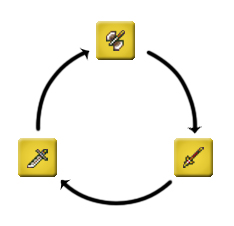
- Sword beats Axe
- Axe beats Spear
- Spear Beats Sword
Examples
- Direct-attack weapon (such as sword) beats ranged-attack weapon (such as bow)
- Ranged-attack weapon beats magic
- Magic beats direct-attack weapon
Examples
- Soul Nomad & the World Eaters
- Yggdra Union, Blaze Union, Gloria Union
- Final Fantasy Crystal Chronicles: My Life as a Darklord
- RuneScape
- Suikoden during the army battle segments
Examples
- Heroes of the Seasons: Physical damage is good against Force, Force damage is good against Arcane, and Arcane is good against Physical. However, some bosses don't have a type and take normal damage from all types.
- Very played with in King Arthur: The Role-Playing Wargame. Terrain matters very much to the success of all units. Light infantry will beat nearly everything in the hard terrain (forests, shrubland, hills), especially forests, which will give them defensive bonuses while it hurts the effectiveness of everything else and makes them invisible until the enemy is near enough — and if no one goes into the forest, the light infantry still can charge from it while the enemy is near and get a large enough damage bonus which will likely have them win unless very outnumbered. Spearmen are less overtly good in hard terrain, but do well also and gain damage bonuses against enemy cavalry and ignore some armor. Heavy infantry are really slow and are good on soft terrain (plains, roads), but are very durable and have a good chance against anything they get into melee with. Cavalry are fast, will beat archers in melee, fight best on soft terrain, and can charge the enemy down if they move past them with enough momentum... but it damages them as well, making them much less effective against hardier and more armoured enemies or spearmen, and it doesn't work against other horsemen. Knights are more damaging and hardier versions of Cavalry, with their higher defense and more damage, but are slower. Archers can attack from a far range, and are considered Game Breakers unless the "Weaken Archers" option is on, but do very poorly in melee and are vulnerable to pretty much all damage, making the terrain between them and their enemies absolutely vital in ensuring their safety. They also can damage their allies if they are too close to their firing target. Crossbowmen are very similar, trading fire rates for anti-armour bonuses, damage, and making friendly fire even more likely with them firing in a line as opposed to an arc to their targets. And then... there's magic. Which can be later powerful enough to make up for any deficiencies in the structure of any of your armies.
- Soul Nomad & the World Eaters makes use of a Melee > Ranged > Magic > Melee triangle. Other than that, there's also the Range > Flying variant with huge movement advantages given to Flying types by nature. There's also the Special type, which is unaffected by normal rules.
- In Fire Emblem, they call it the Weapon Triangle: Axe beats spear, spear beats sword, sword beats axe. Magic has its own triangle that varies by game; archers are outside of both. However, Archers do trump flying units. A few units can actually use more than one weapon, so it's a matter of the right tool for the job. Most games also have specialized weapons that deal effective damage against a class of enemies, such as anti-armor, anti-cavalry, and anti-dragon. There are also 'reaver' weapons that reverse the triangle. In Awakening, instead of 'reaver' weapons, there are 'superior' weapons. In addition to the normal weapon triangle, each 'superior' weapon has +50 Hit/Avoid against weapons of the same type. It should be heavily noted however, that the weapon triangle isn't the ultimate hard counter to another weapon type. It simply changes weapon might/hitrate slightly for reliability, so the player must have adequate stats in addition to.
- Radiant Dawn makes uses both the triangle of Fire>Wind>Thunder>Fire and the triangle of Light>Dark>Anima>Light. Fire, Wind, and Thunder are all treated as Anima, so all 3 beat Light, but are equally beaten by Darkness. In other words, we have a triangle in a triangle. Nevermind the fact that most casters have so much resistance to magic that it's usually more practical to just hit them with an axe. (In the prequel, Path of Radiance, Dark magic doesn't exist and Light magic is outside of the triangle.) Each Laguz tribe is weak to an Anima magic (Mammals weak to fire, Birds weak to wind, Dragons weak to Thunder). It's a wonder why the Laguz don't have their own triangle (but that would mean giving Dragons another weakness). Path of Radiance and Radiant Dawn are also the first games to have knives, which exist outside of the triangle. And Radiant Dawn removes Dracoknights' weakness to bows and wind magic and gives them a weakness to thunder magic, while Pegasus Knights are still weak to bows and wind.
- Fire Emblem: Awakening removes the Magic triangle and reverts Dracoknights to their previous status as being weak to bows and Wind magic.
- Fire Emblem Fates shakes up the formula a bit. The "sword beats axe beats lance beats sword" triangle is still in play, but now other weapons get added into the triangle as well, with each weapon in the original triangle getting a ranged counterpart to it: swords and magic beats axes and bows beats lances and concealed weapons (such as knives used by the Ninja class) beats swords and magic. This notably adds an extra layer of strategy to something that was already apparent in previous Fire Emblem games: bows have always been meant to be the bane of the Pegasus Knight class, as they do bonus damage to flying units, and while Wind Magic did bonus damage to them too, it wasn't quite as apparent, as the high resistance of Pegasus Knights negated it. Since the Pegasus Knight's main weapon is the lance, they get an extra advantage against magic users and have to be doubly afraid of bow users now. The inverse can be said about the Wyvern Rider class, who instead uses axes and therefore increases the risk of fighting against magic users while worrying about bow users even less thanks to both the new triangle and their usually high defense stat.
- Fire Emblem Heroes simplifies things by grouping all weapons under four colours. Red weapons (sword, red and fire tomes and red breath) beat green weapons (axes, green tomes, green breath), which beat blue weapons (spears, blue tomes and blue breath), which beat red weapons. There are also gray/colourless weapons (bows, daggers, and staves) which exist outside the triangle, though there are skills like -raven tomes that deal extra damage against them. Gem weapons and the Triangle Adept skills exaggerate this, as they increase damage dealt and decrease damage taken when at weapon advantage and has the reverse effect at weapon disadvantage.
- This is still present to a certain extent in Fire Emblem: Three Houses, as the "breaker" skills allow the user to gain a hit/evade bonus when using a weapon against the one it is strong against; for example, Axebreaker gives a bonus to sword users who fight axe wielders. On Maddening most enemies past a certain point in the game will have stronger variants of these skills, forcing players to, at minimum, think carefully before having units fight enemies with a weapon triangle advantage over them.
- Fire Emblem Warriors: Three Hopes plays the Sword->Axe->Lance->Sword triangle straight once again, and adds a second triangle to the mix: Gauntlet users have an advantage over tome users, who have an advantage over bow users, who have an advantage over gauntlet users.
- Halo Wars did this plenty with units. Infantry are cheap Zerg Rushers who can fielded by the dozens, but are wiped out by vehicles who are rarer, more powerful, and durable. Said vehicles are then weak to aircraft, who tend to be weaker but faster with a healthy range of firepower, and then those aircraft are trumped by the infantry's sheer volume of fire or guided AA missiles.
- Inverted in the board game "Hannibal: Rome vs. Carthage" where battles are resolved by playing cards representing one of four troop manoeuvers: left flanking, right flanking, direct assault, and envelopment. The counter to each is to play the same card. The battle is lost if you cannot play the same card in response.
- Langrisser mimics Fire Emblem's triangle with unit types: soldiers beat archers, who beat horsemen, who beat soldiers. Langrisser II (Der Langrisser on the SNES) and the HD remaster of Langrisser I changed it to be even closer by replacing the archers with spearmen (soldiers > spearmen > horsemen > soldiers). Archers now have a multiple-square range and dominate fliers, but lose quickly in close-quarters.
- Conviction (SRPG):
- Like in Langrisser, infantry units are good against lancers, who are good against cavalry, who are good against infantry.
- There are some one-sided advantages, such as priests being good against undead and archers being good against flyers. However, unit types with no type disadvantages tend to have lower stats to compensate. Archers and slingers are also very weak at close-range to make up for their long-ranged attacks.
- In the Suikoden series, archery beats magic, magic beats charging, charging beats archery. This also carries over to the one-on-one duels, where a normal attack smacks a defending character, a desperation attack cancels a normal attack, and defense counters a desperation attack. Pretty much regular rock-paper-scissors with different names, since you get to choose your type of attack each round.
- Starting with Suikoden II, the randomness of tactical battles results in even archer units being capable of defeating infantry in melee combat. Figuring out what works and what doesn't is less unit type and more luck.
- EndWar has Transports > Gunships > Tanks > Transports, with Engineers beating vehicles while in cover or buildings, and Riflemen beating Engineers. However, Riflemen will last a respectable amount of time against lighter vehicles while in cover and do even better in a building. The Command Vehicle has a lot of hitpoints but is mostly unarmed and relies on Attack Drones (or New Meat for Russians) for protection. Said escorts only stand any chance against Gunships (and infantry, in Russia's case). Artillery beats everything on the ground — as long as they're too far to return fire, that is. Gunships are particularly good at hunting tanks (can't hit them) and artillery (can't fire back), but against anything that can shoot back, mobility doesn't mean much.
- In a Reality Is Unrealistic situation, Gunships are actually vulnerable to small arms fire from the ground: garrisoned infantry (even Riflemen) can and will shoot down Gunships that stray in range. This might seem like this trope, but is actually Truth in Television.
- A partial subversion to this trope is that, aside from Command Vehicles, every unit has an ability that can penetrate shields and knock down health directly. This means that even if you bring the good counter to bear against an enemy, you need luck or inattention on the enemy's part to kill them without casualties. Especially noticeable against JSF Engineers, who, despite being vulnerable to Riflemen, can cut down whole swaths of them with a well-timed use of the SAW.
- While Warcraft III uses this basic premise, the actual mechanics suffered a series of complete overhauls from patch to patch, going as far as introducing the "unarmored" armor type and later making some units of this armor type actually have armor for balance purposes.
- Seeing as Agility increases armor, it can be assumed that anyone "unarmored" with a good armor value is simply an excellent dodger.
- It wasn't as obvious in Warcraft II, but that's not saying much: Ballista ➞ Cannon Tower ➞ Footman ➞ Ballista. Or Gryphon ➞ Battleship ➞ Destroyer ➞ Gryphon. Or Gryphon ➞ Footman ➞ Archer ➞ Gryphon.
- Advance Wars has a few of these: for example, Anti-Air ➞ B-Copter ➞ Tank ➞ Anti-Air. Or Cruiser ➞ Submarine ➞ Battleship ➞ Cruiser. The introduction of the Anti-Tank artillery in Advance Wars: Days of Ruin has created another one: Anti-Tank ➞ Tank ➞ Infantry ➞ Anti-Tank.
- Some of this shows up in the commanders themselves. For example, Lash, who does more damage based on terrain bonuses, is countered by Sonja, who reduces enemy terrain bonuses. Andy, who can repair all friendly units on the map for 5 HP, counters basically any enemy with a damage-all-the-units-on-the-map power.
- Its Spiritual Successor, Battalion Wars, pulls the same thing, just...larger. Infantry is vulnerable to tanks, Assault, and Flame vets, but strong against Bazooka vets. Bazooka vets are strong against Tanks. Light Tanks are vulnerable to Heavy Tanks, which are vulnerable to Gunships, which are vulnerable to Fighters, etc. The series is remarkably good at introducing each leg of the triangle (It's more like an irregular polygon, really) in such a way as to not confuse the player.
- It also takes the action-oriented gameplay base into account. Most anti-tank or anti-air weapons can kill infantry easily, except they tend to be slower-moving, and troops can easily jump out of the way. Anti-air weapons can hurt ground targets, but have accuracy issues against them. Also, the mighty Battle Fortress is strong against all ground units... except for a Light Tank controlled by the player, who can use its speed to avoid the Fortress' powerful but slow cannon fire.
- Warrior Kings has the following: Heavy Infantry (polearm) beats Heavy Cavalry, Light Infantry (ranged foot) beats Heavy Infantry and Light Cavalry, Heavy Cavalry (melee horse) beats Light Infantry, Light Cavalry (ranged horse) beats Heavy Infantry and Heavy Cavalry.
- There's a bit more to it than that. Light Infantry beats everything other than some specific units, if the light infantry are garrisoned in a fort or if they are firing from a hill, Heavy Cavalry in a wedge can beat weaker Heavy Infantry that aren't in a good formation, and amongst Light Infantry, archers rock against human targets and certain demons, but do almost nothing against the larger demon types, while gunners can do great hurt against any demon other than a Firbolg. Siege weapons rocks against anything that isn't heavy cavalry. Magic trumps everything that isn't protected by One God faith.
- The Bleach DS videogame The 3rd Phantom has Power, which strikes once for major damage, Technique that attacks usually with 2 hits, and Speed that attacks from 3 to 10 times (Flash Step masters, of course). Here, Power➞ Speed➞ Tech➞ Power. NonCom (healers, civilians, etc.) are weak to everything, and Bosses and other powerful enemies have ALL (Powerful) that beats everything. Having the type advantage guarantees a follow-up attack, so Bosses are quite a challenge if you are not careful and just play RPS with everything in your way...
- World in Conflict's multiplayer revolves around a core dynamic that goes: Helicopters ➞ Tanks ➞ Anti-Air ➞ Helicopters. There's other units that play supporting side roles as well, such as infantry, anti-air helicopters, medium artillery, or light tanks. But for the most part, a team cannot do without the core combination of heavy tanks, heavy anti-air, and heavy attack helicopters, since you always need one component of your triangle to defeat a part of your enemy's. Also since these core units are limited to the armor, support, and air roles respectively, it becomes imperative for players to coordinate with each other for mutual support or risk getting massacred.
- Impossible Creatures: Artillery > Range > Melee > Artillery.
- The Final Fantasy XII Real-Time Strategy Gaiden Game Final Fantasy XII: Revenant Wings uses the melee-ranged-flying triangle, plus Elemental Rock-Paper-Scissors... though where espers are involved, the difference between ranks is large enough that, for example, a Rank 1 esper generally isn't strong enough to defeat a Rank 2 esper by itself, even with an elemental advantage in its favor. You have to summon more Rank 1 espers (and Rank 1's can be summoned quickly with little cost) to level the field. This definitely extends to the Rank 3 espers who, despite their high summoning cost, pack enough raw power to bring a world of pain upon anything in their path. Bahamut, for example, is a Rank 3 summon whose attacks have both a wide area of effect and devastating power; his Mega Flare in particular is Non-Elemental and also inflicts Disable, making it very difficult to counter, even with a group of ranged units.
- Many Napoleonic and American Civil War wargames have an Infantry ➞ Cavalry ➞ Artillery setup. It works roughly like this: Infantry will beat Cavalry; during this era, Cavalry were armed for short range combat, and infantry had bayonets for their muskets/rifles that were effective Anti-Cavalry weapons. Infantry moved slowly and in large formations, making them vulnerable to Artillery fire, particularly canister rounds. Cavalry was faster and could overtake Artillery positions before they got too many shots off. Of course, this ignores factors like terrain and weather, but it's generally sound tactics in most strategy games.
- Formations also plays a part — infantry at the time had 3 major battle formations — lines, columns, and squares. Lines for shooting other infantry, and squares to defend against cavalry. There's also the spread-out "skirmish" formation, used to harass/delay the enemy advance.
- The above is nevertheless true enough in broad lines that Bernard Cornwall, author of the Sharpe series of novels, has described Napoleonic warfare as a game of "paper, scissors, stone" (the British English name for the game) in the historical notes of his novels.
- The MMORPG Runescape has a 'combat triangle' of ranger (archery or other missile attacks) ➞ mages ➞ melee fighters who defeat rangers, etc.
- This gets complicated when one considers the Protect prayers and that, more often than not, players versed well enough in at least two forms of combat have defensive strategies for just about any kind of attack. For example, a melee fighter could switch to dragon hide (but only with a ranged level of 40) or robes high in magic defense if he's being attacked by a mage.
- Because of how pitifully broken it used to be, it was not so much as a "Combat Triangle" as it was a "Combat Squiggly Line". In fact, it went more like this: Melee → Ranger → Mage ← Melee. It is much more balanced in the current version of the game, especially after The Evolution of Combat, which was a huge overhaul of the game's combat mechanics.
- Meanwhile "Old School" RuneScape, which has its roots as a pre-Evolution of Combat backup, includes includes such "features" such as the archer Karil being pathetically weak to magic despite his armour having some of the highest magic defense bonuses in the game, due to how magic defense is calculatednote .
- The RTS War of the Ring has a simple system whereby Piercing > Crushing > Slashing > Piercing, then Hero > everything
- Age of Mythology had the same Infantry > Cavalry > Archers > Infantry dynamic as its Age of Empires predecessor, but also added Mythological units which were effective against all of the regular units and Heroes which were effective against Myth units and vulnerable to regular units, thus adding a superdynamic of Heroes > Myth > Regular > Heroes.
- Additionally, naval warfare follows a dynamic of Arrow Ships > Hammer/Ramming Ships > Siege Ships > Arrow Ships.
- And the less common, but still important, Towers > Infantry > Siege Weapons > Towers.
- The game does shake things up in several ways, though. For instance, each civilization has certain "counter" units that are effective against their own unit type but (usually) weak to everything else. This is played completely straight with the Greeks (who are, overall, the most generally straightforward civ), and more nuanced in other civs.
- Example of that nuance: the Norse, an infantry-focused civ, is very vulnerable to archers- except for one of their units, which is specifically resistant to archers. Lacking archers of their own, they make do with a more varied infantry (including throwing axemen, who are good against flyers and infantry), a rather unusual cavalry segment (raiders ruin buildings and are fast, Jarls beat myth units and are effective as normal cavalry), and some of the best siege units in the game. Oh, and, with the right God, their heroes can occasionally summon Myth units out of nowhere.
- Age of Empires IV builds its combat around a somewhat more rigid counter system than in prior instalments. Among light units, Spearmen can negate cavalry charges and deal bonus damage against them, Archers have little difficulty against light infantry, and Horsemen can use their speed to harass and take down ranged units. This simple triangle is given extra depth with heavy units: Men-At-Arms are slow but tanky infantry that can clean up light units, Knights are much the same but remain vulnerable to Spearmen, and Crossbowmen fire bolts which deal extra damage against other heavy units. Naval, siege and unique units have further counters of their own.
- In Homeworld a big, lumbering Heavy Cruiser simply can't hit light, maneuverable fighters unless it gets lucky; however, it has no problem hitting much bigger and slower frigates, which melt under its heavy firepower. Strike Craft eat Capships eat Frigates eat Strike Craft. It may not be an artificial stratification, but the tactical balance still exists.
- The classification isn't exactly size, though. For example, an Ion Cannon Frigate is also armed only with a powerful but unmaneuverable gun.
- The Crippling Overspecialization may be justified, since Ion Cannon Frigates are very specifically designed as cheap artillery ships that can damage opponents above their weight class. Adding on extra tonnage in point defense or secondary weapons would undermine the basic mission of the unit, or at least make them more expensive way to fill the role.
- On the flip side, certain units are designed to reverse the triangle; Missile Destroyers are capital ships that fare poorly against frigates, but absolutely annihilate strike craft.
- Homeworld 2 brought up this trope in full force. The Bomber < Interceptor < Corvette < Frigate < Destroyer < Battlecruiser < Bomber mechanic is still intact but now the damage inflicted by a correct counter is so high that just a few shots are enough to kill the target, quite unlike the minutes-long slugging matches of the predecessor.
- At the same time we have Vaygr Lance Fighters (anti-corvette), Vaygr Laser Corvettes (anti-frigate) and Hiigaran Ion Cannon Frigates (anti-capital), every one of which can punch above their weight class. And despite Bombers upgraded with anti-subsystem bombs being a major menace to bigger ships, Battlecruisers are no longer Point Defenseless and can fend off small Bomber attacks on their own.
- The classification isn't exactly size, though. For example, an Ion Cannon Frigate is also armed only with a powerful but unmaneuverable gun.
- Vandal Hearts has two such cycles; one explicitly stated in the game's help, and one which becomes apparent through play. The one the help tells you about is Fliers > Soldiers > Archers > Fliers. The one which is revealed through gameplay is Armored > Melee > Magic > Armored.
- The manual explains both.
- To quote the game: "Sword defeats bow, bow defeats air and air defeats sword. Armour is strong but slow, mages are weak but wise and monks use word and claw." Other than the face that armour and monk are completely useless, it basically explains the entire tactical foundation of the game in two sentences.
- PvP in World of Warcraft is a lot like this. It's very difficult for a Warrior to beat a Mage of the same level, but he'll cut through a Rogue like butter. That same Rogue can easily take down a Mage in two or three hits, provided he gets the element of surprise (which he usually does).
- The pet-battle minigame is built around this. Every pet belongs to a family (humanoid, beast, elemental, etc.) which is resistant to attacks from one particular family, and vulnerable to another family. Furthermore, a pet from one family generally has at least one attack that uses a different family (e.g. a "beast" pet might have a single "undead" attack). Strategy relies heavily on exploiting those strengths and weaknesses when picking a pet team.
- The ships in Warlords of Draenor's shipyard form a four point cycle. Not counting the Transport which delivers troops to Land objectives, the other four ships engage in naval battle thus:
- Carriers have airplanes that can attack Battleships without coming in range of their guns.
- Battleships have guns that can penetrate the armor on Destroyers.
- Destroyers carry depth charges to attack Submarines.
- Submarines attack from under the water where the Carrier's air support cannot attack.
- A World of Warcraft video dating from Vanilla-era entitled World of Roguecraft attempted to explain how imbalanced certain classes were in world PvP. One part of the video refutes the idea that PvP is based on Rock-Paper-Scissors by showing how unbalanced the triad was:
"Rogues are Scissors, Warriors are Rock; Hunters, Paladins, Priests, Druids, Mages, and Shamans are Paper. Warlocks are Mushrooms. Paper beats Rock, Scissors beat Paper. Scissors also happen to beat Rock, until Rock hits 60, at which point Rock becomes an unstoppable killing machine that also beats Paper, and would beat Scissors, but it can't find Scissors, because Scissors are invisible. So Scissors beat Paper and avoid Rock, and that is called 'Balance'." - Valkyria Chronicles:
- From the basic infantry units, Scouts beat Snipers beat Shocktroopers beat Scouts. Scouts' high mobility mean they can easily close the distance to Snipers, who are helpless at close range; Snipers can shoot down the slow-moving Shocktroopers from a safe distance; and the Shocktroopers' high firepower make short work of Scouts that approach them.
- Those three infantry units then lose to tanks, who can easily mow them down while taking next to no damage from their guns (aside from the radiator). The tanks then get beaten by Lancers, the anti-tank units, who wield heavy, high-power missiles. However, the Lancers' bulkiness, slowness, and inaccurate attacks mean they're vulnerable against other infantries.
- Some time around Soulcalibur 3, Namco started emphasizing Vertical Attack ➞ Horizontal Attack ➞ 8-Way Run ➞ Vertical Attack. It also seems to have an Attack ➞ Throw ➞ Guard Impact ➞ Attack system.
- Dead or Alive has an Attack ➞ Throw ➞ Reversal ➞ system.
- Empire Earth features a complicated system as it covers warfare from the Stone Age to the ultra-tech Nano age. For a large portion of the game it follows the Age of Empires model concerning infantry, cavalry, and archers. The World War and Modern periods have a more complicated system which, despite the huge number of units, was at least somewhat intuitive - it was fairly obvious what the Anti-Tank Gun and Helicopter Anti-Tank unit was designed to fight, for example. The future periods became an almost completely arbitrary and unintuitive mess with a model of This Mech > That Mech > This Other Mech, etc. The game came with a poster covered in intricate diagrams charting the complicated RPS-style relationships (each of which had about 8 different units) for all 15 epochs. It was quite literally unreadable.
- On land, things start easy: archers > swords/blunt weapons > spears > archers. Things start to get complicated when rifle-armed infantry appear and only get worse with the various cannon types and special infantry. In the future epochs, there is generally one anti-infantry mech, one anti-tank mech, one anti-building mech... Generally, if an artillery piece or mech does splash damage, it's an anti-infantry unit; if it doesn't do splash damage but still explodes, it's an anti-tank and anti-mech unit. Also, AP tanks > HE tanks > infantry > AT cannons > AP tanks is a straightforward one... until the two tank types are merged into the Laser tanks of the future epochs.
- Early game armor is against shock, pierce and arrows. The latter two are phased out in favor of anti-gun armor, and late-game armor is against guns and lasers.
- Cavalry uses much the same system as infantry (with sword cavalry, spear cavalry and chariot/horse archers), but it's complicated by arrow cavalry being phased out for gun cavalry, while sword cavalry lasts only one epoch after spear cavalry is made obsolete.
- In water, battleships > frigates > galleys > battleships is the name of the game early on (although a single galley will do a lot of damage to a battleship, it still loses one-on-one). Later, galleys disappear but for all intents and purposes are supplanted by submarines (exact same strength and counter with the addition of only targeting naval units but can now only be targeted by other subs, frigates, towers and a dedicated helicopter). A new equation is also introduced: cruisers > Sea Kings > submarines, with cruisers being vulnerable to everything not in the air and Sea Kings being vulnerable to everything not in the water. Aircraft carriers can wreak massive havoc if there aren't any cruisers nearby but die quickly if being shot at. Nuclear submarines are anti-ground artillery but they too die very quickly if shot at. Both of the latter are completely defenseless against submarines.
- In the air, things remain straightforward: fighters beat everything else in the air (except a Zerg Rush of fighter bombers) but die against surface-based anti-air (which they can't shoot at). Fighter bombers beat ground units, bombers beat everything on the ground (especially so for nuclear bombers); everyone else is situational (AT helicopter for tanks, gunship for infantry, Sea King for submarines).
- Empire Earth II on the other hand, streamlined the counter system (actually called Rock-Paper-Scissors)... by assigning each class of units (Infantry, Mounted, and Artillery, further divide into Light and Heavy) completely arbitrary bonuses against two other classes. You essentially just had to take the game's word for it that riflemen were effective against light tanks and that heavy artillery could somehow kill a soldier holding a mortar better than a soldier holding a machine gun. This also leads to some eyebrow-raising events like modern Heavy Infantry (machine guns) able to shoot helicopters while Light Infantry (mortars) can't, but early units (sword/spearmen and archers respectively) act the same or the aforementioned infantry killing tanks (because the early equivalent was spearmen versus cavalry).
- A basic concept in Falcom's Vantage Master games. Earth spirits are strong against water spirits, water is strong against fire, fire is strong against heaven (air), and heaven is strong against earth. On the other hand, a particularly powerful spirit can hold its own against a lower-ranking spirit of a 'superior' element.
- Some players of the flight combat MMORPG Air Rivals argue that the character classes were meant to follow this pattern. However, the advantage is very situational and can be overcome with sufficient player ability. Supposedly: Interceptor ➞ Bomber ➞ Artillery ➞ Interceptor.
- PvP works somewhat like this in Shin Megami Tensei IMAGINE, at least in straight DB v. DB Combat. Melee -> Magic -> Ranged. However, whichever demon you have out plays a big part of this. (Including with Mega Tens classic Elemental Rock-Paper-Scissors theme)
- From a strategic point of view, tightly clustered units beats rushing, Big Boom beats tight clusters, and rushing tends to allow people to escape the Big Boom.
- In general, both PvP and PvE, there is a complicated triangle that goes like this: counter beats close range, dodge beats long range, block beats area of effect. there are tons of little variations, but the second half is charge beats block, sweep beats counter, close range beats dodge.
- Jade Empire had this in combat: a fast/normal attack beats a strong attack by interrupting it before it hits; a strong attack beats blocking by smacking through the block; a block stops fast attacks dead for as long as you hold the block.
- However, it ends up being broken to the point fast attack beats everything. Fast attack beats strong attack. You are usually a bit faster than enemies, so your fast attack also beats their fast attack. Block does not allow you to do damage or move and there is no stamina bar limiting your attacks, so there is no repercussion for just punching an enemy with fast attacks until they drop their block. Anything you can't defeat this way you're better off just dodging anyway.
- Dragon Force had an entire chart showing which unit type beat the other. Soldier/Samurai > Beastman/Monk > Cavalry > Soldier/Samurai was the main one. Archers and Mages were weak to everything, but since they had ranged attacks, everything took casualties from them until they closed to melee. Zombies beat everything except Mages and Monks. Harpies were strong against everything but fell hard to ranged attacks and Dragonmen, and Dragonmen beat everything but Samurai. The fact that samurai were about the only thing strong against Dragonmen meant players would find the dragon generals and convert them in a hurry, while farming the few castles that generate dragon crest items to equip their most important generals with Dragonmen. Samurai generals were kept on hand to decimate enemy dragon forces.
- The Touhou spinoff PatchCon! Defend the Library! had melee, danmaku, and flight units. Melee units were fast and trumped danmaku, which had range and trumped flight, which was slow but powerful and trumped melee.
- Also in the fighting games Immaterial and Missing Power, Scarlet Weather Rhapsody and Hisoutensoku, the mechanics goes as this: Graze beats projectiles beats melee beats graze.
- Depending on the player's skill in build optimisation, Battle Stations mostly follows this. A missile ship will generally beat a ram ship, which will generally beat a tank ship, which will generally beat a cannon ship, which will generally beat a missile ship.
- Civilization also uses this trope through the various eras in the game. The precise structure changes from game to game and from era to era within each game (hey, when you have a franchise with six games, plus expansions, each of which covers 6,000 years of history...)
- In V, the tree starts out as infantry being mowed down by archers, which get charged by cavalry, which impale themselves on spears, which are overpowered by infantry. In addition, cavalry tends to be stronger than its era's infantry, which is counterbalanced by their higher cost and penalties against cities. Conversely, siege weapons such as artillery are highly effective against cities, but suck against everything else. Once the Industrial Era begins, the rock-paper-scissors is maintained, but changes up; range is blitzed past by armor units, which get blown up by anti-armor units, which get outgunned by infantry, which can't approach range. In the sky, ground units get blasted by bombers, which get shot out of the sky by fighters and anti-air, which get shrugged off by ground units. At sea, battleships overpower destroyers, but get outranged and sunk by carriers, which get sneak attacked by submarines, which get spotted by destroyers. Both ground and sea also have their Awesome, but Impractical unit (the Missile Cruiser and the Giant Death Robot), which counter just about everything but make excellent targets for equally Awesome, but Impractical nuclear weapons.
- Final Fantasy Crystal Chronicles: My Life as a Darklord uses the Melee -> Ranged -> Magic -> Melee triangle. There are also Generic-type units and traps, which, as one might expect, have no notable advantages or disadvantages against any type.
- Command & Conquer, up to Red Alert 3, at least, has the balance so that Infantry counters Rocket Soldier counters Tank and Plane, which counter Anti-Air and Anti-Ground, respectively, and Anti-Ground counters Infantry. Ok, so that's a bit convoluted, but you get the idea. Exaggerated with Command & Conquer 4: Tiberian Twilight. Anti-infantry/anti-tank/ant-air damage system was replaced by different damage types (laser, gun, splash). Units weak against particular types will be pulverized in blink of an eye. But any not responding unit will be ridiculously resilient. Also, this kind of rock-paper-scissors completely replaced anti-air mechanics. Thus, EVERY unit can fire at aircraft. Even MOLOTOVS TOSSING RIOTERS. Yep.
- More like: Guns beat infantry, explosives beat vehicles. Other weapons varied depending on the game. Flamethrowers were usually good against infantry and buildings, Tiberium hurt infantry but generally didn't affect vehicles too much, Lasers and Electricity usually fried everything, but were generally so slow-firing that they were better against vehicles than groups of infantry, and so on.
- A Naval example: Battleship is stronger than Destroyer. Submarine defeats Battleship, which has no anti-sub defenses. Destroyer has depth charges, and so beats Submarine.
- The other rare occasions are weapons that don't exactly fall into either bullets or explosions. For example in Red Alert 2, Prism Tanks were effective against non-buildings (effective, hitting units causes splash damage) and Mirage Tanks' concentrated fire basically makes short work of anything.
- The trope comes into full effect in Tiberium Alliances, where every unit is strong against either infantry, vehicles, buildings or aircraft.
- Cartoon Network had a Mobile Suit Gundam Wing-themed flash game that used a system like this. sword -> gun -> laser -> sword, as I recall. Fun game too.
- Battle Isle. Tanks beat air defence, air defence beats copter squads, copter squads beats tanks (because the tanks have no aerial attack).
- Bungie's Myth games: dwarves (and other weak short range explosives) beat warriors (melee), warriors beat archers, archers beat dwarves. The gameplay encouraged close formations of dwarves in front, archers behind to shoot over their heads, and warriors behind them both to rush in when things get hairy.
- Just don't forget to tell your trigger-happy dwarves to stop lobbing grenades into the melee.
- Rave Heart: Physical damage is good against Tech enemies, Tech damage is good against Ether enemies, and Ether damage is good against Physical enemies. However, at least two bosses, the Lord of the Unknown and Malgorth, have no type advantages or disadvantages.
- Rise of Nations has a complex series of interlocking tactical wheels, depending on the age ten different types of ground units, five different types of sea units, four different types of air units, combat buildings, supply, and generalship all have defined x-beats-y interactions.
- Team Fortress 2, a First-Person Shooter, has multiple cycles of character classes countering each other:
- The explosives of the Demoman are very effective against the Engineer's buildings, with a Demo able to arc or bounce grenades to a sentry whilst staying out of sight. The Engineer's sentry gun provides very effective area denial against the Scout, who normally relies on being hard to hit. Finally, the Scout's speed and a fast mellee attacks makes him hard to hit for the Demoman, who only has projectile weapons and an ineffective mellee (unless it's a Demoknight) and can hurt himself at close quarters, where Scout excels.
- Replace Demoman with Spy and form a similar triangle: Engineer defeats Scout as above, Spy defeats Engineer as elaborated below, Scout defeats Spy with his ability to pursue a fleeing enemy, and with his speed, he can "bump into" his teammates to suss out Spies by the ones he can't simply pass through.
- The Sniper has an easy target in the big, slow Heavy, who in turn is very ineffective at long range. However, the Heavy's close-quarter prowess and high health allow him to make short work of any Pyros and not even worry about being on fire. That same fire makes an excellent way to check for Spies, as a single puff of flame tells the Pyro whether a teammate is actually a Spy in disguise. Finally, a cloaked Spy can easy pass through a Sniper's line of sight undetected, and the latter's immobility and narrow sight makes him an easy target for a backstab.
- A pair secondary cycle is formed between the Spy, the Engineer, and the Pyro, and the Heavy, Demoman, and Scout. The Pyro counters the Spy, as above, the Engineer's sentry renders the short-range Pyro helpless, and the Spy's disguises fool the sentry, his sapper shuts it down, and he can easily backstab the Engineer, given how focused he is on his building. Scout counters Demo as above, the Demo's ability to spam large amounts of explosives lets him chew through the heavy where other classes wound run dry or be out-gunned, and the heavy's constant spray of hitscan bullets lets him kill the fragile scout the easiest of all the combat classes.
- The Medic and the Soldier are left out of these cycles by design: one is a healer above all, while the other is mostly, but not quite, the Jack of All Stats. Of course, with the many different weapons, even they can fall into this: a Medic with the Blutsauger is notoriously effective against Pyros, while a Soldier who didn't equip a shotgun can expect to have all his attacks sent back at him by that same Pyro.
- That said, the "Support" classes (Medic, Sniper, Spy) form a triangle of their own. Spy counters Sniper, as above. Snipers counter Medics, as the latter is a very important target and a one shot kill on a Medic can stall an enemy for minutes at a time, and there's only so much a Medic can do to hide behind his teammates. Speaking of the Medic and his teammates, this is how he counters Spies - while his teammates are facing forward to engage the enemy, the Medic is constantly looking around, keeping abreast on friendly and enemy movements to know when to push, when to Ubercharge, who and when to heal. This puts him in the ideal position to spot suspicious behavior from "teammates" (read: disguised Spies), and he can deal with them surprisingly quickly with his higher-damage, more varied weapons.
- Battle Realms really plays with this one. There are seven kinds of attack (slashing, blunt, piercing, crushing, fire, explosive and magic) and all units have their own degree of resistance (weak, normal or vulnerable) to each of the damage types. Thus, every unit in the game has some kind of counter through attacking it with the right unit — buildings and undead like the Necromancer fall quickly to Kill It with Fire, while heavily armored Dragon clan samurai and Wolf clan berserkers are best dealt with with magic attacks.
- The Fort Condor minigame in Final Fantasy VII features differing soldier types have a rock-paper-scissors relationship to each other, giving and taking double or half the normal damage on a different type of unit:
- Fast units (Attacker, Wyvern) defeat heavy units.
- Heavy units (Defender, Beast) defeat ranged-attack units.
- Ranged-attack units (Shooter, Barbarian) defeat fast units.
- Exceptions include the "Fighter" (who has modest effectiveness all around) and stationary defenses, which have the highest raw attack power overall but are balanced by having a fixed attack range.
- In the Final Fantasy VII Remake version, Attacker Units (red) defeat Ranged Units (green) defeat Defender Unites (blue).
- Dawn of War instead based it on weapons more than general unit types. Missiles and Lascannons beat Vehicles, Heavy Bolters/Big Shootas/Death Spinners/Burst Cannons killed infantry, Plasma killed Heavy Infantry, and so on. How effective a given unit was against enemy types depended on what weapon(s) it (and it's target) was armed with. This allowed the game to at least partially subvert both this and Crippling Overspecialization, as while a squad of infantry armed with missile launchers could face a Lascannon-bearing tank in battle, the fact that the tank could be armed with secondary Heavy Bolters meant that victory was by no means certain.
- The game also usually had a similar hierarchy when it came to close combat involving certain units: Hero Unit > Demon > Walker > Hero Unit. All of which tended to make short work of Infantry in close combat.
- The sequel had certain units armed with certain weapons that were good against certain units' armour types with abilities to flavour things up. However, these were not always clear, requiring players to look into external information sources and the Metagame to better understand what's good against what. The general pattern is not entirely clear, though suppression can make infantry nearly useless, ranged damage is always better than melee damage when out of melee range, artillery units beat anything that's foolish enough to stay in their range, deployed anti-vehicle counters force vehicles to retreat or be destroyed swiftly, and melee beats ranged infantry when in melee and do more damage against retreating units. The abilities of units really make things mixed up, with their uses and effectiveness against units varying. And the upgrades.
- The upgrades - especially the interchangeable wargear in campaign mode - is really just putting a more complex spin on the same basic principals. Realize the enemy you're facing: if it's swarms and swarms of weak Tyranids or Guardsmen, equip rapid-fire and area-of-effect weapons, and bring as many flamers as possible; if you're going against heavy armor/daemons/monsters, pack the lascannon/missiles/power weapons and bolster them with melee support; if it's Space/Chaos Marines, focus on weapons that are effective more against Heavy Infantry, etc. Also partially subverted: if a lascannon, plasma cannon, or similar tank-buster shoots an infantry unit, even some that have heavy armor, that unit will die... And then all his buddies will shoot/chop you to pieces while reloading.
- In Sacrifice, melee units have more health and speed than ranged units but only deal 10% melee damage to flyers, which ranged units deal full damage to. Ranged units, meanwhile, can't shoot while they're being pummeled in melee. This intuitively seems like Melee > Ranged > Flying > Melee but in practice Sacrifice has so many and varied units, and variations in types of missile, that it becomes more a matter of specific army makeup than a hard-and-fast rule. For example, the warmonger is a Pyro ranged unit specifically tailored to counter melee by having a very short-ranged but powerful machine gun, but is very big and slow and will get shot to pieces by artillery and snipers.
- Dokapon Kingdom has this as the basis of their Combat System. Too bad Field Magic is overpowered, and that The Computer Is a Cheating Bastard (blatantly).
- The Battlefield series places some emphasis on Tactical Rock-Paper-Scissors, with varying degree of success.
- In BF2, the concept is so sloppily implemented that helicopters and fighter jets lay waste to everything, including the stationary and mobile AA that was their designated counter. There's a reason infantry-only servers became so popular.
- In general, the series' combat is based around tools' general effectiveness (some weapons are more effective at certain ranges) against infantry, and ground vehicles, at certain ranges. Other options may provide uselessness to other things aside from killing stuff and getting points. Air vehicles were generally able to beat their non-air adversaries easily (though there are occasionally some options against them), with strategically placed anti-air guns on the map allowed them to be chewed up if they strayed too close.
- In the Koihime†Musou Visual Novels, Calvary > Archers > Infantry > Calvary.
- Infinite Space has this to a degree with the Normal, Barrage, and Dodge commands. A Barrage attack is three times stronger than a Normal attack, but will complete whiff if the opponent is dodging. However the Normal attack actually becomes more accurate if used on a dodging opponent.
- Played completely straight in melee combat. Slash beats Shoot, Shoot beats Leader, and Leader beats Slash.
- It's worth noting that using 'Shoot' on a retreating opponent will halt their retreat and give you a free round of damage.
- Played completely straight in melee combat. Slash beats Shoot, Shoot beats Leader, and Leader beats Slash.
- A few rock-paper-scissors relationships exist between units in Starcraft II. For example, Zerg Mutalisks are a strong counter to roaches; roaches are a strong counter to hydralisks; and hydralisks are a strong counter to mutalisks. Starcraft II also has challenge missions designed to teach players which work best against others.
- In general, though, both Starcraft and its sequel go for a more subtle and complex type of advantage system. There is rarely a simple triangle, and many advantages can be overcome through use of micro, mobility, terrain, or sheer numbers. For example, while the Thor is supposed to counter mutalisks, the mutalisks are far faster and can fly, so they can still be used to attack undefended areas and run away before the thors arrive. Siege tanks have powerful attacks and splash damage, so they are usually good against swarms of weaker units, but if just a few of those units make it inside some of the tanks' minimum range, those tanks will be unable to damage their attackers and are also likely to take friendly fire damage from the surrounding tanks.
- A rock-paper-scissors balance model for air units was deliberately invoked by the developers with the first game's expansion, Brood War. Capital ships (carriers, battlecruisers) made for powerful base-killer fleets but were countered by fighters such as Wraiths and Scouts. The expansion introduced splash-damage Support fliers that quickly killed swarms of fighters while being weak against capital ships, creating a triangular balance for aircraft.
- Starcraft also has a strategic rock-paper-scissors element. Most strategies in it can be classified into three categories: Rush (build simple attackers as fast as you can right from the beginning and hit the enemy with a hopefully killing attack in the opening), Defend (spend the opening concentrating on your base's defenses) or Expand (spend the opening making your resource gathering as extensive as possible). Rush beats Expand (because you'll overrun him before he has any fighting capability) beats Defend (because your expanded resources will beat him in the later game) beats Rush (because his early attack will fail to beat down your defenses and leave him open to counterattack).
- It’s not explicitly stated, but the turn-based space-strategy game Stars! has the missile/chaff/beam weapon circle. Missiles do less damage than beam weapons but have a far longer range, so a missile ship can usually get a few shots in and destroy a beamer ship before it can get into range and bring its superior firepower to bear. However, each individual missile can only hit one ship per round, so it is possible to build hordes of tiny, cheap chaff ships whose sole purpose is to suck up one missile each and die. So you get capital ship killing missiles capable of hundreds of points of damage being used up to kill chaff with 20 hit points each while the beam weapon ship the chaff is protecting is able to close the gap. However beam weapons can shoot multiple targets a round and can chew up chaff like nothing, so chaff is a waste of resources against them. The result: Missile Ships > Beamer Ships > Beamer Ship + Chaff > Missile Ships. The endgame can easily turn into a “Redesign War”.
- In Total War games, some soldier types are more effective against others. For instance, archers are good against heavy infantry, because they'll shoot from afar and automatically run away when the enemy gets close, and they can outrun heavy infantry (being lightly armored). But cavalry are good against archers, because the archers get only a few shots in before they have to switch to melee weapons (which they do have, but usually only weak ones, and not much armor). And so on.
- Justified to some extent in that they usually don't get any bonus stats by fighting specific units, it's just the way they interact. The only exception is the "effective against armour" trait that certain missile units and axe-wielding infantry have.
- However, this trope completely dominates TW multiplayer. There are strict rules as to which factions you should use to defeat certain other factions, based on their selection of units and those units' particular strengths. The particulars of this go somewhat beyond a simple rock-paper-scissors scheme, but the effect is the same - only a certain army selection using a certain deployment and certain tactics will guarantee victory against an experienced player using a given faction.
- Beginning in Empire: Total War, the Agent units started to have a clearer Rock-Paper-Scissors relationship. Diplomatic units (Gentleman/Scholar, Metsuke) have a bonus against Subterfuge units (Rake, Ninja/Geisha), who have a bonus against Religious units (Missionary, Monk), who have a bonus against Diplomatic units. This isn't quite cut and dried as a very strong Ninja can assassinate a weak Metsuke, for example.
- Starting with Empire: Total War and continuing in Napoleon: Total War, the creators boast that they are revamping the traditional Rock-Paper-Scissors relationship. Line infantry is now the mainstay of your forces with cavalry relegated to support and anti-artillery. Line infantry is a mix of ranged, melee, and spear units from previous games. Instead, the formation of your line infantry is likely to determine its success. Your line is being charged by cavalry? Form a stationary square that utterly obliterates any cavalry (some horses will throw off their riders rather than charge a wall of braced bayonets), but risk the enemy infantry charging the square or, better yet, the square becoming the target of enemy artillery. Other types of infantry exist, such as grenadiers (can slaughter large clusters of enemy units but have to get close) and light infantry (have long-range rifles for picking off the enemy from afar but don't have the firepower to match a line).
- Total War: Shogun 2 has spear units that counter cavalry, but cavalry come in many varieties, and don't always win against archers (especially if they are samurai archers, or on good terrain), and while there are three main melee weapons, they don't function like this (Spears beat cavalry, Katana beat infantry, Naginata are a hybrid between the two with good survivability). Where this trope comes into play, is with the caste of the units: ashigaru have strength in numbers, Samurai have strength in armor, and Warrior Monk units have strength in damage output. So it goes like Mighty Glacier > Zerg Rush > Glass Cannon > Mighty Glacier.
- Total War: Shogun 2 features a mild version of this trope that can be situational, due to terrain, fortifications, and so forth. Combined arms is always the best way to win, but in general cavalry > katana > naginata > yari (spear) > cavalry. Archery and musket units do not fall into the rock-paper-scissors since they cannot beat anyone in hand-to-hand but if supported can do outstanding damage and guarantee the victory of allied melee tropes when the lines close. Artillery units are like ranged units when used in the field.
- The above chain is somewhat of a stretch; naginata are more of a Jack of All Stats Mighty Glacier, and cavalry are specialized for striking otherwise occupied units (yari cavalry and light cavalry are the Fragile Speedster who aren't good against anything in a prolonged brawl, and low numbers means even katana cavalry can be isolated and surrounded by archers). Where this trope does fit clearly, is in the three castes of fighters: the samurai armor beats the Cannon Fodder ashigaru's weak attack, the Warrior Monk's strong attack counters Samurai armor, and an ashigaru unit's raw numbers defeat unarmored and rare Warrior Monk units.
- In Fall of the Samurai, set about 1870, artillery is king but cavalry beats artillery if the cavalry can charge, modern beats traditional if the terrain is open enough to bring the guns to bear, and infantry > cavalry > artillery > infantry. However, massed artillery which is supported wins hands down over the others due to its ability cover nearly the entire battlefield and sweep away the enemy army before it can form up. The support units just keep the enemy from sending cavalry to ride down the big guns before the shells have finished off the enemy line.
- Total War: Rome II takes the concept even further to the point of rock-paper-scissors systems within rock-paper-scissors systems:
- Infantry blocks mostly consist of large groups of armored foot troops who mainly grind down the enemy in battles of attrition. They are usually too numerous and durable for Cavalry to handle but struggle to effectively fight faster moving Ranged units.
- Spear Infantry are an all-rounder unit with a particular effectiveness against Cavalry, but this does put them into Master of None territory. As spears are one of the most economical weapons in the ancient world almost every culture can make use of them with Hellenic cultures, particularly Sparta, fielding the best.
- Sword Infantry are the purest expression of Infantry combat, reliably beating Spear and Pike Infantry wherever they find them. This does come at the cost of abnormally high vulnerability to Cavalry, particularly Shock Cavalry. Rome, generally speaking, fields the best Sword Infantry.
- Pike Infantry are a specialized defensive unit who's formations can reliably hold off all other forms of close-combat unit, even bogging down Sword Infantry and giving Shock Cavalry pause. These tight formations are notably slow to respond to flanking and rear attacks and any Ranged unit that fires into that area is guarantied a hit. Pikes are rather rare with only Macedon and some other Hellenic factions making any serious use of them.
- Ranged units, although they can effectively damage Infantry with impunity, are very vulnerable to Cavalry who are not only better in close-quarters combat but fast enough to avoid their firing arcs.
- Slingers are the cheapest ranged unit available with no real elite variants existing anywhere. As a weapon Slingers have low damage but good range and rate of fire making them surprisingly good at winning shootouts with other ranged units, even Horse archers.
- Javelins have shorter ranges and smaller ammunition pools than other Ranged units but have much better regular and armor-piercing damage enabling them to threaten higher-tier Infantry. The more civilized cultures tend to field better-armored units.
- Archers get the best of both worlds; good range and damage, if lacking armor-piercing damage. Conversely, they are the most rare of Ranged units with only some barbarian and eastern cultures fielding them.
- Cavalry are the fastest units on the field and therefore the best poised to attack Ranged units and make flanking and rear attacks against Infantry, but they risk being bogged down by more numerous foot troops or rough terrain.
- Scout Cavalry are the fast-but-fragile, cheap and basic take on mounted combat and as such are present in almost every culture in the game. As a fighting unit they are excellent at scouting and hitting targets of opportunity such as war machines and Ranged units, but can only really fight Infantry with flank and rear charges and only while in support of another unit.
- Shock Cavalry sits on the other end of the spectrum to Scout Cavalry being an expensive, rare and powerful unit with a devastating charge that enables them to take Sword Infantry head-on, though Spear and Pike Infantry should be treated with more caution. Other Cavalry are also able to skirmish and avoid them as necessary. Parthia is the undisputed master of Shock Cavalry with some Hellenic factions coming in a close second.
- Horse Archers are a hybrid of Ranged and Cavalry units and have inherited the strengths and weaknesses of both; They can shoot Infantry with near-impunity and reliably outfight Ranged units but will be outfought by Infantry and outshot by Ranged units. Parthia, Scythia and other eastern-nomad-desert cultures field these units effectively.
- To some extent in Company of Heroes: in general, it's Infantry > Anti-tank gun > Armored vehicles > infantry. But there are a dizzying variety of exceptions - Panzershreck-wielding Tank Busters, sticky bombs thrown by Riflemen, emplaced MGs that will shred infantry and can activate armor-piercing bullets - and that's not even including elements like artillery, cover, or flanking, all of which are implemented. In short, there's no single game-winning combination that won't cost an impractically high amount of resources; balance is maintained through the different costs and usages of the units rather than a strict rock-paper-scissors dynamic.
- They may not actually be any tactical rock-paper-scissors even without upgrades. The basic rifleman will have a tough time against MG emplacements and if strategically placed, an AT gun or two will murder units (it's still firing an explosive shell). Tanks, despite usually requiring infantry support in real life, can hold its own against anything other than a tank or an AT gun because infantry can't do creative things like hop up and drop a grenade in. Basically, you can't really use the typical tactical rock-paper-scissors mindset in this game.
- If you think infantry can't kill tanks, you've never faced Ranger or Panzergrenadier spam. Even a Tiger II is meat against 3-4 squads of Rangers.
- They may not actually be any tactical rock-paper-scissors even without upgrades. The basic rifleman will have a tough time against MG emplacements and if strategically placed, an AT gun or two will murder units (it's still firing an explosive shell). Tanks, despite usually requiring infantry support in real life, can hold its own against anything other than a tank or an AT gun because infantry can't do creative things like hop up and drop a grenade in. Basically, you can't really use the typical tactical rock-paper-scissors mindset in this game.
- Star Wars: Rebellion divides starships into starfighters and capital ships. Even starfighters with hyperdrive need a capital ship base when they go on the offense; they can retreat on their own, however. But more relevant is that some fighters specialize in dealing with fighters (A-wing, TIE Interceptor), some specialize in dealing with capital ships (B-wing, Y-wing, TIE Bomber), and some are the Jack of All Stats (X-wing, TIE Defender). One, the TIE Fighter, is completely useless. Capital ships also specialize in dealing with fighters, dealing with capital ships, or transporting fighters or troops. And this overspecialization ultimately results in the Death Star, which can wipe out capital ships easily but is defenseless against fighters (except the A-wing).
- The three ancients in Eternal Darkness: Sanity's Requiem go in a Rock Paper Scissors pattern: Chattur'gha beats Xel'lotath, Xel'lotath beats Ulyaoth, and Ulyaoth beats Chattur'gha. The fourth ancient, Mantorok, is manipulating events so that the three end up destroying each other.
- Gladius has three classes of gladiator, heavy, medium and light. Heavy gladiators crush medium gladiators who squash light gladiators who run rings around heavy gladiators. You do less damage and take more from the weight class you are weak against while doing more and taking less from the one you are strong against. A skilled player can sometimes overcome the disadvantage through careful use of skills, facing and height.
- The battles in Jump Super Stars and its sequel run on this. The playable and supporting characters are all divided in three categories: 力 (chikara, strength - usually fighting manga protagonists), 知 (chi, knowledge - mostly reserved for mentors and/or Lancers) and 笑 (warai, laugh - which are characters from gag manga, or Idiot Heroes). By the system, strong beats smart, smart beats funny and funny beats strong. Doesn't mean you can't beat other characters with a "bad" combination, but following the Tactical Rock-Paper-Scissors here will net you a quicker and easier win.
- Yggdra Union has a complex, multilayered example. At it's base, you have the classic swords beat axes beat lances beat swords. Collectively, these three shock weapons beat bows, bows beat magic, and magic beats shock weapons. In addition, you have "lump" weapons (used by summoned creatures) that are weak against magic and neutral to everything else; Scythes (used by the Big Bad and his Elite Mooks) that trump shock weapons and are neutral to everything else; and the "book" weapon type which trumps other magic.
- Blaze Union added a character that attacks with a koto, and Gloria Union replaced bows with guns, which have the same properties. The koto is neutral to everything.
- Half-Minute Hero has a mode called EvilLord 30 which uses a monster summoning system based on this, Nimbles beat Shooters, Shooters beat Brawlers and Brawlers beat Nimbles. It is made kinda redundant by the end though when Brawlers destroy everything if you hide in a corner near a Goddess Shop.
- Warhammer Online tried to do this; heavy tanks weather the storm of ranged DPS to crush their faces, ranged DPS obliterates lightly armored melee DPS, melee DPS have enough tricks to knock out the tanks or at least murder the support keeping the tank alive. Support units themselves work differently depending on race, but usually get yelled at to heal, heal and heal some more even if they're supposed to be a "balanced" or buff/debuff specialist. This can work out in some smaller scenarios, but the massive end-game
PvPRVR battles the game was touted to be all about usually boil down to "Right, who can lay down the most AOE damage the fastest?" - Spellbound Kingdoms combat system is focused on responsive tactics. A combatant switches between different moves of the style, while styles themselves are built for specific advantages — Guardsman is good at shielding himself and another, while Swashbuckler has mobility and morale based tactics. As such,
"not all styles are meant to be balanced against each other individually. Rather, the game as a whole is balanced. Some styles should consistently kick certain other styles from here to the Kingdoms and back!"
- Age of Wonders has several sets; in Shadow Magic, the simplest for human troops is: Halberdiers < Swordsmen < Cavalry < Halberdiers. Because the former is the weakest by stats, but Polearm gives bonus vs. cavalry and fliers, First Strike means even near-dead units can't be mopped up with impunity and due to cost rate 1:1.5:3.5 for equal gold there's too many of them to answer all attacks.
- Advanced Strategic Command has a lot of units good against specific other types, such as Anti-Air units being weak against sea- or land-based units, and most of them are fodder for aviation. The simplest and cheapest rock-paper-scissors cycle is Assault Trooper < Sniper (hits infantry from afar hard and without retaliation) < Light Tank < Assault Trooper (anti-tank rocket).
- Knights of the Crystals' Arena features a 3-on-3, and this is implemented: Weapon-based jobs beat Magic-based jobs, Magic-based jobs beat Bare Hand-based jobs, and Bare Hand-based jobs beat Weapon-based jobs. Any subversion of this combat triangle may apply, though; if the job level is high enough, arena ability(ies) are activated, or both.
- In Red Alert 3: Paradox, surface units are primarily divided three ways; infantry, light vehicles, and heavy armour, countered by small arms, light ordinance, and anti-tank weapons respectively. Each is also soft-countered by the weapons a grade above and below it; so light armour gets the short end of the stick as guns and cannons still hurt it relatively well, and autocannons are very flexible, though their soft counter damage is reduced. Further complicating matters, however, is a second set of softer counters devoted to air units, and specialty counter cycles for structures, urban garrisons, defensive turrets, and units with unusual properties, plus weapons that cut across counter lines. Then, it gets really complicated, with units that mezz, buff, debuff, and otherwise play with the counter cycle.
- Special note must be made of the Bhor Waveform Device, an allied unit that flips counters around, turning tank armour to infantry and vis versa, throwing off attempts to counter or making enemy units easy targets.
- Cosmic Break has a rock-paper-scissors system with its Air, Land, and Artillery units and the weapons they specialize in: Air units are best at using beam weapons against Land units, while Land units specialize in melee weapons which Artillery units are weak against, and Artillery units' long-range missile weapons can easily swat Air units out of the sky.
- Battlestar Galactica Online: Strikes, with their mobility, can nibble Lines to death. Escorts are intended to defend against them, but their size makes them prey for Lines. Carriers don't really fit.
- Jade Cocoon 2 overlaps this with Elemental Rock-Paper-Scissors. Fire monsters have strong attacks that can kill water monsters quickly, but struggle against earth types with good defence. Earth monsters have stat boosting abilities and a focus on defence, letting them stand up to fire types, but are vulnerable to special attacks. Wind monsters have enemy weakening attacks that counteract earth, but water minions typically have resistances to them. Water monsters can heal their allies and resist special attacks by wind monsters, but lack the defence needed to withstand fire.
- SD Gundam Capsule Fighter doesn't even hide this, outright labeling everything as Rock (melee), Paper (general purpose), and Scissors (ranged). A few units have special skills designed specifically to break the paradigm by increasing their defense against their respective weakness (Rocks vs. long-range weapons, Papers vs. mid-range weapons, Scissors vs. melee attacks). This has been nulled, though, with the advent of the Generation Six update and the removal of this system.
- The Ancient Art of War employed this with the three unit types:
- Archers defeat Knights because the Knights move slowly enough to get picked off
- Barbarians defeat Archers because they move in quickly and take out the Archers
- Knights defeat Barbarians because the Knights are better armed and have armor.
- In Star Wars: Empire at War, this applies both in space and on land. In space, Fighters -> Bombers -> Capital Ships -> Light Cruiser-> Fighters. On land Infantry -> Missile troops -> Vehicles -> Infantry, with some vehicles also being more effective against other vehicles.
- Marvel: Avengers Alliance has five classes in this circle (Blaster -> Bruiser -> Scrapper -> Infiltrator -> Tactician -> Blaster) and a sixth 'Generalist' class which is neither strong nor weak against any class. Played with in that being "strong" or "weak" against another class is not just a matter of doing more or less damage, it gives a tactical advantage: Scrappers get an immediate follow-up attack on Infiltrators, Infiltrators automatically counter-attack Tacticians, Tacticians get a full extra turn when attacking or being attacked by Blasters, Blasters ignore Bruisers' defense and automatically crit them, and Bruisers get a stacking buff that increases all their stats when attacking or being attacked by Scrappers.
- On top of that, there's a secondary tactical rock-paper-scissors going on at the individual character level, in that many character or equipment abilities can nullify class advantages. For example, characters or weapons that can inflict the Off-Balance debuff can negate counter-attacks, weakening Infiltrators; Impaired prevents critical hits, neutering Blasters; Exhausted prevents extra turns, removing Tacticians' advantage; and Generalized removes all class-based abilities.
- This is a large part of Kabam games on Facebook, like Dragons Of Atlantis and Kingdoms Of Camelot. You must scout and find out what your enemy has and send out troops accordingly to succeed in a hit. Mounted troops, for example, are weak to Pikemen. Swordsmen are strong against horses. And it's not only their troops you have to plan for, but their wall defenses. Siege weapons are weak against Trebuchets. Militiamen are sent first to take out traps. Heavy cavalry and cavalry will die if there are spikes or caltrops present. And now KOC has the added element of the Throne Room, which gives boosts to certain troops.
- In Marvel: Contest of Champions, characters are assigned to one of six classes based on the source of their power (the X-Men are almost all Mutant class, Spider-Man is a Science class Champion due to receiving his powers from a Freak Lab Accident, etc.) Characters with a class advantage get a slight bonus to health and attack power in battle, while characters with a class disadvantage get slight penalties to those stats. Mutant (any of the X-Men) -> Science (Spider-Man) -> Mystic (Scarlet Witch) -> Cosmic (Thor) -> Skill (The Punisher) -> Tech (Iron Man) -> Mutant.
- The Magical Girl Lyrical Nanoha A's Portable fighting games follow an Attack -> Throw -> Counter -> Attack system when characters fight in melee range.
- Fate/EXTRA has Attack, Guard, and Break. Attack is a fast, light attack that pokes holes in someone making a heavy Break attack, Guard blocks Attacks and allows a counter, but Break can smash through Guard. Servants also have Skills which disrupt any part of the whole cycle, though Guarding at least reduces damage from attack Skills. Most of the game centers around getting information on enemy Servants so you can predict and counter their attack patterns.
- Fate/Grand Order has four distinct triangles among its classes: Saber > Lancer > Archer > Saber; Rider > Caster > Assassin > Rider; Avenger > Ruler > Moon Cancer > Avenger; and Pretender > Alter Ego > Foreigner > Pretender. In addition to these triangles...
- Berserkers are offensively strong against and defensively weak against all others but Shielder and Foreigner.
- Rulers are defensively strong but offensively neutral against everything but Shielder, Avengers, Berserkers and Moon Cancer.
- Pretenders are offensively strong against Saber/Lancer/Archer, defensively neutral to classes outside its triangle (besides Berserker), and Rider/Assassin/Caster takes less damage from them.
- Alter Egos are offensively strong against Rider/Assassin/Caster, defensively neutral to classes outside its triangle (besides Berserker), and Saber/Lancer/Archer takes less damage from them.
- Foreigner has a unique resistance to Berserkers, deals and takes neutral damage to all other classes outside its triangle, but is also weak to itself.
- The "Unknown"/Beast I class of Demon Pillars are the reverse, strong against Saber/Lancer/Archer and weak to Rider/Caster/Assassin.
- The special Shielder Servant exists outside this system and is completely unaffected by class matchups by dealing and taking neutral damage to all classes. Avenger and Moon Cancer perform similarly with only their exceptions being Berserkers and the other members of their triangle.
- Beast IV:L/Tamamovitch Koyanskaya has an extremely unusual interaction with this system. She deals less damage to Casters and deals neutral damage to all other classes. However, she has the unique Nega-Weapon passive that specifically deals more damage to "Hominidae" Servants (those of human origins) and takes more damage from "Demonic Beast" Servants (those who have animal-based traits). These two systems overlap so she deals neutral damage to Hominidae Casters since the resistance and weakness cancel each other out and effectively has an offensive advantage against any other Hominidae class Servant. All Demonic Beasts are Non-Hominidae but not all Non-Hominidae are Demonic Beasts so there's a pool of Servants who can take and inflict neutral damage alongside the pool of Servants who take neutral damage and deal more damage to Beast IV:L. The only Servants who can deal both more damage and takes less damage from her are Demonic Beast Casters.
- Wizard101 has this for the elemental schools, storm wizards specialty is a powerful single strike attacks that can quickly kill an undefended opponent, ice wizards have a natural defense to all spells, the highest health, and the ability to create shields that reduce damage of a single strike by half allowing them to whittle away at the naturally low health of storm, fire specializes in the use of damage over time which enable them to get around ice's shields but it's susceptible to storm since storm can kill them before the fire's attacks to fully affect them.
- Mega Man Battle Network 4, 5, and 6 extend the Elemental Rock-Paper-Scissors to 4 new "tactical elements" Cursor > Breaker > Sword > Wind > Cursor. With +/-, Healing, and Obstacle types that are totally neutral to both weakness cycles.
- The Prince of Persia series features enemies that will always counter certain moves. Rather than just having the attack blocked, you always take damage for attempting it against that opponent, usually getting knocked down as well.
- Both Ground Control games feature this, along with special emphasis on aerial units. The first game includes bombers, capable of demolishing a whole enemy base in around 15 seconds. Problem is, every anti-air unit here is insanely powerful, with one side having guided missiles and the other having quad machine gun vehicles in squads of four. Basically, you need to get into the base and take out those defences to allow aerodynes, which are already pointless by then. The sequel tones it down; aerial units can hurt infantry either lightly or not at all, they got rebalanced armor, and they are generally more like normal speedy tanks than the powerful fragile speeders they used to be. The rest of the units play this trope straight, except for the ability to flank and produce suppresive fire, which effectively means that even basic infantry can defeat the heaviest tank, if one plans carefully.
- In Kingdom of Loathing, a side quest in the post-endgame zone the Sea involves battling Mer-kin gladiators. You can find three different Mer-kin weapons to use, each of which lets you learn three special attacks with that weapon which will counter the special moves of one of the types of gladiators you might encounter (the Mer-kin dodgeball is used to counter the Mer-kin bladeswitcher, the Mer-kin switchblade is used to counter the Mer-kin netdragger, and the Mer-kin dragnet is used to counter the Mer-kin balldodger).
- In Armored Core V, there are three defense types, with corresponding weapons that inflict said damage types: KE (Kinetic Energy, basically bullets and the force from fragmentation explosive), CE (Chemical Energy, direct contact explosives), and TE (Thermal Energy, basically energy weapons such as lasers, plasma, and whatnot). Attacking an AC with the damage it is strong against, and the damage is "plinked", meaning it will deal very little damage. This is accompanied by a flashing message on your HUD that says "Ineffective", a certain impact sound. On the other hand, attacking said AC with something it is weak against is the easiest to deal massive damage. Likewise, each frame part of an AC (head, core, arms, legs) has a high rating for a certain defense type, and a much lower rating for the other two defense types. This makes it impossible to build an AC that has high overall ratings in all 3 defense types, and so you can only build an AC that has high ratings in only 2 defense types. Each AC can focus heavily on one defense with a secondary defense of sorts, and can carry up to 5 weapons. While carrying a weapon that fits every damage profile is an option, most go for the equipment that lets them maximize damage for 2 damage profiles (eg, 3 KE weapons and 2 TE weapons, say). This being an online squad-based game, most players rely on other teammates to cover for their shortcomings, making matches, especially one-on-one matches, heavily reliant on having the correct "hand".
- In V's sequel, Verdict Day, this is heartily subverted as ineffective "plink" damage is increased, and weapons such as gatling guns and shotguns are very much viable to deal death via a thousand bullets. Furthermore, there is a certain attack value where even effective damage does not deal its full potential, making the rock-paper-scissors aspect much less pronounced. This has been double subverted and triple subverted due to successive patches. One can only wait until FROM concludes their "patch month" if the this trope will take place again.
- Desert Moon: Flamethrowers/Imploders are effective against Hunter and Infected enemies by being able to do huge damage at close range note . Nail Gunners and Flare Gunners can't hit the burrowing Hunter at range or deal enough damage to the slow, durable, Zerg Rush of Infected, but they can beat the fast but weak Bursters. Bursters can easily kill Flamethrowers and Imploders as they're fast, not repelled by Flamethrower fire, can get past the Inmploder's slow fire rate and explode on death/contact and kill anything nearby.
- In League of Legends, ranged carries (ADC, marksmen, usually start bottom lane) typically deal with tanks, assassins and mages (typically mid lane) burst down carries with a single skill rotation, while tanks (top lane) can easily survive several skill rotations from assassins and deal enough damage to kill them if it comes to 1v1 fight.
- Dungeon Keeper 2 has four creature types; flankers, support, blitzers and blockers:
- Flankers are weak individually, and like to either atack a distracted enemy from behind or form groups with other flankers and use Zerg Rush tactics to surround enemies. They overwhelm blockers with minimal casualties but are whittled down by support.
- Support creatures are Glass Cannons with ranged attacks. They can kill flankers without being threatened but tend to die quickly if the enemy deploys blitzers.
- Blitzers are Lightning Bruisers who often have spells to supplement their melee ability. They like charging through enemy ranks to reach the enemy support creatures, but blockers can stop their charge.
- Blockers are Mighty Glaciers who will choose one position prevent the enemy from getting past it. They can stop blitzer charges, but they tend to have slow attack speed and can't fight off flankers by themselves.
- In The Legend of Zelda: Twilight Princess, the sumo minigame is an example. Grappling is avoided by dodging, which is punished by striking, which is countered by grappling.
- The Halloween Hack: PSI Flash (Whiteshock) works on undead, Hypnosis (Sleepstun) works on living enemies, and Paralysis (Timestop) works on dead enemies.
- Warrior's Way from StreetPass Mii Plaza has a quite literal example, in that your three types of units are labelled with rock-paper-scissors symbols, as a reminder on what beats what: Cavalry (Rock) beats Archers (Scissors) beats Infantry (Paper) beats Cavalry.
- Very important tetragonal scheme in The Battle for Middle-earth, especially in sequel. Cavalry charges through archers, archers excel against normal infantry (with swords, axes etc.) and normal infantry crushes pikemen - which, of course, impale the cavalry easily.
- If you factor out the units using special abilities, then GrimGrimoire has Alchemical over Glamour, Glamour over Necromany, Necromancy over Sorcery, and Sorcery over Alchemical. Units with the advantage take less damage and inflict more against vulnerable enemies.
- Downplayed in Mount & Blade, with scheme similar to that from BFME2. Cavalry ➞ archers ➞ light infantry (without big shields) ➞ pikemen ➞ cavalry. Terrain is extremely important, as cavalry in open plains is strong against everything, while mountains make it useless. Some kinds of archers can effectively defend against cavalry charges, some kinds of light and offensive footmen have shields and skills good enough to protect them against the arrows etc.
- Rather downplayed in World of Warships. Destroyers mostly rely on their torpedoes which are great against slow and heavy battleships but not so good against more versatile cruisers. Cruisers with their fast guns hunt destroyers quite nice, but aren't very effective against powerful armor of battleships. Battleships' slow, powerful guns work great against cruisers, but destroyers can avoid their rounds. Aircraft carriers are extraordinary support, working somewhere beyond that scheme.
- Certain heroes in Overwatch are meant as counters for each other. For example, Bastion is able to transform into a turret with a Gatling gun, giving it ridiculous damage output at the cost of mobility. Genji has the Deflect ability, allowing him to send any projectile attacks (bullets, missiles, Energy Ball, etc) back at the shooter, while D.Va can Shoot the Bullet, stopping any projectile that enters the area of her Defense Matrix. Either character will negate the threat of Bastion's dakka, while having their own counters (Genji is a Fragile Speedster who cannot Deflect beam weapons, while D.Va is a Close-Range Combatant vulnerable to snipers).
- Renowned Explorers has three forms of attack and associated "moods." Aggressive gets a bonus against Friendly, Friendly gets a bonus against Devious, and Devious gets a bonus against Aggressive.
- The Teen Titans Go! game Teeny Titans gives its characters a class that counters another, going Martial Arts (Robin) > Beast (Beast Boy) > Cute (Silkie) > Dark Arts (Raven) > Super (Starfire) > Tech (Cyborg) > Martial Arts. The one character who has no class at all is The Joker.
- Town of Salem has the Pirate and his plundering method where he chooses a target and attack type (Scimitar, Rapier, or Pistol), and the player selected has to pick a defensive maneuver (Sidestep, wear a Chainmail, or Backpedal). Success means the Pirate kills that player and plunders them, failure means the target lives another day. Unlike most examples here, each attack is only successful against one type of defence, and fails against the other two.
- Scimitar beats Sidestep (wide cleave hits dodging foe) but loses to Chainmail (blocks it) and Backpedal (out of range)
- Rapier beats Chainmail (pierces it) but loses to Sidestep (dodges it) and Backpedal (out of range)
- Pistol beats Backpedal (ranged attack beats moving backwards) but loses to Chainmail (blocks it) and Sidestep (dodges it)
- Iron Marines:
- The main RPS triangle is Melee > Ranged > Flying > Melee. Melee units are very effective at dealing with ranged opponents and in fact deal twice as much damage to them, but cannot hurt air units. Ranged units (especially missiles, which deal incredible damage to air units) can attack aerial units but are vulnerable to melee. Air units are immune to melee attack but are vulnerable to ranged attacks, especially missiles, although the only playable air unit so far is a paid hero while most flying units are Airborne Mooks.
- The Taskmaster enemy unit has a great amount of health and is capable of deploying swarms of weak aerial Oculi drones. It counts as a structure, meaning that it is invulnerable to One-Hit Kill attacks from Snipers (whose low health and slow fire rate gets them shredded by Oculi) and Channelers (Low health, can only target one unit at a time which is oftentimes the Oculi). However, this in turn makes the Taskmaster vulnerable to Engineers, whose abilities specialize in Anti-Structure (their plasmarays deal great damage to structures AND they can also be upgraded to throw structure-disabling bombs which make the Taskmaster a sitting duck) and their plasma bolts ricochet off the weak aerial minions and destroy their numbers.
- Kartia: The Word of Fate uses an altered version of the "bladed weapons triangle" where the weapon is affected by terrain type rather than weapon match. Spears are great against enemies that stand on higher terrain, axes get bonus when the enemy is on lower terrain and swords get their bonus against foes that are on the same level.
- Downplayed in Dissidia Final Fantasy NT with its different classes for combatants. Vanguards (such as the Warrior of Light and Jecht) hit hard and tend to have defense-specialized abilities in their repertoire, but don't have the best range. Assassins (such as Squall and Kuja) move fast and often have attacks while moving, but don't hit very hard. Marksmen (such as Terra and Ultimecia) have long-range attacks that can rack up damage while the enemy is in no position to strike, but lack short-range options. Specialists (such as Onion Knight and Exdeath) have unique gimmicks that set them apart from their fellow champions in some way or another.
- In theory, Vanguards can intercept the frontal-assault of Assassins to cut them short, Assassins can close the distance and hit Marksmen up close, Marksmen can use their variable projectiles to deal with Vanguards at range, and Specialists are wild cards that serve as jacks-of-all.
- In practice, the game has a Cast of Snowflakes, with combatant classes being a very loose set of guidelines rather than a solid set of actual rules. The Emperor is a Trap Master, Kefka has a black belt in Confusion Fu, Cloud specializes in charge attacks that could come out any time over a five-second period... Basically, no class or even character has such an advantage over another as to make victory impossible if both sides are evenly skilled.
- Also downplayed in Mobile Suit Gundam: Battle Operation 2. Mobile suits are placed into one of three classifications: the lumbering long-ranged Supports, the nimble melee-focused Raids, and the balanced mid-ranged Generals. Raids inflict more damage on Supports, Supports inflict more damage on Generals, and Generals inflict more damage on Raids. Damage inflicted is also reduced when attacking a unit that is strong against you. In practice, the mobile suits are varied enough that the rock-paper-scissors relationship between mobile suits isn't too much of a deciding factor in battle.
- The Spirit system in Super Smash Bros. Ultimate works like this. Attack spirits are strong against grab spirits, grab spirits are strong against shield spirits, shield spirits are strong against attack spirits. Neutral spirits have no specific benefits or weaknesses to any type of spirits. Also, once a spirit's power level gets high enough, you can steamroll any given spirit, regardless of type.
- In Power Rangers: Legacy Wars, each character has attacks that come in three categories: Strike, Breaker, and Defense. Whenever characters hit each other with attacks of different types at the same time, Breaker beats Defense (doing damage despite a block), Defense beats Strike (blocking the damage and allowing a counterattack), and Strike beats Breaker (interrupting the opponent's attack).
- DC Universe Online does this with basic weapon combat, where countering the enemy's current move will stun them: guarding stops interrupt attacks cold, block breakers (channeled attacks) break through guards, and interrupt attacks are for interrupting block breakers.
- Super Robot Wars Z uses a squad-based system with upwards to three units per squad. The "TRI-Battle System" incorporates three different strategies when tackling enemy squads - "Tri Formation", where all units in the squad uses their respective "TRI" capable weapons together as a single attack, damaging all units in an enemy squad with no damage penalties and automatically pierces enemy barriers; "Center Formation", with the squad focusing fire on a singular enemy unit; and "Wide Formation", where the squad fires on their respective enemies in a squad (squad leader attacks enemy squad leader, left to left, right to right).
- Pokkén Tournament has a rock-paper-scissors relationship between normal attacks, grab attacks, and counter attacks: normal attacks interrupt grab attacks, grab attacks power through counter attacks, and counter attacks power through normal attacks.
- Need for Speed: Carbon applies this to motorsports, with 3 car classes paired against 3 different track styles. Exotic cars are usually European supercars, have balanced performance, perform best on tracks with long, smooth corners and are used by the TFK gang; Tuner cars are mostly JDM cars, are slow but have great handling, perform best on convoluted tracks with tight corners and are used by the Bushido gang; and Muscle cars have low top speed and handling but great acceleration, perform best on tracks that alternate long straights with angular corners, and are used by the 21st Street gang. The final stage features tracks that blend all three design styles, and its controlling gang uses cars of all types.
- Pokémon: Along with its famed Elemental Rock-Paper-Scissors aspect, competitive battling necessitates learning another triangle. Pokemon can be classified into three basic battling styles: Tank, Sweeper and Wall. Tanks are bulky, survivable, often hard-hitting Pokemon that can take whatever a comparatively fragile Sweeper can dish out and counterattack. Wall Pokemon lack offensive power, but make up for it with all manner of nasty Status Effects and field traps that can either soften up a Tank for a Sweeper to finish off or even defeat them outright through the use of the likes of Toxic. Sweepers, however, are roundly faster than most Walls and strong enough to beat them before a Wall can hit them with an ailment. In fact, Sweepers often use a Wall's presence on the field to set themselves up with attack and speed buffs and then brute-force through the entire opposing team, Tanks and all. Pokemon can multirole as Sweeper-Tanks that use their defensive bulk to survive and set up buffs (Shell Smash Cloyster), Wall-Sweepers that shut down foes with ailments before going on the offensive (Darkrai) or Wall-Tanks that combine ailments and obscene defenses to wear down the opponent's entire team through attrition (Toxic Chansey), but they usually end up leaning toward one or the other role and demand teammate support to properly function.
- In Digimon Story: Cyber Sleuth and Digimon Story: Cyber Sleuth - Hacker's Memory, every Digimon belongs to one of four Attributes: Vaccine, Data, Virus, or Free. Vaccine is vulnerable to Data, Data to Virus, and Virus to Vaccine with Free being neutral.
- Crying Suns uses a triangle wherein Fighters beat Drones, which beat Frigates, which beat Fighters. Cruisers sit outside the triangle, being able to attack at range (which other units cannot do) but unable to attack adjacent enemy units.
- Sword Fight does it with the Stance System. Barrage > Blitz > Guard > Barrage, with the Technique skill boosting stats by 6 per level if you're using the stance that's strong against the opponent. Attack and Defend stances have no impact in the triangle, but they do trigger the Technique bonus if used against each other.
- START AGAIN START AGAIN START AGAIN: a prologue plays it literally: Scissors > Paper > Rock > Scissors. The Researcher can help you determine what type the Sadness you're currently facing is.
- Monster Hunter: Stories has the attack types of Power > Technical > Speed > Power. When two opposing units target each other on the same turn it triggers a Head-To-Head, in which the attack whose type wins the matchup does extra damage while the loser's attack is weakened. If a Rider and Monstie attack the same target with winning moves, they perform a Double Attack that cancels the loser's action entirely. Some attack skills are typeless and simply don't cause Head-to-Heads.
- OMORI has the Emotion system in a triangle. Happy characters deal more damage to and take less damage from Angry characters, Angry characters beat Sad characters, and Sad beats Happy. Neutral emotion is well, neutral to all other emotions. There's also a rare emotion, Afraid, which takes more damage from all other non-Neutral emotion. What's interesting is that emotion can be changed mid-battle through certain skills or items. Emotions also have tiers, with higher tiers further affecting the effectiveness of the triangle. For example, an Ecstatic (tier 2 Happy) character will take even less damage from Angry characters but also take more from Sad characters.
- The Way (RPG Maker) has the Plunge combat system, which revolves around a Rock-Paper-Scissors trinity of attacks: Cross Sweep beats Lunge Cut, Lunge Cut beats Drop Slash, and Drop Slash beats Cross Sweep.
- Primal Carnage: The human and dinosaur classes were initially designed with this system in mind, with each human best equipped to deal with one dinosaur type and vice versa. However, later updates added more dinosaur species and interchangeable weapons for the humans, strongly downplaying this aspect of gameplay, although there are still advantages and disadvantages with each human class versus each dinosaur class.
- Angry Birds 2: In addition to knowing which birds are effective against which tower material (they're all the same as before, and Silver is about as good against stone as Bomb), you also have to be smart about choosing which bird to use depending on the arrangement and construction of the towers.
- The Battle of Polytopia:
- The classic Infantry>Cavalry>Archer>Infantry dynamic is present here.
- Warriors, Defenders, and Swordsmen have high defense and strong counterattacks, so they can deal a lot of damage in close combat even if they get attacked first.
- Archers and Catapults can attack from a distance, so they can deal damage to melee units without giving them a chance to counterattack.
- Riders and Knights are fast, so they can quickly close in on enemies and attack first, negating the range advantage of missile units.
- When you add Giants and Mind Benders into the mix, the dynamic becomes Giant>Everything else>Mind Bender>Giant.
- Giants are incredibly strong and hard to kill. They can easily hold their own against most units in a fight.
- Mind Benders are able to convert enemy units to your side, regardless of how strong they are. Giants are especially easy to convert due to how slow they are.
- Mind Benders are also unable to fight and vulnerable to pretty much everything, so any damage-dealing unit can dispose of them easily.
- The classic Infantry>Cavalry>Archer>Infantry dynamic is present here.
- Mass Effect: As a general rule, the series follows a Combat>Biotic>Tech triangle, which inverts the usual Warrior>Rogue>Mage dynamic.
- Combat classes tend to have heavy armor that allows them to resist Biotic powers.
- Biotic classes posses area-of-effect offensive skills that hit through cover (which Tech classes heavily use), and that cannot be hampered by Tech debuffs.
- Tech classes have various skills that debuff weapons and armors, both of which are heavily used by Combat classes.
- Both the Paper Mario and Mario & Luigi series derive a lot of their combat from variations of the basic Jump and Hammer attacks and the fairly intuitive ways they interact with enemies. For example, jumping on an enemy with spikes or fire will hurt you, while hammering enemies that are up off the ground (whether by flying or being suspended in some way) will always miss.
- In Minion Quest: The Search for Bowser and its follow-up Bowser Jr.'s Journey, minions fall into three types: Melee, Ranged, and Flying. Melee units have the advantage over ranged units. Ranged units have the advantage over flying units. And flying units have the advantage over melee units.
- Each team in Sonic Heroes is composed of a Speed character, a Flight character, and a Power character. Speed beats Flight, Flight beats Power, and Power beats Speed.
- Combined with Chromatic Rock Paper Scissors in Transformers Forged To Fight with regards to the six classes of bots: Warriors (red) beat Scouts (green) beat Techs (aqua) beat Demolitions (yellow) beat Tacticians (blue) beat Brawlers (purple) beat Warriors.
Other Media
- The 100 Girlfriends Who Really, Really, Really, Really, Really Love You: A Ramen Shop owner repeatedly makes challenge Ramen that no one can eat (or order), but the first challenger is always a girl who's unique suited to it. This includes Ridiculously Blinding Ramen versus Mei who is Eyes Always Shut, and Ridiculously Ridiculous Ramen versus Naddy who is a Cloud Cuckoo Lander.
- A Certain Magical Index: The protagonist Touma has an Anti-Magic ability known as "Imagine Breaker" which allows him to negate esper abilities and magic abilities. However, he's otherwise a seemingly normal human who can street fight. So while he shows himself capable of fighting and defeating mages who are overly reliant on their powers, he still struggles against normal humans who are capable of fighting or people with guns. Street thugs and gunmen are in turn generally overwhelmed by powerful espers and mages. In other words, Espers and Mages—->Normal street thugs and gunmen —->Touma—->Mages and Espers.
- The Digimon franchise gives us an interesting variation. Almost every Digimon belongs to one of three Attributes: Vaccine, Data, or Virus. Vaccine is vulnerable to Data, Data to Virus, and Virus to Vaccine with a neutral Attribute called Free. However, this never comes into play in the various shows aside from Digimon Tamers and only really matters in some of the games like Digimon Story: Cyber Sleuth and Digimon Story: Cyber Sleuth - Hacker's Memory.
- In Keijo!!!!!!!!, the players are divided into three categories - infighters, outfighters, and counters. Infighters overpower outfighters in direct combat, outfighters outspeed counters, and counters turn the infighters' strength against them.
- Medaka Box: Medaka, Zenkichi, Kumagawa, and Ajimu defeat their doppelgangers this way; Medaka defeats Zenkichi, Zenkichi defeats Kumagawa, Kumagawa defeats Ajimu, and Ajimu defeats Medaka.
- My Monster Secret: Spoofed, like everything else. Late in the series, Aizawa claims that there's a "Rock-Paper-Scissors of Idiocy": Serious Characters outwit Straight Men, Straight Men keep Idiots in check, and Idiots frustrate Serious Characters. Indeed, Youko's innocent kindness makes far more headway against Principal Shirayuki than Asahi's straight-up attempts to confront her.
- In Overlord, this sort of balance applies to the three strongest melee specialists in Nazarick. Albedo -> Sebas Tian -> Cocytus -> Albedo. However, if Sebas Tian turned into his dragonoid form, he'd be able to beat Albedo too. If one looks at their stats and skillsets, this is justified:
- Albedo is the Mighty Glacier with top notch defense, high offense, but middling speed (by level 100 standards — she's still much faster than most beings in the New World). She can thus tank most of Sebas Tian's blows with ease before beating him with a decisive attack. However, her defenses aren't enough to counter Cocytus' overwhelming attack power and she isn't fast enough to dodge him.
- Cocytus is the Glass Cannon of the trio (again, by level 100 standards). He can break through Albedo's defense and she isn't able to dodge him. However, his own lackluster defenses mean he's vulnerable to Sebas Tian's attacks, and Sebas is also fast enough to dodge Cocytus' attacks.
- Sebas Tian is the Lightning Bruiser with high attack, speed, and defense. He is powerful enough to overwhelm Cocytus' lackluster defenses and fast enough to dodge Cocytus' counterattacks. However, his normal form lacks the offensive power to break through Albedo's top notch defense, allowing her to tank his blows and wait for a chance to strike back. His dragonoid form otoh would be strong enough to overcome even Albedo.
- In Tengen Toppa Gurren Lagann, After the Time Skip, the army has replaced the old Ganmen (considered "relics of the Spiral King") with the latest mass-produced Grapearl. Turns out Ganmen were originally designed to fight the Anti-Spiral and its Mugen but Grapearl weren't. In the end, Ganmen lose to Grapearl (superior in every way), Mugen lose to Ganmen (thanks to the Spiral Power) and Grapearl are dominated by Mugen.
- In Tokyo Ghoul, this is the base theory behind different RC types and their resulting Kagune. A veteran Investigator explains to his rookie partner that in general, a Kagune will be strongest against the type directly above it and weakest to the one directly below it.
- Ukaku: Uses speed to outmaneuver and overpower the plain Bikaku, but quickly depletes their energy reserve and risks running empty mid-fight. (Shoulders/Upper Back)
- Koukaku: Their defensive capability is sufficient to tank out Ukaku's flurry of light attacks, but the increased defense comes with reduced speed. (Below/between the shoulder blades)
- Rinkaku: Their offensive capability is enough to punch through the slow-moving Koukaku's defenses, but their RC cells are less concentrated, resulting in lower defense. (Waist)
- Bikaku: Lacking any glaring weakness to prey on, they are considered a Rinkaku's worst enemy. (Tailbone)
- That Time I Got Reincarnated as a Slime applies this to demons, spirits and angels. Demons are weak to spirits, spirits are weak to angels, and angels are weak to demons. One mage attempts to exploit this by summoning a Superior elemental earth Spirit against what he presumes to be a Greater Demon due to what he can sense of its power. However, said Greater Demon turns out to be not only an Archdemon hiding its true power but one of the the seven Primordials, the oldest and most powerful demons in existence, which means that he can ignore the disadvantageous matchup, and even laments that the spirit was far too young and inexperienced to ever pose a threat to him after destroying it in one blow and before taking a bite out of its core.
- Über has this in the three varieties of Tank Men. First, you have regular tankman, who have both super-strength and toughness and energy blasts, and are extraordinarily lethal to conventional infantry and armor. Then they made Heavy Tankmen, who are a lot tougher and stronger with no energy blasts, but their extra resilience and the heavier armor they can wear lets them plow through the energy blasts and rip normal Tank Men apart. We complete the triangle with all-energy Blitz Men, who can blast through the armor of a Heavy, but die in droves to ordinary Tank Men. Of course, even from the first issue, there were a few human Battleships who were far more powerful than any tankman of any variety, and the introduction of Zephyrs has further complicated things.
- In the Usagi Yojimbo RPG, Total Attack > Cautious Attack > Total Defense > Total Attack
- Lulu's Bizarre Rebellion: The inability of non-stands to harm or see stands makes them an absolute nightmare for Britannian mechs, since even one with no exceptional strength can completely immobilize a reasonably skilled pilot even without using its ability. However, stands are part of the user's soul and thus viable targets for most geass users. Meanwhile, most geass are short-ranged and only affect people, so there is very little a geass user can do against a knight. Of course, this is not a universal rule, as shown by powers like Rolo's "timestop" geass, Cornelia's anti-stand knightmare. And of course, anyone can get in a Knightmare.
- In Babe Ruth: Man-Tank Gladiator man-tanks come in three styles: Heavy, the largest, strongest, and slowest style; Agile, the fastest and most nimble; and Long-reach, with extending tentacles capable of reaching a good distance. The Heavy could withstand the most of the Agile's attack and lay it out easily if it hit. The Agile could dodge the Long-Reach's attack and slip in close enough to hit it almost unchecked. And lastly, the Long-Reach could easily attack the Heavy from a distance, leaving it unable to hit back.
- In the fourth novel in Piers Anthony's Cluster series Thousandstar, three sapient species compete for control of precursor technology: the spherical HydrO, whose needle-like water jets can penetrate the flesh of an Erb, but are vulnerable to the claws of a Squam; the snake-like Squam, whose claws can cut the flesh of a HydrO, but are vulnerable to the drilling action of an Erb; and the plant-like Erb, whose drilling action can penetrate the carapace of a squam, but are vulnerable to the water jets of a HydrO.
- Used by Shef when introducing his battle plan at the end of One King's Way: Coastal defense ship beats seagoing ship. Catapult beats coastal defense ship. Now, what beats catapult?
- The Star Wars Expanded Universe goes into detail about the seven different styles of lightsaber combat and how each has certain advantages and disadvantages compared to the others (speed, strength, endurance etc.). In order, they are: Shii-Cho, Makashi, Soresu, Ataru, Shien/Djem So, Niman and Juyo/Vaapad.
- It's also worth noting, however, that a fair bit depends on how well trained a saber wielder is - for instance, Makashi, designed for sheer precision and exclusively for saber combat, is weak against blaster fire, but Dooku is good enough at it that he can pull that off anyway. Likewise, Soresu, which is designed to counter massed blaster fire and most lightsaber forms, is vulnerable to Makashi because of its sheer precision - especially with Dooku, who is perhaps the best Makashi practitioner in history. Yet Obi-Wan becomes good enough at Soresu by Revenge of the Sith that Dooku can't pick his way through and is forced to resort to telekinesis to just get rid of him. Finally, Shii-Cho and Niman are characterised as Master of None forms (Shii-Cho being pure basics, and Niman composed of elements of all of the first five forms), with Shii-Cho being seen as Lightsabers 101 and Niman as the easy pass for the Non-Action Guy. But when wielded by a Master, it's different: Shii-Cho is noted as incredibly unpredictable and borderline Confusion Fu, great for multiple opponents or opponents with multiple arms, such as Grievous. Niman, meanwhile, supposedly takes a decade to truly master, verges on Master of All in the right hands such as Exar Kun, one of the greatest Jedi or Sith swordsmen of all time, is the foundation of dual sabre combat, and is key to using the Force in combination with a lightsabre.
- The Traveler's Gate: Each Territory is weak to another; for example, Endross Travelers are highly emotional due to the nature of their powers, so Asphodel, which attacks and feeds on emotions, is most effective against them. The exception is Valinhall, which is highly effective against all other Territories and is best fought by another Valinhall Traveler.
- Wearing the Cape: Discussed (and mentioned by name). Astra is one of the top hundred most powerful Atlas-types in the world. Therefore, her first training session with the team involves everyone else giving her quick and humiliating defeats in order to demonstrate the tactical value of different powers. Quite a few powers make her awesome strength and toughness simply irrelevant, which is why superhero teams focus more on having a varied set of powers on hand rather than simply using overwhelming force. In the second novel, as she is groomed for a leadership role, she has to consider this as she builds her team and when she's going into the final battle.
- Beyblade has included this from the beginning. Attack types beat Stamina types, Stamina types outlast Defense types, and Defense types repel Attack types. Balance types incorporate aspects of all three. Effectiveness isn't a hard rule though, and a good build of one type might stand against the type it has a disadvantage against in certain situations.
- Dungeons & Dragons has this, to a degree.
- AD&D has weapon type vs. armor type modifiers — e.g. chain mail has +2 for slashing and -2 for blunt weapons, splint mail has 0 for slashing, +1 for piercing and +2 for blunt weapons. Combat & Tactics has three basic armor types (leather, mail, plate) against which some weapons were better (e.g. mace vs. mail, maul vs. mail or plate), worse (chakram vs. anything heavier than leather) or inefficient at all (blowgun vs. any heavy armor).
- Telepathy in AD&D has 5 attack and 5 defence modes with specific adjustments against each other, from -5 to +5. If 5x5 table wasn't enough, Dark Sun sourcebook The Will and the Way adds 4 constructs/harbingers for each of 10 powers, expanding the table to 20x20 (plus the old 5x5 for opponents not using these) of the adjustments in range -8 to +8.
- Nonmagical combat in 3rd Edition has a subtle version of this. Most Uberchargers (characters who rely on massive speed and damage) lose to Lockdown tactics (combining long-reach weapons with Counter Attacks that halt movement), which in turn has little defense against ranged combat. Other combat styles have less consistent properties, but are generally weaker.
- The tabletop game Dungeon Quest settles all fights with a fantasy rock paper scissors of three moves: slash > leap aside > mighty blow > slash. The only kink is that player mighty blows deliver two points of damage, while the other two-player moves and all monster moves only do one point.
- In Game of the Generals, all the Officers outrank Privates, who are the only pieces that can capture Spies, who in turn can capture any of the Officers.
- In Magic: The Gathering, this is present in the three standard categories of tournament decks: aggressive, combination, or control (aggro, combo, and control). Sometimes decks can play as either of two roles, but not as well as a deck truly dedicated to that role. The three roles fall into a rock-paper-scissors scenario: Aggro decks play multiple redundant threats to keep the pressure on and overwhelm Control decks. Combo decks use cards that are individually relatively weak but synergize to create powerful effects that can overcome even the strong threats from an Aggro deck. Control decks focus on defense foremost and use card-removal effects to dismantle combos — if a Control deck removes one part of a three-card combo, it cripples the whole combo, while removing one of three Aggro deck cards will leave the other two to continue attacking. So basically: Control > Combo > Aggro > Control.
- In X-Wing Miniatures, there are three chief strategies that more-or-less counter each other (although individual builds can monkey-wrench this in various ways, and the upgrades in each wave shift what's dominant). You have the Jousters, which are straightforward, tend to rely on durability and damage output, and want to fly in, shoot, turn around as the enemy go past, and keep shooting. Jousters are countered by Arc-Dodgers, which tend to be small, elite lists featuring extremely mobile ships that dodge enemy fire arcs, allowing them to gradually cut the enemy to death without ever getting hit, since Jousting ships tend to be only so-so when it comes to manoeuvrability. Arc-Dodgers are countered by Turrets, which tend to favour big, chunky, durable ships equipped with turret weapons that don't care about fire arcs, allowing them to soak up the relatively light damage output of Arc-Dodgers while spraying death at them no matter where they are...but their size, expense and lack of mobility allows jousters to gang up on them and cut them to ribbons with their superior damage output.
- Yomi: In this fighting game simulation in the form of a card game, attacks beat throws, throws beat defensive cards (block and dodge), and defensive cards nullify attacks.
- The concept has been used in two Hasbro toylines:
- Battle Beasts, originating in Japan as Beastformers (a Transformers Spin-Off, although the Battle Beasts line was not connected to Hasbro's Transformers line), featured rub symbols (similar to the rubsigns on many G1 Transformers) that revealed one of three "elements" - Wood, Water, or Fire. Fire beats Wood, Wood beats Water, and Water beats Fire. There was an ultra-rare fourth symbol, the Sunburst, which beats the other three. The symbols were applied at random, and part of the toys' marketing was that you wouldn't know which symbol you got on each figure until you opened the package and rubbed the symbol yourself.
- Transformers Bot Shots features symbols on three-sided tumblers in the robot mode's chest, which are selected by each player before the figure is placed face-down in vehicle mode and crashed into the opponent's figure. Upon crashing, the toys are supposed to automatically transform into robot mode, revealing their symbols. Blaster beats Fist; Fist beats Sword; and Sword beats Blaster. In the event of a tie, however, the symbol decals also contain "attack strength" rankings, so the higher value wins. In the event one of the figures fails to transform, the other figure automatically wins. This play factor was not a feature of Takara Tomy's version of the line in Japan, BeCool, which focuses on their simple transformations as their selling point.
- Parodied in Brawl in the Family: In strip #499,
 Frederick is assailed by an Unknown Rival who intends to defeat him by exploiting the weapon triangle... only for Frederick to inform him that being a Crutch Character beats everything.
- Nerf NOW!! illustrates the necessity to have at least two of the three components.
- xkcdb: Mormons < Police < neighbors < Mormons
- DEATH BATTLE!:
- In "Balrog VS TJ Combo", the boxing triangle theory is brought up: according to this, sluggers have an advantage over swarmers, swarmers have an advantage over outboxers, and outboxers have an advantage over sluggers. Both combatants were found to be almost completely evenly matched in most categories, so this ended up being what gave the outboxer TJ the edge over Balrog, who's a slugger.
- One of the reasons why "Iron Fist VS Po" ended the way it did is how the combatants' fighting styles relate to each other: Iron Fist is a Fragile Speedster, while Po is much more of a Stone Wall. While Iron Fist's speed advantage is significant, Po is experienced in fighting more agile opponents, using his bulk to endure the hits until he finds an opening.
- TierZoo: In "The 4 Animal Combat Styles", this dynamic happens between the four types of animal combat styles.
- Grappler builds beat Spacing (zoner) builds because the Mighty Glacier Spacing builds rely on using their horns or tail to attack for heavy damage, and once they're caught in a grab, it becomes hard to move those heavy parts around.
- Spacing builds beat Rushdown builds as many Rushdown builds tend to be Glass Cannon or Fragile Speedster types, which means one powerful hit from a Mighty Glacier Spacing build will usually spell the end of a Rushdown build, with the Spacing build usually safe thanks to extended attack box.
- Rushdown builds beat Projectile builds as they can often get in close quickly and attack the Projectile build before the projectile can take good effect.
- Projectile builds beat Grappler builds as the Grappler build needs to get close and find the right opportunity to perform their Grapple Move—and a ranged attack can hit the Grappler as they're attempting to do so.
- Invoked in Adventure Time. Finn and Jake were about to be killed by some ghosts due to an elaborated prank from Marceline. She comes to them to apologize, but states that vampires cannot win against ghosts; as she said, it was kind of a Rock Paper Scissors thing.
- In the Teen Titans (2003) episode "The End", Starfire, Beast Boy and Cyborg have trouble defeating their respective clones. So, they switch enemies hoping to counter the clones. Cyborg's armor protects him from Nega Beast Boy's animal forms, allowing him to knock out the shapeshifter, Starfire's starbolts overpower Nega Cyborg, and Beast Boy's shapeshifting lets him change forms faster than Nega Starfire can react, allowing him to crush her when he turns into a whale.
- Near-identical situation in a Justice League episode, as well, where the heroes switch up in order to defeat their robotic duplicates without being argued into despair.
- Game Theorist/Designer David Sirlin notes that to have a tactically engaging game, at minimum: P1 has a Move M, P2 has a Counter C1, P1 has a counter to C1 C2, P2 has a Counter to C2 C3, P1 Counters C3 with M. RPS is just about the simplest implementation of this rule as you can get. The implications of sorting games that have this property by the Kolmogorov Complexity of their payoff tables are also fascinating, especially as applies to the competitive scene.
- Nontransitive dice do it for random number generation: if one die is rolled against another 1dA6 > 1dB6 > 1dC6 > 1dA6 in average (the specific probability varies in different sets).
- In mathematics this is called an "intransitive" relationship. (a transitive relationship is one where A>B>C = A>C.) In Professor Stewart's Cabinet of Mathematical Curiosities, Ian Stewart illustrates this with a game played with three dice: a red one with the numbers 3, 4 and 8, a yellow one with the numbers 1, 5 and 9, and a blue one with the numbers 2, 6 and 7. Both players pick a dice and roll it, and the highest number wins. If the mark seems suspicious, you "generously" allow them first pick to choose the best dice. Of course, the point is that you can always pick a dice that's better: the yellow dice beats the red two times out of three, the blue the yellow, and the red the blue. Stewart uses a further example of three football teams: one with a good goalie and defence, but a poor attack that loses to a good goalie; one with a good attack and defence, but a poor goalie that loses to a good defence; and one with a good goalie and attack, but a poor defence that loses to a good attack.
- Hamster's Paradise: The grasses and grazers of the Therocene savannahs have this kind of dynamic. Mison are able to eat the hardy weedwood due to their powerful jaws and grinding molars, the boingos can eat the toxic bleedweeds thanks to their reduced ability to taste bitterness and ability to excrete the poisons out through their urine and the ungulopes can feed on the sharp saberleaf because of their thick saliva and rubbery tissue lining their throat and stomach. When the herbivores in a given area deplete their grass of choice they move on to a new area and a different grass grows in to replace it, which in turn, draws in the grazer adapted to feed on it and the cycle starts anew.
- Fencing swords have this built into their mechanics, and it is understood by sport fencers today. In its simplest formulation, it goes like this: The direct attack is a fast thrust at the opponent. It is defeated by a parry-riposte, where you block the attack and immediately counter. The parry-riposte is confounded by the compound attack, where you present a menacing false attack (a feint), evade your opponent's parry, then attack for real. The compound attack is defeated by the counter-attack, where you hit your opponent as he unwinds his over-long compound attack. The counter-attack is defeated by the direct attack. A more complex discussion can be found on pretty much any site about the sport, and needless to say, when you have to actually land the attacks against a flesh-and-blood opponent, it's not as easy as selecting the counter to their movement.
- Another big real-life example is boxing, where it's commonly believed that, all things equal, a boxer's style determines the outcome of a fight. An Out-Boxer, who keeps at a distance from his opponent and allows him to wear himself out, beats a Slugger, who favors punching power and a strong chin over finesse and evasion. A Slugger beats an Swarmer, whose strategy is to crowd his opponent, and hit him over and over with hooks and uppercuts (which leaves him especially vulnerable to heavy punches, while the Slugger's strong chin lets them withstand the Swarmer's faster, but lighter strikes). A Swarmer is great against an out-fighter, who can't maintain the distance he's comfortable with when his opponent is charging him all the time.
- For an example of this sort of thing happening in nature (combined with Color-Coded for Your Convenience, no less), look no further than the common side-blotched lizard. Specifically, the males of this species come in three varieties, easily distinguished by of the patch on their throat◊: orange conquerors, vigilant blues, and sneaky yellows. Oranges are physically powerful Boisterous Bruisers that control large territories with multiple mates and who can easily beat up blues to take their partners. Yellows are very similar, size and appearance-wise, to females, and can thusly sneak past oranges with ease and mate with their partners unnoticed, as the orange males can't pay attention to all of their mates due to having so many of them spread out over their large territory. Blues form strong bonds with their partners, making them far less likely to mate with yellows (the fact that blues are big enough to beat up yellows and smart enough to recognize them also helps). Each type takes turns being the most common: when one color becomes overrepresented, its counter takes advantage of this and becomes the dominant morph next mating season, which in turn allows that one's counter to take the lead the year after that.