
Uhura: An alternate reality?
Spock: Precisely. Whatever our lives might have been, if the time continuum was disrupted, our destinies have changed.
The Alternate Timeline at its core is different from the Alternate Universe in that it's only one universe, only played out multiple ways. Imagine you're writing something on a piece of paper and made a mistake: you can erase it with an eraser and write over it, or you can grab a new piece of paper. The first one is this trope, the second one is Alternate Universe. The latter presupposes multiverse theory (also known as the "many worlds interpretation" ), whereas the former does not (not necessarily, at least).
This is often caused by Time Travel and What If? scenarios.
This trope does get a bit confusing on a meta level, when you take an installment and have Alternate Continuities in parallel. To explain, consider two works of speculative fiction: one optimistic and depicts a utopian future, the other is pessimistic and depicts a dystopian future. Obviously both can't happen at once, but until the future arrives they're both equally valid, and both take place in the same world — our world. Basically, the main difference between an Alternate Timeline and an Alternate Continuity is that Alternate Timelines share Backstory and were formed at a point of divergence, with the "new" timeline simply overwriting the "old timeline" as a result of said divergence. In other words: Alternate Continuities do not share the same Canon, whereas Alternate Timelines do.
Unlike plain vanilla Alternate Continuity, these kinds of timelines do not necessarily happen due to Adaptation Decay or Adaptation Distillation in moving from medium to medium, but were often chosen deliberately by creators to take a franchise in a new direction while preserving the original material. This can oftentimes be done to achieve Canon Discontinuity. Didn't like that last installment? It was in an Alternate Timeline and really has no effect on your main franchise. Sometimes, these forked timelines can run simultaneously, each providing a different take on the franchise, its characters, and its events. The Alternate Timeline can also be employed as a kind of "soft" Continuity Reboot, creating a new universe while keeping the original in-Canon.
If what it diverged from is Real Life, then it's Alternate History. In that case, the Nazis may inexplicably win the war. If this doesn't happen, particularly in Video Games with Multiple Endings, it's called "Cutting Off the Branches". In some stories involving alternate timelines, you can Flash Sideways or meet your Alternate Self. Alternately, if a single diverging event causes the story to switch between two or more different timelines, it's a Split Timelines Plot. If one timeline is treated as "truer" or more important than the others, that's a Prime Timeline.
Compare with What If? and Elseworld. Supertrope to Bad Future.
Examples:
- Dragon Ball has over a dozen of these, with three being discussed in the storyline itself (with fans and official guidebooks speculating on the existence of a fourth variant).note The three "main" Timelines all spring from the Android Saga of Dragon Ball Z, listed below in their rough order:
- Timeline A is the base timeline. A resurrected Frieza and his father King Cold arrive on Earth and are defeated by Goku with his Instant Transmission, but Goku dies of a heart virus sometime after. A year later, two Androids appear and kill off everyone except Gohan, creating a dystopia where they run rampant. Bulma eventually creates a time machine for her teenage son Trunks to use to change history.
- Timeline B is created when Trunks arrives in the past via the time machine. Trunks defeats Frieza and King Cold before Goku does, then gives him the cure for the heart virus along with a warning about the Androids, allowing them to prepare for their arrival. Trunks returns later to help the Z Warriors defeat the Androids, and eventually recovers their blueprints. This allows him to shut down the Androids both here and back in Timeline 1, meaning they aren't defeated through training and combat (this is the speculative "fourth" timeline mentioned above).
- Here's where things get confusing. After Trunks returns to Timeline A and shuts down the Androids there, he's killed by a creature called Cell just before he uses the time machine to tell his friends the good news. Cell takes the time machine and arrives in the past, two years before Frieza and King Cold do, creating Timeline C (the one depicted in full via the manga and the anime). Cell won't emerge in earnest until soon after the Androids show up, and usurps them as the main threat to defeat by absorbing them and their power. While Trunks trains to try and defeat him, Cell would ultimately be killed by Gohan. Trunks also kills an embryonic Cell before he can become fully grown, which prevents another future from being ruined. After Cell's defeat, Shenron revives everyone who was killed by him. This includes the Androids, who undergo a Heel–Face Turn.
- Timeline D is created when Trunks, having survived Cell's rampage in Timeline C, arrives back in his future. Rather than shut down the Androids via blueprint knowledge, the training Trunks did to fight Cell in Timeline C meant that he's now powerful enough to defeat the Androids in combat. This has the effect of changing when exactly Trunks decides to go back to the past to tell his friends the good news, and thus when Cell ambushes him. Trunks is able to handily defeat this Cell.
- In terms of how most of the fandom and the guidebooks list the timelines above, it's a different order. Timeline C is considered to be Timeline 1 as that's the one viewers and readers are most familiar with, while Timeline A is Timeline 2 (the Future Trunks timeline) and Timeline D is Timeline 3. Timeline B is the speculative fourth timeline that isn't directly shown outside of Cell's exposition flashback.
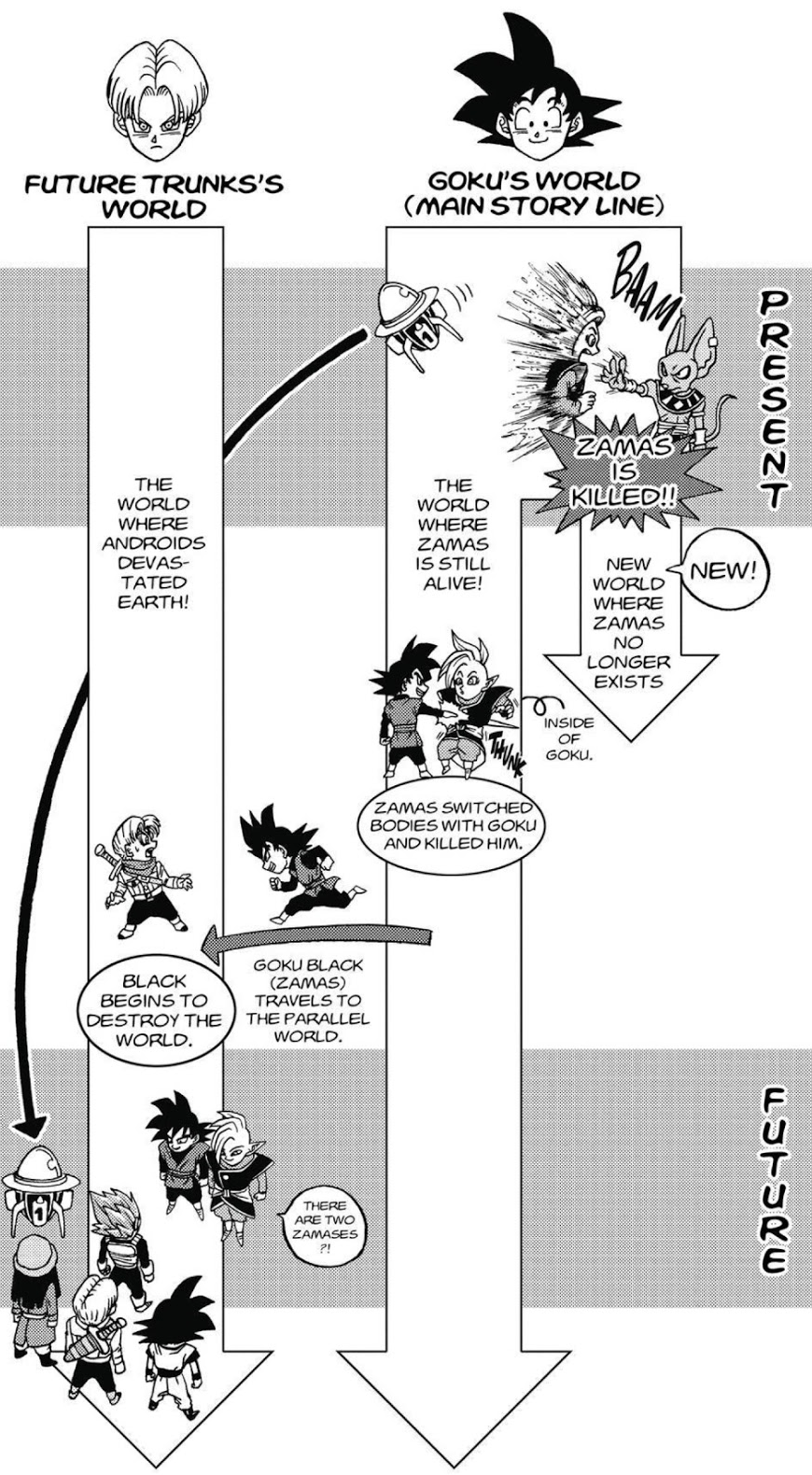
- Dragon Ball Super makes it even more confusing with the introduction of Time Rings, which Gods use to time travel without creating alternate timelines. Goku Black used a Time Ring to travel from Timeline 1 to Timeline 2 (Future Trunks' timeline) and caused havoc there, leading Future Trunks to go back to the Timeline 1 to ask for help. At the end of that storyline, Timeline 2 is destroyed by Timeline 2's Zeno and, thanks to a lot of string-pulling by the other gods, Timeline 5 is created where Goku Black and Zamasu, the one who kicked off these events, never ran havoc in the timeline.
- According to a (now-removed) article on the Dragon Ball Wiki, thanks to a lot of other factors, there's a total of seven timelines, although we only see about four of them.
- In the spin-off manga, Dragon Ball: That Time I Got Reincarnated as Yamcha!, there is one in which Yamcha manages to stay on par with the heroes in the early parts of the series and avoid his embarrassing death that befell him in the Saiyan Saga. This causes the timeline to diverge further because of this, such as causing all the Z Fighters that fought Nappa and Vegeta to survive that fight and accompany Krillin, Gohan, and Goku to Namek. It should be noted that this scenario, contrary to the other timelines, isn't canon, and wasn't created by Time Travel.
- Future Diary:
- The Spin-Off Paradox takes place in one. It actually turns out the be very important to the main timeline in the last chapter, however.
- Near the end of the main series, it's revealed that the timeline the series takes place in is actually one of these. In the original timeline, Yuno was the winner of the game and became the new God of Time and Space, but since she couldn't resurrect her world's Yuki, she instead used her powers to go back in time, creating the actual timeline or "second world", killed this timeline's version of herself and took her place in the game, all in order to be with Yuki once again. In the finale, a third timeline is created when Yuno tries to go back in time once again and here all the characters manage to get a happy ending.
- HuGtto! Pretty Cure only has two timelines, with the major divergence point occurring before the first episode even starts: The main timeline where Hana switches schools after being bullied out of her previous one and decides to change herself for the better, and a Bad Future where Hana stays at the school she was bullied at and ends up dying through undisclosed means in her adult years (which is where the Big Bad and his corporation originates from). Of course, this doesn't begin to cover the countless other timelines that implies to co-exist with the main Hugtto story...
- The Magical Girl Lyrical Nanoha A's Portable game series splits off from the main Lyrical Nanoha continuity at the end of Magical Girl Lyrical Nanoha A's. Here, Reinforce Eins does not perform a Heroic Sacrifice, causing Humanoid Abomination Evil Twins of Nanoha, Fate, and Hayate to be born from the remnants of the Darkness of the Book of Darkness.
- Negima!:
- By the end of Negima! Magister Negi Magi, there's at least three different timelines. The first one is the Bad Future Chao Lingshen comes from, the second one in which Asuna goes into a sleep for 130 years and finds all her friends are dead when she finally wakes up, and the third timeline where Chao and Eva bring Asuna back in time for her to be with her friends this time around and at which the epilogue takes place.
- UQ Holder! takes place in a timeline where Asuna went to sleep and couldn't be there to defeat the Big Bad, resulting in Negi being possessed by the latter. It diverges from any timeline seen in the first series because unlike the second timeline mentioned above, Asuna never gets sent back to the past and stays in the same timeline with Negi after both are freed from the Big Bad's control.
- The finales of Neon Genesis Evangelion and The End of Evangelion (arguably) diverge at Episode 25. ("Arguably", because in the opinions of some fans, they merely present the same events from different points of views.) Rebuild of Evangelion, meanwhile, diverges quite considerably from The Original Series. It's especially notable in the second movie, but it starts a good deal before.
- Puella Magi Madoka Magica: The anime series shows five different timelines where Homura Akemi failed to save Madoka Kaname, having to watch her either die or become a witch. Word of God states Homura has reset the timeline at least 100 times. Spin-Off manga, like Puella Magi Oriko Magica and Puella Magi Madoka Magica: The Different Story, take place in other timelines that came before the final one seen in the anime. The PSP game shows several additional timelines, though at least some aren't canon due to Homura dying or becoming a witch.
- Republica, from BBV Productions, is set in an alternate timeline where Charles II was never restored to the throne after the English Civil War. In the 20th century, England is still a republic (although the last scion of the House of Stuart, who styles himself Charles XIV, is plotting to take back what he considers his).
- Even Archie Comics has ventured into this, with their controversial Archie Marries Veronica / Archie Marries Betty combined mini-series which became a combined regular series.
- DC Comics:
- One alternate Earth in the DC Multiverse was formed soon after Jason Todd died. Batman, stricken with grief, abandoned his Thou Shalt Not Kill policies and virtually eliminated crime worldwide.
- Then there's Earth-12 and Earth-50. Earth-12 is the DC Animated Universe universe, currently in the era of Batman Beyond. Earth-50's history diverged from the DCAU with the death of the Flash at Lex Luthor's hands, leading the Justice League to become the totalitarian Justice Lords.
- Flashpoint details an altered DC Universe in which only Barry Allen (The Flash) seems to be aware of significant differences between the regular timeline and the altered one, including Cyborg's place as the world's quintessential hero, Superman's detention by the government, and a Thomas Wayne version of Batman who spends his days "running Wayne Casinos."
- DC's The Kingdom introduced the concept of Hypertime, "the vast, interconnected web of parallel timelines which comprise all reality", at the end of Issue 2. It also acts as a variation of the multiverse (every story, even the ones just in your head, are canonical somewhere). This was also used to explain away some continuity errors and subtly bringing in elements from other realities, but was later abandoned and instead the anomalies were the result of Superboy punching reality.
Hunter: How does 'Hypertime' work? Off the Central Timeline we just left. Events of importance often cause divergent 'tributaries' to branch off the main timestream. ...On occasion, those tributaries return — sometimes feeding back into the Central Timeline, other times overlapping it briefly before charting an entirely new course.
- In the Doctor Who Magazine comic strip, the Eighth Doctor comic stories were initially explicitly depicted as taking place in an alternate timeline to most of the Seventh Doctor comic stories (Ace dies in a Heroic Sacrifice at a point that is clearly before her character development in the Seventh Doctor stories, and the Seventh Doctor very quickly regenerates into the Eighth, with his first major story arc being his pursuit of the Threshold — all this was because a new editor strongly disliked the Doctor Who New Adventures which the Seventh Doctor comics had shared a continuity with, and wanted to demonstrate that). However, the post-2005 stories have occasionally made continuity references to stories from both allegedly separate timelines.
- A number of Marvel Comics' alternate dimensions — typically the ones featured in the What If? comics — are implied and in some cases outright stated to be offshoots of its main Earth-616 universe. Days of Future Past, Age of Apocalypse, and Marvel Comics 2 universe are examples.
- The Spider-Girl series takes place in the MC2 universe, which diverged from the main continuity after the Clone Saga. In this continuity, Spider-Man's daughter survives and becomes Spider-Girl in the future. The point of divergence may be even further back, as later on it's revealed that Simon Williams (a.k.a. Wonder Man) died in issue 9 and was never resurrected.
- Marvel tends to mess in and out of clones and alternate timelines, to the point where several characters have a modus operandi off of it.
- It was an early rule of Marvel Comics that any attempt to change history would just create an alternate timeline, which among other things is how the X-Men have so many bad futures to choose from. Writers have tended to forget this when it's convenient.
- Exiles is all about exploring alternate timelines with a group of original characters (for the most part). One interesting commonality about them is that typically Thor wasn't involved in them.
- Mighty Morphin' Power Rangers (Boom! Studios) features two timelines: a Setting Update of the original show, and another (revealed much later) where Tommy kept working for Rita even after her spell was lifted. The second one is a few years ahead of the first, and has gone full Bad Future. The comic's story arc is a result of evil!Tommy invading the regular timeline for his own reasons.
- Dr. Ivo "Eggman" Robotnik as he appeared in Sonic the Hedgehog (Archie Comics) actually came from an alternate timeline where he roboticized himself to defeat Sonic. After wiping out the Freedom Fighters in his home dimension, this Robotnik became the successor of the original Robotnik, who was killed in the 50th issue. He was eventually turned back into an organic being in Issue 118.
- Star Trek:
- Star Trek: Early Voyages: In the story arc "Futures", Mia Colt accidentally activates the tachyon energy suspended in an Algolian keepsake when she scans it with her tricorder. As a result, she is sent 39 years forward in time to 2293 and thereby creates an alternate timeline. After her disappearance, James T. Kirk, newly graduated from Starfleet Academy, was assigned to replace her as Captain Pike's yeoman. However, the two men had a severe personality clash and Kirk resigned from Starfleet after a year. He went into the commercial sector and eventually became the captain of the freighter Bounty. Captain Pike remained in command of the Enterprise until it was decommissioned and became an exhibit at the San Francisco Smithsonian Museum of Air, Sea and Space. He then assumed command of the Enterprise-A. In 2293, the Federation has a very fragile peace with the Klingon Empire and it is feared that an instance of border violation may result in war.
- Sons Of Star Trek has Q Junior send Jake Sisko, Nog and Alexander Rozenkho to an alternate universe where first contact with the Breen lead to a ten-year war between them and the Federation. The three are on board the USS Avery, captained by Dukat (which really chaffs Jake) with crew members including Morn (who really is talkative), a Commander Beckett Mariner (suggesting that Sito Jaxa never died here), Tuvix and a seemingly well-adjusted but a Lieutenant Liam Shaw.
- Superman:
- Way of the World: After Thomas Price's death, the story shows an alternate future where Supergirl defeats an alien conqueror and considers to use his time-travelling gadget to save Thomas.
- Superman & Batman: Generations had an alternate timeline play itself out in the third series, only for it to be undone and revert to the ending of the first series, with Batman, Superman, and Lana Lang together wondering what had happened.
- Transformers has done this multiple times.
- The Transformers Classics continuity follows on from the end of The Transformers (Marvel), but ignores the events of G2 and some (maybe all) of the UK comics. Don't ask where Earthforce fits in.
- Titan Magazines had a comic based off the 2007 film which diverges from the main timeline when the Decepticons win the Battle of Mission City.
- In Transformers: More than Meets the Eye, Brainstorm's time machine is designed specifically to avoid creating one when he attempts to prevent the Autobot-Decepticon war. It doesn't quite work — while all the time travelling he and the others do follows You Already Changed the Past, Perceptor messes with the machine enough for a second timeline to come into being. In it, Megatron was never born and all the war's collateral damage is averted — at the cost of Cybertron remaining a complete dystopia where your worth is defined by your alt-mode.
- In Wonder Woman: Odyssey, Themyscira was destroyed when Diana was a young child, leading to the death of Hippolyta and Diana being raised in exile with surviving Amazons.
- Present in the Miraculous Ladybug fic Adrien AUgreste: The New World After the Wish.
- The fic focuses on a new timeline created when Shadow Moth successfully gets the Ladybug and Black Cat Miraculous and make the wish to undo his wife's coma, which leads him to be in a coma instead and Emilie to become the Butterfly villain Lycaena. As Lycaena, she is a far more dangerous and ruthless villain than Hawk Moth was, forcing Master Fu to select more permanent heroes like Ryoko, Rena Rouge, and Pegasus to join in the fight alongside Ladybug and Chat Noir. In addition, Emilie is shown to be a skilled Manipulative Bitch, using emotional manipulation to keep Adrien from going to public school, getting the staff at Dupont to be lenient towards bullies so more potential akumas can be made from the victims, having Marinette blacklisted as a designer so she couldn't claim the stolen hat design Chloe submitted, and training Lila as an apprentice who caused Marinette, Alya, and Max to be expelled from their school, leading to the latter three to work in exposing the various forms of corruption in Paris.
- In the penultimate chapter, it's revealed that there was a previous timeline before the canon-compliant timeline that Hawk Moth started from. The original timeline involved a British version of the original Miraculous Ladybug preview, with Felix as Black Cat, Marinette's cousin Bridgette as Ladybug, and Felix's father as the supervillain Papillon, who planned on using the wish to bring back his dead wife. After the final battle resulted in Papillon's defeat and Ladybug's death, Felix desperately stole the Rabbit Miraculous to go back in time so he can save his mother and his girlfriend. Just like the wish, his actions also resulted in an Equivalent Exchange that brought back Amelie and Bridgette but caused his aunt to enter a coma from abusing the Peacock Miraculous and his father to be killed by Gabriel for the Butterfly Miraculous.
- Justified in Brother on Brother, Daughter on Mother, which takes the approach of explaining the inconsistent behavior of Star Trek Time Travel with the notion that time is like a rope composed of alternate timelines (or more specifically sequences of probabilistically determined events) that are fundamentally similar overall, but which can fray off dramatically different timelines in the event of major temporal incursions. The Time Police and the Temporal Prime Directive exist to prevent such frays from happening, since they damage time itself.
- An unused idea for a Calvin & Hobbes: The Series Made-for-TV Movie chronicled the eponymous characters visiting one, where Calvin (as an adult) became rich by selling the MTM, only for a war to break out as several nations all try to use it to change history in their favor.
- In Carpe Noctem, while going back in time with the help of the Time Turner, Hermione accidentally lets her past self see her future self, which disrupts the space-time continuum and causes an alternate world's Hermione to see the events of the canon Harry Potter timeline in her dreams.
- In Custody Battle, a My Hero Academia fanfic, the first One For All user traveled forward in time instead of dying. This created a darker AU since he never passed on One For All.
- Down the Karmic Hole takes place in one, being set in the same universe as The Karma of Lies. The main divergence so far is Alix encountering her alternate self's future self, Bunnyx, who informs her of the events that lead to Karma of Lies one week before they happen.
- Empath: The Luckiest Smurf had at least three different alternate timeline stories played out. The first was when Empath was born without his abilities, but instead was lost in the forest for 150-something years before he was discovered and named Wild Smurf. The second was when Smurfette fell in love with and married Papa Smurf, resulting in a child and the new family being exiled from the Smurf Village by the other Smurfs. The third was when Empath was forcibly returned to Psychelia and Smurfette ended up falling in love with and marrying Hefty, having a child through him.
- In Equal & Opposite Attraction, there is a massive divergence where Negi never stops teaching and Fate goes soul-searching. This kicks off the plot when Negi leaves Mahora to get his life in order.
- Fate of the Clans: In this, the multiverse exists. A Quantum Time-Lock occurs every 100 years in order to cull the Dead End timelines so the Solar System doesn't die. A person with the Second Magic, Kaleidoscope, can travel to these different realities.
- In Fear No Evil, a My Hero Academia fanfic, Izuku is forced to face Humarise early when they kidnap him while he is still in middle school.
- In Flashpoint 2: Advent Solaris, the Sonic Universe is brought in not as its own universe but rather an alternate timeline of the DC Animated Movie Universe. Barry Allen is just as confused about it.
- In the Forever Captain series, Steve is uncertain what effect his return to the midcentury will have on the proceeding of the timeline in this version of the multiverse.
- In Forgiveness is the Attribute of the Strong, a My Hero Academia fanfic, eleven-year-old All for One and his younger brother travel to canon time. This story uses the parallel universe version of time travel, so their older selves are also around (as a vestige in the case of the latter).
- There is a Futurama fanfic called Green Storm Rising where the Planet Express Crew randomly shifts through two different alternate timelines.
- Hetalia: Axis Powers fanfic Kanashī, Wütend, Desolato is basically a What If? for Gankona, Unnachgiebig, Unità: instead of supporting Germany's, Italy's, and Japan's relationship, what if most of the countries scorned and tormented them upon finding out? Things do not turn out well.
- The Legend of Zelda Ocarina of Time (DragonRand100) features the creation of multiple timelines, not unlike the original game. The first timeline is the adult timeline where Link defeated Ganon as the world healed; the second timeline is the child timeline where Link was sent back to his childhood where Ganondorf could be stopped before his plan was put in motion. Other timelines, created by some timey-wimey stuff involving the Hero of Time, are hinted at.
- Maris Stella: Chapters 27 and 28 detail a timeline in which Riodinidae overpowers the heroes to steal the Miraculous. Yuu manages to travel back in time to change events, creating the main timeline.
- Chapter 10 of Manifest (Season Four) shows an alternate timeline of Manifest where the events of Flight 828 happen differently, shown as where main timeline Cal ended up between touching the tailfin and returning right during Grace's death during Season 3. The passengers on the plane were different, with Olive, her grandfather Steve, and Saavni's girlfriend Alex on the plane in place of canon passengers like Michaela and Adrian. Flight 828 crashed during its flight with Cal as the only miraculous survivor, where he lived for 5 and a half years before dying of leukemia. The timeline also has other notable differences, such as Olive having leukemia during the disastrous flight and Zeke's younger sister Chloe being alive and as a child therapist while Zeke has died years prior. It's also revealed that the Major, who seemingly came back from her death in Season 2, is actually from this timeline, sent when experimenting with Dark Lightning.
- No Such Luck, No Such Love is a The Loud House fanfic that centers around one of these during the events of "No Such Luck", but instead of having the Loud family believe that Lincoln was bad luck, they knew that he lied about it so he could get out of going to his sisters' events. The things that Lincoln suffered through in the actual episode (not allowed to attend activities that he enjoys, having his room completely removed of his furniture and boarded up, and being forced to sleep outside) were really done to punish him for lying, but the problem is that Lincoln doesn't know this due to no one telling him, so he ends up thinking that his family really thought he was bad luck.
- The main setting of Odaliaverse is an alternate version of the Boiling Isles that, while initially looking very similar to the original timeline, is soon revealed to have a couple of changes, chief among them being Phillip Wittebane having been petrified a long time ago, with someone else, implied to be his brother, taking his place as Emperor Belos.
- Passing Days for Fate/Grand Order itself can be considered an Alternate Timeline to canon due to the main protagonist Vy's actions in regards to the game's events and the Servants she summons. Scathach-Skadi herself in this story is an Alternate Self and Sole Survivor of her Lostbelt who was summoned in Part 1.5 as an example, and it results in her saving Vy and Mash from Kadoc and Anastasia in the Russian Lostbelt. Day 15 of the story even has Chaldea explore a mini-Lostbelt of an Alternate Timeline of Fate/Extra Last Encore where Dan Blackmore and Robin Hood succeeded in killing Deadface!Hakuno and Nero in their first encounter.
- The Pony POV Series is established as being an Alternate Timeline to the main series timeline. While originally tied to the "heart-world", the universe diverged completely and became independent as of "The Last Roundup".
- The Powerpuff Girls meet Freddy Krueger: The Powerpuff Girls' confrontation with Freddy Krueger ends with the former three deciding to change the timeline out of sympathy for him. This results in Freddy being raised by a more loving family, becoming a horror enthusiast and a stunt double for Christopher Lee instead of the Serial Killer he was in canon.
- In The Sage's Disciple, this appears to be the case for events of the mundane world, as it appears the presence of the supernatural has affected the timeline. Russia remained an absolute monarchy due to Tsar Alexander III surviving to influence the events leading up to World War I, the Yggdmillennia family prevented the outbreak of the Second Balkan War, the Titanic managed to reach New York City before sinking due to the intervention of an unnamed magus, Operation Valkyrie succeeded in 1944, etc. During the sequel The Puppeteer's Bodyguard, Crow spends much of his free time researching other such changes and trying to figure out why it's so different from the world he knew.
- Spirit Lines takes place in an altered timeline of Parts 1 to 6 of JoJo's Bizarre Adventure after Pucci used Made in Heaven to reset the universe in Stone Ocean. While the events of Phantom Blood and Battle Tendency remained the same, many events afterwards are changed due to the death of Joseph Joestar. Namely, this story's version of Stardust Crusaders has Katarou (this timeline's Jotaro) implicitly get sick from Dio's influence, leading to Holly — who requests to go by Seiko — joining Joseph and Avdol on their quest to Egypt. Katarou and his daughter Irene, this timeline's Jolyne, are normal humans without Stands.
- A defining plot point in Split Second (My Little Pony), which diverges at the moment of the first sonic rainboom, in which Twilight became a White Mage and Sparkle became a Black Mage.
- In Star Wars: Light in Dark Time, the series' real plot begins when Doc and Marty inadvertently get Luke and his friends to create an alternate timeline where Anakin never became Darth Vader, but Order-66 still happened. The result is an evil version of Luke, a more competent Empire, and a potentially worse galaxy.
- To Hell and Back (Arrowverse): Like in canon, except not. Canon's nail was the death of Nora Allen. Here, while Nora's death has had a major ripple effect on the timeline, it is not the only one. It's noted that there have been several changes to the timeline prior to Nora's death, heavily implied to be caused by another time traveler that Eobard was unaware of until recently. Of these changes and others:
- Kara, and by extension, Astra and co., were not due to arrive on Earth for another five years. Kal-El is the right age, but he's being raised by Kara and his original adoptive parents, the Kents, were killed in a fire before they could ever meet. To say nothing of the different landing place. This is also implied to be the reason why her supporting cast, and the location of National City, are not a part of the story — most of them are kids/teenagers living in different parts of the country.
- Bruce Wayne's parents were never killed, so he is a well-adjusted individual who never becomes Batman. This presumably has a ripple effect that prevents the rise of most of his Rogues Gallery.
- Princess Diana never leaves Themyscira, so there's no Wonder Woman either.
- Felicity Smoak is incarcerated for the creation of her hacktivist supervirus, rather than moving to Starling City and eventually becoming infatuated with Oliver.
- APEX starts off in a normal version of 2073, when a time-travelling experiment goes wrong sending an A.P.E.X drone to a century ago, in 1973. The hero, Nicholas Sinclair, travels to 1973 to shut down the drone, but then returns to an alternate version of 2073 where the A.P.E.X. drones tutned against humanity, and mankind are on the losing end of a Robot War. Sinclair even meets alternate versions of his wife and commanding officer, and they didn't recognize him at all.
- Back to the Future:
- About half of the plot of Back to the Future Part II is based around this. 2015!Biff Tannen steals the DeLorean time machine, goes back to 1955, and gives his younger self a sports almanac that allows him to win every bet and become fantastically rich. By 1985, his greed and corruption have turned Hill Valley into a Wretched Hive. Marty and Doc find out about this when they try to return home, then figure out the point of divergence and spend the rest of the movie trying to steal the almanac away from 1955!Biff so they can destroy it.
- The IDW comic book did a mini-series titled Biff to the Future, co-authored by series co-creator Bob Gale, that explored the alternate timeline in greater depth and detailed events that were just minor background elements in the movie. Among other things, Biff became good buddies with Richard Nixon, helping the latter avoid Watergate and stay in office for five terms, which also lead to the Vietnam War continuing into the 1980s.
- In the DC Extended Universe, Batman witnesses a horrific Bad Future in a dream in Batman v Superman: Dawn of Justice, with the forces of Apokolips dominating the Earth and Superman having turned to their side. All of this likely happened because Lois Lane died and the Justice League didn't gather. The Flash travels back in time and tries to warn Bruce Wayne, who doesn't fully understand it until Superman's death at the end of the film. By the time of Justice League, Bruce and Diana/Wonder Woman do their best to gather the eponymous Super Team to repel the incoming Alien Invasion by the Apokoliptian war chief Steppenwolf and spare the Earth the aforementioned Bad Future. While the 2017 theatrical film does not delve into it, it becomes more of a key plot point in Zack Snyder's Justice League, where it becomes more clear what happened: Darkseid killed Aquaman and Wonder Woman, corrupted Superman, and Batman, Flash, Cyborg, Mera, and Deathstroke are forced to pull an Enemy Mine with The Joker to stand a greater chance against their fallen comrade (though Batman had promised Harley to kill the clown when the alliance is over).
- Done to the extreme in Déjà Vu (2006), which necessitates four alternate timelines◊ to explain the events of the movie.
- The Godzilla series has done this several times to the point where each of the movies from Godzilla 2000 and onward (with the exception of the two with Mechagodzilla) are their own continuity branching off from the original.
- Marvel Cinematic Universe:
- Avengers: Endgame deals with something like this. In order to find and retrieve the Infinity Stones and restore those erased by Thanos, the Avengers do a bit of time travelling, intending on "borrowing" the items before putting them right back. However, things don't go so well. In 2012, during the Battle of New York, Hulk accidentally knocks out present-day Tony, allowing the Loki of that era to temporarily escape with the Tesseract (and lead into his own show in the process). Later, the Thanos of 2014 catches present-day Nebula and learns of what happens in the future, leading him to travel to 2023 in order to take care of everything there, taking all of his forces (including his own Nebula and Gamora) with him. This implies there's at least two of these — one where Loki escaped capture and one where Thanos never arrived on Earth at all, but the Guardians never got Gamora on their side. Additionally, the directors have confirmed that Steve going back in time to live a life with Peggy also created another alternate timeline... a statement which is contradicted by the writers, who have instead suggested that Steve was actually a part of the original timeline all along as Peggy's mystery husband. According to the Ancient One, the Infinity Stones create what is perceived as time, and that removing one creates a branched alternate reality. This can be interpreted to mean that any changes caused by Time Travel result in alternate realities, or that this only applies if an Infinity Stone is directly involved.
- In Spider-Man: No Way Home, Peter tampering with Dr. Strange's magic leads to villains from the Raimi and Webb universes being brought into the MCU from timelines parallel to the original ones where they were defeated by their respective Spider-Men, shortly before it happened.
- It's almost certain that there are two continuities in the original Planet of the Apes franchise. The first is the continuity that led to the society of the original film, possibly as described by Cornelius to the committee in Escape from the Planet of the Apes. The second is the altered continuity that the birth of their son, Caesar, sparked. It appears that the ape revolution was greatly sped up with his arrival. However, fans are split as to whether the continuities ultimately re-merge when history reaches the point where the original film was set, and humans will again end up mute wild animals and the world destroyed by the Alpha-Omega bomb or whether history was changed for good by the end of Battle for the Planet of the Apes and Caesar forged a new future. The editing of Battle didn't help things, the theatrical release had a hopeful tone, but the unedited version on most DVD releases clearly sets up the beginnings of the mutant society of Beneath the Planet of the Apes. The TV series likely exists in one of these continuities somewhere, while the animated series and the 2001 remake don't, and and Rise may or may not. Rise of the Planet of the Apes is a Continuity Reboot, but there have been statements by the creators contradicting that and painting it as a prequel as well.
- In Sliding Doors, the movie shows two alternate timelines. The story starts off with Helen Quilley getting fired, while her boyfriend is cheating on her. She goes home, and either just catches the tube in time, finding her boyfriend in bed with another woman, or misses the tube, causing some other events to happen which means she arrives home after the other woman has left. The movie then alternates between the two story lines.
- Star Trek:
- Explained in-story in Star Trek (2009). The two main timelines diverge at the attack on the USS Kelvin. In the Prime Timeline, Kirk is born on Earth in March of 2233 and the timeline proceeds how you remember it. In the new timeline, Kirk is born in space in January during Nero's attack on the Kelvin, his father is killed pulling a Heroic Sacrifice, and Vulcan is eventually destroyed — so there is no point asking Spock-Prime what's going to happen next, since now he has no idea either.
- Although his knowledge of things that predated the Kelvin attack but became important later or that originated elsewhere wouldn't have necessarily been affected. Things like the Guardian of Forever, the "green space hand", Doomsday Machine, giant space amoeba, V'Ger, Khan's sleeper ship (which is realized in Star Trek Into Darkness, where it is discovered several years earlier than the original timeline), the Nexus, the existence of the Borg and the Dominion, subspace damage caused by warp drives, the need for whales, and so on. Also included is the entirety of Star Trek: Enterprise.
- The IDW comic series reveals that Q knows about this timeline and decides to go mess with it to teach Kirk a lesson, despite Picard begging him not to.
- In 2016, shortly before the release of Star Trek Beyond, this timeline got officially dubbed the "Kelvin Timeline", referring to the USS Kelvin attack as the diverging point.
- In Triangle, Jess gets stuck in a "Groundhog Day" Loop of her co-passengers getting killed by a masked killer. The first Jess tries to break the chain by meeting the Jess from the next loop. This creates a new timeline where the other passengers died differently by getting killed by a different masked killer. Subverted in that the two timelines play off at the same time and each influence each other. For example the new timeline eventually causes the second Jess to have her own story, which we don't see, where she eventually killed some of the passengers as the second masked killer which eventually made the first Jess turn into the first masked killer. However, it is highly, highly implied that Jess is not going through any real kind of "time travel", but that she died IRL in the car accident we see at the end, and everything we're witnessing is her in some kind of purgatory/hell due to her guilt/grief over the way she treated her special needs child while alive, ultimately averting the trope.
- X-Men Film Series:
- The series entered this territory after X-Men: Days of Future Past. All films set after that point take place in an alternate version of Earth in which the existence of mutants became public knowledge in 1973, nearly three decades earlier than in the original timeline, meaning there are quite a few differences.
- Logan is said to be its own timeline even to the one post-Days of Future Past.

- Eric Flint's 1632: One of the many things that the main characters bemoan is that so many great artists and musicians born after the arrival of Grantville in the past will now never be born because the timeline has diverged way too far for probability to allow it. This fact causes several artists and musicians native to the time to investigate what would have been created by those now-erased artists and create it themselves.
- Adam R Brown's Alterien features a story at a later point in the series in which Oberon and his rival, Theseus, end up in an alternate reality. In this alternate universe, many of the events of Oberon and Theseus' lives occurred similar to the way they did before, but set a century earlier and with new people in place of some of the people they remember.
- The Black Trillium novel was co-written by three authors, who each went on to write a sequel (or two), effectively spawning three mostly incompatible timelines from a single root.
- Gary Paulsen's Brian's Saga: The first book, Hatchet, ends with Brian being rescued. However, in the third book, Brian's Winter, it takes place in an alternate series of events where Brian has to survive through the winter. Of course, marketing spoiled this on the back of the book.
- Stephen King's The Dark Tower: In The Waste Lands, alternate timelines created in the previous book, The Drawing of the Three, are explored. The alternate timeline, one where Roland travelled with Jake, versus one where he was alone, slowly drive both Jake and Roland insane as their minds simultaneously believe both two different versions of events to be true.
- Scott Ciencin's Dinoverse has a vast number of alternate universes, but it's implied that the peaceful utopian Dinoverse, which has a present-day society of, well, dinosaurs, is the result of characters in the Mesozoic era rescuing an unusually smart Deinonychus from certain doom. There's still the heroes' reality with human civilization, and there are human and dinosaur versions of several characters.
- The Discworld novels refer to this as the Trousers of Time, with a person theoretically going down one leg when they could have gone down the other. It's mostly hypothetical, except for in two instances.
- In Lords and Ladies, Granny finds herself wondering if she's going mad when she starts subconsciously setting up her house as if two people are living there. After learning of the Trousers of Time from her ex-boyfriend Mustrum Ridcully, she realizes that her mind has been mingling with an alternate version of herself where she married him instead of remaining single.
- In Jingo, Sam Vimes leads the Watch to rescue a captured member, and then somehow accidentally collects his Disorganizer (which has started adding future events to his schedule) from the leg where he didn't. This results in him learning what could have been had he not gone - his departure caused the Ankh-Morpork fleet to attack Klatch ahead of schedule, which disrupted Klatch's invasion plans, buying time for Vetinari to come up with a political solution; in the other, Klatch attacked first, and the Watch was slaughtered in the city's defense.
- The Empirium Trilogy: When Eliana returns after a failed trip into the past, she learns that her brief interaction with her birth mother altered the pasts of various characters and events, and not for the better. Characters that were alive are now dead or missing and the deadline for the current mission was moved forward by a few days.
- Later Joel Suzuki books reveal the existence of alternate timelines. When a person travels to one, they displace the version of themself that was already there, resulting in a person who combines traits and memories of both, and retconning the history of the new timeline to reflect that. In Dance of the Darkeye, Joel and Felicity travel to different timelines to use different versions of the Songshell to infuse Joel with huge amounts of power so he can defeat Marshall. But it turns out that excessive timeline-hopping can weaken the boundaries between timelines, and their actions cause all the timelines to eventually collapse into one.
- Isaac Asimov's Living Space: Alec Mishnoff is able to figure out that the German-speaking builders are from an alternate Earth timeline where Nazi Germany won a tribal conflict. Still the same year, ignoring differences of Nach Hitler versus Anno Domini.
- Isaac Asimov and Janet Asimov's Norby and the Queen's Necklace: The characters call these time-tracks, having created a "false" one when Albany took the diamond necklace that was the focus of Marie-Antoinette's scandal before it reached Comtesse de la Motte, preventing the scandal from occurring in the first place. Without that scandal, The French Revolution was a peaceful change in government, creating a constitutional monarchy. In order to return to their own time, the characters have to first return the necklace to the jewelers it was taken from.
- In Orson Scott Card's Pastwatch: The Redemption of Christopher Columbus, the historians of the titular organization try to figure out if it's possible to change the past to avert The End of the World as We Know It, only to discover that it has already been done once. It's heavily implied that our timeline is the alternate to what was supposed to have happened originally. In the original timeline, Columbus never sailed West, instead leading a new, disastrous, Crusade to retake the Holy Land. Without European interference, the Aztec Empire fell under the onslaught of Tlaxcala, a rival nation (in our history, they allied with the Spaniards to destroy the Aztecs). Unlike the Aztecs, the Tlaxcalans were not averse to innovation and were even more bloodthirsty. They forged an even greater empire, by the time the Americas are finally visited by Europeans in the 18th century. The captured Portuguese sailors were forced to give up the secrets of gunpowder and shipbuilding, after which the the Tlaxcalans built a massive armada and sailed East. They fell upon a devastated Europe, crushing all enemies and sacrificing thousands to their god of war. However, that original timeline was also doomed to result in the end of human civilization, so scientists from that timeline sent back a holographic message to Columbus, pretending to be God telling him to sail West, resulting in our timeline. Realizing that both versions of history are dead ends, the Pastwatch historians send three people into the past around the time of Columbus's arrival to the New World. One sacrifices himself to trap the Europeans in the Caribbean, another convinces Columbus to work on unifying the island tribes, and the third starts forming a more benevolent empire on the mainland. Many decades later, Columbus returns to Europe at the head of a massive well-armed fleet of trade ships as both an example of Gunboat Diplomacy and an offer for the Old World to trade fairly with the New World with neither culture dominating the other. Supposedly, this results in a much better timeline.
- Relativity: The entire series apparently takes place in an "alternate timeline." In the short story "Tempest" (which takes place in the distant past, relative to the main narrative), Phanthro alters history, and uses a memory-projector to show a version of history where Matt's son dies in his forties. Since his son dies as a child in the "current" history, the memories Phanthro has must be from an "earlier" version.
- Ginn Hale's The Rifter: Kahlil, after a lonely youth training in Rathal’pesha, spent years in Nayeshi waiting to bring the Rifter (John) to Basawar; then his key to the gates fell into John’s hands and John crossed through. He landed at an earlier point in time and met Ravishan the trainee-Kahlil; together the two of them changed history radically. Now the future where Ravishan becomes Kahlil will never happen, but his future self is still over in Nayeshi, not knowing that events he remembers have been wiped out of existence. Kahlil crosses to Bashawar and arrives thirty years after John’s arrival. He doesn’t meet himself because by this time Ravishan is dead. However, he does pick up Ravishan’s memories; the two timelines coexist confusingly in his mind. Among other things, the Payshmura church that Kahlil remembers serving all those years doesn't exist here, it was destroyed soon after John's arrival.
- Worm takes place on Earth Bet, which diverged from our timeline in 1982 with the appearance of Scion, the first superhero. Other worlds exist with their own divergent timelines — Earth Aleph being one.
- The 4400: In the two-part story "Gone", the woman from the future (who posed as Maia's sister Sarah Rutledge) and her accomplices kidnap five 4400 children — Maia, Lindsey Hammond, Tyler Downing and Duncan and Olivia Germaine — and transport them further back in time in order to create an alternate timeline. Their reason for doing so is that the 4400 have failed to change history and prevent the catastrophe of which the messenger in Kyle's body warned Tom in "White Light". Maia is sent to 1832 and eventually dies of smallpox while on the Oregon Trail in October 1847. Tyler is sent to 1893 and invents synthetic petroleum in 1915. Lindsey is sent to 1918, gets adopted by Robert Goddard and invents the composite materials used in the construction of the first lunar colonies.
- Community:
- "Remedial Chaos Theory" explores six alternate timelines, each different depending on which number Jeff rolls on the Yahtzee die. We then see the main timeline, which is where Abed catches the die instead of letting it roll.
- The series flashes over to the "Darkest Timeline" every now and then to see how things are going (or at least Abed does in his own mind).
- The episode with the two model U.N.s also used this explanation (at Abed's insistence) to explain the presence of two Earth's each with their own U.N.. Ultimately, it's integral to how the study group wins the competition.
- "Remedial Chaos Theory" explores six alternate timelines, each different depending on which number Jeff rolls on the Yahtzee die. We then see the main timeline, which is where Abed catches the die instead of letting it roll.
- Dallas: When the show retconned a whole season that had been unpopular with fans as All Just a Dream, the producers of the Spin-Off Knots Landing didn't want to retcon plots that had been influenced by events in that season, causing the show to split off as an Alternate Timeline.
- Doctor Who:
- "Turn Left" shows what would happened if Donna had turned right instead of left at a fork of the road to take a different job offer some time before meeting the Doctor. She never would've gotten involved in the Racnoss plot and not been there to keep the Doctor from going too far and dying under the Thames. Then it goes From Bad to Worse, as the Doctor's absence causes every single crisis he prevented to take place, sometimes even worse (e.g. the Adipose end up killing millions in the US, while the starliner Titanic ends up wiping out London). At the end of the episode, Donna is convinced by Rose to put events back on the right track.
- The events of "The Pandorica Opens"/"The Big Bang" end up triggering a Total Event Collapse, where all of reality aside from the Earth, Moon, and everyone on it are erased from existence across every point in time. Species that were at the heart of the collapse but not from Earth were preserved as statues; small impressions on the universe. Stars no longer exist, including the sun, but the TARDIS manages to keep the Earth warm by containing its explosion in a "Groundhog Day" Loop across all of time as well. This allows humanity to develop, though they see stars as just a myth. Aside from Richard Dawkins, who runs a "star cult".
- Eureka:
- Lampshaded when Henry explains to Sheriff Carter exactly why they can't accurately predict the future after hitting the Reset Button on the past five years to undo Henry meddling to keep his wife from dying in the past, since the differing actions alone will cause a Ripple Effect to make the timelines gradually diverge. And then something different happens.
- It should be noted that Eureka has gotten two Alternate Timeline treatments. The first one (mentioned above) only lasted an episode before being reverted; the second one, however, became the permanent timeline for the show.
- Farscape: A few later episodes see John Crichton exploring a few of these, particularly as interdimensional wormholes and the associated wibblie-wobblies become more important to the plot.
- The Flash (2014):
- It's eventually revealed that the entirety of the show takes place in an alternate timeline created by the Reverse-Flash going back in time to kill Barry as a child. When Barry saves his past self, the villain kills Barry's mother in a fit of rage. Barry's father is arrested for the murder, and Barry ends up being raised by Detective Joe West. The villain further messes with the timeline after discovering that he is stuck there and does everything possible to try to return to his own time, including re-creating the Flash. By extension, this also means that Arrow also takes place in an alternate timeline.
- Season 3 begins right on the heels of Barry going back in time to prevent his mother's murder. The result is the series' answer to Flashpoint: Barry lives a normal life with his parents, with Wally West as the Flash and The Rival serving as his speedster nemesis. However, Barry's old adopted father is now a washed-up drunk, his old tech support are now a children's eye doctor and self-centred billionaire, and the more he uses his speed, the more he forgets his old life. In the end, after getting one of the above mortally wounded, he goes back again to make a Close-Enough Timeline. Now, the only differences are that Cisco resents him for not going back to prevent his brother's death at the hands of a drunk driver (which only gets worse when Barry admits what he did, then pushed aside, then exacerbated during the Invasion crossover until it's finally settled), Joe West and Iris haven't talked for the past year, he causes Caitlin to develop the Killer Frost persona, and he's had a co-worker for the past year who hates his guts. He almost goes back to reset this timeline too, before Jay Garrick yanks him out for a lecturing, telling him that no matter how many times he tries to fix things, he'll always keep making more changes.
- In the same season, it's revealed that the villain Savitar hails from one, where he slays Iris West, Barry defeats him, and then slips into a funk over the loss of Iris until his past self arrives and snaps him out of it. Then it's revealed to be a Stable Time Loop that occurred because Savitar is really Barry — or rather a Speed Force duplicate of Barry, who wants to ensure his existence remains. When H.R. Wells takes Iris's place, Savitar fades, altering the timeline.
- Fringe: The fourth season takes place in an Alternate Timeline, one in which Peter Bishop was never saved by the Observer as a boy. The first four episodes explore all the changes to the continuity, big and small, that resulted from Peter not being around. Then the Peter from the original timeline returns. This is all in a series that spent three years knee-deep in the complexities of an Alternate Universe.
- It's also worth noting that, according to the time-sensitive Observers, the first three seasons already took place in an Alternate Timeline that was thrown off-course from what was supposed to happen by the actions of an Observer. The Alternate Timeline of Season 4 is probably a lot closer to how the original timeline was supposed to run.
- Kamen Rider Ryuki: Since the overall plot of the series is that Big Bad Shiro Kanzaki is looping time over and over in an attempt to save the life of his sister Yui, the movie Episode Final and the TV special 13 Riders are the events of different timelines rather than simply being Alternate Continuities like most Kamen Rider Non-Serial Movies.
- Loki (2021) elaborates on the concept of time travel introduced in Avengers: Endgame and explains that any change to the timeline results in a branched separate timeline. The Time Variance Authority claims that an uncontrolled branching of timelines would be catastrophic and upholds their goal of maintaining the Sacred Timeline, one where every event happens according to how it's intended to happen, and pruning the unintended branched timelines.
- The Magicians (2016): There are forty alternate timelines because of the time loops created by Jane Chatwin, in order to defeat the Beast. The timelines seem to be largely the same until the main group gets into Brakebills, at which point they diverge. Timeline 23 features in a couple episodes, once in Season 2 and again in Season 3. In that timeline, Julia got into Brakebills, she and Penny are in love, and Quentin is the Beast (after killing Martin Chatwin), among other changes. They bring Marina 23 and Penny 23 back with them after stopping Quentin. We also see a different timeline's version of Dean Fogg, who has had a Face–Heel Turn in response to everything going to shit in his timeline.
- Malcolm in the Middle: "Bowling" played with this, the divergence being which parent took the kids bowling instead of staying at home. The conclusion?
Lois / Hal: Next time, you take 'em.
- Maniac (2018) entirely takes place in a Cassette Futurism world where computing technology never advanced past about the late 1980s (Word of God is that "something happened in the '90s"). However in certain areas technology is more advanced, such as in Cyberspace and Artificial Intelligence. Society also is more dystopian than ours. Blackmail apparently is common enough that there's a chain of stores called "Doxx Stop" that will give you enough information to blackmail someone. There's also the "Ad Buddy", who will pay for your goods in exchange for reading ads to you.
- Misfits: Happens several times.
- The first instance is when Curtis first discovers his Mental Time Travel powers. When the storm turns the probation worker crazy and he attacks Kelly, the rest of the gang doesn't believe her until he comes in the door and kills her in front of them. Curtis travels back to right before he comes in and warns the gang.
- In another episode, he decides to try to use his power to stop himself and his ex-girlfriend from getting caught with cocaine in the first place. He manages to do so but this event causes the deaths of all of the other Misfits except Nathan (probably because of his immortality) because he isn't there to see the potential future. He ends up creating a Close-Enough Timeline in which he does end up on community service but his girlfriend doesn't get arrested.
- In a Season 3 episode, an old man buys Curtis' power from Seth in order to go back in time and kill Hitler. He fails, but he leaves behind his 2011 cell phone which leads to a future where Nazi Germany was able to use that technology to win the war and take over the UK.
- In the Series Finale, Jess is taken forward a year by some guy she meets in a bar, to a future in which she has a baby with this man.
- The pilot of 2021 drama Ordinary Joe has the title character given three paths to choose from when deciding how to celebrate after college graduation. In one, he celebrates with his family and follows in his father's footsteps to eventually become a hard-working single cop. In another, he celebrates with his girlfriend and they eventually get married, with him becoming a nurse, and raise a special needs child. In the third, he impulsively goes to celebrate with a girl he just met at their graduation, eventually marries her and ends up becoming a rock star. From then on, scenes in Cop Joe's timeline are tinted blue, scenes in Nurse Joe's timeline are tinted green, and scenes in Music Joe's timeline are tinted red.
- The series explores the same events differing in each timeline, usually because of Joe's different life. For example, Cop Joe manages to stop a shooter from firing a gun at a congressman. In the other realities, Nurse Joe has to tend to that wounded congressman while Music Joe's concert forced that congressman to move his rally to avoid the shooting altogether.
- The series does have some In Spite of a Nail touches as in each timeline, Joe has the same best friend. More dramatically, it appears that Nurse Joe is the only one with a child, Chris, having married college girlfriend Jenny. But at their college reunion, Music Joe is stunned when Jenny reveals she was pregnant on Graduation Day and gave the child up for adoption. Meanwhile, Cop Joe meets Jenny with her son (the same boy, but named Lucas in this world) with no idea he's the father.
- The Orville: In the penultimate episode of Season 2, Kelly's past self from seven years earlier, the morning after her first date with Ed, is transported to the present. When she returns, she decides not to go on a second date. As a result, Ed's career never goes off track and he and Kelly never join The Orville. This has the ripple effect of Claire Finn never joining either — she goes where she needed, and felt that she was needed on a vessel helmed by a washed up first time captain being given a second chance. This means that Isaac never bonded with her sons and therefore never betrayed the Kaylon, resulting in a finale in which they've all but taken over the galaxy.
- The Outer Limits (1995):
- In "A Stitch in Time", numerous alternate timelines are created due to time travel.
- In "Final Appeal", the sequel to "A Stitch in Time", Ezekiel tells the US Supreme Court justices that time travel has taught him that the future is malleable and, as a result, it is more accurate to talk about futures plural as he has witnessed several different timelines. He cites the example of an alien race launching a devastating retaliatory attack on Earth in the 24th Century in one of these timelines (as seen in "Relativity Theory") as evidence that technology is inherently evil and destructive to humanity. The events of other episodes presumably take place in different alternate timelines.
- Paper Girls: The 2019 that the girls visit is implied to be one: The girls have adult selves, which would be impossible if there was no version of them in the past to grow up. Also, Adult!Dylan mentions that Mac died of brain cancer when she was 16, as opposed to remembering her mysteriously disappearing when she was 12.
- Psych: "Right Turn or Left for Dead" features an alternate timeline that diverges with Shawn giving Juliet Chief Vick's shawl instead of his jacket, thus preventing their break-up in the previous episode. Shawn ends up working the same case in both timelines, but the differences bring clues to light at different times. Near the end of the episode, the alternate timeline is revealed to be All Just a Dream of Shawn's.
- Scrubs: "My Butterfly", where the cast explored what different events resulted from a butterfly landing on an attractive woman's chest or alternatively, an unattractive man's chest. Ultimately subverted in that the patient ends up dying in both timelines.
- Star Trek has had many many episodes featuring alternate timelines. For more information, click here.
- Terminator: The Sarah Connor Chronicles:
- The show branches off from the Terminator movie continuity after T2: Judgment Day — Sarah and John Connor leap through time from 1999 to 2007, skipping Sarah's death from cancer in 2002 and the date at which Judgement Day would have happened if Rise of the Machines were Canon. Terminator Salvation, on the other hand, carries on from the Rise of the Machines continuity. Then, Terminator Genisys branches off to form its own continuity, while Terminator: Dark Fate only follows past Judgement Day. For a series with that much Time Travel, it's a wonder it didn't develop alternate continuities sooner.
- Two members of the future human resistance who were sent back to the past at different times (and were a couple in the future) in The Sarah Connor Chronicles find out that their versions of the future don't exactly match when comparing notes, implying that they come from different timelines.
- The show ends on a Cliffhanger and yet another timeline caused by John Connor traveling forward to the Bad Future, which still happens but now he wasn't there to lead the resistance, and it may be even worse because of that.
- Timecop: Naturally, some episodes have this happen. In one episode, a criminal messes up Jack's personal history, causing their roles to reverse (i.e. the criminal is now a timecop, while Jack is a known felon). In another, a neo-Nazi travels back in time to World War II and helps them win. He's smart enough to dress a local as himself and set up events to look like he is accidentally killed by the Nazis. Satisfied, Jack returns home only to find a different timeline. It's not explored, since he immediately jumps back to fix it.
- Timeless:
- A major plot point of the pilot episode, where despite attempts to keep from altering history, the Hindenburg explodes a day later, destroyed by a group of "renegade terrorists" (the main characters), with only two victims. After they get back, Lucy finds her mother, who was comatose before, perfectly fine, she's engaged, and her sister never existed.
- Most episodes end up with an alternate timeline. The heroes fix the major damage to the timeline but can't restore it 100% the way it was so the present changes in some ways and only the time travellers remember the original timeline. They have to settle for Close-Enough Timeline.
- The Twilight Zone (1985): In "Profile in Silver", a time traveling historian from 2172 named Professor Joseph Fitzgerald prevents the assassination of his Famous Ancestor John F. Kennedy on November 22, 1963. The resulting change to the timeline leads to the creation of significant time distortions and a temporal rift of unprecedented proportions. Tornadoes appear without warning in Texas as part of the initial attempt to counterbalance the temporal damage. The assassination of Nikita Khrushchev results in the new Soviet premier sending in troops to capture West Berlin in an attempt to force the Western powers out of the rest of West Germany. Fitzgerald's wrist computer determines that there is a 77% probability that a nuclear war will break out between the United States and the Soviet Union, resulting in the total annihilation of the biosphere. At 12%, the best case scenario is that Western Europe will surrender within six years. Military costs will cause the Soviet economy to collapse, leading the USSR to blackmail the West for food. The subsequent agro-bacterial war will completely destroy the biosphere within a century. The remaining 11% accounts for all other probabilities in which the biosphere is destroyed. From this, Fitzgerald learns that Kennedy's death is a Necessary Fail and that history must be restored to its proper course if humanity is to survive.
- BIONICLE had at least four different parallel timelines. For instance, in Dark Mirror, Takua was killed by a Toa of Iron, and in The Kingdom universe, as well as the universe briefly seen at the end of Brothers in Arms, he never became a Toa at all. He is a Toa in the main universe.
- Different portions of the Doctor Who Expanded Universe in different media may or may not take place in different timelines — there are various claims in-universe about this, some of them mutually contradictory. Some people will try to place them in the same continuity. However, in the Milestone Celebration of Big Finish Doctor Who for the 40th anniversary "Zagreus", the Doctor claims the events in other continuities happen in other universes, which is the line TV Tropes has taken.
- Star Trek:
- The franchise had been indulging in a "Myriad Universes" series of books and comics which explores countless other realities throughout every Star Trek series, based on various differences in their timelines. Some vary hugely from the original, while others vary in slightly simpler ways. There's also the original Mirror Universe.
- One is the Last Generation comic. Set in a universe ruled by the Klingon empire after a plot change during The Undiscovered Country (i.e., Kirk wasn't fast enough to save the president]], and it's all Captain Braxton's fault). In this Dystopian version of the Trekverse, Sulu captains the last remaining Star Fleet vessel as a Mysterious Protector, Tasha lives, Jean-Luc Picard leads a Resistance movement, Wesley took a few levels in badass (well, physical prowess, anyway) and Data is the key to changing history. Either that or he's the key to the most destructive computer weapons system ever created.
- The series Star Trek: Picard revealed that galactic history turned out very differently in the years after the movie Star Trek: Nemesis was released. It was decided that a Continuity Reboot needed to be done for the post-Nemesis years but executives were anxious to avoid making the same mistakes made by Disney when they rebooted Star Wars canon and placed everything not seen on screen in to the Star Wars Legends continuity. They decided that all the Star Trek Novel 'Verse works written after Star Trek: First Contact took place in an alternate timeline created by the Borg when they fired a temporal beam at the Enterprise causing the timelines to branch off.
- The franchise had been indulging in a "Myriad Universes" series of books and comics which explores countless other realities throughout every Star Trek series, based on various differences in their timelines. Some vary hugely from the original, while others vary in slightly simpler ways. There's also the original Mirror Universe.
- In Alpha Team: Mission Deep Freeze RPG, Future Frozeen created an alternate timeline by going back and time and changing the past, with the point of divergence being Mission Deep Freeze when he rescued the rest of Alpha Team from the assassin robot that killed them in the original timeline.
- In Dino Attack RPG, the Future Villains created an alternate timeline by going back in time and changing the past, with the point of divergence being the early Dino Attack when they joined forces with their past selves.
- Harry Potter and the Cursed Child has two different Alternate Timelines, both created by the protagonists' use of Time Travel to attempt to Set Right What Once Went Wrong.
- In the first, they inadvertently change Hermione and Ron's relationship so that the two never marry, causing the erasure of Albus's cousins and drastically altering the personalities of both Hermione and Ron.
- In the second, they technically accomplish their goal by preventing Cedric Diggory's death. Instead, Diggory's humiliation leads to him joining the Death Eaters and killing Neville Longbottom, which ensures Voldemort's survival.
- The surprise antagonist of the story then attempts to create yet a third Alternate Timeline while the protagonists are attempting to undo their own changes. The protagonists stop her and eventually wind up with a Close-Enough Timeline.
- If/Then follows the main character Elizabeth down two separate timelines, depending on which friend and which activity she chooses to go with at the start of the play. Amusingly, the play is then filled to the brim with more choices, much weightier than the one made at the start, that would seem to be fodder for creating yet more timelines, but these are not explored, despite hints that more such timelines do exist.
- The Madness Musical; Our House, has the Lead Character breaking in to a development site, so he can get a view of his Neighbourhood, but then the Police arrive. It then shows two time lines, one where he turns himself in, another where he runs, showing the consequence of both choices, while his father's ghost watches and makes commentary on his choices. Then at the end it Snaps Back to the beginning and shows a third time line, where he doesn’t break in to the development site in the first place.
- Twilight: 2000 invented an alternate setup for World War III after the end of the Cold War which had Germany start the war instead of the Soviet Union. This one is a bit of Fanon Discontinuity.
- The Babylon Project campaign "The Earth-Brakiri War" is set in an alternate 2260 where Babylon 5 had been destroyed and Earth had alienated itself from the other races due to a failure of diplomacy.
- Chrono Cross initially seems to revolve around Dual-World Gameplay where the key difference between Home World and Another World comes down to whether Serge survived his childhood, but as the plot unfolds it turns out that a lot of what is going on is being influenced by the potential timelines created over the course of Chrono Trigger. One faction is from the good future resulting from that game, a high-tech civilization trying to prevent any Temporal Paradoxes that might threaten its future existence, while a rival faction hails from a timeline in which humanity never rose to dominate the planet, and wants to cleanse the world of us filthy usurpers. And then there's a Time Crash where Chrono Trigger's Bad Future is trying to reassert itself, with dire consequences for everyone.
- Dark Cloud and its sequel. The first game created a different timeline entirely by stopping the Dark Genie from ever coming to existence. The second game was mostly about this, you had to restore Origin Points (events in past which influenced the future), it even creates new innovations in the future such as Aeroharmonic technology and Paznos' Colossus Mode which never existed before.
- Disgaea RPG has an alternate timeline where a staggering number of canon characters have rapidly diverging history from canon, due to multiple changes in history. Hailing from this timeline is the "Xeno" organization, which is chasing down a refugee from their timeline.
- Dragon Ball Xenoverse takes place in an alternate timeline from the main Dragon Ball series, created as a result of Towa and Mira interfering with time and changing the outcomes of key battles (allowing Raditz to evade an otherwise fatal attack from Piccolo, just to name one example). It is up to the player and an alternate future version of Trunks to Set Right What Once Went Wrong and correct the changes being made in history.
- Eternal Darkness, once the player has begun reading the eponymous Tome, details the Roman Centurian Pious Augustus claiming the artifact of an Eldritch Abomination, one of three choices. It turns out that he technically selected all of them across three different timelines, as the player learns by way of New Game Plus: Pious serving each of the three different Ancients was necessary for Mantorok to take care of them individually, and then merge the timelines together such that all three are utterly defeated, leaving him the sole victor.
- Final Fantasy:
- Contrary to its title, the remake trilogy of Final Fantasy VII takes place in an alternate universe that is independent of the original one. Throughout Remake, the characters frequently cross paths with interdimensional beings called "whispers" (or "arbiters of fate"), whose role in the plot is to ensure that a specific chain of events (i.e. the plot of the original game) unfolds as preordained by Destiny itself. Any attempts made by the characters to change history (e.g. Sephiroth trying to kill Barret in the Shinra tower) are immediately thwarted (or corrected soon afterwards) by the whispers. This comes to a head in the final chapter, wherein the party chooses to fight and defeat the whispers so as to free themselves from the bounds of Destiny, thus creating an Alternate Timeline wherein Biggs is still alive and recovering in an orphanage, Aerith is possibly aware of Zack's connection to Cloud, and Zack himself appears to be alive after defeating the horde of Shinra infantry sent to stop him and Cloud near the city entrance. Rebirth clarifies that the main timeline of the remake trilogy (which slightly deviates from the original), and the one where plot has gone crazy and jumped Off the Rails (Biggs and Zack surviving) are separate from each other.
- In Final Fantasy XIII-2 the protagonists have the ability to navigate to various points in the their world's timeline. In some cases their interactions create alternate realities that they can travel between freely. For example, "Academia 400 AF" and "Academia 4XX AF" are alternate timeline versions of the same location in the same time period.
- Final Fantasy Brave Exvius: Dark Rain comes from an alternate timeline where Rain, as Hyoh, succeeds in becoming the Alpha Star, and he ends up being corrupted by Emperor Vlad.
- Fire Emblem Warriors: Three Hopes takes place in an alternate timeline from Fire Emblem: Three Houses where a mercenary named Shez is saved from death at Byleth's hands by a mysterious being known as Arval and rescues the three main lords from the bandit attack before Byleth can. This causes a ripple effect that ends up quickly and vastly changing the geopolitical situation in 1180 Fodlan from what it was in Houses. Notably, Edelgard is able to rescue Monica from Kronya, those who slither in the dark are excised from Garreg Mach and the Empire before the war even starts, and Dimitri executes his treasonous uncle and ousts Cornelia from the Kingdom before she can launch her coup.
- For Honor takes place following a massive cataclysm around 1000-1100 A.D. that reshaped the Earth (among other things, the Japanese Archipelago sunk beneath the ocean) and enforced Medieval Stasis among the survivors (the game actually takes place around The New '10s, but due to said cataclysm, technology is still at the level of the Middle Ages).
- Ghost Trick: Phantom Detective has an in-game instance: the first timeline is a Bad Future where everybody dies, Missile is unable to save them due to lacking the needed ghost tricks, and Sissel refuses to help Missile due to only being concerned about his own quest for identity. At the end, Missile uses Yomiel's no-longer-immortal body to travel back in time 10 years to the Tesmik Park incident and wait out those ten years until that night returns. Then starts the second timeline, which is the Bad Future again, but diverging when Sissel awakens and Missile from the first timeline guides him under the guise of Ray, making Sissel think he's a blond-haired man in red instead and claiming that he'll cease to exist once morning comes, so that he'll naturally save Lynne and everyone else that could be a lead in his quest for identity due to said man's interactions with them. The third timeline begins after Sissel, Missile from the second timeline, Yomiel, and Detective Jowd go back 10 years again like the original Missile did and Set Right What Once Went Wrong by saving Yomiel's life and thus preventing his Start of Darkness, undoing the first two timelines and the first Missile's existence in the process.
- The main premise of the Half-Life mod series "Timeline." Rogue Black Mesa scientists have discovered how to use the dimensional portals to permit time travel, and have been messing with and creating new timelines. Eventually this technology falls into the hands of Those Wacky Nazis.
- The Halloween Hack takes place after EarthBound (1994). This time, the Chosen Four didn't return since they were sent to a timeline created when Giygas was killed in the past. Dr. Andonuts went mad with grief and became a Serial Killer because he thought he killed them.
- The King of Fighters:
- The Game Boy Advance duology of The King of Fighters EX and EX2 charts a rather significant divergence from the mainline series. The King of Fighters '99 establishes that Kyo Kusanagi was abducted by the NESTS cartel after the conclusion of '97, with his DNA used to engineer a Clone Army and various other weapons as part of the organization's multiple nefarious plots. Here, he's instead found by newcomer Moe Habana and the KOF tournament's latest mysterious sponsors turn out to be Geese Howard, still interested in the Orochi Power (as per '96), and then remnants of the Orochi clan that was seemingly dealt with throughout the Orochi Saga. The EX games effectively replace '99 and 2000 in this timeline, and while characters sport their NESTS Chronicles attire and appear to be going through some of the same plot beats from that stretch of time (like Kensou mysteriously losing his psychic powers), only a single character from that Story Arc (Bao) canonically appears in the EX games, with all others relegated to non-canon Striker cameos.
- The Maximum Impact subseries is a nebulous example. While it appears to be a standalone Alternate Continuity wherein prominent characters from the first two arcs interact with a slew of fresh faces, the animated series Another Day incorporated elements of the then-current Tales of Ash saga (Ash himself, Iori's loss of his cursed flames) despite being set after the events of the first Maximum Impact. Regulation "A" (the Updated Re-release of Maximum Impact 2) would then make Ash a playable character as well as introduce a Canon Foreigner (Xiao Lon) who — unlike the other MI-exclusive fighters — was designed specifically to provide ties to the main installments (being the younger half-sister of Duo Lon, a major supporting character introduced in 2003). Unlike the mainline and EX entries (but similar to the original Fatal Fury continuity), Geese is dead, appearing in-series as his "Nightmare Geese" incarnation. (There's also the matter of his son Rock appearing as a teenager, due to the series operating on Comic-Book Time and Rock already appearing as a child in one of Terry's KOF 2001 win poses, but the main games would eventually follow suit starting with XIV.)
- The Legend of Zelda: After years of fan speculation, the devs gave Approval of God to the theory that the series takes place in a split timeline caused by the use of Time Travel in The Legend of Zelda: Ocarina of Time. As it stands, the only games that take place before the split are Skyward Sword, The Minish Cap and Four Swords. On top of that, the fan theory was that the game split the series into two different timelines, but the creators' explanation in Hyrule Historia established three timelines:
- The first timeline focuses on the Adult part of Ocarina of Time, which doesn't cease to exist after Link is sent back in time. Ganon rises again, causing Hyrule to be flooded since Link is gone from the timeline. The Wind Waker, Phantom Hourglass and Spirit Tracks follow this timeline.
- The second timeline, which starts in the Child part of the game, is created after Zelda sends Link back into the past after defeating Ganon in the Adult timeline. Link successfully convinces the king that Ganondorf is after the Triforce, preventing Ganon from taking over Hyrule in the first place and causing him to be banished to the Twilight Realm. Majora's Mask, Twilight Princess and Four Swords Adventures take place in this timeline.
- In the third timeline, Link is killed in battle by Ganon, causing the Imprisoning War. A Link to the Past, Link's Awakening, the Oracle Games, A Link Between Worlds, Tri-Force Heroes, the original Zelda and Zelda II: The Adventure of Link are all set in this timeline.
- The main plot of Hyrule Warriors involves a Crisis Crossover across different time periods thanks to the actions of Cia. The game appears to take place in the Child Timeline, with the three main eras forming a consistent line down (Skyward Sword, Ocarina of Time and Twilight Princess), and the Downloadable Content characters consisting of Midna in her Twili form, as well as Young Link and Tingle as seen in Majora's Mask. The Legends Updated Re Release includes a Playable Epilogue that heavily involves the setting and characters of The Wind Waker, which is all but stated to be a different dimension, on top of adding content based on Phantom Hourglass and Spirit Tracks. Even before that, the Ocarina of Time levels appear to take place after the Adult portion of that game, with Princess Ruto having been aged up and several implications that the game's events had already happened. Finally, said DLC adds warriors from the Fallen Hero Timeline, such as Marin, Ravio and Yuga, as well as their corresponding Adventure Maps.
- For a long time there was no official word on which of these timelines Breath of the Wild takes place in, with clues for each one. Some say that it's the result of all three timelines somehow merging back into one. Others say that it takes place so far in the future that it no longer matters which timeline it is. The developers eventually gave a Shrug of God, saying that they prefer for players to decide how they want to interpret it. Its sequel Tears of the Kingdom makes things even more complicated, as it has elements that seem to contradict things that took place even before the split.
- Hyrule Warriors: Age of Calamity creates yet another alternate timeline. As opposed to being a straight retelling of the Great Calamity as advertised, Age of Calamity takes place in a timeline splintered from the events of Breath of the Wild by a time-travelling Guardian, whose efforts to Set Right What Once Went Wrong result in the Champions and the King of Hyrule being saved from their untimely deaths and Calamity Ganon being defeated.
- Love of Magic: Book 3 is set in an alternate timeline called 'R2' where Owyn died at the lake because he never made Molly a Chosen. The Emily of R2 crossed over to bring "The Sword of Mankind" back with her.
- Luminous Avenger iX is set in an alternate history from the main Azure Striker Gunvolt Series. Specifically, it's a Bad Future that occurs a century after the bad ending of Azure Striker Gunvolt where Gunvolt was not revived by Joule, thus allowing Asimov to take over Sumeragi and dominate the world. This leaves Copen, who had to reconfigure himself into a cyborg to give himself a fighting chance, as the only hero left to deal with the threat.
- Mega Man:
- The Mega Man (Classic) metaseries has one, expanded on in Mega Man Battle Network. A Point of Divergence occurred when both Doctors Light and Wily presented their research to the government: network and robotics, respectively. In the world where Light's network research won out, the Battle Network and Mega Man Star Force games take place. However, when Wily's robotics were chosen instead, it led to the "Classic" series and its various Sequel Series in X, Zero, and ZX (with Legends occurring far off in the future of this timeline).
- The Game Boy Mega Man games (Rockman World in Japan) have an alternate case too, starting with Mega Man II: In one specific future, Dr. Wily gave up his machinations and truly reformed, leading to a world where not only were robots and humans living in harmony, but there was no longer a need for Mega Man, who had become peaceful and disarmed. The "present" Dr. Wily happened across a time machine, however, and kidnapped Mega Man from that timeline, reprogramming him, naming him Quint, and giving him a jackhammer as his weapon for some reason. Following the events, it can probably safely be said that timeline no longer exists, though whether it's canon at all is another matter.
- Surprisingly, this is present in the Metal Gear series: Metal Gear: Ghost Babel takes place in an alternate timeline where neither the events of the second game nor the events of the Solid series have taken place.
- Mortal Kombat:
- The original timeline shows Raiden and Shao Kahn as the final two kombatants in the Battle of Armageddon, with Kahn defeating Raiden. Knowing that he is about to be killed, Raiden sends a message to his past self to hopefully change the future, setting up the events of Mortal Kombat 9. The current timeline, while still near-identical to the original, finally kills Shao Kahn for good. Unfortunately, the new decisions made and results cost the lives of a lot of kombatants, made both Earthrealm and Outworld more vulnerable for attack, and later on placed Raiden in a much darker state after Shinnok's defeat.
- Mortal Kombat 11 at first explores Dark Raiden's campaign against the Netherrealm that was set up by The Stinger of X, only for Greater-Scope Villain Kronika to enact a Time Crash as part of her plan to restart the flow of history anew, bringing together the present-day cast with various heroes and villains from the Mortal Kombat II era (who were apparently in the middle of Kung Lao's chapter from MK9; Raiden also notes that he had been receiving visions of future events for the past few months, indicating things were playing out in that timeline more or less the same as in the 2011 game). Later on, Raiden experiences a vision of multiple other timelines, all of which involve him coming to blows with Liu Kang. Kronika then reveals to Raiden that she engineered these outcomes to prevent the two from teaming up against her, all but saying she's pressed the Reset Button countless times prior to MK11 proper.
- Mortal Kombat 1 takes place in a whole new timeline created following the events of MK11: Aftermath, which ended with Liu Kang, having become a god, taking the reins of the Sands of Time and creating a new history with the hope of allowing peace to flourish. The trailers for the game suggest a number of alterations to the dynamics between characters that used to be bitter rivals, such as Scorpion and Sub-Zero (and the Shirai Ryu and Lin Kuei clans, by extension) being allies, and Kitana and Mileena being supportive sisters. Despite this, many events in the New Era echo that of past histories, even if the context behind them is different this time around. For example, Sub-Zero and Scorpion's alliance is because the New Era Scorpion is not Hanzo Hasashi, but Kuai Liang (the younger Sub-Zero in previous games), and when Bi-Han betrays Earthrealm and allies the Lin Kuei with Shang Tsung, the Shirai Ryu is formed by Scorpion and Smoke in order to uphold the original principles of their clan.
- While alternate timelines have been explored throughout the Nasuverse, the concept really took off in the second chapter of Fate/Grand Order, which focuses on the heroes trying to restore Proper Human History after an alien creature arrives and overwrites history with seven alternatives, each known as a Lostbelt. They're ranked according to their Difference Depth, which defines how much they diverge from the proper history and, in turn, how dangerous they are for humans to survive in. Each timeline is guarded by a Crypter, the custodian of the new world.
- On the weakest end is Lostbelt #3, the Sublime Immortal Nation. Here, Chinese Emperor Qin Shi Huang achieved immortality and then conquered the whole world, ushering in a Golden Age where everyone can live in peace. This might sound good if one ignores how Shi Huang enforces mandatory restriction on knowledge, arts, and progress without his approval outside of his inner circle on pain of dropping a meteor on your village, except that one of the Powers That Be judges timelines based upon whether humans have any chance for progression. With there being no need to progress in S.I.N., the timeline was wiped away to ensure mankind could keep striving forward. Its Crypter is Akuta Hinako.
- On the opposite end of the spectrum is Lostbelt #6, Avalon le Fey, with Difference Depth EX. Here, the nail is that Morgan le Fey was selected to be ruler of Camelot, which apparently lead to fairies taking over the world. It turns out that the actual nail was that the six fairies who would have forged Excalibur didn't do so out of laziness, meaning that when Sefar invaded, it succeeded in wiping out everything on Earth. As fairies ended up being the ones who got out of this the best, they became the dominant species instead of humans. This is the reason that the Difference Depth is so high — history as we know it did not occur at all during this timeline. The divergence is so great that Avalon le Fey is no longer a lostbelt, but a lostworld, equal to Proper Human History.
- Only slightly below Lostbelt #6 is Lostbelt #7, Nahui Mictlan. The nail here has something to do with the asteroid that destroyed the dinosaurs. As it turns out, it's that the asteroid arrived early and allowed humans to appear earlier in this timeline than they do in Proper Human History. The problem is that this meant there were humans around when ORT, the Ultimate One of the Oort Cloud, showed up. In both timelines, ORT is called Gaia to destroy mankind when it appears they will outlive her, but in PHH, it shows up too early and thus goes into hibernation. Here, mankind was around when ORT landed, so ORT wasted no time in trying to obliterate us. It was only stopped when all of mankind sacrificed itself to empower the current king, Kamazotz, with immortality so that he could defeat ORT, and it still took a million years of non-stop fighting to do so, and ORT still isn't dead. Ironically, despite the massive changes in history, Nahui Mictlan isn't a Lostworld because its dominant species are too lazy and fulfilled to do anything, so they have completely stagnated.
- Pokémon:
- Subtly implied by the One Game for the Price of Two nature of the franchise, with each version having differences in the Pokémon you can catch. Since Gen III, these divergences expanded to include which evil team you fight or the legendary Pokémon that is the focal point of the story. Gen V took it a step further and had the Unova region be more old-fashioned in White and more modern in Black.note
- Alternate timelines would become an explicit part of the series' narrative in Gen VI and Gen VII. The former's Omega Ruby and Alpha Sapphire has new character Zinnia establish that AZ's Ultimate Weapon from Pokémon X and Y was never created in the universe of prior generations, splitting the overarching timeline into one with Mega Evolution and one without. Gen VII's Pokémon Sun and Moon would expand on this further, with the player meeting (former) Frontier Brain Anabel and Looker, who both hail from the original non-Mega timeline, as part of the post-game, in addition to giving the player the ability to use wormholes to travel to the parallel timeline of the other version after capturing their game's version legendary. Pokémon Ultra Sun and Ultra Moon would then establish the infinite multiverse by having its post-game revolve around Team Rainbow Rocket, a Legion of Doom of every previous antagonist in the series, with said villains hailing from alternate worlds where the Big Bads won due to their respective player characters not even existing. note
- Shin Megami Tensei:
- The news broadcasts in Devil Summoner establish this series (as well as Shin Megami Tensei if... and Persona, by extension) as an alternate timeline from Shin Megami Tensei I and onward. The divergence here is twofold; Gotou is arrested before he can even attempt his military coup d'etat, and Ambassador Thorman dies of a heart attack well before he reveals himself as Thor and orders a nuclear strike on Tokyo.
- It might not end there either. Shin Megami Tensei NINE, while explicitly set thirty years after Thorman's nuclear strike and mostly consistent with the events of Shin Megami Tensei, implies the game may take place in a timeline where certain aspects of SMT I, such as the protagonist and the Cathedral/Basilica, didn't exist, which therefore means Tokyo Millennium might not have been built as a result. Shin Megami Tensei IMAGINE depicts another possible extension of the original, a course of history where the protagonist was present yet doesn't seem to match what's shown in II. Giten Megami Tensei also refers to a Great Cataclysm — the terminology used in SMT II and its associated materials for the first game's calamity — in the year 199X that was caused by nuclear fallout, suggesting it's yet another branch. The first two Majin Tensei games may or may not be connected as well. Majin Tensei mentions a period of extreme international hostility in the 90s, only nuclear weapons weren't used... and Tokyo ends up falling into disarray anyway. Meanwhile, Spiral Nemesis results from a demon infestation and the Japanese government being overthrown in a coup, both in the year 1996. Gotou wasn't involved, but the game is packed with enough Mythology Gags to SMT I that one might wonder otherwise.
- Shin Megami Tensei IV:
- You see two of these in-game: Blasted Tokyo and Infernal Tokyo. Both are horrible Death Worlds; it's just that they embody what would have ultimately happened if certain events in the past had swayed the balance in favor of one faction or the other.
- The events of SMT IV as a whole appear to be linked to SMT I. Though some backstory details differ (or could have been unseen previously), exposition given by recurring NPC Stephen in DLC content refers to the Great Cataclysm by name, once again making mention of demons establishing contact with the human world, an ICBM strike, and the resulting nuclear holocaust. However, perhaps the biggest divergence is that this all happened in 2013, not 199X. Further confusing matters is how Stephen is even around to tell Flynn this in the first place, as the events of the Raidou Kuzunoha duology suggest that the timeline stemming from SMT I was effectively wiped out, which would be explained by the sequel: Stephen has transcended humanity and can freely traverse The Multiverse as a result.
- The spin-off Shin Megami Tensei IV: Apocalypse is itself set in an alternate timeline to the original game's Neutral route. Specifically, this is the result of Nanashi coming back from the dead with the help of the god Dagda, which, long story short, leads to the unsealing of the Divine Powers and some other drastic things happening to and around Tokyo. It's implied that if Nanashi refuses to be revived (which can actually be done at the start of the game for a Non-Standard Game Over), IV's Neutral ending continues on as usual. Additionally, the DLC quest "Messiahs in the Diamond Realm" sees the aforementioned Stephen unite Nanashi with alternate versions of the Hero, Aleph, the Demi-fiend, and Flynn, all of whom were killed at some point during their respective quests and removed from the cycle of reincarnation due to being deemed threats by YHVH.
- The existence of one of these and the desire of certain odd factions to bring it back fuels the plot of Persona 2: Eternal Punishment.
- Small Town Murders: In Case 6, Nora wishes the case never happened. The Monkey Paw grants the wish and makes the cause of death of Tyler Barnes the same for his three brothers.
- Sonic Forces and official word established that the Classic Era visited in Sonic Generations has become a alternate/split timeline in which Sonic Mania takes place, possibly as a result of the time travel that took place in Generations. The new timeline has seemingly the same history as the main timeline up to Sonic 3 & Knuckles, and is treated as an alternate dimension, with travel between the two being made possible by the combination of the powers of the Phantom Ruby and the Chaos Emeralds.
- Soulcalibur VI, despite bearing the name of a sequel, is a Continuity Reboot of the franchise that was done to get away from the 17-year Time Skip of Soulcalibur V that many fans hated. While it appears to be a faithful retelling of the events of Soulcalibur, there are a few small changes that are admittedly hard to notice. However, two major instances confirm that not only is this a reboot, but the fact that this is a different timeline from the original is very important.
- The first is that Zasalamel receives a vision from the future, likely from the original timeline, that convinces him to change his plans to be a Death Seeker before he ever begins the plot seen in Soulcalibur III.
- The second is that Cassandra meets her original timelime counterpart in Astral Chaos, who warns Cassandra of the Bad Future that awaits while giving the information of how to stop it from happening. These set the precedent for a massive shift in the status quo later.
- Starcraft II's co-op modes are set in an (non-canon) alternate timeline where the fallen Xel'Naga, Amon, successfully awakens and unleashes his hybrid army to wipe out all life in the universe, and the Terran, Zerg, and Protoss armies unite to stand against him. It also invokes a Everyone Lives as more co-op commanders were added, so you have someone like Tychus and Mengsk alive for whatever reason.
- Stellaris allows players to forge their own history, but prior to the game's start there are three possible outcomes for the human race. In the main one the United Nations of Earth discovered FTL travel in the year 2200 and began colonizing the stars, with a Lost Colony ship potentially splintering off to form their Evil Counterpart the Commonwealth of Man. Then there's the Earth Custodianship, where humanity surrendered our free will to robots that waited on us hand and foot while conquering the stars on our behalf. When playing as an alien empire, there's a 50% chance that humanity's development was delayed and we're fighting World War II in the 23rd century, making us ripe for invasion.
- In Super Robot Wars Reversal, the Original Generation characters come from a Bad Future where the events of Mobile Suit Gundam: Char's Counterattack and Martian Successor Nadesico: The Prince of Darkness play out. After accidentally traveling back in time, they unintentionally Set Right What Once Went Wrong by keeping the events of Mobile Suit Gundam Wing: Endless Waltz from going bad, which makes everything better for everyone invovled.
- In Tales of Destiny 2, there are three of them. Nanaly hails from a Bad Future, Kyle and Loni hail from the original timeline, Judas was resurrected from a point 18 years in the past and Harold is from the origin point of two of them, 2000 years in the past.
- Wolfenstein: The New Order is set in a timeline where at some point in 1942, the Nazis got hold of a cache of hyper-advanced technology and consequently reversed-engineered it and used it to curb stomp the Allies into submission and Take Over the World. This becomes extremely ironic considering that the technology was developed by a sect of Jewish scientists who all took a binding vow to God that they would never apply their technology to real life and just use it to help scientists make even more advanced technology with the sole intent to understand the universe better. This means that the Nazis owe their completely ill-begotten victory to a philosophy that they (wrongly) label as inferior.
- The plot for World of Warcraft's fifth expansion, Warlords of Draenor, is kicked off by Garrosh going back in time 35 years to Draenor (the world the orcs come from) and introducing Azeroth's modern vaguely steampunk technology to the hunter-gatherer orcs. Subverted in that there are already differences before he gets there, like Ner'zhul's wife still being alive when she died in our timeline, and Garrosh himself not existing in this timeline — Grom's wife died before Garrosh was born here. Kairoz (the bronze dragon who helped Garrosh get there) even tells him that it is not his Draenor, just one that is similar enough for their purposes. Garrosh's arrival did still change things more though.
- The premise behind Area X, which deals with Time-Travel Romance without actual time travel, as the protagonist is hopping to Alternate Timelines rather than the strict past. They were created when, back in the Middle Ages, Livan tried to rewrite the world to save her life, thus splitting time into multiple streams.
- This becomes important in later stories in the Demonbane franchise: all of the first game's endings are canon and did happen in one timeline or another. One of the prequel novels also involves Nyarlathotep erasing a timeline from existence when things in it go catastrophically wrong for everyone (including itself). Finally, at the climax of the second game, Demonbane summons alternate versions of itself from an infinite number of alternate timelines to deal the finishing blow against the Clockwork Phantom... some of these variations are only slightly different, some are radically different.
- This forms a core plotpoint in Dies Irae where each of the novels story paths are technically canon due to an Eternal Recurrence created by Mercurius' law. The foreknowledge that Shirou and the main Big Bad Reinhard constantly experiences is in fact the result of echoes from prior and alternate timelines.
- Steins;Gate is built on this trope. Each timeline in the game is represented by a number called the "divergence number", where each 1% difference in divergence number represents a drastic change in the fate of the future. Characters can move timelines by altering the past. The events of the game kick off when the protagonist accidentally jumps from the Beta timeline(s) to the Alpha timeline(s), and most of the game involve getting out and back to the original timeline. In the end, it's revealed that the future of the Beta timeline(s) is just as bad as the Alpha timeline(s), so the protagonist must find a third, "golden" timeline that avoids both of these Bad Futures — Steins Gate. Additionally, John Titor (see the Web Original folder below) is an actual member of the supporting cast, portrayed as a legitimate time traveler.
- In Zero Escape, this is pretty much the basis for how Junpei in the first game, and Sigma and Phi in the second, are able to know information they shouldn't. The games work on the multiple world theory, in which every single difference in action, human or otherwise, creates another branching universe. The plot of the first two games weaponizes this, especially the latter, in which the Ambidex Game was played to send Sigma and Phi's consciousnesses back through time, to create an alternate history where the world wasn't torn apart by a viral infection.
- In All Night Laundry, there's at least thirteen different timelines. We only see one though.
- The Wraith in Charby the Vampirate is Zeno from an alternate timeline. Several of the other cabinmates fates in this alternate timeline have been briefly explained and illustrated on the artist's tumblr.
- Earth, 2068: Whenever the STORMaDO is used for time travel into the past, it creates a branching timeline.
- In Homestuck, creating an alternate timeline that contradicts information known in any future time that is also technically the present (effectively, defying a predetermined future event) turns your timeline into a doomed offshoot of the "alpha" timeline, the one that's supposed to happen. Luckily, only the people from the alternate timelines are doomed; the "alpha" characters will be okay. At least, until John gains the power to redefine which timeline becomes the Alpha timeline at the cost of all his other selves.
- With a twist when it comes to Two Evil Scientists: Two super villains from alternate timelines are competing to make their timelines a reality, as well as Quint and the Time Skimmer.
- The Final Minutes gives us Trumpocalypse, an alternate timeline scenario which takes place in a Bad Future where then-president Donald Trump reacts badly to being declared insane and subsequently impeached, culminating in all-out nuclear war.
- John Titor, a person claiming to be a time traveler from 2036 on several message boards, had many predictions for the future. These included a second American civil war in 2004, followed by a swift World War III in 2015, where a nuclear exchange between Russia, America, the European Union, and China killed 3 billion people. Obviously, none of this happened, but Titor also stated that the many-worlds theory of quantum mechanics had been proven to be true and our world might not go down the exact same path as the one he came from.
- Dumbledore's Opening Narration implies that aside from the canon series, there are countless other alternate timelines where Harry became something other than "The Boy Who Lived." Welcome Back, Potter just happens to be one of those "What if?" scenarios.
- In The Debbie and Carrie Show, there are many examples.
- 1. In the original timeline, Sandy Smith came down with multiple sclerosis and died by suicide because she thought she was a burden to her daughter Debbie. But Debbie was so traumatized by this that when time travel was invented in the 2050s, she used this to change her own history by giving her mother a vaccine in the year 2021 so she would remain able-bodied and thus live much longer.
- 2. Sandy Smith not only lived to a ripe old age, she became mayor of her Town and lives there became so much better through her ethical leadership.
- 3. Ted Wilson originally lived to the year 2060 and then as a old man attempted to use a time machine to murder Carrie Sims in the year 2020, but this was stopped by both his own grandson Tony Wilson and Debbie and Carrie's son Richard Sims. Richard instead was killed in the past, spawning a new timeline in which Debbie and Carrie became superheros by the year 2030 and sought to avenge Richard's death. They were assisted by the 2060 version of Debbie.
- 4. Superhero Carrie tracked down Ted Wilson in the year 2005 and killed him, but not before he murdered Lucy Sims, one of Carrie's mothers (this was an accident, Ted was trying to kill Jessica, Carrie's other mother).
- 5. Superheros Debbie and Carrie, guided by the 2060 version of Debbie, finally sabotaged Ted Wilson's time machine and it killed him in an explosion before he could make any time trips, undoing the events of timelines 3 and 4.
- 6. Debbie of the year 2061 then traveled back in time again to warn her mother of Ted Wilson having murdered his wife Rebekah, the mother of their daughter Janet and then blinding Janet. However, Debbie told Sandy about these events AFTER they had happened; she wanted Ted to be sent to prison for those crimes before he could force Janet to bear his grandson Tony and thus she erased Tony from the timeline completely. Ted Wilson then died in the year 2036 at the Battle of Austin.
- 7. Richard Sims and his wife Diana Hudson sought to undo a timeline in which Suzanne, Diana's aunt, had died of a variant of Covid-19. They were successful in giving Suzanne a vaccine for the virus when she was a teen.
- 8. Debbie and Carrie traveled back from the year 2061 to the year 2029 to stop a homophobic terrorist from murdering a gay couple, Michael Jefferson and Charles Mc Kinsey, who were Richard Sims' fathers. This was successful, but also changed events affecting not only Debbie and Carrie themselves, but others like the Belmont triplets, who were never adopted by Debbie and Carrie.
- 9. Debbie, Carrie, and James, Debbie's brother, went back to the 19th Century to visit the time when the Town was first founded. When they returned to the year 2063, they found that Ted Wilson was not only still alive, but was mayor of their Town and living in James' mansion! To undo this, they went to the year 2020 to entice Carrie and her mothers, Jessica and Lucy, to move to Texas to start the chain reaction of events that would bring down Ted Wilson to begin with.
- The Adventure Time episodes "Finn the Human" and "Jake the Dog" deal with this. Finn makes a wish that the Lich never existed. We then see an alternate world where Marceline never became a vampire, Simon stopped the nuke which irradiated the world, and Finn is living with his poverty stricken family and normal-bulldog Jake. Eventually Finn ends up donning the Ice King's crown, causing the nuke to blow up and has a different Lich be born out of Jake.
- Ben 10:
- Ben's Ridiculously Successful Future Self Ben 10,000 is eventually revealed to be from a parallel timeline to Ben's own, as evidenced by Kevin still being a villain despite having a Heel–Face Turn in the prime continuity (although this plot point suffered from a severe case of Depending on the Writer).
- Ben has met other alternate versions as well, like a Gwen who ended up with the Omnitrix instead of Ben, and a Ben who never got the Omnitrix at all and had a normal, dull summer vacation.
- The end of Scooby-Doo! Mystery Incorporated has the Gang force history to reset itself in a much more pleasant direction after Scooby kills the Nibiru Entity. Harlan Ellison tells them that this isn't the first time that they've had their timeline rebooted either.
- In the South Park Episode "Go God Go!", Cartman uses a phone that can call homes in other time periods, even the commercial for it states that it is only for prank phone calls.
- In the Teenage Mutant Ninja Turtles (1987) episode "Shredderville", the Turtles thought they have somehow stepped into an alternate timeline/world/reality where the Turtles never existed, in which Shredder has taken over the world, Rocksteady and Bebop are still humans, April O'Neil and Irma are their servants, and humans and mutants are mutual enemies because of Krang and his Dimension X allies. Oh, and on top of all this, everything in that world is falling apart. Fortunately, the whole thing turns out to be All Just a Dream.
- What If...? gives glimpses at multiple alternate timelines/universes of the Marvel Cinematic Universe's Multiverse.
- X-Men: The Animated Series deals with these thanks to Bishop and Cable. Long story short, Bishop's attempt to stop his Bad Future leads him to keep hopping back and forth through time to stop other events and sometimes Cable gets dragged along because some of these plots also involve his Arch-Enemy Apocalypse.
