

The Game Master has created an epic plot that spans time, space, and dimensions. Its scope is exceeded only by its elegance, its elegance only bettered by its plot, its plot only bested by its setting, and the whole thing is held together by a compelling supporting cast of NPCs. The campaign is perfect... or so the GM thinks.
Meanwhile, the players have decided that the huge scope has made the world shallow, it's only "elegant" if you like a Cliché Storm, the plot was lifted straight from the third remake of something, the setting looks like it came from Manos: The Hands of Fate with the Serial Numbers Filed Off, and the so-called supporting cast of NPCs are cookie-cutter stereotypes who make the players feel like the supporting cast. It's about halfway through the campaign, and the players have decided that everything is only going to get worse.
The time has come to strike a blow for freedom, for better plots, and for teaching this idiot Game Master a lesson he won't soon forget. The time has come to go Off the Rails.
Going Off the Rails can take many forms, and isn't always malicious or even intentional. More benign variants come from a dissonance between the expectations of the GM and the players, in which the latter derails the former's campaign simply because they didn't know any better. At its core, the players disrupt the Game Master's carefully-crafted plot by Sequence Breaking, employing an Outside-the-Box Tactic, killing an important NPC that was supposed to survive, saving an NPC that was supposed to die, finding out about an important secret at exactly the wrong moment, suddenly turning evil or turning good, or just refusing to go where the plot demands they should go.
If the Game Master is inflexible, the GM ignores all actions that disrupt his plot, changes the rules so that his plot stays on the rails, or drops a whole ton of rocks on everybody when he can't take it anymore. A more creative Game Master, on the other hand, will take this player revolt and run with it, spinning a new plot out of the threads of the players' actions. One of the hallmarks of a good GM is being able to roll with the punches and adapt the game on the fly or just pull something out of thin air. On rare occasions, a truly great Game Master will be able to change the story itself to work with the players' actions, creating something entertaining for everyone involved. Of course, good Game Masters rarely have their players revolt on them in the first place.
A party going thoroughly and maliciously Off the Rails is often the beginning of the end of the gaming group, or at least the end of one person's tenure as Game Master. Alternately, if there's just one player who's dissatisfied that keeps grabbing the throttle and gunning the proverbial train, that player's character may be subject to a lightning bolt on a cloudless day, or sudden violent chest pains, or a drive-by mauling by a mind flayer that leaves everyone else untouched , or the rest of their group forcing the train back on the rails by way of tossing their body into the boiler. The Henderson Scale of Plot Derailment has been invented by 1d4chan (the wiki for all things /tg/) to measure just how far off the rails a game can go, named in honor of the legendary Old Man Henderson.
This trope is effectively the players' version of Rocks Fall, Everyone Dies. Compare Total Party Kill, where the game-ending disaster comes from incompetence rather than malice or loss of control over the game. Note that this doesn't apply when there were no rails to begin with.
Occasionally, the train can be put back on track (any track) with a little help from Schrödinger's Gun and copious amounts of improvising. The winners in this situation are usually all involved.
Compare Spanner in the Works, when the plot and plotter being derailed are In-Universe, as opposed to an outside author, and Screw Destiny, where characters decide to go Off the Rails on a more cosmic scale.
Not to be confused with Derailing, which is what happens when someone wants to forcibly change a discussion topic or others' plans, or Plot Detour, which can form part of an attempt by an author of a campaign to spin out the story through misdirection or change its direction. Also not to be confused with actual trains coming off actual rails.
Examples:
- In the Side: Future portion of Danganronpa 3: The End of Hope's Peak High School, the game is thrown off-course by Chisa, and never really gets back on course. Chisa commits suicide, setting Munakata off with the revelation. Among other things, this causes him to go berserk, start treating everyone as an active Despair agent, and attempt to kill everyone in the building. He somehow manages to kill the mastermind in the process of this rampage. Much later, the mastermind reveals Ryouta wasn't even supposed to be participating, throwing off their plan to use him to brainwash everyone into Ultimate Hope. All this meddling also screwed with the original endgame for them, which would have resulted in everyone except Ryouta dying.
- In Miss Kobayashi's Dragon Maid, when Kanna, Saikawa, and Shouta, Tohru, Elma, Fafnir, and Lucoa decide to put on a production of "The Little Match Girl", it somehow morphs into being about magical girls and a battle for the fate of the world. It's hugely popular at the retirement home they perform at.
- The animated adaptation of the Scott Pilgrim series, Scott Pilgrim Takes Off, starts out close to the plot that was set out by the original comic book series and the live-action film with Scott meeting Ramona and falling in love with her. However, the First-Episode Twist comes along to derail the plot and diverge it from the previous incarnations by having Scott lose to the first Evil Ex Matthew Patel and die at the end of the episode. The rest of the series shifts the story focus to other members of the main cast, particularly Ramona.
- Angry Marine's Ruby Quest is much shorter than the original Ruby Quest, because an Angry Marine is playing it and shouts down any attempt by the GM to tell him what he can and can't do to the point where it might as well be the player Railroading the GM.
Uh, a light source is revealed!
Now wha-
It WAS a fucking box!
You fucker.
I'm taking control of this shit. - Bait and Switch (STO) started with only a slightly modified version of Star Trek Online's continuity. However, midway through the Iconian War, the authors' disgust at the Cutscene Incompetence and Hollywood Tactics of the official questline drives them to jump ship on the original plot.
- Code Prime: Considering that the Autobots reveal their presence on global television in Chapter 5, irrevocably abandoning their normal "Robots in Disguise" strategy, this is definitely in play. Then the global status quo, and the entire Code Geass side of the plot, is thrown completely out of whack at the end of R1 - Rebellion when the Decepticons betray and overthrow the Britannian Empire, taking their place as the main villains.
- The Fanmake Blooper Series' main theme surrounds the idea that a Film Fic that's just a Transplanted Character Fic is doomed to get derailed simply because the characters have changed. And sometimes, the characters purposefully derail the story just to be entertained. A good example is the very first chapter of Sleeping Blooper, where during the scene where Maleficent (played by Queen Chrysalis) first appears, Van Helsing shoots her right as she was about to curse Kairi (playing the role of Princess Aurora). The rest of the fanfic is trying to make an entertaining story despite the fact that the main driving force of the story is destroyed.
- In both Halkegenia Online and Fae Is Foul, Louise summoning the entirety of ALFhiem Online ends up causing about .75 Hendersons to nearly a full Henderson of damage to the The Familiar of Zero plot and completely destroys the Sword Art Online plot.
- The Infinite Loops: Most loopers take great pleasure in messing up the plotlines of their various series in amusing ways. Even more when it interferes with a non-looping character's Xanatos Gambit (Shinji in particular loves messing with Gendo's scenario). Going Off The Rails is also a typical response by Loopers who Loop into an unpleasant situation outside of their baseline (such as when Twilight Sparkle Looped into a Nineteen Eighty-Four setting) and immediately decide to do something about it. It's also noted that some characters (mostly certain Loopers, non-Loopers and Loop-Aware Entities obsessed with preserving the timeline) tend to react poorly when Loopers do this. Such beings are usually suffering from Setsuna Syndrome; this is usually fixable by having the truth about the Loops explained to them, sometimes multiple times, after which they eventually learn to accept the situation as it is and go with it.
- Mass Effect: Human Revolution goes off the rails before the prologue is finished, when Shepard is murdered in her hospital bed, resulting in Adam Jensen becoming the central figure to a plotline revolving less around epic space opera and more about Cyberpunk Buddy-cops unraveling a galactic conspiracy.
- Penny Saves Paldea: The events that take place early on in Pokémon Scarlet and Violet are implied to have still happened in the fic, but the various glitchy phenomena occurring around the region results in Penny deciding she can't ignore what's going on anymore shortly after the school Treasure Hunt starts. She ends up cancelling Operation Starfall to prioritize preserving reality, causing one of the game's three main storylines to grind to a halt. Juliana, meanwhile, is unknowingly trying to keep the plot on-track by continuing to dismantle Team Star bases even after the operation's cancellation.
- The Mass Effect and Command & Conquer Fusion Fic Renegade follows the canon Mass Effect plotline fairly closely, up until Kane shows up and throws the entire political situation for a loop, followed by the Scrin attacking the GDI Embassy on the Citadel (during which Shepard is killed and resurrected as an angry cyborg) and then heading off to the opposite side of the galaxy from canon while GDI and the quarian Migrant Fleet ally to launch a full-scale war on the geth. Also, the Collectors are attacking an entire game early.
- Parodied in Scooby-Doo Abridged, where the writers are terminated for making Fred say a pun. The gang then has to deal with the robots through improvising, before a new writer comes in to Hand Wave continuity issues.
- In Sean Bean Saves Westeros, the "real life" Sean Bean is transported into the land of Westeros of A Song of Ice and Fire. Now living as Ned Stark, not just playing him on TV, Bean is almost literally Armed with Canon, having read all of the books, and tries his damnedest to divert the course of the War of Five Kings and save Westeros.
- While small divergences from STO-canon are present throughout The War of the Masters (especially the expanded passage of time), the big point of divergence happens in approximately 2409-2410 when an armistice is inked between the Federation and the Empire well before the discovery of the Dyson Spheres in Season 8. At time of writing Cryptic had not significantly advanced the game's chronology in several real-world years due to lack of funding.
- The Weaving Force: The actions of the various parahumans incidentally derail Sidious’ plan to turn Dooku to the Sith as in canon, leading to Dooku killing Master Yaddle is derailed by several Jedi Masters, Knights, and Padawans responding to Dooku’s call for help, including Anakin, Taylor, and Vicky, as well as the mercenaries Dooku hired. Unfortunately, this leads to Sidious realizing that Dooku is a loose end, as he’s already revealed himself as Palpatine to Dooku to attempt to turn him only to fail. He fights Dooku for a while before the other Jedi Masters get to him to rescue him, killing him with Force Lightning using the station’s metal as a conduit just as they reach the battle.
- The writer of You Got HaruhiRolled! went all out for the 81st chapter, written in commemoration of the story's one-year anniversary. In it, the craziness and the situations are absurd even by Crack Fic standards. It's so nuts, the characters themselves are aware of it, especially after the writer self-inserts himself into the story and causes havoc. It's no wonder why the chapter is literally titled "Off the Rails".
- The Incredibles: Syndrome's master plan is letting loose a robot to attack a major city which only he is able to control with a remote, thereby "saving the day", to show that superheroes, specifically Mr. Incredible/Bob Parr, are unneccessary. However, the robot manages to figure out that Syndrome's using that remote to control him, so he shoots it out of his hands and easily subdues him, and it's up to the Parr family and Frozone to stop the robot themselves, thereby restoring the public perception of superheroes after years of scrutiny and distrust.
- In Addams Family Values, Wednesday does this in the middle of a Thanksgiving play while playing Pocahontas. After citing the future transgressions made against the Native Americans, she burns the "pilgrim" cast at the stake.
- In Back to the Future, Marty tries to stage a Date Rape Averted scenario so that his father, George, can "rescue" Lorraine, Marty's mother, but the plan is subverted when Lorraine is doing the advances. But when Biff takes over and tries to molest her for real, that's when George delivers the badass quote, "Hey you, get your damn hands off her", which was originally meant as part of the play, and then punches Biff out when he doesn't listen.
- In The Cabin in the Woods, Marty and Dana escape the boundaries of the kill-zone by breaking into the underground facility through the Redneck Torture Zombies' grave.
- Get Over It is a high school retelling of A Midsummer Night's Dream, and the finale is a production of the play itself (taking the place of the wedding tableau from the source material). Berke is the Lysander equivalent who has been pining for the Hermia equivalent, and in turn is pined after by the Helena equivalent. He has a realization towards the end of the movie and during the play (where they're all playing the corresponding parts) he improvises and changes the ending - to have Lysander end up with Helena instead.
- Maximus in Gladiator manages to derail a gladiatorial reenactment of a battle (that his side should have lost). It's even remarked on by the emperor. Somewhat played with in that the problem was that he played the role too well; his tactics were appropriate for the Carthaginian infantry they're portraying, but his side were expected to fight as individuals and be massacred.
- In A Hard Day's Night, Paul McCartney's Grandfather is sitting atop a freight elevator under the set of a German operetta forging Beatle autographs when he heard The Beatles' fictional manager Norm approaching. He quickly stands up, but inadvertently activates the elevator and interrupts the performance to the annoyance of the director. He does it again towards the end, during the Beatles' concert while playing "She Loves You", though this time, Paul just pushes him offstage.
- Mallrats has Jay knocking out two of the contestants intended for the game show Truth or Date, so as for Brodie and TS to replace them as part of their Zany Scheme for TS to try and win Brandi back. During the show, Brodie pretty much hijacks it, aiming quips at the third contestant Gil and launching into a story about his Cousin Walter jerking off on an airplane (much to the amusement of the audience and the TV execs). After that, it culminates in a sex tape being played on the monitor banks, implicating Shannon Hamilton in underage sex.
- In Mazes and Monsters, Jay Jay ruins his group's current campaign by having his character jump into a spike pit. He does this with the express intent of starting a new game, with himself as the Game Master, to make use of his idea to LARP in the local steam tunnels.
- Spoony highlights this out in his review of M&M, pointing out the GM's Thousand-Yard Stare as the mark of a Dungeon Master who's fully aware that his entire game has just gone Off the Rails (he even uses this exact term).
- Terminator Genisys: The timeline from the original Terminator movie goes fully off the rails when both a shotgun-wielding T-800 appears for the first Terminator at the observatory, and Sarah Connor rams the storefront and the T-1000 in an armored truck and then steals Kyle Reese's line.
- In Tootsie, the Southwest General part of Emily Kimberly was written to be a tough female role model, but actor Michael Dorsey is told that her given lines make her out to be a wimp and she should be improvising instead, so that's exactly what he makes his alter ego, Dorothy Michaels, do with the character. Despite the director's grievances with these spontaneous changes, they prove very popular with the show's audience, leading to Emily being made a regular character.
- A near-literal case in TRON. During the light-cycle game, one of Sark's Mooks crashes into a wall, de-rezzing, but leaving a glitch in the wall's side. Flynn decides "what the hell" and runs straight for the glitch, escaping the Game Grid. Tron and Ram think he's completely glitched, but decide he might just have the right idea.
- The Dark Artifices: The reason why Thule is a Villain World is because Clary Fairchild was killed during the Battle of the Burren in 2007, thus allowing Jonathan Morgenstern to win the Dark War. And the reason why Clary was killed is because in this world, someone empowered Lilith, giving her the means to slay Clary rather than disappear when the Shadowhunters ambushed the Burren as what happened in the main world.
- Devil Venerable Also Wants To Know: The book Abusive Romance was originally written to be a heterosexual love story with its female protagonist Baili Qingmiao being unwaveringly in love with He Wenzhao in spite of his often-crappy treatment of her and several other male characters, including Wenren E, falling in love with her too. However, when Wenren E gets a copy of this book, he has no interest in becoming one of Baili Qingmiao's Hopeless Suitors and takes steps to change the plot that end up snowballing into him falling in love with his male subordinate instead and Baili Qingmiao deciding that she's better off single than staying in her Destructive Romance with He Wenzhao, among many, many other changes. The story becomes so different from the original one, in fact, that copies of another book series God of Annihilation, which tells the plot from He Wenzhao's perspective instead of Baili Qingmiao's, are dropped into the hands of the characters who had the closest relationships with He Wenzhao with the stated aim of encouraging these characters to undo the drastic changes being made to the plot that are causing He Wenzhao to not obtain the power or harem he got in the original story. However, this just results in the plot deviating even further as the characters who get the books also decide to try to alter the plot to benefit themselves more instead of trying to get it back on the rails.
- In Dream Park: The Barsoom Project, Game Master Dwight Wells has to do this twice:
- Early in the Fimbulwinter Game, a monster goes off its programming (the first sign that something is very wrong in the Game). It was supposed to kill out an actor because his role in the Game is done, but instead it chases and kills a Gamer. Wells bets the actor that he can kill him out without breaking the rules, with the stakes being the actor's pay: if Wells wins, the actor gets zip, but if the actor wins he gets triple his agreed-on pay.
- The script for the Game includes a detailed description of how the Gamers are supposed to defeat the Big Bad. However, the Gamers come up with another way to do it — entirely plausible within the rules and within the context — so Wells has to throw away a big chunk of his programming and improvise much of the Game's ending.
- Endo and Kobayashi Live! The Latest on Tsundere Villainess Lieselotte: Endo and Kobayashi's intent to change MagiKoi to a Lieselotte/Siegwald ending, by definition, makes the Magikoi universe go off the rails since that's not one of the games original endings. And it's quite literally so, since Kuon is effectively in the Game Master's position, so Endo and Kobayashi are literally doing what the Game Master wants the least.
- The world of Goblin Slayer is run by a pair of divine beings named Truth and Illusion who act similarly to the Game Master of an RPG. Goblin Slayer's being Crazy-Prepared makes him immune to the effects of the god's dice and his crusade against goblins has completely changed the world's tone into something far Lighter and Softer than what it was intended to be. It turns out that The Chosen One was destined to have a Dark and Troubled Past, but Goblin Slayer killed the goblins that would've caused it, and the drastic reduction in the number of goblins made saving the world relatively easily. Truth and Illusion are both annoyed and fascinated respectively with Goblin Slayer for messing up their intended story.
- Honor Harrington telegraphs much of the plot if you understand what the story is based on. Then someone goes ahead and nukes Napoleon...
- The ending of The Hunger Games. Katniss caused an Off The Rails scenario by convincing Peeta into a Suicide Pact rather than have them fight to the death, thereby denying the Capitol their Victor and creating two martyrs instead.
- In I'm In Love With the Villainess, protagonist Rei Taylor is transported into the world of her favourite otome game, and is no longer constrained by the original choices. Combined with her prior knowledge and incredible intelligence, she pointedly ignores the three original Prince love interests, and instead chases after The Rival character, Claire, actively preventing or preparing against numerous tragedies and major events along the way.
- The book The Munchkin's Guide to Power Gaming features another hypothetical example, in which a GM wants the players to go into a dungeon, but 'all they want to do is find out what's down the road from the dungeon entrance'.
- In My Next Life as a Villainess: All Routes Lead to Doom!, the main character is a normal-ish schoolgirl who died and reincarnated as Catarina Claes, the daughter of a duke. When she gets her memories back, she quickly realizes she's not just any noble, she's actually a character from an otome game and the villain at that. If she does what the game character does she'll probably end up murdered or exiled, so she sets out to avoid her 'destruction ends' by making sure to train in magic and swordsmanship so she'll be harder to take out, learns to plow a field in case she fails and gets exiled and practices throwing toy snakes at her fiancee. However, while these are all ideas doomed to failure, she does still derail the game script almost immediately because unlike the game character, the new Catarina is super nice and accidentally seduces all the love interests that were supposed to fall for the game's heroine, who also falls in love with Catarina. She remains completely oblivious to all of this, and is still convinced that she's the villain of the piece and is desperately trying to avoid obsolete bad ends.
- Overlord (2012):
- In an attempt to get his demihuman minions to better understand Puny Earthlings and thus stop defaulting to "kill the worthless humans", Ainz holds a game session with a strictly barebones campaign (a village chief asks the heroes to get rid of a nearby goblin tribe) with premade characters. It starts with Albedo declaring she attacks the quest-giver for being a human and goes downhill from there (resulting in one of the funniest moments in the entire series).
- The heroes are attacked by bandits. Ever practical, Demiurge starts stripping them for parts, including flaying the corpses.
- When the heroes run into a bunch of fairies (whose treasure was stolen by the bandits), the heroes negotiate their way out of a fight by showing the fairies... the bandits' skins.
- A treasure chest contains various potions with magical effects. On learning that it takes a turn to drink one, Albedo asks if she can just keep hers in her mouth to save time. Mare finds a potion that switches his gender (Mare already being an Elfeminate crossdresser), Aura finds one that ages her a few years (being an elf, there's little change there either), Demiurge roleplays his potion's requirement that he say "Ribbit" to get a damage bonus by adding it to every single sentence, and Shalltear's will cause her to explode the next time she takes fire damage. The final one is a can of Coke.
- Having finally gotten the team to work together, Ainz is almost ready to wrap it up and have the village chief reward the heroes... and then Demiurge starts picking apart the scenario, coming to the conclusion that the village chief was in cahoots with the goblins all along, having developed a lucrative business sending murderhoboes to their deaths in the goblins' cave and splitting the loot with them. Ainz says "screw it", makes the village chief a demon in disguise, and the campaign ends in a blaze of glory... with his underlings still thinking humans are worthless creatures.
- The Scum Villain's Self-Saving System: Ren Zha Fanpai Zijiu Xitong: Shen Yuan, after being transmigrated into the body of Shen Qingqiu, a Starter Villain from a poorly-written Web Serial Novel series who got brutally killed by the protagonist Luo Binghe, seeks to change enough of the novel's plot to avoid being killed. Along the way, he not only saves several characters who were supposed to die (with both positive and negative consequences) but also unintentionally causes Luo Binghe, who had a harem of hundreds of wives in the original novel, to become so smitten with him that he completely ignores all of the women who were supposed to become part of his harem in favor of single-mindedly pursuing him instead.
- Shangri-La Frontier:
- The trash game United Rounds was intended to be a post-apocalyptic medieval RPG where the players would need to work just as hard to gather equipment as they did battling the invading demons. However, the developers made the drop rates too low, where even the introductory herb gathering mission could take 12 hours or more. Frustrated players eventually realized it was easier to just rob the NPC stores instead, turning the game into a PvP looter RPG. Then Pencilgon completely derailed the plot by overthrowing the NPC royalty and installing herself as queen. She used her position to rile up players into rebelling against her so she could pit the various factions against each other. The general player consensus was that whatever Big Bad the devs might have created, it would have paled in comparison to Queen Pencil Knight.
- When the main characters defeat Wezaemon in Shangri-La Frontier, they unknowingly derail the story plot of the entire game. The boss was tuned to be nearly unbeatable and was expected to only be defeated several years later, which causes several plot events to trigger far too early. The devs have to scramble to pull things back together.
- A recurring trope in the Star Trek Expanded Universe is for captains to come up with creative solutions to the Kobayashi Maru simulator from Star Trek II: The Wrath of Khan. The simulation is intended to railroad the officer taking it into death to see how they react under pressure, but sometimes unusual things happen that the programmers didn't think of.
- Much of Star Trek The Kobayashi Maru revolves around this, detailing the ways certain crew members subverted the test.
- Kirk "won" the test by cheating: he secretly reprogrammed it to make the opposing Klingon commander recognize him as a famous captain, giving him enough leverage to negotiate a peaceful solution.
- Chekov tried to save his crew by ordering an evacuation of the ship, before charging and destroying the Klingon ships in a kamikaze attack. Unfortunately, the test overseer pointed out that the massive explosion would have not only obliterated any escape pods, it would have made the area untraversable for the next century.
- Sulu simply abandoned the Kobayashi Maru to its fate, reasoning that it was likely a Klingon trap.
- Montgomery Scott attempted a technobabble trick that worked fine on paper and therefore apparently in the simulator, but was impossible in reality. The computer essentially declared Rocks Fall, Everyone Dies, and Starfleet Academy rerouted Scotty from command track to engineering, which was what he wanted all along. (And a funny thing about the Rocks Fall, Everyone Dies scenario is how long it would have taken: Scotty would need to sleep eventually....)
- In Star Trek: New Frontier, Mackenzie Calhoun chooses to Shoot the Hostage, reasoning that the crew of the civilian ship was either A) already dead, B) would prefer death to Klingon captivity, or C) were traitors working with the Klingons to trap him.
- In the novel Sarek, Kirk's nephew Peter beat an updated version of the simulation that used the Romulans by challenging the opposing captain to a ritual duel, forcing the other ships to stand by while the duel took place and allowing his crew to rescue the civilians on the Kobayashi Maru. Peter notes that in this case, it is a no-win scenario, but only for him.
- And only reason he knew to request the duel was because he was involved with some Romulans earlier in the book; the simulation noticeably lagged while trying to deal with going off-script. One of the officers running things admits to needing to watch out for 'unexpected life experiences' like that in the future.
- The short story "Til Death" says that Will Riker had a space suit brought to him so that he could personally fight the enemy ships.
- Much of Star Trek The Kobayashi Maru revolves around this, detailing the ways certain crew members subverted the test.
- In Tackylocks and the Three Bears, Tacky and the others do a play for a group of penguin schoolchildren. Tacky eats all the porridge (rather than only Baby Bear's) and falls asleep in the beds after rumpling them and dislodging the set dressing. When his friends finally wake him up, he initiates a pillow fight. However, the penguin children actually find this far more entertaining than if the show had gone as planned.
- In Ryan North's To Be or Not To Be: That Is the Adventure, the Interactive Narrator clearly thinks his version of Hamlet is better than the original. You're given numerous opportunities to try and derail his plot, but if you want to succeed at it you have to pick carefully; some choices lead to him throwing tantrums and trying to retcon away your actions. Do it right though, and you can do stuff like having Hamlet shoot himself out of a cannon or travel back in time to bang his past self.
- Trapped in a Dating Sim: The World of Otome Games is Tough for Mobs: Justified. Multiple people from modern-day Japan reincarnated as background characters in the setting of a Science Fantasy otome game series, and several used their out-of-game knowledge to their advantage: Leon hijacked the spawn point for the first game's microtransaction store to get a noble title in his own right and avoid the Arranged Marriage from Hell, Marie usurped the role of the first game's protagonist Olivia to pursue the Reverse Harem route in hopes of an easy life, and Lelia reincarnated as the previously nonexistent twin sister of the second game's protagonist and claimed the "easy" Love Interest for herself. The problem is, none of the reincarnated Japanese actually have complete knowledge of the game world (Leon is the only one of the three to actually beat one of the games himself and died before the other two came out, while Marie and Lelia just watched the cutscenes and read online walkthroughs), and real people react differently than video game characters following a script. This means that their interference and competing gambits gradually tie the storylines of the games in knots: they end up having to beat the final boss of the third game in the first game's timeframe, and by the time the third Story Arc comes around, none of them have any idea what's supposed to happen next anymore.
- Un Lun Dun seems like your average "The Chosen One goes to another world and goes on a quest that is also a Coming of Age Story in between all the Fetch Quests" story. Then the Chosen One gets bonked on the head, and it's up to her friend (who was, according to the prophecy, the "funny sidekick") to go on the long, epic, Fetch Quest-filled journey. Except, after the first one, she decides (Correctly) 'I don't have time for this shit,' gets the Un-Gun, and becomes the Unchosen One.
- Villainess Level 99: The protagonist Yumiella is a college girl who died and reincarnated in a game world that is a mix of RPG and Otome game as a villainess who becomes its Superboss. Her actions done with this knowledge are causing the story to veer far away from how it was supposed to. She notices this the first time when the game's heroine, Alicia, has already become friends with the three male leads way earlier than in the game. Later Yumiella starts to suspect Alicia is also a reincarnated person from another world just like her, although she later concludes that her own actions indirectly pushed Alicia closer to the male leads. The love interests inadvertently stunt Alicia's growth by protecting her all the time instead of allowing to face hardships that would help her.
- The Whatever After series is about a girl and her brother getting sucked into various fairy tales by a Magic Mirror, accidentally fracturing the plot of these fairy tales, and having to make sure that the characters still get their happy ending before they can go back home. For example, the first book has them stop Snow White from eating the poisoned apple, only to belatedly realize that this means that Snow won't meet her prince and they have to figure out a way to get them to still meet and defeat the Evil Queen before she can ruin things.
- The Wizard, The Witch, and Two Girls from Jersey is an Affectionate Parody about two teenage girls getting sucked into an Epic Fantasy... and accidentally killing The Chosen One within five minutes. One of the girls is a long time fan of the book who knows the plot like the back of her hand, and the other is an Alpha Bitch who doesn't willingly read anything but magazines. Guess which one is mistaken for (and must replace) the Chosen One and which one is thought to be her handmaiden?
- In-Universe in 30 Rock: Jack has Telemundo purchase a Mexican telenovela watched by his girlfriend's grandmother, with the intent of killing off the Big Bad, who is played by an actor almost identical to him and whose over the top villainy makes the grandmother hate him. During the live broadcast, the actor goes off-script, and not only claims to have survived an assassination attempt, but become immortal. Jack reflects that he probably should have had someone on the set who spoke Spanish.
- One sketch on At Last the 1948 Show involves an educational segment where four actors teach basic English vocabulary, and one distraught, underpaid actor (played by John Cleese) derails the segment completely by inserting bogus words into his lines, vandalizing the set, and pouring scalding hot tea on the heads of his co-actors.
- Bottom:
- Live 2 gives us this exchange:
Richie: You know my great watch gag? Well, I've forgotten to put it on.
Eddie: Well, that's shagged that, then! - The recorded version of the live show "Hooligan's Island" also has Eddie grabbing a medical kit from a World War II Japanese bunker in Act 1, which wasn't meant to be revealed until Act 2.
- Live 2 gives us this exchange:
- The Boys (2019): In "Good for the Soul", Starlight, the newest member of the Seven is sent to the Believe Expo, a Christian festival, as a publicity stunt and is scheduled to give a speech about how God gave her superpowers to protect people, but decides that the speech written for her is full of assumptions based on biased biblical interpretations, and tells everyone in the crowd that no one has the answers to the mysteries of universe, anyone who claims otherwise is a liar, and calls out the festivals organizers for fleecing people by charging a hefty sum to attend. She also uses the opportunity to go public about being sexually assaulted. The only person who is impressed by her off-script speech is Hughie, her new love interest.
- Farscape: In "Won't Get Fooled Again", John Crichton is made to believe that he's still on Earth and never left. Having already gone through a similar fake-out in the first season he immediately works out that someone is messing with him and starts pushing back by pointing out things that don't make sense. This forces his captors to crank up the Mind Screw elements in order to break him. Crichton even drops the trope name just before his Not-So-Imaginary Friend shows up to explain what's happening.
Crichton: This thing has gone completely off the rails...or maybe I have.
- In the Frasier episode "Ham Radio", Niles gets so upset at Frasier's over-directing an Audio Play that he decided to take action.
Niles: Okay, that's it. Never mind all that. I'm just going to take this gun off the table. (fake gunshot) Sorry about that, O'Toole; I guess we'll never hear your fascinating piece of the puzzle. (two fake gunshots) Or yours, Kragan and Peppo! Could the McCallister sisters stand back to back? I'm short on bullets. (fake gunshot) Thank you. (to Roz) What was your name again, dear?
Roz: Mithuth Thorndyke.
Niles: Thank you. (fake gunshot) Oh, and also Mr. Wing. (fake gunshot, and sound of muted bell on Mr. Wing's hat) And, of course, one final bullet for myself, so the mystery will die with me. (fake gunshot. Niles taunts Frasier) HA. - Good News Week: The show was supposed to go from 8:30 to 9:30, but they always ended up getting distracted by a humourous aside or five. Then they changed the ending time to 9:45, then to 10:00, but it always ends about fifteen to twenty minutes late. Wanna know why?
- The Tom Bergeron run of The Hollywood Squares saw the "You Fool! Incident", where thanks to Gilbert Gottfried, the first game stretched out for the entire episode.
- Key & Peele: Played for Laughs. In a Dungeons & Dragons parody sketch, one of the players, "Kanye the Giant", decides he wants to "get some bitches" instead of embark on the Game Master's quest. Chaotic derailment ensues. The GM eventually quits.
- The Kids in the Hall: in the "Bad Straight Man" sketch, Dave utterly ruins the "Who's On First?" routine.
- In the Amy's Baking Company episode of Kitchen Nightmares, the entire episode goes off the rails when a stagehand has to step out to break up a fight between co-owner Samy and a customer. The episode then proceeds to jump the rails and disappear into a forest, as Gordon Ramsay watches as both Amy and Samy fight him tooth and nail over everything, culminating in Amy firing a waitress for asking a simple question. Ramsey was so flummoxed that he couldn't even do his usual "The Reason You Suck" Speech, being practically shocked into silence.
- A constant problem of the Leverage crew is that their plans will often go off kilter by some unforseen complication. Nate lampshades that you can never totally predict how a mark is going to be behave which is why he always has a "down and dirty Plan G" that will work if all else fails.
- In "The Gold Job", Hardison crafts a "new-style con" that involves a cipher, a watch, a Cantonese Bible, a tunnel cave-in and a faked death. To his shock, the marks get tired of jumping through all these hoops and just quit. Nate is able to take them down with his "Plan G" and relates that Hardison had to learn a lesson in how the simple cons are always the best.
- In the sequel series episode "The Bucket Job", the gang decides to give a dying librarian a goodbye gift with a "spy adventure". But it goes awry when the guy steals a car to help an "injured" Elliot get away. Then, a batch of real spies show up — as it turns out, the "librarian" is a legendary retired spy himself.
- Match Game was designed around the celebrities appearing to go Off the Rails, but the School Riot was a rare actual example.
- Monty Python's Flying Circus's "Parrot Sketch" is one of the show's most famous. In live performances where the troupe would recreate the sketch, occasionally Michael Palin, in his role as the shop owner, would mix things up a little bit (and force John Cleese to keep up). Among the things Palin did:
- In a performance at Drury Lane, when Cleese asks Palin if the replacement slug talks, Palin answers with a prompt "Yes." Cleese pauses briefly and responds, "Right, I'll have that one then."
- In another performance, Palin is asked if the slug talks and says, "Well, he mutters a little." Cleese couldn't hold it together on that one; he busted out laughing so hard that when he came to, he had to ask the audience to remind him how far they'd gotten in the sketch.
- In another performance, at the beginning of the sketch, Cleese first complains that the parrot is dead — and Palin examines it, announces "So it is!" and offers a full refund. Cleese stands there briefly in shock, then turns to the audience and says, "Well, you can't say Thatcher hasn't changed some things."
- MythBusters:
- In the MacGyver special, Adam and Jamie are put through a series of challenges to test their MacGyvering abilities, set up by Tory and Grant. The final challenge involves creating a signal that could reach a certain height. Tory and Grant set up the surroundings to provide all of the materials needed to build a potato cannon — which results in quite a surprise when Adam and Jamie build a kite instead, using the rope that they were tied up with at the very beginning of the segment. As the solution was both effective and in the spirit of the challenge, it was deemed successful.
- In another episode, Adam and Jamie made a challenge for each other: to build home-made hovercraft using household materials and under a budget and have a race with the machines they build. Both conform to the rules — at first. Then Adam begins cheating. He ends up spending twice the budget on a truly ungainly "hovercraft" that requires him to flap his arms around while wearing press board "wings" and getting pushed by assistants to the goal line. He does, however, attempt to justify it; while Adam had gone over budget, the finished product did not.
- Robot Wars:
- This fight is a four-way free-for-all in which House Robot Shunt gets flipped onto its side in the first five seconds, resulting in general mayhem — including the Refbot falling into the Pit of Doom, the other House Robot getting caught in a 4-on-1, and a washing machine landing in the middle of the arena (It Makes Sense in Context). The match could only be decided by what was left after two robots suicided into the Pit; indeed, the whole thing came about because the match wasn't part of the main competition, and the competitors decided to screw around and take on the House Robots instead of each other.
- A one-on-one match between two robots saw one winning almost immediately, flipping both House Robots and only getting caught out by the Flipper randomly going off mid-match.
- Several times, Razer will celebrate a victory by trying to destroy one or both of the House Robots. In the Southern Annihilator, it did this. Poor Mathilda.
- This fight
- On Star Trek, holodeck simulations are often portrayed as a kind of futuristic LARP session. And sometimes the characters can't resist the urge to go Off the Rails:
- On Star Trek: Voyager, Seven of Nine has issues comprehending the challenge of a holodeck simulation and tends to throw things off the rails by Cutting the Knot.
- In the episode "Night", Tom Paris invites Seven to his "Captain Proton" simulation and has her play a Damsel in Distress who gets captured by Satan's Robot. Seven just does what she thinks is most logical and pulls out the robot's wiring.
Satan's Robot: Citizen of Earth, surrender! Do not resist!Seven: I am Borg.(rips out wiring)Robot: (deactivating) Surrrennndurrr...
- Seven also uses the Leonardo da Vinci holoprogram for a little time to herself.
Janeway: Master da Vinci doesn't like visitors after midnight.Seven: He protested. I deactivated him.
- In the episode "Night", Tom Paris invites Seven to his "Captain Proton" simulation and has her play a Damsel in Distress who gets captured by Satan's Robot. Seven just does what she thinks is most logical and pulls out the robot's wiring.
- Star Trek: The Next Generation:
- In "Qpid", Q drops Picard in the middle of a Robin Hood-like fantasy world and tells the captain that if he doesn't rescue Maid Marion (who is his love interest, Vash), she's going to be executed by Sir Guy of Gisbourne. Both Q and Picard are quite surprised when the eminently practical Vash agrees to marry Sir Guy, as it makes more sense than some stupidly heroic rescue plan. Q had stated that he had given the fantasy "a life all its own, so I have no more idea what's going to happen than you do."
- In "Elementary, Dear Data", Geordi invites Data to a Sherlock Holmes holo-novel, only to find out that Data had read all the books — so he solves what's supposed to be a feature-length case in minutes. Geordi tweaks the simulation to have the computer pastiche elements of the novels, but Data can see right through it and still solves the case in minutes. On his third attempt, Geordi intends to ask the computer to create a simulation that can beat Holmes, but accidentally tells it to beat Data. Cue virtual Moriarty, a self-aware holodeck construct capable of interfering with the ship's basic systems. The rest of the crew starts freaking out.
- In the Grand Finale "All Good Things...", Picard is flung into the past, landing when he first took command of the Enterprise. He senses that something's wrong when Starfleet orders him not to head to Farpoint Station like he had in the pilot episode "Encounter at Farpoint".
- Star Trek: Deep Space Nine:
- In "Q-Less", Q creates a scenario pitting himself against Sisko in a boxing match. Q is his normal chipper self, toying with his opponent — until Sisko gets annoyed and knocks him to the floor. Q, used to fighting Picard, is stunned:
Q: You hit me! Picard never hit me!
Sisko: I'm not Picard. - In "Our Man Bashir", Bashir's holodeck character, a James Bond pastiche, helps the villain destroy the world, and the poor computer almost has a nervous breakdown trying to keep the simulation running. That's probably why they came up with the "Vic Fontaine" holoprogram, which is designed to operate off the rails.
- In "The Way of the Warrior", Kira, while playing Queen Guinevere in a King Arthur scenario, punches out Lancelot after he comes on to her. Makes sense for her character, though; she is a married woman.
Jadzia: He's supposed to kiss you!
- In "Q-Less", Q creates a scenario pitting himself against Sisko in a boxing match. Q is his normal chipper self, toying with his opponent — until Sisko gets annoyed and knocks him to the floor. Q, used to fighting Picard, is stunned:
- On Star Trek: Voyager, Seven of Nine has issues comprehending the challenge of a holodeck simulation and tends to throw things off the rails by Cutting the Knot.
- The Suite Life of Zack & Cody has a Whole-Plot Reference to A Midsummer Night's Dream when the class have to put on a play of it. Cody is stuck playing Bottom, while his girlfriend is Hermia and Zack is Lysander (and she of course has fallen for him instead). Agnes (playing the role of Titania) brings the play off the rails by suggesting Bottom give Hermia True Love's Kiss. This results in much squabbling on stage. The teacher does nothing to stop it, because "it's the best acting they've done in months."
- The entire world of Supernatural appears to be run like a massive RPG, with God as the GM and all of the other characters as the players. God remains behind the scenes while everybody else navigates the various challenges and levels of His campaign. However, knowing that He exists and is ignoring everybody has led to virtually all the characters trying to either trash the whole setting out of spite, or else abandoning the idea that there is any kind of divine plan and just doing whatever they want. For His part, God is letting this all play out. But He does meddle to make sure that the key players (Dean, Sam and Castiel) are never permanently killed, which might end the game. Until the end of season 14, when Sam, Dean, and Castiel finally push things too far off the rails by refusing a direct command to kill Jack, despite God insisting that it’s the only way forward. Fed up with how far things have derailed, God decides it’s time to just discard this setting and start over... and as a final parting "fuck you" to his players for not getting with the program, he initiates the Apocalypse on his way out.
- "Scoobynatural" has this happen in-universe. Sam, Dean, and Castiel are magically transported into an old episode of Scooby-Doo, Where Are You!, and their presence (and that of the ghost that brought them) sends the episode’s plot flying off the rails. Amongst other things, the suspects from the actual episode get brutally murdered by the ghost early on, Shaggy breaks his arm in a fall, Dean keeps trying unsuccessfully to woo Daphne, and Mystery Inc very nearly go mad from the revelation that paranormal things are real. Things could’ve gone even crazier, but Dean makes the others uphold the Fourth Wall specifically to avoid this.
- On the October 9, 2009 episode of the Japanese quiz show Super Time Shock, in the first round of the tournament, all six contestants in the D block got the exact same score. This was the first six-way tie in the history of the show, going back to the premiere of the original Time Shock in 1969. Evidently nobody thought this could happen, and the show was unprepared for such a scenario; they ended up having to break the tie using Rock–Paper–Scissors.
- Survivor: Redemption Island was hyped up as a grudge match between two well-known returning players, Russell and "Boston" Rob. But Russell's tribe knew he would backstab them for the lulz the first chance he got, so they threw a challenge in order to vote him out almost immediately. Unfortunately, this meant that Rob went unopposed for the rest of the season, as the other tribe gave him their Undying Loyalty.
- In an episode of Top Gear (UK) about track day cars, Richard Hammond and Jeremy Clarkson mention how James May cheated during a game of Monopoly by staging a robbery of the bank. May attempts to defended himself by saying it "made [the game] more authentic".
- Whose Line Is It Anyway?:
- One famous instance of the Irish Drinking Song about "yelling out the wrong name in bed" quickly went off the rails when Drew screwed up his line and spewed out gibberish — and Ryan dutifully rhymed with him. Wayne and Drew laughed too hard to do their next lines before Colin threw out a loud "Meow!". Everybody except for Colin fell apart for about 15 seconds before the musicians regained their composure. Colin then yelled "Meow!" again and was the only performer to finish the song without corpsing.
- It frequently happens during the Sound Effects games, largely because it relies on audience members who aren't always very good at making sound effects. One memorable example sees the story of Noah ending with Noah and his wife watching their log float away and leave them to die in the flood.
- During a game of Song Styles, Wayne sings to an audience member named Howard in the style of "YMCA", which includes spelling his name — which he did "H-O-R-W-A-R-D". That threw everyone off enough that keyboardist Laura Hall accidentally increased the song's tempo, causing an increasingly frantic Wayne to desperately try to bring the song back on the rails.
Wayne: (after the game) It's hard to spell at 210 beats per minute!
- In one game of "Party Quirks", Ryan Stiles' character is "Carol Channing whose heads keeps getting stuck on things". Towards the end of the game, Ryan tries putting his head on Drew Carey's desk, but accidentally hits the neon sign and breaks the glass. Drew tries to stop the game, but Ryan insists on finishing.
- One famous instance
- The Christmas Episode of The Worst Witch features a pantomime of Cinderella. Mildred is initially cast as Cinderella, but a jealous Ethel wants to play the part. So the ball scene turns into a magic battle between the two girls fighting over who the real Cinderella is.
- The Young Ones did something similar when they parodied Monty Python's "Cheese Shop Sketch", which is immediately brought to a halt when the shopkeeper notes that it's not a cheese shop.
Alexei Sayle: Well, that's that sketch knackered then, isn't it?
- In The Adventure Zone: Balance, a series of event known as “Arms Outstretched” forced DM Griffin to abort an entire planned arc in the Astral Plane (afterlife) and rewrite a significant amount of the finale.
- A slight one occurs in The Fallen Gods when the party goes to the basement of the Tower in Palanthis instead of the top like DM Alan had hoped, leading to them discovering a series of portals to different planes. A major one happens a few episodes later inside the Tower of Lunitari where instead of going through a portal to return to Mara, they throw the wizard who opened the portal through instead.
- The whole point of the Film Reroll involves playing through movies as if they were RPG's. They then go off the rails and make a whole new movie.
- This is the name of the game all over the place in Interstitial: Actual Play. The biggest example, though, probably occurs during the Reality and Other Falsehoods one-shot. Tony Hawk fades from existence, forcing Riley to create a new character in the second episode. They choose Piccolo, and thus Wheels changes the final boss to Perfect Cell.
- The players manage to very quickly break their first quest during one of the early episodes of Rollplay D&D. Having retrieved a magical glass orb and an Infinity -1 Sword they attempt to have them identified before returning them to the quest giver. Since formal identification turned out to be too expensive one player decided to learn more about the orb by dropping it on the ground to see if it smashes. It did. Having failed the quest the players decided that they might as well ignore the quest giver and wander off with the powerful weapon. The GM sends an assassin after the party who seemed to be powerful enough to have killed them all in a fair fight, but they somehow manage to trip her and then pin her underneath an unconscious party member whilst impaling her through the arm. The following week the GM gave up on heavily planned quests and kept preparations brief since it was clear that his players were too unpredictable to railroad.
- Not Another DND Podcast: While Murph is a good DM and allows the players to do whatever they want without any significant Railroading, there's been a couple of times he's admitted they really threw him for a loop.
- Murph believed Hardwon wouldn't dare kill Galad Rosell after learning that Hardwon's mother had become a Revenant to seek revenge on Rosell for destroying their family, and her soul would be lost if anyone but her landed the killing blow. He was mistaken. The consequences of this decision would later form the backbone of the Shadowfell arc.
- The Endoterra arc was planned to begin with the brutal execution of a then-throwaway NPC, Glorg. However, Fia actually managed to save Glorg with some quick thinking, separating herself from the rest of the group in the process. Since circumstances prevented the party from quickly reuniting after this happened, each of the players ended up rolling a second character, and the most of the rest of the arc was played bouncing between the two parties.
- The scripted nature of a live performance like professional wrestling can lead to this happening often. While it's rare for a performer to completely Go Into Business For Himself (the kayfabe term for it), because they'll be most likely fired and blackballed; injuries, ring and prop malfunctions, etc., can force wrestlers to improvise a lot, leading to a completely different "story" from what was planned to unfold. This can happen in promos too, with the wrestler forgetting what their points were and going off on tangents; these can be made worse if they are talking to someone else and they just go with it.
- During the 2005 Royal Rumble match, Batista was supposed to dump John Cena over the top rope. But Batista accidentally sent himself over the ropes with Cena, causing them both to hit the floor at the exact same time. Cena, Batista and the referees improvised an argument about who won until Vince McMahon came down to the ring to restart things with just the two of them. Incidentally, McMahon would also tear both of his quadriceps getting into the ring, resulting in a Game-Breaking Injury for him.
- The "Phantom Submission Match", of November 22nd 1985. Between 1984 and 1985, David Sammartino, son of famed wrestler Bruno Sammartino, wrestled for the WWF. His entire run was a transparent ploy to lure Bruno back on TV. If Bruno was in his son's corner, David was pushed to the moon; if he wasn't, David was buried. Eventually David got tired of this treatment and decided to quit as decisively as possible. On the match in question, he quickly tapped out to a bearhug from Jobber Ron Shaw, forcing the referee to declare Ron the winner or break Kayfabe by refusing to accept David's unscripted submission. Naturally he was fired shortly after.
- Another example is the infamous 1998 "Brawl For All" boxing tournament. Although the whole point of the tournament was that it was a "shoot", with non-scripted finishes, the winner of the tournament Bart Gunn claims that the WWF had all but anointed "Dr. Death" Steve Williams as the champion behind the scenes, including paying him the prize money after the first round. Gunn alleges that he was asked to job to Williams and refused. He legitimately knocked Williams out and won the tournament, and claims his 35 second loss by knockout at Wrestlemania to Butterbean (an actual boxer) and subsequent firing was a punishment for screwing up the plan.
- The infamous debut of The Shockmaster in WCW went off the rails from his planned character. A prop malfunction combined with a difficult to see out of mask (a Stormtrooper helmet covered in glitter and sequins) led the wrestler to trip over the set during his debut on live TV. The character was hastily rewritten from being a complete bad ass to being a somewhat clumsy comedy character.
- John Cena's rap improvisation during a Halloween skit (while he was dressed as Vanilla Ice) led them re-writing his character from generic tough young dude to a white rapper, which evolved to his current megastar persona. Not bad for a guy who was probably a few weeks from being cut by the WWE.
- If a wrestler suffers a serious injury that means he cannot safely continue (e.g. Bret Hart breaking his ribs in a match with Dino Bravo), becomes concussed and therefore can no longer take instructions or pull his punches, or is otherwise impaired, his opponent needs to end the match immediately for both their sakes, regardless of the planned finish. Popular methods include pinning him for real, getting themselves disqualified, or getting one of them counted out (this is the favoured method in title matches, since titles can only change hands on a pin or submission).
- For a prime example, there's the Summerslam 1989 match between The Red Rooster, aka Terry Taylor, and Mr. Perfect, aka Curt Hennig. Taylor very obviously blows out his knee during an exchange, and moments later Hennig is forced to hit the Perfectplex out of nowhere for the finish. Taylor was out for a couple months afterward.
- The infamous TNA match between Sting and Jeff Hardy is a particularly notorious example, as a clearly intoxicated Jeff was obviously in no condition to perform, and Sting had to end the match within a minute and a half.
- Cryme Tyme were set to face Lance Cade and Trevor Murdoch in a match that was scripted to end in a double count-out. Behind the scenes, Cade and Murdoch changed it and got the referee in on the plan. So they rushed to the ring and the referee counted fast. Shad was legitimately pissed off and hit the referee with his finisher.
- Lita was defending her Women's Championship against Trish Stratus. She was set to retain, but tore her ACL moments into the match. The women visibly had to improvise a quick finish where Trish beat her and regained the title.
- In 1982, Ric Flair wrestled Dominican wrestler Jack Veneno for the NWA Heavyweight Championship in Veneno's home country. Flair was booked to retain, but, when he realised how hardcore and passionate the Dominican fans were, he was genuinely afraid they would riot if he beat the hometown hero. He called a new ending on the fly where Veneno had him in a sleeper hold just as the time ran out. Flair then ran to the airport and as soon as he was safely back in the States, the NWA "stripped" Veneno of the title and pretended the match never happened.
- At WCW Souled Out 2000, Dean Malenko faced Billy Kidman in a “Catch Wrestling” match. The match was contested under a rigidly enforced old-school set of rules, i.e. no coming off the ropes, no strikes, no leaving the ring, etc., just shoot-style mat-based technical wrestling. Malenko, who was booked to win, straight up forgot the stipulation, slid out of the ring two minutes into the match, and was immediately disqualified.
- Eve Torres was scripted to win a #1 contenders battle royal in 2012. Except while doing a spot with Kaitlyn, she accidentally fell off the apron. The reigning Divas' Champion Layla was visibly shocked watching at ringside. This worked out for Kaitlyn in the long run - where the resulting storyline had Eve arranging to have her attacked before her title match, and Kaitlyn and Layla trying to prove it. Kaitlyn ended up becoming the top face of the division for a while.
- The Bella Twins debuted with a gimmick where one twin would wrestle, and the other would hide under the ring to switch at some point during the match. After one match, Brie didn't get out from under the ring in time and had to stay under for the rest of the taping. Including a match between the Big Show and the Great Khali!
Nikki: And I'm watching from backstage as they're doing all these crazy bumps, and people are asking me "is your sister getting ribbed or something?"
- The main event of AEW Revolution 2021 was an Exploding Barbed Wire Deathmatch between Heel champion Kenny Omega and top Face Jon Moxley. The match itself went off without a hitch, but the ending fell completely flat. Omega won the match and left Moxley lying in the ring, which was still set to explode. Eddie Kingston ran down to the ring and threw himself on top of Moxley to shield him from the blast, the plan being to write Moxley off for a while and turn Kingston into the next big hero of the company. Unfortunately, most of the planned pyrotechnics failed to detonate so all that happened was a few burts of pyro from the ringposts, which Moxley and Kingston continued to sell like death, their only other option being to acknowledge the botch and get up, making the whole thing even more of a farce. Moxley and AEW head honcho Tony Khan tried to cover for this by claiming that Kenny, who in Kayfabe had built the ring, didn't know how to wire a bomb correctly.
- An infamous botch in 2013 had Natalya submitting AJ Lee to the Sharpshooter. For whatever reason, AJ only tapped after Natalya had begun to release the hold. The referee stood there blankly, ignoring Natalya's attempts to cover up by making him raise her hand - and they had to visibly redo the finish. Kaitlyn - who left WWE not long after this - revealed that referees were secretly told they'd be given pay bonuses if they actually caught the talent breaking the rules in the ring.
- The 2015 Elimination Chamber match for the vacated Intercontinental Championship went off the script completely when partially through the match, Wade Barrett threw Dolph Ziggler into the door of Mark Henry's pod, only for Ziggler to go through it instead after the plexiglass that covered the pod broke. This caused Henry to enter the match well before he was supposed to be called up, completely ruining the planned script of the match. After Barrett was eliminated by Henry (again, well before that was supposed to happen), Ziggler took control of the match and tried his damn best to rescript it on the fly with what he had to work with, bumping like a madman to try and keep the match entertaining before Ryback's eventual triumph. The match was - and still is - considered one of the worst Elimination Chamber matches of all time because of this, but Ziggler's efforts to salvage the match was commendable.
- Bruiser Brody was booked in a steel cage against lex luger in Puerto Rico, but because of his ongoing feud with the promoters, Brody no-sold all of luger's offense, and then just flat-out left the cage after mere minutes.
- As a promotional gimmick, NJPW founder Antonio Inoki booked himself in a match against former Canadian strongman competitor The Great Antonio. Unfortunately, TGA was well past his athletic prime and was now grossly overweight. Then in the match itself, he for whatever reason decides to no-sell Inoki. This enrages Inoki, a legit shootfoghter, who retaliates by repeatedly unleashing slaps and strikes, sending TGA to the mat. Not finished, Inoki begins kicking him in the head, forcing corner man Abdullah the Butcher to enter the ring and cause a disqualification, bringing the match to a merciful end.
- All Out 2022 ended with CM Punk regaining the AEW World Championship in his home town of Chicago and the returning MJF winning the Casino Ladder Match which gave him a guaranteed title shot. The clear plan for the next world title feud was veteran Face versus cocky upstart Heel. That lasted for a little under an hour until the media scrum just after the PPV where Punk, depending on who you ask, either went on an unprofessional public ego trip or let months of frustration from dealing with immature douchebags boil over, and ranted against former best friend Colt Cabana, company EVP's Kenny Omega and The Young Bucks, and wrestling media in general. When Punk returned to the locker room The Elite kicked down the door to his dressing room to confront him and got into a physical fight with Punk and Ace Steel that ended with one of the Bucks knocked unconscious and Steel allegedly biting a chunk out of Omega. All the participants were suspended and the World Championship, plus the Elite's new Trios titles, were vacated, stopping the planned Punk vs MJF feud cold.
- At AEW Dynamite Grand Slam 2023, Jon Moxley defended his recently won International Championship against Fénix in a match he was booked to win. Fenix has Moxley pinned and the referee counts, only to stop just before three while Moxley just lies there, making it blatantly obvious that he was supposed to kick out but couldn't. Observers initially assumed Moxley was concussed as a result of a botched piledriver, but he later claimed he was injured by a dive in the opening moments of the match, and didn't realise he was too hurt to finish the match until he was on his back. Moxley visibly calls an audible; at which point Fenix gets up, hits Moxley with another piledriver and pins him for the three, winning the belt.
- In just about any round of I'm Sorry I Haven't a Clue where the panellists are given access to sound effects for the purposes of the game, the game will almost certainly end up being forgotten in favour of playing as many random sound effects on top of each other as possible.
- In an episode of The Unbelievable Truth, Henning Wehn abandons his lecture on computers to give a rant about people impersonating him on Facebook.
Henning: The other thing computers are good for is setting up Facebook pages of second-rate German comedians without their consent. [audience laughter] Meaning they have to spend hours of non-productivity writing to Mark Zuckerberg's criminal money-laundering organisation, with no success at all - apparently, it's fine for anyone to have their identity stolen by some half-wit, and have the breach of the basic human right to your own identity overseen by an unelected, power-hungry entrepreneur, who is unanswerable to the law- [buzzer] -doesn't possess an ounce of common decency- [repeated buzzing] that's exactly what Hitler wanted to do! [audience laughter and applause] But I tell you what - but even the Nazi Party wouldn't have had the nerve- [buzzer sounds repeatedly again; Henning's voice is rising in anger] -to steal my identity, and then send me an automated e-mail asking me how satisfied I was with their customer service! [audience applause]
David Mitchell: Arthur.
Arthur Smith: Well, either Henning is one of the greatest actors in the world, or that is true.
Henning: It so is.
David: Well, yes, I think you get a point there, Arthur, yes.
Arthur: Can I just say, Henning, I thought it was quite a funny idea at the time, and I'm sorry.
David: Anyway, that, some time ago now, was the end of Henning's lecture...
- The Ballad of Edgardo is the tale of a forum game that went so off-the-rails the mods shut down the entire thing. Edgardo had an attack called Raw Spirit, which dealt little damage but can't be blocked or resisted in any way, and Edgardo's Overflowing Spirit perk meant that he could hold as much Spirit as he has time to accumulate. In practice, this amounted to Edgardo having to wait days just to use an attack that did more than knock the wind out of an enemy. Then the narrator learns about the city of Haven, home of the Spirit Well. While inside the city, the effects of the Spirit Well cause characters to constantly regenerate all of their Spirit instantly. Since Edgardo had Overflowing Spirit, this gave him infinite Spirit. Cue Edgardo punching straight through the Big Bad's impenetrable force field and right into his smug face with an unblockable infinite-damage attack. The entire player base complained so loudly on the out-of-character board that by the next day, the entire forum was shut down "due to popular opinion".
- Several times in Ruby Quest. They were not supposed to smash their way into that medicine cabinet with a crowbar. Because they'd gotten in, they could tranquilize Stitches instead of killing him, and they then stuffed him in a healing locker with the photograph of everyone standing around happily for when he wakes up. Later, he attacks Ace at the last moment, saving Tom from having to make a Heroic Sacrifice. Weaver also hadn't even considered that they'd try to save Jay or have Tom use his MANLY PHYSIQUE to kill Filbert instead of letting him tempt them with information about their past. All of which actually gave them a better ending. Putting the hand in the pneumatic tube prevented Ruby and Tom watching the videos of Ruby assaulting Red and killing Tom until after they'd bonded. If it had happened earlier, Tom might well never had decided to trust Ruby again, or he might have killed her outright in the belief she might still be insane. Silly it may have been, but it definitely contributed to the happy ending.
- Super Magic Wars V:
- Touma making fast friends with Chinatsu and having her at his side when he fights Stiyl Magnus. And then a Void Beast crashes the party, leading Chinatsu to summon her Servant, Lancer.
- A few Original Characters joining in on the fight between Musubi and the lightning twins. The twins also drop hints about the Sekirei Plan to one of them, Erek Erycies, a TSAB Agent, without incriminating anything against their Ashikabi Seo. Then several other characters are present for Minaka's Do Not Adjust Your Set segment, and are all threatened with force if they tell. And then the twins show up to get jobs at the shop where the announcement was given.
- Two Original Generation characters are present for the upcoming battle against Gertrud, who does not retreat after her minions are defeated. Sayaka is also given a beam axe.
- Discussed in The Valley of Dust and Fire, a module for the Dark Sun setting. Properly played, the Dragon of Tyr should be impossible for a bunch of plucky PCs to kill, and its death would completely wreck the setting. However, the book mentions that a PC group is probably going to try, and might even succeed with a generous DM, and says "okay, but you're on your own if you want to play something this insane out."
- The end result of the GM's plot getting between a Deathwatch kill team and loot.◊ In brief, what is intended as a light infiltration mission ends when the players crush the base they're supposed to infiltrate with an avalanche, and escape by hijacking a helicopter moments before it's crushed.
- The Delver's Guide to Beast World generally encourages GMs to have a light touch anyway. However the adventure Leaving Erin has a sidebar considering the possibilty that the players may completely ignore their first plot-significant NPC even though they've either been specifically told to find him or he's just obviously the person they need to speak to. The sidebar recommends throwing the entire adventure over your shoulder and fixing the players with a withering sigh.
- The Doomsday Mages. For years, the GM had been planning a homemade concept for a sect of villains: a group of mages who had rigged it so their deaths would set off a magical Fantastic Nuke, which they used to be incredibly smug and evil because no one would risk killing them. When the players encountered one of the Doomsday Mages, they knocked the mage unconscious, flew him up several thousand feet into the air with a flying mount, and dropped the Doomsday Mage over the opposing orc army's encampment. The result was one instantly dead mage from falling damage, the mage's self-inflicted bomb going off to devastating effect, the tide of the war turning overnight, and a "Eureka!" Moment that made the Doomsday Mages into living nukes that everyone in the war wanted to use in the same way as the players did. This ended up turning the Doomsday Mages from an unstoppable set of Smug Snakes into a scattered band of fugitives desperately trying to get rid of what had once been their trump card.
- A tongue-in-cheek Dragon article about etiquette at the gaming table notes that when the DM carefully unpacks an adventure called Hills of the Hobgoblins, several hobgoblin minatures, and his personally-compiled dictionary of the hobgoblin language, and asks the players what they want to do, the correct answer is not "Go to the lowlands and hunt kobolds."
- The Elfslayer Chronicles. In a game of DnD played over an IRC chat, the DM (who was a blatant Yaoi Fangirl with an elf fetish) had intended the party to help the human prince save his forbidden love with the captain of the elf guard. One player, who was fed up with the DM's insistence that humans were bigotous, overly-patriotic warmongers and elves were peaceful, wonderful, in tune with nature, and barely ever went bad, decided to embrace his bigotous, overly-patriotic warmongering heritage and had his human illusion mage character murder the prince and frame the elf captain.
- What happens when a player decides to tell the GM's Marty Stu to talk to the gun? Read the saga of "Fuck you, Strake!"
- This story◊ shows what happens when a DM into Darker and Edgier settings forgets to properly prepare for Incorruptible Pure Pureness. The setting was a nasty Crapsack World with a 'Corruption Points' mechanic representing how far characters had fallen. One character, a kindly fisherman, ends up grabbing a Power Crystal that gives its wielder godlike power, but multiplies their Corruption Points by 100. The DM was all ready for him to be the new Big Bad, before the player pointed out something he'd missed- the character in question had no corruption points whatsoever, and 100 times 0 is still 0. Bye-bye new Big Bad, hello new God of Good.
- Actually a double case of Off The Rails. By the time the PCs got to the original Big Bad, he'd already grabbed the aforementioned crystal and was ascending to godhood. The PCs were supposed to have stopped him before he could get to this point, and the fight should have been unwinnable... except for something the GM had forgotten. Each PC had a special Limit Break ability that could activate when the PC was under extreme emotional stress, and these circumstances were easily enough to allow the fisherman to enter his Limit Break state for the very first time in the entire campaign. And in that state, he got a combat multiplier equal to 1.5x the corruption of the most corrupted thing on the field. Which, of course, was the Big Bad, whose already huge corruption of 750 was now 75,000 after grabbing the crystal. This gave the fisherman a combat multiplier of 112,500, allowing him to win the supposedly unwinnable fight with a One-Hit Kill.
- The Five Fathers Adventuring party has a similar story as Noh. The gist of it is that the GM loved sadistic choices and moral ambiguity, and he presented a situation wherein the players could only get some powerful and likely plot-important items by killing a young girl. After one player asked to be shown a picture of the girl, the following exchange occurred:
Player: Oh God, she's adorable!
DM: Yes, now what are you going to...
Player: Can we take her?
DM: Excuse me?
Player: Can we take the girl along instead of the items?DM: No, she is magically bound to the items and you can only take the items if you kill her.Player: Okay, then we destroy the items and take the girl.DM: What?- The party went along with it, and ever since then the girl, who they named Sarah, has been travelling with them, and they've interspersed their adventuring with taking Sarah to school, spending time with her, and generally being good parents.
- Happens fairly often in Legend of the Five Rings, since the storyline is based on tournament results. Sometimes, when players go entirely against the grain, entire storylines can be derailed; an arc's Big Bad underwent a Heel–Face Turn because a mass movement of Dragon Clan players flatly refused to use corrupted decks, despite the Dragon Clan cards of that era being designed to support a corruption-heavy playstyle.
- The example given above is a strange case of recursive Off The Rails. Players expect that their collective behavior (as a clan) at tournaments to be reflected in future story lines. When the story team went Off The Rails by making their clan champion the Big Bad and their clan corrupt despite not having any such behavior reflected in previous tournaments, the Dragon clan players went Off The Rails in response.
- This concept was memorialized in the movie The Gamers: Hands of Fate where a large part of the plot revolves around a game that is a send up of Legend of the Five Rings. A standard fantasy game ended up importing both Science Fiction and World War II elements due to weird tournament winner requests, and during the plot of the movie a group of players are trying to eliminate an entire victory condition despite the designer not wanting that to happen.
- Monster of the Week, also Powered by the Apocalypse, downplays this: in addition to regular "threats", each scenario must have a "Mystery Countdown"—a linear sequence of increasingly evil acts the Monster will carry out if the player characters don't prevent them. However, the book also warns against sticking to it too closely, as the Hunters' interference with the Monster normally makes it abort or alter the latter steps of the countdown (usually by shifting its aim from its original objective to killing those pesky Hunters). In other words, every scenario starts on the rails but is fully expected to go off-track by the midpoint.
- A legendary example is the story of Noh. A DM had his players, on a spiritual quest, encounter what he thought would be a simple virtue challenge: a powerful magic rapier and magic chain shirt on a pedestal, guarded by a little girl (actually a spiritual construct). The little girl could only say two things: "No" or — if a "No" answer would be misleading — "Please do not take these items". The party spent fifteen minutes talking to her, assuming she'd suffered trauma of some sort. Then the bard played a song to see if he could get a reaction from her. He rolled high, so the DM let the little girl shed a Single Tear. The party's response: they fell in love with her on the spot, declaring her the cutest thing ever and deciding to keep her. The little girl kept going back to the items, so the party eventually went back, gave them to her, and then took her with them. The DM, conceding defeat, arranged for her to gain a mind of her own, and the party made her their mascot, naming her Noh (as that was her response when asked what her name was).
- Old Man Henderson, "the man who won Call of Cthulhu." (Actually, it was Trail of Cthulhu, but still.) To make a long story short: A Killer Game Master pisses off The Roleplayer of the group by offing his character in a ridiculously contrived manner (and not for the first time from the sound of things). Said player decides to get revenge by creating Old Man Henderson, a schizophrenic stoner who is convinced that the local cult of Hastur stole his massive collection of lawn gnomes (he actually donated them to charity, then got high and forgot about it). The player had a 320-page backstory that justified all of Henderson's many skills, and was deliberately made to be so long nobody would ever bother to read it. Henderson proceeded to tear through the GM's campaign, culminating in a grand finale of taking advantage of certain rules/mythology and copious amounts of high explosives to permanently kill Hastur. 4chan's tabletop gaming board used this story to create The Henderson Scale of Plot Derailment, which is a scale to show just how far Off the Rails things have gone.
- Inherent in Paranoia to such a degree that many GMs recommend not installing the rails in the first place. (Especially since by the first 'station', everyone will probably be dead.) On the other hand, if the GM really really wants the characters to be at Point X, all it takes is one order from The Computer, and they are being frog-marched X-ward by a heavily-armed Vulture Squadron "escort".
- There are a great deal of stories of clueless players derailing Shadowrun games available at The C.L.U.E. Files. Fine reading for anybody who enjoys dumb player stories.
- This trope is frequently enforced by the rules of RPGs created by community members of The Forge, for example, both Sorcerer (2001) and Apocalypse World explicitly forbid the Game Master from writing out an entire campaign, instead asking them to think about "bangs" (possible situations where players might have to make a hard choice—instead of encounters in a fixed sequence) and "threats" (characters or world aspects that may make life for the PCs difficult in short or long term), respectively. Effectively, the games advocate throwing the game Off The Rails from session 0.
- The RPG Spirit of the Century makes a point of encouraging the GM to run with any derailments by making highway systems rather than railroads and paving as they go. On the other hand, it does allow you to offer Players rewards for having their character perform actions suggested by the GM, so long as it has something to do with the character's Aspects, which the Players choose to begin with.
- That Guy Destroys Psionics is ranked as being an even greater tale of plot derailment than Old Man Hendersonnote . In a psionics-heavy Pathfinder game (plot was that magic was fading away and psionics were becoming more common), a lone wizard manages to completely and utterly wreck the game by not only destroying the Plane of Force (by opening a permanent gate to where the planes of Void and Negative Energy meet, causing considerable planar distress), thereby rendering all psionics (including the campaign's Big Bad) completely useless, but also managing to take away the psychic power away from the Big Bad again after the DM already gave him his powers back (by luring him into a plane of his own making, where psionic powers were useless), and finally killing the Big Bad after the DM gave him his powers back a second time with his personal crafting constructs. To recap: the narrator PC manages to boss kill the supposed Big Bad (using the DM's own house rules) three times in a row. All of this happened in the very first session of the campaign. The derailment was so bad, that the DM didn't even bother to give him a Rock Falls, Everyone Dies ending and just said "you're out."
- TOON actively encourages this to emulate The Golden Age of Animation. Players are supposed to come up with crazy and creative ways to deal with the GM's campaign, with the more creative it is awarding more points to level up the character.
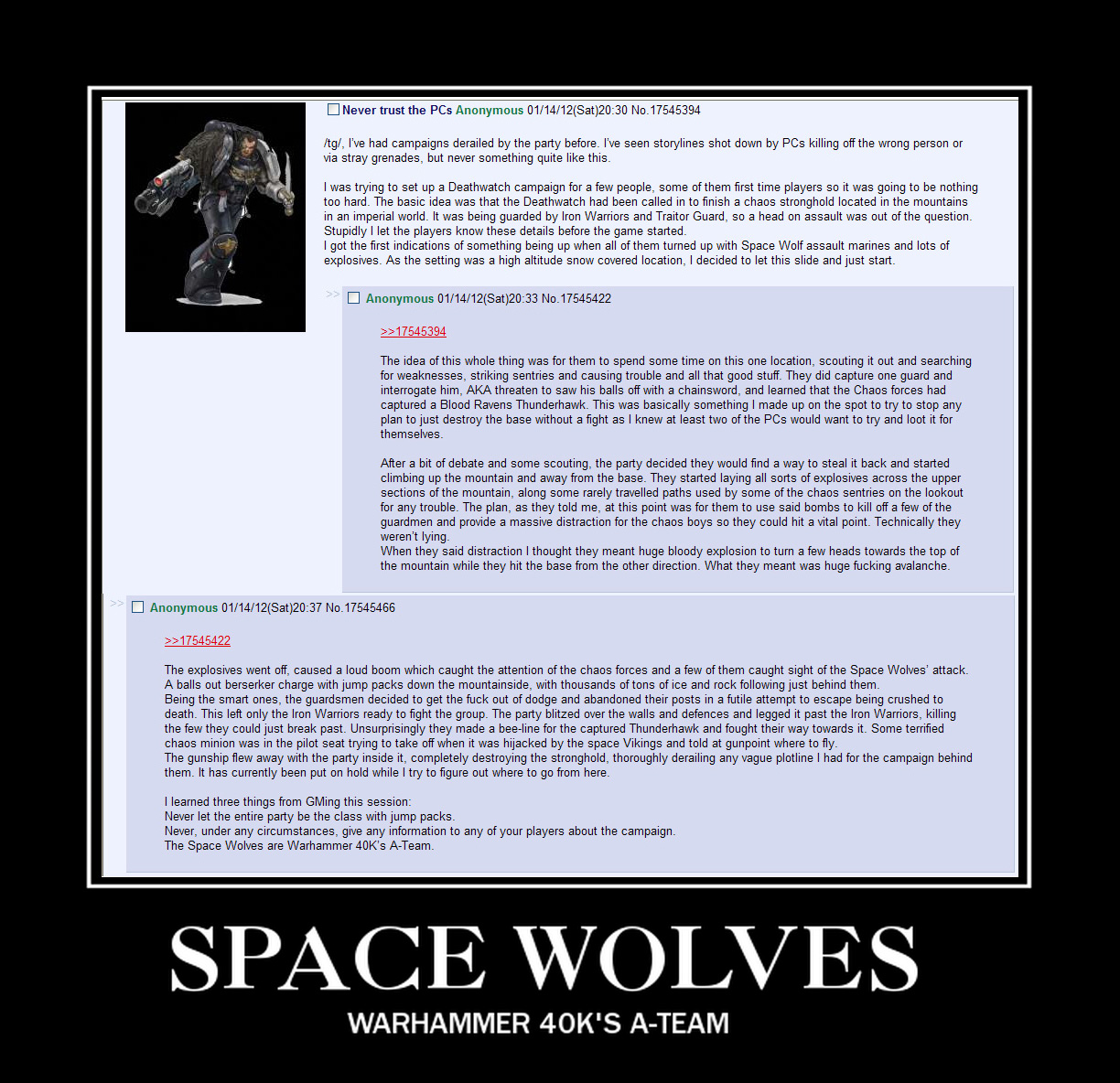

- At about two thirds of Into the Woods, the characters find themselves forced to sacrifice a man to a giantess. The narrator laments their cruel fate. They all promptly look over at the narrator and decide to sacrifice him. And because only the narrator know how things were supposed to go things really went south for the characters.
- The Mario Opera is built around everyone except Mario knowing his role as a video game character and how things are "supposed" to go, so when Mario dies at the end of Act 1 nobody knows what to do next. Peach eventually decides to marry Bowser to unite the kingdoms, and Ludwig summons Luigi and brainwashes him to do what Mario couldn't so he can take over instead.
- The musical Pippin ends when Pippin refuses to obey the Leading Player's 'script' and light himself on fire. The Leading Player doesn't know what to do, so he ends the show, after having a giant breakdown.
- In We Will Rock You, Killer Queen's performance of "Don't Stop Me Now" is usually interrupted by Khashoggi, who informs her of the heroes' escape. During the sixth anniversary performance, however, Killer Queen took things off the rails by chewing out Khashoggi for constantly interrupting the song and declaring that this time, she's going to finish it. Khashoggi protested that that wasn't in the script, to which Killer Queen replied "Screw the script!" before launching back into "Don't Stop Me Now". A downplayed example since the actual overall plot was unaffected.
- In the Strategy RPG 7.62 High Calibre, you start the game as a mercenary sent to a Banana Republic to find a businessman who fled with money stolen from his business partners; you then get stuck in the local civil war, and can either join the rebels or the government. As the game is open-world and you can attack absolutely everyone, nothing prevents you to go to the capital city in the beginning of the game (after hiring two others mercs and salvaging a couple of better weapons from earlier fights and money spared), enter the presidential palace (the loyalists are initially neutral to you), then shoot El Presidente and his bodyguards.
- The plot of the Borderlands 2 DLC Tiny Tina's Assault on Dragon Keep is a game of "Bunkers and Badasses" that threatens to do this multiple times. Sometimes this is because Tina, the DM, is unprepared (she sets a scene in a sunny day when it's supposed to be Eternal Night, tries to make a powerful boss one of the first encounters, and allows Mr. Torgue into the game to destroy the town's surveillance blimps). And other times it's because the players act unexpectedly (wander into an area Tina hadn't balanced yet, kill the dwarven king who was supposed to become their ally, and drop a die onto the miniature of an NPC, destroying him). To say nothing of Tina continually wanting to halt the game until Roland shows up even though she should be fully aware he's dead and Lilith, Brick, and Mordecai's shock and outrage at this. Eventually the players realize that the whole game is a way for Tina to process her grief over his death, become more understanding, and the story reaches a triumphant conclusion.
- There's a point in Deus Ex where you are ordered to kill an unarmed NSF higher-up (Juan Lebedev) who knows a lot about what's going on — and is willing to tell the player. Halfway through the explanation Anna Navarre will show up and order you to finish the job. You can either refuse (Anna will kill him herself and get annoyed with you for refusing orders) or do the job yourself — or waste Navarre (causing Alex Jacobson to freak out) and Lebedev will complete the explanation of what's going on.
- It's that the game in no way suggests that this third way is an option and it's entirely up to the player to decide to betray the side he's working for and murder his partner that really sets Deus Ex apart from other 'non-linear' RPGs.
- With wall mines and Exploding Barrels you can also arrange for Anna to get herself killed as she forces her way into the room before this dilemma even comes up. It requires a little knowledge of what is to come, but the game will distinctly recognize what happened and carry on regardless.
- However, most plot-critical NPCs are invincible until they've outlived their usefulness to the plot. For example, Walton Simons, Joseph Manderly, Anna and Gunther are all invincible until UNATCO betrays you. However, you can kill Maggie Chow before you even speak to her.
- The sequel does this much more. The player can kill anybody they have access to, assuming they have at a functional weapon on them, no matter how important this person is, and the plot adapts. In fact, at one point you can trap two characters who the global society depends on in a room, and irradiate them to death. There's actually a specific ending where the requirement is "Kill every single important NPC in the game". Turns out the Omar were planning on you doing that.
- It's that the game in no way suggests that this third way is an option and it's entirely up to the player to decide to betray the side he's working for and murder his partner that really sets Deus Ex apart from other 'non-linear' RPGs.
- All of the Disgaea games have at least one ending like this.
- Pass the Human World bill in Disgaea: Hour of Darkness, and you'll get an opportunity go invade Earth instead of moving on to Celestia. This leads to a couple mildy difficult encounters, followed by a final showdown where General Carter turns into a Prism Ranger, you beat the crap out of him, and then take over the earth.
- "Etna Mode" from the PSP/DS remake is all about this, since it's about what would happen if Laharl died at the beginning of the game.
- Defeating Laharl in one of Disgaea 2's Hopeless Boss Fights treats you to an ending where he blows up the planet in retaliation.
- Replaying the stage where you fight the ghost of Mao's father in Disgaea 3 nets you an ending where pretty much none of the plot threads are resolved.
- If you kill Feinne the first time you encounter her in Soul Nomad & the World Eaters, this leads to a fight with Asagi, who blows up the planet after beating her, whereupon Gig breaks the fourth wall to complain about having to restart the game. The Demon Path is something of a campaign based solely around this, since it begins with Revya accepting Gig's Deal with the Devil and killing Layna.
- Pass the Human World bill in Disgaea: Hour of Darkness, and you'll get an opportunity go invade Earth instead of moving on to Celestia. This leads to a couple mildy difficult encounters, followed by a final showdown where General Carter turns into a Prism Ranger, you beat the crap out of him, and then take over the earth.
- There are a few Dragon Ball Z games where it is possible to win battles in the story mode using a character who isn't supposed to win either because you are supposed to lose or switch to a different character or change to a different form if you are very skilled at the game. Sometimes but not always there is some humorous Easter Egg dialog that happens when you win with an unexpected character. For example, in Dragon Ball Z Budokai Tenkaichi 3 in the story mode level based on the first Broly film, it is possible to beat Broly with Master Roshi, leading to a shocked reaction from Goku, although in some other levels there is no extra dialog programed for winning with an unexpected character so the level just ends without any dialog.
- The Elder Scrolls:
- Morrowind readily allows the player to break the main quest by killing any of dozens of plot-significant NPCs. The game thankfully gives you a warning if you kill one of these NPCs, but from there you can still choose to ignore it and just troll around endlessly in the Wide-Open Sandbox. There is, however, still a "back-path" method to finishing the main quest which requires only one specific NPC to be alive Yagrum Bagarn but it is well hidden and much more difficult to complete. Finally, even if the back-path is rendered impossible, you can use the Alchemy Exploit to give yourself god-like levels of power and use the Tools of Kagrenac without Wraithguard to unbind the Heart of Lorkhan, which is normally instant death for the player.
- Oblivion and Skyrim do not follow in the same vein as Morrowind; quest important NPCs are simply "knocked out" briefly, averting this possibility.
- This entertaining video shows how a player can use hacks and cheats to send the opening of Skyrim flying off the rails at insane speeds. Some highlights include two people who are scripted to die surviving, an army of Alduin clones, giant chickens, and the player using hacks to kill an entire regiment of guards and critically wounding one of the Alduins before being blown to bits but a blast of fire.
- Fallout 3's plot involves talking to about a dozen NPCs, each directing you to the next NPC, until you meet the one person who can unlock the door to the Citadel. A faster way involves trading your only weapon for lots of ammo crates (each filled with 1 bullet) and building a big staircase out of them to get past the locked door.
- You can also accidentally skip the first main plot quest or two if you -
Go to Rivet City early, orGo to the Jefferson Memorial early, orGo to the garage with Vault 112 early, orSkip straight to Little Lamplight/Vault 87 if you already know how to find any of these places.
- The developers did anticipate a couple of these skips. If you already know where your father is when talking to Three Dog (or smooth-talk him into telling you before his errand), then the reward for finishing his quest will change from Three Dog telling you where your father went to Three Dog telling you where a weapons cache is located.
- You can also accidentally skip the first main plot quest or two if you -
- Subverted in Fallout 4: You really can't reach The Institute holding your kid until you find out where they are: under bedrock, with no physical entrances or exits, because they invented teleportation, and then you have to build the right transportation vehicle to get there. After that, the railroading's over, go nuts.
- Fallout: New Vegas has a few major factions that you can ally with to complete the game. Performing quests for each faction may make opposing factions warn you that they'll stop accepting your support if you persist in helping the other factions - if you continue, you'll no longer be able to progress in their missions (though they will remain non-hostile as long as you don't). You can then make all three major factions mad at you - possibly by meeting with their leaders, killing them, and eating their corpses - which will give you a special perk. This leaves you only one way to beat the game - going off the rails the three factions built and taking over Vegas yourself with the help of Yes Man. But even this rail can be jumped off; while killing him with normal weapons has his body get replaced with a new Securitron when you leave the casino, disintegrating him or turning him into glowing green goo breaks the respawn script and permanently kills him.
- If you play the NCR route, it's possible to complete the game without ever confronting Benny or getting the Platinum Chip.
- In the Honest Hearts add-on, you can go off the rails of helping the Zionites by killing people integral to the plot or getting caught stealing. If you do, the quests to help Zion will immediately fail and a new quest, "Chaos in Zion" will start - it consists of you getting one of the maps Daniel drew so that you can find your way back to the Mojave Wasteland. However, the Sorrows, Dead Horses, and New Cannanites all now want you dead.
- Final Fantasy:
- Final Fantasy VII features a humorous In-Universe instance of this with the Golden Saucer date sequence. If the player is with Tifa, they'll end up going to the amusement park's stage show and get cast in that night's play as the brave knight and Damsel in Distress. However, if the player keeps making stupid choices (such as claiming he's there to rescue the dragon rather than the princess), Tifa will get so pissed off that she smacks Cloud upside the head and defeats the dragon herself with a flying kick, causing the other actors to declare that the princess is the hero of the land.
- Final Fantasy VII Remake, handles this trope much, much more seriously. Starting with Sephiroth appearing far earlier than he did in the original game, the plot begins to diverge in ways both small and large. This causes mysterious specters called the "Arbiters of Fate" to appear and try to force the story back onto the "train tracks" as much as possible, but the game ends with the protagonists slaying the Arbiters, signifying that the story will not just be a beat-for-beat retelling of the original. This is best emphasized by the final cutscene showing Zack Fair's Last Stand from Crisis Core...except this time Zack lives. And to make matters worse, it's implied that Sephiroth engineered the whole thing because he knew he was destined to lose, so he tricked the heroes into destroying destiny to give him another chance to fulfill his plans. The sequel, Rebirth, reveals that there are at least three timelines of the FFVII-verse: the original one, one that is like the original but not quite the same (the main timeline of the remake trilogy), and one that is a complete deviation (the one where Zack lives). Sephiroth's plan is to merge these timelines together, but his plan is temporarily foiled by Aerith, who, like him, has realized the existence of the multiverse.
- Golden Sun: Dark Dawn is about your quest being derailed by the bad guys, who have their own agenda they want you to fulfill. Your Psynergy Vortex business can wait, right? No, it couldn't.
- The game I Have No Mouth, and I Must Scream makes this an intentional example. AM, maniacal AI and Big Bad, puts the five main characters into situations that it fully expects to cause them to give into their weaknesses. If all the players of his "little game" proceed to conquer their Fatal Flaws and prove AM wrong, then this enrages him so much that it will initiate a Logic Bomb; then the characters are given the opportunity to take down AM once and for all as he retreats into introspection to figure out what the hell happened.
- JFK: Reloaded is all about you trying to recreate the JFK assassination. But what happens if you decide otherwise?
- This is the entire reason Vins is trying to kill you in JoJo's Bizarre Adventure: The 7th Stand User, as there are only supposed to be six members of the Stardust Crusaders, not 7.
- The Nameless Mod includes a few ways for the player to go off the rails, including having one of the endings dependent on going off the rails several times.
- Specifically, Trestkon as the PC must complete 3 out of 5 possible actions that are considered "impossible" in-game (such as getting access to Despot's apartment when your character doesn't have the in-game knowledge of how to do so). Completing these actions leads the Narcissus Entity (the in-game AI director of, well...everything) to Break the Fourth Wall, leading to an opportunity for the player to take Narcissus' place a small time later.
- Additionally, should Trestkon kill Scara B. King in person rather than banning him at the end of the game, Narcissus will kill you for breaking the game.
- In Neverwinter Nights, it is theoretically possible to slaughter the entire population of the city of Neverwinter...except for Aribeth, who is totally indestructible and doesn't react to anything you do other than talk to her. Shop owners can still glitch to be invincible, and then follow you (EVERYWHERE, even through doors), attacking you till you die.
- Paradox Interactive's historically based Grand Strategy titles Crusader Kings, Europa Universalis, Victoria: An Empire Under The Sun, and Hearts of Iron almost invariably go hilariously off-course from real history through combinations of player intervention, Artificial Stupidity, and little to no actual Railroading. For example, Charlemagne, one of the few characters who does get events to ensure gameplay resembles the real course of history, regularly dies before he can form the Holy Roman Empire, such as getting captured by Danish raiders that plan to sacrifice him to Odin.
- Phantasy Star III can be game-breakingly derailed at the beginning. You are put in a cell after proposing to the Princess by the King, only to be rescued soon later. However, if instead of approaching the door on your cell, you use an escapipe (which you can only buy beforehand if you sell your starting gear), the Event Flag that removes the NPC Roadblock from the town's entrance never clears, and the game cannot continue. Lampshaded by the King himself with this tasteful message: "You used your escapipe! Normally a smart move, but now I'm afraid the game can't be continued. Please press the Reset Button and try again."
- You can do this in the PokéStar Studios films in Pokémon Black 2 and White 2. While you're given a script for the movies, deviating from them can change the film. You can either get a bad ending, which ends badly and is received poorly by fans, or you get a Strange ending, which derails the story into something else entirely, and end with a Twist Ending. Sometimes your changes get so off-topic that it barely resembles the point of the movie: the strange ending to the first Giant Woman movie ends with her not becoming a giant woman at all.
- Portal and Portal 2 are both linear games. The plot, however, involves you going completely off the rails with respect to whatever plans the AI Mission Control has. In the first game, you escape from GLaDOS' Death Trap and wind up literally taking her apart in order to avoid her vengeful wrath. In the sequel, it happens no less than three times: first, when Wheatley derails GLaDOS' plans to murder you; second, when Wheatley manages to derail his own plans before they even get started by smashing you into the elevator shaft and dropping you into Old Aperture; third, when you escape Wheatley's Death Trap in "The Part Where..."
- Given that escaping GLaDOS's lab in the original Portal requires the player to make extensive use of the Portal Gun (which GLaDOS's test chambers have been training the player character to use for the entire game), there is a popular fan theory that The Game Never Stopped, which would make it a subversion of this trope.
- An in-universe example of sorts takes place in The Reconstruction, but not by the main characters. Throughout most of the game, the Watchers seem like the main masters of the plot, with some kind of grand scheme that your guild has been working towards. But then suddenly, the Big Bad derails everything by killing them and taking over the world.
- In the RuneScape quest, "Kindred Spirits". Sliske puts the player character, his undead slaves, and some other prisoners through a series of games involving sadistic choices. During one of the games, the player character accidentally knocks down a wall and is able to escape into a part of Sliske's lair that they were not supposed to enter and discover information about Sliske's true plans as well as the knowledge that the player character's name had been spoken by a man driven mad by an Eldritch Abomination long before the player character was born. When the player fails to show up at the start of the next game, Sliske decides to skip the game and steal the player character's soul, but while he is extracting the player character's soul, he sees the player character's memory of what they did, and he goes berserk, completely losing his normal Faux Affably Evil peronality. He then gives the player a massive beating, turns Linza into a wight after revealing that she had made a deal with him, and then threatens to kill the player character's loved ones, but his undead minions manage to escape from his control long enough to allow the player character and remaining prisoners to escape.
- SCP Foundation has a downloadable video game used for containing SCP-245. The game has two secret endings that can be found by going off the rails of the game. The first one is found by preventing SCP-245 from entering the control room at the beginning of the game. This allows you to completely skip most of the game and prevent SCP-245's plan to trick you. The second one is found by intentionally losing the boss battle with SCP-245 at the end of the good ending. If you do this then SCP-245 freaks out about why you would do something so stupid and then realizes you already know he is tricking you and kicks you out of the game.
- The Stanley Parable. While there is a story that comes from doing exactly what the narrator tells you to do, (which, ironically, is about a man who frees himself from a mind-controlling machine) the vast majority of the game's content, multiple endings and entertainment value comes from going repeatedly off the rails. Depending on when and what you do, the narrator/GM will try to cajole, threaten or manipulate the player into returning to the main story path, try to create new story narratives, mock the player character, mock the player, encourage the player to strike out randomly to see what you find, break down in despair at your unwillingness to play ball, attempt to destroy the game world, plead with you to prevent you from destroying the game world, and generally get more erratic the further you go. Ultimately averted though, as there's no major action that the player can make that narrator has nothing to say about. The whole point of the game is to zigzag this trope on a meta level.
- Invoked in Super Paper Mario. In Sammer's Kingdom, the party is told that it must fight 100 Sammer Guys in a row. The format of the game so far has been set up to suggest that the player will fight 25 Sammer Guys in each of four levels, before receiving the Pure Heart at the end. The player doesn't even finish the first level when Count Bleck and his minions arrive to destroy that world. The party survives the destruction and returns to the world's ruins, only to be sent to the next world by Dimentio, and thus plays the seventh world early.
- There are instances in old Super Robot Wars games where this can happen through the following:
- If you defeat all enemies at a turn before their reinforcements are meant to arrive, you'd just skip those fights.
- Many games also have bosses who will unleash particularly unpleasant abilities, almost always including restoring their health to full, when they're hurt badly enough. However, the earlier ones can't handle said bosses being killed instead of dropped to low health, and they simply die early despite having the ability to restore themselves.
- In Super Robot Wars 2, destroying Cecily's mobile suit near the end will prevent her from appearing again as an allied NPC later on.
- In Super Robot Wars 3, certain cutscenes can be skipped outright with the proper application of force on bosses when the game expects you to just destroy mooks.
- In F/Final, Angels can be killed prior to their intended death scenes.
- Super Robot Wars V features an In-Universe one: In the second to last stage Black Noir reveals themself as having orchestrated the events of the game in a manner very similar to a dungeon master, and is planning on destroying the world just because it would make for a different type of ending than usual. Naturally, the protagonists disagree. Of course, the mastermind's plans had been falling apart well before the heroes learned the truth, and in a very meta nod to the series's habit of doing this relative to the source materials, most of the things that were "supposed" to happen are things that did happen in the original animes, for example, Kappei's family were supposed to have all died, Banjo Haran was supposed to lose his purpose after defeating the meganoids and drop off the face of the Earth, and Akito Tenkawa was supposed to become obsessed with revenge to the exception of all else.
- The Mettaton sequences in Undertale were planned by Alphys on the assumption that you would solve all of the puzzles properly except the final amazingly difficult tile puzzle. If you do anything else, Alphys and Mettaton's reactions as they scramble to get the "lizard scientist helps human child defeat killer robot" subplot back on track are... something. It's all Played for Laughs, up until the CORE, where it quickly becomes obvious that Mettaton isn't fully on board with the part of Alphys's plan where you win in the end, and the plan starts falling apart as he rearranges the CORE's rooms, hires monsters to fight you in places where she wasn't expecting them, and subverts the puzzles so her attempts at help fail, eventually culminating when Mettaton reveals the charade and announces that he intends to change the ending to "Mettaton kills the human and takes their SOUL".
- The main plot of Until Dawn goes completely off the rails around the time of 3AM because the Big Bad, Josh, had no idea that there were genuine monsters killing his friends on the mountain where he was performing his pranks.
- Vampire: The Masquerade - Bloodlines is slowly revealed to be one long assassination plot cooked up by Smiling Jack, hoping that someone, hopefully Prince LaCroix, is dumb enough to believe the rumors of an ancient vampire sleeping in the Ankaran Sarcophagus and opens it, only to find a pile of C4 that goes off in their face. The end result is that the Anarchs retake L.A., as they're the only faction that won't be dumb enough to believe the rumors or open the sarcophagus. In the LaCroix, Anarch, Independent, or The Player Opens The Sarcophagus endings, this comes true, but there are two endings where this plot fails.
- In the Strauss ending, the Camarilla remains in power and Strauss becomes the new Prince, with the player as a high-ranking underling. The Ankaran Sarcophagus is left unopened and is placed in storage, denying Jack the explosive ending he wanted.
- In the Kuei-Jin ending, the player opens the path for Ming-Xiao to allow the Kuei-Jin to take over L.A., and she immediately betrays them. The Ankaran Sarcophagus is dumped into the ocean unopened, with the player chained to it.
- The Clan Quest Mod one-ups both of these endings by leaving no ambiguity to the fates of everyone else. The player can join the Sabbat at King's Way, and go around diablerizing all the no-longer-plot-relevant NPCs. All Camarilla and Anarch quests are null and void, as the Anarchs and the Nosferatu will now attack the player on sight. After the player takes out the Giovanni and the Society of Leopold, the Camarilla and Anarchs are forced to ally now that the Sabbat has become an organized threat, and they take out the Kuei-Jin to claim the key to the Ankaran Sarcophagus. This culminates in the player invading the Tremere Chantry and fighting a Boss Rush of Damsel, Nines, Skelter, Bertam, and finally Strauss to take the key. The invasion of Venture Tower goes the same, only with Andrei arriving at the end to proclaim his intent to open the sarcophagus and diablerize the ancient inside. The player can allow him to, rerailing the plot at the last second, but they can also fight him to prevent him from doing so, or convince him to destroy the ancient instead. The sarcophagus is burnt in a crematorium, LaCroix is tied to a spire on Venture Tower and left to face the sunrise, and the Sabbat claim L.A., leaving Jack, the only survivor, to flee the city.
- WarioWare Gold includes a feature to dub some most but not all of the cutscenes in the game. You can choose to follow the script... or go completely off-script.
- The "Lawn Wax" episode of You Don't Know Jack ends up this way. The interns have only six questions written out of ten when the game starts. It all spirals out of control as the staff races to get questions done in time for the the rest of the show, each one less prepared than the last: the seventh question has a duplicate answer, the eighth question is by Donny, the ninth question is interrupted by Kim, and the tenth question is just a bit of trivia that Cookie reads off of a Snapple cap—which doesn't even have a category name. In the end, Chad quickly puts together a "minimalist, back to basics" Jack Attack for Cookie very quickly, and initially Cookie's elated. It's when he reads the category: "Do What I Say and We'll Get Through This Together" that he starts to realize what Chad has actually done: In a take on Exact Words, Chad put what you want to match "in quotes" and you want to hit your buzzer when that phrase comes up.
Cookie: "You wanna pick... Wait, what the hell did he do here?!? No, NO, we can't do THIS! Helen! Shut it off! SHUT IT—" *static*
- The Fate Series has the horrible, horrible events of the Third Holy Grail War that shaped many of the awful circumstances that would later haunt the protagonists of the Fourth and Fifth. The Edelfelt sisters cheated using their Ore Scales ability to summon two Sabers. It ended with the sisters defeated, one of them running away from Japan. Darnic Prestone attempted to steal the Greater Grail with Nazi help. It ended with the Imperial Army duking it out with the Nazis in Fuyuki. The Einzberns tried to cheat by summoning a God of Evil. It ended tainting the Grail with All the World's Evils. And in all the hoopla, the Lesser Grail was destroyed.
- Little Busters! is set mainly in a world of Kyousuke's creation. While it normally functions well enough, there are two examples of Riki inadvertently setting it off the rails: firstly, he ends up falling for Kurugaya and in doing so causes the world to break down because this was completely unexpected and so unaccounted for in the world's structure. Secondly, and much more disastrously, there was Kyousuke's plan to send Rin off to another school in order to get her used to the real world and toughen her up. It ends up being harder on her than he expected, and more importantly, Riki does not go along with it. In the end, he runs away with her, and ultimately ends up losing her completely.
- The DEATH BATTLE! fight between Deadpool and Pinkie Pie goes completely off the rails once Deadpool learns Pinkie Pie knows how to break the fourth wall, too. It leads to the duo hopping into past Death Battles before ultimately confronting the actors who play Wiz and Boomstick.
- This happens regularly in Dingo Doodles' Fool's Gold campaign, with Sips usually being responsible. This is to be expected when you play an angsty Chaotic Neutral/Chaotic Good Uplifted monkey wild magic sorcerer with serious anger issues. In the very first video, Sips manages to accidentally unleash a Tarrasque due to a spell going wild. Felix, luckily, is a very flexible DM and manages to either roll with whatever happens or find believable ways to get the story back on track.
- Dingo also tells a story in this video about her favourite Nat 1 and Nat 20 moments about how, partially due to a combination of house rules, her ridiculously lucky player roles and her boyfriend and Game Master Felix's ridiculously unlucky rolls coming together all at once her mini-Minotaur character one shotted the Big Bad of the campaign prior to Fool's Gold after being thrown at him whilst he was monologuing ending the main plot earlier. This game carried on a while after with Felix having to wing it, but apparently they ended up in a Total Party Kill sometime later.
- Dingo also tells a story in this video
- In If the Emperor Had a Text-to-Speech Device Special 6, the characters play a game of Warhammer Fantasy Roleplay with Magnus as the GM, which quickly goes off the rails when the players accidentally cause the death of their quest giver. After a messy detour, Magnus offers them a way back into the rails, only for Whammudes to throw his offer back in his face because they chose this derailed path to hell, and that makes it their own adventure and worth fighting for. By the end, the Great Maw has been boarded up, the Ogre Kingdoms have been left without a leader and Magnus has incinerated the game world out of petty rage.
- Puffin Forest has a few videos where he talks about this happening in campaigns he ran or was in.
- In one campaign he ran his players found a mysterious temple. He had planned for his players to come back to the temple later in the campaign but due to a lucky dice roll they learned how to use the temple's magic circle before they were supposed to and insisted on using it, resulting in them getting teleported to the moon without any way to get back.
- In an another story a Call of Cthulhu game he ran was ruined when a player instantly guessed that an NPC they just met in a hospital was possessed by the villain, despite the fact that it hadn't even been hinted yet that the villain was capable of possessing people, and the NPC had only smiled and waved at that point.
- Another Call of Cthulhu game was derailed into a Total Party Kill. While everyone dying is not unexpected in Call of Cthulhu, this one happened because of an idiot player setting everything on fire to keep a monster away and trapping himself in the fire, and the fire spread and killed the other surviving player. Ironically, the final player had requested a Plotline Death before the session had even started as he wanted to play a different character.
- When he ran Fane of the Night Serpent (part of Tomb of Annihilation) he accidentally skipped over the part of the book explaining how the players are supposed to get into the Temple. The players were supposed to either disguise themselves as the enemy, or let themselves be captured by the enemy and make an alliance with one of the villains, but what happened instead is the players had to fight their way though every single enemy, just barely managing to win after a very long and hard battle.
- In a dystopian ICONS campaign that he ran, the heroes are sent on a mission to find out what happened to some people who were sent to recover a typewriter and never came back. The heroes find that they were attacked by bandits and incorrectly assume they are dead, and end up killing them instead by blowing up the bandit's base. It goes further off the rails when they find the typewriter and accidentally smash it, and discover a mysterious data disc inside which they were not supposed to know about, and they keep it for themselves instead of delivering it to the guy who sent them on the mission. After this he started running the campaign without rails and instead gave them several different plot threads they could choose to follow or ignore.
- In the Black Market Blues story he and his party are confronted by assassins when visiting a black market who are suspicious of the party's paladin. When talking their way out doesn't work the Paladin starts a fight with them and causes chaos in the black market and everybody gets arrest and the black market shut down. When they are in jail, Puffin realizes that it didn't make sense for the town to have a black market because everybody already knew it was there and was ok with it.
- Another campaign that he ran ended up going of the rails at the very end when the players fail to kill the villain. The players succeed in stopping the villain's plan but the final battle between the villain and the last player standing ultimately comes down to one last dice roll, which the player misses. The standing player character is forced to retreat, and the rest of player characters get scattered across the universe and never see each other again although end up in nice places. Since they failed to kill the villain using the Villain-Beating Artifact he will eventually come back, and so it seems like a Bitter Sweet Ending, however it ends on a funny note because the villain ended up on Mount Celestia, the realm of Pure Lawful Good where he is immediately captured and imprisoned for a very long time.
- "DM.exe has crashed!" must be seen to be believed. The players break into a school because they were too impatient to get a warrant to enter legally and get into a fight, and an idiotic samurai player tries to defuse the situation by firing a gun, and it just gets worse from there, as he gets into a completely unnecessary standoff with the police, which all could have been avoided if they had just waited for the warrant.
- In one campaign he ran
- In RWBY Volume 9, Team RWBY finds themselves in the Ever After, the main location of the story "The Girl Who Fell Through The World". All four of them had read the story as kids, but only Blake believes they are in said story. After Yang steals back her robotic arm and Ruby finds and takes one of Penny's Maiden Power-created swords, they opt to follow Blake's idea and just follow the story as is. However, when a key player is replaced with another, Weiss believes that they're actually in the story's "stupid sequel".
- During the first year of Bob and George, since it would be a while before the real strip could launch, the Mega Man cast decide to reenact the story of the first game. Things go wrong the first time when Mega Man gets fed up with the constant delays and abandons the strip, so they attempt to have Proto Man stand in for him, only for Proto Man to accidentally kill Dr. Light. Then the comic's author steps in to resurrect Dr. Light, and then he ends up being roped into being Mega Man's substitute for the reenactment until the real Mega Man returns and forces the Author to launch the real comic. When the real comic didn't last long, the reenactment is restarted with the real Mega Man and follows the same story beats... until the end, when Dr. Wily realizes that, with his original resources restored, he has a second chance at taking over the world, and takes the opportunity to kidnap and kill the Author, since nobody liked working in the strip anyway.
- In Burning Stickman Presents...Something!, one of the protagonists knocks the plot, which had been a retelling of Mega Man X4, off the rails by stopping Zero from killing Colonel. Possibly lampshaded with The Watcher character dropping the F-bomb when he finds this out.
- Darths & Droids:
- The webcomic imagines the plot of the Star Wars films being a series of tabletop RPG campaigns in a universe where they never existed. The entire plot comes about because "Qui-Gon" (Jim) and "Obi-Wan" (Ben) decide to search a room on the Trade Federation ship when they're supposed to be ambassadors, causing the GM to retaliate with a punishment they survive.
- The characters of the webcomic have campaigns that take place offscreen between film recreations, and many of them tend to fall apart (for better or worse).
- The first was a fantasy campaign held between The Phantom Menace and Attack of the Clones, run by the main GM. The characters let their Munchkin be killed by the main villain, left him dead, and after they killed the villain resurrected him and joined his side. The end result is the plot of The Princess Bride.
- The second one took place between Attack of the Clones and Revenge of the Sith, this time run by female Roleplayer Annie as the GM. Her planned campaign would've been the plot to the Twilight series, but the players, with their kill-on-sight mentality towards vampires and werewolves, turned it into the plot for Van Helsing.
- The third campaign was run by Jim between Revenge of the Sith and A New Hope. Nothing was derailed in terms of the plot, but he intended the campaign to be very serious and dramatic while the players took it to be hilarious. It's revealed he tried to do Zero Hour! (1957) and ended up with Airplane!.
- The fourth campaign with Ben as the GM, taking place between A New Hope and The Empire Strikes Back. Ben had planned a campy, Lighter and Softer superhero spoof where the players were supposed to be a team of superheroes trying to catch a masked vigilante who was going around beating up criminals, and the plot would've been the old Adam West Batman (1966) TV series. But the players decided to lure the vigilante out in the open by becoming criminals themselves, and the end result was the Darker and Edgier The Dark Knight Trilogy.
- A couple of the "alternate" strips go Off the Rails:
- In Magicians & Munchkins, everybody decides to be a Min-Maxing Munchkin, including the GM, whose Final Boss is an all-powerful Wicked Witch with the drawback of "Vulnerability to Water". Which the players accidentally discover 3 Sessions earlier than the GM intended them to.
- In Trenchcoats & Turncoats, Ilsa and Victor are Dirty Communists who steal the plans and escape on the plane because Jim (as Rick) is dumb enough to believe their cover story that they're Americans despite the facts that Annie (as Ilsa) speaks with a thick Russian accent and Sally (as Victor) only speaks in stock Russian phrases. But what really gets the GM frothing at the mouth is that he'd intended the campaign to be an epic, exciting, globe-spanning adventure but the players hardly ever left the bar where they all met in.
- In a non-canon strip, Jim uses Summon Bigger Fish and doesn't take it back thus killing the queen and her retinue.
- An out-of-universe example is the killing of Greedo senior, thus making the "Greedo" from Episode IV "Han Solo" and "Han Solo" "Greedo". This is not unusual for the comic due to the Random Number God and the players doing the unexpected. Other examples usually have to do with killing characters the GM doesn't want them to (i.e. General Grievous), killing characters they weren't supposed to (Darth Maul/Zam Wesell), killing character's before they were supposed to (Jango Fett), not taking the obvious hints to go to someplace or do something (which inadvertently sends Boba Fett to want revenge and Naboo being defeated), etc. Several times the GM made very detailed maps of an area just to have the players go through the center of the Earth or book someplace weird.
- A Running Gag in Revelation of the Sith is that the DM is trying to move the action to Naboo, and the players are either oblivious or, in Ben's case, actively trolling him.
Ben: The party's breaking down. Everything falls on me now. I'm the only one I can trust to do this ... what needs to be done.DM: So... you're changing course to Naboo, then?Ben: Hey, I'm the only one with a sensible reason not to be on Naboo!
- By contrast, the webcomic that inspired Darths and Droids, DM of the Rings, features a scenario where every single attempt by the players at getting Off the Rails is met by either failure or cruel retaliation on the part of the Railroading GM.
- The DM does face a problem when Legolas kills Gollum early on. And later on they even get to kill Gríma Wormtongue and Saruman.
- In a smaller example, Gimli's player manages to derail Gandalf's battle against the Balrog by pointing out that it would be against their alignments to squander the Heroic Sacrifice, meaning the Final Speech the GM had written up for that scene goes unused while the Fellowship legs it. Since Gandalf is the over-powered character played by the GM, he gets payback by resurrecting him later in the campaign (with a high power boost), much to the annoyance of the players.
- There is one major success: the hobbit players all get sick of this treatment and leave the game. The DM has to scramble to build some new rails for the remaining players to follow. He ends up playing the Hobbits himself in the background, meaning the final battle comes down to a single will save by a non player character who isn't in the scene.
- The DM does face a problem when Legolas kills Gollum early on. And later on they even get to kill Gríma Wormtongue and Saruman.
- Happens far too many times to count in Dork Tower, usually due to their overzealous gaming strategies.
- They once had a game based on The Lord of the Rings. The campaign opened with Merry killing and gutting Gandalf, Pippin beating Frodo to death... they were planning to institute a military draft in the Shire when Matt (the GM) went catatonic.
- In the second attempt, one of the players is assigned to play Gandalf... but with his abilities limited to talking to birds and casting fireworks. The players ended up using Gandalf as a Bulletproof Human Shield and battering ram.
- Another session ended with the players having taken over the kingdom, forged an empire, and conquered all of the known lands... when their goal was to just rescue the princess.
- One strip had Matt crying to a friend about how his characters had not only derailed his adventure by killing everyone, they had also summoned Elder Gods to destroy the game universe. They had been playing Bunnies & Burrows (a game where all the characters are normal, mundane rabbits).
- They once had a game based on The Lord of the Rings. The campaign opened with Merry killing and gutting Gandalf, Pippin beating Frodo to death... they were planning to institute a military draft in the Shire when Matt (the GM) went catatonic.
- El Goonish Shive: One NP storyline has Ellen as a first-time DM. On their way out of the questgiver's mansion, all of her players make a Critical Failure on a flight of stairs and end up tripping and falling over each other, so Ellen conjures up a random cleric NPC to come in and heal them to re-rail the story. Instead of taking this for the "pity res" that it is, however, the players (save for George, who recognized what happened but decided to play dumb) become suspicious about this "random" cleric character and wrongfully assume that he's a Chekhov's Gunman involved in the kidnapping they have to solve. Rather than try and persuade them that the cleric really was an unimportant bit character who just happened to be there (which would only make them fixate on him even more), Ellen realizes that her players' theories about the cleric's involvement would both better fit the narrative and make for a much more interesting story than that of the vanilla adventure module she'd been following, and quietly rewrites the plot to make the cleric the actual villain.
- The very first thing that happens in Erfworld. One faction finds one more jewel than they were planned to, which lets them buy an extra unit, which turns a critical battle, which sets the actual plot in motion.
- Friendship is Dragons:
- Twilight's player does this on a regular basis. She manages to awaken the Elements of Harmony, correctly assigns the Elements to each party member, and correctly deduces the sixth Element, thus allowing them to defeat Nightmare Moon. The campaign was supposed to go on for years, but she did all this in the first session. Worse, she did it all completely in-character, meaning the DM can't come up with a good excuse to disallow any of it.
- When the parasprites show up, she immediately kills them off before they can multiply.
- This is Lampshaded in the Diamond Dog arc:
GM: [As Spike In Another Room] NOOOOOOOOOOOOOO!!!
Applejack's Player: Twilight, did you derail the GM's campaign again?
Twilight's Player: What are you talking about? I'm not even in the same ROOM! - The climax of the Grand Galloping Gala arc features the author himself going off the rails. His plot ending up diverging so far from the show that he could not illustrate it with actual screencaps, and was forced to get a friend (the author of Star Mares) to make many pages of fake screencaps to allow him to show his final battle.
- Happens quite a lot in Full Frontal Nerdity.
- A good example would be this, where they manage to turn a Harry Potter RPG into an arena deathmatch between the Hogwarts houses.
- At one point Frank turned this against them by setting up a campaign where successful power-gaming required them to spend a large amount of time role-playing. When they realized he had planned them going off the rails from the start, they went further off the rails by deciding to kill them all.
- Nelson once stole the campaign when Frank stated that he was the returning long-lost king, by giving the other two characters Monty Haul missions and such good items that "Even your socks will be +5 Weapons".
- As a result of their growing familiarity with (and contempt for) each other, Frank and Genre Savvy players have begun to undergo negotiations about how much off-the-rails is acceptable whenever someone (usually Nelson) smells a rat. This eventually gets lampshaded.
- A good example would be this
- Once the second part of Homestuck begins it becomes clear there is something terribly wrong with the kid's game of Sburb. Later parts reveal that multiple, connected sessions have gone the same way, with over-powered villains running about and people dying that shouldn't. But there is always ambiguity right up until the end of the comic whether the game is genuinely off the rails, or that the game is deliberately testing how well the players can keep up.
- A number of events have conspired to doom the kids' Sburb session: Jack, who was meant to offer a means of helping the players dethrone the Black Queen before the Reckoning, gained access to a.) a weapon of unbelievable power, b.) nigh-omnipotence, and c.) complete insanity, and immediately began to destroy not just the Sburb session he originated in but also other sessions. Having learned that their game was doomed, Rose searches for a way to break the game because winning it in the traditional fashion is no longer possible. It appears that, in the future, she is ultimately successful.
- After scratching the original session, the new session afterward went Off the Rails before the game even started. The agents of Derse are killing dreamselves before the game in violation of the normal rules, and someone has repeatedly tried to assassinate Jane on Earth. It got further Off the Rails when due to circumstance none of the post-scratch kids prototyped their sprites before entering the Medium, which causes the Battlefield to never fully form and the game to be nearly completely Unwinnable.
- It later is revealed that some of these events were the result of the Troll Empress infiltrating the session and taking the place of the black queen before the game started, planning to claim the new universe for herself.
- And then Caliborn manages to take the cake by attempting to play all by himself, which turns the Medium into a desolate dead place. Caliborn isn't very worried since Hussie informed him that it was like playing in the highest difficulty setting. Aranea claims that Caliborn's species was never meant to play Sburb at all, so not only did the game go off the rails the moment Caliborn & Calliope entered the game, it went off because the game began. This is supported by the fact that Caliborn & Calliope were naturally born instead of being paradox clones, destined to play the game because they were created by the game like all the other players.
- Word of God revealed that in most game sessions, Wayward Vagabond is supposed to serve as a "back door" of sorts who aids the players in defeating the Black King if things go too far off the rails. This is why he revolts against the Black King during the kids session; the game was trying to help the kids get things back on track. This failed and only caused things to derail even more spectacularly.
- Andrew Hussie's Author Avatar explains during the comic that their are three different classes of derailment that can happen to a Sburb session.
- A Null session has the potential to create a new universe, but the players are doomed by fate to fail. This happened to the Pre-Scratch troll session due to Doc Scratch putting a glitch in the game that caused the ectobiology lab to fail to appear, thus preventing the players from being born, and so they were forced by fate to invoke the Scratch in order to correct the paradox. This also happened to the Pre-Scratch human session due to Karkat giving the human universe cancer by failing to find the last frog needed to create the genesis tadpole, and this cancer was personified in the form of the overpowered Jack Noir, who prevented the Post-Scratch troll players from entering the human universe and later destroyed the human universe.
- A Void session occurs when none of the player put anything to the Kernelsprites before entering the game, which is what happened to the Post-Scratch human session. This results in an Endless Game because the battlefield never forms. The only possible way to complete a void session and create a new universe is for the missing parts of the game to be brought in from another session. Although in the case of the Post-Scratch human session, the game might not have been off the rails at all because the game already knew that they would fail to prototype the Kernelspites and would get help from the Pre-Scratch human session, as none of the players were assigned to the space or time aspect required to complete the game, and the towers on Prospit and Derse and the queen's rings didn't even have the orbs to receive the prototypings, and long dead consorts in the game were aware that new players were destined to arrive to help the players.
- A Dead session happens when a player tries to play the game alone by killing the other players and their dreamselves before the game is started as in Caliborn's case. Unlike a Void session, it is completely impossible for a dead session to create a new universe, as it causes Skaia to turn black, and they are designed to be completely unwinnable. Dead sessions exist mainly exist to punish the players who start them. Players in dead session are forced to chose between sacrificing themselves for the good of the universe or attempting an Unwinnable challenge that will reward them with great power. Caliborn only managed to win because 1: his character class gave him a big advantage, 2: three of the planets that he needed to destroy as part of the unwinnable challenge managed to fall into the black hole by themselves, and 3: he had the Author Avatar explaining everything to him.
- The Homestuck Epilogues and Homestuck: Beyond Canon involve one timeline that is rendered non-canonical by a character's actions, resulting in characterization and events unraveling at a cosmic level, essentially turning the universe into a series of fanfiction tropes. The other timeline which preserved its own canonicity involves another character deciding that the only way not to fall into narrative oblivion is to keep the story alive by becoming its antagonist.
- Irregular Webcomic! has (at least) two of its storylines being characters in roleplaying games. When time travel is introduced into both storylines, the PCs quickly disrupt the timeline, preventing events that for them have already happened from happening, resulting in paradoxes that contribute to the destruction of all reality. It should be noted that the DM was dead at the time (his disappearance is noticed in the "Space" storyline), so he was unable to prevent this catastrophic derailment.
- Knights of Buena Vista starts off covering Frozen (2013), and Adriana thinks this happened when Elsa's powers are revealed, but Walter, the Game Master, says it only went off a little bit. It truly went off the rails when a Critical Failure caused an Endless Winter in the kingdom.
- A very common plot seen with the Knights of the Dinner Table comics. In some strips they manage to go off the rails before the adventure starts because they refuse to listen to they guy who's supposed to tell them what the adventure is. In one, after they've stolen the king's silverware during a banquet and therefore had a huge battle with the guards rather than be sent on a quest, B.A. finally storms off after Bob says the adventure was much better than he expected, and Brian recommends he get the other modules in that series.
- We also see such gems as:
- Brian trying to take out a nemesis by throwing a sack containing 47 12-ounce bottles of nitroglycerine. The result is mistaken in-universe for a meteor strike.
- Sarah gets a chance to run the top-of-the-line module Adventure To Castle Lonely, only for the players to refuse to even go to the castle and run off chasing squirrels. And, to add insult to injury, then complain about how badly written the module is.
- Brian shooting Bob's new character for no discernible reason.
- The party defeating a dungeon by sweeping all the traps with animals.
- We also see such gems as:
- At the start of the second game session of Larp Trek, before Geordi (the GM) can even open his mouth, Picard and Wesley get a murder mystery going.
Picard: Geordi, were the holodeck's usual safety protocols disabled?
Geordi: Don't look at me, Captain. I wasn't even on this train when it left the station. - One Piece: Grand Line 3.5:
- The players work to derail the campaign as soon as they hear there are pirates in it, mostly so that they can be pirates themselves. These are the players that will eventually control Luffy and Zoro.
- Later, the GM does it to himself. When he rolls a Critical Failure for the arc boss's attack on an NPC, it grants that NPC an immediate Attack of Opportunity, at which point the GM throws three natural twenties in a row, an Instant-Win Condition. The end result: Sanji.
- The Order of the Stick:
- In an early strip, the Order is able to kill a monster that was intended to be a Recurring Boss before it could escape. There are several other events in the plot that could be argued are examples of this too (if you believe that the story is all just a roleplaying game with a DM planning everything) such as the large number of Nice Job Breaking It, Hero moments, but this is the only one that the characters point out.
- Tarquin freaks out as he slowly realizes that his son's adventuring party is ANYTHING but cliché tropes, leaving him unable to predict what will happen next. He's less emotional when faced with life-or-death situations.
- One of the characters from Paradox Space sets her game of Dungeons and Dragons in a dungeon, but all the other players object to how stereotypical this is and she's forced to set it in the belly of a dragon.
- This happens in a Mortal Kombat sprite comic arc called "Rise of the Robots", in which Sektor tells Sub-Zero he's going to beat Liu Kang. Sub-Zero knows that Liu Kang won't die until Deadly Alliance, but doesn't tell Sektor. Then Reptile happens. He lives.
- The xkcd installment "Outbreak" has Cueball and Megan derail the Zombie Apocalypse by promptly killing Patient Zero and destroying all the Toxin X-7 they've created.
Caption: The remaining 90 minutes of this movie will be a romantic comedy.
- During a game in politics class on Not Always Learning, one student convinces over half the class to pool their money with him, then declares the alliance too big to maintain, dissolves it, and keeps all the money for himself, becoming an emperor.
- Things Mr. Welch Is No Longer Allowed to Do in an RPG is a long list of attempts by somebody who seems to be the Casey Jones of games gone off the track.
- Randall Munroe's "What If?" blog, which studies the probable outcomes of hypothetical questions, routinely sees the author getting carried away with one of the logical outcomes of the question and going into even greater detail about that. Sample literal example: The question of how many BB guns it would take to stop a bullet train eventually turns into an increasingly large army of people wielding AK-47s firing at the bullet train at once, sending it backwards until it experiences so much drag from the atmosphere that it lifts off the tracks, "starts to tumble, and finally disintegrates into a cloud of shrapnel and spent bullets." ("Now bring on that asteroid.")
- Bear Force One from the Glitch Guild. The players decide to completely ignore the intended campaign in favor of raising bear cubs that they found for three years while the world is in political turmoil around them.
- The But Really Really Fast video "What if the Stardust Crusaders ACTUALLY Flew to Egypt?" explores what would have happened if, instead of attempting to travel by land and sea to Egypt after Tower of Grey crashed their initial plane, Jotaro, Joseph, Avdol, and Kakyoin tried flying directly to Cairo again from Hong Kong. In response, all of DIO's minions (Polnareff included) are gathered in Cairo as they try to come up with another way of stopping them before they land. The initial plan they come up with involves J. Geil killing them on the plane via Hanged Man, but then Polnareff remembers who J. Geil is and kills him on the spot. Instead, Arabia Fats deploys The Sun to blast the heroes' plane out of the sky... but then DIO, Vanilla Ice and Nukesaku come out to check on their progress, only to crumble to dust and perish in The Sun's light.
- The 2012 D20 Live campaign fell off the rails early on, when the players all refused the Lawful Neutral alignment the DM gave them. And later on, they challenge a colossal black dragon all on their own (and win!) when the DM expected them to return to the city, warn the head of the local guild and return with an army
- D&D STORY: How I Broke our Campaign: A player breaks the game by killing the villain before they were supposed to. They first tried to assassinate the villain by shooting him with a gun during a speech and would have killed him but the player didn't add the amount of damage correctly so the dungeon master ruled that he lived. Angered by this, the player then used a wish they had earned in a previous game to turn the villain to dust. This ruined the dungeon master's plans for the rest of the campaign.
- D&D Story: My Friends and I Accidentally Destroyed a Multiverse: The players give an evil dragon an orb that allows him to control all other dragons. When he turns on them, the players out of desperation try to blow him up with a Fantastic Nuke. But due to an unlucky series of dice rolls, the evil dragon survives and ends up teleported to the worst possible place, the home of the god of good dragons, allowing him to use the orb to take over the universe with an army of dragons.
- A crossover between Danganronpa Abridged Thing and 50% OFF had Nagisa participate in a killing game to get a scholarship. Rather than kill one of the students and try to prove his innocence in the trial, he just opts to slaughter the whole class while they're still in the gym because nobody could disprove him if no one was around to.note
- In the final session of the second season of the Dice Games Italia campaign titled La Compagnia Del' Inetto (The Fellowship of the Inept) Rodrek, being the Dumb Muscle he is, eats the Red Spark instead of simply taking it away like the Master wanted him to, leaving the Master completely baffled. This makes Rodrek promptly erupt into flames... and gain some sweet new fire-based powers once the third season comes around.
- H.Bomberguy made a video called "ROBLOX_OOF.mp3", which starts with him detailing the history of the Roblox "oof" death noise and its origins, which ends fairly conclusively after about half an hour. And then, he accidentally does a little more research about Tommy Tallarico, the guy in charge of the company that hired the person who originally did the "oof" noise, and it quickly spirals out of control into detailing the Blatant Lies that Tallarico runs on to make himself seem more important than he actually is. At one point, Hbomb reminds the audience that he started making the video "because [he] thought a sound effect was funny" but has now gone down a very deep rabbit hole just about Tallarico.
- This has become an common occurrence in Masters of the Metaverse to the point where the viewers have started keeping a running tally of just how many times the GM breaks per episode.
- Nerd³ managed to do this to himself in a solo play session. What was supposed to be a survival game of ARK: Survival Evolved got irreparably derailed when he accidentally put the wrong values in when loading the game to record a new episode, snapping his carefully-tweaked difficulty balance completely. He was forced to improv an end to the series by trying to get a T-rex to the highest mountain peak he could find.
- This is a regular occurence in the Oxventure series. Despite the best efforts of Dungeon Master Johnny Chiodini to only plan the key parts of the story (to avoid planning that goes nowhere), the party (played by Outside Xbox and Outside Xtra) routinely ends up subverting their plans. Most of the time, this is by accident, due to the gang's tendency to avoid combat where possible and think unilaterally. Special mention goes to the episode "Bad Chair Day", where a minor detail blew up into a half-hour mess that accomplished nothing except to burn time and ruin a local business in the town of that story. This was especially harrowing for Johnny, given that it was a convention live show and the gang had a time limit to vacate the stage.
- In Shadow of Israphel, the writers have come up with a fairly good story, but due to a combination of Simon Lane and Lewis Brindley being inept, mobs appearing and freak accidents, things don't always go as planned.
- Spoony has several stories about this happening in his Counter Monkey videos.
- In Spoony's story about Vegan Steve and the Deck of Many Things is a living testament to this: Spoony had based his campaign around cursing the player characters to turn into mindless animals unless they find a Genie within a week and wish to be cured. However, when they finally summon the spirit and it offers them a wish, Vegan Steve shouts: "I wish for a Deck of Many Things!" After all the other players try to murder his character in retribution, he runs off, pulling cards off the deck at random. Miraculously getting nothing but positive cards allowing him to escape, only to instantly die when he pulls his last card.
- In a Vampire: The Requiem LARP, Spoony wanted to play a Nice Guy character, but was forced into joining the local Church Militant sect by the other players and the Game Master refused to do anything about it. His response was to use his character's extensive knowledge of chemistry to produce enough plastic explosive to level a city block, then snuck it into the local Prince's sanctum. Making it even better, he did it all within the rules, and the Game Master was too lazy or clueless to catch on until it was too late. He was kicked out of the game, but he felt it was worth it.
- In his "All Jedi or No Jedi" video, Spoony also tells the story of a Star Wars game he ran, where he decided to have Darth Vader cameo... which, unfortunately for him, inspired the players to completely abandon their previous mission and focus entirely on trying to kill the Dark Lord of the Sith. He says this taught him the hard lesson that you do not include established characters in an RPG, lest such an event happen.
- One of the most awesome cases of this happened in his Thieves' World campaign. The campaign first started to go off the rails when the players were sent on a mission to investigate a cultist's lair, but instead of reporting their findings back to the Quest Giver, they decided to launch a raid on the lair by themselves. Spoony had designed the lair to be too difficult for the party to beat without assistance but they managed to do it anyway though a ton of careful planning and strategizing. But the campaign became irreversibly derailed when a character impulsively flung an acid flask at a figure entering through a door after they had defeated all the enemies, interrupting Spoony before he could say who the figure was - and ended up hitting the party's Quest Giver, a semi-immortal champion of the setting's god of war, burning off half his face. Spoony had intended for him to show up at that moment to get the campaign back on the rails and confiscate most of the loot because Spoony didn't intend for the players to claim all of the cult's treasure for themselves. Proving that Tropes Are Not Bad, Spoony managed to run with this and changed the campaign so that the Quest Giver became the Big Bad, and the players earned several awesome moments by using their brains, wits, and skills to best the man at practically every turn, becoming crime lords and eventually leaders of a rebellion that manages to kill the guy (at least temporarily, but by the time he came back they'd be long dead of old age).
- Then there was his "Shadowrun: The Code" story, where what should have been a routine breaking and entering job at a low-security museum got out of hand thanks to a tripped alarm. The PCs quickly show their true colors by barricading themselves inside the museum, taking hostages, and then executing the hostages for seemingly no reason other than they found it funny; that, and "They saw our faces!". After killing all the hostages and placing enough explosives to take out a city block, the players escaped through the sewers...and ran smack into the Cyber Psycho Squad, Spoony's righteous wrath in human form.
- In his "Sorbo the Conquerer" video he tells a story about a group of players who are attacked by cultists in a Town with a Dark Secret. The players fail to kill their attackers quickly enough and one escapes and raises the alarm, causing the entire town to come after the players with Torches and Pitchforks. In desperation, the players pull out their Talking Weapon, Willy the Wand of Wonder, and the dice roll lands on "An angry rhinoceros appears." Said rhinoceros charges the mob and tramples them and then demolishes the town, wrecking the entire adventure.
"It makes most games shorter when you drop a rhino on it"
- Sometimes it's not player choice, but cruel fate that derails games: In "Botchamania", Spoony relates the story of a Spycraft campaign he ran where the players were supposed to rappel from a helicopter onto a high-speed train, but due to a streak of spectacularly bad dice rolls, the more athletic party members died either from failing to make the jump or from their allies' botched attempts to bandage them up, leaving them with precisely nobody capable of boarding the train. And bear in mind that this was with Spoony fudging things to give the players as many chances as possible to try and salvage the plot.
- In Spoony's story about Vegan Steve and the Deck of Many Things
- T the Writer's D&D Stories:
- The Shadow of the Northern Planes campaign ended with all the players including T quitting at the climax because they were sick of the DM making them go through long and repetitive battles and not listening to criticism and so the heroes are assumed to have all died and failed to stop the world from ending. T was unsatisfied with this ending so he asked someone else to take over the story, beginning a new campaign called The Ouroboros Contract. The new DM turned the story into a much Darker and Edgier tale about trying to unleash a world ending monster to stop another, hoping they will kill each other. The players succeed but the world still ends. T then takes over the story as DM with a different group of players, and starts The Goddess Wheel campaign, so he could end the story on a happy ending.
- In The Bottled Dragon's Roar campaign, T wanted to run an evil campaign but made the mistake of Railroading the players into it. In the first session the players are captured and enslaved by an evil dragon who controls them with explosive gauntlets. The players did not like this at all. As a reward for completing their first evil mission, the evil dragon gives them a bottled dragon's roar, which they immediately throw into the ceiling to collapse the dragon's lair, killing everyone in it and ending the campaign on the first session.
- TFS at the Table has suffered a few of these during its run:
- In Chapter 2 Session 3, a Boss Battle against a vampiric fallen Paladin was thrown off from the very beginning. The party was in the room fighting another vampire while the Paladin's armored "corpse" was hanging from a giant crucifix on the ceiling. Grant tried to use Ezra's fire ring against the vampire, but he missed and instead hit the "corpse", which caused it to scream in pain and reveal that it was actually alive. When the Paladin came down to fight, Game Master Zito rolled three Natural 1s in a row, which caused the vampire to slip on the ball bearings Ezra had thrown on the floor, hitting the bottom of the ship so hard that he broke through it and quickly sank to the bottom of the ocean. Needless to say, Zito asked for a few minutes to collect himself, then let out a giant "DAMMIT!" after he'd gotten off-camera.
- In Session 4 the party comes across an island with no intelligent life but a disturbing number of deer. After they make landfall, Lanipator has his character Wake lure one deer close with a handful of grass...and then kill it with a punch to the head, prompting a Thousand-Yard Stare from the DM, Zito. It turns out that the island is under a Wendigo's druid curse and anyone who kills a deer becomes one, and Zito specifically intended that the PCs would be unaffected by it so they could investigate. The group rolls with it even after Zito admits what happened in a post-session wrap-up.
- Session 6 has the party confronting the villain behind all this, but instead of an epic boss battle Eloy manages to nail the Wendigo with Hypnotic Pattern, leaving him stupefied for a full minute. The team takes the opportunity to stuff the villain's clothing full of explosives, douse them in oil, and light it up; the subsequent explosion one-shots the boss. Subverted in that Zito was okay with this, since the players earned the victory with their skills and equipment, unlike the vampire Paladin fight above which was just terrible luck on his part and wasted all the effort he'd spent planning it out.
- In Unabridged episode 5 in a game of "Goblins & Gauntlets" Zito is GM for, he has set up a Big Bad - the Shadowmancer who killed Lani's character's (Fuk'Ra the Gobarian) entire family - but all the rest of the players, Lani included, keep dodging the plot hook to mess around (with Lani pointing out as opposed to wanting vengeance Fuk'Ra is no rush to meet the man again). The players keep doing this and Zito keeps trying to force them back into the plot.
- Afterschool Special: This was an Unbuilt Trope in OG Readmore's TV specials. He gets pulled into a classic story, tries to 'fix' the 'bad bits', only for things to fall to pieces thanks to him going off script.
- As Told by Ginger: The Halloween Episode, "I Spy a Witch" revolves around a school play of a story reminiscent of The Crucible - about an innocent girl accused of witchcraft. Miranda conspires to replace Ginger as the lead by framing her for defacing the school statue by dressing it up to look like a Wicked Witch, to which Ginger is suspended from school for. Once a photo of Miranda doing it reaches Ginger, thanks to Carl beinging Maude Back from the Dead, she crashes the play with the photo - and she and her friends change the ending so that the lead character is a witch and is found guilty. It is implied after the fact, Ginger's suspension was reversed and Miranda and Mipsy were rightfully punished.
- Bojack Horseman has an episode where Bojack is a contestant on a gameshow hosted by Mr. Peanutbutter. The game is obviously rigged against Bojack as Bojack only gets hard questions while the other contestant only gets easy questions. During a commercial break, Princess Carolyn points out to Bojack that he can tell what the correct answers are on the multiple choice questions by watching Mr. Peanutbutter's ears. Bojack gets every question right after that and ends up in first place. For the final question he is given an easy question, but he deliberately fails out of spite, which loses him all the money he won, thus ending the show on an Anticlimax and ruining their plans for the other contestant to win.
- In the third episode of Dog City, Elliot is pressured by his editor to include the editor's own character, Meat the Butcher to make the cartoon more violent to please the audience. Since Elliot didn't create Meat, he has no control over him like he does everything else in the setting. This makes him genuinely concerned for Ace since he can't guarantee a victory for him this time.
- DuckTales (1987) has the episode "Launchpad's Civil War," where Launchpad is playing the part of his ancestor in a reenactment of a famous battle that his ancestor bungled. In the process, he comes across the disgraced troops his ancestor led and switches them into the reenactment so they can "defeat" the opposing side and get their dignity back.
- A Flintstones Christmas Carol: While most of the play the gang is performing in stays pretty close to the original story, there's a minor example near the end, where Scrooge (played by Fred) runs across none other than his lost love Belle (played by Wilma) whose joined the collection agency Scrooge rebuffed the previous day and uses this a chance to try and make things up to her. This isn't actually part of the story, as throughout the film several of the actors have gotten sick forcing Wilma to step in, so she's supposed to be playing two different characters, but Fred intentionally runs with this even though it goes against the plot as an in-character way of trying to apologize to Wilma for being so selfish and thick-headed earlier in the day.
- The New Adventures of Winnie the Pooh:
- One episode has Pooh narrate the story of the Three Little Pig(let)s that quickly descends into chaos when Pooh, being Pooh, keeps on slipping honey references in there and Tigger keeps on trying to "improve" the story. Rabbit makes a valiant effort to keep the story on track, but it all ends in a spectactular explosion of rain clouds and honey geysers. Literally.
- Another episode had basically the same plot only Piglet is trying to tell a story about a scientist, but Tigger thinks the story isn't exciting enough and turns the story into Frankenstein, with a giant Pooh as the monster.
- In another episode where the gang are actors in a western play without a fourth wall, the plot goes off the rails for a twist ending. Earlier when Piglet was afraid of confronting the Big Bad, he was reassured that Pooh was scripted to save him in the end, making it a Foregone Conclusion. This does not happened due to Pooh having an Epic Fail which wasn't in the script (and involved going off the rails rather literally in a mine cart). Just before the Big Bad beats up Piglet, Piglet's sheriff badge falls off, which causes the Big Bad to conclude through Insane Troll Logic that now he can't beat up Piglet, and doesn't know what to do next. Piglet offers to let the Big Bad be sheriff now, and he happily accepts and turns on his gang, scaring them all off and saving the town, saying that he had always wanted to be sheriff.
Tigger: "That's not in the play!"
- One episode has Pooh narrate the story of the Three Little Pig(let)s that quickly descends into chaos when Pooh, being Pooh, keeps on slipping honey references in there and Tigger keeps on trying to "improve" the story. Rabbit makes a valiant effort to keep the story on track, but it all ends in a spectactular explosion of rain clouds and honey geysers. Literally.
- In the South Park episode "The Red Badge of Gayness," Cartman tries to win a bet by running the local Civil War re-enactment Off the Rails, dressing up as Robert E. Lee and convincing the Confederate re-enactors to actually fight back, which results in their winning a battle they historically lost. He then proceeds to try and win the entire war, up to and including forcing then-President Bill Clinton to recognize the Confederacy as a soverign nation; he almost succeeded, but Stan and Kyle forced things back onto the rails by dressing up as Abraham Lincoln and Jefferson Davis and acting out the Confederacy's surrender.
- In the Star Trek: Lower Decks episode "Crisis Point 2: Paradoxus", Boimler, Mariner, Tendi and Rutherford are playing in the titular holoprogram, but early on, Boimler gets some news that takes the wind out of his sails and he starts trying to push the program to get through the plot as fast as possible, leaving the poor love interest for Boimler's character confused and lost since he's ignoring her and she's meant to play that role. When Boimler hears a random NPC talking about The Meaning of Life, he chases after that, letting Tendi and Rutherford take over the main plot while the holodeck is forced to compensate for Boimler's sudden B-plot addition, earning Mariner's ire until she learns why: Boimler's transporter duplicate, William, had been killed.
- There was an episode of U.S. Acres where Orson tried to read Rumpelstiltskin to Booker and Sheldon. The boys kept asking Orson to change the characters into things like ninjas or monsters, but Orson put a stop to that for the most part. Then Wade (who played the miller's daughter) butted in and had the daughter be changed to a son, and as a result, the price to be paid became the son's VCR. Things really got crazy and devolved into a Summon Bigger Fish duel when the miller's son was about to guess Rumpelstiltskin's name because Roy (a Super Hero-style Rumpelstiltskin) tried to alter the ending in his character's favor, much to the protest of Wade and Orson:
Roy: But before the duck son could say the name, a hurricane came up!
Orson: A, a hurricane?
Roy: Yes, a hurricane that blew the duck away so he couldn't take his VCR back.
Wade: Uno momento!
Orson: Guys...
Wade: Then, a spaceship came by, and it rescued the handsome duck, and flew him back to reclaim his VCR!
Orson: Guys, stop this.
Roy: But the rooster was determined to get it back with the aid of his, uh, trained dinosaurs!
Orson: Trained dinosaurs? Where did the trained dinosaurs come from?
Roy: Same place all those ninjas came from.
Wade: But then the Third Marine Division landed, with their Anti-Trained-Dinosaur Squadron!
Roy: But the Mole People were too smart for the Marines!
Orson: Guys!
(a few minutes later)
Wade: —Then eighty-three monsters take the VCR back!
Roy: Then eighty-four monsters and a giant moth grab it back from the duck!
