
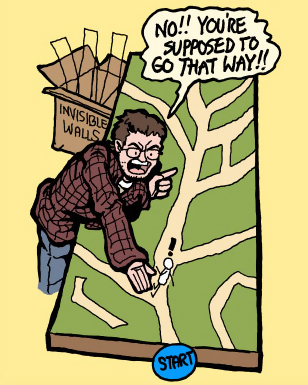
Being the Game Master of a Tabletop RPG campaign is a difficult business: Regardless of whatever exciting Story Arcs you've planned and worked out in advance, there's no guarantee that your human cohorts will proceed according to plan. After all, if they don't know what's going to be in store for them, how will they know to get their characters to the right place at the right time instead of, say, getting Sidetracked by the Gold Saucer?
The answer is Railroading. You take any measure necessary to ensure there is only one direction the campaign may proceed — your planned direction. This can manifest in any number of imaginable ways; some of them subtle, some of them blatant:
- Planning out connecting geographic areas in a linear fashion, to ensure that there is only one given path from town A to town B. There will simply be no side paths, optional areas, or other locations to explore.
- Adding a Broken Bridge to prevent the players from reaching a destination before the plot demands it.
- Having random NPCs remind the party to Continue Your Mission, Dammit! (even if only Because Destiny Says So) if the players haven't left an area quickly enough.
- Using enemies or circumstances to keep the party from stalling, whether they're relevant to the plot or not.
- Throwing in Hand Waves to thwart attempts at Sequence Breaking.
- Locking the players in a Closed Circle for a while to buy time for other events to happen while the party is busy.
- Giving the players choices, but having them all lead to the same outcome.
- Simply telling the players "You can't do X, because it would ruin the story."
The list goes on, with the exact possibilities for how players can be railroaded limited only by the GM.
In practice, the use of Railroading is generally regarded as one sign of a poor GM, as forcing the players down a single predetermined path (like cars on a railroad track, hence the trope name) runs against the collaborative nature of a tabletop RPG in the first place, where every player is allowed an equal voice in dictating what happens next. If players discover the Railroading and rebel against it, they are going Off the Rails. (And if going off the rails triggers an event where Rocks Fall, Everyone Dies, then something about the campaign has failed on a fundamental level.)
On the other hand, while complaints of Railroading are directed primarily at difficult or unimaginative GMs, there are also difficult and unimaginative players. A swift kick in the caboose might be the only way to get some players to do something as simple as leaving the tavern to start the adventure. A subtle GM who knows his players and makes an effort to maintain at least an illusion of free will and exploration, and really does make stories that are That Damned Good, can probably get away with herding a few cats. (Console and PC RPGs, which by their very nature are predetermined stories, do this all the time.)
Plus, maybe the story is just worth going on the railroad for. Players may not object to railroading if the story's good enough to excuse the lack of perceived freedom, or if the ride is fun enough. Tropes Are Tools after all — it's been pointed out that you have to be somewhat linear to make a story work in a Tabletop RPG. It's agreed among avid RPG fans that every plot has at least some degree of Railroading involved. The difference between a good GM and a bad one is the blatancy with which Railroading is used and how they handle players attempting to go Off the Rails.
In a similar vein, an occasional bout of Railroading can do wonders to kick-start the campaign should players be left with no idea how they should proceed next; a GM pointing the players down the nearest track to get the train moving again is to the benefit of everyone involved. Experienced GMs know when it is (and is not) appropriate to Railroad the campaign — a good measure is that if the players are currently having fun with the game, there's no need to interfere. Why fix what's already working just fine?
Schrödinger's Gun can also be a useful tool for a subtle GM to silently railroad players without their awareness. If the GM spent a lot of time secretly preparing a dungeon to the North of the current town, but the players suddenly decide to go South instead, the GM may be able to — surprise! — secretly decide that this dungeon was instead in the South all along, and the players reach it just as the GM planned anyway. This form of Railroading (sometimes dubbed "railschroding") can be an effective tool, as the players are the ones driving the 'train', unaware that the GM has already thrown all the switches so that it somehow ends up in the same place no matter which direction they take it. Essentially, it's You Can't Fight Fate with the GM as fate.
Of course, one advantage a GM always has over a console or PC RPG is that his players probably aren't going to restart the game from the beginning and realize he was leading them by the nose the entire time. (Note that for players or GMs who treat their tabletop game exactly like a console RPG, Railroading is 100% par for the course.)
No Sidepaths, No Exploration, No Freedom, Insurmountable Waist-High Fence, Plot Lock and But Thou Must! are Video Game analogues.
Contrast Off the Rails, an attempt by the players to escape a GM's railroading, and Quicksand Box, what happens when the GM gives too little direction. See also Blamed for Being Railroaded, which is when the GM (or more commonly, the videogame) forces the players down a path and then shames them for "choosing" it; this is considered particularly bad form, and is likely to incite rebellion.
Not to be confused with the Rail Enthusiast's favorite hobby, or Railroad Plot.
If you are looking for railroading meaning getting someone falsely convicted as in a definition of the word railroading as used in American English slang, that trope is at Miscarriage of Justice.
Examples:
- Princess Tutu's Drosselmeyer directly intervenes in the story at several points in order to try and keep the plot on track, even going so far as to show up directly in person a few times to try and talk characters out of an action that would derail the plot or to try and nudge things in the desired direction. Given Drosselmeyer's lack of charisma, his attempted intervention doesn't always have the desired effect.
- Parodied in John Robertson's The Dark Room, a standup show that affectionately parodies old-school text adventure games. It's possible for the current player to end up in a scenario where their only choices are "Hint" and a very obvious trap option. Choosing "Hint" results in the Guardian presenting them with exclusively the trap option.
- Guardian: "You want a hint? This is the wrong option!"[beat]Guardian: "Read it."
- Knights of the Dinner Table: B.A's players (besides Sara) see going Off the Rails as a point of honor, and the game as a contest of wills between them and the GM. B.A. starts in on his new adventure with a lord tasking the party with a quest. The players wandering off into the castle to steal his stuff. B.A. has the court wizard teleport the party away onto a secluded path with mountains on one side and forests on the other. The party tries to go into the forest, but the woods are packed too close together to pass through and are so thick that cutting them is fruitless. As for the mountains, they secrete an oil that makes them too slick to scale; the closest they get are outcroppings of jagged shards that cause damage. Finally, the players give in and just do what B.A. wants them to. During a break, the players sneak a peek behind the GM screen and see the map of the adventure: The path they're on is a literal straight line between the lord's castle and their destination, with the forests and mountains on each side explicitly labeled 'impassible'. The strip ends with B.A. being hung upside down from the ceiling.
- Unfortunately for B.A., his players tend to assume that he's not only a Killer Game Master, but the kind of guy who will put huge piles of treasure in the game world just to screw them out of finding it. This means the players interpret his ways of saying "Nothing To See Here" as a Suspiciously Specific Denial, leading to such incidents as the party killing themselves with the dungeon's garbage chute.
- An odd Fan Fiction example: Pooh's Adventures, a Mega Crossover series that is pretty much any movie with Pooh and his friends pasted into the film. They can't do anything to affect the flow of the film aside from suggesting the obvious, or downright stealing people's lines. One example is "in Pooh's Adventures of The Thief and the Cobbler", in which Mewtwo tells Zig-Zag to watch out for the nails. He still steps on the nails.
- The Infinite Loops:
- Some of the universe can be more forceful when it comes to making Loopers follow their stories, but the Girl Genius Loop takes the absolute cake. When Twilight Sparkle Loops into it, she's incapable of going against the story, no matter how hard she tries. And it makes her very angry indeed. By the time she gets to Sturmhalten, she's had enough. By Mechanicsburg, she's gathered together the rest of her universes' Loopers, and has managed to overpower the Loops temporarily. Then she gets hit by a lightning bolt, and dies before she even knows what happened.
- Railroading is one of the symptoms of Setsuna Syndrome. Named after Setsuna Meioh, aka Sailor Pluto, Setsuna Syndrome is when a Looper tries to force each and every loop they go through to follow their baseline's events as closely as feasibly possible, usually in hopes of "stopping" and "fixing" the loops. If every loop were a baseline loop, this wouldn't be much of an issue — however, baseline loops, while the most common type of loops, are not the only type of loop a Looper goes through. There are Alternate Universe loops, Crossover loops, etc., where following baseline is literally impossible. If not remedied, Setsuna Syndrome can drive a looper insane, making them more and more desperate to maintain the baseline timeline, thus causing them to take extreme measures — such as Helia blowing up Tecna's subspace pocket. The only way to treat it is to convince the Looper that they don't have the power to stop the Loops so maintaining the baseline timeline is pointless in the face of the extended multiverse.
- Railroading is also part of safe-mode loops, which are very stable and provide few to no opportunities to deviate from the plot of those worldlines. More often than not, they're used as punishments for loopers who end up causing a crash, since the nature of the loops makes all loopers perpetually stir-crazy, and so being forced into a predictable and static role can prove agonizing to most of them. The only loopers who aren't frustrated by the railroading are loopers from realities where their usual conditions are so harsh that they treat safe-mode loops as a much-needed vacation.
- In The Legend of Cynder Series, The Chronicler attempts to do this in regards to how Cynder ended up replacing Spyro's intended role in The Legend of Spyro. Despite his numerous attempts to make Cynder complete Spyro's intended roles, he's usually surprised when she flat out refuses to go along with his demands, and his final attempt to rail road things back to canon nearly drives Cynder to suicide.
- Fade: No matter how hard Light and L try, someone will rise up to become Kira, like in the story. While Light succeeds in subverting his fate as canon!Kira, another Kira, arguably worse than what he would've become, takes his place — L, who succumbs to the darkness in his pursuit to stop canon!Kira and his death using his own Death Note. It's implied that there was always meant to be a Kira and that Light and L's efforts were for naught — if it hadn't been one of them, someone else would've gotten the notebook and fallen into temptation instead.
- In Hunters of Justice, Team RWBY get trapped in a book of fairy tales by the Queen of Fables. As Bigby Wolf explains to Ruby, the story world will force them to go along with the tale. If you play along, the world is idellic and Disneyesque. If you rebel and go off-script, the world becomes "Brothers Grimm" and you will find yourself in actual danger. Fortunately, because there have been so many versions of classic stories told over the years, there's a degree of flexibility in how you complete the story.
- In the obscure part-live-action, part-Claymation Christian kids film Hoomania, a boy is trapped in a board game after being warned not to go off the path. He goes off the path twice and gets punished brutally both times. The point of this was to teach him an unsubtle lesson about making wise choices. This may have been inspired by The Pilgrim's Progress.
- In The Cabin in the Woods, Hadley and Sitterson use mind-influencing gases and remote-control doors to separate the five teens or lure them outside as the ritual demands.
- In The Iron Horse, Bauman the land speculator really wants the railroad built over land he owns, which obviously will make him a lot of money. He is prepared to take violent action to make sure this happens, including murdering anyone who finds the pass in the mountains that would allow the railroad to bypass his land.
- In Stranger Than Fiction, Harold, having discovered himself to be a fictional character, tries to stay at home watching TV all day so that the plot cannot progress, only for a bulldozer to knock down the wall of his house. Which is actually a plot point, as it is when they discover the novel is about things happening to him, not what he does.
- In The Truman Show, the show's creators set up a Meet Cute situation to force Truman to marry one woman, even though he actually loved someone else. This trope is integral to the whole movie.
- In The Adjustment Bureau, the eponymous shadowy organization does this for all of humanity, having decided long ago that people cannot be trusted to run their own lives. It's all a subversion in the end, because the goal of the organisation is to pressure people into ultimately rejecting the Railroading in the first place so that they will fight for the right and responsibility to run their own lives.
- In Zero Charisma, the protagonist is a DM who is very much prone to this, taking his campaign very seriously and allowing no deviations from it. This gets to the point that he's willing to lie about his own dice rolls to get his way; a practice known as "fudging".
- In the first act of Dark City, John Murdoch wakes up in a hotel room with a dead hooker and a bloody knife. The hotel clerk tells him his wallet is at the automat, and when he goes to pick it up he encounters another prostitute. The Strangers had set up that chain of events so Murdoch, imprinted with the memories of a Serial Killer, would meet her and so they could observe whether he would kill if given the memories of a killer. However, since he wasn't imprinted and has amnesia, he leaves to find out who he is, and everything goes Off the Rails.
- In Jumanji, the players are at the mercy of the dice. When Peter tries to cheat by trying to drop the dice so it lands on 12, the game punishes him by gradually turning him into a monkey.
- Dead Poets Society: Neil Perry's father is hellbent on him going to Harvard and then medical school to become a doctor, treating anything not part of that path as a distraction and only allowing him to live his life on his own terms after he's done all that. All this despite the fact that Neil is already an honors student at Welton Academy. After he sees Neil starring as Puck in a local production of A Midsummer Night's Dream, despite Neil getting a standing ovation, he forcibly pulls Neil out of the theater and takes him home, telling him he's getting pulled out of Welton and sent to a military school. Having had enough of being railroaded all his life and now being denied his true passion in acting, Neil commits suicide.
- The Doctor Who Choose Your Own Adventure books. In one of them, about half your "choices" led to paragraphs basically saying "No, that's not the right decision. Go back and pick the other one."
- In the modern ones, they let you stumble around, not really having much effect on anything, while the Doctor saves the day. You can't even die, the plot won't let you!
- The two Animorphs Choose Your Own Adventure books infamously have only one path to get to the happy ending; every single other choice results in instant death.
- In The Hunger Games, the Gamemakers use various traps and events such as fires, force fields, and even necessary supplies as a way to make sure the participants have to meet up and fight because the audience doesn't like long periods of time with no deaths.
- Conversely, they also have events that prevent too much slaughter. For example, in Catching Fire, a pitched battle goes on in the center of the arena between the two factions — so the center spins around, scattering the participants by hurling them into the water in various directions. Both sides regroup and withdraw, keeping the Game going for a while longer.
- In the Lone Wolf gamebooks, the adventures got a lot more linear over time. Compare the pathways through early installments like book three, The Caverns of Kalte
 or book seven, Castle Death, versus later installments like book seventeen, The Deathlord of Ixia.
- In You Can Be The Stainless Steel Rat, another Choose Your Own Adventure book (of sorts), used quite blatantly, returning you to already read paragraphs, telling you 'No, not this way', returning you with a 'after a few miles, you realize this is the wrong direction', and so on. Near the end you get to explore about half a dozen different paths, and the paragraph where you choose among the five paths tells you to go to paragraph x only when have run all the other paths — and that paragraph tells you a secret that then allows you to go forward in the 'right' direction...
- In The Odyssey, Odysseus and his crew are warned not to kill the cattle of the Sun (Helios) when they arrive on the island of Thrinacia. They follow this advice at first, but then an unfavorable wind traps them there for a whole month! The crew is slowly starving to death and finally gives in and breaks their promise not to touch the cattle. Of course they are then duly punished even though they basically had no choice.
- Done In-Universe in Bimbos of the Death Sun: Jay Omega, DMing the Celebrity D&D game in place of the murdered Appin Dungannon, puts Dungannon's Barbarian Hero Tratyn Runewind through a Humiliation Conga that ends with his iconic sword shattered and him killed in a disgraceful manner. He did this because he suspected the resident Runewind fanboy of committing the murder; his suspicions are confirmed when the fanboy flips out, delivers his Motive Rant, and then tries to kill Jay in order to "save" Runewind.
- Parodied in Ryan North's To Be or Not To Be: That Is the Adventure. It's obvious that the Lemony Narrator doesn't actually like the original play and thinks his version is superior; attempting to derail his ideas or act out the canonical version of Hamlet leads to increasingly angry tantrums and attempts to retcon away your actions, such as claiming Hamlet was only pretending to be a jerk to Ophelia. Play your cards right though, and you can derail the story in insane ways that he accepts, such as making Hamlet shoot himself out of a cannon or having Ophelia murder everybody.
- Near the end of the first school year in My Next Life as a Villainess: All Routes Lead to Doom!, Catarina hits what seems to be an "Event Flag" from Fortune Lover, namely a group of girls exposing her crimes of bullying and abusing lower-class students (Maria in particular) in front of the entire student body. At first, she's utterly horrified since this was the beginning of the end for Catarina in the game, but then she's utterly confused because she hasn't actually bullied anybody. It turns out to be a gigantic coincidence, as the girls were being manipulated by dark magic; thankfully, her friends come in shortly afterwards and dispel the accusations.
- In The Scum Villain's Self-Saving System, Shen Yuan is constantly monitored by a video game-like "System" after he gets transmigrated into a webnovel as the protagonist Luo Binghe's teacher Shen Qingqiu that tracks his actions and penalizes him if he acts too Out of Character or fails to make important plot events occur. Most crucially, it makes the cost for not following the plot event of Shen Qingqiu betraying Luo Binghe so astronomically high that Shen Yuan has no choice but to do it in spite of him really, really not wanting to.
- The second A Wizard in Rhyme novel, The Oathbound Wizard, starts with protagonist Mathew impulsively swearing to God that he'll conquer the neighboring evil kingdom if it will make him worthy of marrying Alisande (since he's not of noble birth, she'd been refusing to wed him despite the two of them being in love). This caused him to be magically teleported to the border of said kingdom, and teleported back to the same spot when he tried to go back to Alisande until he gave up and went ahead with the job of conquering said kingdom to free it from its Evil Overlord.
- Star Trek:
- The series have had numerous episodes (often involving the holodecks) where the characters attempt to escape the plot of the simulation/ shared dream/ Negative Space Wedgie only to be transported away and forced to finish the story.
- Subverted in the Star Trek: Deep Space Nine episode "Our Man Bashir". Faced with the possibility of being forced to kill either Dax or Kira (because the Holodeck has turned them into characters), Bashir comes up with a third option: side with the game's villain and kill the entire (fictional) population of Earth, but saving the five real people.
- In one episode of The Big Bang Theory Leonard as the DM of a Dungeons & Dragons game planned a Christmas-themed adventure which involved rescuing Santa Claus as a way of forcing the group to celebrate the holidays (which Sheldon generally does not wish to do). Sheldon averts this by appearing to play along, only to abandon Santa to his death at the end.
- Charmed has an episode where Paige and her beau of the arc are sucked into a book written by two magic students, based on The Maltese Falcon. They have to play along to find the way out. The book itself railroads them occasionally, but Phoebe and Piper do their share as well. At one point Paige is heading for a trap; Piper writes in a piano falling in her path to send her the other way.
- In a certain sick way, the Montreal Screwjob could count, Vince McMahon and Shawn Michaels basically forcing events onto their chosen path in defiance of Bret Hart.
- Railroading was a common troll complaint against Weaver in Ruby Quest, although really it had more examples of Off the Rails, like saving Stitches and Jay, than straight railroading, and two times he does straight-up ignore player input have good justifications: Ruby killing Stitches was a flashback, and Tom making a Heroic Sacrifice at the end was a fake out- he's saved by Stitches because the players went Off the Rails earlier. He even throws in a Take That! when Ruby and Tom are riding a tram away from the Metal Glen:
Weaver: The tram begins to move, leading out towards the land beyond.
It's on an automated track, so it will continue on without Ruby or Tom needing to do anything.
CHOO CHOO!
- This is of course a common trap many novice GMs fall into running their first Tabletop RPG. Excited by the (to them) wonderful story they have set up, they can get flustered, irritated and downright stuck when their players either miss what they think are obvious markers on how to proceed next or just plain choose to do something the GM did not account for. While an experienced GM can subtly guide a party back on path, the novice often (and in-game wise illogically) ham-fistedly forces the players back on the "correct" path, either in story or fourth wall yelling/whining at the PCs.
- The gaming blog "The Alexandrian" gives advice for averting railroading in tabletop RPGs called the three clue rule. The article says that any conclusion you want the PCs to make should include at least three clues. This is because, as the article says somewhat tongue-in-cheek, "the PCs will probably miss the first clue, ignore the second, and misinterpret the third before making some incredible leap of logic that gets them where you wanted them to go all along."
- The exact definition and tolerance can be very subjective. Almost universally considered bad (and there are a few examples here in this folder) are where the actions of the players cannot change the end story resolution, to the point where the plot itself overrides whatever the players are able to do. In contrast, You Can't Thwart Stage One is considered slightly more tolerable, especially if there's good in-game justification for it. Likewise, most players will tolerate (in moderation) sections where there is only one available and/or logical choice to proceed, but some contrary players will view any attempt to have a prescripted structure as "railroading", including even having an NPC trying to hook them into a quest.
- The Mekton adventure Operation Rimfire which read more like a script then an adventure. While it featured ten pre-generated player characters, five of them were pretty much useless. To make matters worse, two of the other characters (and one of the useless ones!) were indispensable to the plot, however, if the players didn't choose to play both of those characters, then important developments and revelations would be skipped or confined to NPC-only dialogue (And there is nothing less fun then watching the GM talk to themselves). The story leaves no room for deviation, basically forcing the players to do exactly what the script tells them, otherwise the plot simply will not advance. And finally, the worst straw is the villain's death: no matter what the players do, which pretty much amounts to ten people whaling on him at once with guns, rapiers and laser swords, he lives long enough to deliver his twenty seven line dying speech and then execute his master plan anyway.
- Shadowrun is about playing mercenaries who are little fish in a big mess of secret wars between Megacorps, so naturally their missions are pretty scripted (and it's also perfectly normal for an irresistible force to point a very big gun at them to push them into an adventure). Harlequin then one-ups this by explicitly stating that the Big Good has Plot Armor, just in case the shadowrunners decide that they've had enough of his games and aggravation. Many printed adventures in early editions of the game had sections called "Picking Up The Pieces", which had specific advice to the game master on how to get things back on track when PCs went off the rails. Even more than that, the players are essentially hired for jobs offered by their fixer (contact). While in theory, the fixer should have a number of jobs available to offer to the players, in practice, the fixer usually has one.
- Paranoia is an interesting case, in that the point of the game is usually gleeful chaotic backstabbing, but the setting of an underground complex ruled by an all-powerful computer allows for some pretty iron-clad railroading if the GM so desires it.
- Dungeons & Dragons:
- Many adventures in early editions had various levels of this, but the original Dragonlance modules (DL1-DL15) were by far the most blatant example. Most of the time the {{PC}}s could only do one thing due to the situation, and several times the Dungeon Master was specifically told by the module to take action to force the PCs along a pre-determined path. There were also dire results for the whole game world if the players did manage to avoid doing exactly what they were supposed to. For instance, there was a specific action in the first module which, if nobody did it, resulted in there never being any priests.
- The notorious WG7 Castle Greyhawk, a blatant joke module, teaches the DM how to properly lure players to adventure:
Culum's goal is to get the adventurers to go down into the dungeon. To this end, he'll continually use phrases like "presumed dead," and "assume the worst," in an attempt to get the characters to volunteer to search the dungeon for his dad. If that doesn't work, Culum pathetically offers them his one battered copper, (actually he has 15 silver stashed in his boot) to look for dad. If the adventurers still won't go to rescue dear dad then Culum will flat out ask them. Continued refusal means that you have no adventure this evening — close the book, fold up the screen, and stare at your players until they get the hint.
- A number of adventures for the Ravenloft setting start with the Mists of Ravenloft suddenly appearing around a group of PCs and carrying them off to that demiplane without any chance to avoid it. In the adventure RQ3 From the Shadows, the PCs are approached by a man who asks them to find and defeat a Headless Horseman. If they agree, when they confront the Headless Horseman the Mists appear and take them to Ravenloft. If they refuse, the man casts a Vistani curse on them and the next time they're on a road alone the Mists appear and carry them off. Once they're in Ravenloft the DM (Dungeon Master) is ordered to kill each of the PCs, either by having the Headless Horseman cut off their heads or having them be slaughtered by subsequent waves of monsters, including three beholders (!). The DM is told to cheat on die rolls if necessary to kill off the PCs. A short time later the PCs are brought back to life (sort of) by the lich Azalin and are forced to perform missions for him (if they don't they're permanently killed). If they agree to a mission they'll probably end up being all killed again (but not for real). The PCs are very unlikely to gain any Experience Points from performing these missions and can possibly lose tens of thousands of Experience Points while doing so through no fault of their own.
- In Egg of the Phoenix, after the adventure is over, the titan Sylla suggests that the PCs let her take the Egg where neither evil nor mortal forces can find it. It's only a "suggestion" if the PCs agree, since if they don't, she will take the Egg anyway regardless of the PCs' response... or attacks.
- NewsieSpud, author of Friendship is Dragons, compiled some of the best stories shared in the comic's comment section into a series of animated comic strips. Click here for one of the best/worst examples of railroading ever.
- The 5th Edition Module Baldur's Gate: Descent into Avernus begins with the PCs being forcibly deputized by the Flaming Fist mercenaries and told that they will do as the guy deputizing them orders or else.
- An early edition of White Dwarf magazine carried an article on how GMs could do this for Warhammer Fantasy Roleplay in which it advised four steps: (1) Subtlety (2) Emotional Blackmail (3) Bribery with loot, and (4) Just dropping the plot and encounter in at the very next opportunity. It advised that the first three options rarely work and that sometimes it is best just to skip straight to step four.
- Pathfinder releases Adventure Paths which are six-volume campaigns that carry player characters from first level to roughly 17th before the end, though this varies. Needless to say, even the most open-ended of them can have some heavy-handed railroading in order to ensure the players are along for the ride.
- Marvel Super Heroes supplement Uncanny X-Men boxed set "Adventure Book".
- In chapter 4 "Time Out" the {{PC}}s are at a charity basketball game when the supervillain Arcade performs a Knockout Ambush by flooding the gymnasium with Knock Out Gas in order to capture them. The module explicitly states that the PCs have no chance to avoid being rendered unconscious.
- Chapter 5 "Nightmare in New Guinea". The PCs are at an audience with the Mandrill when he decides to capture them. He and his soldiers open fire on them with neurostunner pistols that cause unconsciousness. The game master is specifically told that if the PCs appear to be winning they should add more regular soldiers or even soldiers wearing Powered Armor — whatever is necessary to capture the PCs.
- At the end of chapter 8 "Terror in the Amazon" the building holding the gymnasium from Chapter 4 appears in the sky and begins pumping out the same Knock Out Gas that took out the PCs earlier. Again, the module says that the PCs can't avoid the effect of the gas.
- Any game line with a strong metaplot tends to have a lot of this in published adventures. The Old World of Darkness had a sequence of adventures revolving around an NPC named Samuel Haight. No matter what the players did, they were never allowed to kill Haight or stop him from achieving his goals, because he was scheduled to turn up in future adventures.
- Published adventures for CthulhuTech are infamous for this. In particular, the GM is often specifically instructed to make sure the villains win one way or the other, since having the good guys win would ruin the tone of horror and despair the game strives for. In another example, the adventure says that a particular character must become a Love Interest for a PC.
- An actual rule in World of Synnibarr is that the GM has to show players his campaign notes after every session, and if he didn't railroad them they get bonus EXP. It also has a rule to enforce that; if the GM doesn't follow any and all rules in the book (for example "I don't want to railroad my players because that's BS"), the players can demand a reset of the adventure.
- Deadlands Classic has The Devil's Tower trilogy. There's quite a lot of Metaplot involved in the series, from uber-power NPCs with no stat blocks, large rewards that are never intended to be paid out, and instructions on how to keep the story "on track." The actual Devil's Tower site is a slight break from this — there's a number of ways to actually enter Devil's Tower, which expose the party to different parts of the dungeon — but even here there's a lot of linearity to the design. This is an unfortunate habit that carries on in a lot of Classic Deadlands, and even some in Deadlands Reloaded. The Savage Worlds Adventure Edition version of Deadlands, where the Servitors are not as large of a threat and a focus on more localized horror stories, intends to be more open-ended, but only time will tell as new supplements are released.
- Warhammer's "Storm of Chaos" campaign: The premise was simple enough: Have matches regarding the story event at your FLGS and official tournaments, and the results would be sent in to an official website to help dictate the storyline of the event itself once the event concluded. The progress of the campaign would be measured by a map that would be updated depending on wins and losses taken during the event. Sadly, it didn't go as planned.
While the centerpiece of the event was the invasion of the Hordes of Chaos, a few problems became clear very quickly, including the fact that while the new edition rules had given massive buffs to certain factions, others weren't as well-balanced or powerful. Between this and a variety of other issues (a larger percentage of newcomers picking up Hordes armies based on their reputations, a large veteran playerbase sticking to their armies of choice, relatively bad balancing of the new rules in general), something amazing happened: Chaos got repeatedly swept in the matches that were sent in. The event wound up being a complete embarassment for GW's writers, who kept pushing forth Gav Thorpe's plot, regardless of how obvious it was that they were essentially ignoring the results of their own event.
During the early phases of the campaign, Chaos repeatedly failed to gain ground, and got held up, essentially, at every major battlefield, when it hadn't been outright routed going by the campaign maps. The response by GW's writing team was to basically start giving Chaos Plot Armor, declaring wins that hadn't happened, and manipulating events so that Chaos won anyway. Arbitrarily, it was decided, apropos of nothing, that a plague from Nurgle destroyed Castle Lenkster, and that the Brass Keep was taken by the Skaven. This quickly became the start of a pattern.
Later in the campaign, Chaos was assumed to have reached Middenheim. The campaign progression showed otherwise, so GW moved up the battle lines to reflect what Games Workshop wanted.
In spite of this blatant act of favoritism on the part of GW, the forces of Chaos continued to lose repeatedly and hard on almost every battlefield. Chaos was held back at Middenheim for the entire next phase of the campaign, and never even got within striking distance of its walls according to the maps, such was how hard the Hordes were losing. Nonetheless, GW decided that they did actually reach the walls, though presumably being worried about backlash. The biggest "WTF" of the entire storyline was arguably Teclis single-handedly destroying not only Be'lakor, but his entire army, with a single spell.
The end result of this clusterfuck of an event was that while shaking things up and moving the story forward would have been fine, GW had zero regard for what the players did, and indeed, constantly changed the event map to make it seem like less of a gigantic clusterfuck. Despite thousands of battle results being submitted, GW was content to ignore all of it and push their desired narrative anyway, making an event whose overall outcome was completely divorced from what actually happened. It left a bad taste in everyone's mouth, and though it was retconned out of existence later, the same idiocy that hallmarked it came back in force for The End Times in 8th Edition with one exception - there was no campaign to stop it.
- The Ace Attorney games are strictly railroaded to the point where nearly every choice you make won't affect the outcome in any possible way. When asked to present evidence for something, there's only one that matches what the developers want you to use, even if another piece of evidence would logically fit the solution note . When choosing how to respond or progress, choosing the wrong response will either have the player character ignore your choice and go with the correct one anyway, have the conversation repeat until you pick the right choice, or you'll get penalized for choosing wrong. While some of the games do have multiple endings, the bad endings are usually from you not picking the correct answers, thus the bad endings are abrupt and unfulfilling.
- At least when compared to the other games in the Advance Wars series, Days of Ruin is heavily railroaded. The previous games gave the player some choice such as choosing which missions you wanted to do, some choice in which order you wanted to complete them in, rewarded fast completion with extra missions and bonus Exposition, allowed you to unlock extra missions which would in turn unlock new units by exploring maps, offered the choice of which CO you wanted to use in which mission, and even allowed you to equip skills to characters to unlock new abilities or augment skills. Granted ,none of the previous games had all of these, but Days of Ruin had none, only allowing you to follow a very specific roadmap of missions with no choice or deviance from the path, chose which specific CO you needed to use for every mission, and wouldn't even allow you to use CO Powers until about half-way through the game. Even the bonus missions were explicitly non-canon to the game's events and gave no rewards aside from 100% Completion.
- Another Century's Episode R takes great pains to recreate the final episode of Macross Frontier — to the point where the mission contains only about two minutes of actual gameplaynote sandwiched in between seven minutes of unskippable cutscenes where the only difference from the Frontier anime is a throwaway shot of some of the other playable characters. This level is so infamous that the phrase "NOT SKIP MOVIE" (which appears during said cutscenes) became a minor meme amongst the Super Robot Wars fandom.
- Ironically, for a game where you're playing a character fighting for freedom, the Assassin's Creed series got progressively more linear in mission structure as the series went on. In Assassin's Creed III assassinating Templars must be done in a specific, story-mandated way rather than killing them however you can. Ubisoft seems to have taken the criticism to heart for Assassin's Creed IV: Black Flag which is more open. They then went back to railroading in Assassin's Creed: Unity where you must kill each target specifically with the hidden blades. Trying anything else like shooting them or melee combat merely causes the target to fall down and then get back up if you don't finish them with the hidden blades.
- Axiom Verge prevents you from leaving Ukin-Na until the Fever Dream Episode is over. This restriction is partly imposed by corridors you can only traverse in one direction without the Power-Up you get at the end, but the game goes so far as to reset your Save Point to the middle of the area whether or not you used it.
- Baldur's Gate: During chapter 6, it doesn't matter if you kill the Iron Throne leaders or not, it doesn't matter if you accept Koveras' ring or not, nor if you report him to Rieltar, and if you meet Koveras it is not even needed to actually meet the Iron Throne leaders: you end up framed anyway.
- And at the end of the same chapter, when you meet Diarmit and pretend to be Prat to get info from him, you will always conclude by saying the wrong thing that will make your disguise be discovered. Granted, it's inconsequential as he leaves, but you don't have any option to just stay silent or whatever.
- Baldur's Gate: Siege of Dragonspear: all the main story is pretty railroaded into its Foregone Conclusion, but it is a Justified Trope, since this is an interquel that necessarily has to reconnect the first game with its sequel. Still, there are many potential interesting sidequests with freedom of choices during them, different approaches to progress through the main story, and different flavor choices for the epilogue in itself. In fact, it could be argued that the epilogue plays a Zig-Zagged Trope. You end up anyway in the situations that leads to the beginning of Baldur's Gate II, but how you get there is depending on your deeds during the campaign and your choices during the final dialogues, and many things might change during the narration.
- You are still blamed for murdering Skie with the Soultaker dagger, even if your character couldn't use the item (for example, because you are playing a cleric).
- You can't warn anybody about what you discover about Hephernaan, something that would otherwise prevent what happens in the final chapters.
- Baldur's Gate II: at the end of chapter 1, it doesn't matter what you say, not even if you deny to be the main character: Gaelan will take you to his house and propose the deal (which you cannot refute: any other dialogue choice then will just loop until you finally accept). You also generally have no choice but to pursue the Big Bad thanks to said deal, either to get revenge/answers or to rescue your childhood friend, you can't simply walk away from Amn and go anywhere else forever.
- Furthermore, you have to choose a side in the guild war to start chapter 3, even if that means going against your character's ethics and creed because the two factions are at best a case of Black-and-Gray Morality, at worst a case of World of Jerkass.
- One popular mod, Alternatives, allows you to Take a Third Option (and a fourth one) between these sides, by giving a "good" option where you can vanquish both, and an "escape" option where you try to ignore both to pursue your main quest.
- Regardless, no matter which side you choose in chapter 3, you will get the same travel route to chapter 4 (but you might get or lose a potential assist NPC for the main task of chapter 6).
- At the end of Chapter 4, no matter which route you choose, during Chapter 5 you will end up in the same place regardless, even in the exact same starting spot.
- And if you refuse Saemon's gift, he will force-give you the silver sword anyway. You can't even abandon it somewhere on the ship. It will be part of your inventory, triggering the next cutscene.
- To say that Plot Lock is a common trope through the game and its expansion is an understatement. It's a very convenient coincidence that so many places are fully protected against your sneaky thief until the very moment it is required that your party gets there... But what is speechless is that, when you are tasked to go somewhere, while usually you are given a special key or granted permission by a guard, sometimes nothing of this will be necessary: the door will be now fully accessible without a reason.
- Furthermore, you have to choose a side in the guild war to start chapter 3, even if that means going against your character's ethics and creed because the two factions are at best a case of Black-and-Gray Morality, at worst a case of World of Jerkass.
- Baldur's Gate II: Throne of Bhaal even forces you to go through all the trouble involved in the whole story Because Destiny Says So. You can't even decide to say Screw This, I'm Outta Here, a messenger of the gods themselves will tell you that your journey must lead to the conclusion of the prophecy, while the spirit of your pocket plane will lampshade that it can teleport you where your action is needed and not where you want to go. Thus, the journey will be highly linear, with the same plot twists and advancement of the story, regardless. The only possible choice is which of two late game bosses fight first between them, and that's all. Train of Bhaal, really.
- As for the Plot Lock part mentioned above, here you even get manholes that don't have a conventional lock and are warded against "simple spells". In fact, your main quest can't proceed until you travel through them, and you must travel through them when the plot dictates so.
- Baldur's Gate III:
- While you can curry favor with the evil Cult of the Absolute in numerous ways such as helping the goblins in their employ slaughter a refugee camp, work with True Soul Nere to kill off the very Duergar he himself employed in the Grymforge, and ally with Enver Gortash against Orin after coming to the titular city, you will have to battle most of the Cult's forces anyway since they're after the MacGuffin you possess, and in the endgame, the Absolute itself turns on the "Chosen" who'd enslaved it (even personally killing off Gortash if you remained his ally), forcing you into battle.
- If you initiate the Creche Y'llek questline (which your companion Lae'zel will strongly pressure you into, eventually threatening to leave unless you comply or clear a speech check) you will make an enemy of Vlaakith and the Githyanki inside no matter what happens. This is because Vlaakith tasks you with killing the occupant of the Githyanki prism MacGuffin protecting you from enthrallment, and always planned to dispose of you once you outlived your usefulness no matter what you did. This, of course, shakes Lae'zel's faith in her supposed "queen" to the core and sets the stage for her rebelling against Vlaakith, though you can still try and get back into Vlaakith's good graces.
- In the endgame, you have to side with either the Emperor, who's a mindflayer who's been protecting you from enthrallment by leeching off the powers of Prince Orpheus, or Orpheus himself who's a key player in the rebellion against Vlaakith, but also sicced his honor guard on you because of your illithid infection. Siding with the Emperor results in him consuming Orpheus's brain and killing the Githyanki rebellion right then and there, but you need his illithid abilities to subdue the Netherbrain. Siding with Orpheus will result in the Emperor turning on you as he refuses to negotiate with Orpheus no matter what you say, and as a result, someone will have to become a mindflayer to stop the Netherbrain, with the options including Orpheus himself, your Player Character, or Karlach.
- In Banjo-Tooie, it is possible to locate Terry's eggs and learn the "Hatch" move before befriending Terry. If Kazooie tries to hatch an egg first, Terry will prevent this by objecting loudly despite being nowhere in the vicinity.
- The New Game Plus of Batman: Arkham City does this, as you have all of the equipment and upgrades from the main game, meaning you could essentially charge into Hugo Strange's fortress and end everything right then and there. However, attempting to go off the rails will have Batman tell you no.
- Doom mod Call of Dooty is a reimagining of the first three levels of the game (so far) in the style of Call of Duty, while taking many potshots at the series and modern military shooter tropes in general. The game also railroads the hell out of the player, starting a "GET BACK TO THE COMBAT ZONE" countdown if they wander off the tracks (which, in the first level, includes moving anywhere in a tiny room other than straight towards the exit!)
- A subtle version shows in Caravaneer 2's story mode, where maps of the region are only sold in the respective region's towns, which means that the player must complete story missions that reveals the location of a town in that region, and after that the rest of the region is open for the player to explore.
- In The Caregiver, you can only go where the game's plot allows you. If you try to go anywhere else, you stop walking, and a text appears on the screen saying you're going the wrong way.
- In Chrono Trigger, there are actions you can take that will result in a jury finding you guilty or innocent, but regardless, you'll still end up in jail. There, you can either break out or wait to be rescued, but you'll be free either way. Except for a few optional side quests, most of the game is heavily railroaded.
- Deconstructing this is the Central Theme of Deltarune. The game goes to great lengths to convince you that you have no agency and none of your choices matter. In the opening, you're given a character creation screen; as soon as you finish making your character, they're immediately discarded and the game condescendingly says that nobody chooses who they are before making you play as Kris. You are constantly forced down a single path and offers to make a choice are often immediately rescinded, with the game creepily insisting that "YOU ACCEPT EVERYTHING THAT WILL HAPPEN FROM NOW ON", even if you clearly don't.
- The NES adaptation of Dick Tracy has railroading occur during its cases. You cannot arrest the suspect being interrogated if you have only one clue to prove they did the crime - you must have every single piece of evidence from the case and then arrest them. In the fifth and final case, every clue must be collected before the player can enter the final area of the game.
- The Elder Scrolls, with its open and non-linear nature, generally averts it. However, certain instances do pop up, typically to avoid making the game unwinnable, and these instances have gotten more frequent as the series has gone on. To note:
- Largely averted in Morrowind, since you can kill any NPC in the game, including those integral to the main plot. The downside of this, is that you can render the game Unwinnable by Design. Fortunately, the game gives you a warning when killing an important NPC, allowing you to reload to a point before killing said NPC, and an alternative, but rather obscure, path to still finish the main quest, unless you kill NPCs required for that path, in which case you are forced to reload, should you want to finish the main quest...unless you grind yourself so high that you can complete the main quest through an exploit or sheer naked force. Also, Morrowind allows you to drop and sell items required to finish certain quests. Losing these items like this is another way to render the game unwinnable.
- Played straight in Oblivion. This game introduces the concept of "Essential" NPCs. Characters who are flagged as Essential can't be killed through combat. Whenever you defeat them, they merely fall unconscious and stand up a few seconds later. This is done to protect NPCs integral to the multiple questlines so you won't accidentally kill an NPC you later need in a quest. This does mean that you are forced play the quests exactly as the developers intended. Oblivion also prevents the player from removing and selling important quest-related items from their inventory, as a precaution to losing them and thus rendering the game unwinnable.
- Skyrim does both things Oblivion did before it did and takes its railroading a step further. The Player Character in this game is the Dragonborn, a Physical God and Reality Warper with the potential to become a One-Man Army, capable of easily killing dragons. Yet the characters in the game always treat the Dragonborn as a mere human and there is nothing to make them respect (or even fear) you as the Physical God you are. A specific example is the Forsworn Conspiracy questline in Markarth. After a while, the Dragonborn gets arrested by three corrupt guards. Despite being perfectly able to kill them and the rest of Markarth's army and pressure the Jarl into stopping the corruption, the only way to truly continue this quest is by meekly surrendering to the corrupt guards.
- Fallout:
- The main quest of Fallout 3 avoids it in its first half, but frequently employs railroading in its second half. For example, if you give the correct code to Colonel Autumn after he kidnaps and interrogates you, you are killed on the spot. More notably, at the end of the main quest, you are forced to make a Heroic Sacrifice... which will likely end up being a Stupid Sacrifice, as 4 of 8 available companions should be able to do the job for younote . Fortunately, you can avoid the Heroic Sacrifice part if you have Broken Steel installed but the narrator still criticizes the player for it. Additionally, the game makes use of Plot Lock far more often compared to its predecessors.
- Fallout 4 doesn't let you skip over clues or quests in the first half of the game. Until you arrive at the Institute, the conditions for each quest are directly set up by the completion of the quest before, and a major event that's completely unrelated to the main quest at that point ( the arrival of the Brotherhood of Steel's main force) is blocked off until you've advanced far enough in the plot. Simply going out, looking for and finding your objective is prevented by making the Institute only accessible by teleportation, which you can only accomplish after completing the plotline. After this, you can decide what to do, though the Minutemen are kept essential to ensure that you can always complete the main quest independently even if you antagonize all the other factions.
- For double the pun, progressing along the main story requires you to find and interact with the faction called The Railroad. They are the only ones who can decode a certain chip to find the Institute.
- The game begins with the Vault-Tec repesentative coming to your home to inform you that your family has been pre-selected for Vault 111, and he asks you to fill out the registration paperwork, which takes the form of choosing your stats. You have the option to refuse him, but if you do he just keeps asking and becomes more insistent each time until your spouse forces you to fill out the paperwork/your character sheet.
- Final Fantasy series examples:
- Though Final Fantasy XIII got quite a large share of flak from players for being "transparently linear", earlier games were far less kind and subtle in their railroading:
- Walking too far from your assumed path in Final Fantasy II resulted in you fighting enemies about ten times as strong as your current level, with no indication what patch of field grass was suddenly considered a 'new area' where you'd get a Total Party Kill in five seconds.
- Going to the wrong place without the right key item in Final Fantasy III simply kills the party in a cutscene... in two separate points of the game, no less. For example, early on in the game, a sea monster that's impossible to defeat guards the way out into the open ocean, and the only way to bypass it is to complete a dungeon.
- Just to be safe, assume that whenever you obtain a new method of transportation in a Final Fantasy game, you're either going to temporarily lose access to it, or discover a new obstacle it can't overcome, some time later when the developers want you to chase a particular goal without distractions. This includes airships in Final Fantasy IV. The airship isn't going to modify 'itself' to enable traveling to the moon faster than today's ships can.
- Final Fantasy plays it both ways. You need to complete the Temple of Fiends to get the king of Coneria to build you a bridge to the mainland, and then need to complete a series of quests in roughly linear order to progressively open up more of the world. This culminates with the Circle of Sages, who won't give you the Canoe until you've defeated Lich (which itself requires a chain of Fetch Quests) and stopped the rotting of the earth. But once you have the Canoe, the world is yours, because that's all you need to get the Global Airship (after one more intermediary quest) and Open the Sandbox. Once you've done that, you can explore the world freely even if you haven't lit the Fire Orb (which you're supposed to do before getting the Airship).
- In perhaps the most obnoxious example, in the ending of Final Fantasy XIII-2, much is made of the following decision: whether Noel should go through with killing Caius or spare his life. The game even provides a button-press option to choose between the two. But this is frustratingly betrayed by the plot in an example of But Thou Must!, because even if you choose to "spare" Caius, he commits suicide anyway and the exact same events unfold.
- Final Fantasy XIV, as an MMORPG, presents a very frustrating double subversion — once you've completed your introductory series of quests, you can access the entire world map, and it is perfectly possible to grind your way up to level 50 without touching any story quests along the way. However, this means you will be prevented from accessing most of the game's dungeons (including endgame content), you won't get a mount, and you won't get your relic items. It's even worse if you decide not to do class progression quests, as these are the only way to gain your class's key abilities and custom gear.
- At the climax of the penultimate chapter of Final Fantasy XV, the party is surrounded by an infinitely respawning horde of monsters, and Noctis's True Companions tell him to go on ahead to the elevator leading to the Crystal Chamber and reach the Crystal. The player can ignore this and continue to fight, but only up to a minute later, when a female electronic voice announces that the hangar in which the players are fighting will be sealed shut. To punctuate this, a timer appears counting down to the door closing, and if Noctis doesn't make it, it's Nonstandard Game Over time.
- Final Fantasy VII Remake: The concept is explored in an extremely meta sense by introducing the Whispers, ghost-like beings referred to as "arbiters of fate" who seem to be the Planet's attempt to enforce Destiny — as defined as the plotline of the original 1997 version of the game. They interfere whenever things diverge too much from the original timeline, sometimes to the protagonists' benefit (stopping Hojo from telling the group that Cloud wasn't really a SOLDIER, preventing him from having a Freak Out that ultimately rendered him catatonic for a large part of the game and reviving Barret when Sephiroth suddenly stabs him without warning) and other times to their detriment (seemingly trying to make sure that Biggs, Wedge and Jessie die with Wedge being able to hang on the longest beyond the point where he originally died, as well as making it so that Jessie sprains her ankle right before an important AVALANCHE mission, forcing Cloud to take her place). Sephiroth manipulates the heroes into destroying their leader by showing them contextless visions of what will happen if they "fail to stop them", freeing up destiny to be changed... as he intended. This turns the remake into a Cosmic Retcon where Nothing Is the Same Anymore, several events happen differently and even some characters who died in the original story (most notably Zack Fair) are still alive when the credits roll.
- Ghost of Tsushima plays around with this. The game was advertised as giving players the choice between two distinct playstyles, Samurai and "proto-Ninja"note , but at a certain point the player is forced to engage in a dishonorable act which drives the rest of the plot: Jin Sakai, the protagonist, chooses to sneak into the invading Mongols' camp and poison their food. This act leads to Jin being branded an outlaw and estranges him from his uncle Lord Shimura, who's the only family he has left; it has deeper repercussions later on as the Mongols manage to reverse-engineer the poison and start using it themselves. You can play the game as the most honorable, noble Samurai the world has ever known, but you aren't given any alternate choice for this one plot point. However, this serves as important Character Development for Jin: He saw that the Mongols were ready for a frontal attack and that no amount of logic would stop Shimura from feeding his men into the meat grinder, making him realize that the Samurai are blinded by honor and don't give a damn about the "little people". This leads to his choosing to become a Pragmatic Hero who protects everyone on Tsushima and not just the elite. In this instance the railroading is done entirely for storytelling purposes, and the player doesn't suffer any kind of gameplay punishment for what happened thanks to the game's lack of a Karma Meter.
- This is a plot point in the Half-Life series. Gordon Freeman is constantly being railroaded by the G-Man. Episode 1 and part of Episode 2 are notable in that you managed to go Off the Rails (in-universe) courtesy of the Vortigaunts. The game itself still railroads you down linear passages, though. To lampshade this, Half-Life 1, 2, and Episode 2 start with Freeman stepping off of a train.
- The title of one chapter in Half-Life 1 is literally "On A Rail".
- The Halloween Hack: Varik can explore the town of Twoson, but he cannot leave it because there are really tough enemies on the outskirts of town. If he manages to get past these enemies, the exits are blocked off.
- Hungry Lamu: Neither Lamu nor the final camper, can wander off in the forest until they complete the task at hand.
- I Was a Teenage Exocolonist:
- Even if Sol maxes out their Relationship Values with Anemone, she always hooks up with Vace on Sol's 17th birthday no matter how much she appears to reciprocate Sol's feelings beforehand. Unless Sol specs their stats right and/or finds definitive proof that Vace is a scumbag, Anemone will angrily reject Sol if they confess to her, saying it's too late and that she's happy with Vace despite him being abusive towards her.
- When Lum orders everyone in the Council to take on an official second-in-command, Cal will be made Second Cultivator over Geranium, who is already considered the unofficial Second Cultivator. The latter fact gets pointed out by Cal himself. This is the result of the fact that it's entirely possible for Geranium to be either dead or Chief Cultivator by that point and makes one less alternative late-game scenario to account for.
- A couple of characters whose lives can be saved by Sol's actions will step down from their respective positions soon after and hand the positions over to the characters who take over if they die. This results in the replacements being around for the same events regardless of playthrough.
- The famine ends soon after it claims its potential victim and the avoidable Shimmer-induced death is an alternate key to the cure, resulting in both plotlines eventually losing relevance even if they don't get solved in a given playthrough.
- Each official Council second-of-command position from the last year has three people who can potentially get voted into it: a Helio, the Strato peer who works under the Council member and Sol themself. Close friend, romantic partner and some job endings mention the Strato peer eventually taking over a specific Council seat even if the Helio or Sol won that playthrough's vote for it. It's especially noticeable because putting in enough work in a location to get Sol voted second-in-command is a surefire way to reach a high friendship level with the peer that works there, if not start a romance with them.
- The Journeyman Project has this right in the beginning of the game. You're supposed to head to your job via transporter and if you so choose, you can decide to skip work and teleport to another location. Going anywhere other than the TSA and you're instantly uncreated due to a paradox created in the timeline. Only by going to the TSA do you find out why the paradox happens in the first place. Later, in the underground maintenance area of the Mars colony, taking the wrong path leads to you dying in an explosion. After taking the correct path, dodging a Killer Robot, and disarming the bomb that is responsible for said explosion, you find that the robot has disabled the minecart you rode in on, forcing you to take the long way back through The Maze.
- Left 4 Dead is extremely linear where there are no alternate paths and any possible alternate path is usually blocked by a barricade. This is not seen as a bad thing since the game is arcadelike in nature and the replaybility comes from the randomization of item locations and enemy spawns. Left 4 Dead 2 tries to change things up by having randomized paths in some of the maps, but it usually just results in the players taking one of two paths when one of the said paths is blocked off and the two paths meet up fairly quickly.
- The Legend of Zelda:
- The Legend of Zelda: Distinctly averted in contrast to the sequels. The game is very open and non-linear, to the point that all but two screens in Hyrule can be explored right off the bat, and you can get as far as Ganon (but not beat him) without even grabbing the sword. The ability to buy keys instead of searching for them allows you to travel through any dungeon at your own pace.
- Played with in The Legend of Zelda: Ocarina of Time. Although the narration railroads you to complete the temples in a certain order, the gameplay itself is more open. So long as you grab the dungeon item in each temple, there is nothing stopping you from just leaving and completing the Fire Temple and/or Water Temple before completing the Forest Temple, and the Spirit Temple before the Shadow Temple or Fire Temple. But first-time players would have no way of knowing this. Also, thanks to a programming quirk the game only checks to see if you've actually beaten the Shadow and Spirit Temple and merely assumes you beat the rest if you did; though to be fair, the only way to pull this off is to glitch the game anyway.
- In a similar vein, The Legend of Zelda: Majora's Mask wants you to complete Woodfall, then Snowhead, then Great Bay, and then Stone Tower in that order. Typically you need the dungeon item from the previous dungeon to visit the next, so you can do them out of order if you just grab the dungeon item and leave, and Tatl will even call you out for doing this by pointing out that you "haven't finished the problem at the previous area yet". The only dungeon that can be completed in its entirety without the item from the previous is Stone Tower — you're supposed to use Ice Arrows to enter Ikana Valley, but you can just get close enough to a tree across the river to use your Hookshot without them.
- The Legend of Zelda: The Wind Waker is particularly harsh with its railroading mechanics as it very frequently relies on But Thou Mustn't rather than the Beef Gates or barriers that require a specific weapon to pass that the series is known for. The only reason you can't explore the great sea in its entirety until the game decides you can is the King of Red Lions says no. If you warp to Mother and Child Island before the game wants you to you'll just be told to come back "when you're ready" to get the fire and ice arrows. If you head to a reef before the game decides it wants to let you conquer them said reefs will just be devoid of enemies. If you're where the Ghost Ship appears but don't have the Ghost Ship Chart, you won't be able to enter the ship.
- The Legend of Zelda: A Link Between Worlds deliberately goes out of its way to avert this trope. It does this by bucking by-then fifteen year old tradition of "use the dungeon item you received to reach the next dungeon"; instead, nearly all of the major items are available to you at the beginning of the game, sold by the merchant Ravio. You can choose to rent the items for a cheaper price, or buy them and thus ensure they'll be yours forever (which also allows you to upgrade them). While certain dungeons do require specific items (especially among the first three dungeons, which outright tell you what you'll need), the majority of the game's levels can be beaten with any combination of tools. Thus, you're pretty much free to do the dungeons in whatever order you like (the only exception is a certain dungeon which requires an item you can't get until you clear another dungeon).
- Subverted in The Legend of Zelda: Breath of the Wild. The 4 shrines on the Great Plateau are mandatory (although they can be done in any order). They unlock the four primary functions to the Sheikah Slate that are needed for most puzzles, and the reward for completing them is the paraglider needed to descend from the Great Plateau. After that, the player has complete freedom within the game to explore and wander. Certain upgrades require certain actions to unlock them, but none are required for beating the game.
- Mass Effect 2 does this on two occasions. The first is right after finishing all four initial Dossier missions, where The Illusive Man orders you to head to Horizon, with no option but to go there. The second occurs after you have a total of eight recruited squad-mates and have completed at least five missions after Horizon. In this case, The Illusive Man orders you to board the Collector Ship. Only after the completion of that mission, do you have the freedom to do missions when you want. In both instances, this is justified as both of those missions are carried out while there is a narrow window of opportunity to strike at the Collectors before they scurry back through their special Omega-4 relay.
- The Lair of the Shadow Broker DLC railroads you over to the Broker's ship almost immediately after killing Tela Vasir. The Overlord DLC strands you on a planet till the mission is complete, albeit for a very good reason, while the Arrival DLC has you take Kenson back to her project base immediately after her rescue, to continue the DLC's plot. Again, this is justified as she says that an important task must be done by a certain time.
- Attempted quite poorly in Mega Man X6 with Alia's navigation. It's very clear the game designers meant for you to explore Commander Yammark's stage first, as that is the level where you get the introductory intel about the various nightmare enemies, but nothing stops you from visiting other levels. It's very possible to finish every other level and tackle Yammark's last, and still get the speech from Alia as if you've never faced the nightmare enemies you've probably gunned down by the hundred by now.
- Metroid:
- Metroid is very non linear and gives you a lot of freedom, but it uses this to give the player some sense of direction while you start Opening the Sandbox. You can't even get past the first few rooms without finding the Morph Ball. To access Kraid's Lair, most of Upper Norfair, Lower Norfair and many other rooms, you need the Morph Ball bombs. And to access many rooms, including the boss rooms and rooms with items, you need to have at minimum five missiles to blow open their locked doors. And to access Tourian, both Kraid and Ridley need to be killed.
- Metroid II: Return of Samus:
- The game is deliberately designed to downplay exploration in favor of combat and a more linear approach to gameplay. The main obstacle to progress is that the caverns you have to traverse are flooded by acid, and the only way to lower it is to kill a certain number of Metroids in each area. And because you need abilities like the Spider Ball and the Space Jump to find the Metroids, you have to thoroughly explore whatever area of the world you can before you can make any more progress.
- If you spider ball or space jump high enough in area without a ceiling, Samus will take damage and fall back towards the ground. One can only speculate why the sky turns hostile.
- Super Metroid: Many areas are cut off unless you have a certain weapon or ability on hand. The more you gather, the more and more the game opens up. For example, you at least need the Morph Ball, Missiles and Bombs to get anywhere beyond the start of the game, and the Super Missiles, Speed Booster and Power Bombs are required to finish it. You also need at collect three energy tanks at minimum in order to survive the fight with Mother Brain in the end.
- Metroid Fusion does this very obtrusively by Metroidvania standards, and especially compared to Super Metroid. To be sure, the omnipresent ability gates and one-way doors that reclose after you leave their area eventually cease to be obstacles once Samus regains enough powers. However, the game frequently locks down or destroys portals and blocks off previously explored corridors with as-yet indestructible enemies in order to force the player to follow the plot, and the elevators basically function at the discretion of Mission Control.
- While there are some speedrunning exploits present, Metroid Dread does this in a more subtle way than its prequel Fusion, in that there are features that serve as Point of No Return lite, preventing much backtracking throughout the game until you get certain abilities, though these become quite inventive as the game goes on until you defeat all the E.M.M.I. This is done on an in-universe level as well, as the whole setup of ZDR and the restrictions on the E.M.M.I. are orchestrated by Raven Beak to awaken Samus' Metroid powers as part of his plan to conquer the galaxy.
- Handled poorly in Neverwinter Nights 2. In Chapter 2, you are put on trial for a crime that you didn't commit, with your past actions and choices coming up as evidence that can help or harm you a la Chrono Trigger. However, no matter what happens in the trial, the end verdict is immediately overruled by one side or the other demanding Trial by Combat, forcing the same outcome either way and making the whole arc pointless. The designers later apologized for this blatant railroading that was unnecessary.
- Pâquerette Down the Bunburrows: Twice Pâquerette refuses to go on until the player checks the new upgrade.
- The Pokémon franchise is often criticized by long-time fans for nosediving into this territory. While the first two generations were also linear, there still existed some choice in traveling and battling some Gyms out of order. Subsequent installments use Event Flags more and more often, with the fifth and sixth generations abusing NPC Roadblocks as liberally as possible, and the seventh having literal roadblocks on every island. That said, those two generations aren't exempt, as the huge list of examples for the franchise on the Broken Bridge and aforementioned NPC Roadblock pages can tell you. For the sake of this page, however...
- Red and Blue gave us the 'HM' mechanic in addition to the usual NPC roadblocks, with this mechanic remaining a part of the series until Sun and Moon twenty years later. Certain obstacles can only be passed or cleared with special moves that work outside of battle. These moves are taught via items known as Hidden Machines, and are obtained through a side errand or event that is conveniently presented around the time you need said item. And even then, you can't use the move outside of battle unless you have the corresponding Gym Badge that allows you to do so. So instead of an NPC blocking you, it's most likely a tree, boulder, body of water. It doesn't matter if you have a hulking dragon with fearsome claws and fire-breathing skills in your pocket. You won't be able to get past that tree without the Cut move. The only reason you can take on a certain cluster of cities midgame in almost any order you want is because they're about two minutes from each other, in a '+' formation.
- Failing the tree/boulder blockade, the game will just toss an obstacle at you that needs a key item, like any usual RPG. Good luck getting past a Snorlax easily without the Flute, which you can only get after clearing a certain tower... which you need the Silph Scope for, to even see the ghosts inside to engage them without running. (A key item that, of course, has its own line of events.) Oh, and don't expect to just take on the Cinnabar Gym the moment you set foot on the island. You need to go fetch the key to the gym from an abandoned building... despite there being trainers inside that can probably just let you in.
- Gold and Silver: While the game has the now post-game region of Kanto be fairly open, allowing you to skip entire routes if you desire, the main region of Johto is fairly linear, also thanks to HMs and key items — and when those two aren't blocking you, you can bet there's a Team Rocket plot happening nearby that you absolutely must stop before you're allowed to move on. (Which gets hilarious when you remember your protagonist is, in fact, a child, who is constantly the one stopping these people.) Almost as if aware of the silliness of a twiggy tree blocking your path, this game introduces an intersection of three conveniently one-tile-wide paths... blocked in the middle with a Pokémon that poses as a tree for the sole purpose of blocking you, forcing you to take a detour around half the country to bypass it.
- Pokémon Sword and Shield, in addition to the usual arrangement of Broken Bridge roadblocks, has some additional railroading justified by the plot: the Galar Pokémon League is run far more like an actual sports league than those in previous games. You have to take a specific route and challenge the Gyms in a particular order because those are League rules. In addition, Team Yell will prevent you from even scouting ahead, due to wanting to prevent everyone other than a girl from their hometown from easily progressing through the League.
- Portal 2: There's a lampshade of this, in the game's intro, when Wheatley gets free of his management rail: "No rail to tell us where to go! This is brilliant. We can go wherever we want! Just hold on, where are we going, seriously. Hang on, let me just get my bearings. Umm, just follow the rail, actually." Many Valve games are designed in a very linear fashion, although the environments are well-designed enough to make it feel cinematic and interesting.
- A critic at one point complained about this in the Spider-Man 2 video game adaptation, despite the open world, you're often timed whenever a story objective happens, forcing you to head over there.
- Rockstar Games:
- This is a usual criticism of the Grand Theft Auto series. While the series is famous for its open worlds, the missions usually force the player to play them exactly the way the programmer intended, by doing things like making your opponent's car faster than yours no matter its model, making assassination objectives invincible until a forced chase ends, failing a chase mission if you blow up the opponent's car, even if the final objective is to kill them anyway - thus giving no real reason for the chase to be as drawn out as it is - or positioning your character in an inconvenient place through a cutscene so you can't have the advantage.
- While Red Dead Redemption II was praised for its open world, its mission design was heavily criticized for being very restrictive. For just a few examples, a few deaths happen only because the attacker is invincible before they kill the victim and certain missions could be beaten easily with ways the player is not allowed to take. It can get pretty extreme, as simply cleaning your weapon during a mission may result in your allies complaining constantly until you are done and dismounting your horse a few feet too early results in the game telling to you to remount it and ride to the target area.
- The Stanley Parable
- The game deals heavily with this subject, and more generally with player decisions/options in video games. In particular, many of the game's Multiple Endings are a Downer Ending, typically caused by taking a different path and ignoring the Narrator's instructions, which results in him killing Stanley in several horrible ways, from crushing him to causing him to go insane and die to blowing him up.
- The pinnacle comes with the Confusion Ending's Stanley Parable Adventure Line™: a bright yellow line painted on the floor that you literally follow to the plot after you've skipped ahead to the mind-control room one time too many. Of course, it takes you to the mind-control room, and the Narrator huffily has you ignore it from that point on.
- The Confusion Ending even takes it one step further by revealing that the Narrator is being railroaded as well, and he's none too happy about it once he finds out.
- In the Real Person Ending, the Narrator does everything he can to force the player to follow his intended story path, including removing the paths to other endings. The game still goes Off the Rails though, because the door to the mind control room is now voice-activated, and Stanley is The Voiceless so he can't open it.
- Of course, the "Good Ending" in the game is reached by following the Narrator's instructions, all of them expressed in past tense, (e.g., "When Stanley came to a set of two open doors, he entered the door on the left,") effectively going allong with the Narrator's railroading. It's not a little bit ironic that this ending is about Stanley throwing off the reigns of a mind control facility that's been dictating his every thought, emotion and action, or that the ending ends with the Narrator narrating Stanley stepping out to meet his freedom and feeling happy about it.
- Star Trek Online is linear in general but the railroading reaches infamous heights with episode "Romulan Mystery", mission "Divide et Impera". If you take the time to read the text prompts it becomes pretty obvious pretty early that the Romulan weapons research lab is really a medical facility, but the game forces you to keep going and become an Unwitting Pawn enabling the Undine impersonating Admiral Zelle to Kill and Replace the facility's commander. "Divide ut Regnes", a Fan Sequel to the mission, justified it with Mind Control.
- Exaggerated in Takeshi's Challenge. The player is given many, many things to do, but doing anything other than a precise series of purposefully obtuse actions will either kill you right away or render the game Unwinnable.
- Tales of Xillia 2 does this by using Ludger's debt. The debt puts travel restrictions onto the entire party, meaning they are not allowed to travel to a new city, unless a certain amount of the debt has been paid off. And walking to a new city counts under these restrictions, so the player cannot by-pass that.
- Telltale Games is sometimes accused of doing this, with some fans saying that despite their games' emphasis on choice, many of the said choices don't impact or change the story in any major way. To name one example from Batman: The Telltale Series, even if players choose to prevent Harvey from getting disfigured, he'll still end up going crazy and become a villain later in the series.
- AI Dungeon 2 lets players do whatever they can imagine in theory. In practice, you'll spend some time fighting with the AI over control of the story and your character.
- Ultimate General: Civil War lets players re-fight battles of the American Civil War but periodically resets entire battlefields along historical lines regardless of player actions. This is probably most obvious for a Union player in the Chancellorsville scenario. First, the player is ordered to capture objectives that historically would've pre-empted the battle entirely but instead just triggers the next phase and redeploys the player in the Union's infamously vulnerable historical position. Succeed in defying history again by holding the line or even routing Stonewall Jackson's famous flank attack and another redeploys the player in an even worse position as if it succeeded, from which the player must sweep the entire field to gain a victory. And even if the player succeeds, the game moves on to its Salem Church scenario in which the player commands another Union force against the same odds they faced historically because the Union lost at Chancellorsville, even if the player just destroyed those same enemies in the previous scenario. Ironically, this makes the scenario almost unwinnable unless the player deliberately makes most of the same mistakes the Union generals did historically.
- Puffin Forest:
- In "EVERYONE in town shops at the black market", the GM does this when Ben tries not to go with the rest of the party to the Black Market. A train horn plays while the GM pushes him out the door.
Ben: "All Aboard!"
- The module writers for a D&D campaign foisted an NPC onto the party with no provisions for if they wanted to reject the help. When they return to town, Wallace much worse for wear, Wallace gets heralded as a hero while ignoring the party.
- Part Two underscores this, as the players desperately want to go away from Parnast, but the module is having none of it, to the point that Ben dresses as an old-timey railroad conductor while welcoming them aboard the train.
- Part Two underscores this, as the players desperately want to go away from Parnast, but the module is having none of it
- In "We Were Just Making Everything Worse" when the players hear that the town they are in is run by a family that is killing humans, they pack up and leave instead of confronting them but end up having to come back later to take them down anyway to progress the plot.
- "Why Won't May Character Just DIE Already?! has two examples:
- Ben had gotten tired of his current character and the group wouldn't let him change to a new character, so he decided to get his character killed in battle by being reckless and never using his healing abilities on himself. When his character finally died, the DM declared that he is brought back to life by his Goddess.
- When the players succeeded in stopping the villain from completing his evil ritual, they suddenly fell through the floor and discovered the real villain completing the ritual right below them, and the guy they had just killed actually wasn't the villain, but a completely unrelated bad guy who just happened to look like the villain and was there at the same place and time conducting his own evil ritual.
- In this video talks about why you should not punish players in game for out of game decisions. He once had a DM who hated magic spells being used to bypass puzzles and traps, and always punished the players who did this by having them set off more traps whenever they tried, hoping that they would give up trying to use magic to solve problems, instead of just telling the players out of game that he didn't like magic. This backfired and just cause the player to try harder to solve everything with magic.
- "The GM Took Away My Addiction Because It Was Breaking His Game". Ben's character is knocked unconscious with the force and finds that his addiction to death sticks is mysteriously gone when he wakes, and all of his death sticks, and only his death sticks, were all stolen. No part of this makes any sense.
- In "EVERYONE in town shops at the black market
- In Volume 9 of RWBY, Team RWBY discovers they're in the Ever After, a world right out of the fairy tale "The Girl Who Fell Through the World". They know that the exit back to their world is the giant tree in the center. But trying to just walk straight there results in you magically looping back around to where you started walking. The Ever After is forcing Team RWBY to interact with each "acre" that makes up the world in a similar sequence of events to those in the fairy tale.
- DM of the Rings is the Trope Maker of the Campaign Comic — the characters are playing an RPG campaign based on The Lord of the Rings as if the franchise never existed and the story was invented by the DM. Said DM is not very good at his role, in part because he's very attached to his lovingly crafted story and hates it when his players go Off the Rails and force him to change it. He resorts to very heavy-handed railroading, especially using Gandalf as a ridiculously overpowered NPC. The players don't take kindly to the DM's railroading; half of them leave mid-campaign, and when the others ask why he even bothers running an RPG if he's going to be so rigid with the story, he basically says it's because they chip in for pizza. The complete disconnect between the DM and his players, and how it affects the story, can be hilarious. Among the things that happen:
- The DM apparently intended for the players to help Gandalf defeat the Balrog. But since the players all hate Gandalf, they don't want to help him. And Gimli's player, the most experienced role-player among them, finds a way out: he cites their Character Alignment and claims that their characters would consider the mission to destroy the Ring more important than helping Gandalf. The DM is forced to relent, but he's quite irritated and later brings Gandalf Back from the Dead and with an incredible power boost. The players are not pleased.
- The DM's railroading is so bad that when Boromir dies (in part because the DM's idea of a good fight is throwing endless orcs at the players), his player refuses to roll up a new character. He chooses to stay dead, which he says is the only meaningful decision he's made in the entire campaign.
- Gandalf initiates a conversation with Wormtongue, but Gimli's player interrupts and tries to roleplay it himself. After Gimli finishes his spiel, the DM restarts Gandalf's dialogue. The players liken it to a video game:
Legolas: Oh no. It looks like we've entered a non-interactive cutscene.
Aragorn: Entered? We've been in one since Rivendell.
Gimli: I don't suppose we can hit "X" to skip?
(Gandalf continues talking)
Gimli: I guess not. - In both the original Lord of the Rings and in the comic, Éowyn begs Aragorn for permission to join the Fellowship in battle. In the original, Aragorn says no (or more precisely, says it's not his place to give permission). In the comic, Aragorn's player sees no reason not to let her fight and says yes. This annoys the DM, who scripted Aragorn as saying no. He tries to fix this by having Éowyn suddenly explain to Aragorn why she can't go; Aragorn's player nonchalantly says if she doesn't think she should go, she shouldn't. This then forces Éowyn back to begging to go fight, using much of her dialogue from the original. Aragorn eventually leaves her behind like in the original, but only because his player is so frustrated at this turn of events that he rides away from her mid-conversation.
- Darths & Droids followed the lead of DM of the Rings. But unlike Lord of the Rings and its intricate and well-crafted story, this one is based on Star Wars — and starts with the prequels, which are a mess. Many of the bizarre plot elements of those films are explained as the players going Off the Rails — and the GM allowing it. This particular GM is quite good at his craft and much more accommodating than the DM of the Rings, and accordingly the players are having much more fun. But the GM still wants to railroad his players and gets increasingly grumpy about how much of his pre-planned story he has to throw out. You can see how much the players changed his original plans for The Phantom Menace, and by the time of A New Hope, he's so frustrated that railroading is a major factor in his decision to blow up Naboo with the Death Star. It's still better than R2's player Pete's brief stint as GM, in which he railroads everyone hard.
- The Order of the Stick:
- Roy categorically declares he's not going where the plot requires he go. It doesn't stick: "Stupid Railroad plot." Interestingly enough, in the forums the author published a pretty detailed account of the battle that forced the PCs to go along with the plot, proving that he actually thought the whole thing through rather than just saying the PCs lost.
- Much later on, General Tarquin thinks he's the Big Bad and that his son Elan is The Hero. However, Elan makes it clear that he's not, and the Order's end-goal is to stop an Evil Sorcerer from harnessing the power of a god-killing abomination. In order to force Elan into what Tarquin thinks is his proper role, the General decides to kill the rest of the Order.
- Roy categorically declares he's not going where the plot requires he go. It doesn't stick: "Stupid Railroad plot."
- Problem Sleuth:
- Though readers' suggestions were still used from time to time, much of the latter part the work was based on commands the author decided to use regardless of whether they were suggested. Similarly, Homestuck's plot is already planned out, though reader suggestions still appeared. Finally the suggestion box was shut down, and, apart from giving names to a couple of new characters, remained locked and will remain so for the foreseeable future.
- However, Andrew has been known for taking suggestions or rumors from the forums and putting them into the story, meaning the readers don't completely lack influence.
- The method of taking suggestions, a forum post, was an artifact from Jailbreak's origin as a forum thread. Homestuck became so popular that every time Andrew reopened the suggestion boxes to get the plot off the rails the forums would crash from the onslaught of attempted suggestions.
- Loaded Dice lampshades this facet of Steve's plot very early in chapter one.
- D And DS 9 features a newbie DM who seems to have it out for Sisko in the backstory roleplay scene.
- In Rusty and Co., Mimic hates an adventure hook but as he leaves, he is literally hooked — onto a landship, which runs on railroad tracks, and belongs to the foe he was being recruited to fight.
Mimic: An' here I thought "on rails" was jus' an expression.
- Erfworld is an unusual example, in that instead of a GM it is the universe itself (or more specifically, Fate magic, a Sentient Cosmic Force) that is behind the Railroading. The gist of it seems to be that some individuals have no Fate and can do whatever they want, it won't really affect matters. Others have a Fate, and this fate will come to pass no matter what. All attempting to go Off the Rails gets you is a stalled and more painful journey along your Fated path, as the universe thwarts any attempts you make to avoid the Railroading by interfering with a Luck Manipulation Mechanic. Trickiness and completely overwhelming odds are needed to overcome a fated person's Prophecy Armor. And even if you manage it, the universe will eventually arrange for a superior replacement to complete the prophecy in their place.
- morphE wants to have interactive segments such as Investigation Mode and the second dream sequence, however it is still a web comic which updates 3 times a week and all attempts to add choice, particularly in the dream sequence, are a case of But Thou Must! and will inevitably lead to the correct conclusion for the next update to be in context.
- Away from Reality has Gord completing the Jade Forest questline from World of Warcraft, and Blizzard (represented by an "evil M&M") is trying to guilt trip Gord, only for Gord to snap back that it literally isn't his fault; Blizzard wrote the storyline, and Gord was railroaded into that outcome, the only option he had was quitting WoW and playing a different game.
- Awful Hospital: Happens whenever Ms. Green gets fed up with the voices (that is, the suggestions coming from the comic's readers) and tries to defy their directions.
- El Goonish Shive
- In the NP story Parable, in which Susan becomes the protagonist of a story that is definitely not Fable, there are occasions when she gets so distracted from the main story that Arthur (as the Guildmaster) literally pushes her back to the plot. When he does this, he's wearing an old-timey train driver's cap instead of his hood.
- Downplayed and justified in the NP story "Who is Ellen? Part 4". Ellen is running a premade adventure with little prep time, and while she's happy to change a few things on the fly based on player suggestions, whether they follow the clues to the abandoned mine, or they decide to go somewhere else entirely, the place they end up is going to look like the abandoned mine, because that's the only dungeon map she's got.
- In the NP story Parable, in which Susan becomes the protagonist of a story that is definitely not Fable, there are occasions when she gets so distracted from the main story that Arthur (as the Guildmaster) literally pushes her back to the plot. When he does this, he's wearing an old-timey
- Things Mr. Welch Is No Longer Allowed to Do in an RPG 501-1000, 1001-1500:
638. The DM is not impressed by me spoiling his well planned ambush by just casting Glassee on the door.
739. Can't make the blacks ops super easy by sending a couple of strippers to the guardroom first.
840. Even if it would have immediately solved the last six adventures, I won't throw dynamite in every well I come across.
977. Disable plot device is not a real skill.
1060. I will go into the villain's lair and take him out the old fashioned way. Not just wait outside his favorite bar with a rifle.
1071. I will go take out the villain's dungeon the old fashioned way, and not use magic to reroute a river into it instead.
1137. I have to go into the dungeon, not just send in dozens of summoned creatures every morning.
1241. It takes more than one pick pocket roll to totally derail the campaign.
1256. "Ignore the metaplot" is also not an acceptable super power.
1293. I can't avoid plot mandated ambushes no matter how hard I try.
1383. Portable Plothole is not a real magic item.
1404. I will not spoil the adventure's mandatory ambush by using the cheesy tactic of a "scout".
1413. Even if the dungeon has only one exit, can't just starve the villain out.
1432. Using my prior knowledge of the adventure to force the game along while encouraged, is discouraged.
1436. In case of premature termination, the dungeon boss has an identical twin brother on standby.
1449. Any plan that would quickly, logically and safely defeat the module early is doomed to failure. - The party in Statless and Tactless gets literally railroaded into visiting a town by way of an actual railroad. The party, chiefly Soo, is surprised that Joe of all people actually dislikes taking games off the rails despite being a massive troll. He insists that he'll never derail the plot but instead takes pleasure from "bursting into the engine compartment and tossing hyper-flammable babies' into the boiler".
- The Spoony Experiment:
- Spoony relates an example of this from the Vampire: The Requiem LARP group of Phoenix, Arizona. Unusual in that it's instigated by the other players rather than the GM, but the GM goes along with it and kind of implies that it's Spoony's fault for not picking one of the two Clans prominent in the setting. Spoony's in-character response is to invoke Rocks Fall, Everyone Dies by using the guards' lack of checking Spoony for weapons, as well as his skill in Chemistry, to create a bathtub full of Semtex and blow up the vampire's headquarters and anything in a two-block radius of it. It ends with the GM basically telling Spoony "I think you should leave."
- In another episode, Spoony discusses the concept of railroading as a necessary evil, saying that even if there's an obvious, ham-fisted plot hook at the start of a game, sometimes you have to swallow your pride and take it because otherwise, there won't be a game.
- Happened in a pretty big way during the 2012 D20 Live campaign. The party is given spiked drinks but Linkara's character is cautious and refuses to drink, so Big Mike (the DM) ends up having him pass out from just the scent. Linkara points out that a drink so strongly spiked that it would make one pass out just from the smell would likely kill the other players who chugged the stuff down.
- Spoony relates an example of this
- Parodied in "The Tavern" by Door Monster. The innkeeper and barmaid are extremely blatantly trying to direct the party to the mysterious old man serving as quest giver, despite the adventurers clearly wanting to avoid it. Turns out the innkeeper, barmaid and mysterious old man are the players, trying to trick an NPC party into doing their quests for them.
- South Park:
- In the episode "Asspen", Stan is railroaded into an 80s-style sports movie plot, complete with contrived exposition.
- Similarly, in "Towelie", the boys have zero interest in playing along with the Plucky Kids Save The Day action adventure plot the various protagonists feel they are in; they merely want to play their new video game system. However, they are eventually forced into it when their game system is stolen.
- Also in "Woodland Critter Christmas", Stan refuses to go along with the plot, but the Interactive Narrator doesn't stop harassing him until he does, at one point invoking a Gilligan Cut. It's eventually revealed that the main plot is a story that Cartman is reading to the class, implying that the real Stan keeps arguing with him.
- Played for Laughs with Craig in "Pandemic"—even when he eventually refuses to go along with the other boys' adventure, he stumbles into it anyway because he's The Chosen One.
- The Dexter's Laboratory episode "D&DD", a homage to Dungeons & Dragons, has Dexter being removed from his position as GM for this exact reason. When Dee Dee takes his place his company doesn't seem to mind, despite the fact that she railroads the game off genre. This is mainly because Dexter was being a Killer Game Master who was blatantly cheating so his overpowered villain would win (and the players' reactions imply that he does this all the time). Dee Dee, on the other hand, was a much more benevolent GM, resulting in the game becoming a Monty Haul adventure.
- In the Star Trek: Lower Decks episode "I, Excretus", the crew of the Cerritos is tasked with running various hologram simulations of iconic moments. For instance, one test was based around the TOS episode "Mirror, Mirror" and the one running it, Mariner, was tasked with trying to convince the Terran Empire to turn good. When she decides that she, instead, wants to take over the Empire, she's stopped from doing so and docked points.
