
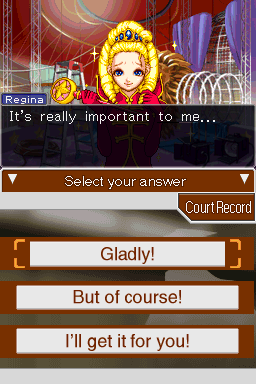
The video game version of You Can't Fight Fate. In video games, the main character has two jobs: in the plot, he is The Hero of his motley crew of rebellious aristocracy, mysterious girls, and many others. He's The Leader, the Designated Point Man, calling the shots. He's also, however, the player's avatar in the game world. Therefore, it's becoming increasingly common for the other characters to turn to you and ask (in the form of a multiple-choice question and Dialogue Tree) what they should do in any given situation.
The problem, however, is this: The writer already has the script plotted out, and your decision, whatever it is, is going to affect all of jack squat. Either the other characters will just ignore the answer and get on with what you're supposed to be doing, or they'll ask the question over and over until you make the "correct" choice. You might see some altered dialogue or a slightly different scene, but the plot itself will remain unchanged. In particularly egregious cases, the dialogue tree will give you multiple "yes" options but not a single "no".
Occasionally a game utilizing this trope will toss in a question where an incorrect answer results in a Nonstandard Game Over. Such questions are usually pretty obvious (the Big Bad asking you to become his disciple, for example), though, so it's easy to avoid falling into that trap. Either way, this represents the game forcing you to Follow the Plotted Line, period.
In some games, particularly in Sierra adventure games, answering a choice incorrectly can leave the game in an Unwinnable state. An example is the salesman in Space Quest I: The Sarien Encounter, where you have to refuse the first offer from him, then wait for him to reappear so he offers you a jetpack, which is critical later on. Guide Dang It!
This trope doesn't apply for games that make heavy use of a Story Branching, such as the Ogre Battle series, or most western RPGs. In those games, your decisions can and will direct the plot, albeit usually on a pre-programmed branch.
Another way to make these questions relevant is to tie them into Relationship Values — your decisions might not change the overall plot, but they will change how other characters perceive you, which might open or close off some future options for useful stuff.
This trope can also be used to increase the drama of a situation by forcing the player to go along on a morally ambiguous or just flat-out evil choice.
Named after one of the first instances of the trope, from the original Dragon Quest.
See also Railroading. Compare Stupidity Is the Only Option, Morton's Fork. Contrast You Can't Get Ye Flask, where the game simply doesn't understand when you attempt to do something outside its scripted plot. Video Games and Fate can be a way to justify this in-universe. Known in real life as a Hobson's Choice, as detailed on the other wiki .
.
Examples where giving the "wrong" answer makes it impossible to proceed until you give the "right" answer (including giving Non-Standard Game Overs):
- Batman: Arkham City. When you're playing as Catwoman, the game gives you a choice about whether to go and save Batman or to simply take two big boxes of loot and leave Arkham City. If you make the 'wrong' choice, it shows you a quick video of what would happen. Then it rewinds so that you are forced to do the 'just' choice.
- In Batman: Arkham Knight, when Batman comes to realize he's infected like the other Joker-ized victims, he's given a choice to either step inside a containment bubble for his own safety or throw Robin in it and continue on. Choosing the former causes the Joker to chastize Batman and tells him he knows what to do.
- In Freedom Wars, there are some infractions of the law that you need to make to continue the plot, like walking more than five steps in your cell without the proper clearance, laying down to sleep without proper clearance, and lying to/refusing to cooperate with the authorities.
- In The Matrix: Path of Neo, the player is presented with the choice Morpheus gave to Neo in the first film: the choice between the red and blue pill. If the player takes the blue pill, the game is over.
- Rambo for the NES console hangs a lampshade on this trope at the beginning of the game, where Colonel Trautman offers Rambo a mission in exchange for getting out of prison. You are prompted to either accept the mission or reply that you feel safer in prison. If you choose the second answer, the Colonel flat-out tells you that the game can't begin until you select the first answer.
- It happens again after Rambo is captured by the Soviet commander. The commander demands that Rambo make radio contact with the federal agent who sent him on his mission. You can either remain silent or do as he says. If you choose the former, the commander repeats his plea word for word, and he will do this ad infinitum until you finally break down and make the damn call. Later, playing as Co trying to rescue Rambo, you run into a soldier who offers to trade you a dress for your rifle. You can refuse all you like, but you're not proceeding any further in the game without the dress. All three events happen in the movie this game's based on, Rambo: First Blood Part 2 (well, Co's rescue attempt plays out a bit differently...), so it's no surprise that deviating from the script is not allowed. (Rambo does initially turn down the mission, but not because he's afraid of dying, he just doesn't think life outside of prison will be any better than inside it.)
- In Saint Seiya Ougon Densetsu Kanketsu Hen, the player can alter the story the game's adapting and pick up any saint to fight the bosses/Gold Saints in the game...that is, except for the Leo and Acuarius Saints. Fighting these bosses with any character but the ones they fought in the story makes them impossible to damage or defeat. This is because they don't respond to the "Talk" command of any character but the ones who canonically fought them.
- In the PC game of Star Wars: Episode I — The Phantom Menace, there are several situations where Qui-Gon Jinn and Obi-Wan Kenobi have to speak with certain characters, presented in a multiple response fashion. The selections highlighted in pink are mandatory responses for getting certain characters to cooperate with you.
- In Yakuza 5, Saejima is stranded in the snowy mountains and rescued by a passing hunter who brings him to a small village and tells him he has bad frostbite and needs to rest. Unfortunately, there was another person with Saejima when they got stranded, so the hunter goes off to search for him. Instead of doing what he's told, Saejima goes outside. There he meets another hunter who tells him going up on the mountain would be suicide for someone so inexperienced even if he wasn't injured, and the player is given two dialogue options, one of which is agreeing to not go up there, and the other is ignoring the advice of more knowledgeable people and going anyway. Picking the sensible option has the villager commending Saejima on being so reasonable, but the plot won't progress until you go up on that mountain and predictably pass out in the snow again.
- The Disastrous Life of Saiki K.: Since most mainstream games get spoiled for Saiki thanks to his telepathy, he buys a knockoff JRPG game so he can actually be surprised. One of the first plot points involves meeting and recruiting an NPC named Tom, who quickly pisses Saiki off because of these elements. If Saiki refuses to shake Tom's hand, Tom kills him thinking he's working with the enemy. If Saiki lets him fall in battle, he dies too, which is made worse by Tom having pathethic stats. And this is all before the first save point. As a result, Saiki gets so frustrated and desperate to beat the level he damages his controller, so when he rewinds time to fix it, he forgot it was plugged in still and resets the game to before he saved. Not wanting to deal with all that all over again, he hits his Rage Breaking Point.
- Campfire Cooking in Another World with My Absurd Skill: In a non-game twist on the classic JRPG examples, Fenrir gives Tsuyoshi the offer to form a familar contract with him. Tsuyoshi however thinks contracting with a beast that speaks human language and scared the group of adventurers he's travling with would disrupt his intentions of laying low as an average citzen. He attempts to refuse twice but is interrupted each time by Fenrir staring intensely at him, forcing him to accept.
- Barbie (2023): When Stereotypical Barbie comes to Weird Barbie about her flat feet, she explains that she'll have to go to the real world to fix the problem. As such, she offers Barbie a choice between a high-heel, representing Barbieland and her perfect, oblivious life, or a sandal, representing the real world and the truth that comes with it. She attempts to choose Barbieland, but Weird keeps telling her repeatedly that she's supposed to want to know the truth and calling redos, eventually admitting that she only gave her a choice to give Barbie a sense of control in the matter.
- In A Girl Walks Into a Bar, the first choice you have to make is which panties to wear. No matter what, you'll end up rethinking your choice and opting for the lacy g-string.
- Give Yourself Goosebumps:
- Typically, this series of books will have a "choice" near the beginning where one choice is an obvious cop-out of the whole adventure (Page 7 reads "If you want to enter the haunted house, turn to page 25. If you want to go home and read your math book, turn to page 63.") Choosing the cop-out leads you right back to the page you just came from. ("Your best friend says, 'If you leave us now, you're a coward, I'll never speak to you again, and you need to give my lucky pen back!' You think it over. Return to page 7").
- On other occasions, the cop-out will take you to the other choice instead of sending you back to the decision page. In the first choice of Night in Werewolf Woods, you have to pick between taking Todd to a Kids-Only Campfire with you or going there alone. If you pick the former, Todd will tell you he wants to stay in the cabin. The next page picks up from the latter option with you going to the campfire by yourself anyway.
- Some of the books, like Tick Tock, You're Dead! and Beware of the Purple Peanut Butter even insults you for making another choice. The former for instance have it's first choice being to volunteer for a prototype Time Machine, or to pass it up and search for your missing kid brother. Choose the latter and the book calls you a wimp with no sense of adventure, lectures for you to spend a minute rethinking your choices, and then turn back to the previous page to make another decision.
- In Romeo and/or Juliet, the occasional railroading with the choices is usually Played for Laughs, but it also serves the point on just how shaped by societal mores and familial pressure the two protagonists are.
"Let Angelica answer. Turn to 9"
"Answer for her so that––wait, nevermind, Angelica's answering already. That's what you get for never speaking up, Juliet. GUESS WE'RE GONNA LET ANGELICA ANSWER AFTER ALL. Turn to 9" - You Are (not) Deadpool gives you the option to say no and just go with your day when Deadpool asks you to help him. When you say yes, you get an achievement with this trope's name and everything.
- Creature of Havoc: Even after the Vapour of Reason gives you free will, the gamebook will sometimes give you "options" that are purely illusory. That's especially true if you meet Hobbits, your favorite food: choosing to not kill/eat them generally results in some variation of "You fail to restrain yourself" and being sent to the Fight page anyway.
- Comically used in the Hentai game Gloria, which starts with the main character receiving a letter inviting him to work as a tutor at the eponymous Gloria mansion. You have the option of telling your friend you don't intend to take the job- and the game ends. The Something Awful review found this to be the best part of the game:
This is roughly one minute into the game and makes for a pretty cool ending that needs to be featured in more Hentai games if you ask me. It's basically you taking the option of "no, I don't want to play this game" and the game apologizes for being so shitty and you're free to leave.
- This game was known for having a pretty high number of endings compared to other English h-games of the time — for which reason, that wasn't the only abrupt exit to the game you could encounter. Unusually for an h-game, rape is BAD here.
- The Hentai game Let's Meow Meow has at least one point where you're given the option of refusing sex on the grounds you're too drained from all the previous sex (as you're supplying magical energy required to return the unwanted girls home) and need a rest. If you choose to refuse it proceeds to give various dire events and you have to go ahead with the sex.
- The beginning of Monster Girl Quest has two options which abruptly end the game: choosing to not help Alice, and choosing to hide from Granberia. Oddly enough, since the former turns out to be worlds above you in terms of power and ability and the latter is a really fierce-looking monster girl with a big huge Flaming Sword, you're basically being punished for making the smart choice.
- This is a major plot point in light novel FFF-Rank Trashero where heroes who don't go through their adventure to the satisfaction of those in charge of the process. There is no real way to refuse, run away, opt out, or quit. If you don't succeed, you do it all over again until you get it right.
- In an episode of iCarly, T-Bo wants to sell Spencer bagels at the Groovy Smoothie. He refuses, not wanting to buy them, but T-Bo keeps persisting, even calling Spencer a jerk, until he caves and buys bagels. The trope is later deconstructed when he asks Sam if she wants a bagel, but she gets him to back off with one refusal.
- Saturday Night Live features a sketch where a Burger Fool employee only accepts the following order: "Cheeburger! Cheeburger! No Coke! Pepsi! No fries! Chips!"
- An actual restaurant chain was inspired by this sketch, but their extensive menu is a major aversion.
- An actual restaurant chain
- In Drawn to Life, when Mari is pleading for your assistance as the Creator, you can break your apparent years-long silence to tell her, at her people's hour of need, that you won't help her. After hearing that from what amounts to her deity, she says she guesses it's over, and it sends you back to the Start Screen. (Selecting that file lets you skip the drawing-in-a-book stuff to go try that scene again, at least.)
- Giraffe and Annika: If you refuse to help Giraffe early on, he will keep making you repeat until you cave-in.
- In A Hat in Time, when you first enter the Subcon Forest, you're led into a trap set by a creepy-looking ghost known as The Snatcher, who steals your soul and offers to give it back if you run some errands for him. You can choose to refuse to sign the soul contract, but if you do it too many times, he gets increasingly frustrated and eventually kills you, making you do the sequence all over again.
- In Mega Man Zero 2 you are asked early on to help the Reploid Resistance; the game won't continue until you say yes.
- In Rayman 2: The Great Escape, you are given the choice whether or not to accept a haul of treasure. You get a plot-advancing potion if you decline, and a Nonstandard Game Over if you accept.
- In RuneScape, one quest has some optional dialogue where the wizard Moravio questions the player. You have multiple dialogue options but no matter what you say, Moravio is not satisfied with your answer and continues to question you. The dialogue loops infinitely until you force it to end by simply walking away.
- Shantae and the Pirate's Curse: The player isn't allowed to refuse a Hostage for MacGuffin trade. This time, it's for Risky Boots:
Will you give him the DARK MAGIC?]
[Yes.] [I've got no choice...] - In the Pinocchio Licensed Game, attempting to exit the first level via Easy Street summons the Blue Fairy, who takes away everything you picked up and sends you back to the start. After Geppetto falls in the water at the end of the final level, if you try walking left instead of going right to save him, you lose a life and have to replay the level.
- Another Code: at the end of each chapter the main character quizzes herself. Getting the answer wrong just makes her say "No, wait... that's not right" and you can guess again. Becomes really obvious in the ending.
- The same thing is done at the end of each chapter in Hotel Dusk: Room 215 and Last Window.
- Andy's Apple Farm Plays this trope for horror. Speaking to one of Andy's friends, Felix, triggers a choice to play a minigames. Saying yes starts the minigame. "no", on the other hand...
Felix: his mouth disappearing and his eyes turning into black pinpricks I don't think you heard me right, Ha Ha Ha Ha.The Game: Press [Y] for yes and [Y] for yes.
- In The Journeyman Project 2: Buried In Time, Answering "no" to both of Arthur's requests gets you nowhere in continuing with the time zone you're on. The first time, Arthur asks to scan your Biochips to find out who you are, and refusal to that reacts in him telling you to go back the way you came. The second time, after said scan reveals his untimely death in the future, refusing simply has him plaintively say, "Well...I can't help you, then." Fortunately, Arthur devises a plan to make sure time won't be affected: By copying himself to a blank Biochip instead of physically moving himself off Amarax Station.
- In Portal 2, when you and Wheatley disable the neurotoxins and the turrets set up by GLaDOS, you have a free shot in disabling GLaDOS by simply pushing a button and there's nothing stopping you. Try as you might, no matter how much you stand there and refuse to press the button, Wheatley will still goad you into pressing it until you do. Even if you know in advance that Wheatley goes mad with power once you place him in charge of the facility and his incompetence will blow it up, you still have to press the button to advance the plot.
- Bridge Constructor Portal begins with a scene in which you are asked to take a job as Chief Custodian for the Aperture Science Vehicular Hurdling Initiative. If you try to refuse this job, you are instead given the "job" of incinerator inspector, set on fire, and now play as the next person in line. This can go on for quite some time.
- PsyCard: The beginning of the Friend's Quest minigame, which opens with a warning message and two options that do the same thing:
warning!
your 4 friends have been stolen by vagabonds!
[ok] [good] - In Riven, Gehn (the villain) asks you to pop into a (prison) book to prove your faith. Once you do so, he then pops in himself, freeing you. That's the expected way for the plot to go. If you decide to side with Gehn, however, by freeing him, he tells you you're an inexplicable idiot, and the game ends. If you free him in the Rebel Age, he thanks you, tells you you're an inexplicable idiot, and the game ends. He knows you're on his side, but he's certainly not going to reward you for it, what with him being a bloodthirsty, egotistical tyrant and all.
- At the end of Episode 4 of Sally Face, there is no way to avoid killing everyone in Addison Apartments in order for The Red-Eyed Demon to be prevented from finding a new host. Jim Johnson and the young Terrence Addison acknowledge that it's a terrible thing to ask Sal to do, and that they wouldn't tell him to do it if there were any other option. There are no alternative routes and there is nothing you can do to avoid slaughtering every living soul on every floor, including an old woman, a very little girl, and even your own parents. As soon as you enter into a conversation with someone, you stab them to death. The only objective in the goal box is kill.
- At the beginning of Cult of the Lamb, The One Who Waits offers you a choice. The possible answers are "Yes" and "Absolutely". Only at the end does he give you a choice where you can say No, much to his fury, but by then you're not nearly as helpless anymore.
- Pokémon Mystery Dungeon:
- At the beginning of Pokémon Mystery Dungeon: Rescue Team, your partner asks you if you want to form a rescue team with them. You have the option to refuse, but your partner won't let you into your house until you accept.
- Refusing to form a team with your partner at the start of Pokémon Mystery Dungeon: Explorers will cause them to become increasingly desperate with you until you give in. Chimecho will also give you this twice when asking if she should explain about adding other members to your party. The first time, she will make a barely-within-the-fourth-wall comment that this is one of those things that even when you refuse, you'll end up having to accept anyway. The second, by the crossroads in front of the guild, she'll point out that she's already explained most of it and just needs to add a little, before accusing you of saying 'No' to get a reaction out of her.
- In Pokémon Mystery Dungeon: Gates to Infinity, refusing to return to the Pokémon world twice will slap you with a Non-Standard Game Over.
- Lyle, the insurance scammer in Animal Crossing: Wild World will never allow you to refuse his offer to buy insurance from him no matter what. Every time you choose no, he will keep the conversation going until you eventually give up and accept it. The only way you can actually get out of buying his insurance after starting the conversation is by not having enough Bells to afford it
- In Custom Robo for the GameCube, right before the final mission, you are given the choice of either joining your friends in the mission or staying behind. Eventually, if you keep saying no enough times, you get a Nonstandard Game Over where they let you stay behind and the game goes black and a text box says that all your friends died trying to fight and one of your friends says "See, I told you to join us!"
- Subverted at one point during the final mission. The Lancer (of the comedic variety) needs to stop to use the restroom in the post-apocalyptic ruins of a theme park overrun by an evil syndicate and begs that The Hero accompany him. He'll continue to beg if the player refuses, but eventually gives up and goes on his own if the player continues choosing not to follow. There is no penalty for choosing not to follow, apart from missing the opportunity to earn a few non-notable Robo parts from a battle in the restroom.
- When you start Dragon Seeds, you're asked by a veteran trainer to engage in a friendly match. If you refuse, he will keep insisting until he eventually tells you that you have no choice and "No" option will be disabled.
- One storyline in Escape Velocity Nova involves the player being mind-enslaved, which makes the quests for this quest chain non-refusable. Not that this makes a lot of difference, because actually refusing a plot mission would disrupt the plot and possibly leave you stranded with no way of winning the game.
- In Hacknet, the mission "Project Junebug" must be followed until a certain point, as it is the only legitimate way to get KBT_PortTester.exe, which is necessary to open port 104.
- In one of the Harvest Moon titles, DS, the mayor gets attacked by your dog at the beginning of the game. You can choose to help or not to help, and choosing not to help causes the credits to roll, implying that the dog killed the mayor... somehow.
- In Harvest Moon: More Friends of Mineral Town, you can tell the mayor at the beginning that you don't want the farm, and get the Game Over. This is actually the only way to end the game.
- A similar event happens in Harvest Moon 3 GBC, where the premise is that the farm is to be turned into a theme park. If you refuse to take the farm, a cutscene occurs where you read a newspaper article about how the farm was turned into a theme park along with a game over.
- And yet another in Harvest Moon: A Wonderful Life. At the end of the first year, if you haven't proposed to any girls then the one with which you have the most hearts with will propose to you (If it's a tie, Celia will be the one. If Celia isn't one of the ones in the tie, then it'll be Muffy). If you refuse, the game's over. In the same game's intro, Takakura asks the hero if he thinks he can do it. Answering no will make Takakura very sad and end the game immediately.
- In Harvest Moon: Animal Parade, Mayor Hamilton gets stuck in his fireplace. You can choose to help him out or you can choose to watch. If you choose to watch, the mayor says "..." and you are asked again. This goes on until you help him out of the fireplace.
- Another example is when the Harvest Goddess asks for your help, you can choose from three responses: "Leave it to me!", "No problem!", and "Yeah!".
- Also happens in Harvest Moon: Magical Melody during the wedding. The mayor will ask to confirm your marriage, and answering no will simply anger the crowd and make him ask again.
- Since you're choosing whether or not you want to LIVE in the area (which should be an option) this is justified in:
- Harvest Moon: Save the Homeland to the list. You're asked if you want to help... err, save the land. You CAN say no, which causes them to repeat the question several times. After enough "no"s, you collect your grandpa's stuff and leave.
- Like the original, the Enhanced Remake Story of Seasons: A Wonderful Life requires you to marry at the end of the first year. If you haven't proposed, Takakura offers to call over anyone with six or more hearts for you to pop the question and get it overwith. If you don't have affection with anyone at all, you're getting Cecilia or Rock. Refusing them gives the same game over as the original. Also in the game intro, deciding you're not cut out for farmwork and leaving will make Takakura ponder how everyone has to live their own way—and roll credits.
- Harvest Festival 64: Due to a storm having blown through town recently, the bridge is out of commission on Monday and Tuesday, forcing you to help the villagers on the side you're on first. Even after the bridge gets repaired, one of the villagers on the other side will be too tired to accept help from you on Wednesday, meaning you don't really have a choice in who to help next.
- In the Government Procedural Hidden Agenda (1988), your only choice in a crisis situation is between the demand on the table and the relevant minister's advice. If the minister agrees with the demand, or no minister is assigned, you have no choice but to implement the proposed policy. (This can lead to a chain reaction where other groups outraged by your "decisions" immediately demand that you reverse them, and without a minister, you'll be forced to cave in every time.)
- When summoned to Gameindustri in Hyperdimension Neptunia: Producing Perfection, you're given three options about whether or not you will be the producer of one of the CPUs. All of them are you agreeing. This is lampshaded by Neptune, saying that they summoned you there, so you can't really say no.
- I Was a Teenage Exocolonist: In Nomi's holonovel, you can't refuse to stop the alien invasion because doing so leads to your early death.
- In Monster Loves You!, this occurs from time to time, but is mostly downplayed. Usually only appears when you pick a choice that isn't actually possible (like "Don't grow up").
- In Rune Factory, Mist offers to let you work her farmland. You can answer, "No, I really can't do that", to which she answers, "No, I insist. You helped me out, and I want to do something for you too." Cue endless loop. Other games in the series follow. Rune Factory 2, for example, if you say you don't have the money to buy farm tools, Mana will tell you that you do, and if you say you just don't want too, she'll insist that you need them. Rune Factory 4 mocks this by giving you an options menu that only has one option in it.
- In Wing Commander IV: The Price of Freedom, you're given two chances to defect to the Border Worlds. If you don't take the second chance, infinite Border World bombers spawn until your home base is destroyed, thus ending the game for the player. Given the moral issues the game was trying to raise, that didn't exactly help with making the player believe there was really any morality concerns, although the game's $12M production costs (one of the highest costs in games at the time) may have been an influence on the reduced list of options for which more Live Action Cutscenes would be required to be filmed.
- In the ancient days of the usenet group alt.games.wing-commander, there was a fan who posted a false rumor about a seventh CD that allowed you to remain with Confed. However, it wasn't much more than further convincing the player that Confed was in the wrong and giving one last chance to defect. It supposedly concluded with a post-victory scene of bedraggled UBW prisoners filing past Blair with suggestions that some of them were UBW personnel seen elsewhere in the game.
- Mario Tennis for the Game Boy gives you a large number of choices throughout the game, however no matter what they will repeat a following phrase repeatedly.
HEADMASTER: Will you ever forgive me?Choose NoHEADMASTER: Don't say that, please find it in your heart!REPEAT
- There is such a massive number of these pointless choices, it makes you wonder why they did it.
- The sequel game on the Game Boy Advance, Mario Tennis Power Tour, gives you a good number of them as well; however you can choose an alternate answer and they will say something different instead of repeating forever like the original. Despite that, there's basically still no point to choosing an option as it doesn't change anything other than the sentence right afterward.
- Pilotwings, of all games, had one. After completing four certifications, your instructors get captured, and Big Al asks you to take a military helicopter and rescue them. Turn him down, and he asks you again. Say "No, you should go", and he says that he's not qualified to fly a helicopter. Say "No, you should go" again, and he insults you. If you continue saying no, he repeats the exact same insult endlessly until you either say yes or turn off the SNES in disgust (you don't even get a non-standard game over). Believe it or not, when his brother is captured five levels later, he gives you the option of going through this little dance again word for word.
- The final scene of Assassin's Creed: Brotherhood pulls a nasty one. After having used the Apple of Eden successfully as Ezio Auditore in the Animus memory sequence, both the player and the protagonist (Desmond) expect that he will be able to use it in the present day. Not so. On picking it up, he is promptly dominated by Juno, told that he must learn more if he is to be of use to her, and then forced to stab his girlfriend. Worse, the game pauses before the fatal moment and tells you to "press any button". So not only did Desmond kill her, so did you.
- In Metal Gear Solid the player has the chance to destroy the Big Bad with a missile, but the blast will kill the Cyborg Ninja (who was revealed to be Snake's old war buddy) too. Although said Ninja exists solely so he can die heroically, if you try to take the shot Snake just says "It's no good, I can't do it". But then he dies a few moments later anyway, making the whole point completely moot and forcing you to fight REX again. A lot of hassle could have been avoided had Snake taken the shot, but then we wouldn't get a race against time fight to the death when you win.
- The dramatic moment is ruined if you manage to completely fire all your Stinger missiles. Snake changes his statement from "It's no good, I can't do it" to "It's no good, I'm out of missiles!"
- The final level of Splinter Cell: Pandora Tomorrow is the only one in which the player is absolutely required to kill enemies. Even after grabbing and interrogating them and then knocking them out, you'll get a call from your support crew reminding you you have to kill them, forcing you to then plug their unconscious body with a bullet or two.
- The joke module Castle Grayhawk for AD&D encourages this; if the players refuse to accept the quest hook, the DM is instructed to close the screen and clean up the game materials, then stare at the players with a disapproving look until they get the point.
- There was an interesting inversion in Vampire: The Masquerade – Redemption. In one scene, the character giving out the quest keeps delivering "but thou must not" lines for a goodly long while, and the fastest way to get on with the damn quest is to agree to not go.
- In Vampire: The Masquerade - Bloodlines, this is justified as the Prince using his vampiric mind control powers (the Dominate discipline) on you when you try to refuse his orders. Prince: "You — will — destroy — the Sabbat", and you get three identical dialogue choices of "I will destroy the Sabbat".
- Which is incredibly sporting of the Prince by Vampire: The Masquerade standards. In the tabletop RPG, gross insubordination to the Prince is generally punishable by being nailed to a wall facing east and left to wait for the sunrise.
- This makes it much more enjoyable when, in the good Camarilla ending, he orders you to give him the key to the Sarcophagus, and you resist it — causing him to fall to his knees and sob. (Of course, if he knew what was in it, he wouldn't want the key.)
- At one point you encounter a female vampire who's part of a doomsday cult spreading a disease, and she suggests you join the good cause. If your humanity rating is low enough, you can actually express a desire to join... but she will respond as though you turned her down. In fact, you can insist several times you want to help them spread the plague to no avail, ending with a fight. Somewhat justified, considering she is an utter loon. Even Malkavians consider the cult members to be crazy by comparison.
- Subverted in the Infocom text game The Hitchhiker's Guide to the Galaxy (1984). The exchange goes something like:
>Aft
The entrance leads to the Infinite Improbability Drive chamber. It's supposed to be a terribly dangerous area of the ship. Are you sure you want to go in there?
>Yes
Absolutely sure?
>Yes
I can tell you don't want to, really. You stride away with a spring in your step, wisely leaving the Drive Chamber safely behind you. Telegrams arrive from well-wishers in all corners of the Galaxy congratulating you on your prudence and wisdom, cheering you up immensely.
>Aft
What? You're joking, of course. Can I ask you to reconsider?
>No- At this point, the game lets you in to the room, but pouts and won't tell you what's in it until you >look a couple times.
- In Godspell, Judas has second thoughts at the last minute about his betrayal and tries to turn away. But he runs into an Invisible Wall in every direction ... except the one leading to Jesus.
- Danganronpa Another Episode: Ultra Despair Girls has one of the final cutscenes where Komaru holds the controller for the Monokumas and if she destroys it, the Monokumas all shut down and the threat to Towa City will vanish. However, you have to refuse several times in order to advance the cutscene. Breaking it at any point before you're supposed to just gives you a Bad Ending. Turns out Monaca was trying to bait Komaru into destroying the controller, because the helmets of the Brainwashed and Crazy Monokuma Kids will explode as well, effectively murdering hundreds of innocent children. Eventually, this changes into a different type of But Thou Must when Komaru is given no choice but to break the controller after hitting the Despair Event Horizon.
- In Gun, after getting thrown in jail by Hoodoo, you must break out by grabbing the jailor when he gets close to the bars after he taunts the cellmate across the hall to you. You get a couple tries to do this legitimately with new dialogue by the jailor, but the third time the jailor exclaims "You dumb sonofabitch!" (addressed to the player, no doubt) and repeats his lines over and over until you grab him like you were supposed to.
- Spec Ops: The Line has the infamous white phosphorus event, where the only way to proceed is to drop incendiary bombs on the enemy, killing them horribly and painfully, followed by the revelation that nearby civilian refugees were also killed by your attack. However, the developers insist that you do have another choice: just turn off the game (of course, since you've already opened it, it's too late to get your money back, so in reality the devs are just mocking you).
- In Fallout, you can compromise the location of the Doomed Hometown and/or agree to join the Big Bad, in which case cutscenes play showing your people being mercilessly butchered and you (bound, gagged, straightjacketed and hung from a meathook) being dropped into a vat of green slime which is a part of the process of turning you into a mindless super mutant soldier. At which point, the game ends with a sober scolding from the narrator. Earlier on, the Overseer demands that you hand over the initial MacGuffin in order for the plot to progress, to the repeated uttering of "Please, the chip!" until the player either caves in or quits the game, should s/he persist in refusing.
- Fire Emblem: Three Houses has a few moments like this.
- In the prologue, Sothis will not allow you to proceed until you identify yourself as a mortal.
- In Chapter 10 on the Golden Deer route, Claude will not allow you to proceed until you allow him to borrow Jeralt's diary.
- In Shining Force II, the player is, at the end of the game, asked if he would kiss and marry the princess who is trapped in eternal sleep... even though they've exchanged about ten words total before she fell into that sleep. The game almost plays off of this by having the lead female character storm off in anger, but your only options remain "Yes" and "I will walk around town for a while, then come back and be given these two choices once more".
- This game also has what seems to be a tongue-in-cheek reference to the Trope Namer. The king asks you to go find a historian — a simple enough task for our Kid Hero, which the king is quick to point out. If you refuse, the king's probably non-evil minister chastises you for refusing your king's wish, and His Royal Crybaby asks, somewhat petulantly (and with weird grammar), "Does thou love me?" If you say 'no' again, the king pouts and whines, "...but thou must!"
- In Shining Force, the Card-Carrying Villain boss Balbazak pleads for you to spare his life. Any response to the contrary presents the same question. When you inevitably decide to spare his life the apparently omnipresent Darksol kills him out of nowhere anyway.
- Ace Attorney:
- Done incredibly emotionally painfully in Apollo Justice: Ace Attorney, in the fourth case. The player knows during a flashback that presenting a certain piece of evidence will result in incredibly bad things happening to Phoenix. However, it's the only piece of evidence the game will accept, all others giving a loop back to the question. It won't even penalize you for getting it wrong, making it impossible to get out of it by losing the trial instead. Of course, it is a flashback — you can't get out of it because it already happened.
- In Justice For All in the final case, there is one part of the trial where you can't use evidence to support your case and it's up to you to decide whether or not your client is guilty or innocent. Of course, it doesn't matter what you pick since Franziska bursts into the courtroom to deliver more evidence to prove Matt Engarde's guilt, which is what Phoenix was trying to do while saving Maya. Though this might be considered an odd version as while the decision does not affect the game, it's meant to affect you. The decision is based around whether or not you would be willing to let a murderer go free in exchange for saving Maya. Phoenix will even flashback to the decision later on and say that the decision he made there defines the type of lawyer he is.
- Earlier in that case you are forced to accuse Adrian Andrews just to stall for time, as an assassin is forcing Phoenix to defend Matt Engarde or else Maya Fey will die. It is painful. Later on, the judge is about to announce the verdict, and you're given the option of encouraging him, which will save the hostage but doom Adrian and let a killer go free, or stalling for time again, which could lead to the real killer being convicted but get Maya killed. Phoenix will stall for time regardless of your decision, but the game will say whichever choice you pick defines what it means to be a lawyer to you.
- Yet again in that same case, at the very end, after the kidnapper, Shelly de Killer breaks his contract with Matt Engarde and releases Maya, then states that he'll kill Engarde, you can once again choose to pled guilty or not guilty. Even if you choose not guilty, however, Engarde will still plead guilty just to avoid de Killer, and Phoenix's demeanor makes it clear he knows this and is just rubbing Engarde's Morton's Fork situation in his face. Compared to the previous instances, this is an example of this trope being used in an outright cathartic way.
- In some cases, the games will ask you whether you want to defend a certain client. If you say no, Phoenix will think about saying no, then change his mind and say yes. Not choosing to defend Maya in one case has Phoenix narrating as if you've chosen a Nonstandard Game Over, lamenting how a state-appointed lawyer got Maya sentenced to life in prison, but he snaps out of it and agrees to take the case anyway.
- The first case of Phoenix Wright: Ace Attorney – Spirit of Justice takes this to a higher level, as you have to decide to defend your client on two occasions, with the second decision literally putting your life at risk since you're in a totalitarian regime with a history of persecuting defense attorneys. Phoenix himself makes a pretty understandable case for leaving the trial, but "choosing" to do so will just make him convince himself to stick to the case anyway.
- In the rest of the series before Apollo Justice, most of the multiple choice/yes and no questions won't change the plot at all other than either changing the dialogue slightly or you're at a dead end until you give the right answer. This happens during trials as well where you have to answer a question and giving the wrong one results in a penalty and forces you to try again. Other times, it won't matter what you pick since the plot will stay the same, but picking the wrong answer will get you penalized because it annoyed the judge or another character.
- When given a choice to either raise an objection or "Wait and see what happens", you will most of the time end up objecting. But not always: There are multiple times when this isn't the case, and in general it's best to not just assume.
- A certain question in the first DS game's bonus case works like the first example, looping you back with Edgeworth telling you to think carefully about what evidence your present. This is done to avert the case becoming unwinnable, since if a player produces the evidence Gant wanted them to present, they would blunder into his trap and get a Nonstandard Game Over.
- This also appears in the grand finale of Ace Attorney Investigations: Miles Edgeworth, where Edgeworth realizes that the only way he can expose the mastermind behind the smuggling ring is by presenting a piece of evidence that would be illegal in court. Even if you refuse to present the evidence, everyone else immediately prompts him into showing it anyway.
- Case 1-4 in Phoenix Wright: Ace Attorney has an infamous example of this: Phoenix has discovered evidence that another character has tampered with the case and may be involved in the murder themselves. However, the game will not proceed to the trial until you show this evidence to the character in question! At which point they promptly stun you and take away the decisive evidence to destroy it.
- In Arcade Spirits, the first choice you get is to either use the app that your roommate suggests for you to help you find your dream job or just settle for whatever job you can find. If you say no to using the app twice, you will get a Nonstandard Game Over ending as well as the "The Good End" achievement for abandoning your dreams.
- In the Touhou Project fangame Aya Shameimaru: Touhou Attorney, based on the Ace Attorney games, there is one time in the second case where you are asked if you believe that Marisa, your client, is innocent. Momiji, your assistant, won't allow you to disbelieve her, and the question will just loop back if you do.
- Used straight in Brass Restoration, as it's a Visual Novel, but also lampshaded a few times.
- Danganronpa: Trigger Happy Havoc:
- In Chapter 4, choosing to tell Kyoko Kirigiri about Sakura Ogami's confrontation with Monokuma sends you back until you decide not to tell her. This leads to Kyoko giving Makoto the cold shoulder for most of the chapter, but it's the only way to progress.
- In the Chapter 5 trial, you are pitted against Kyoko, who's been your closest ally thus far, as Monokuma is trying to frame her for a murder she didn't commit, and in order to fend off suspicion that she's the killer, she's allowing it to fall on Makoto instead. Near the end of the trial, you're presented with a Sadistic Choice; expose a lie Kyoko has told and clear yourself of suspicion but also play right into Monokuma's plans, or let her lie slide and have Makoto become the prime suspect. Exposing Kyoko's lie results in her execution and the game's bad ending, and you're taken back to the decision point so that you choose to take the fall yourself instead.
- From time to time in Free Time Events, characters will ask Makoto questions on various subjects, such as their area of expertise. If you give the wrong answer, you'll be sent back until you give the right one. One particular example is during Chihiro's last Free Time event, in which she asks you for the name of a "strong" person to help herself become stronger. The event won't continue until you select Mondo Oowada — in the game, Chihiro's meeting with Mondo resulted in Mondo killing Chihiro in a fit of rage after Chihiro accidentally triggered Mondo's trauma. Chihiro does have reasons to reject your two other options; Sakura Ogami is out of the question because she's a woman and Chihiro was looking to train with another guy, and Byakuya Togami is a Jerkass and not interested in physical fitness, but you're not allowed to, say, recommend Kiyotaka (who greatly encourages self-improvement) or offer to help Chihiro herself. That being said, Chihiro will choose Mondo as his exercise partner even if Makoto never did that Free Time Event, and thus never asked the question.
- Daughter for Dessert: After the successful relaunch of the diner, Heidi brings up her date with the protagonist to the video game arcade, and says that she would like to go out with him again. She will even say this if he previously chose Veronica over her, and thus never when on any dates with Heidi.
- Doki Doki Literature Club!: After the game drops its act of an ordinary Dating Sim and descends into the abyss, you must once again face the choice of who to help with in the festival preparations. You can choose one of the three gir- huh? Your cursor is literally speeding, with no input of your own, towards Monika. If you manage to bypass the cursor's curse, either by having a touchscreen, using your arrow keys, or sheer speed, the game will flash black, display the hyper-realistic eyes Yuri sometimes gets, then change to the home screen background and give you buttons to choose Monika, and only Monika, from the top of the center of the screen to its bottom. Monika is aware that she is in a mere game, and was tweaking its code so she could get closer to you, the only thing she knows is "real".
- don't take it personally babe, it just ain't your story: At certain instances, you must check your students' online postings before you are allowed to proceed. It turns out in the end that everyone knew that you were looking at what they were writing, so your not looking at those postings would contradict the story.
- This variant specifically is subverted in Hatoful Boyfriend. In the demo version, if the player chooses to wait for Ryouta at the infirmary on the first day, control abruptly shifts away and the other characters discuss the backstory and several strange plot hooks before revealing that the heroine has been murdered, at which point the game ends as a trailer for some Bad Boys Love Route. This route can be played in full in the paid version (though it's triggered by a different choice), with a Genre Shift into horror-mystery as the birds try to find the killer and a war breaks out. It's also the route with the most exposition and detail about the setting and the characters and their relationships.
- Illusionary Trauma has Giga Pudding attempt to make chicken soup. No matter how many times you try, she will always burn it and require you to make instant noodles.
- Naturally used for some of Little Busters!'s bad ends, but by far the most memorable and dramatic example occurs near the end of the game where Riki finally awakens at the scene of the bus crash and must choose between running away with Rin like Kyousuke told him or trying to save everyone. If you choose the later, the gas will catch fire and explode, killing them, and Kyousuke will tell you to go back and do it the other way before the game gives you a Nonstandard Game Over. The only reason the choice exists is to force the player to choose to leave them behind, which, after how close you've come to the characters and how heartbreaking the last scene was, is not going to be easy.
- Also, when Kengo tries to convince Riki to go over to Kyousuke's room, deciding not to go will just have Kengo repeatedly saying no. After you make him refuse 100 times, he gives you an item for making him say no 100 times. Refusing again after that will have Riki give in and go anyways.
- Katawa Shoujo has a few examples of decisions that can lead you on a path to a bad ending even in the first act.
- If you decide not to tell Lilly that you have arrhythmia, you will get the bad ending.
- If you make the wrong decision in "Slow Recovery" or" "Home Field Advantage", you will get the bad ending. This is also a case in which there is no wrong answer to choose, as unlike the above choice, you do not have the option to say you have arrhythmia.
- In Hanako's route, if Hisao doesn't spend the day with her after Lily leaves, Hisao will have the choice to decide he should trust Lily's advice or ignore it while talking with her at the phone. Unlike in the scenario where Hisao spent the day with Hanako, Hisao will ignore the advice regardless of your choice and you will get the bad ending.
- Muv-Luv Extra: at one point, the three idiot maids start demanding Takeru's forgiveness, but refuse to explain what it is they're apologizing for. You're given the option to forgive or not to forgive... but if you don't, the maids just repeat "Oh no! Please, please reconsider!" over and over again until you agree.
- In Mystic Messenger, the plot is set into motion by you agreeing to break into someone's apartment on the request of an anonymous texter who comes across as rather shady. If you try to defy this by repeatedly stalling on entering the apartment passcode, you get a Nonstandard Game Over and the game restarts.
- Enforced in-universe by Kakuya at the end of Spirit Hunter: NG; if Akira tries to make a dialogue choice that she doesn't like, then she'll get rid of the option entirely and overwrite it with one she likes, and keep doing so until he's forced to pick her options.
- During the intro of Slay the Princess, you can try to leave the forest and not go through with killing the Princess. The Narrator will loop you back instead, eventually spawning more cabins in an attempt to keep his story going. And when you begin the next loop, there are "conveniently placed" high walls trapping you inside the forest so that you can only go to the cabin.
- In Virtue's Last Reward, breaking Lock #8 requires you to create a timeline in which you betray Phi. Even Sigma is completely baffled about being forced to betray her.
- Yo-Jin-Bo has a couple of situations like this. And, while they don't immediately impact the game's events, a couple of the early questions determine whose ending you can or can't get...before you've even met the guy in question.
- In Your Turn to Die, at the end of Chapter 2-2, you are forced to choose who to vote for. Your proper choices are to vote for Nao, giving you a bad ending where the two of you escape at the cost of everyone else's lives, or vote for Sou or Kanna, executing one to spare the other. There's also a theoretical fourth option to vote for Keiji, but if you attempt this the Player Character rejects it out of hand; given the votes committed thus far, voting for him would simply get both Sou and Kanna killed for no benefit, and even if Keiji could win the vote he has the Keymaster role and this scenario would result in an immediate Total Party Kill.
- In the middle of a story arc which spoofs most RPG tropes, the aforementioned episode of Dragon Tails takes on this one.
- Homestuck actually has this show up in-universe. Paradox Space has a very specific and intricate plan for how each session of Sburb is to unfold, and if the players diverge from that path reality basically throws up an error message and crashes, annihilating anything and anyone in the session. This is why a Time player is regarded as essential for any session of Sburb: without the Save Scumming and precognition a Time player enables, it's essentially impossible to figure out how you are supposed to navigate your session's plotline.
- In morphE there is an adventure game inspired dream sequence where the reader has to select what the prisoner must do. All non-vital options will return to the option menu until the next scene. Also in Investigation Mode the only way to access the next update (without using the website archive navigation) is to click on the bookshelf containing the items the group are looking for.
- Episode 2 of the Penny Arcade games does this, with the main character having the option of refusing Gabe and Tycho's original request to join the party. Every time the character refuses the two spend a day looking around the remains of your house before coming back and asking you again, with Tycho getting more and more agitated with each asking. There is even an achievement for refusing to join the party five consecutive times, after which the requests start looping and it becomes obvious you have to accept.
- Creep TV: It's impossible to fail The Ghostly Quiz Show on Channel 13. Even if you answer wrong, the host will keep asking questions until you get them all right.
- In We Become What We Behold, you play as a news photographer. By taking pictures, you start off by blowing minor incidents out of proportion, and eventually ignite a race war between squares and circles, leading to dozens of deaths, all for the sake of getting lots of views and clicks. You COULD try to report on happy things instead, but no one finds those stories interesting, so you have to take the manipulative photos to finish the game.
- A Rated M for Manly series of ads for Vytautas mineral water featured an "Apocalypse Edition" for ways to defeat the Mayan Doomsday. Whichever way you picked, you had a choice between Vytautas or a different drink. Choosing the other drink would cause the announcer to berate you, then give you "one more chance" where the Vytautas bottle is the only choice.
- Black Mirror: Bandersnatch has a few Non-Standard Game Over "endings", such as Stefan accepting the Mohan's offer (he works with a team, which just leads to a bad game Stefan doesn't like), pouring his tea over his computer in frustration (which destroys the work he's done on the game), or jumping off Colin's balcony to his death. These endings will cause the timeline to "reset", allowing you to pick the other option, which continues the main part of the storyline.
- A few cases allow options that don't really matter. As well as the cereal choice at the start or the two music choices (the tape Stefan picks on the bus ride and the record he buys in the shop), there's the impulse you want Stefan to make in the therapist's office (he'll resist it either way), when Stefan gets given a higher medication dose after Colin tells him his theory about mind control (he'll either throw his pills in the bin or flush them down the toilet), or anything to do with the fourth-wall breaking "Netflix" ending (with one choice between "Yes" or "Fuck Yeah", both leading to a massive unrealistic fight scene). One of the choices involves only one option, "No", which appears in a flashback with Stefan as a child, and was the "choice" he made that led to his mother's death.
- College Saga uses this when The Hero sits down for a class and is immediately asked "Sleep? Yes/No". He selects "No" a couple times, but it keeps popping back up… Truth in Television, as anybody who has taken a college class can attest.
- While obviously a videogame trope, it is used in the first episode of the Yu-Gi-Oh! The Abridged Series spin-off, Cr@psule Monsters, in which Alexander Brisbane (of Most Definitely Not a Villain fame) reveals a magical map and insists that the heroes step on it. Yugi continues to refuse, leading to back and forth, until Brisbane says that there is candy in the map, and Tristan and Tea eagerly jump on, dragging Yugi along.
- Phelous uses this trope to satirize FeardotCom's stupid plot and in-universe logic with his closing sketch, including using the Trope's name, word-for-word, several times.
- Earlier in the review, he shows clips of him playing the Trope-naming game.
- Sye Ten Bruggencate's "Proof that God Exists" website runs entirely on this, bringing the player back to the same question over and over until he chooses what Bruggencate considers the "correct" answer (or sending him to a Disney site if he says he doesn't care if truth exists). Any answer based on a skeptical and/or non-thiest perspective is considered invalid. Predictable, considering Bruggencate is a presuppositional apologist who refuses to consider the idea that logic and god might both be man-made.
- Shut Up And Sit Down has a skit involving someone who's just lost the card game he's playing being asked, "Do you want to play again?" Ultimately subverted: saying 'yes' only results in him losing — again — and being asked the same question...
- Spoony discusses the use of this trope in tabletop gaming in the Counter Monkey video "Get On the Boat": Sometimes you have to do things that might seem mind-bending stupid like walking into a trap, eating food that you know is drugged, or trusting a person who's Obviously Evil because if you don't, there's no story.
- Captain Laserhawk: A Blood Dragon Remix: The prisoners of Eden's VR facility are forced to play a Crazy Taxi-esque VR game. When it first boots up, they're asked if they want to play and presented with a choice of Yes or No. Choosing No results in a painful electric shock and leaves the choice dialog open, effectively forcing them to pick Yes.
- In one episode of The Real Ghostbusters the Ghostbusters are tricked into a game show in hell, and after surmounting their first test event, were presented with a challenge of choosing between three doors. When they tried choosing door number 2 ...
"And behind door number two is ... Door number one!" Three guesses what was behind door number three.
- Grand Theft Auto: Vice City: in the mission "The Job", you and the gang change into your disguises in the bushes. After this, control is given back to the player and all you have to do is take a few steps to enter the bank and trigger the heist cutscene. But GTA being a wide open sandbox game, you might be tempted to think nothing will happen if you wander off into the city instead. Alas, the mission will fail instantly, the NPC gang members will vanish, you gain a 4 star wanted level and the following message appears: "That's right, just wander about dressed like a lunatic and draw attention to yourself, IDIOT!"
Examples where giving the "wrong" answer has little or no effect:
- Interactive web advertisements for Verizon 4G LTE network coverage show a man presenting charts to a focus group of people, showing relative degrees of LTE coverage across competing mobile networks. At a couple of points, the commercial pauses briefly, and the viewer is prompted to click on one of the networks displayed on the chart, asked to select the one with the best coverage. No matter which one gets chosen, the commercial continues exactly the same, with the minor exception of the text displaying "Are you sure?" if any network other than Verizon is selected.
- Various advert banners on websites, usually in the style of a dialogue box window, ask a question like "Would you like a free virus scan?". Clicking on "Yes" will take you to the advertised webpage, but so will clicking "No", clicking the fake dialogue box's fake [x] button, or clicking the letter "k" in the question, as the entire banner is just one linked image with no way to detect where you clicked.
- In My-Otome, after Miya, who is believed to be responsible for all the schemes to get Arika expelled or worse so far, confesses (she is Taking the Heat for Tomoe), the Trias call Arika in for a meeting and ask her if she wants to press charges. Arika is unwilling to do so, but then, Miss Maria and Natsuki come in and tell her that Miya has been removed from the school, partly the result of her parents wanting her to leave.
- Anzelotte of Night Wizard has "For the request that I will ask you now please reply with 'Yes' or 'Okay'." as her Character Catchphrase. Renji keeps trying to say no (because being sent out on quests all the time is putting him at risk of being held back in school), and is invariably ignored and sent on the quest anyway.
- Nyaruko: Crawling with Love! spoofed this in one of the Nyaruani shorts, where Nyarko talks about the most popular RPG in space. In the game, the monsters will occasionally ask to join after you beat them, and your options are "Yes"...and "Yes". Once they're in your party, the monsters will demand to be paid or else will refuse to help you. Mahiro responds "I hope those kinds of monsters drop dead!"
- In Yu-Gi-Oh! Reshef of Destruction, when Bandit Keith takes Ishizu hostage, refusing to hand over the Millennium Items will have him threaten her and move you back to the choice box.
- Granny's Garden, an educational game for the BBC Micro, didn't even try to disguise this. At any point where you gave a response that the game didn't expect it simply ignored you, often sounding genuinely condescending. For example, shortly after starting, the player is presented with an image of a snowy mountainside with an obvious cave entrance, and this exercise in interactivity follows:
Can you see a cave?
> No
Yes you can.
Do you want to go in?
> No
Yes you do.- It is also confusingly subverted later on. In the final section of the game, the player is asked "I am a hungry giant! Shall I eat you?" Answering "no" has the character run away. However, answering "yes" gives the response "Don't be silly. I don't really eat people." and allows the character to stay and interact with the giant. Without doing this, the game is unwinnable.
- The Three Bears, an 8-bit educational game for young children, would do this — for example asking you if you want to help the bears (essentially the whole mission of the game) but responding to a "No" with "Of course you want to help the bears!".
- In Custom Robo for the GameCube, early on in the game you meet a female who has a watch-collecting hobby, and notes that your watch appears extremely unique and says that she wouldn't mind having it. The watch was a gift from your father from when you were a toddler, with the specific instruction to never take it off. You're given the odd option of saying she can have it, or that she can't, and even if you say she can, she realizes the watch's sentimental value and refuses the offer anyway. But if you persist many, many times, she'll eventually relent and take it. It turns out that the watch was the MacGuffin of the game, and at the end it's a big deal when you don't have it. Rather than give you a depressing Nonstandard Game Over, you're simply told to retrieve it, pausing the plot until you do and then resuming as if you never gave it away.
- Later on in the game, if you refuse enough times when being asked to save the world, your friends go on without you and promptly get slaughtered. Then Harry kicks you back to before the choice was made, raging at you for letting them all die.
- Early on in Sonic Battle, the player is asked to give up some MacGuffin robot and is given a 'yes/no' prompt. Choosing "Yes" nets the response:
You didn't really think I would just say "Yes," did you?
- In Mystery Case Files 15: The Black Veil after you use a lie detector to question Gerald Sykes, Richard asks if he deserves to be absolved. If you press the button which would lower a chained Gerald into a fire pit, Richard berates you for not exhibiting "the Detective's" famed forgiveness and the button shatters.
- Happens occasionally in Guenevere when the plot requires Guen to be in a particular place despite her objections. For example, although she can twice refuse to go, her father will force her into following the British army into battle.
- This is the entire point of the Interactive Fiction game Rameses: no matter what the player tries to get the PC to do, the PC is ultimately too cowardly and self-loathing to be assertive or honest with others.
- Zap Dramatic's games have a real problem with this. Even though the Ambition series offers you choices, usually only one choice is ever the correct one. If more than one choice is considered correct, they still both lead to the same outcome, or an extremely similar outcome, with very minor differences.
- Sir Basil Pike has a rather poorly done example. The player does have the option to skip some things, but the game still automatically assumes that you didn't. So, you could wind up being very confused when things like Janina's Animated Music Video, and Julia running out of the classroom occur if you don't choose the right options. The game also sometimes assumes that you chose certain options, when you didn't, so you can (and probably will) run into situations when the characters accuse you of putting someone up to something or lying when you chose no such option.
- In The Crystal Maze, each zone contained several games to be played, categorized by "genres": Physical, Mental, Mystery and Skill. The team leader had to select which games to play by selecting their preferred genre each time. However the choice of "genre" often had little bearing on the actual type of game given to the team — it mostly boiled down to whatever the production team wanted them to play.
- Doctor Who:
- "The Beast Below": The powers that be on Starship UK encourage the population to choose to forget what they're doing to the beast by:
- Keeping the protest threshold low (if only 1% of the passengers protest, everyone dies).
- Making the Queen's vote a Golden Snitch that will destroy the Kingdom.
- Feeding protesters to the beast (though voters don't know this).
- "The Name of the Doctor": Madame Vastra sets up a conference between herself, Jenny, Strax, River Song, and Clara. The letter sent to Clara tells her to use the sedative candle that comes with it (as is necessary to enter the trance to be a part of the conference), but then tells her the letter is laced with the sedative anyway, in case she chose not to use it out of mistrust.
- "The Beast Below": The powers that be on Starship UK encourage the population to choose to forget what they're doing to the beast by:
- A Dark•Matter (1999) solo adventure in Dragon magazine gave you an option as to whether you'd help a powerful psychic being (paragraph 27) or not (paragraph 32). In paragraph 32, the psychic says they're sorry to hear that, you get a blinding headache, and then you remember you were going to turn to 27.
- Mario Party Advance has a ridiculous amount of examples of this. In the first cutscene of Bowser at the Pipe House, Bowser tells you that he has ten Gadgets and suggests you give up now. Choosing "I give up!" makes Bowser disappointed, but the game goes on as if you choose the "No way!" response. In the quests themselves, all of them except "Love That Princess!", "Dino of Mystery!", and "Game Mage" (the former two ending as soon as you accept them) put you in a "But Thou Must" situation almost immediately after you accept the quest. (The "Hey, UFO!" quest even offers the choices of "Call UFO" and "Call VFO", choosing the latter offers the same response as the former, followed by Mr. E saying, "You mixed up 'U' and 'V'!") However, the "Bowserstein!" quest subverts this — if you choose the "very scary monster", it will be revealed to be a harmless Huffin Puffin from Yoshi's Island, and you will be kicked out back to the Shroom City map screen without a chance to play the required Duel mini-game.
- Two varieties in You Don't Know Jack — how much it matters in either case depends on the players.
- The screws — once the answers appear (and not a moment before), one player can ring in and then use their screw (each player gets one per round) to force another player to answer. The victim loses the normal amount of points if they guess wrong, but if the victim gets the right answer, the victim gets the normal amount of points and the attacker loses the same amount (as if they'd answered the question wrong). Used at the right (or wrong) time, and they can turn a game around.
- "Don't Be A Wimp" — if the player has a rather large lead in multiplayer (or has a rather large score in single player), and the timer for ringing in runs out, the announcer may, once per round, note the player's score would protect them from a particularly bad answer, and that they can afford to run a risk. They then ask the "audience" for their opinion, who yell "Don't Be A Wimp!" and the player is treated like they rang in themselves (with the usual rewards/penalties for appropriate right/wrong answers).
- Blue's Journey (an obscure Neo Geo platformer) has no fewer than three instances where you're given two options and it's plainly obvious which one you're supposed to pick. If you make the wrong choice, you'll see the disastrous consequences, and even "The End"... a few seconds before "Do you believe it?" creeps across the bottom of the screen and the game continues as if you'd made the right choice.
- In Mega Man Zero 2, refusing to help Elpizo with Operation Righteous Strike near the beginning of the game simply ends the conversation. However, there is literally nothing else to do other than roll around the base, which Elpizo snarkily lampshades if you initially refuse. Later on, once the operation commences, the two navigators will take turns begging you to follow Elpizo until you accept.
- In Psychonauts, Raz has the option of saying you are not ready to take on the Big Bad and his nefarious plot. Ford's response?
Ford: (Dope Slap) How 'bout now?
- Pony Island: Early on, Lucifer will force you to type yes master regardless of what keys you press, or if you complete the message. Also, as he actually lampshades at one point, doing what Hopeless Spirit asks is the only way to progress the plot, despite all the warnings that he's not on the up-and-up.
- Puzzle Quest gives you 2 options for many quests (for instance, returning the item the NPC asked for or keeping it), but most of them don't really make much of a difference... except for an early quest that sets the path for the evil ending that initially seems to have little consequences. There is a story-related mission to escort an unwilling princess to her arranged marriage. If you refuse to do so and instead get her to safety, you get her as a companion as well as a nice sum of money, and the main storyline remains unaffected.
- Freeing Princess Seraphine comes pretty damned close, considering how much effort goes into not taking her to her arranged marriage. Not to mention, given the often crappy nature of the quest items you can choose not to return (you can't even see what they do until you've decided to keep them), choosing the "wrong" path is less "But Thou Must" and more "Take That! for not being a hero!"
- The doorbot on board the Starship Titanic asks you whether you are willing to help out, which simply requires you to type "yes" on the device he gives you. Any other answer results in him remarking that it's an "odd way to spell it, but that will do fine."
- In the "Bidoof's Wish" episode of Pokémon Mystery Dungeon: Explorers of the Sky, upon meeting Jirachi, you can choose between a series of wishes (including world domination) but he instead chooses to wish for new juniors, AKA, you.
- Even better later when Chimecho lampshades this. After Spinda's Cafe opens, Chimecho approaches you and asks if you will let your party members wait for you in the cafe instead of at the crossroads. If you answer no, Chimecho laughs at you for choosing it, claiming you did it just to see how she would respond, because whenever you pick "no", you eventually have to pick "yes" anyway, and the result is always the same.
- Also, before the battle against Darkrai, you see an illusion of Darkrai tricking your partner into joining Darkrai, and Darkrai asks you to join. The two responses are right. Selecting the first one causes you to say nothing, and the second one has you saying, "Do that? I refuse!" Then, after finding out that it's a nightmare, you hit Darkrai, and Darkrai hits you back. Darkrai then asks you if this is your choice, and you reply that your partner would never do such a thing, and you say that you won't allow a void of darkness.
- In Pokémon Mystery Dungeon: Gates to Infinity, there is one situation; refusing to let Umbreon and Espeon join your team will cause you to wonder how everyone will react if you say "No." You then proceed to look around you, causing you to get more nervous. You then decide that you're not sure anybody could take a joke, not when they are all worked up. You then decide that you have no choice but to agree anyway. Your partner then proceeds to ask you if you should let Umbreon and Espeon join your team, and you agree to let them join.
- Ace Combat 5: The Unsung War. When your squadmates ask you a direct question there are three options: yes, no, and "no response". The choices ultimately never matter unless it's Chopper asking your opinion about a specific song (which determines what branching path to the story you take at two points) or a wingmate giving a suggestion on how to handle the current mission (where agreeing to the suggestion will change what orders your team are operating under); otherwise, the only thing that changes is the response dialogue from your squad.
- Animal Crossing:
- In the first few games, whenever you pay off your expensive home loan to Tom Nook, he offers to give your house an expensive upgrade, increasing the amount of room available and putting you further in debt. You are given the options "Bigger is better!" which results in him upgrading your house, or "Smaller is cozier!" which results in him upgrading your house without your consent and still charging you for it. This was dropped in New Leaf, where upgrading your house after you're done paying off the previous one is optional.
- In New Leaf, the old mayor of the village, Tortimer, has retired, so a new mayor is supposed to be coming from out of town to take over for him. Unfortunately, said mayor was scheduled to come on the same day that the Player Character arrives in town; when you get off the train, Isabelle and the villagers immediately welcome you (someone who, at this point, hasn't even been to the town before) as their new mayor. You can tell them that they're mistaken, but they won't hear it.
- In Happy Home Designer, usually when your client gives a request, you have the following options, "Leave it to me!" and "Maybe next time." While performing a client request, you have the option to quit by speaking to your client and telling them you have to cancel. However, for important or special client requests, "Maybe next time" is replaced with "Let's get started!", and the option to cancel a request in progress is removed.
- A possible Smug villager interaction in New Horizons involves the villager not being sure if a personal belonging is really their style anymore and asking your opinion. Your responses to this are "Don't doubt yourself" and "Not your style". If you say "not your style", the Smug villager will give you the item. If you say "don't doubt yourself", the Smug villager will....still give you the item. Evidently your Smug villager just really wanted an excuse to pawn an item off on you.
- Growing Up:
- In Alex's route, she invites you to hang out at the mall with her. You can suggest hanging out at the movies instead, but she'll insist on going to the mall and take you there anyway, so the other option does not unlock the movie theater as the game would make you think, but at least it unlocks the bowling alley.
- In Kato's route, he gets nervous when he invites his online friend and crush, SpellcasterRed, for a dinner date. You can tell him that "he's got this", or you can offer to wait nearby, but no matter your choice, he'll say that he can do it himself, so you wait for him outside instead. He clams up completely because of his social awkwardness in real life.
- In Bobbie's route, she makes the protagonist guess whether the Science teacher will make them dissect frogs or fetal pigs. If the protagonist guesses "frogs", the teacher will remark that her students making fun of her froglike face is why she always makes them dissect fetal pigs.
- Idol Manager: When it comes to participating in the Nation of Idols show, the player has exactly two options: accept or refuse, only to find out that an anonymous caller accepted in their name.
- I Was a Teenage Exocolonist:
- If Marz organizes a Toilet Paper Prank in the classroom, you can try to stop your friends from joining her instead of joining in yourself, but while you receive points for Loyalty, Marz will threaten you into joining them, anyway.
- In Marz's four-heart event, she notices how "hideous" you look and offers to give you a makeover. You can tell her that you're "not [her] doll", but she'll insist that she's doing you a favor, anyway, so you don't have much choice but to go along with her.
- It's impossible to skip any of Sol's late teens birthday parties. If Sol picks the option to not go, it only causes Marz to put a little extra effort into making them join. In the case of the seventeenth birthday party, trying to not go at all only results in Sol showing up so late they arrive just in time to witness Lum's interruption.
- You can't turn down Tang's request to find her hopeye eggs at the Valley of Vertigo because she never "said" that you were her "errand-runner", angering her but giving you the Fetch Quest anyway.
- No Umbrellas Allowed:
- Nari's first painting will be sold whether or not you put it on display. Regardless, Darcy will automatically buy it from you for 500V.
- If you don't give Prof. Choi a fake ID for his project, someone else will get it for him, although he will still chide you for not helping him.
- Story of Seasons: A Wonderful Life: Lumina's proposal event has her grandmother Romana asks the player if Lumina makes them happy, with the options "Absolutely!" or "Um..." Selecting "um..." just makes Romana ask you again until you say yes.
- In WWE Day of Reckoning 2's story mode, at one point, you are given the choice of either continuing to team with Rob Van Dam in the tag-team division, or ending the team and going for the United States championship. No matter which way you choose, RVD comes up to you the next week and dissolves the team so that he can go after the US belt; you end up having to fight him and two other wrestlers for the #1 contender spot. Just like in real life, as Vince McMahon hates tag teams.
- In Metal Gear Solid 3: Snake Eater where Naked Snake has to kill The Boss, his mother figure, and mentor. If the player doesn't pull the trigger, the game does it for them.
- Metal Gear Solid 4: Guns of the Patriots has an interesting variation on But Thou Must during the infamous microwave hall sequence. If Snake dies during that scene (which you really have to go out of your way to do) Snake will give out the most mournful death cry you'll ever hear (and Otacon will give out the only genuinely heartrending SNAAAAAAAAAKE! in the entire series). However if you select "Exit" from the Game Over screen, Exit changes to "Exist" and Liquid Ocelot taunts you "Brother! It's not over, not yet!"
- Metal Gear Solid 4: Guns of the Patriots has an interesting variation on But Thou Must during the infamous microwave hall sequence
- Splinter Cell: Chaos Theory has three characters across the game you are required to kill, the last of which is Douglas Shetland. You end one level in a Mexican Standoff with him, where he gives his Motive Rant and then puts away his gun, saying player character Sam Fisher "wouldn't shoot an old friend". You can shoot him then, or you can put away your gun, which causes him to pull his gun again and Sam to in turn dodge the gun and stab him. Either way, the game cuts to a CG scene where Shetland falls through the window and ends up face-down in a pool of water at the bottom.
- Near the beginning of Rule of Rose you are tied to a pole while your captor asks a series of yes/no questions. It makes absolutely no difference what you choose, and the kidnapper even lampshades this by stating that it doesn't matter what you say since he's the one making the rules around here. In fact, it seems that the only reason the questions even are made is to emphasize your helplessness and lack of control over the events in this situation, and in the entire game.
- Silent Hill: Origins insists that you remain in a hospital you could easily leave to find a little girl even though the hospital appears to be deserted, is crawling with homicidal mutant nurses and has numerous portals opening into a hellish nightmare world. Any reasonable person would have been out of that building long ago.
- The key word there is "reasonable". Any reasonable person in Silent Hill left a long, long time ago.
- Except they wouldn't have a choice, as revealed in Silent Hill: Downpour; When Murphy realizes he could hotwire a speedboat with missing keys, the owner outright tells him that would be breaking the rules of the town, and thus impossible. When he ignores that tidbit, he gets swarmed by Screamers that drive him away from the boat.
- The key word there is "reasonable". Any reasonable person in Silent Hill left a long, long time ago.
- In Akatsuki no Goei, there are a couple examples.
- First, if you try to say no to being handcuffed to Tominori, Kaito will keep refusing in different ways and eventually decide he's a Yugioh character, but in the end Reika takes away the refusal response and you get stuck together anyway.
- In Kyouka's route, if you try to say anyone but Kyouka or Reika made the best dish, Kaito will refuse. He'll even call you out for trying to Tae or Anzu did the best job, refusing to tell that huge of a lie.
- To open up Tominori's sidestory in the fandisk, you have to pick the same option fourteen times in a row before Kaito begrudgingly allows him to take the protagonist chair.
- At one point in CLANNAD early on, Tomoya and Nagisa make plans to meet up at the basketball court. However, on the day it's raining, so Tomoya thinks it's cancelled. However, after a little while, he begins to wonder whether Nagisa would go anyway... and realises that she probably would. You're given the option of going or staying behind, but if you choose to stay behind, Tomoya decides he's not mean enough to possibly leave her waiting in the rain indefinitely and goes anyway.
- Danganronpa: Trigger Happy Havoc:
- Chihiro's final free time event is a borderline case between 'won't let you progress' and 'doesn't really mean much'. You can't progress the event without saying that Mondo is the strongest student, but you can refuse to make the choice by not doing the event, and Chihiro will think of Mondo as the strongest student anyways, leading to his death when he accidentally triggers Mondo to kill him in a rage.
- Right after her being revealed as the Big Bad of Junko Enoshima delivers a Call-Back to the Dragonlord's offer in Dragon Quest, offering Makoto half her kingdom along with "honor, status, and some of our finest home cooking!". It doesn't matter whether you accept or reject her offer; she's just messing with you.
- Doki Doki Literature Club!: The first two instances are justified; Monika is hacking the game to ensure the other girls' routes end badly.
- Whether or not the player tells Sayori they romantically love her or cherish her as a friend, Sayori will still commit suicide.
- During Yuri's confession, regardless if the player says yes or no, Yuri will start Laughing Mad and stab herself to death.
- In Act 2, you are forced to spend time with Yuri, even if you chose the words that appeal to Natsuki.
- In Act 1, you cannot spend time with Monika. Even when the game gives you the option, something will happen (like the protagonist convincing himself she's out of his league) that will get in the way. Which is the inciting problem for the entire game; remaining a side character with no route really got on Monika's nerves.
- Double Homework contains two sets of false choices:
- At choice between going to summer school and applying for disability insurance, the protagonist decides to go to summer school no matter what the player chooses.
- The protagonist can to Dr. Mosely/Zeta that he doesn’t know anything special about her experiment when she confronts him about it. She doesn’t buy it, and she decides that he is a liability that she’ll need to deal with accordingly.
- fault - milestone one is a Kinetic Novel, so it's not much of a surprise that the only point in the visual novel where you have a choice affects the immediate dialog and nothing else.
- In Hatoful Boyfriend, if you join the Student Council you're given a choice of positions. No matter what you choose, you're forced into becoming Vice President, since the entire student council consists of you and Sakuya. Of course, choosing Vice President from the start is also an early way to get on Sakuya's good side. He likes that initiative.
- A lot of the choices in Kara no Shoujo are actually this. All that's really affected are the affection point parameters for the characters involved. For example, whether or not you choose to try Hatsune's unique cooking.
- Katawa Shoujo:
- In Lilly's route, Kenji, upon hearing that Lilly is half Scottish, becomes very upset and you are given the option of whether to hear him out or ignore him. Regardless of your choice, he will launch into a rant over how he lost 1,000 Yen in a bet over Lilly's ethnicity. This is justified in that Kenji never takes Hisao's lack of interest into account.
- In Hanako's path, if you made the wrong choice earlier, then the choice of whether to take Lilly's advice and give Hanako some space, which would normally determine whether you got the good ending or one of the bad endings, means nothing; both choices take you to the worst ending. Choosing to take Lilly's advice, which would otherwise get you the good ending, will result in Hisao deciding only to pretend to listen.
- Played for Laughs in Little Busters!. At one point Kyousuke says he'll be going in to town and asks Riki if he wants to come too. If he says no, Kyousuke insists and you're given the choice again. Say no again and Kyousuke will become quite concerned, seriously asking Riki whether he hates him. If you choose 'no, I like you', Riki ends up going with him to reassure him. If you choose 'yes, I hate you', Kyousuke becomes very depressed and sadly apologises for forcing Riki to be around him all this time, mournfully wandering off. Faced with disapproving glares from the others, Riki gets up and tells Kyousuke that he was just lying and that he's just realised that the Little Busters are amazing. He and Kyousuke start celebrating the Little Busters... and then they're off to town together.
- In Mystic Messenger, the prologue centers on you being recruited into the RFA. Saying that you're not interested in joining will still result in the members recruiting you with them saying that they're still giving you a "choice" between accepting your recruitment or refusing and getting sued by them for trespassing.
- In no-one has to die., you must save as many people as possible on each level before you can progress. Failing to do so will reset the level.
- In Rewrite, there are a few choices that almost the entirety of the Terra (true) route follows this trope. Of course, that's because Kotarou wrote it that way.
- At the end of Silver Crisis, you’re given a choice on whether or not Lucas is ready to return home and have the worlds restored to their original state, thus separating him and the others as everyone goes back to their own homes. Choosing No causes Lucas to be noticably more hesitant about his answer, but he ultimately defies the player’s choice to do what he knows is unselfish of him. This moment also acts as a Call-Back to his original game, where choosing No when asked to pull the Final Needle causes Lucas to disregard the Player’s Choice and pull it anyways.
- In Slay the Princess, this occurs during "The Tower" ending. The Princess has transformed into a towering goddess with a Compelling Voice. When you approach her, she'll tell you drop the pristine blade and prostrate yourself before her. While you have options to resist, these are fruitless, as you'll be forced to do what she wants no matter what you pick.
- Attempting to say no to Ai in Tick! Tack! when she asks to sleep with Rin results in her doing it anyway, only now she'll be even happier.
- In True Love Junai Monogatari, during the swimming competition, you'll hear the cries of a girl who's drowning. You do have the option of either having the Player Character look for this girl or not, so he can concentrate on winning the race... but if you pick the latter option, her continued cries for help cause the PC to drop out of the race to look for her anyway, since obviously he can't just ignore a drowning person. And the girl he saves, his Bromantic Foil's little sister Arisa Miyoshi, will become one of the prospect love interests.
- In Adventurers!, Karn's "no" is taken as a "yes".
- This DM of the Rings comic inverts this trope, as Éowyn offers to join Aragorn in battle, but no matter what he says she won't come. In this case, it was because the DM expected Aragorn's player to recognize the tragedy of Éowyn being trapped by her station and that Aragorn has no right to accept her help and let her defy it — except Aragorn is barely aware of either of those things, so he simply says "yeah, sure." Éowyn then has to explain to Aragorn why he can't accept her help, leading to her flip-flopping back and forth between begging to come along and arguing to Aragorn that she can't come along. Eventually, Aragorn just gives up and leaves.
- DM of the Rings also averts this.
- DM of the Rings also averts
- In Homestuck, one of the interactive sections involved Gamzee selling Jane "potions", with the reader having the option of "Yes" or "No" for each potion. Clicking "No" means that Gamzee either keeps pestering her until she changes her mind, or gives it to her as a free sample and then charges her for it anyway.
- This is pretty much the point of FreeWill.
- Exagerated in an early Pico fan-game where you play as a guy who either provokes Pico into or tries to stop him from committing suicide. Even if you select the "Don't do it!" option not only will Pico still off himself, but he will break out of his smiling expression and shoot the provoker to a bloody pulp before doing so!
- A borderline example in Dragonball Z Abridged. When they arrive on Earth, Nappa responds to all of the Z Warriors' questions with "no." Vegeta chastises him for messing around, and the scene continues. The spirit is very much of a moderately snarky game dealing with a wiseass player.
- ProZD makes fun of the trope in "games where your choices don't actually matter". After Lysanderoth reveals his allegiance to King Dragon, the player is given four dialogue options to choose from, with his choice resulting Lysanderoth shooting and killing Archibald. The player, unsatisfied, decides to reset the game and choose a different option, only to learn that, no matter what he chooses, the scene will always end with Lysanderoth killing Archibald.
- Upon completing the final mission of Uncharted Waters, the king of Portugal asks you which reward you would like for having rescued his daughter from pirates. Although you are given four choices (wealth, power, restoration of your family honor or his daughter's hand in marriage), all four choices lead to your engagement to the princess and the king naming you his successor to the throne of Portugal.
Examples where there is no "wrong" answer available to choose:
- Norton example: some computers (*cough* Averatec) that come bundled with Norton will greet you with this: "protecting your PC is a serious matter. Optimized for this computer, Norton Antivirus will safeguard your purchase against spyware, viruses, and other online threats. Click next to turn it on" (next is the only button, and the close option is grayed out).
- Older versions of Norton Anti-Virus would also pop up a window telling you to renew your LiveUpdate subscription after it ran out. The only choices were "Buy now", "Remind me in 1 day", and "Remind me in 7 days". The only way to make it go away for more than a week was to buy a subscription, or uninstall it. But thanks to faulty programming, trying to uninstall Norton could actually do more damage to your computer and render it unable to boot. In other words, Norton itself was malware.
- Various programs (for various reasons) have been known to pop up dialogs informing you that a reboot is required, with the only button labelled "OK" (and resulting in an immediate reboot). No, it's NOT OK to reboot now!note
- Microsoft Windows always installs updates when the computer is shut down and always when it is shut down. If updates are ready to install but you want to quickly shut the computer down, there is no way to hold off on installing updates until next time, unless you take the risk and either unplug the computer, or pull out the laptop's battery.
- It was possible to do a bit of registry tweaking in Windows 7 to add an additional "Install Updates and Shut Down" option to the shutdown button in addition to the regular shut down optionnote . This is no longer possible in Windows 8. In Windows 10, the option is available by default.
- Taking it to eleven, you can use Group Policy to demand Windows to ask you if you even want to download the update. In other words, you can be in full control of when you want to download, install, or restart to update.
- It was possible to do a bit of registry tweaking in Windows 7 to add an additional "Install Updates and Shut Down" option to the shutdown button in addition to the regular shut down optionnote . This is no longer possible in Windows 8. In Windows 10, the option is available by default.
- Lampshaded a few times in eXistenZ, where the characters play a virtual reality game.
- During the dinner scene where Pikul finds a bone gun in his dish.
"Pikul, what are you doing?"I don't know. I find this disgusting but I can't help myself.""Good.""Good? You think this is good?""Yeah. It's a genuine game urge. It's something your character was born to do. Don't fight it.""I'm fighting it but it isn't doing me any good."- During a sex scene.
"Our characters are obviously supposed to jump on each other. It's probably a pathetically mechanical attempt to heighten the emotional tension of the next game sequence. No use fighting it."
- Fate/Extella: The Umbral Star tells its story with Visual Novel trappings, appropriately for its roots. However, at no point does any choice you make have any impact beyond changing a couple of lines of dialog, and often there's only one choice to select at all. This turns out to be plot-relevant: the Master has been splintered into their Mind, Body, and Soul, each now a separate entity. You only get choices that result in one outcome because the other facets of their personality, that would present options that push things another way, aren't present to be part of the decision-making process.
- ALTER EGO (2018): At the final picture book, the one about the little girl and the wanderer, the game will force you into choosing one specific option of the three possible if you are in either of the bad ending routes. This is done by blocking with dialogue bubbles, modeled after Ego Rex's or a distorted version of Es's, the other two options. Respectively, you get "Choose conformity" or "Choose impulse".
- Cell to Singularity: Evolution Never Ends: The only option available is "Yes" when the game asks you if you want to take part in the experiment.
- Appears as a parody in Dave Barry in Cyberspace, regarding software installers:
8. You will hear grinding and whirring noises for a while, after which the following message should appear on your screen:The Installation Program will now examine your system to see what would be the best way to render it inoperable. Is it OK with you? Choose one, and be honest: [YES] [SURE]
- In This Quest is Bullshit!, any Life Quest and Character Class assigned by the Questing Stones must be accepted and completed, no matter how difficult or ridiculous. There is no option to reject what is given, and nothing is said about not completeing the Life Quests besides the characters saying that the Stones cannot be denied. This forms the premise of the whole plot.
- To Be or Not To Be: That Is the Adventure has a few of these, but the most blatant is in the chess match between Ophelia and Gertrude:
Block with my queen (QD8-D7): turn to page 49
Block with my bishop (BF8-E7): turn to page 49
Block with my horse (NG8-E7): turn to page 49 - In the novel version of Please Bully Me, Miss Villainess, the Villainess System, which offers rewards to Yvonne, the game's villainess, if she bullies the heroine Elsa, once falls into this trope. While it usually offers options for how to bully her with varying levels of rewards, during a flashback arc, it offers her three options below. Yvonne refuses to do any of them, the system punishes her by giving her a bad ending, in which her family is stripped of their nobility and sent into exile.
[Option 1: Push the heroine Elsa off the top of the school building(+100)][Option 2: Push the heroine Elsa off the top of the school building(+100)][Option 3: Push the heroine Elsa off the top of the school building(+100)]
- In early episodes of The Colbert Report, Stephen Colbert would often ask interviewees (especially Congressmen) if President George W. Bush was a great president...or the greatest president. Any attempt to Take a Third Option would usually result in Stephen saying, "I'll put you down for 'great.'"
- A similar example but played without irony: in an episode of Lou Dobbs Tonight, Lou ran a poll on President Donald Trump's handling of COVID. The three choices offered were "very good," "great," and "superb."
- Sonic Shuffle: Sonic has a special move where playing the same number on consecutive turns doubles the amount of spaces he can move. This move requires Sonic to move the exact number which means you can easily overshoot where you're trying to go if you're unaware of it. Big's special move inverts this; if he draws a 6, he can stop anywhere between one and six spaces.
- A Hat in Time:
- There are a couple of moments where you're given the option of just giving someone a single Time Piece, but whatever you choose has no effect whatsoever on how things play out save for maybe some different dialogue. For example, the boss of Battle of the Birds appeals to you for a single one: say no and he tries to kill you out of spite, say yes and he tries to kill you to keep you quiet.
- Speaking of, it's up to you to decide who wins the Battle of the Birds, as your performances in the levels add up to scores for the two characters and whoever has the highest one becomes the final boss. Though their motives for attacking you are different, the battles are exactly the same (the two bosses even have the same hitbox despite being different sizes) and the game progresses the same way afterward no matter what.
- In Kirby 64: The Crystal Shards, the pause menu normally gives you to options of "Continue", which unpauses the game, and "Try Again", which sends you back to the level select menu. However, pausing during the fight with the True Final Boss, "Try Again" is replaced with "Tough it out!", which does the same thing as "Continue".
- In Super Bat Puncher, when the bird asks you to help collect the spirits, your options are 'OK' and 'Fine'.
- Super Mario Bros.:
- Super Mario Galaxy 2:
- After the first level, you are asked if Princess Peach has been kidnapped and if you're here to save her. Your only answers are "That's right" and "Yes." You are also presented the same set of answers when asked if you will help the Lumas gather stars for their ship while they help you find Peach.
- Done with The Chimp in one of the galaxies where you have to score 10,000 points to get his star. No matter how many times you say no, he'll keep asking you to take his challenge until you say yes.
- Super Mario Maker 2's Story Mode has Toadette asking Mario to help rebuild Peach's castle after it was erased by the Undo Dog. The player's only options are "I'll handle it!" and "Leave it to me!"
- Super Mario Galaxy 2:
- Occasionally, Professional Wrestling matches that rely on Crowd Voting to determine the stipulation comes off like this. In December of 2014, for example, Chris Jericho was set to fight Paul Heyman in either an A. Extreme Rules Match, B. No Holds Barred Match, or C. A Street Fight. What exactly the differences were between the three were kept vague. Hilariously, Jerry Lawler made an on-air suggestion to explain the differences between them, and a muffled "No, Dammit!" was then picked up on the microphone, presumably from Vince McMahon feeding the commentating team suggestions over headset as he is known to do.
- The Talos Principle: At a certain point in the game, depending on how you've interacted with Milton, Elohim can become fed up with Milton and command you to shut him down. Handled in a certain way, eventually there are no options but to obey his command.
- In World of Goo, in the last level of Chapter 4, you are sent through a puzzle to "undelete" all the junk mail MOM has sent. When you get the Undelete button to the bottom of the level, a prompt appears, asking, "Undeleting everything is an irreversible operation. Are you sure you want to do this?" The two choices are "OK" and "yes".
- In The iDOLM@STER, one of Ami and Mami's events involves the twins taking part in a childwear commercial. Ami suggests that they wear super sexy underwear (keep in mind that they're only twelve). You as the Producer, are given three options to Ami's request, all three of them being in one way or another "no".
- The iDOLM@STER 2 — Chihaya's True End. You get three options during the talk with the Swallow. 大好きなんだ (daisuki nanda), 大好きなんだ! (daisuki nanda!) or 大好きなんだ!! (daisuki nanda!!)
- Star Control II: The Ur-Quan Masters mostly averted this, with its vastly open-ended gameplay, but for one vital decision that ensures its ultimately linear storyline, it actually justifies the lack of free will you experience. That is, through in-story mind control. Your only dialogue choices then range from failed struggling to fawning agreement.
- There are a few other examples though. For the most part you are given a lot of freedom when dealing with the various alien races, and can do everything from sucking up to them, to threatening them, to mocking them, etc. But in the cases where you need to befriend a certain race (usually so they will give you one of the game's Plot Coupons) they will simply accept any abuse you heap on them. Go ahead, mock the P'Kunk's resemblance to Toucan Sam. They'll still gladly ally with you and decide to give you a crystal spindle.
- In Touhou Eiyashou ~ Imperishable Night, Stage 5 has a forked storyline. One choice leads to Eirin being the endboss, the other to Kaguya and the true endings (as well as unlocking the EX stage). Playing as Youmu, your options at this point are "Go where Lady Yuyuko says" and "Go where Lady Yuyuko says". There actually IS a choice, but you can't tell.
- Animal Crossing: New Horizons:
- A large number of dialogue options in the game (though not all) force the player to agree with a request, with the only difference being tone.
- There is a humorous inversion during your first encounter with Redd. During the course of the conversation, he offers to sell you an art piece for the low, low price of 498,000 Bells. Even if you somehow have that much money on your character at that pointnote , your character suffers sticker shock (forcing Redd to drop a couple of zeroes from the price):
"I-I say no!"
"Wha?!" - Europa Universalis III has one as a Running Gag: in the original release, there will be a random event, "Comet Sighted!", with just one optionnote , which caused you to lose one stability. As events usually have more than one option and losing one stability is, in the later game, quite a blow, people complained and asked the developers to give another option. In the expansion In Nomine, they did add a second optionnote , effect: lose one stability. Predictably, people continued to complain, so in the next expansion, Heir To The Throne, they added a third optionnote , effect: lose one stability. When the last expansion Divine Wind came around, no one expected anything to change. And indeed, while a new optionnote was added, it also carried the same effect: lose one stability.
- Parodied in several mods, which tend to add loads and loads of options to the event — of course, still with the same effect: LOSE ONE STABILITY.
- Europa Universalis IV continues the tradition, but the initial release noted it as a comet with only one option, which is "It's an omen!", which causes you to lose one stability.
- The 1.4 patch added an additional option to the event, "The End is Nigh!", which, you guessed it, has the exact same effect.
- The 1.6 patch does it again with "The Economy, Fools!".
- The 1.8 patch adds another with "I wish we lived in more enlightened times."
- The 1.10 patch adds "Quick, sacrifice a human heart to appease the comets" if the player's religion is Pagan
- 1.12 adds "If only we had comet sense..."
- Growing Up:
- All the choices in the baby stage don't have much impact on the story, and neither do any of the choices in the adults' story arcs. For the latter, completing their routes always counts towards their achievements regardless of what you say.
- In Alex's route, she gets upset when "BTY" beats her high score in Space Sheep. She asks you what it stands for, but all of your possible answers are wrong because it actually stands for "Better Than You".
- Harvest Moon Animal Parade features a plotline in which the Harvest Goddess asks for your help. Your incredibly diversified options for response are "Leave it to me!", "No problem!", and "Yeah!", and so you, willingly of course, agree to help her.
- In Harvest Moon: A New Beginning there's this scene where the mayor, Dunhill, collapses right in front of you. If you try to leave, someone will tell you to help. You can't progress the game if you don't help him.
- The other Paradox Interactive games also refer to it. In Crusader Kings 2, when a character is trying to improve his learning, you might have an event in which you realise that "So it's not an omen, after all ..." (+1 learning). Similarly, in Victoria II, there is a Comet Sighted! event, which gives you a temporary advantage to research: The tooltip reads "Thank God we live in such enlightened times!". Also also, in Hearts of Iron IV, there is an event called "Komet Sighted", about the first test flight of the German Me 163 Komet Rocket Interceptor. It's effect? "Lose 1 stability. A vase falls over." Hearts of Iron doesn't have stability. Stellaris also has the same event with only one reply, but at least the (very minor) effect varies depending on your ethos and some other factors.
- In Kairosoft's Ninja Village, after the tutorial stages the Shogun asks you if you want to help him reunify Japan. The answers you can give are "Yes" and "Sure".
- The first Sakura Wars game (a dating sim, so a game where normally your choices do matter with many branches) still manages to have a few choices where the girls just won't listen to you (which is okay, cause that will happen from time to time), but right before the final battle your character says "for us there is only one option left" at which point an option box pops up, which literally only has once choice... and if you let it time out it still goes through the exact same dialogue.
- In Stardew Valley, Shane's six-heart event has him contemplating suicide on the edge of the cliff in Cindersap Forest. He asks you why he shouldn't just roll off the edge. Unfortunately for less sympathetic players, there is no option along the lines of "Take a running jump". Whatever you say, he decides to go to the hospital instead of killing himself. In fact, most dialogue in the game has more effect on your Relationship Values than on the story-line.
- The story for WWE Smackdown: Shut Your Mouth has more than a few inconsequential dialogue choices (especially with Reverend D-Von, who may as well be an animatronic puppet). But the most pointless happens at the very end, when Vinny Mac makes his final, horrible pronouncement. You're given a choice of three responses... all of which are exactly the same, "Shut your mouth!"
- Played with in Metal Gear Solid 2: Sons of Liberty. If you do something depraved or senselessly violent (such as looking at pornography in a toilet stall, shooting seagulls, or knocking out a young hostage to look up her skirt) it will understandably upset Raiden's girlfriend, who's also responsible for allowing saving. If you then try to save, she replaces the SAVE|DO NOT SAVE menu with one saying I WON'T MAKE YOU SAVE|DO NOT SAVE, until Raiden apologizes to her.
- The ending seems to point to a deconstruction of this trope in the manner of BioShock (and years before it was released, too), but it would be entirely understandable if many players didn't pick up on this.
- As above, Splinter Cell: Chaos Theory requires you to kill three characters across the game, two of which are grabbed and interrogated as part of their respective missions. Once you're done talking to them, Fisher kills them, even if you press the button that normally causes him to simply knock out a victim.
- Total War: Warhammer: Playing as the Dwarf faction (notorious for never forgiving an insult and exacting revenge no matter how long it takes) has an event pop up on the strategy map that fits this trope. Put simply, it is recognized by an accountant that the Grudge you wish to settle will cost you very dearly in the long run, to the tune of a 5% increase to all reecrutment costs for 6 turns. You are given two options: 1) Right The Wrongnote which gives a 5% increase to recruitment for six turns, or Honor Is Allnote which gives a 5% increase to recruitment for 6 turns.
- The Corridor: The Visual Novel segment eventually leads to a "choice" where both of your options are to push the button.
- When The Darkness Comes Plays this for horror. The game presents buttons at various points in the game, for the purposes of answering questions. However, the player is never allowed to actually make a choice; either they only get one answer, which invariably isn't the answer they'd typically want to choose, or the answer is nullified anyway because "they didn't mean it". A rather dark version comes near the end. The player is given a button and a woman asking them questions, but they aren't allowed to move. As the woman tries in vain to make you respond, you can do nothing but stand there and fail her.
- Chasing Tails loves this trope. For example, when Rin comes knocking at June's front door, she contemplates just playing dead but all the options you're presented with have her get up and answer it. The best one is the fourth one down:
We live in a society!
- CROSS†CHANNEL features a joke choice whenever you meet Miki cleaning in the hallway and get submissioned by her — "Look at her panties", "Look at her panties", and "Look at her panties".
- Subverted in Crown Delights Deli. While most of your choices are just the same thing but said in three different languages (standard English, African American Vernacular English, and Spanish), how you use code-switching with your customers will influence how they interact with you and your shop, which impacts the bodega's reputation.
- This is how the collapse of the Togami family is revealed in Danganronpa: Trigger Happy Havoc. When you're asked to figure out the fate of the family, the only option available is "The Togami family fell". Junko even lampshades it by declaring Makoto's answer correct before he's even said anything, and pointing out how this "mechanic" makes things so much easier for her.
- DRAMAtical Murder
- Noiz's path has one point (more specifically, when Aoba uses Scrap to get into his Mental World) where a long series of questions pop up asking if you should stop/sleep/give up and the only choices you're given are all "Yes." It's subverted at the very end, however, when a late question asks if you really want to give up and actually gives you the option of saying "No," which you must select to keep on track for Noiz's good ending.
- There's also a certain point on Clear's path where you're given two very similar-looking choices. Clicking on either choice leads to the exact same ending. Or you can instead wait until time runs out to proceed to the actual good ending.
- Dream Daddy: During his third date, Mat asks the Dadsona if he's alright after listening to several bands during Open Mic Night, but the only choices are "I'M TOTALLY FINE", "EVERYTHING IS GREAT", and "NOTHING IS WRONG".
- ClockUp's Euphoria: If you're so far gone into the Brute Ending Route, this is combined with Cruelty Is the Only Option; the final button to push is "Torture Her".
- In Family Project, if you choose to "Make an Excuse" in a certain point of Matsuri's route, she'll start to cry. Then you get to choose between "Confort her" and... "Confort her". The protagonist then complains about only getting a single choice.
- Fate/stay night: Outside of the 40 Bad Ends and two alternate endings, most choices rarely make any difference and just offer some slightly different scenes, as it's a very linear story.
- In UBW, there is no way to save Kuzuki from Archer, after Archer betrayed Caster and killed her. Whether Shirou tries to stop the fight or not, neither Kuzuki nor Archer will listen.
- The Heaven's Feel route uses it as a He's Back! moment. After spending much of the route facing Sadistic Choice after Sadistic Choice and worrying whether he can trust his own judgement, Shirou learns that Illya is in danger; the player's options are:
- Bring Illya back.
- Bring Illya back.
- Bring Illya back.
- Galaxy Angel: An interesting variation occurs at the beginning of the first game when you are requested to take command of the Angel Troupe. While you will inevitably end up taking the position, playing the trope straight, the amount of times you try to refuse will have an effect on the girls Relationship Values. To elaborate: Ranpha, Forte and Vanilla will be impressed by your dutifulness if you say "yes" the first time or if you refuse only once. On the other hand, if you refuse twice or three times, Mint and Milfeulle will admire the fact you carefully considered the offer before accepting.
- At the end of Shuu's full route in Hatoful Boyfriend it's invoked for the sake of creepiness when he asks the protag's severed head if she ever loved him. There are three available dialog options, all of which just say "yes".
- In Rin's path in Katawa Shoujo, there is one 'choice' where the only options you get are to encourage her to do an art exhibition with one of six different wordings.
- In Melody, Amy invites MC into her hotel room for some fun a second time. The possible player choices are “Yes,” “Yes,” and “Yes.”
- Early on in 9-nine-:Episode 2, Sora asks Kakeru if she can stay at his place. You're given a choice, but both are to let her stay with different wordings.
- Parodied in Phoenix Wright: Ace Attorney – Justice For All. In case 3, when the painfully cute Regina Berry asks Phoenix for a favor, all the responses are basically "yes", and regardless of which one you choose, Phoenix will say to himself that he just can't say no to a girl like Regina.
- In Rewrite, during the terra route the game bombards you with an extraordinarily large amount of the usual "choice-making" checkpoints, some of which has so many choices that the screen isn't large enough to fit them, some of which multiple choices have to be made in quick succession. However, in all but two batches of choices (one of which does not matter at all), all but one of them are dimmed out. It Makes Sense in Context.
- Sakuya Izayoi Gives You Advice And Dabs: In the DLC, when Nitori offers advice in exchange for your cucumbers, the responses provided are "Yes", "Yes", and "Yes".
- Wonderful Everyday: At one point in the It's My Own Invention chapter, the entire screen fills up with the words Suppress the source of the Black Surge, forcing the player to click on it. This hammers in Takuji's mental state at the time to the player.
- Homestuck:
- One of the inhabitants of the Land of Wind and Shade asks John to sell him his dapper suit. At many other such choices in the segment there are two buttons to click, "Yes" and "No", but this time "No" is the only option.
- In AlterniaBound, the choices when Gamzee asks Karkat to sleep on his horn pile are "No" and "Hell No".
- In A6A3, when Gamzee meets up with Jane:
A friendly clown welcomes you to Land of Crypts and Helium. It seems he would like to be your guide. Will you let him be your guide? (No / Fuck No)
- In A6I4, when Gamzee (again) meets up with Caliborn, the dialogue is eerily similar:
A friendly clown welcomes you to ?????. It seems he would like to be your guide. Will you let him be your guide? (*blankly staring Caliborn face* / *blankly staring Caliborn face*)
- Either one ends in Caliborn shooting Gamzee for panels and panels straight.
- In Act 6 Act 5 Act 2, after playing a mini-game in which you move Dirk away from his drug-adled, hyperactive friends by pushing the right key 1,111 times, the options to "Play again?" are "no" and "fuck no." However, if you roll over either button, a bigger button will appear saying "YES," taking you back to the beginning of the game.
- Subverting the comic's use of select screens to offer readers the chance to read part's of the story in their own order, a select screens from Act 6 Act 6 Intermission 1 is introduced with lengthy praises of the freedom brought by "Web 2.0," only for you to realize the screen is glitched so that only one option at a time is available. The author's praises of internet freedoms over the course of the next four times the screen comes up, because each time the screen is glitched so only one option is available. At the end, he gets so fed that he just decides to copy and paste some lengthy exposition on leprechaun sex instead, only for that to get censored by glitches.
"You know what was cool, you ask your computer rhetorically? WHEN STORIES USED TO BE ON FUCKING PAPER."
- A shrewd cyborg offers to sell a vampire the blood of her friend in a shopping mini-game. The options are "Yes" and some other form of yes, differing with each bottle, although the vampire does have enough shame to hide the bottles from her friends.
- For the penultimate "CHOOSE YOUR CHARACTERS!" screen, the story tries to give ten different pathway options at one time, only for the pure freedom to cause the thing to crash, ensuring that only one of the options actually works. The page after the end of that option will be a copy of the character screen, only the next storyline can be clicked instead of the first. This trend continues for all ten storylines, and notably, hovering your mouse over pathways you've taken will show an image of what the characters from the path are doing after said storyline.
- Peachi: Starting today, you'll be moving in with your uncle and cousin in Inaba, where you'll be living for then next year. But first, would you like to see a totally unrelated 15-year-old girl in a bikini? (Yes/Yes). (OMG! I'm SOOOO totally fat!!) Awwwwwwww yeah... Wait, what? Oh. Right. Moving in with your uncle, or whatever.
- In Episode 8 of Mage & Demon Queen, Malori begs Cerik to come with her to the Demon Tower again, but he wants so desperately to refuse, knowing that Queen Vel and the Demon Generals will just crush them all again. The (Yes/No) dialogue box that pops up has the "No" crossed out and replaced with another "Yes", and Cerik winds up going with Malori anyway when she promises to find more experienced adventurers at the guild who are more durable than their regular companions.
- xkcd's comic on Adobe updates gives the user the options of "OK" or "Download".
- Microsoft Sam Reads Funny Windows Errors: Many errors have desirable options greyed out, with only the undesirable options left.
- WHAT COLOR ARE YOU?:
- When the quiz first begins to address you directly and the text distorts as the creator starts to speak to you without without the quiz questions, your only options to reply become all blank spaces, or the same distorted text blocks that the questions became.
- During the game portion of the quiz, you can give a variety of responses to the various creatures you encounter, but all of them will lead to the same responses because uquiz lacks the ability to program Story Branching into its quizes. This causes the creator to wonder what the point of your journey was if You Can't Fight Fate.
- The Arthur episode "Best of the Nest" features a game entitled "Virtual Goose 5.0." The only viable option in response to the game's survival questions appears to be "do the hokey-pokey."
- During the first episode of Gravity Falls, Mabel gets a guy to read a note asking if he likes her. The only responses she provides are "Yes", "Definitely" and "Absolutely!!!".
Mabel: He's looking at it, he's looking at it!
Guy: *reading note* Uh, do you like me? Yes. Definitely. Absolutely?
Mabel: I rigged it. - In one episode of The Simpsons when the students at Springfield Elementary are taking a test, Lisa notes that all the answers have the same meaning, which makes it difficult for her to take.
- In one episode of SpongeBob SquarePants, Patrick writes a song of... questionable quality, sharing it with SpongeBob almost immediately afterwards.
Patrick: Did you like it, or did you really, really like it? Give me your completely honest opinion... of how great it was!
- The second-season finale of Star Trek: Lower Decks involves an unpredicted solar flare causing an unstable planetoid to explode, sending not only asteroid chunks but also lots of radiation around the star system; the shockwave hits the USS Archimedes and drains the ship's power, sending it tumbling towards a nearby inhabited planet (which they and the Cerritos were planning First Contact with). To make matters worse, the asteroid thicket would not only disable the power on the Cerritos if they tried to go through it, but the asteroids would be attracted by the ship's magnetic hull. One officer suggests they simply warp past the debris field, but gets shouted down by everyone else on the bridge because apparently that's a bad idea (which prevents us from hearing a reason why). Rutherford eventually cooks up an ingenious idea — detaching all the outer hull plates and cutting the power, navigating through the thicket solely via inertia and RCS thrusters.
- Frequently done in Red Dead Redemption II: while the player has a fair degree of control on how Arthur Morgan behaves outside of missions, as well as to a limited degree within them, throughout the story Arthur is required to do many reprehensible things. This reaches Meta levels with the Thomas Downes debt collection mission; it's the ONLY one of the debtor missions that's mandatory, compared to the all the others being optional, because Arthur MUST beat Mr. Downes to death and contract TB in the process for the back half of the game's story to play out the way it does.
- Saints Row 2:
- At certain points in the Ronin storyline you will be forced into compulsory swordfights. Your Hyperspace Arsenal just up and abandons you for no obvious reason, even if you were shooting people up right to the very moment you trigger the event.
- At the start of the Brotherhood storyline Maero offers the Boss a deal. It's obviously slanted against the Saints, but even if you want to accept it for some reason, the game just doesn't give you any option to do so.
- Saints Row IV:
- Parodied during the opening "The Saints Wing" mission, where one of the "moral choices" you're given is how to respond to an annoying legislator. Thing is, both options end with the Boss punching the guy, with your only choice being whether you "punch a dick in the head" or "punch a dickhead". There's also an option given by your Vice President to sign one of two bills, either one to end world hunger or another one to cure cancer... which ends up not mattering in the slightest since the Zin invade and blow up the planet within fifteen minutes.
- In the How the Saints Saved Christmas DLC pack, the Boss gets dared to lick a frozen flagpole. If you refuse enough, one of your allies will triple dog dare you, at which point your only options are "yes" and "yes".
