
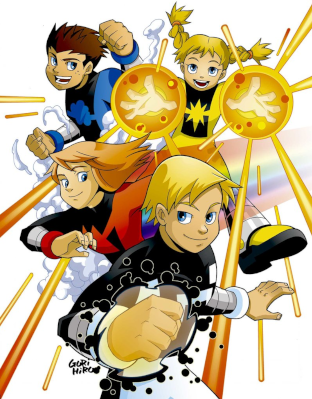
They'll fight off hordes of monsters with techniques the likes of which master swordsmen would never equal. They'll wield weapons spoken of only in the oldest of legends. They'll Save the World and everyone in it from destruction five times over.
And they'll do all of this while not even being old enough to drive.
The Kid Hero is, as the name implies, a child, a teenager, a young adult. The exact age varies up and down the scale, from 8 to 17, 18 or 19, but they're never an adult by whatever the local standards are. The "base age" seems to be between 10 and 15, 16, 17, 18 or thereabouts, though their numeric age may not be revealed.
Your standard Kid Hero has a strong streak of immaturity in them. They might well regard the adventure as a game, albeit one with slightly higher stakes. And if they aren't savvy to the world yet, expect them to be blown away by everything they see. Expect this to be scrubbed out of them in short order, usually when they finally meet an antagonist capable of matching their skill.
Kid Heroes DO have some things going for them, though: their idealism and youth. Anyone trying to perform a Breaking Speech on a Kid Hero is in for a rude awakening when they get it thrown back in their face. Kid Heroes, quite simply, have a very clear view of right or wrong. Some may call it naïve, but it serves them well, as they are basically impossible to corrupt. They're also at that age where their self-image is intricately intertwined with their friends, so they often kick ass through The Power of Friendship.
A Kid Hero will commonly, but not universally, have two primary adversaries; their most dangerous opponent is usually an adult villain who serves as the hero's Arch-Enemy, while their second most dangerous opponent will usually be a younger antagonist, closer to their own age or slightly older, who serves as The Rival or Evil Counterpart of the hero. These two are rarely affiliated, but if they do work together, the adult will almost certainly be the Big Bad with the younger character as an extremely reluctant and rebellious Dragon.
Most commonly seen in console and computer role-playing games, as it allows for character growth to feel natural and skips the question of why they aren't properly equipped for the job. This also appears in the vast majority of animated action-adventure, both Western and Eastern.
If a television show is specifically focused on this character, then the description will most likely be along the lines of "Saving the world, and doing homework!"
If particularly well executed, The Brigadier and others won't look like monsters or weaklings for sending a kid to do their heroics for them. This is Older Than Feudalism; examples include the Biblical hero David, and several Greek and Hindu mythic heroes (e.g., Hercules, who killed two large snakes sent by Hera to kill him in his crib).
See also Child Soldiers, the darker form of this trope. This can easily overlap with the Kid-Appeal Character - kids like to see fellow kids like them save the day, after all. Compare Kid Samurai. Contrast Enfant Terrible, Kids Are Cruel, and Teens Are Monsters. Naturally a requirement for Kid Hero All Grown-Up.
Example Subpages:
Other Examples:
- BoBoiBoy: The main team of superheroes range from the ages of 9 to 11 in the original series, while in the sequel series, their ages range from 13 to 15.
- The main protagonist of Chhota Bheem is Bheem, a hero who's only nine years old.
- The superheroes in Happy Heroes are revealed to be in 3rd grade in one episode, placing them at around eight years old (at least mentally; they presumably haven't been revived for that long).
- Tee Yang in Kung Fu Wa is a Magical Girl Warrior example as she is 8-years old, she finds a Kung Fu master turned into a sock and being a dreamy girl, she decides to help him to capture evil spirits known as Kwei to prevent them from wrecking havok.
- The goats in Pleasant Goat and Big Big Wolf are implied to be children, based off of several episodes such as "Candy House Fantasy". Weslie in particular seems to be either primary or middle school age.
- Samosa of Simple Samosa is the main character of the series and a kid who acts and talks like a real kid.
- Tobot Galaxy Detectives: Tyler is a young boy whos RC toys can turn into giant transforming robots that he can help battle evil by piloting from a cockpit.
- In the Yu-Gi-Oh! card game, there's actually a monster called "Hero Kid", which acts as an unofficial member of the "Elemental Hero" archetype.
- Age of Bronze: Achilles since, according to the story, he was "on the verge of manhood" at the start of the war. That said, he's old enough to have fathered a son even before leaving (and still without anyone finding out his gender).
- Batgirl:
- Although originally Barbara Gordon was an adult woman, it was later retconned out that she was a high-schooler when she started out her hero career.
- Charlotte Gage-Radcliffe, one of the many girls who took up the mantle during Barbara Gordon's retirement, was barely a teenager.
- Cassandra Cain, the first Batgirl after Babs who had her approval and got to hold on to the mantle for more than two outings, was about sixteen when she first donned the costume.
- The titular character of Benoit Brisefer is a young, incredibly well-behaved and polite kid with super strength.
- In The Books of Magic the central figure is Timothy Hunter, a poor adolescent British boy with messy, dark hair and coke-bottle glasses, who is destined to be the supreme avatar of magic of the age.
- The prepubescent Billy Batson became Captain Marvel, and subsequently the most popular character in comic books. A lawsuit from DC eventually ended his reign, but the incident proved that children, likeso many demographics, react best to people like themselves.
- Captain Marvel has the twist that he becomes an adult in his super powered form.
- One retelling of Captain Marvel's origin deconstructed this somewhat. Big Bad Doctor Sivana got some intel that Billy Batson (homeless and living in a subway tunnel at the time) was Captain Marvel and sent assassins after him. Billy defeated them, but his best friend was fatally shot in the process. Billy was so enraged that he nearly violated Thou Shalt Not Kill with regards to Sivana. When Superman confronted him about it, Billy decided to show him his true nature.
Billy (after reverting back): My name's Billy Batson. But maybe it's too dangerous to be Billy anymore.
- Needless to say, Superman was pissed and he called out Shazam for handing all of the responsibility and danger that comes with life as a superhero to a little boy.
Superman: He's a little boy. He should be worrying about homework and school and the crush he has on the girl sitting next to him in class! Not worrying about assassins killing his best friend! He's just a boy. This is a burden meant for men.
- Though Shazam had pointed out that Billy was the only person on Earth who could be entrusted with the power of the gods. So he countered Superman's statements with "He's a boy...who could use some guidance." Cue Superman revealing his Clark Kent identity to Billy and the two becoming true friends.
- The Fantastic Four's Human Torch was this back in the Silver Age, when he was a student around the same age as Spider-Man, and the quartet's youngest member.
- Franklin and Valeria Richards, children of Mr. Fantastic and the Invisible Woman, have recently become full-fledged heroes and adventurers alongside their parents (during the same time period that brought us Kid Loki and Miles Morales- so perhaps as part of a wider comeback for younger superheroes).
- Garth from Ghostopolis looks to be around 10 or 11.
- Jo, Zette and Jocko: Jo and Zette, who are brother and sister, save the day in their stories.
- Jommeke: Jommeke, his best friend Filiberke and their female friends Annemieke and Rozemieke often save the day.
- De Kiekeboes: Konstantinopel, a nifty ten year old boy sometimes has the brains to come up with the solution nobody else could.
- Loki was reincarnated as a kid. He skips most of the negative tropes because he's got a focused mission (save Thor from the Serpent), it's pointed out that he's in a lot of danger (he's a god, but a god in the body of a kid without his magic), and most of all, he's not acting like Scrappy Doo and charging into situations (at least physical situations) that he can't handle. His book is considered one of the best Marvel is putting out.
- Jason in Long Ago And Far Away was the legendary Child Knight who saved the land of Elvenwood. But that was a long time ago.
- Barring Katharsis and Tremor, none of The Movement's members are over 17. In fact, their leader, Virtue is only 16.
- Ms. Marvel: Ms. Marvel (2014) stars 16-year-old Kamala Khan, a Legacy Character to the title originally used by her idol, Carol Danvers. Kamala has since become a Breakout Character in Marvel Comics, and has been described as being to twenty-first century teenagers what Peter Parker was to the kids of the Baby Boom.
- Nero: In some stories Adhemar the boy genius finds the scientific solution to a problem. Petoetje and Petatje are also clever enough to help out in some stories.
- New Warriors: The team started off having mostly teenage members, although, like the X-Men, they all grew up. In fact, two of the founding members, Nova and Speedball were originally created as solo heroes in an attempt to duplicate what Marvel had done with Spider-Man, who'd moved on to college and grad school.
- Power Pack: The team all got their powers before the age of thirteen, and one of them had already retired from adventuring (more than once) by the time she was seventeen. Not to mention the fact that Katie, the youngest power sibling, was five.
- All the Robins! Especially Tim Drake and Damian Wayne who had their own solo books while they were Robin.
- Most of the cast of Runaways are teenage superheroes, though Molly Hayes probably epitomizes this trope best. She's 11 years old and has super-strength, plus invulnerability. However, like a young child, she tires easily and has to take naps when she's over-exerted. (In other words, she could probably go a round or two with the Hulk, but would probably fall asleep mid-battle.) Her idea for a superhero name? Princess Powerful (Hey, she's 11, give her a break!).
- Sonic the Comic's main characters are a part of a group called the "Freedom Fighters". The characters are all teenagers, besides Tails who is somewhere between eight and twelve.
- Sonic the Hedgehog (Archie Comics) consists of a bunch of teenagers, and some preteens, who are a part of the Freedom Fighters. Their initial goal was to save Mobius from the evil Doctor Robotnik.
- Spider-Man: Stan Lee took a wild shot by making Spider-Man one of the first true teen solo superheroes (i.e. non-sidekick; there was the Star-Spangled Kid back in WWII, but he didn't sell as well). The eventual widespread popularity of Spider-Man quite possibly is the root of the trope within the West. The Ultimate Marvel version of Spidey remained in the 15-16 age for the duration (160 issues) of his run. His successor, Miles Morales, is only 13 when he gets his powers. Just to hit Miles' age home, Nick Fury holds his hand when showing him around the Triskelion. Neither Miles nor Fury seem to be bothered by it. Both Spider-Men are realistically proportioned, so there tends to be a David Versus Goliath dynamic with many villains. However it’s worth noting that due to Comic-Book Time, Peter Parker is now in his late twenties or early thirties, and Miles is sixteen.
- The Golden Age Star-Spangled Kid and his modern-age namesake are both teenage superheroes (with adult sidekicks). Courtney Whitmore, the modern Stargirl and second Star-Spangled Kid, still wears braces on her teeth. At 17 years old, she is the youngest member of the JLA.
- Examples from Superman comics:
- Pre-dating Spidey by almost two decades was Superboy ("the adventures of Superman when he was a boy"), who debuted in More Fun Comics #101 in 1945, and soon moved to a lengthy run as the lead feature in Adventure Comics, plus gaining his own self-titled series (Superboy) in 1949.
- Pre-Crisis Supergirl was fifteen when she landed on Earth and started out her superhero career. Her Post-Crisis and Post-Flashpoint incarnations also started out as teen heroes.
- Static, created by Dwayne McDuffie was intended to be inspired as a modern (well, for the 1990s) version of Spider-Man. Virgil Hawkins, the main character becomes Static after being affected by a mutagenic chemical at age 15.
- Suske en Wiske: Suske and Wiske, who are orphans who live at the same house, often do heroic deeds.
- The Teen Titans, at least in their original run, were composed of the teenaged sidekicks of adult superheroes. Later versions of the Titans were mostly composed of college age superheroes, but still had members who were barely old enough to shave (like Beast Boy).
- Carthoris in Warlord of Mars, the Half-Human Hybrid son of John Carter and the alien princess Dejah Thoris. He is a teenager by the time he meets his father, who disappeared for a decade after being sent back to Earth, and is such an accomplished fighter due to inheriting his father's Super-Strength and is always fighting in the frontlines along with the adults.
- The protagonists of W.I.T.C.H. became Guardians of the Veil in middle school.
- Wonder Woman:
- Wonder Woman (1942): While the Holliday Girls are all in college they and Wondy teamed up with a much younger individual to help them solve a crime or find a missing person that the kid was already in the process of sorting out before the adults arrived.
- Wonder Woman (1987): Cassie Sandsmark was just starting high school when she became the second Wonder Girl
- Wonder Woman (Rebirth): Peony McGill is a young girl who acts as the superhero Star Blossom.
- People forget that the X-Men started off as teen heroes in a school for gifted youngsters. Even after the team became composed mostly of adults, other teenagers would go on to join the main X-Men team, such as Shadowcat and Jubilee.
- Various X-Men spin-offs have featured teams of teenage mutant heroes, such as New Mutants, Generation X, New X-Men: Academy X, Young X-Men and Wolverine and the X-Men. Interestingly enough, practically all the members of these teams have since grown to adulthood, something that does not happen much in comics.
- The Titans' successor Young Justice was also a group of Kid Heroes, even younger than the original Titans.
- The All-New Ultimates are a team of teenager superheroes from the Ultimate Marvel universe.
- Zot!: At the beginning of the series, the titular protagonist is only fourteen.
- While the Teenage Mutant Ninja Turtles tend to act as adults, the four main characters usually start as 15 year olds at the beginning of most incarnations, hence the title.
- The Snow Queen: Gerda, a little girl, has to travel till the end of the world in order to save her best friend.
- The Ace Savvy Extended Universe: All of the superhero characters (with the exception of Wild Card Willy) are minors; some (like the Eleven of Hearts) are teens, while others (such as the Royal Flush) are young children.
- Advice and Trust: Shinji, Asuka, Rei and Hikari are fifteen-year-old giant mecha pilots and soldiers.
- In brilliant lights will cease to burn, Izuku is just thirteen when he comes the Cardcaptor and subsequently the vigilante Deku. Combined with his already busy schedule, it's little wonder that he ends up sleep deprived and exhausted. At the same time, he can act with the same amount of maturity and cynicism as someone much older.
- Jack is 16 in Cave Story Versus I M Meen and is obviously the big damn hero of the story, evolving from a Ridiculously Average Guy into a Badass Adorable Nerd Action Hero; although he wasn't exactly a hero in the original Cave Story, the story implies that he was probably about the same age back then as well.
- Child of the Storm:
- Deconstructed. Harry is the hero of the story, Chronic Hero Syndrome and all, and is intelligent, brave, resourceful and - on his level - very capable. However, he's also 13 (to start with), impulsive, and completely out of his depth against Avengers-level opponents who won't hesitate to kill him. Unusually, the Avengers recognise this, and do their level best to keep him out of trouble, with limited success (trouble and Harry tend to go hand in hand, even if he isn't looking for it). This is for good reason. Even after Harry gets the powers (and to a lesser extent, skills) to fight in the same weight-class, his inexperience is repeatedly and brutally exposed on multiple occasions, two near the end of the first book, the third at the start of the sequel. Respectively, they nearly kill him, actually kill him, and put him through a Fate Worse than Death. While this leaves him as a much more competent hero who can more than look after himself against Physical God level threats, it also leaves him with textbook PTSD at 14 (15, physically, thanks to Year Inside, Hour Outside) and a lot of cynicism.
- The same happens, to a lesser degree, to several of his friends - Carol, for instance, has Past Experience Nightmares and similar residual trauma at the start of the sequel, which are magnified after a particularly traumatic arc later on. As a result of this, Harry makes a point of trying to keep Ron and Hermione (so far relatively untouched) out of trouble as far as possible, recognising how damaged his experiences have left him, and making very clear that he does not want that for them.
- Children of an Elder God: Shinji, Asuka, Rei, Touji, Hikari, Anna... are fourteen. They are only ones capable of piloting Evangelions and defeating the Elder Gods by killing them and stealing their powers.
- Beth Lestrade in Children of Time, fifteen in her first appearance and then a physical age of seventeen throughout the events of the "season finale". Justified in her being the daughter of a New Scotland Yard detective inspector.
- Crimson and Emerald: Deconstructed. Hawks was railroaded into becoming a pro hero and had very little agency growing up.
- In The Devil Does Care!, when Trevor finds Adrian, who at this time is barely in the toddler stage, he assumes he was kidnapped to be eaten by Dracula later and tries to run off with him in-spite of his injuries.
- In the Discworld of A.A. Pessimal, Rebecka Smith-Rhodes is forced to confront and stare down the Dungeon Dimensions, aged around eleven. She realises that when Witchcraft wants you, there is no minimum entry age. Either you're good enough or you aren't. Later on her younger sister Famke sets a record at the Assassins' Guild School which is unlikely ever to be beaten; a month or two shy of her twelth birthday, she annoys Miss Alice Band so spectacularly that she becomes the youngest student Assassin ever to be sent on the Vimes Run. Sam Vimes notes that she manages to get inside Ramkin Manor before the inevitable failure, and notes her as One To Watch.
- Dungeon Keeper Ami: Ami Mizuno/Sailor Mercury is still a teenager here, and just as much a hero as in her source work.
- Elementals of Harmony: The one who can stop insane precognitive Twilight, as she herself says: "Where's the filly who can ruin everything?"
- Downplayed in Forewarned is Forearmed. Akira doesn't do much to influence the events of Persona 4's plot directly (in large part due to Lavenza's insistence), though he does get involved in the Metaverse much earlier and learns how to take down Shadows on his own. But his Personas aren't particularly strong, especially when compared to Yu's, due to lacking access to the Velvet Room and a sufficient number of bonds to power them up. But his presence ends up tipping off both Nanako and Dojima to the nature of Shadows, Personas, and the Metaverse, getting them all much more involved in the finale. Akira is also the only Persona user around to defend Inaba from the Shadows appearing there while the Investigation Team is off to defeat Adachi. He also joins Yu when he goes off to defeat Izanami, though the story ends before we see the fight.
- HERZ: Shinji, Asuka and Rei started out their piloting careers in their early teens.
- Hope and Sayaka from Justice Society of Japan.
- This is a recurring trend in the Infinity Train: Blossomverse
- Infinity Train: Blossoming Trail: Chloe Cerise is a ten-year-old girl who finds herself thrown into the Infinity Train, teams up with a corgi king and a living book, to bring down a dangerous cult called The Apex.
- Gladion Montblanc of Infinity Train: Knight of the Orange Lily is 14 and makes it his personal mission to be a knight and topple the Apex. But given that this is a prequel to Blossoming Trail, he isn't successful (although he does stop a serious plan of theirs).
- Goh Fujihachi in Infinity Train: Voyage of Wisteria is also ten, but he has to navigate the train after his friend ended the cult.
- In Last Child of Krypton Shinji, Asuka, Rei, Touji and Kaworu are fourteen-year-old mecha pilots and super-heroes.
- The Lion King Adventures: Simba. Until he realises that he's actually the age of an adult in The End.
- Marissa Picard: The titular main character commands a starship, vanquishes the Romulans, negotiates an interplanetary peace accord, and wins the Triple Crown — all before she's old enough to legally drive.
- Neon Genesis Evangelion: Genocide: In addition to the canonical teen pilots, Keiko is a fourteen-year-old mecha pilot.
- The Night Unfurls presents a rare reconstruction. Three out of five Hunters (Sanakan, Hugh and Soren) are kids (they are referred to as such) who Take a Level in Badass and fight hordes of orcs, mercs, brutes, soldiers and other monstrosities over the course of the story as skilled Hunters alongside the good guys. It is unknown whether they aged, given how long they have to train in the Hunter's Dream before swooping into the real battlefield. Whereas deconstructions of this character archetype portray "kids saving the day" as problematicnote , The Night Unfurls asserts that with sufficient training and guidance, the kids are able to gain the strength, health, agency, and motivation needed to right as many wrongs as possible in a hazardous world, a feat beyond their reach if they remain civilians. There is a reason why the Kid Hero persists in fiction despite being torn apart countless times.
- NWR Hidden Stories: The main protagonist, Conan Owens, is just 14 when he bonds with Thomas and becomes the assigned driver to the Tank Engine.
- Once More with Feeling: Deconstructed. Shinji and his two teammates are fourteen-year-old mecha pilots. Shinji is NOT happy about it, and he often states that they're nothing but child soldiers.
Shinji: With the greatest of respect, Sir, the twin of that toy you are transporting took out that Angel in sixty three seconds, with no civilian casualties, no military casualties and minimal collateral damage to the city it was fighting in. Us ‘kids’ have to pilot these things because there isn’t anyone else who can. While our classmates at school are worrying about who they’ll invite to the dance, we are wondering if tomorrow we’ll die as we’re ripped to pieces by something nuclear weapons barely slow down, knowing if we fail, out entire race is going to die. So, respectfully, I’d ask you to show some fucking respect.
- Pokémon Strangled Red: Steven, just like the protagonist of any real Pokémon game, is the protagonist of the hacked game.
- The Portal: The main character, Thomas Smith, is nearly 16 when he is pulled into the Dragon Realms.
- In Risk It All, Ren is only sixteen and has the maturity of someone his age. As a result, he's not mentally prepared to face danger on a regular basis, freezing up when faced with yet another gun after the first two attempts on his life. Even after he works up the courage to fight back, his attempts to take down Black Mask make things worse before they get better.
- Tales of Termina: Deconstructed. The numerous traumatic adventures Link has had at such a young age has turned him into an emotional wreck with severe PTSD.
- Saved
 is a Once Upon a Time AU that reinvents Emma Swan as one, as she and Pinocchio/August go through the wardrobe when Emma is four rather than as an infant, allowing her to return to Storeybrooke when she's eight years old; the fic ends with David and Mary Margaret aware of their true histories.
- The Second Try played it straight with fourteen-year-old Rei and Touji, and subverted with Shinji and Asuka, since due to time-travel shenanigans, they’re physically teenagers but they’re mentally adults.
- Calvin and Andy from Swing123 and garfieldodie's Calvinverse, the former to extreme lengths.
- In Thousand Shinji, Shinji and Rei are fourteen, and Asuka is thirteen. They pilot mechas and have -very nasty- super-powers.
- Discussed and Reconstructed in What the Cat Dragged In. After the Avengers figure out Ladybug and Chat Noir’s general ages, they’re understandably horrified that the fate of Paris rests on the shoulders of a pair of teens. However they note that this also means they’re not completely responsible for taking care of their civilian lives, giving they a safety net and making Papillon's war of attrition much less effective.
- Hiro Hamada of Big Hero 6, a young Teen Genius that had already graduated from high school at the start of the movie.
- Coco stars 12-year-old aspiring musician Miguel. Through a set of incredible circumstances and his own passion and determination, he ends up restoring his great-great-grandfather’s honor and remembrance, and proving that one of Mexico’s most beloved musicians was a thief and a fraud within the span of a single year.
- Coraline stars a girl as she discovers a portal to another world in her new house. She has to save herself and several ghosts from the Other Mother.
- All three children in The Incredibles. Interestingly, they start off with attitudes fairly realistic to children their age, just with superpowers, but by the end of the movie, the whole family is happy to take baby Jack-Jack with them on life-or-death fights against super-villains.
- The Iron Giant: The nine-year old protagonist Hogarth Hughes acts as the father of the titular Gentle Giant. His overall appearance could be considered as handsome for a kid.
- The title character from Kirikou and the Sorceress is actually a newborn baby hero. He is able to walk and talk despite that.
- Kubo, the titular hero of Kubo and the Two Strings, is twelve years old, and has already lost and eye in infancy and has to play a magical shamisen to earn a living for himself and his ill mother. During the movie, he sets out in a dangerous quest to find his father’s missing armor, while chased by his vicious supernaturally powered aunts.
- Next Avengers: Heroes of Tomorrow focuses in a next generation of young Avengers in an Alternate Continuity where Utron has killed the original Avengers except for Iron Man and The Incredible Hulk.
- Norman of ParaNorman is a boy with the ability to speak with the dead, and must use this ability to save his town from a witch’s curse.
- Pinocchio: The young puppet has to earn his happy ending to Become a Real Boy.
- Maruti/Hanuman from The Return of Hanuman is considered as this.
- Comet becomes this in Space Chimps 2: Zartog Strikes Back.
- For Spider-Man: Into the Spider-Verse, we have a three-fer! Miles Morales is prepubescent and in middle school, making him 13-14 at most. Gwen Stacy states she's "15 months older" than Miles, putting her in the 14-15 year-old range, and SP//dr's Peni Parker, a young girl whose age is not stated, but who looks, sounds, and acts even younger than Miles. Spider-Man: Across the Spider-Verse, which occurs sixteen months afterwards, establishes Miles to be fifteen by that point.
- Vanellope Von Schweetz in Wreck-It Ralph starts off as a Bratty Half-Pint, evolves into a Damsel in Distress and eventually becomes an example at the climax.
- Oskari, one of co-protagonists in Big Game, turns thirteen during the film's action.
- Eliot in E.T. the Extra-Terrestrial. At the end, he pulls off the escape plan to get E.T. back to his ship.
- Home Alone features 8-year-old Kevin singlehandedly defending his home from a pair of pesky burglars through a series of booby traps.
- Lost Creek: The films stars three kids, Peter, Bill, and Maggie, who have to save their town from a monster who's been abducting people. They do this by helping Maggie overcome her fears, as they're what give the monster life.
- The Marvel Cinematic Universe version of Spider-Man is only fourteen/fifteen years old when he makes his debut in Captain America: Civil War.
- The Soviet sci-fi two-parter Moscow — Cassiopeia involves a group of teenagers being sent on a decades-long journey to one of the stars in the Cassiopeia constellation. Had adults been sent, they could have grown old by the time the ship arrived. The original plan is for the teens to be adults at arrival time, but a freak accident results in the ship accelerating to near-light speeds, so Time Dilation keeps them young (which doesn't stop one's family back on Earth from celebrating his 30th birthday (in absentia) before someone points out that, from his viewpoint, he's still in his teens). Since they're still in school, they have to attend classes while in flight (through a Subspace Ansible of some kind). They end up saving a dying Human Alien race and depart on their journey home.
- Dannie of Pathogen is only 14 years old.
- Spy Kids stars a brother and sister team trying to rescue their super-spy parents. By the second film, there are various kid heroes.
- Star Wars: The Phantom Menace. Anakin Skywalker, who single-handedly won the Boonta Eve race with a home-made podracer and (accidentally) won the Battle of Naboo at the age of nine. In the EU, his grandkids are also examples. His children are not, however, with one wanting to go to the Imperial Academy when he starts his adventures and the other having already served as a Galactic Senator. Just like her mom at her age...
- 3 Ninjas: The three brothers are varying ages but all of them are school kids fighting bad guys with ninja tactics.
- Wrath of Daimajin features a quartet of kid heroes who set out to rescue their fathers who've been enslaved by an evil warlord.
- Kintaroa hero from Japanese folklore: A child of superhuman strength, raised by a mountain witch, who ends capturing the evil oni Shuten-dōji.
- Davy Crockett. King of the wild frontier. Killed a bear when he was only three.
- Alcatraz Smedry of the Alcatraz Series, though he constantly insists that he's not as heroic as people think.
- Viciously deconstructed in the Alex Rider series. The eponymous protagonist is bullied into a job as a spy that he doesn't want and the awful psychological toll on him is so bad that it's unlikely he will ever recover.
- The six main characters of the Animorphs series start out at the age of 13, with the exception of Ax (though he's still basically the Andalite equivalent of a teenager, since he's an aristh, or cadet).
- Garion from David Eddings' The Belgariad kills a god at the age of sixteen. And then marries the spoiled princess, which is at least as daunting.
- Biggles is a borderline example, being eight months shy of his claimed seventeen years when he arrives as New Meat at the Air Training School in Biggles Learns To Fly. Most of the franchise is set some time after he reaches adulthood, however.
- His sidekick Ginger is an odd example, appearing in one story as a Bratty Half-Pint before taking up an apprenticeship at an aircraft manufacturer to reappear a few books later, slightly Older and Wiser.
- Astra from Cakes in Space is a little girl who has to save the spaceship her family is on because it's veered off-course, is being looted by aliens, and has hostile living cake monsters infesting it.
- The four Pevensies in The Chronicles of Narnia are schoolchildren when they save the land and become monarchs.
- In Sandy Mitchell's Ciaphas Cain novel Cain's Last Stand, the students at the schola. Starting with Sprie who is piloting Cain's shuttle when the attack comes and analyzes it for Cain. At one point, Cain observes that the schola could pass for an Imperial Guard post if the faces weren't so young.
- The protagonists of Roald Dahl's books are typically young boys around eight or nine years old (Charlie, George, James, etc.), In a few cases, young girls were used as main characters instead (Matilda, Sophie and the nameless heroine of The Magic Finger).
- Ender's Game - except becomes a partial subversion and deconstruction when Ender has a massive mental breakdown after discovering that the game was real.
- The Extreme Monsters book series revolved around the adventures of five monster athletes, whose ages ranged from 9 to 12.
- Tiffany Aching in the Discworld is around nine when she has to rescue her brother from a river monster, armed only with a large cast-iron frying pan and a willingness to look the creature straight in the eyes for long enough to measure her swing. Then it escalates and over the course of four books she realises that if you're a Witch, age is just a number. The pointy hat knows no minimum age.
- Done somewhat differently in the Grey Griffins book series, in that while the main heroes are four children, adults frequently end up having to rescue them or help out, and are also the ones who do the overwhelming majority of the actual fighting. On the other hand, the kids tend to do much adventuring on their own, usually using their wits.
- Sarah from Greystone Valley is twelve years old and the valley's best hope to be rid of the evil warlord Baelan.
- Harry Potter had his first adventure at the age of eleven and in the last book he defeated Lord Voldemort at seventeen. In addition to Harry himself, the series includes his friends and classmates. On the other side, Draco Malfoy became an official Death Eater at sixteen.
- Heroics: The field members of the titular team are all between 13 and 17 years old. The youngest, Kara, is the most optimistic, though most of them do still have a childish nature to them. (Though team leader Kate is well on her way to losing it by the end of the book.)
- Rue from The Hunger Games is 12, the youngest age you can be chosen as a tribute. Katniss and Peeta are both 16, while Rue’s District partner, Thresh, is 18, which is the oldest a tribute can be.
- Eragon in the Inheritance Cycle, though, in fairness, Eragon really isn't too far off from what his people consider the age of maturity when the series begins.
- All of Diana Wynne Jones' work directed towards a younger audience, such as the Chrestomanci series, Eight Days of Luke, The Homeward Bounders, Power of Three, and The Dalemark Quartet. (And sometimes, as in Dark Lord of Derkholm and The Magids series, they share the spotlight with adults.)
- Journey to the Morning Star, being a children's novel, naturally has kids as protagonists, although they are accompanied by an old wizard. The three boys' names are even lampshaded by the wizard, who compares them to the three classical Russian bogatyrs. As expected, the girl (the wizard's granddaughter) ends up being little more than a Damsel in Distress.
- The League of Secret Heroes: Katie O'Malley, Akiko Nakano, and Mae Crumpler are a trio of pre-teen girls who gain superpowers from The Stretcher's costume and use them to help a secret organization known as Room Twelve assist the war effort by thwarting plots by spies and villains.
- Legacy of the Dragokin: Benji is ten years old and desperately wants to be this trope to emulate his Action Mom and impress his Four-Star Badass crush, but he fails repeatedly until the climax.
- Max & the Midknights: The titular Midknights are a group of kids who go on adventures to save the Kingdom of Byjovia.
- Miles Taylor, the titular main character of Miles Taylor and the Golden Cape becomes a superhero after inheriting the golden cape from its previous owner.
- The main characters in The Mysterious Benedict Society are on the thin line between traditional kid heroes and being Child Soldiers. They're all under thirteen, with Constance being the youngest at age three. Mr. Benedict recruited children because he needs them for his dangerous missions that only kids can go on, however would ideally avoid putting kids in harms way.
- The Never Ending Story: Atreyu is twelve years old at most, and he is the chosen by the Childlike Empress to become the saviour of Fantastica.
- Land of Oz: Most of books have a child as at least one of the protagonists. Dorothy Gale is the most famous, but the books also include Tip, Princess Ozma (when she takes part in the action), Betsy Bobbin, Ojo the Unlucky, and others.
- The Camp Half-Blood Series:
- All the half-bloods and Grover (starting with Percy Jackson and the Olympians, although they grow into their teen years in The Heroes of Olympus). They usually discover they are half-bloods in middle school.
- It's debatable whether or not the Hunters of Artemis count too - technically they are immortal and therefore mostly in their hundreds or thousands, but physically are prepubescent.
- Grover's thirty-two in the last Percy Jackson book, he just looks sixteen (and acts that way because satyrs age half as fast as humans).
- Peter Pan is a kid, though a very old one who never grew up.
- Tamora Pierce's protagonists grow up with the books, but Alanna, Kel, Sandry, Tris, Daja, and Briar are 10 at the beginnings of their stories. Daine is about 13. Bekah and Aly are between 16 and 17. Evvy is 10 in her first appearance, but by the time she gets her own book, she's 14.
- Most of the protagonists of The Prophecy of the Stones are in their teens. The three main girls (four, counting Joa) are 14, Love Interest and leader of La Résistance Adrien is 16, and the Supporting Leader and Big Good Elyador is 18.
- In the Rainbow Magic series, Rachel and Kirsty are young, though their exact age isn't specified.
- Most of Redwall's heroes are the Talking Animal equivalent of about twelve-to-fifteen.
- Seeker Bears has all of the main characters. They're a group of bear cubs who, by the end of the second book, are all on an environmental-themed journey together. They're noted to still be too young to even be away from their mothers.
- Septimus Heap: Septimus and Jenna are both 10 year old by the first book.
- The Son Of The Ironworker: Martín Sánchez is only fifteen when begins his adventure across two continents.
- A Song of Ice and Fire:
- Robb Stark commands a good percentage of the continent's armed men while barely old enough to grow a beard.
- The series is full of these. Jon Snow and Daenerys Targaryen are such examples, with the former becoming one of the youngest Lord Commanders in the Wall's history, and the latter becoming a queen and conqueror of slaver cities while just fifteen years old.
- Arya is a deconstruction of the trope. Her coldly calculative personality is extremely disturbing to those she meets, as she has not even hit puberty yet and she's already a successful assassin.
- Robb Stark wins all his battles but proves terrible in handling the political side of ruling and ends up getting murdered at the age of 16.
- Daenerys finds ruling a city incredibly difficult and ends up fleeing on her dragon.
- Daeron I became King at the age of 14 and conquered Dorne, which his ancestors had failed at despite having dragons. However, similar to Robb Stark, ruling proved more difficult then fighting, and he died four years after becoming King in the Dornish wars.
- The protagonist of Strength & Justice is 15. So's his girlfriend, who occasionally shares the spotlight.
- Stephen King is pretty fond of this trope. Jack in The Talisman, the kids in It, Mark in 'Salem's Lot, Jake in The Dark Tower series, even Danny in The Shining.
- The hero of the Time Machine gamebook series. The exact age is unclear, but seems to be somewhere around 13. Which doesn't stop people from occasionally treating him as someone older for sake of the plot; for instance, he can end up becoming a full-fledged astronaut.
- Togetherly Long: Oukii, who's ten years old but still wields the spear of the great hero Yuushi and protects his village from the evil Emperor Von Mal.
- In Toliver's Secret, Ellen Toliver is only ten years old when she's tasked with her grandfather's mission of delivering a message with information to his friend, which will then be passed on through three secret couriers to General Washington.
- In Treasure Island, teenager Jim Hawkins does a good job of screwing up with the pirates' plans - starting with his taking the map and accidentally eavesdropping on Silver's mutiny plans.
- Gratuity in The True Meaning of Smekday, though she is a bit more mature at the start of the book than most Kid Heroes.
- Gregor from The Underland Chronicles is twelve years old by the time the series ends.
- Underworlds: Owen Brown and his friends are fourth graders battling gods and monsters to save the world, and doing a surprisingly good job at it.
- Varjak from Varjak Paw is the youngest in his family and is described as a kitten. He doesn't however look too young, so presumably he is more of an adolescent than a young child.
- The main characters of Warhammer Adventures are able to run around the grimdark worlds of Warhammer 40,000 and Warhammer: Age of Sigmar having adventures while aged between eleven and fourteen.
- Warren the 13th may just be a kid, but he manages to save the hotel, and even the world, from his wicked aunt Annaconda's wrath.
- In Warrior Cats, several of the heroes are apprentices when we first see their points of view - the feline equivalent of 10-18 years old - and some POVs start even younger.
- We All Fall Down by Robert Cormier has one of the few true subversions of this trope. The hero is introduced as an idealistic kid who calls himself "the Avenger" and daydreams of being a Vigilante Man, getting his chance after watching a break-in and rape. He's fully adult and completely insane.
- Wings of Fire starts with a group of dragonets that are still a year from being adults, meaning they're adolescents by human standards. They've been raised to fulfill a prophecy and bring peace to their land.
- The Young Wizards series. Justified by several reasons:
- The younger a wizard, the more raw power they have available.
- A wizard is first offered his/her power by the Powers That Be when s/he is the best (or the only) solution to a particular problem, a problem which was directly or indirectly caused by the Lone Power, the Big Bad of the series. Thus, whatever a wizard does after first getting his/her powers is always important, and often dangerous.
- In R.S Belcher's King of the Road, there's a "secret club" consisting of well-meaning geeky kids of junior-high age living in Valentine's Trailer Park. One thing they do is warn newcomers to "never go to the train graveyard and to stay away from the southeast of the park". These kids are instrumental in saving the life of a scientist of the Brotherhood of the Wheel from the Harlequin serial killer cult and it's implied that when they grow up, they'll be joining the Brotherhood.
- Beetleborgs: 3 preteen kids becoming henshin heroes to defend their town against various monsters.
- Kamen Rider Gaim: Deconstructed. As Sid points out, the reason why Yggdrasill is giving Sengoku Drivers to Beat Rider teams is because they are run by irresponsible, egocentric teenagers who never question why they are getting such power making them perfect pawns while a responsible adult will instantly realize something is wrong.
- Power Rangers Turbo had Justin, the youngest ranger yet at age 11. He somehow gained an adult-sized body when morphed however (except for scenes where he removed his helmet, then he became kid sized again), but mentally remained very much a kid.
- Power Rangers parent show Super Sentai used the same idea earlier for Kō, the Kiba Ranger in Gosei Sentai Dairanger. And again for Kotaro, Koguma Skyblue in Uchu Sentai Kyuranger (except Kotaro stays kid-size when he morphs, except when he uses his special ability to temporarily grow gigantic). The Ressha Sentai ToQger team, meanwhile, act like kids despite looking like they're in the franchise's usual late-teen age range because they are kids that have been magically aged up; they return to their normal ages at the end of the series and participate in some spinoffs as their child selves.
- Subverted in the final Quatermass serial, in which young people are affected by an evil alien force and old people are the only ones who can save the day.
- Stranger Things has about half a dozen of them. They are aided by adults and a few older teenagers, but the main protagonists of the show start out at barely twelve years old.
- Raising Dion stars a seven year old boy who finds out he has superpowers.
- Enban Sensou Bankid: a rather obscure Henshin Hero show featureing a team of five young heroes, the oldest four being in their (late) teens, and the youngest, Bankid Rabbit, being a preteen.
- The main cast of Dawn of a New Age: Oldport Blues are all high schoolers ranging from 15-18. Crispin theorises in-universe that they were granted superpowers as part of a Government Conspiracy to groom them into Child Soldiers.
- In The Thebaid Parthenopeus is eager to go to war against the corrupt cesspit of Thebes despite not even being able to grow a beard. His mother notices he's left too late to stop him and even with the patronage of Diana, he does not return from the war unscarred.
- David of Israel makes his debut in the Old Testament as this, in the classic tale where he faces the giant Goliath with only his sling and stones... oh, and the power of God on his side. The book of 1 Samuel describes his youth thus: "[Goliath] scorned him, for he was but a boy, ruddy and handsome."
- In d20 Modern, the minimum age for starting occupations is 15 years old. In D20 Apocalypse, most starting occupations see their minimal ages being reduced, some to 12 years old. And upon reaching their 12th birthday, kids take their first level in one of the basic classes, and have no attributes adjustment. Cue 12 years old battling radroaches, raiders, scavenging pre-apocalypse ruins for spare ammo...
- In Dungeons & Dragons, the minimum age for a human player character is 16 years old. In Fifth Edition, the rules specify that there are no age restrictions, nor are there any penalties for playing a very young (or old) character- but it's suggested that the character's age could justify their existing stats.
- Perfectly playable in Rocket Age, as there is a secret society of child spies among the Martian royalty known as the Yondari. Older members can be as old as 16, but the majority are under 10.
- In fitting with the source material, this is not uncommon among the titular Hopeful of Princess: The Hopeful. It's mentioned that most adults (including fellow Princesses), would really rather that children not have to deal with the kinds of problems and monsters Princesses face, but given the kind of people who Blossom, it's generally an exercise in futility trying to persuade them to stay safe.
- Dead Reign eventually had rules for creating child characters added in one of its many sourcebooks.
- Tales from the Loop enforces this; no PC can be older than 15. The game is basically a homage to "kid adventure" films like The Goonies and E.T. the Extra-Terrestrial, so it fits.
- SuperThings:
- Kid Kazoom, formerly Kid Shine, was one of the last superheroes created before Enigma stole the Kazoom from Clank Corp. Already a young and inexperienced hero thanks to his new creation, after his accident that required his transformation into Kid Kazoom, he became the protector of Kaboom City, though he had much to learn before he mastered his abilities.
- The Kazoom Kids are all children that were enchanted by the power of Kazoom. As Neon Blast empowered random items they were interacting with with Kazoom, some of them transformed into superheroes that are based around their object theming. On the other hand, some became Kid Supervillains.
- '32 Kick-Up has Patrica-Marie, 12, and Calloway, 10, as its two leads.
- Justified in City of Reality, as the titular city is sufficiently peaceful that they deliberately recruit kids to be members of SUEPR.
- Several of the main characters in El Goonish Shive have become this. Nanase has a super powerful angel form which Ellen can now duplicate. Elliot has his female superhero form, Cheerleadra, along with three secret identities to go along with. Susan is a natural vampire hunter, as is her Doppelganger aunt Diane. However, her powers have not yet awakened.
- Heroes of Homeroom C: Albert and Nicola Hathaway start out as 12-year-old Sunburst and Bombshell, until they're zapped by The Ruiner's Depowering ray. Of course, they don't give up being heroes in spite of that. Partially because Nicole had somehow regained her powers.
- Heroes of Thantopolis Champion of the Queen of Ghosts Cyrus, aged 11.
- All sixteen protagonists of Homestuck are thirteen-year-olds or the alien equivalent. However, none of them act like it most of the time, some more so than others.
- While Huckleberry's exact age hasn't been revealed, he was born during the relatively recent Heroic Age, and everyone calls him a kid. He also survived many encounters with supervillains or powerful creatures.
- Mara: The titular character is eight years old at the start of the comic.
- Parisa's main heroes are Gwen and Logan. Logan is ten years old, and Gwen's implied to be around his age, but they are shown to be more than capable of saving people on several occasions.
- Lampshaded in this Scandinavia and the World strip.
- The Dragon to a villain in Super Stupor is Genre Savvy enough to be terrified when a little girl in spandex shows up at their headquarters. The less Genre Savvy Big Bad gets instantly vaporized.
Frog Ninja: Heroes don't send kids to do the job unless they're little tanks. And most kids are, for some unknown reason, ten times stronger than adult heroes. It's like the younger and cuter they are, the worse they're gonna kick your ass. If that was a four year old playing with a kitten out there, I'd offer her your dead body just to be on the safe side.
- Played glaringly straight in Tales of the Questor; it is even lampshaded in one strip when the Mayor said he wanted Quentyn to mature before sending him out.
- Deconstructed in We Are The Wyrecats. Despite having good intentions, building the XAG suits and playing at being superheroes has practically ruined the team members' lives.
- Deviant: The main protagonist of the story, Cassandra Jansen, is not only a superhero, but she's also only 15 years old. There's a number of other kid heroes as well, most prominently the Newborns, a team of them.
- RWBY: Ruby Rose is a perky, quirky 15-year-old girl who wants to be a professional monster slayer because her older sister Yang read her bedtime stories about great heroes saving and protecting people; she wants to emulate them and make the world a better place. She is pushed ahead two years, so her team-mates (Team RWBY) and companions (Team JNPR) are all two years older. An in-universe year later, they're joined by Oscar Pine, who is two years younger than Ruby and the inheritor of a divine mission to save the world.
- The members of Team Kimba at Superhero School Whateley Academy in the Whateley Universe. They start out with most of them being fourteen.
- It is stated that there is a rule of thumb: the younger a mutant is when they manifest, the more powerful their abilities are likely to be. This seems to be borne out with TEAM AWESOME!, four pre-teens who are near the top ratings in their respective powers.
- The Wards in Worm are an organization of Kid Heroes. But remember that in Worm, Anyone Can Die still applies...
- The Royal Navy permitted newly-minted midshipmen to go to sea and at least nominally command enlisted men from the age of twelve in the era of Wooden Ships and Iron Men, and it was not unheard of for men to reach lieutenant before their 18th year. The minimum peacetime recruitment age for enlisted men in all three services remains a relatively tender 16 years to this day.
- Many, many underage boys lied about their age to serve in the First World War, rather fewer in the Second. Some ended up promoted or decorated for courage under fire, though for most things ended rather worse.
- Audie Murphy, of To Hell and Back fame was a mere 14 years old when he enlisted and was about as close to some of the wilder fictional examples of this trope as you're probably going to get in Real Life.
- Audie Murphy, of To Hell and Back
- Budapest's Corvin Square has a memorial for several young boys who joined to protest against communist oppression, and were killed by the Soviets.
- According to legend, Genghis Khan was 13 when he took control of his tribe and slowly built up his forces and conquered the most land mass of any military leader to date.
- While his accomplishments may not be as epic as some of these others, Steven Stayner qualifies. Abducted at age 7 by a child molester and held captive for seven years; when he learned that another boy had been kidnapped and was about to be similarly victimized, Stayner escaped with the boy, 5-year-old Timmy White, and hitchhiked 40 miles to White's hometown, taking the boy to the police. There are commemorative statues of 14-year-old Stayner rescuing 5-year-old White in both of their hometowns. Also, when Stayner died in a motorcycle accident at age 24 (in 1989), the now 14-year-old White was one of his pallbearers.
- Andrew Jackson fought as an irregular at the age of 13 during the Revolutionary War.
- Zhenya Tabakov, a seven-year-old boy, saved his twelve-year-old sister Yana from an adult rapist. He attacked the man with a kitchen knife and got him to release Yana, who was able to run and call for help, but the man fatally stabbed Zhenya before fleeing. Zhenya was posthumously awarded the Order of Courage, and there was a monument built in his honour.
