

I dig giant robots!
We dig giant robots!
Chicks dig giant robots!
Nice!"
This item is available from the Trope Co. catalog
Who needs an Artillery, Armored, Engineer, Mechanized, or Motorized Brigade when you can have a 100-metre tall humanoid robot with a glowing sword and a fist that fires off like a missile? There's no argument — ordinary vehicles have nothing on the cool factor of Mecha. And when they're really huge, they just get even cooler! Which is what really matters in the end, right?
Mecha themselves are usually divided between the "Super Robot Genre" and the "Real Robot Genre", depending on the kind of sci-fi, though there are as many different kinds of settings for mecha as there are genres of fiction. It should be noted that, while often referred to as robots, many mecha are functionally more like vehicles, controlled either remotely or from within by a pilot instead of being pre-programmed or autonomous.
Mythology as a whole is also replete with artificial humans and similar automatons (eg. Talos, the great bronze automaton built by Hephaestus. Dr. Hell from Mazinger Z finding an army of Humongous Mecha on a Greek island is actually based on that legend), but special mention goes to Hindu Mythology. One of the three barriers the gods set to protect their elixir, the Amrita, was a robot with rotary saws for hands.
For those of you wanting to create your own Humongous Mecha story, we've got you covered. While not a reality yet or likely to be... Japan is working on it. And so is the US. And these two have had the first real-world giant robot fight.
It's worth noting that the amount of Friendly Fandoms in the genre is huge; in fact, most hardcore fans describe themselves as "mecha fans" rather than belonging to any certain franchise fandom.
See Mecha for the more generic, not-necessarily-humongous supertrope. When you want to park your mecha, see Idiosyncratic Mecha Storage for compact storage options.
Example subpages
Other examples:
- There's also a Singapore Army ad featuring a Navy Cruiser Transforming Mecha. Now that's firepower!
- The Authority: Jack Hawksmoor can actually turn cities into Humongous Mecha. As in, walk into the middle of Tokyo, ask it very nicely, and come out wearing battle armour made of concrete and skyscrapers.
- Justice League of America: The JL use a Voltron style combining mech to escape Mongul's prison in the opening to Dark Nights: Metal. Toyman had slipped in the protocol into the machines that Mongul had made him built to kill them, and Batman figured it out. The resulting mecha had Flash as a foot, to his irritation.
- Superman:
- Pre-Crisis Lex Luthor often built giant robots to try to kill Superman and/or Supergirl.
- In Superman vs. the Amazing Spider-Man, Superman fights a skyscraper-sized Lex's robot at the beginning of the story, and later a submarine spider-mecha.
- In Supergirl: Cosmic Adventures in the 8th Grade, Luthor builds a giant robot able to nullify Superman's strength (which gets smashed by Supergirl's rocket).
- The Immortal Superman presents two robots large enough to move Earth around.
Superman: The size of those monster-robots staggers even my mind! They're carrying the Earth... As if it were a basketball!
- In The Dominator War, the Dominators build a giant robot under Megatokyo. It is so big that its head knocks several skyscrapers down when the massive monster bursts out of the ground.
- Transmetropolitan: The City has numerous humongous disabled mechas called Gladiators that stand their ground scattered all about, towering over the landscape. They are at least 200 years old and there was no record of these being ever used. Spider Jerusalem remarks that their steel penises fell off thirty years before, killing numerous civilians.
- Wonder Woman: Mad Scientist Byrna Brilyant's snowstorm creating "Blue Snowman" Powered Armor of prior incarnations is leveled up to a giant cyclops Motion-Capture Mecha with a head taller than Dina in Wonder Woman (Rebirth).
- Godzilla, King of the Monsters (1977): In Marvel's short-lived license of the Toho character, a Samurai-themed robot named Red Ronin is constructed by Tony Stark and S.H.I.E.L.D. to fight the title character. Originally intended to be piloted by S.H.I.E.L.D. agents, in true genre fashion the robot's controls are accidentally mapped to the brain patterns of a young boy who refuses to use it for its original monster-slaying purpose. Though Godzilla has since faded away from the Marvel Universe, the Red Ronin still shows up occasionally — perhaps most notably in Earth X and Exiles where it has a short bout with Fin Fang Foom. In the aforementioned Earth X appearance, Tony Stark has secretly redesigned the Red Ronin into a Transforming Mecha that spends most of its time as his "Iron Avenger" factory. We don't know this till the end of the story (making Tony appear to be a useless recluse), when he pilots it into battle against the even larger Celestials, who are energy being versions of the same — their energy bodies need Humongous Mecha to give them shape.
- Iron Man: The Godkiller, a mecha designed by a race called the Aspirants to fight the Celestials, is almost five miles tall.
- X-Men:
- The Sentinels, mutant-hunting Humongous Mecha. They started out small (when compared to Evangelion, Super Sentai, etc.) but worked their way up to standard mecha size. Much worse (in terms of design impracticality) is that they were created in a "Master Mold," which is actually a much larger Sentinel who makes other Sentinels. There is no good reason for a factory to take this shape. Since A.I. Is a Crapshoot, Sentinels are known for getting out of their creators' hands in short order (Especially Master Molds, Sentinel-shaped factories which wouldn't need any decision-making ability.) The Literal-Minded A.I.s in fact point out their creators' fallacies — "Hunt mutants? You do know that there are some mutations in every life form? Humans are mutants."
- In House of X, we see the giant head of "Mother Mold," a Master Mold Sentinel who makes more Master Mold Sentinels. It's in orbit around the Sun and the X-Men basically have to go on a suicide mission to destroy it.
- It seems the government types finally learned their lesson, because lately, Sentinels tend to be standard Humongous Mecha — Sentinel-shaped vehicles piloted by humans. One character points out the irony when some of those human-piloted Sentinels are assigned to protect mutants; "It's like a black man being protected by a burning cross."
- In X-Men (2021), in order to fight an alien mech creature called the Mind Reaver, the X-Men at the time (which includes Cyclops, Marvel Girl, Polaris, Sunfire, Rogue, Wolverine, and Synch) combine their powers into a mutant circuit and create the X-Mecha. It is an awesome sight to behold.
- Sins of Sinister: In the year +1000, the Sinisterized Emma Frost deploys her Mistress Mold, an enormous diamond Sentinel made in her likeness.
Other
- 2000 AD has quite a few examples:
- ABC Warriors has several examples, the most memorable being George the Gargantek, who is so big he has five "brains" to control the different parts of his body.
- A strip titled Mechastopheles involves a mile-tall mech powered by a demon's soul serving as humanity's last refuge after the apocalypse.
- Kazu Kibuishi's Amulet features a house which sprouts arms and legs and starts walking.
- Astro City: This is a popular staple of villainous Robot Masters:
- Vivi Vector has spent decades using giant robots to attack her enemies.
- Doc Robotnik builds humongous mecha with a team of human operators inside.
- Back during the war years, The Beano ran a two-part "Wild Boy of the Woods" story which revolved around the creation of a giant mechanical bullet-proof statue of Hitler being built in order for Derek, the titular wild boy, and his friends to rescue British RAF prisoners of war. The statue is destroyed at the end of the story, as it's no longer useful as a secret weapon.
- The BGY-11 of The Big Guy and Rusty the Boy Robot is secretly a humongous mecha piloted by the man who claims to be his crew chief, Lt. Hunter. Although Big Guy is a mech from where Lt. Hunter, his subordinates, and his superiors are concerned, the world at large and Rusty assume that it is a sentient robot.
- Buffy the Vampire Slayer: In Season 8, Dawn fights a Mecha-Dawn — complete with a tail — in Tokyo while still a giant.
- Death's Head started out as this until he fell into a time portal and crashed into the Doctor's TARDIS. In defense, the Doctor (then in his seventh incarnation) shrank him to human size and sent him off through time.
- It is possible to write a history of humongous mechas in the Disney Ducks Comic Universe:
- The Man-Robots from the Disney Comics story "The Giant Robot Robbers" by Carl Barks (1965).
- A giant robot (albeit anchored to the roof of the money bin, but able to hurl lightning bolts) is the final weapon against Magica De Spell at the beginning of "Zio Paperone e le streghe in azione" (Uncle Scrooge and the witches in action) by Cimino and Cavazzano (1971).
- Occasionally, also the Money Bin is converted in a humongous mecha: in the second part of "Zio Paperone e la rivolta delle macchine" (Uncle Scrooge and the uprising of the machines), by Ciminonote and Capitanio (1969) not only the money bin is converted in a starship, but it is also equipped with mechanical arms, gigantic spiked maces and clubs. In "Under Siege!" (it: Zio Paperone e il deposito sotto A.S.S.E.D.I.O.), by Zemelo, Stabile and Franzò (2017), the third and fourth episode see a similar trasformation, with mechanical legs, arms and a big round energy emitter on the front.
- In "Le Giovani Marmotte e il ritorno del Giocattolaio" (The Junior Woodchucks and the return of the Toymaker) by Siegel and Scala (1974), the Terrible Toymaker attacks Duckburg with giant toys. In the same story, Gyro's airship, with the form of a ginormous eagle and equipped with working claws, can be also qualified as a humongous mecha.
- Zio Paperone e la statua gigante (Uncle Scrooge and the giant statue) by Siegel and Gatto (1973): the giant statues of Scrooge and Donald are effectively giant robots, controlled by technicians before, and then by an evil inventor and by Gyro.
- Giant Robot Warrior Maintenance Crew is about the people who work on Herotron, the comic's resident giant robot. While the pilots use Herotron to fight evil and protect The Republic Of Worlds, the maintenance crew works hard to keep Herotron running and make sure that it doesn't fall apart.
- In the Crapsack World of Give Me Liberty, the "Fat Boy" fast-food chain uses a humongous mecha mascot in their war to raze the Amazon rainforest into farmland.
- Léonard le Génie affectionately parodies mecha anime when Léonard and Albert both build giant mechas and get into a fight.
- In one story of Molly Danger, a villain named Medula attacks Coopersville, New York with a giant robot with shoulder-mounted missile launchers.
- Issue 22 of Transformers: Lost Light sees Functionalist! 'Cybertron' modified to transform into a giant robot controlled by the Functionalist Council! You read that right, A mech the size of a 'planet'.
- Warren Ellis' Tokyo Storm Warning.
- Home Sick Pilots is about a haunted house that makes a deal with the lead singer of the band, Home Sick Pilots, to find all of the items from inside it that were sold off or stolen. This ends up meaning that the house possesses her and she, in turn, can possess the house. Which means turning the house itself into a humongous mecha. The second arc concerns the lead singer of the rival band, Nuclear Bastards, who was the only survivor when the rest of her bandmates were killed by the house. She was covered in their blood and it won't come off, because it's ghost blood. But using this ghost blood, she can then use it to power other haunted pieces of technology, making them into humongous mecha itself. A group ends up making a vehicle for her to use and she calls it the Nuclear Bastard.
- God of the Ground in Mosely is a giant AI God that is also a temple and has a giant head that could fly around.
- Primal Warrior Draco Azul: Draco Azul—originally called Ya'axkan—is a sixty-meter-tall alien mecha brought to Earth during the Maya civilization, where it was worshipped as a guardian deity. Its AI, Ekchuah, takes the form of a Mayan warrior as a result. Buried under a pyramid for 800 years, it was awakened when Eric Martinez entered it and became its new pilot.
- Dick Tracy had TRAZE-R, a 9 meter high robot Dick Tracy that fought an enemy robot to the death. Like everything else about Locher-period Dick Tracy, TRAZE-R was absolutely bugnuts insane.
- The Wacky Adventures of Pedro had "Pedrobot" (Pedro after an Unwilling Roboticisation) fight another giant robot, Kolossus, on the Ruby Moon of Doom, in order to thwart alien plans to use Kolossus to conquer 31st century Earth.
- AbraxasVerse Timeline: As of 2021, Monarch in collaboration with Apex Cybernetics are building the giant, human-controlled mecha Kiryu in Godzilla's image for extra defence against hostile Titans, with the bones of the dead Titanus Gojira from the beginning of Godzilla (2014) being used as an organic endoskeleton for the mecha. Apex Cybernetics meanwhile are secretly constructing their own counterpart of Kiryu, Mechagodzilla, in Hong Kong behind Monarch's backs.
- The Bikini Bottom Horror: Plankton and Karen use a Humongous Mecha called Fighto-Plankton to battle the Tortured One.
- A Crown of Stars: The Evangelions of the original series, and the Avalon Empire's giant robots such like Asuka's Red Whirlwind (an eighty-meter-tall humanoid red Transforming Mecha) and the Black Knights.
- Fallen Kingdom: The Neo Koopa War Armors, sleek mechs designed by Ludwig himself with titanium hulls and magical reactors. They are equipped with massive laser cannons that are powerful enough to destroy a fleet of ships that would have taken days for a conventional army within 30 minutes.
- Worm fanfic Hold My Beer... And Watch This! utilizes the Siberian's invulnerability to overcome the structural difficulties of a Kilometer tall Robot after The Singularity.
- Hotspring Souls!, a Soulsborne (Demon's Souls, Dark Souls, Dark Souls II, and Bloodborne) crossover comedy fic, starts out as a standard Hot Springs Episode, then turns into a giant robot anime halfway through. It features two humongous mecha, Soulsborneon (heroes' side) and Manushandradorah, robot demon of the Abyss!
- As How To Drill Your Way Through Your Problems: Will has the ability to "sacrifice" Tinkertech with Spiral Power to make Gunmen. The first one he makes is the Dayakkaiser out of a Squealer Tank/Truck hybrid. It later gets turned into the Bakuda Bomber.
- Here There Be Monsters has Shazam!'s old enemy Mister Atom: an atomic-powered, rocket-shaped, ten-foot robot.
- Invader Zim: A Bad Thing Never Ends:
- During their siege on the Membrane house in Chapter 2, Zim and his minions resort at one point to attacking with a mech the size of the house, built from the remains of the Megadoomer and with the three of them jointly piloting it. The Membranes counter by sending out a similarly-sized mech of their own remotely piloted by Gaz, which easily trounces the Irkens as they try to operate all four of their mech’s limbs despite there only being three of them.
- In Chapter 17, the above two mechs are brought out again (with the Announcer now providing the Irkens with a much-needed fourth pilot) for a makeshift tournament against each other and also other similarly-sized mechs created by Tak and Aldrich Coathanger (the latter being remote piloted by the indentured Iggins before Aldrich takes over himself).
- A Bug's Life: The mechanical bird that the ants and circus bugs build is one of these (from an insect perspective).
- In FernGully, we have the Leveler. It's a bulldozer, a tank, a tractor, and an automated factory all in one. It has two huge arms with giant claws for hands, chainsaws on its "elbows", and a "mouth" with backwards-facing "teeth" that pull unfortunate trees inside it, all topped off with a control room that looks like a single wide cyclopes-like eye. Basically, it's a monster of a machine.
- The short film A Gentlemen's Duel has two gentlemen vying for the attention of a beautiful noblewoman with a duel. Their weapon of choice? Giant steampunk robots, of course!
- The Incredibles: Syndrome makes giant robots, named Omnidroids, to destroy all Supers, improving his design each time a super manages to destroy one. The are several times taller and wider than a big man like Mr. Incredible. The final version unleashed upon the city is easily seven stories tall.
- The Iron Giant: Exactly What It Says on the Tin — a giant alien robot. He's also a Gentle Giant...who happens to have been created for war, and is armed and dangerous.
- The King and the Mockingbird has one of the earliest known examples in Western Animation; King Charles tries to chase the Shepherdess and the Chimney Sweep with an enormous robot, which the Mockingbird hijacks and sends on a rampage that destroys the king's palace.
- The LEGO Movie; Once he unlocks his Master Builder powers, Emmet builds one from scratch using some nearby wrecking balls and other construction equipment.
- The monstrous heroes of Monsters vs. Aliens face villain Gallaxhar's enormous Robot Probe. The Probe withstands a military strike and destroys half of San Francisco in its conflict with the monsters before being destroyed by Ginormica. It's later revealed that Gallaxhar has an army of Robot Probes at his command, but when he orders them to destroy Ginormica, they end up smashing into each other like dominoes.
- Rugrats in Paris: The Movie features a Humongous Mecha Reptar.
- Most of WALL•E's robots are smaller than the average human (let alone the obese humans of the future), but at one point we meet two giant versions of the eponymous trash compactor robot.
- The climax in We Are the Strange has a giant mecha fighting a giant monster.
- Even The Asylum gets in on the mecha action.
- Atlantic Rim, their mockbuster of Pacific Rim.
- Mega Shark Versus Mecha Shark, the third in the series of Mega Shark films, pitting the titular shark against a robotic shark.
- Mega Shark Versus Kolossus, which has the shark fight against a robot that bears a suspicious resemblance to the Colossal Titan.
- Transmorphers and Transmorphers: Fall of Man, mockbusters of the Bayverse Transformers movies.
- Mechagodzilla and Kiryu from the Godzilla series. There are also Mechani Kong, M.O.G.U.E.R.A. and Jet Jaguar (though Jet Jaguar doesn't start out humongous).
- Special mention should go to Mog(u)era, alien terror weapon of the eponymous villains in the 1957 film The Mysterians (Chikyū Bōeigun). It appeared on the big screen a mere year after Tetsujin-28 was first published and a full six years before the anime, and showed up again 37 years later in Godzilla vs. SpaceGodzilla.
- Labyrinth has a giant robot called Humongous that guards the gates to Goblin City. Given that it's piloted by goblins, it's a lot smaller than most examples.
- The Matrix Revolutions: Humanity fights off a flood of enemy machines with 20' tall humanoid mecha. The pilots are almost completely exposed in the suits, making them pretty worthless once the machines get close. Word of God explains that the machines tore through armor like butter, meaning there was no point it keeping it there if it was just going to be useless anyway.
- Hercules (the 1983 film from The Cannon Group) has its hero battle three such creatures. They are toy-sized when created by one of the villains, but become this on Earth once they enter its atmosphere (by design). There's an unidentified insect, a three-headed dragon that spits "cosmic rays of deadly fire", and a centaur.
- In Our Friend Power 5, both the turtles and the Shark Gang create giant robots to use in battle against each other. The turtle's mecha is made of five combining parts, each for one of the characters to pilot. The robots also transform into vehicles...
- The 20 story-tall Jaegers from Pacific Rim, which are tasked with fighting powerful Kaiju.
Raleigh: Some things you can't fight. Acts of God. You see a hurricane coming, you have to get out of the way. But when you're in a Jaeger, suddenly, you can fight the hurricane. You can win.
- Robot Jox was a low budget western attempt to exploit this genre. In a dystopic future, wars are resolved by duels between two giant mecha, much like a sporting event.
- Robot Wars (1993) is a Spiritual Successor (marketed as a direct sequel), involving the last remaining Humongous Mecha (a Spider Tank with a laser-firing scorpion tail) being used to ferry tourists through what's left of the Midwest. When Yellow Peril agents hijack the mech and use it to threaten the good guys, the pilot of the mech finds a previously-thought-destroyed humanoid mech under a pyramid. Naturally, the climax involves a battle between the two mechs.
- Spaceballs has Spaceball One/Mega Maid, which is apparently so big it can take the entire atmosphere of a planet. It is also a Transforming Mecha.
- Star Wars:
- The AT-STs and the AT-ATs are among the most visually distinctive mecha in popular culture. The prequels establish that you need ground contact to push through shields, while their height gives them a longer horizon (and thus a range advantage) in a universe without ballistic artillery.
- And then there's the Transformers: Crossovers toy line which features an AT-AT which transforms into a giant robot.
- In Canon: AT-ATs move close to 60 kph. They look slow, but the 12 tons of mecha doesn't slow or stop easily. When Luke latched onto one, he got jerked off his feet.
- The AT-TE seen in Attack of the Clones, despite being "older" technology, has a much more sensible beetle-like design, with six legs and a low profile for stability. The AT-TE was far too vulnerable to mines, being only a few feet off the ground.
- And remember, AT-ST soccer games are strictly against Imperial Army proctocols (668).
- A giant Transforming Mecha appeared in Terminator Salvation to snatch some people.
- The live-action Transformers Film Series, also played straight with Transforming Mecha.
- A rare, non-humanoid example: in War of the Worlds (2005), it's revealed that the aliens piloting the giant tripods look like human-sized versions of their death machines, making them the extraterrestrial equivalent of humanoid mecha.
- The Death Egg Robot in Sonic the Hedgehog 2 (2022), which is on par with the size of the Titanic Monarch from Sonic Mania, if not bigger.
- The Evil Librarians of the Alcatraz Series have giant robots as part of their army, as well as flying robotic bats known as robats.
- Asura Cryin' has the Asura Machina, which is at least mecha-like.
- A few of these guys have appeared in the Captain Underpants books, mostly Played for Laughs.
- Dangerous Fugitives have giant animal robots instead of giant human ones.
- Dream Park: Deconstructed by a simulated Humongous Mecha battle that takes place between two diplomats in The Barsoom Project. Their battle is staged in the middle of a simulated city, complete with tiny, terrified civilians who die in droves every time the robots make a move, as a psychological ploy to get the bickering diplomats back to the negotiating table.
- Strangely for a High Fantasy series, Dragonlance: The New Adventures has one. The Warrior's Heart, Blood, and Bones in the titles of the Goodlund Trilogy refer to components of a giant robot that the villains try to reactivate. It's shown on the cover of Warrior's Bones.
- The Elemental Trilogy: The Bane has a giant mechanical serpent that he uses to guard his fortress.
- Empire, by Orson Scott Card.
- Built in secret by evil liberal ''pacifists'' to slaughter U.S Service personnel out of naked hatred for American men-in-uniform, no less.
- The Four Horsemen Universe: The Raknars that Jim Cartwright accepts as partial payment on a contract in Cartwright's Cavaliers are thirty meter tall piloted robots designed by Precursors to kill canavars, genetically engineered monsters that devastated The Federation in a war ending in its collapse millennia before.
- Full Metal Panic!, like Gasaraki, attempts to show "realistic" robots in a "modern" setting, but is considerably more relaxed about what constitutes "realistic", and much lighter-hearted. It also acknowledges that man-shaped robotic fighting machines are at the very least unlikely, but promptly handwaves the objection away with a mysterious source of ultra-advanced technology.
If we forget about the question how they actually work, their combat efficiency is not shown as overwhelming (unless using even more ultra-high tech), unlike most examples. In the first episode of the anime adaptation, taking out Hind helicopter is seen as a show of great mastery, and later, a single tank is designated by AS on-board AI as a serious threat. - Gearbreakers: The Windups are huge mecha that Godolia uses to enforce their rule.
- The eponymous Objects from Heavy Object are armored fighting machines which possess vastly superior offensive and defensive capabilities, and outclass normal armies and weapons with their ability to decimate an entire base in a short period. Unlike most examples, they do not have a humanoid form.
- Kaiju Rising: Age of Monsters makes it clear that regular military forces are, with one exception, useless against monsters. The only which can beat a giant monster is a giant robot (or another giant monster). Even then, it's often in doubt, as this is a horror anthology.
- Perhaps, collectively, the army of giant golems in Making Money.
- Moist also introduces the idea of 9 meter killer golems, since "If you don't invent thirty-foot killer golems first, someone else will".
- "Mark Elf" by Cordwainer Smith. The titular mecha is a manshonyagger — a German killing robot continuing its mission long after the fall of civilization.
- Hyperion the ancient alien/Atlantean mech from the Nemesis Saga series.
- In The Parasol Protectorate, a steam powered octopus version called an octomaton is used to raid the Westminster Hive after Madame Lefaux goes Mama Bear.
- In Doctor Who novel Prime Time, sudden decline of Blinni Gaar's farming industry sees, in the planet's cornfields, Guldarian farming drones - tower-sized, self-automated combine harvesters.
- Also by Dav Pilkey, author of the Captain Underpants books, we have the Mighty Robot of the Ricky Ricotta's Mighty Robot series.
- Older Than Dirt: Parts of the Sanskrit Rig Veda appear to describe air-to-air missiles traded between flying mecha and floating cities.
- In Literature/Leviathan by Scott Westerfield, mecha called Walkers are used in World War I by Germans and Austrians against the British and French Fabricated Animals.
- In Protector Of The Small the Scanran army has these. Kel manages to destroy one after others have it immobilized. She later ends up killing the creator of the machines when he tries to take the children of the refugee camp she's in charge of. His process in making the machines involves killing children.
- The main villains in Scrapped Princess are capable of transforming into Humongous Mecha. They are forced to use power limiters to maintain a normal human guise until they are authorized to carry out their mission.
- The Sholan Alliance series has a unique version featured on the cover of the eighth book. Apparently, it is also given some page time.
- The Star Wars Expanded Universe, again, features lots of big walking war machines aside from the AT-AT and AT-ST models.
- Specifically, the AT-PT, a smaller, one-person forerunner to the AT-ST from before the Clone Wars, and the MT-AT, a spider-like Imperial walker designed for mountainous terrain, capable of scaling a cliff.
- The Sun Eater have the colossi. These are heavily armoured and shielded Walking Tank / Spider Tank giant mecha that house a massive Plasma Cannon artillery piece. They come in various shapes such as bipedal or multilegged but one thing they have in common is massive size. In fact, they were considered Awesome, but Impractical because of their enormous cost especially for human vs. human limited warfare. But against the genocidal alien Cielcin, each colossi is money well-spent.
- While most Drag-Rides in Undefeated Bahamut Chronicle are Mini-Mecha, a few are large enough to qualify for this trope. Jormungandr is essentially a portable fortress: once set up in a specific location, it can't move from there, but its offense and defense are in the highest class among Drag-Rides. Gorynych can temporarily transform into a mobile version by assimilating the wreckage of other Drag-Rides. In this state, known as Devil Machia Mode, it can wrestle Ragnarok and win.
- War Girls: Both the Biafrans and the Nigerians use huge mecha suits in the war.
- The Martian machines from The War of the Worlds (1898) are almost certainly one of the key Trope Makers.
- The Guardian robot in A Wind Named Amnesia. Originally created to enforce law and order in Los Angeles, it continued to function long after the pilot died and now hunts down and kills any humans it finds. It becomes a Super-Persistent Predator to Wataru after he shoots it the first time.
- The Chouseishin Series revolves around a Sentai team hopping into a humongous mecha and piloting it to fight kaiju.
- Chouseishin Gransazer: The Chouseishin ("Ultra Star Gods") are mecha built by the ancient Gransazers to defend the Earth against the Warp Monarch's Alien Invasion. Each of the four Gransazer Tribes has their own Chouseishin, which shifts from a vehicle form to a humanoid form for combat. The four Chouseishin are also capable of combining together with a base mecha called Guntras to form an even bigger mecha called Dai Sazer. Logia also has his own mecha in DaiLogian.
- Genseishin Justiriser: Riseross is a Mechagodzilla-esque base giant robot piloted by the Justirisers, which is capable of combining with one of the Genseishin ("Mythical Star Gods") mecha themed after The Four Gods to assume stronger and more specialized fighting forms.
- Chousei Kantai Sazer X: The Ryuuseishin ("Meteor Gods") are combat mecha formed from one of the ships in Sazer-X's fleet combining with a base body called a Core Caliber (later upgraded into Core Bravers).
- Doctor Who:
- "Robot": The K-1 robot eventually grows into one of these.
- "The Next Doctor" has a 30-metre-tall steampunk Cyberman. It was also an actual mecha, because it didn't have a human brain in it.
- The title character in Giant Robo/Johnny Sokko and his Flying Robot. Notable for being the Ur-Example of this trope in Tokusatsu.
- Kamen Rider:
- Kamen Rider 555: Kaixa's bike, the Side Basshar, can transform into a giant robot mode with a variety of weapons repurposed from its motorcycle components.
- Kamen Rider Den-O: Most of the cars on the title character's Cool Train can unfurl into a variety of different robot parts. In crossovers with Super Sentai, it can also be used as a component of their own giant robots.
- Kamen Rider Kiva: Kamen Rider Ixa has the Powered Ixer, a giant robot resembling a mix of a dragon and a backhoe, as a counterpart to Kiva's dragon castle.
- Kamen Rider Fourze: The Power Dizer skirts the line between this and Powered Armor: the details of how it's driven are never shown, but it seems to require the operator to physically move their limbs to move the Dizer's, meaning only the football quarterback is strong enough to use it for long periods.
- Kamen Rider Zi-O: Both Zi-O and Geiz have Time Mazines, time machines that can also transform into giant robots and channel the Power Copying abilities of their pilots.
- Kamen Rider Zero-One: Breaking Mammoth is a giant robot normally stored on the back of Zero-One's home satellite, which can also transform into a jet. Zero-One normally pilots the robot, but anyone can use it if they can get up to the satellite, which proves extremely useful in defeating the Big Bad.
- Kamen Rider Saber: The King of Arthur Wonder Ride Book comes with a cool sword which can transform into a giant robot, which then uses Saber as a sword via swinging him around by the legs. Unsurprisingly, he only uses it once.
- Mech-X4 has the titular MECH-X4, controlled through the lead characters's motions through technopathy with the aid of a harness to facilitate jumping. In practice, control of the robot is similar to virtual reality controls in real life. The cockpit is more spacious than your typical mecha cockpit to accommodate for this, with the consoles that other characters use to man the weapons being more like computer desks. The mech itself is not only large, but it actually has multiple rooms on the inside, including an entertainment room and a maintenance room.
- Paper Girls: Both time traveler factions use giant combat robots with a pilot inside, with blasts fired from their hands that also send out scanning rays. Erin even fights Prioress as both are piloting different ones.
- Powerpuff: Mojo pilots a gigantic robot that resembles a squid.
- The Swiss-army knife that is Drago from Superhuman Samurai Syber-Squad, which manages to fit every category (excpet 'mini...' but then again, they're inside computer systems, so maybe it counts, too!) It can transform from plane to dragon and back, combine with Servo to make Phormo, split to make Tor and Jam, and Jam alone can transform into the Dragon Cannon to be used by Servo. The toy probably had to be a freakin' jigsaw puzzle.
- If anything, its counterpart, Xenon, was the jigsaw. Vitor folded about 8 billion different ways depending on whether you wanted it in jet form, Xenon form, or Synchro (Servo combination) form. Borr, the Drill Tank, split into 4 different parts to make Synchro's shoulders/fists, and to change Tracto from Xenon's legs to Synchro's you had to turn it inside-out. Adding insult to injury was the fact that not only that did its Xenon form hate staying together, but that it looked like a really lousy Optimus Prime knock-off.
- In live-action, giant transforming and combining mecha have been a staple of the Super Sentai franchise since its third installment, Battle Fever J, having borrowed the concept from a live-action Japanese adaptation of Spider-Man. Yes, that Spider-Man. It should be noted however, that Super Sentai's mecha are only actual mechanical about half the time, otherwise being spirits, gods, spiritual projections, etc, that just look like robots. Sometimes this carries over to Power Rangers, sometimes not.
- Later installments of the franchise (from Kyōryū Sentai Zyuranger onwards) would be adapted into Power Rangers, which terms all its mechas as "Zords" and the combined forms "Megazords", with "Ultrazord" occasionally used when their entire arsenal combines.
- While on the subject of Zyuranger, an entry with a lot of notable firsts for the franchise, Zyuranger was also notable for being the first Sentai that had mecha that were not mechanical in nature, as well as the first that were "living beings" rather than robots based on living beings (Liveman had an animal motif, but the mecha were explicitly stated to have been built).
- The absolute biggest would have to be Daijinryu/Serpentera. To make it clear: Dairenoh/Thunder Megazord is 54 meters tall, Daimugen/Tor the Shuttlezord is 95 meters, and the Brachiosaurus/Brachiozord (the tallest in the franchise to be controlled by a Ranger) is 112 meters. Daijinryu/Serpentera is 500 meters long and 345 meters tall when standing.
- It took thirty years, but Daijinryu/Serpentera's record has officially been obliterated by the final form of King-Ohger's titular mecha, Transcendental Raging Ultimate Final Form King-Ohger, which debuts in the final episode. Ultimate King-Ohger, formed to fight an Eldritch Abomination on his own turf, is canonically universe-sized. Not only is it handily the largest Sentai mecha in history, it's one of the largest mecha in fiction period, up there with War God Demonbane and the Super Tengen Toppa Gurren Lagann.
- To make it clearer, we once got a distant shot of Serpentera standing in the city, and buildings were about the size of one claw. In its shadow, day becomes night. If it were to lie down, its head could be downtown and its tail could be in a suburb. In franchise history, its size has yet to be topped. (That's probably bigger than 500 meters, but when it's All There in the Manual stats versus the Rule of Cool, cool wins out.) This led to an infamous case of Your Size May Vary in "Forever Red".
- The 2014 Sentai parody Kanpai Senshi After V have their own giant robot, with a design reminiscent of early 80s robos, particularly DaiDenzin and Sun Vulcan Robo.
- A good chunk of Ultra Series kaiju are giant robots. Notable ones include:
- King Joe from Ultraseven is the most iconic of the bunch and one tough customer, able to split into several spaceships and recombine at will. In some series,, he receives an Arm Cannon capable of killing weaker kaiju in a single shot.
- Windam from the same series is a friendly example whom Ultraseven calls forth a few times to help battle the Monster of the Week. Oh yeah, and in Ultraman Mebius, he gets equipped with a flamethrower.
- Another foe of Ultraseven is Narse, a robot dragon that can transform into a spaceship.
- Sevengar from Ultraman Leo is another heroic example, being a giant robot constructed by the Ultras to assist them in fighting kaiju... albeit for only a single minute and with a 50 hour recharge time.
- The 1984 compilation movie Ultraman Story introduced Grand King, a dinosaur-like robot created by Galactic Conqueror Juda and powered by the souls of several defeated monsters. Taking The Juggernaut to whole new levels of unstoppable, it could not be defeated by the Ultra Brothers until they channeled their combined power into Ultraman Taro.
- Ultraman Mebius' Imperisers were Alien Empera's Mecha-Mooks. That didn't mean they were easy to kill though. A single one overwhelmed the main characters for two episodes, thanks to its gatling laser cannons, self-repair system, and teleportation abilities
- Mecha Gomora from the Ultraman Zero special Ultraman Zero vs Darklops Zero can be pretty much summed up as the Ultra Series' answer to the Live-Action Film folder's Mechagodzilla . Its creators, the Salome aliens, also specialize in building legions upon legions of Robot Mes of Ultra heroes.
- The drill-armed Legionoids and Robot Me Darklopses formed Ultraman Belial's Mecha-Mooks in Ultraman Zero: The Revenge of Belial.
- Jean-Bot from the same movie as the aforementioned Mecha-Mooks was one of Ultraman Zero's allies, being an expy of an old Tsuburaya superhero called Jumborg Ace.
- Galactron from Ultraman Orb was constructed to bring world peace, but believed the best way to do so was to annihilate all life in the universe. And it did a pretty good job at that do as it ravaged its creators' world with its plethora of laser cannons and melee weaponry and even gave Ultraman Orb a serious challenge.
- Featured very prominently in Ultraman Z, with the installment's defense organization using them as their primary weapon against kaiju attacks. Sevengar and Windam return in this series as the team's mecha, and later a modified version of King Joe is added to the arsenal. This is actually lampshaded in one episode, which explains that Japan's long history with the trope in their media was what influenced the nation to use giant robots whereas everywhere else prefers enhanced vehicles as a kaiju weapon.
- King Joe from Ultraseven is the most iconic of the bunch and one tough customer, able to split into several spaceships and recombine at will. In some series,, he receives an Arm Cannon capable of killing weaker kaiju in a single shot.
- In Pete Townshend's video "A Friend Is A Friend," based on book The Iron Giant.
- Parodied in Beastie Boys' "Intergalactic" video, a tokusatsu pastiche where the Boys (awkwardly) fight a kaiju in a giant robot.
- The video for Jason Forrest's 'War Photographer' features a pair of humongous mecha. That transform out of giant robots. Crewed by vikings. Who battle it out with the power of rock and roll. No, seriously. And you know what? It's awesome.
- Pato Fu have an robot fight in "Made in Japan".
- Deltron 3030 in "Positive Contact" have an Jet Transforming Mecha in an dystopian world.
- Aerosmith has their own fight with giant robots and fanservice in videoclip of Fly Away From Here.
- T.M.Revolution in music video "Zips" have a live-action version from GINN.
- Prozzak "Get a Clue" has a giant robot version from Love Hurts.
- Shania Twain is hunted by a giant robot in "I'm Gonna Getcha Good!".
- Parodied again by Music/Polysics in the cover of "Mr.Roboto"
- Nina Girado is helped by a giant toy robot in "Loving You"
- Linkin Park's video for "Pts.OF.Ahrty" features CGI Humongous Mecha, each of which is based on the band members. So if the trope wasn't Awesome, but Impractical enough already, you have one that's as skinny as the lead singer.
- There are also the videos for "Somewhere I Belong" and "New Divide".
- Four giant robots destroy the Earth in "Nu Steppa" by Salmonella Dub.
- In some moment appears a giant toy-like robot in Joss Stone music video "Super Duper Love".
- Eminem has an Optimus Prime parody in videoclip We Made You.
- Whore Moans and MC Frontalot have a song, "Mecha Mechanic", that is an ode to a giant robot.
- An army of giant robots is Doctor Steel's backup plan for world domination, if the whole "domination through entertainment" idea doesn't pan out.
- COLDPLAY in Music-Video talk the group helps a Giant Robot.
- GACKT in music video "Metamorphoze" has various parts from a Gundam.
- A giant monkey-like robot appears in the music video "Yume no Kakera" by Nobuchika Eri.
- Bloc Party shows an Love Triangle with giant robots in "Flux"
- Tokio Hotel in "Automatisch" has two lovers as Giant Robots.
- Namie Amuro recreates the infamous Lalah Death in "Defend Love".
- The Black Eyed Peas has black and white dance robots in Imma Be | Rocking that Body.
- We have an Giant Boombox Robot in Ralph Watson music video Londinium.
- An Giant Robot smash an buld in an indie music video "Measure of a Man" by Comrade Robot.
- Soundgarden pilots a horned Giant Robot in Black Rain.
- Ninja Sex Party in animated music video we have sharks, dinosaurs and giant robots in "Dinosaur Laser Fight".
- MC Frontalot parodies Anime/Voltron in "I'll Form The Head".
- Handsome Kenya's "Sing in my own way" tells the story of shop clerk/musician Kenya in multiple versions, by having colored versions of Kenya splitting off (include an giant robot of him) him and having different experiences from then on. The video also contains ShoutOuts to movies such as Sliding Doors.
- Koda Kumi has a race with mechas in PV of "Go to the top" theme of Muv-Luv Alternative: Total Eclipse.
- The music video for "Rock It For Me" by Caravan Palace features a giant swinging robot fighting off flying saucers by dancing thanks to a trombone in its head.
- The Aquabats! have at least two songs about giant robots:
- "Giant Robot Bird-Head!" is about the eponymous robot and its fight against the Floating Eye of Death.
- "Mechanical Ape!" is about a man breaking out of an underground prison complex with a gorilla-shaped giant robot.
- Sigue Sigue Sputnik featured one on the cover of Flaunt It.
- Mechina has the Titans, which are the size of cities.
- Italian comedy/parody rock band Gem Boy's "Giambel V" is based on the question "what if Italy made a giant robot instead of Japan?" The answer: an useless (if cool and stylish) piece of junk that hasn't killed any invaders in a year thanks to bureaucracy and carelessness. The animated music video is an Affectionate Parody of several old mecha anime as well.
- Foo Fighters (2023): The Foobot is a massive robot formed from six distinct parts, able to stand up to the Overlord's own giant robots with an array of attacks.
- The pinball conversion kit Gamatron depictes one of these attacking a lunar base.
- Williams Electronics' Pin*Bot trilogy (Pin*Bot, The Machine: Bride of Pin*Bot, and Jack*Bot) stars giant humanoid robots.
- Revenge from Mars has a mode where you fight a giant Martian by controlling a gigantic Abraham Lincoln robot.
- Zaccaria's Robot features a Killer Robot large enough to hold a woman in one hand.
- Star Fleet features the Dai-X, which is a giant combining mecha. (unsurprising since Go Nagai was also behind this series.)
- The classic western Humongous Mecha tabletop game is BattleTech, and its RPG spinoff, MechWarrior. Both series feature everything from 3-meter tall battle frames to hulking 15-meter tall fusion-powered BattleMechs ranging from 20 to 100 metric tons, and even a few rare Transforming Mecha. While Battletech is now more known for its Real Robot Genre designs, its first editions largely featured very much Eastern mecha designs that were licensed from Macross (among others) that led to a messy lawsuit due to licensing confusion, resulting in those designs becoming "unseen" for 20 some years til they received a redesign. Incidentally, it's also the reason this trope is called Humongous Mecha and not Humongous Mechs.
- Combining Cthulhu Mythos, Super Dimension Fortress Macross, Guyver and Neon Genesis Evangelion, you get CthulhuTech. The irony is that while it's even more weird than Dragon Mech, it has too much Captain Ersatz and thus is not as unique.
- d20 Modern goes for the direct route.
- The magazine supplement Mecha Crusade puts forth options for mecha that go from large Powered Armor all the way to true Humongous Mecha (or, in game parlance, "Colossal Mecha"). These rules were later touched up slightly (the highlight being conversion to D20 Modern's built-in economy instead of the clumsy level-based Point Buy System used by Mecha Crusade) and included as a chapter of D20 Future.
- Doom Striders is a d20 game and almost completely adheres to rules from 3rd Edition Dungeons & Dragons. In this game, dragons wreaked havok in the world so mages and sorcerers built Magitek mecha called Doom Striders based on golem creation magic. While they don't reach the size of the largest mechs from DragonMech, the Doom Striders do match the largest dragons.
- DragonMech: The world is bombard by nightly meteor showers that have wiped out most civilizations, forcing their survivors to seek shelter within enormous Magitek mecha, with armor capable of withstanding the meteors and mobility to avoid the worst of the rains and the monsters that come with them. These robots are large enough to carry entire cities on their backs, and often host unique ecologies in their interiors in the bargain.
- Dungeons & Dragons:
- The 1st Edition module "Queen of the Demonweb Pits" has Lolth's Spider-Ship, a mobile fortress that operates very like a huge machine. (The control room is even called a "bridge" in-game", with Magitek-style control panels.)
- Basic Dungeons & Dragons has "Earthshaker", a Companion-level module for higher-level characters set in and around a gigantic gnome-crewed robot.
- Eberron: The warforged are a playable race. Their "ancestors" (or more accurately, prototypes) called warforged titans, are not.
- Some golems can get pretty humongous, as well, in particular the iron, mithral, and adamantine golems. However, the biggest autonomous constructs are undoubtedly the colossi, 9 meter tall humanoids of stitched flesh, hewn stone, or cast iron, only ever created by the mightiest wizards.
- Mystara: Meks are unapologetically giant mecha, built by some long-vanished insectoid race.
- Dating back to the first edition Dungeon Master's Guide is the Mighty Servant of Leuk-o, something of a giant mecha which is controlled from a cockpit containing something like one hundred unlabelled levers, each with a different function.
- Dust combines this with Stupid Jetpack Hitler and Ghostapo. Nazis find a Cool Ship while drilling for oil and adapt the tech into mechs, flying wing planes, bio-engineered cyborg gorillas, and zombies.
- Eclipse Phase: Before the Fall, several national militaries built anthroform war machines, both piloted and remote-operated. During the Fall the TITANs hacked most of them as well as fabricating their own improved Warbots, leaving a lot of people post-Fall rather twitchy around mechs.
- Exalted's Warstriders. Also, high-Essence Alchemical Exalts... until they turn into cities. Also also Hellstriders. They're made of demons.
- Fate Core offers the setting Camelot Trigger, which features Arthurian knights piloting Armour as they battle evil robots across the solar system.
- Princess Drive, a third party setting, features magical girls who wield magical Drivers that allow them to summon giant mecha called Princess Drives
- GURPS Mecha gives players the wherewithal to design and build every example on this page and then some. Some find that doing this results in quite a startling mix of Tech Levels for all but the simplest battlesuit (GURPS Mecha defines a "battlesuit" as powered armour where the pilot's arms and legs extend into the suit's arms and legs. A "mecha" is piloted from a cockpit, so the Iron Man armour is a battlesuit, while an AT-AT is a mecha).
- The Pyramid Magazine adventure for Discworld Roleplaying Game "A Little Job For The Patrician" features a Discworld Mecha. Based on a design by Leonard of Quirm, adapted by a brilliant Agatean nobleman whose narrative causality tends towards anime tropes, and powered by five trolls. The trolls even go through an Invocation as the thing assembles ("Other leg troll, put it together!"), although since they're trolls in a warm climate, it's possible they'd forget which one went where otherwise.
- The mix of Tech Levels makes sense. Steel (TL 3) is still quite common as a building material today (TL 8).
- GURPS Magic Items 3 includes rules for "mechagolems", and a brief sketch of a setting where The Fair Folk use these in ritual battle with one another.
- Heavy Gear, which features smaller robots than BattleTech's average, but which are definitely more than just body armor.
- The Iron Kingdoms game WARMACHINE is overflowing with (artifically-intelligent, rather than piloted) mecha, though most only qualify as Mini-Mecha. The Colossals, however, fit this trope quite well; the models are mounted on bases the size of a CD, in game where a human is 30mm tall. Unusually, the setting actually brings up the issue of the inefficiency of Humongous Mecha: The Colossals were the first warjacks to be created, but were abandoned for more efficient designs after the Orgoth were overthrown. The current Colossals are a recent development, with a whole book dedicated to their release.
- Lancer is entirely about playing as professional mech pilots in a far-future interstellar setting. The core of the gameplay is about constructing and modifying one's own mech, with an extremely wide variety of options for customization.
- The satirical game Macho Women with Guns had an enemy called BattleWarMechBots. It is giant smiley face with arms and legs. The fluff mentions that they "dominated the battlefields until people realized what a dumb idea they were", after which people pretended they had never used them and most were scrapped.
- In Magic: The Gathering, during the Invasion block storyline, Urza created mecha to fight the Phyrexian invasion. They can be seen on such cards as Urza's Rage and Pledge of Loyalty and despite the name are represented on the card Power Armor.
- Un related are Darksteel Juggernaut, and Darksteel Colossus.
- Not to be outdone, the plane of Kaladesh brings us Peacewalker Colossus, Metalwork Colossus and The Gearhulks.
- Not to be outdone, the plane of Kaladesh brings us Peacewalker Colossus
- Un related are Darksteel Juggernaut
- Mekton is a tabletop RPG that is meant to run any humongous mecha. "Excessive Scale" even allows one to create mecha on par with the eponymous Tengen Toppa Gurren Lagann.
- The scaling system in Mekton Plus is used to build five main scales of vehicle (of any kind): 1/10 (human), 1/5 (roadstriker — motorbikes and cars), 1/1 (Imperial Guard tanks, Gurren Lagann, most Transformers), 10/1 (really big combiners, mecha that turn into buildings for concealment, Dai-Gurren, Imperial Titans, the Millennium Falcon), and 100/1 (the Space Battleship Yamato, the Transformer Metroplex, Arc Gurren-Lagann). There are rules to expand this scaling system to take care of "mecha bloat", so you might use a 1000/1 or 10000/1 scale to build a moon-sized structure like the Cathedral Terra or Unicron, or a 1/100 scale to build Rock 'Em Sock 'Em Robots. Excessive Scale is reserved for the really, really unbelievably big things...as written, it would be used for Unicron and up, but for a TTGL-style game, it's probably best to reserve it for light-year scaling. You can invest in huge amounts of Expanding Plasma to turn your Optimus Prime figure into a galaxy-sized war engine.
- The G.U.A.R.D. in Monsterpocalypse use these to fight Kaiju.
- The Ubercorp faction uses robotic versions of kaiju to fight kaiju, and their services are for sale.
- The Mutants & Masterminds supplement Mecha & Manga has a chapter devoted to creating your own Humongous Mecha.
- Rifts features a wide variety, from the Triax Devastator which can step on things up to the size of a two-story house, to designs such as the Ultimax and Terror Trooper which stand about twice the height of a man and blur the line between powered armor and mecha.
- And the famous Glitterboy, which is fairly small for a mecha but has to use built-in drills to secure itself to bedrock in order to not fall over from firing its "Boom Gun" railgun.
- The Nazis have these in Rocket Age.
- The Singularity System features Humongous Mecha as part of its vehicle combat system. Due to their unique designs, they are treated more like large-scale human combatants than vehicles.
- Space 1889 has a steampunk version of this. There are two prototype giant steam robots in the adventure Tom Fleet and his Steam Colossus in Challenge 61.
- Warhammer 40,000:
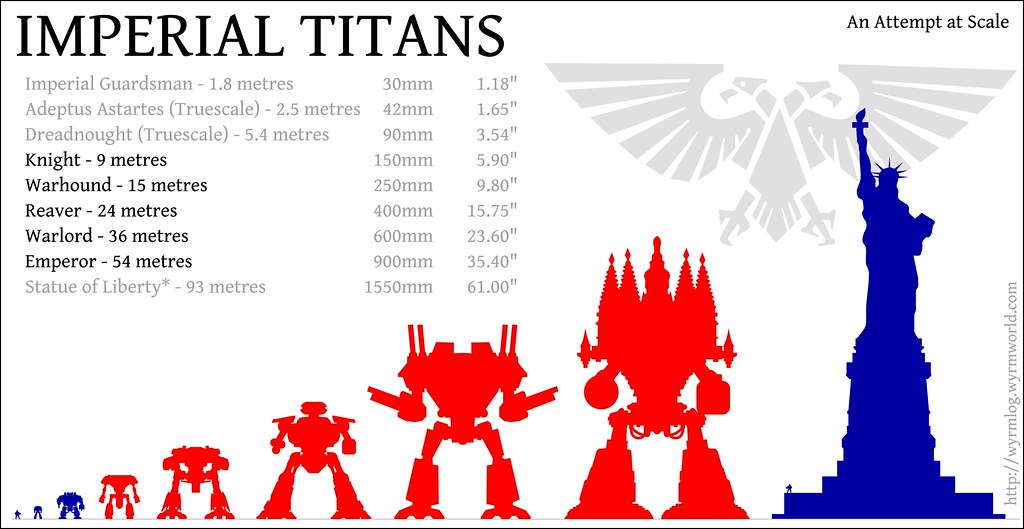
- The Imperium of Man is best known in this particular case for its Titans, giant humanoid mecha that range in height from around 15 meters in the case of the Warhound Scout Titan to at least 50 meters in the case of the Emperor-class Titansnote . What is known is that the Emperor-class Titans are essentially walking cathedrals that can house entire companies of troops in their legs and pack firepower sufficient to do ground-to-orbit duty against enemy spaceships and devastate entire cities in one shot. There are also reports of mecha large and powerful enough to metaphorically mop the floor with even Emperor-class Titans, such as the Apocalypse-class. In game terms, an official model for an Emperor-class Titan has never been produced, but it's said that if one was built to scale with the Space Marine models, it would be the size of a 10-year-old. Similarly, anything large enough to take down an Emperor-class is probably large enough that if a model was ever made, with a bit of work with power tools you could wear it to a tournament.note
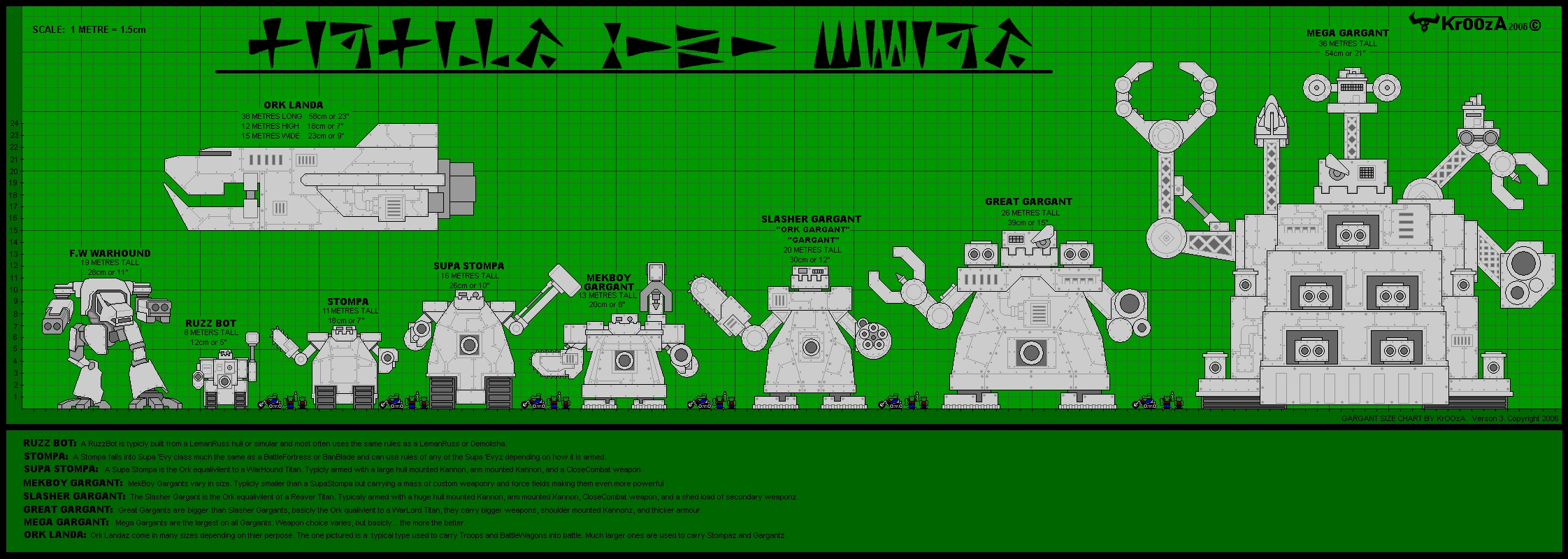
- Ork mechas that fall into this class range from the Stompa and its variants to the Gargants, huge effigies of Gork (or maybe Mork) that plod across the battlefield, hauling ludicrous numbers of Orks in their hulls and carrying an equally ludicrous amount of firepower. Here's a size chart for the most popular huge Ork vehicles.
- The Orks during the War of the Beast, where the Imperium encountered the eponymous Beast's personal "temple" Gargant, a vast, Hive City-sized Gargant larger than any other mecha in the setting! It had enough firepower to effortlessly destroy an Imperial Titan battlegroup in one shot, nigh unbreachable shielding, and could carry even more Gargants within. It proved to be nearly indestructible, and was only destroyed due to a Heroic Sacrifice made by the Primarch Vulkan.
- To further emphasize how large this particular Gargant was, an accurately scaled "miniature" of it would apparently be the size of a small office building.
- The Aeldari of the Craftworlds have the Revenant Scout Titan, the Phantom Battle Titan, and the Warlock Titan, which are comparable to the Imperial Warhound and Reaver Titans in terms of size but, as is the case with anything constructed by the Aeldari, move and fight with astonishing speed and grace for as large as they are.
- Double Subverted by the Animesque T'au Empire, who widely use battlesuits but for a long time didn't have anything of a scale to Imperial Titans, as they largely considered reports of such huge machines to be gue'la propaganda. When they realized that such mecha were very real and very dangerous, they responded first by creating the XV104 Riptide battlesuit, which stands taller than an Imperial Dreadnought and mounts enough firepower to destroy entire units on its own. They then moved on to the KX139 Ta'unar Supremacy Armour, which is the size of an Imperial Titan, packs comparable firepower, and is specifically designed to counter Titan-sized threatsnote . Interestingly, the fluff indicates that T'au had dabbled in larger battlesuit frames before, but quickly ruled out anything larger than the XV88 Broadside suits as resource and maintenance hogs with a bunch of obvious weaknesses that stem from being on the losing side of the Square-Cube Law, and R&D concluded the equivalent materiel in smaller, more reliable battlesuits would always be more efficient. The development of such uneconomincal machines is pushed solely by needing to counter a force that can afford to maintain regular units of such behemoths. Their original counter was to mount Titan-killing weapons on Tiger Shark fighter-bombers and snipe them from above; it's never really been explained why they abandoned the strategy, since it worked perfectly. (The Doylist reason is that standard flyer being able to take out a Lord of War titan would be absurdly unbalanced; though as of the 2022 Codex, anti-superheavy railguns are now a vehicle equipment option.)
- Golden Bat: The Ur-Example. The superhero Golden Bat fights a gigantic Super Robot as one of his first enemies. It began as a Kamishibai paper theatre show in 1930, before becoming a film and anime in the 1960's.
- BIONICLE: Mata Nui is a planet-sized robot containing the entire "Matoran Universe" within himself. It was inhabited and piloted by a "Great Spirit", also named Mata Nui, who was exiled by Makuta when he committed Grand Theft Me. Makuta apparently had plans to use this new body to conquer the universe, but they... kinda fell through.
- During his exile on Bara Magna, Mata Nui has found an older giant robot of nearly the same type, an early prototype for his former body, which the inhabitants had used as a shelter without knowing what it was. Mata Nui retrieved its power source, reassembled it, and activated and inhabited it to confront the approaching Makuta. It kinda didn't work.
- The Great Spirit robot actually carried two about human-sized pilots in its control center, placed there in case the robot malfunctioned or if Mata Nui lost control over his own body. Unfortunately, they died during the Great Cataclysm, which was caused by Mata Nui falling into a coma and crash-landing on a planet. Beyond this tidbit, though, the fact that he had manual controls never came up in the story.
- Kotobukiya's Frame Arms. The background story provide that the Frame Architect was originally suppose to be labor machine in grand scheme known as Project Re Sphere. After 10 years of trial and error, they finally get Frame Architect 001 which can mimic human movement perfectly and can use in all environment by swapping parts. Unfortunely, Project Re Sphere doesn't get launch and Frame Architect instead got turn into weapon known as Frame Arms by various nations.
- The Frame Arms Girls, in the form of Moe Anthropomorphism. Not only they retained the part swapping elements, all the parts between Frame Arms, M.S.G. weapon kits and Frame Arms Girls are in fact, all compatible.
- Hero Factory went this way for the 2014 sets. Instead of re-releasing the heroes with new armor and weapons, they were released as minifigures and put inside mechas to battle huge subterranean monsters.
- LEGO Exo-Force is LEGO's incredibly animesque foray into the genre, a take on the standard tropes and themes of a Humongous Mecha series.
- 30 Minutes Missions has the EXAMACS (Extended Armament & Module Assemble & Combine System), a type of mass-produced mecha unit with modular and interchangeable parts, allowing them to adapt to various environments and situations easily.
- The Mighty Grand Piton: The titular Grand Piton is a giant mecha inspired by similar robots from Transformers, Tengen Toppa Gurren Lagann and Giant Robo. The last shot of the short shows him facing an even bigger robot.
- Sarah Bryant's alien robot Adrastus.
- Xuan, R2, and Sanna discover that their guardian is a mecha in this page of Between Two Worlds. Xuan then becomes the mecha's pilot.
- Chicanery has the might of The 2000" TV's Frank.
- The VanGuard in Deviant Universe stands at 250ft.
- Girl Genius has plenty of them, given that Sparks love to build stuff like that.
- The first time that Agatha is without her Restraining Bolt, she builds a relatively small one out of a tractor and various spare parts in her sleep. It leads Baron Wulfenbach straight to her door.
- The Duke D'Omas' Walking Gunboats are, well, Exactly What It Says on the Tin. The Duke D'Omas was "mad as a bag of clams,"note though the gunboats do look most impressive.
- Tweedle first appears in the comic piloting one, though it almost immediately gets obliterated by a Dreen that he attempts to squash.
- Count Wolkerstorfer combines this with expertise in Magnetism Manipulation.
- The first time that Agatha is without her Restraining Bolt, she builds a relatively small one out of a tractor and various spare parts in her sleep. It leads Baron Wulfenbach straight to her door.
- Molly's robot lion from The Inexplicable Adventures of Bob!.
- Jayden and Crusader has a steam powered mecha flying a giant Union Jack.
- Kangtawoo is about a self-centered high school student who pilots a humongous mecha in order to battle the Spelta Empire.
- In the Minzuki issue of Li'l Gotham, a giant bat-mecha called "Battalion" is deployed to fight giant sea monsters (the issue does take place in Japan, after all).
- Webcomic subversion: In Mechagical Girl Lisa ANT, the A.N.T is a Humongous Mecha... for ants. To a human, it looks more like a Powered Armor.
- In MegaTokyo, the police cataclysm division (which facilitates cataclysms like 'zilla, zombie, and alien attacks, as long as they are done in an orderly fashion) employs mecha. They turn out to be less effective than robot-girl Ping.
- The Gyeoknoho in Panthera.
- Pixie and Brutus: In one Imagine Spot, Pixie appears as "Captain Pixie", saving the city from rampaging robots with her giant robot friend Brutotron. In reality, Brutus knocks over "robots" made from cups.
- Roomies!, It's Walky!, Joyce and Walky!: Joe manages to build a couple for SEMME. They're all modeled after their drivers.
- Sluggy Freelance parodies this a few times, most notably in the GOFOTRON arc.
- Mechateuthis in Episode 2 of Space Kid.
- In The Specialists, Max originally intended it to be a robot, but he could not get it to move right. solution: Mecha. (And he calls it a golem.)
- Stubble Trouble once showed a giant robot tearing up the city while fighting several superheroes. Guests from another webcomic (in a crossover appearance) wondered why nothing this cool ever happened in their town.
- Titanzer, the main character's robot and title of the webcomic.
- Tuesday Titans: The number one opponent the Titans face is the giant robots built by a hostile country. Horrifically large, heavily armed, borderline unstoppable by conventional means, and ready to destroy anything in their path, they're quite capable of giving the Titans a hard fight.
- Unsounded: Uaid is already a construct five stories tall and the Crescian fire-lopers tower over him, and are designed for war while Uaid is designed to protect those he carries from pymary.
- Huge, beetle-like giant mecha are featured in We Are The Wyrecats.
- The Champions (2018): When the Champions League goaltenders are asked to save the world from a meteor strike, Shaktar Donetsk's Andriy Pyatov leads them to Goaltron, a mecha built by the Soviet Union in the aftermath of the Chernobyl disaster. Stored under a football pitch in Pripyat for over 30 years, the robot requires five pilots.
- C0DA, written by former The Elder Scrolls series writer/designer Michael Kirkbride, takes place in the far distant future of TES universe. Numidium, the Reality Warping, 1000-foot-tall brass golem of Dwemer construction, presumed destroyed following the events of Daggerfall, returns after having been caught in a time warp. It continues its war on the Aldmeri Dominion, led by the fascistic Thalmor, leading to an apocalyptic event known as "Landfall", which has forced the remaining inhabitants of Nirn to take refuge on the moon Masser. The story centers around the Dunmer noble Jubal-lun-Sul, who must defeat Numidium as part of an Engagement Challenge.
- Fallen Kingdom: The Piglins' ultimate weapon is a giant Nether Star-powered mech which boasts great strength, though it's no match for the Ender Dragon.
- Friends at the Table even seasons take place in science-fiction world where powerful mecha gods called Divines exists. Science-fiction seasons are full of love for mecha and GM Austin Walker is devoted fan of genre.
- Ilivais X is a mecha anime in Web Serial Novel format, using both Real Robot and Super Robot influences. The eponymous mech (and the others like it) are more streamlined and shiny and just futuristic in general than other examples present.
- The Impossible Man dedicated a chapter to a giant robot called, The Clipperstein Mark 100 Version Beta II X Turbo.
- Kakos Industries:
- The annual Celebration of Techonology features a giant robot battle royale between different companies' giant robots on an undisclosed moon or planet, and have occasionally been fierce enough to destroy said undisclosed moon or planet. The first one described, in the episode "Kawaii", features a lengthy battle between the descriptively named OctoBot Plus Two and the Giant-Ass Schoolgirl That's Kawaii as Fuck, Yo.
- "Intimacy" features a giant-ass robot created by the same company that made the Giant-Ass Schoolgirl That's Kawaii as Fuck, Yo humping the Kakos Industries building throughout the episode. Corin gets on the case of company's CEO, Dirk Cornelius Sexplosion, to get rid of the robot before it reaches... completion.
- MetaBallStudios produces 3D animations comparing the sizes of various real and fictional objects and characters, giant robots among them. An April 30, 2022 video focuses most directly on mecha, with the title specifiying that it compares piloted robots.
- Orion's Arm: Mecha is a general term used for very large, pilot, and human- or animal-like vehicles, usually intended for combat purposes. They have issues due to poor balance compared to wheeled vehicles or ones propelled by slug-like, crawling foundations, but their appearance can serve as a psychological weapon. They very largest are called mega-mecha and can be big enough to hold entire cities inside of them. Due to the expense and difficult of keeping them going, they're usually either elaborate art projects or created to inhabit areas with hostile conditions — for instance, the planet Hardy is populated by large number of city-mechs that move around constantly to avoid their world's dramatic earthquakes, tsunamis and volcanoes.
- RWBY: Atlas has a massive humanoid robot called a colossus to defend the port city of Argus from the rare but extremely dangerous leviathan Grimm. Despite its power, it's immediately pointed out that the mech is basically useless outside of fighting leviathans; it needs support from ordinary army units to handle the smaller Grimm that will inevitably follow any leviathans. When the heroes have to fight the colossus, everyone realizes that the fact that the commander deliberately sent it out alone into a situation she knew it wasn't designed for is a sign of her rising insanity. This nearly gets Argus destroyed, as the heroes disabled the colossus and then a leviathan showed up.
- Scott The Woz features two instances of giant mechas fighting each other.
- The last third of "Anime Games" has Scott being pulled into an anime fight, with Scott and the opponent fighting inside giant mechs they conjured up.
- And in "It's Awesome Baby!", the villain turns his copy of Dick Vitale's "Awesome Baby!" College Hoops into a giant Sega Genesis mecha with a vat of goop he created that turns any game you submerge in it into a cyborg. He almost defeats Scott until the latter's copy of Madden 08 falls into the same vat of goop, giving him a giant green Madden 08 robot to fight with.
- SCP Foundation: The Foundation has SCP-2046, a giant mechanical robot built by followers of an ancient religion that would eventually become the Church of the Broken God. The included excerpts from one of the Church's holy books reveal that it was designed to fight Kaiju created by a sorcerer king's dark magic and prevent a cataclysmic event known as the "Sarkic Dawn." So, in other words, it's a Jaeger.
- There's also the Foundation's own SCP-5514, a mecha they created together with the Global Occult Coalition to fight giant monsters. And thanks to the use of anomalies in its design, it's highly effective at said task.
- There's also the Foundation's own SCP-5514
- Whateley Universe: "Tiny Tim", which the inventors are still working on, since — in keeping with real physics — it is so big that it can't take a real step. At least some of its weapons are working just fine if you can actually somehow contrive to get it out in the open, though.
- Aladdin: The Series: Clock Punk inventor Mechanikles must have read this entry, because most of his giant mecha are based on arthropods. One exception was a Humongous Mecha shaped like himself, but he soon lost it to a boy who fell into the cockpit.
- When Animaniacs did a Power Rangers parody, the water tower was the main trio's Megazord.
- Aqua Teen Hunger Force:
- Parodied in the episode "Fightan Titan" when Paul the Monster goes on a rampage in Seattle, Frylock recruits Shake, Meatwad, and Carl to assist him in piloting the titular robot to stop Paul. Unfortunately, the plan goes awry when Meatwad and Shake takes the arms and legs for a joyride, with Shake losing the legs after getting beaten up by one guy while Carl makes a break for it after seeing what they're getting into.
- Aqua Teen Hunger Force Colon Movie Film For Theaters: Frylock has Meatwad shapeshift into a giant meat-robot to fight The Insanoflex. Just like above, Meatwad immediately screws up the plan once the machine runs by.
- The Backyardigans: "Front Page News" features a giant robot.
- The Batman: "Artifacts" features a future version of Mr. Freeze using one.
- Batman: The Brave and the Bold: The Batmobile transforms into a Bat-Mecha.
- Big Guy and Rusty the Boy Robot: Big Guy is one of these, though the public are under the impression that it's fully automated. Maintaining this secret complicates several episodes, but Lt. Hunter always finds a way to maintain this secret.
- The BOTS Master: Jungle Fiver is easily the largest of all ZZ's robotic creations, five individual machines that combine into a single giant robot.
- Castlevania (2017): "The Good Dream": One of the portals that Saint-Germain comes across in the Infinite Corridor shows a bipedal mech stomping across the African savannah.
- Challenge of the GoBots:
- Codename: Kids Next Door had too many mecha count, probably because its creator is an anime fan. These are normally possessed by their enemies, especially the Delightful Children from Down the Lane, who have a seemingly inexhaustible supply. However, Numbuh Three (who is, incidentally, of Japanese descent) has her own mecha, Hippy Hop (A robot bunny). Then again, Hippy Hop never seems to get the chance to do anything each time it's deployed.
- Dexter's Laboratory: Dexter, being a boy genius, has several of this, with his personal favorite usually being comedically shorter than the others that have popped up on the show, likely because Dexter himself is short in stature. His rival Mandark has his own as well, and he once made one for Deedee, which went about as well as expected. When Dexter went to Japan, it poked fun at Japan's love for this trope by having Dexter try to impress some of the kids at the school he went to with his own, only to reveal they also had their own mechas as well... As well as their school teacher having one too, which she uses to scold them with.
- In The Dreamstone episode "The Monster", the titular monster is a giant robot that was scrapped by Urpgor, and accidentally reactivated by Blob, Frizz and Nug.
- Duck Dodgers: Both Dodgers and Cadet Porky utilize their own mechs to fight a renegade monster; Porky's machine turns into a giant gun, while Dodgers's transforms into a hand, which he uses to operate Porky's gun.
- The Fairly OddParents!
- An Oh Yeah! Cartoons short had two. First, the short opened with the Crimson Chin fighting the Frederator Robot. Then, at the end, Cosmo and Wanda poof up a giant robot so Timmy has a villain to fight.
- In Mr. Dinkleberg's first appearance, he and Mr. Turner turn their cars into giant robots and do battle with them.
- In Felix the Cat (Joe Oriolo), the Master Cylinder was this in his debut episode, but he quickly abandoned this form for a smaller, more compact and mobile body.
- Futurama got in the act after Nixon got re-elected.
- The Mobile Oppression Palace.
- Giant Bender in the first "What if" episode.
- The anime-style segment in "Reincarnation" of course features one of these, albeit briefly: Zagtar, a Voltron pastiche.
- Generator Rex:
- Episode 19 reveals that Rex can turn into one.
- In "End Game", The Meta enhanced Consortium can merge into one.
- In "End Game part 2" Rex gets an Omega build version of his one
- One episode of The Godzilla Power Hour had The Colossus of Atlantis, a giant robot in charge of awakening the Atlanteans when they went into suspended animation to escape the great earthquake that sank the city.
- The Lizard Slayers in Godzilla: The Series.
- Gravity Falls:
- In "Gideon Rises", Lil Gideon pilots a giant robot version of himself as part of his plan to finally get the deed to the Mystery Shack and ruin the Pines family's lives.
- In "Weirdmageddon Part 3: Take Back the Falls", the plan to save Ford and the rest of the town from Bill is to turn the Mystery Shack into one of these, using various materials both manmade and fantastical. The result is glorious.
- Insektors had Koa the Frog/Operation Frogbucket, which resulted in an army of giant mechanical frogs.
- Invader Zim had one in the first episode, which Zim used to accidentally destroy most of his own planet's army and city. A later episode had the titular MegaDoomer, which was smaller but had the ability to become invisible (although the pilot and the power cord it had to be plugged into remained visible).
- Jelly Jamm has an episode where Mina builds a giant robot to help Bello change the lightbulb on his Jammboman helmet, Jammboman being Bello's pretend superhero persona. Bello later tinkers up the robot, turning it into a mech called Jammbobot for Jammboman to use to aid in his crime-fighting pursuits — it even has a theme song ("Jammbobot! Jammbobot! Jammbobot! Jammbobot!").
- On Jimmy Two-Shoes, Heloise has several, including a spider-shaped one named Angela.
- Quite a few are built in The Jungle Bunch. They're all made of logs and twigs.
- The Justice League episode "Legends" starts with the League battling a giant machine in the city that's controlled by Lex Luthor from a distance.
- Kim Possible has plenty of giant mechas. Examples the robot from the pilot, the robots from The Movie, the robots from the Grand Finale and a big flamingo.
- The mecha tanks in The Legend of Korra were created by Hiroshi Sato for the Equalists. Team Avatar and even Tenzin have to try and fight them throughout the latter half of Book 1. And in the end, Asami Sato gets into a final showdown with her father with this machine, which she said works like a "Future Industries forklift".
- They get an overhaul in Book 4, with actual legs and flamethrowers, coming closer to Powered Armor. Later, there's also a two-man "hummingbird" variant capable of flying. Near the end, Kuvira unveils the Colossus, a proper Humongous Mecha roughly 25 stories high made of platnium (so it's immune to metalbending) armed with a Wave-Motion Gun fueled by spirit energy.
- In an homage to Lex Luthor's Powered Armor, resident Rich Bitch Alexis apparently built her own (relatively small) mecha-suit in Legion of Super Heroes (2006).
- Cartoon Network's Megas XLR is possibly the best Western parody, with an alien robot from the future crash-landing in a New Jersey junkyard, where the main character, Coop, buys it for two bucks... which he never actually pays.
- Our Cartoon President: In the 2018 Election Special, Hillary Clinton drives a robot version of herself to deliver a speech to the crowd and take down Donald Trump.
- Parodied in Pinky and the Brain: Brain and his archnemesis Snowball the hamster are battling in their robotic human disguises when suddenly Snowball's suit transforms into a Humongous Mecha, complete with rockets blasting out of its shoulders.
- The Powerpuff Girls (1998) After seeing how dangerous their missions can get, the Professer invents the Dynamo (DYnamic NAnotechtonic MOnobot). The girls, being Flying Bricks already, spent most of the episode ignoring it, much to the Professor's dismay... Until they eventually encountered a Kaiju they couldn't beat on their own, and thus had to break it out to fight it. Unfortunately, being Destructive Saviors already, the fight ends up demolishing near all the city in the process and, as a result, the townsfolk demand the girls never touch the thing again.
- Their Japanese counterparts also have their own version of Dynamo, except this one consists of three Dynamos, one for each girl. They’re much more reasonable while they handle them in fights.
- ReBoot had one that was a parody of Power Rangers which was used to battle a Godzilla parody.
- The Robotix, who (like the Go-Bots) were originally an organic race before transferring their minds into robotic bodies.
- Samurai Jack: In "Robo-Samurai vs Mondo Bot", Jack takes on a rogue attack robot destroying a city while using his own stone giant to fight it.
- South Park
- In the episode "The New Terrance and Phillip Movie Trailer", Chef's giant plasma TV transforms into a humongous mecha and goes on the rampage. By the end of the episode, Chef is still on the phone with customer service, trying to shut down the TV.
- Barbra Streisand transforms into a humongous mecha and goes on the rampage. However, it's not a not humanoid but a godzilla-like machine. The word 'mecha' is used in the episode to describe Ike, who's merely giant and not mechanical in any way. She returns in episodes 200 and 201, upgraded and deadlier and very angry at the town.
- Brian Boitano traveled through time to the year 3010, fought the evil robot king and saved the human race again.
- Space Ghost episode "The Challenge". Zorak creates a giant robot that has powerful beam weapons and a force field and challenges Space Ghost to fight it.
- Storm Hawks: There's a couple giant, piloted mechas in the series. First, there's the Storkasaurus that Stork builds out of pieces of the Storkmobile amidst his breakdown, then there's the Suit of Untold Vengeance which the Dark Ace steals for himself in another episode.
- Super Robot Monkey Team Hyperforce Go! is about a kid and a bunch of robot monkeys who live in a Mecha.
- Sushi Pack: Kani built one out of bamboo, but since the Pack are bite-sized themselves, it's only as big as a normal human.
- Sym-Bionic Titan: The titular robot is formed by the combined armors of Lance and Ilana along with Octus to battle the Mutraddi MegaBeasts.
- Cyborg builds one for the team to use in emergencies on Teen Titans Go!. Robin is very excited to use it until he learns he's the left leg.
- Parodied in Total Drama Island, where Duncan, while trying to catch a raccoon, faces a horde of raccoons forming a huge machine-like army by standing on top of one another. Duncan comments that it's "more than meets the eye!"
- Parodied again during Action. Harold and Beth have to fight in ones during the Kung Fu challenge, but they turn out to be very simple, giant versions of Rock 'em Sock 'em Robots with Duncan and Courtney controlling them.
- Transformers and the various series showcase a Western version of the archetypical transforming mecha. It's especially notable because unlike the usual mecha show, there are no pilots or crew to be the stars — the mecha themselves are the stars, being sentient robots.
- Even in a show of humongous mechas, some of them were EXTREMELY humongous. There was Sky Lynx and Omega Supreme, who were overshadowed by the fortress-bots Metroplex and Trypticon, who were in turn dinky compared to the city-bots Fortress Maximus and Scorponok. To say nothing of the Chaos Bringer, Unicron, or the Transformers' creator god, Primus, who are freaking planet-sized Transformers.
- In Transformers: Animated, the aforementioned Omega Supreme (and apparently, every other Greek letter Supreme) are Humongous Mecha driven by Transformers. Giant robots driving giant robots, yes.
- T.U.F.F. Puppy had an episode called "Dog Daze" where Snaptrap owned one he used with his D.O.O.M. organization to wreak havoc on Petropolis. It humorously was acknowledged by him and Dudley to get horrible fuel mileage.
- Parodied in The Venture Bros.. Season 1's "The Trial of the Monarch" features Hank & Dean's fanciful retelling of a battle with the Monarch in which they become "Mecha-Shiva". Season 3's "The Lepidopterists", Jonas Jr.'s team form a Voltron like mecha to take on the Monarch.
- Nox's Giant Spider Clock Fortress in Wakfu.
- Wander over Yonder had the Robomechabotatron; which Wander, Sylvia, Lord Hater and Commander Peepers had to work together to operate to try to take down Lord Dominator (whose spaceship could also transform into one). It went about as well as you expect...
- In the Wile E. Coyote and the Road Runner short "The Solid Tin Coyote", Wile E. resorts to building a giant remote-controlled robot from scrap metal in his latest attempt to catch the Road Runner.
- Code Guardian, set during WW2, has a giant German mecha duke it out with a giant American mecha as the former tries to destroy a naval ship yard only to have a giant Japanese samurai mecha show up at the end.
- Destroy the Godmodder 2 uses these as the basis for the godmodder's armies fairly often, usually in the shape of Minecraft mobs.
- There are lots of others, Optimus Prime and Redeemer Hitler being two examples.
- UNMD First Contact is based around using these to fight Kaiju.
- Some kind of weaponized excavator would come pretty close to a more feasible version of the same concept, as demonstrated on one double-length Scrapheap Challenge special (albeit with smaller excavators then you'd need to really be this trope).
- Something close to this was actually developed by the US Air Force, in the form of the General Electric Beetle. It was designed not for combat, but as a maintenance platform for proposed nuclear-powered bombers. Because the operator would have to be shielded from the radiation, he would need to somehow work on the plane's reactors without touching them. Form therefore followed function, and the end result was bizarrely humanoid.
- Something close to this was actually developed by the US Air Force, in the form of the General Electric Beetle. It was designed not for combat, but as a maintenance platform for proposed nuclear-powered bombers. Because the operator would have to be shielded from the radiation, he would need to somehow work on the plane's reactors without touching them. Form therefore followed function, and the end result was bizarrely humanoid
- Though by no means humanoid, the largest dragline excavators could be considered to loosely fit this trope, at least in the sense of being giant vehicles that move by walking. Examples [1].
