

Real robots are what happens when Humongous Mecha and Military Science Fiction collide; they're mecha that are treated just like any other weapon of war. Unlike the Super Robot, real robots are typically mass produced units designed and built by governments and large corporations, rather than something designed and built by (or for) a single person—though the occasional Super Prototype or Ace Custom may be an exception. While real robots might be the dominant weapon of the setting, they frequently appear alongside other forms of combat vehicle (like the Cool Tank, Cool Plane, and Space Fighter) rather than replacing them entirely. In other words, instead of being the be-all and end-all of a conflict, real robots are simply another cog in the war machine. As such, Real Robots tend to look plainer than their Super Robot predecessors. Simple and/or drab colors, heads that are either blank, cycloptic, or resemble a gas mask are common, if the mech has a head at all—the general humanoid form is more likely to be relaxed, if not thrown out entirely. Indeed, in many settings, Real Robots look more like Walking Tanks than giant soldiers. Real Robots also tend to be smaller than your average Super Robot. It's fairly common for them to be less than forty feet tall, or even as small as ten feet.
Real robots also tend to be found in harder sci-fi settings than super robots would, often involving elaborate forms of Applied Phlebotinum to explain why giant robots are physically possible to create and tactically advantageous to use. On the harder end of the scale, this explanation may become a full-blown type of Minovsky Physics. Even on the softer side of the scale, real robots usually take into account things like the immense cost in time, material, and expertise of operating a machine as large and complicated as a giant robot would inevitably be. Expect to see references to things like extensive maintenance requirements, the logistics of supplying fuel, ammunition, and spare parts, and other such ancillary issues.
Of course, all of this won't stop an Ordinary Highschool Student with no one but a Ragtag Bunch of Misfits for support from Falling into the Cockpit and saving the day when the plot requires it, but it will make such a feat seem all the more impressive when it happens. Oddly enough, because of the emphasis on realism for the mecha, real robots tend to make their pilots be the ones to stretch Willing Suspension of Disbelief instead. After all, when you can't rely on pure Hot Blood and The Power of Love to save the day, then it's entirely up to the main character's Heroic Spirit and Improbable Piloting Skills to do the job instead—and how unrealistic is that?
Real robots are often Humongous Mecha, but other types like Mini-Mecha or Powered Armor are also common. Compare and contrast with Super Robot Genre and Magical Girl Genre Deconstruction. See also Walking Tank.
Examples:
- Gundam was the Trope Maker, though it didn't completely shed its roots and retained plenty of Super Robot Genre traits. A Gundam tends to become infamous to the enemy and wholly unique unto itself. Still, barring few exceptions even the Super Prototype Gundams are solidly real robot in the "treated as weapons, not superheroes" sense, as they are powerful but can't alter the war by itself, while the grunt suits are entirely Cannon Fodder. The shows that deviate from this (like G Gundam, Mobile Suit Gundam Wing, and ∀ Gundam) still emphasize War Is Hell through costly conflicts.
- The original Mobile Suit Gundam launched the genre in part by establishing a tech-line on both sides of the conflict. The Federation had traditional military vehicles that were getting pounced on by Zeon's mobile suits, the titular Gundam was the third prototype for Federation-based mobile suit technology, and was accompanied throughout the series by the Guntank (a hybrid humanoid upper body with tank treads) and Guncannon (humanoid design with shoulder-mounted artillery weapons). On Zeon's side, it progressively introduced newer and more advanced designs to try and match the Gundam. By the mid point it's revealed that the Federation had already begun production of the GM "Jim" line, non-Super Prototype versions of the Gundam, making the Gundam itself less significant to the course of the entire war, especially compared to the Super Robot Genre. Rather interestingly enough, one of Zeon's major downfalls was investing too much in Super Prototypes rather than developing a solid mass-production unit. As a result, the Gelgoog wound up getting pushed into production far too late for it to have any meaningful impact.
- The OAV Mobile Suit Gundam: The 08th MS Team is one of the hardest Gundam shows to date. Much attention is paid to maintenance and logistics—to the point where some of the mecha in question undergo changes (including one near-total redesign) while being repaired, due to a lack of spare parts. The techs are basically MacGyvering them back together. There's also how they're actually used in the series—they're seen used in combined operations, supporting and being supported by infantry and other vehicles, rather than still being superweapons that handle their battles on their own like in the other series.
- Take a step further in Mobile Suit Gundam MS IGLOO, especially MS IGLOO 2 (pictured above) which shows early battles from the One Year War where the earth forces don't have any mobile suits and combined arms operations involving infantry and tanks are shown alongside mobile suits.
- Another one of the hardest Gundam shows would be Mobile Suit Gundam 0080: War in the Pocket. The crux of the story revolves around an enemy group tasked with destroying a Super Prototype Gundam in the testing stage. It is really more about espionage and a surgical military strike than the big battles of other shows, it has the fewest action sequences per episode of any Gundam series.
- In pure terms of Technology Porn, Mobile Suit Gundam 0083: Stardust Memory featured very intricate mech designs and the plot started off via one Gundam with First Strike capabilities being stolen. The political ramifications of this (given that nuclear weapon development was outlawed during the last war) is more important than the technology being fielded by the Gundams.
- Mobile Suit Gundam Unicorn is also fairly hard in this aspect. Unicorn introduces the Federation's special operations unit ECOAS, who rather predictably tend to operate boots-on-the-ground. The Beam Magnum, while powerful, is also noted to be supremely inefficient, consuming an entire e-pac per shot, on top of having recoil so strong it'll severely damage the arms of machines not designed to handle it. There's even two scenes where the main character ends up burning through his machine's fuel twice, with it coming back to bite him in the ass.
- The only Gundam series to discard the Real Robot Genre and be purely Super Robot Genre is Mobile Fighter G Gundam. The entire series is a Tournament Arc where each Gundam is custom built by each nation to participate in the Gundam tournament, with the prize for the winning nation is to be in charge for four years until the next tournament. The technology is more fantastical than anything resembling real science, with Hot-Blooded and The Power of Love having an actual impact on Gundam performance. Even more notably, very few grunt suits are seen, every mobile fighter is a Gundam.
- Mobile Suit Gundam: Iron-Blooded Orphans: Not only did it omit beam weapons to emphasize the seriousness, the setting of Child Soldiers goes Darker and Edgier compared to the past. Fights are brutal, messy affairs with an emphasis on blunt weapons to crush the cockpits of the enemy mechs, and not even the Gundam is immune to the lack of supplies that force Tekkadan to scavenge parts from fallen enemy mechs and use retrofitted mobile workers as support units. As it turns out, though, beam weaponry isn't nonexistent, but forgotten, and the cast discover this in the most nightmarish way possible. The Mobile Armors possess technology that no faction in the current conflict has, not even Gjallarhorn. While mobile suits have a coating that is highly resilient to beam weaponry, they still prove very effective at their original purpose of wiping out unarmored vehicles, structures, and people.
- even in the aforementioned Mobile Suit Gundam Wing, the non Gundam-tier suits are built to be utalitarian military combat vehicles to be mass produced and deployed with squad tactics (especially the virgo mobile dolls towards the end). Even the Super Robot Gundams are shown to require an extensive maintenance and supply network, and in the final arc are constantly harassed to prevent them from being able to rest up and do proper repairs and maintenance.
- Patlabor, where mecha are mostly used in a non-military setting by industrial workers and the police. Some militaries (the Japanese Self Defense Forces and Schaft Enterprises in particular) have mecha too. There's also a lot of attention paid to the Labors' limitations and how maintenance-heavy machines like that are: their torsos are mostly hollow to save weight and keep the center of gravity low for stability, and almost as much attention is paid to Special Vehicles' crew of mechanics as to their pilots.
- Predating Patlabor, most mecha in Combat Mecha Xabungle, with exception of few models (like the Xabungle), are actually working machines used for digging mineral. However, the savage Wild West-ish setting means pretty much every mech is also armed with a weapon.
- Super Dimension Fortress Macross toyed with this for a while, as it did most tropes. While the Valkyries and Destroids are quite clearly just advanced military hardware from the outset, for a while it appears that the eponymous Macross itself might qualify for Super Robot status, what with its main cannon capable of blowing away entire enemy fleets in a single shot. That is, until the climax of the show where it's revealed that hundreds of thousands of Zentradi ships have a gun like that, they've just been refraining from using them as they wanted to study the Macross and its inhabitants before destroying it.
- The Macross franchise as a whole straddles the line between this and the Super Robot Genre; there are a number of fantastic plot elements, most notably in Macross 7, but the pseudo-science explaining them is mostly internally consistent, even if it resorts to Hand Waving on occasion. What keeps the franchise primarily in the Real Robot category, however, is that even its most advanced mecha are never treated as anything more than advanced prototypes or custom-modified mass production models.
- In Super Dimension Cavalry Southern Cross, even the three-mode transforming mecha are clearly just mass production models; in fact, the most "super"-looking pieces of military hardware are the main cast's body armor. Perhaps not coincidentally, most of the Southern Cross model kits released were of the show's body armor, rather than its mecha.
- In Genesis Climber MOSPEADA the main characters' Plot Armor seems more super than their mecha. They've got futuristic technology; yet are still plagued by fuel shortages, easily tracked by their energy output, generally replaceable (with a main character loosing one mecha and getting a similar one later), and focused on super-advanced motorcycles which can be found lying around unused.
- Robotech, which consists of SDF Macross, Southern Cross, and Mospeada meshed together with a Frankenslation.
- Robotech II: The Sentinels, an attempt to do a proper sequel to Robotech, would have original designs based on the mechs seen in SDF Macross and Southern Cross.
- Martian Successor Nadesico: Played with, in that many of the mecha pilots are fans of Super Robot shows, and try to bring in the associated tropes. (Sometimes this is vaguely successful. Sometimes this is tragic.)
- Armored Trooper VOTOMS, which is famous as being one of the grittiest and hardest mecha shows ever released. The mecha are small, ugly and utilitarian and seemingly very disposable, at least to the main character who goes through dozens of them by the series end.
- All the mecha in Str.A.In.: Strategic Armored Infantry but Ram-Dass and the Gloire are mass produced (and the pilots are generally expendable).
- Dai-Guard has the odd distinction of being a Real Robot in a Super Robot Genre show. While the format is pure super robot genre—featuring the Dai-Guard versus the Monster of the Week—the Dai-Guard itself is extremely real robot, with not only maintenance and logistics taken into account, but also things like insurance for the property damage they inevitably cause, or the mountains of paperwork its pilots have to keep up with. The only reason the Dai-Guard is the only mecha they have to fight the Heterodynes is because no-one else bothered to build and maintain such an expensive machine when there was no obvious use for it. Once Heterodyne appearances become frequent, the military does eventually build their own.
- Code Geass has a solid Real Robot setting where its small Knightmare Frames are originally used in a way that is halfway between modern entries in the Mobile Suit Gundam universe and Armored Trooper VOTOMS. During the second season, a rapidly-accelerating Lensman Arms Race takes place, which means that the two most advanced Knightmare Frames end up being head and shoulders above anything else by the finale.
- HAVWC units from Flag are usually deployed from real-world Osprey transport helicopters, and use their four-wheeled mode to travel across terrain before the four wheels come together underneath the machine to make it "stand up" so it can fire its massive gatling gun. It also requires extensive modification and testing to attach a new weapon to it (to the point where an entire episode is devoted to tuning a machine in preparation for loading a giant sniper rifle onto it).
- The Ridebacks from the anime/manga of the same name, vehicles with arms and the ability to convert between a motorcycle-style speed mode and a humanoid maneuvering mode.
- Gaiking: Legend of Daiku Maryu uses a number of real robot conventions, such as having its own style of Minovsky Physics and paying attention to things like supplies, despite the original Gaiking (a Toei anime from the '70s) being entirely Super Robot Genre.
- Blue Comet SPT Layzner is definitely one of these, to the extent that ammunition & fueling are actually key plot points.
- The Five Star Stories is definitely this. The author's notes go into much detail about the key components of the mecha, and an entire volume was once spent repairing one.
- Viper's Creed with the Maneuver-Roid, which can switch between a mech and a motorbike. These are heavily customized with different weapons and equipment, depending on the operator. Given that Shinji Aramaki made the majority of the show, it should be no surprise to anyone. The mechs are powered up thanks to the electrical supply built in the highways after World War III and global warming.
- Gunparade March pits real robots against Kaiju. Another entry in the franchise, Gunparade Orchestra, is significantly softer than March but both treat their mecha as essentially giant infantry—with many of the same problems.
- Argevollen: the titular mecha at first looks like it should be a Super Robot, and it's easy to make this assumption: it's a Super Prototype that can only be piloted by the main hero because it's synced to his thoughts, and it's ridiculously agile when compared to the other Trail Kriegers of the series. But we quickly see that it takes a lot of effort to get the Argevollen to be able to pull off these kinds of stunts, and it is in constant need of maintenance and system checks. In one episode, the Argevollen is out of commission because it needs to receive a firmware upgrade. In addition, it's hinted that the MegaCorp that built the Argevollen considers it disposable, so long as they archive the combat data acquired.
- The war in Aldnoah.Zero is primarily fought with Real Robots, known as Kataphrakts. The Terrans of the United Forces of Earth use relatively simple mass-produced units that basically function like super-sized infantry, armed with scaled-up rifles, handguns and combat knives. The knights of the Vers Empire, on the other hand, make use of unique, custom-built Kataphrakts whose enormously powerful Aldnoah-based abilities put them on the verge of being Super Robots.
- Though having a group of Ordinary High School Students become badass pilots, as Inaho and his classmates do, is nothing new for a mecha anime, the series does go through lengths to justify it. With the situation between Earth and Mars being as tense as it was after the first war, the high school curriculum now includes Kataphrakt combat training.
- Knights of Sidonia features Guardians, which are extremely fragile in comparison to the Gauna, run out of fuel quickly, can't work in gravity besides a couple specific units, and in general are coffins with a Bosen particle engine strapped to them. Even the protagonist's Tsugumori is only superior in the sense that in the hands of a pilot that can handle its idiosyncrasies it can move very quickly.
- Panzer World Galient features Gundam-sized, mass-produced Panzers, which are used mostly by Marder.
- In a sense, Neon Genesis Evangelion played around with real robot genre tropes for a while, before subverting humongous mecha shows in general. The Evangelions are barely-functional prototypes that never really get improved upon, and constructing them isn't just expensive, it's bankrupting multiple nations, but they're kept around because nothing else works. In terms of energy-consumption, the Evas are more realistic than anything else on this page, operating on a tether and being a fairly large drain on the power grid. The Evas' weapon and equipment loadouts, aside from the one-of-a-kind Lance of Longinus, are relatively disposable. Firing a mech-sized ray-gun requires turning off power to most of Japan for several minutes, and aiming it is extremely difficult. Moreover, the traumatic psychological effects of being a child soldiernote are the whole point of the show. Then, of course, all of this realism gets subverted when you find out, over the course of the series, that the Evas generate an energy shield that can only be generated by a soul, that they are actually giant human-angel hybrids, for which the armor is more of a restraint and control system that still doesn't prevent them from going berserk, and that the aformentioned soul usually has to be from the pilot's mother, among many other revelations that push the show way out the other end of Super Robot Genre and into deconstruction territory, if not Cosmic Horror Story.
- Heavy Object manages to be surprisingly crispy for a mecha series. It fits pretty solidly at the One Big Lie level: the Objects are built for the most part on existing or theorized technology, with only their sheer size seeming to defy physics. There are also realistic powered suits as well.
- The Exoframes from Obsolete, despite their extraterrestrial origins, still require periodic maintenance by their human users, and can be damaged or destroyed with sufficient firepower.
- The Willwears used in Active Raid require constant maintenance to ensure that they're still working the next day and power to be functional. The NPA also needs a special launcher in order to deploy them, which is mounted on their special train.
- AMAIM Warrior at the Borderline have the AMAIM, a mech created by the various supernations and were used in the Japanese occupation before and after it was carved out. Not surprisingly, anti-occupation groups have gotten access to AMAIMs in order to fight back.
- Rumble Garanndoll has the Garrans, used by the Shinkoku Nippon military when they invaded Real!Japan in 2019 through a dimensional portal, taking images from dogs/wolves. Arahabaki is formed to fight back with their own mechs known as the Garrandoll, except they're a super robot since they're powered by battery girls. But the pilot's power is based on own geekiness in popular culture.
- Aura Battler Dunbine mostly adheres to the genre. Directed by Yoshiyuki Tomino, the same person who directed Mobile Suit Gundam, the flying, humanoid "Aura Battlers" are just one class of "Aura Machine". Not only are they mass-produced and often use combined arms tactics with other Aura Machines, cavalry, and infantry, they're also very small by Humongous Mecha standards, and they're often seen being maintained and supplied between battles. It has some Super Robot Genre quirks, though: Aura Machines are powered by Life Energy called Aura; all Aura technology is ultimately derived from the work of one or two geniuses; and machines can be "powered up" by pilots with strong Aura, increasing their strength and speed beyond expectations (which can even cause Aura Machines to enter a Super Mode in which they grow to immense size, but this is described as a dangerous technique that requires evil intentions, so only the villains do it).
- Synduality: Noir has the anime blended with some Super Robot aspects. The mechs used in the anime are known as Cradlecoffins or Coffins. The mechs have a pilot and an android known as a Magus to help the pilot navigate around and provide fire support. Taking out a Magus (or disabling a Magus) will lower a Coffin's fighting capabilities. But the Coffins need to have routine maintenance and have their weapons reloaded.
- The Powerloader from Aliens is a non-combat mecha that straddles the line between Mini-Mecha and Powered Armor (minus any actual armor; the "cockpit" is open-air), used—as the name suggests—for hefting cargo around. The depiction was so realistic that reportedly some construction firms asked the production company where they could get one.
- The AMP suits from Avatar are fairly realistic Mini-Mecha. Their vaguely humanoid shape (including hands) is justified because it makes them more natural to pilot (and the audience actually gets to see this when the controls are shown in use), and gives them the flexibility to be used in many roles—several times they are seen loading and unloading containers and doing other heavy non-combat work. This flexibility also means the suits can operate a variety of heavy weapons, without needing to have Arm Cannons built in. The Pandorapedia has an article on them
 detailing lots of other realistic design details. It notes that the AMP suits were based on earlier powered military exo-skeletons (which are actually being developed in Real Life).
- The Matrix has the Armored Personnel Unit (APU) mechs although calling them "armored" is a misnomer... During the Human-Machine war, the machines cut through these easily (as we are graphically shown in The Second Renaissance Part II)- having armor on them adds more weight and maintenance than necessary.
- Iron Man 2 begins with Tony Stark showing Congress the many real robot weapons programs around the world such as North Korea, Iraq, and other countries and corporations. All tests fail miserably and Tony is sure that no one will be able to develop mechs or suits of armor for years. The Big Bad ends up taking the human element out and building an army of robot drones instead.
- For the most part, the Jaegers in Pacific Rim blends this with Super Robot Genre. The Jaegers are Real Robots in that they're explicitly built by a military-industrial complex and time is given to the extreme amount of resources, logistics and support required to drive and maintain them. On the other hand, individual Jaegers are treated like Super Robots, what with their colourful and individual names and designs, being humanity's 'only hope', and fight using common Super Robot tropes like rocket punches, wrestling moves, unique fighting styles between each robot, the 'drift' and the Absurdly Sharp Blade of Gipsy Danger being its ultimate weapon
- Robot Jox was an early attempt by western filmmakers to capture the intensity of capture the scale of Transformers or Gundam on the big screen in a relatively grounded fashion, with mankind building and maintaining giant robots to be piloted by individuals as an alternative to full-scale war. Each pilot has a team of specialists watching from the sidelines to help learn the opponent's strengths and weaknesses in the heat of battle, and it's even become a spectator event with referees and crowds gathering to watch and bet on the outcomes, even as real-world politics are also influenced by the victories.
- War of the Worlds: Goliath has three-legged Walking Tank mecha of various sizes as A.R.E.S.'s ground combat forces, the larger ones requiring several crewmembers to operate, backed up by airships and planes.
- Star Wars sometimes approaches the genre through the use of various war machines called walkers. The smallest of them are basically Mini-Mecha that give a single occupant a gallop over uneven terrain, but the more famous ones are the four-legged AT-AT that is a mobile artillery and troop transport and the two-legged AT-ST "chicken walker" that is better fitted for guard patrols. But the setting has no shortage of regular sci-fi tanks, planes and hover cars either.
- The Next Generation -Patlabor- is a live-action version sequel of the idea Patlabor has, except labor companies have shut down most production lines and police/military forces are forced to keep them running in working condition.
- 86 EIGHTY-SIX has the M1A4 Juggernaut. Despite it's name, it is an aluminum coffin of a Spider Tank, with armor so thin as to not deflect small arms fire and lacking such basic safety features as airbags. It is underequipped for the job at hand, armed with a singular 57mm cannon that struggles with penetrating enemy armor. This is deliberate, as the Republic of San Magnolia is an apartheid state and the Juggernauts are solely piloted by minorities being used as meatshields against the invading AI Legion, which the Republic is under the impression will shut down after five years. The Juggernaut's successor, the Federacy's XM 2 Reginlief, is significantly hardier and does more to ensure the pilot's safety, although it is still a very vulnerable machine compared to the Federacy's other mech, the Vanagandr.
- Bullbuster is best described as Pacific Rim by way of Patlabor: the titular mecha was designed by Namidome Industries to deal with overgrown and mysterious animals named "Kyojū." Unfortunately, the mech is a money sink for the very tiny company that is Namidome Industries and the pilots are ordered to not miss their shots because bullets are very expensive. The design of the "Bullbuster" could also be described as "the Power Loader of Aliens as a combat mech".
- Full Metal Panic! has a notably serious and semi-realistic depiction of mecha on a battlefield. Of course, having the series point out that mecha are unrealistic (and using physics-defying Black Box Applied Phlebotinum generators as power sources) gives it room to keep a Super Robot Genre trope or two.
- Most novels in The History of the Galaxy series prominently feature serv-machines, which are mass-produced and piloted by a human/AI combination, with the AI learning non-standard tactics from humans. Can also be piloted by AIs, but off-the-assembly-line models are not very effective, as they lack experience. The author likes to go into technical detail regarding the operations of these machines. Typical of the genre, there are multiple models geared towards specific roles on the battlefield. The most common ones are the heavy Phalanxer and the light Hoplite, which often work in combat pairs with the Phalanxer providing heavy, long-range support, while the more nimble Hoplite keeps it safe from enemies that get too close or provides scouting intel, such as target-spotting. Other mentioned models are the medium Raven and the obsolete Golden Eagle. There are also LDL-series walkers mass-produced by the Free Colonies during the First Galactic War. Unlike the Earth Alliance serv-machines, the LDL ("Large Driver Laser") walkers are fairly primitive, lacking a full AI and only fitted with a single weapon. The LDL-55 variant (the most commonly featured) has a 200-megawatt laser and is designed to network with other LDLs nearby. While no longer produced, they can still be found on old battlefields, possibly fighting their ancient enemies.
- The interactive gamebook Robot Commando has the hero piloting various mecha, but they're relatively down-to-earth, seeing as the book seemed to be taking most of its cues from BattleTech. Powerful as the player's mech might be, it can still be brought down by the enemy mechs and dinosaurs they encounter, requiring the reader to get smart and pick their strategy carefully if they expect to last to the end.
- Stone King is set in Japan where the JSDF is forced to conscript young people to operate bipedal mechs known as Titans in response to hostile aliens known as the Eschatos.
- The Deinonychus Combat Mech and the Bellafaun Archangel types from Zetsubou Robo are a more recent American example of the trope. The book mentions that the Deinonychus itself is an evolution of standard industrial mecha found in low-gravity colonies and mining locations when military thinking is applied to what is otherwise a glorified construction machine.
- Most robots in Chou Sei Shin Gransazer fit the trope of Super Robot more, as they are ancient machines of alien origin, with the power to materialize weapons at will as well as transform and combine. However, the JSDF managed to create a robot of their own, which functions more like a Real Robot, as it doesn't transform, combine and only has access to realistic weaponry.
- Super Sentai usually veers within Super Robot territory, but a select few series add more realism to the giant robot aspect.
- In Tokusou Sentai Dekaranger both the Rangers and villains have access to Humongous Mecha. The villains are mostly independant alien criminals who buy mass produced mecha from an arms dealer, while the Ranger's mecha can be seen as police equipment created to deal with these exact criminal mecha.
- Tokumei Sentai Go-Busters is another series in which both the villains and heroes use mecha. In this case, the mecha used by the villains were intended to be robots used by the government for various tasks. However, they were infected by a sentient computervirus, turning them into its weapons of war. Meanwhile, the functionality of the Rangers' mecha is more explored compared to other Sentai shows. For example, an eraser themed Monster of the Week deleted the software that allowed the Combining Mecha to actually combine, forcing the Rangers to do so manually. Another notable difference is that one of the big combinations involving all the Ranger's mecha has to be manually assembled in their hangar, rather than on the field.
- The BattleTech universe. The BattleMechs are simply robots and MechWarriors simply humans. In-Universe BattleMechs are treated as heavy cavalry was in feudal warfare: Extremely powerful on the battlefield (though far from invulnerable) and a symbol of the social hierarchy. BattleMechs are often passed down family lines like an ancestral weapon would, and only the most powerful noble families can keep entire armies of BattleMechs armed and equipped at the same time. Due to the After the End setting of the first edition (in 3025) many of the advanced techniques for making and maintaining 'mechs have been lost and many 'mech designs are irreplaceable relics, whose owners would rather eject from and ransom back than risk permanent damage to.
- The Striders and Gears of Heavy Gear are somewhere between Humongous Mecha and Powered Armor, but they are clearly Real Robots. The only marker they don't hit is interchangeable pilots, and that's because most pilots are only trained for one specific type of Gear or Strider over an entire lifespan. Beyond that point, they're treated like lighter, cheaper, and more mobile tanks without the tank's hefty armor and heavier firepower, or something akin to a Very Large Infantryman (Gears have been shown climbing, hiding in foxholes, sniping, belly crawling, and otherwise performing man-like maneuvers). This can lead to problems when the computer games pit you against dozens of tanks.
- Warhammer 40,000 tends to treat its various Mecha along these lines, varying between different factions and types of giant robots, though many factions dip their toes into Super Robot Genre. Tau Battlesuits and Eldar War-Walkers are simply specialized units that die about as fast as anything else, while and Eldar Wraithlords are a class up. Then there's the Titans. Subverted to some degree in that Imperial mechs are treated as walking god-machines, Eldar mechs use the trapped souls of their people, Chaos mechs are literally possessed by demons, and Ork mechs work because the Orks think they should. The Tau, however, use purely technological mecha.
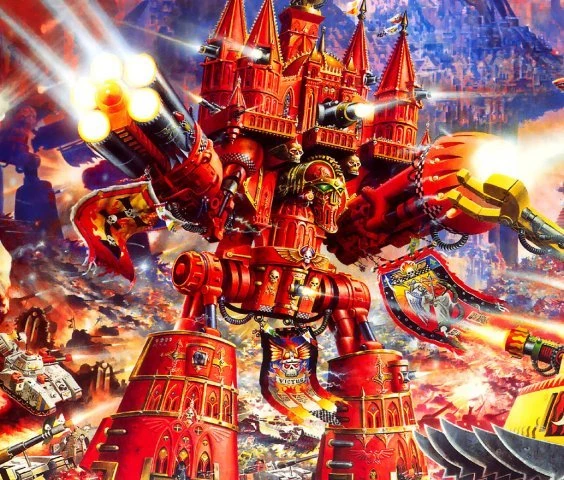
- The Imperium treats most of its mechs largely with this trope, though most things still run off of Rule of Cool. Everything from the Imperial Guard Sentinel up to the Space Marine Dreadnought work in fairly practical ways. When you scale up to Knights and Titans, you're closer to Super Robot territory, as the Tech-Priests might be using some kind of Applied Phlebotinum to keep the things from sinking into the ground or collapsing under their own weight. Knights and Titans are still comfortably inside the Real Robot Genre, since they are usually slow-moving heavy weapons platforms, although their designs are very over-the-top (for example, the Imperator-class Titan is a Cathedral built on top of a Mecha). Melee weapons still exist up to the middle of this scale, but they're mainly used to combat other superheavies at close range, and their movements are often described as slow and still very powerful due to momentum alone.
- Chaos, since they're mostly made of traitorous elements from the Imperium and their descendants, have most of the same things the Imperium does. What the Imperium doesn't have is the ability to have daemons possess their warmachines, and then then very successfully following up on that to create warmachines that are purpose-built to house daemons. Daemon engines themselves get closer to Super Robot, since they often behave closer to living beings than machines, and are created with thinly disguised, if not outright magic. They good news is that trapping a daemon inside one to serve as both the pilot and power source means that you don't have to train a pilot and worry about him, though the thing has to be chained up or kept catatonic between battles to keep it from turning on the people hoping to use it.
- The funniest thing is that the Orks' designs are actually the closest to being practical as giant war machines. A skirt-like design to give it a low center of gravity, large feet (for stompin') or treads that prevent the machine from sinking into the ground because of its weight and a large operating crew for each individual part. Beyond that, the rest is due to the Mekboyz having an instinctual know-how to build Ork machines and Ork belief making sure it will work.
- The Imperium also has Imperial Knights, which are between Tau battlesuits and Titans. They are as awesome as they are big. They are manned by Knight houses, who are as autonomous as Space Marines and the Techpriests of Mars. Said Knights also start to affect the minds of their pilots, making them behave more like a Knight in Shining Armor.
- The interesting thing with Imperial Titans is that while functionally they are in the real robots genre, in-universe they are treated as super robots as they are seen as the manifestation of the Emperor's (or the Omnissiah's, if you're asking the Adeptus Mechanicus) will. It is this weird juxtaposition that initially made the Tau think that Imperial Titans were nothing but war propaganda until one singlehandedly blew a hole in their defenses.
- The Imperium treats most of its mechs largely with this trope, though most things still run off of Rule of Cool. Everything from the Imperial Guard Sentinel up to the Space Marine Dreadnought work in fairly practical ways. When you scale up to Knights and Titans, you're closer to Super Robot territory, as the Tech-Priests might be using some kind of Applied Phlebotinum to keep the things from sinking into the ground or collapsing under their own weight. Knights and Titans are still comfortably inside the Real Robot Genre, since they are usually slow-moving heavy weapons platforms, although their designs are very over-the-top (for example, the Imperator-class Titan is a Cathedral built on top of a Mecha
- Warmachine has warjacks which are massed produced by the various nations and bonded to the minds of the warcasters that use them. These bonds can be easily severed so as to allow warcasters to switch warjacks as they are destroyed or otherwise replaced, though personality traits and sparks of self awareness can develop in warjacks if they are bonded to one warcaster for long enough.
- Exalted's warstriders are usually a Magitek version of this. While one does have to be an Exalt to pilot one effectively, that's simply because they can provide the Essence to power them. They're tools of war, that provide greater strength and defenses (and bigger weapons) in exchange for being a massive pain to maintain. However, once Solars get involved, you get personalized Royal Warstriders that are pure Super Robot.
- The most common kind of robot in Mekton, although you can do Super Robots too. In particular, anything costing less than 100 CP. The system tends to break when you go above two or three hundred CP, and due to the system using cost multipliers for many "flashy" (and a few core) system, making a typical Super Robot tends to cost several thousand.
- Scythe combines this with Diesel Punk, taking place in a setting where mechs were developed instead of tanks during World War I. Despite the focus on mechs, regular infantry units of the period are still seen, and mechs are shown to fulfil mundane tasks such as farming and transport as well.
- Lancer mixes this trope with New Weird stylings. Mechs are tools with both combat and menial uses, but can range from realistic and tank-like to borderline Super Robots thanks to RA's manifestation putting Clarke's Third Law in full effect. This is also why the hardness of the setting is all over the place, with stuff like Generation Ships and Time Dilation coexisting with FTL travel and Psychic Powers.
- Rifts features a wide variety of Power Armor, Mini-Mecha, and Humongous Mecha. Nearly all of which were mass produced, just like any other vehicle or high-tech gear. Though some came off the assembly line before the coming of the Rifts, or on an alien planet.
- LEGO Exo-Force: All the mechas are manufactured by their owner faction, and don't have anything in the way of super powers.
- 30 Minutes Missions
- Kotobukiya has made model kits inspired by Gundam and other real robot shows.
- The Frame Arms model kits.
- The HEXA GEAR model kits.
- The titular Sentinels of 13 Sentinels: Aegis Rim, while being 30 feet tall metal behemoths piloted with the pilot's mind, are treated somewhat realistically: the most heavily armed among them, the Generation 2 and Generation 3 Sentinels, are also the heaviest due to the sheer amount of missiles, mounted gatlings and railguns installed within them, and their designs are no-nonsense war machines that lack any particular visual design quirks a Super Robot would have; even the most advanced and futuristic Sentinel, the flying Generation 4, still looks somewhat odd and pragmatic in their sleeker, lighter design, and instead of having any sort of jet engines or thrusters it has massive rotary blades like a humanoid-shaped helicopter. This is all because the Sentinels themselves were made by basically copying and mish-mashing design elements of the Deimos, which themselves were originally autonomous terraforming machines. Also, controlling a giant mecha with your mind, even if through nanomachines, isn't going to be particularly healthy in the long run. Thus the pilots have to step down every few minutes of piloting to avoid Brain Overload.
- The MechWarrior franchise is a series of Humongous Mecha simulators set in the BattleTech universe. The mechs are generally Walking Tanks, though a few man-walkers show up. All battlemechs have extensive modification options, such as swapping out armor for a bigger engine or more guns. Firing your weapons causes the mech to heat up, and Over Heating your mech can cause your ammo to cook-off or the nuclear fusion reactor to explode inside your mech. Various subsystems can be damaged such as shooting off an enemy's Arm Cannon or blasting through the cockpit canopy.
- Importantly, several games in the series bring into play the importance of logistics—in those games you play as a mercenary leader who has to pull the trigger some of the time and worry about bank accounts the rest. Mechs are big, expensive machines with suitably expensive spare parts, and it can certainly happen that a unit goes into battle with a couple mechs otherwise repaired but missing arms, as fixing those and replacing the guns was too expensive to bother with. A big deal is made of taking, whenever possible, the opportunity to capture enemy Mechs instead of destroying them, so all-out firepower is usually eschewed in favour of targeted shots aimed at disabling rather than killing.
- Mechwarrior Living Legends, a combined arms game featuring player-usable tanks, aircraft, and Powered Armor in addition to the eponymous battlemechs shows the advantages and weakness of mechs. A mech's aim isn't as stable as a tank on level ground, but it can traverse rough terrain with minimal disturbance, unlike the tank that gets jostled around and risks getting stuck. A suit of man-sized Powered Armor is much more agile than a four-story tall mech, but it's also much slower in a straight line.
- Assault Suits Valken (a.k.a. Cybernator) employs this trope—the titular assault suits, as well as other Humongous Mecha, are deployed in large quantities, all very similar in design. As evidenced by the intro, any schmuck who was unlucky enough to get drafted can pilot one. In addition, the game's box art shows an assault suit being fueled and worked on, like any real vehicle would.
- The Terran Goliaths from the original StarCraft are robots that work rather similarly to antiaircraft guns, with machineguns as secondary weapons. When it comes to dealing more damage to ground targets, Terrans use the comparatively more mundane Siege Tanks instead. Terran mech play was expanded in the sequel, with Thors (as well as its Campaign-only Super Prototype, the Odin) and Vikings (which replaces the Goliath, now a Campaign-only unit). The Heart of the Swarm expansion was going to introduce the BattleTech-esque Warhound, but Blizzard was unable to iron out its balance issues. It still appears in the campaign, though.
- The VTs of the Steel Battalion games are the most blatant example. Especially when you must figure out how to drive a Humongous Mecha with a Humongous Controller featuring 3 joysticks, 4 pedals, and more than 50 buttons and dials! Have a looksee.◊ It's worth noting that one button is the eject button, which you must use in time or else the game will erase your save file, as if you died.
- The Armored Core series is also an example. As of AC4, there are three types of robots: MTs, extremely expendable fodder bots that usually go down in one hit, "Normals", custom-built giant robot built to spec from the ground up for each pilot, with modular equipment and parts that can be swapped out between missions (also known as old-style Armored Cores), and the "Nexts", Armored Cores with the latest advances in Applied Phlebotinum. The fifth game in the series went back to Normal-sized Cores (if not even smaller) but with scavenged technology putting them close to par with NEXTs. Then Verdict Day revealed that the AC5 universe is a distant Stealth Sequel to AC4 and for Answer, and that scavenged technology actually did come from recovered NEXTs.
- The Civilization introduces the Giant Death Robots, but it's in VI where the real robot similarities are abound. VI's incarnation is perhaps the more humanoid of those introduced, and anyone pursuing a Domination Victory (which one usually utilizes in warfare) may have the option to produce such robots once Robotics is researched. When the game reaches the Future Era (the endgame), any civ with the capacity to produce such weapons can make the battlefield look like a scene out of Gundam.
- The titular Hounds of Chromehounds. Essentially a combination of MechWarrior and Armored Core with a speed limit of 20 MPH, anything smaller than an ACV is essentially an non-entity compared to the Hounds. ACVs can still cause trouble when they have numbers on their side, though, and Hound v Hound combat is brutal almost beyond belief. One's first ten or so forays into multiplayer combat are guaranteed to end badly for the new guy, as the more experienced pilots rip both the rookie and themselves into tiny chunks of metal. Much like real life air combat, the victor is the one who screwed up the least.
- The Front Mission series of games. War machines there include tanks and 'copters as well as robots, most of which are camouflage painted and equipped with bigger versions of infantry or armor weapons. Pilots can swap parts in and out as they wish, but their skill lists generally tend in a certain direction for each pilot in order to create a balanced team. Also, the mecha of this series see heavy use in construction and civil engineering as well.
- The AFW units in Ring of Red are examples of this trope—requiring a crew to load the main weapons, and additional infantry squads to provide support and cover fire. They also can only operate for very short periods before overheating, and visually are basically tanks with legs—many models take very obvious inspiration from WWII-era tanks. Crippling the legs is important; there are no less than four infantry techniques meant specifically to do just that, and an AFW's targeting computer is programmed to shoot the legs when allowed to calculate max accuracy.
- Being the original source of the term "real robot", Super Robot Wars has loads of these, from Grunt and Mook mecha like the Gespenst and Lion to Super Prototypes like the R-series units (and their combined SRX form) and Huckebein Mk III. The Alteisen is a particular note, as it has no high tech weapons and is generally considered obsolete, while the Alteisen Reis is barely considered this, as it is so off balance from the rediculous amount of heavy weapons that it needs a magnetic flight device just to stand.
- Ironcast takes a more Western approach to the Humongous Mecha side of things, then puts a Victorian-era Steampunk twist on the genre.
- There's also Another Century's Episode, a game series that is quite literally Super Robot Wars Meets Armored Core, since it's made by the team of Banpresto and From Software. It almost exclusively uses Real Robots, the only exceptions being Getter Robo Armageddon and Aquarion (though Hybrid types like G Gundam and Brain Powerd are included with no fuss).
- One of the Earth 2150 trilogy's factions, the United Civilized States, possesses a land army that's chock full of this, except for a lone tank that fills the role of Mighty Glacier.
- Iron Soldier for the Atari Jaguar has the player piloting a stolen Real Robot against the enemy's forces.
- Shogo: Mobile Armor Division, a PC FPS, made by the same people who made FEAR years later, was pretty much the closest thing to a Gundam FPS before they actually made a Gundam FPS. Completely deviating from series like MechWarrior, it featured multiple types of mecha, as well as on-foot sections, Critical Hits long before Team Fortress 2 popularized their use in FPS games, a story with Multiple Endings (complete with an Unknown Rival played for laughs), and it was an in Animesque style inspired by various mecha anime. Also, provided you have the right weapons, lots of Stuff Blowing Up.
- The Vital Suits in Lost Planet: Extreme Condition are fairly realistic, at least until the final battle. Even the primitive "Rigs" in the Prequel would take years to emulate with our current technology.
- The eponymous weapons of Metal Gear. The series even goes as far as specifying different mecha models for the US Marines, Army, and Navy, as well as mentioning copies being built by terrorist organizations and Third World countries. In particular, much effort is put into justifying why any military would construct a "bipedal tank" in the first place; the Metal Gears usually have only a very specific, albeit world-threatening use case, almost always having to do with real-world nuclear strategy.
- The Tactical Surface Fighters of the Muv-Luv franchise, due to circumstances in the world they were developed, largely took the place of fighter aircraft in military combined-arms strategy. Most TSFs are even named after real-world fighters, and visually evoke the ones they are named after. The setting itself is among the more serious and realistic ones in the real robot genre, with the mechs limited to approximately modern-day weaponry (2000-shot 36mm chain guns, six-shot 120mm cannons, guided missiles), nations' reliance on combined-arms tactics instead of TSFs alone, and high casualty rates.
- The F.E.A.R. games, while placing more emphasis on supernatural horror, takes place in a near-future Cyberpunk-esque setting where Mini-Mecha are a common fire support weapon in urban environments. These "REV" units range from heavy Powered Armor to several-meter-tall "elite" armored units, armed with lasers, autocannons, missiles, and grenade launchers, depending on the model.
- The Deus Ex Universe is much the same. Normal robots go from utilitarian robomops to walking weapon platforms, but they always retain a definite real look.
- The Warhound in Ghost Recon: Future Soldier.
- The Ryders in Sunrider are usually mass-produced, and generally only make up part of any army, often being fielded alongside small fighters and large battleships.
- HERCULANs from the Earthsiege and later Starsiege era are treated as mass produced war machines. They possess energy shielding to protect them from harm (while they last), but this is well-known and widely used technology instead of a rare special ability. Certain models of Hercs are purposefully designed with specific missions in mind such as reconnaissance or direct assault, just like modern fighting vehicles, and they can be customized to either pilot preference or mission requirements. Tanks still exist in the setting and can fight Hercs on almost equal footing in spite of a handful of disadvantages. In the later Tribes games set in the same universe, the HERCs were abandoned by the Tribes because the vehicles were incredibly complex and procuring spare parts was difficult if not impossible in the wilderzone, especially in comparison to the simple turbograv hovercraft.
- For all their size, Combots in Metal Fatigue are quite real. You mass produce them, throw them at each other, and support them with armored vehicles and aircraft. Given how it is possible to bring down a Combot with a well timed bombing run, they are not as invincible as they appear. There are no unique, one-of-a-kind Combot designs or unusuable technology—anything that you see on an enemy can be used by your forces, if you can destroy the opponent while keeping their parts mostly intact, then scavenge and research their technology, just like all warring nations have done.
- Metal Marines treat their giant robots in a rather Gundam-esque fashion. While the robots aren't the only war machine in the setting (since things like DropShips exist), the general difficulty of fighting across terrain comprised of dozens of diminutive islands means that tanks will suffer from mobility and transport issues, and aircraft are too easily shot down by the standard in missile defenses (that border on the excessively paranoid). Metal Marines become the weapon of choice because they can attack any terrain and still quickly hop back to their shuttle to make a hasty escape in a fashion similar to a strike team. Metal Marine pilots, like all other crew in the game, are nameless, faceless soldiers. Most of the time, combat is conducted via missile exchanges, with Metal Marines sent in mostly for surgical strikes.
- S.L.A.I.: Steel Lancer Arena International is what happens when the real robot genre is put into The Thunderdome, all run through Cyberspace. The robots in the game are about ten feet tall at the most and are made from mass-produced (but personally customized) parts paired with a personal Artificial Intelligence. The main defense is an Invisibility Cloak available to all participants, including the rinky-dink Attack Drones that also populate the field. Weapons are a fairly standard array of guns, explosives, melee weapons, and the occasional energy weapon. Stops short of being a Blood Sport by taking place through what is effectively remote control.
- Arcade multiplayer team-based third person shooter Border Break features Blast Runners, which are specifically designed for certain roles and are not specially built for any one person. Units are built and lost on a regular basis and the whole game is based around territory control, base destruction, and other things that proper militarized forces would focus on.
- Metal Warriors is a side-scrolling SNES Cult Classic that features a variety of pilotable robots fighting alongside infantry, turret defenses, and other vehicles. None of the units are unique, and you can go on foot to use switches or take control of unattended robots. Enemy pilots can also use unattended robots, including yours if you're not careful. None possess any particularly anomalous features (perhaps save the Ballistic). One scene actually shows Nitros being serviced in hangars just like any other war machine.
- Command & Conquer: Tiberian Sun features the GDI switching from standard vehicles to walkers. The most common is the Titan, which serves as the GDI main battle tank. Strangely, its only weapon is on the side, not in the center. There are also Wolverines, although they straddle the line between Powered Armor and Mini-Mecha, and Juggernauts, walking artillery pieces. The latter are actually 2-3 times the size of the Titans and mount naval artillery. The Mammoth Mk. II is a prototype quadripedal walker and GDI's supertank, although it never went into full production in time for the Second Tiberium War. By the time of the Third War, GDI reverses its military philosophy and goes back to wheeled and treaded vehicles, only keeping the (updated) Juggernaut design. A GDI faction called the Steel Talons keeps the walker designs but updates them for the new war. By the Fourth Tiberium War, the Offense faction of GDI also sticks with walkers, even bringing back the Mammoth Mk. II in the form of the Mastodon.
- The Gungriffon series, which portrays the High-Macs as only one of many tool used in combined arms scenarios.
- Xenoblade Chronicles X has the Dolls/Skells, mass-produced mechas which serve as humanity's primary combat vehicles and come in a variety of different models. You can eventually own one of your own, but the costs of buying and maintaining one are extremely steep, and while powerful, they can still be blown to bits rather easily if you're not careful about what you decide to pick fights with. It is explained that only the top members of BLADE get to pilot Skells, but this is more due to New Los Angeles's lack of resources then anything unique about the pilots. And one of the prerequisites to own a Skell is that you have to buy insurance for it. It doesn't get much more realistic than that, folks.
- The Titans in Titanfall, they function as walking tanks, and get destroyed and replaced in mere minutes. They are fairly sturdy taking minimal damage from small arms, and are weak against missiles, they can also be destroyed when their weak points are targeted.
- Overwatch contains elements of this with the MEKA, a Mini-Mecha military program made by South Korea. They are used to combat Omnic invaders, and while tough, they're only as strong as the various other badasses in the Overwatch universe that don't have mechs, as is personified by the game's lone playable MEKA fighter, D.Va.
- Grey Goo (2015) uses variants on this. Almost all of the Beta's units are versions of these sorts of mecha, either being Mini-Mecha in the case of the Predator and Stalker, or a Walking Tank in the case of units like the Cloudburst, Hailstorm, or Guardian. On the other end of the spectrum, the humans only have one mecha, the Alpha, which is pretty much the exemplification of the classic giant robot genre, being a towering battlemech that can solo entire armies on its own. The Shroud's Dirge fills in a similar role once it's fully upgraded.
- Iron Harvest takes place in a Alternate History version of 1920s Europe were mechs were developed instead of tanks during World War I. The mechs are very much like World War I tanks; crude, slow and still in the early stages of development.
- Like the Gundam franchise, the various SD Gundam G Generation have original mobile suits that operate as real robots.
- Armored Warriors and Cyberbots have huge mechs known as Variant Armor that are used by pilots who are sometimes hot blooded and/or are rearing to go into battle. Both games allow players to pick up parts to use in the VAs, although their VA can lose a part if they have damaged a lot. Players can attach a variety of parts to customize them.
- ''Robot Warlords has the player pilot Bullets, the latest in weapons technology in order to take down rouge factions of the armed forces who also use Bullets for their rebellion.
- The Legend of Heroes: Trails of Cold Steel provides us with the Panzer Soldats, which were designed and built by Professor G. Schmidt, who only built them For Science!. There are at least five different Soldat variations: the Drakkhen, Spiegel, Hector, Kestrel, and Goliath. In the first game, the Panzer Soldats were built in secret, only to be revealed at the end of the first game when the nobility starts a civil war. In the second game, it's mentioned that the Panzer Soldats do not render tanks obsolete, as while they have more mobility, tanks do still have better firepower. There are points in the second game where squads using tanks are able to get an edge on Panzer Soldat squads by restricting their mobility. By the time of the third game, Panzer Soldats are being mass produced and soldiers are being trained on how to pilot them.
- Power Dolls where mechs known as Power Loaders are used by Omni and Earth military forces after the former declared indepedence as a colony from Earth.

- Exo Squad uses E-frames, Mini-Mecha which have very real robot vibes which got damaged or put out of commission as easily as most military vehicles in Real Life are. In fact, the eponymous Squad specifically included a repair specialist whose primary purpose was field maintenance of the others' E-frames. And, of course, she wasn't 100% successful. The squad's mechs did get a Mid-Season Upgrade but it only propelled them into Super Prototype zone appropriate for an elite regiment that they are, rather than Super Robot space.
- Robotech: The Shadow Chronicles is a sequel to the Robotech series. It deals with the logictics of getting supplies to the REF fighters to and from Moon Base ALUCE and other space-based facilities not captured by Invid or other hostile aliens. There's also the problem of the Shadow Devices implemented once the Haydonites begin to sabotage them that REF forces are forced to use other fighters instead.
- gen:LOCK has the Vanguard and Union Military forces have mechas including the Strider (Vanguard), Spider Tank and the Behemoth (Union). In Season 2, Nemesii-type mechs were brought into Union military service, based on the captured Holon mech known as Nemesis. They specialize in Zerg Rush to overwhelm Vanguard forces.
