
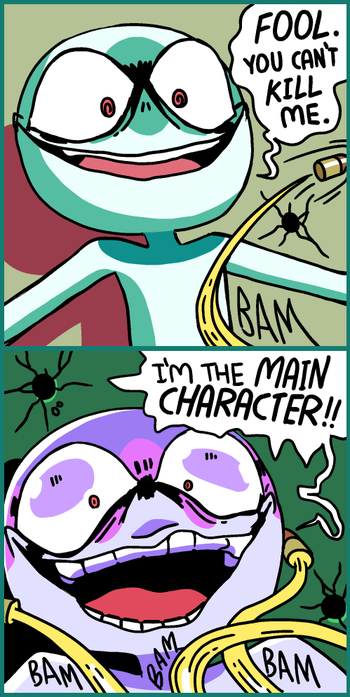
Proto Man: Why?
George: My name's in the title of the comic! I can't die!
Lucky Bob! He's The Protagonist of a story, The Hero whose predestined role is to oppose — maybe even defeat — the villain. He's essential to the plot, which means it is assumed he will progress through the story until at least the final confrontation.
But Bob will need to have some challenges to reach this encounter with destiny, so the author has to throw dangers in his way. Tension with these challenges are in conflict with the Foregone Conclusion that he will survive, a good author can keep it from being obvious that the orc he meets on page 56 can't possibly stop Bob — not if he's going to meet Fing the Fuming on page 237. A seriously good author can make it seem like Bob is the Decoy Protagonist or another character that dies, set them up for death and have them escape in truly dramatic manner.
But in less skilled hands, Bob's invincibility up to page 236 becomes obvious as every mook he shoots go down in one hit while they either constantly miss him or he is able to shrug off identical strikes. He doesn't have talent or luck; he has a suit of divine armor which miraculously protects him from all lasting harm (until the plot calls for it). Even psychological trauma can be held at bay by Bob's Plot Armor.
Sometimes referred to as "Script Immunity" or a "Character Shield", Plot Armor is when a main character's life and health are safeguarded by the fact that he's the one person (or one of several) who can't be removed from the story. Therefore, whenever Bob is in a situation where he could be killed (or at the least very seriously injured), he comes out unharmed with no logical, In-Universe explanation.note
Bear in mind that having Plot Armor is not the same as being Nigh-Invulnerable. When Superman takes a bullet to the eye and survives, that's his superhuman nature — there's an explanation, albeit a fantastic one, for how he comes out unharmed. When Indiana Jones survives the same thing, that's Plot Armor — the only explanation for his survival is that it's only halfway through the movie and you know he can't die yet. (Bonus points if he isn't even blinded.)
The downside to all this, of course, is that when it is Bob's time to die, nothing can save him. And his inability to prevent his own death may seem just as illogical as his ability to avoid it was forty pages ago, but alas, the plot gods giveth and the plot gods taketh away...
Typically absent in episodes involving an Expendable Alternate Universe, Time Travel, or any other guaranteed-Reset Button situation. It is suspended when the Hero Killer is present and it is the main reason the Imperial Stormtrooper Marksmanship Academy is still in business (along with a handful of other tropes).
Sub Tropes of this include:
- Distress Ball: A character's level of danger increases, but his odds of surviving it increase even more, to get him to the scripted rescue or resolution.
- Immune to Slapstick: A character who is never the target of physical comedy.
- Iron Butt Monkey: A character who can take (and survive) all manner of abuse just because it's funny.
- Joker Immunity: Plot-mandated protection given to a particularly series-defining recurring villain.
- Contractual Boss Immunity: Video game mechanics won't allow the player to ease a Climax Boss with particularly devastating abilities.
- Hitler's Time Travel Exemption Act: Hitler has unbreakable Plot Armor, to the point where any timey-wimey attempt to assassinate him will either fail or make things even worse. (If this features in the story, ensure there is a good reason for it.)
- Invincible Villain: When the Plot Armor gets so thick that the villain never loses as a result.
- Made of Iron: Enemy attacks are effective, but not quite as much as you'd expect. note
- Monster Threat Expiration: The villain's Plot Armor degrades over time, and/or the hero's or group of heroes' Plot Armor becomes more prominent against them.
- Near Misses: Peak tension is achieved by the heroes almost getting hit by a projectile.
- Opening a Can of Clones: Appears to remove Plot Armor but actually expands it by giving Bob any number of disposable decoy bodyguards.
- Story-Driven Invulnerability: A video game boss can only be killed when the story allows it.
- Saved by Canon: A character who is alive at the beginning of one work obviously has to survive any works which are set earlier.
- Why Don't You Just Shoot Him?: An enemy has an easy, obvious way to kill the character but inexplicably refuses to use it.
Compare Contractual Immortality (a meta trope where a character cannot truly be dead since his or her actor hasn't left the show), Rule of Empathy (which may give Plot Armor to sympathetic non-protagonist characters, including villains) and Nobody Can Die (which gives Plot Armor to every character, including minor ones). Survived the Beginning usually involves characters developing Plot Armor after an initial bloodbath.
For examples where important characters are just magnitudes stronger than the poor slobs who can't take even one hit, see Almost Lethal Weapons.
For a variation of this trope present in video-games, where a character is invulnerable during gameplay for plot reasons, see You Call That a Wound?.
Contrasts with Anyone Can Die, Characters Dropping Like Flies, Plotline Death, Red Shirt (which is someone wearing a plot target), and Decoy Protagonist (the first focus character does not have Plot Armor, to subvert the audience's expectations)
Examples:
- Angel Beats!: In Episode 2, Otonashi seems to manage to avoid every trap despite being completely new. Ironically, this is probably the one series where Plot Armor is unnecessary. Because death is very, very cheap.
- The entire premise of Assassination Classroom is about everyone trying to save Earth by figuring out a way to kill Korosensei, the story's Villain Protagonist. He has near god-like speed, regenerative abilities, immunity to poison, and is inhumanly perceptive. Whenever someone apparently drives him into a corner, he always pulls another trick up his sleeve to escape (which he keeps deeply concealed within his plot armor).
- In Attack on Titan a few of the main characters sport some blatant Plot Armor that stops them from dying no matter what happens, even in a world where people die like flies, and even if they are not particularly skilled. The members of the 104th Training Corps have a knack for surviving whatever is thrown at them, while their seniors are dying all around them. Enemy barrages just happen to miss them, while others around them are reduced to very messy stains on a regular basis. Tragically, that armor comes to an end after the Time Skip, with Sasha Blaus being gunned down as their squad is leaving the battlefield and celebrating that they've all survived again, Hange being killed by the Wall Titans, and both Floch and Eren being killed by Mikasa near the end of the manga.
- The most painfully ironic example would have to be Reiner Braun, earning him the fan nickname of the Plot Armor Titan. What makes his repeated escapes from death so ironic is that he experiences Sanity Slippage from the guilt of his actions, becoming a full-blown Death Seeker that repeatedly begs to simply be allowed to die already and be free from his suffering. He ends up surviving the series.
- In Berserk, the three main characters have all survived situations that make the viewer ask, "How the hell did they manage to survive this?" due to them each being granted very flimsy sets of plot armor; "flimsy" in that they are still not exempt from very horrible degrees of suffering.
- Bleach is notorious for its characters averting death on a regular basis, to the point where the series is now frequently described with the phrase "Nobody dies in Bleach"... even when the Vandenreich entered the scene they only accomplished a grand total of two named character deaths, one of them off-screen.
- Played for Laughs in Bobobo-bo Bo-bobo to ridiculous extremes.
- Danganronpa 3: The End of Hope's Peak High School: Barring Nanami in flashback events that take place before the games, none of the first two entries' characters die over the course of the anime. Made even worse by there being two fake-out deaths with Asahina and Kirigiri, the entire cast of the second game minus AI Nanami being restored to life, and all of the dying characters being newcomers.
- Conan Edogawa from Case Closed takes more and more bullets in the recent Non-Serial Movies, but always survives. This has to do with him being in the movies based on the TV show. Any non movie-exclusive characters can't die anyway because that would damage the main story.
- In most seasons of Digimon, Digimon, when killed, get their data reformed into digi-eggs so death is rarely permanent. However, the partners of the Digidestined do receive, in some way, this trope. While most Digimon die if they git hit by powerful attacks, the partners revert to their Rookie forms. If they were to die just as easy as most of the foes they face did, the Digidestined would have been defeated fairly quick.
- Parodied in Excel♡Saga. The first thing that happens is the main character gets hit by a bus, and she is brought back by the Great Will of the Macroism explicitly because she is the main character. Her boss is aware of this, and tends to kill her when she gets too annoying.
- Literally nobody important to the plot dies in Fairy Tail, though later arcs (such as Tartaros and Albareth) started to change that. All four of the main characters go through at least one near-death experience per arc and survive (Lucy did really die once, but it was her future self saving her present self from death), and even Lisana who dies before the story starts, ends up in Edolas rather than Heaven. People and attacks that have defeated countless people till then can't even put the Main Characters unconscious. And again at the end of the Tenrou Island arc, all of us thought the main characters died after getting blasted by Acnologia's attack. Seven years later, and we find out Mavis Vermillion, the first guild master of Fairy Tail, converted them into magic. This gets ridiculous in the Alvarez Empire Arc when they face the power of the Spriggan 12, who are all at least as powerful as the strongest wizard in Ishgar. Gajeel is pulled to the Underworld and manages to return to the world of the living, because a wizard used a spell that reshaped Fiore's landmass at the moment of the transfer. Then Juvia attempts to commit suicide and even transfuses her blood into Gray to save his life, only to be revived on the brink of death by Wendy. Natsu gets his chest pierced but Lucy realizes she can save him by rewriting the letters on the book of END that are vanishing at the same time.
- A non-video game example of Story-Driven Invulnerability occurs in Falling in Love With the Villainess with Maria, the Designated Hero. She cannot be killed until she's reached "the end" of the world she was somehow summoned to, which happens to match (at least in key events) the rather niche videogame she adores and memorized. Unfortunately, by the time she'll reach this end, her actions due to deluding herself that the world runs exactly like the game she loves, and that everyone else is just an "NPC" with pre-scripted lines and actions have earned her so much hatred that even if she gets her "perfect ending as Queen," her reign isn't likely to be long or pleasant.
- Gauron of Full Metal Panic!, at least until The Second Raid. This guy just will not die. Of course, every time he gets defeated, nobody bothers to look for a body, so that might be the problem.
- Near the beginning of Ginga Densetsu Weed, the protagonist gets shot. A lot (there were at least 34 bullets in him, according to a later scene). Not only is he back on his feet after a few days, but he is also showing absolutely no signs of being shot over thirty freaking times afterwards. And the protagonist in question is a months old puppy.
- In Ginga: Nagareboshi Gin Harpooned Bear had the opportunity to finish off Gin with a single blow, but for some reason he stopped.
- Every Gundam series uses it to some extent due to the general During the War/War Is Hell setting, with extremely few main characters ending up as casualties of plot-irrelevant battles regardless of their tactical situation. Some shows completely spare the main cast while others put the lesser heroes through the ringer (and typically only in the last few episodes, at that; if the Plot Armor gets pierced, it almost always happens in the finale). Many a Flame War has been started over whether a series uses Plot Armor beyond Willing Suspension of Disbelief.
- One common form of Plot Armor that can be seen throughout the Gundam franchise is that ordinary "grunt" mobile suits tend to mysteriously become a lot more durable than usual if a main character has to temporarily pilot one of them. And the reverse is also true. Whenever a Super Prototype gets put into mass production, even if it explicitly isn't downgraded in the process, the new ones never do as well as the original.
- In Hollow Fields, underachieving students are punished by a weekly elimination system, where the worst student is sent to the Windmill and forced to undergo a Fate Worse than Death. Lucy Snow, the protagonist, is guaranteed to never endure this fate, even in the beginning where she still hasn't grasped the crafts of Hollow Fields. Even when she is sent to the Windmill, for reasons other than poor academic performance, she still escapes with quick thinking and help from her friends.
- In Humanity Has Declined, fairies act as plot armor, in that the number of them you meet is tied directly to how safe you are from danger.
- Joseph Joestar in JoJo's Bizarre Adventure is an extreme example. It's a given he would survive most of his own arc, but the first arc left the impression that Anyone Can Die, even the hero at the end, yet he survives. Then he joins his grandson Jotaro's ensemble for an arc full of Sacrificial Lions and averts Sudden Sequel Death Syndrome and Mentor Occupational Hazard to live through that as well. Amazingly, he even manages to come back from having most of his blood drained after having a knife thrown through his neck; the doctors just put the blood back, and he was right as rain and making jokes again minutes later.
- Konno from Limit (2009) has a very thick layer if this, allowing her to survive a bus crash, drowning, and attempted murder. The other characters aren't so lucky...
- Lampshaded in Medaka Box; the reason the Arc Villain won't start her plans yet is because Medaka is the main character, and thus guaranteed to defeat her if she is challenged. At which point she recruits Medaka's childhood friend Zenkichi to do it for her, and grants him an ability of his own choosing called "Devil Style" which nullifies Zenkichi's own plot armor. First, though, she has to shift the genre of the work to make him the main character in the first place.
- Naruto:
- Sasuke Uchiha has a tendency to get into fights that are beyond his ability to win, only to suddenly demonstrate a new power that had never been seen or even hinted at before, or for another villain to bail him out at the last second. And then there was the time in which Sasuke evaded certain death from an explosion by a combination of two moves that each had immense chakra requirements, despite the reason that he was in danger in the first place being that he had already used up almost all his chakra, and did so in an implausibly short amount of time.
- Madara Uchiha is a villainous version of this. Since his resurrection, Madara got in a few situations in which he was very close to defeat, only to suddenly demonstrate a new power that had never been seen or even hinted at before, or just doing impossible actions without explanation. His most iconic one may be when he was somehow knew how to terminate the contract with Edo Tensei when the person who summoned him was defeated despite the fact that even the original creator of this jutsu did not know how to do it. And as if in confirmation of this when his Plot Armor disappeared (after activation Infinite Tsukiyomi) he was defeated with literally one hit in the back from Black Zetsu which showed that he manipulated Madara all this time and to use him as fodder for Kaguya's resurrection. The plot gods giveth and the plot gods taketh away, actually...
- In the final arc of the manga, over forty thousand members of the Shinobi Alliance died, which is half their total forces. Only a handful of them had names, and half of those were mostly introduced just to be killed off. Given just how many characters there are, it's a bit hard to swallow that half the army could have been killed off and hardly any of the major characters were among the casualties. The only confirmed deaths from pre-existing characters were Neji, Shikaku and Inoichi.
- In Gaara's fight with Kimimaro, he only survived literally because Kimimaro dropped dead on the spot, and even then he still should have been killed but dying completely robbed Kimimaro's attack of its momentum. For some reason.
- Monkey D. Luffy of One Piece sports a rather blatant form of Plot Armor, to the point where it may very well be a plot point. The same goes for the rest of the Straw Hat Crew, especially Zoro. Granted that he had immense strength and durability but sometimes it's kind of unbelievable. For example: When Luffy was exhausted to the point of no longer being able to move and under the danger of being nuked to hell, his severely damaged and barely functioning ship that had been abandoned days prior on another island drifted to his location at that exact moment and his crewmates were able to throw him on and escape. This level of plot armor extends beyond blind luck too; no matter how strong the enemies are, nothing will ever kill one of the Straw Hats. The crew's sharpshooter Usopp, described by Word of God as being supposedly only as strong as a normal person, was able to be smashed by a 4-ton bat and dragged along the ground at 40 miles an hour and live. Truly, the Straw Hats' "limits" are at the complete whim of the plot. They can withstand anything short of being completely obliterated and any attack capable of doing that will simply not touch them for one reason or another. Of course, the series is known for "No One Dies in One Piece" because every character outside of a Flashback showed this sort of durability, at least for around 600 chapters.
- In Pokémon: The Series:
- The heroes always get their Pokemon back from Team Rocket, as does anyone they have befriended that episode (with all of one exception). Yet the organization seems to keep growing through the series, and even the trio were already much-feared criminals before they met Ash and Pikachu. How many trainers must have been less lucky?
- In Pokémon: The First Movie, Ash Ketchum throws himself directly into an attack by Mew and Mewtwo, and gets Taken for Granite. Being the protagonist, this naturally doesn't last for long, as he gets revived moments later when the Pokémon literally cry him back to life, something that is never mentioned or hinted at again.
- In the XY series, Ash throws himself to certain death on three separate occasions and not once suffers so much as a single injury for his recklessness. He jumps off of Prism Tower to save his Pikachu, jumps off of a plane along with his Goodra, and jumps into a volcano alongside his Talonflame, each time getting rescued at the last moment before anything bad happens.
- Another bad habit of the show is its tendency to have the main characters' Pokémon take far more damage in battle than their opponents, yet somehow pull off a victory with much less effort. One such example is Ash's Johto League match against Gary, where Charizard somehow tanks Golem's Magnitude, Blastoise's Hydro Pump, Skull Bash, and Bite, before one-shotting both of them in return.
- Serena, despite her limited progression as a battler and her lateness to discover a goal, has sparsely failed in anything. Her Pokémon have never fainted once in battle due to either her opponents being Team Rocket or being accompanied by a stronger trainer or dumb luck, while the showcases never conveyed her as losing without a serious folly by one of her team, her act always considered the most popular up until the finals.
- Despite these examples, the anime is also infamous for being one of the most iconic subversions when it comes to the seasonal Tournament Arc. While Ash's loss record is a butt of fandom jokes, his friends don't fare much better, always coming short of winning their own tournaments. Dawn particularly stands out because she managed to fail the first appeals round of her Pokémon Contests twice in a row, even though her predecessor May never failed an appeals round despite some objectively worse performances (though this is also a Zigzagged Trope, since it was a Foregone Conclusion that she'd enter the Grand Festival and thus win enough contests to do so).
- The main characters of Saint Seiya fall into this trope (except Phoenix Ikki who can die and revive like the namesake bird). They suffer unaccounted pain and bleed like hell, but still manage to stand up and win no matter what, proving that no matter if you wear a bronze, silver or gold cloth, it's the plot armor that counts.
- None of the main characters in The Seven Deadly Sins die as they manage to survive powerful attacks that kill others with ease. The only one that is justifiable is Ban because he drank from the Fountain of Youth, which gave him Complete Immortality. Hawk takes an attack which killed many Holy Knights and dies, but he is resurrected without any explanation and is the only one to come back to life. Later, Galan of the Ten Commandments give a literal Curb-Stomp Battle to the Sins but they are saved because Gowther rewrote his memories so that he thought that he had already killed them. Meliodas is truly killed by his brother Estarossa but manages to return from the dead chapters later. Escanor does die in the penultimate battle, not from anything the Big Bad does, but from the accumulated damage of being burned alive by his own power every day for decades catching up to him.
- Done as straight as an arrow for both the Main Characters of Slayers, and the one time that they were thought to have died was a Disney Death. Also, any character that winds up allying with them for an extended period of time also survives, with the only exception being Ozel in Evolution-R. This is averted in the novels when Millina and Luke, Zelgadis and Amelia's replacements, wind up dead (Millina is poisoned and Luke, as a host of Shabranigdo, is killed in battle), but they were more distant in helping Lina and Gourry than Zelgadis and Amelia were.
- This is a major plot element that applies to everyone in the world of Steins;Gate. If the Attractor Field dictates that you will die in 2025, you will not die under any circumstances before that day and time comes.
- In Sword Art Online, Kirito survives being beaten to within an inch of his life three times, drawing with Kayaba in what was supposed to be a Duel to the Death, narrowly avoids getting stabbed to death because his enemy was blind in one eye courtesy of their earlier fight, and avoids being poisoned on account of a Pocket Protector stopping the needle, all by the mid-point of the second season.
- This trope is deconstructed in Yuki Yuna is a Hero. In the first half, the heroes always survive the fights against the Vertexes without a scratch on them, even after falling from heights that should have killed them. If the Vertex actually attacks one of them directly, their faery guardian will just block the attack harmlessly, so they still win without too much difficulty even when the Vertexes start to avert Conservation of Ninjutsu. In the second half, however, once it's revealed that they aren't recovering from the "temporary" injuries caused by the use of Mankai, Togo attempts suicide ten times, and her faeries stop her without fail, even from things like carbon monoxide poisoning. It turns out that the girls are destined to fight the Vertexes over and over without end, and therefore cannot be killed. Since the use of their powers progressively and inevitably takes their bodily functions away until they're ultimately tetraplegic, that is not a good thing.
- Yu-Gi-Oh! has this a lot, with characters drawing cards that let them win a duel simply because the plot wouldn't be able to move on otherwise. Not only does nobody important die, when characters do die or otherwise lose their souls, they always come back once the villains are defeated (The card thing, admittedly, seems to be an in-world phenomenon related to the bond between cards and player).
- The Battle City Finals in Duel Monsters, where most characters win/lose due to plot armor, since the story needs certain duelists to meet in the finals. Yugi is about to lose to Bakura until on his very last turn he gets an Egyptian God Card. Rishid is about to win against Jonouchi, but Malik orders him to summon the copy of The Winged Dragon of Ra, resulting in Ra getting enraged and striking both players with lightning, from which Jonouchi recovers with The Power of Friendship. Mai would have beaten Yami Malik had she just attacked, but instead tries to summon Ra and can't read its text, and Yami Malik uses Ra instead. Kaiba suddenly has a vision that tells him that he should use his Blue-Eyes White Dragon instead of Obelisk, sacrificing his Egyptian God Card, which makes Ishizu's trap card useless. And then in the semi-finals, Jonouchi would have defeated Yami Malik, but nearly dies because of the torture he had to endure in the duel. And Yugi is able to save himself from losing to Kaiba by suddenly being able to use the effect of Kaiba's Flute of Summoning Dragon.
- The duel with Dartz is especially notable as both Yugi and Dartz end up playing cards that prevent them from losing while are on the field, even if their lifepoints reach 0.
- In Season 5 of Duel Monsters, Yugi and his friends come across Zorc's second head in the Puzzle. Despite getting directly hit by the fire, Yugi isn't injured at all, and neither are his friends.
- The Abridged Series naturally likes to poke fun at this whenever it can. Yugi and the gang frequently insist that they'll always win because they're the main characters. Occasionally defied, however, as this logic sometimes backfires on them.
Panik: (after surrounding Yami in a tornado of flames) Why aren't you dead?!
Yami: As I explained earlier, I'm the main character. - The WRGP Arc of Yu-Gi-Oh! 5Ds remains largely notable for Yusei, the protagonist, being given a lot of Plot Armor by the format: he's the team's last wheeler, meaning that if he loses, the team would get kicked out. Naturally, this means that while Jack, Crow, and Aki get some pretty severe (in some cases humiliating) losses handed to them in the arc, Yusei walks away with a spotless record every time. The most infamous instances of this were probably the Team Unicorn and Team Ragnarok duels, where Yusei's opponents in both games essentially defeat themselves rather than hand Yusei a loss.
- Avengers Arena:
- The concept is lampshaded when Arcade mentions that he was unable to capture the Young Avengers and the students of the Jean Grey School because they were too well protected. In real life, those groups have their own popular titles, while the teens in Arena are all either entirely new characters, or from cancelled books like Avengers Academy and The Runaways.
- A literal example came when it was announced that X-23 would not only survive the events of the book, but also appear in All-New X-Men. So not surprisingly, the only person absolutely guaranteed to survive the supposed Anyone Can Die story was the one tied to a popular franchise like the X-Men...
- Batman. While not often too egregious in his own book, the second he steps into a Justice League book he's a very different character. For someone who is often championed as "Just a normal man" who works very hard, it is very hard to swallow when he will be struck by characters who can rip through steel like paper, be hurled through multiple stone pillars/walls, dodge attacks that The Flash and Superman get struck by, and only end up a bit bruised or sore when he should be liquefied by now. Almost always in full force during any Superman vs. Batman encounter where there is seemingly always an excuse why Superman, who even in his weakest incarnation, is "Faster than a speeding bullet" has one iota of trouble against Batman, whose Kryptonite IS bullets. Plus, even when Batman wises up and wears Powered Armor, he often has his helmet in the same shape as his iconic mask, with his mouth completely exposed. Amazingly, no one ever sends a super strong/super fast punch right through his unprotected mouth.
- An explicit plot point of Contest of Champions (2015). The Collector and the Maestro don't want to bring down the collective wrath of the entire Marvel Universe, so most of the combatants they kidnap for the tournament are obscure heroes who won't be missed. When they do kidnap a well-known hero like Iron Man or Gamora, they only keep them around briefly before wiping their memories and sending them back home.
- Similar to the Avengers Arena example was the 2018 Death of The Inhumans limited series, which focused on the Kree setting out to destroy the Inhuman race. Despite many of the Nuhumans being slaughtered, Kamala Khan and Moon Girl, the two most popular Nuhumans, were conveniently left out of the story (save for a single panel showing images of them on a list of potential Kree targets).
- G.I. Joe comics. Scarlett survives a shot to the brainpan in the same manner as The Question. Later, she's stabbed straight through the chest... by Snake-Eyes. No, really. Snake-Eyes, being a ninja, knew the least-worst spot to stab her, and it was all part of a Fake Defector scheme, but still... he was not happy to have to do that. And it didn't really help her cover, either, since the Cobras knew that if Snake-Eyes wanted her dead for betraying the Joes, she would be dead. Fortunately for her, Megatron's antics distracted Cobra long enough for her to do her job and make it back to the Joes.
- Judge Dredd has survived innumerable beatings, shootings, stabbings, explosions, bites, infections, diseases and falls from great heights. He was once burned so badly that he was unrecognisable and was renamed The Dead Man. Though, ironically, he did not die. Although several parts of him have been replaced with artificial organs, he has no great superpowers. He is simply very fit, implacably driven, possesses sharply honed survival instincts, a sixth sense for danger and is an expert in the application of controlled violence.
- What do you get when you take away plot armor from everybody but one psychopath? The Punisher and Deadpool find out in their respective versions of The Punisher Kills the Marvel Universe and Deadpool Kills the Marvel Universe.
- The Punisher once resisted Ghost Rider's Penance Stare, under the reasoning that Frank doesn't feel guilty about his innumerable murder cases; it was against unrepentant criminals and the like so for Frank it was justice at work, not a collection of sins. That contradicts many instances where the Penance Stare is said to work on absolutely any living being who has ever sinned, taking a life regardless of the motivations behind it, i.e.: Galactus can be affected by the Penance Stare even if he is a natural force of the universe who doesn't consider his planet-sized killings as something evil.
- DC Comics hero The Question had legendary plot armor during the Dennis O'Neil run. In one fight a mook has a gun to the back of Question's head and pulls the trigger. When nothing happens, the mook looks at the gun quizzically and simply says "Misfire?" before Question pummels him. The Question once DID get shot in the head and dumped in the river. The bullet went around the skull, as it was a weak gun. As for the rest, he was rescued by Lady Shiva, who knows all about healing (and killing).
- Sonic the Hedgehog (Archie Comics): No matter how bad things get, Sonic is always guaranteed to win in the end or eventually rebound from a short term defeat. It's eventually revealed to be an In-Universe case: according to Mammoth Mogul and Eggman, Sonic's long-term exposure to Chaos Energy has essentially made him an Anthropomorphic Personification of Chaos, a living unknown factor; no matter how strong the bad guys get, no matter how ingenious their plans are, and no matter how far they calculate and plan, Sonic will win at the last minute. This has driven Mammoth Mogul to play the Long Game, using his immortality to his advantage to simply wait it out until Sonic dies of old age or just gets too old to fight, and is what led Eggman to create the reality warping Genesis Wave tech to have a way to counter it.
- Squirrel Girl, from the Marvel Universe, has beaten every archvillain she has faced, including Doctor Doom, Mandarin, M.O.D.O.K., and Thanos. Her superpower is the ability to communicate with squirrels. (Of course, Squirrel Girl is different from most cases in that she has less "Plot Armor" and more "Punchline Armor", because seeing all-powerful supervillains like Doctor Doom, Magneto, and the Mad Titan himself being knocked down by swarms of squirrels is humorously unlikely.) She basically operates on the same rules as Roger Rabbit: She can't always defeat guys who are way more powerful than she is, only when it's funny.
- This is basically The Unbelievable Gwenpool's entire thing. She is a girl from the real world who got plopped down in the Marvel Universe, and she recognizes it as such. She has no superpowers, but she is Genre Savvy. So her plan is basically to put on a costume and act like a Superhero (well, Anti-Hero) that is the star of a story, so that she will gain plot armor. That she knows she can't be killed because she is the star of her own book essentially becomes her superpower. This ends up getting deconstructed in her encounter with Deadpool along with Popularity Power. Gwen boasts that she'll be able to kill Wade because this is her book and her Plot Armor will save her. When Wade figures out what's going on, he delivers a devastating "The Reason You Suck" Speech to Gwen by pointing out that she's a D-Lister who casual readers might confuse for one of the many Gwen Stacy duplicates that spawned from Spider-Gwen's popularity while he's an A-Lister with hundreds of issues, merchandise and the highest-grossing R-Rated movie of all time — there was no way she will win.
- More or less the only reason why anyone survived World War Hulk. Justified in-universe. Amadeus Cho "did the math" and figured out that the only explanation for no one dying is that Banner/The Hulk must have been consciously preventing the numerous beatings from killing anyone.
- During the Decimation event, Plot Armor thoroughly protects the most currently marketable mutant characters from a horrid catastrophe that has depowered and/or caused the deaths of over 10 million others and reduced the population to approximately 198. The few notable characters who were depowered, such as Jubilee, ended up either being repowered or gaining new superhuman abilities to compensate. The D-listers weren't so lucky.
- Dan Dare, which often lampshaded how frequently its titular star cheated death by pure luck. In Prisoners of Space, this led The Mekon's chief guard to change sides in the mistaken belief that Dan was genuinely immortal.
- Max Allan Collins, who took over Dick Tracy after Chester Gould's retirement, once observed the importance of the Anyone Can Die principle in maintaining credible suspense. Most notably, Junior Tracy's wife was murdered during Collins's tenure as writer. However, he conceded that Tracy himself would never die (though he frequently got badly injured), because he is the main character.
- Tom the Dancing Bug lampshades this with this
 strip.
- AWE Arcadia Bay (Rogue_Demon): When Jesse investigates The Monolith with a team of highly-trained Rangers, the plane suffers from engine problems and Jesse manages to be the only one that makes it out alive. Even when she barely survives gunshot wounds, broken bones and radiation burns that would cripple a normal person for life after the mission, she manages to heal phenomenally fast no worse for wear.
- Called Plot Protection in The Legend of Eevee, where it saves the main character, Pichu, from otherwise unsurvivable events such as being stabbed multiple times with a spear or falling into a bottomless pit. Pichu and his partner Togetic both know about it. Some of the secondary characters know about it as well.
- In the Mass Effect fanfic The Council Era, when he is in conflict with the Villain Protagonist's son, the Chaotic Evil Takavor Derishama throws his spear and it directly impales him. When he throws the spear at the Villain Protagonist, it goes too far upward, just cutting off one of those muscle-horn things that salarians have.
- Tiberium Wars: Certain characters, such as Mitchell Colt, Sandra Telfair, and especially Nick "Havoc" Parker, are the few main characters safe from death. Almost everyone else is a walking Mauve Shirt or Red Shirt.
- DC Nation usually requires a player wanting to kill a character to go through an application process of the mods and muns of the characters teammates. The exception is when a mun leaves the game and the character cannot be adopted out for one reason or another.
- What Lies Beyond the Walls: Word of God admitted at the end of Book I that Tegast will survive Book II and even Book III, and if he does die, it won't be until the very end of the series.
- Lelouch in Soul Chess has an excuse, but apart from that, Word of God states that even Ichigo and his friends will lose theirs after graduation. Some of the other characters from Bleach have lost theirs already. Like Head Captain Yamamoto. Plus Aizen and Yhwach.
- To clarify, Ichigo is written out of the story (but isn't actually dead) after the Britannian invasion; he shows up again later. Orihime's was baited and switched; she assumes the identity of Inoe from Code Geass, who canonically dies in a mech explosion; Ichigo pulls a Big Damn Heroes to get her out (she doesn't know it's him; he's masquerading as someone else too during the Black Rebellion). Yamamoto is killed by Aizen and Nyra. Lelouch Geasses Aizen into suicide during Rukia's execution; he shows up again as a denizen of hell much later, killing Yamamoto as already stated. Yhwach buys it in the final battle, albeit off panel, against Aizen's latest godmod. For less important canon characters Shinji, Rose, Love, Kensei, Hachi and Hiyori all die, and Lisa nearly joins them. Hisagi, Kira, Sajin, Nanao, Chojiro and Omaeda are all gone too. Some canon deaths, like Tosen, Gin, Starrk, Kaien and Hisana, however, are averted.
- In It Gets Worse, Taylor gets this power instead of bug control. And it makes her, in Director Piggot's words, "scarier than any [parahuman] I've encountered yet. And yes, I am including Nilbog in that total." If anyone is about to harm Taylor, something will happen to stop them. And if they were doing it on purpose, they will be punished in proportion to the scale of their deliberate offense. Taylor's power can sense any attempt to harm her, without any conscious effort on her part, and can if necessary reach back in time up to the moment of her trigger to set events in motion — which makes her get stronger the more time passes. In under two weeks her powers had been able to manipulate reality sufficiently to break the ABB and the Merchants, take out half the Empire-88, terrorize Coil into turning himself in, and lure in and kill/neutralize most of the Slaughterhouse 9, all without any conscious action on Taylor's, and in many cases even her knowledge, suggesting that within a year she'll be utterly unstoppable. On top of it all, her powers work in a variety of bizarre but hilarious Rube Goldberg-esque ways, such as Lung getting tarred and feathered or Kaiser getting hit by a literal ton of frozen crap.
- Khaos Omega uses this in a rather unusual way; the members of the heroic faction XQ can be hit by attacks that would kill others, but to them it triggers them spontaneously jumping to their strongest available transformation. The events near the end of 'RWBY: Super Rainbow' is considered the point when the result changed; before then the 'failsafe' (as it's often called) jumped the XQ agent to their next available transformation, while afterward the agent jumps to their strongest available natural branch of the infinitely-powerful Super Saiyan Angel form.
- The Amethyst Angel herself does it slightly differently; during 'Samurai Angel' she shot straight to the strongest natural branch, Rainbow Nova, and added Ultra Instinct within 24 hours of said first jump. Ultra Instinct spontaneously activating when a normally-fatal attack is headed her way is usually when her take on Plot Armor activates (though said attacks are actually attuned to bypass the Plot Armor if it connects).
- During the events of 'Amethyst Evolution: Angels of Fodlan' the failsafe is revealed to copy over when an S-Bond is activated, and completes the S-Bond when triggered. Edelgard honestly didn't know this in the hour she had her S-Bond to Anise active, given she went right after the Agarthan spy and he triggered the failsafe trying to take her with him.
- Discussed in Skyhold Academy Yearbook, when the teachers are playing Gatehouses and Ghouls. The concept of plot armor is mentioned, and they jokingly remark that it sounds like something Varric (being a writer) would wear. Amused, he promises to have a set made for the school's next trip to the Exalted Age Faire.
- A Certain Droll Hivemind: Played for Laughs. Touma gets into a fight with five armed soldiers. He wins offscreen, using nothing but his fists. The narrative makes no attempt to explain how he does it.
- In Avengers: Endgame, the start of the third act is Thanos's ship appearing over the Avengers compound and reducing it to rubble. Not a brick is left unsmashed. Despite this, literally none of the nine people in it are killed or even injured. Justified for some characters, such as Hulk, Thor, Iron Man and War Machine, less so for the others. That said, main characters Iron Man and Black Widow are ultimately Killed Off for Real here.
- Big Fish: The father claims to have been shown his own death by a witch, and that it made him fearless, because he knew nothing but that could kill him. Of course, that was 90% lies.
- This trope is played completely straight and completely serious, as it is literally the superpower of Eli in The Book of Eli, due to him being protected by God Himself. And while it may sound silly, it really, really works.
- Der Clown Payday: One of the heroes, wearing a police-grade body armor, holds a Mook in front of him as another Mook shoots him. The Mook in front of him is pierced by more than a dozen high-velocity rounds shot from a machine gun in full auto mode while the hero doesn't even have his shirt damaged.
- John McClane in the Die Hard films, especially in Live Free or Die Hard and A Good Day to Die Hard, where he almost becomes superhuman and is able to hang off the wing of an F-35 Lightning II while an elevated highway explodes around him.
- Lampshaded in The Movie of George of the Jungle; the narrator mentions during a recap that "George was really shot but can't die because, let's face it, he's the hero". In fact, everyone in the movie has Plot Armor. At one point, one of the African guides falls off a rope bridge into the river. Despite the fall being quite long, the narrator assures us that "Nobody dies in this story. They just get really big boo-boos." Sure enough, the next scene has the guide alive and covered in bandages.
- G.I. Joe: The Rise of Cobra: The only possible explanation for the Baroness and Storm Shadow to survive their vehicle being hit by a train and catapulted, spinning 30 feet in the air and back down. While their driver dies they hop right out of the wreck and run a good distance.
- G.I. Joe: The Movie. In the original script, good-guy Duke is hit with a snake-spear from Serpentor and dies. However, after Transformers: The Movie traumatized kids with the death of Optimus Prime, Executive Meddling saddled the Joe movie with a hasty edit. Duke's injury merely resulted in a coma, and a voice-over near the end of the movie announced Duke's recovery.
- In Godzilla (2014), our hero, Ford Brody, survives no less than four catastrophes, two of which he is the only survivor. This doesn't apply to his father who does get killed halfway through despite looking like the main protagonist.
- In Guardians of the Galaxy, when Gamora's pod get blown into pieces by a Necrocraft, she doesn't go the way of a Red Shirt. Instead she floats in space, unharmed, slowly freezing to death.note Cue a Big Damn Heroes moment for Quill.
- The Hunger Games: Anyone that gets more than a few seconds of screentime is guaranteed to have some, only for other characters to then penetrate it and kill them, usually rather sadistically. Only Katniss and Peeta's hold up long enough.
- Avoided in The Incredibles: in the film itself, the supers suffer injuries, and in one scene, Violet even loses consciousness due to a concussion. In the DVD commentary, Brad Bird explicitly expressed his opinion that utilizing plot armor won't teach kids anything about how the real world works.
- Almost every James Bond movie ends like this. James is never killed, and rarely seriously hurt, no matter how many bullets fly and explosions go boom, or how many times the villains capture him and have him helpless. The single aversion is in No Time to Die, where Bond chooses to die by missile strike after Safin poisons him with a vial of Heracles virus coded to kill Madeleine and Mathilde before being killed.
- In Peter Jackson's King Kong (2005), there is a scene with Jack Driscoll and a few crew members running in between a pack of Brontosauruses down a narrow path while also avoiding being eaten by velociraptors in full charge. Jack is not only fine, but jump-kicks one of the velociraptors in the face, all while still running UNDER the Brontosauruses.
- Naturally lampshaded and deconstructed in Last Action Hero, with Jack Slater amazed he keeps surviving (until the film grosses drop, notes Genre Savvy Danny). Danny himself has Plot Armor thanks to being the Plucky Comic Relief. Zig-Zagged near the end, when Slater receives a mortal gunshot wound in the real world (where there is no Plot Armor), forcing Danny to race against the clock to return him back to his fictional world, where a .44 magnum slug to the chest would be Only a Flesh Wound.
- If you're a main character in the Jurassic Park Franchise, the dinos will opt to roar in your face instead of biting or pouncing on you. If they do try to bite you, they'll always just barely miss, and if you're being chased and they're shown to be faster than you, they'll always lose ground between shots. This gets especially obvious in Jurassic World: Camp Cretaceous where the actions takes place over months, not days, but the cast of teenagers constantly lives through encounters with dinos shown to easily tear through Red Shirts.
- In Last of the Mohicans, Alice, Cora, and Major Duncan are the only survivors of two giant massacres.
- In The Last Samurai, every single Samurai appears to be killed in the final battle... except for Tom Cruise's character Nate Algren, who miraculously survives being shot multiple times by a Gatling gun.
- In The Lord of the Rings the main characters have all experienced at least one near-death experience and managed to survive or in case of Gandalf he not only came back, he came back stronger (except Boromir). Aragorn especially has shown this, surviving after falling from a cliff and getting up with no injuries after an explosion occurred right beneath his feet, when everybody else near to him died.
- Played for Black Comedy in the Action Prologue of Machete. The title character drives his car at some goons who open up with their automatic weapons, riddling Machete's partner while he remains unharmed. Then again he's probably so badass the bullets just bounced off him.
- The eponymous Mystery Team has tremendous luck for the fact that they're inexperienced detectives.
- Director James Cameron confirmed in both the Mythbusters special and discussing the film's 20th anniversary that ultimately, Plot Armor running out is why Jack bit the big one at the end of Titanic (1997). The story and moral wouldn't have worked if Jack survived, so one way or another, he had to go down with the ship.
- Pirates of the Caribbean: Played straight, especially the second film, wherein the main characters' ship is attacked by the Kraken, who kills most of the crew except for every single main character who board the lifeboats except for Jack Sparrow, who is left on the ship and then killed by the Kraken as it sinks the boat. He comes Back from the Dead, though.). Even the guy with the talking parrot survived.
- Arby in Poultrygeist: Night of the Chicken Dead avoids zombification after getting ejaculated on by the zombie chicken version of himself, which would, under normal circumstances, cause zombification.
- John Rambo, of the Rambo series, is noted for escaping hails of gunfire relatively unscathed. This is occasionally lampshaded by various parodies.
- Lampshaded in the title song of Road to Morocco:
For any villains we may meet, we haven't any fears;
Paramount will protect us, 'cause we're signed for five more years. - Scary Movie:
- By means of an odd twist in plot armors — Brenda dies in SM3, her corpse even exploding into pieces. But she reappears in SM4. Lead Character Cindy, who remembers her friend dying one movie ago, even says to Brenda "I thought you were dead!" To which Brenda replies "I thought you were dead!" One look of confusion later and they decide to drop it.
- In the first movie, Brenda is stabbed to death in a theater for being rude and Cindy is run down by a car at the very end.
- In the second movie, Brenda says that she only had a "near death experience", and it turns out Cindy is alive because she was never officially declared dead.
- The series that first inspired Scary Movie, Scream, has blatant examples of this with the three Main Characters (Sydney, Dewey and Gale), who are always slashed by the antagonists, and even finish the movies in a hospital, but never die. Until Scream (2022), where Dewey finally bites it (the other two are very injured but survive).
- This becomes rather obvious towards the end of Sharktopus, when the killer shark-octopus hybrid has been attacking and killing boatloads of people throughout the film, but is suddenly very reluctant when faced with the hero Andy at the end to actually eat him. Then, when he kills the sharktopus by throwing a bomb into its gullet, the resulting explosion doesn't even graze him.
- Star Wars:
- Stormtroopers are supposedly elite soldiers, and Obi-Wan notes that their marksmanship is unusually precise, yet they hit precisely no important characters despite ample opportunities, and when they do, it's typically a minor injury at best. Compare that to how they steamroll over no-name Rebels with ruthless efficiency. In the first movie, it's ultimately revealed that they were doing it deliberately to keep the heroes from figuring out they were actually being let go so they could be tracked. Empire also has an explanation as to why the Stormtroopers still can't hit the heroes: In Luke's case, they are under orders to lure him to Vader, and the escaping rebels are similarly to be brought to him alive. In the third movie, they have no such excuse, and an entire legion of what the Emperor boasts are his best troops are easily stomped by a stone age tribe and a few Rebels; the best they can do is graze Leia on the arm.
- Rogue One: despite the group going through several dangerous situations (including Chirrut slowly walking through the field of fire to a computer console and not get hitting hit) until after their needed roles are fulfilled. (Chirrut is shot dead the instant after he does this, Baze is killed by a grenade after his work in covering Chirrut is over, Bodhi is killed via grenade the instant after he connects the message to the rebel fleet).
- Very unsubtle Plot Armor for human Main Characters was a consistent problem with the live action Transformers Film Series movies. After Sam and Mikaela keep getting thrown into concrete by 20-foot-tall metal creatures and suffering nary a scratch, it becomes impossible for viewers to ever believe they're ever in any real danger, killing suspense. Because of this, when Sam was nearly killed in the second movie (he was caught INSIDE a corny explosion and thrown at least ten feet, all without even significantly damaging his clothing) exactly no one was surprised when he survived without any obvious injury.
- In TRON: Legacy, all minor characters are instantly destroyed when they crash, but major characters are always thrown clear from crashes completely unfazed. Minor characters are also instantly destroyed by a hit from a disc, but Clu takes a shot from Tron and survives, while Quorra merely goes offline instead of being totally destroyed.
- Parodied mercilessly in UHF, where George Newman fantasies about being in a Rambo parody, with one scene someone is shooting at him repeatedly and still manages to miss him, even when he's firing at him at point-blank range.
- The protagonist Gerry had survived numerous encounters with the really fast tackling zombies throughout World War Z.
- Animorphs plays the trope entirely straight with the six POV characters — since morphing heals injuries, it's easy for them to avoid death. That is, until the final arc, when Rachel gets killed.
- Invoked in Cirque du Freak: Mr. Des Tiny resurrected Harkat Mulds to be Darren's protector.
- The Cosmere:
- Lampshaded in The Stormlight Archive by the various people around Kaladin. His fellow soldiers and later bridgemen notice that no matter how things get, Kaladin (and his squad) make it through relatively unharmed, at least compared to everyone else around them. More particularly, arrows have this ever-so-convenient tendency to just barely miss him even when he really really ought to get hit. Of course this is because he's in the early stages of becoming a Surgebinder and it unconsciously using his various powers, including being a Gravity Master, to keep himself and others alive. Somewhat deconstructed in that Kaladin is quite depressed about how he keeps surviving while other around him get killed, and thinks he might be literally cursed for a while.
- Invoked for Captain Demoux of Mistborn: The Original Trilogy. He's named after a friend of the author, and the author had to promise that friend that the character named after him would survive to the end and get a Love Interest. This is confirmed by Word of God to be the only thing that kept him alive when he is one of the many attacked by the mists.
- In Deltora Quest, the main trio of characters come ridiculously close to dying over and over again, but always manage to survive. Barda probably gets the worst of this, getting to "almost dead" at least twice before miraculously surviving.
- Seen all the time in Discworld novels. Savvy characters sometimes just outright give up/run away because they recognize the plot armor the other guys have.
- An obligatory example would be the end of the The Fifth Elephant — a potential "rival" for Captain Carrot's werewolf girlfriend dies dramatically while Carrot escapes with bad wounds. Vimes can't bring himself to say anything since Carrot's genuinely a good man, but he notes that things tend to work out for a King Incognito.
If you were dice, you'd always roll sixes. And the dice don't roll themselves. If it wasn't against everything he wanted to be true about the world, Vimes might just then have believed in destiny controlling people. And gods help the other people who were around when a big destiny was alive in the world, bending every poor bugger around itself...- At this point, destroying the Disc itself probably couldn't kill Vetinari.
- A major plot element in The Last Hero. Cohen and his barbarian heroes have been exploiting it their whole lives, so when they realize they have the numbers on their side against an apparently ordinary man (Carrot again) and that therefore it would be him benefiting from it they instantly stand down.
- Rincewind the "Wizzard", despite the fact that hes has no magical talent whatsoever, has managed to survive several perils on the disc, often saving it in the process, simply by following a philosophy of always running and acting like a coward. It doesn't hurt that the Lady (of luck) loves him; unfortunately, Fate despises him.
- The Divergent series subverts this trope. Tris, who has been the first-person narrator through the entire series, dies in the third book, Allegiant. This is somewhat telegraphed by the fact that she and Four start trading off narration duties at the start of that book when she had been the only narrator before.
- In Foundation and Empire, Toran and Bayta escape Kalgan. After a series of highly improbable escapes, Bayta observes their Plot Armor can only mean they have brought the source of the problems with them.
- Futuristic Violence And Fancy Suits averts this. The people watching make fun of an enemy who, falling off a building, continues to fire his gun into the window: but it transpires that even firing at random, he actually hit and killed Armando.
- This trope is one reason Gotrek, son of Gurni is either the best or worst member of the Slayer Cult, a penitent branch of dwarfen religion, sworn to atone for their sins by finding the biggest baddest enemies of dwarfdom and kill them (repeat until one of said enemies kill them). We don't know how long Gotrek was at this before he hooked up with Felix, but the two of them have been trying to get Gotrek killed for over 25 years in-universenote . Of course, Gotrek does carry an epic-level magic axe, which makes him significantly harder to kill.
- Also applies to many of the other characters, particularly "Mad" Malakai Makaisson (a Slayer engineer, who has survived the explosion of at least two hydrogen-filled airships, plus a mountain exploding and collapsing on him, among other things) and Grey Seer Thanquol (a Chaotic Stupid rat-man wizard. He's actually the only major enemy Gotrek and Felix have had that's still alive. Mostly because it's funny).
- Harry Potter:
- Harry Potter himself seems to have this, due to being the main character. Each school year, he gets into mortal peril at least once and each time barely manages to survive it due to the circumstances being slightly more in his favor. When people start praising his victories against the dark forces, Harry lampshades this by saying he only succeeded due to having an improbable amount of luck.
- Arthur Weasley suddenly gained Plot Armor when Rowling was writing Harry Potter and the Order of the Phoenix. Her initial plan was for him to actually die after Nagini attacked him, but she realized that killing him would remove the Weasleys as Harry's safe haven and turn Ron from a lighthearted comic relief character to "Half a Harry" i.e., a much darker and serious character, which Rowling did not want. Remus and Nymphadora Lupin die in the final battle in Harry Potter and the Deathly Hallows in Arthur's place.
- Hagrid has Plot Armor throughout the whole series, because as stated by Word of God, Rowling knew that Hagrid would carry Harry at the end of the 7th book from the very beginning. This Plot Armor allows him to safely deal with creatures deemed mortally dangerous by the Ministry for Magic. A minor Running Gag with him is that it never really sinks in that they're actually dangerous to normal people; this causes problems when he becomes a teacher.
- The later novels in The Hitchhiker's Guide to the Galaxy series feature some lampshaded Plot Armor: Arthur Dent knows he can't die until he visits Stavromula Beta. (Arthur learns this from meeting somebody who wants to kill him because of a long list of things Arthur did, including something that happened there. When he discovers that Arthur hasn't even heard of Stavromula Beta yet, he realises that this means Arthur can't be killed yet without causing a serious time paradox — but he's so angry he tries to kill Arthur anyway.) This leads to a shocking twist at the end of Mostly Harmless, when Arthur unwittingly fulfills the conditions of the accidental prophecy, and is swiftly Killed Off for Real. Probably. To much collective dismay, Authors are not granted the benefits of Plot Armor, and dying has caused a serious disruption in the successful use of Plot Armor.
- By Word of God, only one character truly has this in the Honor Harrington series: MacGuiness, Honor's valet, because Weber's wife likes him. In practice, Honor herself ended up with some, though, as she was supposed to be killed off at the end of At All Costs, only for fan outcry (and a change in the series' timeline) to save her. Also, when in one of the later books a massive catastrophe wipes out the entirety of a city where one of Honor's relatives is having a birthday party with the whole clan showing up, all but one of the Harringtons we've seen onscreen just barely misses being there, and the one who does bite it was in all of one scene half a series ago.
- While there's a definite sense of Anyone Can Die throughout the series, there is generally plot armor within a single book. If a character goes through significant plot development — especially if they're newly introduced — chances are they'll be among the few who survive the inevitable Honor Death Ride toward the end of the book.
- The Hunger Games: Katniss Everdeen has one, because the books are written solely from her perspective; anything and everything that she is not privy to is only described after the fact.
- Discussed in The Last Adventure of Constance Verity. While Connie isn't exactly invincible, she has a much higher success rate than any other adventurer. It's implied that not only is the spell that makes her a Weirdness Magnet making her capable of overcoming the odds, but that it also ensures the The Good Guys Always Win all-around. When Connie has her spell removed, various other adventurers she's worked with start dying or suffering some other grim fate at an accelerated rate. Harrison immediately blames Connie for this, reasoning that by removing her chosenness, she had tipped the scales from triumph to tragedy, which will only escalate into the full-on collapse of the universe.
- When you first read The Lord of the Rings it looks at first like Anyone Can Die: two of the nine (including Gandalf) fall fairly early in their quest. But then Gandalf comes Back from the Dead and the rest survive any number of perils, although not always without injury.
- Artyom of Metro 2033 goes into a lengthy internal monologue about this trope near the end of the book, noting that Mikhail Porfirievich, Daniel, and Tretyak all died over the course of his adventure, and yet he managed to survive for no apparent reason.
- The Pirates Covered in Fur shows the main heroes going through grim situations that would (and did) kill off any regular, minor characters. Yet they manage to get through it all with only a couple scratches or bullet wounds. The last third of the story subverts this, and the main characters start dying fast.
- Lampshaded liberally in The Postmodern Adventures of Kill Team One where bullets never hit Sid. Other characters even tell him he has Plot Armor or a Character Shield, but he dismisses the idea as silliness. Except he doesn't know he actually has an alien deflector shield that redirects bullets so they always miss him.
- A Practical Guide to Evil: Since the universe runs on narrative tropes, this can be in effect for Named. Nearly every Named is supernaturally tough, and additionally, if they are in the process of a story, they can more easily brush of not plot-critical wounds than normally. The strongest form of Plot Armor are two characters interwined in a "Pattern Of Three": until the conflict between them is resolved in their third and final fight, nothing else can kill them for good.
- Used as a major plot point in Redshirts, and the Plot Armor of the Intrepid's head officers is exploited by the main characters in order to travel to the real world and get the television show they're characters on cancelled before their characters are killed off. Later on Andrew Dahl uses his own Plot Armor to deduce that he is the real main character of the book.
- As the Redwall series went on, the mortality rate went from "Anyone Can Die" to "Only vermin are in danger". Perhaps the nadir: One named, nonvillainous character died in Pearls of Lutra, and she had only had five nonsinging lines beforehand.
- In Remnants, the author had no qualms at all about killing people, but she did promise before the series began that Jobs and Mo'Steel would survive.
- Subverted in A Song of Ice and Fire, as the perceived main heroes (Ned Stark, Robb Stark) and several characters who were darlings of the readers (Ygritte) pay for their stupid mistakes with death. George R. R. Martin wants to make a point here: Anyone Can Die, and nobody, especially not those who embrace the formulaic role of the Lawful Stupid hero, escapes the consequences of screwing up. Not even the POV characters are protected (at least one, probably two of them are dead by the fifth book). On the other side, some characters who start as secondary characters and little by little gain importance may (or may not) have a form of plot armor against death:
- Daenerys Targaryen and Tyrion are generally perceived by fans to be characters who are going to be there for the end game, even though they are not standard adventure heroes by any stretch of the imagination. Note however that 1) they are not protected against damage, pain and suffering, and 2) when they do something "heroic" for love or idealism, the result is usually quite counterproductive, when not downright disastrous. Word of God doesn't agree with fans here. GRRM, during a convention, was asked if Dany had a "plot armor" against death, and replied that she was as likely to die as anyone else.
- Arya Stark racks up a virtually countless number of daring escapes unscathed. A popular rumor is that GRRM promised his wife he'd never kill Arya because that's her favorite character.
- Bran Stark survives several murder attempts. (He is horribly hurt, however.)
- Catelyn Stark doesn't let death get in the way of remaining in the series.
- One of the many letdowns of the Twilight books is Meyer's continuous promises of danger to characters followed by little to no follow-through. In the first book, Laurent refuses to fight against James even though it would be an eight to two fight. Which basically means James must be the badass of badasses. Actually Jasper and Emmett take him out alone. And easily. Book Four is the biggest Plot Armor moment when a brutal battle between the Volturi and the Cullen/Cullen allies that has been worked up for ages devolves into a friendly talk and an "okay, let's go home" situation. The Twilight characters are supposed to be in real you-could-really-die situations but somehow everyone leaves unscathed every single time. (With the exception of Jacob breaking some bones that heal in a day or two.)
- In Victoria, this trope mixed with every other side holding the Idiot Ball in a death-grip is practically the only way you could explain the Victorian militias crushing every other army they go up against. Wooden ships with spar torpedoes can apparently easily destroy modern warships, World War II-era short-wave radar is good at catching F-35 stealth fighters, and outdated T-34s are technically better than M1 Abrams for being easier to repair and more reliable (though at least the author tries to justifies this by pointing out that they should avoid pitched battles with modern armour, it doesn't excuse how modern hand-portable anti-tank weapons would shred a T-34 without any trouble).
- In the Warhammer 40,000 novels:
- The Gaunt's Ghosts books were like this at first with all the main characters; particularly notable was when they killed a Chaos Baneblade in Honour Guard while only losing two or three troopers and one tank. However, as the series has progressed, the central characters have been steadily moving away from Plot Armour. Since the death of Bragg in book 5 and Corbec in book 7, it's been pretty clear that Anyone Can Die. Indeed, less than 10 characters named in the first book remain alive at the end of the twelfth, with another looking likely to go before the end of number 13. Poor, poor Doc Dorden.
- Ciaphas Cain is the narrator of his books, which are presented as his memoirs from his time in retirement, so it's kind of a given he'll see the end of each story. Other characters protected by the "memoirs" rationale: Jurgen, Cain's aide-de-camp who stays with Cain his entire documented career; Amberly Vail, Cain's Inquisitorial connection and off-again-on-again lover, who's editing the memoirs; and Jenit Sulla, who we're told very early on will someday become a general (and whose terrible, terrible memoirs often fill in gaps in Cain's narrative), and a handful of one-book characters who cross path with Cain whose survival is proven by Amberley annotating Cain's story with passages from their own recollection of said events (though one of those memoirs includes a note that they were never finished, hinting in advance that he doesn't survive the entire story). Since this is a much more comedic view of the 40K universe, this isn't a problem; even in the grim darkness of the far future, not knowing if a character will survive to the end would damage their humor value.
- It's also notable in that the characters themselves notice. Cain in particular is so convinced that all of his successes are due to pure luck that he totally overlooks his own Badass Normal status, and so despite a century of ludicrously one-sided victories thinks of himself as a phony. One group of very religious soldiers he briefly served with ended up so blown away after seeing him take on a powerful daemon (and had originally been sent to arrest him) that there is now a small sect on their homeworld that considers him a saint.
- Wearing the Cape: Detective Fisher has a literal version. He's not actually a real person—he's the protagonist of a short, little known detective book series. Someone (presumably the author) had a Breakthrough and created a thought-construct in the form of the protagonist, a classic Hardboiled Detective who constantly smokes, always has a five o'clock shadow, and of course, never changes. Which definitely means no dying. Whenever he suffers what should be a lethal injury, he appears to "snap back" a few seconds, going from dead or dying to suddenly fine. Most of the time no one notices, but he is worried that one day the wrong people will witness it. He's also not cavalier with his life; as he says, dying hurts, and Astra wonders if a demon could kill him, both because of its power and because it's far beyond his genre.
- Robert Jordan's The Wheel of Time series has the three main male characters as ta'veren, or "tied to the pattern". Essentially this serves as a catch-all for all the weird stuff that happens to and around them, very much including their in-universe plot armor. One ta'veren does get killed, but it's immediately reversed by a Cosmic Retcon.
- In The Wonderful Wizard of Oz, the Good Witch of the North's kiss prevents anything in Oz from harming Dorothy.
- Jack Slash in Worm has survived as one of the most wanted men in America for two decades even as every other member of his gang has died and been replaced. This is because he has an unknown, even to him, secondary power which grants him an in-universe plot armor. The power subtly manipulates other parahumans to not kill Jack, making them hesitate or choose a different target. The only weakness to the power is that it can't work on non-parahumans, leading to Jack getting manhandled by a normal human in powered armor. Even then he still survives because another parahuman locks him in a time loop so he can't be killed.
- This is made literal in the Xanth novels. In the very first Xanth novel, Bink's magic talent is essentially plot armor, as he cannot be harmed by magic. Unlike many examples, the book is kept interesting because it is a great deal of the point of the plot, and it is not known that this is his talent until quite late in the book, when he exploits it. In the second book, he is specifically chosen for the task of finding the source of magic due to his immunity to harm from it. Despite this, his talent is somewhat picky about what is defined by "harm", and he is still worried that he could be killed by mundane means, as well as by the source of all magic itself, a nearly omnipotent demon. In the end, however, it is implied that his talent is in fact so powerful that even the demon could not overcome it, and that all his seeming misfortune was what saved him in no end. In later books, which become more and more comedy-based, anybody who was one of the stars of a given book has in-universe "major character" status, guaranteeing their safety for at least that one story.
- Okra Ogress tries to put Jenny Elf into a life threatening incident, but can't do it simply because Jenny is a major character. Ironically, the reason Okra was trying to get Jenny killed was so that she could get the major character status for herself.
- In the X-Wing Series, Wedge Antilles, the Mauve Shirt in the movies who became an Ascended Extra, once has a down moment when he thinks about all the friends and companions he's flown with who are now dead, and he imagines them coming between him and what killed them, then wonders when it'll be his turn. He's survived time and again without so much as the excuse of being Force Sensitive — maybe he was Born Lucky, but at a high cost.
He'd beaten the odds for so many years, years in which literally hundreds of pilots he'd known had died in battle around him, as though they were living shields for his X-Wing. Someday his luck would run out and the deadly statistics would catch up to him.
- Wedge can actually be considered a nice deconstruction, of a character granted Plot Armor but who considers it more of a curse than a blessing, for the aforementioned reasons.
- Rather hilariously, in the final mission of X-Wing Alliance Wedge's X-wing actually is set to invincible, because otherwise the game's AI would never have gotten him through the Death Star reactor alive.
- Parodied and exploited in The Scum Villain's Self-Saving System: Ren Zha Fanpai Zijiu Xitong. Shen Qingqiu, a very Genre Savvy man who was transmigrated to a Troperiffic stallion webnovel where the protagonist has this trope constantly applied to him, manages to defeat a monster that has them both trapped and bound - he convinces it to attack the protagonist, knowing that the novel's universe won't let their "chosen son" to be permanently harmed. Sure enough, a ceiling column improbably drop onto the monster, which frees the protagonist and distracts the monster long enough for Shen Qingqiu to free and re-arm himself.
- 24 usually averts this but since Jack Bauer was the main character, it's no surprise that in Season 7, when he gets hit with a deadly virus, a cure is suddenly found. The writers also said that Kim Bauer had this, because they felt Jack would never recover if she died.
- The 100: In the S1 finale when it's decided the entire Ark would be sent down to the ground, but it was likely only one section of the station would survive.
- The Blacklist: We get a triple subversion with Elizabeth Keen. She is seemingly killed off, but it turns out to be Faking the Dead (a move made more predictable by leaving her actor's name in the credits). She is then Killed Off for Real at the end of Season 8.
- Blake's 7:
- In the first two seasons, Blake is pursued by Space Commander Travis, who has a personal vendetta against Blake for inflicting the injuries that cost him an eye and hand. In several episodes Blake has Travis at his mercy but doesn't kill him for various reasons, despite the urging of his crew. When Blake was Put on a Bus in the Season 2 finale, there was no dramatic need for his Arch-Enemy so Travis is unceremoniously shot dead in the same episode.
- In "Killer", a Synthetic Plague designed to Kill All Humans kills everyone on a Federation base. However Blake, Vila and Avon, who all teleported down to the base, survive unharmed.
- Bones: Why none of the fans were really fooled when at the start of the really tragic Season 3 finale, Booth was "dead". Pur-lease, a show fueled by UST killing off one of the UST-ees?
- And Pelant. The guy survived repeated attempts on his life, including a shot in the head from Booth that ended up just leaving him with a nasty scar and eye damage.
- In Season 3 of The Boys, Wonder Woman Wannabe Queen Maeve manages to not only hold her own against the Big Bad leagues stronger than her but also survive an explosion & fall that depowers her and should have killed her outright, as according to Word of God they wanted to Preserve Your Gays.
- Breaking Bad: Several main characters, like Walt, Jesse, Hank, Mike and Gus survive things that should be unsurvivable.
- Walt and Jesse survive being targeted by Tuco and his cousins due to a lucky intervention from Hank the first time, and Gus diverting the Cousins the second time. Jesse also survives Walt's final barrage of machine-gun fire by being shielded by Walt himself.
- Hank survives Tuco and the Cousins by chance several times, and kills one of the Cousins just because he wanted to make a show of it.
- Mike survives getting shot by the Cartel members due to timely blood infusion.
- Gus also survives his own self-poisoning by the same doctor who treated Mike despite both of them being in critical condition.
- This is of course Subverted by the end of the series, where no character is actually safe.
- Walt ends up dead by the same machine-gun fire as one of them hits him while he shields Jesse. Jesse ends up surviving the series.
- Hank is killed by Jack Welker after Hank nearly ends up busting Walt's entire operation.
- Mike is killed by Walt when he pisses the latter off for calling out his pride.
- Gus is killed by Hector using Walt's pipe-bomb.
- The Bridge (US): On various occasions, heavily armored S.W.A.T. teams in full riot gear storm buildings, accompanied by the Main Characters wearing nothing but their Plot Armor.
- Buffy the Vampire Slayer and Angel:
- The true reason the two title characters never stay dead.
- A particularly blatant example is Spike's special resilience to the sunlight. No-name vampires are seen immediately disintegrating the moment they're pushed into the sunlight, but when Buffy takes off the Gem of Amarra from Spike's finger during their fight in the broad daylight and he remains without protection, he has just enough time to run into the shadow. Other times he can walk during daylight if he just wears a rug over his head (or in Season 9 comics, a hat).
- "Pangs" from Season 4 sees Spike getting hit with multiple arrows to the torso all of which conveniently miss his heart. Lesser vampires have been dusted from similar hits so apparently the only thing that saves Spike is that he's just been promoted to regular character.
- This also goes for the Scooby characters in earlier seasons such as Willow, Xander, and Cordelia, who have no problem taking nighttime strolls through Sunnydale without Buffy, despite having no special powers or abilities to defend themselves with. With nightly sirings as common as they are portrayed, the group should have been vamped a long time ago.
- In "Chouces", Faith strikes Willow across the mouth in genuine anger. Since Faith is a Slayer (and not inclined to pull punches even when she's in a good mood), only a solid layer of Plot Armor prevents Willow's jaw from shattering.
- Castle:
- At the end of the first half of a two-parter season finale, Kate Beckett's apartment exploded just as she stepped out of her shower. We all knew her Plot Armor would protect her, but we still had to wait a week to find out how. Turns out she survived by hiding in the bathtub.
- They tried to avert the trope by playing that episode's guest star as a potential Suspiciously Similar Substitute (lines including "She's like the federal you!"). It was less than completely convincing, but a valiant effort.
- Columbo: This applies to just about any TV detective, including Columbo, who often made himself very vulnerable to getting killed by the murderers he was investigating. Sometimes he even manipulated them into trying to kill him so that he could get the evidence he needed of their previous murder — needless to say, they never succeeded. Not least of all when he tricked a murderer into trying to cut his head off with a guillotine.
- Dirk Gently's Holistic Detective Agency: Bart, the Holistic Assassin has a very strong one, with an in-universe explanation: the universe has a plan for her and is protecting her from any possible harm, and also, to some extent, her kidnapping victim-turned-ally Ken. She however, can be harmed when she isn't acting according to the universe's plans, as this protection is lifted.
- Doctor Who: This show is notable for its extensive use of Plot Armor throughout its long run.
- The Doctor constantly faces super-powerful alien menaces with only his wit to save him, but he actually survives many of his close scrapes by fortuitous circumstances or getting taken captive instead of killed. Of course, his Bizarre Alien Biology has allowed him to regenerate from fatal encounters, but after nearly 800 episodes of often insanely dangerous adventures his plot armor's only failed 13 times. Specific examples include:
- In "The End of Time", the Doctor jumps from a spaceship, falls approximately half a mile, crashes through a large skylight, lands hard on a marble floor, and sustains only minor injuries.
- The Doctor's companions also have a fairly effective plot armor as well, especially in the original series, as they are usually standard humans facing the same dangers the Doctor does, and keep an extremely low mortality rate with only one or two of them biting the bullet. Companions in the new series have a comparatively weaker plot armor, but even then they tend to leave the Doctor because of some freak space-time accident rather than actual death.
- The Doctor, when in a really tight spot, will sometimes remind his enemies that not only have they had him in tight spots before, not only does he always win in the end but they often lose big and/or are humiliated in the process. This makes his Plot Armor at least partially self-powered.
- The Doctor constantly faces super-powerful alien menaces with only his wit to save him, but he actually survives many of his close scrapes by fortuitous circumstances or getting taken captive instead of killed. Of course, his Bizarre Alien Biology has allowed him to regenerate from fatal encounters, but after nearly 800 episodes of often insanely dangerous adventures his plot armor's only failed 13 times. Specific examples include:
- Eureka: Sheriff Jack Carter is responsible for an entire company town of Mad Scientists, and due to his common-sense way of thinking, always saves the town from self-destructing from their own scientific curiosity. In fact, when an android deputy was commissioned to replace him, things went so spectacularly south during the test drive of the android's abilities that he concludes at the end of his report that with Sheriff Carter around, the town's odds of survival is much better.
- Fear the Walking Dead: While trapped in a bunker with dwindling air alongside several dozen Red Shirt characters, Alicia is the only character to not be asphyxiated by lack of oxygen. She even has enough air to fight off a zombie when the others start to turn.
- The Following: Provides the closest one can get to an in-universe example: the the leading villain is simultaneously writing and enacting in-universe a novel starring the protagonist. As he wants the hero to live until the climax, he makes sure his plots and his minions hurt him but don't kill him off before that. This armor is solid — as far as said villain is in full control of events....
- Game of Thrones: While the series gained fame for its Anyone Can Die enthusiasm for killing off major characters, there are many examples of important characters surviving improbable circumstances to keep the story going:
- In the Battle of the Blackwater, Stannis Baratheon and his soldiers storm the beach outside King's Landing and he gets as far as the top of the wall, fighting off several Lannister soldiers. More are closing in when the retreat is called. The scene changes and the next time we see him he is back at Dragonstone assessing the failure of the invasion.
- The waif stabs Arya almost to the hilt of her knife several times in the stomach. Any one of the resulting wounds would most likely be a mortal injury without modern surgery, but Arya manages to fight off the waif and ultimately survives, by swimming under water far enough for the waif to not find her and walking to a friend's house, who stitches her wounds up. To compare, Robb and Tywin were killed with lesser stabs.
- Davos Seaworth survives the destruction of his ship, washes up ashore without drowning, and is picked up by Stannis loyalists before he can die of exposure.
- Ramsay Snow leads Bolton men against Ironborn raiders while bare-chested, despite the importance of armor being lampshaded in the previous episode.
- Jon Snow survives a major battle after charging the enemy alone and getting caught between two cavalry charges. He has several brushes with death, but fortune (and the Lord of Light) favors him every time.
- Jaime Lannister charges on horse towards Daenerys, who is beside her biggest dragon. Drogon, of course, attacks Jaime with deadly dragonbreath... but he is saved by Bronn tackling him to safety out of nowhere. That safety being a lake where the characters stay under water long enough for the armies to pass. The characters were also wearing heavy armor that limits mobility underwater. The second time unlimited underwater time saved characters.
- In "Watchers on the Wall," Gilly sneaks past the wildlings to reach Castle Black, and sitting ducks like Sam and Olly are barely targeted.
- Jon Snow survives a battle with an army of undead of seemingly a hundred thousand plus by falling in through the ice into freezing water in the middle of the arctic winter and staying underwater while this whole army passes to some distance. Similarly the wights make a show of drowning Tormund, giving enough time for the heroes to save him, despite them killing 2 Red Shirts quickly.
- In "The Long Night," almost all of the named characters survive seemingly impossible odds, each fighting off scores of wights and suffering only superficial scrapes and scratchesnote . Given that the episode was one of the last of the series, viewers expecting a character bloodbath were very surprised by how many survived. Carried on to the end of the series, the only characters that died who were related to the Long Night were... The Hound, Jaime and Daenerys.
- Cersei has this on a factional level as well as a personal one. She ends Season 6 by having the Sept of Baelor blown up, the destruction of a major religious center that should have made everyone else (barring unusual cases like Qyburn) hate her, and she had many enemies even before that. Among her enemies are Arya, a face-changing assassin who's shown to be capable of killing even well-guarded people, and Daenerys, someone who commands three dragons (in addition to formidable armies) and should be able to defeat Cersei's forces head-on. She is also known by just about everyone to deal with her to be unstable to borderline Stupid Evil levels, and holds a claim on the throne that is shaky at best. Despite this, Cersei survives for most of two more seasons and even gains allies during this period, like Euron, the Tarlys and the Iron Bank.
- The Handmaid's Tale: June does have to endure numerous mental and physical ordeals, but by Season 3, and despite all the ways she's defied Gilead, she's yet to suffer any physical mutilations that the regime has become known for dealing out. Compare Janine's eye being torn out for talking back to an Aunt, Emily's genital mutilation for her affair with a Martha, Ofglen/Lillie's tongue cut out for speaking out against a stoning, and Serena Joy's finger cut off for reading. Neither does the regime simply decide 'enough is enough' and send June to the colonies as a repeat offender.
- Hannibal: The protagonist IS this trope. The sheer number of times Dr. Lecter has been able to avoid discovery and/or certain death through his opponents' convenient idiocy, ploys that rely on his ability to make people do what he wants without even trying (like a certain neurologist willing to lie to his patient about an inflammation of his brain), or sheer coincidence (caught in the act of murder? thank goodness the witness is face-blind!) would be enough for a series with ten times as many episodes and STILL look ridiculous.
- Homeland: Peter Quinn. This show deals with espionage, terrorism, and national security, so, combined with the nature of Peter Quinn's character as an elite covert paramilitary operative, this character has exceptionally thick plot armor. Since his introduction in the second season his uniquely strong abilities in espionage, assassination, and surveillance have made him a central player because his presence makes it much easier to advance an interesting, suspenseful plot. Yet for exactly that reason, he has survived numerous attempts to kill him, sometimes bouncing back from near-mortal wounds in record time. As of the second to last episode of Season 6, Quinn has been shot twice in the gut, caught in an explosion, shot in the head (but it only grazed him) and then nearly drowned while trying to escape shooter, and even suffered a stroke after being sarin-gassed. The writers may be somewhat aware of this, as in Season 6, they depict him suffering serious paralysis and cognitive deficits as a result of the stroke. But he is still able to work mostly as well he did previously because he is able to singlehandedly both take down a SWAT team breaking into Carrie's house, and later uncover an internal false flag terrorism conspiracy black-op and kill one of its perpetrators.
- Naturally appears in Kamen Rider, as each series is named after its main character. It would be counterproductive to profit to kill off a character that yields the most merchandising.
- Kamen Rider Ryuki is a show which runs on Anyone Can Die, however, almost all of its main characters manage to survive the end. This series is also notable for removing the plot armor of its main character, by having him killed by a random mook in the penultimate episode.
- Kamen Rider Ex-Aid: Its initial villain enjoys this, Parad, who is main character Hojo Emu's split personality, M. It's revealed that Parad needs to stay alive in order to allow Emu to stay a Kamen Rider. Emu "kills" him, but only for an episode to teach him the value of life.
- Lessons for a Perfect Detective Story: Lampshaded in a show where the main three characters are fully aware they're in a fictional show:
Tenkaichi: No matter what kind of danger, I'm still the main character! I won't be killed.
Fujii: Unlike your usual self, you're pretty manly this time.
Tenkaichi: Exactly! How can the main character die before the solving the mystery? If I die like this it'll be a weird ending. - The Lord of the Rings: The Rings of Power: In Season 1, Orodruin erupts and destroys everything in its vicinity. While the type of eruption was scientifically accurate, the aftermath not so much. Everyone in Tirharad and other unseen villages should have been fried alive by the pyroclastic flow (and we talk here about temperatures that reach 1000F), yet only several extras and unnamed mooks died. All the named characters survived with barely any scratches, save for Miriel who went blind from the ash.
- Lost:
- In the first season, Arzt tells the rest of the Losties that the centuries-old dynamite they've found is very fragile when holding a stick... which then explodes in his hand. But then rest of the Losties (Jack, Kate, Hurley) carry the dynamite without ever exploding, even though they do, in fact, run with it. Happens again in the sixth season, where Ilana, in the middle of a rant, roughly drops a bag of said dynamite. She dies rather anti-climatically.
- Also, in the last season, Lapidus survives an exploding submarine, which is absolutely necessary for the plot because he's the only pilot. Parodied in "How Lost should have ended".
- This trope is actually a Justified Trope in-story as the island itself protecting them. Characters can only die when the island is done with them. Applies even more so to the main cast, who are candidates to replace Jacob and have literal plot armor. Jack even figures this out and exploits it. He actually lights a stick of dynamite and lets the fuse run out. Nothing happens.
- McMillan & Wife: In the second episode, during the final climax the villain barely looks at a police officer entering sideways through a sliding door, and instantly kills him. When McMillan walks through the same door a few minutes later, the man gets 2 shots off and misses both times.
- Merlin:
- Merlin. Not only has he managed to survive various attempts on his life, living as a magical person in an anti-magic kingdom, his lemming-like tendency to jump in front of Arthur and bartering his own life but most recently surviving something that was said to kill all other people that it touched, he was even getting better from it. Arthur counts as well, but a large amount of that is Merlin shielding him (and in turn being shielded by his Plot Armor). There's a Shrug of God on whether or not he's immortal, though, so it may or may not be justified.
- Merlin also managed to go a whole day with a serious sword wound that, that slashed his chest and sliced his stomach while running away from the enemy and having to deal with Arthur's overly attentive panicked mothering. Then he survived a giant rockfall avalanche. Then Morgana healed him and possessed him, making him hellbent on murdering Arthur. Yet somehow, most likely due to Arthur's plot armor, all of Merlin's fairly well-thought out attempts on his life flunk for the silliest reasons.
- Sir Leon has this. The guy survived being bathed in flames by a dragon, being beaten to death long enough to be healed by the Cup of Life, and took a magic bolt to the chest that had just killed two knights and got up without so much as a scratch. Although this isn't Plot Armor so much as Ensemble Darkhorse Armor, and the fact that he's too popular to die.
- Oddly, Arthur actually had plot armor in the legends. The only reason Mordred succeeded in killing him was that the mythic king wasn't carrying Excalibur — or more importantly, Excalibur's sheath, which made him invulnerable.
- Red Dwarf: The Dwarfers both have and attempt to exploit this in "Cassandra". When the titular precognitive computer predicts that everyone in the main cast but Rimmer will survive the destruction of the shipwreck that they're on, they form human plot armour for him by standing around him as they get to their escape ship. He manages to fall down a hole on the way, but it turns out that the computer was lying all along.
- Revolution: The cast consists of Miles Matheson, Charlie Matheson, Tom Neville, Aaron Pittman, Sebastian Monroe, Nora Clayton, Maggie Foster, Danny Matheson, Nate Walker, Ben Matheson, Grace Beaumont, and Rachel Matheson, all of whom are introduced in "Pilot". As of the first season finale, Miles Matheson, Charlie Matheson, Tom Neville, Aaron Pittman, Sebastian Monroe, Nate Walker/Jason Neville, Grace Beaumont, and Rachel Matheson remain quite protected by the plot. Unfortunately, the plot didn't protect Ben Matheson ("Pilot"), Maggie Foster ("The Plague Dogs"), Danny Matheson ("The Stand") and Nora Clayton ("The Dark Tower") from death.
- Lampshaded in Rome: Titus Pullo and Lucius Vorenus return to Caesar's camp and reveal that they encountered a fugitive Pompey on their way and let him go. Caesar furiously berates them and threatens to have them crucified, but then without an explanation dismisses them without punishment. Mark Antony, confused by this, asks why he let them go when by all accounts they should have been punished severely and made an example of. Caesar replies: "Any other man, certainly. But those two, they found my stolen standard, now they survive a wreck that drowned an army, and find Pompey Magnus on a beach. They have powerful gods on their side (the writers perhaps?), and I will not kill any man with friends of that sort."
- Sliders:
- The reason the characters never happened to slide right into sulfuric acid.
- They did once wind up on a world that was completely engulfed in fire — but they were conveniently in the only clear spot we saw, just big enough for them, and were only stuck there for 10 seconds. (Mind you, simply not touching the flames would be no protection whatsoever from the heat of being surrounded by that much flame. However, since the fire on that world was alive, and a little of it followed them, perhaps it decided not to harm them.
- One slide had them facing down some whacked-out tsunami coming to turn California into very tiny dirt clumps. Fortunately it was a short trip.
- While their plot armor managed to save them from several of the most horrible scenarios, it had no qualms with leaving them at the status quo as well... in one episode, they slid into a world in which everyone — including them — had become filthy stinking rich. Naturally, they could only stay for a few minutes and didn't have time to capitalize on their newfound wealth.
- It's actually a built-in part of the Applied Phlebotinum: it somehow scans the area around the target and will not open a portal into something instantly lethal, like underground or a mile in the air. It will find the one safe spot in someplace like the world of fire. However, the operative word is 'instantly.' You'd better run if that tsunami is a mile off but moving at a rate that will submerge you in minutes, or if the sulfuric acid comes in the form of rain that's on the way!
- Played with in Smallville: Clark and Lois work with Jimmy Olsen at the Daily Planet, when during one episode, he sacrifices himself to save Chloe Sullivan. Turns out this Jimmy Olsen is actually Henry James "Jimmy" Olsen, whose younger brother James "Jimmy" Olsen becomes the better-known staff photographer at the Planet..
- Squid Game: In a game where Anyone Can Die, Gi-Hun and Player 001 are always able to escape near death, despite not appearing to have any advantages(since the game is touted to be a level playing field for all players) and Player 001's failing health. Gi-Hun is notably saved mostly through dumb luck or other players' intervention. Player 001's plot armor breaks in the final episode after The Reveal.
- Stargate SG-1:
- In "Camelot"/"Flesh and Blood", an Ori fleet destroys a combined force of more than 10 allied ships, and miraculously the main characters (divided among three of them, the fourth floating unprotected from debris and only kilometers away in space as it all occurs) all manage to survive due to various circumstances. Par for the course for this series, it's the Russian ship which goes down (despite 2 main characters being aboard).
- A variation of this trope appears in the fourth season episode "2010", in which the four regulars do actually die, but they are considerably more resistant to the effects of the automatic security weapons than an unnamed extra who dies almost instantly. While they do eventually succumb after dozens of hits, they naturally survive just long enough to accomplish their mission, which is basically to push the Reset Button.
- This happens multiple times. Alternate versions, cloned versions, or "our" versions in the presence of something that can save them lose their plot armor fast. Daniel Jackson is particular is noted for dying or otherwise taking critical damage over and over and over again. In a regular episode he's protected, but if a Goa'uld sarcophagus is around or a Reset Button is pushable, expect him to be staff-blasted, or buried under tons of rock, lose limbs, etc. etc. It's not easy being him.
- Star Trek: In all the series, the weekly evil alien menaces have killed dozens of redshirts but only two major characters. And one of them kind of came back, albeit with a new body and personality. During space battles the ships that house major characters also have character shields, with many other ships being destroyed instead.
- A common thing for the Chief Medical Officer of all the series to do whenever someone is injured or killed has a near suicidal tendency to walk right up to said person right that second and start administering treatment, even if whatever threat that hurt that person is still there, such as in the middle of a firefight. This trope seems to be the only adequate explanation these people don't end up dead.
- The lethality of phaser weapons also seem to vary wildly depending on who they're being shot at. While there are multiple phaser settings that usually include disintegrate, against main characters they only seem to have three: stun, knock back, and mildly scorch.
- Deconstructed in the Star Trek: Voyager episode "Latent Image", when the Doctor suffers a literal Heroic BSoD due to previously-deleted memories of a medical incident where he had to choose between saving series regular Ensign Harry Kim or Ens. Ahni Jetal. The Doctor was programmed to treat patients by prioritizing medical need, but both Kim and Jetal had equal chances of survival, and he selected Kim because he was his friend, and his programming couldn't reconcile with his reasoning.
- Captain Pike in Star Trek: Strange New Worlds gets his own personal plot armor In-Universe, as he has been shown the future and knows he survives until 10 years past the date the series starts on. In the fourth episode he transfers this plot armor to the Enterprise, driving it into a star and then the edge of a black hole because he knows he must survive, therefore the ship will as well. It does still end 7 crewmembers dying however.
- Stranger Things: All of the main characters - with one exception - have managed to survive the four seasons so far. Eleven looks like having died at the end of Season 1, but turns out to have escaped the Upside Down in the following season. Hopper's apparent death in Season 3 turns out to have not been the case and he in fact ends up in a Soviet prison.
- The notable exception is Max, who does something in the "seriously good category". "Dear Billy" from Season 4 relies on the show making the audience think she isn't wearing Plot Armor and is going to become Vecna's third victim. Her fate is left uncertain through pretty much the entire episode, culminating in the "Running Up That Hill" sequence where she is seemingly about to die but is saved by The Power of Rock, her happy memories and the fact Vecna is a rubbish shot.
- A triple subversion follows in the finale "Piggyback" she is killed by Vecna, then resurrected by Eleven via a healing power not obviously mentioned before... but still ends up in a coma with major injuries with her consciousness/soul missing. The fandom was divided between those who wanted Max to have died to demonstrate real stakes and those who were grateful a now fan-favorite had survived.
- Supergirl: Many of the non-superpowered characters, especially Kara's sister Alex, get regularly grabbed, punched or thrown around by villains that have demonstrated enough strength to go one-on-one with Supergirl. Inevitably they are either rescued while the villain pointless gloats or somehow survive with, at most, a broken bone (rapidly healed by next episode of course), whereas they should, by all rights, have ended up as a smear on the wall.
- Supernatural: All four main characters in the show, but especially Bobby. The general rule is that Bobby is invincible; Sam, Dean, and Castiel can die fairly frequently but will always be resurrected; and nobody else makes it through more than a season or two at most.
- In Season 7, Both Castiel and Bobby die, with an entire episode dedicated to the latter. As for the former, as in Season 6, they Never Found the Body and he was brought back.
- Although Bobby did come back as a ghost, when he started losing it, Dean torched his last remaining link to earth, thus destroying his ghost as well. His soul was last seen ascending to heaven.
- In Season 15, God successfully persuades Sam not to trap him by showing him that he has been giving the main characters plot armor, and that if he is imprisoned, they will lose it and be vulnerable to being killed by the monsters they fight.
- This becomes a plot of a later episode as directly opposing God, who is the literal author of their world, revokes their plot armor. They suddenly start experiencing common ailments like health problems from unhealthy food and barely brushing, while their things start breaking down without maintenance. They end up having to try and get luck from a goddess to shore up their plot survivability.
- Torchwood: Gwen is another prime example. Despite the show touting an Anyone Can Die world, circumstances always seem to ensure Gwen's survival, even in highly implausible situations. This is mostly necessary to preserve her pairing with Jack as the lead characters on the show, since Jack is explicitly immortal and can thus be expected to survive pretty much anything that gets thrown at him. Being a mere mortal, Gwen instead survives by writer fiat. In one particularly notable instance of Bond Villain Stupidity, a group of government assassins sent to kill the Torchwood team is delayed in tracking down Gwen because they never bothered to research her home address!
- The Vampire Diaries:
- Klaus, Rebekah and Elijah. During Season 4, it was announced that they would all go on to star in TVD's spin-off The Originals.
- Kai from Season 6. Witch psychopath whose only power is to absorb other's magic and then use it? Why don't you vampires just drive a knife through his throat while he's powerless and be done with him? Oh yeah, because of Tyler's Romance Sidequest.
- This blog explicitly accuses the Vikings in... well... Vikings of having this, even unto linking to this very page. The author also sees heaping helpings of Idiot Ball and Hollywood Tactics being served up as side dishes on both sides of the Viking/Saxon conflict in the show, all of it adding up to "Ragnar's the protagonist, so he wins, no matter how ridiculous it looks to any actual historian."
- The Walking Dead has this for anyone that is generally considered a "main character," like Rick, Carl, Daryl, or Glenn. While these characters are certainly placed in danger often enough, they are often kept alive by what amounts to pure luck. Possibly the most transparent example of this is at the beginning of Season 5, where Rick, Daryl, and Glenn are about to be slaughtered by a Cannibal Clan and are placed at the end of a line with nothing but Red Shirts in front of them. The butcher works his way through killing the extras, but is interrupted and stopped by another cannibal approaching him a split second before he can kill Glenn. Glenn's armor finally breaks in Season 7, as does Carl's in Season 8.
- Somewhat uniquely for a Police Procedural, The Wire never hesitates to give the police Plot Armor, maintaining dramatic tension even while making it clear that the police are hardly ever in real danger. Though the many residents of Baltimore' projects (drug dealers and bystanders alike) can drop dead at any moment, the show points out nobody in "The Game" would ever knowingly shoot a cop, since it would instantly provoke the usually apathetic police force to come down on their operations like an anvil. In the entire run of the show, in fact, only three police officers are shot in the line of duty, two of whom survive; the third is an undercover cop who's mistakenly killed by Prez.
- Taken to the point of absurdity in "Hjältekvädet" ("The Hero's Song") by Loke Nyberg. Duke Caspian leads his troops into battle and gets killed by several realistic but anticlimactic ways (hit by a stray arrow, struck from behind, crushed by a panicking horse, killed by a superior fighter) only to have each death retconned in one way or another, because the Duke's family paid for the song and expects a glamorizing tale, not a realistic one. The bard even points out what a boring story it is when the "hero" can't even get a scratch, but assures the audience that nobles bleed and die just fine in reality.
- The Adventure Zone: Balance has this happen in almost every live episode since canonically Magnus has a scripted death at the finale of the Balance Arc much to the chagrin of the Game Master.
- Rifftrax notes riffs on this and Imperial Stormtrooper Marksmanship Academy during many of the Star Wars films.
Kevin: (as C3PO and R2D2 cross through heavy laser crossfire) See, the laser beams are deflected by their supporting character status.
- The Magnus Archives is generally an Anyone Can Die show, but The Admiral has Word of God plot armor because of his status as a pet cat.
- Throughout its long history, wrestling has had a fetish of propping up old stars instead of actually pushing new ones. As the past has shown, WWE (in particular RAW) won't push anybody higher than they absolutely have to. Look at Hogan. Stayed on top until he left. Everyone else was on the fringe until Hogan, Savage, Warrior and co. were all gone. Once the "main event" guys started defecting to WCW, then guys like Steve Austin found room at the top. After Austin, Rock and others left, Cena, Orton and Batista found their way up the card. Now, despite having the most talented and charismatic roster of all time possibly, nobody in WWE gets any kind of push-up except the veterans who can barely walk anymore, or people with family connections, like Roman Reigns (cousin of Rocky) or Charlotte (daughter of Ric Flair).
- In The Bible, Jesus lampshades this on two occasions:
- John 10:18 He basically tells the Pharisees that he isn't going to die unless He decides to do so.
- In Mark 4:35-41 and Luke 8:22-25 we see Jesus calming the sea and questioning faith of his disciples. Why? His death for the sins of his "sheep" didn't take place yet. They couldn't die with Jesus on board!
- A great many games have points you can spend on various things including not taking damage. Plot Points in Serenity, Chips in Deadlands etc. etc. The World of Darkness games generally don't have this but in Kindred of the East Dhampyr actually do have Plot Armor in the form of Passive Joss, which is a form of involuntary luck that sometimes stops them being hit by throwing freak events in the way.
- Several games that rely on a Metaplot make sure that their important characters, when they show up in a published adventure, are impossible for the PCs to kill. Sometimes they simply don't have stats at all to avert the tabletop version of the Lord British Postulate ("if you stat it, they will kill it"), while other times, the GM is simply instructed to railroad the plot so that they survive whatever the PCs do.
- Examples of the former include Antediluvians and Caine from Vampire: The Masquerade, Harlequin from Shadowrun, and Stone from the first edition of Deadlands. In later editions, Stone gets stats, but he gets a special ability that leaves him effectively invulnerable anyway. Likewise, Harlequin was given stats in the recent Street Legends sourcebook, although the sheer amount of defensive abilities he has makes him effectively invincible anyway.
- One of the most infamous examples of the latter is Samuel Haight from the Old World of Darkness; Storytellers are explicitly told to ensure that he gets away with whatever he does. Ultimately, however, even White Wolf got sick of him, and he ended up dead and turned into an ashtray in the Shadowlands.
- The Ur-Example of the latter may be the original Dragonlance D&D modules NPCs were all fully statted, but the GM was instructed to arrange a last-minute escape and/or a Never Found the Body situation whenever necessary to preserve someone for future plot. The writers called it "obscure death."
- Continuum has a strange form of plot armor. As a game about time travel, it has everything you are obligated to do enter your Yet — the things you must do. So it is entirely possible your death enters your Yet. That means your death is known, which means you have plot armor from other deaths, and in a game about time travel, that means even knowing you die tomorrow doesn't mean you don't have a lot of time yet.
- It gets weirder when you realize you might be wrong about your death, and it could be a clone, copy, or other shenanigans. This might become important should you die some other way, as the other time-traveling player characters now are separated from the real timeline by knowing a false one. They probably will be very interested in staging your "predicted" death in order to avoid this condition. Continuum is weird.
- Continuum's plot armor protects the plot. It averts Hitler's Time Travel Exemption Act — a time traveler killed him. However, the secret society of time travelers of the Continuum has to keep history intact, so they've had to patch the timelines so what the history books said happened is...close to accurate. This means clones, body doubles, stealing the real Hitler for a bit, etc. Naturally, the replacement Hitlers keep getting killed or abducted or saved or whatever, too. The Continuum — which includes the Player Characters, literally are the plot armor keeping history as we know it intact. Too many paradoxes actually tear reality apart, or tear people out of reality. Continuum is a weird game.
- Joanne of Arc, for example, knows she dies in medieval France eventually. She is currently an agent of the Continuum. Do not mess with her. She will win, because she is going to die in medieval France when she decides it's time to fulfill her destiny.
- CthulhuTech has an in-universe spell to provide this for Rail Roading purposes: Yog-Sothoth's Guard. It grants temporary invulnerability and immunity to restraint, and while it's not impossible for the player characters to get it, it's very expensive for them to use. Villains with Yog-Sothoth's Guard are more or less designed to frustrate PC attempts to deal with them before the module writer is good and ready.
- The Dresden Files has something like this in the form of consequences and concessions.
- Consequences are a series of wounds that a character can take to avoid being Taken Out and keep fighting. While PCs and named NPCs generally are allowed the choice to use them or not, GMs are advised not to give any consequences to mooks. As a result, a successful gunshot that will kill a Mook might cause a PC to weather it with only a twisted ankle from ducking out of the way.
- Concessions are a way to be Taken Out on your own terms. In normal gameplay, whoever strikes the final blow that takes someone out decides what happens — whether the target lives or dies, for a start. But taking a concession means you decide how you're Taken Out, at the cost of some still-tangible loss. So while a vampire taking out a PC may well result in the vampire killing that PC to retrieve a MacGuffin, a PC conceding to a vampire may mean the PC is merely knocked out while the vampire grabs the MacGuffin and makes good an escape. This process is, again, typically not offered to nameless mooks.
- The Fate System in general (which is what Dresden Files uses) assigns plot armor in a pretty straightforward fashion. Major plot-relevant characters (including all player characters, of course) get standard-length stress tracks and a full set of consequence slots, while the less important the character is, the less stress and the fewer consequences they can take before being Taken Out — to the extreme of the lowest-ranking "nameless NPCs " in some versions such as Fate Core not getting even a single stress box to their name and simply being taken out of any conflict right on the first successful hit. These guys make, for example, excellent anonymous innocent bystanders for villains and monsters to threaten.
- Dungeons & Dragons:
- First Edition described adventurer's Hit Points as a combination of toughness, luck and other factors, essentially a numeric value for how much plot armor they have. Fourth Edition also introduced the reverse: 'minions' are adversaries that specifically exist to be taken out by the first hit to be scored against them and thus explicitly lack any plot armor whatsoever. A high-level character's hit points don't necessarily mean he or she can withstand more damage, it just means that they've become adept at making attacks Only a Flesh Wound. An arrow that causes 20 damage would fatally lodge in the throat of a 1st level fighter or minion, but only superficially graze a 20th level fighter. This is all a Hand Wave for explaining why some human-sized adventurers can survive more damage than monsters the size of houses.
- On a meta level, some Dungeonmasters will never let the players actually die, regardless of the circumstances. If this is a good thing depends on your preference of gameplay... some players like that they won't abruptly lose the character they've spent several sessions building: some players think this robs the game of any kind of suspense or risk.
- Dark Sun: In 2nd Edition, the Dragon of Tyr is supposed to be nigh-unreachable and completely unbeatable — too powerful for the standard Character Level range, too Crazy-Prepared for a stronger party, and, most importantly, vital to the Metaplot. The module Valley of Dust and Fire explicitly warns the Game Master not to allow the Dragon to die unless they're prepared to make major changes to all subsequent scenarios.
- Eclipse Phase has "Moxie," which can be used to "flip" a roll — since all rolls in Eclipse Phase are done on percent die (d100) flipping a roll can turn a 91 (a very bad failure, usually) into an 19 (a nearly guaranteed success). Criticals (11, 22, etc.) are notable for not being flippable — a Critical Failure (99) is irredeemable.
- Fiasco has Anyone Can Die and Plot Armor at the same time. Since you will get all your scenes, even if you die, you will get to keep playing. You can create flashbacks which lay out incredibly, amazingly brutal ad hoc Thanatos Gambit after Thanatos Gambit for the schadenfreude of it, and if you're not all about that schadenfreude, you would not be playing Fiasco. Additionally, many scenarios have endless ways to bring the dead back if there are supernatural forces or mad science at work. Finally, you could always just look at the relationships and role of your late character and play out NPCs doing terrible, no-good things that develop out of the death of your character. Dying can be surprisingly liberating.
- In /tg/-created Humongous Mecha RPG Giant Guardian Generation, Plot Armor is the name of PCs' hit points. NPCs that aren't the players' rivals or Bosses don't have it.
- In GURPS there's an option to play a "cinematic campaign", which basically allows the DM to run the show based on Rule of Cool. Characters start out with twice the normal point allowance (and they're considerably more badass than ordinary people to begin with), they get special bonuses in combat, and they can save an unspent character point or two to shake off a bad injury as "just a flesh wound."
- The Serendipity advantage can also function this way.
- Heavy Gear uses a system that rates Non Player Characters by chess pieces, to help GMs to maintain the continuity of the overall fiction. Pawns are considered nameless extras, who are completely expendable, while the fates of Kings, Queens and Rooks are important figures, who are intrinsic to historical events.
- Hong Kong Action Theatre bases its difficulties to hit characters directly on their importance to the plot of the "movie." Player characters are assumed to be of major importance, and are generally much tougher and more skilled than minor importance mooks, who go down like tenpins when faced with the former and often need a natural 20 to even hit them at all. The top tier of importance is Extreme which is mainly reserved for the Big Bad. Major and Extreme importance characters can make Toughness rolls to resist getting One Hit Killed if their opponent scores a natural 20, dodge grenade explosions that would kill lesser characters, and even survive getting blown up provided that they can take the damage.
- The Lord Of The Rings Strategy Battle Game gave major characters something like "Fate points" — allowing them to shrug off wounds just because they're major characters. The number of fate points a character gets is determined by how good their final fate in the films and books is — for instance, Aragorn, Sam, Gandalf the White etc. have high fate point counts, whereas Boromir, Denethor, Gríma Wormtongue etc have low counts.
- The One Ring: Equipment that costs Experience Points, such as cultural Rewards and magic treasure, is safe from loss and destruction as a matter of game balance. However, it can only be used by the character who bought it.
- Similar to (and preceding) Fourth Edition D&D, Mutants & Masterminds has a "minion" rule that designates certain enemies as lacking plot armor — one good hit floors them. The "default to nonlethal" rule also acts as a form of plot armor; however, on the same page is the rules for lethal damage, for when the gloves come off.
- Paranoia features characters who simply are invulnerable because the GM declares that they are. This protection is absolutely inviolable and only bestowed by the GM's grace. The GM is encouraged to make you rue the day you were cloned should you attack such characters. Knowing that this is the case is treasonous, and whining about it is doubly so. Now, taking advantage of it without admitting you know about it is decidedly in the spirit of the game. Nothing can save you if the GM gives it to you; you're being set up for a legendary fall.
- Pathfinder 2nd Edition grants every player character Hero Points that can be sacrificed to stave off death when mortally wounded, granting all players limited plot armor.
- Everyone in Rocket Age has a bit of plot armour in the form of Story Points. The real question is how much? If the character is a Red Shirt, they might have a quarter of the points a hero or major character has. Player characters have the added advantage of manipulating the plot, meaning they can get out of situations no NPC would have a chance of escaping.
- Shadowrun:
- The game has a "karma pool" for each character. You can "burn" one or more dice to give yourself a bonus to some challenging roll at a moment of dire need. The karma is gone once used, but survive long enough and you'll get more.
- Shadowrun also has a related rule called Dead Man's Trigger. The character will still die, but by using up their entire Karma pool, they can enact one last action before expiring. This can result in the last hero standing shooting the Big Bad dead just before succumbing to all the wounds taken during the final climactic battle, making it literal plot armor... it protects the plot, even if it doesn't manage to protect the character.
- Invulnerable saves in Warhammer 40,000 and Ward saves in Warhammer are usually justified as superior agility, supernatural toughness, magical wards, or force fields, but for some people they are explained as luck or fate.
- Plenty of special characters have the Eternal Warrior rule that grants them immunity to instant death attacks. It's supposedly to represent their superhuman toughness, but let's face it, the game developers don't want to see the likes of Marneus Calgar, Chapter Master of the Ultramarines or Abaddon the Despoiler, Warmaster of Chaos get one-shotted by a lascannon on the first turn (bonus points for being from Games Workshop's Creator's Pet faction). It might be worth noting that Abaddon has gotten killed in White Dwarf Battle Reports (in one case he was cut to ribbons by the Sanguinor). Abaddon actually has this as an ability in the 30k ruleset The Horus Heresy. Increasing his odds of surviving enemy attacks to show that the Chaos Gods have plans for him.
- The playable factions get this to a degree but the worst offenders are The Imperium of Man; especially a certain all-male, Power-armour wearing, Super-Soldier faction. For example, during the campaign for Cadia, Abaddon won but they retconned the campaign as not canon, because then Chaos would win and the Imperium, apparently the Main Characters of 40K, would fall.
- The RPG spinoffs Dark Heresy and associated games have it as a rule. Characters have a small number of Fate points that are good for rerolls and other bonuses each session, but they can be permanently lost to allow for a character that would otherwise die to miraculously survive the encounter.
- In Spycraft, a critical hit will kill any "minion"-class enemy in one shot, but will only knock an enemy Agent or major villain unconscious.
- The newer Star Wars d20 has "Force points" which can be spent on temporary bonuses.
- The older Revised Edition d20 Star Wars RPG had vitality points to represent hits as tiring near-misses, and critical hits could very well kill you since they bypassed them.
- West End Games' old Star Wars d6 RPG had this trope codified in the rules. No matter what else happened, you would rarely die. They called it "Script Immunity" and a number of people still identify this trope by that name.
- Unknown Armies has a spell that gives everyone nearby Plot Armor. Laff Riot, learned by Videomancers, replaces the normal rules of the world — here defined as a gritty, modern horror game where Anyone Can Die and where fighting someone can break you psychologically as well as cripple you physically — with that of a family-friendly soap opera. All injuries become amusing booboos, everyone survives horrible situations through amusing pratfalls, and even deliberate attempts to murder someone go completely off the rails. As soon as the spell wears off, it's back to Crapsack World.
- Urinetown features two characters who pretty much ignore the fourth wall and openly discuss the various tropes in play at different points: the All-Knowing Singing Narrator Officer Lockstock, and his street urchin mentee, Audience Surrogate Little Sally. In the second act, the rebel poor are on a rampage, killing the rich associated with Cladwell, including Dirty Cop Barrel. When Little Sally asks her fellow narrator, Officer Lockstock, why he's not worried that they'll come after him, the Genre Savvy cop points out that, as one of the narrators, they need him to end the story, so of course he's safe.
- Destiny acts this way in BIONICLE. It is impossible for any character to die unless they have completed their destiny, unless their destiny actually involves dying. Although, many characters appear to retain this immunity even after completing their destiny by virtue of being very popular with the fans...
- Ace Combat:
- Ace Combat: Assault Horizon and others in the series incorporate this into regular gameplay. Seemingly normal enemies to kill will sometimes soak up any and all weapons you throw at them, even though they are shown spewing fuel, oil, smoke, and debris. They just won't die, until you reach a certain point, whether it's a boss fight finishing his monologue, or a certain mook flying to a specific location to have a cinematic death. Even if you are the best player ever, and hit with every shot, avoid every attack, and never lose sight of your target, some of them refuse to die until it's time.
- Ace Combat 7: Skies Unknown has you encounter enemy ace pilot Mihaly several times, and until the final fight, his plane just gets damaged in "non-critical areas" and is effectively invincible no matter how many times you hit him with missiles, guns, or other weapons.
- Baldur's Gate II: Imoen wears actual plot armor during the first part of the game - the belt she's equipped with (and which cannot be removed) prevents her from being killed in any way, since she's essential to the story, particularly the following scene where she gets kidnapped. It's gone once you're reunited, at which point she's as mortal, disposable and plot-irrelevant as any other companion.
- Baten Kaitos makes this a part of the plot. A character who bonds with a Guardian Spirit (read:player) is said to be granted incredible strength. Kalas, the main character of the first game, knows this... and used it to cover his ass as he set up his betrayal of the entire party. AND YOU.
- Unlike regular Mech Warriors in BattleTech, the player's character, or commander in the game, cannot be killed in combat. Even if they were to take lethal damage from cockpit destruction or max injuries, they are guaranteed to survive (even if the lethal game setting option is turned on that ensures an incapacitated pilot will die).
- The ending of the Arcade version of Battletoads:
Bad Guys never seem to go quietly, so Robo's last shot reduces the Toad's sporty spacecruiser to a flaming jalopy!
Trying hard, but failing miserably to maintain their cool, unflappable image, the Toads crash their bullet ridden banger onto an empty planet!
As the Toads are the heroes in this game, they escape the mangled wreck completely unscathed!
Using the teleporters, that they just happened to have with them, they travel back to base! - Borderlands 2 has a mission called "Shoot this guy in the face", where you have to shoot the guy in the face. This trope kicks in if you attempt to shoot him anywhere else; attack him anywhere but his face (or hit him in the face with a melee attack) and it won't do anything to him.
- In Brothers in Arms, any squad members who die in missions will magically come back to life at the end of the level. They can only permanently die in scripted storyline events.
- Certain characters in the Call of Duty series have scripted immunity, whether for the entire game or only until they fulfill their purpose in the story. Should they take a fatal amount of damage, they'll fall over briefly, only to pick themselves up a moment later. The Call of Duty Wiki has its own page for the phenomenon, covering the entire series.
- Subverted in Call of Duty 4: Modern Warfare. During one of your missions as Jackson, your chopper is downed by a nuclear shockwave, and you wake up soon after in the wreckage. Instead of the expected harrowing escape through the wasteland, you end up only being able to stagger around in Ground Zero for a minute before dying. As well, when finally facing the game's Big Bad, at least half, if not all, of the game's main characters are shot to death.
- Destroy All Humans! subverts Plot Armor as death results in a new clone of Crypto the alien being created. Yet, it does not explain the lack of effect the original dead alien has on authorities.
- In Detroit: Become Human, it's not possible for Markus to die before the chapter "Freedom March" due to his integral role in leading Jericho and setting off the android uprising. Should he be killed after this point, though, it can have terrible repercussions for the other two protagonists.
- The Elder Scrolls:
- Morrowind averts it with NPCs. You can kill anyone in the game if you so choose and are strong enough to do so. Most plot-important characters are marked as "essential", meaning killing them will result in a pop-up text stating that the character you've killed was vital to "fulfilling the prophecy" and recommending that you load a saved game from before their death or "persist in the doomed world you created", but that is all. (And some plot-important NPCs do not give this message.)
- Both Oblivion and Skyrim play this trope straight, as the numerous "essential" characters literally can't die before their role in the game is fulfilled. If their health does reach zero, they fall unconscious in Oblivion's case, while merely kneeling in Skyrim, only to stand up moments later as if nothing happened. This is done to prevent players from breaking entire questlines by killing certain characters, which was a huge problem in Morrowind. However, this can still end up Unwinnable if essential characters become trapped somewhere where they continuously take damage, like a lava pit.
- Fallout 4 is similar to Skyrim in this regard: an NPC flagged "essential" will take a knee when it reaches zero hit points instead of dying. Any NPC involved in a current quest, available as a companion, or involved in the main plot tends to have this flag, meaning almost every named NPC in the game that's not specifically an enemy is immortal and invincible. This causes the Diamond City Blues quest to be significantly more shocking than intended, since a named allied NPC that runs a store (storekeepers are also mostly flagged) can die during a combat sequence with no buildup or fanfare.
- Mostly subverted in Fallout: New Vegas, where every adult NPC can be killed, though certain plot-important NPCs only appear in certain. Played straight with Yes Man and Victor, with the justification that as AI, they can simply jump between different Securitron units, and the Gun Runners Vendortron, who's placed in an unopenable indestructible shack.
- Unusually, the player is put at the receiving end of this trope at the end of Crisis Core. As the game is a prequel to Final Fantasy VII and follows the story of Zack Fair, who is tragically Doomed by Canon, you're put against a Bolivian Army Ending and left to fight a Hopeless Boss Fight. However, whether offscreen or by your own hand, Zack actually beats the army! That's right, you can kill every single soldier sent to kill you! Eeevery single one of them... Except, of course, for those three guys who are required by the plot to survive the fight and kill you; those three guys are literally immortal.
- Final Fantasy IX has particularly bad examples of this where the main characters lie prostrate at the feet of the villains only to not be killed. And this happens no less than three times.
- At least one of these is justified. Especially at the end of Disk I, because the person looking at the party is none other than the Smug Snake Kuja.
- Lampshaded by Balthier, the self-proclaimed "Leading Man" in Final Fantasy XII. While performing a heroic sacrifice during the game's climax, he assures his companion Fran that the main character "never dies". She seems to doubt his Plot Armor however, as she admits that he's "more of a supporting role". He lives!
- Over the course of the story of Final Fantasy XIV, the Main Characters, including the Scions of the Seventh Dawn, often find themselves in perilous situations or sustaining grave injuries, only to be stated afterwards to have survived and been placed on the mend, such that they may return later. The only real aversion to this is Papalymo's Heroic Sacrifice. To name a few examples from Heavensward, Stormblood, and Shadowbringers, where these instances are more common:
- Vidofnir, a dragon seeking peace with Ishgard, is run through by Nidhogg controlling Estinien's body. Her injuries are non-fatal and she recovers after Nidhogg is vanquished.
- Y'shtola is cut by one of Zenos's swords when he invades Rhalgr's Reach. She is hospitalized and reappears after the ending of Stormblood.
- Gosetsu and Yotsuyu are seen left behind in the crumbling remains of Doma Castle. Both are not found afterwards and are presumed dead. They are shown to be alive and well (Yotsuyu's Trauma-Induced Amnesia aside) after the credits. Averted in patch 4.3, when Yotsuyu dies after being fought as the primal Tsukuyomi.
- Alisae is struck by Fordola's sword near the end of the Stormblood plotline. Her injuries are said to be non-fatal and she is shown again after the credits, alongside Y'shtola.
- Gaius van Baelsar is shown to have survived the events of A Realm Reborn after the game drops several hints before outright confirming it in 4.5.
- Zenos commits suicide after being defeated in Stormblood and survives by possessing bodies thanks to his artificial Echo. By the end of the main Shadowbringers questline, he retrieves his body from Elidibus and has taken the stage as the tertiary antagonist of Endwalker.
- At the end of Endwalker, all of the Scions give themselves over to the destructive Dynamis of Ultima Thule in order to allow the Warrior of Light to get to Meteion's lair. One quest later, and a temporarily revived Emet-Selch pulls them all out, no worse for wear.
- The Warrior of Light/the player character in Final Fantasy XIV has plot armor to an absurd degree. They're immune to being brainwashed by primals, they shake off an attack from Midgardsormr, an ancient dragon that has the capability to level entire cities, and can basically survive any attack thrown their way while anyone else that is not the main characters are cannon fodder. This is handwaved by explaining that the Warrior of Light is protected with Hydaelyn's blessing, which allows them to survive a lot of things. Despite the fact that the blessing is removed when the Heavensward scenario begins, the Warrior of Light still has plot armor.
- In the Fire Emblem series, Permadeath is normally a feature. However, certain characters are critical enough to the plot that they'll merely suffer a Career-Ending Injury when reduced to 0 HP, rather than be killed, at least until the end of the war where it's sometimes stated they died of their wounds instead of getting their (usually) happy ending. Gameplay-wise, the effect is the same, but it allows them to still appear in cutscenes where needed. The actual main characters give a Game Over if they die.
- Deirdre and Julia from Fire Emblem: Genealogy of the Holy War have a unique case of this. If either of them reaches 0 HP, they'll be captured by the enemy, and rescued at the end of the chapter. This is because the Big Bad needs them alive, since they carry the bloodline of the God of Evil he's trying to revive.
- Fire Emblem: Thracia 776
- Eyvel is similarly plot-critical, but has a variant: for the first part of the game, she automatically dodges any attacks that'd kill her. This is to ensure that she makes it to the chapter where she gets turned to stone by the main villain. As Eyvel is an overleveled Fragile Speedster with an absurdly high dodge rate, and Thracia characters can never have more than 99% hit rates anyway, it's remarkably easy for players to assume Eyvel is just somewhat lucky. Fridge Brilliance kicks in when you realize that it isn't odd for Eyvel to be lucky. Given her identity as Brigid, she has major Ulir blood. Ulir blood drastically increases growths in Luck.
- Within the game data, several important NPCs and enemy characters cannot be killed and will dodge any attack that would put them at zero HP. Infact there is an actual invisible skill within the game data called "immortal", assigned to these characters, that allows them to dodge with 100 accuracy, any lethal attack, even if the opponent has a 100% hit chance. It isn't just important characters that have the skill either. The minor boss of chapter 20, Baraat/Barath, cannot be killed until his barrage of reinforcements show up, at which point he loses the immortality skill!
- Fire Emblem: Three Houses has several examples:
- Hubert on the Crimson Flower route and Gilbert on the Azure Moon route play this completely straight: as the second-in-command of their respective lords they will retreat if defeated in Classic mode and will continue to appear in cutscenes. Their ending cards do mention they eventually died of their wounds though. As an enemy, Hubert is infamous among players for his annoyingly thick plot armor, as he will retreat every single time the player defeats him until the battle of Enbarr.
- Hilda, Seteth and Flayn meanwhile have selective plot armor: Hilda only gets to wear hers on the Verdant Wind route where she's Claude's second-in-command and the same is true for Seteth and Flayn on the Silver Snow route, where Seteth is Byleth's second-in-command and Flayn tags along. All three characters will be Killed Off for Real if they fall on any other route.
- Similar to Hubert, the Death Knight simply won't die until the plot decides his appointed time has come, which can become ridiculous when the player faces him six times on the same route. Naturally, he drops his plot armor on Crimson Flower, the one route where he's playable.
- In FreeSpace and FreeSpace 2, mission designers have this tool at their disposal. Ships can be set to not take damage past a certain point, which is usually set to a number that isn't suspicious at first glance.
- In God of War (PS4), the sons of Thor Magni and Modi believe they have this because the prophecies surrounding Ragnarok claim they will survive it. When Kratos kills Magni anyway at the end of their boss battle, Modi is horrified and can scarcely believe it. Modi meets his end later as well.
- Golden Sun has a Tournament Arc which that the main characters have to win of course. So what happens if you enter the tournament and lose? You wake up in the inn having a nightmare about entering the tournament and losing. Then you go off to enter the tournament again. You keep having this Dream Within a Dream "Groundhog Day" Loop until you finally win. This way the player still has to win the tournament, and there's no bending of the rules to let you reenter when you should be eliminated so in-universe the Tournament retains its integrity.
- Grand Theft Auto IV:
- If a plot-critical NPC is "killed" during gameplay, outside of Plotline Death, they will later come Back from the Dead and call you to pick them up from the hospital.
- Also, in a rare aversion of this trope, all your characters "deaths" (referred to as being "wasted" in-game, as you are merely considered wounded and start the next scene at a hospital, even if you had your head chopped off) and arrests are canon for the rest of the game (unless you reset to the last save point obviously) and are counted up on your stats screen. It should be noted though that it doesn't effect the gameplay at all.
- Grand Theft Auto V has plot armor return for the player characters and their friends/family. Killing an NPC related to the player character or even killing another player character will just have them respawn later on and you footing the bill for their hospital fees. The plot armor is removed for Trevor and Michael, two of the three playable characters, if you choose to go for the endings where one of them has to die and thus they will be Killed Off for Real.
- Halo often deploys it with the Spartans, though some often lose it when scripted to die.
- Halo: Reach sees all members of Noble Team sans the sniper Jun die during the game (Jorge and Carter both perform Heroic Sacrifices, Kat gets sniped from above and behind, Emile gets stabbed but manages to live just long enough to kill the Elite who stabbed him, and the player character gets swarmed by Covenant but is stubborn enough that it takes seven Elites (most of whom do not survive the cutscene) to finish him/her off).
- In the original Halo Trilogy, both Sergeant Avery Johnson and Captain Miranda Keyes have this full stop, up until their respective cutscene deaths in Halo 3 though of course. The Elite NPC "Half-Jaw" Rtas 'Vadum shares this trait as well, except, unlike the former two, he doesn't end up dying fortunately.
- Heavy Rain: Ethan can get into a car accident, cut up his body crawling through broken glass, electrocute himself, cut off his own finger, get shot at with a shotgun at point-blank range (it clips him, though) and fall off a building in that order, and he still can't die until the endgame. Shelby can get beat down, get shot in the shoulder, get beat down again, get beat down once more, nearly drown in his car and get shot at by Mooks in that order, and he still can't die until the endgame. Justified in Shelby's case, as he's the main villain.
- Levant in Jade Cocoon has literal, in-universe plot armor in the form of a ring he wears. When he loses all his health the ring warps him back to the entrance with 1HP, essentially making it impossible for him to die. If you lose to a boss and challenge them again, they even mock you for having to use it, and taunt that you'll never be able to beat them.
- Played for laughs in Just Another Day, where Alpha 1 is unkillable due to being the player character. Reality very blatantly warps around him to make sure he always has a way out of whatever ridiculously unfair situation he finds himself in.
- In Kingdom Hearts II, while Riku can take damage during the final battle, he will not fall unconscious even at 0 HP. The only time he can lose is when Sora is captured by Xemnas and Riku must rescue him under player control. If he has 0 HP when this happens, he may simply not take any damage. The same applies to the data rematch in Final Mix.
- The trope applies to all party members in the series. While the playable character's defeat is a game over, party members simply fall unconscious, only to get up after a moment with some HP. The only exceptions are the above, where the party member cannot be defeated, and the fight with Captain Barbossa in the second game. If Jack is defeated, the game is over.
- Villainous example — this is a frequent criticism against Master Xehanort (the Arc Villain): His plans are so convoluted that "He must survive until Kingdom Hearts III" can be the only logical reason for his Near-Villain Victory streak thus far.
- Both the endings of The Legend of Tian-ding ends with your titular hero getting killed by a bullet, fired by your protégé-turned-enemy who falsely believes you as a traitor. Never mind during gameplay you can survive dozens and dozens of bullet wounds, multiple stabs and slashes, explosions and incineration - when the game have you shot by a named character, you will die. Justified because the game is based on a true story (with your player character based on a folk hero who died the same way).
- Averted in the end of The Legend of Zelda: Ocarina of Time. Link's Plot Armor actually wears off during the final battle against Ganondorf. Though there's no cutscene for it in-game, according to the timeline later put together in Hyrule Historia, if you lose that fight the next game in the series becomes A Link to the Past, rather than The Wind Waker (the future of the timeline where Ganondorf took over Hyrule but then was defeated) or Twilight Princess (a timeline where the child Link used his knowledge of the future to help avert Ganondorf's invasion before it happened).
- In the endgame of Mass Effect 2, where all characters have the chance to be Killed Off for Real, Miranda Lawson can survive situations that would kill other characters for half of the mission or so. Afterwards, she can die like anyone else.
- It is possible for all of Normandy's crew and Shepard's squad to die during the Suicide Mission, including Shepard him/herself. The only character who is guaranteed to survive no matter what is Joker.
- Metal Gear:
- In Metal Gear Solid, Liquid Snake also had ridiculous plot armor. Despite being an apparently non super powered human, he walks away from multiple explosions, crashes, and falls until the ending.
- Also, in Metal Gear Solid 2: Sons of Liberty, Metal Gear Ray was originally designed specifically as a counter to the now widely proliferated Metal Gear Rex. However, in part 4 Solid Snake manages to hold his own against the prototype Ray in the reactivated husk of the destroyed Rex (left to rust for a decade).
- In Monkey Island 2: LeChuck's Revenge , the game starts with Guybrush talking to Elaine whilst hanging over a pit. The game is him recounting his latest adventure, and at one point you can actually kill Guybrush — only for Elaine to point out that Guybrush can't have died because he's there talking to her now.
- In The Outer Worlds, Phineas Welles is the only character you can't kill whenever you want since he spends most of the game hiding in a room protected by bulletproof glass, stating that he doesn't trust you to not decide to kill him on a whim. The only time that you get to kill him is if you side with the Board in the ending, where you can either literally talk him into committing suicide or he'll make a Last Stand after defeating the Final Boss (a robot he sics on you).
- While all of your other teammates can potentially die in Peret em Heru: For the Prisoners, and two members are outright doomed, it is impossible to get Kyosuke Hino killed in the storyline; the entire climax revolves around him being the only member who wasn't judged for any sins.
- In an example of literal Plot Armor, Perfect Dark tends to give the Big Bads unbreakable energy shields during in-game missions. They generally run off before you can try to shoot them down anyway, leaving you with several armed Mooks, but chasing them down and pumping them full of lead proves they're invincible until their respective death cutscenes. This doesn't apply to your allies, of course.
- Prince of Persia: The Sands of Time lampshades this with the Prince telling the story of his adventures. When you die in-game, he comments that it didn't happen that way and that he should start again.
- In Resident Evil, the main characters are always protected against the various zombifying viruses and outbreaks, at least partially due to gameplay mechanics. The developers attempted to handwave the whole thing by saying that 10% of the world's population has a natural immunity to the virus, which would explain why the protagonists never get infected.
- The T-Virus that the heroes try to fight against is spread via biting (or through the environment, like water), and you can have your player bitten (or wade through T-Virus infested water in the case of the first game) and suffer no ill side effects.
- Taken to the extreme in Leon's fight against the first Lepotitsa in Resident Evil 6; the creature releases the C-Virus in gas form that instantly zombifies anyone who breathes it in... but Leon and Helena only lose some health from it.
- The only exception is the first game's Yawn, who poisons the player normally instead.
- Also, Jill gets infected in the third game, but another survivor, Carlos, is able to make a vaccine for her.
- Sigmund from the Cave Goblin questline in RuneScape repeatedly avoids death by using the in-game Ring of Life that teleports the person wearing it to safety if they reach 10% HP or less. He is, however, immune to killing blows and will always have at least one point left when it activates, even when his hand is cut off before it can teleport him to safety. With no method to escape this time, he loses his plot armour and finally dies.
- Many hostile aces in Starlancer try to jump away once damaged enough. Some of these can be killed as an optional objective, provided can kill them in the few seconds it takes to power up their drives. This can usually only be accomplished by immediately spamming dumbfire rockets when they power up. Other aces are part of the plot in later missions and become flat out invulnerable during those few seconds. You won't know which case applies until after you've wasted half your missile loadout.
- In any Star Wars videogames where the player is fighting in the Battle of Yavin, Darth Vader's T.I.E Fighter is indestructible, no matter how many times you hit it. Hitting Vader's T.I.E fighter enough times will result in you being able to evade it, via Vader's fighter spinning out of control. This was the case in both the original 1983 arcade game and the 1998 Star Wars Trilogy arcade game.
- In Suikoden, if an ally unit is defeated during an army battle, there is a chance that they will be gone for good, preventing you from getting the Golden Ending. Plot-relevant characters are immune to this and will just retreat.
- Also happens in the Strategy RPG Gaiden Game, Suikoden Tactics.
- It's pretty much a given in the Time Crisis series that Wild Dog will be in every game, even if he suffers grave wounds every time.
- Wild Dog takes it a bit beyond "grave wounds." He blows himself up in every game, yet inexplicably returns in the next.
- Super Snail by QCplay Limited outright says your protagonist Super Snail has plot armor. Whenever you lose a battle, Death Is a Slap on the Wrist at worst. The game will say your Plot Armor has just saved you and you aren't penalized for anything. The only inconvenience is that certain enemies have a waiting period before you can battle them again.
- Touhou:
- Reimu Hakurei is this. She is the Barrier Maiden and Gensokyo would just vanish if she dies. This is why more powerful beings such as Yukari, Yuuka, Suika, Remilia go along with the spellcard rules, so they can resolve their differences without accidentally destroying the world. This becomes subverted in Perfect Cherry Blossom, in which the main characters have to breach the barrier that divides the real world from the netherworld in order to take Gensokyo's spring back. Yuyuko states this before fighting Reimu saying that being at that point of the netherworld basically means she's probably dead. Even if Reimu loses against the non-lethal spellcard rules, all the spring in Gensokyo will resurrect the Saigyou Ayakashi, and the series Fridge Horror page will remind you of its abilities.
- For a fairy whose stated profession is ineffectual shaved-ice salesperson, Cirno possesses an uncanny ability to remain intact in situations that would be rather dangerous for a human, let alone a being whose stated life expectancy when it comes to dangerous situations is unflatteringly low. This is taken to its logical conclusion in Touhou 16: Hidden Star in Four Seasons where she is a playable character solving an incident along the likes of Reimu Hakurei in spite of being vastly weaker than any other member of the playable cast.
- The antagonist of Foul Detective Satori has thus far become infamous for evading the title character, Reimu, and everyone else that has tried to capture her, and has without fail taken out every person she's targeted, even those who actively attempted to protect themselves against her, even briefly getting her claws into Yukari offscreen, a character some fans believe she should not have even survived an encounter with.
- Undertale not only plays with the trope, but directly calls you out on it. Several characters know that while the playable Kid Hero can die, the kid's determination allows them to go back in time and reset the timeline over and over until they overcome the obstacle they face, which is similar to how a player keeps reloading their save file whenever they lose so that they can keep trying until they win. The main antagonist also has the ability to load and save during their Final Boss fight, allowing them to screw you over indefinitely until a third party steps in to prevent the antagonist from reloading their save file.
- While Anyone Can Die in Until Dawn, some characters can't die until certain parts of the story. Sam and Mike, most notably, have their respective Plot Armor last the longest, as the only time they can die is the final cutscene.
- Squad 7 in Valkyria Chronicles. For the most part it's unobtrusive, since it's a war game and it's entirely possible to lose during the individual stages, but it's impossible to lose any of your lieutenants permanently (without getting a Game Over, anyway). There's also the fact that Selvaria, upon being captured, requests that Squad 7 be let go to escort her men away from the battle field before she flash-fries the rest of the army in her Suicide Attack. Squad 7 is the only reason she was captured in the first place and represents the only serious threat to the Empire; if she didn't have to let them walk because of the plot, the Empire would've won.
- Warcraft III hero units took less damage from most forms of attack. Even though they could be slain non-plot, they could be revived at special Altars. Certain plot-important enemies during the campaign had "Divine" armor that could only be damaged by units doing Chaos-type damage, which are almost impossible to obtain. Therefore, characters with Divine Armor aren't meant to be slain in conventional combat and can only be defeated by completing the mission as the developers intended.
- Each faction in Way of the Samurai 4 has a couple of important characters who contribute to the story. At times, you may end up having to fight these characters as part of a mission, before they would stop contributing to the plot, in which case, they will retreat instead of dying. Melinda Megamelons however, is exempt from this, and can die at any point past the prologue, in which case, she will be replaced by a nameless substitute.
- In Wing Commander and Wing Commander II (and associated add-ons), the home bases for the character are able to take damage far exceeding the defensive stats in the manual. In the WC2 add-ons, the Bonnie Heather is pretty much unkillable by anything. Attempting to destroy it using the "Finger of God" option in Debug Mode crashes the game.
- In Wings of Glory, the named members of your squadron who participate in the main plot cannot be shot down in missions.
- A frequent fan criticism in World of Warcraft, where important characters and factions are usually kept around despite the constant warfare and ubiquitous overwhelming odds which should have by rights wiped them out years ago. Particularly frustrating when you see a main character do something despicable (this is war, after all) and just know they're never going to be meaningfully punished.
- Notably, the majority of politically important player groups probably should no longer exist. The Blood Elves, Gnomes, Draenei, Worgen, and Goblins are all the "last survivors" of various devastating wars and disasters, but can all still muster sufficient troops at any given time. The Darkspear are supposedly a small tribe with at most a few thousand members, but their numbers and military prowess never seems to dwindle.
- Non-player groups benefit from this as well. The Scarlet Crusade couldn't have been a very big movement to begin with, but despite years of being kicked around by neverending Scourge, Alliance, and Horde attacks, they remain active and prominent simply because the Forsaken need enemies to fight who are objectively more evil than they are. There logically couldn't be more than a few hundred High Elves or survivors of Lorderon around, but those groups can always muster sufficient military forces when the story calls for them. (This is particularly ironic in the case of Lorderon, given that their forces are almost always further devastated by whatever they're called on to fight.)
- A particularly pronounced example was the Siege of Orgrimmar. At face value this would be a devastating setback for the Horde and a decisive, even potentially conflict-ending win for the Alliance. But of course, the game must maintain its balance of relative power, so you quickly realize that very little real damage can or will be done to the Horde. By the next expansion, the Horde was battling the Alliance as if nothing had happened beyond losing several notable NPCs.
- In contrast to the Horde leaders, most of whom die all the time, most of the Alliance leaders never die. For example, whilst Horde leader, Cairne, was Killed Off for Real in Cataclysm, Alliance leader, Magni, was simply turned Taken Forgranite and later returned as a major character in Battle for Azeroth. Battle for Azeroth also lampshades this with the Alliance leader, Gelbin, activating Proto Layered Optimal Titan Armor, or P.L.O.T. armor to save himself.
- The comic "Anduin: Son of the Wolf" ends with a Flash Forward to a conversation between Velen and Anduin, the latter of whom is now an old man. Given that Anduin is only 17 in Legion, this means both of these characters must survive for at least the next 50 or so in-universe years — probably well beyond the lifespan of WoW, unless there's a Time Skip or something. It's especially bad because the comic came out right around the time Velen announced his seemingly suicidal plan to retake Argus from the Burning Legion.
- Plot-critical friendly ships in the X-Universe games are typically indestructible: they'll go down to 93% hull and then stop. The jumpgates are also indestructible unless otherwise specified by the plot (as in the Kha'ak invasion of President's End in X2: The Threat).
- Because Tropes Are Tools, Danganronpa typically subverts this to establish that Anyone Can Die, generally by killing off a seemingly important character in the first chapter. In the first game, the first victim is the player character's Childhood Friend and played as if she was the Deuteragonist, a role she held during the demo, with her death being a twist that clarifies the nature of the game. In the second game, the first victim is a survivor from the previous game (though you later learn that he was an imposter). And in the third, not only is the first victim the resident Ultimate ???, the first one executed is the player character. The role is taken up by her former sidekick from this point on.
- On ther other hand, it can easily be said that the protagonist of the first game, Makoto, has this. For example, everyone thinks he killed Sayaka, which would have resulted in everyone's deaths including his own, but he just so happens to have the one door that sticks, which he can use to prove he didn't do it. Or, when Junko breaks into his room in the middle of the night to stab him, Kyoko had luckily just been wandering around at night to see Junko trying this and fight her off. It happens again in the fifth trial, where he's getting executed and by all means shouldn't survive, but Alter Ego managed to use the last of his strength to save him (keep in mind, if it's Kyoko getting executed instead, Alter Ego doesn't show up to help). It even extends to Danganronpa 3: The End of Hope's Peak High School when he's the ONLY person who's brainwashing video gets interrupted. He's the only person subjected to one of those videos in the final killing game that doesn't die from it.
- Of course, it could be said to be Justified in Makoto's case, because being Born Lucky is the talent that got him invited to Hope's Peak in the first place, so he could be said to have Ultimate Plot Armor. Junko even lampshades this in the anime, noting that Makoto's luck protects his life and could make him a Spanner in the Works, which she then demonstrates by throwing a wrench at his head. Makoto slips on a piece of paper and lands on his rear, causing the wrench to barely miss him (he doesn't even notice), just as Junko thought would happen.
- Nagito Komaeda is his year's Ultimate Lucky Student, and he's even luckier than Naegi, so he keeps the plot armor despite not being the player character. Early in the story, he sets up a situation where he'll be murdered, only for someone else to shove him out of the way and unintentionally take the bullet. Even more absurdly, later on Nagito has to play Russian Roulette, but he feels a one-in-six chance is boring and loads five of the six chambers instead of just one. He still wins by getting the single blank chamber, just as he expected. When he eventually does die, it's all part of his plan to let Chiaki graduate by making her responsible for his death. However, the anime reveals his simulated death just put him in a coma, from which he completely recovered.
- On ther other hand, it can easily be said that the protagonist of the first game, Makoto, has this. For example, everyone thinks he killed Sayaka, which would have resulted in everyone's deaths including his own, but he just so happens to have the one door that sticks, which he can use to prove he didn't do it. Or, when Junko breaks into his room in the middle of the night to stab him, Kyoko had luckily just been wandering around at night to see Junko trying this and fight her off. It happens again in the fifth trial, where he's getting executed and by all means shouldn't survive, but Alter Ego managed to use the last of his strength to save him (keep in mind, if it's Kyoko getting executed instead, Alter Ego doesn't show up to help). It even extends to Danganronpa 3: The End of Hope's Peak High School when he's the ONLY person who's brainwashing video gets interrupted. He's the only person subjected to one of those videos in the final killing game that doesn't die from it.
- Done deliberately with a lot of characters in Dies Irae as they are playthings in Mercurius little opera, but Shirou Yusa has this the worst by far. He is a Thrill Seeker yet struggles to get any excitement as he knows that whatever he does short of strait up suicide, he is gonna survive no matter how small the odds as he is the Deuteragonist in the script that Mercurius has planned out.
- During the escape from the avalanche on Barbarossa in Double Homework, none of the girls dies or is permanently injured despite three of them never having been on skis before, one of them never having had much skill with skiing, and the fact that "only the strongest skiers" (the protagonist and Tamara) survived a previous avalanche on the same mountain.
- In 8-Bit Theater, Black Mage asks if Sarda is Made from Plotanium.
- Played straight in The Adventures of Dr. McNinja, both for what situations major characters can get out of and what kind of damage they can recover from. The Alt Text acknowledges this from time to time. Perhaps the most memorable: the Doctor is running through a temple full of death traps and ends up in a room where he is completely surrounded point-blank by traps and robot guards. The alt text snarks "clearly he dies on the next page".
- In Bob and George the characters frequently note they won't die because they are title characters or otherwise plot important. This sometimes takes the form of literal Plot Armor, as in the plastic-wrap force-field the title characters were given by their mother. They both lose their plastic-wrap force-field, but still retain their plot armor. At one point when Bob is presumed killed, the title and banner of the webcomic changed to simply being 'George,' until it was revealed he actually survived.
- The Velvet Knights and the recently rescued princesses in Commander Kitty had to be wearing a pretty sturdy set to survive being at the mercy of a psychotic A.I. with control over a transporter. First, there's the issue that said A.I. teleports them back to their own ship, instead of, say, into open space. Then, after their ship gets sucker punched by a torpedo, they somehow had time to don space suits before the bridge decompressed, and the princesses were fortunate enough to end up in a still-pressurized part of the ship.
- This extends to CK's crew as well. Turns out, Zenith doesn't even need them aboard the ship, so why the heck she didn't at least teleport them onto the Velvet Knight before torpedoing it is anyone's guess.
- This extends to CK's crew as well. Turns out, Zenith doesn't even need them aboard the ship
- The Cyantian Chronicles is a collection of comic series, the first one "Campus Safari" taking place ten years after the current series, "Darius". Any characters that appear in "Safari" (i.e. Syrys, Darius, Sheanna, Ravon, Cilke, Chatin, Silver, Tira, Darrik, Rama and a significant number of others) are certain to survive at least until the latest chronological strips, but it looks like you shouldn't get too attached to anyone else.
- Lampshaded (as is everything else) by Darths & Droids in this strip.
- The characters in Girl Genius are a pragmatic bunch who are Genre Savvy enough not to fall into the What Measure Is a Mook? or Why Don't You Just Shoot Him? trap when it comes to their enemies. To compensate, there's an extensive use of Plot Armor to ensure the named villains and heroes don't die too often. Guns pulling to the left or right became a bit of a Running Gag at one point.
- Homestuck gets hit with this pretty hard; while the series doesn't shy away from the main characters dying, there's usually a loophole to get them out of it. Dream selves, time hopping doubles, and alternate timeline duplicates are all fair game though. In fact this is so prevalent that when Bro and Davesprite seemed to be Killed Off for Real, the predominant fan reaction was Like You Would Really Do It. Turns out only one was actually killed. At one point, after describing how Vriska's actions get her entire group killed, Doc Scratch remarks that such an event would clearly not be allowed by the alpha timeline, and reveals what actually happened: Terezi killed Vriska.
- Andrew Hussie is also prone to giving characters temporary plot armor by way of the series' weird time mechanics and flash-forwards.
- Gamzee Makara has literal plot armor given to him, supposedly having something to do with his being a clown (as stated by the author avatar). He is absolutely incapable of dying, taking more than a hundred bullets to the chest and regenerating his torn body. This is lampshaded in the following conversation:
DAVE: so youre just gonna let him suffocate in there then
VRISKA: Dave, give me a little more credit than that.
VRISKA: Gamzee is supposedly relevant to some stuff that's going to happen in the new universe.
VRISKA: He's still got some "plot armor" or some shit.
VRISKA: So when Earth is resitu8ted, I'm just going to drop the fridge in the fucking ocean or something, and let him find his own way out.
DAVE: ok thats fair- A general rule is this: If a character is a human SBURB player, Karkat, or one of Karkat's friends, they're safe and any death will turn out to be a fake. Anyone else dying is fair game, including any carapacian including AR and the agents and some of the more minor trolls. Vriska did stay dead for an extremely large portion of the comic but was eventually revived by means of her death being ret-conned away.
- Ascending to the God Tiers gives characters near-impenetrable in-story Plot Armor. They can only be killed in a manner that is either heroic or just, preventing meaningless deaths. Interestingly, the heroicness or justness of the deaths are decided by a clock, it is not clear if a single clock or one per character, but the important thing is that the clock simply exists within the universe of the story, meaning characters could conceivably go and mess with it to kill or save a particular God Tier. This is one interpretation of what happens to Vriska, as a Take That! to the fans arguing back and forth on her villainous nature or lack thereof. Aranea shows that her luck-based powers work on the clock, which aided in killing off some God Tiered characters, but the events of which were ret-conned later. Even the characters she killed ended up surviving to the end thanks to an alternate timeline.
- Parodied in this League of Super Redundant Heroes strip with the Personal Lightweight Omnidirectional Tactical Armor.
- An honourable mention should go to ensign Red Shirt (•̀ᴗ•́)و ̑̑ from Legostar Galactica, who has some kind of Plot-anti-armor. Laser beams will curve around other crewmembers just to hit him, whether the enemy was actually aiming in his general direction or not. Although the medic always manages to fix him up afterwards, so perhaps he has some sort of straight Plot Armor, just not a very nice one.
- The Order of the Stick lampshades this in the last panel of this strip. Miko is shown to hold her own against the Order with Durkon doing nothing, and is very strongly implied to only have this ability in bad weather, which acts against V's magic and Haley's shooting. But in the linked strip, she beats and captures the entire Order between panels, not even merely routing them.
- Lampshaded when two injured redshirts announce that they have names and are instantly cured. One also reveals her last name, the other says he is saving his "for an emergency."
- And Elan the Bard, who asked the Oracle, "Does this story have a happy ending?" and received the answer, "Yes, for you, at least." Elan can die only in a means which makes the Oracle's prophecy true.
- Speaking of the Oracle, the Oracle is brought back from the dead each time he is killed because he knows when he will be killed and makes arrangements. In this setting, death can be a slap on the wrist sometimes.
- Shelley Winters of Scary Go Round is indestructible. She survives several catastrophes that should have killed her, and even a few that did, but she came Back from the Dead. It's even discussed in the comic. In fact, not even the end of Scary Go Round (with her leaving town) can stop her, as she still appears around her author's website.
- Schlock Mercenary has plot armour in a kind of roundabout way, only a handful of characters are ever permanently killed, most just end up with their heads temporarily in jars (Tagon is killed in one story arc, but then Kevyn warps back from the future and changes history so that he doesn't, oh, and Petey suicides earlier in the piece, but he appears later having backed himself up into a mini-tank).
- Shen Comix: Parodied in a one-off comic. Despite being shot at point-blank range, all the bullets curve away from the main character as though they have an invisible force field around them and hit the wall behind them instead. The main character then mocks the person shooting them, explaining that it's impossible for them to be killed because they're the main character.
- In A Dumb Way to Die, after Groot (Maokai) managed to survive the enemy's 4 man focus, The Odd One joked that his plot armor was too strong for him to die. Subverted the next moment when Maokai dived under the turret and died just so he can kill the enemy Sona.
- Averted in several shorts of How It Should Have Ended, as its episodes tend to show why several characters from different movies survive is because of plot and shows what happens in reality. It goes to show in the 2012 episode showing that the reason why the main characters ever survived the massive disaster is because of the plot and shows that they would be just like anyone else in the movie in reality if the movie ever happened in real life.
- Protectors of the Plot Continuum plays with this a bit. Any character from a canon series are still under the protection of the source material's plot armor, so any injuries they suffer won't kill them until their time of death in canon; hence why the agents can send them to Medical and get them patched up. While agents themselves can and have died in the line of duty, the sheer number of times they've subdued Mary Sues more powerful than canon characters and certainly themselves makes it clear they've got a lot of this going on as well.
- SCP Foundation: Any attempt to terminate or neutralize 682 has to fail in some way due to its Memetic Badass status.
- Chuck "SF Debris" Sonnenburg frequently riffs on how implausibly good character shields are on Star Trek, with people shot point-blank center-of-mass and yet are fine.
Chuck: Guns don't kill people! Technobabble does!
- In "Year of Hell," Tuvok is only a few feet away from an exploding torpedo, and yet his permanent injury is blindness.
Chuck: Imagine if the torpedo had actually collided with him. It just might have killed him!- When several characters are killed off or seriously injured in rapid succession in the Season 4 finale of Andromeda, Chuck points out that things are bad because the character shields are down.
- In the climax of "These Are The Voyages...", Trip rigs an explosion powerful enough to rip through walls, and only his lungs are damaged. "If he held his breath, he'd probably be fine!"
- "Hiding behind the DMPC to take advantage of her Plot Armor" is one of the many Things Mr. Welch Is No Longer Allowed to Do in an RPG.
- Bad movie review website "Jabootu's Bad Movie Dimension" referred to this as "Hero's Death Battle Exemption". Basically saying how killers or monsters in movies will wipe out minor characters with no trouble at all, but have to make a much bigger effort to kill the hero of the movie and/or their Love Interest, for some reason.
- Dream, in the Manhunts he wins. He somehow survives situations that other people are very unlikely to live through. He's so lucky that some fans are even going as to saying he has plot armor. What actually happens behind the scenes is that if the hunters win early on, Dream and his friends are more likely to restart and pretend that never happened, for a more intense video. That being said, there are some Manhunts in which Dream loses, but they happen really late in the video.
- Discussed during Fast & Furious Crossroads' appearance on Just Bad Games:
Roman gets kidnapped and gets a bomb strapped to his chest! Roman screwed up! But the golden rule of any video game based on movies is: Your main characters cannot die!
- Similarly discussed when John Wolfe is playing The Devil in Me and is presented with the Sadistic Choice of killing Erin or killing Kate. He chooses to do nothing, and the game just goes ahead and kills Erin and lets Kate survive. He's confused to the point of anger, as he expected them both to die, and then remembers Kate is played by Jessie Buckley:
John: I should have known Kate's not gonna die! She's the Hollywood actress! She can't die from like a shitty little midgame choice like that! I should have been like "Yeah! Kill Kate! I dare you! I double-dog dare you, Game! Go ahead and kill Kate right now! You won't!note "
- The Gentleman Pirate: Being a documentary, it's explicitly mentioned since Reality Is Unrealistic. When the authorities catch up to Stede Bonnet following his escape from prison, they kill one of his remaining companions and injure the other two, but manage to catch Bonnet himself completely unharmed. That's not even getting into his numerous Too Dumb to Live decisions that he inexplicably survived the fallout of to get to that point.
- Parodied in RDCworld1's "How You know an Anime Character is About to win A fight", where the hero is about to be finished off by a villain who is "at least 20 times [the hero's] strength", but after a flashback to his friends, the hero suddenly improvises an "ultimate technique" with a sword to land the killing blow on the villain, causing the villain to complain about the development.
Impossible! I could've sworn I was 20x stronger than him! This must be... PLOT!!!
- Vision of Escaflowne Abridged Discussed between Van and Hitomi. Sure, Zaibach has an entire empire's worth of giant robots and soldiers, but Van's a plucky Shōnen action hero with lots and lots of powers, and Hitomi is a Magical School Girl. Between the two of them, there's no way they can lose! (Frequently lampshaded when they're saved in the nick of time by great timing, Contrived Coincidences, or New Powers as the Plot Demands.)
- American Dad!:
- Roger Smith the Alien Among Us is practically made of plot armor. Although he may take an occasional beating, death can't touch him. Not only does he always survive certain doom, he's almost always saved by the most amazing and unlikely of circumstances, usually at the last possible second. His own people tried to rid themselves of him by deliberately crashing his space ship into the desert outside Roswell, New Mexico but no dice.
- Stan Smith also undergoes all sorts of horrific injuries and scenarios, including, on separate occasions, being paralysed by gun shot (and rehabilitated by another), having his retinas detached, undergoing numerous bloody beatdowns, losing his legs to a polar bear attack and briefly being pronounced dead on at least two occasions. Regardless of this however, he always recovers and reverts to the Status Quo by the end of each episode.
- Archer is a good example. Sterling Archer's been in so many situations that should result in him dead, but he's always come out minimally harmed thanks to conveniences and/or bad guys who are aimless and/or monologuing-prone. He's commented that things just work out for him, and he takes his mortality for granted.
- Around the World with Willy Fog: Near the beginning of Episode 13, the members of the Reform Club who bet against Fog are discussing a typhoon which struck while Fog and his companions were sailing to Hong Kong when one of them suggests that Fog may not have survived the typhoon. However, as Fog is The Protagonist and this is only the halfway point in the series, there's no way he could have died at this stage. Indeed, the very next scene shows Fog and the others alive and well in Hong Kong, their ship having made it to the dock despite suffering extensive damage. A dock worker even lampshades that:
"It's hard to believe this ship is still afloat considering the condition it's in."
- The Vulture Squadron on Dastardly & Muttley in Their Flying Machines should have been in traction multiple times for the mid-air crashes and poor structural integrity of their planes while trying to catch Yankee Doodle Pigeon. But there they are, moments and many episodes later, perfectly fine.
- The DC Animated Universe wasn't immune to this as well, with various criminals clearly having an easy target at Batman or another hero. Of course, they always miss their target. The rare example being Darkseid, who was able to casually vaporize a fairly important character with disregard. People didn't even realize he was actually dead until the funeral scene kicked in.
- Of course, Darkseid does have 'chase you down' death-beam eyeballs.
- Naturally, Batman and Superman both have Plot Armor to avoid or just plain tank it anyway. It's even more silly in the actual comic storyline, where they LITERALLY are protected by The Source, one of the aspects of The Presence/DC God, and therefore are practically immune to his Omega Beams.
- The Dreamstone:
- Zordrak is implied to have killed his Slave Mooks the Urpneys in hundreds for the slightest failure. However Urpgor, Sgt Blob and his cadets not only are Made of Iron and constantly survived near certain fatal scenarios and injuries but were never properly disposed of by Zordrak despite their constant bumbling (though at least one episode justifies this, with Zordrak having decided killing mooks on a whim isn't very productive).
- Their foes, Rufus and Amberley, are even more exaggeratively safeguarded, generally defeating their foes with barely any effort and usually being totally immune to even slapstick pain. Even cases the Urpneys offer a genuine threat and have them on the ropes, a Deus ex Machina will quickly dumb it back down so the Noops still have victory just a couple easy steps within their grasp. Only a handful of episodes force the Noops to deal with a challenge based on their own competence, and even then it's difficult to say they don't have the story on their side.
- In Futurama:
- Philip Fry's death has been subverted kind of often. In one of the first episodes it was implied that he was mere days from death.
Bender: Ooh! Dibs on his CD player!
- Every one of the several times Fry has "died," or done something that was supposed to result in his death, it turned out he either wasn't really dead, it didn't happen, etc. Though, he did die just like nearly everyone else as part of the premise of the "Rebirth" episode.
- Philip Fry's death has been subverted kind of often. In one of the first episodes it was implied that he was mere days from death.
- Of course, in any Family-Friendly Firearms show, the effectiveness of Energy Weapons is inversely proportional to the importance/Made of Iron-ness of the character struck. Bonus points if near misses cause scenery to explode massively.
- Bugs Bunny, blessed by Karmic Protection has plot mecha-armor with a humor power-up. He could beat Sauron from The Lord of the Rings. Of course, he'd end up in a wedding dress and marrying Aragorn.
- grudge-match.com once had a match between the two reality-benders, Bugs and Neo. Bugs won.
- The same goes for Wile E. Coyote, who by all rights should be dead mere minutes into his episodes. Every scheme he attempts to catch his prey either results in him blowing up, falling off a cliff, or generally getting badly hurt, yet he's fine and hunting all over again immediately after.
- grudge-match.com once had a match
- In The Simpsons, Homer Simpson is a grossly incompetent safety inspector who has cheated death so many times that the writers have lost count. Bart Simpson has also had a vast number of attempts on his life from several different villains, all failing for various contrived reasons. The obligatory plot armor of the Simpson family is even lampshaded in a Treehouse of Horror episode, where most of the kids at the school have been killed and eaten and Bart and Lisa are in mortal danger. Since the specials are non-canon, however...
Bart: Uh... nevertheless, I remain confident that something will come along and save the two Simpson children. note
- South Park: Kenny never stays dead. No matter how he's killed, he's usually back in time for the next episode. They did, at one point, tried killing him off permanently, but even this only lasted for one year, partly due to fan backlash.
- Most important Jedi in Star Wars: The Clone Wars have some degree of plot armor (granted, this is mostly so they can survive to be killed in the movies) but the one who takes the cake is Anakin Skywalker. He has notably survived multiple life threatening injuries that should have killed him, such as when he almost got blown up by a fiery inferno. It's a wonder Obi-Wan got anywhere close to killing him in Revenge of the Sith.
- Lampshaded in Todd McFarlane's Spawn, where Twitch takes a bullet to the brainpan and the only result is (relatively realistically-portrayed) Easy Amnesia, baffling the doctors and Police Chief Banks, who shot him in the first place.
- Total Drama:
- Heather in Island (2007). Despite her manipulative tactics earning the ire of just about every other player, she repeatedly manages to avoid elimination either by earning literal invincibility or through a Contrived Coincidence to make another player's elimination seem more immediately necessary. The most egregious examples would be Geoff's and Leshawna's eliminations. For the former, despite having wanted Heather gone for weeks and finally having the perfect opportunity to boot her (no invincibility, no immediate issues with other players), they decide to vote off Geoff instead for "being too nice," justifying this sudden shift in attitude with some Insane Troll Logic. In the latter, the eliminated contestants all have a chance to vote off one of the remaining team players, making it the perfect chance to say a certain someone's name. Unfortunately, so much as saying a contestants name counts as a vote, so when Katie and Sadie mistakenly vote for Leshawna, with many of the other contestants saying they don't want her voted off while using her name, and with Chris also counting the vote of a random parrot, she gets the boot anyway.
- From the same season, Owen. There are many times in which his actions should have logically gotten him eliminated, but he somehow always manages to avoid being voted off altogether even making it into the finals. The most notorious examples would be "If You Can' Take the Heat...", where him eating the ribs for the challenge costs his team the win, but the team votes out Beth instead because she got the team "cursed", and "Are We There, Yeti?", where he eats Chef's cinnamon rolls instead of getting him and Duncan immunity, but Chef eliminates Duncan instead for no reason.
- Ripper in Island (2023). He constantly annoys and disgusts his teammates with his obnoxious personality and gross habits, with Priya spending a good amount of time trying to get him eliminated (especially after he used her as a Human Shield during a challenge and got her maimed). Despite this, he survives being in the bottom 2 against Axel, Scary Girl, and Damien, and during the first challenge in the merge avoids elimination due to Wayne and Raj having to be evacuated as a result of being too injured to compete. He's finally booted in the next episode after losing immunity to Julia, long after most of the other contestants had gotten sick of him.
- Averted. Julia may share many similarities with the original Alpha Bitch Heather, but a major difference between the two is her lack thereof the trope given she won her immunities by her own merit rather than random chance, other players screwing up or Chris throwing out the votes just because. The one time the trope was in play is when Julia was convinced she was going to be eliminated for accidentally getting Chase and Emma back together until Raj and Wayne's cassowary cliff-diving accident caused a Non-Gameplay Elimination instead.
- Like its parent series, several teams in the The Ridonculous Race spin-off were hit with this.
- The Best Friends (Carrie and Devin) avoided elimination a few times due to their Will They or Won't They? plot. This is ironic, given they were the main face of The Ridonculous Race during the show's production.
- The Daters (Stephanie and Ryan) avoided elimination twice due to the legs in Hawaii and the Arctic being non-elimination rounds.
- The Ice Dancers (Jacques and Josee) dodged possible elimination because they were the Arc Villains. Same reason why the Police Cadets (MacArthur and Sanders) dodged two non-elimination rounds (Australia and Siberia). The writers believed that the Cadets-vs.-Ice Dancers rivalry was the main focus of the race.
- 1986's Transformers: The Movie was notable for the large number of characters who abruptly lost their plot armor. Characters whose toys were no longer on the shelves were suddenly demoted to Red Shirt status, and went from having Nigh-Invulnerability to being gunned down by the villains' suddenly accurate weaponry.
- The Venture Bros.: Discussed a number of times in regards to Monarch Henchmen 21 and 24. In one episode, 21 remarks, "Dude, we're like those guys on TV who never get shot. We're, like, main characters!" In another episode, they spend an entire mission pointing out to a Red Shirt how he will die while the two of them will live on. Their boss realizes this, too: "I know it sounds crazy, but they both have that rare blend of "expendable" and "invulnerable" that makes for a perfect henchman." Ultimately, 24 does end up dying midway through the series, mostly because Jackson Publick didn't like performing his voice. 21 spends a lot of time mourning him, and he does come back occasionally as a ghost or hallucination.
- In Winx Club, there have been deaths, but the Winx Club and the Specialists are wearing plot armor and are off limits to that. With one jarring aversion: Nabu dies in a Heroic Sacrifice at the end of Season 4. Though he was the newest member of the group he had been a part of the show for almost two seasons and a movie, and he was Aisha's fiancé. Except for the receiving of the Black Gift an episode before, there was no indication that anyone was going to die. Ogron destroys the Black Gift before it can be used, and Nabu is dead.
- Though more violent and mature than many comic book cartoons, Young Justice isn't immune to this either. There's an Anyone Can Die-style atmosphere in the second season, but of the characters killed in the Time Skip (Aquagirl, Jason Todd, Marie Logan and Ted Kord), only Aquagirl and Marie had any real role in the plot. All of the major characters were safe. At least until the finale, when Kid Flash pulled a Heroic Sacrifice (and one that anyone with even a passing knowledge of Flash comics knows was never intended to be permanent at that). More generally, that the team was able to operate at all when the Light had the resources and power to wipe them out in two seconds flat at basically any point. Ditto with the Justice League actually, though they were kept alive because the Light wanted to frame them. For some reason.
