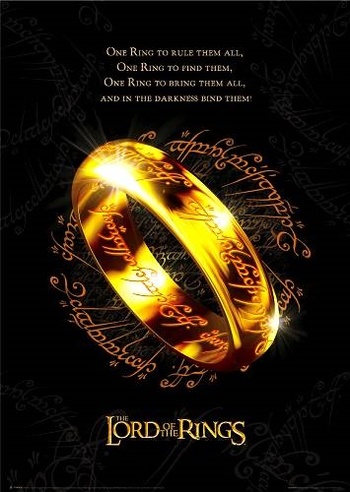
An adaptation of J. R. R. Tolkien's The Lord of the Rings into a film trilogy directed by Peter Jackson. The movies were filmed together and released one year after the previous for the holiday seasons of 2001-2003.
One of the most ambitious movie projects ever undertaken, the overall budget was around $300 million (estimates vary between $281-330 million), and principal filming for all three pictures took place over 18 months in Jackson's native New Zealand (which has seen tourism increase by 50% since the films came out). The entire project took eight years, factoring in the early pre-production and the fact that additional pick-ups were filmed in between each film's release. In fact, the very last shot filmed (a few skulls tumbling along the ground) was quickly shot in the studio after the third film was released and included in its extended edition.
The films were remarkably faithful in many respects, though many changes had to be made due to the many factors involved with adapting such a monumental work. Among the most significant changes include Saruman's last scene, the characterizations of Aragorn, Gimli, Faramir, Denethor, and Arwen, as well as the removal of various subplots to make the story as a whole more appealing to movie audiences or to streamline their remarkably nuanced events from the books.
The theatrical versions were lengthy epics (all clocking at around 3-ish hours), and the "Extended Editions" (released before the succeeding movies) added at least another half-hour to each film's running time.note Unusual for such a thing, Peter Jackson has stated that the Extended Editions are not an actual Director's Cut (feeling the term would unfairly imply that he was unsatisfied with the theatrical releases) but merely a fan-friendly extension to enlarge the world of Middle-earth and see what things they left out of the faster-paced theatrical versions.
The results were astonishingly critically and commercially successful, with each film grossing more than $750 million (averaging more than $1 billion after being adjusted for inflation), and with all three winning Academy Awards.note
The trilogy consists of:
- The Fellowship of the Ring, released in December 2001
- The Two Towers, released in December 2002
- The Return of the King, released in December 2003
An adaptation of The Hobbit was later made into a prequel trilogy, with Peter Jackson returning to direct the films. The first part of which was released in winter 2012 and the last in winter 2014. Many actors from the Lord of the Rings trilogy (such as Ian Mckellen, Andy Serkis, Cate Blanchett, Hugo Weaving, Orlando Bloom, and Christopher Lee) returned to reprise their roles.
The Prime Video series The Lord of the Rings: The Rings of Power about the Second Age is not in the continuity of the film series, although New Line Cinema is involved in the production in some capacity.
Peter Jackson's The Lord of the Rings trilogy contains examples of:
- 0% Approval Rating:
- No one liked Sauron, as he was the embodiment of evil in Middle-earth. His underlings were not fond of him at all and served him far more out of fear than out of either respect or loyalty. Even the Nazgul were just puppets and extensions of his power. And Saruman thought of allegiance with him as nothing more than a convenience.
- Denethor clearly hit this by the time Mordor arrived at Minas Tirith. When Denethor finally snaps in the face of Mordor's army and orders his men to desert their posts, Gandalf whacks him unconscious with his staff, and then proceeds to take control of Minas Tirith's defence. No one stops Gandalf from doing this, and everyone immediately starts following Gandalf's orders.
- 1-Dimensional Thinking: The Nazgûl at the Fords of Bruinen in the first movie. Instead of just riding back into the forest, they ride downstream where the wave is certain to catch them... because the water has distorted all sense of direction for them (hence why they were reluctant to cross in the first place). It's also worth noting that in the novel several riders are driven into the river by arrival of Glorfindel behind them.
- Absurdly Sharp Blade: Limbs and heads get lopped off frequently in this movie. Viggo Mortensen actually went to the prop department and asked them to make him a prop whetstone he could use as part of his costume. He realized that if Aragorn would be killing so many orcs, he'd have to keep his blade sharp somehow. In the extended edition, there's even a scene of him sharpening his sword while resting in Lothlórien.
- Accent Adaptation: A multitude of accents from all over The British Isles are used with great effect throughout the trilogy to enhance characterization:
- The high-ranking characters (Gandalf, Saruman, Elrond, Galadriel etc) have RP (the Queen's English) accents, which lends them gravitas and enhances their position of authority.
- As explained in the commentary, there was originally an idea for the Elves to have sort of Irish-accents where they pronounce their R's and L's differently, because they live so long it's like they learned to speak Old English centuries ago and are getting used to the new vowel shifts since then. This is actually how all of their lines were performed during the original filming, but the idea was later dropped (because a general audience wouldn't immediately understand the reason behind it) and all their dialogue was re-recorded in ADR.
- Most people from Gondor (Denethor, Boromir, Faramir) speak with an RP accent, as Gondor is the main kingdom of Men that still opposes Sauron.
- People from Rohan speak with Rhotic accents, in which they pronounce all their R's distinctly (unlike in RP). This was to show how they're a little less advanced than Gondor itself but are still in contact with them. In fact, all the Rohirrim speak their own language, presented as literally Old English in a few scenes, but the entire royal court is bilingual in the Common Speach / Westron, their world's lingua franca. Rhotic accents are more common in the Americas but can be found in the British Isles, in the West Country around Somerset.
- Most Hobbits speak with a rural, Somerset-to-West-Midlands accent. Sam speaks with this standard accent. More educated Hobbits Bilbo and Frodo (arguably Hobbit gentry) have a more softened accent that is a bit closer to RP. The exceptions are Merry and Pippin: Billy Boyd used his native Scottish accent to preserve his comedic timing (they came up with the explanation that Tookland is rough hill country in the southern Shire and thus sort of like Scotland); meanwhile while Merry is from Buckland beyond the eastern edge of the Shire, so his accent is sort of an oddball that doesn't quite sound like the others.
-
 Fridge Brilliance: in the novels it's stated that the Hobbit accent actually sounds a little like the Rohan accent, because their ancestors used to live in the same region near the Anduin and had some contact. Thus it makes perfect sense that if the Rohirrim have Somerset accents, the Hobbits have sort of similar Gloucester-to-West-Midlands accent.
-
- Aragorn has a unique accent, but as he's a Dunedain ranger from the old north kingdom Arnor, not the south kingdom Gondor, he was raised by Elves, and he's been traveling extensively for decades, it makes sense that he wouldn't sound like any of these other groups.
- The Orcs have Ray Winstone-esque theatrical Cockney/SE London accents to emphasize their loutishness.
- Gimli was given a Scottish accent to mirror what in the text was simply gruff speech. (By John Rhys-Davies, who was raised in England by Welsh parents).
- To emphasize just how alien a walking, talking tree-man is, his voice-actor (also John Rhys Davies) performed the lines by talking as he was inhaling instead of exhaling.
- The high-ranking characters (Gandalf, Saruman, Elrond, Galadriel etc) have RP (the Queen's English) accents, which lends them gravitas and enhances their position of authority.
- Acoustic Licence: In The Two Towers, when Saruman is addressing his army of ten thousand Uruk-hai, his voice appears to be magnified by magical means. However in the extended version of The Return of the King Saruman speaks to the protagonists from the top of Orthanc and no similar effect is used (online cartoon spoof site Sev Trek suggested that he was using his pointy wizard's hat as a megaphone).
- Action Bomb: In The Two Towers, during the battle at Helm's Deep, the Uruk-hai placed a bomb in the drainage tunnel at Helm's Deep, with an Uruk with a torch blowing himself up to set it off.
- Action Film, Quiet Drama Scene:
- The heartwarming and peaceful scenes of The Shire in Fellowship of the Ring (especially in the Director's Cut), filled with laughter, friendship and happy children (what a warrior lays down his life to protect) is what makes us actually care whether or not Frodo and the Fellowship defeat the Lord of the Rings or not.
- While The Two Towers has a very loud build-up with the arrival of Saruman's army at Helm's Deep, the extended edition cuts away from this bombastic action to focus on cowering civilians in the caves underneath, with the Uruks chanting in the distance. Theoden also delivers a monologue where he doubts whether the Rohirrim can win and wonders what will become of his kingdom.
- When the orcs are trying to break down a gate deep within Minas Tirith, Gandalf takes a few minutes to tell Pippin about the peaceful nature of the afterlife — a Far Green Country. The music at this point transitions from fearsome to quietly spiritual.
- Frodo and Sam have many scenes that show The Power of Friendship. Likewise, there are many flashback scenes that show Aragorn and Arwen's romance.
- Action Girl:
- Eowyn is the most prominent example. She's a shield maiden of Rohan, trained to fight in battle. She doesn't get to demonstrate it much in the second film - but she does successfully lead the people to safety, qualifying her for Action Survivor status. She more than earns her stripes in the third film.
- Arwen gets a moment in the limelight in the first film, taking Glorfindel's place as the rider who carries Frodo to Rivendell. She outruns the nine Nazgul and summons a flood to wash them away. Word of God has said that she was originally supposed to fight at Helm's Deep too.
- There are also female warriors among the Easterling army. Women can be glimpsed in the army of elves that show up at Helm's Deep too.
- Actionized Adaptation: The films all focus a lot more on the battles than the books do, adding and extending action scenes. For example, Fellowship's action prologue was only outlined second hand in the book, the fight in Balin's tomb was about a page long, the climax of the first book was focused more on Frodo and Sam splitting from the Fellowship, with most of the Uruk-Hai attack (with Boromir's death and Merry and Pippin being taken away) again being described after the fact. The following two books were more action-oriented than the first, but Peter Jackson still turned the action up to eleven by inserting whole sequences like the warg-rider attack and placing Frodo & Sam at Osgiliath.
- Actor Allusion: In the extended cut of the third movie, Saruman is impaled on a spike that goes through his heart after falling to his death from Orthanc.
- A possibly very subtle one when Boromir cuts himself on the broken sword, his response is "...still sharp." Sean Bean starred in the British series Sharpe prior to this role.
- Act of True Love: The entirety of the trilogy is one of these for Samwise Gamgee. He followed Frodo into Mordor, being his keeper for the whole trip.
- Adapted Out:
- Tom Bombadil and his wife Goldberry, together with the Hobbits' entire "Old Forest" adventure.
- Glorfindel's role of rescuing Frodo from the Nazgûl and bringing him to Rivendell is given to Arwen.
- Prince Imrahil of Dol Amroth is omitted. His role in the book supporting Gandalf's defence of Minas Tirith and his support of Aragorn as King of Gondor are fairly important plot points, as he's the one that figures Aragorn can cure victims of the Nazgûl.
- Beregond (and his son's) role as Pippin's friend is given to Faramir. His role in defending Faramir from premature cremation is simply cut, so Pippin's dash for Gandalf is even more desperate and they only get there just as the pyre is about to be lit. Purportedly, Ian Hughes'
 character was meant to be Beregond, but the name was changed in post-production because the role had been so reduced. (Not that you hear either name said onscreen.)
 - Ghan-buri-Ghan and his wildmen are omitted. In the novels, many thousands of Orcs are quite sensibly sent north to guard against the Ride of the Rohirrim, forcing Theoden and his men to sneak around them thanks to Ghan-buri-Ghan.
- Elrond's sons Elladan and Elrohir, as well as Halbarad and the other Rangers who join Aragorn on the Paths of the Dead are also absent.
- The Scouring of the Shire is absent from the films' canon, instead shown as a Bad Future.
- Adaptational Angst Upgrade:
- Aragorn is more unsure about returning to the throne of Gondor, and must be convinced by Elrond to do so. His reason is his ancestor Isildur's failure to destroy the One Ring, and Aragorn fears this weakness has been passed down to him.note
- Faramir is also an example. In the book he immediately recognizes the danger of the Ring, thereby becoming the only "normal" Human in the entire story who isn't tempted by the Ring.note The filmmakers thought that audiences wouldn't believe that a normal human wouldn't be tempted by the Ring (as the book never gives a compelling reason for this either) so in the movie he follows in his brother's footsteps and tries to get the Ring to Gondor, due to massive angst over being the less-favoured son. The scene of Denethor treating Faramir as The Un-Favourite also was added to justify this change.
- Denethor could apply as well: while his actions are more or less the same, the book actually gives him reason to despair in the end while the movie manages to keep it much more ambiguous.
- Adaptational Context Change: Numerous lines and events are taken from the books but given a different meaning by changing the context or speaker.
- In the book, Gandalf is the Fellowship member most in favour of going through the mines of Moria, against the objections of Aragorn especially. The film, by contrast, plays up both his foreknowledge and his angst about Durin's Bane and thus insist, "I would not take the road through Moria unless I had no other choice."
- In the novel, Gandalf is pulled clear off the bridge and into the chasm by the Balrog's whip and shouts his last words as he's already falling. In the film, the whip disentangles while he's still clinging to the ledge and he intentionally lets go rather than let the Fellowship return to help him.
- As he enters Lothlorien in the film, Frodo hears Galadriel's disembodied voice say, "Your coming to us is as the footsteps of doom. You bring great evil here, Ringbearer," in an ominous Doomy Dooms of Doom to play up the image of the "Elf witch of terrible power" currently being described by Gimli. In the novel, she describes his coming as "the footsteps of Doom" while explaining that destroying the One Ring will likely also end the power of the Elven Ring she's using to enchant Lothlorien, thus putting the Elves in a Morton's Fork between immediate destruction and slow decay.
- In the book, "Heed no nightly noises" is said by both Goldberry and Tom Bombadil in their house in the Old Forest on the borders of the Shire. After cutting Bombadil from the film, the screenwriters decided to instead give this line and some others to Treebeardnote in Fangorn forest. This changes the meaning of the line from, "No matter what you hear tonight, it won't harm you," to something more like, "Sleep tight, don't let the bedbugs bite."
- Gandalf's description of Éowyn is changed to something Grima says to her directly. As Peter Jackson says, it was less important who said it than that be said about Éowyn.Wormtongue: "Who knows what you've spoken to the darkness in the bitter watches of the night, when all your life seems to shrink; the walls of your bower closing in about you, a hutch to trammel some wild thing in?"
- In the film, Gandalf's healing of Theoden is portrayed as a full-on exorcism and visible de-aging of Theoden himself, whereas in the novel it's more a casting down of Wormtongue and a breaking of the supernatural cloud of despair infecting Theoden's hall.
- The events around the Battle of Helm's Deep are all twisted about.
- In the film, Theoden refuses Gandalf's advice to fight Saruman in the open on the grounds that his main force is too far away with the banished Eomer, so he must abandon vulnerable Edoras for the fortress of Helm's Deep. However, this plan is treated as inherently wrong by Aragorn and Gandalf, the latter of whom rides off to retrieve Eomer apparently in defiance of Theoden even though the king only said summoning him was unfeasible, not unwanted. In the novels, by contrast, Theoden immediately accepts Gandalf's advice to call up all his forces and immediately leads his household guard to join the forces already defending the Westfold while the rest of his forces assemble.
- In the film, the Rohirrim are then attacked en route and badly mauled on the plains merely by Saruman's warg riders, proving Gandalf's open-battle plan wrongheaded, yet Theoden is still portrayed as a Perilous Old Fool for persisting with his Helm's Deep plan, especially after Aragorn returns to report their enemies' true numbers. Contrariwise, in the novels, it is precisely upon learning the true size of Saruman's host and that the Westfold men have already been defeated and scattered with many fleeing to Helm's Deep with their women and children that Gandalf himself urges Theoden to join them there while he rallies the other survivors. Thus, in the novels, Theoden and Gandalf are in agreement on fighting at Helm's Deep and Theoden himself provides the enheartening last-minute reinforcements embodied by Haldir's Elves in the film.
- Wormtongue's release. After being allowed to leave Edoras, Wormtongue arrives in Isengard seemingly within hours and immediately provides Saruman (and the audience) with several key insights into the weaknesses of Helm's Deep and Theoden's plans to retreat there, thus prompting both the Warg-rider attack and the breach of the Deeping Wall, which can make letting him go seem like pure Good Is Dumb and Nice Job Breaking It, Hero at least in The Two Towers. Not so in the novel, where Wormtongue—to his great dismay—only arrives in Isengard after it has been flooded by the Ents.
- Sam's monologue at the end of The Two Towers about how their situation is "like in the great stories," is transplanted from their camping at Cirith Ungol where it was only part of a series of musings Sam had while chatting lightly with Frodo after passing Minas Morgul. The film placed it much earlier, during the battle in Osgiliath, and made Sam utter it as a shocked, heartfelt revelation about their fears and hopes, which the speech pretty much summed up. Gollum's reaction diverges too, as in the book he wasn't present and thus never heard it, while in the film he was right there with them and was uncharacteristically moved by Sam's words in one of his most redeeming moments.
- In the book, Sam wakes up to find Gollum crouched over Frodo and accuses him of "sneaking" when Gollum was actually on the verge of repentance, but Sam's words harden his animosity towards the hobbits and his resolve to feed them to Shelob. In the movie, Sam surprises Gollum disposing of the lembas, and uses the same language on him. In this context, Sam's accusation is more justified and lacks the negative consequences of the original.
- Upon accepting the reforged Anduril in the third film, Aragorn utters the Elvish words, Onen i-Estel Edain, u-chebin estel anim, ("I gave Hope to Men; I have kept no hope for myself") either to illustrate lingering doubts about his own ability to lead (see Adaptational Angst Upgrade) or chances of success. In the novels, these are the last words of Aragorn's own mother Gilraen shortly before she died in despair for the future.note
- In the book, Éowyn says the line "Do you not know?" to Faramir to let him know that she's fallen in love with him. In the movie, her relationship with Faramir is downplayed, and her feelings for Aragorn emphasised, so the line is said to Aragorn instead.
- Sam's vision of the star over the Ephel Dúath shows up in the extended edition of the movies, but is given slightly different significance. In the book, the vision is a private experience of Sam's that gives him strength to continue the journey. In the movie, Sam points out the star in order to encourage Frodo, taking the focus off of Sam's inner struggle and shifting it to Frodo's need for support.
- Adaptational Modesty: Frodo has lost his cloak and mithril vest in the Tower of Cirith Ungol, leaving him shirtless. In the book the Orcs have stripped him completely naked. Which explains Sam's line about how "you can't go walking through Mordor in naught but your skin", which is quoted verbatim from the book.
- Adaptational Self-Defence: In the book, Gollum bites the Ring off Frodo's hand, leaves the hobbit writhing in pain, revels madly in his triumph, and falls into the Crack of Doom through his own fault. In the movie, Frodo, apparently still in the Ring's thrall, gets up and starts fighting Gollum for the Ring, knocking them both off the edge where Sam rescues Frodo. Peter Jackson figured it was more satisfying for the audience to see Frodo actually take part in the Ring's destruction. It also makes Gollum look like less of an idiot that he doesn't just fall in on his own, no matter how ring-addled he is.
- Adaptational Sympathy: Because of the extra material added to The Two Towers, the Rohirrim are unintentionally portrayed more sympathetically than the Gondorians. Especially in the extended editions, we see more of Rohan civilians escaping from Edoras, taking refuge in Helm's Deep, and celebrating their victory afterwards. On the other hand, characters in Minas Tirith from the books who could have humanized the Gondorians, such as Beregond, Bergil and Ioreth, were cut out of the movies. The Rohirrim's architecture and costumes also have a warmer color scheme than the Gondorians, where because the national colors of Gondor are black and white, the production team designed most things in Minas Tirith to be shades of gray.
- Adaptation Expansion: The fight between Gandalf and the Balrog is only mentioned in the book. Here, it's the opening scene of the second movie.
- Adaptational Badass: The Eagles. In the book the force that turns the tide in the final battle is an entire army; in the film it's just four of them.
- Adaptational Villainy:
- The movie version of Denethor lacks most of the redeeming qualities that he has in the books, in which he is a Good Is Not Nice character who nevertheless was a capable leader until driven off the Despair Event Horizon.
- Although never a villain, Faramir is far more hostile to the hobbits in the movie than he was in the books, and is tempted by the Ring, until Samwise tells him what the Ring did to Boromir.
- Adaptational Wimp: Gondor gets hit with this big time. Due to the omission of Dol Amroth and reinforcements from other parts of the kingdom, it seems very much like Gondor is just a city-state in this continuity and all the soldiers within Minas Tirith is everything they have. Gondorian soldiers are also depicted as total pushovers who can't defend anything on their own, failing to hold Minas Tirith while the Rhohirims can charge the orcs frontally and still emerge victorious.
- Adaptation Distillation:
- Many favoured aspects of the books were taken up a notch, while much detail was glossed over. Most notably, the removal of the Tom Bombadil sequence, which other than some facts he gives them in the course of his storytelling doesn't really add anything incredibly significant to the narrative of the books.
- The final chapters of the books, the Scouring of the Shire, were removed entirely. Even if they were somewhat anti-climactic, they gave the book a darker vibe, one of Tolkien's recurrent themes. Specifically, they were meant to illustrate what war does to a beloved homeland. Saruman's downfall to becoming a petty tyrant over this little corner of the world is a
 What Could Have Been for Chris Lee.
- Adaptation Dye-Job:
- Boromir in Fellowship of the Ring is described as having dark hair. For the movies they gave him light brown, bordering on blond.note Faramir's hair is not as dark, either. The vast majority of Men of Númenórean ancestry are said in the books to have dark hair and grey eyes.
- The elves of Lothlórien are shown to be uniformly blonde, though only the Vanyar and their descendants such as Galadriel, had exclusively blonde hair in the books. However Thranduil was described as being "golden-haired" in The Hobbit, so Silvan elves were capable of being blonde but not the extent of the Vanyar.
- While Frodo and Pippin are brunette, Merry and Sam are fairly blond, when in the books it specifically says that blond hobbits are a rarity.
- Adaptation Explanation Extrication: The largely unexplained backstory leaves quite a few of these:
- Thanks to Peter Jackson's staging of the flashback with Elrond and Isildur, many who haven't read the books wonder why Elrond didn't just grab the Ring from Isildur and destroy it himself, or even just push Isildur into the lava if he wouldn't destroy something so Obviously Evil. note In the books, there's no such epic confrontation since at the time "few marked what Isildur did" and not even Elrond really knew what the Ring did, only that it was an evil wrought by Sauron to master the other Rings and should be destroyed on that basis, not because it was Sauron's Soul Jar. Therefore, when Isildur took the ring as a token of victory, a memorial to his father and brother's heroic deaths, and heirloom for his kidsnote , no one really had any solid evidence to oppose him doing so.
- The issue of Aragorn as heir to the throne of Gondor. While the films play it off as Aragorn's own reluctance to rule, if Boromir can recognize the heir of Isildur simply from the name 'Aragorn', then why weren't his ancestors made kings long ago? In the books, the issue is far more complicated since although Isildur did rule Gondor at one point, he would later relinquish it to his nephew Meneldil, thereby removing any claim he and his descendants had over it. The Council of Gondor would later make this into law, declaring that only the direct male-line descendants of Meneldil are fit to sit on the throne. As someone who is only descended from Meneldil through a female ancestor, Aragorn does not fulfill that criterion and cannot simply walk into Gondor demanding his kingship. When Gandalf tells Denethor that he has no authority to deny the return of the king, that is a major deviation from the books, as Gondor has already done it once to Aragorn's own ancestor.
- One issue that is routinely brought up as though it's a plot hole is "Why didn't the Fellowship just use the eagles and fly the One Ring to Mount Doom, then drop it in from the air?" There are a number of reasons in the books that explain why. The Eagles are forbidden by their creator from intervening directly in the War, so they won't shepherd the Ring themselves. They also would be just as likely to be tempted to take the Ring for themselves as any other sentient creature. The most obvious reason is that the whole point of the Fellowship is to avoid detection, and a flock of eagles would bring all of Sauron's forces down on their heads. For all these reasons, the Eagles are only free to arrive once the Ring is gone and Sauron is defeated. Another factor is that their power is greatly increased in the movies; while their arrival did turn the tide in the book it was the assembled armies of their entire race intervening (which had been established to be mustering much earlier), not just four guys.
- Tom Bombadil is cut from the film, along with the scene with where he rescues the hobbits from the Barrow-wights and takes their enchanted daggers one of which Merry uses to slay the Witch-king. Here, Aragorn just gives them some short swords ("These are for you") that had been kept at Weathertop. Merry goes into battle with an Elven dagger which is never truly hinted or explained why it's effective against the Witch-king of Angmar unless it's enchanted in a similar way with the book's counterpart. Then again, it's a gift of Galadriel. Or maybe he can harm the Witch-king simply because he is a Hobbit, and not a "man" (human).
- Gandalf stops at Rohan in the first book before going to Rivendell (because Gwaihir the Eagle can't carry him much farther), attempting to warn Theoden about Saruman's Face–Heel Turn - but Grima Wormtongue has already started poisoning the old king's mind. This is eliminated from the film, so it's not explained how Gandalf is so up-to-date on what's been happening in Rohan.
- Adaptation Personality Change: Did this with a few characters. Arwen's role is expanded and she becomes an Action Girl, Faramir becomes tempted by the ring and his Parental Favouritism issues are more played up. Elrond is also made to be bitter and cynical, thinking humans are useless. Merry and Pippin were much more mature and responsible in the book; their carefree and comical escapades in the film had been decades earlier (stealing food)note or not at all (the fireworks scene). Denethor also gets a bit of Adaptational Villainy when he was simply Good Is Not Nice in the book.
- Adaptational Species Change: The Fellbeasts in the novels were implied to be featherless avian creatures, likely to emphasize their nature as an Evil Counterpart for the Eagles. In these films, they instead appear to be draconic beasts (which, ironically, still works, as it makes them come off a poor imitations of Eagles, just like how Orcs are imitations of elves and trolls imitations of ents. That being said, it's stated that Fellbeasts did look somewhat draconic in the novels).
- Advantage Ball: Rather than worry about such things as tactical realism, advantage in battle seems to be principally a matter of who makes the most badass entrance, regardless of such matters as numbers and equipment. This is especially true of the Uruk-hai on Amon Hen.
- Age Cut: Averted in the Fellowship Of the Ring when Elrond talks to Gandalf about an incident thousands of years in the past. We cut to a shot of Elrond in the past and he looks exactly the same, since elves are immortal.
- Age Lift: Pippin is 28 in the books (hobbits come of age at 30, and thus he is considered still a tween) and the youngest of the Fellowship. While not specifically addressed in the films, Billy Boyd is the oldest of the four actors playing the hobbits and is not likely to be considered the youngest of the group.
- Agony of the Feet: Averted when the other hobbits make a fire on Weathertop (inadvertently drawing the Nazgûl to them) and Frodo panics when he sees it and tries to put it out with his foot. Hobbits are stated to have tough soles in the book — basically their feet are their shoes, and they have a lot more fur on them than depicted in the film.
- All There in the Manual: While not necessary to understand the movies, reading the books can provide valuable background information that just couldn't be fit into the films. In particular, the events of The Hobbit are recapped in less than a minute. If you haven't read it, quite a few of the little continuity nods will go right over your head, and seeing an aging Bilbo leaving Middle-Earth won't be nearly as emotional.
- All Your Base Are Belong to Us: What Sauron and Saruman try to do to Minas Tirith and Helm's Deep, respectively. They do manage to lay siege to Osgiliath however.
- Always a Bigger Fish: In the Fellowship of the Ring. The goblins have the party surrounded in the mines of Moria — until the Balrog makes its first appearance. They run for it. So does everyone else.
- Always Chaotic Evil: Orcs and Uruk-Hai.
- And This Is for...: Samwise Gamgee, the normally non-threatening gardener, even did this, dedicating Orc kills: "That's for Frodo! And that's for the Shire! And that's for my old Gaffer!"
- Animal Espionage: Saruman has crows that serve as spies, and one scene has The Fellowship take cover when a flock of crows fly overhead before we see them report in back at Isengard.
- Angelic Beauty: A rejected idea from the third film was to have Sauron (who is basically a Fallen Angel only appearing as an Evil Overlord) appear in his fair form as Annatar to beguile Aragorn during the final battle at the gates of Mordor. This did result in some deleted footage, but was replaced with the Aragorn vs. Troll fight.
- Annoying Arrows: Averted for the most part. Arrows are very, very lethal in the films and people from both sides go down after getting hit by one. Played with (for dramatic effect) when Boromir gets tagged with two in a row: he's visibly pained but still keeps fighting for a while uninhibited until the third one brings him to his knees and he's helpless to stop Merry and Pippin from being taken.note Also, the Uruk-hai berserker with the bomb-igniting-torch at Helm's Deep keeps running unimpeded when Legolas shoots him two times.
- Antagonist Title: Sauron is the Lord of the Rings. He is the one who created the Rings of Power, and the One Ring is trying to reunite with him throughout the books. It would be assumed that it is Frodo, which is even referenced when Pippin calls Frodo "Lord of the Ring," but Gandalf hushes him and tells him not to Speak of the Devil.
- The Apple Falls Far: When the hobbits almost tumble into a pit in Moria, Boromir drops a torch, which is followed by a long tracking shot of it falling into the abyss.
- Armies Are Evil: For the Free Peoples, armies are at best a necessary evil and warfare, when it happens, is still decided by yeoman warrior ethos and heroics from leaders. Gondor is the only realm to keep a standing army because, as Boromir points out, they are the one next to Mordor. Isengard and Mordor on the other hand are focused war machines and fight with professional tactics and strategy in addition to the brutality.
- Armour Is Useless: There are many instances of mooks and redshirts dying from a single blow despite being encased in armour. Most notably, orc and goblins tend to wear particularly heavy-looking plate armour, yet often go down to a single swipe or arrow. Aragorn and Legolas also go without armour for a majority of the series, despite being some of the most capable fighters.
- Slightly justified where the elves (and Aragorn) are concerned: Legolas is heard to pass advice on the weaknesses of Uruk-hai armour to his fellow elves in Helms Deep, so they can Attack Its Weak Point. When humans or orcs fire a volley, it tends to fell significantly less troops per arrow fired, though orcs get around this by sheer numbers.
- Aragorn might be wearing leather armour the rest of the time, it's a bit hard to tell. Not the best armour out there, but someone who calls himself a "Ranger" would prefer mobility (not to mention quiet for stealth) over protection. He does put on heavier armour when he's going to be involved in pitched battle and his mobility might be compromised.
- And averted when Frodo is speared, only to reveal his Mithril vest had protected him.
- Also averted when Théoden is speared at Helms Deep. While he had to withdraw from the battle for the time being, he was seen back in the fight later.
- In the infamous surfboard sequence, the shield that Legolas uses as a surfing board manages to plant itself inside an Uruk even though he's wearing plate and mail. That would be hard to do even for a pike, let alone a shield, even if it has two sharp edges.
- The Gondorians in general get hit with a very bad case of this. All of their soldiers save the rangers are wear plate armour, yet they still go down like flies against the orcs (who mostly wield swords and axes, though some do use hammers).
- During the surprise attack on Osiligath, a Gondorian sentry is killed instantly with an arrow to the chest despite wearing a plate cuirass. That would be implausible even for a longbow.
- During the surprise attack on Osiligath, a Gondorian sentry is killed instantly with an arrow to the chest despite wearing a plate cuirass. That would be implausible even for a longbow
- Arrow Cam:
- The Fellowship of the Ring features another "point of view" arrow shot.
- Return of the King mounts its Arrow Cam behind a tumbling chunk of broken city masonry as it sails from its catapult and over the walls to fall among the massed orcs outside.
- Artistic Licence – Geography:
- One of the opening scenes of The Two Towers depicts Barad-dur as being a significant distance away from Mount Doom, while during the Battle of the Black Gate they appear right beside each other. Tolkien's maps show them to be about 30-50 miles apart. Moreover, the films portray Barad-dur as between Mt. Doom and the Black Gate to the north, whereas Tolkien placed it straight east of Mt. Doom. And while it is possible that a hint of a hint of Barad-dur or Mt. Doom could be seen from the Black Gate (if one removed the inner mountains and gates at the other end of the Udûn plateau), seeing their full heights as in the films would require a flat world with no terrain or horizon and unlimited visual resolution.
- Gondor's signal fire relay, using light, is limited only by reaction time, which is shown to be quite fast in the epic overnight sequence. The likely speed of this is miles per minute and so only a few hours to reach the last beacon above Edoras (~ 300 miles). Other than changing the cinematic reaction time, the distance would have to be far greater to go through the night, far too far for horses to arrive in time later.
- Aragorn's journey to Minas Tirith is similarly odd in the films in that he emerges from the Paths of the Dead (a journey of hours) at a site overlooking the Corsair ships in the Anduin river, at least 300 miles from where he entered near Dunharrow. In the novel, he emerges at just across the mountains at Erech and has to ride hard to intercept the Corsairs at Pelagir.
- Ascended Extra:
- Arwen was pretty much a background character in the book, and barely appeared or talked. In the film, while still mostly a Satellite Love Interest, she also has a badass moment saving Frodo from the Nazgûl (in the book it was a male elf called Glorfindel, and Frodo took that ride by himself!), and her importance as a driving motivation for Aragorn is played up.
- Gothmog is a mix of this and Composite Character, as he takes the role that several different Orc commanders had in the book, and becomes the joint-leader of the attack on Minas Tirith.
- Ash Face: Merry and Pippin, after setting off a firework at Bilbo's birthday party.
- Audible Sharpness: Any time a sword is pulled out of a leather scabbard, with a metal-on-metal sound effect. In the DVD audio commentaries they mention they originally wanted to do it realistically, but they put them in after test audiences reacted badly, as our subconscious is trained on and used to the trope.
- Author Usurpation: Ask anyone about movies made by Peter Jackson, and The Lord of the Rings films are probably the only ones they'll mention. They might mention The Hobbit trilogy as well, but often in a less flattering light.
- Award-Bait Song: The films gave us three stellar Tear Jerker examples: "May It Be" and "In Dreams" from Fellowship of the Ring and "Into the West" from The Return of the King. "May it Be" was nominated for an for Oscar, "Into the West" was nominated and won. "Gollum's Song" from The Two Towers averts the trope by being in a minor key, having a much darker tone, and being sung in a dissonant, shrill voice.
- Awesome Moment of Crowning: The Return of the King was about getting to this moment, since Aragorn was the rightful ruler all along. And in the end of the movie, the coronation gets a good five minutes and a reunion for Aragorn and Arwen, which makes it an almost perfect moment of crowning when the new king turns to the hobbits and says "My friends, you bow to no one."
- Back-to-Back Badasses: In the film adaptation, during the battle of Helm's Deep, Aragorn and Gimli fought the Uruk-hai while the main gate is repaired.
- The Backwards Я: Downplayed with the "faux tengwar" script used in the films. Although it uses the normal Latin alphabet as a Translation Convention, three dots are placed over each "A", which imitates the way many Tengwar modes write "A" in-universe. These modes do not have separate letters for vowel sounds, so these sounds have to be written with diacritics placed over consonant letters, and the three dots are the symbol for "A".
- Badass Army:
- The Elven army is implied to be one of these in the films given how disciplined and co-ordinated they are. Not because they're inherently better, mind you, they've just had literally thousands of years of training and combat experience.
- The Army of the Last Alliance seen in the prologue of The Fellowship. Justified in that they trained for years before marching on Mordor.
- The Uruk-hai army that attacks Helm's Deep definitely qualifies as a villainous version. Indeed, they are shown to be bluntly superior to the Allied force, to the point that not even the overwhelming disadvantage of storming a castle can stop them for long. Even the aforementioned Elves with their millennia of fighting experience can only hold them at the Deeping Wall; as soon as it's breached, the Elven defenders fail to stem the tide and are forced to retreat to the Hornburg. The Rhohirims fare even worse against the Uruks, barely even able to stop them at the gate despite having a huge chokepoint advantage. Even after Aragorn and Gimli salvage the situation by sallying out to flank the Uruk column at the gate, their effort is instantly rendered moot as the Uruks unleash their war machines to quickly scale the Hornburg and rapidly overwhelm the Rhohirim defenders. It takes Gandalf arriving at a precise moment and the Ents intervening for the Free Peoples to stand a chance against them.
- Badass Boast: "I am a servant of the Secret Fire, wielder of the flame of Anor. The dark fire will not avail you, flame of Udûn!note . Go back to the shadow... YOU SHALL NOT PASS!"
- Samwise Gamgee combines one with a Pre-Asskicking One-Liner when he returns to confront Shelob. True to his word, she never touches Frodo again after dropping him.
Sam: Let him go, you filth! LET HIM GO!!! You will not touch him again! Come on and finish it! - Samwise Gamgee combines one
- Badass Longcoat:
- Aragorn wears a dark-green "ranger coat" throughout most of the series. Unfortunately, he sheds it when he becomes king.
- On that note, the other Dúnedain rangers, who only appear in storyboarded scenes and the trading card game, wore longcoats, as well.
- Bad Future: The Scouring of the Shire from the books is turned into this in the film adaptation. In Fellowship Frodo is invited to look into the Mirror of Galadriel. He is shown a vision of the Shire being destroyed, orcs slaughtering other hobbits, the four (Merry, Pippin, Frodo and Sam) chained and forced to walk, being whipped by orcs. Galadriel tells Frodo that this is what will happen should he fail in his quest to destroy the Ring.
- Bad Guys Do the Dirty Work:
- In the extended cut of Return of the King, what to do with Saruman is a bit of a problem for Théoden and the Fellowship. He resists coming quietly to be questioned until Grima backstabs him after being kicked around one too many times.
- The sudden presence of Gollum at Mount Doom means that Sam doesn't have to fight or even kill Frodo to complete the quest and destroy the Ring after Frodo succumbs to the Ring's temptation and refuses to destroy it himself, since someone is already handling the fight for him.
- Badass Normal: Both Éomer and Éowyn. It must run in the family.
- Sam. Oh Sam. An ordinary guy who wants nothing more than to take care of his garden back in Hobbiton, Sam goes on to save Frodo countless times, take out quite a few orcs, and drive off Shelob by himself with nothing more than a Cool Sword and a magical flashlight.
- Batman Gambit: While Treebeard is taking him and Merry home, Pippin tells him to take them past Saruman's tower, claiming that the closer they are to danger, the further they are from harm. However, it's all a ruse to get Treebeard to see the devastation that Saruman wreaked upon the forest, which drives the Ents to attack Isengard.
- Battle Butler: Sam.Faramir: Are you his bodyguard?Sam: His gardener.
- Battle Chant: In Return Of The King, just before the Battle of the Pelennor Fields, Théoden gives his "arise, arise, riders of Théoden". The entire army begins then chanting "Death" over and over (even Merry chants it).
- Battle Cry: Due to the martial nature of the series, there are a few examples:
- the Rohirrim : "FORTH, EORLINGAS!"
- Aragorn's cry of "ELENDIL!"
- And Théoden's "DEATH!"
- An amusing example: when Boromir is teaching Merry and Pippin how to sword fight, they charge him shouting "For the Shire!"
- And the biggest one during their Last Stand, "For Frodo!"
- Battle in the Rain: The Battle of the Peak (when Gandalf fights the Balrog on top of the Misty Mountains). Gandalf uses the thunderstorm to his advantage by letting a bolt of lightning strike his sword, which he then stabs into the Balrog's chest, killing it.
- Beauty Is Never Tarnished:
- Frodo is badly stabbed on Weathertop, and later loses a finger, Boromir catches several arrows in his chest, Aragorn spends the whole trilogy bloody, bruised and scraped. Practically all of the cast is harassed by either the Watcher in the Water or a cave troll. But all pretty boy Legolas gets over the course of the trilogy is a bruise and a little smudge of dirt. Éowyn made it through almost the entire Battle of the Pelennor Fields unscathed, with nary a cut or bruise... until the Witch-King smashes her shield (and shield-arm) with his gigantic flail.
- Théoden also gets a spear in the shoulder during the battle of Helm's Deep. He's not badly injured, due to his armour, but he has to switch his sword to his other hand for a bit.
- During the "Flight to the Ford" scene, Arwen gets a small cut on her cheek from a branch (due to being on a high-speed horse run), but is otherwise unharmed.
- Behind the Black:
- In The Two Towers, Aragorn, Legolas, and Gimli stop their run after Aragorn senses something. The Three Hunters run behind a rock and miss, by a matter of inches, being trampled by a huge contingent of horses and riders that are coming over the hill. Why the particularly perceptive Legolas or Aragorn couldn't see or hear the riders coming from a mile off is left unexplained, but the scene is played purely for effect. In the books, the hunters did in fact spot the riders coming from a long way off and had plenty of time to prepare themselves.
- Sam in The Two Towers steps into the Dead Marshes before realizing he's walking into a bog that stretches as far as the eye can see.
- Gimli in The Fellowship Of The Ring claims he has "eyes like a hawk" but doesn't notice the squadron of elves with their arrows pointed at him.
- Being Watched:
- Frodo notices that Gollum is stalking the Fellowship when he catches a glimpse of him in Moria. Gandalf replies that he's known about it for days.
- Celeborn warns the Fellowship that they're being hunted by Orcs before leaving Lothlorien.
- The Eye of Sauron, which is instantly drawn to anyone who puts on the Ring.
- Big Bad: Sauron. His malevolence is retained because all his power was in the ring. He would be able to regain physical form if he retrieved the ring, and nearly every problem they deal with is connected to his power. note
- Big Badass Battle Sequence: At least one per movie.
- In The Fellowship of the Ring, the battle between the Last Alliance and Mordor in the prologue certainly counts. The Battle at Amon Hen is much smaller in scale, pitting the Fellowship against a small army of Uruk-hai, but it's still an extremely impressive action sequence.
- In The Two Towers, Helm's Deep fills out this role quite nicely. We also see a bit of the fighting in Osgiliath near the end of the film, as well as an ambush of the Rohirrim refugess by a pack of orc raiders and the ents' destruction of Isengard.
- In Return of the King you have the siege of Minas Tirith, the Pelennor fields, and the Black Gate. We also get to see more of the Battle of Osgiliath, ending with the forces of Gondor being utterly routed.
- Big Damn Heroes: As in the books, it happens at Helm's Deep and twice at Pelennor Fields, though a little varied. Unique to the films are two scenes in FOTR:
- When Frodo is stabbed at Weathertop, the Ringwraith reaches out, likely to grab the Ring. Cue Aragorn literally jumping in, wielding torch and sword. He fights the five of them off, setting most of them on fire.
- At Amon Hen, Merry and Pippin are surrounded by Uruk-hai; one runs in and seems to be ready to decapitate them (even though his orders say to bring them alive and unspoiled), when Boromir jumps right in between them and kills the Uruk.
- There's also a scene in The Two Towers when Merry and Pippin have been abducted and Pippin was about to be eaten by an orc when they were unintentionally rescued by the Riders of Rohan. They are saved again by Treebeard stomping on the orc a little later.
- Big Eater: All the Hobbits, but especially Pippin.
- Big Good: Gandalf foremost, as he is the most powerful individual among the heroes. Galadriel and Elrond also come close due to being the most prominent Elven.
- Big "NO!": The films have a whole bunch of them, most of them reasonably done:
- Gimli has a Big "NO!" when he discovers the tomb of Balin, which dissolves into mournful blubbering.
- Frodo also has one when Gandalf appears to die.
- When Faramir discovers that Frodo possesses the One Ring and contemplates delivering it to his father, Frodo has one and immediately retreats from Faramir, much to Faramir's surprise.
- Eomer gets in a good one when he finds Eowyn's body on the battlefield (only in Extended Cut).
- Sam, right at the climax of the third film, when Frodo succumbs to the lure of the One Ring while standing on the edge of the Crack of Doom. It's actually two smaller "no"s, then followed by what might be the biggest "NOOOOOOOOOOO!" ever heard as Frodo puts on the Ring, alerting Sauron to his presence.
- Yet another in the third film is Legolas in the final battle when Aragorn's about to be killed by a troll. It's definitely in the extended cut and the trailers at least.
- Big Shadow, Little Creature: Sam, a hobbit, tries to scare a squad of Orc warriors this way. Unlike in the book, it doesn't really work. Also unlike the book, he kills them all easily.
- Big "SHUT UP!": Gandalf's epic takedown of Gríma Wormtongue when he, Aragorn, Legolas, and Gimli enter the Golden Hall in Edoras to try and gain an audience with King Théoden easily qualifies.Gríma: Late is the hour in which this conjurer chooses to appear. Lathspell, I name him. Ill news is in ill guest.Gandalf: Be silent! Keep your forked tongue behind your teeth!
- Big "YES!":
- Gimli has one in The Fellowship of the Ring when Aragorn announces his intent to rescue Merry and Pippin from the Uruk-hai, following his famous line, "Let's hunt some Orc."
- Gollum has several in Return of the King immediately after he takes the Ring from Frodo. Cue him jumping around for joy.
- Bittersweet Ending: Quite possibly the best example of this trope in high fantasy, along with its overlapping with Earn Your Happy Ending: After much hardship, sacrifice, and perseverance at ever-surmounting odds, the One Ring is destroyed, Sauron vanquished, and a whole new era of peace and happiness is ushered in. The Fellowship is reunited, Aragorn is made King of Gondor, and the four Hobbits return home as revered heroes. However, the War of the Ring brought much devastation to Middle-earth that will take years to rebuild and countless lives were lost in all the conflict. The time of magic, the Elves, and the Maiar in Middle-earth ceases as Men begin to rule. But the biggest toll is seen in poor Frodo as he has been both physically and emotionally scarred by the Quest. He could never go back to living a life of peace and innocence in the Shire. Thus, he accepts the Valar's invitation to sail into the West, much to the heartbreak of his best friends Sam, Merry, and Pippin.
- Black-and-White Morality: For the most part, though Boromir and Frodo are otherwise good guys who succumb to the evil temptation of the Ring without meaning to. Aside from that, though, pretty much everyone besides Gollum is either clear-cut good (if they oppose the forces of Mordor and Isengard) or evil (the leaders and armies of Mordor and Isengard) and even Gollum falls squarely into the "evil" category at the end of The Two Towers and stays there in The Return of the King.
- Subverted once: in the Extended Edition of The Two Towers, Faramir sees the corpse of a Harad man they'd just been fighting, and muses about where he came from, how he'd ended up fighting in Gondor, and whether he wouldn't have rather stayed home. He notes that the man's sense of duty was no less than Sam's. This part is taken from the book, where it was Sam who considered this.
- Black Knight: Sauron from the intro of the Fellowship of the Ring opening wears a huge suit of armour, roars monstrously, and swings a gigantic mace everywhere, sending scores of soldiers flying with each blow. He is modelled after his former master Morgoth from Silmarillion, and the books (or at least the appendix) did mention him taking part in this particular battle personally, so at least it's fairly justified.
- The Witch-King fulfils this trope in both the books and the movie.
- Black Speech:
- Sauron and the Ring-wraiths use it.
- Gandalf uses it to dramatic effect in Imladris, complete with Empathic Environment. It also appears to cause elves such as Elrond and Legolas physical pain, as both wince at its usage.
- Blinded by the Light: The Uruk-Hai at the end of the battle of Helm's Deep are blinded by the rising sun when Gandalf and his army of Rohirrim come charging towards them.
- Blood from the Mouth: When Aragorn is fighting Lurtz, the orc headbutts him in the face and his mouth is bleeding afterward.
- Bloodless Carnage: Downplayed. There is quite a lot of gore if you watch closely, but the gushing blood is almost indistinguishable from the grime and filth the orcs are covered in.
- Body-Count Competition: Gimli and Legolas have one in the battles of Heml's Deep and Minas Tirith. Even after Legolas takes down the war beast, Gimli says it still only counts as one.
- Bookends: Several examples in The Two Towers (which may seem odd as it's the middle film):
- Near the start of the film, Frodo attacks Gollum with Sting held in his left hand and holds the tip to his throat. Near the end, he does the same to Sam, except with Sting in his right hand.
- Faramir's arc starts with Denethor mockingly asking if Faramir wants to attend the Council of Elrond to "show his quality". At the end, Sam earnestly tells him that he has shown his quality.
- The trilogy as a whole begins and ends in Hobbiton. Additionally, it starts with Bilbo beginning work on his book There And Back Again and ends with Frodo writing the final lines of the sequel. The Lord Of The Rings
- Bottomless Magazines: Nobody ever runs out of arrows despite firing dozens of them and never being shown replenishing their quivers or picking the arrows out of the bodies.
- Bow and Sword in Accord:
- Aragorn uses both bow and sword in the first movie, but he usually uses the bow only to open battle, staying in melee once it opens.
- Legolas is more flexible, switching between his bow and his knives when appropriate. Elves in general are capable of both archery and swordplay.
- Faramir's rangers from Ithilien used bows and swords and were lightly armoured, but the mainline Gondorian archers are depicted in plate armour, though it may have been a lighter style.
- The Uruk-hai captain (Lurtz) at the end of the first film also employs a bow/sword combo.
- Boxed Set
- Brave Scot: Gimli may be from Middle-Earth, but he comes across as this with his thick Scottish accent, red hair and habit of calling everyone "laddie".
- Breaching the Wall: In The Two Towers, the first part of the battle at Helm's Deep has Rohan's army easily keeping Saruman's Uruk-hais at bay. Unfortunately, no one's aware Saruman has found out the fortress wall can be destroyed by placing a bomb on a sewage drain nearby. Guess what happens a few minutes later...
- Breaking Speech: Elrond gives one to Arwen about how if she marries Aragorn, she will live to see him and their child die. This is an unusual example because he does it out of love.
- Brick Joke: Nobody tosses a Dwarf, but then Gimli later has to get tossed in order to fight the orcs across a gap.
- A blink-and-you'll-miss-it example: early in The Fellowship of the Ring the four Hobbits stop for "second breakfast," but Aragorn pushes them on. Pippin complains, so a couple of apples come flying out of the bushes from Aragorn's general direction. One hits Pippin in the head, and he looks up at the sky in confusion. Much later, just after the Ents have trashed Isengard in The Two Towers, Pippin mentions that he's hungry, then sees some apples floating in the water. He grabs one, then looks up in the same manner.
- Bring Him to Me: Saruman wants the ring bearer brought to him alive and unspoiled.
- Buffy Speak: Pippin during the creation of the Fellowship: "You need people of intelligence in this kind of mission... quest... thing."
- Butt-Dialing Mordor: Pippin tries to use the Palantir and unintentionally ends up getting face time with Sauron himself.
- Butterfly of Transformation: The white moth that brings giant eagles to the rescue when Gandalf is imprisoned at Orthanc, and again when the Gondor army is at the gates of Mordor. (Only appears in the Jackson films, not the book).
- Butt-Monkey: Gimli in The Two Towers and Return of the King, with a few small moments of it in Fellowship.NOT THE BEARD!!!!!
- Call That a Formation?: While lip service is paid to forming battle-lines, the battles quickly devolve into total chaos.
- Cannot Cross Running Water: Arwen uses an invocation to Ulmo to raise the waters of Rivendell and prevent the Ringwraiths from crossing the ford. (Compare the book, where the waters rise due to a boundary spell set by Elrond).
- Captain Obvious: Legolas, who tells the audience what a diversion is. The writers joke about it on the commentary.
- Catapult Nightmare: Aragorn had one of these in ''Return of the King. In fairness, he pulls a knife in the same motion, and has probably trained himself to do this every time he's suddenly awoken.
- Cavalier Consumption: Denethor appears to be more interested in eating his chicken and tomatoes than he is in Faramir's safety.
- The Cavalry:
- Minas Tirith is about to be overwhelmed by an enormous horde of Orcs—and then the Rohirrim appear at the top of the hill, blowing their horns.
- The same happens at Helm's Deep, with Gandalf and Éomer's éored.
- Cavalry of the Dead: In the book, they're ghosts who accompany Aragorn to prove his kingship, inspire fear and awe, and ensure only stone cold badasses are brave enough to fight alongside him and help defeat the Corsairs of Umbar. In the film, they are the cavalry.
- Chekhov's Gun:
- The small glass vial containing the Light of Eärendil, given to Frodo by Galadriel in the first film. It comes in handy in the third film, when Frodo is lost in Shelob's lair. The elven rope given to Sam also comes in handy, though it's only given a bit of relevance in the extended edition. Given the length of time between the release of the film in theaters, this turned into a bit of a Brick Joke.
- In the book all items received by the Fellowship in Lothlórien fit this trope (most notably the Elven cloaks and brooches). She even gives Sam a box of dirt. The movie keeps most of them with the exception of Boromir's belt (in the book it served to help Faramir realize that he indeed saw his dead brother and not just a vision).
- In the beginning of the second film, Saruman instructs his mooks to dam the river. At the end of the film, the Ents break the dam, dramatically destroying Saruman's army and Elaborate Underground Base in the ensuing flood.
- If counting where Bilbo and Frodo's sword, Sting, received its name in The Hobbit killing the giant spiders of Mirkwood as they attacked the ensnared dwarves, it's perhaps one of these or a Brick Joke that Samwise uses Sting to defeat Shelob (the Mirkwood spiders are literally her offspring).
- Child Soldiers: There is a scene in The Two Towers where the soldiers suit up to defend Helm's Deep and we see a number of people being armed are very young boys needed to up their soldier count. Mercifully, we're never shown the kids doing any actually combat besides throwing stones at the besiegers from the wall.Gimli: Some of these men have seen too many winters.Legolas: Or too few.
- Chromatic Arrangement: All merchandise, including the special edition DVDs, was colour-coded by film. Fellowship was green, Two Towers was red, and Return of the King was blue. Irritatingly, the Complete Recordings soundtracks had a different order: Fellowship was red, Towers blue, King green. These colours were made to match those of the limited edition soundtracks released at the same time as the films, which were designed before the films were even released. So in a way the Complete Recordings show the original colour concepts, then they went and changed them for the extended edition DVDs.
- Climb, Slip, Hang, Climb: When Frodo and Sam are following Gollum to Shelob's lair. Aragorn does it as well when the staircase is collapsing in Moria.
- Collapsing Lair: Barad-dûr, when Sauron is finally defeated. See Keystone Army.
- Colour Wash:
- Especially noticeable in day-for-night scenes. There's even a scene in Return of the King where Pippin is searching for Merry, that appears as a daylight scene in the theatrical version but was regraded to night for the extended version.
- An interesting example occurs with several shots used more than once (Green Dragon Inn exterior, Boromir's last stand, a certain close-up of Elrond) in different movies: frame-by-frame comparison shows exactly the same imagery with drastically different colours.
- Combat Tentacles: The Watcher in the Water, which wasn't clearly described in the book, is shown as a giant squid-like monster when it attacks the Company.
- Come with Me If You Want to Live: Aragorn gets introduced this way in Bree, as a wilderness expert who can outrun the Nazgûl. More so in the film, since they set out that very morning after they outwit the Nazgûl ambush. In the film, Aragorn fits the trope to a T:Frodo: Where are you taking us?Aragorn: Into the wild.Merry: How do we know this Strider is a friend of Gandalf?Frodo: We have no choice but to trust him.
- Comically Missing the Point:
- As Sam and Frodo are left alone with Sméagol:Sam: It's too quiet. There hasn't been sight nor sound of a bird for two days.Gollum: No, no birdses to eat. No crunchable birdses!
- Another example: While on Weathertop, being chased by the Nazgûl, Frodo goes to sleep, only to wake up to the other hobbits cooking food.Frodo: What are you doing?! [meaning, Why are you lighting a fire when we have demonic ghosts chasing us?!]Merry: Tomatoes, sausages, and nice, crispy bacon.
- As Sam and Frodo are left alone with Sméagol:
- Convection, Schmonvection:
- The lava pours out of Mount Doom within feet of Sam and Frodo at the end of the movie. Then the eagles swoop down and pick them up. Lampshaded by John Rhys-Davies in the DVD commentary.John: There you have your old pyroclastic lava flow, not a good thing to be... err... in. Added to which there may be a little bit of sulfur there and not too much oxygen.
- When Gollum and The One Ring fall into the Crack of Doom, neither show any signs of burning even when Gollum gets completely submerged.
- The lava pours out of Mount Doom within feet of Sam and Frodo at the end of the movie. Then the eagles swoop down and pick them up. Lampshaded by John Rhys-Davies in the DVD commentary.
- Conveniently Timed Attack from Behind:
- When Merry and Pippin try to escape from the orc camp and are chased by Grishnakh, he has them at knifepoint and says nobody will save them now ... then the Rohirrim attack the camp and one of them throws a spear into his back.
- Later on, Treebeard saves Merry and Pippin by stepping on an orc for them.
- When the Rohirrim are attacked by orcs on the way to Helm's Deep, Gimli gets pinned under the body of one of the Wargs, and another one creeps up on him. Aragorn then grabs a spear out of the ground and skewers it before it can attack.
- Sam also stabs an orc from behind with Sting when he rescues Frodo from the tower of Cirith Ungol.
- Cool Mask: The Witch-King's spiky, crowned helmet, which immediately sets him apart from the other Nazgul.
- Courtly Love: Gimli, almost immediately after seeing Galadriel. When she is bestowing gifts on the fellowship prior to their departure, all he requests is a strand of her golden hair. She gives him three.
- Creative Closing Credits: They contain the names of every single member of the Tolkien fan club in the special edition.
- Creator Cameo: Peter Jackson, as well as other high-ranking members of the production crew, make several appearances throughout the films:
- The prologue has cameos by senior prosthetics supervisor Gino Acevedo and prosthetics technicians Rich Mayberry and Xander Forterie as three of the seven Dwarf Lords who receive Rings of Power; concept artists John Howe and Alan Lee play two of the Nine Kings; Weta production worker Ben Britton and pre-viz storyboard shader Jason Secto play elves fighting in the Last Alliance.
- Artist Alan Lee and Production Designer Dan Hennah appear as old men being armed when Legolas and Aragorn argue at Helm's Deep. Peter Jackson appears again as a spear throwing Rohirrim at Helm's Deep.
- Jackson, Acevedo, Weta Workshop head Richard Taylor, director of photography Andrew Lesnie, and co-producer Rick Porras play the Corsairs of Umbar. Jackson's Corsair is shot by Legolas, and the rest are implicitly killed by the Army of the Dead.
- Cruel and Unusual Death: While most of the casualties are to be expected of warfare (swords, arrows etc.), there are two instances of this:
- A Rohirrim soldier at Helm's Deep is hit directly by the massive grappling hook fired by the Uruk-Hai ballista. The shot knocks him clean of the wall.
- Several Gondorian soldiers are scooped up by the huge claws of a fell beast and dropped onto Minas Tirith from a great height.
- Cruel to Be Kind: After their narrow escape from the Mines of Moria, most of the Fellowship is extremely distraught at the loss of Gandalf and stop just outside the exit to mourn. However, Aragorn orders Boromir to get them on their feet and continue the journey, answering protests of not giving them a moment by noting that by nightfall, the whole local area will be crawling with Orcs fully intent on killing them or worse, and the Fellowship must get to safety before dusk.
- Curb-Stomp Battle:
- Eomer's Rohirrim ambush the Uruk-Hai at night while they are camped outside Fangorn Forest. The Uruks barely have a chance to fight back and are slaughtered.
- Ents vs. Isengard.
- Army of the Dead vs. Forces of Sauron, unlike the book, which describes it as a long day of battle.note
- Curb Stomp Cushion:
- While the Rohirrim's battle against the Haradrim outside Minas Tirith is nearly this, as the Mumakil the Haradrim ride are basically unstoppable juggernauts that impale, crush, and swat horsemen away with impunity, the Rohirrim give a good accounting of themselves, managing to bring down a number of Mumakil by taking advantage of their greater numbers and maneuverability, though it still takes the Army of the Dead to tip the scales in Middle-earth's favour.
- Nearly all of the battles of the soldiers of Gondor against the forces of Mordor. When the trolls break through the gate of Minas Tirith the soldiers manage to kill at least one troll and in this video you can see at least one soldier who spears down an Orc.
- Cut Apart: The first movie has closeups of sleeping hobbits mixed with Ringwraiths surrounding the beds. When the stabbing begins, we discover the beds are empty and the hobbits in another room.
- Darker and Edgier: The three movies seem to alternate between this and Lighter and Softer compared to the original book. They drop a couple of the more lighthearted scenes of the book (Tom Bombadil, for example) and focus more on the bloody battles (easier to do in a visual medium), while omitting some of the creepier book-scenes (such as the barrow wights) and adding a lot of comic relief.
- Death by Adaptation: Haldir. (In the book, the elves don't even show up at Helm's Deep).
- Also the Mouth of Sauron, whose fate is unknown in the books.
- Death Glare: The crowning one has to be the one Theoden gives Grima after being freed from Saruman. You can almost hear Grima piss himself.
- Death Is Such an Odd Thing: Orlando Bloom said in the commentaries for the extended edition that this is what he was trying for, when the camera had its closeup on his face in the One-Woman Wail montage after Gandalf fell: he was coming to grips with what death was, as an elf whose only experience with it previously had been seeing enemies die in battle.
- Death of a Thousand Cuts: How the Fellowship kills the cave troll in Moria.
- Death Wail: Aragorn lets out one when he finds Merry and Pippin's elven belts on the Orc funeral pyre. In Real Life, it was because Viggo Mortensen had just broken his toe on the helmet he kicked, but he went on with the scene.
- Defeat Equals Friendship: Defied. Saruman tries to use this trope as a trick when he offers Théoden and the Fellowship a peace council after the Ents corner him in Orthanc. Théoden calls bullshit on it.
- Despair Gambit: Sauron and his minions do a lot of this, often with considerable subtlety. Perhaps the most overt example is at the beginning of the Battle of Pelennor Fields, when the orcs start the siege by catapulting the heads of Gondorian soldiers into the city.
- Determinator: Sam is Frodo's only companion to stay with him clear from the Shire to Mt. Doom, in spite of being turned away by Frodo twice, and in spite of Frodo and the others twice secretly conspiring with regards to the journey without Sam or the other hobbits. He also saves Frodo from an Eldritch Abomination and Orcs, then carries him partway up Mt Doom on his own back. The only incentive he gets to do any of this is when Gandalf says, "Don't you leave him, Samwise Gamgee" once, right at the beginning.
- Deus ex Machina: The eagles show up in the final battle to keep the ring wraiths at bay, and also to fly Frodo and Sam away from the erupting Mt Doom. This has led many a fan to wonder why none of the Fellowship flew on the eagles to Mordor in the first place (because they could get corrupted by the Ring if they saw it and tried to take it for themselves, just like all the other living beings which see the Ring).
- Devoured by the Horde: The orc pack who take Merry and Pippin to Isengard are starving, and one of them attempts to eat the hobbits. Under strict orders to bring any hobbit back in one piece, the leader of the orc pack kills this orc instead, who is then devoured by his hungry comrades.
- Didn't Think This Through: During the siege of Helm's Deep, the Uruk-Hai use Saruman's newly-created explosives to blow up the wall in order to make a breach. However, they were caught off-guard by the blast almost as much as the defenders were. The Uruks near the grate are blown up along with the ones already on the wall and countless more are crushed beneath massive chunks of falling rubble that were blown sky high by the blast. After the dust settles, instead of immediately storming through the breach, they stand there staring at it, clearly not realizing that Saruman's new weapons would be that powerful. Of course, it's probably likely that Saruman just didn't bother to inform them of its destructive power because he didn't care, given that We Have Reserves was in full effect for the Uruks.
- Dies Differently in Adaptation:
- At the climax of the story, Gollum dies while falling into Mount Doom with the Ring, but the book and the film depict the exact circumstances a bit differently. In the book, Gollum trips and falls over the precipice while celebrating his retaking of the Ring. This was filmed, but when translated to film this ending came off as too anticlimactic. A couple of other scenarios were tried, and what eventually made it to the screen was that Frodo, still caught in his own desire for the Ring, started struggling with Gollum for it again, eventually resulting in both falling over the precipice together. Gollum fell into the lava with the Ring, but Frodo managed to grab the ledge, and Sam managed to pull him up and out of immediate danger. It also allows Frodo to participate in the Ring's destruction, while also making Gollum not look like such an idiot as to fall into the lava all on his own.
- Théodred was killed in battle in the book, while in the movie he was only seriously wounded and brought back to Meduseld alive before succumbing to his wounds, possibly with assistance from Gríma.
- The omission of the Scourging of the Shire led to Saruman and Grima's deaths being changed. In the book, Grima slashes Saruman's throat and is then killed by archers. In the film, he stabs him in the back and is then killed by Legolas. Saruman then falls from his tower onto a spiked waterwheel.
- Digital Head Swap: One of the techniques used to create the proper scale for the Hobbits.
- Disney Death: Alongside Frodo's examples from the book that made it into the film, we also have Aragorn's plunge off of the cliff in The Two Towers, alongside Gollum's 'death' right after going through Shelob's tunnel.
- Disney Villain Death: Alongside examples from the book, we also have a couple unique to the films, those being Saruman's (uncut version only) and Denethor's deaths. Though it should be noted that unlike most versions of this trope, we actually see the result of Saruman's fall.
- The Dog Bites Back: Saruman really shouldn't have mistreated Wormtongue the way he did, as we see in Return of the King (at least in the extended edition).
- Door-Closes Ending: Seen as Sam returns to his family and home, having just seen the last of the fellowship leaving.
- The Dragon: The Witch-King of Angmar to Sauron. Aided by the fact that his mount, a Fell Beast, actually looks kind of like a dragon.
- Dream Intro: At the beginning of The Two Towers, Frodo has a dream that reminds us what happened to Gandalf at the end of Part 1, although in this case it continues into a sequence which he couldn't possibly have seen.
- Driven to Suicide: The look we see in Frodo's eyes as he hangs over the edge, feeling all too tempted to give into despair. Thankfully, through Sam's loyalty and love, Frodo grabs his hand and subverts this trope.
- Dug Too Deep: According to Saruman, the Dwarves of Moria did this, unleashing the Balrog.
- The Dulcinea Effect: Gimli goes from describing Galadriel as a wicked sorceress to pledging himself as her Knight In Shining Armour within days of meeting her.
- Eager Rookie: Merry and Eowyn both want to join the battle of Minas Tirith but have to sneak in with the rest of the Rohirrim, since them joining the fight is met with disapproval from the others due to being a hobbit and a woman, respectively. Eowyn at least has some battle training.
- Early-Bird Cameo:
- Inverted. Rohan appears briefly in the first book, establishing that the nation will enter the plot in the second. It's completely cut out of the film, with only one brief mention.
- The extended version of The Two Towers has a flashback to Boromir and Faramir's past, which serves to introduce Denethor before he becomes a major character in Return of the King.
- Earn Your Happy Ending: A very heavy price is paid for their victory. Poor Frodo will never be the same.
- Easy Logistics: Strongly averted. A surprising amount of screen time is spent on the various sides arming, armouring, and feeding their people. The forces of Shadow need to overcome the additional problem of protecting their forces from sunlight (Saruman solves the problem by creating the Uruk Hai, who can endure sunlight better than common orcs, while Sauron creates a cloud of volcanic ash to darken the sky over the battlefield). It even affects the plot when a powerful faction that might have remained neutral joins the war because Saruman tore down their forest to use as fuel in his forges.
- The orcs and Uruk Hai are shown subsisting on rations that would quickly make humans sick (though they certainly don't enjoy such fare). As magically created lifeforms designed as warrior slaves, this is probably a design feature to assist with this.
- The Elves achieve similar results with lembas, a magical "waybread" that can feed a grown man for a full day with one bite. It's apparently tasty, too, since Hobbits eating for pleasure can still down four whole pieces in a sitting.
- The shortage of provisions is a major concern at Helm's Deep, but quickly becomes a moot point when the Uruk-Hai storm the fortress instead of laying siege.
- Elite Mooks: The Uruk Hai.
- End of an Age: The destruction of the One Ring and the Second Defeat of Sauron marked the end of the Age of Elves and of magic in Middle-earth; the Third Age. In turn, it would give rise to the Fourth Age, which would become known as the Age of Men. As melancholy as this is, it could have been much worse. The Age was going to End one way or another, and if it hadn't been the Age of Men, it would have been the Time of the Orc.
- Enemy Civil War: The orcs of Mordor and Isengard do not play nicely together. In fact, Saruman is only allied with Mordor out of convenience; he plans to betray Sauron once he gets the Ring and overthrow him.
- Engagement Challenge: Similarly to the book, Elrond is disapproving of Aragorn and Arwen's romance until Aragorn proves he's worthy of being King. The scene in the third movie when he arrives bearing Andúril was added to show that he had changed his mind and given them his blessing.
- Epic Flail: The Witch-King's weapon of choice.
- Epic Movie: Collectively and individually, averaging at about three hours each. And that's just the theatrical cuts. The extended edition of The Return of the King actually has a running-time of four hours, and that's without counting the end credits which are another 20 minutes themselves.
- Establishing Character Moment: Quite a few.
- Sam telling Frodo the promise he made to Gandalf in the beginning. ("Don't you lose him, Samwise Gamgee!")
- Merry and Pippin's mischief at Bilbo's birthday party.
- Boromir instantly suggesting the Ring be turned over to Gondor to use against Sauron.
- Legolas defending Aragorn against Boromir.
- Gimli grabbing an axe and attempting to destroy the Ring right at the council.
- Saruman chastising Gandalf for consorting with Hobbits.
- Lurtz chokes the first orc he sees within seconds of his birth.
- Gandalf arriving in Hobbiton for Bilbo's birthday party. All the children are excited to see him, while the adults look on disapprovingly (for the most part, one Hobbit laughs at a miniature fireworks display only to frown when his wife appears.)
- Faramir is introduced after his men attack a troop of Haradrim, and he shows empathy for one of the enemies that they killed. Unlike the War Is Glorious mindset of most other characters, he then says "War will make corpses of us all."(Only in Extended Cut)
- Wormtongue's introduction in Edoras shows that he is manipulative, creepy and nevertheless a little pathetic.
- The first glimpse of the Lady Galadriel (other than the flash of her eyes that Frodo sees when he hears her voice in his mind) is her descending the stairs in Caras Galadhon with Celeborn in a blinding, majestic aura of white light. 'The Lady of Light', indeed!
- Evil Gloating: See Fate Worse Than Death.Saruman: Who now has the strength to stand against the armies of Isengard and Mordor? To stand against the might of Sauron and Saruman ... and the union of the two towers? Together, my Lord Sauron ... we shall rule this Middle-Earth!
- Evil Is Not Well-Lit: Mordor is called the Land of Shadow for a reason. Also, the inside of Orthanc is always dimly lit, and Minas Morgul is shown as being pitch-black save for a Sickly Green Glow.
- Evil Me Scares Me: Both Gandalf and Galdriel are terrified of the monsters they would become if they took the Ring. We especially see this when Galadriel returns to normal from her strobe-light moment and is really shaken.
- Evil Sounds Deep: Saruman has a deep, booming voice. The Uruk-Hai captain Lurtz also has a very deep voice, as do other orcs, when they're not...
- Evil Sounds Raspy: A side effect of corruption by rings of power. Gollum speaks this way after possessing the One Ring for centuries, and the Ringwraiths rasp their few lines. Even Sauron himself has a somewhat raspy (if deeper) voice when he's heard onscreen.
- Evil Tower of Ominousness: The (original) Dark Tower, Barad-dûr. It's actually depicted as under construction during the first film; the completed tower itself is first seen at the end of the film, from the Seat of Amon Hen; and revealed in the second film.
- Evolutionary Retcon: By the third entry, Peter Jackson had decided he wasn't a fan of the "witch noses" on certain orcs in the previous films. As a result, none of Return of the King's orcs sported long, pointy noses.
- Possibly Justified in-universe in that most of the orcs we see in the first two films are from either Moria or Isengard, whereas those in ROTK are almost exclusively of Mordor stock. It's not inconceivable that there may be some regional variation in appearance.
- Exact Words: Legends goes that no man can kill the Witch-King. Éowyn reveals she isn't one a moment before she stabs him in the head.
- Eyes Never Lie: "There was no lie in Pippin's eyes", declares Gandalf after the former has looked into the Palantir, meaning that he has not revealed Frodo's mission to the Enemy.
- Fade to White: Peter Jackson enjoys doing this, especially at the end of the third film.
- Fallen Angel: Sauron, Saruman and the Balrog of Moria.
- Fanfare: The fellowship theme, the Rohan theme at points, and the Gondor theme.
- The Bridge of Kahazad Dum, starts with an energetic and explosive fanfare as the Fellowship tries to cross the Bridge of Khazad Dum.
- Fantastic Light Source: Gandalf's staff and Galadriel's phial that contains liquid starlight and helps Frodo and Sam escape Shelob's lair.
- Fantastic Racism: A major theme of the books and movies is the heroes learning to overcome their differences. Elves vs. Dwarves is the most prominent, although Elves and Men are shown having some grudges against each other too.
- Fatal Fireworks: There's a comedic, non-fatal example: at Bilbo's birthday party, Pippin and Merry steal and launch one of Gandalf's firework rockets, ending up with an Ash Face.
- Fate Worse than Death:
- The heroes (and the unfamiliar reader) assume Frodo suffered such a fate. Subverted, somehow, as Aragorn deduced the messenger was lying.Mouth of Sauron: Who could have thought one so small could endure so much pain? And he did, Gandalf. He did.Aragorn: (smirks, strolls up to the Mouth of Sauron, and cuts of his head) I do not believe it. I will not.
- Averted with Saruman's Disney Villain Death. To shorten the film, the Scouring of the Shire had been deleted and he was made to die, but in Tolkien's eyes the original fate of the Wizard has been much worse: for a Maia, a minor god, and a powerful ruler able to sack a kingdom, to be reduced to begging through the countryside was a much greater humiliation.
- The heroes (and the unfamiliar reader) assume Frodo suffered such a fate. Subverted, somehow, as Aragorn deduced the messenger was lying.
- Fictional Accent: Aragorn speaks in a mixed accent that alternates between English, American and vaguely Irish that no other Men in the films use. Presumably, seeing as Aragorn is a Long-Lived Dunedain, the accent is part of their regional dialect.
- Final Speech: While both Boromir and Théoden had some last dying words in the book, they really spice it up in the films, especially with Boromir's last line to Aragorn: "My brother, my captain, my king".
- Fire-Forged Friends: Gimli and Legolas probably count as Trope Codifiers. They openly hate each other at their first meeting (Gimli: "Never trust an elf!"), but by the end of Fellowship they are inseparable.Gimli: Never thought I'd die fighting side by side with an Elf.
Legolas: What about side by side with a friend?
Gimli: ...aye. I could do that. - Fighter, Mage, Thief: The Legolas-Gimli-Aragorn trio is a subversion: Legolas is the Thief, because he's a skilled archer and expert in acrobatics, Gimli is the Fighter, as he's a bulky axe-wielding tank, and Aragorn, despite having Healing Hands and being able to heal victims of the Nazgul (Mage), not only completely lacks the typical characteristics of a White Mage, but does very few healing and is much more well-known for fighting in the front lines, having traits of a balanced Fighter-Thief hybrid that uses Bow and Sword, in Accord. The only actual Mage of the Fellowship is Gandalf, but he rarely uses magic as a weapon.
- Flash Forward: Elrond warns Arwen what will happen if she stays in Middle-Earth and marries Aragorn, and there is a scene of Aragorn's funeral, after he has become king and has died of old age, while Arwen lives on in grief and loneliness.
- Foe-Tossing Charge:
- Sauron during the prologue, to get to Isildur.
- Theoden and Aragorn also do this at the climax of the Battle of the Hornburg, riding out of the gates and scattering the orcs on the bridge.
- Forced Perspective:
- Used to great effect to help the average-height actors playing hobbits and dwarves seem to-scale with their man and elf co-stars.
- Used in reverse in one shot from The Fellowship of the Ring: While climbing Caradhras, Frodo falls and drops the Ring. There is a shot of the Ring lying in the snow in the foreground. The filmmakers used a larger model of the Ring in this shot to make it seem closer, while still in-focus.
- Forced Transformation: Humorously subverted when Sam eavesdrops on Gandalf and Frodo's conversation about the One Ring in Bilbo's former house. Samwise begs Gandalf not to use his magic to turn him into something "unnatural". Then the scene cuts to a shot of Gandalf walking with a horse and telling Sam to keep up, only for Sam to run along after them.note
- Foreshadowing:
- In an Extended-Version-only scene, Frodo and Sam see a group of Wood-Elves on their way to the Grey Havens while they're leaving the Shire. The final film ends with Frodo going to the Grey Havens and leaving Middle-Earth with the rest of the elves.
- When Bilbo and Gandalf smoke Pipe-weed before Bilbo's birthday party, Bilbo puffs a smoke ring, subtly bringing up the topic of the ring he possesses. In response, Gandalf produces a ship made of smoke and dissolves Bilbo's smoke ring, foreshadowing the destruction of the One Ring and their departure by ship. Bilbo watches thoughtfully. This scene follows right after Bilbo mentions that he needs a holiday and doesn't mean to return.
- In Moria, Boromir barely avoids being hit by arrows.
- Gollum's Song, sung by Emiliana Torrini and played over the credits of The Two Towers, ends with 'You are lost, you can never go home.' While it's ambiguous who exactly this is directed towards, by the end of the quest Frodo at least suffers a tragic case of You Can't Go Home Again.
- In Return of the King, Gimli mentions how he wishes he could summon a legion of Dwarves to march on Gondor with the Rohirrim. However Legolas tells him, "Your kinsmen may have no need to ride to war. I fear war already marches on their own lands" which may be a reference to the Easterlings' siege on the Dwarven kingdom of Erebor and their allies that happens off-screen at the same time as the siege of Minas Tirith.
- Forest of Perpetual Autumn: The woodland around Rivendell is in a permanent autumnal state to symbolize the declining influence of the Elves in Middle-earth.
- Forgot About His Powers:
- Sometimes Gandalf uses his magic powers, and sometimes he doesn't. He does when battling Saruman, or when facing the Balrog, or when he scares off the Nazgûl that are chasing Faramir's men on the road to Minas Tirith. But at other times he seems to forget he's a wizard and is content simply to whack bad guys with his staff, most notably when he's fighting in hand-to-hand combat in the siege of Minas Tirith or in the final battle at the gate to Mordor. Ian McKellen even asked this question once.McKellen: Why don't I zap them?Jackson: (thinking quickly) ...ah, you see, the staff is out of batteries and the local alchemy shop is closed for the war.
- Saruman shows the ability to levitate an enemy and toss him through the air, and to call down storms and avalanches from dozens if not hundreds of miles away, and Treebeard predicts that the Ents are probably doomed fighting against him. But during the actual battle, the Ents win easily and Saruman just watches angrily without using any magic.
- In the books he actually kills one of the Ents with a jet of fire, making this an inversion of the ususal Adaptation Deviation tendency to add much more blatant magic use than was in the source material.
- All There in the Manual: The Istari, being Maiar, are forbidden to use their powers directly in opposition to Sauron, and were directed to oppose him by means of giving guidance and advice. After 2000 years, not using magic is a strong habit to break.
- Sometimes Gandalf uses his magic powers, and sometimes he doesn't. He does when battling Saruman, or when facing the Balrog, or when he scares off the Nazgûl that are chasing Faramir's men on the road to Minas Tirith. But at other times he seems to forget he's a wizard and is content simply to whack bad guys with his staff, most notably when he's fighting in hand-to-hand combat in the siege of Minas Tirith or in the final battle at the gate to Mordor. Ian McKellen even asked this question once.
- Forgot to Mind Their Head: This was a hazard both in and out of universe when filming the trilogy:
- During the scene in The Fellowship of the Ring where Gandalf visits Bilbo in his hobbit hole, Gandalf, stooping, accidentally backs into a chandelier (as part of the script). His actor Ian McKellen then promptly turns and accidentally smacks his head on the roof, an (unscripted) accident so funny that they left it in.
- In the gag reel for Fellowship, this happens also to the crew. Everyone's sitting inside the hobbit hole listening to directions, then when the meeting ends they all stand up and hit their heads on the roof. Then everyone falls to the floor.
- During the scene in The Fellowship of the Ring where Gandalf visits Bilbo in his hobbit hole, Gandalf, stooping, accidentally backs into a chandelier (as part of the script). His actor Ian McKellen then promptly turns and accidentally smacks his head on the roof,
- For the Evulz: The ultimate reason why Sauron does all the things he does. All he cares about is having power over others, and the idea that his enemies don't never even occurs to him.
- Four-Temperament Ensemble: The four main hobbits — Pippin (choleric), Sam (melancholic), Frodo (leukine), and Merry (sanguine).
- Freeze-Frame Bonus: The extended palantir scene with Aragorn and Sauron very briefly shows Sauron holding the palantir in his armoured form, implying that he has returned to a humanoid form.
- Friends All Along: Aragorn is hurrying to find a herb to heal Frodo when someone sneaks up behind him and holds a blade to his throat. Said person turns out to be Arwen, teasing him.
- The Friends Who Never Hang:
- Despite ostensibly serving as one of his protectors and being a member of the Fellowship, Legolas says exactly five words directly to Frodo: "And you have my bow". Justified in that the two are separated for most of the story - they meet at the House of Elrond, split up at the end of The Fellowship of the Ring, and don't see each other again until the tail end of The Return of the King, but awkward nonetheless. Legolas primarily interacts with Aragorn and Gimli, barely even looking at anyone else in the fellowship.
- Gimli has a similar problem to a lesser degree than Legolas. As he's mostly the comic relief to the Three Hunters trio of himself Aragorn and Legolas, he rarely talks to anyone outside that dynamic. He never once speaks to Boromir or Sam.
- From Bad to Worse: The odds keep getting stacked against the heroes and their allies no matter what glimmer of hope may shine. From the Skirmish at Amon Hen, to the Battle of Helm's Deep, to the Battle for Gondor, and ultimately the Battle at the Black Gate. Each new battle is much more hopeless than the last, and it is with that last one that everything hangs by a thread.
- The Ring being available is bad enough as it means Sauron can obtain it. It soon becomes clear that the nigh-impossible task of destroying it on Sauron's doorstep is necessary as he will launch an all-out war there is no hope of defeating conventionally even before Saruman decimates Rohan.
- Frying Pan of Doom: Sam uses his cooking gear to whack some goblins in Moria.Sam: I think I'm getting the hang of this.
- Funny Background Event:
- During the Entish assault on Isengard, one of them catches fire. The Ent running around and then dousing himself in the overflowing Isen is hilarious if you notice it.
- As the Ents break the dam overlooking Isengard, there is an Ent in the foreground holding a struggling orc in his hand. When the Ent sees the dam breaking in the background, he casually throws the orc in the path of the torrent and walks away.
- Giant Spider: Peter Jackson applied his actual arachnophobia to full use to make Shelob as horrible as possible. Strangely, Shelob had a stinger in her belly, and a gaping mouth instead of actual spider fangs. Justified in that she is meant to be an Eldritch Abomination.
- Giant Wall of Watery Doom:
- In both cases the water is only "doom" to evil forces, and is actually the salvation to the good ones.
- In The Fellowship of the Ring when Arwen conjures up the Bruinen river against the Black Riders (invoking a Mass "Oh, Crap!" out of them, but they can't outrun it). For added awesomeness, the waves are horse-shaped.
- In The Two Towers when...The Ents: Break the dam; release the river!
- Near Isengard at the end, flooding all foulness out of it.
- God Save Us from the Queen!: "In place of a Dark Lord you would have a QUEEN! Not dark but beautiful and terrible as the dawn! Treacherous as the sea! Stronger than the foundations of the Earth! All shall love me, and despair!"
- Godzilla Threshold: The reason Theoden recruits young boys as Child Soldiers for the Battle of Helm's Deep; the Uruks plan to kill everyone and they need to up the solider count. To be fair, everyone involved in-universe (Theoden, the soldiers taking the children to the armoury) was thoroughly unhappy with the situation.
- Gollum Made Me Do It: More pronounced in the film than the book, where we're asked to take Gollum as more of a whole person.
- Gondor Calls for Aid: Denethor refused to light the signal fires due to a combination of bad blood between Gondor and Rohan, and due to a misguided notion that Gondor needed no aid (Denethor being under the influence of Sauron affected his decision making somewhat). Pippin manages to sneak into one of the towers and lights the fire himself. Théoden, when the subject was first broached by Aragorn, was bitter over Gondor not sending any help to Rohan during their devastating fight... when he actually gets the call, though, he personally leads The Cavalry.
- Good Lips, Evil Jaws: The film has a lot of Orcs with no lips at all. They're humanoid, and besides just being ugly look fairly normal. They have rather human mouths, if unusually sharp teeth, but these mouths are not covered by lips.
- Great Offscreen War: Not a typical example, as it takes place at the same time, rather than before, the main conflict—but in the extended edition of RotK, there is a moment when Gimli says that he wishes he had Dwarf warriors beside him. Legolas replies that he fears the Dwarves are already at war; anyone who has read the appendices knows that both of their homelands (Erebor and Mirkwood, respectively) are indeed fighting Sauron's armies in the north. The Dwarves even lose their king in the conflict. The fighting around Gondor is a sideshow by comparison to the scale of the attacks on Erebor and Mirkwoodnote .
- Green Aesop: The conflict between Isengard and the Ents.Saruman: "The old world will burn in the fires of industry. The forests will fall!"
- Grievous Harm with a Body: It's easy to miss and hard to see, but at one point when the Ents are fighting the forces of Isengard, one Ent is swinging an orc around and whacking other orcs with it.
- Groin Attack: Happens a couple of times to orcs during battles, particularly to an Uruk-Hai at Helm's Deep. Gimli hits him with an axe.
- Guilt-Free Extermination War: "Show them no mercy, for you shall receive none" is an accurate description of Saruman's Uruk-hai. They exist only to serve him and have been ordered/enchanted to kill every last person in Rohan; they don't even value their own lives. Every other group of orcs encountered in the story has a similar mindset, if sometimes more words and fear.
- Sauron's orcs are equally lockstep and merciless, out of direction from him and the Witch-King. It's implied Sauron can come to terms with at least "wicked men" who are allied to Mordor (and in the books he "offers" such to Aragorn) and make the orcs behave differently. As he is immensely cruel and known as "the Deceiver" besides, no one besides Saruman even suggests reasoning with him and Gandalf calls the latter madness.
- Heartbeat Soundtrack: Déagol's death in the third movie.
- He Didn't Make It: The Two Towers has a strange example because that scene was filmed before the script was totally ironed out: the director wasn't sure what actually did happen to Aragorn, so decided to keep the dialogue vague to save time.Éowyn: Where is Lord Aragorn?
Gimli: He fell. - Helmets Are Hardly Heroic: Unless you are a Rider of Rohan, or an Elf soldier, or a Dwarf, or a soldier of Gondor. Interestingly, Éowyn wears a helmet properly like the Rohirrim (along with Merry, Éomer, and Théoden) but she needed a custom one made so that her face was still recognizable to the audience.
- Heroism Motive Speech: Sam's monologue at the end of The Two Towers.There's some good in this world, Mr. Frodo. And it's worth fighting for.
- The High Queen: Galadriel. In a case of Meta Casting, she is played by Cate Blanchett, famous for portraying Elizabeth I, a Trope Codifier of High Queendom.
- Hilarious Outtakes: While Jackson and company are saving the gag reel for the high definition Limited Special Collector's Ultimate Edition, a few bloopers have surfaced. Creator/SeanAstin just wants a close-up.
- Hoist by His Own Petard: Sauron's demise becomes a Karmic Death when you realise it was his corruption and degradation of the innocent hobbits Sméagol and Frodo and their resulting conflict over the Ring in Mount Doom that causes it to fall into the fire.
- Hollywood Darkness:
- The night battles at Helm's Deep and Osgiliath are shown in a blue tint. Helms Deep occurs with rain during the bulk of the battle,meaning that the only light would have been lightning and scattered torches, but this isn't cited as nor provides any obvious difficulty. Osgiliath is a retreating battle in which both sides tried to ambush the other, no one has torches lit, but the orcs in the boats stay low, and the Gondorians took cover in the broken urban landscape
- The lair of Shelob is fairly well-lit despite being depicted in the book as pitch black, (we are told she "secretes" darkness), but here the audience has to see. Frodo does run right into a web he should have been able to clearly see, so apparently the lair is lit in our view, but not in his.
- Hollywood Drowning: Averted. Sam's near-drowning occurs without much flailing or noise. Frodo knows he's drowning because he knows Sam can't swim.
- Hollywood Tactics:
- The Rohirrim defenders of Helm's Deep let the Orcs neatly form up outside the fortress without shooting - until one bowman prematurely does, which (only then) provokes the Orcs to charge.
- The Rohirrim cavalry charge at the conclusion of Helm's Deep - downhill, towards thousands of Uruk-Hai armed with pikes and spears pointed right at them is a textbook example. In real life, this would have skewered the horses and their riders like shish-kebab. But the Orcs, blinded by the sunlight (and perhaps Gandalf's magic) ridiculously start to raise their weapons when they could've just stuck their spears into the ground and pointed them straight forward at their attackers, and the Rohirrim cut them down.
- However, the next Rohirrim cavalry charge, head-on at the giant Oliphaunts while swatting at their legs, goes exactly as one would expect. However, this was due more to real-life considerations than artistic licence. According to the DVD commentaries, going by the book - shooting the Oliphaunts in the eyes - was deemed too gruesome and reminiscent of animal cruelty toward real elephants to be filmed. In addition, the massive Oliphaunts could have wreaked havoc upon what remained of Minas Tirith's walls had they been able to reach them. By engaging them and distracting the beasts with hundreds of horses swarming around them, the Rohirrim end up buying the city more time.
- The Return of the King includes an intentional example. Faramir is forced to make an unsupported cavalry charge across open ground against a fortified position. Also, said position is an urban environment with lots of rubble in the streets that would handily take away all of a horse's speed and maneuverability. This goes about as poorly as one can expect and was meant to display Denethor's failing sanity.
- In the battle before the gates of Mordor, the heavily outnumbered and surrounded Army of the West break ranks and charge into the enemy, whereas in the book they hold their formations on higher ground and let the enemy come to them. Also, in the film version they arrive on war horses but inexplicably dismount and attack on foot.
- Homage Shot:
- Peter Jackson shot one bit at Bilbo's birthday party in Fellowship of the Ring ("Proudfeet!") as an exact copy of a shot in Ralph Bakshi's animated Lord of the Rings. Jackson even helpfully points this out in the commentary. A circle-round shot of the four hobbits at Weathertop is also lifted from the original, although the camera moves much faster and Aragorn is absent. Same goes for the four hobbits hiding under a root by the wayside with the Nazgûl leaning in above them.
- Not exactly an homage shot, but the Nazgûl attacking the Hobbits' room at the Prancing Pony was drawn from Bakshi's film. In the books, it's explicitly stated by Aragorn that they would not have openly attacked the inn in this manner, and that their assailants were instead Men of Bree under their influence.
- Home Sweet Home:
- The Hobbits were naturally happy to be back home in the Shire after spending many long months away from it.
- Subverted with Frodo, who just couldn't get over the psychological scars he had endured. Hence why he felt so out of place despite being back home.
- Played straight with Sam as he walks back to his home and family after parting with Frodo at the Grey Havens, albeit bittersweetly.
- Hooked Up Afterwards: Faramir and Éowyn, as the book chapter of them meeting and falling in love over time was cut, but restored in the extended edition.
- Hopeless Suitor: Éowyn for Aragorn
- Hopeless War: The War of the Ring was very much this trope for the Free People of Middle-earth. Sauron's power and forces were growing stronger by the day, the odds of the Quest's success were becoming increasingly slim, and all the while the armies of Gondor and Rohan were struggling to bring their tactics up-to-par with that of the Enemy. The massive battle at Minas Tirith is only a small fraction of Sauron's total forces, and it took almost everything they had to stop it.
- Hope Spot:
- The first half of the battle for Pelennor Fields has the Rohirrim absolutely curb-stomp the Orc legions. Just as Théoden proclaims that they'll drive them back and retake Minas Tirith, the Oliphaunts arrive.
- Probably the cruellest one in film history is when Gandalf drops the Balrog off the bridge and begins turning back...only for the tips of it's whip to catch Gandalf by the foot and leave him dangling off the side of the bridge.
- Horns of Villainy: The Balrog wasn't clearly described in the novels, but in Fellowship and The Two Towers it's given large ram-like horns, giving it a beast-like appearance.
- Hostile Weather: The snowstorm on Caradhras. The movie clearly shows that Saruman is behind it too, while in the book it's left vague.
- Hufflepuff House: As in the book, the seven dwarven Rings of Power don't factor into the plot at all; the bearers appear only for a couple of seconds at the very beginning of Fellowship, and none are named. In contrast, the three elven Rings are held by major characters (Gandalf, Galadriel, Elrond), and the nine Rings of Men are held by the Nazgul, the nemeses of the forces of good throughout much of the trilogy.
- I Am Not Left-Handed: When Gandalf confronts Saruman while the latter is speaking through the possessed King Théoden, Saruman mocks him with the declaration "You have no power here, Gandalf the Grey!". At this, Gandalf casts off his grey outer cloak, revealing himself (to possessed!Théoden's shock) as Gandalf the White before successfully casting Saruman out of the king's mind.
- I Gave My Word: After Pelennor Fields, the army of the dead demand Aragorn release them, as he promised he would. Gimli points out they could still be useful, but Aragorn chooses to keep his promise.
- "I Know You're in There Somewhere" Fight: Sam to Frodo during The Two Towers.Samwise: It's me. It's your Sam. Don't you know your Sam?
- I Lied:Frodo: Sméagol promised!
Gollum: Sméagol lied. - I Like Those Odds:Gimli: Certainty of death, small chance of success... What are we waiting for?
- Iconic Sequel Song: While the motifs for Rohan and Minas Tirith are some of the most recognizable parts of the series' score, they first appear in The Two Towers and The Return of the King respectively.
- I'm a Humanitarian:
- "You will taste man-flesh!"
- "Looks like meat's back on the menu, boys!"
- I Meant to Do That: Gimli, when he falls off his horse in The Two Towers.Gimli: Nobody panic! It was deliberate. It was deliberate.
- Impaled with Extreme Prejudice: Saruman dies in the extended version of Return of the King by getting stabbed, falling off the tower of Isengard and onto a spiky wheel of a machine. For bonus symbolism points, the wheel then shifts because of his weight and turns until Saruman is on the bottom, hidden beneath the pool of water.Treebeard: The filth of Saruman is washing away.
- Improbable Aiming Skills: Elvish archery in general; see for example the Elves in the prologue shooting Orcs off the slopes of Mount Doom at what looks like over a mile away. And there's Legolas specifically, of course, who shoots Orcs in the head while shield-surfing. It's never stated whether this is the Elves getting good from having had centuries of practice, being just that good due to being Elves (enhanced eyesight, reflexes, hand-eye coordination, etc.), or some combination of the two.
- Inertial Impalement: Subverted in The Two Towers: The Rohirrim cavalry charges down a steep incline where orc pikemen are massing. However, the sun rises just in time for them to be dazzled, and the charge completely breaks the line apart.
- Insane Troll Logic: In The Two Towers, there is the following exchange where it's used twice in a row:Pippin: If we go south, we can slip past Saruman unnoticed. The closer we are to danger, the further we are from harm. It's the last thing he'll expect.Treebeard: That doesn't make sense to me, but then you are very small. Perhaps you're right.
- Interscene Diegetic: While Pippin is singing for Denethor, the scene cuts to Faramir and his soldiers.
- In Vino Veritas: At the end of The Return of the King, Sam avails himself of some liquid courage before going up to talk to Rosie, and after he leaves the table, we see some delightedly wide-eyed reaction shots of the other three hobbits. The next scene is Sam and Rosie's wedding.
- Ironic Echo: Gandalf finds a record of Isildur's journal, accounting the finding of the One Ring.Isildur: "I will risk no harm to the Ring. It is precious to me."
- Averted in some dubs where they change Gollum's my precious but miss this echo.
- Shortly after Pippin swears allegiance to Steward Denethor, Gandalf reacts to the situation with derision ("Perigrin Took, Guard of the Citadel..."). Later, during the battle in the city, Pippin then kills an Orc that was about to attack an unaware Gandalf. When Gandalf realizes what had just happened, he utters a far more sincere "Guard of the Citadel, indeed!"
- It Has Been an Honour: Many times.
- Boromir's last words to Aragorn:
"I would have followed you, my brother... my captain... my king."- Gimli and Legolas before the final battle, in their final lines of dialogue:
Gimli: I never thought I'd die fighting side by side with an elf.
Legolas: How about side by side with a friend?
Gimli: ...Aye, that I could do. - It May Help You on Your Quest: Galadriel's gifts. All of them. Even moreso in the book, where she gives Sam a box of dirt with a mallorn nut in it. It helps.
- Jabba Table Manners: Denethor messily gobbling down his dinner as he apathetically sends his youngest son to his death in The Return of the King.
- Just Hit Him: The Nazgûl are portrait as a No-Nonsense Nemesis early on but on their first encounter with the hobbits they just shove them around and inflict a shoulder stab to Frodo instead of killing them on the spot as they usually do.
- Kill It with Fire: Strider uses this method to drive off the Nazgûl at Weathertop, with a Throwing Your Torch Always Works finisher.
- Kill the Lights:
- In The Fellowship of the Ring, when Gandalf intimidates Bilbo to convince him to leave the Ring behind, the room darkens and his voice gains a menacing reverberation. He also seems to grow, though he may simply be standing up from a slouch."Bilbo Baggins, do not take me for some conjurer of cheap tricks!"
- A similar effect happens during the Council of Elrond when Gandalf breaks up the squabble by reciting the ring couplet in Black Speech, though as this scene is outside, the darkening is less noticeable.
- In The Fellowship of the Ring, when Gandalf intimidates Bilbo to convince him to leave the Ring behind, the room darkens and his voice gains a menacing reverberation. He also seems to grow, though he may simply be standing up from a slouch.
- Kill Steal: Gimli accuses Legolas of this in The Two Towers during the fight with the warg-riding orcs.*riderless warg charges at Gimli*Gimli: Bring your pretty face to my axe!*Legolas shoots the warg when it's within mere feet of Gimli*Gimli: That one counts as mine!
- Kneel Before Frodo: Trope Namer. Aragorn and a courtyard full of people bow to the hobbits during his own coronation.
- Kubrick Stare: At the climax of The Return of the King Frodo gives off a crazed Kubrick Stare to Sam at Mount Doom before putting the Ring on. Foreshadowed in Fellowship when Isildur (in flashback) gave Elrond exactly the same stare, in exactly the same circumstances. One of the powers of the One Ring is to cause Kubrick Stares.
- Lampshade Hanging: Performed by Sam in one of the Osgiliath scenes in The Two Towers. His big speech to Frodo starts "By rights, we shouldn't even be here!" In-universe, this makes sense as a comment on what unlikely heroes they are, but it also references the fact that the two characters never go to Osgiliath in the book.
- Large Ham: Gandalf gets lines like "I will draw you, Saruman, as poison is drawn from a wound!" and "YOU...SHALL NOT...PASS!. Also see "Evil Is Hammy" above.
- Leave No Survivors: In the films, both Saruman and the Witch-King tell their minions to kill everyone in Helm's Deep and Minas Tirith, respectively.
- Leeroy Jenkins: A number of Internet parodies compared this to Aragorn's final charge. The Rohirrim at Pellenor Fields also experience this; Theoden's Death Seeker attitude has gotten to them so much that they'll charge a line of Mumakil without hesitation.
- Legend Fades to Myth: According to Galadriel's prologue, this is why things came to be as they were at the end of the Third Age: people forgot about past threats, and grew complacent. Sauron exploited that.
- Leitmotif:
- The "Fellowship theme," a traditional triumphant brass theme as heard over the montage of the fellowship travelling out of Rivendell towards Caradhras. Later used for the Three Hunters, Aragorn, Legolas, and Gimli. Notable in that, according to the composer Howard Shore, it never quite makes a full reappearance after the events in Moria; at least one note is off, or the rhythm is changed.
- The "Hobbit theme," a sort of jaunty flute piece with bassoons and oboes evoking pastoral countryside. Plays over the "Concerning Hobbits" narration. Gets more and more wistful the more the hobbits, especially Frodo, go through Break the Cutie - only to be restored to full brass-filled glory when everyone bows to the hobbits during Aragorn's coronation.
- The "Rohan Theme." Wistful when we first hear it on the Norwegian fiddle when the heroes arrive at Edoras, it later appears in full-on brass mode for Helm's Deep. Plays over the charge of the Rohirrim at the Battle of Pelennor Fields, with Norwegian fiddle and brass sections working together.
- The "Gondor Theme." Majestic, soaring theme that wouldn't sound entirely out of place in a pirate movie. Heard as Gandalf and Pippin arrive at Minas Tirith and gallop up the city to see Denethor, as well as over the lighting of the beacons. An early version of this theme is played on solo French horn as Boromir speaks at the Council of Elrond.
- The "Minas Tirith Theme", first heard in an Extended scene in Fellowship when Boromir and Aragorn talk in Lothlórien unintentionally become the "Andúril Theme" and associated with Aragorn's march to kingship. It seems it originally was never meant to be associated with Andúril, but Howard Shore changed his mind.
- The "Mordor Theme." Dark and dramatic with lots of brass and ominous chanting when needed. Heard as Gandalf witnesses the arrival of the Nazgûl. Used to excellent effect first as a threatening sound when Sauron first appears before the Allied Army, single-handedly stopping their attack with his very presence, and then blasting into angry brass and choir as he sweeps away scores of soldiers with casual swings of his mace. There's another "Mordor Theme" as well, which is a dissonant, menacing melody, often featuring an instrument called a rhaita, which gives the theme a slightly Middle-Eastern feel. It is featured at its most ominous during the siege of Gondor, as the giant battering ram, Grond, breaks through the gates. When the ring is destroyed and Sauron's tower is falling, the melody reappears one last time, but the dissonance is triumphantly resolved.
- "Gollum's Theme," appears all the way through the second film whenever Gollum is around, but most notably as a song in the end credits sung by Emiliana Torrini.
- The "Isengard Theme," played with heavy brass and percussion in the Caverns of Isengard or when the Uruk-hai are on the move. Unlike other themes, which are in more conventional timing, Isengard's theme is done in 5/4 time, which sounds a little bit off or unnatural (as most music these days is done in 4/4, 2/4, or 3/4 time), to reflect the twisting of nature and industrial methods of Saruman. The percussion in question is actually banging an opened piano's wires with chains.
- The "Lothlórien" theme for the Elves (or at least Galadriel's Elves) is first heard as an ethereal, dreamy piece with generous amounts of Cherubic Choir and One-Woman Wail. In the second movie, though, it gets transformed into a badass military march during the scene where the Elven army comes to the rescue at the Battle of Helm's Deep.
- "The History of the Ring," representing the power of the One Ring, especially when it changes hands or when someone tries to take it — plays under the title card of each movie, so easily mistaken for the theme to the trilogy itself — or perhaps it is, in a way.
- Éowyn's theme (the only theme other than Gollum's associated with one character), played usually whenever she's standing at the front of the Golden Hall.
- The March of the Ents/General Badassery about to Happen theme (can be heard here).
- There is a Moria theme, too, profoundly sad and full of grandeur, with a soft chorus of deep (Maori) voices in Khuzdul. It plays once, as the Fellowship walk through the deserted corridors of what was once a bright and majestic city under the mountain.
- The Theme of the Gray Havens. Introduced rather late into Return, during the most desperate moment of the siege of Gondor, when Pippin believes all is lost. Comes to its full fruition when the last of the Elves and Frodo leave Middle-Earth from the Grey Havens. Before that, it gets its first true moment when Sam carries Frodo up Mount Doom.
- Lethal Chef: Éowyn, as seen in the extended edition. She provides Aragorn with a bowl of stew—he eats one bite, and tries to pour it out as soon as her back is turned.
- She first offers some to Gimli, but despite the Dwarven appetite and being already moving unlike the sitting Aragorn, he says "oh no, I couldn't!" and rushes off before she insists.
- Licensed Pinball Table: Click here.
- Lock-and-Load Montage: Aragorn gets a short one before the Battle of Helm's Deep. Théoden gets one before that during his semi-Heroic BSoD.
- Lost in Imitation: Peter Jackson first encountered The Lord of the Rings via Ralph Bakshi's 1978 animated film, and several events and shots in his trilogy are clearly influenced by it rather than the novels.
- In his DVD commentary on Fellowship of the Ring, Jackson acknowledges a low angle shot of a hobbit at Bilbo's birthday party shouting "Proudfeet!", as an intentional homage to Bakshi's film.
- The staging of the four hobbits all hiding under a big tree root while a Black Rider stalks above them comes almost directly from Bakshi, just shot at different angles. In the book the rider was further away, Frodo hid separately from the others, and Merry wasn't present).
- The scene of the Nazgûl entering the Prancing Pony and slashing the hobbits' beds only to reveal the shapes under the covers to actually be pillows is almost identical to Bakshi's version. In the novels the hobbits' beds are indeed padded before being slashed in the night, but this is reported rather than depicted and the townsfolk of Bree are to blame, not the Nazgûl themselves.
- Another plot point used in both films but foreign to the books is casting Éomer as the leader of The Cavalry at the Battle of the Hornburg with the men who accompanied him in exile from Meduseld. In the novels, Éomer is arrested rather than banished but is quickly freed once Théoden is himself again and fights beside and befriends Aragorn during the siege, while The Cavalry is led by the local lord Erkenbrand.
- In the novels, Wormtongue is described as a wizened figure with a pale face and heavy-lidded eyes. Bakshi & Jackson both depict him as more Obviously Evil with black hair, black clothes, and a skulking demeanor.
- Made of Incendium: The Ring Wraiths burst into flames if they come in contact with a fire source. Aragorn uses this to an incredibly effective degree when he lights up half of them and hurls the torch so hard that it embeds into one's face. Doesn't really seem to deter them for long, though.
- The Magic Goes Away: With the One Ring destroyed, it is not only Sauron's dark sorcery that is diminished but much of the magic that remained in Middle-earth. The Three Elvish Rings lose what power they had left as a result of this. What little magic remained with the Elves and Gandalf are carried off with them to Valinor.
- Man Hug: Frodo and Sam tearfully hug each other after Sam risks drowning to accompany Frodo to Mordor. Other examples from the trilogy are Gimli and Aragorn when the latter turns up alive at Helm's Deep, and Boromir and Faramir in a flashback following the recapture of Osgiliath.
- The Man in the Mirror Talks Back: When Gollum talks to Sméagol, it's via some variation on this mechanism. (Most noticeable in The Return Of The King.)
- Manly Tears:
- Boromir's Final Speech:I would have gone with you to the end, my brother...my captain...my king.
- Sam and Frodo share this a lot in Mordor.
- Galadriel's intense gaze reduces Boromir to tears in the first movie, most likely because he knows that she knows that he will eventually betray the Fellowship.
- Boromir's Final Speech:
- Man on Fire: An Ent catches fire at one point. Dousing the flames as the dam on the River Isen burst is a fairly notable Funny Background Event.
- Marquee Alter Ego: Andy Serkis felt depressed about his groundbreaking work as Gollum being relatively anonymous. So the filmmakers shot a flashback scene as Sméagol for him.
- Meaningful Echo:
- The tune from "Concerning Hobbits" (the piece that plays as the Shire is introduced) appears at the end of the first movie in "The Breaking of the Fellowship".
- After Gandalf removes the spell of age from Théoden, Éowyn looks at him and he says, "I know your face." When Théoden lays dying on the Pelennor, he looks up at Éowyn and says the same. In the book, he died without knowing she was there, but his last moment here is definitely a heartwarming one.
- Not precisely word for word, but the essence of this is present in Boromir's first and last scenes. In the former, when he's informed that Aragorn is heir to the throne of Gondor, he retorts that "Gondor has no king. Gondor needs no king," pouring as much scorn into the words as he can. In the latter, when he's dying in Aragorn's arms, his last words are "I would have followed you, my brother. My captain. My king."
- Melancholy Moon: Sméagol fishing in the waterfall in The Two Towers has a curious use of the moon. Sméagol, who has found a measure of redemption helping Frodo and even banishing Gollum, is "betrayed" by Frodo under Faramir's threat of killing Sméagol.
- Mickey Mousing: The music matches the marching and chanting of Orcs as they drag the battering ram, Grond, towards the gate of Minas Tirith in Return of the King.
- Miracle Food: Elven lembas bread (which got more emphasis in the original book) is featured in a scene from the Extended Edition DVD. Legolas explains to the hobbits Merry and Pippin that a single bite of lembas can fill a grown man's stomach for a day. As soon as Legolas leaves:Merry: How many did you eat?Pippin: Four. [groans]
- Monogender Monsters: The movie's portrayal of Uruk-Hai, being all male and spawned from mud pits.
- Monster-Shaped Mountain: Gargantuan carvings of kings, both human and dwarf, appear in several films.
- Moving-Away Ending: The ending of The Return of the King shows Frodo, Bilbo, and Gandalf the White moving away from Middle Earth.
- Mr. Exposition: Legolas, when he's not being Captain Obvious.
- Mr. Fanservice: Most of the Fellowship as well as some secondary characters were targets of the Estrogen Brigade even before the books were adapted for screen. Having the characters played by delectable-looking actors merely made this trope more prominent.
- My God, What Have I Done?:
- Several, ranging from Boromir realizing he was seduced by the Ring to Wormtongue coming to understand that Saruman's gambit isn't just the overthrow of Rohan (possibly involving him getting Éowyn), it's absolute genocide of the human race.
- Gríma seems to believe that Saruman is biting off more than he can chew and that he might be able to play both sides against the middle - right up until Saruman shows him the magically frenzied 10,000+ superhumans in plate armour. The look on his face is priceless.
- Frodo has a "What did I almost do?" moment in The Two Towers. Under heavy influence from the Ring, Frodo doesn't notice that the Witch-King of Angmar is swooping in to grab him. Sam pulls him out of the way, simultaneously trying to get the Ring off. In response, Frodo pins him and threatens him with Sting. Sam manages to talk him down, but you can clearly see the horrified expression on his face as he drops the sword.
- Frodo has another after he fails to destroy the Ring, instead knocking Gollum off the ledge by accident in the scuffle to possess it. The look he gives Sam makes it clear that he's deeply saddened by what he did.
- Neutral No Longer: Treebeard after seeing the destruction Saruman has caused to Fangorn Forest.
- Never Found the Body: Aragorn's plunge off the cliff with the warg (Gimli even ambiguously says simply "He fell"), as well as Gandalf in Moria & Gollum on the Stairs.
- Never Got to Say Goodbye: Prince Theodred succumbs to his wounds before his father can be freed from Saruman's control.
- Never Tell Me the Odds!: In The Return of the King, when Aragorn suggests that Gondor march against Mordor as a diversion, Gimli comments, "Certainty of death, small chance of success... What are we waiting for?"
- Nice Job Breaking It, Hero: In The Two Towers, Aragon stops Théoden from killing Wormtongue because too much blood had already been spilled. Wormtongue turns around and gives Saruman the secret to defeating the defences at Helm's Deep thus causing nearly all the defenders to be killed. Too much blood indeed.
- Nice Job Breaking It, Rivals!: How the Ring gets destroyed. After Gollum wrests the ring from Frodo, Frodo tries to take it back. The result is that Gollum falls into Mt. Doom, still clutching the ring.
- Nightmare Face: In Fellowship of the Ring, when Bilbo wants to take a look at the One Ring. Holy crap!
- Frodo begins to channel this as the Ring begins to take a hold of him. Over the course of the second and third film, we see him gain tired, red bags under his eyes and his skin turn a deathly pale colour. During a fight with Sam, we see Frodo display a frenzied, almost feral, look in his eyes and begin to snarl in an all-too-familiar way...
- The Psychotic Smirk that Frodo displays when he finally submits to the Ring. Similar to the flashback with Isildur in film one.
- No Adequate Punishment: Treebeard's reaction to seeing Saruman having chopped down a good portion of his home forest in The Two Towers lets the reader know just how unspeakable an action it is. The ents end up resorting to a Neutral No Longer and enacting Gaia's Vengeance by attacking Saruman's city of Isengard to, at the very least, put a halt to it.Treebeard: There is no curse in Elvish, Entish, or the tongues of men for this treachery.
- Noodle Incident: The "incident with the dragon" is this to anyone who hasn't read the books.
- No-Holds-Barred Beatdown: Sam starts gives giving this to Gollum after being accused of having eaten the Lembas Bread. Though, Frodo intervenes before it could get really ugly.
- No One Could Survive That!": Seen in both Aragorn's line "It cannot be. You fell.." speaking of Gandalf, and Sharku's line "He's dead. Took a little tumble off the cliff." speaking of Aragorn.
- Not-So-Omniscient Council of Bickering: The Council of Elrond dissolves into a lot of vicious arguing, causing Frodo to make his heroic choice.
- Oculothorax: In the film version, Sauron is depicted as a literal flaming eye. In the books, the term "The Eye of Sauron" is not meant literally, but rather as a symbol of Sauron's vigilance, evil and influence; which several characters describe or perceive as being like a great eye Wreathed in Flames. However, the extended edition has a scene with the palantir where Aragorn fleetingly glimpses Sauron in his armoured form holding the palantir - implying that he has a humanoid form.
- Oh, Crap!: The series features many examples.
- A great one in the prologue battle when Sauron makes his appearance on the battlefield. These mighty Dúnedain have just mopped the floor with the Orcs and are about to declare their victory... then all of a sudden a black-armoured giant with a very big mace strides into their midst...
- Frodo in the first film, when he realizes that the two words Sauron's forces got from Gollum (Shire and Baggins) means that they know where the One Ring is and are coming to take it.
- When Arwen summons a tidal wave to beat the Nazgûl. Granted, they don't have faces, but their behaviour is enough to convey it.
- In Moria:
- Gandalf's reaction to hear Goblin drums beating, as the denizens of Moria have realised there are intruders in their home.
- Boromir's deadpan "They have a cave troll." Spoken in an almost Graham Chapman voice.
- Legolas gets a pretty good Oh Crap look when he realizes there's a Balrog down there. The Moria Goblins are also similarly terrified.
- Elrond has an Oh Crap reaction to the fact that Saruman is breeding an Orc army of his own. An army that can move in sunlight.
- Aragorn and Legolas are busy fighting the Uruk-Hai on Amon Hen, when suddenly they hear the Horn of Gondor being blown frantically. "Boromir!!!"
- Bernard Hill as King Théoden does a series of great Oh Crap faces:
- In The Two Towers, Théoden asks "Is this all you can conjure, Saruman?", then looks extremely unnerved when the Uruk-Hai answer by blasting a hole in the Deeping Wall.
- Two more in The Return of the King: the arrival of the Rohirrim at Minas Tirith where they see just how huge the orc army is, and then when it seems they've actually won, the Oliphaunts arrive.
- Théoden gets another when he sees the Witch-King coming right at him on its flying steed, in the moment before the Fell Beast bowls his horse over and drops it on him. The camera actually zooms and lingers on Théoden, who clearly lets out a sigh rather than, say, trying to dodge out of the way.
- Theoden's Death Glare after he's freed from Saruman causes a great Oh Crap face on Grima.
- The huge orc army gets their Oh Crap moment as the Rohirrim charge, completely ignoring the arrows and spears (slightly) thinning out their numbers. Gothmog in particular gets a close-up of his face turning from a confident grin to wide-eyed fear when he realizes the thousands of screaming madmen on horseback aren't even slowing down.
- There's also Saruman's reaction to the Ents trashing Isengard. It's exactly the face you'd expect to see if someone was woken up with the news that the trees had come alive and were trashing his yard.
- When Gandalf gives a big speech to the Gondorians about how they can fight whatever comes through the gate. When the first thing through is three huge trolls, Gandalf gets a look on his face like, "Well, I wasn't expecting that."
- The whole Battle of Minas Tirith is really a series of alternating Oh Crap moments for both sides. Denethor's Freak Out. The gate getting knocked down by Grond, the Rohirrim's arrival followed by the Oliphaunts. Gandalf nearly getting killed by the Witch-King, and then the latter getting destroyed by Éowyn and Merry. And of course Aragorn bringing a big damn undead army to clean up the place.
- Eowyn at the battle of the Pelennor Fields when the Witch King, somewhat pissed at Eowyn for killing his fell beast, turns to face her and she sees that he is wielding a flail whose spike-ridden head is bigger than her torso.
- A subversion when Aragorn recruits the Army of the Dead. The opposing forces get their Oh Crap when Gimli, Legolas and Aragorn get off the boats and charge at them. They have their reaction BEFORE seeing that these three dudes brought an army of ghosts with them, at which point they simply panic. Similarly:Corsair: Boarded?! By you and whose army?
Aragorn: This army. - Despite being nothing but a big CBS eye made out of flames, Sauron manages to convey his shock when he realizes his Soul Jar is at the one place it can be unmade.
- Merry, Aragorn and Gandalf's faces turn from triumph to horror when they see Mt. Doom implode, realising Frodo and Sam are still there.
- The collective expressions of the entire Mordor army when they realize their master Sauron has been defeated. There's something satisfying about seeing a big, scary troll running away like a little girl when Sauron is destroyed.
- Offscreen Inertia: Played for Laughs. In the extended version of The Two Towers (but not the theatrical version), the last thing we see Merry and Pippin doing before the film ends is lighting one up, and they're still smoking away several in-movie days later at the beginning of the next film. Admittedly, considering the way Hobbits in general (and Merry and Pippin in particular) are, it's completely believable that they did spend the entire time smoking, drinking and eating.
- Offscreen Rebuilding:
- Minas Tirith looks spiffy when Aragorn is crowned at the end of Return of the King.
- Aragorn himself does too. He Cleans Up Nicely.
- Offscreen Teleportation: Gandalf manages to move from Bilbo's party to Bag End in Fellowship before Bilbo himself gets there, even though he is seen sitting in the audience while Bilbo is running home, made invisible by the Ring. All without crossing paths with him, either. He is a wizard, but not even the most powerful beings in Middle-Earth can manage actual teleportation.
- Off with His Head!: Done several times, including to the Mouth of Sauron instead of the Death Glare from the book.
- Older Than They Look:
- Due to the Elves' immortality, all of the Elven characters fit.
- According to information given in The Silmarillion, Galadriel is one of the oldest Elves at around 10,000 years oldnote . Not bad for someone who was played by 32 year old Cate Blanchett.
- In the Extended Edition, Aragorn admits to Éowyn that he is 87 years old during the events of The Two Towers. Being a descendant of Númenor, he's in his prime. He goes on to live to 210.
- Gandalf, while looking like a frail 70-year-old, is a Maia (god-like entity) who has been around since the creation of the universe. He's been in Middle Earth for about 2000 years, and was the *last* of the Five Wizards to arrive. So Saruman and Radagast are older in that respect.
- Due to the Elves' immortality, all of the Elven characters fit.
- Ominous Clouds: Through the film series, the skies over Mordor are filled with menacing, black clouds and lightning, as well as the eerie lighting caused by the fires of Orodruin, aka Mount Doom.
- Once More, with Clarity: A very subtle one, but the Fellowship implied that Sméagol was the one whom the Ring "ensnared" when he grabbed it from the riverbed. ROTK shows it was actually Déagol who grabbed it, and then was murdered by Sméagol. Of course, those who read the books were not even slightly surprised.
- One Head Taller: As best demonstrated when the Fellowship stand together in Rivendell for the first time, dwarves are one head taller than hobbits, and men and elves are about a head and half taller than dwarves.
- One-Man Army: While he often has friends or an army on his side, Aragorn certainly kills enough Orcs in battle to qualify, and was very much this trope for part of the battle of Amon Hen in the first film.
- Aragorn has killed 60 enemies on-screen, but this also includes some Elite Mooks, and he certainly killed much more enemies during off-screen fighting scenes. Just remember the many war sequences. Gimli and Legolas aren't so bad either, as both claim to have killed each like 40 Uruks during the battle at Helms Deep.
- Onrushing Army: The orcs love to charge. As do any humans fighting with them. Aragorn and his army do it too at the climax of Return of the King.
- Opening Monologue: Galadriel's now iconic opening monologue of the trilogy, describing the forging of the Rings Of Power, the Battle of the Last Alliance, Sauron's downfall and the One Ring being lost and forgotten, basically laying the groundwork for the beginning of the main story. The page quote at the top is just part of it. She speaks some Elvish (Sindarin) at the beginning of the monologue."(I amar prestar aen.) The world is changed. (Han matho ne nen.) I feel it in the water. (Han mathon ned cae.) I feel it in the earth. (A han noston ned gwilith.) I smell it in the air. Much that once was is lost, for none now live who remember it."
- Orcus on His Throne: Sauron is a rather less sketchy figure than in the novels; he is instead a literal flaming eye, on top of Barad-dûr. Peter Jackson originally planned for Sauron to take physical form in the battle in front of the Black Gate, but thought better of it.
- Our Angels Are Different: Gandalf, Saruman, Sauron, and the Balrog are Maiar, the Middle-Earth equivalent of angels. The latter two were corrupted by Morgoth during the First Age, while the former two were sent to Middle-Earth in the Third Age to help defeat Sauron.
- Outliving One's Offspring: In Two Towers, Théoden was under a spell from Saruman for a long time and was unaware of his son dying until much later. He was freed from it in time for the funeral, though.
- Théoden: No parent should have to bury their child.
- Papa Wolf: Although the hobbits aren't children, their small size and innocence invoke instincts of protectiveness similar to children, and the members of the Fellowship clearly think of them as their charges. Boromir's anguished "They took the little ones!" as he is dying is particularly heartbreaking.
- Parental Favouritism: Denethor clearly favoured Boromir over Faramir, going so far as to admit that he wished that Boromir were still alive and Faramir were dead.
- Parental Marriage Veto: Emphasized a lot more in the films with Elrond's outright disapproval of Aragorn's and Arwen's relationship. In the book he is saddened, but gives the conditions not out of spite but to provide the best for his daughter.
- Parenthetical Swearing: Gandalf manages to make the word "Steward" sound... like something it's not.
- Phosphor-Essence: Galadriel glows with a bluish-white light when she explains how powerful and terrible she would become were she to accept the Ring.
- Poke in the Third Eye: When Gandalf frees Théoden from Saruman's telepathic occult control, Saruman miles away in his tower is thrown to the floor by the force of Gandalf's exorcism.
- Plot-Mandated Friendship Failure: Inverted. Just when he needs him most, Frodo sends Sam away due to Gollum's ploy. Moments later he's paralysed by Shelob. Luckily, The Power of Friendship prevails.
- Plot Parallel: Because The Two Towers shows Frodo and Sam's travels concurrently with Aragorn's, the scene where Frodo reminds Gollum of his original name is immediately followed by one where Aragorn reminds Gandalf of his.
- Poor Communication Kills: Faramir is benevolent enough to offer Frodo the chance to talk Gollum out of the Forbidden Pool before Faramir's troops shoot Gollum for violating the law, but instead of carefully explaining to Gollum that there are soldiers waiting above and that Gollum can either risk capture or be killed on the spot, Frodo doesn't bother to explain the situation beyond "you must come with Master." When Gollum obeys and is captured by Faramir's men, Gollum confuses the "come with me" offer for a betrayal and shortly begins plotting his revenge.
- Portal Statue Pairs:
- The Argonath, also known as the Gate of Kings or the Pillars of the Kings, was a landmark on the northern edge of Gondor in representing two of the earliest kings of Gondor.
- The Two Watchers at the gate of Cirith Ungol were of the Gate Guardian variety.
- Power of Friendship: One of the biggest themes. They were not known as the Fellowship of the Ring for nothing!
- Pragmatic Adaptation:
- The removal of Tom Bombadil and the excision of the Scouring of the Shire.
- Frodo not having the Ring for 17 years before Gandalf comes back — here it's implied he only had it for a couple of months at the most.
- Peter Jackson himself invoked this in his explanation as to his complete rewrite of the meetings of Faramir and Frodo's group: in the books, he lets them go free after learning of their quest and agreeing with it; in the film, he keeps them captive in order to take the Ring. Jackson said specifically this was because after the first book, the Ring's power to corrupt became an Informed Ability until it surfaced again at the tail-end of Return; in order to remind the viewer that it was basically evil incarnate, and keep with the rules Tolkien himself set, he had to have Faramir be tempted by the Ring.
- The Osgiliath detour even gets a subtle nod in Sam's speech:Sam: By rights we shouldn't even be here!
- He wanted to move Shelob to the third movie because anything was going to pale next to Helm's Deep, and that left Frodo and Sam completely out of (action-y) danger for the entire movie. There had to be a threat, and poor Faramir got drafted.
- When Tolkien commented on ideas for a film version by Forest J. Ackerman, he said they should probably skip the Hornburg entirely so that the Ents' attack on Isengard as well as the final battle would look that much more impressive. (We're all glad the filmmakers didn't take him up on that.)
- Postponing his acquisition of Andúril to the third film gave Aragorn greater credibility as a ranger earlier on, as he got to demonstrate his knife skills more. Having him leave Narsil's shards in Rivendell also avoided the visible incongruity of a trained survivalist, who needs to travel light, hauling a priceless historical artifact all over the wilderness with him.
- In the books, there's a lot of random elves who show up, do one incredibly plot-crucial thing, and are never seen again. Most of their jobs went to Arwen, so she'd have something to do to make the audience actually give a damn about her. Elrond got the rest. And then later completely turned on its head when Arwen was to be added to the Battle of the Hornburg before Peter Jackson decided it would be too much, which led to another elf getting a one-off: Haldir. Unfortunately, he dies in the films, while in the books his fate is undetermined.
- In the books, as Saruman's power wanes and Gandalf's grows, the white of Saruman's robes and hair fragments change so much that he becomes "Saruman of Many-Colours." The film-makers, realising how utterly ridiculous a rainbow-coloured wizard would look, represent this by having Saruman's robes get dirtier as he descends into evil.
- Merry instantly recognises Eowyn when she is disguised as a Rohirrim soldier. This is because it would have been impossible to make Miranda Otto look like a man without it looking silly, and for Merry to not realise it was her until she takes off her helmet (as happens in the book) would have made him look like an idiot.
- The removal of
- The Precarious Ledge: The Fellowships must traverse a narrow ledge at the Pass of Caradhras through the snow, even as Saruman tries to bring them down with his foul chanting.
- Prehistoric Animal Analogue:
- The trilogy's version of the elephant-like mumakil are portrayed with four tusks, similar to the extinct proboscidean Stegotetrabelodon.
- Pre-Mortem One-Liner: Éowyn says "I am no man!" before stabbing the Witch-King in the face (after he said "No man can kill me!").
- Pretty Boy:
- All of the male elves. Well, except for Elrond, who is old, but you can still tell that he must have been one in his younger years (he is played by Hugo Weaving, after all).
- Frodo, as he is fairly good-looking for a Hobbit. Being portrayed by Elijah Wood helps.
- Pretty in Mink: Furs would obviously be worn by the royalty and high nobility.
- Prodigal Hero: As the related trope of Rightful King Returns would suggest, Aragorn is an example of this, having fled from his duty and being forced to take on his destined responsibility as king.
- Prohibited Hero Saves the Day: Much as in the book heroes who were told or asked to stay at home and out of harms way are integral to the defeat of Sauron and his forces.
- The hobbits are frequently encouraged to return to the Shire and let others take responsibility for the Ring. All four of them prove to be vital to the quest in different ways.
- Eowyn is left behind to care for Edoras despite her request to accompany her uncle the king while the Rohirrim men march to war, but comes along in disguise anyway and defeats the Witch-King, who could not have been felled by a man.
- Punctuated! For! Emphasis!:
- "You! Shall Not! Pass!". Then the bridge practically broke in half.
- "LEAVE! NOW! AND NEVER... COME BACK!"
- "Naughty... Little... Fly... Why... Does it... Cry?... Caught... In a web... Soon... You'll be... EATEN!"
- Pull Yourself Down the Spear: In The Fellowship of the Ring, when Aragorn stabs Lurtz in the stomach, the Uruk-hai responds by pulling the sword inwards, snarling at Aragorn, possibly to get close enough to hurt him. Aragorn pulls the sword out and chops off Lurtz's head.
- The Queen's Latin: Nearly all characters speak with an English accent or another from the British Isles like Scottish or Irish, quite possibly as a Translation Convention for the Common Tongue of Tolkien's universe.
- Radial Ass Kicking:
- The Balrog chases them off before the fight actually happens but in the Mines of Moria, the Fellowship finds itself completely surrounded by a really absurd number of goblins.
- Happens again, on an even larger scale, at the siege of the Black Gate.
- Rain of Arrows: Elves, mostly. Orcs manage it during the siege of Minas Tirith with ballistae, though.
- Rays from Heaven: These are used when Gandalf the White arrives at Minas Tirith and incidentally rescues Faramir from a dark Nazgûl attack. It's especially symbolic because the clouds were literally sent from Mordor to aid the forces of darkness.
- Reality Has No Subtitles: Depending on the circumstances, non-Common dialogue may or may not be subtitled. A notable early example is Elrond shouting orders to his troops at the battle on Mount Doom.
- Real Life Writes the Plot: Legolas's famous display of elf agility in mounting a horse during the warg attack in Two Towers came about solely because Orlando Bloom was incapable of mounting normally after fracturing several ribs earlier in the production.
- Rebel Prince: Aragorn chose exile instead of leadership of his people.
- Recursive Translation: A particularly wonderful set of Chinese bootlegs for the first two films, although only the one from The Two Towers is currently available online. Here are some screen shots to whet your appetite.
- Red Pill, Blue Pill: Frodo is given the choice to unburden himself of the Ring and its mission several times throughout the story, but he never chooses to return to normalcy.
- Redemption Equals Death: Boromir's famous death scene in The Fellowship of the Ring happened right after he attacked Frodo, tried to take the ring from him, and cursed him along with "all the halflings". What was he doing during his death scene? Defending two of these "Halflings" with his life.
- Redshirt Army: It seems as though the only thing a soldier of Gondor is even good for is getting massacred by Orcs, Trolls, and other creatures that the forces of Sauron use.
- Red Sky, Take Warning: "The Red sun rises. Blood has been spilled this night!"
- Refuge in Audacity: Seemingly Pippin's near-suicidal plan to go back to the Shire by going past Isengard.
- Reports of My Death Were Greatly Exaggerated: Might as well be called "Not Really Dead: The Trilogy".
- Movie one: Sauron is Not Really Dead.
- Movie two: Gandalf is Not Really Dead. Aragorn is Not Really Dead.
- Movie three: Frodo is Not Really Dead. Faramir is Not Really Dead.
- Reverse Arm-Fold: Gandalf does this on the rare occasion that he's not clutching his staff or a pipe.
- Ridiculously Difficult Route:
- Passing over (Caradhras)/under (Moria) the Misty Mountains was this trope for the Fellowship.
- Frodo and Sam have to get into Mordor. How? By climbing up hundreds of "stairs" on an almost vertical mountain and crawling through a giant spider's lair. Because they obviously can't use the front gate.
- Aragorn has to go through the ghost-infested mountains that no-one has ever returned from before. Though perhaps in this case the trope is not entirely played straight since he went in there to gain the alliance of said ghosts...
- Right Under Their Noses: Pippin wants the Ents to drop him and Merry off right at Isengard: "The closer we are to danger, the further we are from harm. It's the last thing he'll expect!" Lampshaded when Merry looks at him like he's crazy and Treebeard says the plan makes no sense to him, but Pippin was bullshitting. He really wants the Ents to see the desolation so they'll get mad and go to war.
- Rousing Speech:
- Before the siege of the Black Gate."But it is not this day!"
- Just before the charge of the Rohirrim. Bernard Hill said that the tipping of the spears with his sword was his idea."Forth, and fear no darkness!"
- Before the siege of the Black Gate.
- Royals Who Actually Do Something: More royals serve and fight for their people in these films than just rule them.
- Rule of Cool:
- Peter Jackson has admitted that he and his design team weren't exactly sure whether a Balrog literally had wings or not in Tolkien's storynote , but decided to go with the look in the films "just because it looked cool."
- How could the beacon system between Gondor and Rohan be maintained? It made for an awesome scene. That's how.
- Rule of Symbolism: Christian symbolism is carried over from the books, although in a very discreet manner:
- In the first movie, when the Fellowship parts from Lothlorien, a white-clad Galadriel makes a blessing gesture◊, looking much like Catholic statues of Virgin Mary.
- At the very beginning of Fellowship, Jackson bows to Tolkien with subtle grace: the film opens in total darkness, and the voice of Cate Blanchett begins to speak... in Elvish. Because with Tolkien the languages came first, and then the people who spoke them, and their stories. In the beginning was the word...
- Perhaps the most obvious is Gandalf's arrival at Helm's Deep atop a white horse, in a scene straight out of Revelation.
- Aragorn is given the messianic treatment as follows: He is the long-awaited returning king to a city long ruled by stewards, whose architecture resembles Rome and whose top tier looks an awful lot like the Vatican (It should be noted that Tolkien himself was a devout Roman Catholic).
- Sam plays the role of Simon of Cyrene when he says "I can't carry it for you, but I can carry you".
- In the first movie, when the Fellowship parts from Lothlorien, a white-clad Galadriel makes a blessing gesture
- Rule of Two: Sauron and Saruman.
- Ruling Couple: Lord Celeborn and Lady Galadriel. They have been Happily Married for thousands of years and co-rule Lothlórien together.
- Run or Die: The goblin horde in Moria, but especially the Balrog.
- Sad Battle Music: Pippin sings a song for Denethor. It's a sad melody. At the same time, Faramir and his battalion charge Osgiliath, and it doesn't go well.
- Samus Is a Girl: Eowyn still dresses up as a knight, but Merry catches on immediately in the films (but doesn't mind since she's still giving him the chance to go to battle), while the Witch King gets this trope full on before Eowyn strikes the killing blow.Witch King: "You fool! No man can kill me!"Eowyn: "I am no man!"
- Savage Wolves: The Wargs are evil and vicious as the orcs who ride them.
- Saved by the Platform Below:
- In The Two Towers, Frodo starts climbing down a cliff face when the cry of a Nazgul causes him to freeze and fall. A fortunately-placed ledge catches him.
- In the climax of The Return of the King, when Frodo and Gollum wrestle for the Ring, they both fall off the cliff towards the fiery pits of Mount Doom. While Gollum, along with the Ring, falls into the lava and dies, Frodo manages to grab a ledge so that Sam can pull him up and save him.
- Scare Chord:
- When Gandalf almost touches the One Ring and senses Sauron in it.
- When Bilbo sees the Ring around Frodo's neck in Rivendell.
- Scared of What's Behind You: In Moria Gimli thinks that the Fellowship is scaring off the orcs, naturally it's the Balrog that they're really reacting to.
- Scarily Competent Tracker: In The Two Towers, Aragorn actually listens to the rocks to track the Uruk-Hai. Specifically he was listening to the vibrations coming from several hundred Uruk-Hai in heavy armour running at full speed. Tolkien's avowed fondness for "Red Indians" is showing there.
- Scary Impractical Armour: Sauron, and a few other bad guys, wear some pretty intense armour.
- Scenery Gorn: The film is made of Scenery Porn during the "good times" parts, and Scenery Gorn during the "struggling times" parts. The best example is probably the view of the ruination of the Shire in the Mirror of Galadrielnote . As Sam and Frodo say in the books, seeing your own home devastated when you remember it being pleasant is far more horrifying than some anonymous landscape that you never knew before it was ruined.
- Scenery Porn: Some shots just gush over the scenery, like the mountains in the opening of the second movie, and the beacons of Gondor lighting up. The movie has been referred to as "the New Zealand tourism board's best ad".
- Screw This, I'm Outta Here: The troll, that Aragorn was fighting at the end of The Return of the King, runs away when Barad-dûr is exploding. Also, the goblin horde at the mines of Moria scatters when Balrog approaches.
- See No Evil, Hear No Evil:
- When the band of Rohirrim rides right by, the three give each other quizzical looks as if to say "huh ... they didn't notice." This was on account of the cloaks from Lothlórien, which make it difficult to see against any background — green, grey, brown.
- In the original book, they spot the Riders from very far off already (five leagues by Legolas' estimation), consciously move down to the foot of the hill so as to not present an easily visible silhouette, sit huddled in their Elven cloaks, and have to wait for some time.
- Serkis Folk: Gollum. The Trope Namer, where Andy Serkis played the character by acting out on the set, and the CGI crew superimposed Gollum in post.
- "Shaggy Dog" Story: Subverted. Aragorn, Gimli, and Legolas run for days on end to catch up to the Uruk-hai... only to find them and the Hobbits apparently slaughtered by the Rohirrim Army. Aragorn puts the pieces together though and figures out that they escaped.
- Shield Bash: Éomer gets in a few nice shots with his shield on some orcs at the Battle of the Black Gate.
- Shield Surf: Legolas does this down some stone stairs during the battle for Helm's Deep, blazing a trail for shield surfers everywhere. He then surfs down the trunk of an Oliphaunt in the third film.
- Short Range Guy, Long Range Guy: Gimli and Legolas have an axe and bow respectively.
- Shout-Out:
- To the Ralph Bakshi animated Lord Of The Rings (Mr. Proudfoot's "Proud FEET!" with his feet up on the table at the Party; the Nazgûl emerging from the tree as the four Hobbits hide in the roots), Shaka Zulu (the pre-Battle Of Helms Deep build-up), Gladiator (Aragorn's dazed horse ride to Helm's Deep; Frodo being carried by the Eagles).
- And to The Wizard of Oz and the Winkie Guards when Frodo, Sam and Gollum get to the rocky cliff above the Black Gate and witness the Easterlings marching from stage left into the castle, unintelligible chant and all.
- Shown Their Work: Six DVDs worth of bonus material about the making of the films.
- Shut Up, Hannibal!:
- Aragorn's response to the Mouth of Sauron's taunts is to cut his head off.
- Gandalf delivers an epic and hilarious one to Denethor after the Steward starts ranting about the hopelessness of the coming battle, knocking him out with a Tap on the Head before ordering the soldiers to return to their posts.
- The Siege: The battle of Helm's Deep, Osgiliath and Minas Tirith. Osgiliath is the only battle the heroes lose.
- Signature Roar: The screech of the Nazgûl is instantly recognizable.
- Silly Rabbit, Cynicism Is for Losers!: Throughout the film, cynical characters tend to get punished with pointless deaths. The trilogy as a whole is known to deconstruct cynicism relentlessly.
- Simple Score of Sadness: The solo hardanger fiddle version of the Rohan theme.
- Sinister Suffocation: After Sméagol and Déagol find the One Ring in a river, the former is immediately smitten by it and strangles his friend to death in order to claim the artifact for himself. This act marks the beginning of his descent into insanity.
- Soldier Versus Warrior: In keeping with Tolkien's Romanticist leanings, the orcs fight as Soldiers and the "good" races are Warriors. Particularly on display with the Uruk-hai, who use standardised equipment, fight in formation and use explosives provided by Saruman to breach fortifications. Men and elves (especially elves) prefer to fight as individuals as knights and rangers in glorious battle. And dwarves are a Proud Warrior Race.
- Soundtrack Dissonance: Pippin's song in the third film.
- Soul Jar: The One Ring is not only the main plot device to the whole Lord of the Rings saga, but is essentially Sauron's Horcrux.
- Simple Solution Won't Work:
- Possibly the best-known Fandom-Enraging Misconception in any discussion of the trilogy is "Why didn't the Fellowship ride the Great Eagles of Manwe into Mordor instead of walking?", because the films don't state that this was never an option: the Eagles would have been spotted too easily and been intercepted, handing the Ring right over to Sauron.
- The Fellowship of the Ring:
- When Elrond and Frodo reveal the One Ring to the attendees of the Council of Rivendell, Boromir suggests using the Ring against Sauron. Aragorn immediately shoots that down: "The One Ring answers to Sauron alone. It has no other master."
- Elrond subsequently says that the Ring must be destroyed. Gimli promptly takes a swing at it with his battleaxe—and is Blown Across the Room and his axe's blade shattered.Elrond: (bemused) The Ring cannot be destroyed, Gimli, son of Glóin, by any craft that we here possess.
- The Return of the King: Following the Battle of the Pelennor Fields, Gandalf states that Sauron will be regrouping in Mordor after his defeat. Gimli (again) suggests just letting him rot there, and Gandalf replies that his remaining armies of orcs are now standing between Frodo and Mount Doom. This leads to the plan to march on the Black Gate to draw Sauron's attention away—a plan that means certain defeat for the armies of Men if Frodo fails to get through.
- Single Woman Seeks Good Man: Eowyn, who at first has some feelings for Aragorn, but later ends up falling in love with Faramir.
- Sleeps with Both Eyes Open: Gandalf sleeps with his eyes completely open.
- Sliding Scale of Idealism vs. Cynicism: While not as optimistic as something like The Chronicles of Narnia, the series is still heavily idealistic. Heavily focuses on the Silly Rabbit, Cynicism Is for Losers! trope.
- Slippery MacGuffin: The One Ring is just waiting for a chance to abandon its current bearer and get back to Sauron. It had more luck with its past, non-protagonist bearers (Isildur, Gollum) than with Bilbo and Frodo, who ultimately manage to foil its efforts, but it still almost manages to get Frodo to hand it over to a Nazgûl at one point.
- Solemn Ending Theme: "May It Be'' for the first movie, "Gollum's Song" for the second.
- Spared by the Adaptation: In the book, one of the Ents is set on fire during parley with Saruman and presumably dies. In the film, it is lucky enough to be ignited just before Isengard is flooded and douses its head in the rising waters.
- Spit Take: Gimli's immediate reaction to Aragorn's decision to march directly on the Black Gate is to cough up the smoke from his pipe.
- Split Personality: Gollum and Sméagol.
- Split-Personality Makeover: Most notably with their voices, but there are subtle visual differences as well. (Sméagol's pupils are far more dilated than Gollum's, for instance.) Metaphysical theses have been written on the "diagnosis" of DID for Gollum/Sméagol. Tolkien did not mean it this way. Several characters in the book, notably Sam, dialogue with themselves when they're trying to decide something. Jackson made it look more like what happens in Fight Club.
- Stab the Sky: "For Gondor!."
- Standard Female Grab Area: Aragorn does this to Éowyn in The Two Towers, when she sees Gandalf working his magic on Théoden. She tries to fight him off until he tells her to wait.
- Starring Special Effects: Gollum, particularly in The Two Towers.
- Start of Darkness: Sméagol's is shown in flashback as the intro to the third movie.
- Stealth Pun:
- At the Prancing Pony, Merry comes back to the Hobbits' table looking pleased with himself, carrying a mug of ale that dwarfs (*ahem*) the others'. "This, my friend," he tells Pippin, "is a pint." "They come in pints?" asks a bewildered Pippin, before adding, "I'm getting one." What were the Hobbits drinking up to that point? Half-pints.
- Steel Mill: Saruman runs one at the basement of Isengard. The scene was filmed in a real foundry, using real steelworkers using Orc costumes.
- Stern Chase: The Nazgûl. "They will never stop hunting you." Also, the Three Hunters.
- Storming the Castle: In Return of the King, Sam storms the Tower of Cirith Ungol to free Frodo.
- Done earlier in The Two Towers the Ents attack Isengard and absolutely obliterate the place.
- Stranger in a Familiar Land: The Hobbits after returning to the Shire. Merry and Pippin stare longingly at their military uniforms, while Frodo is burdened by his wounds and his experience as a Ringbearer. Sam is best able to cope with being back home, but shares a private toast with the others at the Green Dragon.
- Faramir attempts to beseige Osgiliath after losing it to the orcs, but ends up losing as the Sole Survivor.
- Sudden Soundtrack Stop: In one of the many, many extras for The Two Towers, the music swells heroically and then abruptly fades out as Billy Boyd wearily recounts his experience filming the scenes with the Treebeard puppet:Billy Boyd: They used backwards bicycle seats [for us to sit in], and for that they found the most uncomfortable bicycle seats in New Zealand.Dom Monaghan: I don't think Weta had any concept of men having testicles, and by the time we were through I didn't either.''
- Suicidal "Gotcha!": Gandalf jumping from the top of Orthanc onto Gwaihir's back.
- Sweet Polly Oliver: Downplayed as Éowyn's disguise worked only worked as long as no only looked at her closely or heard her speak. Thus Merry recognized her almost immediately, but he didn't mind as she was the only one who would take him to battle.
- Symbolic Blood: Faramir's hopeless charge against orc-held Osgiliath is juxtaposed with the image of King Denethor devouring tomatoes. When the orcs finally fire upon Faramir, the scene cuts to a close-up of tomato juice dripping from Denethor's lips, a visual metaphor for the bloodshed.
- Take a Moment to Catch Your Death: After he watches the Balrog fall through the pit of Khazad-dûm, Gandalf turns away from the lip of the broken bridge. Unfortunately, the Balrog manages to lasso Gandalf's foot as it falls, pulling Gandalf until he is dangling from the lip by his weak grasp. Certain that any attempt to recover would hinder the Fellowship, he bids them to escape the mine and lets go.
- Take the Wheel: In a medieval variation, Éowyn makes Merry take her horse's reins mid-battle.
- Taking You with Me: There are quite a few examples of this trope in the trilogy:
- In the prologue of Fellowship of the Ring, we see Sauron explode once the Ring is severed from his hand. Though this may be subverted as the affected scores of Men and Elves were more likely blown off of their feet than killed; after all, Isildur was at ground zero, and survived with no sign of injury.
- The Balrog pulls Gandalf down the dark chasm with its fiery whip as it falls.
- Boromir takes down many Uruk-Hai as he is being pierced by Lurtz' arrows.
- Saruman threatens to do this to Theoden while he is in possession of him, but thankfully, Gandalf overpowers his spell.
- Then there is the Uruk-Hai suicide bomber that takes out the main wall of Helm's Deep and its Elven Archers.
- After seeing how the battle is lost, himself wounded, and the Witch King no more, Gothmog tries to kill an injured Eowyn. Thankfully, Aragorn and Gimli arrive just in time to take him down.
- Even the One Ring, using its influence, tries to make an extremely weakened Frodo give into despair and fall into the magma. But thanks to Sam, Frodo still had a little bit of strength left in him.
- Finally, there is the death of Sauron, in which he explodes for the second time, and in doing so, takes much of Mordor and his followers with him.
- Tall, Dark, and Handsome: Aragorn is definitely this in the films, especially when he cleans up nicely both during scenes in Rivendell and his coronation.
- Tattered Flag: The royal banners outside of Rohan's Golden Hall are so beat up, one of them gets torn off by the wind.
- The Team: The Fellowship of the Ring, which was formed for the purpose of destroying the One Ring by going into the deepest parts of Mordor and casting it into the volcanic fires of Mount Doom, where it was originally forged.
- Technicolor Death: Although it's right in the prologue rather than the end of the movie, death for Sauron basically means becoming the exploding man.
- Telepathy: Galadriel, Elrond and Gandalf are shown communicating telepathically with each other. Galadriel also speaks to Frodo in his mind in Lothlórien and at various points in his journey to Mordor.
- Tempting Fate:
- "Is this it? Is this all you can conjure, Saruman?"
- "No one's coming to save you!" *Orc promptly gets speared by Rohirrim*
- A Thicket of Spears:
- In The Lord of the Rings: The Two Towers, when Eomer's army of renegades arrives to lift the siege of Helm's Deep, the Uruk-hai form a solid line of pike-orcs to meet Eomer's charge. Being orcs, however, many of them run in terror and the line collapses just as the Rohirrim reach them (helped along by Gandalf amplifying the light of the sun coming over the hilltop and blinding them).
- In The Lord of the Rings: The Return of the King, the Mordor-orcs besieging Minas Tirith try to meet the charge of the Rohirrim with a line of pike-orcs backed by archers. As at Helm's Deep, however, the Rohirrim scare the hell out of the orcs, and the line collapses as many of them turn and run.
- This Is Gonna Suck:
- "They have a cave troll."
- Also, the Orcs who thought they could stand on foot against a cavalry charge on the Pelennor Fields. They realized about ten seconds before getting run down that it was not going to go well.
-
- This Is Unforgivable!: Clearly the tone in Treebeard's voice when he furiously exclaims "A wizard should know better!" - especially clear in the novels and other backstory as Saruman's (and Gandalf's) line of wizards are somewhat comparable to archangels sent to the world to watch over creation, and Saruman used to wander the forest on friendly terms with the Ents.
- Throwing Your Shield Always Works:
- Lurtz throws his shield at Aragorn during the skirmish at Amon Hen, pinning him to a tree. Aragorn gets free of the shield just in time to dodge another attack.
- Legolas does it at Helm's Deep; after sliding down the staircase, he picks up his shield and throws it at an orc, pinning him around the neck.
- Tightrope Walking: Legolas goes running along a chain to attack the cave troll.
- Title Drop: In every single film.
- "You shall be the Fellowship of the Ring."
- "To stand against the might of Sauron and Saruman, and the union of the Two Towers."
- "Authority is not given to you to deny the Return of the King, steward!"
- The names of chapters from The Hobbit and The Lord of the Rings are brought up on occasion.
- On entering Hobbiton, Gandalf is delighted to see preparations underway for A Long-Expected Party.
- When Lobelia Sackville-Baggins comes knocking on the front door of Bag End, Bilbo whispers to Gandalf "I am not at home!".
- Gandalf whispers Riddles in the Dark, as he wonders if that chapter of The Hobbit might not be entirely true.
- "There is only one Lord of the Ring, only one who can bend it to his will. And he does not share power!"
- When the hobbits fall on each other after being pursued by Farmer Maggot "A shortcut to what ?" "The mushrooms!"
- When Gandalf sees Orcs assembling outside of Balin's tomb, he shouts "To the Bridge of Khazad-Dum!" to the other Fellowship members.
- After Gandalf comes Back from the Dead, he says he fell "through fire ... and water". This is also a reference to a chapter in The Hobbit.
- Took a Level in Badass: Merry and Pippin, by the time of The Return of the King, go from constantly running away and hiding to fighting orcs head-on and winning.Gandalf: [to Pippin] Guard of the Citadel indeed!
- Tragic Hero:
- Boromir, whose desire to protect his people at all costs makes him easy prey for the power of the Ring.
- Also Boromir's and Faramir's father, steward Denethor, who's shown to be a gruff but kind man with the good of Gondor at his heart, but succumbs to Sauron's mind tricks that feed off his growing feeling of hopelessness, as well as his fear for his two sons and his people. In the behind the scenes materials, John Noble described Denethor as a tragic figure in the vein of King Lear.
- Trailers Always Spoil: Gandalf returns in the second film, although anyone who read the book would spoil that, anyway.
- Trail of Blood: Gimli tracks the hobbits in Fangorn by following the trail of blood left by the orc chasing them.
- Translation Convention: The movies made a point of having characters speak in Tolkien's invented languages when appropriate, with English (Common) subtitles for the 99.9% of viewers who don't speak Elvish. However, when native speakers were talking among themselves, they reverted to Common (or Westron). Thus Galadriel speaks to Elrond in Common rather than Sindarin; the Witch-King addresses his orc minions in Common rather than Black Speech; et cetera.note
- Translation Train Wreck: There's a fantastic Chinese subtitle track out there, here's a page with some screens.
- Troperiffic: Since it's based on the Trope Codifier for all of high fantasy.
- True Companions: It's pretty clear the Fellowship become this by the end of the trilogy. Frodo even refers to the Fellowship as 'eternally bound by friendship and love' at least in the films.
- This extends to the actors playing them as well, as they grew close during filming. They even got matching tattoos which read 'nine' in Elvish, though John Rhys-Davies has sent his scale double in his place.
- Undeath Always Ends: During the Battle of Minas Tirith, Eowyn manages to kill the Witch-King, a disembodied spirit occupying a human suit of armour who used to be a mortal man, presumably destroying him for good.
- Unexplained Recovery: We last see Gollum falling off the cliffs around Shelob's Lair (and from the looks of it, it would be a deadly fall). At the climax, we then see him again up on Mt. Doom, somehow having miraculously survived his fall. Perhaps being under the influence of the Ring for as long as he has been had given him a Made of Iron perk. Or he just got lucky.
- Unlimited Wardrobe: Arwen and Éowyn. Ngila Dickson said specifically that she was a fan of designing spiffy gowns for Arwen.
- Untouchable Until Tagged: Boromir was on a rip roaring Orc slaying binge until a single arrow hits him, which was enough to get him mobbed and killed, although it took another couple of arrows to fully incapacitate him.
- Urban Warfare: The Battle of Osgiliath is a rare medieval fantasy example, with the orcs and Gondorian soldiers fighting each other in brutal close quarters combat amidst the ruins of the city while the Nazgul fly overhead on their fell beasts killing any human soldiers that dare expose themselves. This also happens in Minas Tirith after the orcs breach the main gate using Grond. In both cases the orcs are able to utterly overwhelm their opposition.
- Vertigo Effect: Used by Peter Jackson in both The Fellowship of the Ring (when Frodo senses the arrival of the Black Rider in the Shire) and The Return of the King (Frodo's first look into Shelob's lair).
- Viewers Are Goldfish: Amazingly, this was defied by Jackson and company when the studio wanted them to put a Previously on… for The Two Towers. Played straight with footage like Boromir's death and Isildur cutting off Sauron's Ring (which was repeated at least three times during the course of the trilogy).
- Villainous Badland, Heroic Arcadia:
- The Shire is very much an idyllic pastoral countryside, while the Hidden Elf Villages of Rivendell and Lothlorien are closely intertwined with the natural setting around them — Lothlorien itself is seamlessly integrated with the forest it's built into and out of.
- Saruman's fortress in Orthanc is a heavily industrialized waste, filled with smoke, burning forges constantly churning out weapons, and military camps packed with orcs. The movies make it a point to show Saruman destroying the former gardens and the nearby forest of Fangorn in the name of industrialization and war.
- Ironically played with in regards to Mordor itself. The northwestern parts of Mordor, known as the Plateau of Gorgoroth, fit the bill of a hostile, deserted wasteland, consisting chiefly of rocky barrens dominated by the looming shapes of Sauron's dark tower and the burning volcano of Mount Doom, but its southern half, according to the books, is covered in great swaths of incredibly fertile farmland and a large freshwater lake. Sauron uses human slaves to work farms in the area to feed his orc army. Naturally, however, we never actually see this region of Mordor, and it exists largely to justify how straight this trope is played in regards to the parts of Mordor we do see.
- Villainous Rescue: The Fellowship are surrounded by several hundred goblins in an open cavern in Moria, after barely holding off a fraction of that with a position advantage. Then the goblins flee headlong from an oncoming, loud fiery brightness. The way Gandalf and Legolas react makes clear the Fellowship had better odds against the goblins rather than a Balrog.
- Ironically neither force has anything to do with the quest or even appears aware of the Ring. Not that a living destroyer created by Morgoth needs a reason to kill, or that it would be good if it found it.
- Vocal Evolution: When he first appears Aragorn has a definite brogue to his voice - signifying his status as a ranger. As the trilogy progresses, his voice subtly changes to become more RP - and thus sound more regal.
- Voice of the Legion:
- Galadriel gets a bit of this when she goes off on a tangent while being tempted by the Ring. In the extended edition of Return of the King, Saruman gains some echoes when he tries to intimidate/manipulate Théoden, Gandalf, Aragorn and the rest of the party from Helm's Deep.
- When Gandalf first appears to the Three Hunters in Fangorn, Ian McKellen's voice is over/underlain by Christopher Lee's, which has a wonderful triple meaning: the blend concealed the newcomer's identity until the last moment so that those who hadn't read the books (or been spoiled by the trailers) would not know of Gandalf's resurrection; it played to Aragorn, Gimli, and Legolas's worries that Saruman was after them thanks to Éomer's warning and Saruman's pre-Face–Heel Turn habit of wandering the forest to talk to the Ents; and it suggested that after coming back as the White Wizard, Gandalf actually was Saruman—or as Gandalf said, "Saruman as he was meant to be." (Also, having become Saruman "the Many-Coloured" it could be said he truly wasn't the White any more even aside from his fall to evil.)
- Wait Here: At Weathertop, Aragorn says he's going to have a look around and for the hobbits to "stay here." Naturally it doesn't work out exactly as planned.
- Walk into Mordor: Trope Namer. It's what they do. But not simply!
- War Elephants: Mûmakil serve as these for the Haradrim legions, and are used to devastating effect against the Rohirrim.
- Weapon Twirling: Boromir twirls his sword a few times while waiting for the goblin horde to break into Balin's Tomb in Moria.
- We ARE Struggling Together: Half the movies are about political disagreements between the good guys, and orcs seem to only work together if they're herded into it by torturers (and promised a good bit of violence as reward).
- We Can Rule Together: Saruman tries this on Gandalf. It doesn't work.
- What Beautiful Eyes!: Close ups of Galadriel's eyes (especially in the first film) reveal that they're incredibly beautiful◊ with dozens of points of eye shine in comparison to the single points of everyone else. According to the Word of God this was done deliberately (using christmas lights rigged up in front of the camera) to help portray Galadriel's unique 'otherworldliness' in that she's the only Elf left in Middle-earth who has been to the Undying Lands (she was born there) and seen the light of the Two Trees.
- We Have Reserves: Just like in the books, Isengard and Mordor use this as their primary MO when it comes to war, swarming over the forces of Men with sheer numbers, though they do occasionally bring in huge weapons of war in order to help their armies get past formidable defences like the Deeping Wall at the notoriously defensible Helm's Deep (which was destroyed with gunpowder), and the massive, nigh-unbreachable gate of Minas Tirith (which was broken by the massive battering ram Grond).
- What Happened to the Mouse?:
- Though it's somewhat justified by their presence not existing in the book, what happened to the elven army at Helm's Deep? Are they all victims of Death by Adaptation? The supplementary book The Lord of the Rings: Weapons and Warfare states that they died to the last man.
- Saruman and Wormtongue's unexplained disappearance in the theatrical cut of RotK is another example. Rectified in the extended cut.
- Gimli and Legolas are also subject to this to a lesser extent at the end of The Return of the King. While the fates of the rest of the fellowship are shown, they are left out of the epilogue. Perhaps due to its already considerable length, brief scenes of Gimli in the Glittering Caves and Legolas wandering the woods of Lorien were deleted.
- What Measure Is a Non-Cute?: Invoked a couple times:
- Wargs look nothing like wolves, because killing wolves is no longer the acceptable behaviour it was when Tolkien wrote the books. They were later made more wolflike for the adaptation of The Hobbit, supposedly at Guillermo del Toro's behest while he was still slated to direct. Of course, they are still referred to as "Wolves of Isengard" at one point.
- They specifically avoided having the mûmakil use their trunks as "hands" as well as certain other behaviours that might make the audience identify them too closely with Real Life elephants.
- When Trees Attack: The massive numbers of ents (who basically look like giant tree people) marching on Isengard, who stomp and crush orcs with very little resistance despite Treebeard's prediction that the ent attack was likely to fail.
- World of Ham: Ask Gandalf and Saruman and even the Witch-King, as well as Aragorn and the Dead King as to why this trope was casted onto this page.
- Wrongfully Attributed: The now famous line, "A wizard is never late, nor is he early, he arrives precisely when he means to," was first uttered in film The Fellowship of the Ring. Somehow, however, the line keeps being referenced as a genuine quote from the books by casual fans of the 'verse.
- You and What Army?: A corsair captain makes the mistake of asking Aragorn this in Return of the King. The answer, of course, is the Cavalry of the Dead.
- Younger Than They Look: Théoden while being possessed by Saruman looks to be a decrepit old man in his 80s or 90s. After Gandalf releases Théoden from the spell, Théoden quickly reverts back into his mid-50s look.
- You Are Better Than You Think You Are: The "Samwise the Brave" scene includes Frodo reassuring Sam that he is an important part of the story.Sam: I wonder if anyone will ever say, "Let's hear about Frodo and the Ring!" "Yes, that's one of my favourite stories. Frodo was really courageous, wasn't he, Dad?" "Yes, m'boy, the most famousest of hobbits, and that's saying a lot."Frodo (laughs): Why, you've left out one of the chief character — Samwise the Brave. I want to hear more about Sam. Frodo wouldn't have gotten far without Sam.Sam: Now, Mr. Frodo. You shouldn't make fun. I was being serious.Frodo: So was I.
- You Didn't Ask: When Frodo and Sam hook up with Gollum to guide them, Frodo asks Gollum to "take us to the Black Gate" of Mordor, which he does. They see how massive and impenetrable the entrance is, and when they are about to make a charge for it, anyway; Gollum pulls them back and tells them there is another way in. Sam asks why he didn't mention this before. Well... you didn't ask...
- You Do Not Want To Know: In the director's commentary for The Fellowship of the Ring, Peter Jackson notes that Christopher Lee gave him a couple pointers on hand-to-hand combat for the fight between Saruman and Wormtongue, including the fact that someone will not cry out if stabbed through the back, but let out a big gasp instead. When Jackson inquired how Lee knew this, Lee invoked the trope name. Lee did fight in World War II though, so there's always that possibility.
- You Leave Him Alone!: Samwise Gamgee to Shelob in Return of the King.Sam: Let him go, you filth. Let him go! You will not touch him again!
- You Know What You Did: Many Tolkien fans have lamented Peter Jackson's decision to insert this, to drive a wedge between Frodo and Sam when the one absolute element in the books was their unswerving loyalty to each other. Then again, doing nothing but walk all over Mordor gets kinda boring after a while, and Jackson didn't have Tolkien's detailed descriptions of the journey to help him out.
- You Shall Not Pass!: The Trope Namer, since Gandalf actually says "You cannot pass" in the book. He says both in the film, but the long, more meme-inducing one was "shall not."