

"I have not heard that it was the fault of the Elves," said Legolas.
"I have heard both," said Gandalf...
Many stories will have animosity between a beautiful, highly advanced race or civilization, and a much more gritty, industrial, technological force.note These themes of Harmony Versus Discipline, Romanticism Versus Enlightenment, and Brains Versus Brawn are very common, regardless of the genre.
In many fantasy fictions these roles are filled by two of the Standard Fantasy Races, the Elves and the Dwarves. Elves are tall and slender, Dwarves are short and stout. Making a physical difference like this is a common way to point out that the two groups are meant as a foil of one another.
- Elves use swords or bows (or both), weapons requiring flexibility and precision, representations of elegance. Elegance is power. Dwarves use axes, hammers, crossbows or if the setting allows for it, guns, which are primarily about direct, mechanical (in the case of the crossbow) or chemical (for guns) application of force. Force is power.
- Elves will focus on magic and spirituality and evince disdain for material things, or to be more interested in their elegance than their utility. Beauty is strength. Dwarves will focus on mining and smithing, sometimes use muskets or revolver-style pistols and various Steampunk machines and tanks, all representations of industrial, technological might with a much greater concern for utility than elegance. Innovation is strength.
- Elves live in pristine woods, crystal spires or elegant palaces, emphasis on light and natural beauty and openness. Dwarves live in great halls and impregnable fortresses that are usually underground, with emphasis on artifice and containment.
- Elves are often masters of diplomacy, debate, rhetoric, Purple Prose, small talk, and doubletalk. Dwarves generally prefer straightforward opinions and blunt facts, and aren't overly concerned when somebody's feelings get hurt.
- Elves dress fancily, sing elaborate songs, write poetic literature in flowing script, and strive (or, in some cases, don't have to strive) to epitomize beauty and style. Dwarves are often unkempt, sport long beards and hair, and dress in either simple leather, undyed wool—or steel—and write Beige Prose. Usually in sticklike runes, carved into the rock.
We've given a lot of information here about the specific races, elves and dwarves, but the core of this trope isn't about them. It's about how that plays out in lots of stories that have no elves or dwarves in them at all. In historical fictions/fantasies, you'll find aristocrats versus barbarians, for example, which could be exchanged for elves and dwarves quite easily. Science Fiction will have some variation on Eloi and Morlocks, or a Crystal Spires and Togas race versus a Proud Warrior Race, or a primitive but nature-oriented race versus humans. In a contemporary business setting, it'll be marketeers versus engineers. A lot of the modern retelling of the classic Cowboys and Indians western sagas has been presented as this sort of "spiritual barbarian vs. industrialized civilization" theme. Force and Finesse tends to describe their contrasting combat styles.
One common outcome is for the Elf and the Dwarf to better understand each other and their respective cultures. The Dwarf may gain a new respect for the Elf's culture and deep learning, while the Elf comes to appreciate the Dwarf's craftsmanship and hard work. Also expect both sides to put aside their differences and team up against a third enemy, who's usually portrayed as primarily destructive (orcs, for example). The primary attribute shared by Elves and Dwarves is their resourcefulness.
Compare with Pirates vs. Ninjas—although the latter is a recent Memetic Mutation while this trope is Older Than Television. Likewise the horror-oriented werewolves vs. vampires. For neighboring foil cities or countries, see Athens and Sparta. Comedy will show this one as Slobs Versus Snobs, Big Guy, Little Guy, or Fat and Skinny. It can sometimes manifest as a form of Fantastic Racism. Don't expect to see a Dwarf/Elf hybrid due to Hybrid-Overkill Avoidance and both sides being very squicked at the prospect. However, it's always possible to have an Orc Raised by Elves or by Dwarves if not either an Elf or a Dwarf being Raised by Orcs.
Tanuki/Kitsune Contrast is a Sub-Trope and the Eastern equivalent of the classic Elf/Dwarf dichotomy.
Examples
- In the backstory of Delicious in Dungeon, elves and dwarves fought over the ownership of the island. The Elves won but handed it over to Humans because they had too much territory to take care of by then. By the present, though, Elves and Dwarves have no problem cooperating in matters such as keeping precursor technology and ruins out of the hands of the short-lived races.
- Frieren: Beyond Journey's End: Averted; Frieren the elf is actually on perfectly good terms with her former teammate Eisen, who is a dwarf, and there's no indication there was ever any notable hostility between the two. The fact is, Elves are so incredibly rare in this setting (at one point the party meets another Elf who is surprised to see Frieren, as he hadn't encountered another Elf in so long he genuinely believed he was The Last of His Kind) that it's likely they just don't encounter each other enough to form any Fantastic Racism.
- It's My Life (Imomushi Narita) has Oz Snowblind (a white Dwarf) and Dr. Feelgood (a big Elf), who would always bicker whenever they see each other. However, their relationship is mostly played as Vitriolic Best Buds rather than actual animosity.
- You have Art Nouveau (Elves) with its recurring motifs of flowers and plants, female forms, fairy tales and dreams, and curvy lines and themes of sensuality and freedom; contrasting with Art Deco (Dwarves), preoccupied with sharp lines, geometric shapes and patterns, and themes of innovation, progress and inoffensive opulence.
- The Polish "Lil i Put" ("Lil i Put") series. In this universe, Dwarves not only hate Elves but their first instinct when they see one is to charge and beat the crap out of him (or her). The hate is partly sadistic, as even all their songs appear to center around how much fun is for them to hurt Elves.
- The Elves and Trolls in ElfQuest closely fit this dynamic—although those particular Elf tribes are not particularly cultured, and the two groups aren't above cooperating against a common enemy. The Trolls of ElfQuest are little different from standard fantasy Dwarves.
- In Doug Moench's '70s-'80s story Weirdworld - Warriors of the Shadow Realm, Dwarves are commonplace in that fantasy world and when they meet their first Elf - it's pretty much hate at first sight. The 2 reasons? First, the Elf Tyndall has pointed ears (and that's largely the biggest difference - Elves in this world are short, no taller than the Dwarves) and most Dwarves are bigoted against non-Dwarves. The 2nd is that Tyndall appeared at a time when the Dwarves would soon come under attack from monsters and so they attributed the attacks with his appearance. When a second Elf, Velena is found, she gets treated no better. The only Dwarf to treat them well is the thieving Dwarf Mudbutt.
- Used as a bit of background colour in the Dragon magazine strip Floyd by Aaron Williams. At one point Floyd and his friends accidentally get between an Elvish ambush and a Dwarven ambush. The reason the two sides are ambushing each other is never elaborated on beyond the fact they're Elves and Dwarves, and that's what they do.
- In The Good Hunter, any sort of animosity between elves and dwarves is merely mentioned but not shown. Sierra Underwood (elf) and Emil Gold-Gather (dwarf) presents an averted example, as they are shown to get along without trouble.
- In Avatar, the Na'vi are amazing natural archers, have deep empathy for their environment, are not ones to really mess around, and are tall, slender, and lacking in body hair. The Humans are incredibly skilled at craftsmanship, construction, and engineering, utilize big guns, mining machines, and high-impact weaponry, live in dark multi-layered cities with lots of technology and little vegetation and natural light, mostly lack a spiritual connection with their world, and are rather gung-ho and upfront, not to mention short, stocky and hairy when compared to the Na'vi.
- The classic silent film Metropolis has a leisure class living above ground in luxury, while workers both live and work below ground.
- Thor: The Dark World: We have Dark Elves with Asgardians playing the part of Dwarves. The traditional earmarks are played with, though: both are pretty advanced but the Dark Elves' tech is visibly "spacey" (starships, laser guns, grenades) while Asgardian tech looks medieval, and the "Dwarves" have fancier clothes (by virtue of wearing colors other than black).
- The 2012 film adaptation of The Hobbit plays up the animosity between Elves and Dwarves. Thorin hates Elves because they wouldn't help fight off Smaug when he came to The Lonely Mountain.
- So strong is Thorin's distaste for Elves that he at first refuses to take up Orcrist, a beautifully crafted First Age magic sword, just because it is Elven make.
- Played for Laughs in one scene in Rivendell. The mostly Dwarven party is invited into Rivendell for food and rest, but they quickly find to their displeasure that Elven cuisine mostly consists of salads and green food. Compounded by one of the Dwarves' reactions:
I don't like green food... Have they got any chips?
- In some variations of tradition The Fair Folk are beautiful but erratic and dangerous possessing strange powers of enchantment. Mortals are more ordinary and depend on tools and organization.
- The Dökkálfar and Ljósálfar of Norse mythology represent a concept of light versus dark. Though whether or not both sides are Elves, or if the Dökkálfar are actually Dwarves is debated, the idea still fits this trope either way.
- You also have the war between the Aesir and the Vanir. The former are generally described as gods of war (Dwarves), and the latter as gods of nature (Elves). Freyr, one of the Vanir, was even the ruler of the Norse alfar.
- A variation of sorts can be found in Japanese folklore where Kitsune and Tanuki have an infamous rivalry for the position of apex trickster going on. The Tanuki commonly take the form of short, fat, and jolly old monks and employ both Trickster Mentor behavior, petty pranks and mafia-like methods when interacting with humans. The Kitsune, on the other hand, favor the form of lean, seductive women and prefer setting humans up for their own downfall through sinful actions with an almost divine entitlement.
- Both are played straight and subverted in the Fighting Fantasy gamebooks, depending on where exactly you go in the world of Titan. It's noted that many Dwarves and Elves really don't get along, but it tends to be more due to misunderstanding rather than outright antipathy. The subversion comes when canon also notes that there have been several notable adventuring team-ups between elves and dwarves, and both races have a certain respect for the love the other has for nature/the earth. The Zagor Chronicles series of standalone novels further fleshes out this trope when the dwarf Kagand explains to the dwarf Stubble (who comes from another world) that, while dwarves and elves have slain enough of each other in wars over the centuries, they actually live in harmony in places like Darkwood. This is a mild form of culture shock to Stubble, as the Dwarves and Elves in his own world have a deep-rooted dislike that goes back centuries.
- The Billibub Baddings books, which features a dwarf from a Standard Fantasy Setting being stranded in Chicago in the late 1920s, alludes to and lightly parodies the rivalry between elves and dwarves — though the dwarf protagonist certainly doesn't hate elves (especially not the women!), and in fact reveals that in their world, the rivalry originally started over a recipe for malt beer.
- Bored of the Rings has a hostile relationship between Legolam the elf and Gimlet the dwarf, who frequently vent their Fantastic Racism on each other.
- In the Corum series, the Vadhagh are extremely Elf-like and are eventually just identified as Elves. Their ancient enemies, the Nahdragh, are barely mentioned, but the one Nahdragh who does appear, is described as stocky, wearing furs and with a vaguely Neanderthal-like appearance.
- Randy Waterhouse in Cryptonomicon divides the world into Elves (ingenious, calculating, and highly motivated people, like his business partner Avi), Dwarves (hard-working "plodders" like himself), and Men (everyone else outside the realm of nerds that he inhabits). Interestingly, he feels that Elves and Dwarves complement each other well, despite their differences. He later adds "Hobbits" (humanities academics) to his typology, and those he regards with contempt.
- Played with in three of the worlds from The Death Gate Cycle. In Arianus, the Elves are The Empire and the Dwarves are an oppressed slave race that serves them; in Pryan, the Dwarves generally don't like anybody, but there doesn't seem to be any particular animosity between them and the elves; in Chelestra, the two races are shown to be staunch allies who may indulge in mockery of each other but have great respect for each other's abilities. In Abarrach, both races had been wiped out by the toxic atmosphere over a century before the story begins, rendering whatever relationship the two races may have had moot.
- In the Deverry novels, many of the Mountain Folk (Dwarves) believe the Westfolk (Elves) are all thieves and enchant their weaponry to glow when they come into contact with Elves (this is how it's revealed the main character is a Half-Human Hybrid). Any antipathy the Westfolk have toward the Dwarves is mostly a reaction to this attitude.
- Discworld:
- In Soul Music, Glod the Dwarf acts a bit hostile to Imp at first when he thinks he might be elvish.
- In Lords and Ladies, it is mentioned that dwarves and trolls would kill an elf on sight, but for a good reason. Discworld elves are somewhere between Nazis with magic and demons with good PR. Humans fall victim to their Glamour easily; Dwarves and Trolls are resistant to it.
- Dwarves and Trolls are hereditary enemies. Dwarves mine, which involves smashing rocks to get valuable minerals out of them, and trolls are basically animate rocks with valuable minerals in them. This is despite the fact that both races are Stout.
- Subverted in a short story from Dragon in which a dwarf community built under a gigantic tree is revealed to be even more spiritually attuned to the tree than the Elves who worship it on the surface. The Dwarves tend its roots with loving care and are grateful to it for holding the roof together and guiding them to water. When it gets sick, the Elves just worry about what its illness forebodes; the practical-minded Dwarves seek out and correct the problem with the tree's taproot.
- The Charmed and the Naturals in Dragoncharm. The Charmed are magic-wielders and generally sculpt their bodies into more elegant forms and pretty colours. The Naturals are technically wyverns and are generally variations on brown and other natural colours. The leader of the Charmed chooses to colour himself brown, perhaps as a form of diplomacy or respect towards the Naturals.
- In The Dwarves, the Dwarves really hate the Elves for seemingly annihilating the fifthling kingdom before the main storyline, but the Elves never actually had a part in the genocide — the culprits were the Elves' Always Chaotic Evil counterparts, the Alfs, and the Elves oppose the forces of the Perished Land as much as the Dwarves do. It ends up all for naught by the third volume when a hothead Dwarf declares himself High King and launches a genocidal war against the Elves, which ends with 37 Elves left in the entire world. Nice going, you stunted jerks.
- The First Dwarf King: The Elves and Dwarves of Herezar would sooner kill each other than look at each other.
- Goblin Slayer:
- Dwarf Shaman and High Elf Archer often argue with each other for trivial reasons, usually pulling the race card against each other. That doesn't stop them from working with and protecting each other. This is especially true in regards to Goblins, as both races consider them as ancient an enemy to their respective races as the other is to them.
- Dwarf Scout and Elf Acolyte leap on each other's throats if left alone, and delight in the other getting chewed out by the rest of the party until it's their turn. They still would save each other, though.
- Axe-Dwarf and Half-Elf Archer, on the other hand, got along very well and never had an argument with each other during their short careers.
- In Timothy Zahn's book The Green and the Gray, the two races, Greens and Grays, are basically Elves and Dwarves respectively and yes, they've been at war for centuries.
- This runs all through the Green-Sky Trilogy, despite the fact that the Kindar (willowy, pale, overly diplomatic, tree-dwelling vegetarians) and Erdlings (stocky, darker-skinned, plain-spoken, underground-dwelling hunters) are simply two separate human cultures.
- His Master's Voice has the Hard on Soft Science conflict between the "Dwarves" (mathematicians, engineers) and the "Elves" (psychologists, mostly).
- Inheritance Cycle:
- The Elves and Dwarves add another twist to this: the Elves are generally very scientific, while the Dwarves are religious. Note that this has nothing to do with technology: the series is strictly "swords & sorcery." But for example, the Dwarves worship Stone, believing that they came from it and return to it in death, and one of their priests mentions why they know that stone is alive: coral reefs, which grow over the decades. The hero is suitably impressed with this until he meets the agnostic Elves, who posit that there is no evidence supporting any gods or supernatural beings and that the coral are just the accumulation of billions of tiny dead sea creature fossils.
- In a series set technologically in the Medieval era, magic is the only way to properly study the world. A particularly meticulous king of a small nation is overjoyed to have a few of the rebels' mages at his beck and call, being suddenly able to really study the world in detail.
- Later events do suggest that the Elves' condescending attitude is grossly misguided, on the other hand. Despite being a much older culture and considering humans primitive, comparing the elvish lands with human indicates that the Elves are actually the most scientifically backwards species and make up for it through innate magical powers, while Eragon observes a being who can be very easily interpreted to be one of the Dwarven gods appearing to bless their new king, which rather dashes the notion that no evidence supports supernatural beings existing.
- The Legend of Drizzt:
- Subverted in The Cleric Quintet and some of the later novels, which feature Pikel, a rather eccentric dwarf (he dyes his beard bright green) whose ambition in life is to become a druid (to the sheer horror of both the elven monks he goes to for training and his brother Ivan, who is the epitome of everything blunt, earthy, and dwarvish). However, Pikel's affinity for nature and his druidic abilities eventually end up creating quite a rapport between certain dwarven and elven settlements.
- Drizzt himself is a subversion as a dark elf who befriends a dwarf chieftain, Bruenor Battlehammer.
- The conflict between the Khaiate and the Galts in The Long Price Quartet. The Khaiate are the degenerating remnants of an ancient empire, obsessed with an elaborate code of politeness and manners, primarily artisans, and derive their power from their poets' ability to magically control the spirits known as andat. The Galts are a rising power, blunt, direct, primarily industrial, and derive their power from their technological progression.
- Record of Lodoss War makes good use of this trope in playing up the initial dislike between the aged, bitter dwarf Ghim and the flighty elven princess Deedlit. Character Development leads them both to understand the other better.
- Essentially there in Saga of the Exiles with the Tanu and Firvulag. Tanu are tall and beautiful, while the normal Firvulag is short and stocky, although their heroes can be equal or better than the Tanu.
- In The Sevenwaters Trilogy, the Sevenwaters clan are in touch with nature and nature spirits, while the Northwoods are stodgy folk, and more settled in mentality.
- In Shadows of the Apt, there is considerable tension between the fading, magically oriented Inapt races and the rising, technologically oriented Apt ones, especially between the Moth-kinden and the short, stocky Beetle-kinden.
- A Song of Ice and Fire has the Children of the Forest and the Race of Men. Men of Westeros can also be divided between the sly and elegant Southrons, mostly descendants of the Andals, and the straight-talking and often brutal Grim Up North Northmen, descended from the First Men that first warred the Children. Ironically, the cultured, urbane, "advanced" Free Cities and the "barbarous" Dothraki coexist relatively well. The Dothraki show up and rattle their spears, and the Free Cities bribe them to go away because it's cheaper than hiring mercenaries to run them off. Diplomatic relations are strong enough that Free City Magister Illyrio can invite Dothraki chieftain Khal Drogo and seemingly his entire khalasar over to discuss a marriage pact with few or no problems.
- Star Trek Novel 'Verse:
- The Next Generation Expanded Universe novels A Time to Love and A Time to Hate feature two rival alien races called the Dorset and the Bader. The Dorset are a race of tall, thin artists; the Bader are stocky builders and engineers.
- The rivalry between Huanni and their offshoot race the Falorians. Huanni are graceful and ethereal as well as emotionally expressive, Falorians are stockier, stoic, disciplined, and historically a labour class.
- The Sword of Shannara is highly derivative of J. R. R. Tolkien's works (later books in the series less so), but his elves and dwarves get along quite well and have for centuries, thank you very much. Also, Brooks's Dwarves have a morbid fear of being underground, to the extent that given a choice between sleeping outside in the rain and sleeping in a cozy, dry cave, the typical Dwarf is going to wake up wet.
- The Time Machine (1895) features the Morlocks (below ground, industrious) and the Eloi (above ground, beautiful, musical), two (sub?)-species of humanity, in the year 802701. Unlike the more common form of this trope, however, the Eloi are neither highly advanced nor highly intelligent. Indeed, they're little more than the Morlocks' purebred humanoid cattle.
- Tolkien's Legendarium is the Trope Maker, considering J. R. R. Tolkien's major role in creating the modern fantasy archetypes of both dwarves and elves,note with the enmity between the elegant, tree-loving, immortal, and mostly clean-shaven Elves and the stout, mining-oriented, mortal, and universally bearded Dwarves being a major source of conflict in The Hobbit. In fact, when the Dwarves were first created, the God of Arda himself foretold that they would come to conflict with the Elves. That said, the actual relationship between the two would turn out to be more complicated:
- As shown in The Silmarillion, relations between Elves and Dwarves were actually relatively friendly for most of the First Age; they taught each other many things, trade flourished, and the Dwarves were even happy to help the Elves build their greatest settlements. While Tolkien does still describe the friendship between the two races during this time as not being particularly warm, this didn't stop them from fighting side by side against the evil forces of Morgoth. In fact, it's not until near the very end of the First Age that Elves and Dwarves actually come to blows, when an argument over ownership of a Silmaril suddenly explodes into a bloody conflict between the Dwarven city of Nogrod and the Elven kingdom of Doriath, resulting in Doriath's destruction and the complete annihilation of the Nogrod forces. Though brief (lasting less than a year), this war becomes the source of subsequent enmity between the Elves and Dwarves of western Middle-earth, though tensions never again escalate to the point of actual fighting.
- That said, even in the Second Age, there was a strong friendship between the Elves of Eregion and the Dwarves of Khazad-dûm; the gate between them allowing entrance to the Dwarven kingdom would open to the word "friend" spoken in Elvish. However, the fall of Eregion and a general decrease in the ties between all the races in the following millennia would once sunder the relationship between the two races to the point where it would not be until near the end of the Third Age that an Elf (Legolas) and a Dwarf (Gimli) could once again call each other friend.
- There is a wonderful moment in the first book where Gimli meets Galadriel, and Galadriel has no idea what to give Gimli as a gift for the journey. Gimli is smitten with her and Galadriel didn't want Gimli to be the only one leaving empty-handed, so he jokingly asked her for a strand of her hair to remember her beauty by... so she gives him three strands.note That is how much Gimli is regarded as an Elf-Friend. Even sweeter? At first, Gimli would ask for nothing, saying the hospitality he'd been shown was enough. Galadriel is so impressed with his humility that she has a command for all of Elfkind at that point.
Galadriel: Hear ye all Elves! Let none say again that Dwarves are grasping and ungracious!
- And even better? Legolas resists the call to sail to Valinor for over 120 years so that he can travel the world with Gimli and take in the sights of the greatest creations of both races. When he does go, he takes Gimli Elf-Friend with him to Valinor, and it's strongly implied that Galadriel put in a good word for him to permit his entry so she could see him again. Daww.
- It's worth noting that in many respects, the two aren't that different. For one thing, the Dwarves and the Ñoldorin Elves, in particular, have a shared love of and skill in smithing and general craftsmanship, and a shared reverence for Aulë, the Vala who specializes in these things (who actually made the Dwarves), all of which became the source of their relatively good relations (the aforementioned Eregion was itself a Ñoldorin realm). Also, while the Dwarves have a reputation for coveting gems and jewelry, the Elves (and not just the Ñoldor) are rather guilty of this too.
- The most straight example probably comes in the relationship between the Elves and the Petty-Dwarves, a smaller subspecies descended from Dwarven outcasts. When the Elves first encountered the Petty-Dwarves, they had yet to come across another sapient species and thus mistook them for beasts that could be hunted; though they stopped doing this after encountering "regular" Dwarves and realizing their mistake, the Petty-Dwarves refused to forgive them for this, especially since many Elves ended up settling in caves that they themselves had dug.
- The Hobbit gives a short and simple backstory for the conflict, likely because Tolkien hadn't established that part of the setting properly yet, so he just needed something easy and simple. The reason is actually remarkably petty; the Elves claim that the Dwarves refused to part with some jewelry even after the Elves had paid them to work the raw jewels. The Dwarves claim that they were never paid and kept the jewelry as compensation. The whole thing seems to be intentionally as petty as possible.
- The Time War in Doctor Who between the Time Lords and the Daleks.
- The Time Lords ruled the universe in the past and possessed the most advanced of all possible technology, but were (with the exception of the Doctor) almost always portrayed as arrogant, and abided by a strict code of non-interference and by the time of the Time War all that remains of their empire is their home planet, Gallifrey, where the Lords spent most of their time being dusty old senators in constant political Machiavellian infighting rather than, you know, using their ancient elegant supertech to actually rule all of the cosmic order (Elves).
- On the other hand, there are the Daleks, the Dwarves to the Time Lords' Elves. Previously, as any Classic fan would attest, they are in their most basic, utilitarian, not-so-stylish, saltshakers with plunger arms, who could not even climb up stairs. But their drive to EXTERMINATE anything in their path won't let such stairs stand in their way ("Daleks don't climb stairs. They level the building") - though in later parts of the classic series and in the new series, they can fly... but, Daleks being Daleks, they will still happily level the building anyway. Unlike the Time Lords' TARDIS technology which was basically flying in your own pocket universe throughout space and time, Dalek technology was always portrayed as utilitarian, metallic, and bulky, yet they get the job done in combatting the Time Lords in their own turf (that is, throughout the entirety of space and time) and are extremely devastating, and despite their ugly technology, they almost won the Time War with sheer firepower and numbers.
- It should be noted that taking on the Time Lords was a case of Waking the Sleeping Giant - just because they didn't rule the universe didn't mean that they weren't entirely capable of it, and once roused, they nearly destroyed the universe in fighting the Daleks (then almost did it out of spite). Had a more ruthless Time Lord than the 4th Doctor been on Skaro at the beginning, they could easily have erased the Daleks from history - and even on the verge of defeat, their emergency measure, the 'Final Sanction', would have allowed them to ascend beyond mortal form, wiping out the Daleks along with the entire universe (hence the Doctor's intention to use the Moment a.k.a. 'the Galaxy-Eater')... and instead, a relatively simple piece of Time Lord technology, properly used, allowed the Time Lords to get away clean and tricked the Daleks into almost destroying themselves. Even after, the very words 'Gallifrey' and 'Time Lord' caused Villainous Breakdowns in Eldritch Abominations and Sufficiently Advanced Aliens alike, while premonitions of its return echoed throughout time and space, causing a Mass "Oh, Crap!", and a signal they broadcast to reach the Doctor through a crack in reality caused existential terror in every single being that detected it, Daleks included, to the point where they laid a 900-year siege to stop Gallifrey coming back.
- The Time Lords themselves are divided into the Time Lords and ordinary Gallifreyans - the dusty aristocrats and the less polished but more trustworthy ordinary people and soldiers, as well as faction known as the Outsiders who preferred to live a more primitive lifestyle of hunting and outdoor living.
- At one point the Daleks are shown in conflict with the Movellans, who are tall beautiful androids. However, the Movellans ended up winning the war with a virus.
- Before this was the conflict between the Daleks and the Thals, who are tall blonde humanoids. However "Genesis of the Daleks" shows that during the war that created the Daleks the Kaleds and Thals weren't so different.
- The Drahvins and the Rills from Galaxy 4 also show this, with a subversion of Beauty Equals Goodness. The Drahvins are blond, beautiful women but most are just cloned slaves and their officers are violent imperialists. The Rills are hideous creatures who communicate telepathically and breathe ammonia but turn out to be peaceful explorers. The Drahvins hate the Rills because of their appearance, to the extent they refuse an alliance that could allow both of them to escape a doomed planet, instead of trying to steal the Rill ship.
- Star Trek:
- "The Cloud Minders" had graceful and scholarly humanoids living in a literal flying city, while brutish and mentally limited miners dug tunnels with simple hand tools underground. It's later revealed that the two are actually the same species, but the miners are exposed to a mineral that affects the brain.
- In the episode "Journey to Babel", Vulcans and Tellarites have a classic Elf-Dwarf relationship, with Sarek of Vulcan a rather witty Legolas and Gav the Tellarite a doomed variant of Gimli.
- Bajorans and Cardassians have a sort of dark elf/drow and dark dwarf enmity going on. There's also the contrast between the deeply spiritual Bajorans and the commerce-minded Ferengi.
- The long-standing rivalry between the haughty, arrogant but unfailingly cautious Romulans and the Proud Warrior Race Guy Klingons.
- The Federation versus the Borg. The Federation is enlightened, utopian, and based on the principles of personal freedom and self-determination. Their technology is elegant, aesthetically pleasing, and geared largely toward improving quality of life. The Borg are single-mindedly dedicated to forcing the entire universe to conform to their ideal of "perfection," which is total submission to a plague-like rapacious Hive Mind. Their technology is ugly and industrial but functional; they have no real sense of aesthetics or artistic creativity and no purpose other than to consume and expand.
- Star Trek: Enterprise: The Vulcans and Andorians have a long-standing Space Cold War-style rivalry. The Vulcans of this era are a haughty Proud Scholar Race, while the Andorians are a Hot-Blooded Proud Soldier Race with a severely regimented society and who often live underground due to the harsh conditions of their homeworld. The humans of the United Earth end up bringing them together, and together with the Tellarites they end up as founding members of the Federation.
- Babylon 5:
- Minbari are elegant, traditional, and warriorlike fighting in a heroic fashion. Humans are practical, mechanistic, and soldierlike fighting in a militaristic fashion.
- Meanwhile the Centauri are decadent, pompous, and huge consumers of art and culture, and the Narn are brutal, Hot-Blooded, and weapon mongers. It is indicated that the Centauri made them that way when they enslaved the Narn, however. Finding common ground to settle their differences is a major background plot for much of the show, culminating in them forming a temporary alliance along with the Minbari and the League of Nonaligned Worlds to help Sheridan liberate Earth from Clark's dictatorship.
- The Lord of the Rings: The Rings of Power: During the First Age, King Thingol of the Teleri Elves made an alliance with the Dwarves in the battles against the Orc forces. However, Thingol's passion for Silmarils — gems crafted in the First Age from the essence of the Two Trees of Valinor — led to the deterioration of the relationship between the races when he commissioned the Dwarves of Belegost to create a necklace into which a Silmaril gem could be set. Realising the beauty of what they'd crafted, the Dwarves refused to give up the necklace, which led to an escalating conflict that's still bubbling away in the Second Age.
- The rivalry between Progressive Rock and Punk Rock could be characterized as this conflict. Prog rock takes the side of elves with long, complex epic songs with jazz and classical influences while punk represents the dwarves, with rough simple short songs bashed out in three chords.
- The two major Progressive Rock bands, Yes and Pink Floyd, also embody this dichotomy. Yes has high, ethereal vocals with spiritual lyrics and more overt jazz and classical influences, while Pink Floyd has a blues-influenced sound with rougher vocals and lyrics based on real-life topics.
- Classical Music and popular music also contrast along these lines, with the former more abstract and striving for beauty and complexity while the latter is seen as simpler, rougher, more down-to-earth in its concerns, and often self-consciously commercial.
- 13th Age: The Elves and Dwarves get along now (except for the Drow), but there was a war long in the past that caused the three Elven subraces to split in the first place.
- ''Banestorm': The Elves and Dwarves play more or less to type.
- Castles & Crusades: The Elves and Dwarves have a longstanding enmity, as the Dwarves see the Elves as untrustworthy while the Elves see the Dwarves as backwards. The one place where the two races agree is in their hatred of the goblinoid races.
- The Dark Eye: There's no outright violence (although there have been wars in the past), but a lot of issues to work out nonetheless. Elves prefer to live under the open sky. Dwarves consider that to be suicidally insane, after all, you never know when a dragon might attack. Elves love the forest and will defend it from loggers. Dwarves view the forest as a good source of more mineshaft supports. Dwarves believe (with some justification) that dragons, specifically the Great Dragon Pyrdacor, are the root of all evil in the world. Elves once worshiped Pyrdacor as a god. Dwarves distrust all magic, viewing it as the Dragon's Work. Elves are inherently magical. Dwarves love beer (and wine, and rum, and...). Elves find the smell of any fermented foodstuff or drink so revolting it can cause them physical damage. Elves have no body (or facial) hair. Dwarves believe any male without a beard must have been cursed by their god for some very serious crime. Unlike in some other settings, male and female Dwarves are fairly easy to tell apart. Elves... aren't. This can lead to embarrassment. The list goes on. Needless to say, the two races have had a traditionally rocky history...
- Dungeons & Dragons:
- Since both dwarves and elves are standard hero races, they tend to be on decent terms, though usually not seeing eye-to-eye on much (typically more like eye-to-groin). The 3rd edition rulebook mentions that while dwarves and elves don't always get along, if one gets attacked the other will be the first to help them. Much like brothers. This was less the case in the 1st Edition, where the table for racial relations explicitly noted that dwarves and elves had a noted antipathy towards one another. Humans generally tended to be regarded neutrally by all the demihuman races.
- Whether dwarves and elves as enemies is played straight, subverted or averted depends on the setting in question. In Forgotten Realms from AD&D and up to 3rd Edition, it is explained that dwarves and elves are Lawful Good versus Chaotic Good respectively. Outright conflict between the two races is very rare and mostly it comes down to private jabs and grumbling.
- In Dragonlance Elves and Dwarves tend to not interact much and generally leave each other alone. Humans, due to it being human empire that got blamed for Cataclysm, tend to play the role of "Dwarves" for Elves, and can also, alongside Kender, fill the role of "Elves" for Dwarves, if needed.
- Eberron has a really weird version of this between the halflings of the Talenta Plains and the elves of Valenar. Thing is, it's the Halflings standing in for the Elves in this trope — primitive, spiritual, attuned to nature, and generally cleaving to the Magical Native American idea, only they ride dinosaurs. The Valenar Elves, in turn, stand in for the Dwarves, being accurately described as land-based Vikings. The actual Dwarves of the setting are geographically removed from both races and thus are neutral towards both. Also, the setting's largest elven culture is where it gets weird — an even more remote, Dark Is Not Evil necrocracy, former slaves to giants and a rivalry with dragons.
- Dwarven Kingdom of Rockhome in Mystara tends to get into conflcit with two nearby Elven nations. Their animosity with Kingdom of Alfheim seems downplayed and mostly keep alive by Thorns - a gang of Dwarves who like to get drunk, sneak across the border and cause all kinds of troubles for the Elves. Their conflict with underground Shadow Elves comes from Dwarves mining crystals that Shadow Elves believe hold souls of their unborn children. Honestly, the setting's Halflings, Hin, are probably closer example of this trope, due to Dwarves having occuppied their nation, Five Shires, in the past. They won't get shot on sight like Orcs, but a Dwarf wandering the streets in Five Shires alone after dark would be considered either Too Dumb to Live or suicidal.
- Eon: The reason for Elves' and Dwarves' inability to get along is explained by the fact that the elves and dwarfs have fought five highly destructive "great wars" against one another. According to legend, the first one ironically started when the Dwarves accidentally made a terrible diplomatic faux pas by laying down their weapons in front of the Elven negotiator. In Elven culture, this is a declaration of war ("Now, the only thing that can be between us is arms!"). The conflict is easily fueled by the extreme differences in mentality and culture. Elves are famous for their flowery language and long greetings. For Dwarves, spoken language is for conveying information, and the subtleties are expressed with tone and body language.
- Exalted: The Jadeborn (with a hint of elfish traits) and The Fair Folk don't exactly meet often enough to develop an attitude about it, but their very natures are inimical to each other — the industrious, inventive Jadeborn being about as close as you can get to representations of Creation and Order without being an Earth elemental, and the alien Fair Folk being a tiny piece of Primordial Chaos that for whatever reason decided to pretend to be sentient and go around Mind Raping people.
Within the Jadeborn society, the Artisan Caste (the most elf-looking) are typically prejudiced against the Worker and Warrior Castes, regarding the regulars as uncouth and brutish and the Enlightened ones as freaks and upstarts, while the other two Castes deride the Artisans as stuck-up, arrogant and a little bit crazy. - Godforsaken: Discussed. Elves love trees and green things, Dwarves love rocks and the underground, and never shall the two agree. This trope and its prejudices are common in most fantasy games that have Elves and Dwarves. To make things more interesting, the GM is suggested to amplify the conflict so that an Elven kingdom and a Dwarven kingdom are openly at war, and all other groups of elves, dwarves, and their allies are forced to take sides or invert this concept by having Elves and Dwarves be close allies who have no interest in each other's territory, and the other prominent species of the world compete for space with this powerful alliance.
- Iron Kingdoms: The highly-industrialized titular Iron Kingdoms (the WARMACHINE factions) often find themselves at odds with the much more naturalistic Primal Powers (the HORDES factions). Of course, there's plenty of infighting among the Iron Kingdoms and the Primal Powers as well. Notably, this trait is actually averted by the setting's actual elves and dwarves, as the Elves are xenophobes and friendly with no one else but particularly hate the Skorne and Humans, and the Dwarves, while isolationist, are on generally friendly terms with all the other races.
- The One Ring: Downplayed, as the Elves and Dwarves of Middle-Earth are both heroic cultures despite their mutual prejudice. Mechanically, they're less forgiving of each other in social encounters and will accept fewer failed social skill checks before cutting off conversation entirely.
- Palladium Fantasy Role Playing Game: The Elven and Dwarven Empires fought a war that lasted over ten thousand years. As a consequence of the war, humans now dominate the world and Dwarves swore off magic.
- Pathfinder:
- This trope was consciously averted: Elves actually are really good neighbors with Dwarves in this setting due to both being fairly isolationist. According to one sourcebook, this is because "good fences make good neighbors". Lead designer James Jacobs explained that it's because Elves vs. Dwarves is a prominent trope in Forgotten Realms, and Paizo wanted to avoid comparisons between the two settings.
- Apparently played straight as of the Advanced Race Guide, which includes character options for both elves and dwarves which divide up their favored enemy bonuses between the standard orcs... and each other, thanks to the usual ancient grudge. And according to the "Ask Merisiel" thread, the Iconic Rogue, Merisiel Sillvari, finds Lem's jokes about dwarves hilarious.
- Pugmire (including Monarchies of Mau): This relationship exists between cats and dogs. Dogs struggle to avoid falling into groupthink, while cats struggle to build a society despite their individualism. Naturally, each species recoils at the other's behavior.
- Warhammer 40,000: There's a minor example of this in older lore concerning the Eldar, Space Elves, and the Squats, short and industrious Heavy Worlder humans, where the Squats nurture an older grudge from when the Eldar declined to help in the defence against an Ork invasion. When the Squats were later re-imagined as the Leagues of Votann, they weren't, however, noted to have any particular grudge with the Eldar, at least no more so than they do with most other factions.
- Warhammer Fantasy: The Elves and Dwarfs have a long-standing mutual hatred for each other from the War of Vengeance/War of the Beard/War of Vengeance from long ago. Once they were great allies and worked together to save the world from Chaos. However, the Elves underwent a civil war and the Dark Elves framed the High Elves for a series of attacks on Dwarf caravans. The Dwarfs, who are normally so obsessed with vengeance that they have a giant book that enumerates every slight wrong against them, were such good friends with the Elves at the time that they sent emissaries to ask for answers rather than go to war. The Phoenix King of the Elves, apparently unwilling to lose face by admitting that they had suffered a civil war and angered by the Dwarf emissary's aggressive behavior, had the lead ambassador shaved. This being a grave insult on top of their refusal to explain what was happening immediately triggered a gigantic war. The war irrevocably ruined both empires (allowing for the rise of humanity and increased influence of Chaos) and lead to the death of the Phoenix King. The Elves refuse to put it behind them because the Dwarfs stole the Phoenix Crown from their king. The Dwarfs refuse to put it behind them because, again, they literally have a giant book listing every grudge in the whole history of their race to ensure they never stop being mad about them. While, by the time of the game itself, the two races are once again allies and on relatively (they are willing to talk and cooperate to an extent) friendly terms, it is noted that they will never again be as close as they were before. They even insist on conducting most of their trade through human middlemen to avoid contact as much as possible.
- Warhammer: Age of Sigmar: Downplayed. The Duardin and Aelven factions get along about as well as any of the races in the Grand Alliance of Order do. Which is to say, badly, but they'll put aside their differences to fight a mutual foe, especially if that foe is Chaos. However, there's no indication the two races have any particular disdain for each other.
- The Witcher: Game of Imagination: The first thing Elves did after landing on the Continent was declaring Dwarves not worth living and starting a genocidal war with them. This equally maimed both sides and paved the road for being conquered by humans. Both races still hold grudges against each other. Dwarves also like to remind everyone how Elves started talking about "us older races" only after humanity decided that there was no room for Elves.
- The gods of Asgard (Elves) vs. the Nibelungs (Dwarves) but also the giants (Fasolt and Fafner) in The Ring of the Nibelung by Richard Wagner. Alberich in particular is often interpreted as an embodiment of Capitalism, out to depose the old, feudal elites. The Gods are sometimes referred to as Light Elves, though ironically enough the Nibelung Dwarves are sometimes referred to as Black Elves. The name of the Nibelung, Alberich, even roughly means Elf King. This is from Norse Mythology, where there wasn't really a clear divide between the Black Elves and Dwarves.
- In Knights of the Old Republic, the Echani and the Mandalorians. Both are a form of Proud Warrior Race Guy, but they go about it in different ways. Echani are famous for their graceful combat and finely crafted light armor and weapons, whereas the Mandalorians are well known for their powerful heavy armor and fondness for big, heavy, sturdy weapons. One memorable conversation with a Mandalorian mercenary on Manaan has him pegging the Echani as "Fey dancers wielding flimsy toy weapons not suitable for Mandalorian children." The Echani are also regarded by many fans as physically elf-like for their lithe bodies and their features.
- In Mabinogi, the elves and giants are at war. You never see any actual raiding, aside from reminiscences, but any elf or elf-aligned human in the giant village will be attacked on sight by the guards, and vice versa. There is also an option toggle that will cause any character of the opposing race with the same option enabled to be targeted and attacked like a monster. However, the elven healer Atrata and the giant blacksmith Taunes are old friends, suggesting that the war is not built-in.
- Of course, Mabinogi giants are basically dwarves in every respect except for actually being short.
- Scribblenauts has a classic example. While an ordinary "Elf" is no trouble, try putting a "Wood Elf" and a "Dwarf" next to each other. If both are unarmed, the dwarf panics and is slain by the elf. If both are equally armed, the dwarf will defeat the wood elf.
- The Elder Scrolls:
- In the series backstory, there did exist a race of "Dwarves", though this was a archeological misnomer for the Dwemer, who were actually a sub-race of Mer (Elves). Despite this, they did play the trope straight by warring with just about every other race of Mer they came into contact with. The Dwemer were a highly technologically advanced race, and were extreme Naytheists who believed that none of the setting's "divine" beings were truly gods worth worshiping. As each of the other races of Mer were highly religious and worshiped a variety of divine entities, this was the most common cause of conflict. Most famously, the Dwemer warred with the Chimer (ancestors of the modern Dunmer or 'Dark Elves') in what is now modern Morrowind. The Chimer were hardcore worshipers of what they called the three "good" Daedra and considered much of what the Dwemer did as blasphemy. While the two races did form an Enemy Mine alliance when the invading Nords threatened Morrowind, it broke down when the Chimer learned that the Dwemer had discovered the Heart of Lorkhan (the "dead" creator god of the mortal world) and planned to tap into its power. The Chimer assaulted the Red Mountain stronghold of the Dwemer and, though there are many versions of what exactly happened next, the Dwemer disappeared from all known planes of existence. This plays a major part in the story of Morrowind thousands of years later.
- The Dwemer of Skyrim also played this trope straight when it came the Falmer (Snow Elves). When the Atmorans, ancestors of the Nords, invaded Skyrim from the frozen continent of Atmora, they nearly drove the Falmer to extinction. Some of the Falmer turned to their Dwemer cousins for refuge. However, the Dwemer betrayed and enslaved the Falmer, turning them into blind, feral, and barely sapient monstrosities little better than goblins. They play a role in several side quest lines in Skyrim.
- There are several examples throughout Tamriel's history of Men and Mer fighting each other: the Nords vs. the Falmer, the Imperials vs. the Altmer, the Redguards vs. the Thalmor, etc. The Men usually win, because Humans Are Warriors and possibly also Humans Are Special.
- In Arcanum: Of Steamworks & Magick Obscura, Dwarves and Elves don't particularly understand each other, but they aren't enemies... except that this misunderstanding was exploited by the Dark Elves, who got the Dwarves to banish one of their own clans for the humans' destruction of an "elven" forest. Culminates in a rather interesting (which has several opportunities to never be seen) conversation between Loghaire Thunder Stone (king of the dwarves) and Z'an Al'urin (a True Neutral Dark Elf), which humbles Loghaire but-quick.
- The elves and dwarves (and gnomes) of Majesty won't settle in your kingdom if any of the other races are present. While the dwarves here are depicted as typical 'gruff engineers' the elves are far from mystical, magical, or wise, but are instead a bunch of hedonistic layabouts who bring vice to your city in the form of gambling halls and elven lounges. On the plus side, elves effectively double your income.
- Subverted in one mission in the expansion pack, when you find yourself assisting refugees from a war between the elves and the Greater Gorgons. If you last long enough, the second wave of reinforcements is a large party of dwarves.
- Stonekeep features dwarves who are prejudiced against elves. And goblins. And trolls. And fairies. And various other green-skinned races. And dwarves who have been dishonored. Despite all this, the dwarves are not unlikeable, probably because they have no problems with humans whatsoever. Dwarves make up the majority of your traveling companions early in the game, and one does nothing to hide his intolerance of party members from the above races.
- The story of Faxanadu revolved around Elves vs. Dwarves, although it's because the dwarves had gone psycho and turned into demons.
- In Overlord, it turns out that — a short while before your Awakening — the Dwarves and Elves fought a war of extinction. The Dwarves won, carting away the most valued treasure of the Elves, as well as several cartloads of elven slaves to work in their mines, and leaving the Elvish forest of Evernight to the mournful whispers of the ghosts. If you are so inclined, you can help the Elves regain their freedom, and their treasure... or you could kill them all and keep the treasure to yourself. Canonically the Overlord saves the Elves from extinction since they're still around in the sequel while the Dwarves are presumably devastated by the magical Cataclysm that turned the lands of the first game into a magical wasteland. The prequel Overlord: Dark Legend has Lord Gromgard, the previous Overlord instigate a war between the Elves and Dwarves by killing their leaders and framing the other side for it.
- Subverted in The Legend of Zelda: Twilight Princess, when the Gorons seem to hate the Hylians, but actually the Gorons were just ashamed for having problems with an evil curse on their leader, which is why they kept the Hylians away from their territory.
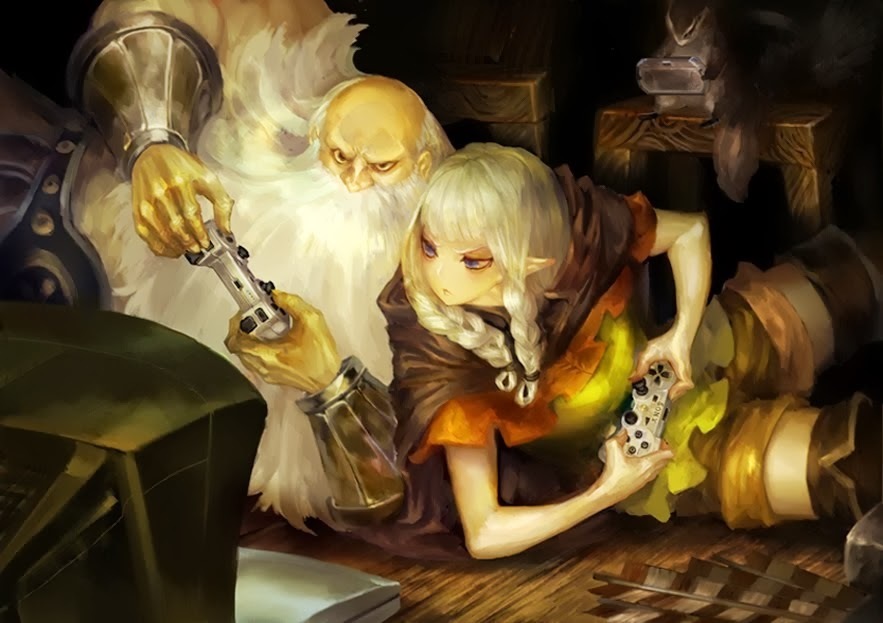
- Dragon's Crown doesn't feature much animosity between its Dwarf and Elf characters or their races. A piece of official artwork, though, shows the two going at it...while playing video games.
 ◊
◊
- In Class of Heroes, Elves and Dwarves don't get along with each other, thus making it harder for them to gain affinity points when characters of both races are in the same party.
- Dragon Age mostly averts the trope, since the two races don't really have a whole lot to do with each other in general; this results in a relative lack of animosity. The elves are too busy recovering their history and avoiding being killed by the humans, and the dwarves are too busy recovering their history and avoiding being killed by the darkspawn... and themselves.
- Less literally, the trope is played straight with the rough-around-the-edges Fereldans and the foppish Orlesians, being Fantasy Counterpart Cultures of Britain and France, respectively.
- Much more directly lampshaded, and laughably subverted, in Dragon Age: Origins, when Oghren is in the party when you recruit Zevran:
Oghren: We're taking the elf?! Oh, fine, fine. I see standards are just falling down all over the place.
Zevran: I see. Are we now supposed to engage in some manner of archetypal dwarf-elf banter, my friend?
Oghren: Nah. - Dragon Age: Origins – Awakening has this a bit, with dwarves Oghren and Sigrun pranking Dalish elf Velanna. Subverted in that it's not racially motivated - it's based on the fact that Velanna is extremely uptight.
- In Dragon Age II, Varric and Fenris are usually very cordial to each other, and by the third act participate in a regular card game. While Varric is one of the few party members who remains on good terms with everybody, Fenris is generally antisocial and quite antagonistic towards the other members, particularly the mages (or at least mages that aren't Hawkes). Varric also adores Merrill, the party's other elf, nicknaming her "Daisy" and treating her like a little sister.
- Played with in Dragon Age: Inquisition in some overheard NPC dialogue at Skyhold. A human tells a dwarf that he's happy to be working with him and not "one of them." The dwarf has no idea what the human means, rattling off several possible groups which could be indicated by "them," until the human finally spells it out - "Elves!" The Dwarf is distinctly unimpressed, because he has no problem with Elves.
- The Trespasser DLC reveals that The Evanuris, the Dalish Jerkass Gods, waged war against the Titans, Genius Loci that live within Deep Roads, at one point. Since the Titans are connected to (and hinted at being) The Stone that Dwarves revere and were created from, Bioware basically said this trope was the case in ancient times.
- To a degree in Kingdom of Loathing; as part of a quest, you can start and stop a war between the nature-loving hippies and the beer-drinking frat boys.
- Heroes of Might and Magic:
- Averted in the first three games, where Dwarves and Elves are part of the same faction.
- Played straight in the fourth game, where the Dwarf Lord Ufretin has severed the aforementioned alliance between elves and dwarves, and allied his people with the Academy (Order) faction instead, while the Elves formed (or remained in) their own Nature faction; incidentally, Order and Nature are opposed to each other.
- Played straight-ish in Heroes of Might and Magic 5, where Dwarves war against Dark Elves.
- The Dark Elves and Dark Dwarves of the old verse were unfriendly to each other. This may have more to do with the consequences of one race (the Elves) being enthusiastic traders and the other being xenophobic allies/servants of the Earth Elementals than this trope, however (certainly, the Dark Elves can only barely be said to fit the Elven archetype used in this trope).
- Even though Thief has humans as the only civilized race, aspects of this trope show up in the rivalry between The Hammerites, whose religion embodies the concepts of order, technology, and civilization, and the paganistic worshippers of a Trickster God, whose religion embodies chaos, nature, and magic.
- Averted in Popful Mail with Elven bomb-maker Slick and Dwarven artisan Glug, who are the best of friends.
- The Elves, who represent the element of Life, and Dwarves, who worship the element of Earth, typically begin with poor relations in Lords of Magic.
- While both factions in Rift have Elves, it's the faction that doesn't have Dwarves in which this rivalry gets obviously played out: The Kelari Elves are not on the best of terms with the Bahmi (the imposing, blue-skinned, and decidedly non-dwarven stout race of the Defiant faction).
- Dwarf Fortress double subverts this trope. Textually, dwarves are on good enough terms with elven civilizations to engage in trade. However, the Dwarf Fortress playerbase loathes Elves, due to their obnoxious, arrogant attitudes, their constant attempts to restrict players from cutting down trees, and the fact that they will be appalled if you sell wooden goods even though they sell wooden goods themselves.note This has led players to do drastic things just to spite elves.
- Cacame Awemedinade is also a Double Subversion. He's an elf who became the king of a Dwarven civilization, and just about the only Elf beloved by the playerbase... but he's admired because he despises other Elves. (Dwarf Fortress elves have cannibalistic tendencies, and one such Elf killed and ate Cacame's wife. Cacame himself has never eaten anybody.) This opposition to Elves, combined with being a One-Man Army who slaughtered a dragon in single combat, makes Cacame one of the most Dwarfy elves ever.
- Averted in the Warcraft games.
- Downplayed in Warcraft II and III, High Elves and Bronzebeard dwarves don't really get along well, but the more spiritual Wildhammer Dwarves were very good friends with the High Elves. Dwarves, in general, don't seem to have any problem with Night Elves, and if they are enemies of the Blood Elves, it's only because the latter joined the Horde (their rival faction) or the Burning Legion (who are enemies to everybody).
- There are some individual examples, however. Tarenar Sunstrike and Gidwin Goldbraids in World of Warcraft's Eastern Plaguelands have a rivalry very reminiscent of Gimli and Legolas. Likewise, a night elf and dwarf in one of the Warcraft: Legends manga were verbally at each other's throats all the time.
- The Alliance's ambassador to the Blood Elves (before they joined the Horde) was a Dwarf, which you would think was an intentional aversion to this trope. Turns out, he was investigating things where he didn't belong and handing off blueprints of arcane sanctums to the Night Elves hiding in the area.
- There is a bit of this trope in Cataclysm, with the Dwarven Explorer's League coming to blows with the Elven Reliquary, of course, they are on opposite factions so it's to be expected.
- Early on the rivalry between the Jungle Trolls and the Forsaken was played up, particularly in the manual. However later it got dropped without much explanation. There seems to be a minor animosity between Blood Elves and Darkspear Trolls, which stems from both races being ancestral enemies, and with the Blood Elves joining the Horde, this is the first time they ever have to be allies.
- Lacking any actual elves in the setting and with the dwarves virtually extinct as of the first game, Guild Wars 2 has an excellent parallel in the conflict between the ancient, civilized, beautiful, magically gifted humans and the brutal, industrious, and militaristic Charr, where the humans are in serious decline and are in very real danger of extinction and the Charr are thriving. They're reluctant and wary allies in the game, courtesy of the de facto ruler of the Charr being unusually progressive and far-sighted (who also wants the traditional marker of the true leader of the Charr, which the humans stole centuries back), while the human queen has more than enough trouble on her hands without the Charr.
- Lampshaded by descriptions of items in Dungeons of Dredmor, where there was such a war outside the dungeon.
- The Witcher is all over the place with this trope. Elves and dwarves don't like each other at all. However, both Elves and Dwarves are members of the local Anti-Human Alliance called the Scoia'tael. However, there are several dwarves who don't like the Scoia'tael (who, for all their high-sounding rhetoric, are most likely "freedom fighters" In Name Only) and point out that the Elves didn't stop being condescending and hateful towards Dwarves until human supremacy was already a fact and that the Scoia'tael will always put Elves before Dwarves. Elves, on the other hand, dislike Dwarves mostly because they have had a far easier time being accepted into human society and have managed to preserve much more of their culture and traditions.
- While not played straight in the official games, the Hyrule: Total War mod of Medieval II: Total War has the graceful and supremacist Zora versus the stout and warlike Gorons. They're explicitly rival factions and hence both have to wipe the other race out as a win condition.
- The backstory of the Disciples series has this start with a misunderstanding. When Bethrezen's Legions of the Damned first burst onto the surface of Nevendaar, they happen to come out in the elven woods, setting them on fire. The Elves flee en masse towards higher ground, which is also where the Mountain Clans are located. Misinterpreting the massive rout as an invasion, the Dwarves attack the "invaders", slaughtering many Elves. The Elven Gods Gallean and Solonielle go to the Dwarven God Wotan and demand that he punish his children for this. Outraged, Wotan kills Gallean (he gets better later, but the event also results in Solonielle becoming the fleshless goddess Mortis). This starts the feud. Then, during the Elven campaign, a young Oracle, possessed by Gallean (who may have gone insane by this point) urges the Elven Alliance to attack the Mountain Clans. The Elves win and force the Clans back under their mountain. Then the Oracle kills the Dwarven Queen for no good reason.
- Elves and Dwarves don't get along with one another in the Warlords Battlecry series. There are a few different stories explaining why this is; one claims that both races were manipulated into war by the Dark Elves (who were excluded from mainstream Elven society when they discovered how to summon demons), while another claims that a Dwarf King swore an oath of friendship to the Elves when they saved him from a storm at sea, but a jealous nephew murdered the king, seized the throne and declared war on the Elves in order to pillage their treasures.
- Deep Rock Galactic: Implied, along with many other hints that the universe is a standard fantasy setting that made it beyond the Space Age. In this trope's case, the dwarves may insult each other by calling the other a "pointy-eared leaf lover", and the "Leaf Lover's Special" is a drink that Dwarves do not want to drink, be seen drinking, or even have available in the bar at all, in good part because of this trope (the other part being it gets rid of your alcoholic buzz faster than a surprise pay cut).
- Suikoden: Toran dwarves, while very different from the standard depiction of Dwarves in media note , hold Elves in utter contempt (and the feeling is mutual).
- Fate/Grand Order imagines elves and dwarves of Faerie Britain as two types of Faeriekind belonging to the Wind and Earth clans respectively. They are still noted for their mutual enmity and the complete timeline reveals why. In keeping with how faeries overall have Blue-and-Orange Morality by acting on capricious whims, the two clans had a dispute over a patch of sunlight. This led to 12,000 years of race-wide enmity, bitter over such an incredibly minor dispute even after the Faerie Court was established and they started imitating human society.
- In Divine Divinity, the imminent war between the Elves and Dwarves is talked up throughout the game, though we never actually see it happen. Divinity: Original Sin II scales back on this; neither Elves nor Dwarves seem to have much against one another, though both races are wary of humans.
- In Drowtales, the Light and Dark Elves were no longer able to survive on the surface and fled into the depths of their world. There they were faced with hordes and entire cities of Dwarves who were none too happy about these new refugees and a war broke out... The Dwarves lost entirely, whole cities slaughtered and their race pushed back to the barely habitable edges of the underworld. Now they are viewed as a passing pest and nuisance by the Elven races and almost all small fights with them end in a one-sided massacre by the Elves.
- 8-Bit Theater:
- The grudge is mostly explained as Elves really, really disliking all the beards. Or, to be more specific, both races believe they rightfully own the Earth Orb. Notably not present in the game it's based on, however, which portrays the Dwarves and Elves as being friendly with each other.
- Keeping with the tone of the comic, the rivalry is severe, with both sides gladly committing genocide on the other. The two biggest Sociopathic Hero-protagonists do their part since Thief is an Elf and Black Mage... just enjoys destruction.
Dwarves: We're the Dwarven border guards. We guard the Dwarven borders. Our orders are simple.
Black Mage: That must be a relief to you.
Dwarves: We're to kill any Elves on sight without question. Which is fairly redundant, since any Dwarf would do that anyway. But a paycheck's a paycheck. - It doesn't help that both species are portrayed as being highly xenophobic and Elves believe that all other forms of life (including some of the gods) were failed attempts at replicating their perfection.
- The grudge is mostly explained as Elves really, really disliking all the beards. Or, to be more specific
- In Dominic Deegan, they have the Halflings and the Dwarves going at it with the pretty Halflings having fruited beers while the ugly Dwarves have more generic beers. That is what's presented in the nature of their conflicts, at least in the modern day. It's later mentioned that the star that provides magic to one country or another on their planet shone on the island they share at some point in the past and they used the magic to go to war with one another.
- The Order of the Stick features rather few elves and dwarves long enough for the two to meet — except for the party members. Durkon, a proudly stereotypical dwarf cleric, and Vaarsuvius, The Spock and Insufferable Genius wizard have great respect for one another for being strong spellcasters. The problem arises from their personality traits; Durkon is a reliable and humble individual who keeps calm while V is an Insufferable Genius who likes to show how smart they are and is flashy with their attacks. It comes to ahead when the party is split. Haley's absence as V's Morality Chain and their Inferiority Superiority Complex has grown worse to their guilt and failure during the battle of Azure City has made V utterly insufferable to be around, even to Elan. Eventually, when V returns from their deal with the fiends (which gave them a big slice of Humble Pie) they patch up. V apologizes for their arrogance while Durkon does the same, since V was able to do a lot, (such as use their Lawful Evil soulbound companion's ability of Mass Teleportation to transport the entire Azure City fleet to safety.)
- Yet Another Fantasy Gamer Comic presents: the dwarven humour.
- A certain Nodwick arc involves a war between the elves and the dwarves over possession of a certain artifact the dwarves claim was stolen from them two thousand years ago. It turns out to be a sword which will kill both races if one uses it on the other, which forces them to declare a truce.
- When Dwalin first appears in Irregular Webcomic! he initially says he can't help a party that includes Alryssa because of "the Five-Thoosand Year Groodge" between dwarves and Elves.
- Spoofed in this Lightning Made of Owls strip, in which Meridian and Holly say their RPG characters will be a dwarf and an elf who are friends despite this, and Delkin replying "You do realise that there are more cases of elves and dwarves who are best friends despite the fact that elves and dwarves never get along than there are cases of elves and dwarves who actually don't get along?"
- The Strongest Florist Though the Elves have a bigger beef with the Demons of New World. They still have no love for Dwarves and Dwarves don't have much good to say about Elves either.
- In Le Donjon de Naheulbeuk (Dungeon of Naheulbeuk), a French audio Affectionate Parody of tabletop RPGs and particularly Dungeons & Dragons, elves and dwarves famously can't get along. Each race takes its defining characteristics far, far beyond its limits, making the following more or less the norm:
The Elf: [who has fallen down a hole] Help me, I'm stuck!
The Dwarf: She says we can leave her behind.
The Elf: Get me out of here, it's slimy!
The Dwarf: She says she wants us to make rocks fall on her to put her out of her misery. - In Tales of MU, a gnomish folk tale depicts elves and dwarves are the descendants of quarreling twin brothers, who grew into their current forms by attempting to emphasize their imagined differences.
- In Monster Girl Encyclopedia, it was Fantastic Racism in era of previous overlords. Elves consider Humans, Dwarves, and any monsters to be lowly creatures and loathe to make contact with them, so they rarely get far from their Hidden Elf Village. Dwarves feel insulted by this attitude and hate them back. Today, when many Elves and Dwarves are succubi, they still tend to snipe at each other and fight over men. For some reason, succubi elves and dwarves usually target the same men. Fortunately, their "fighting" consists mostly of...snuggling up against the man, pinching him between them.
- Similarly to Naheulbeuk, Reflets d'Acide has Elven bard Enoriel and Dwarven master Zarakaï constantly arguing, typically through Snark-to-Snark Combat.
- In the story told in Elfslayer Chronicles, the dwarf Rumbling Brothers were helping OP get away with his in-game crimes against the elves, by messing with elves' Discern Lies spell. One brother had insanely high charisma and could easily fool the spell, and he constantly made outrageously false stories that would be identified as true by the spell. His twin had very low charisma, and he confirmed the story as true, with the spell recognizing it as the lie, which resulted in their story being confirmed as both true and false, confusing the elves and hindering their progress in searching for the culprit. Out-of-universe, it's because their players are as annoyed by DM's Yaoi Fangirl fantasy and Can't Argue with Elves rhethoric as OP was. In-universe, that's because they are dwarves and just wanted to mess with elves.
OP: Dwarves just love to make Elves suffer.
- Out of Context D&D Quotes, a blog collecting, well, out-of-context D&D quotes, had this utterly hilarious dialogue between a haughty elf and a Deadpan Snarker dwarf.
Elf: You're clearly jealous of my ability to clean myself and see over low barriers.
Dwarf: The only thing I'm jealous of is that giant stick up your ass. It could fuel a dwarven forge for years!
- The debate continues even onto YouTube in a segment of D&D PHB PSA. Elves, for those not in the know, cause cancer, and have tiny penises. Especially the women.
- Ross Scott of Ross's Game Dungeon is firmly on Team Dwarf. The show has covered a fair number of fantasy games that feature dwarves and/or elves, and Ross wastes no opportunity to either praise dwarves, insult elves, or both at once. Even if the game doesn't feature them he'll still sometimes get in a few jabs at elves, such as blaming them for murder in The Black Mirror, a Gothic Horror game with no elves or dwarves at all.
Ross: If we stop by the morgue, the doctor tells us what we already know: It wasn't wolves, it was an elf blade. Well, okay, he doesn't say that, but he says it's definitely not wolves.
- In The Grim Adventures of Billy & Mandy episode "Here There Be Dwarves!", the plot revolves around a war between tree-dwelling Elves (a parody of the Keebler Elves) and Dwarves over who got what rights to sell food. The Elves, of course, got cookies, while the Dwarves get mushrooms, and have regretted it ever since; it was originally the other way around, but the Elves tricked the Dwarves into taking the mushroom job instead. In the end, they compromise and make mushroom cookies.
- "They taste like my cat!"
- There is definitely an undercurrent of this in My Little Pony: Friendship Is Magic, between the unicorns (tend to be educated, higher class and have telekinesis to handle delicate tasks) and the earth ponies (strong, hard-working and with a "connection to the earth"). Among the mane six characters, two of the character foil pairs follow this dynamic, with the dainty Rarity against down-to-Earth Applejack, and the logical Twilight Sparkle against the Cloud Cuckoolander Pinkie Pie.
- This was also the point of a stage play, which brought the pegasus class (agile, high-spirited, and able to handle high-altitude activity) into the act.
