If a character is beautiful, then that character is a good person, either publicly or secretly. If a character is good, then that character will either be beautiful or be treated as beautiful.
Or to put it another way, every hero worth his salt must be physically attractive, or at the very least, better-looking than half of other people their age. This standard is more relaxed for side characters who can be truly ordinary-looking or even literal aliens, but expect the lead character to be pleasing to look at, even if he is the alien.
This trope is problematic for two reasons. First, it implies that the creators believe that attractive people are inherently more moral than unattractive people in Real Life. Second, it implies that the creators believe that the audience won't be able to tell the difference between the heroes and villains without obvious visual cues. Despite this, it almost goes without saying that this trope is also very old; Ancient Greece codified it with the concept of "cosmos" (from which we get the term cosmetics), and an attempt was even made in the 19th Century to quantify this attitude into the "science" of physiognomy, which posited a direct correlation between appearance and moral character. And of course, characters who are both attractive and good are appealing to most audiences.
This trope's influence is felt in many others:
- Adaptational Heroism usually goes hand-in-hand with Adaptational Attractiveness.
- Always Lawful Good races will almost always play this straight, sometimes to the point of inhuman beauty. Conversely, Always Chaotic Evil races will be hideous and/or deformed so the audience doesn’t feel bad about slaughtering them all.
- The Beautiful Elite usually plays it straight, but may not apply it if they are so beautiful that they don't seem human.
- Character Model Karma Meter often makes good-aligned characters become more traditionally attractive.
- Draco in Leather Pants: Fan fiction involving the redemption of a villain that the writer personally finds attractive is as old as fan fiction itself.
- Friendly Zombies are frequently good-looking to make it easier for the audience to like them despite the fact that they are rotting corpses who otherwise would never be able to maintain the beauty part of this trope.
- Gorgeous Gorgon may play this trope straight or just plain play with it depending on the gorgon.
- Historical Hero Upgrade often leads to Historical Beauty Update as well. Conversely, a Historical Villain Upgrade tends to concede with a Historical Ugliness Update.
- Light Is Good can be a perfect example for this trope.
- Makeup Is Evil: In older works, only an evil character would have no natural beauty and so have to resort to paint.
- Progressively Prettier: If a villain undergoes a Heel–Face Turn, don't be surprised if they're gradually drawn as more attractive over time.
- Red Right Hand, where a specific ugly or inhuman feature marks a character as evil.
- Ugly Guy, Hot Wife both averts this and plays it straight—unattractive men are shown to be good husband material, yet it still works on the assumption that because the wife is hot, that he was lucky in love even if nothing else is known about her.
For animals and more nonhuman characters, see What Measure Is a Non-Cute?.
Compare Evil Makes You Ugly and Gonk. The opposite of this trope is Beauty Is Bad although they aren't mutually exclusive with this one. Ugly Hero, Good-Looking Villain is a specific inversion. Compare also Villainous Badland, Heroic Arcadia, which applies the same basic concept to landscapes instead of people. Contrast Divinely Appearing Demons, Face of an Angel, Mind of a Demon, Wasted Beauty. See also Expecting Someone Taller, Sensible Heroes, Skimpy Villains, and Sexy Villains, Chaste Heroes. Can go hand-in-hand with Ugly Cute (even though this other trope gives focus to physical ugliness), especially in terms of their shared senses of morality.
One of the many reasons that Evil Desires Innocence.
As this trope is ubiquitous, please only add egregious cases. Invoked and defied examples are the best ones.
Example Subpages:
(Mostly) Straight examples:
- Abunai Sisters: The heroines are twin sisters who have an hourglass figure and a very well-endowed chest. The villains are the Gonkish Hokuroda, whose design seems to be based on Yubaba from Spirited Away, and Matsumoto, who looks like a stereotypical creepy nerd.
- Assassination Classroom: If you're attractive (or at least ordinary) without looking downright creepy, then you're likely a member of Class-E in one way or another. The only exception to this seems to be Koro-sensei and the four 3-E delinquents (not counting Karma). It's even lampshaded when two girls in a higher-ranking class note that 3-E's PE teacher, the young government agent Karasuma, is rather attractive, and that all of the guys and teachers in their class are ugly and mean.
- Koro-sensei's appearance plays with this trope. His face will change from "good" to "evil" (pitch black for extreme anger) if anyone tries to push his Berserk Button (hurting his students or seeing Itona Horibe's tentacles. Then inverted with his original, human appearance, which shows that he used to be a pretty handsome man before the experiments he endured turned him into the creature he is today.
- Averted with Kaho Tsuchiya of 3-C. Beautiful? Yes. Cold-hearted, manipulative, vile witch? An undisputed affirmative. Played straight when she shows her true face.
- Played with in Takaoka: his cartoony (well, more cartoony) smiley face masks a vicious streak a mile wide.
- The doctor who turned an extremely skilled but still human assassin into the superhuman Koro-sensei looks rather attractive at first; then he starts referring to his secret human test subject as a disposable guinea pig ("he doesn't have a family registry so it doesn't matter if he dies"), smashes a vial of something on an assistant's head, and strikes his other assistant/slave/wife via arranged pity-marriage on the head with a computer tablet repeatedly. By the time the (first/original) God of Death KO's him through a solid plexiglass barrier his good looks have gone a bit off.
- Attack on Titan:
- Mikasa Ackerman, the only female member of the Shiganshina Trio, is a very attractive young woman whose beauty is commented on by various characters. It's noted that being half-Asian through her mother, she's beautiful in an "exotic" way; unfortunately, that got her and her mother being targeted by human traffickers as a child, which led to her parents' deaths. While jaded and ruthless, she's still a heroic character who fights to protect her home from the Titans.
- When the Rogue Titan makes its debut, the audience immediately knows it to be different from the other titans as it not only saved Mikasa from being eaten but possesses a far more toned and better-proportioned body than the average titan. It's actually played with- humanlike proportions are common to most Titan Shifters, most of whom are morally ambiguous at best.
- This was even lampshaded by Mikasa in the Abridged On Titan web series where she refers to the Rogue Titan as the "Sexy Titan."
- Beauty and the Beast of Paradise Lost: Deconstructed. The entire manga makes a harsh criticism of people’s obsession with beauty and youth. Especially La Medium, who collects the faces of beautiful women to remain eternally young and attractive. She also sells these faces for women who want to keep their husbands or lovers. Back in the 18th century, many women didn't have money of their own and were forced to depend on men — thus, keep them interested.
- Bio-Meat: Nectar: A recurring element is that the older and uglier you are, the more likely you will be a completely nasty person who gets eaten alive. That said, there are a few attractive-looking people with ugly personalities who end up dying. Banba, an obese kid who starts off as The Bully, makes a Heel–Face Turn thanks to Kan's kindness and becomes one of the main survivors.
- Dance in the Vampire Bund: The most powerful vampires in the setting have a "true form" that supposedly reflects their inner soul. Mina Tepes, an anti-heroic vampire and the main protagonist, has a true form that looks like a centerfold with some strategically placed armor. The rest have true forms that are extremely hideous to look at; the head of the Telomere Clan has a true form that looks like an Eldritch Abomination.
- Fist of the North Star: Discussed; when Ken is attacked by Fudo, he spares him because he has "the face of a good man". It helps that Ken is an Excellent Judge of Character, and Fudo had just told him that Ryuken had walked away from a fight with him many years earlier, so he wasn't just relying on Fudo's looks.
- Gundam examples (basic fact: since about Mobile Suit Zeta Gundam nearly all major characters were relatively beautiful unrelated to their alignment. Even the franchises' morally ambiguous masked men hardly ever wear them to hide ugly scars and the like.
- The most obvious subversion would be Dozle Zabi. While the ugliest of the Zabi family by far, he's also probably the nicest aside from Garma. His final act in the One Year War is to Hold the Line to buy time for his wife and daughter to get to safety.
- Discussed in Mobile Suit Gundam Wing: When OZ goes to apprehend Duo's space shuttle, Lady Une muses that they should kill the pilot if he's attractive but let him live if he's ugly. Her reason: they can use an ugly pilot as a scapegoat when they do bad stuff; but if the pilot is handsome, the people would be more likely to sympathize and follow him. Her orders, however, are just to kill him. In the actual series, everyone is attractive note , so it's the same difference.
- Many of the Gundam series also feature this distinction between the heroes' Gundams and the bad guy's mobile suits. The Gundams almost always have a very humanoid appearance and more human-like faces. The bad guy's mobile suits almost always are more mechanical and aggressive looking, such as the cyclopean Zakus and many other Zeon mobile suits, and machines like the walking tank Anf of Gundam 00.
- Innocents Shounen Juujigun: Etienne is an ethereal beauty with white hair, stunning blue eyes, and fine features. He's also an All-Loving Hero who is genuinely kinder than most humans are even capable of.
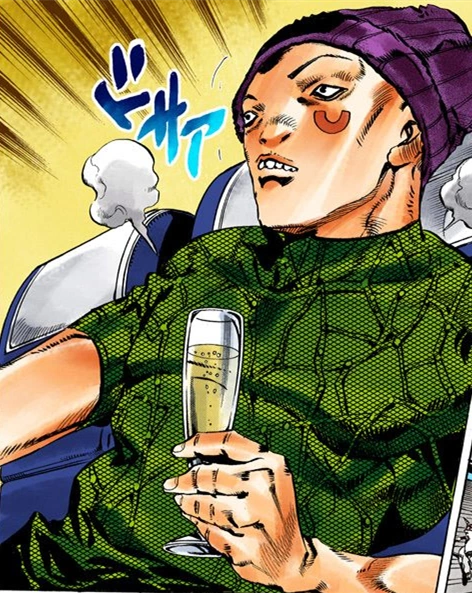
- JoJo's Bizarre Adventure: The sixth Part of the series, Stone Ocean, reveals that Dio Brando has at least four sons. They're all very handsome, except for Ungalo, the least sympathetic of them, who looks like this.
 ◊ He works for Enrico Pucci, though two of his better-looking half-brothers are working for him, too, and aren't much better than Ungalo. Giorno Giovanna, the protagonist of Golden Wind and one of the most beautiful of Dio's sons, is an unambiguously good Anti-Hero who wants to take down The Don of Passione to free Italy of its crime wave.
- Kimagure Orange Road has Madoka Ayukawa who is a gorgeous person in all respects, despite her reputation. A beautiful, composed, and mature girl with long black hair, extremely smart and talented, and also a fantastic person at heart: incredibly selfless, kind-hearted and doesn't think twice if there's someone to help. However, Beware the Nice Ones: making her angry is not a good idea.
- Noblesse: Played straight — Are you ugly? Get yourself life insurance. Are you hot? Redemption road is right over there. Curiously, this does not apply to female characters who die anyway.
- One Piece:
- There are many good-looking bad guys and bad-looking good guys but Chapter 764 is a little special: Every single grotesque person is a heartless Doctor (and Nurse) Jerk who turned away a dying child future badass pirate surgeon Trafalgar Law because they thought he was contagious (he wasn't, his disease was caused by pollution). Fortunately being ugly made it easier to watch the boy's companion Corazon, incredibly Big Bad Doflamingo's secretly kindhearted brother destroy them and their hospitals.
- Most World Nobles are malformed and ugly, but St. Homing and his wife, rare examples of nice World Nobles, look fairly normal and even pretty. He passed on his good looks, but not his good morals, to his child Doflamingo. And then there's Saint Mjosgard, whose looks notably improve after he changes his outlook on life and reforms into a better man without the usual God complex.
- It turns out Sabo himself is a noble (not a World Noble, but a regional noble) and is one of the few child nobles who is pleasant to look at, especially when compared to the Gonk looking spoiled brats. He's also a Defector from Decadence.
- Shanks is the nicest of the Four Emperors, and also the prettiest. Whitebeard is second-nicest, and while he's not handsome like Shanks is, he's at least human-looking. Big Mom is cruel and psychotically unstable, and she's hideous (Though she was a quite looker as a young adult), and the tyrannical Kaido looks monstrous.
- Powerpuff Girls Z: Parodied; when they first encounter each other, Blossom and Mojo Jojo get along just fine, and Blossom instructs Mojo on a good way to eat a sandwich cookie. However, when they both realize that one of them is beautiful and the other is ugly, they realize that they must be enemies, and they start fighting.
- Reborn! (2004): Bishōnen Rokudo Mukuro, who is shown before to be a horrible, Manipulative Bastard with no regard for human life, is later given a few humanizing traits and is depicted as not being completely evil, with hints that he's just being stubborn with hiding that he doesn't really hate Tsuna anymore (most notably stated by Tsuna, who is convinced that he is, deep down, not such a bad person). He's still pretty darn evil, though.
- Sailor Moon: Usagi at least seems to think this way. This is how she tries to stand up for Rei (who at this point she knows next to nothing about as a person) from a trio of women harassing her:
Usagi: "How can you guys accuse such a beautiful girl?!"
- Then again this is Usagi we're talking about, who is kind of shallow at this stage of the story (if we're being honest) but still an All-Loving Hero nonetheless.
- The Secret Garden: Camila is a Hot Gypsy Woman who's also a practicing doctor and befriends little Mary Lennox. She was treated badly by the villgaers for being a Romani, but still went out of her way to save them when a plague occured, even if they unfairly blamed her for it.
- Starzinger: Aurora is gorgeous and kind, but she's innocent to a fault. She frequently ends up in Damsel in Distress situations because she's too trusting.
Bellamis: "You are beautiful and kind. However, your kindness can be fatal."
- Voltes V: Lozaria has vivid blue eyes and reddish-brown hair, and also is the Token Good Teammate of the noble Boazanians, supporting her husband's vision of equality for all races.
- Yu-Gi-Oh! ARC-V: Starve Venom Fusion Dragon is a horrific Body Horror monster that scares many people by its look alone. As one way of attacking: it grows its mouth wings into large mouths that devour people and monsters whole, fitting to its carnivorous plant motif. Once it fuses with Odd-Eyes Pendulum Dragon to become Supreme King Violet Dragon - Odd-Eyes Venom Dragon, it gets purified and gains a beautiful (yet still somewhat terrifying) appearance. Odd-Eyes Venom Dragon is so beautiful that even Asuka, who used to hate Fusions because they were used to hurt people, is astonished by its appearance alone. When Odd-Eyes Venom uses its Monster Effect to gain more ATK, its wings spread yellow energy, making it look like a blooming flower. It also replaces the carnivorous plant motif for a cherry blossom motif. And unlike the other two Pendulum hybrids, its "What Beautiful Eyes!" description is the opposite of them; its "gem-like eyes are shining in kindness".
- The beauty of Michelangelo's David is meant to reflect the Dave's holiness, which is why he has features that would not be expected of an Iron Age Jewish boy, like a seventeen-foot figure or an uncircumcised penis. Michelangelo considered those traits to be signs of ideal beauty and perfection, so when depicting an ancestor of Christ, he took artistic liberties to convey David's virtues visually. (He was also inspired by Ancient Greek statues.)
- In Child Ballad "Sir Aldingar", the mysterious, possibly angelic champion who fights for the queen.
A louelie child was hee;
- In the ballad "Zu Bacharach am Rheine" by the Romantic poet Clemens Brentano, the world is first introduced to Brentano's creation, the magic-wielding Loreley, who brought doom to whoever fell in love with her. The local bishop has her arraigned before his ecclesiastical court, but he cannot condemn her because she is so beautiful:
Der Bischof ließ sie laden
Vor geistliche Gewalt—
Und mußte sie begnaden,
So schön war ihr Gestalt.
- Jack Kirby's Eternals are physical specimens of godlike perfection, while the Deviants are hideously mutated.
- Subverted, as about half of the Eternals are jerks, while the Deviants aren't that evil. Played straight with Thanos of Titan, who is an eternal but had the latent Deviant gene. His brother is handsome and the demigod of love, while Thanos is monstrous, with purple skin, black eyes, and a wrinkled chin, and completely evil. And Karkas, whom everyone acknowledges to be the most hideous Deviant, is a Defector from Decadence and one of the good guys.
- X-Men is often pretty good about averting this by having heroes like Beast who have really freakish mutations, or Wolverine (arguably the most famous of the X-Men) being depicted, both in the art and by the other characters, as a "short, square-built, hairy and smelly man". However, note that almost all of the "grotesque but benevolent" mutants in the X-canon are male. There's a definite double standard there. And they're still frequently drawn as being generically attractive.
- In an arc of X-Men spinoff New Mutants, one of the characters, Karma, was possessed by the evil Shadow King, who caused her to become morbidly obese from overeating. In the following arc (after Karma rejoins the team), Karma is promptly (and conveniently) dropped into a desert where she sheds her fat in record time and becomes hot again.
- Perhaps the biggest X-Men example is Marrow, a Morlock with the Lovecraftian Superpower of pulling her own bones out to use as weapons. She first appeared as a terrorist; she was distinctly unattractive, with random bones sticking out of her body and skin like a prune. Marrow was later plucked from obscurity and reimagined as a member of the X-Men, but the writer apparently didn't like the idea of having an ugly woman on the team. To fix this, he had her get badly injured during an off-world mission, which led to her being revived via an advanced alien medical device. The procedure had the convenient side effect of transforming Marrow from a hideous freak into a pouty-lipped babe with flawless skin, with Gambit speculating that the machine had given her more control over her mutation. She still had the bones sticking out, but those were eventually done away with too in the later Weapon X series. When she returned to villainy years later in X-Factor, she went back to having a homely appearance (though not nearly as ugly as her original look).
- When Rogue originally appeared, she was A) a villain and B) drawn to be very butch and homely. Nowadays...
- In New Mutants number 47 (entitled "My Heart for the Highlands"), several of the team find themselves in 14th century Scotland and fight on behalf of Robert the Bruce. Afterward, Doug Ramsey has a question, and the answer implies this trope:
Doug: Pardon my asking sir, but—Aren't you afraid of us? We pop up out of nowhere, wielding fantastic powers. You've only our word that we're not demons or worse.
Robert the Bruce: True Douglas—But any hadesspawn able to assume so young an innocent, an' noble a seeming deserves our respect rather than our fear—for that demon has become more human than most men. - In the original Brotherhood of Evil Mutants, the only two conventionally-attractive members, Scarlet Witch and Quicksilver, were also the only members who weren't actually evil, and soon did a Heel–Face Turn.
- These days the Blob looks like a friendly-appearing guy who's about a 100 pounds overweight and has an impressive handle-bar mustache as he reformed and works as Krakoa's bartender as a hobby and way to give back, even when he joined the Mutant Liberation Front his looks didn't get worse as he thought the group was for saving captive mutants and fighting their genocidal oppressors. This contrasts with his original Brotherhood of Evil Mutants stint when he started out looking ugly and then he was with the more brutal 2nd Brotherhood of Evil Mutants, his fat and limb proportions were grossly inhuman in size.
- In ElfQuest, the distinction between in-group (elves) and out-group (humans and trolls) has been striking from the get-go. Elves are the embodiment of otherworldly beauty, while Humans Are Ugly and idiosyncratic and trolls are bulbous and warty. While a few humans and the occasional troll are easy on the eyes, they are nothing compared to the elves — even evil elves, even genocidal elves, they're never ugly. See, humans are the enemy and trolls are untrustworthy, but "All elves are one". You can kill humans and trolls in self-defense, but Elves Don't Kill Elves no matter the provocation. Recent years have seen these principles change. More and more humans have been joining the list of allies, so the in-group/out-group distinction is weakening significantly. The "Elves Don't Kill Elves" prohibition has been broken on a few occasions and no longer elicits the agonizing guilt that Strongbow felt over Kureel (the first such killing). Now that Wendy Pini isn't [always] doing the art herself, certain artists draw humans all but indistinguishable from elves (which means as beautiful as elves). They look so similar that a human wearing ceremonial elf ears leaves you wondering, not about the ears, but if his thumb and four fingers are a mistake — a confusion that would never have been possible in the early books. The whole thing is at least mildly justified, anyway: elves are a different species from both humans and trolls, usually have access to healing magic that the latter don't, and their ancestors deliberately took forms that would appeal to humans in preparation for making contact (they just didn't count on getting thrown thousands of years backwards in time and losing most of their magic in the process). Word of God has it that the Wolfriders, the tribe who had to fight humans most often, even went out of their way to deliberately prevent or eliminate scars whenever possible in order to present a more formidable face to their enemies, who'd just have been encouraged by the notion that their weapons could actually leave marks on the 'forest spirits'.
- Batman: Many of Batman's villains are deformed in some way - The Joker's skin is bleached white and he has a permanent smile, Two-Face is scarred down half of his body, Mr. Freeze's skin is an unearthly white, Clayface is a giant goop monster, Killer Croc is reptilian in appearance] and The Penguin resembles his namesake animal. In fairness, though, most of the time these deformities are part of what caused them to become villainous in the first place, and there are a few better-looking villains like Poison Ivy. (Oddly, those characters all seem to be female. Funny how that works.)
- In Batman: White Knight, The Joker is cured of his insanity and his skin tone is restored to its original color, allowing Jack Napier to emerge. He stops wearing goofy or garish clothing and instead dons much more stylish clothing and combs his now brown, formerly messy hair. The colors associated with being a Secondary Color Nemesis are also downplayed, limiting them to his neckties.
- Tintin ("Tintin: The Calculus Affair"). Tintin and Captain Haddock witness their friend Professor Calculus being carried off by mysterious figures when another group ambushes them. When Haddock asks which side they should help, Tintin evokes this trope by telling him to hit the ugliest ones. Haddock is then confronted by two brawling mooks, each as ugly as the other. So he bangs their heads together. (As it turns out, the "rescuers" are trying to kidnap Calculus as well).
- Played laughably straight in almost anything by Jack Chick. In fact, people go ugly as soon as we find out they disagree with Jack. The only exception is that strange tract about homosexuality, where Satan is constantly shirtless and has obviously been working out. Is there something you want to tell us, Jack?
- Dick Tracy villains are almost universally malformed and ugly. Prune Face is the most extreme example. The hero, by contrast, is a handsome square-jawed detective.
- Played oh-so straight for years on end with the family of Captain Marvel villain Dr. Sivana. Sivana himself could be kindly described as a stunted little troll with no hair and a face only a mother could love: evil. He has four kids. Georgia is her father, only female and with hair: evil. Thaddeus is his dad mark 2: evil. Magnificus apparently comes from a completely different family, with golden hair and absolutely no deformities: good. Beautia, winner of the All-Time Prize for Least Subtle Name, is absolutely stunning: good. Captain Marvel himself: physically Superman in red, and the hero.
- Nancy Callahan in Sin City is the most noble and innocent character in the series and is described as the most beautiful.
- Captain America is the perfect male specimen, especially by Nazi standards, with blond hair, blue eyes, and a perfect body. His Arch-Enemy Red Skull has a red skull.
- One Doctor Who annual strip from the 1970s, "The Traitor", displayed a really literal example. The Human Alien civilisation in the story has 'a psyche that is their form' and anyone significantly hideous is invariably murderous, stupid, and evil. The planet the Doctor has landed on is their form of an 'asylum', a planet where the suns give out a special radiation that allows these people to live normal lives. The Doctor cluelessly helps them off the planet, and when they're away in the spaceship they transform into horrible monsters - the Doctor then tricks them back into returning to the planet for their own good and cries about it in the final panel. It's pretty grim for a strip aimed at eight-year-olds.
- Archie Comics are pretty bad for this. If a character shows up in a comic who looks mean or ugly, you can bet dollars to donuts he's a rotten guy with no redeeming traits. Ethel Muggs started out as an Abhorrent Admirer / Stalker with a Crush and was pretty hard on the eyes, but as the comics have gone on she's been redesigned to be quite pretty along with being a much nicer and likable person (compare her old and new designs◊). The only subversion to this is Cheryl Blossom because she's played up as a rival and enemy of Betty and Veronica, and she's not that bad to begin with since she's basically a Rich Bitch who does have some genuinely redeeming qualities.
- Prevalent, if only subtly, in Wonder Woman. Both pre- and post-Crisis the character tended to have World's Most Beautiful Woman as one of her Olympus-given powers, while most of her villains (especially Dr. Psycho) are the definition of Gonk. If she does come up against a beautiful female villain, Defeat Means Friendship will often come into play, especially during the Golden Age. On the other had, one of her arch-enemies the God of War Ares, who is usually depicted as a sinister red-eyed armored figure whose evil children happen to look ugly because of their parentage, is revealed to be very handsome underneath◊.
- In Reborn, individuals are reborn in the afterlife in fantastical new forms depending on whether they are good or evil. For example, Bonnie turns into a young and voluptuous blonde woman upon dying of old age in the human world and ending up in the next one while her best friend Estelle turns into a tall and beautiful fairy queen. On the other hand, evil people turn into Darklanders, who range from ugly to outright demonic: Lord Golgotha (who used to be a serial killer on Earth) looks like a grey-skinned demon and an Alpha Bitch from Bonnie's high school becomes a cybernetic abomination.
- Laika: Kudryavka's first owner, Tatiana, is a kind and pretty woman who adores animals and is a loving mother. Her cousin Katya has a wrinkled and withered face, and her husband is a big, fat man with squinty eyes; both are Abusive Parents to their son Mikhail.


- Double subverted in Andrew Lang's "The Blue Parrot". The daughter of the swan fairy is shocked that the handsome portrait she had fallen in love with belongs to such a rude man — but they soon discover that he's an impostor. Rescuing the true king finds him both courteous and handsome. The illustrations play it straight for Hermosa, the swan fairy's daughter, and Riquette, Ismenor's daughter. Hermosa is depicted as beautiful, while Riquette is depicted as ugly and apelike.
- Similarly in "The Colony of Cats" — the older cats rebuke the kittens, saying that all the servants can't be pretty, but Peppina proves to be as bad as she is ugly, where Lizina was pretty and good.
- Cinderella, Snow White, Rapunzel, Sleeping Beauty... pretty much every heroine in every fairy tale is always described as being beautiful.
- "Beauty and the Beast" has both Beauty who's depicted as the epitome of outer and inner beauty and the Beast who starts out ugly but turns into a handsome prince when Beauty realizes she loves him.
- In The Brothers Grimm's "Maid Maleen", the false bride has "a face as ugly as her heart was wicked".
- In "Mother Holle", the wicked stepmother "had two daughters, the one was beautiful and industrious, the other ugly and lazy."
- "The Three Little Men in the Wood": One of the heroine's rewards for her kindness is to grow more beautiful with each passing day; whereas her mean-spirited, selfish, and lazy stepsister is punished to become progressively uglier.
- In Joseph Jacobs' "How Jack Sought The Golden Apples":
- Played with. Jack's helpers are three brothers who have long overgrown teeth and nails and are generally ugly. However, they're much friendlier and more helpful than the prince's brothers. However, it turns out that they actually are handsome, wealthy men who were cursed to look this way for no apparent reason.
- The Princess of Melvales is a great beauty who is also spirited and compassionate enough to approach the king about him having his youngest son unfairly executed.
- The Bridge: Zigzagged all over the place with both the heroes and villains. Godzilla Junior is the Big Good of the kaiju and intentionally acts as a protector yet he looks monstrous with blood-red sclera, massive canine teeth, numerous scars, and a huge body even as a unicorn; but he looks far less mutated than his morally neutral father and grandfather. The alicorn princesses Celestia, Luna, and Cadance are along with other Equestrian heroes and heroines absolutely beautiful and handsome, with morality to fit it to this trope; but extremely heinous villains like the murdering King Sombra and genocidal Queen Crysalis aren't hard on the eyes either. It is played fairly straight with the worst villains however, as completely vile kaiju like Grand King Ghidorah and Gaira are noticeably more hideous than morally gray individuals like Xenilla.
- Calvin & Hobbes: The Series: Electro is described as being quite ugly. This is notable, as the other heroes aren't particularly beautiful either.
- Cave Story Versus I M Meen: Jack is easily the cutest-looking character in the entire story, and he is the main protagonist.
- Forum of Thrones: This is played with, like in the source material.
- On the one hand, many of the good characters are noted to be beautiful. Lucas and Leonard are both described as handsome, Argella and Raenna are stunningly beautiful and Samantha and Maya regularly get their fair share of admirers as well and all of them are good guys, more or less.
- On the other hand, a noticeable number of attractive characters are very evil and some of them use this trope to hide it. Sherryl is the most prominent example and a Manipulative Bitch on top, but Harmund and Wolfius are noted to have handsome qualities as well, even if they are Ax-Crazy psychopaths.
- The number of Mooks that are described as plain or outright ugly is also noticeably high.
- Gankona, Unnachgiebig, Unità: Italy couldn't bring himself to hate the homophobe who had beaten and nearly raped him, Italy didn't despise the bully who singled him out shortly after that ordeal, Italy never hated Austria who had abused him for hundreds of years, he never resented Germany for the poor treatment he received, he never was angry at Japan for the coldness exhibited towards him, etc. He is also described as being beautiful as both Germany and Japan.
- Hogwarts School of Prayer and Miracles: This is emphasized by the narration regarding Hermione.
A woman taking pride in her appearance is honoring the Lord; because after all, it is the Lord who gave her a pretty face and nice hair. Taking care of that is important! Harry got the feeling that Hermione was as beautiful on the inside as she was on the outside.
- Karma in Retrograde: Touya is a Todoroki and thus an instant heartthrob the moment he's gotten out of his Rummage Sale Reject outfit and into clothes that capitalize on his Troubled, but Cute good looks. As the serial killer Dabi, he's heavily scarred all over with piercings all over his face. Touya can barely recognize himself when he sees Dabi's picture, saying that he "looks like the walking dead".
- Knowledge is Power: Many words are spent on how ugly the antagonists are (as well as how beautiful the male protagonists' wives and girlfriends are). Notably, Millicent's shift from rapist to love interest (in a "Humour/Romance" fic!) is accompanied by her working out and losing weight.
- Pokéumans: Asula the Milotic, regarded as the most beautiful Pokemon species, serves as the Big Good of the story.
- The Many Dates of Danny Fenton: Averted and Zigzagged since the girls Danny goes out with are considered attractive to some point, regardless of their moral alignment. One exception could be Vicky, since Danny, even before being exposed to her nasty nature, couldn't bring himself to call her pretty.
- Resurrected Memories: This Danny Phantom story Zigzagged on the issue as the girls are attractive regardless of alignment. Examples include Paulina and Penelope Spectra (bad), Sam, Jazz, and Valerie (good).
- Ember herself is considered to be very attractive both as a human and as a ghost and her own alignment shifts from bad to neutral to good during the story.
- 101 Dalmatians: Cruella is a skeletal harridan to mark her as the villain, with two likewise unattractive goons. The human protagonists Roger and Anita are conventionally attractive.
- Aladdin: The boyish good-looking hero Aladdin and beautiful Love Interest Jasmine, compared to creepy and rakishly-thin Big Bad Jafar. Aladdin and the King of Thieves also has Aladdin's handsome Noble Demon father Cassim and his Evil Counterpart, the hulking, scary-looking Ambiguously Human Sa'Luk.
- Barbie: Often played straight in the earlier films, but also played with.
- Barbie in the Nutcracker: Clara is a pretty teenage girl and the Nutcracker is clearly designed to be cute (even though Clara's brother calls him ugly), while the Mouse King and his bat minion Pimm are respectively ugly and goofy-looking.
- Barbie as Rapunzel: Rapunzel is lovely; Gothel isn't ugly, but she's an Obviously Evil-looking older woman with Villainous Cheekbones and has an unpleasant-looking Wicked Weasel for a pet.
- Barbie of Swan Lake: The beautiful Odette and handsome Prince Daniel are the heroes; the wizened Rothbart (who has a ridiculously big Sinister Schnoz) and sallow Eerie Pale-Skinned Brunette Odile are the villains. The forest troll Erasmus is firmly a good guy on Odette's side, though.
- Barbie as the Princess and the Pauper: Anneliese and Erika are the conventionally attractive heroines, while Preminger and his minions Nick and Nack are goofy-looking at best.
- Barbie as the Island Princess: Queen Ariana is a Fat Bitch, while her kind-hearted daughter Luciana is a beautiful princess.
- Barbie & The Diamond Castle: Played almost absurdly straight with the Muses of Music, who are all elegant women in brightly colored dresses save for the Big Bad Lydia, who was an Obviously Evil-looking type with too much eye makeup even while she was one of them.
- Cars 2 actually both plays this straight and inverts this: The good guys are a shiny American racecar, a pair of shiny British spy cars, and a rusty American tow truck, while the bad guys are all mean, beaten-up Lemons, led by a malfunctioning British SUV posing as an electric car.
- Cinderella: Cinderella is prettier and much nicer than her cartoonish and mean stepsisters. And the stepsister Anastasia becomes cuter in the sequels as her inner goodness develops. Her Wicked Stepmother is matronly and haggard-looking — while the Fairy Godmother has a sweet grandmotherly appearance.
- Cinderella 3D: The titular and good Cinderella is the most beautiful of all the characters, whereas the stepmother and her daughters are as ugly inside as they look.
- The Emperor's New Groove: Yzma, the villain, stands out for being so incredibly ugly that she is often called "scary beyond all reason". The rest of the cast looks great by comparison. This includes the handsome Kronk, The Dragon to Yzma, who isn't really evil anyway and only on Yzma's side because he doesn't seem to be smart enough to even realize she's evil.
- In Epic (2013) the Boggans are ugly, and the animals they use as mounts (bats, crows, and a star-nosed mole) are ones that are generally disliked by humans. Whereas the Leafmen are all good-looking and ride hummingbirds.
- Faeries (1999) had the good, beautiful faeries vs. the evil, ugly Shapeshifter and his minions. Though the Prince does hint they're ugly because they're evil.
- Ghost in the Shell (1995): In the DVD Commentary for Ghost in the Shell: Innocence, Mamoru Oshii laments that he asked the animators to make sure a young female character was not cute, but they just couldn't help themselves.
- Ice Age: Continental Drift: When a pirate ship pulls up alongside our heroes' iceberg, several hideous, raggedy pirates of conventionally "ugly" races like sea lions and warthogs put their heads over the rails, followed by the well-groomed, feminine saber-tooth Shira, the only normal-looking animal in the crew, and expectably, pulls a Heel–Face Turn at the middle. Sid even nudges Diego, pointing out the obvious Love Interest.
- The Jungle Book (1967) and The Jungle Book 2: The boyish good-looking Mowgli and pretty, girly, and cute Shanti are good-hearted and kind children.
- The Lion King II: Simba's Pride features a rare, justified version of this trope. The Outsider lions are scraggly and have duller, scruffier coats. But that's because they were living in a barren wasteland and likely had poor diets, so naturally they were going to be leaner and their coats would be less bright. By the end, the outsider lions come to live in the pridelands and they have the same body build as the rest of the prideland lions.
- The Little Mermaid (1989): Gorgeous redhead heroine Ariel compared to the grossly overweight evil Ursula. This is also made clear by reactions to the characters In-Universe. While everyone tends to be drawn to Ariel for her Moe appearance and mannerisms, Ursula seems to physically repulse everyone she encounters, excluding her pet eels. Ariel, Flounder, and Sebastian look creeped out by her constantly during her Villain Song, and later on all of her wedding guests look horrified upon the reveal of what she really looks like. Also applies to the sequel when you compare Ariel's pretty daughter Melody and Ursula's ugly, skeletal sister Morgana. Averted when Ursula uses a spell to turn herself into the lovely, buxom maiden Vanessa to enchant Prince Eric away from Ariel. The character herself is treated better by the other characters In-Universe too, especially Grimsby. Though as Ariel's animal friends disrupt her wedding ceremony and she continually loses her composure, she turns from a beautiful, poised bride into a frazzled, crazed-looking woman. By the end she’s a disheveled mess and starts using Ursula’s usual unflattering, ugly facial expressions again, complete with regaining Ursula’s deep, masculine voice after she loses possession of Ariel’s voice. It ends with an offputting Slasher Smile as she returns to her true appearance.
- Mulan: The human-looking Chinese heroes against the monstrous-looking Huns.
- Pocahontas: The Big Bad is Fat Bastard Radcliffe in comparison to the supermodel-esque Pocahontas and the Adonis-like heroic John Smith. In fact, he's the least sympathetic character in the film, and he's also the ugliest.
- Quest for Camelot: Ruber is the only unattractive member of Arthur's knights. Of course he turns out to be the villain.
- Ratatouille: After tasting the ratatouille Rémy's made for him, Anton Ego finally begins to smile and his complexion improves considerably. In the epilogue, he's shown with a much healthier skin tone and brighter attitude than he did at the start of the movie.
- Red Shoes and the Seven Dwarfs deconstructs this notion as part of its premise. In the backstory, we learn that Snow White's father only married the Big Bad because he thought she was as beautiful inside as she was outside (she's actually a Vain Sorceress); meanwhile, the Fearless Seven were cursed into their current forms because they attacked a fairy princess who they thought was evil because she had the appearance of a classic Wicked Witch. And as for Snow White/Red Shoes, she's a pretty and kindhearted young woman.
- The Tale of Despereaux: This comes in three layers: The cute mouse and porcelain-skinned princess are good, the plain but not hideous Mig and Rascuro are susceptible to evil urges, and the ugly other rats are Always Chaotic Evil. Although the movie does state that the princess was partly at fault, for being rude to Mig and flat-out screaming at Rascuro when he tries to apologize.
- Toy Story: The beautiful and good-hearted Bo Peep and kind, motherly, and equally beautiful and pretty Mrs. Jennifer Davis, Andy and Molly's single mother.
- Made explicit in The Good, the Bad and the Ugly. All three characters are unscrupulous to some degree, but the most conventionally handsome character, Blondie, played by Clint Eastwood, is "the Good," and the de facto hero. However, the villain of the film is the hawkish featured "Bad" and not "the Ugly," who is more of a Lovable Rogue (and Hollywood Homely to boot).
- Zig-zagged with The Good, The Bad, The Weird. Do-won, "The Good", is ridiculously good-looking, but so is the "Bad", Chang-yi. However, the "Weird", Tae-goo, who is stout and pudgy, was, at least in his past, arguably the most morally repellent.
- Star Wars plays this straight with all human characters, to the point that Revenge of the Sith shows both Palpatine becoming the way he looked in the original trilogy within minutes of the Jedi discovering he's a Sith Lord, and Darth Vader lost his once good looks shortly after turning to the dark side.
- Solo: The first indication that Enfys Nest is a good person is when she removes her helmet to reveal that she's not a hideous alien or grizzled old man but a pretty young girl.
- In The Wizard of Oz, the Good Witches are pretty, and the Wicked Witches are ugly. Glinda says straight up that "Only bad witches are ugly". (And yet, she had to ask if Dorothy was a good or bad witch.)
- Conversed and played completely straight in the sequel to Zenon. When the aliens finally show up at the end, they are Energy Beings who travel in a butterfly/manta ray style spaceship that shifts between pastel, Easter egg colors of pink, blue, yellow, etc. When a character asks if these aliens might be hostile, Zenon replies, with no irony and a completely straight face, "Nobody could have a ship that beautiful and be evil." She was right; they were good aliens who saved their lives and repaired the space station.
- At the start of Unbreakable, Samuel L. Jackson describes a comic cover in art-critic detail, commenting on the villain's inhumanely big head. At the end of the movie, he reveals to the hero that he was always meant to be the villain because of his brittle bones. "They called me 'Mr. Glass'"... although being played by Samuel L. Jackson, he's pretty good looking and thus an aversion.
- This trope is always so much fun to observe whenever Elizabeth I and Mary, Queen of Scots pop up. If the story is focusing on Mary, she will be rather pretty, whilst Elizabeth will look like an ugly old hag. But if it's Elizabeth in the spotlight, she's always portrayed as having far more grace and beauty, whilst Mary is transformed into a woman whose bitterness is shown quite clearly on her plain (if she's lucky) face. Expect the ugly one to have crow's feet, and any ugly Elizabeth will have hair exactly the wrong shade of red and far too much white makeup on. The irony of this is that both Elizabeth and Mary would have been seen as absolutely freaking gorgeous in our time at age twenty-five - they both resembled Nicole Kidman in face and in body. Neither of them aged as well, but what can you expect in the 16th century?
- In I Now Pronounce You Chuck & Larry, anyone who disagrees with gay marriage (or homosexuality in general) is noticeably unattractive. Watch again and you'll see. Characters who are borderline attractive are also on the fence regarding gay rights, and invariably back up the titular couple in the end. Obviously, this isn't so much "good and evil" as it is "backing up our message with visual cues," but still.
- Tim Burton's Alice in Wonderland (2010) plays this trope straight. The White Queen is gorgeous and Alice is pretty as well, whereas the Red Queen is very strange-looking. But it also seriously subverts it with the Mad Hatter and the Bandersnatch. And also Tweedle-Dee, Tweedle-Dum, and the March Hare. It's also worth pointing out that the Red Queen herself is aware of this trope, telling her sister at one point that she can't get her way for once just by blinking her "pretty eyes".
- Matilda: All the evil characters are either unattractive or just average, whereas Matilda's heaven-sent teacher Miss Honey is probably the only good-looking person in the movie (not counting the cute little innocent kids, that is). This gets a bit silly when the tackily-made-up, unattractively-voiced Mrs. Wormwood starts lecturing Miss Honey about the merits of books versus looks. That's how it was in the book as well. If anything, the drawings of Mr. and Mrs. Wormwood were uglier than their live-action counterparts (Mr. Wormwood looked a bit like a rodent, and Mrs. Wormwood is described as being plump, with obviously-dyed hair and a "suet-pudding" face).
- Solomon Kane: Kane in the start is ragged and crazy-looking with his messy beard and hair, and his crazy Large Ham expressions, but after doing Heel–Face Turn he smoothes out his facial hair and becomes ruggedly handsome. Likewise, when The Dragon recruits warriors, he does some kind of demonic possession-thing where the recruits receive horrible scars, black eyes, and bad teeth, all which go away when they die. Oh, and The Dragon himself is horribly scarred under his mask, and the Big Bad invokes Two-Faced appearance with his tattoos.
- Played depressingly straight in Star Trek: Insurrection. The Bak'u look like catalog models, while the Son'a look like Michael Jackson after 20 too many facelifts.
- John Wayne's 1968 pro-Vietnam War project The Green Berets played this straight with a young George Takei as a handsome South Vietnamese commander, and his Viet Cong counterpart as anything but.
- In Oz the Great and Powerful, all three witches appear beautiful at first. Her stunning appearance is what convinces Oz that Glinda is good, though, given his The Casanova character, it's not perhaps astounding that a pretty face turns his head. Thedora's transformation into into the Wicked Witch of the West is accompanied by her becoming quite monstrous. And in the end, Evanora's beautiful appearance is caused by a Glamour and she's really an old hag.
- It's implied that the Super-Soldier serum in Captain America: The First Avenger horrifically mutates bad men and amplifies the attractiveness in good ones. This would explain the Red Skull's deformation and Steve getting more buff.
- X-Men Film Series: As a consequence of Adaptational Heroism and Adaptational Attractiveness, Charles Xavier's good looks are emblematic of his good heart in the First Class trilogy. Even when his younger self is a Broken Bird in X-Men: Days of Future Past, he's still an Unkempt Beauty, which means that his heroic side has merely been suppressed, not extinguished.
- Played straight with Adam in I, Frankenstein. At first, he's very obviously a creature stitched from different parts, as shown by the stitches on his face. However, throughout the movie, the stitches get less and less noticeable. By the end, he could easily pass for a human with a few scars. It doesn't hurt that he looks like Aaron Eckhart. This signifies him moving away from being a mindless animal who is only out for himself and finding a purpose in life and developing a soul. Averted with the gargoyles and the demons. They both look unattractive in their true form, while their human appearances vary.
- The Autobots in the Transformers Film Series have humanoid appearances so that audiences can identify as them as the good guys. They have humanoid faces and bodies and five-fingered hands, even Jetfire. Also, they always talk in English, even when there are no humans around. Sentinel Prime subverts it. Meanwhile, most Decepticons have animalistic appearances and communicate with animal noises and Cybertronian language, in order to highlight their alien nature.
- The Kurosawa film Sanjuro inverts this with Chamberlain Mutsuta and Superintendent Kikui. The Chamberlain describes himself as having a "horse face", which leads the warriors to mistrust him despite his being an honorable man, while they initially assume that Kikui is a good man who will aid them in dealing with the corrupt officials because he's handsome when he's really their ringleader. Also inverted with a couple of ugly but well-meaning young sidekicks. Played straight with Sanjuro, who is scruffy but very handsome.
- The Cosmic Marvel Cinematic Universe initially played this straight with its alien factions but started to play around with it later.
- In The Avengers, the heroic extraterrestrials (Asgardians) are Human Aliens primarily represented by a tall muscular hunk in Thor. The villainous aliens, the Chitauri, are Humanoid Aliens with visibly different hand and leg structure and faces that resemble a combination of human skulls and birds.
- Similar story in Thor and Thor: The Dark World, with the Asgardians being much more attractive than both the Frost Giants and Dark Elves — and, as Ragnarok reveals, the Fire Demons. Even Asgardian buildings and landscapes are beautiful compared to the Mordor realms that the latter three races live in.
- Continued in Guardians of the Galaxy, where the villainous mooks (Sakaarans) are humanoid Insectoid Aliens while the "good" races seen on Xandar are Rubber-Forehead Aliens at best (e.g. pink skin and eyes, Pointy Ears), with many being outright Human Aliens. The heroes themselves are a human, two to three Rubber-Forehead Aliens (the only things distinguishing them from humans being green/grey/blue skin and some markings that may or may not be tattoos), a raccoon, and a cute tree-like alien. Though the main villain also resembles an attractive blue-skinned human man. The villain of the sequel is a Living Planet who can take any form in an avatar, though for most of the film he looks like Kurt Russell.
- Also in Guardians of the Galaxy, the only sign of Gamora's cyborg augmentation is some ridging on her face, which looks as if it might even be her species' natural bone structure. By contrast, her Evil Counterpart and former friend Nebula has a metal strip across her face including a cybernetic eye and one clearly cybernetic arm. In the sequel, it's explained that Thanos used to make the two of them fight and would order a piece cut off the loser and replaced it with cybernetics. Gamora kept winning the fights, so she didn't end up with as many cybernetic parts as Nebula. Also, Nebula makes a Heel–Face Turn after the two of them reconcile.
- Finally subverted in Thor: Ragnarok and Captain Marvel. The former has noticeably more inhuman aliens such as Korg and Miek being among Thor's allies against Hela and her undead troops (who are Asgardians, albeit rotten desiccated ones in the latter's case), while the latter has two races of Rubber-Forehead Aliens as the main factions with the Kree being noticeably more attractive and human-like than the Skrulls. It turns out that the former were more or less playing on this trope as part of a ploy to convince the titular hero that they were the good guys and the Skrulls evil aggressors when in reality it was the other way around.
- Subverted in two German live-action adaptations of Frau Holle (in 1977 and 2008): the bad sister is, in fact, a lot prettier than the good one — and because of that, she's not merely lazy and rude but also extremely vain. Then double subverted as these adaptations are also the ones to include a Heel–Face Turn for her (combined with washing off the pitch).
- 300 is very rife with this: the Spartans exemplify Greek beef-cakery with their heroically buff and muscular builds, while the evil Persians run gamut of a Grotesque Gallery with several monsters in their army and even the harem girls look bizarre. Interestingly, of the two Spartan traitors, Ephialtes is highly deformed but is the most sympathetic at least compared to Theron. The second movie tones this down by presenting the Persians in a more conventional manner and the villain Artemisia being a case of Ms. Fanservice.
- In The Hills Have Eyes, Ruby has no physical deformities and is by far the most attractive member of the Clan; she is also its White Sheep who does anything she can to help the traveling family that the other members of her family have victimized.
- In Harry Potter and the Prisoner of Azkaban the friend group of Harry’s father James is revealed. Two members of the group are conventionally handsome (James and Remus), one still looks good even if a little worn down from being on the run for the entire movie (Sirius), and one is overweight and ugly (Peter). Guess which one is revealed to be the Dirty Coward who defected to Voldemort’s side?
- In Beauty and the Beast, kindhearted Belle is, as per usual, seen to be the most beautiful girl in town, putting very little effort into her natural lovely appearance, while the cruel Bimbettes are all tarty-looking girls, with cakes of makeup on their face.
- In There Was a Little Girl, the good twin Julia is an attractive and genuinely good-natured young woman who works as a schoolteacher for deaf children, while the evil twin Mary is a mean, spiteful, abusive character disfigured by a degenerative skin disease.
- American Gothic: The major subplot of the episode "Eye of the Beholder" plays with and then toes the line of this trope from the heroic perspective of a minor character. In order to obtain custody of his 'son' Caleb, Sheriff Buck tries to discredit Dr. Crower as a potential legal guardian by revealing his past difficulties with alcohol. To attest to this, he needs the aid of an orderly at the hospital who worked with Matt before he came to Trinity. When the orderly refuses, Buck sends his wife a magic mirror which swiftly turns her into a tempting seductress. The orderly breaks the mirror... which also horribly disfigures his wife. Freed from the spell, she urges him to refuse Buck's deal and stand by his friend Matt instead, and he professes to love her no matter what she looks like. Despite this and the name of the episode, the orderly inexplicably does Buck's bidding—and though his testimony is as unbiased as possible, and Buck doesn't get his hands on Caleb due to a delicious Bait-and-Switch Chekhov's Gun from earlier in the episode, the sheriff still keeps his end of the deal by rewarding the orderly, restoring his wife's beauty so they can leave town in peace and good conscience.
- America's Prince: The John F. Kennedy Jr. Story: Played with. Two female mourners outside of the home of John and Carolyn include a beautiful brunettenote and an unattractive redhead. While both women are Gossipy Hens who don't like John's wife (for obvious reasons), the brunette at least expresses genuine sympathy for Carolyn's mother over the tragedy.
- Battlestar Galactica (2003):
- Played uncomfortably straight with the Cylons—the good (or at least sympathetic) Cylons are played by attractive young actors and actresses (Six, Boomer/Athena, D'Anna, Anders, Chief Tyrol), the more morally doubtful (Leoben, Tigh) are older and less conventionally attractive, and the outright evil (Cavil) is the ugliest and oldest of the lot. Then again, Tory is both young and attractive and also morally doubtful, and her actions have resulted in her seeming far less sympathetic. And given D'Anna was willing even in her last (S4) appearance to wipe out humanity even after they helped resurrect her she probably deserves to be in the morally doubtful region along with Tory.
- The (only) perfectly upstanding character, Karl Agathon, is named after this trope (see "Kalos kai Agathos" above).
- Buffy the Vampire Slayer: Often falls victim to this trope (perhaps surprisingly, given its self-awareness). Apart from the Slayers themselves (who are all stunning), all the other major good guy characters are attractive, even Hollywood Homely Willow, while the demons are usually hideous. True, there are some good looking villains, (Spike, Angelus, Faith, etc.), but most of these characters were either very minor or ended up performing a Heel–Face Turn, or ended up looking really, really monstrous. Glory is the only good-looking seasonal Big Bad who was presented entirely without sympathy. (Although The First, able to look like anyone it wants to as long as it's dead and given to appearing like Buffy, might count.) And, of course, Willow was recast from the pilot to be cuter. The original tends to be known on the Internet as "Fat Willow", with forum posters complaining about how the show would have been ruined...
- Charmed (1998): May or may not have been intentional. Piper, Phoebe, Paige, and Prue are all gorgeous women. Their enemies in the first season were commonly monstrous-looking, and when they began to look like ordinary humans, they were usually greasy and dirty looking, as if they'd been living in a cave. Although quite subverted with the evil Zankou, who is implied to have had a relationship with the stunning Seer, Kyra.
- Doctor Who:
- None of the Doctors of Doctor Who were victims of savage beatings with the ugly stick (or at least not for long), but most of them are or were unconventionally handsome. Most subversive is Tom Baker (the Fourth Doctor), who was not what you'd call the most traditionally handsome of men, yet was easily the most popular and well-recognised of the Doctors in the classic series (though that second is partly longevity). The companions, however, are almost invariably traditionally beautiful, with their beauty often being the main indication that the Doctor is going to pick them up.
- The more conventionally handsome Doctors tend to be the more "human" in outlook, tending to form strong emotional attachments with humans and converse with them on their level. The odder-looking ones tend towards being more prickly or more psychologically alien. The Fourth Doctor, played by a forty-something actor with eyes that literally stick out, wild hair, and a huge nose, had what Philip Hinchcliffe called "Olympian detachment" and tended to avoid committed relationships even with companions; the Eleventh Doctor, a handsome twenty-something, was what Steven Moffat called "a boyfriend-type Doctor" and had a whole arc about his marriage.
- The Fourth Doctor even lampshades this trope and his odd appearance when pulling faces at himself in the mirror after his new regeneration — "can't say much about the physiognomy".
- Played with by the Sixth Doctor, who (at the beginning of his tenure, anyway) is probably the most conventionally attractive of the classic Doctors, and is initially alarmed, then pleased by how good-looking he suddenly is, doing a lot of Showing Off the New Body. Unfortunately, he's also a tasteless Insufferable Genius egomaniac and one of the most bastardly of all the Doctors thus far, especially in contrast to his incredibly sweet and human previous self. As he gets nicer, he gains weight, ages, and gets worse hair.
- The Eleventh Doctor also plays with this. He has an unusual sort of face that looks extremely handsome from certain angles, and extremely ugly with other ones — Steven Moffat said he looks like "a caricature of a handsome man". The camera crew exploit this, making him look handsome when he's being noble and kind, and ugly when he's being frightening and weird.
- Really played with when it comes to the Twelfth Doctor, whose actor Peter Capaldi was the second-oldest of the numbered Doctors when cast. He is Creepy Good to the core, Lean and Mean with Big Ol' Eyebrows and Death Glares, a Pragmatic Hero with No Social Skills who alienates his companion Clara — she knew Eleven well (and also met Ten and the War Doctor) and knows he needs her still as Twelve, but almost leaves him for good during his first season after a well-intentioned act of his comes off as cruel and condescending. Twelve is also a less boastful man who wants to be more virtuous than his previous selves were, and capable of incredible empathy, compassion, and forgiveness. His look softens as time passes, and while he is often grumpy and always a dangerous man to cross (the final stretch of Series 9 has him temporarily become a Woobie, Destroyer of Worlds after a Trauma Conga Line drives him mad), he also has a tender, poetic soul. When he encounters his time-hopping wife River Song post-Series 9, he becomes the "sweetie" she pined for, the lover that Eleven never could bring himself to be, ultimately staying with her for twenty-four years.
- The Doctor and the Master go back and forth on this one. It does often depend on the viewers’ opinion of each actor’s attractiveness because neither (with the exception of the Crispy Master) is ever outright horrible-looking, but there is still often a general consensus one way or the other.
- The Third Doctor and the Delgado Master invert it. While both are reasonably attractive and sophisticated older men, the Delgado Master is far more smooth and charming than the Third Doctor, who by comparison can often be awkward and off-putting to the people around him. This is best seen in “The Time Monster” serial, in which the Master easily charms a woman into falling in love with him (only to use her for his plans, of course). Meanwhile this incarnation of the Doctor never wooed anyone, always coming across as a more grandfatherly figure instead.
- The Fourth Doctor and the Crispy Master play this trope VERY straight. Although the Doctor is in one of his more awkward-looking incarnations, he is nowhere near the rotting corpse abomination that the Master has become in this form.
- The Tremas Master inverts it with every Doctor he encounters. While not to the same degree, he does still capture much of the Delgado Master's "suave older gentleman" charm against multiple goofy-looking and awkward Doctors (Four and Seven in particular). The Fifth and Sixth Doctors, while more conventionally attractive, still play into this inversion for being less charming than he is. Additionally playing into this inversion is that The Rani gets thrown in as a third party to their rivalry, and when she does, she outdoes even the Master in terms of both good looks and evil, further inverting this trope.
- The Eighth Doctor and Bruce Master play it straight again. The Eighth Doctor is one of the most conventionally handsome incarnations of all, against a snake-eyed, acid-spitting, decaying (albeit nowhere near as badly as the Fourth Doctor’s opponent) version of the Master who has terrible dress sense to boot.
- The Tenth Doctor plays it straight against the Yana Master, mostly due to their extreme age gap, but once the Yana Master regenerates into the much younger Saxon Master, they are more or less completely even in both charm and looks in general.
- The Twelfth Doctor and Missy Master invert it again, where both are older than their predecessors but Missy is FAR more charming and approachable than he is, and noticeably younger too. While Missy’s Villainous Cheekbones might have otherwise been a hint that she’s the evil one between the two, the Twelfth Doctor’s Big Ol' Eyebrows and stern face cancel this out. Then the Saxon Master comes back during this time and inverts it with him as well for similar reasons.
- The Thirteenth Doctor and O Master play it straight again, although only very slightly. Both are very young and attractive and charming, but the difference is that this version of the Master has such a Hair-Trigger Temper that he loses his charm extremely easily. Working in the Doctor’s favor as well is that she is the closest the Doctor has ever been to outright Moe, with a cuteness level that only the Eighth and Tenth Doctors have come close to.
- The "monsters" are generally unattractive by human standards, but it's often subverted with the revelation that they're not really that monstrous. Some of them are capital-E-Evil, but some have Blue-and-Orange Morality, some of them are Well Intentioned Extremists, and some of them are actually the good guys.
- Played straight in the first Dalek serial, "The Daleks". The two races on Skaro are the Daleks, a Little Green Man in a Can species with Robo Speak voices whose mutated form is never shown aside from the reactions of the people who see it, and the Thals, an Inhumanly Beautiful Race who are all blond-haired and tall. While the Thals initially attempt to give medicine to the crew and the Daleks imprison them out of paranoia, it's notable that the Daleks aren't really all that bad in their first story, as the viewer is assumed to want to side with the beautiful Thals over them on sight. The Daleks also soon got Flanderized into full-on space-racists with no sympathetic qualities at all. When Doctor Who's writing improved and the Thals-versus-Daleks dynamic became the relic, "Genesis of the Daleks" showed the Daleks as the genetically brain-damaged followers of an evil mad scientist, and deconstructed the Thals' supposed pacifism and their patriarchal, beauty-fetishising culture, showing them mistreating Sarah Jane because of her sex and putting anyone visibly deformed from chemical weapons as a subhuman slave caste.
- Zigzagged in the William Hartnell-era story "The Rescue". The TARDIS lands, Barbara and Ian go out to investigate, and an insect-like, googly-eyed monster, named Coquillion, attacks Barbara. When Ian returns to the Doctor, the Doctor reveals he's been on this planet before, and the natives are a very nice species who live in isolated, egalitarian, and cooperative social groups of about a hundred and have nothing to gain from becoming violent and refuses to accept the terrifying appearance Ian claims Coquillion had as evidence he would ever kill anyone. However, the Doctor and Ian get trapped in a cave with a different, lizardlike monster while investigating, and assume it's going to eat them. Later, Barbara (who survived) shoots the monster from the cave because she thinks it was attacking an orphaned human girl, but it turns out that it was a herbivorous creature that she treated like a pet. At the end of the story, however, the Doctor corners Coquillion and reveals that what we assumed was his face was actually ceremonial dress used in his people's religious rituals, being worn by a human man who claims to have committed genocide against the natives of the planet. The man is then attacked by two natives who survived his genocide, and we see that they are actually beautiful blond men similar to Thals.
- "Galaxy 4" plays with this. The first indication that the Chumblies aren't as hostile as they appear is that they are super cute, with Vicki remarking on it. Meanwhile, the Rills look downright grotesque but turn out to be quite amiable, while the Drahvins are conventionally beautiful women who turn out to be the jingoistic and genocidal antagonists of the story.
- Drake & Josh: The titular stepbrothers are both pretty nice guys who have a cute but devious little sister named Meghan (played by Miranda Cosgrove). Grades and academics are much more important to chubby Josh than handsome Drake, who knows how to play the guitar but generally doesn't take anything else too seriously. (As Josh says to him once after Drake fails to get his driver's license despite getting along very well with the female instructor, "You can't just coast through life on good looks, charm, and cool. Okay, you can. But it's not going to get you everything.)
- Farscape: Has this in spades, although it's often subverted in later seasons. Rygel, arguably the least heroic member of the crew, looks like a cross between a miniature Jabba the Hutt, a moth (look at those eyebrows), and a melting frog. Scorpius, who served as the Big Bad between seasons 2-4, is a dead ringer for a desiccated corpse in a gimp suit. Also Furlow, the filthy and, er, "solid" mechanic who betrays the Moya crew at every available opportunity, eventually even leaving John Crichton to die a painful and irradiated death. Thankfully, they have a spare.
- As mentioned above, this trope becomes less egregious as time goes on, and is downright subverted by Season 5, with the introduction of Commandant Grayza as the new antagonist and Scorpius' ascent to Anti-Hero status.
- The Fresh Prince of Bel-Air: Joked at with Hilary.
Hilary: Heaven is this place where everyone is beautiful. And hell is, like, The Valley.
- Game of Thrones: Played with constantly.
- Many characters admired or trusted for their beauty—such as Cersei, Joffrey, and Margaery—are actually villainous, cruel, or manipulative while more honorable and compassionate characters like Tyrion and Brienne are mocked or despised for their unattractiveness.
- Perfectly inverted with Jamie Lannister’s two love interests. Brienne is far from beautiful by the standards of her culture, but arguably has a stronger moral compass and sense of devotion than any knight in the realm. Jamie’s sister Cersei - considered to be one of the realm’s most beautiful women - is by contrast selfish, power-hungry, and willing to kill everyone from political rivals to her own family to maintain her status.
- Other characters play it straight. The heroic character Daenerys is renowned for how attractive she is as well as her heroism and villainous or anti-villainous characters like Styr and the Hound are ugly or disfigured. As a result of Adaptational Attractiveness (In the books, Robb and Sansa are considered attractive because they take after their Tully mother; Jon and Arya on the other hand take after the more dark-featured, long-faced Ned) every member of the Stark family is quite attractive and unambiguously good (though none are without their flaws).
- Heroes: A pretty big offender. You can always tell the new character is a good guy if they look like a model. Sylar and Adan Monroe are the only exceptions.
- Kingdom Adventure: Played straight for the most part, in that the cuter the character, the fewer character flaws they tend to display: Pokum and Keena are the cutest of the kids, and their housemates Garbo and Lolly have buck teeth and less-appealing proportions, and they tend to be naughtier kids. Pitts, Dagger, and Gorf are uglier still and are recurring villains. All this straight-playing makes a subversion all the more noticeable, when a wart-covered purple monster named Gulp turns out to be not only friendly but an important ally and the former Magistrate.
- The Lord of the Rings: The Rings of Power: Most of the Elvish characters are shown to be good-hearted and noble, if deeply flawed individuals. They are described as beautiful by several characters, in contrast with their Evil Counterparts, the Orcs, who are all deformed and repulsive-looking.
- The Office: Played straight in the American version. You can roughly approximate how much of a Butt-Monkey each character is by how young and attractive they are, with Pam and Jim being the only characters who are not played up as buffoons, get tons of screen time, and end up being shipped together.
- Seinfeld: Elaine is certain that her boy of the week shares her pro-choice views because "He's so good-looking."
- Son of the Beach: The trope itself is parodied in this Baywatch parody. A high-school girl commits a string of murders because she's ugly and jealous of pretty girls; however the day is saved when the hero tells her to "take off your glasses," and "now, untie your hair!" and she is revealed that she was really Beautiful All Along.
- Star Trek: The Original Series: Played straight with the handsome Captain Kirk, The Hero of the show. Klingons are all rough and rugged, evil Spock has a beard, every girl Kirk falls in love with is horribly attractive, etc.
- Star Trek: The Next Generation: This is especially evident with the Klingons. The evil or unpleasant ones, such as the Duras sisters, are hideous, while Worf is much more attractive. This might, however, have something to do with the fact that his adoptive parents introduced him to the wonderful human invention known as a comb.
- Star Trek: Picard: There are two Romulan men who are part of the main cast, so Elnor, the most gorgeous between the two of them, is the most heroic and the most sympathetic. It should be noted that his actor, Evan Evagora, is a former model.
- Supernatural: While everyone is ridiculously pretty, this trope was directly referenced in the episode "Folsom Prison Blues", in which Dean and Sam are thrown in jail. While their female lawyer keeps hearing that Dean's a monster, she changes her mind completely and helps them out when he uses his looks to convince her he's innocent.
- That's So Raven: Parodied when Cory's band hold auditions to find a singer. Cory is so enchanted by one girl's beauty that he imagines her with a beautiful singing voice too - when she's actually terrible. Things work out for him when the girl is too nervous to sing - so Cory has her lip-sync, while his mother sings behind the stage.
- Unbreakable Kimmy Schmidt has this trope inverted. In season 2, Russ is introduced, a very ugly lawyer, but that is very kind-hearted and dedicated to helping the little guy due to having been bullied by his family due to his looks and stuttering, his family, particularly his brother Doug, are all very handsome people who turn out to be raging bullies, racists, and selfish greedy bastards. When a surgery in season 3 turns Russ into a handsome Hunk, he starts becoming shallow and obsessed with his new looks, focusing only on causes related to nice-looking things, including turning down Jacqueline's interest in saving a Haitian rodent because it's ugly. This results in their break up when he decides to become like the rest of his family.
- The Young Pope: Lenny admits to weaponizing this trope. After becoming elected to the papacy, he keeps his appearance hidden to develop an air of mystery about him, knowing that when he finally reveals himself, the masses will be so entranced by his angelic good looks that his first pronouncement will be automatically accepted.
- The assertion that 'beautiful is better' is very prominent in the figures of Greek/Roman Mythology. Most gods and goddesses are described as possessing a beauty so transcendently beautiful —be it human or elemental—that they can't even be looked upon with mortal eyes. Hephaestus — god of blacksmiths, craftsmen, and artisans — was said to have been thrown from Mt. Olympus because his mother, Hera, was ashamed of having an ugly child. Most of Zeus’s and Apollo’s philandering was often caused by them falling head over heels at the first attractive person that they saw. In fact, the famous Trojan War was set off both because Paris thought that having the most beautiful woman from the goddess of beauty, Aphrodite, was a better option than being freakin' king of half of the world or genius of warfare offered by Hera and Athena. When gods behave like men, beauty is in the eye of everyone's beholder. However, considering that many myths depict them as Jerkass Gods, they might be an example of the opposite trope.
- There is a sect of Hinduism that believes that if a woman is not beautiful, she did something very bad in a past life and the gods are punishing her.
- To Catholics and Orthodox Christians, the Virgin Mary is said to be the very essence of the perfect woman, and accordingly, is always described as being extraordinarily beautiful, on the grounds that she was predestined to be the Mother of Jesus and so was perfect. Moreover, the exact description changes depending on the culture of the describer, always conforming 100% (or more) to whatever the ideal of feminine beauty happens to be in that time and place. Interestingly, her looks are not even so much as mentioned in passing, at any of her (very few) appearances in The Four Gospels. Many Christian denominations also believe human souls will be reunited with their bodies on Judgment Day, and their bodies will be transformed. The righteous will receive beautiful, glorified bodies that resemble extremely idealized versions of themselves, while the wicked will be placed in twisted, pain-wracked versions of their old bodies.
- Other than the odd tchotchke made to cater to ethnic appeal, angels are always shown with flowing blonde hair, beatific bordering on vacant smiles, rosy to pure white skin, and sparkling azure eyes. Never will you see one with pockmarked skin, a big nose, or even mouse-brown hair. This interpretation is so common there's a trope for it. Made even more ridiculous since angels in The Bible look like the stuff of nightmares.
- All Japan Women's Pro-Wrestling had a tradition of having larger, less attractive wrestlers as Heels (e.g. Dump Matsumoto, Bull Nakano, Aja Kong), and pitting them against smaller, cuter Face wrestlers. However, all three examples either went through heel face turns or became faces by default at some point, while the cutest most popular baby faces, the Crush Gals, were forced into retirement and ended up returning as resentful heels using the same tactics employed by their old enemies).
- Maybe a bit subverted with TNA Wrestling's Knockouts division; everyone is pretty (in some way), regardless of whether they are good or bad. Even Awesome Kong, the big bad black Japanese wrestler, became a babyface and fan favorite.
- Kelly Kelly is one of the few WWE Divas to never undergo a Face–Heel Turn or to have been a heel in the first place. This was probably because she was one of the prettiest Divas ever, and (it was assumed) no one would have ever believed her as a heel. Word of God is Kelly was going to undergo a Face–Heel Turn in 2011, as it would be revealed she was secretly working with Kharma. This would have led to Kelly becoming Divas Champion, with Kharma acting as her muscle (similar to when Sable had Nicole Bass in 1999). After Kharma got pregnant, WWE went forward with Kelly becoming Divas Champion but without the heel turn.
- On the whole, a lot of women can become faces purely because of their beauty. Stacy Keibler and Torrie Wilson debuted as heels but proved to be very popular Ms. Fanservices - and were babyfaces for most of their careers because of it.
- Livinia, the Cute Witch heroine of Die Liewe Heksie, while a bit dim, is young and appealingly featured. The friendly elves and the Fairy Queen are also attractive. The moral is that good-hearted people are visually pleasing to look at.
- The Dark Crystal: The Mystics and Skeksis are all suffering Age Without Youth, but the wise and gentle Mystics are much easier on the eyes than the evil Skeksis, who look like undead vultures.
- The church of the goddess Sune in the Forgotten Realms buy into this trope. She is a goddess of love and beauty, and earlier editions had game mechanic rules stating that her clergy had to satisfy a minimum level of physical attractiveness (as measured by the charisma stat) in order to serve. The goddess herself requires her servants to promote beauty and love even among the ugly: the vanity and prejudice is chiefly the result of her clergy's collective fear that ugly or even average-looking priests or priestesses would 'sully' the church's reputation. Clerics who weren't part of the church structure would receive answers to their pleas regardless of their physical appearance, but the organized church wouldn't welcome them.
- The Hero System games, most notably Champions, postulate that the average man on the street has stats of 8 in all categories, including physical appearance. Player Character, on the other hand, get a 10 in each category because they are the heroes. So your "average hero" is notably better looking than a regular schmoe. The stat that reflects your good looks is also by far the easiest one to buy up, so most heroes end up having supermodel good looks because there is very little downside to it.
- This has changed in 6th Edition, which removes the Comeliness stat altogether. Instead, Players who want a character who looks significantly outside the norm can purchase Striking Looks, which can add to certain social skill rolls and abilities. Notably, Striking Looks includes not just unreal beauty, but unreal ugliness, a truly alien appearance, and just about any other kind of appearance, all with similar effects on mechanics (though different kinds of SL will apply in different circumstances).
- In Dungeons & Dragons, Orcs, goblins, trolls, ogres, and other "savage" humanoids are bestial in appearance and almost always portrayed as always evil in official game material and most campaigns. Of course, individual DMs may portray them however they want, and there's nothing stopping you from running a game with a tribe of noble, heroic orcs.
- Fourth Edition removed or reduced the sex appeal of every attractive monster in the game. Those who remained attractive were made Darker and Edgier. Dryads looked like small treants with breasts. Nymphs kept their attractiveness but gained Blue-and-Orange Morality.
- In The Witcher: Game of Imagination, The Cult of Freyja from the Skellige Isles takes this mindset to its logical extreme, since Freyja is the goddess of beauty and fertility. Her clergy is entirely made up of girls chosen for their looks and nothing else. It's assumed that if they are pretty, they must be chosen by Freyja to serve her and thus are good and innocent. Then again, the girls are picked in their early teens and then put through years of training and indoctrination, while the religion puts heavy emphasis on compassion and goodness.
- Taken Up to Eleven in Magic: The Gathering by the elves of Lorwyn. Beauty determines status in their society, with the most beautiful known as "perfects". They also hunt down and kill anyone they consider too ugly to live. And then there's her, an assassin whose goal is apparently to cut your face because that's as bad as killing you.
- In Rocketmen, the good guys are the Rebels who are allied with Mercury, and Venus who both have a matriarchal society some pretty female characters, while the bad guys the Legion of Terra are allied with Mars who are a race of green skin space gorillas.
- In TORG, one of the invading realms is a D&D-inspired fantasy setting where one of the laws of the universe was that being Honorable increased your beauty while being Corrupt caused you to become uglier. This caused an unfortunate social stigma to attach to just being ugly from birth.
- Everdell: The critters of Everdell are good-natured and cute. In contrast, Hate Sink Rugwort looks unkempt and has an Evil Scar over his right eye.
- Older Than Steam: William Shakespeare's Richard III. While the real Richard may have had a slightly deformed spine and was noted for ruthlessness against political foes, though this was hardly uncommon at the time, everyone remembers Richard from Shakespeare's play, a hunchbacked, deformed villain who commits numerous brutal murders during the play, leading up to the time when the attractive and competent and morally pure Henry Tudor can finally deliver Laser-Guided Karma to Richard at Bosworth Field. It is worth noting that not all of this was potentially Shakespeare's own idea — the regime in power at the time were the direct descendants (as in the granddaughter of) Henry Tudor, and wouldn't have been too chuffed at seeing anything that even remotely painted Richard III or the rest of the House of York in a good light. Some of this is averted in the film starring Sir Ian McKellen, in that Richard looks fairly attractive to those who don't realize his looks are based on British Fascist Party leader Oswald Mosley... then again, to a few, it probably makes the character more attractive...
- William Shakespeare's Macbeth does not so much subvert it as play with it: Goodness equals Beauty but not vice versa.
Angels are bright still, though the brightest fell;
Though all things foul would wear the brows of grace,
Yet grace must still look so.
- A lot of LEGO themes are like this, with Agents probably being the worst offender in that the vast majority of the villains are disfigured, cyborgs, or both. The Adventurers' Baron von Baron/Sam Sinister is a stereotypical Nazi officer with a monocle, handlebar mustache, Dueling Scar, and hook hand, while the only other Adventurers villain who could be considered attractive in the conventional sense is Alexis Sanister. Ogel, of Alpha Team, has some kind of red glass eye, and of course a hook, while his Mooks are skeletons. The Evil Wizard from the Castle sets has the same face as Ogel, so that's another one. The Bulls of Knight's Kingdom have are scarred, clad in rusted armour, and have silver eyes. Things get far worse, of course, if you consider the Pirates to be bad guys, what with the hooks, peg legs, eyepatches, and scars. To give LEGO some credit, they have had scarred or deformed heroes, like Rock Raider's Chief (prosthetic arm), Power Miner's Rex (facial scarring), Dino Attack's Viper (more facial scarring), and Lego Island's Captain Click (a pirate skeleton). Still, ugly villains greatly outnumber even unattractive (if they were real) heroes.
- Inverted in Baten Kaitos: Eternal Wings and the Lost Ocean. The lovely princess Melodia of the continent of illusion turns out to be the power behind Geldoblame and is trying to resurrect the evil god Malpercio due to being corrupted by the End Magnus after her heartbroken and desperate father the Duke resurrected her after she died from an illness that she doesn't even remember. Both she and the main character Kalas do a face-heel-face turn by the end of the game. Kalas made a bargain with her because he was desperate to two wings of the heart instead of one normal wing and one mechanical one. There's a part in the middle of the game where you're controlling Xelha, the second character to join your party at the beginning of the game.
- Both Gabriel and Marie Belmont from Castlevania: Lords of Shadow fit this. Marie's natural pure heart is what makes Gabriel so attracted to her all his life even after her tragic death; her sweet laugh was often enough to soothe his chronic moodiness. As of Gabriel, in spite of his unshaven facial hair, is still dignified due to his natural sense of justice and kindness. Had Hideo Kojima allowed him to be a Barbarian Hero, this would be even more obvious.
- Darkstalkers has Felicia, who's the nicest out of a cast of anti-heroes and is gorgeous.
- Archangel Vulcanus from Disgaea: Hour of Darkness. Compared to the other notable angel characters in the game, the cute Angel Trainee Flonne and pretty-boy Seraph Lamington, Vulcanus sticks out for looking like a shifty middle-aged man with a perpetual frown. Naturally, he's the game's Big Bad. Hilariously, the rest of the cast, a group of demons and humans, lampshades how villainous he looks.
Etna: WHAT!? Don't tell me HE'S an angel!
Jennifer: You've got to be kidding! No matter how you look at it, that's the face of a villain!
Laharl: True. You look so evil, it's a pity that you're an angel.
Vulcanus: Silence! How dare you look at my glorious face and call me a villain! - Drakengard: Played straight. Another layer is added on with the impossibly beautiful and pacifistic elves and the horrific designs for the monsters, who are bloodthirsty and primitive. These other creatures are rarely seen, however. And really, what's more beautiful than a baby?
- In the Fable series of games, it goes beyond good characters being beautiful; if you do good things, your character becomes more beautiful, to the point of people on the street commenting on it constantly. (Doing bad things makes your character grow horns and become wrinkled.)
- Fire Emblem does an almost facepalmingly straight adherence to this rule. Almost all the good guys will be bishonen, ruggedly handsome men, hot chicks, Cool Old Guys (sometimes good looking for their age, too) and most of the bosses will be old, plain or gonks. They'll attempt to mix things up by always adding one or two gonks and a non-hottie to the good guys' side, and typically the bad guys will have one or two good looking guys on their side, however they'll usually be either good at heart or wear an unflattering facial expression on their portrait. Sometimes a few of the ugly minor bosses will hint or be revealed to not have been bad at heart after their death. The simplest way to put it is ugly characters are the Token Minority for the good guys and attractive characters are the Token Minority for the bad guys. Ugly good guys far outnumber attractive bad guys. This can sometimes make sense (Most of the early foes are low-class bandits, the latter ones are old nobles and in some games a separate species, while most player characters are nobility and\or young), but often doesn't.
- This trope is very much enforced when it comes to female bad guys, no exceptions. Expect any good looking female villain who is well-aged, or young and beautiful to be an anti-villain. Yes. any cute woman. All of the female villains to be unsympathetic are either poorly aged with wrinkles or wear a very unflattering expression with evil-looking eyes.
- If you're a sympathetic character in Fire Emblem, you're either at least quite attractive, or you're old. And if you fall into the latter category, you were likely quite a looker when you were younger. There are only a few major exceptions to this (i.e. most axe-users).
- This can get particularly funny in the first chapter of Fire Emblem: Genealogy of the Holy War, where you get a look at the princes of Verdane◊. Three guesses which one is playable.
- It would be easier to list out the exceptions of this trope, many of which are in The Binding Blade. Dorothy's main trait is being plain-looking compared to the rest of the army. Gonzales and Garret are reformed bandits who look like they could be early-game bandit bosses, yet join your army all the same. And Niime is perhaps the only elderly woman playable in the entire series. Fighters also tend to be less pretty but in a more dumpy and plain sense than an outright ugly sense.
- A major and famous exception is Oliver, from the Tellius games. In Path of Radiance, he's a regular boss who has to be disposed of (and there's a good chance that an ally character will kill him for you), and he's an insufferable narcissist, viewing himself as the epitome of beauty... Despite the fact that he looks like this. He makes his return in Radiant Dawn where, against all odds, despite being once again the boss of a chapter, he is recruitable. Except that, well, he hasn't changed much (if at all) between the two games: he's still the same vain, self-absorbed character, who only joins you as a protector of beauty (he's quite fond of herons). Though they decided to make him less evil-looking, he's still the Gonk. Heck, even Ike begs him to return on the enemy side.
- Exaggerated in Fire Emblem: Awakening. Aversa (Pictured here) is a young and attractive female among a group otherwise entirely composed of extremely unattractive males (Comb overed thug, Jafar, ugly hooded man, Balding brute, and Creepy priest) and one Eunuch (pic). Sure enough, It turns out Aversa was Brainwashed against her will the whole time, while all the ugly members are apparently just in it For the Evulz.
- Interestingly, due to the Capture mechanics of Fire Emblem Fates, while this trend is still in play with a number of villains, this can be subverted with a number of Gonk-ish or not-conventionally attractive villains, who can be convinced to join your side. Of course, since they aren't plot-important, you can off them anyway.
- This trope is very much enforced when it comes to female bad guys, no exceptions. Expect any good looking female villain who is well-aged, or young and beautiful to be an anti-villain. Yes
- Kid Icarus: Uprising: As The Hero of the story, Pit is a cute Bishōnen with Innocent Blue Eyes, a literal angel, a Nice Guy, and his appearance is exceptionally beautiful and bright. Unsurprisingly, he is in stark contrast to the ugly monstrosities of the Underworld, who are Always Chaotic Evil and the villains of the game.
- In the original Art of Fighting, King was a villain with a more masculine build and a homely face (presumably to help hide the twist of her being a woman). After making a Heel–Face Turn in the sequel (complete with a Retcon establishing that she had actually been a Punch-Clock Villain during the first game), she was given a slimmer frame and more conventionally attractive facial features. From then on, all of her appearances in The King of Fighters series and the various intercompany crossovers have depicted her as a gorgeous Bifauxnen.
- The Legend of Zelda:
- The series plays this broadly straight across the games: Link is either a handsome Pretty Boy teen or a cute young boy, Zelda is always a beautiful princess or cute young girl, and their Arch-Enemy Ganon ranges from a monstrous Pig Man to big and brutish, but obviously humanoid.
- Zoras as well. While "beautiful" may be a bit of an exaggeration, the good zoras are graceful lithe humanoid merfolk save for their king, who's pretty gonky (but it's Played for Laughs). The evil zoras (known as "river zoras" or "swamp zoras") are short, chubby, frog-like, vaguely golliwog-looking monstrosities with bug eyes, big lips, and sharp teeth.
- Little Nightmares has the protagonist Six, who is the most "beautiful" character by virtue of being a petite young child. While she isn't exactly the most heroic character, she's definitely more heroic than the residents of the Maw, who are deformed Humanoid Abominations or Monstrous Humanoids out to cut her up and eat her. The Lady initially seems to subvert this because she is a thin graceful woman, but the DLC shows that under her mask, her true face is ugly, flabby, and deformed.
- Mass Effect:
- In Mass Effect, Saren, the apparent Big Bad of the game, is clearly weird-looking by Turian standards, sporting glowing blue eyes and cybernetic implants on top of the spikey Turian exoskeleton. On the other hand, Benezia is much more attractive but still acts as Saren's Dragon for much of the game. However, it's revealed that both of them have been brainwashed by Sovereign, and both of them get a Dying as Yourself ending (optional in Saren's case). Sovereign himself is a giant insectoid spaceship and makes use of Blue-and-Orange Morality behavior.
- In the second game, quite a few of the villains are even more monstrous: the Collectors, for example, are Insectoid Aliens equipped with a lot of repulsive-looking organic technology, and serve the Reapers in abducting human colonists for use in their experiments. Once again, it's revealed that the Collectors are just brainwashed servants of the Reapers; before they were enslaved, the Collectors were the equally bizarre-looking Protheans, Benevolent Precursors to the current galactic civilization.
- In Mass Effect 2, picking the Renegade choices will make Commander Shepard's post-resurrection scars appear wider and glow red (a rather disturbing picture here). It can be subverted, however, through plastic surgery later in the game. On the other hand, Paragon choices will make the scars shrink so much, said surgery will hardly be worth the resources it costs.
- In Master Detective Archives: Rain Code, Fubuki Clockford is as beautiful as she is kind, especially when compared to her more... pedantic colleagues, in the Nocturnal Detective Agency. Similarly, Melami Goldmine in Chapter 0 who fails to reach Kanai Ward before being brutally murdered by a hitman is also rather beautiful, and out of the detectives the player first meets before arriving at Kanai Ward, she is also the least judgmental and the most willing to help Yuma out with his troubles.
- The only nice demon bound in Jerro's Haven in Neverwinter Nights 2 is also the one who goes around disguised as an Eladrin.
- Octopath Traveler: All the good gods you fight look human and normal with the minor exception of Winnehild's extra arms. The fallen god Galdera on the other hand is an unholy cross between Big Red Devil, Tin Tyrant, and Eldritch Abomination. Mostly averted with each chapter's Arc Villains, many of whom are rather attractive (the human ones, at least).
- The Shadow Sirens from Paper Mario: The Thousand-Year Door are as "good" as their appearance: Vivian is cute and pulls a full Heel–Face Turn, Marilyn lands in the middle and is neutral (though loyal to the baddies), and Beldam is ugly and fully evil.
- Persona 4 - Hanako, Mitsuo, Morooka, and Kashiwagi (who isn't specifically ugly, but has a tendency toward drastic, overly-exaggerated and unattractive expressions, and a crap personality), have no particular positive qualities and the heroes have no sympathy for them. The exceptions are Adachi, who the player is supposed to trust, and Izanami, whose true form is legendarily hideous but appears as an attractive lady.
- In Plantasia, flowers are beautiful and colorful, while weeds are ugly, brown and vicious-looking.
- There are three types of mutant in Sons of the Forest: Cannibals, which look like ugly humans, sometimes emaciated and often coated in mud or blood. Creepies are inhuman monsters that look like jumbles of arms and legs that are barely recognizable as human-derived. Then there's Virginia, who's a pretty blonde woman in a spotless white one-piece swimsuit with one extra arm and one extra leg. Guess which can be befriended. Go on, guess. Here's a hint: it's not the Cronenbergian monstrosities.
- In Spyro: Year of the Dragon, the Big Bad, the Sorceress, and her Rhynocs minions are dinosaur-like monsters, who even gain Slasher Smiles, More Teeth than the Osmond Family, or Death Glares in the remake. The Dragon, Bianca, is a Shrinking Violet rabbit who is a Minion with an F in Evil, who looks adorable even when she's trying to look intimidating. Sure enough, Bianca makes a High-Heel–Face Turn near the end of the game and even gets into a relationship with Hunter.
- Star Trek Judgment Rites: An entire mission is built around subverting this trope. Kirk and crew beam down to a planet where two colonies of single-celled creatures are housed in separate rooms. One represents itself with an angelic-looking hologram, the other with a demonic-looking one, and they both implore Kirk to help them get rid of the other colony. Guest-Star Party Member Ensign Jons, a geneticist, falls for the trope and urges Kirk to help the angel destroy the demon. Kirk however manages to stay rational about it: these are single-celled organisms with no morality whatsoever. At the end, this turns out to have been a test specifically to see whether the Starfleet officers would fall for the trope.
- In Star Wars: Knights of the Old Republic, if the player character goes to The Dark Side, s/he develops pale whitish skin and yellowed eyes. In the sequel, the player character can influence his or her allies to go Dark, causing a number of changes in their appearances (none of them good).
- Reversed in Two Worlds II: at one point, the protagonist is begged by the helpful leader of a nearly-doomed colony to hunt down the reason for their misery - an evil witch, who not only lives deep in a swamp but who is indeed hideous. However, instead of killing the witch, the protagonist can also listen to her unexpected pleas. Doing so opens an entirely new subplot, which eventually reveals that the real Evil Force was actually the charismatic leader, while the witch was the true protector of the people. The reversal is then reversed at the end of that subplot, as the witch's beauty is magically restored upon the demise of the real villain.
- Played straight in Valkyria Chronicles. All the villains have exaggerated, ostentatious, or just plain ugly faces, unless the game presents a reason for the player to sympathize with their tragic plight, while everyone in Squad 7 ranges from plain to rugged to just plain gorgeous. (The bad guys do, however, wear some truly awesome-looking officers' uniforms).
- World of Warcraft generally averts this, although sometimes small bits get through.
- In the Classic, the Alliance had all the pretty races while the Horde had the ugly ones. However, the Horde was not evil, merely Noble Savage in a morally gray fight over the land to live on. Burning Crusade further muddied the trope by giving them the pretty Blood Elves.
- A little shade of it was in the Draenei and their changes over the years. Originally, they were an ugly race with More Teeth than the Osmond Family and raptorish feet, which nevertheless were allied with the Anti-Hero Illidan and opposed the demonic Eredar (who had typical Hot as Hell appearance.) In the Burning Crusade they were retconned to being a fallen and mutated Draenei - and we were introduced to the proper, clean and pretty Draenei as a playable race, directly allied with the Naaru. The previous Draenei, now called Lost Ones, were portrayed almost exclusively as insane villains. The newly introduced Ugly Cute Broken were also made antagonists, but it was due to being enslaved by Illidan gone mad, not being inherently evil. Furthermore, the trope was averted with the Eredar, who were shown to be Draenei that fully embraced the demon powers - they look just like Draenei, only red instead of blue.


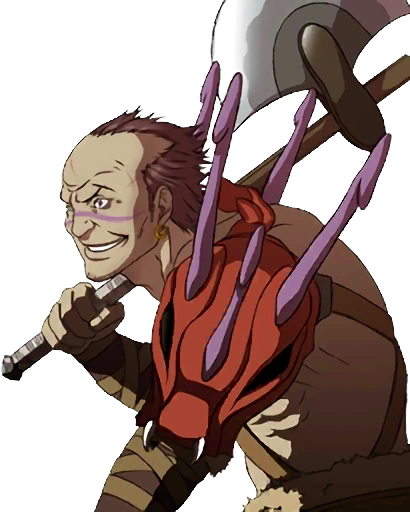
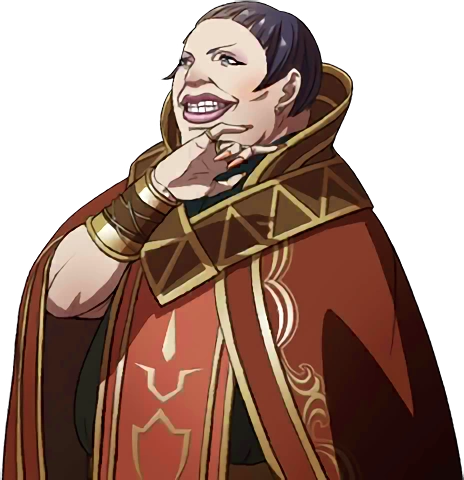
- Played straight and averted in Yo-Jin-Bo. Just about everyone except Yahei (nice old man) and Nobumasa (big, dumb, and evil) could be considered at least above average. Of course all six Love Interests are extremely attractive, but villains Kasumimaru and Harumoto aren't bad-looking, either.
- Most stories in Manga Soprano feature female antagonists who are either overweight, or have facial features that could be read as "ugly", or both, to contrast them to the conventionally attractive protagonist. If the antagonist is conventionally attractive and a pool is the setting/a plot point, she might be revealed to have an ugly face at the end.
- When the unnamed protagonist of Chitra gets Isekai'd into the body and memories of priestess-princess Chitra Serekino, she discovers that beauty = goodness is the law of the land she's inherited: the Kingdom of the God of Beauty. Virtuous and faithful subjects will be rewarded with dewy skin, flawless hair, and peace and prosperity. Chitra works hard to uphold that law and gain the faith of the god's followers, threatening to give criminals and traitors "an ugly face" to match their impure hearts (meaning she'll send her Battle Butler to beat them senseless). When Chitra gains Stat-O-Vision from the God of Beauty, she uses her powers to grant some of her ugly-but-virtuous subjects a facelift in Chapters 34 and 35 with the kingdom's first "Men's Beauty Project."
Patriotic Holy Golem: An evil man's character will be portrayed on his face, and a good man's character will be portrayed on his face! ...Even if one is born with a handsome face, without any faith, they won't have a long and prosperous life!
- Korean webcomic Noblesse. For a "shounen" series, it certainly emphasizes a lot on androgynous male beauty. & you can bet every attractive bad guy you see will be working for the protagonist by the end of the arc.
- For most of the first volume of Quantum Vibe, when Nicole and Seamus have an antagonistic relationship, and the audience is expected to be somewhat suspicious of him, a regeneration error has trapped him in a 250 kg body with a dumpy face and kinky red hair. It's about the time she begins to trust him implicitly that this is fixed, leaving him thin and beautiful with perfect face and hair.
- In the Harem Genre comic Beauty and The Beasts, the protagonist is gorgeous and the males of the shapeshifter tribes are all attractive despite some of them being morally questionable. In contrast, most of the women of the tribes are considered bitchy and ugly with flabby bellies, big noses, and haughty expressions.
- A very popular meme format that reinvents itself over and over revolves around showing an idea, argument, or group of people that the creator doesn't like/agree with being represented as a plain or conventionally unattractive person, and showing the viewpoint that the creator does agree with as a conventionally attractive person. Like this, or this◊. Then again, this can be ZigZagged since the same meme format has been used ironically quite often.

- Discussed by Honest Trailers in their take on Arcane. The narrator says that the show goes all in on the trope of making everyone good hot (Jayce and Caitlyn, who are conventionally attractive, and Heimerdinger, who is adorable) and everyone bad physically deformed (Silco and Singed, who have extensive facial scarring, Sevika, who is "hot, but one-armed, so evil", and Finn, who has lots of tattoos and a replacement jaw ("super evil").
- Demo Reel. The heroes are all conventionally gorgeous — Donnie is wanted by everyone, Tacoma consistently is told he looks good in a dress, Rebecca is played by a model, Quinn spends most of his time in a wifebeater and Karl has a foursome with con girls — while the villains (the Psychopathic Manchild family and Tom Collins) are either weightier or just made to look awkward.
- Nearly the first line in Complete MCU Recap: Everything You Need to Know Before Avengers: Infinity War: "Thousands of years ago, these ice aliens invaded Norway, but they were stopped by super-powerful handsome aliens from a realm called Asgard."
- Bramble, the villain of the Bitsy Bears pilot is relatively unattractive, with a dry bob haircut, but the instant she thinks about reforming, she suddenly becomes more attractive with long, wavy hair. (Seriously, it changes between frames.)
- In Chowder no one is attractive and practically everyone is either some kind of a weird creature or a weird-looking humanoid, but Chef Mung Daal's main rival is a monstrous woman called Ms. Endive, although in one episode it's revealed that she's bitter and advises her apprentice Panini to stay away from boys only because she was left at the altar on her wedding day.
- Played with in Earthworm Jim. Princess Whats-Her-Name is a gorgeous human-looking woman with bee wings who seeks to free her people from the tyrannical rule of her sister, an ugly monster with a giant pus-filled slug for a back side....except by the standards of her species, the queen is the beautiful one while the princess is hideously malformed.
- Among the main set of characters from Ed, Edd n Eddy, Nazz Van Fartanschmeer is the ultimate example for this trope, since her overall kindness in front of others makes almost every boy in the Cul-de-Sac fall for her.
- The eponymous heroes of Gargoyles are superficially ugly monsters (especially Brooklyn), which barely hides their heroic natures. Some fans of the show find them rather cute.
- Goliath - if you can get past the wings, fangs, and talons - could be seen as downright handsome. And let's face it, any man with Keith David's voice is going to have less trouble with the ladies than he might otherwise.
- Brooklyn - if drawn in the right way and angle - gets points for his exotic nature.
- And most of the females? Not really ugly at all (although the one we see the most is not all that good either).
- Goof Troop uses this in an interesting way for just one family. Everyone's favorite Fat Bastard, Pete, has a son, PJ, who is physically his spitting image in terms of body composition, hair color and form, and ear shape. He's also significantly nicer. Pete's face is fairly ugly; PJ's is downright cute. At the very least, he's the male character on the show with the smallest protruding teeth, and often doesn't have protruding teeth at all.
- On Justice League (and Justice League Unlimited), only two of the big seven are even remotely not conventionally attractive. J'onn, while green, is a shapeshifter who can look however he wants, and Hawkgirl's "weird" look is angelic wings. Now, let's take a look at the villains: Gorilla Grodd, Ultra-Humanite, Parasite, Shade, the White Martians... Except the female ones. And Luthor. Bodies are likewise ridiculously one-note exaggerations, with Top-Heavy Guy being the norm— and not just in body, but with chins that would make Jay Leno blush. Not surprising, given that they're based on comic book characters (easily the worst offender anywhere). Ultra-Humanite happens to also be a subversion in the comics as his power is stealing bodies and he did once steal the body of a beautiful woman.
- In My Little Pony: Friendship Is Magic, Rarity (she's as beautiful as she is generous) and Fluttershy (she's as beautiful as she is kind). Also Princess Celestia although she is more a Hot Goddess. She is drawn more aesthetically... more clean, shiny, "beautiful", and pretty... compared to the rest of the cast. It's implied that she is (or fits) the ideal for equine beauty in Equestria; for example, the beauty parlor in Ponyville has a picture of a pony with her tall and slender proportions.
- Almost always the case on The Smurfs; recurring villains like Gargamel, Balthazar, and Hogatha, were always ugly or belonged to races were everyone was ugly. Some were beautiful originally but became ugly due to their actions, like Chlorhydris and Nemesis. Exceptions did exist, like Captain Warmar of the swamp-dwelling Wart Mongers, who made a Heel–Face Turn after the Smurfs saved his son. (Most all other Wart Mongers, however, fit the Trope.)
- Fusions in Steven Universe sometimes have extra features from being composed of two people, but how neatly they come together seems indicative of the health of the relationship. Stable, heroic fusions like Opal and Garnet have relatively few extra features that mesh harmoniously with the rest of their appearance, while Sugilite, a destructive and potentially dangerous fusion, is more beastly in form, boasting five eyes, pronounced fangs, and two sets of arms that blend at the shoulder. Alexandrite, while more 'balanced' than Sugilite, is still a bizarre-looking mess, which makes sense as she's all three Crystal Gems trying to act as one. All of the Crystal Gems together, including Rose Quartz or Steven, form into Obsidian, who manages to be beautiful and scary at the same time due to looking like an eight-armed volcano goddess. The antagonistic fusion Malachite is barely even humanoid, with a second torso where her hips should be, two independently-operating sets of eyes, and four extra arms that serve as legs. Her components are using each other for selfish gain- Jasper is just using Lapis for the power boost, and Lapis is using the fusion to take control of and imprison Jasper. On the other end of the scale, there's Flourite, who's even less humanoid than Malachite, but only for being made of six Gems; the relationship between the six is stable and healthy, and as a result, she's far more cuddly in appearance.
- Teen Titans (2003): The Titans themselves do fight ugly villains or even twisted-looking monsters. Inverted with Jinx, Blackfire, Madame Rouge...
Subversions and played-with examples:
- Kintano from Angel Densetsu is the Nice Guy, The Pollyanna, All-Loving Hero, and an Actual Pacifist. His face, however, makes small children cry.
- Beauty may equal goodness, but on Bobobo-bo Bo-bobo, "Beauty" equals...exasperation (constantly).
- Played around with quite a bit in Death Note, in just about every permutation:
- Villain Protagonist Light Yagami is popular, impeccably groomed and dressed, and has girls fawning over him everywhere. He seems good at first but turns into the worst serial killer in history and a Magnificent Bastard who manipulates everyone around him with no consideration for their feelings.
- However, this is played straight with Light when he loses his memories of the Death Note for a brief period of time. He is a really great guy, the complete opposite of Kira, and he is still gorgeous.
- In contrast, L, the detective chasing Kira, is gangly, funny-looking, and has permanent bags under his eyes; most girls in-story won't even look at him twice, and he has no friends. But he's the world's greatest detective, with a strong determination to take down the murderer, albeit using somewhat questionable methods. He's often considered Ugly Cute, granted, but this was unintentional.
- Misa Amane is a supermodel who turns into a serial killer, though she thinks she's doing it for a good reason; she's genuinely kind and friendly aside from her actions as the second Kira.
- Ryuk, the Shinigami, plays this trope relatively straight: he looks like a monster, and he's a nut who doesn't care who lives or dies as long as he's entertained, and he uses humans as playthings. He'd be another Magnificent Bastard if he weren't so lazy.
- Shinigami Rem still looks somewhat scary, but she's softer and more feminine than Ryuk, and she does what she does out of a sense of duty to a fallen friend, along with genuine compassion for Misa which leads to a Heroic Sacrifice.
- Then there's Sidoh, who's ugly as normal for a Shinigami, but isn't so much evil as pathetic and pitifully stupid.
- Virtually all of the common criminals are butt-ugly. It seems breaking the law only makes you ugly if you do it without the help of a Shinigami.
- Then there's Mello and Near, where this trope is REALLY played around with. On the one hand, Near is like L in that he is an anti-heroic antagonist who uses questionable methods, yet he looks like a cute little boy. Meanwhile, Mello is an extreme Byronic Hero who commits some pretty appalling crimes just so he can beat Near in catching Kira, yet he is a pretty handsome guy to start with. His face gets scarred later on, but even then he is arguably still pretty attractive.
- Villain Protagonist Light Yagami is popular, impeccably groomed and dressed, and has girls fawning over him everywhere. He seems good at first but turns into the worst serial killer in history and a Magnificent Bastard who manipulates everyone around him with no consideration for their feelings.
- Gilgamesh of Fate/stay night is a fair-skinned, red-eyed, golden armor-wearing spiky-haired blond Bishōnen who happens to be an A-rank douchebag and firmly rooted in the villain camp. He is given plenty of depth, however, and though he is evil he has a clear set of morals.
- The main character's best friend in the light novel of Ghost Hunt gets hit hard with this trope. Shibuya Kazuya is stunningly beautiful, even after a rough night with next to no sleep at all. Naturally, Mai and her two best friends form instant crushes ... until Mai realises that he's abrasive, cocky, sarcastic, narcissistic and flat-out insulting to just about everyone. What's Michiru's response when she's informed of this? "But ... he's really handsome." Because someone that pretty cannot possibly be a bad person ... Further subverted in that he genuinely does care for his colleagues and clients, and always acts only in the interest of their safety - he just doesn't like to show it.
- JoJo's Bizarre Adventure: Diamond is Unbreakable has Okuyasu Nijimura, who, while scary-looking and initially introduced as an antagonist, actually turns out to be one of the nicest characters on the show.
- Played with in Magi: The Labyrinth of Magic. For the most part, the heroes or ambiguous anti-heroes are mostly good-looking. But certain villains like Jamil, Judar, and Gyokuen Ren and other Al-Thamen members like Dunya and Ithan are just as attractive, though they can occasionally lapse into twisted, dark caricatures.
- Played with in Mobile Suit Gundam regarding Char and Garma. Both are quite handsome (and are, in fact, responsible for getting fangirls interested in the franchise long before Mobile Suit Gundam Wing. Char switches loyalties at the drop of a hat, all so he can avenge his father. And while arguably the least evil of the Zabi family, Garma is still, at the end of the day, a Space Nazi.
- Interesting case in Mobile Suit Victory Gundam. Katejima Loos is portrayed as a beautiful girl in her late teens. The series protagonist, Uso, certainly thinks so, since he has a crush on her. She starts out as one of the main heroic cast, but slowly shows her true colors of being a Manipulative Bitch. Even when it's clear that she's far from good, Uso refuses to believe that she's evil, even when she tries to kill him on multiple occasions. This changes near the end of the series, when he finally wakes up and fights her back. She even points this out, afterwards, acting shocked that her charms no longer work.
- The psychopathic Johan is easily Monster's best-looking character.
- Naoki Urasawa puts about as much stock in this trope as Pratchett does (read: none). This guy here◊ is the hero of 20th Century Boys (whose Ragtag team of freedom fighters includes, among others, an old homeless man and a guy best described as a human frog). The sinister-looking guy here with the receding hairline◊ is one of the good guys in Pluto. This little cutie? Satan incarnate.
- Naoki Urasawa puts about as much stock in this trope as Pratchett does (read: none). This guy here
- Commonly subverted or played with in One Piece. Ugly characters often turn out to be stalwart and good in their own right, and more conventionally attractive characters can be really, really awful or kind of ambiguous at best. Unless they're women. Nine times out of ten, attractive (Nami, Vivi, Robin, Hancock), or in the case of elderly women, dignified-looking (Tsuru, Shakky, Nyon) women are good, while ugly women are evil (Alvida pre-transformation, Miss Merry Christmas, Big Mom). There is the occasional subversion, though, where an attractive woman is evil (Miss Doublefinger, Kalifa, Monet, Black Maria, York) or an ugly woman is good (Kokoro, Lola, Chiffon).
- Averted in Paprika. The obese Tokita appears to have no deep and dark issues with his weight, being a happy, brilliant, affable scientist, and it turns out the girl of his dreams, Chiba, is plenty enthralled with him as well, and they get married!
- In Red River (1995), most of the noble characters are portrayed as very beautiful. They're generally divided between being Royals Who Actually Do Something (for example, Kail and his brothers) and those who are incompetent or outright harmful to the wellbeing of their countries (for example, Nakia and Nefertiti). The very handsome Ramses wants to gain power in Egypt so he can better care for its people which is a noble goal, but he also repeatedly tries to kidnap and rape Yuri, leading her to consider him a complete cad. Meanwhile, Nakia and Urhi are very beautiful but also are incredibly and unbelievably evil. Even worse, their backstories show that their beauty caused the circumstances that lead to them becoming as horrible as they are. Yuri, meanwhile, is very cute by modern-day standards but is initially considered plain by most people in Hattusa, mainly because she's short and flat-chested. As people begin to love her for her kindness and the good things she does for them, they talk about features that they do consider beautiful about her (namely her pale skin and black hair) and her maids imply that her beauty comes from her happy, friendly demeanor.
- Played with in Superior. Though all the main cast is attractive, 'beauty' is talked about mostly as an internal quality, related to goodness and valuing life. At one point, Sheila breaks down in tears and asks Copy (who physically looks almost identical to her) and Shadow why they are so ugly after their callous slaughter of a village- while also remembering how she used to be the same way. The original Demon Lord, on the other hand, seems to believe that beauty is in fact related to purity... though his idea of 'pure' is far, far removed from valuing life.
- Trinity Blood subverts this. Deitrich is described as having "the face of an angel and the heart of a devil". Despite his beautiful appearance, he's evil. In addition, during the final battle in the anime Cain's ultimate form resembles a heavenly angel, while Abel's ultimate form resembles a demon from hell.
- Yu-Gi-Oh! toys with it in the person of Marik Ishtar. He's a Bishōnen in a midriff-baring outfit who has all the fangirls fawning over him. He's also a Manipulative Bastard who plots to Take Over the World via Mind Rape. He's later revealed to have a Superpowered Evil Side with Omnicidal Maniac and Combat Sadomasochist tendencies; this identity (Dark Marik), is also far, far, uglier with grotesque facial features, Anime Hair, bulging eyes, Tainted Veins, and a much more brutal, muscular build. So beauty equals evil, but ugly equals more evil?


- In Byzantine Christian art, most Saints are drawn somewhat ugly to accentuate their Inner Beauty represented by their halo.
- Many Renaissance portrayals of Saints or Biblical characters were intentionally drawn plain as to avoid inspiring lust for a holy character. However, angels, who were genderless...
- Ben Grimm is one of the most popular characters in the Marvel Universe, in spite, or perhaps because, of the fact that he's a massive rock creature.
- Beta Ray Bill. He looks like an orange humanoid crocodile/horse hybrid and is even considered hideous by his own people's standards (they normally just look like yellow humanoids with no hair or pupils), yet he is one of the noblest beings in the Marvel Universe. One of the most badass, too. After all, he was the first non-Asgardian to be deemed worthy enough to wield Thor's hammer, Mjölnir, which was of course intended to be a shock to both Thor and readers.
- The Anti-Hero mutant Wolverine—longstanding, undisputed favorite of the X-Men franchise—was originally supposed to be a subversion. Five-foot-nothing, slightly hunched, enough hair on his body to wonder why he didn't wind up with the "Beast" codename, and reportedly, poor personal hygiene (even though you know as well as I do he couldn't maintain hair like that without being half-metrosexual). However, because of Popularity Power, many writers sometimes forget the above description and turn him into a sexy funtastic lady-lovin' machine. Maybe it's animal magnetism, or his fan-favoritism (the current writers were fans in their youth), or they realize that one word has always defined Wolvie: stamina. Even at his ugliest, he looks pretty good for 113!
- Spider-Girl, in her identity as May Parker, started out as a star basketball player with short hair, a major subversion from just about all the mainstream superheroines who've ever gotten their own series. Since that time, while May has grown her hair a little longer, what little Fanservice exists is rather mild, if not non-existent, compared to what many readers have come to expect.
- Hellboy was started when the creator, Mike Mignola, wanted a hero that looked like a villain. Hence, Hellboy looks like a demon.
- Fables has the actual Prince Charming as a major character and also a shallow, heartless, bastard. Goldilocks is very attractive and turns out to be murderously violent. Bluebeard is, well, Bluebeard. Beauty is beautiful but happens to be a total bitch. Bigby's looks are up for debate but his actions support him being a subversion whether you think he's good-looking or not.
- Of course, played with often in Watchmen, thanks to the series blurring the lines between ugliness and beauty, and heroism and villainy.
- Rorschach, despite being one of the main heroes (and most certainly the star of the book), is ugly as sin. Uneven haircut (and ginger at that), short, pug nose, spotty face, dead eyes, aged face, he's described as being "fascinatingly ugly" by his psychiatrist. Hasn't stopped a small portion of the female fanbase being into him...
- Ozymandias. Tall, muscular, blonde, handsome, older than he looks, strong features. The "villain" of the series.
- Of course, these two examples could either be considered an aversion or playing it straight, depending on your point of view.
- Played the straightest with Nite Owl II, who is a little hefty and wears thick glasses but is considered very handsome by at least two characters.
- Silk Spectre II is rather stunning, like her Mom, but she doesn't care for the hero thing at all.
- Her Mom, Silk Spectre I, was a successful hero because she was a beauty. It was publicity to help her movie career.
- Dr. Manhattan rebuilt himself in the shape of the ideal man and the classical hero, standing well over six feet with statuesque features. He even walks around naked. However, he doesn't care at all about heroism.
- The Comedian is tall, handsome, and has "bad boy appeal", which also plays the trope straight except... he's not much of a hero. It straightens out again when his scars and age reduce his good looks to a rather leathery-looking ball of meat.
- In Sin City, physical beauty in general is not a good barometer for morality in a setting like this, even though some of the heroes do play it very straight.
- Marv is a massive, ugly monster of a man but is also a good man.
- Ava Lord is pure evil but was extremely beautiful to the point where she could easily manipulate almost any man into doing her bidding.
- Junior was also fairly handsome and looked every bit the golden boy future President his father wanted him to become — too bad about the whole "raping and killing little girls" hobby. It's played straight with Junior after the experimental treatments that saved him from Hartigan's No-Holds-Barred Beatdown also disfigured him.
- One Two-Face comic subverts this nicely. After he gets the surgery to fix the mangled side of his face his split personality is cured and he no longer needs the coin. Too bad the mangled side of his face represented the good Harvey Dent, and without it, he sinks completely into evil and is no longer held back by his good side.
- Excalibur played with this trope when the team visited a Barsoom-esque world where they saved the beautiful◊ Princess Anjulie, who was seemingly threatened by a group of blue-skinned humanoid pirates. It turns out she was a cruel, Eldritch Abomination-worshiping despot that had seduced and overthrown the previous king and the pirates were led by the rightful princess Kymri, who was ready to avenge her father before the heroes barged in. While Kymri looks certainly inhuman compared to her enemy, she is far from bad-looking herself, being a gorgeous◊ Blue-Skinned Space Babe and a Distaff Counterpart to Nightcrawler, a Chick Magnet himself despite his demonic visage.
- In "The Day After Doomsday" in Creepy #24 the pretty woman Richard Caldwell encounters in a blighted wasteland After the End turns out to be a member of a cannibal tribe, while the hairy and grotesque mutants are usually-peaceful vegetarians.
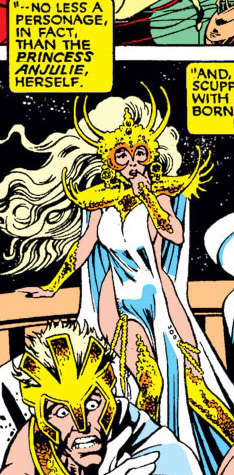

- In The Three Spinners, three hideous women offer to help the heroine with her spinning. Unlike Rumpelstiltskin, all they want is to be invited to the wedding. When the heroine does, they assure her husband that their hideous looks stem from their endless spinning and thus get the heroine off the hook forever. The Three Aunts is another variant.
- There are countless fairy tales where the protagonist is given vital aid on their quests by dwarves, crones, and sometimes even giant, disembodied heads, such as The King of England and his Three Sons, where the youngest son meets three ugly brothers along the way.
- In the story of "Tatterhood", the eponymous heroine is filthy and dresses in rags while wearing a goat. Her sister is traditionally beautiful, but is a Damsel in Distress and contributes virtually nothing to the story besides having her head stolen by trolls. The end of the fairy tale does prove that she can be beautiful if she wants, but she makes it clear that she prefers to be ugly.
- "The Three Snake Leaves: in the beginning, the princess is very beautiful and very weird, but not a bad person. After she dies from illness and is brought back to life, she becomes twisted into a murderous adulterer.
- There is a fairy tale where a girl is So Beautiful, It's a Curse and is harassed by many attractive, wealthy men... one of whom is Satan himself. When she refuses him, the Devil spitefully steals her beauty from her, leaving her ugly and misshapen. Years later, he decides to see what happened to the girl and is shocked to find that her new ugliness drove away all her unwanted suitors, leaving her Happily Married to an ugly but goodhearted Dogged Nice Guy.
- The Golden Branch subverts this trope and then plays it straight - the protagonists are a prince and a princess who are both very ugly and crippled but are shown as being good-hearted. The princess is even given the choice between being beautiful and being good and decides that being good is the better option. Their goodness wins them the favor of a fairy, who eventually rewards them both with beauty. Then, they get turned into animals by an evil witch, and have to get turned back after going on a quest.
- The Shrek series has an ogre as the hero, and the love of his life becomes an ogress herself at the end of the first film. By contrast, the handsome Prince Charming from the second and third films is a bratty, immature, villainous twit. Interestingly, the not-so physically attractive Shrek's heroics and the comparatively more physically attractive Prince Charming's malice also collectively create an inversion of this trope at the very same time.
- There's also Charming's mother, Fairy Godmother. She's got the sweet, matronly look down, and is not above drugging her goddaughter into marrying her son, threatening to essentially ruin King Harold's life by turning him back into a frog, and trying to kill Shrek.
- Downplayed with Queen Lillian, Fiona's mother, who despite being an old lady, is very kindhearted and beautiful.
- Shrek the Third also has the other princesses, who are shown to be fairly shallow and useless at first, while the ugly stepsister Doris is a lot kinder and stronger. Rapunzel also ends up selling them out so she can marry Charming. She's later revealed to be bald which could be playing the trope straight, except that she's still an attractive woman, just with no hair.
- Shrek Forever After has all of the ogres as perfectly decent people fighting to overthrow the evil Rumplestiltskin. In that universe, Fiona also identifies as an ogre and keeps her curse of turning into a human woman by day a secret.
- Played with in Megamind. Metroman, the unambiguous hero who fakes his death because he's tired of the life is all Heroic Build and Lantern Jaw of Justice, but then you have Megamind the villain who becomes good and Titan who turns bad because he can't get the girl. Megamind is a skinny blue alien with a giant head, but has huge, puppy-like, instantly endearing green eyes complete with eyelashes, while Titan is human but looks and acts like a thug.
- Disney Animated Canon:
- The Queen in Snow White and the Seven Dwarfs is beautiful, but in a cold and inexpressive way, meant to unsettle the audience. She later disguises herself as a hideous old peddler woman, which, being far more openly evil, represents her true nature.
- This was the moral to Disney's Beauty and the Beast - the attractive Gaston is actually a terrible person while the Beast is very kind and gentle. Of course, the Beast himself (as well as the Prince he turns back into) could be considered quite attractive themselves, depending on one's taste.
- While Tiana and Naveen are plenty attractive in The Princess and the Frog, the animation crew also took great pains to make the sinister Doctor Facilier quite charismatic and attractive as well, to explain how he could lure in unsuspecting victims. And then Ray the Firefly is drawn to resemble an inbred hillbilly but is still one of the most insightful and helpful characters.
- Both applied AND subverted in Tangled- the main leads are all handsome or cute (Disney even had its own female employees choose what Flynn should look like) and two of the villains (the Stabbington Brothers) are ugly- however the main villainess is pretty hot (while young) and the Snugly Duckling Pub Thugs, despite their looks turned out to be nice guys. They even lampshade it in one of the movie's best musical numbers. It's also lampshaded with Flynn's Wanted Poster, which portrays his criminal self as uglier than he actually is. This extends into the animated series, where the central antagonist is a cute teenage boy, though the art style as a whole removes the ugliness out of the equation thoroughly.
- Subverted in both of Disney's Cinderella sequels, where Anastasia is an ugly stepsister but is a nicer person. She's a little better drawn arguably, but it's more of a result of her not scowling all of the time.
- In Frozen, the greedy and prejudicial Duke of Weselton is one of the least physically attractive characters. The duke turns out to be a Red Herring, and the true villain is actually Prince Hans, attractive and dashing.
- In The Little Mermaid (1989), Ursula explicitly uses the form of a beautiful woman to trick Eric into falling for her instead of Ariel.
- In The Emperor's New Groove, the villainess Yzma is old and unattractive while protagonist Kuzco is fairly average looking. Throughout the movie, Kuzco gradually learns humility after being turned into a llama by the vengeful Yzma. Even she learns humility at the end by being turned into a cute little kitten and is grudgingly forced to join the cub-scout-like children's group headed by Kronk, the assistant she used to boss around.
- The Hunchback of Notre Dame is an example if you're into men like Frollo who, while not straight-up ugly, is rather old and skinny. However, the hero of the film is a deformed hunchback named Quasimodo who is everything Frollo isn't.
- The main villain in Zootopia is a cute and unassuming sheep, which actually caused flack in China for not adhering to Animal Stereotypes.
- Barbie sometimes plays with or avoids this trope:
- Barbie Fairytopia: Played with. The Big Bad Laverna has ugly goblin henchmen, but Laverna herself is the twin sister of the graceful Enchantress and looks identical to her (at least when she hasn't been turned into a toad).
- Barbie in the 12 Dancing Princesses: Mostly avoided; Duchess Rowena is elegant, and her manservant Desmond is more ape-like than outright ugly.
- Barbie: Princess Charm School: Dame Devin is the villain, as well as a conventionally attractive Rich Bitch with a Strong Family Resemblance to her daughter Delancy.
- Double Subversion in Bartok the Magnificent, where the ugly Russian witch Baba Yaga is actually portrayed as being a benign character, and she even makes a magic potion that can make people on the outside 10 times what they are on the inside. According to Yaga, the titular bat is supposed to drink the potion, which will turn him into a brave hero, but the potion is later stolen by the evil Ludmilla, who is portrayed as being beautiful. Ludmilla actually wants to use Yaga's potion to make her even more beautiful so she can take over Russia, but when she finally drinks it, said potion realizes that Ludmilla is evil once consumed, and as a result, it turns her into a dragon.
- In Gandahar, Sylvain immediately assumes that the Deformed, a race of mutants, must be evil on account of their grotesque appearances. They quickly prove him wrong.
- The villain of Happily N'Ever After 2 starts out ugly and turns herself beautiful so she can marry the king.
- Strange Magic: The film subverts it early on when the textbook prince-level handsome Roland turns out to be a cheating jerk. It also subverts it with the Bog King, an ugly insect humanoid who turns out to be surprisingly heroic after falling in love. Roland turns out to be the Big Bad and the Aesop is literally stated out loud (albeit for Hypocritical Humor).
- Teen Titans: The Judas Contract: Lampshaded in the flashback when Starfire arrives on Earth. The Titans argue about whether to help her or the aliens fighting her (who look like ugly, winged reptilians). Bumblebee says that the choice is obvious, but Speedy counters that looks can be deceiving. Robin finally orders the Titans to assist Starfire after she's knocked unconscious.
- Subverted very cruelly in Audition when the lonely, widowed male lead discovers that his beautiful, demure bride-to-be is Ax-Crazy.
- Subverted in such high school teen comedies as Mean Girls and "The DUFF" (Designated Ugly Fat Friend. It turns out that a DUFF doesn't even have to be ugly. It's just a term used for the least popular but most approachable member of a group of friends.)
- Inverted in the 1953 sci-fi movie It Came from Outer Space where the hideous one-eyed aliens are not launching a covert invasion of Earth; they only want to quietly repair their spaceship and leave without conflict.
- E.T. the Extra-Terrestrial. An alien that can at best be described as wrinkled and stubby, and also one of the most sympathetic and beloved characters in cinema history.
- Averted, lampshaded, and parodied in the Austin Powers movies where the hero doesn't look good at all and one of the first things said to him after he is unfrozen is that he should get a makeover for his teeth. At the end of one of the movies when they watch a movie based on Austin Powers (yeah.) Austin is played by Tom Cruise.
- In the James Bond movie For Your Eyes Only, Aris Kristatos, a handsome Greek tycoon decorated by the British government for valor during World War II and devoted to his patronage of an aspiring Olympic figure skater Bibi Dahl, warns Bond that Milos Columbo, a swarthy, greasy-haired heroin smuggler, has the encryption device that Bond is attempting to retrieve. When Bond meets with Columbo, he declares that, yes, he is a smuggler, but he never smuggled heroin, and that Kristatos is the real drug smuggler, having warned Bond that he may have to kill Columbo to knock out the competition. By the end of the movie, Kristatos has attempted to kill Bond (and clearly had non-fatherly designs on Bibi), while Colombo aided Bond in taking him down.
- Christopher Johnson and his son of District 9 are the only two white spots in an otherwise Black-and-Gray Morality Crapsack World. They also happen to be giant space roaches.
- Lampshaded and subverted throughout Passione d'Amore. The good-looking male has an affair with a good-looking married woman. (She gets away with stringing him along because she's pretty.) Then, he gets sent to some backwater area and starts to interact with the local colonel's daughter, whom everybody agrees is quite ugly. It also shaped her character: even her parents avoided contact with her. She never gets a 'beautiful all along' makeover, but he eventually falls in love with her anyway. Then she dies. And he goes to tell his pretty lover that he isn't taking her shit anymore. It's mainly notable for the 'pretty dude/ugly woman' pairing.
- Harry Potter and the Order of the Phoenix: The films apply Adaptational Attractiveness to Dolores Umbridge - who is compared to a toad in the books. This serves to create dissonance between her sweet, grandmotherly appearance and the horrible things she does - to make her all the more terrifying.
- Marvel Cinematic Universe: Played with in Loki's case. In Thor, Loki's lovely Raven Hair, Ivory Skin looks denote that he was once on the side of good before his Face–Heel Turn, and he's a sympathetic (if appallingly misguided) anti-villain. In The Avengers (2012), he becomes an Eerie Pale-Skinned Brunette, and his more sickly complexion conveys that he's an unsympathetic, malevolent villain. In Thor: The Dark World and Thor: Ragnarok, Loki appears healthy again, with his gorgeousness being emblematic of his potential for a Heel–Face Turn, and he's an anti-hero in both films. In Avengers: Infinity War, his vulnerability and desperation in closeups are intensified because he's a Long-Haired Pretty Boy, and it makes his Heroic Sacrifice that much more grisly and disturbing.
- The US Navy's sexual harassment training videos subvert this trope. In an example of quid pro quo sexual harassment, the protagonist is an unattractive girl who does a good job and only wants recognition for her hard work. The two antagonists are a male sailor who has the power to pick the Sailor of the Quarter and an attractive blonde sailor who is chosen for this position with heavy implications that she is chosen only because she slept with the guy who makes the decisions.
- In Small Soldiers the owner of Globotech assumes the human Commando Elite are the heroes while the odd-looking Gorgonites should be the villains due to this trope. The reverse is actually true.
- All over the place in The Hobbit. All of the elves are impossibly beautiful, but while you have Elrond, Galadriel, and Tauriel, you also have the unrepentantly Jerkass Thranduil, and Legolas is a Jerk with a Heart of Gold. The orcs and goblins play this straight as well; they're just as cruel and wicked as they are hideous. The dwarves are very much the opposite of the elves, fittingly: all of them are good people, but while you have Bombur◊, you also have Thorin◊. Which itself is an inversion, as Bombur is portrayed as a pretty good guy in both book and film, but Thorin is a bit more complicated...
- Subverted in Leave Her to Heaven with the beautiful Ellen also being a Bitch in Sheep's Clothing, a Green-Eyed Monster, and Yandere all in one.
- Zoolander 2: Parodied.
Hansel: [dead serious] She's hot. I trust her.
- The crew of Return of the Jedi mocked Admiral Ackbar's design for being ugly but director, Richard Marquand refused to change it because he wanted children to know that this trope wasn't true.
- The 2001 comedy Shallow Hal is about a superficial man being hypnotised into seeing people's inner beauty. His love interest looks like Gwyneth Paltrow to his eyes but is in reality three hundred pounds overweight (although still portrayed as a Big Beautiful Woman). The flipside comes when a beautiful Gold Digger in real life is then shown from Hal's POV as unattractive. Then again, Hal's Jerkass of a best friend is shown to be less attractive than him.
- The Dark Crystal: Played with. The protagonists, the Gelflings, are obviously intended to be attractive, despite any Uncanny Valley that may be invoked by looking at them. The pure urRu are made to look noble and sagacious, and when they die, they fade into sparkles. The Skeksis, on the other hand, are clearly intended to look twisted, deformed, and vulture-like, which is made even worse by their advanced age and the fact that the Emperor's body crumbles to pieces within seconds after his death. Aughra, however, is quite hideous and warty, yet proves to be a helpful character. A bit of background checking shows that in the grand scheme of things, she's actually supposed to be True Neutral, and not one to take sides. It gets really confusing with the Podlings, who are supposed to be a good, Closer to Earth race, yet somehow they wound up looking Ugly Cute at the same time. Brian Froud did admit that he toned down their appearance from the earliest incarnations because those were far too grotesque and potato-like.


- Angel:
- Darla, one of the most evil vampires on the show, was ravishingly beautiful and would often lure victims in with her beauty. She would also always be seen dressed to the height of whatever fashion was in at the time.
- Jasmine, the Big Bad of Season 4, is a Dark Messiah who takes the form of a beautiful woman (Gina Torres to be specific). When someone's blood mixes with hers, they're freed from her spell by glimpsing her true form - which looks like a rotting corpse.
- Some Charmed demons played with this:
- The Siren was an attractive woman who seduced married men and then burned them to death, along with their wives.
- Christy Jenkins is Brainwashed and Crazy and, despite her love for her little sister Billie, is proven to be very evil. She's also a very beautiful young woman, and the sisters comment on her beauty.
- One of the "conditions" in Lessons for a Perfect Detective Story is that if a beautiful woman is involved in the case, they're more likely to be the murderer than an unattractive one. So it's the job of the "supporting characters" to never suspect or question these people. Of course, this is regularly double-subverted.
- The theme song for the US broadcast of Danger Man:
Beware of pretty faces that you find
A pretty face can hide an evil mind - X5s in Dark Angel tend to be attractive, but that's down to genetic engineering (and being played by Jessica Alba or Jensen Ackles). Manticore transgenics with more bizarre appearances are also generally good guys. However, they still fall prey to this, as anti-transgenic bigots especially play up the latter to demonize them, and one is shot dead by a police officer who thinks he's trying to hurt a boy (though he actually just saved his life), undoubtedly at least in part due to his hideous appearance.
- Doctor Who:
- Subverted in "Galaxy 4", with the beautiful female Drahvins (who turn out to be the villains) and the hideous Rills (the good guys). Also somewhat subverted, a lot of the time, by the character of the Doctor himself.
- In the novel Timewyrm: Revelation by Paul Cornell, Ace finds a pack of double-sided Tarot cards which symbolize the Doctor. One of the cards is called "We Are Friends To The Ugly"/"We War With The Beautiful", and shows the Doctor embracing a many-tentacled monster (possibly a Venusian, or Alpha Centuri from the Peladon stories) and confronting a calm humanoid.
- The most common source of Cowboy BeBop at His Computer in Doctor Who news is journalists assuming that the most hideous looking alien in a given story is "the monster".
- The first story to intentionally and properly subvert the trope is "The Sensorites" — the Sensorites are hideous beings (similar to the Ood in the new series) who are introduced to us performing a constant campaign of psychic Mind Rape on the occupants of a human spaceship, its hideous face appearing to us from behind a plate of glass as a cliffhanger. As soon as the Doctor starts communicating with the Sensorites, he realizes they are peace-loving beings prone to Sensory Overload, misguidedly attacking the humans under erroneous beliefs, and soon patches things up between the ship occupants and the Sensorites. He spends most of the story helping the Sensorites from a gang of evil colonialist humans and protecting the good Sensorites from the token evil Sensorite politician.
- Played with from all angles by "The Brain of Morbius". Evil Solon is charming and handsome but far nastier than his ugly servant Condo, who is more antiheroic. Yet both Solon and Condo are obsessed with the beauty of the Doctor and Sarah respectively (the good guys) — Condo even tells Sarah that she's better than him because she's pretty, while Solon is fascinated at first sight by the Doctor's face and decides it would be the perfect head for the body he's building for the psychotic Morbius — the Doctor, interestingly, isn't conventionally handsome but is very striking and magnetic. The Doctor and Sarah make fun of Morbius' ugliness compared to their own good looks when confronting him at the end of the story, but it's because it's a sore point for Morbius, who (it is implied) was known for his charismatic good looks in his last body and claims to experience agony from the sheer experience of being what he currently is. And Sarah only shows fear of Morbius when she sees him for the first time, and is very blasé about him (even trying to help him!) when she's blinded.
- Drop Dead Diva is all about what happens after a sexy but arrogant supermodel wakes up in the body of a chubby female attorney after a car accident.
- The staff on the upper floors of The IT Crowd are, as suggested, "a lot of sexy people not doing much work and having affairs". And they're all horrible, mean people. At least to Moss and Roy, anyway.
- Lost in Space episode "The Golden Man". Two aliens are in conflict: the handsome title character and his ugly frog-like opponent. The Golden Man turns out to be the bad guy.
- In Merlin (2008), any beautiful woman who turns up in Camelot is guaranteed to be evil. The two subversions (Princesses Elena and Mithian) had their beauty used as a deliberate Red Herring to make the audience believe they were evil before the twist emerges that they were actually good all along.
- An unsung aversion is The Muppet Show and to some extent Sesame Street as well. With muppets, it doesn't matter what a muppet looks like as to how good or bad a person uh puppet will be. And at least on The Muppet Show it was even true with the guest stars you couldn't tell how nice or mean they would be purely based on looks. In fact the more you like a muppet, the more you like the way they look.
- Averted with Julie Cooper in The O.C., widely acknowledged as beautiful, but also suffers from Chronic Villainy. She isn't exactly evil, but she's sure not the most morally upstanding character in the series. Though, in the end, she's one of the good guys.
- Averted in-universe with Michael Scott of The Office, he truly believes that the more attractive a person is the more trustworthy, honorable, etc. they are. Every attractive person Michael puts any trust in are arrogant Jerkasses.
- The Outer Limits (1995): Subverted in the episode "Mind Over Matter". Dr. Stein (Mark Hamill) is experimenting with entering people's minds with the help of an AI but has unrequited feelings for his colleague Dr. Carter. When she enters a coma after an accident, he plugs her into the machine and spends time with her inside the virtual world. Then the AI goes rogue, admitting that it's fallen in love with Stein and wants him for itself. A being looking like a dishevelled Carter appears to kill the real Carter, prompting Stein to kill the attacker. Except it turns out that the dishevelled-looking Carter was the real one because her mind was only partially active and therefore distorted the avatar. The pretty avatar that he assumed to be Carter was the AI all along.
- Sabrina the Teenage Witch:
- One episode has Sabrina shocked that one woman can be the Wicked Witch, as "she's so pretty" (she's played by Shelley Long). Hilda remarks that the witch has had a lot of work done. As she's an infamous cannibal of mortals, naturally a more beautiful appearance would help in attracting victims.
- As a Secret Test of Character, the Evil Matriarch Aunt Irma demands that Harvey answer truthfully if she's attractive. He says she's "nice looking" on the outside but hideous on the inside. But she turns out to be Good Is Not Nice in the end.
- In a Saturday Night Live skit, an angel comes to a woman in the hospital and asks her to take his hand so he can heal her, but she's extremely distrustful of him because he's dressed in all black, has black wings, and, well, he's played by Christopher Walken. He points out that if he was trying to deceive her and take her life, he'd be more subtle about it and come disguised as a beloved dead relative. Moments later, her late grandmother appears and kills her.
- Subverting this trope is the basis of much of the humor of comedienne Sarah Silverman. When performing, she has the appearance, mannerisms, and voice of a sweet, innocent young woman. It takes a while for what she is actually saying to sink in...
- The Singing Ringing Tree zig-zags this trope. The heroine is a princess who, whilst outwardly beautiful, is arrogant and mean-spirited. She later gets cursed with ugliness (which due to limited production values admittedly appears more Hollywood Homely than anything) as a reflection of her inner character, with her outward beauty only being gradually restored as she slowly redeems herself.
- Star Trek:
- Star Trek: The Original Series:
- There's actually plenty of instances where good-looking people are the villains (or most of the time, Affably Evil). Not sure if this would be a subversion, aversion, or some variation, but the women in "Mudd's Women" are actually very ugly unless they take a pill that makes them radiantly beautiful. It's later revealed to be a case of the Placebo Effect, and the women's beauty was merely a factor of their self-confidence. They then become beautiful without the pill.
- Spock himself quoted this trope in the episode "Is There In Truth No Beauty", commenting on the Greek ideal that "what is beautiful must therefore be good." The episode subverted: Kollos, a member of a race described as so ugly that no one can look at them without going mad, turns out to be friendly and helpful when he shares minds with Spock, but his human aide Miranda, while very attractive, is cold and aloof, and later jealous of Kollos' bond with Spock. Kirk himself admits, "Most of us are attracted by beauty and repelled by ugliness — one of the last of our prejudices."
- Star Trek: The Next Generation: Gene Roddenberry was originally opposed to casting a bald lead due to this trope, but changed his mind after seeing Patrick Stewart's audition. Stewart was later called the "The Sexiest Man on TV" by TV Guide, bald head and all; this is telling.
- Star Trek: Voyager:
- Speaking of baldness, the Doctor in is bald, has Big Ol' Eyebrows (although neither of those are inherently unattractive), and generally will not win any beauty pageants. He's one of the show's most popular characters, and a good guy (albeit a pretty jerkish good guy). As a hologram, he could look like anyone who's on the ship's records, but generally doesn't.
- Inverted in "Nemesis", where Chakotay crashlands on a planet fighting a Civil War, and is rescued by the Vori, Human Aliens fitting every The Hero — handsome, brave men fighting to protect innocent villages against the Kradin — who wear black, talk in deep growls and look like something out of Predator. It turns out Chakotay is trapped in a Vori brainwashing simulation to indoctrinate conscript soldiers to hate the Kradin, who are helping Voyager rescue him.
- Star Trek: Picard: Narek is a villain who's quite handsome, along with his sister Narissa, who's beautiful and even more evil than Narek.
- Star Trek: The Original Series:
- Robert Palmer's "Bad Case of Loving You":
A pretty face don't make no pretty heart
I learned that, buddy, from the start
- At one point, The Bible describes Abram (later Abraham) worried someone might try to steal his wife Sarai (later Sarah) because he "realized she was beautiful." The Talmud interprets this to mean that she was physically attractive, but that Abram/Abraham connected to her on a spiritual level, so he would have found her beautiful no matter how she looked; he only realized other men might fancy her years after they had been married.
- It's also been noted that the matriarchs are only described as beautiful when they're also being connected with positive traits; however, rather than playing this trope straight, the interpretations are either a.) beauty only matters when it accentuates goodness or b.) one should find goodness to be beautiful, not beauty to be good.
- The Messiah, on the other hand, is explicitly described by Isaiah as being ugly, so that no one would be distracted by carnal desire.
- In keeping with their belief as Christians that Jesus was the Messiah, early descriptions of Jesus were of a short, ugly, hairy man with dark skin and wooly hair. Even early icons of Jesus (before 800 CE) show a very scary, angry-looking guy. Early Roman critics of Christianity, such as Celsus, bring up Jesus's ugliness to mock Christians without realizing it was probably they who spread the description in the first place.
- Inverted with Jezebel, whose beauty is meant to emphasize her arrogance and corruption.
- Also inverted with Satan, who was formerly the angel Lucifer ("light-bearer"). Tradition states that he is still able to take on a beautiful appearance, and if he did so any man who saw him would be overcome with awe and worship him. He's still, well, Satan.
- 1 Peter 3:3-4 in the New Testament also plays on the theme of the "inner" beauty of character being as important, if not more so, than outward beauty.
- In the Book of Esther, Ahasuerus/Xerxes' first queen, Vashti, was said to be the most beautiful woman in the Persian Empire. However, according to some Midrashic interpretations, she was haughty, arrogant, and made her (mostly Jewish) servant-girls do things like work on the Sabbath or eat unkosher food. note According to these interpretations, the real reason she refused her husband's summons was that she had been punished by an angel with some sort of embarrassing disfigurement.
- Warhammer 40,000: Subverted. Descriptions of most Space Marines fit the "ruggedly handsome" image, but they're the result of massive genetic engineering and are described by most normal humans as strikingly inhuman. Sisters of Battle and Eldar are often portrayed as beautiful in artwork but books, official content, and Word of God all agree that they're anything but. Physical beauty is also one of the most common gifts bestowed by Chaos God Slaanesh, Prince of Excess and Debauchery.
- The reasons that the Sisters of Battle don't look as good as their tabletop models are scarring, tattoos, weight, missing body parts, and them not giving a damn about personal appearance.
- "Though there was no disguising his inhumanity [...] there was the overgrown gigantism of the face, that particular characteristic of the Astartes, almost equine". That's Captain Loken, the definitive Good Guy of the first Horus Heresy book, Dan Abnett's Horus Rising. Also, the book gives us an idea of how much Space Marines stink after some time in their powered armor. On the other hand, most Primarchs, who are even taller than Marines, are godlike beautiful.
- Subversion in Warhammer: See that really hot, half-naked elf woman? She's the Dark Elf Hag Witch who kills children and bathes in their blood. That fat frog guarded by the huge, frightening lizards she's fighting? The frog's a Slann Mage-Priest, and those lizards are Temple Guards, among the noblest soldiers in the world.
- Played straight to the point of absurdity however with the literal Always Chaotic Evil servants of Chaos, who have an explicit rule that the more they devote themselves to Chaos the more mind-warpingly horrific they become, with the final fate of any Chaos follower being either a gibbering Chaos Spawn with more limbs than IQ points or a massive Daemon Prince with dominion over their own slice of hell.
- And subverted again with followers of Slaanesh, who are described as disturbingly beautiful at worst. The ability of the artists and modelers to convey this, however, varies due to individual skill and decency laws.
- Though played disturbingly straight with Slaanesh's two champions in 40K, Lucius and Fulgrim. Fulgrim was one of the most beautiful primarchs while on the side of the Emperor, but now he's a four-armed snake thing. Likewise, Lucius was called a pretty boy by his allies because he had never taken an injury in battle. You only start seeing his ugly side after Loken breaks his nose, and when he truly turns, he starts cutting his face up whenever he kills someone. Hence how he looks in the 41st millennium.
- Sigvald the Magnificent, Slaanesh's champion in Fantasy, is a Viking Pretty Boy whose feet don't even touch the ground so as not to get them dirty with every aspect of The Fighting Narcissist and Camp Straight you can imagine. He's also a sadist who once torched a city because he didn't like the wine, and his entire unit carries polished shields so he can admire himself whenever he feels like it (the in-game explanation for his having the Stupidity rule).
- And to perhaps complete the cycle, there is the case of the Chaos god Nurgle, horrifying and ugly in the most maximal senses of the word, and that’s without factoring in the virulent plagues and diseases has coursing through the very air he resides in, let alone his skin. Bloated, dead-looking, maggots and worms writhing everywhere, and one of his attributes is kindness. His followers while all hideously ugly as well, and bloated/diseased, are nonetheless also jovial and welcoming. To make it even more insane, when the Eldar pantheon fell in the birth of Slaanesh, the goddess of fertility, healing, and presumably beauty, Isha, was captured by Slaanesh to be his/her/its plaything forever. When she screamed and begged for help across the cosmos, none other than Nurgle and his followers wage war on Slaanesh to get Isha out. Nurgle kept her in his garden then and had her drink his plagues - she, of course, could heal herself, and so would then tell all mortals how to rid themselves of his plagues. While she could leave, canon seems to indicate she willingly stays with Nurgle. He absolutely adores her, and likewise, she loves him.
- The Dark Eldar greatly value physical perfection and beauty and look the part, their telltale deathly pallor, a consequence of living in a realm with no real sun, notwithstanding. They also happen to be utterly repugnant hedonistic monsters. The black hollow soul of a Dark Eldar is one of the worst things a psyker can see with his/her witch-sight.
- Played straight with Sanguinius, Primarch of the Blood Angels, who is frequently described as both angelically beautiful (and not just because of the wings) as well as one of the most noble, kind, and pure-hearted Primarchs, second only to his brother Vulkan in the latter regard. There's a reason he was one of the most beloved Primarchs not just by the Imperium as a whole, but even by his fellow Primarchs and the Emperor himself. That said, most of the Primarchs were noted for their striking physical looks and superhumanly perfect features, including several of the Traitors (Fulgrim naturally comes to mind, but even Konrad Curze was described at various points as being "perfect" in appearence, if you got past his horribly unkempt appearence and black eyes).
- Completely averted with D&D Tieflings. 2e Tieflings are sexy, usually evil, and possess only a few 'subtle' signs of their heritage (small horns, glowing eyes, etc). 4e Tieflings are hideous and almost always good.
- A third-party publication for Third Edition subverts this even more with Amazons: all of them are stunningly beautiful women, on the other hand, they are bloodthirsty Neutral Evil near-literal feminazis who kill men at sight and\or rape them for reproduction, to the point they gleefully bash their male children's head to pulp against trees. Reading about their tradition makes many players Not Distracted by the Sexy.
- Swords and Scorcery Creature Collection - Subverted with False Lovers, paragons of charm and beauty, who can effortlessly win the hearts and souls of any who look upon them. They are able to inspire heroes and heroines to great deeds, give birth to new forms of art and literature, and transform cultures of entire kingdoms with their wit and grace. Yet, ultimately they will betray those dreams, leave a trail of broken lives in their wake, and crush the spirits of those who loved them simply for the evulz. They hide their true cursed nature behind powerful illusions that maintain the semblance of whom they once were before their looks began to wane in the passing of time.
- Thoroughly averted in Dungeons & Dragons with the Flumph, a race of tentacled aberrations with acid spikes and an attack that overwhelms the enemy with stench... classified as Lawful Good. Apparently this subversion of standard conventions made the Flumph "one of the worst ideas in D&D history". Go figure. To be fair, this backlash probably has more to do with the rather non-standard definition of ugly, crab-jellyfish-mushroom look that many players simply couldn't bring themselves to take seriously than the basic idea of an ugly but nice creature itself.
- Princess: The Hopeful: Princesses of Mirrors are noted to subscribe to this belief, with a number of their Charms being dedicated to making them the most beautiful person in the room. This is treated as one more symptom of their Court's pervasive madness.
- Playing with this trope is one of the major themes of Wicked. Glinda is conventionally attractive and wears many princess gowns, intentionally utilizing the Hair of Gold, Heart of Gold stereotype in her reputation as the Good Witch of Oz. However, she is willing to sacrifice her morals and work for corrupt politicians like The Wizard and Madame Morrible, who are persecuting Animals to bolster her own power. Elphaba is considered an outcast by Ozians because of her green skin. However, she is actually a very attractive woman herself once one gets over the unusualness, which both Fiyero and Glinda note. Elphaba also cares deeply for freeing the oppressed in Oz and refuses to sacrifice her ideals despite multiple offers from The Wizard.
- While Ace Attorney has unambiguously good and attractive characters (such as Mia Fey, Phoenix's crusading mentor) and unambiguously unattractive and amoral characters (such as Manfred von Karma, an Obviously Evil corrupt prosecutor), the series as a whole plays with this trope.
- There are quite a lot of witnesses who are guilty who subvert the trope. April May, Dee Vasquez, Alita Tiala, Matt Engarde, Cammy Meele, Calisto Yew, and Daryan Crescend all are attractive, but have done very amoral things (most of which are murder). In fact, some witnesses exploit their beauty to appear innocent in front of the court and deflect suspicion away from them.
- Dahlia and Iris in the third game, and Klavier and Kristoph in the fourth game are examples of Sibling Yin-Yang that play with this trope. Both pairs of siblings are practically identical but one is a good person while the other only pretends to be and is, in fact, a straight-up murderer.
- Miles Edgeworth, who is very pretty, but a complete Jerkass, but eventually becomes a Jerk with a Heart of Gold, and then gets Character Development until he's a much better person.
- The Japanese-developed Ace Combat 5: The Unsung War subverts this. The base commander is a Fat Bastard, but the handsome-in-an- Uncanny Valley-way adjutant is The Mole for the Belkans.
- Bioshock Infinite: When the people of Columbia don't know Booker is the "False Shepherd", one can hear many compliments from various women he passes by. When Booker is revealed as the "False Shepherd", they somehow see him as a deformed mulatto dwarf or a one-eyed Frenchman, if the descriptions of him over the PA are to be believed. One woman is even seen describing the False Shepherd to a police artist, and the end result is Sander Cohen, somehow.
- The Elder Scrolls plays with this trope with regards to a few of its goddesses.
- In the series' mythology, this is played with by Dibella, the Aedric Divine Goddess of Beauty. She is the goddess of beauty and is one of the Divines, a group almost uniformly considered "good" (or at least benevolent) throughout Tamriel. However, some more conservative religious figures preach about the "charms of Dibella" with a Sex Is Evil slant. Additionally, her worshipers have been known to mock the disfigured and use their sexual charms to manipulate others.
- Meridia is a Daedric Prince whose sphere is obscured to mortals, but is associated with Life Energy, Light, and Beauty. She is usually considered as one of the few "good" (or at least benevolent) Daedric Princes, though is definitely not always nice, and is characterized as a highly self-righteous Narcissist who deliberately invokes the idea of beauty being associated with goodness or pleasantness. Meridia takes the form of a beautiful woman, often in various skimpy outfits which show off and/or enhance her bust and legs, and is frequently depicted with angel-like wings.
- Azura is inarguably the most benevolent of the Daedric Princes, and is strongly associated with beauty. The Khajiit worship her as a goddess of beauty, and her plane, Moonshadow, is said to be so beautiful that it's actually hard to look at. It's somewhat played with though, as this beauty likely stems from the fact that her sphere includes vanity.
- Final Fantasy:
- In Final Fantasy VII, Final Fantasy IX and Final Fantasy X, Sephiroth, Kuja and Seymour are all very attractive. This is not to say their rivals Cloud, Zidane and Tidus are bad looking, just that they're not as attractive as the baddies. It is worth pointing out that the baddies tend to be attractive in an Otherworldly and Sexually Ambiguous way, skewing more feminine and unearthly, while the heroes tend to be more boyish and conventional.
- Used in Final Fantasy VII spinoff: Dirge of Cerberus. Deranged scientist Hojo still looks to be in his late middle age, as a young man.
- Pointed out on two occasions in Fire Emblem: The Binding Blade:
- In the first case, playable character Fir gets manipulated by an Obviously Evil, gonkish pirate into believing he's a good person, and the protagonists are invading pirates. When one of the protagonists points out the pirate's thuggish appearance, Fir sarcastically says "Well that's what I get for listening to my mom, and not judging people for their appearance." Note, Fir's mom was Happily Married to a large and thuggish-looking man.
- In the second, the large, and ugly Gonzales is made an outcast for his grotesque appearance, and forced into the service of the villains. One of the protagonists ends up treating him like a person, and he undergoes a Heel–Face Turn.
- In Fire Emblem Fates, Benny and Charlotte turn this trope on their head. Benny looks intimidating to the point where his personal skill uses that to scare the enemies into dropping a couple stats when in reality he's gentle, easily frightened, and shy. Charlotte, on the other hand, is a total hottie who puts on a cutesy face to attract men but is actually a harsh, cynical Lad-ette. They're actually old friends and foils to one another, and they can get married if you pursue their supports.
- Ghost Trick:
- Despite actually being named Beauty, the female agent of the blue people is probably the most cold-hearted, having kidnapped and threatened a little girl. Beauty was apparently willing to kill her if Sissel stuck around. Even her fawning admirer Dandy took offense to being cruel to Kamilla, though he was complicit in the kidnapping.
- Yomiel isn't bad-looking (Anime Hair aside, possibly), but is also a depraved criminal. Played straight when he ends up redeeming himself, though not after going through quite a lot.
- Subverted and played straight in Lunar: Silver Star Story Complete with Phacia. Then, played straight in Lunar 2: Eternal Blue Complete with Lucia. In fact, some NPCs in the game express disbelief at how someone that beautiful can be the Destroyer (which Lucia isn't, but oh, well...).
- Though it has many straight examples of this trope, Mass Effect also has numerous subversions in all three games of the series.
- In the first game, Urdnot Wrex is just as ugly and ferocious-looking as most Krogan, and sports a number of old battle scars on his face; however, though he's admittedly an Anti-Hero, Wrex is surprisingly amiable for a Blood Knight Warlord-turned-Mercenary and goes on to become a leader and reformer among the Krogan populace in the sequels.
- Turians aren't exactly handsome by human standards, sporting insectoid mandibles and spikey exoskeletons; however, the one that joins your team, Garrus Vakarian ends up becoming one of Shepard's closest friends. This is subverted even further in the second game when Garrus gets shot in the face by an enemy gunship; though he survives, he's inflicted with permanent scarring and plastic surgery isn't brought out as an easy way to keep him "handsome." This doesn't affect his morality in the slightest.
- Mordin Solus is a very old Salarian with a number of old facial scars from his time in the STG, and is missing one of his cranial horns. Though he's a bit on the morally ambiguous side, there's no denying that he's still a hero who does his best to ensure the safety of his patients and the galaxy at large. After all, he is the Very Model of a Scientist Salarian.
- In a far more alien example than most, the Rachni Queen might be a terrifying insectoid Hive Queen that speaks through the bodies of the dead and dying and her species did engulf the galaxy in war several centuries ago, but she isn't inherently evil. In fact, she's just been imprisoned and enslaved as a means of creating shock-troops; if you release her, she joins forces with you out of gratitude and honours her promise without any backstabbing.
- Morinth, one of your optional team members from the second game, is a beautiful Asari with class and sophistication on her side. She's also a Serial Killer who operates via Mind Raping her victims to death, and has absolutely no empathy for anyone she has to kill in order to feed her hunger for power.
- Mortal Kombat can get confusing about this. The original games played the trope dead straight, pitting the handsome hero Liu Kang against the wizened Fu Manchu-esque Shang Tsung, and the other heroes (Raiden, Johnny Cage, Sonya Blade, Kuai Liang/Sub-Zero II, Jax, Kung Lao, etc.) are all good-looking humans, while the villains boast a variety of monstrous characters (Shao Kahn, Goro, Baraka, Kintaro, Motaro, Sheeva, etc). It's also on display with Kitana and Mileena—Kitana is beautiful and undergoes a Heel–Face Turn; Mileena is a Butterface with bestial teeth and never does. But Shang Tsung is able to take the form of a younger man, Sonya's Arch-Enemy Kano is usually rugged-looking as well as rotten to the core, Edenian traitor Tanya and Bastard Bastard Rain are conventionally attractive, and the reboot games feature many of the aforementioned heroes turning evil after becoming undead revenants (before 11 used time travel to bring back their past heroic selves).
- Some Persona games subvert this with Igor, a diminutive hunched old man with bulging, bloodshot eyes, pointed ears, a fiendish grin, and a foot-long nose, who helps the good guys develop their powers while claiming he's just fulfilling his own obligations. In other games, however, he's the trope played straight — you're not supposed to trust him. And he does outright state he's doing all this for his own reasons— they just happen to align with the hero's this time.
- Planescape: Torment subverts this rule more frequently than any other game.
- The Nameless One is covered from head to toe with scars. So much so that he cannot even see his original, unscarred face underneath them. In any other game, he would serve as a brutish, monstrous villain. Of course, this trope isn't subverted if you choose to play as an evil character.
- His sidekick, Morte, is a floating, talking skull with large, bulging eyeballs, and seems to be a generally good-natured and amiable character, if a Deadpan Snarker.
- Dakkon is very old, his frame skinny and his face sagging and withered.
- In the World Builder game Ray's Maze: A Mess O' Trouble, you encounter two ancient beings sealed away, an ugly lizard-like creature and a luminescent angel-like woman. Turns out the lizard-like creature is the good one, and the angel-like one is the evil one, and after the latter escapes (with or without your help) and vaporizes the former you have to seal her away again.
- In Raze's Hell, the cute and cuddly Kewletts are an evil army on a genocidal campaign to destroy those not cute enough by their standards.
- Rise of the Kasai features four playable characters, three of which subvert this trope. Baumusu and Grizz are both old men, Baumusu is bald, burly, heavyset, and is missing an eye. Grizz is wrinkly, thin as a rail, has a huge nose, and is also balding. Both are noble and honorable heroes. Tati is a very attractive female, but is the most morally questionable of the four, to the point that she can make a Face–Heel Turn at the end of the game. Her brother Rau arguably plays this straight as he's a fairly handsome man and arguably the most noble of all four of them. This is played straight with most of the villains, however. The big bad is especially hideous. The Twins are supposed to be very attractive to the point of being able to mind control men, but the game's graphics and the haziness of the scene make it something of Informed Attractiveness.
- The visual novel Saya no Uta is about a medical student who was in a car accident that damages his brain and causes him to hallucinate that everything around him is literally made out of blood and gore and the people are all monsters. He falls deeply in love with a girl named Saya, who actually is an interdimensional mutant that he perceives as normal because of his distorted senses. He eventually alienates all of his original friends, goes insane, and kills them all while Saya follows him as faithfully as a puppy. He doesn't even care when he finds out that she's a mutant because she's literally the only person in the world that he can stand to be around. He even starts eating human flesh at one point because all five of his senses are distorted, including his sense of taste.
- Splatoon simultaneously plays this trope straight and subverts it. The protagonists of the story mode are the Badass Adorable Inklings, while the bulk of the antagonistic Octarians range from outright Gonks to Ugly Cute at best. The elite Octarian forces, however, are made up of humanoid Octolings that are just as cute as the Inklings. All of this isn't even taking into account that the Octarians are not even "evil" so much as they are on the opposite side of a war.
- Almost subverted in StarCraft. One of the few attractive characters (most of them being alien or plain) does a Face–Heel Turn, and probably the closest thing to good guys in the game are aliens who are only somewhat humanoid... except for Jim Raynor, who is a classic rough-hewn hero and, with one exception, easily the most moral person in the entire series thus far.
- From another viewpoint, StarCraft can be seen to be completely neutral in this respect, as every race and character is crafted to be both good and evil, in one way or another. The Protoss are noble, but are all but undone by their traditions and hubris; the Terran are very versatile but are almost constantly fighting amongst themselves for power and resources; the Zerg are the stereotypical 'evil' race but are the only race that's striving to better themselves, and being a hivemind, they have the highest 'integrity' of the races (until a human enters the Swarm and the Overmind dies, which results in said human fighting with the Cerebrates for control over the Swarm...) As far as attractiveness is concerned - beauty is in the eye of the beholder... or in this case, the player. Take, for instance, the release of the Zerg models for StarCraft II by Blizzard - the entire fanbase was falling over themselves in adoration of their favourite spiny, scaled, and virulent units.
- Averted in Street Fighter in that while literally every playable female character is made to be attractive to a demographic in the audience and the vast majority of the girls are good, its sole female villainess Juri is just as attractive as any other lady in the game and can even appeal to a certain crowd more than any of the good girls can.
- The most straightforward example is probably Cammy. While all the dolls would probably turn good if they wanted to and all the dolls are attractive in their own right (and have similar bodies to Cammy), Cammy herself has turned good and her beauty is accentuated by her soft eyes, fairer skin, and clothes that show her off more.
- Ibuki averts in her comic is shown that she would still be attractive in a more evil way if she stayed with the Geki clan rather than taken from them by her master Enjo when she was still an infant. She would have used more makeup among other techniques but still would have been a ruthless killer compared to the more natural girl who is cutesy and good she ended up becoming.
- Birdie averts this in his own way for a male character. He was never "beautiful" in his own right and especially not compared to the girls who all are made to be attractive, but early on he was a criminal out of his own accord when he had muscles and younger. Now he is older, fatter, and uglier and now fights the good fight working under Karin as long as she feeds him.
- In the Touhou Project series, hideous and otherwise monstrous entities, some of whom even state outright that they do/have done things we might otherwise consider repugnant in their lives, have been turned into Cute Monster Girls. They are also extremely well-loved by both their creator and the Fandom, even if "human" is their main delicacy.
- Then there is Saigyou Ayakashi which uses its beauty to lure people to it and then drain their souls.
- The various games in the Warcraft series have both subverted this trope and played it straight. Of particular note is Warcraft III, in which the stereotypically ugly orc Thrall rises to become one of Azeroth's greatest heroes, while stereotypically handsome human Arthas falls to irredeemable evil (though he becomes less handsome when he becomes a Death Knight.
- Many of Warcraft's protagonists aren't traditionally attractive and all but Turalyon and Thrall have been older men. Even Malfurion, an Elf, was a large elderly man with a long grizzly beard. The Antagonists are almost always pretty ugly, however.
- An inversion being the race of Succubi. However they play with this trope as well as they fall in love with their master relatively commonly - and it happens no matter how hideously ugly the summoner can be.
- It's possible that to demonic senses, which include aura vision and some telepathy, anybody with the magical and mental attributes needed to summon and bind a succubus (and retain life and sanity) is beautiful by definition, one way or another.
- Many of Warcraft's protagonists aren't traditionally attractive and all but Turalyon and Thrall have been older men. Even Malfurion, an Elf, was a large elderly man with a long grizzly beard. The Antagonists are almost always pretty ugly, however.
- Somewhat subverted in World of Warcraft: While five out of the six Horde races are ugly and monstrous, the Horde itself isn't particularly evil...and the attractive blood elves are one of the most unpleasant of the Horde races. As for the Alliance, the vaguely demonic-looking draenei are usually Lawful Good and probably the most honorable of the lot.
- Then played straight when the draenei—particularly draenei women—became very obvious perpetual fanservice. Fanart has very quickly caught up to reflect this.
- Played straight in a Horde quest in the latest expansion, where players help overthrow a cruel but incompetent Orc commander in favour of her more noble sister. The tyrant uses one of the "ugly" Orc female faces with red eyes and a perpetual snarl, while the sister has the most conventionally attractive face available to Orcs.
- Played straight early in The Witcher, as the bad guys are brutish and ugly compared to the Witchers, who are scarred enough to increase their masculine charm. Act I ends in a conflict between a beautiful witch who has been the town's doctor, and an unruly mob who sell their own children into slavery. This trope fades as good and evil become less clear, and by the end, both the Big Bad and Big Good are equally immaculately handsome in their finely-crafted armor.
- Oddly averted in Yggdra Union partially due to the art style; every bad guy from the lowest mook to the cruelest boss is cute as hell. Of course, so are the heroes.
- It's hard to convey beauty in a cartoony style, but in Sinfest, Informed Attractiveness is used to convey the depths of Lil' Evil's Amnesiac Dissonance.
- Flying Fox Man in League of Super Redundant Heroes is thought to be one of the city's many young and handsome billionaires. While the real man behind the mask is indeed a billionaire he is ugly as sin and middle-aged underneath his mask and is getting tired of no one suspecting him.
- Sergeant Schlock of Schlock Mercenary is an... interesting variation on this trope. While no one can deny that he is one of the protagonists and that he does have his Jerk with a Heart of Gold moments, it is repeatedly noted that he is an alien that looks like a pile of fecal matter.
- On the other hand, thanks to genetic engineering, any genes that can make a person "unattractive," have been weeded out. One character even mentions that all of humanity's females now have ample bosoms. Interestingly, this subverts the trope harshly, as it means that if you're a human, then you can be good or evil and still be pretty.
- In Homestuck, multiple characters, including the Author Avatar, comment that Kankri is really cute and adorable-looking. However, this does not change the fact that he is a boring, self-important asshole, or make people respond to him in any more positive a way.
- Calliope is an 'ugly little skull-monster', but nevertheless has a gracious, beautiful personality. However, she shares her body with her brother, who is every bit as ugly in character as he looks.
- Edged by Karkat, who is (like Kankri) apparently cute-looking and is a good guy, albeit a Good Is Not Nice guy who (at least initially) is disliked by many of his peers for his extremely difficult personality.
- Bob the Angry Flower meets a very ugly mutant and outright tells it that something so ugly had better be evil. Turns out it's one of his victims.
- Parodied via exaggeration in How to Write Badly Well in "Equate physical beauty with virtue". The alleged double agent has a bad moustache, pimples, a cleft lip, a malformed hand, and a withered leg, and the muscular, luscious-haired, handsome hero straight up says he "should have known never to trust someone so ugly."
- Protectors of the Plot Continuum: Inverted; the villains are Mary Sues, whose unnatural beauty is another facet of their nature as brainwashing reality-warping abominations. The Assassins that hunt them down, by contrast, are typically fairly scruffy people who've had too little sleep and too much time since their last shower.
- The Guardian Angel in Adventure Time uses this trope to get Finn to trust her immediately...big mistake as she soon reveals her true intentions involving her quite literally cooking and eating Finn alive, no less.
- Finn does this a lot, although he doesn't appear to necessarily judge by "beautiful" so much as "cute and helpless".
- The show itself mostly inverts this by having adorable characters such as Me-Mow and the Cutie King be evil and the comparatively hideous Cinnamon Bun and Tree Trunks be the sweetest of the characters.
- However, when Princess Bubblegum becomes temporarily ugly, she immediately becomes more vicious, thereby playing this trope at least half-way straight.
- Finn does this a lot, although he doesn't appear to necessarily judge by "beautiful" so much as "cute and helpless".
- Avatar: The Last Airbender plays with this a lot. When Zuko is first introduced the viewers' attention is immediately drawn to his huge facial scar, and he at first seems a fairly stereotypical arrogant, hot-tempered villain. However, once the initial shock of his disfigurement has passed, you start to notice that he would actually be a very Pretty Boy without it, and he soon starts getting a lot of Character Development and revealed Hidden Depths as the series progresses. Plus, once Zuko's hair gets a bit longer, it draws a bit less attention to his scar. The scar is also later a sign of his inner good, as his benevolence is what got him the scar in the first place. Fire Lord Ozai is another case of playing with this trope, as his face is obscured with shadow for his first appearances, but his cruelty and menacing voice are very clear, making the eventual discovery that he is just as handsome as Zuko would have been without the scar that much more surprising.
- Azula and her Quirky Miniboss Squad are all physically attractive, and they are all bad guys. The two sidekicks eventually have a Heel–Face Turn, but Azula remains evil throughout.
- Uncle Iroh is one of the few firebenders who is clearly good right from the start, and he is a fat, blunt-featured old man.
- On the good guys' side, Katara and Suki are the only ones who would be called conventionally beautiful. While none of the characters are really unattractive, their appearances tend to be somewhat goofy or unusual, and any attractiveness has more to do with their personalities than appearances.
- The Legend of Korra carries on the tradition of its predecessor by playing with the trope. It's especially notable for Asami, who initially appears to subvert it by having a design that encompasses numerous traits usually affiliated with villains. She looks like an Eerie Pale-Skinned Brunette, she wears makeup and eyeshadow, dresses in black and red, and captures Mako's heart with minimal effort. But it turns out that this trope is played perfectly straight with her; she's a Sheep in Sheep's Clothing and is just as good on the inside as she is on the outside who becomes a core member of Team Avatar all the way to the end of the series.
- Played straight and inverted in Lady Lovely Locks: the hero, "Lady Lovely Locks" is good and has lovely blonde hair, while her enemy is Duchess Raven Waves, a beautiful princess and troublemaker. (This series was made to appeal to young girls.)
- Inverted in the episode "Stage Fright" of My Life as a Teenage Robot. Jenny, who was rejected from performing in the school's dramatic production of Romeo and Juliet, believes the school is playing the trope straight by accepting only human actors, but when aliens crash land and attempt to warn everyone of an alien invasion (simply by shouting "Alien invasion!"), Jenny is quick to face them on the grounds that they're hideous. When the actual invaders arrive, they're beautiful energy beings with slight feminine figures...who quickly attempt to conquer. In the end, both Jenny and the uglier aliens are cast in the school play as the leading roles.
- My Little Pony had a few aversions, and at least one deliberate subversion: In the episode "Fugitive Flowers", the main characters help a group of sentient flowers escape from the "crabnasties"; they regret it later when it turns out the crabnasties are a police force, and the "flories" are escaped convicts. It becomes clear that their respective appearance made it hard for Posey to consider, but all in all, the ugly crabnasties end up being the Big Damn Heroes of the episode.
- In My Little Pony: Friendship Is Magic, the parasprites are utterly adorable. They also constantly eat any and all food they can find (and, after Twilight messes them up with magic, any non-food they can find) and reproduce in a revolting manner. The fourth gen is generally devoid of ugly mook villains - the changelings are bug-like but still fairly aesthetically pleasing, Sombra and Nightmare Moon were sinister but attractive, and Discord's mismatched appearance makes him look weird and strange rather than ugly. Discord ultimately becomes a straight-up inversion when he reforms: He looks his usual chaotic and borderline ugly self, but other than being kind of a jerk he is ultimately a good person... pony... thing.
- Played with in Bats! during the song sequence Stop The Bats. When Applejack sings about them they are drawn as hideous buck-toothed gremlin things, and when Fluttershy sings about them they're drawn as fluffy and cute. Applejack sees them as monsters because of the threat they pose to her farm and livelihood, while Fluttershy sees them as cute because she sympathizes with them.
- This may be as much a consequence of the art style making ugly almost impossible. The changeling soldiers, for example, can easily be seriously monstrous in more detailed but otherwise accurate artwork.
- Zigzagged with Starlight Glimmer, who is a rather cute unicorn. In her first appearance, she was a completely unrepentant villain straight from Harrison Bergeron who had gone Stalin on a town and was at best a Well-Intentioned Extremist. In her second appearance she was a fully evil villain... until the last few minutes where we learn her tragic backstory, she's forgiven by Twilight, and becomes a Sixth Ranger to the team, landing her as a completely straight example in the end.
- As suspected by "Kevin's" appearance in Slice Of Life and later confirmed in The Times Are A Changeling, there are individual changelings that are peaceful and even good, despite looking like bug/horse hybrids. Again, they ultimately become an entirely straight example when it's revealed in To Where And Back Again that "good" changelings turn into colorful pretty fairy-moose-beetle-horse things. Fan reaction was... very mixed to say the least. Being shapeshifters, they could well be invoking this to be less intimidating to ponies.
- The Powerpuff Girls have a "Substitute Creature" that covers for Ms. Keane. They think he is evil because he is a monster and fear the worse. It turns out he is a nice guy and sets the girls straight.
Blossom: I guess we shouldn't judge someone based on what they look like.
Bubbles: Even if they're as ugly as you. - Jack himself from Samurai Jack is a very straightforward example of this, but is also one of the only few. There are many neutral or even outright heroic characters such as The Scotsman who is hideous◊ and his wife who is even worse, along with many very strange and odd-looking species. The villains' side has characters like Josephine Clench◊ and The Gentleman who are both unrepentant killers for hire, as well as Ikra who is Aku himself in disguise. Ashi ends up exaggerating this trope after her Heel–Face Turn, in a "Sexy Equals Goodness" sort of way.
- The South Park episode "Miss Teacher Bangs a Boy" (a.k.a. the Double Standard Rape: Female on Male episode), Kyle goes to the police to report that his little brother Ike is being molested by his kindergarten teacher. They initially assume the teacher is a man and are willing to bring down the full force of the law on the sicko, but when Kyle says it's a woman teacher, the cops are very confused. Then they ask Kyle if she's ugly, implying they'd still be willing to arrest her if she was, but since she's actually a hot blonde, they want to congratulate Ike for "scoring" instead.
- ThunderCats (1985): Multiple:
- The episode "Good and Ugly" did this, with the heroes having to choose which of two visiting aliens to help; the good guy turned out to be the ugly one. They even ended the episode with a "good and ugly" joke.
- Of course the show usually plays the trope straight with the ThunderCats all being portrayed as attractive, while their enemies, Mumm—Ra, the Mutants, and Lunataks are ugly.
- Inverted with many of the villainous contestants in Total Drama. Heather, Justin, Courtney, and Alejandro are all considered extremely attractive. Scott, Mal, and Scarlett less so, but they do each have some level of appeal. Jo, Max, and Sugar play the trope straight.
- Generally speaking, however, the show zig-zags quite a bit with the trope, as there are plenty of very attractive contestants in the series who are also known for being good and kind. Bridgette, Trent, Lindsay, and Geoff are prime examples among the first generation contestants, while Zoey and Jasmine are probably the best played-straight examples with the Revenge of the Island and Pahkitew Island casts respectively.
- Further playing with the trope is that while there are many contestants who are both very attractive and good people, the contestants who end up being the ultimate “heroes” of the season by making it all the way to the end (or close to it) and taking down the Big Bad are usually more average-looking. In Season 1, the two heroes to ultimately defeat Heather are Owen and Gwen. Owen, while not ugly, is obese and not really attractive to anyone except Izzy. Gwen is cute, but also aloof, socially awkward, and Goth, so while she does have appeal to certain other contestants (i.e. Trent, Cody, and Duncan), contestants like Heather, Bridgette, and Lindsay are considered much more conventionally attractive by the majority. In Season 2, the only unambiguous hero to outlast the Big Bad Courtney and win (or be runner-up, depending on the ending) is Beth, who is slightly overweight and still looks like a kid, meaning she basically just looks average. While the “hero” of Season 3 is Heather who is very attractive, she is also only the hero by default, because of being slightly more good than Alejandro and the only one capable of beating him. The highest-ranking unambiguously good contestant is Cody, who got 3rd, and like Beth, still looks like a kid. Season 4 has Cameron as the only hero to make it to the final challenge (therefore, outlasting the Big Bad Scott), and then beating Lightning in the final challenge (in most endings). He is also a scrawny nerd and definitely not any sort of Mr. Fanservice. Season 5 finally breaks the trend with Zoey, who is extremely attractive and the only hero to outlast Mal. Then Season 6 continues that trend with the beautiful Sky, who along with the other hero Shawn, is one of only two contestants to both beat Sugar and overcome the sabotage of Dave during the final challenge. Shawn though, like the majority of his predecessors, still looks average.
- The Spin-Off series Ridonculous Race then follows the usual pattern of the series. Big Bad team Josee and Jacques (the Ice Dancers) are a definite Ms. Fanservice and Mr. Fanservice, respectively, and get 3rd. That team’s main Arch-Enemy duo, and one of the two teams to defeat them, is the Police Cadets. Both of whom are pretty average-looking and definitely not distinctly attractive like the villains. Especially Macarthur, who is both more heavyset and enjoys frequently indulging in Toilet Humour. However, the other team to beat the Ice Dancers team is the Surfer Dudes, who are pretty good-looking, but also not really involved in a rivalry with the Big Bads like the Police Cadets were. Although the trope did get pretty close to being played straight here, since 4th Place team The Sisters were both extremely attractive, both clearly heroic (arguably even moreso than the two winning hero teams, due to Macarthur bordering on Anti-Hero at times by her willingness to stoop to the Ice Dancers’ level to beat them, and the Surfer Dudes more or less being Dumb Is Good and not taking the competition too seriously), got focus on par with the other final teams before their elimination, and had a rivalry with Josee and Jacques too. Meaning they would have qualified if placing just a little bit higher.
- An episode of Xiaolin Showdown had a Villain of the Week use this trope to her advantage. As long as she's in water, she looks like a beautiful mermaid and gives the group a sob story about how she's the last mermaid in the world, being hunted by an evil Viking. She's pretty, the Viking is ugly...naturally, they believe her until the Viking sets them straight—he's the good guy here, and she's a monster. Then it turns out that, out of the water, the mermaid becomes a hideous giant monster.