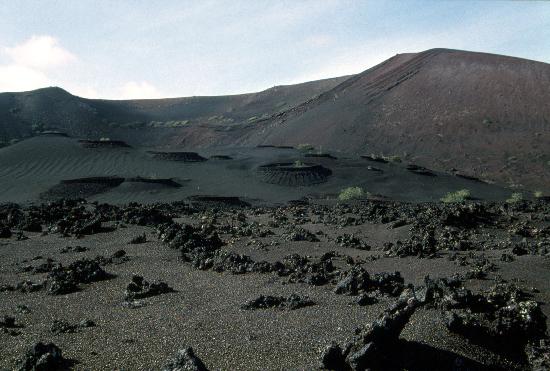
Mordor is a black and bleak type of shadowland. The sun is always hidden behind endless dark storm clouds. What little vegetation there is (if any) will be withered and rotting or mutated into an "evil" variety that's covered in sharp thorns and/or liable to eat people. Poisonous marshes and swampland are also quite common. Expect frequent volcanoes and/or ice storms. May contain the ruins that show that once people had lived here. It may even be an Eldritch Location, defying the laws of nature (and most Eldritch Locations are Mordor).
In a Fantasy Setting, Mordor is often this way because the evil of the Big Bad who rules the place radiates throughout the land, or because his Black Magic acts as a Curse on it. Often, this land was once a beautiful place before the Big Bad got hold of it, and it's presented as a stark example of what could happen to the hero's world should he or she fail in stopping the Big Bad. Should the Big Bad be defeated and the good king restored, often the skies will clear up and the birds and bees and flowers will return at warp speed.
It's not clear how anything can survive in Mordor for any extended period in time. Perhaps everyone lives Beneath the Earth and eats mushrooms (or people who wander into their land), or else all their resources come from conquering others. Or maybe they are demons or The Undead, who don't need to eat. Even if not, expect its inhabitants and vegetation to be part-monster as a result of adapting to survive the conditions there, or being twisted by whatever evil resulted in Mordor's creation.
Series that take place After the End will often be set in a version of Mordor (though usually not quite as harsh). Sometimes Mordor is Where It All Began. Sometimes Mordor is even Hell.
See Polluted Wasteland for Mordor's counterpart more frequently seen in realistic or Sci-Fi settings. Compare Corpse Land, Forbidden Zone, I Don't Like the Sound of That Place, and Death World. See also Villainous Badland, Heroic Arcadia.
In a videogame, it's usually featured at the end of the game.
Frequently difficult to access on foot.
Examples
- Bleach has Hueco Mundo (Hollow World in Spanish), the place where the Hollows reside.
- Hellsing has London after it was invaded and destroyed by the Millennium.
- In Inuyasha, Naraku has a mobile Mordor; a magically generated cloud of poisonous gas that follows him to wherever he chooses to abide.
- Kimba the White Lion has Dead River, a mountainous and desert-like valley that serves as Claw's lair.
- In the second season of Magic Knight Rayearth, Cephiro is Mordor because it lost the mystical ruler who had sustained the land. There is no life outside of the castle maintained largely by Clef — even the monsters are gone.
- Michel in Mermaid Melody Pichi Pichi Pitch wants to turn the world into a rather odd-looking Mordor: rocks jutting above the clouds, giant neon DNA strands shooting out of the sky, and wings on every animal. Seeing his hideout, which already looks like this, disgusts Lucia and makes her wonder what would possess anyone to like that. Of course, it all has symbolic ties to his own origin.
- The Sea of Corruptionnote from Nausicaä of the Valley of the Wind is depicted as this at first, but is later revealed to be the Ghibli Hills.
- The dark twist is that it's still just as inimical to humans as a typical Mordor. The poisonous spores and such are the environment's way of cleaning the pollution left over from the Great Offscreen War. It's a sign that the environment is getting better, not worse.
- The Wizard World from Ojamajo Doremi. It is bleak and dark and has been called an infertile wasteland by the Wizards who call it home. Its so inhospitable that the Wizards themselves have become a Dying Race (only 30 of them remain!) and hatch a plot to start a war with the Witches so they could regain their lost land and survive. It wasn't always like that; it only turned into this barren wasteland after the previous King of the Wizard World lost a good deal of land to a previous Queen of the Witch World in a game of cards. The Wizard World is restored to its former glory by the current Witch Queen after the current Wizard King expresses remorse for his and his people's actions. Today, it is very much an aversion of this trope.
- Subverted in Princess Mononoke. Iron Town looks a bit like Mordor, with its destruction of the countryside and smoke rising from the furnaces, but instead of plain evil, Ashitaka finds a combination of good and ordinary human frailty. And in the end, the Forest Spirit lays waste to the forest in a flood of death and destruction while searching for his missing head.
- After that, Iron town's iron shield becomes covered with vegetation when Lady Eboshi swears to do better.
- Saint Seiya: Death Queen Island, Andromeda Island, and the Underworld.
- As a subversion, the whole world at first appears like Mordor in Tengen Toppa Gurren Lagann and becomes more and more hospitable as the heroes approach the Big Bad's fortress, possibly hinting at Lordgenome's Anti-Villainous nature. It's also why Kamina City is erected near the ruins of Teppelin.
- New Gods: Apokolips, the homeworld of Darkseid is a mixture of this and Polluted Wasteland. The planet is a blackened, dessicated husk of pure evil, fitting with its malevolent inhabitants, so much so that in a crossover Galactus refused to eat it; it was just too devoid of actual meaningful life that'd actually make a meal.
- The Smurf Village in The Smurfs was originally located in what was called The Cursed Land in the Johan and Peewit comic book story "The Flute With Six Holes" (later renamed "The Smurfs and the Magic Flute"). It would later appear in a flourishing animal-filled forest that would over time become a Sugar Bowl when the Smurfs got their own comic book series.
- In Robin Wood's Or-Grund (an argentine epic fantasy comic), an evil sorcerer has turned a previously prosperous and fertile region into a dying desert, in order to use it as a base for his armies destined to conquer the world (one wonders about the logic of starting an empire from a place lacking in resources like a desert)
- Wonder Woman (1987): The Areopagus is dread Ares' abode and is presented as a desolate dark rock floating in its own pocket dimension covered with skulls, fires and Malevolent Architecture.
- In The Black Cauldron fic Hope for the Heartless, the lands around the castle of the Horned King are this because the lich has a strong aura of death. The sky is permanently covered by red clouds, the lake next to the castle has lifeless and poisonous water, trees are dead, nothing green grows in the soil, and no animals of any kind appear. The Horned King's soldiers couldn't keep any horses in the castle because they became insane from the proximity of the lich. However, when the Horned King's prisoner and Morality Pet Avalina starts trying to tend to a garden, she slowly makes the land fertile again. A healthy forest grows in the place of dead treesnote , the lake's water becomes clean, the sun starts shining through the permanently cloudy sky, and animals appear in increasing numbers. Eventually the Horned King himself can walk in Avalina's garden without killing the plantlife or scaring the animals away with his mere presence.
- The Night Unfurls has Garan, named after the haughty goddess of the same name. Garan was once a verdant and green land, now a desert wasteland because of Olga's Black Magic, deterring any invasion to her fortress. There's foul air, monsters galore, terrible climate, twisted vegetation, ravaged villages, and blatantly bad places like The Badlands or The Dead Marshes. Travellers are susceptible to disease, starvation, monster attacks, and in the case of armies, loss of morale, hence why many never return home in one piece.
- Even before the Great Earthshake, the lands Littlefoot from The Land Before Time is born into are hellish and scorched of all water and plant life and infested with carnivorous dinosaurs, tar pits, volcanoes, and steep pits. He and his friends have to navigate this deathly terrain in the hopes of reaching the fabled Great Valley.
- In The Lion King (1994) the Pridelands become a Mordor of sorts after Scar and the hyenas take over. The sky turns grey, all the plants die and all the animals are gone. As expected, when Simba defeats Scar and takes his rightful place as king, the land recovers perfectly (and apparently fast enough that the Pride doesn't starve in the meantime).note
- The Blue Meanies in Yellow Submarine turn Pepperland into a colorless, dreary Crapsack World once they conquer it and ban music.
- The castle of the Skeksis and the land surrounding it in The Dark Crystal are dark, barren, and foreboding. That is until the Skeksis are no more.
- DC Extended Universe:
- In Batman v Superman: Dawn of Justice, the Earth has essentially been turned into a hellscape after conquest by the forces of Darkseid in the Bad Future.
- In Zack Snyder's Justice League, the few glimpses of Darkseid's domain, Apokolips, give off the vibe of an inferno with nothing but huge columns of fire and scorched land. And the Bad Future scene with Joker happens in the same hellscape as in Batman v Superman.
- Aquaman and the Lost Kingdom has Necrus, a sister city to Atlantis that got corrupted and polluted by its reckless use of Orichalcum. Its mad king Kordax turned himself and everyone there into sorts of undead, Kordax himself became a Sauron-like figure, and his own black citadel recalls Sauron's citadel.
- In The Matrix, the real world that Neo is first shown by Morpheus is devoid of life. Dark clouds blanket the planet, and the landscape is scared by a terrible war. Humans must live deep underground to survive. Some humans prefer being in the Matrix to eeking out a living in this place.
- MonsterVerse:
- Kong: Skull Island: The Skullcrawlers which threaten the island and the cast make their lair on the surface in a corner of the island which is a barren, gaseous boneyard where almost nothing else lives (in stark contrast to the rest of the island's lush if hostile tropical forestry and swamplands). It's a place which Marlow actively warns the rest of the cast they should steer clear of, not that they listen to him.
- Godzilla: King of the Monsters (2019): King Ghidorah quickly destroys Washington D.C. and turns it into his personal roost (with Rodan stationed beside him as his vanguard), whilst commanding the other Titans to continue wrecking the planet. The city is flooded in waters so deep that a Navy battleship can sail through it, the buildings emerging above the water are half-scorched, tornadoes and water spouts from Ghidorah's hurricane are dotted about the place, and only a bleak-looking amount of sunlight gets through at the horizon with Ghidorah's lightning-filled storm darkening the sky.
- Outworld is depicted much like this in Mortal Kombat: The Movie. As Kitana tells us, it was once a beautiful land before its best warriors lost ten Mortal Kombats and the realm was taken over by Shao Kahn. She tells Liu Kang that the same thing will happen to his world if he fails to win this Mortal Kombat. Johnny Cage has perhaps the best line about what this land is like:
Johnny Cage: Liu, I hate this place. I'm telling you, I hate it. I'm in a hostile environment, I'm completely unprepared, and I'm surrounded by people who probably want to kick my ass. It's like being back in high school!
- Mustafar from Revenge of the Sith. It's an entire planet covered in lava, volcanoes, and smoke as a result of being caught between two gas giants, leading to a gravitational tug-of-war that's slowly destroying the planet. It's where Anakin/Darth Vader force chokes Padmé, and then duels and loses to Obi-Wan, leading to him losing three of his limbs and burning alive to the point of spending the rest of his life on life support. Rogue One reveals that Vader has a castle on the planet, where he presumably interrogates Jedi that are caught.
- Draenor in Warcraft (2016) is a barren wasteland full of Black Magic fel which corrupts all new that's born to it, where skies are covered in volcanic ash and everyone living tries to get off from. It's implied that this is a recent development, and that Gul'dan has literally poisoned the land with fel.
- The Lone Wolf series give us a few, including the Darklands, home of the Darklords, Ixia, home of the (not to be confused) Deathlord, and the Doomlands of Naaros. The Darklords' campaign was in part a terraforming project to make the rest of Magnamund more Mordor-like because they actually can't survive anywhere else without life-support equipment. It becomes a plot point near the end of the Magnakai series when the Darklords create a device that negates that weakness.
Notably, after the destruction of the Darklords, the good guys begin efforts to turn the Darklands into fertile wilderness again. After a few years of work, they realize that the process will take centuries of effort. After a decade, we only see a tiny corner of the Darklands green on the map.
- The Deadlands in An Outcast in Another World. One phrase of advice is given: don’t go there. They’re later revealed to be Blighted zones, where all life and matter quickly decays, and the air is toxic.
- According to The Areas of My Expertise, Oregon is "where the shadows lie."
- In The Arts of Dark and Light, the Wolf Isles were the heartland of the old Witchking empire, and remain bleak and wretched ever since the elves magically destroyed them in their war against it. Some of their leftover ruins and artifacts also still linger—as does a growing infestation of the werewolves the Witchkings also left behind, which are themselves becoming a significant threat to neighboring lands of late.
- In The Belgariad, the Big Bad Torak had his worshipers (literally, Torak's a god) construct a huge city. At the end of the construction, he had them create a giant tower of iron, which Torak used his divine powers to make not rust before it got put up. To cap it off, Torak made a giant black cloud and parked it over his city; it blotted out the sun for many miles around; after thousands of years, the countryside surrounding the city full of dead trees being consumed by fungus; water stagnated with no sun to evaporate it, and Torak's iron tower (after he knocked it over in a fit of rage) rusted down to a kind of semisolid goop. The place was definitely fragrant.
- Zemoch from the same author's The Elenium is also like this; the fact that the Elder God Azash (particularly nasty even by Eldritch Abomination standards) has been imprisoned in the middle of it for millennia can't have helped.
- It is theorized in The Malloreon that Torak didn't make the giant black cloud when they notice that the homeland of the new Child of Dark suffers from the same malady (although less advanced, that cloud having only been up for a couple of years). The reason it hadn't been noticed before would be down to a combination of Torak having been the Child of Dark for several millennia and having the sort of personality that wouldn't let him admit the cloud wasn't his decision.
- The Black Company in the first book of the series this trope is averted with the Lady's tower at Charm. In fact it is actually discussed by the protagonist that while it would seem dramatically appropriate for the land around the tower to be like this it also doesn't make a lot of sense. Who would want to live in a volcanic wasteland anyways?
- Played straight in the later books both with the Plain of Glittering Stone, a blasted desert populated with deadly shadows (to even step foot into the plain without appropriate magical protection spells instant death), and with the demon Kina's visions of the future as seen by Lady, Murgen and several others.
- Hotash Slay, Lord Foul's hangout, in the The Chronicles of Thomas Covenant, the Unbeliever. Suitably, it is even more Mordorer than the other Mordorish settings in the series, which takes some doing.
- Chrysalis (RinoZ): Each Dungeon stratum contains much more mana, and thus more powerful monsters, than the one before it. But whereas the first four are otherwise relatively hospitable, even full of wonders, the fifth stratum is instead a poisonous wasteland, believed to have been corrupted by the ancient monster of decay, Theorazzn. Very few have been able to cross it to reach the deeper strata, and their reports are Classified Information.
- In Jeramey Kraatz's The Cloak Society, the Gloom. It is bitterly cold even when just using it as a teleportation means; people left there slowly lose their powers, their intelligence, and their lives.
- In Dark Heart, the country of the evil god Vraxor is a harsh land of swamps, mountains, warped forests, and volcanic badlands. Unusually for this trope, this isn't because Vraxor rules there; the region has always been like that. He may have chosen to claim it because it reminds him of home.
- Roland's world is basically Mordor in Stephen King's The Dark Tower series. Long before Roland was even born, a nuclear war destroyed the entire world, leaving only mutants and lucky survivors to rebuild the population. Thousands of years later, the Crimson King comes in and purposely destroys massive areas, poisoning them with radiation on purpose just so Roland can't follow.
- In Heralds of Valdemar, the kingdom of Hardorn becomes Mordor after Ancar messes it all up with blood magic.
- In some versions of The Hitchhiker's Guide to the Galaxy, the blasted and ruined Frogstar is the home of the Total Perspective Vortex:
Zaphod Beeblebrox: This place is the dismalest. Looks like a bomb's hit it, you know.
Gargravarr: Several have; it's a very unpopular place. - Camp Green Lake from Holes. Flashbacks to the town's past show that it was a pristine lakefront Texas town, until Kissin' Kate Barlow cursed the place. From then until the present, it's a desert hellhole.
- In The Last Unicorn it's stated outright that the area became a Mordor after King Haggard had his castle built there. Once the king is tossed into the sea by its crumbling, the land begins its climb back into a veritable Ghibli Hills. But it's going to be a slow process, King Lir has to return to help it along the path.
- In The Licanius Trilogy, Talan Gol is sealed away behind a magical boundary and perceived as a impregnable dark wasteland. In reality, this trope is Downplayed, as Davian's trip into Ilshan Gathdel Teth shows that the citizens there are mostly normal, just under the thumb of the Venerate's oppressive government.
- In The Magician's Nephew by C. S. Lewis, the parallel world of Charn is an example. No dark clouds of smoke, but every living thing in the entire world (which in this case may well mean entire universe) was killed by a devastating magical spell. The only inhabitant is the one who killed everything else, waiting in suspended animation for someone to open the way to new worlds to conquer.
- The whole damn world turns into Mordor in the third book of the Mistborn trilogy, with ash covering the entire planet to waist level, blotting out the sun and killing all plant life. But it got better. That would imply it wasn't all Mordor already — the entire planet starts the trilogy post-apocalyptic and ruled by an Evil Overlord who's actually a Well-Intentioned Extremist, but that's small comfort to those living under him. It just goes downhill from there. There's actually a rather interesting reason for this: when Rashek used the Well of Ascension, he first tried to get rid of the mists that were blocking out sunlight and causing plants to die by moving the planet closer to the sun. This worked, but it drove the temperature up too high for people to survive, so he created the volcanoes that constantly spew ash in order to block most of the heat.
- William Hope Hodgson's The Night Land and its sequel, John C. Wright's Awake in the Night Land, have the whole Earth like this after the death of the Sun and, it is implied, either some experiments gone horribly wrong or visitations from the Eldritch Abomination dimensions, or both. (Well, apart from a couple of huge pyramid cities where the last humans cling to existence.)
- John Taylor of the Nightside has visited a couple of these, one a potential Dark Future and the other an Alternate History. The former is a lightless, moonless, cold world of disintegrating ruins, stalked by giant mutant insects and dwindling, insane remnants of Lilith's monstrous armies. The latter is a blood-drenched mudhole of ever-burning dead trees and starkly-brutal medieval fortresses, ruled over by a grotesque alternate Merlin who'd embraced his role as Antichrist.
- In John Barnes's One for the Morning Glory, Overhill has been reduced to a wasteland under the reign of the usurper Waldo. Queen Calliope, returning, is told that it has even become better since the usurper left to continue his conquests.
- Hell in John Milton's Paradise Lost — rather than a Fire and Brimstone Hell.
- Yscalin in The Priory of the Orange Tree. Up until recently it was a beautiful place of art, culture, and lavendar fields, rather evoking Spain for its aesthetic. Then the volcanoes that were the birthplace of the ancient wyrms began erupting, the king threw his country into Draconic worship, and the lavendar fields were incinerated almost overnight by rivers of lava and marauding Draconic creatures. When Loth gets there, it is a grim and plauge-ridden place where death is cheap.
- Marmo from Record of Lodoss War definitely qualifies, particularly its bleak depiction towards the end of the OVAs. The TV series isn't quite as stark, but everything is still trying to kill you.
- The Badlands in Septimus Heap are basically this, with narrow gorges, abandoned mines and giant Land Wurms waiting for prey.
- The Shadowhunter Chronicles:
- Edom. It's actually Earth that has been ruled by demons for centuries. The land is dead, the sea is drained, and there are no vegetation, animals, humans or any other living things with the exception of demons. The sun is also obscured by gray clouds (or possibly gone), making the entire world perpetually gloomy.
- Thule. Like Edom, it's an Earth that has been conquered by demons, though, unlike Edom, demons have only set shop in Thule for seven years. It is not as bleak as Edom; there are still humans, animals, Downworlders, and some vegetation. However, demons have taken over most of the land, both the sun and moon glow a dim red light, the sea is dark even during daytime, and the rain is implied to be hazardous. The only magic that still exists is demonic in nature, as a result, there are still Endarkened, but not Shadowhunters.
- The Dragonlands in Shadowslayers, thanks to magic woven by Derrezen, the fellow who put the "Dragon" into "Dragonlands."
- The Swiss Alps are about as Ghibli Hills as a setting comes, but the powers of Victorian melodrama can still make lush greeneries and picturesque landscapes sound a lot like Mordor:
- It is, indeed, a fearful place. The torrent, swollen by the melting snow, plunges into a tremendous abyss, from which the spray rolls up like the smoke from a burning house. The shaft into which the river hurls itself is an immense chasm, lined by glistening coal-black rock, and narrowing into a creaming, boiling pit of incalculable depth, which brims over and shoots the stream onward over its jagged lip. The long sweep of green water roaring forever down, and the thick flickering curtain of spray hissing forever upward, turn a man giddy with their constant whirl and clamour. We stood near the edge peering down at the gleam of the breaking water far below us against the black rocks, and listening to the half-human shout which came booming up with the spray out of the abyss.
- A Song of Ice and Fire:
- The ancient Valyrian Freehold was destroyed after an unknown cataclysm known as the Doom burned it to ashes and shattered its peninsula. The area, now called the Smoking Sea, is said to be cursed and demon-haunted, and volcanic activity makes the ocean boil and stains the sky a deep red.
- As revealed in The World of Ice & Fire, Asshai and the Shadow Lands almost exactly match the trope description. Asshai itself is in a perpetual gloom, while Stygai, an ancient ruin deeper in the Shadow Lands, doesn't experience "daybreak" until noon due to the sheer cliffs surrounding it. Everything in Asshai is built from the same mysterious, black, greasy stone, which appears in other structures around the world that are so ancient that their origins defy memory. Said stone somehow dims any nearby fires, making the place even darker. The city is a Mecca for the practice of forbidden magic and other unspeakable taboos. Any animals that set foot in the city quickly fall ill and die, and for some reason not a single child is to be seen within its walls. No crops grow in the city or its surroundings, and the only plant that seems to grow at all is ghost grass, which has a rather inauspicious reputation (for example, one in-universe apocalypse myth involves ghost grass covering the entire earth). The local river Ash is corrupted and full of bioluminescent plankton and blind, mutated fish that only shadowbinders dare to eat. Those last few points make it sound like the people of Asshai somehow manage without any food or water, but this implication is Hand Waved with the explanation that the population simply depends upon imported food and water. However, Melisandre's chapter in A Dance with Dragons instead opens up the possibility that the Asshai'i indeed don't need food and water, and simply keep up appearances to keep from scaring off trade –- the place is creepy enough, after all.
- * In La Saga de los Confines, by Liliana Bodoc, Misaianes, the Son of Death, has his throne on top of a mountain on the continent of The Ancient Lands, surrounded only by hundreds of kilometers of dead forests full of skeleton trees, under eternal fog and perpetual darkness. The rest of the Ancient Lands are much more fertile and not affected as much by his evil influence, but his plan is to turn the whole world into Mordor.
“A single sound, and a single color”
- In the Star Wars Expanded Universe, Korriban, the homeworld of the Sith, is a Single-Biome Planet version of Mordor; in fact, the Sith relocated to another world early in its history and turned the planet into a vast necropolis.
- This wasn't by choice: the Jedi and Republic basically destroyed it from orbit. All of the remaining temples and tombs are in a very small area, the rest is a wasteland.
- Tales of the Sundered Lands: There is a "place," which as no name, which is blackened, burned out, covered with smoke and the home of evil spirits called Furies which can possess the unwary.
- Tolkien's Legendarium:
- The trope's title comes from the Black Land of Mordor from Tolkien's The Lord of the Rings. Mordor combined both the "radiated evil" version of this trope (already seen in Mirkwood) and the "don't abuse resources" version (already seen in Isengard). However, the desert wasteland really makes up only the northwestern part of Mordor: Ironically, Sam and Frodo never find out the whole southern half of Mordor has a lake and great amounts of farmland to keep itself running, kept fertile by ash from the evil volcano; Sauron has to feed all those Orcs somehow. As a Bilingual Bonus, mor in Elvish means "dark" or "black" (see Morgoth, "dark enemy") and (n)dor means "land" (see Gondor, "stone land").
- The Silmarillion's Angband (the abode of Sauron's boss) combines this trope with Grim Up North. You've got arctic surroundings, barren desert plains, rivers of lava, giant slag volcanoes, vast underground dungeons, the works. Cold-Blooded Torture is the national pastime. Plus proximity to the Grinding Ice, the Land of the Shadow of Horror, the Gasping Dust, the Hill of the Slain, the Mountains of Horror, the Forest Under Night, and the Valley of Dreadful Death, all of which are also evil or horrible places (although they weren't always: they got turned into horrible places in the Dagor Bragollach, before that all of them were quite nice actually). Just how Morgoth fed these orcs is not explored.
- Said Valley of Dreadful Death is a place so horrifying that even the orcs of Angband avoid it. All we know is that the water there will kill you or give you horrific nightmares, and it's inhabited by the Giant Spider descendants of Eldritch Abomination Ungoliant (Shelob came from there). Beren, who had survived a litany of trauma and horror (including sneaking through Angband), could never bear to speak of what he experienced in this valley. Most of the other people who went in didn't come out. Which makes it all the more impressive that Beren's mom Emeldir managed to lead a wagon train full of civilians through there. Maybe the all-female spiders gave a woman-led caravan a break? The other person known to have traveled through the valley and come out is Aredhel, daughter of Fingolfin.
- The climax of Dan Abnett's Warhammer 40,000: Gaunt's Ghosts novel First & Only takes place in a necropolis. Gaunt and his team must forge through an underground maze that suck power from their equipment, including their lights, to a constructor for Men Of Iron, aka robots. Not only did a robotic revolt overthrow humanity's finest civilization, these particular ones have been seeped in Chaos. When Gaunt goes to blow it up, the Chaotic tainted Men come to life to stop them — horrifically malformed.
- In Traitor General, the Chaos forces are actively working to make Gereon a Mordor: they are using machines that drain water to other planets, and planting crops that will grow wildly and destroy the land. In The Armour of Contempt, when they return, the process is considerably more advanced, with dead plants everywhere.
- In William King's Warhammer 40,000 novel Space Wolf, when a group of Space Marines are searching for a missing group, they find a tunnel, leading to a dark and enormous cavern, filled with twisted animals and once-human nightgangers, culminating in an evil temple.
- Robert Jordan's The Wheel of Time series features the Blight, a festering wasteland where any bit of plant life is malevolent and the animals are even more so.
- The Three-fold Land, also known as the Aiel Waste, is very much a Mordor, with just about everything trying to kill you, and very little water.
- By the end of the series, the Dark One is extending his reach beyond the Blight. Strange, bad things are occurring by the beginning of the fourth book; with the twelfth, the sky is blanketed with stormclouds that never break, and the plants are withering from lack of sun and rain, and the bad things are happening constantly across the entire continent.
- The Waste in When True Night Falls of the Coldfire Trilogy, designed by the Undying Prince to ward off opponents.
- The Shadow homeworld Z'ha'dum in Babylon 5 resembles a science-fiction Mordor-analog, complete with a Great Eye that is ever watchful.note
- In Dead Ringers a run-down house was memorably described as looking like "a cross between Afghanistan and Mordor".
- "Skaro", planet of the Daleks in Doctor Who. It is a Polluted Wasteland due to the centuries of war between the Kaled and Thals, where you'll soon die of radiation poisoning. Here are the maps
 . The lakes contain terrifying monsters. Then there are the inhabitants...
- Ice Fantasy: The Fire Kingdom is a Lethal Lava Land and the Shadowland to the Ice Tribe's bright and shiny kingdom.
- The Lord of the Rings: The Rings of Power has the creation of Mordor as a major plot point in the first season.
- Netu in Stargate SG-1 is a good example of a science fiction Mordor. Sokar, a Goa'uld who takes the identity of the devil himself bombarded it to resemble hell.
- "In the darkest depths of Mordor, I met a girl so fair... but Gollum and the evil one crept up and slipped away with her..."
- The Darklands described in many songs of the Rhapsody of Fire are a swampy wasteland devoid of plant life, always covered by dark clouds. Of course, is where the Big Bad Akron resides.
- "The Kingdom of the Damned" from Dream Evil is a desert ruled over by a dragon. It has shades of Hell, as well.
It's where the Dragon rules the sky
Where you wake up just to die
Where the river flows with sand
in the Kingdom Of The Damned
If you can't cope with the pain
you will surely go insane
In this god forsaken land,
the Kingdom Of The Damned'' - Ethiopia is described as one in the charity Christmas Song Do They Know It's Christmas?
... it's a world of dread and fear
Where the only water flowing
Is the bitter sting of tears
Where nothing ever grows
No rain or winter snow
Do they know it's Christmastime at all? - The industrial areas described and referenced in "The Process Man," and illustrated in this video.
- Mindjammer: The Orion Complex (The Venu home star systems). In the Venu sourcebook, a Commonality agent notes that the whole region of space has such a sinister and strange feeling to it that he can't help thinking that there's some kind of malevolent force at work. With features like the Bone Nebula or the Graveyard Stars, its hard to disagree.
- Deadlands: The Deadlands themselves. The twist is that any place can become like that if the inhabitants are driven into despair and fear. In the original Deadlands: The Weird West, there's only one major Deadland, in war-devastated Kentucky, and one area close to becoming a Deadland, the City of Lost Angels. But in the sequel, Deadlands: Hell on Earth, most of the former USA is kinda like that, and the Eastern Seaboard is one big Mordor.
- Eberron:
- The Mournland which was once the kingdom of Cyre before the dark magical cataclysm known as the Day of Mourning that ended the Last War, is actually even less convivial to Mordor; Mordor itself actually had living things (blighted, twisted ones, but still living). In the Mournland, healing doesn't work, the ground is littered with corpses, and there are even undead warforged.
- Also, the Demon Wastes, who are closer to the "classic" Mordor (ie: Volcanic, ash covered land blasted by evil). Humanoids native to the area tend to have various signs of demonic corruptions.
- The Shadowfell could be considered an entire plane of this. It's a bleak, grey land where Undead are not only far more common but also far more powerful and the entire plane has a metaphysical aura that slowly crushes your will to live. It is intended as a dark reflection of the prime material plane, a concept from early editions given an full name in the 4th edition.
- Exalted: Shadowlands are an example of "Make Your Own Mordor": any massive act of slaughter over a large enough area will effectively open a door to the Underworld, something the Deathlords are quick to capitalize on. Zombies are created more easily in a shadowland, ghosts wander when night falls, and the flow of Essence is impeded.
- Games Workshop games:
- The domain of Khorne in Warhammer, Warhammer: Age of Sigmar and Warhammer 40,000 is a wasteland of industry and rocky plains, studded with countless fighting pits and ringed with jagged volcanos that erupt in sympathy with the Blood Gods rage. The blood-stained landscape is constantly trampled by legions of Khorne’s daemons as they fight each other in unending war.
- Warhammer:
- The land of Chaos Dwarfs in — known generally as the Dark Lands — manages to be both Mordor and a Polluted Wasteland at once. It started as a dark volcanic wasteland... and then the Chaos Dwarfs brought in thousands of slaves to start strip mining and heavy industry. It's a wonder how they manage to feed their single giant city in such conditions.
- There is also the (much smaller) Desolation of Nagash on the shores of the Sour Sea at the foot of the citadel of Nagashizzar — which is a less industrial, more undead version. Though it does pretty much border the Dark Lands.
- The Northern Wastes or Umbra Chaotica surrounding the northern polar rift into the Realm of Chaos would also count — its particular flavour of nastiness being found in merciless barbarian tribes, waves of wild magic and horrific mutant monsters spawned from the meeting of the first two.
- While slightly more hospitable than the above three, Naggaroth or the Land of Chill certainly looks the part. Besides the frigid climate and the dark, jagged mountains covering most of the continent and infested with hydras, dark pegasi, manticores and black dragons, there's a sea that literally boils from volcanic activity, places with names like Shadow Wood, Doom Glades, Plain of Spiders or Sulphur River, and the fortress-cities of the dark elves, who are as nice as one would expect. Oh, and the whole place sits on top of the Underworld Sea, a gigantic system of half-flooded and largely unexplored caves where even the dark elves rarely venture. The harsh nature of Naggaroth is in fact the canonical reason why dark elves keep slaves in the first place, as when they arrived they quickly discovered that surviving without a large slave workforce would be impossible.
- Warhammer 40,000:
- There are many civilized planets and places in the setting, even some that are nice places to live. That said, setting as a whole is neck deep in blasted dead worlds, Daemon realms, ash wastelands, Necron-scoured desert rocks, volcanic hellscapes and generally every other unpleasant place to live imaginable. In general, if you were to take an A3-sized map of the galaxy, then stick a pin in every place it's a bad idea to visit, you wouldn't be able to see it.
- The world Catachan is one of the most famous examples in the setting, environmental conditions probably being one of the most hospitable for human life, but at the same time it's renowned as one of the harshest worlds in the Imperium. Rather than being a barren wasteland, it's a lush jungle, but everything is poisonous, carnivorous, highly aggressive, or otherwise just incredibly dangerous. (One example is an seemingly harmless toad that's skittish, and prone to exploding into a huge cloud of poison when frightened.) The human inhabitants are tough and cunning, and the Catachan Jungle Fighter regiments are one of the Galaxy's most famous fighting forces.
- The planet Krieg (a word that means "war" in German). It was once a habitable planet until its ruler declared independence from the Imperium. The loyalists lead gathered up and and fought back in a war that ended with widespread atomic bombing that left the surface a barren, uninhabitable, irradiated wasteland good for little more than war games and training. The inhabitants live in underground bunkers, and most if not all males are secretly clones who form the Imperial Guard's most grim and obsessively dutiful fighting forces.
- Throughout the galaxy there is a relatively small number of Warp Rifts and Warp Storms, a realspace/warpspace overlap often large enough to cover many star systems. Planets caught in these are subjected to the rules of physics either softening or being thrown out the window altogether; the latter case transforming the world into a Daemon World, which is covered with a literal hellscape shaped by the whims of fate or any entity that can claim one of these worlds as its own. In some cases, they are populated only by daemons of rival factions warring for control, in other cases by humans (or derivatives) who are the slaves and servants to the local power.
- Legend of the Five Rings has the Shadowlands. Thoroughly tainted by dark spirits and the touch of the Dark God, the place rots and corrupts everything within. The overwhelming presence of dark spirits makes magic much more difficult and dangerous to cast, and it teems with mutants and horrible creatures, many of which are outright immune to anything short of jade (which is pure and thus dangerous to them) or magic. Carrying jade protects the bearer from the taint, but jade is rare and valuable, and the strain of providing protection causes it to slowly rot.
- Magic: The Gathering:
- The Tempest cycle has Rath, wherein Mordor becomes an entire plane of existence where a perpetual storm rages in the sky.
- Shadowmoor was once the idyllic sunny world of Lorwyn. After undergoing the cyclic process of the Aurora, the Ghibli Hills-esque Lorwyn becomes Shadowmoor, a world of perpetual night, filled with sickly vegetation and corrupted life.
- In Shards of Alara, the plane of Grixis is a world completely devoid of white and green magic. This has left it starved of life and growth, reducing it to a wasteland of bones and ashes ruled by demons and hordes of the undead.
- Immersturm, one of the realms of Kaldheim, is a land of barren crags, seas of fire, eternal lightning storms and unceasing warfare between the hordes of demons imprisoned there.
- The Dead Zone of Libya in Nobilis, created when an Excrucian Strategist really went to town with the World-Breaker's Hand. The zone was scoured clear of life, worth, meaning and hope, and it'll remain so for the rest of time. You can break a man by leaving them there just a day or two, but no one does. No one even considers it, because whatever makes places memorable or even remarkable is something that was burned away, too.
- Numenera:
- Vralk is rocky, barren wasteland ringed by volcanoes, where the ground is broken by vents spewing ash and toxic gas into the air and criss-crossed by rivers of lava, and scoured by violent storms. Little grows in Vralk, and what lives there consists of vicious monsters, poisonous animals and deadly plants. Its people are sadistic, warlike and authoritarian in the extreme, practice a religion focused around The Power of Blood and Human Sacrifice, and are planning an invasion of the Steadfast, who have no idea they exist and are focused on the non-existent threat of the Gaians.
- Dessanedi is a mostly barren field of broken, jagged glass where travel is slow, arduous, and filled with cuts and scrapes or worse, something which no one would do if the Jagged Wastes were the only way to reach the Sheer. Nothing grows in Dessanedi, and only a few scavenger birds live there.
- The ground in Sor Rumnar is often stark, twisted (often impossibly), and filled with chaotic and unexpected chasms and ridges. Earthquakes and weird weather are routine. Creatures found nowhere else haunt this dread land, and familiar creatures are perverted, with extra limbs, eyes or heads. For most people in the Lands of the Dawn, Sor Rumnar is more myth than reality. When they speak of it, they call it Hell itself, a place of devils and ineffable evil.
- Werewolf: The Apocalypse features another Malfeas, home of the Wyrm. It's a place of eternal decay with politics like the court of the Medicis on crank. Most Garou that go in there don't come out again — or if they're let out, they've changed for the worse.
- The realm of Karzahni in BIONICLE definitely fits. The ground screams with every step you take, waterfalls flow with dust, volcanoes erupt with burning ice, and any lazy Matoran would be turned to stone. When the ruler left, the Toa Nuva liberated the mentally and physically broken Matoran and Toa Gali proceeded to destroy the place in a massive flood.
- Mhaldor in Achaea is Mordor on an island. The streets are littered with corpses, piranha fish swim in every pond and even the plants are carnivorous — that is, the ones that aren't withered by the toxic red mist. The city patrons are Apollyon and Shaitan, also known as the Twin Gods of Oppression and Suffering. It's a nice place for a picnic.
- Age of Wonders: The undead factions often have blackened wastelands around their cities (especially the last campaign level), complete with dead trees, active volcanoes, smoking fissures and skeletons abound.
- American McGee's Alice pulls this off: as soon as you defeat the Big Bad, the entire world loses its sickly nightmarish quality and reverts to a much nicer place, complete with blooming flowers and chirping birds. Justified by the fact that it's all happening in Alice's head.
- Used interestingly in Baten Kaitos with the land beneath the Taintclouds. Everyone who lives above the clouds believes that land to still be this, but when you actually get down there you learn it's actually not that bad anymore. It hasn't been toxic or poisoned for years, the people only wear their masks as part of their culture rather than to protect from the harsh environment, and it's actually a pretty nice and peaceful place if a little gloomy because of the clouds overhead.
- Baldur's Gate III: The Shadow-Cursed Lands in the game's second act is an area that's been cursed by Shar to be blanketed with shadows that will kill anyone not near some form of light and the deep shadow areas require a more potent and magical source of light for protection.
- Battalion Wars: The nation of Xylvania is a complete wasteland with green acid pits everywhere and dead trees amuck. The sequel's past missions in Old Xylvania looked similar except it had the Iron Tower which looked just like the tower in Mordor.
- Black & White 2: A God Is You, and if you fall towards the bottom of the Karma Meter, your presence warps and blights the land under your control. Lava bubbles up from fissures in the barren soil, the sun fades, moans and screams echo in the air, fountains flow with greasy fire, and your towns' windmills are stitched with Genuine Human Hide.
- The Eridium Blight areas in Borderlands 2. All of Pandora, really, but the Blight is something special.
- The area around the Sea of Black Tears in Brütal Legend is designed after Death Metal album covers. All graveyards, twisted and ruined churches, dead trees, and candelabras everywhere.
- The Rogue Isles is known as the City of Villains for a reason. Places that aren't a Vice City or Supervillain Lair are a dilipidated mess of decripit slums, or ruined and abandoned buildings. The first zone players enter, Mercy Island, fits this trope to a tee.
- In Combat Instinct 2, the Gnork filled Planet Dead Ball with extreme toxic air and a surface full of ash.
- Dishonored has the Pandyssian Continent, which is mostly unexplored by residents of the Isles due to the distance and hazards travelling there, consists mainly of inhospitable desert and jungle terrain, and sports bizarre, violent ecosystems and wildlife that tend to drive Isles explorers insane, including the rats carrying The Plague.
- The Dominions series has a variation: there isn't any specific place that fits, but the eponymous Dominions is the influence of the divine pretenders the player(s) control, which can twist the very environment. This can be into something more pleasant... or it can turn areas into fiendishly hot (or cold) realms of death and misfortune. It doesn't help that the nations that a dominion like that synergizes best with tend to be amongst the ones most hostile to normal humans (for example, undead hordes are not bothered by there being no food supply from every crop withering). A few nations even have what is killed popkill, where the Dominion of a pretender for that nation directly causes the population of provinces under its influence to decrease.
- Crocodile Island from Donkey Kong Country 2: Diddy's Kong Quest is oddly both Mordor and a Polluted Wasteland. It's both a Death World filled with dangerous monsters and polluted to the point it makes any real life environmental trainwrecks look quite pleasant in comparison. It actually sinks into the ocean after the final boss is defeated.
- Dragon Age has an underground Mordor, ominously named The Deep Roads. Forget the black-ash-ridden skies! This place has no skies at all, just an unconscionable number of tunnels, originally built by Dwarves (whose architectural sensibilities just have to raise some questions) and subsequently conquered by the Darkspawn hordes. Forget the desolate, depressing winds or murderous cold! This place has lava rivers, and the air is hardly breathable at best, and filled with the blood-taint that will make you die or turn into Darkspawn at worst. The Dark Lord? A mad, tainted Dragon-God that seeks to corrupt the whole world. And then there are his sleeping brother and sister.
- Additionally, surface lands that are overrun by Darkspawn become barren and corrupted (or "tainted" as characters in the game call it), and the animals that inhabit those land become twisted, bloodthirsty mutants. It is possible for the lands to recover once the Darkspawn and tainted are killed or driven out, but it's a very long process: for instance, the Western Approach in Dragon Age: Inquisition is where the Second Blight first erupted 900 years ago and its now an inhospitable desert that still hasn't healed itself after all this time. In some places, the corruption is so severe that corpses can not decay because the taint has killed off all microscopic life forms.
- The Anderfels has been ravaged by three of the Blights which have started in the area, leaving most of the landscape scarred and barren as a result, with roving bands of Darkspawn commonly seen above ground even between Blights. It's not surprising that the Grey Wardens hold a lot of power and prestige in the Anderfels and maintain their headquarters there, located at Weisshaupt Fortress.
- The world of Dragon Quest has become a collection of different wastelands in Dragon Quest Builders. Cantlin is merely shrouded in darkness, but Rimulder is a poisonous bog and Kol is a desert wasteland. Tantegel got it worst though: there's no light at all and the ground is nothing but ash that nothing can grow on, it makes the whole place look black and white.
- The underworld in Dragon Quest IV.
- Dwarf Fortress: Evil biomes are this trope inherently. Nothing says "Fun" like raining goo that makes dwarves haemorrhage from their lungs, bodies and body parts spontaneously rising up as undead, or if you're really unlucky, cursed fog banks that instantly turn living things into nigh-unkillable, highly aggressive husks. Even when not infested with undead, evil biomes teem with lovely creatures like ogres, harpies, sea monsters and swarms of biting blood gnats, and have grass replaced by writhing tendrils of muscle and growths of staring eyeballs. Players have been known to turn the once-pleasant realms they colonize into lesser Mordors as well, usually by wanton use of weaponized magma. A number of Lets Plays provide specific examples:
- Boatmurdered becomes one of these around the time that a stream of lava is unleashed to dry up a freak flood. It goes From Bad to Worse. In fact it was one before when "Project Fuck The World" was used to flood the entire playable area with magma in a successful attempt to wipe out the vicious and bloodthirsty elephants that surrounded them.
- Its Spiritual Successor Headshoots is founded on an ash plain filled with undead creatures and burnt trees.
- Headshoots' direct sequel Syrupleaf is set on an arctic glacier with no vegetation to speak of and haunted by hideous demons. Those dwarves sure know prime real estate.
- Battlefailed had a rare example in a Mordor-esque ocean of awful slime, full of oceanic monstrosities and undead sea life. The coastline is inhospitable rock covered in this same slime, that seeps down and taints almost all available water. And, of course, the plains it meets with are about as bad, with dead plantlife, constant monster attacks and an overpowering stench that always hangs in the air, with the dwarves founding a fort right in the coastline where the two meet.
- The Elder Scrolls:
- Morrowind has central Vvardenfell island. First there's the Ashlands and Molag Amur, which are covered in cursed infertile ash all the time and populated by killer dinosaurs and cliff racers. Even there, though, the Ashlanders manage to get by thanks to their sheer badassitude. Then there's the Great Scathes within Molag Amur, which are full of cliff racers and nearly impassable thanks to the jagged terrain and open rivers of lava. But at the center of it all is the Mordor to end all Mordors, Red Mountain. It is covered in treacherous ruins populated by psychopathic mutants, cliff racers, and demons. The air is constantly thickened by the Blight, a cloud of red dust that causes horrific diseases and impedes movement. Oh, and it is an active volcano. Naturally, this is where the Big Bad lives. It's such a nasty place that the Dunmer had to put up a giant magical fence around it (powered by burning the souls of their own dead) to keep all the evil from spilling out and ruining the whole world.
- The series has the Deadlands, the Daedric plane of Mehrunes Dagon, Daedric Prince of Destruction. Crossing over with Fire and Brimstone Hell, the Deadlands is a bleak and barren realm, containing wastelands of blackened rock, seas of lava, and partially destroyed structures. In a clever homage to the original Mordor, despite the flowing lava all over the place, mortals who visit are said to feel an "unearthly chill" within the realm. You get to visit the realm itself in Oblivion, and it really fits the bill.
- Elden Ring has two different flavours of this:
- The first one the player is likely going to encounter is Caelid, a previously normal region that was irrevocably corrupted after Malenia released her Scarlet Rot in a desperate attempt to defeat General Radahn; what resulted was basically a fantasy bioweapon going off, corrupting the very land and air with the flesh-consuming Rot and turning it blood-red. Now Caelid is home to horribly mutated beasts, prawn-like humanoids called the Servants of Rot spawned from the disease itself, and the remnants of Radahn's army trying desperately to keep the Rot at bay. Ironically, the name "Caelid" is likely derived from "caeli", a Latin word for "heaven".
- A more traditional example is Mount Gelmir, a volcano and domain of Praetor Rykard; the zone is practically bereft of human life, and it's full of corpses: some are the result of the battle between Gelmir and Leyndell, while others are the result of Rykard himself probably purging his own population to advance his plot of becoming the God-Devouring Serpent. Things get even worse when getting to Volcano Manor, which seemingly sat atop the caldera of Gelmir itself: the surrounding township is visibly slowly sinking into the magma, and the area is full of torture devices, the victims of Rykard's persecutions, and man-serpents which replaced Rykard's army after the Shattering.
- In Elemental — War of Magic and its sequel Fallen Enchantress, factions that structure themselves as The Empire do this to the land they colonize. Of course, the land is already blighted due to the backstory, so The Empire makes it dark and twisted but liveable. At least for those living in The Empire...
- Played with in El Shaddai: Ascension of the Metatron. The fallen angels known as the Grigori are "perverting mankind's natural evolution" from their Evil Tower of Ominousness, hidden in another dimension. When you arrive at the exterior, the Tower, and the city surrounding it certainly looks twisted enough, with its blood red hues and lightless sky. Yet as the music plays, and the fireworks erupt through the air, you realize: The people corrupted by the Grigori's gifts of forced advancement are celebrating.
- EverQuest and EverQuest II both have two realms of volcanic mountains; Lavastorm and the Skyfire Mountains. In EQ1, the Muramites are doing their best to turn the entire continent of Taelosia into Mordor. Perhaps surprisingly, the Muramites home realm isn't too harsh for the most part, although being an upper level area it suffers from a severe case of Everything Trying to Kill You.
- EQ1 has the Plane of Disease, a bloated, disease-ridden, spider and fly infested place with ingrown hairs in the place of trees and a river of bile running through it. This, incidentally, is the nice part of the realm, as next up on the platter is the Ruins of Lxavanom... also known as the intestinal crypt of doom.
- Then there's Volska's Husk, a place of golems, imps, lava, cult members... all living together in the hollowed out husk of a titanic lava snake. Don't forget your asbestos robes!
- Eversion's world turns more and more into this as you progress through the game. The environment takes on a definite Mordor feel when you evert to World X-6: the vegetation is covered in thorns (which are Spikes of Doom for all intents and purposes), the Goomba-like enemies start to show their teeth, everything turns into a spray of Ludicrous Gibs when killed, the music sounds horribly distorted, and demon hands pop out. It doesn't end there.
- In Fable, the landscape that is near places of great evil, such as Darkwood or Wraithmarsh, are very creepy and ruined.
- Fallout:
- The Glow in Fallout, where Rad-X is required to survive any significant length of time.
- Fallout 3 has an Expansion Pack area titled The Pitt, the pollution-clouded and irradiated ruins of Pittsburgh, where most humans have degenerated into Wildmen, or worse, the skinless ape-like beasts known as Trogs, and the few "normal" humans here (other than Ashur and his wife and infant daughter) are either disfigured and sterile Slaves or Pitt Raiders.
- Fallout: New Vegas has The Divide, a heavily irradiated hellhole that makes the rest of the post-apocalyptic world look like paradise in comparison. It's surrounded by blistering sandstorms thanks to the folks up at Big Mountain and populated by the Marked Men, ghouls that have been driven insane after having their skins torn off and are sustained by pure hatred. It's eventually revealed that The Divide's current state is due to The Courier once accidentally setting off dormant nukes that destroyed what was once a prosperous community. The Long 15 and Dry Wells become this if you launch the missiles at them.
- To a slightly lesser extent, there's the Sierra Madre from the New Vegas DLC Dead Money, which is polluted by a lethal and corrosive red smog created by the aforementioned Big MT facility, and inhabited by Ghost People, hazmat workers who were trapped in their suits by the corrosive gas and mutated into zombie-like creatures.
- Fallout 4's Glowing Sea, the ground zero of the nuclear strike on the Commonwealth, makes even the Divide look like a walk in the park. Most traces of prior civilization have been reduced to ash and debris; lethal radiation still lingers in the area after 210 years, partly due to at least one of the blasts hitting a nuclear reactor; weather systems that pass through here spread radiation into the rest of the Commonwealth as "Rad Storms"; and aside from a few members of the Children of Atom cult, the sole inhabitants are Demonic Spiders such as Deathclaws, Stingwings, Bloodbugs, and the higher-tier Feral Ghouls.
- Final Fantasy VI, you actually get to watch the planet be taken over by an Ax-Crazy Mad God, and the landscape goes from lush green meadows and blue seas to sickly grey and brown wasteland and murky purple-ish seas.
- Final Fantasy XIV
- A Realm Reborn's highest level region is Northern Thanalan, a largely inhospitable area filled with deposits of ceruleum, a glowing blue oil-like liquid that serves to power most of the world's Magitek. The fumes given off by ceruleum cloak the region in a dense blue fog that ensures the area never sees the light of day. The ceruleum attracts a lot of unwanted attention, from the Magitek-powered Garlean Empire, to demonic voidsent seeking to feast on the aether-rich environment.
- Stormblood has the Burn, a region bordering Doma (via the Azim Steppe) and Garlemald that is practically devoid of aether due to repeated primal summonings, leaving it a stark white desert inhabited only by uncommonly savage monsters fighting over what little aether still lingers.
- Shadowbringers has the Empty, which looks much like the Burn back in the Source, save for the fact that, with Norvrandt being the only region spared from the Flood of Light, it encompasses the near totality of the First.
- Dissidia 012 Final Fantasy, the north-west continent dominated by Onrac. The skies are red, there's streams of lava, stretches of desert, and the lair of the Big Bad is on a floating volcano island off the coast.
- In Fire Emblem Fates, The Kingdom of Nohr fits this trope perfectly, which is surprising for a series that normally averts this trope. Like many Mordors, it's almost Always Night, with withered trees, acidic swamps, all complete with a tyrant of a king ruling it with an iron fist. There's even an area consisting of a river and waterfall that are on fire. Unlike other Mordors, the evil king and his servants are only a minority, with the vast majority of Nohrians being perfectly decent people. Even when you're their enemies when fighting for Hoshido, most Nohrian soldiers are just doing their jobs.
- The world of Flight Rising has the Scarred Wasteland, home to the goddess of pestilence and the savage Plague dragons that serve her, is compared to a "wound in the center of the world." Diseased areas littered with bones and filled with twisted, vein-like plant life surround the Wyrmwound, a highly-dangerous lake of disease used by the region's goddess to essentially create bioweapons.
- In Gems of War, the island kingdom of Darkstone has been corrupted to this; it was once "a shining beacon", but its knights fell under demonic influence, becoming tyrants and slavers.
- The Great Gaias: The lands around Validus are a horrible wasteland where nothing grows, forcing its people to rely on advanced technology to grow their food. While the Validian citizens are unhappy with this situation, this is intentional on Emperor Maultor's part, since he wants to keep the people dissatisfied and turn their hatred against the elves.
- Guild Wars:
- The original campaign, later renamed Prophecies:
- The game begins with the characters' kingdom becoming Mordor when the Charr (the game's stand-in for Orcs, more or less) unleash a massive sorcerous assault of flame and crystalline meteors, rendering the entire kingdom into a broken desert, featuring rivers of tar and a blood-red sky.
- Then the campaign proper takes place in a series of Mordors. After a brief interlude in the series of hells with an excursion in mountains and ice caves and a brief pass through the lush jungle crawling with with The Undead and Knight Templars, you're thrown into a scorching endless desert hell.
- By the end, you go to a more standard hell-esque Mordor on a set of volcanic isles that makes even Sauron's Mordor look like a pleasant vacation spot.
- While we're here, the two elite areas that are necessary to farm the components for the most expensive armors of the game, the Fissure of Woe and the Underworld, are no slouch either, being the bleak-looking domains of Tyria's War and Death gods (respectively) where there's plenty of dark-looking and hard-hitting creatures to fight.
- Guild Wars: Nightfall: The Realm of Torment, which is the home of the fallen god Abaddon. Caves made of flesh? Check. Teeth sticking out of the ground? Check. It's even got some fetid swampland of its own. And every part of it has its own delightful status effect to offer.
- Oddly, the Charr homelands in the Eye of the North expansion is actually a pretty pleasant place (less so by the time of Guild Wars 2 though).
- The original campaign, later renamed Prophecies:
- The World of Doom, a ruined version of Winters in The Halloween Hack.
- In Halo: Reach, thanks to all the fighting and the glassing, Reach looks like this by the end of the game.
- Heroes of Might and Magic usually has these as the default terrain for Evil-aligned factions.
- Inferno, as the name implies, lives in a volcanic wasteland with bubbling lava, charred black rock, and little to no vegetation. Inside their towns, the skies are permanently red. In III, their "home" country of Eeofol used to be a lush forest, but the Kreegans turned it into an ashen hellhole when they arrived just because they're jerks like that.
- Deyja is a dry, lifeless dirt land that's home to the Necropolis faction. Although dirt terrain can be made pretty on the adventure map, the Necropolis town screen shows it in the worst light possible; the skies are overcast and it's Always Night, there's no plant life save for a few dead trees, and gravestones litter the cracking ground. Unlike the Kreegans, the necromancers don't necessarily like it that way, but that's just what practicing necromancy does.
- Stronghold is situated in rough, inhospitable mountainous terrain. The faction themselves aren't actually evil, but are very warlike and have been villains at many points historically.
- Hyperdimension Neptunia mk2 has the Gamindustri Graveyard, the resting place of those who worshiped the evil goddess Arfoire and the home base of the Arfoire Syndicate of International Crime. It also has an ominous tower that looks like Barad-dûr.
- Malachor V in Knights of the Old Republic II: The Sith Lords. An entire Mordor planet echoing with the deaths of millions of people who were slaughtered there. High-ranking Sith would bring captured Jedi there because it would break their wills and make them easy to convert to the Dark Side.
- Legacy of Kain has two examples. One is Dark Eden, the lands surrounding a tower which spews forth an ever-expanding dome of magic. The dome is the result of three Pillar Guardians pooling their powers and it warps everything it touches. The inside of the dome is standard fare with roiling lakes of lava and warped mutants with poisonous blood. The second example is Nosgoth itself, as it turns out that Kain's decision at the Pillars was fixed to result in destruction either way. As it is, Kain chose to live and rule, which causes the world's balance to waver, resulting in the world as it is seen in Soul Reaver.
- The Legend of Spyro: Dawn of the Dragon: The Burned Lands, the area immediately around Malefor's lair, are a wasteland of barren, jagged black rocks interspersed with rivers of lava, fiery vents, and stands of burnt trees, all under a sky-shrouding pall of volcanic fumes and ash. Notably, between them and Malefor's lair proper is a series of floating islands covered in lush green grass, hovering above the ash and smoke and in full sunlight.
- The Legend of Zelda provides several examples:
- The Legend of Zelda: A Link to the Past: The Dark World was once the Sacred Realm of the Gods, before Ganon's influence turned it into a dark, forbidding realm swarming with monsters.
- The Legend of Zelda: Ocarina of Time: Ganondorf, using the Triforce of Power, manages to turn the area around Hyrule Castle Town into a forsaken land, full of decaying architecture, Redeads and ugly clouds. His tower (sitting where Hyrule Castle once stood) is surrounded by a lake of lava and sealed off from the rest of the land. However once you leave the castle town, things still aren't that great (Death Mountain is haunted by the same ugly clouds, Lake Hylia is mostly dry, and Zora's Domain is perpetually frozen) but the sun is still shining on Hyrule Field and the rest of the land hasn't been completely ravaged.
- The Legend of Zelda: Twilight Princess: The Twilight Realm is perpetually covered in bleak light and dark clouds. Besides that and the creepy architecture, though, it's actually a pretty nice place.
- The Legend of Zelda: Breath of the Wild: As a combination of being at the epicenter of the cataclysm that ended Hyrule and a century of being exposed directly to Ganon's influence, the area around Hyrule Castle — most notably the ruins of the ancient capital — is a field of barren black soil, burnt tree stumps and the shattered ruins of buildings, all covered in puddles of Malice and stalked by a large number of Guardians.
- Hyrule Warriors has Ganon's Castle, which is the Hyrule Field stage transformed into a hellish version of itself. It also serves as The Very Definitely Final Dungeon of the main story, before the Linkle and Wind Waker epilogues.
- Lords of Magic: The Death Faith's lands is basically the marshlands of evilness, dominated by an ominous, towering cliff with a skull carved into it... Oh, and the people who live in the land are all since childhood trained murderers and, as such, the life expectancy within the land's borders isn't especially long, as a merchant in the Death capital's marketplace helpfully reinforces: "Be sure to take advantage of our lifetime guarantee. It's good up to thirty days..."
- The Lord of the Rings Online: In addition to Mordor itself, Angmar is essentially Mordor North: a blackened wasteland full of noisome swamps and slag heaps where the sky crackles with weird energies that block out the sun. At release only Eriador (northwest Middle-Earth) was accessible in-game, so Angmar played the role of Mordor for the first volume of the main storyline.
- Lunar: The Silver Star has the Frontier, a barren land untouched by the Goddess and home to the Vile Tribe. It looks like a saguaro-filled desert in the Sega CD version, and a moonscape in the remake.
- Mass Effect: the vorcha homeworld Heshtok has been described as "hell, plus vorcha". It's such an unpleasant place that the vorcha, despite their 20-year lifespan, have actually evolved into a "perfect race" since they can adapt to survive nearly anything short of headshots. In addition, any world that bears the touch of the Reapers will typically have blasted and ruined cities, massive casualties, and in most cases fires that are visible from orbit, although outside major population centres the damage tends to be less extensive.
- Metroid:
- Metroid Prime 2: Echoes: Dark Aether, not only because literally every location is in perpetual thundery twilight and shaded in an eerie mixture of purples and greys, but every enemy you knew and hated in the Light Aether has a big brother living here and that the whole world wants you dead, even the air itself. Stay out of the light for long enough and you'll snuff it in Dark Aether.
- Metroid Prime 3: Corruption: The Pirate Homeworld serves as the enemy home base and has a quite hostile environment, including perpetual acid rain.
- Middle-earth: Shadow of Mordor features this topography in the first area, just beyond the Black Gate, but then subverts it with the Sea of Nurn — a lush area that's used to keep Sauron's army fed. The sequel plays with this by offering more diversity to Mordor: there are indeed dark and inhospitable areas like Gorgoroth (the area around Mount Doom) and Minas Morgul (which is the city of Minas Ithil after being taken by the Nazgul and appropriately reduced to a dark city) but also features the return of Nurnen, and Seregost, a cold mountainous region with normal vegetation — all of it inside Mordor.
- Minecraft has the Nether, an entire dimension mostly made up of magma caverns and the home to strange, flying giant beings that can fire exploding projectiles. The environment is so harsh that water is normallynote evaporated instantly.
- Minetest:
- Some biomes like the various deserts and the ice biome are pretty much devoid of plant life. You can't even get raw materials for tools. If you have a hunger mod on, and you spawn in one of these, good luck finding another biome before you starve.
- The Ethereal mod adds, amongst other things, a whole lot of new fantastic biomes to the standard minetest_game. One of them is a volcanic biome that gives you lava in countless craters on the surface. Can be useful, but very harsh and even difficult to navigate. Another one, often directly adjacent, is a scorched wasteland with nothing on the bone-dry surface but dry shrubs and burned tree trunks. At least you can make charcoal out of the latter (hey, lots of cheap fuel).
- There's a mod that adds a Minecraft-like Nether to Minetest.
- The biomes in the Australia mod and the Outback subgame emulate those in Australia, including arid, hostile deserts like the Pilbara. Both the mod and the game are works in progress, so they aren't too rich in food in general, but these deserts provide you with next to nothing, so you may reconsider if you want to play them with a hunger mod. At least they both don't come with mobs yet.
- All biomes in the Lord of the Test game are modeled after Middle Earth, so you get Mordor proper including orcs (unless you have the option "only_peaceful_mobs" on). And it expands, but so does Gondor.
- There are extreme survival games that turn the entire freaking map into this. Beware if they add mobs, and you've got "only_peaceful_mobs" off.
- That said, seeing as how easily tweakable Minetest is with its Lua modding interface, you may mod it so that it creates entire worlds made of concrete if you want to. Or obsidian if you want to go with black.
- To make certain mods or games even worse, there are mods that add thirst or sensitivity to sunlight.
- Sorrow Pass from Ori and the Blind Forest consists of shear canyons that can mostly only be navigated by gliding with Kuro's Feather once the Element of Winds is restored. Thorny vegetation covers most surfaces, the air is thick with smog from the nearby Mount Horu, and lava vents regularly erupt from the ground and walls. The lava-ruined section of Hollow Grove at the foot of Mount Horu also qualifies.
- Ori and the Will of the Wisps has the Silent Woods, the home of Big Bad Shriek and the epicenter of The Corruption, which has killed off nearly all flora and fauna in the area, turned its water to tar, generates nearly-constant thunderstorms, and petrifies visitors who linger too long. Willow's End, the grounds of Niwen's deceased Spirit Willow, is equally(if not more) bleak and foreboding, being cloaked in pink clouds/fog and peppered with Spikes of Doom and instant-death acid/goo/lava.
- The Island of Evil in Phantom Brave, due to Sulphur's influence.
- The titular age of Riven takes on this aesthetic when the Star Fissure is reopened at the end of the game.
- Sullust in Rogue Squadron.
- In RuneScape, the Wilderness is a dangerous volcanic wasteland populated with skeletons and other nasty things. It is also one of the only places where other players can attack you and get all your stuff if they kill you. Originally, it looked a lot like the "normal" parts of the world, but fighting during the God Wars desolated it.
- In Sacrifice, Charnel's realm of Stygia is a dark and gloomy land inhabited by Charnels minions.
- The Valley of the Sun God in The Secret World. Once a relatively peaceful region of Egypt, the place has been hit hard by the emergence of the Atenists: the rivers have dried up, the place is swarming with giant locusts and humongous scorpions, pure Filth is being directly pumped into what little remains of the local water supply, meteors continually bombard the northern areas, and a huge stretch of the place has been torn open by volcanic fissures. Things only get worse when you head north into the City of the Sun God, the ancient capital of Akhenaten's tyrannical kingdom, which features more Filth, more lava, more barren terrain, and an entire army of cultists, ghouls, Filth-monsters and mummies striving to awaken the Black Pharaoh from his slumber and bring the Aten to Earth. Also, just to draw further parallels to Modor, the centerpiece of the region is a giant black monolith with a fiery Aten symbol floating above it — rather reminiscent of the Eye of Sauron.
- Destin Island from Sky Odyssey might not have evil creatures, but it looks just like the trope image. The mountains here are ash black, cragy, and complete with an active volcano. Other parts of the island look almost as bad with little to no plant life and hurricane like thunderstorms being the most common type of weather. In a subversion however the Tower of Maximus and Garden of Eden hidden near the center of the island are absolutely gorgeous.
- The last world in Something. It's a barren field with a Ghost House filled with ? Mushrooms, an obstacle-filled Fortress, and Ballser's Castle. Ballser is menacingly orbiting around his castle, waiting for Mario to enter.
- In Spore, planets in the Space Stage with a terrascore of 0 are either hot, with lava and random volcanoes, or cold, with frozen seas and storm clouds. A more fitting example would be the cyborg Grox's planets, which the Grox convert into barren wastelands because that's the only environment they can live in.
- Char from Starcraft is your standard Planet Mordor, all lava and volcanoes and blasted dead black plains.
- Rather accurately described with: "Char. If Hell ever existed — this is it. Oceans of fire, tectonic storms and an atmosphere that'll burn a man alive."
- Planet Venom in the Star Fox series.
- The planet Fargett in Star Ocean: First Departure is a desolate wasteland, in contrast to the lush, Earth-like environment of Roak, the home planet of the game's main character, Roddick Farrence. The planet Fargett is run by an Evil Overlord named Jie Revorse, who essentially turned the planet into The Empire.
- Star Wars: The Old Republic has several:
- Oricon, the base of operations for the Dread Masters, is a moon full of lava, eldritch creatures and nightmare-inducing effects that erode one's sanity.
- Ziost after the Emperor's devastation is a completely lifeless planet, on which even the sound and color are drained, the bodies of those who died in the cataclysm turn to ash when touched and only Dark Side abominations roam the surface.
- Nathema is even worse than Ziost. There is no background music — only some ethereal whispers. The colors are drained like on Ziost, but the void in the Force is even worse. Even the Physical God Valkorion can only do so much against it and actually appears afraid at several points.
- Malastare in Star Wars Episode I: Racer is represented as a barren, rocky wasteland with lots of toxic swamps and flying creatures.
- Bowser's Castle in the Super Mario Bros. games almost always exists in Mordor. It rarely has a set name, though Dark Land/World and Valley of Bowser are some that have been used. Such lands are filled with barren rocks, volcanoes, rivers and lakes of lava, and if it's lucky enough to have vegetation, fetid swampland. Especially noteworthy in Super Mario Bros. 3, where part of Dark World was so dark that you could only see your current location on the map screen, not the whole map.
- Planets colonized by the Zuul in Sword of the Stars start taking on a very Mordor-ish bent.
- Terraria:
- The Corruption, an evil purple-and-black land with various monsters and harmful thorns constantly growing everywhere. The screen will also darken slightly when entering it, even in the day. Being a surface biome, it can be encountered fairly early in the game, but this is heavily discouraged as it contains more dangerous enemies than the average surface biome by that point. Unlike most Mordors, it also actively spreads, especially in Hardmode.
- The Crimson is what happens when one themes the Corruption around meat and general Body Horror. It shares many of the same traits as the Corruption: a dead-looking wasteland that NPCs will refuse to live in that darkens the screen and has thorns all over the place. Rather than gray eye monsters, however, the main inhabitants appear to be deformed meaty beings. It, too, spreads. The Crimson and Corruption are mutually exclusive unless the player decides to take Crimson/Corruption-spreading supplies from one world and in to another with the opposing biome.
- Digging far enough will eventually lead to the Underworld, a molten cave made of ash and a mineral literally called "Hellstone" with massive lakes of magma. Oddly, giant obsidian buildings can be found, implying that there was once a civilization there. Performing a sacrifice here summons the last pre-Hardmode boss, and killing it causes a huge burst of Corruption/Crimson (and their "light" counterpart, the Hallow) to appear on the world, as well as speading up the spread of all three infectious biomes.
- Barathrum from Total Annihilation is a subversion. It's a world in the process of being born, hence the higher than average metal content of the surface. The overall effect is about the same, though.
- Taros, from Total Annihilation: Kingdoms, is a textbook Mordor clone. Like most Tolkien ripoffs it lacks any ecological explanation for how the barren volcanic steppes can support a population, unlike the original. By the time it gets like that, half its population is all undead and demons.
- The various worlds named Filgaia in the Wild ARMs series are virtually always like this, but usually long after the event that caused it. Sometimes this was caused by a Fisher King scenario (another of which might also be arriving in the same story), but the original cause has long since departed, leaving the planet's ecosystem to try to slowly clean up after itself. Compare Tatooine from Star Wars.
- The sequel to White Knight Chronicles gives us Redhorn Isle, which is the enemy faction's base of operations and a home to a rather nasty Eldritch Abomination.
- Wizard101 has Dragonspyre, which features a stony surface, a sky completely covered by crimson clouds, bodies of lava, dead trees, crystal/rocky spikes sticking out of the ground, ruined buildings, and about half its population is dragons and the undead.
- World of Warcraft
- The original game (Kalimdor and the Eastern Kingdoms – with the Cataclysm expansion, some of these zones have actually begun to heal back into normalcy, while others have gotten even worse): Searing Gorge and Burning Steppes, full of volcanic cracks in the ground and high-level nasties (Burning Steppes in particular even has the dark-skinned orcs and the ever-active volcano). The Western and Eastern Plaguelands, thoroughly corrupted by the Scourge's plague of undeath. Felwood, a demonically corrupted and really unhealthy-looking forest. The Blasted Lands, a blasted, lifeless desert with a perpetually black, stormy sky. Silithus, full of giant bug hives.
- The Burning Crusade (Outland): Outland in general is a magically devastated world crawling with demons and full of inhospitable locations. Some areas make an exception to this; the ones that most definitely do not include the following: Hellfire Peninsula, a barren, broken wasteland with a highway of bones going across it. Shadowmoon Valley, another dark wasteland with added volcanic activity. The Netherstorm, an area consisting of nothing but islands of land floating above the Twisting Nether. The Bone Wastes, literally an enormous bomb crater littered with bones tossed from their previous resting place inside a now-exploded necropolis.
- Wrath of the Lich King (Northrend): Icecrown is Mordor down to a T; complete with big black gates guarded by fearsome, disfigured creatures, an evil, necromantic lord bent on destroying the world as we know it and even a large magical eye atop a tower. Only difference is it's covered in snow instead of ash. Intentional on Blizzard's part: the entire area is separated by huge ramparts with Gates to block passage. The one directly in front of the Citadel (which already looks like Barad-dûr) is called "Mord'rethar." One does not simply walk into Icecrown. A flying mount is needed to get around the place.
- Cataclysm: The Firelands and its accompanying daily quest hub, the Molten Front. Players fight against the forces of Ragnaros here. The landscape is like the Burning Steppes or Hellfire, full of fields of lava pools, and areas that are constantly burning. The only green area is the Guardian of Hyjals' base, Malfurion's Breach, where they have grown the Sentinel Tree.
- Mists of Pandaria: While much of Pandaria is deceptively serene-looking, the aptly named Dread Wastes is war-scarred land corrupted by the energy of the Sha. Much like Silithus, this zone is full of evil giant bugs. It's also spoken of as having a "basically no-one returns" reputation.
- Warlords of Draenor: Tanaan Jungle, the first zone visited by the player, is a vibrant jungle filled with hostile animals and the Iron Horde's vast war machine. It fully becomes this trope in the final patch of the expansion when Gul'dan corrupts much of the Horde and Tanaan Jungle with demonic energy and turns Hellfire Citadel at its center into the final dungeon.
- Legion: The Broken Shore is this for the Broken Isles, an area completely dominated by the Legion, littered with the remains of Azeroth's failed counterattack. Until the players invaded in a later patch, every enemy in the region island was designated as boss level. And approaching the entrance of the Tomb of Sargeras would cause players to drop dead as their souls were ripped from their bodies.
- This just becomes the gateway to the expansion's true Mordor: Argus, homeworld of the Legion. Krokuun is blasted rock and fel lava, home to a slaving operation focused on the few surviving eredar who opposed the Legion; Mac'aree is a remnant of beauty slowly being consumed by the void; and the Antoran Wastes are home to the Legion's fleets and Antorus itself, the massive citadel where Sargeras's spirit dwells.
- Battle for Azeroth: Ny'alotha the Waking City, the realm of the last of the Old Gods, N'Zoth the Corrupter. It's a twisted perversion of reality with tentacles, an ominous purple color and the Old God's eyes everywhere.
- In Haven (2020), the final set of Islets is a volcanic hellscape with perpetually hazy red skies, almost entirely coated in Rust, and bereft of plant life. The Optional Boss Lorudo that resides in this area even has a cyclopic eye resembling the Eye of Sauron.
- In Sable's Grimoire: A Dragon’s Treasure, Nidhogg's domain is a barren and blasted wasteland covering hundreds of miles. It got that way because she torched the place in the process of hunting and marking her territory.
- A Beginner's Guide to the End of the Universe has the surface of the Black Star. Gray, desolate, bleak, with nothing but mountains that keep growing out of nowhere with each step you take.
- The Borderland between Draconia Chronicles' dragon kingdom and tiger territory is a hardpan desert (read: barren dirt) area between two mountain ranges. It's implied to have been ruined, not by the presence of a God of Evil, but unbridled use of Earth Magic, which when used in anger, makes the earth uninhabitable.
- Historically the Kingdom of Ghor Dranas was one of these in Critical Role, as described in the Tal'Dorei Campaign Guide written by Matthew Mercer. It was where the Betrayer Gods consolidated their power before waging war against Exandria, resulting in a massive demonic and aberrant population in the area the corrupted the land. Post-Calamity it has become known as Xhorhas, and while not nearly as evil as it once was it is still primarily home to evil or morally ambiguous residents like Drow and Fallen Aasimar if Yasha is anything to judge by, is a harsh place to live in due to its inhospitable landscape, and is currently locked in a border dispute that has escalated into full-scale war with the Dwendallian Empire of Wildemount.
- Succession runs of Dwarf Fortress are frequently played out in such a way that the settlement either is or becomes a blight on the face of the planet. Take this quote from the renowned Boatmurdered playthrough:
At this point, we have somehow managed to create THE root of evil in the dwarven universe. Here is what it must look like from the mountainhomes:
1) Dwarves go to Boatmurdered and disappear.
2) Lava comes out of Boatmurdered and destroys the surrounding environment no less than three times a year.
3) A maniacal dwarven supervillian comes out of Boatmurdered and goes on a killing spree.
Shit, there are probably entire fucking sagas that are being sung about the evil fortress of damnation known as Boatmurdered.- More often than not, the settlements are founded in places that are already prime Mordor material, to make things more !!Fun!!. Such places are typically almost inhospitable, infested with undead, or both. Usually both.
- Green Antarctica is a Crapsack World, with Everything Trying to Kill You. Despite not being completely frozen over like in our world, it still has winters cold and dark enough to kill people who are foolish enough (or forced) to go outside. And that's if the other humans don't kill you first. Some parts are also inhospitable for agriculture, like the Highlands of Leng and the Cold Islands.
- The part of the Second Dimension where Oswald Sherzikien's castle is located in Journey of the Cartoon Man.
- Rhinoland in Babar it's a cloudy desert wasteland with pyramids, albeit more in the movie than in the animated series.
- Outcast Island in Dragons: Riders of Berk, looks like a stony wasteland with no vegetation. One has to wonder what does the Outcasts eat.
- The Land of Nightmares from The Dreamstone.
- In Ego Trip, the entire world becomes this in the Bad Future where Mandark uses the negative energies of the Neurotomic Protcore to Take Over the World, with the sky red, the landscape jagged, everyone living in slime molds for houses, the citizens are numbed neanderthals, and all science and technology belongs to Overlord Mandark.
- On The Fairly Oddparents, Dimmsdale became one of these after Crocker took over.
- Drekmoor in Disney's Gummi Bears. Homeland of ogres, ruled by Duke Igthorne, and a perpetually nasty place –- everything there is either poisonous, carnivorous, explosive, or otherwise dangerous. Even the rabbits are meat eaters.
- Masters of the Universe: The Dark Hemisphere of Eternia, where one can find Snake Mountain and exposed rivers of lava.
- Unbelievably, one is briefly glimpsed in My Little Pony: Friendship Is Magic's second season finale; as Queen Chrysalis and her changeling army are sent flying over the horizon, the place in which they land is lent a dead, arid look thanks to its sky and vegetation being stained an ugly brown. It is presumably from this land or somewhere else much like it that the changelings came from, and Chrysalis's comments earlier in the episode imply that, thanks to her efforts and those of other such beings, huge sections of the world outside Equestria's borders may follow suit.
Chrysalis: Equestria has more love than any place I've ever encountered.
- Subverted in the tie-in comics which show what happened directly after the Season 2 finale. The Changelings actually landed in a Sugar Bowl that resembles the G3 version of My Little Pony, only inhabited by cute cat-like people. And then they turn said Sugar Bowl into their own personal Mordor.
- Arguably, another (Tartarus itself, no less) is referenced in one of the previous episodes. Later on, we get to see brief glimpses of it.
- In "The Crystal Empire," the flashback to King Sombra's reign over said Empire one thousand years ago depicts this trope with frightening directness considering its target demographic of young girls. What is normally a stunningly beautiful kingdom is transformed by the influence of his dark powers into a harsh landscape where a sunless sky, the corrupted crystal architecture, and his seat atop the central tower that he's converted into his evil fortress look down upon the population of ponies he's enslaved. Upon his return one thousand years later, his mere presence even before reaching the city center is enough to begin the decay anew.
- The final Bad Future in the Season 5 finale has all of Equestria turned into a barren Mordor-like wasteland due to an unknown cataclysmic event.
- "To Where and Back Again" (the Season 6 finale) takes place in the Changeling hive, a cross between Mordor and a Hornet Hole. It's always dark and full of green slime, non-Changeling magic doesn't work there, and it's surrounded by rocky, barren wastes.
- Rainbow Land was Mordor before Rainbow Brite came from "somewhere else", freed its Light and defeated The Evil One.
- The swampy, gnarly and desolate village of the evil gnomes in the Van Beuren Studios Rainbow Parade cartoon "The Sunshine Makers", at least until the good gnomes bombard it with Sunshine milk, turning it into a colorful, lively land lush with life again.
- In Reboot, Mainframe turns into this after Bob is launched into the Web, Enzo, AndrAIa and Frisket are stranded on the Net after a game goes awry, and Megabyte takes over the city.
- The Land of Shadows in Robotman And Friends, the realm of the evil Roberon. It's only seen once briefly, but the place is pure Nightmare Fuel for the good guys. Portals to it are a pretty scary, too, with grasping smoke-tentacles that grab people and pull them inside.
- She-Ra and the Princesses of Power has the fittingly named Fright Zone, domain of the Horde. Contrasted with the rest of Etheria, which is Ghibli Hills at best, and old ruins reclaimed by nature at worst, the Fright Zone is an industrialized wasteland with constant (red) lightning but rarely rain.
- The Transformers: After the Decepticons are forced to flee Cybertron, they take refuge on the planet Chaar. It is a dark and barren wasteland that, incredibly enough, appears to have formerly held life. The 'Cons struggle to survive here until Galvatron returns, after which it becomes a much more functional evil base of operations.
- Meridian in W.I.T.C.H. was Mordor until its evil ruler was dethroned. It's explained that Phobos was draining the magical energy of the land.
- The battlefields of the First World War are the very image of Mordor, if contemporary photographs are anything to go by. Blasted hellscapes of twisted trees where nothing lived and men drowned in the mud. The "no-man's land" between the two front line trenches, which looked more like the surface of the moon than the Earth. The battlefields were most likely Tolkien's inspiration for Mordor, as he served in the war as a young officer.
- They also helped him conceive the Dead Marshes, a haunted swamp.
- So-called "Zone rouge" (Red Zone) is a chain of areas in France that were so heavily damaged in the war, they were defined as "Completely devastated. Damage to properties: 100%. Damage to Agriculture: 100%. Impossible to clean. Human life impossible". It's polluted by lead, mercury, chlorine, arsenic, Deadly Gas, corpses, and unexploded shells so heavily, that even today it remains unsettled. While it's slowly gets Reclaimed by Nature, there are still areas where not even plants can grow. And it will take hundreds of years until it's cleaned completely.
- While battlefields of World War II were less damaged than those of WWI, due to greater mobility of armies and less positional warfare, certain cities got a much rougher deal. This is a description of Stalingrad during the battle here:
“The street is no longer measured by meters but by corpses…Stalingrad is no longer a town. By day it is an enormous cloud of burning, blinding smoke; it is a vast furnace lit by the reflection of the flames. And when night arrives, one of those scorching, howling, bleeding nights, the dogs plunge into the Volga and swim desperately to gain the other bank. The nights of Stalingrad are a terror for them. Animals flee this hell; the hardest stones cannot bear it for long; only men endure.”
- Industrial deserts. In countries where environmental laws or pollution reduction technologies are lax or nonexistent, the pollution emissions of the factories and plants may poison the environment for good, killing all plants, trees, and animals within radius of tens of kilometres. This so-called "industrial desert" or "industrial wasteland" — usually accompanied by smog — can resemble Mordor a lot. The Ruhr Valley in Germany used to be an Ur-Example of this.
- Tolkien possibly had the hinterlands of Englands' industrial and mining cities in mind when he wrote of Mordor. Not for nothing was the West Midlands referred to as the 'Black Country'.
- When an Apple employee visits the city-sized FoxConn factory where iPods are made, he is said to have been "sent to Mordor."
- The Bonneville Salt Flats of Utah. The whole area is basically a plain of salt. There is a highway with a couple of gasoline stations, an 87-foot-high statue of a tree made by a Mad Artist, and that's about it. No plants, no animals, and the whole thing is surrounded by some barren-looking mountains (though these do actually have a working ecosystem).
- Ethiopia's Danakil Depression is an, um, interesting place with 130-degree temperatures, sulphuric acid volcanoes and lava lakes. Google 'Erta Ale' some time and you'll see exactly what we mean; one part of it is actually called the "gateway to hell" by locals.
- Death Valley, despite its name, is NOT an example: it is an incredibly hot desert, to be sure, but plenty of desert plants and animals call it home and survive just fine. You still don't want to go there without water, though.
- 250 million years ago, a huge, continuing volcanic eruption in what is now Siberia reduced pretty much the entire planet to this. Fortunately, this didn't last.
- A colossal meteor impact had done the same during the Cretaceous-Tertiary boundary 65 million years ago, though there are those who beg to differ.
- Earth will become this in the far future courtesy of a more luminous Sun as it ages. Depending of the details, it will become either a bone-dry, hotter, and larger version of Mars with vast salt flats marking the place of the former oceans after they've evaporated away, a carbon copy of Venus, or an even more extreme version of the latter at least for a while. And this before being a lava-covered airless planet once the Daystar goes red giant.
- The Dasht-e Lut, the largest desert basin in Iran and confirmed by NASA to be the hottest place on Earth, with a recorded maximum of 71 degrees Celsius (159 degrees Fahrenheit). Most notably the area called Gandom Beriyan, an area of hardend black volcanic lava whose temperature differential with the surrounding terrain causes constant winds. No life is said to exist here.
- Washington, D.C. is often referred to within the blogosphere as "Mordor on the Potomac".
- It's actually quite green and lush, and very elegantly laid out in a wheel — but it was originally a malaria-infested swamp and was a pretty unhealthy place to live until malaria was eradicated in the US.
- About 20 miles south of DC, the Fairfax County Landfill at the former Lorton Reformatory has a giant trash-to-energy plant whose smokestack is said to resemble the Eye of Sauron and Barad-dur. The road leading to it was even renamed "Mordor Drive" at one point.
- On that thread, Jamestown was not a particularly great place to start a settlement. The island the settlement was on had actually been abandoned by the Native Americans in the area because they considered it too poor and remote for agriculture. It was isolated, swampy, small, plagued by mosquitoes (and malaria), and the water was brackish and unsuitable for drinking. On top of that, settlers arrived too far into the planting season to really get anything going and many of them were not accustomed to doing hard labor. As a result, 51 settlers died in the first few months of settlement, and in the winter of 1609-1610 (known as "Starving Time"), only 61 of the 600 settlers survived.
- Southeastern Idaho. It's flat, treeless, and dry. In the winter, the temperature can drop to 30 degrees below zero. Natural characteristics aside, it's Idaho. That in and of itself makes it Mordor.
- All the wimpy Earth "Mordors" couldn't hold a candle to Venus. The sun is hidden beneath toxic clouds, which is a mercy, as due to a runaway greenhouse effect it's already the hottest planet in the solar system, even though Mercury is closer to the sun. Atmospheric pressure is so high — as much as about 92 times that of the Earth at sea level, or about 1km under water — it would crush anyone not properly equipped like an egg. The clouds emit lightning and acid rain -– not our weaksauce, slightly-lower-pH acid rain, but battery acid rain. (It evaporates 25 km above the surface, but still...) And all of this is partially thanks to its many erupting volcanoes. When the Venera space probes landed on its surface (imploding after 45 minutes), they recorded thunderclaps at a rate of three a second. And just to make things a little creepier, it spins the wrong way. Yes, it spins clockwise, unlike all of the other planets in the solar system. It seems more like the homeworld of the ultimate evil in a fantasy novel than the planet next door.
- Stephen King nicely noted its Eldritch Location qualities in the short story "I Am the Doorway":
And that was Venus. Nothing but nothing — except it scared me. It was like circling a haunted house in deep space. I was scared gutless until we got out of there. I think if our rockets hadn't gone off, I would've cut my throat on the way down. It's not like the moon. The moon is desolate but somehow antiseptic. That world we saw is utterly unlike anything anyone has ever seen. Maybe it's a good thing that cloud cover is there. It was like a skull that's been picked clean—that's the closest I can get.- Likewise, in the "Heaven and Hell" episode of Cosmos: A Personal Voyage, Carl Sagan said of Venus: "It is the one place in the solar system most like hell."
- Jupiter's moon Io has to be close. The most volcanically active body in the Solar System, tidal forces from Jupiter and the other major moons ensure that it is in a state of almost constant eruption, covering the surface in lava flows and sulphur compounds. It's also tidally locked to Jupiter which means that for half of the moon you can't escape its mass hanging in the sky. And for extra fun the entire surface is bathed in radiation from Jupiter's magnetosphere and is connected to Jupiter by the Io Flux Tube which causes lightning strikes between the two. In the novel 2010 by Arthur C. Clarke, Heywood Floyd compares Io to Mordor.
- Bouvet Island is the most isolated piece of land on earth, 1000 miles north of Antarctica and 1500 miles from South Africa. It's also buffeted by frigid hurricane-force winds, its landscape consists of snow and crags, and it stinks of penguin and seal feces. Smack in the middle of the South Atlantic with only chartered boat transport available, it's sort of a holy grail for adventure tourists who want to go everywhere …but that's about the only reason to go there.
- Russians sometimes like to call their country Mordor jokingly – the environment and living there can be quite nasty, plus don't forget it was considered an Evil Empire not so long ago. But they hate if anyone else does this.
- And history has shown how hard it is to walk into Russia.
- Actually getting into Russia is easy, getting out alive is the problem.
- Lanzarote (one of the Canary Islands) is Mordor, in some way. Most of its surface is covered with black ash and rock, and almost the half of the place is completely without plants. There are no dark clouds, but the average quantity of rain per year is lower than in some parts of the Sahara. These◊ are◊ some◊ examples◊. It also has some cool beaches, too.
- Any of the places on this list.
- The southern half of Montserrat, a British territory in the Lesser Antilles, became this trope when its Soufriere Hills volcano awakened in 1995. Its capital city of Plymouth and communities throughout two of its three parishes were left abandoned and buried in ashen mud, and subsequent volcanic activity has blocked all plans for re-colonizing the evacuated Exclusion Zone.
- Much of the southeastern side of the "big island" of Hawaii is a baking hot black volcanic desert, covered in the flow from Mount Kilauea (which has been erupting continuously since the mid-eighties). The ground is littered with sharp fragments of volcanic glass that will cut your feet if you walk in sandals, and boiling sulfurous jets of steam spout up unexpectedly. However, it's eerily beautiful and awe-inspiring in its bleakness, like the surface of another planet – especially if you're in a place where you can see molten lava rolling down the mountainside.
- The Atacama Desert in Chile, South America, made up of salt basins, sand, and lava flows. Complete with the remnants of ancient towns: really ancient, as in over 9,000 years old. And eerie petrified forests, gypsum salt flats, and other weird landscapes. It's accorded the dubious honour of being the driest desert in the world. Average annual rainfall is one millimetre, and some weather stations in it have never received rain. Water poured on the sand evaporates within seconds. Mountain peaks over 22,500 feet (6850 metres) are completely devoid of glaciation. The Top Gear Bolivia Special asserted that it's so dry even bacteria can't live there. Although this is a significant exaggeration, it illustrates just how inhospitable the area is. The most surprising thing however, is that people actually live here. This is because there are in fact rivers that flow down from the Andes Mountains, but only in the Springtime. The sand is chalk full of nitrates (to the extent that they are actually exported as organic fertilizer), so it becomes insanely fertile if you add even the smallest amount of water. With complex irrigation systems to minimize water evaporation, people have been able to live in this hellscape for milennia. It also contains the world's largest silver mine, which has been in continuous operation for something like 1,000 years.
- The Tarapaca desert is so similar to Mars that NASA has tested its space probes here.
- Centralia, Pennsylvania. A still-burning underground coal seam has rendered it a ghost town, fissures and sinkholes dotting the landscape, blanketing the town in Silent Hill-like smog and toxic gases such as carbon monoxide. Fittingly, the film adaption's titular setting is partly based on Centralia.
- Iwo Jima, or in modern Japanese, Iōto. The name means "Sulfur island" in Japanese, and the terrain is indeed rich in sulfur, making it true Mordor. Not to mention it was the venue of one of the bloodiest island battles in World War II. Mount Doom optional, as there is ongoing volcanic activity omnipresent. Except for annual visits by American and Japanese naval cadets, its only inhabitants are the dead.
- The local Mount Doom goes by the name Suribachi-yama (Mt. Mortar) as it's a deep caldera and looks like the utensil. It is volcanically active.
- Bárðarbunga in Iceland when it erupted in August 2014 made that region look quite like a real life Mordor◊
- Any Steel Mill or area nearby. The Koverhar mill at Syndal, Hanko, Finland, was actually called Syndalsmordor.
- The 1912 Novarupta eruption in what is now Katmai National Park, Alaska, buried 40 square miles of land in ash up to 700 feet deep, and the thousands of steaming fumaroles lead to the area being named the Valley of Ten Thousand Smokes.
- Al-Safa in Syria is an small volcanic plateau that has been used as an ISIS hideout during the Syrian Civil War. Granted, its volcanically inactive, but it fits this trope due to looking like a black stain from the above, water and other natural resources being extremely scarce and serving as refuge for an extremely evil organization due to its underground tunnel network until they were defeated in late 2018.
- Tropical rainforests technically count as this, as, despite being beautiful to look at and important to the environment, they are invariably full of danger. In addition to the obvious dangerous animals (jaguars, leopards, crocodiles etc), there are often large ants and wasps with very painful venom, poison dart frogs which are deadly to even touch, poisonous plants of all kinds, as well as a hot and humid climate liable to cause heatstroke and the like.
- Baotou is basically a giant Acid Pool created by industrial waste (mainly from creating technological items) and is even radioactive in places. As the author says, it feels like Hell on Earth.