

Silence Is Golden... Except when it isn't.
This is a Horror trope where fear isn't induced by a traumatic visual element or by a physical threat, but by the sole lack of event. When properly done, it can result in terrifying moments. It does so for one simple reason: the creator refuses to show us just what it is that's causing this horror, but we desperately wish to know, so our imagination fills in the blanks and our minds provide the content, using whatever the individual considers scary.
It often has to do with where the events are happening, generally because said place is inherently scary, but sometimes merely because of the way it is filmed or described.
This trope comes in three flavors:
- The classic version, where the moment serves to build up suspense and tension, until something scary suddenly jumps at you from elsewhere. It has been done a million times, and is often poorly executed, ending up with the killer/monster/whatever apparition being less scary than the preceding sequence.note Many times, what the directors do is make the character look around with some small light source (flashlight, cellphone, camera flashes) for a mysterious noise, then turn around right when the suspense reaches its peak. Of course, they sigh when they see nothing, and then they turn around again, and WHAM! Both of these methods alternate between being the norm, in that they can still keep the tension high, even when expected.
- The full version is when there really is nothing happening, but the result can be several magnitudes scarier than the classic version, because the audience is left to imagine what could have happened.
- The third variation is where there's nothing there... nothing there... nothing there... and then you realize there is something there, and it's been there all along. Perhaps the most common method of showing this is Nobody Here but Us Statues, when not played for comedy. Another variant (which has admittedly become discredited as Technology Marches On) is The Calls Are Coming from Inside the House.
Scare chords and cues may be used to reinforce the effect, but it seems to work best when there's no music at all. The camera might slowly close in on the "nothing", either as a character musters the courage to open the door, enter the dark depths, or cowers abjectly at the impenetrable darkness.
This trope can be used in combination with several other tropes; Through the Eyes of Madness, Darkness Equals Death, Quieter Than Silence, Leave the Camera Running, Mind Screw, Kill the Lights, and Obscured Special Effects are some examples. Since the space is empty, it may also appear as a part of Space Madness, usually as the second variant. Anything will do as long as the result is scary. Paranoia Fuel is a near-must.
In Real Life this trope is why it's terrifying to walk through a familiar dark room by yourself, through the woods or a secluded street at night. This is one horror trope everyone is familiar with. It's also a reason why the Silent Treatment can be an especially damaging punishment, both emotionally and sometimes even physically. Sensory deprivation can result in panic attacks or even visual/auditory hallucinations for some people, as the lack of stimuli makes the subconscious mind "hungry" for input, causing the brain to create its own to fill in the gap.
Compare and contrast And I Must Scream, Cat Scare, Creepy Basement, Gory Discretion Shot, Jump Scare, Monster Delay, Unseen Evil, and The Unreveal. One of the counterarguments against leaving nothing to the imagination, and sometimes an argument against Gorn as well. Dead Air can be this for radio. The Spook and the Diabolus ex Nihilo are often characterized by this trope. It often overlaps with Half Empty Two Shot (a two-character shot where one character is conspicuously absent) when it's Played for Horror.
Interestingly, this is probably what makes people afraid of whatever The New Rock & Roll is.
Not to be confused with Nothing Exciting Ever Happens Here, Empty Room Psych, or It's Quiet… Too Quiet. Contrast Nothing Is Funnier, where leaving details to the viewer's imagination is used for comedic effect.
Example Subpages:
- Anime & Manga
- Fan Works
- Films — Live-Action
- Literature
- Live-Action TV
- Music
- Video Games
- Web Original
- Western Animation
Other Examples:
Wait for it...
- Ultimate Spider-Man: There is a noise in the back door. Ben and May thought that it was Peter, who usually uses that door. They call for him... and nothing. Silence. They both realized that something was wrong, because of the kind of silence. Then, the burglar appears, with a gun.
- FoxTrot: Done for comedy in one week-long series of strips. After Peter smashed Jason's lunar module model, Jason vowed vengeance within twenty-four hours, something that made Peter fear for his life. He spent the whole day sneaking around, jumping at every little noise, and spent the night lying in a pile of dog doo after eating twigs for dinner just to hide (after his mother grounded him for two weeks for driving everyone nuts). Once the 24 hours were up, he thought he had escaped Jason's plan... But then realized he hadn't. Jason had done enough by doing nothing at all. ("Let's do this again sometime," Jason remarked, when Peter realized it.)
- Atlantis: The Lost Empire pulls the Hitchcockian "show you the ticking bomb and wait for it to go off" version to great effect when the Leviathan is hunting the Ulysses submarine through the underwater caves. The audience sees it pretty clearly (especially in a chilling shot where we see that its mandibles are larger than the entire Ulysses), but the characters don't, cranking up the suspense and lulling the audience into a false sense of security before the inevitable happens.
- In A Bug's Life, Hopper and his gang don't appear until they break into the underground hideout in the ant hill and are referred to as “they” and “them” by the ants.
- In The Jungle Book (1967), Shere Khan the tiger does not physically appear until two-thirds through it. Before that, he is all built up so you know how formidable he is. It is not Shere Khan himself but his reputation as a ferocious man-eater that compels the wolves to send Mowgli to the man-village.
- The Lord of the Rings: Unlike the Peter Jackson versions, Sauron is never seen in full. The most we ever get is his shadow, that of a man in a horned helmet, but everything else is kept a mystery. Even so, there's always fear in peoples' voices whenever they talk about him.
- Shows up frequently in The Magnus Archives. A lot of the little mysteries behind the various monsters and nightmarish situations are left unexplained, with the most prominent example being that we never get to know what exactly Maxwell Rayner's pet monster is, or even what it looks like. That said, it doesn't show up as often as you might expect from an audio medium since most of the episodes take the form of audio recordings or written statements, which tends to at least provide visual descriptions and coherent storytelling from traumatized people, helped by the fact that the main characters serve an entity whose power lends itself to uncovering hidden information and parsing knowledge out of people's minds. It shows up more commonly when the events are happening in the present, as the characters feel no need to describe what they're seeing at any given moment, such as what exactly the Angler Fish looks like or what it does to make its waxworks and taxidermied shells.
- The hosts of Sick Sad World theorize that the reason Jack the Ripper is so legendary is that we'll never know the truth about his identity or all his victims.
- Numenera: The game occasionally uses this to emphasize the feeling that the player characters are dealing with very dangerous things vastly beyond their understanding. As an example, Nibovian guides are entities that pose as humans and gradually work their way into people's trust, eventually knocking them out with airborne pheromones and sealing them in transdimensional cocoons that transport them to Reeval, the Nibovian home dimension, where... something happens. The description doesn't say what that is or why the guides want it to happen, only that their victims are never seen again.
- This is the undercurrent running through "Gethsemane (I Only Want to Say)" in Jesus Christ Superstar. It's not the torture and death that awaits him that disturbs Jesus the most; it's the uncertainty of what will happen after his death, which is guaranteed by his Father's silence on the matter. Definitely an unspoken acknowledgment of Cessation of Existence, not only for Jesus but, by extension, the entire human race.
Jesus: But if I die
See the saga through and do the things you ask of me
Let them hate me, hit me, hurt me
Nail me to their tree
I'd want to know, I'd want to know, my God...
I'd want to see, I'd want to see, my God...
Why I should die.
Would I be more noticed than I ever was before?
Would the things I've said and done matter anymore?
I'd have to know, I'd have to know, my Lord...
I'd have to see, I'd have to see, my Lord...
If I die, what will be my reward? - The Propeller Shakespeare Company, an all-male Shakespearean troupe based in England, did this to remarkable effect in their production of Richard III. It was set in a Bedlam House, and featured horrifically gory murders that kept escalating until someone was being eviscerated with a chainsaw in a barely-concealed Gory Discretion Shot. But the scariest murder of them all occurred with the two young princes. Richard hires an assassin to get rid of them; the Company imagined that assassin as a mute Psychopathic Manchild with a broad, empty-eyed grin and toys sitting on his belt. The sequence played as follows: the princes (played by puppets) put on their nightcaps and went into a small space under a flight of stairs; the assassin emerged from the shadows and followed them; the stage was totally silent with the exception of a ticking clock...and then, after a minute, the assassin exited the space, now clutching the nightcaps. We have no idea what he did to the boys, or how long it took—our imaginations paint the picture for us, and it is terrifying.
- Parodied in Adventurers!: Faced with the video game version of walking around a dark, dangerous hole in the ground, Gildward is clueless.
- In Stand Still, Stay Silent, chapter five. Sigrun, Emil and Lalli are investigating an old community space. Cue creepy dark space, corridors that appear to be blocked from the inside, and freakin' hospital beads all over the place. Creepiness dawns, but Sigrun assures the boys that there are no signs it's a nest... and then she finds Meat Moss, a sure sign that it is a nest... and then Emil bumps into two trolls.
- In Girl Genius, Volume Five, two men from the troupe scout ahead, and return riding as fast as they can, and there's no pursuit. Worse, when Lars and Augie tell the story, this is when they note that something is very wrong.
Augie: Took us a while to figure out why. No animals. No birds. We left the road to look around. There were no signs of life. No active burrows, no fresh nests. No fresh tracks. No droppings. No bodies. No bones. Nothing.
- Discussed and parodied in Skin Horse after Tip becomes a werewolf. Unity references Jaws and Alien, both classic movies that took a very long time to show monsters that ultimately turned out to be disappointing. "The monster's always a letdown because it's not as scary as the idea of the monster! Y'know what you are? You're a plywood shark!"
- Awful Hospital: Dr. Man, at least from what little we've seen of him, is what appears to be a normal human doctor. He's a bit odd-looking for a human, but not unrealistically, and compared to everything else in the hospital he's incredibly ordinary. After all that's come before, being relatively normal is what makes him scary.
Nothing at all
- Many people have admitted to finding the famous painting "Christina's World" by Andrew Wyeth terrifying for this very reason. There's nothing in it more overtly sinister than a woman lying in a field with her back to the viewer, looking across the horizon at a distant farmhouse, but the surreal, desolate landscape, gloomy, desaturated colors, her strange, oddly twisted posture, and above all, the question of just what the hell is going on combines to make an atmosphere that's almost inexplicably foreboding. Many of his◊ other◊ paintings◊ also qualify for similar reasons. Tellingly, he was cited as a major influence on the visual design of Silent Hill 2.


- The painting Deimos by Serbian artist Dragan Bibin depicts a scared dog looking at an open door to a pitch-black room. The viewer doesn't know and can't see what's in the other room, but the tension in the room is palpable.
- The BBC Doctor Who audio drama Dead Air plays with this trope. The recording opens with a cheerful woman telling you that you're about to listen to a piece of history, the very last recording of a Pirate Radio station from the 60s. What follows is the Doctor telling you "If you can hear this, then one of us is going to die." The Doctor then goes on to narrate a story which is pretty standard Doctor Who fare. A nasty alien entity which is composed entirely of sound has taken over the pirate radio ship and is killing everyone aboard before going on to conquer all of Earth. Throughout the recording there are instances of static bursts, occasional distortion in sound, jumps in the recording that give you snippets of odd music that was on the tape until the Doctor recorded over it, and at one point a tinny voice overlapping the recording begging for help. In the final confrontation between the Doctor and the big bad, the Doctor traps the monster in a recording, the very one the audience is listening to. The monster taunts that as soon as anyone listens to the recording the monster will be free, and the Doctor announces that no one will ever listen to the recording, because he put a warning on the tape to not listen to it. With such a warning in place, who could possibly be stupid enough to listen all the way to the end of the recording? The Doctor then says a cheerful "Goodbye!" and the tape immediately cuts to a distorted portion of blaring music which clicks into static. The story ends with the sound of a tape running out...
- Used to great effect in the Big Finish Doctor Who audio Scherzo, where the Eighth Doctor and Charley are trapped in a White Void Room and slowly lose all of their senses except hearing, including their sense of time. That the listener already only perceives the story through hearing punches it up to almost unbearably tense.
- DC Comics had a horror anthology title in the '80s called Wasteland. Due to one error or another, issue #5 was published with issue #6's cover. When the real #6 came out, it was numbered "the real number six", and the cover, apart from framing elements, was pure white. For a horror comic, it worked quite well.
- Figment: As the doglike Chimera's fears are "barked" to her rather than spoken in English and there are no visual clues as to what they could be, the reader can only guess what scares her enough to leave her crying Tears of Fear.
- The Gigantic Beard That Was Evil: We never find out what there actually is or what exists across the sea. We never find out why There ended up invading in the form of Dave's beard either, which is actually addressed in-story.
- In Supergirl storyline Death & the Family, when Kara rushes into the hospital, she desperately notices she can hear every single sound in the building... but she cannot hear her surrogate aunt Lana Lang's heartbeat and breathing.
- The Walking Dead has this in one of its most infamous defining moments in issue 66. Rick and his group have outsmarted the group of cannibal hunters that have been stalking them and although they promise not to eat them, they will still kill them. Rick tells the others to hold them down, and then the comic cuts to the aftermath. All we see are the bloody weapons they used on the hunters and the mess left behind before the group throws the dead bodies into a fire. We never find out exactly how the hunters were killed, but this event is referred to several times by the group members, wondering if they went too far and what they have become because of this moment.
- Man from Bambi. We never see the hunters. Ever. The result is one of the creepiest villains of Disney history. Especially effective is the silence of the scene of Bambi's mother's killing, since the hunters are so stealthy that we don't hear a sound from them until the shot that slays Bambi's mother rings out - yet the mother still knows they're coming (perhaps she can smell them).
- The opening scene from The Fox and the Hound plays out eerily similar to the scary scenes from Bambi. As the credits roll, we are treated to a dark forest and Ominous Fog where the only sounds are at first the occasional bird chirp, frog croak, only for them to be replaced by dogs barking, and eerie music. Then, Tod's mother shows up, running from a hunter, the music speeds up and gets louder and more drastic, and yet we never see the hunter or his dog, save for barking, and two gunshots at the end.
- Finding Nemo:
- The opening scene with the Barracuda. We don't get to see what happens to Marlin's wife, Coral, but it's easy to imagine, and it is horrifying.
- The trench scene, one of the most effectively ominous moments of the film as the characters never enter the terrifying trench and find out what lies inside, apart from the skeleton of a fish at its entrance. Ironically, the trench was said to be the safer route and the wide open space ends up proving more dangerous.
- Although it's hardly a noisy film, The Prince of Egypt tells most of its story through its epic, sweeping score, so the audience gets very acclimated to hearing that even when very tragic things are happening. Even the Ten Plagues of Egypt are depicted through (an admittedly awesome) musical montage, all except for the last and worst of all of them, where (no pun intended) the whole movie goes absolutely dead silent. After more than an hour of bright colors and emotive music, it is unbelievably eerie to watch the whole land of Egypt go grayscale as the Angel of Death descends to Earth in complete silence, with no sound effects on the audio track AT ALL except for a soft whispering wind as it blows through the streets and the almost gentle sighing of its victims. It ends up being far, far more terrifying and haunting to watch than the plague of rats, frogs, boils, and raining hellfire only a few scenes earlier.
- Pooh's Grand Adventure features Pooh, Piglet, Tigger, Eeyore and Rabbit on a quest to find Christopher Robin, and the primary threat on their journey is the Skullasaurus, a beast Owl warns lurks in the "Great Unknown" beyond the Hundred Acre Wood that they know. Sure enough, not long into their journey, the gang is haunted by hellish roars off in the distance, and some very close. We don't see the Skullasaurus during these encounters, but that's what makes it so scary. It turns out that there was never a Skullasaurus; the roars were actually the roars of Pooh's hungry tummy.
- A man is driving down the road and breaks down near a monastery. He goes to the monastery, knocks on the door, and asks to stay the night. The monks graciously accept him, feed him dinner, and even fix his car. As the man tries to fall asleep, he hears a strange sound. The next morning, he asks the monks what the sound was, but they say, "We can't tell you. You're not a monk." The man is disappointed but thanks them anyway and goes home. Some years later, the same man breaks down in front of the same monastery. The monks again accept him, feed him, and fix his car. He hears the same strange noise that he had heard years earlier and asks what it is, but the monks reply, "We can't tell you. You're not a monk." The man then asks how he can become a monk. The monks reply, "You must travel the earth and tell us how many blades of grass there are and the exact number of sand pebbles. When you find these numbers, grasshopper, you will become a true monk." The man sets about his task. Decades later, he returns and knocks on the monastery door. He informs them that there are 145,236,284,232 blades of grass and 231,281,219,999,129,382 sand pebbles on the earth. The monks reply, "Welcome. You are now a monk. We shall now show you the way to the sound." The monks lead the man to a wooden door, where the head monk says, "The sound is right behind that door." The man reaches for the knob, but the door is locked. The monks give him a key that's attached to a 10-key ring, and he opens the wooden door. Behind that door is another door made of stone. The monks show him which of the 9 other keys opens that door. The man opens the stone door, only to find a door made of ruby. Again, the monks show him which key to use. Behind that door is another door, this one made of sapphire. So it goes until the man has gone through doors of emerald, silver, topaz, amethyst, and gold. Finally, the monks say, "That key right there on your key ring unlocks the last door." The man is ready. He unlocks a jade door, turns the knob, and behind that door he is amazed to find the source of that strange sound. But we can't say what it is, because not everyone on this site is a monk.
- Often used in Welcome to Night Vale, something which the purely audio-format makes particularly effective. We don't know what exactly re-education, Valentines Day or Street Cleaning entails, but we can imagine that it is terrible.
Cecil: Listeners, the only thing more terrifying than seeing the devil is no longer being able to see the devil.
- Captain Scarlet and the Mysterons: The Mysterons are never seen on-screen. They are represented visually by twin rings of green light that they cast onto the scenes of murder and destruction from which their facsimiles emerge.
- Quiet, Please (1947) uses this in the very first episode, entitled, fittingly enough, Nothing Behind the Door. The protagonist and his friends try to rob a small house on a mountainside, only to find that there is literally nothing behind the door, as in, a completely empty void. Anything that passes through the door simply ceases to exist.
- Punchdrunk Theater Company's Hitchcock inspired, haunted-house-Choose-Your-Own-Adventure-1940's Noir ballet of Macbeth Sleep No More. The audience is given a creepy ''bird'' mask told not to talk and set loose in the 100 room, five floor, Mckittrick Hotel to find their own way through a series of beautiful, unsettling rooms. You're allowed to touch/eat/read/open anything you find and follow the performers at will. It's instantly terrifying. Nothing will ever jump out at you or even attempt to scare you and there's no conventional Haunted House elements, besides the atmosphere of dread and general creepiness of the design. After a while you get into the swing of things, the place becomes familiar and you can start to really enjoy exploring or following the story- but the first twenty minutes after getting off the elevator, faced with room after creepy room, with no direction and separated from your friends, is pants-wettingly, paralyzingly scary. Part of what they do is get groups in the elevator together and the deliberately separate them as much as possible. You are alone. You are lost and confused. Meanwhile a variant of Macbeth is going on around you.
- One of the Dungeons & Dragons trap compendiums includes a room with a timer and a button on a wall. When the party enters, the doors are slammed shut and the timer begins to countdown. The button restarts the timer. Cue the party frantically looking for a way out, leaving someone to reset the timer repeatedly. The catch is, when the timer reaches zero, the doors open without any ill effects. The fact that the adventurers were so scared of what was to come was the trap. It's only when they steel themselves and prepare to face what was to come that they get to leave.
- Eclipse Phase: the Gatecrashing sourcebook gets a lot of mileage out of alien worlds that are uninhabited but have the ruins of a lost civilization on them; extinction is a major theme in the game, and as a result a lot of areas are left completely depopulated. Some of them go the extra mile, like the planet where there's a massive, self-repairing virtual reality network, with easily enough storage space for the minds of an entire planetary populace... but the network seems to be empty, with simple programs and predesigned environments but no actually intelligent beings, and no-one is quite sure why.
- Note that there is one known living sentient alien race, the Factors, who for some reason they haven't explained do not use Pandora Gates and strongly advise transhumanity against using them either.
- There is also the belief that the Solar System's Gates were built by the TITANS, those hyper-advanced A.I.s who almost wiped out transhumanity, which makes one wonder who built the others systems' Gates. The GM-only section confirms that it was the TITANS, and that they were infected by a virus of extraterrestrial origin, which has infected many other civilizations before transhumanity's. Whether any of those civilizations survived is left up to the GM, as well as other things like the Factors' true motivations (are they survivors, witnesses, agents of the Viruses creators?), or if the Virus was intended to exterminate or assimilate seeing how the TITANS forcibly uploaded or mutated many of their victims.
- Yu-Gi-Oh! does this with the monsters 'The Thing in the Crater', where all we see is a deep crater filled with lava, and 'Dweller in the Depths', where all we see is a dark cave with stalagmites and stalactites everywhere, aside from very vague silhouettes of something in each.
- Rogue Trader: Even in a terrifying Crapsack World like the Warhammer 40,000 universe , something that stands out are the Halo Devices. These are objects indistinguishable from normal jewelry but somehow have the ability to make you immortal... at the cost. Wearing one will de-age you back to your prime, make you stronger, grant you a Healing Factor, and make you The Needless, but as the device more permanently bonds with you, it also turn you more and more unstable. You'll gradually end up an insane, hard-to-destroy, vaguely insectoid being with an insatiable desire for human tissue. That's par for the course with 40k, but here's the kicker: nobody knows where Halo Devices come from. While mutation is a favorite of Chaos, the devices will not bond with chaos-worshipers, the possessed, or even with psykers. They have no apparent connection to any of the major players in the galaxy and can't even be scanned to figure out what they're made of. What is known is that they've been found in ruins on ancient worlds orbiting dead stars, but with no trace of who lived there, how or why they made these things (if they did), what they used them for or why they disappeared. In a galaxy where Eldritch Abominations are a fact of life, somehow this is even worse.
- In Zero Punctuation's review of Amnesia: The Dark Descent, Yahtzee states that the form of terror Nothing is Scarier invokes (although he does not refer to the trope by name, instead using a humorous example), "is best, because your imagination is doing all the work. All a good horror game needs to do is hand you a piece of sandpaper and shout encouragement as you vigorously massage your own undercarriage."
- In the Creepypasta Suicide Mouse, the majority of the titular episode is just Mickey Mouse walking past some buildings while odd noises play. It somehow managed to make an employee who was watching it commit suicide.
- Eddsworld: In this comic strip, Edd is left visibly shocked after navigating the Internet. We don't see what he's found, and whatever he saw is left to the reader's imagination.
- Rank Amateur's prologue has a brief walk through an abandoned spacestation "where it all started." What happened there and what it started hasn't yet been explained. The only information given is that it's a 'covert' research facility.
- In xkcd, Black Hat Guy hires Rick Astley to show up at a party... and just stand there.
- In Homestuck, we have Doc Scratch's warning to Karkat:
[Don't turn your back on the body.]
- When he turns around, none of the bodies have moved.
- In-universe example from Sluggy Freelance: Torg comes back from the doctor's office and announces that he's had a "magic flap" installed; no one's quite sure what a magic flap is, but imagining what it might be freaks everyone the hell out.
- Shen Comix gives us The Brain Mechanic. He's alone around there... he thinks.
- In Kill Six Billion Demons, The Rant for this page has an account of a caravan that took shelter from a sandstorm in ruins implied to be where Gog-Agog was once imprisoned. The sense of unease it created was so great three of them died in the sandstorm trying to find anywhere else to rest, but nothing happened when they stayed there.
Graves: It was one of the most harrowing and uneventful nights of my career. The company parted soon after. We lost the stomach for the work.
- Game Grumps: The Spice World episode ends with Arin having a mental breakdown and doing God knows what to Jon. In the midst of it, the video cuts off for the final 8 seconds of absolute silence and darkness.
- Technically speaking, very little happens in Marble Hornets. "Nothing happening" will keep you awake for weeks.
- Case in point: Entry 21. Daylight. No audio or video distortion whatsoever except around a small burrow of sorts. Yet when Jay climbs up the tower, you feel like you're gonna die!
- The entirety of Entry 17. It's just a clip of Tim sitting around, running through some lines with J and Alex. It might take some time to notice our friend in the back◊.
- Marble Hornets took this trope to the extreme in Entry #16 - Nothing happens, and you never see Slendy, unlike literally every other entry up to that point. It's one of the scariest entries in the series. Then you notice that midway through, the video tears. Meaning that Slendy was there all along and you never saw him.
- Slenderman was originally supposed to be this trope. Everyone was to see his face differently and the horror is tailored specifically for them, only the camera is not a person so the audience sees only a white blur. Instead the facelessness became Slendy's defining feature but is still a good example, your mind can make his nothing of a face infinitely more terrifying.
- The Onion:
- Towards the end of this video from the narrator says "Somehow the fear of spiders is even worse than the spiders themselves."
- The video "(Classified) Bill Defends Against Flesh-Eating (Classified)"
Representative Haller: Air Force units may also be directed to combat said CLASSIFIED due to their enormous size and otherworldly strengths. Should event occur in urban areas... Jesus. Uh, that's CLASSIFIED... far surpassing our darkest nightmares. Should casualties exceed CLASSIFIED body disposal actions shall be halted and associated resources shall be reallocated to CLASSIFIED underground CLASSIFIED protected birthing centers.
- Towards the end of this
- In Mokey's Show - Slunder, choosing no results in Mokey doing a Death Glare with horrifying music. 4 seconds in, everything goes dead silent as you get a black screen with a message saying "HELP ME". Nothing else happens for the rest of that video.
- This horrifying video, which takes the form of a fictional "extreme emergency" meteorological report about...something to do with the moon, and the helpful "advice" it gives keep getting worse and worse. The whole thing is nothing but white text on a black screen with heavy glitching, but the horrible white noise in the background and the increasingly disturbing warnings to the viewer ("Switch off all lights", "Do not look out any windows", "Do not look at the ceiling", "Do not attempt to investigate any figures you might see out the corner of your eye") will have you sleeping with the lights on for days.
- In this episode of Frame by Frame, Kyle takes on three horror movie classics (The Innkeepers, The Changeling and Let the Right One In) to explore how directors oftentimes make what you DON'T see scarier than what you DO. The threat is outside the frame but it is very very real!
- Both shown and discussed throughout Two Best Friends Play's playthrough of the indie-horror game Phobia. Most of the video is just Pat stumbling around a big, dark, creepy old house and, aside from the looming threat that there is something horrible locked up in the basement trying to get out, nothing really happens. However the ambiance is set up so well that Pat (and the viewer) is genuinely terrified. At the end of the video Pat heads down to the basement to confront the monster, the basement door bursts open and we never find out what the monster looks like or what happens next because the game immediately crashes, which Pat uses as an excuse to end the video before he has a heart attack.
Matt: See, that's what horror games bring to the table: doing something with absolutely nothing.
Pat: Yeah, the absence of "thing" is what's scary.
Matt: The absence of a threat is the biggest threat. - Petscop:
- As of now at least, nothing seen in a typical horror game or creepypasta is present, aside from darkness and text that seems to indicate child abuse. Most of the horror and uneasiness of the series comes from how bleak the game is, how silent the commentary can be sometimes and how little interactivity is seen in levels. Because of this, you're constantly waiting for something to pop out, which in turn is arguably the most scary part of the whole thing.
- We don't know what the black boxes were covering in Episode 7 and 9. All we know is that it might be related to the children and it managed to shock Paul somewhat given how much time he spends on the screen and the noticeable shakiness in his voice afterwards (the one in Petscop 9 even causes him to give a Precision F-Strike.)
- The Minerva Alliance: Many of these videos will rarely (if ever) show the horror they are referring to. If they are shown, there is still some information about them withheld.
- The "thunderstorm" from "Unusual EAS" doesn't seem to be a thunderstorm, based on the odd orders from the emergency broadcast.
- The virus in "Unusual PSA" has no transmission vectors or symptoms shown. And when it attacks, death comes pretty quickly.
- In "Quakin' and Shakin'", the burrower worms only get a few frames of screen time.
- In "Community's Choice", Alazareth appears as a mass of yellowish-green light.
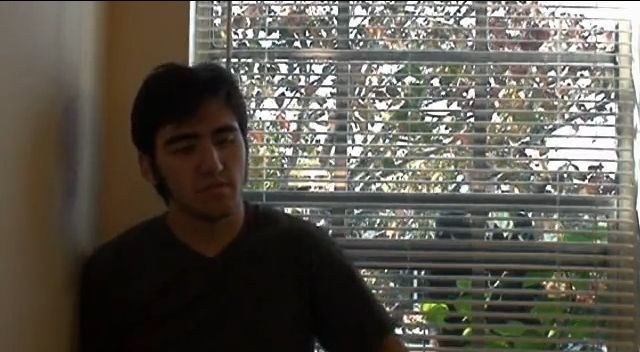
There all along!
- In this video, if you follow the instructions of the video, you don't notice the moonwalking bear.
- One Spanish PSA campaign against child abuse used lenticular lenses on its posters to achieve this effect. From an adult's point-of-view, they only see the picture of a sad child and the words, "Sometimes, child abuse is only visible to the child suffering it." Children, however, see bruises on the boy's face and a hidden message urging them to call the listed number if they're being abused. Empowering for survivors of child abuse, an eye-opener for everyone else. In a more meta case of this trope, the linked article brings up the possibility of toy companies exploiting this discovery to market directly at children, without the knowledge of parents.
- In the graphic novel Blankets, Craig Thompson mentioned a story about a babysitter who did something horrible to him and his little brother. (It's not hard to figure out just what it was...) However, the Babysitter's eyes are never shown. It's a very powerful method to inspire fear - the viewer never sees the full image of the babysitter, making some wonder what the babysitter's gender was, until later.
- At the end of Beauty and the Beast, Gaston is chasing after the Beast, following him across the roof, running past a row of gargoyles in the darkness. Then one of the gargoyles moves...
- The ever-popular campfire story "The Hook" tells of a couple making out in a car. They hear over the radio that an escaped killer with a Hook Hand has been seen in the area. After they leave and arrive at the girl's house, they find a hook hanging from the handle of the car door. (And yes, the "man door hand hook car door" meme originated from a mangled retelling of this urban legend.)
- "The Boyfriend's Death" similarly starts with a couple making out in the car. The boy steps outside to investigate some noises but never returns. In the pitch darkness, the girl only hears an odd sound and then an irregular tapping against the top of the car. Terrified, she locks the doors, hides, and waits there through the night. When the sun comes back up, a local sheriff arrives and tells her to walk over to his car without looking back — but of course she does look back. In some versions, she sees her boyfriend's severed head impaled on the car's CB antenna. The tapping sound was his blood dripping onto the roof of the car. In other variations, the tapping is the boyfriend's foot tapping against the car roof, as he's been hanged on a tree, or a scraping sound in a similar scenario — only this time he's upside down, so the noise is coming from his fingernails. But the scariest version of all has the killer himself standing outside the car and beating the boyfriend's head against it like a drum, meaning that he could have gotten into the vehicle at any time.
- Fridge Horror makes the last version even scarier. The Sheriff obviously knows that the killer is right there, since he'd have been looking right at him and he told the girl to not look back. Is the Sheriff working with the killer? Or does the Killer wield so much power that not even the Sheriff dares try to arrest him, even when catching him in the act?
- The urban legend "Aren't You Glad You Didn't Turn on the Light?" and its variants.
- In the most popular version, a girl on a university campus picks up some books from her dorm. Knowing her roommate is asleep, she leaves the light off and grabs her books in the dark. When she returns home later and does turn the light on, she finds her roommate dead and a note written in lipstick on the mirror: "Aren't you glad you didn't turn on the light?"
- Another variant involves a woman being woken up at night by an odd sound. She reaches toward the foot of the bed, where the sound originated, and when something licks her hand she decides it's only the dog and goes back to sleep. The next day, she finds the dead dog hanging in the shower and a lipstick note on the mirror: "People can lick too."
- There's a variant of "People..." variant with a different ending: she wakes up, sees the message, but her dog is fine alive, and she can still feel licking... then the killer reaches up from under the bed and kills her.
- The story "High Beams" has a young girl driving home when she notices a large truck following her. She tries to shake it, but it won't go away; occasionally, the truck driver turns on his high-beam headlights for no apparent reason. When the girl gets home and her parents call the police, the truck driver—a huge, bearded man—emerges from his vehicle with a gun and refuses to move from the driveway. The cops show up to arrest him...at which point he says "Not me. Him," pointing to the girl's car. They open the back doors and find a man hiding there with a rope and a knife. It turns out that the attacker was hiding in the car the whole time, and the truck driver was only following her to protect her. Whenever the high beams turned on, the attacker had risen up behind the girl and was preparing to strike; he dropped down and hid again when the beams shone.
- Another version of this one has the station attendant ask the woman to come inside as there's a problem with her card then once inside he tells her there's a maniac in her back seat and she needs to call the police.
- Another famous example that named a trope—"The Babysitter." The titular character is taking care of her charges or, in other versions, has put them to bed, when the phone starts ringing. Every time she answers, a man either laughs insanely or gives a message like "I'll be there soon," "Have you checked the children?", or "I'm getting closer." The babysitter calls the police, who tell her to keep the guy on the line for as long as possible so they can trace the call. After he calls back and the girl (because it's always a girl) talks to him, the police call back and scream at her to get out of the house—the mysterious calls are coming from an upstairs extension! The girl runs from the house, at which point the killer begins to head down the stairs for her. In some versions, the girl escapes with the children; in others, he's already killed the kids and wants the babysitter to come upstairs so he can murder her, too.
- In another version of the story, the girl is babysitting and there's a creepy clown statue that stares and unerves her, even seems to move ever so slightly. She calls the parents and asks if she can cover it up or move it so it doesn't bother her. Then the parents reveal they don't own a clown statue and tell her to get the kids and run.
- A lesser-known but still-creepy story has a woman returning home from work to discover her beloved dog choking on something. She immediately rushes the animal to the vet, who tells her to go back to her place while they perform the operation. Upon getting back, she sees the phone ringing off the hook. It's the vet, who tells her to run—the obstruction was a pair of fingers. A burglar is in the house; the dog bit off his fingers and sent the man hiding somewhere, probably hiding in a closet at that moment.
- The "Jesus is watching you" joke uses this as the punchline: "Jesus" is the rottweiler watching the burglar from the darkness, presumably waiting to strike him.
- Played with in episode 33 of Welcome to Night Vale. Teenage Cecil describes a flicker of static that seems to be getting closer each time he turns on his tape recorder, and his mother hiding from him and covering all the mirrors in the house. In the last scene the thing is coming for him, and we get no description of what it is or what it's doing to Cecil, other than tearing, gurgling sounds as though the thing were eating him. The mirrors are uncovered in the last scene, and Cecil doesn't know who did that, and the flickering movement is most visible in the reflection. Then the listener might remember a bit from a previous episode... "Or better yet, destroy all of your mirrors. As my mother used to tell me, 'Someone's going to kill you one day, Cecil, and it will involve a mirror. Mark my words, child!' And then she would stare absently through my eyes until I giggled."
- On the November 11, 2005 WWESmackDown, there was a scene with Edge and Lita backstage with Edge talking about how SmackDown! General Manager Teddy Long putting him in a Street Fight against Batista can't happen and that he was going to talk some sense into Batista and that he was going to put some security on the door so nobody could come into the room. Edge walked out and the room got briefly dark before lighting up again and THE BOOGEYMAN popped up from behind the couch! He told the scared Lita, "Close your eyes! I'm the Boogeyman, and I'm coming to get you!", sending Lita screaming from the room.
- Edensphere had an event based around Silent Hill. Basically, Sam Vimes, there called Stoneface, and Cecil Harvey, there called Paladin, ended up there, and, after various monsters and creepy children happened came this part. Note that "nothing" is always struck out.
- Stand Still, Stay Silent turns it into form of (creeeepy) art. It's not that the troll was there all along — that's clearly visible. It's when you look closer and then you start seeing just why the trolls are so creepy... They're made of people... and there are still human faces on them... full of terror...
- Creep from minds at Fewdio Horror shows a woman talking on her cell phone while driving down the freeway at night, the rest of the car shrouded in darkness. As a car passes her by (or she's passing under a streetlight), the viewers get to see the eyes of a humanoid creature sitting in the back seat, its face between the driver and passenger seats. After hanging up the phone, a Beat happens before the woman gasps and turns around... and the video ends.
