
Within the past couple days or hours, something very strange has happened. Maybe the Synthetic Plague the government was working on got unleashed. Maybe a voodoo priest's spell went awry. Maybe an alien space probe broadcast a weird signal at the Earth, or fell to Earth and brought radiation with it. Maybe there's just no more room in Hell.
Whatever the cause, the result is the same; the recently dead have risen, en masse, to feed on the living. With each victim they claim, their numbers swell, and no force on Earth can contain them. As society collapses, it's up to the Big Damn Heroes (or a Ragtag Bunch of Misfits) to fight their way to safety or keep shooting until things blow over.
The Zombie Apocalypse has arrived.
While Horror is assumed to be an inherent part of the zombie apocalypse, not all the horror and conflict comes from the zombies themselves. Instead it can come from the reaction of the living humans involved, and how they respond to the state of fear and violent chaos brought about by the zombies. Often, the answer is "not well". The breakdown of society, the fear that your Fire-Forged Friends could be infected and turned against you without warning, are at least as important to a zombie story as the zombies themselves, if not more so.
Common to virtually all Zombie Apocalypse tales is that, regardless of the reason zombies attack living/non-infected people, they never attack other zombies. Whether they'll attack animals other than humans varies, but it's rare for The Virus to affect other species, probably because it's cheaper and easier to film humans in make-up than to work with animals, whether trained, animatronic, or CGI.
Due to the threat that zombies pose (they did just become the apocalypse, after all), protagonists of more serious works are required to become very smart very quickly (but will be ignorant with regard to the word "zombie" itself). Failure is often the only option in these stories; rarely do they have an ending that could be considered "happy" by typical standards, or indeed one where humanity survives as a species. Another main staple is that things will always, always go From Bad to Worse. Either from the character's actions or circumstance which are out of their hands, no matter how improbable it is.
Since trying to plot a zombie outbreak from Patient Zero is long and difficult, most zombie stories are set either After the End, have zombies turn very quickly, or have a significant mass of people infected all at once by some sort of bioweapon.
The Militaries Are Useless trope is usually a must in such a movie, if only to avoid the film ending in five minutes. If they ARE actually competent, they'll likely happen to be evil.
The collapse will also take place very quickly, over a period of weeks or months, instead of years. This prevents society and/or the main characters from adapting, and also makes Convenient Comas somewhat plausible. In the occasion where collapse occurs in a couple of months, a nuclear submarine, aircraft carrier, or other large vehicle could realistically be expected to weather the entire outbreak start to finish in perfect isolation and safety. Characters may also assume that their portable radios have infinite reception and frequency range, and local dead air means a completely global collapse. The audience may not need to speculate about this, if a Spreading Disaster Map Graphic crops up in the opening credits.
Another common staple of the Zombie Apocalypse is that the zombies are often not the most dangerous enemy that a survivor will face. It's usually other survivors, power-hungry maniacs or regular-hungry people who want to attack you to get at your food and shelter. Sometimes Humans Are the Real Monsters will occur (after all, a zombie is just a degraded human!)
Subtrope of Our Zombies Are Different. A member of The Undead trope family. See Night of the Living Mooks for cases where zombies don't threaten the end of the world. See also Zombie Gait, Everything's Deader with Zombies. Raising the Steaks is what happens when humans are not the only creatures that can be infected by The Virus. The zombie apocalypse is almost always a case of Guilt-Free Extermination War requiring that everybody be armed. Expect a healthy dose of Improbable Infant Survival — for despite a population of millions of children at any given time in any human population very few will become (visible) zombies — and the few that do are for audience effect. Also expect the Incongruously-Dressed Zombie to turn up for occasional comic relief. Contrast Friendly Zombie, who is not there to make an apocalypse. (Attractive Zombies also generally tend to avert this, due to Beauty Equals Goodness).
The trope Zombie Apocalypse refers to any kind of undead apocalypse, with the common traits of this trope are that the undead spread rapidly, wipe out humans primarily by eating or biting them, and are usually highly infectious — even if the undead happen to resemble vampires or yet another kind of monster more than zombies. Vampire versions of this nearly always involve Feral Vampires.
If you are looking for different types of Zombie, see Our Zombies Are Different. Not to be confused with Vampire Apocalypse: The Series by Derek Gunn. Sometimes the 'zombies' might be a case of the Technically-Living Zombie, but the overall narrative usually plays out the same way regardless.
A Zombie Apocalypse can be considered a sort of Came Back Wrong on a very large scale.
Also known as a "Zombocalypse".
Example subpages:
Other examples:
- If Toshiba doesn't make their laptops drop-resistant, the resulting chain of events will cause a zombie outbreak. A marketing campaign
 has the CEO imagining various worst-case scenarios if some seemingly minor feature isn't added to their product.
- Around the time The Walking Dead (2010) came out and was a big hit, there was a FedEx commercial which showed a horde of zombies attacking a gas station/convenience store. Four survivors were barricaded inside: an Asian woman in a suit and two men bending over a third. He is lying on the floor, sweating and feverish and about to turn. One of the men is saying to his reluctant friend, "we have to do it, or he'll turn into a zombie and eat us". Just then there's a knock at the back door, and a chipper clean-cut young FedEx delivery man shows up with "a package for Dr. Lee". "The antidote" the scientist screams joyously. As the two disconcerted men look on, the FedEx employee looks at the man on the floor and asks with casual concern "He okay?"
- Attack on Titan contains many of the hallmarks of the trope, with the constant threat of humanity being devoured by a mindless horde of humanoid creatures being only one problem. Dot Pixis repeatedly predicts that humanity will be its own worst enemy, with food shortages and limited space creating ever-present dangers of starvation or civil war. His grim prediction comes within days of coming true, as the crisis within Wall Rose leaves the refugees starving and on the verge of violent rebellion. The Titans are essentially enormous zombies, with most mindlessly shambling about in their search for human flesh and only possible to bring down by inflicting major damage to the back of the neck. There's also the fact that Titans are transformed humans, and the only way to kill them is to sever the spinal column. The Beast Titan is a being capable of infecting human victims, leaving the horrifying possibility that anyone could become a Titan without warning. While not strictly undead, Titans lack many of the hallmarks of living beings and make about as much sense as a zombie in terms of how they function.
- The story gradually moves away from this though as it becomes apparent that the people in the Walls are not the last remnants of humanity and the Titans are more of a finite, organic weapon being used against them by another human faction rather than some infinite supply of creatures acting on their own. The mindless Titans are completely cleared from Paradis Island about a year after the Battle of Trost and the story then becomes more about human-warfare than the Titan invasion.
- Black Butler has one on a Titanic-sized ship they're "only" artificially reanimated corpses.
- Cells at Work! depicts the influenza virus (e.i. cold or flu) as this.
- D.Gray-Man: Parodied. The Science Department created Komuvitamin D in order to help people work overtime, however it turned them into zombie-like people instead. The zombie arc was played mostly for comedy but there is one scene where it is discovered that a ghost of a girl experimented on didn't want the Black Order to leave and infected them so they would stay forever as mindless infected people. However, Komui starts reciting the names of all the kids that died from experimentation by the Black Order in order to find out her name, telling her that even if they leave, they will never forget her. It doesn't stay serious for long.
- Dropkick on My Devil: Jashin has a nightmare that she, Medusa, and Minos were all victims of one at the end of Episode 9 of the anime.
- In Dorohedoro, Hole gets a Zombie Apocalypse every year, and surviving it is as simple as being inside behind locked doors after midnight. This has been going on long enough that the braver (or stupider) denizens of Hole have turned it into a game, with prizes for killing a certain number of Zombies and everything.
- Spoofed in a bonus chapter of Fairy Tail titled "Fairy Tail of the Dead Meeeeeeeeen", where Ichiya creates a "beautifying" perfume that spreads into the city and turns everyone who smells it into shambling Ichiya clones. Several typical zombie traits are replaced with Ichiya's quirks, such as moaning "meeeen" instead of "braaains", and infecting their victims by sniffing them instead of biting them. For bonus points, Wendy nearly calls Romeo "Romero" by mistake. In the end, Natsu manages to turn everyone back to normal by spraying them with deodorant.
- This is the main plot of Fort of Apocalypse. The main characters are 4 boys who have so far survived the zombie apocalypse by being in a high security juvenile delinquency prison.
- Franken Fran has a zombie outbreak on an island. But it's a Deconstruction. Why? It's actually a disease, and its victims are unable to talk or do anything about it. Fran does note that they're all going to be killed by the survivors if she doesn't do anything soon, but not only was she bitten and forced to detach her head from her body in order to cure herself without being infected, but the chapter ends before she can actually do anything about that or the other victims.
- Fullmetal Alchemist:
- Fullmetal Alchemist has the Cyclops Army, "lesser homunculi" released by Father. They behave a lot like zombies, but headshots don't kill them. They also eat people, and beg for "mama" and "daddy".
- In Fullmetal Alchemist: The Conqueror of Shamballa, the Gate inexplicably turns a group of Thule Society soldiers into zombies. They also have thick suits of armor. The Big Bad has some knowledge of alchemy, and so she's able to control the zombies when she passes through the Gate. This results in armored, machine-gun-wielding zombies with militaristic capabilities. Badassity ensues. About their only real weakness is that they possess the zombie gait.
- Subverted in The Garden of Sinners, the zombies are around for about a minute before Shiki shows what happens when zombie meets very well aimed knife.
- Hellsing has the Nazis causing a zombie apocalypse in London as a side effect of their powers. But that is the least of the protagonist's problems. It is hinted that the zombies (along with the vast fires) cause much more damage than the main actions of the Nazis.
- Highschool of the Dead is about a group of teenagers who're forced to escape their school as it quickly becomes overrun by zombies, during a sudden and unexplained outbreak. But they quickly learn that their school was only the beginning. Yet, despite the grim sounding nature of its narrative, it's often offset by bits of comedy and fanservice.
- Higurashi: When They Cry:
- The justification for the Plan 34 massacre is that the Hate Plague Hinamizawa Syndrome could cause a Russo-style Zombie Apocalypse if it started spreading out of control. The manga-only chapter Onisarashi-hen shows precisely what happens when Plan 34 fails and the disease breaks quarantine: aside from a few isolated cases, life goes on as normal. The person who created Plan 34 deliberately lied about how dangerous the Syndrome was in order to get it approved.
- Higurashi Kira's second episode features a fog that zombifies the residents of Hinamizawa by brainwashing them and making them act hostile towards those unaffected by the fog. The fog was created by — you guessed it — Miyo Takano.
- The Kaku special is even closer to an actual Zombie Apocalypse than anything else in the series.
- I Am a Hero: features a loser otaku trying to stave off angry hordes that are consuming Japan.
- In Kabaneri of the Iron Fortress, the world appears to have fallen to infectious Kabane, and railways using heavily armored trains are humanity's last resort for connecting fortified settlements together.
- In Magical Girl Apocalypse, the world gets invaded by magical girls who inexplicably start slaughtering everybody in their path. Anybody they kill rises again as a zombie.
- Played with in Mitsuboshi Colors where Kotoha makes a Halloween game out of it and gets quite a few townsfolk involved.
- The second OVA of My Hero Academia has a survival training exercise, with Class 1-A of the UA competing alongside a group of four students from Isami High. One of them is a guy whose Quirk is called, appropriately enough, "Zombie Virus". He unleashes it by spreading out pink gas, infecting almost everyone (including his own classmates), but then gets infected himself when he's bitten by a zombified Bakugou. The infected become chalk-white, lose their eyes, along with most functions of their brains, gain Super-Strength and Zombie Gait, randomly use their Quirks, are Nigh-Invulnerable, can be fooled into thinking someone is a zombie, and retain some aspect of their personality. In the end, the only ones not infected are Midoriya, Todoroki, Uraraka and Ashido, who retreat themselves to a cave to plan a counterattack. But when they do so, the infected return to normal, revealing the effect was only temporary. Bakugou is not happy about this and attacks Midoriya in retaliation.
- Naruto:
- In a Shippuden filler arc, a group of ninja has a special jutsu that makes zombies. It turns out that the zombie apocalypse facing the leaf village is actually a diversion, and the real goal is to revive 4 powerful ninja monks who can use a lightning jutsu to destroy the village in one shot.
- During the Fourth Shinobi War, Kabuto uses the Edo Tensei to resurrect and control hundreds of the various nations' most powerful shinobi for use against the Shinobi Alliance.
- Parodied in the Thriller Bark arc of One Piece, where pretty much every single zombie convention is shattered. Here, zombies can move pretty quick, they get tired, they have resorted to fighting each other on a couple occasions, and bite from them has no effect; plus, the giant zombie is actually the fastest one of the bunch. However, this does make sense considering these zombie are made by implanting the personality and move set of a living person into a specially modified corpse. Thriller Bark zombies feel no pain, however. They feel fear just fine, but not pain.
- Panty & Stocking with Garterbelt does this in the eighth episode fittingly titled "...of the Dead" which parodies most Zombie Apocalypse tropes. In a surprising aversion, the title characters not only fail to stop the zombie outbreak, but end up becoming zombies themselves. 'Course, as this is a gag show, things are back to normal the following episode. It should also be noted that in this universe zombies can zombify angels, demons and Ghosts.
- An episode of Samurai Champloo is a homage to Russo's work, with an asteroid blowing everyone up à la the nuclear bomb from the movie. This episode has Negative Continuity.
- School-Live! is set in the aftermath of a zombie apocalypse; while the first chapter/episode presents the series as a typical laid-back Schoolgirl Series (and the manga did run in Manga Time Kirara Forward, which is home to many series of that kind), it's revealed at the very end that this is not the case. The main characters, the self-named "School Life Club", are a group of schoolgirls living in a barricaded section of their school. It's eventually shown that the virus is airborne, resulting in individuals turning even if they're not bit. Some people are naturally immune, but the virus evolves, meaning that this immunity might not last forever.
- Space☆Dandy's fourth episode is about a zombie outbreak at a hospital where Meow is admitted after he gets bitten by a zombie alien, leading to your typical (yet surprisingly frightening for such a light-hearted comedy series) fight for survival for the main characters. Halfway through the episode, all the main characters get bitten and turned (yes, even the robot QT, because they live in an age where robots can be zombified), and by the end, the infection spreads across the entire universe. In a hilarious twist, this turns out to be the best thing to happen to the universe; as detailed by the Lemony Narrator, there's no more death, war, or discrimination now that every living thing in existence is undead, and the heroes even find a more positive outlook on their undeaths by eating yogurt instead of flesh, thinking of themselves as "fermenting" instead of "rotting", and mooching off their own life insurance.
- Played for Laughs in episode 7 of Strike Witches Road to Berlin. An ancient fertility statue grants Lucchini large breasts, and anyone she fondles subsequently gets "infected" with large breasts as well. They lose their mind for the duration of the curse, and a Dwindling Party scenario occurs as several other witches are attacked and fondled. Lynette subsequently becomes the Final Girl, and ends up saving the day when she destroys the idol with a well placed sniper shot.
- Sunday Without God has a subtle and not particularly violent one. Fifteen years prior, people lost the ability to truly die, so those who did die became undead. At first, something called the "half-dead fever" sprouted up, rendering people straight into zombies, and a deceased's body and mind will still rot, driving them mad, but eventually humanity adapted and deceased people began to create their own communities to support themselves, such as Ortus, with a population of over one million undead. Of course, with no new life the world is still dying and eventually all of the living will become deceased, but it's not a violent or horrific apocalypse.
- UQ Holder! has an arc dealing with one of these, caused by a necromancer.
- Spoofed in an episode of Urusei Yatsura. Alien toothaches are contagious, and if the sufferer bites three or four people, the pain will go away. In short order the entire classroom is filled with crazed teenagers with swollen faces and a burning need to bite each other and any non-infected that they can. It's like a very silly Zombie Apocalypse.
- Zom 100: Bucket List of the Dead: Akira Tendo hated his Soul-Crushing Desk Job so much that he finds having to brave hordes of flesh-eating zombies an improvement.
- The Cartographer's Handbook deals with an alternative Earth that was struck with a zombie apocalypse shortly after the American Civil War.
- The Princess Thieves takes place on the same Earth, dealing with what has happened to Victorian Britain.
- The board game Zombies!!!, which seems to owe some influence to Resident Evil (the players have to shoot the zombies, and they win the game by escaping in a helicopter).
- Zombicide, as might be guessed from the name, takes its cues more from Left 4 Dead, where the players will likely end up mowing down zombies by the dozens.
- Epic (Card Game): The Zombie Apocalypse card results in either destroying all Champions and giving all players Zombies... or it just giving a player two cards.
- Magic: The Gathering: This sort of thing occurs from time to time, although Magic zombies are not The Virus; they cannot create more of their own kind through infection, but are instead created from corpses by Evil Sorcerers. Thus, zombie apocalypses are generally started and directed by one or a few necromancers, generally as a way to seize power.
- Grixis, one of the shards of Alara, is in a successful Zombie Apocalypse, albeit with necromancers and demons at the forefront, caused by the crapping out of two types of magic good at fighting them off. Humanity, or what's left of it, is reduced to a few isolated redoubts amidst a corpse-scape haunted by the walking dead.
- Invoked by the Archenemy deck Bring About the Undead Apocalypse, which allows you to create a Zombie Apocalypse of your own.
- The Innistrad block introduces a good old fashioned zombie apocalypse, vampires and werewolves, mad scientists and their abominations, demons and, central to the block's story, all of these at once. The trope is name-dropped in the card Zombie Apocalypse, which brings back all of your dead zombies and destroys all humans.
- The Horde format becomes this when you build the Horde out of zombie cards.
- Grave Titan has zombies crawling out of its chest. Every time it attacks it gives birth to more.
- Topps released a card series titled Hollywood Zombies which features parodies of celebrities as flesh-eating zombies.
- 2000 AD:
- Zombo had this as a background in the far future, where a zombie apocalypse is sweeping through the galaxy, and being hushed up by the government. The eponymous Zombo is a human/zombie hybrid (DON'T TRY TO THINK ABOUT IT) created by the government to fight back. Zombies personalities are exactly the same as when they were alive, except they now crave human flesh. It's a weird story, even by 2000AD standards...
- Previous to Crossed Ennis wrote a Judge Dredd / Strontium Dog crossover zombie apocalypse story called "Judgement Day". The necromagus Sabbat has zombies attack every Mega-City on Earth, overrunning five (which Dredd has nuked) and killing three billion before being stopped. Mega-City One's response to the zombies, by the way, is "Estimate sixty million plus! OPEN FIRE!"
- The Dark Judges in Judge Dredd have been shown to employ a slightly different version on occasion. Namely, introducing the "dead fluids" that they normally use to prepare their host bodies into a civilian population will turn those afflicted into half-dead, Ax-Crazy zombies.
- Another 2000 AD strip, Defoe, involves a motley crew of adventurers fighting zombies in the 17th century using weapons provided by Isaac Newton and Robert Hook.
- In Adventure Time: The Flip Side, this is the final catastrophic stage of the Reverse Curse, due to reversing life and death.
- Afterlife with Archie is a zombie apocalypse set in the Archie Comics universe. Sabrina the Teenage Witch is disturbed from her sleep by her friend Jughead Jones, whose beloved pet dog was struck by a car. Though her Aunts try their best, there is nothing to be done — Hot Dog is long dead. However, Sabrina is moved by Jughead's plight and they plot a way to bring him back. Naturally, the spell goes awry, and Jughead becomes the Patient Zero of a full-blown Zombie Apocalypse right in the heart of Riverdale.
- The Bash Street Zombies story by Kev F Sutherland which appeared in The Beano. Read it here.
- The Black Lantern Corps in the story Blackest Night are a particularly nasty variation. The zombies are reanimated by flying rings that are programmed to automatically seek out corpses. As long as the rings are still worn, they can construct zombies out of almost anything, even empty skeletons, so damage to the brain doesn't kill them. They are neither slow nor stupid, regaining all the skills and abilities they had in life, including any superhuman powers. The number of Black Lanterns in existence is truly Legion, recruited from multiple different planets across the entire universe. Worst of all, while Black Lanterns do possess many elements of their former personalities, they will all kill any living thing they encounter without hesitation or remorse. They actually have to kill people to recharge their rings. One ripped out heart, filled with one of the seven emotions, equals 0.01% power restored to every ring. Not that they need the incentive. Worse yet, even though they're magic zombies revived by power rings, their bites still carry part of The Virus. Hope the rest of the universe is more savvy than Donna Troy.
- Averted in an issue of B.P.R.D. (a spinoff of Hellboy), wherein a zombie outbreak occurs in a small European town and the zombies are brutally slaughtered by angry villagers with farming equipment before anyone else is infected.
- The series Crossed is a 28-days series done with Garth Ennis' subtle touch. The infected like to rape people to death and do other absolutely horrific things. They do not lose their intelligence and they can talk. Oh, boy do they talk. The crossed will prey on each other if there are no uninfected around, and they get bored. Ennis calls this the most fucked up thing he's ever done. In many ways, the work feels like Ennis read all those articles that explains why a Zombie Apocalypse wouldn't work in real life (See the Cracked example below) and decided to painstakingly address every single point:
- The military saving the day? All attempts of the army to control the plague ended in colossal failure.
- The initial viral breakout is concentrated on a single place where it could be easily contained? Every country had a Patient Zero and all the mass infection happened on the same day, late dubbed C-Day.
- The gradual infection taking enough time to be prevented? All the infected succumbed in a record time. In one hour London had fallen to the plague and in three weeks, the entirety of the United Stated was overrun with the infected.
- A cure is somehow created? All attempts to study the plague ended up with the scientific personnel getting infected and so on.
- Damn Nation takes place five years after a Vampire Apocalypse has mostly wiped out the United States. The government has abandoned the lower 48 states, and the rest of the world has put the country under quarantine.
- DCeased takes many cues from the genre, focusing on a corrupted, technological version of the Anti-Life Equation that turns the masses into ravenous, rage-filled undead.
- The comic Dead Eyes Open takes the Zombie Apocalypse and turns it on its head: people are rising again as the undead, yes, but the undead are intelligent, mostly want to be left alone, and are generally in more danger from the living than vice versa. One character is also trying to invoke the Zombie Apocalypse in the most literal way possible — ie, creating an apocalypse that will wipe out all the zombies.
- In Dead West, zombies rise up in a town built on ground where a Native American tribe was slaughtered. Then a Lawyer-Friendly Cameo by the Man With No Name shows up and things get interesting.
- Horror/dark fantasy publisher Chaos! Comics had one carried out by one of its own flagship characters, Evil Ernie. The zombie apocalypse was limited to the eastern United States, eventually spilling out across the country during the company's own Crisis Crossover. After that event established a multiverse for Chaos!, there was supposed to be a title using established characters in a world after the Zombie Apocalypse, but Chaos! went under before it saw print.
- The Final Plague is about a zombie apocalypse caused by undead animals. Like any usual zombie apocalypse story, once bitten, you're infected and will eventually turn. And humans can be infected, too. It's speculated In-Universe that this was all caused by a new strain of rabies.
- G.I. Zombie: The titular zombie's first comic story involves one. A group of Western Terrorists intended to start one in Washington D.C. with a virus that seems to have been developed from rabies. The intent was to send it their via missile, only for G.I. Zombie to sabotage the guidance system and damage one of the rocket fins. As a result, the intended apocalypse instead happens in the town of Sutterville, Tennessee.
- The Goon is all about zombies, all are created by an unnamed Zombie Priest to be his army, most are fully sentient and can do pretty much anything (others are standard Romno) also the bulk of them are all former Mobsters.
- Harley Quinn Volume 3 starts with Coney Island invaded by zombies. Their origin? An alien named Vertigax crash-landing on a farm and disguising himself as a cow, who accidentally gets butchered. After the meat-processing, we see that Vertigax has been shipped all over as various meat products (particularly Coney Island hot dogs), contaminating everyone who eats him. This, naturally, results in zombies.
- Impaler depicts the start of a Vampire Apocalypse which, by the end of the second volume, reached Class 0 proportions, with no sign of stopping. Possessing the ability to become Made of Air Living Shadows and manifest long shadow Combat Tentacles, it only takes two days for what started as a few dozen vampires to become a few million and infest New York City to the point where it has to be nuked. It takes less time for them to wipe out Baltimore, Boston, Philadelphia, and Washington, D.C.
- Infestation is a crossover storyline from IDW Publishing (their first, actually) that initially starts as a crossover between Zombies vs. Robots and CVO Covert Vampire Operations, which causes a vampire to be bitten by a zombie, allowing them to transfer that infliction towards four universes - G.I. Joe, Transformers (circa Generation One), Star Trek (TOS era) and Ghostbusters.
- The Marvel Universe comic Marvel Zombies, spun off from Ultimate Fantastic Four, fuses this with the Super Hero genre, to transform the superpowered characters into intelligent, Russo-style zombies. Zombiism in this series causes decay and an incredibly powerful craving for non-zombified human flesh. Although the virus can infect anyone, the super-powered zombies still keep their powers, and thus quickly overwhelm and devoured all the defenseless, normal humans. The series starts on a world where they're the only ones left, having already hunted down and eaten every last non-zombie person on the planet.
In addition, Marvel Zombies discusses why they do not turn on each other; zombie flesh is unappetizing, and flesh imbued with the Power Cosmic is more nourishing to the zombie-ized superheroes. Also, the zombies are able to stay sane and focused after they have just eaten, though it is later revealed that the hunger also goes away if they go without eating flesh for a sufficient amount of time, making it more like a drug addiction. Later on, they're attacking the main Marvel universe. Good thing Aaron Stack is a robot with chainsaw hands... A later series also hints that the zombie virus is sentient, with various zombified characters referring to it as "the Hunger Gospel". Amusingly, this was actually itself made fun of in Marvel Zombies 5, in which the characters go to the real world and talk about how the trope itself makes little sense. - Lesbian Zombies from Outer Space: I think you get the gist from the title...
- Abracadaver, the zombie magician The Powerpuff Girls faced in their animated series, returns in "Undead Kola" (DC run, issue #58) with a zombie army fueled by a soft drink they obtained after raiding a soda delivery truck.
- Simon Dark: The cult's plot consits of turning half of Gotham's population into rabid Technically Living Zombies that slaughter the rest and using the bloodshed to summon a demonic entity to earth from another realm.
- Amazingly, this even happened to The Smurfs. The Smurfs started out as a Belgian comic book, and in the first issue, "The Black Smurfs", a Smurf is infected by a disease that turns him jet-black, violent, and unable to speak. He then spreads the disease by biting other Smurfs, and Papa Smurf and the few other remaining normal Smurfs have to find a cure. This story, despite having nearly every element of the modern Zombie Apocalypse, predated Night of the Living Dead by nine years. When the story was adapted for the animated series (see below), the color of the "zombie" Smurfs was changed from black to purple, presumably to avoid any accusations of racism. The Papercutz translation of the original comic book story to English also changes the infected Smurfs to purple. Also, purple allows for more shading and greater visibility. Gary explains the events of the first issue, Les Schtroumpfs Noirs, here. The original story also serves as the Origins Episode for the comics version of Grouchy Smurf — he was the Patient Zero who initially spread the infection, and retained some of the anti-social tendencies after the disease was cured. (In the animated version, Grouchy already exists, and Lazy is the first Smurf infected.)
- Snow White Zombie Apocalypse is an example of this trope happening to a Crossover Cosmology fairytale land.
- The second Story Arc of Sonic the Hedgehog (IDW) features Eggman unleashing the Metal Virus, which turns the infected into zombie-like robots that Sonic dubs "zombots". Despite the different kind of zombie involved, it still plays out like a typical zombie apocalypse, as whole cities are soon overrun as the infection spreads, with the heroes unable to do anything but evacuate everyone they can and hope for a cure.
- The Transformers (Marvel): One UK original story involves a plague of reanimated Transformer corpses overrunning Kalis city-state under the command of rogue Autobot Flame, which forced Autobots and Decepticons to join forces to defeat them.
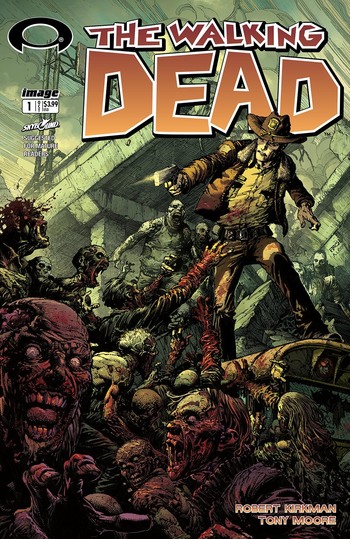
- The Walking Dead is a comic book that follows Rick Grimes, an Atlanta sheriff who Slept Through the Apocalypse, as he tries to find a safe place for his family and a rotating cast of other survivors. Since it is a series perpetuated by Rule of Drama, any safe haven is a Hope Spot at best, and Rick's life is perpetually a From Bad to Worse scenario. The narrative only follows Rick's story, so it is unknown how bad the apocalypse is, but the zombies have at least overrun the East coast of the United States. The zombies follow typical Romero rules.
The Walking Dead is a unique case of the Zombie Apocalypse setting. Firstly, the zombies are presented as more like a natural disaster than a consistent threat: the true conflict of the series comes from interactions with fellow survivors and other group members. Secondly, bites do not infect people, everyone who dies with their brain intact re-animates.. Thirdly, the USA as a nation state collapsed long before the story starts, leaving people as scattered, nomadic scavengers. Finally, walkers seem to have good hearing and smell but poor eyesight. This functions as a double-edged sword: on one hand, walkers are drawn to gunfire and thus survivors must be careful about use of firearms, but on the other hand, it is possible to sneak around zombies provided you stay out of sight and don't attract attention, placing more emphasis on stealth and melee combat. This overall makes the idea of a widespread outbreak more realistic and plausible, while addressing commonly cited issues people have with the setting. - Wonder Woman:
- The sixth annual for Wonder Woman (1987) was a Pulp Magazine magazine homage, specifically to Robert E. Howard's horror tinged tales, and followed an adolescent Diana trying to stop a zombie apocalypse.
- In Wonder Woman (2006) Zeus raises an undead army of Greek Heroes as his Gargareans, and commands them to violently dismantle the earth's militaries and subjugate their governments. It's rather different than most takes on this concept as they're not shambling mindless things but unkillable visibly undead unsympathetic men who end up turning on Zeus and refusing to continue their mission anyway.
- The near-future "found journal" Zombies: A Record of the Year of Infection, which is presented as the journal of Seattle doctor Robert Twombly, has the western seaboard of the United States and some of Canada overcome with a zombie uprising in 2012 caused by, of all things, an experimental food preservative gone bad. Although Twombly is implied to have been killed at the end, since his journal cuts off with a blood splatter on the last page the fact it was found and published suggests (in the context of the journal's universe) the zombies were successfully stopped somehow.
- Zombies Calling has a zombie apocalypse taking place in a campus on a university.
- Zombies vs. Robots (and its sequel Zombies vs. Robots vs. Amazons) starts out in a post-zombie apocalypse world where man's former servants fight to protect the last uninfected baby.
- Zombie World had a Lighter and Softer portrayal of the zombie apocalypse, instigated by the reanimated high priest of an advanced lost civilization reawakens in a museum exhibit. In adition to zombies, giant maggot monsters also roam around the wrecked remains of civilization.
- In the Chilean comic Zombies en la Moneda, the undead invade the presidential palace of Chile, known as La Moneda. At first the zombies only invade Santiago, the capital city, but from Volume IV the plague it expands to all of Chile.
- The Far Side: One strip depicts the "Night of the Living Dead Chipmunks".
- The basis for the Dark Fic adaptation of To Love Ru, To Love-Death. If you like Happier anime, you've come the wrong place, kiddo.
- In the Mass Effect and Jurassic Park fusion fic Tyrant Kings, Khar'shan (the Batarian homeworld) suffers two at nearly the same time, in addition to an alien invasion. The first was the result of a fungal bioweapon that turned Batarians into zombies, while the second was because the Emperor of the Hegemony decided that the way to fight the zombies was to turn loyal soldiers and civilians into Husks to fight the menace.
- In the The Familiar of Zero fanfiction,The Steep Path Ahead, Albion went through one of these courtesy of Sheffield being more than a little upset over her lover's death. They had to burn the entire city down.
- Not the first fanfic to present a zombie apocalypse, but Zombies uses this trope as the backbone of the plot. Its one big video game crossover and the Zombie Apocalypse is quickly wrecking civilization, and the monarchs who attempt to deal with it are summarily killed off for their efforts.
- Humorously, the Mushroom Kingdom is imminently threatened due to their dependence on Mario & Luigi. The kingdom, just like the franchise, is a big, army-less nation completely susceptible to attack by MUSHROOMS WITH LEGS and TURTLES. What happens when an unstoppable virus starts turning the Mushroom people into flesh-eating monstrosities?
- Dead in Ohio manages to combine Glee, slash and the Zombie Apocalypse. Word of God states it's a Crossover with Zombieland in that it takes place during the same zombie outbreak, even though the Glee characters never encounter the Zombieland characters (though the complete destruction of Columbus, Ohio in the film happens in this fic too). Not Using the "Z" Word is played with, as Puck starts calling them zombies right away, while Kurt initially states that he doesn't believe that what's walking around out there is The Undead, but if Puck wants to call them that, then fine. Notable is that, unlike many works featuring a Zombie Apocalypse, the characters here are successful in pulling off their long-term plan for survival, thus avoiding a Downer Ending.
- In Origins, a Mass Effect/Star Wars/Borderlands/Halo Massive Multiplayer Crossover, we have an Alien Invasion by the Flood that's resulted in this in one galaxy with several others under active threat.
- One chapter of You Got HaruhiRolled! is a parody of Resident Evil. Naturally, this trope is in effect.
- League of Extraordinary Gentlemen: Tempest Rewrite: Part of the horrors unleashed by Prospero.
- Outbreak and Of Death and the Undead, fan fictions based off the Teenage Mutant Ninja Turtles (2012) franchise, use this (and the beginnings of) this trope as the main story focus.
- Under Cover Of Darkness: A Magic School Bus fanfic in which an older Ms. Frizzle's class has to survive a mauler apocalypse. It's one big Shout-Out of The Walking Dead (2010), though not a true crossover. While it follows a similar storyline to the TV series, there are notable differences. There are characters that share names with TWD characters, but they are not the same people, and the story isn't set in Georgia.
- Respawn of the Dead asks what would happen if a Zombie Apocalypse took place in the Team Fortress 2 universe (long before the Scream Fortress event that let players use cosmetic items to turn into zombies or the "Wave 666" mission, which is a rather literal armed zombie invasion). The answer is that in spite of the game's darkly comedic setting, things would get really horrific (and really heartbreaking) really fast. In short, one of the Medics elects to recreate the technology behind respawning, which goes very bad in a big hurry.
- Ashes of the Past does a variation of this to fit the setting. Early on during the first chapter of the Orange Islands arc, an entire island made of limestone spontaneously reanimated into a few million Kabuto (one of which Misty caught) and Cradily. As it turns out, Altomare is built on limestone. This allows Annie and Oakley to use the DMA on the exposed bedrock and unleash a Fossil Pokémon Apocalypse comprising of every fossil Pokémon in the history of the franchise onto the entire city. It forced Ash to summon every Pokémon on his team that was available along with all of Brock and Misty's Pokémon in order to keep it at bay, and it's implied that even with the aid of all the trainers who were in town for the festival, they would've eventually been overwhelmed had Ash and the Latis not broken the damn machine.
- Surprisingly enough, someone managed to make a Watchmen zombie apocalypse Alternate Universe fanfic, which you can find here, that really kicks ass. Probably because Rorschach is just about the only character that would wind up happier and saner upon becoming one of the flesh-craving undead.
- Principal Celestia Hunts the Undead: Cinch uses the brain worms to turn the Crystal Prep students into a zombie-like mob and has them attack Canterlot High.
- A Tumblr post speculated that a rabies epidemic would act similarly to a zombie apocalypse in the Warrior Cats series. The Clans have no experience with rabies, so they wouldn't understand what it is or how to combat it.
- The Empath: The Luckiest Smurf story "The New Shop In The Village" has Empath as the Smurf Village's leader having a dream that, because he has legalized smurfnip to be used as a recreational drug, the entire village is full of Smurfs who have succumbed to the lure of doing all sorts of drugs, with most of them looking like "the walking dead".
- Disney Zombies has almost every world from Disney's 2D animated films (at least made before The Princess and the Frog, and not including Hunchback) overrun by an undead plague, with all the grimdark blood spilling that it entails. Much of the story focuses on two plotlines: Pinocchio going through infected worlds to find Geppetto, and Grumpy of the Seven Dwarves still trying to find a prince to save Snow White, and also find a way to stop the plague. Countless nostalgic characters are either zombified, or killed so gruesomely it's sometimes borderline hilarious.
- Gloriously subverted in Corpse Bride when the dead come to the land of the living for Victor and Emily's wedding. While people are freaked out at first, some eventually realized their lost loved ones are among the crowd. Even funnier, when they arrive at the cathedral, the Vicar tries to keep them out with a loud and hammy You Shall Not Pass!, only for one of the ghouls to give a chiding "Keep it down, we're in a church!", leaving the Vicar stunned silent.
- Frankenweenie has this for its climax, with the variation that all the zombies are former pets who were resurrected through Frankensteinian science rather than through a virus or supernatural curse, and all of them have different powers, attributes, or abilities based on what kind of animal they were in life.
- The main plot of ParaNorman uses the supernatural variant, where the zombies are resurrected by the curse of a vengeful witch. It otherwise plays the "small band of people running from a mindless, bloodthirsty horde" plot fairly straight, with the ingenious twist that it's the outnumbered zombies who are fleeing in terror from the savage, murderous mob of living townsfolk, which, arguably, is actually much scarier than the alternative.
- Used in spirit in Patlabor: The Movie. The final act is a Hold the Line action to prevent civilization from being destroyed against an onslaught of slow moving, dumb, but relentless horde of opponents that are afflicted with a highly contagious virus that infects one of the good guys and turns it against his friends. Only instead of living dead humans, it affects construction mecha, the kind that were meant to easily demolish buildings and are used throughout the Tokyo Bay area.
- 28 Days Later is a zombie film with Technically Living Zombies who are afflicted with the "rage virus," something akin to super-rabies. Zombies are called "the infected", and can spread the condition through any bodily fluid transfer.
- Anger of the Dead is set in a zombie apocalypse that's been going on for four months by the time the main events of the movie take place.
- Anna and the Apocalypse is about the titular character and her friends dealing with one of these hitting their small town. During Christmas, no less!
- Army of the Dead: A zombie outbreak devastates Las Vegas, and a team of mercenaries (some of which are veterans of the war to contain the zombie horde) goes on a Suicide Mission to rob a vault in the city once the outbreak is contained.
- Beautiful People: Shots of zombies overrunning Britain are seen among the end credits.
- Ben 10: Alien Swarm: Via mind control.
- Boy Eats Girl: Nathan's revival as a zombie and biting someone else results in the condition spreading rapidly as more people are infected from bites in turn.
- Burial Ground: The Nights of Terror takes this trope to its beginning phase, with zombies coming back as the presumable result of an ancient curse, and includes tool-using zombies, along with the unusual use of an adult dwarf playing the role of a child.
- Call of the Undead: The Virus escapes containment and gets loose in the city of Taipei.
- Cockneys vs. Zombies sees a zombie infestation grip modern day London, with a group of five criminals, their two hostages-turned-allies (well, for one of them) and expletive loaded granddad fighting against the Romero style hordes roaming old London town, with a number of regular tropes lampshaded in the process.
- Colin (2008) plays the Zombie Apocalypse pretty much straight, with the eponymous zombie as the protagonist.
- The remake of Dawn of the Dead (2004) updates the setting and has a much larger cast. Zombies are also distinguished from the original by being capable of sprinting.
- Dawning of the Dead focuses on a British news team trapped in the news room while the world around them becomes engulfed by flesh-eating zombies.
- Day of the Dead (2008) shows a virus that turns people into zombies starting out as flu symptoms. About half the town is infected and comes down with what is thought to be the flu, but then everyone infected simultaneously stops moving for about five minutes, then visibly rot from the inside out within seconds, killing them, and turning them into flesh-eating zombies.
- The Dead, filmed on location, depicts a Zombie Apocalypse in an unnamed African country.
- Dead Air continues the tradition of virus-infected Technically-Living Zombie films, with the infection being caused by a compound spread by terrorist attacks in the United States' major cities.
- The Dead Don't Die is Jim Jarmusch's take on the zombie film. Zombies are the result of the Earth spinning off its axis due to polar fracking. Several Genre Savvy characters identify the problem as zombies and educate others on the standard ways to fight them very quickly.
- Heavily subverted in Dead Heat, a cops vs. zombies movie with a Whodunnit to Me? plotline. Police detective Treat Williams dies in the line of duty, but is brought back temporarily with a resurrection device concocted by the corrupt scientist he was investigating. No apocalypse is forthcoming and no flesh/brain-eating ensues, as the zombies retain their free will if they're revived immediately after death and are compliant Mooks if resurrected a bit later.
- In Lamberto Bava's Demons, the creatures are more like monsters than zombies, but they work with zombie rules and may have been an inspiration for straight zombie films to follow.
- Brilliantly skewered in the 2006 film Fido, which occurs in an alternate 1950s that is in the heyday of a zombie post-apocalypse. The zombies have been tamed into domestic servitude by a control collar. This is possible because zombie bites do not cause a change. Billy Connolly plays the eponymous character, one of the most charismatic shambling corpses ever shown on the big screen.
- Flight of the Living Dead (2007) is a zombie movie which was clearly inspired by Snakes on a Plane, since it takes place in the confines of a commercial airliner. The film's zombies follow the Russo mould, in that they can move faster than a shamble, but the incubation time for the virus varies wildly — some are infected and do not turn until a good while afterwards, whereas some are zombified almost as soon as they die.
- Gangs of the Dead a.k.a. Last Rites had homeless people zombies created by radiation from a meteor that fell to earth attacking so the Latino and black gangs had to more-or-less put off their fight to stay alive.
- Here Alone takes place in the aftermath of one, when almost all of the human population has been wiped out by it. This one has been caused by a virus.
- I Am Alone is about the host of a wilderness survival show who is bitten while in the Colorado Rockies, and his film crew is in town trying to survive.
- Invisible Invaders may be the Ur-Example. In this film, invisible aliens possess corpses and use them to attack the living. It's largely Un-built, since the zombies aren't contagious and humankind quickly finds a way of dealing with them.
- Juan of the Dead depicts a Zombie Apocalypse in Havana, Cuba. It is not made clear if this is in Cuba only or a global situation. And the government claims this to be the work of dissidents collaborating with the U.S. government.
- This seems to be one of the reasons the world was destroyed in Spanish horror/sci-fi film La Hora Fría.
- Acclaim French film La Horde shows a group of cops and gangsters forced to face a Zombie Apocalypse together.
- The French movie Les Revenants (They Came Back in international release) has 70 million people climbing out of their graves... and peacefully returning to their old lives, trying to relearn speech and basic motor functions, and generally not killing anyone.
- George A. Romero's Living Dead Series. Perhaps because the original film predates most of the zombie canon, it actually avoids many of the "rules" it is credited with creating. Some zombies in the Romero canon can move quickly, use tools, and show problem-solving ability. These abilities are increasingly developed through the sequels. Also, the term "zombie" is rarely used, with "ghouls" being the more popular term. The movies include:
- Night of the Living Dead (1968)
- Dawn of the Dead (1978). The word "zombies" is actually used once here, when Peter warns the others that there are now a thousand zombies in the mall.
- Day of the Dead (1985)
- Land of the Dead
- Diary of the Dead
- Survival of the Dead
- In the Italian film Nightmare City (a.k.a. City of the Walking Dead), the zombies are radioactive, drink blood instead of eating flesh, and can run.
- Misfit Heights is about a puppet zombie apocalypse caused by a mad scientist who sought to raise the dead to Take Over the World.
- Blending Zombie Apocalypse with Our Werewolves Are Different, Mulberry Street gives us a virus that's transmissible by rats as well as humans (fat chance keeping those out by boarding up the farmhouse windows...), and turns infected people into rat-faced, rampaging cannibals. Subverted in that the Virus goes into remission at sunrise, restoring victims to normal, albeit not until after the protagonists have killed off their loved ones in self-defense or mercy.
- Mythica: Szorlok unleashes this on the world in the last film, raising all of the dead and then sending them out to kill the living, who become more undead soldiers for him.
- This happens halfway into New Kids: Nitro, which is shown to be more of a parody of zombie films than an actual zombie film, complete with grainy filters.
- Night of the Creeps features the alien entity infection variety, where the victims could either remain sentient or become mindless shamblers looking to continue infecting others.
- One Cut of the Dead: The film's first act features a production crew filming a zombie movie, only to be attacked by real zombies, causing the realism-obsessed director to continue shooting. It's all captured in one lone take. After the first act, things twist in unexpected directions.
- The fan remake for Plan 9 from Outer Space seems to be playing this up, majorly. On that note, the original also has a (badly) attempted one.
- Planet Terror gleefully plays out all the classic zombie tropes in the style of a '70s B-Movie.
- [REC], and the American remake Quarantine (2008) document the first stage of a zombie apocalypse with an In-Universe Camera. In the Spanish version, the origin is Demonic Possession and an exorcism going wrong in the American remake the zombies are afflicted by a disease described as similar to rabies and it's hinted that a mysterious tenant intentionally created the disease.
- The Resident Evil Film Series is more straightforward survival horror, although zombie apocalypse elements are involved from 2 on to the end.
- The Return of the Living Dead film series resulted from a dispute between John Russo and George A. Romero, which split the Night of the Living Dead sequels into two branches. Russo only lived to make the first film with his new partner Dan O'Bannon. The The Return of the Living Dead series is more campy and humorous as well as more grotesque than Romero's more famous films. The zombies have human-level intelligence, specifically eat brains rather than just human flesh, and are much more difficult to kill. The first film lampshades its departures from the original by acknowledging the existence of Night of the Living Dead as a movie within its world. One character even exclaims, "You mean the movie lied?!" The films include:
- Rockabilly Zombie Weekend seems to get to apocalyptic levels, as the method of transfer (government mosquito repellent sprayed over the tri-county area, plus infected mosquitoes and spiders) allows for it to randomly spread to many places at once without a single Patient Zero that can be quarantined; within a few hours, the entire area is seemingly entirely populated by a few dozen survivors, a handful of soldiers with minimal equipment, and the zombies. A CB radio check with another survivor confirms that the highways to the airport are blocked, though it's unclear if it's due to massive death and destruction or massive traffic trying to flee.
- Shaun of the Dead plays the concept for laughs, while at the same time remaining faithful to the style of the Romero films. Like those films, it includes hints that zombies retain some semblance of their former personalities. It also includes a Take That! against the Twenty-Eight series. It memorably subverts the "apocalypse" part by having the military seep through and restore order within a day. It's not even clear if any country but Britain was affected.
- Slither also includes an alien infection, where zombies are infected by parasitic worms and controlled by a hive-mind. The film is partly an Homage to and an Affectionate Parody of zombie tropes.
- Stake Land (and its sequel) takes place in a post-Vampire Apocalypse setting.
- Tokyo Zombie is a 2005 Japanese live-action Zom-Com about a pair of bumbling Jujitsu practitioners where zombies of the shambling variety first appear by popping out of a mountainous pile of garbage, toxic waste and discarded bodies called Black Fuji. Within 5 years all of Japan is covered in zombies except for a pyramid-shaped building inside a wall where rich people have gathered for safety and to amuse themselves with zombie-on-zombie as well as zombie-on-human fights to the undeath.
- Korean film Train to Busan is probably the best well-known Korean version.
- Trench 11: Reiner's plan is to find the mustering point for the next Allied offensive and release the Parasite Zombie infection. When it's pointed out that it will spread from nation to nation regardless of political affiliation, he isn't put off, saying that the strong should emerge victorious from this crucible as it engulfs Europe.
- Undead: Played with. Whilst Berkeley becomes a total infection zone at the end, it's unknown if the virus spreads to the rest of the world (although it's implied that Rene may have managed to contain it to just the township).
- Viral: The worm flu that spreads rapidly across the US results in people turning into parasite zombies, with people having to quarantine and flee the infected.
- Warm Bodies and its adaptations are set against the backdrop of a Zombie Apocalypse. It's a Romantic Comedy: with a Whole-Plot Reference to Romeo and Juliet, with zombies and humans as the warring parties rather than families. In this version of zombies, zombies acquire the memories of the people whose brains they eat. They also have extremely sublimated memories of being human, which can be brought back out again.
- World War Z is about a global effort to fight back against a massive zombie outbreak.
- Italian director Lucio Fulci's Zombi 2 took the Romero concept and increased the gore factor with such novel touches as a zombie fighting a shark underwater and a woman getting her eye gouged out with a sliver of wood.
- Zombie Apocalypse, a movie from The Asylum, has a group of survivors of a Zombie Apocalypse trying to get to a supposedly safe refuge.
- Numerous examples regularly appear on Syfy as original movies, including one called literally Zombie Apocalypse.
- The Zombie Bloodbath trilogy (1993, 1995, 2000) proves to be capable of bringing forth Narm Charm unlike anything you've ever seen.
- In Zombie Cult Massacre zombies were initially created by an evil cult leader but those bitten and/or killed by zombies also rise from the dead.
- Zombieland uses the fast zombie variant. They aren't very clever at all except where required by the Rule of Funny, and are pretty much limited to basic functions such as turning doorknobs and climbing fences and scaffolding, putting their minds at about "pissed off monkey" level. They were created by The Virus and can spread it through bites. They're also seemingly immune to pain, leading to the first two of the lead's Rules of Zombieland: Cardio (zombies can run fast, making it important to be able to run faster) and the Double Tap (put another bullet into the head after taking one down to make sure).
- ZA: Zombies Anonymous aka Last Rites of the Dead (2006) gives a new spin on the Zombie Apocalypse: the outbreak has happened, the dead are walking the earth, but they are still functioning — although mostly closeted — members of society. The movie is a good study on prejudice, showing the new world through the eyes of the recently-deceased Angela. Most of the living prefer the dead to stay dead, but most of the "mortally challenged" just want to be left alone; there are, of course, extremists on both sides, the living who actively hunt down the dead, and vice-versa. The social commentaries aren't subtle, and can be quite agitating at times, especially during the climax.
- The entire point of Can You Survive the Zombie Apocalypse?.
- Marlee Pagels's Along The Winding Road uses this as a background element. While there are still a few zombies ambling about four years afterwards, it's implied that they were much more formidable enemies at the start of the apocalypse.
- In Ashes by Ilsa J. Bick, some sort of electromagnetic pulse instantly kills all adults and turns most teenagers into zombies.
- David Moody's Autumn series is somewhat novel in its setup: the story begins with 99% of the world population dying — in the following weeks, some of the victims get better. The most novel aspect of his approach is that for the majority of the first book, the zombies are benign, just wandering about at random, with the result that we can see that "Holy crap, dead people are getting up and walking around," is really freaking scary entirely independent of the possibility of being eaten by a zombie. Of course, at the end, the zombies do become violent, and the whole thing just slips into the mold of the standard survivalist zombie apocalypse story. It is also somewhat novel in that the protagonists plan, for most of the story, to simply wait the zombies out, on the assumption that they will eventually decay past the point of mobility.
- John Ringo's Black Tide Rising series is about a virus that turns people into Technically Living Zombies and about one family's efforts to both survive themselves and to save as many others as possible. Ringo decided to write it because of his oft stated dislike for most examples of the genre. Ringo specifically averts the Militaries Are Useless trope, as (not all, but many) members of the military are capable and competent, but they are stuck in isolation until someone can get them a vaccine so they won't turn into zombies. Ringo also averts the never attack other zombies trope. The infected will eat anything: each other, rats, packaged foods in container ships, algae infested water, etc. And if some of it is too foul to sustain them, their peers will be delighted to partake of an infected person who is suffering from food poison.
- Cell, another Stephen King zombie novel, has people turned into Technically Living Zombies by cell phones, causing them to attack anyone not afflicted.
- Dark Inside has similar themes to this, but they're not exactly zombies. Rather than being mindless monsters, something turns the majority of citizens into amoral, thrill-seeking, violent monsters who retain full brain capacity and personality traits. Their only pleasure is to hunt and kill, for the sake of it.
- John Wyndham's 1951 novel The Day of the Triffids, while concerned with genetically engineered Man Eating Plants, foreshadows many themes of the contemporary Zombie Apocalypse. Society collapses after an atmospheric event causes mass blindness. The sighted and unsighted alike struggle to scavenge a living while being hunted by this new predator. Eventually the sighted protagonists retreat to the countryside and barricade themselves in a farm house, fending off repeated Triffid attacks. The book is heavy with social commentary and contains memorably hellish imagery of shambling, groping masses of humanity. The Triffids themselves have a rickety, limping gait and are slow moving, awkward creatures of little threat individually (unless they catch you unawares). In large numbers, however, they are a serious menace; able to force their way in anywhere and seemingly capable of rudimentary communication and organization. The most effective way of stopping one is to 'decapitate' it using special blade firing weapons. It has been adapted as a lightweight 1962 monster movie (casts the Triffids as extraterrestrial plants) and a more faithful (albeit stagey) 1981 television series, and then again as a TV series in 2009.
- In the 1961 novel The Day They H-Bombed Los Angeles by Robert Moore Williams, mutated protein molecules invade Southern California, turning people into flesh-eating zombies.
- Brian Keene's Dead Sea features a zombie plague that also affects cats, dogs, and rodents in addition to humans. After the characters flee the land for the sea, they discover that the plague is spreading to other mammals and eventually fish. By the end, the plague has reached the birds. Zombies do not result from demonic possession in this book as they do in his other books. It does contain a 'blink and you'll miss it' reference to an incident in The Rising so it may be a case of Unreliable Narrator.
- Happened in Fire Sea, third book of The Death Gate Cycle. In this case the effect was not pandemic but might as well have been (almost all the zombies were necromancers in life and simply animated every corpse they came across) and rather than being mindless they were sentient but Ax-Crazy with hatred for the living (except for Kleitus, the leader of said undead, who was still Ax-Crazy but also smart enough to have vision- he was gunning for ruling an entire zombified universe.) Mercifully, they were contained on just one world of the series multiverse at the end of the novel, and in the climactic volume Kleitus was killed in battle and the rest of the undead were destroyed by what could best be described as "cosmic reshuffling".
- Diario de un Zombi has this as the setting for a depopulated Barcelona. Add in unstoppable biomechanical horrors and cultists.
- The web-novel Domina is about a number of super-powered zombies called "screamers" attacking an island city. Hasn't hit the actual apocalypse stage yet, but the Reasonable Authority Figure is rightly worried.
- In Justina Ireland's Dread Nation, the US Civil War ends because a Zombie Apocalypse happens in the US South. This wipes out much of the Southern US to the extent that they're collectively known as the "Lost South". The apocalypse is stalled when the surviving Confederates surrender to the Union and their combined forces are able to beat back the Shamblers for almost 20 years. During this time, the Union edict of mandatory education for African-Americans and Native Americans is twisted by the Survivalists (a racist political faction started on surviving Confederates) into the Combat Schools where minorities are trained to fight zombies and become "Attendants" (bodyguards for wealthy white gentry). The apocalypse resumes when Survivalists try to create new settlements while the Shamblers develop a hungry, instinctive Hive Mind. The sequel, Deathless Divide has the heroine from the first book on a Roaring Rampage of Revenge against a Mad Scientist who's made things even worse.
- The Enemy centers around London following a version of this which only affects those over age of fourteen.
- Peter Clines's ExHeroes is a story about the end of the world at the hands of zombies, only to be opposed by superheroes.
- In Expedition Z the zombie apocalypse (AKA the Fall) happened 20 years ago that at this point the main character's father points out there shouldn't be any zombies out in the wild after having starved to death about 7 years ago.
- Carrie Ryan's The Forest of Hands and Teeth takes place in a fenced-in community several generations after the Zombie Apocalypse.
- Friday The 13th The Jason Strain has Jason, while a "special guest" on a Deadly Game, being abducted by scientists, who want to replicate his regenerative abilities and immortality; Jason wakes up partway through the vivisection, rampages through the lab and is exposed to an experimental virus which reacts negatively with him, giving him the ability to reanimate his victims as zombies. Thousands of deaths later the virus is cured and Jason's rid of his new powers. Notably headshots don't stop the zombies — the head needs to be completely eradicated in order for them to be fully (re-)killed. Also, Jason fights a shark in reference to Zombi 2.
- In Aaron Allston's Galatea in 2-D, the last attack Roger unleashes on Kevin.
- Comes up in Galaxy of Fear: City of the Dead. Long ago the people of Necropolis killed a witch's son, and she cursed them, saying that if they did not respect the dead, the dead would rise and destroy them. A mad scientist, looking to create an army of zombies, started raising corpses using a serum. The resulting undead follow orders and don't bite, but are tremendously strong and tireless. He ended up applying a lot of the serum to the massive graveyards, besieging the Necropolitans. The heroes were able to come up with a counterserum which they applied liberally to all the undead — it's a children's book, but this serum simply turned zombies back into corpses which then had to be reburied.
- Deconstructed in Handling the Undead, which explores how society would react if dead people actually came back to life, and without the craving for brains that makes it so easy to just kill them all. (The zombie violence is rare and seems to stem more from their being unaware of their actions and consequences.) The first thing that happens is that the government calls an emergency meeting and decides what terminology to use, deciding on "reliving" because it sounds so much more pleasant than "zombies". A memorable subplot follows the grieving mother of a recently deceased young boy, fighting to hide her mindless zombie child from the authorities.
- In Herbert West–Reanimator, Dr. Herbert West devises a chemical that will bring dead people back to life. Unfortunately, the subjects either die (again) within minutes or turn into flesh-eating creatures that share more than a slight resemblance with your average zombie (they retain normal human strength and speed though). He eventually gets better at reanimating, creating an intelligent zombie who can reanimate more bodies. The intelligent zombie then leads an army of other zombies to kill Dr. West.
- In the Horus Heresy novel False Gods, the attack on Davin's moon is met by hordes of animated corpses.
- Richard Matheson's 1954 book I Am Legend, while it was about vampires and not zombies, is an important precursor to the genre. Matheson's novel was adapted into the films The Last Man on Earth, the most faithful adaptation, and later into The Ωmega Man, which apes the then-recent Night of the Living Dead (1968) to a degree and turns the vampires into Luddite photophobic albino mutants produced by biological warfare. The most 2007 adaptation, I Am Legend, has the infected more like an odd cross between zombies and vampires.
- Jonathan Maberry:
- Zombie CSU The Forensics of the Living Dead is a What If? scenario in book form. The author has interviewed Real Life Police, SWAT, doctors, hospitals, 911, and even DHS about what they would be doing to react if the Zombies began walking the earth. Delightfully enough, all the agencies and groups interviewed in the book had already given the question some consideration and had strategies formulated. Yes, even the DHS.
- Patient Zero has a genetically engineered version of The Virus (that infected unusually fast via parasites and prions along with the viral cocktail) that creates Zombies used as a weapon by jihadist terrorists who come up with a strain that allows for smart zombies.
- Dead of Night has an engineered version of The Virus that was meant to leave a serial killer awake in his own rotting corpse, Buried Alive. Unfortunately, instead, it raised him as a zombie, and an intelligent one. The resulting Zombie Apocalypse got contained, but they never found and stopped patient zero.
- David Wellington's Monster Island and its sequels provide Romero-style zombies with an exception: if your brain is provided with oxygen between death and before returning as a zombie, you return as an intelligent zombie which the sequels call a lich. The dead are reanimated as a result of a scientist having pierced the source of Life Energy, causing the world to overflow with life energy, reanimating the dead. The trilogy is available online.
- In Teresa Edgerton's The Moon and the Thorn, Lord Cernach causes the Cauldron of Cerridwen to be recreated, which has the power to create an army of phantoms every twelve hours. Cernach's stated intention during the design phase of the work was to use it to extort concessions from Mochdreff's Governor, who preferred diplomacy to military action. Cernach becomes Ax-Crazy, and uses the cauldron.
- The first volume of My Vampire Older Sister and Zombie Little Sister is about the eponymous sisters trying to prove which of their two races is stronger, by starting two warring pandemics of their respective infections (in Cyberspace, to avoid crossing the Moral Event Horizon).
- The Newsflesh series by Mira Grant (pseudonym of Seanan McGuire), in which bloggers and geeks are the only reason that humanity survived the Rising. Subverts and lampshades lots of related tropes, while playing others straight (notably zombie animals: any mammal over 40 pounds will reanimate upon death).
- In the Stephen King Nightmares & Dreamscapes short story "Home Delivery", an object orbiting the Earth (either an asteroid covered with seriously weird worm-like creatures, or it's worms all the way down...) is somehow causing the dead to reanimate. The story was originally published in a collection of Romero homages called The Book of the Dead.
- Night of the Living Trekkies is about what happens when the initial outbreak is at a Star Trek convention.
- This was one theory about what some of the bad guys in the Old Kingdom trilogy had in mind, since hordes of zombies are their favorite mooks and they were taking thousands and thousands of refugees into the country. Unfortunately, they were actually thinking a bit bigger than what Sabriel and Touchstone were expecting.
- In the Patternist series, a sci-fi version of this happens when the starship Clay's Ark returns to Earth contaminated with an alien virus that turns humans into predatory savages. While not literally undead, and still possessing some intelligence and cunning, the "Clayarks" as they are called are basically zombies in all but name, including the ability to spread their disease to others creating more of their kind. Eventually, they overrun the world and destroy civilization, except for fiefdoms controlled by the psychic "Patternists".
- Permuted Press was specifically created to publish these kind of stories and they have an entire line of varying types of undead horrors.
- Pavlov's Dogs is a somewhat unique take on the genre with a zombie apocalypse in a world where people have seen zombie movies and played games where you fight zombies. As a result, much of the usual stupidity in zombie stories is absent. Oh, and the good guys have werewolves.
- Time of Death subverts many of the tropes associated with zombie apocalypses including Humans Are Bastards and Evil Army, presenting humans as mostly good people dealing with a disaster. It also has a Cool Dog.
- The Becoming series is a Zombie Apocalypse where the zombies are against a bunch of badasses including a US Marine, Israeli Special Forces operative, and SWAT officer teamed up.
- In What Zombies Fear, the Zombie Apocalypse is brought about by hive-minded microscopic aliens inhabiting human corpses.
- In Dirge by Tim Marquitz, the world of Denhalm is on its last legs due to the Necrolords (Necromancers) unleashing one of these.
- Please Don't Tell My Parents I'm a Supervillain gives us the most adorable one ever. One of Penny's inventions is a zombie ragdoll that eats cloth to make new zombie ragdolls.
- Sergey Lukyanenko's Quazi takes place about ten years after a zombie apocalypse. Starting in 2017, whenever a person dies, he or she comes back as a mindless, ravenous zombie about 20 minutes later. The Risen can only be killed by destroying the brain or through decapitation. After a while, some Risen become intelligent beings again, who start calling themselves Quazi (note the "z"). Only a small percentage of the Risen have become Quazi, and no one knows why, just like no one has been able to figure out why the dead rise (some assume it's simply a global infection that is dormant until death). The Quazi have bluish-gray skin and don't retain many emotions. They do tend to be peaceful. A full-fledged human vs. Quazi war was stopped in several countries, including Russia, US, and Germany, but several countries have been completely wiped out by the apocalypse. Vast tracts of Russian lands are now filled with ravenous hordes and traveling through them requires the use of armored trains or joining a convoy of specially-equipped vehicles. Moscow remains the bastion of the Russian living with fortifications built up along the Moscow Ring Road, while St. Petersburg has become the capital of the Russian Quazi nation. Interestingly, the Quazi are vegetarian unlike their mindless brethren. Their digestive systems can only process organic foods. The Quazi are unable to develop mentally and are stuck at whatever state they were at death. Their primary goals during their lives become their primary goals upon awakening as Quazi. As a rule, Quazi tend to be logical and unemotional. The protagonist of the novel is a Mortal Affairs Inquirer named Denis Simonov with a grudge against all undead after losing his wife and son during the apocalypse. His responsibility is to be the first on the scene during suspected deaths in order to immobilize or kill any newly-risen. His boss is concerned that most of his "visits" end with the Risen being killed in "self-defense", so she partners him with a Quazi cop. Denis later finds out that, in order to become a Quazi, a Risen has to eat a part of a living human brain. Worse, his partner is one of the Risen, who killed his wife, becoming a Quazi shortly after and saving Denis's infant son, raising the boy as his own.
- The Radiant Dawn is the story of a zombie apocalypse brought on intentionally. The Big Bad of the story is a demon lord who instructs his acolytes to summon him to Earth. However, they are unable to, as human sentience interferes with the magical forces needed to bring him from his home plane to Earth. So what's a demon worshiping acolyte to do other than Kill All Humans? The zombie apocalypse, then, is merely a means to an end for the acolytes.
- Reliquary, the sequel to Relic, has those affected by a watered-down virus (it turns you into a horrific cocktail of dinosaur/primate DNA in the original) turned into light-shunning, psychotic, rat/lizard-faced things. The even more watered-down version just turns people into something like 28 Days Later zombies.
- The Rising and its sequel City of the Dead by Brian Keene play with several zombie tropes. As a result of a scientist messing with things he oughtn't to mess with, a portal to Dimension Hell is opened. Now, every time any animal above the level of "bug" dies it is possessed with a malignant, sadistic demon with one purpose: kill more creatures and let more of its buddies into the world. So we get zombie animals: zombie cats, zombie birds, zombie rats, zombie hump-backed camels, heck, zombie alligators in New York City's sewer system. As noted in the introduction above, zombie animals equals totally screwed. At the end of the second novel, the zombies win. They succeed in wiping out all higher animals and move on to bugs, plants and unicellular creatures. Their ultimate goal is to make Earth a lifeless hulk before moving on to other worlds and then to storm the gates of Heaven itself.
- Rot & Ruin takes place about 15 years after an unexplained Zombie apocalypse, and while the zombies are relatively easy to kill (zombie hunters tend to make a game of it) the society is still kind of in shock, so the idea of any organised take-back-the-earth campaign fails to gain traction when it's brought up. Something of an unusual example in that while the main characters do kill Zombies, one of the main points of the book is that just because they're walking around doesn't mean they're not someone's dead relative who deserves respect
- Raymond E. Feist's The Riftwar Cycle has the Black Slayers: dead warriors called back to life using necromancy, or in one case, using the authority of the Goddess of Death. Once called, they are virtually unstoppable, where even severed body parts will wriggle towards each other to reassemble. Near the end of the Serpentwar, a magic-user casts a spell that continuously reanimates all corpses in the battlefield to do their bidding. This has friendly and enemy soldiers both being killed off and rising again to fight for the magic user.
- Kill the Dead, a novel in the Sandman Slim series has the title anti-hero dealing with the dead rising en mass in Los Angeles. In the end he winds up destroying every zombie in the greater LA area and possibly everyone in the world.
- A good half of Clark Ashton Smith's work features Zombies of the non-contagious variety, generally custom animated by necromancers. In at least one case they 'outlive' their creators and carry on with what they were doing before they died.
- In A Song of Ice and Fire, wights are undead zombies created by, and apparently under the full command of, the Others... who are essentially ice demons/fey considered myths by most of Westeros. Wights have eerie, blue-glowing eyes and are particularly vulnerable to fire, yet are nonetheless persistent fighters that are hard to put down. Wildlings aka the Free Folk north of the Wall (where the Others are located) burn their dead to prevent them from returning as wights. As the series begins, the Others are becoming more aggressive and amassing large armies of wights from Free Folk towns and settlements they have overrun, seemingly in preparation for an invasion of the kingdoms south of the Wall.
- The second Soul Drinkers novel features the ridiculously powerful mutant-psyker Teturact, who would induce these, then bring it to a halt while forcing any survivors to worship him as a god. His main starship has been set up so that it can self-destruct and provide a drop assault Zombie Apocalypse.
- Star Trek: Destiny reveals that this is how the Borg came to be, as a result of two humans lost in the Delta Quadrant getting "possessed" by a starving energy being called a Caeliar, capable of manipulating matter as she saw fit. Then all they did was wait for the locals to come wondering what that huge racket was...
- Christopher Moore's The Stupidest Angel has quite a bit of zombieism. And brain hunger.
- Subverted in That is All; the Zombie Apocalypse is one of the few things that doesn't occur during the Ragnarok of 2012. The only creatures that rise from the dead are taxidermied animals, and they are harmless because they are all mounted on wooden planks.
- Theories of International Politics and Zombies, a rare non-fiction case of this trope; it's an almost serious look at the subject, through the lenses of various theories of international relations.
- In Robert R. McCammon's They Thirst, Los Angeles is overtly taken over by a Vampire Monarch and his servants. With each person bitten becoming a new vampire. He uses a magical device that creates a perpetual sandstorm around the city to keep people inside during the day, while at night the vampires raid homes. By the end of the book, there are hundreds of thousands of vampires.
- In Undead on Arrival, the apocalypse was five years ago and humans have pretty much lost.
- The Unexplored Summon://Blood-Sign has a variant in which each individual "zombie" is a copy of an Eldritch Abomination with the power to easily destroy the world. In the seventh volume, the White Queen demonstrates the ability to turn humans into copies of herself by biting them, with the copies being fully subservient to her. Though unlike most Zombie Apocalypses, she can't infect just anyone — she can only infect humans with an innate disposition to being easily possessed by spirits.
- Derek Gunn's Vampire Apocalypse: The Series is pretty obviously an example of this with vampires.
- The Weakness of Beatrice the Level Cap Holy Swordswoman has the invasion of Ground's Nir by the Underworld. The zombies of every single person who's ever died in Ground's Nir make up the invading army, and every casualty only adds to their ranks. On top of that, the zombies can never be permanently killed.
- Garry Kilworth's Welkin Weasels: Castle Storm features a being called a "ghoul", but effectively it's a zombie; the villain resurrects a badger corpse via (surprisingly disturbing for a kids' book) necromantic rituals. The resulting being obeys his every command, but displays a hint of personality in a Shout-Out to Frankenstein when it begs him not to call it a "monster".
- Max Brooks' next effort, World War Z is a mockumentary of a past zombie invasion, conducted in a series of interviews with survivors from around the world. The interviews are ordered so as to take the reader through the war chronologically, from "Patient Zero" to the Zombie Apocalypse to the eventual human victory. The interviews are supposedly conducted by Max Brooks himself. When The Zombie Survival Guide is mentioned and criticized, the "interviewer" says, "Oh really?"
- Walter Greatshell's Xombies series deals with an odd combination of Romero and Russo rules; the titular 'xombies' are the result of a contaminant which can only infect dead people (due to the fact that it has to bond to anaerobic hemoglobin, or a blood protein that isn't bound to oxygen). The zombies in this series are especially dangerous because they literally can't be killed. Separated body parts are sometimes more dangerous than actual zombies. In the second book, it is revealed that the zombie apocalypse was an attempt by its creator to avoid a far worse apocalypse from a comet/spaceship from Saturn's moon Encaladus.
- In Zeus Is Dead: A Monstrously Inconvenient Adventure, Hermes invokes this trope when talking about Hades, and the sequel to the book uses it as the basis for its plot, which is about a zombie apocalypse.
Hermes: He's actually a decent enough chap. A bit inexorable. A tad strict, perhaps, but it's his job to keep the dead out of the world of the living. You don’t want someone like me in charge of that. One good distraction and wham! Zombie apocalypse!
- In the children's book Zombiekins, an elementary school is infected by a magical teddy bear that carries a zombie plague that is ignored by the teachers because it causes the infectees to quietly move in orderly straight lines and take their seats at the sound of the bell. They obey every school rule except the one about not biting other students. Since it's a children's book, the condition does turn out to be reversible.
- In the episodic ebook series Zombies! by Ivan Turner, a savvy 17-year-old is the first to alert the authorities to the threat, thus subverting the trope because the authorities handle it carefully and sensibly enough that your average citizen doesn't even notice the undead walking among them.
- Max Brooks' The Zombie Survival Guide is a handbook on how to survive a zombie apocalypse. Its advice is based around classic zombie behavior that is not quite rooted to any specific source. It breaks down the hazards and strategies in detail, from zombie strengths and weaknesses to effective combat tactics.
- Derren Brown's Apocalypse special sets up a fake apocalypse scenario in order to get an unsuspecting guy to man up and take responsibility for his life, as well as to start appreciating those around him. After a series of fake news reports about an impending meteor strike, the guy is on a bus traveling to a (fake) rock concert when pieces of the meteor start to fall all around him. He passes out (put into a trance by Derren) and wakes up in a deserted hospital seemingly two weeks later with a news report warning about a Rage Plague brought by the meteor fragments. Then crazy people start chasing him and his young companion (naturally, all of them are actors). The special is inspired by the 2012 end-of-the-world fears.
- Arrowverse:
- The Flash (2014): Bloodwork, a "meta vampire" who acts as the Arc Villain of the first half of Season 6, sets about trying to "save everyone from death" by infecting people with his mutated blood acting like The Virus. In this case, however, the infected are completely under his control and become his Hive Mind, otherwise they act just like regular sci-fi zombies (without the hunger for human flesh at least). Bloodwork's final plan is to use the heroes' particle accelerator to infect the entire city (maybe even the entire world) in one go.
- Legends of Tomorrow: In the Season 4 episode "I Am Legends", the Fates magically raise the dead of Britain just to hunt down the Legends. The zombies in question shamble when inactive, but are incredibly fast when they set sight on a living target.
- Bar Rescue: The ultimate concept of The End, a pizza bar / club that was heavily upgraded from its tacky Hallowe'en theme (The Underworld).
- The Bite shows how one starts when an experimental beauty treatment reacts to COVID-19 and starts to spread. One of the main characters is a doctor who's trying to find a cure.
- Buffy the Vampire Slayer:
- "Dean Man's Party" has people being turned into zombies due to a mask that contains the powers of a Nigerian zombie demon. Zombies aren't really her thing.
- The alternate timeline created in the Season 3 episode "The Wish" is a vampire variant.
- Discovery's The Colony is a reality TV show that takes place after a simulated "viral catastrophe". It's basically a zombie apocalypse with the zombies cut out.
- Allof Us Are Dead:a group of students struggle struggle to survive after after their school becomes the epicenter of a zombie outbreak after a student was bitten by a mouse infected with a failed expiriment.
- The Community episode "Epidemiology" deals with a zombie plague breaking out in the college. The group must try to escape, reach the thermostat to lower the temperature, and not be driven insane by the "Mamma Mia!" soundtrack.
- The UK horror series Dead Set involves a zombie apocalypse in Britain, with the plot revolving around the contestants of Big Brother as they are trapped in the house.
- Degrassi: The Next Generation has a Halloween Episode titled "Degrassi of the Dead" in which genetically modified food turns people into zombies, leaving the few surviving students to fight for their lives to escape.
- Costa Rican TV series Diario de la Peste has the Zombie Apocalypse as main theme.
- Doctor Who:
- The two-part serial "The Empty Child"/"The Doctor Dances" is a neat twist on the Zombie Apocalypse, with alien medical nanobots encountering a dead human child, assuming that's the human baseline, and rebuilding him and all other humans they encounter as shambling corpses. The walking corpses in the earlier episode "The Unquiet Dead" are closer, but they are actually hosts for the ghost-like aliens called the Gelth.
- "New Earth" set in a hospital in the year 5 billion and twenty-three on, naturally enough, a New Earth which is run by cat people. Towards the end, we find out that the doctors have been growing people in an enormous area under the hospital and exposing them to various diseases from the moment of their conception, which has turned them into your common-or-garden Romero zombie. Of course, the buggers get out and mischief ensues.
- Though not a classic example, the dark future of the Dollhouse resembles a Zombie Apocalypse. A signal was sent to all telephones on the planet that would wipe the listeners' minds, and program them to kill anybody who didn't hear the signal. As a result, rabid hordes of lunatics hunt down the few remaining normal people in the ruins of the civilization; a very strong similarity with this trope.
- The anthology series Fear Itself had the episode "New Year's Day", which was about a Zombie Apocalypse with a very interesting twist: the protagonist was a zombie the whole time.
- Game of Thrones: White Walkers in the North can raise anyone they have killed into becoming undead zombies with glow blue eyes called wights. They don't eat human flesh, but are motivated purely to kill at the White Walkers' command. Over the course of the series, the White Walkers amass an army of wights, including undead giants and other creatures, to attack the Seven Kingdoms and plunge the world into endless night.
- Grimm: Zombie Apocalypse through Hate Plague can be caused by yellow fever if this affects Wesen, as shown in the episode "You Give Me... Yellow Fever?"; it seems to have happened before in the past. Of course, the Wesen known as Baron Samedi can also turn people into the more traditional zombie.
- Spoofed on an episode of Happy Endings: Max and Jane get into a dispute leading to a Zombie Apocalypse Olympics that tests athletic prowess, ability to be still, aim, and ruthlessness. Jane eventually wins by demonstrating ruthlessness in pushing Max out in front of a group of hungry, hungry hipsters, even though Max had earlier claimed that ruthlessness was his strong suit.
- How to Survive the End of the World from National Geographic actually had an episode called Zombie Earth where a mutation of the Rabies virus was the cause.
- One of Sal's punishments in Impractical Jokers sent him into the sewers to "save" his nieces from a horde of zombies.
- In the Flesh is set three years after zombies rose from their graves to attack the living...and then the government actually found a cure. The main character is a Partially Deceased Syndrome Sufferer who's trying to re-integrate into a society which now hates him and come to terms with the guilt of the people he killed when rabid.
- I Survived A Zombie Apocalypse is a BBC Three reality show where a 5G network caused humans to mutate into zombies. The Survivors need to perform challenges while also avoiding the zombies, with the ones who are so much as touched being Killed Off for Real.
- iZombie: Liv is afraid of one happening, or inadvertently starting one herself. But because zombies retain their intelligence so long as they can occasionally eat brains, the spread of zombies is depicted as more akin to a vampire infestation. Some people, particularly those dying of incurable illnesses, choose to be turned into zombies in order to live forever, while others are turned against their will by zombies looking to gain leverage over them (i.e. they have to eat brains in order to remain human, brains ain't easy to come by, and the person who turned them just so happens to be a brain smuggler...).
- Masters of Horror: In "Homecoming", fallen U.S. soldiers rise from the dead en masse to vote out the administration that sent them to war. It's only when said administration starts treating them like horror movie zombies that the violence begins...
- Misfits has a zombie episode in the third season. Curtis brings a cat back from the dead, zombie apocalypse ensues, body count sky rockets.
- An episode of My Babysitter's a Vampire has everyone being turned into zombie by mutated coffee.
- MythBusters devoted an episode to surviving an attack by a zombie horde. Among their findings: an axe is a more effective weapon than a shotgun, and pushing your buddy into their numbers may give you a better chance of escaping yourself. It was odd how they kept saying, "Even though Zombies aren't real..."
- Nicky, Ricky, Dicky, and Dawn: In "Field of Brains" after watching a horror zombie movie, the quads think their parents are zombies. After escaping to their parents' store, they then think others are also zombies.
- Resident Evil (2022): The series is split between two time periods, 2022 and 2036. The former shows the early days of the T-Virus outbreak, due to Umbrella Corporation using it in new mood-altering pharmaceuticals; by the time of the latter, the human population has been reduced to 300 million people hiding in walled-off city-states and other defended settlements, while the 6 billion other people on the planet are now ravenous zombies.
- The Rookie (2018): "A.H.C." features a minor breakout in LA when users of a new drug are driven rabid by it, closely resembling zombies (though it's not infectious), on Halloween appropriately enough.
- The Sarah Jane Adventures did a zombie-themed story for the show's pilot episode, "The Invasion of the Bane". In this case, the zombie effect is caused by consuming a new energy drink that turns out to be a symbiotic life form. The resulting zombies try to force others to drink the stuff.
- The Sliders had an alternate dimension Earth, where, get this, a new "fat burning" medicine causes a Zombie Apocalypse. The drug was meant to "eat away" fat and an antidote would be taken to end the effect... However something went horribly wrong and millions of people started to hunger for fat, even if that fat was on another human. For some reason these zombies also became very sensitive to light, possibly having something to do with the zombies becoming excessively pale. Also, the zombies aren't of the risen dead variety, but will die without feeding as the medicine — possibly an engineered virus considering it transfers with getting bitten — will simply eat them alive if they don't get fat to their system..
- Smallville: "Rabid" has a mysterious virus turn most of Metropolis' citizens into violent zombies.
- Although they are not real, in an episode of Spaced, "Art", Tim takes some bad speed and plays Resident Evil 2, essentially making him hallucinate a zombie attack throughout the whole episode. The Twiglets he ate at the party didn't help either.
- The Star Trek: Enterprise episode "Impulse" has the crew coming across a drifting Vulcan spacecraft whose crew have been affected by the Trellium-D they were mining from nearby asteroids. The insanely aggressive Vulcans stagger after the crew through darkened corridors growling incoherently and, while their bite is not contagious, T'Pol is affected by the Trellium, becoming a danger to the others.
- Storage Wars: New York did this with "The Walking Bid," where a tuna-based Acid Reflux Nightmare has bidder Candy think an auction she's at turned John Luke, the auctioneer, and her fellow bidders into zombies.
- Played for Laughs in The Stinger as there are Hilarious Outtakes aplenty with it.
- The Supernatural episode "The End" has exactly this. It was more or less a Shout-Out to 28 Days Later (rage virus infected, very fast Zombies, I mean Croates). The Winchesters prevent it from coming true in "Two Minutes to Midnight".
- That Mitchell and Webb Look features a recurring sketch about a game show taking place in a world where an unspecified, but clearly horrific and traumatising, "Event" has happened. Food is scarce, there are no more children, there are frequent exhortations to "Remain Indoors" and the survivors live in terror of a mysterious Them, who look like us because they used to be us. It is later revealed that They are sepulchral voiced, red-eyed zombies with a taste for human flesh. Oh. And they've got in. It's hinted that this is not the worst part of the "Event".
- AMC's The Walking Dead Television Universe, which debuted in 2010 with a live action series adaptation of The Walking Dead. It later spun-off into a number of sequel series, currently composed of Fear the Walking Dead, The Walking Dead: World Beyond, Tales of the Walking Dead, The Walking Dead: Dead City and The Walking Dead: Daryl Dixon, with more planned in the future.
- The X-Files: The episode "Millennium" deals with a zombie apocalypse with the advent of Y2K. Obviously, going back and watching this episode over a decade later, it doesn't hold nearly the same punch as it did when it first aired in 1999.
- Syfy's original series Z Nation takes place after a zombie apocalypse has destroyed civilization, and is about a group of survivors trying to get the one man with a zombie cure in his blood to a laboratory that can synthesize his blood to make a vaccine. Society at large is gone, but there are small communities riding it out with success since by now it's a World of Badass.
- This is the basis for the Creature Feature song, "Aim for the Head".
- "Shoot To Kill" by thrash-metal band Warbringer is about gunning down zombies. Boom Headshot indeed.
- "Re: Your Brains" by Jonathan Coulton. The narrator, Bob, is a zombie who seems to have been made merely sociopathic by zombification, rather than mindless, since he retains his sapience and incredibly middle-management personality while attempting to persuade his co-worker Tom to let him eat his brains. Other zombies are mentioned, but they seem to be the standard nonsapient kind ("...my colleagues, who were chewing on the doors").
- The music video for Metallica's "All Nightmare Long". Soviet scientists investigating The Tunguska Event find a new lifeform which spores can reanimate the dead even three weeks after death. They use it to conquer the United States by spreading the spores there with weather balloons and staging an "intervention" to "rescue" them in the 1940's, and they lose control of it in the 1970's.
- The music video for Michael Jackson's "Thriller".
- Most of Cannibal Corpse's album covers and quite a number of their songs feature zombies (and the same goes for the bajillion gory death metal bands they inspired). The name itself, according to bassist Alex Webster, refers to a zombie who feeds on other zombies.
- Ludo's "Save Our City"
- "The Zombie Apocalypse Blues"
- The music video for the Gorillaz song "Clint Eastwood" involves zombie gorillas rising from the dead.
- "Early Sunsets Over Monroeville" by My Chemical Romance.
- "This is a slow one...grab your girl...and then shoot her in the head!"
- The Devil Wears Prada's concept EP "Zombie", as the name implies, centers around one of these. The lyrics and sound clips in between songs (such as the quote at the top of the page) rely heavily on the genre's many clichés.
- Lemon Demon's "Bad Idea" is about a guy who takes a wrong turn on a road trip and ends up trapped in a town infested with zombies.
- Chiodos' "Those Who Slay Together Stay Together" details the events of a Zombie Apocalypse. It eventually culminates with the narrator and his group of friends turning into zombies themselves.
- The music video for Ice Nine Kills's "Rainy Day;" appropriate, since the song itself is a huge shoutout to Resident Evil.
There is no next level
"All access denied"
Ignorance is past-tense
"Game over, you died" - Oderus Urungus of GWAR leads the Zombie Army.
- Kirby Krackle "Zombie Apocalypse"
- March of the Undead and Reanimator by Machinae Supremacy.
- Parodied in LMFAO's music video "Party Rock Anthem".
- "Fight 'Em 'Til You Can't" by Anthrax. The cover for the single even depicts the band themselves fighting off zombies.
- "Zombie Apocalypse Barbecue" by Consortium of Genius
- Part of the Meta Plot of mc chris'note music. After he's assassinated in Dungeon Master of Ceremonies by his Recording Agent in an attempt to invoke Dead Artists Are Better, chris returns in mc chris is dead as a sentient zombie leading an army of the undead to get revenge.
''I wait 'till they day's end when the moon is high
Then I'll rise with the tide with a lust for life
I'll amass an army, yo I'll harness a horde
Then we'll limp across the land until we stand at the shore. - The premise of Blue Öyster Cult's "Joan Crawford" implies this is the result of a single zombie.
- "Superbeast" by (who else) Rob Zombie:
The ragged, they come, and the ragged, they kill!
You pray so hard on bloody knees.
The ragged, they come, and the ragged, they kill!
Down in the cool air I can see. - Mortician's "Zombie Apocalypse", complete with a sample from Dawn Of The Dead.
- In the video to "Oh Lies" by Piney Gir, the singer finds a book with "Read Me Aloud" on the cover among some old ruins, and proceeds to do just that. This causes the corpses in a nearby graveyard to emerge from the ground, chase her down and devour her entrails. The video ends with a now-zombified Piney getting up and shuffling after them.
- The concept of TWICE's "Like OOH-AHH" video is the members making their way through a zombie apocalypse as the zombies start to regain their humanity.
- "Zombie Christmas", by Emmy The Great and Tim Wheeler, deals with the dead rising from the grave at Christmas, because of course. Amusingly, the singer seems to find this more annoying than scary.
- Older Than Feudalism; the Ragnarok of the Norse Mythology mentions the world destroyed by resurrected dead brought back from Hell by Loki, among other monsters.
- Older Than Dirt invocations in Mesopotamian Mythology:
- In The Epic of Gilgamesh, the goddess Ishtar/Inanna tells her father that if he doesn't help her get revenge on Gilgamesh for turning down her proposition, she will break open the underworld and bring up the dead to consume the living, all of them. He, sensibly, agrees to her alternative. Had she gone through with it, it would probably have been the Ur-Example by a couple of millennia.
- She does it again in Inanna's Descent to the Netherworld, sort of a Spin-Off of the Epic of Gilgamesh. She uses the Zombie Apocalypse threat against the gatekeeper of the underworld, and after deliberating with Irkalla's queen (Inanna's sister Ereshkigal), he agrees to let her in, on the condition that she remove her clothing and jewelry at a series of checkpoints.
- Ereshkigal then threatens with it herself in Nergal and Ereshkigal.
- For their April Fools 2008 issue, The University at Buffalo's Spectrum college newspaper reported, among other things, about the emergence of the Necro-Animatory Syndrome virus, and the rise of the ambulatory dead ("zombie" being an "outdated and offensive term," though Bush is quoted as nearly using it) out of Cape Canaveral, where the NAS virus had apparently come back with a space shuttle crew. Articles included general information, survival guide, how to recognize an NAS sufferer (not very hard), and what to do if you're bitten (die with dignity, and with a friend to take you out immediately).
- This fake BBC article claimed that a Zombie Outbreak had occurred in Cambodia and was hushed up by the government. It was debunked on Snopes.com but is still passed around from time to time.
- The BBC put out another article, this time playing on the Swine Flu scare (H1Z1, a mutation of the H1N1 virus that reanimated the victim after death, who then showed signs of the usual zombie behaviour). It is of course, fake, but the comments on the page are well worth reading.
- The Walking Dead, based on the AMC television show of the same name.
- Red Panda Adventures supervillain Professor Zombie tended to avoid causing these, preferring to use the zombies she created as mooks she can control. She even assists in fighting an Apocalypse in season seven. However, when driven by revenge in season nine, this goes out the window as by that point all she wants is to cause as much carnage as possible and she makes at least two separate attempts to create a zombie disaster before she's stopped.
- We're Alive is an audio drama podcast about people trying to survive a zombie apocalypse.
- The Peoria Plague, produced by easy listening station(!) WUHN in Peoria, Illinois in 1972, combines this with elements of Phony Newscast, Big Blackout, The Plague and Alien Invasion.
- In The Gamer's Alliance, the Plague of Undeath hits the Kingdom of Remon during the civil war, turning the dead into the living dead.
- Fledgling Survival of the Fittest Alternate Universe RP SOTF Zombies sees a group of ten survivors attempting to fend off the reanimated bodies of their dead classmates to make it to the coastline, where a rescue boat awaits.
- ZOOOOOmmxBIES is a German Play-by-Post game, which follows the events of the apocalypse — directly after it hits and several years after that.
- All Flesh Must Be Eaten is all about surviving the Zombie Apocalypse, with a variety of different Apocalypses in different settings (called "Deadworlds").
- BattleTech is not immune to this, having launched the Necromo Nightmare campaign where a small unit is sent to a mysteriously silent world to uncover what happened to the last recon team sent down there. The circumstances can be summed up as Word of Blake war crimes (releasing a biological plague on the planet that destroys higher mental functions and reduces people to mindlessly attacking non-infected) meeting Capellan Confederation war crimes (creating The Broken, a tormented, insane defense AI with the ability to copy voices and take over empty Battlemechs). This ends up creating zombie encounters on both the infantry and 'Mech scale, thanks to a combination of mindless horde tactics and enemies being far more resilient than normal.
- Call of Cthulhu:
- In the Different Worlds magazine adventure "The Eye of Sitar", Azathoth cultists are planning to perform a Human Sacrifice ritual at midnight on the fall equinox. If they succeed it will result in the dead rising from the grave all over the world and consuming the flesh of the living.
- It's not unheard of for Keepers to adapt the system to play zombie apocalypse survival campaigns, far removed from the Cthulhu Mythos and with a 1920s twist, especially as the 7th Edition core book provides stats for many classical horror monsters including zombies.
- Deadlands has zombies, but these things are intelligent and cunning. Makes them hard to put down. Particularly if they're intact enough to be shooting back. Specifically, Deadlands has a lot of different kinds of undead monsters. The default are creatures called Walkin' Dead, which are basically Flesh Eating Zombies made through Demonic Possession; this means they are smart, quick and capable of using weaponry, up to and including guns. They don't even really need to eat meat, but do so for enjoyment. Baron LaCroix creates "Voodoo Zombies", which are, as the name implies, the Voodoo-style slow, stolid, mindlessly obedient shamblers. 'Gloms are animated piles of corpses that grow bigger by absorbing more into themselves — a variant called a Colony 'Glom can actually send out component bodies as Walkin' Dead... let's just say we'd be here a while if we tried listing them all.
- Dead Reign features a mish-mash of zombie tropes and abilities. (The majority of the Zombies are tough, slow-moving ones, but there are also fast zombies, thinking zombies, zombies that don't believe they're zombies, and "half-dead".)
- Dungeons & Dragons:
- Zombies are simply mindless, reanimated corpses with no risk of infection, and are among the least dangerous of The Undead. However, there are quite a few undead with the "create spawn" ability, and several of them are incorporeal.
- The "Infectious Zombie" template was provided in the 4th-edition supplement Open Grave. Unfortunately, actual rules for the zombie plague were not, despite being alluded to in the template.
- In the previous edition, wights are probably the closest thing to more traditional zombies, though they had to actually kill their victims in order to turn them. A modified version of the infamous "locate city bomb" theoretically allows the PCs to One-Hit Kill every level 1 commoner in a 10-mile-per-caster-level radius with Level Drain, which has the side effect of causing them to come back as wights and slaughter everyone who survived the initial attack.
- The "Viral Deathspawn" template from d20 Modern — Apocalypse can be used in 3.5 D&D without modification (not that you should want to). It is worth noting, however, that Viral Deathspawn have only a -2 to their Intelligence score, meaning you can potentially have "zombies" smart enough to understand logistics, chain of command, sneak around, potentially use weapons and traps.
- Greyhawk includes a zombie variant known as a "Son of Kyuss", an aggressive zombie with green worms crawling about in its eye sockets. If the worms land on someone, they burrow under that person's skin and attempt to reach the brain, at which point the victim becomes another Son of Kyuss. Given the nature of some of the beings in the game, these creatures are probably too weak to cause a full-scale apocalypse, but they can easily wipe out an entire village of zero-level humans.
- In the 3.5 edition book Elder Evils, there's the World Born Dead, Atropus, whose coming is marked by the undead rising from their graves in a zombie apocalypse. His coming may cause anyone who dies by any means (not just killed by a zombie) to rise as a zombie (or skeleton if there's not enough flesh for a zombie). When Atropus gets close enough to the planet, anyone who's dead will reanimated as a skeleton or zombie by tearing out of their graves even if they were killed years ago.
- The fifth edition sourcebook for Ravenloft Retooled Falkovnia from a military dictatorship engaged in pointless, doomed wars with its vastly superior neighbours, into a military dictatorship under siege from armies of the living dead, who march out of the Mists every new moon. The people could, in theory, just leave and escape the zombies, but the Darklord, Vladeska Drakov, would rather die and take everyone else with her than admit defeat and has attempted "deserters" impaled.
- There's an entire sourcebook for The End of the World about this subject, with material for five different kinds of zombie apocalypse.
- In Exalted, this is one of the favored tactics of the more militarily inclined Deathlords. High level Necromancy can raise corpses en masse, and certain spells can even corrupt an area to the point that the dead will rise of their own accord. Eye and Seven Despairs, one of the Deathlords, has even pioneered a zombie plague that works on its own accord, but is too busy tormenting the reincarnations of people who screwed with him in the First Age to actually deploy it.
- Feng Shui: The Corpse Factories in Glimpse of the Abyss are Buro-created superzombies that are markedly more intelligent than the non-infectious zombies that they create. Only five of these things exist in 2056, and if just one of them gets loose, it's Zombie Apocalypse time, particularly since the Necromantic Implanter, an arcanowave device that every corpse factory is equipped with, can be used to turn regular zombies into more corpse factories.
- The GURPS Infinite Worlds setting has the Gotha timelines. Those are about twenty known parallel worlds where civilization was wiped out by the "Gotha Plague": a mutant disease that causes infectees to behave like the 28 Days Later variety. It specifies that the Plague has trouble establishing itself in small communities, so civilization on these worlds is in small enclaves.
- The Gotha Zombies have a few differences from other zombies, though; they're semi-intelligent, and function more like a highly aggressive chimpanzee tribe in terms of organization than anything else. They're quite willing to eat zombies from other "tribes", and will even eat their own if there isn't any other food available.
- They also retain just enough of their memory to fall back on some tribal customs from the group they belonged to — the reason worlds with them are called the Gotha Parallels is because the first contact with such a timeline resulted in the research team nearly being devoured by infected Gothic berserkers. Other worlds have zombie Thuggees, zombie Vikings, and so on.
- The Gotha Zombies have a few differences from other zombies, though; they're semi-intelligent, and function more like a highly aggressive chimpanzee tribe in terms of organization than anything else. They're quite willing to eat zombies from other "tribes", and will even eat their own if there isn't any other food available.
- Last Night on Earth, a board game, has several different scenarios to play through during a Zombie Apocalypse.
- Pathfinder:
- One of the potential effects of failing your save when using one of the powers granted by the Codex of Infinite Planes is for every living thing in an area of up to twelve miles of you dropping dead and rising as undead creatures of a type determined by their combat rating — CR 1-5 creatures rise as zombies, CR 6-10 creatures as ghouls, CR 11-15 creatures as wights and all stronger creatures as mhorgs — all of which are uncontrolled and ravenous for flesh. Appropriately, this outcome is referred to as "Zombie Apocalypse" in the rules.
- In a spectral variant, humanoids killed by a wraith or a spectre arise as new undead of the same kind under their killer's control, remaining that way until their maker is destroyed. Should this happen, they become full wraiths or spectres themselves — and gain the power to create spawn of their own. A small group of such entities, if left unchecked, can quickly grow into a dangerous plague.
- Red Markets is set in a Fallen States of America whose government has retreated east of the Mississippi, leaving everyone in the west to face the zombies. Fortunately, most zombies go from fast-moving "Vectors" to sluggish "Casualties" after a day or two, giving the survivors enough leeway to hole up in fortified enclaves and for an industry of professional "Takers" to emerge scavenging the wasteland.
- Rotted Capes has one in a Superhero setting, where all the A-list heroes were on the front lines when a zombie plague struck and have become undead, in addition to the hordes of regular zombies. The players control sidekicks and unknown heroes who weren't exposed, but as B-list super-beings, their job is more to help their colonies survive than to defeat than their now evil former idols. Because somehow, having superpowers when they were alive means they're still intelligent after being "Z'ed".
- Strike Legion has a localized zombie outbreak as one of its story hooks. This being Strike Legion, the zombies in question are faster than Olympic sprinters and can throw tanks.
- A Touch of Evil: You get one of these when using the Necromancer in the Advanced Game. The game starts with three Walking Dead minions on the board, and a new one crops up at the beginning of each Mystery Phase.
- Unhallowed Metropolis: The backstory puts a subtle but significant spin on this trope by having the first Plague outbreak occur in 1905. This is also the kind where anyone who dies may come back — although it's only a sure thing if they died of a bite from a zombie, there's a chance of it for any corpse, with the odds depending on the surrounding environment.
- It's also hinted that zombies might be the least of the world's problems. Bizarre wastelands expanding throughout the world, reports of unnameable horrors and mind-rending blasphemies in the jungles of Africa and beneath the streets of London, hints that the people of the Crimean peninsula have undergone an unwholesome transformation that makes the degenerate ghouls and feral vampires look tame by comparison, Hong Kong somehow having become a true necropolis where zombies can survive long past when they should have desiccated into immobility... clues abound that the Zombie Apocalypse is just the most visible symptom of something having gone deeply wrong with the world on some fundamental level.
- Warhammer Fantasy:
- Zombies make up the bulk of the armies of the undead Vampire Counts (alone with other classic horror creatures like wights, ghouls and giant bats). They also use undead dire wolves. These zombies are reanimated corpses animated by the will of the vampire or necromancer who raised them and are slow and weak, relying on numbers to make any impact. Since Vampire Counts magic-users can effectively grow them out of the ground, numbers are NOT something they have trouble with...
- During The End Times, Nagash managed to successfully usurp the Wind of Death from Morr, the result being that all souls turned to him after dying. This is a major problem as Nagash is otherwise known as the great necromancer and effectively became the god of zombies. The result was that zombies started popping up everywhere and both undead armies no longer had a problem keeping their undead slaves alive (before this, if the necromancer animating the army died, the army would slowly crumble to dust). Nagash's actions also caused a new lore of magic to be made, which allowed any army to summon undead (of any kind) to their service.
- Warhammer 40,000 brought on plague zombies during the 13th Black Crusade, courtesy of the god of pestilence and decay, and other zombie infestations have been known to be caused by Tyranids and a fair number of different plants.
- Plague zombies have been part of 40k background for almost as long as the Chaos powers, and are a playable gang in the spinoff skirmish game Necromunda.
- Wicked Ones: Undead Awakening includes rules for running one of these, with the mindless hordes being directed by the more intelligent undead Player Characters. The apocalypse isn't necessarily zombies though, as how exactly the undead work is up to the players. They could be simply be rotting corpses driven by an infection that spreads by bite, or they could be stranger things such as flaming skeletons who make more of themselves by immolating the corpses of the dead.
- The World of Darkness games actually subvert the zombie apocalypse. While Zombies do exist, they're not exactly common, and aren't normally infectious.
- There was an adventure done by Thomas "Wanderer" Wilde (best known for his Resident Evil plot guide) that took this trope head-on, called The Last Escape.
- While there isn't necessarily an infectious means of Zombie Apocalypse, certain ghosts and spirits in the New World of Darkness have a chain of Numina that allow them to jump into a corpse, then jump into any corpse that corpse kills, then possibly invite some friends along...
- Rhinoceros is a play by French author Eugène Ionesco that revolves around people spontaneously becoming rhinocerotes. They're destructive, but not violent, and one must apparently choose to become one (or at least not actively choose not to). Though mostly comedic, it still has the feel of a Zombie Apocalypse, not least because there's only one man left standing at the end.
- How The Day Runs Down is a zombified version of Our Town.
- The original stage play for Snow White Zombie Apocalypse does this in a fairytale kingdom.
- Harvest December has a chapter where this effectively happens as the main god of an island infuses pretty much all of the local girls with his power, causing them to go on a primal rampage without any control of their own selves.
- Discussed and specifically averted in Tsukihime, though in regards to a Vampire Apocalypse instead. Shiki naturally points out that if there are vampires, and they have to feed so much, then why are there still so few? Arcueid points out that A. vampires don't get along well with each other and fight a lot and B. organizations such as The Church hunting them down, so they keep a low profile and avoiding making too many minions to avoid unwanted attention.
- Bowser's Kingdom Episode 666 has one of these. Jeff even lampshaded how zombies can't talk:
Shy Guy: I'm a zombie now! Ugh!
Jeff: Wait a minute, zombies can't talk.
Shy Guy: Oh, okay! Ugh! - FreedomToons: Parodied in "Night of the Living NPCs", where Seamus has to defend his house from a rampaging horde of Non-Player Characters spouting progressive platitudes at him.
- The Frollo Show features one during the "Frollo Beats Up Evil Residents" arc.
- Homestar Runner: In the Strong Bad Email "your funeral", Strong Bad predicts a "zombie uprising" on March 31st, 2046, and for this reason considers having his remains preserved in a giant jar so he can come back as a zombie. An Easter Egg features Future Badass versions of Strong Sad and Pom Pom facing a zombie Strong Bad.
- The Red vs. Blue Public Service Announcement "Planning to Fail" details the Zombie Apocalypse survival plans of the main characters
Grif: There's two kinds of people in the world Doc. Those who have a plan prepared for when the zombies take over the Earth, and those who don't. We call those last people "dinner".
- The Spider Cliff Mysteries: Spider Cliff has the occasional zombie attack, which are all quickly contained offscreen. Except for Annabelle, the intelligent, intact, friendly zombie.
- Stupid Kids: People who sold their souls to Facebook become zombies because it crashed and hunt for the ones who are still alive in Boldogat és még boldogabbat (Merry and even more).
- Xombie is a series of animated web shorts, trade paperbacks, and web comics that deals with the war between xombies, zombies, and humans. The schtick is that zombies are your average, run-of-the-mill reanimated dead, whilst xombies are corpses that retain their former intelligence, gain enhanced physical strength, some kind of crazy weapon, and high Animal Empathy. The original shorts revolved around the xombie Dirge and his dog Cerberus protecting a young girl (Zoe), on her way to the last human settlement.
- The Adventures of Dr. McNinja's titular Dr. McNinja has faced one, of course. Zombie ninjas, no less. And zombie Ben Franklin. The zombies are contained thanks to McNinja and the mayor of the town (who is secretly a time-traveling survivor of a future ravaged by this very apocalypse) having set up anti-zombie defences for the city. McNinja is convinced the zombies have risen in revenge for him mass-murdering them in the previous storyline (for the greater good, of course). However, it is revealed the zombies are just a side-effect of a resurrection drug used by the clone of Ben Franklin after he was murdered in the previous storyline. The resurrection itself actually turns out to be part of a larger plan by Dracula. It's that kind of comic.
- Brawl in the Family's third Halloween episode started with Kirby walking towards Dedede, zombified. Soon, the entire cast was zombified. They all moaned 'braaains...' and began closing in on Mother Brain from the Metroid series. Now there are a bunch of zombies roaming the land, moaning, 'braaaaaiiiinss....' (except Mother Brain, who moaned, 'Meeeee....') The zombies then found a schoolhouse and studied hard and graduated, achieving the 'brains' they wanted. Then, it turns out the characters where just telling scary stories, and Kirby was the last one to add his part to the story. He apparently tells a disgusting and creepy tale, but the comic just skips to when he says, "The End!" with a very cute face while the rest of them look nauseous.
- According to the Demononlogy page in Dan and Mab's Furry Adventures, one becomes undead only if they die within 24 hours of receiving a scratch or bite from an undead creature. This implies that the wound itself is not automatically fatal, and that if one died more than 24 hours after receiving it they will stay dead.
- Dead Metaphor is a comedy set in a world plagued by zombie outbreaks. Zombies are very Romero-like in their actions and their desire to consume flesh — although the human population treats the zombies more as an annoyance than a threat.
- Played with in Dead Winter; the city is full of zombies, but they're normally not a threat until a large number is encountered without an escape route. Other humans are far more dangerous.
- Girl Genius: Though not called zombies the Other did create an auto-recruiting army of mindless, malicious, shambling, ''incurable'' Revenants under her complete control. Putting them down was the greatest challenge of Klaus' Empire creating career. It was later revealed that those revenants were just a small percent of the infected, and the rest look and act like any other person, even though they're mind-slaves to the Other. Tarvek said that the "zombie-like" Revenants were an unforeseen and rare exception, and helped to hide the nature of more numerous non-shambler Revenants.
- El Goonish Shive: one short storyline consisted of Sarah, Grace, and Susan discussing Zombie Apocalypse survival strategies. They eventually call Mr. Verres to find out if zombies are a thing in their 'verse; he says that creating undead zombies is very difficult, and even if it does work you'd just end up with "an army of broken machines that will fall apart on its own anyway." Then he admits that not-quite-zombies are much easier to make, what with mind-control, fungal spores, and so on.
Mr. Verres: It's okay, though. We're prepared to deal with it, and it rarely happens.
Susan: Rarely? - Hooves of Death features this as the setting, with an added helping of Unicorns for good measure. Despite adorable cartoon unicorns on the side of humanity, the hordes of undead are just as persistent as ever, and the genre's dangers like being ripped apart by zombies or refugee camps from lack of food remain always hover over the characters. Judging by a flashback, the zombies' ultimate origin might be equally as magical as the unicorns themselves.
- A vampire protagonist in Hungry City wakes up during one of those, and is none too happy about the scarcity of humans to eat.
- Deconstructed in this page of Kong Tower in which a more friendly zombie (who's also a private detective) points out that, due to the basic limitations of a rotting body and a disease that spreads by biting, a zombie plague isn't likely to spread that far outside of the metropolitan area in which it begins. Not that that means much for the people IN that metropolitan area, though.
- Last Blood with one hand plays along with this trope and with other hand subverts it. While that world, indeed, had experienced Zombie Apocalypse and majority of zombies are near mindless, hungry creatures, the First Zombie was, in fact, a vampire, who starved for too long, and completely retained his intelligence after transformation. This is also true for any other vampire-turned-zombie but not for their zombie "children".
- L's Empire has Weegee converting everyone during the April Fools' Day special. it was just a movie Mr L was watching.
- Nobody Scores! plays the zombie apocalypse fairly straight but it's part of a larger meme plague. Also treated more metaphorically and once again with case zero and the brain eating. The strip has No Continuity though, so the cast can all come back to be zombified again.
- Schlock Mercenary:
- A zombie apocalypse is mentioned offhand in a footnote. A series of natural disasters and poor city planning took a worse turn when the flood got to the city's reserve of moisture-activated emergency-resuscitation nanites.
Footnote: It went down in history as one of the greatest small-scale failures of planetary engineering, and that's without taking the zombies into account.
- We see a small-scale one in the comic, once again involving nanites. A secret government project hijacked medical nanites to put mind-clones of their own soldiers in the bodies of civilians. But the whole thing was a prototype and the heroes were trying to block it, so most of the people just became mindlessly violent that were easily dispatched instead of intelligent and dangerous special forces soldiers. And then the government blamed the whole thing on the victims by claiming they had illegal technology that got out of control.
- A zombie apocalypse is mentioned offhand in a footnote. A series of natural disasters and poor city planning took a worse turn when the flood got to the city's reserve of moisture-activated emergency-resuscitation nanites.
- ShootAround is a comedy webtoon about a girls' basketball team facing one of these.
- Sluggy Freelance gives a quite elegant and reasonable-looking explanation for why zombies must eat brains (and other organs as well): as dead corpses, zombies are decomposing all the time, but are able to regenerate eaten parts. So if zombies want to keep their intelligence, they simply must eat brains. Or, to put it another way: "To keep our wits about us we need to eat the wits about us."
- Additionally, the comic also address the issue as to why zombies do not attack other zombies:
"Humans taste like chicken! Zombies taste like crap!"- Also worth noting that Sluggy has so far had: straightforward ordinary zombies; people turned into socially dysfunctional geek zombies by brain-eating mosquitoes; people (but mostly animals) turned into relentless flesh-eating zombies by subliminal messaging; ghouls from another dimension which were treated with similar tropes to zombies but turned out to be of different origins; military research into weaponising zombies; and a zombie-themed restaurant. Not in that order.
- Something*Positive's "Kawaii of the Damned" storyline is something of an Affectionate Parody of the Zombie Apocalypse.
- In Stand Still, Stay Silent, the zombies are the horribly mutated victims of a sickness that automatically kills most of its victims. The resulting creatures can aggregate into bigger creatures and seem to be of the Perpetual-Motion Monster type. The world had a The Magic Comes Back episode after the initial outbreak, which is one of the hints towards the disease possibly being partly magical in nature.
- In Surviving Romance protagonist Chaerin Eun was content with just living out the plot of the romance novel she found herself transported into, only for the happy ending to suddenly be replaced with one despite it never being mentioned in the book.
- In the Urban Rivals comic the Nightmare clan raises an army of zombies to attack Clint City, they were beaten when Blaaster goes Thriller on them and sends them off a cliff to the sea. No really.
- The printed version of Van Von Hunter has zombies that crave brains, but are actually intelligent. After they have tasted some really good brownies made by gnomes, they changed their chants from "braiiins" to "brooownies" instead, and raid gnomes for more brownies.
- In The Whiteboard, the two weeks to either side of Halloween 2010 featured a zombie uprising that Doc and Roger had to take down. This story arc updated daily, instead of the strip's normal M/W/F schedule.
- The Zombie Hunters Reconstructions this against the backdrop of a near-future Post-Apocolypse. It's been a few years since The Virus nearly wiped out the human race and turned Earth into a Crapsack World, where multiple subspecies of The Undead roam freely. The known remnants of humanity and government have settled on an Island Military Base, to attempt to Find the Cure! and rebuild society, which would be fine if it weren't for the tensions between the two castes, uninfected and Infected. The Infected are a minority population of Zombie Infectee Action Survivors who contracted a dormant form of the virus due to low exposure at close proximity. Highly contagious, they can infect others through their own bodily fluids, and will inevitably reanimate after death. Consequently, Infected are both segregated from and forbidden from romancing the uninfected. They're also required to wear identifying armbands and ID tags, pass through checkpoints, and obey curfews while among uninfected, and the young and unskilled are exploited as highly-expendable, underequipped, yet vital Disaster Scavengers. The story revolves around a motley, dysfunctional crew of these so-called "Zombie Hunters", living within the margins of their Dystopian society, and training in an older Half-Human Hybrid Token Heroic Orc (who's contempt for his station parallels their own) while trying not to get eaten on the job.
- Zombie Ranch takes place over two decades since the dead began to walk. In this case humanity not only managed to survive the disaster — they have adapted so thoroughly to the reality of the undead that they not only have new laws and customs regarding them, but have managed to turn zombies into a prized consumer commodity.
- The service terms for Amazon's free game engine Lumberyard include a paragraph which notes that the engine is "not intended for use with life-critical or safety-critical systems, such as use in operation of medical equipment, automated transportation systems, autonomous vehicles, aircraft or air traffic control, nuclear facilities, manned spacecraft, or military use in connection with live combat", but with one exception:
However, this restriction will not apply in the event of the occurrence (certified by the United States Centers for Disease Control or successor body) of a widespread viral infection transmitted via bites or contact with bodily fluids that causes human corpses to reanimate and seek to consume living human flesh, blood, brain or nerve tissue and is likely to result in the fall of organized civilization.
- Blogging example: on 13th June 2007, the blogosphere declared a zombie apocalypse. While this page contains the biggest list of links, it is no means exhaustive.
- Deconstructed in one Cracked article, fittingly named 7 Scientific Reasons a Zombie Outbreak Would Fail (Quickly). For starters undead or not, zombies are still dead, and would not only be incapable of recovering from wounds but begin decomposing right after death. The landscape alone would form many obstacles and barriers zombies would be unable to navigate as well. The infection's transmission method is also completely impractical since zombies must infect the same people they're trying to devour, usually via bite, which is easily preventable. Any zombies that do survive long enough would eventually run into the extremely well armed and equipped military who are nowhere near as helpless or incompetent as fiction suggests.
- Dead Ends is one of these in interactive story form.
- Zombies are an Iconic feature of Gaia Online. Gaia has not one, but two Zombie Apocalypse events (one traditional, one involving Killer Rabbits), as well as a Vampire war that was functionally identical to a Zombie Invasion. In addition, Gaia has released two item based Zombie themed skins, and later brought back even more zombies for the Olympics (although they're created through a serum rather than The Virus). The Zombies introduced for the Olympics played a part in the 2K8 Halloween event, where they were referred to as Glompies. They killed members of the other three teams by hugging them to death.
- The website Last Days Journal is a user-generated series of blogs about what happens after the zombie apocalypse.
- Not Always Right's sister site Not Always Romantic features several stories involving people asking their significant other what they'd do if they were turned into a zombie. They're all titled "Till Undeath Do Us Part, Part X". The other Not Always sites posted stories taking place during a zombie apocalypse for April Fool's Day 2015.
- SCP Foundation: Several SCP objects can potentially trigger this, especially SCP-008, which specifically invokes the trope. Additionally, SCP-093 allows access to a world where something like this has already happened; though the "zombies" are faceless, legless horrors, produced by a Sufficiently Advanced Alien, that have absorbed so many people that by this point they're the size of buildings.
- This is implied to be the case in Tales of Ubernorden.
- In the world of Taerel Setting, a Vampire Apocalypse happens after a Super Solider experiment by the Zu'aan Empire that leads to the vampire outbreak kicking off the Age of Awakening and later is the reason why the world in the Age of Shattering is the way it is.
- 4chan's Weapons-oriented component routinely sees threads of what would you do during a Zombie Apocalypse. Anything from where would you go, to what weapons and ammo and supplies you carry is brought up. The board is getting fairly sick of it at this point.
- On any YouTube video featuring an Awesome, but Impractical weapon, someone will always comment "Zombie Apocalypse". It's getting tiresome.
- Subverted by Brains. The series is set in the post-post-apocalypse. The main character, Alison, just wants to get on with her life and start dating again.
- A Couple Of Cunts In The Countryside discuss their zombie apocalypse survival tactics in this episode.
- Dream: One of Dream's videos was about him and George surviving an army of zombies, with some being fast, some exploding, some throwing you, and more.
- Economy Watch: Used in Episode 11, "Night Of The Economic Dead", with the apocalypse lasting only a day and a half.
- Glove and Boots features a whole blog dedicated to Mario and Fafa's education from Zombie University.
- In "10 DEAD PEOPLE WHO CAME BACK TO LIFE!" by Matthew Santoro, Matthew says that when people hear about people coming Back from the Dead, they picture a group of zombies rising up and people running from them in horror.
- MEOW: An utterly hopeless zombie apocalypse with Cute Kittens.
- A video making the rounds on the internet shows a Russian military helicopter recording a man who was attack and Devoured by the Horde of several "zombies" complete with Vomit Discretion Shot.note
- Secret Life SMP: While they're technically not called zombies, it's invoked on Day 7 when Gem's secret task denotes her as Patient Zero for the Boogeyman curse, and she is tasked with infecting every non-Red player on the server with the curse, eventually leading to a server-wide conflict between the growing Infected faction and the "Survivors". The result is a bloodbath, with most server-members losing at least one life from the horde of infected players, but three non-Red players manage to stay uninfected, causing Gem to fail her task.
You are infected with the Boogeyman curse. You must kill a non-Red to infect them. Once you have infected them, show them this book. Their task, if they have one, is replaced with this. Yellows cannot call out this task; you cannot reroll for hard. You succeed when all non-Reds have the curse during the session. All infected players can work together. Anyone infected can kill a non-Red, but the most recently infected player must be involved. If you turn Red, you can choose to be free from the curse by hitting 'Fail' early.
- 7-Second Riddles: A viral outbreak at a hospital causes some of the doctors to get infected, making a bad situation all the worse as people are already locked inside and panicking.
- Stampy's Lovely World: One of the scary movies watched in the 2017 Halloween Episode, "Block of the Dead", takes place in a ruined version of the Lovely World ravaged and taken over by hordes of zombies, and covers a couple of survivors trying to navigate the place.
- This happens at the end of WarpZone Project, thanks to a case of Harmful Healing... from death.
- The Adventures of Super Mario Bros. 3 has the episode "Recycled Koopa" where King Koopa and the Koopalings dump their garbage into Brooklyn, turning residents into Koopa Zombies.
- The Adventure Time episode "From Bad to Worse" has one, accidentally caused by Princess Bubblegum and is transmitted whenever a victim of zombification bites someone. The episode sees a Dwindling Party as the heroes turn to zombies one by one before the day is saved.
- The Amazing World of Gumball:
- "The Joy" has Gumball and Darwin get so overly happy from a hug Richard gave that it turns into an all-out infection that turns the victim into an overly happy, grinning being that literally vomits rainbows. They end up infecting the school in a zombie-like fashion and Miss Simian, noting something off with Gumball and Darwin from the get-go, tries to find a cure. While she does find it (sad music), Gumball and Darwin jumping her before she can play it over the intercom foils her attempt.
- In "The Box", Anais' theory as to what's in the mysterious box that arrived at the Wattersons' doorstep is that it causes a zombie outbreak across the entire planet. As a reporter questions how it began, it then cuts to the family finding the box containing an injector and some containers of presumably mutagenic chemicals, which Richard mistakes for a squirt gun and sprays the others with.
- In the Aqua Teen Hunger Force episode "The Clowning", there's a Time Skip to 67 years later where the Aqua Teens' house is being attacked by zombies who are being kept at bay by a laser turret defense system that they installed at some point.
- The Batman has a zombie apocalypse in the episode "Strange New World", courtesy of a toxin created by Professor Hugo Strange. It's eventually revealed that the apocalypse is just an illusion Strange created to trick Batman into releasing the real toxin into Gotham, which Batman figures out at the last moment.
- Ben 10: Omniverse:
- In the episode "Something Zombozo Comes That Way", Zombozo creates a special virus called the Airborn Clown Virus and injects it into pairs of fake clown teeth. Using the virus, he manages to transform everyone in Bellwood except Ben into his army of zombie clowns that can only say "Come one, come all".
- One of Ben's Mirror Universe counterparts, Benzarro, comes from a universe that suffered this. In this case, the zombification process turned him into an expy of Bizarro.
- Care Bears: Adventures in Care-a-Lot: One episode, when a Love Potion goes wrong, turning the other Care Bears into creepy "love zombies" bent on apparently hugging Oopsy to death.
- Codename: Kids Next Door:
- In "Operation: U.N.C.O.O.L.", Sector V is sent to another K.N.D. sector to rescue an operative after his base was taken over by a horde of zombie nerds.
- Operation: Z.E.R.O. has ultimate evil Grandfather unleash a "Senior Citizombie" apocalypse on the world.
- The B-plot of the Detentionaire episode "28 Sneezes Later" centers around Cam, Holger, Chaz, and Brandy dealing with one. In actuality, everyone at school except for a few people caught a bad cold that just happens to share its symptoms with the zombie virus in a movie series Cam and Holger like; it didn't help that Chaz exaggerated it when reporting it on the school's news channel. Brandy, meanwhile, actually knows what's going on; she just doesn't like the idea of being stuck in a school filled with sick people.
- In the Family Guy Christmas Episode "Don't Be a Dickens for Christmas", Christmas carolers roam the streets, shuffling along like zombies while singing. They apparently "infect" anyone who gets too close, who then join their shuffling ranks as carolers. Quagmire and Joe quickly fell victim.
- The main setting of Fight of the Living Dead. 10 famous YouTubers are trapped in a location where they need to survive for three days, trying to complete missions without getting killed by zombies.
- In the Foster's Home for Imaginary Friends Halloween Episode "Nightmare on Wilson Way", when Bloo accidentally gives Mr. Herriman a heart attack, he buries the body, but Herriman's zombie returns. Eventually, the entire household is turned into zombies. It then turns out to be a huge prank played on Bloo to get back at him for his Halloween tricks.
- In the Gravity Falls episode "Scary-oke", Dipper tries to convince a pair of government agents that there's something weird about the town by showing them Journal 3. When they aren't moved, Dipper randomly recites one of the magic spells enclosed and ends up causing zombies to burst from the ground. Luckily, it turns out the undead can be destroyed with three-point harmony, requiring the Pines family to sing.
- The Grim Adventures of Billy & Mandy, no surprise, has a few cases of zombies. One caused by an evil meteorite that sucks out people's brains, another caused by the smell of tainted brownies.
- A G-Rated version occurs in the Grojband episode, "Dance of the Dead", as lightning striking the haunted amp, combined with Corey's terrible lyrics causes this.
- Parodied in the Harvey Street Kids episodes "While You Weren't Sleeping" and "Blame That Tune", where the zombies are sleep-deprived kids that the girls have kept awake by lighting up the neighborhood and the kids enthralled by an Ear Worm jingle, respectively.
- Iron Man: Armored Adventures sees Justin Hammer create a gas that can turn people into zombies; his right-hand woman even uses the term "zombie apocalypse" to express her fears about it. After he's exposed, he tried to unleash the gas on New York, only to turn into one himself.
- Invader Zim: Subverted when the zombies unleashed by mall cop Slab Rankle in FBI Warning of Doom prove to be just as stupid as almost everyone else in the show.
Zim: Nothing stops Zim. Nothing! Not even this filthy army of zombies!
- The episode "Zombie Pickle" in Jimmy Two-Shoes has everyone in Miseryville turn into pickle zombies, much to the horror of the pickle-phobic Jimmy. It turns out to be a nightmare that Jimmy had.
- In the Kaeloo episode "Let's Play Scaredy Cat", Stumpy blatantly ignores Kaeloo's warnings about a magic book and uses a spell, re-animating all the corpses in the nearby cemetery, and Bad Kaeloo and Quack Quack also get turned into zombies after they are bitten. Mr. Cat manages to single-handedly fight them all off and restore everything back to normal by the end.
- The Loud House parodies this in "One Flu Over the Loud House", involving the flu spreading among the family, but playing it out like a zombie infection.
- Mighty Max had an episode where Max had to travel to Haiti to help his mother investigate the strange behavior of the locals. They had a Zombie Gait and were pretty strong, however they were possessed by slug-like symbiotes (you could kill the slug to free the victim) and tried to attach more slugs to make more "zombies". Eventually, Max finds a hive full of them and kills the Queen slug. The victims were fully aware of what they were doing, a unique trait for these zombies.
- In the Miraculous Ladybug episode "Zombizou", the titular Monster of the Week causes one. In this case, the zombies infect people by kissing and are part of said villain's attempts to spread love and affection throughout Paris. The episode itself is an Affectionate Parody of zombie apocalypse films, containing a number of tropes associated with them (Dwindling Party, Heroic Sacrifice, Zombie Infectee, etc.).
- The first (intended) episode of Moral Orel is about this: Orel learns "not to reject Jesus' gift of life", so he believes all the dead people in Moralton are sinning. He uses the Necronomicon to bring back his best friend's dead grandpa (and strip him because he thinks his clothes smell) and within minutes, there's a zombie apocalypse. It turns out most of the adults in Moralton have Skewed Priorities: They're upset that the corpses are naked rather than on a rampage.
- The "Going Dutch" episode of Motorcity, although the zombies aren't actually dead people, they're just infected by nanomachines put out by Kane.
- The My Little Pony: Friendship Is Magic episode "28 Pranks Later" deals with Rainbow Dash accidentally starting an outbreak of zombie-like cookie addiction by feeding everyone in Ponyville joke cookies with rainbow filling, giving them "rainbow mouths" in obvious place of blood. It all turns out to be a prank the whole town pulled on Rainbow Dash when they got sick of her wanton pranking.
- Penn Zero: Part-Time Hero:
- One clip in the intro features Penn running through a derelict hospital and punching the head off a rotting zombie.
- In "Brainzburgerz", the heroes find themselves in a dimension that's just been hit by a zombie infestation. They later discover that these particular zombies are alive but have been infected by tainted food from a corrupt corporation disguising itself as a fast food chain, and that their mission is to find and deliver a suitcase containing a cure to a secure military facility.
- In the Phineas and Ferb special "Night of the Living Pharmacists", Dr. Doofenshmirtz turns his brother/rival Roger into a clone of himself. Thanks to the excess energy used by Doof's invention of the week the transformation starts to spread, and soon Danville is crawling with mindlessly-duplicating "Doofenzombies".
- The Secret Show: "Zombie Attack" has Doctor Doctor turn everyone into the world into zombies, which Anita manages to reverse at the last second as she turns herself.
- The Simpsons:
- "Treehouse of Horror III" has a segment involving Bart getting a book from the "Occult Section" of the school library and attempting to reanimate deceased family cat Snowball I with it; he accidentally reanimates the human graveyard instead.
- In a "Treehouse of Horror XX" segment, a tainted Krusty burger causes a 28 Days Later-style outbreak, which leads to the Simpsons barricading themselves inside their house, where they learn that Bart is immune. The zombie hordes burst in, the family escapes, Homer gets bitten but it hardly makes much difference, and Bart gets to cure the masses by bathing in their soup.
- There is an episode of The Smurfs (1981) called "The Purple Smurfs" in which Lazy gets bitten by a "purple fly". This turns him purple, makes him aggressive and causes him to bite other Smurfs. The same thing then happens to those Smurfs. As noted above, this is an adaptation of a storyline from the original Smurf comic book.
- South Park:
- In "Pinkeye", a bad case of pinkeye is going around, as you might have guessed from the title. Due to some Worcestershire sauce being used to embalm Kenny, he comes back as a zombie and starts infecting people. The local doctor, when visited by some of the infected, mistakes the condition for pinkeye and prescribes some topical cream. Stan, Kyle and Cartman, with the help of Chef (who does a great Thriller bit), attempt to stop the zombie threat.
- "Night of the Living Homeless" displays some homeless people as zombies in a parody of Dawn of the Dead (2004). However, they're more an inconvenience than a threat (doesn't stop the adults from treating it like one, though).
- That's how Dr. Bent tried to Take Over the World, by causing the Zombie Apocalypse with the Spiral Zone.
- SpongeBob SquarePants:
- Mad Snail Disease in "Once Bitten", though it's entirely fake.
- A real apocalypse later occurs in "Krabby Patty Creature Feature" when Mr. Krabs' new experimental Krabby Patties (invented by Sandy) turn everyone into mutant Krabby Patty monsters that force every non-monster they see into eating them. SpongeBob is the only remaining survivor (while taking shelter at the Chum Bucket) when he discovers that ingesting chum causes the monster Bikini Bottomites to vomit up the Krabby Patties that transformed them and return back to normal.
- One of Superfriends' scariest stories is "Day of the Plant Creatures", in which a meteorite crashes into a swamp and causes a flood of plant creatures which rampage and turn every animal into one of them while the Superfriends race to find a way to stop the disaster.
- Transformers:
- In a Season 3 episode the Decepticons are tricked by the Quintessons into releasing a powerful creature called the Dweller. The Dweller drains the energy of any transformer it can capture, turning them into an "energy vampire". Despite this title, they behave almost exactly like zombies — they move slowly, though not quite shambling, and drain the energy from others to make more energy vampires. They even lose all color, becoming gray and lifeless in appearance.
- In Transformers: Prime the first five episodes concerned the use of Dark Energon, which revived Transformers into a mindless, zombie-like state. They don't spread the virus around, and Dark Energon only affects dead cybertronians, but given that is after a galactic war, corpses are not exactly in short supply, especially not back home...
- The two-part Season 3 finale "The Return of Optimus Prime", has everyone affected by the Hate Plague that has spread throughout the galaxy. Optimus used the collected wisdom of the Matrix of Leadership to wipe out the plague.
- The fifth episode of What If…? (2021), "What If... Zombies?!", adapts Marvel Zombies into the Marvel Cinematic Universe via a virus from the Quantum Realm Janet van Dyne contracted during the events of Ant-Man and the Wasp.
- Parodied in the Wishfart episode "Hot Spicy Breath", with the gingerdeads, who are gingerbread men that behave just like zombies (they even turn those they bite into gingerbread men). They're usually kept busy by Fireball Cat, who puts them to work making gingerdead movies, but when Akiko gets fed up with their movies being everywhere and wishes people would stop caring about them, the now-jobless gingerdeads turn on the city and turn nearly everyone into gingerbread men.
- Zombie walks are the Cosplay / LARP versions of it.
- Some smart-ass hacker in Austin, Texas broke into the controls of two electronic road signs in January of 2009, replacing their usual notices about upcoming construction with warnings of, among other things, "Zombies ahead!". Drivers were amused; city safety officials were not.
- The Pentagon actually has a procedure in the event of this happening. Why? To put it bluntly, they have plans for several events that are unlikely to occur, like an insurrection by the Girl Scouts, an Alien Invasion, and other unlikely enemies, and it's not just the United States. It always helps to be prepared.
- A declassified copy of one of the zombie apocalypse plans, known as CONPLAN 8888, was released to the internet. Read it here.
- A declassified copy of one of the zombie apocalypse plans, known as CONPLAN 8888, was released to the internet. Read it here
- Zombie Squad is a disaster-preparedness group that uses the metaphor of a Zombie Apocalypse to encourage people to prepare for real-life emergencies, on the principle that if one is prepared for the dead to rise from their graves en masse to feed on the living, and the collapse of civil order that would inevitably ensue, that dealing with something as prosaic as an earthquake or hurricane is small potatoes.
- "Zombie Apocalypse" is a common brainstorming scenario for first responders because it's widespread enough to implicate all of the major disaster relief agencies, but also fictional so it doesn't flare up the usual interservice rivalries. It's also easier to get civilians to play along, or at least not panic or send confused messages, if the scenario is clearly fictional.
- ZombieFit is a parkour/fitness class designed to prepare participants for the ever-present threat of a zombie apocalypse.
- The Humans vs. Zombies massively multiplayer live-action tag game.
- Most nerds/geeks/etc. have put some amount of thought into the subject. Pretty much all of them have plans.
- While nearly every (pick your term) has put some amount of thought into it, there is now an entire nerd subculture dedicated to zombies in the same way trekkies are primarily dedicated to Star Trek, with the amount of thought put into their discussions making the Zombie Survival Guide look like Plan 9 From Outer Space.
- Mathematical modelling of an outbreak of zombie infection produced by the University of Ottawa, published in the academic journal Infectious Disease Modelling Research Progress, which basically comes to this conclusion unless the undead are eradicated quickly.
- Foreign Policy magazine had a feature article on how different schools of International Relations theorists would approach the Zombie problem.
- The author of the article, Dan Drezner of the Fletcher School for Diplomacy (aka the best foreign affairs school in America), has published a monograph called Theories of International Relations and Zombies. It covers the major paradigms of IR theory and the "corpus" of zombie literature and film. It's an excellent introductory text to IR theory for beginners, and the results show that while a zombie apocalypse would suck, it's unlikely to be the end of humanity. It's also really damned funny.
- The Cracked website has dedicated a few lists to analyzing a possible zombie apocalypse in real life.
- This article explains the ways it could happen and how likely it is.
- This article debunks the lethality of a zombie apocalypse, showing how it would never get very far. A notable example is pointing out how rabies doesn't exactly sweep through the world, so why would zombie infections?
- Covering all the bases: in the event that it does happen, this article discusses how Hollywood Tactics would promptly get you zombified.
- This article examines the appeal of zombie invasions.
- This
- Even the Centers for Disease Control and Prevention (aka the CDC) is getting into it, with its warning the public about preparing for a zombie apocalypse, as a tongue-in-cheek way of getting people thinking about disaster preparedness.
- Other organizations have done the same as the spread of a zombie apocalypse apparently models highly infectious epidemics pretty well.
- It's possible that zombie tropes may be partially rooted in events during The Black Death or similar plagues. Mass graves were used at times, and high fevers can cause delirium or even brain damage. So if someone was buried haphazardly but recovered from the plague enough to free themselves, witnesses would see an inarticulate, clumsy person covered with sores leaving a graveyard, which would look a lot like a "zombie" even when the trope was unbuilt.
- There may have even been plague victims supposedly "attacking" random people, uninfected or not, though this is all likely due to severe hallucinations and clumsy walking. And of course, no plague infected people would actually eat people they came in contact with.
- There is also a group called the Zombie Research society dedicated to fact gathering (as such) about zombies.
- Zombie Tools is a small company in Missoula, Montana that forges a variety of knives, swords, machetes and other nasty bladed things out of 5160 spring steel and other quality materials. They're designed specifically to cleave through flesh and bone, and therefore zombies.
- On February 11, 2013, the Emergency Alert System on several TV stations (particularly in Montana and Upper Michigan) broadcast a warning that the dead were rising from their graves. Ultimately, this was blamed on hackers and the stations' still using the default passwords on their EAS equipment.
- Two days later, a radio station in La Crosse, Wisconsin managed to accidentally trigger the EAS on another TV station in their area by playing the exact same clip during their morning show.
- Cordyceps are a genus of fungus that can inflict this upon insects and other bugs. Upon infection, the victim is compelled by the fungus to seek higher ground so that, when the fruiting bodies of the fungus kills them and erupts from their body, the spores can spread far and wide when released. Cordyceps are so infectious that they have the potential to wipe out entire ant colonies, such that many species of ant have taken to quarantining suspected infectees to protect the colony.
- When a naked man ate the face of a homeless stranger before getting shot to death by police in Miami, something of a panic broke out where more than a few people thought it was the beginnings of this trope. It even got connected to a few outbreaks of a mysterious rash in Florida schools just a few days earlier. The man turned out to be suffering from "cocaine psychosis" and the rashes are believed to be an outbreak of measles. Hopefully.
- Some sufferers of OCD have obsessions with end-of-the-world scenarios and compulsive listmaking, using many hours of their time thinking of how to prepare and writing it down, only to never acquire the needed supplies or practice the necessary skills. Obviously, zombie scenarios are the root of some sufferer's obsessions, and they may even be triggered into compulsions by seeing zombies in fiction.
- Some people have thought of this when the brain parasite causing moose to become zombie-like appeared. This is not a good sign. What's worse is something like this could happen to other creatures, such as ants (which does happen) or the human race.
- And lastly, thanks to all the hydroelectric dams everywhere, there would be an eventual rebuilding and regrouping effort across the world, centered around the endless power tied to the vast amounts of water. Coal liquefaction and plastic thermal depolymerization would provide to oil stock needed to restart a lot of processes. And from there, retaking the planet from zombies and newly risen barbarians.
- The Attack of the Dead Men. Back in WWI, a German charge was routed by Russian soldiers who'd been victims of a gas attack, bleeding and coughing up blood as well as having some of their flesh starting to dissolve. The Germans, despite having massive numerical superiority over the dying Russian survivors, may well have thought this trope was in play due to the ghoulish condition of their foes, and so panicked and fled.
Allllll weeee wanna dooo is eat your Braaaaaaiiiins....
